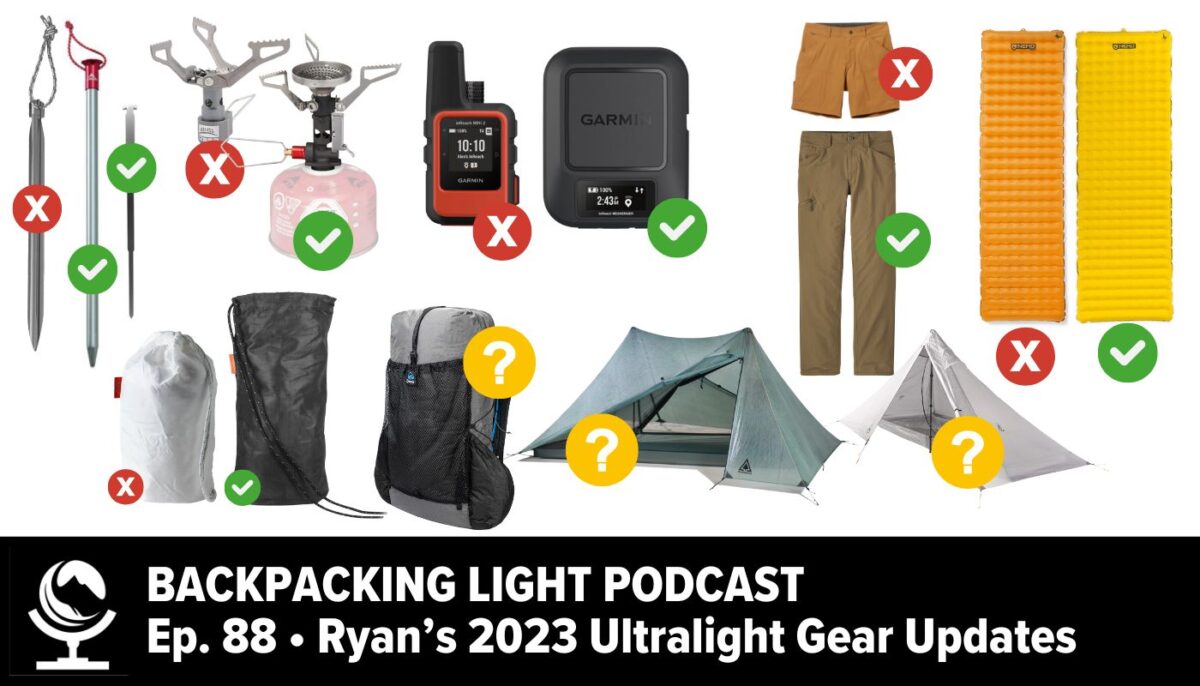
The Publisher’s Gear Guide has been updated. This gear guide contains recommendations in various categories by Backpacking Light Publisher and Founder Ryan Jordan. This is the gear he actually chooses to use on his own trips.
The Publisher’s Gear Guide has been updated as of November 3, 2023.
From the Publisher’s Gear Guide: “My purpose with this gear guide is to share the gear that I’m currently using on my own backpacking trips and other outdoor adventures. Some of the products I discuss are those that have been in my kit for several years. Others are new to my kit this season.
Because this gear is the gear I choose myself (and often represents the gear that I’ve actually purchased with my own money), the selections here represent my personal recommendations of sorts.” – Ryan Jordan, Backpacking Light Publisher and Founder
Questions for the Community
Reply in the comments below:
What’s been your favorite gear this year?
Given that you may have multiple options within the same category, what are the use cases where you select one of your products over another?
The MSR Pro Bivy weighs less than 10 ounces (285 g). It’s a very compact, feature-less bivy sack that embodies the essence of bivy sack camping.
“They are the best of nights: they are the worst of nights. The modern lightweight tent has opened up the wilderness – but for an increasing number of people, the lightweight tent is just a bit too civilised. Can you really experience nature’s rawness from inside a zipped-up storm-flap? For those who want to bring a bit of old-fashioned pain and suffering back into the outdoor experience, the bivvybag is the place to be.” – Ronald Turnbull, The Book of the Bivvy.
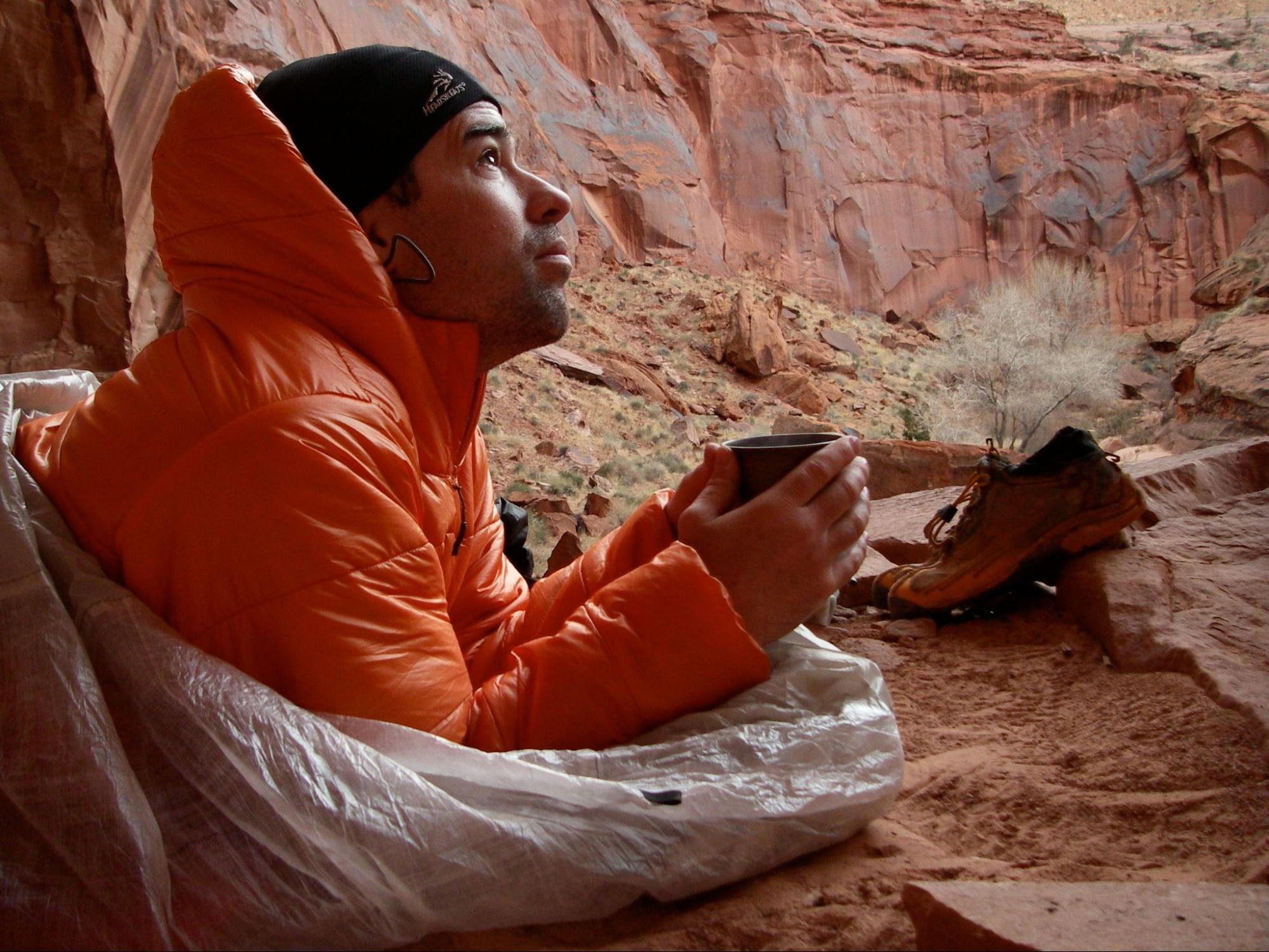
Bivy camp, Grand Staircase-Escalante National Monument, 2006. This was a simple, homemade bivy sack with a Cuben Fiber floor and Pertex Quantum upper, drawstring closure.
My experience camping in a bivy sack can be traced to the late 1980s when I started properly exploring the wilderness in Washington State’s Olympic Range. A bivy sack was the second shelter I owned (a blue plastic tarp was the first). Mine was made by Moonstone Mountaineering, fashioned from 2-layer Goretex that was both questionably breathable and questionably waterproof. These dubious qualities, combined with the fact that the Olympics enjoy more than 100 inches of annual rainfall, probably made for both pain and suffering. Interestingly, I remember very little of that. What I do remember are the nights spent in rainforests and meadow edges, atop basalt ridges and peak summits, and on platforms of ice carved into a glacier with my fiberglass-handled ice axe. They were some of the most memorable and rewarding nights of my entire life. Sure, some nights were wet. Many nights were a little chilly. But the discomfort never dampened the fond memories. Waking up to a baby goat sniffing my forehead. Outrageous sunrises. The solitude of sleeping in remote alpine perches large enough for only one human body.
It is from this context that I’m reviewing the MSR Pro Bivy sack, a modern day, 2-layer shelter bag devoid of features, and about as breathable and water-resistant as my Moonstone bivy sack from 40 years ago.
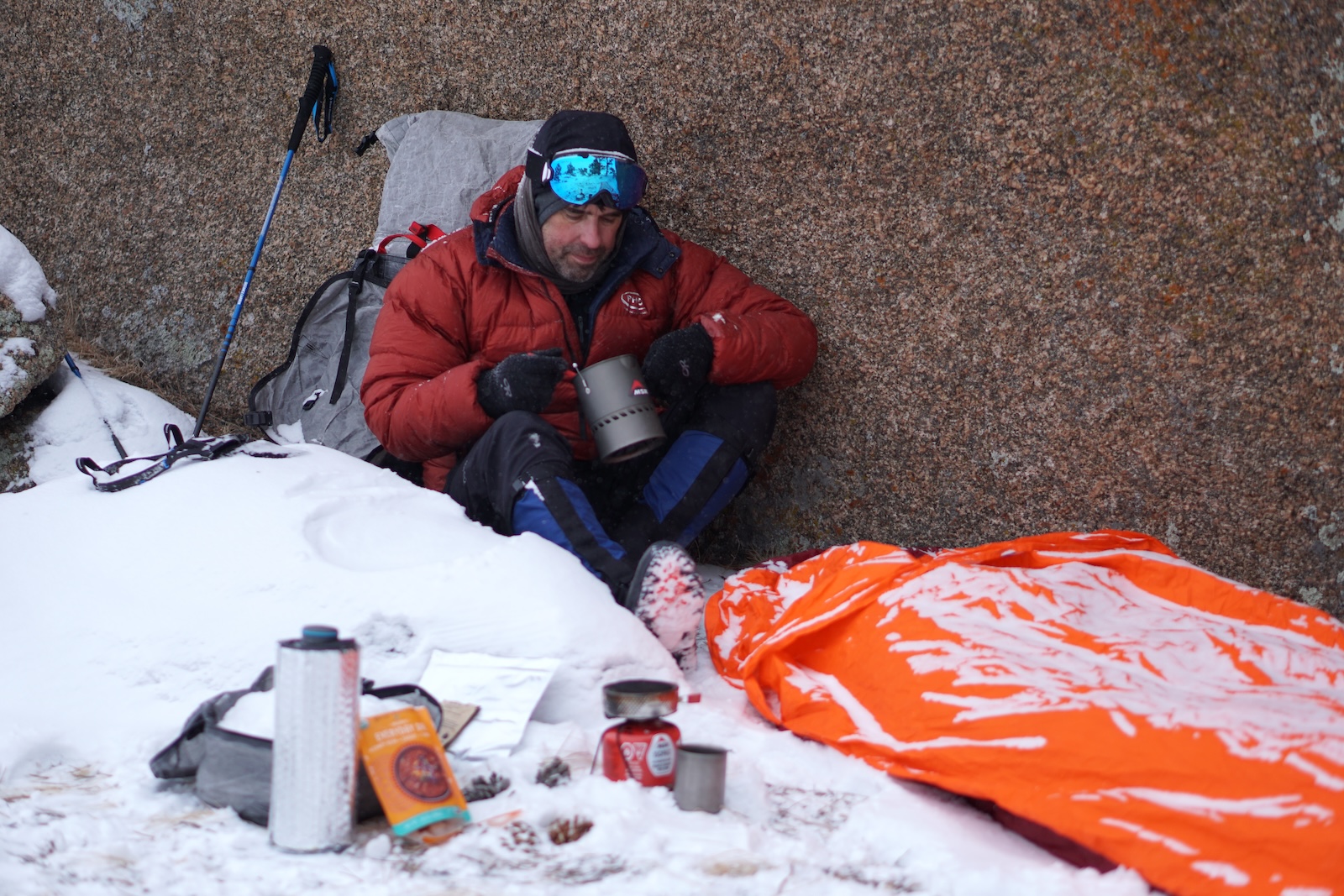
Sheltering behind a large granite boulder, Sherman Range, Wyoming. High temperatures in the 0’s °F.
MSR writes in its marketing copy for the Pro Bivy, “Designed for professional alpinists and serious adventurers…” Whenever I read something like this, I immediately translate it to “Saves weight by removing features that will result in pain and suffering unless you are a professional alpinist or serious adventurer.”
Specifications: MSR Pro Bivy
Length: 88 inches / 224 cm
Width: 36 inches / 91 cm
Weight: 10 ounces / 285 g
Packed Size: 8 x 4 inches (20 x 10 cm)
Upper Fabric: 20D ripstop nylon 2-layer breathable 1000 mm
Of course, this type of marketing may be attractive to those of us who pose as serious adventurers, even though we will invoke complex reasoning (even if executed by our monkey brain) to justify why we won’t be packing a bivy sack on our next trip!
That’s why I get a little worried about my faculties (mental or otherwise) when I get excited to use my bivy sack as my sole shelter.
To that end, the MSR Pro Bivy has re-ignited that excitement in this phase of my life. It reminds me of my 20s, when there was no decision-making matrix between choosing a tent, tarp, or bivy sack. The bivy sack always won.
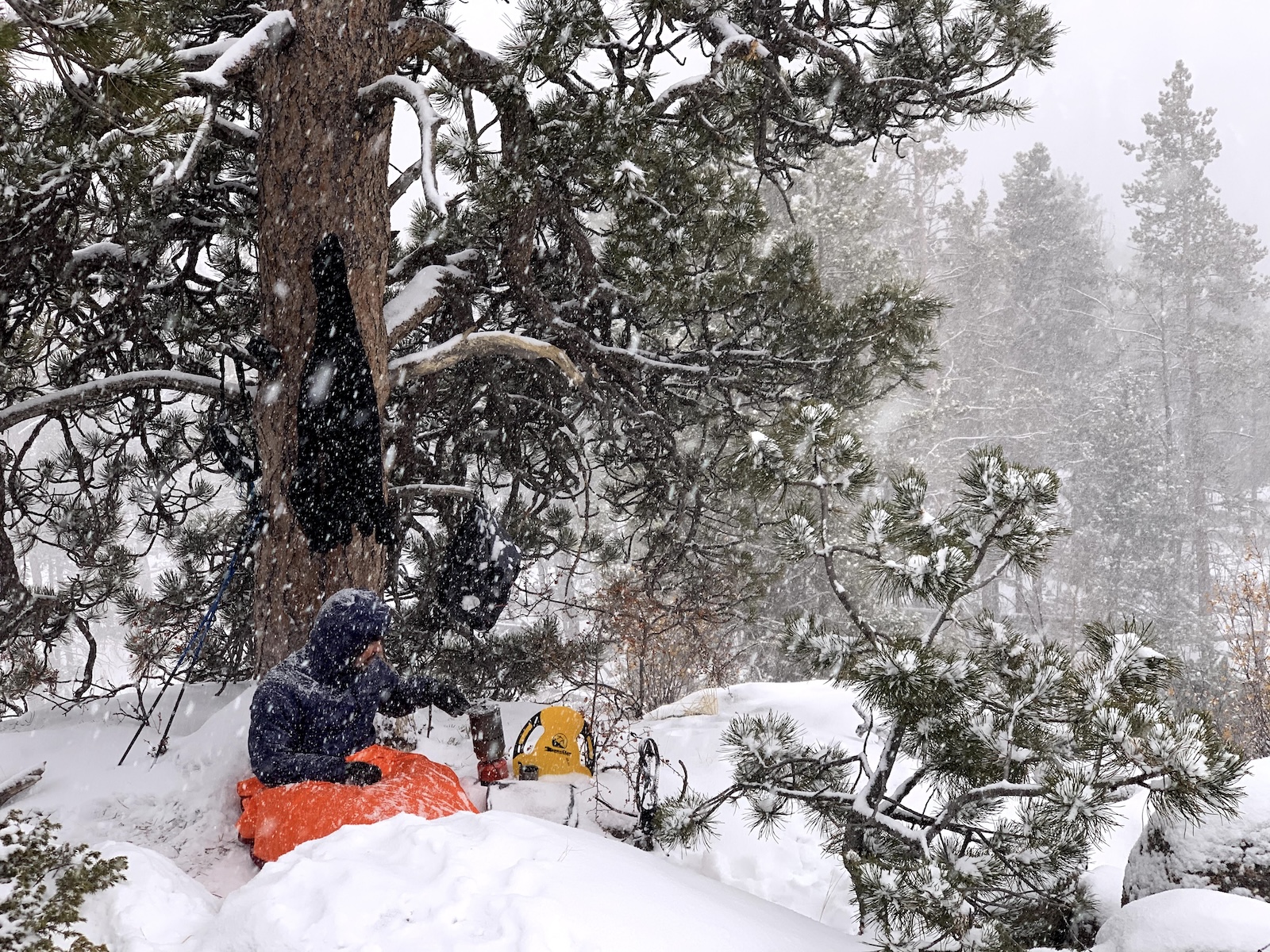
Bivy camping with the MSR Pro Bivy under a ponderosa pine, Wyoming.
Here’s why I love my MSR Pro Bivy vs. other bivy sacks I’ve used in recent years:
1. Its compact pack size. While it lacks the breathability and condensation management offered by other bivy sacks made with 3-layer waterproof-breathable fabrics, the packed size of the MSR Pro Bivy is tiny. I can stuff it into the smallest nooks and crannies of my backpack.
2. Its generous room for gear storage, thick sleeping pads, and winter sleeping bags. An 88-inch length gives me plenty of room for gear storage in the hood of the bivy (including, often, my backpack).
3. Its pitching and design simplicity. No stakeout points, no poles, no zippers. Just fabric. Nothing to break, fiddle with, or adjust.
Some of these features, of course, are also limitations. The 2-layer PU-coated fabric and lack of pole structure means the MSR Pro Bivy is not great at managing interior condensation. The zipperless design means that you are protected from the elements only by two overlapping layers of fabric at the hood end, exposing the bivy a little bit from rain, spindrift, and insects.
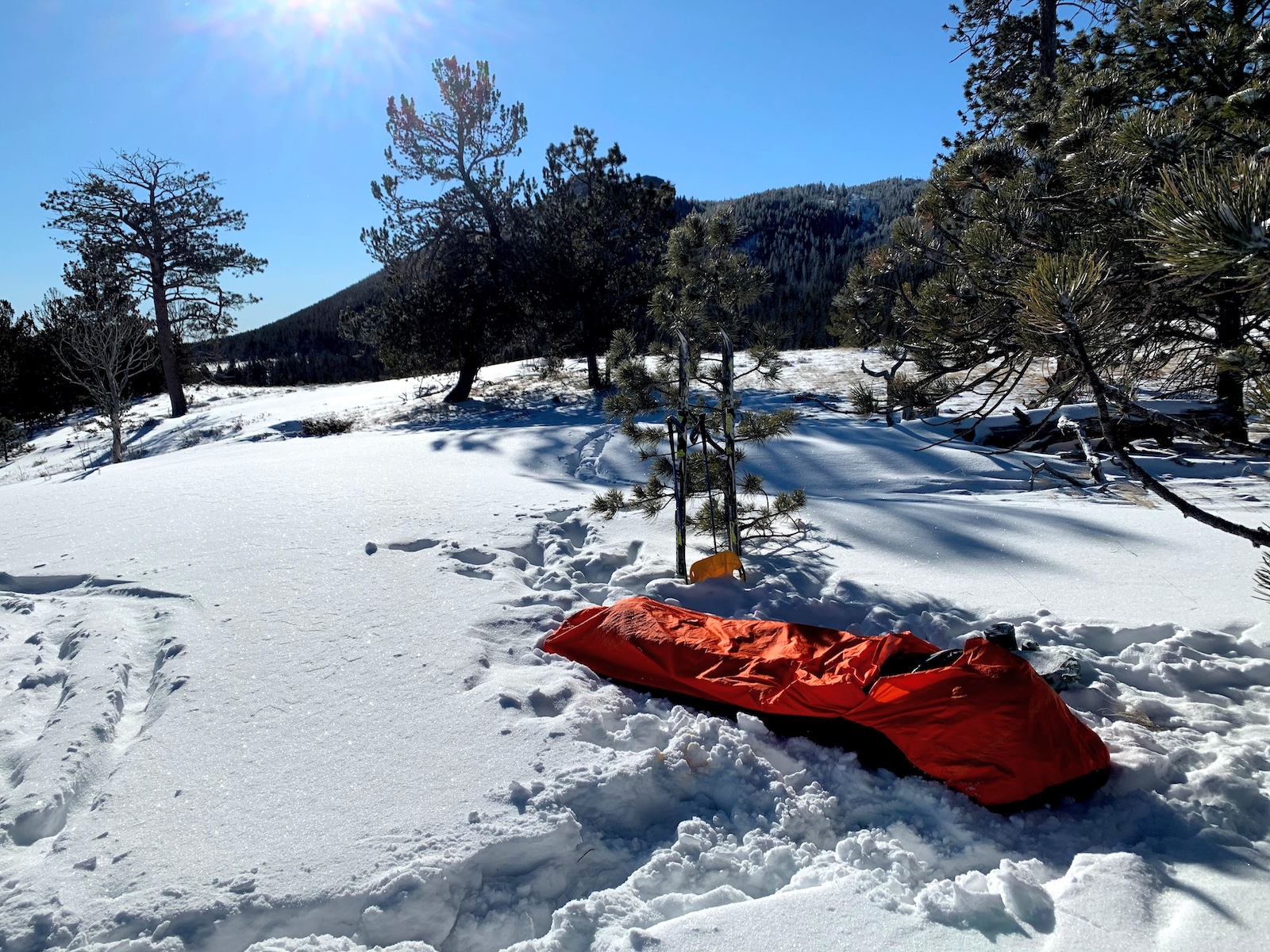
Bivy camp with the MSR Pro Bivy during a Wyoming winter ski trip.
But for me, these are the usual limitations of ultralight bivy sacks, and I’ll happily take them in exchange for a 10-ounce shelter that I don’t need to “pitch”.
In conclusion, if you’re shopping around for a full-featured bivy sack with poles and stake loops and mesh windows and zippers, you’re going to have a hard time justifying its weight and cost. Consider instead something like a Gossamer Gear Whisper (9.8 oz), ZPacks Plex Solo (12.3 oz) or a Durston X-Mid Pro 1 (15.7 oz), all of which will provide far better livability than any full-featured bivy sack on the market for less weight.
But if The Book of the Bivvy sits next to your favorite religious text on your bedside table, then the MSR Pro Bivy may be exactly what you’re looking for. Unlike other bivy sacks, which ruined bivy sacking for generations of users with bells, whistles, and features that make them feel more like really bad tents than really good bivy sacks, the MSR Pro Bivy embodies everything about bivy sack camping that makes bivy sack camping an immensely satisfying way to enjoy the backcountry.
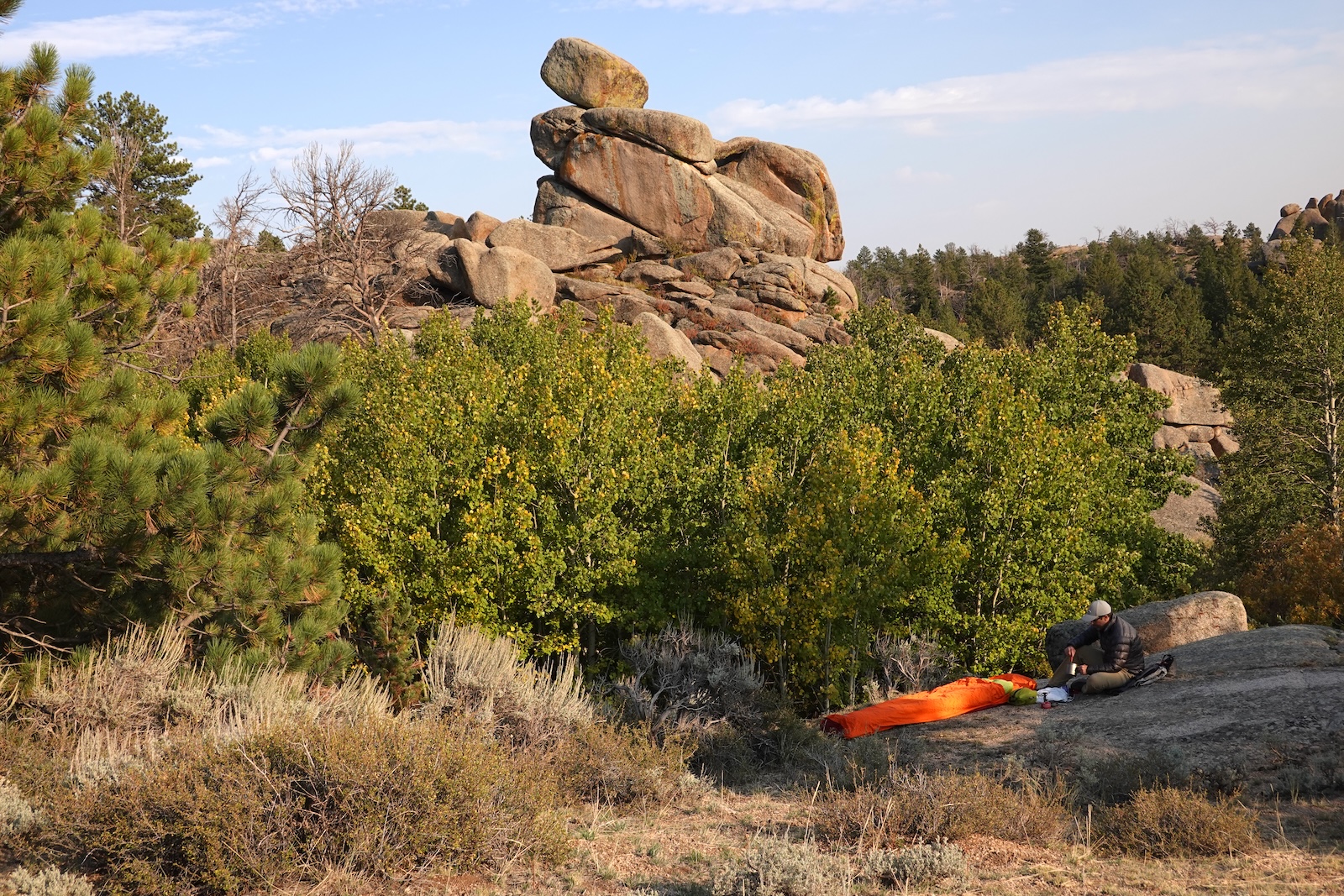
Springtime bivy with the MSR Pro Bivy, Laramie Range, Wyoming.
Product mentions in this article are made by the author with no compensation in return. In addition, Backpacking Light does not accept compensation or donated/discounted products in exchange for product mentions or placements in editorial coverage.
Some (but not all) of the links in this review may be affiliate links. If you click on one of these links and visit one of our affiliate partners (usually a retailer site), and subsequently place an order with that retailer, we receive a commission on your entire order, which varies between 3% and 15% of the purchase price. Affiliate commissions represent less than 15% of Backpacking Light's gross revenue. More than 70% of our revenue comes from Membership Fees. So if you'd really like to support our work, don't buy gear you don't need - support our consumer advocacy work and become a Member instead.
Learn more about affiliate commissions, influencer marketing, and our consumer advocacy work by reading our article Stop wasting money on gear.
The Granite Gear Crown2 60 is a 60 liter capacity internal frame backpack that carries up to about 35 pounds comfortably and weighs around 2.1 to 2.5 pounds.
Introduction
The Granite Gear Crown2 60 is a versatile and inexpensive pack. At a weight of about 2.1 to 2.5 pounds / 0.9 to 1.1 kg (depending on size and configuration), it’s neither ultralight nor heavy. Considering that it carries up to 35 pounds (16 kg) comfortably, its load-carrying performance-to-weight ratio is reasonably high. It features an internal frame, an adjustable hip belt, and a 5-liter lid, all of which are removable. It has large mesh pockets on all three sides and a useful compression strap system.
Features and Specifications
Features
Padded adjustable hip belt with pockets (from 26 to 42 inches / 66 to 107 cm, removable)
Rated for a load-carrying capacity of 35 lbs (16 kg)
Large rear and side mesh pockets
Molded foam and mesh back panel
Load lifters
Compression strap system
Multiple attachment loops
Hydration compatible
Roll-top closure with over-the-top cinch for carrying a bear can
Weight
Torso Length
Pack Weight (including belt and frame sheet but not the lid)
Lid Weight
Total Weight
Short
2.1 lb (0.95 kg)
0.16 lb (0.073 kg)
2.26 lb (1.03 kg)
Regular
2.2 lb (1.00 kg)
0.16 lb (0.073 kg)
2.36 lb (1.07 kg)
Long
2.3 lb (1.04 kg)
0.16 lb (0.073 kg)
2.46 lb (1.12 kg)
Capacity
Volume: 60 L (3,500 cubic inches)
Weight: 35 pound (16 kg) maximum carry capacity
Materials
High-Tenacity Nylon (100D and 210D) with Barrier DWR
Compression molded polypropylene frame sheet
Description of Field Testing
The Granite Gear Crown2 60 was my first pack that saw extensive use. It served me well on a thru-hike of the Colorado Trail. I have since moved on to a smaller and lighter pack as my go-to pack, but the Crown2 60 still sees plenty of use due to its large volume and ability to carry comfortably across a wide weight range.
I have tested this pack on approximately 800 miles of mostly on-trail travel, across all seasons and most weather conditions. Testing environments and activities included the entirety of the Colorado Trail, multi-day desert backpacking, and cross-country ski hut trips. I have tested the carrying capacity up to the recommended 35 pounds (16 kg) limit, as well as stripped down as a day pack loaded with less than 5 pounds (2.3 kg) of gear. Its simplicity and highly adjustable waist strap mean that it is also the pack that I lend out most frequently, and this review will incorporate the feedback from other users who have borrowed my pack.
Performance Assessment
My performance assessment of the Granite Gear Crown2 60 is based on the following considerations:
Accessibility and Organization
Comfort
Durability
Stability
Accessibility and Organization
This pack has one large main pocket with a roll-top enclosure and cinch strap, with no internal organization. The sleeve that contains the removable internal frame ostensibly doubles as the hydration sleeve, with a small hook to hang a water bladder (which I use to clip my keys).
Externally, the Crown2 60 has three very large stretch pouches. The rear mesh pouch is easily big enough for a shelter, warming layers, or rain gear. The side mesh pouches (replaced in newer models with Robic nylon) are large enough to fit three 1L Smartwater bottles, but the mesh does not taper towards the front as dramatically as it does in other packs. The depth of the side mesh allows more gear to be stored securely at the cost of less access while hiking. If you do not have flexible shoulders, reaching the side mesh pouches requires taking the pack off or asking for help from a friend. I added a Zpacks Water Bottle Sleeve to one of the shoulder straps, which eliminated this frustration. Current versions of this pack also have a drawstring at the top of the side mesh pouches for added security.
The hip belt pockets are large enough to securely hold any small items that I need accessible while hiking. I have found that filling one pocket with all the snacks I expect to eat during the day leaves room in the other pocket for my phone, a map, a mini chapstick and sunscreen, and more. The zippers on these pockets are more easily pulled from a certain angle and can be difficult to operate one-handed if the pocket is mostly empty.
The last pocket is the completely removable lid, which adds 5 liters of extra storage. In my usage of the pack, I have never needed this extra storage, but when loaned out to friends, they used the lid with no complaints. The lid can be attached over a bear canister if needed, but it’s not required to secure a bear canister (which can be secured using top compression straps). Note: I have not tested this pack with a bear canister.
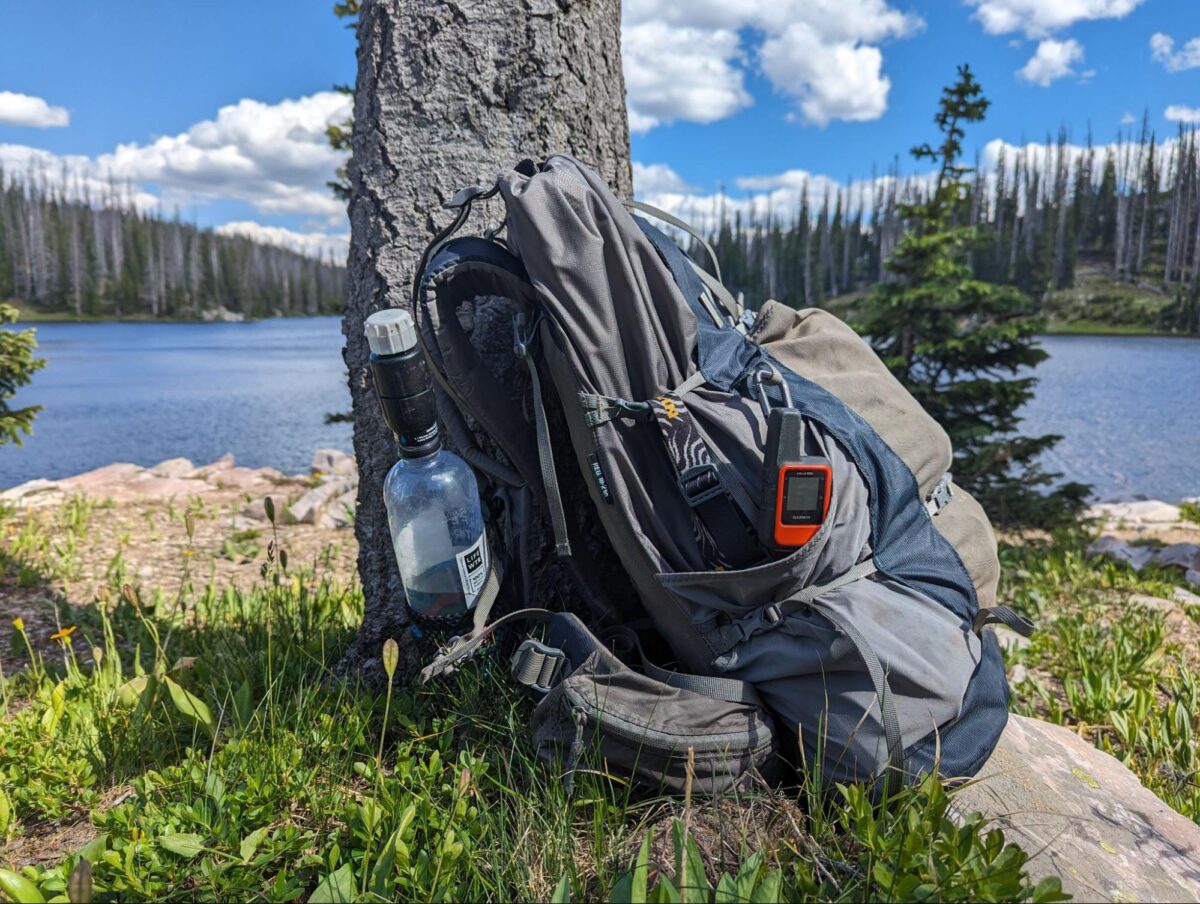
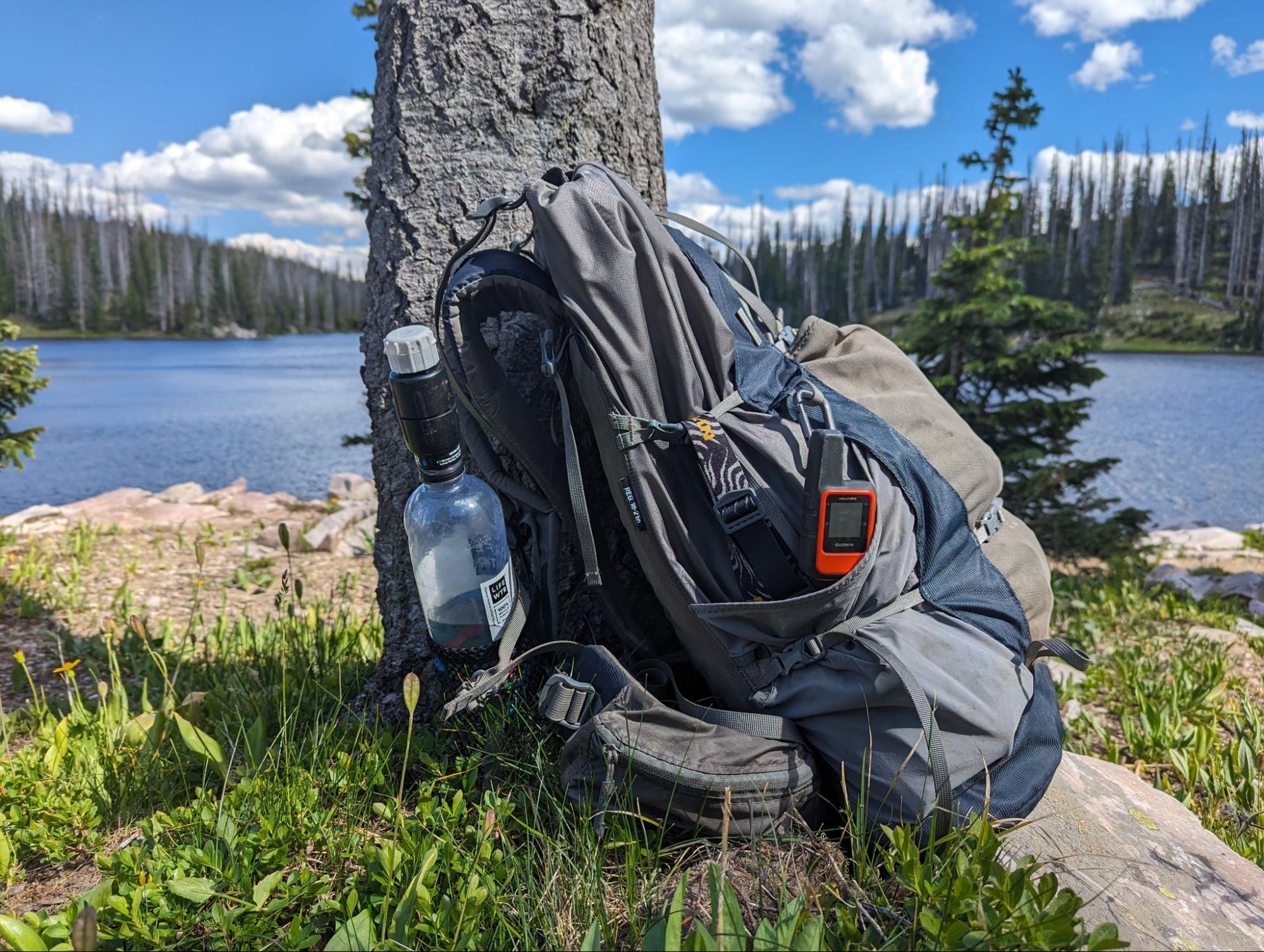
The Crown2 60 has two larger loops at the bottom of the pack that can be used to attach an ice axe, trekking poles, or shelter. It also has two smaller loops that are meant for attaching the removable lid, which are too small for larger items but are an easy place for a carabiner or cord attachment. It also has six compression straps, making for an adaptable compression system. The lower side straps can be threaded underneath the mesh pouches, or kept on the outside to secure the contents of the pouches. The upper side straps are 4 to 5 inches (10 to 13 cm) above the top of the straps and can be used to secure taller items like trekking poles. I also use this strap to secure my Garmin inReach Mini and headlamp.
Overall, the pack has lots of secure storage space, with an acceptable amount of storage accessible while walking. With the simple addition of a shoulder strap water bottle holder, the pack allows for easy organization and accessibility of all of my gear.
Comfort
This pack is very comfortable for my body type when used within the recommended weight range. The highly adjustable hip belt, internal frame, and harness work together well to pull the pack close to my body and transfer weight to my hips. Other testers included men and women ranging from 5’4” (1.6 m) to 6’ (1.8 m) tall, all of whom found similar results with my medium torso length pack.
The hip belt rubbed on my hip bones enough to leave them discolored by the end of a day of hiking, but never developed into open sores or became painful. While the hip belt fits most user’s hips comfortably, a two-strap system would give more freedom to dial in the fit by allowing the load to be better distributed across more hip belt surface area.
The shoulder straps are less than perfect; they are too thin to distribute heavy loads and the sternum strap is not well designed to position the straps comfortably. Above a pack weight of about 30 pounds (13.6 kg) they begin to cut into the wearer’s shoulders. However, at lesser pack weights, the hip belt takes almost all of the weight easily and the thin shoulder straps become a non-issue.
The sternum strap buckle is small enough to be frustrating to open or close with cold hands or while wearing gloves, and the thin strap connecting the harness to the bottom of the pack can at times rub on the wearer’s ribs. Lastly, the back mesh panel and air flow vents don’t significantly increase air flow – my back is sweaty while wearing this pack in most if not all conditions. The new version of this pack, the Crown3 60, has ditched the mesh for a molded foam back panel; time will tell if this fixes the issue.
If you remove the internal frame as advertised, the pack quickly devolves into a puddle of unstructured fabric. Do not buy this pack with the intent of using it frameless.
All that said, this is one of the more comfortable packs I have used for carrying less than 35 lbs. When fitted well to my body, it sits with all of the weight on my hips, and the shoulder straps simply pull the pack tightly to my body. On long mileage multi-day treks, I have never been uncomfortable using this pack in a way that a short strap readjustment could not fix.
In summary, it’s comfortable, but don’t expect to push it beyond its load-carrying capacity.
Durability
My Crown2 60 has lasted for hundreds of miles with impressive durability. The only damage sustained is a pinhole in the rear mesh pocket which has not grown bigger with time. All straps, buckles, and zippers are working and intact, even the delicate-seeming sternum strap buckle. The pack only shows its age and mileage on the rare occasions when the lid is attached, which has only a few dozen miles on it and still looks almost brand new. I am not particularly gentle with my packs, often sitting on them and taking them on rock scrambling or canyoneering expeditions.
Stability
The design of the hip belt, internal frame, and shoulder harness provides a stable pack that does not shift when rock scrambling or moving over downed logs. It feels like part of your body, moving with you as you move. Even if the weight is positioned awkwardly through hasty packing, it does a great job of distributing the weight to your body – because of the wide range of adjustability in the harness and compression system.
On an overnight backpacking trip to a hot spring, one friend asked to borrow a pack, and I happily offered my Crown2 60. It was not until we arrived at the trailhead that we realized the sheer amount of gear they intended to bring – including a 7+ pound (3 kg) Walmart car camping tent and a large bear canister. We did a shakedown to leave any unnecessary items at home, but still had a lot more gear than we were expecting. My wife and I gave our friends our smaller and lighter packs and I carried the Crown2 60 packed to its limits, likely right at or above 35 pounds (16 kg). While this was at the limit of comfort for the thin shoulder straps, the pack still hugged my torso well and I had no problems climbing over avalanche debris or fording streams.
On a separate trip to the Black Ridge Canyons Wilderness, I was able to climb and scramble with 10 pounds (4.5 kg) of water sloshing around inside the pack. While I have fallen many times while wearing this pack cross-country skiing, the falls were always due to my technique, not from the pack disrupting my balance.
Use Cases
This pack (in a size Medium torso length) is 35.2 ounces (1 kg) without the lid, which is 7 ounces (0.2 kg) heavier than my Mountainsmith Zerk 40. The Crown2 60 can only comfortably carry up to about 35 pounds (16 kg), which is on the lighter side for 60 L packs. This pack is not a finely-tuned scalpel for a hiker with a well-dialed-in kit. However, I find myself using it consistently for many situations in which it excels. These situations include winter hiking, long water and food carries, short trips, and as a loaner pack to friends.
Winter Activities
When backpacking or cross-country skiing in the winter, I love having the extra room to carry all the puffy insulation I need to stay warm. I can also carry heavier items, such as a large pot to melt snow. The compression straps and loops make attaching poles, snowshoes, and other winter equipment easy.
Long Water and Food Carries
When hiking in the Black Ridge Canyons Wilderness, this pack’s ability to comfortably carry a significant amount of water weight allowed me to travel much deeper into the canyonlands than with my Zerk 40 (which has a lower comfortable load-carrying capacity). It allowed me to finish the Colorado Trail in a COVID-shortened period by letting me skip multiple town days and rely on larger resupplies.
Short-Distance Trips
A quick overnight close to the car is a great opportunity to have a pack that can handle a six-pack, a little firewood, a four-person tent, or any other camping luxury.
Loaning to Friends
This pack is simple to use, and the wide range of adjustment on the hip belt means that anyone roughly my size can use this pack comfortably. It can easily handle a less-than-ultralight kit for trips that do not have long food or water carries.
Entry to Lightweight Backpacking
The same reasons this is a great loaner pack make it a great first entry into reducing your pack weight. My Colorado Trail thru-hike was the first backpacking I had done since the Marine Corps, where my body armor alone weighed more than my fully loaded Crown2 60. The easy learning curve of this pack makes it easy to recommend or gift to someone interested in starting to lighten their pack.
Comparisons
Pack
Granite Gear Crown2 60
REI Flash 55
Gossamer Gear Mariposa 60
MSRP
$200
$200
$285
Weight (Size M)
38 oz (1077 g)
42 oz (1191 g)
32.7 oz (927 g)
Capacity
35 lb (15.9 kg)
30 lbs (13.6 kg)
35 lb (15.9 kg)
Materials
Main: 100D High-tenacity nylon with NeverWet liquid repelling treatment, Bottom: 210D High-tenacity ripstop nylon with NeverWet liquid repelling treatment
100-denier ripstop nylon main body; 420-denier nylon bottom
100 denier Robic high-tensile strength nylon; select use of 200 denier Robic high tensile strength nylon, 70 denier double-rip ripstop nylon, Darlington Mesh, and Supreme Air Mesh
Frame
Polypropylene, removable
Steel, non-removable
Air Flow SitLight Camp Seat, removable
Exterior Pockets
5
9
7
Hipbelt
yes, load bearing, with pockets
yes, load bearing, with pockets
yes, load bearing, with pockets
Closure
Roll top
Roll top
Over-the-top
External attachment Points
2 ice axe loops, 6+ cinch straps
1 ice axe loop, 5 cinch straps
1 ice axe loop, 1 trekking pole attachement site, 2 cinch straps, multiple webbing tie on sites
The Granite Gear Crown2 60 balances good value, versatility, and lightweight functionality. With an MSRP of $219.95, it is often available at much lower prices during sales – I purchased mine new for $110, and it is currently available from Granite Gear for $120. It offers a wide range of uses, from winter overnights to extended backcountry ventures. For those seeking the most ultralight solution or needing to carry more than 35 pounds (16 kg), other options might prove more suitable. For me, the Crown2 60 saves me money and garage space by filling many roles in my outdoor adventures.
Photos
Following: a collection of random photos of the Granite Gear Crown2 60 in use on day hikes, winter trips, backpacking trips, and as a loaner pack.
Join Ryan Jordan and a demon virus on a trip that brings early-season winter to Rocky Mountain National Park.
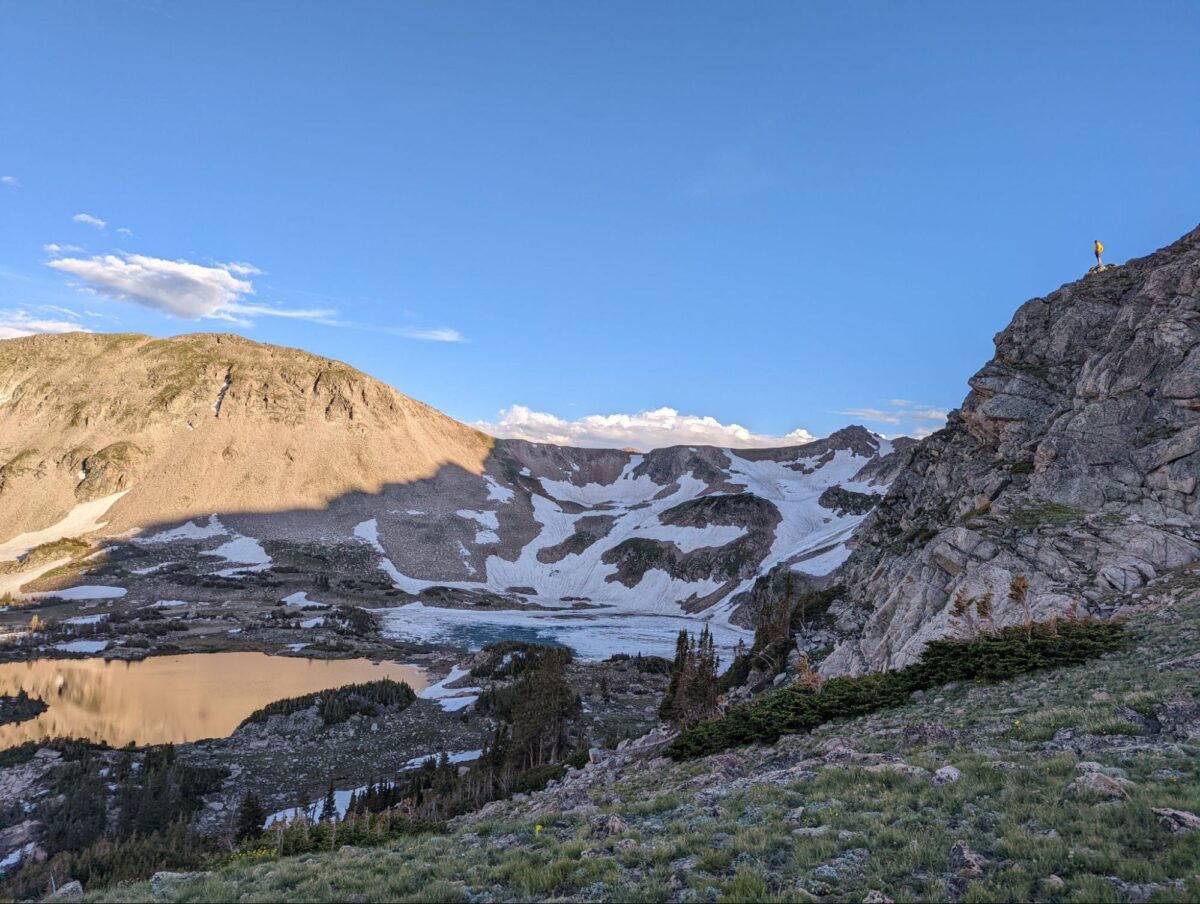
The first snows of fall make me happy. I live at 7,500 feet above sea level, and my town is rimmed by mountains that are prettier when they’re snowy. While I appreciate their majestic rock faces, I like them more with a bit of white on them. Even more, I like experiencing early-season snow while hiking and camping in them.
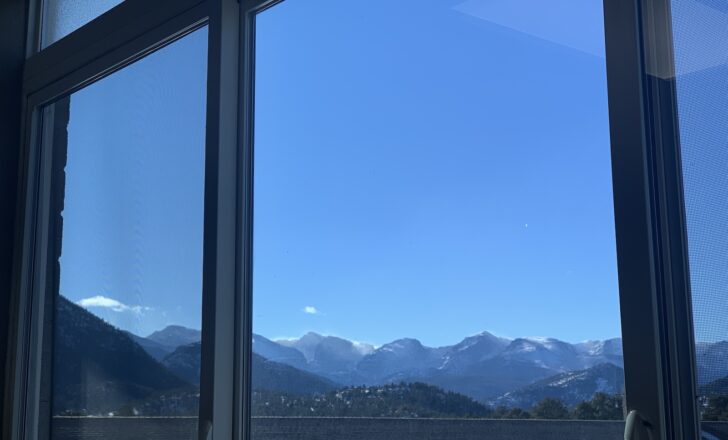
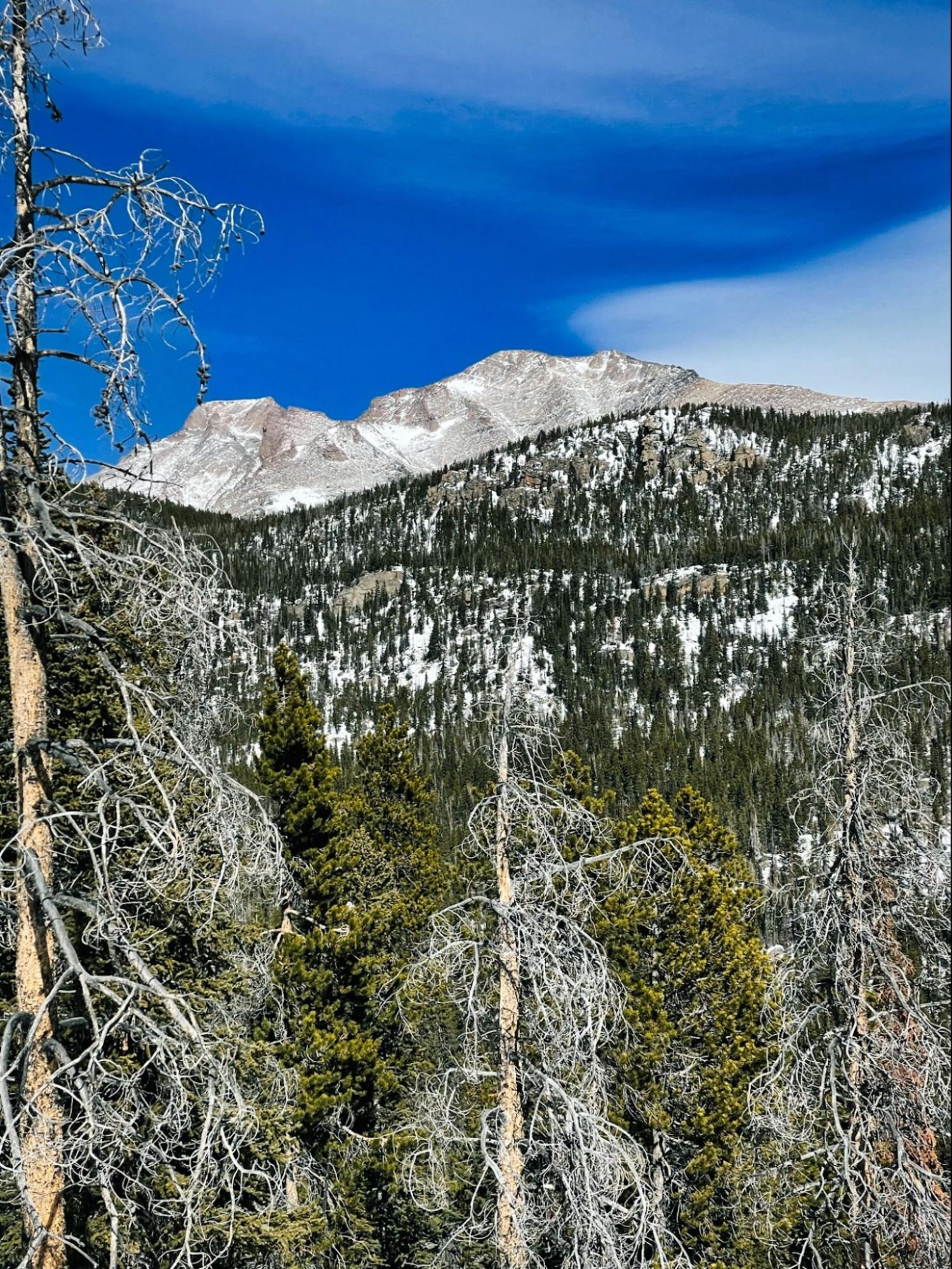
Our office window is a portal to the 12,000-foot peaks of the Continental Divide in Rocky Mountain National Park. It’s distracting enough that I had to move my desk away from the window. Out of sight, out of mind.
So when the weather forecast started to go south, I started packing.
With a forecast of a few inches of snow, this trip would be my transition out of summer gear and into fall gear.
Gear Notes
Some of the changes I made to my hiking clothes:
Hiking pants – replaced thin polyester pants with warmer prAna Stretch Zion softshell pant
Hiking shoes – hung up breathable trail runners for La Sportiva Ultra Raptor Wide GTX Mid Boots, oversized two sizes to accommodate extra insulation, leave toes less constricted
I still carried a 20-degree down quilt for sleep, but since I was to sleep on snow, I opted for the NEMO Tensor Extreme Sleeping Pad and added a double-walled tent (Tarptent Notch Li with Solid Inner) for a few extra degrees of indoor temperature.
Other than that, I stuck with the majority of the rest of my summer kit, and it served me well enough. Next time, though (note to self): booties and puffy pants.
Trail Notes
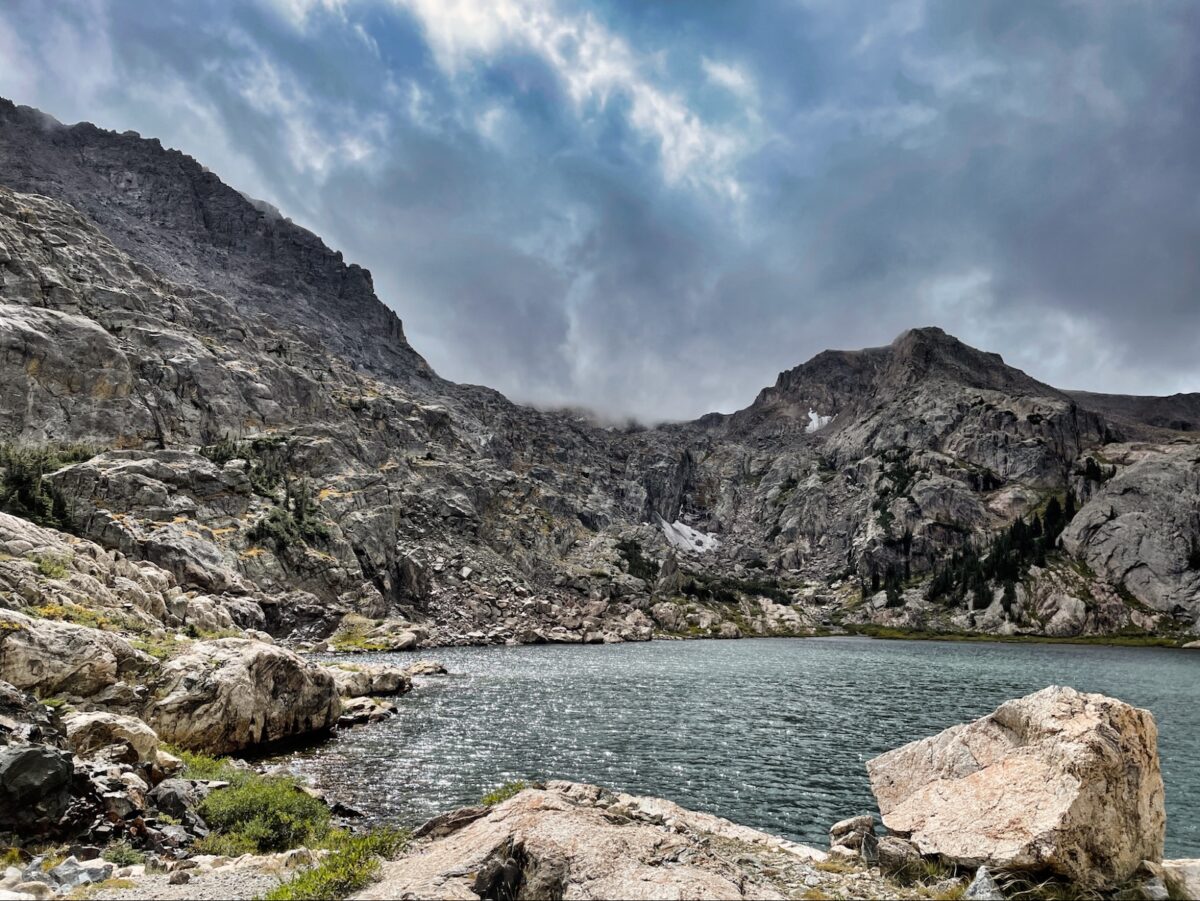
When I left the 8,500-foot trailhead at around noon, it was 45 °F and cloudy. Four hours later at my destination (an alpine lake at 11,000 feet), it was 29 °F and snowing. The trail was dirt up to about 10,000 feet, then patchy snow. As I passed little streamlets here and there with tiny icicles dangling from their rocks, I chuckled a little bit, thinking, “C’mon, it’s not that bad yet.” I’d rethink that sentiment the next morning.
By the time I reached 10,500 feet, snow was sticking to the trail, and the mountains were silhouetted in the clouds.
Squirrels were frantically dropping pine cones and building their seed caches as if on a sunset deadline. A chipmunk scurried over my feet, cheeks full, while I was hiking. It tripped over my shoelace and careened off my shin in a slightly different direction than intended.
By early afternoon, the wind started to blow. Five miles an hour, then ten, then fifteen. I layered. First, the fleece hoody. Then, gloves. Then, rain jacket and pants. Then, rain mitts. Then, sunglasses (?) to avoid the stinging of snow in my eyes, in spite of the fact that the skies were darkening.
Camp Notes
My camp was located above the lake and somewhat protected in the trees. However, by late afternoon the temperature had dropped to 21 °F and the wind had picked up, gusting through camp at 20 mph. Wearing all of my clothing, I was starting to shiver, so I retired into my tent.
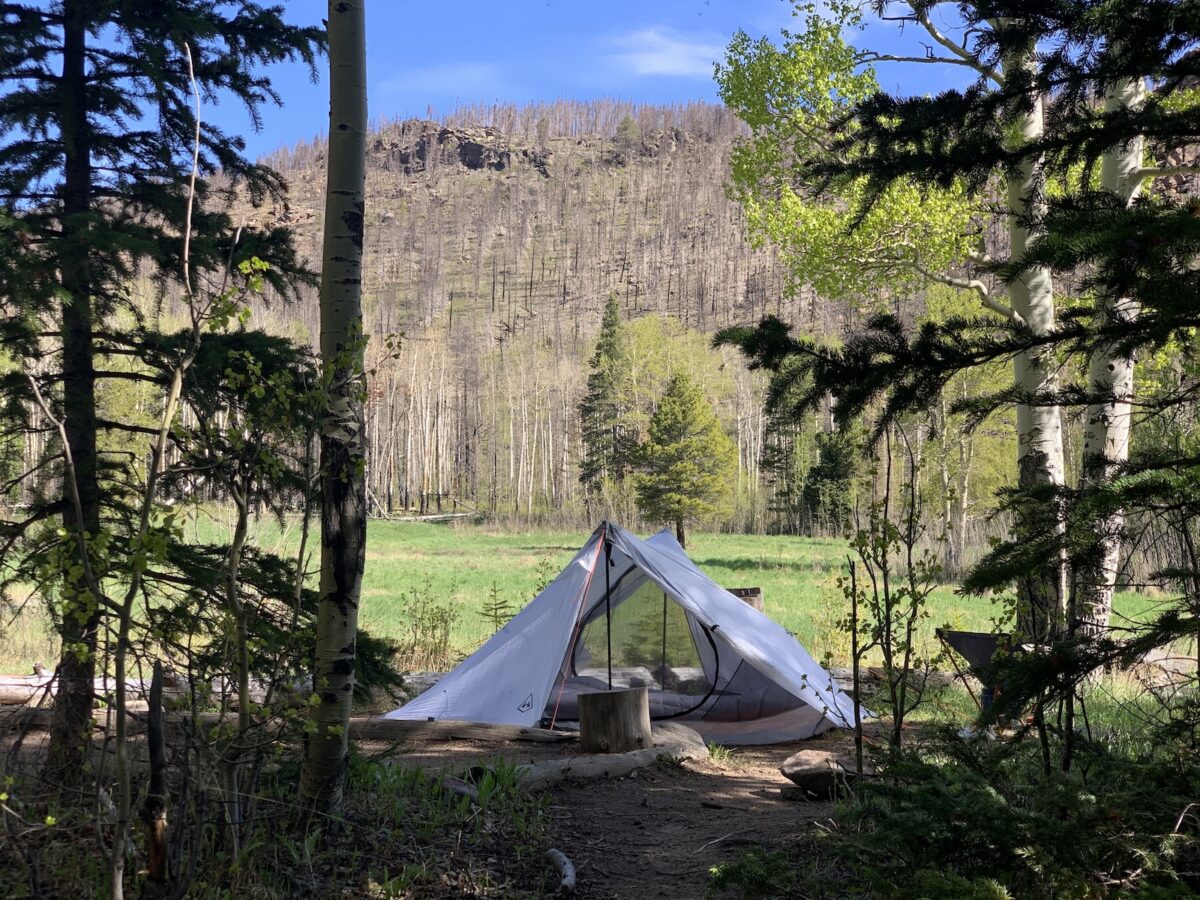
Tarptent Notch Li with solid inner.
I crawled under my quilt, brewed coffee, and listened to a podcast. I then napped, awakened here and there by the freight train sound of the wind on the 13,000-foot peaks surrounding my camp. A nearby tree was starting to sing and squeak, its lower trunk weakened by the presence of a 1-inch crack splitting its lower trunk. Fortunately, it was leaning away from me.
After darkness enveloped my camp, I mustered up the courage to exit my tent to cook dinner, not in the mood to spend any more time in the confines of the little tent than I had to. It was snowing harder now, so I set up my chair, hunkered under a light tarp that I’d pitched nearby, and boiled water. I meditated for the 18 minutes or so it took to rehydrate my meal under my parka, trying to will away the occasional shiver. After eating and cleanup, I checked my outside sensor: 17 °F. I retreated back to the tent with a full belly and the fatigue of the day’s elevation gain. Sleep came easy.
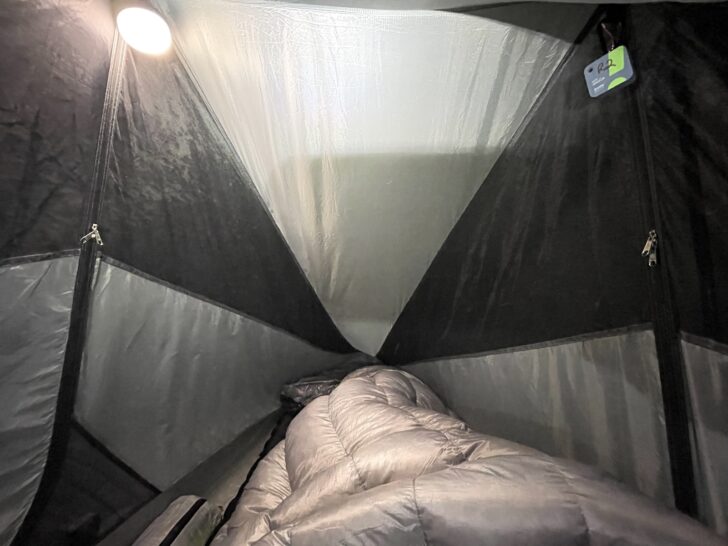
I use environmental sensors to collect data (temperature, humidity, dew point, barometric pressure, and vapor pressure differential) at various locations in camp and in my shelters. On this trip, I placed one sensor outside, and three more at various locations throughout the double-walled tent (see one on the upper right near the trekking pole in this photo) to observe the variability in conditions and how the data correlates to observed condensation. I added a little LED lantern (upper left) for a little cheer during the long night.
Two hours later, I woke up, coughing spectacularly and shivering, and a sense of dread came over me. Chase had the flu this week, and I thought I’d escaped it. But it was just incubating with me during my hike in and didn’t go rogue until the demon virus knew I was trapped in this mylar-and-UHMWPE winter coffin, far from the warmth of my bed back home.
It was a long night. Sleep came in spurts, 20 minutes here, 30 minutes there. Other than the 25-minute break for dinner and two late-night pee breaks, I would spend 16 hours in the tent.
Morning Notes
I woke up for good at around 8 AM. I could see blue sky through the paper-thin walls of my tent, but the wind remained belligerent.
Morning brought fresh snow, blue skies, and frigid temperatures.
I checked my sensors: 14 °F outside, 17 °F inside my tent. Too many hours spent in a prone position while battling the onset of the flu left my back sore. I had to get out of bed at some point, now seemed like a good time.
I was already fully dressed, so all I had to do was stuff my sort-of-warm feet into my sort-of-cold boots. After relieving myself, expelling the phlegm from my congested sinuses, and making a cup of hot coffee, the wind died. I took my coffee and quilt and walked the few hundred yards to the lakeshore. I found a dry rock, wrapped myself in my blankie, and let the sun and hot drink do its good work for the next half hour.
After the wind died down, the morning sun made me feel human again. My camp was in the trees below the large mountain on the right.
After eating a hot breakfast hash, I felt a little better, so I continued my work. Some gear testing, analyzing sensor data from the night before, a little writing, and some filming for a new module being presented during our current live online course cohort.
Finally, a little after noon, I packed up, messaged Stephanie with my pickup time and location, and started walking.
I would make it back just in time, virus in tow, and spend the next three days in bed.
Post-Trip Notes
It no longer surprises me how much colder the same temperature feels in October vs. July. A few things are going on here. The temperatures are sustained at colder levels for longer periods of time when days are shorter. The sun is lower, so there’s less radiative heat gain. Winds are stronger and more sustained. I have to remind myself time and again – don’t just pack for the coldest expected temperature – pack for the season. Reminder: booties and puffy pants (slaps head).
The Tarptent Notch Li with its solid inner tent is a fine fringe-season shelter. Its steep sidewalls shed snow well, and its small roof panels don’t really hold much snow before it sloughs off. However, DCF is a “cold” tent fabric (due to radiative heat loss), and the Notch solid inner tent is only partially solid – the upper sidewalls have large mesh windows in it. It’s not a warm combination, at least, not warm like a double wall tent with a polyester or nylon fly and full solid inner tent, which can offer interior temperatures that are 8 to 12 °F warmer than outside. In addition, while the solid inner kept the wind blowing under the fly out of my sleeping area, it did not prevent the ingress of fine spindrift throughout the night, and I found myself covered in a light dusting of snow and frost in the morning.
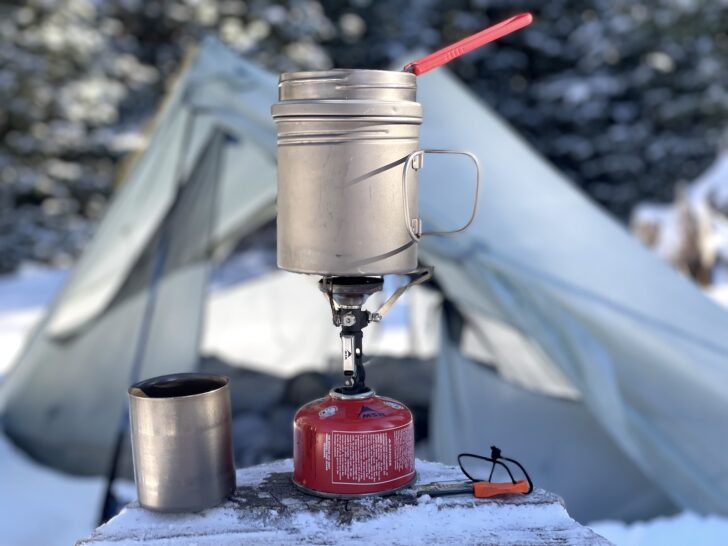
Cooking on an upright canister stove in breezy conditions (gusts of 5 to 12 mph atop the cut stump that was my cooking table) was fine. My water volumes were small (200 to 500 ml), and I kept my canister in my parka when not in use to keep it warm. I was using an MSR Pocket Rocket Deluxe (with no additional windscreen) and a Vargo Titanium BOT 700.
Not a winter stove, but good enough for winter conditions so long as the water volumes stay low and I keep the canister warm between boils.
I knew something was happening in my body before I started to show symptoms. The trail in was a steady, uphill drive (2,500 feet of elevation gain over about 6.5 miles). However, after two hours, something happened to my heart rate. The same grades on the first half of the hike that drove my heart rate into the 130s were driving my heart rate into the 150s during the second half of the hike. I saw this as a red flag, but ignored it, just thinking that the trail was getting steeper (it wasn’t). I didn’t really see the decay in my aerobic performance until I analyzed the data after my trip. In retrospect, I wished I had performed a heart rate variability (HRV) test the morning that I’d left. Almost without exception, I can predict the onset of sickness with an HRV test.
Drew Smith reflects on hiking in the places close to home as he explores a nearby mountain drainage during all seasons.
Most trip reports (mine included) focus on noteworthy locations — places that are some combination of remote, challenging, or distinctive. And although hiking may be harder in such places, writing about them is easier.
Photo: Drew Smith
But life, very much including the hiking life, is not always lived on the peaks. There is plenty of satisfaction to be found in just being in wild places, even if those places don’t have the biggest mountains, the tallest trees, or the showiest wildflowers.
If a place has pretty good forests, flowers, fish and fields, and it is close by, then you are lucky indeed. You have a retreat and a refuge, a place to go when you need to go someplace. You don’t need to make an expedition of it. Just grab your pack, chuck in some food and go.
I have the good fortune to live near such a place. It is a drainage that stretches from the Continental Divide down to the Great Plains. There are plenty of these along the Front Range of Colorado — but only one that does not have a road traversing its length.
I tend to visit in the fall, winter and spring. Summer is too hot in its lower elevations and wilderness permits are required in the upper basins – and they are usually snapped up weeks in advance.
Author’s Note:BPL’ers, especially those in Colorado, already know this drainage. I’m omitting place names to keep them out of search engines, not to tease backpacking humans.
Photo: Drew Smith
Fall
Photo: Drew Smith
Summer was leaving. Low clouds and high winds were sweeping away what drowse and lassitude still hung in the air. Time to get out before winter’s sharp discipline imposed itself.
Despite the forecast, permits for the high country were still in short supply. I could camp in a valley site near the creek for a day. After that I’d have to move up the basin. The ranger at the permit station gave me a wildly optimistic weather forecast along with a biffy bag and the LNT lecture.
The day hikers thinned out quickly after the first miles and first cascades. The aspens, still leafed out, began fluttering as the wind rose. The creek had long ago finished its business of carrying away snowmelt. It ran low but was still clear and confident, moving at a stately pace, in no hurry to now carry away the last of summer.
Photo: Drew Smith
I set up camp, then returned to the creek to enjoy a sun-warmed ledge. These were the last moments of summer, and I did what summers are best for: nothing. I did nothing, I thought nothing. I was perhaps no more sentient than the rocks that warmed and cradled me, the river that sang and danced before me. There was no desire to be anywhere other than where I was, to do anything other than what I was doing. Which was nothing.
Clouds and a cold creeping wind chased away that particular idyll. I migrated back up to camp. The map showed a pair of lakes maybe half a mile and a few hundred feet above, well away from any trail. The lakes would be scenic and interesting, and perhaps they would hold fish.
Photo: Drew Smith
I grabbed my Tenkara rod, snaked my way uphill through the forest, detoured around some outcroppings then dropped down to the lakes. They did not look full of fish. The lakes were satisfied to straddle the boundary between lake and pond, not caring how humans might classify them.
I sat, I waited, and I observed. Nothing happened. Nothing was good. Nothing was all I desired from this lake. The sun dropped and I returned to camp.
A break in the rain the next morning gave me a chance to pack up dry. The rain came and went on the hike upbasin, flung by a wind that was trying to whip up a sense of urgency. I resisted, or rather, ignored its prodding, stopping often to look around me, to go beyond looking, to actually see this place in its entirety.
When I arrived the lake was frothing. However the designated campsite was beneath a low outcropping and well-supplied with trees. I set up my tent, then strung my tarp in a strategic spot where I could monitor the cloud level on the divide while sipping hot drinks.
The rain slackened then stopped. The wind relaxed a bit. I had never visited the headwaters lake above. Now would be a good time. Ever hopeful, I packed my rod along with snacks and water.
Photo: Drew Smith
The lake basin was elemental: rock, water and wind. The divide ringed the water, dipping near to its surface. I stood in the open as long as I could, then retreated to the leeward side of a boulder and ate lunch facing downvalley. It was a blue sky day out on the plains. Small dense snowflakes whipped past my face. I could see summer, feel winter. Fall was here.
Photo: Drew Smith
Winter
The mountain forecast was sunny but windy. Not ideal, but waiting for a calm weekend might mean waiting all winter. Best to pack an extra layer and just go.
Dan had built his pulk the previous weekend and was eager to take it out. He doesn’t ski, so we strapped on our snowshoes and began shuffling up the well-packed trail.
Photo: Dan Schneider
The familiar sights passed by, familiar but changed. Sharp-angled outcrops were now sinuous mounds and bowls. The boisterous summer stream was subdued, its cascades encased in ice, its pools and runs tucked under a fleece blanket. Open forest had become a ciborium of snow-laden branches drooping over the trail, muffling all sound.
Photo: Drew Smith
Silence does not equal death though. Although the raucous calls of jays were gone, they were replaced by the cheerful recitations of chickadees. The snow itself recorded the continuing business of life, tracks of snowshoe hares, foxes, bobcats and the occasional squirrel criss-crossing the trail.
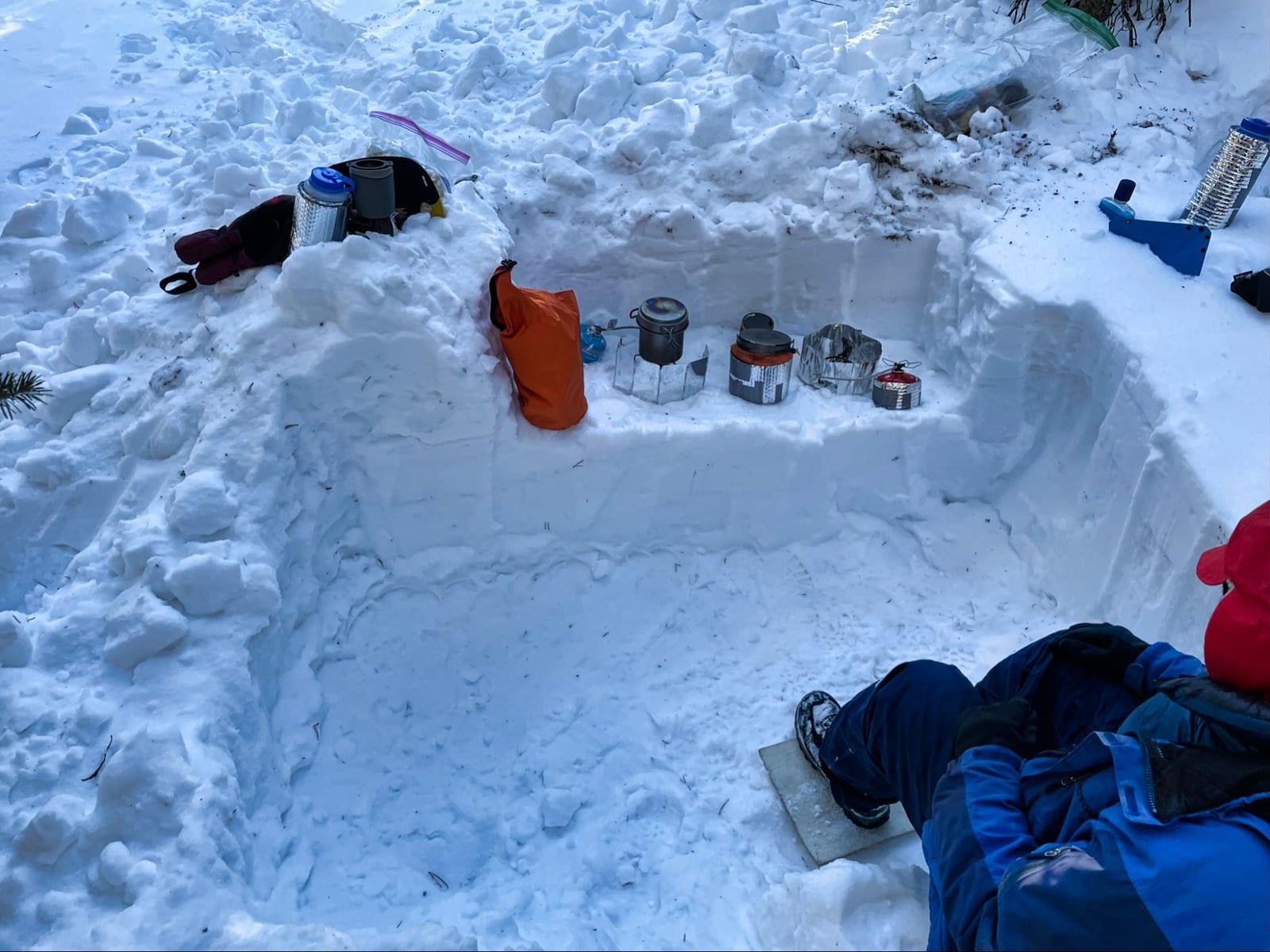
We arrived in camp around noon, set up our tents, and began digging out a kitchen as the wind rose.
We lounged around camp in our kitchen burrow, mostly out of the wind, mostly in the sun. Dinner was served as the sun went down, then a few shots of whisky as we prepared hot water bottles. We retired to our tents directly after, unwilling to face the wind on a February night.
Photo: Dan Schneider
Morning was sunny and windy. We had spent enough time in our tents. Side trails form a loop on the west side of the canyon. The forest opened occasionally to views of the dominant peak. Snow had long buried the cascades and falls draining upper basin lakes. It didn’t matter. We were out, we were moving.
Photo: Dan Schneider
We had brought one more dinner and breakfast, and could stay another night. That would mean spending 12 of the next 16 hours hiding from the wind in our tents. Best to pack up and go.
Spring
Spring is the saddest season in these parts. The weather is more about winter refusing to leave than summer coming on.
It’s good then to have a low-altitude destination close by, a place where you can put a pack on your back and walk without strapping anything onto your feet.
Photo: Drew Smith
The trail leads down the gulch, past the spring where an old sheepherder’s cabin slowly decays. The hoofed locusts are gone now but their big horned betters remain, and we startle a small flock at a narrow spot.
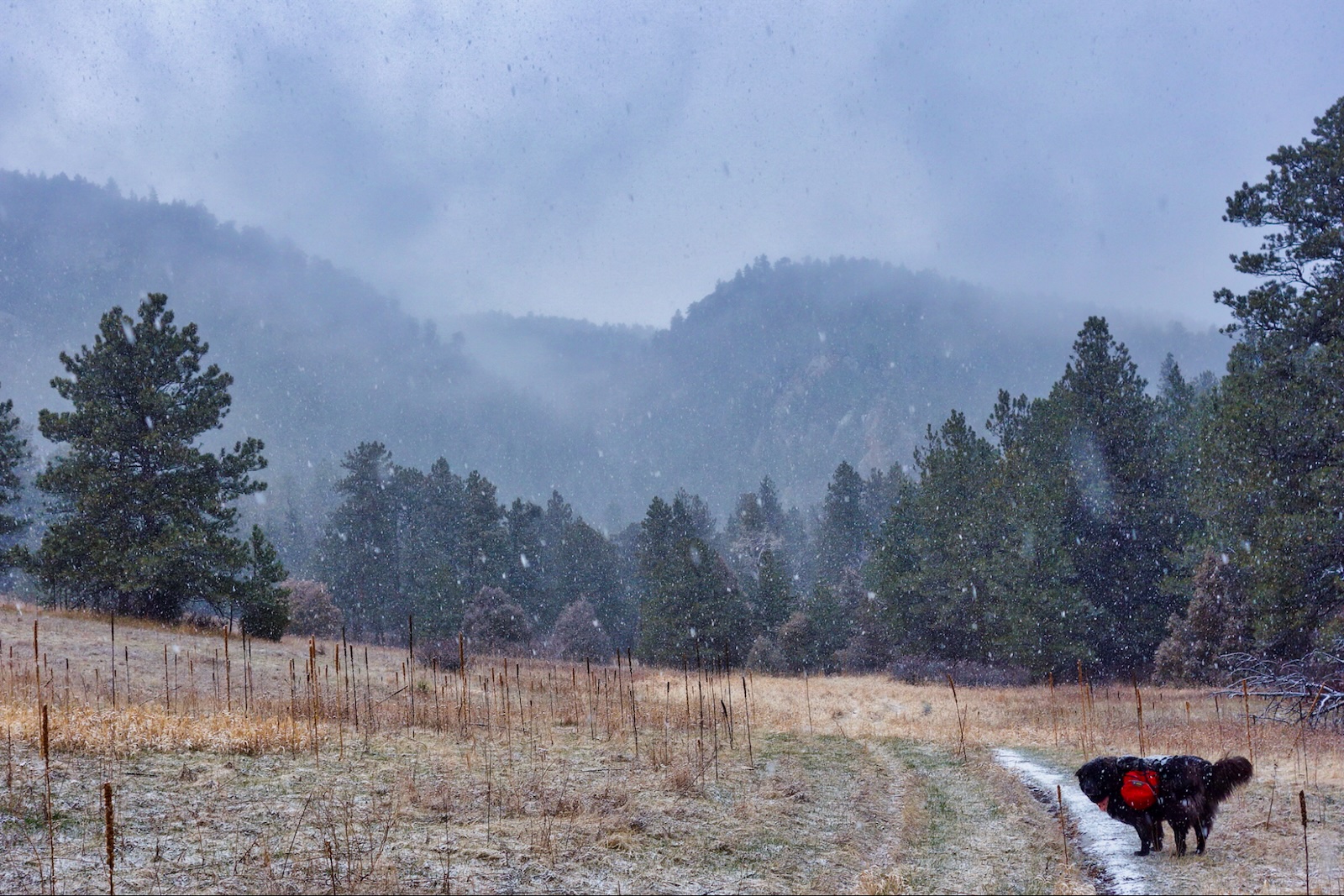
Reaching the meadow we turn east toward a favorable site. We are cut off by a steep-sided gully, one that was not here before the flood of 2013. The dog is getting older, she has to be helped down, then boosted up the far side. She does not balk or complain, would never be the one to hold us back.
Photo: Drew Smith
The morning sun is replaced by snow squalls. But it’s not too cold, not too windy, to lounge around a small fire wrapped in scents of pine smoke and wet snow.
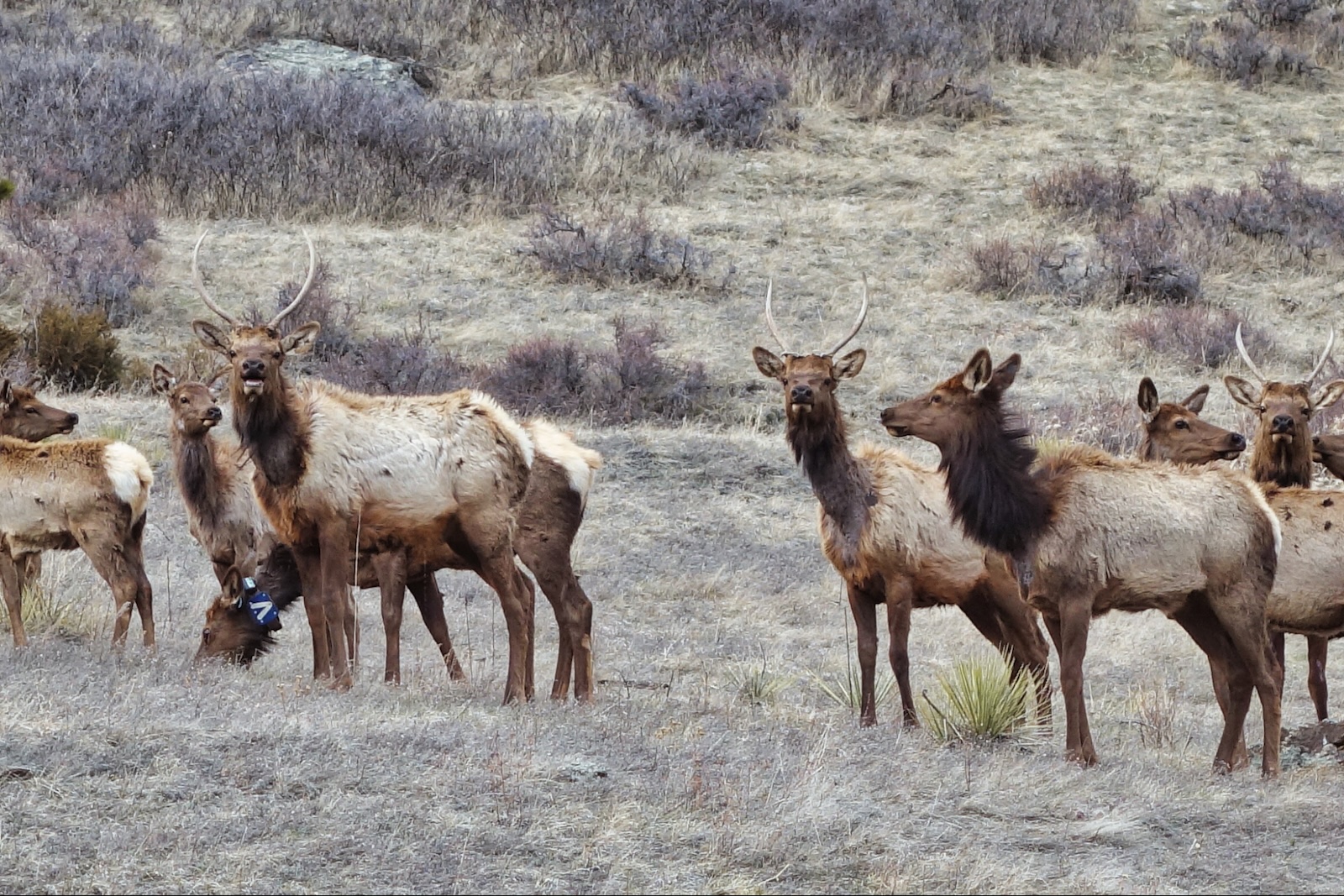
A herd of elk filters into the meadow, upwind, unaware of our presence. The dog is on full alert. She quivers, a quiet whimper escapes, but makes no move to chase. The elk finally notice us but stay where they are, looking for something, anything to eat. They are in no condition to run. Without ever seeming to move, they melt back into the forest.
Photo: Drew Smith
The gully had consumed the use trail we followed down to the river. Everything there is still askew. Or maybe right where it is supposed to be. The old arrangement of boulders was no doubt the result of a previous 200-year flood. The new arrangement will in time seem natural and right.
But the hole where I could count on catching a brown trout is gone. It has not been replaced by a new hole with a new trout. We contemplate this, the dog and I, each in our own way, decide it is not so bad, and return through the dusk and the snow to our camp.
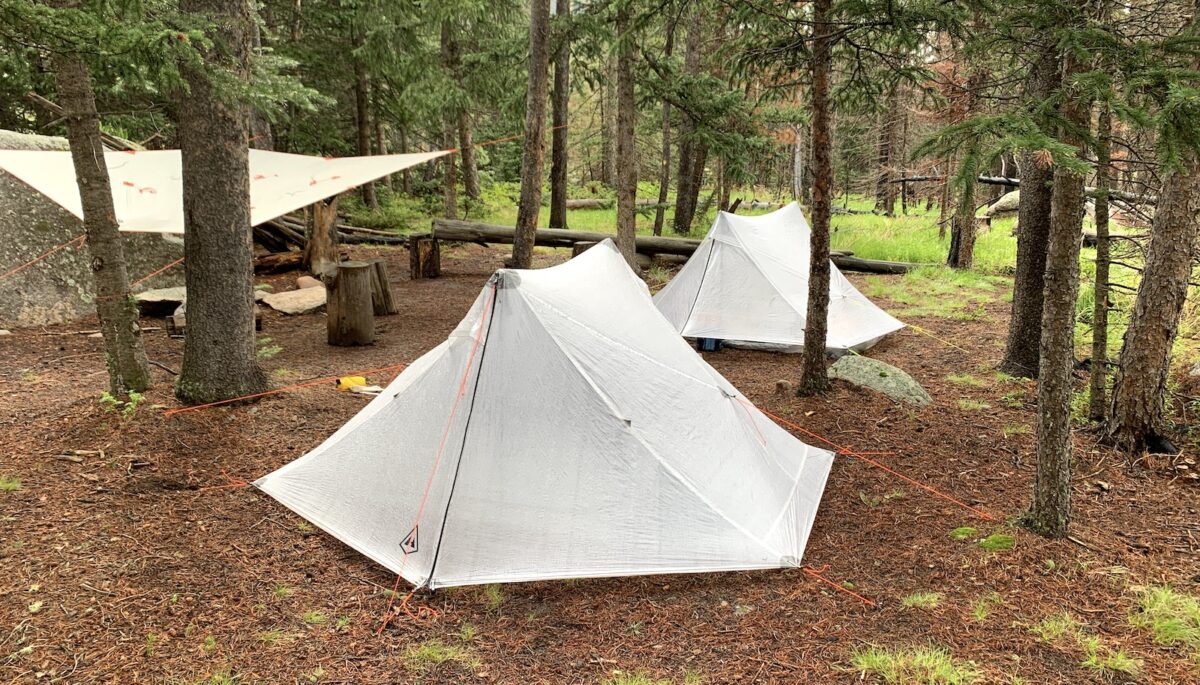
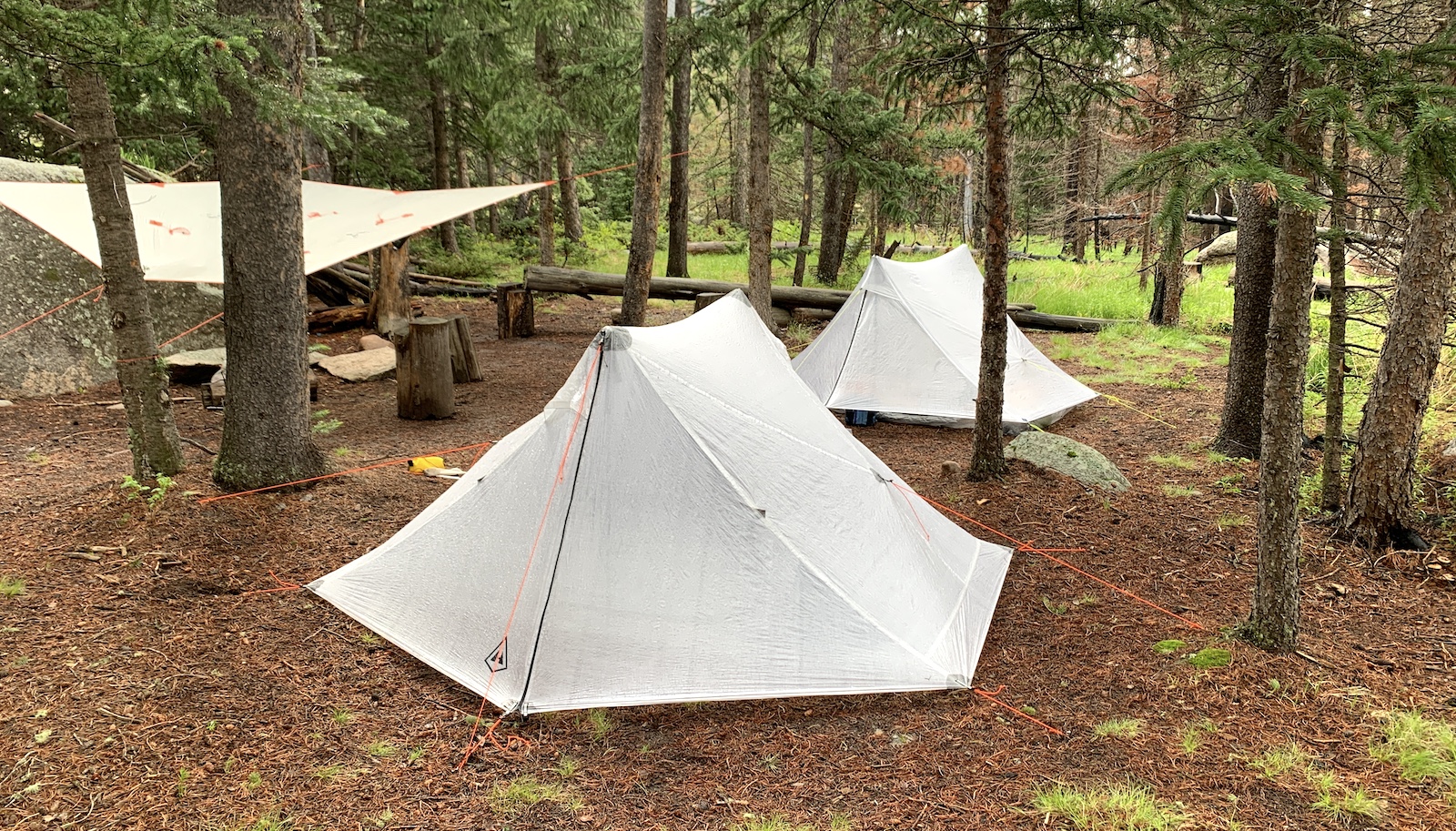
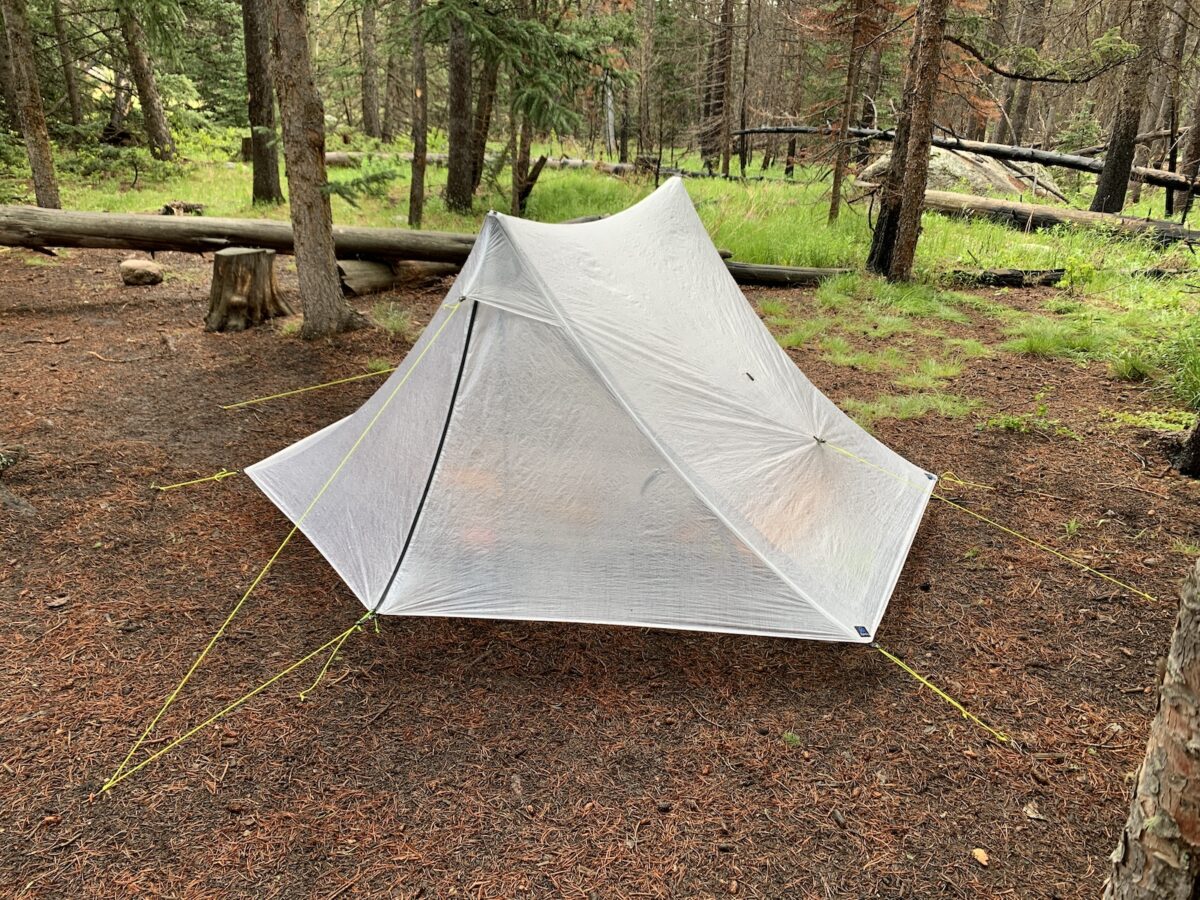
The Unbound 2P and Duplex Zip beg for a direct comparison. Both of them are six-panel, symmetrical designs with zip-access, side-entry storm doors, and both are generally pitched with a total of 8 tent stakes. They have similar footprints, similar weights, and offer similar levels of weather protection.
Introduction
The ubiquitous ZPacks Duplex, perhaps the most popular ultralight trekking pole tent for modern-day thru-hiking, has more competition today than in years past. With new Dyneema Composite Fabrics shelters from Hyperlite Mountain Gear, Tarptent, Durston Gear, Gossamer Gear, and others, thru-hikers and other backpackers who care about their shelter weight have many more options to choose from today.
The following table compares several Dyneema Composite Fabrics shelters. All of them are two-person, side-entry, dual-vestibule tents that are pitched with two trekking poles.
Model
Weight
MSRP
Hyperlite Mountain Gear Unbound 2P
24 oz
$699
ZPacks Duplex
19 oz
$699
ZPacks Duplex Zip
20 oz
$699
Gossamer Gear the Two DCF
21 oz
$589
Durston Gear X-Mid Pro 2P
20 oz
$679
Tarptent Dipole 2 Li
27 oz
$799
Bonfus Duos 2P
21 oz
$739
* The Gosssamer Gear The Two DCF pricing was current as of fall 2022. However, that model is currently unavailable.
The Hyperlite Mountain Gear Unbound 2P and ZPacks Duplex Zip were tested side-by-side in a variety of (mostly very wet) weather conditions.
The Unbound 2P and Duplex Zip beg for a direct comparison. Both of them are six-panel, symmetrical designs with zip-access, side-entry storm doors, and both are generally pitched with a total of 8 tent stakes. They have similar footprints, similar weights, and offer similar levels of weather protection.
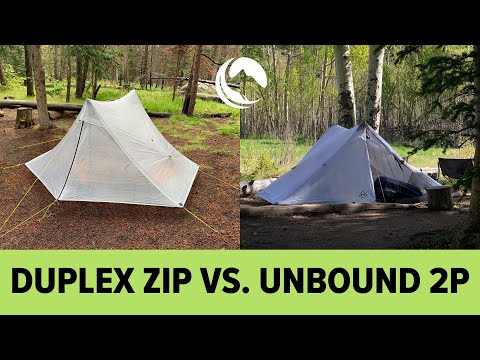
We pose a variety of questions about these two shelters and go into detail about a head-to-head comparison of them in the following video.
Watch the Video
Outline (clickable timecodes are available in the video description at YouTube):
0:00 – Coffee
0:25 – Why is the Unbound heavier than the Duplex/Duplex Zip?
1:02 – Which tent is more stormworthy?
2:02 – Any differences in condensation resistance?
2:45 – Which tent would you choose (Duplex vs. Unbound vs. Gossamer Gear Two)?
3:25 – Will the Unbound dethrone your Dipole Li as your DCF tent of choice?
3:55 – Interior door battle: rainbow zipper or D-zipper?
4:23 – Which tent has better guylines?
5:13 – What tent stakes do you recommend with these tents?
6:18 – Which tent has better interior organization/pockets?
6:38 – What about adding peak guylines for stormy weather?
7:08 – Fold and roll vs. stuff (storage)
7:20 – Best vestibule door zippers/guylines?
7:39 – What’s the better tent for 2 people?
7:50 – Privacy, connectedness to nature (canopy fabric differences)
Executive Producer - Backpacking Light; Show Director and Host - Ryan Jordan; Producer - Chase Jordan; Theme music: Look for Me in the Mountains written by Chris Cunningham and Ryan Jordan, performed by Chris Cunningham (acoustic guitar, lead and harmony vocals, harmonica), Chad Langford (upright bass), and Tom Murphy (mandolin), produced by Basecamp Studios in Bozeman, Montana.
Sponsorship Policy: Backpacking Light does not accept compensation or donated/discounted products in exchange for product mentions or placements in editorial coverage, including any podcast episode content not excplicitly identified as sponsored content. Some (but not all) of the links in these show notes may be affiliate links. Learn more about affiliate commissions, influencer marketing, and our consumer advocacy work by reading our article Stop wasting money on gear.
The ZPacks Duplex Zip Tent is a 2-person, 2-door, 2-vestibule, side-entry trekking pole tent made with Dyneema Composite Fabrics. The ZPacks Duplex Zip weighs 20.4 ounces (577 g) and has an MSRP of $699.
Daniel Hu backpacks the High Divide Loop, one of the most beautiful hikes in Washington State and Olympic National Park.
The High Divide Loop (also known as the 7 Lakes Basin) is, in my mind, the most beautiful hike in all of Washington state. Nestled deep in Olympic National Park, this trail comes with spectacular views and is teeming with wildlife. If you’re looking at a map of the United States, touch your finger to the most northwestern point in Washington state, and you’ll be fairly close to identifying its location. The trailhead is 3.5 hours from my front door, meaning an early rise out of bed before dawn in order to get boots on the ground at a reasonable hour.
I’ve done this trip twice, and each time have marveled at the beauty of the Olympic mountain range. The “Enchantments” moniker has already been bestowed upon another region in the Washington Cascades, but in my mind it would be more fitting for the High Divide Loop! (Side note: explorers who have traversed the Enchantments may contend that it is a more beautiful experience, but having also twice hiked both trails, I stand by my words – nothing comes close to the High Divide Loop for me!)
The trail isn’t a simple walk in the woods, either: this loop is 19 miles long and comes with 4000 feet of elevation gain! I’ve most frequently heard of hikers treating themselves to a more leisurely two-night trip, but my experiences there have been just for one night. In hindsight, perhaps a more compelling reason to take two nights would be simply to prolong the experience in this magnificent area!
Beginning the Hike
The loop can be done either clockwise or counter-clockwise and since the elevation peaks at approximately the halfway point, neither direction is necessarily easier or more difficult than the other. I have only hiked it counter-clockwise, and the biggest determining factor was where our campsite was located along the trail.
The trail is well-maintained and I’d venture to say it’s nearly impossible to lose track of it. As with many hikes, the first several miles of trail are quite wide due to day-hiker traffic, but as you begin to penetrate deeper into the backcountry and gain elevation, the noise and bustle of your fellow humans will fade and give way to the gentle quiet of nature. It’s possible, if not likely that you could complete your entire hike without encountering another hiker until you reach the campsites, which makes the hike peaceful and calm, almost giving you a sense of ownership of the experience.
A view from one of the footbridges at the beginning of the trail.
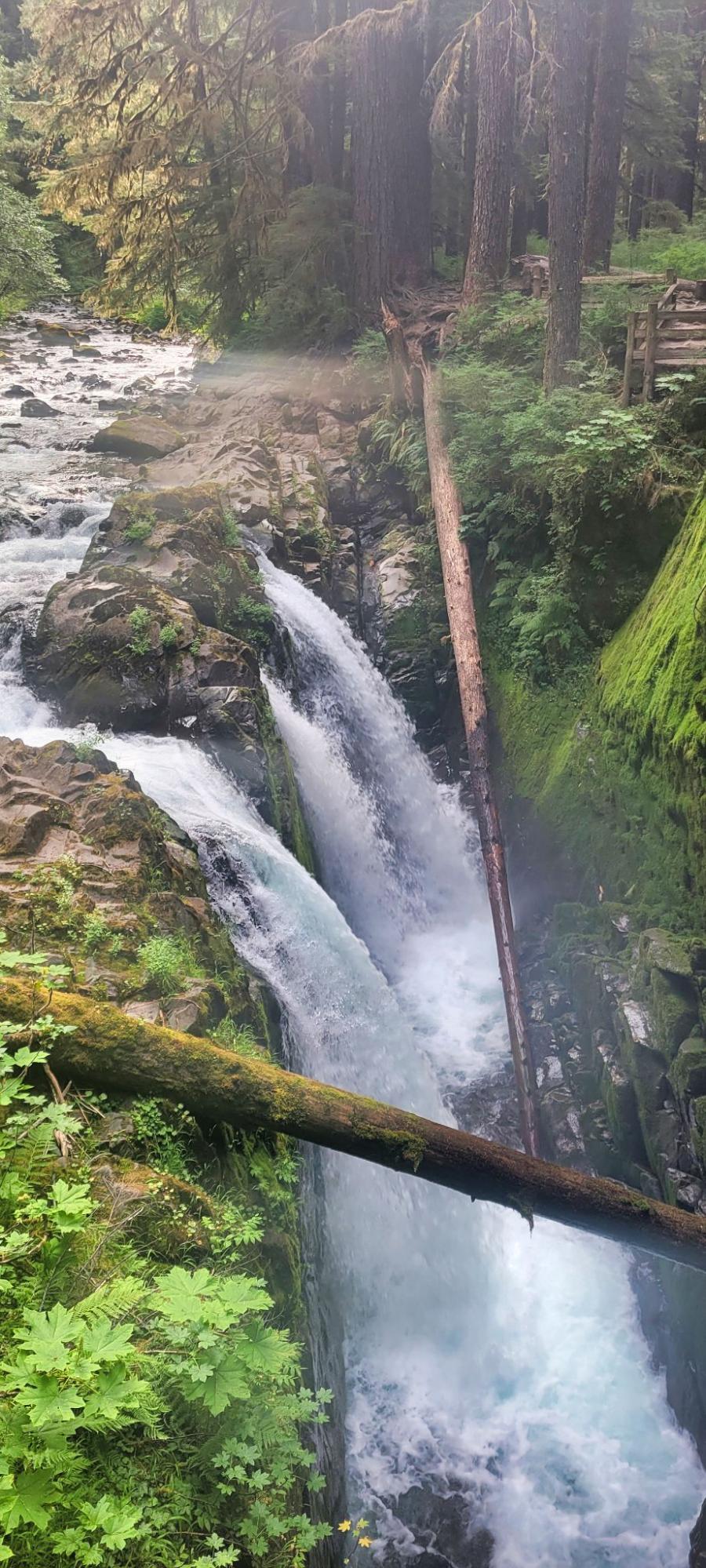
The initial portion of the trail was gentle and relatively easy, but it was all uphill thereafter! Large fir trees towered overhead to provide shade as we crossed over wooden bridges beneath which streams flowed 20 or 30 feet below. Moss coated many features of the old-growth forest, and with tender ferns underfoot, we were reminded that on the other side of the High Divide flows the Hoh River into the Hoh Rainforest. The trees gave way after a few miles so that clouds could float in the open sky above Deer Lake, the first of many lakes we’d encounter. It was tempting to stop and take a long break near the water, but with miles of trail left, we continued on quickly to the High Divide trail.
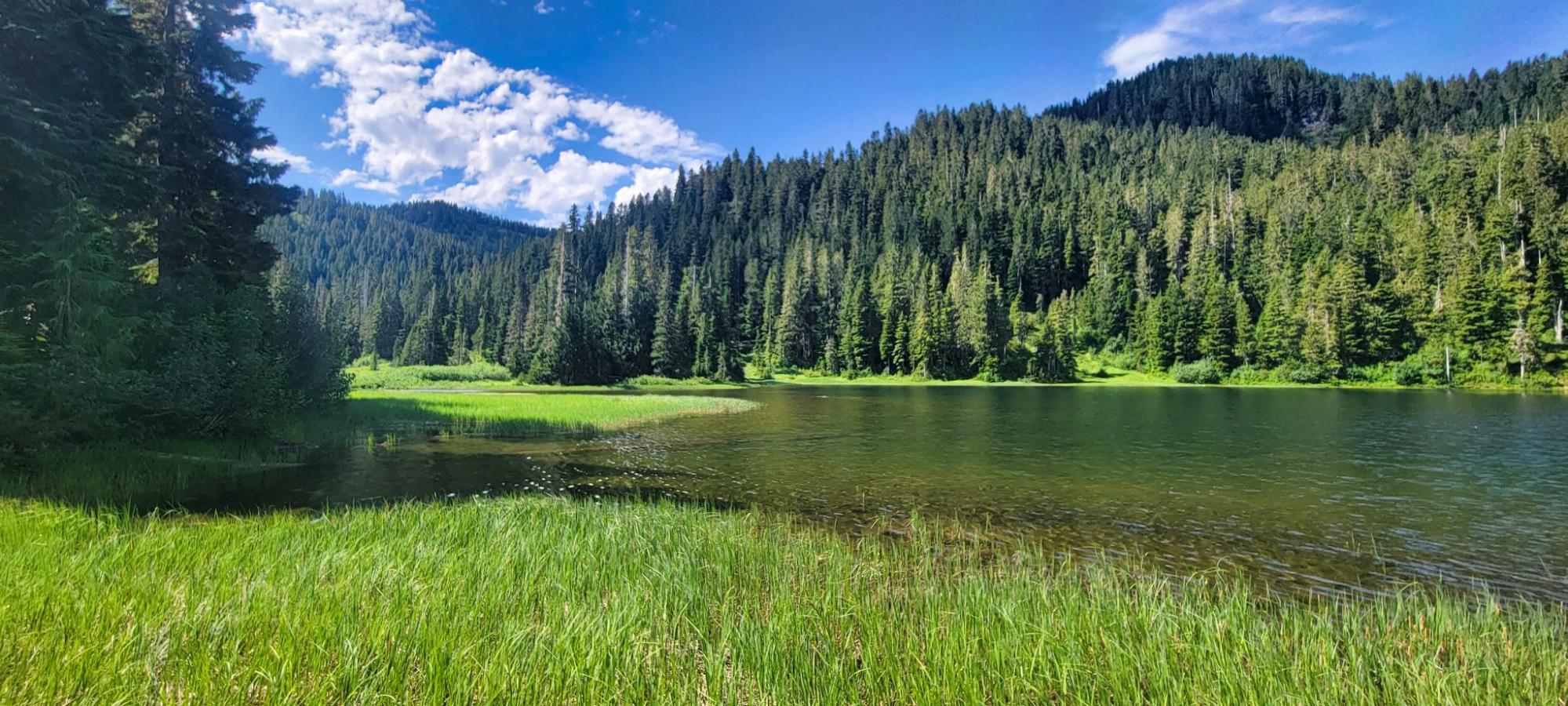
Clear skies over Deer Lake.
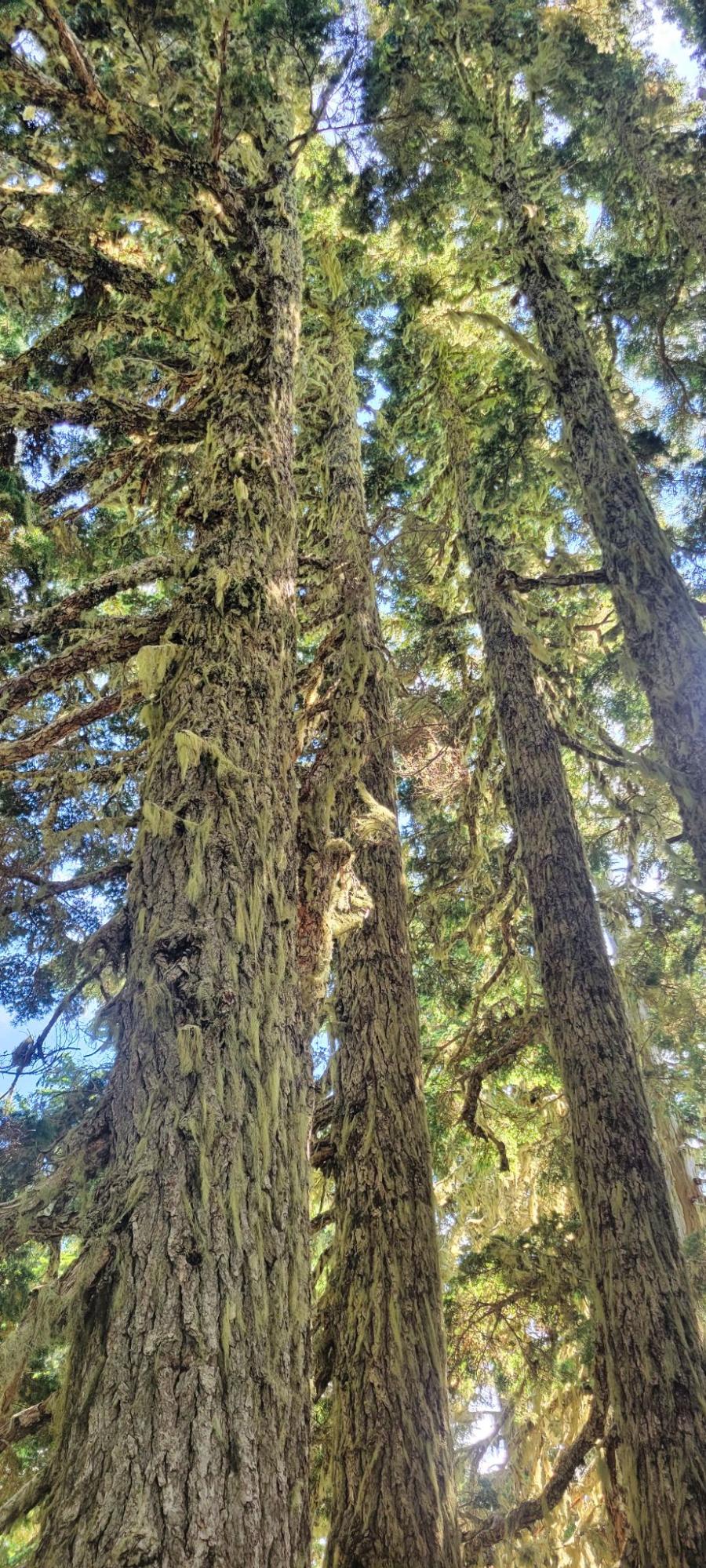
Moss growing on trees along the High Divide trail.
The High Divide and Bogachiel Peak
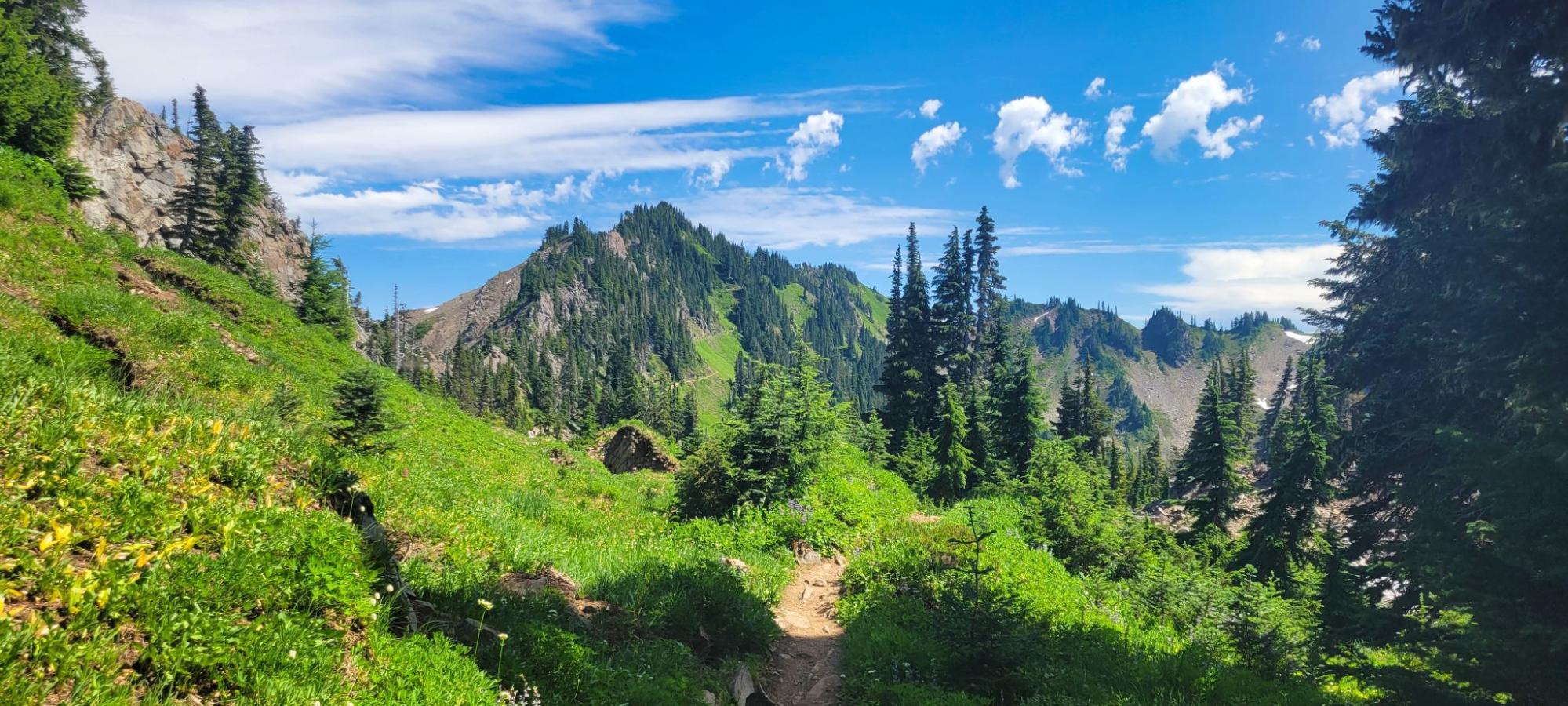
Stepping onto the High Divide trail took us further up towards Bogachiel Peak, the highest point in this loop at nearly 5500 feet of elevation. We followed the curve of the mountains, trudging ever upwards and onwards. Climbing upwards over our heads, the sun began to exert its heat more fiercely, and we found ourselves sipping water more frequently. As we continued to hike, we were treated to spectacular views of the valleys (Bogachiel River flows to the south and the 7 Lakes Basin is on the north side of the trail) and mountains. Wildflowers sprinkling dots of color across the mountainside danced gently with any breeze. Despite the heat, we still found patches of snow glistening in the sun at higher elevations, even in early August. Our campsite for the night was at Lunch Lake, so after approximately 7 miles we turned into the Basin, just shy of the short trail leading to the top of Bogachiel Peak.
Bogachiel Peak in the distance. The trail has a bifurcation before the switchbacks, turning left takes you into the Seven Lakes Basin and continuing ahead leads up to Bogachiel Peak.
Pausing at the top of the Basin to enjoy the view, we then descended approximately half a mile towards Lunch Lake. As we drew nearer to our destination, we had reason to pause again after spying a bear ambling towards campsites at the nearby Round Lake. I did a quick double-check for my canister of bear spray as we surveyed the terrain, and then we continued on, keeping a wary eye towards the bear. By the time we reached our campsite at Lunch Lake (maybe 0.1-0.2 miles away), the bear had disappeared.
Camping at Lunch Lake
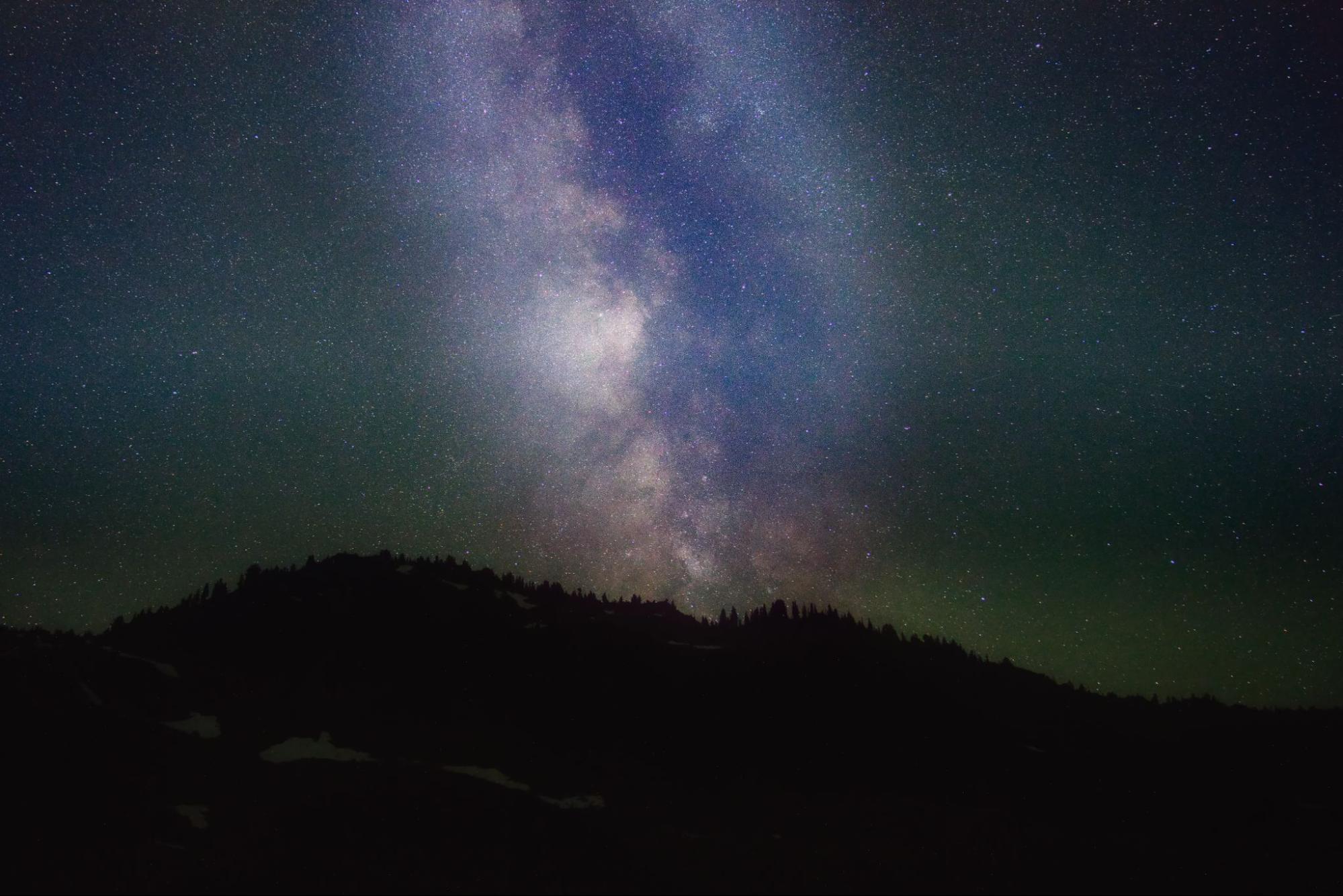
Lunch Lake was clear and refreshing, and we swam, fished, and enjoyed some trail beers, relaxing for a few hours before heading into our tents. The skies were clear, and the moon was in a phase that was favorable for astrophotography, so I set an alarm for the wee hours of the morning, and trudged back down to the lake to take a few pictures of the stars. The Basin is nestled deep in the Olympic Mountains, and gazing upwards at the expanse above, I saw the Milky Way hanging in the sky. An ethereal sight, resplendent in a veil of stars, and a reminder of the vastness of the universe.
The Milky Way over the 7 Lakes Basin.
No bears troubled our sleep or our food, but in the morning I awoke to a rustling outside of the tent, and stepping outside, found a fearless deer nibbling around our tents. It was clearly used to seeing humans and was unafraid of my approach, but soon pranced off, evidently preferring solitude over my company.
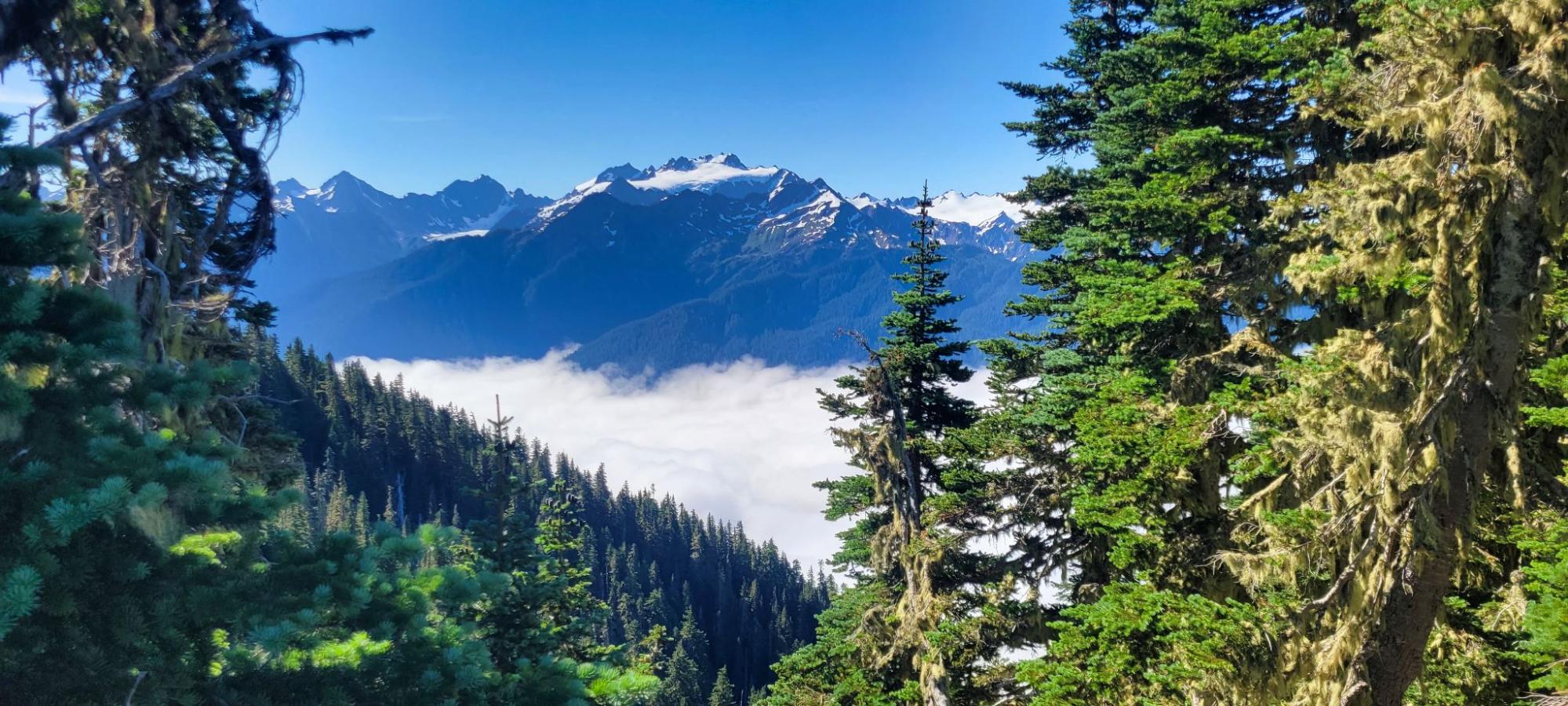
Mount Olympus, seen from the High Divide trail.
Heart Lake and Exiting the Wilderness
Instead of backtracking west to the bifurcation that allowed us into the Basin on the previous day, we took a 1 mile trail that took an eastward route that rejoined the High Divide trail about half a mile beyond Bogachiel Peak. Hiking along the ridge, we could peer down into the Hoh Valley, or turn our gaze upwards to the snow-capped Olympic mountains, with a wonderful view of Mt. Olympus. After enjoying these views, the trail continued to lose elevation for the remainder of our journey. Leaving the ridge, we headed northeast and encountered Heart Lake, where we stopped to refill our water supply. Crossing the creek, we descended back down into the forest, trading expansive vistas back for the trees and ferns. The last several miles are shaded from the heat of the sun, and while gentle, offer fewer views, and as we drew nearer to the trailhead, we again began to see a telltale sign of civilization: day hikers in flip flops!
Bridge Creek, emerging from Heart Lake.
A welcome treat at the end of the hike can be found after driving a few miles away from the trailhead, as the Sol Duc Hot Springs Resort is located nearby. We parked and paid for a 90-minute time slot reservation at the mineral hot springs, and felt the aches melt away from our bodies as we relaxed in the water.
“…they never felt more powerful, or more fit, or happier about themselves and their bodies, than when they were thru-hiking.” – Nikki Stavile on femininity in the backcountry.
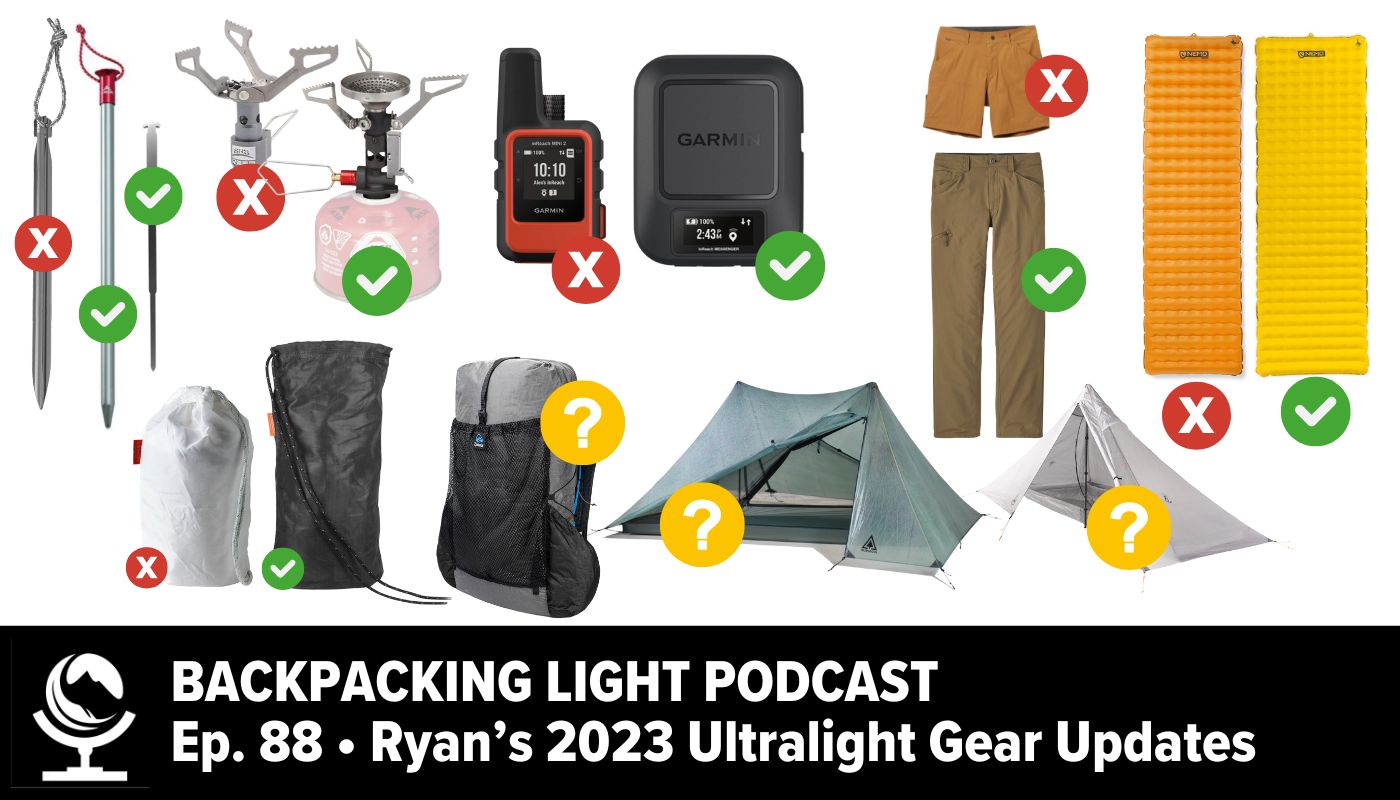
Episode 88 of the Backpacking Light podcast features nine pieces of gear from Ryan’s kit that he liked, didn’t like, and is sitting on the fence about.
Listen
Summary
Episode 88 of the Backpacking Light podcast features nine pieces of gear from Ryan’s kit that he liked, didn’t like, and is sitting on the fence about.
Executive Producer - Backpacking Light; Show Director and Host - Ryan Jordan; Producer - Chase Jordan; Theme music: Look for Me in the Mountains written by Chris Cunningham and Ryan Jordan, performed by Chris Cunningham (acoustic guitar, lead and harmony vocals, harmonica), Chad Langford (upright bass), and Tom Murphy (mandolin), produced by Basecamp Studios in Bozeman, Montana.
Sponsorship Policy: Backpacking Light does not accept compensation or donated/discounted products in exchange for product mentions or placements in editorial coverage, including any podcast episode content not excplicitly identified as sponsored content. Some (but not all) of the links in these show notes may be affiliate links. Learn more about affiliate commissions, influencer marketing, and our consumer advocacy work by reading our article Stop wasting money on gear.
The Hyperlite Mountain Gear Unbound 2P Shelter is a single-wall, Dyneema Composite Fabric, 2-person, 2-trekking-pole-supported tent with two vestibules, two side-entry doors, a weight of about 24 oz (g), and an MSRP of USD $699.
Episode 87 of the Backpacking Light podcast features highlights from our new Publisher’s Gear Guide – the gear that I actually own and use on my backcountry adventures.
Listen
Summary
Episode 87 of the Backpacking Light podcast features highlights from our new Publisher’s Gear Guide – the gear that I actually own and use on my backcountry adventures.
In this Episode:
Live Event: Office Hours Live – Friday, August 25 @ 6 PM US MDT – Gear system decision-making & gear recommendations from the new Publisher’s Gear Guide!
Executive Producer - Backpacking Light; Show Director and Host - Ryan Jordan; Producer - Chase Jordan; Theme music: Look for Me in the Mountains written by Chris Cunningham and Ryan Jordan, performed by Chris Cunningham (acoustic guitar, lead and harmony vocals, harmonica), Chad Langford (upright bass), and Tom Murphy (mandolin), produced by Basecamp Studios in Bozeman, Montana.
Sponsorship Policy: Backpacking Light does not accept compensation or donated/discounted products in exchange for product mentions or placements in editorial coverage, including any podcast episode content not excplicitly identified as sponsored content. Some (but not all) of the links in these show notes may be affiliate links. Learn more about affiliate commissions, influencer marketing, and our consumer advocacy work by reading our article Stop wasting money on gear.
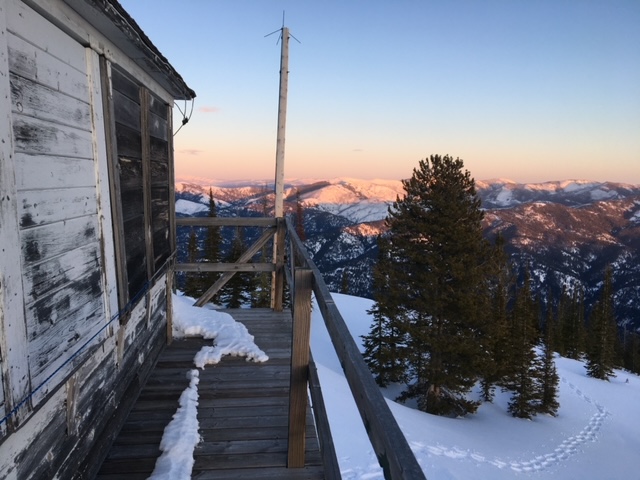
BPL author Mark Wetherington skis into a remote fire lookout tower in Montana’s backcountry on a chilly winter night.
Introduction
Moving to western Montana in November meant that unless I wanted to wait until spring to explore the jaw-droppingly beautiful landscape, I’d have to get equipped for oversnow travel. Since I’d moved to Montana specifically for its proximity to outdoor recreation, within a few weeks of arriving I’d acquired a pair of cross-country skis and a pair of snowshoes. In what I viewed as an omen from the winter gods, the security deposit from my previous apartment was almost the exact amount of a package deal from the local outdoor store for cross-country skis, poles, boots, and bindings. After a few day trips on skis to get the hang of this new (at least to me) mode of human-powered travel, I skied three miles into a US Forest Service rental cabin for my first overnight trip in Montana on winter solstice. Almost ten years later, that same cabin is often booked solid six months in advance, but I was able to book it for a weekend less than two weeks out.
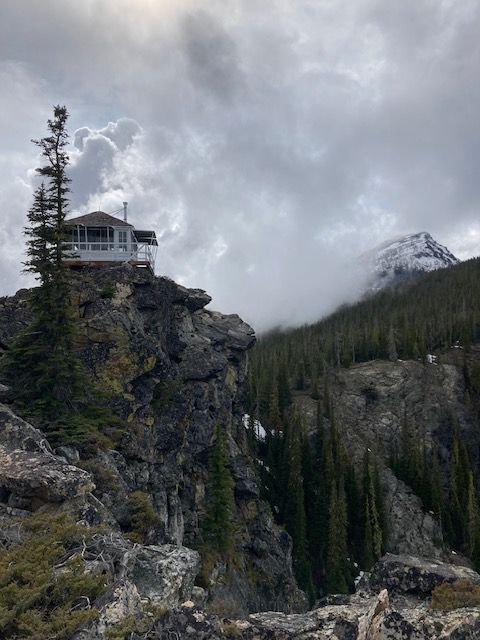
A view of the lookout in late spring which shows off its majestic location.
I spent the rest of that winter alternating between snowshoes and cross-country skis for my backpacking trips, staying in a Black Diamond Firstlight tent and slowly building up the winter camping skills that the temperate climate of the Southeast hadn’t allowed me to hone. The next winter, I made a grueling New Year’s Eve trip to a fire lookout (which I’ll refer to as “Magic Rock Lookout” to provide some semblance of anonymity) that involved snowshoeing approximately 5 miles and gaining over 3,500 feet of elevation. Since that inaugural visit, I’ve stayed overnight at that lookout over two dozen times and made at least as many day trips. I’ve helped with volunteer restoration efforts, packed out a broken Coleman stove, cut out trees across the trail, and split at least five times more firewood for the woodstove than I’ve burned. Friends jokingly call me “The Mayor of Magic Rock Lookout” and it’s likely not hyperbole to posit that other than the fire lookouts who were assigned there when it was staffed as an active lookout for fire suppression, I’ve probably spent more nights there than anyone else (the logbook for the lookout also supports this theory).
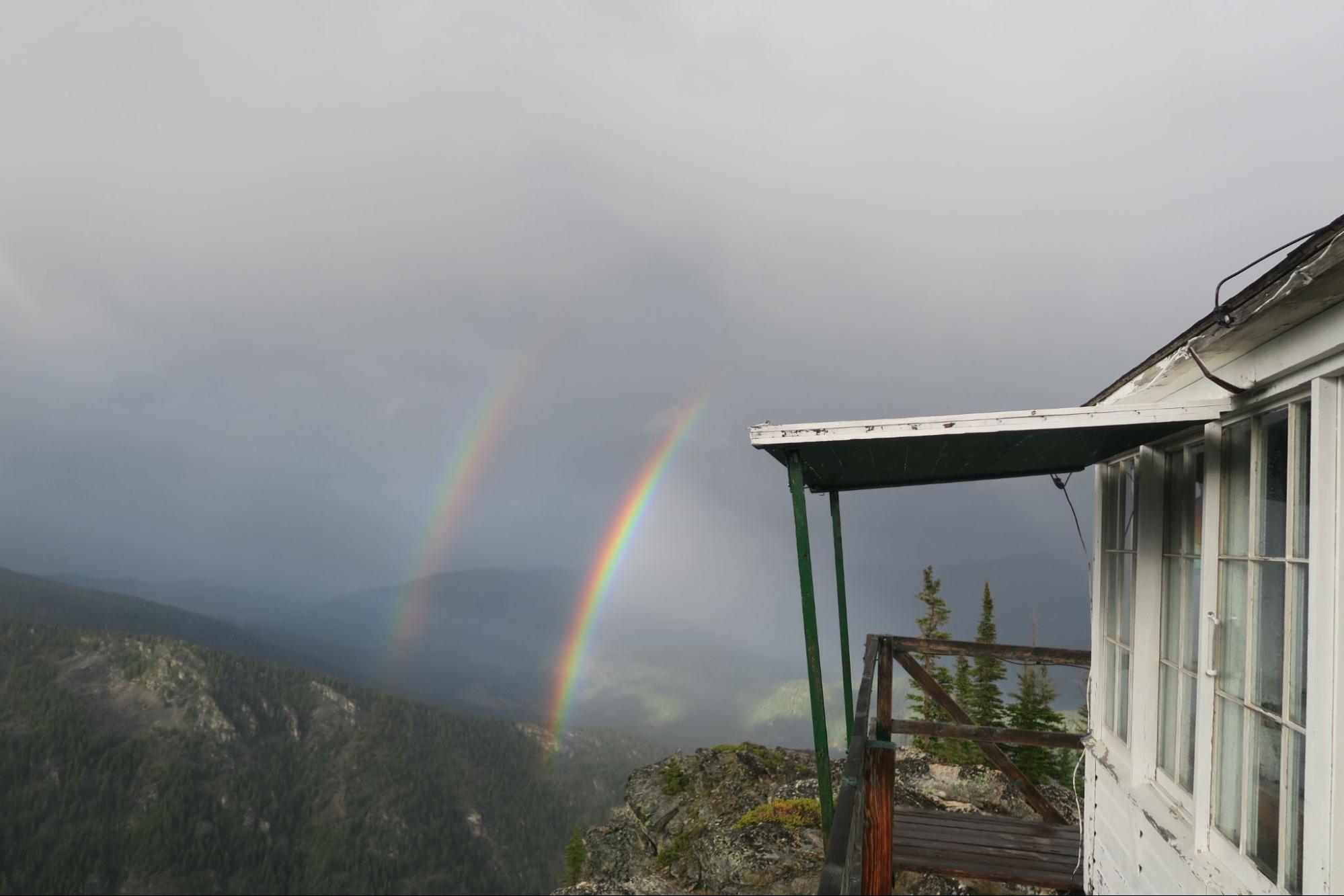
An early summer view of double rainbows from the lookout.
I’ve stayed at the lookout at least one night in every month of the year except December, which I hope to rectify later this year. Despite my initial attempt being aimed for New Year’s Eve, I only spent the second night of that trip – January 1st – in the lookout; the first night I spent in a bivy sack a quarter-mile from the lookout as I’d become exhausted and benighted and didn’t want to press on somewhat blindly toward the lookout (I was solely using a paper map at the time, GPS likely would’ve ensured I arrived at the lookout but also would’ve denied me a character-building experience). Unsurprisingly, the months I’ve stayed there most are when it’s easiest to access – roughly from when the snow melts until it piles back up again – and June is currently in the lead. After a particularly exhausting snowshoe visit, I swore off any future trips using snowshoes. I decided it was time for me to gain a new set of skills to access the lookout in winter: backcountry skiing.
The timing was great, as I’d lucked out earlier that winter and won a pair of skis at a raffle and was able to trade them in for store credit and ended up with a great pair of all-mountain skis that had Alpine Touring (i.e. backcountry skiing) bindings on them. A perfect set-up for what I was envisioning, which was more about getting myself into the backcountry as quickly as possible as I had no real interest in downhill skiing at ski resorts.
The Journey to Backcountry Skiing
Growing up in Kentucky with parents from south Georgia hadn’t exactly given me a lot of exposure and opportunities for skiing. I went a few times as a kid to a ski hill in Indiana, but skiing manmade, icy snow on runs with a maximum vertical drop of 300 feet didn’t exactly give me an incurable case of Ski Fever. I progressed at cross-country skiing quicker than I expected and appreciated the relatively low-cost of the activity as well as the fact that it could be done solo without seeming like one was taking unnecessary risks. Being able to easily access US Forest Service Rental Cabins was also a huge benefit, especially since as the years went on my winter backpacking trips largely became limited to those that involved cabins or hot springs.
Downhill skiing, perhaps the most critical skill outside of avalanche safety to have for safety while backcountry skiing, went a bit less smoothly for me and initially made me think I just wasn’t cut out for anything other than kicking-and-gliding through mild terrain on Nordic skis. The local ski hill had an excellent and economical beginner package, so I thought even though I was 30 and for all intents and purposes downhill skiing for my first time, and that given my general fitness and several seasons of cross-country skiing on my legs, I’d be able to gain the basic competencies and comfort level needed without having to invest too much time and energy. I couldn’t have been more wrong. At the end of the six days of skiing I did that season (first three days with hour-long lessons, then three days solo) I was only able to feel moderately comfortable going down groomed intermediate runs. I was able to enjoy myself, but overall found it to be about an even mix of humbling and discouraging. Backcountry skiing up to Magic Rock Lookout anytime soon felt about as realistic as skiing down Corbet’s Couloir in Jackson Hole.
My last snowshoe trip to the lookout – after a handful of times using this most exhausting mode of oversnow travel, I swore them off for future trips and committed to attempting a backcountry skiing trip.
I stuck to cross-country skiing the next few winters, enjoying many fulfilling multi-day ski tours, but fate once again intervened and a girlfriend convinced me to give downhill skiing another chance. She’d grown up skiing near Seattle and, oddly enough, had been a ski instructor in Jackson Hole for a winter. To describe her as an expert skier would be an understatement. Since I had a handle on the basics of skiing and she had a lot of patience, I was able to slowly progress over the next few seasons. With the ski hill only an hour away and season passes being as affordable as one could hope for in a state experiencing pervasive rural gentrification, I was able to get in a lot of ski days over the winters and eventually got comfortable enough to ski all the black diamond runs and most of the double black diamonds. Which, based on the estimation of her and other folks I skied with, meant that it was time to dip my toe into backcountry skiing if I still felt the urge.
And the urge was most definitely still present. Since I’d sworn off snowshoe ascents, it had been over three years since I’d visited in winter. The idea of visiting it in all its winter charm and then enjoying the descent on skis seemed too good to be true. The only minor issue was that no one else had a schedule that lined up with mine and doing my first backcountry ski trip solo seemed borderline reckless.
Working in my favor was the fact that none of the route to the lookout was in avalanche terrain and by heading up in mid-April the snowpack was more stable, effectively reducing the avalanche risk to zero. Also in my favor was the fact that I would be in familiar terrain, the days were long, and my fitness was as good as it had ever been. After getting three separate opinions from three different ski partners, one of whom had been to the lookout on skis recently, the consensus was that it didn’t seem too foolhardy given the context. With what was tantamount to a resounding endorsement, the anticipation for a weekend outing to a familiar lookout using a novel method of travel began to build.
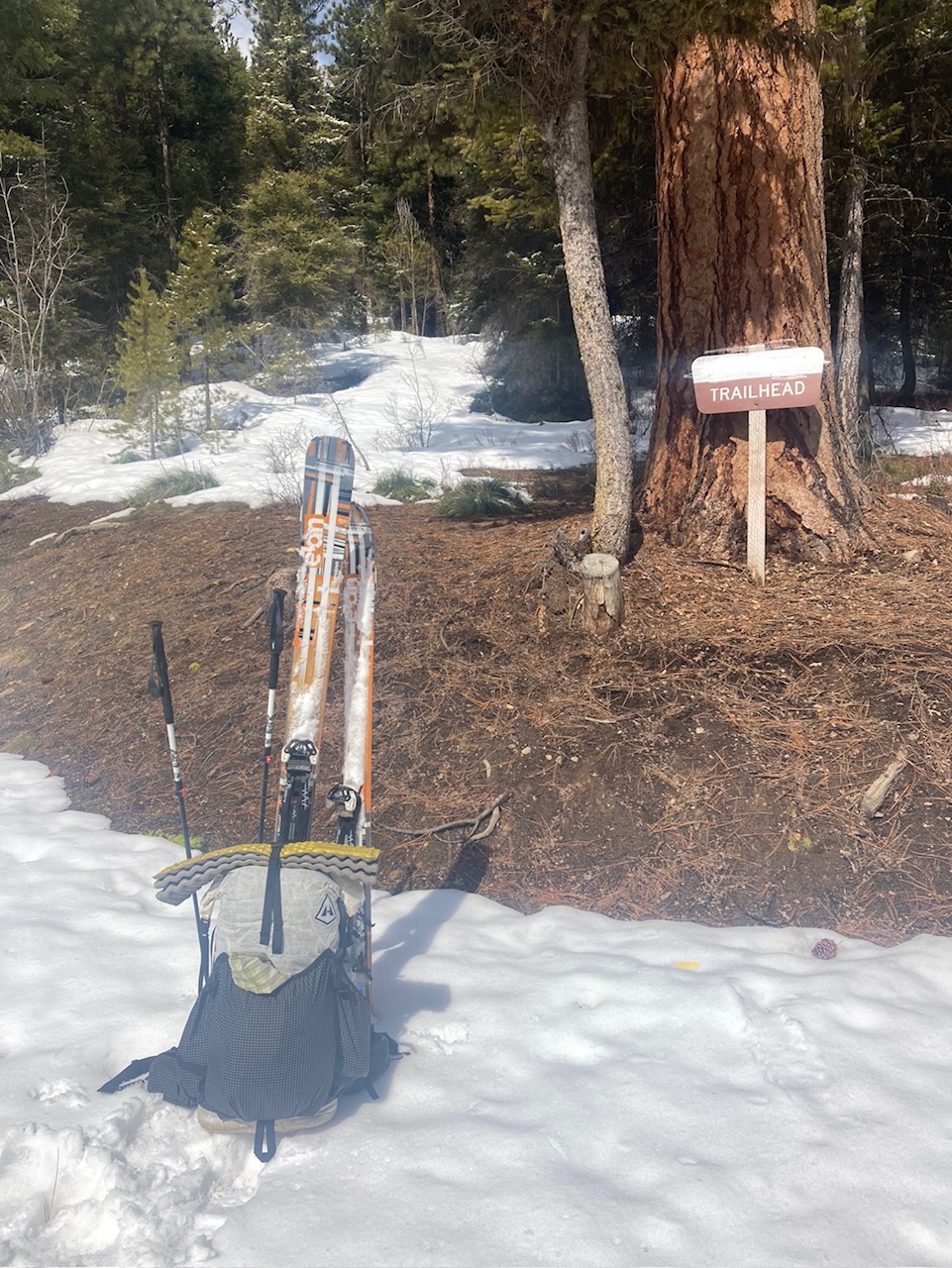
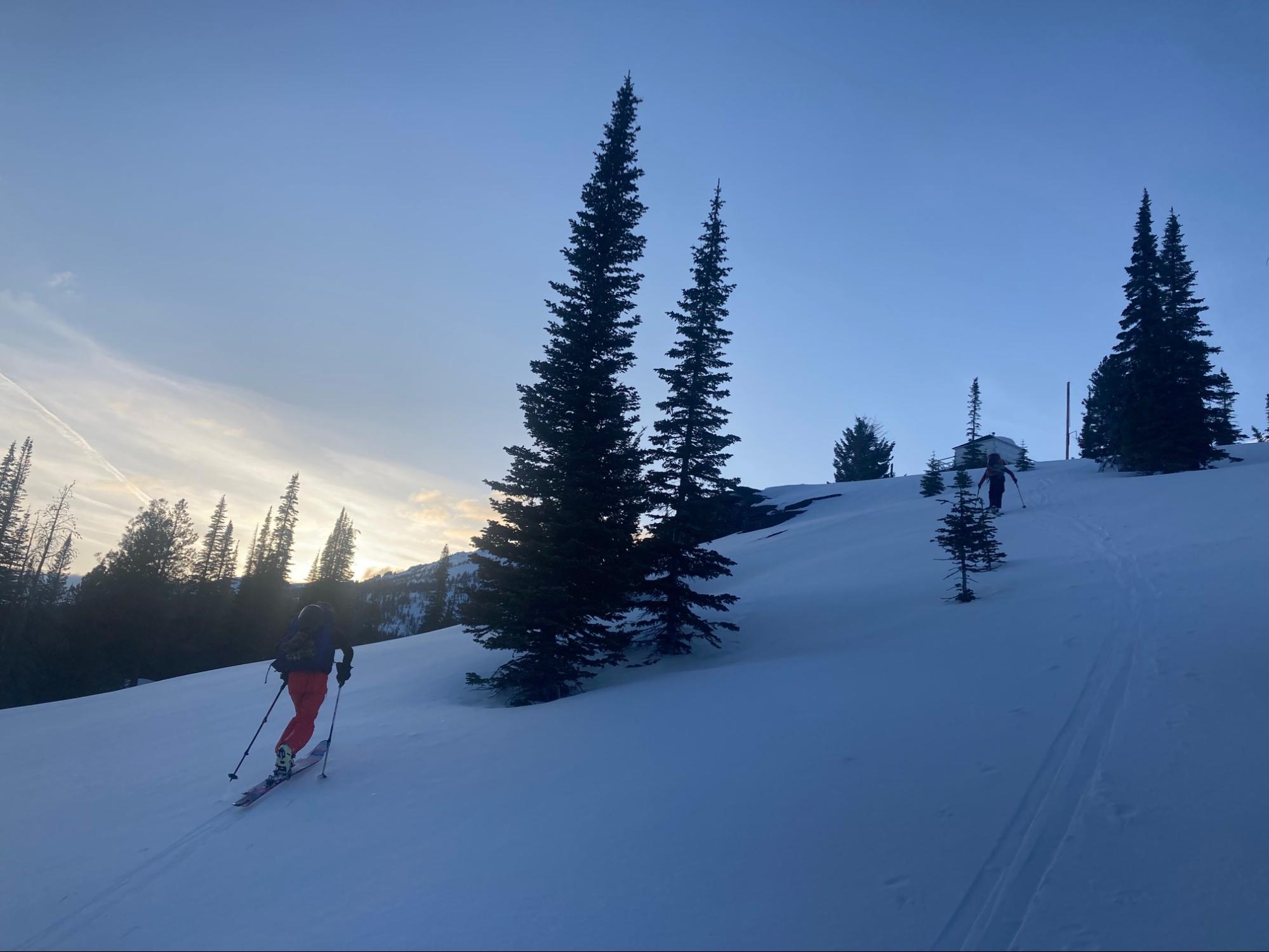
After a few miles of patchy snow that never allowed me to get into either a walking or skiing rhythm, I hit continuous snow at the trailhead and was able to ski through the forest the rest of the way to the lookout.
Ski Cabineering
Heeding a friend’s advice, I put the skins on my skis before packing up the car and heading to the trailhead. I made it less than a mile up the access road before I had to park at an impassable snow drift. For the next few miles, I’d alternate between skiing and walking in my ski boots when the snow became patchy or nonexistent. Things were starting to melt out down low, but as soon as I reached the trailhead the snow became consistent and I was able to duck into the forest and began as direct of an ascent as possible.
I was absolutely enamored by the sensation of skinning uphill through a beautiful coniferous forest. The sense of freedom and adventure was exhilarating. It just felt right to finally be using the backcountry bindings on my skis, adjusting the heel lifters when the terrain became steep enough to need them, and gliding up through the forest. It was exponentially more enjoyable than the slog of snowshoeing to the lookout. If going up was this much fun, then going down tomorrow was going to be euphoric, I thought as I smiled to myself. I took two leisurely breaks on the way up to air out my feet, rehydrate, and refuel. I maintained a steady but not hurried pace when moving and only hit a few slow spots where thin cover and/or micro-navigational issues had to be addressed and slowed me down. I arrived at the lookout in the early afternoon, roughly three hours after leaving the car.
Looking back at my skin track was supremely satisfying, as was knowing that gravity would be on my side when I headed down the next morning.
Reaching the lookout always brings me a sense of achievement and joy, but it was particularly thrilling to have reached it on skis. I was smiling from ear to ear as I set about the familiar tasks of opening up the shutters, sorting out my minimal gear onto the bed and table, and enjoying the expansive view from such an unlikely and inhospitable location. Without the lookout, the rocky promontory wouldn’t invite one to linger much longer than a lunch break, especially in winter. But with a simple building, no longer even used for its intended purpose, this spot became a hermitage of sorts. It is outfitted with a simple wood stove, a worn out mattress that is probably older than I am, random cookware, and two pairs of binoculars as well as an assortment of tools to help make minor repairs.
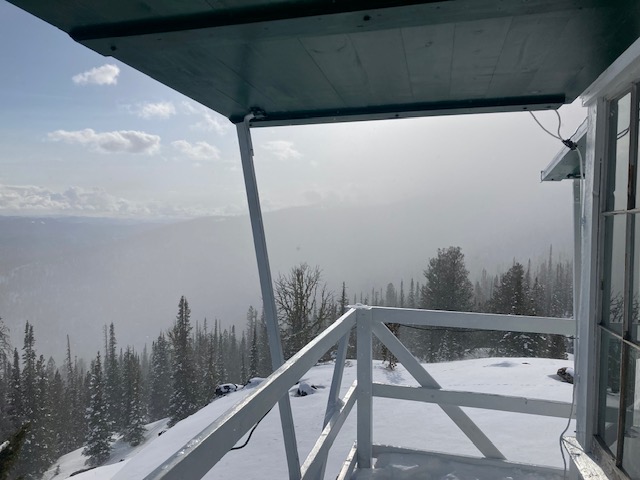
I was hoping this storm would bring in a few inches of fresh powder, but all it left was a dusting on top of wind-scoured snow.
As I settled into the lookout and began to melt snow for the evening’s cooking and hydration needs, a squall blew in. I was hoping for a few inches of fresh snow to ski down on, but the storm blew out as quickly as it came in. Views to mountains afar returned, with a few clouds swirling around to provide some dramatic ambience. I contemplated starting up the wood stove, but given the relatively scarce supply of wood and the mild temperatures I chose instead to just drink lots of hot tea and put on all my layers. I stretched out my muscles as much as I could and looked off the lookout’s catwalk to the slope I would be descending in the morning, visualizing my turns. The evening went by at a perfect pace and the sunset was pleasant, but the cloud cover prevented me from stargazing and I went to bed shortly after dark.
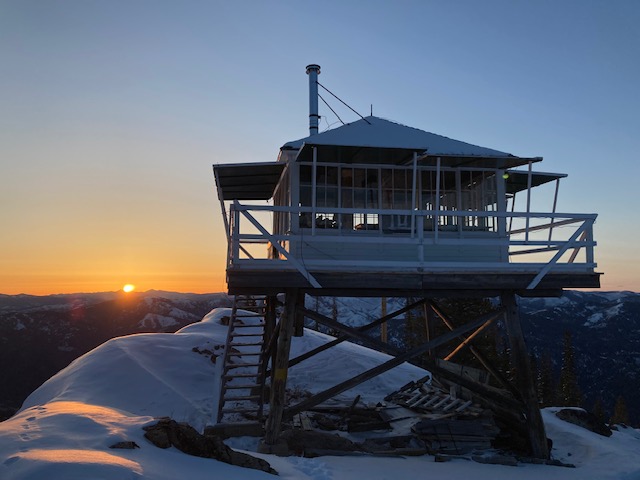
Sunrises at the lookout never fail to disappoint, but this one was particularly memorable.
Waking up at almost 8,000 feet in a room with a 360-degree view is always delightful, but the sunrise when I awoke was majestic beyond words. With a cup of coffee in hand, I walked around the catwalk to appreciate it al fresco before returning to my sleeping bag for some warmth and relaxation. I was in no hurry to leave, both for the obvious reason of wanting to prolong my time in such a magical spot and to let the snow warm up to make for a more enjoyable descent. The conditions weren’t quite right for corn snow to form, but I was hoping for things to soften up a bit before I headed down.
After a few hours, my eagerness for skiing got the better of me and I packed up my gear, closed the eight shutters, meticulously tidied the lookout and swept it out, and then finally got into my skis and pointed them downhill. The descent had moments of bliss, but it was clear within my first few turns that the snow was much too hard to make for enjoyable skiing. Lots of sidescraping was involved as I lost the elevation I’d gained the previous day. I skied cautiously – between the less-than-ideal conditions and the weight on my back, it seemed like it would be easy to take a fall.The descent was slow, as I told a friend after the trip to illustrate my timidity on the downhill: “I was just skiing for the car, not skiing for the gnar.”
Although my trip lasted barely 24 hours, the deep satisfaction and sense of accomplishment had me buzzing for days. I couldn’t wait to go back and planned a return trip for the next weekend with those who had expressed interest but couldn’t make the initial short-notice trip. I’d ski up solo for a night, then ski back down to the road to “guide” two friends back up for another night. Sharing the trip with others, including one who’d visited the lookout on foot but not yet on skis, made an already enchanting experience even better.
The only thing better than backcountry skiing to a lookout is backcountry skiing to a lookout with friends.
Cozied up by a fire with friends and sipping wine while watching the sun dip below the ridge just west of the lookout was sublime beyond words. A clear sky even allowed us to glimpse some shooting stars before we went to bed. We took our time before leaving in the morning and the conditions had softened up the snow to where it allowed for enjoyable turns and carving through the trees on steep but not scary slopes. Although this will probably be my shortest season of backcountry skiing – it was all of a week long – I know without a doubt that it will be one of my most memorable.
Executive Producer - Backpacking Light; Show Director and Host - Ryan Jordan; Producer - Chase Jordan; Theme music: Look for Me in the Mountains written by Chris Cunningham and Ryan Jordan, performed by Chris Cunningham (acoustic guitar, lead and harmony vocals, harmonica), Chad Langford (upright bass), and Tom Murphy (mandolin), produced by Basecamp Studios in Bozeman, Montana.
Sponsorship Policy: Backpacking Light does not accept compensation or donated/discounted products in exchange for product mentions or placements in editorial coverage, including any podcast episode content not excplicitly identified as sponsored content. Some (but not all) of the links in these show notes may be affiliate links. Learn more about affiliate commissions, influencer marketing, and our consumer advocacy work by reading our article Stop wasting money on gear.
Different land management agencies have different difficulties obtaining a permit to plan and enjoy a backpacking trip.
As a backpacker living in western Montana, needing a permit to go backpacking is the exception rather than the rule. Outside of Glacier and Yellowstone National Parks, you can arrive at pretty much any trailhead you want and hike into the backcountry for a trip of any length and destination of your choosing. Campsites in the national forests are almost exclusively first-come, first-served (aside from rental lookouts and cabins) and there’s no zone quotas or other restrictions limiting travel. In the mountain range where I do most of my backpacking, the luxury of being flexible in my destination if solitude is my priority is much appreciated. If I pull up to a trailhead and there’s a dozen cars and a Boy Scout troop van, I can easily just drive a half-hour to the next canyon and leave the crowds behind. But more often than not, even on holiday weekends, I can count most of the cars on one hand at all but the most popular trailheads. And, perhaps most importantly, based on what I see as a visitor – these areas don’t yet need permits to preserve opportunities for solitude and avoid adverse impacts to the landscape from concentrated visitation.
Without being bound to any permit itinerary, I was able to stay at this lake for two nights instead of just the one I’d originally planned on. Since it was midweek, I had the added bonus of having this lake to myself both nights.
Needless to say, this makes the browsing of maps and guidebooks and planning trips a productive pastime, since I won’t mind my trips derailed by the inability to secure a permit. Trips are derailed or don’t happen due to natural causes – fire closures, excessive smoke from wildfires, weather issues, or lack of time. And to be quite honest, I’ve become frustrated enough by the competitiveness and complexity of backpacking permits for national parks that I’ve stopped trying in recent years to even attempt snagging a permit for most “life list” trips and national parks. I’ve been lucky enough to have a friend who is more diligent and patient with applying for permits and have been lucky enough to tag along with him on trips to Glacier National Park in recent years.
Other than a trip in North Cascades National Park that was marred by five straight days of thick wildfire smoke, which irritated my throat and limited visibility to only a mile or so, I’ve never been disappointed by a backpacking trip. Even ones that have been rainier than I would’ve liked, or which ended prematurely for various reasons, or where the trails were in frustratingly poor condition they’ve have always had some elements of exploration and enjoyment which cause me to remember them fondly. Oddly, I have found myself increasingly disappointed by trips that don’t happen as a result of not getting a permit to even start them in the first place.
In 2022, the only place I can recall backpacking where I needed a permit was Craters of the Moon National Monument in Idaho where I visited for a lunar eclipse. Although the landscape is otherworldly, the limited options for backpacking, the harsh landscape and climate, and the burden of having to pack in all the water you need means that the demand for backpacking isn’t anywhere close to outpacing the supply. It is rare for there to be two groups backpacking at the same time in the entire 43,243 acre Craters of the Moon National Wilderness Area. The permit was a simple matter of stopping by the ranger station, receiving a brief orientation, providing an estimated itinerary and route, and then heading out to the trailhead. Prior to that, my most recent experiences with permits for backpacking were for Yellowstone National Park, Aravaipa Canyon Wilderness, and Capitol Reef National Park – in order of most to least competitive.
In 2019 and 2020 when I applied for backpacking permits for Yellowstone National Park, the permit reservation system was structured in a way in which permit applications were randomly processed in early spring before going to being processed in the order in which they were received. Under that system, which involved using a fax machine at the local library to submit the permit application, I was able to specify a wide range of dates, campsites I was willing to accept, and even the option of reversing the itinerary I had proposed. This option to indicate flexibility is likely what allowed me to be successful two years in a row at getting a permit for a four-night backpacking trip that included two nights at a campsite near a phenomenal hot springs.
Once the backcountry permitting system was moved to recreation.gov for 2022, along with the permits for most other federally-managed recreation units, the format changed. Users – which seems like a weird way to characterize potential backpackers yearning for amazing natural experiences – simply entered into a lottery and then received a time and date slot to log in and pick from the sites that were still available. Those who received a time and date slot earlier in the window were much more likely to get the trip they wanted than those who drew a later slot. I’ve never received one of the slots in the first half of the window after two years of trying. By the time I’ve been able to access the reservations, all the nights for that campsite for the entire season have been completely booked.
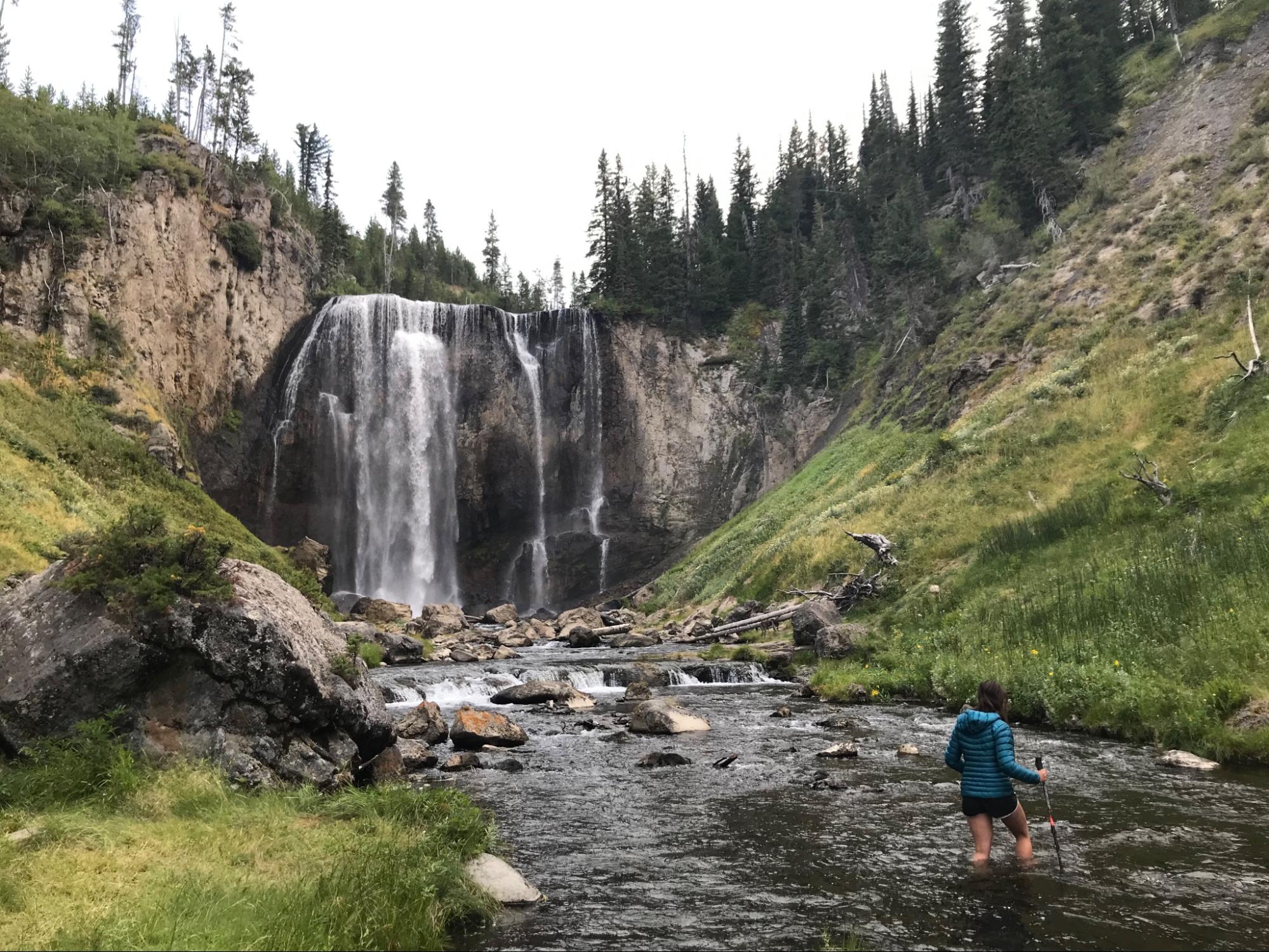
Almost to the most idyllic of the hot springs pools that line the stream below a waterfall in Yellowstone National Park. After the backcountry permit system became administered under recreation.gov, obtaining a permit became more challenging.
While I’m fortunate enough to be able to backpack with a degree of spontaneity that is rare in other parts of the country, and have been on many trips to incredible places in nearby wilderness areas, I do enjoy the level of planning and anticipation that comes with planning trips to national parks. The trip to Aravaipa Canyon Wilderness in 2019 did have a few nail-biting moments when trying to secure the permits for the three continuous days needed (the maximum allowed by the Bureau of Land Management), but overall it felt attainable. When browsing recently for both nostalgia and comparison’s sake, things appeared to be booked within a few hours whereas in previous years there was still availability days after the booking window opened.
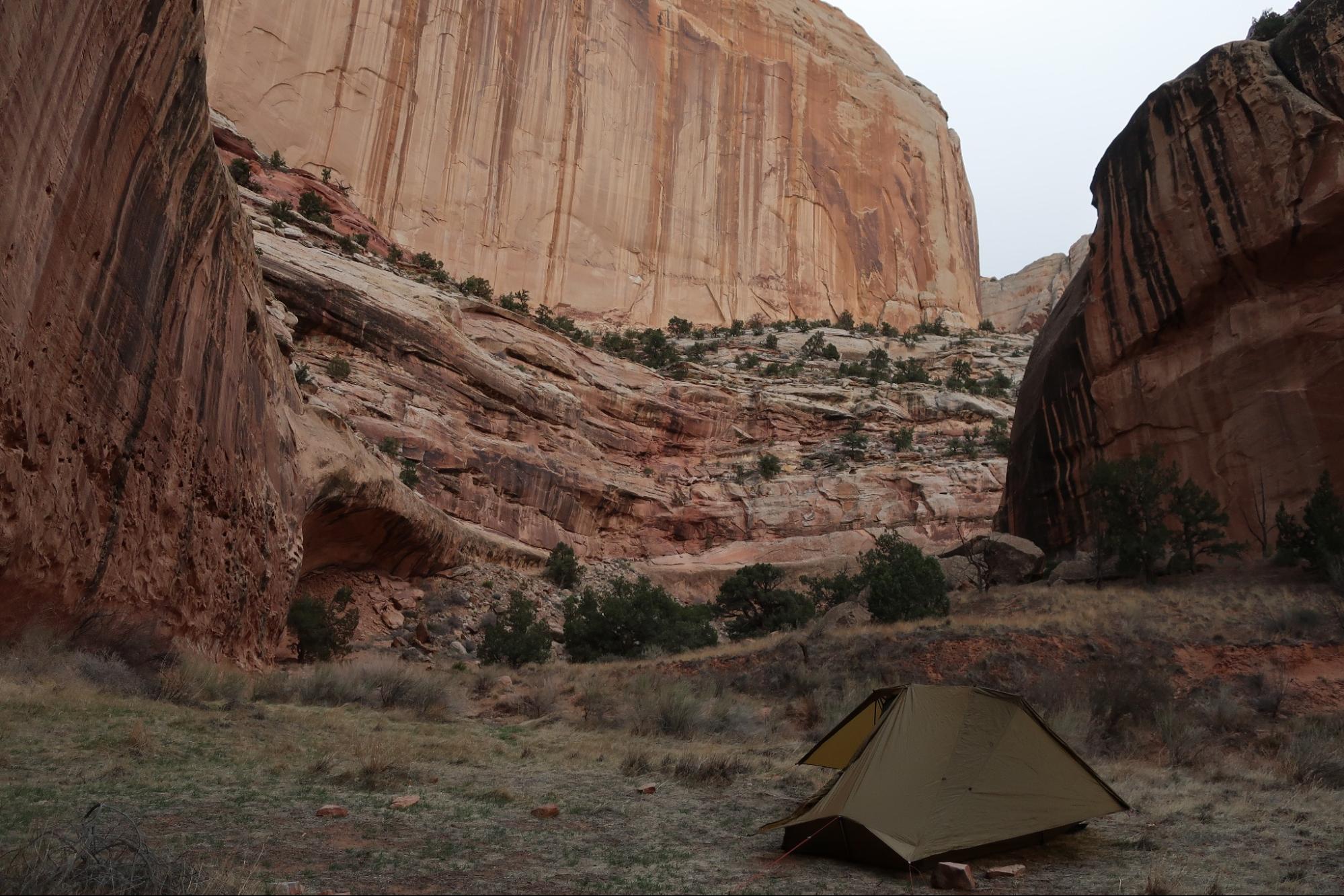
Backpacking in Capitol Reef National Park was an amazing experience and the permit process makes it easy to have a flexible itinerary.
While I’m more than content to primarily limit my backpacking trips to within a half-day’s drive of my home, I do have an urge to explore other landscapes. For those that are national parks, it seems like concentrating my efforts on those with less rigorous permitting processes – like Capitol Reef National Park – seems to be the best approach for someone like me who takes it personally when they can’t backpack on public lands due to onerous permitting requirements. I realize this selfishness and entitlement in my perspective, and I don’t relish feeling this way, especially since I can easily backpack in the Northern Rockies with little planning and only a few miles of driving. Where I feel the most sympathy is for those who don’t live close to public lands and have to plan their trips with an efficiency and economy that leads them to becoming reliant on obtaining a permit with a set date, set itinerary, and near-guarantee of incredible scenery (smoke and weather being the major variables). While the solution to visit a national forest or other that doesn’t require a permit is certainly an option for anyone who wishes to backpack, there’s less information on how to put together a comparatively outstanding trip for these places compared to a national park. The national park trips ostensibly provide much more of a “sure thing” if you can manage to snag a permit.
Perhaps the silver lining to this cloud created by permits is that backpackers will become more informed about, and involved with, the stewardship of national forests. By becoming aware of the amazing outdoor recreation opportunities on these public lands, and the challenges that face them (particularly deferred maintenance for trails), there might be more volunteerism among trail work organizations and discussion of how to utilize these resources without loving them to death and ultimately having them fall under the purview of permits as well.
Clinic & Trek: October ’23 – Live Skills Clinic & Guided Trek in Rocky Mountain National Park – Become an Unlimited Member to gain access to early enrollment
Executive Producer - Backpacking Light; Show Director and Host - Ryan Jordan; Producer - Chase Jordan; Theme music: Look for Me in the Mountains written by Chris Cunningham and Ryan Jordan, performed by Chris Cunningham (acoustic guitar, lead and harmony vocals, harmonica), Chad Langford (upright bass), and Tom Murphy (mandolin), produced by Basecamp Studios in Bozeman, Montana.
Sponsorship Policy: Backpacking Light does not accept compensation or donated/discounted products in exchange for product mentions or placements in editorial coverage, including any podcast episode content not excplicitly identified as sponsored content. Some (but not all) of the links in these show notes may be affiliate links. Learn more about affiliate commissions, influencer marketing, and our consumer advocacy work by reading our article Stop wasting money on gear.
Membership Required
This feature requires an active Backpacking Light Membership.
Premium Articles
You're currently viewing a free preview of a member exclusive premium article. Our premium articles include in depth journalism and insights from the Backpacking Light editorial team.
Get full article access by subscribing to a Premium or Unlimited Backpacking Light membership!