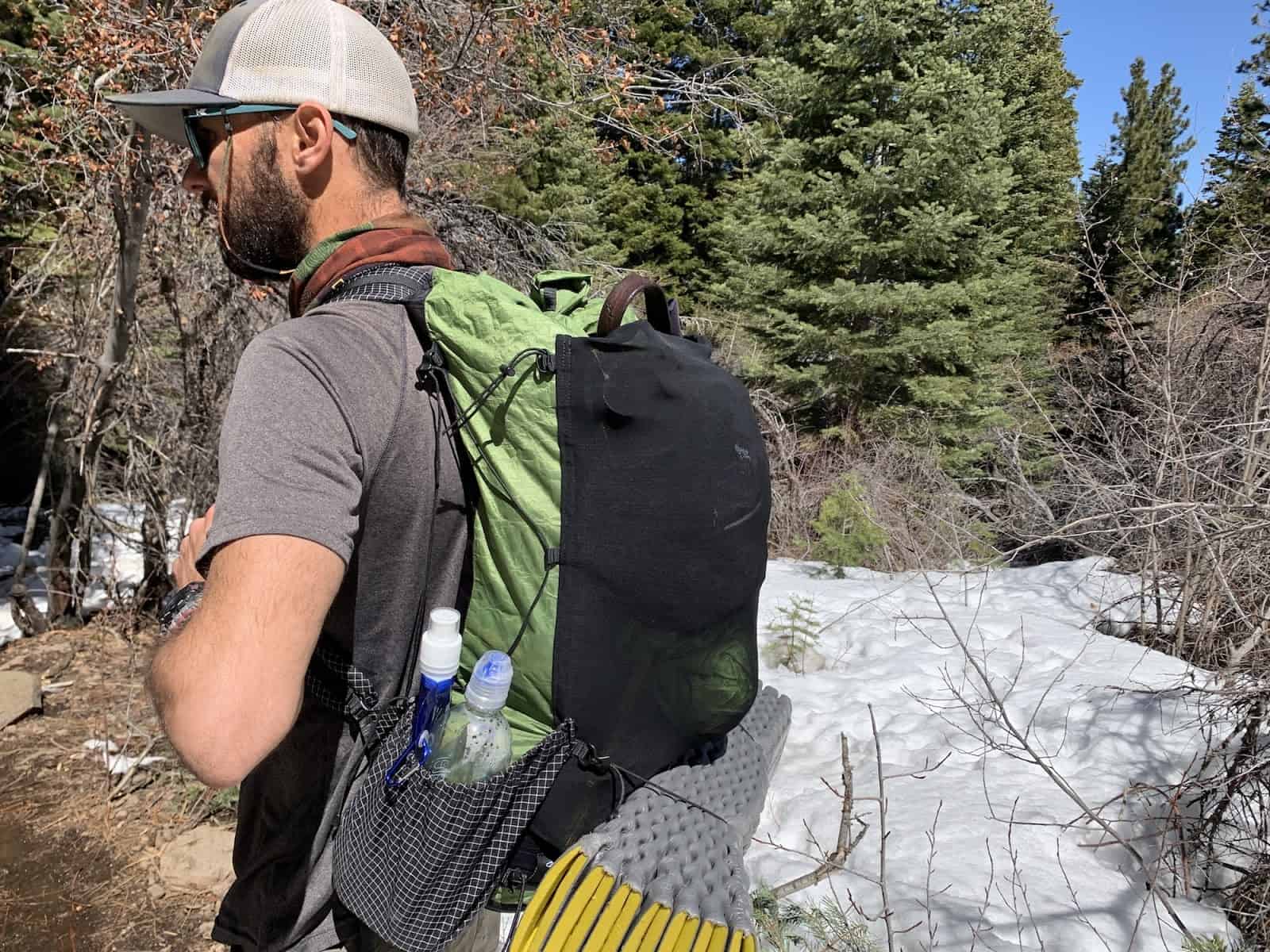
The Seek Outside Divide 4500 is an external frame backpack featuring a roll-top closure, two oversized side pockets, and a back pocket.
Introduction
The Seek Outside Divide 4500 (54 oz / 1531 g, $359) is a high-capacity external frame backpack designed to carry heavy loads. Seek Outside introduced this pack in 2016. It features a roll-top closure, multiple compression straps and attachment points, two oversized side pockets, and a back pocket. The bag material is waterproof, and all materials are heavy-duty, intended to give long service in rough conditions.
Photo: Seek Outside
About This Review
This Limited Review of the Seek Outside Divide 4500 is based on my experience with the pack during a 10-day, 150-mile section hike of the Desert Trail in the Mojave Desert of California, March 2020.
Features and Specifications
Base MSRP: $359
External frame
Roll-top closure
Waterproof X-Pac fabric
Dual-adjustment straps on hip belt
Gatekeeper buckles allow compression straps to be easily added or removed
Optional accessories include top lid, frame extensions, hipbelt pockets, lumbar pad, bottle holster
No hydration ports
Minimal weight 2 lb 12 oz (1250 g)
Weight as tested 3 lb 6 oz (1530 g)
3000 – 4500 cu in (50 – 75 L) volume
Carries 50+ lb (23+ kg) loads
Adjustable harness fits torsos 16-20 in (40-50 cm), 18-22 in (45 – 55 cm) with optional frame extension
Five hipbelt sizes fit 26-48 in (66-122 cm) hip range
Performance Assessment
Criteria
Observations and issues
Load Hauling
Rigid U-shaped external frame and well-padded yoked harness enabled me to comfortably carry loads of up to 40 lbs (18 kg). Dual straps on hipbelt provided a comfortable and secure fit.
Load Adaptability
The side, top, and bottom compression straps minimized volume as water carries went from 8 L to 1 L, and my food supply went from 8 days to 1 day. However, the main bag is cavernous, 38 inches (97 cm) tall when unrolled. It's a long reach to grab gear.
Usability and Flexibility
The Divide 4500 comes with an abundance of straps and gatekeeper buckles that are easy to move around between the many attachment loops. The optional hipbelt pocket is positioned too far back, making it difficult to access. The optional lumbar pad increased comfort with heavy loads, increased airflow to back. The pack was easy to balance. A lack of a hydration port meant that I used a side pocket for a hydration bladder, which was easily accommodated by the oversize side pockets.
Agility During Off-trail Travel
Articulated hipbelt maintained my freedom of movement. Curved frame geometry kept the load close to my back. Cordlocked drawstrings on back and side pockets kept items secure when clambering up and down rocks.
Durability
Heavy-duty mesh and solid fabrics resisted abrasion from rocks and thorny vegetation very well. There are a lot of both on the Desert Trail.
Water Resistance
Although I did not seam-seal the pack, only minimal moisture entered the Divide 4500 in an all-day rainstorm.
Weight
Seek Outside bills the Divide 4500 as an ultralight pack, placing it in the 2.5 lb(1 kg) category. This billing is unrealistically low, as most configurations result in a 3+ pound (1.4+ kg) pack weight. Such weight doesn't qualify as ultralight in my book. But it does qualify as light, especially in the context of its load and volume capacity.
Commentary
What makes the Seek Outside Divide 4500 unique?
Wide Load Range
Robust Construction and Materials
Configurability
Suspension
The yoked harness is easy to adjust to a range of torso lengths
Load Range
I tested the Divide 4500 on a 10-day hike of the Desert Trail in California. With long stretches between food and water caches, I carried loads ranging from 20 to 40 lbs (9 to 18 kg). The pack readily accommodated my maximum load of 6 days food and 6 L of water. I can easily imagine the pack accommodating the kind of bulky gear I bring when leading youth groups: a 4L pot, mixing bowls, bear canister, etc. Conversely, compression down to my base load (15 lbs / 6.5 kg) plus a day of food and 2 L of water was no problem.
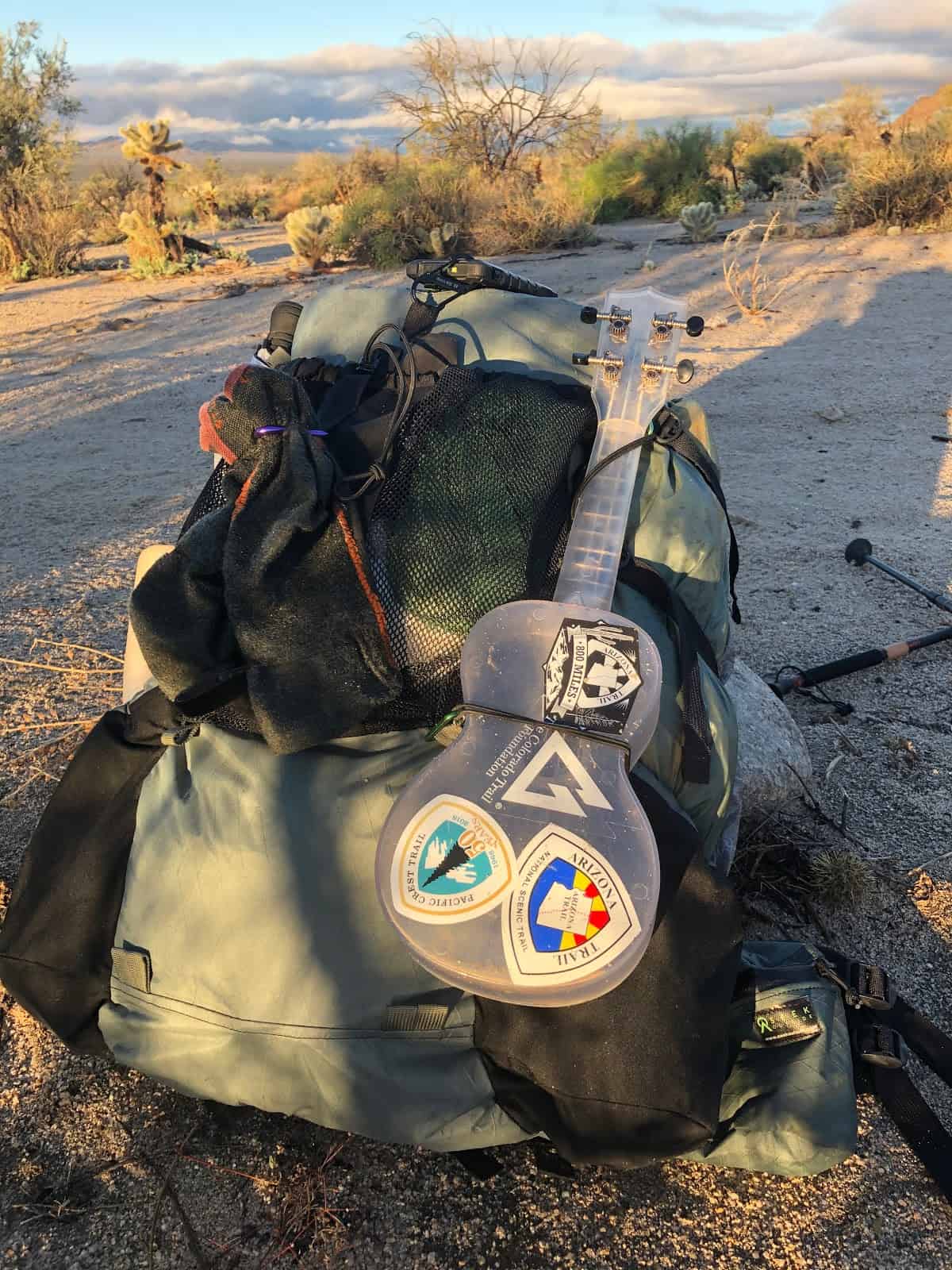
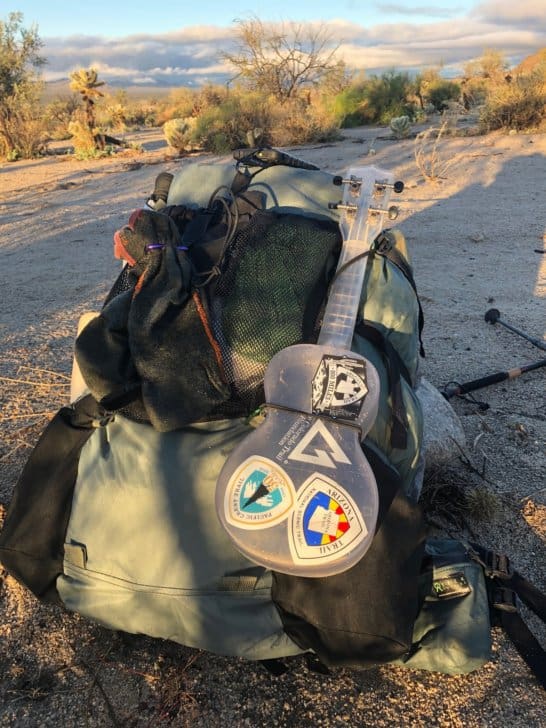
The Divide 4500 after stocking from a cache outside Joshua Tree NP, with 7 days of food and 3 L of water. There are plenty of attachment points to strap on a ukulele, a solar charger, and some wet socks.
Robust Construction and Materials
A ten-day trip is insufficient to assess long-term durability, but the Desert Trail dishes out plenty of pack (and human) abuse per mile. I routinely subjected the Seek Outside Divide 4500 to thorny vegetation and extensive abrasion from rock scrambles. The pack showed no damage or signs of wear. The side pockets are 500d Cordura. The back pocket is a mesh-solid hybrid, with the mesh a non-stretchy heavy-gauge material. These are the most vulnerable points on a pack when bushwhacking, but they were undamaged.
The laminated X-Pac material forming the main bag is heavy (4.4 to 7 oz/sq yd, 150 to 240 g/sq m) and somewhat stiff. This material is exceptionally waterproof (200 PSI, 140K mm H2O) but must be seam-sealed to achieve full water tightness. I hiked for hours in the rain one day with the pack exposed and noted only minimal water infiltration, despite not having seam-sealed the pack.
Close inspection of the Divide 4500 revealed its workmanship to be top-notch. The seams are straight and even and are double-seamed or zig-zagged for strength where appropriate. Seams are covered with tape to prevent fraying, and no loose ends are left to unravel.
Configurability
A key attribute of the Seek Outside Divide 4500 is its flexibility and how easy it is to configure. I ordered my tester pack with the lighter gray Xpac fabric (the heavier olive material adds 3 oz / 85 g), a lumbar pad (+ 3 oz / 85 g) and a hipbelt pocket (+ 2 oz / 57 g). I opted against ordering the frame extensions, which increase load capacity because I have no intention of ever carrying 60+ lb loads. A top lid is also available.
I adjusted the torso length per the manufacturer’s instructions, a fairly simple operation. I tested the ride of the pack with and without the lumbar pad and opted to keep it mounted as it increased carry comfort with heavier loads and also increased air circulation along my back. I retained the removable horizontal stay (2.5 oz / 71 g) for the same reasons.
Among the distinctive features of this pack are the numerous loops for strap attachment, and the use of gatekeeper buckles for rapid attachment and removal of straps. To minimize weight, I opted to leave off the top “V” strap, the two bottom straps, and used only two, rather than three, side compression straps. The trail weight of this arrangement (size M hipbelt), was 3 lb 6 oz (1.5kg).
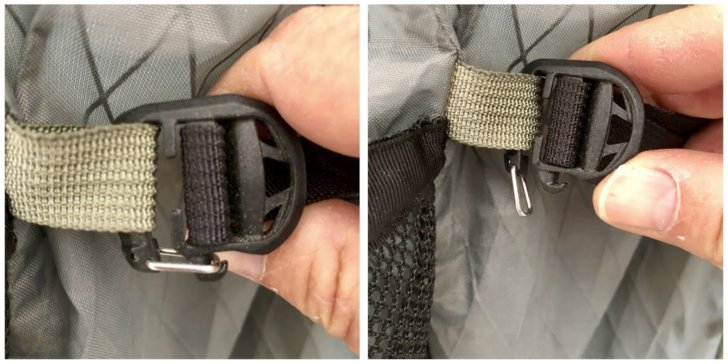
Gatekeeper buckles latched for secure attachment and unlatched for removal. You squeeze down on the top bar (on the left in these pictures) to pop open the latch.
The Divide has no hydration ports, which increases its water tightness and suitability for packrafting. It has two very large side pockets. Each pocket can accommodate two 1 L Nalgene or two 1.5 L Smartwater bottles. I prefer to hydrate on-trail with a bladder. It was little trouble to fit a Platypus 2.0 L Hoser bladder in a side pocket, clip its top loop to a compression strap with a mini-biner, cut the drink tube to size and clip it to the shoulder strap.
Load Carry
The Seek Outside Divide 4500 is not an ultralight pack. To justify its weight, it has to carry heavy loads securely and comfortably. A 0.5 inch (1.3 cm) anodized 6061 T6 aluminum external frame is key to load capacity. The frame runs in a U-shape around the perimeter of the pack bag and has a concave curve at the bottom to wrap the pack closer to your body. This geometry keeps the pack’s center of gravity closer to your center of gravity.
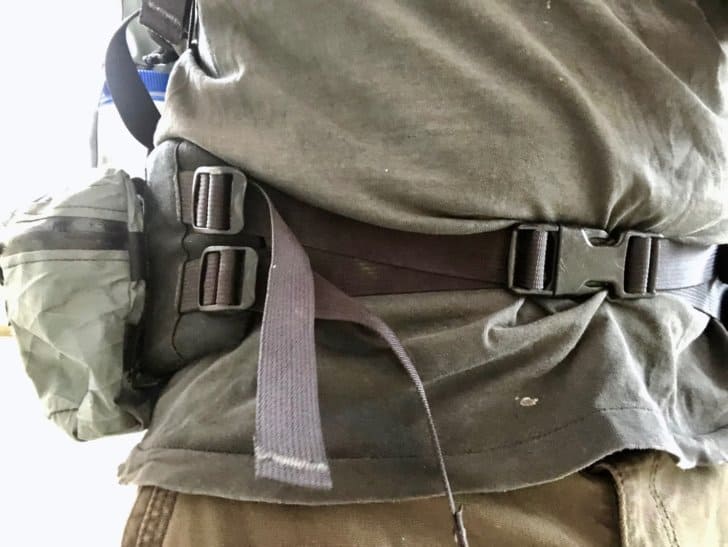
The shoulder straps and hipbelt are well-padded. The hipbelt is 5 inches (13 cm) wide and has two independently adjustable 1-inch (2.5 cm) straps. I find the two-strap configuration to provide a superior fit, both on this pack and other packs I own.
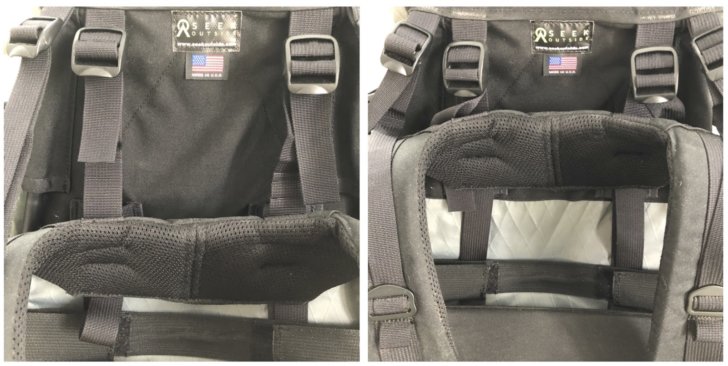
Divide 4500 hipbelt and hip pocket.
The Divide carried loads of up to 40 lbs (18 kg) over rough terrain with minimal flexion and no buckling. The load remained well-distributed at all times, and the pack was easy to balance without much fuss. I believe it could easily cope with an additional 20 lbs (9 kg), but I am not anxious to test this assertion.
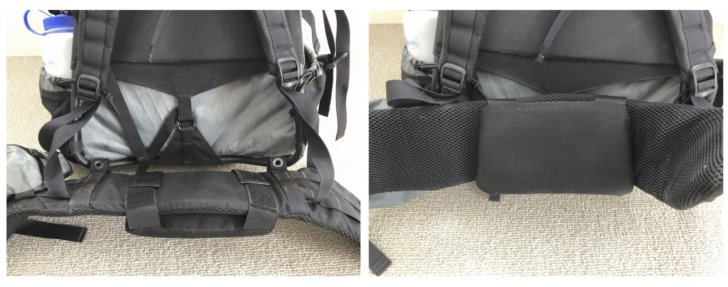
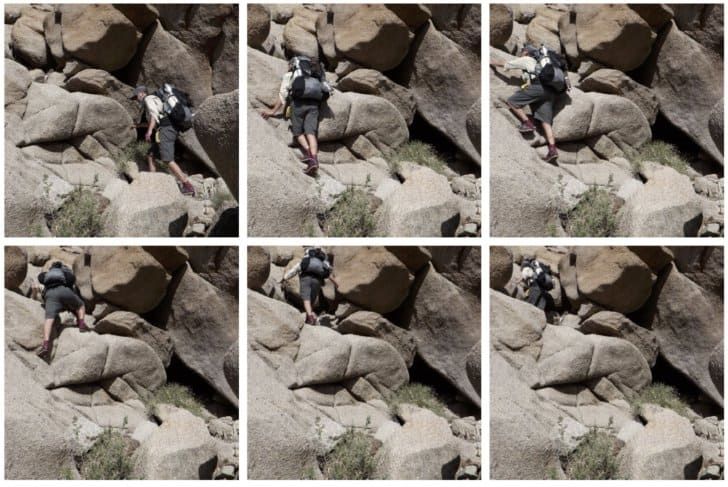
Equally important on this hike, the Divide moved with me on innumerable scrambles, climbs, and sidehill traverses. At no time did I feel thrown off-balance by the pack. The Divide hipbelt is articulated, which simply means that it is attached along the bottom edge of the frame and can swivel up and down. This feature is very helpful when scrambling over rocks and reaching for handholds.
The hipbelt is attached by loops to the bottom of the frame, allowing it to rotate. Optional lumbar pad is shown.
In short, the pack’s ability to move with me was superb. It made carrying 30 to 40 lb (12 to 18 kg) loads about as comfortable as is possible.
Scrambling up Lost Palms Canyon with a 40 lb load in the Seek Outside Divide 4500.
Compared To…
Last fall, I bought the Andrew Skurka-designed Sierra Designs Flex Capacitor 60-75L. This pack checks many of the same boxes as the Seek Outside Divide 4500 concerning capacity and compressibility and addresses many of the same use cases. I have taken the Flex Capacitor on two trips: a 4-day fall loop through the canyon country of western Colorado, and a winter overnight in the Front Range foothills.
Flex Capacitor 43 oz (1220 g), Divide 4500 54 oz (1530 g)
Flex Capacitor
Max volume
75L both
Tie
Min volume
Flex Capacitor 60L, Divide 4500 50L
Divide 4500
Carry comfort
The Flex Capacitor has a high center of gravity, making it tippy. Single-strap hipbelt constantly loosened and slid down
Divide 4500, big time
Durability
Mesh side pockets of Flex Capacitor were shredded in bushwhack. The Divide 4500 is made of much burlier material.
Divide 4500
Configurability
Few attachment points on Flex Capacitor, the Divide 4500 has many attachment points.
Divide 4500
Organization and accessibility
Flex Capacitor has a zippered top lid and zippered main opening (works better than you think). Divide 4500 has back mesh pocket (good) and long roll-top opening (not great)
Flex Capacitor
Cost
Flex Capacitor $220, Divide 4500 $359 base
Flex Capacitor
Strengths
Rugged and durable
Comfortable carry
High capacity
Waterproof with seam-sealing
Adaptable storage options
Limitations
Heavy. Best use cases are cold-weather trips, guiding, packrafting, hunting, and long water/food carries
Product mentions in this article are made by the author with no compensation in return. In addition, Backpacking Light does not accept compensation or donated/discounted products in exchange for product mentions or placements in editorial coverage.
Some (but not all) of the links in this review may be affiliate links. If you click on one of these links and visit one of our affiliate partners (usually a retailer site), and subsequently place an order with that retailer, we receive a commission on your entire order, which varies between 3% and 15% of the purchase price. Affiliate commissions represent less than 15% of Backpacking Light's gross revenue. More than 70% of our revenue comes from Membership Fees. So if you'd really like to support our work, don't buy gear you don't need - support our consumer advocacy work and become a Member instead.
Learn more about affiliate commissions, influencer marketing, and our consumer advocacy work by reading our article Stop wasting money on gear.
Internet pundits often insist that new lightweight backpackers should buy a pack last, so that it will hold all their new gear and a week’s worth of food. Sometimes the advice is to buy the pack first, a little larger in volume than the backpacker thinks they’ll need. But both approaches can misfire, and I think there’s a better way.
Introduction
Internet pundits often insist that new lightweight backpackers should buy a pack last, so that it will hold all their new gear and a week’s worth of food. Sometimes the advice is to buy the pack first, a little larger in volume than the backpacker thinks they’ll need.
But both approaches can misfire, and I think there’s a better way.
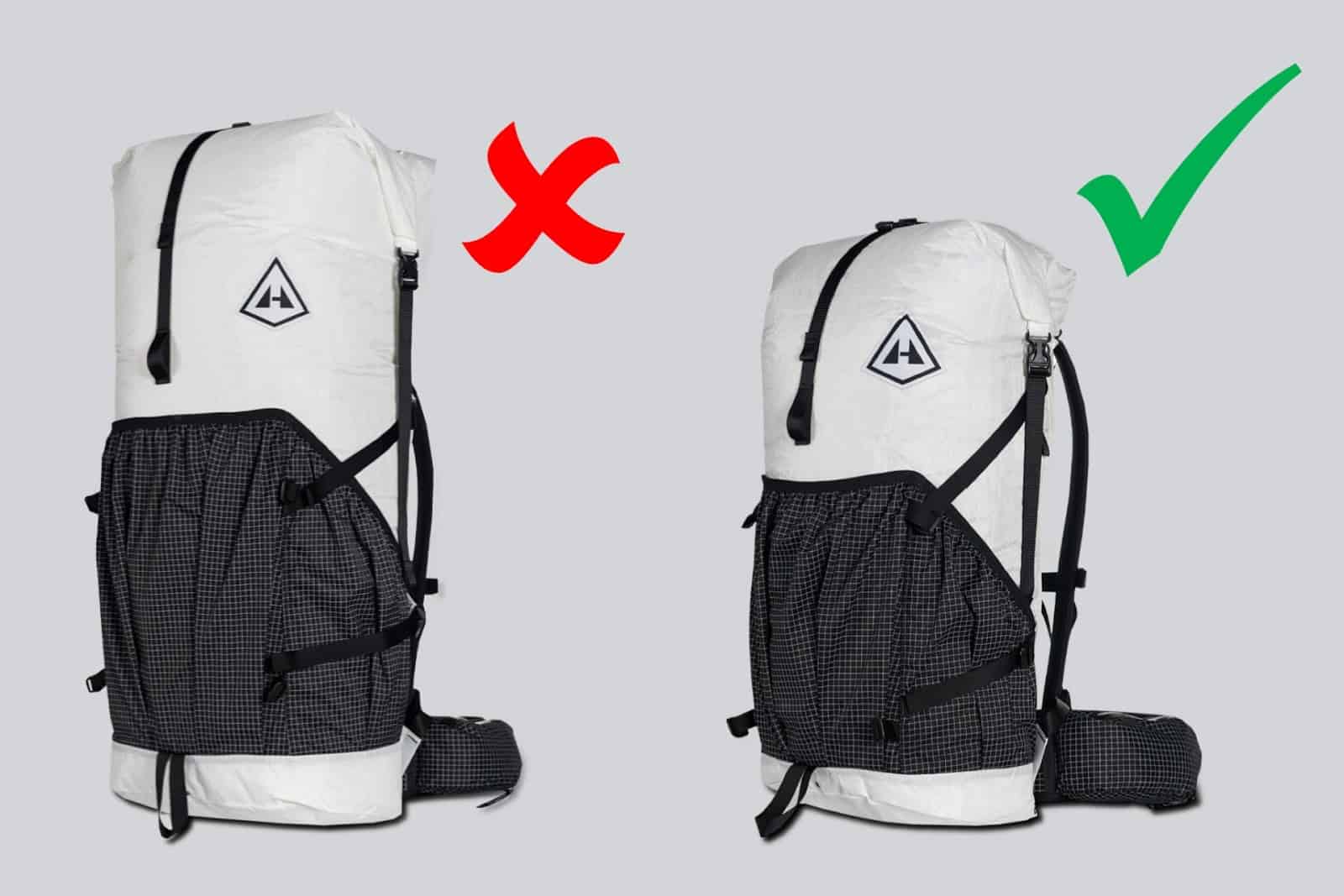
The first purchase for transitioning trekkers should be a backpack that fits well and holds 50 liters (3,000 cubic inches) or less. Then they should buy and carry only as much gear, food, and water as fits inside, because they’ll always fill the space available. It took me three tries to figure this out the hard way.
Stumbling into Lightweight Backpacking
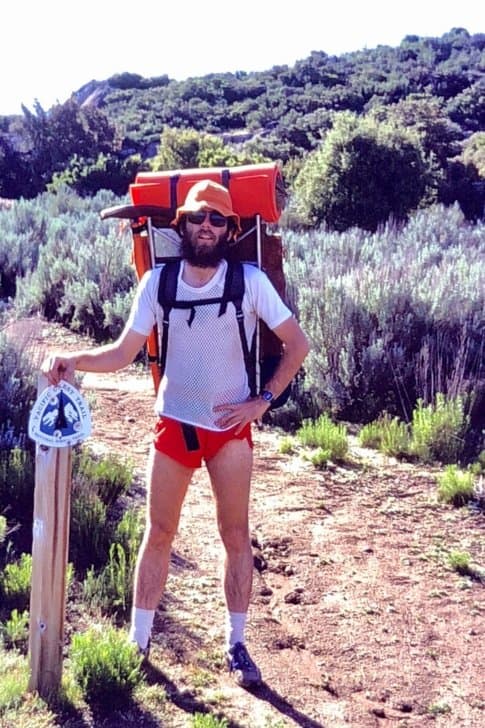
Type 2 fun, all day, every day. My monster pack and stylish clothing on the PCT in 1980. Photo credit: Gordon Masor
From the mid 1960s to the early 1980s, I backpacked with large external frame packs. Books and friends told me to buy the biggest volume hauler that fit, because you never knew what you might need to take. Catalogs and ads convinced consumers to buy a monster pack now in order to climb Mount Everest someday.
Of course, I always crammed those packs full, and frequently strapped more to the outside. I commonly carried 40 pounds (18 kg) for a two-night trip, and 55 pounds (25 kg) or more for Pacific Crest Trail sections. I was young and strong, but still couldn’t wait to dump my pack at all-too-frequent rest stops.
Then in the early 1980s a mainstream lightweight backpacking revolution started. Eventually I bought a low volume 2-pound (0.9 kilogram) internal frame pack for weekend trips. Most of my old equipment wouldn’t fit, which forced me to buy smaller and lighter gear and to carry less crap.
At last I could hike longer distances without suffering nearly as much. I actually enjoyed backpacking for several years, until a good friend introduced me to whitewater rafting.
Big Boat, Small Boat, Bigger boat
Most rafts can haul enormous piles of gear for overnight trips – and I did. But I also had to arrive a day early to inflate the boat, attach the frame, load the gear, and tie it all down with dozens of straps. And at each river camp I spent more hours unloading and reloading.
Then one evening at a live charity auction (with beer), I spontaneously bought a small cataraft that could carry me, my personal gear, and not much more. I could rig that boat in less time than it took to inflate most rafts. The cataraft’s small size and weight made it a joy to row down the river. And I schlepped a lot less stuff in camp.
Then I got married, bought a bigger raft, and hauled even bigger piles of gear. But I secretly longed for backpacking-style river trips, where each person brought just one large dry bag of equipment and food. Backpacking alone started looking better.
Third Time’s the Charm
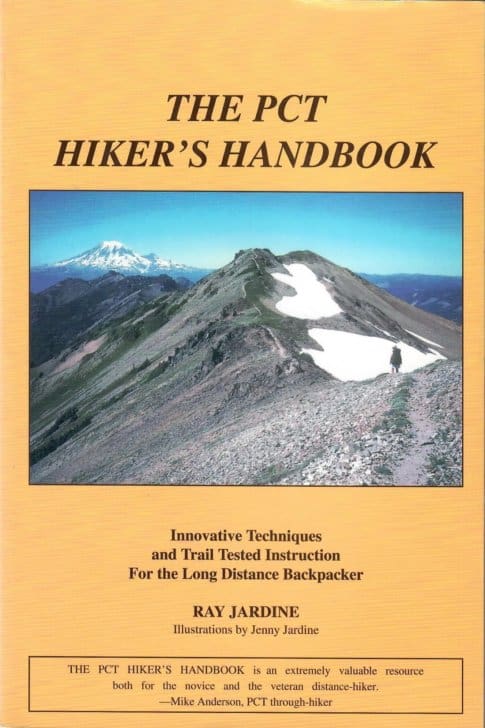
My copy of “The PCT Hiker’s Handbook” by Ray Jardine, first published in 1992. This book kicked off the current ultralight backpacking movement.
By the time my 1980s lightweight backpacking gear wore out, the outdoor industry had reverted to 5 pound (2.3 kilogram) tents, packs, sleeping bags, and boots. My base pack weight jumped to 25 pounds (11 kilograms) and backpacking became a rarely-repeated sufferfest again.
But in 1993 I stumbled across Ray Jardine’s “The PCT Hiker’s Handbook,” and it blew my mind. Could I really backpack without hurting so much? I dropped weight piece by piece without downsizing my pack. I still carried too much gear “just in case,” and ultralight running shoes resulted in ultra-large blisters. It wasn’t until I bought a much smaller pack, which forced me to ditch unnecessary stuff again, that I got my base weight below 15 pounds. That was about 17 years ago. I think I’ve learned the lesson this time.
The Universe is Expanding?
An old rule of thumb says you’ll always fill the space available. This is true for garages, hard drives, and backpacks. So what happens when an enlightening trekker buys a smaller pack last? Until then, they keep using their old high-volume pack, they haul too much stuff, and they continue suffering. After spending big bucks on new gear, they could easily decide that lightweight backpacking is nonsense and give up.
If a lightweight convert buys a new pack first, “a little larger than needed,” then to be safe they’ll estimate too high, carry too much, and won’t be happy.
The American way is that bigger is better. Yet bigger backpacks are almost always heavier. Bigger means you’ll carry more stuff, which makes your load heavier. Bigger means there’s more fabric, seams, and straps to wear out, snag, leak, etc. And bigger is usually more expensive.
Better Advice
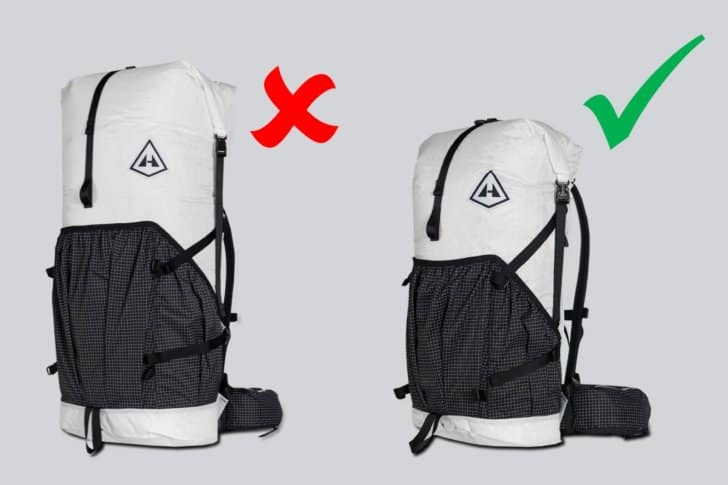
The first purchase for transitioning backpackers should be the smallest backpack that fits well and holds a downsized weekend load. For most trekkers that’s 50 liters (3,000 cubic inches) or smaller.
My 50-liter Hyperlite Mountain Gear Windrider 2400 fits me better than any pack I’ve owned or tried. I’ve used it to comfortably carry up to 33 pounds (15 kilograms) of gear, food, and water at the start of eight-day trips. And I’m not SUL or even UL – my base pack weight is about 13 pounds (6 kilograms).
Pack fit is crucial, and this HMG Windrider 2400 fits me well but doesn’t hold too much gear. Type 1 fun returns! Photo credit: Judith Witt-Sanders
Yet multiple reviewers claim that this pack is just big enough for weekend trips. They insist on recommending packs of 60 liters (3,700 cubic inches) or larger, especially since the 65-liter (4,000 cubic inch) Windrider 3400 weighs “only” 1.8 ounces (51 grams) more.
Start Small
The reality is you don’t need a bigger pack unless you plan to hike and camp in cold, snowy weather for many days, or carry a bunch of specialized gear like packrafts or climbing racks. Even if you do – why not buy a smaller pack first, carry less, and suffer less for most trips? If you need to carry more gear for special trips, you could downsize other equipment to make room, and hike even lighter most of the time. Or you could strap gear on. Or you could buy, borrow, or rent a larger pack.
But start small – 50 liters (3,000 cubic inches) or less. Because you’ll always fill the space available.
Note: Some backpack makers advertise just the main pack bag volume, others include the pockets. I included pockets for this post.
DISCLOSURE (Updated April 9, 2024)
Backpacking Light does not accept compensation or donated/discounted products in exchange for product mentions or placements in editorial coverage.
Some (but not all) of the links in this review may be affiliate links. If you click on one of these links and visit one of our affiliate partners (usually a retailer site), and subsequently place an order with that retailer, we receive a commission on your entire order, which varies between 3% and 15% of the purchase price. Affiliate commissions represent less than 15% of Backpacking Light's gross revenue. More than 70% of our revenue comes from Membership Fees. So if you'd really like to support our work, don't buy gear you don't need - support our consumer advocacy work and become a Member instead.
Learn more about affiliate commissions, influencer marketing, and our consumer advocacy work by reading our article Stop wasting money on gear.
We review the 6-Liter model of the Platypus GravityWorks Water Filter, intended to provide water for groups and for basecamp scenarios.
Introduction
In this article, we review the 6-Liter model of the Platypus GravityWorks Water Filter, intended to provide water for groups and for basecamp scenarios. The potential advantages of this gravity-powered system are the saving of time, effort, and weight in purifying water for groups.
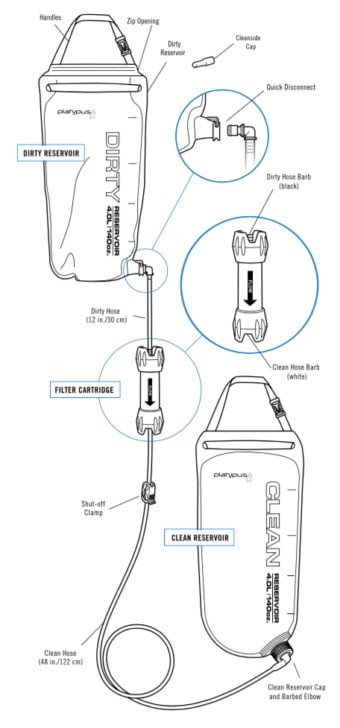
Schematic of parts and assembly. From the owners’ manual.
The GravityWorks system has been around since 2008 and is a mature product. We reviewed the 4.0 L incarnation of this filter in 2016. That review found the GravityWorks system to be robust and easy to use, offering good value for weight. According to the design team at Cascade Designs (parent of Platypus), the current version of the filter is little changed from previous models. The most significant change is that the cartridge walls are now thinner. The team found that they could save a bit of weight there without sacrificing robustness or reliability.
Our previous review focused on qualitative factors: ease of use, quality of build, and design. Our current review expands on those observations with a quantitative analysis of key performance factors. Together these reviews should give you a good sense of what to expect from the GravityWorks filter, and whether it is a good fit for your filtration needs.
About This Review
This Limited Review examines some of the key performance parameters of the system: rate of filtration, how this rate is affected by water quality and hydrostatic head, and how this performance declines with use. I also make a qualitative assessment of ease of use based on my experience with similar previous models and compare the GravityWorks filter with its nearest competitors.
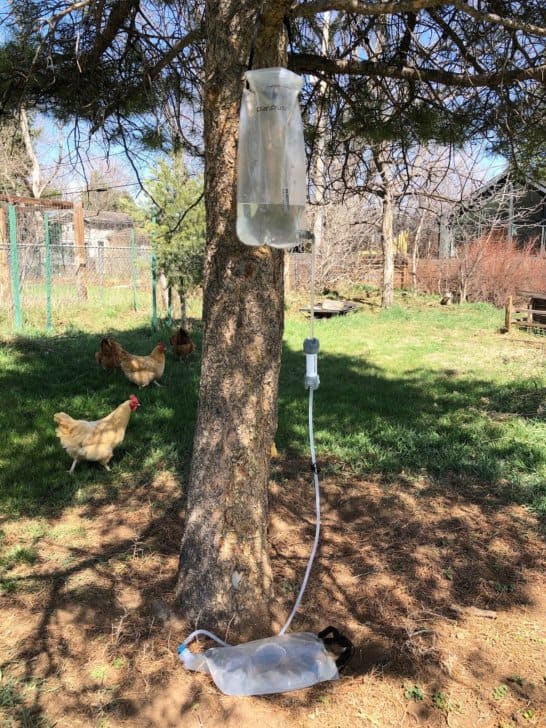
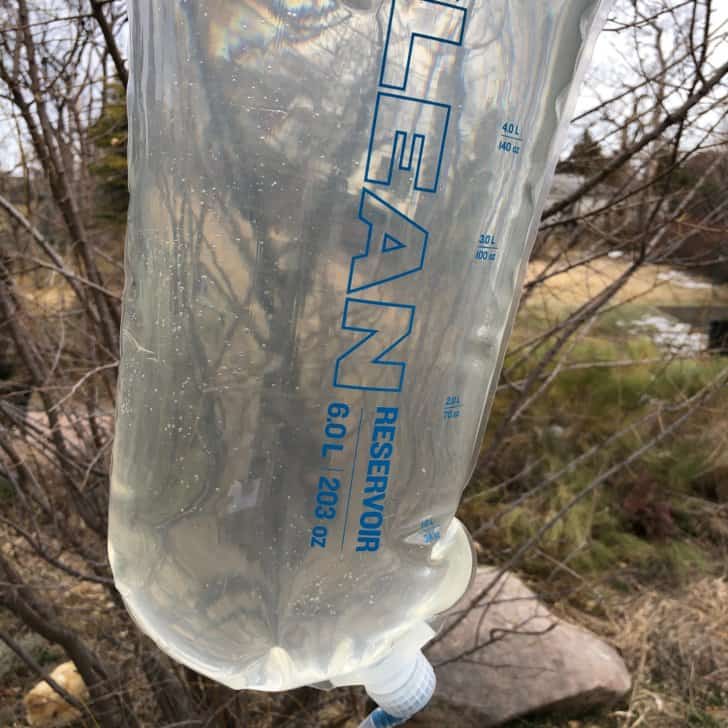
The Platypus GravityWorks 6.0L filter in its basic use configuration: dirty water reservoir hanging from a tree limb, feeding water through the filter to the clean water bladder on the ground. No animals were harmed in the production of this review.
Features and Specifications
Gravity driven
Effective against bacteria and protozoa, but not viruses
Meets EPA and NSF standards for removal of 99.9999% of bacteria and 99.9% of protozoa
Pore size: 0.2 µm
Field-cleanable by backflush
Hollow-fiber filtration media
Wide-mouth collection reservoir
Simple operation controllable by in-line clamp
6.0L capacity
Filtration rate
Claimed: up to 1.75 L/min
Measured: see text
Weight:
Claimed: 12.3 oz (350 g)
Measured: 12.7 oz (360 g)
Packed size: 12 x 6 x 3 inch (30 x 16 x 7 cm)
Replaceable cartridge treats up to 1500 L
Polyethylene reservoir, silicon tubing
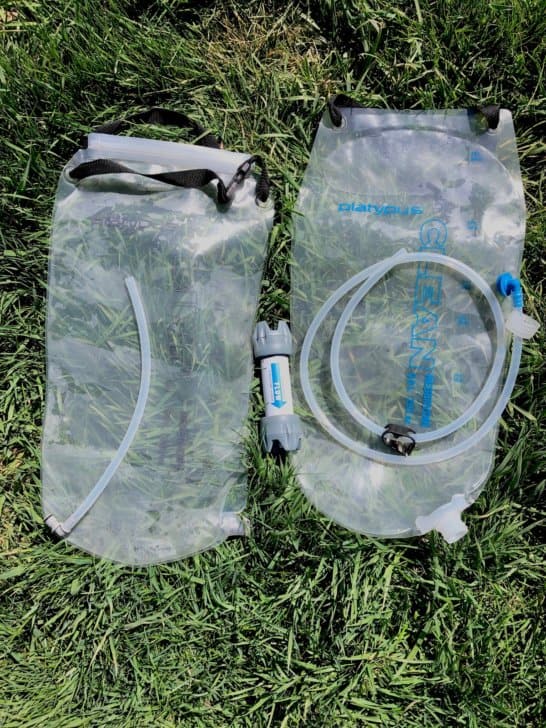
The GravityWorks filter, packed.The GravityWorks filter components unpacked
Performance Analysis
I tested the GravityWorks filter for several parameters:
flow rate with both clean and dirty water sources,
dependence of flow rate on hydrostatic head, and
loss of flow rate as a function of cumulative liters filtered.
Those are a fair number of variables to examine, and they are variables that I expected to show some dependence on each other. Rather than examine each in a traditional one-factor-at-a-time experimental design, I used statistical design of experiments methods to minimize the number of runs needed to extract the desired information.
To measure the effects of hydrostatic head, I hung the collecting reservoir 3, 5, and 7 feet (the maximum extension of the tubing) above the receiving reservoir. I used tap water for clean water. Per the manufacturer’s recommendation, I backflushed the filter with 0.5 – 1.0L of clean water before every run. To generate dirty water, I stirred up the algae from a downspout rain barrel in my garden and withdrew water from that barrel.
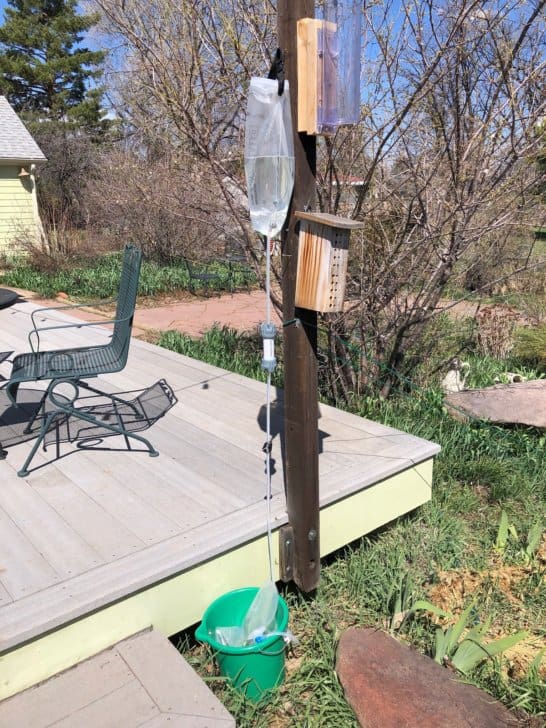
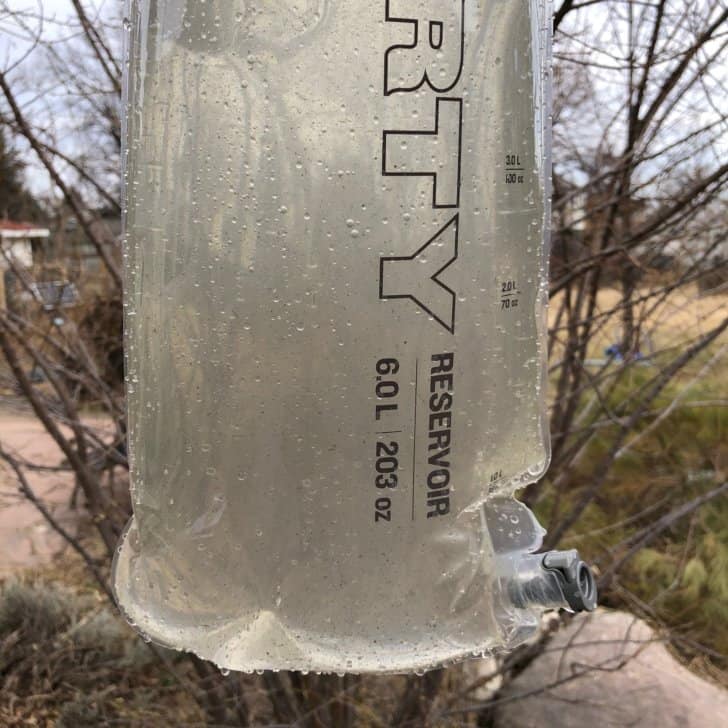
Testing setup: the dirty water reservoir was hung from a post at 3, 5, or 7 feet (max extension) above the receiving clean reservoir. The rain gauge and bee nesting block were not part of the test protocol.To generate dirty water, I stirred up the algae from a downspout rain barrel in my garden.For comparison, here’s what the filtered (clean) water looked like.
Experimental Results
Here’s my raw data:
hydrostatic head (ft)
water quality
filtration time time (hh:mm:ss)
filtration rate (L/min)
cumulative water filtered (L)
ambient temperature (F)
7
clean
0:03:47
1.59
0
50
7
clean
0:04:02
1.49
12
50
7
clean
0:04:27
1.35
18
50
7
clean
0:03:56
1.53
24
50
7
clean
0:03:50
1.57
30
50
5
dirty
0:05:53
1.02
36
58
7
clean
0:04:39
1.29
42
58
3
clean
0:09:39
0.62
48
58
3
dirty
0:16:49
0.36
54
58
7
dirty
0:06:35
0.91
60
40
3
clean
0:11:14
0.53
66
40
3
dirty
0:21:10
0.28
72
40
5
clean
0:08:15
0.73
78
40
7
clean
0:05:56
1.01
84
47
3
dirty
0:22:54
0.26
90
47
7
dirty
0:16:38
0.36
96
47
5
clean
0:11:58
0.5
102
47
3
clean
0:17:14
0.35
108
47
5
dirty
0:15:39
0.38
114
49
3
clean
0:17:20
0.35
120
49
7
clean
0:06:34
0.91
126
49
5
clean
0:08:30
0.71
132
50
Note: Data from the second run (the 6L run) excluded due to a kink in the tubing.
I used these data to create a multivariate model of test performance using a response surface design. A Bonferroni correction was applied to reduce the false discovery rate of significant factors. Factors that were thus excluded were: temperature, non-linearity of hydrostatic head, and interaction of water quality on hydrostatic head.
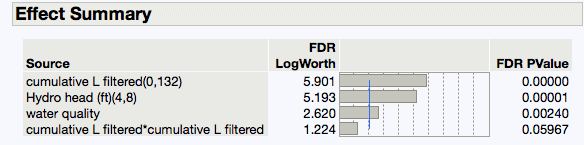
Significant factors and their Bonferroni-corrected P values are:
The derived multivariate model fits well to the observed data (R2=0.94, RMSE=0.13 L/min, Pvalue < 0.0001).
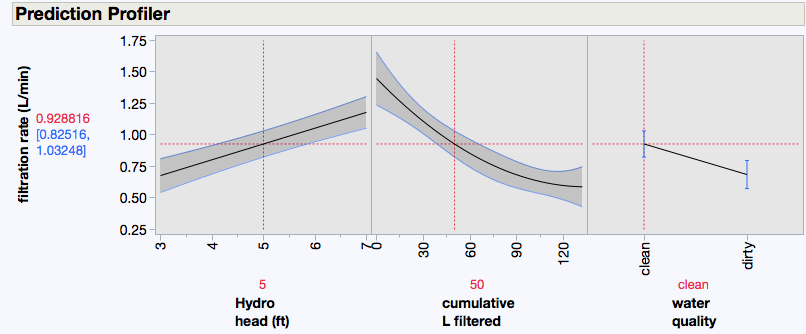
Here is a graphical representation of the model, showing the relative effects of each of these factors:
Clicking on the graph will take you to an interactive file that will open in a new browser tab.
Conclusions from this analysis:
Dependence on the hydrostatic head is about 0.2 L/min/ft. Not surprisingly, the higher you hang the filter, the faster filtration rates will be. This dependence is linear over the range tested.
The maximum filtration rate is about 1.5 L/min, not 1.75 L/min as claimed by the manufacturer.
Dirty water is filtered about 17% more slowly than clean water. This is less of an effect than I expected. Obviously this depends on just how dirty the water is. A limitation of this result is that I tested scummy (algal) water, but not silty water, which might behave differently.
Filtration rate drops with use. The initial rate of 1.5 L/min dropped to 0.9 L/min after 100 L. That’s a lot. To be fair, most users won’t be filtering as much dirty water as I did in this testing and should see a lower loss of filtration rate. Unless you are hiking the Arizona Trail, I can easily imagine that the drop in rate would be much slower than what I measured.
The loss of filtration rate is non-linear and appears to slow down after an initial rapid drop. This effect is of borderline statistical significance (p = 0.06) but still more likely than not to be real. My physical interpretation of these results is that there are a finite number of sites on the filter to which scum will stick irreversibly.
Qualitative Observations
My testing plan was to use this filter on a Sierra Club ICO trip with middle-schoolers to Canyonlands National Park in April 2020. The coronavirus outbreak led to the cancellation of all our outings for the time being. However, I have used earlier versions of this filter on previous outings. As the basic design and form factors appear little changed, I think it is valid to apply those experiences to the current product.
The operation of this filter system is very simple. Both elementary and middle-school kids have no trouble in both setting it up and getting water from it. Collecting water from still sources using soft-sided containers is always harder than using rigid containers. However, the wide mouth and stiff zip-seal at the opening make collection from still water relatively easy.
Backpacking Light publisher Ryan Jordan has used large-volume Platypus GravityWorks filters for several years with Scouting groups in mountainous areas of the Northern Rockies, including Glacier National Park, Yellowstone National Park, the Bob Marshall Wilderness, and the Absaroka-Beartooth Wilderness and notes that as long as they aren’t filtering extremely silty water, the efficiency of using a system like this as a group filter far outweighs the filtration rate slowdowns that come with filtering clean water.
Earlier versions of this system featured an adapter that allowed filtration directly into a variety of bottles, rather than the supplied Platypus bladder. Although this was convenient, it was not unusual for kids to fill their bottles and forget to clamp the line shut, draining filtered water out onto the ground. Filtration into a closed reservoir prevents this waste.
The narrow mouth of the clean reservoir also makes it difficult to use for water collection, thus minimizing the risk of cross-contamination.
Performance Summary
criterion
observations and issues
Filtration rate
1.75 L/min claimed, but 1.5 L/min max rate for a full 6 L batch observed. Not surprisingly, this rate decreases with reduced hydrostatic head, and for dirtier water.
Ease of use
Simple to assemble. Wide, rigid mouth facilitates water collection. Walkaway operation. Easy to backflush.
Robust design
No moving parts or power sources required. Sturdy construction. Very few failure modes.
Product lifetime
Significant drop in filtration rate with use.
Backflush setup: hang the clean reservoir above the dirty reservoir for a minute.
Commentary
Gravity filtration technology is mature. The first version of the Platypus filter was launched in 2008. With several well-established competitors in the field, there are no striking innovations that distinguish one product from another. Instead, these products are differentiated on the basis of execution. I reached out to the design team at Cascade Designs (parent of Platypus) for their view of what distinguishes their product from the competition:
Clean side/dirty side complete system. Makes it easy to backflush and purge air bubbles, reduces the risk of contamination, provides storage capacity so that clean water is always available. Comment: These claims are fair. Several competitors do not include a clean water reservoir. Backflushing only requires placing the clean reservoir above the dirty for about a minute.
Internal testing. Platypus does actual microbiological testing rather than relying on dry particles to verify manufacturing quality. Comment: I can’t vouch for competitors’ methods, but microbiological testing is the gold standard. Bacteria (especially Gram-positive cocci, which can be < 0.5 µm) are flexible and can pass through filters whose pore size is smaller than they are. Also, nominal pore sizes are an average over a distribution. The width of that distribution matters greatly to actual filter performance.
Taste-free. The proprietary film of Platypus products has a thermoplastic polyurethane outer layer that provides strength and durability and is lined with an inner-water contact polyethylene layer. This construction keeps water from tasting like polyurethane. Comment: I did not detect any plastic flavor from the clean reservoir. I have had other products, notably an MSR Dromedary bag, that had a strong plastic taste (incubating several hours with a warm, dilute solution of Dr. Bronner’s helped fix this).
The Cascade Designs team also noted that they test 100% of filters inline on their production lines. They also believe that their lifetime claims are more realistic than those of their competitors, and plan to update this spec to best-case/worst-case (i.e., clean vs. dirty) scenarios. Comment: I noted a significant decrease in the filtration rate in less than 100 L use. However, the rate seemed to be stabilizing at about 1 L/min, which is still comparable to rates for mechanical filters.
Compared To
I’ve used the comparable Sawyer product on group outings. In my experience, it is a distinctly inferior product. Flow rates under the best of circumstances were significantly slower than the Gravityworks filter and it clogged readily. Repeated backflushing was required to get it to work at all.
The MSR Trail Base Water Filter System is more expensive, heavier, treats a smaller volume, and has a slower filtration rate. On paper, it loses out to the Gravityworks filter.
Platypus $120, Katadyn $90. Katadyn does not include a clean reservoir.
Katadyn
weight
Platypus 12 oz (350 g), Katadyn 10 oz (283 g). The Platypus clean reservoir weighs 3.2 oz (90 g) and can be left at home, making it lighter in a comparable configuration.
Platypus
packability
Clean reservoir accounts for most of the small difference.
Katadyn
capacity
6 L both
tie
pore size
0.2 µm both
tie
backflushable
Platypus easy to backflush, Katadyn cartridge must be replaced
Requires trees or other support, preferably > 5 feet height
Decreased filtration rate over time, even with backflushing
Closing Comments
The Platypus Gravityworks 6.0L Filter is a mature product that addresses the use cases of high-volume water treatment for groups and basecamp scenarios. It is simple to operate and is robust and reliable. It provides clean water at a higher rate and with less effort than mechanical pumps, and at a comparable weight. Its main limitations are that it will not remove viruses or chemicals and that it is more difficult to use in non-forest environments such as above treeline and deserts. I have used this filter for years on group outings and will continue to do so.
Product mentions in this article are made by the author with no compensation in return. In addition, Backpacking Light does not accept compensation or donated/discounted products in exchange for product mentions or placements in editorial coverage.
Some (but not all) of the links in this review may be affiliate links. If you click on one of these links and visit one of our affiliate partners (usually a retailer site), and subsequently place an order with that retailer, we receive a commission on your entire order, which varies between 3% and 15% of the purchase price. Affiliate commissions represent less than 15% of Backpacking Light's gross revenue. More than 70% of our revenue comes from Membership Fees. So if you'd really like to support our work, don't buy gear you don't need - support our consumer advocacy work and become a Member instead.
Learn more about affiliate commissions, influencer marketing, and our consumer advocacy work by reading our article Stop wasting money on gear.
It all started years ago when I was contemplating the weight of a number of commercial remote canister stoves, and wondering why they had to be so heavy. In many cases, it seemed as though someone with little knowledge of stove engineering had just thrown bits together with no regard for either weight or elegance. Some of the results were clunky, and others were just weird.
At the same time I was looking at some of the massive pre-heat tubes found on commercial remote canister stoves, and wondering why they were needed when butane boils below 0 deg C and propane boils below -40 deg C. It seemed to me that the designers of these stoves were simply copying, rather blindly, the design of current white gas and kero stoves. Kerosene boils somewhere between 150 deg C and 300 deg C, so the comparison seems ridiculous.
Version 1
Actual development work started when I was asked to review the Brunton Stove Stand. It allowed me to put a hose onto my favourite upright canister stove (a Snow Peak GST-100). But it had a solid metal pipe where the hose connected to the body, and I wondered whether I could conduct enough heat in there to vaporise the propane/butane fuel mix as it arrived.
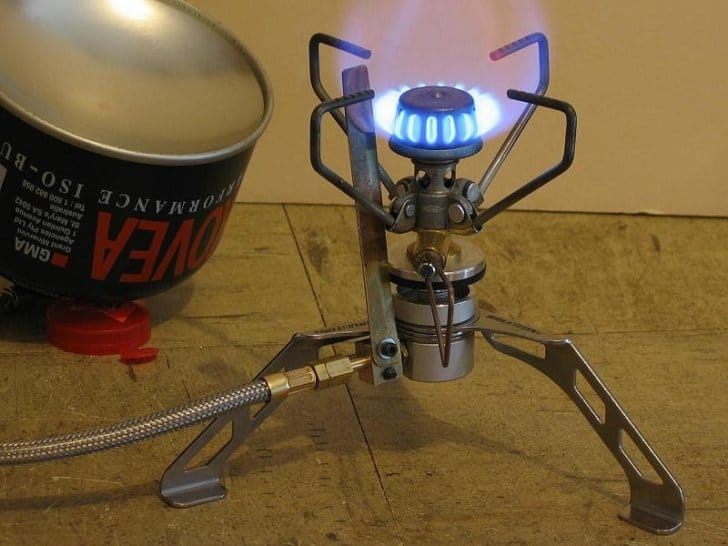
I added a hose and a copper strip to a Snow Peak GST-100 and Version 1 was born. The stove is integrated with the Brunton Stove Stand.
Well, no use wondering: go and do. So I did, as above (see photo), and it worked fine. There was enough heat coming down the metal strip (copper) from the flame to the pipe. After all, the pipe had only to reach something like +5 deg C. Interestingly, while a copper strip (thermal conductivity 400 W/m∙K) worked fine, a brass (61-111 W/m∙K) strip was not so good. For interest, plain aluminium is 236 W/m∙K while Ti is 22 W/m∙K. Obviously, good thermal conductivity would be needed. This metal strip is now called the Heat Shunt.
But the original steel legs on the Brunton stand were heavy, the large base was heavy, and the hose was stiff. If I did some engineering, made some lighter legs, and integrated the needle valve with the base, better was possible. And so the long journey got going.
On one trip in the Pyrenees, the brass thread (where the stove connects to a canister) on my GST-100 had been stripped by the very rough steel thread on the screw-thread canisters. I had to suddenly buy a Campingaz stove (lumpy and heavy) and Campingaz canisters (nice). I wanted to get away from that crude rough steel thread, and I had quite a few nice full Powermax canisters on the shelf. Could I make a universal canister connector?
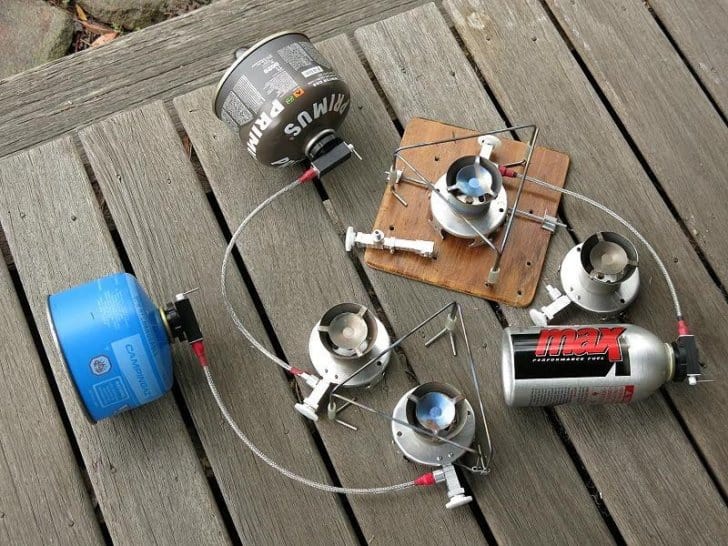
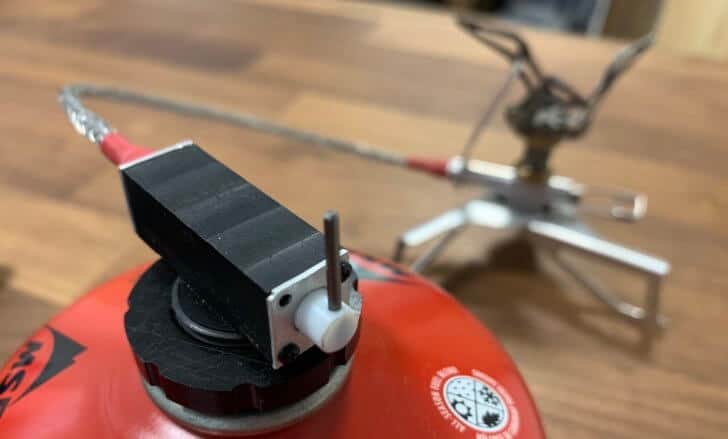
I redesigned (and made more durable) the hose, a better fuel control system, and universal canister adapter next (the black pieces attached to the canisters).My universal canister connector with fuel-control valve. Photo by Ryan Jordan.
Jumping ahead several years, this is what I envisaged: compatible with screw-thread, Campingaz and Powermax, and having a fast ultra-reliable shut-off facility at the canister, separate from the control valve. It was possible, and it has been described in my previous stove articles. At the same time, I was able to make a thoroughly satisfactory but light-weight armoured hose, as seen in the above and below photos.
But developing the whole system had taken a year or two, and I had become a bit impatient. I decided to use a commercial burner head on my stove body and legs to get things going. I could pick a burner head which was light and effective, and it would save me a lot of work. I used two stoves for this: at first the Fire Maple FMS-116 and later on the Fire Maple FMS-300.
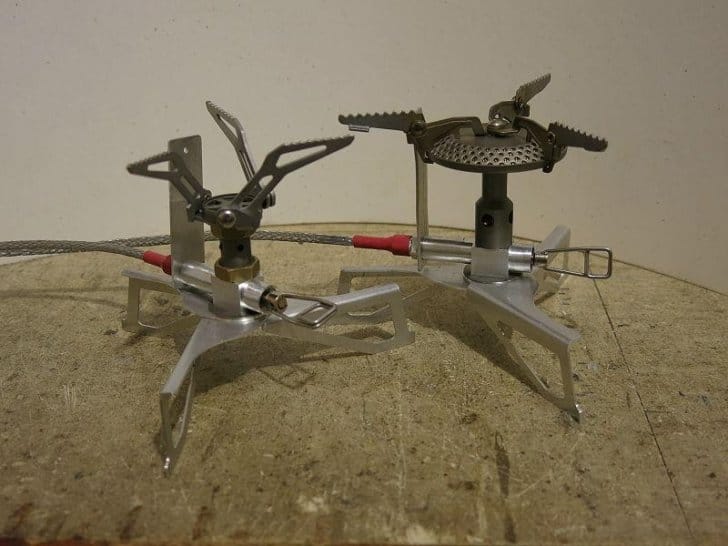
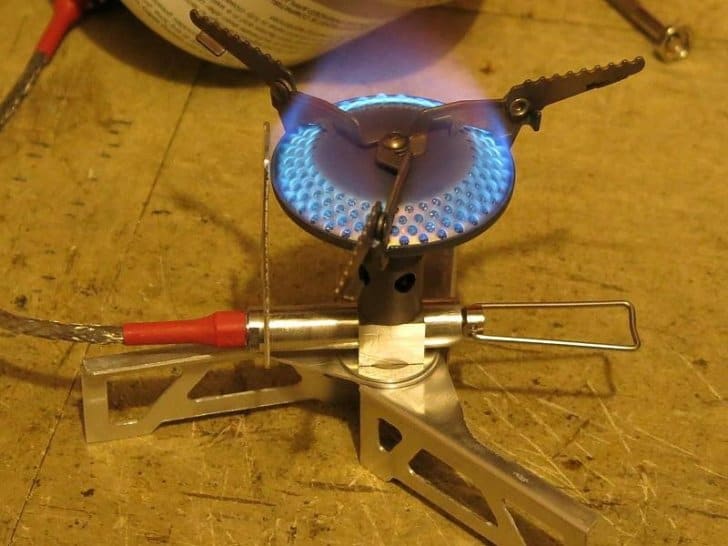
Using these currently available burners (the Fire Maple FMS-300 (left) and Fire Maple FMS-116 (right)) allowed me to focus on other stove design elements, but eventually, it became time to optimize the burner.
The FMS-300 had, to my mind, a better gap between the burner head and the pot, permitting better combustion and lower CO levels. Also, I cheated slightly and reused the needle valves out of the stoves. Purely as a side note, you might like to compare the Fire Maple FMS-300 (on the left) with the BRS-3000t: there is not a lot of difference, and I believe the FMS version was first. A performance comparison between the two can be found in Backpacking Light’s most recent upright canister stove gear guide.
Anyhow, my V1 stove was successful, and I sold well over 100 of them. I was very pleased, and my wife was impressed (which was not easy to do).
Despite the sales, I was not entirely happy with using a commercial burner head. I wanted to make my own burner head. So I started to experiment (and use up a lot of gas in the process).
One of the few constraints I had was that I wanted a wide flame head, not a focused pencil flame like the original Pocket Rocket, the BRS-3000t, or the Fire-Maple FMS-300. Two other constraints were that it had to be manufacturable, and it had to work well. A year or two went past.
The Vortex Diversion
I was well on the way down this path when I suddenly started thinking about Vortex Burners: they are very different from the conventional designs above. I was hooked and spent the next few years happily playing with them – to the point of producing two slightly different models and selling them as well.
This is the V3 model, also covered in articles here at BPL. Yes, I sold a number of both the V2 and the V3 models. There is something very macho about the noise these stoves make when going full bore, they look impressive, and they do work well.This photo was taken up in our Alpine region one morning. It was sub-zero and my wife wanted warm milk on her muesli. Not a problem. So was this the end of the road?
Rediscovery
I was tidying up the workshop after making and selling my V2 and V3 stoves when I opened up one of several boxes of left-over parts. I found all the old burner heads I had been experimenting with after V1, plus about 14 (quite refined) burner heads I had been just about to fit onto stove bodies. I had forgotten all about them.
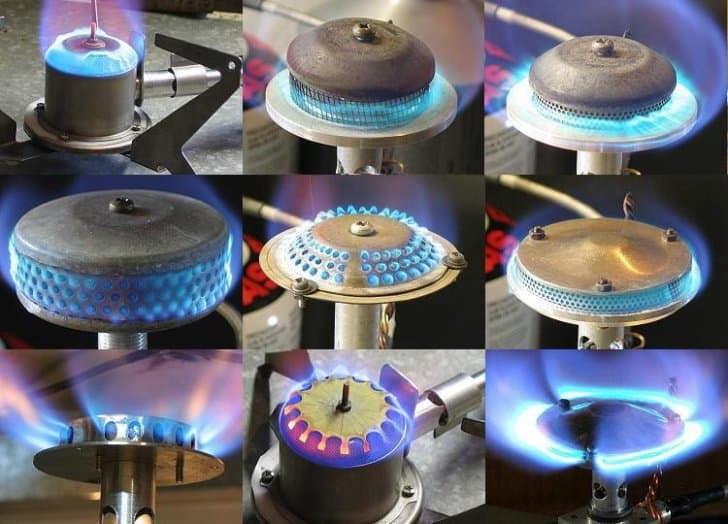
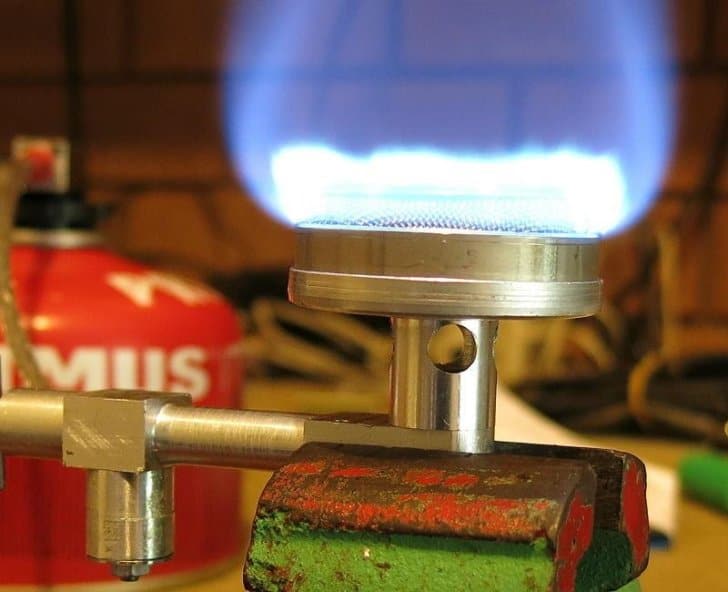
Revisiting burner heads.
Out of interest, I examined them closely. All very nice in fact. Some were made from titanium tubing I had lying around, and others were made from machined aluminum. They were all very light, and they all made a nice broad flame.
Then I looked at the stove body design that came with these heads in the left-overs box: that’s the bit held in the vise in the photo above. It’s rather long, with a pivoting connection for the hose, and I began to remember that both the length of the stove body and the pivot on the hose had both given me a lot of trouble.
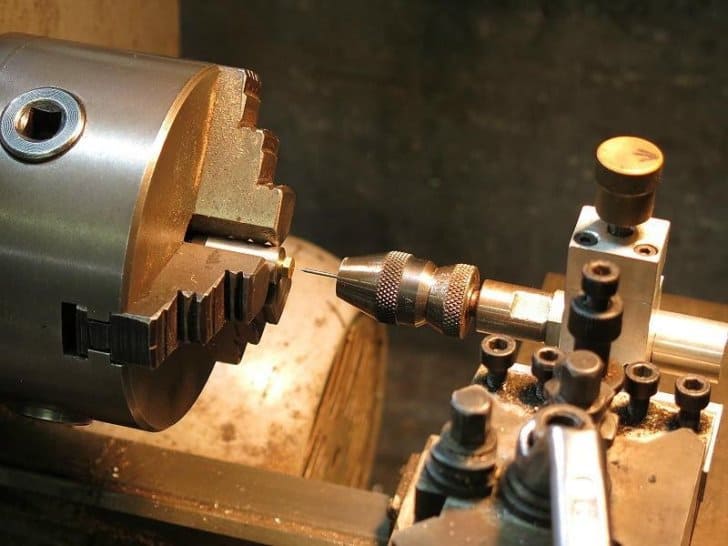
The long stove body presented two problems. The needle valve is perforce directly under the jet. This means a delicate drilling operation for a precisely concentric 1 mm hole at the end of a long thin (4 mm) bore, and I could not find a suitable stock drill bit for this. I had to get some custom-made in China for it. In addition, machining a long thin aluminum needle to fit down the long bore had been difficult: the long thin aluminum rod insisted on flexing in the lathe.
Proving the concept, but at the expense of creating bulk.
I tried using some titanium rod for the needle, and this machined OK, but actual field use revealed a terminal problem when I shut the stove down after use. You see, aluminum has a significantly higher coefficient of thermal expansion than titanium. When the stove cooled down the aluminum body shrank more than the titanium needle, which meant that the needle ended up jammed hard in the orifice. It was very hard to reopen the valve. Long-term reliability? Very poor. Not good enough.
Then I looked at the pivot connection for the hose: the little bit sticking down from the long stove body, near the black O-ring on the spare needle valve. I could buy larger versions of these pivots, but not small ones. My memory was that machining these had been even more complex and slow. The problem lay in how you hold them. There had also been a small problem with the gas flow: going from the pivot connection into the side of the needle valve. There was not a lot of room at the bend for the fuel. I began to remember why I had abandoned the idea and switched to designing Vortex Burners.
But still, I wondered whether I could do better now, with the advantage of many more years of stove design. Ah, the challenge! Further optimisation of the burner head, and a much smaller and simpler stove body at least.
Stove Body
The first decision was that the revised stove body had to be very short, both to keep the weight down and to make the machining easier.
The hose connection was not difficult: I had developed a neat simple connection method for previous stoves which could be further developed.
In the photo of a V1 stove here the end of the hose goes into the stove body, into a bore machined to the right size for an O-ring on the PFA hose itself. The ‘nut’ which holds the hose in place also goes inside the stove body. The version shown here on V1 did not allow rotation of the hose at first, but that was soon fixed. The nut also clamps the Heat Shunt to the stove body for good heat transfer.I changed the screw connection from the V1 style to one which used a loose external nut which lets the hose spin nicely. This had already been done on one of the Vortex Stoves as shown here, so I knew it would work.
Part of the problem with the long stove body had been having the hose connection at the same end of the stove body as the valve, even though it had ‘seemed like a good idea at the time’. If I put the hose at the other end, as in V1 as shown in the previous photo, everything fitted nicely.
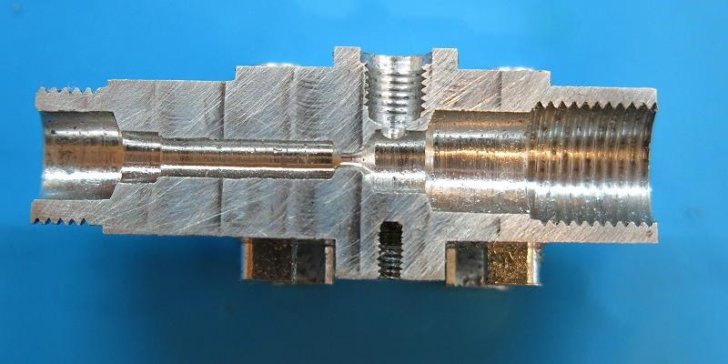
This is an engineering cross-section of the stove body on the V3 stove. The needle valve screws into the thread at the right, and the hose connects at the left. The O-ring is inside the end while the nut is on the outside. The jet comes in at the top.
A very technical point should be made here about how the gas flow goes in at the opposite end from the needle valve. Any dirt or wax from the fuel (it happens) which wants to collect somewhere will most likely blow through the needle orifice, leaving it clean, and it will then collect on the needle. It can often be cleared by movement of the needle valve, or if it’s really bad, by removing the needle valve and wiping it. The overall length of this stove body is under 40 mm, so the needle valve is very short and much easier to machine in the lathe. These factors made both the stove body and the needle valve much easier to manufacture – and lighter too.
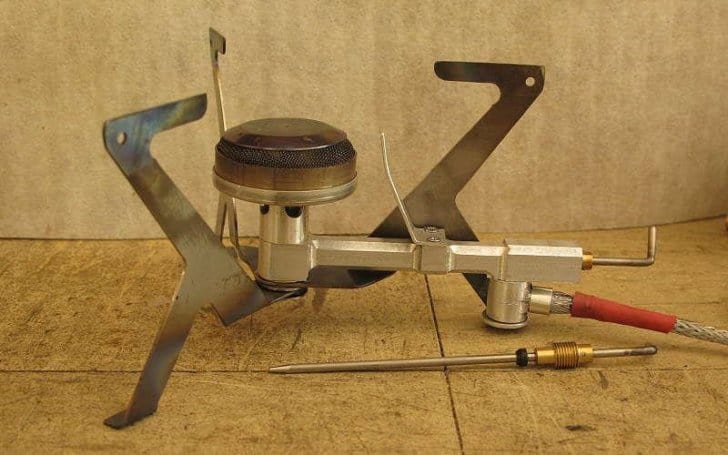
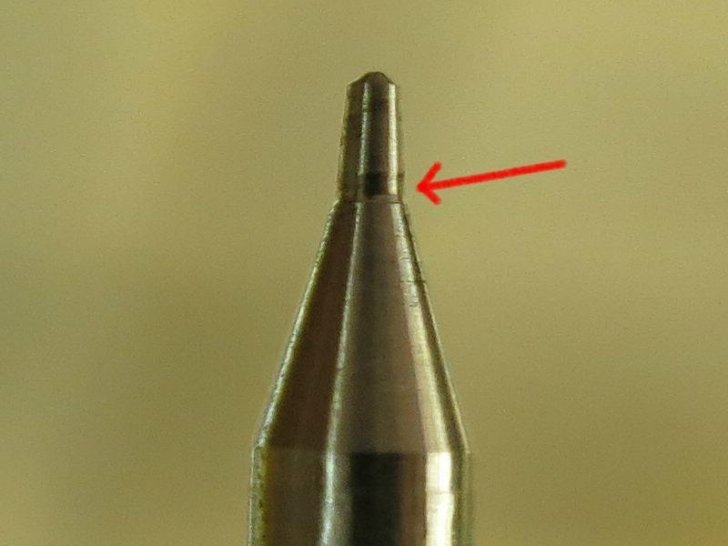
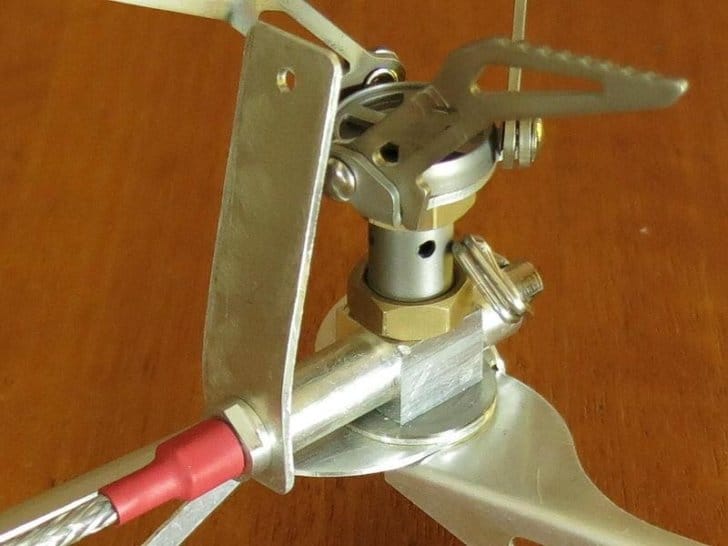
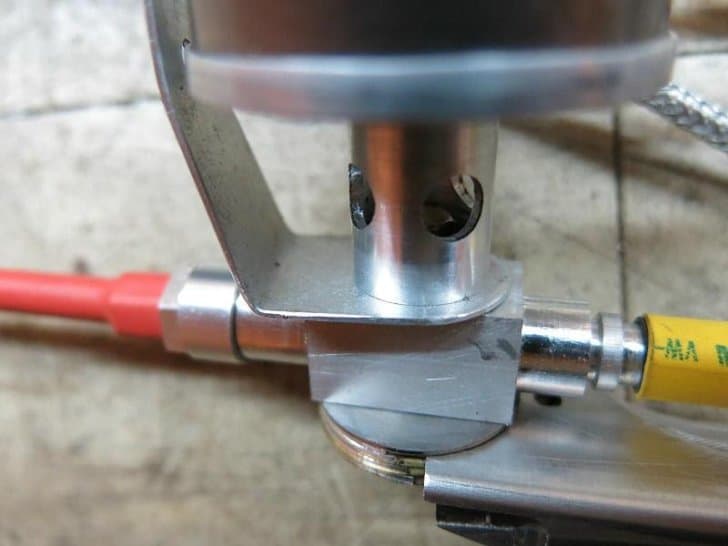
Another technical point concerns the aluminum used. In this photo above I had used a readily available 6060 alloy for the needle and a hard cast aluminum (scrap from an aeroplane propellor) for the stove body. After a few open/shut cycles, the hard cast aluminum body had damaged the profile of the tip of the 6060 needle right where it seals, at the red arrow. I had not realised just how hard cast aluminum can be. For long-term reliability, I needed to match the needle alloy with the body alloy to maintain the profile and get a good shut-off seal.Obviously I would need some sort of heat shunt to vaporise the incoming liquid gas. This photo shows what I had done for the V1 stoves, but I could not do exactly the same for the new V4 stove as the hose was now to be retained by an external nut. Well, I could with some redesign, but I wanted something simpler.The solution was quite simple: bend the heat shunt and have it held down to the stove body by the burner tube. The heat will easily get to the stove body: it only needs to get it above, say, +5 deg C. Conduction from where the Heat Shunt sits over the short distance to where the hose enters the stove body is very simple. In practice the stove body can sometimes get about the touch-test temperature of 40 deg C: definitely hot enough even in very cold weather!Previous stoves had used a jet hole of 0.3 mm diameter, and that had given plenty of power. As the power available in any canister stove depends mainly on the amount of fuel being used, with very little contribution from the design of the stove, it seemed reasonable to keep it this size. I make my own miniature jets as you can’t buy them. Yes, that is a 0.3 mm dia drill bit held in an expensive Albrecht chuck. Actually, you can’t really see the 0.3 mm part of the drill bit: it’s too small. Those drill bits are expensive and come from Switzerland. Watchmakers. The part holding the Albrecht chuck gives me precision centering of the drill bit on the centre of rotation of the chuck; typical lathe headstocks are not accurate enough for 0.3 mm bits.
Handle and Windscreen
While both the stove body and the needle valve are small, one does have to be able to adjust the valve while the stove is running. I soon found out that there was a fair bit of radiation that close to the stove body (rather warm fingers), so some sort of handle would be needed. The V3 stove used a long Ti wire handle, but the machining was a bit complex. Perhaps a very light bit of tubing could be made to connect somehow with the short but solid handle on the needle valve?
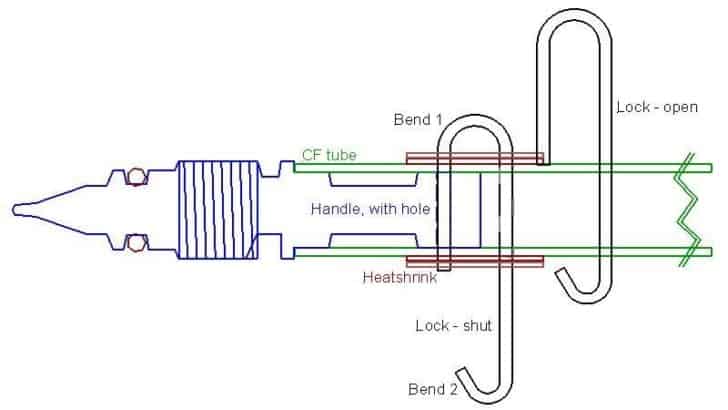
Carbon fibre tube is very strong and quite light, and I had a fair amount of bits and pieces leftover from making tunnel tents. It was a simple matter to make the handles on the needles fit snugly inside the CF tubing. However, the tube had to not only fit, but connect reliably so the valve could be turned reliably. Since the CF tube could be rather long, it was also necessary that it should be removable for packing.
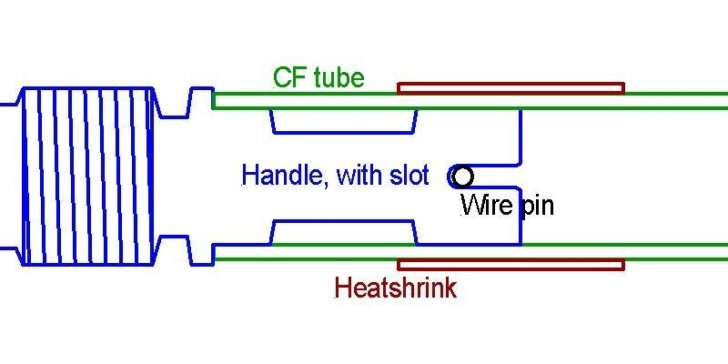
My first idea was a bit complex, although it certainly worked. However, getting the sliding clip exactly right was tricky. Bending the 1 mm wire used into the right shape (Bend1) to fit the holes was not as difficult as getting Bend2 exactly right so the straight bit of the wire went through the handle and engaged both sides of the CF tube when shut but cleared the handle when open so the handle could be removed. Adding the heat shrink tubing to ‘thicken’ the wall of the CF tube helped a bit. After making a few of these (they do work fine) I cast around for something simpler.The basics of this second version are very simple: a simple slot in the handle and a pin through the CF tube. The problem is how to keep the two connected during use: they look as though they could fall apart. A little experiment showed that a practical implementation with real wire would work: the fit onto the handle of the valve was snug, the slot in the handle was not sloppy, and the wire pin through the CF tube was not 100% straight (reused stainless steel wire). There was enough interference due to a slightly curved wire pin and an ever-so-slightly offset alignment of wire and slot that the handle stayed in place during use.
I chamfered the entry into the slot just a little so that I could simply push the CF handle over the end of the valve and spin it a bit to get the wire to drop into the slot. Should the connection ever start to get a bit loose, a tiny bit of a crimp in the wire would restore the grip. In practice, this was very effective.
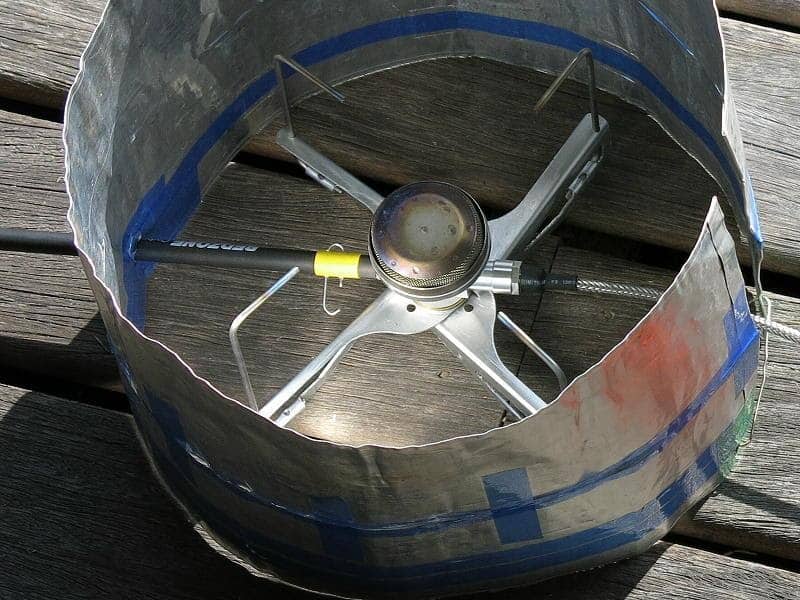
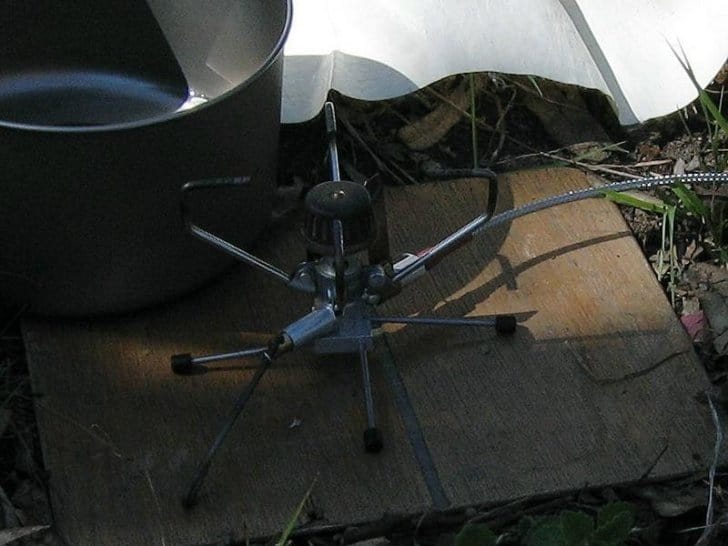
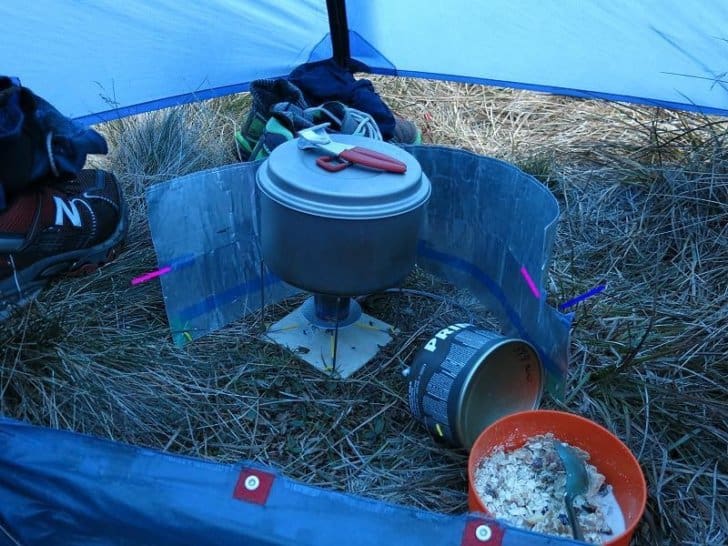
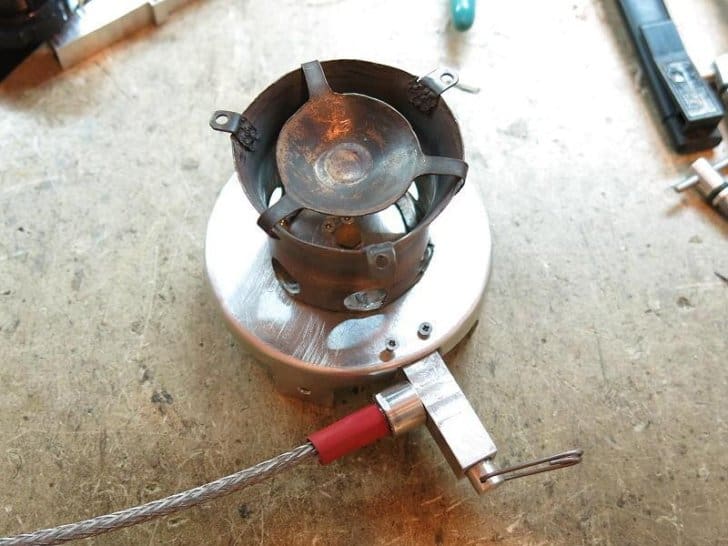
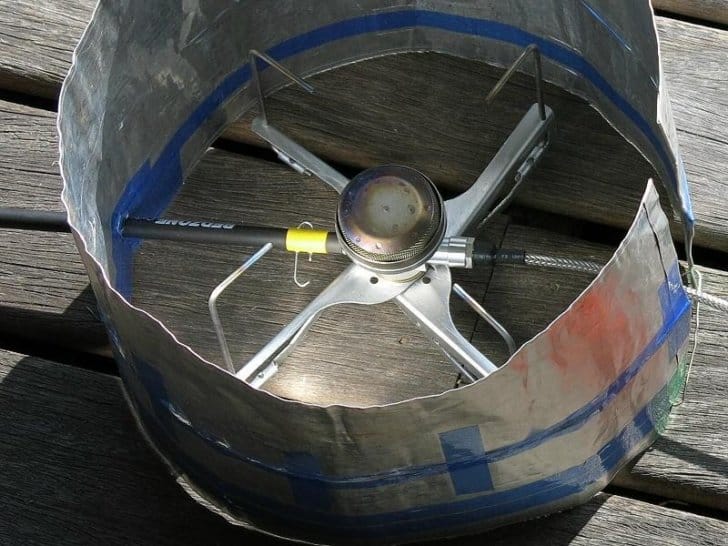
The CF tube offcut I was first experimenting with was longer than I needed, but I was loath to cut it down too early. Then, looking at the stove and wondering how to fit the windshield around it now that the handle stuck out so far, I suddenly saw the perfect solution. I punched a hole in the light foil at the right height at the midpoint and threaded the windshield onto the CF handle. The hose then came out the gap or opening in the windshield on the opposite side. Perfect, and very fast to set up. (Yes, this is V4, but you are meant to be looking only at the CF tube handle at this stage.)
Summary So Far
This article covers all the easy bits. The next article will go into some detail about the development work needed to get a design that satisfied me: optimising the burner head and coming up with a neat solution for the stove legs and the pot supports.
This is a story about a 40-day backpacking trip in the Far East (Russia) where I started with a pack that weighed 95 lb (43 kg).
Introduction
This is a story about a 40-day backpacking trip in the Far East (Russia) where I started with a pack that weighed 95 lb (43 kg).
For some, ultralight backpacking is all about carrying the bare minimum. For others, it’s a mindset or framework.
Not everyone wants to pack ultralight, whether it is for comfort or because of the kind of trip, but I am sure that most people can appreciate lightening their load. Ultralight gear is about shaving weight down for any trip. With good weather you could easily spend a weekend in the mountains with 15 lb (6.8 kg) or less on your back, or you could go out for another week and double that weight. Continuing advances in gear design mean that in 2019 you can get a 2 person tent that weighs less than 1 lb (0.45 kg) and a 0F (-18C) sleeping quilt at only a pound and a half (0.7 kg)
This summer a friend of mine and I decided to make our ultralight gear seem a little ironic and carry 95 lbs (43 kg) on our backs. This wasn’t just as a joke or some bizarre industry commentary though, we had good reason, and we were still light on food and gear by the end of our trip. As much as ultralight gear can make for light packs it can also afford other opportunity. Nearly 100 lbs (45 kg) may seem a bit nonsensical until you look at what we were doing. We were out for 40 days unsupported in Far-Eastern Russia. That means we had 40 days of food on our backs in addition to our gear.
This presents an interesting if perhaps seemingly niche side of ultralight backpacking. Instead of the desire to carry less and go further, the desire to carry more and go longer. Were we actually backpacking ultralight? Perhaps not. Were we cutting every ounce we could from our packs? We certainly made an effort to. This is a bit of a different perspective and approach than what is more conventional. Instead of shaving weight to have the lightest pack possible, you choose the heaviest pack you’re willing to carry and go backwards from there to see how many days you can spend in the wilds. We ended up carrying more than we probably should have (I don’t know if anyone has ever enjoyed a 95 lb (43 kg) pack) but only because of how long we wanted to spend in the backcountry.
Expectations also change for things like distance and rest. Day after day of hiking for 20 miles (32 km) or even to hike every single day become something approaching impossible. Movement is often slow and distances are often grueling.
In a world where trails like the Sunshine Coast Trail – 112 miles (180 km) – in British Columbia are run in under 35 hours and the 310-mile (500 km) Superior Hiking Trail saw four new speed records in 2019 there is an obvious propensity for travelling light and fast and far. So why on earth would someone carry 95 lbs (43 kg) and cover a fraction of the distance? To explain myself I’d like to try to capture what actually happened over those 40 days.
About The Trip
For long sections of trail, self-supported or supported trips are often possible. This helps to alleviate the necessity of carrying consumables like food and fuel for an entire trip. Thru-hikes are well known for this type of travel, often with frequent resupplies (typically every 3 to 7 days) of the day to day necessities. There were a number of reasons we did not employ this approach on our trip this summer. In addition to any desire we might have had to be unsupported, the realities of remote off-trail hiking also made it our only option.
Planning an international expedition without any intention to follow a known route or trail system requires a certain level of self-sufficiency. We prepared ourselves to be absolutely on our own for up to 40 days at a time, and we ended up doing just that.
We hiked into the mountains of Magadan Oblast (Магаданская область) at the beginning of August and exited about midway through September. In that time we committed ourselves to an existence that flowed through time and space in synchronicity with our bodies and the landscape. We were lucky enough to see one of the most amazing changes of seasons that I have ever experienced and to revel in sun rain and snow, truly at a pace that followed the mountains around us.
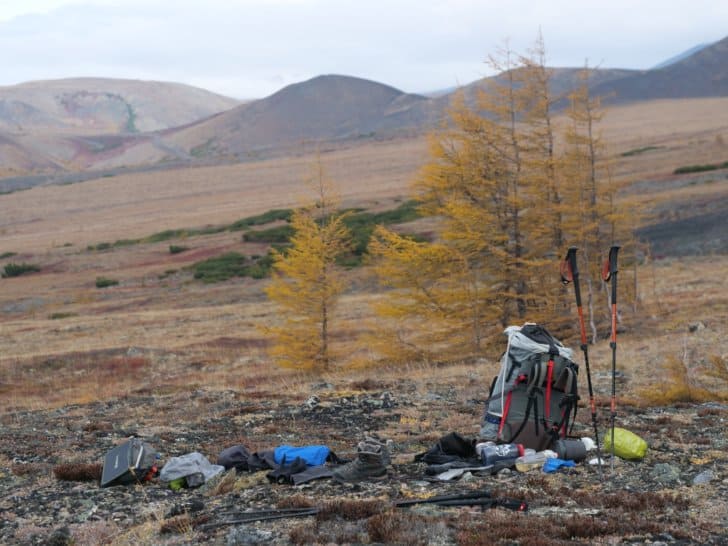
Colors changed everyday, from the glowing greens of summer to vibrant reds, pinks, purples, and the shining gold of the fall subarctic forests and tundra.
At 63 degrees North days are long in August. We only used headlamps once over the course of 40 days and that was at the end of the day after reaching a summit at 6pm. The larches and the tundra framed microcosms and macrocosms of stunning plants and animals and rocks and water. We saw snow sheep and a brown bear and foxes and loons and countless insects and spiders. It seemed that at each turn there was more magic awaiting us.
Our day to day wasn’t dissimilar to what you might expect from any other backpacking trip. We found both routine and novelty in each day. Our isolation allowed us to focus, whether that be on our feet across slick talus or in the immersion of a reader absorbed by a well-written book. Things were simplified and this revealed some of the complexities of each tiny piece of the world around us and of ourselves. In lieu of a novel to describe the momentous character of this trip I will let the pictures here reveal what they can to you.
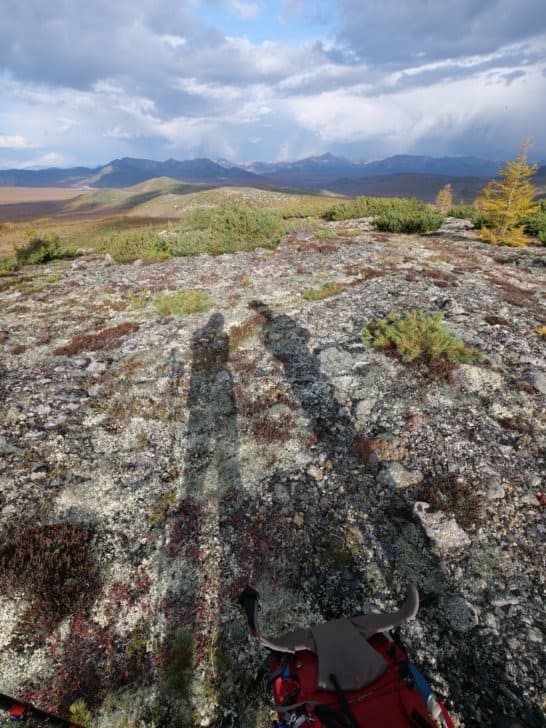
The ground wore many faces. The growing and shrinking of lichens and plants with the rains and the seasons made even what was underfoot a dynamic world.
What’s challenging about an unsupported, 40-day trek?
Pain. Carrying 95 lbs (43 kg) hurts – a lot. Every day, the pack gets lighter but a heavy pack takes a toll on the body. Even a light pack can press heavily on the body as the miles and the days build. Over the course of weeks the body fights back, bruises and cramps and stiff joints can be discouraging feedback and morning stretching can only appease so much.
Patience. Moving slowly is surprisingly taxing, not only on the body but on the mind. One of the beautiful things about spending weeks on end in the mountains is the ability to settle into routines but also stay present in response to surprising and changing details. This takes some patience to settle into. If you are focused on a constant sense of movement or of accomplishment, it does nothing but distract from the immersion of calm moments and the breaks that the body needs.
Hunger. I think a lot of backpackers, particularly ultralight hikers, bring less food than they might eat in their kitchens at home. Over the course of a few days or even a week this works well, just enough things missing to make the first meal back extra tantalizing. Skimming ounces off of the top of 40 days of food to save weight makes for a different story. Over the course of almost six weeks hunger can become a real nuisance. With any long unsupported backpacking trip it must be balanced with what can become a back crushing load.
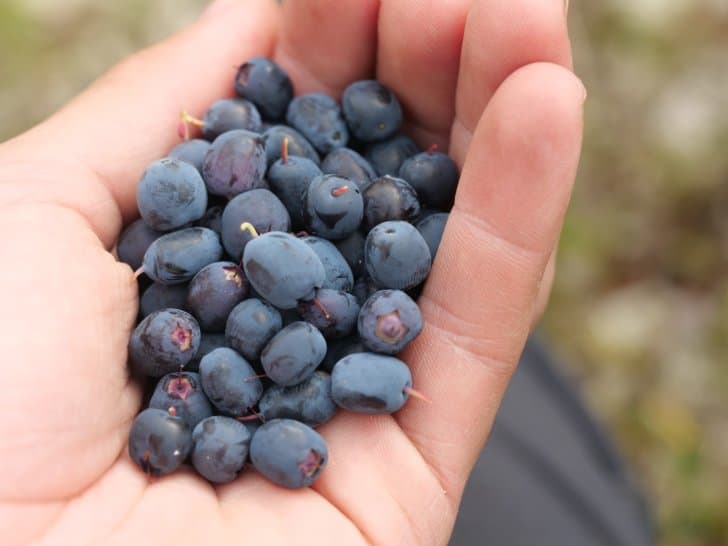
Fresh berries were a welcome mouthful of freshness and a calming pause from the weight of a heavy pack or the stretching of a long day.
Constant Exposure. You are exposed to it all. When you spend almost a month and a half out in the backcountry you can’t plan for weather. Sometimes you can anticipate it and sometimes even take refuge from it, but you certainly cannot avoid it. On our trip we were rained on for almost a week straight. We ended our trip with four days of snow and our last day we woke to frozen water bottles. Cold and wet happen, and sometimes they stick for a little too long.
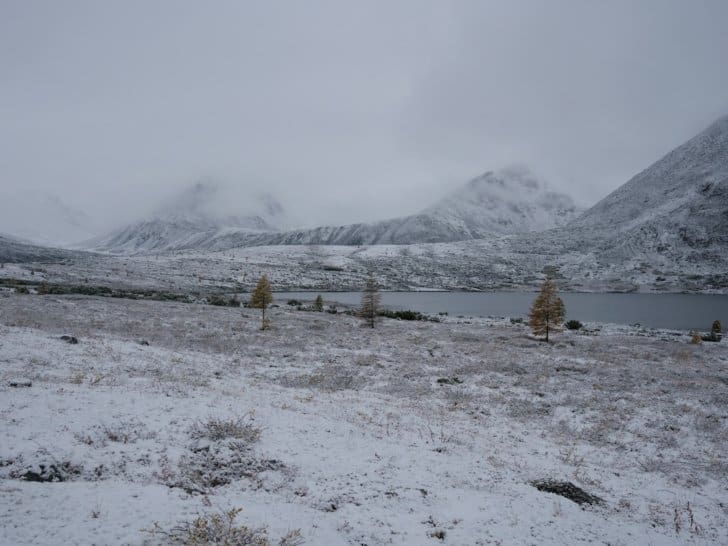
Waking up to so much fresh snow with over a week still ahead of us was at first intimidating. It proved to be both challenging and enchanting in its encompassing of the landscape and in the ice that built on our boots.
Conclusion: Why?
With all that struggle looming over you it should probably take a lot of convincing that this style of backpacking is worthwhile at all. I know there will be some people that will be instantly on board with the idea of spending so long in the backcountry, the love of it came naturally for me. However, I want to leave the more reasonable reader with something meaningful as well.
Maybe you have to be a bit crazy to want to carry almost three quarters of your body weight just to have five and a half weeks in the mountains. However, I think that more people will see the charm of going into the wilderness unsupported for three weeks with under 50 lbs (23 kg) on your back. I hope that this presents another way to look at limits. We all have different goals in our adventures. Some of us want to move fast, some far, some light. I’ve found that one of the things I value most is the time I spend in the mountains and the woods and even a tent. Sometimes that means packing differently and sometimes that means working hard and slow and pausing to let it all soak in.
Appendix: Selected Gear
Here’s some of the gear I (very carefully) selected as part of my 95-lb kit for a 40-day trip in Russia.
item
brand/model
weight
backpack
CiloGear 75L WorkSack
4.8 lb (2.24 kg)
quilt
Enlightened Equipment Revelation 0F
27 oz (0.76 kg)
pad
Therm-a-rest NeoAir Xtherm
15 oz (0.43 kg)
shelter
Tarptent Stratospire Li
28 oz (0.79 kg)
cook shelter
Mountain Laurel Designs Supermid
26 oz (0.74 kg)
trekking poles
Black Diamond Trail Trekking Poles
17 oz (0.48 kg)
stove
MSR Pocket Rocket
3.1 oz (0.09 kg) plus fuel canisters
pot
Toaks Titanium 1300 ml Pot with Pan
6 oz (0.17 kg)
bear bags
2 x Ursack Major XL + 4 x odor-proof bags
21.6 oz (0.61 kg)
DISCLOSURE (Updated April 9, 2024)
Backpacking Light does not accept compensation or donated/discounted products in exchange for product mentions or placements in editorial coverage.
Some (but not all) of the links in this review may be affiliate links. If you click on one of these links and visit one of our affiliate partners (usually a retailer site), and subsequently place an order with that retailer, we receive a commission on your entire order, which varies between 3% and 15% of the purchase price. Affiliate commissions represent less than 15% of Backpacking Light's gross revenue. More than 70% of our revenue comes from Membership Fees. So if you'd really like to support our work, don't buy gear you don't need - support our consumer advocacy work and become a Member instead.
Learn more about affiliate commissions, influencer marketing, and our consumer advocacy work by reading our article Stop wasting money on gear.
Recorded version of the livestream of the 2020 Backpacking Light Adventure Film Festival. This content is available only to Premium and Unlimited Members.
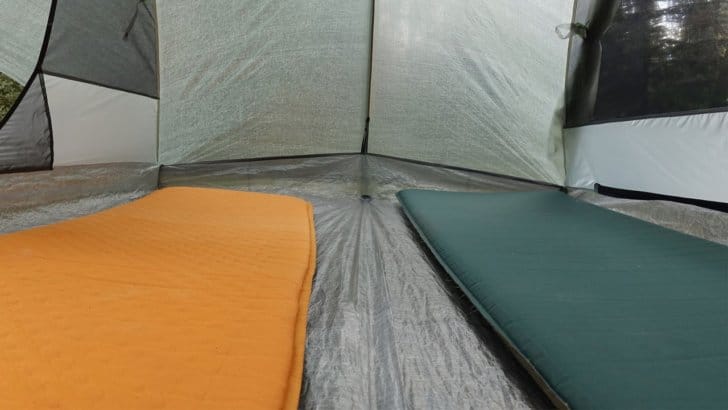
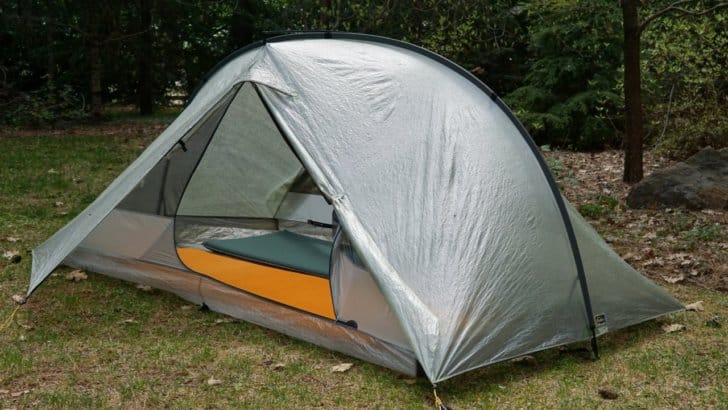
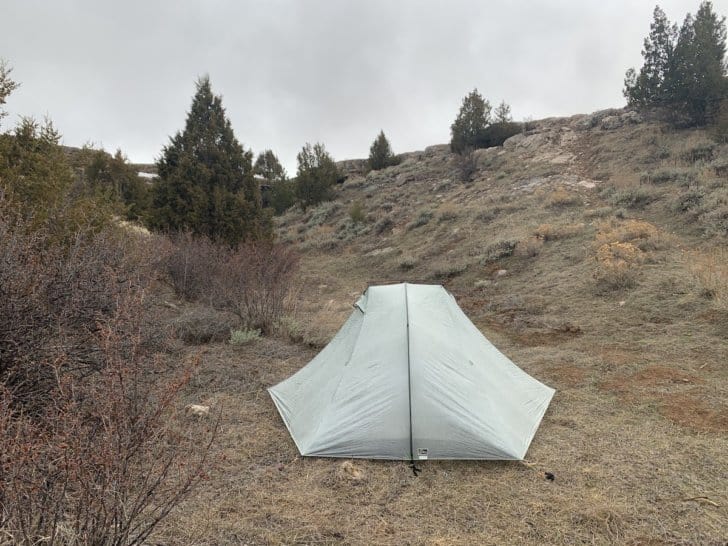
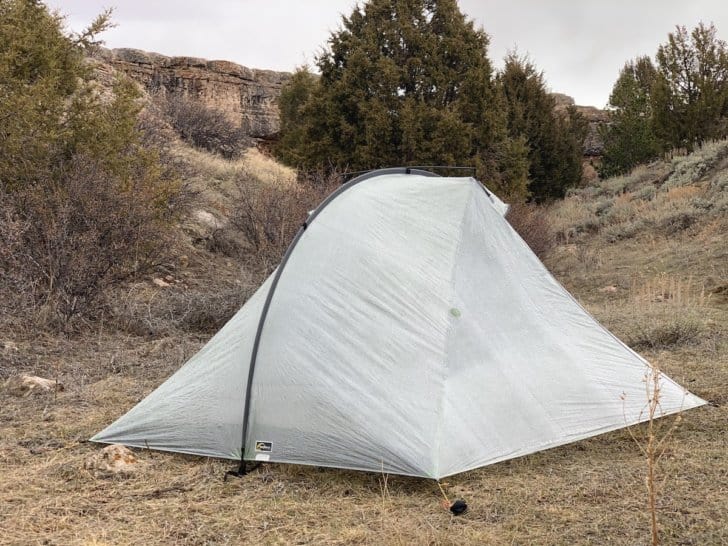
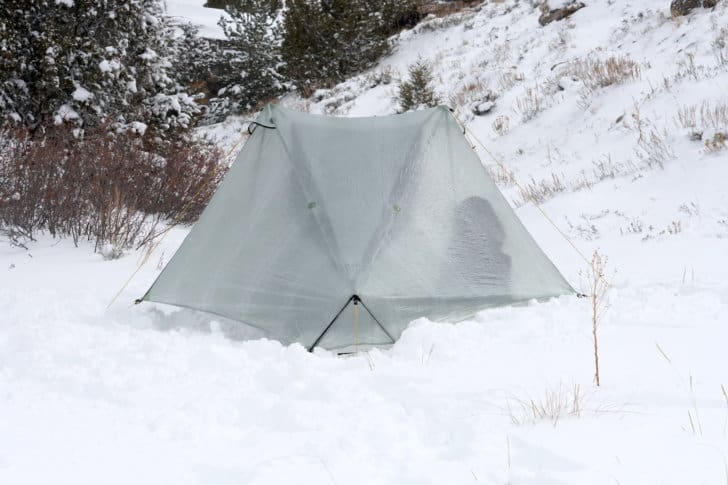
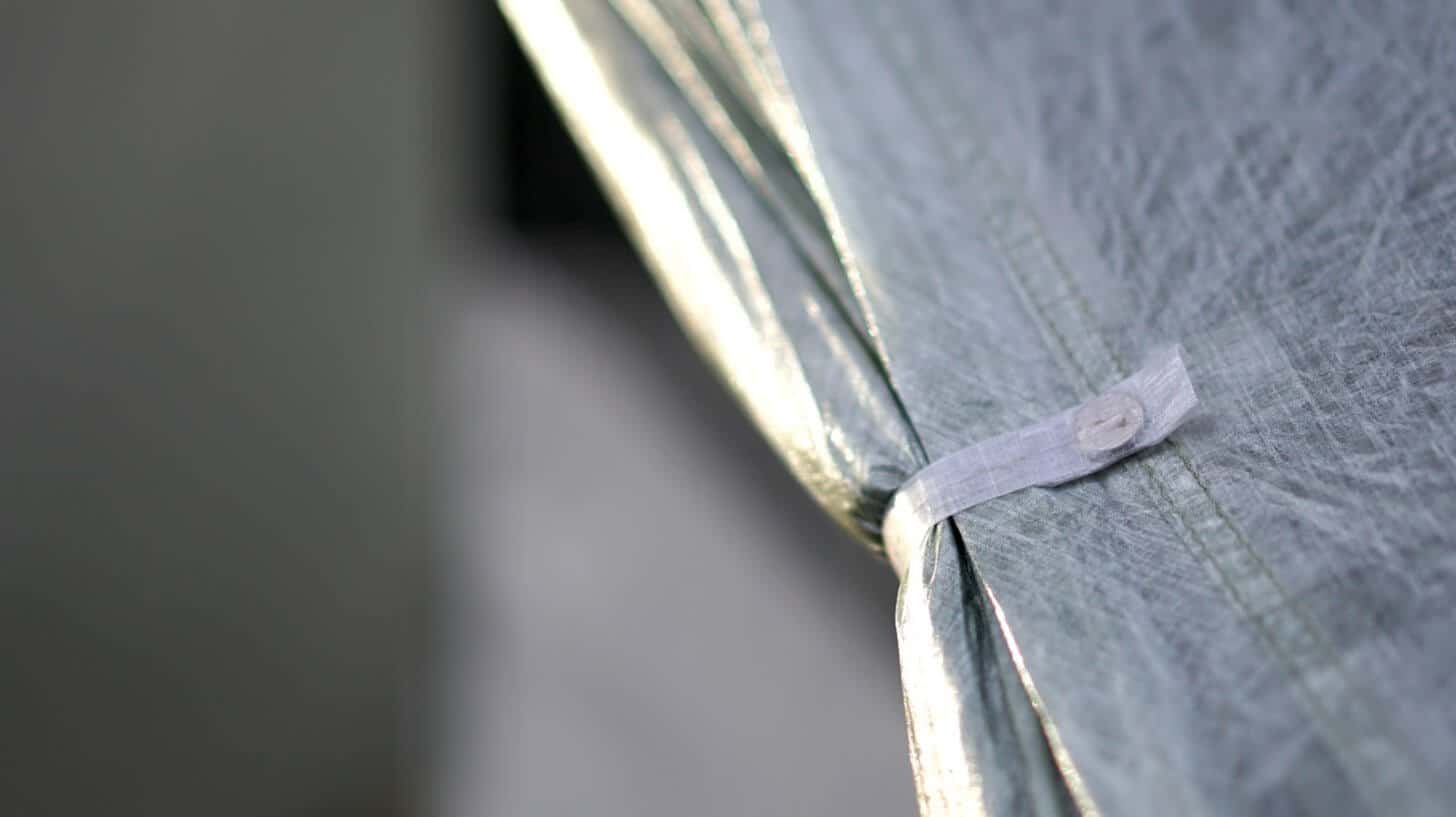
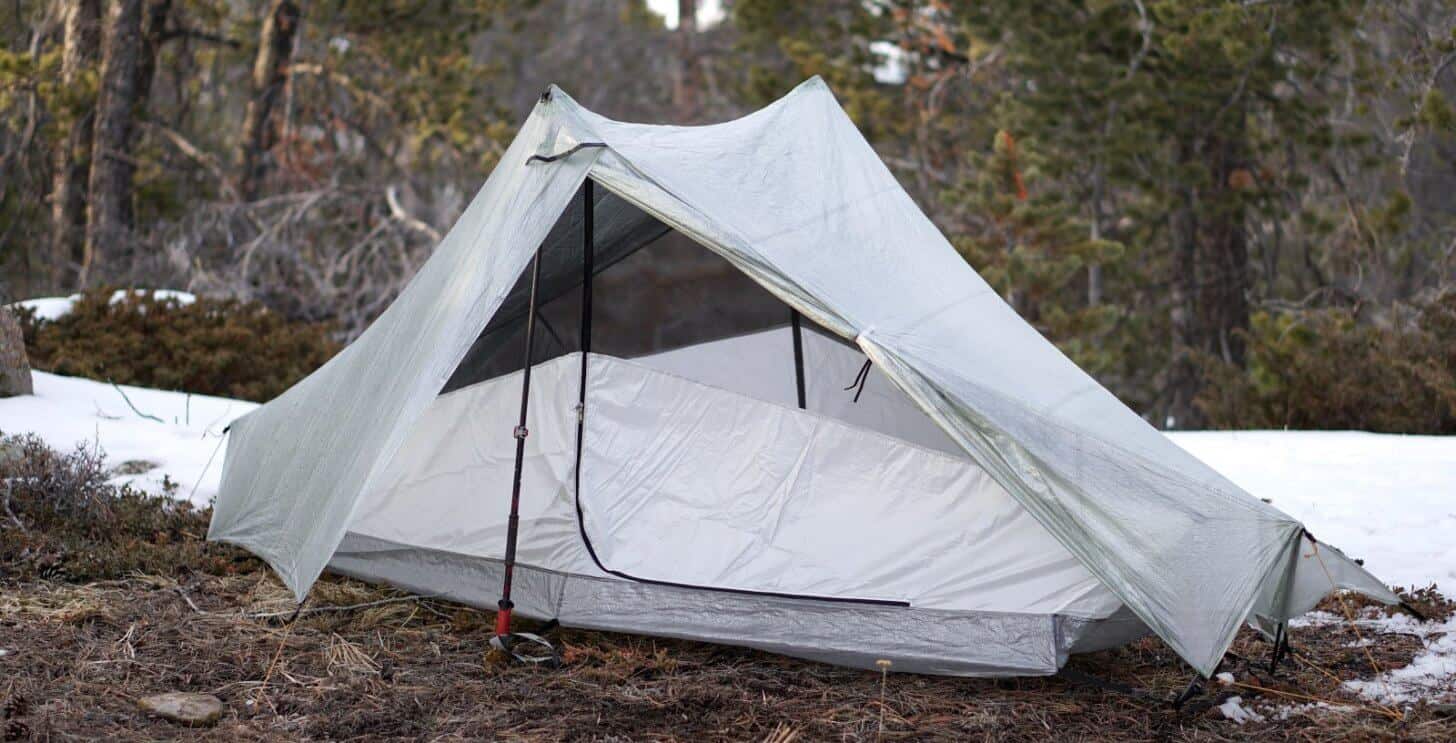
The Tarptent Double Rainbow Li is a 2-person, side-entry, 2-door (and 2-vestibule) hybrid single/double-wall tent made with Dyneema Composite Fabrics that weighs 27 oz (765 g).
The Tarptent Double Rainbow Li is a 2-person, side-entry, 2-door (and 2-vestibule) hybrid single/double-wall tent made with Dyneema Composite Fabrics that weighs 27 oz (765 g).
Tarptent announced the Double Rainbow Li on April 23 and will make it available for sale beginning April 27. The Double Rainbow is Tarptent’s best-selling shelter, and the new DCF version will be one-third lighter.
We’ve had a few days to look over Tarptent’s specs for this product, and took it out for a spin this week to form some first impressions.
Watch the review video:
This article is sort of a hybrid First Look/Limited Review – it represents an initial performance analysis of a new product based on limited use in one type of climate and geographical environment. Herein, we make no claims regarding its long-term durability or performance in other environments. Learn more about the types of product reviews we publish.
Highlights
Weight: 27 oz (765 g)
Floor Dimensions: 50 in wide x 88 in long (127 cm x 224 cm)
Bathtub floor height: 5 in (13 cm)
Vestibule depth: 26 in (66 cm)
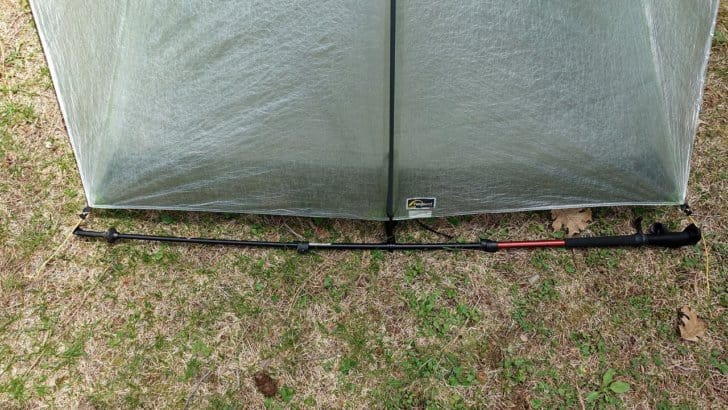
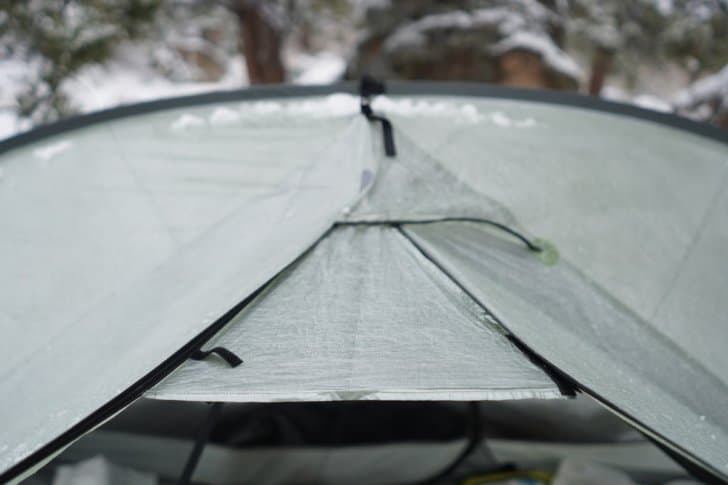
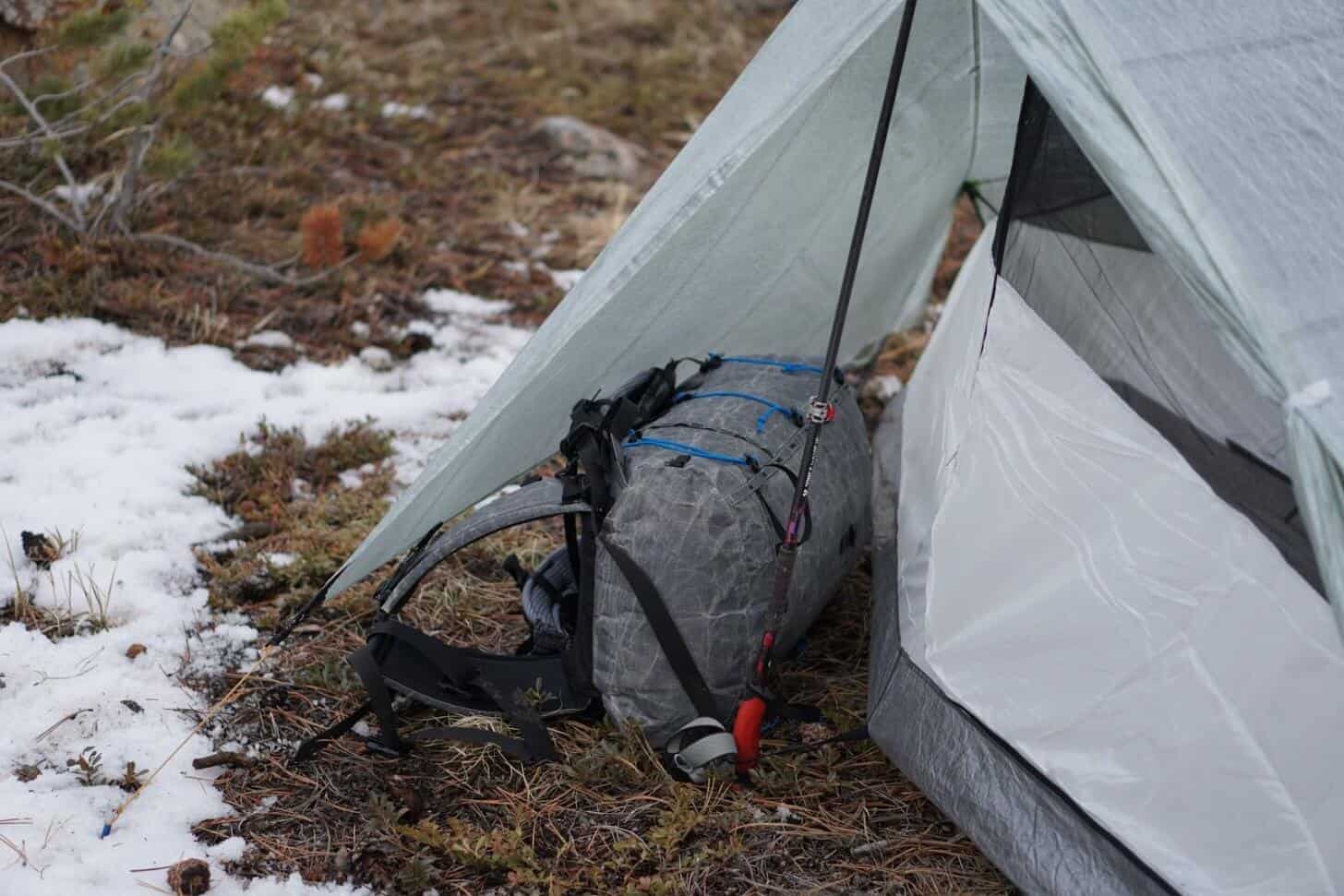
Trekking poles can be used to set up the shelter in freestanding mode or to create a “porch.”
Overview
What is new about this version of the Double Rainbow?
DCF construction
bonded seams – no sealing required
one-third lighter than silnylon version
carbon-fiber pole-set:
Easton 3.9 carbon series (7.5 mm dia)
main arch pole: 4.44 oz (126 g)
cross strut: 0.88 oz (25 g)
total carbon-fiber pole-set offers ~4 oz (113 g) weight savings over the aluminum pole-set used in the Double Rainbow
Quote from Henry Shires: “We have been offering and shipping the Easton 3.9 carbon pole for awhile on the Rainbow and Bowfin 1S and so far reports of breaks have been nothing statistically greater than for the aluminum. I still wouldn’t trust the carbon pole to handle more extreme stresses — carbon snaps rather than bends — but for most use we think it will be fine.”
partial solid interior wall (10d uncoated nylon)
improved trekking pole attachment points for freestanding mode
What has carried over from the previous version of the Double Rainbow?
hybrid wall design (lots of living space – a two-person shelter for people who want to save weight but don’t want to spoon overnight
versatile – can set up in freestanding mode using trekking poles if desired
large, spacious vestibules
“Porch mode”
Photo: Tarptent
Photo: TarptentPhoto: Tarptent
Field Test
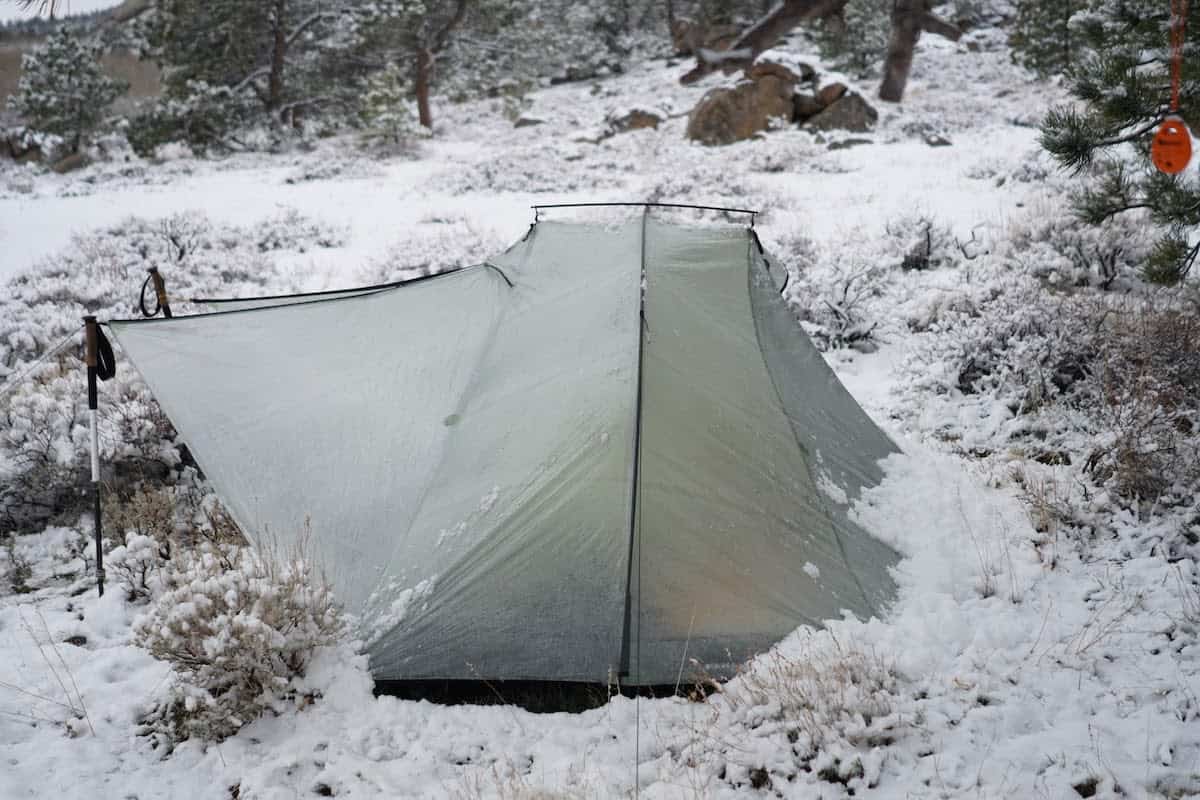
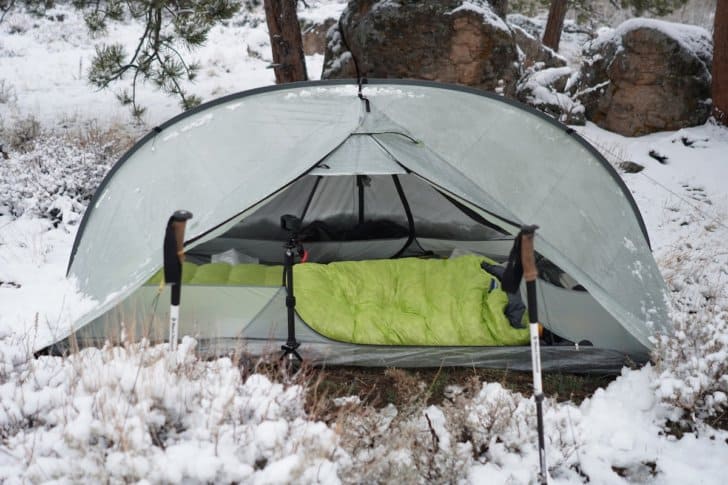
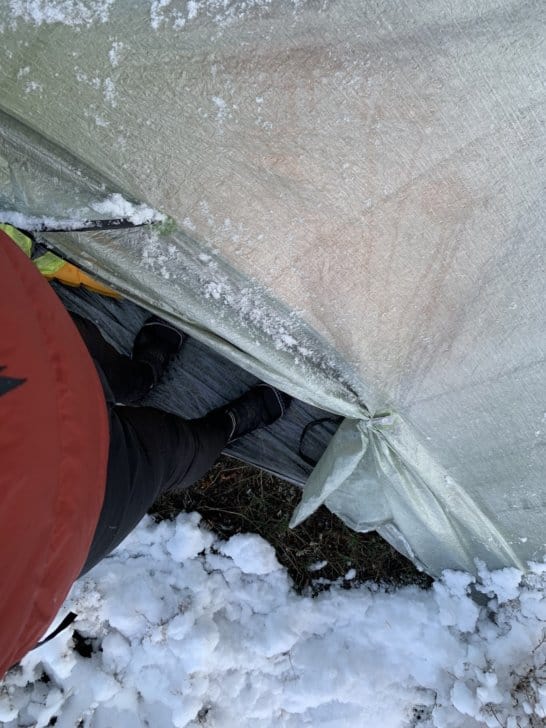
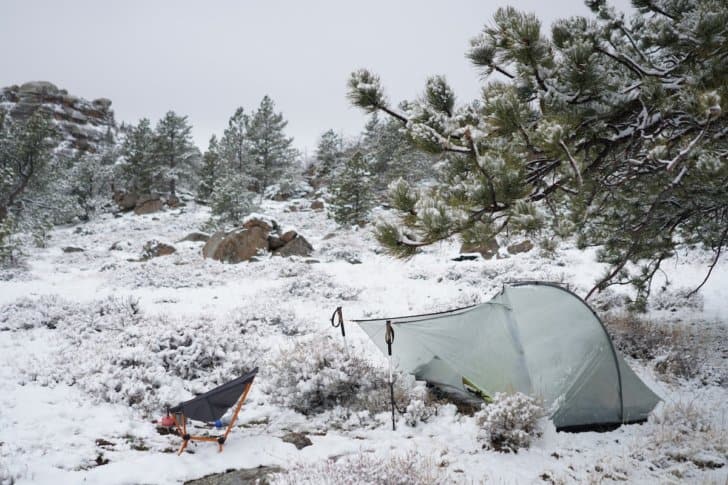
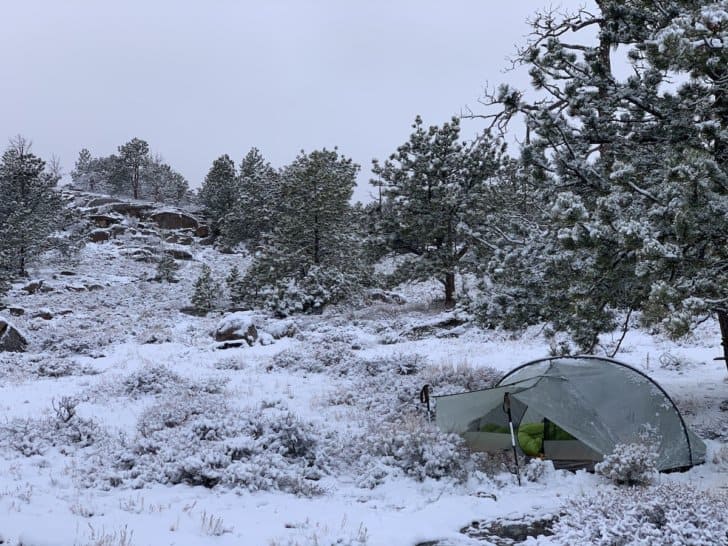
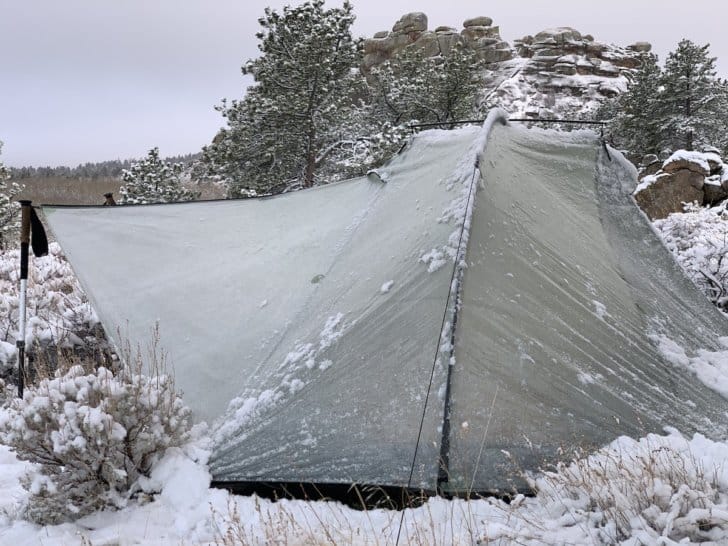
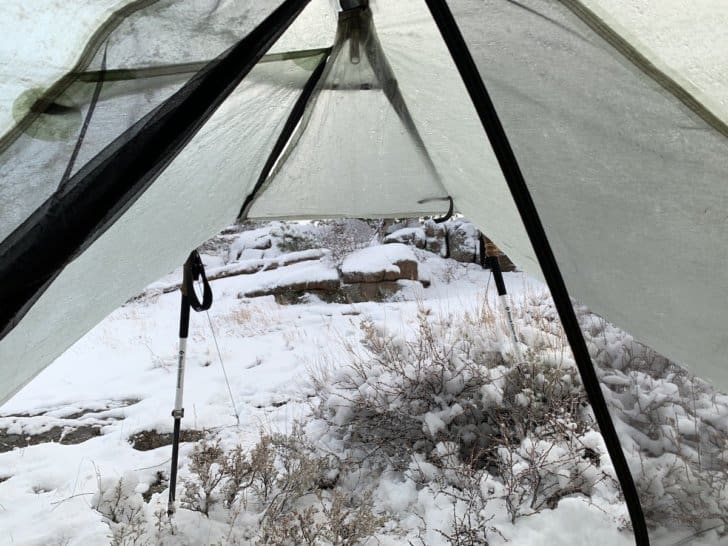
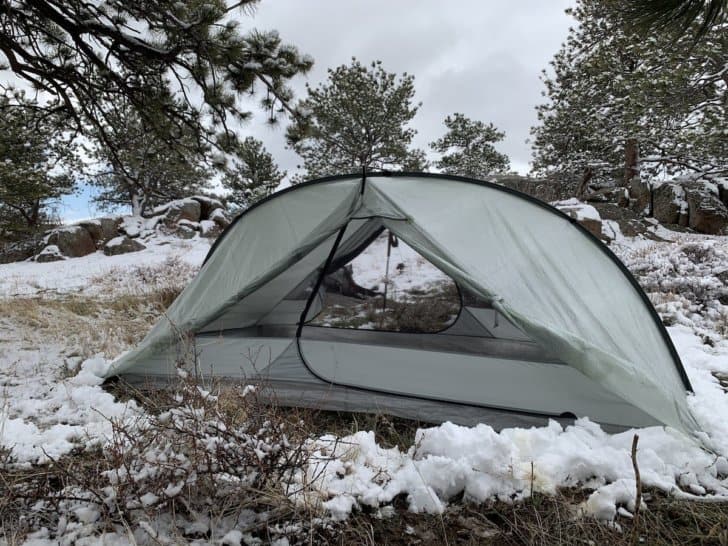
Ryan had the chance to spend a few days with the Tartpent Double Rainbow Li, including one overnight backpacking trip during a winter storm in SE Wyoming.
His first impressions are outlined in this review video, now online at YouTube:
Photos below from Ryan:
More Info
Tarptent will begin taking orders the week of April 27th. You can read more about the shelter here.
Questions? Hit us up in the forum below and we’ll do our best to answer them based on our brief experience with the shelter.
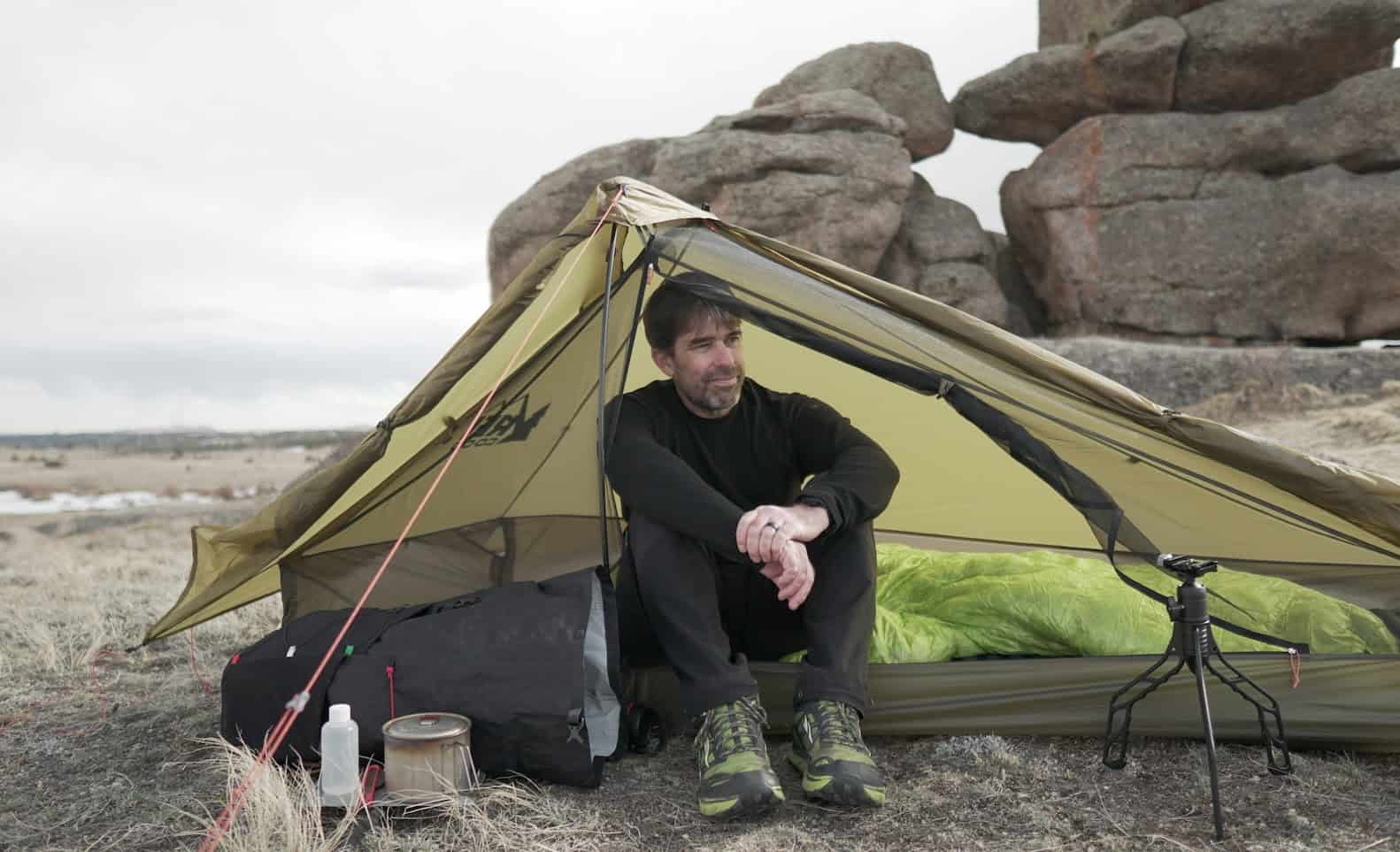
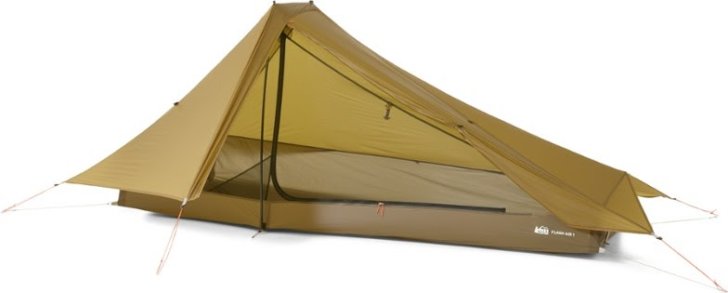
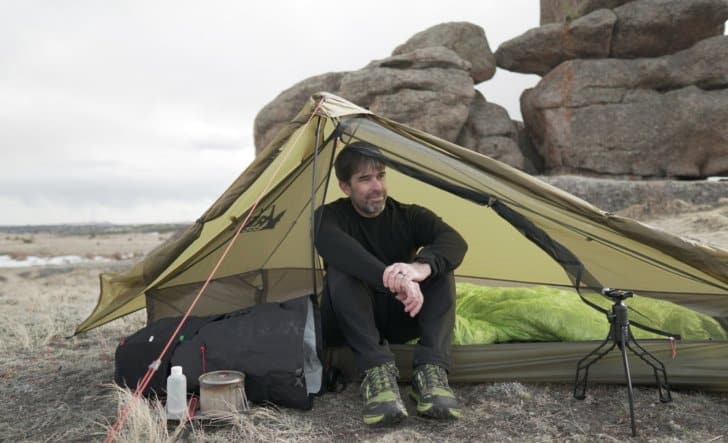
The REI Flash Air 1 Tent (20 oz / 567 g, $249) is a hybrid single/double-wall solo tent with a single entrance and vestibule and can be supported by a single trekking pole.
Introduction
The REI Flash Air 1 Tent (20 oz / 567 g, $249) is a hybrid single/double-wall solo tent with a single entrance and vestibule and can be supported by a single trekking pole. A 2-person model is also available (the REI Flash Air 2 Tent, 31 oz / 879 g, $299).
Photo: REI
About This Review
This Limited Review is based on overnight backcountry use in a single geographic environment (the mountains near southeast Wyoming). The tent has been exposed to light rain and snowfall, mild-to-moderate winds, overnight temperatures near freezing, and moderate humidity levels. In addition, I performed a quantitative condensation study and a direct measurement of the hydrostatic head rating (waterproofness) of the fly fabric using a Suter tester. This review builds on the initial peek at this product as published in our First Looks of the REI Flash Air 1 Tent.
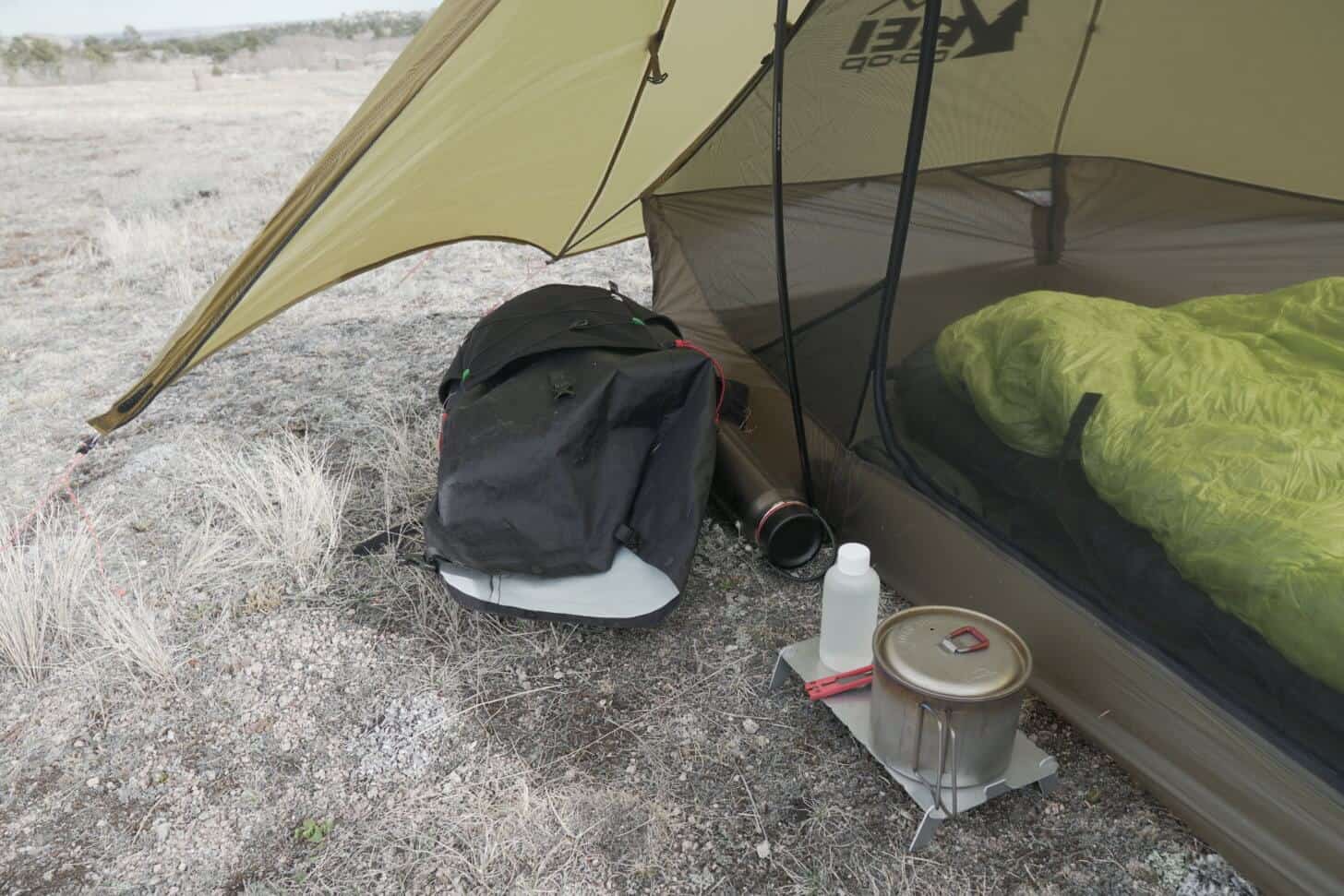
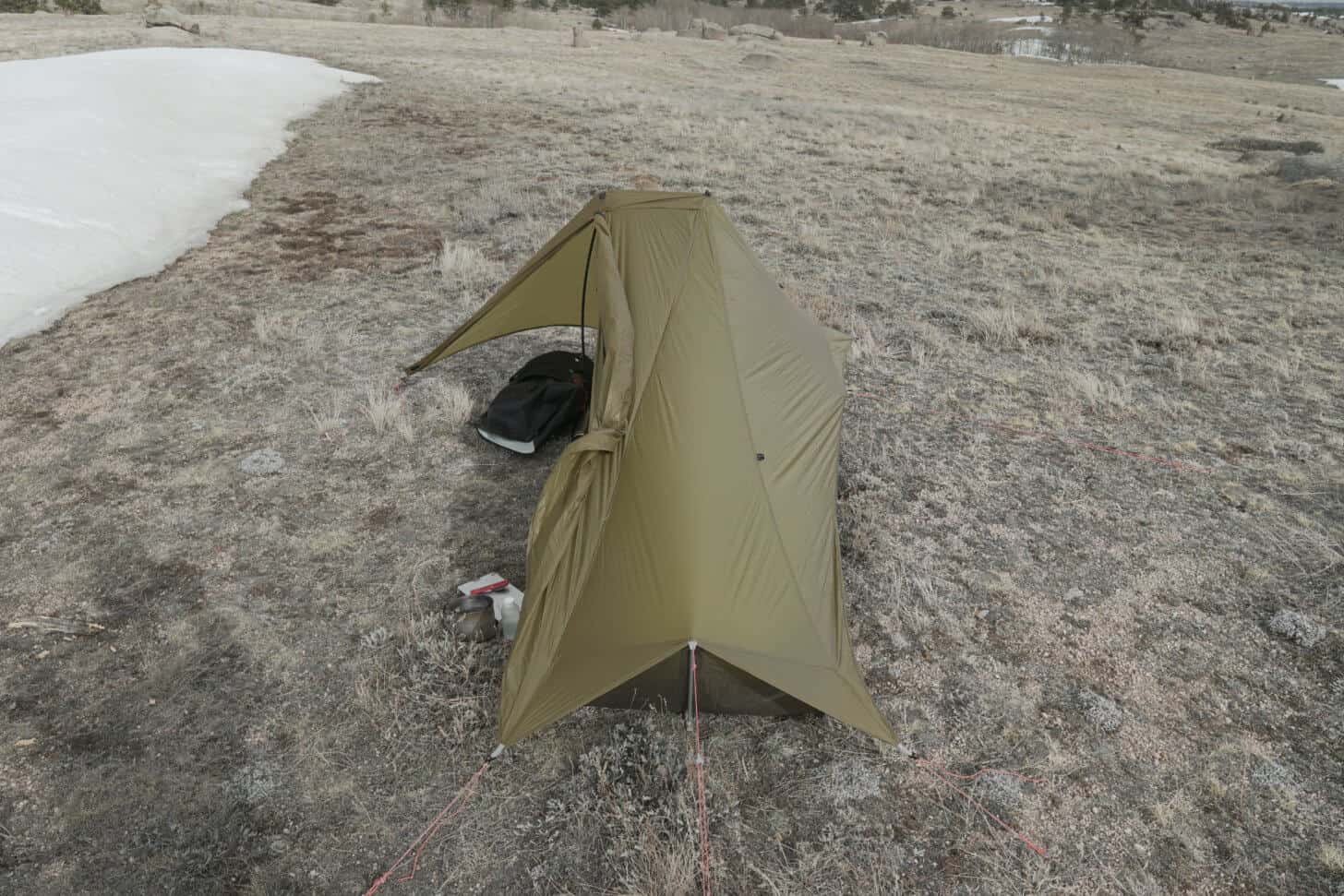
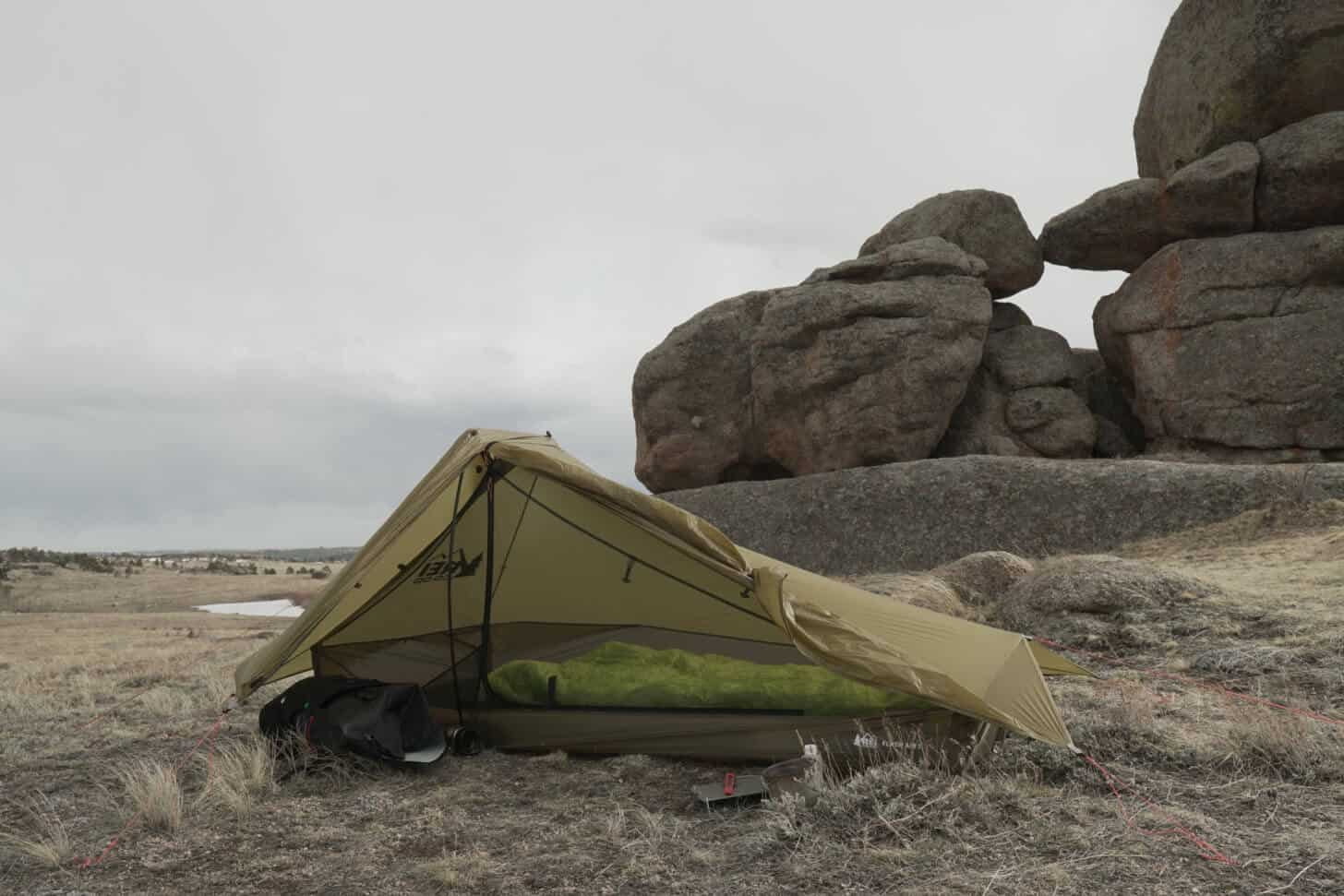
My first trip with the REI Flash Air 1 Tent was in the open, windy flats of the Sherman Range foothills in SE Wyoming.
Features & Specifications
key features
non-freestanding (requires a minimum of 5 stakes)
no. of accessory guyline tie-out points: 8
no. of included extra guylines: 4
weight
claimed (tent body, strut, and roof pole): 20 oz (567 g)
measured (tent body, strut, and roof pole): 20.10 oz (570 g)
measured weight of included vertical pole (required if a trekking pole isn’t used): 1.72 oz (49 g)
dimensions
floor: 88×35/27 in / 224×90/69 cm (LxW head/foot)
surface area
floor: 21.3 sq. ft. (1.98 sq. m.)
vestibule: 8.4 sq. ft. (0.78 sq. m.)
materials
support pole (optional, or use a trekking pole): DAC Featherlite NFL Green, 9.3 mm dia x 38 in (96.5 cm), 3-sections fold to 14 in (35.6 cm)
end strut pole: 8.7 mm dia x 11.875 in (30.2 cm)
roof pole: 8.7 mm dia x 14 in (35.6 cm)
roof pole hub: molded plastic
fly and floor: ripstop nylon
mesh: nylon noseeum mesh
MSRP: $249
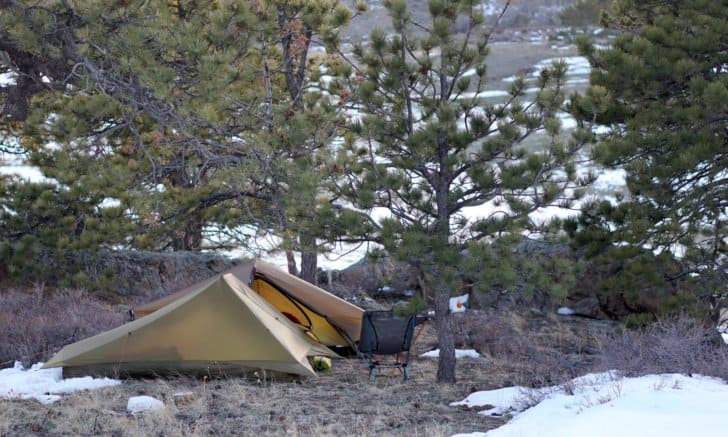
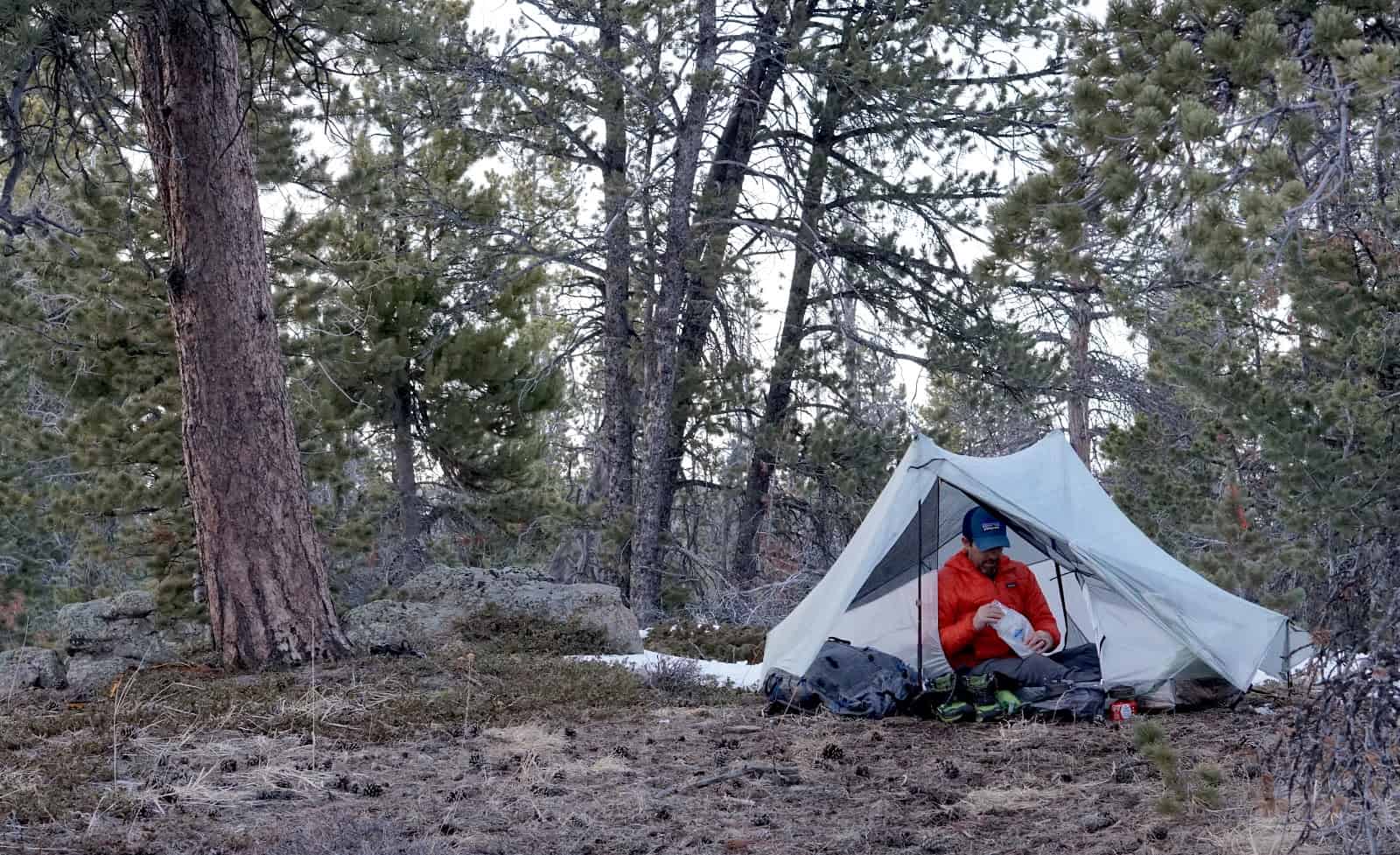
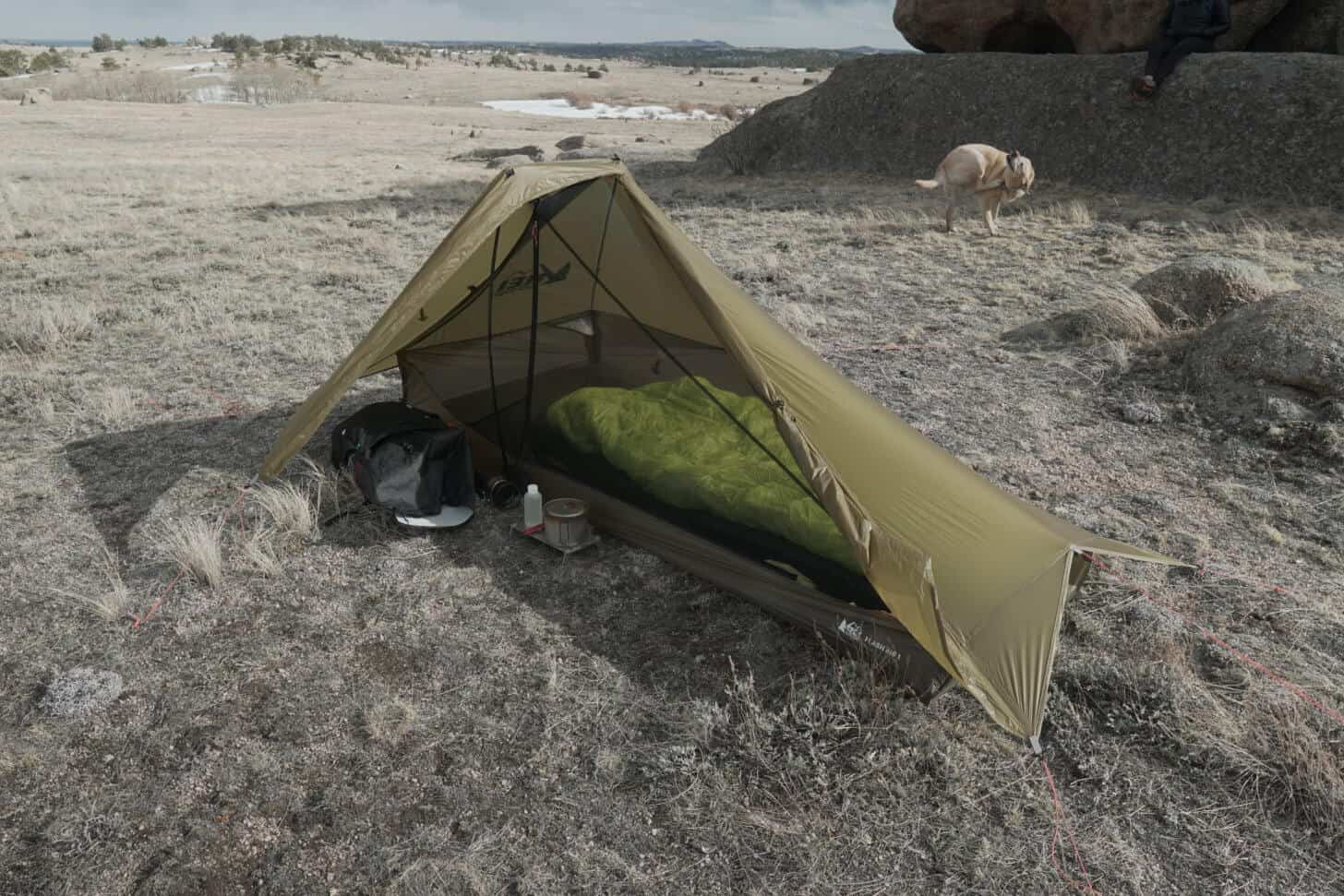
I used the REI Flash Air 1 Tent on a recent tent testing trip with Stephanie (she was in the Hilleberg Enan, behind the Flash Air 1). We camped in a ponderosa copse on a ridge in the Sherman Range in Wyoming.
Performance
Because this is a Limited Review, a detailed performance analysis based on long-term testing will not be presented. In lieu of a detailed analysis, performance observations and issues are noted below.
Before reviewing the table below in detail, take a look at my initial First Looks video about the REI Flash Air 1 Tent that I posted in my First Looks Review, which also addresses some questions from our forum community:
Criteria
Observations and Issues
ease of setup
No issues of note - setup is fast, simple, and intuitive; the instructions are worth reading, just to familiarize yourself with how the roof hub pole assembly works with the included vertical pole vs. a trekking pole. Because the shelter depends on the balance of tension around its perimeter, it's easy to overtighten guylines attached to the fly.
quality of materials and construction
Consistent with other tents we've reviewed from REI, and similar to the REI Quarter Dome SL1 and REI Quarter Dome SL2. Seams, cut-and-sew quality, and seam taping are all performed to a consistently high standard, on par with shelters from MSR and Big Agnes.
livability
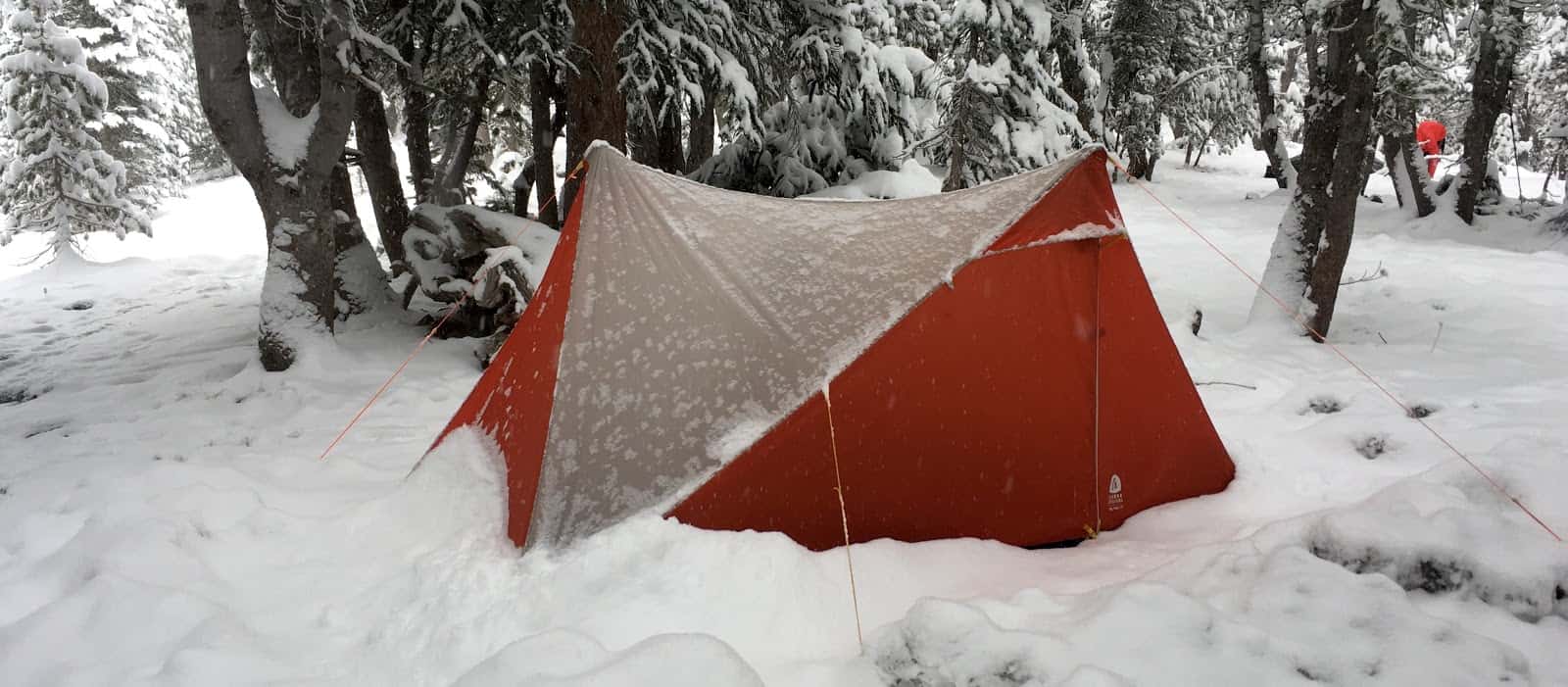
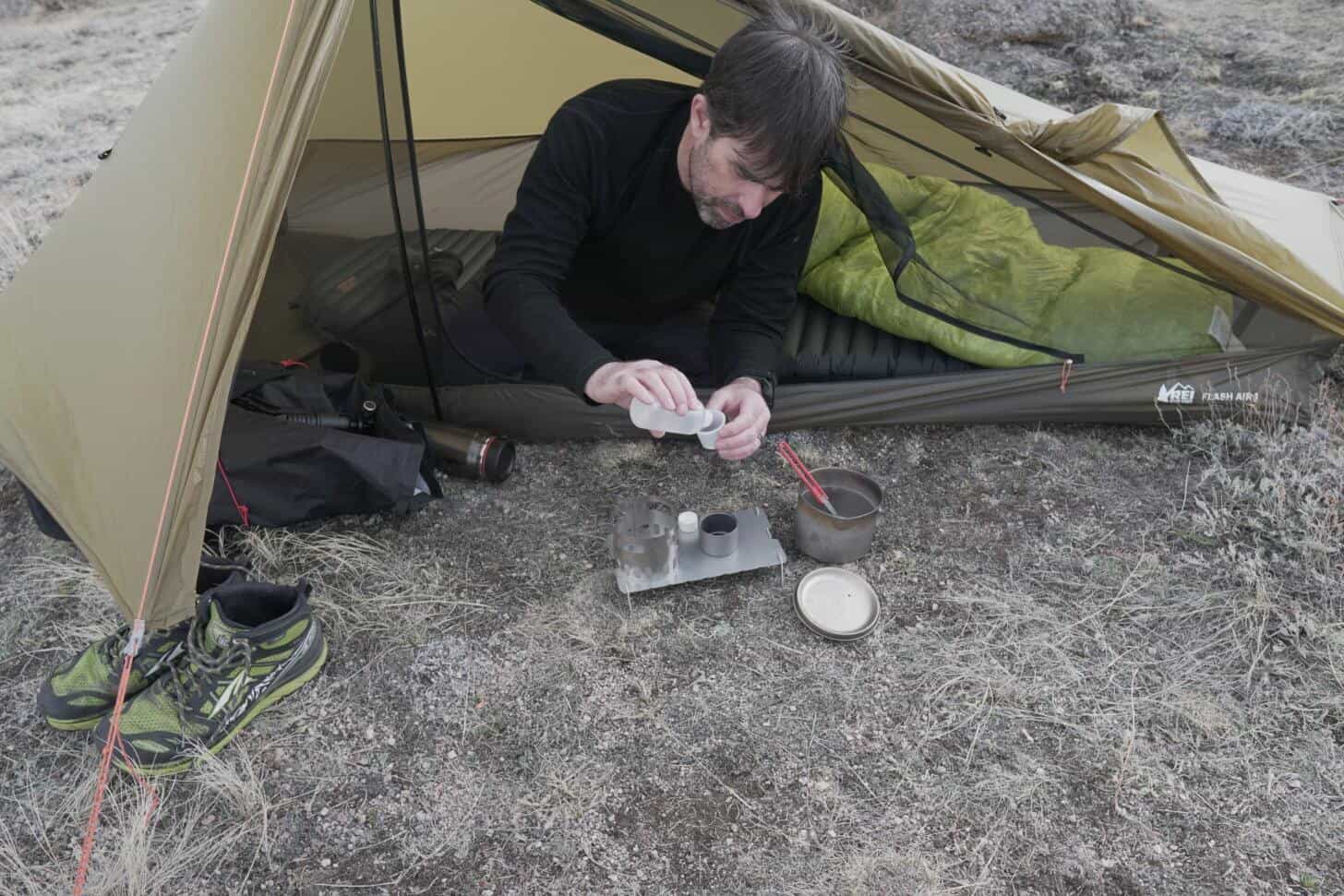
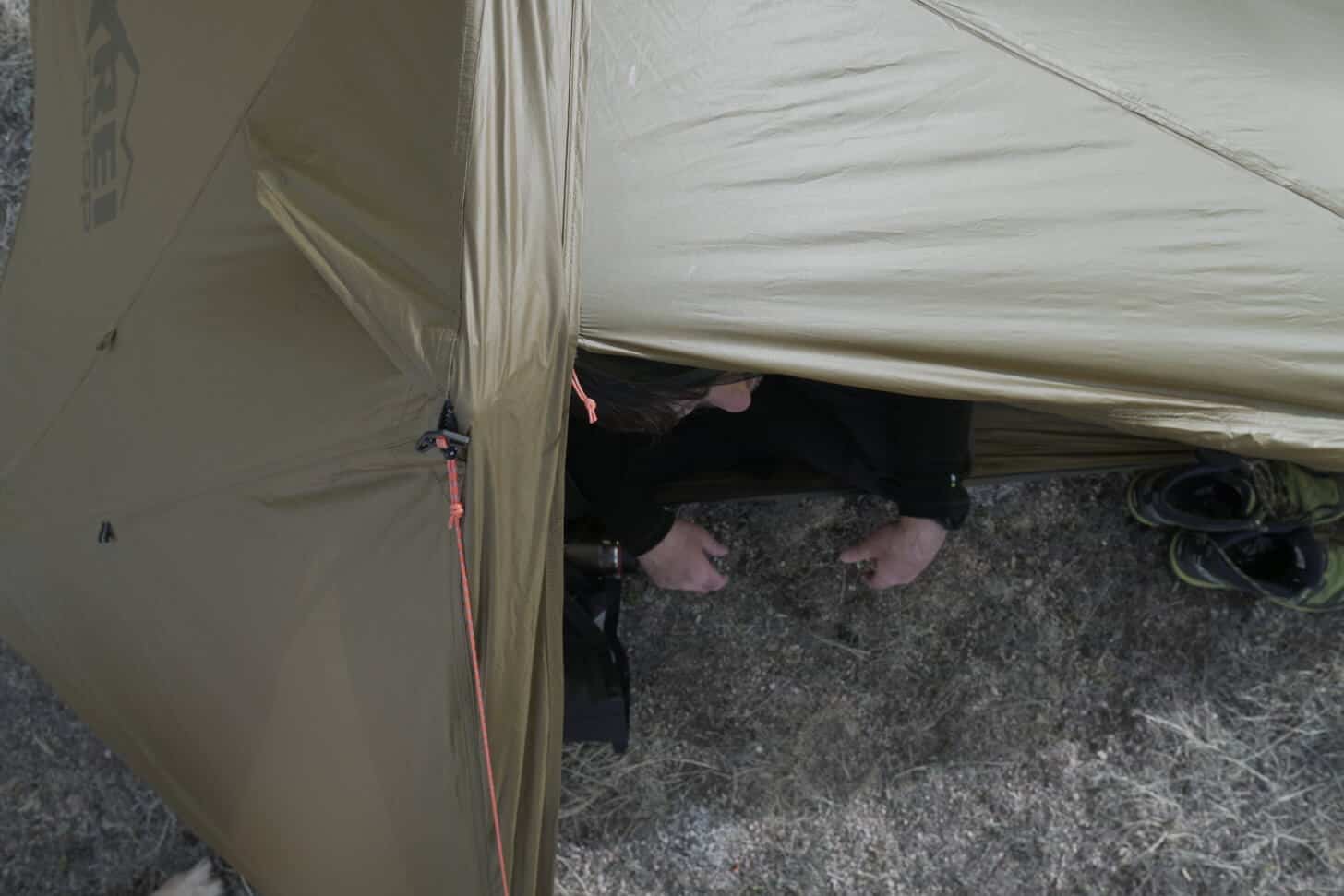
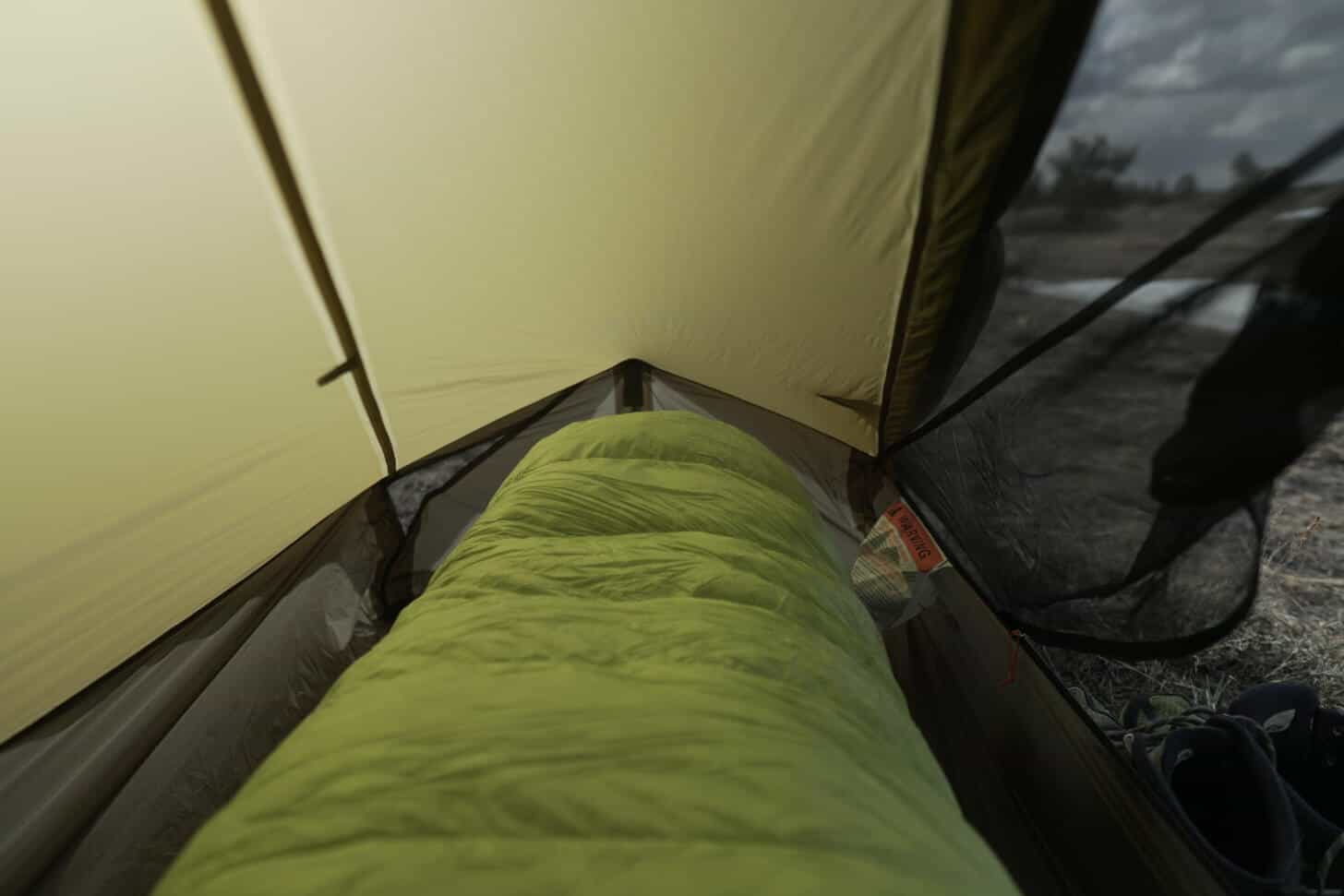
The REI Flash Air 1 Tent is small - more in line with a solo bivy tent than a solo tent you'd want to spend extended time in during an all-day rainstorm. Its Achilles' heel is its interior height at the ends, which limits the overhead volume in the tent that's required for anyone larger than an average-sized man to move around much, change clothes, etc. Design execution using the roof "arch" pole combined with a trekking pole and fabric tension from stake-out points is brilliant - it works and adds meaningful headroom.
rain protection
The vertical mesh inner tent door is protected by the fly during an overhead rain. The fly and floor fabrics tested to about 1,800 mm H2O on my (calibrated) Suter tester. This is sufficient for moderate rain protection, but water may seep through this ultralight floor material if you camp on hard, sopping wet ground, and crawl around on your knees in the tent.
snow loading
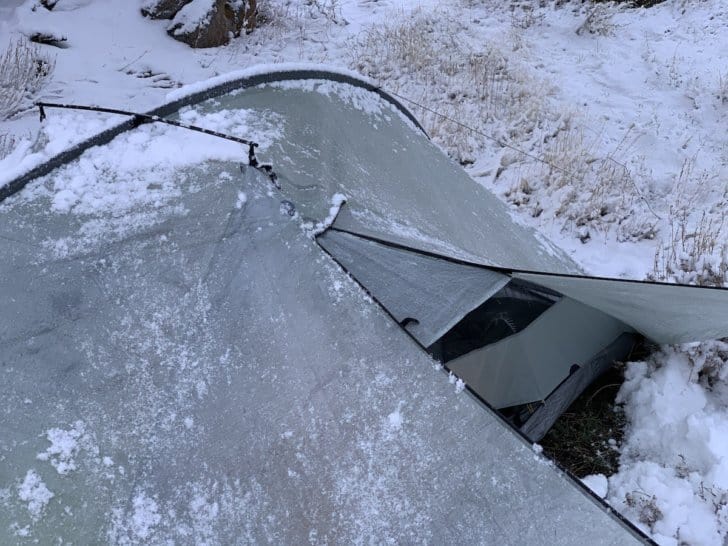
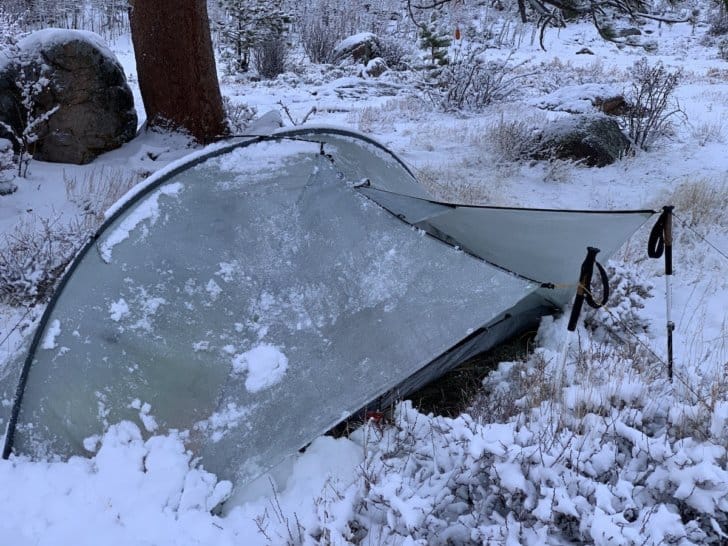
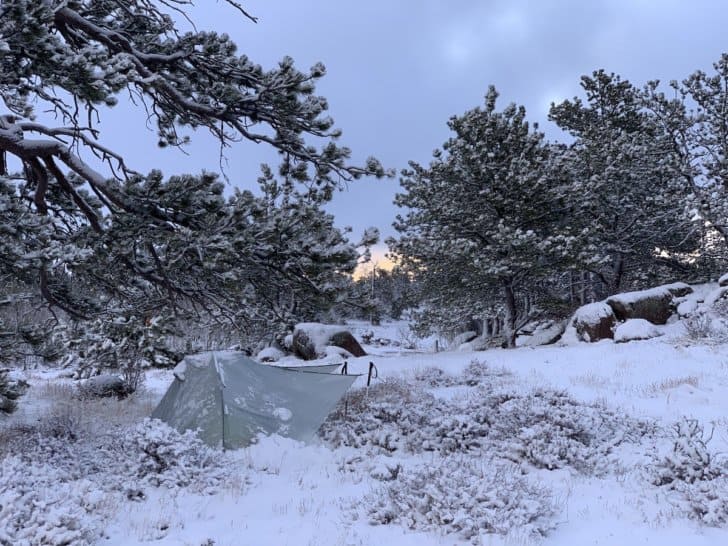
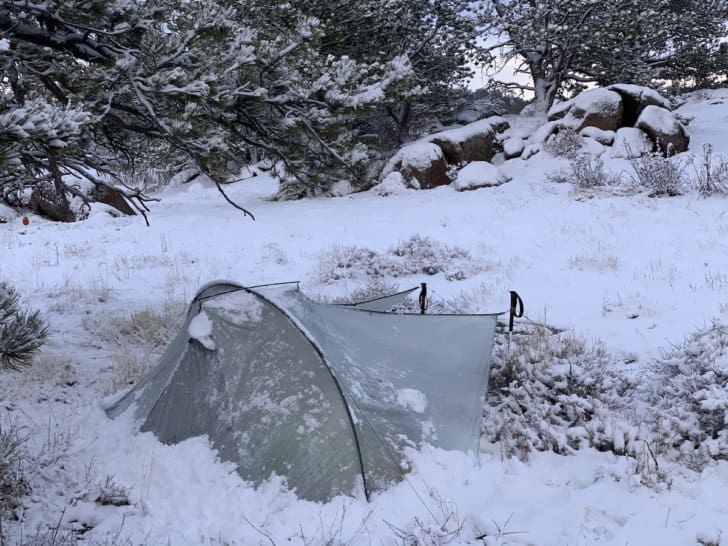
This is an ultralight tent that loses volume in response to very light snow loading. Given this limitation, it probably can't be considered a 3-season tent for some users.
ventilation/condensation resistance
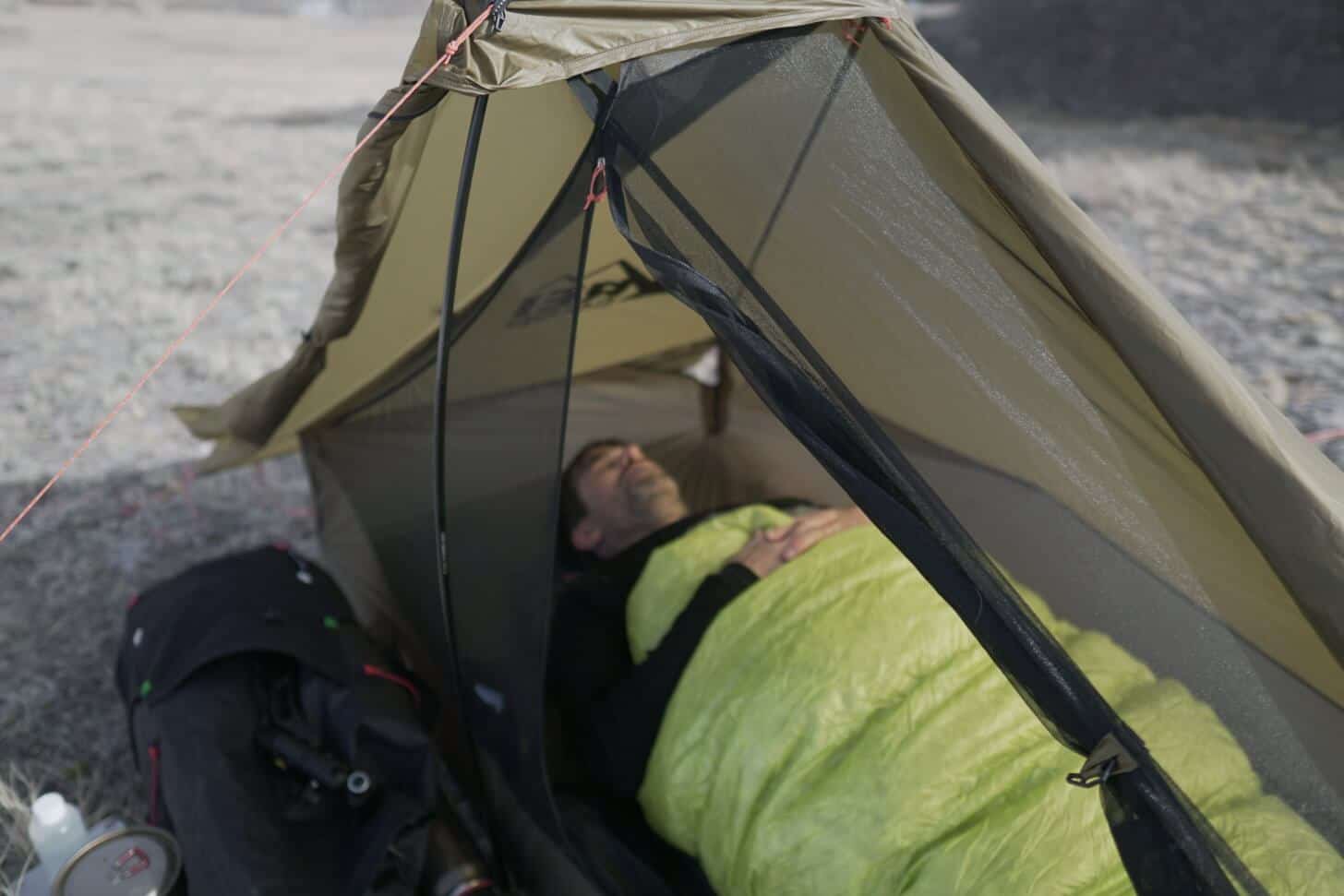
Two very small vents at either end and a vestibule door that sits a few inches above the ground provide intake points for dry air, while a full mesh wall and peak vent allow moist air to escape. However, by nature of its hybrid-wall design and small interior volume, this is not a tent for sustained cold, humid conditions. End and back walls are solid and joined to the floor, so provide no place for dripping condensation to escape tent without reaching the floor.
warmth
Hybrid wall design doesn't provide meaningful insulation to allow tent to retain much body heat at night.
compressibility
Ultralight fabrics are very compressible, and pole sections are minimal, short, and easily separable from the body.
aesthetics
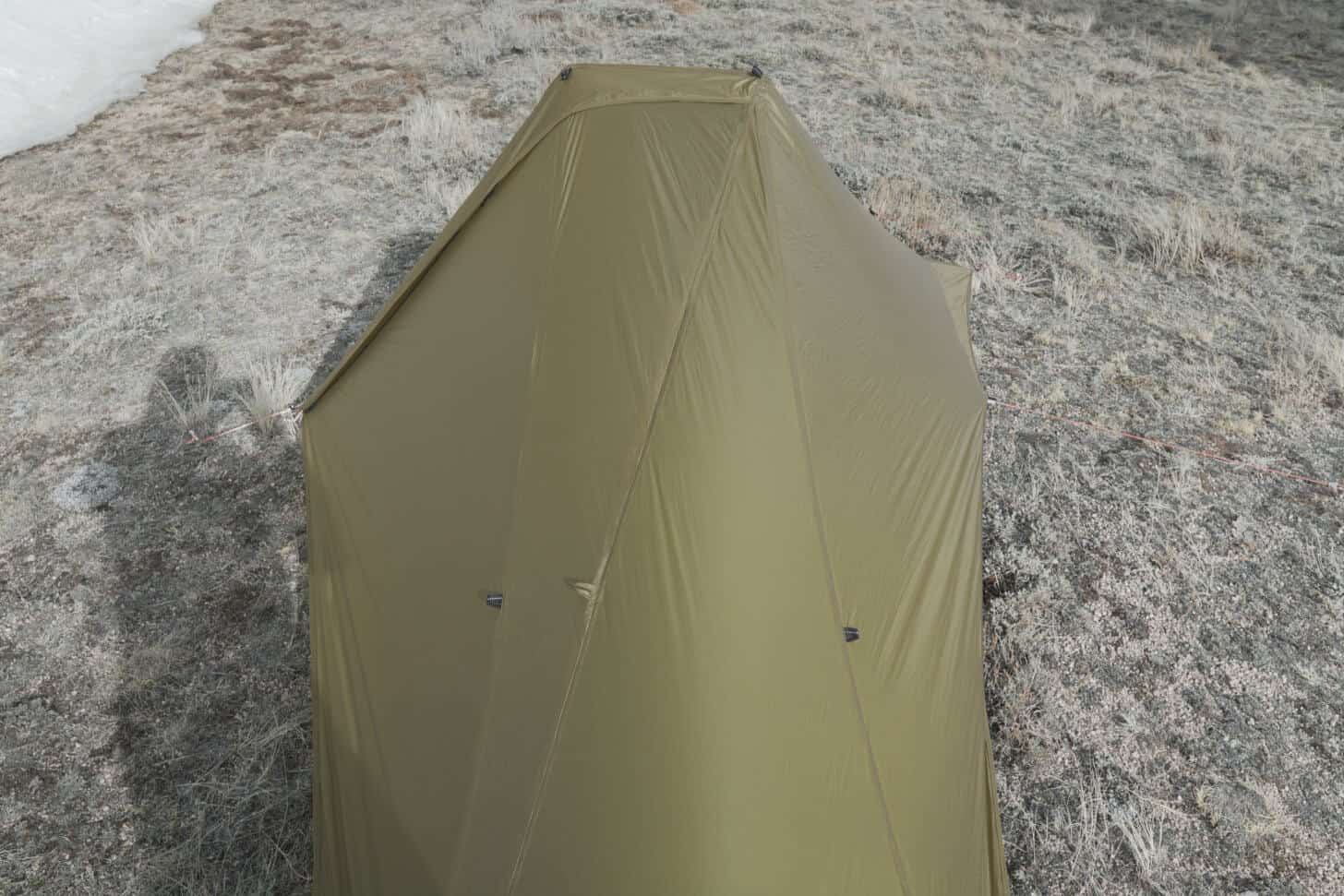
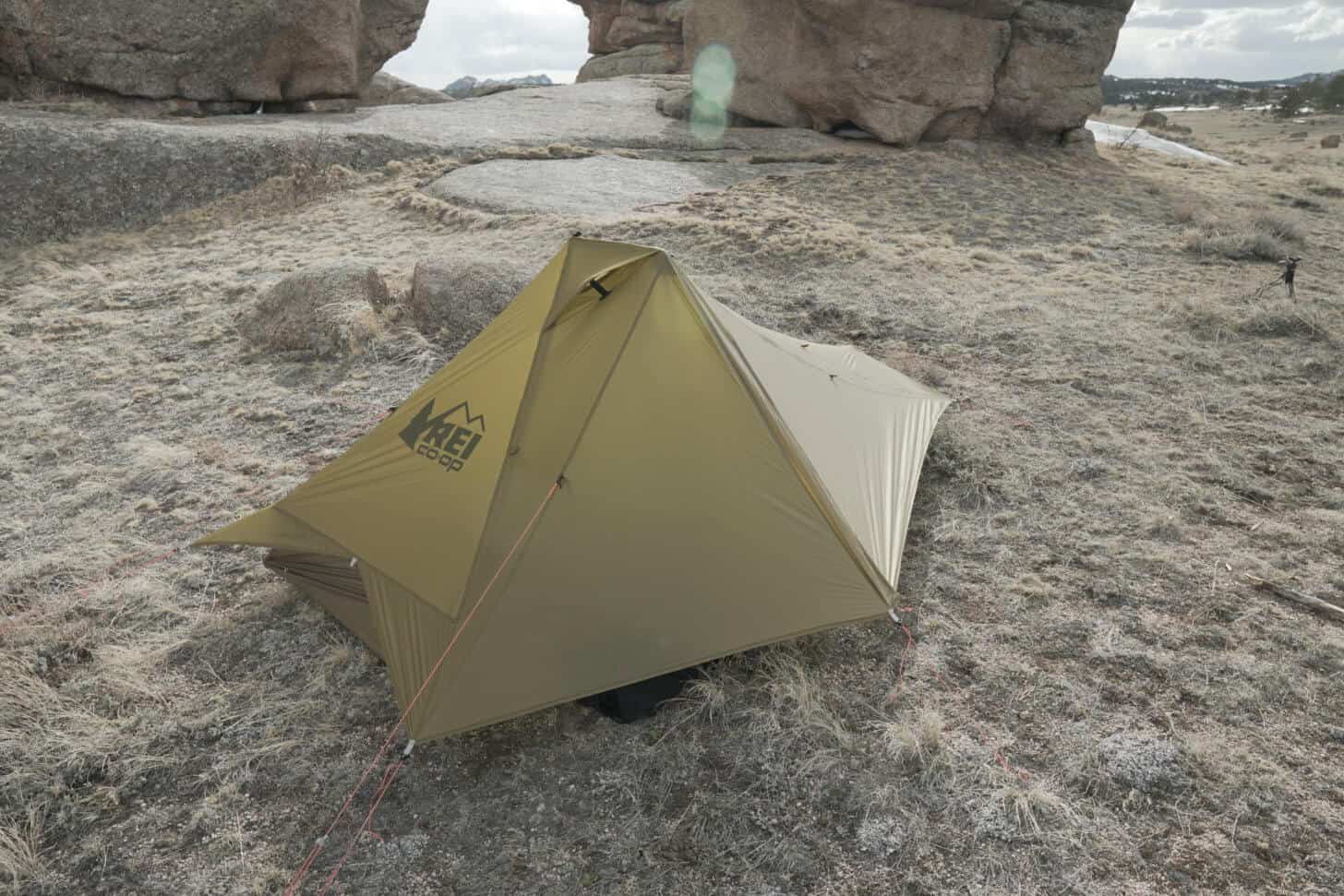
Foremost, I absolutely love the drab olive color. It disappears into the landscape, making it almost as non-intrusive as my favorite tent color, Hilleberg Sand. The profile is low, the lines are clean, and the pattern cuts make it look kind of like a Stealth Bomber. It's a cool design, and it's not ugly!
value
At $249, the REI Flash Air 1 Tent is a quality product that provides a light, minimalist shelter for a range of conditions that doesn't include extended heavy rain or cold, humid environments.
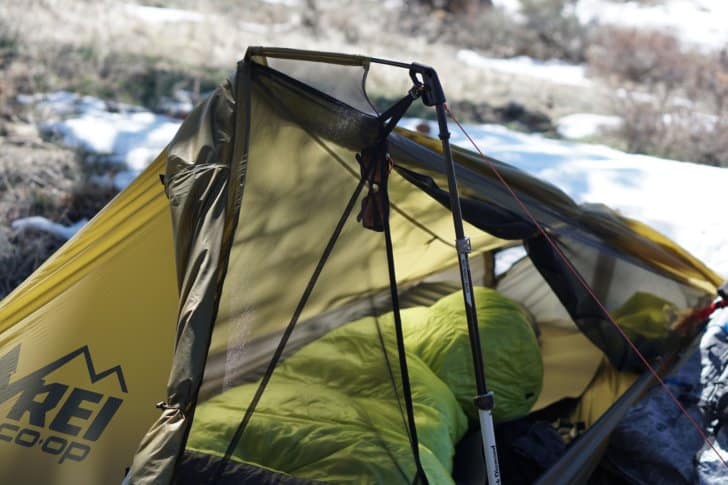
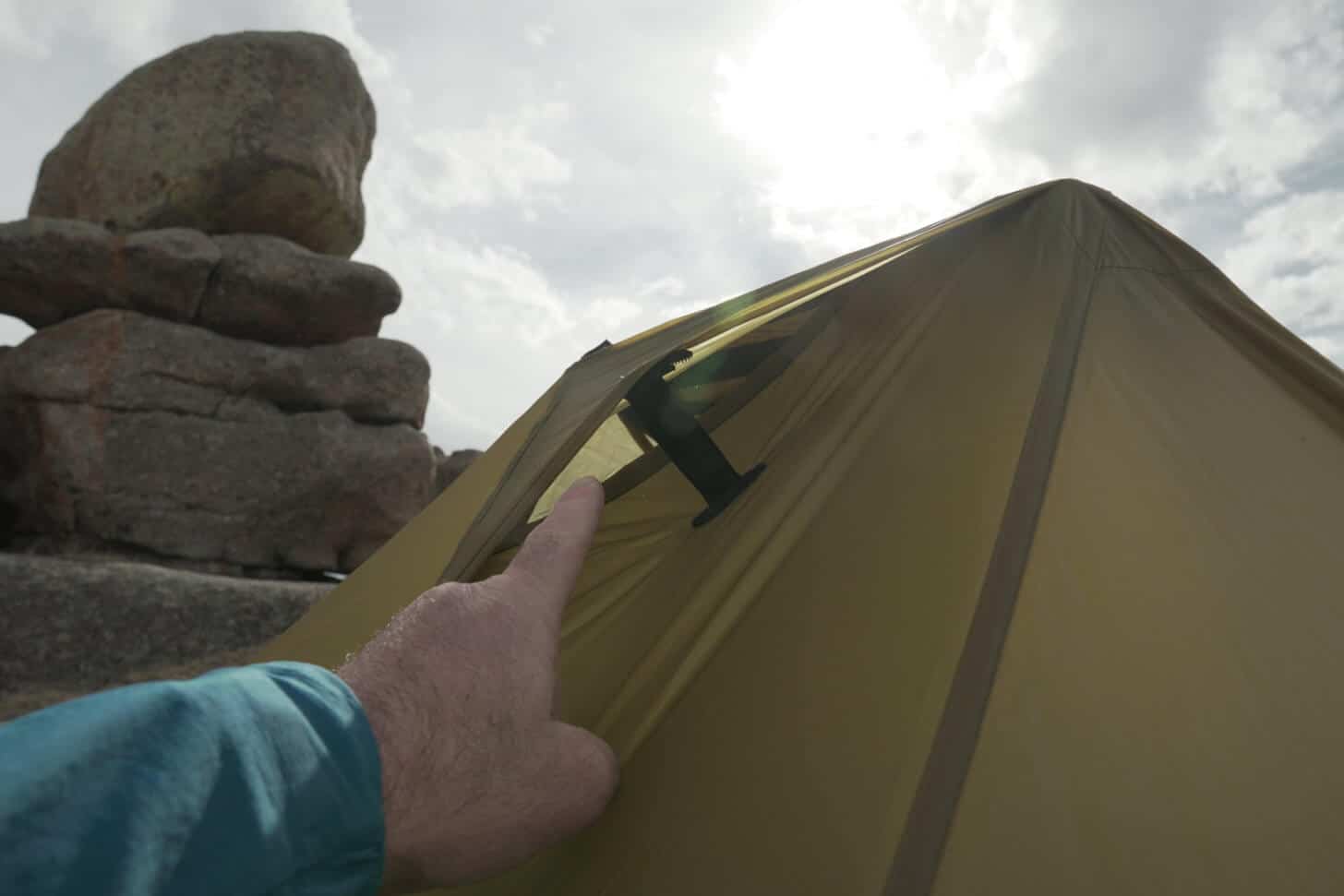
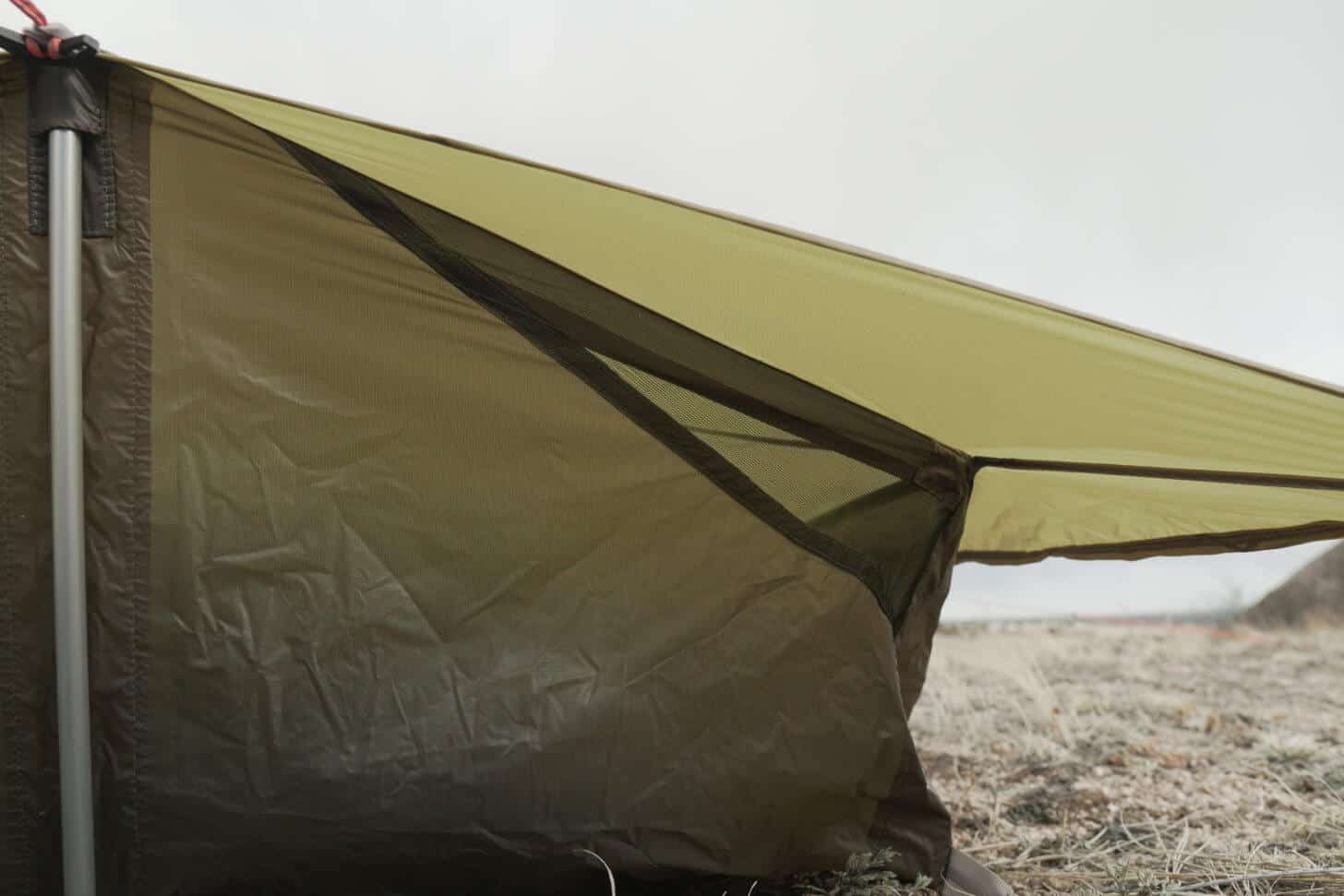
One of my favorite features of the REI Flash Air 1 Tent is its rollaway fly, which exposes roof and sidewall mesh for views, stargazing, and ventilation.
Commentary
What makes the REI Flash Air 1 Tent Unique?
There are lighter shelters that offer more volume than the REI Flash Air 1, but they are usually made from exotic materials like Dyneema Composite Fabrics and cost twice as much or more.
There are more compact fully-enclosed shelters at close to the same weight and cost (e.g., hooped bivy sacks), but they lack livability and wet-entry-and-exit options.
Therefore, the unique aspect of the REI Flash Air 1 Tent is its combination of:
low weight
low packed volume
reasonable price point
Hydrostatic Head Test
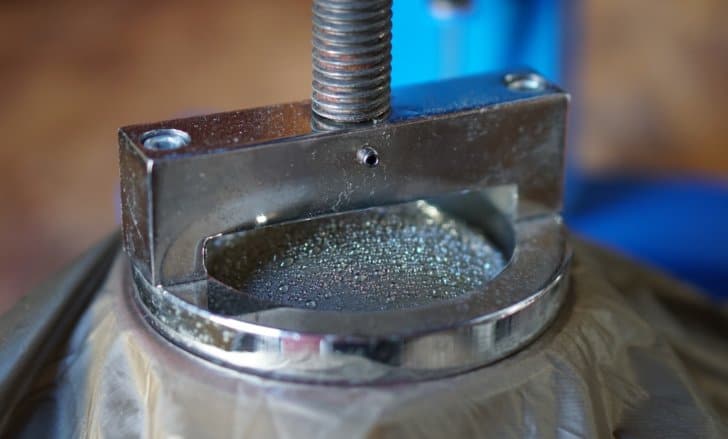
I used a Suter tester (calibrated) to measure the hydrostatic head rating of the REI Flash Air 1 Tent fly and floor fabrics. Both measurements were similar – about 1,800 mm H2O of pressure was required for water droplets to begin appearing at the ripstop threads. Read Roger’s account of this particular phenomenon in his article about hydrostatic head testing.
This photo shows widespread leakage by the time the pressure reaches 3,000 mm H2O. The first leaks started showing up at around 1,800 mm H2O.
This compares well with some other ultralight fabrics I’ve tested. For example, the fabric used in The One by Gossamer Gear tests at around 1,300 mm H2O on my test device. For context, Tarptent silnylons (latest generation) test at around 3,500 mm H2O, and Hilleberg Kerlon 1000 tests well over 5,500 mm H2O. Note: all of these numbers represent new fabrics that haven’t yet been exposed to significant amounts of UV radiation from sunlight.
Condensation Resistance and Livability
The REI Flash Air 1 tent’s most notable limitations include its condensation resistance and its livability.
I’ve addressed both in detail in this video:
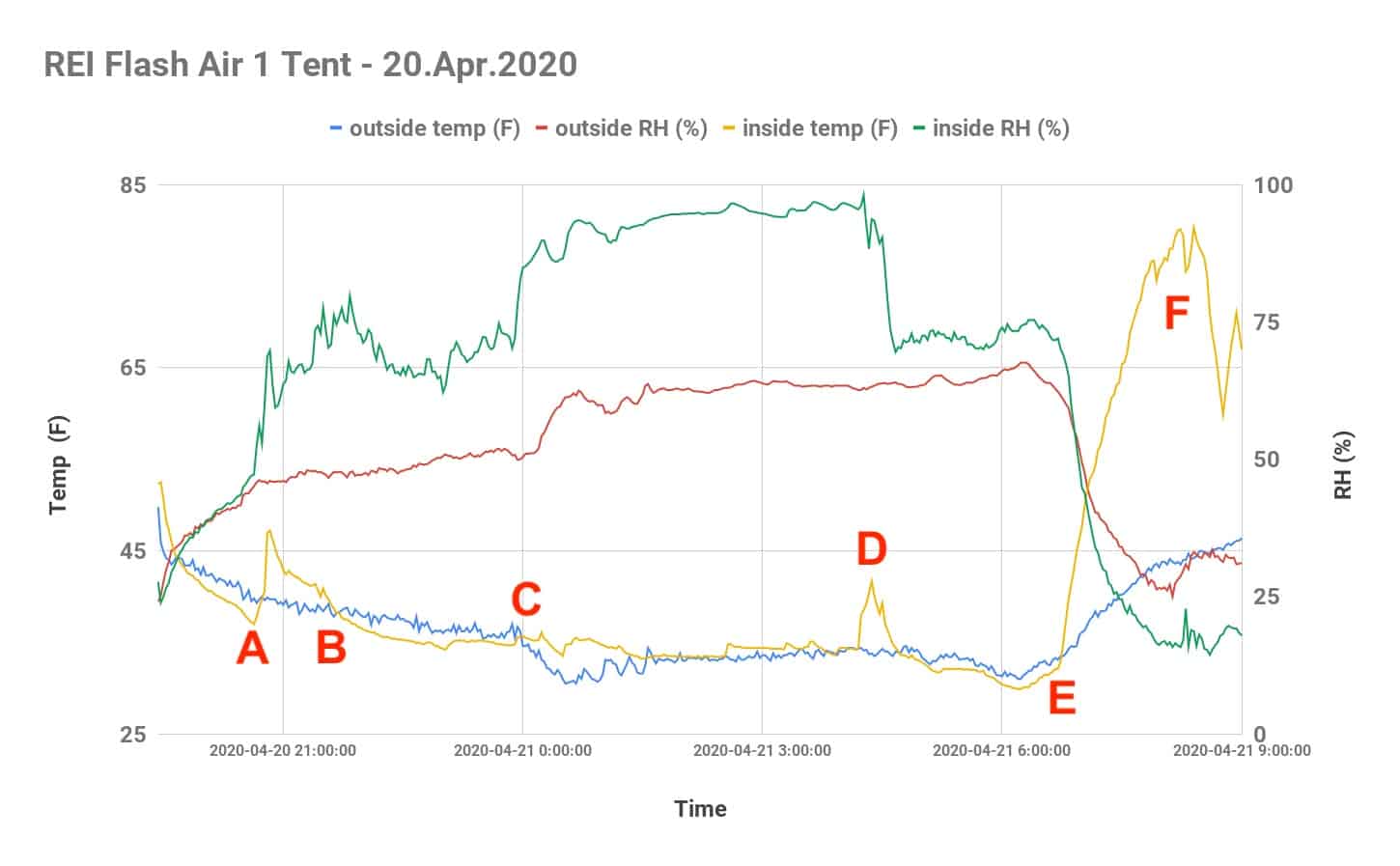
Here’s a graph showing its temperature and condensation performance (as measured with Kestrel Drop meters placed inside and outside the tent) on a cold, clear night at an elevation of 7,800 feet (2,377 m) in southeast Wyoming (click image for larger size):
Points of interest on the graph:
A
Bedtime – I enter the tent, close the roof vent (just for fun), and zip up the doors.
Increase in inside temp and humidity results from me moving around lot as I changed clothes and wriggled into my sleeping bag.
B
I’m in my sleeping bag here and now remain still, so the environment starts to stabilize.
Inside humidity begins to drop to around 65%, where it reaches a pseudo-equilibrium with the outside environment.
Outside air temp is 39 F and outside RH is 53%. Inside air temp is 39 F and inside RH is 65%. Inside vapor pressure differential is 2.88 mb (see the Tarptent Moment DW review for details about this calculation and why it’s important).
Note throughout this test that inside and outside temperatures are nearly the same, reflecting the tent’s lack of insulating ability.
Nothing more than a thin film of very light condensation is observed on the tent walls until about midnight.
C
At midnight, outside temp takes a sharp dive of a few degrees, while outside humidity increases by about 10%.
Inside humidity increases significantly now, approaching 95%+ for the next several hours. Inside vapor pressure differential is now only 0.25 mb.
Condensation begins to accumulate on the tent walls. By 4 am, there are visible drops of condensation.
D
I have to pee at 4:30 am.
Wriggling around raises the inside temperature as I get ready for nature’s call.
When I return to bed, I open to the foot-end vestibule door, and roll it all the way back, exposing half the sidewall and the lower roof mesh to open air.
The humidity inside the tent drops from 97% to 70% and stays steady at 70% until sunrise. Inside vapor pressure differential rises to 1.48 mb by 6:00 am.
Condensation inside the tent gradually disappears over the next few hours.
E
Official sunrise, 6:15 am.
By 6:45 (when the sun’s first direct rays hit my tent), there is virtually no condensation remaining in the tent, except very a very thin, almost imperceptible film on the roof; vapor pressure differential inside tent here is calculated to be 5.79 mb.
F
8:00 am, I’m awake for the day.
The sun is beating down on my tent and the interior temp climbs into the 80s.
Compared To…
The REI Flash Air 1 Tent is a single-entry, single-vestibule, side-entry, solo tent that can be pitched with a single trekking pole and weighs only 20 oz (567 g).
You simply cannot find any shelters that offer this feature set, at this weight, and at this cost.
If we are to compare tents of similar cost, they will be notably heavier, as a result of heavier fabrics, more features, more volume, or more pole structure. For example, the Six Moon Designs Skyscape and the Tarptent Notch offer two entrances, two vestibules, and require two trekking poles, at weights at least 8 oz (227 g) heavier than the REI Flash Air 1 Tent. Likewise, similar weights are available for solo, side-entry, 1-entrance/vestibule tents with their own pole sets, like the REI Quarter Dome SL 1.
And, if you look at single-trekking pole side-entry tents like the Tarptent Aeon Li or the ZPacks Plexamid, you’re now into a weight range that’s more competitive, but they are made with Dyneema Composite Fabrics that drive the price to more than twice the price of the REI Flash Air 1. Now, if you consider something like The One from Gossamer Gear, you have a shelter that is close in design and weight to the REI Flash Air 1 Tent. The key difference is that The One uses two trekking poles. It’s a little bit larger shelter, but also a little more expensive than the REI Flash Air 1 Tent.
Scroll right to view additional table columns.
REI Flash Air 1
Six Moon Designs Skyscape Trekker
Tarptent Notch
REI Quarter Dome SL 1
Tarptent Aeon Li
ZPacks Plexamid
Gossamer Gear The One
weight (minimum)
20 oz
28 oz
27 oz
29 oz
16 oz
15 oz
21 oz
MSRP
$249
$250
$314
$299
$535
$549
$299
wall type
hybrid
hybrid
double
double
hybrid
hybrid
hybrid
# trekking poles required to pitch
1
2
2
0
1
1
2
# entrances/vestibules
1
2
2
1
1
1
1
fly fabric
nylon
silpoly
silnylon
nylon
DCF
DCF
sil/PU nylon
peak height
42 in
45 in
42
38 in
47 in
48 in
46 in
floor area
21.3 sq. ft.
23.0 sq. ft.
15.8 sq. ft.
18.9 sq. ft.
18.3 sq. ft.
20.6 sq. ft.
18.3 sq. ft.
vestibule area
8.4 sq. ft.
16 sq. ft.
16 sq. ft.
9.6 sq. ft.
8.6 sq. ft.
6.4 sq. ft.
16.2 sq. ft.
Strengths
Core function – minimalist, overhead shelter with a side-entry and a reasonably generous vestibule – is very high for a tent at this weight and price point.
Easy to set up, with very little fiddle factor.
Ventilation and views are outstanding in fair weather. It’s a good option for buggy, warm conditions.
REI product that comes with outstanding customer service and a solid warranty.
Limitations
Limited weather resistance – this isn’t a tent for snow or high winds.
Limited condensation resistance – this isn’t a tent for cold, humid environments.
Limited livability – small volume isn’t ideal for larger folks or if you have to spend a few days holed up in a rainstorm.
Our review of the Tarptent Aeon Li features a single-side entry, single-vestibule, 1-trekking pole hybrid-wall tent that may be the performance gold standard for this style of shelter.
DISCLOSURE (Updated April 9, 2024)
Product mentions in this article are made by the author with no compensation in return. In addition, Backpacking Light does not accept compensation or donated/discounted products in exchange for product mentions or placements in editorial coverage.
Some (but not all) of the links in this review may be affiliate links. If you click on one of these links and visit one of our affiliate partners (usually a retailer site), and subsequently place an order with that retailer, we receive a commission on your entire order, which varies between 3% and 15% of the purchase price. Affiliate commissions represent less than 15% of Backpacking Light's gross revenue. More than 70% of our revenue comes from Membership Fees. So if you'd really like to support our work, don't buy gear you don't need - support our consumer advocacy work and become a Member instead.
Learn more about affiliate commissions, influencer marketing, and our consumer advocacy work by reading our article Stop wasting money on gear.
Note: This podcast was recorded in early February 2020 – before Covid-19 social distancing measures went into place.
In this episode of the Backpacking Light Podcast, Ryan and Andrew talk about load hauling – how to go as light as possible when the nature of your trip (packrafting, desert water carries, winter travel, etc.) requires specialized and (often) heavy gear.
After catching up (Ryan is running some cool experiments) the guys talk gear: packs, footwear, and other considerations for when the pack weight starts to creep up. After that they move into a discussion of skills that can lighten up a trip, even when the equipment is heavy.
Ryan updates the listeners on cool new stuff going on at BPL, and Andrew talks about his new favorite thing – a new pair of ultralight running shoes.
The episode wraps with an interview of Kevin Timm, owner and founder of Seek Outside. In a wide-ranging discussion, Kevin and Andrew talk about:
Seek Outside’s story and gear design aesthetic
What Kevin values in a piece of gear
Kevin’s advice to budding outdoorsy industry entrepreneurs
Lessons learned
The overlap between hunters and backpackers
Conservation and public lands use
And more!
Outline
Introduction
Today’s theme – load hauling: going light when you have to bring along a bunch of gear.
Catching Up
Ryan’s been doing experiments
Load testing with tent guylines
Comparison of moisture transfer in different layering systems
This episode of the Backpacking Light Podcast is supported and kept advertising-free by Backpacking Light membership fees. Please consider becoming a member which helps support projects like this podcast, in addition to a whole slew of other benefits!
The Feathered Friends Eos Down Vest (7 oz / 200 g, $249.00) is a simple, well-constructed, well-fitting down vest with a high warmth-to-weight ratio.
Introduction
The Feathered Friends Eos Down Vest (7 oz / 200 g, $249.00) is a simple, well-constructed, well-fitting down vest with a high warmth-to-weight ratio. The Eos Down Vest is, as you might suspect, the vest version of the Feathered Friends Eos Down Jacket. That jacket is a popular piece of apparel that BPL jacket-guru Max Neale once referred to as “arguably the best down jacket on the market.” The Eos Down Vest seems primed to follow in the Eos Down Jacket’s footsteps by utilizing the same 900 FP down and lightweight shell fabrics as the jacket.
The Feathered Friends Eos Down Vest. Photo: Feathered Friends
About This Review
This Limited Review is based on use over three nights of backpacking and 10-15 day hikes and trail runs in the Lake Tahoe area of the Sierra Nevada Mountains in late winter and early spring.
Testing the Feathered Friends Eos Down Vest during late-spring while backpacking in the Lake Tahoe region of California.
The Feathered Friends Eos Down Vest combined streamlined design with premium materials.
Because this is a Limited Review, a detailed performance analysis based on long-term testing will not be presented. In lieu of a detailed analysis, performance observations and issues are noted below.
criteria
observations and issues
warmth
The Eos Down Vest delivers a high degree of warmth for its weight. Partly this is a function of premium materials - 900 fill-power down, and 12 x 20 denier woven nylon. It’s also a feature of choosing a vest over a jacket. In a sense, you could look at a vest over a jacket as minimalism applied to its logical extreme - insulating only where necessary (torso) and trimming everything else.
The zippered hand warming pockets are generously deep, going well beyond my wrists when using them.
fit and comfort
This product features a moderately trim cut. I routinely wore mine on top of a Brynje Wool Thermo T-Shirt Base Layer and Ridge Merino Solstice Lightweight Pullover Hoodie, and still had room to layer one more light fleece-type layer underneath if necessary. Anything more than that will begin to feel constrictive. In other words - it is a refined fit - certainly less baggy than a jacket. This fit makes it a very functional mid-layer.
Lycra around the armholes ensures the vest doesn’t pull or rub in that area. The elastic hem is adjustable on both sides. The nylon fabric is soft and comfortable - what you’d expect from a high-end insulating layer.
packability
Although I prefer to let my insulating garments remain uncompressed in my pack as much as possible to extend their lifespan, that isn’t always an option - particularly if I’m using a pack that features external storage. In those cases, I need to keep my jacket easy to access but also protected from moisture, so I will sometimes keep an insulating layer in a waterproof stuff sack on the outside of my pack.
The same premium materials and minimal cut that make the Eos Down Vest so warm for its weight also make it highly compressible. During my testing, I mostly kept my Eos Down Vest in an 8 in x 10 in (20 cm x 25 cm) Hyperlight Mountain Gear Drawstring Stuff Sack (size small). It fit easily in there, far from its maximum compression.
weather resistance
The DWR coating and calendered 12 x 20 denier woven nylon fabric shrug off light rain and snow as much as expected. I take great care not to expose my insulation layers to moisture, but if you were caught in an unexpected light shower while wearing this vest, you’d be okay long enough to get it safely stowed away or covered with a rain layer. The Eos Down Vest is wind-proof within reason, but you’d certainly want to toss a wind-shirt over it if you were dealing with moderate-to-high winds in cold conditions.
quality of construction / durability
The Feathered Friends Eos Down Vest is sewn with extremely high quality. There are no errant seams, and the stitching is straight. The zippers glide easily and do not catch in the fabric. In my time testing this vest, one down plumule migrated through the fabric.
The 12 x 20 denier woven nylon fabric is light but not so light as to be overly delicate. I wouldn’t want to expose it to sustained bushwhacking, but I wouldn’t worry about pushing through some brush while visiting the latrine or hanging a bear bag.
After rigorous inspection, I haven’t found anything that would indicate a short lifespan for this vest. If anything, the opposite is true - you would be safe in assuming that an investment in this vest would be paying off for a long while.
Commentary
What Makes The Feathered Friends Eos Vest Unique?
At first glance, the question of “What Makes the Feathered Friends Eos Vest Unique” is somewhat hard to answer. There are no gimmicks or trendy features on this insulating layer – the only way to make it any more minimal (or lighter) would be to remove the pockets and zippers and make it a pull-over, reduce its fill weight, or use even lighter (e.g., 7d/10d) shell fabrics.
After giving it some thought and using this garment broadly (across a wide range of circumstances and temperatures) if not deeply (for an extended period on a long, multi-week backpacking trip), I’ve determined that two factors make the Eos Down Vest unique. These factors are:
Quality of Construction and Materials
Utility While Fastpacking
Quality of Construction and Materials
The Feathered Friends Eos Down Vest is sewn in the USA.
Feathered Friends sews its products in Vancouver and Seattle, and if “made in the USA” isn’t quite the byword for quality that we sometimes believe it is, in this case, the old maxim is true – this is an exceptionally well-made garment. In researching this article, I spoke with Juna Gates from Feathered Friends, who shed a little more light on how Feathered Friends maintains such high quality of construction (the brand’s quality is well-known in the outdoor world).
Firstly, Juna told me, Feathered Friends places a lot of emphasis on retaining their Seattle workforce, preferring to keep workers for years. There’s something to be said for practice and experience, particularly behind a sewing machine and while working with ultralight fabrics.
Secondly, Feathered Friends’ small scale (relative to larger brands like Arc’teryx) means they “hand inspect every piece coming out of [the Feathered Friends] factory.”
Neither of those factors makes for a flashy product, but when combined with good customer service and function-centered design, they do make for a very high quality product. The final factor to consider is Feathered Friends’ use of premium materials in the Eos Down Vest. I’ll talk more about that below.
Utility While Fastpacking
When I need fast (but waterproof) access to my Feathered Friend’s Eos Down Vest, I often store it in this size small (8 in x 10 in / 20 cm x 25 cm) drawstring stuff sack. The vest could compress more than this if needed.
As the ongoing Covid-19 pandemic has limited my vagabonding area to my immediate surroundings, I’m experimenting with ways to challenge and progress my backpacking skills and fitness. One of the ways I’m doing this is by fastpacking and trail-running (and blurring the lines between the two). In essence, I’m playing with how quickly I can move over challenging terrain for short distances (thirty miles or less). For this purpose, the Feathered Friends Eos Down Vest has been perfect. Its compressible nature and high warmth-to-weight ratio (both factors of simple, elegant design and premium materials, including 900 FP down) make it perfect for inclusion in fastpacking kits – particularly on trips where you’ll be spending a minimum amount of time lounging around camp. My weekly long trail runs are now edging up towards marathon distance, and I like to take a break at the halfway point to eat and admire the scenery. It’s still somewhat chilly in my area, so the Eos Down Vest is a worthy inclusion in my 18L running vest – well worth the 7 oz (200 g) and the minimal space it takes up.
When longer backpacking trips are back on the table, it will make a stellar insurance garment. While I’d probably lean towards a more substantial down jacket for serious alpine trips, I’d be tempted to bring the Eos Down Vest along instead of a jacket on multi-week trips in milder climates where I just need something small and light to fend off evening and morning chills.
Compared To…
I chose to compare the Feathered Friends Eos Down Vest to the Arc’teryx Cerium LT Vest. Both vests are simple, streamlined designs, at an identical price-point and similar weight, from companies known for quality garments.
The Eos Down Vest uses 900 FP down, while the Cerium LT Vest uses 850 FP down and minimal amounts of synthetic insulation at strategic locations. The Cerium LT Vest weighs in at 6.5 oz (185 g) vs. the Eos Down Vest is 7 oz (200 g).
Eos
price
Both products cost $249.
Tie
insulation type
The Eos Down Vest uses 900 FP down, while the Cerium LT Vest uses 850 FP down and synthetic insulation.
Eos
weather and moisture resistance
Both garments utilize calendared, ultralight nylon fabrics coated with a DWR. What sets the Arc’teryx Cerium LT vest apart is its use of synthetic insulation at strategic points (notably the shoulders). In my opinion, this gives the Arc’teryx Cerium LT vest a slight edge in terms of moisture resistance.
Cerium
durability / quality of construction
Both products are from companies known for high-quality production. That being said, research into the Cerium LT Vest revealed ongoing issues with zipper durability (according to multiple user reviews on Arc’teryx and several third-party websites). The Eos Down Vest is a new product and hasn’t garnered many reviews yet. I certainly didn’t find anything of concern on my sample, so for now, the Eos Down Vest holds the edge.
Eos
packability
The inclusion of synthetic insulation in the Cerium LT Vest makes it slightly less compressible than the Eos Down Vest.
Eos
pockets
The Eos Down Vest has two zippered hand-warmer pockets. The Cerium LT Vest has two zippered hand-warmer pockets but also includes an inner zippered chest pocket. I find this type of pocket especially useful for keeping electronics and batteries warm, so in this case, I give the edge to Arc’teryx.
Cerium
Strengths
Utility
Ideal for peak-bagging, fast-packing, trail-running, or other pursuits where you might be trying to shave ounces but maintain warmth on short rest breaks.
Great utility as an insurance layer or primary insulative layer in milder climates
Precise, refined fit functions well under layers.
Quality of Construction
Lives up to the Feathered Friends reputation for quality.
Limitations
Insufficient warmth for long stays in alpine environments where temperatures can fluctuate dramatically.
Our community discusses the Feathered Friends Eos Down Jacket and several other insulated jackets in this forum thread.
DISCLOSURE (Updated April 9, 2024)
Product mentions in this article are made by the author with no compensation in return. In addition, Backpacking Light does not accept compensation or donated/discounted products in exchange for product mentions or placements in editorial coverage.
Some (but not all) of the links in this review may be affiliate links. If you click on one of these links and visit one of our affiliate partners (usually a retailer site), and subsequently place an order with that retailer, we receive a commission on your entire order, which varies between 3% and 15% of the purchase price. Affiliate commissions represent less than 15% of Backpacking Light's gross revenue. More than 70% of our revenue comes from Membership Fees. So if you'd really like to support our work, don't buy gear you don't need - support our consumer advocacy work and become a Member instead.
Learn more about affiliate commissions, influencer marketing, and our consumer advocacy work by reading our article Stop wasting money on gear.
This Tarptent Notch Li Review presents the benefits of Dyneema Composite Fabrics (DCF) for ultralight backpacking shelters, assesses its design/feature set, and compares the Notch Li to its competitors.
Updated: Notch Li V2 (2020 Version)
Updates:
April 18, 2020 – added new field and detail photos of the v2
April 9, 2020 – added stock photos and details about the v2 update
The most meaningful change is replacing the door flaps on the vestibules with waterproof zippers. This will drastically improve weather performance in wind, which was was the notable shortcomings we discovered in our review below. These are two-way waterproof separating zippers, which will help with ventilation at the peak as well.
The Notch Li now includes a waterproof, 2-way separating zipper. Photo: Tarptent.
The partial solid fabric interior now has a solid fabric (instead of mesh) roof panel. This type of construction is essential in order to prevent condensation that has accumulated on the inside of the roof from falling down on you through mesh. Best of all, Tarptent changed the fabric to a 10 denier weight – which means the partial solid fabric inner is now lighter than even the mesh inner.
The partial solid fabric inner tent now includes a solid fabric roof panel for protection from dripping condensation. Plenty of mesh in the upper, so this has the potential to be a very functional all-season inner tent except in the warmest environments (then you’d want the mesh for additional airflow). Photo: Tarptent.
Tarptent notes that they also made “end to end improvements in stitching, cutting, taping and bonding” which we can only assume will result in a better pitch and more strength. There are some obvious additional bonding patches here and there (see photos below for the magnetic door tie).
It looks like Tarptent has addressed the magnetic vestibule door tie issue. It tended to pop open under very little pressure (wind, tight staking, etc.). Note in the photos below, the V2 magnetic closure is attached to a thicker strap and the location has changed along the door seam, so less stress will be imparted on the door tie and it should be less likely to pop open under tent stress.
Magnetic closure on the Tarptent Notch Li v2 (2020 version). Photo: Tarptent.Magnetic door tie on the V1 (2018) Tarptent Notch Li. Photo: Ryan Jordan.
Manufacturing has moved from Seattle to China, at least for Lithium series tents. We expect this to improve sew and finish quality of these new tents dramatically.
New Photos
added 4/18/2020
Introduction
This review was originally published on March 4, 2018.
This Flash (“first looks”) Review provides an overview of the new Tarptent Notch Li shelter, representing Tarptent’s first use of Dyneema Composite Fabrics (DCF, formerly, Cuben Fiber) in their shelter line.
In DCF, it is quite a beautiful little tent, yes?!
DCF shelters have a cult following amongst hardcore ultralight hikers for their:
High fabric tear strength-to-weight ratio (and very light weight);
Low stretch (maintains a taut pitch across a wide temperature range);
Tarptent is known for shelters that are well-made, stable in foul weather, and usable, roomy designs. We recently reviewed the Tarptent Stratospire 1, which I’ve personally found to be a highly-weather resistant shelter in four-season conditions. Oh how I wish for a DCF Stratospire!
The (silnylon version of the) Tarptent Stratospire 1 on the Colorado Plateau. Constructed of DCF, this tent could weigh as little as 1.5 lb.
We’ve published a number of other Tarptent Reviews here. I find the curved-pole designs sort of ho-hum (others will differ in opinion, and I respect their preferences) due to their unflattering performance (storm-worthiness)-to-weight ratios. However, my personal experience in recent years has focused on their dual-trekking pole solo models, including the Notch and Stratospire.
I appreciate the design simplicity of the Notch – stability afforded by two trekking poles (and a few carbon struts). Its double-side entry/double vestibule design makes it a very usable shelter that offers great advantages for the solo hiker.
However, the use of silnylon fabric for a shelter this small makes it a condensation trap in all but the driest environments. On nights with little or no wind, at temperatures less than about 40 deg F, prepare to mop moisture from the walls – there simply isn’t enough ventilation in this shelter to manage condensation well.
In addition, the Silnylon Notch (and its more robust bigger brother, the Stratospire) suffers from fabric panel sagging as temperatures drop and/or precipitation falls. This isn’t unique to the Notch, it just happens to be one of the disadvantages of silicone-coated nylon fabrics. (Another 2-trekking pole-supported tent that suffers similarly is the Sierra Designs High Route FL1.)
And so it is with some hope that this new DCF version of the Tarptent Notch (the Tarptent Notch Li, or “Lithium”) improves on silnylon versions by increasing pitch tautness during a decreasing temperature / precipitation event, and being more resistant to condensation.
Of course, the weight savings of half a pound is nothing to shake a carbon fiber strut at, either.
Features
Dyneema fabrics for weight savings and improved condensation performance;
Taped seams;
Dual trekking pole support; no poles in your living space (Requires minimum 43 in (110 cm) trekking poles or optional setup poles (extra $);
Double wall, dual entry, and dual vestibules;
Interior is completely removable and can set up independently;
Interior protected from overhead precipitation during entry/exit;
Alternate partial fabric and/or silnylon floor interiors available (extra $);
PitchLoc™ foldable corners and integrated line tighteners for increased pitch tautness;
Pole handle side up possible with optional adapters (extra $);
Reflective spectra cord guylines;
Catenary ridgelines improve pitch tautness and performance in wind/snow loading;
Different interiors available (extra $).
Specifications
Dyneema composite fabric (DCF) spec – 0.52 oz/sq yd on fly, 1.0 oz/sq yd on inner tent floor;
Hydrostatic head rating: 8,000+ mm
Interior surface area: 15.2 sq ft (1.4 sq m);
Floor width (max): 34 in (86 cm) – fits a wide sleeping pad;
Floor length (max): 84 in (213 cm);
Interior height: 43 in (109 cm);
Stakes (included): 4 x 6 in (15 cm);
Packed size: 16 in x 4 in (41 cm x 10 cm);
Weight
Mesh interior with DCF floor (standard model)
19.9 oz (0.57 kg) – includes fly (10.1 oz / 0.29 kg), interior (8.2 oz / 0.23 kg), and stakes/stuff sack (1.6 oz / 0.045 kg).
Mesh interior with silnylon floor
21.8 oz (0.57 kg) – includes fly (10.1 oz / 0.29 kg), interior (10.0 oz / 0.23 kg), and stakes/stuff sack (1.6 oz / 0.045 kg).
Partial DCF/mesh interior with DCF floor
21.5 oz (0.57 kg) – includes fly (10.1 oz / 0.29 kg), interior (9.8 oz / 0.23 kg), and stakes/stuff sack (1.6 oz / 0.045 kg).
Design, Features, and Usability Assessment
Inner Tent Layout
The Tarptent Notch Li includes a relatively small inner tent (34 in x 84 in, only 15.2 sq. ft. of area), but with notable features:
PitchLoc corners integrate with the inner tent to provide more usable space at the ends. Consequently, nearly the entire 84 inch length can be used with a thick foam pad and winter-weight sleeping bag. A tall person using a long-length sleeping bag (e.g., 6′ 6″) should have no problem spreading out without touching any solid-fabric tent walls.
With an inner tent width at its maximum of 34 inches (at the mid-point of the inner tent) and at its minimum of 20 inches (at the ends of the inner tent), the claim that a wide (e.g., 25 inch) sleeping pad will “fit” is a little dubious. That said, it works well enough, even though it all gets a little bit scrunched up at the ends.
An interior peak height of 43 inches, even a tall-ish person (probably up to about 6′ 0″) can sit upright without rubbing their head on the top of the inner tent.
The Notch and Notch Li share the same geometry. Specifically, note the yellow-shaded model of a standard-sized sleeping pad (20 x 72 inches). A wide/long pad (e.g., 25 x 78 inches) will interfere a little bit with the footprint of the inner tent. Image credit: Tarptent
Dual Doors, Dual Vestibules
Dual doors and dual vestibules first appeared on two-person tents for obvious reasons: each person could have their own entrance and gear storage area.
However, and perhaps counterintuitively, I think dual doors and dual vestibules are even more important for a solo tent, and especially for a solo tent that has an inner tent as small as that included with the Tarptent Notch Li.
Here’s why:
Two vestibules allow you to organize gear more efficiently. For example, I often keep my pack, shoes, hiking clothing, and wet gear in one vestibule and my water, cooking gear, and food (if not in bear country) in my other vestibule. That leaves me one vestibule for gear storage and organization, and one vestibule for cooking and/or morning coffee.
Two entrances (on both the fly and inner) allow me to open up all doors, and tie them back for the best views and maximum ventilation on warm nights.
Two entrances allow me to use one or the other, depending on the direction of prevailing winds, when entering or exiting the tent in inclement (especially snowy) weather.
Two vestibules and entrances also allows me to save one side for the dog.
#BigSkySierra is happy enough in the vestibule as long as she can hang with me through an open door but when the weather hits, her backside needs to somehow fit inside, too. The Tarptent Notch Li vestibule isn’t big enough for a 95-pound labrador retriever, so keep that mind if you need this tent to accomodate your furry friend.
Design Geometry and Pitch Tautness
The Tarptent Notch Li features a catenary ridgeline, dual trekking poles for support, two PitchLoc corners, only four required stake-out points, and of course, low-stretch DCF fly fabric.
The aggressive catenary ridgeline is a good idea on the Tarptent Notch Li, but don’t expect to take advantage of its stabilizing properties unless you add guylines to the ridgeline Linelocs (shown in foreground), which effectively makes this a “6-stakes-required” shelter for inclement weather involving high winds or snow loading.
These design elements check off all the right boxes to make the Tarptent Notch Li a stable, taut shelter that maximizes wind resistance, and minimizes collapse in response to snow loading.
The result is a shelter that I can confidently rate as a 3+ season shelter. Having used the silnylon version of the Notch in snowy fringe-season conditions, I can’t say that it’s a shelter I’d recommend for any amount of snow. Silnylon simply has too much stretch, and more structure is needed to support it under even a small snow load. For any conditions where snow is expected, and I had to use a silnylon shelter, I’d upgrade to the Tarptent Stratospire 1 model, which offers additional stability afforded by more fabric stability resulting from an increased number of stake-out points.
Construction Quality
My beef with DCF / Cuben Fiber shelter construction quality goes back a long time.
DCF is expensive. Construction quality and attention should match it.
When I first introduced Cuben Fiber tarps as part of the Backpacking Light Gear Shop back in the early-2000s, the first generation tarps were horrific. Back then, we all assumed that we could treat Cuben Fiber like any other fabric and call it good. Boy were we wrong. Ripped seams, ripped fabrics, puckered panels – it became a customer support nightmare and an engineering debacle. My Cuben Tarps were ridiculed for their lack of durability. And deservedly so.
I learned a few hard lessons very quickly:
Recalibrate the CAD software to consider the differences in stretch and bias vs. the fabrics we were used to building shelter flys with (silnylon, nylon, and poly).
Find the balance between needle size (make it smaller) and thread size (make it bigger) to minimize the catastrophic effects of thread cutting that was so prevalent with Cuben Fiber.
Orient the fabric bias (high strength threads which dominate in one direction over another) so that tensile strength resistance is consistent with the actual tensile forces exerted on the shelter in high winds.
Remove raw fabric panels that contained puckering (manufacturing defects) from the production line.
Never, ever – use Cuben in geodesic spherical panels. The math (lack of stretch) doesn’t work. Take note, Sierra Designs: you could have saved yourself a lot of heartache, cost, and embarrassment.
Study seam, edge, and corner bonding as if bonding was the Holy Grail, because it is.
After I pulled all Cuben Fiber production from our inventory and recalled tarps purchased by our customers, I went to work and studied Cuben tarp design in more detail, and we eventually produced the Stealth Zero and Stealth One catenary-ridgeline tarps – the first Cuben tarps available on-demand to a wide audience. They were decent – not awesome – but durable, bonded, unpuckered, and properly bias-oriented. And the 7×9’s were five ounces, man!
Shortly thereafter, other manufacturers started introducing Cuben Fiber shelters, including Locus Gear, Mountain Laurel Designs, and Six Moon Designs. LG and SMD’s early shelters suffered the same durability problems as our early tarps – inadequate bonding (or in one manufacturer’s case, none at all), giant needle holes, poor bias orientation, and puckered fabrics.
But I applaud their guts. They took on an innovative new fabric and went for it.
All the while, Tarptent remained absent from the Cuben Fiber shelter market. Chickens!
OK, maybe not chickens. Maybe Henry Shires (Tarptent owner/founder) was simply … staging.
Meanwhile, we saw Sierra Designs release the Cuben UFO, which seemed more proof of concept than practical execution of anything (floppy and flappy in even light winds). Terra Nova introduced the Laser Ultra 1, seemingly to break a Guinness World Record rather than provide something more usable than a bivy sack. And Brooks Range brought us the Rocket, which was the finest mountaineering tent I’ve ever used – but was pulled off the market for suffering UV damage that sent the manufacturer into “fear and withdrawal” mode.
So that brings us to the present day.
SMD has pulled back from Cuben Fiber / DCF. MLD has modified their bonding at seams and tie-out points over several iterations. Locus Gear has set a totally new standard with the new CTF-B Khufu – one of the most aesthetically beautiful, and strongest DCF pyramid-style shelters ever produced.
And now we have the Tarptent Notch Li.
Look for bonded panels at every structural (tensile load-bearing) seam junction when shopping for a DCF shelter. Lack of bonded panels reveals the designer’s ignorance of how to properly design a shelter with DCF fabrics – these junctions are notorious for concentrating high stress as a result of tensile loads placed on the fabrics from tight pitching, high winds, or snow loading. This photo shows one of the ridgeline peaks of the Tarptent Lithium from the inside. The darker green areas indicate bonded reinforcement panels that help distribute stress at seam junctions. Well done.
A common area of weakness in DCF tents is found where external tie-outs meet the shelter floor. Here’s a shot from inside the Tarptent Notch Li. The dark gray is a bonded reinforcement that secures the tieout sewing to the floor. As a bonus, the tieout cord is elastic, further reducing stress on the fabric.
The Tarptent Notch Li applies a bonded-then-sewn approach to adjoining DCF seams, which is reasonable. Just recognize that there is some controversy surrounding various DCF adjoining techniques. Sewing after bonding, most notably, introduces undesirable aesthetics, but probably no loss in strength vs. a sewn-then-bonded approach. And, because bonding can delaminate in cold temperatures, there is some legitimacy to the argument that a bonded-then-sewn approach results in a more durable, albeit a little bit uglier, seam.
A fly corner reinforcement is assembled using a bonded-then-sewn approach that reveals the aesthetic limitation of exposed, criss-crossing seams, but may preserve the security of the bonded tape in case of delamination in cold temperatures.
Snow-Loading Considerations
A relatively shallow roof pitch (about 30 degrees) doesn’t bode well for snow-loading. The Tarptent Notch Li will have to rely on the amount of tension that you use to engage those rooflines between the shelter’s peak (ridgeline) and the PitchLoc (carbon fiber strut) ends.
The good news is that the PitchLocs will keep the ends from collapsing, which is the main problem caused by snow loading of shelters where the corners and ends of the shelter go directly to guylines.
The PitchLoc corners and lower stretch of the DCF fly effectively make the Tarptent Notch Li a 3+-season shelter capable of handling a little bit of snow rather than a 3-season shelter.
Six Panel Geometry
The Tarptent Notch Li has four stake-out points (2 side, 2 end), and two ridgeline peaks. This creates a geometric shape comprised of six (generally triangular) panels (2 side panels on each side, and 2 roof panels).
This gives it some advantage over conventional one-pole pyramids (4 triangular-panel shelters), and quite a lot of advantage over shelters comprised of rectangular / trapezoidal panels (e.g., Six Moon Designs Skyscape, or conventional flat tarps – although tarp users can address this).
It is well known among tent designers that tension can be generated to a much higher degree in smaller triangular panels than in larger rectangular panels. Higher tension equals greater wind stability, better resistance to snow loading, and decreased condensation dripping.
Ventilation
Little tiny peak vents. Don’t expect any miracles.
The Tarptent Notch Li offers two tiny peak vents and two lower end vents. Don’t expect any condensation resistance miracles. The best thing going for the Notch Li is the fact that it’s made using DCF fabrics that remain taut in response to decreasing temperatures and/or precipitation during the night, and should accumulate less condensation than silnylon.
Lower vents on each end should provide much needed airflow on warm nights, especially when combined with opening the fly doors. When combined with the tiny peak roof vents, will they help resist condensation on cold nights? Time and testing will tell, I suppose.
Magnetic Fly Closure Thingys
I’m not a fan of gimmicks.
I tend to be pretty conservative when it comes to design: use what works, and stop futzing around with it.
That’s what I was thinking when I discovered the *new and improved* Tarptent Notch Li tent fly retainer thingys (you know, what is usually some type of hook-and-loop or elastic toggle mechanism for retaining a rolled-back fly).
It was magnetic.
My first response was, “Oh, Lord, no.” I think I saw this on purse closures at the Nordstrom Rack the last time I went on a shopping date with Stephanie. I just hate to see her get pickpocketed. I like the sound of Velcro’s RRRRRR-R-R-I-P – it’s a good alarm system.
And my gut feeling was sort of validated when I realized that this little magnetic mechanism doesn’t work that well on the Notch Li.
I’ll get to its limitations in a second, but I have to admit that the idea is worth refining.
I like not having to hear the RRRRRR-R-R-I-P of Velcro when I’m trying to enjoy the peace of natural sounds in the backcountry. And fiddling around with elastic cord and toggles with cold fingers? No thanks.
In that context, the magnetic retainer is sounding pretty good right about now.
It just needs a little better execution:
Longer tabs, so you’re not trying to secure so much rolled up fabric with such a short length of fabric – it’s too tight.
A tab extending beyond the magnet, so you can operate it more easily with gloves or mittens, maybe? I did like the ability to “brute-force” the whole thing and just “tear it down” without fear of ripping out any seams, so maybe that’s OK as is.
A stronger magnet would keep things more secure. I found the magnet popping loose quite a bit, especially when the shelter was pitched very taut.
Not a deal breaker for me. I like the idea. It could be improved.
Inner Tent Options
The Tarptent Notch Li comes with a few different inner tent options:
All mesh body, 1.0 oz/sq. yd. DCF floor. This is the lightest version, best for most temperate-climate hikers who simply want insect protection and the feeling of coziness that comes from sleeping inside an inner tent.
All mesh body with a silnylon floor. A little heavier, this is for the crowd who thinks that silnylon floors are better than DCF floors (they probably aren’t). DCF floors are easier to repair, result in less condensation accumulation, and are less slippery.
Partial solid fabric (breathable nylon, uncoated) interior with a DCF (or silnylon, presumably) floor. Best for hikers who want additional windblown dust / snow protection, or a little extra warmth.
My personal pick is #3 for sand resistance in desert winds, and spindrift (snow) resistance for winter trekking. It also affords a little more privacy if you’re camped in a crowded camp in warm conditions and want to keep your fly doors open.
Vestibule Function and Space
The Tarptent Notch Li features two vestibules, which is great for organization, cooking, or stowing a dog.
The vestibules aren’t small, but they’re not huge. They big enough to stow my 90-L McHale expedition backpack, but too small to comfortably stow my 95-pound labrador retriever without her wanting to encroach on my turf inside the tent.
Fly doors that protect the vestibules are brilliantly designed with overlapping shingles secured by hook-and-loop patches and a neat little plastic loop-and-metal-hook gizmo at the bottom of the door. Like most other door security contraptions, this one is also a pain in the neck to use while laying inside the tent, it’s dark, wind and rain are starting to blow, and your fingers are cold.
The door closure clip. It requires more precision than I’m capable of giving when I’m tired and cold and I’m inside the tent.
Conventional elastic ties secure the rolled-away inner tent door. That works for me, but they’re hard to untie. There must be an innovation in the making in the dark recesses of some designer’s mind out there: how can we retain rolled-up-tent doors, and release them, with cold fingers in the dark? For now, I’ll try to stick with a quick-release slipknot loop instead of an overhand knot.
Securing the Inner Tent
The Tarptent Notch Li is a European-, and not an American-style tent.
Don’t worry, #maga fans, that’s actually a good thing!
You see, in America we have this view that “whilst” backpacking the sun always shines. Therefore, we can casually pitch our meshy inner tent, go brew a coffee, and then, when the occasion strikes us, we can decide to pitch our fly over it and retire to bed “when convenient” (a phrase we Americans really love).
In Europe, however, and the UK specifically, the situation is often different.
One arrives in camp in a mild gale, signaling an oncoming storm. It is then when tea is brewed and enjoyed.
But by the time the tea is half finished, the gale has given way to sideways driving sleet and graupel. Thus the Brit must erect the tent fly first, and then crawl under it to escape, and finish his tea.
After finding some solace that comes with refuge under the fly, the Brit (or Scot) can then “clip” the inner tent into the fly, and enjoy the dry inner tent accordingly.
Let’s take a look at the American, on the other hand, in a similar scenario.
Upon arrival to camp in a gale, the American is already in tears, claiming “this is the worst storm ever experienced in American history!” Regardless of wind speed, of course.
Then the American will pitch the inner tent of their American-designed shelter, through which its meshy-ness will permeate all precipitation falling from the sky, soaking the inside fully.
Still crying, the American will haphazardly toss the fly over the inner and spend the next forty minutes suffering mightily trying to get the fly tight, the floor mopped, and the ego revitalized, while composing an Instagram selfie to publicize the suffering.
I know this routine, because I’m an American, and I’ve experienced all this hoopla.
And I’ve hiked with Brits, and while I have a little disdain that they actually know more than us about tent design, I get pretty excited about tents that can be pitched “fly-first”.
The Tarptent Notch Li is just such a tent – whew!
In mild weather, you can leave the inner tent attached to the fly. In inclement conditions, however, you might consider leaving the two detached. Then, you can simply pitch the fly first and take refuge.
When you’ve finished your first cup of tea and have enjoyed a change of clothes and some gear organization, you can pitch the inner tent and crawl into it dry, all the while under the protection of the fly.
As shown above, the inner attaches to the fly using mitten hooks and elastic bands. The process of attaching the inner tent to the fly is pretty easy while sheltered under the fly, and requires no major body contortions (assuming you’re under the age of 40). It is easier, however, if you leave both inner tent doors open, so you can reach through the doors to access the various attachment points.
The corners of the inner tent attach to the PitchLoc struts via mitten hooks and grosgrain webbing.
The side edges of the inner tent attach to the trekking pole handle via a grosgrain ribbon tab attached to an elastic shockcord loop.
Headroom
I’m not tall – 67 or 68 inches on a good day. The Tarptent Notch Li offers plenty of headroom for me. A 74 inch human shouldn’t brush his head on the roof (too much), but if you’re any taller than that, you’ll probably need a shelter with an inner tent headroom of at least 45 inches. The Tarptent Notch Li offers 43 inches.
Other Features
Mitten hooks on the inside of the inner tent, at the ridgeline, allow you to connect a cord for clothes drying or hanging a tent light.
The Tarptent Notch Li ships with four (4) Easton 7075 tubular aluminum stakes. You’ll want to purchase two more, plus accessory guylines, to secure the ridgeline for more inclement weather.
Two interior stash pockets are big enough for accessories. Shown is an iPhone SE for reference.
One of my favorite features of DCF fly fabrics is its translucency. It makes me feel closer to nature.
Compared To
If you’re shopping for a solo tent, consider the Tarptent Notch Li in context with these options:
Tarptent Notch Silnylon
Compared to the Tarptent Notch Li, the Tarptent Notch (silnylon version) is:
$285 cheaper;
7 oz heavier;
More condensation-prone;
Less resistant to snow-loading;
More likely to sag during cold rain / temperatures.
Tarptent Stratospire 1
Compared to the Tarptent Notch Li, the Tarptent Stratospire 1 is:
$290 cheaper;
16 oz heavier;
More wind- and snow-resistant;
More condensation-prone;
Larger footprint, but larger inner tent and larger vestibules;
More likely to sag during cold rain / temperatures.
Sierra Designs High Route FL1
Compared to the Tarptent Notch Li, the Sierra Designs High Route FL1 is:
$300 cheaper;
17 oz heavier;
Larger footprint, but larger inner tent and larger vestibules;
More wind- and snow-resistant;
More condensation-prone;
Has a lower level of construction / finish quality;;
More likely to sag during cold rain / temperatures.
Sierra Designs High Route FL1, Absaroka-Beartooth Wilderness, Montana.
ZPacks Solplex
Compared to the Tarptent Notch Li, the ZPacks Solplex is:
$45 cheaper;
Narrower and shorter;
Taller;
4 oz lighter;
Less storm resistant.
Six Moon Designs Skyscape Trekker
Compared to the Tarptent Notch Li, the Six Moon Designs Skyscape Trekker is:
$255 cheaper;
7 oz heavier;
Has smaller vestibules;
Is less stormworthy;
Has a lower level of construction/finish quality;
Less wind/snow resistant;
Less condensation resistant.
Gossamer Gear The One
Compared to the Tarptent Notch Li, the Gossamer Gear The One is:
$300 cheaper;
1 oz lighter;
Has a larger interior floor space;
Has one larger but one much smaller vestibule;
Less wind/snow resistant;
Less condensation resistant.
Summary
My first impressions of the Tarptent Notch Li are positive.
There are few shelters in its weight class that offer the following options:
Dual trekking pole support for stability;
Dual side entrances and vestibules for gear organization, views, and usability;
Fabrics that are more condensation- and stretch (temperature)-resistant than silnylon.
In fact, there are only three. The Tarptent Notch Li, the ZPacks Soloplex, and the Gossamer Gear The One. They all range from about 19 oz to about 21 oz in weight.
However, the Tarptent Notch Li stands out even from both of those, due to a symmetrical design that allows for greater versatility, a six-triangular panel pitch that offers better stability, and of course, Tarptent’s unique PitchLoc carbon fiber strut system which improves both stability and usable space.
Disclosure
Backpacking Light has no financial affiliation with Tarptent. This is an independent review of a product owned by Backpacking Light, and Tarptent did not provide this product with any expectation or contractual obligation for a review.
The REI Flash Air 1 is a 1-person, hybrid-wall (single/double) tent that can be pitched with a single trekking pole and weighs 20 oz.
The REI Flash Air 1 Tent entered our gear review queue last week, so we took it on its maiden voyage Sunday to become familiar with it.
This is a first look at new gear that recently entered our review pipeline, and hasn't yet been subjected to rigorous field use. Learn more about the types of product reviews we publish.
This is a 1-person, hybrid-wall (single/double) tent that can be pitched with a single trekking pole.
Highlights:
Stake-out points: 2 in front, 2 in rear, 1 vestibule
Guyline options: rear peak strut, back side, peaks (2), front top (2), rear top (2).
Weight: 20 oz (minimum)
First Impressions:
I found it to be surprisingly roomy, but I’m not a big guy. The pad in the photo is a 20×72 Uberlite.
With all of the guylines attached, wind resistance is excellent for a 20 oz tent, but not in a conventional way. It buffets a lot in high winds, so the structure moves quite a lot. However, it doesn’t seem to flap excessively, and it remains well-tensioned. In addition, high winds don’t seem to deliver much force back to the tent stakes (I’m guessing here, I’ll try to verify with our guyline force measurement sensors later). Instead, the structure’s resiliency (sort of akin to elasticity) distributes the brunt of the forces. The slightly bendy stock vertical pole hooked into the arch pole probably helps with this. Maybe a trekking pole would make this a “stiffer” structure but that *may* actually cause more flapping. We’ll see!
Lack of structure means you can’t pull a lot of tension force into the guylines without disrupting the shape negatively.
The 100-pound dog won’t fit into the vestibule very comfortably.
Acknowledgments: Thanks for taking the photos, Stephanie (my wife). I’m grateful to be social distancing with you during the Covid-19 pandemic.
Questions? Hit me up in the forum below and I’ll do my best to answer them based on what I know so far about it.
DISCLOSURE (Updated April 9, 2024)
Product mentions in this article are made by the author with no compensation in return. In addition, Backpacking Light does not accept compensation or donated/discounted products in exchange for product mentions or placements in editorial coverage.
Some (but not all) of the links in this review may be affiliate links. If you click on one of these links and visit one of our affiliate partners (usually a retailer site), and subsequently place an order with that retailer, we receive a commission on your entire order, which varies between 3% and 15% of the purchase price. Affiliate commissions represent less than 15% of Backpacking Light's gross revenue. More than 70% of our revenue comes from Membership Fees. So if you'd really like to support our work, don't buy gear you don't need - support our consumer advocacy work and become a Member instead.
Learn more about affiliate commissions, influencer marketing, and our consumer advocacy work by reading our article Stop wasting money on gear.
There are many good motives for altering equipment. Mostly we focus on reducing weight, fixing problems, or adding features. Here are a few more reasons.
Introduction
Decades ago I read Ray Jardine’s The PCT Hikers Handbook. One of my biggest “aha” moments was realizing that it’s OK to modify the gear I own, and often a good idea. Since then, I’ve reworked backpacks, bottle caps, hats, headlamps, jackets, pods, ponchos, pots, recorders, shirts, shoes, shorts, sleeping bags, sleeping pads, spoons, stoves, stuff sacks, tents, thermometers, toothbrushes, umbrellas, and water filters – almost everything I wear and carry. Today, modding your stuff is popular in the lightweight, UL, SUL, and XUL backpacking communities.
There are many good motives for altering equipment. Mostly we focus on reducing weight, fixing problems, or adding features.
Here are a few more reasons.
Simplicity
Photo credit: Andy Cattoir, National Park Service. [Note: All photos in this story are public domain.]
“Everything should be made as simple as possible, but not simpler.” – Albert Einstein
If you don’t need it, remove it. If you can’t remove it, simplify it.
For every doodad you remove or simplify, that’s one fewer thing to snag on brush, or tangle in other gear, or get in the way while you are looking for something else, or chafe in sensitive spots, or whatever.
I’ve removed ice axe loops from new packs for decades and don’t miss them. Same with most compression straps. I’ve trimmed extra-long hip belts to fit me while wearing warm clothing. Less strappage flapping in the wind, getting dirty, etc.
If you aren’t going to add optional poles to your tent, cut off the loops and hooks. Ditch the tiny key ring and toothpick on your Swiss Army knife if you don’t need them. Many people value the simplicity of lightweight backpacking as much as carrying fewer grams.
Reliability
Photo credit: Ed Austin/Herb Jones, National Park Service.
“Simplicity is prerequisite for reliability.” – Edsger Dijkstra.
It can’t break if you didn’t bring it.
Why be disappointed when something fails in the wilderness, when you didn’t need it or want it in the first place? You’ll be especially sad if that useless tchotchke breaks something else as it fails. Remove it now, so it can’t malfunction later.
Cleanliness
Photo credit: Eric A. Hegg.
“Man and other civilized animals are the only creatures that ever become dirty.” – John Muir
If it’s not there, it can’t get dirty.
Some people are proud of their dirty gear. Others see value in clean gear. If you remove that strap, it can’t get dirty, and it can’t get other things dirty.
Ownership
Photo credit: Brendan Collins, U.S. Navy.
“Ownership is the most intimate relationship that one can have to objects.” – Walter Benjamin
If you mod it, it’s yours.
By modifying your gear, you put your mark on it. It looks different from everyone else’s. You’ve spent time and possibly money changing it. You could add a patch for your favorite sports team, national park, or environmental cause. You might add something light and whimsical to the peak of your shelter, so it stands out in a sea of grey and green silnylon. You could add your trail name or avatar to the back of your pack. But after your mod, you can’t hop onto the Internet and order another one just like it in 30 seconds. And now that it’s yours, you’ll take better care of it.
Education
Photo credit: John Linzmeier, U.S. Air Force.
“Anyone who keeps learning stays young.” – Henry Ford
To mod it, you must learn how.
You shouldn’t begin making your own gear by sewing a hooded, baffled down jacket with zippered pockets and elastic closures. It’s much easier to start by removing sewn-on logos, since seam ripping is a critical sewing skill. Simpler tasks build abilities and confidence for more complex projects.
Let’s say a bear ripped an unwanted four-foot opening in your tarp, three days from the nearest trailhead, and the rain hasn’t stopped. You have two feet of repair tape, a needle, and some dental floss. Luckily, you learned some sewing skills while adding a beak to that tarp, so you stay calm and fix the problem.
Photo credit: SpaceX.
Beauty
Photo credit: NASA.
“If pure gold were liquid and could raise a cream, that golden cream might be like the color of the poppies.” – John Steinbeck, The Grapes of Wrath
If it’s ugly, remove it or change it. If it makes you happy, add it.
I don’t want to be a walking billboard, so I remove logos and tags whenever feasible. I’ve even used a permanent marker to blot out branding. The look of diagonal compression straps on one backpack bugged me for years, until I figured out how to replace them with one better looking and slightly more functional binding. You could draw a grinning sun or a bunch of flowers on your pack or shelter – if that makes you or other trail users smile.
Conclusion
This isn’t about making long lists of favorite gear mods, or the wisdom of any particular change. It’s just a reminder that we can alter equipment for many reasons besides adding features, fixing problems, or dropping weight.
What are some of your uncommon motives for modifying gear?
The Biolite Headlamp 200 (1.75 oz /50 g, $44.95) is a USB-rechargeable headlamp with a unique design that makes it very comfortable and stable.
Introduction
The Biolite Headlamp 200 (1.75 oz /50 g, $44.95) is an ergonomically designed, competitively priced, feature-rich, rechargeable headlamp. Minimal stitching, careful-material selection, and an easy-to-use adjustment mechanism pair with the Headlamp 200’s weight to make it attractive to anyone seeking a functional, comfortable, economical option over a more powerful, chunky design.
Photo: Biolite.
About this Review
A wide lycra head strap and curved backing make the Biolite Headlamp 200 comfortable and stable while in motion.
This Limited Review is based on my initial testing of the Biolite Headlamp 200, over about ten days of day hiking, trail running, and overnight backpacking in the Tahoe region of the California Sierra in February and March.
Features & Specifications
weight: 1.75 oz (50 g)
MSRP: $49.95
max output: 200 Lumens
modes: Dimmable white spot, white strobe, dimmable red flood, red strobe
brightness memory
lock mode
battery:
charges with micro-USB
700 mAh lithium-ion
low: 40 hours
high: 3 hours
water resistance: IPX4
adjustable elastic band
die-cut, layered fabric head strap with minimal stitching
tiltable front panel
comes in grey, green, blue, and red
Performance Analysis
The Biolite Headlamp 200’s spot feature is only available in white, while the flood feature is only available in red. Both modes are dimmable to a customizable level of brightness, and the headlamp’s memory feature retains your brightness setting between uses. Illustration: Biolite
Since this is a Limited Review, I will not present a detailed performance analysis based on long-term use. Instead, I’ve noted performance observations and issues below.
Criteria
Observations and Issues
Beam Pattern and Brightness
The Biolite HeadLamp 200 features a spot mode in white and a flood mode in red. At maximum brightness, the spot mode is 200 lumens. The brightness and spread pattern are more than enough for camp chores and night-hiking on trails and moderately technical terrain. I’ve also used it for nighttime trail-running on unevenly compacted, icy snowmobile paths and while cycling at night. The HeadLamp 200 is slightly too dim to be ideal for these purposes.
Comfort and Adjustability
I found the Biolite Headlamp 200 to be the most comfortable headlamp I’ve ever worn. This comfort springs from three sources: the curved, ergonomic backing paired with low profile electronics, a die-cut lycra fabric on the head strap (very minimal stitching), and a tensioning system that distributes pressure evenly around the skull (as opposed to one side or the other).
Weight and Price
At 1.75 oz (50 g) and $44.95, the Biolite Headlamp 200 is one of the lightest rechargeable headlamps available (though products like the Nitecore NU 25 have 160 more lumens at a lower price for only slightly heavier weight). There are a few rechargeable headlamps, like the Petzl BINDI, that are slightly lighter at identical lumens. The BINDI is $15 more expensive than the HeadLamp 200.
Usability
The Biolite HeadLamp 200’s dimming capability sets it apart from other rechargeable headlamps. I found the ability to dial in brightness precisely for a given task (as opposed to having to choose between two or three presets) valuable when moving over different types of terrain and doing different kinds of tasks around camp.
Additionally, while some headlamps are designed to be able to tilt up while wearing them around the neck, the Biolite HeadLamp 200 can only tilt down. According to Biolite engineers, the Biolite Headlamp 200 didn’t need the ability to tilt up because it is expressly designed to be comfortable enough for long-term wear around the head.
The Biolite Headlamp 200 sports a dual-tensioning system, one-button mode cycling, and a locking function - features that are relatively ubiquitous on modern headlamps.
Battery Life
Biolite’s claimed battery life for the HeadLamp 200 is 3 hours on maximum brightness and 40 hours on minimum brightness. The HeadLamp 200’s dimming capabilities mean the average user will likely experience battery life somewhere between these two extremes. I tested battery life claims at max brightness while hiking and trail running, and found the 3-hour claim to be accurate to plus-or-minus ten minutes depending on the ambient temperature.
Recharge Time
I was able to consistently re-charge the Biolite HeadLamp 200 from empty to full within 2-3 hours using a 20,000 mAh portable battery pack (depending on temperature).
Quality of Materials and Construction
The Biolite HeadLamp 200 is well-constructed of quality materials. The backing is particularly impressive and feels sturdy but soft against the skin. The charging cable slides in and out of the charging port easily, but the rubber flap that covers this port often requires a little extra manipulation to get it to lay flush again.
Durability
I subjected the Biolite HeadLamp to the kind of shocks you’d expect during normal operation - namely drops on mixed-terrain surfaces from three-to-six feet and jostling around inside a pack during the day. As expected, it held up perfectly well to these rigors.
The Biolite HeadLamp 200 is rated for IPX4 water resistance - which means it is resistant to splashing water from all directions. This rating is common for headlamps of this type.
Commentary
The Biolite Headlamp 200 weighs 1.75 oz (50 g) and provides 200 Lumens of illumination for 3 hours, but its real strength is its comfort, stability, and dimming function.
What Makes the Biolite Headlamp 200 Unique
The Biolite Headlamp 200 is not the brightest rechargeable headlamp available, nor is it the lightest (though it comes close). While it is competitively priced and bright for its weight, it doesn’t provide the best lumen-per-dollar value. But the Biolite Headlamp 200 does have two features that set it apart from the expanding rechargeable headlamp crowd.
Comfort and Stability
Customizable Brightness Levels
Comfort and Stability
The electronic element of the Biolite Headlamp 200 is recessed inside a plastic and lycra compartment and tilts forward at adjustable angles.
To prepare for this review, I interviewed Mindy Abbruzzi from Biolite’s design and engineering team. From Mindy, I learned that the Biolite team turned to Nike’s high-end cleats for inspiration on the Headlamp 200 project. At first glance, shoes and headlamps may not have much in common. Mindy explained that her team was trying to accomplish a seamless integration between hardware (electronics) and soft-ware (fabrics) akin to how Nike integrates hard metal pieces and soft materials in their sports shoes.
The die-cut lycra head strap is stitched to the elastic band. This connection point (one on each side of the head strap) is the only instance of stitching on the Biolite Headlamp 200 – minimizing threads that could irritate or rub while in motion.
This focus resulted in two choices that make the Headlamp 200 so comfortable:
Material choice: layered die-cut lycra is just thick and stretchy enough to be soft but thin enough to allow some moisture to pass through. Utilizing non-woven fabric here allows there to be minimal stitching and, therefore, minimal rubbing or discomfort.
Low-profile electronic components sit flush inside a compartment with a broad, ergonomically-curved backing for superior stability in motion. This design choice effectively removes the cantilevered effect without having to overtighten the adjustment straps.
Customizable Brightness Levels
The other factor that makes the Biolite Headlamp unique in its category is its dimming function. With typical headlamps, I often find myself wanting to save battery by not using the brightest setting, but struggling to see clearly with the next-lowest brightness level. The Biolite Headlamp 200’s adjustable feature (available with both red flood and white spot modes) allows the user to dial-in a desired lumen level. Even better, a memory function retains that level after turning the light off and back on. One downside to this adjustability is that it might make it hard to guess how much battery life you have left (the Headlamp 200 does have a battery life indicator function, but I found it to be a little imprecise)
Compared To…
I wanted to compare the Biolite Headlamp 200 to another rechargeable headlamp of similar lumens, battery life, and weight. I chose the Petzl BINDI.
The BINDI weighs 1.23 oz (35 g) while the HeadLamp 200 weighs 1.75 oz (50 g).
BINDI
Brightness
Both headlamps have the same maximum brightness of 200 lumens
Tie
Battery Life (max burn time at highest and lowest available lumens)
The HeadLamp 200’s 700 mAh Lithium-ion battery will burn for 3 hours at max brightness while the BINDI’s 680 mAh battery will burn for 2 hours at max brightness. The BINDI has a lower minimum Lumen setting. This means it will burn for 50 hours at lowest output vs. the HeadLamp 200’s 40 hours
Tie
Features
Both headlamps have locking functions, red modes, strobe modes, and tiltable light panels. The BINDI’s light panel can tilt up while wearing the headlamp around the neck, while the HeadLamp 200 can only tilt down. The HeadLamp 200’s red and white modes are both dimmable for customized brightness levels, while the BINDI has four fixed brightness modes (one red and three white).
Tie (depends on your preferences)
Comfort
While both lamps feature ergonomically-curved designs, this curve is more pronounced on the HeadLamp 200. Additionally, the HeadLamp 200 has a more comfortable tensioning system and strap and is more stable on the forehead due to more surface area contact.
HeadLamp 200
Price
The HeadLamp 200 retails for $49.95 while the BINDI retails for $59.95
HeadLamp 200
Usability
Both headlamps have lock functions and similar one-button mode cycling. Both headlamps tighten from the back instead of the side, and both adjustment systems (while different) are equally functional and intuitive. Both lamps have the same level of water-resistance (IPX4)
Tie
Strengths
Comfort and Stability
Ergonomic, low-profile, streamlined design with wide backing for maximum surface area contact
Die-cut lycra fabric with minimal stitching for comfort
Usability
Dimmable red and white modes for dialed in brightness or battery life control
Brightness memory
Low-weight and low-profile design
Value
Competitively-priced
A wide, ergonomically curved backing made of soft fabric and an intuitive tightening system are two of the Biolite Headlamp’s strengths.
Limitations
Battery life
3 hours will not be long enough for anyone needing maximum brightness for night-hiking over difficult terrain
Brightness
200 Lumens will not be bright enough for anyone needing exceptional brightness for night-hiking in highly technical terrain
Issues of Interest for Backpacking Light Community Members
1. Is receiving packages from Gear Swap transactions safe?
As of March 13, the World Health Organization (WHO) and U.S. Centers for Disease Control and Prevention (CDC) have stated that the likelihood of novel Coronavirus contaminating cardboard or other shipping containers is low.
In a March 20 report conducted by researchers at Johns Hopkins University, the coronavirus can survive on hard surfaces for up to 24 hours (cardboard), 48 hours (stainless steel), and 72 hours (plastics). Keep in mind that these are the times required to reach a virus presence that is 0.1% or less of the original inoculate population. Consequently, the likelihood of an infectious concentration of coronavirus surviving after these times is extremely low.
Precautions to take:
If you or a household member are infected with COVID-19, do not sell or exchange goods on Gear Swap until you have completed a 14-day quarantine following the disappearance of symptoms.
If you are a member of a high-risk population for complications resulting from COVID-19 illness and are receiving a shipment, consider the additional precaution of placing the shipment/goods in a dry location for 72 hours prior to handling the goods.
2. What’s the status of Backpacking Light film festival events, live clinics, guided treks, and other event-based programs?
As of February 1, 2020, Backpacking Light canceled all live events during the month of February.
As of March 1, 2020, Backpacking Light canceled all live events until May 31, 2020.
We have tentatively rescheduled the 2020 Backpacking Light Adventure Film Festival in October 2020 in Estes Park, Colorado. We will re-evaluate this decision on June 1, 2020.
As of March 25, 2020, approximately four months prior to the start of our guided trekking season in the State of Montana, we have not yet canceled group treks. We will re-evaluate the progression of the pandemic and make further recommendations about our July 2020 guided treks on April 30, 2020 (approximately two months after the beginning of the logarithmic progression of the pandemic in the US). Our decision to move forward will depend on the following:
The extent of progression of disease transmission in the US, the State of Montana, and the city of Red Lodge, MT.
Recommendations from our land management agency oversight and government health officials.
The extent to which we can ensure the health and safety of our guides and participants, and take measures to minimize disease transmission during travel to and from Montana, and during the trek.
3. Should I go backpacking in 2020?
The answer to this question depends on a number of complex factors. In addition, this situation is changing rapidly, and we (the US) are still early in our disease transmission cycle (“the curve”).
Review this content to help you in your decision-making:
As the Covid-19 pandemic continues to sweep the world, Andrew and Ryan take a hard look at responsible backpacking in 2020. They are joined by Jeff Garmire: repeat guest, elite long-distance athlete, author, and FKT holder – and Maggie Slepian: thru-hiker, climber, freelance writer, and Managing Editor of the Trek.
Also in this episode:
Are group trips possible once the pandemic begins to recede?
Resources for managing your non-backpacking time
Thoughts on how to stay sane in a year of social distancing and too much indoor time
This episode of the Backpacking Light Podcast is supported and kept advertising-free by Backpacking Light membership fees. Please consider becoming a member which helps support projects like this podcast, in addition to a whole slew of other benefits!
This feature requires an active Backpacking Light Membership.
Premium Articles
You're currently viewing a free preview of a member exclusive premium article. Our premium articles include in depth journalism and insights from the Backpacking Light editorial team.
Get full article access by subscribing to a Premium or Unlimited Backpacking Light membership!