Misti is one of the three volcanoes you can see from Arequipa, Peru, which is the second-largest city in the country. Part of the Andes mountain range, Misti is located between Chachani and Pichu Pichu. In this article, I’ll tell the story of my Misti summit attempt and share some lessons I learned along the way.
What to Expect When Hiking Above 19,000 Feet on Top of a Volcano
Misti is one of the three volcanoes you can see from Arequipa, Peru, which is the second-largest city in the country. Part of the Andes mountain range, Misti is located between Chachani and Pichu Pichu. In this article, I’ll tell the story of my Misti summit attempt and share some lessons I learned along the way.
The three mountains are a part of the town and the history of Arequipa. On a clear day, Misti appears to be so large and close to the city that you can stick out your hand and touch it. It’s a beautiful mountain that lures people to try and climb it every year.
Misti is not the tallest of the three, but it is not small by any means. At 19,101 feet, Misti will challenge anyone who has never hiked above 15,000 feet. Why do I say 15,000 feet? Because there are no mountains taller than 15,000 feet in the lower 48 States. That extra 4,000 feet might not seem much, but you will feel it.
Highlights of Gear You’ll Need:
Hiking jacket and warm clothes – Summit Day is a cold day, and most of your hiking will be in the dark.
Sleeping bag that is designed for single digit weather. It never got that cold but keeping warm at night goes a long way.
Wool leggings – You can wear them while you sleep and put your hiking pants over them
Headlamp – This is extremely important because your second day starts in the dark.
Trekking poles
Thermos – Warm beverage while hiking will help pick up your spirits.
Neck Gaiter – This was my favorite possession because it helped protect me against the sun on the first day, kept me warm on the second day, and also helped block dust from the high winds on the mountain.
Don’t Get Overconfident
I wouldn’t say that I have an abundant amount of confidence, but I am a very optimistic person. When I looked at climbing a 19,101-foot mountain, I shrugged it off and said I’ll be fine. It can’t be that hard. Well, I was wrong. A lot of my confidence and optimism is based on what I remember my physical condition to be when I used to run marathons and triathlons. Now older, I do not do those activities as much as I used to.
Hiking Misti was tough, and it was probably one of the hardest things I have ever done. I had several moments while hiking the mountain when I asked myself, “Why the heck am I doing this? I wish I was drinking a cold beer in the plaza.” Even worse, your mind starts looking for the easiest excuse to give up and return to basecamp.
Tip: Commit to training for the hike like you would for a marathon or triathlon. You need months of preparation. The more work you can put in, the better.
Acclimating at High Altitude
I arrived in Arequipa two nights before I would start my ascent of Misti. I knew deep down that it was not enough time. Unfortunately, based on my travel schedule, that was the best I could do. Arequipa sits at 7,760 feet. As soon as I got out of the plane, I could feel the high altitude. Coming from a place of pretty much zero feet above sea level, I expected to feel some discomfort in my chest. It doesn’t hit you until you have to walk up a flight of stairs. That is when you realize that you are way out of your element.
Tip: Altitude affects everyone differently, so the more time you have to acclimate, the better.
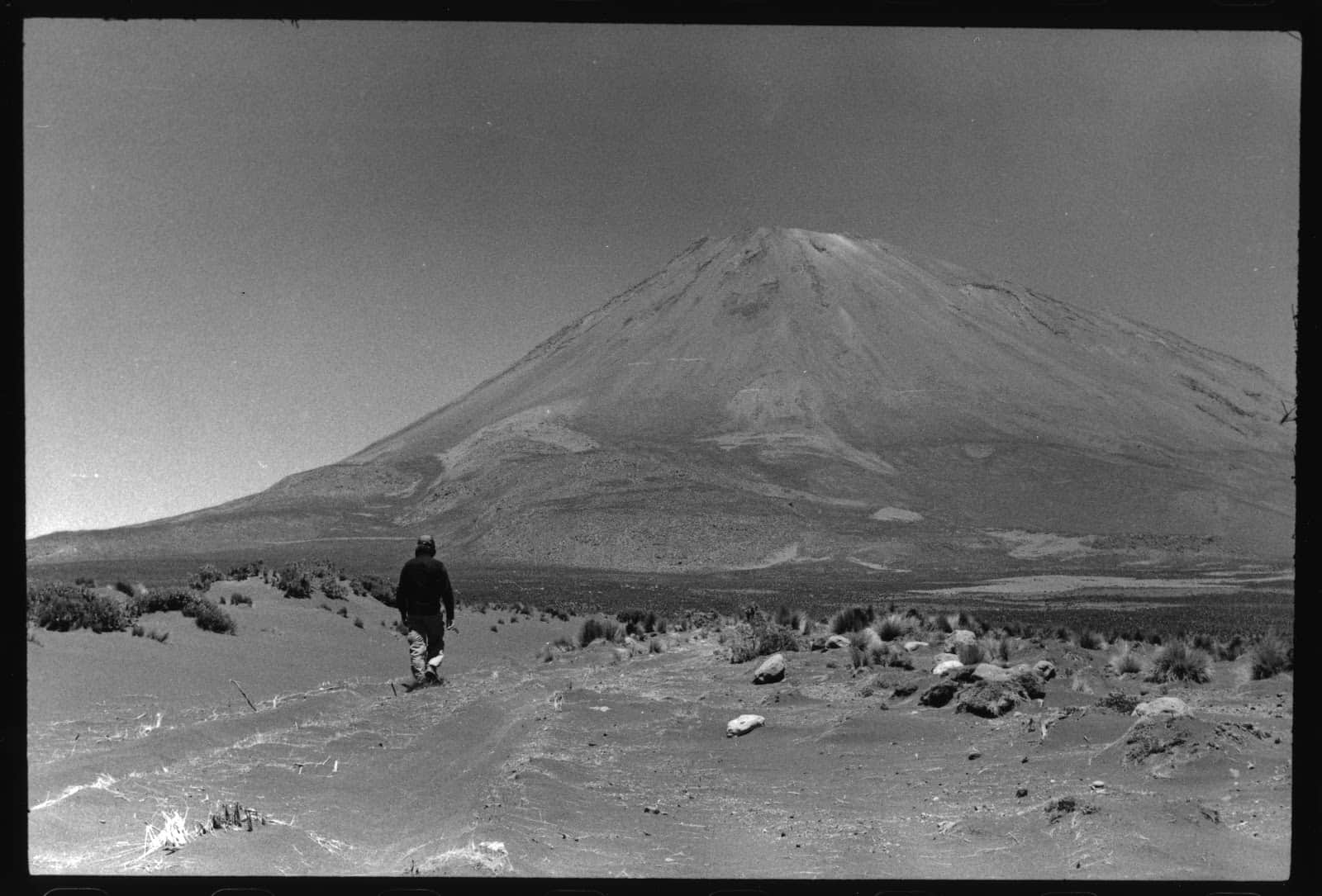
The road to Misti.
First Day
From our hotel in Arequipa, our guide picked us up at 9:30 AM to start the journey. The drive would take about 3 hours and go through the Salinas y Aguada Blanca National Reserve. While driving through the park, we were lucky enough to see wild alpacas, lamas, and vicunas. The SUV dropped us off at the end of the road; elevation 14,107 feet.
At this point, our guides started to prepare us lunch by making us soup and serving empanadas. From my own experience of hiking at high altitude, I knew that I needed to eat and drink while I could.
Between waking up and starting the hike I drank three liters of water. I drank two more liters of water on our hike to our basecamp. And all through this time, I only urinated a couple of times.
Tip: High altitude dehydrates you, so drink plenty of water.
We started our hike to basecamp after lunch. After acclimating two days in Arequipa I felt better. I still had my appetite, and I was in good spirits. As soon as we started hiking at 14,107 feet, I could feel my heart race. I was breathing heavily only minutes into the hike, but as we walked, my breathing improved, and I felt more relaxed.
The route was a steady hike up the base of the mountain. The hardest part of the path was dealing with the volcanic ash and loose gravel that layered Misti. It felt like running on loose sand on a beach, but instead of being flat, it was uphill and at 14,000+ feet of elevation. I made the mistake of asking the guide if the path would be like this for the following day. He simply answered “yes.”
The volcanic sand around Misti made hiking difficult.
Since we started after lunch, the hike was hot, and our route was protected from the intense cold winds that blew on the mountain.
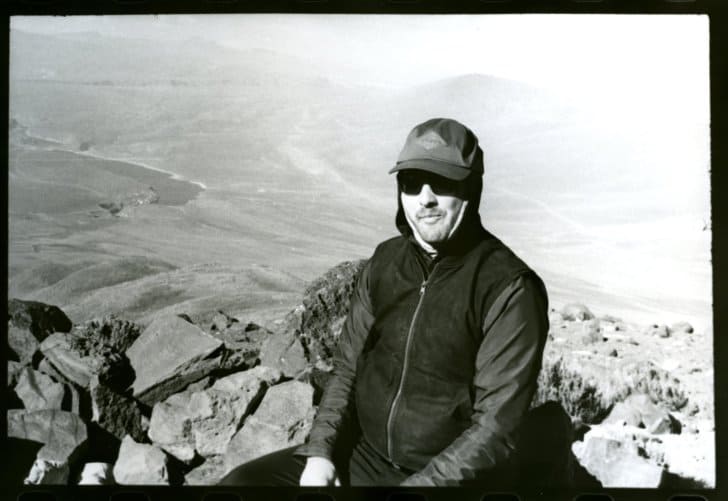
Tip: Wear sun protection. Peru is closer to the equator than North America, so the effects of the sun are much stronger. I covered my face with a hoodie, neck and faceguard, and a hat.
Basecamp was at 15,748 feet. Everyone in my group was feeling pretty good at the time, but we knew how hard the next day would be. The porter hiked ahead of us and prepared our tents. It felt weird because no one has set up my tent since I was in second grade, but at the moment, I wasn’t complaining. All we had to do was set up our belongings in our tent and change into warmer clothes.
The basecamp is located in the open with no protection from the winds. Over the years, guides made walls out of rocks to protect the campground.
The wall of rocks helped a lot, but once you were inside, you could hear how strong the winds were. Trying to sleep at almost 16,000 feet was nearly impossible. For those thinking or planning on camping at high altitude, I wouldn’t plan on getting much sleep. I was in my tent by 7:00 PM, and the next day was going to start at midnight.
Rock walls around basecamp sheltered us somewhat from the constant wind.
Tip: I had a zero degree bag and a pair of wool long johns. I kept warm throughout the night. Even though I couldn’t sleep, at least I was comfortable.
At this point, doubt started to creep in. I tried climbing a mountain like this ten years ago that did not result in reaching the summit, and fear of altitude sickness started to creep in my thoughts. I did my best to ignore the fear and tell myself that I was a lot more experienced and prepared this time around.
Summit Day
Summit Day arrived quickly, and it was time to get out of the comfort of my warm tent. It was cold, but the winds stopped during the night. I ate what I could since my appetite wasn’t there, and it was harder for me to drink water because of the altitude. I had my backpack and everything else ready to go. Our guide led the way into the darkness. I for one could not see any trail; however, our guide has done this hike so many times he could do it blindfolded. Like the first day, my heart started to race for the first five minutes of the journey.
We hiked for twenty minutes before stopping for a minute to catch our breath. It felt like we were going for an hour. Again, more doubt started to creep in. I had to keep reminding myself that I wasn’t hurting that bad. I had a small headache but nothing unmanageable. My breathing was hard, but nothing more than what I would feel training for a marathon. One of the members in our group was a swimmer and hated walking for twenty minutes for a break. He asked the guide to take twenty steps, stop for three breaths, then resume another twenty steps.
Tip: Your guides will always be in better shape than you. Don’t be afraid to ask them to change to more of an interval series or frequency/length of breaks.
This method worked great for our group. The guide was excellent and would do anything (besides carry us) to get us to the top. We did take a couple of longer breaks along the way. As we continued our “twenty steps-three giant breaths strategy,” the mountain got more and more steep. I tried my best to take deep breaths to gather every last bit of oxygen that my body desperately needed.
The temperature was in the mid-thirties but felt colder with the increasing wind. Even my Minnesota blood was not keeping my body warm. My toes and fingers were freezing at different points in the hike. I was wearing medium wool socks and thin cotton gloves. My feet did not bother me as much as my hands did. During our breaks, I would try and blow hot air into my gloves to warm up my hands. At one point, I took my hands and placed them in the inside of my jacket to keep them warm. I survived the hike with the full functionality of my fingers, but it was not the smartest thing I have done.
Tip: Don’t underestimate how cold it can be on top of a mountain. Bring warm clothing, including gloves and a jacket that are designed for the winter. Cotton gloves do not work well.
I remember taking a five minute break and feeling like the mountain was winning. As we were sitting, trying to regain any bit of energy, I was falling in and out of sleep. I could have fallen asleep for hours if they didn’t wake me up. I knew from previous experiences that feeling sleepy while hiking was a sign of altitude sickness for me. At this moment, I wanted to give up and head back to the comforts of a warm bed. Everything seemed so hard in the darkness of the early morning. I kept wishing for some solid ground to walk on, anything but volcanic ash. I kept pushing and told myself that at least I wouldn’t quit until someone else did in my group. Luckily no one did, and the sun started to rise, which gave me new life. We began to see how close we were getting to the summit and how far we’d already come..
Tip: Think of anything that can motivate you to keep moving forward and not give up. Never quit before sunrise.
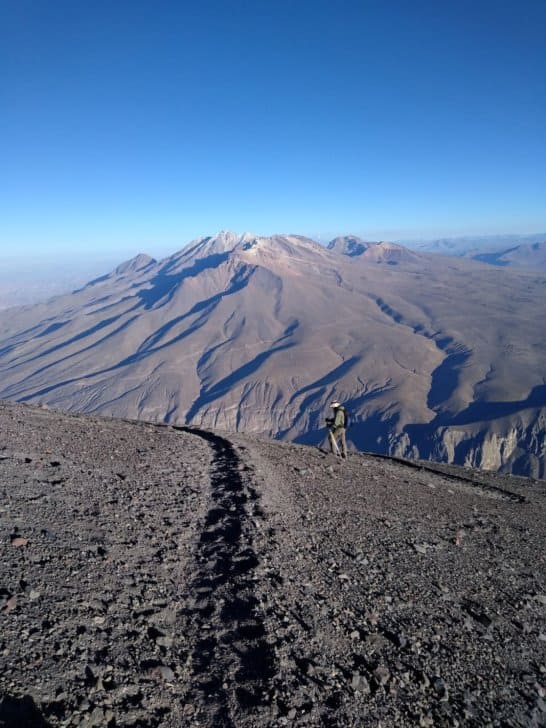
Our guide gave us extra motivation when he told us we were getting close. Soon we could see the final stretch and the summit. I remember asking the guide several times if it was indeed the top and not a false summit. He assured me that it was real, and at that point, I knew I was not going to turn around. The last stretch of the mountain was difficult because we were nearly at 19,000 feet. I was breathing incredibly hard. We were all going at our own pace at this point, and I pulled ahead of the group. The last piece of the hike included several small switchbacks.
Nearing the summit of Misti.
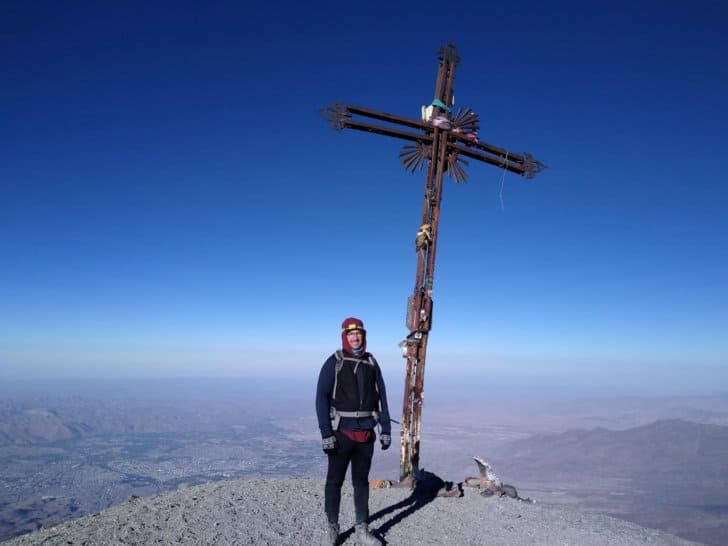
Here, I would hike about twenty steps and take at least ten big breaths before I would continue. Each set of twenty steps felt like I was hiking for days without rest. However, the summit started to get closer and now nothing was going to stop me from reaching the top. I reached the summit just before 7:00 AM; seven hours of being challenged by Misti. It was a big relief as soon as I made it to the summit. It was hard to imagine how high we were and how far we came, but we made it.
Final Thoughts
It was hard to feel excited or happy once I reached the top because I was worn out from the ordeal. However, it is something that I will never forget. It was an experience that challenged me physically and mentally. If you are thinking of climbing Misti or another mountain around the same elevation, then plan accordingly. Give yourself plenty of time to acclimate, drink lots of water, wear hiking gear that will keep you warm, train months in advance, and keep a positive attitude when you are hiking.
DISCLOSURE (Updated April 9, 2024)
Backpacking Light does not accept compensation or donated/discounted products in exchange for product mentions or placements in editorial coverage.
Some (but not all) of the links in this review may be affiliate links. If you click on one of these links and visit one of our affiliate partners (usually a retailer site), and subsequently place an order with that retailer, we receive a commission on your entire order, which varies between 3% and 15% of the purchase price. Affiliate commissions represent less than 15% of Backpacking Light's gross revenue. More than 70% of our revenue comes from Membership Fees. So if you'd really like to support our work, don't buy gear you don't need - support our consumer advocacy work and become a Member instead.
Learn more about affiliate commissions, influencer marketing, and our consumer advocacy work by reading our article Stop wasting money on gear.
The CrazyCap 2 ($59, 1.9 oz/56 g) is an ultraviolet water treatment device that takes the form of a bottle cap. At first glance, this little multi-use item seems like the perfect invention for ultralight backpackers on the fly. But how does it perform in the field with its bottle compatibility issues?
Introduction
The CrazyCap 2 ($59, 1.9 oz/56 g) is an ultraviolet water treatment device that takes the form of a bottle cap. At first glance, this little multi-use item seems like the perfect invention for ultralight backpackers on the go. But how does it perform in the field with its bottle compatibility issues?
The CrazyCap 2
The Test
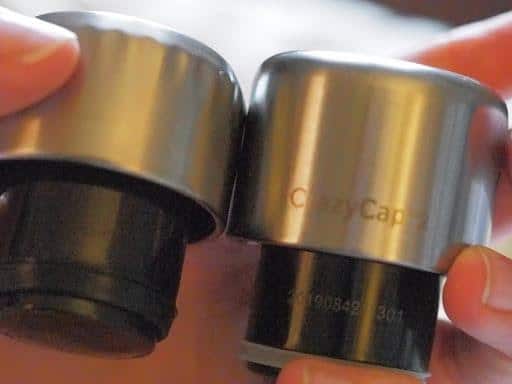
Inside the box, I found directions, a warning about not looking directly into the UV light, an alcohol swab, a USB charger, and The CrazyCap 2. Aside from being double the weight (0.85 oz/24 g vs 2 oz/56 g) than a standard S’well water bottle, the cap is pretty similar to a standard S’well lid.
CrazyCap 2 compared to a Manna bottle standard lid.
The CrazyCap 2 lid requires a specific bottle format and you will require either a CrazyCap bottle, S’well bottle, or another similarly configured bottle. I used a Manna water bottle. I did find a cola style water bottle in plastic (2.8 oz/80 g) (also made by Manna), but because plastic has a different screw style than the stainless steel bottles, the CrazyCap 2 didn’t fit.
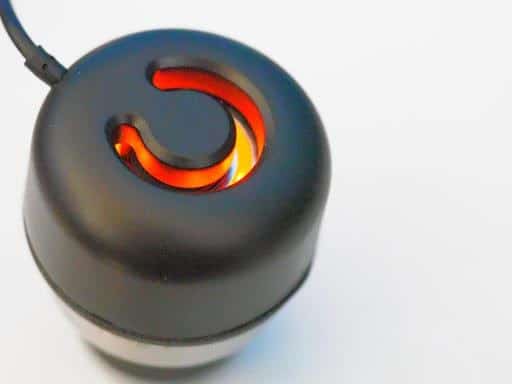
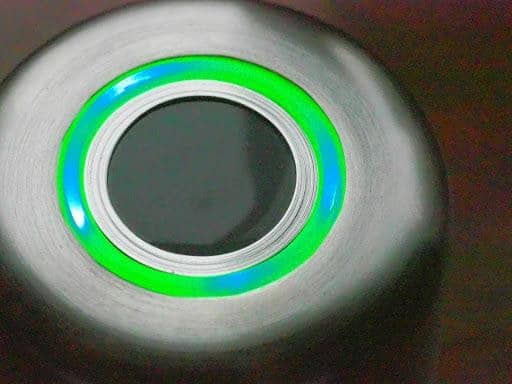
Touch once and the CrazyCap 2 lights up and give the battery status, touch twice and it does a normal sterilization mode (one minute), touch five times and it gives the crazy sterilization mode (2.5 minutes). Indicator colors red for less than 25% battery, orange for 25-50% battery, green for a full charge, and blue for sterilizing in progress.
The charge mounts overtop the cap and plugs into any USB port, including one on a laptop or battery pack.
The CrazyCap 2 charging.The CrazyCap 2 with a full charge.The CrazyCap 2 purifying water.
The Limitations
The Crazy Cap 2 is a neat product but is a limited use item for most ultralight or lightweight backpackers. The first obvious issue is that The CrazyCap 2 uses a stainless steel bottle which is heavier than most of us would be comfortable packing around if only to protect our “ultralight cred.” I’m all for finding little luxuries on the trail and if a stainless water bottle is yours, this is a fantastic product. For me, a fancy water bottle is definitely not one of my luxuries.
Second, the battery life on The CrazyCap 2 lasts about a week doing 5 batches of 17 ounces (0.5 L) or 85 oz (2.5 L) of water per day or 595 ounces (17.6 L) per week. This is great on a short trip with low hydration needs. However, on a longer trip, charging may be required, which therefore requires the addition of a charging pack (or two.) Obviously this is a limitation but not a real strike against The CrazyCap 2. If you are bound to using UV technology, battery life will be a constant factor. A Steripen Ultra has about 1,700 ounces (50 L) of water per charge or 170 ounces (5 L) per day for 10 days. The Steripen Ultra weighs about 4.9 ounces (138 g) vs CrazyCap 2’s 1.9 oz (56 g), but the Steripen Ultra also processes twice as much water per week and lasts an additional three days.
This brings me to my third point. After I started using hydration packs because I like them more than bottles, I didn’t use my Steripen Ultra very often. When I finally dug it out to sell it about 5 years after it had last been charged and put away, the battery was still at ¾ charge. The LCD screen still had its idiot-proof interface. I could use the Steripen Ultra instantly and explain how it works to the guy who bought it. The CrazyCap 2 was less intuitive, in that the button is glitchy with a 3-second delay between touching the button and it responding. The delay makes you second guess if you are using the CrazyCap 2 correctly. I found myself asking, “Is this thing even on? Or does it need to be charged again?” The CrazyCap 2 indicator colors (red, orange, green, and blue) all make sense, however, what it does not do (unlike the Steripen Ultra) is give a reading if the water is too contaminated or if the sterilization failed. The Steripen Ultra has a happy face, a sad face, an error, and a battery life indicator on its LCD screen, and its neoprene carry case has a definition for each icon.) A sterilization failure indicator seems crucial for any device you plan on using to keep you safe from giardia.
The CrazyCap 2 can be used multi-functionally for sterilizing other items, and this is good in theory. It’s true, a UV light can be used for sterilization, however, it is important to note that UV Sterilization only works if the light is not impeded. By not impeded I mean the surface has to be clean, with no particulates covering the surface. The requirement of surfaces to be clean is why hospitals don’t extensively use UV sterilization technology. This is also why cloudy water doesn’t work with a UV light, as the particulates block the light and the sterilization fails. In short, this is a great device if you know you have crystal clear water. UV sterilization is a recipe for disaster with cloudy water. With the CrazyCap 2 providing no notification it failed sterilization in cloudy water, it makes me wary of using it on long trips where I have questionable water sources.
Another potential issue is that CrazyCap 2 is relatively expensive. The cap itself is $59.00 plus a compatible bottle at $25.00 – $45.00. A Steripen Ultra is $110.00 and a Steripen Ultralight is $90.00. Having used both types of products, I would pick the Steripen Ultra. The Steripen Ultra can pretty much be used in any water bottle, and overall I found it more reliable than the CrazyCap 2.
My final issue with the CrazyCap 2 is this – every time you fill the bottle in a water source, you have to sterilize the mouth of the bottle. The mouth of the bottle must either be sterilized before you screw the cap on so you don’t cross-contaminate the cap’s threads, or you must sterilize the mouth of the bottle every time you take a sip. CrazyCap provides one alcohol swab for this purpose. On a long backpacking trip, a single alcohol swab would be insufficient. Carrying one alcohol swab for every water bottle refill or every sip is impractical, to say the least. Therefore, you could use the CrazyCap’s UV rays to sterilize the mouth of the bottle but at a battery cost of 1 use per every 17 oz (0.5 L) of water sterilized, which cuts the battery life down to 3.5 days. The other possibility, of course, is to take a weight penalty and carry a small bottle of alcohol or bleach with a small cloth to wipe down the mouth of the bottle. Obviously, this is an issue with other UV systems as well, but the Steripen markets a bottle mouth cover for filling the bottle. This could be a solution for the CrazyCap as well but to my knowledge, no one is making a bottle mouth cover for cola style bottles.
Conclusion
I love the idea of the Crazy Cap 2, but its limitations concerning the bottle size and type mean that its functional use in my pack is limited. From an ultralight perspective, the best use of CrazyCap 2 is for a short duration trip with excellent water sources. I would gladly use the product for a mountain marathon where water sources are frequent and clean, gear is minimal, and the duration is short. At this time, however, the use of the CrazyCap 2 is primarily for people who have a sentimental attachment to a specific S’well style bottle regardless of its weight. If CrazyCap produces an ultralight bottle, or comes up with more universal designs, and addresses the mouth sterilization issues, then I can see greater use for this product in the future.
DISCLOSURE (Updated April 9, 2024)
Product mentions in this article are made by the author with no compensation in return. In addition, Backpacking Light does not accept compensation or donated/discounted products in exchange for product mentions or placements in editorial coverage.
Some (but not all) of the links in this review may be affiliate links. If you click on one of these links and visit one of our affiliate partners (usually a retailer site), and subsequently place an order with that retailer, we receive a commission on your entire order, which varies between 3% and 15% of the purchase price. Affiliate commissions represent less than 15% of Backpacking Light's gross revenue. More than 70% of our revenue comes from Membership Fees. So if you'd really like to support our work, don't buy gear you don't need - support our consumer advocacy work and become a Member instead.
Learn more about affiliate commissions, influencer marketing, and our consumer advocacy work by reading our article Stop wasting money on gear.
Executive Producer - Backpacking Light; Show Director and Host - Ryan Jordan; Producer - Chase Jordan; Theme music: Look for Me in the Mountains written by Chris Cunningham and Ryan Jordan, performed by Chris Cunningham (acoustic guitar, lead and harmony vocals, harmonica), Chad Langford (upright bass), and Tom Murphy (mandolin), produced by Basecamp Studios in Bozeman, Montana.
Sponsorship Policy: Backpacking Light does not accept compensation or donated/discounted products in exchange for product mentions or placements in editorial coverage, including any podcast episode content not excplicitly identified as sponsored content. Some (but not all) of the links in these show notes may be affiliate links. Learn more about affiliate commissions, influencer marketing, and our consumer advocacy work by reading our article Stop wasting money on gear.
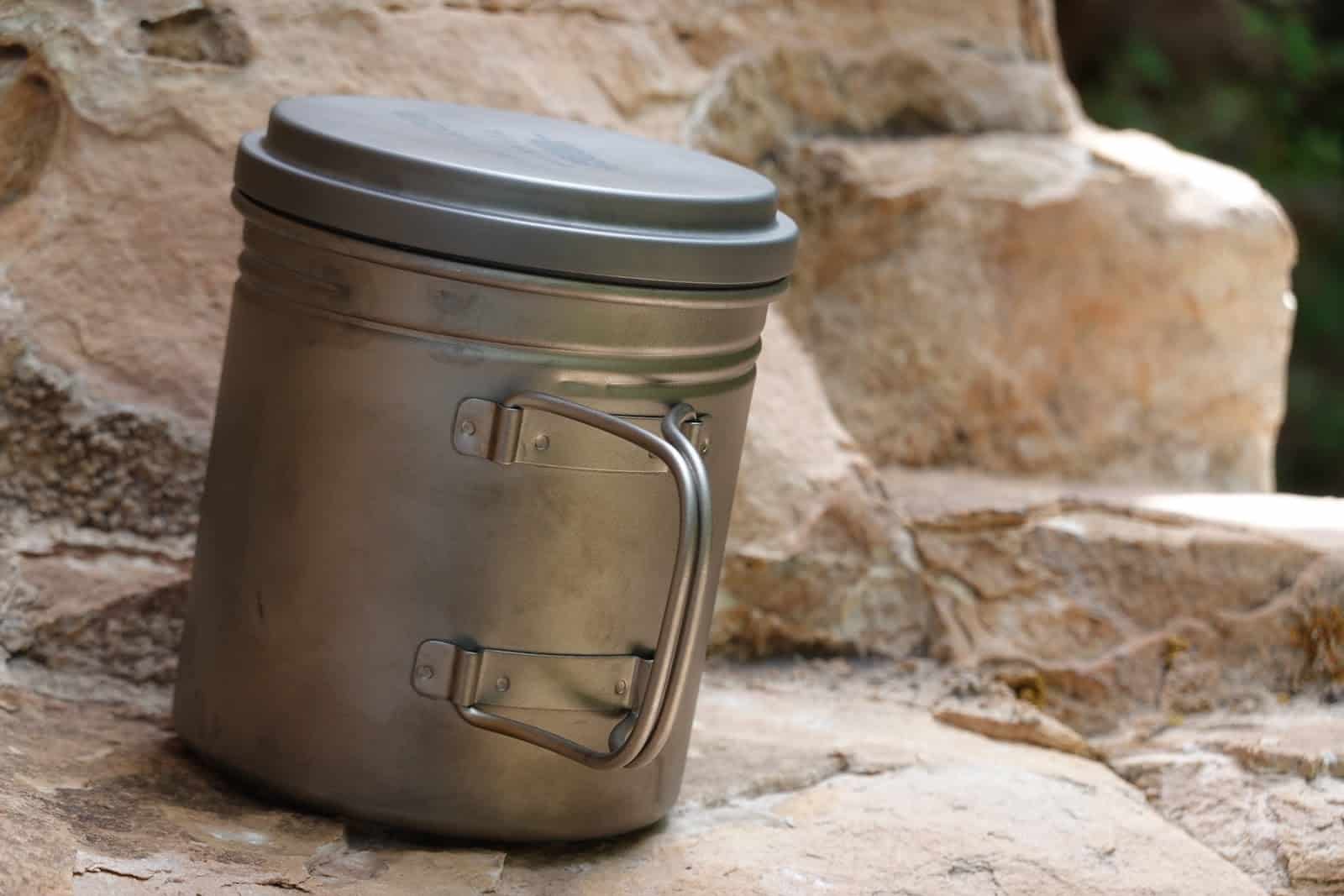
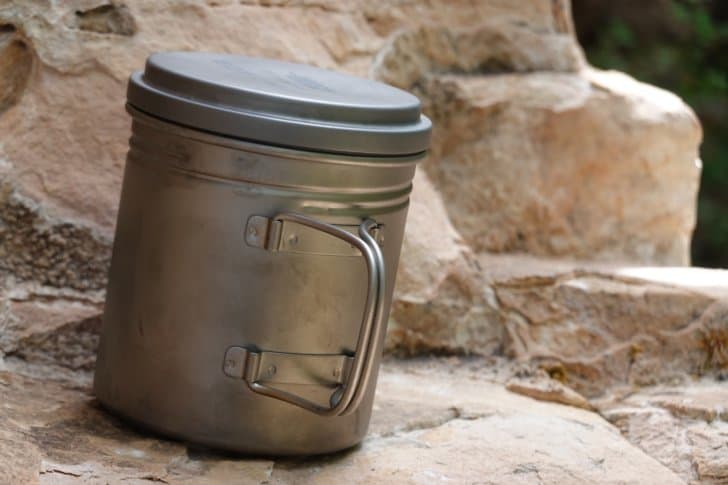
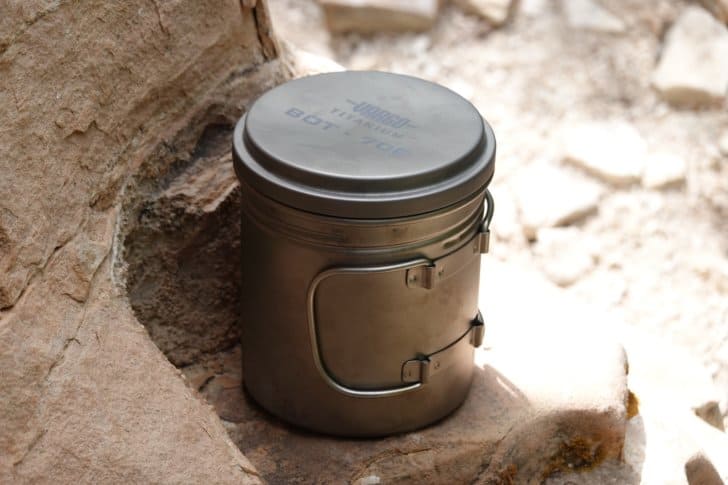
The Vargo Titanium Bot 700 is a 0.7-liter cooking pot made of titanium with a watertight, screw-top lid with a silicone gasket.
Introduction
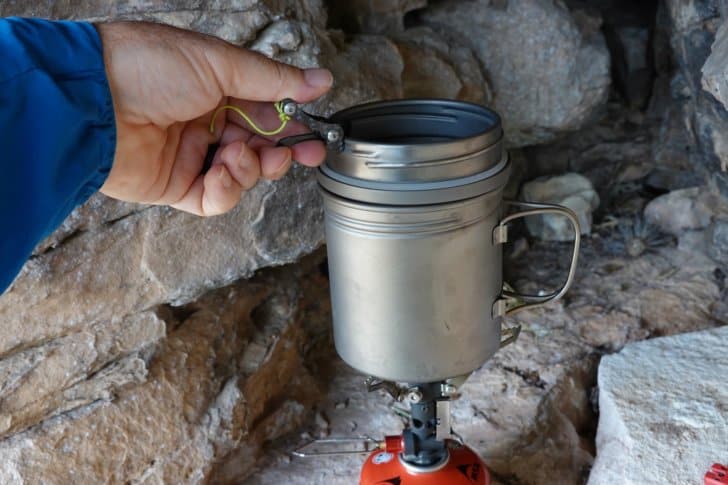
The Vargo Titanium Bot 700 is a 0.7-liter (24 fl. oz) cooking pot with a watertight, screw-top lid. The Bot 700 is made of titanium and the lid contains a silicone gasket. I measured the weight of the pot (including the lid) to be 4.83 oz (137 g).
This is a first look at new gear that recently entered our review pipeline, and hasn't yet been subjected to rigorous field use. Learn more about the types of product reviews we publish.
The Vargo Bot 700 has a reputation for being useful for cold-soaking dehydrated (or freeze-dried) food but is a very expensive option compared to an empty peanut butter jar, which is an excellent cold-soaking pot. The Bot 700, however, can be used for stove-top cooking as well – a plastic jar cannot.
There are some other metal cold-soak options from DIYers that have been made commercially-available by cottage manufacturers like Stormin’s, which are both lighter and cheaper. I picked one up off the used gear market last year and found that pot to be too fragile – it deformed easily when stored in my pack and accordingly lost its leak-proof seal in short order. Also, I never felt good about using an enameled aluminum jar designed for dry food storage for cooking.
Highlights
weight of pot: 3.27 oz (93 g)
weight of lid: 1.56 oz (44 g)
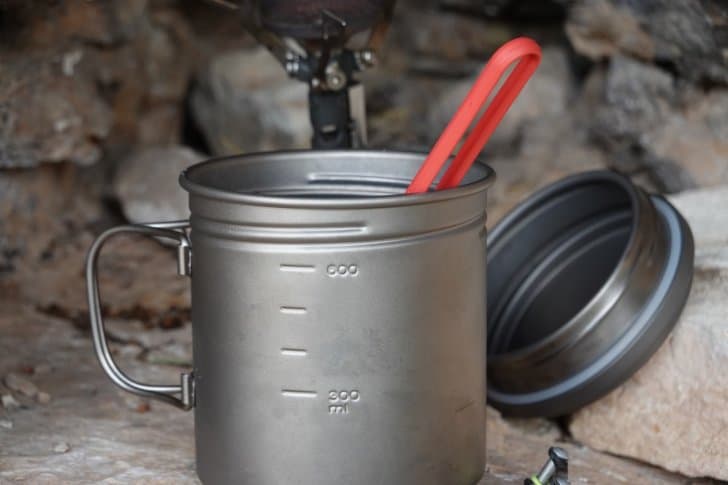
capacity: 700 ml (24 fl. oz.)
size: 4.1 in (105 mm) dia x 4.8 in (122 mm) height
foldaway titanium wire grab handles
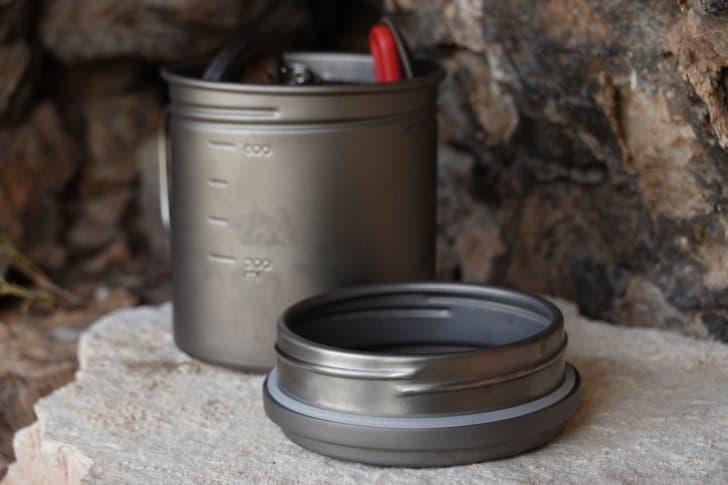
screw-top lid with silicone gasket for a watertight seal
the lid is deep enough to be used for cooking or drinking/eating small volumes of food or beverages
MSRP $99.95
First Impressions
The lid has a capacity for 8.5 fl. oz. (250 ml), and can be used for other purposes in addition to being a lid for the pot. First, you could use it to warm soup or tea when it’s in its inverted position during cooking. Second, you could use it as a mug/bowl for drinking. Third, with a small pot grabber, it could even be used as a miniature fry pan. Its practical capacity is closer to 6 fl. oz. (175 ml), which is obviously pretty small.
The gasketed, screw-top lid works to contain any liquid I tried in it, including oily liquids, liquids with alcohol (it might make a great margarita shaker), and hot or cold foods. I had an older version of the Bot that wasn’t gasketed and it leaked like a sieve. This one (so far) seems much better, but only time will tell, I suppose.
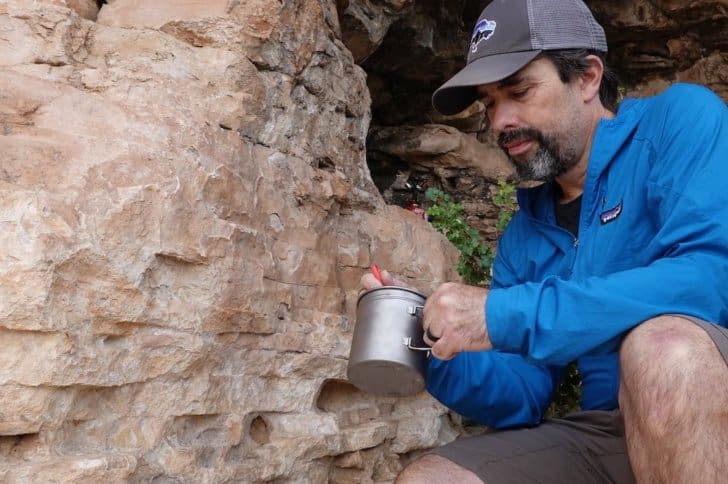
I’ve been using it for pre-soaking dehydrated and freeze-dried meals. My normal routine has been to cold soak my food for an hour or two, add a little more water, then heat it up when I get to camp and am ready for dinner. Unlike the screw-top plastic containers revered by most cold-soakers, the Bot 700 gives me the flexibility to cook and use with a stove as well.
Titanium gets hot, especially the lid. Use a bandana or pot grabber to lift the inverted lid off the pot when cooking. And watch your mouth when sipping hot tea, it takes a few minutes for the rim of the lid (or pot) to cool down enough to drink.
Don’t cook with the lid screwed on – only use the lid in its inverted position while cooking so as not to pressurize the pot contents and create an explosion hazard.
It’s a $100 jar, and the price tag makes it a specialty item. If you’re cold soaking and not cooking and need cheap, stick with your peanut butter jar. It does everything you need without being able to use it with a stove.
Product mentions in this article are made by the author with no compensation in return. In addition, Backpacking Light does not accept compensation or donated/discounted products in exchange for product mentions or placements in editorial coverage.
Some (but not all) of the links in this review may be affiliate links. If you click on one of these links and visit one of our affiliate partners (usually a retailer site), and subsequently place an order with that retailer, we receive a commission on your entire order, which varies between 3% and 15% of the purchase price. Affiliate commissions represent less than 15% of Backpacking Light's gross revenue. More than 70% of our revenue comes from Membership Fees. So if you'd really like to support our work, don't buy gear you don't need - support our consumer advocacy work and become a Member instead.
Learn more about affiliate commissions, influencer marketing, and our consumer advocacy work by reading our article Stop wasting money on gear.
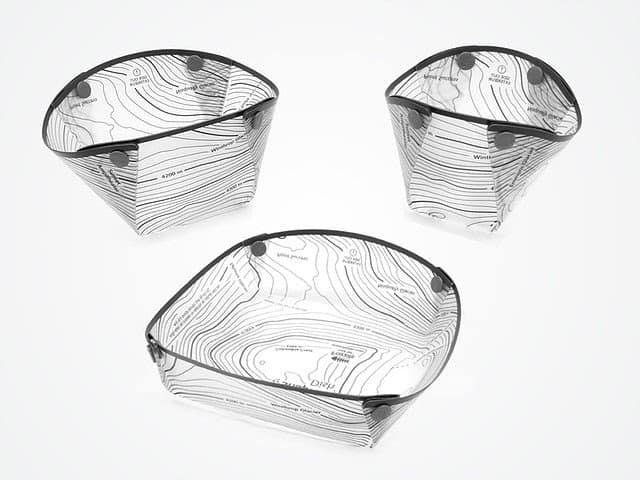
Fozzils Solo Pack dishware is a unique, folding, ultralight, compact set of dishes which at first blush are a luxury-seeking, ultralight backpackers dream. But we ran into problems when testing them with hot liquids.
Introduction
Fozzils Solo Pack Ultralight dishware is a unique, folding, compact set of dishes which at first blush are a luxury-seeking, ultralight backpackers dream. But we ran into problems when testing them with hot liquids.
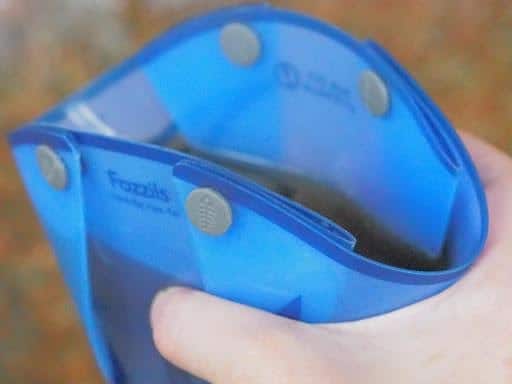
At a paltry 4 oz (115 g) and $14.95 for a cup, bowl, and plate, which pack flat, the Fozzils Solo Pack is a full set of dishes unlike any other on the market. The dishes snap together in origami style and unsnap to flat sheets of food-grade, heat-safe polypropylene and silicon.
Fozzils
The Test
The Fozzils Solo Pack has rattled around my backpack for about three years (usually only one part of it at a time, though.) Fozzils are the lightest, most compact and innovative dishware I have ever seen.
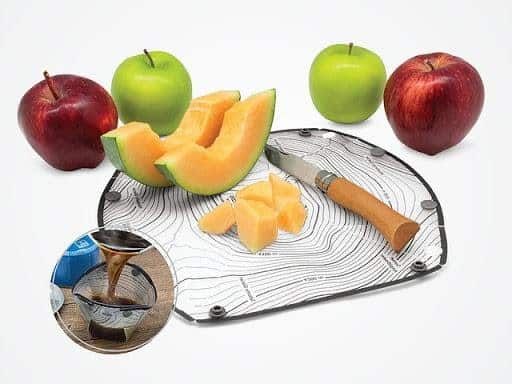
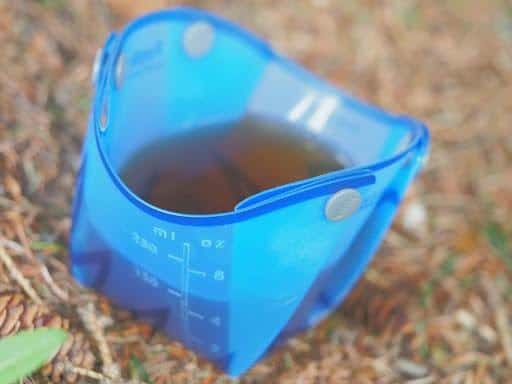
What I like is the fact that they are light and pack completely flat. I thought the snaps would give out after a few months but so far have held out. Also, the bowl and cup have measurement marks, making them perfectly multifunctional. The propylene also makes a decent cutting board with gentle use. I also love how easy Fozzils are to wash once they are unsnapped and flat.
Fozzils
The Issues
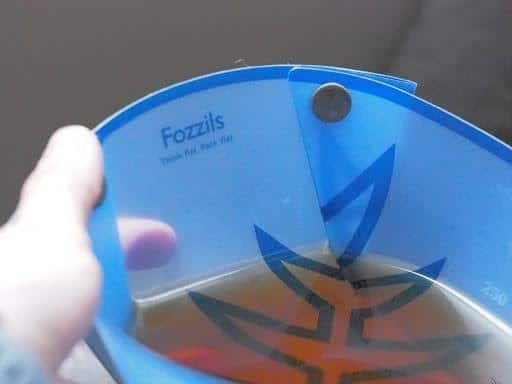
They are flimsy and even flimsier with hot liquids inside. The irregular lip-height on the dishware and tendency to squish and overflow (sometimes overflowing boiling liquids on my hands) relegates all but the Fozzils bowl and plate to my pile of inconclusive experiments.
The Fozzils plate with about 200 g of mac and cheese.
I still use the plate on occasion if I need a cutting board and a small plate. It holds about half-to-three-quarters of what I want to eat when I’ve had a hard trek day (I’m on the small side of female backpackers. The plate holds about a quarter of what most gentlemen would like to eat at the end of a hard trek day). The plate has the best stability of all the pieces in the set, with its wide base.
With the Fozzils cup half full, the slightest move can spill hot liquid all over my hands.Here, you can see how high the fluid comes to the low side of the Fozzils cup when half full.
The cup is too small and is the worst offender for overflowing simply by holding it gently. It can hold 4 ounces (150 ml), which is slightly more than its 10 ounces (275 ml) of capacity without overflowing by gentle pressure. The cup is the lightest dish, with the smallest base, the most likely to contain a hot liquid, and therefore the most likely to overflow boiling liquid. I have completely abandoned the cup and it could be thrown out as far as I am concerned.
Though slightly unwieldy for my hand, the Fozzils bowl does make a decent two-handed cup at about half full.
Because of its wider base and larger capacity, the bowl is more forgiving than the cup and less likely to overflow when held, but again it holds only about 8 ounces (250 ml) of its 18 oz (525 ml) capacity. I rarely opt to pack the bowl, but when I do, I use it as a cup and only fill it up to the 8 ounces (250 ml) mark.
Conclusion
In short, I love the idea of Fozzils dishware, but the implementation is somewhat lacking. For the money, Fozzils might be worth playing with. They are especially worth playing with if you don’t put hot hot liquids in them. However, I suspect, due to their flimsy nature with hot liquids, they won’t appeal to a large section of the backpacking community.
DISCLOSURE (Updated April 9, 2024)
Product mentions in this article are made by the author with no compensation in return. In addition, Backpacking Light does not accept compensation or donated/discounted products in exchange for product mentions or placements in editorial coverage.
Some (but not all) of the links in this review may be affiliate links. If you click on one of these links and visit one of our affiliate partners (usually a retailer site), and subsequently place an order with that retailer, we receive a commission on your entire order, which varies between 3% and 15% of the purchase price. Affiliate commissions represent less than 15% of Backpacking Light's gross revenue. More than 70% of our revenue comes from Membership Fees. So if you'd really like to support our work, don't buy gear you don't need - support our consumer advocacy work and become a Member instead.
Learn more about affiliate commissions, influencer marketing, and our consumer advocacy work by reading our article Stop wasting money on gear.
Lightweight wood saws for backpacking can be used for preparing firewood and more. Here’s what affects saw performance and how that’s revealed in four models from Bahco, Suluk46, Coghlan’s, and Sven Saw.
Introduction
Lightweight wood saws for backpacking can be useful tools. I’ve used them for:
Cutting firewood.
Preparing limbs for snow trench shelter roofs.
Building a pyramid for hanging a pot over a fire.
This article includes a video where I show the process by which a saw can be used for preparing wood for further hatchet-splitting (or batoning with a knife) to create dry kindling from wet wood.
Backpacking wood saws are not considered essential items by most of us, but they offer enough utility that it’s worth exploring the market to see what’s available across the weight spectrum.
Limitations
Backpacking wood saws suffer from three primary limitations:
They are bulky.
They are heavy.
They don’t have enough cutting power to be useful.
So-called survival saws are the least bulky of all of them. They have no frame to hold the saw blade, which is typically just a short “chain”. Folding saws are less bulky than non-folding saws, but require more time to deploy.
In terms of weight, saws with longer blades require more framing to keep the blades stable, and will necessarily be heavier.
Cutting power and quality is defined by these three factors:
Teeth per inch (TPI) – the number of teeth per inch of saw blade. The fewer teeth per inch (and the deeper the teeth), the faster you can saw through a given thickness of wood (generally), but the rougher the cut and more likely the teeth will get hung up on knots in the wood.
Opposing teeth – saw blades with teeth that are perfectly in line (parallel to) with the saw blade cut more aggressively – i.e., faster with less effort, because cutting is performed on both push and pull strokes. This feature is a hallmark of pruning saws, which are designed with opposing teeth for cutting through live, wet wood. Dry wood blades do not have aggressively opposing teeth, and can get stuck in soft, wet woods that can swell during sawing (e.g., fir, pine).
Blade length, thickness, and saw frame – the more robust a frame is (which provides blade stiffness), the thicker a blade is, and the longer a blade is, the more power you can transfer to the saw with your body. This makes cutting faster and more efficient. All of these features also add weight to the saw.
An Overview of Selected Wood Saw Models
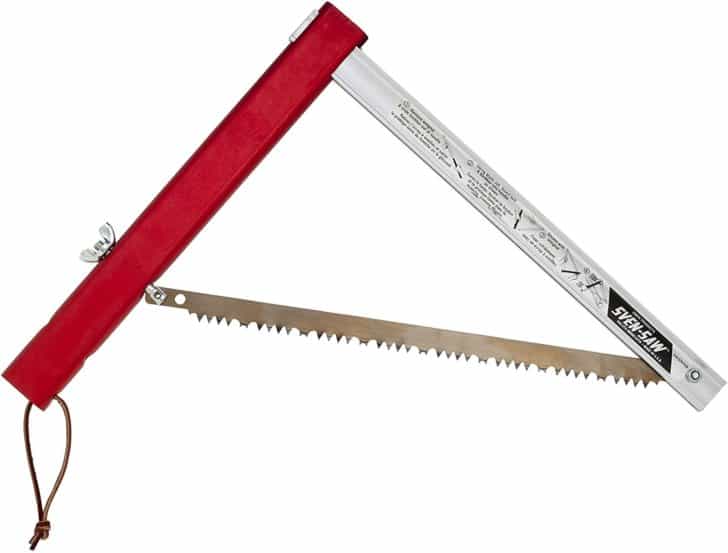
One of the more popular compact camping saws is the veritable Sven Saw, a folding model with an aluminum frame and 15-inch blade that weighs about 11 oz (310 g).
Sven Saw
The Sven Saw is a powerful, functional saw that folds away to a relatively compact package, but is generally considered to be a bit heavy for the backpacker who needs a saw only for incidental use.
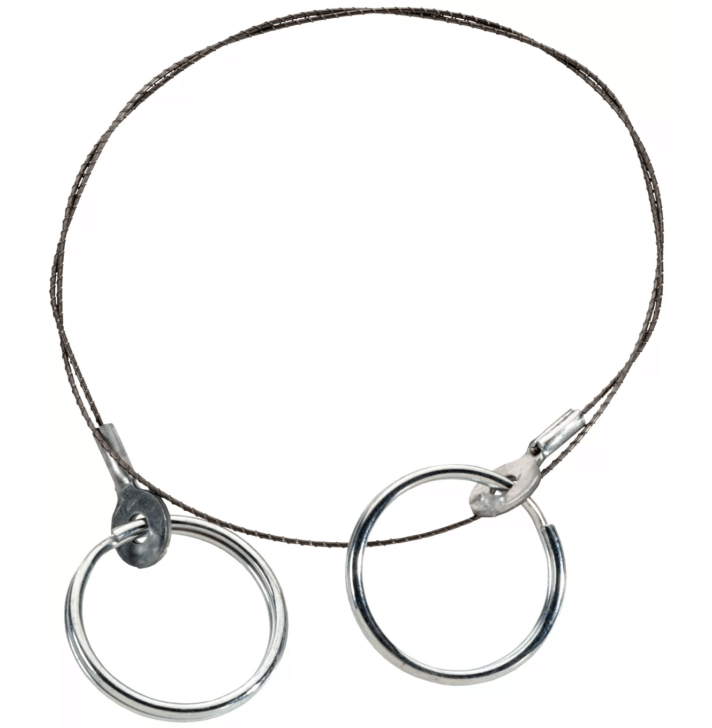
At the other end of the spectrum, one of the lightest and most compact wood saws is the Coghlan’s Pocket Saw, which weighs a little under 3 oz (86 g) and rolls to the size of a small spool of fishing line.
Coghlan’s Pocket Saw
Although very compact and light, the Coghlan’s Pocket Saw has very little cutting power and is generally considered to be more useful in a survival kit than as a backcountry tool requiring frequent use.
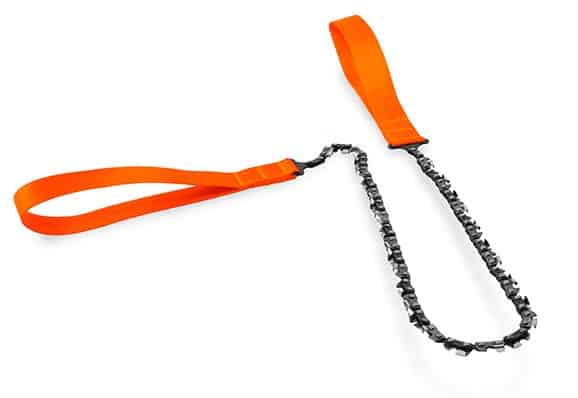
The Pocket Saw is a lighter weight version of the well-known Nordic Pocket Saw, which typically uses nylon webbing handles connected to a very light chainsaw-style blade. Nordic Pocket Saws are much more powerful than the Coghlan’s Pocket Saw and would be well worth the added weight of 2 oz (56 g) or so if you needed something that could actually cut wood.
Nordic Pocket Saw
I’ve used both the Sven Saw and the Coghlan’s Pocket Saw and neither of them is found in my backcountry kit today. For the past few years, I’ve been using two products that I find to be “high performance” (good cutting power) while still being light and compact enough that it doesn’t provide me undue hardship to include them on short backpacking trips.
It’s not quite as powerful as the Sven Saw, and has a much shorter blade length (7 in vs. 15 in). It’s a folding saw as well but requires only a push button to engage and it deploys quickly. It’s also more compact and lighter (6.8 oz / 193 g) than a Sven Saw. It cuts both wet and dry wood well.
The most popular alternatives to the Bahco Laplander are folding saws from Fiskars and Silky, especially the Silky Pocketboy 130. My experience with Fiskars folding saw blades is that they don’t hold their sharpness in response to heavy use. I find that Silky Saws are a little less ergonomic when it comes to discomfort in my hand during sustained sawing – the handle isn’t quite as comfortable for me as with the Bahco Laplander.
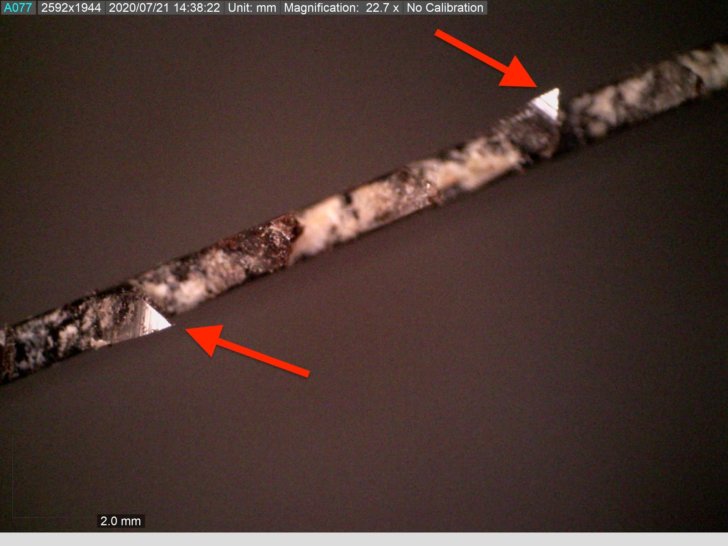
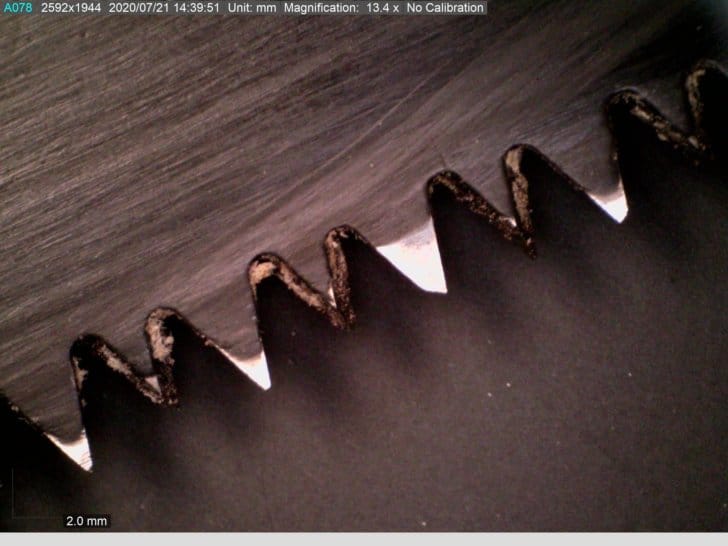
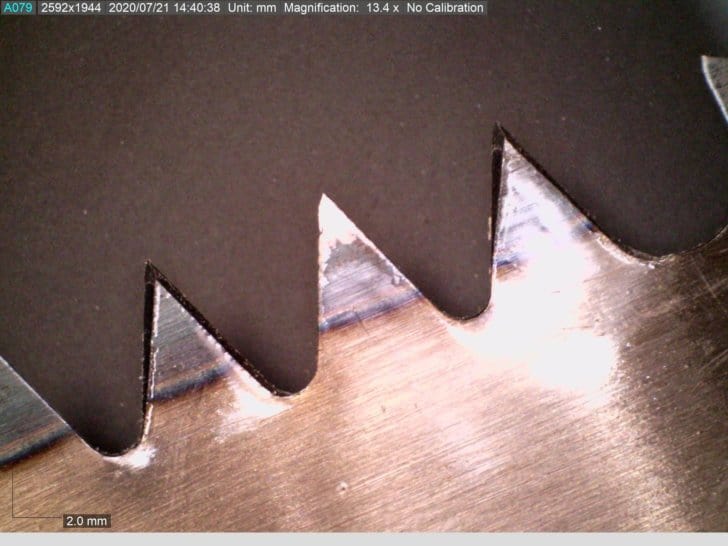
View of the teeth in-plane with the blade of the Bahco Laplander wood saw. This is a pruning saw designed for cutting wet wood, and you can see the opposing teeth (red arrows). Blade thickness is about 1.4 mm and TPI is 7. With the thick blade and additional 0.3 mm of tooth offset on each side, the cut thickness is about 2.0 mm.Side view of the Bahco Laplander saw blade. You can see the (shiny) chiseled edges of every other tooth. Opposing chiseled tooth edges is a feature critical to any useful saw (as opposed to uniformly-chiseled edges on both sides of every tooth) in order to create the cutting power required for sawing wood.
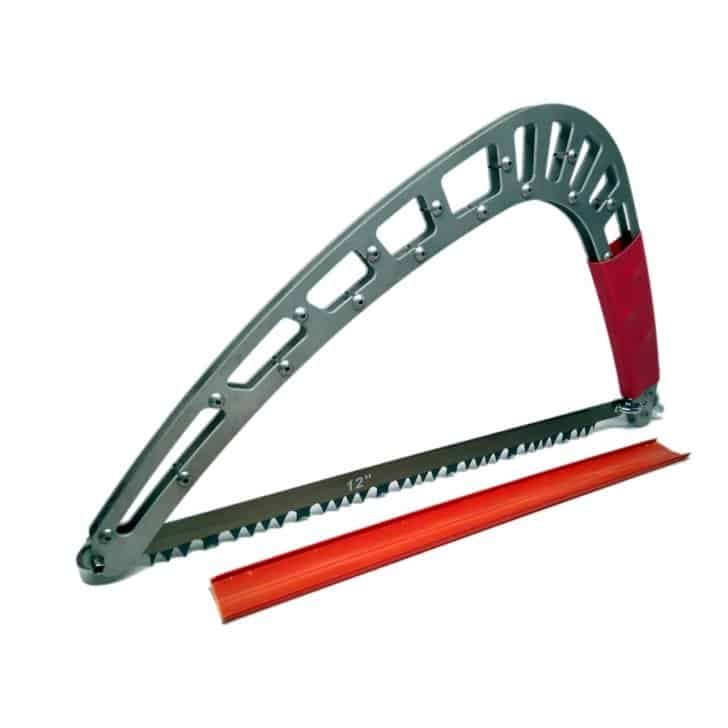
The Uki has a custom-designed aluminium frame built for stiffness and light weight (4.9 oz / 139 g), and uses standard 12-inch buck saw blades. Heat-shrink tubing is used to create a comfortable handle. It doesn’t fold, so it’s the bulkiest of the wood saws mentioned here. The blade can be tensioned to a very high level so it’s an efficient cutter. It cuts dry wood well, but suffers and gets stuck on wet softwoods like pine.
The Suluk46 Uki buck saw has opposing chiseled edges. However, its teeth are all inline with the saw blade, so it doesn’t provide much cut thickness beyond its 0.7-mm blade thickness, more than twice as thin as the Bahco Laplander cut thickness. The Uki suffers accordingly with soft, wet wood. At only about 4 TPI, it cuts dry, soft wood aggressively and well. However, the low TPI and deep teeth make it limited for hardwood cutting.
In Use (Videos)
The first two videos show the Bahco Laplander and the Suluk46 Uki in use on dry, soft wood (beetle-killed pine).
The second two videos show the same two saws on wet, harder wood (dead aspen).
Final Thoughts
Suluk46 accomplished something special: a beautifully-designed 12-inch buck saw that weighs less than 5 oz (142 g). It has potential, but its utility is limited by thin, aftermarket saw blades that shine when sawing through dry, soft wood but suffer for wet hardwoods. The Suluk 46 Uki buck saw will be fine for most users cutting dead fir and pine.
The Bahco Laplander is about 2 oz (56 g) heavier than the Uki. However, it’s more compact and more versatile, and represents the best of what a lightweight folding saw can offer.
The Sven Saw has the most power of all of these saws, due to its blade length. Like the Uki, it suffers when trying to saw through wet hardwoods.
The Pocket Saw is nearly useless beyond its ability to be included in a survival tool that you might give away as a gift, but otherwise is unable to efficiently cut wood that you can manage to break yourself with a swift kick.
DISCLOSURE (Updated April 9, 2024)
Product mentions in this article are made by the author with no compensation in return. In addition, Backpacking Light does not accept compensation or donated/discounted products in exchange for product mentions or placements in editorial coverage.
Some (but not all) of the links in this review may be affiliate links. If you click on one of these links and visit one of our affiliate partners (usually a retailer site), and subsequently place an order with that retailer, we receive a commission on your entire order, which varies between 3% and 15% of the purchase price. Affiliate commissions represent less than 15% of Backpacking Light's gross revenue. More than 70% of our revenue comes from Membership Fees. So if you'd really like to support our work, don't buy gear you don't need - support our consumer advocacy work and become a Member instead.
Learn more about affiliate commissions, influencer marketing, and our consumer advocacy work by reading our article Stop wasting money on gear.
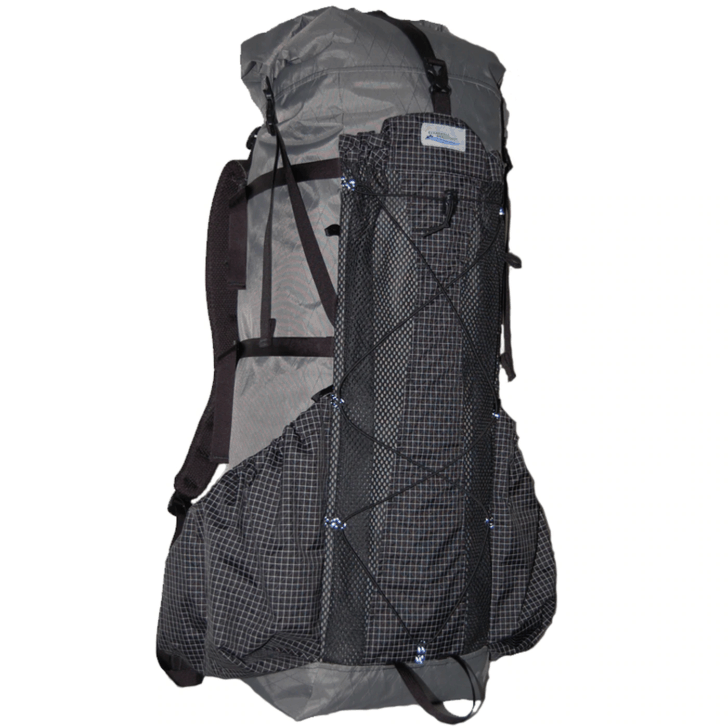
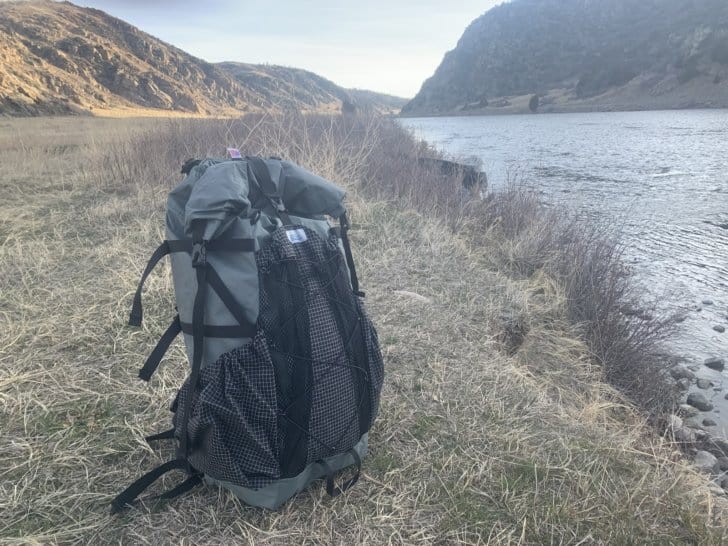
The Elemental Horizons Kalais XT backpack (42.8 oz / 1213 g, $336) is a 60.4-liter pack meant to handle the harshest and most rugged conditions.
Introduction
The Elemental Horizons Kalais XT Pack (42.8 oz / 1213 g, $360) is a 60.4-liter pack (total capacity) meant to handle the harshest and most rugged conditions. The quality of the build and the durability of the construction make it conducive for backpacking with a heavy load and in variable environments. The hip belt and back padding along with the sturdy internal frame allow the pack to comfortably carry substantial weight.
Elemental Horizons Kalais XT photo by Elemental Horizons
About This Review
This Limited Review is based on my initial testing of this pack on a wide range of trails in Montana in April of 2020. I carried a variety of weights on this backpack at faster hiking speeds as well as a more casual pace to assess the stability of the components and efficacy of the suspension.
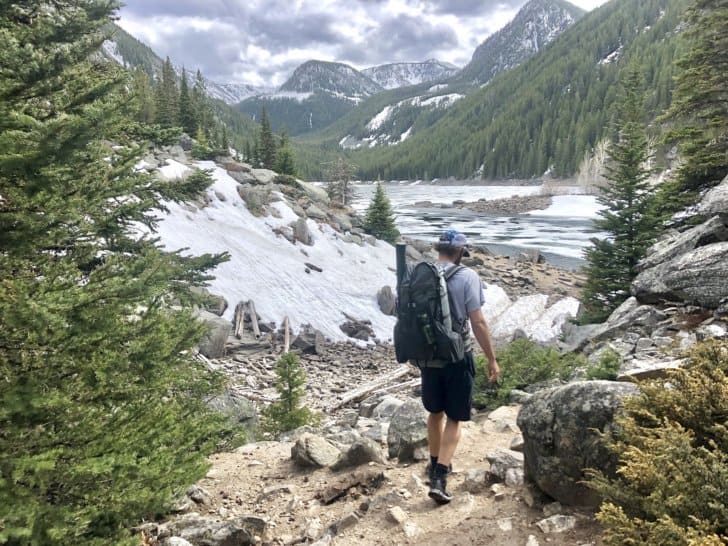
Testing the Kalais XT on the Continental Divide in Montana spring weather.
Features and Specifications
MSRP: $360
Capacity: Total: 60.4 liters (3685 cu in).
Main compartment: 46.1 L (2816 cu in)
Front Pocket: 5.4 L (331 cu in)
Bottle Pocket: 7.2 L (442 cu in)
Hip Belt Pockets: 1.6 L (96 cu in)
Weight: 42.8 ounces (1213 grams)
Materials
X-Pac VX21
Dyneema X
Stays are directly connected to hip-belt and shoulder-strap
Dual-density hip belt
Adjustable torso length
Bear canister compatible
Five pockets
Made in the USA
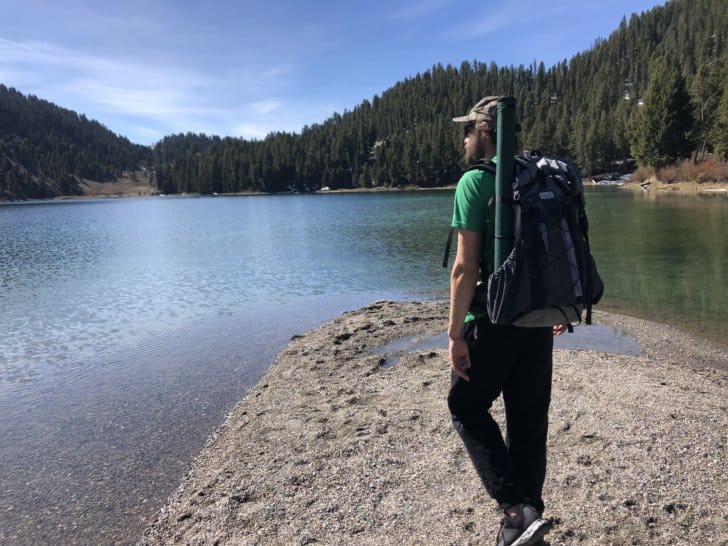
Testing the Kalais XT pack at a Montana alpine lake
Performance Assessment
Criteria
Observations and Issues
Adjustability
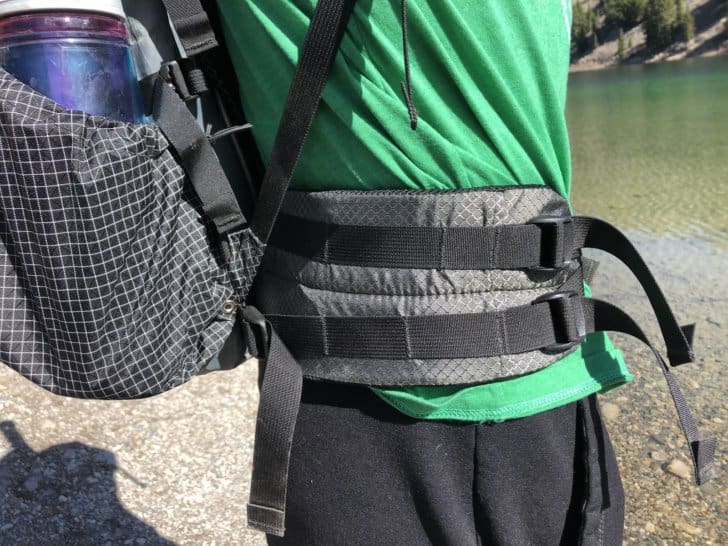
The dual independent straps on the hip belt allow easy adjustments while hiking. They squarely rest on the hips and don’t move even with large amounts of weight. The multiple connection points, roll-top, and dual cinch point can compress the bag when carrying less gear.
Load-bearing/comfort
The load lifters, wide hip belt, and three compression straps per side hold the weight close to the body. The dual strap adjustability on the hip belt limits excess movement and keeps the pack resting comfortably.
Organizational capacity
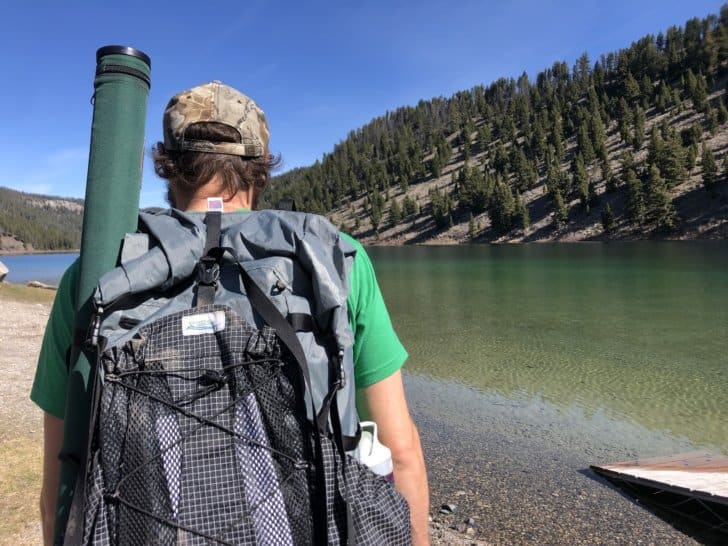
The breadth of external storage sets this pack apart. The back contains a stuff pocket, elastic cordage, and three compression straps. Gear and accessories can be strapped to the outside of the pack for drying or additional capacity.
Durability
The X-Pac material holds up well, and shows little sign of wearing out after the testing period. The backpack frame maintains its integrity and even the bathtub bottom is unscathed after multiple drops on the ground.
Commentary
What makes the Elemental Horizons Kalais XT Pack Unique?
The Elemental Horizons Kalais XT Pack is unique in terms of durability, storage options, adjustability, and versatility. The numerous straps, buckles, elastic, clasps, and loops allow both large amounts of gear and weight to be carried, both inside and outside the pack. The roll-top and multiple compression straps allow it to be snugly cinched to the body and constricted when carrying a smaller load. The Kalais XT is rated for up to 45 pounds (20.5 kg).
The Kalais XT has multiple straps, back mesh pocket, and cordage to aid in external storage of gear such as a fishing rod.
This pack uses several durable fabrics and comes with different adjustment options and organization features. Here are a few that stand out:
X-Pac fabric construction
Multiple external storage options
Compression and adjustability
Versatility with multiple weights
X-Pac Fabric Construction
X-Pac is a composite fabric. Multiple sheets are laminated to form a single sturdy layer. X-Pac is heavier but more durable than Dyneema composite fabrics and aids in the heartiness of the Kalais XT. The fabric showed few signs of wear despite many hours and miles of testing.
Multiple External Storage Options
The stuff pocket, elastic-topped water bottle pockets, elastic webbing, and multiple compression straps give the ability to carry gear externally. Outside of the waterproof compartment, wet items and soiled articles can easily be separated from the more protected interior. The ease of use and independence of each buckle and strap offers multiple creative alternatives to separate gear and stow it inside or outside of the pack. The dual water bottle pockets on each side are large and can fit multiple bottles. The pockets are secured with elastic cordage.
Compression and Adjustability
The adjustability of the hip belt and the variable and customizable length of the torso section aid in the perfect fit and carry for loads both big and small. The compression and roll-top style allow the main pocket to be compressed for any size carry.
The roll-top, large side pockets, and compression straps aid in carrying large loads.
Versatility with Multiple Weights
The removable hip belt, numerous loops, and options to fasten gear to the pack, and the adjustable torso length lend this pack to a variety of uses. A bear canister fits within the main compartment along with all the necessities for trips into bear territory. The rigid frame and pack construction are designed to carry heavy loads. The versatility means the Kalais XT can be used for long distances with heavy carries, as well as shorter sections once the pack is compressed. It could seemingly be used for both long-distance hiking and day hikes while maintaining integrity as a versatile backpack.
Mariposa is 10 ounces lighter when both hip belts are included.
Mariposa
Price
Mariposa is $90 less expensive with the hip belt included
Mariposa
Load Limit
Kalais XT is rated for 45 pounds and the Mariposa sits at 35
Kalais XT
Adjustability
Kalais has 4 torso size options, five hip belt sizes and mens and women’s harness styles
Kalais XT
Customizability
Each Kalais XT Pack is custom made with a modular approach of adding or omitting accessories based on each order
Kalais XT
Durability
Kalais XT Pack containing the X-Pac material holds up better
Kalais XT
Strengths
The adjustability of the torso length along with the compression options.
Multiple compression straps help customize the pack for each individual and also specific trips. For shorter trips with less gear, the internal compartment can be cinched tighter and hold the smaller amount of gear closer to the body, while on longer expeditions the compression straps can either be neglected or loosened.
The durability of the pack is aided by the numerous points of contact, a sturdy harness system, and X-Pac fabric. Despite long trips and the rugged Montana terrain, my Kalais XT looks nearly new.
The load-carrying ability makes the pack unique. The pack is rated for up to 45 pounds (20.5 kg) and the hip belt is designed to distribute this much weight throughout the body. The width and dual strap style of the belt spread the weight over a larger surface area than comparable packs with a narrower hip belt.
The dual strap padded hip belt is fully adjustable to find the perfect fit.
Limitations
Price: The durability, adjustability, and the multitude of features come at a price. At $360, this pack is priced moderately higher than other comparable packs.
Weight: In conjunction with the heavier frame and adjustability of the backpack, it could exceed the weight range for hikers on shorter sections.
Excess cordage and straps: While the adjustability and the ability to hang gear and clothing on the outside of the pack can aid in specific situations such as rapidly changing weather, there are enough loops and cords that I cannot see myself using all of them at any one time. While not necessarily a limitation, I do not see a use for some of the straps and cordage.
The Kalais XT pack sitting on the edge of the Madison River in Montana
Product mentions in this article are made by the author with no compensation in return. In addition, Backpacking Light does not accept compensation or donated/discounted products in exchange for product mentions or placements in editorial coverage.
Some (but not all) of the links in this review may be affiliate links. If you click on one of these links and visit one of our affiliate partners (usually a retailer site), and subsequently place an order with that retailer, we receive a commission on your entire order, which varies between 3% and 15% of the purchase price. Affiliate commissions represent less than 15% of Backpacking Light's gross revenue. More than 70% of our revenue comes from Membership Fees. So if you'd really like to support our work, don't buy gear you don't need - support our consumer advocacy work and become a Member instead.
Learn more about affiliate commissions, influencer marketing, and our consumer advocacy work by reading our article Stop wasting money on gear.
In this post, we share about Backpacking Light’s plans for its next phase of website development. Over the past several months, we have been vetting enterprise website development agencies. We have made our final decision and are excited to announce that we are building a new site and plan to launch it in 2021.
Updates
8/25/2020 – Phase 1 (moving the production site to a dedicated physical server) is now complete
9/28/2020 – Phase 2 is now complete
12/31/2020 – Phase 3 is now complete
Currently in Phase 4 (development) – on schedule
Intro
In this post, we share Backpacking Light’s plans for its next phase of website development. Over the past several months, we have been vetting enterprise website development agencies. We have made our final decision and are excited to announce that we are building a new site and plan to launch it in 2021.
First, let’s talk about what’s around the corner, and then what’s on the longer-term radar.
New Site Search Engine
In 2018, we solicited feedback from our membership about site search, and the difficulty members had in finding content in our article library and forums. This remains our users’ #1 pain point.
In 2019, we designed the specs for our new site search and started building the new search engine in the fall. Earlier this spring, we distributed a beta version to Unlimited Members who gave us invaluable feedback about it. We’ve incorporated nearly every suggestion submitted by several hundred Unlimited Members, and we’re now getting ready to roll it out to everyone! We will be replacing the old site search with this new search engine before the end of the month.
Here’s a preview of what’s coming:
What’s Next?
We invested in a custom-built platform and server architecture in 2007 and ran on that platform until 2015. In mid-2015, our hosting and development company abruptly announced that they were ceasing operations, and we only had a few months to build a new site. That site was developed rapidly and launched in November of 2015. The primary goal of the 2015 transition was to maintain continuity of our website and content – it was not to be a long-term solution. But at the time, we didn’t have the resources to manage a new ground-up development effort, so we have had to make do with that site until now.
The primary challenges with that site were related to security and speed. It became clear that we would need to invest substantial resources to lay the foundation of a highly secure, fast, and scalable server architecture. So 2016-2017 became a period of saving money to pay for the transition to our first enterprise server environment. The focus of our web development efforts in 2018-2019 has been primarily on developing and optimizing that server architecture, so we could begin website redevelopment/redesign efforts in 2020.
BPL has close to two million forum posts, articles, member profiles, and other content records stored in 175+ different databases. These databases are interdependent and accessed by several hundred users online at a time with complex queries. Maintaining stability and speed is an enormously challenging problem that’s a balancing act between server resources, database optimization via regular maintenance, and continued new development to maintain state-of-the-art data access and delivery code. As our current site ages, it becomes more difficult to maintain because we didn’t have the time or resources to develop scalable architecture in 2015.
And so, here’s what’s next.
1. We have increased our budget for website support and maintenance and have hired a new website support agency.
Maintaining the website effectively, including fixing bugs that pop up when code updates are installed, is a complicated and expensive process due to the complexity of the website and the extent of its customization. On an enterprise site like ours, bug fixes require validation and source analysis, a fix proposal, code writing, code review, testing on a staging server, migration to the production server, and testing on the production server. We have to maintain very strict standards for change control to maintain the security, speed, and stability of the site.
We retained a new website support services agency that will be providing site monitoring, security, and maintenance services for us. Because of the complexity and size of the BPL website, there is a substantial onboarding/training/transition period, and they won’t be up to full speed until later this summer. This is the agency that will be handling our site maintenance including routine code updates and bug fixes. Moving to an outside support agency comes with a substantial cost (consider that at least 10-15 hours per month of developer hours are required to maintain BPL at rates of $150 to $200 an hour and you get an idea of what sort of commitment this is).
2. We are adding an additional community moderator who will focus on website issues.
We are seeking an additional moderator from our community who will help us manage bug reports and communications between the BPL community and the website support and development team. This moderator’s responsibilities would include:
Acknowledging new bug reports, logging them in BPLTrac, and communicating them to the website support and development staff (here’s how we process bug reports).
Two-way communications with our staff in our company’s internal Slack channel, so the moderator can participate in real-time internal communications about website issues.
Communicating progress back to the community with updates about bug reports and other website issues.
If you’re interested in this role, have a reasonable understanding of how web development and web technologies work, have a diplomatic disposition, and are able to communicate technical information to a lay audience, please drop me a note at publisher@backpackinglight.com.
3. We are about to finish our 2-year transition to enterprise server architecture.
Site security, speed, and stability comprise the most important foundational pillars of a healthy site, and we knew we had to get these things right before embarking on any major development projects. Since 2015, we’ve experienced issues with speed and stability. And in the past 18 months, attempts at breaching our site security have grown more than tenfold. We now block 30% of attempted traffic to the BPL site. This traffic is the direct result of malicious bots and known hacking networks attempting to steal passwords and other user data, overwhelm server resources, and inject malware into the site. Such is the nature of the new internet. It’s normal, but serious and requires money and infrastructure to combat it and protect our user data. Security will always be our #1 priority.
Last month, we took another step in what has been a 2-year transition period to new server architecture. We now host BPL on a custom-configured enterprise-class server with enterprise-grade security systems in place to protect user data and site functionality. This was a critical step to achieve the security, speed, and stability required for scale, and to proceed with further development.
We have one more phase in building out our enterprise server architecture:
Decoupling database operations from the rest of the site (where database ops are processed on a different server than the rest of our ops) In early August after tests on a dedicated vs. decoupled server, we made the decision instead to upgrade our server architecture to a dedicated server with a local database. While more expensive, it will result in substantially better performance. This upgrade is schedule for August 7-10, 2020
Finishing installation of state-of-the-art security protocols to take advantage of the security policy compliance opportunities afforded by the most modern browsers.
This is the focus of 3Q2020.
Once this foundation of security, stability, and speed is established, we can then proceed to the next era of backpackinglight.com.
4. We have started building the next Backpackinglight.com website.
The site we launched in 2015 was an attempt to re-create the functionality of the pre-2015 site with minimal UI (user interface) disruption to our community. We knew we couldn’t create a modern user experience with the resources and time constraints that we had. As such, the BPL site as it exists today is inelegant, with an aging user interface. In particular, forums have limited functionality, ad injection clutters the site in unpredictable ways, the article reading experience is clunky, managing member accounts and profiles is difficult, online course delivery is antiquated, and styling is inconsistent across site sections.
Our mission for the next site is:
Completely update the user interface, site design, and functionality so the user experience is enjoyable – refreshing, easy, fast, intuitive, immersive with our content, and able to connect members of our community in more meaningful ways.
We have retained the services of a website development agency that specializes in custom-built sites for media publishers with large memberships and forum communities, online courses, and robust content publishing/content management platforms. We’ve reviewed their work, worked with them on preliminary scoping, and conducted due diligence with several of their previous clients. They are among the very best UI/UX designers of membership communities in the world.
Our plan is to launch the new site in May 2021.
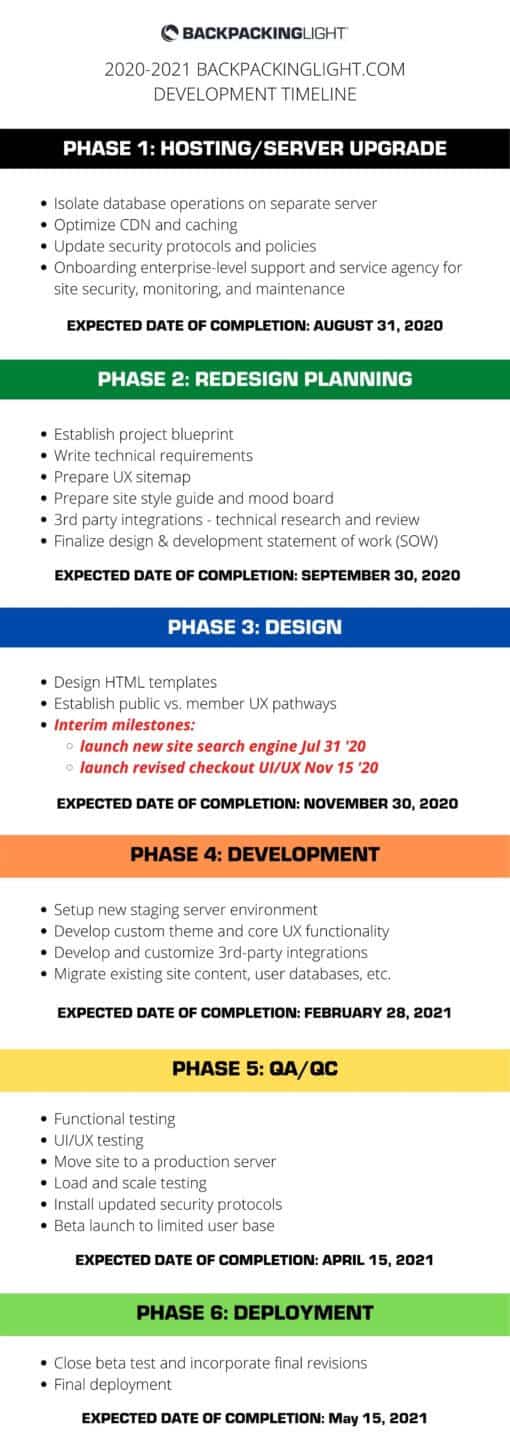
Here’s our development timeline. We will update our membership as we progress, and let you know which items have been completed so you can see exactly where we’re at on our schedule.
Combined with our existing enterprise server architecture, the next website will usher in a new era for BPL. It will give us the opportunity to:
Implement modern website design and user interface standards to vastly improve the user experience at the site – allowing us to maintain modernity into the future without major redesigns of underlying architecture;
Create a platform with scalable maintenance and speed in response to continued growth;
Offer features and functionality that will enhance member experiences at the site, including community, content discovery/curation, site search, and online course delivery.
It became clear in 2015 that we needed to put a plan in place to create a state-of-the-art website that served the needs of our community. We’re excited to enter this next phase of our transition because this is the phase that results in dramatic improvements in user experience for our community.
The reasons for the lengthy time frame to get to this point are simple:
This final piece of development – the new site design – carries a substantial price tag. It will require 300 to 400 hours of high-level engineering by outside developers at rates of $120 to $180 an hour. That’s on top of annual server and tech maintenance costs that are also very expensive. I’m debt-averse and am committed to paying cash for a new website. That means money has to be saved. It takes time to save that much money, and time to ensure that we have enough operating cash flow reserves to properly commit to ongoing maintenance when we take on these new recurring expenses.
It takes time to research, study options, and make decisions that have the potential to impact our operations for several years into the future.
It’s easy to burn money on development efforts that have short-term impacts, but doing so can result in dramatic losses of long-term opportunities that require substantial cash reserves. This is the universal challenge of all entrepreneurial endeavors. It didn’t take long before we realized that the 2015 site was not going to be a long-term solution, so I prioritized saving cash for tomorrow’s build rather than trying to continue hacking together a disjointed site and missing out on this current opportunity. The downside of this unpopular business management strategy, however, is that it frustrates our users when we make the decision not to make their requests for site features and functionality a higher priority during periods where we are saving cash for large projects. I understand that frustration.
Your Feedback is Essential: Take the Survey
We will be soliciting feedback from our community throughout this process.
Today, we’d like to invite you to participate in this very short survey so we can gather feedback that will help us during the design phase. This information goes straight to the development agency, so it’s critical that if you want your feedback to be heard and processed by the folks that are actually building the new site, that you do so in this survey!
How is it possible to spend three-to-six months walking through the woods and still have a relationship left to come home to? In this article, I chat with a mental health expert and share some tips to help you maintain a strong relationship while backpacking.
Introduction
How is it possible to spend three-to-six months walking through the woods and still have a relationship left to come home to? In this article, I chat with a mental health expert and share some tips to help you keep your relationship strong while backpacking.
Let’s go back in time. Six days after I completed my southbound thru-hike of the Appalachian Trail, I looked up from a plate of chimichangas and asked my fiance how she’d feel if I tackled the Pacific Crest Trail the next summer.
Every committed relationship has its own secret dialect: a subtle combination of spoken words and body language. But I’d just spent the last four-and-a-half months walking through the woods and mostly speaking to the same four or five dudes. And so I missed the obvious clues that I was treading on, shall we say, off-camber ground with the woman I was about to marry. The resulting conversation – fueled by too many watery margaritas – lives on in my memory as the longest consecutive string of regrettable things I’ve said in under an hour.
Naturally enough, my soon-to-be-wife was not enthused at the prospect of her new husband shouldering a pack and vanishing into the California desert mere months after doffing his wedding suit. Less forgivably (but perhaps still understandably) I was chafing at the thought of my lifestyle being curtailed by domestic restrictions. Things got so bad that the mariachi band didn’t even bother approaching our table. They were better at reading my fiance’s body language than I was.
Let me just stop here and say that seven years later we are still enjoying a deeply rewarding marriage. We’ve even come to a gentle compromise regarding my tendency to strike out for the territories. We’ve cobbled it together over the better part of a decade through trial-and-error, wise advice, increasing maturity, and a certain amount of luck.
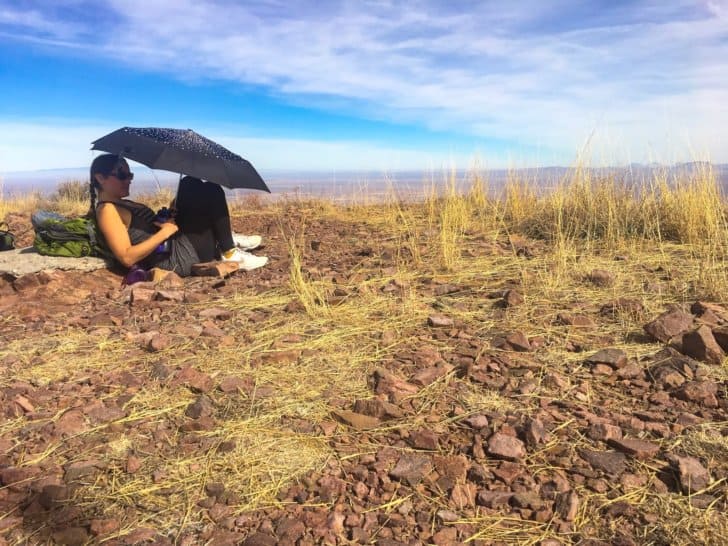
The author and his wife find a shady spot during a hike in southern New Mexico.
I set out to write this article to pass along what I’ve learned. But at the end of the day, I’m just a writer who likes to hang out by myself in the mountains, and it struck me that just about every descriptor in that previous sentence disqualifies me from giving relationship advice. So I’ve enlisted the help of an expert, Mary-Catherine Riner, Ph.D., Ed.S, M.S., and all-around relationship expert.
If you’ve already figured out how to keep your relationship strong while engaging in solo long-distance human-powered adventures, the following article might be useful to you for note comparison. If you are just dipping a toe into this world, maybe this article can shorten your learning curve, thereby reducing the frequency of placing your trail-runner clad foot directly into your mouth.
The Emotional Bank Account
Let’s start with the big question. How the heck is it possible to spend three-to-six months walking through the woods and still have a relationship left to come home to?
A big part of it is a concept called “the emotional bank account.”
“Relationships are never 50/50.” says Riner as we settle into our interview. “If you find a relationship that is 50/50 I would be shocked. Some seasons it’s going to be 70/30, some seasons it’s going to be 40/60, and some seasons it’s going to be 90/10. So you’re in it for the long haul. So if you are looking at six months for example, then how do you look at the other half of the calendar and really buffer that? How do we create a strong emotional bank account?”
What she’s getting at is that if you know you are leaving for Springer Mountain in early March, you need to be spending at least September through February going way above and beyond the normal effort you spend on your relationship. And then you need to do the same when you get home. You just took a long, long time doing something that was all about you. So take an equal amount of time and make life about your partner. You have to put in more than you take out, preferably before you take it out.
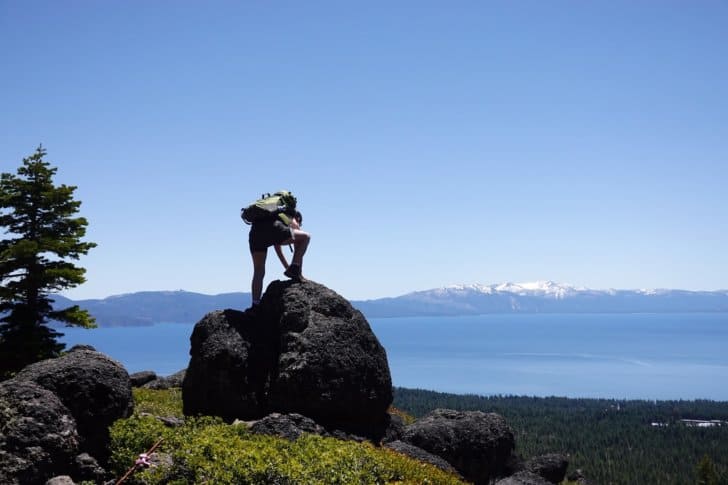
The author’s wife scrambling up a boulder above Lake Tahoe. Plenty of day hikes together is a good way to spend quality time before going off on solo adventures.
To a certain extent, this seems obvious (or at least it seems obvious to anyone with more emotional intelligence than I possessed at 26). But there’s a widely known phenomenon common amongst long-distance adventurers. In the weeks before and after finishing a long trek, it’s hard not to think about what’s next. Adventuring life is so radically different from first-world culture, and our bodies are so well-calibrated to moving every day in the outdoors, that ending an adventure can be like withdrawing from a powerfully addictive substance. It’s a complex set of feelings to wrestle with, and it can blind you to the needs of those around you.
And that’s totally understandable. I daresay a committed and emotionally mature partner will find thoughts (and eventually vocalizations) of the next adventure totally acceptable – if their emotional bank account is being replenished. Otherwise, as Riner says, “…fights will happen more frequently, and become more and more resentment based.”
Meeting Needs
Communication is super important. Not the headline of the year, I know, but how many couples do you know who seem a little oblivious to this concept?
Ideally, you should be communicating your lifestyle and needs to a partner very early in the relationship, so they know that doing quasi-risky things in remote locations is how your brain makes feel-good juice for you. As Riner puts it, “most people who like sensation-seeking don’t just develop it overnight.” Being communicative upfront (and not confrontational) about your lifestyle is a great way to still be adventuring if and when your twenty-year anniversary rolls around.
It’s important to meet your partner’s needs as well (maybe the title of this article should be “It’s Not All About You!”). In order to meet their needs you have to, you know, ask them what their needs are (don’t wait around for them to volunteer the information. Be proactive).
Ask, “while I’m gone, what will make you feel close to me?” These are not easy conversations to have. As Riner says, “Setting those intentions and mutual communication without…being vague or broad is difficult. There’s a lot of grey area…people have to stretch themselves to uncomfortable places to talk about that.”
Riner recommends approaching these conversations within the context of the “love languages” concept. You’ve probably heard of this: it’s the idea that you can roughly group everyone’s relational needs into five categories – words of affirmation, quality time, receiving gifts, acts of service, or physical touch. Figure out which ones matter most to your partner, then go out of your way to make it happen before, during, and after your adventure.
For words of affirmation and gifts, Riner suggests writing letters, leaving gifts and notes around the house while you are gone, and staying in contact as much as possible during your trip. Yep. Get over your Luddism. Get a satellite communicator and stay in touch with your partner. It’s an investment in your future.
Quality time, acts of service, and physical touch can be a little harder to accomplish while on a trek. That’s why you have to make deposits into your partner’s emotional bank account using these love languages before and after your trip. If possible, try to arrange things so your partner can see you at the halfway mark or at some other point in your adventure. If you can drop a few hundred dollars on a shelter, you can do the same for an airline ticket if getting to see you meets your partner’s needs.
Once you’ve committed to meeting your partner’s needs in a certain way, follow-through is crucial. Setting reasonable, clear expectations is important. Meeting those expectations is doubly-so.
Changing Seasons
So what about if you find Wild in a used bookstore and decide to hike the PCT fifteen-years into a relationship – and you’ve never once mentioned a desire to backpack? It happens. Riner points out, “Things change – what you like at twenty and what you like at thirty might be different things. There’s an ebb and flow to life.”
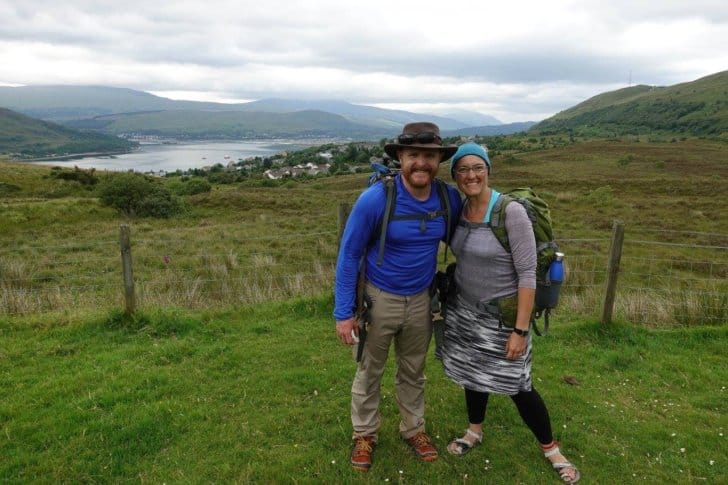
The author and his wife at the finish of their trek across Scotland.
The key, Riner says, is embracing the changeable nature of life. It’s harder than it sounds. We all know a couple who called it quits because someone in the relationship “just wasn’t the same anymore.” In these situations, Reiner says, “It’s both people’s responsibility to be honest and vulnerable and authentic and not to hide the parts of themselves that are the most true.”
So if you find yourself trying to break it to your partner that you are considering leaving their soft bed for a questionably comfortable sleeping pad for months at a time, the best policy is to not put it off. Be as open and descriptive of your need as possible, and trust that your partner is willing to do the needed work on their end.
Dealing with Worry and Fear
Speaking of which, let’s talk about something your partner is going to have cope with: worry and fear. Riner told me that there are all kinds of fears that can crop up for your loved one while you are out in the woods: fear of being alone, fear of abandonment, fear of missing out, fear of not being a part of something, fear of not belonging. Some of these fears you can assuage with intentional thought and action (everything we just talked about above, for starters), but some of them are up to your partner to deal with.
In the early days of our relationship, my wife was often pretty fearful of my outdoor adventures. Buying tools to stay in communication (like a satellite messenger) and including her in my adventures are two ways we mitigated that fear.
Riner says your partner needs to think about it this way: “How do we hold thoughts but not let them dictate our behaviors? There’s risk everywhere but you have to ask yourself what makes you[r partner] come alive. If your partner has to say no to the things that make him come alive, then how strong is the relationship going to be anyway, because if you don’t honor and recognize that part of them, then you are probably going to brew more resentment and depression.”
She goes on to say that your partner’s worry and fear is natural and that it’s okay for them to hold a space for that fear, but they should also be, “holding a bigger space for why [they] fell in love with [you] in the first place. [Your partner should ask themselves], do I really want to change that person or can I lean into this fear and also be excited that this person is pursuing their passion? It doesn’t have to be…a dichotomous thought.”
Maintaining Training, Maintaining Love
Recently I trained for and completed a marathon as part of my larger backpacking training cycle. I was astonished to realize the sheer time-suck training for such an undertaking involves. Luckily I’d just completed research on this article, and was able to apply an actionable tip that Riner gave me to avoid draining my wife’s emotional bank account right before I left for an extended time in the woods.
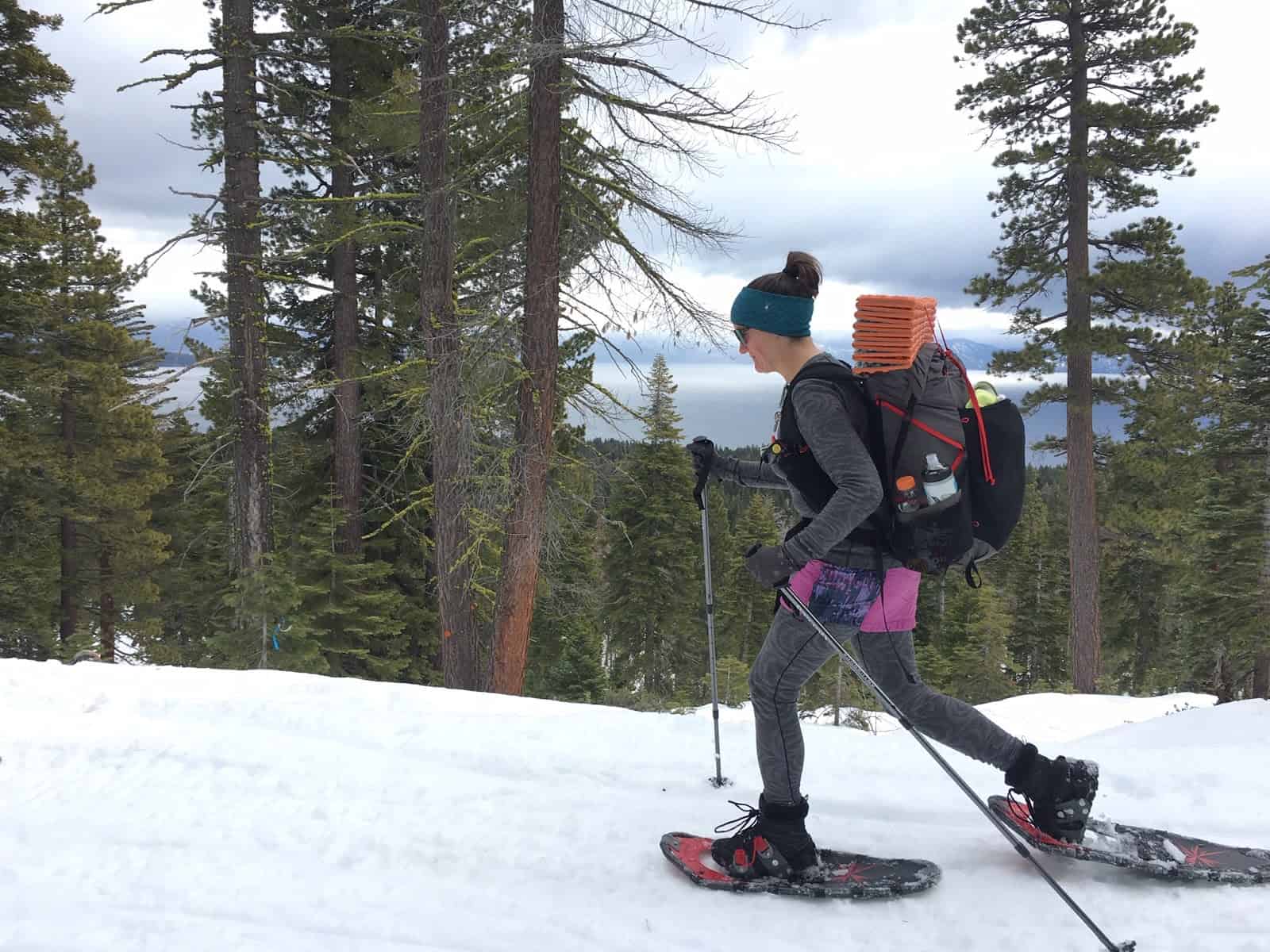
My wife loves to snowshoe. I prefer to ski. It’s okay that we develop and maintain different interests around the outdoors.
Riner’s suggestion is this: that every person in the relationship needs eight hours a week just for themselves. This time can come spread out or in one or two large blocks, but the point is neither person in the relationship needs to ask permission or forgiveness for how the time is used.
At the same time, the relationship also needs eight hours of guaranteed, locked-in time per-week. If possible, sit down and schedule your week, or your month, out. This isn’t always realistic, of course, but the more you make your relationship a priority, the easier it is for each person to take the (much needed) time for themselves. I used my eight hours for extra training time, and my wife used hers to read. Both of us came away from our dedicated time more able to build into each other during our relationship time, and the net result is each of our emotional bank accounts was full before I walked into the mountains.
Adventuring Together
Of course, one way to approach this whole issue is to simply adventure together. This outcome is quite common, either because your mutual interests are what attracted you to your partner in the first place, or because it’s in the nature of relationships to grow to love the things your partner loves. But be careful not to think that a long or intense adventure will save a failing relationship. While intense adventures can build powerful relationships, they also put existing relationships under stress. Your relationship needs to be firing on all cylinders before you take it into the mountains.
I often invite my wife on short trips while I’m testing gear. Ultralight backpacking isn’t really her thing though – and that’s okay.
Riner also cautions against loss of identity in these situations. “…if you do everything together, all the time, same situation, same person, you may kind of lose your sense of self through it. Or you may sacrifice in some ways, your values, or your roles around it,” she says.
Just because both people in the relationship like backpacking doesn’t mean you have to backpack together. You may have different goals, different speeds, and different styles. You may, in other words, want entirely different things out of the sport. So it’s best to make no assumptions. Be open to changing emotional circumstances, and re-assess each person’s needs before every adventure.
Going the Distance
The best adventure my wife and I ever undertook was our coast-to-coast trek across Scotland. We hiked fifteen-to-twenty miles a day, stayed in bed-and-breakfasts every night, and started each morning with a full Scottish breakfast. It’s the only adventure that I returned home heavier than I left.
Is this an ultralight kit? Nope. That wasn’t the point of this trip.
It was a beautiful and powerful moment in our relationship because it combined something I love (walking in the mountains) with something she loves (European travel) and created something new for each of us. My type-A reservations about trekking from BnB to BnB vanished the first time I ended a trekking day with a cold beer, a plate of fish and chips, and a soft bed. For my wife, it was just enough of a new experience for her to feel accomplished and connected to one corner of what I love to do, and she got a shower every night. Hard to beat.
My takeaway from our Scotland trip is that the best way to make my wife feel included in my adventuring life is not to force her to enjoy the things that I enjoy, but to figure out a way to combine our mutual interests into things that are fun for both of us. And so I do a lot more car camping than I used to. And she sleeps on the ground more often than she ever did. And we are having a blast.
We wouldn’t be if we (and, in particular, me) had shied away from the hard conversations that led us towards new understanding. I shudder to imagine our relationship if I’d ended our backpacking related spat with a dismissive “you knew who I was when you agreed to marry me, and now you have to deal with it.”
No relationship is perfect and no one is going to stay the same,” Riner says as we wrap up our conversation. To me, our chat felt less like an interview and more like a free marriage counseling session, and I couldn’t be more pleased.
“Life is always changing, life is always evolving. So if you lean in to ‘this may be uncertain and I can handle hard things, I can do hard things, I can be uncomfortable’, then you are setting yourself up for a lot more success.”
Her final point resonates powerfully with me. What is adventuring if not learning to be uncomfortable for the sake of an emotional, physical, or spiritual payoff? If we can learn to be uncomfortable in the woods, then we can learn to be uncomfortable in our relationships – honest, communicative, vulnerable, and, as a result of our discomfort, happy – and with relationships that can weather any mountain gale.
DISCLOSURE (Updated April 9, 2024)
Backpacking Light does not accept compensation or donated/discounted products in exchange for product mentions or placements in editorial coverage.
Some (but not all) of the links in this review may be affiliate links. If you click on one of these links and visit one of our affiliate partners (usually a retailer site), and subsequently place an order with that retailer, we receive a commission on your entire order, which varies between 3% and 15% of the purchase price. Affiliate commissions represent less than 15% of Backpacking Light's gross revenue. More than 70% of our revenue comes from Membership Fees. So if you'd really like to support our work, don't buy gear you don't need - support our consumer advocacy work and become a Member instead.
Learn more about affiliate commissions, influencer marketing, and our consumer advocacy work by reading our article Stop wasting money on gear.
Part 1 of a detailed account of our expedition down the Nahanni River by canoe, including our pre-trek preparation and training.
Series Notes
This is Part 1 of 2 of the series Traversing the Elusive Nahanni River.Read Part 2 here.
Introduction
“What are you doing in August?” Michael texts me in January 2019.
Though I usually have my life arranged in advance, I’m never organized more than six months prior.
“Nothing I know of yet,” I text back.
“Good, do you think you can get a few weeks off?” Michael asks.
“I can try,” I reply, still not knowing what he had in mind. Michael wanted to paddle the Nahanni River in the Northwest Territories (NT). I wasn’t going to pass this opportunity up for anything. Within a month, I arrange my schedule to accommodate being gone for most of August of 2019.
My Attachment to the North
The Nahanni has a half-romantic and half-haunting allure. The area is probably one of the few truly wild places left in the world. In summer, it’s unpredictable, harsh, unforgiving, and remote. In winter, it’s only inhabitable by the fiercest and hardiest of any species.
I have been inching my way towards the far North for much of my life. Perhaps the first time I knew I would see the North was as a small child. As I sat on my Grandpa’s knee, he recited the Cremation of Sam McGee by Robert W. Service:
There are strange things done in the midnight sun
By the men who moil for gold;
The Arctic trails have their secret tales
That would make your blood run cold;
The Northern Lights have seen queer sights,
But the queerest they ever did see
Was that night on the marge of Lake Lebarge
I cremated Sam McGee.
Wonder, macabre curiosity, and an unquenchable wanderlust for the North filled my heart. I can still recite the entirety of a haunting poem that I memorized two decades ago.
My love of the North did not stop with Grandpa and Robert Service, though. It continued through reading every story Jack London wrote (a dozen times or more), and finally to the mystic Nahanni. Nahanni National Park Reserve holds the same kind of unearthly curiosity for me as an adult, as Sam McGee held for me as a child.
“The Cirque of the Unclimbables granite spires rise out of the lush alpine meadow, at Náįlįcho (Virginia Falls) the South Nahanni River surges over a drop twice the height of Niagara Falls.Nahanni National Park Reserve, encompassing 30,000 square kilometers, is a designated UNESCO world heritage site. The Dehcho First Nations welcome adventurers to Nahʔą Dehé, land of peaks, plateaus, and wild rivers.” Parks Canada boasted. I highly doubted it was an idle boast, either.
Developing Skills
In the back of my mind, my nerves frayed. I’m a backpacker who has paddled. I paddle well enough, but this was the outside edge of my skill. I am reaching, but I’m always reaching for the edge of possibility. This trip is the challenge I’ve been craving.
I know I need to adapt and adjust the lightweight backpacking theory to a different application. Canoeing is a different game; I know enough about it to realize I need to be flexible while still leveraging my skills. For leverage, I primarily require my ability to learn and adapt.
Risk Assessment
Nahanni is a massive river and by far the most prominent and fastest-moving river I have ever challenged. I could disappear into it without a trace. I’m not fond of the idea of becoming a statistic. Moreover, my biggest fear (after falling) is drowning.
Whitewater canoeing, unlike backpacking, isn’t always better to be ultralight. A canoe needs a ballast against rapids, waves, and wind, but lighter is easier to maneuver quickly. The ballast needs to fit into heavy dry bags and barrels and be lashed in with rope and carabiners. My skills in packing smaller and lighter will help, but almost two weeks of gear, food, backpacking, and camera equipment are dense and space consuming. If I have to swim or walk myself to help or safety, my ultralight backpacking will be an advantage. However, on the Nahanni, ultralighting will do next to nothing to mitigate rapids, strong currents, driving rains, or buffeting winds.
The remote and difficult to access area drastically restricts margin of error, I could be in trouble for over a week before anyone notices I’m missing. On many trips, it’s a day’s walk to the nearest highway or contact for help. In the Northwest Territories, it could be days or even weeks before aid reaches me and longer if I have to reach support myself.
No discussion of potential risks is complete without mentioning the potential of sharing space with various bears, ungulates, and birds. I recently obtained a telephoto lens, and I’m interested in close-ups of anything the Northwest Territories offers, but from a healthy and respectful distance of course.
Practicing with my new telephoto lens, I had the opportunity of seeing a pair of grizzlies, up close and personal, without being in harm’s way. Nordegg, Alberta.
At least, I had considered a worst-case scenario and knew what I was getting myself into…. Well, mostly.
Logistics
A trip of this magnitude has logistics. To complete the Nahanni, we need the following:
Two proficient paddlers
An appropriate canoe
Gear of sufficient quality and quantity
Massive amounts of food
Extensive transportation
Planning
Training
Paddlers
Michael, a swift-water rescue technician and a paramedic, has spent more time in a kayak or canoe on whitewater than the average river rat.
Michael paddling Rampart Creek, near Jasper, Alberta, Canada.
I know how to paddle and I am a proficient swimmer. I’ve spent a good deal of time paddling, surfing, and swimming, but have barely touched a paddle since anaccident back in 2015. My upper body suffered significant trauma. My recovery, though remarkable, has been slow. According to my physical therapy team, I owe much of my recovery to my fitness level, dogged determination, positive attitude towards a new normal, and continuously challenging limitations.
Emylene VanderVelden out in her native Canadian stomping grounds near Linda Lake, BC.
The same hyper-mobility, which saved my life in 2015, became mymechanism of injury in 2016. I had the displeasure of dislocating a knee that further slowed my recovery. Having since recovered to about 85% – 90%, I continue to push boundaries.
If nothing else, I know how to pick a gifted teammate. On a river, though, the team is only as strong as its weakest link. I (at 5’2 and 110 lb / 50 kg) am the weak link and have no illusions otherwise.
Canoe
The Nahanni is a big whitewater river. From Virginia Falls to just past Nahanni Butte, we’ll paddle about 150 miles (240 km), which drops a staggering 1300 feet (400 meters) over the course; not just any canoe is right for this type of endeavor.
I left the expert canoe selection up to Michael; he’s been researching the whitewater expedition member of his fleet for some time. He selects theNova Craft Canoe Prospector 17 and orders a new one through the local retailer. He chose this canoe for its excellent primary and secondary stability and load capacity for long trips.
Nova Craft Canoes, especially their Prospector line, is a gold standard for arctic expeditions, designed for Nahanni-like paddling conditions.
Specifications
Material: SP3: 99 lb (44.9 kg)
Length: 17′ (518 cm)
Width: 36″ (91.4 cm)
Center Depth: 15″ (38.1 cm)
End Depth: 23″ (58.4 cm)
Rocker: 2.5″ (6.4 cm)
Capacity: 1200 lb (545 kg)
Features
Symmetrical Hull
Shallow Arch Bottom
Moderate Rocker
Available with or without shoe keel in some materials. Weights listed above are for no-keel versions.
There are lighter but less durable and more expensive options out there. As this canoe will also be used on shallower whitewater, the more durable and substantial option is better. Nothing would be worse than being up the Nahanni without a canoe.
Gear
For Nahanni, my standard backpacking gear still applies. Additional equipment also needs to be added. Considerations include barrels, Pelican boxes, dry bags, wet suits, dry suits, paddles, neoprene socks, spray decks, neoprene booties, paddling gloves, neoprene gloves, PFDs, river knives, rescue gear, water safety kits and other equipment native to water travel. Fortunately, I have much of the gear tucked away in a box in the back of my closet. If I don’t have it, Michael still does. We both upgrade some equipment, but our inventories remain mostly unchanged.
Food
As we plan and pack food for the trip, I am not behind the eight-ball.Planning meals and making food tasty, compact, quick, and lightweight is one of my specialties. I’m also a master of collecting backpacking food from a grocery store when it’s on sale to keep costs down.
Michael rolls with my Excel spreadsheets and grocery lists. He is not inclined to complain about meals like Hawaiian pizza, tacos, chili cheese mac, garlic cheese biscuits and gravy, vanilla cake with icing, and banana cream pie.
He also doesn’t seem to mind my versions of backpacking meals that are tailored to taste and cost significantly less than commercial backpacking meals. On average, homemade meals weigh the same (sometimes a bit more, give or take) as commercial ones. They also have significantly less sodium and preservatives. Packing meals as a team reduces space and packaging requirements. With the inevitability of spending hours or days in the rain (or swimming), we opt for more warm meals than cold. Fuel reduction is natural as Nahanni permits campfires.
Transportation
Though I am in Canada, getting to Nahanni National Park Reserve is more complicated, dangerous, and time-consuming than flying to New Zealand. With about 1060 miles (1700 km), over 24 hours of driving time (one-way), and a chartered bush plane, planning Nahanni is not for the faint of heart.
The Reserve itself requires travelers to obtain a permit and register atFort Simpson before continuing toLindberg’s Landing. At Lindberg’s, we meet thebush plane pilot before flying intoVirginia Falls and starting the adventure in earnest. Once returning to Lindberg’s Landing, by paddle or foot, over a week later, travelers must return to Fort Simpson and unregister the permit. Fortunately, in actual practice, the Parks Canada office allows phone registration and deregistration if we have a phone service (which is unlikely.)
To fly intoYellowknife, NT from Edmonton, AB (a two hour, one-way flight) is $250 – $900 CAD per person, in economy seats, without any equipment besides what could fit in a carryon. From Yellowknife, a traveler has to make it to Fort Simpson or Lindberg’s Landing. It is possible to charter a guided tour to save some logistics, but it also comes at a high cost ($5,000 – $10,000 CAD.)
Michael volunteers to handle the permits and bush plane bookings (I will not argue), and we split the driving time and cram (us and gear) into the truck for well over 24 hours.
Training
If nothing else, I have confidence in my swimming ability; though I am not confident about how I feel about rivers. Lakes, oceans, and rivers are distinctly different beasts. I’m confident on the lake, competent on the ocean, but nervous on a river. I’ve been on rivers before and found them pushy and unforgiving. Somehow though, I am compelled to go to rivers every few years. I never have the heart to let go of all my river gear.
In spite of my fear, I’ve always had an affinity for water. When I went to Mexico to snorkel, dive, surf, and paddle, locals kept calling me “la Serena,” or “the mermaid.”
On the other hand, drowning is one of the highest causes of death for outdoor people (after falls.) Nothing is so firmly fixed in my mind as the thought of me drowning. After falling, drowning is my greatest fear.
That said, here I am, up a river with a paddle, a PFD, and questioning my sanity. The only way to mitigate my risk, gain competence and confidence is to paddle. Michael’s big plan is to let me paddle every river between Alberta and NT as soon as they melt and until August. Fortunately, I have almost everything I need already:
Wetsuits
Helmet
PFD
Kayaking odds and ends
North Saskatchewan River
Finally, one early morning in June, it’s time to test my mettle, and get my first whitewater canoeing lesson. The paddle feels like a shoe on the wrong foot. It’s too short compared to sea kayak-paddle. Everything feels awkward and clumsy; mostly, I am a bundle of nerves.
This first trip out is an acid test. After my accident a few years ago, I scaled back my activities. I found ultralight backpacking and all but abandoned kayaking. I don’t know if my shoulders and spine can withstand paddling again. Compounding my concern, when I get nervous, my joints ache from my previous injuries. I tense them and hold my rib cage like it’s still broken.
Shuttling
On the drive out to the canoe launch point, I blast my stereo and try not to think about it. I am meeting Michael at Preacher’s Point in Kootenay Plains, Alberta. I’ll leave my vehicle at the canoe take out on the North Saskatchewan River.
I park my car, and Michael pulls in behind me. I hop into his truck, and we continue down the mountain highway to the canoe launch near Saskatchewan River Crossing, Alberta.
Michael notices I am nervous. “I can paddle this one solo; you don’t have to paddle at all if you don’t want to,” he says. Which in my mind, voids the point of the activity.
I grin and laugh, and say “If nothing else, I’ll make almost useless ballast in the bow.”
Route
He covers the route details on the drive. The river runs about 56 km and is a braided channel most of the way. There is a risk of log jams along the entire route.
As Micheal ties in our gear, he covers basic safety:
Don’t risk yourself for saving your equipment. You’ll probably find it quickly downstream. Otherwise, it’s tied in and will stay with the canoe even if it’s upside down.
Stay with the canoe unless you need to swim to avoid a hazard.
Hold onto your paddle if you can. A paddle makes safety equipment to help you catch an eddy, get to shore, or avoid a hazard. Let go of the paddle if it becomes a hazard.
If you swim, always keep your feet pointed downstream with toes and nose facing sky side.
Swim diagonal to the current, avoiding hazards. Try to reach an eddy or shore as safely and quickly as possible, but don’t exhaust yourself doing it.
Finally, Michael pops a GoPro in front of my seat and tells me that my job is to get the footage. I internally grimace, as any nervousness on my face will have a front center view. I hide behind lenses to avoid being in front of them.
My least favorite companion, a GoPro.
The North Sask is not a beginner route without someone who could paddle it alone. Although it has good examples of river features, hence it’s a perfect training ground for a rookie with a coach. This section is much smaller than Nahanni, and as we push off from shore, I further question my sanity.
Paddle
I clench my jaw and my paddle. No one has talked me out of whitewater in years. I’ve known people who have drowned or almost drowned. I’ve thought about drowning once or twice myself. Near drowning, in my experience, involves panic, cold chills, agonizing cramps, and an abiding fear of drowning.
Sitting in the bow on the North Sask, I know I’m a figurehead. A wind-torn siren, decorative but without purpose. Nahanni, though, will take teamwork and both paddlers’ strength to navigate. Without a glance backward, I test my paddle while Michael starts coaching on my technique.
He talks me through maneuvers, and the current repeatedly rips at my paddle while I follow instructions. The river splashes and howls past rocks and logs, forcing us down its course.
As I ease back into whitewater, I slowly recall how to catch current lines properly. As I relax, I glance at the scenery all around us.
Vetch
Everywhere around the river, the vetch, fireweed, primroses, and prairie fire are in full bloom. The mountain air pours into my lungs and infuses my hair with subtle aromas.
Fireweed
I can hear the river singing all around me; sometimes its voice so loud, I can’t hear Michael’s instructions, so I paddle by instinct.
For practice, we pull off the river onto floral islands, separated by braided channels.We occasionally stop, pulling out snacks, making hot drinks, or searching for artistic driftwood, lost gear, or pretty rocks.
It’s breathtaking. While sitting in the warm sunlight, I remember why the rivers call me back year after year.
Several hours of paddling later, we pull into Preacher’s Point. By Michael’s estimation, I’m a rusty, but easygoing and natural paddler. By my estimation, my shoulders and abs ache from the current ripping at my paddle.
One river down; as many as possible to go between then and August.
Our Trial Run
After months of prep, two weeks before Nahanni, Michael and I decided to make one last multi-day test run. To my chagrin, I am negotiating contracts and barely ever available for packing (aside from dropping my gear and lists off and occasionally providing input.) Between my lists, Excel spreadsheets, and his expertise, Michael packs almost everything without me.
For readers who have read mytrip planning article, you will recognize the extraordinary amount of trust and self-control it takes to allow someone else to plan and pack for me. Though I have pre-planned for Nahanni, this trip is impromptu, and it’s testing my adaptability.
The fact that I am handing Michael the reins indicates to me that my trip mate is reliable. I’ve said before, trusting and liking your trip mates is critical.
If you catastrophically disagree with a backpacking partner, then likely the worst which happens is you walk home alone (possibly with hypothermia or a minor injury.) Though you can end up dead backpacking, there is usually a wide margin of error and opportunities to correct course. In paddling or climbing, though, a disagreement between trip mates could lead to a significant fall, a swim, an injury, and, at worst, death. Nahanni has critical elements for things to go badly wrong: remote access, open fast-flowing water, and high cliffs.
North Sask, Round Two
The smell of bacon and coffee woke me up around 6 AM on a Saturday morning. Without knowing exactly what was packed, I follow Michael back out to another section of the North Saskatchewan River. This time it would be three days out on the river, and there would be hazards, training, rapids, and gear trials.
My last practice run down the North Sask started at Highway 93 Crossing in Jasper, Alberta, and ended west of Lake Abraham (colloquially known as Lake Abe.) This trip begins downstream and east of the Lake Abe Dam.
Lake Abraham, November 2018
After all the practice sessions, I’m not nervous. Instead, I’m anticipating fun and a much-needed escape. Once most of the gear is organized, packed, and loaded, it’s almost midnight, and I tumble into bed.
Day 1 – 22 Miles (35 km)
Launch
Early Saturday morning, I drag myself out of bed for a quick coffee before driving to the Lake Abe Dam. We arrange for someone to shuttle the truck to the takeout after we drop off our gear at the launch point.
Once we arrive downstream of the Lake Abraham Dam, we start organizing logistics; loading gear, tying in and finally climbing into our neoprene suits.
Lake-like conditions on this section of the North Saskatchewan River are deceptive.
Paddle
The first section of the North Saskatchewan River we are heading into is generally not recommended for novice or nervous intermediate-paddlers. At first, though, the river seems safe with a slow-moving, almost lake-like surface. Not far in though, it takes a turn for the worse with dangerous strainers and log jams which have ambushed more than a fewunwary paddlers.
Fortunately, Michael is neither unwary nor cocky about this section of the river. From being part of rescue teams, he knows this section of the river well.
On the River
In a short while, what appears as simple lake-paddling becomes a braided group of channels with log jams, sweepers, and strainers around each bend.
My heart is pounding most of the day as we scan around for hazards, and frequently encounter them. I barely remember to take photos as we dodge massive log jams. We pull off on scouting missions and quick breaks throughout the day. As Michael promised, we bypass the hazards with ease.
Quick scouting mission before carrying on downstream.
Now, through the riskiest section of the river, and with what looks like a soaking rain coming in, we decide to camp for the night at about 3:30 PM.
In Camp
We set camp and get a fire started and a tarp up just in time for a heavy afternoon shower. From my perch on top of a barrel, I watch as my little campfire valiantly resists the rain, and with a bit of help, stays just hot enough to survive almost 40 minutes of soaking rain.
Dinner consists of Tunagetti, a meal test for Nahanni. It’s good with its sundried tomatoes, garlic, salt, pepper, olive oil, Parmesan cheese, tuna, and stir fry noodles. It’s also, thankfully, warm. Though we didn’t go for a swim today, the rain certainly adds a chill.
Day 2 – 39 Miles (63 km)
On the River
Michael and I slowly develop a morning system. He is tall and more of a morning person than I am. Packing up the sleeping gear in a tent during the rain is more or less the bane of his existence. I am not a morning person (without caffeine.) At 5’2, I can easily pack up equipment inside a tent.
Michael opts to be in charge of starting the coffee and the morning fire. I pack up the sleeping gear and join him for coffee shortly after that. The rain slowly dissipates. We finish packing everything into barrels and loading the canoe before donning neoprene.
Back on the river, it’s desolate. We have only seen one other group. Usually, this river is relatively busy, but we theorize the current flood conditions scare most paddlers off.
After a long leisurely breakfast, we start paddling like mad to try to outrun what looks like a soaker of a storm.
I realize that I find paddling relatively untechnical, especially after yesterday. As Michael points out, flood conditions don’t necessarily equate to a more dangerous river. Flood conditions can erase rapids and safely bury obstacles in the depths. Some of the most technical water in the world isn’t deep but in fact shallow, and the river bed has more impact on the course.
What flood conditions do dictate is a faster river. A faster river means if there are obstacles, you have to respond faster and have less margin for error. Nahanni is a quicker, bigger river. Not only will we have to respond faster, but we also have more distance to cover when we respond.
The Chase
As we paddle the river, it becomes increasingly apparent that a thunderstorm is chasing us. Yesterday we stopped to avoid the storms, but today we need to make miles. We have to make up for lost time or risk not making it back to Rocky Mountain House in time for looming responsibilities.
Though we have sunshine, behind us, a cloudburst is waiting to happen.
For hours we face the sun with our backs to a storm. We manage to stay just on its border and miss the worst of the rain before about 7:30 PM in the evening and pull into shore to camp.
In Camp
Our teamwork system further develops as Michael learns we forgot the fire-starting paper. He realizes I have better fire-starting skills than a troop of Boy Scouts and don’t need paper. After my valiant little fire stayed ablaze in a torrential downpour yesterday, Michael is happy to make me fire goddess for the duration.
We fall into another routine where I start the fire and start unpacking the kitchen, while Michael sets up shelters. We then switch. I begin assembling sleeping gear inside tents, and he finishes unpacking the kitchen and starts supper over my roaring fire.
I have a penchant for fire craft. I like building fire pits in all-terrain. On my native prairies (in any season), or in the boreal forest and near coastal waters, I can start a fire in a matter of minutes, sometimes even in spite of driving precipitation.
Though time is not on our side, daylight this far North of the equator is. We spend the remainder of the evening testing out Beef Stroganoff and drinking hot chocolate, while intermittently avoiding short mountain squalls and rain under a tarp.
The morning will come early. The last section of the river features a series of rapids, which includes the Devil’s Elbow and the Three Bears.
Day 3 – 19 Miles (31 km)
In the morning, we prepare for rapids and strap on the spray deck. Michael has decided I am sufficiently seaworthy to attempt rapids. We’ll catch the Devil’s Elbow, and a few others before we reach the truck in the afternoon. In a worst-case scenario, it’s a safe swim, and we should find the canoe washed up not too far downstream.
What Michael did not tell me is he intends upon repeatedly half drowning me while laughing the entire time. I need a snorkel for Nahanni.
Fortunately, in spite of repeat attempts (on Michael’s part) to see if I know how to swim, we make it to Rocky Mountain House. Throughout the trip, we kept a log of things we forgot or didn’t think of, and in the remaining week will finish packing for Nahanni.
Packing Strategies
12 days of equipment and over 3000 km worth of supplies for driving and camping is not a small load or a short list. Every spare moment of July 2019 is dedicated to packing or testing equipment for Nahanni.
A Nahanni River trip is like planning the most remote possible 13-day thru-hike. A shoulder-season thru-hike, with no resupply, and the added requirements of whitewater canoe equipment.
Canoe Equipment
Whitewater canoe equipment includes: three 60 liter river barrels, one 30 liter river barrel, a 115-liter portage pack, two Ocoee Watershed dry bags, two Watershed stern bags, and one 20 liter Sealine drybag empty weigh more than all my backpacking equipment (in use and not) combined. A canoe (which we christened Kermit), a Northwater sprayskirt, four paddles, a pin kit, four throw bags, a bailing bucket, and a bailing sponge weigh more than Michael, and I do by far.
Additional canoe specific gear includes wetsuits, neoprene socks, neoprene gloves, paddling gloves, river shoes, PFD (personal floatation device), river hat, bathing suit, and quick dry tube scarf. An extra set of dry layers is required in case of a swim. Firestarter and stove are also not-optional.
Seeing the massive pile of equipment makes the ultralight backpacker in me want to break out in hives. However, trying to make a list shorter and shrink the collection proves to be almost impossible. Whitewater canoeing is different; it requires more and a different sort of equipment.
Camera Equipment
I am almost certain I will not return to Nahanni again. With that in mind, I pack my camera equipment in Pelican boxes. Ultralight backpacking has allowed me to pursue my passion for photography, and I’m not about to let whitewater prevent my pursuits.
Backpacking Equipment
Backpacking equipment is easy. I won’t ever need an overnight pack, but I will need a day pack for layers, food, hydration, safety equipment, and camera equipment on unmarked treks up the river canyons. A tiny 9-liter day pack with a hydration system will meet my needs adequately.
However, at no point, except portaging, will I carry these items.
Food
Food on this trip challenges my creativity. The journey ahead is long and expensive. In total, I need about 16 days of supplies (including road days.) I am half famous for not eating my food if I’m tired and the food is boring, which is not ideal on a long duration trip. I rarely get to plan a menu with many options, especially not on one trip.
Fortunately, canoeing allows me liberty I rarely have. So, I’m bringing my Banks Fry-Bake Oven 12 oz (340 g.) I am also bringing a pot, a kettle, and my coffee press. This type of kitchen allows me to bake, boil, fry, and backcountry chef, to my heart’s content.
For a backpacking trip, I would have to pick one or two of these items at most; canoeing lets me have a full outdoor kitchen. This is only limited by space, and I have to creatively fit a large kitchen and an almost expedition amount of food in barrels. The food here sounds gourmet, and to be sure it is, especially since it is virtually all dry or powdered shelf-stable goods.
The dinner menu includes:
2 Tunagetti meals
1 Chili Cheese Mac meal
2 Garlic Cheese Biscuits and Gravy meals
2 Beef Stroganoff meals
2 Teriyaki Stir Fry meals
1 Hawaiian Pizza meal
2 Beef Burrito meals
Dessert includes:
1 Cake with icing
1 Apple Crisp
1 Chocolate Mousse
1 Vanilla Pudding
1 Lemon Pudding with whipping cream
1 Banana Cream Pie
Hot chocolate
Tea
Lemonade
Ice Tea
Lunches and snacks are a free-for-all with:
4 or 5 flavors of Protein/Granola bars
4 or 5 flavors of Chocolate bars
Mixed unsalted nuts
Chocolate covered coffee beans
Dried fruit
Swiss chocolate squares
Wasabi peas
Beef jerky
Breakfast includes:
Bacon
Eggs
Hash Browns
Pancakes
Granola
Coffee
The kitchen is the only place I severely depart from ultralight backpacking on this trip. However, If not for how light and compact the food is, I wouldn’t be able to pack half the cheffing equipment I’ve managed to fit in. Half of this trip is the freedom to depart from ultralight backpacking in the kitchen and test what I can accomplish with backcountry gourmet. Canoeing an extremely remote mountain river is the only time my kitchen supplies might be of value in a rescue scenario as well.
For the drive, I tuck in powdered soups, tortillas, fresh fruit, and a selection of other bits and bites which can’t survive packing into barrels.
Culmination
After eight months of planning and packing, leaving for the trip flows relatively seamlessly. Seeing the pile of gear disappearing into seaworthy containers and into the bed of the truck with a 17’ canoe overhead feels like a feat of engineering. It takes till almost midnight to complete packing. I stash the last item and collapse into bed.
Morning is early, but the truck is ready and waiting for adventure.
On the Road: Big Sky and Seas of Green
As expected, the morning starts close to dawn. I stretch, and my mind starts sorting through all the things I may have forgotten. I grab a few last-minute items as I drink my coffee and eat my breakfast. Michael opts to drive till he is tired, then I will take over. We want to make it from Rocky Mountain House, Alberta, to at least High Level, Alberta, which is about halfway.
Day 1 – 652 Miles (1050 km)
Approximate Fuel Price:
$4.40 CAD / $3.30 USD per gallon, $1.10 CAD / $0.83 USD per liter
The drive starts at 7:45 AM in the seas of green forests, fields, and hills of livestock. Slowly, forestry and grazing lands give way to seas of golden canola, wheat, oats, and barley. Hours pass with conversation and podcasts. Occasionally we stop for fuel or truck snacks before continuing ever North.
At 6:30 PM we arrive at High Level, Alberta, which is about 800 km from Lindberg’s Landing. Neither of us is ready to stop driving, and we want to shorten Tuesday’s driving time. After getting fuel and a bite to eat, we continue Northward, hoping to make it to the Northwest Territories border before nightfall.
Approximate Fuel Price:
$4.00 CAD / $3.00 USD per gallon, $1.00 CAD / $0.75 USD per liter
As we drive, crop fields fade into the rearview as thick tangles of trees and undergrowth take their place. At 8:30 PM, we reach the 60th meridian and the Northwest Territories border. We covered 1050 km in a single day, and we both feel it.
The Northwest Territories and Alberta border in Canada.
Sadly, the visitor center is closed, but there are empty campsites. We set up camp and crawl into our beds for the night.
Approximate Park Fees:
Campsite: $25
Day 2 – 365 Miles (588 km)
We allow sleep in till 7:30 AM before packing up and registering at the visitor center when it opens at 8:30 AM. The manager of the campsite is friendly and gives us information about the nearest fuel (Hay River, NT – an hour and a half and a 76 km detour, or Fort Providence, NT – 2.5 hours and a 50 mile (80 km detour) until we get to Lindberg’s Landing.
Hay River
We opt to stop at Hay River for one more fuel up. Aside from almost vacant Enterprise, we won’t see another community, house, or sign of civilization except for the road and the occasional vehicle.
Approximate Fuel Price:
$4.80 CAD / $3.60 USD per gallon, $1.20 CAD / $0.90 USD per liter
Within hours, we leave the pavement and cell service behind for the next two weeks. As we travel, we notice how the amount of traffic dwindles. As we drive, we see one other vehicle every hour and a half on average.
Numerous pull-outs with trash disposal and the occasional outhouse make the drive North and West towards Fort Simpson and onto Lindberg’s Landing pleasant. As the hours pass, the complete isolation of Northern communities sets in. We are truly alone here, and the Nahanni National Park Reserve, though a focal point in the area, will be no less isolated.
Parks dot the landscape, and we take frequent stretches and picture breaks. Hay River, NWT.Coffee break in one of the beautiful pullouts along the road.Another beautiful Territorial Park, but we still have miles to make.Sambaa Deh Falls
The further we get down this highway, the more I crave the isolation. My life has often taken me far from my natural state of quiet solitude. The Northwest Territories feels like home in its reclusive independence.
I see a road sign that I have never seen before: Bison Crossing.More bison crossing signs make me anticipate seeing one of the giant beasts.
Lindberg’s Landing
When we arrive at Lindberg’s Landing, we find that it’s obviously not ideal for camping or parking. There is a floatplane dock but no cell service to call the airport or the park. Our flight won’t arrive till 10 AM tomorrow (August 7) anyway.
Blackstone Territorial Park
Michael saw a sign for a Territorial Park, and instead of camping on the lawn at Lindberg’s, we opt to check the park. We have been impressed by parks in NT, and Blackstone Territorial Park is a gem. Fully staffed, coffee, and room for us to camp, park a vehicle for two weeks, a shower house, campsites on Liard River, and cell service have us sold on the park just a couple of miles from Lindberg’s.
Blackstone Territorial Park
Blackstone’s manager, Curt, tells us to pick any tent site and come pay him after. We choose a site right next to the river and hatch a plan to pay the parking fee for two weeks and paddle our gear downstream to Lindberg’s Landing in the morning.
Upon arrival at Blackstone Territorial Park, we opt to check out the Liard River and spot two Bison swimming the 2 miles (3 km) wide river.Bison
Approximate Park Fees:
Park access (if not purchasing overnight or facility permits): $5
Shower House access (if not buying overnight or facility permits): $5
Campsite (includes access and showers): $25
Multiple week parking passes: $30
Day 3 – Delay
On August 7th, high winds, cloud cover, and rain convince us (and Simpson Air), flying to Virginia Falls is not an option first thing in the morning. A steady North wind blows, and lazy meandering North-flowing Liard River is white-capped and flowing South. Simpson Airlines has us call back every two hours for flight updates.
The locals keep us entertained as we wait for our flight:
Curt, who seems apologetic for our flight situation, starts a fire and coffee in the visitor center fireplace and makes us feel at home while letting us dry our gear. We watch high winds drive the Liard River’s southward current northwards for eight hours, and Simpson Airlines delays our flight till August 8th. Curt offers to rent us one of Blackstone’s cabins to keep us dry and more packable for the next day. He also offers to shuttle us to Lindberg’s after we drop our gear off by truck to avoid spending time paddling the Liard River in the morning.
A night in a cabin, keeping gear dry was a welcome relief. We knew we would eventually get soaked, but it was nice not to start there. We didn’t sleep well because of the storm and a few “unwelcome guests” (mice), but in the morning, we are dry.
Approximate Park Fees:
Cabin Rental: $60
Day 4 – 101 Miles (162 km)
The weather still looks questionable, and we call Simpson Airlines. Simpson Airlines receives a “weather report” (there are no local weather stations) from a Parks Canada Officer at Virginia Falls at 9 AM. Our flight was delayed until the report came in. When we call at 9 AM, the flight is confirmed, and the pilot will arrive by 10:30 AM.
We drive to Lindberg’s, unload our gear, and Michael drops his truck off.
True to his word, Curt shuttles Michael back to Lindberg’s.
As we portage gear down to the beach, we hear an incoming bush plane.Soon, we spot a bright yellow Simpson Airlines Cessna 185 coming in for a landing.The pilot, Ron, hops out of the plane. At 6’4 or so, Ron makes the Cessna look tiny.The tiny plane makes me worry our gear won’t fit.In a few short minutes, all the gear is in the back of the plane.I climb into the back, and Michael squeezes into the seat beside Ron.
Ron tells us the weather over the Nahanni River is unpredictable and volatile today. Clouds are low over the passes, and Ron isn’t sure we can get through, but he’ll try.
My heart is in my throat as the plane takes off. Bush planes do not have thehighest safety track record, but Ron seems professional and cautious.
Wild Blue Yonder
Once in the air, I am almost catatonic as I see the vast expanse of barren muskegs and mountain ranges. Behind each mountain range is another. The expanse does not end. There are no signs of humanity in any direction. It’s a harsh looking environment where only the hardiest of beasts survive and few if any, humans dare to venture.
Liard River from above.
One thing is crystal clear in my mind, I do not want to get lost in this wilderness. I might never be found, nor would I be likely to be able to locate help for hundreds of miles.
The pass we are supposed to travel is completely occluded.Clouds cover our way in every direction.We have nowhere to turn, and the clouds will not let us through.
After almost two hours of searching for a clear pass, we exhaust the known routes for a Cessna to get into Virginia Falls.
Ron tells us he’s afraid the cloud cover will close behind us, leaving us literally flying blind in a mountain range.The landscape reminds me of some exotic paradise.Jagged cliffs carved out of the landscape.
I can see Ron is increasingly agitated and turns back without hesitation or further explanation. To be fair, I’m more nervous and more than ready to feel the firm ground beneath my feet.
The Gap
Ron decides to set the plane down at a nearby bush refueling station atLittle Doctor Lake. Little Doctor Lake is one of the few places to safely set a plane down nearby. It’s also guarded by a ridge known as “the Gap.”
As Ron flies through the Gap, it looks like we could reach out and touch the sides. High winds blow through the Gap like a wind tunnel and shake the Cessna and its contents (me) like a Magic 8 Ball. It feels suddenly like an elevator floor drops out from under us. My fingernails embed into my seat as I tighten my grip, clench my jaw, and weld my eyes shut.
The turbulence rocks the Cessna, and I vow to give up flying, or chocolate, or whatever it takes to be safe on the ground:
Little “Doc” Lake
As the pontoons touch down on the surface of Little Doctor Lake, and the plane skips along like a stone towards the shore, I breathe a deep sigh of relief.
Pontoon waves ripple behind us, and the shore of Little Doctor Lake is a direct contradiction to the storm we left behind in the Gap. The air feels warm, and there is a hint of sunshine.
Another plane with four passengers on board is also grounded at Little Doc Lake. Both pilots opt to spend the afternoon with us waiting out the storm. Soon all hope of getting through to Virginia Falls is lost, and the pilots unload our gear from the planes and take off for Fort Simpson.
We (and our new friends) are stranded on the lakeshore till morning.
New Friends
As we sit on the beach, we make fast friends with some other Albertans (Bruce, Bruce, Donna, and June) who, like us, are enjoying the view at Little Doc Lake but are anxious to get to the Nahanni. Our new friends have been separated from the other half of their group too (Chris and Ken.)
Michael and I are starting to wonder if we can paddle fast enough to get him home to his job as a Paramedic. It’s unlikely his employer will understand about a flight being delayed for two days.
In this circumstance, we will hike around Virginia Falls tomorrow as soon as we get there. We estimate we should be at Virginia Falls around noon if Ron’s promise to see us “in the morning” pans out. We’ll have to forgo most of the other hikes because if we don’t, we might not make it back in time for Michael’s shift.
With our strategy planned, we get our tent set up and make Hawaiian pizza and white cake with icing. With two full days of delay, we also now have at least two extra days of food.
We sit on the beach with the Bruces, June and Donna, and enjoy a campfire and a sunset that lasts for hours longer than any of us are accustomed to.
One of the Bruces has paddled Nahanni before and gives us ideas of where to camp and which hikes we should try to get in.
Soon, though, the events of the day wear on us all. With the sun finally setting on the lake, everyone retreats to tents for the night.
Day 5 – 46 Miles (74 km)
Delay Day
Morning arrives, and for the third day in a row, we eat breakfast, pack and await a plane. To our surprise and delight, the skies are clear, our plane has to arrive soon. 8 AM becomes 10 AM, and 10 AM becomes noon.
We stare out at Little Doc Lake for hours, and no plane arrives.We sit on the beach until noon when finally a plane arrives, but it isn’t our plane. We wave goodbye to our friends, the Bruces, Donna, and June as their plane takes off.
Michael is on edge. Usually, he is the more even-tempered of the two of us, and it’s throwing me off. He is afraid we’ll miss our deadline to get back, and he’ll miss work. For a medic, missing work would likely mean losing his job. We have no way of predicting weather conditions. We make a pact that we cannot stop anywhere on the river, and we have to paddle every day no matter what happens.
The afternoon wears on long enough so I take a dip in the lake. An hour later, I climb out of the lake, and there is still no sign of our plane. Overhead we can hear Twin Otters flying towards Virginia Falls, and we know flights are making it in. Michael and I seriously discuss abandoning the trip and having the pilot fly us back to Lindberg’s Landing instead. At 4:00 PM, we resolve to abandon the trip if we don’t make it to Virginia Falls tonight.
At 4:30 PM we hear a plane, after days of listening to bush planes overhead, we can identify the sound of the Cessna 186 coming into Little Doc Lake.For the second time, we load up the Cessna and hope Ron gets us to Virginia Falls.I take one final glance through the gap while boarding the plane.With a wild roar, the plane lifts off the surface of Little Doctor Lake and into the blue horizon.
Virginia Falls
In the sunlight, the terrain looks more like a lost tropical world, than the Canadian deep north.Yet even with sunlight, the landscape retains its rugged mysteries.I have a wild desire to explore every canyon, where human feet may have never gone before.After every range, I can see, there is another range and no signs of humanity. I am tiny, and this place could swallow me whole.With names like the Ragged Range and the Headless Range, the Northwest Territories warns visitors of its dangerous past and an uncertain future.
Ron feels terrible about how long our flight was delayed. To make up for it, he is giving me a direct flight over the top of the falls. He’s not supposed to fly over the falls, but he knows I am a photographer and is gifting me a photo from above. I have just one shot at this. I won’t have time to take a second one. My hands shake nervously as I screw on my precious telephoto lens and line up for the shot of my lifetime.
From a plane high above, you can see the scale of the tallest falls in North America, Virginia Falls (315 ft / 96 m).
As I look at the falls, my heart is in my throat, but almost as soon as I glimpse them, they vanish into the calm, lake-like waters of the Nahanni River above the falls.
No Room in the Inn
As we land and start unloading, we are met by Parks Canada staff. We have no reservations, had no way to sign in with the Parks Canada staff, and our two overnight permits for Virginia Falls are expired.
Ron smooths things over, and the Parks Canada staff tell us there are no campsites; they’ll work something out and squeeze us somewhere. Just then, one of the Bruces comes off the dock and starts helping haul our gear up onto the shore. He and his crew have already saved us a tent spot with them. They have been waiting for us all day.
As soon as our gear is unloaded, we wave goodbye to Ron, and he takes off for Fort Simpson and home. We take our equipment into camp and have a reunion with our fellow castaways.
Just above the towering Virginia Falls is a glassy Nahanni River.
A View from the Top
We only have tonight and tomorrow morning to explore Nahanni, but we are also travel-worn. As soon as we have our tent and gear set up, we race to explore the falls before dark.
Sun is quickly setting over the Nahanni River.The classic Parks Canada red chairs are part of a Canada wide scavenger hunt, and we have found a pair on the precipice of Virginia Falls.Top of the Falls is devastatingly beautiful, and a reminder that a mistake here could be fatal.The height of the cliffs here is sobering.
S’mores with Great Friends
Darkness comes, despite our wishes for a bit more time. Once it’s completely dark (and past midnight), we return to our tent site. Our new friends are still awake and have a beautiful campfire roaring.
Without the sun, there is a new and vengeful chill to the northern air. We all huddle in close to the fire, and Michael and I share one of our precious few pure luxuries: maple marshmallows and chocolate-covered cookies for s’mores. Our new friends have made all the difference tonight, and we are grateful for their help and company.
The evening becomes bittersweet as we realize, Bruce, Bruce, Donna, June, Chris, and Ken will not be joining us for the remainder of the trip. From here, Michael and I are completely alone.
This episode of the Backpacking Light podcast is chock full of actionable advice to create your own delicious backpacking meals.
Stream
Summary
In this episode of the Backpacking Light podcast, Andrew and Ryan discuss the gear, skills, and hacks you need to create your own backpacking meals. This giant two-hour episode is chock full of actionable tips, with input from Backpacking Light’s resident dehydration expert, Dave Swink, and Aaron Owens Mayhew, MS, RDN, CD from the Backcountry Foodie.
Just a few of the things covered:
All the gear you’ll need to get started with at-home dehydration
How to make good backpacking meals using only ingredients from dollar stores
The best tricks to decrease food prep time and increase the taste and texture of your dehydration efforts
Which foods to dehydrate and which foods to stay away from
Executive Producer - Backpacking Light; Show Director and Host - Ryan Jordan; Producer - Chase Jordan; Theme music: Look for Me in the Mountains written by Chris Cunningham and Ryan Jordan, performed by Chris Cunningham (acoustic guitar, lead and harmony vocals, harmonica), Chad Langford (upright bass), and Tom Murphy (mandolin), produced by Basecamp Studios in Bozeman, Montana.
Sponsorship Policy: Backpacking Light does not accept compensation or donated/discounted products in exchange for product mentions or placements in editorial coverage, including any podcast episode content not excplicitly identified as sponsored content. Some (but not all) of the links in these show notes may be affiliate links. Learn more about affiliate commissions, influencer marketing, and our consumer advocacy work by reading our article Stop wasting money on gear.
The Revelation is a perennial favorite among ultralight backpackers – it features an adjustable, zippered foot-box, U-shaped baffles, the ability to open all the way out into a blanket, and solid, long-lasting construction. Now Enlightened Equipment is introducing the Rev-HOLE-ation – the same quilt but with a hook-and-loop neck-hole for use as a poncho in camp on cold mornings and evenings.
This is a first look at new gear that recently entered our review pipeline, and hasn't yet been subjected to rigorous field use. Learn more about the types of product reviews we publish.
Highlights (Regular/Regular 20F / -7C, 850 FP)
Features:
A hook-and-loop neck-hole for use as a poncho!
Flat clips for pad attachment system double to gather the material when using as a poncho
20 in (51 cm) YKK #3 zippered foot box with snap and drawstring
Draft-tube
Snaps and drawstring at collar
U-shaped baffles
Box-baffle construction
Available in short/regular, regular/regular, regular/wide, and long/wide
Weight (measured): 24 oz (686 g)
Fabrics: 10d nylon (0.65 oz per sq yard down fill)
fill type: 850 fill power RDS certified duck down
fill weight: 16.08 oz (456 g)
average loft: 2.5 in (6 cm)
baffle width: 5.75 (15 cm)
type of baffle: box
Measurements:
Length: 78 in (192 cm)
Shoulder width: 54 in (137 cm)
Foot box width: 40 in (102 cm)
First Impressions
The Rev-HOLE-ation Quilt is the same Revelation Quilt template that made Enlightened Equipment’s name in the ultralight world – now with more functionality!
I’m a big fan of this concept, but – I’ve used poncho-style quilts in the past, and a big problem is that the loose material gets in your way, especially while cooking – which is when I most want a nice cozy poncho wrapped around me!
That being said, Enlightened Equipment’s already solid pad-attachment system does double duty here to keep the material locked in close around your body while maintaining loft.
There’s a little extra material around the hook-and-loop closure so that what touches your neck is nylon and not scratchy hook-and-loop – a thoughtful touch.
10 denier fabric, box baffles, a draft collar, a zippered foot box, stellar construction quality, good pad attachment system, and now poncho-style utility – the Rev-HOLE-ation is a highly versatile foundation for a sleep system!
Even the stock products at Enlightened Equipment come in a variety of options. Price and weight may vary depending on custom sizing, materials, and design choices.
Questions? Hit us up in the forum below, and we’ll do our best to answer them based on our brief experience with this product.
DISCLOSURE (Updated April 9, 2024)
Product mentions in this article are made by the author with no compensation in return. In addition, Backpacking Light does not accept compensation or donated/discounted products in exchange for product mentions or placements in editorial coverage.
Some (but not all) of the links in this review may be affiliate links. If you click on one of these links and visit one of our affiliate partners (usually a retailer site), and subsequently place an order with that retailer, we receive a commission on your entire order, which varies between 3% and 15% of the purchase price. Affiliate commissions represent less than 15% of Backpacking Light's gross revenue. More than 70% of our revenue comes from Membership Fees. So if you'd really like to support our work, don't buy gear you don't need - support our consumer advocacy work and become a Member instead.
Learn more about affiliate commissions, influencer marketing, and our consumer advocacy work by reading our article Stop wasting money on gear.
Ben Kilbourne explores the need for backpackers to be amateur naturalists in our effort to steward our natural environment.
Out of my backpack, I pulled the small nylon sack that contained my tarp and began scanning the meadow for a flat place. My pack fell over and my pot and stove spilled out. I walked away from the mess toward a mostly flat, mostly rockless patch of meadow. Perfect. I pulled the tarp out of the sack and draped the rectangle over the grass and the tiny white and purple flowers. Before I pounded in a single stake I noticed a dead lodgepole about 50 feet (15 meters) away and 60 feet (18 meters) tall. Halfway up the tree split into a schoolmarm, one side bare and the other side impossibly supporting a mess of dead branches. The whole thing leaned generally in my direction. This spot will not do. I gathered the tarp and continued the search.
My tent pitched a safe distance from beetle-killed hazard trees.
Rags of snow lay in strips through the scree at the south end of the lake. Great cliffs encircled the basin, their definition subdued by the now-permanent summer smoke. Water cascaded into the lake somewhere on the far side, though I couldn’t quite tell where. Chris, my hiking partner, already had his tent set up, a dead army of trees leaning in every direction on all sides of him. Am I paranoid? Chris has clearly considered the statistics and decided it very unlikely that one of these trees will fall tonight. But aren’t those statistics changing every day as beetles kill more and more trees in the Uintas? The outcome less and less in our favor?
After sighting the fall direction of every tree within a quarter mile I settled on a spot. It was imperfect. There were lodgepole ghosts still in my vicinity but they mostly threatened to find permanent repose on top of other future campers. Not me. Not tonight.
From a good vantage, you can tell the color of the forest is more gray than green because of all the dead trees.
At the trailhead a photo was posted of this very basin, looking nothing like the graveyard I now gazed out upon. The photo showed a lush mountain of green trees with no beetle kill at all. The photo was from the 1980s when this problem was still in its infancy and I was glad they had not updated it. Using a photo of today’s ghost-forest would have the potential to reify disease in these mountains. Dead trees could come to be seen as the way things are. This photo and the death immediately behind it struck me as an image crucial to solving ecological crises in the places we love. The photo, like the memories of people who have been backpacking here for decades, has the potential to imagine the Uintas in its past healthy state, the result of which is the imagination of a future state of forest health as well. As backpackers, our ability to observe changes in the places we love is critical to finding a path to ecosystem intactness in spite of the ravages of climate change.
Those of us who have been walking around for a long time will be able to tell you that the Uintas were not always like this, that one never had to worry about a beetle-killed tree falling on them in the middle of the night. So, what has changed? William deBuys, in his book A Great Aridness, says that the onset of higher temperatures due to anthropogenic climate change favors the beetles. Because summers are getting longer and winters are getting shorter, the beetles begin reproducing earlier and continue later into the season. With extra time for reproduction, greater numbers of beetles will make it to winter. If winter isn’t cold enough to knock them back, an even greater number will begin reproduction again the following summer. If temperatures continue to go up this cycle will continue. In British Columbia alone, the mountain pine beetle has killed over 33 million acres of lodgepole, but it’s not the only culprit; the piñion Ips beetle and Spruce beetle also threaten to decimate our forests. And in Colorado, it is expected that pretty much all of their lodgepole forests—about 5 million acres—will succumb eventually.
Sap oozing from a lodgepole attacked by bark beetles.
This bark beetle predicament struck me first as a purely aesthetic issue—likely a common reaction among recreationists. The mood of the Uintas went from somber to apocalyptic. The trees forced to stand for many years after death become their own tombstones, and the whole range becomes a graveyard. But I walk among them regardless, and enjoy doing so, for my personal needs are not to be stopped by a tree cemetery. I often claim and do so with passion, that I need wild places for my own wellbeing. Sometimes there is a city-born sorrow that accumulates in one’s bones and becomes heavy. Sometimes only walking can break its gout-like crystallization and disperse with it.
The dispersal of this accumulation often drives our desire to protect all the wild that remains, but it should not be the only reason. The possibility of being squashed by a dead lodgepole woke me up to other, more dire reasons for us to care about wild places. A tree falling on me would very literally be the former intact ecosystem retaliating on the human in response to anthropogenic climate change. It becomes symbolic of other, greater revenge that the relative ecological intactness of the Holocene may seek as a result of its disruption.
About half the trees at the end of this meadow appear to be dead.
I think this consideration can urge backpackers to think more critically about what we are trying to protect when we say we want to protect wild places. For while humans could be considered to be natural, we are currently very bad members of the natural community. We are like the band who, after refusing to attend other bands’ shows, wonders why it is so hard to book a gig. If we refuse to be a member of the ecological community should we really be surprised if it retaliates eventually with disease, poverty, and ugliness? As I walk through the beetle kill of the Uintas my trip becomes about more than recreation. I experience sorrow in the manifestation of the ghost of Holocene balance retaliating with disease. I wonder what, if anything, I can do.
The first step, promoted by Wendell Berry, Aldo Leopold, Ellen Meloy, and Robin Wall Kimmerer, is to become amateur naturalists. And who is better suited to this task than we backpackers? Our observations are invaluable to maintaining ecosystem health. We know what places have looked like in the past, and we know how they have changed. We know when the desert bighorns stop frequenting their favorite lookouts, and this observation should fill us with concern. We are reminded that:
To have a place, to live and belong in a place, to live from a place without destroying it, we must imagine it. By imagination we see it illuminated by its own unique character and by our love for it. By imagination, we recognize with sympathy all the fellow members, the neighbors with whom we share the world. As imagination enables sympathy, sympathy enables affection. And it is in affection that we find the possibility of a neighborly, kind, and conserving economy. – Wendell Berry
While it is worthwhile to experience wild places for our own wellbeing, this experience can come to have more depth. We, through deep observation of our backpacking destinations, develop affection for them. And through this affection, we begin to develop the ability to imagine these places in both states of health and states of catastrophe. This imagination has great potential for conservation.
After a rainy dinner, the sun found a tunnel through the gloom and lit the tops of the
mountain. The red looked unreal against the dark sky and red and gold raindrops fell into the lake. When I laid down to sleep I thought briefly of the dead trees around us, but only briefly, and then fell asleep because the issue was officially out of my control. In the night a deer visited me. I awoke to her nose snorting loudly about three inches from my forehead. I twitched violently and she ran off. Since I was awake I used the opportunity to get out of the tarp and pee. I walked to the edge of the meadow and in the blackness, many glowing eyes met the light from my headlamp. I wondered what invisible threads run between the dying lodgepole and these deer. I wondered what the mountain would be without them. It would still be a mountain, but how would it feel without deer? And then I remembered that there is a feeling I have never had in the Uintas and likely never will; that of the presence of the grizzly bear. The complexity of the invisible threads that tethered bear to deer to lodgepole and on and on and on was too much for my drowsy, oxygen-deprived brain. I would have to think about that in the morning. But I laid there for a long time thinking about the absence of the grizzly, how its absence is the ghost whose poltergeist hauntings are likely occurring all around me, but which I am unable to perceive as such due to my ignorance of this place’s character 150 years ago. Come back, grizzly, it might be the only way to know how things have changed.
The last light of day in Four Lakes Basin, Uinta Mountains.
For further reading:
Berry, Wendell E. “It All Turns on Affection.” National Endowment for the Humanities, 2012.
DeBuys, William. A Great Aridness. Oxford University Press, 2011.
Kimmerer, Robin Wall. Braiding Sweetgrass. Milkweed Editions, 2013.
Leopold, Aldo. A Sand County Almanac. 1949. Random House, 1970.
Meloy, Ellen. Eating Stone: Imagination and the Loss of the Wild. Vintage Books. 2005.
This first look at the Goosefeet Gear Custom Down Sweater summarizes features, specifications, and photo details of an ultralight down garment that weighs less than 6 oz (170 g).
Introduction
One of the topics I’m exploring in 2020 is fastpacking, and Goosefeet Gear agreed to take on the challenge of making an insulated top that pushed the limits of warmth while maintaining a weight that was as low as possible. Therein lies the motivation behind this particular down-insulated sweater.
This is a first look at new gear that recently entered our review pipeline, and hasn't yet been subjected to rigorous field use. Learn more about the types of product reviews we publish.
This sweater may be the warmest sub-6 oz (170) insulated garment I’ve ever worn.
I specified a generous back and sleeve length. I’m pleased about that! The generous sizing makes it a more comfortable garment, especially in cold conditions.
I specified a slim profile. So as long as I can keep the “Covid 15” away, I can layer this under my rain shell if needed!
Packed size is tiny, which is perhaps my favorite feature, especially in the context of fastpacking, where I’m using a small (30L) backpack.
I can fit the sweater easily into a 5 in x 8 in (13 cm x 20 cm) stuff sack, and it could almost certainly go into one a little smaller.
Photos
More Info
This is a custom made-to-order product available from Goosefeet Gear. Price and weight may vary depending on custom sizing, materials, and design choices.
Questions? Hit us up in the forum below, and we’ll do our best to answer them based on our brief experience with this product.
DISCLOSURE (Updated April 9, 2024)
Product mentions in this article are made by the author with no compensation in return. In addition, Backpacking Light does not accept compensation or donated/discounted products in exchange for product mentions or placements in editorial coverage.
Some (but not all) of the links in this review may be affiliate links. If you click on one of these links and visit one of our affiliate partners (usually a retailer site), and subsequently place an order with that retailer, we receive a commission on your entire order, which varies between 3% and 15% of the purchase price. Affiliate commissions represent less than 15% of Backpacking Light's gross revenue. More than 70% of our revenue comes from Membership Fees. So if you'd really like to support our work, don't buy gear you don't need - support our consumer advocacy work and become a Member instead.
Learn more about affiliate commissions, influencer marketing, and our consumer advocacy work by reading our article Stop wasting money on gear.
A narrative of my spring hike on the Desert Trail, and what it was like to re-enter American society at the beginning of the coronavirus pandemic.
Introduction
The Desert Trail (DT) runs some 1500 miles from Mexico to Oregon through eastern California and western Nevada. Despite the name, it is not a trail but a route, a passable corridor through public lands. It is composed mostly of cross-country travel with a few jeep trails mixed in.
By early spring I suffer from a hiking deficit that ski and snowshoe trips are unable to satisfy. Deserts are the cure for this malady. In April 2019 I did a 5-day/75-mile section of the DT through the Anza-Borrego desert. I liked it well enough that I went back for a 10-day/150-mile chunk through the Mojave desert in March 2020 – just as the country was being swept by the coronavirus. With little phone service, I was a desert version of Schroedinger’s cat, simultaneously both aware and ignorant of the pandemic. That blissful state of quantum uncertainty collapsed when my brother picked me up at I-40 and brought me back to a changed reality.
My route, campsites, and caches on the Desert Trail from the Mecca Hills to I-40. In addition to the water caches shown, I got water at the Chiriaco Summit coffee shop on I-10 and at the Cottonwood visitor center in Joshua Tree NP. I also cached 8 days of food just north of I-10. Screenshot from my Gaia GPS account.
Narrative
Day 1, Mecca Hills to Hidden Springs Canyon
I am not a trail completist, and so I had no problem skipping a long dreary road walk around the Salton Sea and starting this year’s hike in the Mecca Hills.
It felt like a bad start when I discovered I had packed shorts rather than convertible pants for the hike. I was not worried about my legs getting cold, but I was worried about them getting shredded. Cat’s Claw can be hell on your hide.
This section starts near Ladder Canyon:
Ladder Canyon is comprised of a series of dryfall slots where the BLM thoughtfully placed ladders for the convenience of canyoneers.
Climbing the slots of Ladder Canyon.
I spent an hour on a side trip into Ladder Canyon and then headed up the main canyon. With just a few missed turns, I emerged up on the crest of the hills and enjoyed a fine afternoon of easy walking with spectacular views in all directions.
Mt. San Jacinto from the Mecca Hills.The Salton Sea is vile up close, but from a distance it is magnificent.
The only other hiker I encountered today was wearing a hat and boots and nothing in between save a grin. A disciple of Colin Fletcher, no doubt. I made it to my first cache in Box Canyon and discovered I had drunk only half the water I allotted for this first leg. I cut back the water for the next leg from 7.5 to 6.5 L. I probably could carry less but I hate being out of water. As always, we carry our fears in our packs. But 6.5 L of water weighs about 14 lb, so those are some pretty heavy fears.
And we also carry beers. Or at least one beer, the Coors tallboy I included in the cache.
Celebrating a fine start to my trip.
Day 2 – Hidden Springs Canyon to below Orocopia Mountain.
The route wound over a series of rugged ridges dividing broad washes then followed Orocopia Wash to the base of Orocopia Mountain. This was the launching point for the biggest, steepest climb of the hike: some 2000 feet up in a distance of about 2 miles. It was a hard climb over slopes covered with loose shale and I don’t mind admitting I was pretty whipped by the time I made it to the top.
I pulled out the summit register and it fell open to where my friend Dirtmonger had signed it a couple of years ago. He is one of the few other people twisted enough to think this kind of hiking is good fun.
I took a video of the summit view. As a storm was approaching, I thought it best to head down to find a camp on a bench a few hundred feet below. It began raining soon after I pitched my fly and kept up until morning.
Day 3 – Orocopia Mountain to Lost Palms Canyon Wash
Rain in the morning meant answering the call of nature under challenging conditions. Fortunately, I brought an umbrella to ward off the desert sun, and it turns out that it wards off the desert rain as well. Business concluded, I was able to pack up and start walking without getting too wet.
I was fortunate to stop and camp where I did. The next two miles were a series of downclimbs in a narrow rocky canyon with no possible place to pitch a tent. If I had pushed on I would have been scaling down rockfalls in the dark, and in the wet. That’s not exactly a best practice.
Slick dryfall. Not a big deal in dry weather, a widowmaker when wet.
The storm moved back in as I approached I-10, and I walked up to the coffee shop at Chiriaco Summit draped in my poncho, looking pretty much like a hobo. A wet, smelly hobo.
But they made me feel welcome there. I had a chili burger and a couple of beers, hoping for a break in the rain. One appeared and I hustled up the canyon, dug out my food cache, and made camp further up the wash.
Day 4 – Lost Palms Canyon to Valley North of Eagle Mountains, JTNP
The sun rose after a night of rain and began burning clouds off the Cottonwood Mountains.
The desert unveiled.
The route turned from a broad flat wash to a narrow canyon filled with car-sized boulders. I enjoyed the luxury of palm tree shade at Victory Oasis, and then was forced to climb up and above the canyon for a kilometer or so until Lost Palms Oasis.
Looking back at Victory Oasis.Lost Palms Oasis featured running water and … a trail!
There is a trail – a real trail – to Cottonwood Springs about 3 miles away, and I gladly made use of a route that was free of rocks and Cat’s Claw.
My Tarptent Moment DW in fly-only mode beneath the Eagle Mountains in JTNP.
I arrived at the Cottonwood campground, filled up on water, had a bit of a siesta and headed east through the trailless valleys of eastern Joshua Tree. I walked until my feet tired of carrying 8 days of food and 6 L of water and then stopped and set up camp after a very fine day of hiking.
Day 5 – On to Big Wash, JTNP
I woke again to the sound of raindrops on the tent. Rather than go out and get wet, I dawdled inside for a couple of hours, thinking to wait it out.
Instead, the rain kept increasing. I finally faced up to reality (a hiker has to hike), packed my pack, and took down the tarp in a steady drizzle.
At first, the drizzle was well-contained by my umbrella. A few transient breaks in the clouds allowed me to convince myself that fair weather was just ahead. No need to put on my poncho.
Then the real storm began. Drenching rain accompanied by 20-30 mph winds soon had me soaked. I finally put on my poncho, but at this point it couldn’t keep me dry. It just slowed down the rate at which I got wet. I think a small spot on my back stayed dry, but that was all.
I was fortunate that today’s route was simple. Much of the DT has directions like “follow the wash until it makes a bend to azimuth 40 degrees, then climb the third gully on the right until you get to the ridge where you follow it at azimuth 135 degrees for half a mile then descend down the gully on the left.”
That kind of route-finding would have been impossible today. I had my phone with a GPS route laid out on it, but hadn’t thought to bring a waterproof phone pouch to the desert, and couldn’t use it. I had paper maps, but they would have been destroyed by the wind and rain in about 30 seconds. Fortunately, all I had to do was head slightly north of east for about 8 miles over a low divide and then slightly south of east. Visibility in the rain was about 200 yards.
The only way I could keep on track in the broad valley was to walk with a compass in my hand, constantly looking down at it. I found that if I put it away for a few minutes, I always went off track, always to my right. Even after I noticed this and tried to compensate, I still did it.
Old-school route finding.
My satellite beacon beeped with a message from my brother: flash-flood warning for eastern JTNP. Not a surprise, but not welcome news either.
By late afternoon I could hear thunder ahead. There was a bench up out of the wash to my right. Time to stop and put up my tarp.
It was still raining, but the wind was a bigger problem. It took me nearly half an hour to get the tarp pitched and stabilized so I could crawl inside and be out of the storm. I unpacked and found that my merino hoody was still dry. As was my quilt. And my whiskey was still clean. Life was beginning to look good again. The sky seemed to lighten a bit. I peeked outside, and there it was. I had held on through the rain and gotten my rainbow.
Brutal and magnificent.
Day 6 – Big Wash to the Coxcomb Mountains
I lounged in camp until nearly eight o’clock, luxuriating in a morning with no wind or rain. I hiked the few miles to my water cache, then turned north to cross the immensity of Pinto Basin.
Hiking through big country.
Clouds played across the mountains, shadows stalking the land like ancient formless giants. You can’t really capture the scale and immensity with a picture. A video is only slightly more effective. You have to be there. And you have to be prepared to feel very small and humble and unimportant. Because you are.
Day 7 – Coxcomb Mountains to the Sheephole Valley
The easy striding of yesterday ended immediately as I began climbing up into the Coxcomb Mountains. The high alluvial valley I camped in last night turned into a rocky but passable canyon, and that canyon turned into an even rockier but climbable couloir that slips between the teeth of the comb that comprises the crest.
It was maybe a mile to the top and a 1500 foot climb and it took nearly two hours. Slow going, but nothing too harrowing or strenuous. Just steadily working my way up the couloir, rock by rock. The reward was fine views from the top through the notch in the mountain.
Looking back over the Pinto Basin.Sunset in the Sheephole country.
I took several wrong turns on my way out of the Coxcombs but finally navigated through a quicksand-infested canyon and out to the Sheephole Valley. I recovered my water cache near Highway 62, then walked a few miles further and made a fine scenic campsite in the sand and wind.
You’ll notice my sleeping pad in the picture above. It’s a Nemo Switchback 72-inch foam pad cut in half.
Despite such scanty padding, and my advanced years, I sleep great on it. One trick is that I dig out a circular pit about a foot wide and two inches deep with my trowel. That takes the pressure off my lower back when I’m on my back, and off my hips when I sleep on my side.
But it’s more than that. I prefer not having a big soft inflatable cushion between me and the ground. I like feeling the ground, and thus the Earth, when I lie down. It makes me feel connected with all that’s around me. I can sense (or imagine I do), the world turning on its axis, spinning through space, carrying us all on to a destiny that remains unknown and unknowable. That sense of connection provides me with a more comfortable sleep than a whole pile of mattresses ever will.
Day 8 – Sheephole Valley to Calumet Hills
Despite best efforts, I probably stepped on a hundred tunnels most days.
Classic basin and range country now. The ranges are narrow, just a mile or two across. The basins that separate the ranges are 15-20 miles wide. The upshot is that I mostly walked through open desert. I did go through a 6-mile long fault canyon that separates two halves of the Calumet Range, but everything else was gently rising and falling alluvial outflows. The biggest obstacles were the kangaroo rat tunnels that undermine the basin floor and collapse underfoot.
Day 9 – Calumet Hills to Marble Mountains
Another walk across a wide basin. The views were expansive. I watched a storm front approach, cloud the mountain peaks, but then rotate east and stay north of me before it was chased away by blue sky.
I arrived at my cache just south of Route 66 and dug it up, everything intact. The cool weather means I don’t need all the water I buried, and I decided to use the excess for a little desert laundry.
On mountain hikes, where I expect to encounter water at least daily, I typically wash out my boxers and socks (I carry a spare of each) every other day. This system doesn’t work for a waterless desert. Other than getting my clothes soaked in a rainstorm, they have been steadily accumulating dust and sweat and grime for over a week.
Laundry done, I headed toward my last mountain range, the Marble Mountains. My target is an alluvial re-entrant valley about half-way along the range, five miles distant. But the quickest path is not a straight line. The terrain adjacent to the mountains is broken and fissured, littered with rocks large and small, scarcely a place to set my foot.
I swing out a mile to the west, where the ground is sandier and more walkable. Near sundown I find a small but suitable camp spot. I pitch the tarp to get out of the wind, then open the lee side to enjoy views and the beer from my cache. I cook dinner, play a few tunes on my uke, and lay down to sleep the sleep of the righteous.
Sunset on the Marble Mountains.
Day 10 – Marble Mountains to I-40
I awoke to a still, clear morning, anxious to get up and get hiking. Another 13 miles or so and I would reach the end of my hike at I-40, meet up with my brother, and begin to wallow in the comforts of civilization once again.
Sunrise view of the Bristol Mountains from camp.
The route does not look too challenging: a few miles of climbing up a broad wash, a couple of low summits in the middle of the range, a mile or two of a narrow, steep canyon but then a broad flat wash through some low hills to my destination. Easy peasy. I send Dave a text by satellite saying I should be there by two o’clock and head out.
I-40 and my path back to civilization from the crest of the Marble Mountains.
I arrived at the interstate and Dave soon pulled up. We embraced, I tossed my pack in his car and got in. I savored being enveloped in a cocoon of modern automotive comfort as we drove to Hole-in-the-Rock Campground.
My comfort quickly evaporated. Dave filled me in on the alarming developments about the coronavirus pandemic. His wife Karen, a schoolteacher, was trying to teach first-graders remotely from home. Restaurants were closed. Non-essential businesses were shutting down and sending employees home. Both the basketball and baseball seasons were suspended. Concerts were banned. Movie theaters were closed. Hospitals in Italy and Spain were overwhelmed, and US hospitals expected the same. The stock market was crashing. A recession dwarfing that of 2009 was all but inevitable.
I was shocked and stunned and surprised. When I set out on the trail on March 8, I knew that these events were a distinct possibility. I had spent a career in biotechnology, much of it developing diagnostic tests for infectious diseases. I knew the threat a novel virus posed was grossly underappreciated. I knew that we had underfunded public health agencies and would be unprepared. I had written about how vulnerable we were to epidemics, how quickly our interconnected world would unravel if a highly contagious and lethal disease emerged.
It is one matter to know that such things are possible. It is quite another to witness them happening. I had walked out of one world and into another, as though the desert were a portal between two realities.
I wanted to go back. But there is no going back. Not to the trail, and not to the life of complacency towards infectious disease that once was possible. Just as the desert humbled me, so would this virus humble the world. Humility is the first step on the path to wisdom. That’s why I embrace the humblings that long trails dish out on a regular basis. Perhaps this virus will do the same for humanity. Maybe we will emerge – as we eventually will – on the other side a bit wiser. Slower to anger, quicker to forgive, more mindful of our place in the universe, more aware of how dependent we are on others and on the planet that supports us, more willing to care for both. One can hope.
Field Notes
The Desert Trail will challenge both your gear and your skills. The DT is a route, and there is very little trail or even jeep tracks to follow. You will mostly have to find your way cross-country. Expect extremes of temperature and plenty of wind. Violent rainstorms are also a possibility; snow is not out of the question. There are plenty of rock scrambles and thrashes through thorny brush. Resupply points are few, water is scarce and there will be no trail magic. It is unlikely you will encounter another hiker. This is not the PCT.
A heavy-duty pack is appropriate for the rough conditions and long water and food carries. I took a Seek Outside Divide 4500 in order to review it for BPL. I was taken aback by its weight (54 oz) when packing, but that weight provided good value in the form of comfortable carriage of heavy loads, resistance to abrasion and tears, and waterproofness. Read my Seek Outside Divide 4500 backpack review.
Cachingwater and food (and beer) – and then locating those caches – is essential on the DT. In sandy areas, I completely buried my caches. In rocky areas I built a cairn of rocks over them. The likelihood of a varmint (whether two- or four-legged) disturbing them if left in the open is small but not zero. I used Gaia GPS to drop a waypoint on my caches, and took pictures with my phone. I also put a rock or stick above the buried caches and was glad I did – the rain completely washed away all signs of digging, and GPS only gets you so close to your cache. You really don’t want to be probing a 6-foot radius with a 6-inch trowel, trying to find your cache. Especially in a rainstorm.
Navigation is a constant challenge on the DT. The official Desert Trail Guidebooks, by Steve Tabor (most of CA and NV) and George Huxtable (Death Valley), are essential. I transcribed the route from Steve’s excellent maps into Gaia GPS, and made paper copies of his written directions, as well as of USGS topo maps. I still made numerous wrong turns by virtue of not checking these resources often enough, thinking I understood the route. I always bring paper maps but in this century I have rarely combined them with compass work for precision navigation (GPS is just sooo much easier). As a result I hadn’t noticed that most of the number labeling on my compass dial was worn off. This complicated my efforts to navigate by compass during a heavy rainstorm.
Forrain protection I used a DCF Zpacks Groundsheet Poncho. I’ve been disappointed by many generations of waterproof-breathable jackets. They are fine for short squalls but fail miserably in all-day storms. A poncho made with non-breathable material like DCF is actually waterproof, and the open sides and bottom provide excellent ventilation. The Zpacks poncho is a shorty – although it covers your pack in back, it doesn’t quite reach to your knees in front. I’m OK with that. The big flaw in its design is the use of zippers for side closures. Given that it doubles as a ground cloth, it was no surprise when one of the zippers failed. I’ve since modded it with adhesive hook and loop strips to close the sides.
My footwear was the Altra King MT trail runner. It has the same form factor as the more-popular Altra Lone Peak. It differs in having a grippier sole and better side support which can be cinched down with a hook and loop strap. I find the King MT model preferable to the Lone Peaks for off-trail travel.
My Kala Waterman plastic ukulele now has about 1500 trail miles on it. It survives just fine through rain, sun, rocky scrapes, rough bushwhacks and freezes. No one would mistake it for a fine musical instrument (or me for a fine musician), but it sounds remarkably good for a cheap piece of plastic. Much better than a Martin backpacking guitar in my opinion.
My repair kit consists of needle and thread, superglue, and Tenacious Tape.
My first aid kit consists of antiseptic wipes, gauze pads, butterfly closures, adhesive bandages, leukotape, moleskin, antibiotic ointment, Imodium, ibuprofen, Benadryl and hydrocortisone cream.
Food is what was in my day 3 resupply cache. My breakfasts and dinners were homemade dehydrated meals. Dried fruits and jerky were also homemade.
Breakfasts: oatmeal (plus sugar, milk, dried peaches) x 3; muesli (plus milk, dried peaches) x 3; scrambled eggs w/salmon and sweet potatoes; scrambled eggs w/ham and veggies.
Dinners: beef and bean chili; rice w/peanut sesame sauce and veggies; pasta w/cheesy tomato sauce; pork green chili; posole; navy beans and ham, peas and carrots; mashed carrot and sweet potato w/chicken; Adobo mac and cheese.
Backpacking Light does not accept compensation or donated/discounted products in exchange for product mentions or placements in editorial coverage.
Some (but not all) of the links in this review may be affiliate links. If you click on one of these links and visit one of our affiliate partners (usually a retailer site), and subsequently place an order with that retailer, we receive a commission on your entire order, which varies between 3% and 15% of the purchase price. Affiliate commissions represent less than 15% of Backpacking Light's gross revenue. More than 70% of our revenue comes from Membership Fees. So if you'd really like to support our work, don't buy gear you don't need - support our consumer advocacy work and become a Member instead.
Learn more about affiliate commissions, influencer marketing, and our consumer advocacy work by reading our article Stop wasting money on gear.
If some of humanity is threatened, then our humanity’s collective intimacy with nature is also broken.
On the morning of May 26, 2020, I woke up to Darnella Frazier’s video of George Floyd’s murder the day before by four Minneapolis police officers.
As I watched the 8 minute-46 second ordeal unfold, I felt anger, grief, and sadness – for Mr. Floyd, for his family, for the community of Minneapolis, and for our country. By the time the medics loaded his limp body onto a stretcher, I just felt numb.
In the aftermath, each day brings new pain in our reeling, confused, and deeply hurting society. Often, pain comes with emotion – anger, sadness, grief – symptoms of injustice and unfairness.
Justice and fairness are core human values: cornerstones of community function and collective intimacy. A police officer abusing his power to take the life of an unarmed citizen is a pretty easy thing to use as an example of unfairness. So it’s no surprise that we are questioning what systemic defects are present in the ground that supports those cornerstone values. Many are asking: is justice being served fairly among all peoples in our communities?
The recent deaths of George Floyd, Breonna Taylor, and the many others before suggest that the answer to this question may be a resounding “no”. I have no idea what it feels like to be a Black person in this country. But I know that Mr. Floyd and Ms. Taylor should not have been killed by police that exercised their power to remove their human rights to life and fair treatment. I’ve also learned that their deaths, while difficult to process for all of us, is difficult for Black people in a way that transcends my understanding. All I can do is offer deep empathy. I’m not going to pretend to understand. But it’s not hard to keep my eyes and ears open to see, hear, and feel some of this pain with them.
The civil unrest we are witnessing today in America and across the world cuts deeper than a hashtag or a black square or even a political ideology. What is taking place is foundational to human existence and equality: fighting for the basic human and civil rights that many of us already have. That many of us take for granted. And that many of us would want for our children.
But why is protecting diversity and taking an antiracism stance so critical in the outdoor industry?
The outdoor industry has grown from a tiny niche to a powerhouse capable of facilitating meaningful change on a national, and even a global scale. Many of us participate in movement leadership, business leadership, and platform-building. We bear some responsibility for providing leadership in all aspects of our industry, whether they impact our profitability or followers or likeability or social credit score. If we don’t accept this responsibility, or accept responsibility only within the smallest circles of our influence, then we simply bow to the altar of free-market capitalism and let the chips fall where they may.
Every person exercising their platform in our industry will choose the extent to which they invest in social, environmental, and economic justice. And every one of us will distribute our energy differently. Public lands accessibility, climate activism, fair economic policy for businesses, access to healthcare programs for our employees, the pursuit of fair wage laws, ethical media disclosure, consumer protection, tariff and tax negotiations – and not the least of these – fighting for ethnic diversity and inclusion so marginalized people have a meaningful say in how our industry evolves and serves their communities.
Some people say that they don’t witness or practice racism, or perform other actions that violate and diminish human rights. That doesn’t mean that it doesn’t exist. Nor does it mean that we shouldn’t collectively fight against the practice of racism overtly, or investigate and address how it’s practiced covertly and passed down through generations and across the systems we have built.
We know about the intimate connection between humans and nature – we experience it every moment we spend in the outdoors. And there are so many different ways to enjoy it. Hiking is my personal favorite. Others may enjoy it on a horse or in a kayak, pedaling a bicycle or riding a snowmobile, behind binoculars or a rifle scope, carving a snowboard or climbing on crampons. Further, we can enjoy this intimacy alone, or with a group. In each experience, the outdoor participant realizes value and recognizes their own humanity as a direct result of what spending time in nature brings to the human spirit.
We’re quick to point out that if some of nature is threatened, then our ability to access intimate experiences in nature may also be threatened. That threat keeps us fighting for nature and engaging in movements that include climate activism and public lands policy and endangered species protection and more.
And so we must move forward and also recognize that if some of humanity is threatened, then our humanity’s collective intimacy with nature is also broken. And this threat must keep us fighting for human justice that focuses on equality, representation, and antiracism.
We can’t just fight for environmental justice. We can’t just march in protest for the climate. We can’t just protect public lands. Of course, these are fights that serve the outdoor industry’s interests, because they have a profound impact on our long term sustainability, profits, and growth as an industry. That makes these fights “acceptable” – most people expect us to participate in them. They fit our stereotypes. They fall into our lane.
Maybe one day, a fight for racial justice will become as ingrained into every fabric of our personal and work ethos as our fight for environmental justice because these fights will reflect our desire to protect the whole of humanity. For without humanity and the racial justice that protects its whole being, nature and environmental justice are reduced to something less, unable to fully inspire and soothe the spirit of all humans. I hope that day comes sooner rather than later for each American citizen.
Reconciling our need for individualism with the collectivism required to ensure the existence of intimately connected communities that care for each other seems particularly difficult in today’s polarized political climate. Americans are fiercely individual creatures. Our identity is rooted in our rugged individualism, expression, and freedom. But we are also members of a collective whole – as human beings in the communities of our families, our neighborhoods, our industry collectives, and of humanity overall.
The glue of collective connection is spiritual and difficult to measure, graph, poll, or summarize in a statistical report. But when spiritual connections in our communities are disrupted, we feel pain in the depths of our soul. Part of our humanity is experiencing intense, deep pain right now as a result of unjust treatment. Our empathy and spiritual connectedness allow us to feel that pain too. And that’s why we stand by their sides – so we can grieve together, and help each other do the hard work required to ensure a better future.
Executive Producer - Backpacking Light; Show Director and Host - Ryan Jordan; Producer - Chase Jordan; Theme music: Look for Me in the Mountains written by Chris Cunningham and Ryan Jordan, performed by Chris Cunningham (acoustic guitar, lead and harmony vocals, harmonica), Chad Langford (upright bass), and Tom Murphy (mandolin), produced by Basecamp Studios in Bozeman, Montana.
Sponsorship Policy: Backpacking Light does not accept compensation or donated/discounted products in exchange for product mentions or placements in editorial coverage, including any podcast episode content not excplicitly identified as sponsored content. Some (but not all) of the links in these show notes may be affiliate links. Learn more about affiliate commissions, influencer marketing, and our consumer advocacy work by reading our article Stop wasting money on gear.
Membership Required
This feature requires an active Backpacking Light Membership.
Premium Articles
You're currently viewing a free preview of a member exclusive premium article. Our premium articles include in depth journalism and insights from the Backpacking Light editorial team.
Get full article access by subscribing to a Premium or Unlimited Backpacking Light membership!