

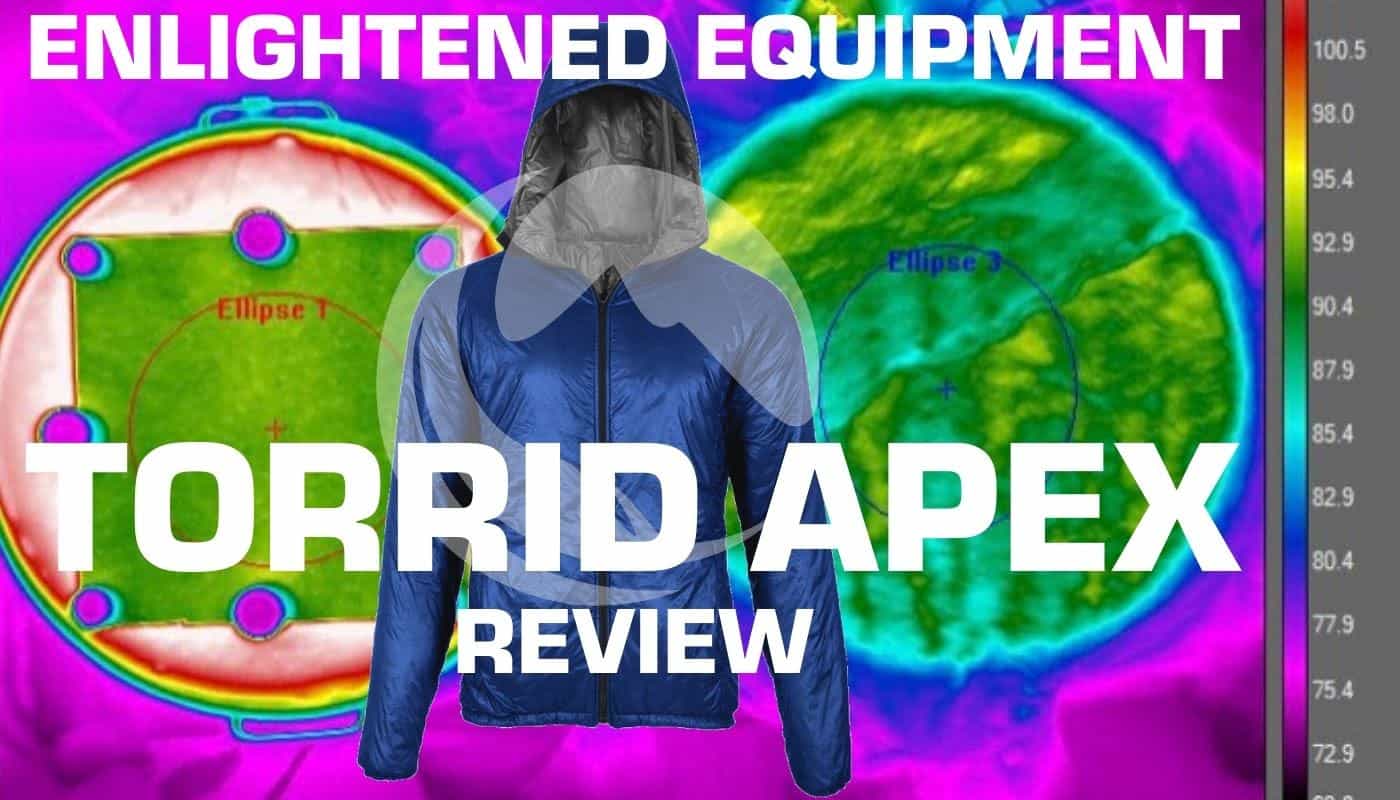

by Mark Wetherington and Ryan Jordan
Introduction
The Enlightened Equipment Torrid Apex Jacket is an ultralight hooded jacket insulated with Climashield Apex (synthetic), weighs 8.4 oz (238 g) in size M, and has an MSRP of $170. It is designed for backpackers looking for an insulating (at-rest or in-camp) layer that is more weather-resistant than a down-fill garment. The Torrid Apex features a minimalist design and low weight, making it especially popular among gram-counting ultralight backpackers and long-distance hikers.
Many possibilities for customization are also available for those who prefer a collar instead of a hood, different deniers for the interior or exterior fabrics, or a color other than black.
In fact, customization offers “so many color options, you wouldn’t believe it…..”

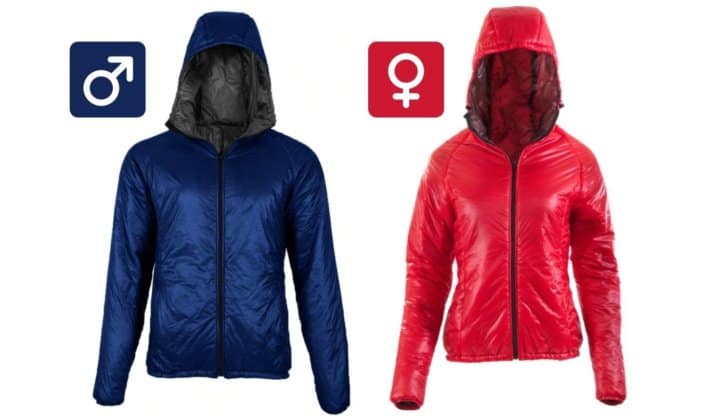
Men’s and women’s versions of both stock and customizable jackets are available:
- Men’s In-Stock Torrid Apex Jacket
- Women’s In-Stock Torrid Apex Jacket
- Men’s Custom Torrid Apex Jacket
- Women’s Custom Torrid Apex Jacket
The men’s cut is boxier, the women’s is more fitted:
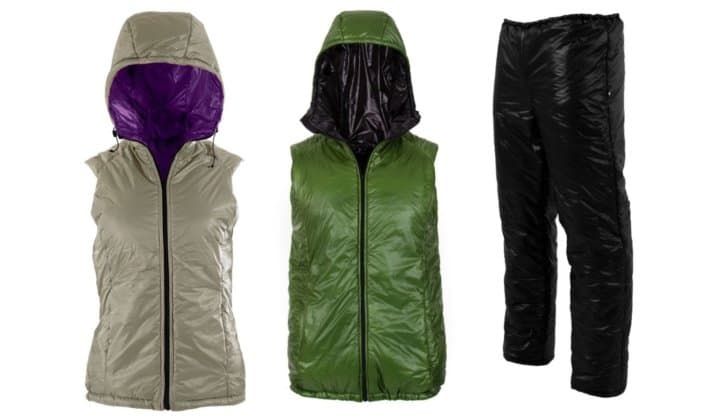
Other products in the same apparel line:
Review Context
This is a performance review based on extensive field research by both authors and some laboratory testing performed by Backpacking Light community member Stephen Seeber of Active Wear-Dynamics.
The primary context for this review is to evaluate the jacket’s ability to keep a user warm in cool, wet environments while not moving (e.g., in camp).
Features
- helmet-compatible hood with drawcord adjustment
- elasticized waist and wrist closures
- zippered pockets
- DWR finish on face fabrics
- regular fit (vs. trim, slim, or athletic) to accommodate layers underneath
Specifications
(size men’s medium)
- weight:
- claimed: 8.4 oz (238 g)
- actual measured: 8.01 oz (227 g)
- fill:
- type: Climashield Apex (2.5 osy / 85 gsm)
- fabrics:
- face: 10-denier ripstop nylon
- lining: 10-denier ripstop nylon
- zippers:
- #3 YKK coil
- sizing measurements:
- chest: 46 in (116 cm)
- hips: 45 in (114 cm)
- back length: 29 in (73 cm)
- length from sleeve to base of neck: 39 in (99 cm)
Product Category Overview
The Enlightened Equipment Torrid Apex Jacket is a synthetic-fill high-loft water-resistant insulating mid-layer. This is in contrast to similar jackets with far more breathable shell and lining fabrics, such as the Arc’teryx Proton LT jacket, which is considered a synthetic-fill high-loft highly-breathable (active) insulating mid-layer. The former is traditionally used for warmth while at rest, in camp, or in your sleeping bag. The latter is traditionally used as a mid-layer under high levels of exertion (e.g., alpine climbing or hiking).
An additional area of contrast to similar garments is related to its insulating material. The Enlightened Equipment Torrid Apex Jacket is insulated with synthetic-fill, which is more resistant to loft collapse in response to moisture absorption and dries faster than a down-filled garment.
We’ve previously reviewed lightweight synthetic-fill jackets in this state of the market report. The Enlightened Equipment Torrid Apex Jacket was not available yet when the jackets in that report were reviewed.
Design/Technology Overview
- Face and Lining Fabrics
- 10d calendared ripstop nylon, generally considered to be highly water-resistant (not waterproof) and somewhat breathable (but not enough to be used as a mid-layer during high levels of activity).
- Insulation
- Climashield Apex, an unbatted high-loft insulation made with continuous-filament solid-fiber extruded polyester.
Performance Assessment
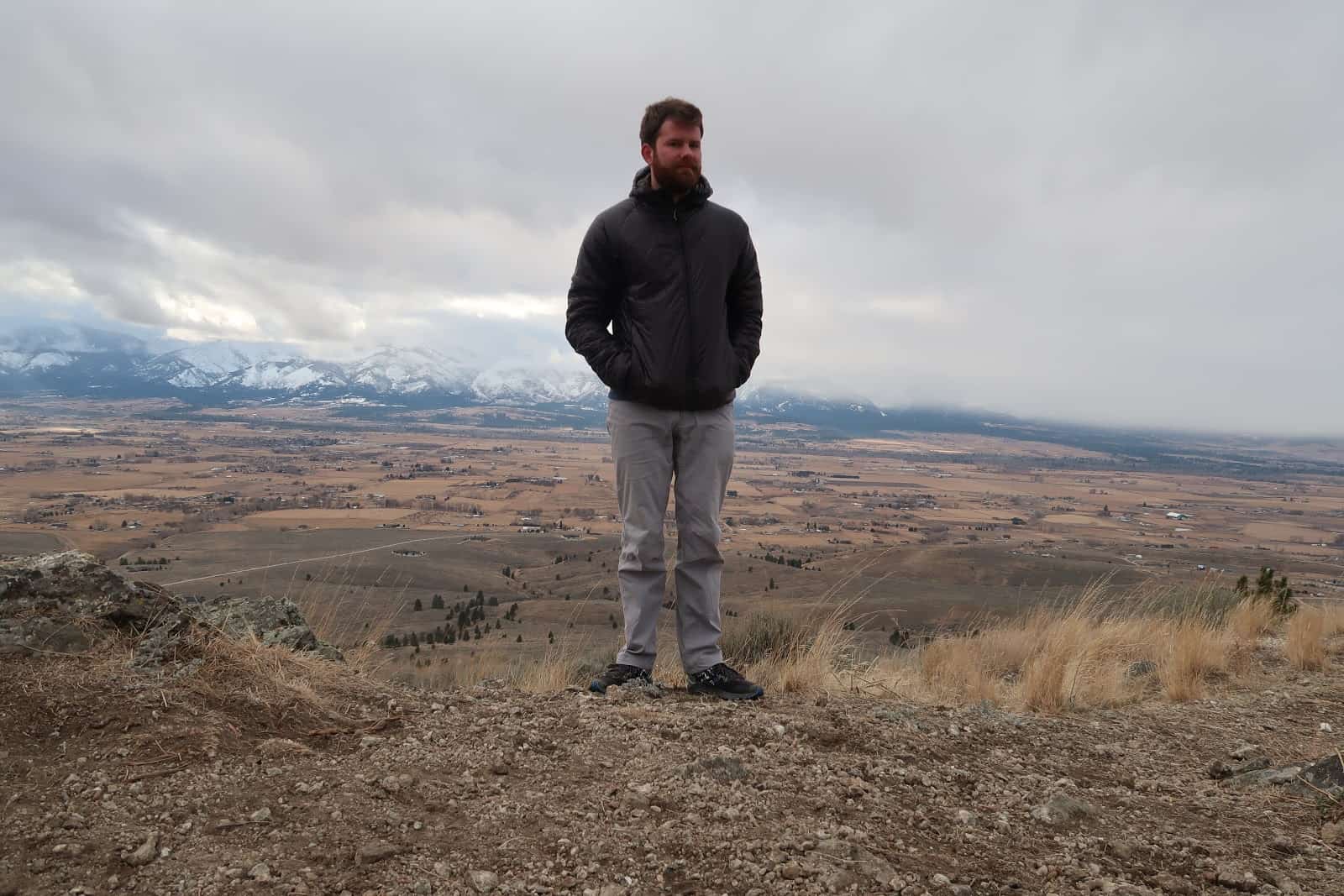
We tested the Enlightened Equipment Torrid Apex jacket in a variety of conditions between September 2019 and early February 2020 in southeast Wyoming, northern Colorado, and western Montana. It was tested as an insulating layer when resting during hikes at warmer temperatures (more than 30 F or -1 C) as well as an active layer when cross-country skiing and hiking in conditions of 10 F to 30 F (-12 C to -1 C). The jacket was tested in windy conditions as well as in drizzly rain, light snow, and sleet. By using the jacket in as wide a variety of conditions as possible, as well as pushing its limits both in regard to temperatures and use as an active layer, we intended to gain a thorough understanding of how it might fit into our backpacking kits.

Description of Field Testing
Locations
- Bitterroot and Sapphire Mountains in western Montana
- Rocky Mountain National Park in northern Colorado
- Snowy and Laramie Ranges in southeast Wyoming
Dates and Seasons
- September 2019 to February 2020
Environmental Conditions
- Altitude: 3,500 feet to 12,100 feet (1,067 m to 3,688 m)
- Weather: Temperatures from 10 F to 55 F (-12 C to 13 C), primarily calm winds but some breezy conditions with sustained gusts up to 45 mph (72 kph)
How Many User Days?
- This jacket was tested in the field for a total of 58 days.
Use Case Scenarios
- Insulation Layer: as an insulation layer when at rest over a base layer (150-200 weight wool, as well as Arc’teryx Phase SL) in mild conditions and worn over a base layer and lightweight fleece in colder conditions. Worn under a waterproof-breathable shell in wet and windy conditions. This was the intended purpose of the jacket and, therefore, was how it was most frequently used.
- High-Output Activities: As a primary outer layer when cross-country (Nordic) skiing in both tracked and untracked terrain.
- Inclement Weather: as a primary outer layer in winds, drizzly rain, light snow, and sleet.
- Cold temperatures: as a primary insulation layer when resting while hiking or cross-country skiing.
List of Performance Criteria
We assessed this jacket by evaluating its performance in a variety of conditions and activities, with the primary focus being on how well it functioned as a primary insulation layer when resting. Careful attention was paid to critically examining its features, or lack thereof, and their ability to provide warmth and protect the wearer from the elements. In addition, we compared the jacket to others that we have worn in similar conditions or for similar activities. The assessment has been separated into the following categories:
- Warmth
- Weather Resistance
- Breathability
- Comfort and Fit
- Durability
- Manufacturing Quality
Warmth (Plus R-Value and Clo Measurements)
Member Exclusive
A Premium or Unlimited Membership* is required to view the rest of this article.
* A Basic Membership is required to view Member Q&A events


Discussion
Become a member to post in the forums.
The Enlightened Equipment Torrid Apex Jacket is an ultralight hooded jacket insulated with Climashield Apex (synthetic), weighs 8.4 oz (238 g) in size M, and has an MSRP of $170. It is designed for backpackers looking for an insulating (at-rest or in-camp) layer that is more weather-resistant than a down-fill garment. The Torrid Apex features a minimalist design and low weight, making it especially popular among gram-counting ultralight backpackers and long-distance hikers.
Major upside to other products such as patagonia and mountain hardware is that you can try it on and if you don’t like it send it back. With EE your gonna wait a long time to get it and if its not everything you wanted, pay to send it back plus eat a 20% restock fee. And that restock fee is applied even if you cancel the order. This is nuanced with their stages of production, you can cancel after you order up until they cut the fabric, which could be weeks before its actually produced. Why cutting fabric and production are so far apart in time is unknown to me. But it essentially locks you into loosing $40 because they disconnected the cut from production. If radical colors were stockpiling I could see this, but there are few radical colors offered and it would reduce the business burden of reducing losses by scoping down to popular colors and deniers and actually upcharging only for unpopular colors that impact overstock of cut garments.
The premise that this jacket is custom is big stretch of that term. They offer standard options you can choose and charge you customization charges. Custom would be they ordered a special fabric for you and made non-standard adjustments for the buyer. This if far from that. You have 3 options: Size, hood, color. Most manufactures provide this without the custom up charge, lengthy wait and friendlier return policy.
I have a Torrid hooded vest that sees a good deal of use. It weighs a svelte 5 oz (Large) and packs pretty small. It’s typically used in conjunction with a light fleece (but not always) and provides enough insulation when stopped on the trail or camp (can always layer a hardshell over the top for more warmth). The vest also works pretty well as an active insulative layer (better than a jacket in most instances).
It also gives my sleep system just the right amount of boost when pushing the limits a little.
I also have a Nunatak hooded Apex jacket that is significantly warmer, but at nearly twice the weight. It gets the nod in colder conditions. The fabric I chose on the jacket (7d Robic) is also almost waterproof and very windproof, but clearly not the best choice if used as active insulation.
@brianvinci Yeah, long wait is par for the course with small domestic makers and a fact I think most consumers browsing these esoteric corners of the gear market have come to accept by now.
The restock fee, however, is an unfortunate development in the cottage realm, especially a whopping twenty percent. What sort of production hurdle does EE have on their allegedly very limited custom options to warrant this? Their quilts sewn overseas does not have a restock fee, as far as I can see.
Some payment portals, like PP, are no longer refunding the 3% fee on cancelled transactions. I can see small companies struggling with what to do here; eat the expense or forward it to the buyer? If the customer is faced with a 3-5% cancellation charge, I think most would be okay with that, especially if they know it’s not going in the owner’s pocket.
No clo/R for unused Torrid, so hard to say for sure, but the Apex appears to have held up to 60 days use pretty well. Nice to see the reputation holding up.
Our standard products don’t have restocking fees, but if you choose a custom one there is because we don’t stock those so it’s a burden to have to sell off something that we don’t stock. It’s a burden to be half way through building something we don’t stock and have the customer decide to change the color. So yes if you order something custom and decide to cancel after we start building it or return it there will be a fee. Want to avoid that fee, don’t order custom.
i understand that custom doesn’t mean custom in that you can ask us to add features we don’t currently offer. However it allows us to offer vastly more colors and fabric styles along with many many more sizes (in quilts/bags) than if we only had the stock/standard offering. We feel, and our customers confirm that this is a good thing.
overwhelming demand has depleted almost all of our inventory and driven up lead times on our custom made products. This is frustrating for customers and honestly for us too. We are doing everything we can to increase capacity to meet the extremely high demand that we have. We are hiring new sewers every week but it takes about 6 months for them to be highly proficient.
I promise that we are doing everything in our power to meet customer demand and provide the very best products that we can
-Tim Marshall
Founder; Enlightened Equipment
Great hooded puffy. It’s been my go-to piece for Alaskan summer trips for the past 2 years. I did the custom 7d inside and out. It doesn’t replace all my other puffies (for a wet trip I’d bring a Nano Air, a cooler trip a Macro Puff, etc), but for trips with a good forecast when I mostly want morning and evening warmth in camp, the Torrid fits the bill.
@marshlaw303 Thanks Tim for providing some insight.
The main item this jacket has that gives me hope is that it is made of CLIMASHIELD. At least by US Army testing CLIMASHIELD has proven to be about the most resilient synthetic fill when loft is measured after repeated trips through a stuff sack.
I’ve had it with short staple synthetic insulations!
I would be interested to know if the density and weight of the synthetic insulation effects the heat loss at the sewn threw baffles. Case point micro vs macro puff. Would like to see heat loss steady state imaging of like micro vs macro … if more surround insulation reduces baffle loss or … visa versa that actually more insulation in a synthetic baffle design is even more inefficient since you increase weight faster then warmth due to equivalent baffle loss or even faster due to micro climates perhaps.
perhaps the study could be apex 60 and 90 gram vs baffled core loft 60 and 90 or something and compare the heat loss?
thanks for getting me thinking. Nice review.
Hi Hanz, the EE Torrid Apex is a baffle-free design. I’ve owned this jacket for 18 months and I find it as or if not warmer than my baffled down jackets.
An addition to “who should consider”: Larger women. The other brands you list top out at a smallish size 18 in their women’s jackets. EE goes up to size 22 before you have to see if something on the men’s side will fit you well enough in the hips to make it manageable.
@errol , not debating that at all. I also have used a torrid and agree it’s warmer than a baffle design , much like the down based everdown from Eddie Bauer. I’m interested in if the insulation weight on a synthetic impacts baffle heat loss.
Hi Hanz:
I have images that compare the Pat Macro and Micro, along with their calculated thermal resistances. However, I don’t understand the relationship you are trying to establish. Please try to explain what you are after again and I will see if I have any relevant information. The Macro comes out at an R value of about 1.7, while the Micro comes out at about 1.07. I own a Macro but not a Micro.
FWIW, EE have apparently tested the Torrid to some standards at Kansas State, claiming a CLO of 1.84. Curious where the difference to these results by Stephen might come from?
Not that it really matters. Just the measurement relative to the Micro Puff seems more valuable than any absolute number
Thanks, Anne — that is a great point about the sizing of the women’s version of this jacket.
Tim, since you’re here, how small would you stuff a Torrid (in liters, maybe)?
Oh man, I don’t know that stuff anymore off my head. My customer service would though.
-Tim
@stephan s
I guess I’m interested in if increases in warmth achieved in other weighted insulation in baffle designs reduced heat loss not just due to the amount of insulation obviously, but also does it reduce heat loss through the sewn threw seams. For instance, is there less imaged heat loss at the seams specifically when comparing the macro puff compared to a micro puff.
I think this is an interesting question to get a second question: if the added weight of insulation in baffle designs is actually less efficient then the the added weight of insulation in non baffle designs.
example: perhaps added weight of 1oz of insulation in a baffle design provides the equivalent of 1/2 oz of insulation in a non baffle design… my question is more about rates of heat loss as baffle design increases studded insulation.
This is getting a off topic for this thread so I suggest we not dwell on this or you can start a new thread.
It is clear that through stitching reduces the insulating value of the garment. This is most readily seen by comparing box or other baffle designs that go to increased lengths to eliminate through stitching to support the insulation with through stitched garments with similar insulation content.
I really have not looked at the nuanced issues that you raise.
Rather than speculate, I have attached the raw images of the macro puff and micro puff and you can judge for yourself. I have not made measurements for this specific discussion so, you can make some qualitative judgments based on the image colors.
When looking at these images, remember, the higher the loft at the center of the baffle, the more air is trapped beneath the through stitched surfaces of the garment and the top surface of the permeation kettle, adding additional insulation to what is imaged at the through stitch area. In the high loft jacket, compared to a low loft garment, this will produce somewhat reduced heat loss at the through stitched area.
In the macro puff ( I don’t have a micro puff here to study, but I think the construction is similar) the through stitching is in the horizontal direction. Each horizontal stitch section terminates with a short area of heavier stitching. It is heavy enough that you can see light through the stitch holes. There is no through stitching in the vertical direction. I think the vertical lines of high heat that looks like through stitching in the images are due to crimps in the insulation produced by the heavy stitching at the ends of the horizontal through stitch seams. So with these caveats in mind, you can perhaps draw some conclusions concerning your question.
FYI, macro puff is upper image.
Cool. Those pics are really great! I’ll draw my own conclusion from them semi-subjectively.
Hey, @stephan s, what kind of thermal camera are you using? Do you have a calibrated black body source (or something of known temperature in the image) that you’re referencing the temperature scale to? If this is a FLIR camera, they have about +/- 5°C accuracy, and tend to be very drifty. Not really intended for radiometric operation. However if you’re just looking at relative temperature values, they’re fine. Just don’t do any careful image analysis or computations with the data! It’s always fun looking at thermal imagery…
Thank you for your advice. By the way, what do you base this advice on? I have been using Inframetrics and then Flir instruments for nearly 40 years. This is the camera that I use for these tests: https://www.flir.com/products/a655sc/. What you need to be aware of is that Flir markets a wide array of products to all market segments. You really get what you pay for and I only pay for SC rated cameras. Drift occurs in any uncooled imager. The drift is corrected by performing a NUC. This camera will do it automatically. However, before I take the temperature data used for the thermal resistance calculations, I first perform a manual NUC. In this mode, the impact of any drift is minimized. I also repeat the measurements several times to ensure that they are in fact, repeatable and therefore not subject to drift from the camera or the test setup. In any case, this instrument is designed and intended for radiometric operation. That is not to say this is camera offers the lowest signal to noise available, highest resolution or lowest NETD performance (30 mk for this camera which means it can resolve a temperature difference of .03C) . However, IMHO, this camera is suitable for this application.
Hi Tuuku:
I never responded to your question, so here it is. According to Climashield, the clo value of the insulation is .82/0z/yd2. The jacket contains two inches of insulation. This means the expected clo of the insulation will be 1.64. The insulation thickness and therefore clo can vary +/- 10%. The value in the final jacket will change somewhat because the loft will be impacted. For the jacket, I measured clo=1.02.
In the thermal image below, you can see two pieces of cork. The left cork is .22″ and was used as the reference in the article. The right cork is .55″. Based on NIST test data for cork, these thicknesses would produce expected Clo values of .75 and 1.87. respectively.
Here is the actual image from the paper with the cork and jacket.
When you look at the jacket colors, they would have to be predominately the color of the right cork to approach the value that you write is claimed by EE for the jacket. Its performance is clearly not that high, as evidenced by the presence of the greens and yellows in the test area. Simple visual observation, suggests that the performance is well between the two cork samples. So, the insulation value is less than the study value you reference and less than the expected insulation value based on the insulation specification. If a study was done (I did not see reference to it on the EE website) I cannot tell you why the numbers don’t agree. But, due to assembly, aging, or both, the jacket is performing well below expected levels. It is actually not quite as warm as a new Micro Puff (the one in the report is aged, after substantial use), but very close.
Become a member to post in the forums.