

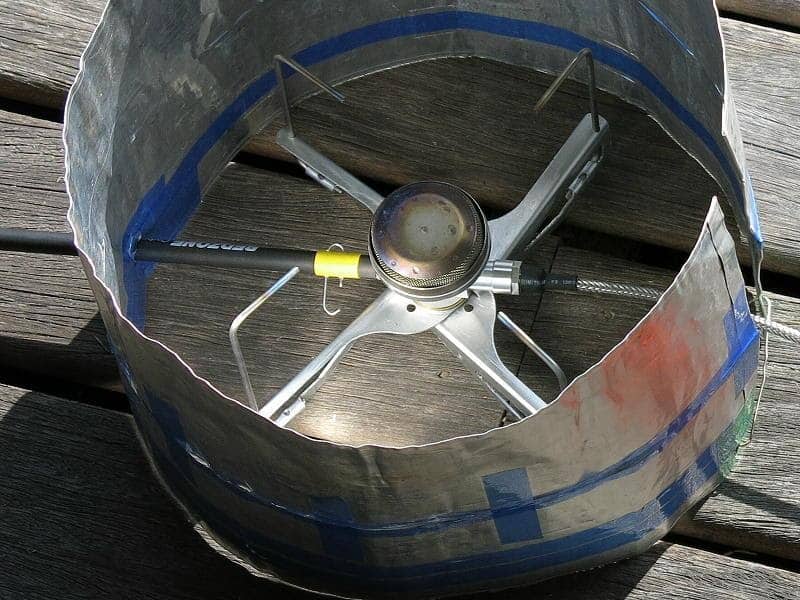

Background
This article describes the development of my 4th generation of Remote Inverted-Canister Winter Stoves. You can find articles about the previous versions here at BPL in the series’ Evolution of a Winter Stove (5 parts) and DIY Backpacking Stove: An Ultralight Vortex Burner (5 parts).
It all started years ago when I was contemplating the weight of a number of commercial remote canister stoves, and wondering why they had to be so heavy. In many cases, it seemed as though someone with little knowledge of stove engineering had just thrown bits together with no regard for either weight or elegance. Some of the results were clunky, and others were just weird.
At the same time I was looking at some of the massive pre-heat tubes found on commercial remote canister stoves, and wondering why they were needed when butane boils below 0 deg C and propane boils below -40 deg C. It seemed to me that the designers of these stoves were simply copying, rather blindly, the design of current white gas and kero stoves. Kerosene boils somewhere between 150 deg C and 300 deg C, so the comparison seems ridiculous.
Version 1
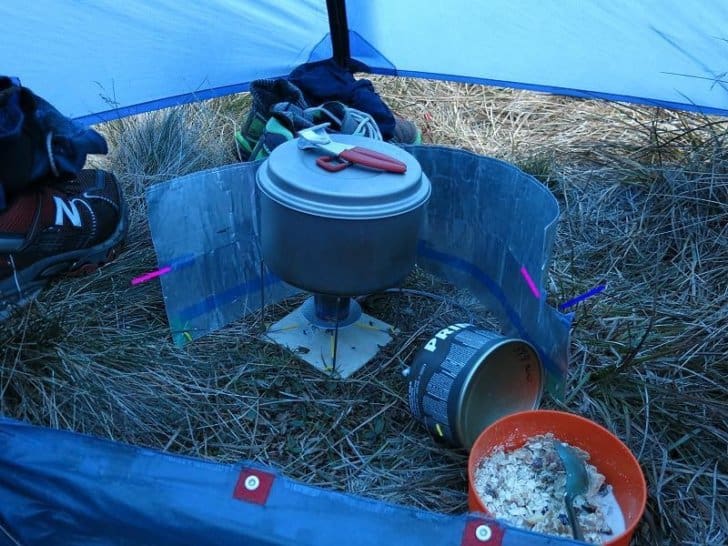
Actual development work started when I was asked to review the Brunton Stove Stand. It allowed me to put a hose onto my favourite upright canister stove (a Snow Peak GST-100). But it had a solid metal pipe where the hose connected to the body, and I wondered whether I could conduct enough heat in there to vaporise the propane/butane fuel mix as it arrived.
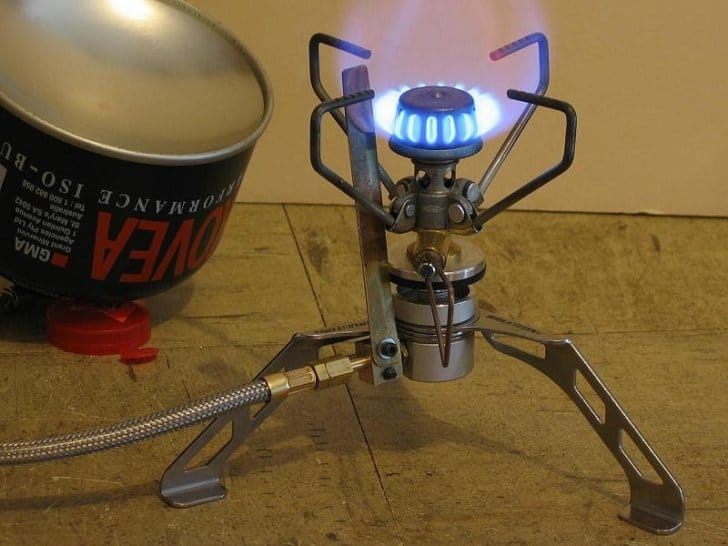
Well, no use wondering: go and do. So I did, as above (see photo), and it worked fine. There was enough heat coming down the metal strip (copper) from the flame to the pipe. After all, the pipe had only to reach something like +5 deg C. Interestingly, while a copper strip (thermal conductivity 400 W/m∙K) worked fine, a brass (61-111 W/m∙K) strip was not so good. For interest, plain aluminium is 236 W/m∙K while Ti is 22 W/m∙K. Obviously, good thermal conductivity would be needed. This metal strip is now called the Heat Shunt.
But the original steel legs on the Brunton stand were heavy, the large base was heavy, and the hose was stiff. If I did some engineering, made some lighter legs, and integrated the needle valve with the base, better was possible. And so the long journey got going.
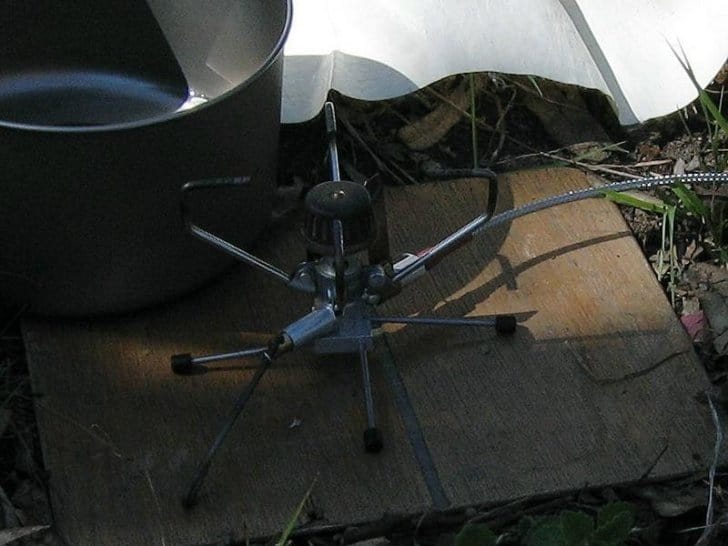
On one trip in the Pyrenees, the brass thread (where the stove connects to a canister) on my GST-100 had been stripped by the very rough steel thread on the screw-thread canisters. I had to suddenly buy a Campingaz stove (lumpy and heavy) and Campingaz canisters (nice). I wanted to get away from that crude rough steel thread, and I had quite a few nice full Powermax canisters on the shelf. Could I make a universal canister connector?
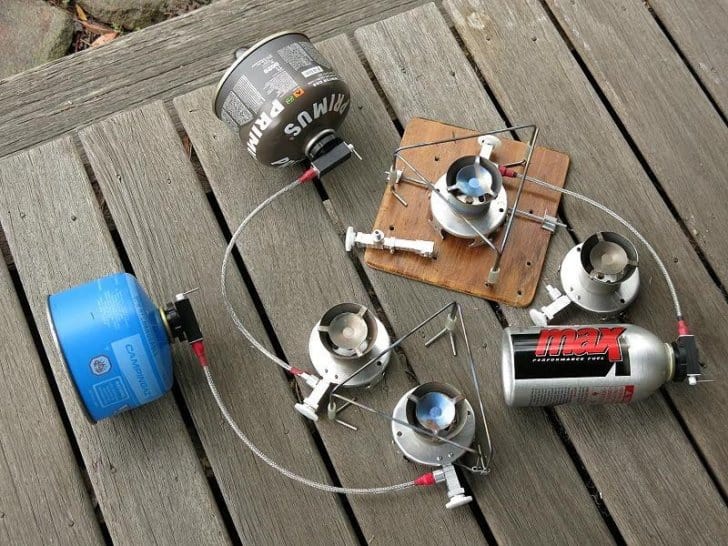
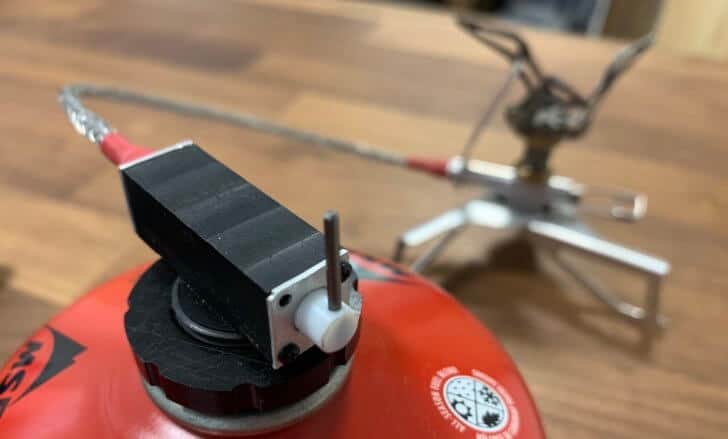
Jumping ahead several years, this is what I envisaged: compatible with screw-thread, Campingaz and Powermax, and having a fast ultra-reliable shut-off facility at the canister, separate from the control valve. It was possible, and it has been described in my previous stove articles. At the same time, I was able to make a thoroughly satisfactory but light-weight armoured hose, as seen in the above and below photos.
But developing the whole system had taken a year or two, and I had become a bit impatient. I decided to use a commercial burner head on my stove body and legs to get things going. I could pick a burner head which was light and effective, and it would save me a lot of work. I used two stoves for this: at first the Fire Maple FMS-116 and later on the Fire Maple FMS-300.
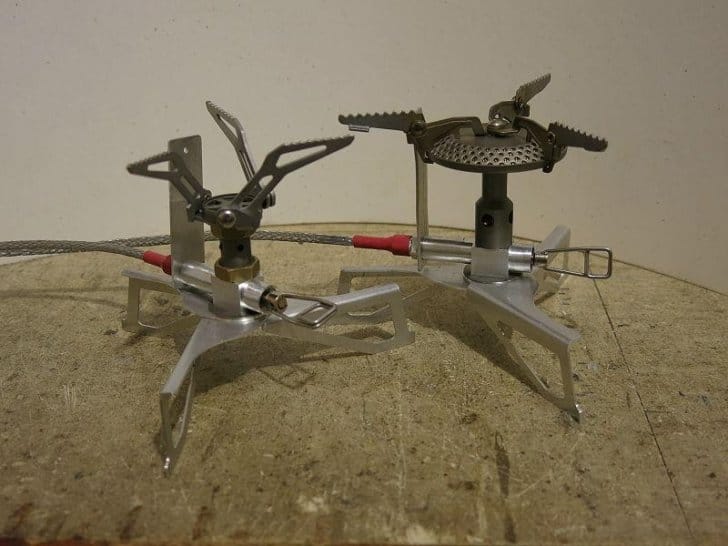
The FMS-300 had, to my mind, a better gap between the burner head and the pot, permitting better combustion and lower CO levels. Also, I cheated slightly and reused the needle valves out of the stoves. Purely as a side note, you might like to compare the Fire Maple FMS-300 (on the left) with the BRS-3000t: there is not a lot of difference, and I believe the FMS version was first. A performance comparison between the two can be found in Backpacking Light’s most recent upright canister stove gear guide.
Anyhow, my V1 stove was successful, and I sold well over 100 of them. I was very pleased, and my wife was impressed (which was not easy to do).
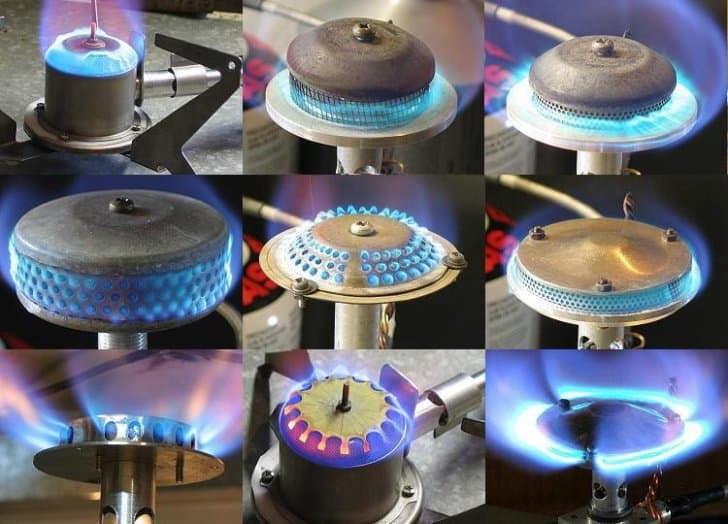
Despite the sales, I was not entirely happy with using a commercial burner head. I wanted to make my own burner head. So I started to experiment (and use up a lot of gas in the process).
The Vortex Diversion
I was well on the way down this path when I suddenly started thinking about Vortex Burners: they are very different from the conventional designs above. I was hooked and spent the next few years happily playing with them – to the point of producing two slightly different models and selling them as well.
Rediscovery
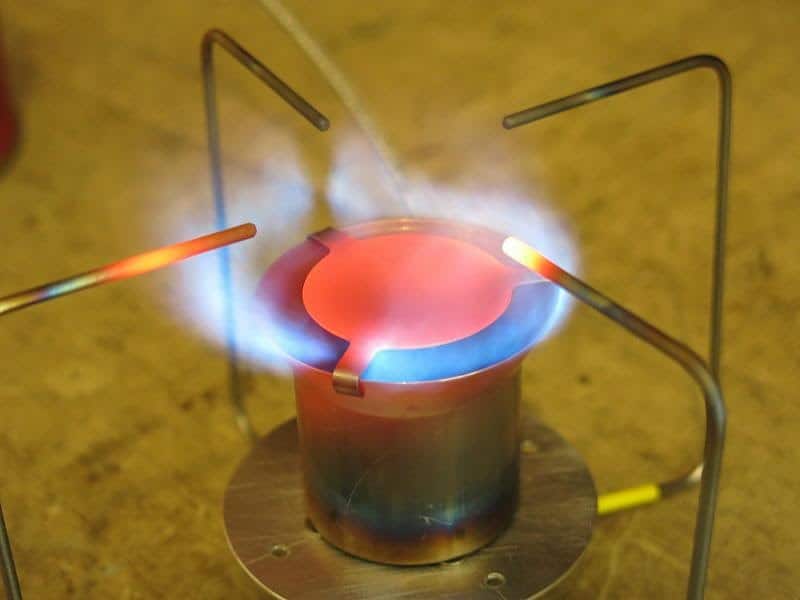
I was tidying up the workshop after making and selling my V2 and V3 stoves when I opened up one of several boxes of left-over parts. I found all the old burner heads I had been experimenting with after V1, plus about 14 (quite refined) burner heads I had been just about to fit onto stove bodies. I had forgotten all about them.
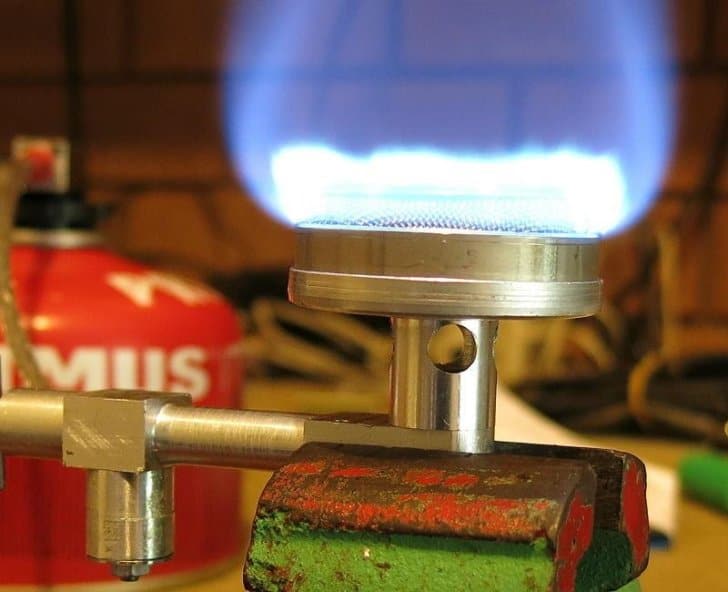
Out of interest, I examined them closely. All very nice in fact. Some were made from titanium tubing I had lying around, and others were made from machined aluminum. They were all very light, and they all made a nice broad flame.
Then I looked at the stove body design that came with these heads in the left-overs box: that’s the bit held in the vise in the photo above. It’s rather long, with a pivoting connection for the hose, and I began to remember that both the length of the stove body and the pivot on the hose had both given me a lot of trouble.
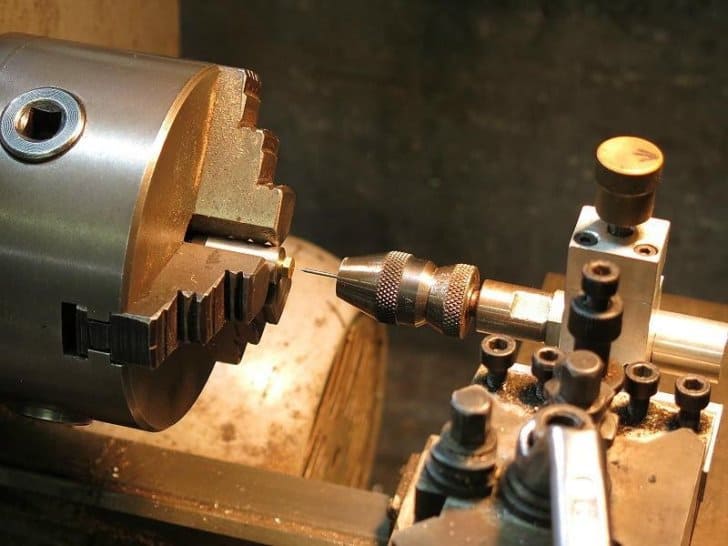
The long stove body presented two problems. The needle valve is perforce directly under the jet. This means a delicate drilling operation for a precisely concentric 1 mm hole at the end of a long thin (4 mm) bore, and I could not find a suitable stock drill bit for this. I had to get some custom-made in China for it. In addition, machining a long thin aluminum needle to fit down the long bore had been difficult: the long thin aluminum rod insisted on flexing in the lathe.
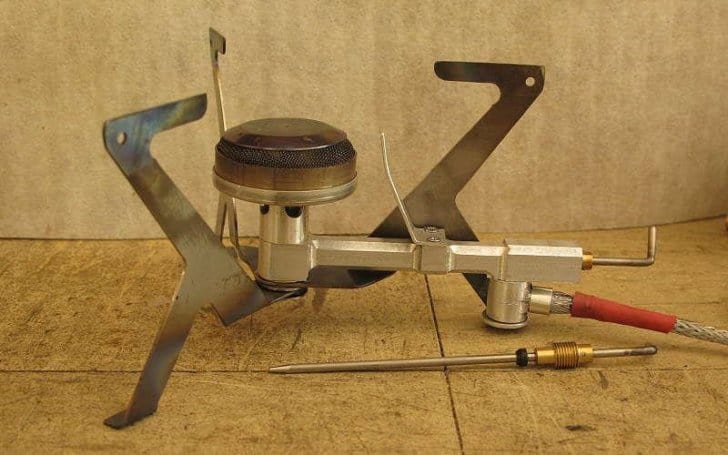
I tried using some titanium rod for the needle, and this machined OK, but actual field use revealed a terminal problem when I shut the stove down after use. You see, aluminum has a significantly higher coefficient of thermal expansion than titanium. When the stove cooled down the aluminum body shrank more than the titanium needle, which meant that the needle ended up jammed hard in the orifice. It was very hard to reopen the valve. Long-term reliability? Very poor. Not good enough.
Then I looked at the pivot connection for the hose: the little bit sticking down from the long stove body, near the black O-ring on the spare needle valve. I could buy larger versions of these pivots, but not small ones. My memory was that machining these had been even more complex and slow. The problem lay in how you hold them. There had also been a small problem with the gas flow: going from the pivot connection into the side of the needle valve. There was not a lot of room at the bend for the fuel. I began to remember why I had abandoned the idea and switched to designing Vortex Burners.
But still, I wondered whether I could do better now, with the advantage of many more years of stove design. Ah, the challenge! Further optimisation of the burner head, and a much smaller and simpler stove body at least.
Stove Body
The first decision was that the revised stove body had to be very short, both to keep the weight down and to make the machining easier.
The hose connection was not difficult: I had developed a neat simple connection method for previous stoves which could be further developed.
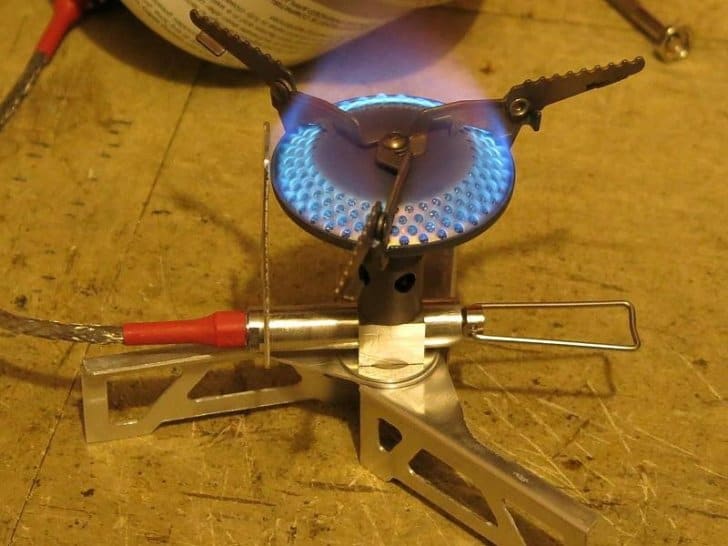
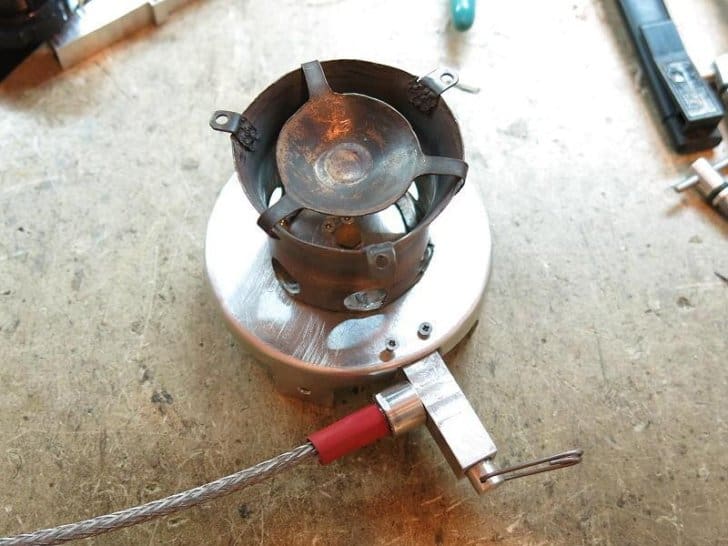
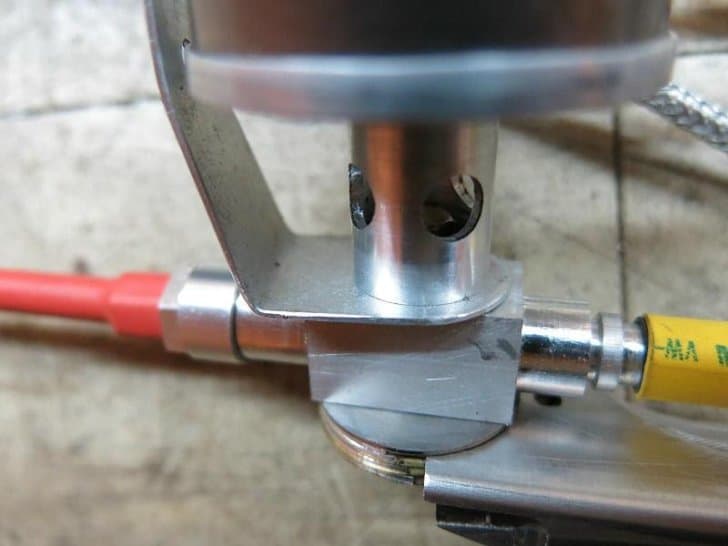
Part of the problem with the long stove body had been having the hose connection at the same end of the stove body as the valve, even though it had ‘seemed like a good idea at the time’. If I put the hose at the other end, as in V1 as shown in the previous photo, everything fitted nicely.
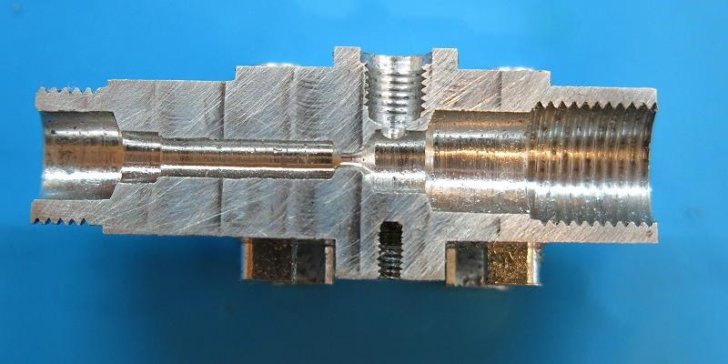
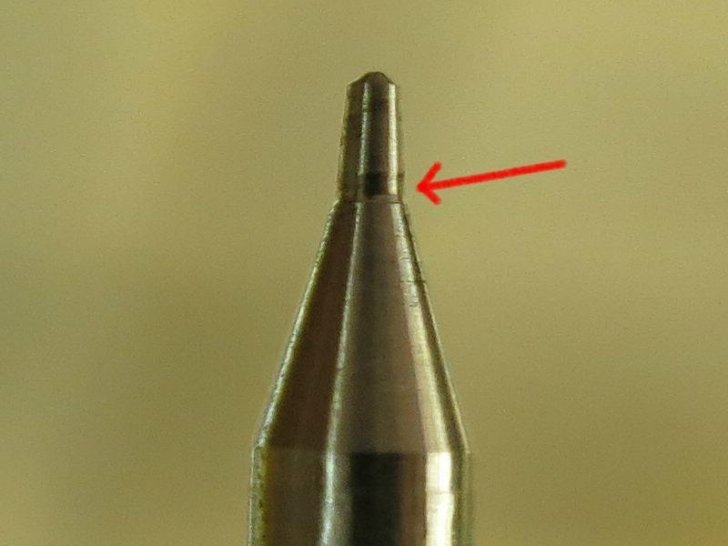
A very technical point should be made here about how the gas flow goes in at the opposite end from the needle valve. Any dirt or wax from the fuel (it happens) which wants to collect somewhere will most likely blow through the needle orifice, leaving it clean, and it will then collect on the needle. It can often be cleared by movement of the needle valve, or if it’s really bad, by removing the needle valve and wiping it. The overall length of this stove body is under 40 mm, so the needle valve is very short and much easier to machine in the lathe. These factors made both the stove body and the needle valve much easier to manufacture – and lighter too.
Handle and Windscreen
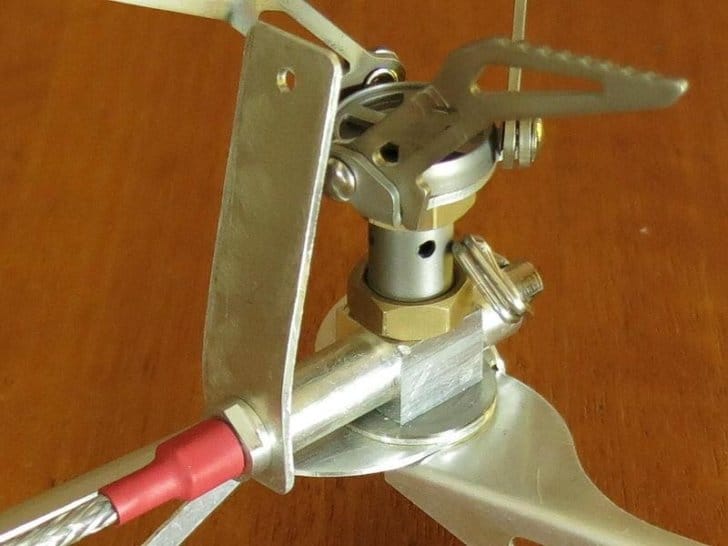
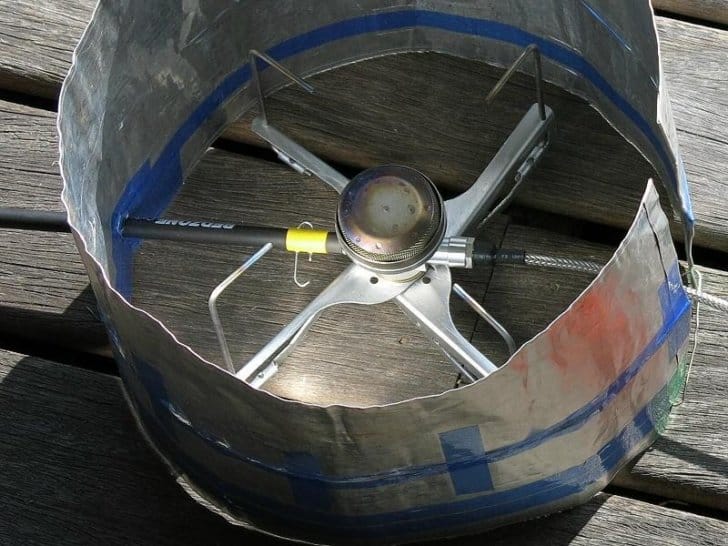
While both the stove body and the needle valve are small, one does have to be able to adjust the valve while the stove is running. I soon found out that there was a fair bit of radiation that close to the stove body (rather warm fingers), so some sort of handle would be needed. The V3 stove used a long Ti wire handle, but the machining was a bit complex. Perhaps a very light bit of tubing could be made to connect somehow with the short but solid handle on the needle valve?
Carbon fibre tube is very strong and quite light, and I had a fair amount of bits and pieces leftover from making tunnel tents. It was a simple matter to make the handles on the needles fit snugly inside the CF tubing. However, the tube had to not only fit, but connect reliably so the valve could be turned reliably. Since the CF tube could be rather long, it was also necessary that it should be removable for packing.
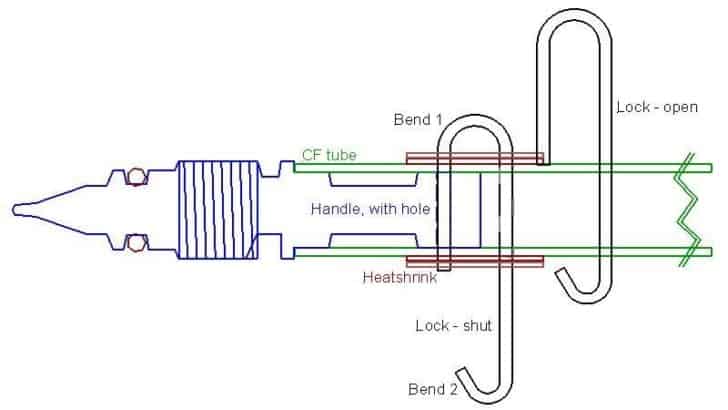
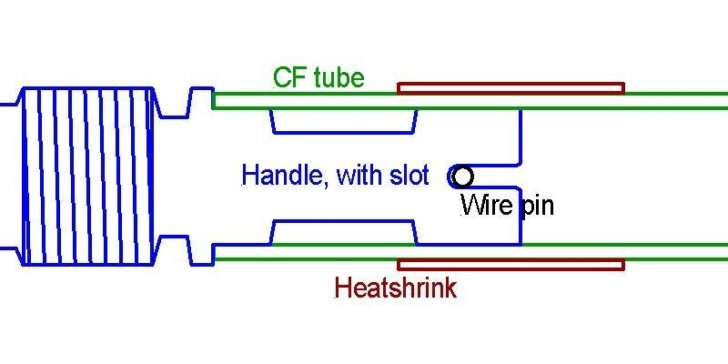
I chamfered the entry into the slot just a little so that I could simply push the CF handle over the end of the valve and spin it a bit to get the wire to drop into the slot. Should the connection ever start to get a bit loose, a tiny bit of a crimp in the wire would restore the grip. In practice, this was very effective.
Summary So Far
This article covers all the easy bits. The next article will go into some detail about the development work needed to get a design that satisfied me: optimising the burner head and coming up with a neat solution for the stove legs and the pot supports.


Discussion
Become a member to post in the forums.
This article series describes the development of my 4th generation of Remote Inverted-Canister Winter Stoves.
Not possible to integrate the heat shunt in to the burner head and use the burner tube for conduction down to the body? Or attaching the shunt at the top of the burner tube instead of the bottom?
Hi Rene
A good question, but the answer is, as you might guess, no. The explanation is a bit complex, but obvious once you read it.
Briefly, you can not get any significant amount of heat going past the air inlets. The reason for this is that there is a large (well, significant) flow of cold air in through those holes, and the bits of aluminium between the holes don’t have a significant cross-section. All the heat is sucked out of the aluminium around the holes by the cold air flow. And in the snow, the air is quite cold.
This is NOT theoretical: I made several attempts to get enough heat down from the burner head, and failed. I could actually FEEL the difference in temperature. Then the penny dropped.
So the heat shunt has to go some way south of the air holes if it is to get enough heat to the hose inlet to vaporise the liquid fuel. This was not so apparent with V1 as the heat shunt in that model went direct to the hose inlet.
Could I have redesigned the heat shunt to connect at the hose inlet? Yes, but with difficulty. The result would, I suspect, have been heavier. But there is always room for ingenuity.
Cheers
I’ve been meaning to sing praises here about Roger’s stove. I have a V3 was really impressed by it during a week’s use in the Chartreuse and another week in the Belledonne this winter.
It is very very light, easy to use (minimal fiddle factor), easy to use in the cold, and is extremely economical. Example: for my trip in the Chartreuse with mild winter weather, during six days boiling water for one three times day, three of which required melting snow for water at temps from -10 C to 5 C, as well as a couple of nights of special frying, I didn’t use even a full 450 gr iso-butane cartridge.
The only gripe I have is a wish for the feed tube to be slightly longer (for which I’d gladly accept a small weight penalty).
Totally awesome.
I like this stove, how much would this be if made for the light weigh crowd , I have no time to make this, but great build
Hi Roger. Love your work as usual. Let us know how much. I was particularly interested in your chuck setup for the jet. Does the jet have to be drilled perfectly concentric? If not perhaps you can put the part in the tailstock and the drill bit in the headstock instead, assuming your head has acceptable runout.
p.s. mcmaster has the bits too, dunno about shipping to australia: https://www.mcmaster.com/drill-bits/decimal-size-equivalent~0-0118inches/
Ah, cold air flow – hand’t thought of that.
Cheers!
Thanks Jon. I find how much gas I use depends as much on how careful I am with the stove as anything else.
Sheldon – if interested, email me direct at roger@backpackinglight.com Price with shipping depends on country of destination. Price is compatible with Western brand remote canister stoves.
@Al – no, the jet does not have to be drilled perfectly concentric. But NO lathe chuck or collet has zero runout, so putting the drill bit in the chuck will ALWAYS mean the tip of the drill will wobble slightly. OK, more wobble on a small Chinese lathe than on a very expensive Swiss lathe. My technique puts the drill tip within microns of the centre of rotation regardless of wobble. I align with a head magnifier.
Yes, McMaster Carr has the drill bits – at a price! Fortunately, I have stock of such drills already. I have no idea how the (Swiss) mfr manages to grind them though!
Cheers
Thanks Roger, fantastic write-up. Looking forward to Part II.
Interesting section on wider burner heads/wider flame ring. One of the reasons I bought slightly heavier Brunton CRUX folding upright stove is B/C of its wider flame ring.
I have an older MSR Wind Pro I got for car camping. I’d like to modify the canister connection so I can invert it. Seems If I order a new hose as used on my MSR Universal from MSR that may be the (expensive) way to solve the problem.
But Roger, after reading the entire article my brain is full and I need a Jim Beam moment to clear my thoughts. Cheers! Looking forward to Part II.
I don’t understand how your stove is much different than a Kovea Spider stove. Other than a heat shunt, vs. heated tube?
@Rod
Kovea Spider is actually quite a good stove imho. One of the best and I think the lightest of the commercial offerings.
It is however 80 g heavier than mine (170 g vs 90 g), it can only use a standard screw thread canister instead of all three sorts, and the Kovea thread on the canister connector can/will wear out.
Cheers
Where can we get one?!
You email direct to me, roger@backpackinglight.com
Please include your country.
Cheers
Hi Roger
Good to see development of a silent burner, addressing the main annoyance I have with your v2 stove which I have enjoyed over the last two years. I find the sound intrusive, so much so that I often select the spider, alcohol stoves, or even my old Optimus Explorer (cobra burner) for car/moto camping.
A simplified pot support would also be appreciated; the v2 triangular version works very well but the fiddle factor is again an annoyance at the end of a long day. The v3 design, would it be adaptable to my v2 stove?
Also interested to hear of your appreciation of the Kovea Spider, I love mine despite its vulnerability to wind. If you can get your v4 stove quieter than the spider I think you will be on a winner; you may tempt me again! LoL
Oh and I have not checked, is your gas multi-connector suitable for the cheaper ‘rim vent’ butane gas canister (for summer use)?
Cheers
Lachlan
Hi Lachlan
>> The v3 design, would it be adaptable to my v2 stove?
Do you mean V3, which is also a vortex burner, or V4? In any event, I think the answer is no.
The V4 is pretty quiet. How it compares to the KSpider – it’s similar. It’s a lot quieter than a vortex burner, which is a bit ‘macho’.
No, the current canister connector is not compatible with the rim-vent butane canisters. Looking at creating a small modification to my stock canister connector for the rim-vents is a project for the future. Chuckle – a delay is that I can’t find any of them at the local shops right now! This too shall pass.
Cheers
absolutely awesome! Congrats!
What a shame the “main-stream” industry does sell their junk labelled “ultralight” instead of hiring you as a designer!
Happy trails
Urs
Thank you :)
Cheers
Just want to jump in and add that I’ve been a happy user of the V1 with the FMS-116t head for several years. I got the FMS-116t specifically for the wider head. To be honest, it hasn’t had hardly any winter use, but I find it’s a nice stove for fry-bake cooking following videos that Ryan J has posted as well as videos & techniques from Jon at FlatCat Gear.
I recently took the V1 on our (my wife and I) 4-day trip backpacking Death Valley at the end of January. Combined with an Evernew titanium 1L pot and a super thin titanium windscreen I purchased off of Amazon, I think it’s actually lighter than my Jetboil Sol Ti. The real reason I took it was because we car-camped for a few days prior to backpacking and we did Ryan’s bean burrito cooking method in the fry-bake. The fry-bake pan was left in the car for the backpacking portion of the trip.
I use my stoves in summer as well: the pot is lower to the ground and more stable. I am, of course, biased!
Cheers
How does the rotating hose connection work? I can’t really get my head around it. Is there a pressed fitting on the hose that stops it from being pulled out?
A quick sketch of the connector at the stove end of the hose.
The grey is the hose itself.
The brown is meant to be a round O-ring which seals the hose to the stove body.
The pink is the end of the stove body.
The green is a hollow nut which screws onto the end of the stove body. You can’t see the thread.
The pale blue is a ‘sleeve’ into which the hose is locked (your ‘pressed’), and it has a shoulder which the hollow nut retains. But it is free to rotate.
At the canister connector end a flat plate replaces the hollow nut.

Cheers
@roger, if I understand correctly, this is (going to be) a stove with integrated pot supports? If so, what diameter are you aiming at?
I ask, because, (for winter camping) I prefer a big, flat pot (~4l) in order to be able to easily fill and refill it with snow for melting. Also because I have 2 kids, so melting snow/boiling water for 4 people at once.
Anyway, as usual, super fun to read the engineering, problem solving and design choices!
please keep doing this stuff and writing it up for us!
Man I love (and miss!) your articles and creativity, Roger!!! You’re such an amazing contributor to this community.
@Tjaard
Part 2 should be published next week, and all will be revealed. Yes, integrated pot supports are part of the design.
That said, a 4 L pot could be very big, and I cannot recommend putting something that large on any camping stove. Very few of our stoves are designed to support 4 kg of water (4 L)
The big diameter can create problems with excessive heat being reflected downwards from the bottom of the pot. This is more likely to affect the upright stoves than the remote canister stoves of course.
Chuckle: the more common concern is with beer-can pots. They are often too small to sit on the stove pot supports.
Stay tuned.
Cheers
PS: thanks todd.
Become a member to post in the forums.