

Introduction
The Seek Outside Divide 4500 (54 oz / 1531 g, $359) is a high-capacity external frame backpack designed to carry heavy loads. Seek Outside introduced this pack in 2016. It features a roll-top closure, multiple compression straps and attachment points, two oversized side pockets, and a back pocket. The bag material is waterproof, and all materials are heavy-duty, intended to give long service in rough conditions.

About This Review
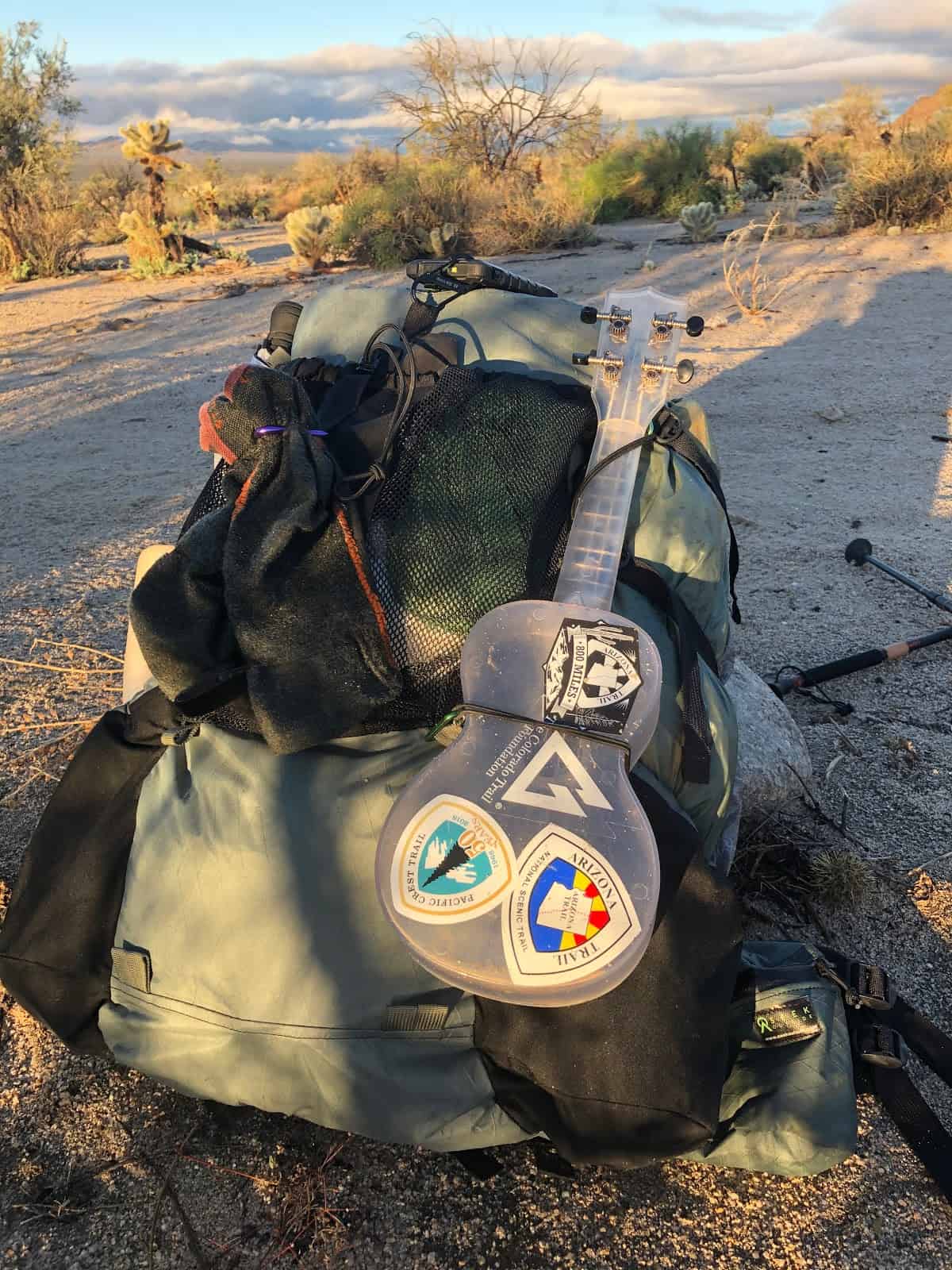
This Limited Review of the Seek Outside Divide 4500 is based on my experience with the pack during a 10-day, 150-mile section hike of the Desert Trail in the Mojave Desert of California, March 2020.
Features and Specifications
- Base MSRP: $359
- External frame
- Roll-top closure
- Waterproof X-Pac fabric
- Dual-adjustment straps on hip belt
- Gatekeeper buckles allow compression straps to be easily added or removed
- Optional accessories include top lid, frame extensions, hipbelt pockets, lumbar pad, bottle holster
- No hydration ports
- Minimal weight 2 lb 12 oz (1250 g)
- Weight as tested 3 lb 6 oz (1530 g)
- 3000 – 4500 cu in (50 – 75 L) volume
- Carries 50+ lb (23+ kg) loads
- Adjustable harness fits torsos 16-20 in (40-50 cm), 18-22 in (45 – 55 cm) with optional frame extension
- Five hipbelt sizes fit 26-48 in (66-122 cm) hip range
Performance Assessment
| Criteria | Observations and issues |
|---|---|
| Load Hauling | Rigid U-shaped external frame and well-padded yoked harness enabled me to comfortably carry loads of up to 40 lbs (18 kg). Dual straps on hipbelt provided a comfortable and secure fit. |
| Load Adaptability | The side, top, and bottom compression straps minimized volume as water carries went from 8 L to 1 L, and my food supply went from 8 days to 1 day. However, the main bag is cavernous, 38 inches (97 cm) tall when unrolled. It's a long reach to grab gear. |
| Usability and Flexibility | The Divide 4500 comes with an abundance of straps and gatekeeper buckles that are easy to move around between the many attachment loops. The optional hipbelt pocket is positioned too far back, making it difficult to access. The optional lumbar pad increased comfort with heavy loads, increased airflow to back. The pack was easy to balance. A lack of a hydration port meant that I used a side pocket for a hydration bladder, which was easily accommodated by the oversize side pockets. |
| Agility During Off-trail Travel | Articulated hipbelt maintained my freedom of movement. Curved frame geometry kept the load close to my back. Cordlocked drawstrings on back and side pockets kept items secure when clambering up and down rocks. |
| Durability | Heavy-duty mesh and solid fabrics resisted abrasion from rocks and thorny vegetation very well. There are a lot of both on the Desert Trail. |
| Water Resistance | Although I did not seam-seal the pack, only minimal moisture entered the Divide 4500 in an all-day rainstorm. |
| Weight | Seek Outside bills the Divide 4500 as an ultralight pack, placing it in the 2.5 lb(1 kg) category. This billing is unrealistically low, as most configurations result in a 3+ pound (1.4+ kg) pack weight. Such weight doesn't qualify as ultralight in my book. But it does qualify as light, especially in the context of its load and volume capacity. |
Commentary
What makes the Seek Outside Divide 4500 unique?
- Wide Load Range
- Robust Construction and Materials
- Configurability
- Suspension
Load Range
I tested the Divide 4500 on a 10-day hike of the Desert Trail in California. With long stretches between food and water caches, I carried loads ranging from 20 to 40 lbs (9 to 18 kg). The pack readily accommodated my maximum load of 6 days food and 6 L of water. I can easily imagine the pack accommodating the kind of bulky gear I bring when leading youth groups: a 4L pot, mixing bowls, bear canister, etc. Conversely, compression down to my base load (15 lbs / 6.5 kg) plus a day of food and 2 L of water was no problem.
Robust Construction and Materials
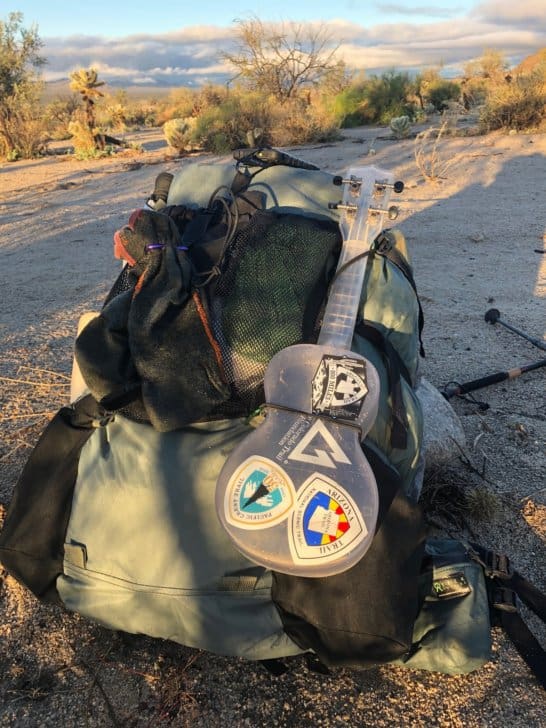
A ten-day trip is insufficient to assess long-term durability, but the Desert Trail dishes out plenty of pack (and human) abuse per mile. I routinely subjected the Seek Outside Divide 4500 to thorny vegetation and extensive abrasion from rock scrambles. The pack showed no damage or signs of wear. The side pockets are 500d Cordura. The back pocket is a mesh-solid hybrid, with the mesh a non-stretchy heavy-gauge material. These are the most vulnerable points on a pack when bushwhacking, but they were undamaged.
The laminated X-Pac material forming the main bag is heavy (4.4 to 7 oz/sq yd, 150 to 240 g/sq m) and somewhat stiff. This material is exceptionally waterproof (200 PSI, 140K mm H2O) but must be seam-sealed to achieve full water tightness. I hiked for hours in the rain one day with the pack exposed and noted only minimal water infiltration, despite not having seam-sealed the pack.
Close inspection of the Divide 4500 revealed its workmanship to be top-notch. The seams are straight and even and are double-seamed or zig-zagged for strength where appropriate. Seams are covered with tape to prevent fraying, and no loose ends are left to unravel.
Configurability
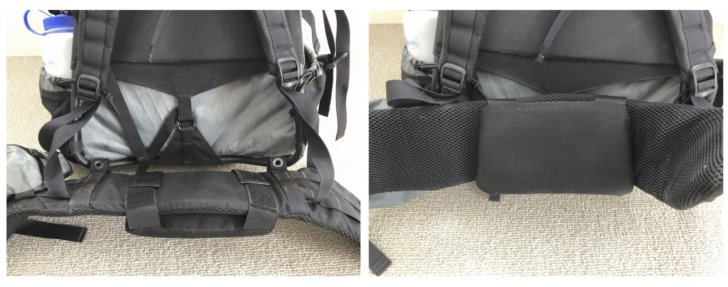
A key attribute of the Seek Outside Divide 4500 is its flexibility and how easy it is to configure. I ordered my tester pack with the lighter gray Xpac fabric (the heavier olive material adds 3 oz / 85 g), a lumbar pad (+ 3 oz / 85 g) and a hipbelt pocket (+ 2 oz / 57 g). I opted against ordering the frame extensions, which increase load capacity because I have no intention of ever carrying 60+ lb loads. A top lid is also available.
I adjusted the torso length per the manufacturer’s instructions, a fairly simple operation. I tested the ride of the pack with and without the lumbar pad and opted to keep it mounted as it increased carry comfort with heavier loads and also increased air circulation along my back. I retained the removable horizontal stay (2.5 oz / 71 g) for the same reasons.
Among the distinctive features of this pack are the numerous loops for strap attachment, and the use of gatekeeper buckles for rapid attachment and removal of straps. To minimize weight, I opted to leave off the top “V” strap, the two bottom straps, and used only two, rather than three, side compression straps. The trail weight of this arrangement (size M hipbelt), was 3 lb 6 oz (1.5kg).
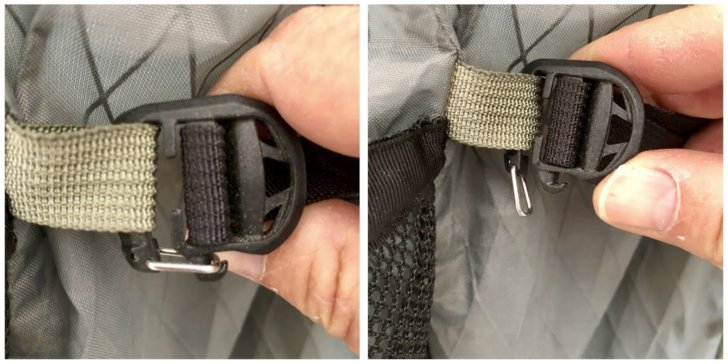
The Divide has no hydration ports, which increases its water tightness and suitability for packrafting. It has two very large side pockets. Each pocket can accommodate two 1 L Nalgene or two 1.5 L Smartwater bottles. I prefer to hydrate on-trail with a bladder. It was little trouble to fit a Platypus 2.0 L Hoser bladder in a side pocket, clip its top loop to a compression strap with a mini-biner, cut the drink tube to size and clip it to the shoulder strap.
Load Carry
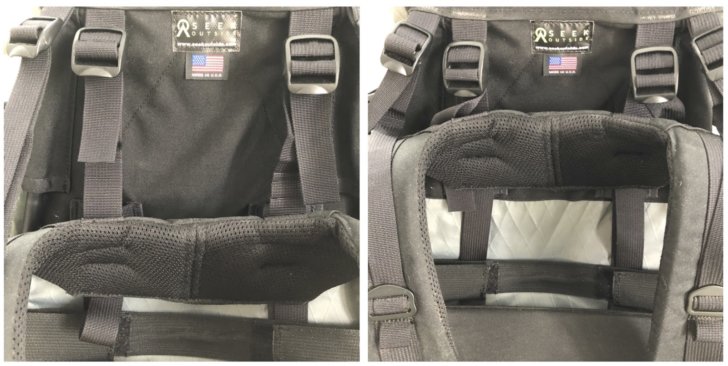
The Seek Outside Divide 4500 is not an ultralight pack. To justify its weight, it has to carry heavy loads securely and comfortably. A 0.5 inch (1.3 cm) anodized 6061 T6 aluminum external frame is key to load capacity. The frame runs in a U-shape around the perimeter of the pack bag and has a concave curve at the bottom to wrap the pack closer to your body. This geometry keeps the pack’s center of gravity closer to your center of gravity.
The shoulder straps and hipbelt are well-padded. The hipbelt is 5 inches (13 cm) wide and has two independently adjustable 1-inch (2.5 cm) straps. I find the two-strap configuration to provide a superior fit, both on this pack and other packs I own.
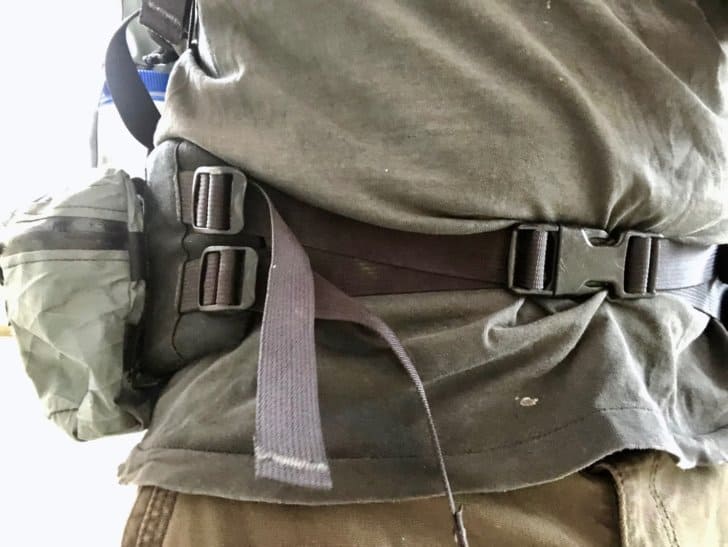
The Divide carried loads of up to 40 lbs (18 kg) over rough terrain with minimal flexion and no buckling. The load remained well-distributed at all times, and the pack was easy to balance without much fuss. I believe it could easily cope with an additional 20 lbs (9 kg), but I am not anxious to test this assertion.
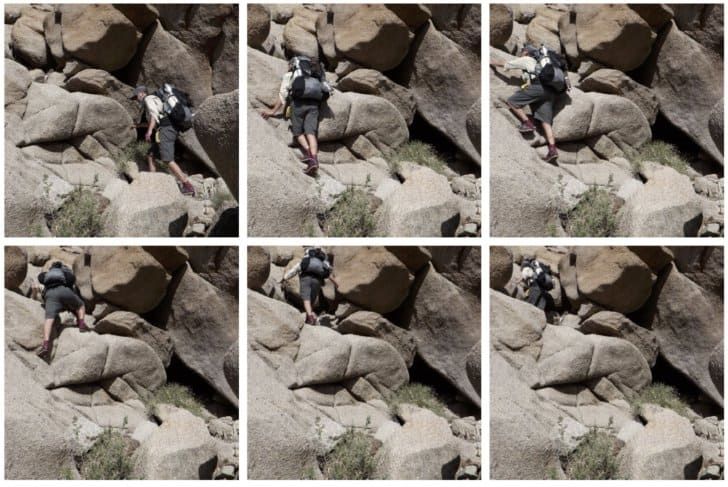
Equally important on this hike, the Divide moved with me on innumerable scrambles, climbs, and sidehill traverses. At no time did I feel thrown off-balance by the pack. The Divide hipbelt is articulated, which simply means that it is attached along the bottom edge of the frame and can swivel up and down. This feature is very helpful when scrambling over rocks and reaching for handholds.
In short, the pack’s ability to move with me was superb. It made carrying 30 to 40 lb (12 to 18 kg) loads about as comfortable as is possible.
Compared To…
Last fall, I bought the Andrew Skurka-designed Sierra Designs Flex Capacitor 60-75L. This pack checks many of the same boxes as the Seek Outside Divide 4500 concerning capacity and compressibility and addresses many of the same use cases. I have taken the Flex Capacitor on two trips: a 4-day fall loop through the canyon country of western Colorado, and a winter overnight in the Front Range foothills.
The Sierra Designs Flex Capacitor 60-75 L vs. the Seek Outside Divide 4500
| Criterion | Comments | Edge |
|---|---|---|
| Weight | Flex Capacitor 43 oz (1220 g), Divide 4500 54 oz (1530 g) | Flex Capacitor |
| Max volume | 75L both | Tie |
| Min volume | Flex Capacitor 60L, Divide 4500 50L | Divide 4500 |
| Carry comfort | The Flex Capacitor has a high center of gravity, making it tippy. Single-strap hipbelt constantly loosened and slid down | Divide 4500, big time |
| Durability | Mesh side pockets of Flex Capacitor were shredded in bushwhack. The Divide 4500 is made of much burlier material. | Divide 4500 |
| Configurability | Few attachment points on Flex Capacitor, the Divide 4500 has many attachment points. | Divide 4500 |
| Organization and accessibility | Flex Capacitor has a zippered top lid and zippered main opening (works better than you think). Divide 4500 has back mesh pocket (good) and long roll-top opening (not great) | Flex Capacitor |
| Cost | Flex Capacitor $220, Divide 4500 $359 base | Flex Capacitor |
Strengths
- Rugged and durable
- Comfortable carry
- High capacity
- Waterproof with seam-sealing
- Adaptable storage options
Limitations
- Heavy. Best use cases are cold-weather trips, guiding, packrafting, hunting, and long water/food carries
- Hip pocket access is awkward
- No hydration ports or sleeve
Where to Buy
- You can buy the Seek Outside Divide 4500 here.
Related content
Podcasts:
- Ryan and Andrew talk about load-hauling, and interview Seek Outside founder Kevin Timm in Episode 26 of the Backpacking Light Podcast
Forums:
DISCLOSURE (Updated April 9, 2024)
- Product mentions in this article are made by the author with no compensation in return. In addition, Backpacking Light does not accept compensation or donated/discounted products in exchange for product mentions or placements in editorial coverage.
- Some (but not all) of the links in this review may be affiliate links. If you click on one of these links and visit one of our affiliate partners (usually a retailer site), and subsequently place an order with that retailer, we receive a commission on your entire order, which varies between 3% and 15% of the purchase price. Affiliate commissions represent less than 15% of Backpacking Light's gross revenue. More than 70% of our revenue comes from Membership Fees. So if you'd really like to support our work, don't buy gear you don't need - support our consumer advocacy work and become a Member instead.
- Learn more about affiliate commissions, influencer marketing, and our consumer advocacy work by reading our article Stop wasting money on gear.


Discussion
Become a member to post in the forums.
The Seek Outside Divide 4500 (54 oz / 1531 g, $359) is a high-capacity external frame backpack designed to carry heavy loads.
It’s an amazing pack. In the quarantine, I was hiking around the city with a pack to get some exercise. I loaded it up and weighed it. It said 40 lbs but didn’t feel even close when I was wearing it. I figured my scale was broken. I then took out everything and weighed it individually, knowing that the 20 lb ankle weights were indeed 20 lbs. The scale was right. I loaded it up to 50 lbs just to make the relatively flat hike harder. Carried like a dream.
Thanks for the review!
I purchased my pack early this winter and got in close to a dozen winter trips. Just finished the Bob Marshall Open and used the same pack.
I really like this pack for winter camping, or any trip where you need more volume or are carrying heavy loads. The X Pac material is bomber and as close to waterproof as a pack can be. It carries extremely well, much more so than an internal frame pack I’ve used (and that’s been a lot of them!). The same frame is used by big game hunters and can easily handle loads of 100 lbs (wether one could handle carrying 100 lbs is a different question). If I’m only packing 20 lbs or less and don’t need the volume, I’ll choose another pack- otherwise the Divide gets the nod.
It’s lightweight for an external frame pack, ultralight might be a stretch. For longer trips, winter trips and trips that require carrying more weight- I think you’d be hard pressed to find a better pack.
Really nice review, but four YEARS late. I’ve been trumpeting this and the Gila 3500 for years and all I got was crickets…..even though I’ve used it for 6,000 miles…yea I know sour grapes but really?
Nice review. Based on the photos, I personally would be exchanging the hip belt for a size up. I don’t like when the padded wings barely end on the sides of my hips, like this one appears to in the photo.
What’s the consensus on this? Should a padded hip belt wrap around more for better comfort, or is it sufficient as shown in Drew’s photo?
I definitely prefer mine to wrap around more than what is pictured. I’ve seen some folks where them where there is only an inch gap, that’s too much the other direction. The sweet spot for me is having that belt fully enclosing the front of my hip bones
My own preference would be a longer hip belt with a greater degree of wrap. Perhaps this also impacted the usefulness of the hip pocket on Drew’s trip?
^ very possible; I have the optional hip pockets on mine and are easily accessible and unlike other manufacturers, the SO ones are very generously sized so you can fit a fair amount ear in them
Re: hipbelt sizes, @olias_of_sunhillow, @mtwarden, @jjmcwill
My waist size is 34″, at the upper range of the medium size spec (29-34″). I opted for that because my waist shrinks during hikes and I hate running out of room to tighten down.
Even though I am at the upper end of the nominal range, you’ll note there is plenty tag end on the straps. Something to keep in mind if you are deciding between sizes. Although I can’t speak for Seek Outside, I bet they would accommodate you if you asked to order two and return one.
How much wrap one prefers is subjective of course. I found the hip belt ride of the Divide 4500 to be one of the most comfortable of the many packs I have owned over the decades. Perhaps the large size would have been even better, but I have no complaints.
+1 on the hipbelt comfort and overall ride of these packs. Between my sons and I we have 2 Divides and one Unaweep (another model with the same suspension). Carries great from 15# to 65#, and able to cinch down or expand as needed to position the loads accordingly.
Old school design (…bag, hip belt, and shoulder straps all connected directly to frame) meets modern materials and adds some new tricks.
We recommend at least 1.5 inches past the front of the illiacs . The Lumbar pad does reduce the belt wrap slightly.
Yes we exchange belts all the time to get the right size.
Am I missing something here?
The Divide’s been around at least 4-5 years and extensively written about and discussed on various threads on BPL with a bunch of informal reviews. If BPL felt compelled at this late stage to publish a review it would have to add some value beyond what’s already out there. Why bother doing a “Limited” review with marginal additional value?
Or follow up with a longer term review.
I agree with the review and have for years. I too wonder about BPL reviewing years old gear like the Divide, the Moment as well. Both well discussed in the forum. The Divide review is also labeled new features but nothing is mentioned.
A great pack but an odd timed review choice.
Delete less, discuss more. Learn.
I really like reviews like this with less bias that you would find on the forums. Additionally, this pack has changed over the years and is likely not the same pack as when it first came out (i.e. like many products we see in this market). It also gives an opportunity to the manufacturer to respond to questions (thanks Kevin).
Keep these reviews up; it is why I have recently come back as a member.
Isn’t it a “heavy” backpack?
From the article, “The Seek Outside Divide 4500 (54 oz / 1531 g, $359) is a high-capacity external frame backpack designed to carry heavy loads.”
I suspect there would have been a lot of criticism and gnashing of teeth for reviewing a “heavy” pack 4 or 5 years ago. Seems you can never please everyone. In comparison, a lot of people tell me I can’t be a lightweight or UL backpacker with my 1971 Kelty D4 external pack (57.50 oz/ 1630 g, $40), which weighs 3.5 ounces more than the tested Seek Outside pack. How’s that for dollar cost averaging — $0.82 cost per year.
From my trip a few days ago in the Santa Rosa Mountains . . .
BTW Drew, nice review. Lost Palms Canyon is more fun going the other way (down) with an external ;)
I used a Brooks SO pack for a 21 day backpacking trip in November 2017 and it has some pros and cons.
Of course I really liked the waterproof Xpack material (is this what it’s called?)—and liked the full length zipper on the pack body for quick dumping of all my gear in camp. And liked the roll top feature. And of course the overall lightness of the pack.
Here’s the pack at the beginning of the trip. Since I wanted a pack lid (it didn’t come with a lid) I had to use my old Mystery Ranch lid along with some gatekeeper buckles and straps etc. Pack weight on this 21 day winter trip was about 85 lbs.
Gatekeeper buckles. While these buckles offer great flexibility—you can put them anywhere on any strap—they had the irritating propensity to open up without my permission—often when the pack was on the ground during a reststop or moved along the ground for slide-under blowdowns. Then gear would dangle off the pack etc.
The main criteria for a pack is its comfort level—how does it feel after hiking all day with significant weight? Here is where the Brooks pack failed me. Of course it must be remembered I was carrying around 85+ lbs. The first problem is shown above—by how close the metal frame comes to the hipbelt. I tried all three configurations for hipbelt placement and always got the same results—the nagging nuisance of the frame hitting my hips most especially when twisting to get around trail brush and blowdowns.
So much weight caused the pack to SAG which put tremendous stress on the hipbelt/frame combo thereby causing the pack to sag uncomfortably. There’s just not enough clearance between the hipbelt padding and the frame.
Another problem was with the shoulder harness. Looks normal in this pic, right?
Well, right behind the shoulder/back padding are two metal slide buckles—and these eventually became hot spots on my back and became noticeable after several days of the trip. Just some thoughts.
Tipi – Interesting thoughts on the pack – I used a Unaweep 4800 that I modified slightly (2lb 15oz now) on a 14 day unsupported trip and when one of the guys I was with rolled his ankle in an Alder thicket, I ended up carrying 40lbs after taking some of his gear, and also used it on an 11 day unsupported backpacking/packrafting trip where my starting weight was over 40 pounds and I thought it was wonderfully comfortable. I felt like my body would give out before the frame, which at 85 pounds my body probably would have given out!!! That’s impressive !!
“Additionally, this pack has changed over the years and is likely not the same pack as when it first came out (i.e. like many products we see in this market)”
“ The Divide review is also labeled new features but nothing is mentioned.”
Well?
— We changed from Bachelor Buckles to GateKeepers.
— Slight changes to back pad
— Tabs on pack bag to thread the harness
— Colors / Fabrics … slight changes. We added Cordura bottle pockets vs X-pac
— 3rd grommet on belt and dual tension forward pull.
Pack fit is subjective and a bit dependent on body type. For the most parts, Tipis experience does not seem to consistent with the feedback we receive regarding GK, tabs , frame etc. However, it does not work for everyone for whatever reason. One thing we have changed is how we send it which should fit everyone pretty good out of the box. The longest heavy load test I know of is one of our original testers on a prototype did 105 lb dry weight for 30 plus miles over 3 days. However, we have had people carry up to and possibly above 160 several times. I know of one other customer that carried about 130 lbs 16 plus miles in northern alaska on a pack out as well.
Thanks Kevin.
Tipi – curious as to how many miles you hiked with 85 lbs? what was your daily mileage?
How did you pack your pack? Seems like most of your food was probably down at the bottom of the pack so that you do not have to remove the food weight every day – did that probably cause the discomfort near your belt? But, I guess you dont want your sleeping bag at the bottom all the time as that would mean removing all the food every day from your pack…just curious.
Murali—on that particular trip I pulled approx. 61 miles of backpacking with the Brooks.
I always put my down sleeping bag at the very bottom of the pack as it’s the last thing pulled out of the pack upon camp arrival. On top of the bag are the 2-3 big food bags—with other gear sandwiched between the bags like stove and rain jacket and a couple books etc. The food weight helps to keep the sleeping bag in its stuff sack compressed.
Here’s the pack in action on South Fork Creek in Citico wilderness TN—
“right behind the shoulder/back padding are two metal slide buckles—and these eventually became hot spots on my back and became noticeable after several days of the trip. ”
I am trying to figure out what you are saying here. Do you mean the padding was not sufficient?
David—yes, the pack pressed tight against my back shoulders and I felt the metal buckles. Extreme weight changes everything when it comes to backpack comfort.
I own a Unaweep 4800. On the hip belt pocket issue – the way that the webbing in the hip belt is set up, any MOLLE-based pouch will attach to it. This system is a little heavier than the ultralight flexible-ribbon hold method typical of Zpacks, HMG, etc, but the trade-off is that you have a MUCH larger population of pouches to choose from, and they’re MUCH cheaper. Just go to Amazon and type in “MOLLE” and see what I mean.
Become a member to post in the forums.