


Introduction
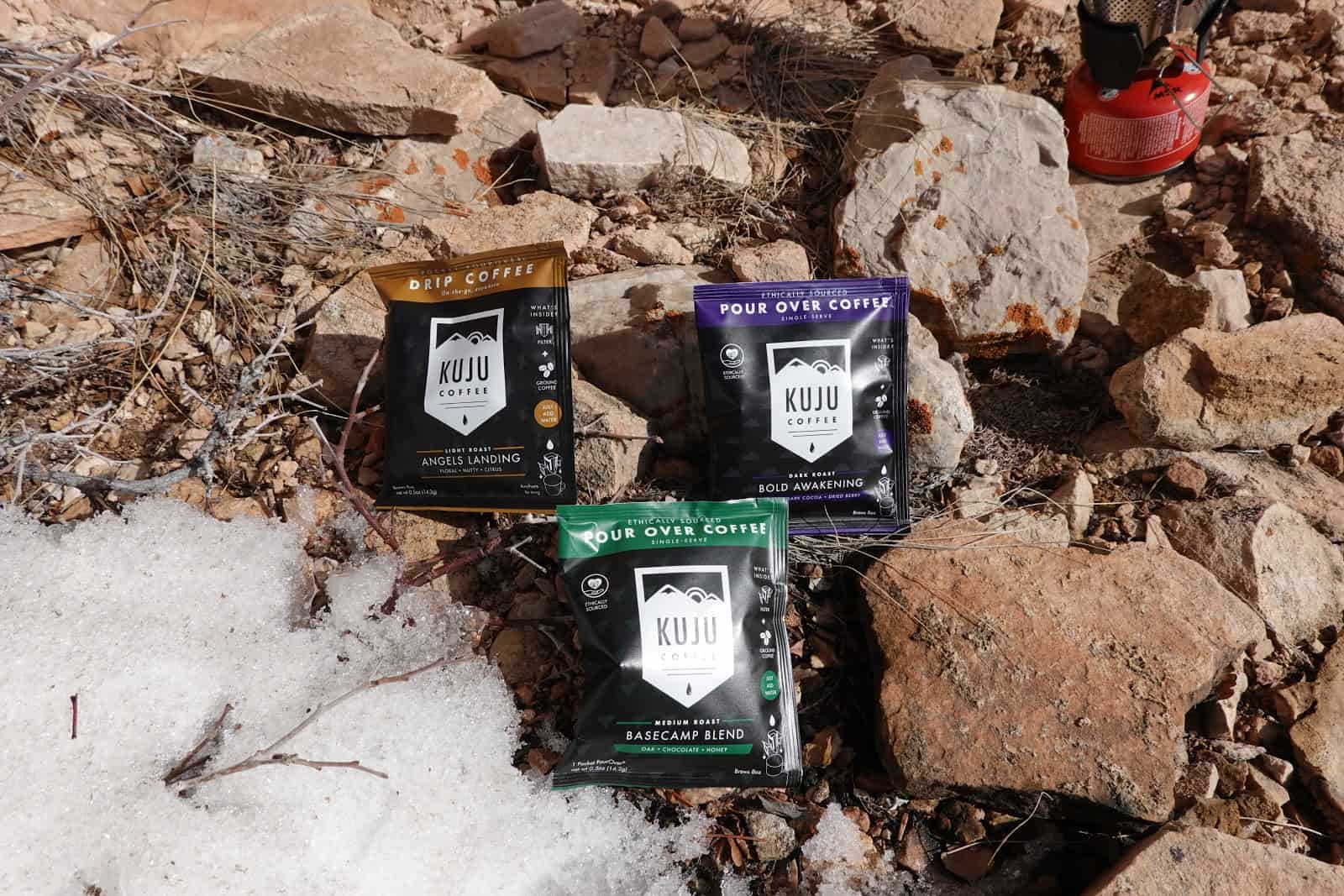
While preparing for a 10-day trek in the Sierra Nevada near Mammoth Lakes, CA, I discovered Kuju Coffee Pour Overs in my search for the elixir from the gods – coffee. This find struck gold. Kuju Coffee has since become a staple in my backpacking kit.
SUMMARY
Kuju Pour Over Coffee
 Kuju Pour Over Coffee is a high-quality craft coffee packaged in a disposable pour-over package. – $2.50 at REI.
Or search all merchants for current sales on Kuju Coffee »
Coffee is an intrinsic part of my day in the backcountry. Whether it is a morning cup of Joe while writing and composing and enjoying the sunrise, a celebratory cup on top of a mountain pass, or a cup of coffee as dessert after a long day, I find that it is vital for myself to take the time to make good coffee and start, continue, or end my day on the right note.

I have tried several different kinds of instant coffee over my many years of backpacking. Some instant coffees, like Folgers, I drank once before packing the rest out and never purchasing again due to the acrid and charred taste. Starbucks Via seems tolerable, but often tastes slightly burnt and the bitterness covers the flavor profile. But is “good ‘nuff” sufficient on a 10-day expedition or an overnight backpack? Because of my constant search to find a delicious brew, I often pick something up at local shops before I head to the trailhead. It seems that my personal answer is that coffee should be the highlight of my food intake every day. My personal preference for coffee is that it is rich, complex, smooth, and the flavor profile is distinct instead of muddled.
Kuju Coffee Purchasing Options
Kuju Coffee offers six pour-over coffee roasts: three in their standard coffee line, and three in their premium single-origin line. This review will only cover the three standard pour-over coffee roasts, as I have yet to acquire the premium roasts.
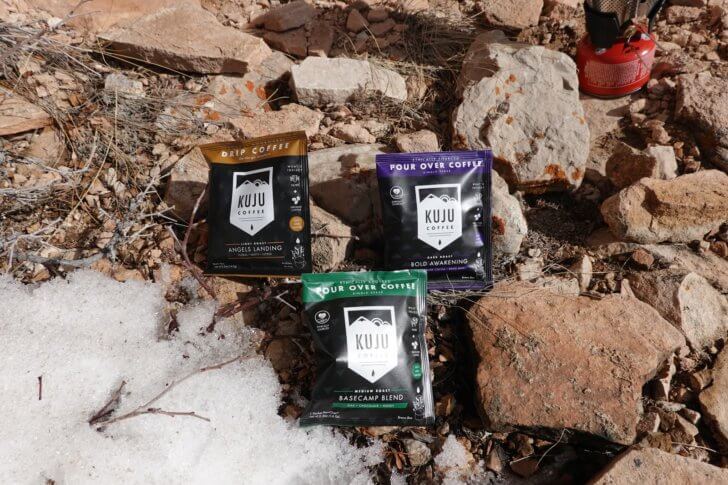
The primary differences between the standard roasts and the premium, single-origin roasts are the following:
- The single-origin pour-overs are $30 per 10-pack, as opposed to $22 per 10-pack for the standard roasts.
- The single-origin pour-overs are certified fair trade organic while the standard roasts are not.
All Kuju Coffee is:
- Ethically Sourced
- Made with Wind Power
- Nitro-Flushed for Freshness
- Supports 1% for the Planet
- The net weight is 0.5 oz (14 g), and they make 8 oz (237 ml ) of brewed coffee.
Basic Roasts:
- Bold Awakening (Dark Roast)
- Basecamp Blend (Medium Roast)
- Angel’s Landing (Light Roast)
Premium, Single Origin Roasts:
- Ethiopia
- Indonesia
- Papua New Guinea
Product Assessment
In this remainder of this review, I will discuss the pros and cons of Kuju coffee concerning:
- Taste
- Ease of Use (Including a brief discussion of making pour-over coffee in the backcountry)
- Ethical Sourcing of Beans
- Environmental Impacts
Taste
Kuju coffee is by far the best-tasting camp coffee I have tried on the market, far surpassing instant coffees such as Starbucks Vias without creating brewing hassles such as long preparation, and time-consuming and messy cleanup.
My personal favorites are the light roast (Angel’s Landing) and the dark roast (Bold Awakening). The excellent taste of Angel’s Landing surprised me, as I am generally not a fan of fruity coffees. I found the flavor profile (look at this if you aren’t familiar with coffee tasting terminology) of the medium roast (Basecamp Blend) as indistinct and neutral. Overall, the coffee is smooth, and the flavor profiles are not covered up by bitterness. The body of the three coffees is relatively lighter compared to most medium roasts that I’ve tried (whether brewed at home or in a coffee shop).
In the table below, I will compare the coffees advertised flavor profile with my own tasting notes from trips in the Sierra Nevada (CA; August ‘19), and the Sherman Range (WY; December ‘19).
| Coffee Roast | Flavor Profile from Manufacturer | Personal Flavor Notes |
|---|---|---|
| Angel’s Landing (Light Roast) | Floral, Nutty and Citrus | Bright, Tangy, Fruity, Sweet (Sherman Range, WY, 8/19) |
| Basecamp Blend | Oak, Chocolate, Honey | Light flavors, woody, muted (Sierra Nevada 8/19) Woody, indistinct, neutral (Sherman Range 12/19) |
| Bold Awakening | Earthy, Dark Cocoa, Dried Berry | Full, Rich, Dark, Complex, Lingering (Sierra Nevada 8/19) Full, Dark, Complex, Slightly Sweet (Sherman Range 12/19) |
Ease of Use
It is effortless and straightforward to use the Kuju Coffee Pour-over Pouches in the backcountry. On my trip to the Sierra Nevada, I made them in my MYOG cozy around a Ziploc container and boiled water with a Jetboil Stove. In the Sherman Range, I used a titanium mug with an MSR Windburner.
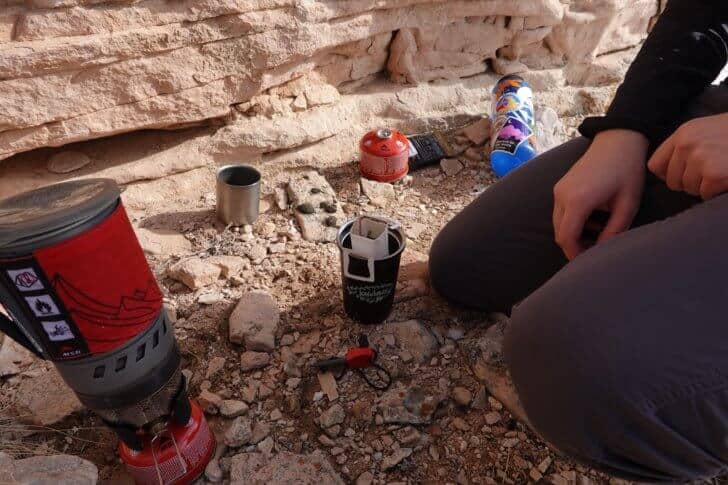
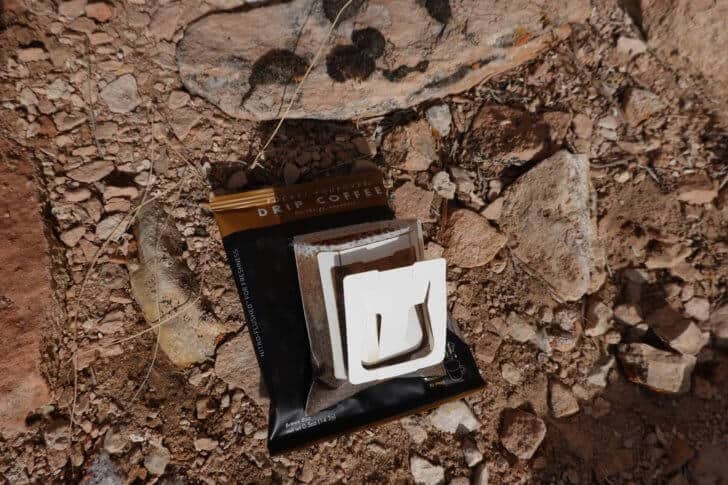
The single-use pour-over pouch was clean, convenient, and effective. No water escaped through the sides of the mesh fabric and filtered through the ground coffee beans quick enough to maintain a continuous pour without affecting the flavor. After letting the pour-over pouch dry in the sun or freeze in the cold in the winter, I had an easily packable square of trash to put in my backpack.
Step-By-Step Guide to Making A Kuju Coffee Pourover
- Set up your stove, and fill your pot with about 8 oz (237 ml) of water. Hook the pour-over pouch along the rim of your mug to secure it. In wider mugs and bowls, you may need to use your hand to hold it in place.
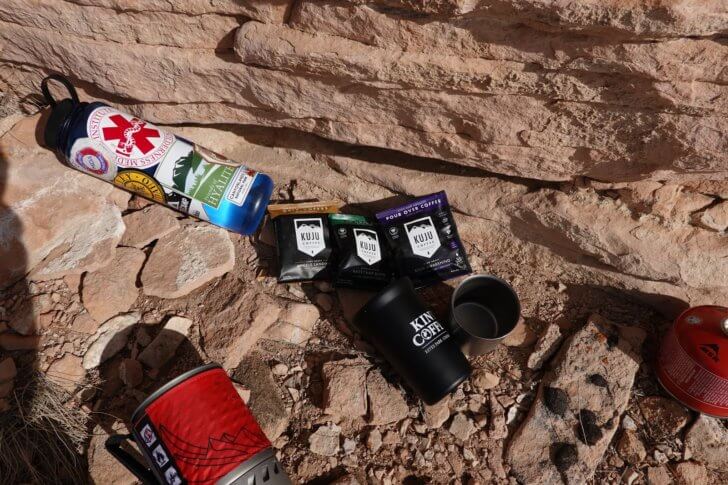
- Boil Water. Let cool for approximately 1 minute.
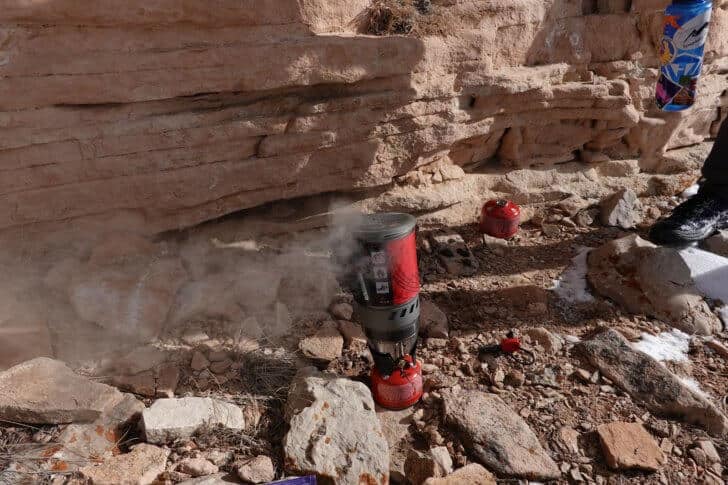
- Slowly pour your water through the pour-over pouch at a continuous rate. If you pour too quickly, water will spill out of the top of the pour-pouch, weakening your coffee; too slowly, and you won’t fully gain the flavor profile of the beans and you’ll be more likely to extract bitter oils as a result of the longer contact time.
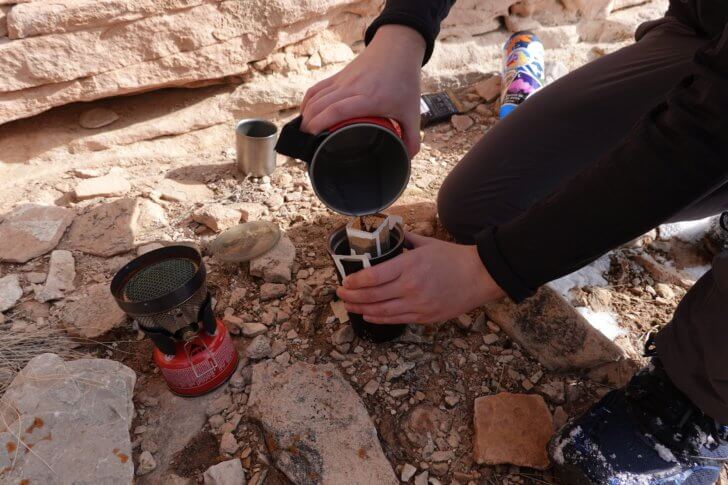
- Serve and enjoy! Let your pour-over pouch dry in the sun (or freeze in the December cold) to make it easy and clean to pack out in your trash bag.
Ethical Sourcing of Beans
Kuju coffee comes from a coffee farm in Thailand that employs former victims of sex trafficking as part of their workforce. This is part of the Source-to-Soul initiative in which they advocate using moral tastebuds in choosing the coffee we drink. Beyond this, there are no certifications that ensure the ethical sourcing of beans.
Environmental Impacts

One of the things that first caught my attention about Kuju Coffee is that it is produced in 100% wind-powered facilities. Additionally, Kuju Coffee donates 1% of its proceeds to the National Parks Foundation as part of the 1% for the Planet movement.
On the downside, the single-use nature of the product has the potential to create a lot of trash, including its mylar-coated packaging and the paper used in the pour-over pouch itself. Overall, the garbage is not significantly more than what is produced when using a pour-over cone. Still, the nature of single-use items is that they result in substantially more waste, when compared to bulk-packaged coffee.
Author’s Take
Overall, Kuju Pourover Coffees have carved out a role in my meal-kit for future trips and expeditions.

Despite creating slightly more waste to pack out in comparison to Starbucks Via, and other similar products, I feel the pros of this product outweigh this only con:
- The taste is superior to any other instant coffee or pre-ground coffee I have ever tried. Coffee should bring joy, and this elixir does just that.
- It is effortless and straightforward to make. It can be easily made during a quick pit stop in the afternoon, as dessert, or as part of an aromatic morning wake-up.
- The idealist in me prefers to support companies that share my values. Kuju coffee is not only aware of the human and environmental impacts of the coffee industry, but it has also taken steps to make their business run in an ethical and environmentally friendly way.
Where to Buy
Related Content
- Ryan Jordan first reviewed craft coffee packaged in single-use pour-over packs back in 2015 when they first started hitting the market.
- For additional info about pour-over coffee and other coffee-making techniques, read Emelyne’s and Ryan’s article on coffee brewing.
- Listen to the Backcountry Coffee Episode on the Backpacking Light Podcast, where Emylene and Andrew talk ultralight coffee with a craft roaster.
- The author chose Kuju Coffee as one of their Staff Picks this year. See what other gear our staff picked as their favorites.
Disclosure
Updated November 7, 2019
- Product(s) discussed in this article may have been purchased by the author(s) from a retailer or direct from a manufacturer, or by Backpacking Light for the author. The purchase price may have been discounted as a result of our industry professional status with the seller. However, these discounts came with no obligation to provide media coverage or a product review. Backpacking Light does not accept compensation or donated/discounted products in exchange for guaranteed media placement or product review coverage.
- Some (but not all) of the links in this article may be “affiliate” links. If you click on one of these links and visit one of our affiliate partners (usually a retailer site), and subsequently place an order with that retailer, we receive a small commission. These commissions help us provide authors with honoraria, fund our editorial projects, podcasts, instructional webinars, and more, and we appreciate it a lot! Thank you for supporting Backpacking Light!
- Read about our approach to journalistic integrity, product reviews, and affiliate marketing here.


Discussion
Become a member to post in the forums.
Companion forum thread to: Kuju Pour Over Coffee Review
Kuju pour over coffee singles are direct-trade, ethically-sourced coffee packaged in a single-serving disposable pour over pouch.
Nice review. I have to admit that nothing beats a fresh pour-over. However, I also have to point out that at $2-$3 per the price is arguably over the top…and you have to accept Kuju’s choice of bean and roast.
Contrast with purchasing the exact same disposable filter structure for just under $.02 each and using the bean/grind of your choice.
I agree with John, at approx $2.50 per serving I’ll have to pass on the Kuju. I use an MSR Mugmate WITHOUT a filter. Just requires a little water to rinse clean, but I find the coffee has a much better flavor than with a filter (and less waste to pack out). I can’t really see where the waste that goes along with the Kuju is being very green, and again more waste to pack out.
Mugmate is also my choice for pour-over in the field. Simple, no waste, a quick rinse to clean up.
Just put a helping of grounds in your bandana and soak for a bit.
Toss the grounds away from the camp site.
Hae to admit that I use Starbucks VIA. Lighter and smaller package
than carrying grounds.
Larry S
Chase is missing the blindingly obvious! He is using a MSR Windburner, the easiest and most cost efficient option would be to buy the Windburner coffee press. Less of a hassle (I can’t imagine using that pour over system in a stiff breeze), and less waste to pack out. It’s funny that Kuju touts all this feel-good environmental blather while generating a substantial amount of packaging waste, all to brew a stinkin’ cup of coffee!
…and an eight ounce cup at that. Hardly worth the bother
The pop-up/disposable/pour-over novelty is cute and clever, but I agree with others…spare me the environmental signalling when your idea hinges on an expensive, single-use, disposable product replacing a reusable option like a Mugmate or simple cowboy coffee using grounds you’ve already got at home.
an expensive, single-use, disposable product
It is , isn’t it? I dislike the throw-away society.
What puzzles me is how the “flavour profile” coffee is described by the vendor, for instance “Floral, Nutty and Citrus” or “Oak, Chocolate, Honey”. Am I supposed to believe this ridiculous marketing spin? I would far prefer that my coffee smelt and tasted like … coffee.
Cheers
“simple cowboy coffee using grounds you’ve already got at home.”
If you’re going to go to the trouble of brewing real coffee, it doesn’t get any simpler, or better, IMO, than this. If not, then use your preferred instant coffee with its minimal packaging/repackaging. Simple and minimal is the name of the game, as far as I’m concerned.
What do you carry your ground coffee in? I had a container which, when I weighed it empty, was 4 oz!
I really try to avoid good smells like coffee in my backpack. Or permeating my food bag. The 4 oz container worked way better than most other packaging, but I haven’t carried it for years.
I recently started having a cup of coffee daily, more often than not. Helps with the energy.
I have been known to carry my coffee in a used moisturiser jar from my wife: weight 29 g (1 oz). Basic Sorbolene: unscented. Capacity for the two of us is about 4 – 5 days.
Other times I have carried it in double ziplock bags weight a few grams.
Cheers
Back in the day, we all carried our, ahem, dank vegetative matter in 35mm film canisters. They aren’t terribly big but work the business for containing smells and weight only 5.6g each. Today I use them to carry all kinds of things because they are very robust and don’t open easily in your pack. The positive side of the small size is you can simply carry several and scale to match the length of trip. They work great for repackaged Via/instant coffee or ground bean and you can buy them rather cheaply.
Edit: I just noticed the reviews of the product I linked to complaining of the lids not fitting correctly. While I bought the product linked in 2014, they are perfect, functioning exactly as they did in 1978. There are lots of other film canisters available…I bought these because they were exactly like the Kodak canisters of my youth.
“Back in the day, we all carried our, ahem, dank vegetative matter in 35mm film canisters.”
Man does that bring back memories! :-)
they are very robust and don’t open easily in your pack.
A bit small for their weight maybe?
I have a collection from long ago, but some of the lids have shattered. Just the lids. Most unsatisfactory.
Cheers
Yeah…They are not large but have their plusses and minuses. May not be optimal size for coffee, but are great for many other things. I only use the black ones with smooth grey tops. The ones with indented tops do not seal as securely in my experience.
I usually carry Starbucks or trader joe instant packets. But I was thinking of bringing the Italian espresso instant coffee that comes in the little green glass jar. I really like the taste of it, and it’s nice and strong. Plus I can repackage and not have lots of small wrappers. But I was trying to think of a better way to package it and also concerned about making everything in my food bag smell like coffee; ziplocks don’t keep strong smells from spreading. Kind of everything in my bear canister smelled like misc spice packets on my last trip. Bleah. When your oatmeal tastes like taco seasoning…
I can’t imagine just dumping coffee grounds everywhere, near where people are going to camp. Just seems slovenly to me. Yes, they’re biodegradable and so is your poo.
Shug’s method works well. I just tie the bag off rather than using a twist tie.
^^^
An OUNCE+ of instant per (12 oz) cup?
…sounds more like coffee pudding :)
Let’s see, Shug says he prefers 1 oz of INSTANT coffee instead of say 0.5 oz pour over coffee, hmm. Guess it’s all a matter of taste, which can change with the times. I remember back when my mom (and most moms) made coffee with a percolator. Of course every aficionado nowadays will tell you that cooking coffee over and over (like in a percolator) destroys it,
https://www.youtube.com/watch?v=BWEYjEQ75ZM
I may be misinterpreting what Shug said, but given how he measured it out, it appeared that he was saying by cup he preferred 1 oz by volume, not 1 oz by weight.
Thanks for bringing Shug and the instant Italian espresso onto my radar….going to buy a jar and give it a try. Never seen him or that brand.
An ounce by volume/weight sounds pretty legit either way…probably helps explain his need to juggle ; )
Thanks for the write up, food information. I love me some coffee but have transitioned from coffee grounds to instant in the back country. Except for short trips by myself where the ritual of coffee is just as important as the coffee it self. I may give the pour over idea a try again. Most of the time I use a French press either in the jet boil or I have another one that fit one of my titanium pots. The later though does not have the lid that centers the plunger so you have to be careful as you press down.
Snow Peak Titanium French Press: excellent. Has lid.
SP sells replacement filters.
Cheers
Become a member to post in the forums.