

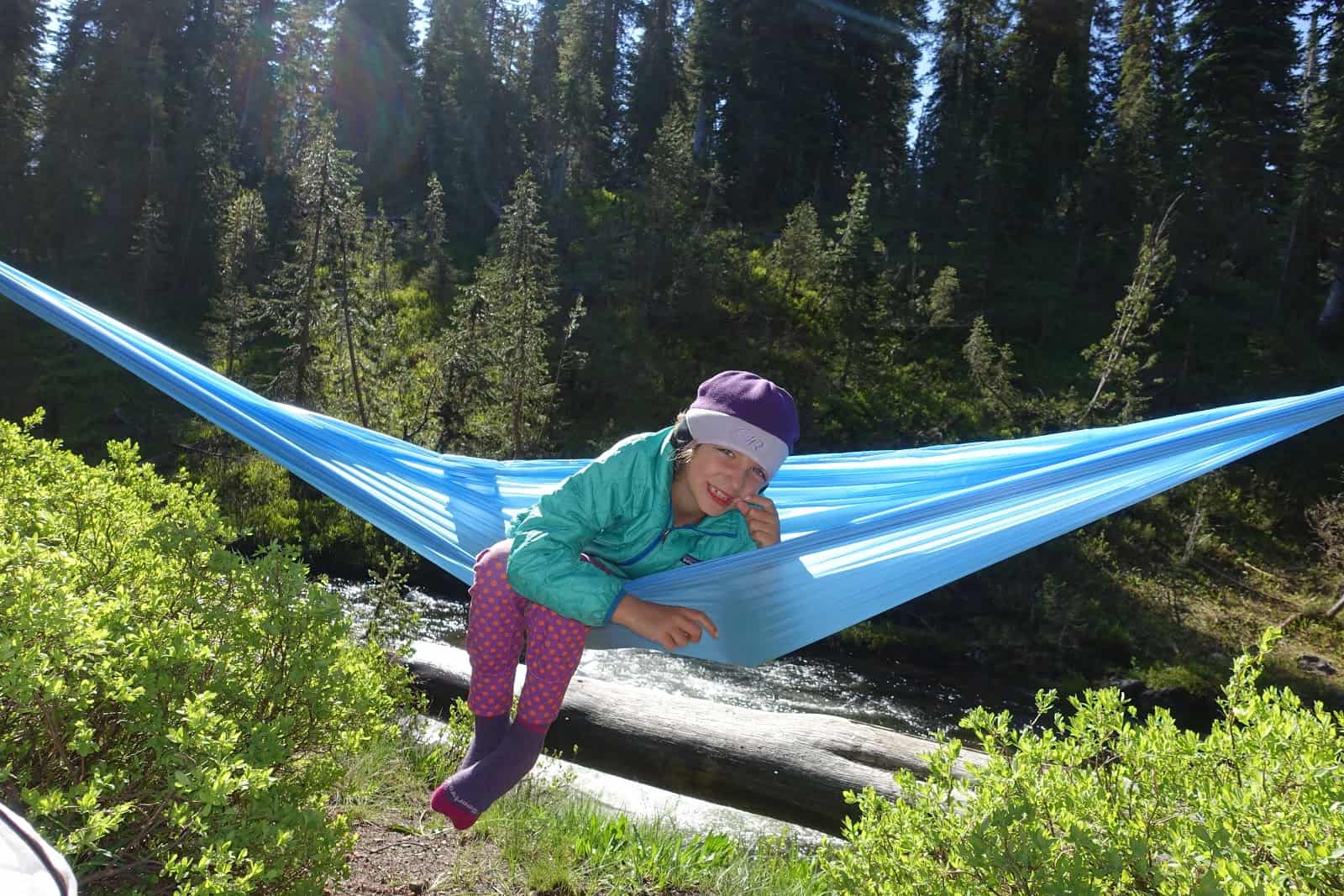
Lily relaxing in the Hummingbird Hammocks Single+ in the backcountry of Yellowstone National Park.
Introduction
Hummingbird Hammocks offers a variety of Made in the USA hammocks and accessories including three hammocks, two hammock tarps, a bug net, and other accessories. They have some unique features such as Button Links that eliminate the need for carabiners and integrated tree straps with whoopie slings which simplify the suspension system and make setup very easy. They also offer what is likely the lightest hammock on the market – the Single Hammock, which weighs a scant 5.6 oz. Can the lightest hammock also be the most comfortable?
Features and Specifications
SINGLE HAMMOCK
Features:
- Built-in Button Links for easy connection to straps
- Durable lock stitching on seams at head and foot
- Sewn-in stuff sack
Specifications:
- Materials (body): uncoated 1.1 ripstop nylon – PIA-C-44378 T4 Certified Reserve Parachute Fabric
- Materials (cord): 1500 lb Spectra Cord
- Weight: 5.6 oz (159 g) measured; manufacturer claim: 5.2 oz (147g)
- Measurements: 104 in x 47 in (264 cm x 119 cm)
- Capacity: 300 lb (136 kg)
- Cost: $64.95
SINGLE+ HAMMOCK
Features:
- Built-in Button Links for easy connection to straps
- Durable lock stitching on seams at head and foot
- Sewn-in stuff sack
Specifications:
- Materials (body): uncoated 1.1 ripstop nylon – PIA-C-44378 T4 Certified Reserve Parachute Fabric
- Materials (cord): 1500 lb Spectra Cord
- Weight: 7.7 oz (219 g) measured; manufacturer claim: 7.6 oz (215g)
- Measurements: 116 in x 63 in (295 cm x 160 cm)
- Capacity: 350 lb (158 kg)
- Cost: $69.95
HUMMINGBIRD HAMMOCKS SUSPENSION SYSTEM
Features:
- Tree Straps available in two sizes and feature Integrated tree webbing and adjustable whoopie slings
- Tree Strap Extensions with button link system add a combined 12 ft of reach
Specifications:
- Tree safe Mil Spec Type IV webbing (Tree Straps)
- 1500 lb Spectra Cord (Tree Straps, Extensions)
- Tree Straps: 1 in wide by 100 in. long each; 2.5 oz (71 g) with stuff sack; $29.95
- Tree Straps+: 1.5 in wide by 152 in. long each; 5.7 oz (161 g) with stuff sack: $39.95
- Tree Strap Extensions: 72 in long each; .8 oz (24 g): $19.95
PELICAN RAIN TARP
Features:
- Hexagonal tarp with door flaps for full hammock coverage
- Quick Adjustor ridgeline adjustment system
- Ten reinforced perimeter tie-outs
- Four panel tie-outs
- SilNet seam sealer included
- Sewn-in stuff sack included
- Optional Guyline Kit with 80 ft of cord, 4 titanium stakes, and 8 glow friction adjustors: 3.7 oz (105 g) $29.95
Specifications:
- Materials: .9 oz Silpoly silicone polyester fabric
- Weight: 13.6 oz (387 g) measured- seams sealed; (manufacturer claim: 12.8 oz (363g)
- Measurements: 137 in x 112 in (348 cm x 285 cm)
- Cost: $169.95
WARBLER BUG NET
Features:
- Full bug protection
- Included ridgeline cord
- Ultralight side zipper for easy entry
- Reinforced end closures with adjustable cord and cordlocks
- Sewn-in stuff sack
Specifications:
- Materials: .6 oz No-See-Um netting
- Materials (cord): 1500 lb Spectra Cord
- Weight: 6.4 oz (182 g) measured; (manufacturer claim: 6.3 oz (179g)
- Measurements: 110 in long x 51 in high (280 cm x 130 cm)
- Cost: $39.95
Review Context
I have used hammocks as a backpacking sleep system for many years. More recently, I have also been interested in using hammocks as an Ultralight Luxury item – something to provide relaxation and comfort in camp during more relaxed or family trips. These hammocks were reviewed with versatility in mind: both as a sleep system and as a luxury item in camp. For me, a versatile hammock needs to meet the following criteria:
- Comfortable for both relaxation and overnight sleeping
- Modular, with removable bug netting
- As light as possible – less than 12 oz (340 g) including suspension system, or less than 16 oz (454 g) with bug netting
- Easy to set up, adjust, and take down
Description of Field Testing
These hammocks were used on multiple trips over a 10-month period. Our family used these on an 11-day canoeing and backpacking trip in Yellowstone National Park, while backpacking on the coast of Olympic National Park, and camping through multiple states on a month-long road trip adventure. In addition, the hammocks were used at home for extended periods. Each hammock was used overnight by both children and adults.
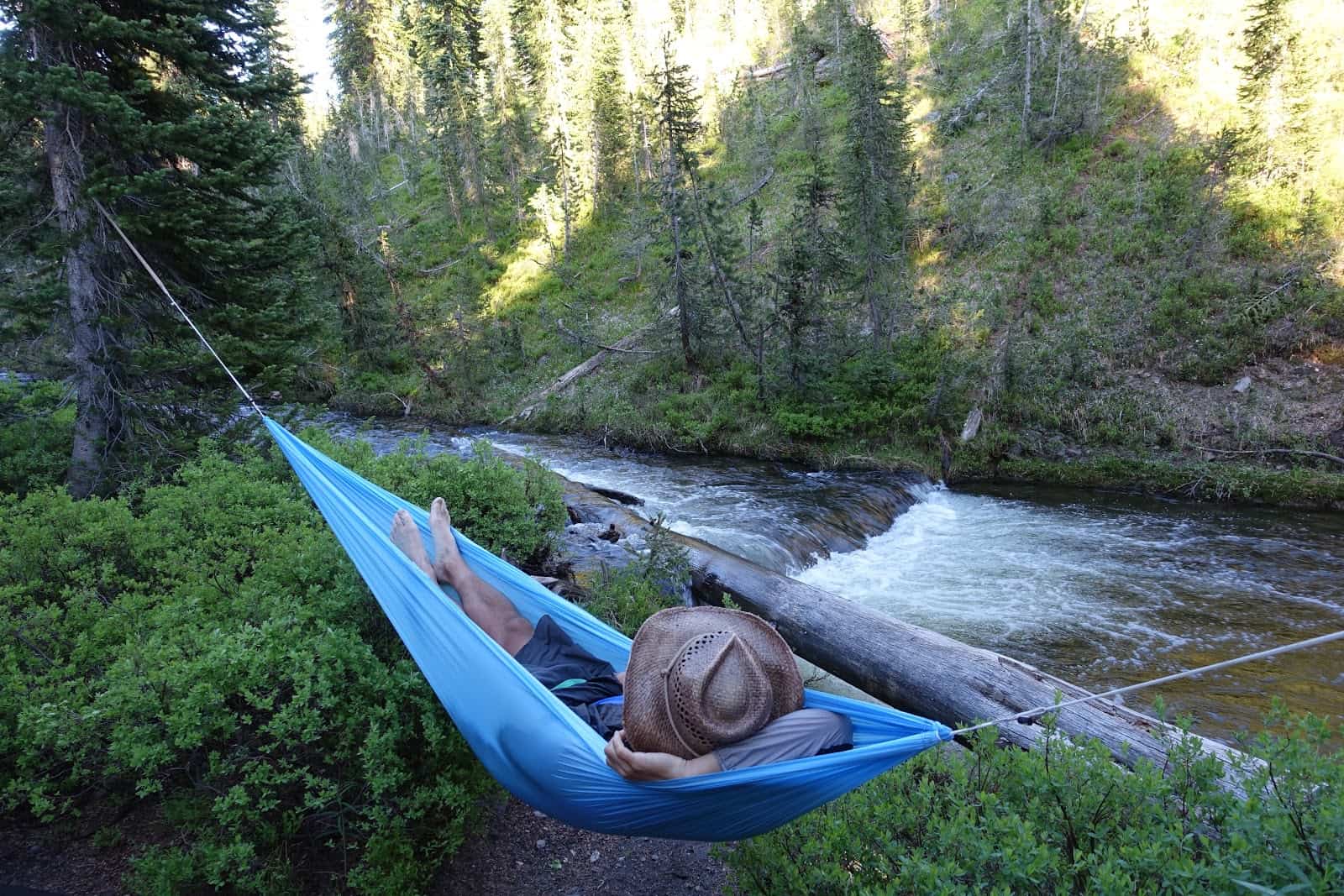
The author relaxing in the Single+ hammock in Yellowstone’s Bechler Area, using the optional Tree Straps and Extenders.
Performance Assessment
Member Exclusive
A Premium or Unlimited Membership* is required to view the rest of this article.
* A Basic Membership is required to view Member Q&A events


Discussion
Become a member to post in the forums.
Companion forum thread to: Hummingbird Hammocks Reviews: Single, Single+, Pelican, Warbler, and Suspension System
Hummingbird Hammocks offers a variety of Made in the USA hammocks and accessories including three hammocks, two hammock tarps, a bug net, and other accessories. They have some unique features such as Button Links that eliminate the need for carabiners and integrated tree straps with whoopie slings which simplify the suspension system and make setup very easy. They also offer what is likely the lightest hammock on the market – the Single Hammock, which weighs a scant 5.6 oz. Can the lightest hammock also be the most comfortable?
Doug, I also love the button links. My wife uses the Single + and I use a Dutchware Netless hammock and a Simply Light model. One difference I have noticed is that the Dutch and Simply Light fabrics don’t stretch (I forget what fabric option I chose when I bought them). I have tried hammocks from half a dozen different manufacturers, and they had no stretch in the hammock fabric either.
But I always feels a bit of stretch cuddling around the derriere area on the Single +. Not bad or anything. I kind of like it. But it’s different enough that I think it’s worth mentioning. May put some folks off???
Thanks for comparing to the BIAS hammocks. I have both the Weight Weenie and the Weight Weenie Micro and they are my go-to hammocks when I go out. I’m a big guy (6′, 280 lbs) and the BIAS hammocks are the most comfortable I’ve found AND they’re room in the stuff sack for the suspension.
I cannot fathom why Hummingbird would make their integrated stuff sack so small that it barely holds the hammock. I guess it has to do with “shelf presence” – “Wow…Could that softball-sized package really be a full-sized hammock?” The answer to that, unfortunately, is “No – You still need to carry a suspension elsewhere.”
Thanks Kevin- a comprehensive BIAS (Butt In A Sling) hammock review is coming soon. 👍🏼
I don’t think I would be comfortable squished in a piece of fabric as seen in the photo. I use a bridge hammock once in a while and that helps to eliminate the squished feeling.
If he didn’t have his arm under his head, the fabric would be tight to his neck, not comfy for humans, maybe emerging butterflies :-)
Hi Dan,
Actually, when I put my had down and got a diagonal lay, it flattened out quite well. It’s not as bad as it might look in that picture.
Best, Doug
I have been looking at hammocks as a replacement for the quilt/pad(s) I usually carry into the backcountry. I have recently had two neoairs fail rather drastically (one started delaminating and was replaced with an Xlite, the Xlite failed with multiple leaks in the bottom.) Fortunately, I had my NightLite but was forced to choose my ground a LOT more carefully…roots I could quickly cover over with a fairly firm Neoair are obsticals that cannot be ignored with a short pad, for example. And camp turned into a 10 minute chore of finding enough pine needles to level out the ground. I got another neoair to finish the trip, but I am still looking to replace it.
Generally, by my calculations, the weight of 2 pads/and a 20F quilt are significantly less than a hammock, 20F underquilt, and a 20F over quilt. Roughly, the underquilt at 17.5oz is equivalent to the pads and the quilts are the same. Only the hammock and whoopie slings add to the weight budget by about 10oz. This is a supper and some snacks for me. Are the benefits worth it? My old Hennessey was always uncomfortable, it never stopped swinging and moving it seemed.
Hi Marco,
Not sure what underquilt you have in mind. If it’s full length, I am looking into getting a shorter underquilt, in the 50″ range, and use a small foam pad for my legs. This should allow me to reduce weight and volume. I often carry a frameless pack and I like having that extra bit of cushy foam. The NightLite should be plenty, perhaps combined with the backpack for the coldest nights.
I thought it was interesting you count the hammock as part of the sleep system. But it makes sense. Until now, when I compare, I counted the hammock, tarp, cordage/hardware and socks (if needed) as part of the shelter when comparing weights to ground sleeping.
Yeah, Well I was looking to have the “chair” also. It is getting difficult to change cloths in the morning before I start packing… Clothing is a simple system of hiking cloths, sleeping cloths & jacket, and, as it gets lower in temps, my fleece/and a mid range set of long johns. Hiking, it is easy enough to stay warm during daylight. But at night, it gets much harder. Like my quilt, I would draw the line at 20F(-7C.) I cannot do any real winter camping anymore, but in the mountains, the temps often dip into the 20’s at night. Daytime temps are usually much higher, >40F. The additional weight is my concern, though. Eventually, I think I could tolerate the rocking with a stake/bungie to the hammock.
To my mind, shoulder season (spring and fall) is perhaps the most difficult. But it is very quiet and peaceful in the woods. Wet, cold rains, wet snow, half frozen trails can be difficult to handle sometimes, though. I would like to travel as light as possible, since I usually take a two week trip out, often with a 25-30pound pack in spring. Gone are the UL days of summer.
Become a member to post in the forums.