


by Andrew Marshall and Ryan Jordan
Introduction
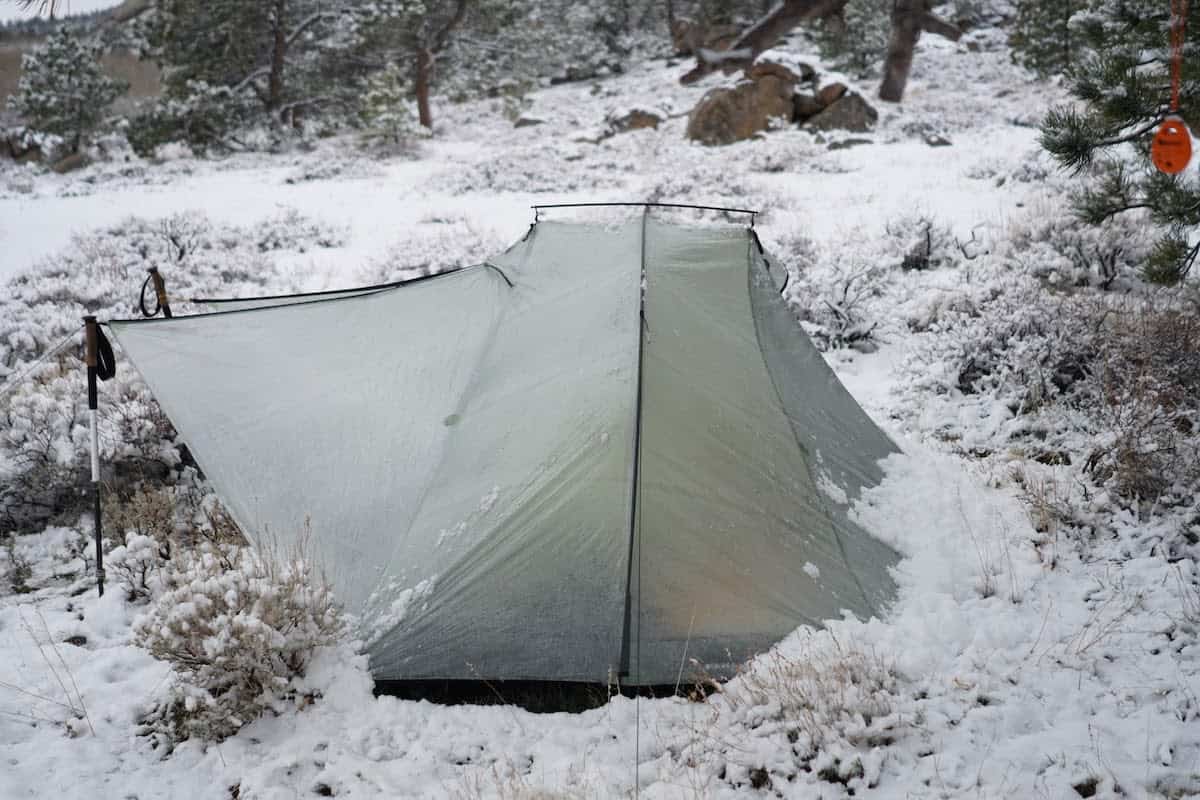
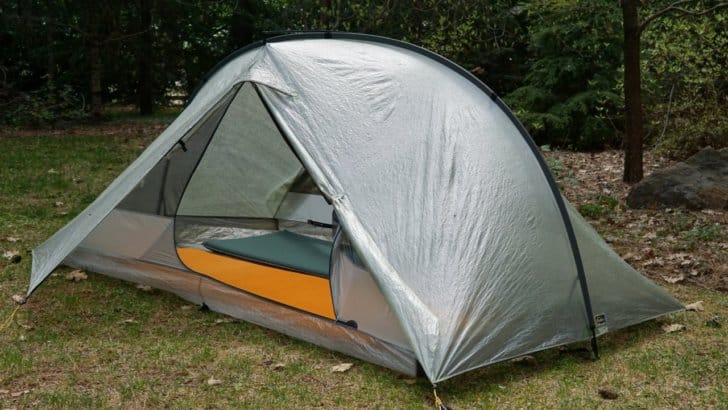
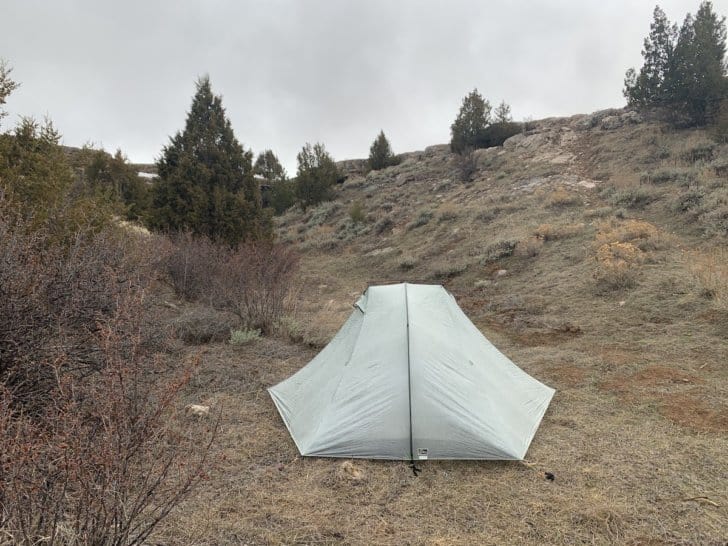
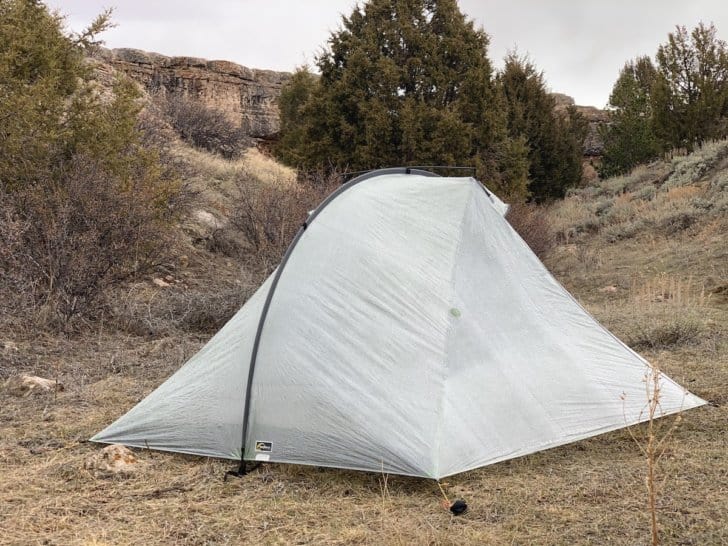
The Tarptent Double Rainbow Li is a 2-person, side-entry, 2-door (and 2-vestibule) hybrid single/double-wall tent made with Dyneema Composite Fabrics that weighs 27 oz (765 g).
Tarptent announced the Double Rainbow Li on April 23 and will make it available for sale beginning April 27. The Double Rainbow is Tarptent’s best-selling shelter, and the new DCF version will be one-third lighter.
We’ve had a few days to look over Tarptent’s specs for this product, and took it out for a spin this week to form some first impressions.
Watch the review video:
This article is sort of a hybrid First Look/Limited Review – it represents an initial performance analysis of a new product based on limited use in one type of climate and geographical environment. Herein, we make no claims regarding its long-term durability or performance in other environments. Learn more about the types of product reviews we publish.
Highlights
- Weight: 27 oz (765 g)
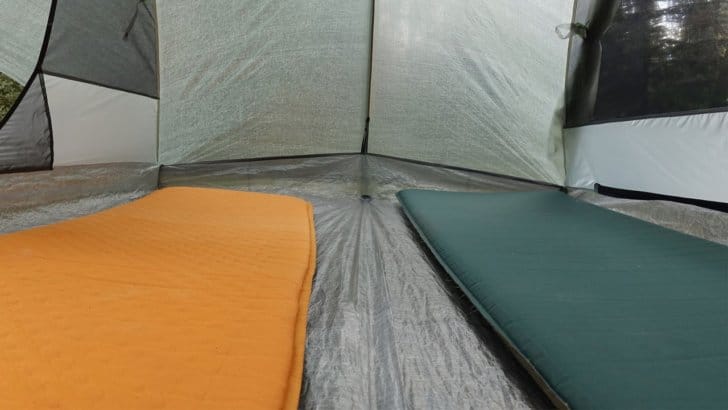
- Floor Dimensions: 50 in wide x 88 in long (127 cm x 224 cm)
- Bathtub floor height: 5 in (13 cm)
- Vestibule depth: 26 in (66 cm)
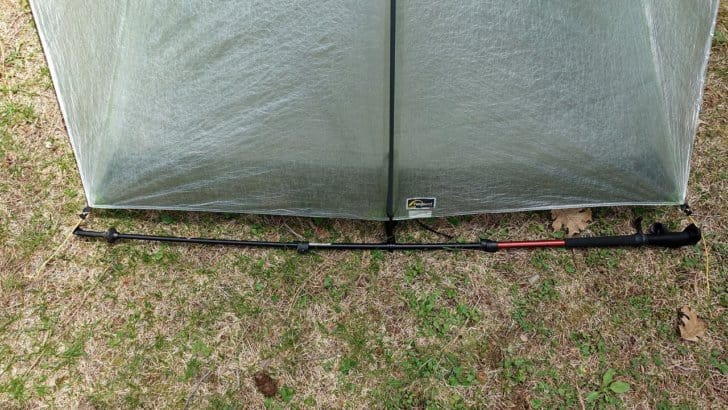
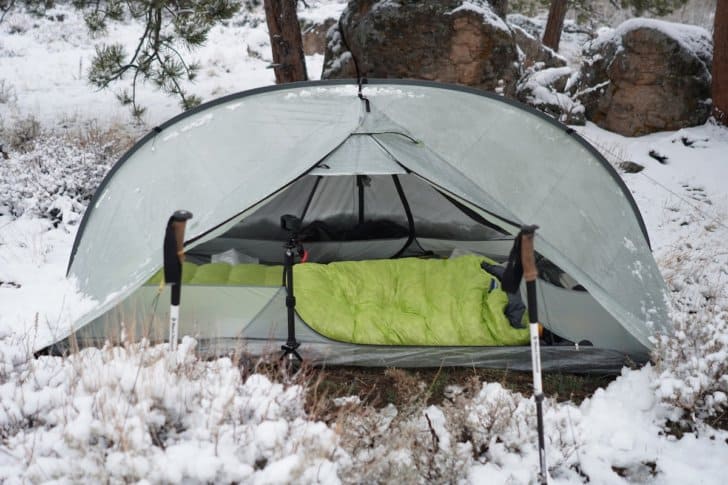
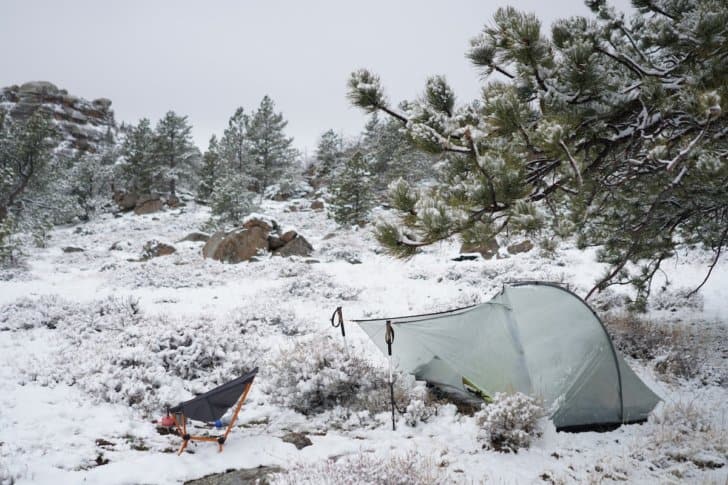
- Trekking poles can be used to set up the shelter in freestanding mode or to create a “porch.”
Overview
- What is new about this version of the Double Rainbow?
- DCF construction
- bonded seams – no sealing required
- one-third lighter than silnylon version
- carbon-fiber pole-set:
- Easton 3.9 carbon series (7.5 mm dia)
- main arch pole: 4.44 oz (126 g)
- cross strut: 0.88 oz (25 g)
- total carbon-fiber pole-set offers ~4 oz (113 g) weight savings over the aluminum pole-set used in the Double Rainbow
- Quote from Henry Shires: “We have been offering and shipping the Easton 3.9 carbon pole for awhile on the Rainbow and Bowfin 1S and so far reports of breaks have been nothing statistically greater than for the aluminum. I still wouldn’t trust the carbon pole to handle more extreme stresses — carbon snaps rather than bends — but for most use we think it will be fine.”
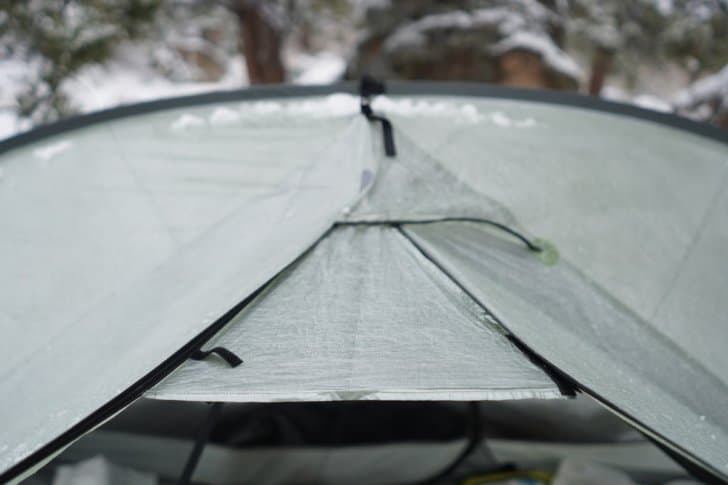
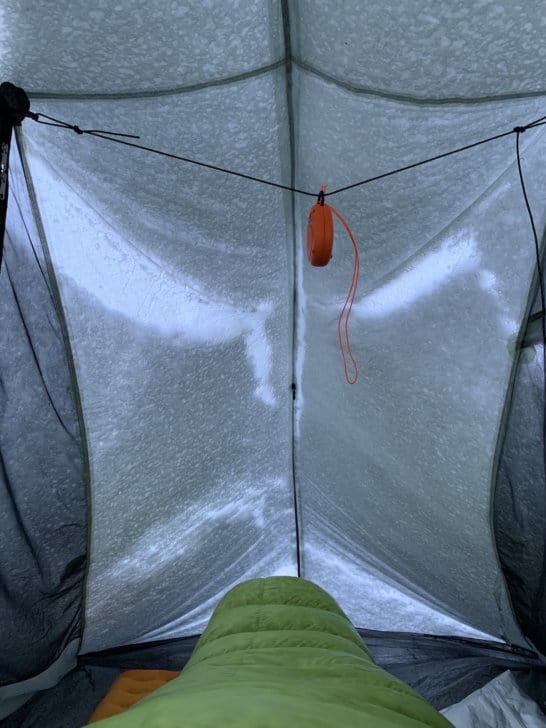
- partial solid interior wall (10d uncoated nylon)
- improved trekking pole attachment points for freestanding mode
- Incorporated the pattern from the Double Rainbow’s optional trekking pole handle adaptor set.
- DCF construction
- What has carried over from the previous version of the Double Rainbow?
- hybrid wall design (lots of living space – a two-person shelter for people who want to save weight but don’t want to spoon overnight
- versatile – can set up in freestanding mode using trekking poles if desired
- large, spacious vestibules
- “Porch mode”
Field Test
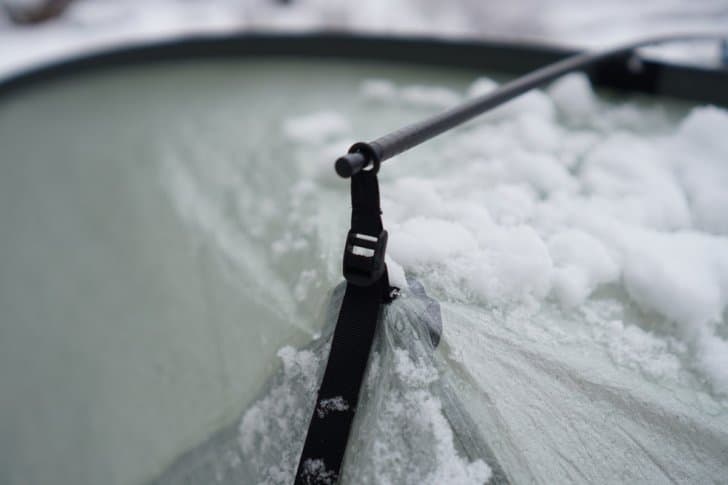
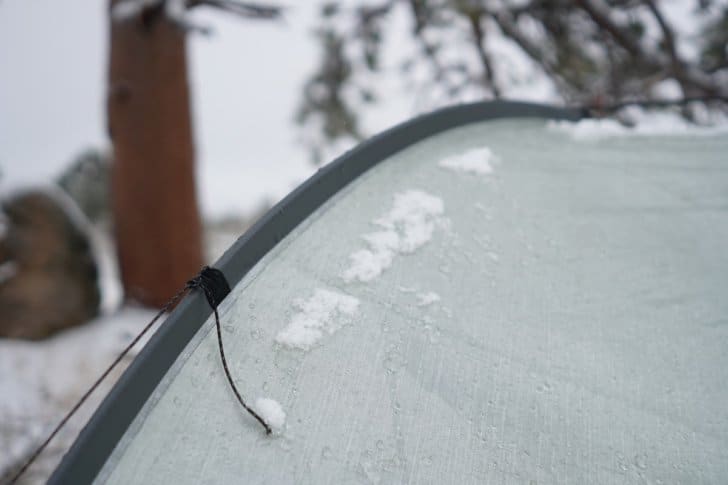
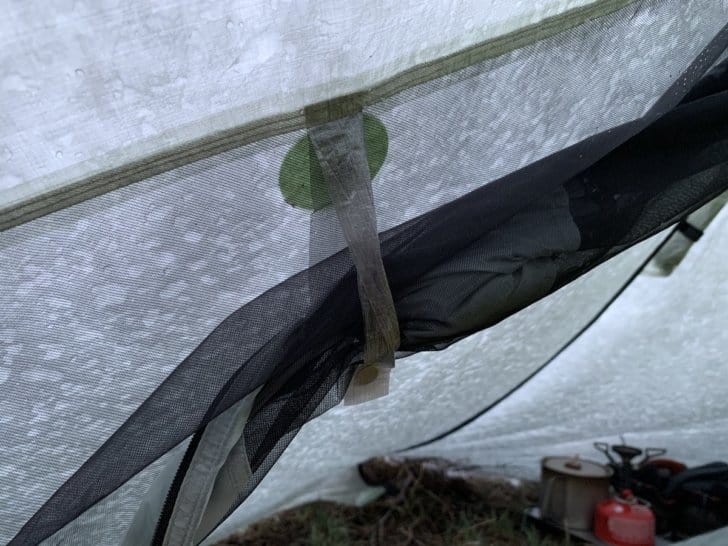
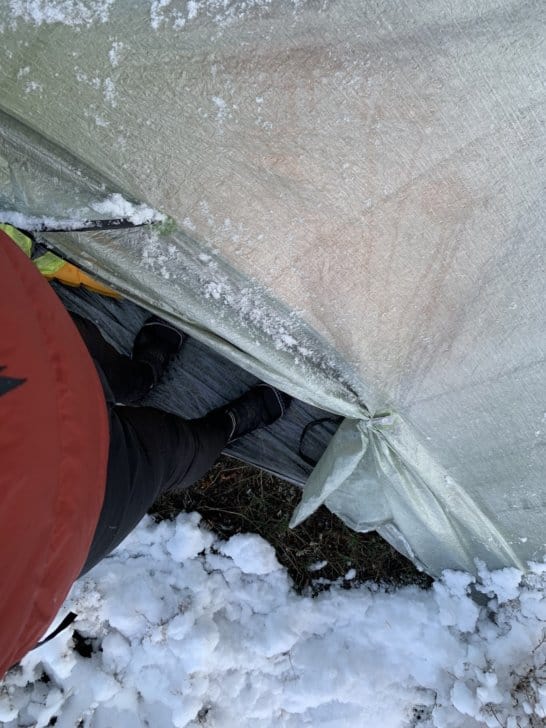
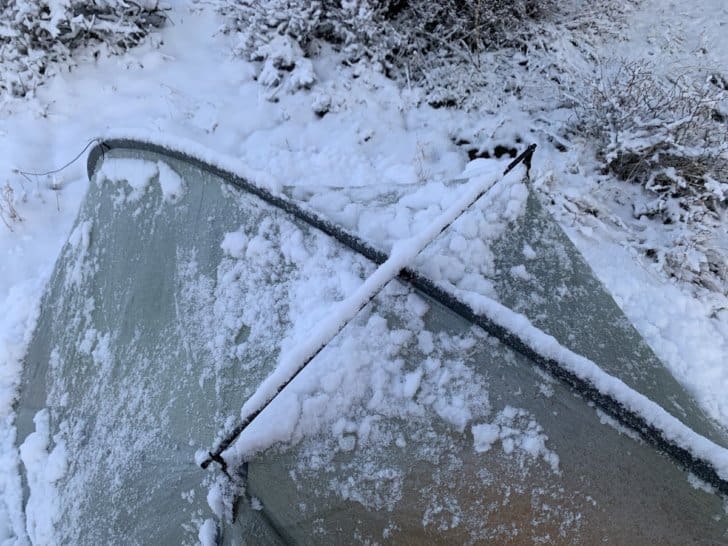
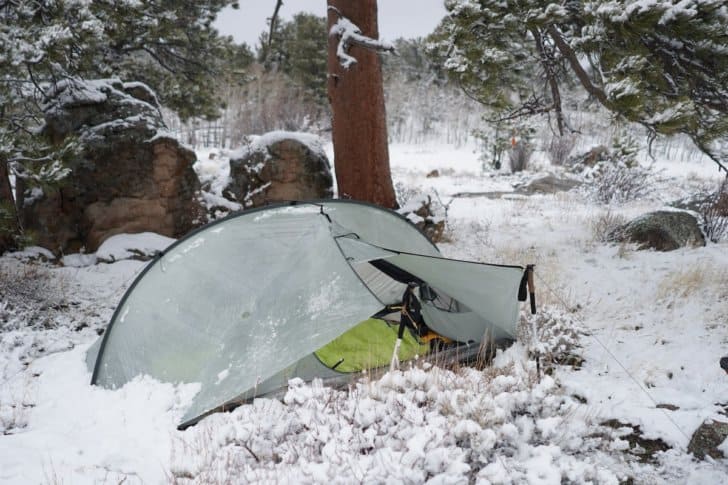
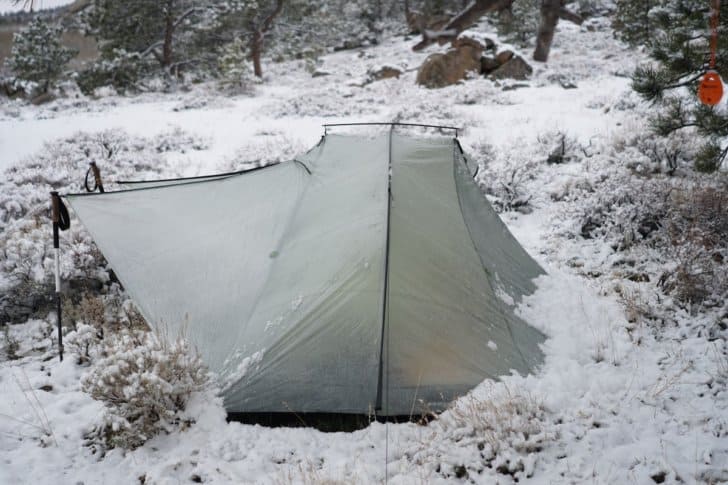
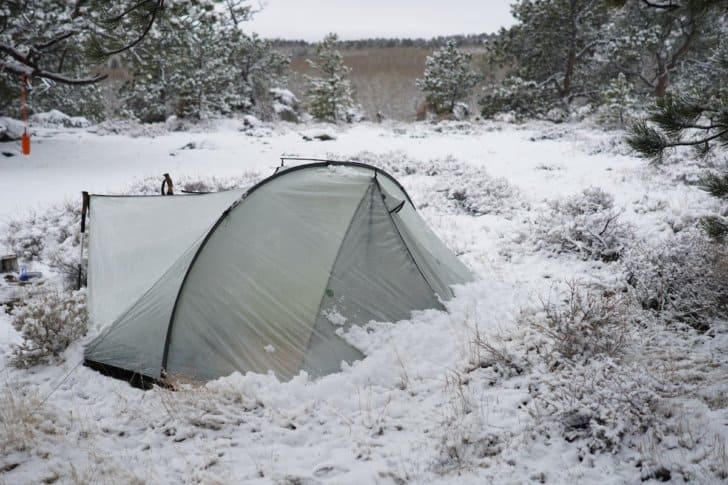
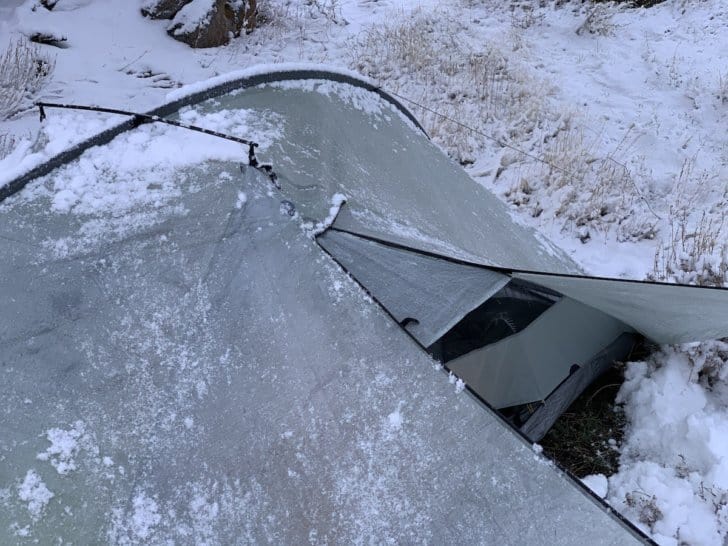
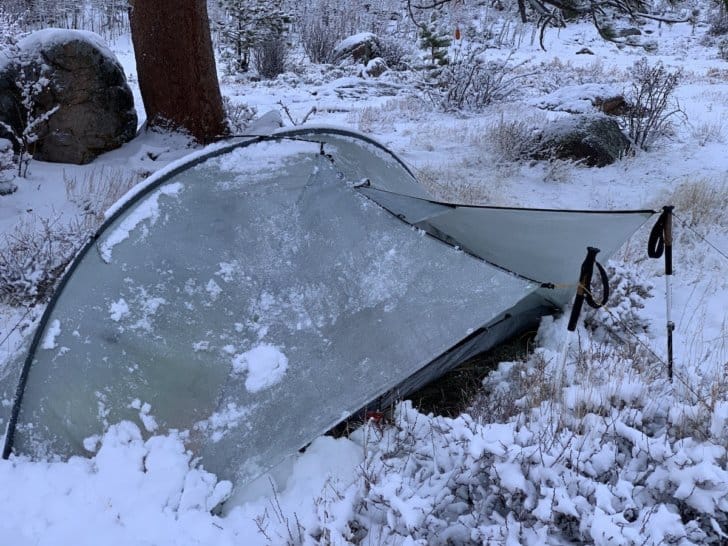
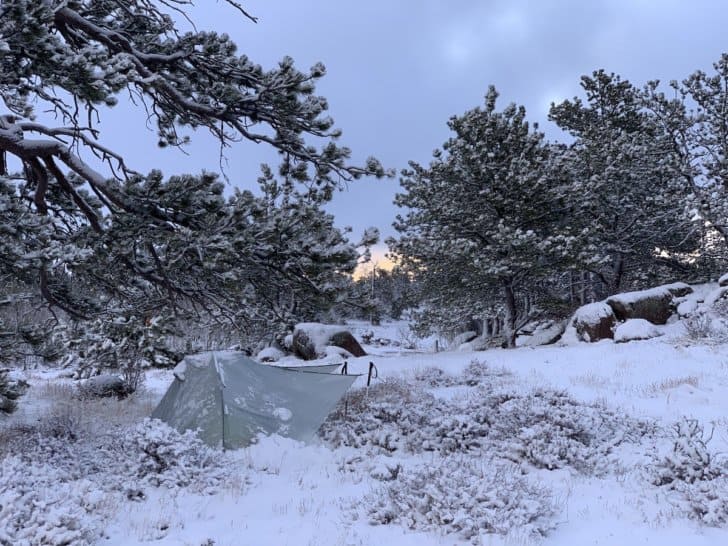
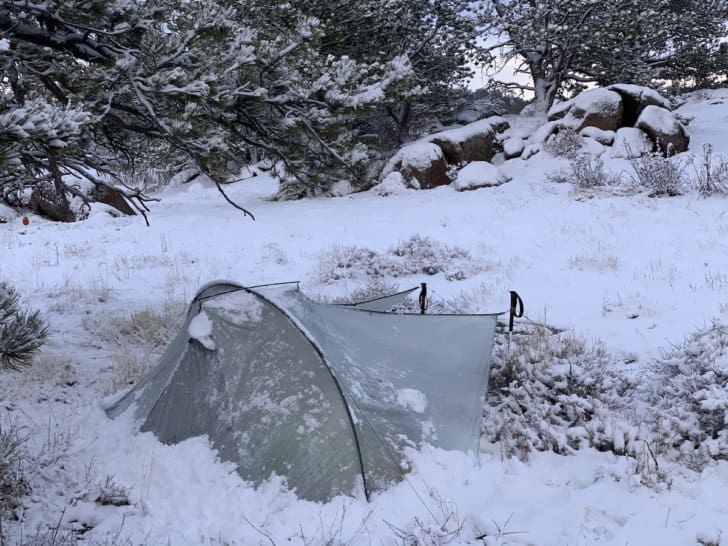
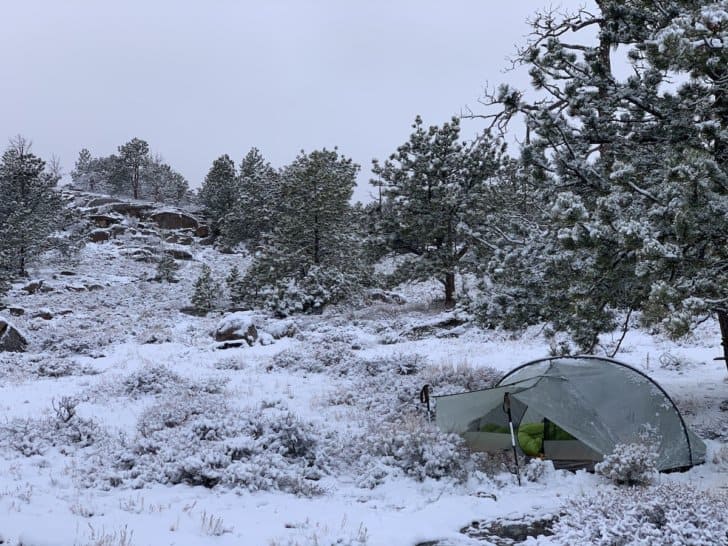
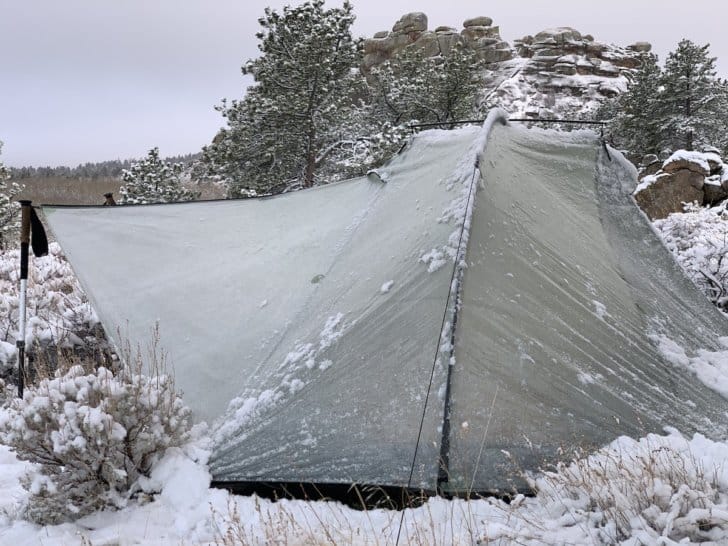
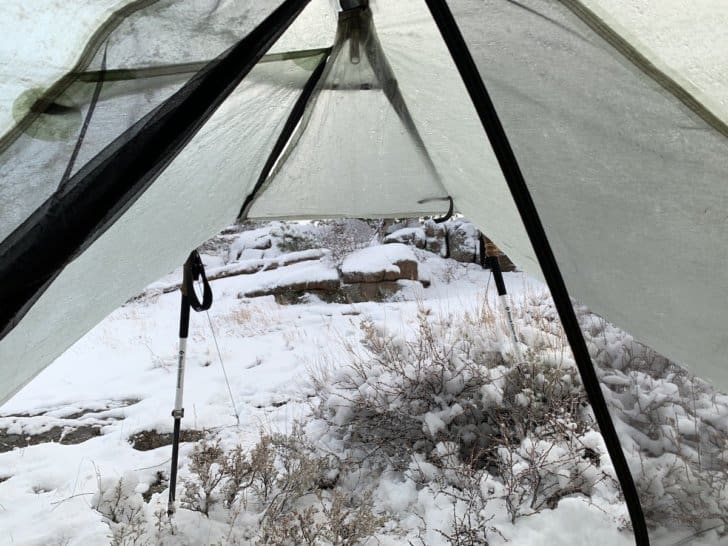
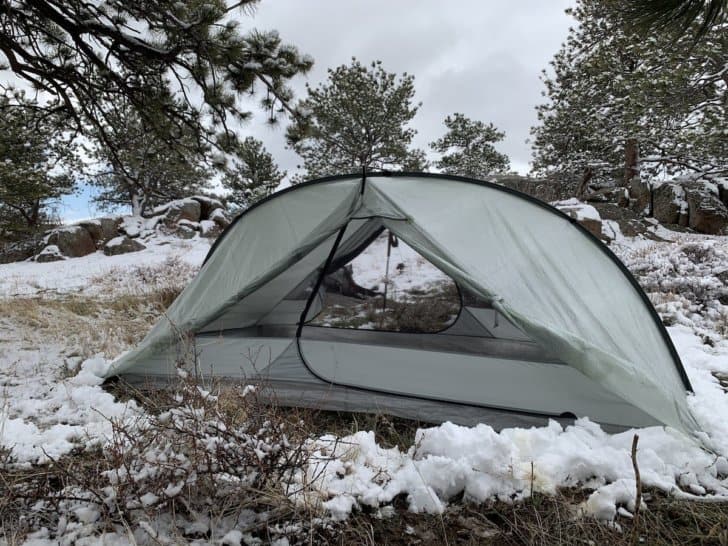
Ryan had the chance to spend a few days with the Tartpent Double Rainbow Li, including one overnight backpacking trip during a winter storm in SE Wyoming.
His first impressions are outlined in this review video, now online at YouTube:
Photos below from Ryan:


More Info
- Tarptent will begin taking orders the week of April 27th. You can read more about the shelter here.
- Questions? Hit us up in the forum below and we’ll do our best to answer them based on our brief experience with the shelter.


Discussion
Become a member to post in the forums.
Here’s our first looks/limited review of the new Tarptent Double Rainbow Li (Lithium) model made with Dyneema Composite Fabrics:
Did you get a chance to try out the freestanding pitch option?
I, too, am curious about the free standing pitch option.
And to me, the obvious question is how does it compare to other similar tents in terms of livability? Ease of pitch? Weather worthiness? I’m curious how this stacks up against a ZPacks Duplex, particularly.
A most informative and tantalizing review. There is nothing in this shelter that I don’t like, and I can see a major outflow of cash in the near to middle future.
I note with amusement that without saying a damned word, you made the perfect argument for a light camp chair.
I have a question unrelated to the shelter: What is that little cooking table and where could I get one? It looks to be a useful piece of kit.
Cheers
Hmm this seems like a stellar option at that weight …. and yes, the free pitch option seems like a crazy good comparison to the duplex free standing, and I’d love to see some comparison videos in wind on the same trip!
I personally think the duplex free standing when staked down is is crazy good in wind for 34 total oz, so it this is better in the same weight class kudos. But I haven’t had the duplex in wind and snow. The duplex free standing also has a “loose” hub at the top which now I know why that’s so helpful. I think the vestibule canopy attack ent could have been made to extend the whole length of the vestibule walls , like the original six moons design trekker canopy attachment.
thank you for the preview !
Such a good looking tent for the weight – no trekking poles needed, no struts dictating packed size, and lots of useable interior room. Almost feels like cheating! The solid fabric strips seem like a good addition. What material is the pole sleeve?
> What material is the pole sleeve?
70D silicone coated nylon. Very comparable to what we use for the silnylon DR and other models. You would never want to use Dyneema for a pole sleeve because of the lack of stretch and because of the lower abrasion resistance.
-H
Hi Ryan… great review, much appreciated. As mentioned by others, it would be great to get your views on the competition such as the Tarptent Aeon LI or StratoSpire 2 Li but also the Zpack options.
You are personally a fan of the Djedi… how would you compare these two?
Much appreciated – regards
reto
Makes sense for the pole sleeve material. Just a note – the Double Rainbow Li tent does not show up under “sleeps two” on the front page of the Tarptent website. But if you go to another tent’s page, then it shows up in the upper right drop down menu. At least it’s like this on mobile.
The table he is using looks like the SULUK 46 TULIMAK BACKPACKING TABLE .
Thank you, Link.
Cheers
> the Double Rainbow Li tent does not show up under “sleeps two” on the front page of the Tarptent website.
Thanks for catching that. It should be fixed now.
“the free pitch option seems like a crazy good comparison to the duplex free standing, and I’d love to see some comparison videos in wind on the same trip!”
I don’t think either system is designed to increase the tent’s stability… the zpacks solution doesn’t connect the poles at the peak, crippling the structure. The tarptent solution simply spreads the four corners apart. Maybe poles spreading the corners is stronger, but those corner steaks don’t fail in the videos of Rainbows being blown over by wind. The tarptent solution does not increase the footprint and allows the tent to be moved after pitching. Also it is simple enough to work on almost any tent with a rectangular end spread by two corner pullouts; tarptent patented the solution to prevent others from marketing it. So while it may seem like a unique solution tarptent offers, consumers should know they can accomplish the same thing with other tents. Showing this with photos in the review would help people understand this feature much better.
The rainbow does in fact have a third pitch option built in that supports the cross pole vertically from the ground. From my limited experience with an older generation single rainbow, this rarely mentioned pitch option is the strongest because it prevents the tent from collapsing sideways (the rainbows that collapse in those videos, collapse sideways. They weren’t pitched this way). This pitch is mentioned on the nylon double rainbow faq page, but not the rainbow li’s page. Does the rainbow li have the grommets for this pitch under the apex vents?
“the zpacks solution doesn’t connect the poles at the peak, crippling the structure.”
they are not connected at the top hub but they create many triangles when attached and slide freely at two cross over points where wind is most likely to effect the structure over the largest flattest wind catching sections.
so I don’t wanna make this a duplex thread, but I must say that when I add the poles to the staked duplex in windy conditions it’s an entirely different structure and very stable in wind. I think it’s the creation of more functional triangles in the Tents shape that adds that integrity. I wouldn’t define the free standing poles as crippling, at least when used with stake outs at all 8 points.
That said, I really do think these two tents in windy conditions, same
Video, same situation, fully staked, would be a very good comparison video. And if there are obvious differences in wind ¿resistance? that would be great to see.
I can’t edit my post now; I didn’t mean to say “cripple the structure” so much as I meant to say fail to achieve the full potential of that pole arrangement. Check out the Kuiu mountain star to see s similar example of that structure fully connected;
But back to rainbows! I found the vertical trekking pole setup on the rainbow li page! its under the freestanding question on the faq page now instead of under the winter setup question. Edit: I got excited and mis-read, the vertical support pole is for the horizontal freestanding setup without trekking poles.
The freestanding option is handy because it can be used only as needed. Only need one side spread? Great, only spread one side and stake the the other. I have used the TT Rainbow a fair bit and the option in rocky ground and tight spots to not need to stake, is very handy.
I am excited for this release and crossing my fingers that down the road, a (solo) Rainbow will be sold.
So on the standard Double Rainbow its possible to use trekking poles for vertical support at the ends of the cross strut?
From Double Rainbow FAQ: “… if you support the arch pole with trekking or ski poles using the grommet system underneath the apex vents.
From (solo) Rainbow FAQ: “… when using the grommets up under the cross strut to support vertical trekking /ski poles.”
I was just thinking about this when I looked at the tent in the video review, that it should be possible to do this. I guess it would add significantly to the wind resistance, and it would be nice to have that option if needed.
I’m under the impression that yes, both the single and standard double rainbows have the cross pole support grommets. I think either trekking poles or normal tent poles should work.
Old thread with Henry mentioning it, he said recently in another thread I can’t find at the moment that the new ones still have it: https://backpackinglight.com/forums/topic/4307/page/2/#comments
pics from my older single rainbow
The vertical support poles used under the apex strut is not an option with the Li version.
FYI: There are no grommets under the apex vents on the Double Rainbow Li sample we received from Tarptent.
The new Double Rainbow Li seems so light, why wait for a solo model only to save 5 ounces?
I wonder what is more windworthy – the rainbow or the notch? Spoiled for choice.
I just acquired a new Notch Li, and set it up in inclement weather blowing 10kts gusting to 15, and rain heavy at times. The wind shifted from quartering to full on the vestibule right around the compass to full on the other vestibule. I left the tent for over 24 hours without touching a single guy line. The tent was not affected by the wind at all. I was able to put just 1/2 inch more tension in a single ridge line guy line and the tent was back to drum tight.
Those were not very high winds, but the tent was in an open field on the edge of a lake so it was getting some abrupt high winds. I stayed dry and comfortable throughout. I am blown away by the Notch Li. The two sided entry, the zippers, the ease of setup, the stability, the head and foot clearance, incredible construction detail and livability have elevated it to my favorite tent after one use. I have a lot of tents I won’t be using again.
Ryan, I have a question about the mesh gutters at the bottom of the single wall ends. I own a Zpacks Altamid and find that water from outside the tent finds its way into the mesh, possibly by wicking or through the stitches, and will puddle there. Those fine mesh bug proof gutters do a pretty good job of retaining water on top of the mesh, puddles of water. Did you see any puddling on the mesh gutters in the Double Rainbow Li?
What weight of DCF is used here please? I see that TT’s other Li tents have 0.51oz DCF, yet I have seen other manufacturers warn that care must be taken with such lightweight fabric…
If a solo model was available, that would be my choice – a little lighter, a little smaller packed size, and a smaller footprint. I used a solo silnylon Rainbow 7 or 8 years ago. There was a good amount of room for my 50lb dog and I, so the Double Rainbow must be truly palatial (when used as a solo shelter).
Regarding the trekking pole grommet under the peak vents on the silnylon versions: this was a neat feature, but I don’t remember ever actually needing to use it, even when getting snowed on. Maybe it was excluded for weight? Maybe the poles tended to slip and caused a risk of DCF puncture?
Become a member to post in the forums.