


Editor’s Note 3/11/16: After publishing this review, we learned that the 5.1 oz vertical support poles we originally referenced are not recommended by TarpTent for strong winds or snow. Instead, they recommend vertical support poles that are 8.o oz and cost $32. These changes were made below.
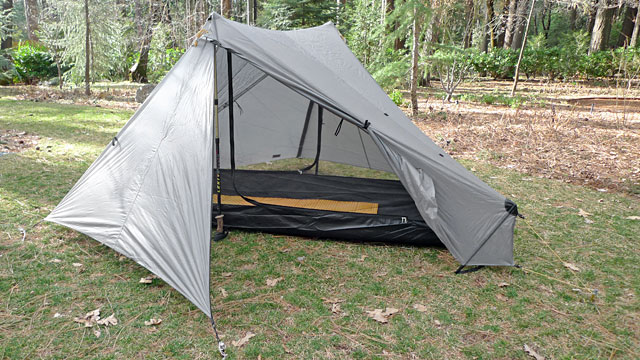
Tarptent Stratospire 1 | Photo from tarptent.com
TarpTent Stratospire 1 Video Preview:
The Skinny
The Tarptent Stratospire 1 is uniquely positioned as one of the most livable and stormworthy lightweight solo tents available.
Features & Specifications
Features
- Dual entry, dual vestibules
- Dual trekking pole support
- Double wall design (inner tent & fly)
- Silnylon fly + mesh or solid fabric inner tent
- Design allows for dry interior when entering/exit during storms
Specifications
- Sleeps: 1-2
- Weight: 36oz / 1kg
- Floor Width: 32 in
- Floor Length: 86 in
- Interior Height:48 in
- Stakes Required: 6
- Packed Size: 16 x 4 in
- Cost: $309
My Take
I found the Tarptent Stratospire 1 to be a very comfortable solo shelter, with plenty of space inside and in both vestibules.
I liked being able to retract the fly doors entirely away from both vestibules for magnificent views of stars and alpenglow.
I’m not a trekking pole user – so the fact that it requires trekking poles makes its use a bit of a hassle for me, requiring the additional cost (minor, only $32) and weight (8.0 oz) of optional shock-corded aluminum poles.
I’m used to the simplicity of using single-pole pyramids for most of my backpacking, and while the Tarptent Stratospire 1 is not difficult to pitch with practice, there are still two poles, two strutted corners, and six stakeout points to adjust to get everything perfect.
The tent pitches extremely tight – owing to its use of structural elements and strong silnylon fabric: it should hold up well in storms.
Strengths
The Stratospire 1 is particularly unique for its livability and its stability.
- Livability: dual side entry, dual vestibules, lots of usable interior space, plenty of headroom – sacrifices often made in other ultralight tents.
- Stability: Carbon fiber struts, dual pole support, hexagonal design, strong silnylon fabric – all of these design features result in the ability to create a highly tensioned structure that distributes wind loading well.
- Modular inner tent can be left at home to save weight, or swapped with a solid fabric inner tent for winter use.
Limitations
- More complex (but not complicated…) to set up than simpler 1-pole structures (i.e., pyramids).
- Silnylon fabric is less resistant to condensation than Cuben Fiber.
- Complex design, inner tent, and structural elements contribute to a relatively heavy weight for a solo shelter.
Additional Info
- Learn more at tarptent.com.
- The Tarptent Stratospire I has been nominated for a 2016 Backpacking Light Guide’s Gear Award, and is currently undergoing extensive field testing in extreme weather conditions in all four seasons. We are evaluating it for both its wind and snow loading, as well as use as a winter shelter with its solid fabric inner tent. A comprehensive review is planned for later this year.
- Backpacking Light is currently sponsoring a research project with the Montana State University Department of Mechanical Engineering to evaluate the effect of shelter design on wind load distribution. The Stratospire 1 is one of the shelters being investigated in this study, and we are looking forward to seeing how it performs under high wind loads.
Acknowledgments
- The author wishes to thank Ryan Jordan for putting together the preview video shown above, highlighting the TarpTent Stratospire 1 features.


Discussion
Become a member to post in the forums.
Companion forum thread to: Tarptent Stratospire 1 Review
This Tarptent Stratospire 1 Review highlights one of the most livable and stormworthy lightweight solo tents available.
I am surprised that this hasn’t had the BPL treatment in the four years it has been on the market. Congratulations Chase.
First look Aug. 2011
Watch Franco’s setup videos
Great work, Chase!
Just FYI, those poles are not optimal / recommended for strong winds or snow. We offer a $32, 8-ounce “vertical support pole” set that collapses to 16in and is much stronger and stiffer. That pole set is very close to trekking pole performance and the way to go for serious use if you’re not a trekking pole user or don’t want to bring your regular poles on a bike, canoe, or airline trip.
The one kinda/sorta downside, in my opinion, of the Stratospire is the larger area required for set up as compared to most solo shelters I’ve used. Now, for people who camp in areas where there are plenty of spacious sites, this matters not at all. For me, there have been a couple of times where it was a pretty tight fit in the available sites.
HJ
The feature many like about the SS1/2 is thge large vestibules, that of course translates into a largish footprint.
Still if you consider the space guylines take with some similar tents, it isn’t all that big.
In emergencies you can eliminate one or both vestibules as long as you have somewhere to guy the apex out.
This is my SS2 with one vestibule only in use :
much easier to think of/do if you set it up my way where the rectangular sleeping area is set up first and then the vestibules are pulled out or as in this case not pulled out.
I think the Stratosphere is one of Henry’s most innovative designs yet. If I didn’t already have a Moment DW I’d be very tempted to get a Stratosphere 1 W/ “solid” ripstop interior.
This tent is roomy!
Great tent and review and video. Thanks.
I owned both the StratoSpire 1 and 2 for a time. On level sites I found them very easy to pitch well, but on uneven ground the SS2 was more forgiving than the SS1. The larger geometry worked better for me. Both were very good at wind shedding. Some time after selling them, I returned to the fold with the Notch, and in retrospect I appreciated the StratoSpire’s offset trekking pole design even more.
I found this comment interesting. What are the nuts and bolts of that?
“Silnylon fabric is less resistant to condensation than Cuben Fiber.”
yes , good point.
I still haven’t seen a side by side comparison using the same shelter made with the two materials and a few of those exist.
On a thread that was up a few years ago someone put these two photos up apparently to prove how CF was better :
somehow it wasn’t obvious that an Hexamid has a lot more airflow than a fully enclosed Wild Oasis.
Nice review, Chase.
“I found this comment interesting. What are the nuts and bolts of that?
“Silnylon fabric is less resistant to condensation than Cuben Fiber.”
Not sure I believe that statement as written. Water does seem to cling to silnylon a little more but I have no idea how cuben would somehow be less resistant to condensation as it implies that the fabric breathes to a degree. Which it doesn’t. The design of a shelter has a much bigger effect on managing condensation. IMHO.
Why did you choose the Stratospire over the Notch?
Is it better wind stability and more space?
I have been using the (much ligher) Notch for several seasons and am very content with it and can highly recommend it. The balance between, weight, space and ventilation is very good. Only when I pitch the tent I use big stones to prevent the stakes from moving in strong wind conditions
Become a member to post in the forums.