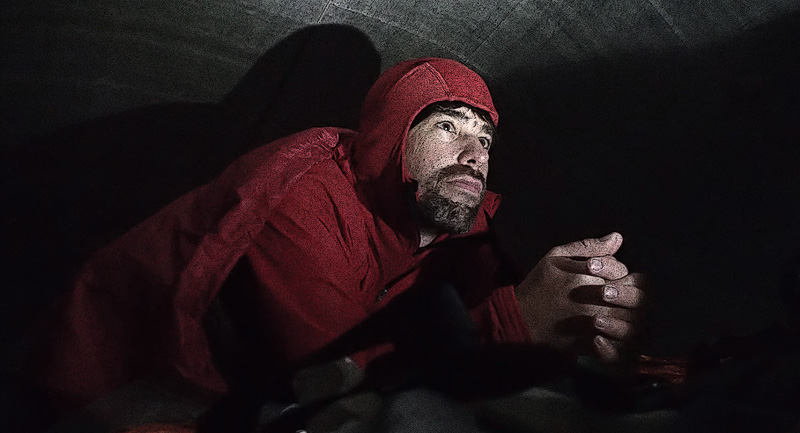
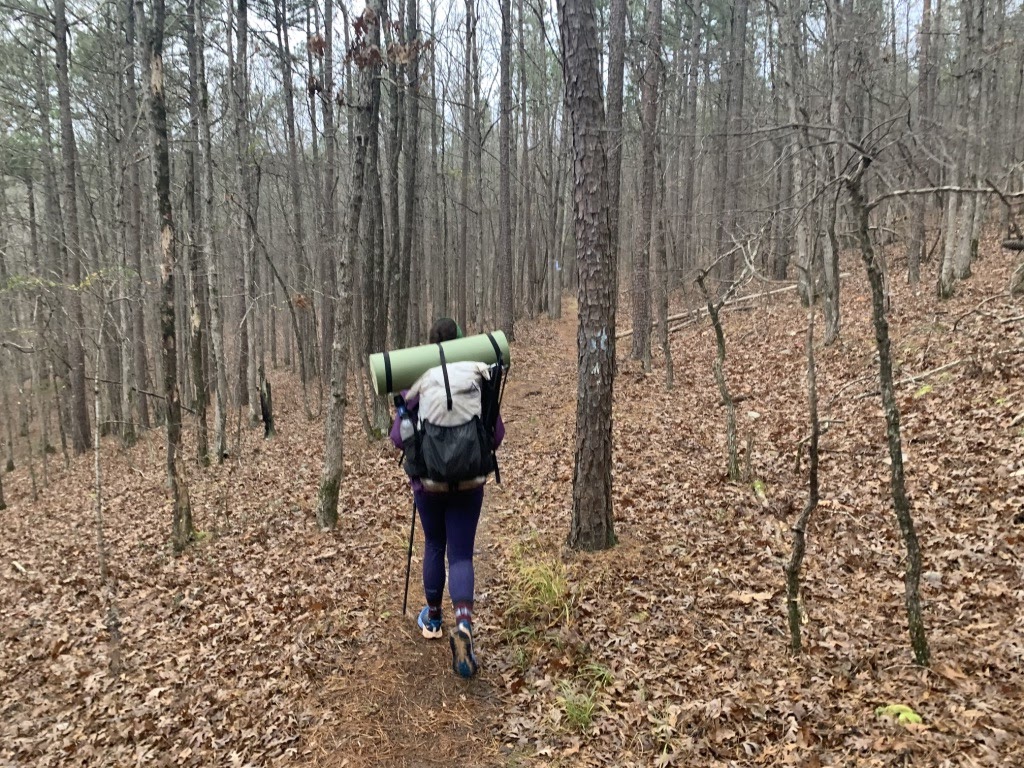
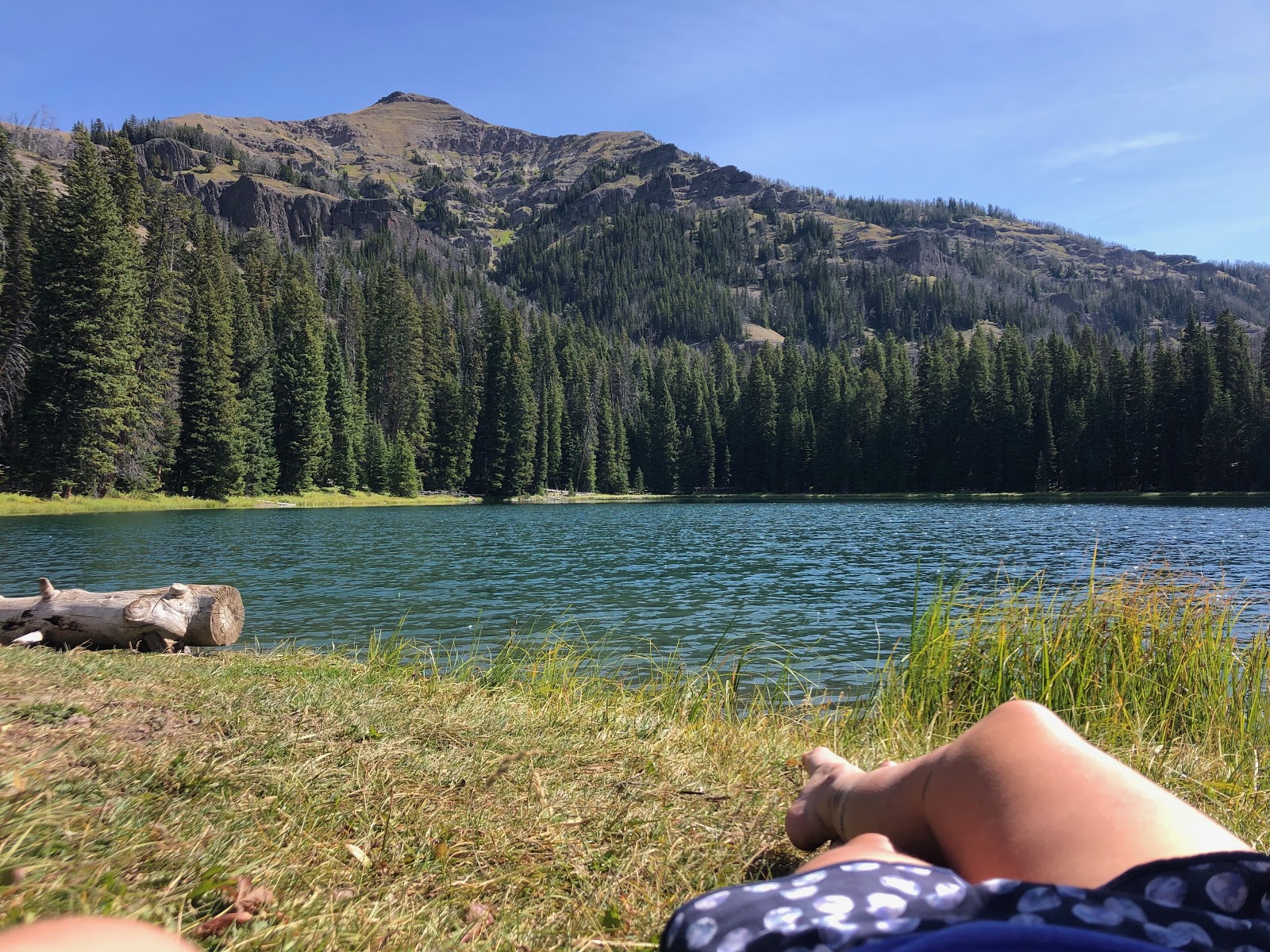
In this episode of the Backpacking Light Podcast, Andrew and Ryan talk about mental health. As their jumping-off point, they use a recent paper called Levels of Nature and Stress Response.
Stream
Summary
In this episode of the Backpacking Light Podcast, Andrew and Ryan talk about mental health. This is something they both struggle with, and they’ve got a lot of thoughts on how to manage it both in and out of the backcountry. As their jumping-off point, they use a recent paper called Levels of Nature and Stress Response.
Also in this episode: new favorite winter gear, updates on the new website, and some recent favorite content at BPL. Also—has Andrew finally found some trail runners that will last more than 500 miles?
Photo credit: Ryan Jordan
Outline
Intro Conversation
Ryan’s still freeze-drying food. Taco soup this time!
Executive Producer - Backpacking Light; Show Director and Host - Ryan Jordan; Producer - Chase Jordan; Theme music: Look for Me in the Mountains written by Chris Cunningham and Ryan Jordan, performed by Chris Cunningham (acoustic guitar, lead and harmony vocals, harmonica), Chad Langford (upright bass), and Tom Murphy (mandolin), produced by Basecamp Studios in Bozeman, Montana.
Sponsorship Policy: Backpacking Light does not accept compensation or donated/discounted products in exchange for product mentions or placements in editorial coverage, including any podcast episode content not excplicitly identified as sponsored content. Some (but not all) of the links in these show notes may be affiliate links. Learn more about affiliate commissions, influencer marketing, and our consumer advocacy work by reading our article Stop wasting money on gear.
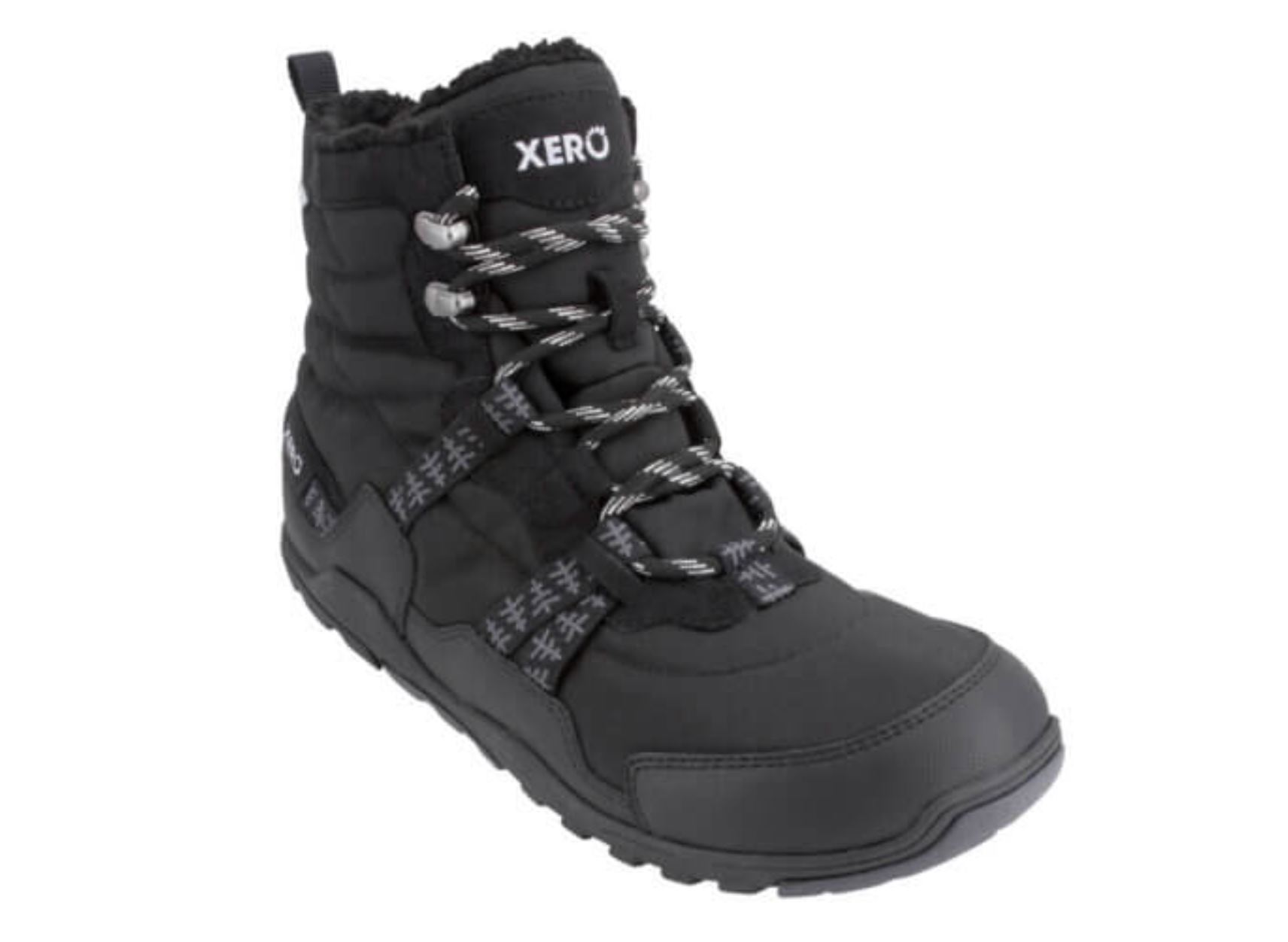
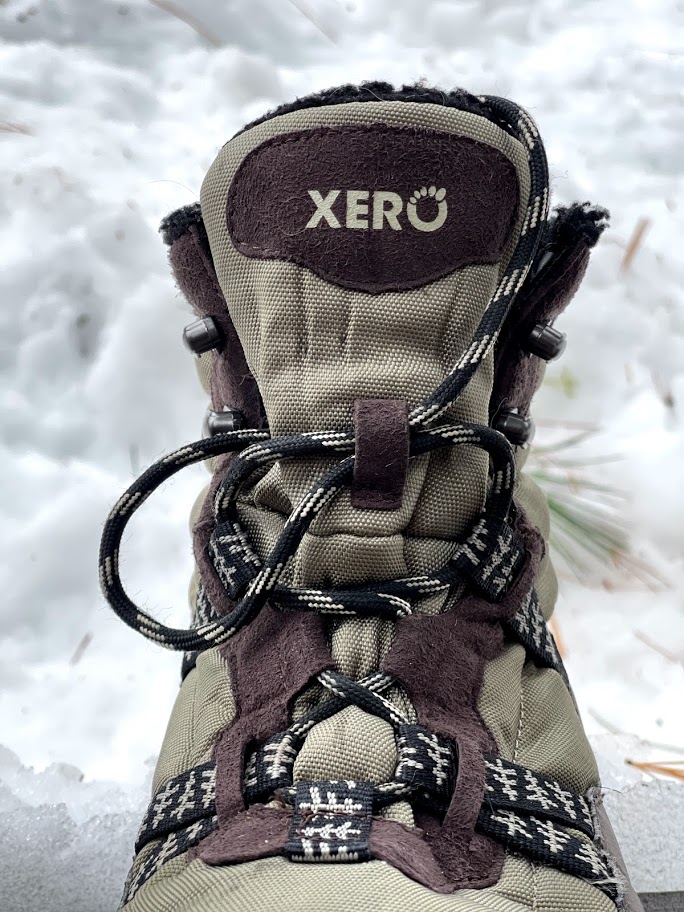
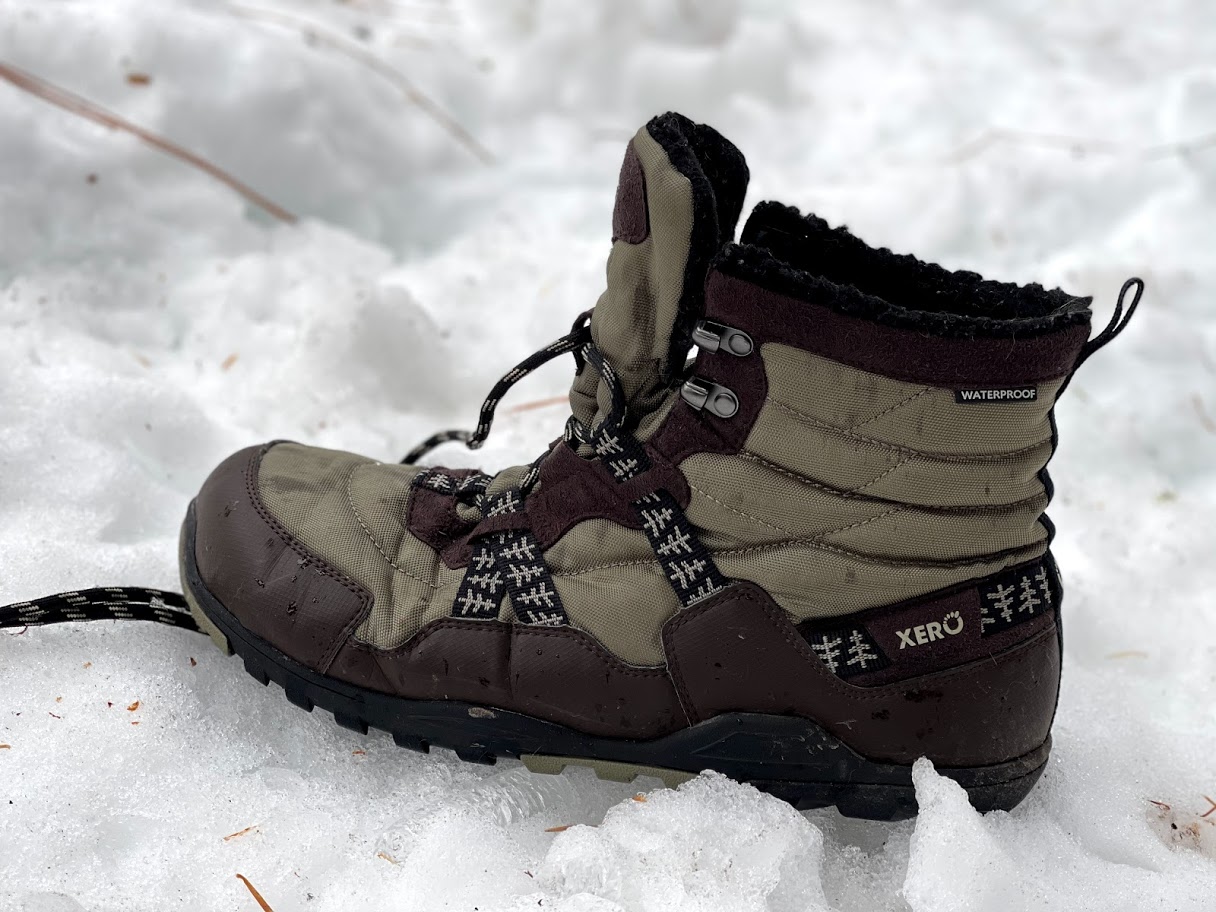
The Xero Shoes Alpine Snow Boot is a flexible, insulated, waterproof, zero-drop footwear option for minimalist shoe lovers who still want warm feet in cold and snowy conditions.
Introduction
The Xero Shoes Alpine Snow Boot ($149.99, 14.9 oz / 422 g each) is a flexible, lightweight (for a snowboot) insulated, waterproof, zero-drop footwear option for minimalist shoe lovers who still want warm feet in cold and snowy conditions.
The Xero Shoes Alpine Snow Boot. Photo: Xero Shoes
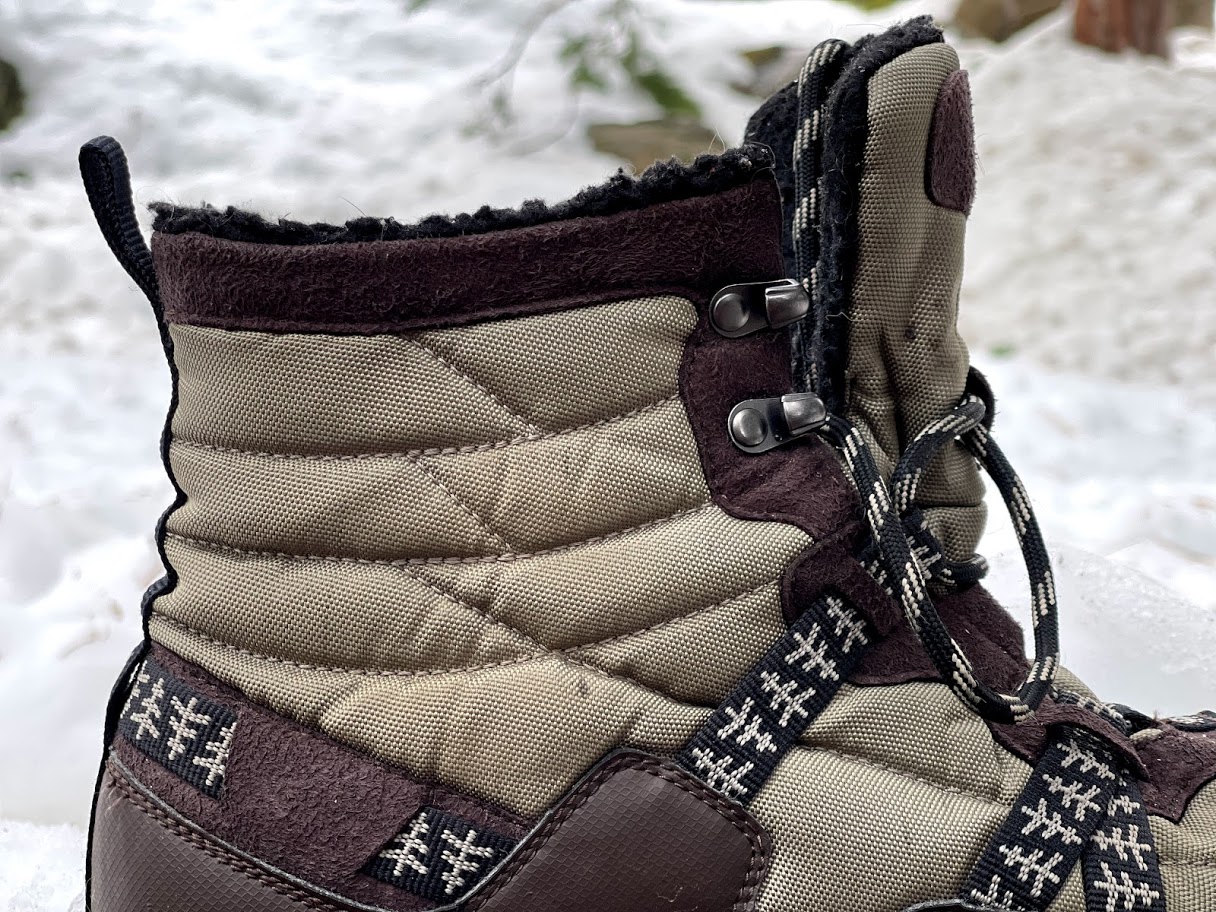
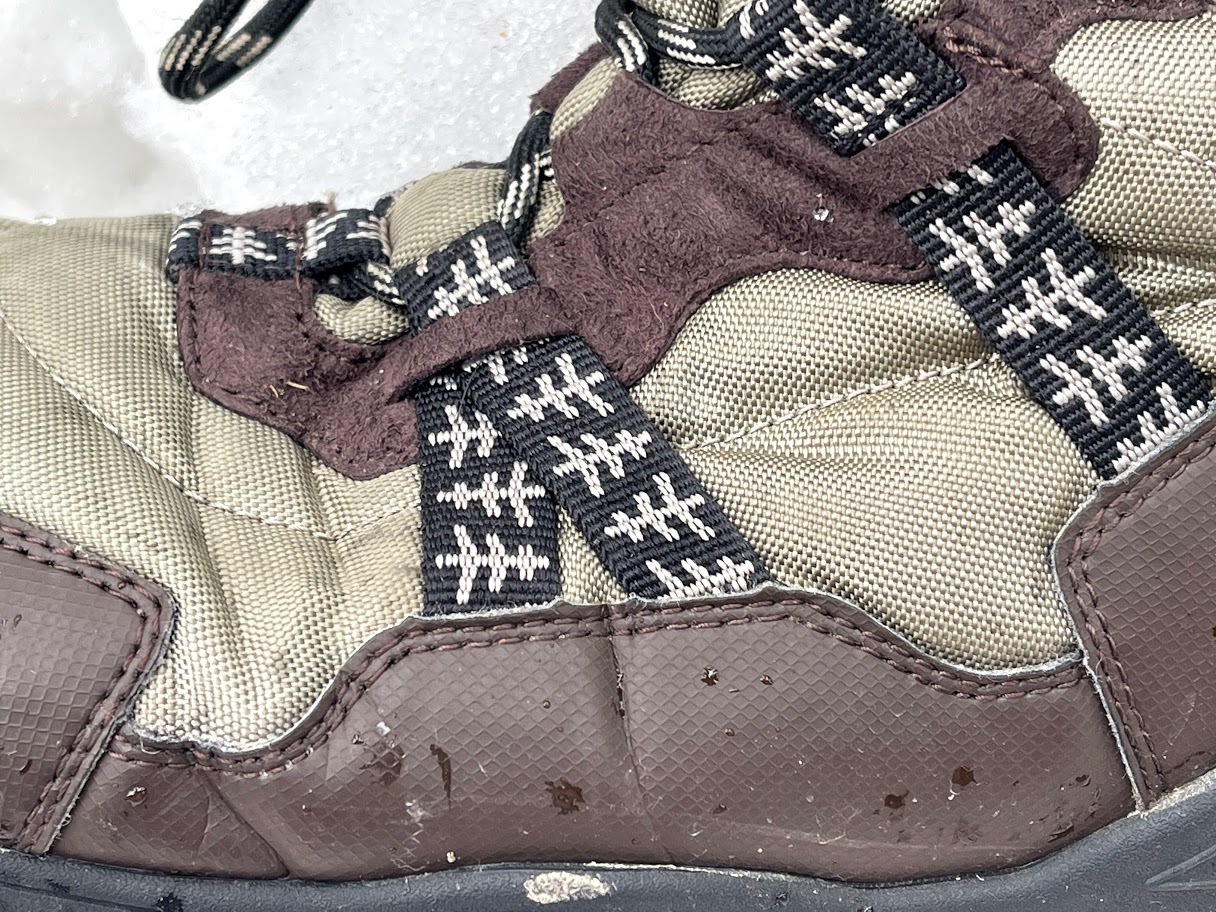
The Alpine Snow Boot will look familiar to anyone who’s encountered Xero Shoes in the past. The huarache-inspired straps, zero-drop construction, lightly-lugged outsole, and minimalist mid-sole are all standard Xero Shoes features. But unlike the Mesa Trail (a Xero Shoes trail runner I reviewed here), the Alpine Snow Boot is insulated, waterproof, and high-topped.
This feature-set caught my eye because I just can’t do the whole trail-runner-and-waterproof-sock thing in the wintertime. My feet get too cold. On the other hand, I hate clunky, stiff winter boots just as much as any self-respecting lightweight backpacker does. So I was excited to test The Xero Shoes Alpine Snow Boot this season because it seemed to offer a compromise—combining warmth and protection from the elements with the dialed-in-fit, flexibility, durability, and spacious toe-box I’ve come to expect from the Xero Shoes.
This is a first look at new gear that recently entered our review pipeline, and hasn't yet been subjected to rigorous field use. Learn more about the types of product reviews we publish.
Features and Specifications
weight: 14.9 oz / 422 g (each)
wide toe-box
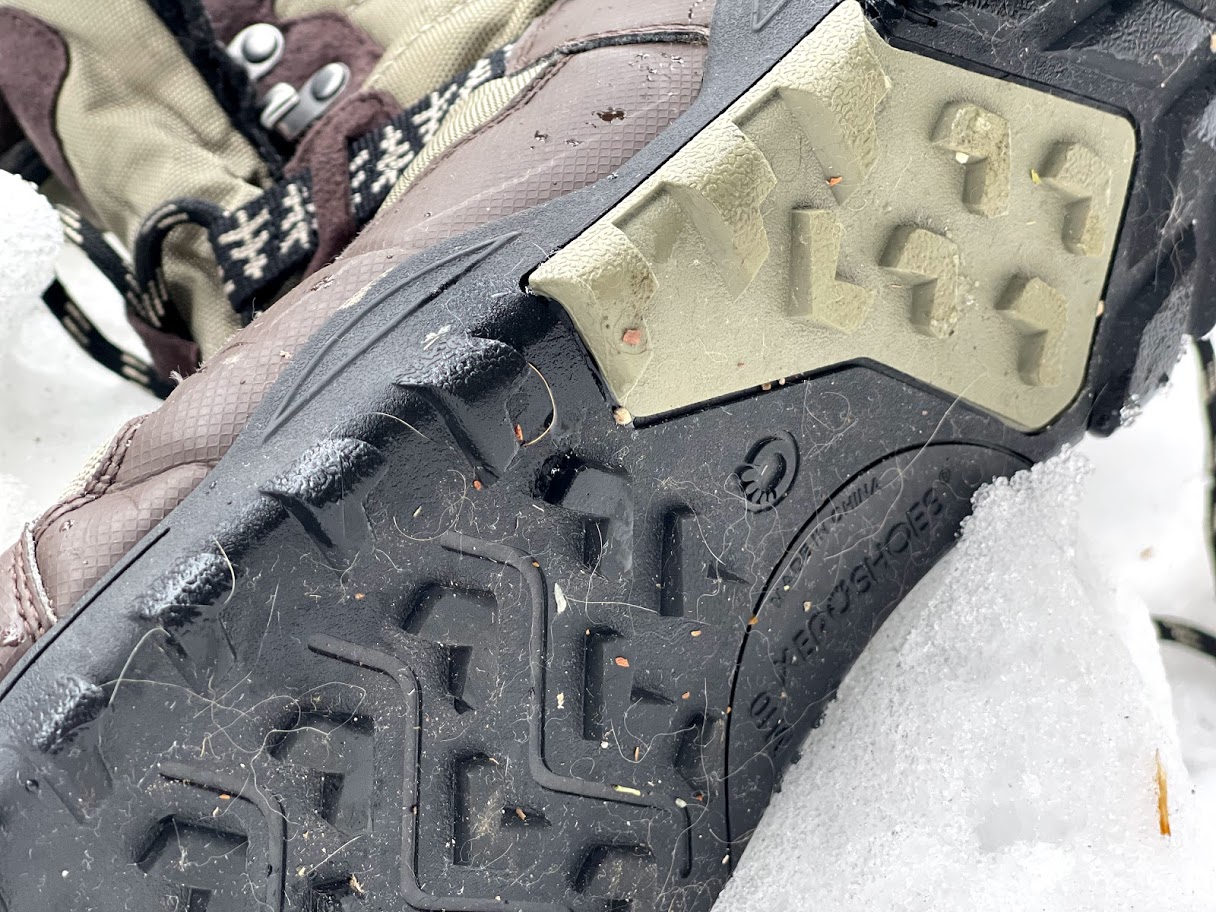
5.5 mm chevron-patterned outsole
synthetic upper
removable 2 mm heat-reflective insole
200 g polyester insulation
water-resistant membrane
seam-sealed inner bootie
vegan-friendly materials
MSRP: $149.99
Commentary
Fit and Comfort
The wide toe-box of the Xero Shoes Alpine Snow Boot is especially important for me in the winter so I can wear thick socks and still have room to move my toes.
Even though it is technically a high-top boot, it has the flexibility and comfort of a trail runner.
I’m a fan of the huarache inspired strap system that Xero Shoes employs. It just seems to fit my feet well.
Warmth and Waterproofness
The waterproof membrane and inner lining of the Xero Shoes Alpine Snow Boot kept my feet dry during extended, multi-day hikes and backpacking trips in the snow.
It remained waterproof in more slushy, splashy conditions (e.g., when warming conditions on trail caused slush puddles)
The 200 g polyester insulation (which is “rated” to -25 F / -32 C) and heat-reflective insole kept my feet warm in ranges from 15 F (-9 C) to 45 F (7 C).
Traction and Lugs
I have concerns about the Xero Shoes Alpine Snow Boot’s traction. Xero Shoes uses a 5.5 mm chevron-patterned outsole here, and it just doesn’t handle slick, icy conditions as well as I’d like.
I slipped more than once in transitional areas between snow and ice, and the shoe is particularly bad at handling icy rock.
Durability
I have roughly 100 miles (161 km) on the Xero Shoes Alpine Snow Boot. So far the synthetic uppers are holding up against sharp, crusty snow well. I don’t see any noticeable wear on the fabric or separation of the bonded elements.
Ideal Use Cases
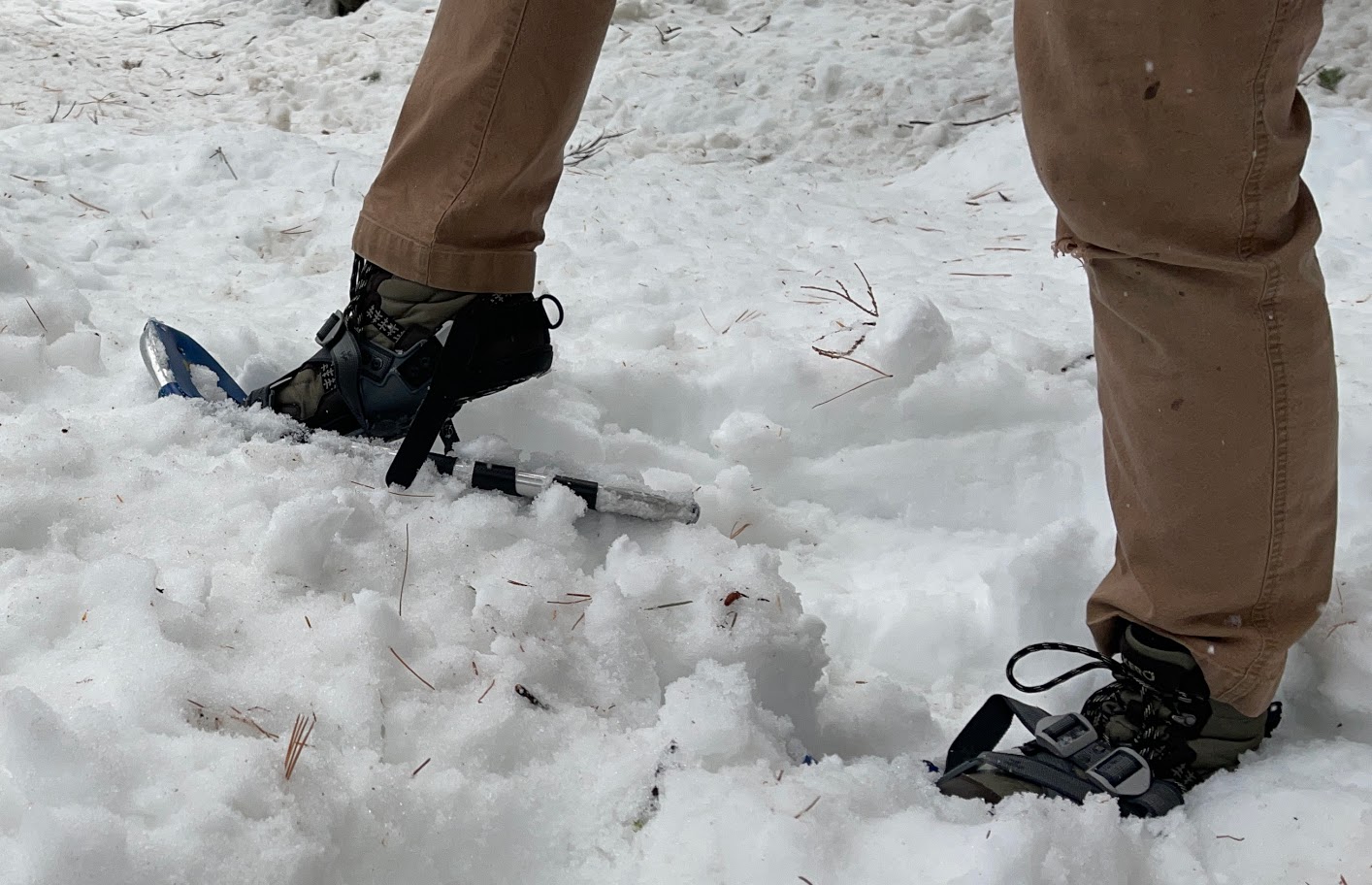
Snowshoeing with ultralight snowshoes
Winter hiking while wearing traction devices
The warmth, waterproofness, flexibility, fit, comfort, and (comparatively) low weight of the Xero Shoes Alpine Snow Boot have vaulted it to the top of my list when it comes to snowshoeing and winter hiking/backpacking when I know I’ll be wearing traction spikes. My feet are prone to blisters and cold while snowshoeing, and the Xero Shoes Alpine Snow Boot addresses both these issues.
Less than Ideal Use Cases
Hiking on slick, icy surfaces
Hiking on steep, hard-packed snow
If you think you’ll be scrambling over ice-slicked granite, look elsewhere. The short lugs and minimalist outer sole are great for comfort and a low center of gravity while wearing snowshoes and traction spikes but are a liability in other commonly encountered winter conditions.
Photos
Photo credit: Andrew MarshallPhoto credit: Andrew MarshallPhoto credit: Andrew MarshallPhoto credit: Andrew MarshallPhoto credit: Andrew MarshallPhoto credit: Andrew MarshallPhoto credit: Andrew MarshallPhoto credit: Andrew MarshallPhoto credit: Andrew Marshall
Product mentions in this article are made by the author with no compensation in return. In addition, Backpacking Light does not accept compensation or donated/discounted products in exchange for product mentions or placements in editorial coverage.
Some (but not all) of the links in this review may be affiliate links. If you click on one of these links and visit one of our affiliate partners (usually a retailer site), and subsequently place an order with that retailer, we receive a commission on your entire order, which varies between 3% and 15% of the purchase price. Affiliate commissions represent less than 15% of Backpacking Light's gross revenue. More than 70% of our revenue comes from Membership Fees. So if you'd really like to support our work, don't buy gear you don't need - support our consumer advocacy work and become a Member instead.
Learn more about affiliate commissions, influencer marketing, and our consumer advocacy work by reading our article Stop wasting money on gear.
Maggie Slepian considers what it means to be a perfectly average backpacker in a city (and industry) full of high-achievers.
I have always been an average athlete. In fact, I could probably be considered a below-average athlete. One of my clearest childhood memories is from sixth grade. I was standing alone at recess when I heard one of the Cool Sports Kids tell another Cool Sports Kid: “We would have won the soccer game in gym class, but the teacher made us have Maggie on our team.”
Some memories just stand out because they perfectly encapsulate the entire middle school experience, right?
Well, Cool Sports Kid, joke’s on you! 15 years later, that soccer loser would go on to complete a very average thru-hike of the Appalachian Trail.
Long-distance backpacking is one of the only tiers of the athletic realm where being average means nothing, because there is no competition. As the miles accumulate into the hundreds, and then thousands, most hikers (hopefully) stop comparing themselves to the people around them. They settle in with a group that is moving around their pace, and are too enraptured by the journey to care if they’re hiking 15 miles per day compared to someone else’s 25 miles per day. If you’re a thru-hiker still consumed by those numbers, congratulations, but you’re probably not the target audience of this column.
Averagely hiking around Bozeman, Montana a few weeks ago.
I’ve spent the last eight years living in a mountain town that attracts super-athletes in every category. The person in front of you at the grocery store, delivering your pizza, or parked next to you at the trailhead: any one of them could be a truly exceptional mountain athlete. If you’re hiking a peak, someone will run past you. If you’re pushing your bike up a seemingly impassable section of trail, another mountain biker is coming up behind you, clipped into their pedals on their third lap of the morning. It’s not competitive per se, but the comparison can be impossible to ignore. It’s like that sixth-grade gym class: if I am with a group of friends running, biking, or peak bagging, I am probably last. I might be an average athlete, but with my group of friends, my partner, and my chosen hometown, I fall far below average.
This is where backpacking provides freedom and relief. Backpacking isn’t competitive. You hike at your own pace, and the primary goal is to finish what you started. I constantly compared myself to other people when I first began backpacking. I’d look ahead in the guidebook and worry about being slower on climbs, having to stop before everyone else, needing more breaks. I worried they’d hear me breathing hard, or notice that I couldn’t hold a conversation because I was too busy rationing my oxygen. This created a needless cycle of stress and anxiety, worrying about the pace of the group and whether I was going to slow people down.
Off-trail scrambling with no timeline and only minor levels of terrain-induced stress.
But of course, none of it mattered. I was slower than some people and faster than others—we all hiked at our own paces, and no one cared. If someone was having a good day, they were faster. If they were feeling worn out, they were slower and stopped earlier. Sometimes I hiked all day with people and sometimes I preferred to be on my own. Eventually it stopped bothering me when someone would pull ahead on long climbs. I’d either see them at camp, or I wouldn’t. Slowly, that fear of inadequacy I’d experienced in every other athletic endeavor faded.
That’s how long-distance backpacking goes. Hikers of all athletic abilities are doing the same thing, just at different paces. If the backpacking trip takes eight days instead of six, the biggest consideration is taking a few extra days’ worth of food, or planning for another resupply.
Backpacking in the Grand Canyon this fall. This group had varying athletic capabilities and it! Was! Still! Fun!
The only real definition of success with backpacking is reaching the end of your route or trail, and even that isn’t set in stone. Sick of your section hike? Finish early. Run out of time and money? Turn your thru-hike into a LASH. There are no winners; thus, there are no losers. The person who took seven months to hike the Appalachian Trail still thru-hiked the Appalachian Trail, just like the person who did it in 100 days.
As an average athlete, this loose definition of success is one of my favorite aspects of backpacking. An athletic activity that requires nothing more than forward motion over an extended period of time is a great equalizer in the world of sports.
Being an average athlete in a high-achieving mountain town is no longer shameful—I actually see it as a benefit. There’s less pressure as an average athlete—I’ve learned not to expect excellence, and to appreciate the activity at face value. When I set out from a trailhead, I’m not trying to set a record, impress anyone, or even look particularly good while I’m out there. I’m just there to hike, and it makes me enjoy it more. I’m accustomed to things feeling hard for me: I get winded easily, I need a lot of sleep each night, and my knees hurt on the steep downhills. If I think I’ll need more time, I plan for it without feeling bad about myself.
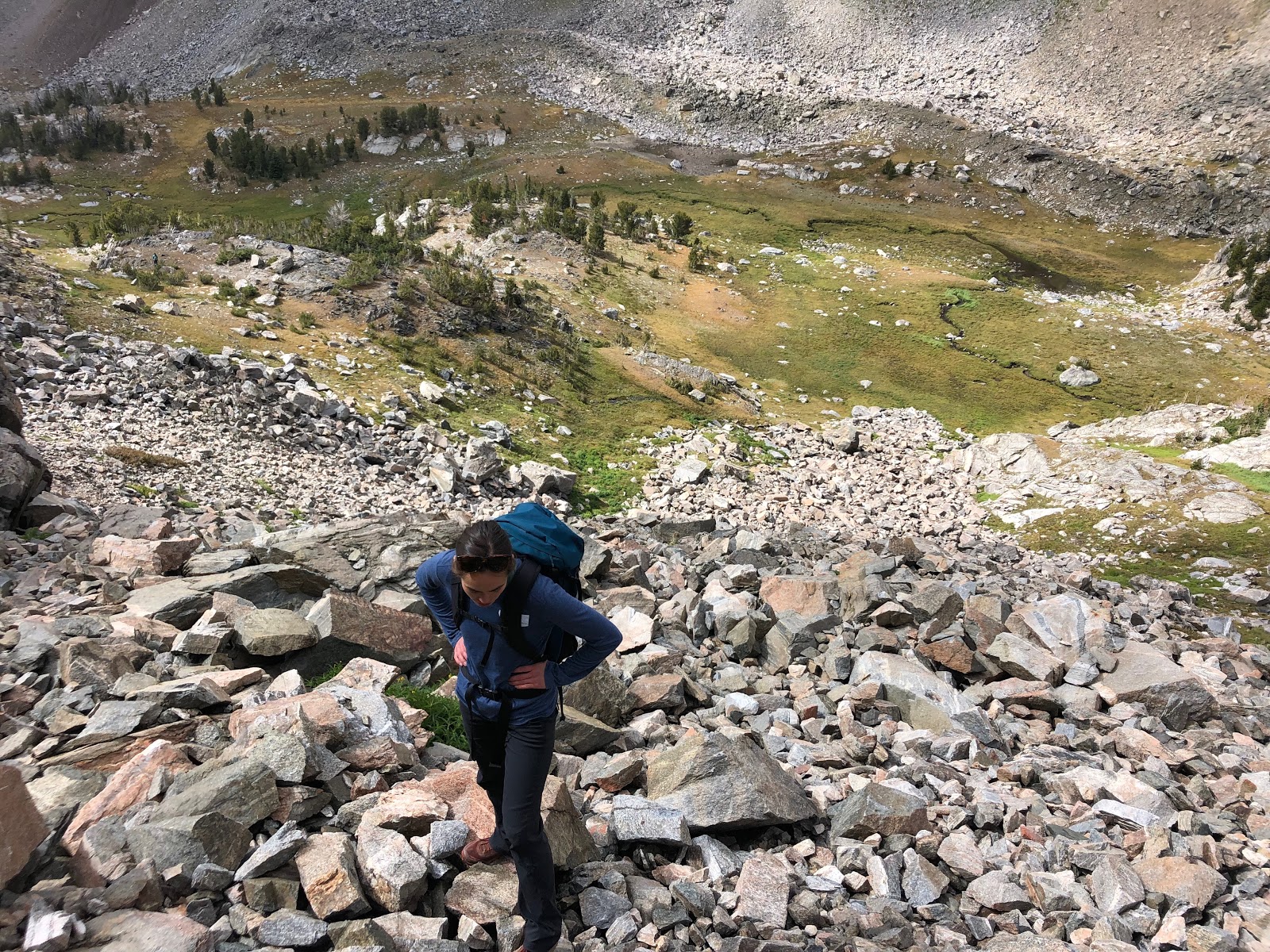
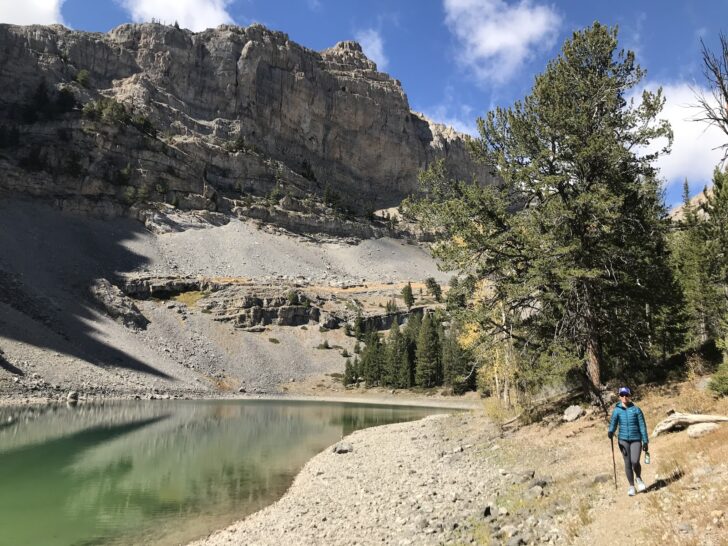
Enjoying a hard-earned rest at an alpine lake. I don’t know how long it took to get here, and it doesn’t matter.
The “average is a blessing” lesson was not an easy pill to swallow. I’ve always wanted to be naturally good at things. This fruitless desire made me competitive, prone to ignoring risks in other sports like climbing, kayaking, and mountain biking. What I lacked in athleticism I tried to make up for in heady risks. But that pressure doesn’t exist with backpacking. I just get to walk. I don’t have to walk fast, and I don’t have to walk farther than I want to.
I just have to move forward.
My average-ness was solidified for me on the middle school playground: I can’t be good at all sports, and maybe I can’t be excellent at any of them. But being average made me seek out equal playing fields, which meant dedicating more time to scrambling around in the backcountry, exploring remote alpine lakes, planning long-distance hikes, and taking off from trailheads with just my backpack, a few days’ worth of food, and a vague timeline.
The release from performance pressure is something I’ve never experienced in another sport. The idea of being average fades away with the accumulating miles. Out there, I’m just a backpacker, and I always finish what I start.
Backpacking Light does not accept compensation or donated/discounted products in exchange for product mentions or placements in editorial coverage.
Some (but not all) of the links in this review may be affiliate links. If you click on one of these links and visit one of our affiliate partners (usually a retailer site), and subsequently place an order with that retailer, we receive a commission on your entire order, which varies between 3% and 15% of the purchase price. Affiliate commissions represent less than 15% of Backpacking Light's gross revenue. More than 70% of our revenue comes from Membership Fees. So if you'd really like to support our work, don't buy gear you don't need - support our consumer advocacy work and become a Member instead.
Learn more about affiliate commissions, influencer marketing, and our consumer advocacy work by reading our article Stop wasting money on gear.
Ben Kilbourne follows tracks in the Grand Staircase-Escalante National Monument as its fate once again hangs in the balance.
Will Biden Restore Grand Staircase-Escalante National Monument?
The Grand Staircase-Escalante National Monument was designated in 1996, with its original size encompassing 1,880,461 acres. President Bill Clinton famously signed the proclamation on the South Rim of the Grand Canyon, several miles and a state away from the southern border of the new monument, an act seen by many local Utahns as cowardly, a slap in the face, and more proof that only outsiders wanted this land to hold monument status. A little over 20 years later, Trump pleased these same folks by reducing the size of the monument by about half. Now many who lamented the shrinking—locals and nonlocals alike—are anticipating President Joe Biden’s restoration of the monument to its original size. On his first day, he signed an executive order for the review of the monument boundaries. With all of this in mind, I decided to walk through an area that could be affected by whatever Biden decides to do to see if there was a story inherent in the place itself, one separate from the political division that accounts for most monument discussions.
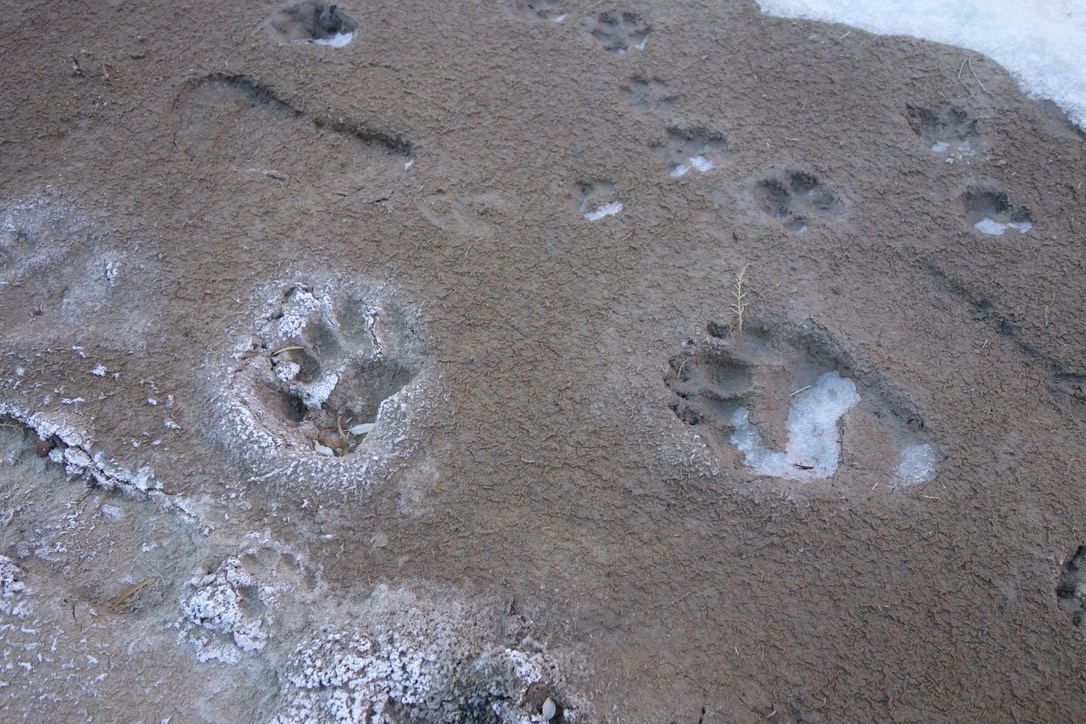
Bear, coyote, and human prints in the frozen mud.
The Upper Paria
We were headed for the Upper Paria River Canyon, an area with particularly confusing designations. Decades ago, Wilderness Study Areas (WSAs) were created on either side of the canyon and according to the Southern Utah Wilderness Alliance (SUWA), “The Paria River bed through the proposed wilderness was excluded from the draft recommendation to allow ORV [off-road vehicle] use.” This is because the state and county claim the riverbed is an RS2477 road. These RS2477 roads were created during the Civil War to plot out transportation in the west. Many are unneeded, go nowhere, and create land-use designation nightmares like we’re seeing here. As I was typing away on this paragraph a friend texted me an article saying the U.S. Supreme Court rejected an appeal by the state and county over whether organizations had the right to challenge RS2477s. This means SUWA and others are now officially allowed to fight them.
While it may be the case that ORV use is allowed in the WSA agreement, the 2000 GSENM travel management plan says that the road is closed. Thus, it is shown on most maps as a black line (closed) rather than a red line (open) or blue line (admin only). So, ORV use in the canyon likely doesn’t violate the WSA designation but does violate the 2000 GSENM travel management plan. That said, the 20-year-old travel management plan isn’t really in effect because of the shrinking; the public has been awaiting a new one which simply never happened. Without a new travel management plan, the situation in the Upper Paria has been in limbo. Once Biden restores the old boundaries (nearly a guarantee) it could be two years before we see a new plan. Until then, the canyon may have to fend for itself. I wanted to check it out for myself, and see if all this confusion violated my idea of an aesthetic backpacking destination or a coyote’s idea of a viable home.
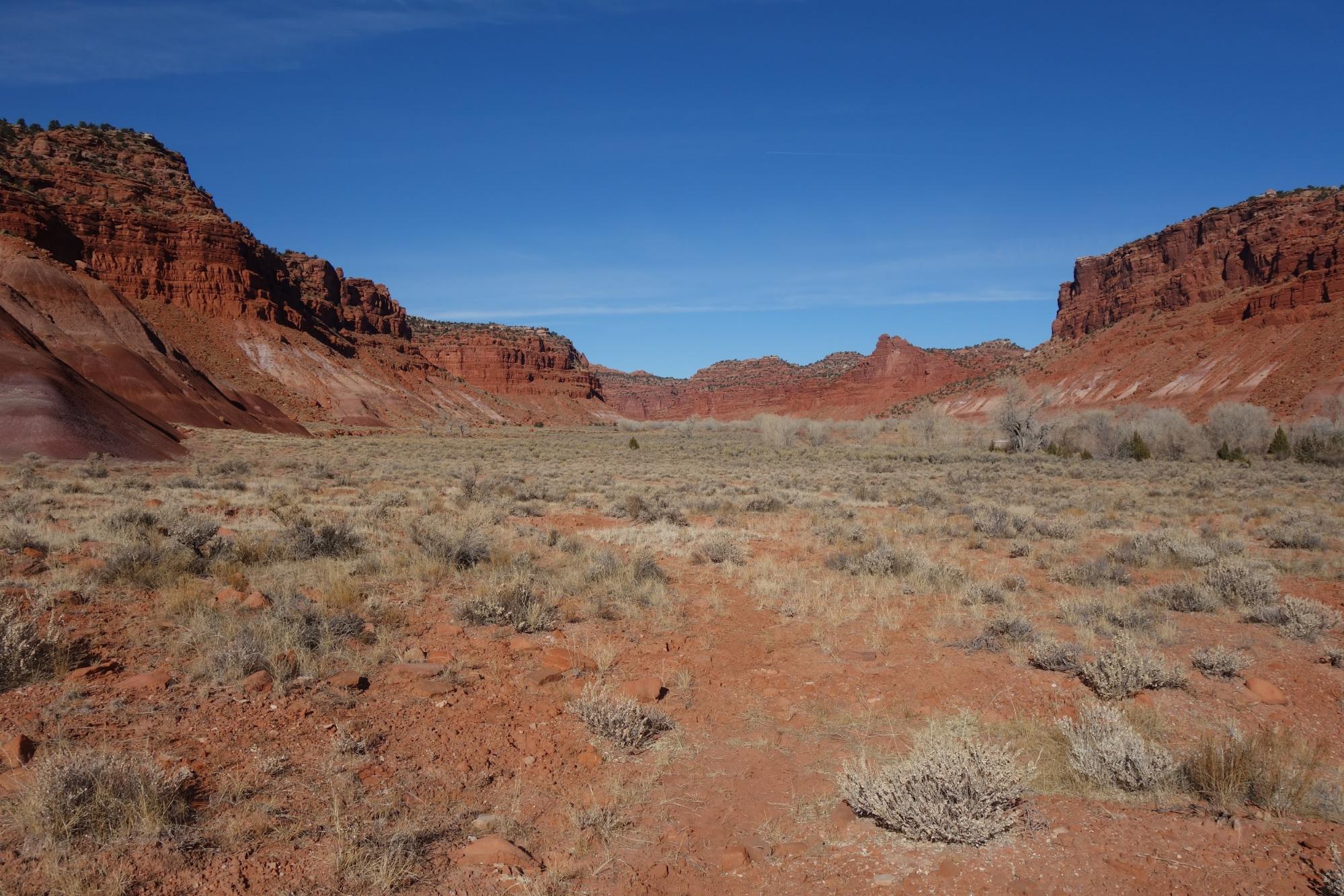
The Upper Paria River Canyon, a place with confusing designations and abundant wildlife.
Biodiversity in the Upper Paria
My friend Michelle and I rolled up to the trailhead after dark and stepped out of the car into a freezing wind. That night was in the low teens, with a good layer of frost on my bag in the morning. It took what felt like an eternity for the sun to reach us, and we didn’t start walking until late morning. My feet warmed slowly as we ambled down the dirt road. We saw a lone cholla cactus and stopped to admire it. They’re rare this far north, and rareness is always exciting
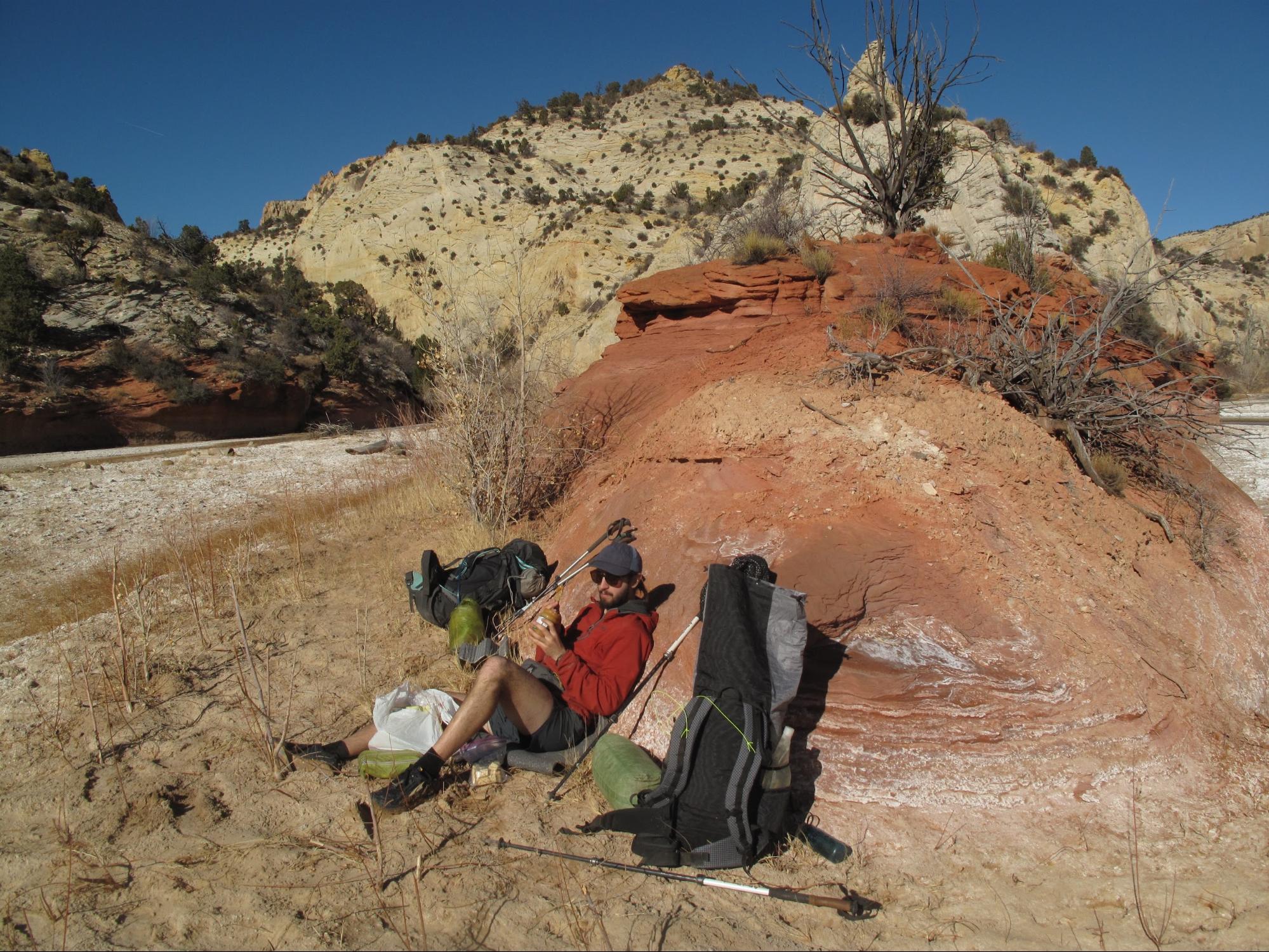
The Paria River was half frozen, half flowing, all pain-inducing. We paced back and forth along the edge of the shallow water, looking for a way to get through without getting our feet wet, but there was none, and we eventually gave up, plodding reluctantly onto the ice and punching through to ice-cold mud and water below. The brilliant red of the Vermillion Cliffs and the bright blue of the sky vibrated against each other. Either one could have been the closer block of color, either one the further. Michelle’s hair was the same color as the cliffs, a warm pink, a product of a quarter-life-crisis, she had said. I was in the midst of my own third-life-crisis but had nothing to show for it, besides maybe this reckless trip, wearing shorts in 15 F (-9 C) weather. Someone should have told me to stay home. But the warmth and brightness made the land ahead look warm and inviting, and I almost forgot the frigid night prior.
First light on the White Cliffs.
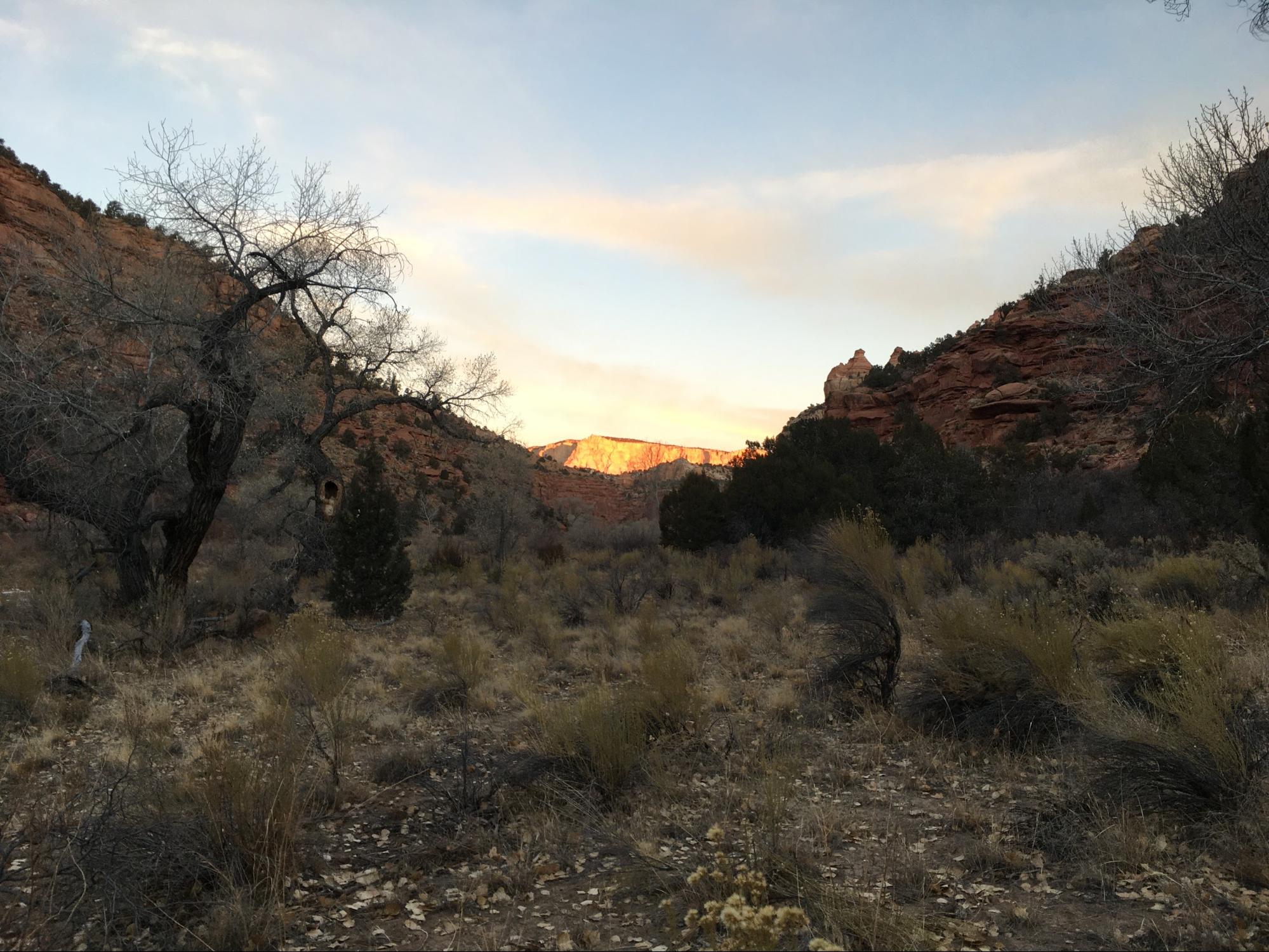
The next morning, I woke early to read in my sleeping bag. After a while, I stood up and shivered. Michelle’s tent was silent and still. She must be getting those morning hours of sleep, often some of the best. The white cliffs at the end of the canyon started to illuminate softly with the light before the dawn light, features pushing into reality. Then without warning the mountain became a castle, suddenly bright gold, like the domes of an exotic city, a place of providence at the end of a cold road. I waited in the cold for providence to reach me when I heard whirring and looked up to see a huge flock of piñon jays whooshing over me like 70 mechanical blue drones on a pre-programmed mission: go to the warmth. Soon another flock appeared over the eastern canyon wall and headed up-canyon toward the golden city where the last had gone. Then a third flock did the same thing. I looked at Michelle’s tent but there was still no movement. She missed it. So this is what happens all winter when I’m tucked warmly in bed or making coffee comfortably in my tropical kitchen.
That day we continued up-canyon observing various tracks in salty sand. There were many human tracks, Vibram sole impressions now encrusted in salt, an odd relic of capitalism in this quiet and wild place. We humans walked single-mindedly up-canyon or down-canyon while deer with unknowable destinations crisscrossed our linear paths. Cows plodded aimlessly here and there. Coyotes, too, meandered through the canyon. One giant print was probably dog’s, and another large print had the characteristic three lobes, tear-dropped shaped pads, and retracted claws of a mountain lion.
Ice in a bear print.
Then I saw a print that threw me off. It almost looked human for a second, with toes distinct from the pad—forward-facing, but still too splayed to be human. It slowly came into focus as a black bear print with another much smaller one right beside it. Clearly a mother and her cub walking side by side down the canyon. Eventually, they must have decided enough was enough, there was no food or not the right food, or there was something roaring loudly in the canyon that seemed prudent to avoid, and they turned and went back north towards Bryce Canyon and the Paunsaugunt Plateau.
As we walked, the bear path and the human path crossed and re-crossed. We watched two histories play out before us, intertwined in the residual present. Then they encountered another, the ORV path, or rather it encountered them; time is broken at this scale. Tire tracks ran across all aforementioned tracks and I couldn’t square all of these realities in my mind at once. This seems to be the real issue at hand. Who do we really want using this canyon? Can backpackers, elk, bear families, coyotes, deer, mountain lions, cows, and ORV’s coexist in this corridor? What kind of land use designation would allow this coexistence? Or do some of us need to be excluded so others can thrive?
Remembering the Purpose of GSENM
When Grand Staircase-Escalante was designated, the emphasis or purpose of the monument was to protect archeological, paleontological, geologic, and biological resources for posterity. I honestly can’t say if my presence, cows’ presence, or ORVs’ presence is conducive to this goal. Here I am writing an article from a backpacking perspective about a premier backpacking destination, and yet I feel uncertain about such a promotion. Of course, not all recreation has the same level of impact. The wide footprint and far-reaching decibel roar of ORVs vastly outweigh my meager presence. If we’re talking about science in GSENM—and I think we are—then we should keep things like this in mind.
All I ask is that when the monument is restored, and a new travel management plan is being made, this RS2477 road should remain closed. The Upper Paria is an excellent backpacking destination with wilderness character and abundant wildlife—even in the dead of winter—proving that this is a place with all of the qualities the monument was created to protect. Most importantly, it hosts the biodiversity necessary for climate change resilience. Let us see beyond our recreational desires and remember this.
Michelle and I stopped for lunch where Sheep Creek entered the Paria. It flowed swift and clear over sparkling orange sand, so I topped off a water bottle. Then we dropped our packs on the beach and let the sun warm our feet. They felt like a couple of blocks of frozen parmesan cheese stuck to my ankles, about to crumble under me and leave me face down in the icy water. But then I started to feel my toes. I wiggled them; I still had human feet. The Vermillion Cliffs had been replaced by sandstone that looked like mounds of strawberry and vanilla ice cream. I glanced up-canyon. I could see that soon we would be transitioning out of the ice cream layer into yet another layer of sandstone, the white cliffs that caught the first light that morning.
“This place is incredible,” I said, stating the obvious.
Michelle eyed me with a look that said, “Duh.”
Lunch at the confluence of Sheep Creek and the Paria River.
A western bluebird landed in a dead juniper behind us and yelled at us or maybe just the world; it was hard to say. Then another landed, and another. I didn’t know anything about these birds or how they are connected to the larger ecosystem. But I do know that maintaining those connections—whatever they are—is one of the main purposes of the Grand Staircase-Escalante National Monument.
I just hope the (forthcoming, but as yet unconfirmed) Secretary of the Interior, Deb Haaland, keeps this original purpose in mind as she and her team work towards making a decision on the monument.
Backpacking Light does not accept compensation or donated/discounted products in exchange for product mentions or placements in editorial coverage.
Some (but not all) of the links in this review may be affiliate links. If you click on one of these links and visit one of our affiliate partners (usually a retailer site), and subsequently place an order with that retailer, we receive a commission on your entire order, which varies between 3% and 15% of the purchase price. Affiliate commissions represent less than 15% of Backpacking Light's gross revenue. More than 70% of our revenue comes from Membership Fees. So if you'd really like to support our work, don't buy gear you don't need - support our consumer advocacy work and become a Member instead.
Learn more about affiliate commissions, influencer marketing, and our consumer advocacy work by reading our article Stop wasting money on gear.
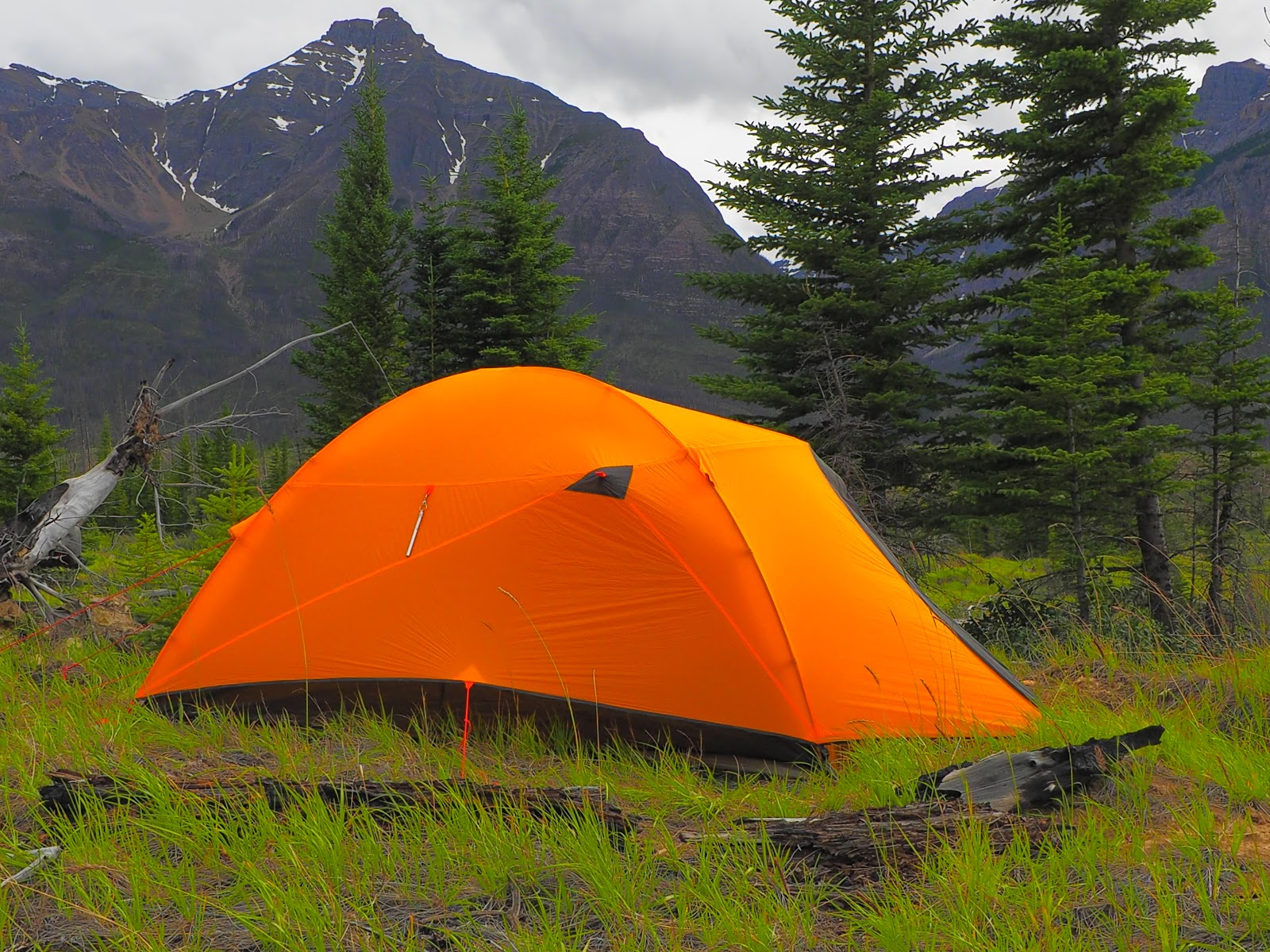
The Nemo Kunai 2P Tent ($499, 4 lb 5 oz / 1.96 kg) is a four-season shelter capable of withstanding moderate storms and offers ample headroom and good ventilation.
Is backpacking suddenly…hard? Ben Kilbourne understands, and discusses how to deal with it during uncertain times.
I’m Doing Fine!
Throughout the summer, despite the ongoing pandemic, an uncertain relationship, political division in the U.S., the impending election—and the possibility that it wouldn’t go smoothly—I somehow completed several multi-day backpacking trips and even the Uinta Highline Trail. I even said out loud on multiple occasions that I was actually enjoying quarantine, that I was enjoying my work routine at home, and that I liked cooking every meal every day. But by mid-September, something shifted in me.
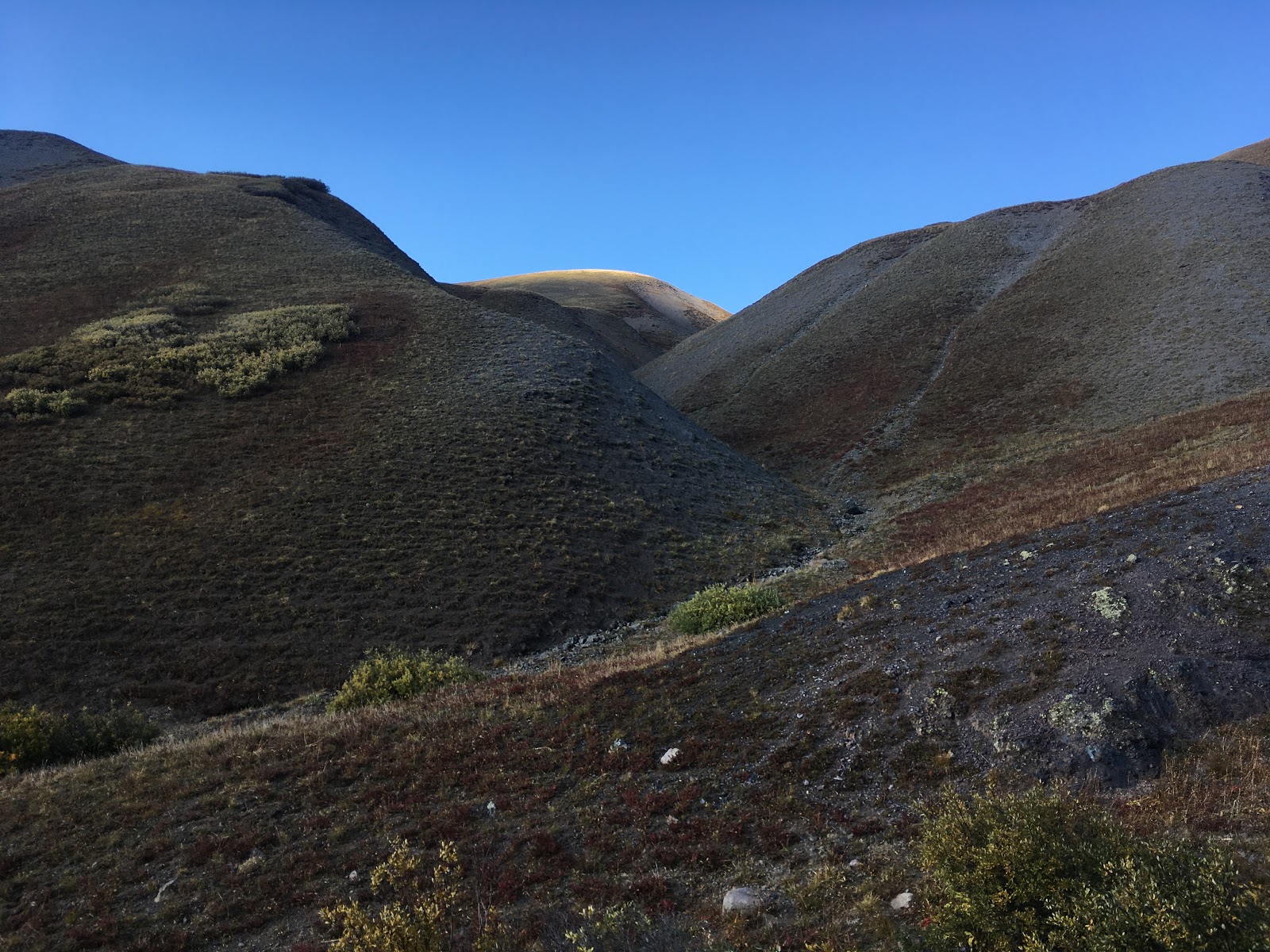
September in the San Juans.
I started making plans to go backpacking in the Cascades with my sister. She lives in Portland, so I figured I would park in her driveway and use her WiFi to complete some writing and podcast work on either end of the trip. That week, however, the entire Northwest burst into flames. Air quality was atrocious in much of Oregon and Washington, the sky completely orange from dawn to dusk. My mind swirled with these considerations:
How do I deal with Covid-19 while visiting my sister? Should we both get tested and quarantine beforehand?
Should we risk backpacking in fire-prone forests in the Northwest?
Should we backpack in smoky areas with poor air quality?
Is there a trip in that area that is both safe and non-smoky? How should I go about planning it?
What if clashes between protesters and militias in Portland get worse? Do I really want to be there?
Portland may have to be evacuated. Could I get caught in the traffic pouring out in every direction?
I procrastinated because I simply couldn’t compute all of this. Finally, it was too late. Procrastination made the choice for me, and although it didn’t feel right, I decided to head south alone. There were fewer fires in the Four Corners area so I could at least stop worrying about that, but I’d be alone, which would prove to be less than desirable.
These days many of us are far more alone than we have ever been before. To compensate for this aloneness, we connect to our friends, and sometimes people we don’t even know via texts, emails, calls, and social media. There’s a togetherness that screens allow, but it’s only a partial togetherness. I’m virtually never alone while being simultaneously nearly always physically alone. This strange state has left me in fear of complete aloneness, real aloneness. As someone who has backpacked alone countless nights, this fear of aloneness was new for me, and strange, and worth investigating.
When I hit the road with a Weminuche Wilderness map on the seat beside me, I wasn’t quite ready to sever my connection to humans completely. Sitting in the truck after getting gas in Durango I sent some text messages out, hoping for an engagement—however mundane. Right before dusk I pulled into a campground and parked between ponderosas and gamble oak. A Steller’s jay greeted me from the picnic table. I stepped out of the truck and wobbled on my feet; I had forgotten to eat all day. After dinner, I walked out into the dark forest and stood and just looked into the darkness and the still-glowing sky beyond the trees. I thought about how all I wanted was certainty. Just certainty. Of any kind. In any aspect of life. I looked back towards the campground. And then I slowly made my way there.
Descending toward the Animas River and the Weminuche Wilderness.
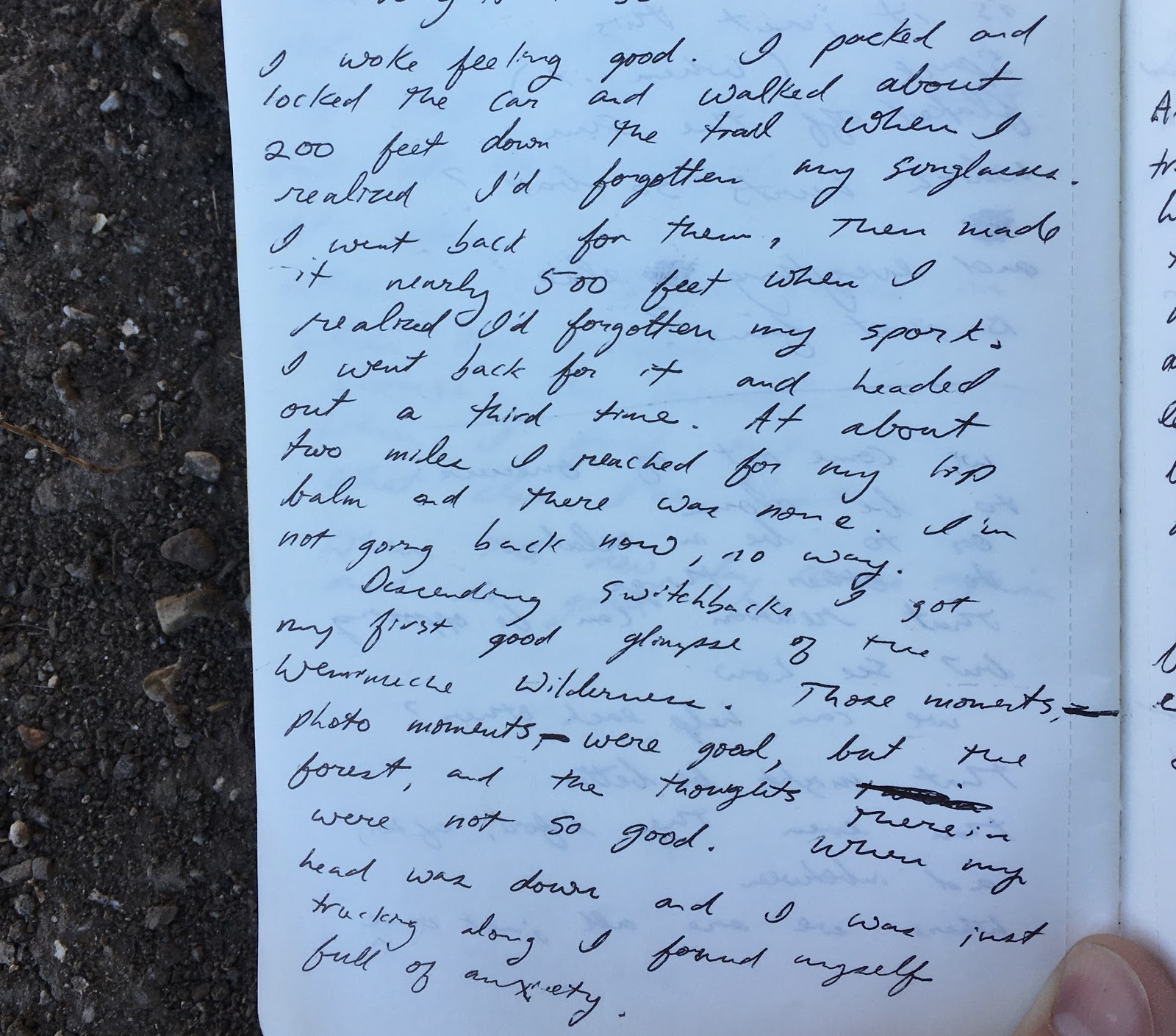
The next day, when I walked down steep switchbacks between yellow aspens, I couldn’t get out of my head. The smoky sunlight shined through a dramatic valley with nearly 3,000 feet of relief between the mountain tops and the Animas River. These mountains were new to me and intimidating. I looked at the twisted rock across the valley which trees managed to grow sparsely on despite its near verticality and was awed, but my awe stopped short of appreciation. I stood on a footbridge that ran over the Animas with banks still slightly yellow from the 2015 Gold King Mine Disaster. I listened to the water, but it sounded far away as if I was observing it through a screen just as I’d been observing most of the world over the past few months. As much as I tried to experience everything around me, I really couldn’t. I simply kept ruminating, my mind spinning with uncertainty.
A journal entry from the first day of my Weminuche trip shows how scattered my mind was.
Later in the day, climbing a trail above the treeline I suddenly stopped. “What if it snows?” I thought. “I don’t want to be up here.” I hiked back down the trail and started looking for a camp in the forest. I scoped out a spot with too many dead trees and another that was too lumpy. Nothing was quite right.
Then I started second-guessing my choice not to go over that pass. I knew that it wasn’t supposed to snow, so why did fear of snow suddenly send me back down the trail? Moreover, I normally wouldn’t care one way or the other about snow, or I would even look forward to the beauty of snow-covered tundra at 11,000 feet. I felt like I just wanted someone to tell me what to do. Then I stood in the trees wondering why it was so hard to make any decision at all. I fell into extreme despair and just stood looking at the lumpy meadow in the afternoon light. Then I began judging myself for being unable to accomplish something previously so simple.
Depleted Surge Capacity
What’s going on here? I’ve been backpacking alone for years and yet I found myself incapable of something as simple as making a choice between walking over a pass or not. Even selecting a campsite was impossible. Apparently, I’m not alone.
Throughout the summer, I had been staying afloat by using what psychologist Ann Masten, Ph.D., calls surge capacity. “Surge capacity is a collection of adaptive systems—mental and physical—that humans draw on for short-term survival in acutely stressful situations, such as natural disasters,” Masten says.
I think of it as a form of adrenaline. We tap into it when we need it—to escape a mountain lion attack or a burning building—but it becomes depleted when we wake every morning only to find that mountain lion ready for the chase again. As the pandemic and other compounding uncertainties continue, and each day we grapple with the reality that things are still not how they used to be, our surge capacity eventually runs out.
I was unaware of the concept of surge capacity at the time, so I just stood in the trees judging myself harshly for not being able to accomplish simple tasks. I was still standing in the trees not knowing what to do when two men strolled by. The first exclaimed enthusiastically,
“Howdy! It just couldn’t be a better day, could it!?”
Caught off guard, I stammered “It’s, uhh, really nice.”
Where I stood in the trees unable to make previously simple decisions.
They walked on into the forest and I stood in the trail and watched them go. They’d been on the Colorado Trail for many days, so their appearance told me. I wondered what they knew that I didn’t. I wished I could absorb some of their happiness and ease through osmosis, and wondered if they were so much more settled than me because they’d been out on the trail for 10 or 15 days.
In the moment, the solution to my woes seemed clear: I needed more time out there. I needed to get used to being alone on the trail again. This could be true, but according to science journalist Tara Heale, in an article published in the online publishing platform Medium, pushing ourselves to function like normal might not be the best idea for some of us right now.
It’s Ok for Backpacking to be Hard Right Now
When I found myself fully and truly alone after the two Colorado Trail hikers disappeared, I became suddenly flooded with reminders of what I had lost in the past few months. Among other things, I’d lost the ability to hang out with friends or to go to the coffee shop, movie theater, gym, or restaurant and bask in the ambiance of others’ lives. I didn’t know the loss of these things would be such a big deal, as they’re less tangible than say, the loss of a loved one. This type of loss is referred to as “ambiguous loss”. Humans are wired to cope with acute loss or acute grief, but ongoing loss and grief are different. Heale writes that “ambiguous loss elicits the same experiences of grief as a more tangible loss—denial, anger, bargaining, depression, and acceptance—but managing it often requires a bit of creativity.”
One of the recommended ways of coping with ambiguous loss and the resulting depleted surge capacity is to expect less from ourselves. This means we should be OK with not being OK right now. I shouldn’t have beat myself up for my inability to hike over a pass, select a campsite, or enjoy the trip. It’s even alright not to go backpacking if it makes things worse. Backpacking often necessitates the use of problem-solving skills, physical strength, and mental and emotional robustness; all things that may be depleted for some of us during this strange time. And this is particularly troubling when backpacking—my primary form of stress-relief and self-care—suddenly turns on me.
It’s a pretty hard reality to accept, but accept it I must. Of course, many folks reading this will not be in the same boat as me, and for them, it’s fine to go backpacking more than usual if that’s what best relieves your stress. The bottom line is we need to do what we need to do to take care of ourselves regardless of how that might compare to the ways we cared for ourselves prior to 2020. Backpacking isn’t going anywhere, and things will not always be like this. Remember, we have the summer of 2021 to look forward to, and it’s going to be amazing.
Eventually, I did manage to set up my tent and hike to the top of the pass. I got at least a little taste of the awe, wonder, and sense of accomplishment I hoped for.
Backpacking Light does not accept compensation or donated/discounted products in exchange for product mentions or placements in editorial coverage.
Some (but not all) of the links in this review may be affiliate links. If you click on one of these links and visit one of our affiliate partners (usually a retailer site), and subsequently place an order with that retailer, we receive a commission on your entire order, which varies between 3% and 15% of the purchase price. Affiliate commissions represent less than 15% of Backpacking Light's gross revenue. More than 70% of our revenue comes from Membership Fees. So if you'd really like to support our work, don't buy gear you don't need - support our consumer advocacy work and become a Member instead.
Learn more about affiliate commissions, influencer marketing, and our consumer advocacy work by reading our article Stop wasting money on gear.
Some observations on cheap one-person shelters, including on their design, proliferation, and history, and comparison between some shelters.
Introduction
A one-person tent—of whatever brand—is sized at some barely tolerable minimum that varies slightly according to its design. Whether all of this cramped stringency and suffering actually pays off for backpacking is unclear. Substituting a “two-person” tent may add merely a pound (or in many cases, less). The idea has been around at least since the Victorian Era and probably the Stone Age—always with the same tradeoffs. Marginal advantages of the solo tent include reduced bulk and weight. When beset with brush or uneven ground and in stealth camps, its small size is versatile for siting. My fascination with this equipment is not, however, primarily practical. I’ve long imagined the minimal one-person shelter as a symbol and marker of backpacking’s austere freedom.
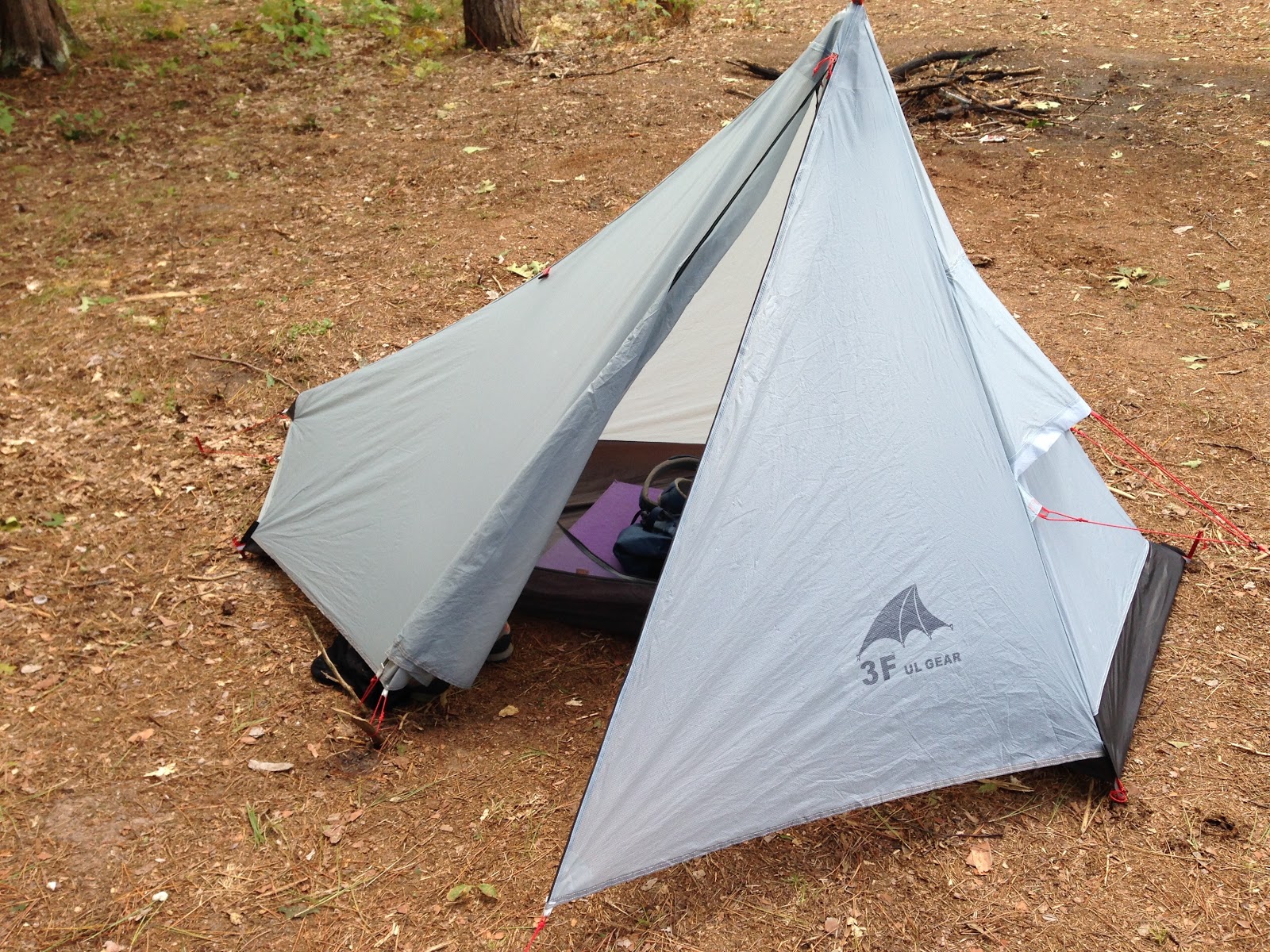
And so it was that I recently acquired an offset-pyramid tent from 3F UL Gear—the CangQiong 1 (1.5 lbs / 740 grams). The company offers a small line of tents that rely on a single trekking pole for set-up. Based in Xiamen, China, 3F seems to rely on Google Translator for its English-language marketing. This tent-maker helpfully describes the CangQiong 1 as “designed for dry conditions.” Yet I interpret this forbidding description with sunny optimism.
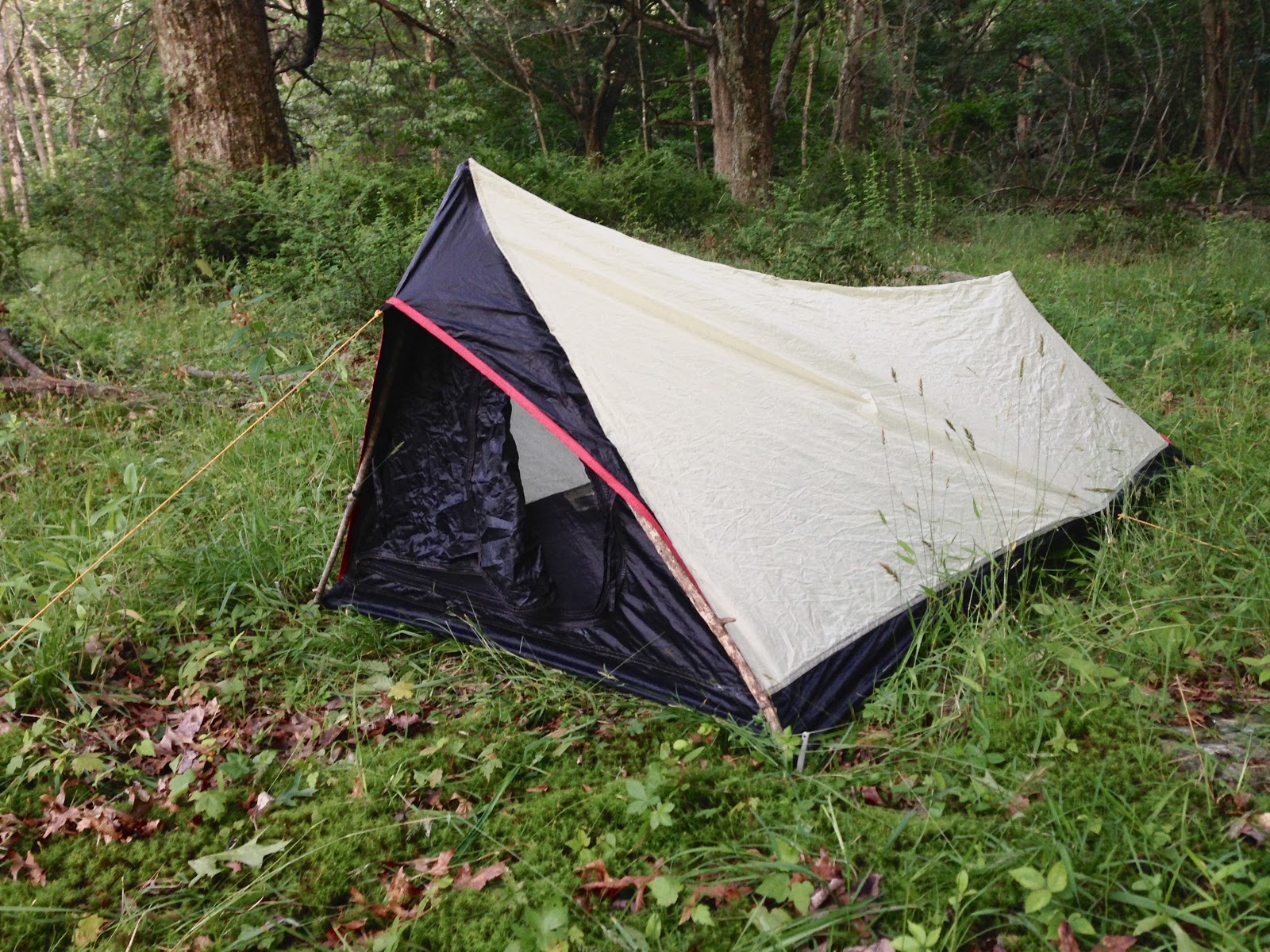
The 3F Ultralight Gear CangQiong 1 is an offset pyramid designed for one person and advertised at 1.6 lbs (740 g). Its maker helpfully describes this tent as “designed for dry conditions.” Camped on the banks of a slow-moving and sizable river at freezing, condensation was problematic but unthreatening. (photo: John Seward)
Knock-offs, “Originals” and History
First, however, it’s best to acknowledge the obvious: these tents are inexpensive knock-offs derived from successful American brands. The “originals” are more durable and weatherproof—and cost more. Producing copies and imitations is a long-established practice among tent-makers, with examples continually appearing. Outright piracy presents moral and legal issues, but I’ve no information nor opinion on whether this pertains to the 3F Ultralight Gear CangQiong 1.
Moreover, choosing between global market “philosophies” of any stripe is not my intent—least of all at the cash register. The concept of backpacking implies severely minimizing all its trappings. Sometimes this minimalism expands—at least in my imagination—to include matters of price. At some point, many of these questions become trivial and arbitrary.
Offering dire critiques of non-premium equipment is a long-standing pastime for certain hikers. But memoirs of the now elderly British mountaineer Chris Bonington recount sharing a ledge high on the Eiger with Don Whillans while both inside the same jumbo-sized plastic bag culled from a trash heap. The infamous Whillans chain-smoked cigarettes through the night. The bag’s quality wasn’t recounted as an issue. But in this instance the pair may have been happier in solo shelters—even if still failing to complete their route as a team.
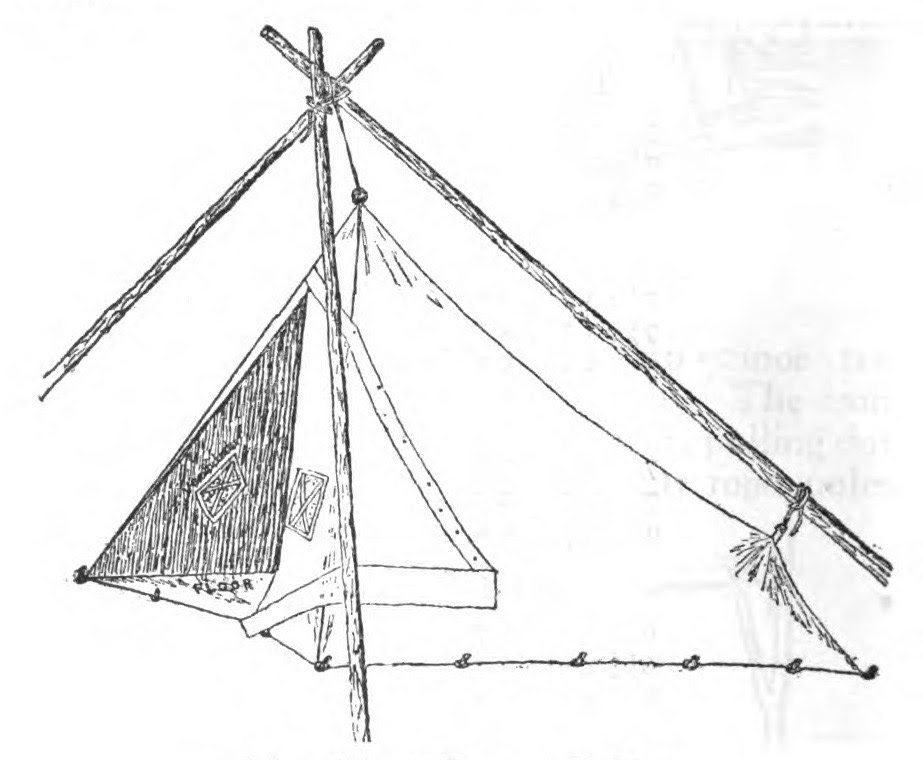
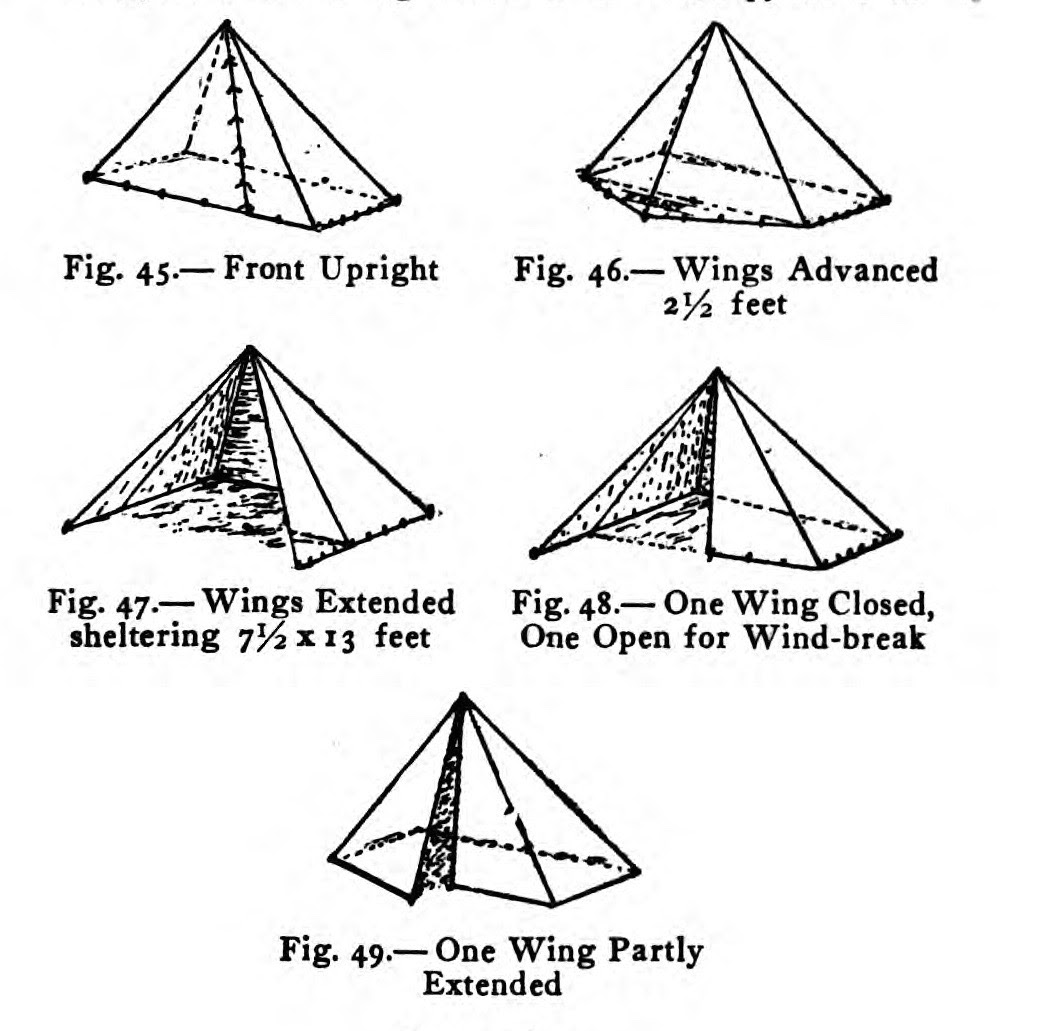
The 3F tents are based on recent patterns, but also reminiscent of much older, classic designs —especially the Compac Tent (3.4 pounds, 1.5 kg ) and the Royce Tent (4 pounds, 1.8 kg). Horace Kephart referenced these old tents in his 1911 manual Camping and Woodcraft. The author noted that Thomas Hiram Holding of London supplied a wedge tent “of Japanese silk, that weighs under 12 ounces; and it is a practical little affair of its kind.” But for the hiker who “goes out alone for a week or two at the fall of the year, or at an altitude where the nights are always cold” Kephart advised, “take a half-pyramid tent, say of the Royce pattern, but somewhat smaller.”
The Compac Tent set up with shears as shown in Horace Kephart’s volume called Camping and Woodcraft (1911). Kephart says of the Compac, “I have called this clever contrivance a ‘pocket-house.’ It deserves the name, being waterproof, wind-proof, bug-proof, ventilated, sheltering a space 8 x 6 x 4 feet, and yet it rolls up into a 16 x 4-inch parcel, and weighs, with its rope, only 3.4 pounds. [1.54 kg]”
As of 1969, Recreational Equipment Inc.’s catalog included a “One-[Person] Tent” of tapered wedge design, with a canopy of finely woven cotton and pictured in deep blue. It may have been part of their line of several Swedish imports. Much lighter solo wedges in coated nylon were already available through a contemporaneous Eddie Bauer catalog.
The Royce Tent as illustrated in the 1911 outdoor manual Camping and Woodcraft. Author Horace Kephart recommended a smaller version of this four-pound (1.8 kg) half-pyramid for the lone traveler in cold weather.
Proliferating Designs
Today among leading one-person designs, the 28.6 oz (810 g) Durston X-Mid 1P is $200 and made of polyester, said to reduce stretching in rain. Six Moon Designs, one of at least several comparable small firms in the U.S., has produced a matter-of-fact YouTube video, showing that its Lunar Solo tent ($230) employs more durable and waterproof textiles (polyester) than competitor knock-offs, and yet is marginally lighter. The Swedish firm Hillenberg offers a well-established line of heavier singles in the range of $600 that seem suitable for alpine blizzards. But even as ingenious solo tent designs have proliferated, the whole genre is called further into question when lined up against very small, single-wall two-person domes (Black Diamond Equipment First Light, $370) available for the past 20 years.
Feeling penurious and with a genuine aesthetic revulsion toward domes, in March 2020 I acquired the 3F Ultralight Gear CangQiong 1 offset design. A longstanding but selective attraction to “reverse snob appeal” slightly clouded my judgment. The actual name of this product is rarely used in English-language marketing. It’s called instead of the “Single Person Tent Outdoor Ultralight Camping Tent 3 Season Professional Nylon Silicon Coating Rodless Tent.” Delivery from Xiamen took eight weeks.
In Michigan’s Lower Peninsula recently, I spent four October nights in the CangQiong 1, confirming its high-quality stitching and carefully designed reinforcements. It shrugged off light showers. Although smaller and more than twice the weight of Holding’s silk wedge of 1911, this tent is indeed “a practical little affair of its kind”— and yet another sign of human progress.
In March, AliExpress listed the model at $70, but payment difficulties on that site sent me to Amazon, which charged about $100. Now, seven months later, its price is up substantially, although a tent branded Flames Creed (not 3F) at a glance appears identical and is more reasonable ($89) as of this writing.
Cheap Tents Compared
I can most directly compare the CangQiong 1 with recent experience of a different one-person tent: the Wenzel Starlight. Its pleasingly classic, “mountain tent” form, and even an A-frame door bring to mind 1960s REI backpacking tents. Mine was a $28 Walmart purchase. From April to November last year, I spent a dozen nights in this relatively spacious, two-pound (896-gram) tent during walks along the western border of New England. But my Starlight has a sad secret: On a November evening in the Taconic Mountains, the “beak” or hood shielding its door ripped as I carelessly inserted an A-frame pole too tightly. This tent, now discontinued by Wenzel, remains marginally usable and repairable, but I’m uncertain of taking the trouble and expense.
The Wenzel Starlight, advertised as a one-person tent, was discontinued by its manufacturer several years ago. This wedge-style shelter weighs about two pounds (907 g). Its “beak” or hood ripped during a careless job of pitching after a dozen nights. It cost $28 at Walmart. (photo John Seward)
The 740’s construction inspires incremental confidence. It’s also preferable for its spacious, well-protected vestibule and door, and 10 inches (25 cm) of extra headroom. Although the 740 may at any time meet Starlight’s fate, it’s more likely to stand up adequately. For 10 years, I gradually wore through the floor of a tent similar to the Starlight, acquired for $19 from a local version of K-Mart. Clearly (to me), cheap and lightweight tents are potentially reliable. Moreover, recent experience may now inspire slightly greater tent-handling care.
Condensation Complaint Department
In mild weather, condensation inside coated tents, including the Starlight and 740, is largely insignificant. But a couple of nights spent hard by the banks of a midwest river near-freezing saw the 3F Ultralight Gear CangQiong 1 produce copious condensation by dawn. (In similar weather at a less dank location, this same tent stayed reasonably dry). Long ago I spent a night of inexpressible misery inside the K-Mart pup tent after a predicted rainstorm unexpectedly produced eight inches of wet snow at nightfall.
For several years following this pup tent incident, I avoided down sleeping bags in all but summer weather—regardless of available tentage. I acquired various floorless tarp shelters—solo and otherwise. Liquid simply drains away into the snow or dirt. Banked snow or even autumn leaf-drop can seal the perimeter from cold drafts. Moreover, floors may be the quickest tent component to wear out. But sewn-in floors and netting are an indispensable defense against insects in season and serve as a reassuring barrier against mud and crud.
Still fearful of drowning in an icy sea of condensation, I now rely on a sleeping bag cover or bivouac sack to protect from any rare discomfort inside sketchy shelters. A cover also shields the delicate sleeping bag from dirt and abrasion, while conveniently serving in lieu of a stuff-sack for transit and as a closet storage bag. In relevant circumstances, covers with fully waterproof “floors” can also make a groundsheet redundant.
Unlike many 3F products, its Tyvek Bivy bag (7 oz / 200 g) appears to lack narrowly comparable competition. Recently advertised at $20, it performed well inside the CangQiong 1 on four autumn nights near freezing. The unit is doubtless somewhat weatherproof when new and/or not excessively laundered. It’s too narrow, however, for winter sleeping bags and lacks a reliably waterproof floor. Various do-it-yourself Tyvek bags seem feasible for the talented.
Other, much more durable and desirable light covers are available—starting at about $100.
Further Reading:
Matthew De Abaitua’s memoir The Art of Camping (Penguin Books, 2011) includes a survey of camping history and literature from a British perspective with significant detours to America. DeAbaitua’s bibliography, including works by Kephart and Holding, covers 17 pages.
Dan Durston, a U.S. designer who reviews gear for Backpacking Light.com, has written with clarity and authority on geometrical issues of tent design. See his blog essay “The Volumetric Efficiency of Trekking Pole Shelters.”
Backpacking Light does not accept compensation or donated/discounted products in exchange for product mentions or placements in editorial coverage.
Some (but not all) of the links in this review may be affiliate links. If you click on one of these links and visit one of our affiliate partners (usually a retailer site), and subsequently place an order with that retailer, we receive a commission on your entire order, which varies between 3% and 15% of the purchase price. Affiliate commissions represent less than 15% of Backpacking Light's gross revenue. More than 70% of our revenue comes from Membership Fees. So if you'd really like to support our work, don't buy gear you don't need - support our consumer advocacy work and become a Member instead.
Learn more about affiliate commissions, influencer marketing, and our consumer advocacy work by reading our article Stop wasting money on gear.
BPL columnist Maggie Slepian unpacks suffering in endurance sports.
Every backpacker, thru-hiker, or endurance athlete knows how to suffer. It’s an intrinsic part of what we do, and it sets the people who reach their goals apart from the people who quit from the discomfort.
Maybe you remember when you first learned to suffer. It could have been on a thru-hike, elsewhere in the mountains, or in some other, disconnected part of your life. I learned to suffer during my first season as a wrangler in Yellowstone National Park. It was 2010, I had just graduated from college where I had lots of friends and soft hands. I went from my plush New England existence to working 14 hours a day at a rugged corral where my coworkers hated me. It was my first experience with both manual labor and being despised.
Leading up to this point, I’d never had to “gut it out.” Life had been easy. To everyone’s surprise (and possible dismay), I finished the season—a full four months where I wanted to quit every. Single. Day. It was the first time I’d suffered in something and saw it through to the end.
Though it seems disconnected, I carried that horrendous season with me as I moved forward in life. There wasn’t a smack-you-over-the-head bedtime story lesson, but it was more the fact that I had forged through misery and loneliness, physical and emotional pain. Something about that experience wedged into the back of my mind as I became more involved in backcountry sports.
I put my gym-class-rejection past behind me and learned to keep up because I was willing to be uncomfortable.
When it comes to many endurance endeavors, mental fortitude often plays a bigger role than physical capabilities, and this includes backpacking—athletic abilities are irrelevant for most long-distance hikers. Out of shape? Hike fewer miles. Out of breath? Stop and rest. It’s not a race and there is very little skill involved in walking. With this lack of hard skills is where the ability to suffer comes in. This is what sets the people who finish apart from the people who throw their packs down at a road crossing, stick out their thumb, and google nearest airport from the bed of the pickup truck that took pity on them.
I am a very average athlete. I lack coordination, endurance, speed, and anything else it took to succeed in gym class. As I got into climbing, mountain biking, and thru-hiking, I learned that while I was average in anything that makes people passable at sports, I could keep up and do well because I was willing to suffer. The mental aspect could override any physical shortcomings.
None of the literature on “mentally preparing for a thru-hike” is groundbreaking. We all know that there are mental and physical components to backpacking. But what sets the finishers apart from hikers who quit when it gets hard is the ability to compartmentalize the discomfort and endure some amount of suffering. That mentality lets average athletes do above-average things.
Long-distance backpacking is mostly mental. If you can gut out the bad days, you can finish.
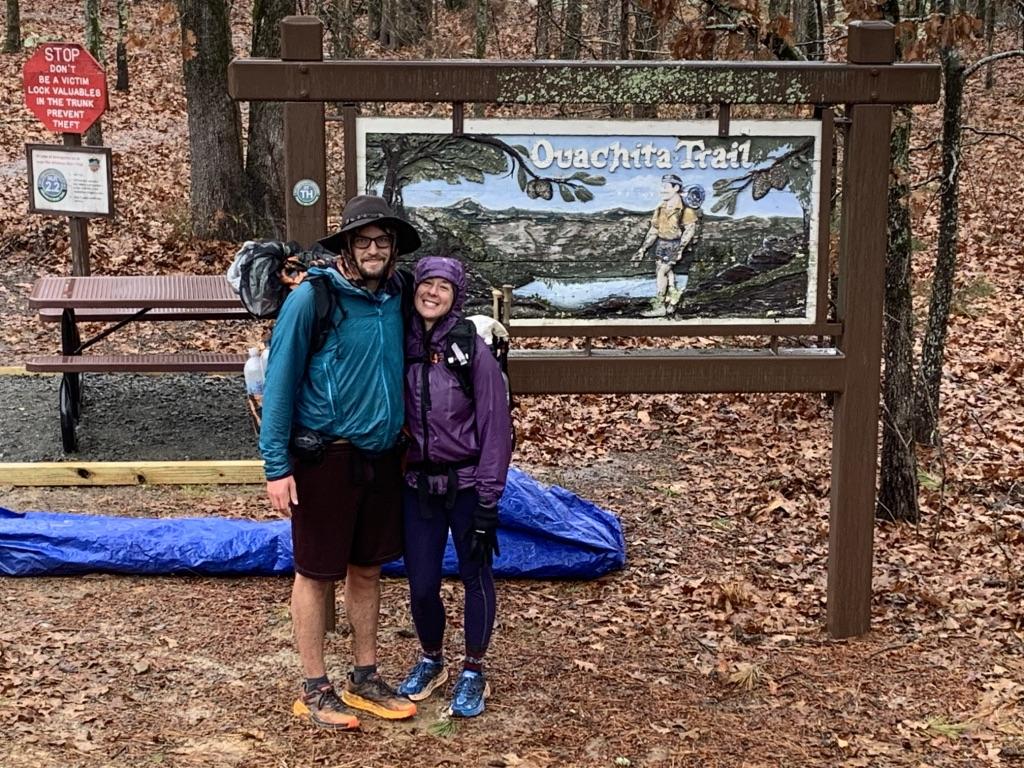
I thought a lot about what sets people apart during my recent thru-hike of the Ouachita Trail. The people who are out there completing thru-hikes aren’t necessarily the ones who excelled in high school athletics. We saw a few other thru-hikers out there last month, and it seems like half of them quit before the halfway point, citing pain and discomfort. Totally fair! Long-distance backpacking can be a wildly uncomfortable experience and not something most people put themselves through. The people who do get out there are often surprised by the sheer misery some days on the trail throw at you.
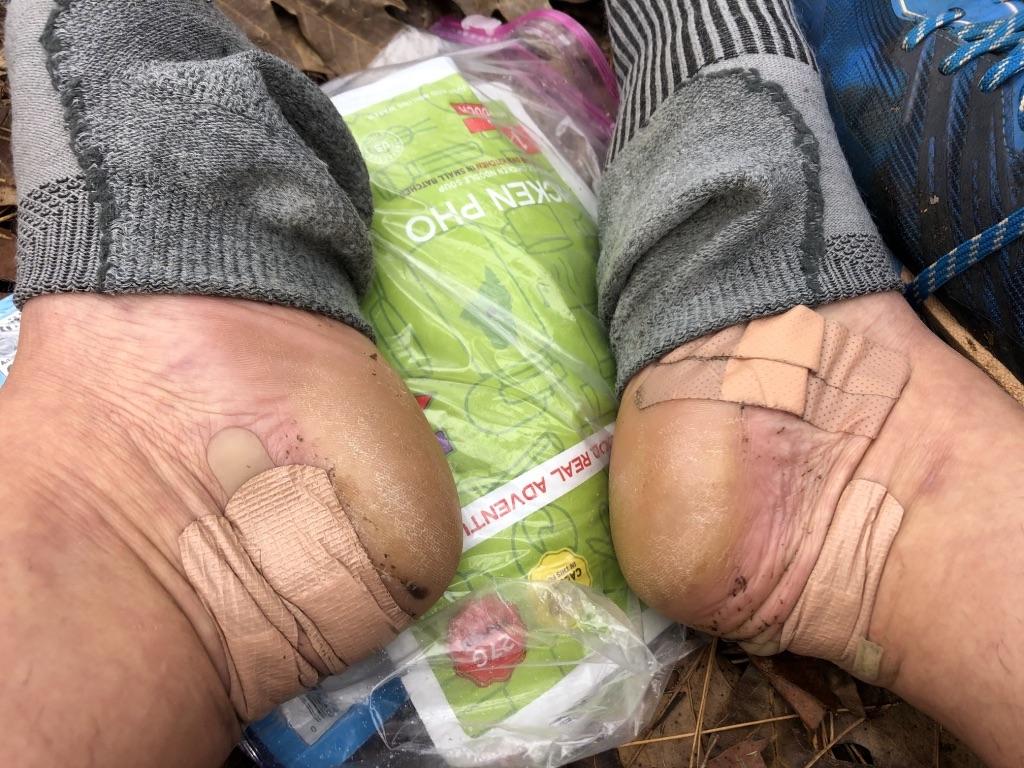
I had awful foot issues on the Ouachita Trail, pretty much from the beginning. The trail was 223 miles long, and I’m not exaggerating when I say I hiked maybe 40 miles without enduring moderate to extreme foot pain. It ranged from pounding soreness to blisters that made me shriek when half of my heel skin peeled off with my socks. I spent one evening picking crusted blood and pus from my socks so I could wear them the next day.
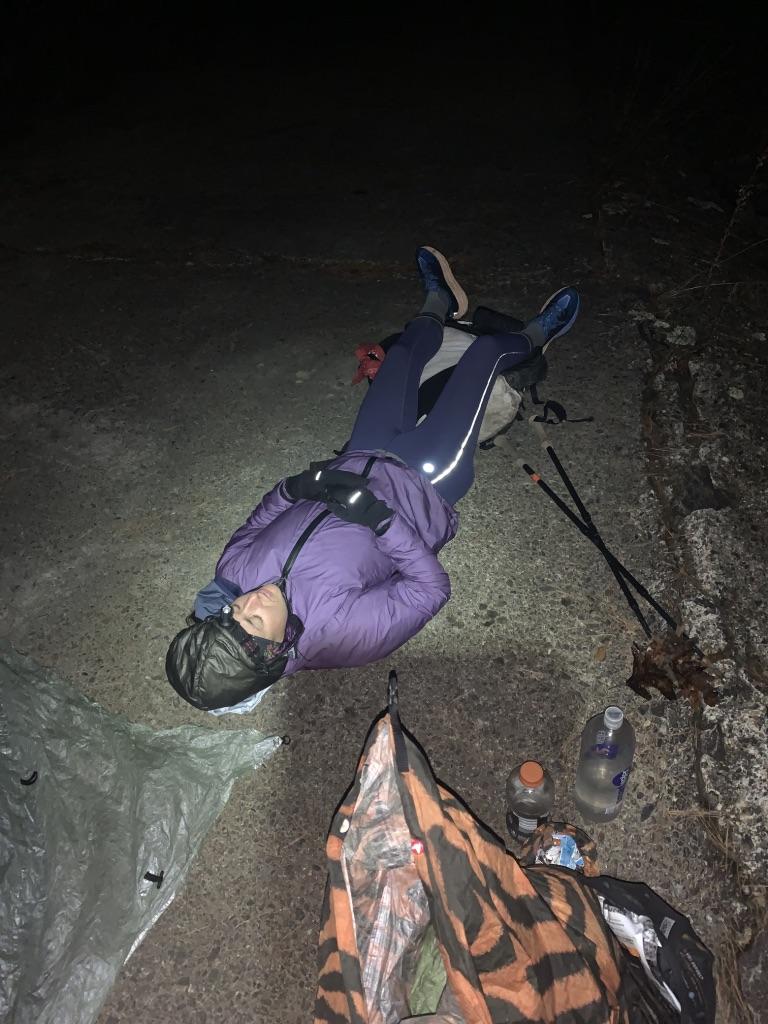
Lying down on an asphalt bridge crossing during a night hiking section to alleviate some pain and get through the next four miles.
But the worst was the pain in my heels. It prevented me from sleeping and made me walk with a staggering limp. I had the nagging feeling it was the start of plantar fasciitis, but I never figured that out. Whatever it was, the pain would be absent for two or three miles each morning, then start building throughout the rest of the day until I would count my steps, backward from 500, to have something else to focus on.
I developed mental tricks for continuing to move forward. Instead of trying to ignore the pain, I would focus on it, untangle it. Left on its own, the daggers through my heels would become overwhelming, but if I could narrow it down or describe it to myself, it was less intimidating. I’d keep walking and not let myself stop until a predetermined, arbitrary spot every few hours. By the time I reached the spot, I would be gasping for air—the pain was so bad it made my chest constrict.
This was the healing process for my blisters. The swelling and heel pain would continue to get worse over the next 100 miles.
For some (maybe asinine) reason, it never occurred to me to quit. Sure, I’d have stopped if I felt like I was truly injured, but the fact that my feet would (mostly) recover each night gave me confidence that I wasn’t doing irrevocable damage to my body. I figured my feet were just Going Through It, and as long as I could continue physically moving forward, I would. The suffering would eventually end, and in the grand scheme of things, I told myself it really wasn’t that bad. It wasn’t my knees or ankles, it wasn’t gastrointestinal distress, it wasn’t my back going out. I could walk through it. Plain and simple.
Since physical pain and discomfort is such an individual experience, it’s impossible to accurately scale it. Was my foot pain bad enough it would have caused someone else to quit? Maybe. But with the “gut it out” mentality of just hiking one more mile, one more afternoon, one more day, one more week, the suffering eventually ends. When it does, you’ve completed your goal. And I did complete the goal, which was to hike this trail end to end. It hurt and I’d say I was suffering, but not bad enough to make me stop.
Whatever was going on with my feet, all traces of the pain had faded within two days of finishing
When we each learned to suffer, we also learned that the suffering eventually ends. That’s what keeps us going. My wise, endurance-athlete father once told me: “It doesn’t always keep getting worse.” That’s how I keep going, and that’s how I finish what I start.
Despite my curated existence on the internet and the fact that I am a Writer in the Outdoor Industry, I am not a skilled athlete and I don’t possess supernatural endurance capabilities.
Some of you might be lucky enough to be skilled athletes or have those supernatural endurance capabilities. Most of us though? We’ve just learned to be really, really good at suffering.
Backpacking Light does not accept compensation or donated/discounted products in exchange for product mentions or placements in editorial coverage.
Some (but not all) of the links in this review may be affiliate links. If you click on one of these links and visit one of our affiliate partners (usually a retailer site), and subsequently place an order with that retailer, we receive a commission on your entire order, which varies between 3% and 15% of the purchase price. Affiliate commissions represent less than 15% of Backpacking Light's gross revenue. More than 70% of our revenue comes from Membership Fees. So if you'd really like to support our work, don't buy gear you don't need - support our consumer advocacy work and become a Member instead.
Learn more about affiliate commissions, influencer marketing, and our consumer advocacy work by reading our article Stop wasting money on gear.
BPL author Rex Sanders meditates on gratitude and 2020 as he recovers from a traumatic brain injury during the time of COIVD and wildfires.
One sunny Saturday in the spring of 2020, I left the house to ride my mountain bike across town. That’s the last thing I remembered for the next two weeks.
According to witnesses and official documents, just a few miles away I went off the road, down a near-vertical hillside, and crashed into some trees. I was unconscious, bleeding from minor wounds, and covered in poison oak. The next 24 hours included three emergency room visits, two ambulance rides, and one 22-mile trauma helicopter flight, followed by months of doctor appointments, a cornucopia of medications, and countless sessions of physical therapy. Plus intensive care from my loving wife Judy, who’s beginning to tire of adventures that involve Type III fun. Thank goodness for effective bicycle helmets!
This story isn’t about what happened that day, since I still can’t remember, and probably never will. It’s about recovery, and gratitude that my life continues, and continues to be much better than it was for others in the mind-blowingly bad year of 2020. I hope this helps you discover more parts of your life to be grateful for, especially outdoors.
In the past, when I heard the words brain injury, I pictured many bad things about what that person was going through. What I’ve learned is that, as with most things in life, everyone’s experience is different. For that, I am very grateful, as you will see.
A Multitude of Gratitudes
One of my most confounding experiences was scrolling through phone messages weeks later and discovering that I’d been texting back and forth with Judy from the second hospital, less than 12 hours after the crash. The neurologist said that wasn’t uncommon: “The TV was on, but the recorder wasn’t running.” I’m slowly becoming grateful that I can’t relive the experience, though I would like to avoid doing that again, whatever that was.
This brings up one of the stranger things I’m grateful for: my decades-long adventure with debilitating migraines. Several years ago, that journey finally led to a neurologist who actually helped me. So, when Judy gently guided me into his office soon after the crash, I was in good hands. I’m very grateful that my mental recovery took only a few months.
I’m also grateful for smartphones, voice recorders, and sticky notes, since my short-term memory took a while to come back.
I was able to continue writing for Backpacking Light relatively quickly. I’m grateful that Ryan, Stephanie, Chase, Andrew, and all the other staff, plus paying members (like you?), keep BPL running through trying times, and continue publishing stories like this one.
The physical injuries included poison oak rashes and blisters over most of my body, accompanied by dramatic swelling in places. I’ve suffered from a few gnarly poison oak incidents over the decades, but this time was different. For the first two weeks, Judy washed me twice a day and applied various medications to what used to be called “a real space cadet.” I’m grateful that she took on that job.
My running joke for many years was that “poison oak lasts about two weeks unless you treat it, and then it lasts about 14 days.” What’s lingering several months later are tiny patches of oozing rashes and white scabs that pop up on my legs and back every few days. My friendly neighborhood neurologist provided relief, if not a cure, in the form of a prescription steroid ointment applied sparingly. Once again, I’m very grateful to him, plus whoever invented that ointment. And the locally-owned-and-operated pharmacy that faithfully refills that prescription and others in spite of coronavirus disruptions.
But the injury that refuses to go away is best described as a sprained neck. I still wake up many mornings with soreness and stiffness that often gets worse as the day goes on. Driving gets even more interesting when you can’t predict whether looking over your shoulder is going to work. That makes me strangely grateful for piloting a variety of trucks and vans over many years—relying on side mirrors and body contortions was already second nature.
My neck is slowly getting better. I’m very grateful to my physical therapist for dramatic improvements compared to the early days. And once again, to my wife, who recommended her.
Grateful to be Walking
In the Before Times, my main forms of exercise were long day hikes and backpacking trips. But between the bike crash and recovery, coronavirus restrictions and closures, and months of record-setting California wildfires triggering terrible air quality, my longest walks now are one or two hours on quiet streets and beaches very near home. I’m dreading getting back into shape for 15-to-20-mile backpacking days. Still, I’m grateful that I can walk in beautiful settings a short drive away, knowing that too many people don’t have that privilege.
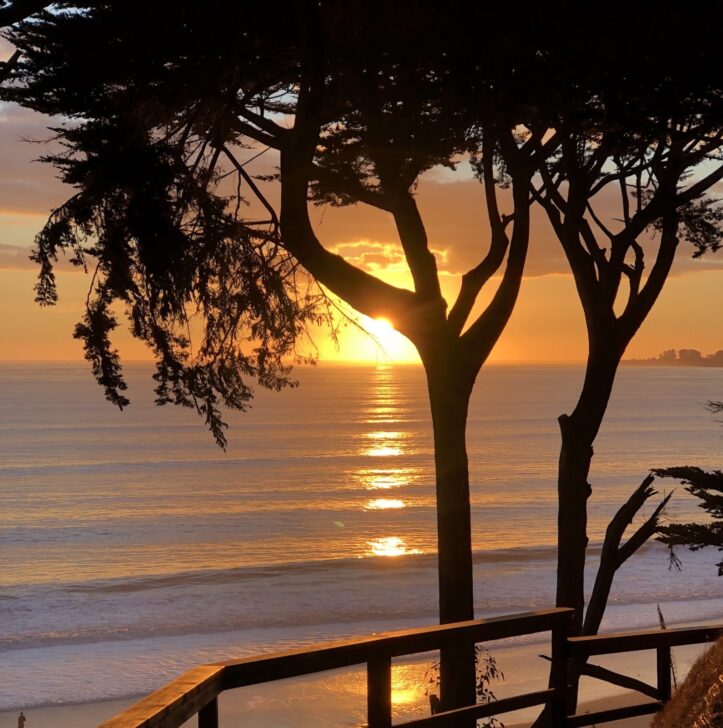
Sunset on one of my local walks.
After all I’ve gone through, and especially all that millions of others have been through, I’m grateful that I’m still walking, period. And I’m very grateful to all the doctors, nurses, and EMS personnel who took good care of me, and continue helping millions of other people day after day during crisis conditions.
My overall feeling, writing this on Christmas Eve 2020, is one of profound gratitude. I know that I live a privileged life in many ways, in a privileged part of a privileged country.
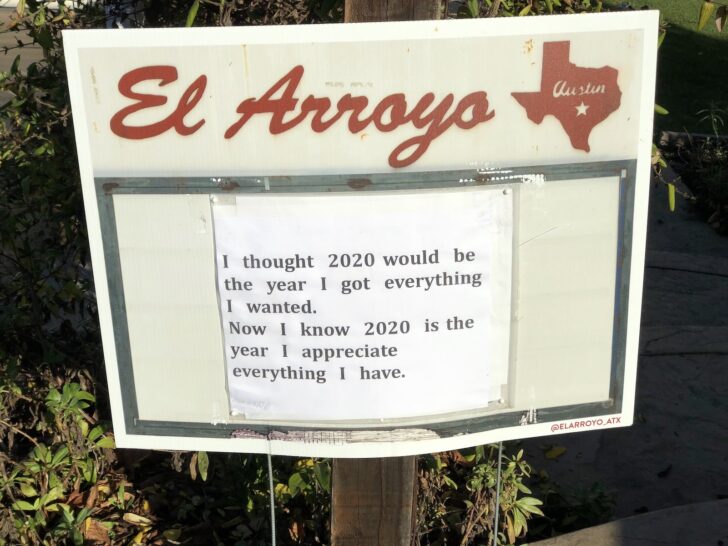
A neighborhood sign that changes frequently. Today’s saying is so true.
This story is not intended to provoke praise, pity, or scorn, nor to solicit suggestions for improvement. I hope this story encourages you to find opportunities for kindness and gratitude and generosity in your own life, no matter how stressful it may be.
I’m not a very spiritual person. But what I have learned is that the keys to happiness are simple, even in a crazy year like 2020.
Be kind to yourself and others.
Be grateful, and express your gratitude frequently.
Be generous—you’ll make others happier, and yourself.
I hope that you can find happiness, too. And may you follow a less traumatic outdoor adventure path than I have.
Editor’s Note: My favorite end of year/beginning of year tradition is to reflect on the past year rather than make resolutions, so I couldn’t pass up the chance to publish Rex’s reflections. What are you grateful for at the start of this new year? Drop us a line in the comments. -Andrew Marshall-
Backpacking Light does not accept compensation or donated/discounted products in exchange for product mentions or placements in editorial coverage.
Some (but not all) of the links in this review may be affiliate links. If you click on one of these links and visit one of our affiliate partners (usually a retailer site), and subsequently place an order with that retailer, we receive a commission on your entire order, which varies between 3% and 15% of the purchase price. Affiliate commissions represent less than 15% of Backpacking Light's gross revenue. More than 70% of our revenue comes from Membership Fees. So if you'd really like to support our work, don't buy gear you don't need - support our consumer advocacy work and become a Member instead.
Learn more about affiliate commissions, influencer marketing, and our consumer advocacy work by reading our article Stop wasting money on gear.
Rediscovering the Great Smoky Mountains by lens and brush.
There are salamanders in the Great Smoky Mountains that breathe entirely through their skin.
I think this is a wonderful fact. It makes me deeply happy that the grinding, unstoppable force of evolution came up with both gills and lungs but still wanted a weird little side project like skin breathing. Evolution, it should be said, is only slightly less prolific than Dolly Parton, another child of the Smokies. Dolly is currently enjoying something like her 1,000th career resurgence. Would that salamanders were so durable.
Parton grew up in a little town called Pigeon Forge, in the shadow of Pigeon Mountain where, as it turns out, there’s a species of salamander that lives just on that one hillside. So, maybe there’s just something about the Smokies that encourages creative mastery, be it by singer-songwriters or science in action.
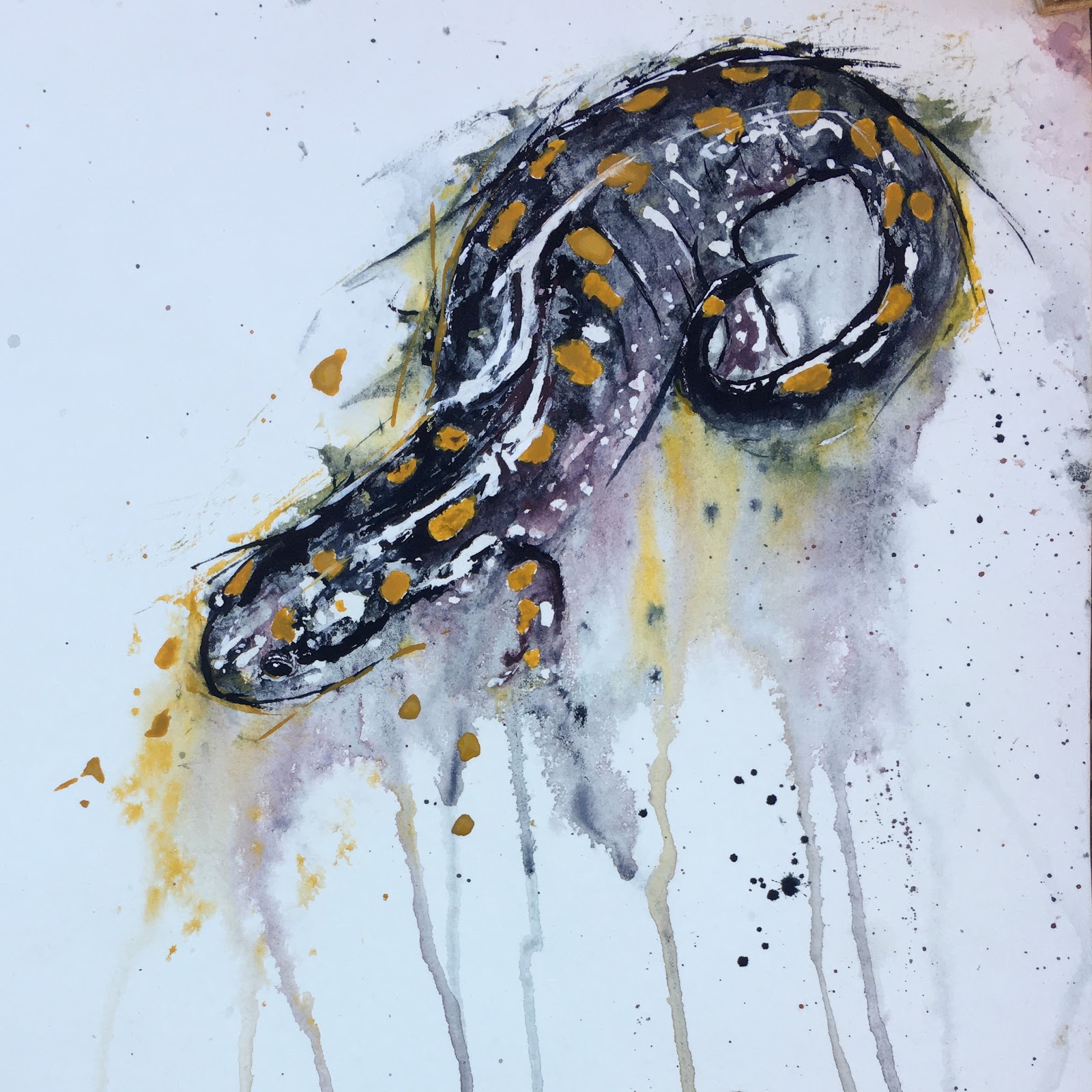
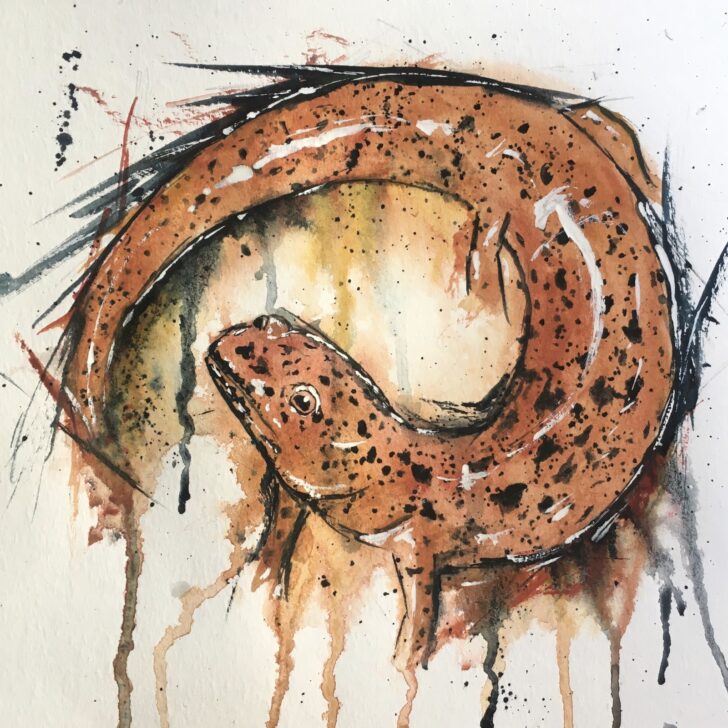
The spotted salamander is a common sight in the southern Appalachians. (Painting: Andrew Marshall)
I grew up in the general vicinity of the southern Appalachians, but unlike the Pigeon Mountain salamander, I have lived in many places. Currently, I live in California, where a well-chosen curse word and a light breeze can start a fire that chars half the state. It was the smoke from these fires that canceled a long-planned trip on the Wonderland Trail, a famously beautiful loop route around the base of Mt. Rainier in Washington State.
In the days leading up to the trip, my hiking partner Nick and I had been keeping a close eye on the air pollution levels in the Pacific Northwest, hoping that the right combination of wind and rain would send the smoke billowing in a different direction. Wonderland Trail permits are awarded by lottery, and the self-supported loop-style trip was the perfect Covid-19-safe itinerary. We were loathe to cancel our plans. But conditions continued to worsen, and with three days until our prospective start, we pulled the plug.
It was heartbreaking, but in classic 2020 fashion, not surprising. With only 72 hours to find another 100-plus-mile (160+ km) loop route in a non-on-fire part of the country, we drew a more or less random circle around the Great Smoky Mountain National Park and applied for permits. The park made an ideal plan B, with something like 900 miles of trails available to choose from. I also happened to have an unavoidable family commitment back east at around the same time, so I was forced to brave the airports one way or the other.
On the Wonderland Trail, you can cache food, meaning you don’t have to carry so much at a time. We’d have no such luck in the Smokies, so we started chucking luxury items out of our packs to make room for four more days of vittles.
The Rainforest of the South
48 hours later, we were in the park. I felt my sinuses begin to rehydrate about five minutes after crossing the park boundary. I breathed deeply as we walked, relishing the smoke-free air. We had a short day heading east along Fontana Lake and made camp with plenty of daylight to spare. We fell asleep to the sound of cicadas and frogs waging a sonic war in the canopy around us. It’s the sound I most deeply associate with my childhood. Between that and the assurance that, for the first time in three months, I wasn’t in immediate danger of evacuating in advance of a wildfire, I slept better than I had in a long, long time.
Cold, shaded streams are a hallmark of the Smokies. This photograph was taken on Cherokee ancestral land. (Photo: Andrew Marshall)
A few hours later, it started to rain. Water falling from the sky. Moisture in the air.
What a concept.
Salamander Daydreams
We spent our second day hiking along Lakeshore Trail, still heading east, and more or less hugging the shores of Fontana Lake. We’d woken to a gentle drizzle and made breakfast under the DCF tarp we’d tossed into my pack at the last minute. It would be the first of the roughly 6,000 times we’d eat under it in the seven days to follow.
The author crossing an old train trestle on Lakeshore Trail. This photograph was taken on Cherokee ancestral land. (Photo: Nick Ramey)
Lakeshore Trail is part of the Benton MacKaye trail system, a medium-distance trail (300 mi / 483 km) that winds from the western side of North Carolina to Springer Mountain in North Georgia. It was going to be my hiking project for March of 2020. In fact, the weekend that Covid-19 went from “somewhat concerning” to a “national emergency” was the weekend I was going to fly east to begin hiking. A familiar story to anyone who’s had hiking plans disrupted this year. How weird to find myself on this trail, if only for a few days, six months later.
As the managing editor at Backpacking Light, I come into contact with a lot of elite hiking athletes. I am most assuredly not an elite hiking athlete, but interviewing the likes of Jeff Garmire multiple times puts unhealthy FKT-related thoughts into my type-A brain. As we squelched along on the Benton MacKaye Trail, I began to daydream about setting an FKT on it. After I returned home, I looked up the current record. I’d have to run it and average 55+ mile (88 km) days.
Nevermind.
We finally left the lake and turned northeast to climb into the mountains proper by the afternoon of day three. When I’d crawled out of my tent at 6 AM that morning, I’d been greeted by several crawdads scampering around outside my vestibule. You know you are hiking in a temperate rainforest when the freshwater crustaceans come out to play on what is ostensibly dry land.
One of the highly infrequent dry creek beds in the Smokies.This photograph was taken on Cherokee ancestral land (Photo: Andrew Marshall)
We ate lunch on a narrow ridgeline with no room for the tarp. Rain splashed spicy-ramen juice into my eyes. Our day contained no less than twelve rain-swollen fords. I was—unapologetically— having a blast.
The rain petered out by the afternoon, but the trees, ferns, and vines continued to splash us every time a light breeze kicked up through the poplars, beeches, and birches. We ate dinner by headlamp. I sat my mug down on the damp soil and turned away for a moment. When I picked it back up seconds later, it had sprouted a salamander as if by magic. Her eyes blazed in the reflected light from my headlamp. I gently scooched her away with damp, muddy fingers.
A red-legged salamander. (Painting: Andrew Marshall)
The southern Appalachians are an incredibly biodiverse ecosystem. The general scientific consensus is that the ice-age glaciers pushed a variety of species further and further south, and all those species just hung around after the glaciers retreated. It’s a particularly good spot for salamanders, as I noted earlier. There are more unique species of salamanders in the southern Appalachians than anywhere in the world, including the hellbender—an amazing specimen that can reach up to two feet (61 cm) long and weighs more than a large kitten. Only two species of Asian salamanders are larger.
Hellbenders have picked up a few colloquial names over the centuries, my favorite being the Snot Dragon. In the cold, damp, late fall air, our noses ran consistently. We took to saying “all hail the Snot Dragon” every time we sent a snot rocket flying into the surrounding mountain laurel.
Hobbit Pipes and Bourbon Songs
The next morning we slept in, had a leisurely breakfast, and luxuriated in the relative dryness of the day. It was just over twelve miles (19 km) to our next campsite, and we took advantage of the extra time to take a long lunch and air out some gear. But in the southern Appalachians, things only get so dry. We considered ourselves lucky to get our clothes, quilts, and skin from saturated to moderately damp. It was the right moment to enjoy a pipe, hobbit-like, propped up against a tree.
The author, trying to go from soaked to damp. This photograph was taken on Cherokee ancestral land. (Photo: Nick Ramey)
We climbed up above 4,000 feet (1,219 m), watched the ecosystem start to change to spruce-forest, then descended once more to maples, oaks, birches, and our campsite.
When we arrived at our designated site, it already contained another camper. We chatted in the way that folks do in such situations, and he poured a measure of bourbon into our mugs as we ate dinner. As we sipped our shots, he put a serious dent in the amber liquid sloshing around in the bottom of his nearly empty flask. Soon enough he was waxing eloquent about his recently finalized divorce.
He was awake and singing drunkenly to himself long into the night, only just audible over the ever-present frog song. I couldn’t make out the words, but the tune sounded improbably like a sea shanty.
Mulberry Place
A 22 mile (35 km) day took us over Clingman’s Dome. It was the second time I’d been there—the first was on my thru-hike of the Appalachian Trail in 2012. That’s the year Superstorm Sandy came through and dumped three feet (91 cm) of snow onto the Smokies in early October, just as I was passing through wearing Chacos and kilt, possessing no insulating body fat, and carrying a forty-degree quilt in my pack.
On the way up to Kuwa’hi. This photograph was taken on Cherokee ancestral land. (Photo: Andrew Marshall)
Now, as it was then, the overlook was socked in with fog and mist, a complete whiteout. I took a photo comprised entirely of white fog and later sent it to my dad with the caption, “classic Smoky Mountain vista.” He appreciated it—he had roamed the Smokies with his father back in the early seventies.
The Appalachian Trail above 6,000 feet (1,829 km) on the Dome is mystical, cloud-shrouded, and holy—the home of the White Bear in Cherokee history. Stand around long enough, and you are sure to grow some moss in your beard. The mountain’s real name is Kuwa’hi, or “Mulberry Place” in Cherokee. Under the United States’ stewardship, the Frasier firs and giant hemlocks that tower above the unique ecosystem are crashing to the ground—the victims of invasive insects and blight. The great chestnuts of the lower elevations have been gone for years. Before 1906, 25% of the trees in the Appalachian mountains were American Chestnuts. All gone now, dead to an airborne bark fungus accidentally imported from Asia at the turn of the century.
Stand around long enough near the top of Kuwa’hi and you are likely to grow some moss. This photograph was taken on Cherokee ancestral land. (Photo: Andrew Marshall)
As for the Cherokee, they’ve mostly been gone since the late 1830s, when the Jackson administration ignored a supreme court ruling and removed the Cherokee and other Indigenous People from the area by force, bartering, bribes, and political pressure (source: Jacksonland, by Steve Inskeep).
The south has no monopoly on racism, ignorance, bigotry, broken promises, and genocide. But those things feel immediate there—renewed and refreshed every time a Confederate flag is waved or you realize a street in your hometown is named after the first grand wizard of the Klu Klux Klan.
Every now and then, someone will ask me where I grew up. My hillbilly accent has mostly been washed away by stints in Ohio, Texas, and California, and it isn’t always obvious. When I tell them where I’m from, the usual response is, “Oh, I’m sorry.”
I never know how to feel about this. I usually settle on a mix of shame and irritation, like when you complain about your parents and then your partner chips in with a complaint of her own. With Georgia in the national news more or less non-stop for the last two years, that feeling has been leaning more and more towards shame. Ultimately, we own the places that make us, whether we like it or not. I’ve spent the better part of my adult life vacillating between being happy I no longer live in the south and wondering if it’s possible to move back and use my voice and vote and privilege as a straight white man to make it—at least in some small ways—a better place.
I don’t have a resolution for this, and eight days of walking through my home mountain range didn’t provide one.
We Go Up. We Go Down. We Cross a Stream.
We recovered from our long climb over Kuwa’hi by sleeping in and doubling our breakfast rations. As we ate in the morning drizzle, salamanders watched us from atop logs, underneath flaps of moss, and beneath rocks. It reminded me of canoeing through the Okefenokee—the enormous swamp that occupies the lower corner of Georgia and the upper corner of Florida. In the Okefenokee Swamp, there are enough alligators around that you are always within the gaze of one, much as New Yorkers are generally always pretty close to a rat.
I imagine the same is true of the Smokies and salamanders. There’s just something about the collective gaze of a dozen cold-blooded creatures that makes the monkey in me want to head for the nearest tree, even if the creatures in question are rarely larger than a pencil.
The red salamander. (Painting: Andrew Marshall)
We had another short day mostly free of rain—though we still passed through the occasional cloud as we climbed and descended back and forth over the ridgeline that forms the spine of the park. As a cloud is just rain that hasn’t gotten its life together yet, the end result was more or less the same.
The last few miles seemed interminable despite our short hiking time. Ahead of me, I could hear Nick mumbling to himself, “We go up. We go down. We cross a stream. We go up. We go down. We cross a stream. We go up. We go down. We cross a stream.” It’s the kind of trekking that can and has driven east coast hikers quietly insane. My quasi-zen comments about walking being the point of walking didn’t seem to help, but that’s to be expected on empty stomachs and wet feet.
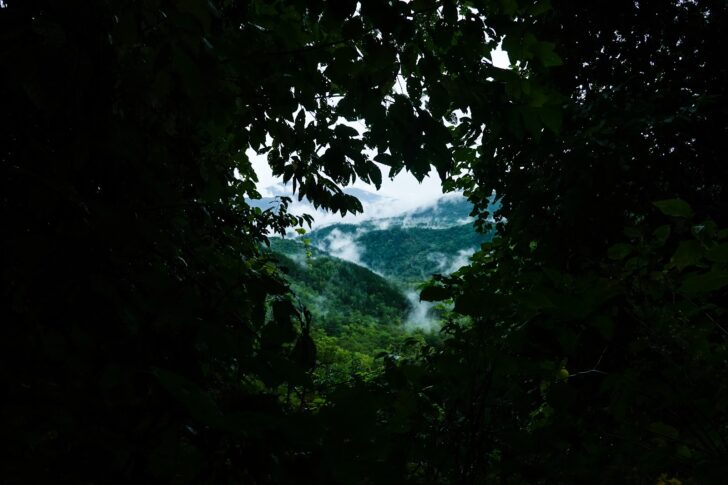
A rare glimpse through leaf and cloud. This photograph was taken on Cherokee ancestral land. (Photo: Andrew Marshall)
We set up our tarp quickly and shoveled down some tepid food. Thunder echoed over the ridges and hollows, and an opaque sheet of rain quickly followed. We heard it barreling through the forest towards us—a steam train with no engine, just a rushing tide of mist condensing inevitably into rain. Water doing what it does. Being inevitable.
We dove into our shelters just as it hit. The atmosphere in my tent was only .005% dryer than the air outside. I spared a moment of pity for my down quilt as the force of the falling rain sent condensation splashing all around me. I pulled the wet sack of feathers over my head and slept deeply, even after realizing that my air mattress had sprung a catastrophic leak.
When we awoke, it was still thundering. Occasional bursts of lightning illuminated the rivulets of water carving micro-canyons through our campsite. We hunkered down under the tarp; drinking endless cups of coffee and smoking our pipes while we waited on the worst of the lightning to pass. When it finally did, we set out into the rain.
All Hail the Snot Dragon
As the day wore on, Nick’s pace slowed, especially on the downhills. At lunch, we assessed the damage. His knees were in rough shape after seven days of relentless climbing and descending. No one likes to bail on a route, but we decided to shave a few miles and one day off our hike. We changed our plan slightly to follow the AT back down to Fontana Dam the next day. The terrain was tough enough that we’d be risking a more serious injury to Nick’s knees if we continued with our planned route—one wrong step on a slippery root, and he’d be in for ACL surgery.
The open vistas many western hikers are accustomed to simply don’t materialize all that often in the Smokies. A traveler must turn his gaze to the sublime rather than the sweeping. This photograph was taken on Cherokee ancestral land. (Photo: Andrew Marshall)
At camp that night, I identified the hole in my sleeping pad and attempted a field repair. I sacrificed my last semi-dry piece of clothing to dry the area around the hole and patch it with the included kit. Then I slapped some Tenacious Tape on top of the repair for good measure. I went to sleep feeling fairly confident but woke up a few hours later with my butt on the cold, damp earth. My legs and head were still elevated under a cushion of air, so I’d at least managed to slow the leak. It was good enough. I went back to sleep.
In a turn of events that every serious backpacker will recognize, our last day in the Smokies had the most agreeable weather by far. The temperatures were crisp, the sky blue, the maples just starting to turn. We worked our way down, down, down the ridgeline of the AT, finally catching glimpses of Fontana Lake as the miles slid away beneath our feet and the afternoon light softened.
Sunlight illuminates the trail. This photograph was taken on Cherokee ancestral land. (Photo: Andrew Marshall)
Within an hour of the car, we came to a rocky outcropping that offered a glimpse of the mountains unfolding in hazy layers to the horizon.
As we admired our first and only scenic vista of the trip, Nick opened his precious final pack of pop tarts, and I unsealed my last packet of strawberry lemonade drink mix. Both items were were sodden—somehow, the Smokies had managed to saturate them through heat-sealed Mylar. We ate both things anyway, then made our way out of the mountains. In the fading light, I took a last glimpse around for salamanders, hoping my headlamp would spark in a pair of strange, alien eyes. No luck. I made a final offering anyway, pinching one nostril shut and sending a final snot rocket into the thick, fragrantly rotting pile of leaves at my feet.
All hail the Snot Dragon. May her skin be moist, may her streams be cold and clear, and may her offspring number in the millions.
The hellbender salamander, otherwise known as the Snot Dragon.
Backpacking Light does not accept compensation or donated/discounted products in exchange for product mentions or placements in editorial coverage.
Some (but not all) of the links in this review may be affiliate links. If you click on one of these links and visit one of our affiliate partners (usually a retailer site), and subsequently place an order with that retailer, we receive a commission on your entire order, which varies between 3% and 15% of the purchase price. Affiliate commissions represent less than 15% of Backpacking Light's gross revenue. More than 70% of our revenue comes from Membership Fees. So if you'd really like to support our work, don't buy gear you don't need - support our consumer advocacy work and become a Member instead.
Learn more about affiliate commissions, influencer marketing, and our consumer advocacy work by reading our article Stop wasting money on gear.
Greg Perhson details the process of creating your own, lightweight (19.5 oz), MYOG backpack from vehicle airbags!
TL;DR
I made a 6400 ci / 105 L pack out of repurposed car airbags, with a frame made from a baby carrier. The packbag weighs 19.5 oz / 553 g and with the suspension system included weighs 44.75 oz / 1269 g.
Here are a few photos of the finished pack:
Background
In this thread, I wrote about my last upcycled backpack, made from an old porch umbrella with a frame made from a cut-down baby carrier. I loved using that pack; it was supremely comfortable and I could fit anything in it from winter trips to family gear.
Unfortunately, the umbrella fabric proved to not be durable – apparently having been out in the sun and weather day after day for years made it brittle. When it ripped, it did so spectacularly. On a winter trip, one of the side pockets ripped clean off.
I started to get holes all over the bag, especially at abrasion points and patched them with more and more duct and Gorilla tape. It made it through eight short trips before becoming unserviceable. But that’s OK; I had expected it to be a prototype for this project using car airbags as the pack fabric.
The old umbrella-fabric pack, RIP.
Several years ago, I read an article about Ursacks on the Section Hiker website, and in the comments section, Ken “DripDry” Holder shared about making a bear bag out of an airbag. This was based on the idea that airbags are meant to be extremely tough and lightweight – like the Ursack’s fully woven UHMWPE – but are much cheaper (or even free) when repurposed from old vehicles.
DripDry ended up writing a full how-to article on Gossamer Gear’s blog about this a couple of years later. I became very excited by the idea of building a backpack out of this material. One of my good friend’s uncles owns an auto body shop, and he started to cut airbags out of junkers for me until he had a whole bag full.
A few years ago, I found a guy on Craigslist an hour from me selling his Kelty White Cloud made of fully woven UHMWPE (Spectra) and I went to go check it out. While I’m not equating them, the look and feel of the two fabrics were very similar, even though airbags are typically made of woven nylon.
At home, I performed non-scientific durability tests on the airbag fabric and was quite pleased with the results. I could hammer a nail through the fabric into a piece of wood and then was unable to tear the fabric by pulling it against the nail. If I make a cut, I’m unable to tear it further with my hands. I scraped it hard 42 times in the same place with a sharp rock before it finally cut through the material.
In my online research, I found several examples of airbag backpacks, but they were all upcycled fashion items, none made for backpacking or heavy use. I drew up a bunch of possible designs but ended up going with one heavily inspired by Dave Chenault’s commentary about the future of ultralight packs and Luke Schmidt’s DIY ultralight backpack article, as I had with my previous pack, knowing that the design worked extremely well for me. The cut-down baby carrier from that pack serves as the frame for this one. I’m so appreciative of both Dave and Luke’s ingenuity and generosity in sharing their designs.
The new pack incorporates a frame from an old baby carrier.
Issues and Notes
I’m looking forward to putting miles on this pack, which will be the real determinant of the fabric’s durability. I’m optimistic about the use of airbags as an ideal backpack material that has that unobtanium trifecta of ultralight, ultradurable, and ultracheap.
However, there are several issues (and workarounds) to be aware of that I discovered along the way.
Coated vs. uncoated
Some airbags are coated with silicone and are waterproof. The ones that aren’t coated just soak up water. Less than half of the bags I received were silicone coated. I tested every airbag I had by putting each one over a glass filled with water with a rubber band around it, then inverting the glass overnight.
Different materials
Since airbags are made by a number of different companies, their composition is different. A few pieces had a really thick and slick layer of silicone on the inside, while others had a much subtler coating (which I prefer). One coated airbag out of the whole bag I received from my friend’s uncle felt like a much cheaper and thinner material and I was able to rip it with my hands. I can’t imagine how that one passes an auto safety test. The only information I have on the fabric is one piece has “420d” printed on it, which may stand for 420 denier, or it may not – there are a bunch of numbers and letters printed on the airbags.
The mysterious coding system printed on some airbags may reveal the fabric weight (420d) and lot number.
Color
You don’t get to choose. Primarily, the uncoated airbags are white and look cosmetically like fully woven UHMWPE. The coated ones tend to be colors – mostly pink and baby blue; sometimes yellow. My pack uses all of these colors. I tried painting a sample piece gray with many coats of watered-down acrylic paint (a technique I learned here on BPL), but then just decided that the funky colors are part of the charm. I’ve been calling this pack Big Pink, but Rainbow Sherbet might be a more accurate name. Or The Pastel Peakbagger?
Patterning on small pieces
To build this backpack, I spent hours seam-ripping the triple-stitching on circular and oval-shaped airbags, which means there are stitch holes left in weird places that need to be sealed with silicone. Then I had to do some creative patterning and use extra seams to join smaller pieces together. For example, the massive rolltop on this bag uses four pieces of fabric instead of just one.
There are companies that make airbags that have seconds-quality runs (unsuitable for car safety standards) of material yardage. However, I was unable to get these companies to sell me their seconds, especially since I was only looking to buy a few yards. Because of my limited supply, and my desire to not waste the material, I had the airbags for seven years (!) before finally committing a few months ago (once my umbrella pack died) to actually building it.
It’s far from perfect – there are wavy seams, a pucker in one place where the roll-top meets the main body, and I thought I was going to lose my mind trying to get the bottom to line up correctly, but it will be functional and comfortable and for that I’m content. The vertical seams are triple stitched and either flat-felled or bound and felled, and the bottom is triple stitched with grosgrain binding.
Measuring where the daisy chain bartacks will go using a piece of masking tape. Because of the placement of the compression straps, I couldn’t just evenly space the bartacks down the length of the chain. So I started from where the compression straps were and then divided the space between them evenly. This means some bartacks are 2.5 inches apart, some are 3 inches. The dots mark the middle of the compression straps and the lines mark the length of each bartack.
Weight
Oh yeah, the weight! This pack is roughly similar in size to my old Lowe Alpine Contour IV (6400 ci / 105 L). The packbag alone is 19.5 oz / 553 g (not including the shoulder straps, frame, and hipbelt). The total weight of the pack including the suspension elements is 44.75 oz / 1269 g. For winter use, I’ll run it with bottle parkas attached to the hipbelt and a compression panel (which add 8.3 oz / 235 g with long straps and buckles) that I made for my last pack to hold snowshoes. In the future, I’ll add modular side pockets and a top lid and configure the pack with the appropriate accessories for each trip.
Thanks for reading!
Ultralight, ultradurable, and ultracheap: my airbag backpack.
The Helly Hansen Odin Minimalist 2.0 jacket (180 g / 6.35 oz, $220) is a lightweight 2.5-layer rain jacket with a well-designed hood and minimal features.
A recent multi-sport adventure got BPL columnist Mark Wetherington thinking about gear and our relationship to it.
Unpacked is a new column from Backpacking Light by outdoor writer, gear tester, and librarian Mark Wetherington. It ranges from book reviews to essays on outdoor ethics and culture. There’s a richness in backpacking that’s rarely reflected in gear reviews and trip reports – this column aims to explore the deeper essence of our hobby with an insightful (and sometimes humorous) approach.
Things are in the saddle, And ride mankind.
Ralph Waldo Emerson, from “Ode, Inscribed to William H. Channing”
After spending an entire morning packing for a climbing, hiking, camping, and hot springs soaking trip in the hinterlands of Idaho at the end of September, I had an episode of Overwhelming Gear Accumulation Distress Disorder (OGADD). Multi-sport trips are perhaps the most common trigger for this syndrome—given that you must assemble gear from a variety of disciplines that often has limited double-duty capabilities—but it can occur in shoulder-seasons as well.
When one finds themselves standing in the dedicated gear room of their home and debating between bringing the 20 F (-7 C) sleeping bag or the 30 F (-1 C) sleeping bag, the inverted canister stove or the regular canister stove, the 9 oz (255 g) down jacket or the 11.5 oz (326 g) down jacket it means that OGADD is often close at hand. Car camping is also a noteworthy catalyst of OGADD as instead of worrying about pushing the limits of your 35-liter pack, the only thing you have to consider taxing is your vehicle’s suspension system.
The author inadvertently surrounded by gear at an Idaho campsite.
When sitting around camp after an evening hot springs soak and slowly recognizing that I was almost completely surrounded by gear (see above photo), my companions and I engaged in some humorous banter about just how much stuff gets involved with relatively simple camping trips. To be fair, most of the gear was removed from my Honda Element so my girlfriend and I could sleep in the back, but the situation still had the trappings of ridiculousness. The notion from a Ralph Waldo Emerson poem about things being in the saddle and riding mankind, taken completely out of context courtesy of a few post-soak IPAs, came to mind.
Indeed, sometimes it seems like the gear—or the desire to accumulate more gear—begins to own you, rather than the other way around. Backpacking is an all-consuming passion of mine and has wielded an outsized influence in regard to the jobs I’ve worked, where I’ve chosen to live, and how I spend my free time. However, I’ve noticed that a dark side of that enthusiasm for backpacking can be a passion for consuming—in particular buying the latest and supposedly greatest gear that will allegedly take your backpacking experience to a new level.
The author belaying in Pass Creek Canyon. Climbing requires a significant amount of dedicated gear, most of which is completely useless for hiking. Photo: Andrea Price.
I was lucky enough to get disabused of any notion I had of becoming a gear junkie when I worked in an outdoor retail shop a few years after I started backpacking. After unpacking, pricing, stocking, and talking about gear for hours every day, it lost its luster for me; my passion was for getting outside and I realized gear was merely a tool. I liked living in a home, for example, but I would derive little joy from working at a hardware store or discussing the finer points of washers and dryers in online forums. But for some reason backpacking and the gear that allowed me to have such amazing experiences in natural landscapes captivated me in a way that few other things in life did.
I also recognized rather quickly that, with few exceptions, once you have your basic kit dialed in that vastly more pleasure will come from channeling effort into planning trips than looking for places to save 50 grams of weight. In other words, if after you’ve assembled a functional kit you’re spending more time looking at gear specifications instead of maps, guidebooks, or other trip-planning resources then you might want to do some reflection on how you’re spending your free time.
With four people occupying a site with one picnic table, the seemingly superfluous gear I brought along—like a table and chairs—allowed us to have one table mostly just for eating and one for food prep, which kept elbow bumping to a minimum.
Criticism aside, there are good reasons to have a healthy focus on buying quality gear that is appropriate for your hobbies. For one, it tends to make those hobbies more fun since you’re not being held back by equipment deficiencies—you have only yourself to blame for not climbing more difficult routes, not putting in more miles, or not catching wily trout at a subalpine lake. Additionally—and this is far and away my favorite part of all the gear I’ve accumulated over the years—is that it can allow you to share the experience more easily with others (i.e. by loaning them gear) or make the experience more enjoyable by getting fancy from time to time.
On the recent trip which inspired this piece, I was able to cook meals that would’ve been well-received at a backyard cookout but which hit the spot even more after a day of climbing or before a day of hiking. The sleeping system I use in the back of my car when car camping is almost as comfortable as my bed at home.
This isn’t exactly a new notion, and I give much credit to Paul Magnanti, who has covered it well on his blog over the years, but given that a season that emphasizes the buying, giving, and receiving of stuff is in full swing (I received no less than three emails about sales from gear companies while writing this piece) it seems a timely subject for Unpacked. While it’s tempting to give gear to yourself or others as a way to celebrate the holiday season, it’s worth it to take a step back and ponder other options.
Minimal gear was required for a short day hike to Bear Creek Lake in the Lost River Range. An antique guidebook from 1984 that I tossed in the car at the last minute contained enough information to lead us to this secluded piece of paradise.
Far and away the best gifts you can give to yourself, or to others, is time or knowledge. Planning a trip with a friend or family member and spending that time with them is infinitely more valuable and memorable than any item on a 2020 Gear Guide. Making a conscious effort to learn a new skill—like dehydrating your own food, route planning, or gear repair—will likely improve your experiences long after whatever piece of gear you buy has lost its shine. Sharing information with a friend about a stellar campsite, off-trail waterfall, or trout-filled lake is more heartwarming than any gift card. Gear certainly helps you achieve trips that make memories, but unless you get out there and use it the only thing gear will remind you of is buying it. And what excitement or enrichment is there in that?
What I remember most about the trip to Idaho is climbing with friends, eating delicious food, a beautiful hike, crisp September air, and a roadside hot springs soak to break up the drive back home. And, of course, the good-natured chiding from my companions about the inordinate amount of stuff I brought along to pull it off.
Backpacking Light does not accept compensation or donated/discounted products in exchange for product mentions or placements in editorial coverage.
Some (but not all) of the links in this review may be affiliate links. If you click on one of these links and visit one of our affiliate partners (usually a retailer site), and subsequently place an order with that retailer, we receive a commission on your entire order, which varies between 3% and 15% of the purchase price. Affiliate commissions represent less than 15% of Backpacking Light's gross revenue. More than 70% of our revenue comes from Membership Fees. So if you'd really like to support our work, don't buy gear you don't need - support our consumer advocacy work and become a Member instead.
Learn more about affiliate commissions, influencer marketing, and our consumer advocacy work by reading our article Stop wasting money on gear.
Backpacking Light staff and contributors give their 2020 staff picks – their favorite backpacking and hiking gear of the year.
Introduction
Each year, our staff selects their favorite backcountry gear from the past 12 months, and we look forward to you sharing your favorite gear of the year as well in the forum comments below!
Table of Contents • Note: if this is a members-only article, some sections may only be available to Premium or Unlimited Members.
Row 1, L to R: Chase Jordan (production editor), Ryan Jordan (owner/founder), Stephanie Jordan (owner/founder), Andrew Marshall (managing editor); Row 2, L to R: Emylene VanderVelden (contributor), Rex Sanders (contributor), Stephen Seeber (contributor), Big Sky Sierra (shop dog); Row 3, L to R: Maggie Slepian (contributor), Mark Wetherington (contributor), Drew Smith (contributor), Shilletha Curtis (grant awardee); Row 4, L to R: Ben Kilbourne (contributor), Daniel Hu (contributor), Iago Vazquez (contributor), Roger Caffin (community moderator).
I’ve been waiting a long time for a legitimately stormworthy, trekking pole tent that doesn’t rely on zippers as they’ve been the Achilles heel of most tents I’ve used in the desert southwest. The Seek Outside Eolus, which weighs about 3 lb with guylines and stakes, has been my primary two-person tent this year. It’s not as light as some other ultralight tents out there, but it makes up for it with its reasonable price, roomy nest, giant vestibules, overall reliability, and storm worthiness. – Ben Kilbourne
When sharing a tent with Ryan, I really appreciated the dual side doors so I could have my own entrance. Steep walls and lots of headroom help prevent claustrophobia, my least favorite thing about most backpacking tents. Easy setup, stable in wind, lots of gear organization options, room for the dog, and a bright cheery color. – Stephanie Jordan
Having used an eVENT bivy sack with a DCF floor and a stiffened brim from a cottage manufacturer for several years, I spent 2020 reducing my pack size, and wanted a bivy sack that was more compact. I chose the MSR Pro Bivy because its dimensions are wide enough to accommodate my winter sleep system – a foam pad, a 3-inch-thick wide inflatable pad, and a lofty winter sleeping bag. – Ryan Jordan
In my quest to find a cold-weather down mummy bag that was roomy enough to layer a winter down parka and pants, windproof enough to sleep under a tarp without a bivy sack, and light and compact enough to feel like a 3-season bag rather than a winter bag, I’ve returned to my trusty Feathered Friends Lark 10 UL. At 31 oz, when combined with down puffy clothes, it’s my bag of choice for all but the most frigid 4-season conditions in the Rockies. – Ryan Jordan
Keeps me warm when my master gets a wild hair to do some tent testing. Has a sleeve for my pad so I don’t fall off. This is a custom item, so be nice to Jan if you want one. Don’t worry, they’all gotta soft spot for canines. Start your email with “hey Jan, my dog has been shiverin’ and I need some help…” Works every time. – Sierra
The ULA Circuit is awesome, lightweight and durable. I love how light the pack is and how you can remove pieces like the aluminum stay in make it lighter. It carries well and the hip pockets are solid. – Shilletha Curtis
Rogue Panda is known for bike bags. The Zoro is the first commercially available backpacking pack created by Rogue Panda founder Nick Smolinske, and features a few innovations that really caught my eye. The floating hip-belt and innovative horizontal water bottle pockets particularly stood out. The pack is undergoing re-design, and isn’t currently available, but I highly recommend it as a load-hauling pack when it comes back on the market. – Andrew Marshall
I do day hikes. I don’t like a sweaty back while hiking. Even in the winter, I don’t need much gear with me. The answer: a lumbar pack. Light weight, adequate capacity and all weight is off my shoulders and back. The Day Pack has enough room for my extra winter needs. Now, for you backpackers, if you follow all the tips found on BPL, the lumbar pack will probably keep you out in the wilderness for weeks on end! – Stephen Seeber
Because most packs I’ve used are not completely waterproof, I used to pack everything in individual dry bags or one big trash compactor bag, but this year I found a better way. The Zpacks Packliner Dry Bag has kept my gear completely dry on many trips including repeated full pack submersions in the Verde River and 48 hours of solid rain in the Mazatzal Mountains this Spring. Made of 1.0oz DCF and weighing only 1.8oz, this 44L dry bag has become an indispensable piece of gear for me this year. – Ben Kilbourne
The vest version of the classic Feathered Friends jacket. This vest packs a lot of warmth and space-saving minimalism into seven ounces. It’s now my insulation of choice to ward off a chill at high elevations in the summer, and it works just as well as a shoulder-season layer in more temperate climates. – Andrew Marshall
I’ve never used a synthetic-fill jacket before, and now I’ll never go back. The Torrid APEX weighs less than 8 ounces and is as warm as any of my down backpacking jackets. Since it’s synthetic, I actually wear this as a hiking layer when it gets cold, and I don’t feel gross or clammy like I would if I hiked in down. This jacket goes on every backpacking trip with me. – Maggie Slepian
I was a bit hesitant to bring something so heavy when doing winter xc-ski touring, but these pants have been great to toss on over what I skied in when I get to camp and don’t want to get chilled before changing into dry layers. I don’t have to worry about the insulation absorbing moisture, since they’re synthetic, and the durability is a major plus. The zipper and pockets also had functionality that would’ve been lost with some of the lightweight down pants — going to the bathroom in the winter is enough of a chore already, without having to complicate things further by not having a zipper! – Mark Wetherington
Lightweight, windproof, and warm, I prefer pairing this with a fleece jacket (vs. a single puffy layer) for warmth during summer and early fall trips. – Chase Jordan
Down provides more warmth per ounce, but merino provides more comfort. The Woolverino hoodie checks all my boxes: hoodie to warm my neck and ears, thumb loops to cover my wrists, 1/4 zip to vent heat when hiking. Most important, it turns a cold, wet, blustery evening into a spa day. Well, not quite, but it is a difference-maker. – Drew Smith
This is a quality product by Helly Hanson that is totally windproof and waterproof. It’s a nice single outer layer that is easily packable and extremely lightweight. Quite fashionable on top of its great functionality! – Daniel Hu
I took a risk and wore these out of the box on a 200+ mile thru-hike this year, and they were superb. They sit high so they don’t slide down while hiking (a near-constant issue for me with hiking tights), but the waistband is so wide and flat that they don’t feel restrictive or uncomfortable. They have a flatlock inseam which meant zero chafing, and after 12 days of continuous wear, they kept their shape and never sagged or stretched. They’re light, breathable, and wicking, and I’m going to get a pair in every color. – Maggie Slepian
I have poor hand circulation and suffer in the cold. I have used heated gloves for several years. Each glove, with an extra battery weighs 15.85 ounces! Almost two pounds! And they are not that warm because the liner seams and outer glove seams line up and create a miserable thermal short circuit. During high winds I must also wear a windproof shell. Each Vapor Mitt, with the highest available insulation weighs 4.5 ounces. 9 ounces for the pair. I have used them in single digits with high winds and my hands have been happy. They offer pretty good dexterity for such a warm mitten. – Stephen Seeber
When I received my Rab Expedition Slippers in the mail, my invoice had a handwritten note at the bottom which read: “now your feet will never be cold!” How right the sales associate was! In my pursuit of a lighter sleep system, in a cold weather climate, the Rab Expedition Slipper bridged the weight and temperature gap between carrying a shoulder season rated quilt all year, and using a lighter, down summer quilt. – Emylene VanderVelden
The Radar line stands above the rest of nylon caps and hats for me due to the breathability of its softshell material. I have been using the same cap for the last few years and it is still my favorite, most used piece of headwear. I do not know of any other manufacturer that offers softshell headwear. The folding brim of the cap is also extremely practical as well. – Iago Vazquez
After switching from boots to trail runners, emptying dirt and debris became an hourly chore. Many had praised Dirty Girls, but I was skeptical, worried about overheating my already-sweaty feet. Finally ponied up and bought a pair more than a decade ago. Now I won’t hike or backpack without them, and I can wear thinner socks without stuff digging into my feet. Too many patterns to choose from; choose your size wisely. 45 grams for the pair in my size. – Rex Sanders
Sadly, the Wisp is no longer in production. We will throw one of these windshirts over the top of our Taslan smocks when it gets a bit cool and windy. As they weigh no more than 90 g each, and they block the wind very well, they are usually to be found in our packs. But I am sure there are many other brands available. – Roger Caffin
For windless precipitation, I love to pair the Montbell Rain Umbrero with other pieces of headwear under it, most often a mesh trucker hat or cycling cap. I can easily control the ventilation/warmth and I do not need to wear my raingear hood. The thin flexible wire allows it to fold and store easily, but it also makes it unusable in anything but light winds. – Iago Vazquez
The Vargo TiBot 700 mL pot embodies the multi-use principle of lightweight backpacking. I have used it as a cooking pot, coffee mug, a small bowl, an auxiliary water bottle for long carries, a rehydration bottle when I’ve run out of fuel, a water scoop at desert seeps. It stores a canister and small stove when not being put to any of these other uses. – Drew Smith
In our article, How to Make Coffee in the Backcountry: Gear and Methods, I gathered all of the coffee making methods I amassed over the years and the GSI Ultralight Java Drip stands out from the rest. I take the GSI Ultralight Java Drip on almost every trip and regret not taking it if I don’t. – Emylene VanderVelden
After breaking my trusty cut-down REI Permaware spoon on a trip several years ago, I went on a long search for the perfect titanium replacement, since I’m not a sporky guy. Most titanium spoons have an unpolished bowl that feels yucky in my mouth. Yes, I tried to polish one and failed after much swearing. Finally bought the MSR Titan Fork and Spoon set, and immediately ditched the wire keychain and fork. Plus the spoon doesn’t have any useless slots or holes to accumulate weird gunk. Eating bliss returned, should last my lifetime, and I can almost scare myself with the reflection. 17 grams. – Rex Sanders
Cutting meat from your diet can be daunting for a backpacker, but Good To-Go gives you delicious, healthy food, energizing, and ethically-sourced food. The Mushroom Risotto might be my favorite. – Chase Jordan
Finding a shoe that remains comfortable over the course of a long trip has for many years been an unsolvable problem for me making my purchase of the Altra Lone Peak 4.5 my single most important gear discovery this year. The latest iteration of the Lone Peak has a heel cup that is narrow enough for average feet, great traction, and a durable upper along with the characteristic foot-shaped toe box and zero-drop you’re already familiar with. I’ve put hundreds of miles on these and have experienced no knee pain or plantar tendon pain, things that previously plagued me on long backpacking trips before. – Ben Kilbourne
I added Hoka Speedgoats to my footwear arsenal a few years ago primarily as a recovery shoe to wear after long-mileage training days. Now, they’ve earned a spot in my backpacking routine when I’m hiking hardpacked trails. I also like them during the winter where the high stack height helps insulate my feet from the cold ground in my snowy home hiking areas. – Ryan Jordan
These Injinji socks prevent me from getting blisters and the taller cuff keeps junk out of my socks. I also like Injinji Liner Crew Socks in the winter, worn under a cushioned wool sock. – Stephanie Jordan
This is, in short, the most comfortable headlamp I’ve ever used. It isn’t the brightest, longest lasting, or lightest rechargeable headlamp on the market. But thoughtful engineering with an eye towards a seamless blend of hardware and software make it the most comfortable and most stable (no bounce) that I know of. Great for on-trail excursions and winter trips where you need to wear a headlamp around camp for long periods. – Andrew Marshall
Sure, I’ve had multiple Wilderness First Aid courses. But I am not at all confident that I would correctly follow protocols when faced with an actual incident. That’s what checklists are for. This bandana provides you with a memory aid so that you can focus on executing, not trying to recall what’s next. Plus, it is a bandana. – Drew Smith
Recorded music blaring in the backcountry is always horrible and inappropriate. Live music, perhaps accompanied by a sip of whisky among friends, is a great way to make the wilderness feel like home. This plastic ukulele weighs only 14 oz, is nearly indestructible, and sounds surprisingly good. – Drew Smith
A dubious option for bears, we use this for moose instead. After several hostile moose encounters (including two charges) since we moved to Wyoming, I’ve come to realize that my hiking partner may be the moose whisperer. Since air horns are more effective moose deterrents than rubber bullets or pepper spray, we may never leave home again without it. I also appreciate the locking on/off button – at 115 decibels, you don’t want this to be accidentally discharged. – Stephanie Jordan
The Klymit V Seat started as a joke about my bony butt needing cushioning after one too many complaints about sitting on hard wet stumps and rocks. However, the Klymit V Seat solved being uncomfortable, and it became a favorite winter backpacking item because I could use it as insulation between the toe of my quilt and the tent wall. The Klymit V Seat packs down small and compared to a chair, is a lightweight solution that has multi-purposes. – Emylene VanderVelden
Trekking poles are a must for me, and the LT5 are the lightest and most comfortable ones I’ve ever used. They collapse to just 60 centimeters, and have a wide range of length adjustment from the three-piece build. The shafts are a carbon construction that absorbs impact, the foam grips absorb sweat, and the straps are padded. They weigh under 10 ounces for the pair, and I feel like they “swing” lightly and easily on the trail. I will say that you have to be careful with these, as carbon poles can’t withstand hard lateral pressure. If you feel the pole get caught in a rock, stop and extract it straight up. I’ve snapped one of the shafts by trying to wrench it out from a rock at an angle. These are best for on-trail, not scree field expeditions. – Maggie Slepian
I actually use the Klymit Cush as a pillow more than a seat. I sleep both on my back and on my side when on the ground. I need more pillow height when on my side and significantly less on my back. All I need to do is fold this thing twice and I have a tall pillow, unfold it and I have lower one. The end circles work great when folded and laying on one’s side as the ear goes inside the circle and it does not get pinched. Because of its length the Klymit Cush also works great to combat calf ridge in the hammock. And of course you can use it as a seat, something most pillow manufacturers warn you against. – Iago Vazquez
After too many Type III adventures that ended in emergency rooms and hospitals, I bought one of these to slip over my ABC watchband. Shows a bunch of hopefully useful information if I’m incapacitated. Maybe it helped after my mountain-bike induced concussion this spring, but I don’t remember that day or the next two weeks. Be prepared and safe out there. Only 10 grams of worn weight, so it doesn’t count. – Rex Sanders
While the COVID-19 experience of 2020 is something we won’t want to remember too vividly in the future, the reality is we are many months away from returning to normal and many of us may not have a vaccine before we begin our spring and summer treks. This will be a part of my kit for the foreseeable future on busy trails, and it’s something we all should consider to keep our trail mates and passerby safe. – Chase Jordan
It has been GREAT to turn my phone off or set it on airplane, even just on day hikes where I would usually have reception. As much as I appreciate gear, I am even more grateful for uninterrupted time in beautiful places and sometimes stepping away from technology is essential to achieve that! My apologies for this questionable staff pick, but it was really important to me and I think it’s always good to have a reminder that sometimes the best gift you can give yourself is some peace and quiet (so long as you don’t avoid urgent responsibilities). – Mark Wetherington
Backpacking Light does not accept compensation or donated/discounted products in exchange for product mentions or placements in editorial coverage.
Some (but not all) of the links in this review may be affiliate links. If you click on one of these links and visit one of our affiliate partners (usually a retailer site), and subsequently place an order with that retailer, we receive a commission on your entire order, which varies between 3% and 15% of the purchase price. Affiliate commissions represent less than 15% of Backpacking Light's gross revenue. More than 70% of our revenue comes from Membership Fees. So if you'd really like to support our work, don't buy gear you don't need - support our consumer advocacy work and become a Member instead.
Learn more about affiliate commissions, influencer marketing, and our consumer advocacy work by reading our article Stop wasting money on gear.
Andrew and Ryan discuss some digital tools useful for planning your route effectively. Also: An interview with FATMAP founder Misha Gopaul.
Stream
Summary
In this episode of the Backpacking Light Podcast, Andrew and Ryan talk about digital route planning. There are a huge variety of digital tools out there, and all of them have different strengths and weaknesses, so the guys spend a lot of time breaking things down by software type, best uses, and pros and cons.
After that, Andrew interviews Misha Gopaul, the founder of FATMAP. They talk about the technology needed to create 3D mapping software, how FATMAP is trying to make ripples in the digital route-planning world, and the responsibilities that come with being a company operating in the outdoor space.
A screenshot from FATMAP’s user-friendly desktop application.
Executive Producer - Backpacking Light; Show Director and Host - Ryan Jordan; Producer - Chase Jordan; Theme music: Look for Me in the Mountains written by Chris Cunningham and Ryan Jordan, performed by Chris Cunningham (acoustic guitar, lead and harmony vocals, harmonica), Chad Langford (upright bass), and Tom Murphy (mandolin), produced by Basecamp Studios in Bozeman, Montana.
Sponsorship Policy: Backpacking Light does not accept compensation or donated/discounted products in exchange for product mentions or placements in editorial coverage, including any podcast episode content not excplicitly identified as sponsored content. Some (but not all) of the links in these show notes may be affiliate links. Learn more about affiliate commissions, influencer marketing, and our consumer advocacy work by reading our article Stop wasting money on gear.
BPL columnist Ben Kilbourne uses a close encounter to examine the practice of livestock grazing on public land.
The Overlook is Backpacking Light’s new monthly column where hiker, writer, and thinker Ben Kilbourne will explore backpacking from many different vantages. He will try to climb up to a high place with a view, an overlook, where the myriad issues intertwined with backpacking can be seen. This column will challenge the reader to embrace complexity and engage in thoughtful dialogue with other readers. Join us at The Overlook!
On a Saturday afternoon, we hit the smoky road with the sun setting red outside of Evanston, Wyoming. We passed windmills beside I-80 in the twilight and let the GPS guide us to the China Meadows trailhead on the Northern Slope of the Uintas. The next day, we would be heading into the Red Castle area of the High Uintas Wilderness.
We camped in the pines while the yellow moon rose out of them and crossed the sky while we slept. Cows grunted, mooed, and bawled in the dark just before dawn. After crawling sleepily out of the back of the truck, we made tea and grits, packed our packs, and then rolled slowly down the road to find the China Meadows parking lot completely filled. Without exaggeration, there were probably about 60 cars, indicating that well over 100 people would be on the trail we were about to walk.
Hallie and Easy walking through Wilderness rangeland in the Uintas.
Our first encounter on the trail, however, was not human but bovine. We had been hearing them all morning, hoping they’d be out in a meadow somewhere, trampling delicate riparian vegetation, rather than on the trail where we’d have to deal with them. They turned out to be in both places. Within a half-mile (800 m), we saw the first giant black cow standing like a disgruntled and erratic bus. The mechanisms and the pilot behind those giant white eyes were unpredictable, and the tension between that unpredictability and the very certain weight of the thing was terrifying. The leashed dog was asked to heel and did so promptly, and then we stood there watching the beast.
“How much do you think they weigh?” Hallie asked.
“I don’t know. A thousand pounds?” I guessed.
“Holy crap.”
We stood and waited and watched the enormous cow watch us. Her also enormous baby ambled out of the aspens, ducked his head under her side, and found breakfast. Since they appeared uninterested in letting us pass, we decided to walk around — way around. We tromped into a soggy meadow through waist-high grasses and between bunches of willows. Thankfully, the cow seemed disinterested, and we were able to pass easily.
Cowpies and a spring in the Uintas.
But for the next mile (1.6 km), we dodged giant, black cows. Some stood in the trail; others peered at us through the lodgepole from every direction. We nervously and quickly moved through, hanging tightly onto the dog’s leash. When the trail led to a gate, we opened it, stepped through, and closed it from the other side.
“I wonder if this means no more cows,” I inquired.
“I hope so,” said Hallie.
The cows we encountered were in designated Wilderness, which felt strange considering the use of words like “untrammeled” in the Wilderness Act. But it was never going to get passed without a livestock provision. Wayne Aspinall, a Democrat from Colorado, stalled the vote from 1960 to 1963, refusing to vote until a livestock provision was added. Today, there is livestock in about 330 designated wildernesses throughout the lower 48, encompassing a total area of about 10 million acres. The Wilderness Act of 1964 stipulates that any permits active before the Act are allowed to continue almost indefinitely. Due to this livestock inclusion, exceptions are often made for ORVs, fences, the poisoning of prairie dogs — things otherwise not allowed in Wilderness.
Livestock in Wilderness areas and public lands in the west is a complex and divisive issue. As a hiker, my first reaction to encountering them on the trail always has to do with personal safety — I don’t want to be trampled. Then I see the damage they’re doing — cowpies in springs and wet meadows, riparian vegetation devastated. I start to ask, “what are they doing here?” Then I think about the people who own the cows — whose cultural identities are inextricably tied to them. It feels uncomfortable to be frustrated with someone’s means of making a living. Does a backpacker have the right to tell them their cows are destructive?
The majority of public lands grazing in the 11 western states of Arizona, California, Colorado, Idaho, Montana, New Mexico, Nevada, Oregon, Utah, Washington, and Wyoming takes place on Bureau of Land Management (BLM) and United States Forest Service (USFS) land. Because these lands are not irrigated, they are referred to as rangelands — in contrast with pasturelands, which are irrigated. There are about 21,000 livestock operators on BLM and USFS lands in the west. Compared to the 800,000 operators in the U.S., these only make up 2.7% of all livestock operators in the country.
Cows grazing in the San Rafael Desert in Southern Utah.
And there’s a reason there are so few livestock operators on these western rangelands despite the sheer abundance of acreage — the forage is generally poor. It’s so poor, in fact, that western livestock operators can’t make a living without government subsidies. Fees for livestock operators on public rangelands in the west are kept artificially low. If they had to pay market value for their product, there would instantly be no livestock industry at all on these rangelands!
According to a report by the Center for Biological Diversity, “the federal lands grazing program generated $125 million less than what the federal government spent on the program in 2014.”
Part of this figure includes nearly $24,000 that taxpayers dole out to each one of these operators every year. While I don’t see any problem helping out those who are struggling, I do feel some hesitancy about helping out a struggling industry that is so ecologically destructive. In addition to direct costs, there are millions of dollars in indirect costs associated with remediating damage caused by livestock and the removal of predators.
I thought of this as we stepped over puddles filled with cowpies. The ecological costs — predator extermination, vegetation removal, and trampled riparian areas — didn’t seem worth the minimal contributions made to the GDPs of these 11 western states. Shouldn’t we just have cows in landscapes less harsh, where they can graze happily?
Cows must huddle in the shade of this tree throughout the summer.
After a couple of beautiful days exploring lakes and waterfalls and watching unreal rainbows materialize across the red quartz-sandstone of Red Castle, the trip concluded with an exit through the same cow-choked stretch of trail. But this time, it was even worse. The first mama we encountered turned and faced us and started towards us. Chaotically, we scurried backward a good thirty feet (9 m) and reevaluated. She stood staring at us. “She looks pissed,” one of us said. When she finally went back to grazing, we detoured around her only to find ourselves face to face with another protective mother, this time a 1,500-pound (750 kg) beast.
“What do hikers do about cows?” Hallie asked. “We can’t just be expected to walk past these clearly upset and protective mothers. Can we?”
I suddenly realized I had no concrete answer to this question.
“As soon as we’re back in service, I’m going to look up how many people are killed by cows each year,” she continued.
Agreeing to play it safe, we began bushwhacking through young aspens, common juniper, and willow to get as far away as possible from those wary mothers.
When we hit I-80, Hallie Googled, “How many people are killed by cows in the U.S. each year?” The answer was somewhat surprising to me — about twenty, mostly killed by kicking and trampling, and most by protective mothers. This figure was much higher than the threats we think about more often, like bears and mountain lions. I suddenly felt like we’d been careless and vowed then and there to be more vigilant when in livestock situations.
Of course, the physical danger posed to backpackers like myself is just a tiny side effect of a much larger issue. And I recognize that my viewpoint is only one of many vantages from which to look at it. Again, I thought of the 21,000 livestock operators whose identities are linked to this way of life. That’s 21,000 people who I’m asking to change in order to maintain ecological intactness on public lands in the west. It’s a big ask, no doubt. I can hear their response, too — “What do you want me to do instead?” Undeniably, no one deserves to have the rug ripped out from under them like that. But the government subsidies are already so huge that it makes a lot of sense to just use that same money for establishing new ways of life for these people.
This will help them get on their feet and establish occupations they can be proud of. Maybe this is easier said than done, but I can see this way forward and feel hopeful while still wondering if backpackers, conservationists, politicians, and western livestock operators are capable of having this conversation together right now. Hopefully, we will be able to have it soon.
Backpacking Light does not accept compensation or donated/discounted products in exchange for product mentions or placements in editorial coverage.
Some (but not all) of the links in this review may be affiliate links. If you click on one of these links and visit one of our affiliate partners (usually a retailer site), and subsequently place an order with that retailer, we receive a commission on your entire order, which varies between 3% and 15% of the purchase price. Affiliate commissions represent less than 15% of Backpacking Light's gross revenue. More than 70% of our revenue comes from Membership Fees. So if you'd really like to support our work, don't buy gear you don't need - support our consumer advocacy work and become a Member instead.
Learn more about affiliate commissions, influencer marketing, and our consumer advocacy work by reading our article Stop wasting money on gear.
Chances are, you’ve got something in your pack that could be lighter, but it works for you. Maggie Slepian shares her heaviest items.
Confession time. As a longtime writer in the outdoor industry, I’ve had plenty of opportunities to lower my base weight to a ridiculously low number. If I wanted to, I could be a walking advertisement, the kind of person you see on the trail and know that Everything in Her Pack is DCF Including Her Pack. But I’m not, and I’ve had more than one trip with other ultralight backpackers where I felt clunky, goofy, and like I had to explain myself.
We get to camp, and they unfurl their translucent DCF tarps, slap their closed-cell foam pads on the ground, and shake out a feather-light quilt from their hip-belt-free 30L pack.
I drop my 55L pack (with an extra shoulder pocket!) with a thud and start extricating my two-person from the depths of the pack. I nearly pass out from the infinity breaths it takes to inflate my sleeping pad, and then shake out a 10-degree mummy bag so lofty I have to wrestle it into the tent. To the amusement of my ultralight companions, I whip out a camping pillow and inflate it to *just the right amount.* My campsite is now set up.
None of my gear is ridiculously heavy, but it’s also not trendy, and very little of it is lightest in its class. I’ve tried quilts (I sleep too cold), trekking pole tents (I find them a pain to set up), and closed-cell foam pads (ask me how that went). I’ve always gone back to the items that aren’t the newest, lightest, or coolest, but for me, they’re the most comfortable and functional, and I’m willing to carry a heavier pack to have a better experience each night. Here’s the gear I always carry and what the cooler options would be.
What’s Cooler: One-person DCF tarp or trekking-pole-supported shelter single-wall shelter
Solo backpacking trip carrying my all-time favorite two-person shelter.
Yes, I am one person, and yes, I carry a two-person freestanding tent. (or semi-freestanding, depending on how you describe this shelter). I love how easy it is to set up, how taut the pitch is with very little effort, how spacious the interior and dual vestibules are, and how well double-wall shelters handle condensation. I also use this with my partner, but I don’t think twice about carrying it on solo trips as well. This shelter weighs 2.5 pounds, which isn’t excessive in the grand scheme of things considering how well it accomplishes what I need it to.
Wrapped up in the 10-degree, 900-fill plush life of a mummy bag.
I’ve tried the quilt life, and it didn’t work for me. I know there has been plenty written about how quilts are just as warm as mummy bags, but this isn’t the case for me. Having full coverage plus a hood isn’t comparable to the drafts I’ve experienced with a quilt. This sleeping bag is quite bulky, but I’ve never been cold in it, and the draft collar and treated down offers incredible protection.
This pack is made with DCF, and it’s also pretty pricey, but it has the capacity I need for carrying extra food, plus my gear to be comfortable at camp. I can fit my gear into a 45L if I’m going out for a few days, but an extended backpacking trip or thru-hike means I need at least 50 or 55 liters of capacity.
What’s Cooler: Z-fold closed-cell foam pad or cut-down torso-length back pad
The lightest of ultralight hikers use the back pad from their ultralight pack. I like to be able to sleep on my side and not care if there’s a rock or a root underneath my tent. This sleeping pad takes a lot of effort to blow up, and I may or may not have destroyed two of them this year on a cactus and a pair of tweezers (don’t ask), but I will forever remain loyal to the two inches of padding and 4.2 R-value.
I am carrying a foam pad from Wal-mart here, but believe me when I say it was extenuating circumstances
You better believe I’m not putting my trail runners on until the next day
What I Use: Wal-MartFlip-Flops for camp shoes
What’s Cooler: not having camp shoes
These cost $4.99 and weigh 4 ounces. I’m never leaving them behind. The option to not slide into my crusty, stinky, probably wet shoes for a midnight bathroom break is way too appealing. I know the judgment that hikers get from Crocs or flip-flops dangling from the outside of a pack, but I shall choose to ignore it.
I know shockingly few hikers who use one of these ultralight pillows. Everyone else seems fine with balling up a greasy down jacket or shoving extra clothes into a stuff sack. That’s too lumpy for me. This weighs 2 oz (57 g) and inflates with four breaths. For me, it’s a no brainer.
I carry camp clothes, tucked away in the bottom of my pack. I might not use them for the first few nights on a backpacking trip, but once my hiking clothes get wet or rancid, you better believe I’m giddily donning my clean(ish), dry base layers to sleep in as soon as I get to camp.
Comfort, Safety, Enjoyment
Chances are, there’s something in your pack that isn’t the lightest (or even most effective) piece of gear possible, but it hits your budget and meets your needs. Maybe it’s just a sentimental item or something you can’t bring yourself to leave behind? Drop us a line in the comments and let us know!
Maggie writes BPL’s Learning Curve column. Check out her most recent piece!
Gear
Are you a pillow user? Ryan Jordan wrote BPL’s Ultralight Inflatable Pillows Gear Guide. He had a lot of good things to say about Maggie’s choice of a Sea to Summit pillow.
DISCLOSURE (Updated April 9, 2024)
Backpacking Light does not accept compensation or donated/discounted products in exchange for product mentions or placements in editorial coverage.
Some (but not all) of the links in this review may be affiliate links. If you click on one of these links and visit one of our affiliate partners (usually a retailer site), and subsequently place an order with that retailer, we receive a commission on your entire order, which varies between 3% and 15% of the purchase price. Affiliate commissions represent less than 15% of Backpacking Light's gross revenue. More than 70% of our revenue comes from Membership Fees. So if you'd really like to support our work, don't buy gear you don't need - support our consumer advocacy work and become a Member instead.
Learn more about affiliate commissions, influencer marketing, and our consumer advocacy work by reading our article Stop wasting money on gear.
Membership Required
This feature requires an active Backpacking Light Membership.
Premium Articles
You're currently viewing a free preview of a member exclusive premium article. Our premium articles include in depth journalism and insights from the Backpacking Light editorial team.
Get full article access by subscribing to a Premium or Unlimited Backpacking Light membership!