


Introduction
A one-person tent—of whatever brand—is sized at some barely tolerable minimum that varies slightly according to its design. Whether all of this cramped stringency and suffering actually pays off for backpacking is unclear. Substituting a “two-person” tent may add merely a pound (or in many cases, less). The idea has been around at least since the Victorian Era and probably the Stone Age—always with the same tradeoffs. Marginal advantages of the solo tent include reduced bulk and weight. When beset with brush or uneven ground and in stealth camps, its small size is versatile for siting. My fascination with this equipment is not, however, primarily practical. I’ve long imagined the minimal one-person shelter as a symbol and marker of backpacking’s austere freedom.
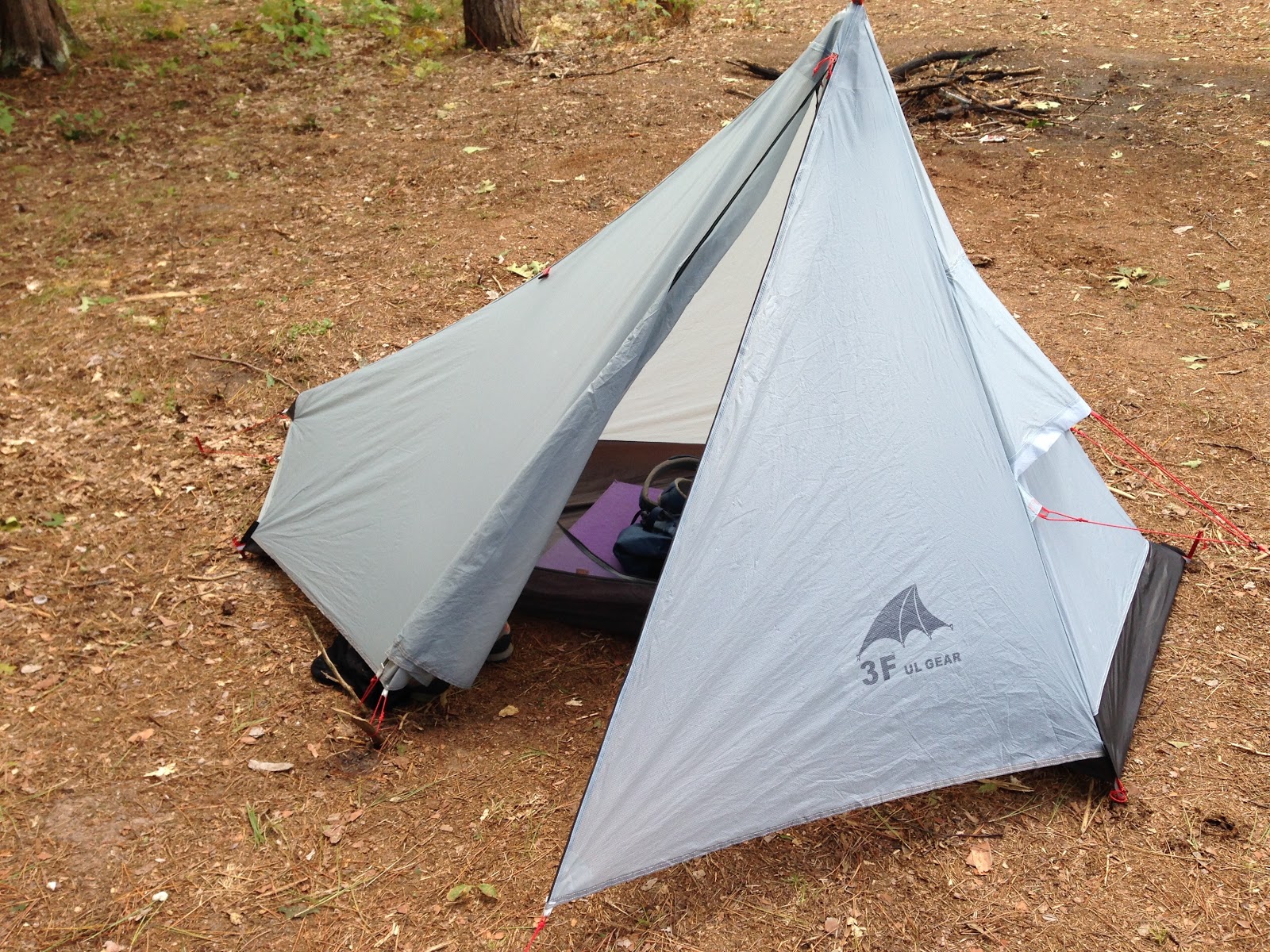
And so it was that I recently acquired an offset-pyramid tent from 3F UL Gear—the CangQiong 1 (1.5 lbs / 740 grams). The company offers a small line of tents that rely on a single trekking pole for set-up. Based in Xiamen, China, 3F seems to rely on Google Translator for its English-language marketing. This tent-maker helpfully describes the CangQiong 1 as “designed for dry conditions.” Yet I interpret this forbidding description with sunny optimism.
Knock-offs, “Originals” and History
First, however, it’s best to acknowledge the obvious: these tents are inexpensive knock-offs derived from successful American brands. The “originals” are more durable and weatherproof—and cost more. Producing copies and imitations is a long-established practice among tent-makers, with examples continually appearing. Outright piracy presents moral and legal issues, but I’ve no information nor opinion on whether this pertains to the 3F Ultralight Gear CangQiong 1.
Moreover, choosing between global market “philosophies” of any stripe is not my intent—least of all at the cash register. The concept of backpacking implies severely minimizing all its trappings. Sometimes this minimalism expands—at least in my imagination—to include matters of price. At some point, many of these questions become trivial and arbitrary.
Offering dire critiques of non-premium equipment is a long-standing pastime for certain hikers. But memoirs of the now elderly British mountaineer Chris Bonington recount sharing a ledge high on the Eiger with Don Whillans while both inside the same jumbo-sized plastic bag culled from a trash heap. The infamous Whillans chain-smoked cigarettes through the night. The bag’s quality wasn’t recounted as an issue. But in this instance the pair may have been happier in solo shelters—even if still failing to complete their route as a team.
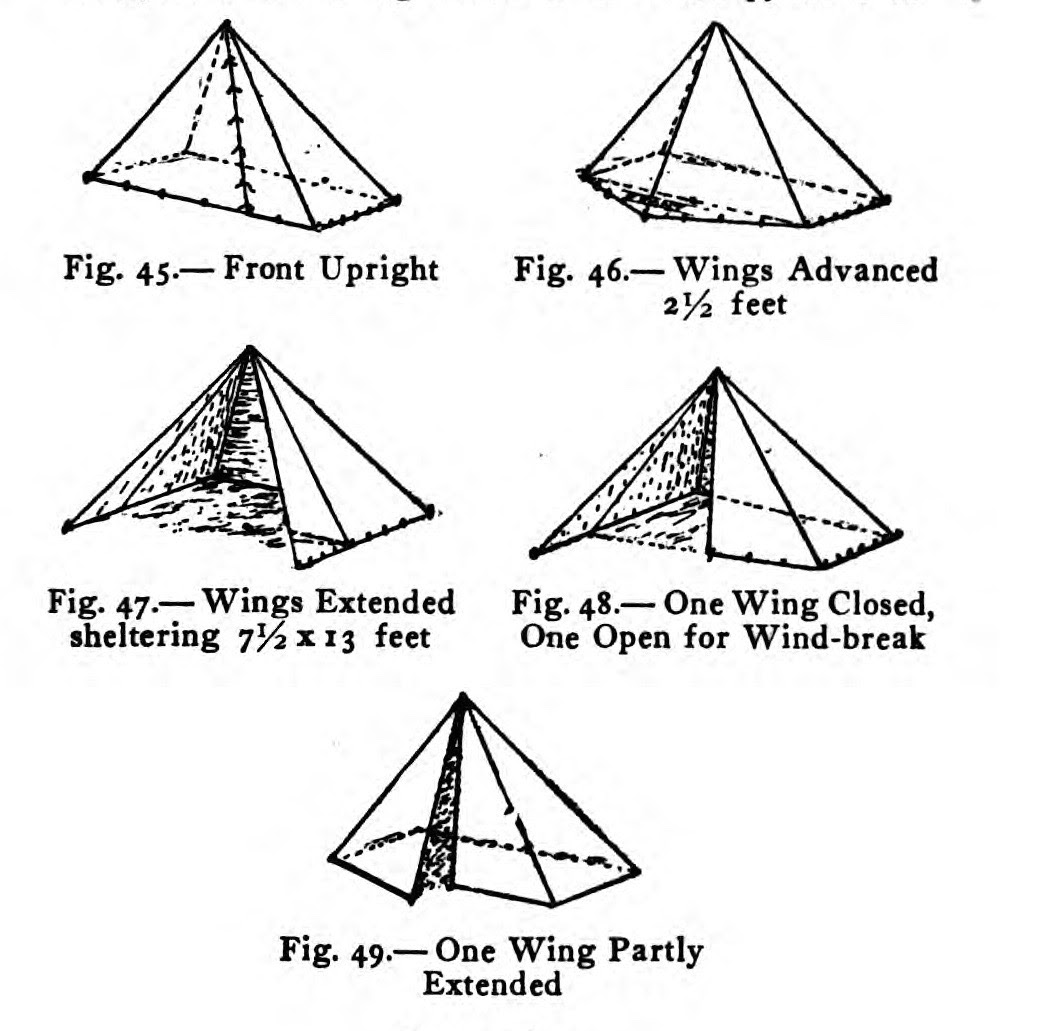
The 3F tents are based on recent patterns, but also reminiscent of much older, classic designs —especially the Compac Tent (3.4 pounds, 1.5 kg ) and the Royce Tent (4 pounds, 1.8 kg). Horace Kephart referenced these old tents in his 1911 manual Camping and Woodcraft. The author noted that Thomas Hiram Holding of London supplied a wedge tent “of Japanese silk, that weighs under 12 ounces; and it is a practical little affair of its kind.” But for the hiker who “goes out alone for a week or two at the fall of the year, or at an altitude where the nights are always cold” Kephart advised, “take a half-pyramid tent, say of the Royce pattern, but somewhat smaller.”
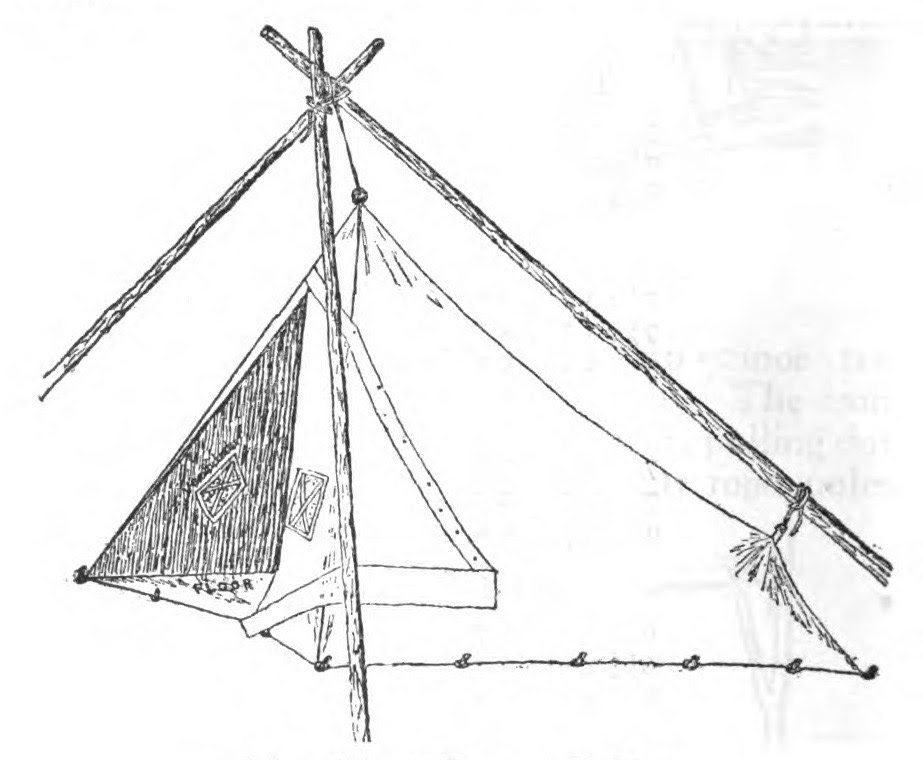
As of 1969, Recreational Equipment Inc.’s catalog included a “One-[Person] Tent” of tapered wedge design, with a canopy of finely woven cotton and pictured in deep blue. It may have been part of their line of several Swedish imports. Much lighter solo wedges in coated nylon were already available through a contemporaneous Eddie Bauer catalog.
Proliferating Designs
Today among leading one-person designs, the 28.6 oz (810 g) Durston X-Mid 1P is $200 and made of polyester, said to reduce stretching in rain. Six Moon Designs, one of at least several comparable small firms in the U.S., has produced a matter-of-fact YouTube video, showing that its Lunar Solo tent ($230) employs more durable and waterproof textiles (polyester) than competitor knock-offs, and yet is marginally lighter. The Swedish firm Hillenberg offers a well-established line of heavier singles in the range of $600 that seem suitable for alpine blizzards. But even as ingenious solo tent designs have proliferated, the whole genre is called further into question when lined up against very small, single-wall two-person domes (Black Diamond Equipment First Light, $370) available for the past 20 years.
Feeling penurious and with a genuine aesthetic revulsion toward domes, in March 2020 I acquired the 3F Ultralight Gear CangQiong 1 offset design. A longstanding but selective attraction to “reverse snob appeal” slightly clouded my judgment. The actual name of this product is rarely used in English-language marketing. It’s called instead of the “Single Person Tent Outdoor Ultralight Camping Tent 3 Season Professional Nylon Silicon Coating Rodless Tent.” Delivery from Xiamen took eight weeks.
In Michigan’s Lower Peninsula recently, I spent four October nights in the CangQiong 1, confirming its high-quality stitching and carefully designed reinforcements. It shrugged off light showers. Although smaller and more than twice the weight of Holding’s silk wedge of 1911, this tent is indeed “a practical little affair of its kind”— and yet another sign of human progress.
In March, AliExpress listed the model at $70, but payment difficulties on that site sent me to Amazon, which charged about $100. Now, seven months later, its price is up substantially, although a tent branded Flames Creed (not 3F) at a glance appears identical and is more reasonable ($89) as of this writing.
Cheap Tents Compared
I can most directly compare the CangQiong 1 with recent experience of a different one-person tent: the Wenzel Starlight. Its pleasingly classic, “mountain tent” form, and even an A-frame door bring to mind 1960s REI backpacking tents. Mine was a $28 Walmart purchase. From April to November last year, I spent a dozen nights in this relatively spacious, two-pound (896-gram) tent during walks along the western border of New England. But my Starlight has a sad secret: On a November evening in the Taconic Mountains, the “beak” or hood shielding its door ripped as I carelessly inserted an A-frame pole too tightly. This tent, now discontinued by Wenzel, remains marginally usable and repairable, but I’m uncertain of taking the trouble and expense.
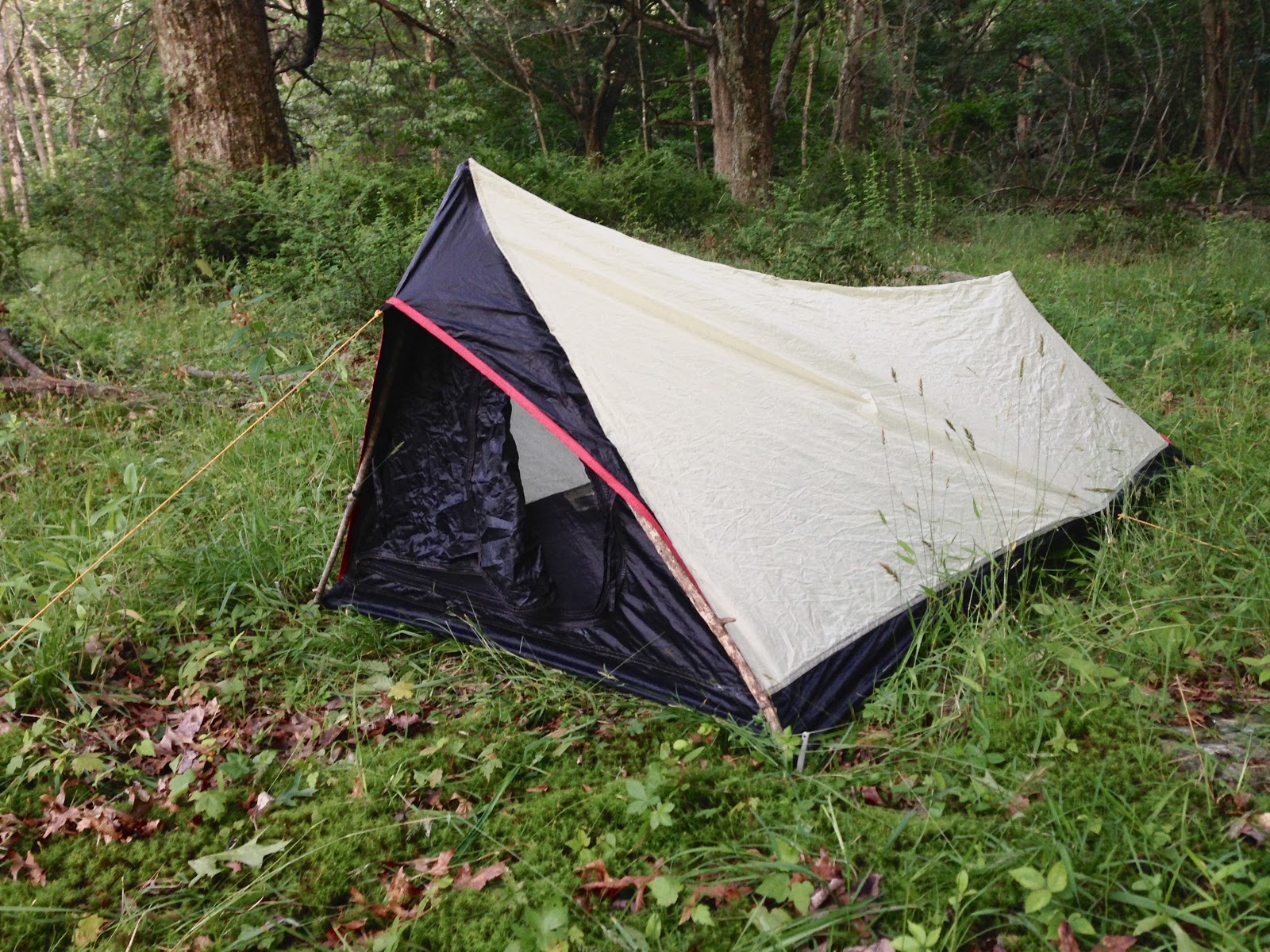
The 740’s construction inspires incremental confidence. It’s also preferable for its spacious, well-protected vestibule and door, and 10 inches (25 cm) of extra headroom. Although the 740 may at any time meet Starlight’s fate, it’s more likely to stand up adequately. For 10 years, I gradually wore through the floor of a tent similar to the Starlight, acquired for $19 from a local version of K-Mart. Clearly (to me), cheap and lightweight tents are potentially reliable. Moreover, recent experience may now inspire slightly greater tent-handling care.
Condensation Complaint Department
In mild weather, condensation inside coated tents, including the Starlight and 740, is largely insignificant. But a couple of nights spent hard by the banks of a midwest river near-freezing saw the 3F Ultralight Gear CangQiong 1 produce copious condensation by dawn. (In similar weather at a less dank location, this same tent stayed reasonably dry). Long ago I spent a night of inexpressible misery inside the K-Mart pup tent after a predicted rainstorm unexpectedly produced eight inches of wet snow at nightfall.
For several years following this pup tent incident, I avoided down sleeping bags in all but summer weather—regardless of available tentage. I acquired various floorless tarp shelters—solo and otherwise. Liquid simply drains away into the snow or dirt. Banked snow or even autumn leaf-drop can seal the perimeter from cold drafts. Moreover, floors may be the quickest tent component to wear out. But sewn-in floors and netting are an indispensable defense against insects in season and serve as a reassuring barrier against mud and crud.
Still fearful of drowning in an icy sea of condensation, I now rely on a sleeping bag cover or bivouac sack to protect from any rare discomfort inside sketchy shelters. A cover also shields the delicate sleeping bag from dirt and abrasion, while conveniently serving in lieu of a stuff-sack for transit and as a closet storage bag. In relevant circumstances, covers with fully waterproof “floors” can also make a groundsheet redundant.
Unlike many 3F products, its Tyvek Bivy bag (7 oz / 200 g) appears to lack narrowly comparable competition. Recently advertised at $20, it performed well inside the CangQiong 1 on four autumn nights near freezing. The unit is doubtless somewhat weatherproof when new and/or not excessively laundered. It’s too narrow, however, for winter sleeping bags and lacks a reliably waterproof floor. Various do-it-yourself Tyvek bags seem feasible for the talented.
Other, much more durable and desirable light covers are available—starting at about $100.
Further Reading:
- Matthew De Abaitua’s memoir The Art of Camping (Penguin Books, 2011) includes a survey of camping history and literature from a British perspective with significant detours to America. DeAbaitua’s bibliography, including works by Kephart and Holding, covers 17 pages.
- Dan Durston, a U.S. designer who reviews gear for Backpacking Light.com, has written with clarity and authority on geometrical issues of tent design. See his blog essay “The Volumetric Efficiency of Trekking Pole Shelters.”
Related Content:
Recent One-person shelter reviews
- Six Moons Designs Lunar Solo
- REI Co-op Flash Air 1
- Tarptent Notch Li (2020 version)
- Big Agnes Scout 1 Platinum
Forum
- Looking for a cheap tent? Our community has some ideas…
DISCLOSURE (Updated April 9, 2024)
- Backpacking Light does not accept compensation or donated/discounted products in exchange for product mentions or placements in editorial coverage. Some (but not all) of the links in this review may be affiliate links. If you click on one of these links and visit one of our affiliate partners (usually a retailer site), and subsequently place an order with that retailer, we receive a commission on your entire order, which varies between 3% and 15% of the purchase price. Affiliate commissions represent less than 15% of Backpacking Light's gross revenue. More than 70% of our revenue comes from Membership Fees. So if you'd really like to support our work, don't buy gear you don't need - support our consumer advocacy work and become a Member instead. Learn more about affiliate commissions, influencer marketing, and our consumer advocacy work by reading our article Stop wasting money on gear.


Discussion
Become a member to post in the forums.
Some observations on cheap one-person shelters, including on their design, proliferation, and history, and comparison between some shelters.
Great article :)
“Feeling penurious and with a genuine aesthetic revulsion toward domes, …”
If you were going to do an article about solo tents in general, you might have included self-supporting tents.
Disclosure: I’m not a fan of trekking pole tents, but it has little to do with aesthetics. It has to do with function, especially in the worst weather. IMO, guy-outs being equal, the best self supported solo tents will withstand far worse weather than one supported by one or two trekking poles, for a number of reasons:
There is much less tension on the stakes, so less likelihood of stake failure. More power to those with young backs who can lift boulders.
A self supporting solo tent can be designed with zero pole obstacles within or without.
There is less likelihood of pole failure, with no vertical poles to knock against or slip out of place. A flexible pole can be designed to be locked in place, at both ends and along its length; such as with R. Caffin’s tunnels. If the flexible poles reinforce each other by being crossed more than once, and are elbowed at the peaks, and not bent into full hoops as is most common, then lighter carbon poles can withstand extreme weather.
With its lower peaks and curved outer surfaces, a self supporting tent with flexible poles can be designed to present less wind resistance and be more aerodynamic.
Because of its curved outer surfaces, a self supporting solo tent can also be designed to be more spacious inside than trekking pole tents. So can hoop tents, but with few of the above advantages.
The biggest idea behind trekking pole tents is that they save weight, since the poles are dual use, and would be carried anyway. However, many of us carry only one trekking pole; because that is all we need, or the other hand must hold a leash, or we are content with sticks lying on the ground, or trekking poles are just not used by seasoned hikers such as R. Caffin. Where I hike, folks leave their hiking sticks at the trail heads for others to use. Disclaimer: The above does not apply to Willem Lange, moderator of NHPBS’ Windows to the Wild, who has earned his two hiking poles many times over.
Strong flexible poles made from filament wound carbon tube weighing less than 1/4 oz per running foot are currently available. Thus 24 feet of tube can weigh less than 6 oz; so trekking pole tents do not have as much weight advantage as is often thought.
As far as aesthetics are concerned, ‘beauty is in the eye of the beholder.’
Granted, the devil is always in the details, and the above is just a prototype canopy.
Glad to see someone else acknowledge 3F UL Gear tents. They’re hardly mentioned here on BPL, but they’re popular in Europe. I’ve never owned one, however, most reviews are very good. They’re praised for their solid construction and high HH materials. I started a thread on the latest 2021 Lanshan 1 last week, but it garnered little interest and mostly got shade thrown at it. Not surprising really, yet the backpacking masses worldwide like the idea of a solid tent for half the price of competitors. Yes, the Durston X-Mid and SMD are similar in price and quality to 3F tents. The rest however are much pricier and probably not as waterproof or durable as 3f shelters (Big Agnes, MSR, etc).
https://backpackinglight.com/forums/topic/3f-ul-gear-2021-lanshan-1-now-longer-wider-look-out-western-competitors/
Nice to see some of the old design of tents. Thank you so much for sharing the idea, good gears don’t need to be pricy. FYI, CangQiong (苍穹) means endless sky in Chinese. What a name!
Thanks to Yun for filling in the meaning of the name, Cangqiong. A little more background about it might also make its appeal clearer. The term was alluded to in a wildly popular documentary about pollution in Chinese cities from 2015, titled Under the Dome in English and 穹顶之下 (qiongding zhi xia) in Chinese. In today’s China, where air pollution is a serious issue attracting attention from both the government and industry, the name Cangqiong isn’t just a poetic image of wide open space but also evokes very strong green, environmentalist associations.
Good to see articles like this. Having walked the length of the North Island of New Zealand on the Te Araroa trail (1700km) with my wife and lived almost continuously in the LanShan 2 for 3 months (https://www.aliexpress.com/item/32860402976.html?spm=a2g0o.productlist.0.0.7a16ce8f7jJT0J&algo_pvid=cede4673-9121-4540-93b3-66d1576af052&algo_expid=cede4673-9121-4540-93b3-66d1576af052-34&btsid=0b0a555c16109079150035881e20c6&ws_ab_test=searchweb0_0,searchweb201602_,searchweb201603_), which we paid US$100 for on Aliexpress, we had no complaints whatsoever.
Superb construction. Totally waterproof. 1.2kg. For that price, we were prepared to give it a go in lieu of spending a fortune on other brands.
BJ
Love the title, “Life in the Dog House”. Sometimes during a long rain it sure feels like a dog house. Thanks for this interesting article.
My Solo Tents: 1.) TT Contrail 2.) TT Moment 3. TT Moment DW 4.) TT Notch Li
So yeah, there is a theme here – Tarptent. Like the designs, quality and customer service.
The Contrail was the roomiest and the Notch Li the most confining. “Progress”? Only in less weight but not in livability.
Hi Jon,
I agree with you. Still remember those days in high school 20 years ago in Beijing, the dust storm was so bad, dust got into windows although they are closed tightly. We got used to it so nobody were wearing masks or anything, elderly people were and still wearing masks these days regardless of covid. If one walk through area around Beijing Steel Factory, the collar would be very dirty after the walk. Before 2008 Olympic, federal government asked the factory and many more pollution-causer to stop manufacturing so the air would be better during the game. Some of them moved to other towns for good. The air is getting better and better although it will take very long to make up for decades of damage. At least there is hope!
Sorry for the long reply. Thank you!!!!!
UK design 1912
Here’s an Itisa tent belonging to Bryan Miller, on display in Newark, England in 2015.
The 3F UL CangQiong is probably a copy of the Big Sky Wisp tent which has been discussed on this site but the link between both tents is often overlooked.
Well written, John. Informative, entertaining, and even expanding my vocabulary a bit.
Thank you.
This aditorial content seems weird to me; Is it an article on the history of one person tents or a review/spotlight on a single tent manufacturer?
Based on my research different styles of cowboy/ ‘bivouac’ camping were popular before the world wars dating back to the renascence at least. It seems that Europeans exported the concepts to America (I’m not a historian!).
https://www.youtube.com/watch?v=SJxWa6pr8Hw&list=PL5RHeeMpUaXknIXik5gyRjbkp-2nrK6hm&index=3
https://youtu.be/_dojSfWQUeg?list=PL5RHeeMpUaXknIXik5gyRjbkp-2nrK6hm&t=824
https://www.wynnchester.com/history-of-the-canvas-bedroll/
Apparently Napoleon said, “Tents are not healthy; it is better for the soldier to bivouac next to the fire.”
Before nylon fabrics were invented in the 1930s, tents were made from heavy waxed cotton or virgin lanolin-rich wool. They were durable shelters intended to be carried by pack animals and used to build camps that would stand multiple nights, if not a whole season. The simplest/smallest tents from before WWI that I have found are square tarps which date back at least hundreds of years (A frame and diamond pitch). Cutting large branches or logs to erect such tents would be common whenever traveling near trees to avoid carrying them. Hence, most historical one person shelters being bivy like solutions. When alone and dealing with waxed cotton or wool it could be simpler and warmer to wrap oneself rather than pitch it over themselves.
http://www.pantherprimitives.com/furtrade.html
Before nylon there was “balloon silk”, not silk but very tight weave lightweight cotton. I have an original edition of Kephart’s book and it has some great tent and tarp descriptions. Unfortunately quality lightweight cotton has pretty much disappeared from the market now, the best I have found is still 4.5oz per yard, adding any proofing quickly increases the weight.
Thank you for all comments!
In 1971 I purchased from REI a cotton “two-person” backpacking tent with a coated nylon floor. REI discontinued cotton tents very soon after this purchase.
A few years earlier, at a summer youth camp that emphasized backpacking, very small cotton tents, floorless and without insect netting, were standard issue.
But any slight advantages offered by a cotton tent (breathability and comparatively low susceptibility to fire) today seem obviously outweighed by other factors. Thomas H. Holding’s 12-ounce tents, circa 1900, were made of silk — another textile that is doubtless obsolete for tentage.
Let’s not leave out olfactory histories; I still recoil when I smell anything resembling the oiled and mildewed cotton tents from my scouting days.
My family had a cotton tent, I remember fondly the smell, oddly. It wasn’t mildewy, or at the least, I wasn’t repulsed by it if it was.
I wish I could fit in the 3FUL tents. Being 6’1″ and liking to use Big Agnes pads (3.5″ thick), I have not even risked it based on the reviews. I do often wish I was a shorter person (think of the weight savings! :D).
“But any slight advantages offered by a cotton tent (breathability and comparatively low susceptibility to fire [italics added]) today seem obviously outweighed by other factors.”
The CPAI-84 standard and state laws that virtually require most backpacking tents sold in the U.S. to be treated with toxic fire-retardant chemicals were a reaction to cotton canvas tents catching fire and killing people. Too often, cotton tents were soaked in wax (or similar) to repel rain, literally adding fuel to the fire. CPAI stands for Canvas Products Association International.
OTOH, it’s very difficult to find reliably-sourced stories of people dying, or even getting seriously injured, in synthetic (nylon, polyester) backpacking-style tent fires. Even without treatment, these tents don’t catch fire or sustain flames very well – especially with ultralight fabrics.
Synthetics laminated to waterproof-breathable fabrics like GoreTex are almost impossible to light and sustain a flame, but won’t pass CPAI-84. Hmmm, wonder why a standard developed by cotton fabric makers is so hard on synthetic fabrics?
In the EU, virtually no tent maker uses fabrics treated with fire retardants, in large part because of the toxicity issues. And European backpackers are not going up in flames – unless they are drummers in second-class rock and roll bands:
When it comes to fire susceptibility, I am far more comfortable in a lightweight synthetic tent than cotton. Each fabric has other advantages and disadvantages.
And don’t be stupid – keep flames away from all tent fabrics.
— Rex, stepping off soapbox – for now
But more here:
https://backpackinglight.com/standards-watch-mike-cecot-scherer/
Become a member to post in the forums.