Articles (2020)

Gear List: Tenkara Fly Fishing in the Northern Rockies

Mark Wetherington’s tenkara gear list serves as a great entry point to backcountry fly fishing for newcomers.

Introduction

Figuring out the best backcountry fishing system can be an intimidating process with an inordinate amount of choices and pieces of gear to sift through. The purpose of this article is to offer the reader one way to simplify it with a minimalist, tenkara fishing kit.

Although I am certainly not an expert angler, I am reasonably well-versed in the intersection of lightweight backpacking in the Northern Rockies and catching trout in mountain lakes. I’ve fished several dozen lakes and over a dozen small streams and rivers in the Northern Rockies and the Pacific Northwest and almost always found success – sometimes just barely and sometimes spectacularly – using a tenkara fishing system. Tenkara is a traditional method of flyfishing as practiced in Japan that is noticeable for its simplicity.

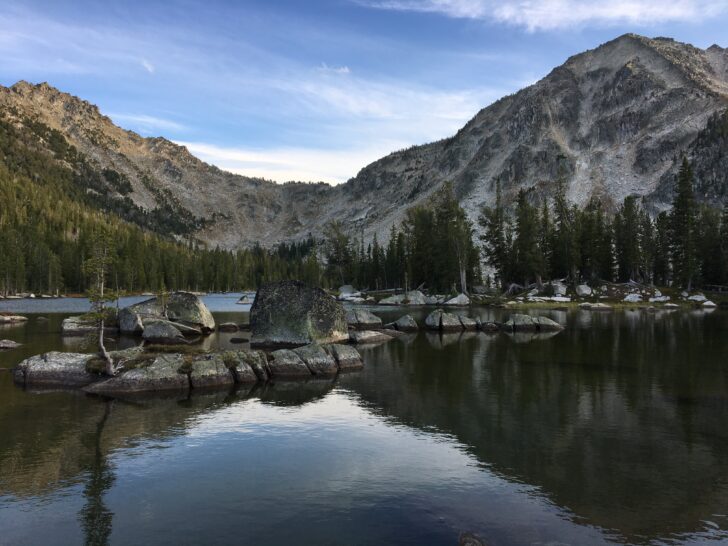
a beautiful alpine lake
Tenkara fishing turns a lake like this from something nice to look at into an endless source of entertainment – and possibly dinner!

As adapted for backpacking, this method uses only a collapsible (telescoping) rod, short line, tippet, and a fly (we’ll explain these terms further down in the article). There’s no reel and no multi-section rod and eyelets to thread line through, just the basics needed to catch fish. This minimalist approach not only allows me to keep my fishing kit to well under 8 oz (227 g), but it allows me to have a fly on the water in less than a minute after removing the rod from my pack. There have been several times where I’ve landed a fish before my companions even got their traditional fly rods set up for the first cast.

The simplicity also lends itself well to sharing the experience with others and getting people to try fishing for the first time. In just a few minutes, I’ve shown people who’ve never fly fished how to make simple casts and achieve a passable presentation of the fly, then watched them catch small but eager trout within a few casts.

On a philosophical level, the lack of gear to manage and master allows for a much more focused – and for me, a more fulfilling – experience.

Summary of Context

Although I purchased my first tenkara rod in 2011 for use on streams and rivers in eastern Kentucky, it wasn’t until after I moved to Montana in 2014 that I became an avid backcountry angler.

My tenkara experience is primarily with backcountry lakes in Montana that contain trout – cutthroat (both Yellowstone and Westslope), rainbow, and brook. Some of these populations are self-sustaining and others are stocked. I’ve also fished small streams and rivers in the region. I’ve used tenkara on streams and rivers in Wyoming and Washington, as well as at several lakes in Washington. Despite my use being limited to the Northern Rockies and Pacific Northwest, this article is applicable to any backpacker who finds themselves hiking in areas with mountain lakes that have trout – California, Oregon, Utah, Idaho, Colorado, Nevada, and New Mexico all come quickly to mind.

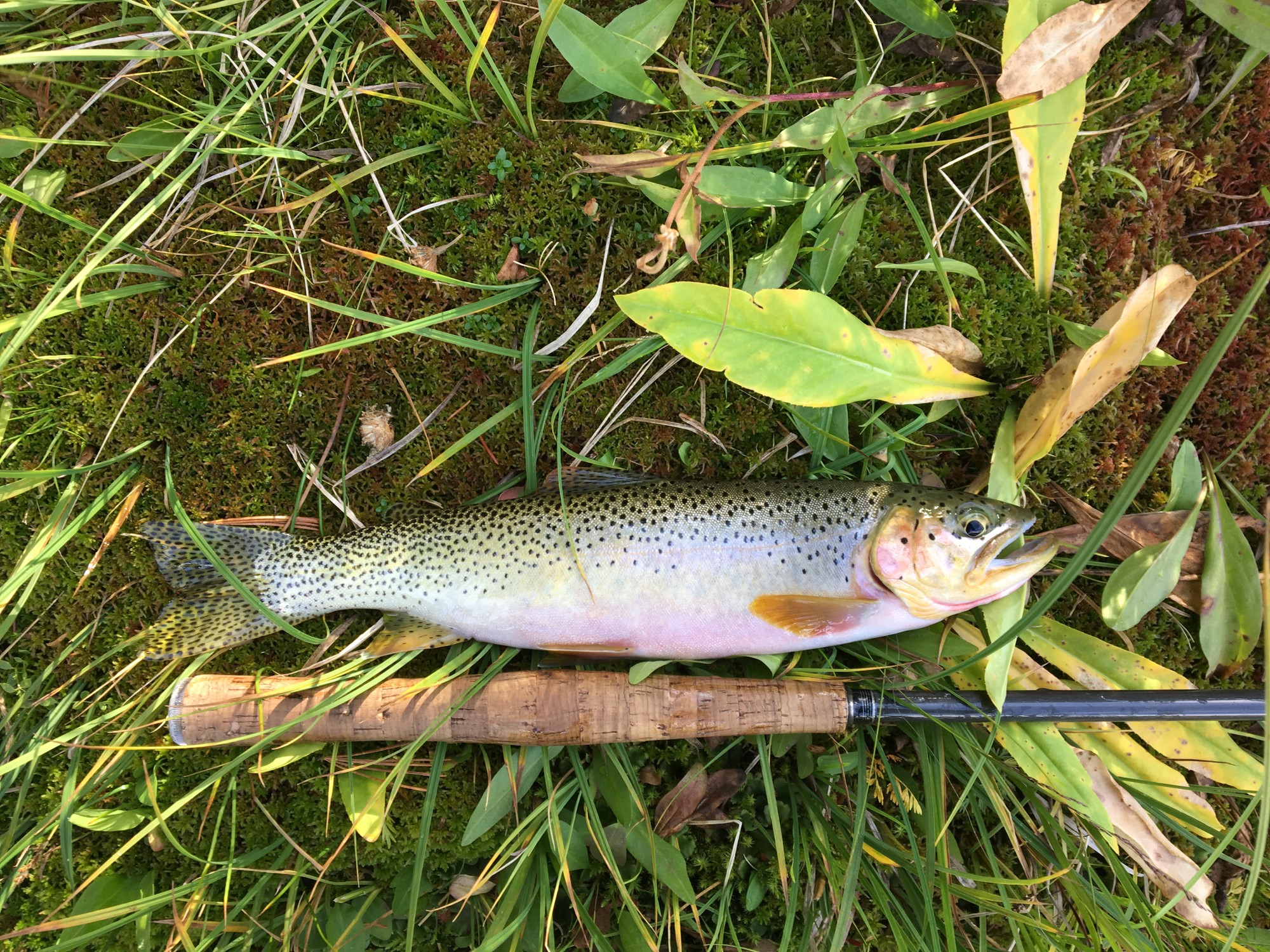
a beautiful trout next to a minimal tenkara style rod
A tenkara-caught cutthroat trout. A minimal amount of gear, a lot of patience and a little bit of practice can yield great results.

As noted in the introduction, my intent is not to provide a comprehensive overview of tenkara as a supplement or substitution for traditional fly rod systems. Rather, I am simply providing information and observations about my experiences using it as my sole fishing system for backcountry lakes. It is my opinion that for most backpackers this system is preferable – or should at least receive ample consideration – due to its affordability, minimal weight, and ease of operation.

My experience is limited to the products produced by Tenkara USA, which was the first company to make lightweight, telescoping tenkara-style rods available in the United States. However, the observations and experiences should be more or less transferable to other tenkara-style products by other manufacturers.

Gear

Rod

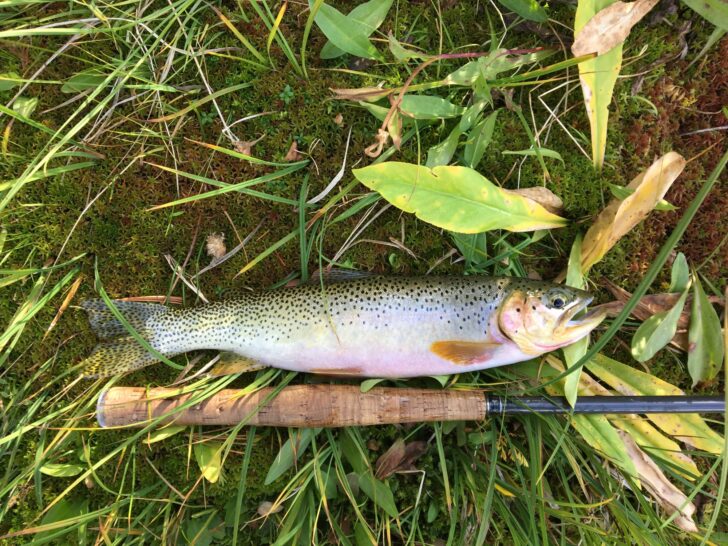
a small fish on shore next to a tenkara rod
A Yellowstone Cutthroat caught via tenkara. Even small and medium-size fish are a thrill to hook and land with Tenkara rods.

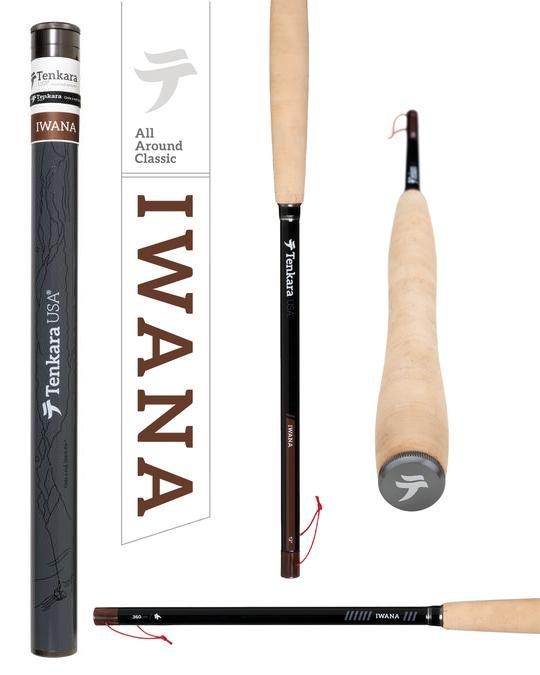
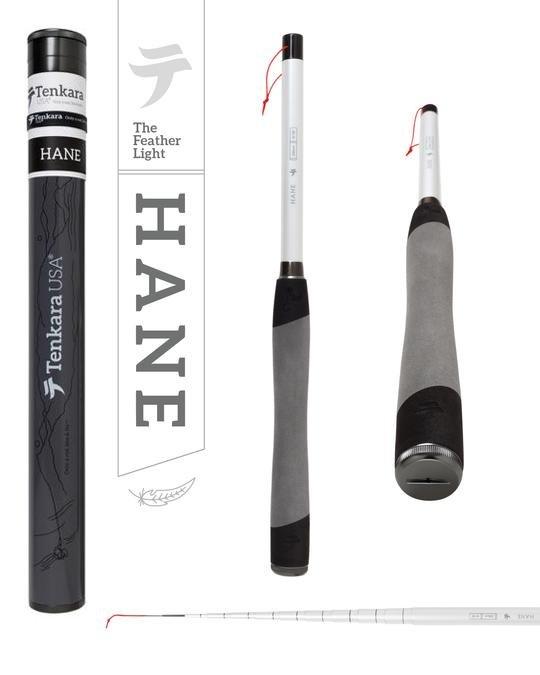
I’ve used the Tenkara USA Iwana and the Tenkara USA Hane rods, both of which are incredibly light at 2.7 oz (77 g) and 3.5 oz (100 g) respectively. The Iwana is currently sold in a 12-foot long version, but my earlier generation rod is closer to 11 feet. The Iwana is sold as an all-around rod (not too long, not too short, not too stiff, not too flimsy) and is my favorite to use. The cork handle feels nicer in my hand than the handle of the Hane, although both are comfortable to hold for long periods of time. A minor drawback of the Iwana is that it doesn’t collapse as small as the Hane – 20.5 in (52 cm) versus 15 in (38 cm). However, it is 0.8 ounces (23 grams) lighter.

product photo iwana rod by tenkara usa
The Iwana model. Photo: Tenkara USA.

Although I find the Iwana to be a bit more fun and responsive, I would most likely recommend that backpackers who are new to tenkara go with the Hane. Its packability and length make it a bit more user-friendly to start with. Both rods are priced similarly, with the Iwana at $170 and the Hane at $160.

product stock photo of the hane tenkara rod
The Hane model. Photo: Tenkara USA.

Editor’s Note: The Tenkara USA Hane originated as a collaboration between Ryan Jordan (Backpacking Light’s founder) and Daniel Galhardo (Tenkara USA’s founder) in 2010, and was sold exclusively to Backpacking Light Members. Ryan wanted a rod that was shorter, stiffer, more compact, and more durable than other tenkara rods – in other words, a rod designed for the backpacker. The Hane was recently brought back to market by Tenkara USA and it remains one of our favorite all-time models of tenkara rods from any brand.

In well over two hundred fishing days between these two rods, and having landed several hundred fish, I’ve yet to notice any significant wear or durability issues. The telescoping extension of the rod is intuitive, but the thinnest segments are fragile. There are plenty of stories of people breaking a tip while telescoping a rod.

I watched a clumsy friend do this within a few days of having his first rod, so it’s advisable to read the instructions carefully and watch a few videos on the extensions/collapsing process to make sure you don’t damage your rod. On the bright side, Tenkara USA is noted for exceptional customer service and a lifetime warranty on defects in its products. Issues caused by user error can almost always be replaced economically by purchasing individual rod sections.

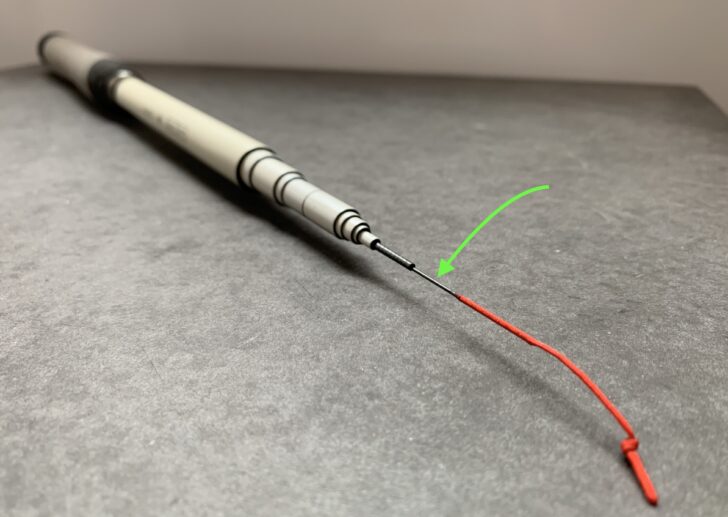
tenkara rod showing telescoping sections
The tip section of the Tenkara Hane is the most fragile part of the rod. At only 0.8 mm in diameter and made of brittle carbon, it is much more likely to be damaged while setting up or taking down the rod than to break while casting or playing a fish. Photo: Ryan Jordan.

Each rod comes with a protective case to use when transporting the rod. At first, I used the case when backpacking out of an abundance of caution. Now I just pack the rod inside my pack or in a side pocket and secure it snugly against the pack with compression straps. I’ve had no issues with damage to the rod on roughly two dozen trips using this approach.

Rod Notes

  • Iwana Rod / 12 ft (360 cm) open / 20.5 in (52 cm) closed / 2.7 oz (77 g). My first and favorite Tenkara rod. Great for mountain lakes and open streams flowing through meadows and most rivers.
  • Hane Rod / 10 ft 10 in open (330 cm) / 15 in (38 cm) closed / 3.5 oz (100 g). An ideal rod for backpacking and the most compact rod offered by Tenkara USA. Suitable for fishing the same waters as the Iwana, but I find the action of the rod to be slightly less thrilling when catching fish due to the shorter length and slightly stiffer feel.

Line and Tippet

There are two types of lines most commonly used with tenkara rods – a traditional (tapered) line and a level (untapered) line. I’ve used both and prefer the traditional line, mostly because it is the easiest to attach to the rod and connect a piece of tippet to (the tippet is a very fine piece of line that connects the primary line to the fly). Tapered lines are also easier to cast.

Lines are available in 10 ft 6 in (3.2 m) or 13 ft (4 m) lengths. I usually bring one of each with me. If the fish are rising further out from shore I use the 13 ft (4 m) length. If they’re close in or the terrain makes it easier to have less line in the air, I’ll opt for the 10 ft 6 in (3.2 m) line. When line, rod, and tippet combine, I have about 20 – 25 ft (6.1 – 7.7 m) of effective casting range.

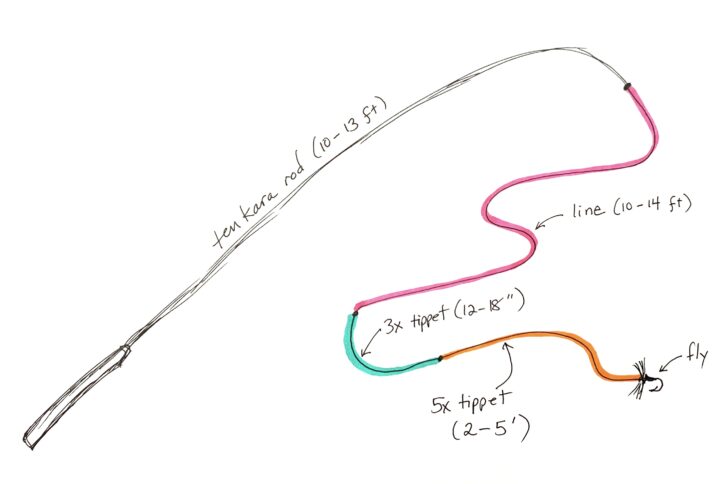
a typical tenkara rod-line-tippet setup showing a 10-13 foot rod, 10-14 foot tenkara line, 12-18 inches of 3X tippet, and 2-5 feet of 5X tippet, then the fly
A typical tenkara rod-line-tippet setup. Illustration: Ryan Jordan

While a traditional fly rod system would provide me with more distance, I’ve rarely found that being able to cast 50 ft (15 m) makes or breaks my day of fishing. I can usually just walk around the lake to a place where the fish are feeding closer to shore or wait until they move in as the time of day changes.

Line and Tippet Notes

  • Tapered Tenkara Lines / 10 ft 6 in (3.2 m) or 13 ft (4 m) / weight is less than 0.04 oz (1 g) for a 10 – 13 ft (3 – 4 m) monofilament nylon line / are my preferred lines. I’ve found them to be the easiest to cast, easiest to attach to the rod, easiest to attach tippet to, and the easiest to store. When minimalism and convenience dovetail so perfectly, it’s hard to switch to anything else. I use both the 10 ft 6 in (3.2 m) and 13 feet (4 m) lengths and always have one of each with me on my trips so I can alternate them when conditions dictate and to have as a backup.
  • 5X or 6X tippet / one spool containing 30 m of tippet typically weighs less than 0.3 oz (10 g) / I use these strengths of tippet because I’m generally not fishing waters with fish requiring heavier tippet. Thin tippet is also easier for fish to see – especially in mountain lakes with high clarity. I typically have between 4 – 6 ft (1.2 – 1.8 m) of tippet on my line. On the calm and clear waters of lakes it is nice to have as much distance between the line and the fly as possible.
  • Tenkara The Keeper / 1.4 oz (40 g) / This line storage device allows you to store two lines and has a small compartment for a handful of flies. In my experience, having one of these is almost mandatory for your enjoyment (and sanity, as dealing with tangled tippet and lines is maddening).
assortment of spools of sample tenkara lines and tippet material
A sampling of typical tenkara lines and tippet material: (A) a braided, tapered monofilament tenkara line; (B) and (C) different diameters of non-tapered monofilament level lines; (D) 3X (0.008″ dia.) non-tapered monofilament typically used as a short transition section between the end of the tenkara line and the rest of the tippet; (E) 5X (0.006″ dia.) non-tapered monofilament typically used for the tippet section between the 3X transition section and fly; (F) 6X (0.005″ dia.) non-tapered monofilament used instead of 5X when fishing very small flies or spooky fish. Photo: Ryan Jordan

Flies

Tenkara USA sells its own traditional Japanese tenkara flies. Tenkara purists espouse using as few flies as possible. Indeed, Tenkara USA only offers four different varieties of flies for sale.

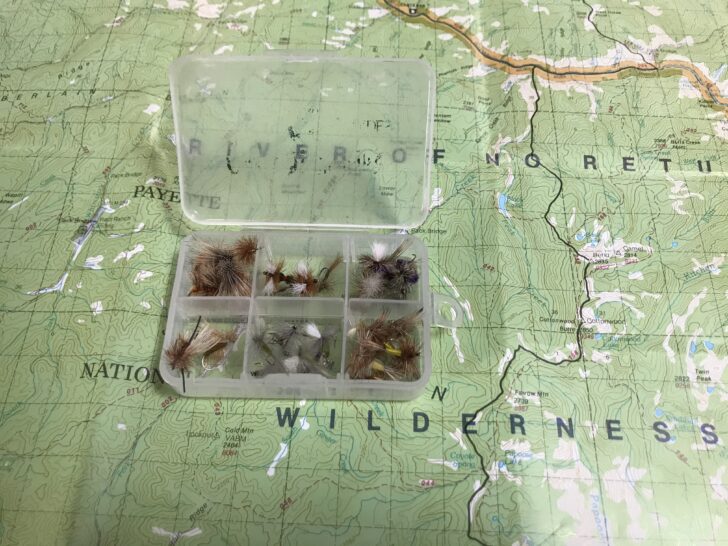
I mix the neuroticism of traditional “match the hatch” fly fishing (with its abundance of flies for every occasion) with the minimalist focus of tenkara and usually have 5-6 patterns with me when fishing (totaling around 25 flies). Royal Wulffs, Caddises, Adams, Blue Winged Olives, and Ants are always in my fly box. With a few variations among these, mostly just in color and size, I’m nearly always able to have a successful day of fishing if the trout are feeding on the surface (i.e. hitting “dry flies”).

A fly box laid out against a map.
My typical fly box for tenkara. My fly box is more involved than a traditional tenkara system, but less involved than traditional western fly fishing.

I’ve yet to experiment with using nymphs to fish below the surface of the lake, but I know of some who have made this work with a tenkara system.

Flies Notes

  • Royal Wulffs / size 12-16 / This is generally the fly I toss out first to see how eager the trout are to rise and how discerning they are. I’ve tossed these out on lakes where I haven’t seen a rise in 15 minutes of observation and had a strike within a handful of casts. I’ve also cast it out on lakes with fish feeding on the surface in a frenzy, but not had a bite on this fly.
  • Blue Winged Olives (BWO) / size 12-16 / If the fish aren’t striking on a Royal Wulff, I’ll usually try a BWO or something similar to see if I can entice them to strike.
  • Ants / size 12-14 / I’ve found that sometimes the difference between getting a strike and coming up empty depends on variations in the color on the ant – red and purple can sometimes appear to make a difference. At a lake with arctic grayling in Montana’s Sapphire Mountains, the fish seemed to be choosing ants with purple on them above all other flies.
  • Caddis variations / size 12-16 / Similar to ants, color seems to make a decent bit of difference here so having a few with different colors is a good idea. I’ve noticed that yellow and oranges tend to be popular with trout in mountain lakes in September.
  • Adams variants / size 12-16 / I use a few different colors of Adams variants similar to Royal Wulffs – generally as a way to see how picky actively feeding fish are or how likely inactive fish are to rise and strike whatever hits the surface.

Net

A net makes it easier to land fish and allows them to be handled and released more gently. The lightest ones are made of carbon fiber and clear rubber, but in proportion to the rest of the fishing system they have significant weight. I most often leave the net at home, especially if fishing is a secondary part of my trip.

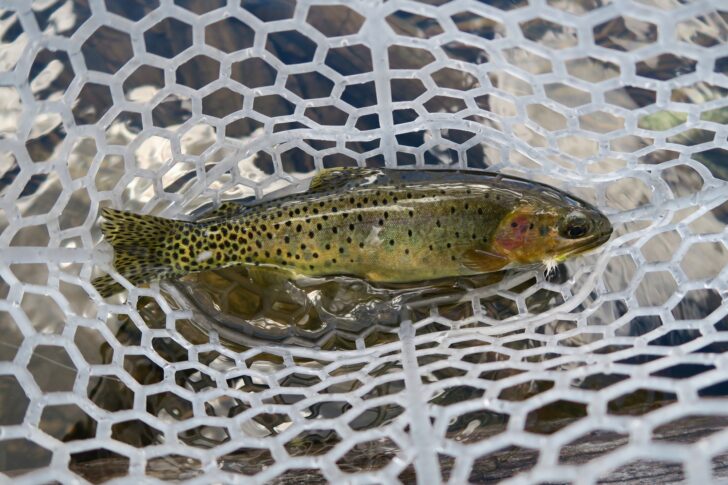
a trout in the bottom of a net
A net is helpful at landing trout and allows them to be handled more gently.

I typically bring a net when returning to lakes where I have caught large trout and can use the help with landing them. If you don’t plan to use a net, please read up on the best ways to practice catch-and-release to minimize impact to the fish. If you’re planning to eat the fish you catch, then having a net would be useful in preventing dinner from getting away.

Net Notes

  • The Brodin net I use has been discontinued. It is a carbon fiber frame with rubber net and weighs 9.4 oz (2.66 g), so I only bring it when I think I’ll be catching larger fish. As one would expect, the exact opposite result usually occurs — when I bring the net to lakes I’ve landed large fish in before, I usually don’t catch any or only catch smaller fish. When I don’t bring the net, the chances of having my rod doubled-over and an 18-inch trout on the line increase significantly. The Brodin El Zorro Cutthroat is the model that most closely resembles the net I use.

Accessories

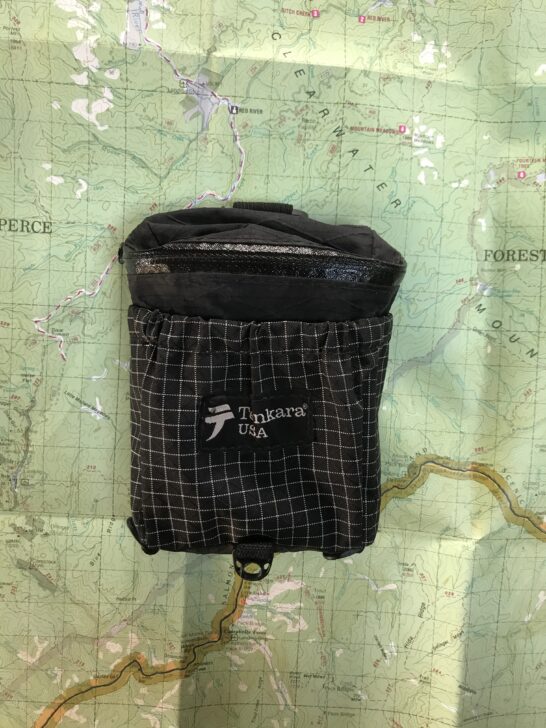
I use a Tenkara USA Strap Pack and their line holders to keep things organized. Tenkara USA sells a specialized nipper tool that is certainly useful, but in true ultralight fashion I just use the fingernail clippers I keep in my first aid kit to clip the tag end of my knots down.

a small fishing pack laid out against a map
The Strap Pack is handy for stowing the minimum essentials.

A small fly box is useful as well. Models as minimal or elaborate as you desire are available. I typically take around 25 flies total that are a mix of the four to five patterns that have proven most successful over the years, and hope for the best.

  • Tenkara Strap Pack / 1.5 ounces (43 g) / This small Dyneema/Nylon bag is perfect for storing the handful of items – tippet, line, flies, and clippers – that I want to have access to when I’m fishing. It has a waterproof zipper and waterproof fabric, so I don’t have to worry about drenching the gear inside when wading.

Technique, Performance, and Experience

Casting a tenkara rod is remarkably intuitive. Tenkara USA rods come with basic instructions, and their website has a lot of great instructional resources as well. Take some time to learn to cast correctly.

Knots are as important a part of the technique as the casting, in my experience. There’s almost nothing worse than having a fish get away because your knots were poorly tied.

Fortunately, tenkara knots are also minimal – I only use two. One to connect the tippet to the line and another to connect the fly to the tippet. These are covered in the instruction booklet that comes with a Tenkara USA rod and are also covered online in various videos and tutorials.

Landing a trout with a tenkara set up can be oddly confusing and intimidating for those used to fishing with a reel. Having to pull the line in by hand feels a bit more intimate than using a mechanical advantage (a reel) to bridge the gap. I play the fish as little as possible before beginning to pull the line in. There are helpful tutorials on the best way to land fish on the Tenkara USA website.

Conclusion

Tenkara fly fishing allows me to catch almost as many fish with 50% less equipment compared to western-style fly fishing. And some days, I outperform the western fly rod systems used by my companions.

But regardless of how many fish I catch, the fact is that I am catching them quicker and spending more time fishing and less time fiddling with gear. My gear also weighs a fraction of that of a traditional fly rod system and is much more portable, allowing me to fish lake chains without having to disassemble my system or worry about snagging my rod as I change locations.

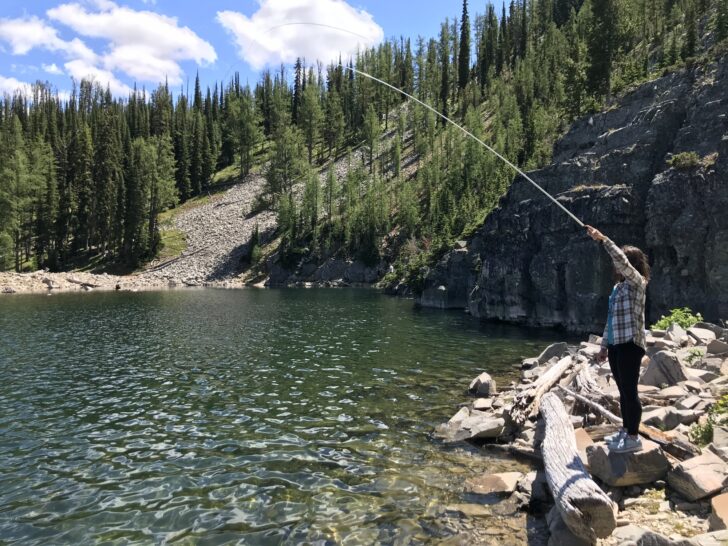
a woman tenkara fishing from shore
Tenkara is easy to share with others, as the lack of gear makes it more approachable.

If you already have lots of experience as an angler, a tenkara system will be a useful tool in your toolbox. However, you’ll likely be more prone to recognizing its limitations (which despite my near-fanatical endorsement of tenkara, do exist). If you’re new to fishing backcountry lakes and small wilderness streams and rivers, a tenkara system is an ideal way to start.

It’s relatively inexpensive, typically hassle-free, adds minimal weight, and can provide hours of enjoyment trying to catch trout at the lakes you pass by or camp at during backcountry outings. The learning curve is fairly gentle and in many cases, trout at mountain lakes can be much easier to catch than those in rivers or streams.

Summary: Gear List

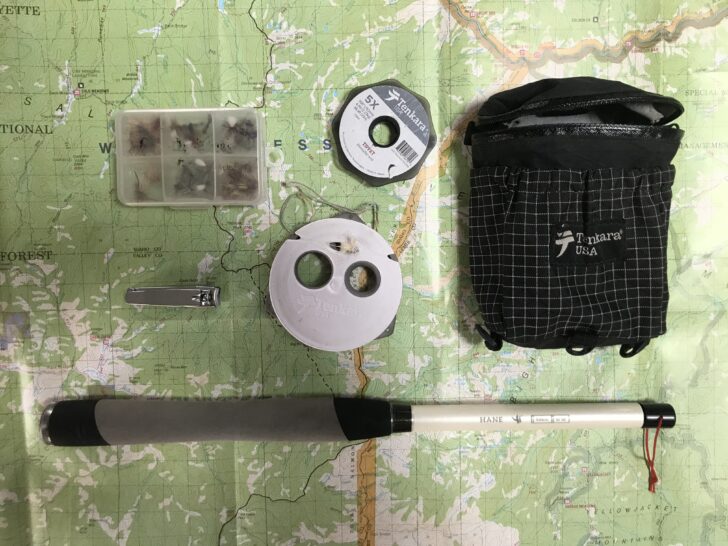
  • Tenkara USA Iwana or Hane Rod – 2.7 oz (76.5 g) or 3.5 oz (100 g) respectively.
  • Tenkara The Keeper with two lengths of braided line with pre-attached tippet and flies – 1.6 oz (45 g).
  • One Spool of 5X or 6X tippet – 0.2 oz (6 g).
  • About 20 flies in plastic fly box – 0.8 oz (23 g).
  • Fingernail clippers – 0.7 oz (20 g).
  • Tenkara Strap Pack – 1.5 oz (43 g).
  • Fishing license in small plastic bag – 0.1 oz (3 g); the digital license can also be used on a smartphone in some states for no added weight.
tenkara gear laid out against a map
My typical tenkara kit for a long weekend of fishing in mountain lakes and streams.

Related Content

DISCLOSURE (Updated April 9, 2024)

  • Backpacking Light does not accept compensation or donated/discounted products in exchange for product mentions or placements in editorial coverage. Some (but not all) of the links in this review may be affiliate links. If you click on one of these links and visit one of our affiliate partners (usually a retailer site), and subsequently place an order with that retailer, we receive a commission on your entire order, which varies between 3% and 15% of the purchase price. Affiliate commissions represent less than 15% of Backpacking Light's gross revenue. More than 70% of our revenue comes from Membership Fees. So if you'd really like to support our work, don't buy gear you don't need - support our consumer advocacy work and become a Member instead. Learn more about affiliate commissions, influencer marketing, and our consumer advocacy work by reading our article Stop wasting money on gear.
Episode 38 | Tenkara Fishing

In this Skills Short episode, Ryan and Andrew talk about the essential skills and gear needed to take up the sport of tenkara-style fly fishing.

Stream

Summary

In this Skills Short episode, Ryan and Andrew talk about the essential skills and gear needed to take up the sport of tenkara-style fly fishing.

Outline

  • Andrew’s problem with fishing
  • The difference between tenkara and western-style fly fishing (it’s one of simplicity)
  • What you need and where you can get it
  • Tenkara USA
  • Tenkara Rod Company
  • How do you get fish to the shore?
  • Skills and connection with task
  • Flies, lines, and how they differ in tenkara
  • Strike indicators – what are they, and do you need them?
  • Split shot – what is it, and do you need it?
  • Connecting it all together with some accessories
  • To net or not to net?
  • Skills for beginners
  • Skills to take you to the next level
  • Tenkara by Daniel Galhardro
  • Simple Fly Fishing: Techniques for Tenkara and Rod & Reel by Yvon Chouinard, Mauro Mazzo, and Craig Mathews

How to Subscribe

More Episodes

Credits

Feedback / Tips / Questions

  • podcast@backpackinglight.com

More Backpacking Light

Disclosure

  • Sponsorship Policy: Backpacking Light does not accept compensation or donated/discounted products in exchange for product mentions or placements in editorial coverage, including any podcast episode content not excplicitly identified as sponsored content.
  • Some (but not all) of the links in these show notes may be affiliate links. If you click on one of these links and visit one of our affiliate partners (usually a retailer site), and subsequently place an order with that retailer, we receive a commission on your entire order, which varies between 3% and 15% of the purchase price. Affiliate commissions represent less than 15% of Backpacking Light's gross revenue. More than 70% of our revenue comes from Membership Fees. So if you'd really like to support our work, don't buy gear you don't need - support our consumer advocacy work and become a Member instead.
  • Learn more about affiliate commissions, influencer marketing, and our consumer advocacy work by reading our article Stop wasting money on gear.

Learning Curve: What I Learned From Taking a Beginner into the Backcountry

I thought I knew how to take first-time backpackers out, but I’d never actually taken a bare beginner into the backcountry.

Backpacking has a lot of wonderful attributes, including that it’s one of the least technical outdoor activities you can do while still being deeply immersed in the mountains. Backpacking is more involved than a day hike, but it’s not as complex as mountaineering or climbing. If you can walk, know where you’re going, and carry the bare minimum to spend the night outdoors, you’re going to be ok.

I might have more backpacking miles than my friends, but they are all capable and experienced outdoorspeople. The most I’ve ever had to do was help them set up a borrowed tent or explain the benefits of carrying a lightweight bottle instead of a Nalgene. But I’d never taken someone out who had never slept in a tent or spent the night outdoors.

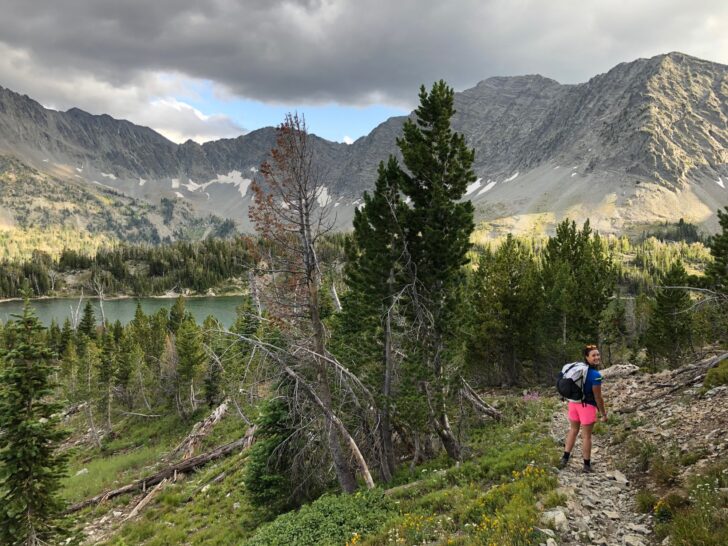
a woman walking along a beautiful train in the mountains
Taking beginners out isn’t my forte… it’s something I’m trying to get better at. Photo credit: Maggie Slepian

We’ll call this bare beginner Jewel. She spent most of her time bouncing between LA and Las Vegas, but last summer, she spent a week with me in Montana as part of a work project. Jewel was in great physical shape, loved being outside, and was an advanced yoga instructor. She kicked my butt on a few day hikes and was excited to go on her first backpacking overnight with me during the trip.

I chose my show-off hike: an overnight to a picture-perfect alpine lake in a mountain range a few hours from town. The hike to the lake was only about seven miles, but the trail was varied and picturesque. It climbed steeply through the woods, crossed several deep creeks, traversed open meadows before switchbacking up a pass to views of the lake below. It’s one of my all-time favorite overnights in Montana, and the one I always take guests on.

I invited two friends along with Jewel and me. I knew she was fit, but I was also aware that she’d never spent the night outdoors or carried a loaded pack. Additionally, I knew my own limitations. I am simply not the best at being a guide – I love taking people out, but I also understand that I can be oblivious to skills and tips that probably should be explained.

Before she showed up, I had sent Jewel a detailed list of the backpacking gear she should buy. She showed up to my house with the exact items – the inflatable sleeping pad, off-the-shelf 55-liter pack, 20-degree mummy bag, 300-lumen headlamp, and a lightweight set of carbon trekking poles. Despite trying to convince her to wear trail running shoes, she insisted on beefy hiking boots straight from the box. Once I saw the boots, I also made sure she packed a few pieces of Moleskin.

a woman stands on top of a mountain
Part of my show-off hike for people visiting Montana. Photo credit: Maggie Slepian

We packed our bags while waiting for Hailey and Claire to show up. I explained the concept of leaving some items behind for an overnight. We didn’t need a full pack of face wipes, hard cases for different items, a full sunscreen, or the aerosol bug spray. I left her with the “nope” pile and went to go meet Hailey and Claire downstairs.

When Jewel came down, her bag was several pounds heavier than when I’d left it upstairs.

“What’s in this?” I asked, digging through the bulging pockets. She’d put back most of the items I’d taken out. I told myself it was fine. She was in very good shape and the hike wasn’t too strenuous.

For me, the learning part of this outing meant truly understanding what it meant to be a real beginner. Not just a first-time backpacker, but someone who had never had a real backcountry experience. Jewel was enthusiastic and in shape, but she came from a realm far from the outdoor recreation world.

At the trailhead, I threw my pack on and started walking away from the truck, expecting Hailey, Claire, and Jewel to fall in line. Hailey tapped me with a trekking pole. Jewel was still at the truck, struggling with her pack. I dashed back and helped her adjust the straps and buckles, marveling at how complicated the adjustment system is on a fully-featured backpack. From the different connections, to cinching, to fit, to packing method… a lot goes into something as simple as throwing a pack over your shoulders. I’d taken this skill for granted for years, mindlessly adjusting tension, slinging it over my shoulder to grab something from the outside pocket. The buckles, straps, and keepers made sense to me, but with Jewel, I was seeing it in a new way.

We moved at a great pace up the trail and through the meadows. At the base of the pass, we stopped to marvel at a family of mountain goats picking their way over the scree above us. We stopped for photos at the top, then descended the switchbacks to the lake. Hailey and I picked our way across a steep, slippery patch of snow still clinging to the north-facing side of the basin. It obscured the trail, and we kick-stepped carefully, aware that one stumble or slide would send us tumbling down the steep, loose face. Claire was more tentative and took a good amount of coaxing across. Jewel, for whatever reason, found it hysterical and ran across the slick snow, despite me shrieking about a high-consequence fall. She giggled when she reached us, and I had to remind myself to calm down. Risk and consequence mean something different to everyone, and I tried to convince myself she’d been sure of her footing.

At camp, I helped Jewel with her new tent and we took photos by the lake. When it was time for dinner, I realized another thing: I never cook in the backcountry, so while I’d told her to buy a stove and fuel, I had forgotten to tell her to bring a lighter. A lighter was simply part of most people’s backcountry items, and I’d totally spaced it. Luckily Claire had a spare, so we could ignite Jewel’s stove and figure out dinner. Hailey showed her how the new valve worked on her sleeping pad, and we were good for the night.

Everyone was in great spirits, and the basin was as stunning as ever. The weather was perfect as well – high 60’s F (16 C) during the day, which then meant low 30’s F (-1 C) at night. This was something else I hadn’t mentioned to Jewel – we were at a higher elevation, and the temperatures could get colder than expected once the sun went down. Part of her pack list was a set of base layers and the requisite puffy, but I hadn’t mentioned that you needed to sleep in those items if it got cold.

Jewel was really smart. She had her MBA from a prestigious business program, and picked up on things quickly. But for someone to pick up on something quickly, you need to impart the relevant wisdom. That’s where I fell short. Jewel slept in shorts and a t-shirt at home, so that’s what she wanted to sleep in outdoors. It didn’t occur to her to put on more layers. After a great night’s sleep for me, Claire, and Hailey, Jewel said she’d loved being outside, but admitted she’d been too frozen to get any sleep.

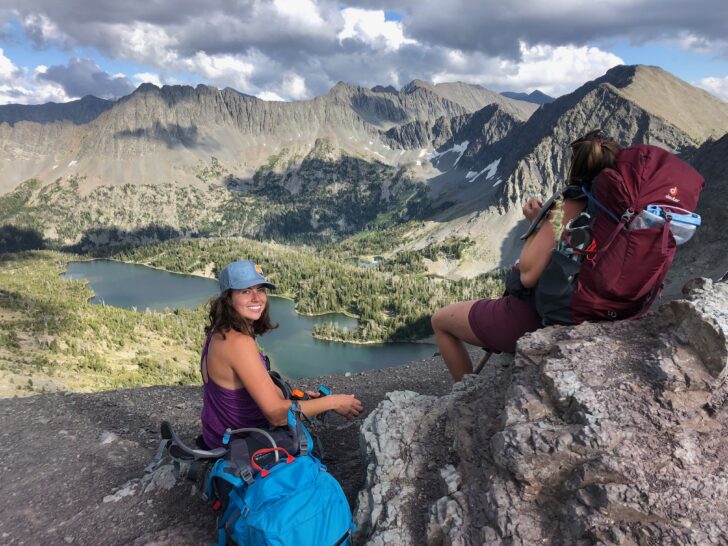
two women look out over a beautiful mountain view
Stopping for some photo ops after a hefty climb. Photo credit: Maggie Slepian

“Why didn’t you put your jacket on?” I asked, helping break down the tent.

“What do you mean?” Jewel asked, “I never sleep in a jacket.” I felt like an idiot. She was still in a great mood, despite not having slept because she was a veritable popsicle. If I’d just mentioned that she could wear a jacket to sleep in, that wouldn’t have happened.

She also had thumb-sized, oozing blisters on her heels from the hiking boots, but the application of Moleskin quickly solved the issue. I gave her careful instructions about digging a cat hole, where to use the bathroom away from water sources, and to pack out all trash, no matter how gross. She was attentive and respectful of my ramblings, and after a quick lesson on stuffing a sleeping bag into an impossibly small stuff sack, we were on our way.

Jewel was sore from carrying her heavy pack, but she never complained. Hailey gave her pointers for using the trekking poles to descend the pass, and once again, the weather was incredible. On the drive back, my three companions gushed about the hike, the goats, the lake, and the campsite. I was quite pleased. My go-to overnight had once again proven to be a stunner, and climbing a dramatic pass to camp at an alpine lake is as memorable a Montana adventure as it gets.

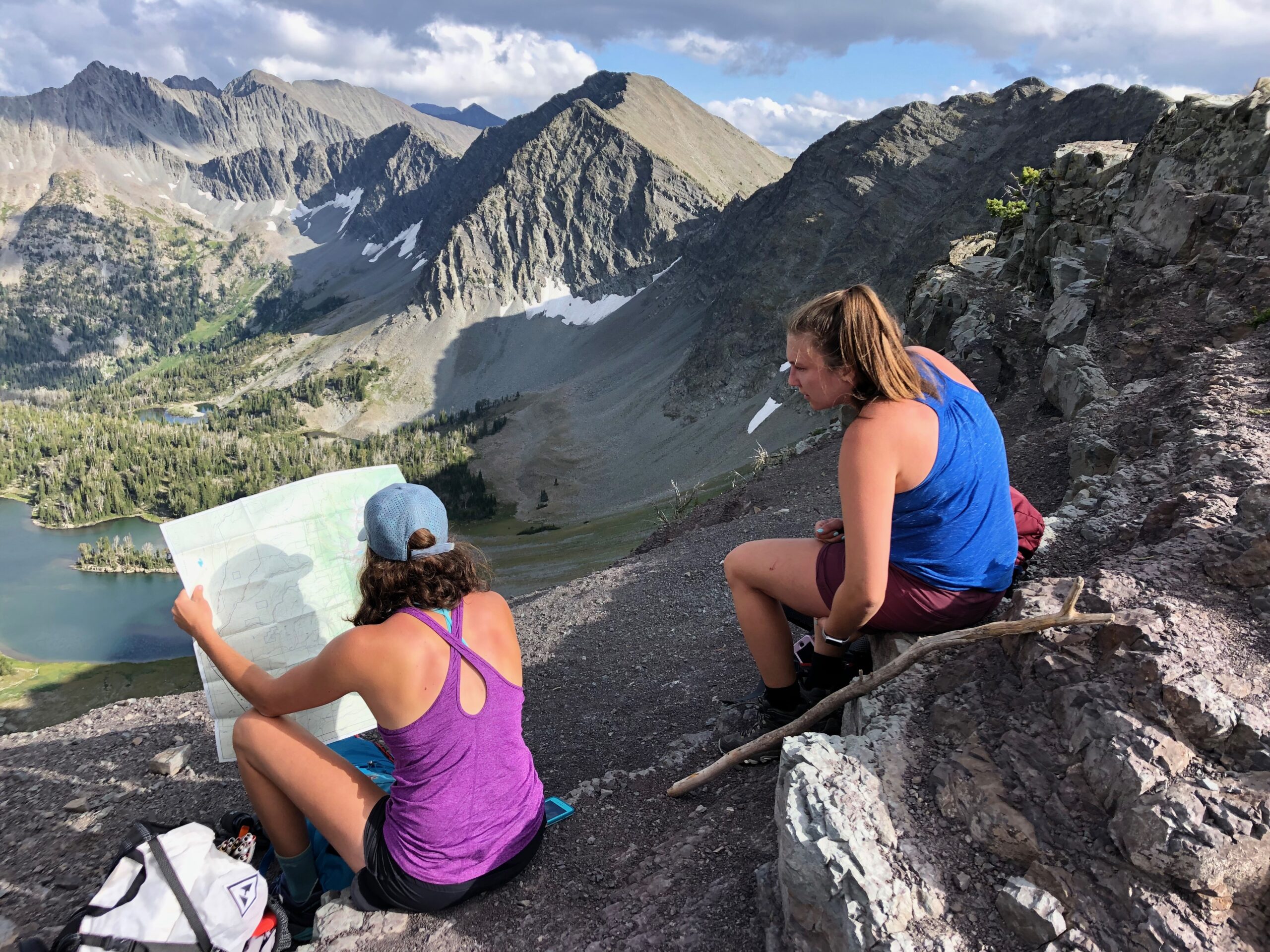
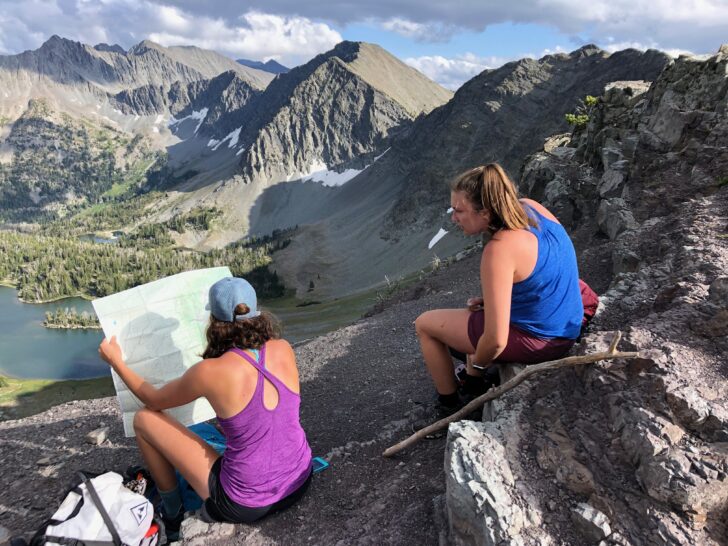
two women looking at a map
Even if you know where you are, it never hurts to be oriented. Photo credit: Maggie Slepian

It was my first time taking a bare beginner out, and I can confidently say I learned more than I anticipated. There was a vast difference between someone who had never spent time in the backcountry and beginner backpackers who had experience in other forms of outdoor recreation. From understanding how to put a pack on, to the idea of layering for sleep, there was a lot I hadn’t considered. I was grateful to Hailey and Claire for reminding me to check on Jewel, and grateful to Jewel for her unfailing good attitude.

And the last thing? The day after we got back, I yelled upstairs to Jewel to ask her if she wanted me to take her sleeping bag out of the stuff sack. Her packed bag was still sitting in my living room.

“Sure,” she called downstairs, “but beware. There’s a giant turd in a ZipLock bag in there too…I packed everything out.”

Related Content

DISCLOSURE (Updated April 9, 2024)

  • Backpacking Light does not accept compensation or donated/discounted products in exchange for product mentions or placements in editorial coverage. Some (but not all) of the links in this review may be affiliate links. If you click on one of these links and visit one of our affiliate partners (usually a retailer site), and subsequently place an order with that retailer, we receive a commission on your entire order, which varies between 3% and 15% of the purchase price. Affiliate commissions represent less than 15% of Backpacking Light's gross revenue. More than 70% of our revenue comes from Membership Fees. So if you'd really like to support our work, don't buy gear you don't need - support our consumer advocacy work and become a Member instead. Learn more about affiliate commissions, influencer marketing, and our consumer advocacy work by reading our article Stop wasting money on gear.

Standards Watch: Dan Durston Chats About Standards and Testing

Rex Sanders interviews gear designer Dan Durston.

Introduction

Dan Durston should be well-known to most Backpacking Light readers. Besides contributing articles and many forum posts, he worked with Drop.com (formerly MassDrop) to create the lightweight X-Mid 1P and X-Mid 2P tents, based on his original designs. Dan’s day job is as a fisheries biologist studying how the sediments suspended in rivers and streams impact the creatures living there. He lives, works, and designs gear in the small town of Golden, British Columbia.

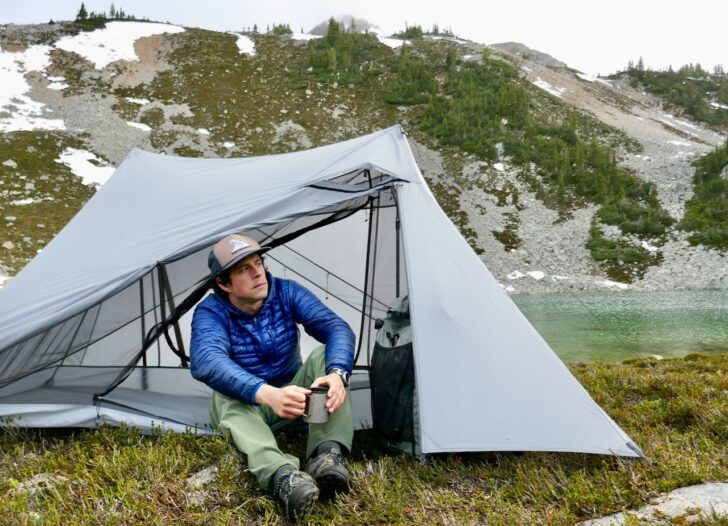
a man sits inside a tent drinking a cup of coffee with mountains in the background.
Dan Durston, inside an X-Mid tent. Credit: Dan Durston

We chatted for nearly two hours in January 2021, on many topics. This article focuses on standards and testing. A future article will cover tent design and the business of making and selling tents. I edited the interview for length and clarity.

A Great Place to Live, Work, and Play

Rex: I don’t know the small towns in B.C. Tell me more.

Dan: I’m in the best one. [From the east] go over the Rockies, there’s a valley, which is where I live. It’s a 10-kilometer-wide or 5-mile-wide valley, and then another 100 miles (160 km) of mountains. I moved here because the Rockies are world-class, and the Canadian Rockies are my favorite.

In any direction there is backpacking and skiing, and all the biggest national parks are around here. It’s great when you live somewhere awesome, and you have a lifetime of adventure right in your backyard. I spent a bunch of years on the coast, so I’m less wet now than I used to be.

People online don’t appreciate how areas can be different. They think everywhere is like where they are, and if you get condensation, you’re doing it wrong. And then people in the Pacific Northwest are like, how are you guys surviving in your little tiny single walls?

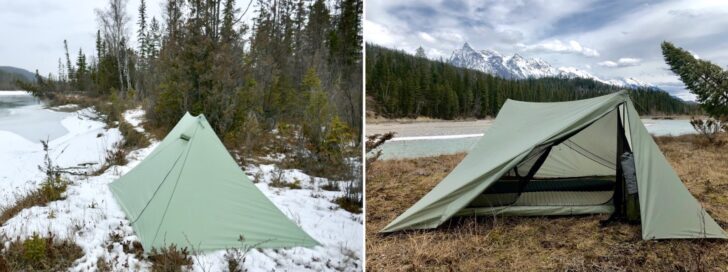
two variations on the same tent design
Left: X-Mid 1P tent; right: X-Mid 2P tent. Credit: Dan Durston

Standards and Design

Rex: What were some of the standards that drove your tent designs?

Dan: The waterproofness standard is important. It also really showed its limitations.

My two requirements for a good standard are that it represents how things are in the field, and it’s understandable. Waterproofness is very understandable – it’s a water column test.

But in terms of relating to the field, degradation is such a huge issue for almost all fabrics. We had PU (polyurethane) coatings 5, 10, 20 years ago that degraded pretty fast. People buy a 3,000-millimeter hydraulic head (HH) tent and then two years later it’s not waterproof. Then they say I need a 5,000. And then the 5,000 lets them down, they go for 10,000. It’s a durability or longevity problem, not an initial HH problem.

I like DCF (Dyneema Composite Fabric), but companies are hyping it up, like 8,000 mm HH, which is true. But it forms pinholes and micro-cracks. I wouldn’t trust it over a 2,000 mm woven [fabric] two years down the road.

For the X-Mid we wear-tested the fabric with Richard Nisley. He did all his tests, and HH over time. We were fortunate to find a fabric right away that held up really well. As a percent reduction, it was about as good as he’s ever tested.

Rex: The rainfly, with raindrops bouncing off taut fabric, has a very different waterproofness requirement from the floor, where you might be kneeling on wet ground for a long time. Can you discuss some of the differences with hydraulic head?

Dan: Certainly, there are differences. I take a new fabric and I can kneel on it, and see if it leaks. I can get that initial performance empirically, and then my main focus is how does this hold up over time?

That’s what I worry about the most, is how is this material in 5 years? And I don’t have a magic bullet answer to that. But that is why I’m such a fan of PEU (polyether urethane) over PU (polyurethane) because it’s going to hold up better. Silicone is great, too, but you can’t seam tape it, and those floors are just annoyingly slippery.

It’s hard to know what aging is because it’s so multi-faceted, but I’m basically doing anything I can to be less vulnerable to it with the coatings and the fabrics. And it seems like I’m starting with a good buffer. I think that we’re on a good trajectory.

We’ve never had someone say “my X-Mid leaks.” I’m surprised because we have over 10,000 out there now.

A Realistic “Aged HH” Standard Won’t Be Easy

Dan: [Saying we have 2,500 mm HH] leaves us at a competitive disadvantage because other companies say 3,500 and customers think they are more waterproof. But I do what we do because it represents how it really is in the field. I would benefit from an aged waterproofness standard. Then I could say “aged HH” is this.

That is the single biggest thing that’s missing, because that is a real issue with tents. How is the waterproofness 5 or 10 years down the road? And there is not much effort to address that.

Rex: I had so many of the early PU coated nylon tents basically rot on me. It wasn’t because I was putting them away wet. It was almost impossible to dry them out completely.

Dan: People think their tent is dry, but there is moisture inside, and that’s compounded by nylon because not only is the PU coating doing that, but the fiber is doing that too.

Richard’s test is a tumbling test, which would have basically no UV (ultraviolet) exposure. So even there, you’re missing something.

Standards Versus Simple Tests

Rex: Have you been involved in any standards committees?

Dan: No. Maybe the perspective I can provide is from the opposite end, where I’m pretty new to this. It’s hard because you have to pay money for the standard, and there’s a few. And you don’t know which one you want. Then you buy the standard, and it’s this really specific test where I’ve got to buy this crazy machine, or I can’t even do it.

What I end up doing is a lot of relative testing, where I’m not using a standard. Maybe I want to see how well two tensioners hold the cord. I’ll just put them on a bucket, fill it with water, and [figure out] this one is better.

I would prefer it if I was meeting a standard, where I could be publishing the results. But actually getting to that level is so much more involved in terms of equipment and precision. A lot of it, I don’t see that much value in, other than marketing.

a floorplan layout of a two person shelter
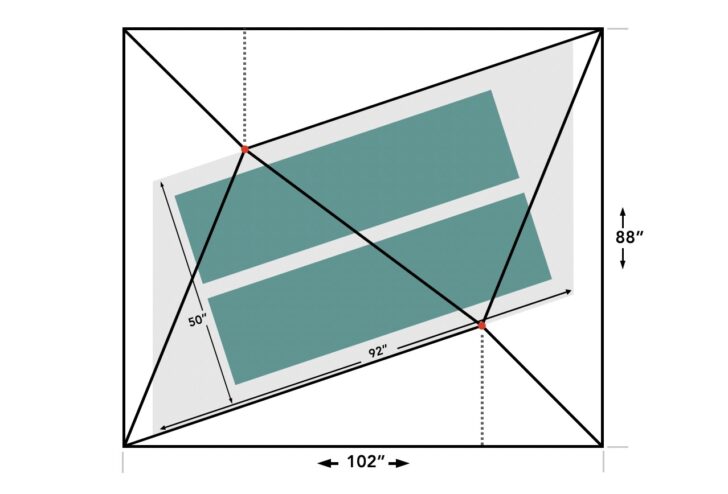
Floorplan of the X-Mid 2P tent with dimensions in inches. Credit: Dan Durston

Fit My Tent

Rex: There is this new website called Fit My Tent. What role that is playing in your marketing?

Dan: I have talked to the guy that’s doing it quite a bit, and that has illuminated how hard it is to simplify things. For example, the X-Mid has a diagonal ridgeline. You can measure it [straight across the tent] and it doesn’t look like that much, or along the diagonal where it’s a lot.

Tent fitting is really complicated to distill down. He’s using a 12-inch (30 cm) and 36-inch (91 cm) off the ground [length measurement]. I’m fine with the 12. I think that does a good job [at] getting at usable length. The 36 is a bit trickier because a lot of tents are right about that height.

Editor’s note: Measuring a set up tent at 12 in (30 cm) above the ground better reflects a sleeper’s needs than simple floor dimensions because that includes room for their head, feet, pad, and sleeping bag. And since most people’s sitting height is about half their standing height, measuring a tent 36 in (91 cm) off the ground can help with estimating headroom.

I personally think a 24-inch (61 cm) measure adds a lot, because 36 is so sensitive. But for just how much space is in my tent, I feel like 24 gets at that the best.

Rex: About shoulder height while sitting.

Dan: I’m also not confident it’s going to catch on even though it’s worthwhile. It’s hard to distill down to these metrics. They’re simplifications, but you also lose a fair bit in that simplification.

I see a widespread problem of accurate measuring. Everybody wants their tents to look good, so you’re going to measure it in a way that is charitable to the product, even if users might not get full space out of the product.

With the X-Mid 2P we made it 52 inches (132 cm) wide, and we marketed it at 50 inches (127 cm) because that’s what I think it is in the real world with some wrinkles. But then everybody else makes theirs 50 and it’s really 48 (122 cm). And then it’s 2% lighter and cheaper to produce.

I don’t know what the solution is.

Measuring Standard Tent Volumes

Dan: I personally like volume better. I know that tents have unusable volume, but it’s not actually that many cubic inches (cubic cm). Think about a single-pole [pyramid tent]. Those low areas around the outside, you trim all that off, maybe it’s 10% of the volume.

It’s simple, [customers] can see that this tent has 30% more volume than that tent, and it’s going to feel larger.

If people measure different ways, then it’s not going to work, like somebody’s doing fly volume and someone else is doing inner volume. If I pitch the fly tight, it is going to have more volume than if all the walls are sagging in. And similarly, a lot of floors are technically 50 inches (127 cm) wide, but only if they’re perfectly tight and wrinkle-free. If you grab an average 50-inch tent it’s probably about 48 (122 cm).

I agree there is a problem. I’m just not sure there is a solution yet that’s elegant enough to really catch on.

A Tear Strength Arms Race

Dan: With abrasion and with tear strength, I do my own testing. I have competitor’s fabrics and I know what a good fabric is.

Rex: At some point, you know that whatever you are doing is good enough, and whether it’s the highest tear strength doesn’t matter. And that gets lost in online discussions.

Dan: I totally agree, and I think that’s one of the problems. If tear strength was something that everybody published, it would just become this arms race. You don’t necessarily get any benefit in the field.

Weight Standards Not That Important

Dan: On weight standards, I don’t see those as important as some of the other ones. Customers right now can figure it out pretty much. Somebody counts stakes, somebody doesn’t, but it’s not as consequential as “I don’t fit in that tent” or “that tent leaks.”

Even when you say “trail weight,” people don’t know what that means. I just give an itemized list: fly, inner, you need four stakes, we give you eight, and they weigh this much. Obviously, we have to have a headline number, and we do the weight of the actual tent body without stakes. It’s a bit unrealistic, but it’s what so many other companies do. And fully disclosed in the specs for anyone that cares.

“I Hope You Don’t Use Fire Retardants”

Dan: The other contentious one is fire retardants. I get way more customers worried about the carcinogenic aspect of them. I’ve never had somebody say, “I really hope you have a fire retardant on this.” Whereas I get an email once a month saying, “I hope you don’t.” It seems like they are pretty unhealthy, so we don’t use them. We save a little weight by keeping it off.

Rex: And you’re keeping poisons out of the environment.

Dan: I’ve been trying to do more of that. It’s hard because I don’t have full control over a lot of stuff.

Just Three Product Testers

Rex: Besides yourself, do you use other product testers and how does that fit into your design process?

Dan: I have a friend, and my wife hikes a lot and she uses [my products]. To date, everything I’ve done has been a fast and streamlined process. But we don’t have a bunch of extra samples to send out to a crew of people who are going to use it for a couple of months.

Generally, when I get a prototype, it’s only two or three weeks until I’m ready for the next one. I’ll obsess over it and dwell on those thoughts for a bit and then, give me the next one.

With the pack, Drop did have a big field-testing program. They sent it out to 20 people. And they sent some tents out, too. That was their call. I didn’t think it was that helpful because [the testers] weren’t really the target audience, not lightweight backpackers. I think it’s only helpful to the extent that your testers are really knowledgeable.

Rex: At least for the market that you’re targeting.

Dan: I totally see the value. We probably would have caught that compatibility issue with the trekking poles if it wasn’t just three [testers]. If we had 40 people, somebody would have that style of tip. That’s part of the process of moving from this small nimble operation to a more mature operation.

But I’m also so picky that I have a hard time with other people’s opinions. It’s rare that somebody would have put more thought into an aspect than I have, like where the door toggles are, or should I move this up and down an inch (2.5 cm).

Conclusion

Rather than getting lost in a blizzard of expensive and confusing standards documents, followed by costly tests of dubious real-world value, Dan mostly chose quick and simple comparative tests to hone his designs. After selling more than 10,000 well-reviewed tents, that approach seems to have paid off.

In a later interview, we’ll chat about tent design, the business of making and selling tents, customer support, backpack design, and Dan’s future gear plans.

More Information

  • Dan posts detailed information about his tents and backpack at https://durstongear.com, along with extensive notes on tent design philosophy and materials. Highly recommended.
  • You can find Dan’s blog here, along with his guide to Stein Valley Nlaka’pamux Heritage Park, a provincial park in southwestern British Columbia, Canada.

Related Content

  • More by Rex Sanders
  • Check out our review of Dan’s pack. It’s an interesting read that illustrates how gear design can change during the prototyping phase.

DISCLOSURE (Updated April 9, 2024)

  • Backpacking Light does not accept compensation or donated/discounted products in exchange for product mentions or placements in editorial coverage. Some (but not all) of the links in this review may be affiliate links. If you click on one of these links and visit one of our affiliate partners (usually a retailer site), and subsequently place an order with that retailer, we receive a commission on your entire order, which varies between 3% and 15% of the purchase price. Affiliate commissions represent less than 15% of Backpacking Light's gross revenue. More than 70% of our revenue comes from Membership Fees. So if you'd really like to support our work, don't buy gear you don't need - support our consumer advocacy work and become a Member instead. Learn more about affiliate commissions, influencer marketing, and our consumer advocacy work by reading our article Stop wasting money on gear.
The Overlook: Giving Back to Bear’s Ears

Ben Kilbourne reflects on his first journey in the Bear’s Ears National Monument, and wonders how to give back to such special places.

Stories Begin to Appear

I picked up my friend Clayton from his apartment near the University of Utah and we headed south from Salt Lake City on I-15 with snowflakes swirling around us. The pale sky made me cold as I imagined backpacking in the Bear’s Ears area in January. I reached for the heat and slid the dial a bit more to the right. Warm air blasted my face. Was I prepared for this?

a ruin nestled below an overhanging cliff
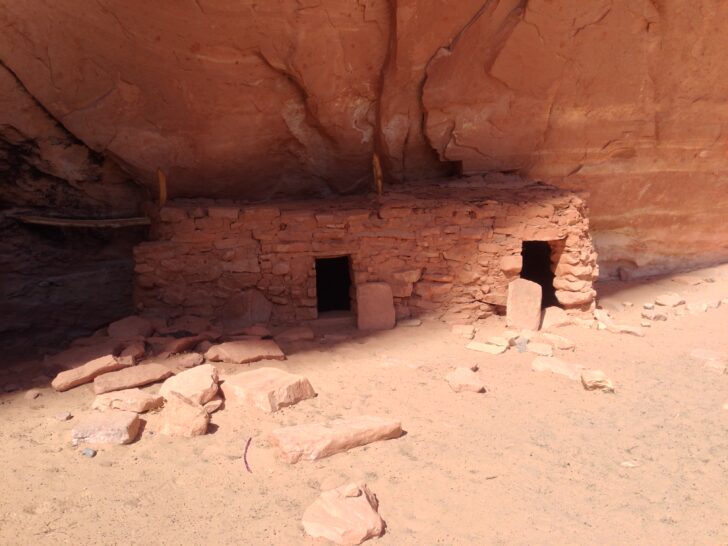
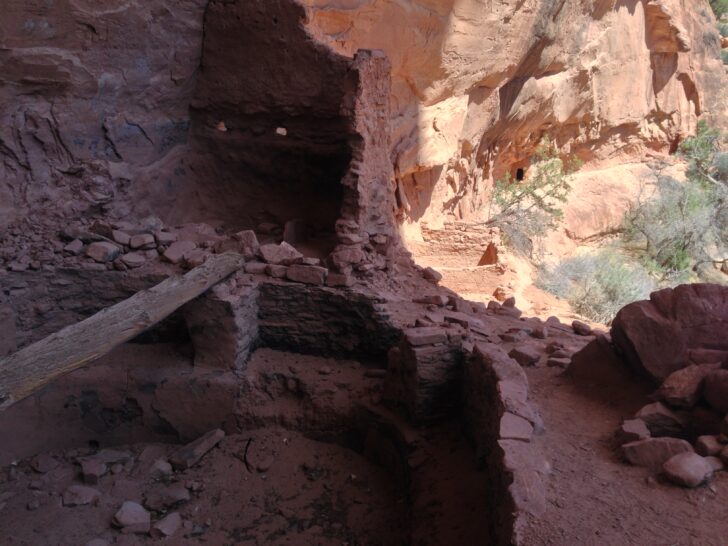
A small ruin somewhere in Cedar Mesa.

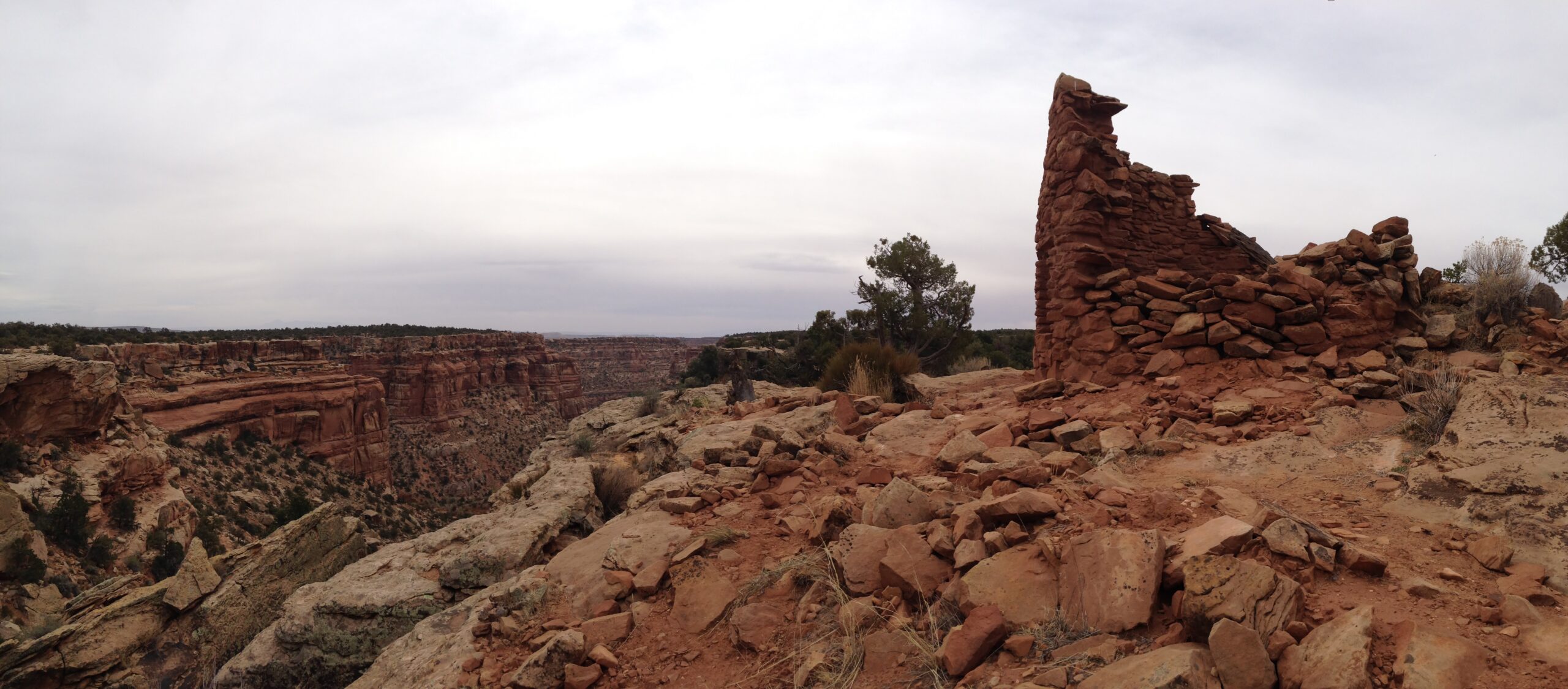
It would be my first adventure in the Bear’s Ears area. Prior to this trip (which occurred in my early 20s) I had been more interested in the simple aesthetic beauty of desert canyons. Water pouring over orange sand, and fragments of the cobalt sky reflected in it. But after a while, I started to think more deeply about places. The beauty remained, but it began to penetrate time in both directions: centuries into the past, and centuries into the future. And if a particular place — say, Coyote Natural Bridge in Coyote Gulch, for example — was here 800 years ago, who walked under it? What did it mean to them? As these questions developed, the existence of the stories of the land began to appear. But not the stories themselves, just the fact that they exist. I could start to see them, like unlabeled books on a shelf I couldn’t quite reach. First I would have to start walking and asking questions, then maybe, just maybe, a few of those layers would start to reveal themselves.

First stop: Comb Ridge.

By the time we were bumping down Butler Wash hours later, I could suddenly smell beer. One of the beers behind the seat had sprung a leak from all the jostling back and forth.

Just before the golden hour, we found a pullout in a cow-trampled sagebrush flat. There was an old, rusted-out trough being used as a fire ring. We decided we’d use it too. But first, we would walk up the nearest arroyo we could find towards Comb Ridge. I had heard that there were ruins in every single one of these little canyons, so choosing at random would be a good test. Before we even entered the short canyon we spotted a granary high up on the cliff. We both wondered aloud how they reached the spot, much less built a structure there.

“Don’t you think you could prop a log up there and then use that ledge to pull yourself up?” Clayton speculated.

“Maybe,” I said. “But then think about hauling those bricks up there.”

“True.” Said Clayton.

We kept looking for a minute but the puzzle did not come together, so we decided to let the structure remain a mystery and turned and walked up the canyon. Within a few hundred feet we found another structure, this one at ground-level, against a south-facing cliff. It was in sad shape. The roof had long since caved in and the walls were working their way to the earth. Old, dried fragments of cowshit peppered the dirt floor, and coarse, black hairs clung to the edges of walls where cows rubbed against them scratching gnat-bites and fly-bites. No wonder this old house was falling apart — its new tenants were the wrong size.

The clouds above us turned from gray to orange against the turquoise January sky and we began to amble back towards the car. That night was around zero degrees Fahrenheit (−18 °C) and my sleeping pad deflated: Russian thistle, I assumed. I cursed the cows (misdirected curses, I know) silently as I got dressed in the dark. I dug an old synthetic sleeping bag out of the car, walked back to the tent, and placed it over the deflated pad. I removed my shoes and reentered my bag shivering. I waited for cold spots. None. It worked.

The next morning we hiked to the top of Comb Ridge so we could get a better idea of where we were. There was the big, juniper-covered mound of Cedar Mesa to the west and the slightly taller Dark Canyon Plateau to the northwest, where the namesake buttes of Bear’s Ears sit. In the south, beyond the long spine of the ridge was the San Juan River. I couldn’t see it, but I knew it was there. We didn’t linger long though — we were on a mission.

The Fight For and Against Bear’s Ears

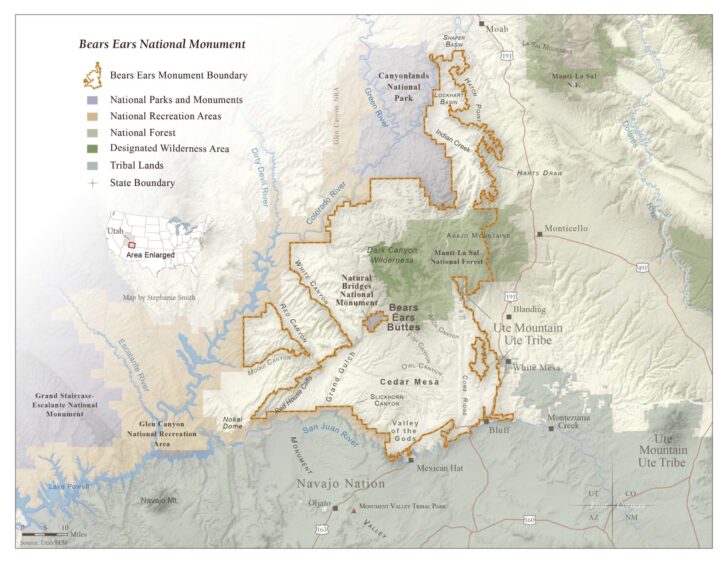
We sat at the top of Comb Ridge in January of 2011, so about five years before the area would come to be known as Bear’s Ears National Monument. Most of what we were gazing out on — and much we couldn’t see from that vantage — would be included in the designation. I didn’t know it, but around that time moves were already being made to increase protection in the area. Just a year later, in 2012, the nonprofit Utah Diné Bikéyah (UDB) was formed.

Utah Diné Bikéyah began to create a comprehensive ethnographic map of the area, plotting the layered histories of several cultures as a starting point from which to begin thinking about how to implement a new conservation strategy. By 2013 they had come up with a proposal for the Diné Bikéyah National Conservation Area, which was about 1.9 million acres (7,690 km2) in size. In response to these efforts, Utah Congressman Rob Bishop along with Representative Jason Chaffetz drafted the Public Lands Initiative (PLI). What appeared at first (as promoted by PLI representatives) like a conservation compromise actually documented policy proposals that would increase extractive activities1, reduce decision-making representation of tribes2, and ensure that future presidents would be unable to designate a National Monument in the seven counties participating in the PLI and where future monument designation would be most likely.3

a map of the Bear's Ears National monument
Bear’s Ears National Monument map created by Stephanie Smith, Grand Canyon Trust.

In response to what has been called a bad-faith PLI, the Bear’s Ears Inter-tribal Coalition was formed in 2015. The group is made up of five tribes: Navajo, Hopi, Zuni, Ute Mountain Ute, and Uintah Ouray Ute, each of whom has deep connections to the Bear’s Ears area. They encouraged President Obama to designate those 1.9 million acres identified by UDB. His administration considered both UDB’s 1.9 million acres and the smaller proposal laid out in the PLI’s map, eventually settling on 1.35 million acres for Bear’s Ears National Monument, which was somewhat of a compromise. Of course, not long after this, President Trump reduced the area by over 80%. Now a third administration is looking at the monument. President Biden signed an executive order on his first day in office, promising to have a look at the boundaries. Secretary of the Interior Deb Haaland, the first Native American in a President’s Cabinet, visited the area the second week in April 2021.

The Ruin

All the while, I have backpacked periodically in the area, seeking out well-known ruins, stumbling across surprises. Back in 2011, when Clayton and I were given rough directions to a site of particular interest, my coworker had drawn his finger in a circle around an area of the map, a vague, mile-wide radius. He said he didn’t want to give us precise directions because that would ruin the thrill of the hunt. A mile radius looked small on the map but would be a different story in reality.

The snow was six inches deep as we plodded into the canyon in the light of day. Though it was barely above freezing we were soon in t-shirts. At the bottom of the canyon, the snow was even deeper, almost a foot in places. We walked into the vague radius that housed the site and looked at the terraced canyon walls for some sign of residence. If I had to live there, where would I choose to live? Clayton continued up the canyon while I scrambled upwards to what had the appearance of being a good lookout. There I found a small ruin with three doors, a second small ruin, and the whole high shelf strewn with potsherds.

It wasn’t the site we were after, but something about it completely bowled me over. I picked up small, grey corrugated pieces with the fingerprints of their makers still pressed into them. The clouds above the canyon, flat and gray just a second prior, became orange catching the last light of day, and suddenly expanded like leavening bread towards the earth. The sudden closeness of the sky, the descending cold, the inevitable night, and my aloneness at the site sent me hurtling through time. Or rather everything that ever was and would be seemed to be happening all at once. I had been to Mesa Verde, the Pantheon, and Se Grada Familia, and those places had filled me with awe, but not like this.

I replaced the tiny pieces of broken wares and looked at the sky. Fading fast. I’d better get going. I scrambled down, being careful not to slip on the snow-covered slickrock. Clayton and I reconvened at the bottom. He told me he had stopped looking for the site altogether, instead following a deer track just to see where it went. The snow was deep and the night began to get colder. The sky went from winter-blue to purple and the leavened, orange clouds deflated and retreated back into the firmament far from earth. We never found the site but it didn’t matter.

artifacts in the Utah desert
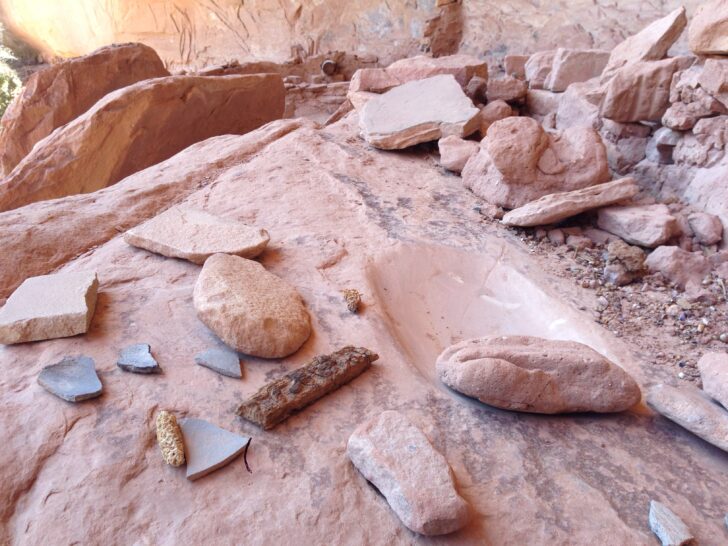
Metate and other artifacts in Cedar Mesa.

How Does a Backpacker Give Back?

I, of course, didn’t take any potsherds, arrowheads, or corncobs. The only thing I took away was the experience of being there: awe, wonder, and feeling like I was seeing into deep time. But, according to archaeologist and conservation advocate R.E. Burrillo in his book Behind the Bears Ears: Exploring the Cultural and Natural Histories of a Sacred Landscape, I may still have been engaging in what could be considered a form of pillaging. Let me explain.

Burrillo tells the story of getting his truck stuck in a creek in the Bear’s Ears area around Christmas many years ago. He is saved by a climber who winches his truck out of the ice. The climber asks Burillo why he likes archaeology. “What I said at the time is that I love hiking and backpacking to archaeological sites, investigating and taking photos of them,” Burrillo says. “Becoming an archaeologist meant turning my favorite hobby into a job, as Confucius supposedly advised.” The climber thought about this and then asked him what he gives back.

Burrillo had no good answer at the time. The climber said, “I know a lot of people who don’t give a shit, they don’t think much deeper than buying new gear and putting up routes, but I know these places wouldn’t look very much like this if we didn’t do something to look after them.”

Many years later, Burrillo finally found out how to give back. He became one of the primary voices calling for the designation of Bear’s Ears National Monument. He wrote op-eds, researched, and worked on advocacy projects. And, of course, wrote a whole book about the area he loves so much.

His story urges me to ask what I have done to give back. So far I have given back close to nothing. The concept of reciprocity wasn’t in my vocabulary in 2011, and now, ten years later, I still don’t know exactly how to give back to a place that has provided me with experiences like the one described here. But this theme keeps finding me, prompting me to consider it more seriously. Recently, I had the privilege of interviewing writer and adventurer Craig Childs for a podcast episode, and he touched on the same concept. “I’ll be dead and gone before I ever really figure out what needs to be fed back into this place and the people of this place,” he says. “But at least I can get close, at least I can do my best.” In his case, each book he writes is an endeavor to give back to the desert he loves. He takes what he has observed while walking through remote canyons and over orange slickrock and transforms the observations into words that have the intention of drawing the reader into the experience so that they too can develop affection for these places. Through affection we can begin to learn what a place needs, how we can help, what role we can play.

It’s a small gift, but I hope that even this article — my meager effort to become more aware of the reciprocity asked of backpackers like myself — is an attempt to give back to the places that have given me so much.

some ruins in shade beneath an overhanging cliff
Ruins in Grand Gulch.

Further Reading

Endnotes

  1. PLI SEC. 1102. ACTIONS TO EXPEDITE ENERGY-RELATED PROJECTS. “(a) In General. — The State of Utah —(1) may establish a program covering the permitting processes, regulatory requirements, and any other provisions by which the State would exercise the rights of the State to develop and permit all forms of energy resources on available Federal land administered by the Price, Vernal, Moab, and Monticello Field Offices of the Bureau of Land Management…” The main takeaway from this section seems to be the fact that they were trying to move energy development decision-making from the Federal Government to the State.SEC. 1103. PERMITTING AND REGULATORY PROGRAMS basically makes permitting easier.
  2. PLI SEC. 110. BEARS EARS ADVISORY COMMITTEE. This section of the PLI states that tribes would have had a consultative rather than managerial role with regards to Bear’s Ears. Committee members would have been chosen by the Secretary of Interior. This would have allowed then-Secretary of the Interior Ryan Zinke to choose people who wouldn’t be noise-makers. In addition, these committee members would have had to live in Utah which leaves the Ute Mountain Ute Tribe (located just across the border in Colorado, but still with a strong vested interest in Bear’s Ears), out of the decision-making process.
  3. The Antiquities Act provision is in section 3 of H.R.5781 which was a companion bill to the PLI. It reads: “A national monument designation, or a boundary adjustment that increases the size of an existing national monument, under section 320301 of title 54, United States Code, within or on any portion of Federal land in the counties of Summit, Uintah, Duchesne, Carbon, Grand, Emery, and San Juan, in the State of Utah, shall be made only pursuant to an Act of Congress.”

Related Content

DISCLOSURE (Updated April 9, 2024)

  • Backpacking Light does not accept compensation or donated/discounted products in exchange for product mentions or placements in editorial coverage. Some (but not all) of the links in this review may be affiliate links. If you click on one of these links and visit one of our affiliate partners (usually a retailer site), and subsequently place an order with that retailer, we receive a commission on your entire order, which varies between 3% and 15% of the purchase price. Affiliate commissions represent less than 15% of Backpacking Light's gross revenue. More than 70% of our revenue comes from Membership Fees. So if you'd really like to support our work, don't buy gear you don't need - support our consumer advocacy work and become a Member instead. Learn more about affiliate commissions, influencer marketing, and our consumer advocacy work by reading our article Stop wasting money on gear.
Episode 37 | Endurance Training for Backpackers

Ryan and Andrew chat with Dirk Friel, co-founder of TrainingPeaks, about how to get the most out of your endurance training.

Stream

Summary

In this episode, Ryan chats with Dirk Friel, co-founder of TrainingPeaks, about endurance training for backpackers and how to get the most out of limited training time. Also in this episode: hiking in a post-Covid world, wilderness permits, bear-canister compatible packs, synthetic insulation, and more.

a luxuriously bearded man rests after running up a snowy hill
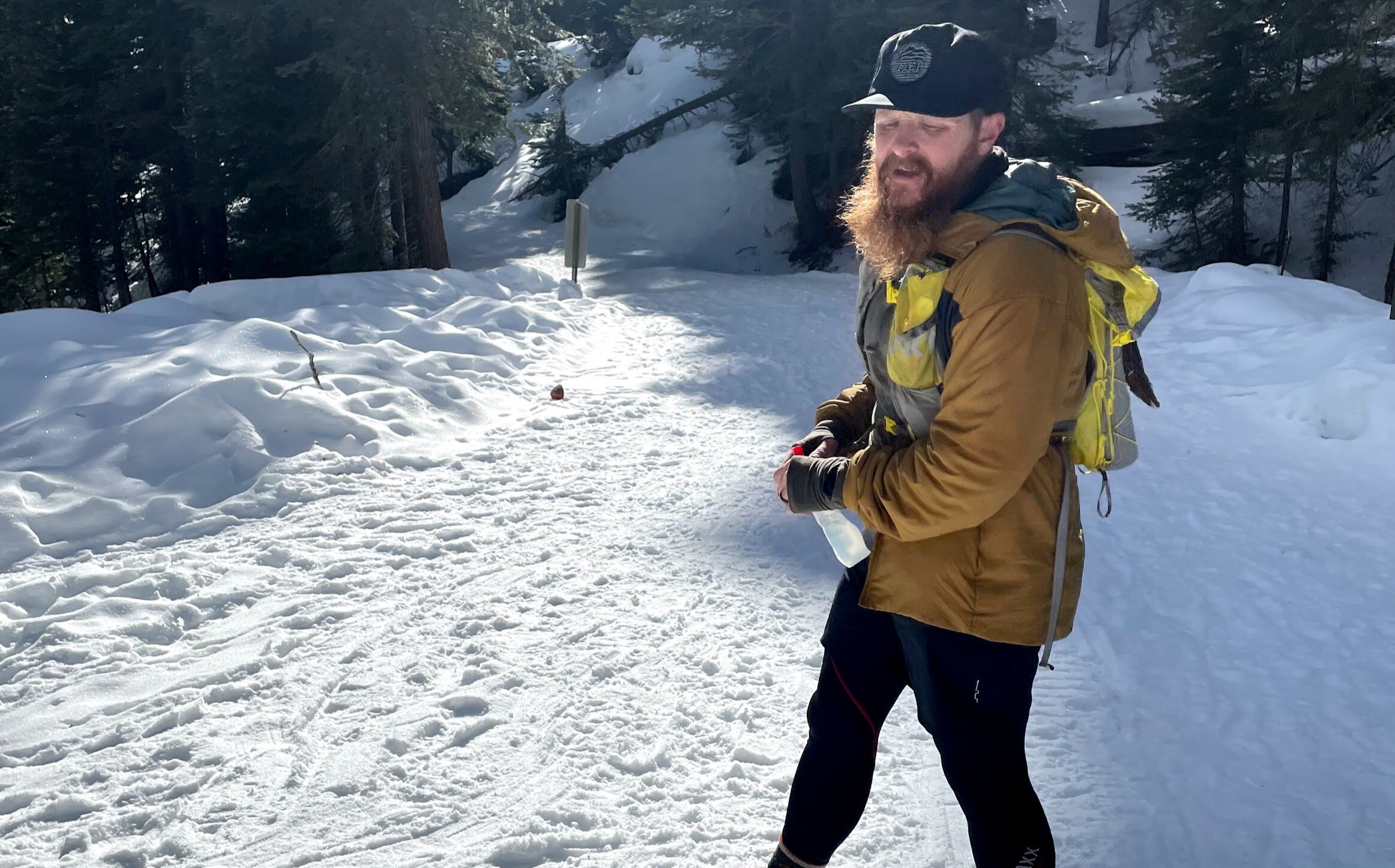
Co-host Andrew Marshall participating in some loaded winter endurance training. Credit: Rachael Shaw Marshall

Outline

Catching Up

Gear and New Favorite Things

Dirk Friel Interview

  • TrainingPeaks is a subscription-based software that helps you analyze your fitness data and plan your training
  • Why should backpackers care about endurance training?
  • Altitude and how to train for it
  • Performance output metrics
  • The three endurance training metrics
  • Which fuels your body burns at what point in your effort
  • What happens when your heart rate and pace decouple
  • High-intensity interval training and how it impacts endurance
  • Training for a New Alpinism: A Manual for the Climber as Athlete
  • Training for the Uphill Athlete
  • Dirk’s recommendations for targeted training
  • Progression and modulation
  • Heat training and adaptation and its effects on endurance
  • Strategic macro-nutrient intake
  • Examining different endurance scenarios: periodic week-long efforts, thru-hiking, FKT attempts
  • A-efforts vs. B-efforts vs. C-efforts
  • TrainingPeaks and how it can help
  • The power of data collection
  • CORE Body Temperature Monitoring
  • Dirk’s thoughts on WHOOP
  • The advantages of getting expert level instruction
  • What’s new for TrainingPeaks

Interview Follow-up Conversation

  • Training the gut
  • Listening to your body
  • a body-scan meditation practice can help you get in tune with your body
  • hot weather adaptation

What’s New at BPL?

  • Website update!

In the Forums

Related Content

How to Subscribe

More Episodes

Credits

Feedback / Tips / Questions

  • podcast@backpackinglight.com

More Backpacking Light

Disclosure

  • Sponsorship Policy: Backpacking Light does not accept compensation or donated/discounted products in exchange for product mentions or placements in editorial coverage, including any podcast episode content not excplicitly identified as sponsored content.
  • Some (but not all) of the links in these show notes may be affiliate links. If you click on one of these links and visit one of our affiliate partners (usually a retailer site), and subsequently place an order with that retailer, we receive a commission on your entire order, which varies between 3% and 15% of the purchase price. Affiliate commissions represent less than 15% of Backpacking Light's gross revenue. More than 70% of our revenue comes from Membership Fees. So if you'd really like to support our work, don't buy gear you don't need - support our consumer advocacy work and become a Member instead.
  • Learn more about affiliate commissions, influencer marketing, and our consumer advocacy work by reading our article Stop wasting money on gear.
Blood Moon on the Border

An off-trail borderlands odyssey during a lunar eclipse in the Organ Pipe Cactus National Monument.

Organ Pipe Cactus National Monument sits uneasily on the borderlands of southwest Arizona. It is very much a frontier; being a conjunction of nations, cultures, and ecotones. It is home to plants and animals found nowhere else in the US and is rightly designated a UNESCO biosphere reserve. It also hosts some of the darkest skies in the country. I hoped it would be a perfect setting to observe a recent Super Blue Blood lunar eclipse.

tall, narrow cactus in the foreground, mountains in the background
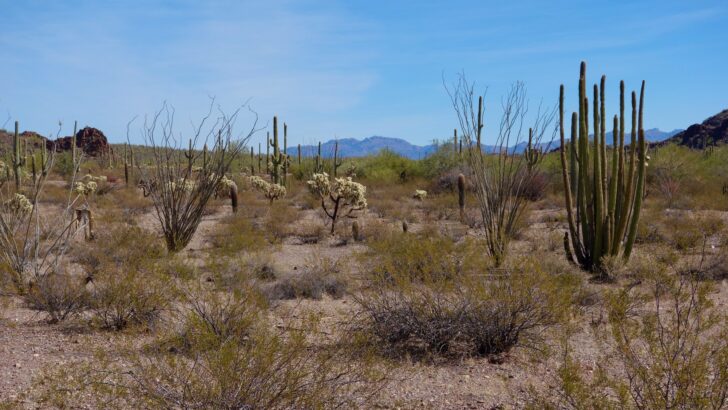
A fine stand of Organ Pipe cactus in the Ajo Range.

Backcountry trips in Organ Pipe require a permit, available in-person at the Kris Eggle Visitor Center. My plan to hike a five-day fifty-mile (80 km) loop through the Monument caused a bit of consternation there. As the rangers puzzled over my proposal to hike multiple backcountry zones, I looked over the permit log. No one had obtained a permit for weeks, and the few permits that were issued were for overnight out-and-backs. Eventually, the rangers concluded that multi-zone multi-day trips are not actually prohibited. They gave me a permit to leave my car at a trailhead and wished me well.

As they should. The Organ Pipe backcountry is not truly under the control of the US Government. It was closed from 2003-2014 after the murder of Ranger Eggle by drug-smuggling fugitives. Although now deemed safe enough for backpackers, the Monument still sees significant traffic from smugglers and migrants.

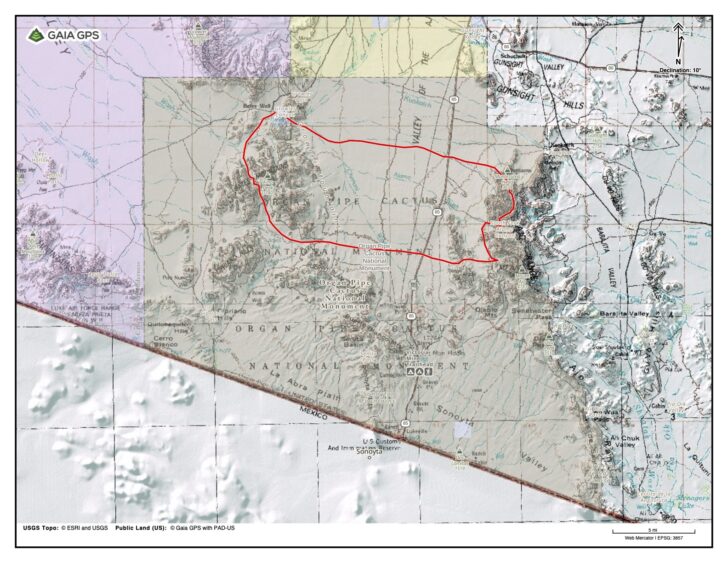
My planned route would take me north through the Ajo Mountains, then west across the alluvial plain of the Ajo Valley, through and behind and then back over the Bates Mountains on the west side of the Monument. I would return east across the southern Ajo Valley and over the Diablo Range. There are no designated or maintained trails in this region. There is no water.

a map showing a route through the mountainous desert
My approximate route through the northern reaches of Organ Pipe Cactus NM.

Into the Desert

With only a few hours of daylight remaining after caching water and securing my permit, I parked my car, saddled up, and crossed the low pass separating Arch Rock Canyon from Alamo Canyon. I made camp at dusk a few hundred yards beyond the car campground at its mouth, only slightly bloodied by the hurried bushwhack. I did discover a bandana missing, presumably the work of a larcenous jacaranda.

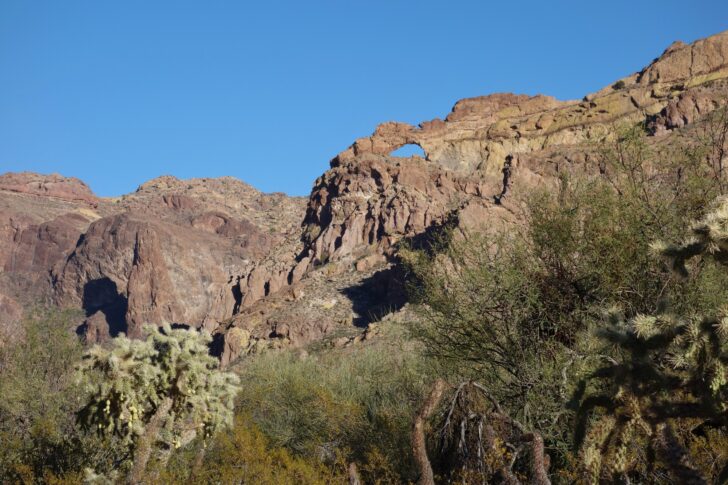
desert rock formations
Arch Rock above the trailhead.
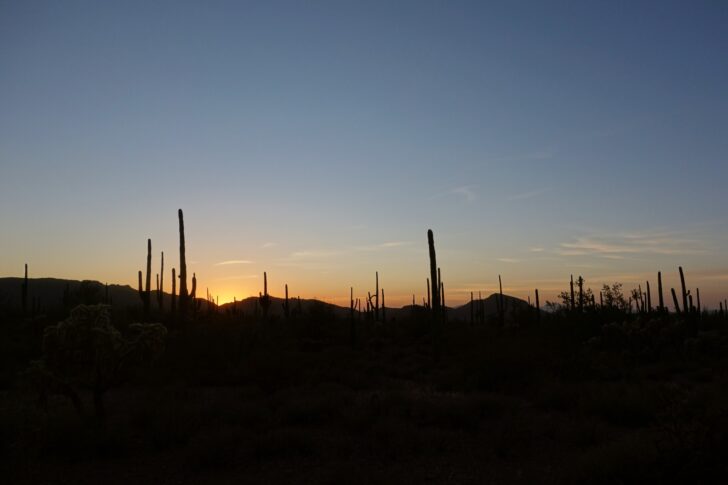
a sunset over the desert
Saguaro sunset from Alamo Wash.

An exquisite sunset ended the day with a promise of desert beauty to come. I rejoiced to find myself back in my native country and settled in to sleep on its accommodating sands.

Around midnight I awoke to the sounds of cars pulling up nearby. Voices conferred in relaxed Spanish and then faded into the distance. A couple of hours later the voices returned and the cars departed.

Faced with a long rocky route and a shortage of January daylight, I was up and out of camp well before dawn. A mile up the canyon I discovered the likely work of the night visitors—gallon jugs of water and a bucket of food. They were stashed for migrants who dared travel a route too wild and rugged for La Migra to follow. Tucked under a large boulder, the jugs were inscribed with slogans like “vaya con la virgén” and “chinga la migra.”

a pile of one-gallon water jugs
Water cached for migrants in a remote canyon

The route up the canyon, more scramble than hike, was well-marked by the passing of the migrants. Socks, sneakers, clothes, and above all, foil tuna packets lined the canyon bottom and showed the way north. Although not marked on any map, I was clearly following a trail. El Sendero Atún I called it.

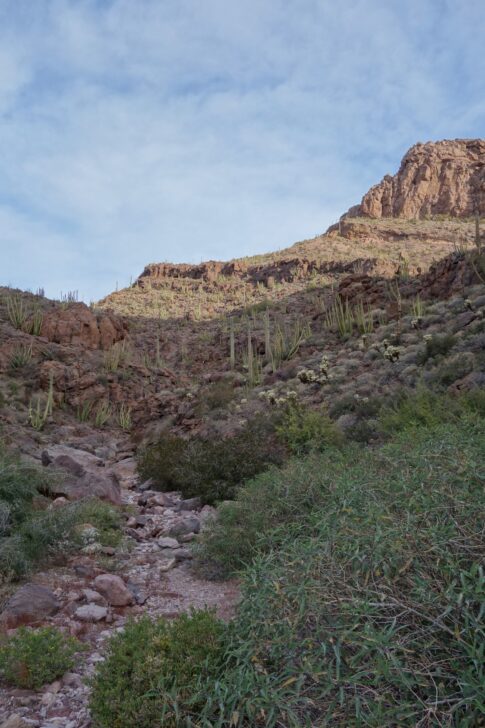
looking up at a washout and mountains in the distance
A steep and rocky climb.

It was a hard route. The top miles are a continual rock scramble, much worse on the way down than on the way up. I did enough butt scootching to wear holes in my pants. My poor plastic ukulele took a beating too.

I moved slowly and carefully. I was out of shape. There was no phone service. No one knew exactly where I was, or when to expect me. Anyone else traveling this canyon would have little interest in contacting the authorities to arrange a rescue. If I fell or pulled a rock down on myself I’d be in big trouble.

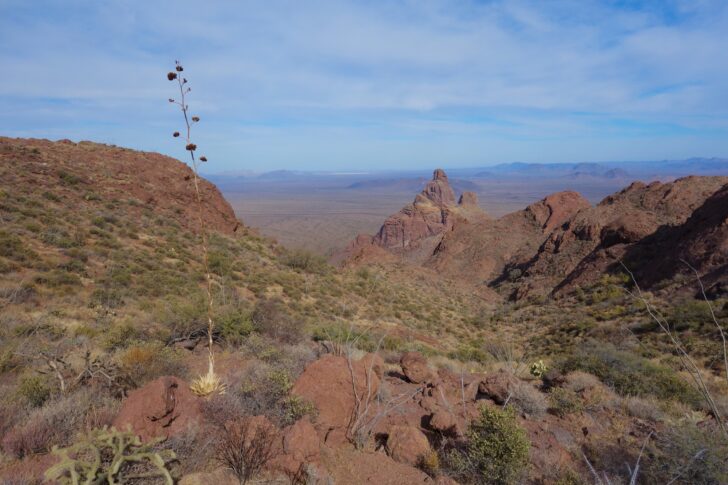
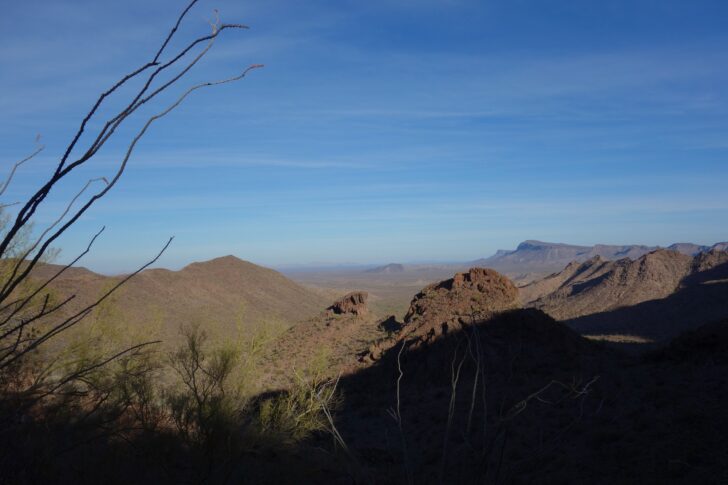
a high vantage point looking down towards the valley floor
Looking out at Tohono O’odham country and my route down to the desert floor

After the scramble down the north side of the divide, I finally reached the desert floor, its alluvial slope a garden of saguaro, prickly pear, and cholla. Oddly, there were no organ pipes on this side of the mountain. I crossed the highway and struck out across the desert pavement, heading for the setting sun. There was an open spot on the gravelly plain and I made it my cowboy camp and lunar observation post.

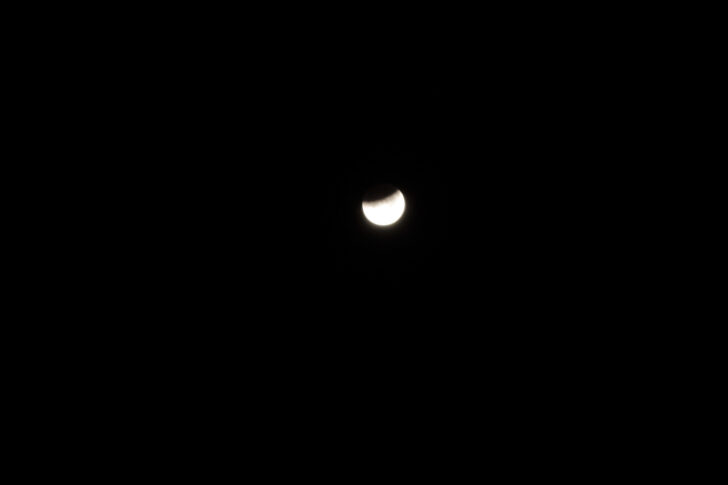
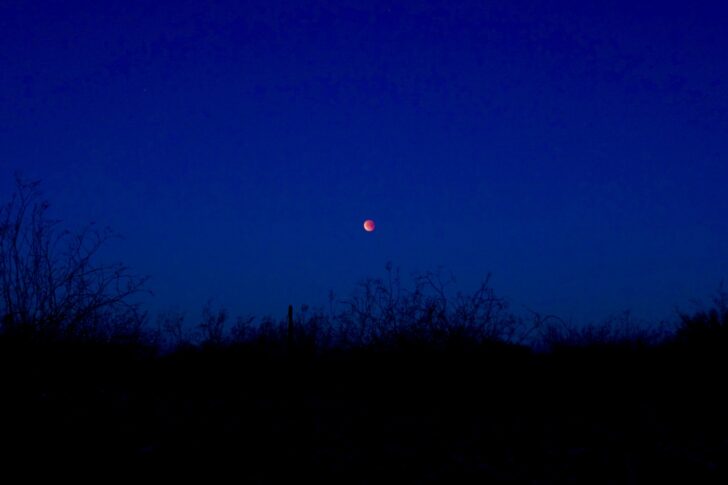
Though cloudy at sunset, the skies cleared at midnight, and I was rewarded by open views of a baleful moon over the Bates Range to the west. On cue, a pair of coyotes began howling as totality began. I sat entranced by the spectacle, quilt wrapped around my shoulders, watching the moon shade from bone to bark to blood as it slid behind the Earth’s shadow.

a shot of the moon in the first stages of an eclipse
The eclipse begins.
a moon under eclipse
Totality.

I was not alone.

In a mesquite-lined wash a quarter-mile to the south a light flashed: five seconds on, five seconds off. The signal continued until met by an answering light further down the wash. The lights approached each other, converged, then disappeared. Who were they? And where were they, and where were they headed?

I turned off my camera lest its lights and beeps give me away. In all likelihood, the nightwalkers would be more frightened of me than I of them. But I couldn’t know this. I kept my eyes on the blood moon, but my ears were alert for the sound of approaching visitors.

The moon slowly brightened and then dropped behind the mountains. No one passed near. I lay back and slept.

dawn light illuminates a mountain range far in the distance
Dawn light on the Bates Range from camp.

Contenders for Land

Arising at dawn, I strode west through the widely spaced creosotes, my progress rapid and untroubled. Navigation was simple: head toward the gap in the mountains to the west-northwest. I crossed the tracks of the coyote songsters and then another migrant trail, this one marked by black plastic jugs. Most of them were cut up and shaped into funnels and scoops. Helicopters passed low overhead, several converging at the southern end of the Bates Range. One circled above me for a minute, then left, perhaps deciding that anyone walking west in the open in broad daylight was not suspicious. Although this area is a designated wilderness, there were numerous jeep tracks made by the Border Patrol. (Editor’s note: CBP officers are allowed to use vehicles for pursuit, but they are legally prohibited from using vehicles for surveillance here.)

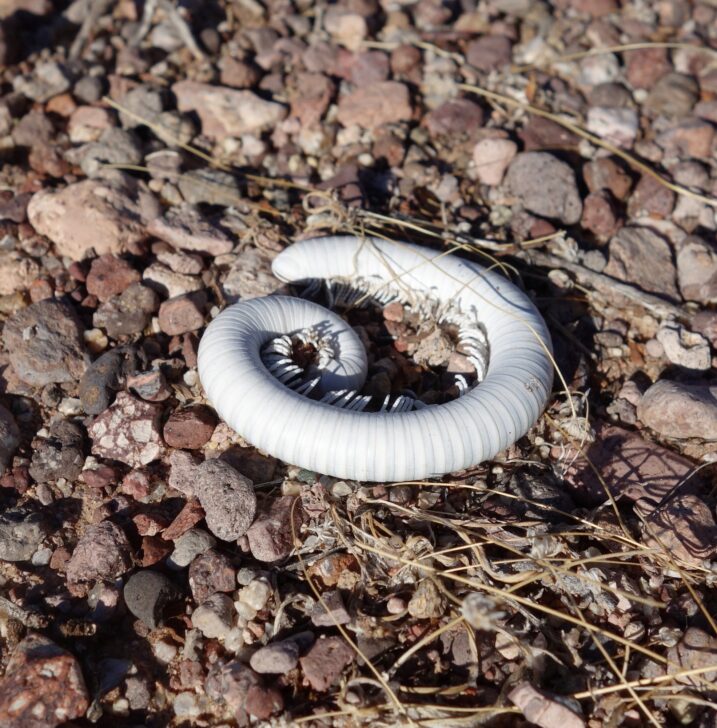
But the desert held its share of delights and wonders. The shells of desert millipedes in the sand evoked a day at the beach.

Shell of a desert millipede
Shell of a desert millipede.

I paused to examine an eight-foot shrub with the largest, wickedest thorns I have ever seen. It was Emory’s Crucifixion-Thorn (Castela emoryi), found only in the lower Sonoran and Mojave deserts.

sharp, spiny desert plants
Emory’s Crucifixion Thorn. Yes, those needles are sharp.

A movement to my right betrayed the presence of a deer steadily trotting away from me. Looking closer I saw that its head was oddly shaped, resembling neither a muley nor a whitetail. I realized it was no deer—deer usually bound away from threats rather than trot—but a Sonoran pronghorn, one of maybe a dozen in the monument, of a few hundred in the world.

Growler Canyon, my path through the Bates Range, was a sandy wash churned up by the contenders for this land—smugglers, Border Patrollers, and rogue ATVers. Although the grade was nearly level, my pace was slowed by the soft deep gravel. I passed a well-established but deserted migrant campsite and collected my water cache at Bates Ranch. I hesitated, then decided to leave a couple of liters for the next passers-by, whomever they should be.

a pile of rusted tin cans
Trash (or historic treasure?) at Bates Ranch.

The abandoned ranch is strewn with ancient rusting settler trash. The cans, bottles, and broken implements were left here by people—themselves migrants—who lived a hard life and did what they felt necessary to survive. Keeping the landscape tidy was not high on their list of priorities. Those cans are now old enough to be considered historic artifacts rather than litter, worthy of an admiring informational kiosk constructed for the edification of jeep tourists. Its readers might be forgiven for believing that the history of this land begins with the advent of Anglo settlers. There is no mention of the original inhabitants, the Tohono O’odham.

a range of mountains rises over organ pipe cactus
Kino Peak, a tower in the desert.

Kino Peak, the apex of the Bates Range, towered above. It looked down on the ranch with the austere timeless indifference of desert peaks. Its walls were naked of vegetation, the volcanic plug a skeletal remnant of creation. It will remain while we humans come and then go.

I skirted the west side of the range, diving in and out of small canyons, walking against the alluvial grain. As I turned up the bajada that would carry me to the crest of the range, the signs of migrants—that is, their litter—became abundant once again. Not wishing to encounter more nightwalkers, I camped in a discreet side valley under the shelter of Kino Peak. I was comforted by its mass and warmth as it radiated back the setting sun. I quietly sipped my whiskey while my ukulele remained unplayed.

a view of mountains half in light and half in shadow
Kino Peak from my hidden camp

An uneventful night brought a warming dawn, the temperature climbing as I made my way up the steep slopes of the range. Views of an even-harsher land, the Cabeza Prieta, unfolded to the west. An intense blast of sunlight—and more trash—at the saddle left me disinclined to linger. I opted to follow a rocky ridgeline rather than a brushy gully down to the desert floor. There I joined a broad canyon thick with saguaros and followed it to the southern end of the range. Weaving among volcanic outcrops, I struck east across the Ajo Valley.

a vantage point from high in the mountains, looking down valley
The Cabeza Prieta emerges from early morning shadows.
trash on a desert path
Modern migrant trash at a saddle in the Bates Range.

Desert washes—steep-sided, deep, and filled with thorny mesquites, jacarandas, and palos verdes—provided both the only obstacles to navigation and the only refuge from the sun. In true hiker fashion, I cursed the thorns but took advantage of the shade. Out on the open plain again, my windswept camp afforded fine views of the last rays of sun lighting up the Diablo Range to the east.

a desert landscape with cactus and mountains far in the distance
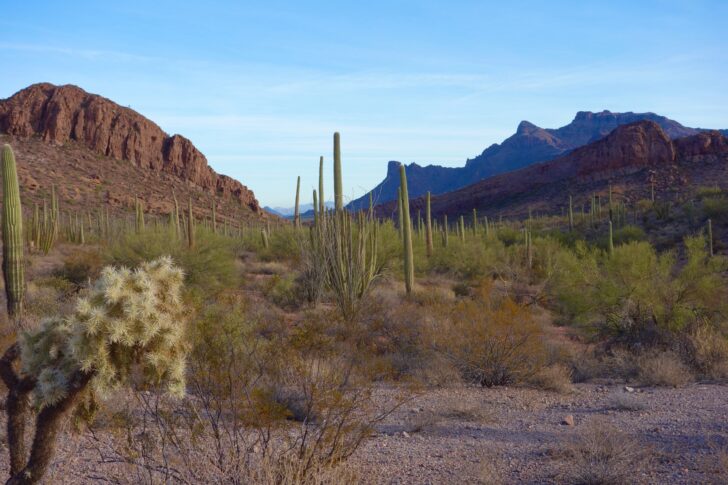
A desert passage
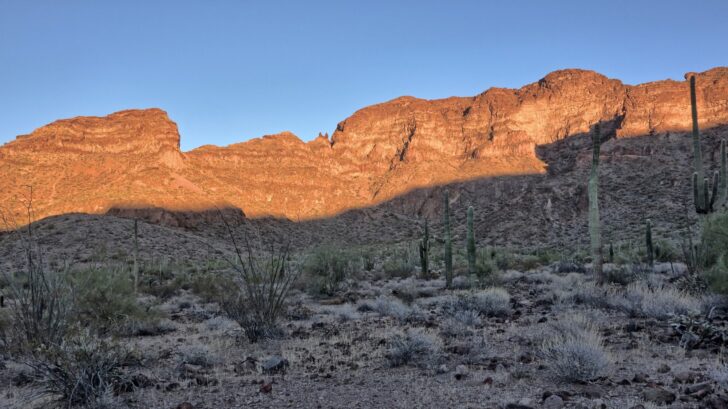
sunset lights a range of mountains on the horizon
The Diablos at sunset.

An Odyssey Concludes

The next morning I enjoyed a rosy-fingered dawn over the Diablos (I was reading Emily Wilson’s terrific translation of The Odyssey), and then picked my way through a low saddle in the range and down to my car. I felt gratified but unsettled. The hike was all that a lover of desert landscapes could want—stately cacti, sun-blasted peaks, secret canyons.

a desert landscape with cactus and rock formations
Through a saddle in the Diablos.

But those canyons were not such a secret. Although a site of recreation for me, they were the locus of suffering and struggle for others. I blithely strolled where fellow humans, unprepared or betrayed, had breathed their last. The remains of more than 20 migrants were found in the Monument in 2018.

How do I deal with that? How should I deal with it?

I resent having to ask the question.

These lands are set aside for the enjoyment of all. They are my lands. I was born and raised nearby. I have every right to walk here unhindered.

I can’t fault those seeking a better life for themselves and their families. But I resent having to worry if moving lights at night are a threat. I resent having to find campsites hidden from illicit pathways. And I really resent the skeins of trash that defile this land—my land. It feels like a palpable mark of disrespect, a big “F*** you” from uninvited guests.

I have the luxury of feeling that way because I don’t have to worry about feeding my family or fleeing from violence. I am safe, well-fed, and comfortable. None of the migrants who drop empty water bottles in the desert came here for fun. They were trying to survive, and survival is the most fundamental and undeniable right of all. We cannot lock families in cages, or persecute those who would rescue them, for exercising this right.

You might think that none of this has anything to do with backpacking, and may perhaps wish that I would just stick to telling inspiring hiking stories framed by beautiful pictures.

I would like nothing better. But abuse of people is inextricably entwined with abuse of the land. If we do not object to people being caged we can hardly object to walls that cut off wildlife corridors and separate tribes, or construction that destroys vital springs, or the incursion of motorized vehicles into the wilderness.

a red moon descends over a silhouette of desert plants
Blood moon descending on the desert.

Humans and the natural world are not separable. We can treat both with respect, or we can objectify, exploit, and destroy both. The desert is not a cactus Disneyland, carefully walled off from the reality that surrounds it.

We can’t just walk; we have to talk.

Editor’s Note: If you’d like to share your borderland backpacking experience with us, we’d love to hear it. Send your perspective to submissions@backpackinglight.com for possible inclusion in a future blog post. 

Related Content

You Know You’ve Been Backpacking a Long Time When…

Rex Sanders takes a walk down memory lane (er, trail).

“Those who ignore the past are condemned to repeat it.” – common misquote of George Santayana, The Life of Reason.

OK Boomer.” – Phrase often uttered in frustration by people under the age of 65.

Both sayings are true – sometimes. So I’ll try to keep this short.

You Know You’ve Been Backpacking a Long Time When…

General

  • You’ve seen lightweight backpacking revolutions come and go, and come back again.
  • Leave No Trace meant carrying out your trash instead of burying it or burning it in a campfire. Except, LNT wasn’t invented yet.
  • In the 1970s, you tried winter backpacking because trails and camps were too crowded in the summer. You barely survived.
  • You bought each revised edition of The Complete Walker by Colin Fletcher—from a local brick-and-mortar bookstore, as it was published.
a cover of a tattered book
The cover of Colin Fletcher’s “The New Complete Walker.”
  • And you bought most of the gear he wrote about, including that crappy little flashlight he praised.
  • You remember being slightly sad when the authorities started requiring permits to hike Mount Whitney.
  • You’ve been an REI member for well over half the co-op’s existence.

Gear

  • You looked forward to the next REI mail-order catalog because the nearest store was a ten-hour drive away.
  • You remember when REI catalogs listed weight and other important specifications of everything they sold.
  • You signed up for the Stephenson’s Warmlite mail-order catalog because they had unusual equipment and interesting photos.
a worn piece of gear
Because everyone needs a used 45-year-old Chouinard RURP, just in case.
  • You wondered why Chouinard Equipment disappeared because you loved their catalogs and still have some of their gear.
  • Pieces of vintage equipment you still use now command premium prices on eBay.
  • Your tents and packs were mostly aluminum and polyurethane-coated nylon, which was a big improvement over wood, steel, and canvas. Except, the polyurethane rotted, stank, and peeled off after a few years.
  • Only rarely-seen European hikers used trekking poles, and you always stopped to ask why.
  • Commonly available lightweight tents, sleeping bags, backpacks, and boots weighed at least 4 pounds (1.8 kg).
  • You remember when rolls of film were packaged in sturdy, threaded aluminum canisters that you reused for backpacking supply storage. And you hoarded them when Kodak switched to plastic with snap-tops.
an old camera
Film nostalgia. I still own this totally manual Rollei 35 S camera more than 40 years after purchase but haven’t used it in decades.
  • You carried one of the lightest and smallest film cameras on the market, with a button battery for the light meter which lasted years. The camera used manual film advance, rewind, focus, ASA (now known as ISO), shutter speed, and f-stop settings.
  • Your entire electronics kit consisted of that camera, plus Fletcher’s favorite flashlight with a spare incandescent bulb, which ate carbon-zinc AA batteries for dinner nearly every night.
  • Out of necessity, you practiced changing flashlight batteries and bulbs with your eyes closed.
  • You were amazed when high-capacity alkaline batteries became available, happy when small, rugged, waterproof flashlights hit the market, and thrilled when LEDs replaced fragile, short-lived, battery-eating incandescent bulbs.

Clothing

a bearded man wearing a white mesh shirt
The author modeling state-of-the-art thermal wear in 1980. (Photo credit: Gordon Masor)
  • You believed that cotton mesh T-shirts and long johns could keep you both warm and cool in a wide range of conditions. Until you wore them in the wilderness. At least the cool part was correct.
  • And you believed that 60/40 cloth hooded jackets could keep you dry in the rain—until the first storm hit.
a man standing in death valley with a brown coat
The author wearing a 60/40 jacket, standing in Death Valley circa 1975, where the garment’s water resistance worked best. At least it had lots of pockets.
  • You experienced just how bad first-generation Gore-Tex jackets and pants were. And you still believe they haven’t gotten a whole lot better.
  • You bought a first-generation polyester pile jacket in the 1970s that promised to be warm when wet.
a red jacket
Second-generation Patagonia pile jacket purchased circa 1980, and still worn occasionally.
  • But you wondered if the pile was ready for prime time after discovering it chilled you with the slightest breeze, then quickly fell apart. You wouldn’t try windshirts until the early 1990s—and then you fell in love with a cheap, ugly pink one. Until another, named for a magician, stole your heart.

Backpacks

  • Your first backpack was a cotton canvas rucksack hanging on an external steel frame with unpadded shoulder straps and no hipbelt.
an old backpack leaning against a tree
Trailwise frame backpack leaning against a tree, surrounded by other gear, circa 1975.
  • You and your hiking buddies were in awe of the first Kelty external frame pack you saw because it had padded shoulder straps and a hipbelt.
  • You finally broke down and bought one of those new-fangled internal frame backpacks—and never went back.

Tents

  • Your first shelter was a single-walled pup tent made with thick canvas, wooden poles, and steel stakes. On a rainy night, if you bumped the wall, water came pouring in through the fabric.
  • You thought that the plastic tube tent was a miraculous invention—light, simple, waterproof, and easy to set up. Until you actually slept in one.
an old geodesic dome tent on a snow field
North Face VE-24 tent on the Pacific Crest Trail in Southern California, April 1980. The VE-24 was one of the earliest geodesic dome tents designed for backpackers.
  • You remember when the most common backpacking tents were A-frames—which looked just like pup tents built from nylon and aluminum.
  • You thought a lightweight tent was anything under 5 pounds (2.3 kg) but worried if it would be strong enough in a storm.
  • You remember what a revolution the first geodesic dome tents were—complicated and heavy.
  • Henry Shires showed you how to set up an early TarpTent you had just purchased, on the front lawn of his old home in Redwood City.

Sleep Systems

  • Your first sleeping bag had a built-in, thick, vinyl groundsheet under synthetic insulation covered in flannel, and weighed almost as much as your base pack weight today.
a person sleeping in an old army surplus sleeping bag in the back of a truck.
Army surplus sleeping bag, circa 1977.
  • Your second sleeping bag was Army surplus, filled with duck feathers held in place by cotton fabric and a chest-mounted brass zipper. But it was much warmer and lighter than your first bag.
  • Your third one was a state-of-the-art goose-down mummy bag, in which you nearly froze to death during an unexpected snowstorm while cowboy camping.
  • So you bought a much heavier synthetic bag. Which you used for a few years until you learned to sleep smarter.
a woman leans against pack in a forest
A weary friend leans on a heavy backpack topped with a roll of good old Ensolite, circa 1975.
  • You replaced your popular beige Ensolite closed-cell foam sleeping pad every couple of years because Southern California smog kept rotting it.
  • You were amazed but skeptical when the first Therm-a-Rest self-inflating mattresses came out.
  • You waited about 30 years to buy one on sale, just to make sure it wasn’t a passing fad. It was okay, but you replaced it a couple of years later.

Footwear

  • Your first hiking boots were high-topped cotton-and-rubber basketball shoes.
  • You promptly melted the soles by standing too close to a campfire on a cold rainy night. While wearing a cotton T-shirt, jeans, and socks.
  • Your Vietnam War surplus jungle boots were a big improvement. But they also gave you numerous blisters.
a man wearing a lot of gear stands on top of a mountain
The author posing in unneeded gear on top of San Gorgonio Mountain, circa 1975. (Photo credit: Paul Hacker)
  • Then you totally bought into the popular idea that heavy leather waffle-stomper boots were best, and would get more comfortable after a brutal and lengthy break-in period. Except they never did.
  • And you laboriously rubbed in a half-pound of Sno-Seal in a fruitless attempt to keep them dry.
  • Nike Lava Dome hiking shoes seemed like a miracle in 1981 when you took your first pair straight out of the box at the trailhead, then hiked 12 miles (19 km) of rugged trails—without blisters.
  • After Nike discontinued them, you tracked down remnant pairs for years, because trail running shoes hadn’t been invented yet.

Food and Water

  • You carried canned food. And fried Spam in a mess kit over a campfire. And made breakfast toast by impaling a slice of mangled Wonder Bread on a stick propped over the flames. Because that’s all you knew when you started.
a stove and pot
Popular Svea stove inside an aluminum cook set, circa 1975. No shelters were harmed, but we came close.
  • You thought freeze-dried backpacking meals were a miraculous invention. Until you ate a few and nearly gagged each time.
  • You carried powdered lemonade to mask the flavor of iodine used to purify water. It worked, sort of.
  • But you rarely purified water, and never got sick drinking from backcountry sources.

Pacific Crest Trail

  • You didn’t see any other thru-hikers in the spring of 1980 while walking hundreds of miles from Campo to Weldon.
  • You ran into exactly one trail angel, but they weren’t called that yet.
  • And you spent the night throwing up in their bathroom, probably from PCT anxiety.
  • When you first heard rumors of Eric Ryback hiking 40-mile (64 km) days on his 1970 thru-hike, you thought they were preposterous.
  • Even 20-mile (32 km) days seemed out of reach while carrying a 55-pound (25 kg) pack.
  • Since the PCT wasn’t finished, you road-walked more than 100 continuous miles (160 km) across the Mojave Desert—among many other highway strolls.
a worn map of california on yellow paper
PCT maps in a book published by the U.S. Forest Service in 1973.
  • You carried over a pound (454 g) of USGS topo maps, Forest Service maps, AAA road maps, and sliced-up Wilderness Press guidebooks, plus a good compass, because there was no GPS and no Guthook.
  • But you still played “Where’s the PCT?” for days at a time. Often you gave up and muttered: “When in doubt, head north.”
  • You made short, expensive, collect, long-distance calls from ubiquitous payphones in the front country, and even at trailheads, to keep in touch with your family and girlfriend in the same state. Because there were no mobile phones or satellite communicators.
  • You thought minimizing mail drops was a good idea, but suffered while hauling two weeks of food between post offices.
a roll of film and a film canister
A roll of print film with its widely-reused plastic film canister, much newer than 1980, purchased after Kodachrome vanished.
  • Resupply boxes included rolls of Kodachrome film, plus pre-stamped mailers to get the slides developed and sent home.
  • You rationed how many pictures you took each day, and carefully composed each shot. Because film and developing were expensive, and you couldn’t see the slides until you got back.

Conclusion

I’ve learned a lot in more than 50 years of backpacking, and I wouldn’t trade those experiences for anything. But I wish I had better gear and a shorter learning curve. Get out as often as you can—even with imperfect gear and trails.

Remember: you don’t stop backpacking because you get too old—you get old because you stop backpacking.

Related Content

DISCLOSURE (Updated April 9, 2024)

  • Backpacking Light does not accept compensation or donated/discounted products in exchange for product mentions or placements in editorial coverage. Some (but not all) of the links in this review may be affiliate links. If you click on one of these links and visit one of our affiliate partners (usually a retailer site), and subsequently place an order with that retailer, we receive a commission on your entire order, which varies between 3% and 15% of the purchase price. Affiliate commissions represent less than 15% of Backpacking Light's gross revenue. More than 70% of our revenue comes from Membership Fees. So if you'd really like to support our work, don't buy gear you don't need - support our consumer advocacy work and become a Member instead. Learn more about affiliate commissions, influencer marketing, and our consumer advocacy work by reading our article Stop wasting money on gear.

Nemo Chipper Review

The Nemo Chipper (MSRP: $19.95, 5.6 oz / 160 g) is a closed-cell foam sit pad made from scraps created in the production of the Nemo Switchback and other closed-cell foam sleeping pads.

Introduction

The Nemo Chipper (MSRP: $19.95, 5.6 oz / 160 g) is a closed-cell foam (CCF) sit pad made from scraps created in the production of the Nemo Switchback and other closed-cell foam sleeping pads.

a multicolored, folding sit pad
The Nemo Chipper Sit Pad (photo: Nemo Equipment).

The idea of upcycling materials (especially petroleum-based materials) in the production of a new outdoor product caught my attention. A prevailing message for consuming in an environmentally friendly way is to keep things out of landfills by reusing or repurposing them. In that light, if you are in the market for a sit pad (I myself am a recent convert) then an environmentally-conscious action would be to scrounge around until you find an old closed-cell foam sleeping pad and cut it down to size. Not only does this reduce the amount of busted-up CCF sleeping pads in landfills, but it also avoids the use of new packaging materials.

But if you’ve been a long-time inflatable pad user or are new to backpacking, you may not have access to an old CCF pad. In that case, and assuming Nemo’s marketing materials can be believed, it’s worth looking at the Nemo Chipper over something like the Therm-a-Rest Z Seat.

This is a first look at new gear that recently entered our review pipeline, and hasn't yet been subjected to rigorous field use. Learn more about the types of product reviews we publish.

Highlights

  • MSRP $19.95.
  • Weight: 5.6 oz (160 g) (some minor variation in claimed vs. measured weight due to the different densities of foam used in this product).
  • Unfolded dimensions: 13 x 17 x 1 in (32 x 42 x 2 cm).
  • Folded dimensions: 12.5 x 4.0 x 2.5 in (32 x 10.5 x 5.7 cm).
  • R-value: 2
  • Uses the Nemo Switchback’s nesting pattern.

First Impressions

In the first year of producing the Nemo Chipper, the company projects that they will utilize 8.8 tons of scrap foam that would have otherwise headed towards an incinerator or landfill as a result of making the Nemo Switchback. As I said in the introduction, I can get behind that, even if the most environmentally friendly way to source a sit pad is by using a second-hand sleeping pad that’s been cut to your needs.

a sit pad strapped atop a backpack
The Nemo Chipper strapped atop the Red Paw Packs Flatiron 28L.

The blend of foam Nemo uses in the pad is slightly more firm than that used in the Switchback. That makes it an ideal sit pad because rocks and roots are less likely to poke your booty through the foam. But my favorite thing is the sizing – in its halfway folded state, the Nemo Chipper slips precisely into my size small Hyperlight Mountain Gear Stuff Sack Pillow.

the nemo chipper sit pad sliding into a pillow stuff sack.
My Nemo Chipper slides perfectly into the pillow system I’ve built around the Hyperlight Mountain Gear Stuff Sack Pillow (size small).

There’s no telling if this sizing is intentional or not, but I certainly appreciated it when I realized a mass-produced sit pad could slot exactly into my pillow system. (I use the sit pad to create a little rigidity beneath whatever puffy or clothing layer I’m using as the bulk of my padding, a technique I stole from Ryan Jordan.)

a man sits on a sit pad in the middle of the woods
Sitting on the Nemo Chipper in Great Smoky Mountains National Park.

As a final little bonus, each Nemo Switchback is unique because of the random distribution of foam types throughout the pad.

a man wearing a backpack looks at a blaze on a tree.
The Nemo Chipper, like pretty much all sit pads, can slide easily into the side pockets of virtually any backpack.

The Nemo Switchback is about four bucks more expensive and 3.6 oz (102 g) heavier than the ubiquitous Therm-a-Rest Z-Seat, but it is slightly thicker and (I think) denser, though in the interest of full disclosure I’ll admit that it’s been a while since I sat on a Z-Seat.

a man wearing a backpack contemplates a stream crossing
The Nemo Chipper strapped atop my pack in Great Smoky Mountains National Park.

The Takeaway

I used the Nemo Switchback for the bulk of the 2020 backpacking season and appreciated its density when used as a seat and its dimensions when used as a part of my pillow system. If you absolutely have to buy a new sit pad, the upcycled nature of this product stands out from competitors – if you don’t have a problem with the (slight) expense and the 3.6 oz (102 g) weight penalty.

a man wearing a backpack stands on top of an old train trestle.
The Nemo Chipper strapped atop my back in Great Smoky Mountain National Park.

Where to Buy

  • Find the Nemo Chipper here.

Related Content

By the Numbers: Thermal Performance Measurements of Synthetic Insulations

Stephen Seeber presents measurements of several market-leading insulations along with four performance metrics to help judge their performance.

You don’t have access to view this content.

Episode 036 | Andrew Marshall Reads “Salamander Song”

Backpacking Light Managing Editor Andrew Marshall’s essay Salamander Song is a love letter to the Great Smoky Mountains.

Stream

Summary

In this episode, Backpacking Light Managing Editor Andrew Marshall reads his essay Salamander Song – a love letter to the soggy, squelchy, perpetually socked-in Great Smoky Mountains.

a watercolor painting of a salamander.
One of Andrew Marshall’s Salamander paintings inspired by his 8-day hike in Great Smoky Mountain National Park. Photo credit: Andrew Marshall

If you enjoyed this podcast and would like to see some of Andrew’s accompanying photography and paintings, make sure and check out the written version of Salamander Song, here.

How to Subscribe

More Episodes

Credits

Feedback / Tips / Questions

  • podcast@backpackinglight.com

More Backpacking Light

Disclosure

  • Sponsorship Policy: Backpacking Light does not accept compensation or donated/discounted products in exchange for product mentions or placements in editorial coverage, including any podcast episode content not excplicitly identified as sponsored content.
  • Some (but not all) of the links in these show notes may be affiliate links. If you click on one of these links and visit one of our affiliate partners (usually a retailer site), and subsequently place an order with that retailer, we receive a commission on your entire order, which varies between 3% and 15% of the purchase price. Affiliate commissions represent less than 15% of Backpacking Light's gross revenue. More than 70% of our revenue comes from Membership Fees. So if you'd really like to support our work, don't buy gear you don't need - support our consumer advocacy work and become a Member instead.
  • Learn more about affiliate commissions, influencer marketing, and our consumer advocacy work by reading our article Stop wasting money on gear.
My Year of Lentils: A Survey of Packaged Vegetarian and Vegan Backpacking Meals (Gear Guide)

Small and mid-sized companies are making increasingly delicious vegan and vegetarian backpacking food. This gear guide covers meals from six of those companies.

You don’t have access to view this content.

Lipstick on a Pig? Wind & Cold Temperature Testing of the Jetboil Stash (StoveBench)

Backpacking Light publisher Ryan Jordan subjects the Jetboil Stash to the StoveBench testing protocol to answer the pressing question: is this innovation, or lipstick on a pig?

You don’t have access to view this content.

Learning Curve: Learning to Turn Around

For some people, turning back is the hardest skill to learn.

A few months back, I wrote about learning to suffer. I spoke from experience, discussing how people who finish the hardest backcountry trips have learned to gut it out. They don’t quit—they push through the worst conditions, worn-down bodies, and debilitating mental fatigue.

There’s a point though, where that mentality becomes not just unreasonable, but unsafe as well. For certain people (hello, me), knowing when to turn around can be harder than just suffering.

My desire to finish what I start is a combination of fierce pride mixed with an overblown “I can handle it” mentality. It’s sent me racing a high tide across an inlet as the water is rising and my companions are yelling at me to turn around. It’s sent me continuing up prominent peaks as lightning forks overhead, and it’s prevented me from speaking up when I know I’m not fit to be in a certain situation.

This mentality landed me, a bare beginner skier, in the advanced skier group during a backcountry avalanche safety course last year. I’d been skinning once in my life and was barely coordinated enough to wobble down groomed blue runs at our local resort. But thanks to the sleek ski setup I’d received as a perk of working in the outdoor industry, plus athletic friends who actually knew how to ski, I’d been lumped in with the group skinning to the highest meadow for field practice.

a woman digs a hole in the snow on a steep mountainside
I took this picture of my friend during the avalanche course, but trust me when I tell you, I learned nothing and haven’t been backcountry skiing ever since.

I watched the beginner groups with rental skis strapped to their backpacks boot-packing to the lower areas. I wanted to speak up and see if I could switch groups, but I stayed quiet. My friends helped me set my bindings to walk mode, and I fell in line with the dozen or so participants who absolutely, definitely knew how to ski.

Our two instructors led us higher and higher. They scanned the meadows, looking for a good place for our group to set up. Each time they stopped (and then invariably kept going), I’d hunch over my poles, wheezing from exertion. The climb was steep and narrow, and I didn’t know how to do skin turns. My friend stuck close behind me, offering tips. Step on the skis? Something about 90-degree turns? Making them cross in the back? I don’t remember, because this was the last time I skinned, and I’ve mostly blocked this day from my memory.

By the time we arrived at our meadow to dig pits, measure slope aspect, and practice beacon locating, I was paying zero attention. My entire thought process was consumed with staring down in horror at what looked like an impossibly steep mountainside of deep powder disguising unpredictable terrain.

I grabbed one of my friends.

“I shouldn’t be up here,” I hissed. “I will never be able to ski down this.”

She was usually encouraging about my skiing progress, but now she scanned the slope from her waist-deep position in the pit we’d just finished.

“Um yeah, yikes,” she said. “Why didn’t you say anything when they put you in this group, or ask to turn around?”

I shrugged helplessly. Was it pride? Had I just blindly accepted the instructor’s false assessment of my skills based on my fit companions and really nice ski setup? Whichever it was, we’d been up on the mountain for hours by this point, and it was time to rip the skins and head down.

My fears were correct! It was really bad!

a woman eats a sandwich while sitting in snow on the side of a mountain
Lunch break before I fell down the whole mountain essentially on my face.

Falling Down the Mountain

I was the last to go, peering down at the tiny dots of the other group members waiting at treeline. I went into a frantic, splayed pizza stance, skidded a few feet down, then fell over. I pushed myself up, vision spotting from stress, then tumbled sideways into the snow, my skis over my head. An instructor had waited behind me and was trying to give verbal assistance. I pushed myself up again, made it through one turn, then tumbled into the snow again, ejecting from one of my skis.

The slope seemed to grow longer and longer. It took me so long to get down the first section that the group was visibly freezing as they waited for me to finish tumbling down the hill. Murmurs of encouragement greeted me, but I stared at my cursed skis and waved the group on.

The next section through the trees was the same. I hit a tree, fell off the trail, lost a pole. I skidded sideways down through bumpy, deep snow on the final run, avoiding eye contact when I reached the base. I just wanted to be back in my truck.

Obviously, the best thing would have been to step to the side when I realized we were climbing too high for my abilities, and tell an instructor I was switching to a beginner group. But I had forced myself to stay put and gut it out.

The situation wasn’t overly dangerous, but this mentality, despite my proclaimed affinity for suffering, can be detrimental in other situations. If I was in over my head on a backcountry ski tour and something bad happened, would I have the skills to get down? To rescue my companions? The answer is a resounding no, and it’s something I have to accept to ensure I stay within my limits, even if it means turning back or declining an invitation.

I Come by it Honestly

Understanding my own limits has always been harder for me to accept than just gritting my teeth and getting through it.

I have a hunch that this is at least partly genetic. One of my most formative memories of hiking in New Hampshire’s White Mountains was a multi-peak traverse with my dad. I was in late high school, and my dad was in pursuit of his first completion of New Hampshire’s 48 4,000-footers.

a father and daughter stand side by side on top of a mountain
Is this genetic? Maybe!

Whatever this third peak on the traverse was, he needed it for his list. In classic New Hampshire fashion, our bluebird day at the trailhead had taken a miserable turn. We were above treeline, and frigid wind howled around the open peak. Visibility had disintegrated to almost nothing.

My breathing was shallow and panicky, and the clouds were so dense that I felt entirely alone, despite hiking with my dad and brother. My only reference point was my dad calling for myself and Aaron to follow his voice over the boulders as we climbed higher into the gale. As we passed the bad weather route that would have taken us around the summit cone, I begged my dad to turn around. But he wanted this peak, and we were within a half-mile (800 m) from the top. I didn’t feel confident splitting up, so I kept climbing.

a father and two children stand on top of a mountain that is socked in by fog
My dad’s face is saying “Maybe I shouldn’t have taken them up here.”

My dad’s face is saying “Maybe I shouldn’t have taken them up here.”

Neither of us has changed much since then. I recently asked my dad about one of his winter peak-bagging hikes, and he reluctantly told me he’d wound up with frostbite from the nasty conditions.

“Why didn’t you turn around?” I asked, knowing full well I probably wouldn’t have either. He had been with another companion who needed those peaks for a tick list (sound familiar?) and didn’t want to leave his partner alone.

That same day, another New Hampshire hiking friend told me there had been a rescue on Franconia Ridge—conditions were ghastly above treeline and no one should have been out there. She also discussed at length the desire to continue hiking beyond her capabilities and comfort. Is it just me, or is this mindset not terribly uncommon?

Sometimes the hardest thing to do is turn around.

I have friends with extensive backcountry experience who are never too proud to say they’re uncomfortable with the conditions. They are able to separate their capabilities from the conditions without worrying whether or not this reflects poorly upon them. They are thinking safely and critically, not concerned they’ll seem “weak.”

Do I respect them less for calling it? Never. They’re my most trusted companions, and when I can’t make a decision about bailing, I turn to them. Even though I recognize the value of knowing when to bail when something doesn’t feel right, it’s something I am continually working on.

But hey! When it comes to skiing, I’m definitely not too proud to stay low. In that particular instance, I’d say I finally learned something.

Related Content

DISCLOSURE (Updated April 9, 2024)

  • Backpacking Light does not accept compensation or donated/discounted products in exchange for product mentions or placements in editorial coverage. Some (but not all) of the links in this review may be affiliate links. If you click on one of these links and visit one of our affiliate partners (usually a retailer site), and subsequently place an order with that retailer, we receive a commission on your entire order, which varies between 3% and 15% of the purchase price. Affiliate commissions represent less than 15% of Backpacking Light's gross revenue. More than 70% of our revenue comes from Membership Fees. So if you'd really like to support our work, don't buy gear you don't need - support our consumer advocacy work and become a Member instead. Learn more about affiliate commissions, influencer marketing, and our consumer advocacy work by reading our article Stop wasting money on gear.
Standards Watch: Standards Are Important (But Not Enough)

Rex Sanders illustrates how difficult it can be to make accurate product comparisons based on manufacturer-provided data.

Introduction

I’m baffled by a recent backcountry clothing trend: active insulation jackets and hoodies. The best-known examples might be the Patagonia Nano-Air Hoody and the Arc’teryx Proton LT Hoody. Call me old-school, but I don’t see the value of one combined garment over flexibly layering fleece with a wind hoody. But maybe I’m missing something, so I started investigating.

three photos of the same man wearing different layering elements
Rex demonstrates the flexibility of his current fleece and wind layers. Photo credit: Rex Sanders

I attempted to compare weight, insulation, air permeability, and retail costs extracted from manufacturer websites. I checked out similar garments from Arc’Teryx, Montbell, Outdoor Research, Patagonia, and REI, mostly sticking to one manufacturer at a time to help level the playing field. My clothing choices might look arbitrary to fans of any company’s products, but I tried to be fair. It wasn’t easy, especially thrashing through thickets of marketing overgrowth. The results were dismal.

I went down this disappointing trail to illustrate the promise and limitations of standards and testing using a consumer-focused example.

Arc’teryx

The following table compares these Arc’teryx garments:

three jackets from the same brand
Left to right: Arc’Teryx Proton LT Hoody, Delta LT Hoody, and Squamish Hoody. Photo: Arc’Teryx
Proton LT Hoody
(active)
Delta LT Hoody
(fleece)
Squamish Hoody
(wind)
Fleece plus wind layerDifference
Weight375 g
13.2 oz
258 g
“10.1 oz”
(likely 9.1 oz)
140 g
4.9 oz
398 g
14.0 oz
+0.8 oz (23 g)
Insulation“Coreloft Compact 80” body,
“Coreloft Compact 60”
hood
“Polartec Classic 100 micro velour small grid,” “152 g/m²”n/aProbably warmer than fleece aloneUnknown
Air permeability“Air permeable”“Quick drying, air permeable”“Breathable Material”ComplicatedUnknown
Cost$299$159$159$318+$19

The Arc’teryx website tries to make comparisons easier by assigning garments to “layering ranges.” But I clicked and searched for over an hour, looking for a fleece hoody in the same layering range (3) as the Proton LT – and came up empty-handed. Finally, I chose the Delta LT Hoody, in layering range 2. Unfortunately, the websites for the other gear makers were far worse.

Note that the published weight specification for the Delta LT Hoody seems to convert grams to ounces incorrectly. If a Canadian company utilizes the metric system internally, 258 grams should be 9.1 ounces. So in the other columns, I used that lower American weight.

(Dangerously) assuming comparable warmth and breathability, the active insulation Proton LT Hoody comes out slightly ahead on weight and price. Maybe. I hope.

Montbell

The following table compares these Montbell garments:

three jackets from Montbell
Left to right: Montbell U.L. Thermawrap Parka, Climaplus 100 Warm Up Parka, Tachyon Parka. Photo credit: Montbell
U.L. Thermawrap ParkaClimaplus 100 Warm Up ParkaTachyon ParkaFleece plus wind layerDifference
Weight9.3 oz (265 g)14.1 oz (400 g)2.5 oz (72 g)16.6 oz (472 g)+7.3 oz (207 g)
Insulation“STRETCH EXCELOFT synthetic insulation, 40g/m2”“CLIMAPLUS 100 (100% polyester)”n/aProbably warmer than fleece aloneUnknown
Air permeability“the most stretchable, breathable, quick-drying synthetic insulation we’ve ever created”“CLIMAPLUS 100 (100% polyester)”“redesigned to significantly increase breathability”ComplicatedUnknown
Cost$209$69$99$168-$41

For this face-off, I chose the lightest options from Montbell, a well-respected ultralight garment maker. The Thermawrap and Tachyon are on many lightweight backpacker’s gear lists.

But Montbell doesn’t label the Thermawrap U.L., or any other garment, as active insulation, though the description seems to fit: “purpose-built to reduce layer shedding stops on the trail.” Unfortunately, their website says nothing useful about fleece insulation or air permeability. Montbell’s lightest hooded fleece plus wind jacket is much heavier than their active insulation parka, at a slight cost savings.

Outdoor Research

The following table compares these Outdoor Research garments:

three jackets from Outdoor Research
Left to right: Outdoor Research Refuge Air Hooded Jacket, Trail Mix Hoodie, and Ferrosi Hooded Jacket. Credit: Outdoor Research
Refuge Air Hooded JacketTrail Mix HoodieFerrosi Hooded JacketFleece plus wind layerDifference
Weight16.8 oz (477 g)13.6 oz (386 g)15 oz (424 g)28.6 oz (810 g)+11.8 oz (333 g)
Insulation“VerticalX Air 100% polyester 75D insulation, 75 g/m2”“100% polyester ... thermo-regulating ActiveTemp treatment”n/aProbably warmer than fleece aloneUnknown
Air permeability“Breathable ... rapidly moves moisture”“Quick Drying, Breathable”“Breathable, Quick-Drying”ComplicatedUnknown
Cost$229$99$129$228-$1

After multiple loops through their website, I couldn’t find a simple, lightweight wind hoody from Outdoor Research. So, I settled for their overweight Ferrosi.

The active insulation Refuge Air comes out way ahead on weight at a nearly identical price, while making the rash assumption that breathability and warmth are similar.

Patagonia

The following table compares these Patagonia garments:

three jackets from Patagonia
Left to right: Patagonia Nano-Air Hoody, Capilene Thermal Hoody, and Houdini Air Jacket. Photo credit: Patagonia
Nano-Air HoodyCapilene Thermal Weight Zip-Neck HoodyHoudini Air JacketFleece plus wind layerDifference
Weight12.2 oz (346 g)7.7 oz (218 g)4.1 oz (116 g)11.8 oz (334 g)minus 0.4 oz (12 g)
Insulation60-gram polyester“3.8-oz (129-g) Polartec Power Grid 92% recycled polyester/8% spandex”n/aProbably warmer than fleece aloneUnknown
Air permeability“exceptional breathability ““breathable, lofted baselayer”“prevent that hot, sweaty feeling during high-output activities”ComplicatedUnknown
Cost$299$119$169$288minus $11

In this first example from Patagonia, fleece plus wind layer is almost identical to active insulation. But only if we assume that breathability and warmth are similar.

More Patagonia

The following table compares these Patagonia garments:

three jackets from Patagonia
Left to right: Patagonia Thermal Airshed, Capilene Thermal Hoody, and Airshed Pro Pullover. Photo credit: Patagonia
Thermal AirshedCapilene Thermal Weight Zip-Neck HoodyAirshed Pro PulloverFleece plus wind layerDifference
Weight8.3 oz (235 g)7.7 oz (218 g)4.0 oz (113 g)11.7 oz (331 g)+3.4 oz (106 g
)
Insulation“100% recycled polyester PlumaFill insulation is hybridized in front panels and arms”“3.8-oz (129-g) Polartec Power Grid 92% recycled polyester/8% spandex”n/aProbably warmer than fleece aloneUnknown
Air permeability“Designed for hybridized warmth and maximum breathability”“breathable, lofted baselayer”“fast-drying, breathable”ComplicatedUnknown
Cost$259$119$129$248-$11

While I was writing this, Max Neale reviewed the Patagonia Thermal Airshed active insulation jacket, which he labeled “not recommended.” But Max considers the combination of Patagonia’s Capilene Thermal Hoody plus Airshed Pro Pullover to be much better. This despite the fleece plus wind layer combination coming in significantly heavier—at least for gram weenies.

REI Co-op

The following table compares these REI Co-op garments:

three jackets from REI
Left to right: REI Activator Soft-Shell Jacket, Lightweight Base Layer Half-Zip Top, and Flash Jacket. Photo credit: REI
Activator Soft-Shell JacketLightweight Base Layer Half-Zip TopFlash JacketFleece plus wind layerDifference
Weight18 oz (510 g)7.0 oz (198 g)7.4 oz (209 g)14.4 oz (407 g)-3.6 oz (103 g)
Insulation“Soft, fleecy inner face keeps you warm”“soft polyester blend ... to keep you warm in winter”n/aProbably warmer than fleece aloneUnknown
Air permeability“breathes to keep you comfortable when you're hiking hard”“breathes to keep you comfortable all day”“the material is breathable”ComplicatedUnknown
Cost$100$45$100$145+$45

Here we encounter yet another marketing mystery – the difference (if any) between a “soft shell” and “active insulation.” Neither phrase has a consistent, well-accepted marketing definition (though we’ve defined it here at Backpacking Light), and some vendors promote a wide range of garment designs under the same moniker.

REI doesn’t sell their own hooded fleece, so I compared the Activator jacket to hoodless fleece plus a wind hoody, making this a frustrating apples-to-oranges-plus-apples comparison.

And I repeatedly ran into one of my pet peeves about REI’s standard product listings —missing weights. I’ve seen that question asked and answered on their website many times over several years, but they haven’t picked up on that clue yet.

Given those complications and the same unfounded insulation and breathability assumptions as previous comparisons, REI’s hoodless fleece plus wind layer comes out ahead on weight at a slight price increase. But most people would add something like the 0.5 oz (14 g) $20 REI Polartec Fleece Beanie to keep their head warm, negating some of the weight savings advantage (unless you already carry a warm hat).

Rex’s Choice

The following table compares these garments:


three jackets from, one from Montbell and two from Patagonia
Left to right: Montbell U.L. Thermawrap Parka, Patagonia Capilene Thermal Weight Zip-Neck Hoody, and Patagonia Houdini Jacket. Photo Credits: Montbell, Patagonia
Montbell
U.L. Thermawrap Parka
Patagonia Capilene Thermal Weight Zip-Neck HoodyPatagonia Houdini JacketFleece plus wind layerDifference
Weight9.3 oz (265 g)7.7 oz (219 g)3.7 oz (105 g)11.4 oz (324 g)+ 2.1 oz (59 g)
Insulation“STRETCH EXCELOFT synthetic insulation, 40g/m2”“3.8-oz (129-g) Polartec Power Grid 92% recycled polyester/8% spandex”n/aProbably warmer than fleece aloneUnknown
Air permeability“the most stretchable, breathable, quick-drying synthetic insulation we’ve ever created”“superior warmth, breathability and moisture-wicking”“weather-resistant protection for high-output endeavors”ComplicatedUnknown
Cost$209$119$99$218-$9

Here I chose the lightest well-liked active insulation hoody, the Montbell U.L. Thermawrap Parka, to compare with the latest versions of the layers I usually carry from Patagonia. My system is significantly heavier and barely cheaper. But does it have similar breathability and insulation? Your guess is as good as mine.

Messy and Complicated Air Permeability

Why did I mark air permeability for fleece plus wind layer as “Complicated” in these tables? Because it is. According to independent clothing tester and BPL columnist Steve Seeber, adding just a thin layer of dead air inside a garment dramatically decreases moisture vapor transfer rates. MVTR can be closely related to air permeability for garments like these. Wind hoodies definitely trap a layer of air above fleece.

But active insulation garments also have an air gap, except where the layers were sewn together at the wrist, waist, face, etc. Plus, all the active insulation hoodies in this comparison include an interior fabric lining, trapping a second layer of dead air, which is not present in a wind hoody over fleece.

A separate wind hoody that’s loose or open can easily release moist, warm, trapped air, while retaining some insulation and wind resistance. It depends on how you use it.

And to further muddy the picture, many vendors and backpackers believe that air permeability, breathability, and moisture vapor transfer are closely related.  For this article, I used the phrases interchangeably and still didn’t get much helpful information.

So, air permeability is both messy and complicated.

Marketing, Reviews, and Complex Choices

Too bad most outdoor clothing makers don’t publish important, standards-based values like insulation and total air permeability (versus just one layer of a multilayer garment) in comparable units—or even any units. That makes objectively choosing between jackets like these almost impossible.

Instead, backpackers could use comparative reviews from reliable authors and outlets, like this one that Max Neale wrote for BPL. Except Max focused on test conditions that don’t match my settings. And many reviewers do not describe their test conditions very well, or sometimes at all.

In the before times, most of us could easily walk into retail stores and try on clothing. At least we got a sense of fit, finish, quality, and weight. And we could use our experience and informal on-the-spot tests to judge warmth and breathability.

Now we can buy a bunch of jackets over the internet, try them on at home, return the obvious rejects, and wear selected models in a variety of conditions. Which might take several years, probably well past most retailer’s return windows. This quickly becomes an expensive and time-consuming practice.

Or we might buy something based on reputation, personal experience, marketing spin, online reviews of mixed quality, and recommendations from friends, and hope it meets our needs. At least a few retailers have generous return policies.

Choosing and Using Good Standards

Good standards, consistently used, with results published by gear makers, would help tremendously. Even if one of these active insulation jackets was perfect for me, how would I know without buying and trying several?

If you are the maker of a clearly superior garment, but the rest of the industry claims the same poorly-defined benefits, how do you stand out? If the only parameter consumers can objectively compare with some reliability is weight, then the industry races to the bottom, reaching for lower and lower masses at the expense of performance and longevity. At different times we’ve seen that with tents, backpacks, sleeping bags, and other products.

For this exercise, where I wanted to reliably compare the warmth and breathability of these clothing systems, some standards are better than others. A good place to start might be with this Steve Seeber interview.

In an ideal world, we would have standards-based testing by manufacturers, plus high-quality independent reviews that cover a wide range of conditions, plus independent testing of many clothing combinations.

And, as long as we’re fantasizing, real live flying sparkly unicorns.

Conclusion

It’s impossible to objectively compare jackets like these based on the manufacturer’s web pages. Since I have years of experience with my current fleece plus wind-hoody combination, I’m not likely to buy and try active insulation soon.

Too bad for gear sellers. Maybe, someday, they’ll see the value of standards, testing, and clear communication. Given how they’ve screwed up promising efforts like sleeping bag temperature rating standards and sleeping pad R-value standards, I’m not hopeful.

In short, standards and testing are necessary, but not sufficient, for backpackers to make well-informed purchasing decisions.

More Information

Related Content

  • Andrew Marshall and Ryan Jordan gave the latest version of the Arc’teryx Proton LT Hoody our “Highly Recommended” rating, after using the jacket in a variety of well-characterized settings, and drawing on the experiences of many others.
  • As part of this massive, multi-part review from 2018, Max Neale explains many of the factors that you should consider before choosing active insulation and other insulated jackets.
  • In this extended interview, Steve Seeber describes the challenges of independent garment testing and the limitations of many standards used in those tests.

DISCLOSURE (Updated April 9, 2024)

  • Backpacking Light does not accept compensation or donated/discounted products in exchange for product mentions or placements in editorial coverage. Some (but not all) of the links in this review may be affiliate links. If you click on one of these links and visit one of our affiliate partners (usually a retailer site), and subsequently place an order with that retailer, we receive a commission on your entire order, which varies between 3% and 15% of the purchase price. Affiliate commissions represent less than 15% of Backpacking Light's gross revenue. More than 70% of our revenue comes from Membership Fees. So if you'd really like to support our work, don't buy gear you don't need - support our consumer advocacy work and become a Member instead. Learn more about affiliate commissions, influencer marketing, and our consumer advocacy work by reading our article Stop wasting money on gear.
 

How To Ask Someone to Pull Your Car Out of the Snow

Sometimes the best skill is humbly asking for help. Here’s a story about my experience getting unstuck when driving snowy backcountry roads.

a Honda Element stuck in deep snow
We got off to a promising start after digging the car out from its weekend parking spot, but it eventually got bogged down in the deeper snow. Photo credit: Mark Wetherington

While there are plenty of winter backpacking skills to master—staking out a tent in the snow, managing body heat, and coping with extended hours of darkness and cold—one that is often overlooked is how to ask someone to pull your car out of the snow when you get stuck going to or from the trailhead.

Most people find themselves having to perform this task when their skill of not getting their car stuck in snow on the way to or from the trailhead isn’t as sharp as they’d remembered or environmental forces beyond their control overwhelm the ability of their vehicle. Fortunately, I’ve recently gained some experience with this skill and wanted to share with the Backpacking Light community what I learned. Although I’m far from an expert on this skill, or any other skills for that matter, I have some valuable observations worth sharing.

Exhaust Yourself and Your Options Before Seeking Help

a Honda Element stuck in deep snow
Deep, untracked powdery snow with deep drifts outmatched my Honda Element.

Asking someone for help when you haven’t broken a sweat (and possibly the handle of your shovel) to extricate yourself from your predicament is simply poor form. If the tire chains are still in their original packaging, there aren’t mounds of snow on both sides of the car, and you and your passenger(s) are still on speaking terms, then you’ve likely given up too soon. Floor mats must be sacrificed to the Snow Gods for attempts at gaining traction (half-size Therm-a-Rest Z-Lites also work), futile efforts at moving metric tons of snow must be undertaken, and lengthy discussions about which gear to start in and who should push and who should drive need to have happened. These steps should be repeated at least once and preferably twice before seeking assistance from outside your party.

When traveling to a place where you might encounter a snow trap, it’s a wise idea to have some notion of where to get help when you need it. Noting the location of the closest plowed driveway to the trailhead is a reasonable start. Being aware of where cell phone reception begins and ends, in case you need to call a tow truck, is also important. Satellite messenger devices, like a Garmin InReach, can also allow you to coordinate efforts to free your vehicle from a frozen white death with people in your family or social network.

Employ Humor and Have No Expectations

Lacking cell phone reception or a satellite messenger, my girlfriend, Andrea, and I had to do things the old-fashioned way when we found ourselves stuck in February a mile from the paved and plowed road that would take us home.

a backcountry cabin covered in snow
Forest Service rental cabins have become one of my favorite winter shelters over the past few year.
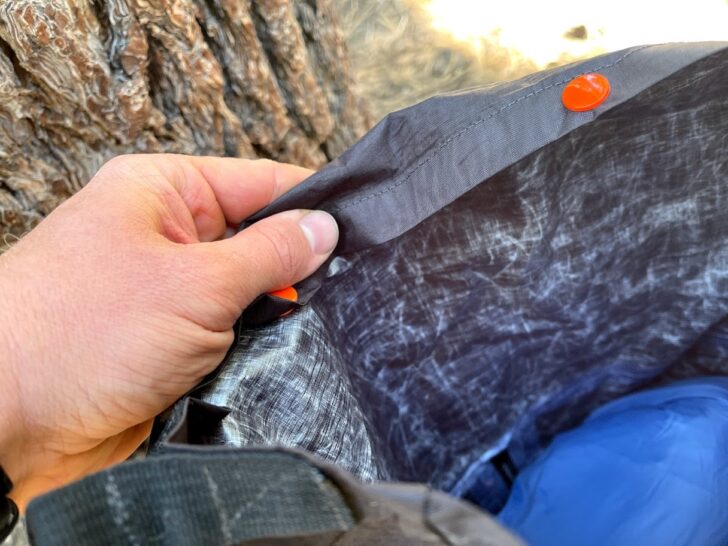
We’d driven in on a gravel road that only had a handful of inches of well-packed snow and stayed at a US Forest Service rental cabin for a few days to cross-country ski and enjoy the simple life. During our blissful stay, over 16 inches (40.7 cm) of snow fell and made our exit a bit more exciting than anticipated. In our defense, the forecast called for a maximum accumulation of 7 inches (18 cm) which was well within my Honda Element’s capability to traverse—I had proper winter tires and I had chains as a backup. The USFS also told me that they usually plow the road to the cabin, even on weekends, which made me feel a bit more relaxed (sure, and Sasquatch cleans it between guests).

After a valiant effort to drive out that involved chains, shoveling, and strategic driving, we finally had to give up short of the pavement and its salvation. Luckily, there was a small cluster of houses with year-round residents at the junction of the paved and gravel roads, and 30 minutes of post-holing took us to the first house. Even more fortuitously, a truck was plowing the rear part of the nearest driveway. Putting on our friendliest and most humble faces, we approached to see what our options might be.

The driver of the truck, Russ, waved to us, parked, and then hopped out into the still-falling snow to see what we wanted. After the initial greetings and apologizing for bothering him, I got to the meat of the conversation:

“So, we were staying up at the Forest Service cabin on the East Fork this weekend. Drove up there on Friday. And, uh…we’re not driving now. Guessing you can put two and two together…”

After mentioning we might need to use a phone to call a tow truck, Russ said he’d be game to drive his truck back to our vehicle since we weren’t very far in. He would see if he could pull us out and get us in his tracks so we could drive out ourselves. We eagerly and earnestly took him up on his offer and, as far as getting stuck vehicles out of the snow, things couldn’t have gone smoother.
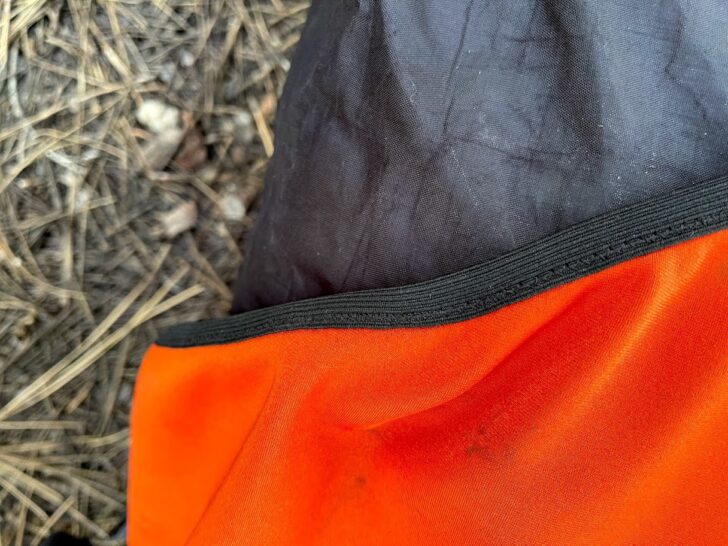
A short pull from his truck with my tow rope and we were able to get into his tracks which had packed the snow down just enough for the Element to get traction on. We drove the final mile out under our own power. The whole ordeal, from acknowledging we were totally stuck to being on the pavement probably took less than an hour—but we spent more than an hour on our initial attempts of driving out, getting stuck, digging out, driving some more, getting stuck, and admitting defeat.
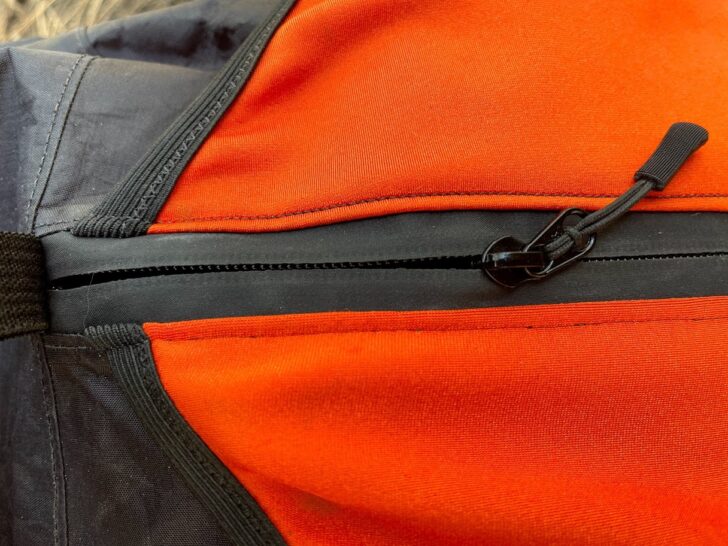
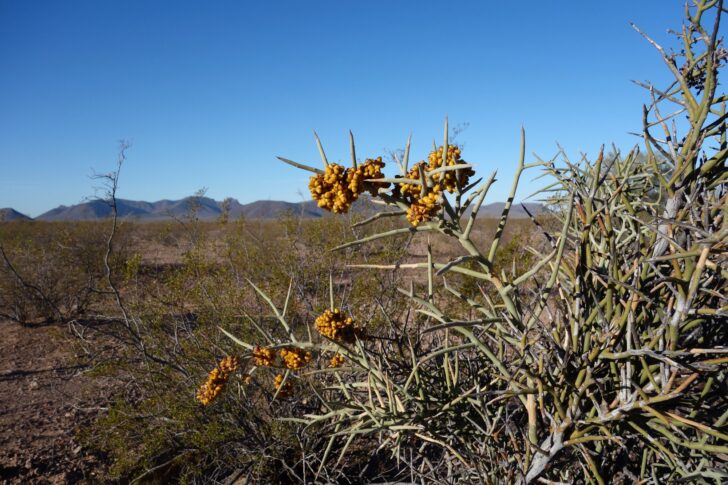
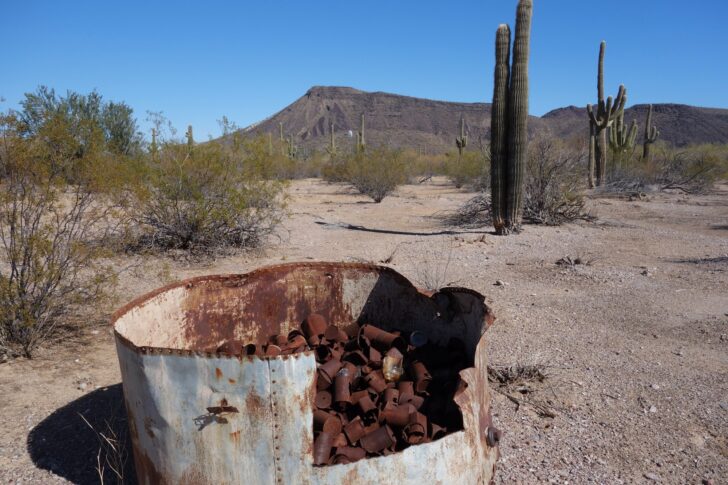
Nevertheless, we made it out in time for a full afternoon of downhill skiing on the 24 inches (61 cm) of powder they’d received in the last 24 hours. While I’d have rather started my morning with fresh tracks on my skis than in my car on a snowed-in forest road, I suppose all is well that ends well.

Express Gratitude and Return the Favor

a snow-covered road leading away from a backcountry cabin
A peaceful Sunday morning with no snow plows in sight.

After making it back to the pavement, we stopped to thank Russ sincerely for his assistance. He was in the middle of plowing out the houses in the neighborhood and we’d taken his time away from that job with our interruption. We asked for his address and dropped a thank-you note in the mail with a gift card for a local ranching supply store. It seemed the least we could do since he saved us from what could’ve been a long and expensive ordeal.

I’ve helped a handful of people out, both on trails and on the roads, during my decade of backpacking and it is always a good idea to pay it forward”. If it is safe to help, and you have the resources, then there’s really no excuse not to.

Be Prepared

Overall, I was reasonably prepared for the situation I found myself in. I had the proper equipment (winter tires, shovels, chains, a vehicle suitable for the predicted conditions, tow rope, knowledge of plowing conditions, and a detailed forecast) but the snowstorm was more severe than what was predicted. These things happen. Ours was a success because of neighborliness and not getting stuck in too inconvenient a location. And it was a good lesson to maybe just park where the guaranteed plowing stops if snow is in the forecast and just ski into the cabin rather than driving.

tire tracks in the snow
Snowy forest roads are best enjoyed on skis or snowshoes.

After all, a 2000 lb. vehicle isn’t really part of a lightweight backpacking system and can sometimes create more problems than it solves.

Related Content

DISCLOSURE (Updated April 9, 2024)

  • Backpacking Light does not accept compensation or donated/discounted products in exchange for product mentions or placements in editorial coverage. Some (but not all) of the links in this review may be affiliate links. If you click on one of these links and visit one of our affiliate partners (usually a retailer site), and subsequently place an order with that retailer, we receive a commission on your entire order, which varies between 3% and 15% of the purchase price. Affiliate commissions represent less than 15% of Backpacking Light's gross revenue. More than 70% of our revenue comes from Membership Fees. So if you'd really like to support our work, don't buy gear you don't need - support our consumer advocacy work and become a Member instead. Learn more about affiliate commissions, influencer marketing, and our consumer advocacy work by reading our article Stop wasting money on gear.