


Introduction
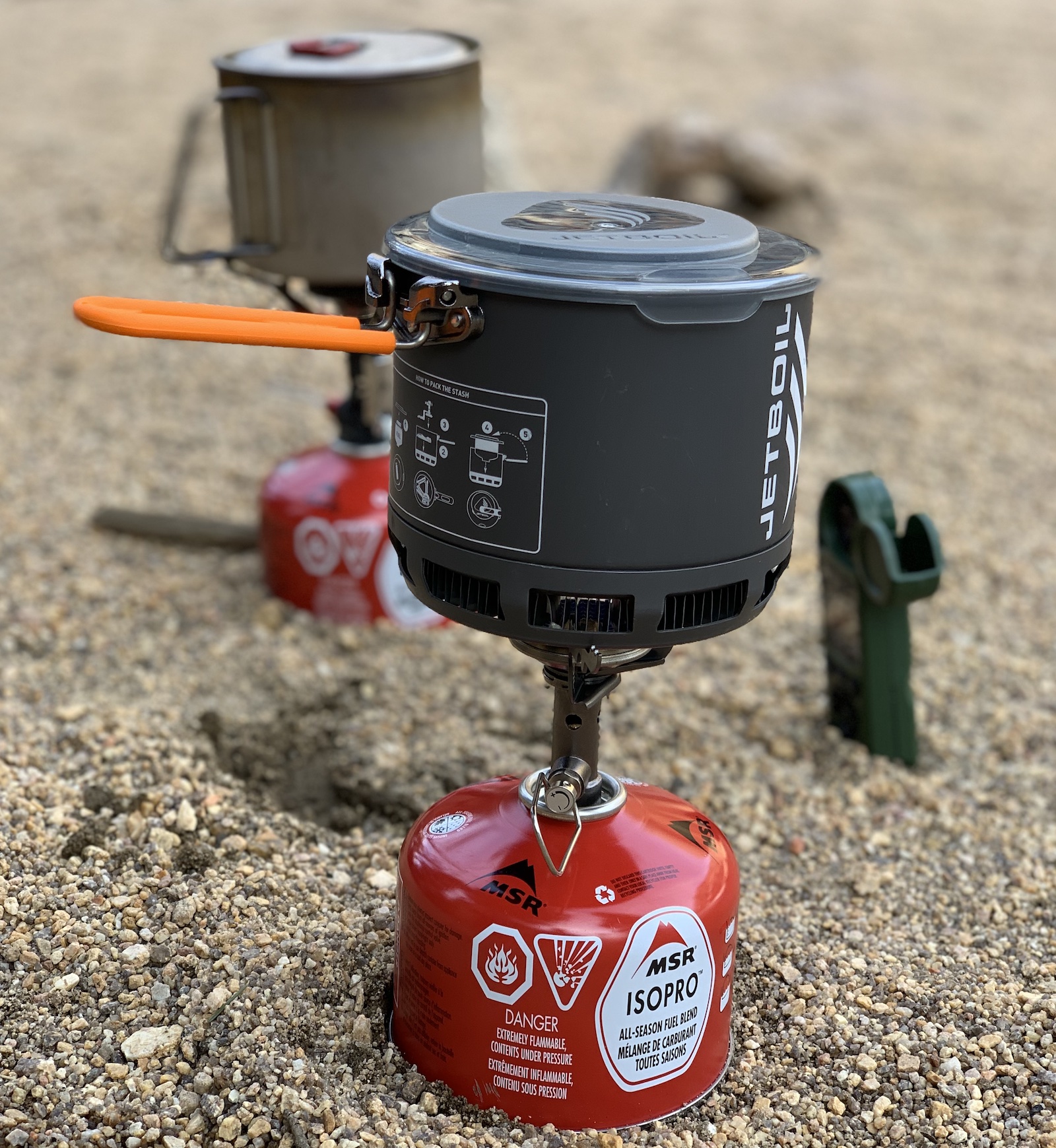
Product reviewers across the internet are singing high praise for the new Jetboil Stash. Jetboil sent loaner samples prior to its release to YouTubers, bloggers, and affiliate marketers. Some claims that have been written:
- “Despite below-freezing temperatures and high elevation, the Stash boiled water for oatmeal in under two minutes.”
- “Lightest, most efficient stove ever.”
- “At the heart of the Stash system is the burner/regulator. Made of titanium, this component marks the biggest technological advancement in the Stash.”
- “Best backpacking stove … signature Jetboil performance and features…”
- “We field-tested the new JetBoil Stash Stove System for winter hiking and camping in the Appalachian Mountains including below freezing and windy conditions.”
- “Lightest, most efficient backpacking stove ever.”
Another reviewer writes that it “performs on-par with similar canister stoves in wind” but acknowledges that “in anything more than a light breeze a windscreen is needed. However, a simple foil one weighs little, certainly far less than the big collar found on more wind resistant Jetboil stove systems.”
This reviewer’s comments suggest that a “simple foil windscreen” is all that’s needed to address the deficiencies of “similar” canister stoves (which are no longer “par-stoves” when considering the performance of wind-resistant canister stoves from MSR and Soto (which have now been on the market for several years).
In addition, those of us that spend any amount of time camping in windy conditions know that a “simple foil windscreen” not only adds complexity to our cooking systems, but can’t hold up to anything more than a 5 mph breeze unless they are made of metal that’s several mils thick, and adds 2-3 oz (57-85 g) to our cooking system. And we’ve already shown that the big collar on other Jetboil stoves does little to improve the wind-resistance of their burners. Our members have been removing the plastic collars from Jetboil stoves (to remove weight) since they hit the market in the mid-2000s, with no loss of performance.
So I’m curious to see how the Stash actually performed in the field and when subjected to inclement weather. To do that, I had to resist the urge to accept the pre-release invite to test samples of the Jetboil Stash provided on loan for a very limited period. Instead, I bought my own and spent a little time getting to know her. Sort of a pre-engagement period, I suppose, before popping the question:
Dear Stash, would you like to become a part of my gear kit?
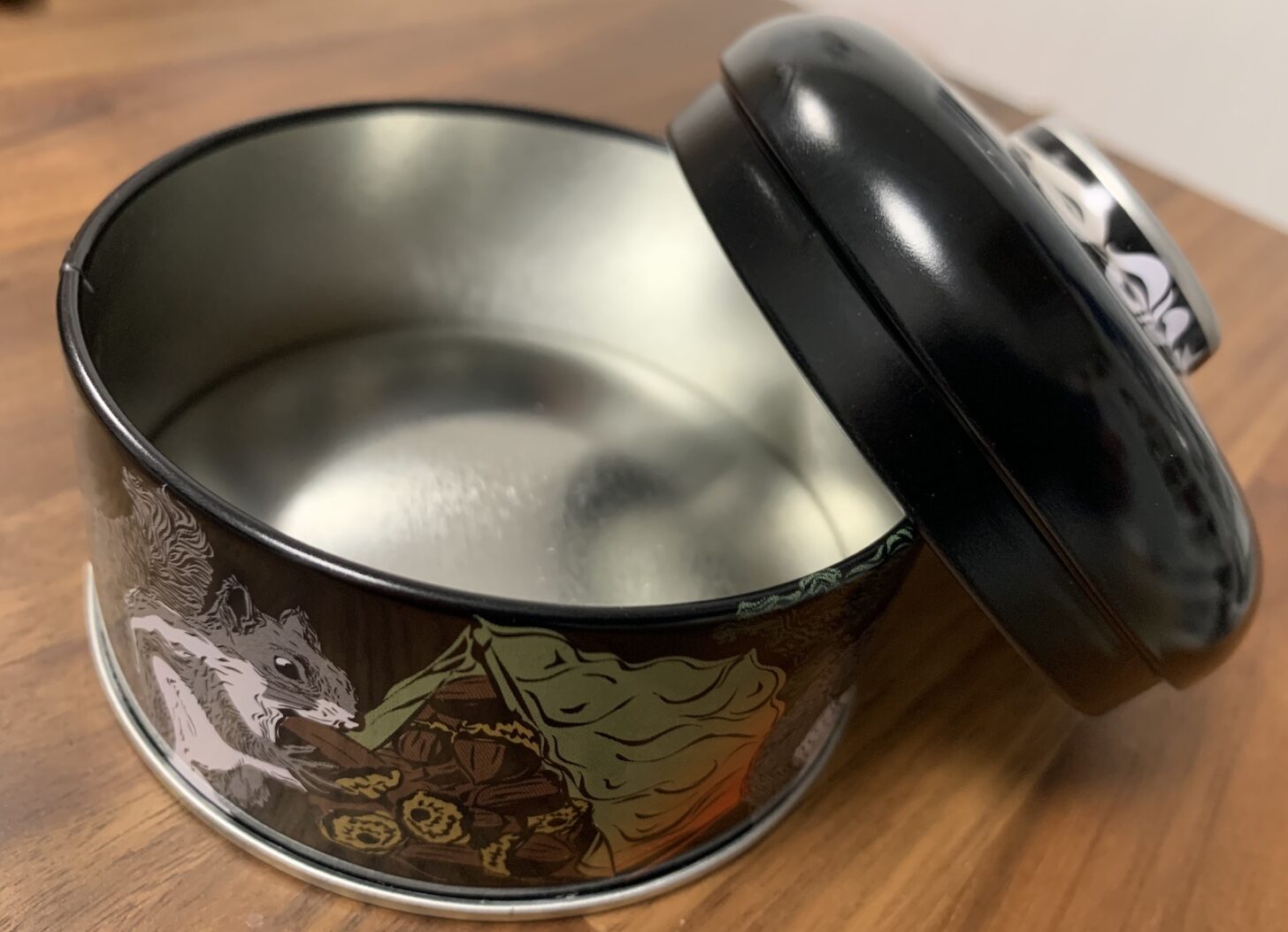
This isn’t a product review – it’s a test report. And I only test performance in terms of boil times and fuel economy. I’m not going to talk much about ergonomics, design, aesthetics, its cute nesting features, the included squirrel-branded repurposed mini-gas canister stash container, or brand marketing.
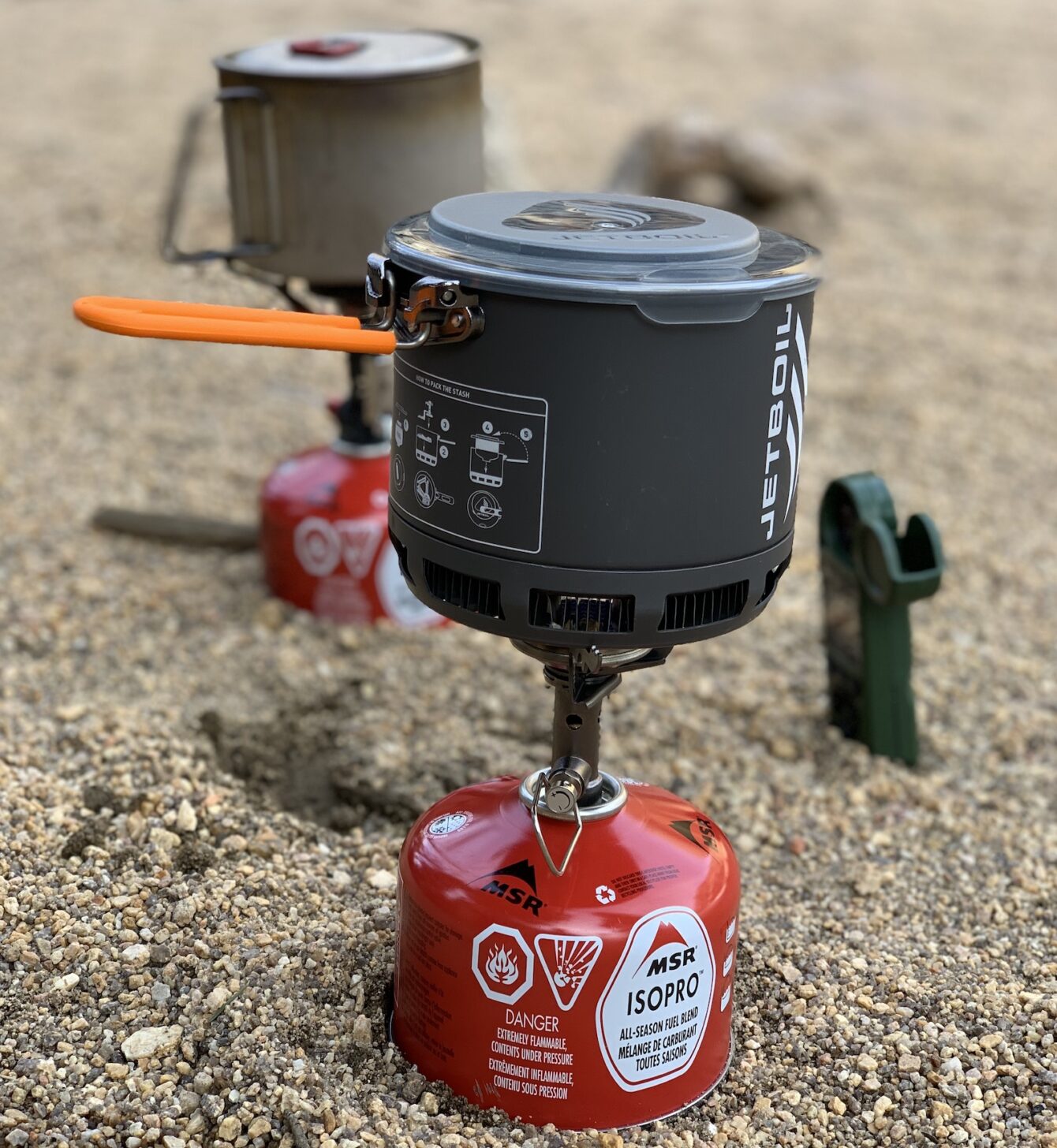
And to be fair, when I unboxed the stove kit, my immediate response to the ergonomics and aesthetics of the kit was “well done”.
What I like:
- That I can snap-fit the bottom of a 110-g net weight fuel canister into the plastic lid inside the pot without it rattling around.
- That the pot can fit a larger, 220-g net weight fuel canister.
- That the stove’s pot supports have indentations that keep the pot centered on and affixed to the stove even if used on a slight incline. In fact – I love this feature.
- The stash container is a really nice touch and a fun keepsake, and of course, it can be used to secretly store myriad substances like Tinder-Quik tabs, etc. The art is great and the theme (a repurposed gas canister) is cool.
- A small (0.8 L) and light (5 oz / 140 g) heat-exchanger pot.
- A titanium burner that resists rusting. My main gripe with steel burners, which accumulate rust that clogs burner ports which degrades performance over the long term.
What makes me pause:
- Same traditional Jetboil burner design, which lacks some power and wind resistance relative to today’s market average.
- Plastic, press-fit lid that’s difficult (and a little bit dangerous) to remove when the pot is boiling and you want to add food. This kit is fine-tuned for water-boiling, not simmering.
Description of Testing
For all tests described in this report, the Jetboil Stash Cooking System was directly compared to the highest-performing upright canister stove we’ve tested, the MSR Pocket Rocket Deluxe (which was used with the 0.9L MSR Titan Kettle). In outdoor tests, both stoves were operated side-by-side so they were exposed to the same wind condition.
The StoveBench stove testing protocol was used for all tests. The following table summarizes the test parameters for each of the tests conducted:
| Control | Mild Outdoor | Moderate Outdoor | |
|---|---|---|---|
| Elevation | 7,190 ft | 8,860 ft | 7,190 ft |
| Ambient temperature | 68 F | 45 F | 28 F |
| Precipitation | n/a | none | light snow |
| Average Wind | n/a | 4 mph | 1 mph |
| Measured Wind Gusts | n/a | 12 mph | 6 mph |
| Starting water temperature | 3 C | 4 C | 1 C |
| Ending water temperature | 91 C | 89 C | 91 C |
| Water volume | 500 ml | 700 ml | 700 ml |
In addition, I conducted tests with the Jetboil Stash burner and the MSR Titan Kettle, and with the MSR Pocket Rocket Deluxe burner and the Jetboil Stash heat exchanger pot. These tests were the most enlightening – they helped me answer the question about whether the Jetboil Stash burner (playing the part of the pig in this theatre) or the heat exchanger pot (playing the role of the lipstick) were the most important components of the system.
Control Test Results
The following table summarizes the test results for the controlled, indoor environment for the Jetboil Stash (“Stash”), the MSR Pocket Rocket Deluxe (“PRD”), and the averages from all of the stoves in our Upright Canister Stove Gear Guide. PRD test data was collected in May 2019 as part of that Gear Guide but repeated again in March 2021 simultaneously with the tests performed on the Jetboil Stash. Both data sets are presented in this table.
| Stash | PRD (May 2019) | PRD (March 2021) | Average of All Stoves (May 2019) | |
|---|---|---|---|---|
| Boil Time (mm:ss) | 4:03 | 3:05 | 3:11 | 3:23 |
| Fuel Consumed (g) | 5.7 | 10.6 | 10.8 | 11.6 |
| StoveBench Score (F) (L-degC/min-g) | 1.95 | 1.45 | 1.29 | 1.16 |
| F_economy (L-degC/g) | 7.89 | 4.33 | 4.10 | 3.87 |
| F_power (L-degC/min) | 11.11 | 14.29 | 13.90 | 13.12 |
As a side note before diving into the data more deeply, note that the StoveBench scores (and general performance) of the PRD decreased slightly from May 2019 to March 2021. I’ve seen the same pattern on all stoves for which I’ve conducted StoveBench tests over a multi-year period. The performance decrease may be due to the accumulation of dirty fuel residues in the jet and burner, the accumulation of rust on steel burner parts that interfere with flame efficiency, and degradation of the Lindal valve seal on the stove. (I haven’t investigated this trend in detail, so these explanations are conjecture at this point.)
When comparing StoveBench scores between upright canister stoves, the Jetboil Stash Cooking System scores higher on fuel economy (F_economy, i.e., that fraction of the StoveBench score that describes how much water was heated for a given amount of fuel) than any of the stoves we tested in our Upright Canister Stove Gear Guide. This is to be expected, given that the Jetboil Stash incorporates a heat exchanger pot and a low-power (4500 BTU) burner.
However, the Jetboil Stash scores lower on power (F_power, i.e., that fraction of the StoveBench score that describes how much water was heated in a given amount of time) than the average upright canister stove we tested. Again, this isn’t surprising given that the Jetboil Stash is a low-BTU burner.
Of course, you should take the results of the StoveBench Control Test with a grain of salt. It’s only meant to be a baseline test to get a feel for burner economy and power in optimum conditions. It’s more important to compare stove performance under more adverse conditions, e.g., higher water volumes, lower ambient temperatures, and exposure to wind – the types of conditions we may experience on a trip where we want (need) our stoves to perform well.
Mild Outdoor Environment Test
The following table compares the test results under mildly stressful environmental conditions:
Member Exclusive
A Premium or Unlimited Membership* is required to view the rest of this article.
* A Basic Membership is required to view Member Q&A events


Discussion
Become a member to post in the forums.
Companion forum thread to: Lipstick on a Pig? Wind & Cold Temperature Testing of the Jetboil Stash (StoveBench)
Backpacking Light publisher Ryan Jordan subjects the Jetboil Stash to the StoveBench testing protocol to answer the pressing question: is this innovation, or lipstick on a pig?
I have never been a Jetboil fan. Most of their stoves that I am familiar with suffer from the same degraded performance in wind and cold. That fact, combined with their reputation of mediocre build quality, has steered me in other directions. Mostly I use alcohol. When I do use a canister stove, it’s a Soto Windmaster which I really do like. If I were to consider an integrated stove system, I would look first at the MSR Windburner.
Like Ryan, I decided to compare the new JetBoil Stash to the PocketRocket2 Deluxe with an MSR Titan Kettle (karma?). Here are my conclusions:
Here is my recent video about the comparison. Enjoy
I forgot to include these snapshots at 5.1 mph wind.
JetBoil Stash – flames separating from the mug
PocketRocket2 Deluxe – Flames fairly stable
I have mixed feelings about the stash. One the one hand they created an attractive package and rolled out a very targeted marketing campaign. I can’t remember another product in this category that got so many YouTube and web reviews in such a short period of time. Very impressive.
On the other hand the stove is apparently underpowered for anything other than an HX pot in calm conditions with a mostly full canister. Very disappointing. Was the power limited to prevent damage to the HX pot? Thinner fins? Some jetboils are listed as 9k btu yet this is 4.5k Kinda defeats the purpose of using it with regular pots yet I’m sure they’ll still sell many.
The lower BTU is likely to ensure people get good fuel burn numbers, because apparently no one knows how to adjust the throttle.
The comparison photos @jonfong posted are very telling. The distance between the top of the burner and the top of the support arms, e.g. the distance from the head to the bottom of the pot appears to tell the story. Why didn’t JetBoil tuck the head up into the fins?
I’m sticking with the Soto Windmaster and wide pot for a canister setup…no windscreen required, just tuck it into/behind a natural windbreak. The PR Deluxe does look like it might perform similarly to the Soto WM.
Interesting results, certainly…but not especially surprising, except on the part of the 28-minute boil time. That’s impressively long.
Apparently, Ryan’s descriptor: “Lipstick on a Pig” is apt.
I spent a few minutes with a sharpie, scissors, and some Ti foil from an old stove pipe to make a wind screen that grabs the bottom of the HX shroud. It fits between 2 of the pot support arms, so it wraps about 1/3 the way around the pot. I gave it a low-hanging tab to grab easily. It actually holds onto the pot pretty snugly. It weighs 3 grams. Probably less if I brushed the old creosote off. ;^)
So how much does the Stash pot (with lid) by itself weigh?
144 g
That titanium foil windscreen is very clever!
Excellent review Ryan, thanks for calling a spade a spade (with lipstick)! There are too many crap products out there these days. Quilts with overstated ratings, tents with unworkable designs, and stoves that can’t boil water. I refuse to buy pigs. Bacon on the other hand …
That was a very helpful review. Thanks so much for testing more thoroughly than others did.
yeah, nice windscreen, about the minimalist possible
What is not clear to me in the review is can the jetboil pot (more precisely the fins and their attachment to the pot) withstand the higher MSD BTU and resulting higher temperature over a moderate number of uses (let’s say 3 to 4 dozen)?
I have seen 2 titanium Sumo pots were the fins have detached and show damage when used with the JetBoil stove they were designed for. I suspect the fins will not survive prolonged use with a higher temperature stove output.
Daniel, I’m concerned about the durability of that heat exchanger as well. Honestly, I’d happily take a slightly more durable HE in exchange for inclement conditions performance. It’s been shown here numerous times that titanium fins may not be the most durable.
Kinda reminds me of my first cooking system: the Optimus Crux lite cookset. With the heat exchanger and the dedicated windscreen that would grip the top of the canister and that would fold around the pot when carried it’s a clever design. The top would even double as a coffee cup or a small frying pan (try frying some thinly sliced salami, onions and garlic and adding that to a pot of cooked pasta with a small bag of tomato soup powder and you eat like a king after a 20 kilometer hike). If only they would make that thing in titanium.. I still had my Kovea Ti-burner then, which was next to useless in the cold. Switched to a MSR PR2 and never looked back. Which proves Ryans point that the burner is key to the system.
In the long run, a lot of Stash sets may be returned to REI. For those that live near a REI store, returned Stashes will be in the Garage Sale section. Which means we can buy the pot at a decent price and toss the stove! Much prefer my Soto stove, but that is a cool pot, great for weeklong trip’s fuel efficiency or more.
Very nice, Phillip! Should be doable for the Sterno HX pot, too.
This little strip spring-clips around the burner head. I thought about making a full ring/cylinder, but left it open on one side. It does not register on my scale which does not go to tenths.
I’ve come to love the MSR Reactor we recently purchased. Buy once, cry once… No more futzing around with wind screens. Water boils in seemingly only a minute or two at most, even under windy conditions.
The caveat is it’s not being used by myself in the summer (for which it’s too heavy), but rather shared with my wife, and sometimes also some other friends/family. Or used in winter. And sometimes we still use our old MSR MicroRocket when it’s just the two of us.
Yes, the Reactor is an excellent stove. That’s what we bring when we have a larger group and more demanding (higher volume) hot water needs, like during elk season. But as you point out, it’s basically in a different category.
I’ve used a JB Sol Ti for many years now. The HX fins are still in good shape. I picked up the aluminum cup just in case since I like the system for solo travel. I will try the Stash but it will have to impress in order to displace the Sol.
I guess I understand Ryan’s reporting of the 28-minute boil for completeness’s sake and intervening would have violated the experimental conditions, but it’s a silly and gratuitous value. Any normal human would have pulled a glove off and placed a warm hand on the cooling canister to restore the volatilization of the liquid fuels after a couple of minutes. I mean, who would sit there helplessly for a half hour?
The vast majority of beginners and others who don’t understand how stoves work.
Become a member to post in the forums.