



Introduction
In an earlier article, we focused on batt-type insulation as well as two knit active insulations. We covered how these insulations are manufactured, their benefits, and their drawbacks. We covered issues related to how the insulating value of the insulations are measured by the industry. We presented the results of our measurements of thermal resistance for 10 insulation products.
In this article, we will focus on an important synthetic insulation category: fleece.
We will concentrate on two aspects of fleece that are often discussed when comparing fleece garments with those insulated with synthetic non-wovens or down – weight and warmth. Our testing determined that fleece warmth/weight performance simply cannot compete with the performance of batt type insulations or even that of its fleece cousin, Polartec Alpha. The average of fleeces we tested, which included all weights (except micro), was 0.09 clo/oz./yd2. The average of non-woven insulations we tested was 0.42 clo/oz./yd2. When you compare the warmth-to-weight of finished jackets, the warmth-to-weight ratio of fleece seems to pale next to other technologies.
Editor’s Note: If you’d like a detailed explanation of “clo,” see Stephen’s earlier article.
I have two fleece jackets. For each, the clo/oz. is 0.03. If we look at an average of 12 active insulation jackets, the average for these jackets, which offer competitive performance with fleece is 0.07 clo/oz. One other thing that we found in our examination of 10 different Polartec fleece samples: there is no relationship between fleece weight and fleece warmth!
A Very Brief History of Fleece
Malden Mills was a manufacturer of pile baby bunting and pile toilet seat cover fabrics. Pile fabrics are produced as both woven and knitted fabrics using natural, synthetic, and blended fibers. The key to forming pile is brushing or napping the fabric core structure, raising fibers from the core. The raised fibers produced synthetic fur. The fibers can be trimmed to control the pile height and uniformity and also produce a variety of patterns and textures.
Patagonia was an early adopter of pile fabrics for outdoor wear. Pile fabric provided an alternative to woolen fabrics with advantages in weight, water resistance, and cost. Patagonia worked with Malden Mills to adapt their pile fabrics to the demands of active outdoor activities. In 1985, Patagonia marketed their new products as Synchilla. Malden Mills produced their product under the trade name PolarFleece and Polar Plus. Patagonia grew rapidly after the introduction of its fleece products.
In 1995, Malden Mills suffered a devastating fire at its Massachusetts mill and after rebuilding, faced various financial challenges. Malden Mills went through multiple bankruptcies and was purchased by venture capital firm Versa Capital Management in 2007, which renamed the company Polartec. Polartec was sold in 2019 to Milliken & Company. Along the way, Polartec moved its manufacturing to plants in New Hampshire, Tennessee, China, and Italy.
Although Malden Mills invented synthetic fleece, the company never patented its product. As a result, a variety of manufacturers developed the ability to produce competing products.
Fleece Weights
Polartec Classic Fleece comes in four basic weights: Microfleece, 100, 200, and 300 weights. Table 1 lists the weight range for each weight class as well as equivalent weight classes for Polartec Thermal Pro, Patagonia, and The North Face. (Thermal Pro is manufactured by Polartec and provides a wide variety of surface textures and patterns not incorporated into its “Classic” line of products.)
Table One: Fleece Weights and Equivalents
| Weight Class | Grams/Sq Meter | Oz/Sq Yard | Thermal Pro Equivalent | Patagonia Equivalent | The North Face Equivalent |
|---|---|---|---|---|---|
| Microfleece | <100 | <3 | |||
| 100 | 100-200 | 3-6 | Lightweight | R1 | TKA100 |
| 200 | 200-300 | 6-9 | Midweight | R2 | TKA200 |
| 300 | >300 | >9 | Heavyweight | R3 | TKA300 |
In principle, the higher the weight designation, the heavier and warmer the fleece product will be. We shall see below; this is not necessarily the case.
Test Procedures
- The 1 yard samples were measured for area and then weighed on an A&D SJ-2000HS digital bench scale.
- 10 samples of fleece were obtained from three vendors: Mill Yardage (ML), Rockywoods (RW) and Discovery Fabrics (DF).
- Two test samples were cut from each 1 yard fabric: one across the roll (perpendicular to machine direction); one in the machine direction.
- The thickness of each sample was measured using a Mitutoyo Absolute Digital Caliper and an iGAGING digital thickness gauge. Approximately 12 measurements were taken around the perimeter of each sample.
- The intrinsic thermal resistance (R-value) for each sample was measured on the Guarded Hot Plate. Each sample was tested twice. The Guarded Hot Plate was set to 100 F (38 F). The room ambient during the test was 70 F + 1 F (21 C). The duration of each test was 1 hour. Each sample was heated on the hot plate for 20 minutes prior to starting the test. A detailed discussion of the hot plate and its operation may be found here: The hot plate discussion starts on page 14.
- The thermal resistance values from each of four tests were averaged together to obtain the listed results.
- An infrared image was obtained for each sample at the conclusion of each test.
- Photomicrographs were obtained for selected samples to illustrate construction.
Insulation test results are provided in the two tables below. Table 2 provides the physical data for each insulation. Table 3 table provides the measured results and comparative metrics. Four metrics are provided. All are based on Intrinsic values with the air film resistance removed.
Editor’s Note: for an explanation of intrinsic clo values, see Stephen’s earlier article.
The metrics are:
- Measured R-value. This is the result for the piece of insulation tested.
- Intrinsic Clo. This is simply the measured R-value x 1.136.
- Intrinsic clo/oz/yd2. This is Intrinsic clo divided by the measured (not claimed) weight per square yard. This metric will give you the most efficient insulator based on weight.
- Intrinsic clo/inches. This is Intrinsic clo divided by the measured (not claimed) insulation thickness. This metric will give you the most efficient insulation based on volume.
- Intrinsic clo/oz/inch. This is Intrinsic clo divided by weight and thickness. It identifies the most efficient insulation in terms of both weight and thickness.
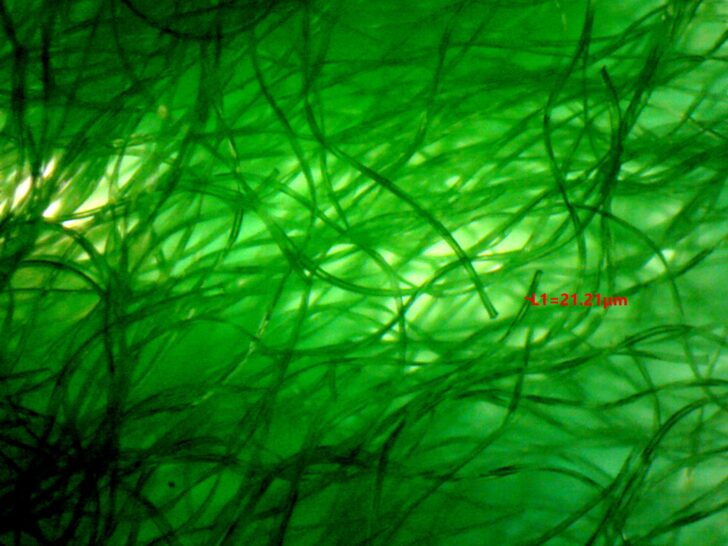
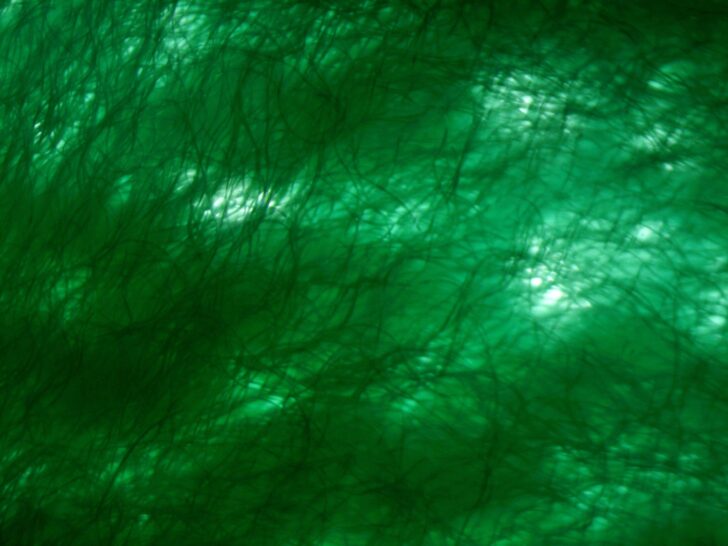
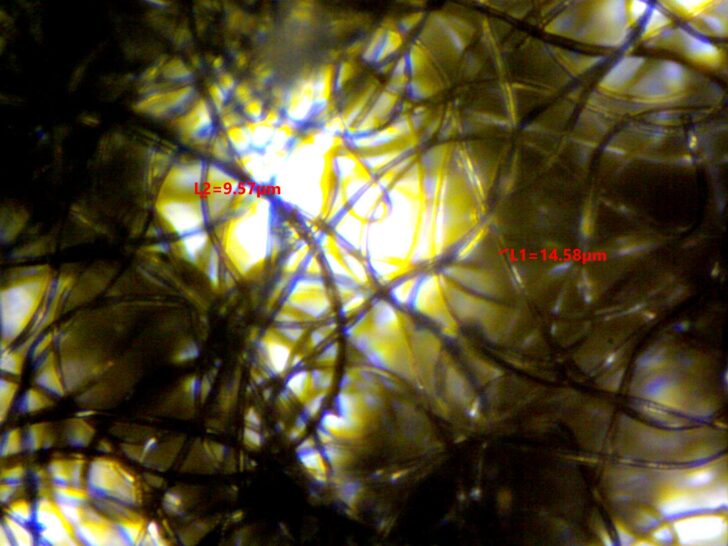
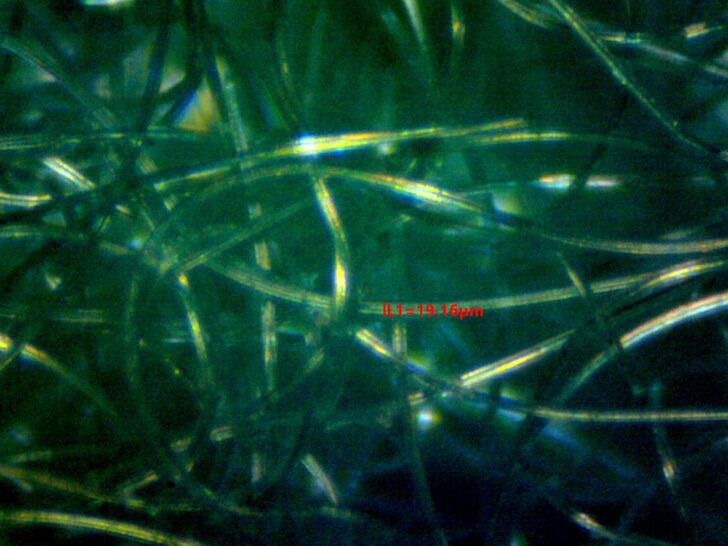
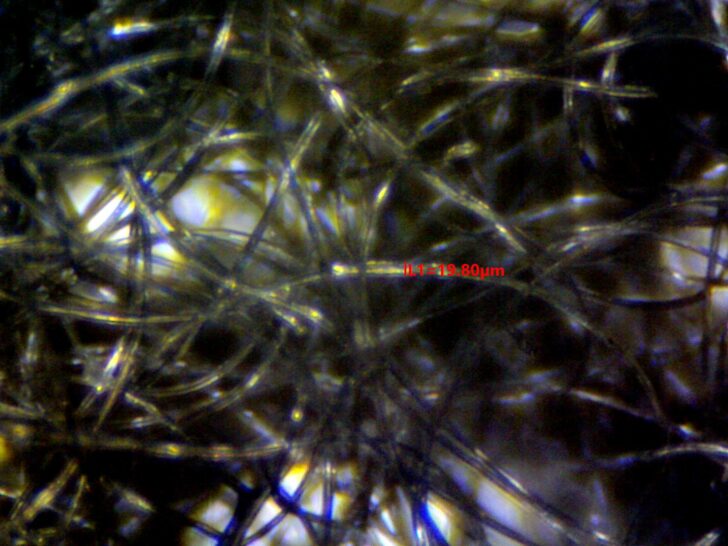
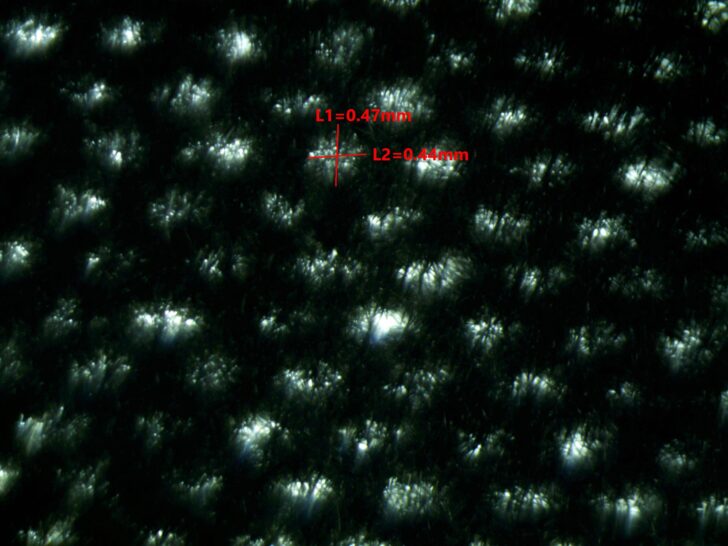
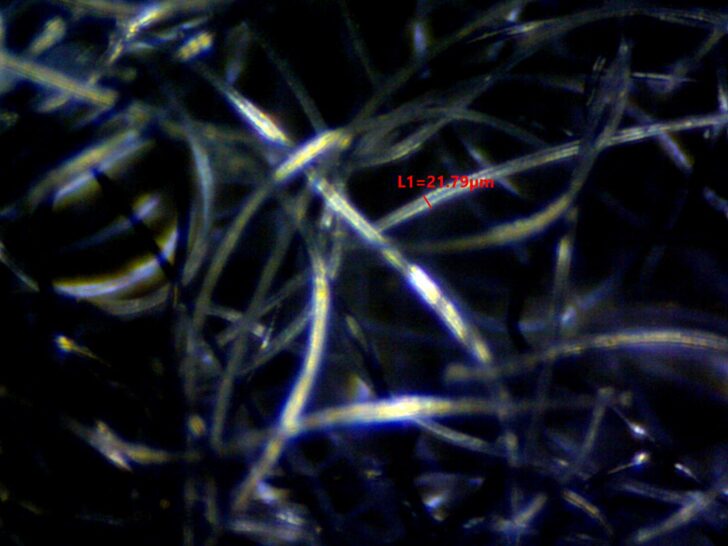
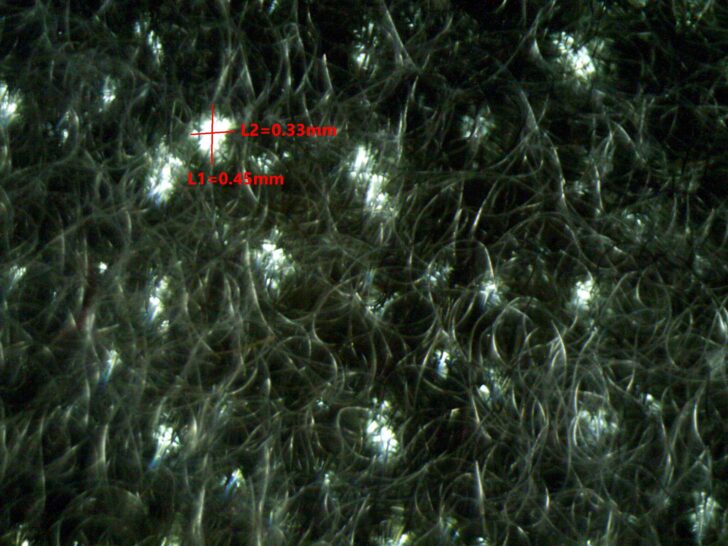
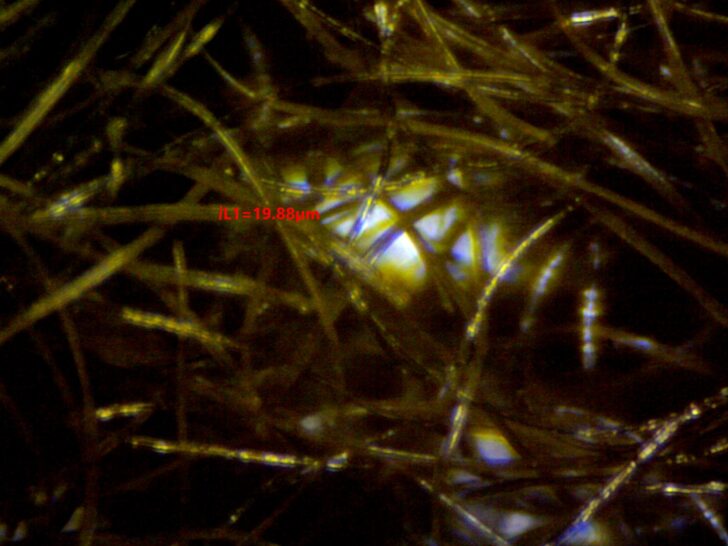
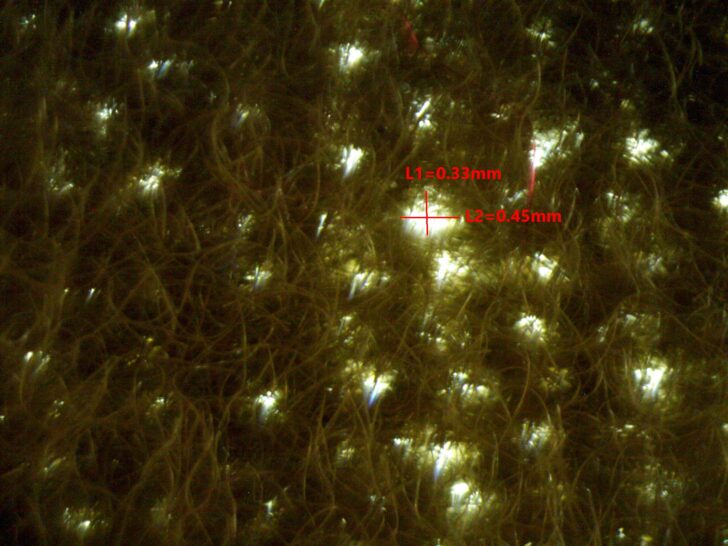
Selected photomicrographs are shown below:
Some of these samples are fairly dense, so the underlying core fabric structure from which the fibers are napped cannot be readily seen. The image for Thermal Pro Lightweight, low mag, shows the clearest image of the underlying structure because there is nearly no pile on this fabric. Typically, the fiber diameter is about 20 micrometers. This is comparable to fiber diameter in continuous filament batt insulations that we tested previously and in the middle-to-upper range of short-staple batt insulations that we tested previously.


Test Data
Table 2: Physical Dimensions
| Insulation | Insulation Type | Claimed Weight per Square Yard (oz) | Measured Area (sq yard) | Weight (oz) | Measured Weight per Square Yard (oz) | Approximate Loft (in) |
|---|---|---|---|---|---|---|
| Polartec 100 9180 Double Velour MY | Fleece | 9.6 | 1.83 | 15.05 | 8.22 | 0.247 |
| Polartec 200 7614 Double Velour MY | Fleece | 13.9 | 1.87 | 15.35 | 8.21 | 0.228 |
| Polartec 300 9381 FQ Double Velour MY | Fleece | 20.8 | 1.88 | 17.95 | 9.55 | 0.204 |
| Polartec 100 Pewter RW | Fleece | 9.6 | 1.89 | 10.45 | 5.53 | 0.16 |
| Polartec 200 Baby Blue RW | Fleece | 13.9 | 1.94 | 19.05 | 9.82 | 0.219 |
| Polartec 300 Coyote RW | Fleece | 20.8 | 1.74 | 19 | 10.92 | 0.155 |
| Ptec Thermal Pro Midweight HiLoft Grn MY | Fleece | 9.1 | 2.094 | 20.4 | 9.74 | 0.243 |
| Ptec Thermal Pro HiLoft Azurro MY | Fleece | 6.1 | 1.94 | 12.45 | 6.42 | 0.216 |
| Ptec Thermal Pro Lightweight Olive MY | Fleece | 5.4 | 1.97 | 11.25 | 5.71 | 0.104 |
| Ptec Thermal Pro 4230 Silver Extreme DF | Fleece | 9.1 | 2.18 | 19.2 | 8.81 | 0.234 |
Table 3: Thermal Resistance Data
| Insulation | Hot Plate Measured R value | Hot Plate Intrinsic Total Clo | Hot Plate Intrinsic Clo/oz /Yd2 | Hot Plate Intrinsic Clo/In | Hot Plate Intrinsic Clo/Oz/In **** | Claimed Clo/ Oz/Yd2 |
|---|---|---|---|---|---|---|
| Polartec 100 9180 Double Velour MY | 0.78 | 0.89 | 0.11 | 3.59 | 0.44 | 0.16* |
| Polartec 200 7614 Double Velour MY | 0.72 | 0.82 | 0.1 | 3.59 | 0.44 | 0.14* |
| Polartec 300 9381 FQ Double Velour MY | 0.59 | 0.67 | 0.07 | 3.29 | 0.34 | 0.11* |
| Polartec 100 Pewter RW | 0.54 | 0.61 | 0.11 | 3.83 | 0.69 | 0.16* |
| Polartec 200 Baby Blue RW | 0.65 | 0.74 | 0.08 | 3.37 | 0.34 | 0.14* |
| Polartec 300 Coyote RW | 0.46 | 0.52 | 0.05 | 3.37 | 0.31 | 0.11* |
| Ptec Thermal Pro Midweight HiLoft Grn MY | 0.72 | 0.82 | 0.08 | 3.37 | 0.35 | .185* |
| Ptec Thermal Pro HiLoft Azurro MY | 0.69 | 0.78 | 0.12 | 3.63 | 0.57 | .185* |
| Ptec Thermal Pro Lightweight Olive MY | 0.34 | 0.39 | 0.07 | 3.71 | 0.65 | .16* |
| Ptec Thermal Pro 4230 Silver Extreme DF | 0.69 | 0.78 | 0.09 | 3.35 | 0.38 | .21* |
* From manufacturer’s published specification. Precise calculation method unknown for all manufacturer’s claims
**** Based on measured thickness
In order to easily compare the performance of fleece insulation with batt insulation, we reproduce as Table 4 the thermal performance of batt insulation from the article By the Numbers: Thermal Performance Measurements of Synthetic Insulations.
Table 4: Thermal Performace of Batt and Knitt Insulations
| Insulation | Hot Plate Measured R value | Hot Plate Intrinsic Total Clo | Hot Plate Intrinsic Clo/oz /Yd2 | Hot Plate Intrinsic Clo/In **** | Hot Plate Intrinsic Clo/Oz/In | Claimed Clo | Watts Hot Plate |
|---|---|---|---|---|---|---|---|
| Climashield Apex 6oz | 3.03 | 3.44 | 0.58 | 2.41 | 0.41 | 0.82 oz/yd2* | 3.5 |
| Primaloft Gold 6oz | 2.94 | 3.34 | 0.47 | 3.09 | 0.43 | 0.92 oz/yd2*,*** | 3.5 |
| Climashield Apex 5oz | 2.5 | 2.84 | 0.59 | 2.81 | 0.59 | 0.82 oz/yd2* | 4.5 |
| Primaloft Gold 3oz | 1.57 | 1.78 | 0.55 | 2.97 | 0.91 | 0.92 oz/yd2*,*** | 5.3 |
| Thinsulate 200G CDS | 1.54 | 1.75 | 0.24 | 3.02 | 0.42 | 2.2R*,*** | 5.9 |
| Primaloft Silver 3oz | 1.23 | 1.4 | 0.45 | 2.54 | 0.82 | .79 oz/yd2*,*** | 6.8 |
| Climashield Apex 2.5oz | 1.07 | 1.22 | 0.51 | 3.12 | 1.32 | 0.82 oz/yd2* | 7.9 |
| Polartec Power Fill 100 | 0.87 | 0.99 | 0.36 | 3.19 | 1.15 | 1.2 Clo Total* | 8.8 |
| Freudenberg KHT | 0.86 | 0.98 | 0.49 | 2.57 | 1.28 | 1.35 Total* | 8.8 |
| Polartec Alpha | 0.54 | 0.61 | 0.2 | 2.56 | 0.84 | 0.87 Clo Total*,** | 11.3 |
| Polartec Alpha Direct | 0.36 | 0.41 | 0.15 | 2.27 | 0.84 | 12.9 |
* From manufacturer’s published specification. Precise calculation method unknown for all manufacturer’s claims.
**https://backpackinglight.com/forums/topic/56056/#post-2080930, alternate source claims .37 clo/oz/square yard
*** Scrim weight included in measured weight
**** Based on measured thickness
Discussion of Results
A number of issues are illustrated in these results.
- Compared to batt insulations tested previously, fleece provides relatively little warmth. Fleece ranges from R-0.34 to R-0.78, while the batt insulations that were tested provided R-0.86 to R-3.03.
- Compared to knit insulations previously tested, fleece provides similar thermal performance. The Alpha insulations previously tested ranged from R-0.36 to R-0.54. (Note: we tested mid-weight versions of Alpha and Alpha Direct. So somewhat lower or higher values should be found in lighter or heavier fabric weights.) Thus, one can conclude that Alpha insulations perform similarly to fleeces with one important exception – the Alpha insulations are considerably lighter. This can be seen from the Clo/oz/yd2 metrics. Alpha insulations can be less than half the weight of fleece.
- Compared with batt insulations, fleece is heavy. This may be seen, again, by comparing the clo/oz/yd2 metrics.
- When we compare the fleece weights, fleece sample names, and thermal performance, we find there is little agreement with our expectations that product weight (100, 200, 300 or lightweight, midweight or heavyweight) is related to warmth. We will look at this from a couple of angles.
Table 5 shows the fleece sample names, which include the weight class (100, 200, 300 or lightweight, midweight or heavyweight), the measured weight per square yard, the expected weight class, based on actual measured weight and referencing the weight class designations found in table 1, above, and finally, the measured clo/oz/yd2 value.
Table 5: Comparison of Actual and Expected Weight Class
| Insulation | Measured Weight per Square Yard (Oz) | Expected Weight Class per Table 1, based on measured weight | Hot Plate Intrinsic Clo/oz /Yd2 |
|---|---|---|---|
| Ptec Thermal Pro HiLoft Midweight Azurro MY | 6.4 | 200 | 0.12 |
| Polartec 100 Pewter RW | 5.5 | 100 | 0.11 |
| Polartec 100 9180 Double Velour MY | 8.2 | 200 | 0.11 |
| Polartec 200 7614 Double Velour MY | 8.2 | 200 | 0.1 |
| Ptec Thermal Pro 4230 Silver Extreme DF | 8.8 | 200 | 0.09 |
| Ptec Thermal Pro Midweight HiLoft Green MY | 9.7 | 300 | 0.08 |
| Polartec 200 Baby Blue RW | 9.8 | 300 | 0.08 |
| Polartec 300 9381 FQ Double Velour MY | 9.6 | 300 | 0.07 |
| Ptec Thermal Pro Lightweight Olive MY | 5.7 | 100 | 0.07 |
| Polartec 300 Coyote RW | 10.9 | 300 | 0.05 |
Based on product name, only 6 of 10 samples correspond to the expected weight class.
However, our expectation with fleece is that warmth and weight increase together. We would expect the highest weights and highest insulation values for class 300 products. We would also expect the lowest weights and lowest insulation values for the class 100 products. This is not what happens. Polartec 100 Pewter RW, the lightest fabric, has the second-highest thermal performance. The very lowest thermal performance goes to Polartec 300 Coyote RW, which is the heaviest fabric. The four heaviest fabrics are in the bottom five performers for warmth.
There is clearly a mismatch between product names and product performance.
Is there a way to determine product performance based on product physical characteristics? Absolutely.
Member Exclusive
A Premium or Unlimited Membership* is required to view the rest of this article.
* A Basic Membership is required to view Member Q&A events


Discussion
Become a member to post in the forums.
Companion forum thread to: By the Numbers: Rethinking Fleece
Stephen Seeber subjects ten fleece samples to rigorous thermal testing.
That’s a lot of measuring and data, thanks
Yeah, fleece is heavy for the warmth. You have good data that quantifies this.
Maybe fleece is good for heavy exercise when you don’t want much insulation or you’ll sweat
Run hot myself but this can help people who run cold even summer months. There’s the various thicknesses and then wind resistant layers/panels too.
Think for backpacking … “active“ vs “at camp“ insulation needs to be the main planning consideration.
I agree with Jerry. Fleece is great for hiking/skinning/skiing/jogging etc. in cold weather. And for grabbing a beer afterwards.
This will probably sound strange, but I also like the old Marmot driclime wind shirt for similar activities if it’s cold and windy or I will be moving fast. After all these years and new technologies, I still find myself reaching for it.
I’m loving this By the Numbers Series! Please keep it coming!!
I really appreciate the history included in the article; I think it helps navigate today’s current products.
I’ve always thought of fleece as active insulation, i.e. warmer wind shirts; info on breathability, water resistance, drying time, and wet performance could be enlightening.
Wouldn’t a fleece with high breathability and low R value function similarly to a wind shirt?
Since Patagonia funded the research on fleece pollution, I’m a little surprised to see them introduce new fleeces with no mention of micro fiber shedding. Does anyone else think about the pollution or do anything different to try to mitigate it? Based on top loading vs front loading washing machine results maybe gently hand washing fleeces is warranted?
Polartec might be trying to do something about micro fiber shredding…or maybe just marketing.
IME fleece’s effectiveness is awful in wind. so it needs a shell or windshirt as an add on–and that has to be considered in terms of its already high rate to warmth ratio. In other words, it weighs still more than its own weight in order to be effective in wind.
down is far warmer with less weight than fleece. Obviously it performs poorly when soaked, and fleece still provides some warmth in those conditions.
Down also tends to handle wind better than fleece.
I stopped carrying fleece on my backpacks in the Sierra. Too heavy! for its warmth to weight.
In the great outdoors, fleece is for when you expect your insulation to get wet. Around town, who cares what it weighs? Unless the referenced testing was done with wet insulation, I’m not sure how useful the results. (I can’t read the article.)
Great article. Thanks!
It would be really great to see data on how they compare when wet, hot much water is retained when given a good squeeze and dry time.
Fleece in the High Sierra? Yeah, probably not necessary. But what about wetter climates? The Pacific Northwest? The Winds with its temperamental weather? The Adirondacks which feel like a temperate rain forest? In those areas, I still like having one fleece layer. Also, based on the most recent reviews I’d be tempted to pick up a EE Torrid Apex and carry that rather than my Stoic Hadron down anorak. (Who else remembers Backcountry.com’s Stoic brand before it disappeared and then re-emerged again as a casual front-country house brand? )
the article says that batt insulation has better than 4 times as much warmth for the same weight as fleece. Lots of other good information.
I was looking at that again.
Stephen measures the clo/oz/yd2 of Apex as 0.58 or 0.59. The claimed value is 0.82.
When I’ve measured it in my more crude setup I’ve got closer agreement. I measured 0.92 compared to the claimed value of 0.82.
In Stephen’s earlier article he measured cork which has a known insulation value, as a verification of his test setup, and got good confirmation.
Measuring insulation is tricky. Maybe there’s a scale error. The relative comparison of fleece to batting, or different fleeces is still valid though. Hmmm…
I think active insulation pieces have pretty much taken the place of fleece. They’re warmer for weight and with the right fabrics, quicker to dry.
Fleece is still a bargain compared to these pieces and will last forever, not so with syn insulation.
I still use very light fleece as base layers for shoulder season and winter. Kuiu’s Peloton 97 hoody weighs all of 5 oz, ditto on their zip off bottoms. They make a nice sleep layer too.
Related to this article, Dave C’s “the fleece killer” is worth looking at
My thoughts exactly, except I’m using Montbell Chameece which is close in spec to Kuiu. Thinking they are both Toray fabrics? Light insulation layer on its own or under a puffy, windshirt or rain jacket.
yup- very close, yes to Toray as well
the Kuiu is nice as it has a hood and the zip off bottoms I thought originally, a bit of a gimmick, but that actually work really well. cool/cold morning wear them out of camp, warms up drop your pants (but no need to take off boots/shoes) unzip and voila- base layer off
Bill – curious how your Montbell Chameece weighs ~5 oz as MontBell USA’s website gives the nominal weight as 9.7oz. I made my own 1/4zip fleece top from Polartec 100wt fleece and it runs 8.6oz. It’s a velour/fleece variant, but I don’t have the specific Polartec fabric style # handy.
Active insulation like Alpha Direct is great. I have a Rab Alpha Flash jacket made out of the stuff.
In the article, the measured CLO/oz for Alpha Direct is .15 vs .12 for “Ptec Thermal Pro HiLoft Azurro MY”. That’s not a huge difference in CLO/oz between “traditional fleece” and “Active insulation”. Worn on its own (meaning without some sort of additional wind blocking fabric on top like a wind shirt, rain jacket, or other woven fabric) I’d argue the Thermal Pro HiLoft would be warmer on a breezy day, and thus maybe a bit more functional, with the downside being it’s probably slower to dry.
I’ll admit I haven’t really put my Rab Alpha Flash jacket through any personal testing as a back country item. I need to do that, because if I really like it, I may acquire some Alpha Direct and sew some additional tops for family / close friends. I’m no Senchi Designs, but I’m capable of making a top or two of reasonable “MYOG” quality.
Mike- Have you ever used the Patagonia Capilene thermal weight base layers (or whatever they call them these days) and, if so, what would you say the difference would be between that and the Kuiu Peloton 97 material- warmth/wicking/wind resistance/odor issues?
I have; the thermal weight is a little heavier fabric, but the grid design of the Patagonia ones probably moves moisture better
if it’s really cold- I use the thermal weight as my base layers; just regular cold to cool :) I use the Peloton 97 ones
a lot of time in shoulder season the Peloton becomes more of a mid-layer (and I use it sleep in as well), so it’s pretty versatile
neither offers too much in wind resistance, I would say equal as far as odor resistance- both are pretty good for synthetic
You are correct Jeff. My Chameece is 9.5 oz. I mentally confused it with my Alpha hoody at 5.5 oz. Thanks for catching that. I water the Chameece almost daily in cool weather. The Alpha is too delicate for daily use.
Pouring rain, hail, snow flurries, thick fog, and 40 degrees F for days and nights and days. Oh, and add some wind, and no sign of sun. That’s why a fleece still goes with me on every trip here in Alaska.
I use fleece not for the weight/warmth ratio but because it helps mellow out temperature and moisture swings with varying exertion. I mostly have 100 weight items and think it’s about right. If you need more warmth use a puffy, if you need wind resistance add a shell.
The fleece type that impresses me most is Polartec Powerstretch. I think it manages moisture better than the Powerdry grid fleece.
One of the biggest complaints about fleece is also its strength- resistance to compression. For alpine skiing against a -30 chairlift it is great to have a fleece layer. On his South Pole trip, Ray Jardine suffered mild frostbite on the front of his thighs due to the incessant wind compressing his down pants- a fleece layer probably would have prevented it. When it’s cold and you’re sweating the feel of fleece between your backpack and body is way better than a puffy squished there.
For me, on multi-day trips where I need insulation hiking, polyester fleece is the first layer over a light merino t-shirt. On day trips I may choose a wool fleece or sweater instead.
Lots of discussion about the performance of fleece but almost no discussion about cost. Standard fleece garments are CHEAP. Combine fleece with a shell and you have a fairly versatile combination that performs even under wet conditions and you are not concerned with damaging fragile shell fabric. For Summer+ (late spring+summer+early fall) in the alpine, fleece is just about perfect for those on a budget.
I have no trouble wearing a light fleece under a pack. It does not get damaged.
A windshirt over it, and the combo is fine in the snow.
Cheers
In terms of fleece micro-pollution, I rarely put mine through the washing machine. They respond well to vigorous sponging, look OK cosmetically and don’t seem to pong. I’m hoping that this will significantly reduce the environmental downside. If I’m wrong, please disabuse me!
Fleece is still pretty much universal in the UK because of its ability to perform well in damp and wet conditions, its versatility, its cheapness and its longevity. I find that batted insulation collapses too quickly and needs replaced too often, while down is pretty useless for active wear in a wet climate.
In dry cold, I’d use something else I guess, but that’s not something we experience much over here.
Do folks have recommendations on which fleece to consider if one is in the market? It looks like there are many options under 8 oz so I’m trying to stay under that number rather than go for a Patagonia R1 or something heavier.
Kuki – Peleton 97 Fleece Zip T – 4.5oz – $89 USD
Decathalon – Quechua MH100 Hiking Fleece – 7.4 oz – $20 USD
North Face – TKA Glacier Snap Neck – 7.40z – $60 USD
Arcteryx – Delta LT Zip Neck – 7.8oz – $115 USD
Become a member to post in the forums.