


Introduction
In an earlier article, we focused on batt-type insulation as well as two knit active insulations. We covered how these insulations are manufactured, their benefits, and their drawbacks. We covered issues related to how the insulating value of the insulations are measured by the industry. We presented the results of our measurements of thermal resistance for 10 insulation products.
In this article, we will focus on an important synthetic insulation category: fleece.
We will concentrate on two aspects of fleece that are often discussed when comparing fleece garments with those insulated with synthetic non-wovens or down – weight and warmth. Our testing determined that fleece warmth/weight performance simply cannot compete with the performance of batt type insulations or even that of its fleece cousin, Polartec Alpha. The average of fleeces we tested, which included all weights (except micro), was 0.09 clo/oz./yd2. The average of non-woven insulations we tested was 0.42 clo/oz./yd2. When you compare the warmth-to-weight of finished jackets, the warmth-to-weight ratio of fleece seems to pale next to other technologies.
Editor’s Note: If you’d like a detailed explanation of “clo,” see Stephen’s earlier article.
I have two fleece jackets. For each, the clo/oz. is 0.03. If we look at an average of 12 active insulation jackets, the average for these jackets, which offer competitive performance with fleece is 0.07 clo/oz. One other thing that we found in our examination of 10 different Polartec fleece samples: there is no relationship between fleece weight and fleece warmth!
A Very Brief History of Fleece
Malden Mills was a manufacturer of pile baby bunting and pile toilet seat cover fabrics. Pile fabrics are produced as both woven and knitted fabrics using natural, synthetic, and blended fibers. The key to forming pile is brushing or napping the fabric core structure, raising fibers from the core. The raised fibers produced synthetic fur. The fibers can be trimmed to control the pile height and uniformity and also produce a variety of patterns and textures.
Patagonia was an early adopter of pile fabrics for outdoor wear. Pile fabric provided an alternative to woolen fabrics with advantages in weight, water resistance, and cost. Patagonia worked with Malden Mills to adapt their pile fabrics to the demands of active outdoor activities. In 1985, Patagonia marketed their new products as Synchilla. Malden Mills produced their product under the trade name PolarFleece and Polar Plus. Patagonia grew rapidly after the introduction of its fleece products.
In 1995, Malden Mills suffered a devastating fire at its Massachusetts mill and after rebuilding, faced various financial challenges. Malden Mills went through multiple bankruptcies and was purchased by venture capital firm Versa Capital Management in 2007, which renamed the company Polartec. Polartec was sold in 2019 to Milliken & Company. Along the way, Polartec moved its manufacturing to plants in New Hampshire, Tennessee, China, and Italy.
Although Malden Mills invented synthetic fleece, the company never patented its product. As a result, a variety of manufacturers developed the ability to produce competing products.
Fleece Weights
Polartec Classic Fleece comes in four basic weights: Microfleece, 100, 200, and 300 weights. Table 1 lists the weight range for each weight class as well as equivalent weight classes for Polartec Thermal Pro, Patagonia, and The North Face. (Thermal Pro is manufactured by Polartec and provides a wide variety of surface textures and patterns not incorporated into its “Classic” line of products.)
Table One: Fleece Weights and Equivalents
| Weight Class | Grams/Sq Meter | Oz/Sq Yard | Thermal Pro Equivalent | Patagonia Equivalent | The North Face Equivalent |
|---|---|---|---|---|---|
| Microfleece | <100 | <3 | |||
| 100 | 100-200 | 3-6 | Lightweight | R1 | TKA100 |
| 200 | 200-300 | 6-9 | Midweight | R2 | TKA200 |
| 300 | >300 | >9 | Heavyweight | R3 | TKA300 |
In principle, the higher the weight designation, the heavier and warmer the fleece product will be. We shall see below; this is not necessarily the case.
Test Procedures
- The 1 yard samples were measured for area and then weighed on an A&D SJ-2000HS digital bench scale.
- 10 samples of fleece were obtained from three vendors: Mill Yardage (ML), Rockywoods (RW) and Discovery Fabrics (DF).
- Two test samples were cut from each 1 yard fabric: one across the roll (perpendicular to machine direction); one in the machine direction.
- The thickness of each sample was measured using a Mitutoyo Absolute Digital Caliper and an iGAGING digital thickness gauge. Approximately 12 measurements were taken around the perimeter of each sample.
- The intrinsic thermal resistance (R-value) for each sample was measured on the Guarded Hot Plate. Each sample was tested twice. The Guarded Hot Plate was set to 100 F (38 F). The room ambient during the test was 70 F + 1 F (21 C). The duration of each test was 1 hour. Each sample was heated on the hot plate for 20 minutes prior to starting the test. A detailed discussion of the hot plate and its operation may be found here: The hot plate discussion starts on page 14.
- The thermal resistance values from each of four tests were averaged together to obtain the listed results.
- An infrared image was obtained for each sample at the conclusion of each test.
- Photomicrographs were obtained for selected samples to illustrate construction.
Insulation test results are provided in the two tables below. Table 2 provides the physical data for each insulation. Table 3 table provides the measured results and comparative metrics. Four metrics are provided. All are based on Intrinsic values with the air film resistance removed.
Editor’s Note: for an explanation of intrinsic clo values, see Stephen’s earlier article.
The metrics are:
- Measured R-value. This is the result for the piece of insulation tested.
- Intrinsic Clo. This is simply the measured R-value x 1.136.
- Intrinsic clo/oz/yd2. This is Intrinsic clo divided by the measured (not claimed) weight per square yard. This metric will give you the most efficient insulator based on weight.
- Intrinsic clo/inches. This is Intrinsic clo divided by the measured (not claimed) insulation thickness. This metric will give you the most efficient insulation based on volume.
- Intrinsic clo/oz/inch. This is Intrinsic clo divided by weight and thickness. It identifies the most efficient insulation in terms of both weight and thickness.
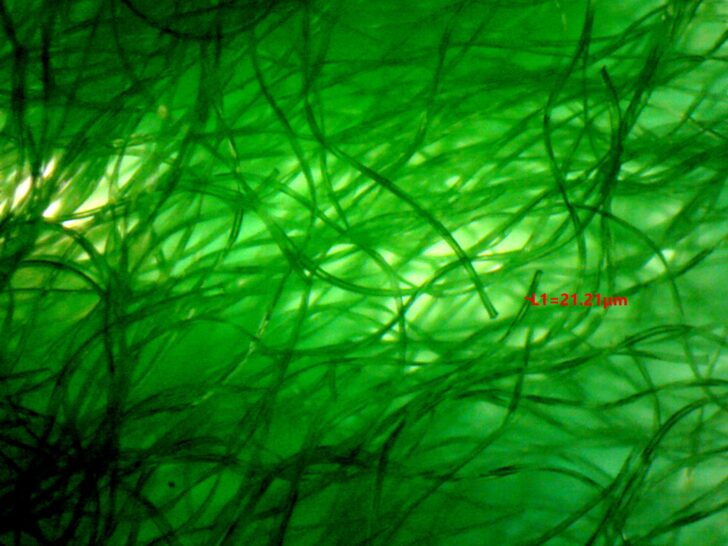
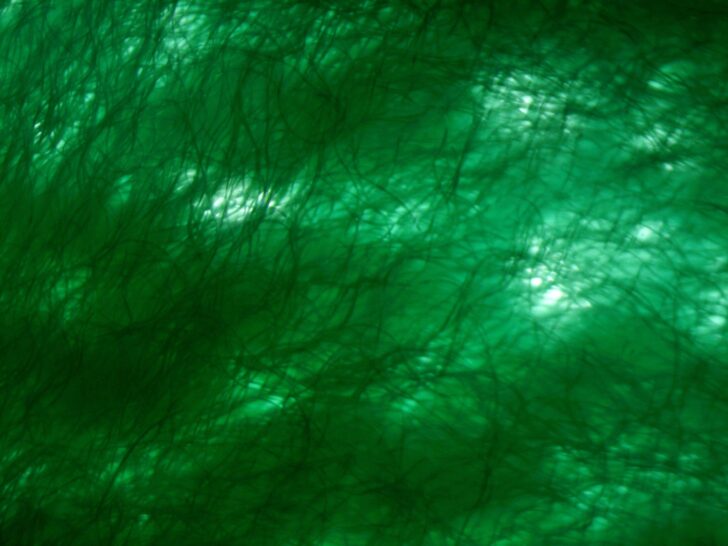
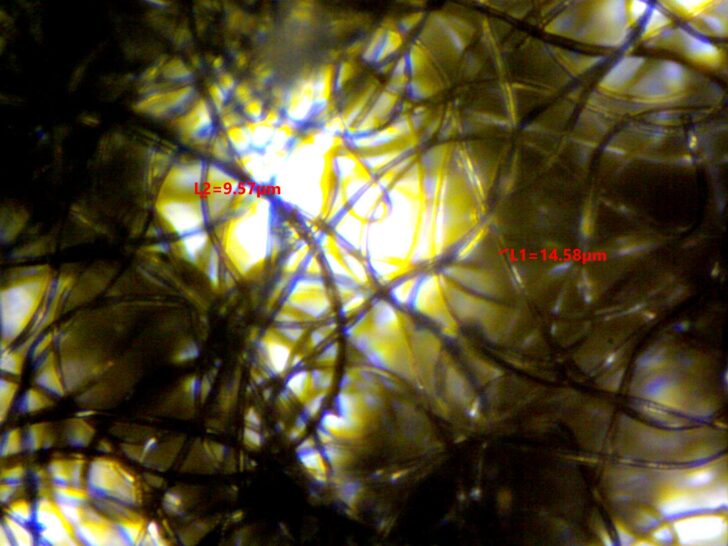
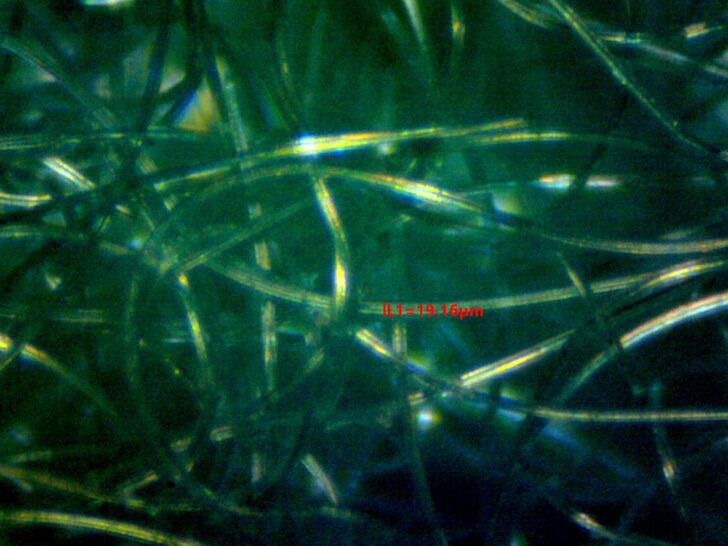
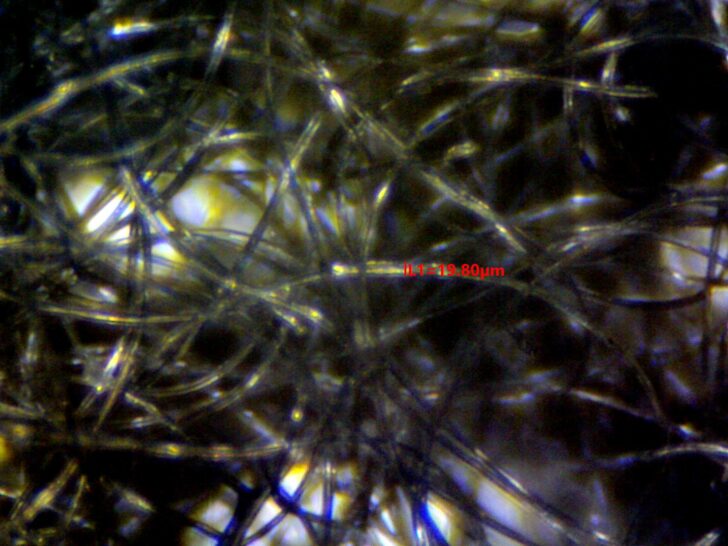
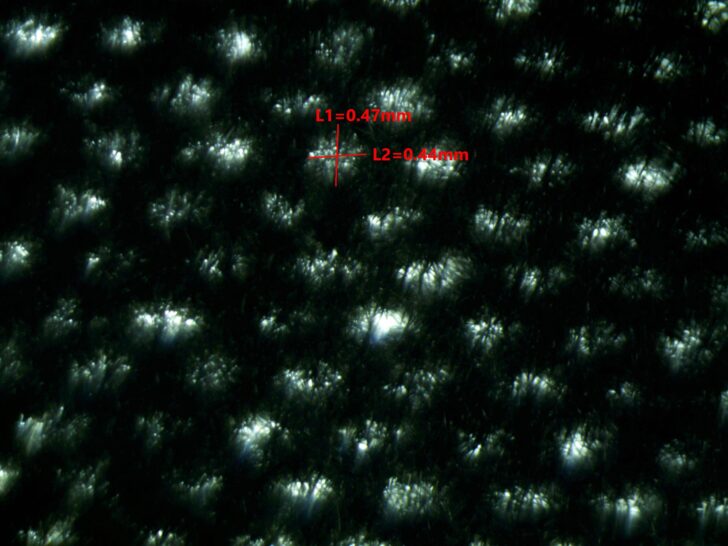
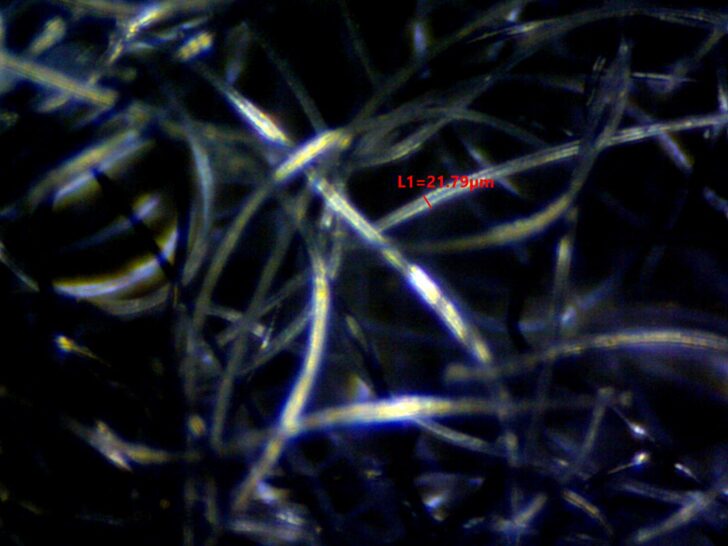
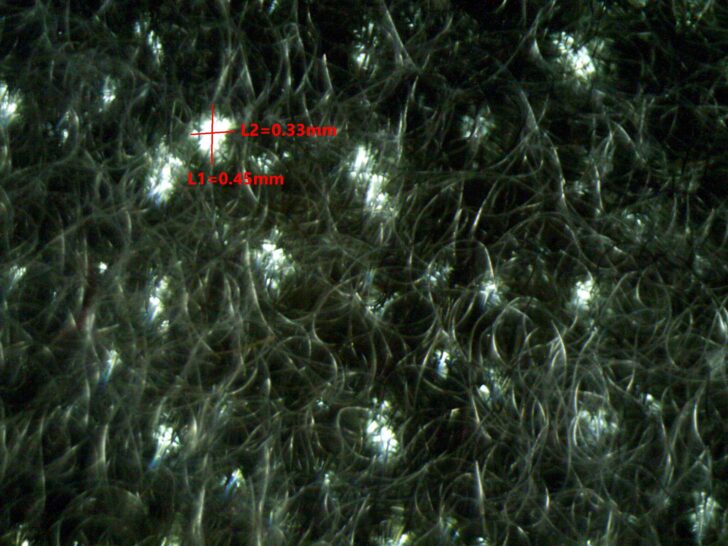
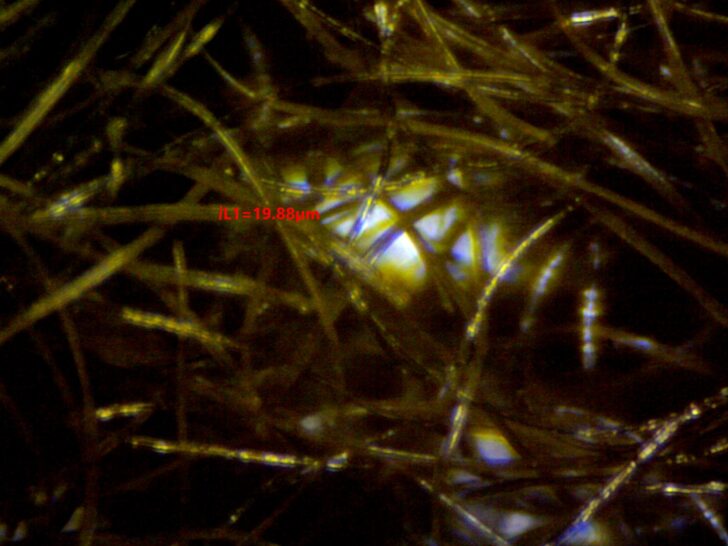
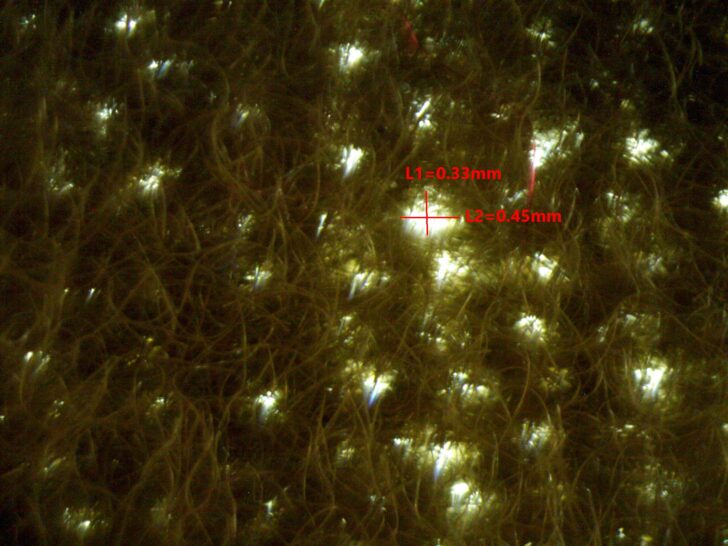
Selected photomicrographs are shown below:
Some of these samples are fairly dense, so the underlying core fabric structure from which the fibers are napped cannot be readily seen. The image for Thermal Pro Lightweight, low mag, shows the clearest image of the underlying structure because there is nearly no pile on this fabric. Typically, the fiber diameter is about 20 micrometers. This is comparable to fiber diameter in continuous filament batt insulations that we tested previously and in the middle-to-upper range of short-staple batt insulations that we tested previously.


Test Data
Table 2: Physical Dimensions
| Insulation | Insulation Type | Claimed Weight per Square Yard (oz) | Measured Area (sq yard) | Weight (oz) | Measured Weight per Square Yard (oz) | Approximate Loft (in) |
|---|---|---|---|---|---|---|
| Polartec 100 9180 Double Velour MY | Fleece | 9.6 | 1.83 | 15.05 | 8.22 | 0.247 |
| Polartec 200 7614 Double Velour MY | Fleece | 13.9 | 1.87 | 15.35 | 8.21 | 0.228 |
| Polartec 300 9381 FQ Double Velour MY | Fleece | 20.8 | 1.88 | 17.95 | 9.55 | 0.204 |
| Polartec 100 Pewter RW | Fleece | 9.6 | 1.89 | 10.45 | 5.53 | 0.16 |
| Polartec 200 Baby Blue RW | Fleece | 13.9 | 1.94 | 19.05 | 9.82 | 0.219 |
| Polartec 300 Coyote RW | Fleece | 20.8 | 1.74 | 19 | 10.92 | 0.155 |
| Ptec Thermal Pro Midweight HiLoft Grn MY | Fleece | 9.1 | 2.094 | 20.4 | 9.74 | 0.243 |
| Ptec Thermal Pro HiLoft Azurro MY | Fleece | 6.1 | 1.94 | 12.45 | 6.42 | 0.216 |
| Ptec Thermal Pro Lightweight Olive MY | Fleece | 5.4 | 1.97 | 11.25 | 5.71 | 0.104 |
| Ptec Thermal Pro 4230 Silver Extreme DF | Fleece | 9.1 | 2.18 | 19.2 | 8.81 | 0.234 |
Table 3: Thermal Resistance Data
| Insulation | Hot Plate Measured R value | Hot Plate Intrinsic Total Clo | Hot Plate Intrinsic Clo/oz /Yd2 | Hot Plate Intrinsic Clo/In | Hot Plate Intrinsic Clo/Oz/In **** | Claimed Clo/ Oz/Yd2 |
|---|---|---|---|---|---|---|
| Polartec 100 9180 Double Velour MY | 0.78 | 0.89 | 0.11 | 3.59 | 0.44 | 0.16* |
| Polartec 200 7614 Double Velour MY | 0.72 | 0.82 | 0.1 | 3.59 | 0.44 | 0.14* |
| Polartec 300 9381 FQ Double Velour MY | 0.59 | 0.67 | 0.07 | 3.29 | 0.34 | 0.11* |
| Polartec 100 Pewter RW | 0.54 | 0.61 | 0.11 | 3.83 | 0.69 | 0.16* |
| Polartec 200 Baby Blue RW | 0.65 | 0.74 | 0.08 | 3.37 | 0.34 | 0.14* |
| Polartec 300 Coyote RW | 0.46 | 0.52 | 0.05 | 3.37 | 0.31 | 0.11* |
| Ptec Thermal Pro Midweight HiLoft Grn MY | 0.72 | 0.82 | 0.08 | 3.37 | 0.35 | .185* |
| Ptec Thermal Pro HiLoft Azurro MY | 0.69 | 0.78 | 0.12 | 3.63 | 0.57 | .185* |
| Ptec Thermal Pro Lightweight Olive MY | 0.34 | 0.39 | 0.07 | 3.71 | 0.65 | .16* |
| Ptec Thermal Pro 4230 Silver Extreme DF | 0.69 | 0.78 | 0.09 | 3.35 | 0.38 | .21* |
* From manufacturer’s published specification. Precise calculation method unknown for all manufacturer’s claims
**** Based on measured thickness
In order to easily compare the performance of fleece insulation with batt insulation, we reproduce as Table 4 the thermal performance of batt insulation from the article By the Numbers: Thermal Performance Measurements of Synthetic Insulations.
Table 4: Thermal Performace of Batt and Knitt Insulations
| Insulation | Hot Plate Measured R value | Hot Plate Intrinsic Total Clo | Hot Plate Intrinsic Clo/oz /Yd2 | Hot Plate Intrinsic Clo/In **** | Hot Plate Intrinsic Clo/Oz/In | Claimed Clo | Watts Hot Plate |
|---|---|---|---|---|---|---|---|
| Climashield Apex 6oz | 3.03 | 3.44 | 0.58 | 2.41 | 0.41 | 0.82 oz/yd2* | 3.5 |
| Primaloft Gold 6oz | 2.94 | 3.34 | 0.47 | 3.09 | 0.43 | 0.92 oz/yd2*,*** | 3.5 |
| Climashield Apex 5oz | 2.5 | 2.84 | 0.59 | 2.81 | 0.59 | 0.82 oz/yd2* | 4.5 |
| Primaloft Gold 3oz | 1.57 | 1.78 | 0.55 | 2.97 | 0.91 | 0.92 oz/yd2*,*** | 5.3 |
| Thinsulate 200G CDS | 1.54 | 1.75 | 0.24 | 3.02 | 0.42 | 2.2R*,*** | 5.9 |
| Primaloft Silver 3oz | 1.23 | 1.4 | 0.45 | 2.54 | 0.82 | .79 oz/yd2*,*** | 6.8 |
| Climashield Apex 2.5oz | 1.07 | 1.22 | 0.51 | 3.12 | 1.32 | 0.82 oz/yd2* | 7.9 |
| Polartec Power Fill 100 | 0.87 | 0.99 | 0.36 | 3.19 | 1.15 | 1.2 Clo Total* | 8.8 |
| Freudenberg KHT | 0.86 | 0.98 | 0.49 | 2.57 | 1.28 | 1.35 Total* | 8.8 |
| Polartec Alpha | 0.54 | 0.61 | 0.2 | 2.56 | 0.84 | 0.87 Clo Total*,** | 11.3 |
| Polartec Alpha Direct | 0.36 | 0.41 | 0.15 | 2.27 | 0.84 | 12.9 |
* From manufacturer’s published specification. Precise calculation method unknown for all manufacturer’s claims.
**https://backpackinglight.com/forums/topic/56056/#post-2080930, alternate source claims .37 clo/oz/square yard
*** Scrim weight included in measured weight
**** Based on measured thickness
Discussion of Results
A number of issues are illustrated in these results.
- Compared to batt insulations tested previously, fleece provides relatively little warmth. Fleece ranges from R-0.34 to R-0.78, while the batt insulations that were tested provided R-0.86 to R-3.03.
- Compared to knit insulations previously tested, fleece provides similar thermal performance. The Alpha insulations previously tested ranged from R-0.36 to R-0.54. (Note: we tested mid-weight versions of Alpha and Alpha Direct. So somewhat lower or higher values should be found in lighter or heavier fabric weights.) Thus, one can conclude that Alpha insulations perform similarly to fleeces with one important exception – the Alpha insulations are considerably lighter. This can be seen from the Clo/oz/yd2 metrics. Alpha insulations can be less than half the weight of fleece.
- Compared with batt insulations, fleece is heavy. This may be seen, again, by comparing the clo/oz/yd2 metrics.
- When we compare the fleece weights, fleece sample names, and thermal performance, we find there is little agreement with our expectations that product weight (100, 200, 300 or lightweight, midweight or heavyweight) is related to warmth. We will look at this from a couple of angles.
Table 5 shows the fleece sample names, which include the weight class (100, 200, 300 or lightweight, midweight or heavyweight), the measured weight per square yard, the expected weight class, based on actual measured weight and referencing the weight class designations found in table 1, above, and finally, the measured clo/oz/yd2 value.
Table 5: Comparison of Actual and Expected Weight Class
| Insulation | Measured Weight per Square Yard (Oz) | Expected Weight Class per Table 1, based on measured weight | Hot Plate Intrinsic Clo/oz /Yd2 |
|---|---|---|---|
| Ptec Thermal Pro HiLoft Midweight Azurro MY | 6.4 | 200 | 0.12 |
| Polartec 100 Pewter RW | 5.5 | 100 | 0.11 |
| Polartec 100 9180 Double Velour MY | 8.2 | 200 | 0.11 |
| Polartec 200 7614 Double Velour MY | 8.2 | 200 | 0.1 |
| Ptec Thermal Pro 4230 Silver Extreme DF | 8.8 | 200 | 0.09 |
| Ptec Thermal Pro Midweight HiLoft Green MY | 9.7 | 300 | 0.08 |
| Polartec 200 Baby Blue RW | 9.8 | 300 | 0.08 |
| Polartec 300 9381 FQ Double Velour MY | 9.6 | 300 | 0.07 |
| Ptec Thermal Pro Lightweight Olive MY | 5.7 | 100 | 0.07 |
| Polartec 300 Coyote RW | 10.9 | 300 | 0.05 |
Based on product name, only 6 of 10 samples correspond to the expected weight class.
However, our expectation with fleece is that warmth and weight increase together. We would expect the highest weights and highest insulation values for class 300 products. We would also expect the lowest weights and lowest insulation values for the class 100 products. This is not what happens. Polartec 100 Pewter RW, the lightest fabric, has the second-highest thermal performance. The very lowest thermal performance goes to Polartec 300 Coyote RW, which is the heaviest fabric. The four heaviest fabrics are in the bottom five performers for warmth.
There is clearly a mismatch between product names and product performance.
Is there a way to determine product performance based on product physical characteristics? Absolutely.
Member Exclusive
A Premium or Unlimited Membership* is required to view the rest of this article.
* A Basic Membership is required to view Member Q&A events


Discussion
Become a member to post in the forums.
(Alpine Pandani have silicon dioxide razor blade leaves, like pampas grass)
You should try the Central Australia spinifex grass. Utterly deadly stuff. Goes through gaiters without pausing.
Cheers
Made another rookie error on the Larapinta. When I stop for a break and drop my pack, I like to lie horizontal, and can snooze rapidly with hat covering face to keep the sun off. Very relaxing and amuses friends when I start snoring after 30 seconds.
Turns out the Northern Territory flora is sharp enough to go straight through my trusty PFG shirt, so my mates pulled about 40 burrs/thorns out of my back.
Made sure to sit on a rock for any subsequent rest breaks :)
Some of the rocks on the McDonald Ranges (Larapinta) are glassy quartz/something, and they will slash you open just as easily.
Somewhere around here the rocks slashed both the side of my jogger and a bit of my gaiter.
Cheers
As many have stated, I find the combination of fleece and a windshirt a very good combination in damp cool climates.
You can hike all day in sprinkles/spray and feel comfortable. The fleece and windshirt layers will dry quick.
That is not so true with puffy jackets which tend to get soggy and retain more of the moisture for longer periods of time.
Roger, that looks like the bit of the Larapinta where one of our group twisted an ankle, joining the 2 knees and 1 wrist needing medical attention, from a group of 8 or 9 50-somethings!
Ironically, us oldies all did 100km or so of ‘highlights’ (some sections were closed after fires) and the only medevac was the 20 yr old guide who got severe gastro.
Another advantage of fleece is that rocks usually won’t cut it, and spinifex or Richea will go straight through, not leaving a hole for down to fall out. The trouble with needles like spinifex is they’ll go through a Kevlar butcher’s glove (or a steel mesh butcher’s glove, for that matter) so you can’t really protect your legs. Glad I’ve never sat on one.
Hi Ian
Yes, Larapinta Trail, end to end. No problems: walked carefully (in our 50s).
Spinifex: yeah, it penetrates. You only sit on it once. :)
Cheers
What wind shirt would be considered most effective and functional worn over the Alpha Direct 90? And is the weight of the BD Alpine Start too much? I’m considering having the Macpac Nitro with BD Alpine Start as my go suit, given the BDAS’s specs, however the weight is concerning. Would I be able to wear the BDAS the majority of the time (so as not to carry it) in this scenario in cooler colder months? Or should I look instead for a different breathable wind shirt that’s lighter (EE 7D?)? Thanks!
I suggest you read my two latest articles which will answer your question. The BDAS is not water proof. Air perm is too high for my taste. Its MVTR is excellent. I have not tested a Copperfield windshirt and no specs are published by EE. The Visp specs published by EE suggest that would be an excellent choice although I expect 7D might be less durable than a heavier fabric. I have not yet tested the Visp.
Stephen your input is much appreciated. I’ll go back and check out your articles. Often being in the Blue Ridge Mtns here around Asheville my needs may vary a bit from yours. Current setup is to carry a rain shell and a wind shirt (which is what I’m sourcing now). It’s humid here. I thought I had read you like the BDAS, or at least the CFM (40?) and MVTR, but I’ve read a lot and may have that confused with someone else. Thanks again!
I used to hike extensively in Blue Ridge National Park, before moving to Colorado. I have to admit, I don’t miss the humidity. However, the lushness of the forests there are a striking change from the arid mountains I now enjoy. In any case, I urge you to read my two latest articles because they deal in detail with the importance of MVTR and also, the ineffectiveness of elevated garment air permeability for the elimination of vapor from sweat. As you will see, selecting the proper rain layer will allow you to eliminate the wind layer while achieving equal or better moisture removal. That is not to say you will be comfortable in a summer rain in any garment while hiking at an elevated MET level, but you will obtain the best moisture removal under the widest range of conditions.
Steve, I think you’ll find that, hiking, the combination of Nitro (Alpha 90) plus windshirt (any windshirt, really) will be too warm unless it’s calm and <30F or windy and <50F, or thereabouts. Of course, you can separate the two and achieve comfort in a far greater range of temps. I’ve hiked OK in 60F with Alpha 90 with nothing on it, and managed with fully zipped down windshirt over the top with 20+ winds at those temps. But unless it’s quite cold, I think you’ll end up carrying the Alpine Start quite a bit. The Alpine Start is my favorite windshirt and I wear it for nearly every day hike spring, winter, fall (unless winds are consistently 20+ mph). But unless you really need its durability, it is probably too heavy compared to much lighter shirts (2-3 ounces) if it will be riding in your pack much of the time. I rarely take mine backpacking unless I’ll be spending lots of time off trail.
Stephen, very interesting with some contrarian take-always! It’s great pursuing objectivity over confirmation bias :)
Still, net/net, you didn’t seem to hate the BD Alpine Start (but yeah, I understand now that the permeable price lacks advantages). Great reads. Grateful for the work you put into this and the value yield to layman like myself. So, excluding rain shells, if you hiked in Appalachian mtns in temp 20-60F in a Macpac Nitro, what wind shirts (recon high MVTR & relatively low air perm) would you prefer? Or if not brand/model, then what CFM? Seems 35 is no longer the “goldilocks” number, huh? Thanks. I’ve got some Alpha Direct 90 in the pipe and will likely (maybe?) return the new BD Alpine Start. PS – if you ever want another hike in the thick mountain Laurel popping out at balds in Pisgah ping me ;)
I’ll add I like the logic that lines up with your science. We’re simply not walking fast enough for CFM to even register in the equation, so the primary component is the MVTR. Much appreciated.
Stumphges – really appreciate the feedback. That’s exactly what I’m aiming for – hike in the Nitro 30 – 60* with a wind shirt ready to deploy. So if it’s mostly in/on the pack, lighter is better (may keep the BDAS for day hikes but focus here for me is overnights). I do like the feel of the thin soft-shell. Now I just need to narrow down my wind shirt – with consideration or the new data MVTR matters more then CFM.
Steve, you summed up the issue with air permeability in one sentence! I agree with Stumphges. On my summer hikes here, with the sun shining, I tend to be in shorts and short sleeves above mid 50’s. I produce enough heat just from hiking up the mountains and trotting down. When the wind is blowing, I will wear either a Rab Flash or Shakedry shell depending on temperature. I won’t wear both unless the temperature is below 40 and the wind is really blowing. The combination of the two, with a very light short sleeve base shirt, will take me down to 30F. As Stumphges pointed out, the ability to separate the two layers gives a lot of flexibility. I have no interest in a windshirt for my use. I get better performance with a light rain shell with very high MVTR, full front zip and pit zips than any windshirts I have tried. I am very happy with my Montbell Shakedry shell with after market pit zips. Another good choice is the EE Visp (which I have not tested yet) or, if you want a separate wind shell, the OR Helium wind hoody has MVTR almost at good as the BDAS, much better HH, and lower air permeability and lower weight ( you can look up the weight for both).
Thank you for the thorough follow-up. I’ll research these products (side not – I thought shakedry had a high CFM, again I’ll do my homework). Is your MB the “Peak”. How do you feel about the Versalite?
Hard to justify when my current shell (heavy, 11 oz) Arcteryx Zeta SL is in perfect condition (w/o pit zips). Wonder what the CFM and MVTR are for the Zeta (Gore paclite plus I think). Maybe cut some pit zips and run with it for a bit. Seems gore’s trying to get shakedry more “durable”. I am squeezing down over grown trail with rhododendron and mountain Laurel at times – some concern for shakedry’s outer design. And of course the pack.
I do appreciate your position on using the rain shell for a wind shirt. Honestly I’ve been hesitant to only carry a mostly waterproof shell around here. It can really rain. Don’t want to be stupid light. But nor do I want to be stupid. An 11 oz rain shell plus a wind shirt is not the ultimate solution.
Gore-Tex Paclite Plus (on my Zeta SL) utilizes a 2-layer unlined construction. Any idea what the MVTR and CFM are? I can’t find it and posed the question to ArcTeryx but have not recd a reply yet. Maybe having pit zips added would be a short term solution. Thanks!
Hi Steve: Paclite Plus performance, like all Goretex fabrics is greatly impacted by the denier weight of the face fabric. I have measured MVTR for PacLite from 1500 to just below 2000. By comparison, Gore Pro with 40D face fabric is 2800. I think best performance is achieved over 3000 on the scale of my test. All Gore fabrics that I have tested are air impermeable. I consider a garment to be impermeable at <5 cfm/ft2 (a limit set by Patagonia). In reality, it is usually lower than I can measure and I can measure down to around .5 cfm/ft2 on my instrumentation. To make it even less suitable, there are no pit zips. Today, I descended about 3 miles in steady light rain. Temp varied from 50F to nearly 60F as I descended. Pit zips were open and I was comfortable in my Shakedry jacket. Its MVTR is around 3400 and the pit zips were open. Winds were calm. I was comfortable and dry in my Shakedry jacket. I am confident I would have been pretty sweaty in a Paclite under the circumstances, especially without pit zips.
Stephen, thanks. I kinda expected that. Funny, you’re decent, made me wonder if you’re cursed or blessed, always calculating garment performance on every hike ;)
Your shakedry, w after market pit zips, comes in at $325. What do you like between the Versalite and Visp (both at $200, w pit zips). Hope to leave you alone soon :). Thanks!
Steve–Yes, kind of expensive, but, worth it to me given the amount of use I get out of it. It is a real shame they don’t make it with pit zips. I used the Versalite jacket for a couple of years and retired it when I got the Shakedry jacket. Using Shakedry resulted in a substantial increase in weather conditions I could hike in without adjusting layers, as compared to the Versalite. All that difference is because of the big jump in MVTR. Of course, I don’t have to worry about DWR issues with the Shakedry. I don’t have to worry about abrasion on vegetation where I hike–I am on trails or above tree line. I do have to worry about abrasion on rocks, and am careful in this regard. For my purposes, the MVTR of Versalite is simply not high enough. Visp might be a great solution. I simply have not tested one. I hope to receive one shortly to test and, if it does well, it should be a good solution. However, at 7 denier, will it hold up better than Shakedry? I don’t know and perhaps someone with experience using a Visp can chime in. Andrew Marshall did a review of Visp. You can see what he said. https://backpackinglight.com/enlightened-equipment-visp-rain-jacket-review/
Thanks Stephen, there are always trade-offs. Having just invested heavily in a new shelter, bag, pack, pad, etc to get light, and having a good although heavy ArcT shell, it’s hard to justify the $325 (yet). Given the MVTR of the Visp compared to the Versalite I’m leaning that way (now anyway). I did read the BPL Visp review, and also Philip Werner’s at Section Hiker – where his wetted out quickly (errr). But I really appreciate your comprehensive contact and you taking the time for my personal decisions. Thanks for that. Whatever I acquire, if my experience is relevant to your research I’ll fill you in. At some point you just have to make a decision, roll with it and see how it does in the field. At times I do have some narrow, overgrown trails so with a 7D jacket maybe I’ll take my 3 oz fauxdini in those cases for a temp protective layer. I look forward to reading more of your work. Good hiking. Steve
Rethinking carrying an extra base layer. Carrying an extra base layer bottom for emergency (or planned) winter overnight weighs 6.2 oz (Smartwool 150). I am currently ordering some custom down pants. I can request any amount of down. Pants are approx. 1 square yard. I am thinking better to add an ounce of down (adds 2 CLO at 2 CLO/oz/yd2) rather than carry my extra 6.2 oz merino pants (0.85 CLO/oz/yd2 or about 0.53 CLO). The down is 4 x warmer at 1/6th the weight. However, I also realize the down may not fit as snugly at ankles and waist and thus allow more air flow. Feedback appreciated on this — thanks in advance.
We have only ever carried one base layer set.
We don’t find our legs get all that cold when we are in bed.
If I had to choose – difficult. Could the down bottom be TOO warm sometimes?
Cheers
Thanks. Clarification: I have a verio 3/4 bag (insulation at legs only rated to 25F) and would use with very warm down parka. Anticipated weather is 0-5F at night. Looking for getting through night with some sleep — not comfort.
4x warmer at 1/6 the weight – exactly!
use down to stay warm
have a base layer to absorb body oils and protect the down. Probably more comfortable against skin. It seems like discussions about which fleece provides how much warm is sort of misdirected.
I think I’d use a full size quilt or bag at 0 – 5 F
I also have a little synthetic insulation. twice the weight of down for the same weight. But it stays warmer if wet. Sort of a survival item.
Become a member to post in the forums.