



Introduction
In an earlier article, we focused on batt-type insulation as well as two knit active insulations. We covered how these insulations are manufactured, their benefits, and their drawbacks. We covered issues related to how the insulating value of the insulations are measured by the industry. We presented the results of our measurements of thermal resistance for 10 insulation products.
In this article, we will focus on an important synthetic insulation category: fleece.
We will concentrate on two aspects of fleece that are often discussed when comparing fleece garments with those insulated with synthetic non-wovens or down – weight and warmth. Our testing determined that fleece warmth/weight performance simply cannot compete with the performance of batt type insulations or even that of its fleece cousin, Polartec Alpha. The average of fleeces we tested, which included all weights (except micro), was 0.09 clo/oz./yd2. The average of non-woven insulations we tested was 0.42 clo/oz./yd2. When you compare the warmth-to-weight of finished jackets, the warmth-to-weight ratio of fleece seems to pale next to other technologies.
Editor’s Note: If you’d like a detailed explanation of “clo,” see Stephen’s earlier article.
I have two fleece jackets. For each, the clo/oz. is 0.03. If we look at an average of 12 active insulation jackets, the average for these jackets, which offer competitive performance with fleece is 0.07 clo/oz. One other thing that we found in our examination of 10 different Polartec fleece samples: there is no relationship between fleece weight and fleece warmth!
A Very Brief History of Fleece
Malden Mills was a manufacturer of pile baby bunting and pile toilet seat cover fabrics. Pile fabrics are produced as both woven and knitted fabrics using natural, synthetic, and blended fibers. The key to forming pile is brushing or napping the fabric core structure, raising fibers from the core. The raised fibers produced synthetic fur. The fibers can be trimmed to control the pile height and uniformity and also produce a variety of patterns and textures.
Patagonia was an early adopter of pile fabrics for outdoor wear. Pile fabric provided an alternative to woolen fabrics with advantages in weight, water resistance, and cost. Patagonia worked with Malden Mills to adapt their pile fabrics to the demands of active outdoor activities. In 1985, Patagonia marketed their new products as Synchilla. Malden Mills produced their product under the trade name PolarFleece and Polar Plus. Patagonia grew rapidly after the introduction of its fleece products.
In 1995, Malden Mills suffered a devastating fire at its Massachusetts mill and after rebuilding, faced various financial challenges. Malden Mills went through multiple bankruptcies and was purchased by venture capital firm Versa Capital Management in 2007, which renamed the company Polartec. Polartec was sold in 2019 to Milliken & Company. Along the way, Polartec moved its manufacturing to plants in New Hampshire, Tennessee, China, and Italy.
Although Malden Mills invented synthetic fleece, the company never patented its product. As a result, a variety of manufacturers developed the ability to produce competing products.
Fleece Weights
Polartec Classic Fleece comes in four basic weights: Microfleece, 100, 200, and 300 weights. Table 1 lists the weight range for each weight class as well as equivalent weight classes for Polartec Thermal Pro, Patagonia, and The North Face. (Thermal Pro is manufactured by Polartec and provides a wide variety of surface textures and patterns not incorporated into its “Classic” line of products.)
Table One: Fleece Weights and Equivalents
| Weight Class | Grams/Sq Meter | Oz/Sq Yard | Thermal Pro Equivalent | Patagonia Equivalent | The North Face Equivalent |
|---|---|---|---|---|---|
| Microfleece | <100 | <3 | |||
| 100 | 100-200 | 3-6 | Lightweight | R1 | TKA100 |
| 200 | 200-300 | 6-9 | Midweight | R2 | TKA200 |
| 300 | >300 | >9 | Heavyweight | R3 | TKA300 |
In principle, the higher the weight designation, the heavier and warmer the fleece product will be. We shall see below; this is not necessarily the case.
Test Procedures
- The 1 yard samples were measured for area and then weighed on an A&D SJ-2000HS digital bench scale.
- 10 samples of fleece were obtained from three vendors: Mill Yardage (ML), Rockywoods (RW) and Discovery Fabrics (DF).
- Two test samples were cut from each 1 yard fabric: one across the roll (perpendicular to machine direction); one in the machine direction.
- The thickness of each sample was measured using a Mitutoyo Absolute Digital Caliper and an iGAGING digital thickness gauge. Approximately 12 measurements were taken around the perimeter of each sample.
- The intrinsic thermal resistance (R-value) for each sample was measured on the Guarded Hot Plate. Each sample was tested twice. The Guarded Hot Plate was set to 100 F (38 F). The room ambient during the test was 70 F + 1 F (21 C). The duration of each test was 1 hour. Each sample was heated on the hot plate for 20 minutes prior to starting the test. A detailed discussion of the hot plate and its operation may be found here: The hot plate discussion starts on page 14.
- The thermal resistance values from each of four tests were averaged together to obtain the listed results.
- An infrared image was obtained for each sample at the conclusion of each test.
- Photomicrographs were obtained for selected samples to illustrate construction.
Insulation test results are provided in the two tables below. Table 2 provides the physical data for each insulation. Table 3 table provides the measured results and comparative metrics. Four metrics are provided. All are based on Intrinsic values with the air film resistance removed.
Editor’s Note: for an explanation of intrinsic clo values, see Stephen’s earlier article.
The metrics are:
- Measured R-value. This is the result for the piece of insulation tested.
- Intrinsic Clo. This is simply the measured R-value x 1.136.
- Intrinsic clo/oz/yd2. This is Intrinsic clo divided by the measured (not claimed) weight per square yard. This metric will give you the most efficient insulator based on weight.
- Intrinsic clo/inches. This is Intrinsic clo divided by the measured (not claimed) insulation thickness. This metric will give you the most efficient insulation based on volume.
- Intrinsic clo/oz/inch. This is Intrinsic clo divided by weight and thickness. It identifies the most efficient insulation in terms of both weight and thickness.
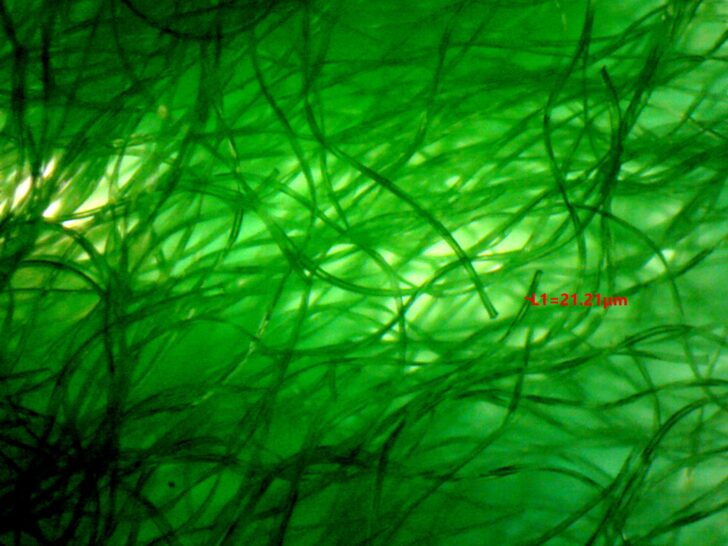
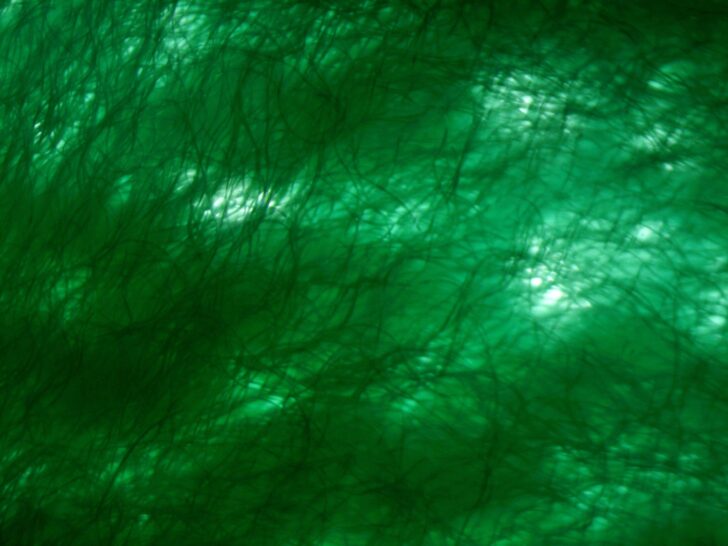
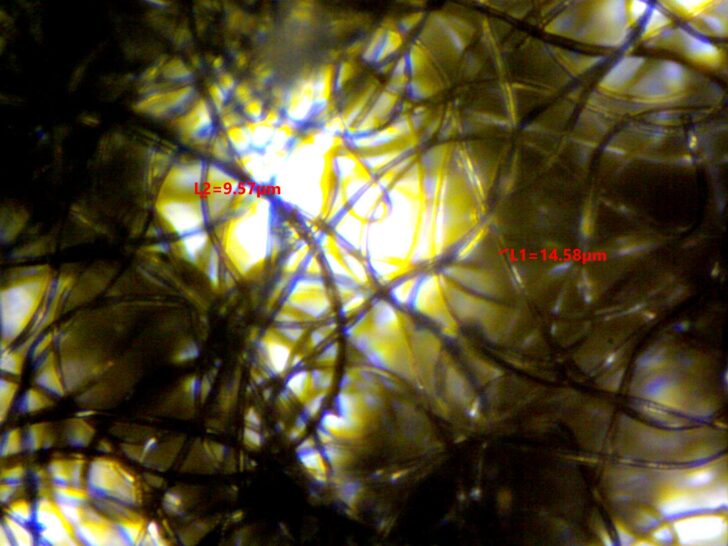
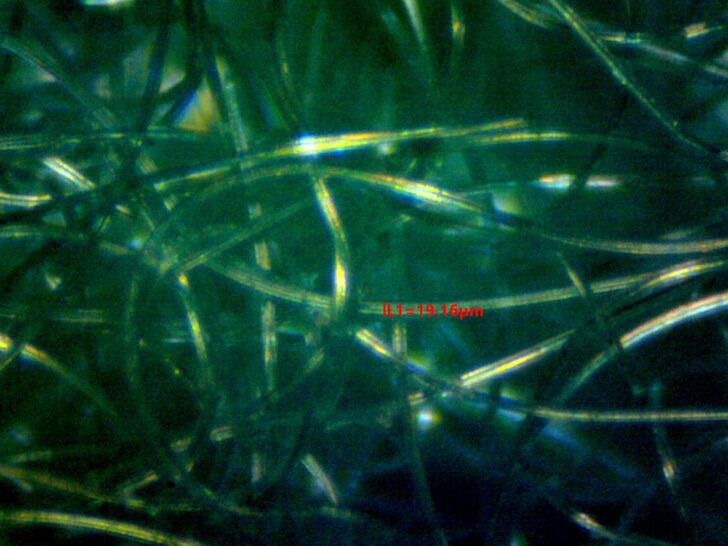
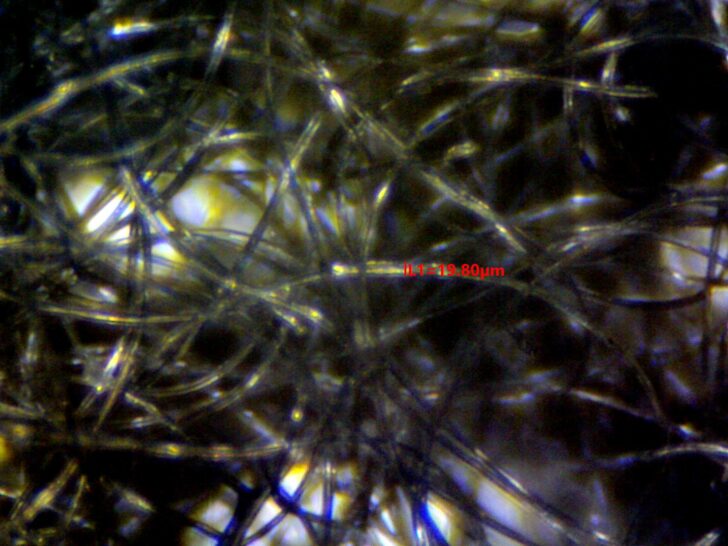
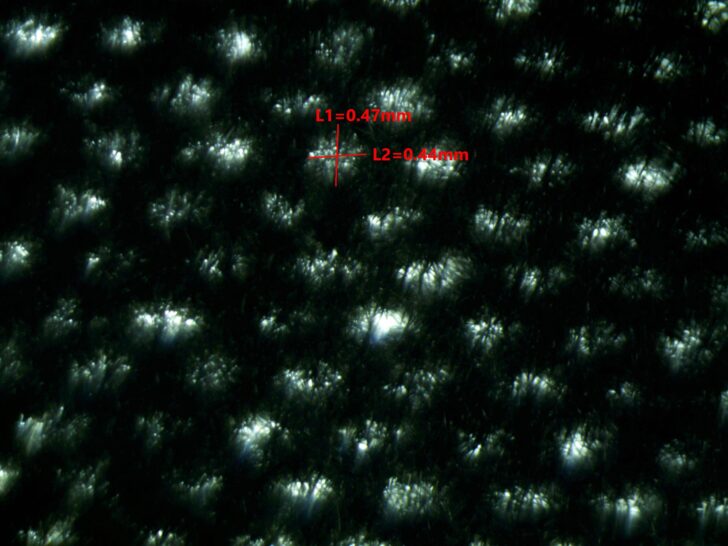
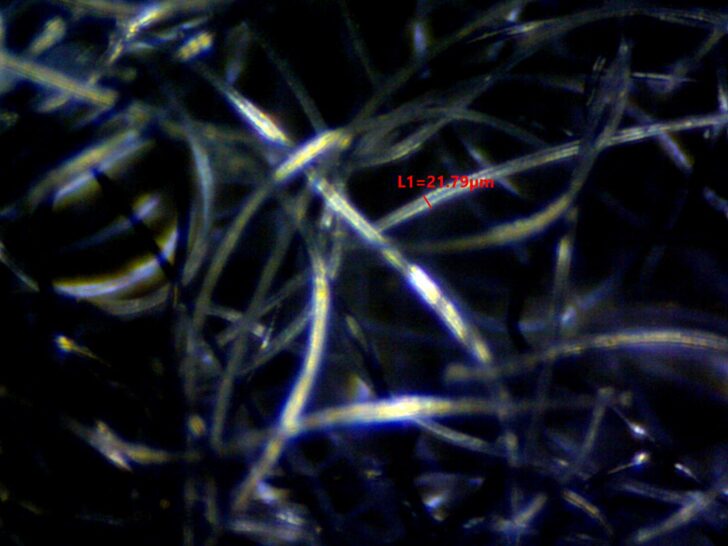
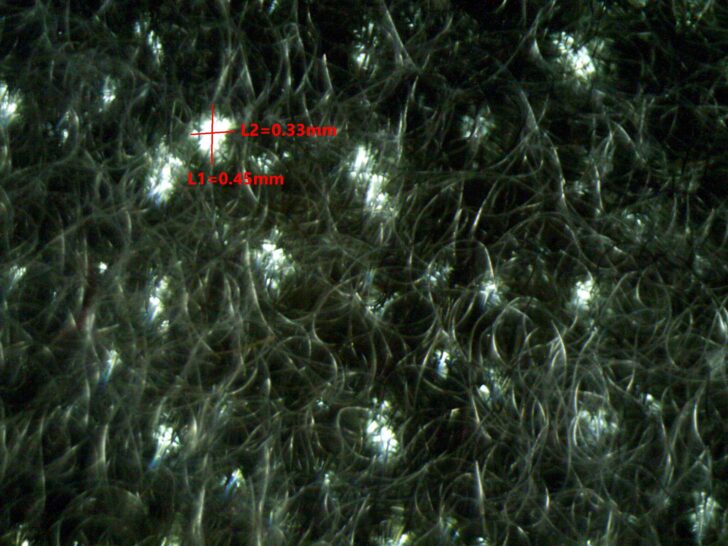
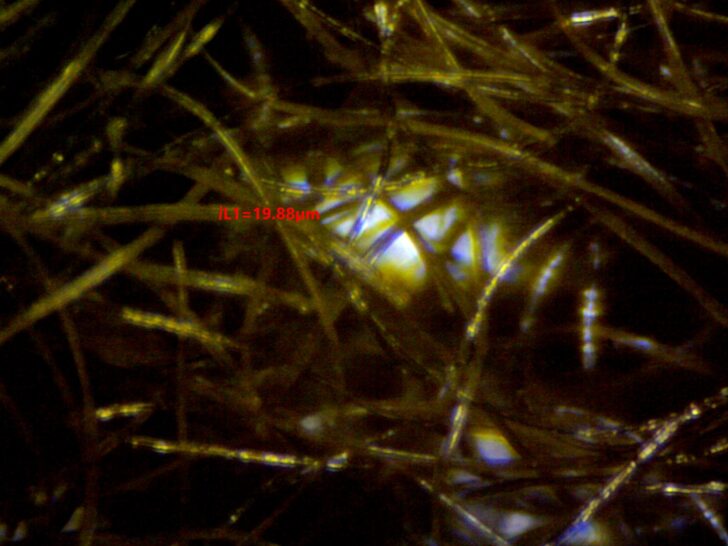
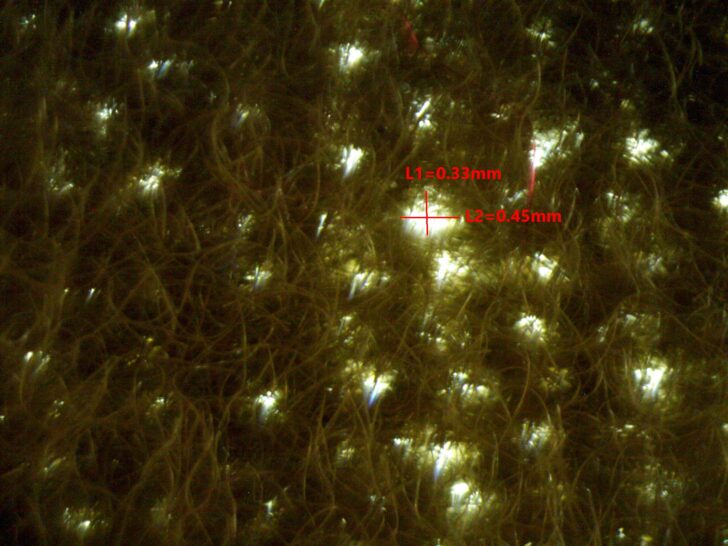
Selected photomicrographs are shown below:
Some of these samples are fairly dense, so the underlying core fabric structure from which the fibers are napped cannot be readily seen. The image for Thermal Pro Lightweight, low mag, shows the clearest image of the underlying structure because there is nearly no pile on this fabric. Typically, the fiber diameter is about 20 micrometers. This is comparable to fiber diameter in continuous filament batt insulations that we tested previously and in the middle-to-upper range of short-staple batt insulations that we tested previously.


Test Data
Table 2: Physical Dimensions
| Insulation | Insulation Type | Claimed Weight per Square Yard (oz) | Measured Area (sq yard) | Weight (oz) | Measured Weight per Square Yard (oz) | Approximate Loft (in) |
|---|---|---|---|---|---|---|
| Polartec 100 9180 Double Velour MY | Fleece | 9.6 | 1.83 | 15.05 | 8.22 | 0.247 |
| Polartec 200 7614 Double Velour MY | Fleece | 13.9 | 1.87 | 15.35 | 8.21 | 0.228 |
| Polartec 300 9381 FQ Double Velour MY | Fleece | 20.8 | 1.88 | 17.95 | 9.55 | 0.204 |
| Polartec 100 Pewter RW | Fleece | 9.6 | 1.89 | 10.45 | 5.53 | 0.16 |
| Polartec 200 Baby Blue RW | Fleece | 13.9 | 1.94 | 19.05 | 9.82 | 0.219 |
| Polartec 300 Coyote RW | Fleece | 20.8 | 1.74 | 19 | 10.92 | 0.155 |
| Ptec Thermal Pro Midweight HiLoft Grn MY | Fleece | 9.1 | 2.094 | 20.4 | 9.74 | 0.243 |
| Ptec Thermal Pro HiLoft Azurro MY | Fleece | 6.1 | 1.94 | 12.45 | 6.42 | 0.216 |
| Ptec Thermal Pro Lightweight Olive MY | Fleece | 5.4 | 1.97 | 11.25 | 5.71 | 0.104 |
| Ptec Thermal Pro 4230 Silver Extreme DF | Fleece | 9.1 | 2.18 | 19.2 | 8.81 | 0.234 |
Table 3: Thermal Resistance Data
| Insulation | Hot Plate Measured R value | Hot Plate Intrinsic Total Clo | Hot Plate Intrinsic Clo/oz /Yd2 | Hot Plate Intrinsic Clo/In | Hot Plate Intrinsic Clo/Oz/In **** | Claimed Clo/ Oz/Yd2 |
|---|---|---|---|---|---|---|
| Polartec 100 9180 Double Velour MY | 0.78 | 0.89 | 0.11 | 3.59 | 0.44 | 0.16* |
| Polartec 200 7614 Double Velour MY | 0.72 | 0.82 | 0.1 | 3.59 | 0.44 | 0.14* |
| Polartec 300 9381 FQ Double Velour MY | 0.59 | 0.67 | 0.07 | 3.29 | 0.34 | 0.11* |
| Polartec 100 Pewter RW | 0.54 | 0.61 | 0.11 | 3.83 | 0.69 | 0.16* |
| Polartec 200 Baby Blue RW | 0.65 | 0.74 | 0.08 | 3.37 | 0.34 | 0.14* |
| Polartec 300 Coyote RW | 0.46 | 0.52 | 0.05 | 3.37 | 0.31 | 0.11* |
| Ptec Thermal Pro Midweight HiLoft Grn MY | 0.72 | 0.82 | 0.08 | 3.37 | 0.35 | .185* |
| Ptec Thermal Pro HiLoft Azurro MY | 0.69 | 0.78 | 0.12 | 3.63 | 0.57 | .185* |
| Ptec Thermal Pro Lightweight Olive MY | 0.34 | 0.39 | 0.07 | 3.71 | 0.65 | .16* |
| Ptec Thermal Pro 4230 Silver Extreme DF | 0.69 | 0.78 | 0.09 | 3.35 | 0.38 | .21* |
* From manufacturer’s published specification. Precise calculation method unknown for all manufacturer’s claims
**** Based on measured thickness
In order to easily compare the performance of fleece insulation with batt insulation, we reproduce as Table 4 the thermal performance of batt insulation from the article By the Numbers: Thermal Performance Measurements of Synthetic Insulations.
Table 4: Thermal Performace of Batt and Knitt Insulations
| Insulation | Hot Plate Measured R value | Hot Plate Intrinsic Total Clo | Hot Plate Intrinsic Clo/oz /Yd2 | Hot Plate Intrinsic Clo/In **** | Hot Plate Intrinsic Clo/Oz/In | Claimed Clo | Watts Hot Plate |
|---|---|---|---|---|---|---|---|
| Climashield Apex 6oz | 3.03 | 3.44 | 0.58 | 2.41 | 0.41 | 0.82 oz/yd2* | 3.5 |
| Primaloft Gold 6oz | 2.94 | 3.34 | 0.47 | 3.09 | 0.43 | 0.92 oz/yd2*,*** | 3.5 |
| Climashield Apex 5oz | 2.5 | 2.84 | 0.59 | 2.81 | 0.59 | 0.82 oz/yd2* | 4.5 |
| Primaloft Gold 3oz | 1.57 | 1.78 | 0.55 | 2.97 | 0.91 | 0.92 oz/yd2*,*** | 5.3 |
| Thinsulate 200G CDS | 1.54 | 1.75 | 0.24 | 3.02 | 0.42 | 2.2R*,*** | 5.9 |
| Primaloft Silver 3oz | 1.23 | 1.4 | 0.45 | 2.54 | 0.82 | .79 oz/yd2*,*** | 6.8 |
| Climashield Apex 2.5oz | 1.07 | 1.22 | 0.51 | 3.12 | 1.32 | 0.82 oz/yd2* | 7.9 |
| Polartec Power Fill 100 | 0.87 | 0.99 | 0.36 | 3.19 | 1.15 | 1.2 Clo Total* | 8.8 |
| Freudenberg KHT | 0.86 | 0.98 | 0.49 | 2.57 | 1.28 | 1.35 Total* | 8.8 |
| Polartec Alpha | 0.54 | 0.61 | 0.2 | 2.56 | 0.84 | 0.87 Clo Total*,** | 11.3 |
| Polartec Alpha Direct | 0.36 | 0.41 | 0.15 | 2.27 | 0.84 | 12.9 |
* From manufacturer’s published specification. Precise calculation method unknown for all manufacturer’s claims.
**https://backpackinglight.com/forums/topic/56056/#post-2080930, alternate source claims .37 clo/oz/square yard
*** Scrim weight included in measured weight
**** Based on measured thickness
Discussion of Results
A number of issues are illustrated in these results.
- Compared to batt insulations tested previously, fleece provides relatively little warmth. Fleece ranges from R-0.34 to R-0.78, while the batt insulations that were tested provided R-0.86 to R-3.03.
- Compared to knit insulations previously tested, fleece provides similar thermal performance. The Alpha insulations previously tested ranged from R-0.36 to R-0.54. (Note: we tested mid-weight versions of Alpha and Alpha Direct. So somewhat lower or higher values should be found in lighter or heavier fabric weights.) Thus, one can conclude that Alpha insulations perform similarly to fleeces with one important exception – the Alpha insulations are considerably lighter. This can be seen from the Clo/oz/yd2 metrics. Alpha insulations can be less than half the weight of fleece.
- Compared with batt insulations, fleece is heavy. This may be seen, again, by comparing the clo/oz/yd2 metrics.
- When we compare the fleece weights, fleece sample names, and thermal performance, we find there is little agreement with our expectations that product weight (100, 200, 300 or lightweight, midweight or heavyweight) is related to warmth. We will look at this from a couple of angles.
Table 5 shows the fleece sample names, which include the weight class (100, 200, 300 or lightweight, midweight or heavyweight), the measured weight per square yard, the expected weight class, based on actual measured weight and referencing the weight class designations found in table 1, above, and finally, the measured clo/oz/yd2 value.
Table 5: Comparison of Actual and Expected Weight Class
| Insulation | Measured Weight per Square Yard (Oz) | Expected Weight Class per Table 1, based on measured weight | Hot Plate Intrinsic Clo/oz /Yd2 |
|---|---|---|---|
| Ptec Thermal Pro HiLoft Midweight Azurro MY | 6.4 | 200 | 0.12 |
| Polartec 100 Pewter RW | 5.5 | 100 | 0.11 |
| Polartec 100 9180 Double Velour MY | 8.2 | 200 | 0.11 |
| Polartec 200 7614 Double Velour MY | 8.2 | 200 | 0.1 |
| Ptec Thermal Pro 4230 Silver Extreme DF | 8.8 | 200 | 0.09 |
| Ptec Thermal Pro Midweight HiLoft Green MY | 9.7 | 300 | 0.08 |
| Polartec 200 Baby Blue RW | 9.8 | 300 | 0.08 |
| Polartec 300 9381 FQ Double Velour MY | 9.6 | 300 | 0.07 |
| Ptec Thermal Pro Lightweight Olive MY | 5.7 | 100 | 0.07 |
| Polartec 300 Coyote RW | 10.9 | 300 | 0.05 |
Based on product name, only 6 of 10 samples correspond to the expected weight class.
However, our expectation with fleece is that warmth and weight increase together. We would expect the highest weights and highest insulation values for class 300 products. We would also expect the lowest weights and lowest insulation values for the class 100 products. This is not what happens. Polartec 100 Pewter RW, the lightest fabric, has the second-highest thermal performance. The very lowest thermal performance goes to Polartec 300 Coyote RW, which is the heaviest fabric. The four heaviest fabrics are in the bottom five performers for warmth.
There is clearly a mismatch between product names and product performance.
Is there a way to determine product performance based on product physical characteristics? Absolutely.
Member Exclusive
A Premium or Unlimited Membership* is required to view the rest of this article.
* A Basic Membership is required to view Member Q&A events


Discussion
Become a member to post in the forums.
I have the Peloton and the Delta; the Delta utilizes a grid type fleece so probably moves moisture a little better, the Peloton is more “traditional” fleece and is probably as warm as the Delta, but a fair bit lighter.
So if weight/warmth are higher priorities, go Peloton; if moving moisture is more important- the Delta, no experience with the other two.
I have tried a bunch of the fancy fleeces, and none of them are as good or as light as the cheap, no name brand one I received as a gift some years back. I think it was purchased at JC Penney or Sears or something. I’ll probably have it the rest of my life; I wear it on every backpacking trip and it shows no wear.
So all that to say, check the thrift store first?
Thanks for the analysis! The observations about label/weight vs. warmth are particularly interesting.
In short (and IMO), fleece is for when you are moving (not stopped) – particularly if you are dealing with moisture and environmental hazards like thorns, rocks, etc. that are likely to come into contact with the piece.
Most of the comparisons in the article seem to be between fleece and static insulators. IMO, those are performing two very different functions – especially for folks who run very warm and sweaty like me. Even the jackets I’ve had with relatively low weights of apex/primaloft have been too warm / not breathable enough to wear while moving.
As others have said, fleece vs. active insulation seems like a better comparison, since in theory they are targeting the same type of use. Although for me active insulation pieces are often still too warm / not breathable enough for the temps around here (down to about 0F).
I’m a big fan of alpha direct, and some folks are making standalone alpha direct pieces with no inner or outer fabrics – they are incredibly warm for the weight and breathe extremely well, though fleece would be more durable if you are wearing it as an outer layer.
I’d be interested to see how the Octa insulation compares. I’ve had two jackets with it (Proton FL, Norrona Falketind Octa) and it seems pretty warm for the weight and less subject to compression damage than apex/primaloft.
Octa is an interesting concept. The polyester fibers are extruded to have 8 fins around a hollow core. The Octa fiber can trap air internally and within the spaces produced by the fins. There are other hollow polyester fibers around. I cannot test this stuff on its own without destroying a jacket, so that is probably not going to happen. This stuff is inherently low or no loft, so will be of limited value as an insulator. It may support good MVTR on its own, but that capability is mitigated by the face fabric used in the Proton FL. From what I have seen, the implementation into a woven fabric differs substantially between the Proton FL and the Norrona Falketind Octa (which I have not physically seen). As used in the Proton FL, it just seems like a means for trapping an air layer between two fabrics. I doubt it has much insulation ability on its own in the FL, which has the lowest thermal resistance of any active insulation piece I have tested. Looking at pictures of the Norrona, its Octa lining appears woven or knitted to achieve some loft, but again, not much. I share your appreciation of Alpha Direct as a midlayer insulator. Good warmth to weight ratio and the drape of the fabric causes it to cling to you in a way that no batt insulation can. Great MVTR. I will be posting an article on active insulation pieces that will address the issues you have mentioned. I will see if I can include a Norrona Falketind Octa in that study.
Is the peloton fleece really ‘fleece’? And is Toray a brand or the name of the designer, manufacturer?
I have owned the 97 for @ 3 years and really like it. Versatile, extremely light, compactible. Good with a proper base layer and shell for movement in wetter windy climes to @ or maybe just below freezing. Maybe lower in dry climes with high exertion.
But the stuff is not like any other fleece I’ve seen, felt or owned. More like some kind of dense but stretchy foam or something.
And I thought ‘Toray” specifically referred to the fabric with all the regularly spaced holes in the weave. I have a toray tiburon dot-air pullover zip-neck and it’s the best sun-shirt I’ve owned /used so far… but I’d hesitate to wear it next to skin. Also very light, compactible, stretchy. Weight under 6 oz. Surprisingly durable wrt snags/tears and really abrasion resistant; no noticeable pack wear etc. Also serves as an extremely breathable wind-shirt when you just need that extra layer to stretch a tee or light base; like when you’ve got the motor running and it’s a little cooler or breezy but not gloveish /hatish cold.
Toray makes fibers of all sorts https://www.toray.com/ or https://en.wikipedia.org/wiki/Toray_Industries
Before I realized they made fabric I knew them as an OEM of very high quality carbon fibers, specifically the super fancy aerospace ones like Prepreg Spread Tow used in the 787 and F1 race cars. apparently they do many other things as well. All very high quality stuff.
Spread tow is the most beautiful (IMO) and stiff carbon fiber available. TexTreme canoes are works of art in person
https://www.textreme.com/what-we-do/spread-tow-products/
^^ Thanks Marcus. Looks like Toray is quite an innovative company.
I did a little digging and found out the “fleece” is called karuishi
More on Karuishi. Apparently it doesn’t shed nearly as many micro-particles
Here’s a photo that illustrates the stretchiness of the fabric. Also discovered a couple other companies are making similar type garments using the material.
interesting; all this time I thought that Peloton was manufactured in the base of magic tree by wee people :)
Thanks for this piece of research, Stephen. I remember being bewildered over 20 yrs ago snow camping, wondering why my really heavy Polartec 300 jacket didn’t quite feel warm enough, not 3x as warm as a Polartec 100 (which I was expecting). Couldn’t afford a quality down jacket back then. Maybe if soaking wet, the thicker fleece might be better than the thinner? Perhaps that could be your next project for those of us who wade across rivers in Tasmania and New Zealand, and occasionally fall in!
My current favourite fleece is Polartec PowerGrid, in the Macpac Prothermal Hoodie. The fleece feels great against skin, and is comfortable for wet conditions, still warm under a hardshell, and cosy to sleep in. The Prothermal gives a good versatility under an Arcteryx Atom LT, stripping off layers and undoing zips as the day warms up. I haven’t had a down/fibrefill jacket where I could roll the sleeves up like a thin fleece, as the sun starts warming up. Layering the Polartec over a Capilene or merino T shirt is warm, and the other advantage of fleece, particularly on a solo walk, is it’s quieter – no annoying rustling of sleeves.
Hi Ian:
I have wondered if the mismatch I found between weight and warmth is inherent to the fleece manufacturing process or resulted from changes in manufacturing quality following one of the changes in ownership. Your anecdote provides some historical perspective on the question. However, it is a question that will probably not be answered unless I come across old pieces of fleece to test.
Concerning wetting, my first shot at this issue is will be published next month.
Fleece breathes extremely well. It dries out well. These are factors that make fleece popular, not warmth per weight.
A few years ago Dave Chenault wrote an article about the Patagonia Nano Air Light Hoody, calling it a fleece killer. I now own one. It didn’t kill my fleece — it was barely wounded. I still use fleece for just about every cross country ski outing. If it is snowing heavily, I’ll put on the Air Light. Otherwise, I’ll use fleece, as the Air Light is just too clammy. Likewise I use fleece when it is chilly in the morning and I’m hiking up a mountain.
However, I don’t use fleece when backpacking (and counting grams). I use a puffy instead. I have to take it on and off more often, but that is the price you pay for saving weight.
The key elements that makes fleece popular is its breathability, water resistance and ability to dry out. Comparing the different brands and types of synthetics (e. g. soft shell) as well as wool in this way would be more useful than comparing these to puffy jackets (although throwing in a particularly breathable puffy, like the Air Light, would be useful).
Hi Ross:
For me, Polartec Alpha Direct without face or liner fabric is the fleece killer. It has the benefits of fleece with less weight and even better MVTR. I still use fleece but not for active outdoor activities. I did just purchase a Decathlon Quechua. At $12.99 plus shipping, this is what I pay for a yard of 100 wt fleece from millyardage.com. I measured the thickness at .13″ and used the linear regression formula in the article to calculate an expected R-value of just over .4. Your final comments will be addressed in an upcoming article on active insulation, where MVTR of all garments tested, along with weight, thermal resistance and wind resistance are provided.
Alpha Direct is a fleece killer as well. The fabric chosen (or lack there of) makes a huge difference on how the garment works; likewise the weight of the insulation.
I find it dries quicker and warmer for weight than fleece. Of course there is no comparison on price, fleece wins that battle.
I’m more likely to choose fleece if I know I’m going to be around a fire, or if there is a lot of bushwhacking, but in my experience it (Alpha Direct) out performs fleece in most categories.
I picked up a MEC T3 hoody(Polartec Power Dry?), and I really like it for what it is, but I am more concerned about damaging it than any regular fleece I’ve had, seems more fragile – I assume Alpha Direct is the same. Fleece is cheap and durable, or at least the kinds that I use, and so it is my go-to for most office use (protects the sleeves of my nicer shirts – dang “mousing elbow”) as well as for general walkabout use where I am not concerned about having to pack it in a bag and carry it.
I’ve been using some pure alpha direct pieces for a few months. (Though it just got really hot here so they’ll likely go in storage until the fall.) They seem pretty sturdy for the weight and definitely fine for general hiking, trail running, or general use. I haven’t noticed any wear yet from shoulder straps, though it’s still relatively early. That said, the exposed nature of the mesh seems like it would be particularly vulnerable to thorns or other grabby bits. So if that’s in the forecast I’d probably lean towards fleece – unless it’s purely being used as a midlayer where it would be protected, then the alpha starts to shine again.
Timmermade has a bit on the page for their custom Alpha 90 hoodie about ditching puffies in favor of naked Alpha + windshirt.
Based on the data from this BPL article, particularly the warmth/weight ratio of Alpha, I bought a 90 wt Alpha hoody from Superior Fleece and used it on a recent trip. Left my Torrid Apex at home, as nightime lows were going to be around 40. Used the Alpha against the skin in camp and whilst sleeping. Hood was adequate at these temps. Conditions were calm in camp, so I didn’t cover the Alpha with wind/rain jacket, but knew I could if it got windy or colder than expected. Worked very well.
Does not seem to get as stinky as fleece or powerdry, probably because it dries so fast.
Does not wick like Powerdry, but didn’t expect it to. E.g. putting it on out of the washing mashine, one can feel the slightly fuzzy inner surface holds a little water. But it dries so fast that this sensation of cool dampness goes away very quickly. By contrast, PowerDry HE tops come out of the drier with their inner surfaces feeling dry, but outer layer is still a bit wet. I have not done a quantitative (weight before and after washing) of PowerDry and Alpha. I would not be surprised if Alpha actually held onto less water.
A velcro strap snuck into the wash after this trip and got at the inner surface of the Alpha hoodie. Seemed to pull a bunch of fibers from the outside to inside, but overall the damage was minimal/not really noticeable. Obviously, with the wide open knit, it’s going to be vulnerable to snags in the field, but might not take too much damage thereby.
Overall, I’m optimistic that naked Alpha + wind/rain jacket will be an adequate replacement for synthetic fill puffy in three season conditions. I plan to get a 120 wt hoodie from Superior Fleece when they re-open in the fall. (BTW, the superior fleece hoodies are cut quite well, with the exception of the hood attachment at the shoulders/neck – the opening is too large/far away from the base of the neck. This could be improved, but it’s doable as is.) There are other companies making naked Alpha hoodies, but Superior was cheapest I found.
Just one trip, plus several day hikes, hanging out in cool weather, but Alpha seems like the fleece killer for me. I hadn’t taken a fleece backpacking in a long time before this trip.
Apart from the data on Alpha, the big stunner in this BPL article is that 200 and 300 wt fleece are not worth buying. 100 wt double velour looks like the best traditional fleece and is almost certainly the best R-value/price proposition. Some versions of Thermal Pro are good, but most (probably the ones that look like sweaters instead of fuzzy fleeces) are proably good only for the front country. And I get the feeling that naked Alpha 120 is basically an improved version of the best Thermal Pro (e.g. R2), but probably more fragile.
BTW, I’m a little confused about Alpha Direct vs naked or raw Alpha. Does Polartec have a settled jargon for these variations?
The “naked”/”raw” Alpha Direct just means the piece doesn’t have any kind of inner or outer lining. It’s just wearable insulation.
There are a few companies out there making pieces like that. I’ve gotten some from FarPointe – https://www.farpointeog.com/ – he does nice work and will do custom measurements for a small upcharge. Another is Senchi – https://www.senchidesigns.com/ – but I haven’t tried them.
But there are also several different types/weights of Alpha Direct. It comes in (at least) a UL weight, standard Alpha Direct (which seems to come in two weights, 2.5 oz/sqyd and 3.54 oz/sqyd), and then there is a ~200wt “hi-loft” version.
Looks like the mfg numbers are “4004” for the 2.5 oz direct, and “4008” for the 3.54 oz direct. The UL was labeled “4409” though I see that online as just “Alpha” and not “Alpha Direct.” I don’t see much difference between them other than loft/density, so the line between “Alpha” and “Alpha Direct” may not be so bright.
FWIW, the weights of my pure alpha hoodies are 83g for the UL, 116 for the regular, and 300 for the hi-loft.
The hi-loft is incredibly warm for the weight. By comparison, my TNF 100wt TKN hoody is 307g.
Hi Chris:
Thank you for your comments. The ability of an insulation to be self supporting as a garment is no small thing. That is an important reason why fleece has succeeded, despite its inherent weight disadvantage over batt type insulating materials or down. Alpha is an extension of fleece but its core construction appears to provides better warmth to weight than fleece, from the fabrics I have measured. Alpha also offers improved MVTR performance in comparison with fleeces I have tested. Also, higher air permeability, which, depending on your use may or may not be of benefit. In my 3 season layering strategy, I find it more useful to have a mid layer that simply offers insulation so that I can leave wind blocking duties to my wind layer. I don’t need duplicate wind layers, certainly not for weather conditions where I am using an Alpha Direct garment as a mid layer. In the winter, I don’t mind the duplication of wind layers so I don’t have to expose myself to high winds and cold temps as I adjust my layering.
It is difficult to use jacket weights as a means to understand warmth to weight performance. This is better done with actual weight and actual thermal resistance values. The weights will reflect jacket features and construction differences as well as the differences in fabric weights. If we assume Alpha direct is either 60, 90 or 120 gsm, than, with an identical feature set and construction, the heaviest jacket should be twice the weight of the lightest. This is not the case in the jacket weights you provide. So, I would guess there are feature set or construction differences that contribute to the differences in the listed weights.
In my tests of Alpha Direct, I have looked only at a 90 gsm fabric. I hope to obtain samples of 60 and 120 gsm samples to test. The Rab Alpha Flash that serves as my 3 season mid layer is 120 gsm. My hope is that for this product, unlike the fleece products that I tested, there is a real relationship between weight and warmth. Right now, we really don’t know the answer to that question.
One of the the things I would like to achieve with the testing I am doing is to try to get away from product descriptions such as “incredibly warm for the weight” and provide actual measurements that allow comparisons of real products.
In my fleece article I was able to measure two Hi Loft Samples. They produced clo/oz measurements of .08 and .12. The 90 gsm Alpha Direct I tested had a clo/oz value of .15. We learned from my fleece article that Polartec labels don’t really tell us much about warmth of the products. There may be other other Hi Loft products that turn in better performance than what I measured, but I can only test what I can purchase, so who knows. We do know that both Hi Loft products had more loft than Alpha and weighed 3.6x more and 2.4x more than 90 gsm Alpha direct per square yard. Both products had higher R value than Alpha Direct, but not enough to provide better thermal performance/unit weight. So, the Hi Loft products I tested have inferior performance on a warmth per weight basis to 90 gsm Alpha Direct. Once I secure the 120 gsm and 60 gms Alpha direct samples, we should have a pretty complete understanding of relative performance with the understanding that I don’t know if there are other Hi Loft fabrics that can offer significantly improved performance since my study, as already mentioned, doesn’t promote much confidence in Polartec’s product labeling as guide to thermal performance.
With what we know at the moment is that Hi Loft performance is achieved by other “classic fleece” products. The classic 100 9180 is warmer than the Midweight Hi Loft Green but does end up with a slight warmth to weight disadvantage. There is probably no “silver insulation bullet” in any of the fleece variants. They simply are not that efficient on a weight basis or in comparison to synthetic batt or down insulations. I suspect they will also offer inferior warmth to weight performance in comparison to the other available Alpha Direct fabric weights. I should receive and test the other two available weights in June.
In my upcoming article on active insulations, I hope to publish the performance metrics of the 60 and 120 gsm versions of alpha direct.
You can look at all of the thermal measurement data I have measured for fleece and synthetic batt insulation in my last two “By the numbers” articles. There will be more upcoming articles.
Hi Stephen – Just to clarify, the only difference in my jackets (hoodies) is the fabric. They were all custom made for me by the same person in the same batch with the same design.
However, the heaviest one is not the Alpha Direct 120gsm – it’s a much higher loft insulation. It was apparently labeled “Polartech 200 wt” and looks like the main fabric in the Rab Alpha Freak, which is listed as “Alpha Direct 200 weight.” Maybe Polartec has discontinued that, but I don’t really see much info online about it.
But that would explain why it’s more than 2x the weight of the UL version. The weight of two lighter ones roughly lines up with the raw fabric weights of the 4409 and 4004.
Chris: Thank you for the clarification on the weights. That makes sense.
HI Chris: A little follow up. 1) I obtained the Norrona Falketind Octa and completed testing. I will include it in the active insulation article. I am sure you noticed that the Octa implementation for the two companies could not be more different! 2) I found and purchased 186 gsm Alpha Direct. This is probably what is used in the Alpha Freak. Discovery fabrics weighed it and found it weighed less than claimed so they listed what they found. This often occurs with fleece and batt insulation and can be see in the measurements I have published in the 1st and 2nd articles. This is Polartec model 4024. I have also found and purchased 120 gsm and 60 gsm Alpha direct. Once the 60 gsm arrives, probably next week, I will test them all and include them in the active insulation article.
Thanks for the update Stephen!
The Octa is definitely very different on those two! Interestingly, there are some photos floating around of the Proton FL with Octa that looks like the Falketind. It might be a prototype – either of an older model or upcoming change.
And thanks for the info on the Alpha Direct 4024. The picture on the discovery fabrics website is too dark to be able to confirm if it’s exactly what I have but it seems to line up with the description from the person who made mine.
Looking forward to the active insulation article!
In the last 40 years I have accumulated more outdoor clothing than some small outdoor stores.
I have tried almost every type of insulation available, fleece is still an economical, durable and abuse resistant option,
Probably the best of its versatility is demonstrated when we combine it with a windbreaker and we consider it as a “system”, it is still an incredibly versatile option.
I do not deny that currently there are options that seem advantageous … but when we consider price, resistance and versatility there is no possible comparison, although it may hurt many manufacturers, sometimes I use combinations of fleece and windbreakers that cost less than 20 dollars (both garments ) and that they give me results similar to clothes that I have paid hundreds of dollars for …
+1 for what Carlos said. I still fall back on fleece and a windbreaker most days – like probably 90% of people in the British hills.
Simple. Cheap. Robust. Adaptable. Works…
Yeah Geoff – I read Carlos’ post and laughed out loud – I can sympathise with the tendency to buy different stuff! And read it wearing a 20 year old Polartec with baggy sleeves, now relegated to home wear only.
I’m in Australia where defined walking tricks are usually narrow, and I also laugh when I read about 7 Denier face fabrics – every plant we have is sharp, and will tear through anything that isn’t ‘robust’. After a summer walk many years ago to Cape Pillar (Tasman Peninsula) in a t shirt my arms looked like a skingraft donor, coastal Hakeas and Banksias for 30km had sandpapered me. I changed to a Columbia PFG long sleeved shirt for summer non-alpine base layer, as the nylon can take the friction. Same with fleece vs down, the compromise is significantly less warmth but infinitely greater tear resistance.
The equation changes when you get above the sharp tree line (Alpine Pandani have silicon dioxide razor blade leaves, like pampas grass) and need more warmth with less friction risk.
Become a member to post in the forums.