You don’t have access to view this content.
Mountainsmith Zerk 40 Review (Backpack)
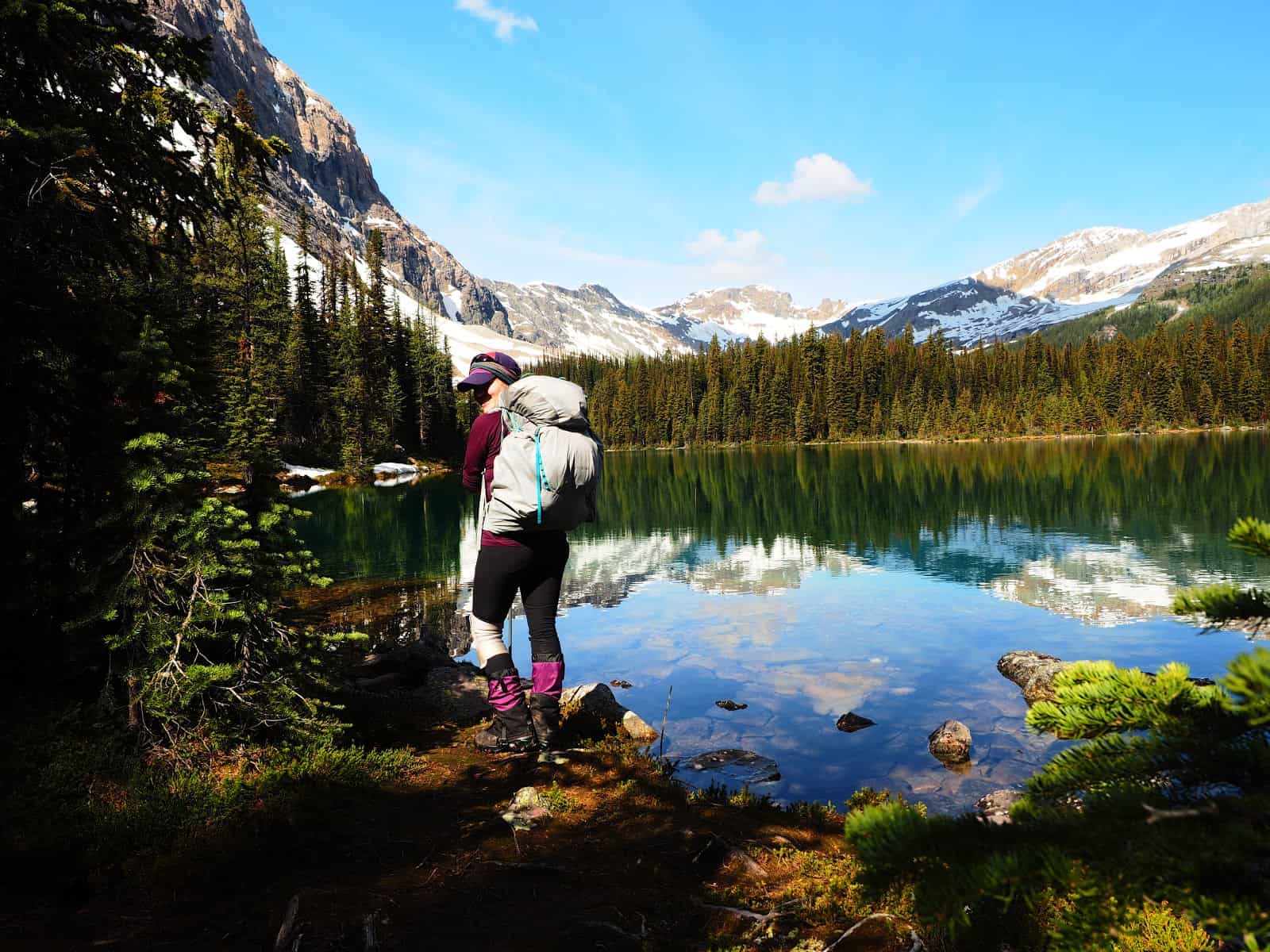
This Mountainsmith Zerk 40 review discusses the long term performance of a functional and durable backpack targeted to thru-hikers.
This Mountainsmith Zerk 40 review discusses the long term performance of a functional and durable backpack targeted to thru-hikers.
You don’t have access to view this content.
How to create a lightweight sunscreen strategy by using your backpacking apparel and supplies.
Though not everyone gets the blistering, itching, inflammation effects of sunburn, skin conditions (including skin cancer and premature aging) are a real possibility for anyone who loves the outdoors. This article considers the gear and supplies you use for lightweight sunscreen protection.
Backpackers who spend extended periods of time in the elements including sunshine are at a higher risk of consequences. Sun protection is crucial to prevent painful sunburn and skin disorders and diseases.
I am melanin challenged – fair-haired, light-eyed, and my skin is a lovely shade of glow-in-the-dark (I have my red-headed mother’s fair complexion). Even if I wasn’t inclined to burn crispy, sun protection should (and would) be a priority for my health.
Do I wear sunscreen every day? No, but I do wear it most days, even when not backpacking. I also cover up most of my exposed skin. I face dire and almost immediate consequences if I don’t protect myself from the sun.
If you get a lovely shade of tan in response to sun exposure, it’s easy to be complacent about sun protection. However, having known a few people under thirty who have lived through skin cancer treatment, I have no desire to join the club and I’m willing to bet that you melanin-challenged readers out there don’t either.
When you face the burning, blistering, and inflammation of a sunburn after an hour or less of sun exposure like I do, you learn a few techniques for saving weight and space while packing sun protection. I will preface by saying that not carrying sun protection is a lighter (but more damaging) option. No dermatologist would recommend anyone skip sun protection and I certainly won’t either.
Perhaps the lightest option is to leverage the clothing you wear as sun protection. When picking layers for backpacking, consider purchasing gear with built-in sun protection or UPF (ultraviolet protection factor). Most outdoor clothing lines have a UPF rating and picking a UPF 50 rated item over a non-rated item rarely costs an extra dime or ounce. Stay away from open-mesh and open-weave fabrics that allow UV light to penetrate through the fabric and onto the skin surface.
A Buff scarf or tube scarf is worth its weight in versatility and sun protection. A Buff serves as my warm head layer, and my neck, head, chest, and face sun protection in a high UV context. A tube scarf is a light, multi-purpose item every backpacker should consider adding to their pack. Many companies (Outdoor Research UberTubes is my current favorite) offer a cooling fabric with UV blocking tech.
A hat should be obvious, but in case it isn’t, a wide-brimmed hat provides the most shade. A baseball-style cap (front brim only) is not a bad option either, especially in combination with a lightweight hooded shirt or tube scarf.
It is also worth noting, ball caps with sun protection capes around the neck also exist and can be used in place of a tube scarf or hooded scarf. I should note though, a caped ball cap cannot replace the purpose of a tube scarf or a hood in a layering system for inclement weather.
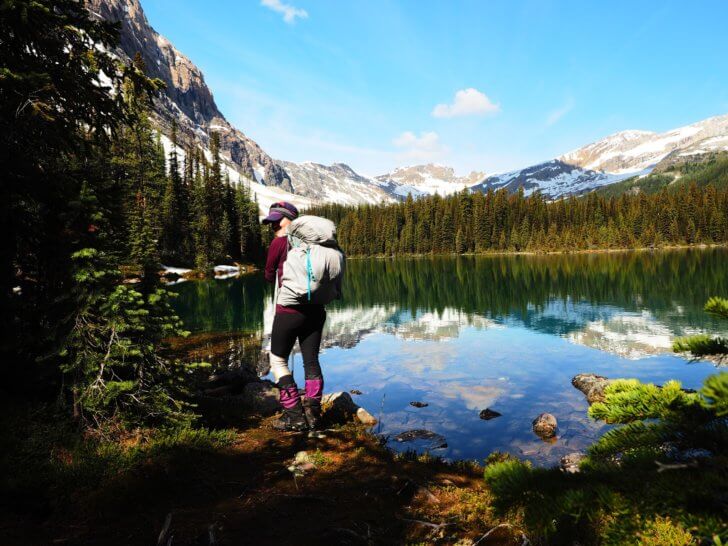
My favorite option is an ultralight wool long-sleeve hoody. Wool doesn’t stink after many days of wear and makes an ideal sun protection layer. I recommend long sleeves and if possible a 3/4 zip with a hood. Summer weight merino (e.g., 150 gsm) is a light-enough option.
Occasionally, in the heat, I find merino a bit itchy, though not itchy enough for me to switch back to synthetic fibers. Whether wool or synthetic, the 3/4-zip, long sleeve, hooded lightweight shirt is my layer of choice for ultralight backpacking because of its multipurpose uses including sun protection.
Shorts and skirts are great for ventilation in the heat, but a lightweight pair of pants in a lighter color is worth the sun, insect, and tick protection during the summer. Vented versions, which provide more cooling and sun protection are probably the best middle ground for those who run hot.
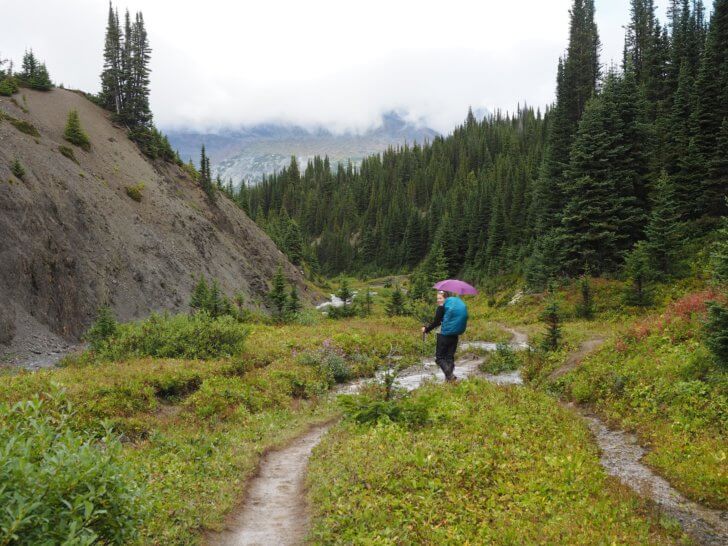
My final point in sun protection layering is using an umbrella as a parasol. The humble bumbershoot also serves as a cooking shelter and rain layer. It makes a fantastic multipurpose addition to an ultralight pack. In addition to keeping the sun off, I have found an umbrella to be one of the driest, lightest, best vented, and effective rain layers. While rain jackets and pants tend to either saturate or ‘wet out’ (this should really be called a ‘sweat in’) over time during warm rain, umbrellas do not. Obviously, umbrella’s are not ideal for windy conditions, and they provide limited warmth in cold temperatures, but they are an excellent multipurpose item for summer use.
People always ask about sunscreen lotions. I immensely dislike sunscreen lotions. Sunscreen tends to get everywhere including in my mouth and makes my skin feel terrible. In short, sunscreen tastes, smells, and feels bad. For me, however, sunscreen is a necessary evil. When it comes to sunscreen, I find you generally pick between light, comfortable, or cheap. I am also going to assume readers know about, and have tried normal spray-on and liquid sunscreens and know the ins and outs there.
Before we dive into lightweight sunscreen options though, let’s chat SPF. What is SPF and what is the ideal SPF?
SPF = Sun Protection Factor
Heather Brannon, MD explains SPF this way: “an SPF rating tells you how long you can stay in the sun without getting burned while wearing that sunscreen, compared with how long you can stay in the sun before you burn without wearing that sunscreen. For example, if it typically takes you 15 minutes to burn without sunscreen and you apply an SPF 10, it will take 10 times longer (2.5 hours) to burn in the sun.”
SPF is not an indication of the effectiveness of sunscreen! It only indicates the length of time it that it’s effective. Medically-recommended sunscreen generally provides 30+ SPF, broad-spectrum (UVA and UVB) protection. Regardless of SPF number, reapplication every 1-2 hours or after sweating or exposure to water is an important best practice.
One of the most convenient, lightweight sunscreen options is a small stick of solid sunscreen. A lightweight sunscreen stick is usually about the size of a glue stick or about 1/4 to 1/3 the size of a deodorant stick. I find the smell tolerable, the taste intolerable, and the price expensive. Solid sunscreen sticks can usually be purchased for $5 to $15, depending on size. Smaller and lighter sticks can sometimes be found where travel-size toiletries are organized in a store.
My only issue with the sunscreen stick is you cannot measure the exact right amount of the stick and only take the amount you need. The stick is smaller and lighter than liquid but has limitations and because the stick is more viscous (sticky) it does not spread as far as a liquid. My favorite use for sunscreen sticks is during paddling or winter adventures as it conveniently packs into a pocket for on-the-fly application.
The most comfortable option for me is a high-end cosmetic cream with sunscreen included as a component. Generally, higher-end cosmetic sunscreens smell pretty good, don’t taste as bad, and absorb into the skin more easily.
Cosmetic sunscreen bottles (often glass) tend to be heavy and breakable. Cosmetic sunscreens can be expensive ($15-$90). When used with proper layering to keep the sun off the price may not be of great concern and the absorption rate means you use much less (and can, therefore, pack less on a trip = weight savings).
Of all the options, a small container (usually not the original container) of higher quality cosmetic grade facial cream with sunscreen built-in is my preference because it’s multipurpose in hydrating windburned skin (without clogging pores and causing breakouts) and acting as a sunscreen. Most of the ladies out there probably have a small and lightweight container of cosmetic sunscreen and have been religiously told to apply it to prevent age spots and wrinkles.
Another tip I can offer here is to use a small, wide mouth, screw off lid container to store the lotion. When you put the lotion in the container put a small piece of plastic wrap over the mouth of the container and screw on the cap. This makes the bottle more leak proof. Keep using the same piece of plastic wrap, it takes quite a while to wear out. As a heads up, this tip works well when airplane traveling with liquids as well.
Sunscreen Wipes are like facial cleaning or baby wipes but they have sunscreen built-in. They are easy to apply, don’t count as a liquid during flights and are flammable to use as fire starting material. They are reasonably lightweight and highly packable compared to a liquid solution. However, they also have additional waste associated with their use.
I like sunscreen wipes for when I am flying into my trail location and don’t want to take liquid sunscreen through security or have the bottle leak in my checked gear. Wipes allow you to take exactly the right amount of sunscreen for each day and pack it into meal supplies for applications when you stop to eat.
Another sunscreen option (that allows you to pack exactly the right amount of sunscreen): individual foil-packed liquid sunscreen tubes. These are lighter and smaller than a bottle of sunscreen but come with a penalty of a foil package you are stuck with. Foil-packed sunscreen is perfect for getting the exact right amount of sunscreen for a trip and having them easily accessible.
I like the foil packs for precisely dosing my sunscreen on short trips. The foil packs are still lighter than an equivalent bottle (up to a certain point).
Sunscreens contain certain ingredients (called active ingredients) that actually do the work of protecting your skin from UV damage. It’s generally accepted (and confirmed by both the American Academy of Dermatology and the Food and Drug Administration) that titanium dioxide and zinc oxide are the safest active ingredients found in sunscreen.
Para-aminobenzoic acid (PABA) and tolamine salicylate are two ingredients that have been deemed unsafe by the FDA. These ingredients are not found in sunscreens legally sold in the US, but you may find them in sunscreens sold elsewhere (especially in developing countries).
Other active ingredients you will commonly find in sunscreens include:
and less commonly:
It’s important to note that the FDA has not deemed these ingredients safe (nor have they deemed them unsafe!) and FDA has called upon further safety studies to investigate them before providing further public health endorsements (or warnings) about them. The reason for this indecision: some research does exist that poses questions about some of these chemicals…
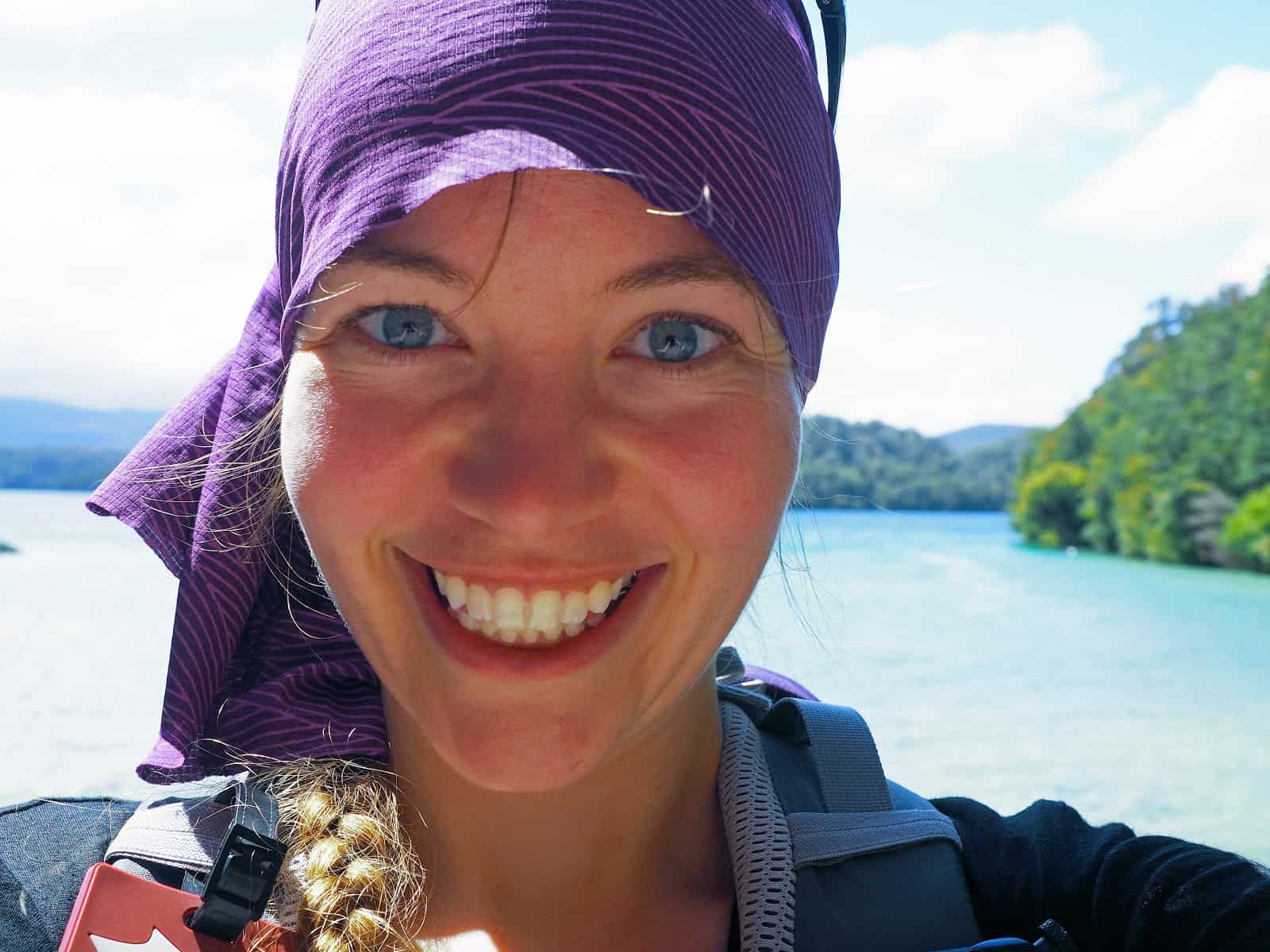
Sun protection matters. If you tan or don’t, sun exposure can cause cancer and protecting your skin is worthwhile for preventing premature aging, disease and discomfort. Even if you decide to keep going without sunscreen, at least consider some of the layering sun protection options which don’t add anything to pack weight. Sun protection takes very little time out of a day and has lifelong benefits.
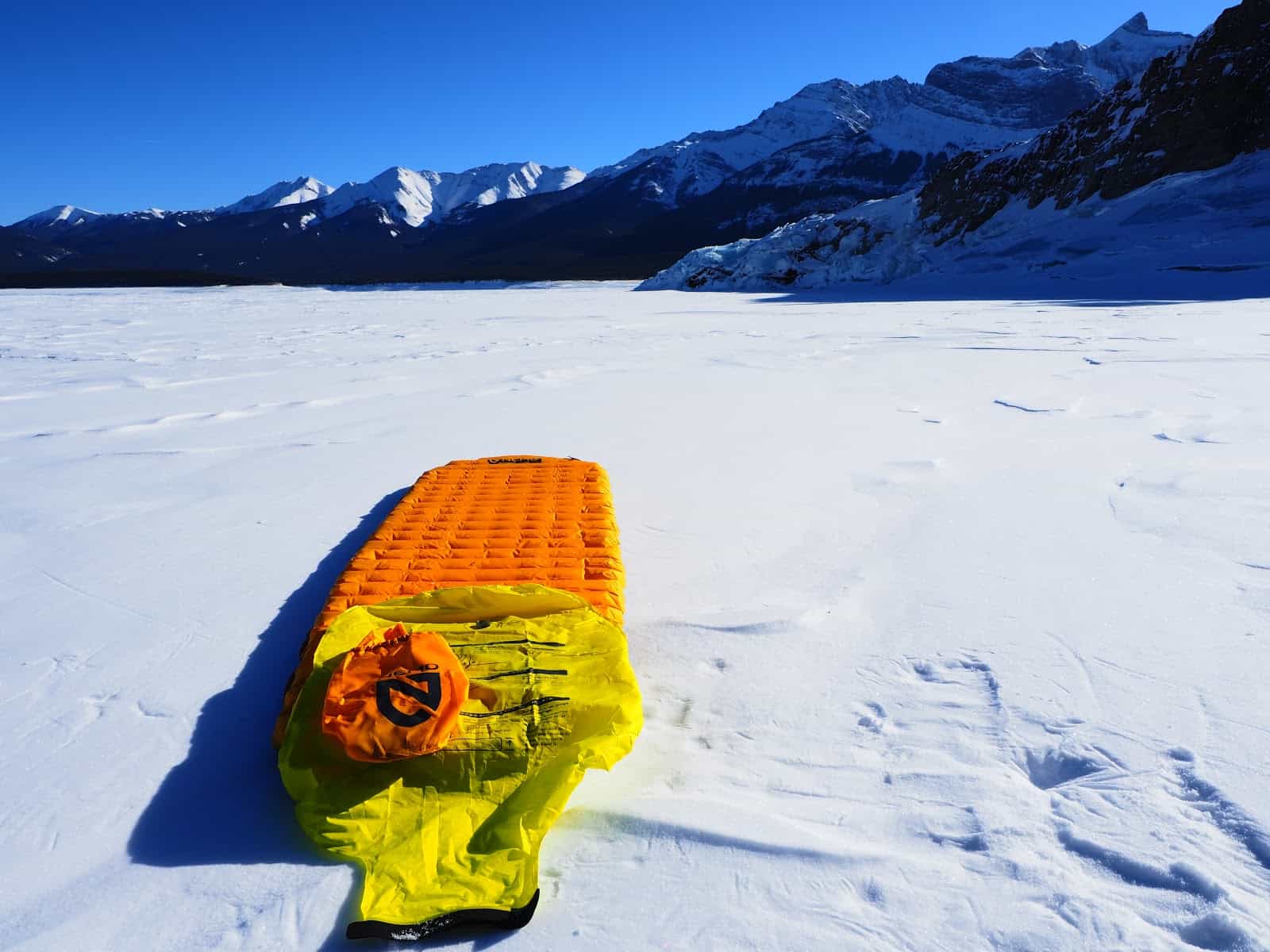
This Nemo Tensor Insulated Sleeping Pad review takes an in-depth look at the sleeping pad’s comfort, stability, insulative properties, & more!
You don’t have access to view this content.
Jimmy Carter created the Arctic National Wildlife Refuge (ANWR) in 1980, and it’s been a contentious subject ever since. A bonanza of biodiversity, the ANWR also potentially sits atop one of America’s last untapped oil reserves. In this episode, Andrew talks to Adam Federman, a journalist covering the recent push by the Trump administration to lease oil and gas rights in the refuge. Adam is a reporting fellow with Type Investigations, where he’s spent the last few years covering energy, public land, and the Trump administration’s environmental policies.
Jimmy Carter created the Arctic National Wildlife Refuge (ANWR) in 1980, and it’s been a contentious subject ever since. A bonanza of biodiversity, the ANWR also potentially sits atop one of America’s last untapped oil reserves. In this episode, Andrew talks to Adam Federman, a journalist covering the recent push by the Trump administration to lease oil and gas rights in the refuge. Adam is a reporting fellow with Type Investigations, where he’s spent the last few years covering energy, public land, and the Trump administration’s environmental policies.
His recent piece “How Science got Trampled in the Rush to Drill in the Arctic” caught our eye when it ran in Politico in July of 2019. We immediately reached out to Adam for a chat about this developing issue as well as a larger conversation about public land policy in the United States.
You can read the final Environmental Impact Statement here.
You can contact us at podcast@backpackinglight.com, or follow us on social media –
A mathematical model to calculate how much food to pack for your trip based on terrain and mileage with minimum weight carried in the pack.
You don’t have access to view this content.
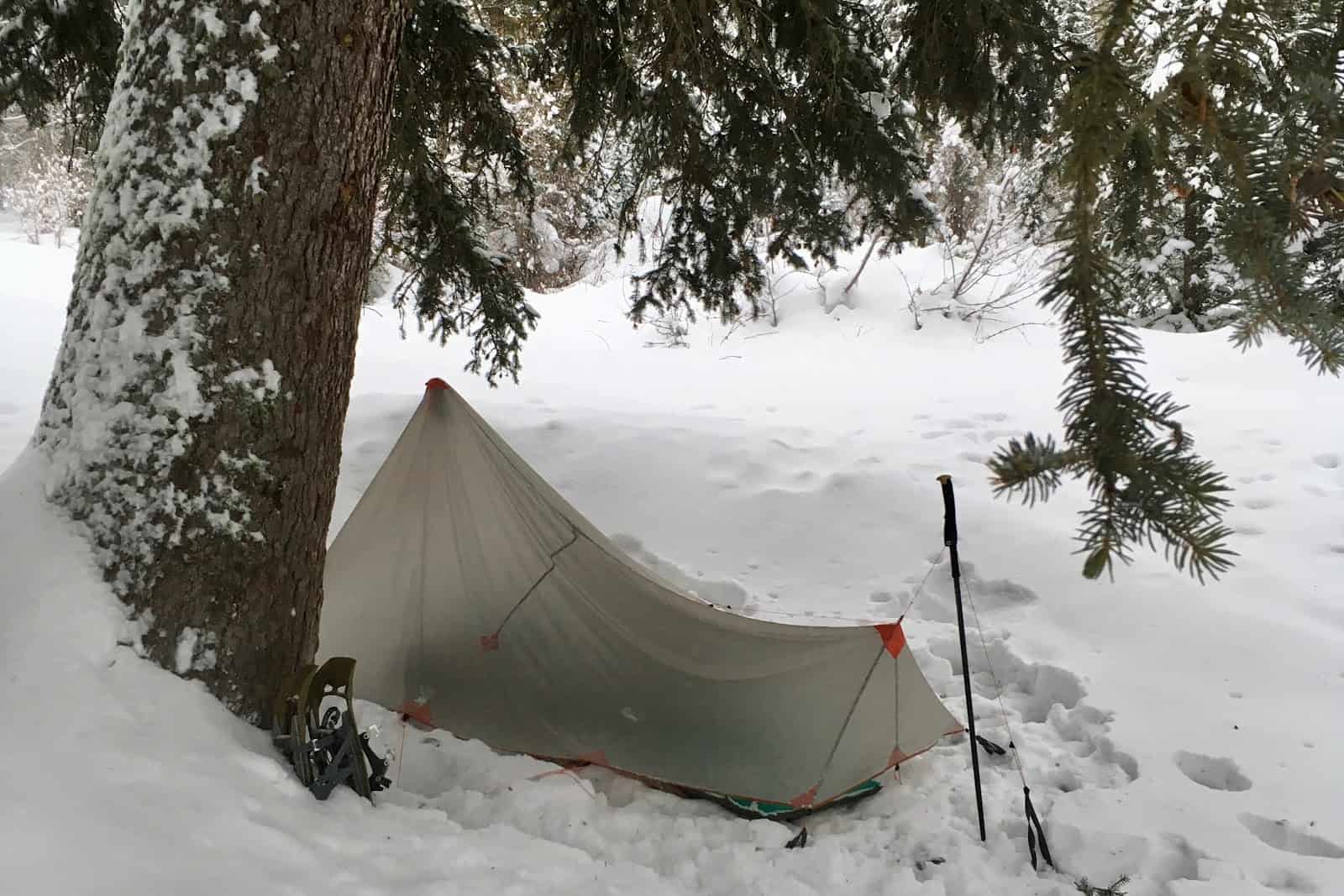
The SlingFin SplitWing UL Tarp is a modular 24 oz, 1-2 person shelter that bridges the gap between minimalist tarps and fully enclosed tents.
You don’t have access to view this content.
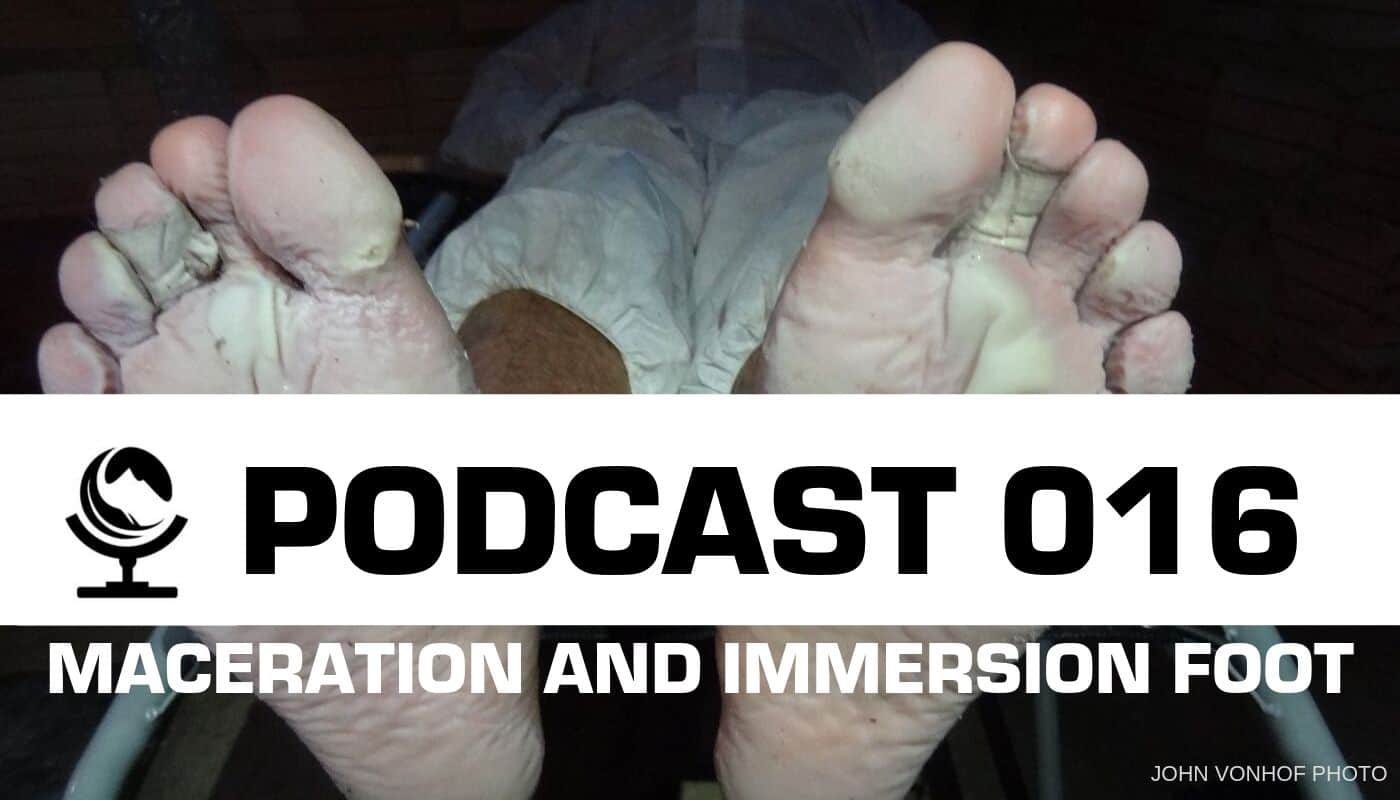
In this SKILLS SHORT, Ryan and Andrew break down the causes, symptoms, and results of immersion foot diseases.
As backpackers, we spend a lot of time thinking about and managing our feet. One problem that crops up a lot (especially for those of us who choose to utilize ultralight footwear, hike in damp or snowy environments, or both) is wet feet. Feet that get wet and stay wet can cause all kinds of nasty issues – starting with maceration (wrinkly, pale, soft skin) and progressing through to immersion foot diseases like trench foot, tropical immersion foot, and warm water immersion foot.
In this SKILLS SHORT, Ryan and Andrew break down the causes, symptoms, and results of immersion foot diseases. After a fairly exhaustive and somewhat nasty primer (you’ll hear the phrase “sloughing skin” more than once) the guys discuss strategies to prevent and manage immersion foot diseases and their symptoms. The pod wraps up with a discussion on when you should get off the trail (blackened skin = big trouble), and Ryan shares some of his favorite resources and further reading on foot care.
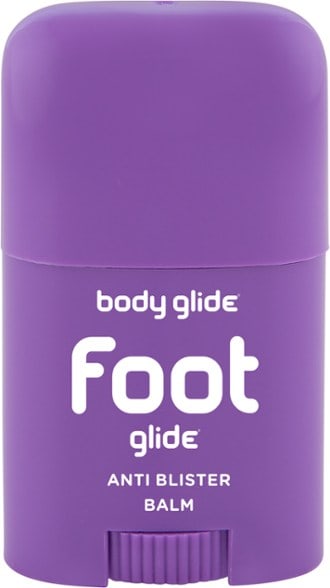
Recommended anti-maceration and anti-blister balm: Body Glide Foot Glide
You can contact us at podcast@backpackinglight.com, or follow us on social media –
A short, detailed discussion on immersion foot and maceration, how to deal with it in the backcountry and when not to.
In response to an article I posted recently about crossing streams in your hiking shoes, @impalatrash replied via Twitter to share their experience with trench foot.
Nice article but with wet feet comes the risk of trench foot. Which I didn’t know was possible but after one day of wet feet I was off trail for 9days. If I had hiked on it could have caused permanent damage. I still just cross but now rub vaso in 3 times a day.
— Impala_trash (@impalaontrail) July 18, 2019
The purpose of this article is to clear up some confusion about trench foot, other immersion foot diseases, and maceration, and provide some context for backpackers who are worried about it.
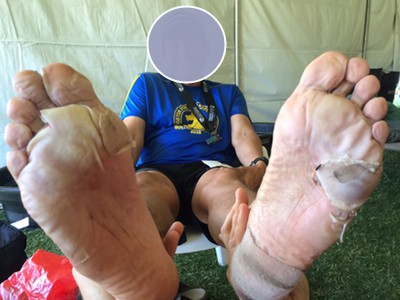
Immersion foot refers to a type of diseased condition that results when your feet are continuously wet for extended periods of time.
The most well-known of these conditions is trench foot (TF). Related conditions include tropical immersion foot (TIF) and warm water immersion foot (WWIF).
For a backpacker, understanding the differences between these three distinct diseases aids in diagnosing the right condition. Knowing what disease you are manifesting will allow you to optimize subsequent treatment so you can return to the trail as soon as possible without suffering permanent damage.
It’s often assumed that the three diseases are distinguished by the temperature of the water that causes the immersion foot disease, but that’s not the entire story. It is true that TF usually occurs in cold conditions (temperatures above 32 deg F but less than about 60 deg F) and that TIF and WWIF usually occur in warm conditions (temperatures greater than about 60 deg F).
Other than the temperature of the water that causes the disease, the nature of the disease and the symptoms between cold water immersion disease (TF) and warm water immersion diseases (TIF and WWIF) are notably different.
Trenchfoot occurs primarily when the feet are exposed to cold temperature water for extended periods of time. It occurs far more rapidly when the feet are continuously immersed or otherwise soaking wet (as what might occur if you are walking through an Alaska tundra swamp during snowmelt), instead of intermittently immersed (as what might occur if you are wading cold rivers in the High Sierra several times a day).
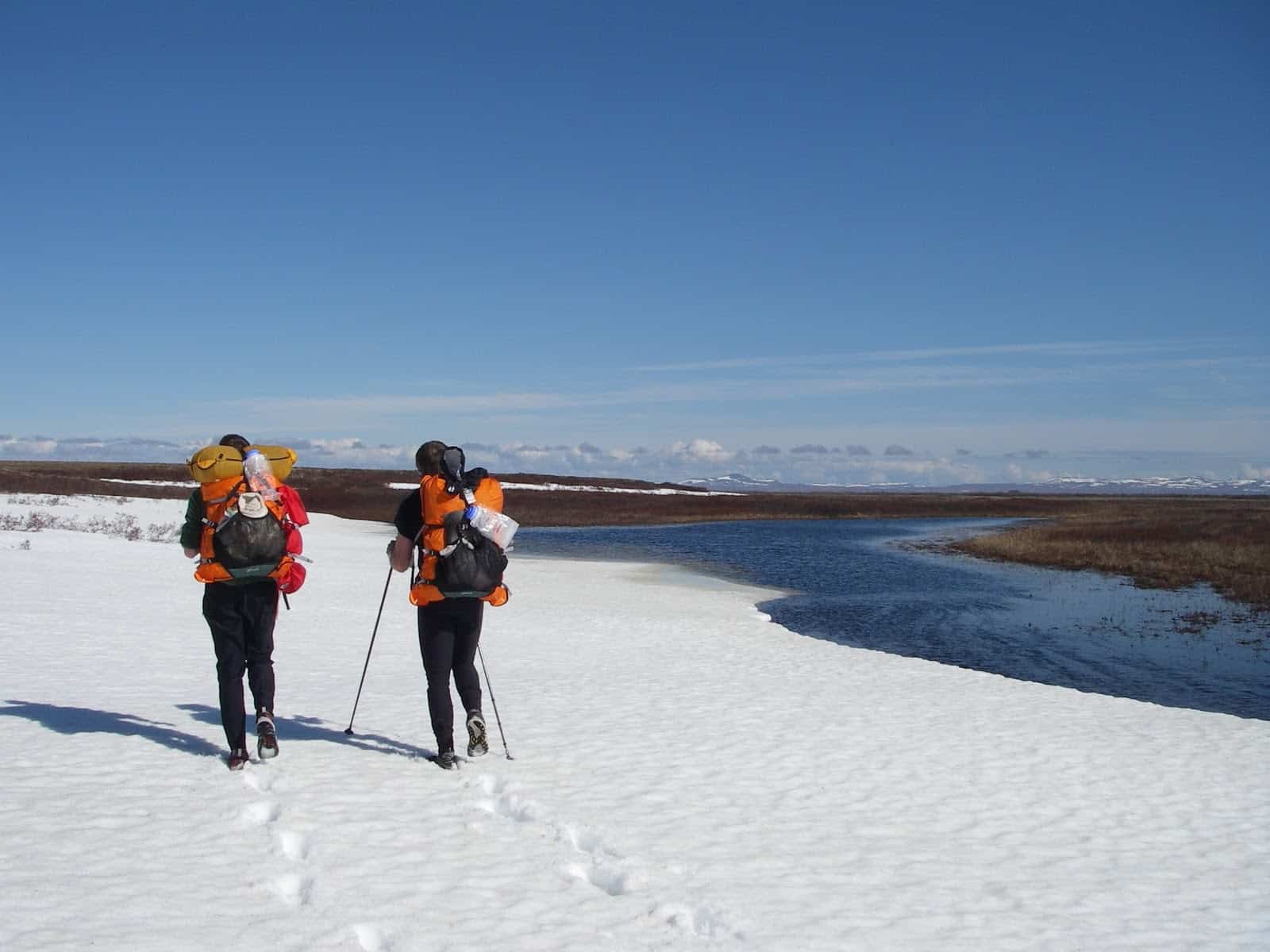
Water immersion, whether in cold or warm water, causes maceration (“pruning”) of the foot’s dermal tissues. However, maceration (which is simply the byproduct of supra-hydration of dermal tissues) tends to be more pronounced in TIF and WWIF.
With TF, it’s the combination of water immersion with cold temperatures that creates a different set of problems – vasoconstriction to the foot’s surface tissues (dermal layers). Once the blood supply has been restricted for a significant period of time, tissues start to die, which makes them more prone to bacterial infection. As a result of tissue death and bacterial growth, blisters and open sores occur more easily – which creates even more avenues for infection. Trench foot can be halted in its early stages, but if allowed to progress, can lead to gangrene and permanent nerve damage.
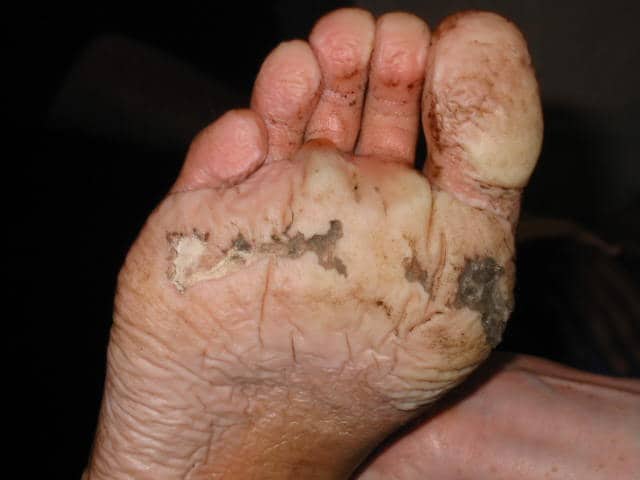
Another primary difference between TF and TIF/WWIF is that trench foot can occur more rapidly, and progress to a fairly advanced state within the course of a single day’s march (e.g., 12-14 hours). TIF and WWIF, on the other hand, progress more slowly, and usually requires 48-72 hours or more to manifest themselves.
Although the pathology behind all immersion foot diseases is complex and not well-understood, it is generally accepted that trench foot is caused primarily by cold-induced vasoconstriction, and TIF/WWIF are caused by the maceration-induced separation of dermal layers.
Other than these causative differences, all immersion foot syndromes share similar symptoms:
Now, how does an understanding of these diseases affect the backpacker?
First and foremost, consider that if your feet are exposed to wet conditions for several hours, the very first thing that you are going to notice is maceration:
Maceration is the softening of the dermal tissues of the foot as a result to these tissues become overhydrated due to sustained water exposure.
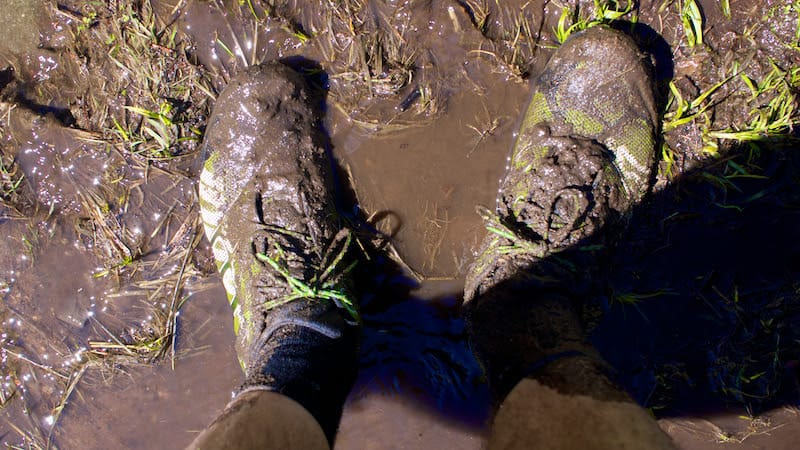
The primary symptoms of maceration are white, wrinkly feet. In the early stages of maceration, there should be little or no tenderness, redness, or swelling. As a result of the softening and wrinkling of the tissues, you may begin to notice some cracking or blistering of the skin.
At this point, you don’t have an immersion foot disease but do consider the maceration as a warning sign that needs to be addressed.
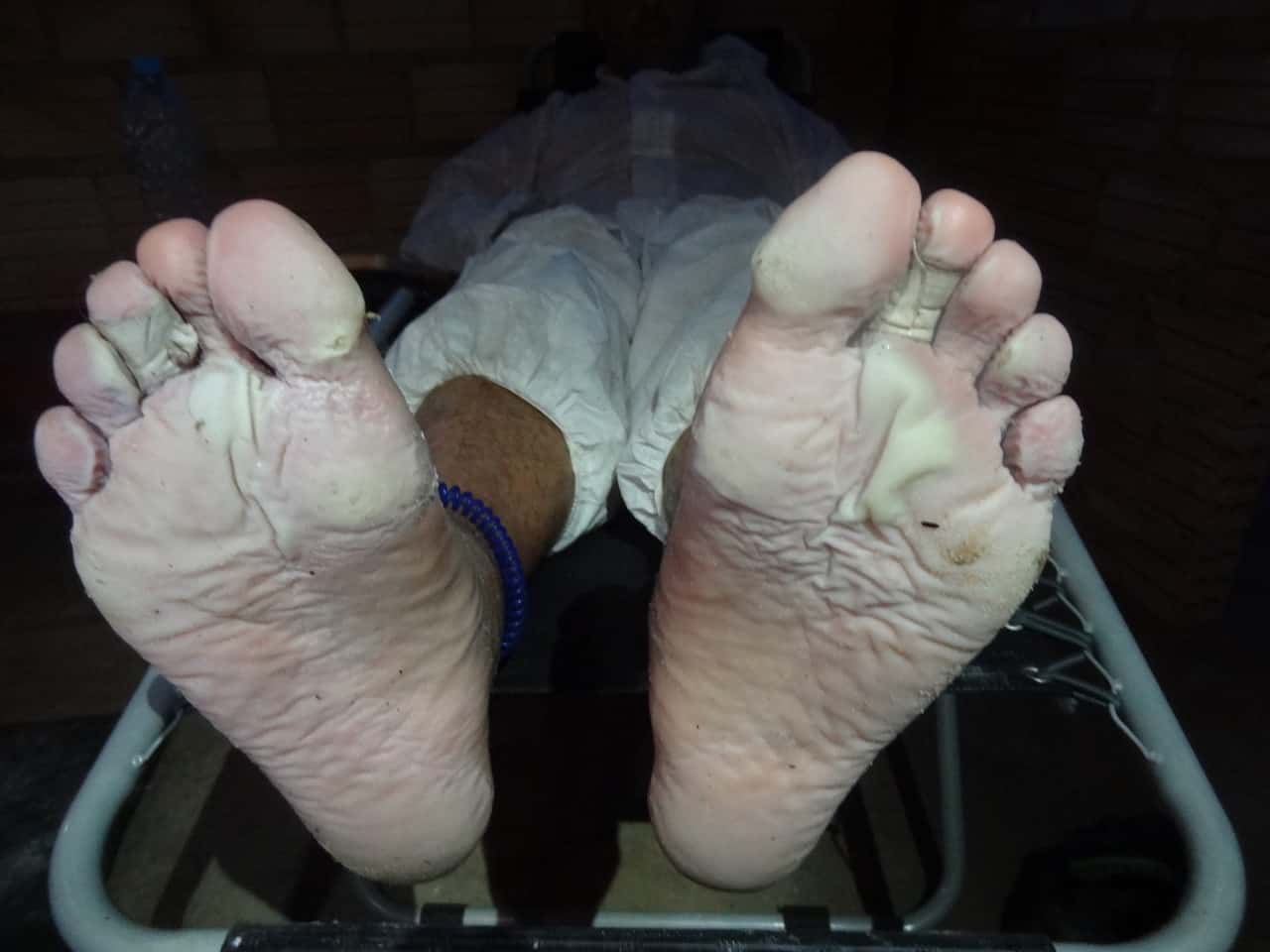
In my research on this topic, one of the most mind-blowing themes I discovered was that there seems to be no limit to the amount of water your dermis and epidermis can absorb (ref. 3). The implications of this are profound because we can no longer assume that the skin becomes “saturated” at some point, and then all’s good. The bottom line is that the more you expose your feet to saturated conditions without drying them out fully, the more that maceration will develop, and the risk of dermal layers separating from each other increases. Consider early wrinkling, whitening, and softening of your foot skin to be a canary in the coal mine for something down the road that could cause permanent damage and require weeks or even months of healing.
And this brings me to the most important consideration for backpackers: preventing and managing maceration should be your focus, not worrying about full-blown immersion foot diseases. Control maceration and your feet won’t degrade further, regardless of water temperature.
There are a number of things you can do to help prevent maceration, and manage it once it starts:
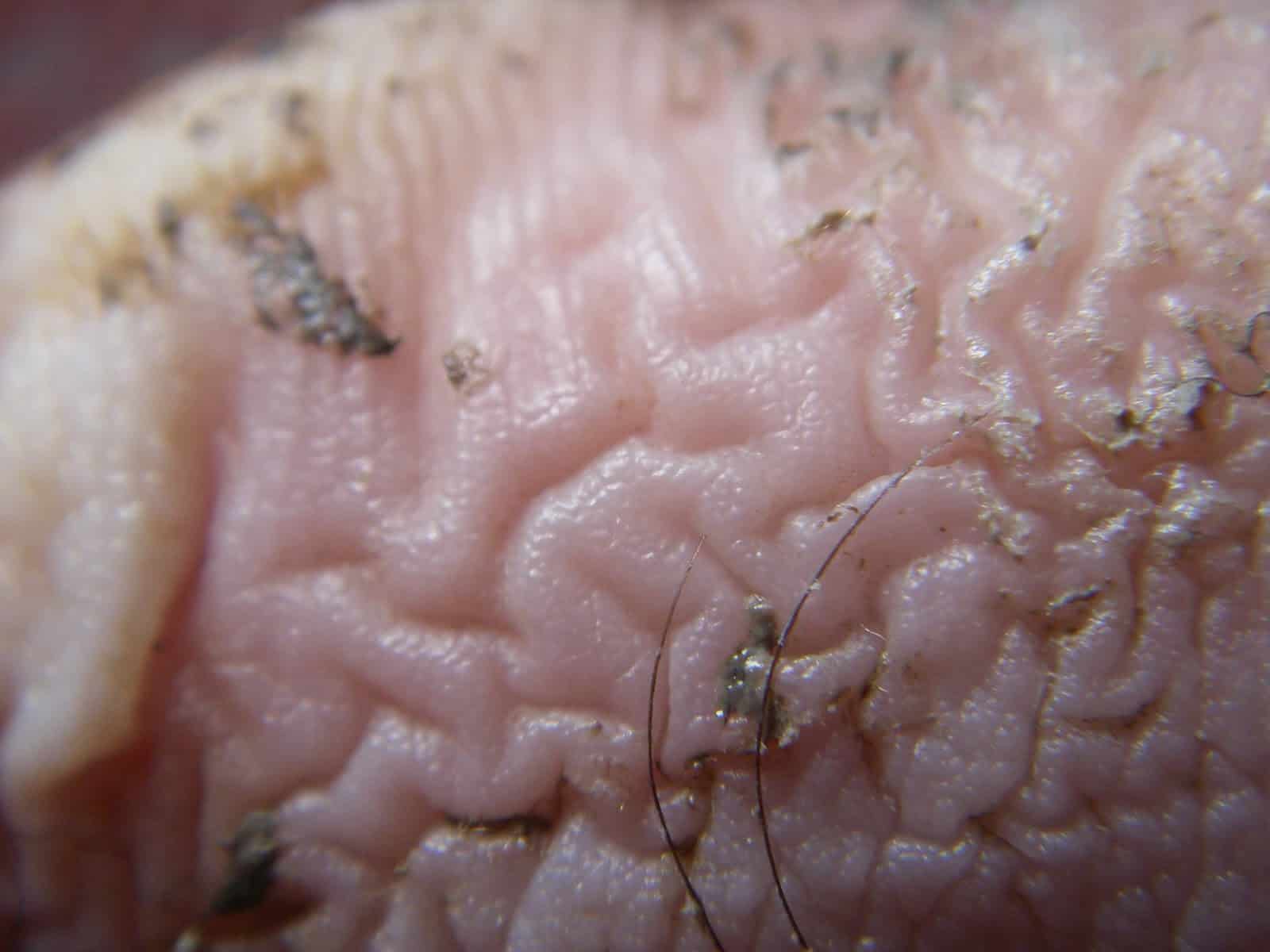
Finally, if you note that your feet have been macerated for several hours or days, and any of the following symptoms manifest, you may be progressing into an immersion foot disease:
At this point, the chance that you can reverse conditions while on the trail is extremely slim. It’s time to get off the trail and rest your feet for a week or more. It may take up to several weeks for your foot to grow new dermal layers of skin, depending on the extent of the damage. If your feet are discolored (blue, black) or open wounds appear to be infected, it’s time to see a doctor as well.
Max Neale gives a comprehensive review of Patagonia’s MicroPuff Hoodie, including its warmth, insulation, cut, and hood.
You don’t have access to view this content.
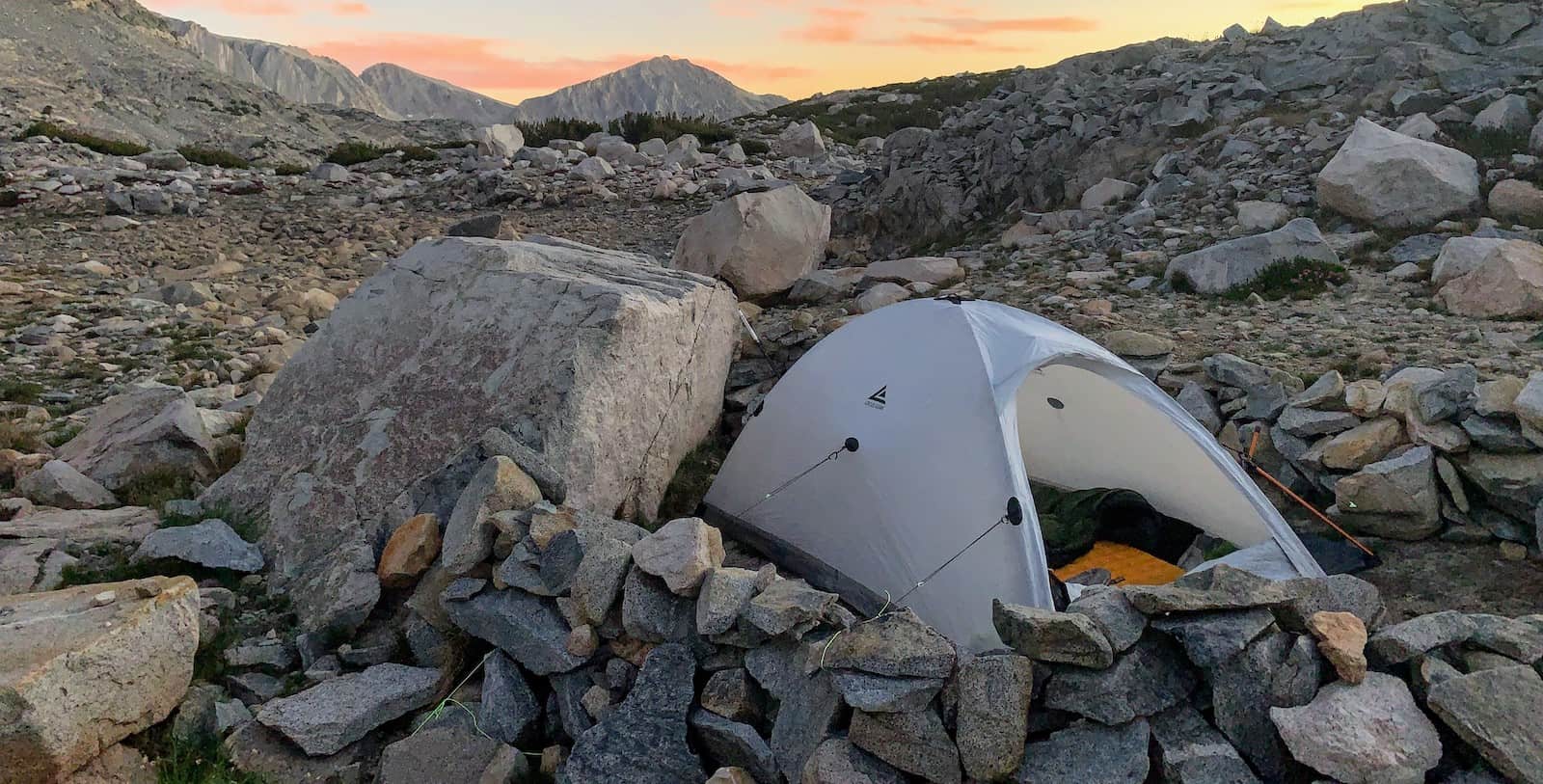
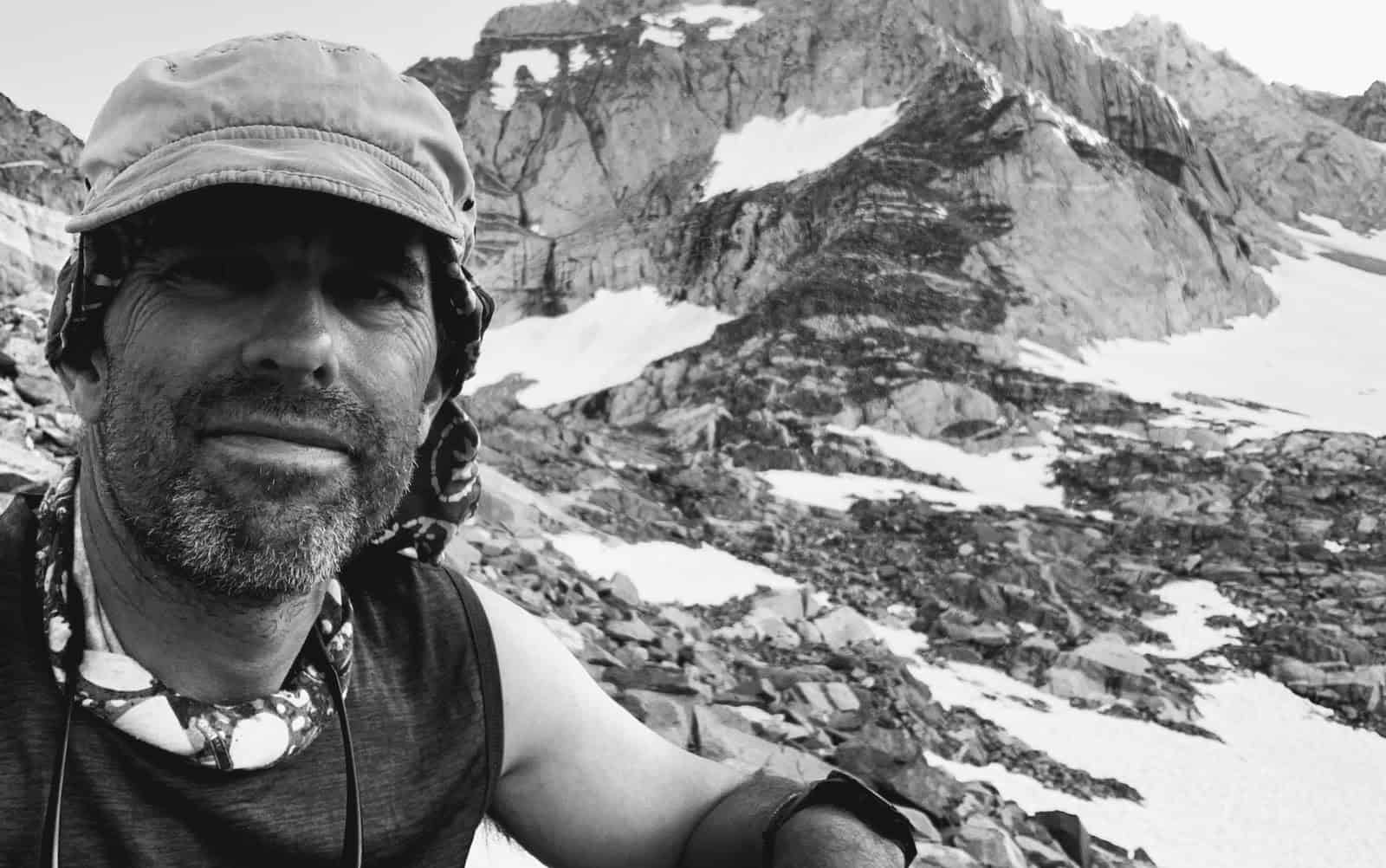
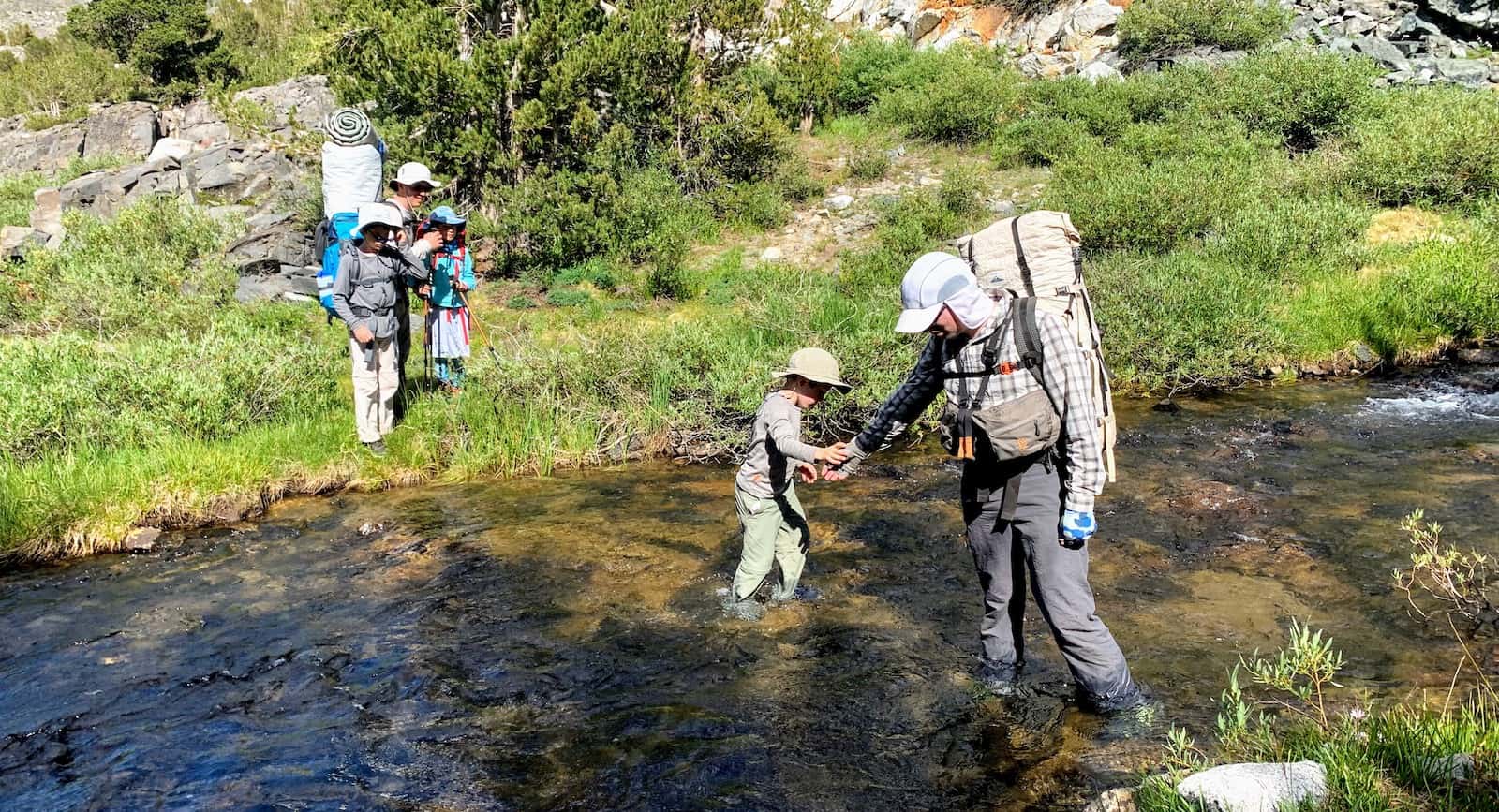
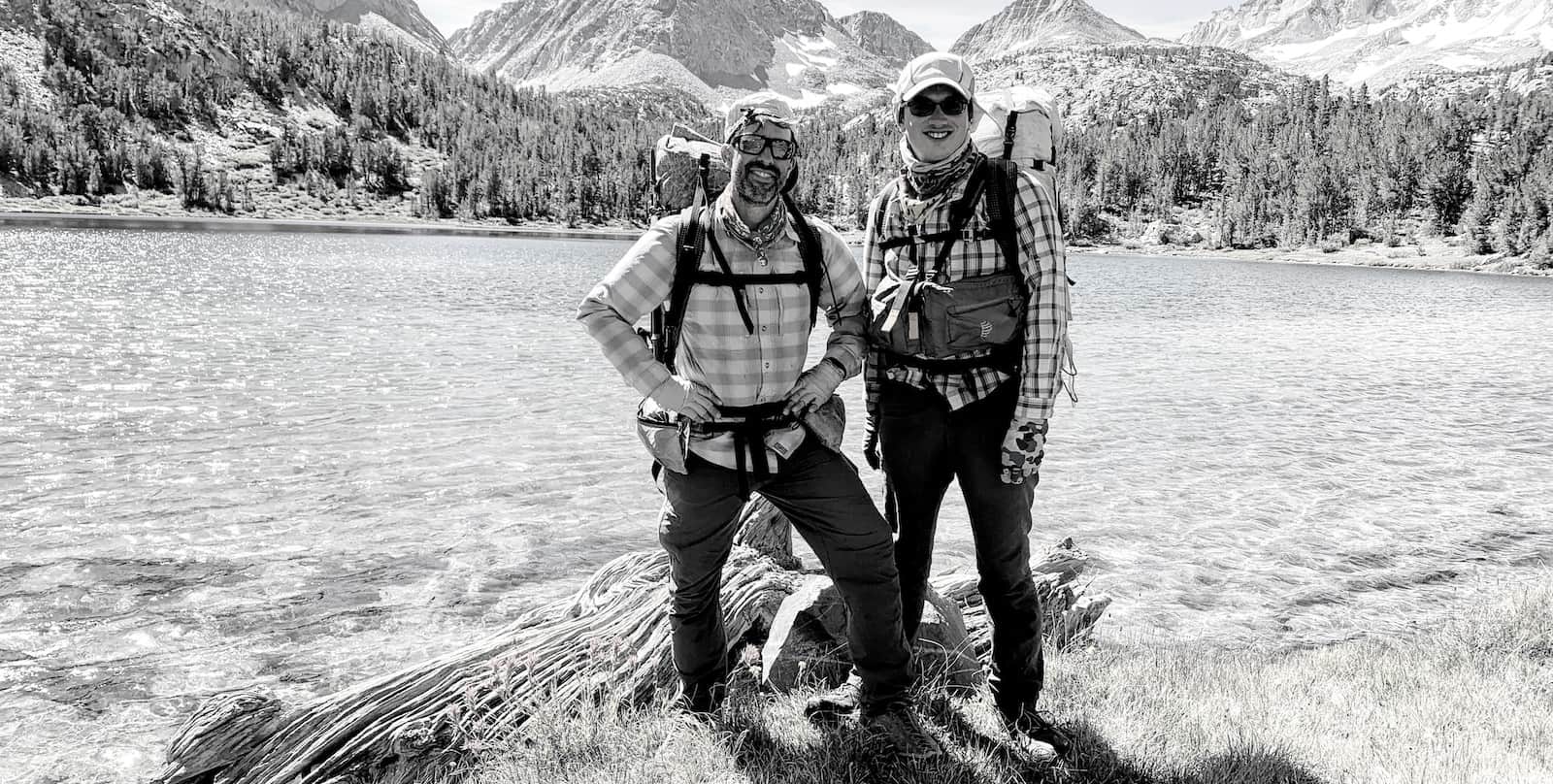
In this video, I walk through my gear during a 9-day summer trek in the high mountains of the western US. This was a trip with friends and family – 3 other adults and four children ages 7-11. We moved camps every day but one, and spent 70% of our miles off-trail, with camps up to about 11,600 feet. Scroll down for gear notes and trip photos!
In this video, I walk through my gear during a 9-day summer trek in the high mountains of the western US. This was a trip with friends and family – 3 other adults and four children ages 7-11. We moved camps every day but one, and spent 70% of our miles off-trail, with camps up to about 11,600 feet. Scroll down for gear notes and trip photos!
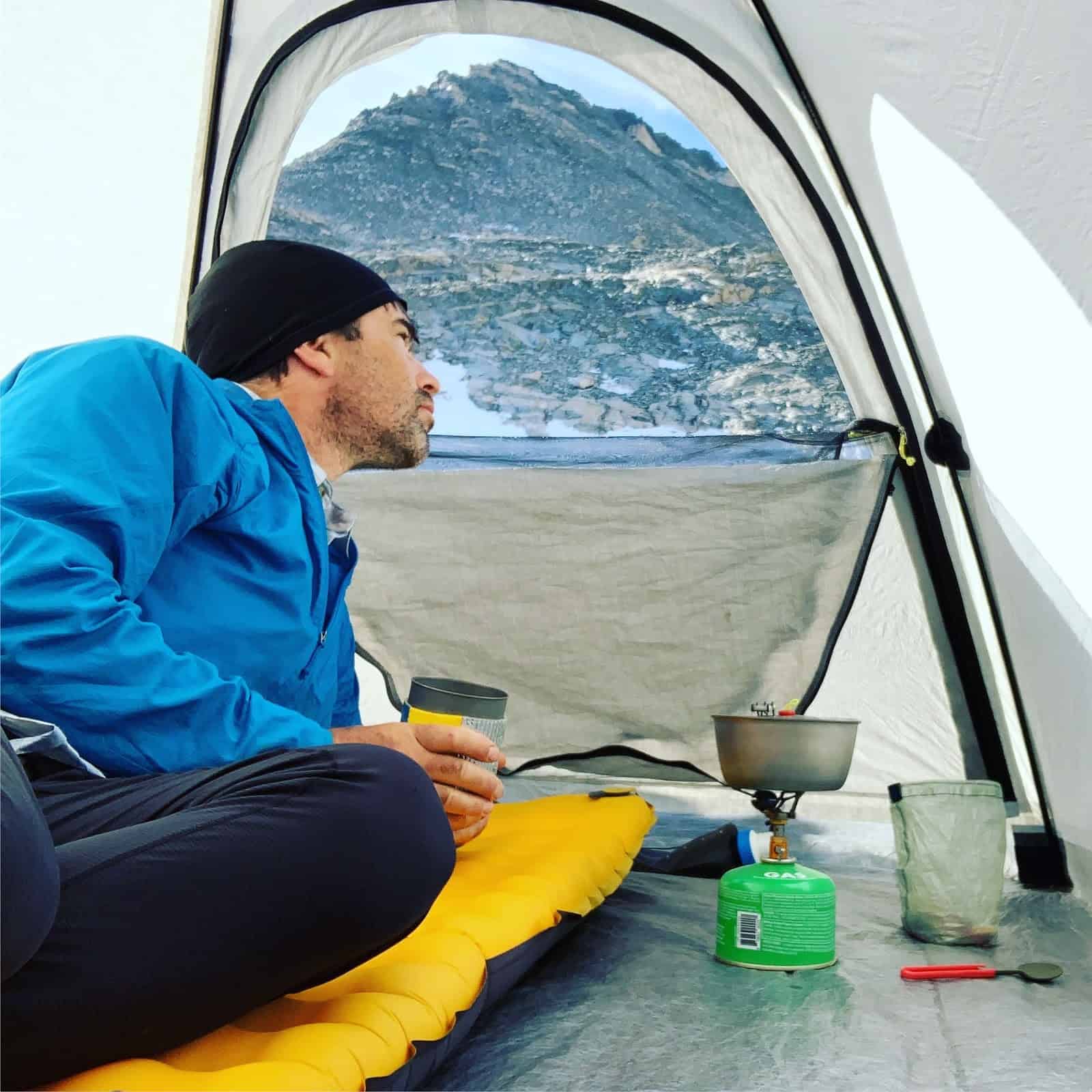
Commentary: I was surprised at how much I liked the simplicity of the Djedi tent. I’ve had the chance to use it for most of the summer now, and I appreciate its stability in wind, ease of setup, and confidence in knowing that I’m in a real tent while a storm is raging outside. On this trip, having a mosquito-free haven where I could actually make coffee inside the tent and not have to fiddle with a too-small vestibule was wonderful. The Chisos quilt was too cold. I think my metabolism is changing, and I’m not sure how much longer I can suffer through sub-freezing nights using a sub-1-lb quilt. The Tensor pad was a pretty nice luxury, but I still can’t justify the weight (probably) on long expeditions. We’ll see if it makes it into my kit for the September Whitetail Trek, or if I’ll go back to the XTherm for longer, harder trips…
Commentary: I only used the raingear for nights where my quilt was too cold (2 nights below freezing). I suppose for 8 oz, it’s not a bad deal to have real raingear in the pack. For trekking in actual rain off-trail, however, I prefer my Arc’teryx Zeta FL. My rain pants are also too bloomy for off-trail scrambling and am on the lookout for something more tailored. The Sun Stretch shirt has been a go-to for me for years, and I’m a huge fun. The Quandary pants are light, but not so durable or warm when the terrain gets hard or the weather turns south. Nights were chilly, and I would have rather had my down jacket than the synthetic puffy.
I also brought some gear for day hiking and mountain running. This trip involved kids, and short miles, and I’m in the middle of a training cycle for another expedition, so I used the following for mountain runs and day hikes on this trek:
Commentary: I wish I brought some light gloves for evening runs. After the sun went down, my hands got pretty cold up high where I was scrambling in the evenings.
Commentary: Very happy with my footwear choice on this trip. The balm helped ease the skin stress when the temps got warm during the day and my feet were closed up in leather shoes.
Commentary: I’ve been experimenting more and more with the HMG pods over the last year and they have become an essential component of efficient, void-space-free packing and organization.
Commentary: The little Fire Maple 300t stove is tiny, reliable, and powerful. But it’s not a great stove for simmering food – its flame/heat distribution is just too tiny. I wish I had my Pocket Rocket Deluxe. The rest of my cook and water kit – no complaints at all.
I brought about 18 oz of food per day (2,000+ Cal):
Meals were supplemented with fresh trout, which I prepared by poaching, de-boning, and then adding back to my one-pot meals.
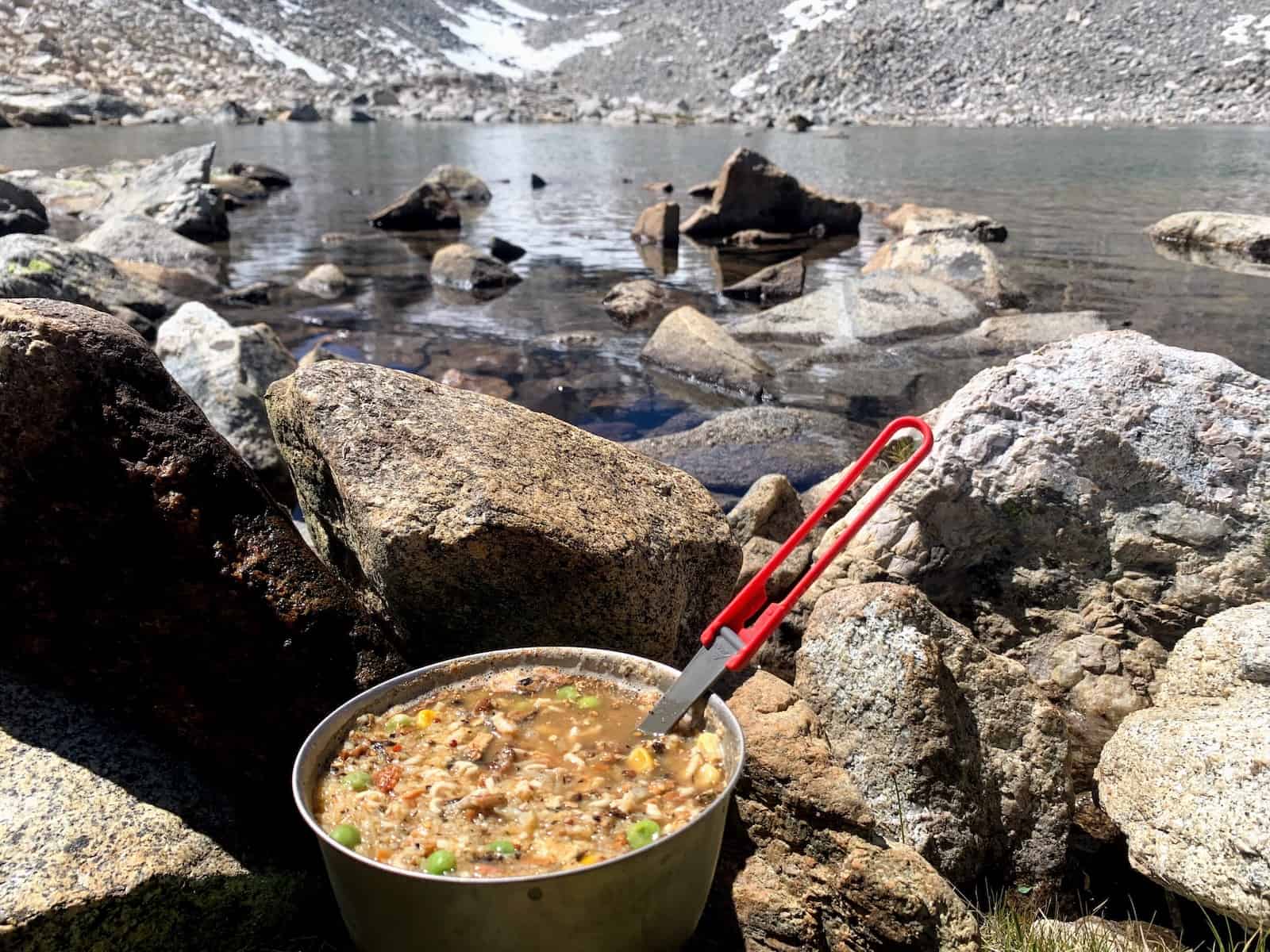
I did experiment with fasting on this trip, and fasted up to 24 hours at a time, with no challenges, energy depletion, or ill effects. I left the trailhead with about 10 pounds of food and came out with about 2.5 pounds leftover. I lost about 3 pounds of body mass over the course of 9 days.
My favorite filling, calorie-packed, quality packaged foods from this trip:
My tenkara fishing rod: (2.5 oz)
Commentary: I’m very happy with Patagonia Provisions soups, chilis, savory grains, and fish. They are some of the best-tasting foods I’ve ever had on a backpacking trip. The packaged meals are surprisingly filling and compact (dense). Adding trout to my menu was a huge bonus, and I can’t imagine leaving my tenkara rod behind when I know I’m going to be traveling through alpine lake country. My experiments with fasting surprised me, but admittedly, I went into this trip riding the wave of two months of an every-other-day 16-20 hour fasting lifestyle, so there was some conditioning. On trips that don’t involve a lot of exertion, I could save quite a lot of food weight by eating fish, foraging, and fasting.
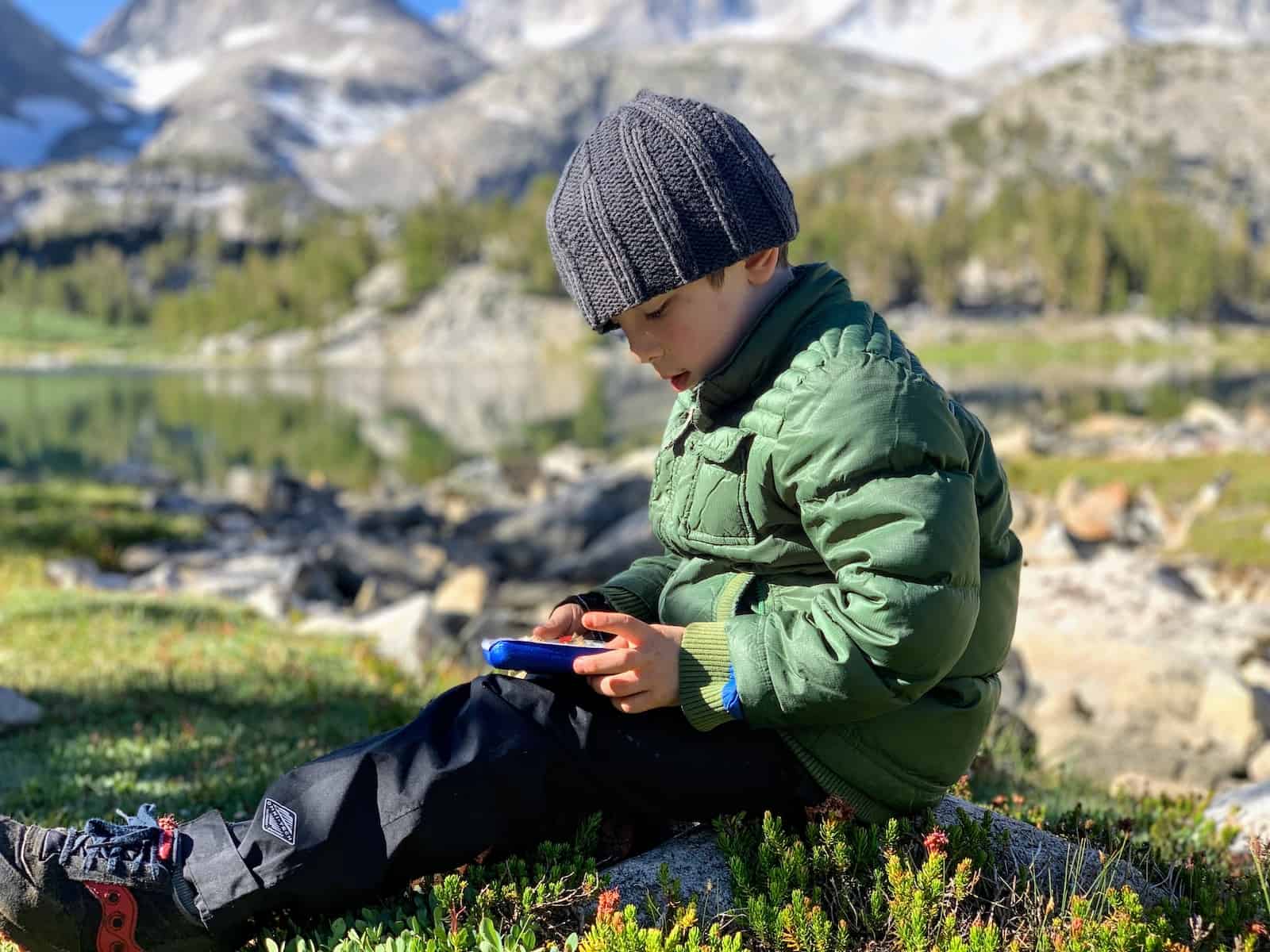
Commentary: inReach Mini for the win, as usual. Easy to stay in communications with this tiny device. Not so easy with the sat phone. Pleased with the iPhone XS photo and video capabilities, especially with Moment lenses.
Commentary: Critical item for my back health on trips where I have to spend a bit of time in camp.
Updated September 15, 2018
My Fryatt Valley Hike trip report – photos, gear notes, planning and prep.
You don’t have access to view this content.
The goal of this test is to determine the effective age of your backpacking water filter based on comparing its current flowrate to its flowrate when new.
I worked in the 3D printing industry for many years: actual jetting of material (not dispensing molten material through a single nozzle). We were using a 300 dot per inch printhead to generate solid objects and the printhead contained 1200 nozzles. Building a single 8” tall object was equivalent to printing 5000 pages.
Supplying the printhead with clean material was paramount to printing reliability as well as longevity. To assess this issue, a metric was developed to evaluate jetted material for cleanliness. This is called Conductivity Testing. To conduct the test, liquid was placed into the test apparatus and the fluid level was held at a constant level – this would provide a uniform fluid pressure. Downstream from the vessel was a standardized filter material. The liquid was allowed to flow through the filter and the data was collected. To generate a Conductivity Chart, you plot the real-time flowrate of the liquid through the filter material (Y-axis) against the total amount of fluid that had passed through the filter (X-axis). The chart would look like a straight line with a negative slope: high on the left side and diminishing on the right.
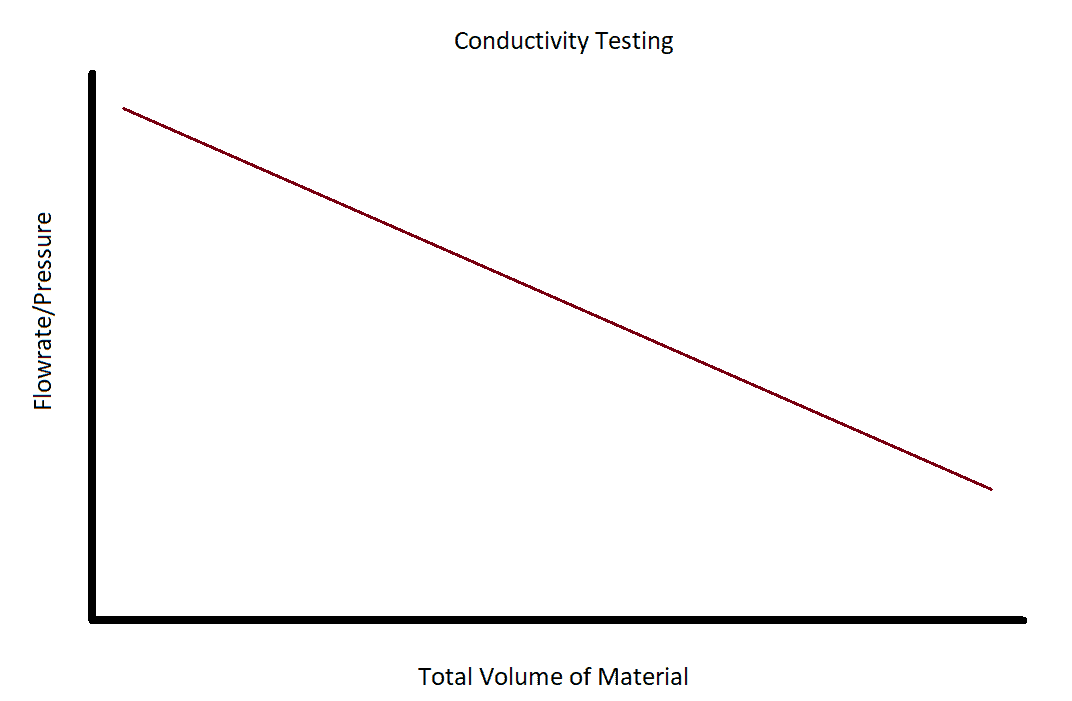
The slope of the line would give us the rate at which the filter clogged or in other words, a measure of the material cleanliness. The minimum flowrate is defined by performance requirements needed to jet material correctly. The total volume of material jetted is defined by marketing requirements. From this chart you can determine how many cubic feet (or pounds) of material could be jetted before the flowrate drops below acceptable levels.
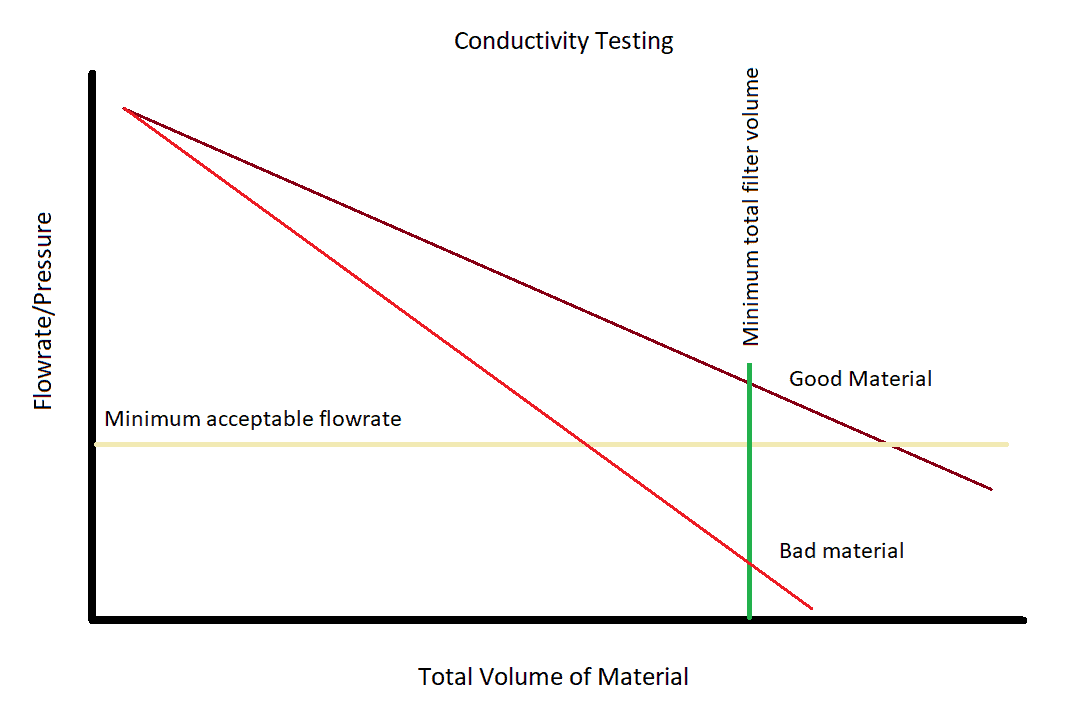
The test metric is excellent for verifying material cleanliness, so we can apply this to estimate backcountry water filter performance.
However, we have no control over water quality in the backcountry. Modifying the test methodology to estimate effective filter area does add a lot more value to help characterize the performance state of the water filter.
It would be easy to replicate this type of test for water filters and the results would be highly repeatable. That being said, the system we used for evaluating 3D printing material quality, described above, is bulky and requires additional equipment that would make it difficult for most backpackers to emulate.
Thus, in this article, I am proposing a faster and easier-to-use test that, while not as accurate, the would be easy to replicate and is user friendly enough for most backpackers.
The goal of this test is to determine the effective age of your backpacking water filter based on comparing its current flowrate to its flowrate when new.
I developed this test procedure using Sawyer Squeeze and Sawyer Mini filters, since they are probably the two most popular filter models in use by the lightweight backpacking and thru-hiking communities.
You can estimate the life of your Sawyer filter using a pretty simple test setup. The test requires that you measure the flowrate of a new filter in order to establish a baseline.
Darcy’s Law is used to characterize fluid flow through a filter media. However, this assumes that the fluid is free of particulates. By adding the assumption that the filter will become clogged over time, you can estimate the life of the filter by calculating the reduction in the effective filter area. By monitoring the flowrate, you can approximate the amount of useable filter (effective remaining filter area) that is remaining in your filter. Additionally, you can see the effect of backflushing on restoring the life of your filter.
Step 1: Drill a hole in the bottom of the Smartwater bottle. The hole should be small enough (~3/16” or 5 mm) that you finger can prevent air from leaking into the bottle. This is required to prevent a vacuum from forming in the water bottle during filtration, which will influence repeatability by altering the flow rate.
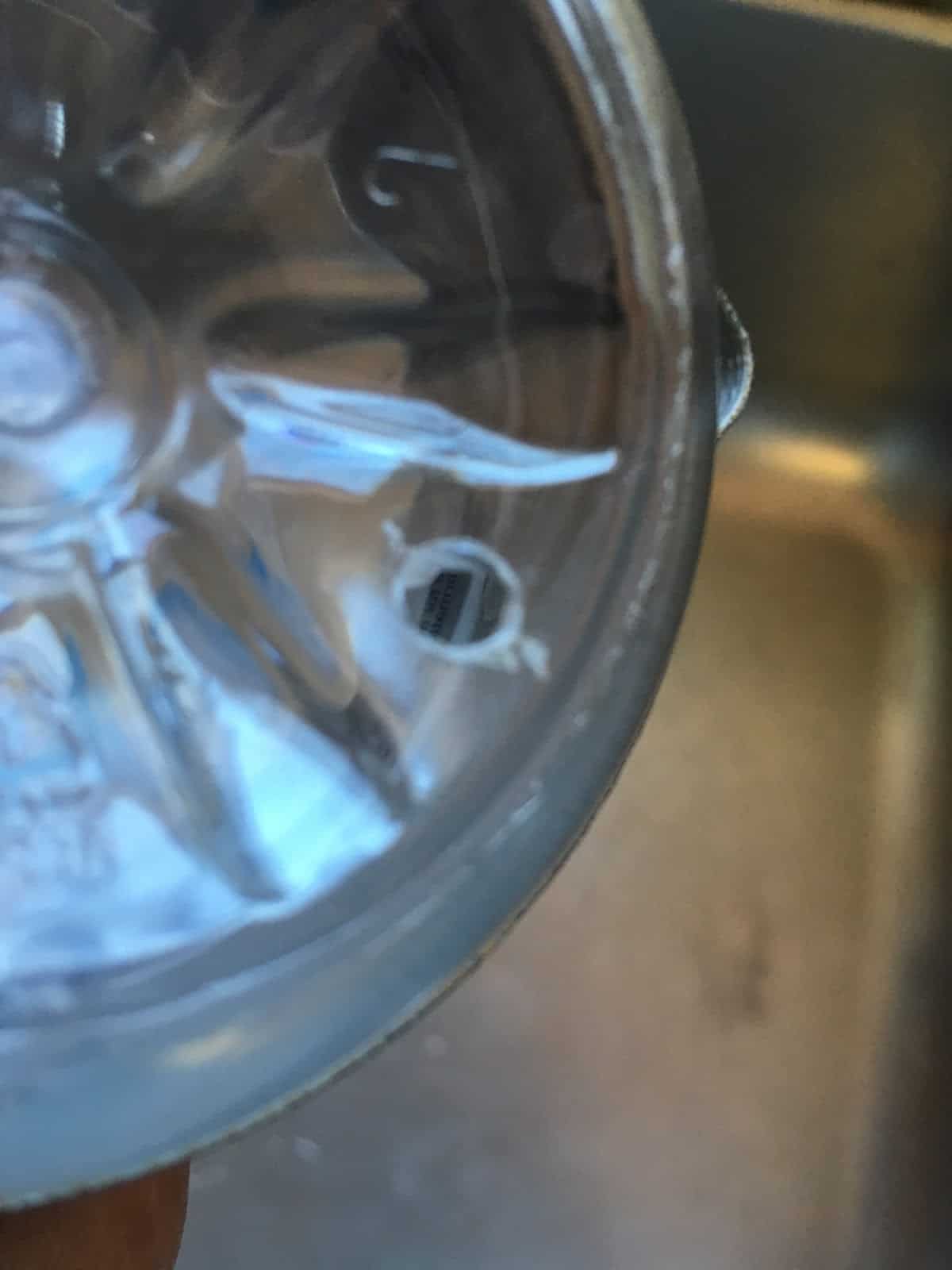
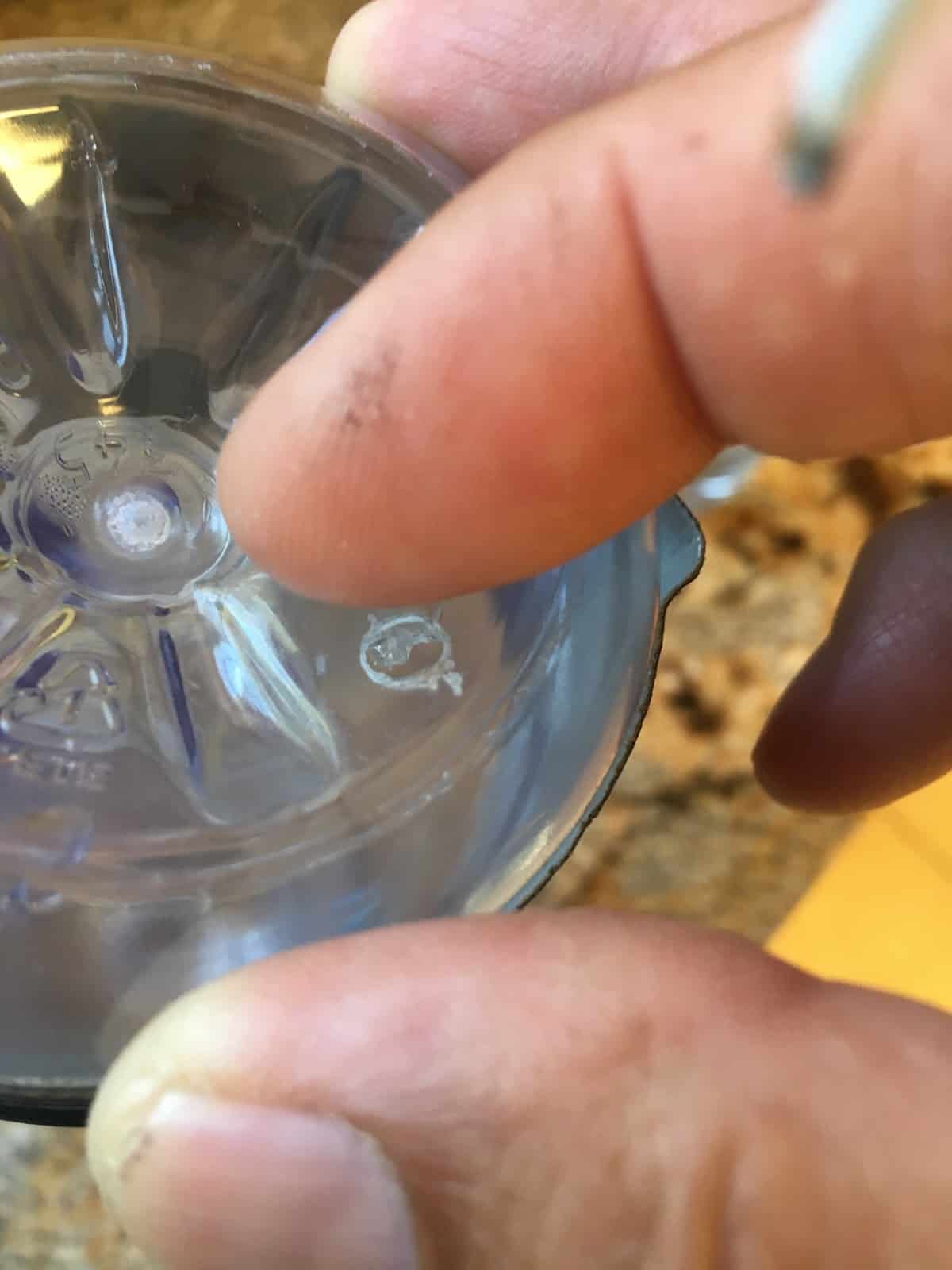
Step 2: Make sure that your filter is wetted out: I placed mine in a full glass of water overnight.
Step 3: Fill your sink (or a bucket of water) full of water.
Step 4: Submerge the bottle completely under water and remove all of the trapped air. Do the same with the filter and attach the two while keeping them underwater. In the picture below, the assembly is completely submerged below the surface of the water.
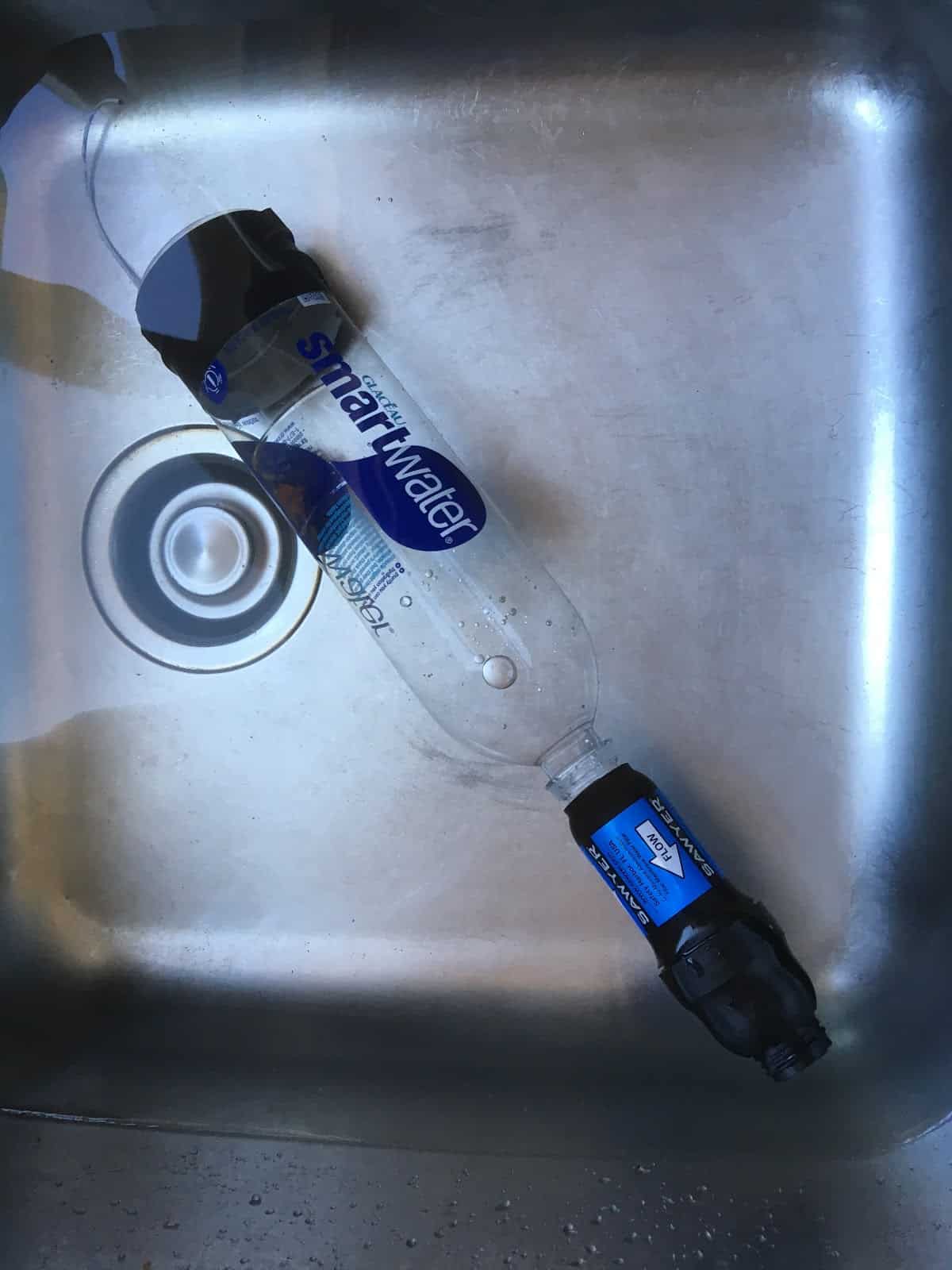 Step 5: Place your finger over the hole on the bottom of the water bottle and raise the bottle/filter assembly out of the water. Water should not flow out of the filter (there may be a few residual drips, and that’s OK).
Step 6: Place a bowl on top of the scale and tare the scale.
Step 7: Suspend the bottle/filter over the bowl. Release your finger from the vent hole, and at the same time, start a stopwatch.
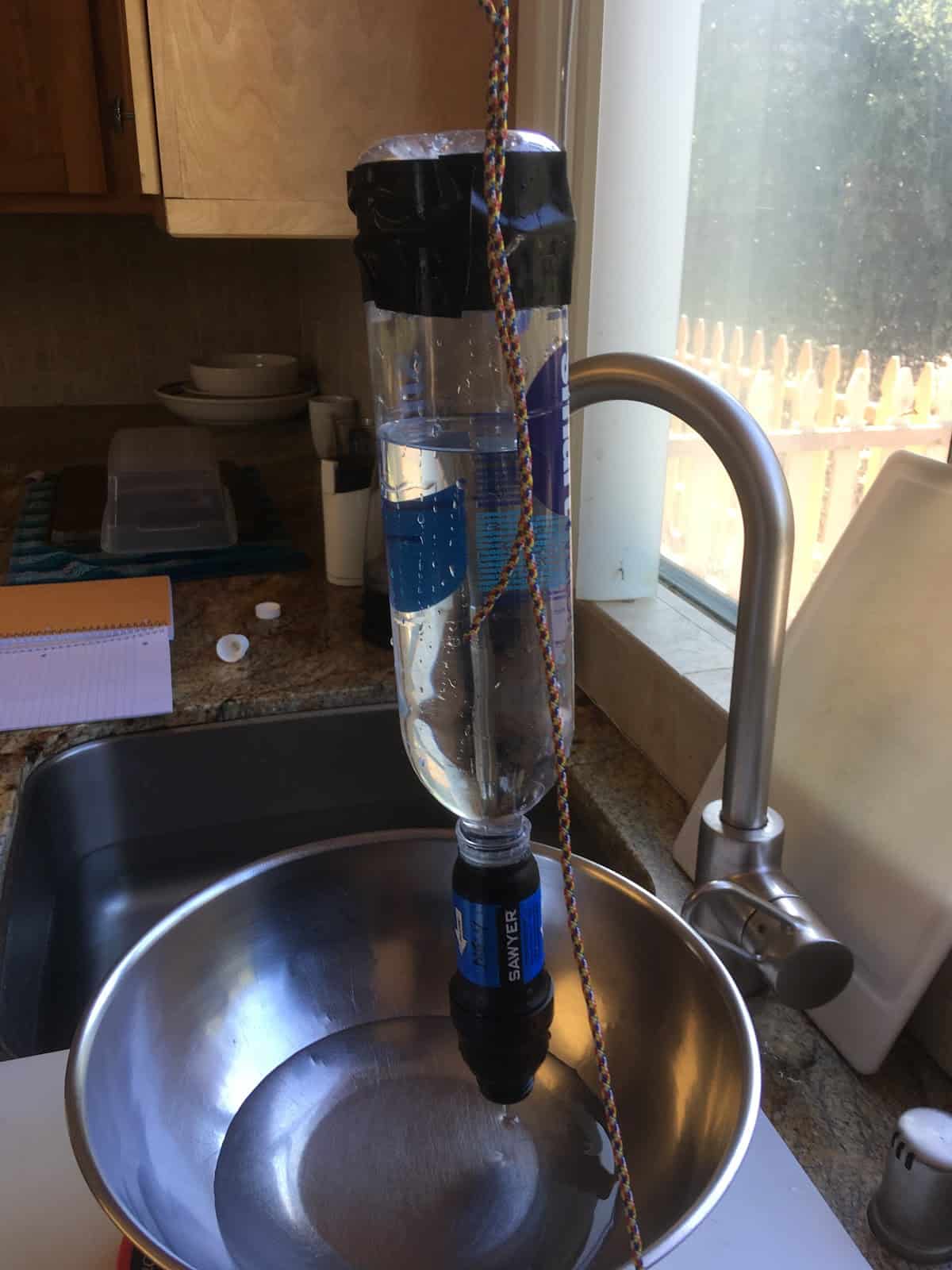
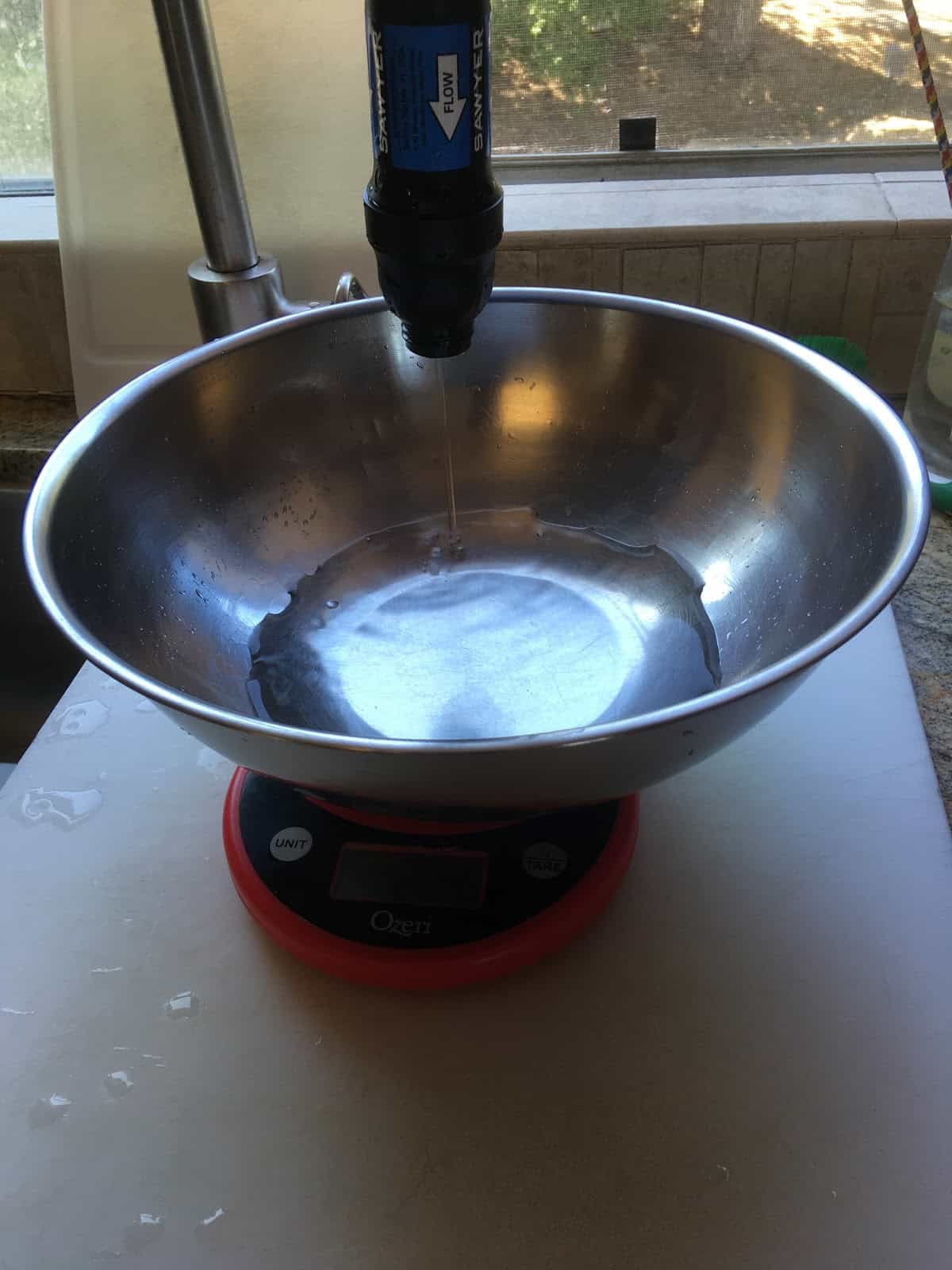 Step 8: When the scale reads 500 grams (16.9 oz), record the time (in seconds) and end the test.
For reference, I tested a brand-new (unused) Sawyer Squeeze filter and a used Sawyer Squeeze filter. The used filter has been my go-to filter for the last 5 years or so. I haven’t been judicious about backflushing or performing maintenance on the filter after my trips. I also do not have a clear idea as to how much water has been through the filter.
The test was conducted 3 times. Due to good repeatability, I elected not to include more replicate runs. The same batch of water was used for all tests and the water temperature remained constant. After the test, the filtered water was poured back into the main body of water.
The test was limited to 500 ml (16.9 oz) for 2 reasons. First, I was concerned about the impact of the reduced pressure head over time (h). As the water level dropped so would the flowrate and that could add error into the measurements. Secondly, my digital scale times out after 3 minutes so the change in volume (ΔV) had to be managed.
The following table summarizes my results with the new filter, the used filter, and the same used filter after a backflushing regime:
| New Filter | Used Filter | Used, Backflushed | |
| Time
(seconds) |
57 | 103 | 99 |
| 56 | 105 | 97 | |
| 57 | 100 | 98 | |
| Average | 56.7 | 102.7 | 98.0 |
Darcy’s Law was first used to describe fluid motion through permeable media (e.g., water flow through dirt and sand). Darcy’s Law has been used by engineers for decades to characterize filter performance. The basic equation is defined below:
K = ( ΔV * L ) / ( Δ t * A * h )
Where
Engineered filters are easier to analyze compared to earthen systems as a number of variables are under control.
K (hydraulic conductivity) is usually a design specification. A and L are defined by the physical design of the filter. For the purpose of this test, K, A, and L are all constants since we are comparing the performance of the same filters.
Darcy’s Law was formulated with the assumption that the fluid does not contain any contaminants (particulates). We can adjust the formula by assuming that as the filter clogs, the effective area of the filter is reduced.
Given the test protocol, the initial volume (V) is defined as a full bottle and the final volume occurs at the termination of the test when 500 ml (16.9 oz) has been filtered. Additionally, h (pressure head) is geometrically fixed as a function of the bottle’s dimensions.
Since K is a true constant between two filters having the same design, we can rewrite Darcy’s Law for both the new and used filter tests:
( V * L ) / ( tnew * Anew * h ) = K = ( V * L / tused * Aused * h )
V, K, L & h are basically constant over the course of any replicate tests so they cancel out of the equation.
The formula now reduces to:
1 / ( tnew * Anew ) = 1 / ( tused * Aused )
This can be rearranged into:
Aused / Anew = tnew / tused
Thus, the ratio of the effective surface area of the used filter compared to the surface area of a new filter is proportional to the inverse of the time difference of the flowrates.
Using my test data in the Darcy’s Law formula above, we can compare the performance of my used to a new filter:
Water quality is unknown and filtered volumes will vary. Here is a graph speculating what can happen over the life of a filter.
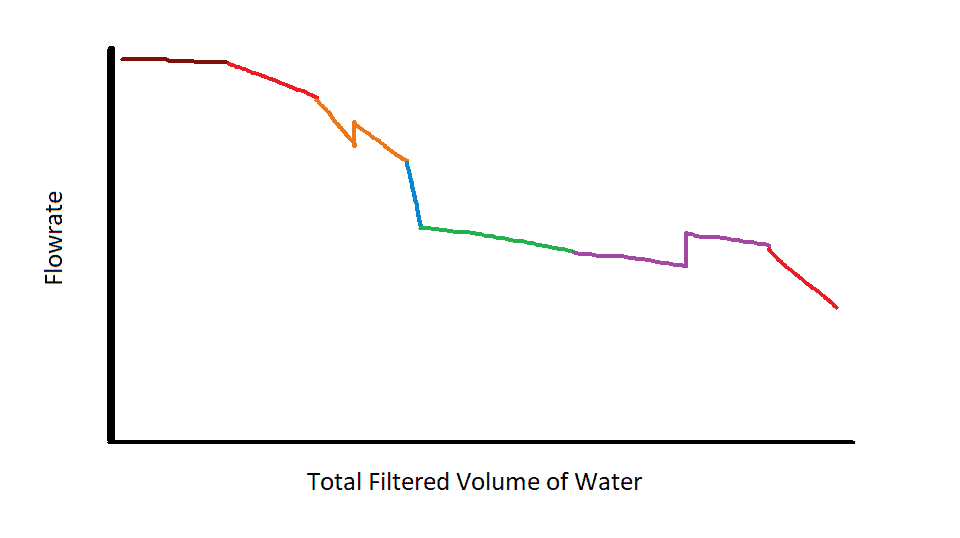
Each color represents a different backpacking trip. The decreasing slope of lines, e.g., may be a function of particulates clogging the water column (steep lines represent the filtration of water with higher particulate concentrations). The vertical spikes represent attempts to backflush the filter.
This simple test would provide insight about the effective surface area of your water filter’s media (in a sense, it represents a fuel gauge for the filter’s life).
No meaningful conclusion can be drawn from the backflushing results because the history of the used filter is not well-documented. More field data would be needed in order to clarify the effectiveness of backflushing, de-calcification, or any other mechanism by which filtration could be improved.
In an ideal world, one could measure results on (for example) 10 samples of new Sawyer filters to create a baseline range of flow rates for new filters. Users could then repeat the test protocol to estimate the actual effective filter area or life of their used system. If successful, the database could be expanded to include other gravity/squeeze-based filters.
Water quality around the country (world) is highly variable, so you must select the right filter for the right conditions. When camping in and around slot canyons and silty water sources, I usually bring my MSR MiniWorks filter because I can easily clean the filter element even in silt-laden water. Otherwise, I use the Sawyer Squeeze for 90% of my trips.
When they first came out, the reported life of a Sawyer Squeeze was 1 million gallons (3.8 M liters) of water!
A million gallons is an absurd amount of water. I knew that the only way that they could claim those numbers were based upon something like continuous-flow (i.e., Conductivity) testing using some type of clean model water. Sawyer was forced to back off on those claims as they could not verify the claim with confidence, and it had almost zero real-world applicability.
The Sawyer Mini claims to have a filter life of up to 100,000 gallons (380,000 liters) of water. That’s great but the Mini has an order of magnitude less filter material that the Squeeze. After more than 5 years of use and abuse, the test results indicate that my original Sawyer Squeeze filter still has 55% of its life remaining. In terms of equivalence, that’s the same as about 5 Sawyer Mini filters!
In my opinion, the Sawyer Squeeze is superior with respect to flowrate, longevity and most importantly robustness (or latitude in its ability to resist clogging by problematic water sources). The biggest downside of the Squeeze for most people is the weight. That being said, the Sawyer Squeeze filter weighs only 1.0 oz (28.3 gm) more than the Sawyer Mini.
This test protocol proved to be very useful for me in making the decision to stick with the Sawyer Squeeze, for its performance-to-weight ratio vs. the Mini, especially with respect to its durability (longevity).
Disclosure: Some (but not all) of the links in this review may be “affiliate” links, which means if you click on a link to one of our affiliate partners (usually a retailer site), and subsequently make a purchase with that retailer, we receive a small commission. This helps us fund our editorial projects, podcasts, instructional webinars, and more, and we appreciate it a lot! Thank you for supporting Backpacking Light!
My interview with a physio-therapist, as well as my personal history with foot injuries, is making me think more carefully about backpacking footwear.
You don’t have access to view this content.
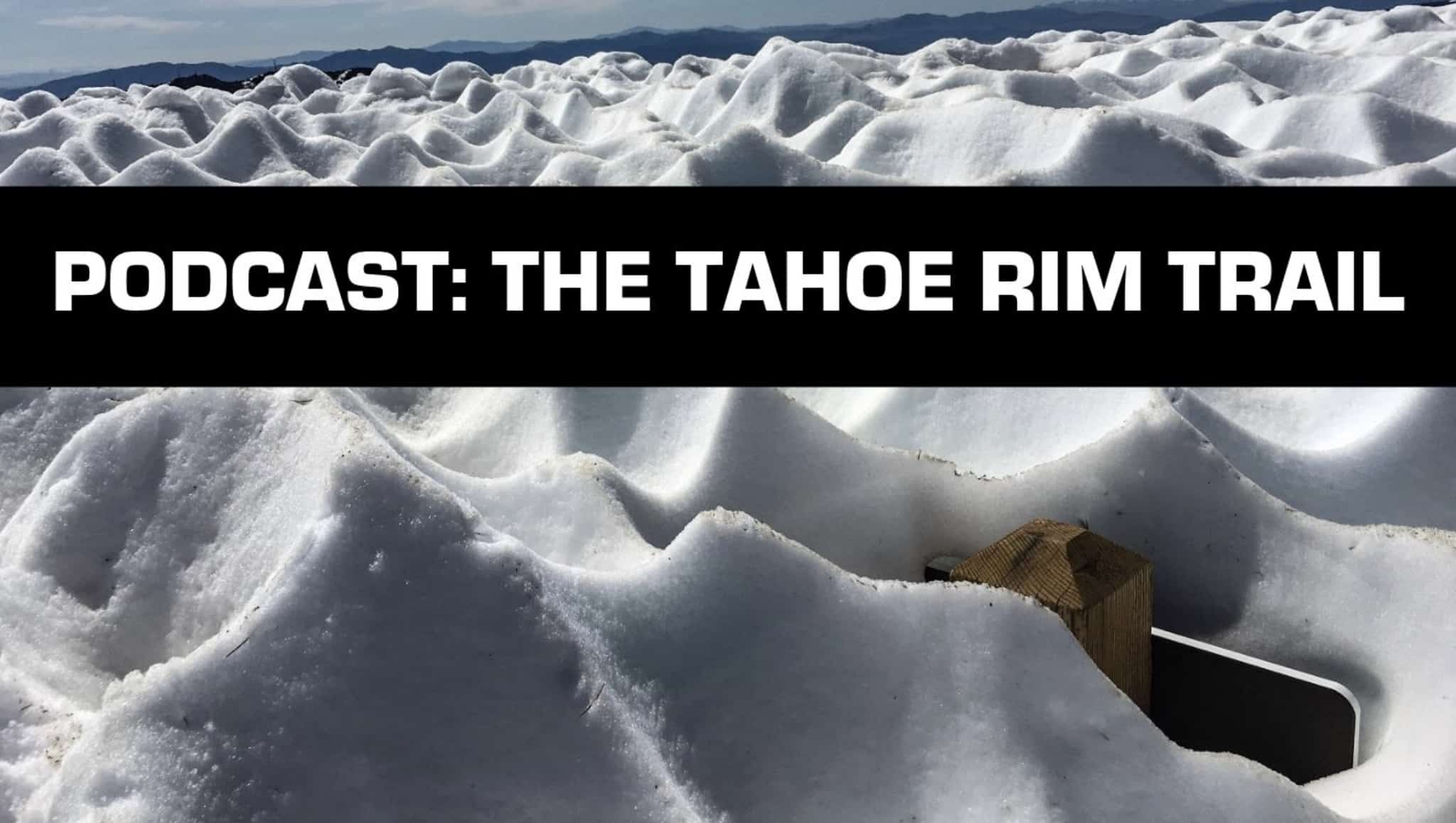
Ryan interviews Andrew Marshall about his recent thru-hike of the Tahoe Rim Trail. They talk about snow, gear, training, and more.
When Backpacking Light Gear Editor and Podcast Producer Andrew Marshall set out on a fast thru-hike of the Tahoe Rim Trail, he knew he’d be contending with Sierra snow pack that was several hundred percent above average. The story of that trip – trail conditions, lessons learned, and gear tested – is the subject of this BPL TRIP SHORT.
After a brief introduction, Ryan and Andrew spend some time discussing the Tahoe Rim Trail and conditions in the Eastern Sierra. Among other things, the guys talk about Andrew’s route finding, food strategies, training, and how to walk on sun cups (hint – meditate).
In the second half of the pod Ryan and Andrew talk about the gear – what Andrew loved, what he didn’t, and what he wished he’d left behind. They wrap it up with a lament on the state of footwear in the ultra-light world.
You can contact us at podcast@backpackinglight.com, or follow us on social media –
A narrative about Andrew Marshall’s thru-hike of the Tahoe Rim Trail during a big snow year.
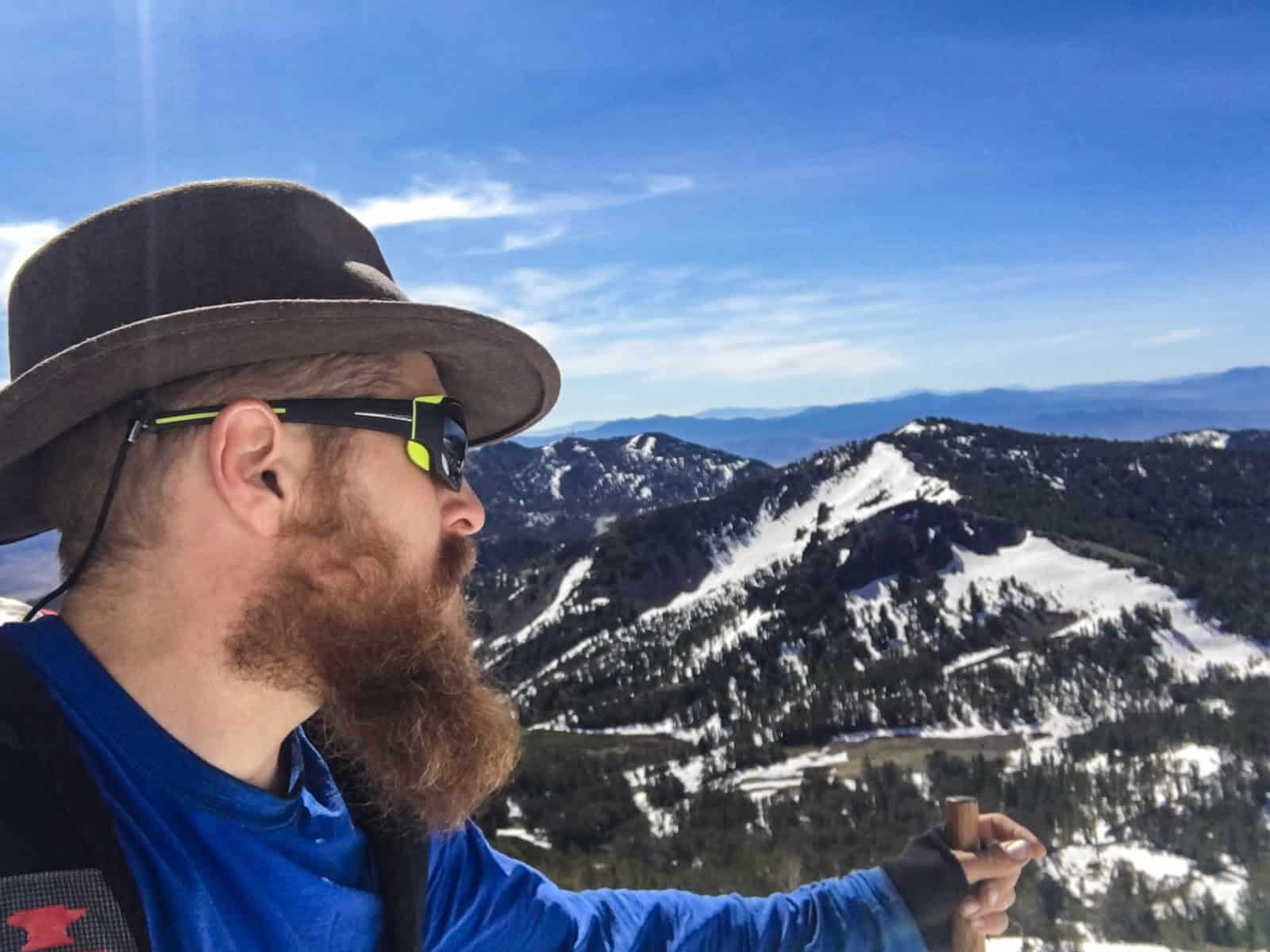
The Tahoe Rim Trail passes just above my cabin. Walk out the front door and up three miles of forest roads and singletrack and there you are – at a loop that winds through 170 miles of stunning eastern Sierra scenery.
We moved to Tahoe nine months ago, and I found the TRT a few days after that. You will perhaps remember that A Walk in the Woods, Bill Bryson’s seminal work on the Appalachian Trail, begins in much the same manner. In the opening pages, he stumbles across the AT a few minutes from his backyard in New Hampshire.
Bryson is a literary hero of mine, his book a large part of the reason I eventually set out on my own AT journey. So I rather enjoyed the similarities in our life experience. I made up my mind to thru-hike the TRT the moment I stepped across it, and it’s been an itch on the back of my neck ever since. Just existing up there, maddening, while I pecked away at a keyboard and watched through my window as the wind off Lake Tahoe tossed around the top of the sugar pines.
Maybe you know what I mean. Long trails have a way of getting under your skin. For every person who decides to do a thru-hike spur of the moment, it seems like there are ten folks who’ve been obsessing for years. Reading books and blogs, haunting forums, and boring their friends at cocktail parties. When you do finally pull the trigger on a long hike, it can feel strange, like you aren’t doing the thing you’ve been talking about doing for months, years, or decades. But you are, and it’s glorious and heady and a touch disorienting.
This is the state in which I found myself in early July as I bounced along the TRT at a respectable 3.4 mph. I’d spent the day frantically getting the loose threads of my life tucked away – freelance work put to bed, cat sitter paid, dishes washed, firewood tarped. Now I was getting a late start, but I was afoot and lighthearted in the golden afternoon light. Best of all, I was confident that regardless of what emergencies cropped up over the next week, I wouldn’t know about them and couldn’t solve them even if I did.
The arc of American life is long and bends towards obligation. And so I’ve come to value the disconnection and simplicity of thru-hiking more and more, even as near-daily Instagram updates, vlogs, and satellite communication become the rule rather than the exception. At the risk of breaking the sanctity of the “hike your own hike” mantra, it seems to me that the more thru-hiking comes to mirror “normal life,” with its unceasing connections and updates, the less reason there is to do it.
But why do we do it? It seems like a simple question at first, but I’ve struggled to explain myself over the years – particularly as the tales of hardship and suffering end up being the best stories from any hike. A good thru-hiking yarn doesn’t go, “and then I had several pain-free days of excellent walking in good weather and no bugs, and I wasn’t even all that hungry.”
It’s the sort of thing that becomes hard to explain to relatives at family functions, and the unexplainable nuance of it is why you end up answering with “it just seemed like it would be fun” when asked why you decided to trudge through snowfields from Mexico to Canada. On such occasions, it’s easy to understand why Mallory answered with a flippant “Because it’s there,” when asked why he was making another Everest attempt. That his quote has come to symbolize badassery rather than a frustrating inability to express the in-expressible is no fault of Mallory’s. We generally like our heroes to have good explanations for their actions, and when they don’t, we assign them our own explanations.
So why schlup a pack up and down mountains when for the same money and time you could be drinking margaritas on a beach somewhere? The obvious thoughts – immersion in nature, sitting in awe of beauty, and disconnection from modern society – are only part of the total answer. This story will have its moments of hardship – it wouldn’t be good otherwise. But I’ll also attempt to highlight the small moments of grace and wonder that comprise the answer to the ultimate long-distance backpacking question: why are we doing this?

I made an easy fifteen miles counter-clockwise around the lake by dark and pitched my tent in the lee of some boulders overlooking the water. I watched the sunset as I ate dinner, then fell into the familiar chores: store the food, treat the water, organize the gear, look over the following day’s terrain.
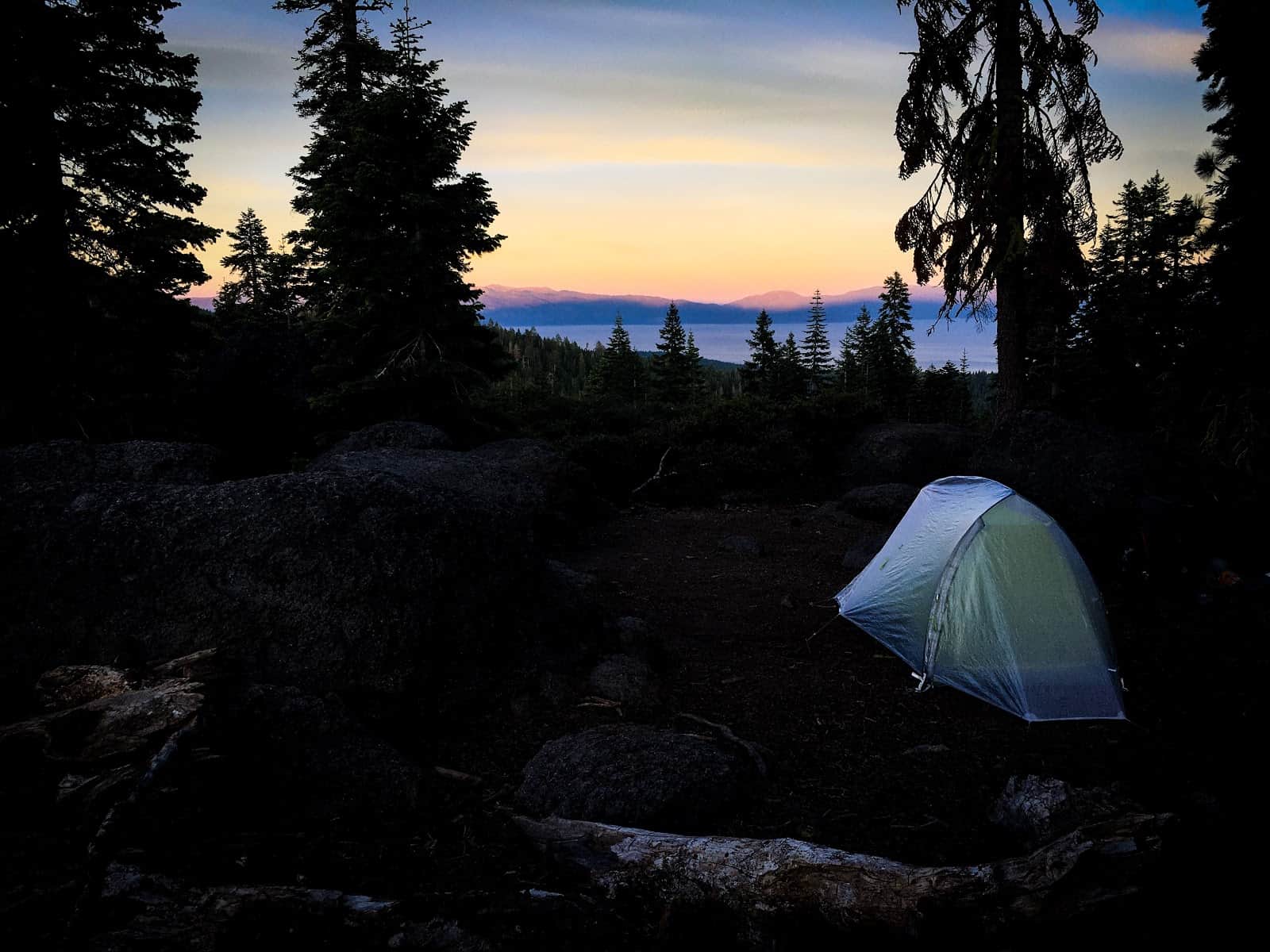
Here’s an often-overlooked reason to hike long distances: to meet your needs you must do simple, repetitive work with a small number of tools. The relationship between you and a drink of water is immediate and tangible, not separated into a series of remote capitalistic interactions which start with you going to work and end with you unthinkingly turning on the faucet. Sure, you have to do these simple chores on a three-day hike as well. But the rhythm they form after weeks and months of repetition is lovely.
Everything has a cost. While backpacking, that cost becomes concrete. And the longer you pay that cost concretely, the more concrete the world itself seems to become. To that end, backpacking is grounding.

Day two of my hike took me through Tahoe City and out the other side, into the edge of the Desolation Wilderness. As I gained altitude, I ran across ever-growing mounds of consolidated snow cutting across the trail like the edges of a desert expanding into a forest. These drifts immediately slowed my pace – the easy-to-follow trail became a slippery exercise in aerobic route finding. Nothing gets the blood pumping like gaining and losing a thousand feet of elevation in ten-foot increments.
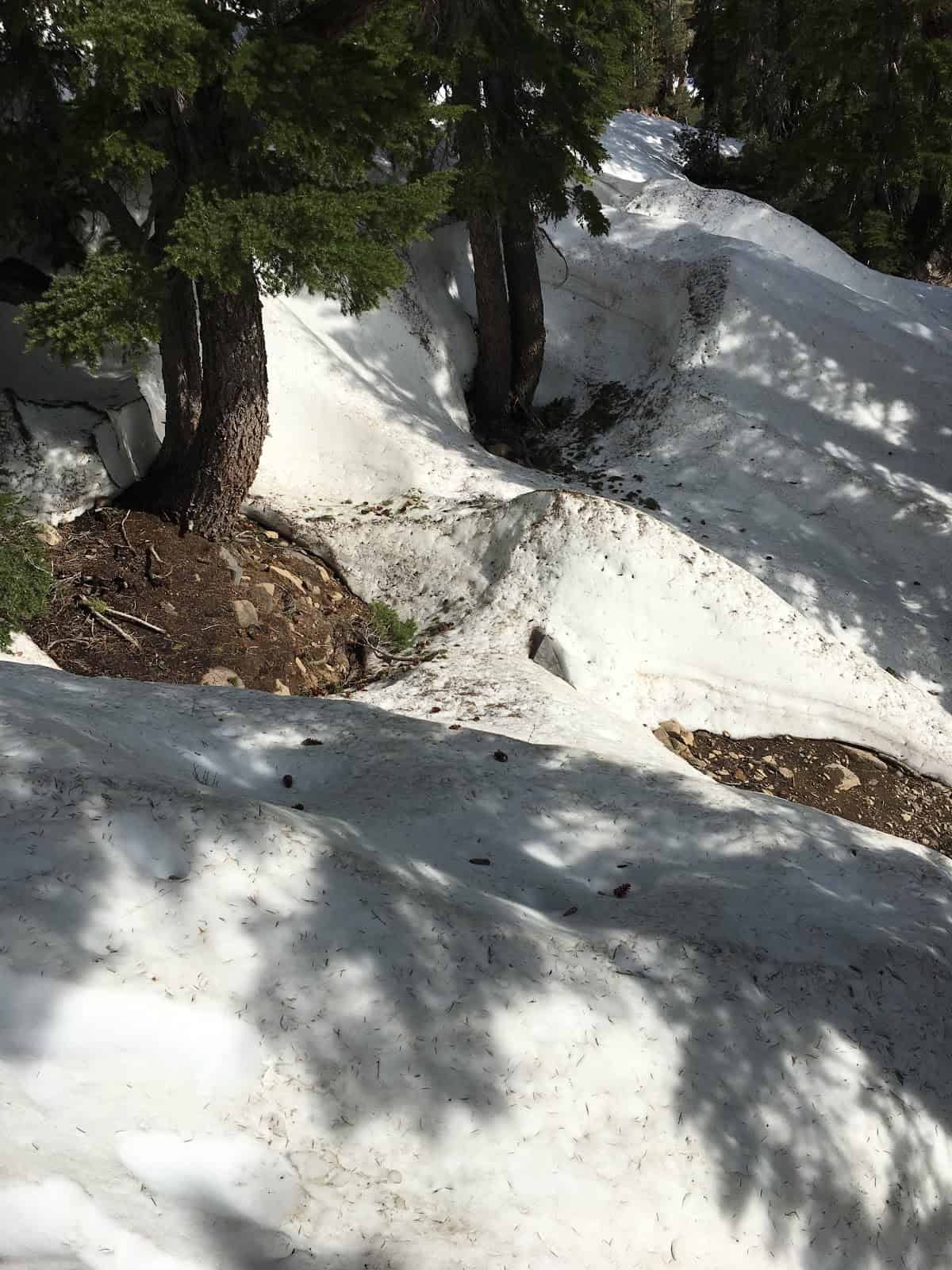
As the TRT joined the PCT at the end of day two, I started coming across northbound PCT thru-hikers. Thru-hikers tend to vacillate between grim fatalism and manic joy, but these gangly individuals were finishing four-hundred miles of conditions that were already wearing me out after ten miles. It’s hard to express their mood. Weary resignation, perhaps?
We had a hell of a winter here in the Sierra, and what is good for wildflowers and the California water table is bad for poor saps trying to make it to Canada. Sunken-eyed, hollow-faced, and thinner than they should be before the halfway point, this crop of PCT NoBos took it on the chin. They were exceedingly happy to be leaving the Sierras, and hopefully, their caloric burn would stabilize once they were in better trail conditions.
Weight loss is a pleasant side effect of thru-hiking but shouldn’t be considered in the “why we do this” category. Particularly as any weight you lose, you are likely to gain back almost immediately following your hike. It’s challenging to transition out of the “eat everything you see” mindset once you rejoin normal life. Most people don’t manage it very well. Another thing people forget about thru-hiking – whatever problems you take with you into the woods are likely to be there when you return.
Upon meeting PCT thru-hikers, I took great pride in being mistaken for one of their own. I took it to mean my pack was well-dialed and my stride locked in (either that or my beard, cultivated all winter against my wife’s clearly articulated wishes, was sufficiently ratty). Either way, I sucked in my winter paunch at every opportunity as I explained that, no, I wasn’t a PCT SoBo, I was on the significantly shorter Tahoe Rim Trail.
I love the traditional exchange of trail conditions as two hikers meet each other from opposing directions. It’s another oft-overlooked pleasantry of life on the trail. Is there anything more basic than two travelers meeting on a path, each doing his or her best to ease the passage for the other? Our ancestors have been doing it since the first proto-humans met each other on proto-elephant trails. No doubt they were leaning on sticks, saber-tooth tiger packs slung over their shoulders, discussing water sources and upcoming elevation changes. Shortly after that, the first forum arguments broke out on cave walls as strangers argued with each other about the pros and cons of giant sloth pelts as overhead shelters (so breathable, but is it worth the weight? They had OPINIONS).
In this case, The Ritual all through the Desolation Wilderness went like this:
“How’s the trail behind you?”
“Snowy. Sketchy traverses. Twenty-foot snowdrifts. Slushy walking and wet feet after ten am. Hard going, you won’t make good miles. Streams are running though. How’s the trail behind you?”
“Same. Exactly the same.”
“Happy Trails.”
“Happy Trails.”
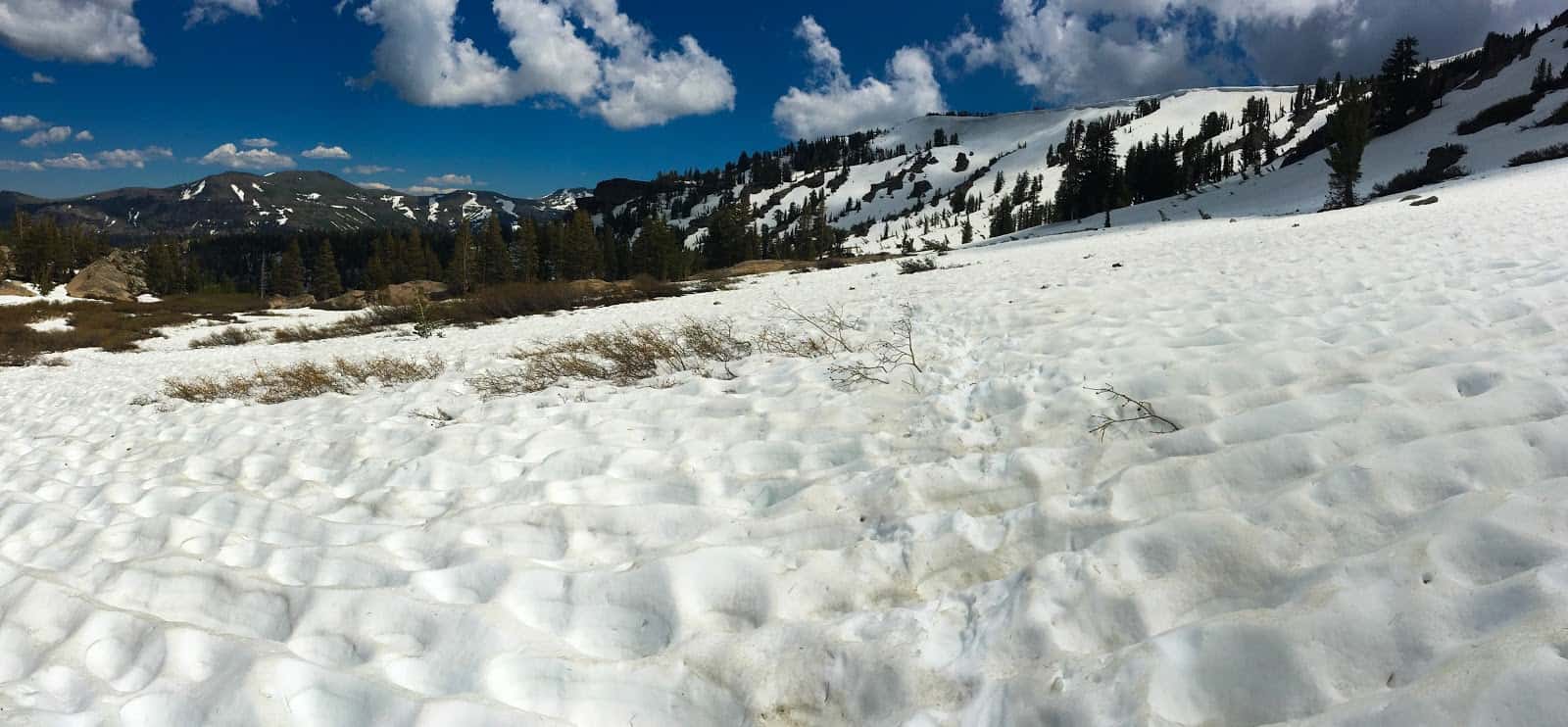

As day three progressed, the slow-going started to stress me out. With less than a week available on my calendar to complete the TRT, I had to top 27 miles days every day. My late start on day one had already set me behind, and now I was working twice as hard as I’d been expecting in order to make two or three miles per day less than I needed to. The brutal math of trail miles adds up quickly – this was going to mean 30+ mile days on the east side of the lake.
As I slid down my umpteenth snowbank and searched around for the trail, I reflected on my pre-hike research. My sources had indicated that this particular section of TRT was “mostly clear of snow.” It occurred to me that I must have a different definition of “mostly,” “clear,” or “snow” than the person who wrote the trail conditions on the official Tahoe Rim Trail website. I was starting to think my ambitious timeline might be coming up against the reality of mother nature. I was walking by five-thirty am every morning and setting up camp after eight every night. I’d yet to crack the 10 oz paperback I’d already hauled over eighty miles of tough going, an unconscionable sin if ever there was one.
At the start of this essay, I mentioned that a common reason for long-distance backpacking is a chance to be “in nature” for long periods. What I believe most people mean when they say this is “to be surrounded by the beauty of nature,” and that it is wonderful and soothing to the soul, of course.
But another aspect to being “in nature” is to be at the mercy of nature. All the research, preparation, and expensive gear in the world doesn’t change the fact that if it rains long enough, you will be wet. If the cold is cold enough, you will be cold. If you are hungry, you will be hungry, because you just can’t carry enough food with you to not be. If the going is sufficiently hard, you may not accomplish your goal, no matter how hard you try. If you push yourself too far past your limits in the wrong situation, you die.
Dealing with these realities is one of the hardest things about thru-hiking for type-A first-world humans. We are used to getting our way with the push of a button or the swipe of a finger across a screen. “Hard work and preparation will bring you success,” is so deeply ingrained in our American mythology that it’s disorienting when mountains turn out not to give a damn about your hard work. Even worse, mountains sometimes don’t care how much Dyneema and carbon fiber your high-paying white collar job affords you.
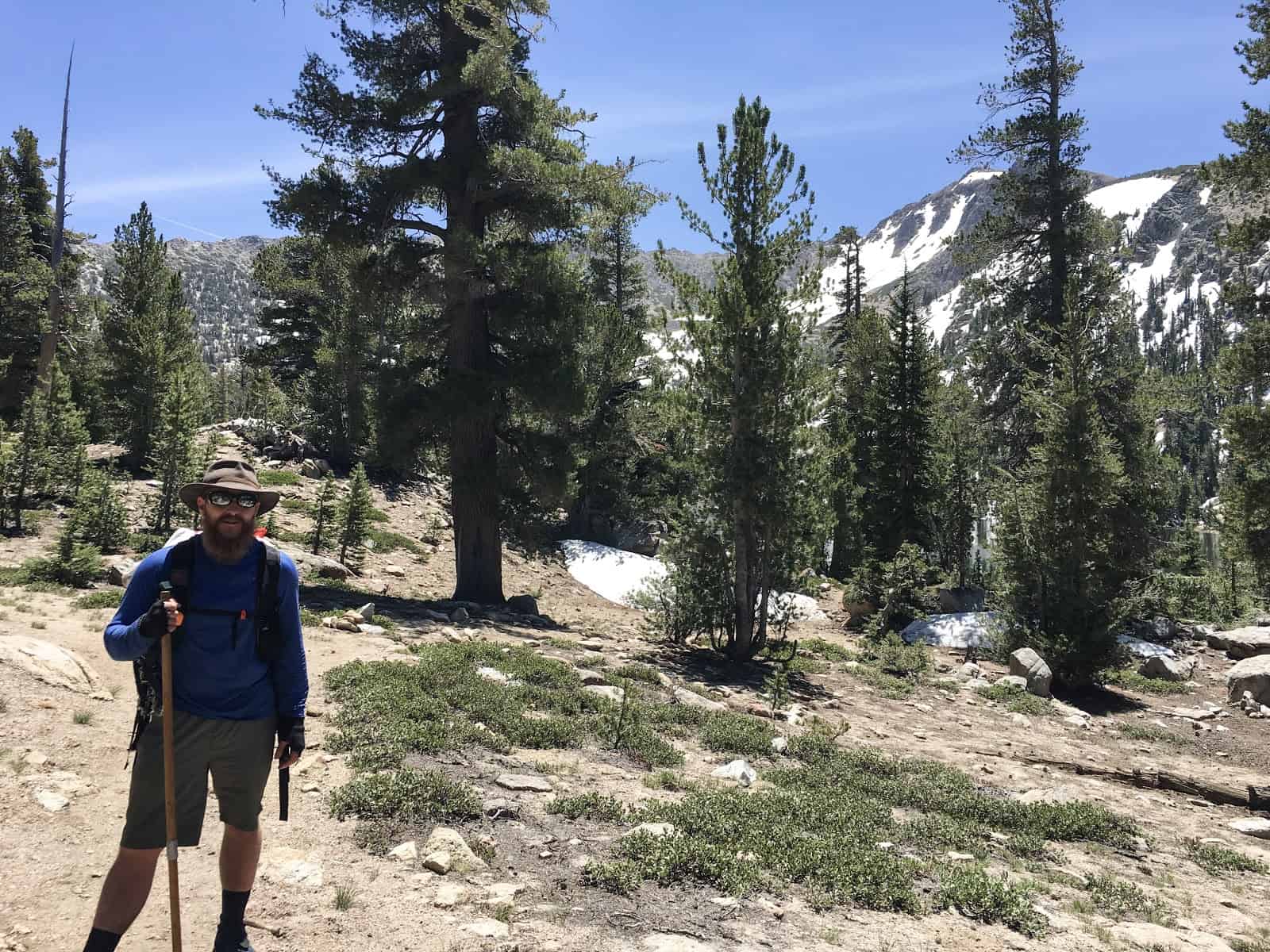
So long as it isn’t fatal, the occasional kick in the ass is one of the best things that can happen to you, as crusty old grandpas everywhere are fond of reminding you. And so it turns out that being uncomfortable and sometimes failing is an excellent reason to go on a long hike – but this can be hard to remember sometimes.
On the morning of day four, I arrived at the Echo Lake Chalet, a mountain hotel with a well-provisioned general store. I took the opportunity to grab a candy bar and a cup of coffee and settled down to text my wife. After I complained about the conditions and my swiftly compressing timetable, my wife responded with the obvious.
“You know, you don’t have to finish. Maybe conditions are just too hard for the time you have. Just do what you can and take an Uber back to the house at the end of your seven days,” she texted.
I grumpily pondered this wisdom while I dunked my Snickers in my coffee and glared up to the mountains.
A few minutes later, she texted again.
“But you are a bad-ass, and I believe you can get it done,” read text number two.
Clearly, she was unsure which tactic would make me feel better, so she decided to toss both out there and hedge her bets. In truth, both ideas (that I didn’t HAVE to finish, but it was likely I COULD finish, but also just as likely that I COULDN’T finish because the trail is what the trail is) soothed my mounting gloom. I would give it my best shot, knowing that the reality of the mountains might defy me regardless of how hard I tried. Thus buoyed by expert philosophical wifery, I finished my snack and slid back into the slipstream of the trail.

We are lead to this: thru-hiking (or any long-distance backpacking) is a contradictory experience. Clearly, the point is to be in the wild, in the woods, in the mountains, for long periods of time. Clearly, the point is also to get from point A to point B. It isn’t about the journey, it’s about the destination, although it is simultaneously very much about the journey.
Trying to hold both of these ideas in your head at the same time is an exercise in mental gymnastics that is best assisted, in my opinion, with a deep study of the Tao Te Ching and some of the more Zen focused branches of Buddhism. Failing that, you can always go southbound on the Appalachian Trail. The southern terminus of the AT is famously just a plaque bolted to the ground, overlooking a pretty but unremarkable collection of low, soft Georgia ridgelines. The “Oh. Well. I did it, I guess,” feeling this plaque engenders is such a contrast to the Instagram-worthy epicness of the Katahdin northern terminus that it boggles the mind. It will teach you to think correctly about the act of walking long-distances, that’s for sure.

By the afternoon of day four on the TRT, I was enjoying my longest snow-free stretch of trail yet, feeling lean and strong and locked in.
As I rounded the southern tip of Lake Tahoe and started north on the eastern side, trail conditions continued to improve. I made up some lost time, knocking out twenty-nine and thirty miles on days five and six respectively. As day seven dawned, I was thirty miles from finishing the TRT, with an additional three miles after that to walk back to my cabin. At this point, I was determined to finish on day seven because I’d neglected to pack a dinner for that evening, to say nothing of breakfast or lunch for a hypothetical day eight. Philosophy considerations almost always take a backseat to the realities of the stomach.
Covering the ground was going to be no easy task. My route for the day would take me into the Mt. Rose Wilderness and over Relay Peak, the highest point of the TRT. The Wilderness was a section of trail I knew would be completely socked in with snow, which is why I’d saved it for last. I was banking on the somewhat silly hypothesis that an extra six days of sunshine would vaporize the twenty-foot snowbanks.
Feeling like an Everest mountaineer on summit day, I broke camp and drank coffee by headlamp. Five miles later, I was in the snow, and my pace dropped from 3.5 mph to under .5 mph.
I had a few new problems with which to contend. Firstly, the TRT had split from the PCT forty miles earlier, and I no longer had even the hesitant footprints of previous hikers to follow. So I spent even more time route finding than I had in the Desolation Wilderness a few days earlier.
To add to that, the sheer volume of snow at this higher elevation had created a quasi-glacier. The weight of the ice had pushed giant pines over like matchsticks. Soon enough I was engaged in a sort of vertical scrambling bushwhacking with slushy late-morning snowpack underfoot, fighting hard for every scrap of elevation gain. When I finally cleared treeline, I was met with even more challenging tread – sun cups that were two feet deep.
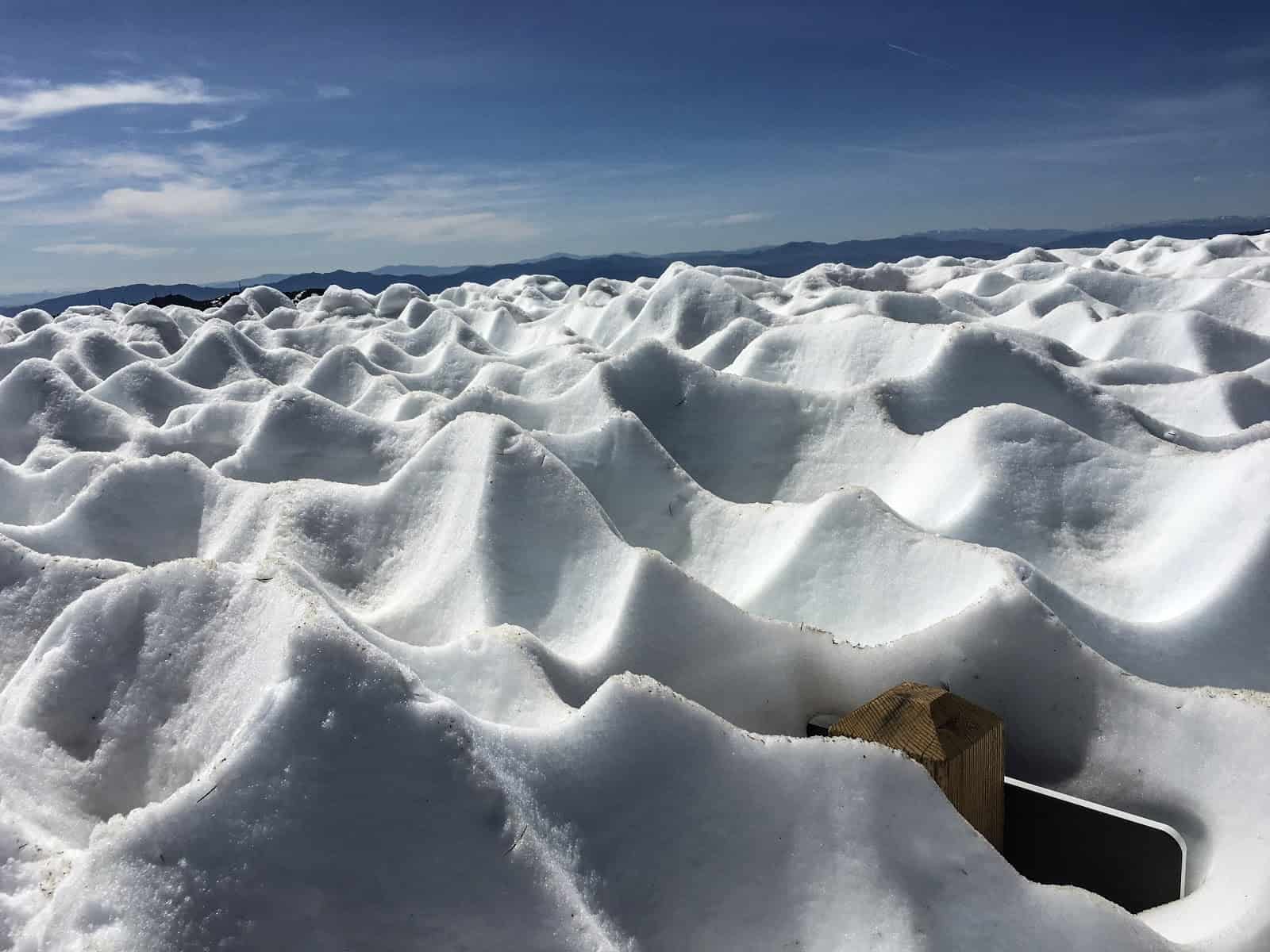
Both the final ascent to Relay Peak and the descent on the other side were replete with the kinds of traverses that make your mother extremely unhappy. Halfway across one particularly exposed traverse, I stopped for water and thought to myself, “I’d better mentally rehearse my self-arrest technique.” On the very next step, my fragile toe-hold gave way and down I went, suddenly subject to the forces of friction and gravity and pants-pissing fear. I managed to halt myself about ten feet into the slide, though it felt more like ten hundred. Terror inducing traverses are the sort of thing I never had to deal with growing up backpacking in North Carolina, Georgia, and Tennessee. In the southeast, snow is (generally) less murderous, and it’s easier to find decent post-hike barbeque.
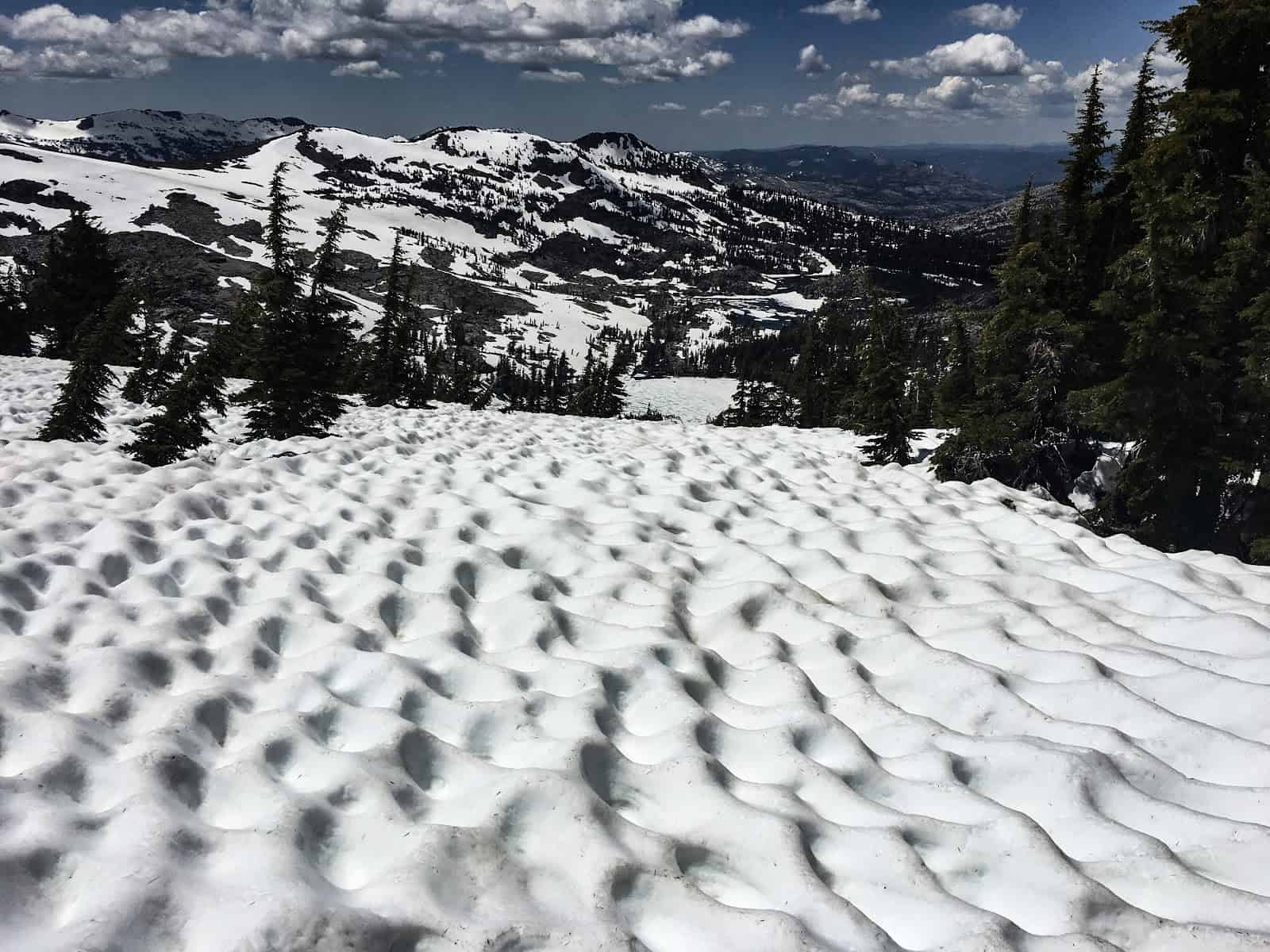
All in all, it took me about eight hours to clear six miles of trail, and I ran into periodic snowbanks for another five miles after that. But finally, blessedly, I was out of the Wilderness and into elevation that snow had given up on weeks beforehand. Digging deep, I cranked up my pace and pushed into the final leg – fueled by my final few almonds, a chunk of parmesan cheese, and some lemonade soaked chia seeds. My reward was truly jaw-dropping ridgeline vistas beneath a bluebird sky. Beyond the ridge, Lake Tahoe was a surreal ultramarine. After a day of unceasing snow-glare, everything seemed over-saturated. Under my feet, the trail was solid and real.
I like off-trail travel – the problem solving, the adventure, the sense of being “out there” – and it always makes for a good story. But what I truly love is the steady, rhythmic, boring walking that a good section of trail provides. It’s my meditation and my prayer, and the thing that’s allowed me to stomp most of the poison out of my soul over the years. In his essay “On Walking,” Henry David Thoreau provides a Latin quote that sums it up nicely.
“Solvitur Ambulando.”
It is solved by walking.
What is solved? Well. Lots.
Herein lies my final thought on the matter of why we participate in this odd pastime of long-distance backpacking – a pursuit that is arguably the least sexy of all outdoor sports.
It’s just about walking. That’s it. Everything else – the beauty, the solitude, the camaraderie, the routine, the life lessons – all of it takes a back seat to what happens to your mind, body, and soul when you spend a good chunk of your day just plodding along.
Thoreau, that keen observer of the human condition, didn’t need modern double-blind studies to tell him the benefits of traveling by foot at two to three miles per hour. He saw the rewards made manifest in his soul, and as such was no fan of how locomotives, with their noise and their speed, shrunk and cluttered his world. We can only imagine what he’d have to say on the state of things now, although, come to think of it, his words would probably be much the same as they always were.
“Simplify, Simplify, Simplify.”
What’s more simple than walking?

In his book “On Trails,” journalist Robert Moore explores the concept of pathways as a kind of collective species memory. All sorts of animals from sheep to elephants follow trails because trails go somewhere. If a trail exists, the logic goes, it must be worth following.
My trail went exactly where it started – an unassuming fire road in the middle of the woods and from there three miles downhill to my home. When I stumbled into my cabin an hour later, it was eight-thirty pm. I’d covered thirty-three miles on the single toughest day of hiking I’d ever foisted upon myself. I’d finished on time, though I like to think I’d have been okay with not doing so.
More than that, I’d walked in a giant loop, a great irony to anyone who’s ever spent time in the woods expressly avoiding that navigational feat.
But to walk in a circle only to arrive home again seemed appropriate (and a touch Tolkien-esque), a final manifestation of my ponderings on the nature of thru-hiking. As the old saying goes, “Wherever you go, there you are.”
Maybe it’s all a little too esoteric, a bit too hippy-dippy. That’s okay. Just go on a long ramble, that’s all I’m trying to say. Follow a trail somewhere, and do it for more than a weekend. There are worse ways to shrug off a burden than to shoulder a pack and go walking for a long time. And few better.
Here are my notes about some of the more significant pieces of gear I took on the Tahoe Rim Trail. My base weight was around 17 lbs.
This article features an interview with a Canadian Mountain Rescue Medic, focusing on how to assemble lightweight first aid and trauma kits for backcountry travel.
This article features an interview with a Canadian Mountain Rescue Medic, focusing on how to assemble lightweight first aid and trauma kits for backcountry travel.
Invariably, when I release a new trip report with my gear list, the forum has at least one person ask: ‘what is in your first aid kit?’ Though, I am generally savvy with emergencies, (I did spend a fair bit of time with emergency services and have certainly been a patient more than my share of times) I am not a doctor, a nurse or a paramedic. Though I have taken many medical courses, I am long since expired on most of the relevant certifications, except basic first aid. I am perfectly capable of administering basic medical care to myself and packing my own kit. However, I balk at doing either for anyone else if I can possibly avoid it. I am evasive about answering the question to say the least.
I will start with a relatively generic disclaimer: no one can tell you what to put in your kit. You are the best person to evaluate your needs based on your own skills and medical liabilities. That said, insight from a medical professional is a great place to start. In my case, I built my kit around ideas I got from my family doctor (he’s an outdoor enthusiast), an ER nurse friend of mine and my physiotherapist. I took wilderness first aid and have had a fair amount of experience either managing an emergency as a responder or being a casualty (I’m a pinch accident prone.)
I do, however, believe the question of ‘what goes in your first aid kit’ begs an answer; a very good answer from a current professional (read: not me.) And, if you don’t use your skills, you lose them and the certifications expire.
To that end, I decided to find a professional to interview. I needed someone not only with medical experience, but also with outdoor experience (and preferably emergency trauma experience). Odd combination, which I put on the back burner for several years.
My search for a perfect interview candidate, accidentally ends one afternoon. As I stand in a line for a desperately needed cup of coffee, a stranger walks into the line behind me. Uncharacteristically, my, typically introverted personage introduces itself.
Turns out, my extroverted alter ego made friends with Michael. Michael is an avid kayaker, canoer, mountaineer and backpacker. On top of all of his outdoor pursuits, Michael is a paramedic and firefighter in the mountain community of Clearwater County, Alberta, Canada. Some time later, Michael and I part ways and I realize he’s going to be my interview subject to help us answer the question, ‘what goes into your first aid kit?’
A few months later, I meet with Michael for the interview. He’s tall, athletic with a boyish, unassuming charm and an affable grin. He is an obvious introvert, but with an air of confidence and intention.
Em: So what goes into a mountaineering paramedic’s kit?
Michael: I think experience as a paramedic tells me more about what isn’t important in a kit than anything else. Most life-saving tools and interventions come down to training, quick thinking and thousands of dollars worth of bulky electronic equipment. None of these are possible in a physical first-aid kit.
People shouldn’t fool themselves into thinking that loading up with a lot of dressings, bandages and splints will make a positive outcome more likely than loading up with knowledge of injuries and illnesses and the techniques for managing them.
Em: What is in your head is more important than what you carry.
Michael: It’s funny, now that I’m thinking about it, me being a paramedic probably allows me to weed out a lot of items more than it has me adding a bunch of items. I carry a few different things than a first aider, but a lot less of the common things. Improvising is easier when you understand what is going on and what the objective is.
For instance, people get hung up on items of wound care needing to be sterile. I know better…Clean is preferred but sterile is not a necessity. I always say, a dirty sock stuffed in a wound is still better than hypovolemic shock.
Em: In the backcountry, is there really such a thing as sterile? Most medical personnel I know would debate how ‘sterile’ conditions are in hospitals. There is contaminated, clean and clean enough to do surgery. If you aren’t a surgeon, the last one is irrelevant. Humans are relative germ factories. Is there any case where you would be seriously worried about clean dressings?
Michael: Large area burns, deep or full thickness burns, that is. Infection can happen fast when you lose a large portion of skin. That’s the main reason I add roller gauze to my kit, they come sterile.
Em: What is a common item you would eliminate from every backcountry first aid kit and why?
Michael: Instructions (on how to use first aid supplies). [laughing] Ok, I’ll give a real answer… Probably most of the tensor bandages and triangular bandages because they’re bulky and can be easily substituted with other things. Most kits seem to throw in a lot of them. I keep a couple if I have the luxury of room.
And I also toss the stupid little CPR face shields. They don’t work. Especially for a layman first aider. An actual CPR face mask would be optimal but are larger.
Em: And really how often are you going to be giving yourself CPR or traveling with someone you are afraid to give CPR? If you are giving CPR, it is most likely to be someone you are traveling with. Most people (maybe everyone) I backpack with could bleed all over me and I wouldn’t worry about it.
Michael: Exactly.
Em: What is one thing no kit should be without?
Michael: Duct tape. [laughing] Actually, no first aid kit should be without a user with a prevention mindset. Basically, no kit should be without brains. Always remember the brains!
Em: What’s a weird item in your kit most people wouldn’t think to put in, and what is it for?
Michael: Well, you’ll laugh… Condom, [laughing] its an emergency water container, waterproof bandage (fingers, hands), use it for its elasticity, crude glove, waterproofing for a firestarting kit (they stretch a surprising amount). Never actually used one yet for any of those though. Just seemed logical. They’re tiny and multifunction. Always a good thing to have in first-aid or survival kits.
Em: What do you look for in a first aid kit case?
Michael: Waterproof or water resistant, easily recognizable or marked as first aid, (might be sending someone else for it) and something that allows easy, even one handed access, without having to dump out all the contents. Most commercial options fit the bill but lots of other options too.
Em: I prefer to toss my meds in craft baggies from the dollar store and label them. I usually toss them in an old pill bottle afterward to prevent them from getting crushed. Is there a better method?
Michael: Same, I used to use mini bottles but never had a problem with them getting crushed in baggies. I do keep them organized separate from everything else in a mini nylon sack or designated pouch in the kit.
Em: I just dumped a pile of pink powder out of my kit the other day. Pepto doesn’t do well in baggies apparently. I used to always use a bottle then switched to baggies and switched back to bottles again.
Michael: You can still take the powder form. [laughing] I only have one tablet per bag so it doesn’t matter. The harder tablets I double up. The bags aren’t really robust enough to be opened and closed repeatedly anyway.
Em: Is there anything you think is an absolute no-no to toss out of your kit?
Michael: Never leave behind the meds. They’re basic meds but can still really improve a situation, and you can’t improvise them. Rapid fluid loss is really bad. Symptom control can’t be overstated when presented with diarrhea or vomiting.
Em: Same thing with hard tools like scissors?
Michael: Yeah, tools are the basis for improvising. Or at least, necessary for improvising.
Em: I know a lot of people think, ‘I’ll improvise a tool if I need it’, which can be done. However, it can cost precious time when it counts. Somethings cannot be improvised well either. Also, most people do a terrible job of improvising when they or a loved one are in pain.
What about antibiotics?
Michael: Antimicrobials would be a good idea for a long term trip, for treatment of various bacterial, viral, or protozoal infections, especially when you’re potentially a long time from getting out. Azithromycin (Z-Pak) is not effective against giardia, but a good choice for a wide variety of other bacterial infections.
Having the meds to treat high probability illness is always a plus. However, keep in mind that even quick recognition and treatment of, for instance, a bad case of giardia (with drugs such as Flagyl, tinidazole, etc.), diarrhea and other symptoms will continue for up to a week, for a lot of people. It’s very hard to “knock out” diarrhea fast and very easy to aggravate it. Even after treatment, dehydration will continue to be a serious safety concern, in a lot of wilderness settings where strength and endurance is required. Therefore, certain otherwise fairly benign illnesses, like giardia – in certain settings – would be cause for aborting a trip, if that option is open and depending on severity of symptoms, security of your position and available resources. (I say that having never suffered a case of it myself).
If you have no other choice or are in a good enough position to push through, having the right meds will indeed save you a lot of anguish.
Now the brass tacks, what are the contents of Michael’s kits? Michael works on a sliding scale, he starts with a universal consideration kit and combines with items for the next size up kit. This strategy makes it easy to organize as each kit size addition can be stored separately but combined to make a larger kit when needed.
Additionally, meds are kept in a separate list and section of the kit to make using, replacing and ensuring expiration dates are valid easier. The amount of meds in the kit is determined by the length of the trip and the individuals on the trip. Everyone should be aware of what personal meds are needed by their adventure mates and where they are if the meds may be needed in a life-saving intervention (epipens, heart medications and inhalers etc.)
My universal considerations for every kit (the list may get long but most of these are light and small items):
Editor’s Note: links to specific products are not necessarily links to the exact products in either Michael’s or Em’s kit, but are representative of the types of products that are popular choices by members of our community.
| Item | Purpose/Importance | Amount | Approximate Weight |
| fire starting kit | hypothermia/shock prevention | 1 | 16 g (.6 oz) |
| blade or small knife | digging out splinters, controlling callouses, useful multifunction (think tiny, sharp and narrow blade, not wide like razor blade) | 1 | 14 g (.5 oz) |
| duct tape | Splinting, wound cover, fire starter | 4’ (1.5 m) | 12 g (.4 oz) |
| super glue | makeshift stitches for small wound closures, gear repair | 1 tube | 2 g (.1 oz) |
| needles | splinters, gear repairs, blisters | 1 large, 1 small | .25 g (.0 oz) |
| electrolyte dry mix | dehydration treatment | 2 servings | 25 g (.9 oz) |
| water purification tablets | dehydration prevention | 4 | 2 g (.1 oz) |
| zipties | splinting, gear repairs | 3 | 4 g (.1 oz) |
| 100 quick calories (running gel, etc) | hypothermia/shock prevention | 1 | 50 g (1.8 oz) |
| elastic bands | dressing cover securement, useful, multifunction | 5-10 | 2 g (.1 oz) |
| plastic ziploc bags | ice pack, dressing cover, kit | 1-2 | 9 g (.3 oz) |
| condom | waterproof bandage cover, glove, etc. | 1-2 | 4 g (.1 oz) |
| blunt tip shears or seatbelt cutter | for cutting clothing and old bandages | 1 small | 14 g (.5 oz) |
| tweezers | splinters, ticks | 1 | 4 g (.1 oz) |
| safety pins | splinting, dressings | 2-3 | 4 g (.1 oz) |
| blister balm, powder or chalk | blister prevention | 1 package | 4 g (.1 oz) |
| antibiotic ointment | wound care | 1 small container | 10 g (.4 oz) |
| consider: glow sticks for larger kits | signalling, long term and night vision friendly light source, marking a patient or location in darkness, marking important equipment or rope | 2-5 | 24 g (.9 oz) |
Michael: Between that and the gear you would be carrying, that covers a bunch of small annoyances as well as splint building and major bandaging, so you can toss out the splint materials and bulky triangular bandage (substitute with clothing).
Em: I actually don’t carry a blade, I carry nail clippers with a sharp pointed file. It’s one of those tools I cannot replicate on the fly and serves a crucial and practical function in a pinch.
Michael: I hadn’t thought of that one, it makes pretty good sense.
Em: I like the seat belt cutter though, great idea. I also saw Victorinox is making a “blister pack” of tools about the size of a credit card called a SwissCard Lite which pretty much covers everything. It’s light and compact, but it’s also heinously expensive. Neat tool for backpackers on an unlimited budget.
Michael: I’d then work up from there to your most minimalist kit which would add some wound care supplies but only enough for isolated trauma (a single deep laceration, a single bad burn, a single broken bone) as any multi trauma in the wilderness environment is going to require improvisation anyway – unless you travel with a trauma jump kit.
As your trip length increases, the kit gets larger to account for higher potential and repeated use.
So in the most minimalist kit (solo, light 2-3 day trip) I would add:
| Item | Purpose/Importance | Amount | Approximate Weight |
| compression dressing | large wounds, blood loss control | 1 Medium | 10 g (.4 oz) |
| band-aids | small cuts | 10 assorted | 6 g (.2 oz) |
| blister pads or moleskin | blisters | 2 sheet or 10 pads | 6 g (.2 oz) |
| tegaderm | dressing securement | 2 | 4 g (.1 oz) |
| alcohol swabs | dressing attachment, cleaning wound site to ensure adhesion | 10 | 10 g (.4 oz) |
| gauze | wound dressing: particularly eye injury dressing | 1 2×2 | 2 g (.1 oz) |
| bandage tape or IV tape | dressing securement | 1 small roll | 6 g (.2 oz) |
| steristrips | small wound closure | 6 | 2 g (.1 oz) |
| tensor bandage | minor sprains, longer term treatment | 1 small | 20 g (.7 oz) |
| roller gauze | large, deep burns | 1 small | 6 g (.2 oz) |
| nitrile gloves | wound treatment | 1 pair | 10 g (.4 oz) |
| afterbite swabs | insect bite treatment | 2 | 5 g (.2 oz) |
| burn gel or medical grade lubricating gel | minor burn treatment | small packet | 4 g (.1 oz) |
In my next largest kit (a multi day backpack with another person, for instance), I’d add:
| Item | Purpose/Importance | Amount | Approximate Weight |
| tensor bandage | major sprains, longer term treatment | 1 Large | 25 g (.9 oz) |
| roller gauze | large, deep burns, multiple days of dressings | 1 Large | 12 g (.4 oz) |
| gauze | all purpose dressing | 1 4×4 | 4 g (.1 oz) |
| compression dressing | large bleeding wounds | 1 additional | 10 g (.4 oz) |
| bandage tape | dressing securement, multiple days of dressings | 1 additional | 12 g (.4 oz) |
| band-aids | minor cuts, multiple days of dressings | 10 additional | 6 g (.2 oz) |
| alcohol swabs | dressing attachment, cleaning wound site to ensure adhesion, multiple days of treatment | 10 additional | 10 g (.4 oz) |
| 10ml syringe | wound flushing, tick removal and tick container (just plug opening after) | 1 | 9 g (.3 oz) |
| emergency blanket or bivy | hypothermia prevention/treatment | 1 | 90 g (3.2 oz) |
| afterbite swabs | insect bites, multiple days of treatments | 2 additional | 5 g (.2 oz) |
| burn gel | minor burns, multiple days of treatment | 2 additional | 8 g (.3 oz) |
| antibiotic ointment | wound care, multiple days of treatment | 1 additional | 10 g (.4 oz) |
| abdo trauma pad | head wound/open skull fracture, open abdominal injury, any large wound dressing. (Especially open skull fracture, important to distribute pressure over large area, not directly over wound site, which is why Abdo pads work well) | 1 small 4×6 | 9 g (.3 oz) |
Michael: And by the way, the tick removal with a syringe is a ‘Michael field special.’ You don’t want to squeeze a tick when removing and you also want to save it/them for testing.
It’s something that I’m starting to take more seriously as I know a few people now that have contracted Lyme disease from local tick bites. It’s pretty much a North American wide thing now. Just to qualify that it’s not a well known method. There’s special tweezers too.
Em: Any reason you don’t toss your emergency blanket out? Most backpackers who practice ultralight skills want to throw them out because they have sleeping bags etc.
Michael: I don’t bother chucking it because I’m not watching my weight to that extent. If I was watching the grams, I’d only carry it on single day hikes. No reason to keep it if you have a sleeping bag other than redundancy’s sake.
Em: You are also out climbing for longer days where the bigger kit goes, but the sleeping bag doesn’t?
Michael: Yup, when I’m with other people especially. My climbing partner doesn’t carry much in the way of first aid. In that case, I bring the bigger kit which contains the emergency blanket.
In the largest kit I’d carry (multi-day paddling trip), I’d add:
| Item | Purpose/Importance | Amount | Approximate Weight |
| abdo trauma pad | head wound/open skull fracture, open abdominal injury, any large wound dressing | 1 large 8×8 | 18 g (.6 oz) |
| gauze pad | wound dressing: particularly eye injury dressing, additional days of dressings | 1 additional 2×2 | 2 g (.1 oz) |
| gauze pad | all purpose dressing, multiple days of dressing | 1 additional 4×4 | 4 g (.1 oz) |
| roller gauze | large, deep burns, multiple days of dressings | 1 additional | 12 g (.4 oz) |
| SAM splint | Splinting major joint or skeletal injury | 1 | 130 g (4.6 oz) |
| alcohol hand sanitizer | cleansing hands, fire starter | 1 | 40 g (1.4 oz) |
| triangular bandages | longer term major injury or wound care | 2 | 16 g (.6 oz) |
| vial of rubbing alcohol | dressing attachment, cleaning wound site to ensure adhesion, multiple days of treatment | 1 | 17 g (.6 oz) |
Michael: These aren’t exactly what my kits look like, but would be reasonable, minimalist kits for an intelligent first-aider, in my opinion.
Em: Any reason a backpacker shouldn’t toss the SAM splint?
Michael: The biggest kit is the one that goes on the long term, remote trips where it may be several days or weeks before help gets to you and you may need to have every advantage getting yourself or partners out. You might need typical items used as splint materials as crutches or their intended purposes in the long term.
The SAM is versatile. They make good neck braces and can be incorporated into bulk dressing for rib fractures. You can always cut it in half to save weight and space but still have a small amount of rigid splint to work with.
Em: Yeah, I could see the problem with using a makeshift splint out of existing materials (ice axe, trekking poles, tent poles) you are already carrying, because you may need those items during the course of a long self-rescue.
For meds, I always have the following for myself (and are a good baseline for everyone):
| Item | Purpose/Importance | Amount |
| ibuprofen | anti-inflammatory | 2 – 10 |
| acetaminophen | antipyretic | 2 – 10 |
| Diphenhydramine | antihistamine | 1 – 8 |
| gravol | analgesic | 1 – 5 |
| pepto bismol tablets | antiemetic | 1 – 5 |
In my bigger kit I’d add:
| Item | Purpose/Importance | Amount |
| epinephrine (+administration tools) | anaphylaxis | 1 |
| ASA | cardiac emergencies | 2-3 tablets |
| Ventolin/Atrovent | bronchospasm | 1 |
Michael: I can’t really give weights or amounts on meds, I can give a basic idea but it depends on who is on the trip and what the individual needs of the users are. I have some more sophisticated administration techniques and tools than a standard first aider as well, but I haven’t included those in the list.
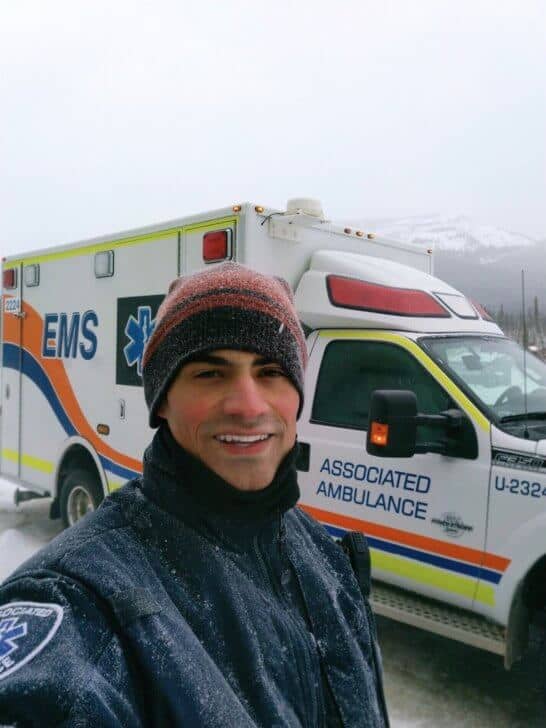
From my experience as a first responder, and I’m sure Michael would agree, no one can tell you exactly what to put into a first aid kit. Other paramedics, doctors, nurses and emergency responders will be able to add unique items and items they have found effective in the past.
As someone who practices ultralight backpacking, I can say first aid supplies make up a reasonably small percentage of my base weight (10-20% for me at 10lbs or less) and I would rather cut weight from somewhere else. I’ve been in some tight jams, on and off the trail and its one place I do not like to skimp.
One thing all responders will tell you is “take your brain with you.” Sometimes intelligence means leaving behind things which are unreasonable for the situation you are entering. Sometimes using your brain, means backing down from things which have too high a risk profile, or taking an alternate route and not getting into a first aid situation in the first place.
You cannot always avoid first aid though, and it is important to have it ready for worst case scenarios, even when going ultralight.
To that end, I encourage every backpacker to acquire some meaningful first aid education: e.g., wilderness first-aid, search and rescue, first-aid, and safety courses throughout their journey of traveling light.
Updated September 15, 2018
How do trails form? Why do trails form? Come to think of it, what is a trail? These are but a few of the (deceptively simple) questions author Robert Moor attempts to answer in his book On Trails (Simon and Schuster, 2016). Moor – a lifelong backpacker and Appalachian Trail thru-hiker in addition to being a writer – approaches his subject with lyrical language and journalistic due-process. The result is a book as quietly spiritual as it is wildly informative.

How do trails form? Why do trails form? Come to think of it, what is a trail?
These are but a few of the (deceptively simple) questions author Robert Moor attempts to answer in his book On Trails (Simon and Schuster, 2016). Moor – a lifelong backpacker and Appalachian Trail thru-hiker in addition to being a writer – approaches his subject with lyrical language and journalistic due-process. The result is a book as quietly spiritual as it is wildly informative.
Moor begins his exploration in the micro (with single-celled organisms and slime molds) and finishes with the macro (the 12,000 mile International Appalachian Trail). In between those extremes, he covers:
Woven between all these subjects are layman’s studies of history, chemistry, biology, anthropology, botany, geology, entomology, etymology, philosophy, poetry, and a dozen other scattered pursuits.
Moor’s gift as a writer is to make following this maze of interconnected ideas seem effortless and natural, like easy walking over smooth tread. One of the great pleasures of On Trails is how much the subject of pathways informed the book’s linear but ultimately branching (trail-like) structure.
On Trails is far from a dry academic tome, however. Moor is an accomplished backpacker. He gathers the threads of his story while hiking along with everyone from Latifa Asselouf (one of Morocco’s only female mountain guides) to M.J. “Nimblewill Nomad” Eberhart. The immersive style suits Moor’s subject well. The author’s voice is something like a cross between Bill Bryson and Jon Krakauer (with a dash of Steven Ambrose sprinkled in for good measure).
What is a trail? In his closing chapters, Moor sets aside hard science and reaches instead for philosophy and poetry to grapple more theoretically with his central question. Those old standbys – Thoreau and Muir, Abbey and Leopold – all make an appearance. But so too does the thousand-year-old verse of Chinese poet Hanshan and the heartfelt cowboy prayers of Nimblewill Nomad.
In the end, it takes both science and philosophy to fully describe the messy confluence of travel, connection, communication, and time that we call “trails.” Moor’s work is well worth the journey, and if the final page leaves you wanting more, well, isn’t that what all the best trails do?
It’s no secret: the more physically prepared you are for a backpacking trip, the more you are going to enjoy yourself. But what are the most effective ways to reach optimal backpacking condition? That’s the topic of today’s BPL SKILLS SHORT: training.
It’s no secret: the more physically prepared you are for a backpacking trip, the more you are going to enjoy yourself. But what are the most effective ways to reach optimal backpacking condition? That’s the topic of today’s BPL SKILLS SHORT: training.
After a brief introduction, Ryan and Andrew get right to it – covering some basics like living at sea level, training on stable vs. uneven ground, and trail vs. road running. After that, they talk about cycling, stabilizing muscles, core strength, upper body resistance training, nutrition, flexibility, injury and foot care, and body weight maintenance.
At the end of the pod, Ryan gives his suggestions for a very basic backpacking training plan.
If you are interested in a more in-depth training episode of the Backpacking Light podcast, let us know at podcast@backpackinglight.com. There’s so much more to dig in to!
You can contact us at podcast@backpackinglight.com, or follow us on social media –
I’d like to address what I do in each of these areas at some point in the future, but for now, I want to expand on why I believe a lean body weight – in addition to carrying less weight in your pack – is really important for a backpacking lifestyle.
This post is part of a new blog-style series that summarizes key concepts about backpacking skills, gear, and philosophy in a shorter format than our standard articles. It’s filed under the category blog.

In an earlier blog post about what footwear to consider for backpacking, I concluded with this answer to the question, “What shoes should I buy for backpacking?”:
A lot less attention could be paid to that question if we maintained healthier, leaner body weights, and spent more time on fitness development. Over the past 3+ decades of backpacking, I’ve learned something that has almost entered into my own personal gospel: the leaner I am, and the more attention I give to physical training, the less my shoes matter.
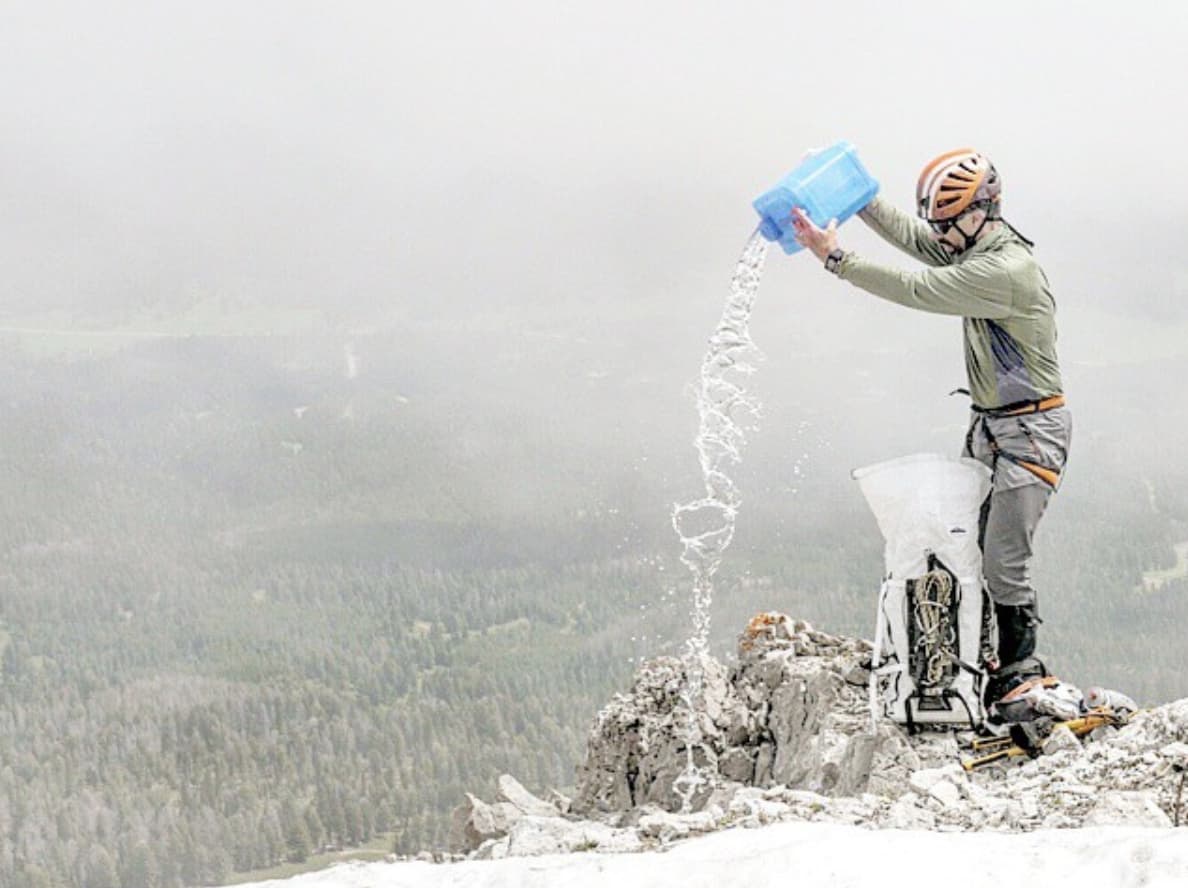
That spurred a few folks to send me an email requesting that I share what I do to maintain fitness for backpacking.
I believe fitness should be looked at holistically. In addition to physical fitness, you also have to consider your mental, emotional, and spiritual fitness when it comes to living a healthy lifestyle.
When it comes to physical fitness, there’s a lot to consider as well: sleep habits, training, nutrition, rest, etc. All four of these have an impact on maintaining lean body weight. I’d like to address what I do in each of these areas at some point in the future, but for now, I want to expand on why I believe a lean body weight – in addition to carrying less weight in your pack – is really important for a backpacking lifestyle.
The “why” behind this objective is simple when it comes to backpacking: less bodyweight (and even more specifically, less body fat) with respect to backpacking means that:
Indiscriminate consumption of food has been the most significant impediment to maintaining lean body weight for me.
Maintaining lean body weight depends on managing insulin levels. A high level of insulin does two things:
Foods that screw up a healthy insulin balance include sugars (especially when combined with fats in a single meal) and other simple carbohydrates. Of course, copious amounts of those same foods also contribute rapidly to a calorie excess.
Be intentional about every calorie you put in your body, and focus on quality over quantity.
Through the years, I’ve experimented with a variety of keto-style diets but I prefer a few more carbs above the keto baseline, to keep energy reserves high during hard, sustained aerobic training. Keto does help you lose weight, but it’s not a great fit for my lifestyle, and I have some personal reasons for minimizing my meat intake.
Right now, my own diet is mostly plant-based (especially veggies with lots of leafy greens and cruciferous), some fish, mostly whole foods (not processed), nuts, lots of slow carbs like legumes, less than trace amounts of dairy, a minimal amount of refined grains and oils, realistic (not American) portions, and a minimal amount of simple carbohydrates. I also severely restrict those combinations that inhibit fat metabolism – sugars, alcohol, and fast carbs + high fat foods eaten in the same meal. In terms of processed supplements that actually provide some calories, I use a pea protein isolate as a protein supplement and occasional doses of MCT oil.
If I’m backpacking on a longer trip, I break some of these rules (more fat/carb combinations like potato chips and fettucini alfredo) and will increase my salt, carb, and calorie intake.
The first world is used to breakfast, lunch, dinner, desserts, snacks, crumpets, donuts, etc. eaten throughout the day.
If this is you, your insulin is going to think you’re really cool.
And maintaining lean body weight is going to be hard, especially once you exit adolescence-young adulthood.
Once you sort out the details of a quality menu, consider limiting your eating periods during the day a few times a week. Spending 16 to 20 hours in a fasted state, and 4 to 8 hours in a feeding period, helps you maintain low insulin, allows your insulin spikes to come down more quickly when they do happen, and simplifies your life because you’re no longer chained to the three-meal-a-day social structure.
The result? Vastly improved usage of body fat as fuel.
Learn more by researching intermittent fasting.
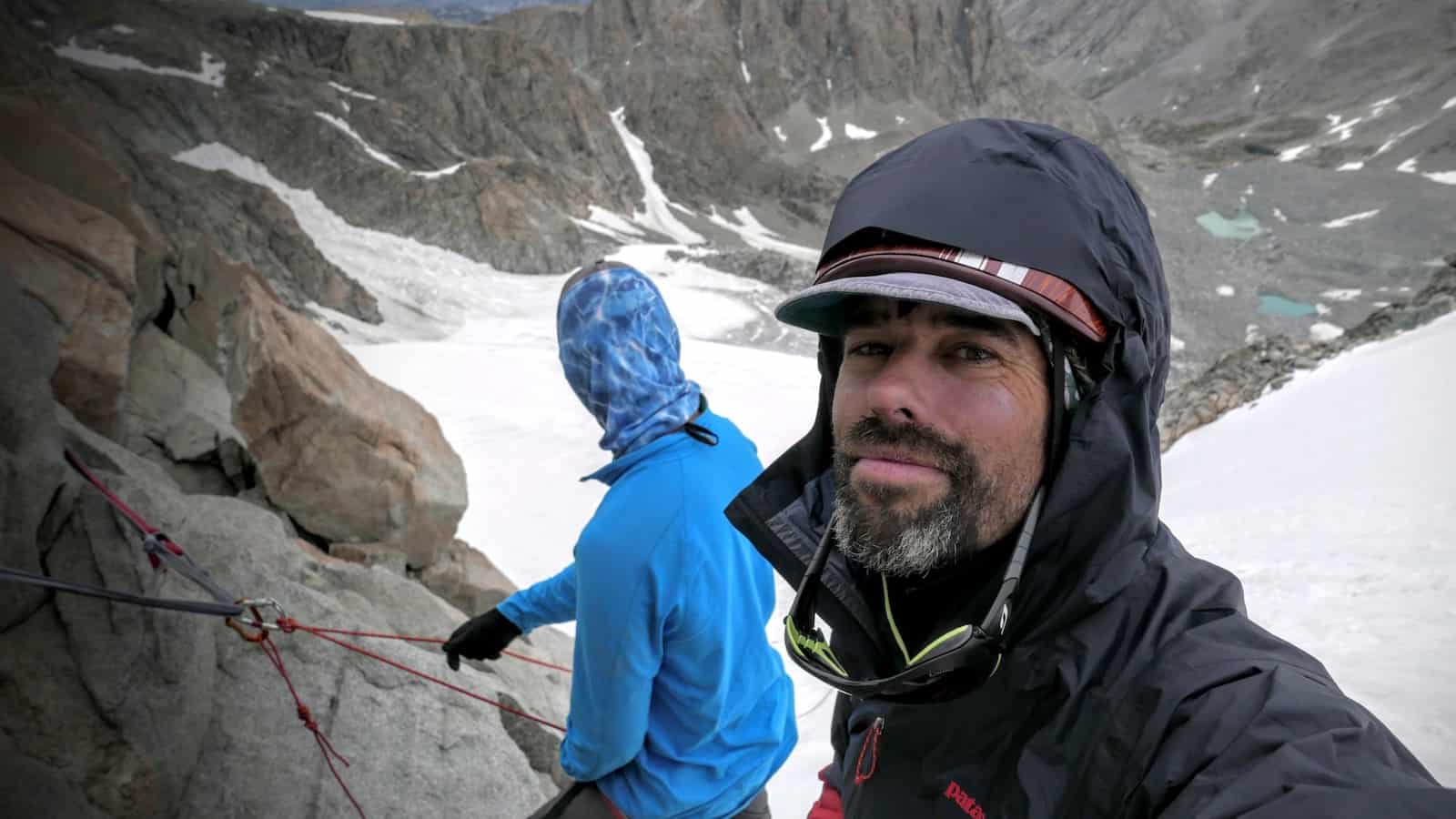
Crossing rivers “ultralight style” – that’s when you simply walk through the water wearing your hiking shoes and keep walking on the trail once you get to the other side.
This post is part of a new blog-style series that summarizes key concepts about backpacking skills, gear, and philosophy in a shorter format than our standard articles. It’s filed under the category blog.

Crossing rivers “ultralight style” – that’s when you simply walk through the water wearing your hiking shoes and keep walking on the trail once you get to the other side.
There’s no stopping to change shoes and socks, and no carrying an extra pair of “water shoes”.
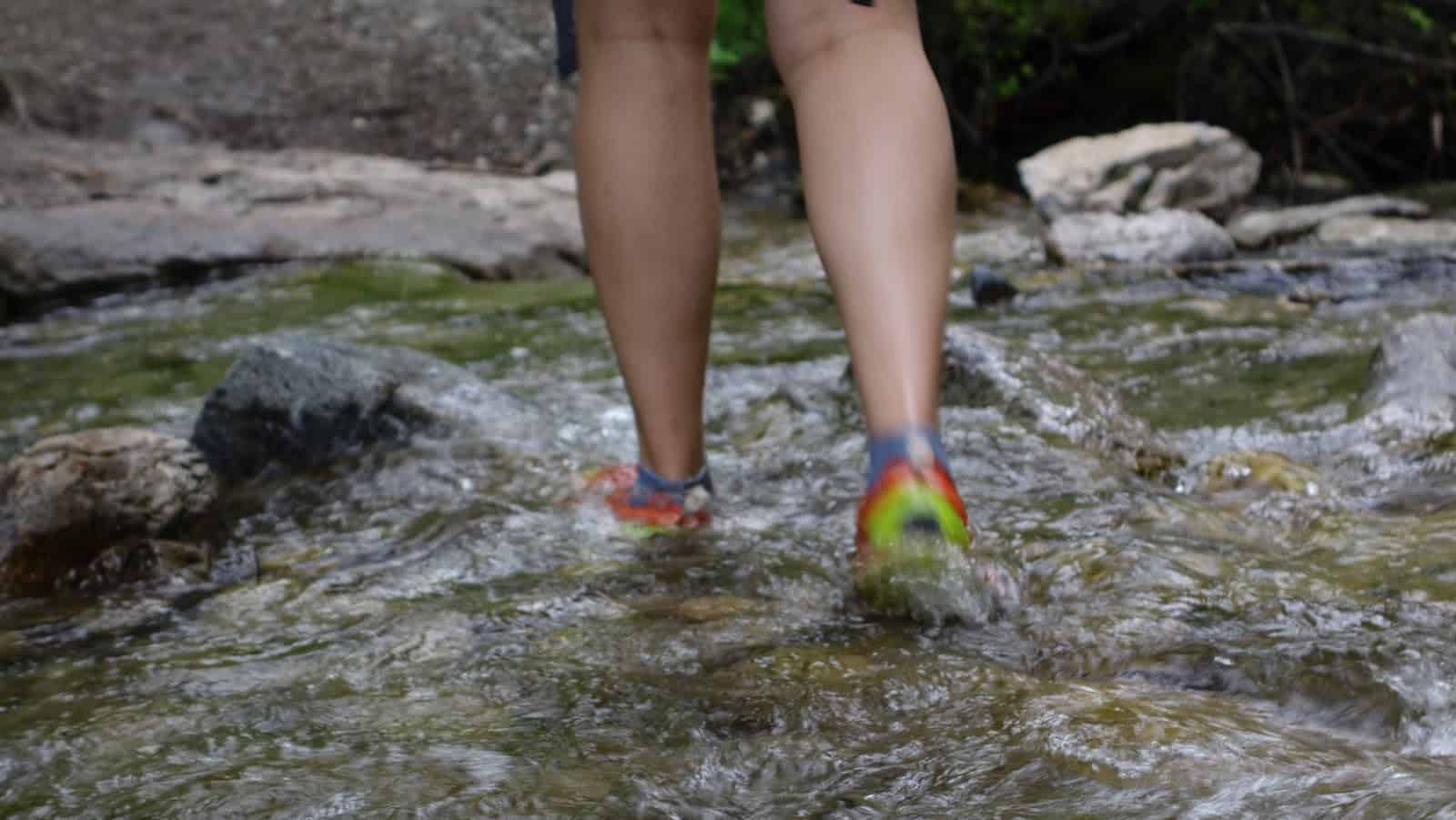
There are two primary barriers that trip up hikers when it comes to crossing a stream in your hiking shoes.
The first is the trauma (sic) caused by (the idea of) wet feet and the second is the fear of blisters caused by added moisture to the footwear.
The trauma caused by the idea of wet feet usually goes away with experience. Other than this perceived trauma (which of course, is not real trauma, but merely some level of minor discomfort), having damp shoes has no real impact on most hiker’s performance.
The added moisture to your footwear that you think might cause blisters may actually be offset by the fact that the water is cold. Blisters are formed by heat, friction, and moisture. Heat and friction are generally more problematic than moisture. Friction can be solved almost entirely if you carry a light pack and wear a lightweight, flexible trail running shoe instead of a hiking boot.
The ideal footwear for hiking in wet areas where there are lots of stream crossings has the following characteristics:
So embrace those stream crossings – they provide opportunities to cool your feet down and experience some podiatric refreshment!
 © Beartooth Media Group Inc.
 Loading...