


Introduction
Winter backpacking (i.e., backpacking in snow and/or cold) can be intimidating. Gear that is heavy and bulky, long nights, hiking through deep snow, dealing with cold temperatures and wind – these are some of the challenges of hiking in the winter.
This winter, I filmed an overnight trip I took in SE Wyoming. The area where I hiked is crisscrossed with a summer trail network and frontcountry picnic and camping areas that aren’t accessible during the winter. I hiked through these areas but ventured further into the backcountry where I spent the night.
Low temperatures dropped to the upper single digits (deg F) and the snowpack was variable from zero to several feet.
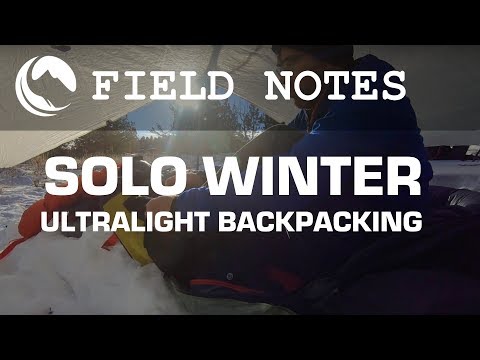
The video is presented in a vlog-style chronological narrative that includes some skills instruction, some gear commentary, and some reflections of my experience on the trip.
This article provides more insight into my gear list, as well as post-trip notes.
For more info, listen to the related podcast about winter backpacking gear!
Watch the Video:
Video Timecodes: Skills, Gear, and Highlights
- The Hike In
- Footwear – 1:33
- Trekking clothing – 6:11
- GPS app/navigation – 9:18
- Rock scrambling – 16:20
- Mental mistakes – 22:50
- Sunset – 24:18
- Evening in Camp
- Arriving in camp – 28:00
- Staying organized in camp – 29:30
- Adjusting clothing for maximum warmth – 31:29
- Selecting a shelter site – 32:38
- Preparing a sleeping platform in the snow – 33:42 and 35:58
- Satellite messaging – 34:42
- Pitching a flat tarp in snow – 37:00
- Setting up the bed – 39:52
- Collecting and cutting firewood – 41:58
- Building a fire – 45:12
- Cooking over the fire – 46:59
- Podcast Recommendation (“Walk to Connect“) – 48:21
- Going to bed/reflections – 49:10
- Morning in Camp
- Sunrise / wakeup – 51:27
- Wood stove cook Kit, fuel collection – 53:06
- Using the Suluk46 Una titanium wood stove – 54:36
- Breakfast in a bag – 59:58
- Review of sleeping comfort from the night – sleeping warmth, bag ratings, the REI Magma, condensation in bivy sacks, wind, tarp performance – 1:00:55
- Firestarting skills and kit – 1:04:06
- LNT fire area restoration – 1:07:30
- Tarp rigging: guylines, trucker hitch, and deadmen in snow – 1:08:55
- Commentary on snow stakes – 1:13:12
- Packing up – 1:13:52
- Northern Lites Honey Badger snowshoes – 1:15:41
- The Hike Out
- Leaving camp – 1:16:27
- Clothing for hiking in winter sun – 1:16:40
- Challenges of winter terrain and the added effort required – 1:18:03
- Water treatment using Aqua Mira – 1:20:56
- Snowshoeing in deep, unconsolidated snow – 1:23:44
- Commentary on vegetation mastication – 1:25:47
- Lunch amongst large boulders of Sherman granite – 1:29:47
- Final comments – 1:32:35
- Acknowledgments and credits – 1:33:07
Notes from the Trip
- This was a “backyard adventure” for me. This is one of the closest backcountry locations for me, with the trailhead about 15 miles from my house. It’s a good reminder that adventure, fun, and solitude can be found very close to home.
- I was in a hurry getting ready for this trip. Construction projects, travel, and preparing for an upcoming family surgery have been taking a toll on my ability to stay organized and be able to prepare for a trip quickly, so I suffered some minor inconveniences as a result of packing quickly:
- I overpacked, especially camera gear. I didn’t need the tripod, so many extra batteries, or a battery charger, and could have shaved a few pounds there. In addition, I brought the wrong audio cable so I wasn’t able to capture good pro audio through my external mic, which added more dead weight and compromised the audio quality in the video.
- I packed quickly, shoving things in my backpack, without paying attention to how I might need them later that evening. As a result, I didn’t have quick access to my headlight for hiking after dark, so I ended up navigating with my video light! And when I arrived at camp, I had to remove almost everything in my pack to access the things I needed right away – my parka, puffy pants, thin gloves, and headlight.
- I (smartly) slept with all the gear I didn’t want to freeze (socks, shoes, overboots, water bottle), storing it in my inflation pump bag – except my Aqua Mira – which froze overnight! It took a while for me to discover that, and to thaw the bottles out enough to use them! I was running a bit dehydrated by the time I was able to treat water.
- There was a vegetation mastication operation occurring in the area. Had I known this, I would have hiked in a different locale. It was pretty noisy on the 2nd day, as I hiked towards it, and while I don’t have any philosophical opposition to this particular project, it was certainly disruptive to my desire for quiet solitude.
Gear List
All gear items link to the actual product that I used on this trip, except items marked with an asterisk (*). In the latter case, I proposed a similar substitute.
| Worn/Carried (oz) | In Pack (oz) | Consumables (oz) | |
|---|---|---|---|
| TREKKING FOOTWEAR & TRACTION | - | - | - |
| merino wool ski socks | 2.5 | - | - |
| waterproof-breathable socks* | 2.6 | - | - |
| waterproof-breathable mid-height, zero-drop trail running shoes | 25.5 | - | - |
| neoprene overboots with eVENT gaiters | 13.5 | - | - |
| technical snowshoes with SS crampons | 55.0 | - | - |
| high-strength, cork-grip, collapsible carbon trekking poles w/snow baskets | 16.8 | - | - |
| CLOTHING WORN WHILE TREKKING | - | - | - |
| merino wool fishnet s/s t-shirt | 3.5 | - | - |
| active insulation pullover hoody | 10.3 | - | - |
| breathable hooded wind jacket | 3.8 | - | - |
| viscose/spandex boxer briefs | 3.1 | - | - |
| double-knit polyester long underwear bottoms | 3.5 | - | - |
| stretch softshell pant w/dual-entry cargo pocket | 13.6 | - | - |
| ultralight fleece backpacking hat | 1.1 | - | - |
| lightweight merino wool neck gaiter | 1.7 | - | - |
| snow goggles with spherical photochromic lenses (VLT 30%-50%) | 4.0 | - | - |
| waterproof-breathable glove w/leather palms, gauntlets, and high-pile fleece inner | 6.5 | - | - |
| CLOTHING WORN IN CAMP | - | - | - |
| wind-resistant fleece glove liners | - | 1.8 | - |
| ultralight down hooded winter parka | - | 18.7 | - |
| * | - | 10.7 | - |
| extra socks for sleeping | - | 2.5 | - |
| NAVIGATION & COMMUNICATIONS | - | - | - |
| smartphone / case | 7.6 | - | - |
| gps navigation smartphone app w/maps | - | - | - |
| 365 Lumen Cree XM-L2 T6 neutral white LED CR123V headlamp | - | 2.8 | - |
| 4.5 Lumen coin-cell IPX7 keychain light | - | 0.3 | - |
| mini satellite messaging device | - | 3.5 | - |
| PACKING | - | - | |
| DCF internal frame pack, custom, stripped | - | 46.6 | - |
| rectangular compression sack for sleep gear | - | 3.3 | - |
| rectangular, stand-up zip sack for minor essentials | - | 1.1 | - |
| durable stuff sack for fire kit | - | 0.9 | - |
| DCF11 stow sack for cook kit | - | 1.1 | - |
| pepper spray (for moose/mountain lion) | 13.1 | - | |
| SHELTER | - | - | |
| claw-style snow shovel | - | 6.4 | - |
| 8.5' x 8.5' DCF flat tarp | - | 11.3 | - |
| 1.2mm Dyneema cord w/polyester sheath for knotting | - | 0.6 | - |
| eVENT bivy sack w/DCF floor | - | 13.1 | - |
| 1/8" 72x20 CCF pad | - | 2.4 | - |
| R5.7 72"x20" inflatable insulating pad | - | 15.4 | - |
| inflation pump bag | - | 2.0 | - |
| microfleece/DCF pillow sack w/DIY foam | - | 3.8 | - |
| 10 degree 850 down sleeping bag | - | 30.6 | - |
| FIRE KIT | - | - | - |
| folding saw, 7 TPI | - | 6.8 | - |
| drop-point 3" batoning knife with custom sheath | - | 4.7 | - |
| waterproof firestarting tinder | - | 0.1 | - |
| solid fuel tablets | - | 1.0 | - |
| magnesium fire starter | - | 0.8 | - |
| COOKING & WATER KIT | - | - | - |
| 1100 ml titanium pot with bail handle | - | 4.5 | - |
| unbreakable folding spoon | - | 0.3 | - |
| titanium wood burning stove | - | 2.5 | - |
| curly birch custom-carved wooden mug* | - | 2.5 | - |
| food storage / animal protection | - | 7.6 | - |
| 2L soft water bottle, wide-mouth | - | 2.8 | - |
| 2L soft water bottle, wide-mouth | - | 2.2 | - |
| benzalkonium chloride hand sanitizer repackaged in 0.5 oz bottle | - | 0.5 | - |
| FOOD | - | - | - |
| cashews | - | - | 4.0 |
| cookies | - | - | 2.0 |
| herbed mushroom risotto | - | - | 8.0 |
| meusli | - | - | 5.0 |
| smoked trout | - | - | 8.0 |
| pretzel roll | - | - | 5.0 |
| coffee, tea | - | - | 0.5 |
| food packaging | - | 2.0 | - |
| WORN/CARRIED WEIGHT (lbs) | 11.7 | - | - |
| BASE PACK WEIGHT (DRY) (lbs) | - | 13.6 | - |
| PACK WEIGHT + CONSUMABLES (lbs) | - | - | 15.6 |
| TOTAL SKIN OUT WEIGHT (lbs) | - | 27.3 | |
| OTHER GEAR CARRIED and not included above (camera gear, non-essential duplicates I brought along for testing) | - | - | - |
| Camera Equipment | - | 46.8 | - |
| Tall Carbon Fiber Tripod | - | 28.5 | - |
| environmental data logger | - | 1.2 | - |
| hiking crampons w/rubberized platform base for overboots | - | 25.7 | - |
| ultralight waterproof-breathable rain jacket | - | 7.6 | - |
| TOTAL EXTRA GEAR (lbs) | - | 6.9 | - |
Gear Notes
Footwear and Traction Systems
- The only scenario where I can see the STABILicers Hike Macro Traction Ice Cleats being feasible is when (a) temperatures are so cold that you need insulated overboots, AND (b) when you are hiking on packed, steep, icy trails. For most backcountry pursuits, snowshoes are more versatile. For what they are (a microspike), this Stabilicer model is almost comically heavy. Its only real advantage is that there’s a rubber footbed above the cleat that won’t chew up the underside of a neoprene overboot (unlike traditional microspikes, which are much lighter and more suitable for hiking in lightweight footwear as long as you’re not wearing overboots).
- The Northern Lites Honey Badger snowshoes with speed bindings are some of the most aggressive, easy to use, and lightest snowshoes on the market. My first experience with these is extremely positive. However, they are a few ounces heavier than my MSR Lightning Ascents, and may be a little less durable – time will tell. The speed binding on the Honey Badgers is extremely comfortable, and the steel crampon is very sharp and aggressive on steep, icy, and rocky terrain.
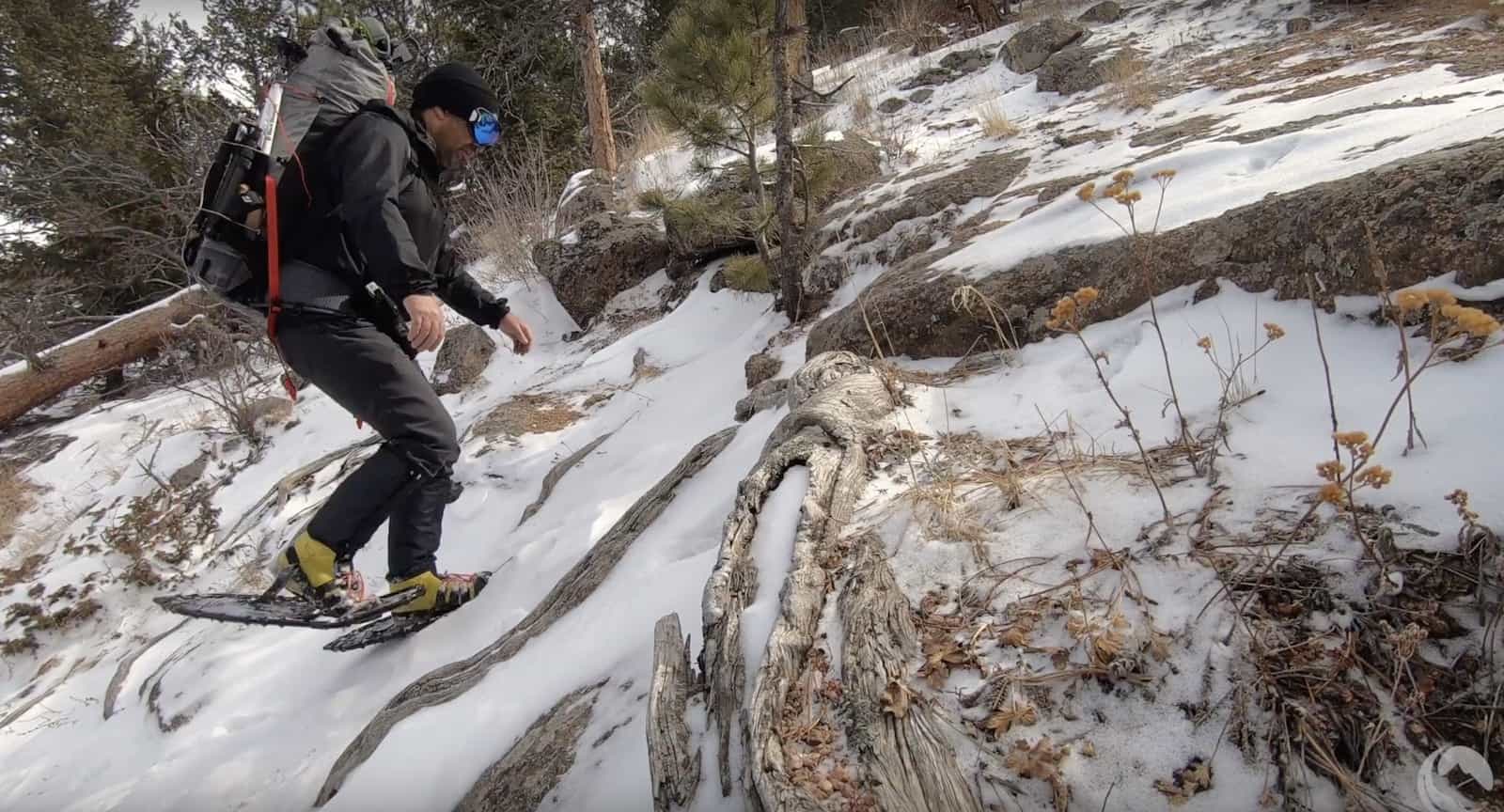
- The combination of Gore-Tex socks and Forty Below TR Light Energy overboots with a waterproof-breathable mid-height trail running shoe is simply superb for snowshoeing in winter conditions. My feet never got cold, on the trail, or in camp.
Clothing
- The Brynje Merino Wool Fishnet S/S (short sleeve) T-Shirt, worn under a Patagonia Nano Air Light Hoodie for cold conditions or under a Patagonia Houdini Jacket for warm conditions was a very comfortable and versatile base layer. These systems kept me drier than just about any other winter layering combo I’ve worn, especially when climbing or slogging through deep snow and I was working hard and sweating.
- A pair of thin puffy pants and a very light parka (Feathered Friends Helios) was plenty warm for spending hours in camp after dark in temperatures around 10 deg F. I’ve also been fine when temperatures have been colder. If there is wind, however, and temperatures are below zero F, I would need something warmer.
- My primary glove for trekking in these temperatures is a waterproof-breathable pile glove with a Gore-Tex shell and full leather palm. It’s warm, durable and protective enough for firewood collection, and it dries quickly (by removing the liners and stowing them in a jacket). For in-camp use, I prefer to wear fleece liner gloves and use my parka pockets when my hands get cold. As long as my hands were in gloves (rather than rock scrambling without gloves!), my hands stayed warm and comfortable.
Navigation
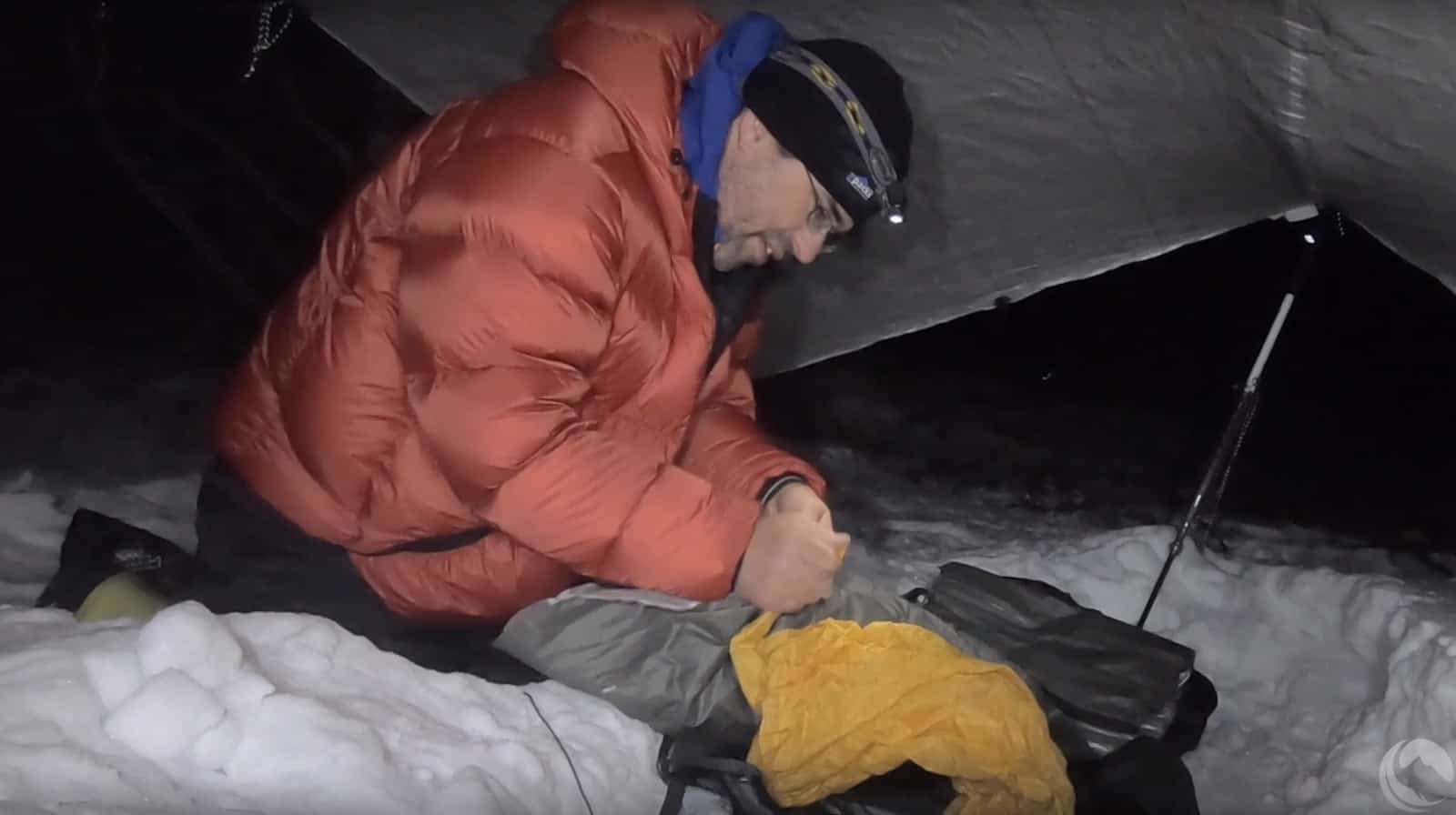
- A phone update rendered my Garmin inReach app useless, and I forgot to update everything before I left. This resulted in the laborious operation of the Garmin inReach Mini with respect to SMS communications. I sent my wife one text message to let her know I arrived in camp OK. The process of remembering how to do it, figuring out what I didn’t know, and trying to type a message on multiple occasions, took quite a long time. This is the only part of the trip where I experienced mild irritation.
- The battery on my Fenix HL50 headlight expired midway through the evening, and I switched over to a Photon II Pro Microlight. Lighter than a spare battery, and made for a quicker transition!
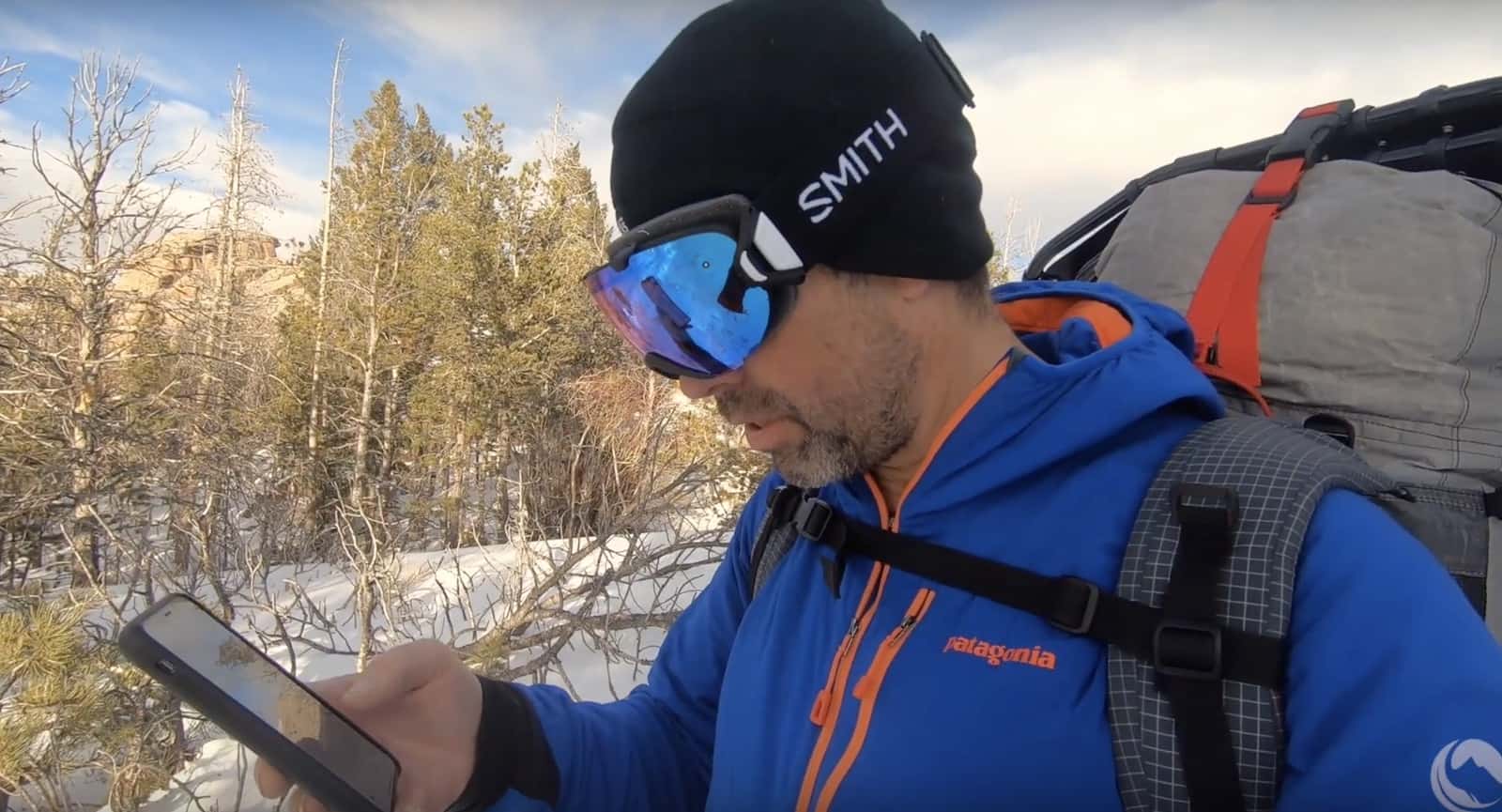
- I’m recovering from a long bout of papillary conjunctivitis (I’m a contact lens wearer normally), an allergic reaction to a foreign body in the eye (most likely a result of construction debris). I don’t own a pair of prescription sunglasses, so I’ve been wearing goggles while hiking this year. My favorite goggles so far have been the Smith I/O (I wear the smaller women’s model) with photochromic lenses (variable light transmission from 30% to 50%). They are simply outstanding in the wind and cold, and the spherical rose photochromic lenses are an absolute joy to look through. I’ll be adding these to my winter hiking kit in the future!
Shelter & Sleep Systems
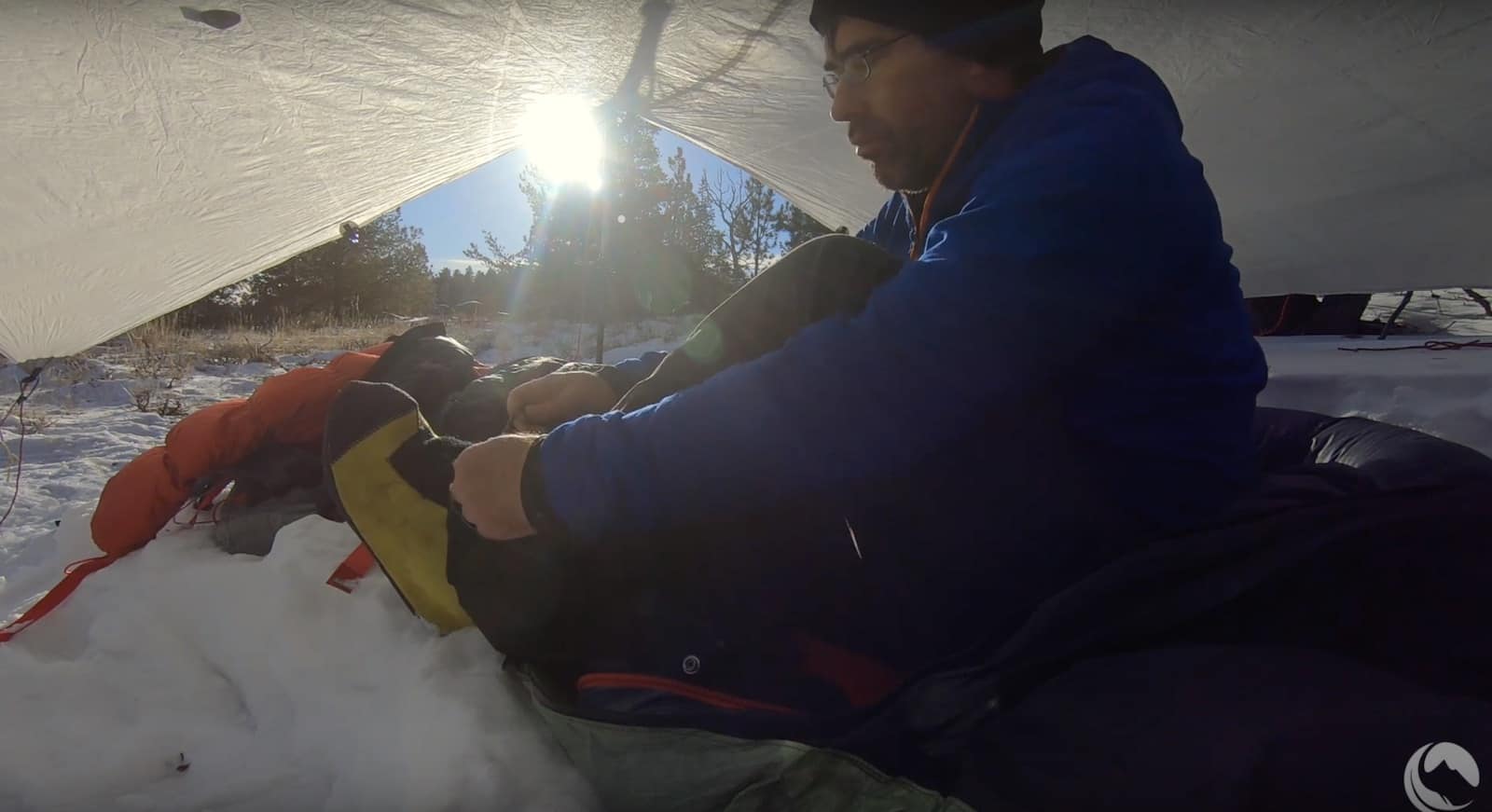
- A flat tarp doesn’t provide a lot of protection, especially in the wind, but the views and openness are sure nice. One of the highlights of my trip was waking up, opening my eyes, and watching the sunrise without having to move!
- The Hyperlite Mountain Gear Flat Tarp has seen more than its share of adventures over the past several years, and even after suffering some hearty wind storms, including on this trip, there still doesn’t seem to be a seam out of place or coming loose. I can’t say this for any of the other DCF tarps I’ve owned.
- I’ve used the REI Magma 10 down sleeping bag for two years now, and it continues to perform beyond my expectations for a 30 oz bag. I slept very warm on this trip, with nighttime temperatures in the low teens. I’m looking forward to using the 2019 iteration of this bag, the Magma 15, which is a few ounces lighter and should offer similar performance in these conditions.
Fire Kit
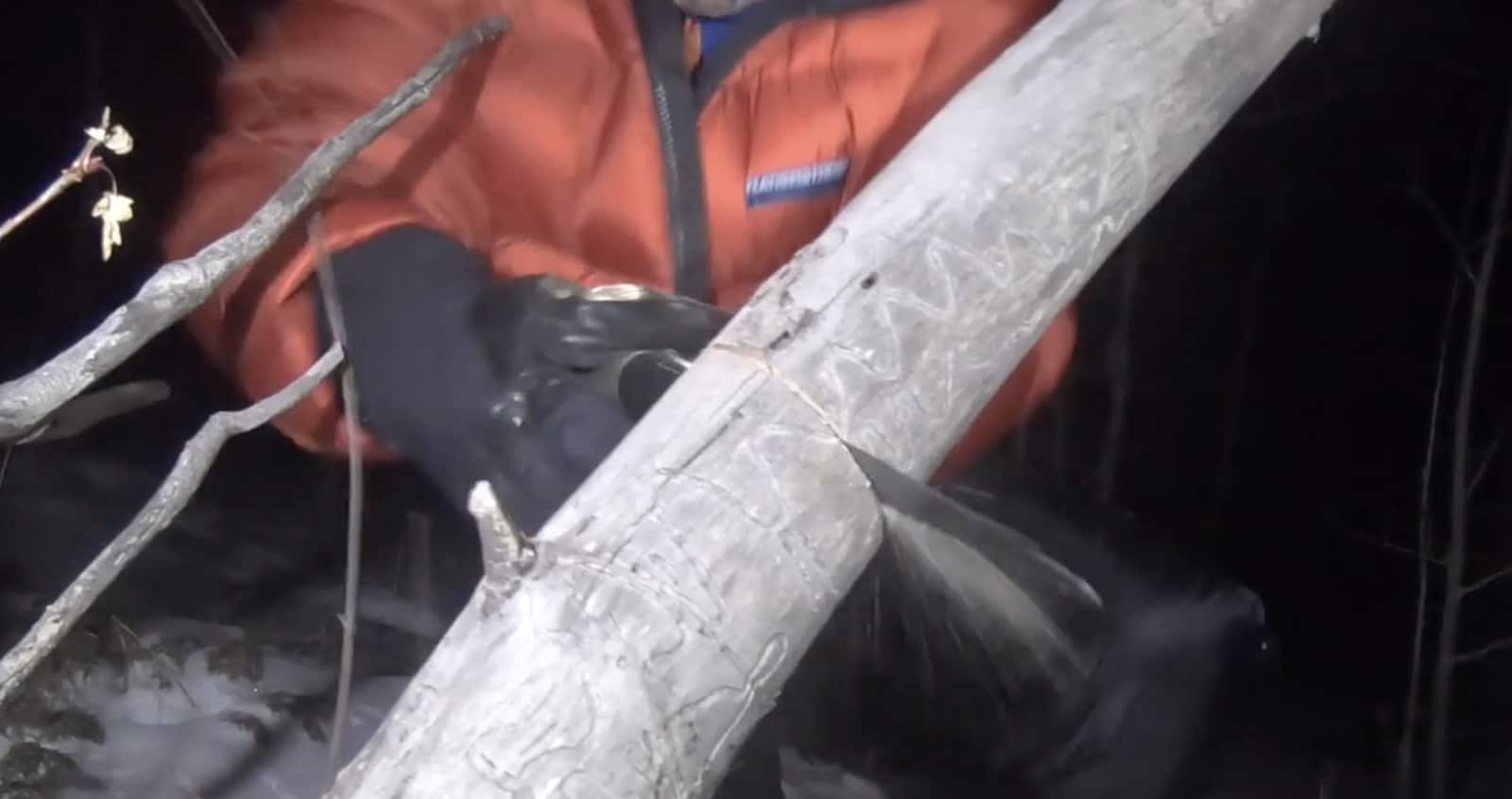
- The Bahco Model 396 Laplander saw is one of the best cutters I’ve ever used. I wish it was lighter. I think I said in the video that it weighed around 1/4 of a pound but I got it mixed up with my lighter (and very poorly cutting) Gerber saw. The Laplander weighs a few ounces more, and I find the extra weight worth it if there’s a lot of cutting to do. It goes with me on almost every winter trip for firewood prep and building stick roofs on my snow trenches.
Cooking and Water
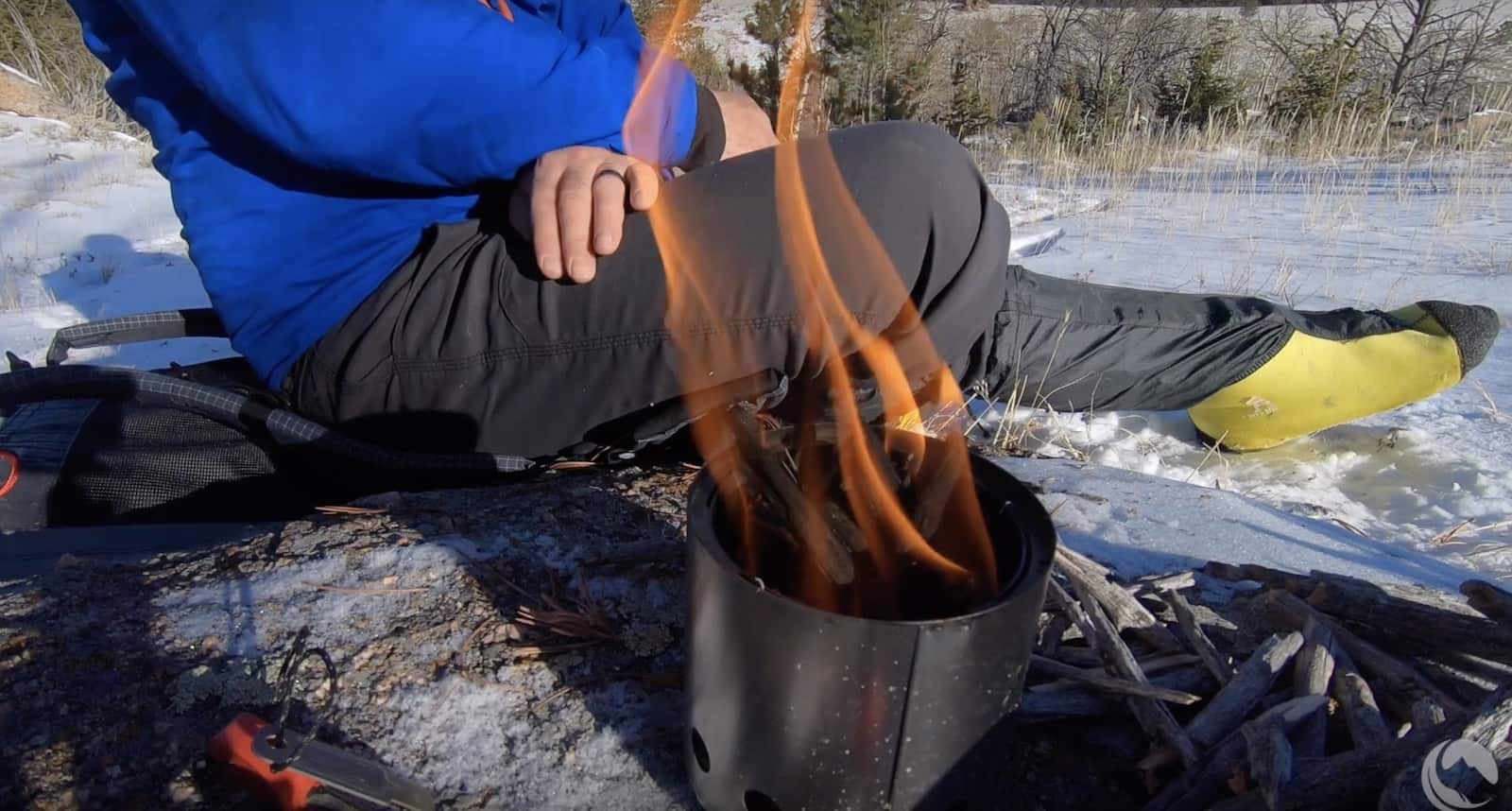
- The Suluk46 Una Titanium Wood Stove is a huge win. At 2.5 oz, it cuts the weight of my wood stove in half (from the Bushbuddy Ultra) with no decrease in performance. I used beetle-killed pine needles and dead sagebrush twigs and the stove burned both very clean. Well done!
Acknowledgments
Thanks to the following companies for making this video possible through financial and/or gear support:
* These companies have entered into sponsorship agreements with us in 2019 in our effort to support our effort to produce more engaging content and reduce our reliance on network advertising (e.g., “Google Ads”). Thank you!
Product Review Disclosure
Updated September 15, 2018
- How we acquired these products: Product(s) discussed in this review were either acquired by the author from a retailer or otherwise provided by the manufacturer at a discount/donation with no obligation to provide media coverage or a product review to the manufacturer(s).
- We do not accept money or in-kind compensation for guaranteed media coverage: Backpacking Light does not accept compensation or donated product in exchange for guaranteed media placement or product review coverage.
- Affiliate links: Some (but not all) of the links in this review may be “affiliate” links, which means if you click on a link to one of our affiliate partners (usually a retailer site), and subsequently make a purchase with that retailer, we receive a small commission. This helps us fund our editorial projects, podcasts, instructional webinars, and more, and we appreciate it a lot! Thank you for supporting Backpacking Light!


Discussion
Become a member to post in the forums.
Companion forum thread to: Field Notes: Winter Backpacking in Southeast Wyoming
Lightweight backpacking in winter: field notes from SE Wyoming – tarp camping, firebuilding, wood stove cooking, and more (VIDEO).
Thanks for that video Ryan.Winter camping is too often seen as an “ordeal” by those inexperienced on how to do it so they avoid this great time of year. “No bugs and no people”
And, yet once again, I highly recommend “Allen & Mike’s Really Cool Back Country Ski Book” (which is actually about 50% on winter camping) as the best book on the subject for beginners and anybody wanting to brush up on their winter camping skills.
My take on your tarp is that you need good weather to make it a comfortable shelter.
->I use my TT Moment DW solo tent – but to save weight I could use it “fly only” however I’d still need a ground cloth so why not just take the inner tent as well?
->With puffy clothing I can take my overstuffed 20 F. WM Megalite down to 10 F. But if temps threaten to go lower I take my LL Bean -20 F. down bag. It is a Long so I have room for boot liners, neoprene foam divers socks VBLs and water (inside closed dry bags). In cold weather I always sleep in a 100 weight fleece balaclava. Also good for cold, windy, nasty days.
->My REI FLASH All Season Insulated air mattress is good at R5.3 to around -10 F. Below that I have a Thermarest Ridgerest to go under it.
->For travel I use a medium (200 weight) Polartec fleece pullover over polar weight poly base layer and Norwegian wool sweater. A 200 weight fleece vest is available for temperature drops.
-> for in camp wear I have:
3/4 side zip Thermolite Micro puffy pants
But, depending on temperatures my travel pants are either TNF GTX shell ski pants or if it will be colder, Duluth Trading nylon cargo pants W/200 weight fleece lining. Very cozy!
Eddie Bauer PEAK XV baffled down parka heavier than your Patagonia Fitz Roy but extremely warm, even at -25 F. It’s stuffed in my Sea to Summit pump dry bag so the bag does double duty.
I’m usually skiing in on Tele skis & skins with Voile’ release bindings and Scarpa T3 plastic backcountry boots. Full coverage Thinsulate insulated “super gaiters” come along for very cold temps.
->My snowshoes are MSR Lightning Ascent IF I wear my Sorel Felt pac boots.
-> extended Leki aluminum hiking poles W/snow baskets
->Trail Designs Sidewinder Ti stove W/Inferno woodburning kit & mating 3 cup pot. Hottest wood stove I know with its Inferno “gassifier” wood burning insert. As shown in your video small stoves like this need only finger size sticks for fuel.
->My selection of battered and scratched ski goggles will offer at least one decent pair for a trip. BTW, I’ll pick up a pair of those SMITH IO photochromic goggles since I need a new pair anyway. ANd the women’s size will fit my narrow face better. Hopefully they will fit over my glasses. Thanks for the tip.
A most enjoyable and informative video. I picked up some valuable pointers.
Cheers.
Nice video, Thanks!
Great Job!!
One Question concerning:
Hi Ken,
Thanks for the note and question. That is the same pair Ryan wore in the BD ski video. That is a pair we made for Ryan about 10 years ago. Virtually identical to the way we make them now. The only difference is that the color is now all black (no neo green), the snap is black, and the material on the sole is a stronger fabric. The front opening on that pair, and the current design, is still hook and loop. We do make a shorty version, and that one is a large zipper, with knit cuff. Let me know if you have any other thoughts/ideas.
Joel Attaway
Forty Below Ltd
I’ve only had a chance to watch the first 10 minutes and looking forward to the rest tonight. Thank you Ryan and very well done.
Love the Forty Below Light Energy TR Overboots and have used them over lightweight Keen Growler 200g Thinsulate boots for snowshoeing. They are warm and very durable. I’m looking for a lightweight traction device to protect the bottoms of the overboots in camp and for winter hiking. Any suggestions?
Joel at Forty Below suggested one of the STABILicers models, of which there are 6. No idea yet how much they weigh: https://stabil.implus.com/
I know others who stick with high gaiters instead so that they have the advantage of the traction and durability of their exposed boot soles when they’re not on snowshoes, but I wouldn’t want to give up the warmth of the overboots.
Love it. I really enjoy watching all of your videos and reading trip reports. Thanks for all you do. Im sure it’s not easy. Please keep posting more videos of your trips!! Would you ever consider bringing a hammock and tarp instead of sleeping on ground?
Agreed – great piece.
Seeing something as simple as a local overnight well-described in detail is unexpectedly easy to watch. Ryan, your narrative and editorial talents are well served by the video medium, definitely keep it up.
Also, nice to see what you guys talked about on the backcountry camera/video podcast put into practice so well.
@mountainwalker: “I’m looking for a lightweight traction device to protect the bottoms of the overboots in camp and for winter hiking. Any suggestions?”
It looks like Ryan is wearing STABILicers Hike Macro traction ice cleats in his video.
Thanks Ryan, I’m just getting into winter camping, and learned a bunch of valuable tips from this.
<p style=”text-align: left;”>What were your synthetic insulated pants when in camp?</p>
Jeff – those were some DIY pants I made. Full length separating zips, Climashield Apex insulation, Pertex Shield fabric on the outside, Quantum on the inside, elastic cuffs and waist with a snap/zip fly and a drawcord at the waist as well.
To everyone else, thanks for jumping in and helping answer questions, and thank you for the kind comments. It was really fun shooting the video, and putting it together, and for me at least, it’s pretty neat to go back and relive it like this. I tried not to edit too much in order to provide a flavor of what it was like as much as possible. I’m looking forward to doing more of these in this kind of style, which was very enjoyable.
Yeah, reminiscent of the old Arctic Hike, years ago. Anyway, we could use more of this.
I can’t seem to understand the brand of cleats you’re wearing with the overboots. Can you help?
Jack he has clickable links that take you directly to what gear he is using. just like the one I am putting here
. STABILicers Hike Macro Traction Ice Cleats .
Ryan, that was a darned good video production. Lots of good discussion about the gear and your technique. Now you should talk Danny Milks into offering the Byrnje ‘fish net’ base layers on Massdrop, so that we po’ folk can afford to buy a set.
Edit – Dan Dursten told me that Danny Milks no longer works for Massdrop.
Thanks Doug for pointing out the cleats model.
Ryan, are you happy with the STABILicers Hike Macro? Why did you choose that particular model? Do you usually leave the removable 1/2″ cleats on? Seemed like the removable 1/2 in. cleats might have made your footing a little more difficult when you were climbing over rock.
I’m still waiting to receive weight/pair for their models and will share them once I get them. Wish they’d list them on the website.
It’s interesting to see how winter backpacking in Wyoming is completely different than winter camping up in Washington. Water easily available? Rocks not completely covered in snow or sheets of ice requiring instep crampons? Walking on snow without snowshoes in which you’re still postholing 3 feet down? Dry wood available for burning? Where is this magical place?
Thank you for this! So much to relate to. I’ve been there so many nights – but kinda fun to be sitting in my living room watching this on a 55″ TV with a fire going instead of actually being there :)
Two things caught my attention:
Again, thank you, Ryan!
Oh – and I LOVED the Bluegrass camp breakdown music!
Nice video!
As others have mentioned, during the winter up here in the PNW, we don’t have access to running water and firewood due to our snow volumes (although more similar in Eastern Washington). The joy of waking up to the sunrise in the winter in a backcountry camp is definitely something that we enjoy as well.
Thanks for making the video with great detail on gear, etc.
Thanks for a great video! The timecodes, gear lists and all the tutorials are very helpful. Obviously a lot of work went into making this video and the after documentation. Please keep up the good work!
Become a member to post in the forums.