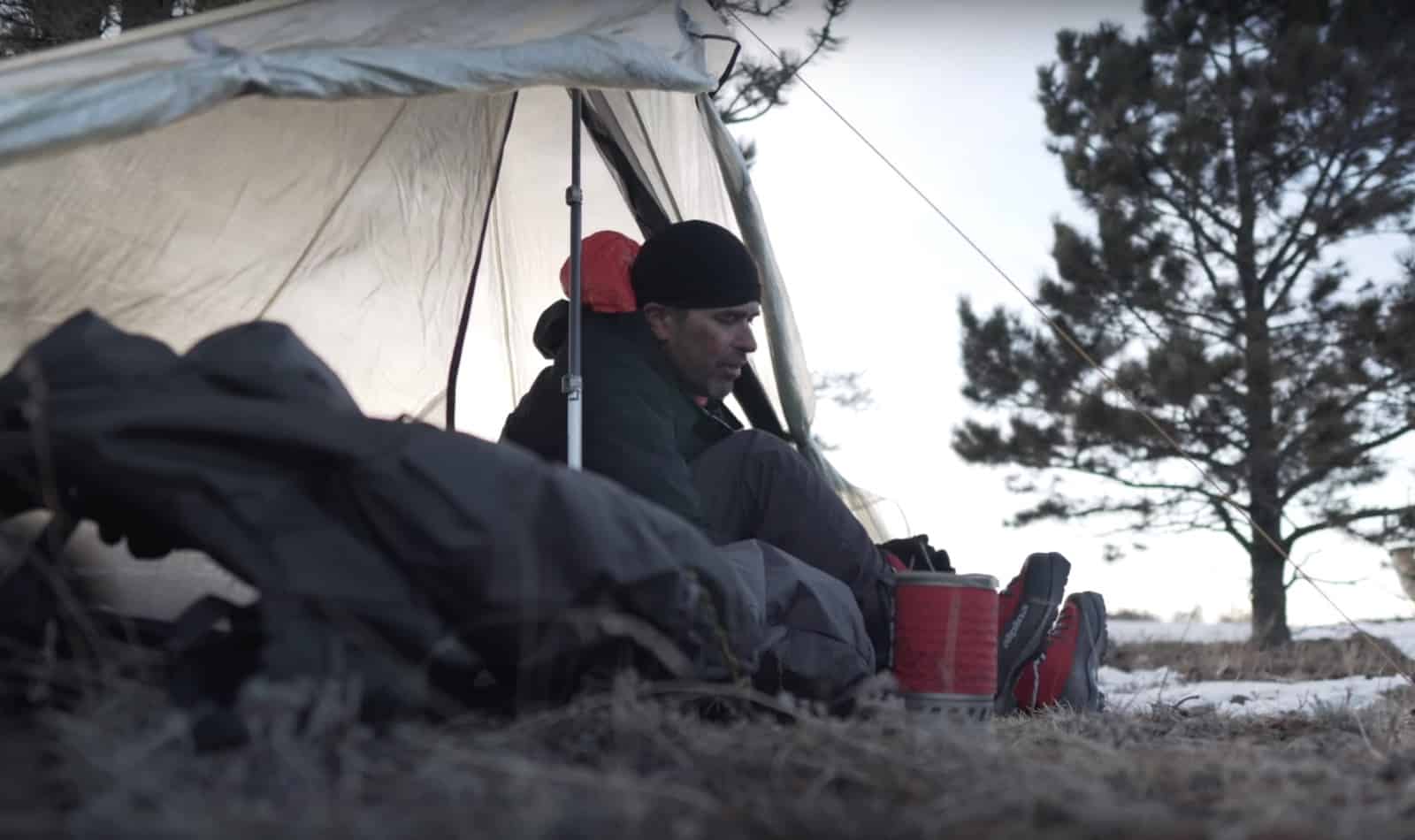
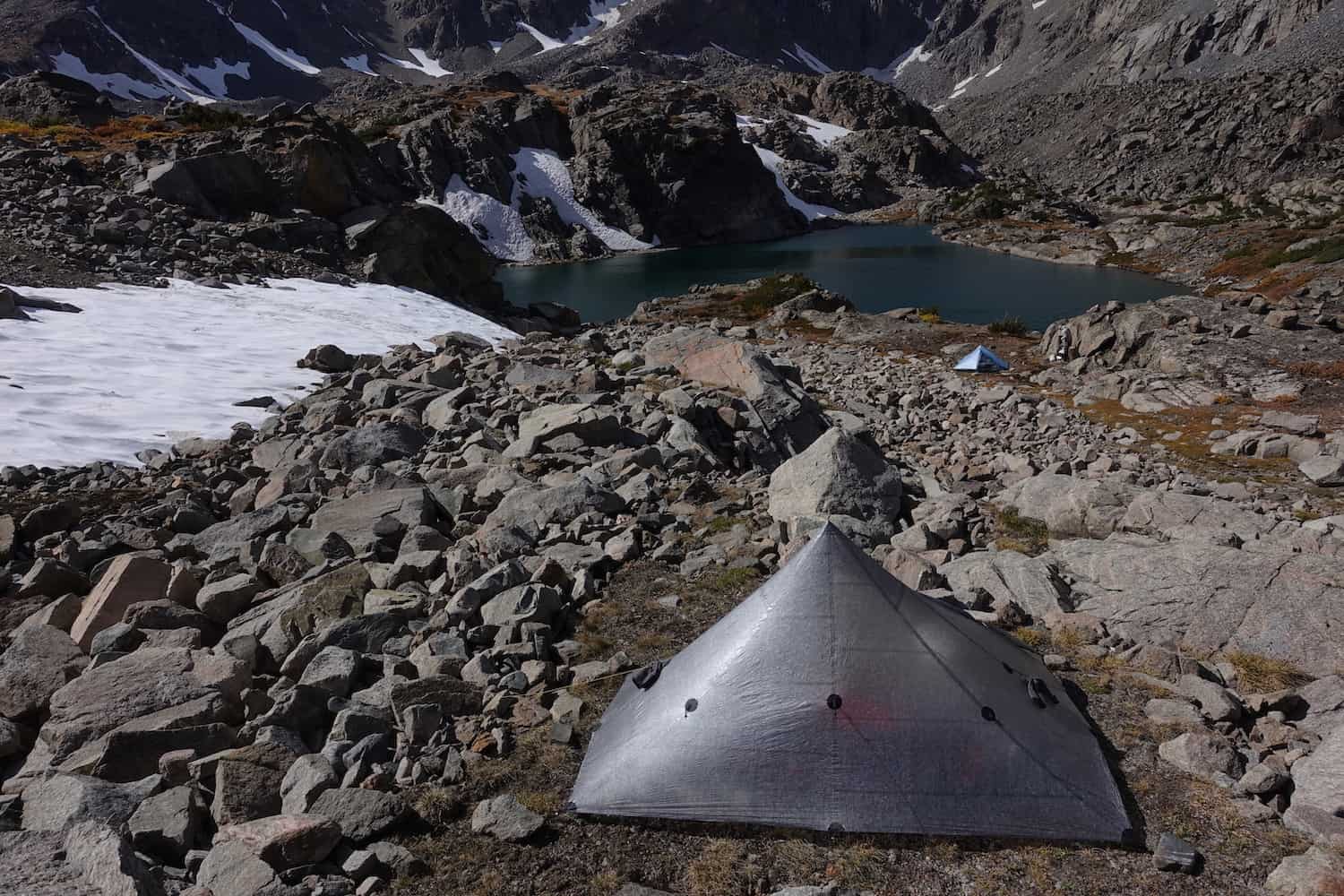
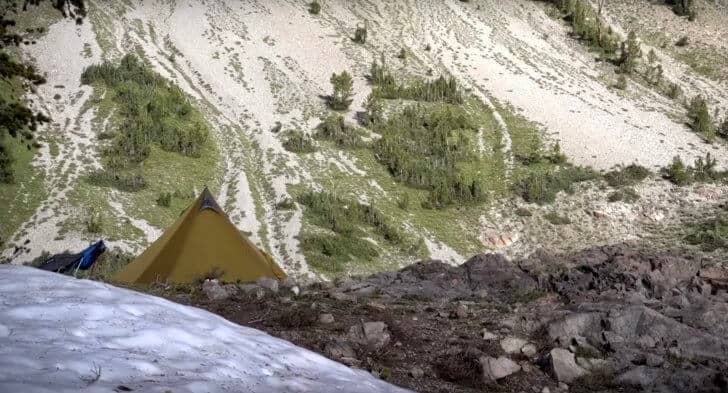
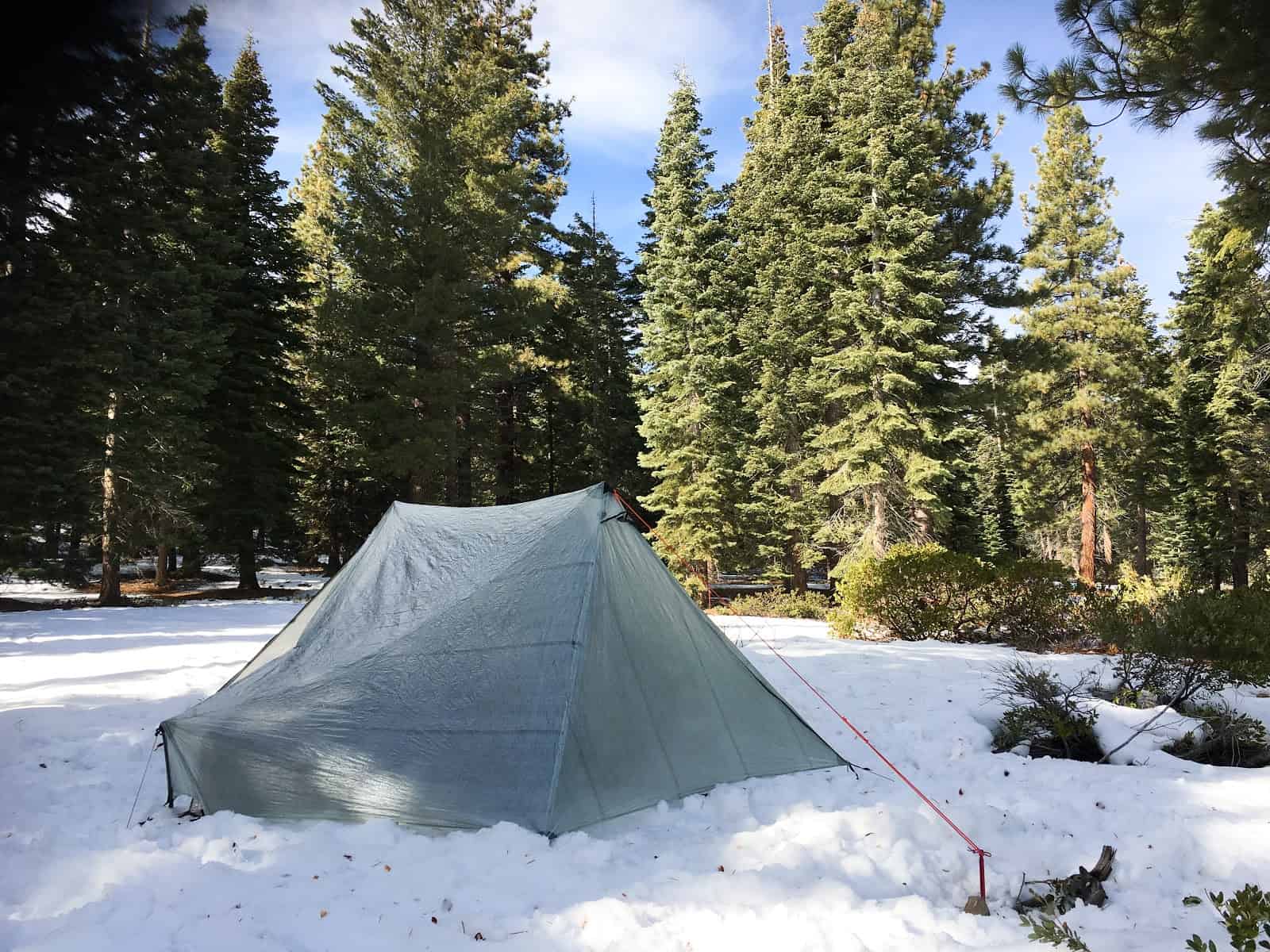
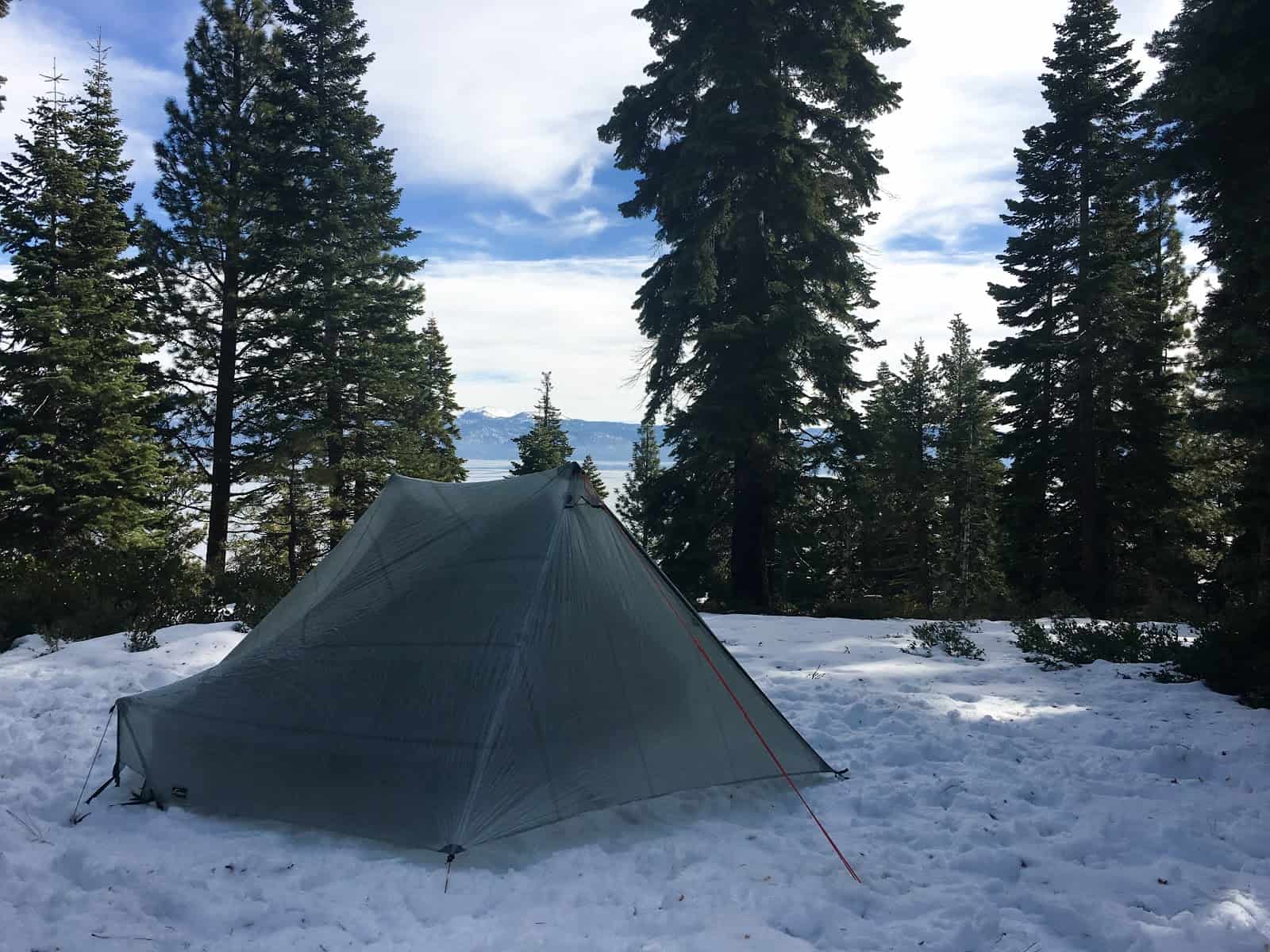
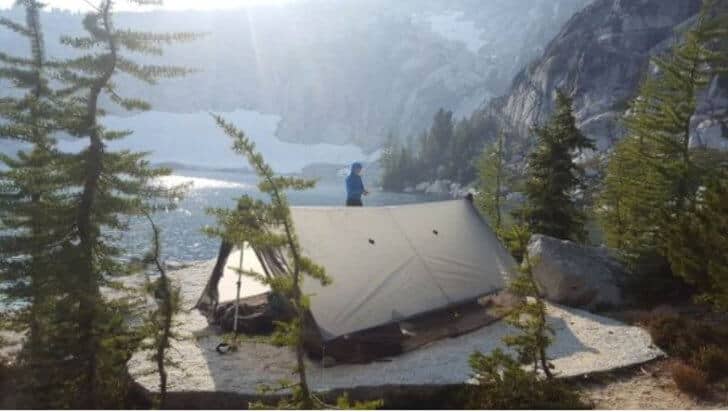
The Tarptent Aeon Li is one of the lightest solo (1-person) backpacking tents available. Made with Dyneema Composite Fabrics (DCF), the Aeon is a single-wall design featuring a zippered side-entry with a vestibule. The Aeon requires 4-7 stakes and is pitched with a single trekking pole.
Introduction
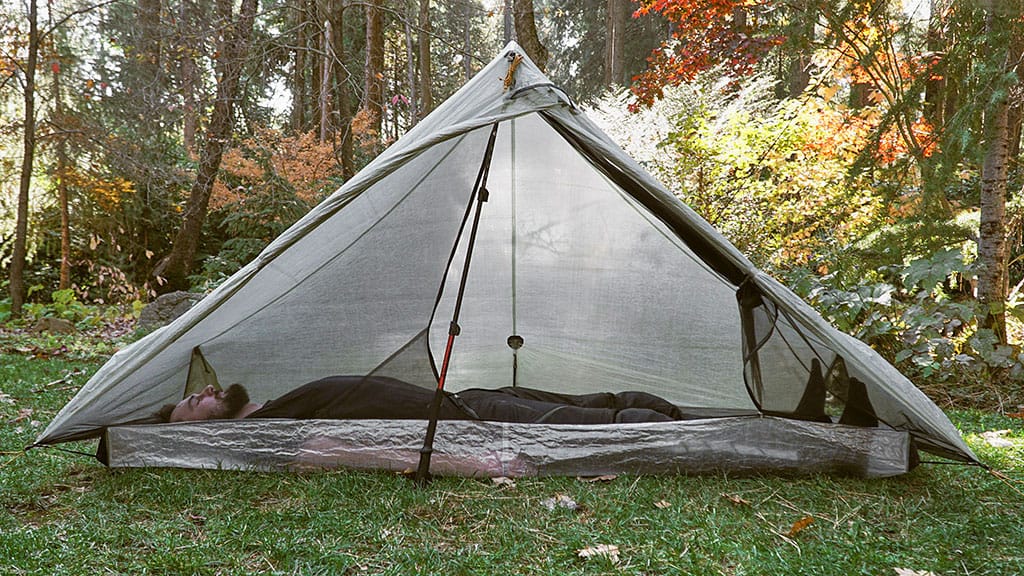
The Tarptent Aeon Li is one of the lightest solo (1-person) ultralight backpacking tents available. Made with Dyneema Composite Fabrics (DCF), the Aeon is a single-wall design featuring a zippered side-entry with a vestibule. The Aeon requires 4-7 stakes and is pitched with a single trekking pole.
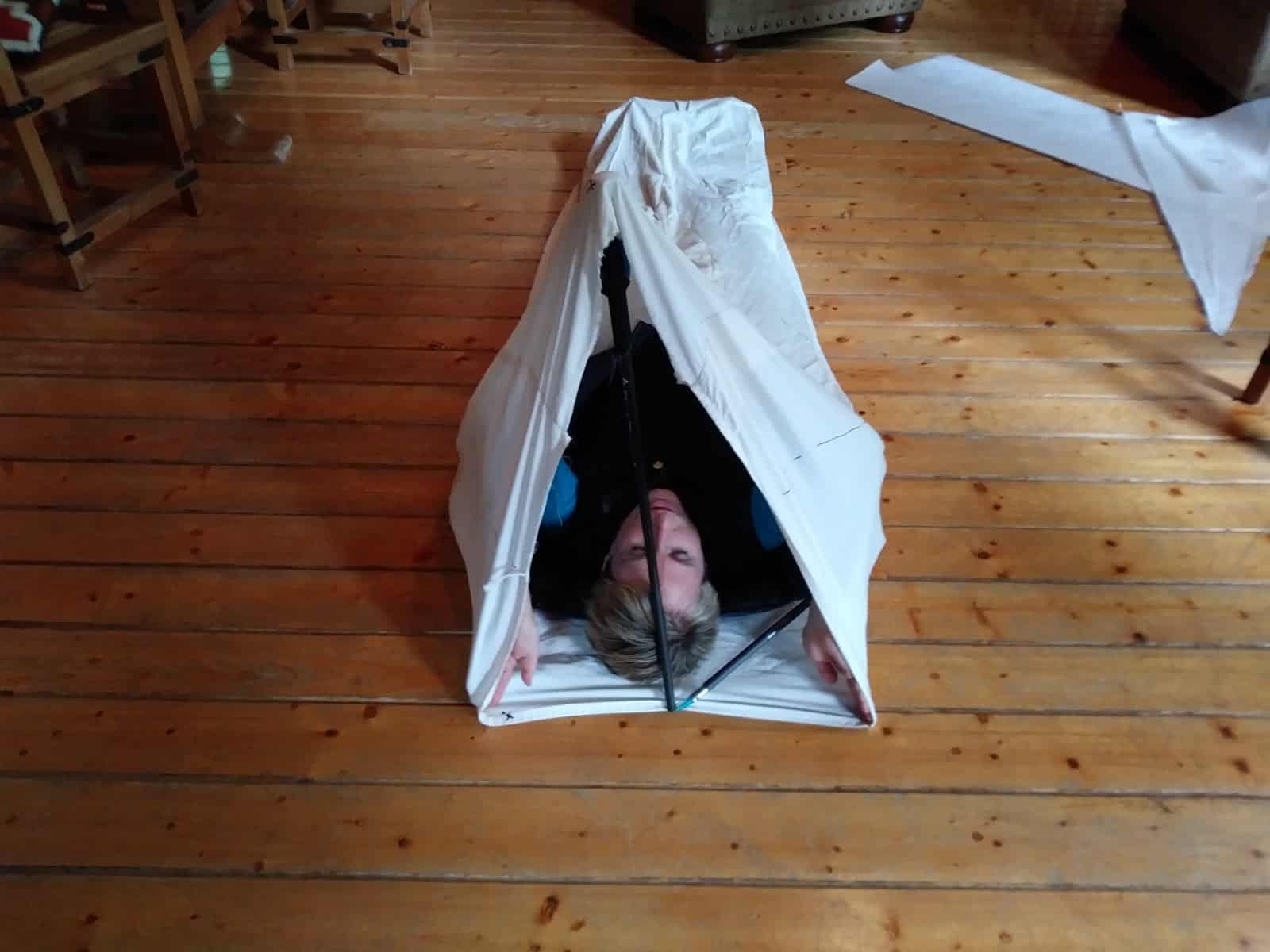
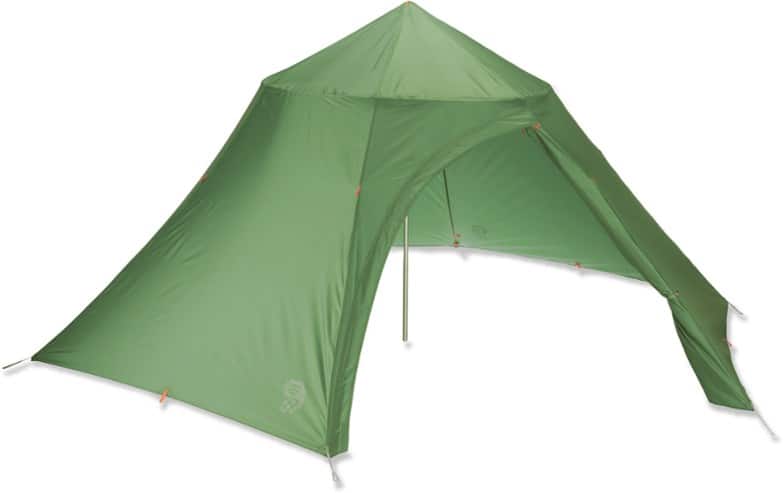
Photo: Tarptent. Subject is 7 feet tall.
See my review of the Tarptent Notch Li, which discusses some of the features that the Notch Li has in common with the Tarptent Aeon Li, including PitchLoc corners, Dyneema Composite Fabrics, and magnetic door closure tabs.
The following video provides an in-depth analysis of the Tarptent Aeon Li:
(note: due to some wind noise, keep your finger on your volume control if needed so you can hear the narration during wind gusts):
Features
Single trekking pole support, no pole in your living space
Front vestibule can be completely rolled back with no apex guyline required
Fits people up to 7 ft / 213 cm tall (claimed)
Generous vestibule for excellent gear storage space
Rollaway vestibule doors for ventilation, views, and moisture management
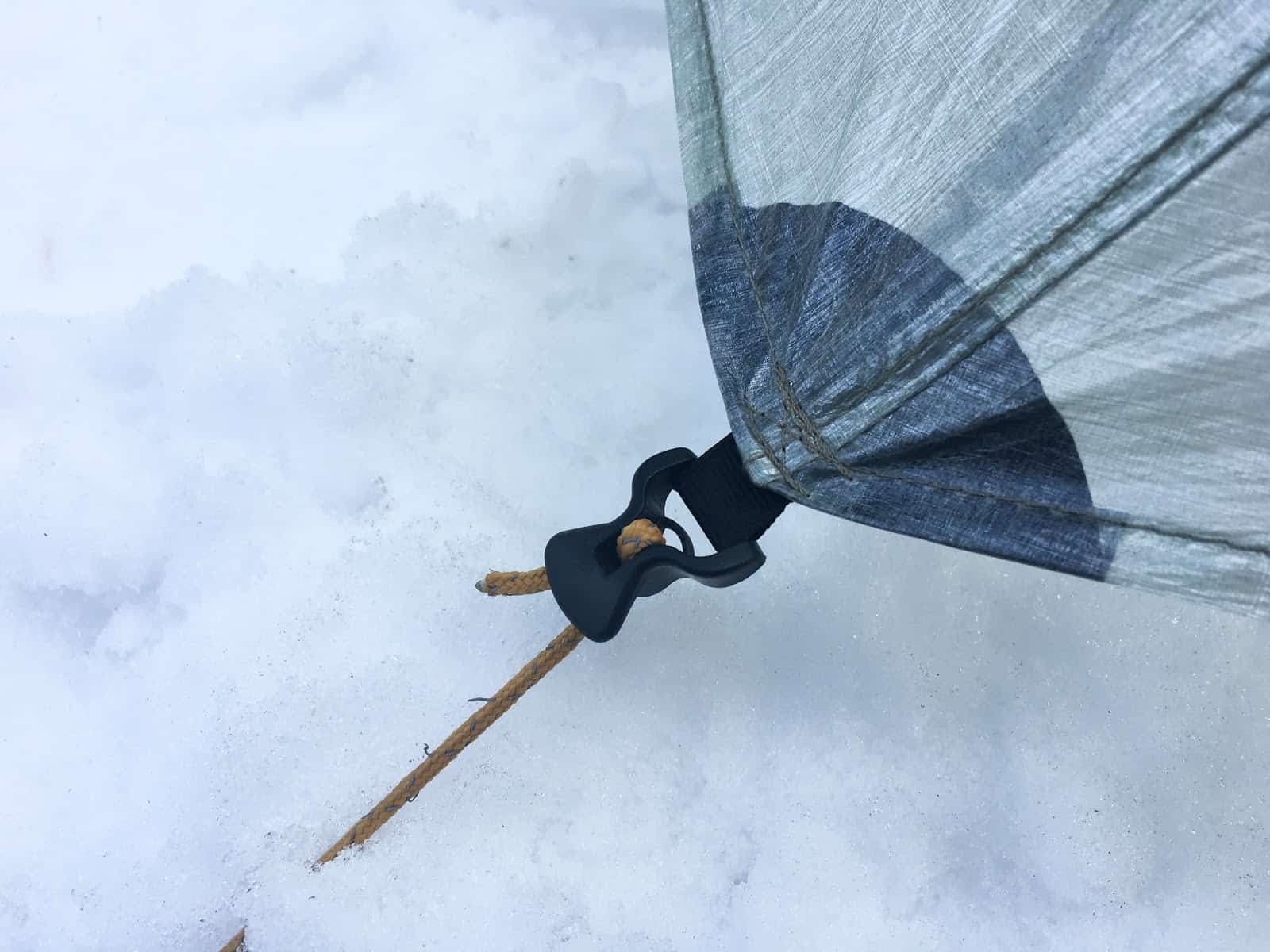
PitchLoc™ foldable carbon fiber strut corners on back wall with integrated line tighteners for taut pitch
Trekking pole handle can be pitched up or down
Reflective spectra cord guylines
Catenary ridgeline seams
MSRP $535
Specifications
Fabrics: Dyneema Composite Fabrics (DCF) – 0.51 oz/yd2 (canopy), 1.0 oz/yd2 (floor); fully taped and waterproof to 8,000+ mm hydrostatic head pressure rating
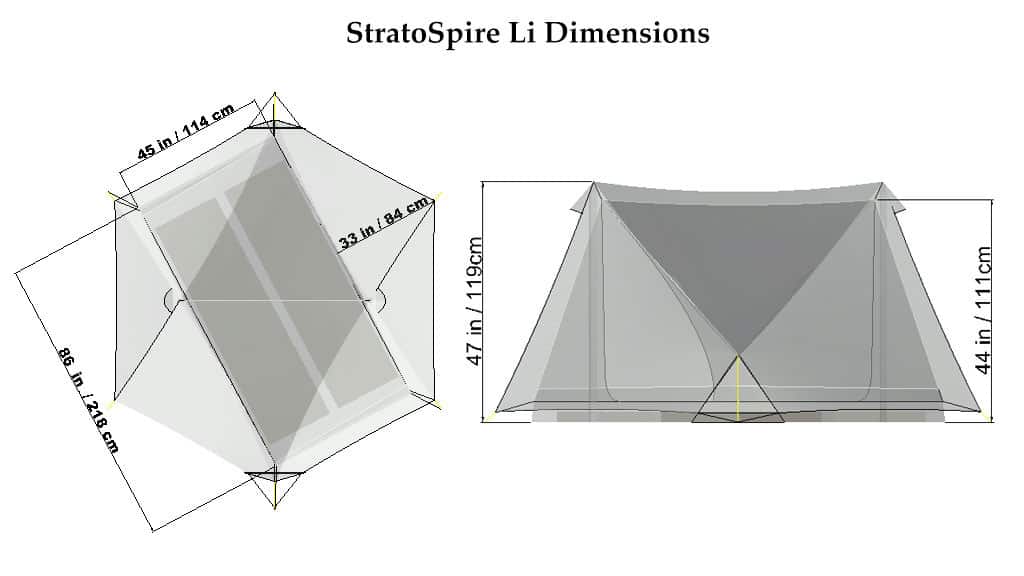
Sleeps: 1 (floor area ~ 18.3 sq. ft.; vestibule area ~ 8.6 sq. ft.)
Seasons: 3+
Weight: 15.8 oz / 448 g tent body (includes guylines, struts, and stuff sacks) + 1.7 oz / 48 g stakes (included)
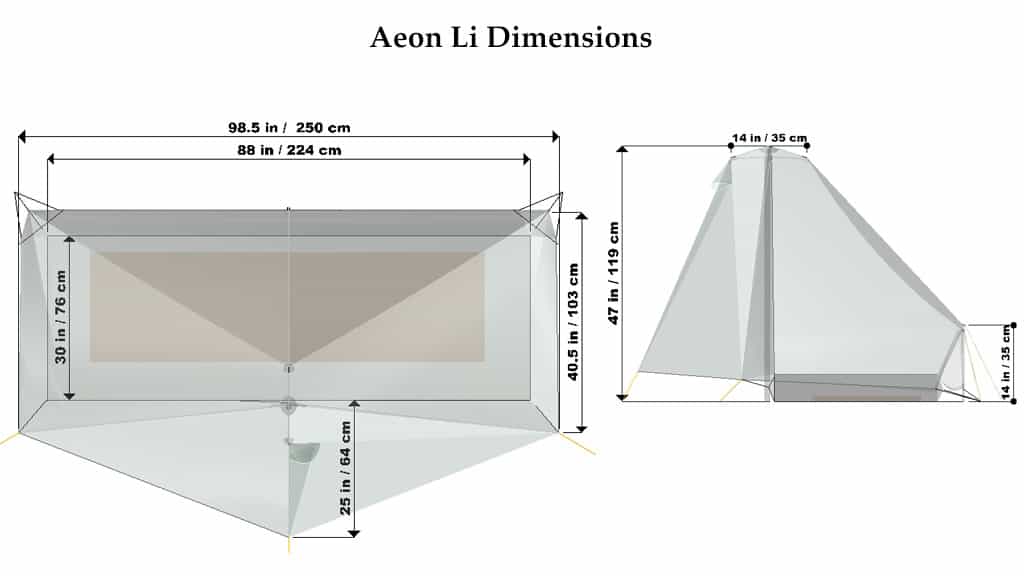
Interior Height: 47 in / 119 cm
Floor Width: 30 in / 76 cm
Floor Length: 88 in / 224 cm
Stakes: 6 x 6 in / 15 cm Easton Nanos (included)
Packed size: 14 in x 4 in / 36 cm x 10 cm
Source: TarptentSource: Tarptent
Commentary
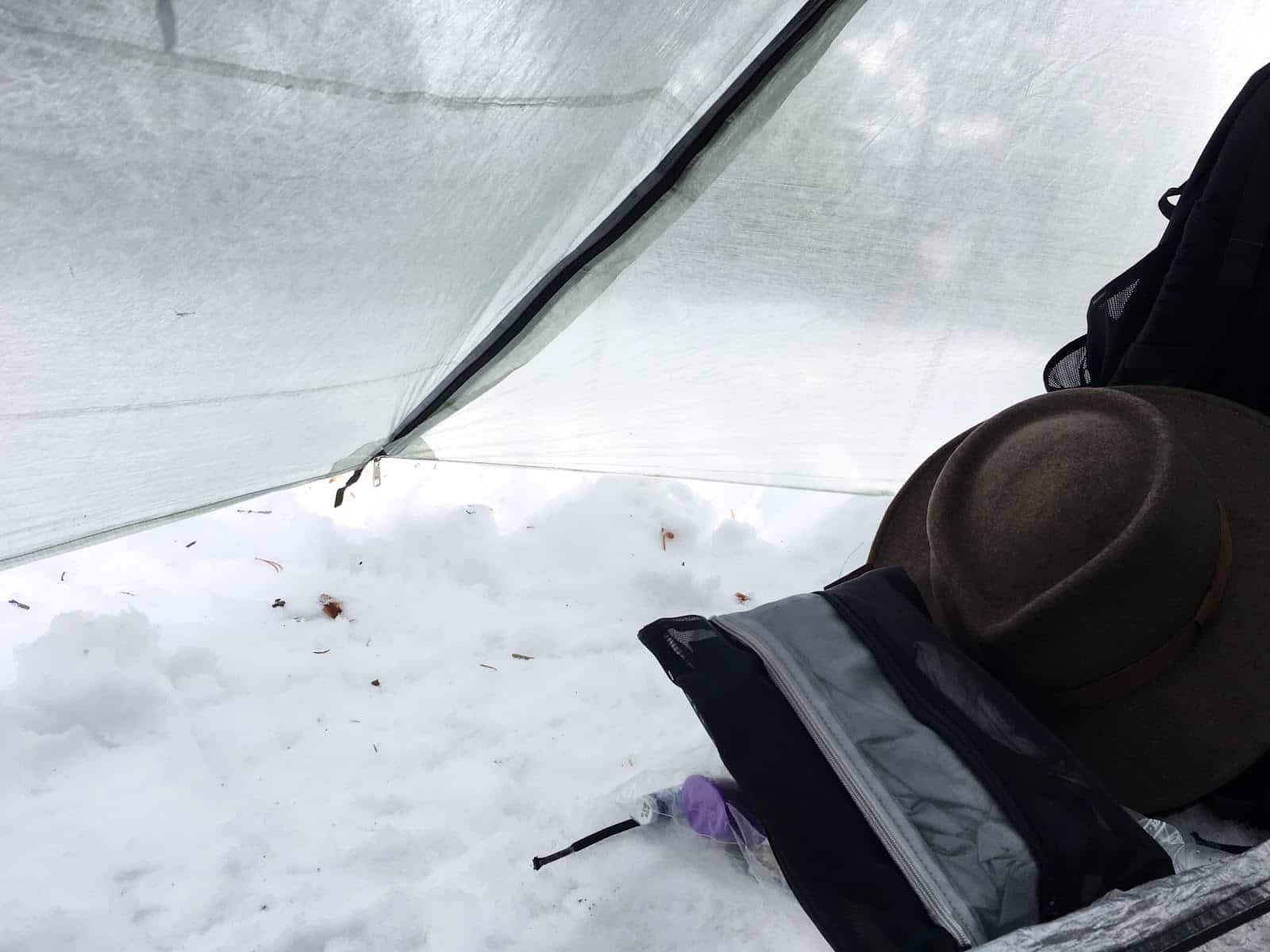
Vestibule doors can be rolled up and secured out of the way with magnetic clips for expansive views and an open front porch. The apex guyline (shown) is optional but recommended for windy weather.
What’s Unique about the Tarptent Aeon Li?
The market for lightweight solo tents weighing less than two pounds is quite crowded, comprised of dozens of both single- and double-wall designs from both cottage and larger manufacturers.
While it’s tempting to use the metric of weight for delineating product categories, it’s probably more appropriate to look at functional metrics when comparing products to each other.
In that context, these features characterize the Tarptent Aeon Li:
1-person capacity.
Trekking pole-supported structure.
Fully-enclosed shelter (i.e., includes integrated walls and floor).
External vestibule.
These features allow us to narrow the product category and excludes shelters requiring shock-corded pole sets, 2+ person capacity shelters, and floorless shelters such as tarps and pyramids.
Other important criteria include:
Single-wall design.
Dyneema Composite Fabric (DCF) materials.
That leaves a limited number of shelters meeting these functional criteria, with the most obvious competitor being the ZPacks Plexamid.
So what makes the Tarptent Aeon Li unique among this field of competitors?
1. Carbon fiber support struts.
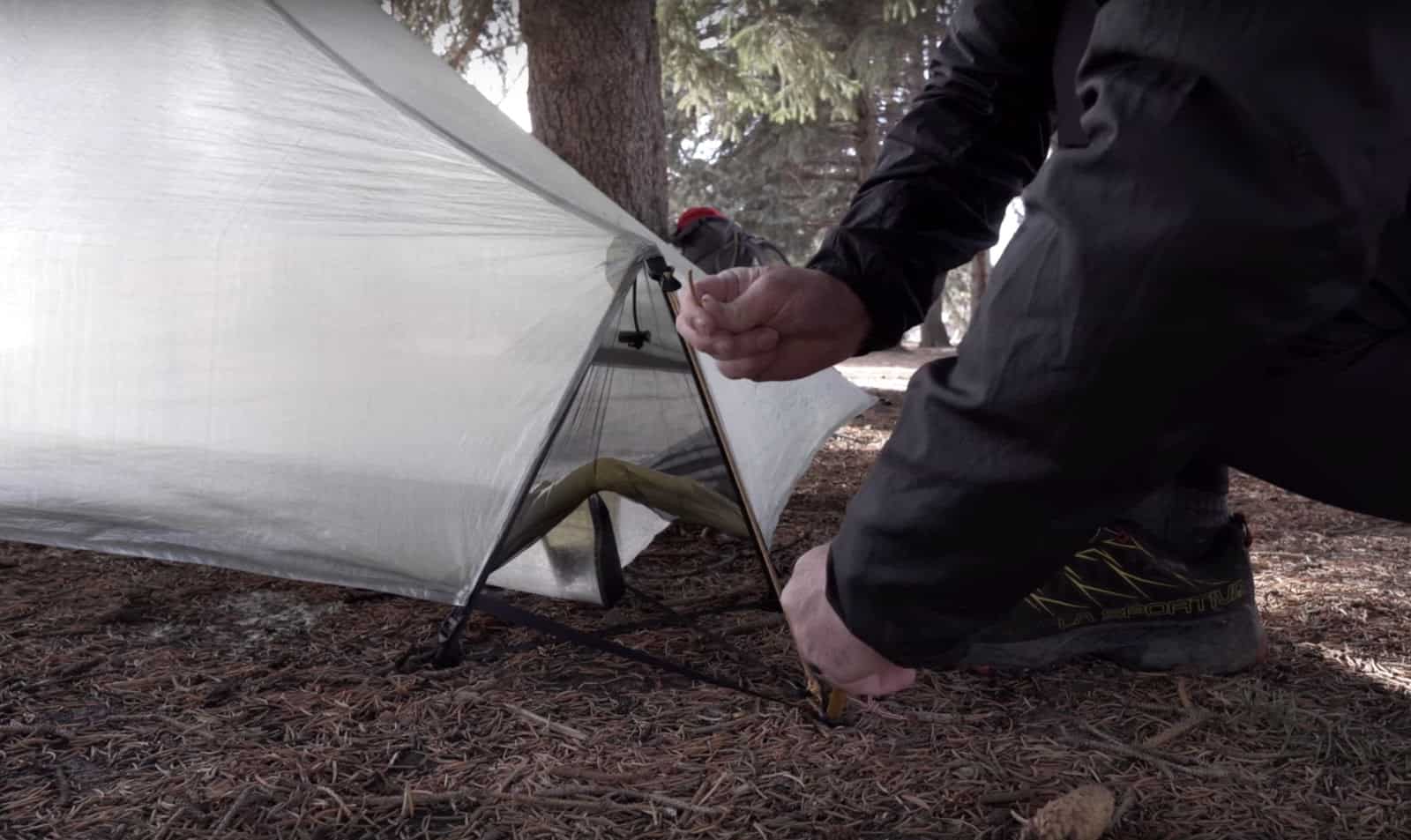
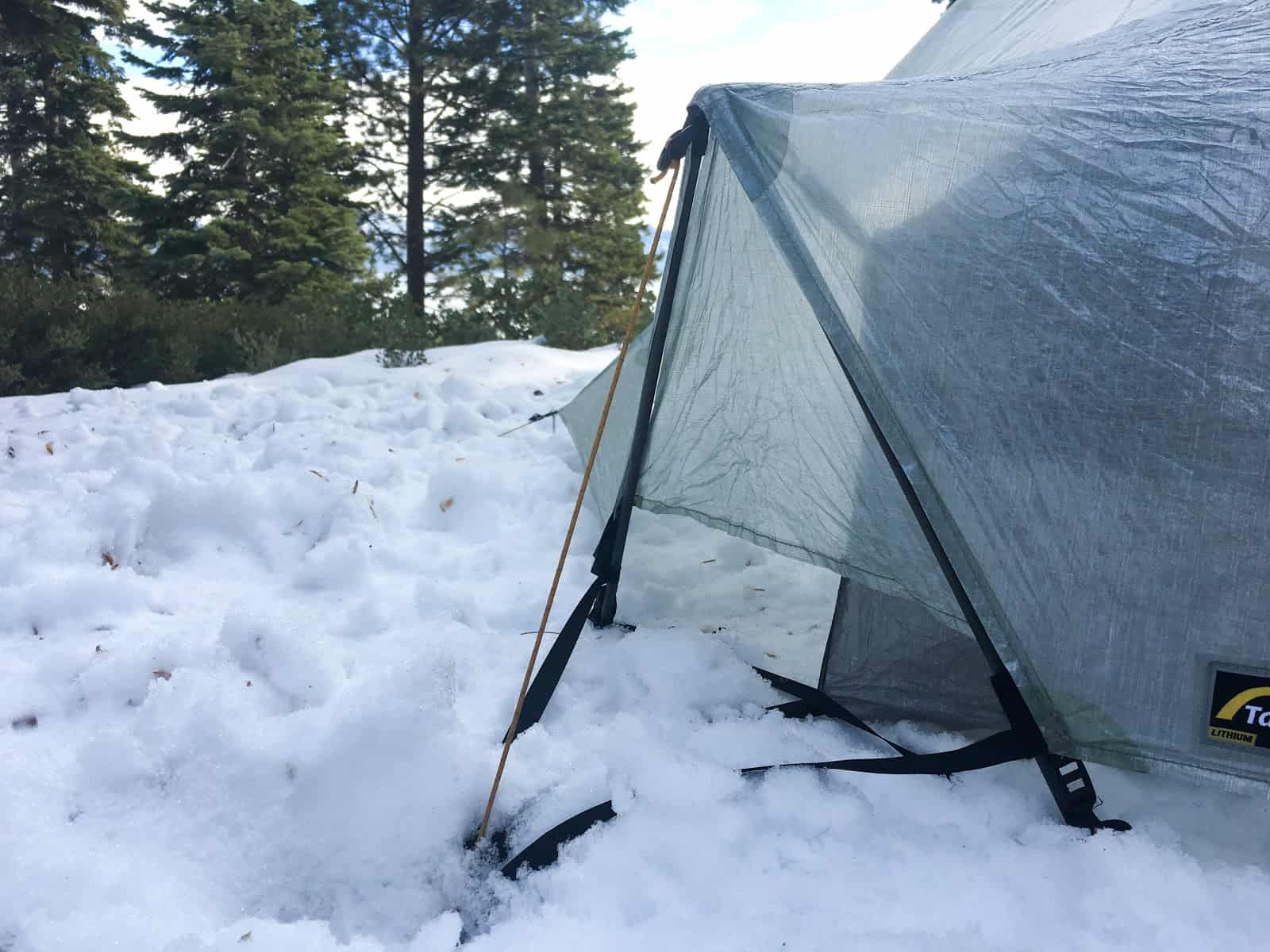
The two back corners of the tent are each supported by two carbon fiber struts in an inverted-V configuration (Tarptent calls this a “PitchLoc” corner). A third (vertical) strut along the midpoint of the back wall, combined with the PitchLoc corners, help create a vertical wall along the back of the tent.
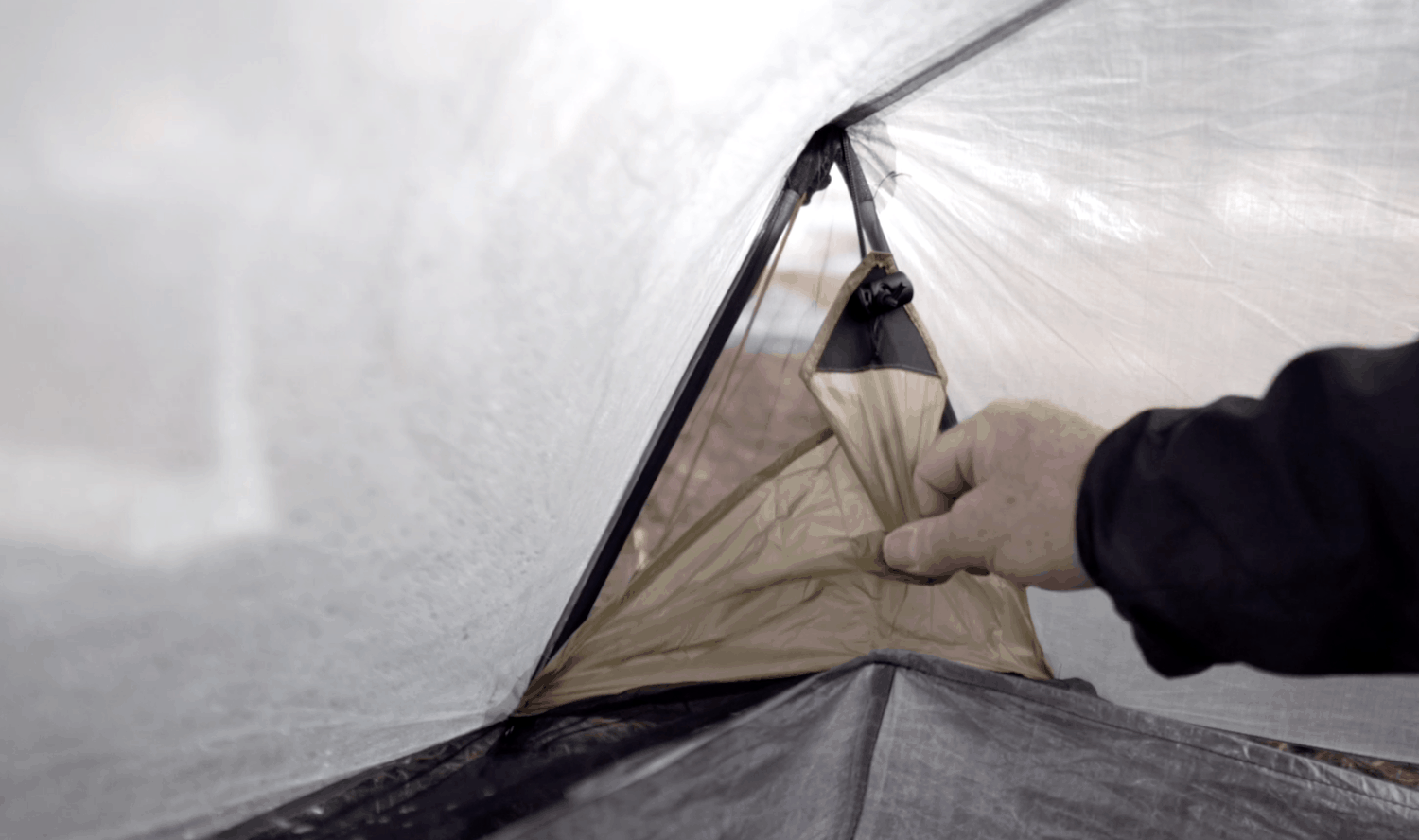
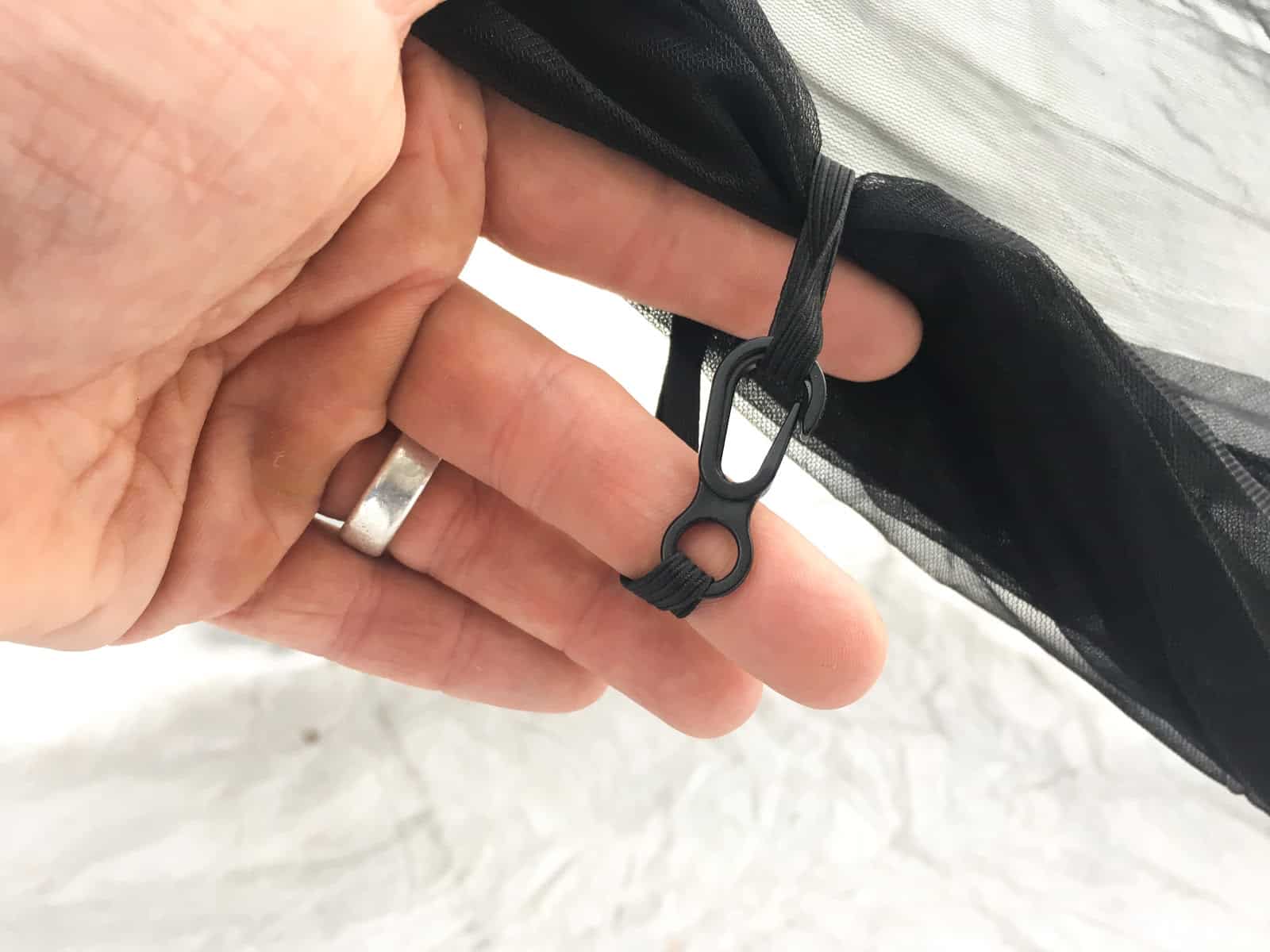
PitchLoc corners are comprised of two carbon fiber struts in an inverted “V” configuration that increases stability and living space. They are backed by a mesh screen (for ventilation) and a nylon panel (adjustable from the inside of the shelter).
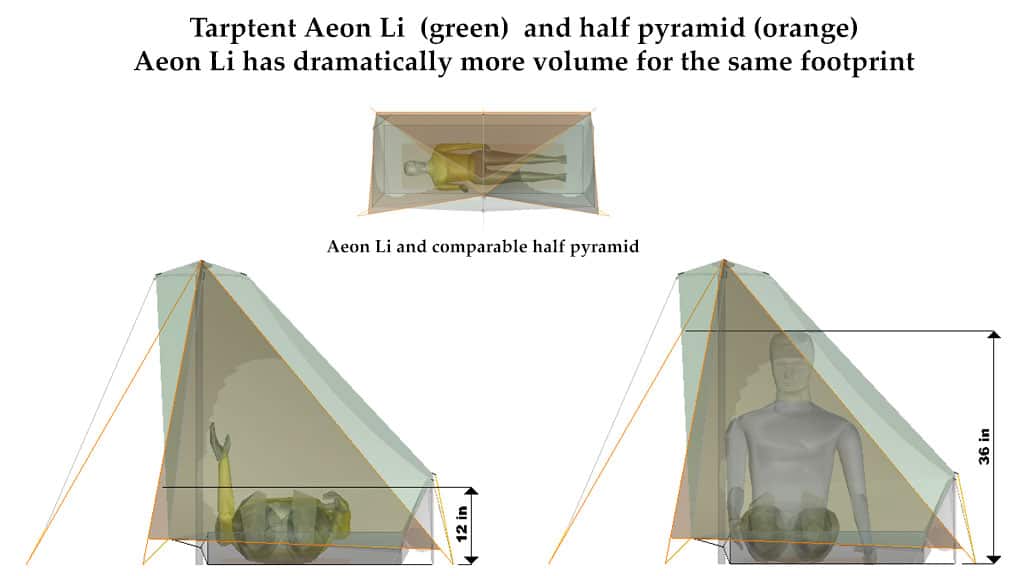
The presence of the struts creates the effect of a raised canopy, thus minimizing the chance that your sleeping bag will contact the lower edges of the sidewalls. A conventional pyramid design achieves the same effect without the struts – it just requires a larger canopy and larger pitched footprint. Thus, the geometric benefit of the struts is their ability to allow the tent to pitch with a smaller footprint (i.e., stakes closer to the tent).
The most impactive benefit of the strut system (and specifically, the PitchLoc corners), is that the PitchLocs create triangular structural elements that make the tent more wind resistant and more resistant to deformation as a result of snow loading. The difference in wind resistance and snow loading capability between a conventional pyramid shelter and the Tarptent Aeon is noticeable. It makes me wonder why manufacturers of conventional tarps and floorless pyramids aren’t incorporating structural elements into their designs. Maybe we will someday see tarps and pyramids incorporating the PitchLoc elements brought to market by Tarptent.
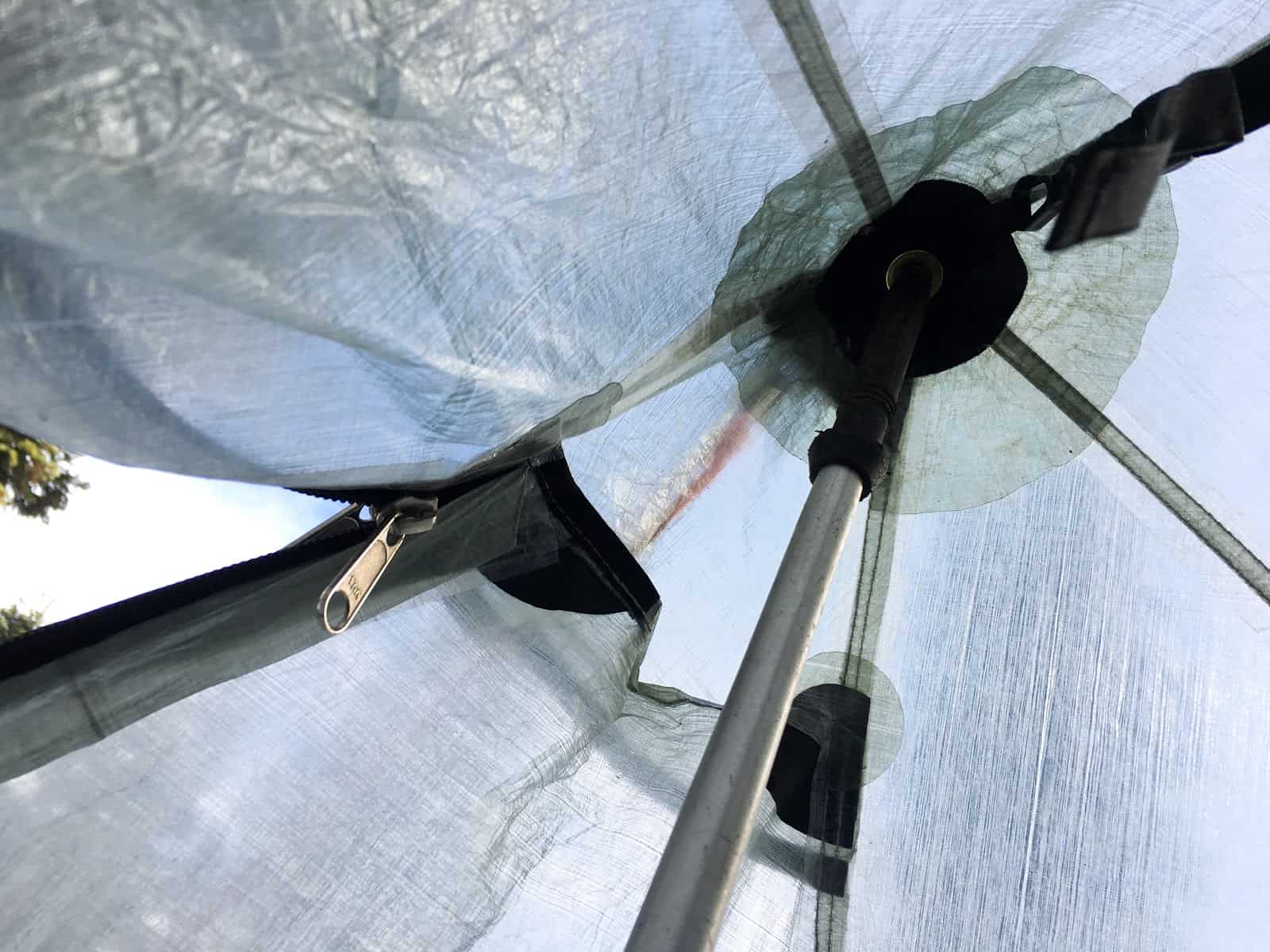
2. Carbon fiber peak strut
A carbon fiber strut situated horizontally at the peak of the tent, when combined with the vertical support pole (e.g., a trekking pole), creates a “T”-shaped structural element. When tension forces from the front and rear corner guylines are exerted on the T, the T provides resistance to torsional motion that allows the tent to be supported without the need for a front guyline. This type of structure is in contrast to typical pyramid designs, which require the front corners to be situated well in front of the top of the support pole. You can thus pitch the Aeon with a wide, nearly-vertical front opening (when both sides of the vestibule are rolled away) for expansive views and no guyline tripwires.
Inside view of the carbon fiber peak strut.
3. Precision design, cut, and sew (treat each of these individually)
The Tarptent Aeon Li is designed by a talented engineer (Henry Shires) who has an acute understanding of material properties (including DCF) and structural design. As such, the cut-and-sew (and bonding) processes have already taken into consideration a careful analysis of force distribution and aesthetic quality, resulting in a finished product that not only looks beautiful (when pitched properly), but also remains surprisingly stable in response to high wind and snow loads (considering that this is a one pound shelter).
Strengths
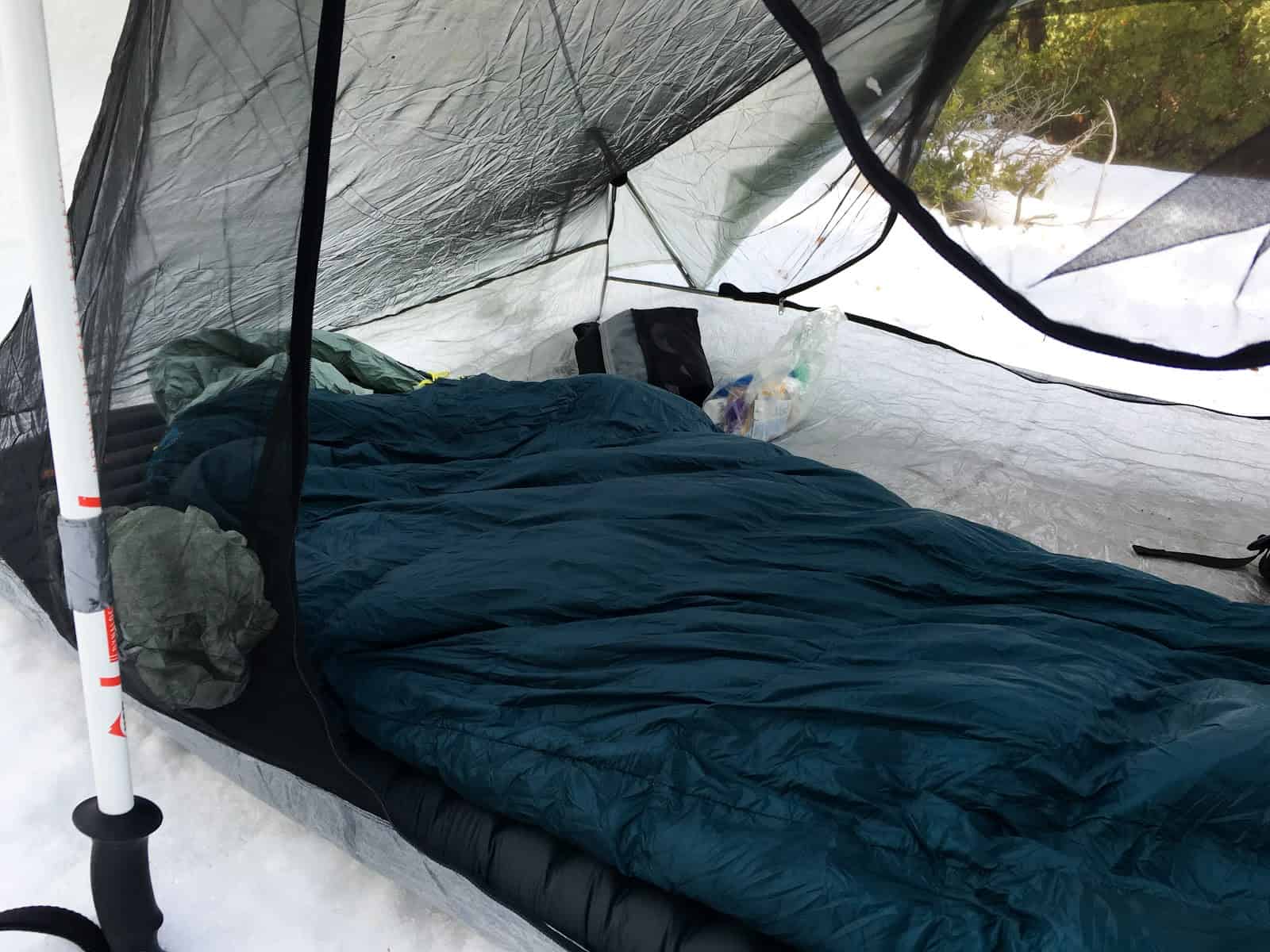
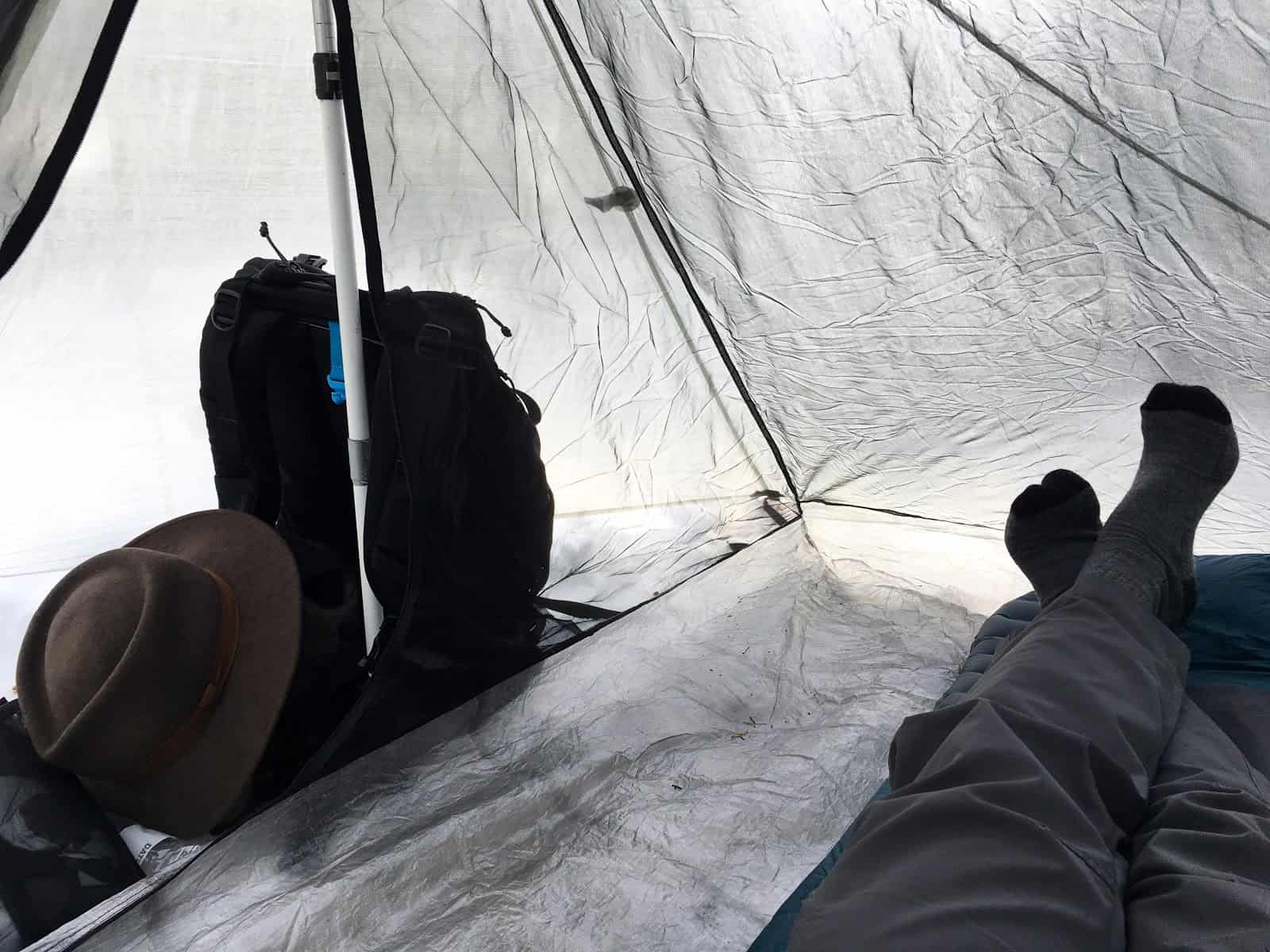
Generous interior volume for sitting up, moving around, stowing gear, and avoiding sleeping bag contact with sidewalls of shelter.
Well-ventilated: includes perimeter mesh around bathtub floor, two large (adjustable) interior vents, full front mesh door, rollaway vestibules, and peak vent.
Resistant to wind and snow loading, owing to structural elements formed by carbon fiber struts (total of 6 throughout shelter), and adjustable height.
Resistant to heavy rain and moderate spindrift, due to adjustable pitch height, bathtub floor, and overlapping vestibule doors.
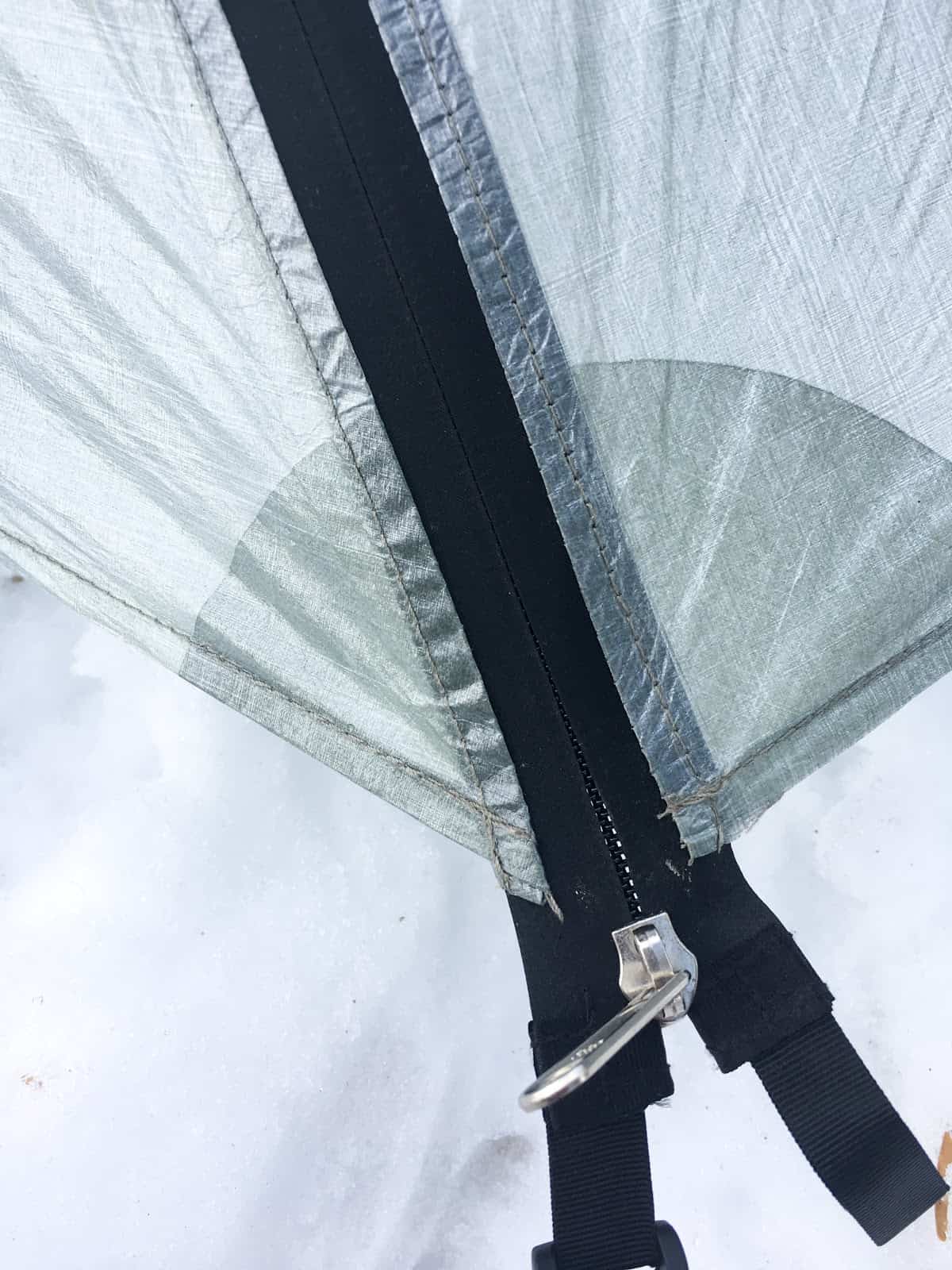
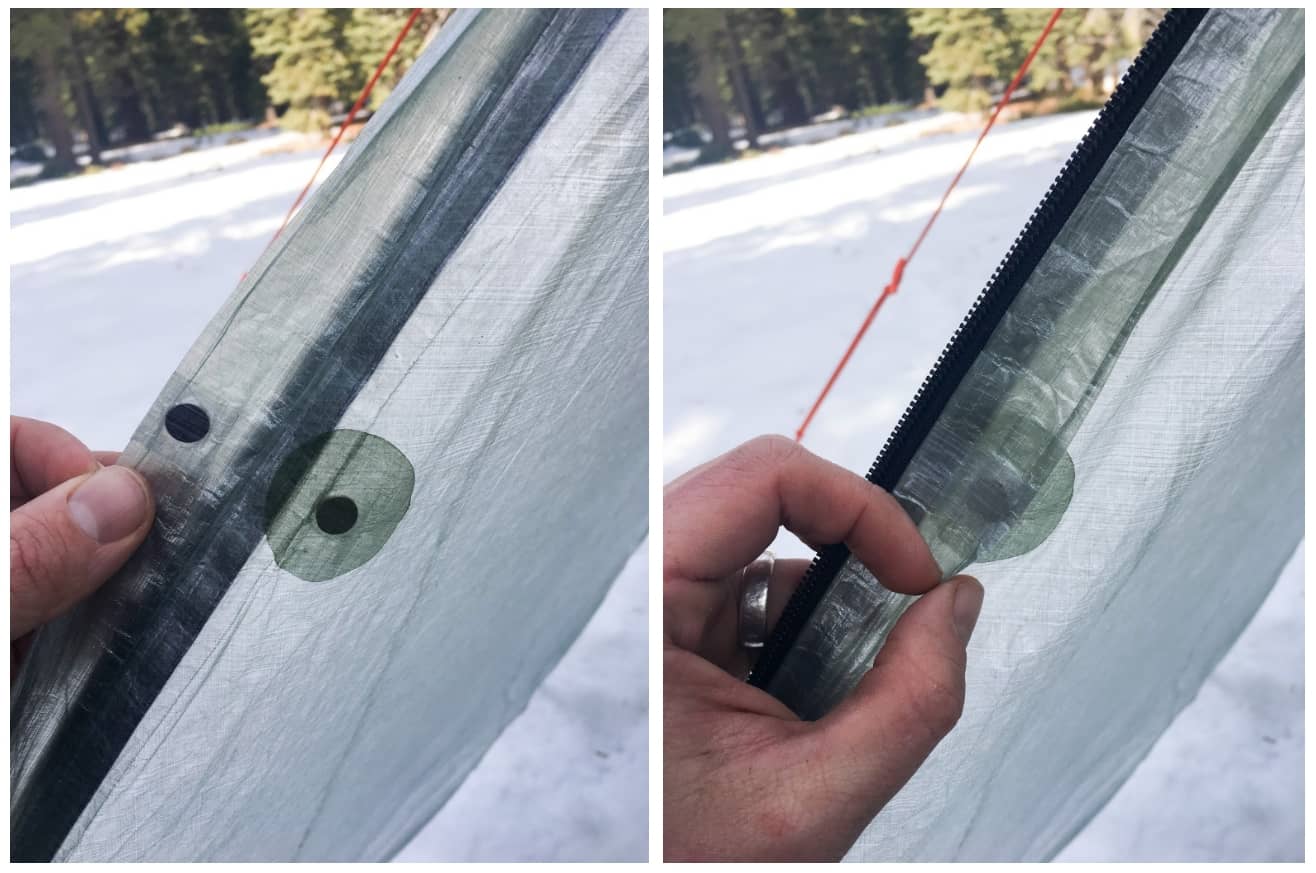
Magnetic loops that secure zippered door and overlapping vestibule doors are much easier to use than toggles or hook-and-loop straps.
Peak strut allows the tent to be pitched without a front guyline, so when the vestibule doors are rolled back there are unrestricted views and no guyline to trip over.
Vestibule peak provides several inches of overlap over vertical front mesh tent door, so rain doesn’t enter tent if vestibule is open/rolled away (unless there’s wind driving rain towards the inside of the tent).
The generous vestibule is large enough for an expedition pack and gear.
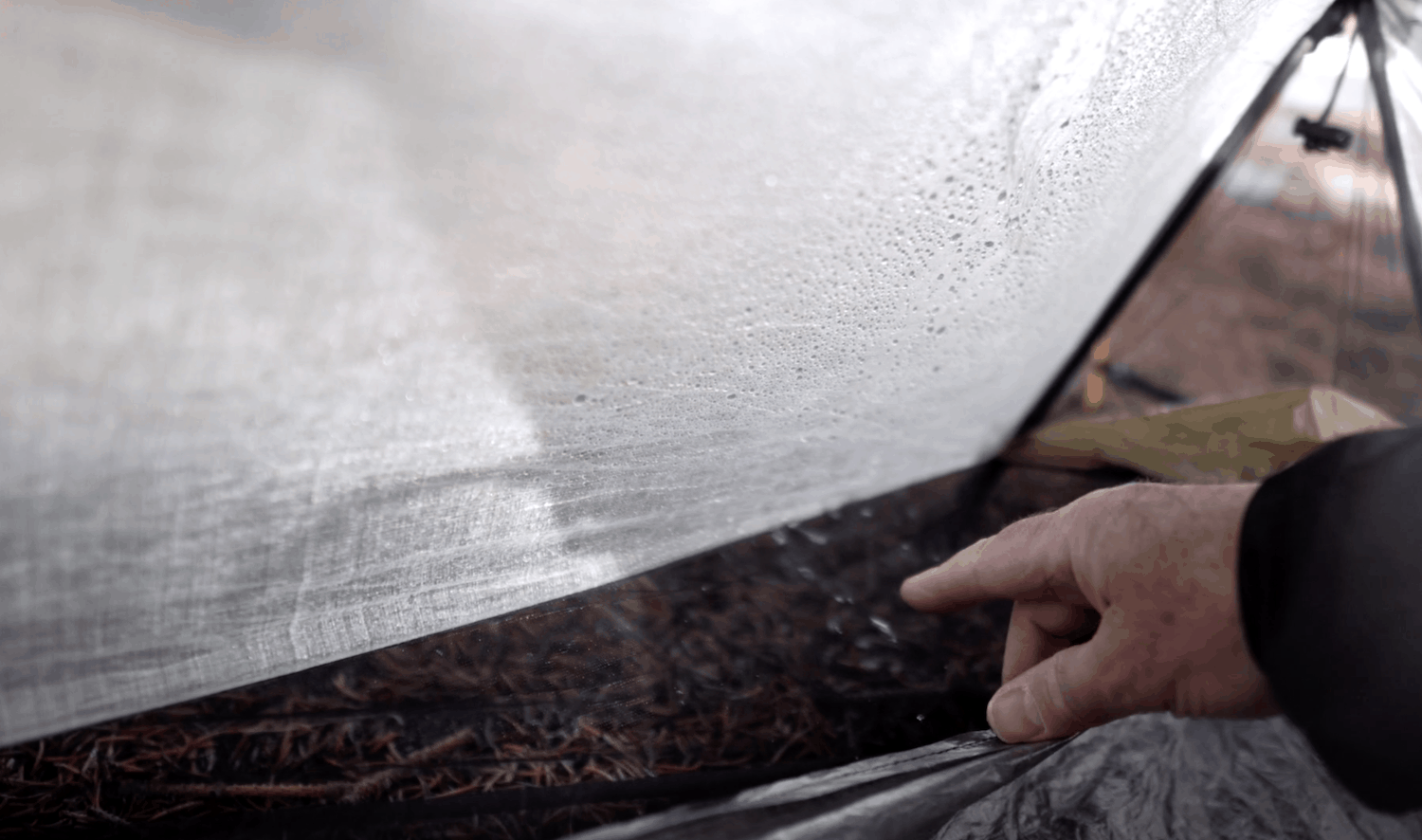
Downward sloping mesh from top of bathtub floor to bottom of shelter canopy keeps condensation droplets from gathering on the shelter floor.
PitchLoc structures at back corners reduce footprint size, so the tent can be pitched in more compact spaces that pyramids of similar interior usable volume.
Dyneema composite fabrics (DCF) fabrics are easy to repair, maintain tension in cold and wet conditions, and provide a high tear-strength-to-weight ratio.
DCF fabrics may be more condensation-resistant than nylon and polyester fabrics because of lower material emissivity.
Seam strength and strong, non-stretch fabrics combined with longer, stronger tent stakes, allow for staking the tent at extremely high levels of tension (20+ pounds per stake), which dramatically improves its wind resistance.
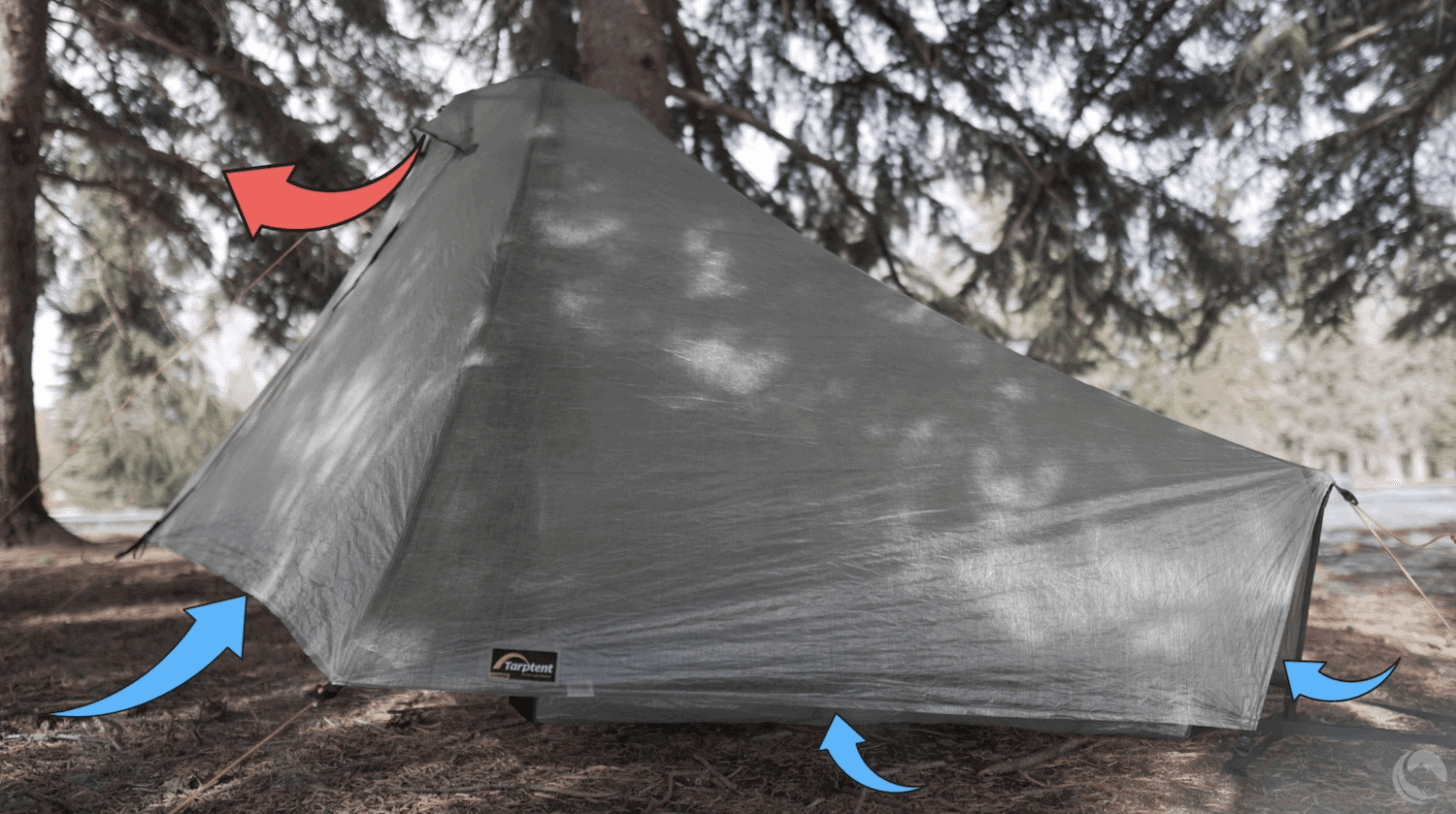
There is a mesh perimeter screen sewn between the bathtub floor and the bottom edge of the canopy. The top of the bathtub floor sidewalls is higher than the bottom of the canopy, so the mesh panel slopes downward away from the shelter floor. The slope allows condensation dripping down the inside of the canopy to hit the mesh and stay off the floor.The PitchLoc corners form mesh ventilation windows. The windows are adjustable from inside the tent by way of a nylon panel, and can be completely dropped for maximum ventilation.Condensation management: the Tarptent Aeon offers multiple options for air intake – through the vestibule (left), under the sidewalls (center), and through the PitchLoc corner vents (right). A small peak vent allows warm, moist air to escape.
Limitations
Magnetic loops that secure doors could be extended with a pull-tab for easier one-handed operation, especially with cold-weather gloves or mittens.
Hook-and-loop patches on overlapping vestibule doors are not as easy to use as a zipper, but generous overlap and bottom clip (that clips both doors together) provide good wind and rain protection.
Setup and configuration are quite easy but requires some geometric adjustments if pitched on uneven ground (as do most pyramid-style designs) to maintain proper tension between the stake-out points and shelter peak.
Struts prevent the tent from being packed horizontally inside a backpack. Removing the struts is possible, but requires extra time when pitching and striking the tent.
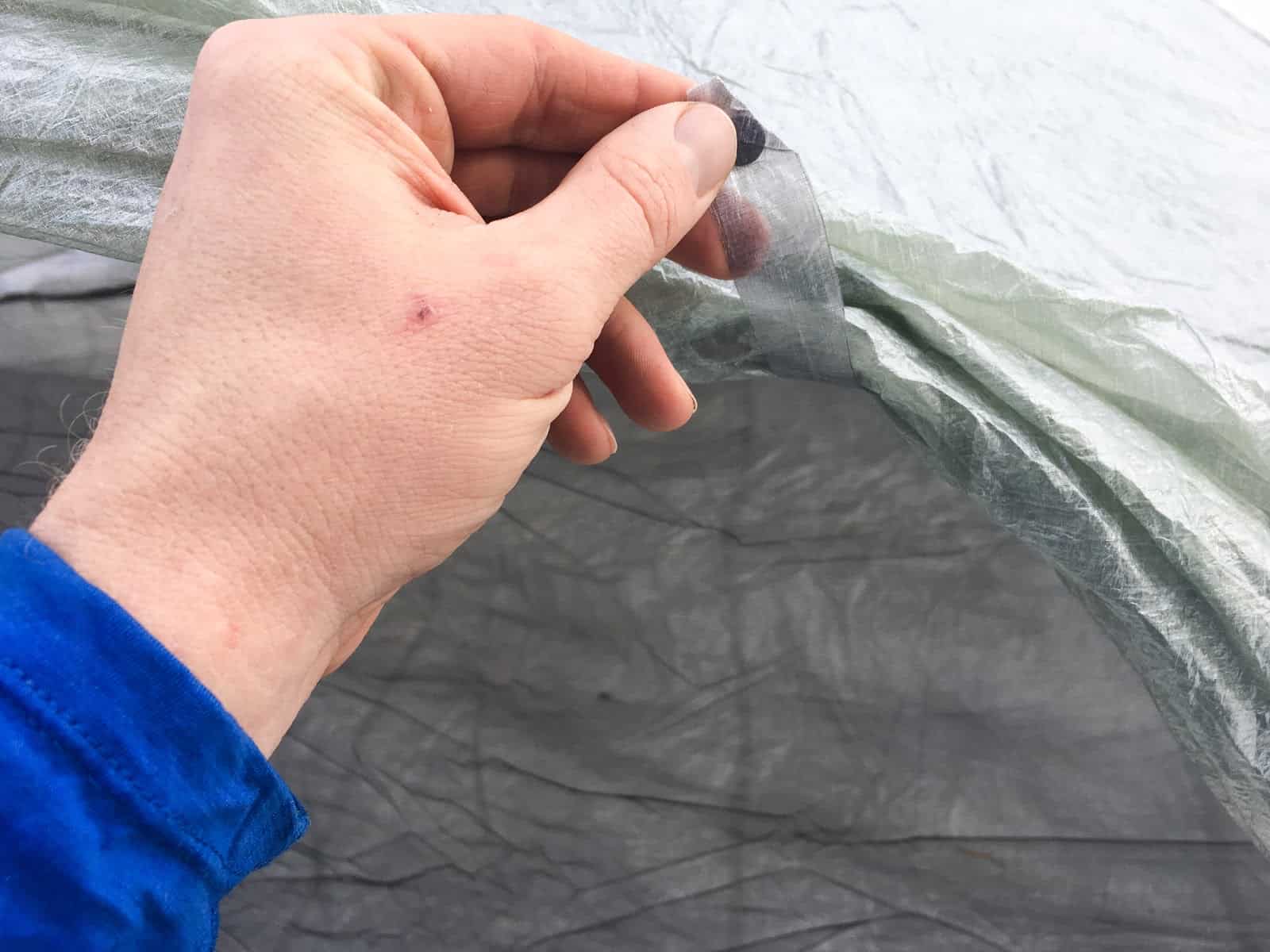
Dyneema composite fabrics (DCF) fabric used in the canopy is a lighter weight fabric (0.51 osy) that is prone to puncture if the shelter is pitched near sharp twigs or poky desert plants.
Compared To
Tarptent Aeon vs. Floorless Pyramid
For similar interior volume, the Aeon requires a smaller footprint.
The Tarptent Aeon with the integrated single-wall inner tent is a lighter combination than a pyramid tarp with a separate inner tent.
A pyramid tarp with a separate mesh inner tent is better at managing condensation under most circumstances. A pyramid tarp with a separate fabric inner tent is better at managing cold winds and spindrift.
A pyramid tent is typically easier to pitch but requires more stakes than the Aeon to provide similar wind stability.
The Tarptent Aeon is better at managing heavy snow loads.
The Tarptent Aeon pitches with no support pole in the sleeping area.
The 10 oz (284 g) Locus Gear Khufu DCF-B (and before that, the standard CTF model) has been my primary shelter for the past decade. The Tarptent Aeon Li is a compelling option for when I’d like a little extra bug protection.
Tarptent Aeon vs. Double-Wall Tent
Tarptent Aeon is lighter.
Tarptent Aeon is simpler to set up and take down.
Double-wall tents generally provide better condensation management.
Tarptent Aeon vs. A Dual-Trekking Pole Supported Shelter
Tarptent Aeon may be simpler to pitch, and lighter since it’s built around just one support pole.
Tarptent Aeon may be the better option for users who do not use trekking poles, or who may only use one. If you’re not a trekking pole user, you can purchase a 4.2 oz pole (fixed length) from Tarptent, or an adjustable carbon fiber pole from Ruta Locura (I recommend a 3-section 0.450 pole with max length of 48-49 in). The max height you can pitch the Aeon is about 47 in (199.4 cm), but a slightly longer pole is useful if the ground is uneven.
A dual-trekking pole shelter may be more wind-stable than the Aeon, but this is highly dependent upon the shelter.
A dual-trekking pole shelter may offer better livability in terms of wider floor area, dual side entrances, and dual vestibules.
Tarptent Aeon Li (DCF) vs. Shelters Made with Other Fabrics
DCF may be more resistant to the formation of condensation over a wider temperature range due to DCF having a lower emissivity than nylon or polyester.
DCF doesn’t stretch as much as nylon or polyester and tends to be more wind-stable.
DCF’s lack of stretch allows it to maintain tension across a wide range of temperatures and moisture content than nylon or polyester, so once the tent is tensioned properly, it’s not likely to sag over the course of a cold, wet night.
DCF manufacturing requires high levels of precision in terms of engineering design, fabric cut and sew, and seam bonding, so mistakes in manufacturing are magnified in the form of uneven stress distribution across fabric panels and seams that can lead to flapping in the wind and structural failure.
The Tarptent Notch Li shares many of the Aeon’s features, but sets up with two poles and sports two vestibules and two doors.
Want to learn more about DCF? Check out the BPL podcast: we do a deep dive into the fabric’s strengths, limitations, and best uses.
Product Review Disclosure
Updated September 15, 2018
How we acquired these products: Product(s) discussed in this review were either acquired by the author from a retailer or otherwise provided by the manufacturer at a discount/donation with no obligation to provide media coverage or a product review to the manufacturer(s).
We do not accept money or in-kind compensation for guaranteed media coverage: Backpacking Light does not accept compensation or donated product in exchange for guaranteed media placement or product review coverage.
Affiliate links: Some (but not all) of the links in this review may be “affiliate” links, which means if you click on a link to one of our affiliate partners (usually a retailer site), and subsequently make a purchase with that retailer, we receive a small commission. This helps us fund our editorial projects, podcasts, instructional webinars, and more, and we appreciate it a lot! Thank you for supporting Backpacking Light!
In this episode, we talk to Alaskan writer, biologist, and adventurer Caroline Van Hemert. Caroline is an ornithologist who, along with her husband Pat, undertook a 4,000-mile human-powered journey from Bellingham Washington to Kotzebue, a small town high above the arctic circle.
Podcast Sponsor: REI
This podcast has been made by possible by the generous support of REI. Please consider supporting Backpacking Light and REI by using the affiliate link below to shop at REI. We receive a small commission if you end up placing an order if you use the link, at no additional cost to you. Thank you!
In this episode, we talk to Alaskan writer, biologist, and adventurer Caroline Van Hemert. Caroline is an ornithologist who, along with her husband Pat, undertook a 4,000-mile human-powered journey from Bellingham Washington to Kotzebue, a small town high above the arctic circle.
Caroline’s written a book about her journey, The Sun is a Compass. The book weaves together a lot of threads: the path Caroline’s life took to get to the start of her journey, her relationship with her husband, her life as a scientist, her feelings about motherhood: it’s a great read.
Our interview covers all that and more. So sit back, relax, and enjoy our conversation with Caroline Van Hemert.
Outline
Andrew introduces the subject of their interview: Caroline Van Hemert.
Andrew tries to digest the scope of Caroline’s journey.
Where Caroline grew up and how she found herself on long adventures.
A German word for “restless need to migrate”.
Finding parallels between birds and humans
Trip logistics.
What was Caroline most worried about, and did those fears pan out?
The challenges of trip planning, even with modern tools.
Advice for planning similar routes.
Lean on local contacts!
What makes an elegant route?
Breaking down the different modes of human-powered transportation.
Rowing, skiing, hiking, packrafting, and canoeing.
Which of these things did Caroline enjoy the most?
Caroline recommends training strategies for trips with a variety of physical demands.
What was her low point, and how did she overcome it?
Arctic biting insects
Peeing in a food dish
Cooking methods.
Indispensable gear.
Sacrificing gear for weight considerations.
Conflict, outdoor partnerships, and risk management.
The pros and cons of adventuring with a romantic partner
This episode of the Backpacking Light Podcast is supported by Backpacking Light membership fees. Please considerbecoming a member which helps support projects like this podcast, in addition to a whole slew of other benefits!
In addition, some of the links on this page may be affiliate links that refer to our partner merchant retailers. If you follow a link and then make a purchase, we receive a small commission which goes a long way towards helping us pay for podcast production, hosting, and bandwidth fees! Thanks for supporting us in this way!
Contact
You can contact us at podcast@backpackinglight.com, or follow us on social media –
We do not accept money or in-kind compensation for guaranteed media coverage: Backpacking Light does not accept compensation or donated product in exchange for guaranteed media placement or product review coverage.
Affiliate links: Some (but not all) of the links in this review may be “affiliate” links, which means if you click on a link to one of our affiliate partners (usually a retailer site), and subsequently make a purchase with that retailer, we receive a small commission. This helps us fund our editorial projects, podcasts, instructional webinars, and more, and we appreciate it a lot! Thank you for supporting Backpacking Light!
This review of the Zerk 40L Fastpack provides a first look at Mountainsmith’s new ultralight backpack aimed at thru-hikers.
Introduction
The Zerk 40L Fastpack represents Mountainsmith’s first stab at an ultralight backpack aimed specifically at thru-hikers doing big mile days with few breaks. Inspired by trail running packs, the Zerk is designed to give you access to food, water, and essential gear while being comfy enough to leave on all day. The design is centered around wide, thick shoulder straps and a removable foam framesheet.
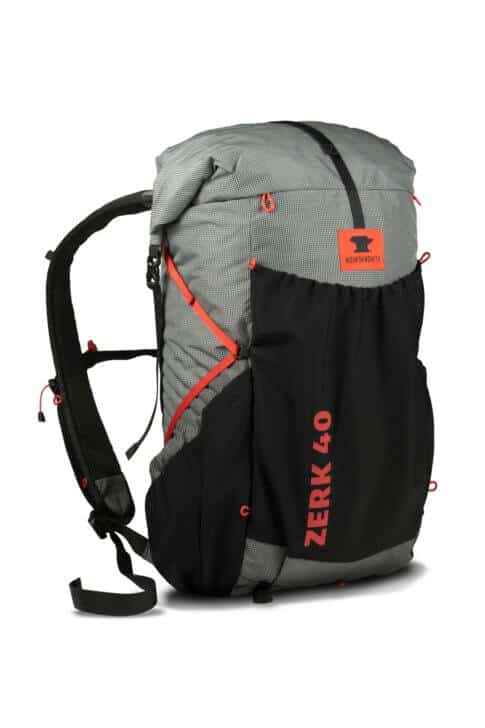
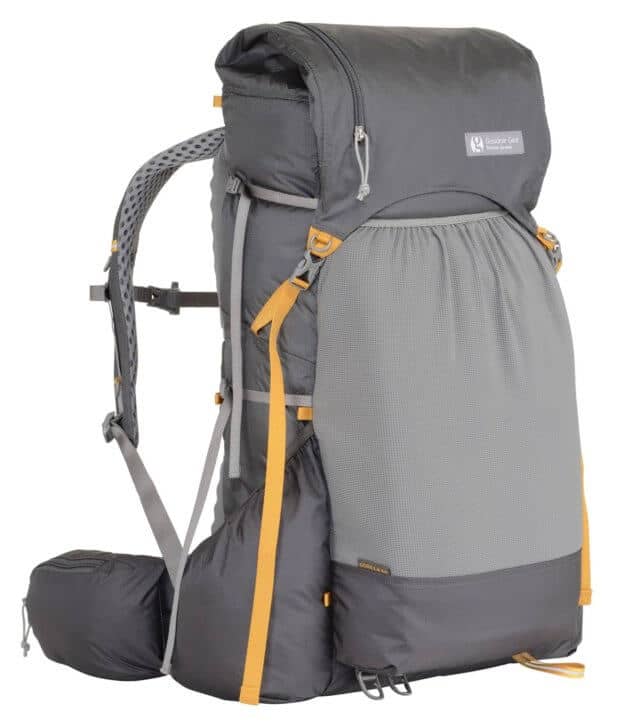
Photo: Mountainsmith The Zerk 40L Fastpack
Mountainsmith designed the Zerk in collaboration with thru-hikers, specifically Mountainsmith athlete Tom “The Real Hiking Viking” Gathman. Such partnerships can sometimes feel like marketing gimmicks, but I had reason to believe that Mountainsmith takes these things seriously. I’m a professional photographer/videographer, and the Mountainsmith Tanuck 40L, designed with photographer Chris Burkard, is my all-time favorite camera bag because it feels like a backpack designed by a photographer.
Going into this initial First Looks review, I hoped that the same “on the front lines” design and execution would spring from the collaboration between Mountainsmith engineers and the thru-hiking community.
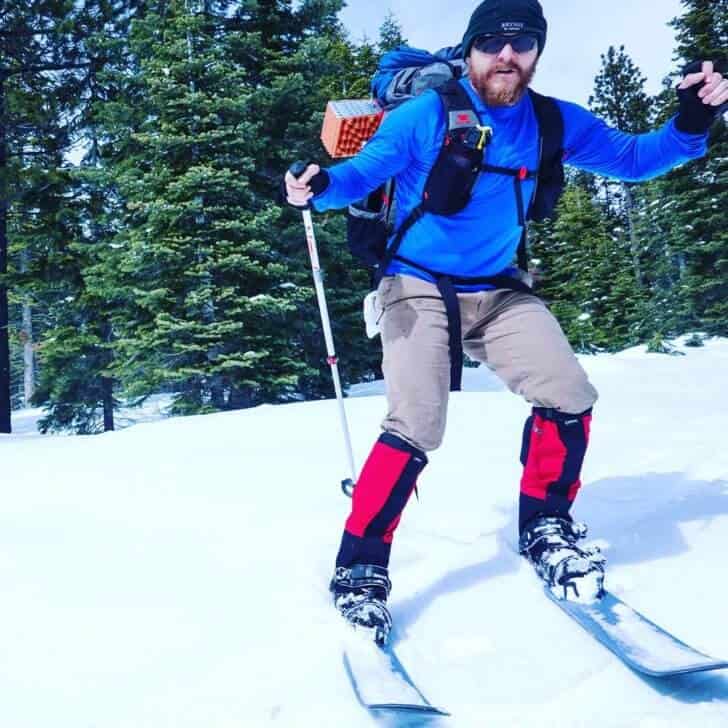
With all this in mind, I took the Zerk out for a quick two-day, one-night cross-country skiing excursion in the eastern Sierra Nevada.
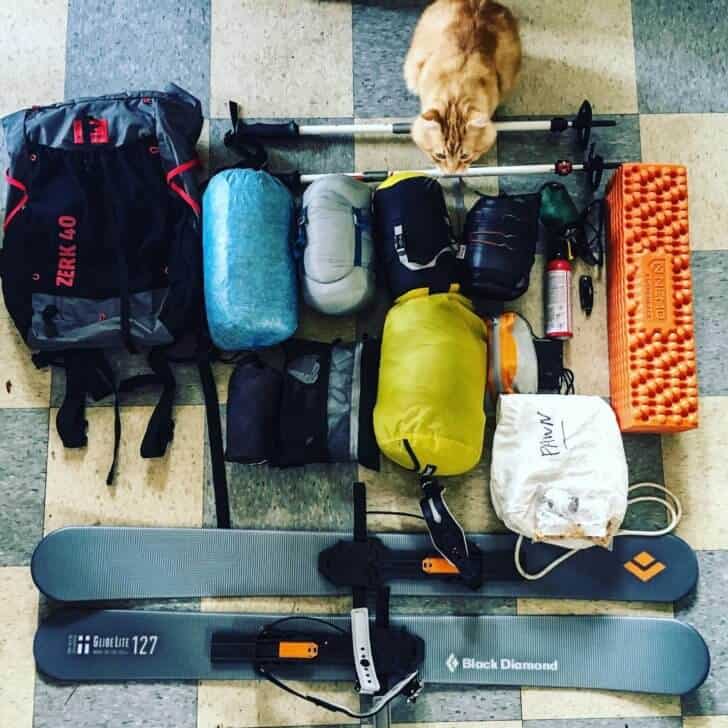
Everything pictured here, minus Bothy the Cat and the trekking skis, found a spot inside or outside the Zerk 40L. The Zerk is a well-organized pack, particularly with regard to its external pockets and lashing systems.
Features and Specifications
Features
Wide, cushy shoulder straps
Dual mesh shoulder pockets with drawstrings
Shallow, diagonally cut side pockets
Outer secondary mesh side pockets
Wide roll-top enclosure with over the top webbing
Large front stretch pocket
Elastic gear attachment points located high on shoulder straps
Integrated shoulder-strap safety whistle
Stabilized with a two-piece Atilon and EVA foam panel (no frame sheet or stays)
Removable non-load bearing waist belt
Removable bear-can straps with multiple attachment points
Removable reflective front bungee
Hydration system port and internal attachment
Specifications
Dimensions: 18.5 x 11.75 x 5.75 in (47 x 30 x 14.6 cm)
Weight (including all straps and waist belt): 28 oz (793.78 g)
Superior external organization: with good planning, you can hike all day and never take this pack off.
Shoulder straps are wide, comfortable, and secure.
Shoulder strap pockets are well placed, large, and hold items securely.
Side pockets are cut diagonally, allowing you to reach water bottles easily.
Foam stabilizing back panel is comfortable and seems to breathe well.
The bright orange, reflective accents are a nice safety touch.
The “designed by a thru-hiker FOR thru-hikers” element feels genuine.
A mass-produced minimalist pack with cottage industry features.
Limitations
Shallow, diagonal cut side pockets don’t hold bottles securely.
Removable bear-can attachment straps are hard to get on and off.
Compression straps seem to pull a bit “sticky”.
Stitching on one of the mesh pockets is already coming loose: worrisome for a pack that is built to last for thousands of miles.
Compared To
Product
Mountainsmith Zerk 40L
Granite Gear Crown2 38L
Dimensions
18.5 in x 11.75 in x 5.75 in (47 cm x 30 cm x 14.6 cm)
22 in x 14.75 in x 7 in (55.9 cm x 29. 84 cm x 17.78 cm)
Weight
28 oz (793.78 g)
33.5 oz (950 g)
Volume
40 L (extended), 32 L (compressed)
38 L
Suggested Load
30 lbs (13.6 kgs)
35 lbs (15.87 kgs)
Load Lifter straps
No
yes
Frame
Removable dual layer Atilon and EVA foam
Removable PP frame sheet
Pack Material
100D Nylon HT w/200d Spectra Double R/S TPU
Robic High-tenacity nylon (100D and 210D)
Internal Organization
One compartment
One compartment
External Organization
Four side pockets, four shoulder strap pockets, one rear mesh pocket, removable bear canister webbing, removable lashing bungee
Two hip belt pockets, two side mesh pockets, one rear mesh pocket, removable lid with pocket
Closure Style
Roll-top with over the top webbing
Roll-top with over the top webbing
Hip Belt
Removable, non-load bearing
Removable, load bearing with pockets.
MSRP
$219.95
$184.95
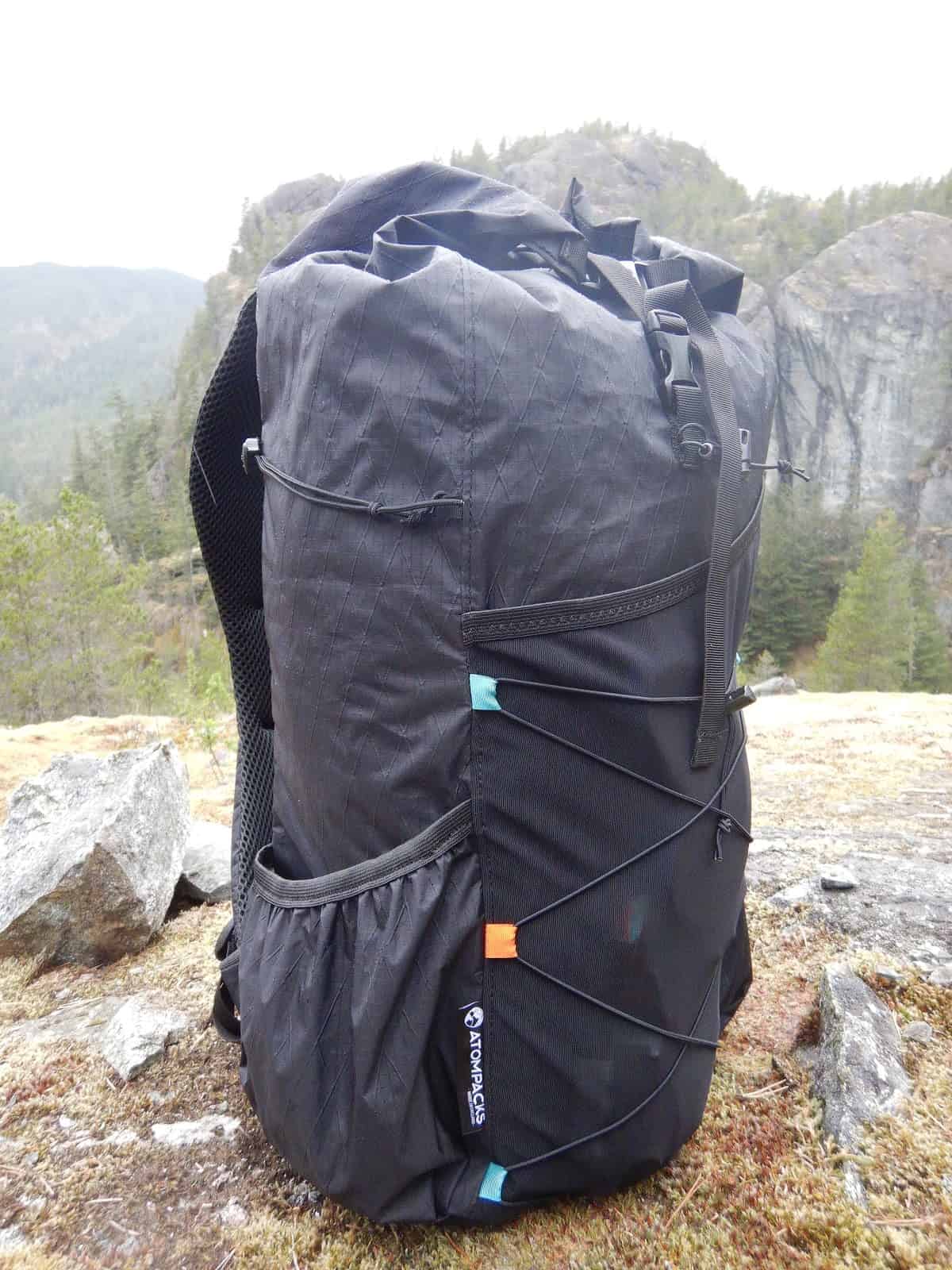
The Zerk’s features are most commonly found on cottage industry packs (the shoulder strap pockets and diagonal side pockets remind me of our recent review of the Atom). Likewise, the price point and weight are similar to the classic Gossamer Gear Mariposa. For the upcoming Gear Review, I’ll be sure to do in-depth comparisons of the available cottage industry frameless and minimalist packs. But for this short review, I wanted to compare the Zerk to another mass-produced pack of a similar weight, volume, internal organization, and load capacity – the Granite Gear Crown2 38L.
The manufacturers advertise both packs as slimmed down options aimed at the ultra-light crowd. The Crown2’s volume sits squarely between the Zerk’s compressed 32L volume and its extended 40L volume. It does so at the cost of about 5.5 oz (155.9 g) of weight. The Crown2 has a recommended load of 35lbs (15.87 kgs) as opposed to the Zerk’s 30 lb (13.6 kg) capacity. The Crown2 achieves this with a thick hip belt and a plastic molded removable frame-sheet. Removing the frame sheet gets Crown2 down to 25.6 oz (754.1 g), 2.4 oz (68 g) lighter but significantly less stable than the Zerk.
The Crown2 makes a nod towards accessibility with large mesh hip-belt pockets, but other than that has roughly the same accessibility as many other mass-produced packs. The shoulder straps and hip-belt are industry standard designs.
These features are why the Zerk stands out among mass-produced packs: trail running inspired shoulder straps and a foam frame sheet that give it killer comfort-hauling chops for its weight class. Those same features allow for excellent and unusual (for mass-produced packs) pocket placement.
Commentary
The Zerk 40L Fastpack is many things, but it isn’t a marketing gimmick. It feels like the Zerk was designed by a foot-sore, achy-shouldered thru-hiker with nothing to do but daydream about how he would change his pack if he could. One thing to keep in mind though: At 28 oz (793.78 g) the Zerk isn’t the lightest minimalist pack available. It wasn’t made to be. It was designed to sit at a crossroads of comfort, accessibility, durability, and weight.
This First Look will focus on two of these elements: accessibility and comfort. An extended, more comprehensive Gear Review is forthcoming in summer 2019. In that review, I’ll elaborate on the factors discussed here. At that point, I’ll also be able to speak to the long-term durability of this pack, as well as make a more in-depth comparison to other minimalist frameless packs.
The Zerk 40L Fastpack’s main strengths are comfort and accessibility. Both are enabled by the wide trail running inspired shoulder straps.
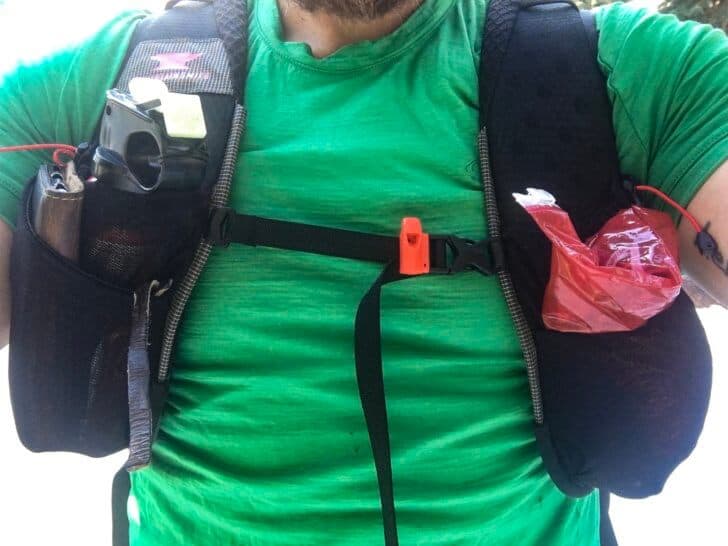
To start with, the Zerk gives you easy access to frequently used pieces of gear. Single compartment roll-top enclosures are common in minimalist packs, but where the Zerk shines is its external organization. It has four well-placed shoulder strap pockets, two on each strap, with the upper pocket nesting inside of the lower pocket. The top pocket cinches with elastic cord, making it ideal for securing electronics or small water bottles. The bottom pocket is cinched permanently with elastic, and it’s roomy enough to hold snacks or other small pieces of gear.
On my testing trip, I fit my Sony Rx100vi, my iPhone 6 and case, a can of bear spray, 800 calories worth of snacks, a small pocket knife, headphones, and spare camera batteries in the shoulder strap pockets. All these items felt secure, and I especially appreciated knowing that my camera and phone were easy to reach but safe behind an elastic drawcord. Hikers with larger phones (or marginally larger cameras) should have no problem: the pockets swallowed both those items with room to spare. If needed, the shoulder-strap pockets could easily fit chapstick, a small tube of sunscreen, a lighter, a contact lens case, or other sundries on top of all the other items I’ve mentioned.
Wide shoulder straps give plenty of space for deep, stretchy pockets. In this photo, mine are holding a camera, extra batteries, 800 calories of food, bear spray, my phone and wallet, extra batteries, a pocket knife, headphones, and chapstick.
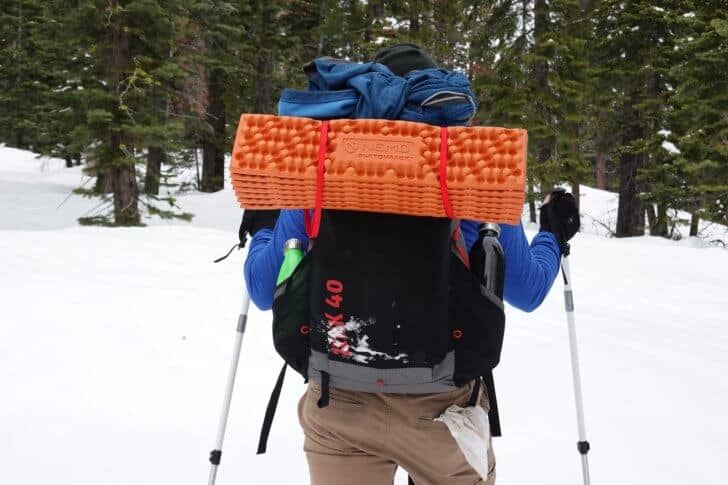
The Zerk has a removable webbing system for bear-canisters or other bulky items. I used it to attach my Nemo Switchback to the pack. I like this system for three reasons. The first is that if you don’t have any bulky items you can leave the webbing at home without having to cut it off permanently. The second is that there are multiple attachment loops all over the pack, giving you the flexibility to attach gear where you want to attach it. The third is that the webbing (along with the side compression straps, removable bungee, and logo) are bright red-orange. The logo and bungee are reflective. Not only will this help you find your pack in the dark, but they also add an extra layer of safety during hunting season.
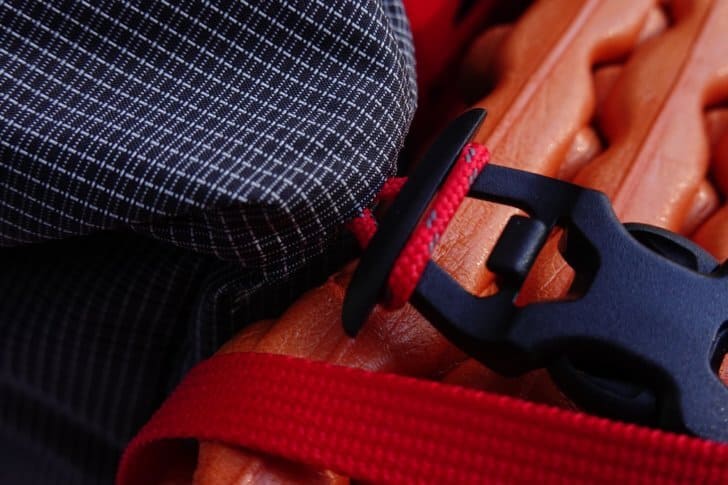
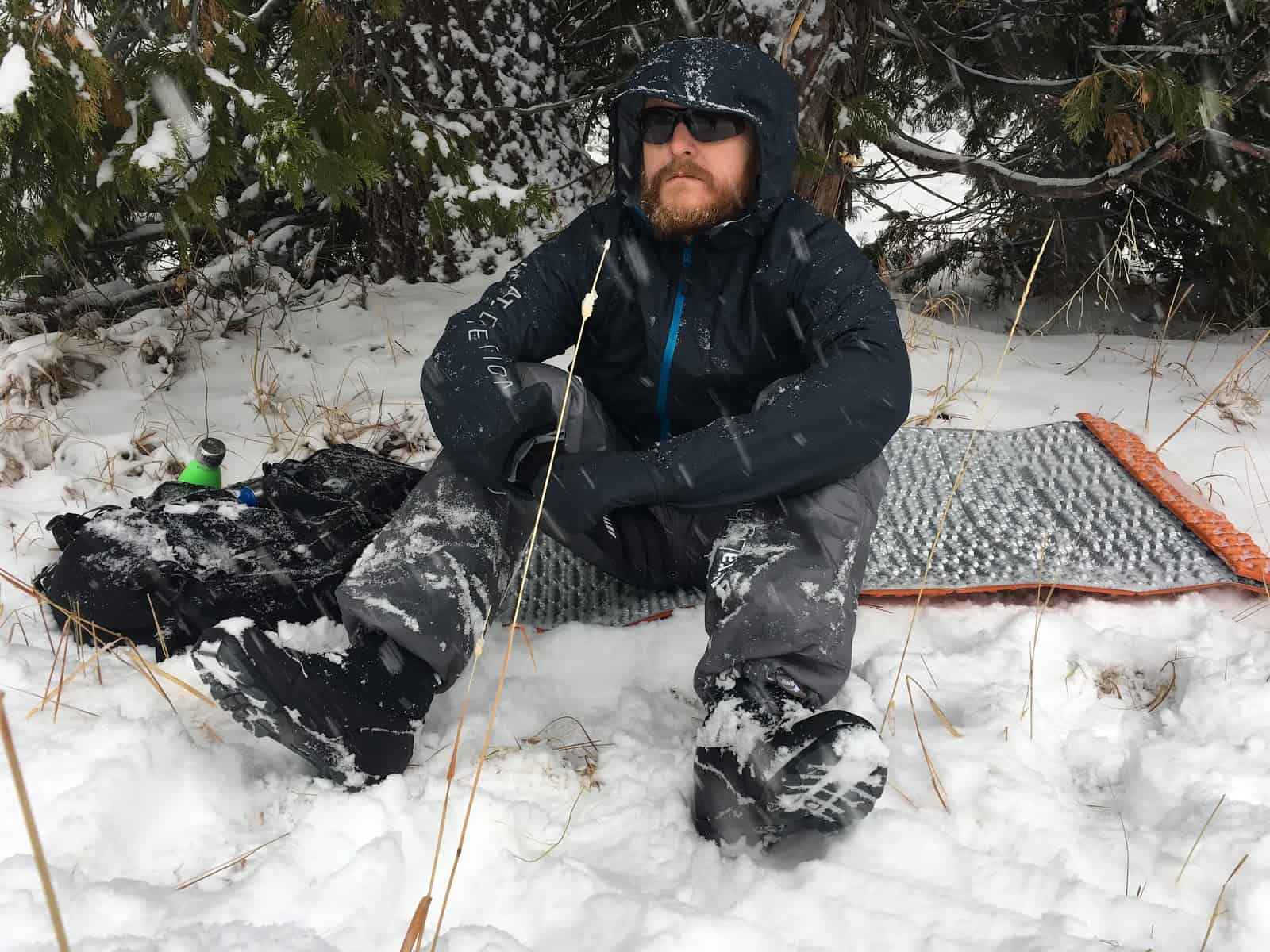
Removable bear-canister webbing can attach at multiple points (orange loops) or be removed completely. I used the webbing to lash my CCF pad to the back of my pack.
The removable bungee is designed to give you more lashing options for the outside of the pack. I can’t speak to its effectiveness as my sample pack seems to have shipped without one. Once Mountainsmith sends me a bungee I’ll be able to address its functionality in my longer review.
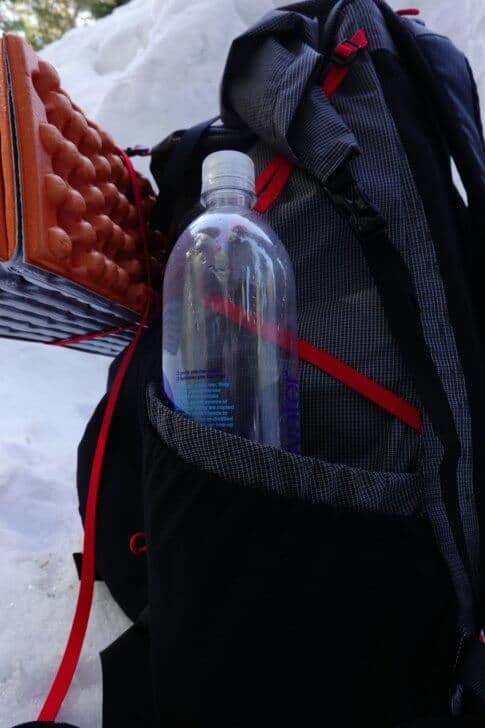
The dual side pockets are also worth mentioning. The upper pockets are fashioned from the same Spectra material as the rest of the pack. They are shallow and diagonally cut, with the upshot being I could easily reach and replace my 1L Smartwater bottles on the go. The downside? The bottles were not secure. They consistently fell out when I bent over to adjust my ski bindings or fetch a dropped trekking pole. I even lost a bottle entirely in the deep snow through which I was skiing.
I find the trade-off worth it. But if your trek involves talus scrambling, bushwacking, or snowdrifts, keep an eye on those bottles. You can always use the side compression straps to secure gear that doesn’t need to be reached on-the-go.
Shallow, diagonal cut side pockets give you easy access to your water bottles. The trade-off is water bottles that fall out when you bend over.
The lower side pockets are roomy, with an elastic band across the top for more security than the upper side pockets. I used these pockets to hold lunch, trash, and a small bag of sundries and, like the larger side pockets, was able to access these items without breaking my stride.
The back stretchy mesh pocket is large, the entire width of the pack. Other than that it is pretty standard — handy to store items in, but not accessible while walking.
For this First Look, I ate all my snacks and lunch on the go, never taking the Zerk off during my eight-to-ten hour skiing days. I’m happy to report, without any exaggeration, that this is the most comfortable mass-produced pack I’ve ever worn. Well designed, extra-thick shoulder straps and a comfortable foam internal structure seem to be the contributing comfort factors. It will be worth seeing how all that thick foam breathes once temperatures warm up.
I was testing a few other pieces of gear, so I had some extra items. My total weight (including food and water) came in between 24 and 28 lbs (10.88 to 12.7 kgs). Mountainsmith recommends a load no heavier than 30lbs, but even at these upper ranges, the pack was comfortable and secure. For my upcoming Gear Review I’ll overload the pack to determine its comfort at greater-than-recommended loads.
I noticed two drawbacks to the Zerk during my initial testing. The first is that I struggled with attaching and removing the optional bear-canister webbing, even with warm hands in the comfort of my home. Specifically, only one of the attachment loops gave me problems. In a similar vein, the compression straps seem a bit “sticky” to tighten. We’ll see if both of these things loosen up with prolonged use.
For some reason, this particular loop gave me trouble. Time will tell if it loosens up or not.
The second issue I noticed was one of durability: a small amount of stitching around the elastic on the upper-right shoulder strap pocket seems to have come loose. A minor thing, so minor that it was difficult to get a good picture, and I ultimately decided not to. That being said, it’s a tad worrisome after two days of use on a pack designed to last thousands of miles per year at 20, 30, and 40 miles a day (a paraphrase of the Mountainsmith marketing copy). Time will tell if this is a one-off fluke or something that will happen to stitches elsewhere on the pack.
All in all, I’m highly impressed with this pack. Within the first hour of my test, I shortlisted the Zerk as my pack of choice for my next long-distance hike. It’s comfort, security, and well-designed exterior organization are all top-notch, especially for the price point. I look forward to testing its durability and comfort over a more sustained period.
The Zerk has similar features to the Atom by Atom Packs. You can read an in-depth review of that excellent pack here.
Going frameless? Here’s some advice from our forum.
Disclosure
How we acquired these products: Product(s) discussed in this review were either acquired by the author from a retailer or otherwise provided by the manufacturer at a discount/donation with no obligation to provide media coverage or a product review to the manufacturer(s).
We do not accept money or in-kind compensation for guaranteed media coverage: Backpacking Light does not accept compensation or donated product in exchange for guaranteed media placement or product review coverage.
Affiliate links: Some (but not all) of the links in this review may be “affiliate” links, which means if you click on a link to one of our affiliate partners (usually a retailer site), and subsequently make a purchase with that retailer, we receive a small commission. This helps us fund our editorial projects, podcasts, instructional webinars, and more, and we appreciate it a lot! Thank you for supporting Backpacking Light!
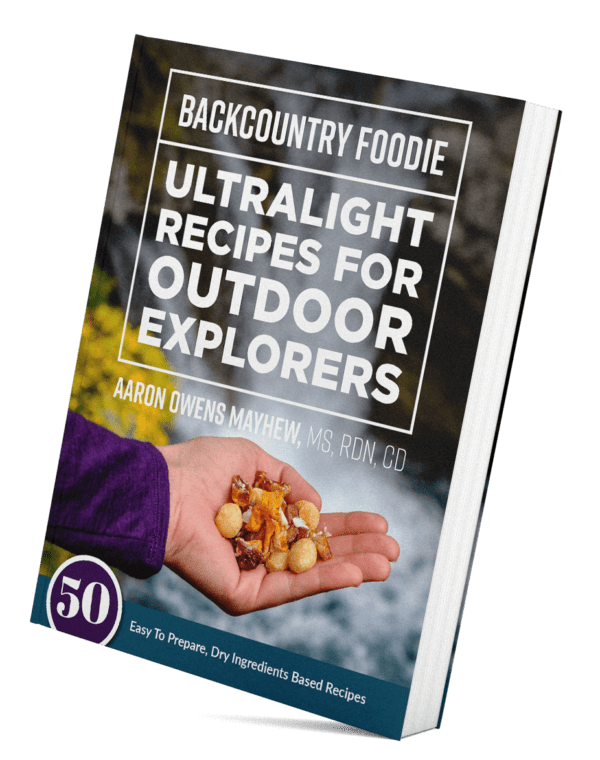
Backcountry Foodie – Ultralight Recipes for Outdoor Explorers by Aaron Owens Mayhew, MS, RDN, CD. is a cookbook containing 50 dry-based ingredient recipes along with detailed nutritional information for each. The target audience is backcountry adventurers looking to expand their dining options, drop some consumable weight, save money over pre-packaged meals, and those concerned with their nutritional intake.
The book provides unique recipes with both “at home” and “in the field” instructions. It also provides enough detailed nutritional information to allow for proper meal planning for multi-day trips. Finally, downloadable label files are available for each recipe to aid in keeping track of the meals while on the go.
Dry ingredient based recipes which can be assembled in under 5 minutes
Printable food label sticker templates.
Only digital copies currently available
* Trace amounts of nuts and gluten may be present in the raw ingredients
Review Context
I am a longtime oatmeal-and-trail mix, barebones, ultralight backpacker who is looking to expand my backcountry kitchen toolkit. Generally, my trips are two or three days in length with the occasional week-long trek thrown in. In my non-backpacking life, I have high standards for food, particularly as I spent a decade working professionally in Chicago kitchens.
In evaluating this cookbook, I considered:
Recipes – A recipe should be straightforward, easy to follow, and contain ingredients that are simple to source.
Organization – Recipes should be easily found and appropriately grouped by meal or some other logical categorization.
Ease of use – Is the format simple to understand with any necessary information readily available?
When creating a meal plan, I believe an ultralight backpacker should consider:
Kcal/oz – The food needs to be calorie-dense and lightweight.
Nutritional value – I feel better when I eat better; my recovery is faster and I can log more miles.
Convenience – From ingredient sourcing through clean up, less time working on meal preparation is more time spent hiking or enjoying the scenery.
Taste – A backcountry meal is more than just fuel. It can provide a much-needed pick-me-up and add enjoyment to the end of a long day. It should taste good!
Description of Field Testing
Upon receiving the cookbook, I began collecting ingredients and working through the recipes, initially testing them in my home kitchen. After testing at home, I selected seven recipes for field testing: two from the Breakfast section, two from the Lunch & Dinner Section, one Snack, and two Beverages. My selections included both cook and no-cook options.
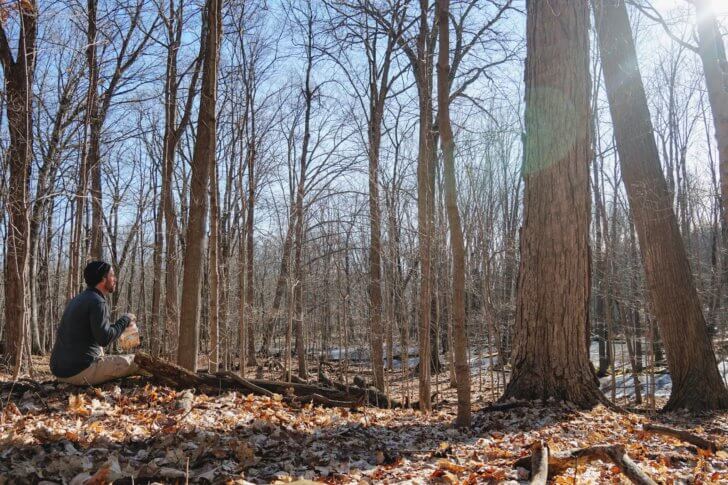
Field testing of the recipes took place under winter conditions in southeast Michigan. Temperatures ranged from daytime highs around 45F to morning lows in the high 20s. There was little-to-no precipitation. During weekend hikes I would alternate days of cold meal preparation with hot meal preparation using an alcohol stove. I treated the final weekend of testing as a tune-up for a planned Isle Royale National Park speed hike, allowing me to note my impressions of energy levels after logging 10+ mile days on my feet.
Performance Assessment
I based my performance assessment of Backcountry Foodie – Ultralight Recipes for Outdoor Explorers on the following criteria:
Cookbook organization
Cookbook ease of use
Recipe convenience
Taste
Impressions of energy level and nutrition
For the evaluation of the recipes themselves, I’ll focus on the seven recipes I field-tested over my shakedown weekend. My no-cook day consisted of a breakfast of Raisin Pecan Ramen and an afternoon meal of Lemon Pepper Bean Spread. My evening treat was Coconut Ginger Milk. For my cook day, I prepared a breakfast of Lemon Blueberry Oatmeal and an afternoon meal of Thai Peanut Ramen. In the evening I treated myself to a decaf Peppermint Latte. On both days I supplemented with a Chocolate Almond Butter snack while walking.
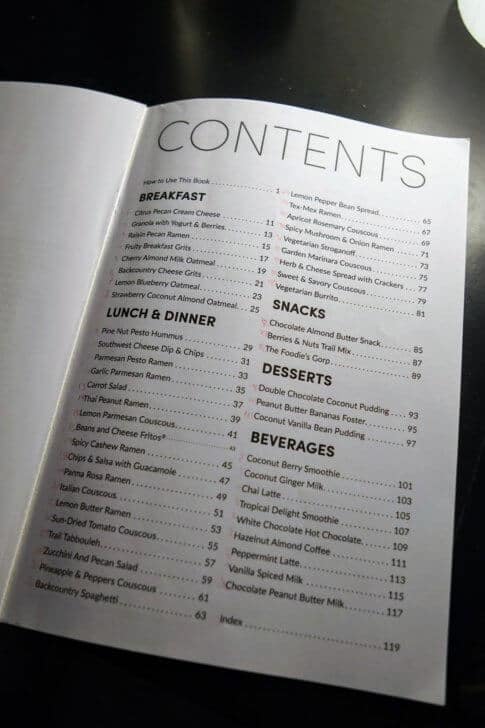
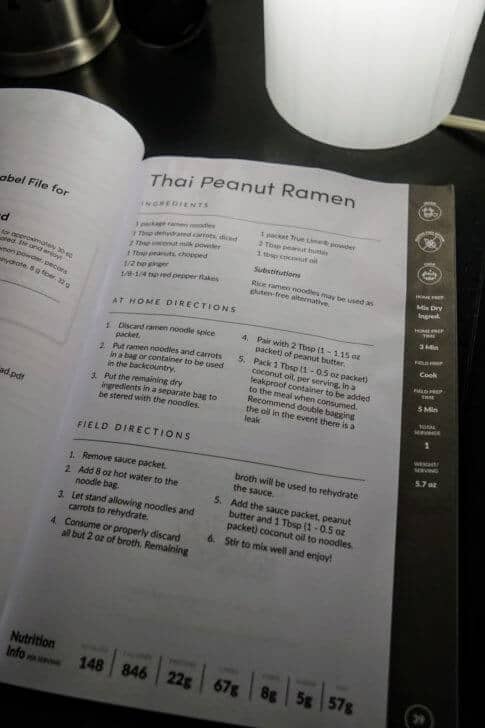
I found the cookbook easy to use. Each recipe fits on a single page and contains a list of ingredients, at home directions, field directions, nutritional information, and summary information. The summary information proved to be very helpful in meal planning, providing ‘At a Glance’ information regarding preparation method, potential allergens, vegan/vegetarian information as well as preparation and cooking time, the number of servings created, and the weight per serving. When used in tandem with the nutritional information, it was very easy to meal plan for my weekend hikes.
Generally speaking, the recipes are very convenient. Both at-home and in-the-field meal prep were straightforward with no hiccups. I was able to complete the at-home portion of meal prep in under two minutes per-meal. My cold-soaking days went off without a hitch. All of the ingredients rehydrated well without any additional heat. Similarly, I had no issues with the recipes that needed cooking (I used an alcohol stove). The biggest hurdle I faced throughout the entire process was sourcing the ingredients.
Meal prep was very quick and easy.
Even though I live in a large city, I had trouble sourcing a number of the ingredients locally. I spent an afternoon traveling from grocery to natural food store to camping supply company to another supermarket. The author does provide online sources for ingredients via links on her website, and I could have saved myself some trouble by sourcing online. If you are under a time crunch, as I was, you might have to use ingredient substitutions.
The book lists the recipes in cups, tablespoons, and teaspoons. With an intended audience that likely weighs their toilet paper for fun, providing weights for the individual ingredients (to allow for scale measurement when assembling the recipe) would have been a nice touch. I found that my weight for the completed Lemon Blueberry Oatmeal was a couple of ounces higher than the listed weight. Using a scale to measure out ingredients makes for more repeatable recipes and ensures that the weights are dialed-in with precision.
Taste
Taste is subjective, but I found these recipes to be delicious. Many of the recommended ingredients were ones I’d not used before. I found they added enjoyment and variety to my outdoor dining experience. Coconut milk powder is a fantastic ingredient that I wish I had known about back in my pastry chef days. Same with True Lime Powder, which added a burst of flavor to the Thai Peanut Ramen. None of the recipes I tested were duds.
Hot prepared Thai Peanut Ramen, substituting rice noodles
Impressions of energy level and nutrition
The layout of Backcountry Foodie – Ultralight Recipes for Outdoor Explorers lends itself well to caloric analysis. On both my no-cook and cooking days, I was able to consume over 3000 calories. My intake of protein, fats, and carbohydrates was well balanced. My energy levels were high and seemed consistent throughout the day.
Product Strengths
The format and layout of the cookbook contribute to painless meal planning and easy backcountry cooking.
The author balanced the flavors in her recipes. She uses spices, sweets, and acids skillfully, creating dishes that were a pleasure to test. Nothing that I tested (or tasted) was bland.
The provided nutritional information and easy-to-interpret sidebar graphics help ensure adequate caloric intake.
Once I started measuring out the recipes, I realized how much less expensive it is to create my meals as opposed to buying freeze-dried, pre-packaged offerings.
Product Limitations
I wish that the ingredient lists had measurements listed in grams or ounces.
While the author provides online sources for all the ingredients she uses in Backcountry Foodie – Ultralight Recipes for Outdoor Explorers, I found myself wishing that more of the items were available at my average mid-western supermarket.
Compared To Your Typical Ramen and GORP
Overall the recipes from Backcountry Foodie – Ultralight Recipes for Outdoor Explorers outperformed my usual backpacking diet of oatmeal pouches for breakfast, GORP for lunch, and ramen for dinner. My old standbys win if I am judging the basis of convenience; there is not much easier than tossing a few bags in my kit and calling it good. There is something to be said for variety, though. Aaron’s recipes introduced me to ingredients I had never considered using in backpacking food. The change was welcome on the basis of taste alone.
I felt better physically after eating Aaron’s food. An afternoon meal of GORP and water sits pretty heavy in the stomach, particularly on the third or fourth day in the field. It seemed to me that I was better able to get back to hiking after eating the afternoon meals of Lemon Pepper Bean Spread or Thai Peanut Ramen.
Commentary
Even though I have over ten years experience in the professional kitchens of Chicago and scores of backpacking miles under my belt, as I flipped through the pages of Backcountry Foodie – Ultralight Recipes for Outdoor Explorers, it dawned on me that I was really missing out on a cheap, easy way to enhance my enjoyment while spending time outdoors. It also occurred to me that my old standbys were somewhat lacking in complete nutrition.
A breakfast of cold-soaked Raisin Pecan Ramen in southeast Michigan.
I honed my outdoor culinary chops during my time with the Boy Scouts, and my backpacking menu was an old and familiar one. The pack list was simple. Packaged oatmeal for breakfast, trail mix and beef jerky for lunch, and a pre-packaged freeze-dried meal for dinner.
As the years have gone on the menu hasn’t changed much. Beef jerky left the pack list when I became a vegetarian. I added coffee to my breakfast and replaced the expensive freeze-dried meals with cheap ramen and bouillon. It was a bland backcountry diet. Working through the cookbook, it became clear how easy it can be to add new recipes to the rotation that won’t sacrifice convenience, cost a fortune, and will taste great.
The Thai Peanut Ramen recipe is a great example of the quick and easy steps Aaron has laid out in her book.
Step one: I make certain I have all the ingredients on hand. Some of the ingredients are hard to find at your local corner store, so plan accordingly or be prepared to make substitutions.
Step two: I grab any tools I’m going to need. For Aaron’s recipes, the list of tools is blissfully simple; storage containers and measuring spoons. I mentioned earlier that I wish the book had weights for each ingredient listed, but I admit it is much faster to build out a recipe when you are simply scooping out the parts.
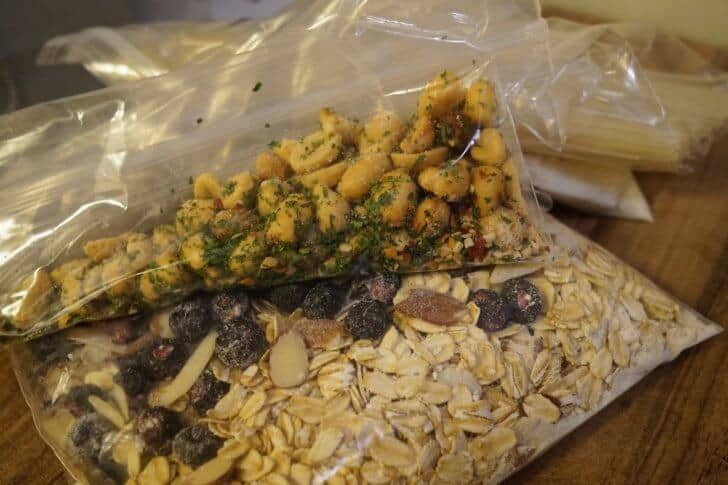
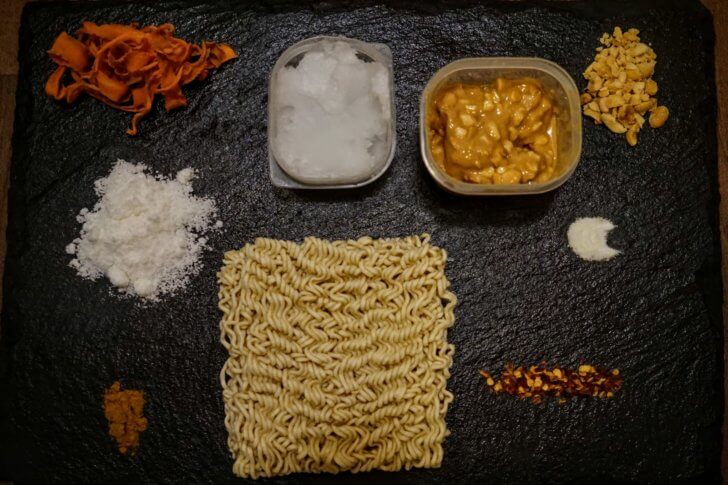
Step three: pack it all up. Put the ramen noodles and dehydrated carrots in a bag, measure the other dry ingredients in a separate bag and measure out some peanut butter and some coconut oil. That’s it. For longer trips, I would simply just bring a bunch of peanut butter in one container and use it across multiple meals. I might do the same with the coconut oil as well, though I might substitute olive oil as I find it to be more versatile.
Ingredient assembly for Thai Peanut Ramen
I found Backcountry Foodie – Ultralight Recipes for Outdoor Explorers to be a fantastic resource. The individual recipes stand stand up well. They are simple to prepare, nutritious, and filling. Every recipe I tried was quite tasty. However, the greatest strength of the book is the nutritional information which allows readers to build their own nutritional, balanced meal plan for their outdoor adventures.
How we acquired these products: Product(s) discussed in this review were either acquired by the author from a retailer or otherwise provided by the manufacturer at a discount/donation with no obligation to provide media coverage or a product review to the manufacturer(s).
We do not accept money or in-kind compensation for guaranteed media coverage: Backpacking Light does not accept compensation or donated product in exchange for guaranteed media placement or product review coverage.
Affiliate links: Some (but not all) of the links in this review may be “affiliate” links, which means if you click on a link to one of our affiliate partners (usually a retailer site), and subsequently make a purchase with that retailer, we receive a small commission. This helps us fund our editorial projects, podcasts, instructional webinars, and more, and we appreciate it a lot! Thank you for supporting Backpacking Light!
Ryan and Stephanie Jordan venture into Idaho’s Sawtooth range for a couples backpacking trip.
Introduction
Many years ago, inspired by Alastair Humphrey’s concept of microadventures, and to feed my insatiable desire to sleep in wild places, I started creating video journals of trips where I spent less than 24 hours in the backcountry, including:
But it’s been a while since I video-journaled a more conventional 24-hour trip (in a shorter-form video format like the original episodes of the 24 series) and I really wanted to share a recent trip that Stephanie and I took in the mountains of Idaho.
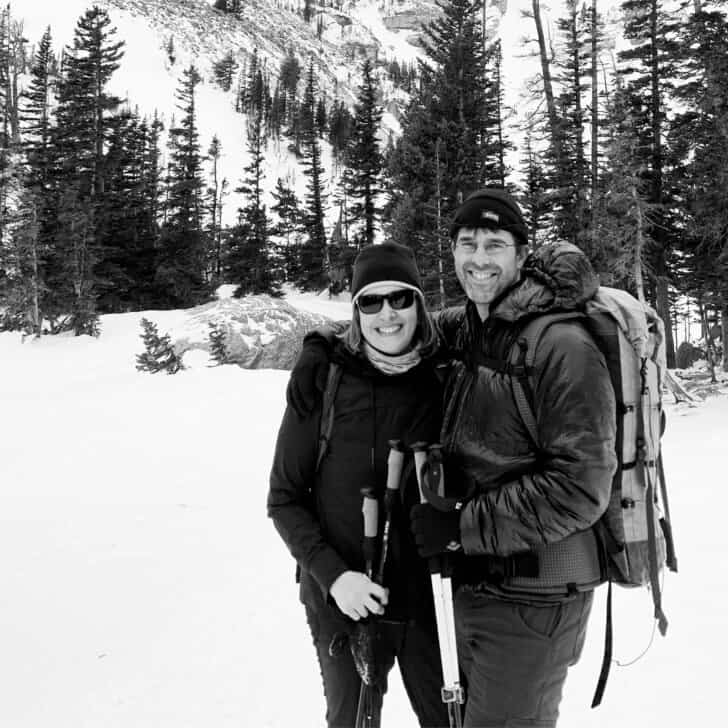
Not in Idaho! Ryan and Stephanie hiking in Rocky Mountain National Park, Colorado (Photo: Lindi Chatterton.)
Context
Over the past few years, our family has taken a couple of extended road trips across the west in our popup camper. Our usual loop travels through Wyoming, Colorado, Utah, Idaho, Nevada, California, and back, spending time hiking and camping in the Rockies, Wasatch, Uintas, Sawtooths, and High Sierra.
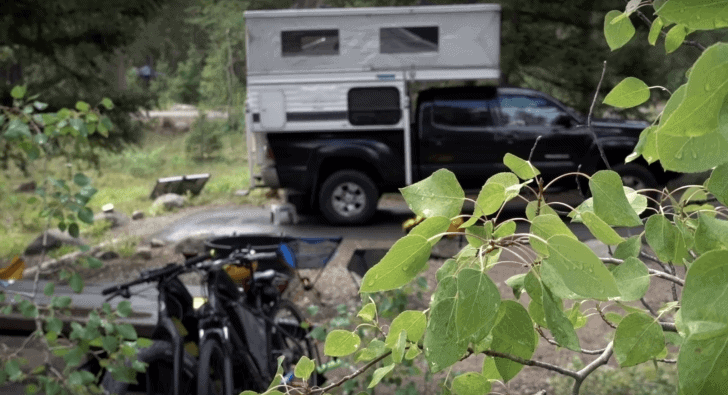
Road-trip, Jordan-style. A solar-powered popup camper on our Tacoma carries bikes, skis, packrafts, and backpacking gear as we travel the west. Venue: an off-grid USFS campground in Idaho.
These road trips are time to regroup, visit our favorite places in the west, and enjoy some time in the wilderness.
So while spending some time in Ketchum, Idaho (where our son Chase was attending the Sun Valley Summer Symphony Music Institute) during the summer, Stephanie and I figured we could steal away on a quick “24” up in the mountains north of town while Chase was in class! Poor kid.
One of the highlights from our trip was watching mountain goats and kids traverse the steep hillside across from our camp.
Watch the Video
Enjoy the video, and stick around to the end, where we answered questions submitted via social media on the topic of “couples hiking”.
Q&A: Couples Backpacking
We solicited questions about couples backpacking via our social media channels and answered them in the Q&A at the end of the video. Here are the questions:
What happens when you are both equally convinced that you are correct about opposite navigational decisions? – andrewmarshallimages via Instagram.
How do you cope with inclement weather and expectations of things that cannot be controlled? My partner is new to backpacking so weather can be discouraging for her. Especially because I am a magnet for bad weather it seems, but I’m used to it at this point. – Carlos via YouTube.
Do you find yourself getting out together more now that Chase is away at college? – b_rogers_99 via Instagram
When I think back on all the times I took girlfriends camping when I was in my 20s I can’t help but feel remorse for being such a blowhard ‘expert’ that mansplained everything and had to show off my cool gear. My way was the best way and we had to hike big miles, etc. I constantly see young men who have no self-awareness and are blind to the wants and needs of their partner like they are in Ikea, not in the woods. How do you get people to weigh their own wants and expectations to their partners? – hoagietime1 via YouTube.
What is the best way to cope with physical and mental differences during the hike? How to keep your partner’s morale high? Especially during hard stretches – multicam_sokol via Instagram.
Do you pack extra luxury items when you go backpacking together? – NaLona Brato via YouTube.
What are the benefits of having “break hikes” where you hike separately but end at the same location? – jsherman51 via Instagram.
Do you find that when you are backpacking with a romantic partner you have more or less conflict than with a non-romantic hiking buddy? How about when you and your partner are with a larger group? – TheBestBackpacker via YouTube.
Gear Notes
Sharing: We shared some stuff – repair, first aid, water treatment, and firestarting supplies; stove, and shelter.
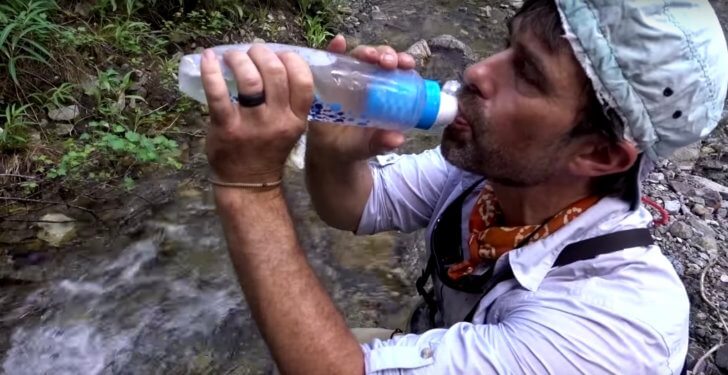
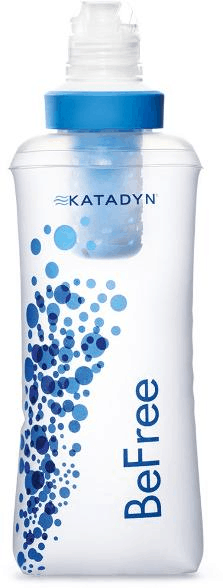
We shared a number of essentials, including our water treatment kit, which consisted of only the Katadyn BeFree 20 oz filter bottle. For the clear mountain streams of Idaho, it served us well enough!
Sleep & Shelter System: We’ve used couples’ bags, quilts, and our own bags, and we sleep more comfortably in our own sleep systems (pads, quilts, pillows). That way, Stephanie can have her 10 deg F quilt and I can have my 40 deg F quilt and neither one of us gets too hot or cold! We used the My Trail Co. Pyramid 3 shelter with netting insert (it was the peak of bug season!). It’s weather resistance, reasonable weight, and terrific living space (including headroom) makes it one of our favorite shelters for couples.
The MyTrail Co. Pyramid 3 is spacious for a couple, reasonably-priced, and offers a solid, stable, taut pitch. We’ve weathered some pretty severe winds in this shelter through the years. Our only advice if you expect to encounter bad weather is to upgrade the four load-bearing corner stakes to 8″ MSR Groundhogs. Ounce-counters will want a lighter inner tent as well. At 34 oz, the stock Nest inner tent is heavier than it needs to be, unless you desire the durability of a heavier floor.
Packs: Stephanie carried a frameless pack (My Trail Co. Backpacking Light 70L). A frameless pack is critical for her back comfort – she has a degenerative spinal condition called spondylolisthesis and most internal frame packs have not been so great for her. I carried a Hyperlite Mountain Gear Porter 5400, which allows me to carry the bulk of the load, and the large volume makes it really easy to pack – just throw stuff in and call it good. With a light load on short trips, less attention needs to be paid to precision packing and weight distribution!
The MyTrail Co. Backpacking Light 70 is a well-built and highly functional pack suitable for light and bulky loads. Its frameless design makes it very comfortable for people with spinal discomfort who suffer from pressure points caused by internal frame components. Plus, it’s one of the best value packs on the market, at only $165.
Some other gear we used on this trip that Stephanie and I really like:
My favorite shoe for rocky terrain (talus, scree). I brought two pair of shoes on this trip (my second pair – Altra Lone Peaks) for some side-by-side testing. I definitely prefer the Lone Peaks for trail running and backpacking on trails.
My Chisos 40 is seven years old and has been my summer staple for hundreds of nights. It’s still going strong and I don’t see myself retiring it anytime soon.
I just don’t think I can ever go back to being confined in a mummy bag again. The Enigma 10 offers an impressive loft:weight ratio if you customize it with the lightest possible materials.
Now discontinued, which is too bad. It’s the most stable and comfortable chair design I’ve used. Helinox could have knocked it out of the park with a lighter fabric and pole set…
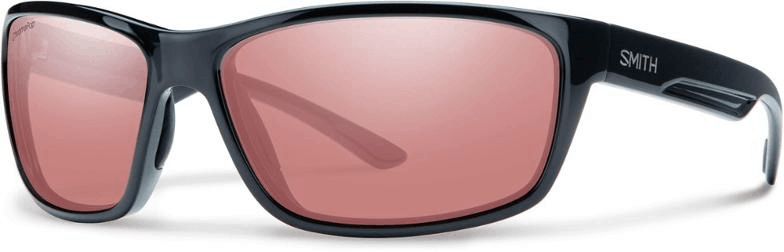
Photochromic, polarized lenses in a lightweight wrap design; lightweight glass is durable and scratchproof. A nearly perfect feature set for backpacking.
We’ve used these for years. A great addition to a two-person cook kit to supplement an integrated canister stove like the Windburner. One of us eats out of the cook pot, the other out of this bowl.
In spite of reports of failures and slow flows, we’ve been using the BeFree since it came out a few years ago and have never had a problem with it. A fast, easy-to-use system. Read our review here.
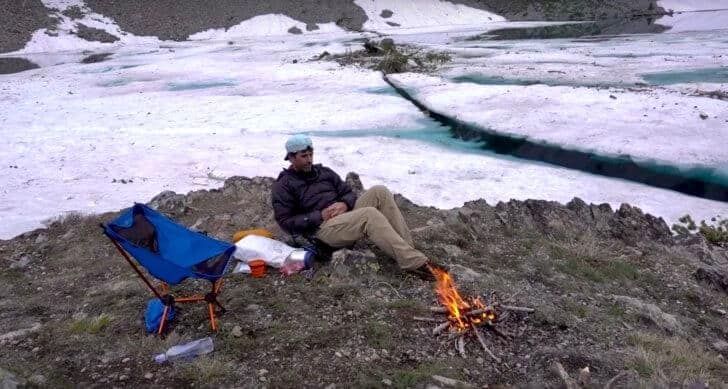
Camp chairs give us relief for our aging backs and allow us to cook and enjoy the fire in comfort.
Disclosure
Thanks to the following companies who provided gear and financial support to help us put this video together:
Some (but not all) of the links in this review may be “affiliate” links, which means if you click on a link to one of our affiliate partners (usually a retailer site), and subsequently make a purchase with that retailer, we receive a small commission. This helps us fund our editorial projects, podcasts, instructional webinars, and more, and we appreciate it a lot! Thank you for supporting Backpacking Light!
A first looks review of NEMO Equipment’s Switchback Sleeping pad based on initial impressions at from at home and in the field.
Introduction
Photo: Nemo
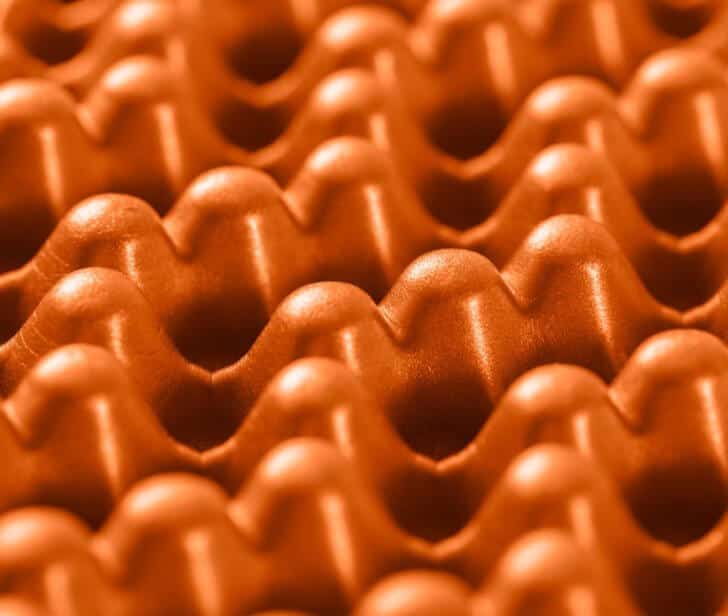
The Nemo Switchback sleeping pad has a bright orange hue which is the first thing that catches your eye. The eye-popping color isn’t the real selling point in NEMO’s new foldable closed-cell sleeping pad, though; it’s the ratio between its thickness and packed size. Until now, Therm-a-Rest’s Z Lite Sol has been difficult to improve upon. With the Switchback, NEMO has created a pad that is measurably thicker than the Z Lite Sol while matching that pad’s folded dimensions and virtually matching its weight and cost.
Features (Size Regular)
Hexagonal nesting pattern
Dual-density Axiotomic™ foam
Metalized thermal reflective film
Folding panel design, rectangular shape
MSRP: Regular: $49.95
NEMO Lifetime Warranty
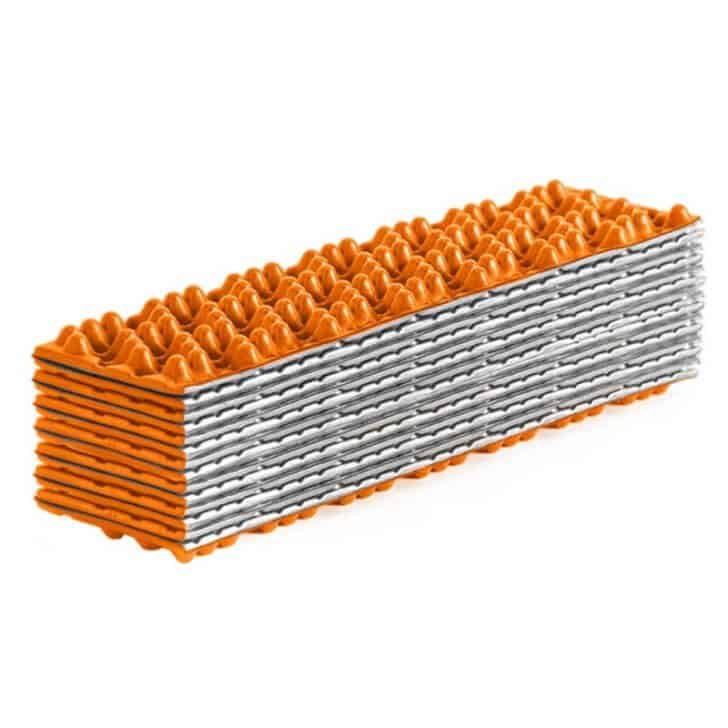
Clever engineering and a hexagonal nesting pattern allow the Switchback to match the competition in packed dimensions while outdoing the competition in terms of thickness (Photo: NEMO).
Specifications (Size Regular)
Manufacturer provided weight: 14.5 oz (415 g)
Measured weight: 15 oz (425 g)
Manufacturer provided packed size: 20 x 5 x 5.5 in (51 x 13 x 14 cm)
Measured packed size: 20.5 x 5 x 5.5 in (52.07 x 13 x 14 cm)
Manufacturer provided unfolded dimensions: 72 in x 20 in x 0.9 in (183 cm x 51 cm x 2 cm)
Measured unfolded dimensions: 72 x 20.5 x 0.9 in (183 x 52.07 x 2 cm)
Temperature rating: 20F to 35F (-7C to 2C)
Product Strengths
It is 20% thicker than comparable pads at identical folding dimensions.
The taller nodes theoretically allow for more trapped air for better insulation.
It maintains the same utility and near-indestructibility of all closed-cell pads.
Clever engineering measurably improves a stagnant product category.
Product Limitations
It is unproven if the added thickness improves comfort.
The durability of the metalized thermal reflective film over the long term is unknown.
The nodes begin to crush down after repeated use.
Slightly more expensive than the competition.
Compared To:
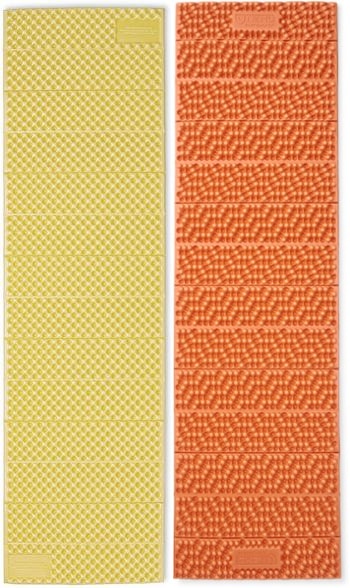
The NEMO Switchback (orange) shown side-by-side with the Therm-a-Rest Z Lite Sol (yellow). From this view the difference in node patterns is apparent (Photos: Therm-A-Rest & NEMO)
Let’s compare the Switchback to the ubiquitous Therm-a-Rest Z Lite Sol. It seems a reasonable choice as both pads have identical packed dimensions and utilize the same folding structure.
Product
NEMO Switchback
Therm-a-Rest Z Lite Sol
Weight (Regular)
14.5 oz (411 g)
14 oz (396.89 g)
Thickness
0.9 in (2.28 cm)
.75 in (1.90 cm)
Packed dimensions
20 x 5 x 5.5 in (51 x 13 x 14 cm)
20 x 5 x 5.5 in (51 x 13 x 14 cm)
Unfolded dimensions
72 x 20 x .9 in (183 x 51 x 2.28 cm)
72 x 20 x .75 in (183 x 51 x 1.9 cm)
R-Value
unavailable, NEMO provides a temperature rating of 20 F to 35 F
2.6
Node pattern
Hexagonal
Egg-carton
MSRP
$49.95
$44.95
Sourcing
Imported
Made in the USA
Glancing over the table, you can see that the two pads have identical length, width, and packed dimensions. The Switchback weighs a scant .5 oz more than the Z Lite Sol (My scale measured the Switchback at 15 oz as opposed to the 14.5 oz measurement provided by NEMO, but I’m willing to chalk that up to my consumer grade scale). The difference in node patterns is readily apparent, especially when viewed side by side (see above photo). The Switchback’s hexagonal pattern is what allows it to be nearly 20% thicker than the Z Lite Sol despite being the same size when folded.
The Z-Lite Sol is made in the USA, while the Switchback is imported. The price difference is negligible.
Commentary
Like all closed-cell pads, the NEMO Switchback makes a hardy seat during rest breaks. A metallic film reflects body heat, but I have reservations about the film’s long-term durability.
The NEMO Switchback is an example of a product that manages to reap measurable improvements from a stagnant category by utilizing elegant design. Who knows how much time and energy went into re-imagining the tried-and-true egg carton pattern? The result is a pad that is 20% thicker than the competition, with larger nodes that theoretically make for more comfortable nights.
The metallic heat-reflective film seems to perform at industry standards. That includes the film’s tendency to rub off. It’s a common problem — personally speaking, I’ve never used a pad where the reflective film didn’t rub away after repeated use. The nodes also seem to be crushing slightly. Again, not unusual, and if past experience is any indication, it would take hundreds of nights of compressing the foam to notice a practical difference.
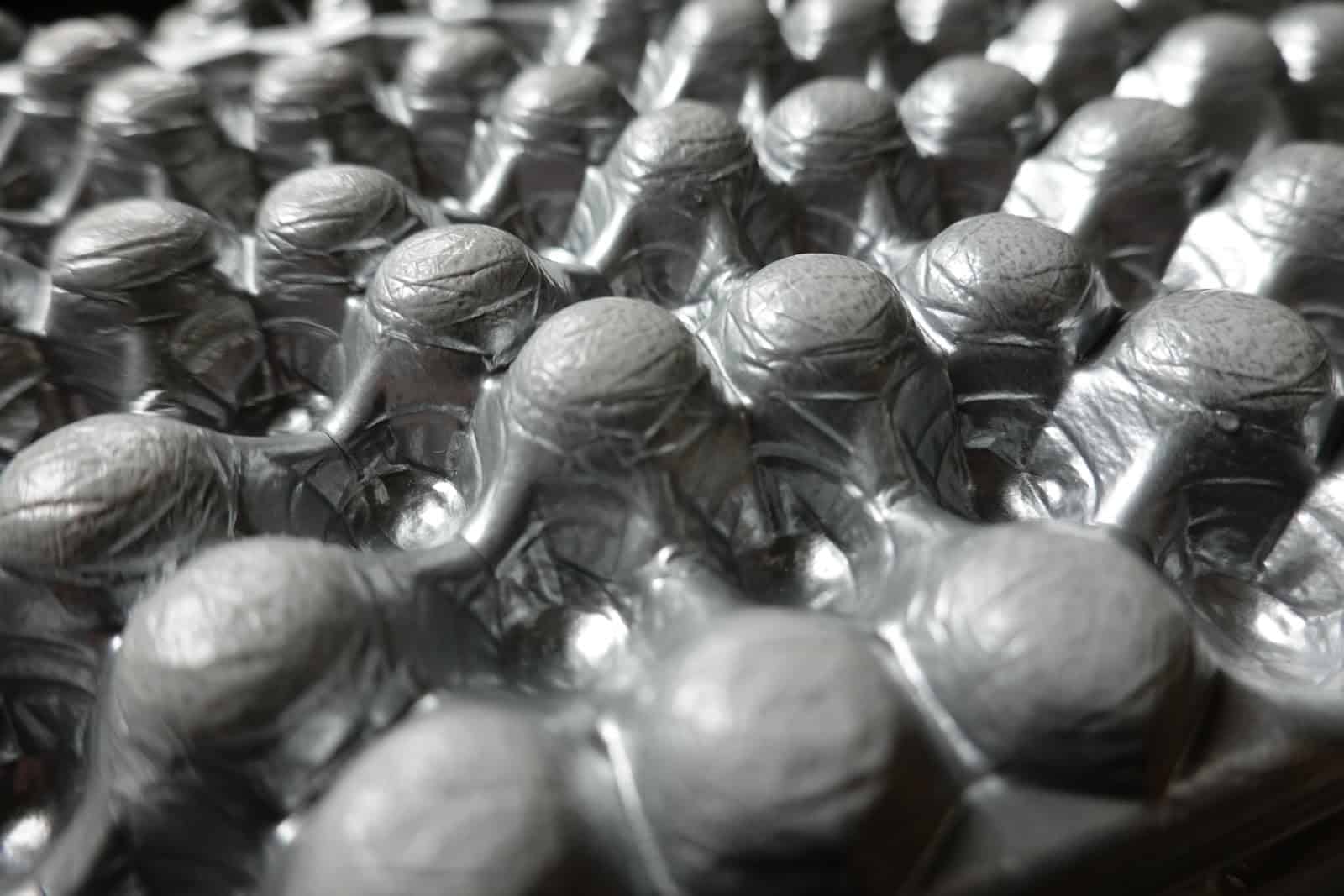
The heat-reflective film is wearing from the tips of the nodes after only a few uses. Such wear is a common problem in closed-cell sleeping pads, and practically the only way they deteriorate over time (other than foam collapse after hundreds of nights).
Does the Switchback’s elegant design and execution translate into added comfort? Hard to say. Subjectively, I found the texture of the hexagonal pattern to be a little strange. I got used to it after a bit, but the initial impression after a lifetime of sleeping on egg-crate patterns was odd.
It was also hard to nail down just how much the Switchback’s added thickness improved upon the standard amount of comfort inherent to a foldable closed-cell pad. Some evenings I felt I could tell a difference, others, not so much. My takeaway is this: extra thickness at identical packed dimensions and at virtually the same cost and weight certainly can’t hurt. If you like your current closed-cell pad, I wouldn’t be rushing to your local gear shop to make a change, but if it’s time for an upgrade, it’s hard to go wrong with the Switchback.
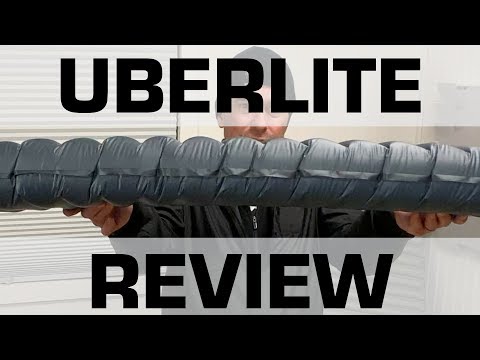
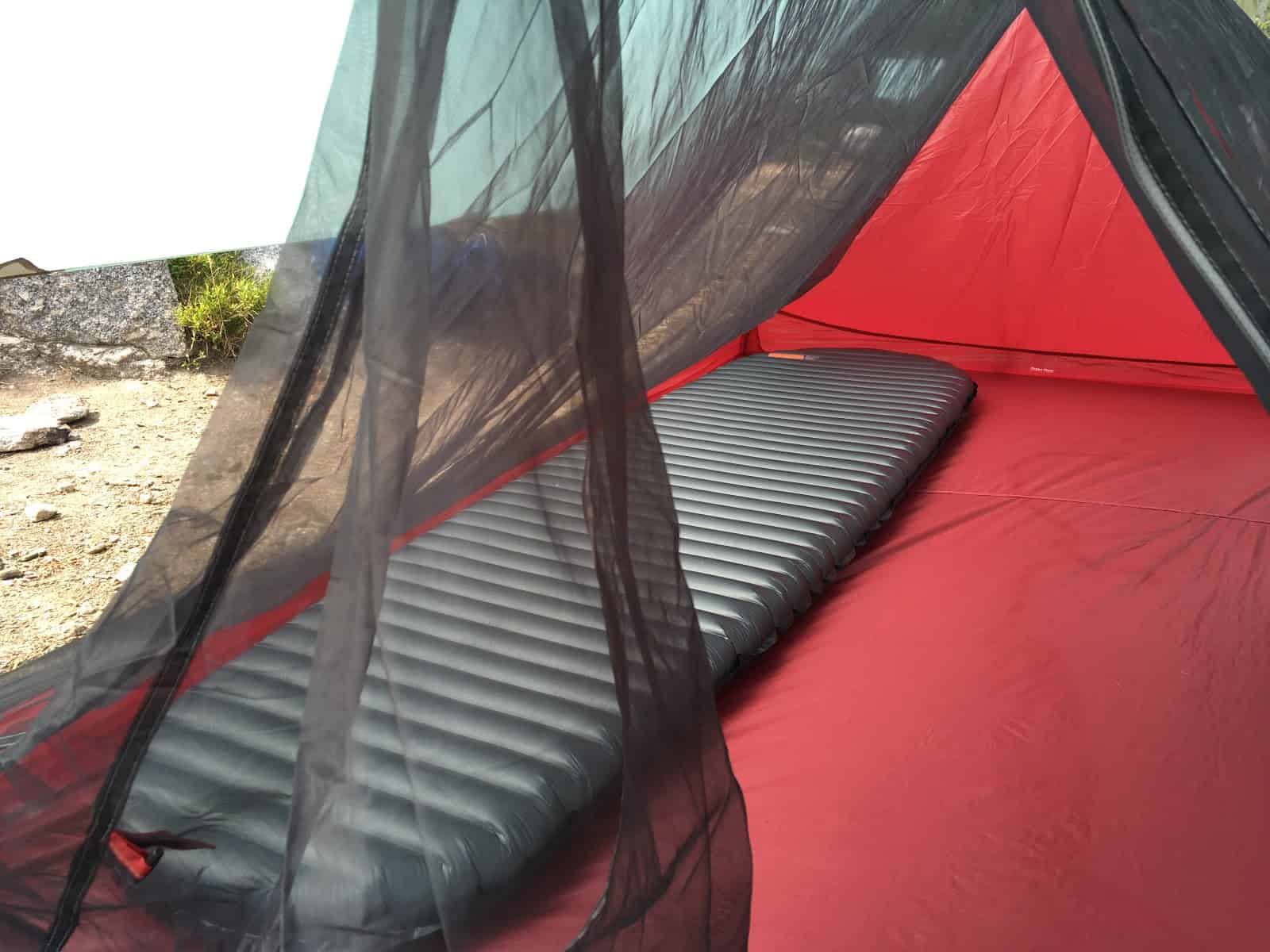
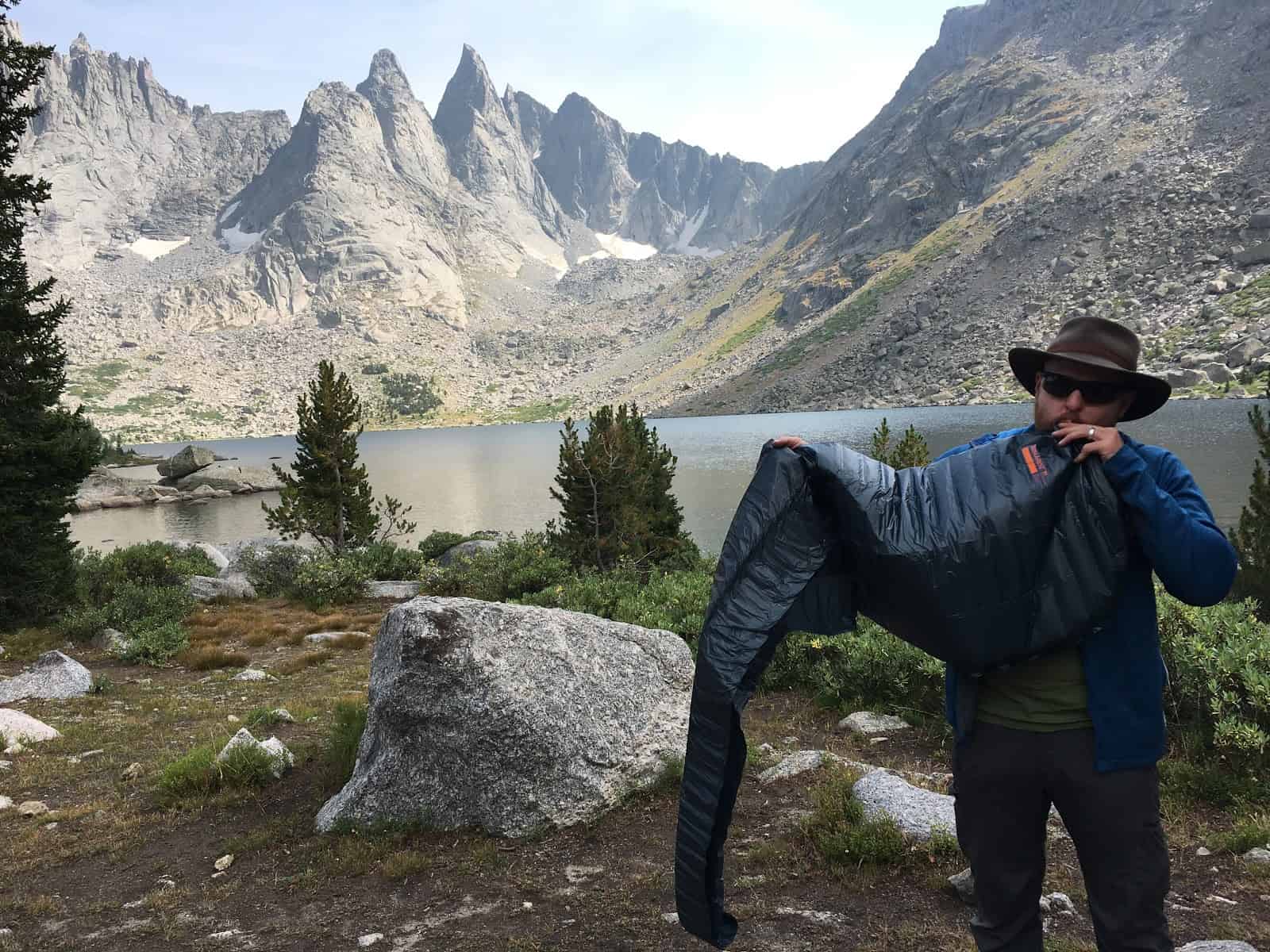
Are closed-cell foam pads not for you? Check out the UberLite.
Disclosure
How we acquired these products: Product(s) discussed in this review were either acquired by the author from a retailer or otherwise provided by the manufacturer at a discount/donation with no obligation to provide media coverage or a product review to the manufacturer(s).
We do not accept money or in-kind compensation for guaranteed media coverage: Backpacking Light does not accept compensation or donated product in exchange for guaranteed media placement or product review coverage.
Affiliate links: Some (but not all) of the links in this review may be “affiliate” links, which means if you click on a link to one of our affiliate partners (usually a retailer site), and subsequently make a purchase with that retailer, we receive a small commission. This helps us fund our editorial projects, podcasts, instructional webinars, and more, and we appreciate it a lot! Thank you for supporting Backpacking Light!
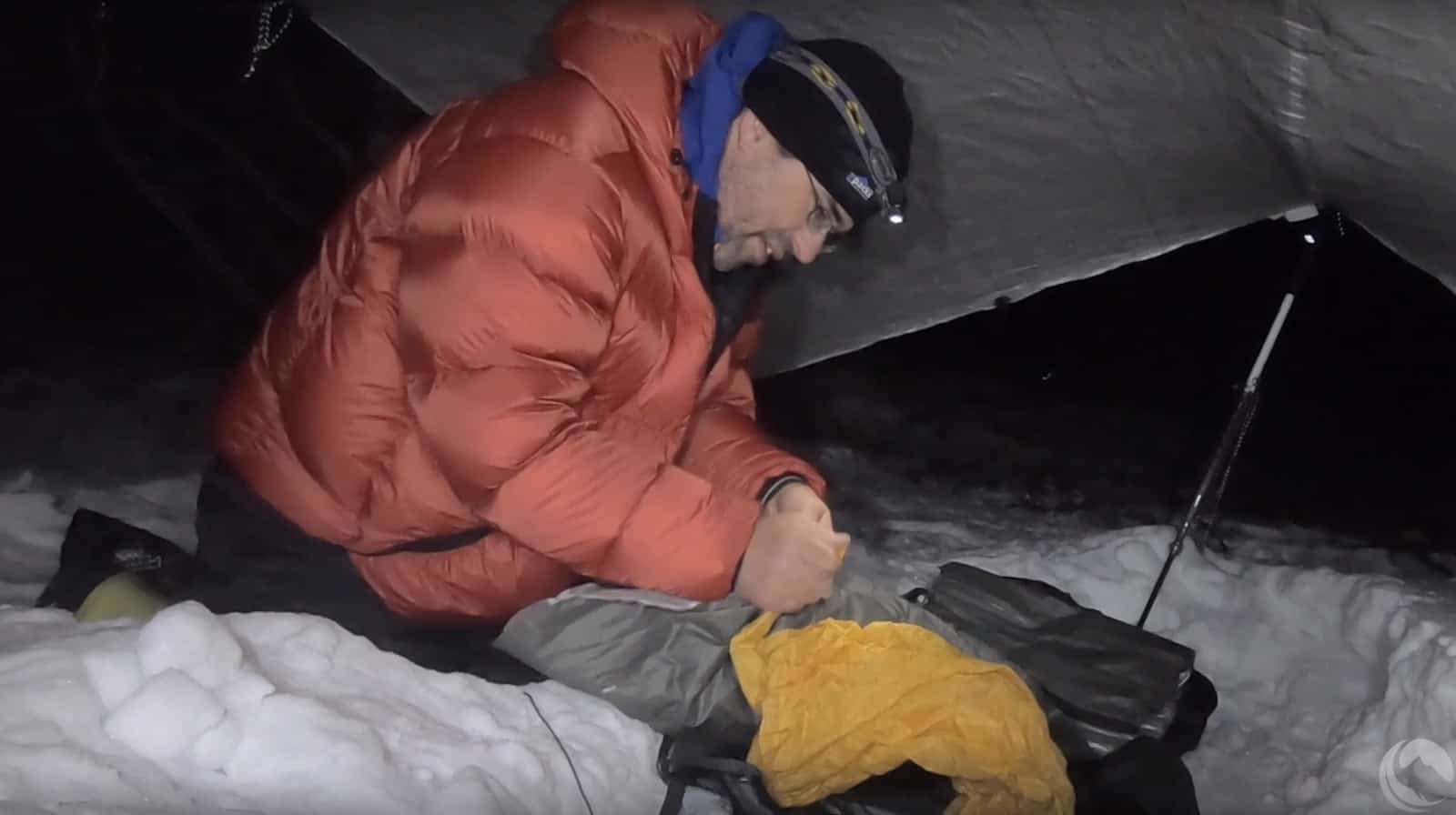
Lightweight backpacking in winter: field notes from SE Wyoming – tarp camping, firebuilding, wood stove cooking, and more (VIDEO).
Introduction
Winter backpacking (i.e., backpacking in snow and/or cold) can be intimidating. Gear that is heavy and bulky, long nights, hiking through deep snow, dealing with cold temperatures and wind – these are some of the challenges of hiking in the winter.
This winter, I filmed an overnight trip I took in SE Wyoming. The area where I hiked is crisscrossed with a summer trail network and frontcountry picnic and camping areas that aren’t accessible during the winter. I hiked through these areas but ventured further into the backcountry where I spent the night.
Low temperatures dropped to the upper single digits (deg F) and the snowpack was variable from zero to several feet.
The video is presented in a vlog-style chronological narrative that includes some skills instruction, some gear commentary, and some reflections of my experience on the trip.
This article provides more insight into my gear list, as well as post-trip notes.
For more info, listen to the related podcast about winter backpacking gear!
This was a “backyard adventure” for me. This is one of the closest backcountry locations for me, with the trailhead about 15 miles from my house. It’s a good reminder that adventure, fun, and solitude can be found very close to home.
I was in a hurry getting ready for this trip. Construction projects, travel, and preparing for an upcoming family surgery have been taking a toll on my ability to stay organized and be able to prepare for a trip quickly, so I suffered some minor inconveniences as a result of packing quickly:
I overpacked, especially camera gear. I didn’t need the tripod, so many extra batteries, or a battery charger, and could have shaved a few pounds there. In addition, I brought the wrong audio cable so I wasn’t able to capture good pro audio through my external mic, which added more dead weight and compromised the audio quality in the video.
I packed quickly, shoving things in my backpack, without paying attention to how I might need them later that evening. As a result, I didn’t have quick access to my headlight for hiking after dark, so I ended up navigating with my video light! And when I arrived at camp, I had to remove almost everything in my pack to access the things I needed right away – my parka, puffy pants, thin gloves, and headlight.
I (smartly) slept with all the gear I didn’t want to freeze (socks, shoes, overboots, water bottle), storing it in my inflation pump bag – except my Aqua Mira – which froze overnight! It took a while for me to discover that, and to thaw the bottles out enough to use them! I was running a bit dehydrated by the time I was able to treat water.
There was a vegetation mastication operation occurring in the area. Had I known this, I would have hiked in a different locale. It was pretty noisy on the 2nd day, as I hiked towards it, and while I don’t have any philosophical opposition to this particular project, it was certainly disruptive to my desire for quiet solitude.
Gear List
All gear items link to the actual product that I used on this trip, except items marked with an asterisk (*). In the latter case, I proposed a similar substitute.
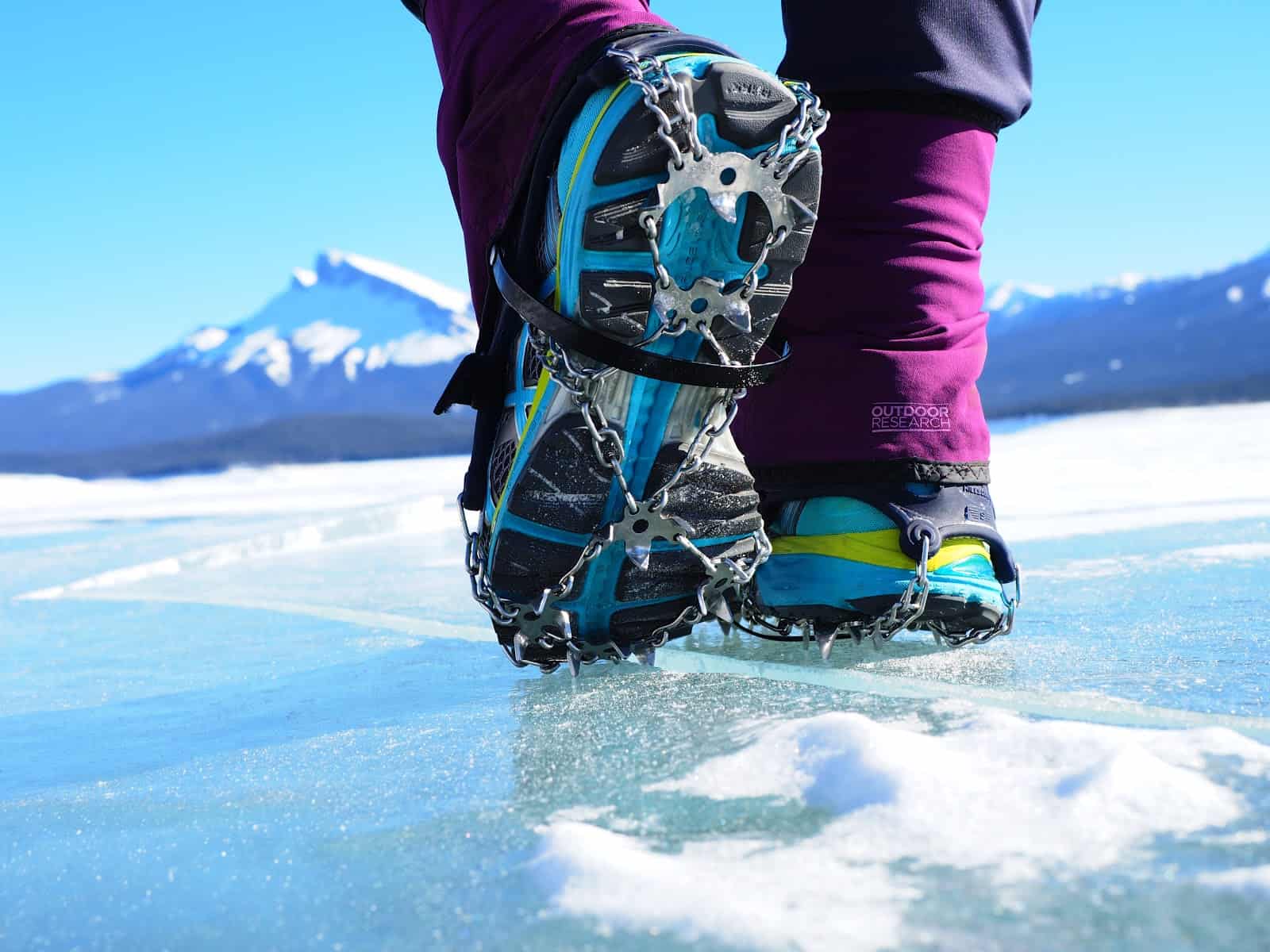
The only scenario where I can see the STABILicers Hike Macro Traction Ice Cleats being feasible is when (a) temperatures are so cold that you need insulated overboots, AND (b) when you are hiking on packed, steep, icy trails. For most backcountry pursuits, snowshoes are more versatile. For what they are (a microspike), this Stabilicer model is almost comically heavy. Its only real advantage is that there’s a rubber footbed above the cleat that won’t chew up the underside of a neoprene overboot (unlike traditional microspikes, which are much lighter and more suitable for hiking in lightweight footwear as long as you’re not wearing overboots).
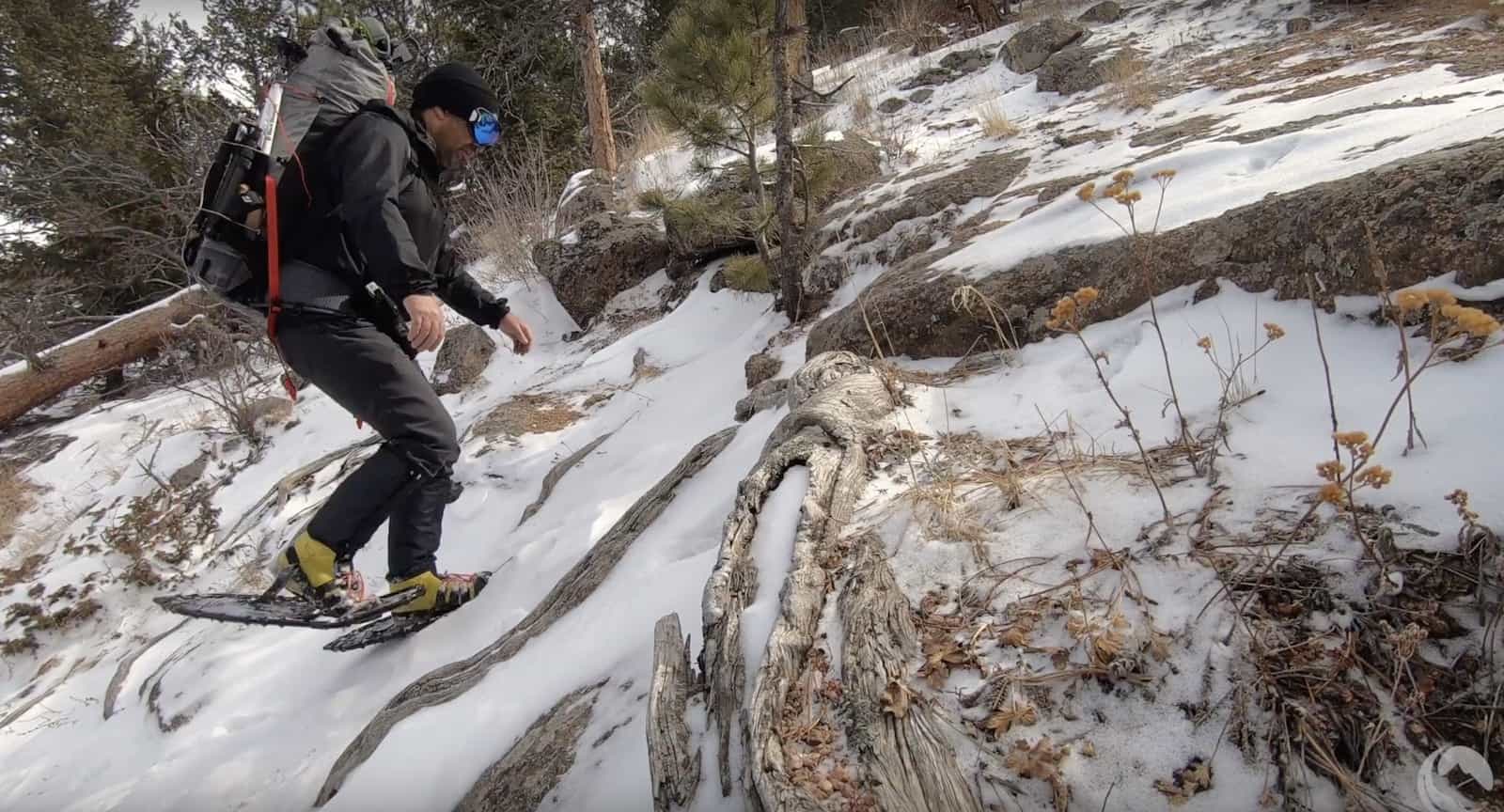
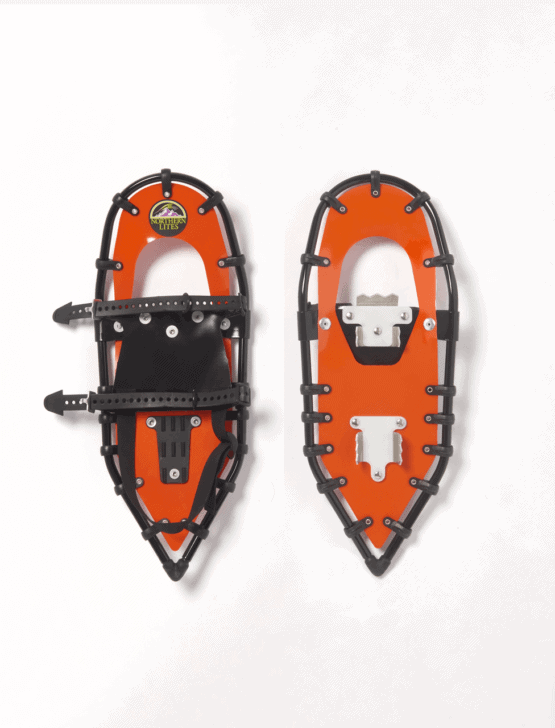
The Northern Lites Honey Badger snowshoes with speed bindings are some of the most aggressive, easy to use, and lightest snowshoes on the market. My first experience with these is extremely positive. However, they are a few ounces heavier than my MSR Lightning Ascents, and may be a little less durable – time will tell. The speed binding on the Honey Badgers is extremely comfortable, and the steel crampon is very sharp and aggressive on steep, icy, and rocky terrain.
The combination of Gore-Tex socks and Forty Below TR Light Energy overboots with a waterproof-breathable mid-height trail running shoe is simply superb for snowshoeing in winter conditions. My feet never got cold, on the trail, or in camp.
A pair of thin puffy pants and a very light parka (Feathered Friends Helios) was plenty warm for spending hours in camp after dark in temperatures around 10 deg F. I’ve also been fine when temperatures have been colder. If there is wind, however, and temperatures are below zero F, I would need something warmer.
My primary glove for trekking in these temperatures is a waterproof-breathable pile glove with a Gore-Tex shell and full leather palm. It’s warm, durable and protective enough for firewood collection, and it dries quickly (by removing the liners and stowing them in a jacket). For in-camp use, I prefer to wear fleece liner gloves and use my parka pockets when my hands get cold. As long as my hands were in gloves (rather than rock scrambling without gloves!), my hands stayed warm and comfortable.
Navigation
A phone update rendered my Garmin inReach app useless, and I forgot to update everything before I left. This resulted in the laborious operation of the Garmin inReach Mini with respect to SMS communications. I sent my wife one text message to let her know I arrived in camp OK. The process of remembering how to do it, figuring out what I didn’t know, and trying to type a message on multiple occasions, took quite a long time. This is the only part of the trip where I experienced mild irritation.
The battery on my Fenix HL50 headlight expired midway through the evening, and I switched over to a Photon II Pro Microlight. Lighter than a spare battery, and made for a quicker transition!
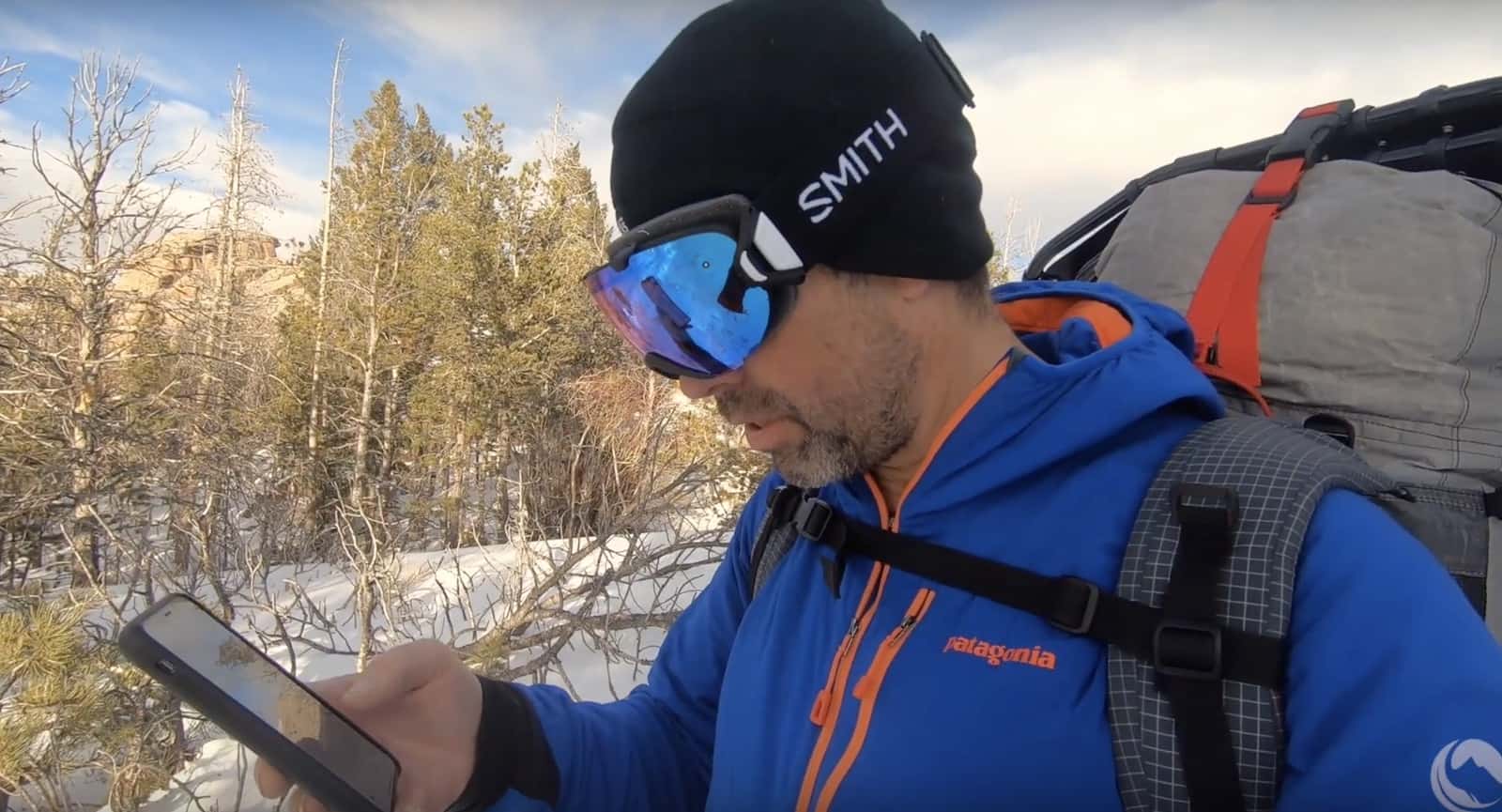
I’m recovering from a long bout of papillary conjunctivitis (I’m a contact lens wearer normally), an allergic reaction to a foreign body in the eye (most likely a result of construction debris). I don’t own a pair of prescription sunglasses, so I’ve been wearing goggles while hiking this year. My favorite goggles so far have been the Smith I/O (I wear the smaller women’s model) with photochromic lenses (variable light transmission from 30% to 50%). They are simply outstanding in the wind and cold, and the spherical rose photochromic lenses are an absolute joy to look through. I’ll be adding these to my winter hiking kit in the future!
Shelter & Sleep Systems
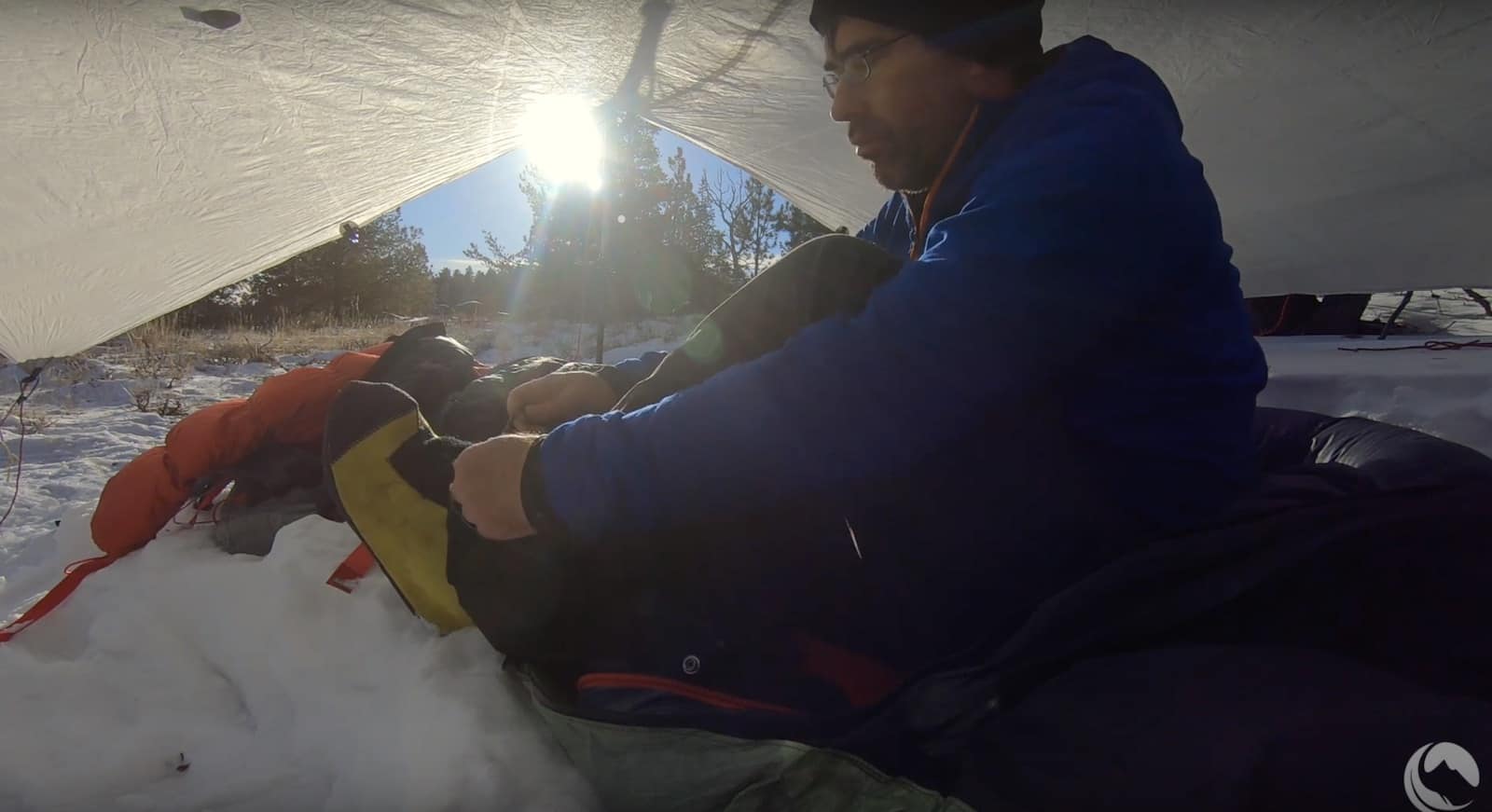
A flat tarp doesn’t provide a lot of protection, especially in the wind, but the views and openness are sure nice. One of the highlights of my trip was waking up, opening my eyes, and watching the sunrise without having to move!
The Hyperlite Mountain Gear Flat Tarp has seen more than its share of adventures over the past several years, and even after suffering some hearty wind storms, including on this trip, there still doesn’t seem to be a seam out of place or coming loose. I can’t say this for any of the other DCF tarps I’ve owned.
I’ve used the REI Magma 10 down sleeping bag for two years now, and it continues to perform beyond my expectations for a 30 oz bag. I slept very warm on this trip, with nighttime temperatures in the low teens. I’m looking forward to using the 2019 iteration of this bag, the Magma 15, which is a few ounces lighter and should offer similar performance in these conditions.
Fire Kit
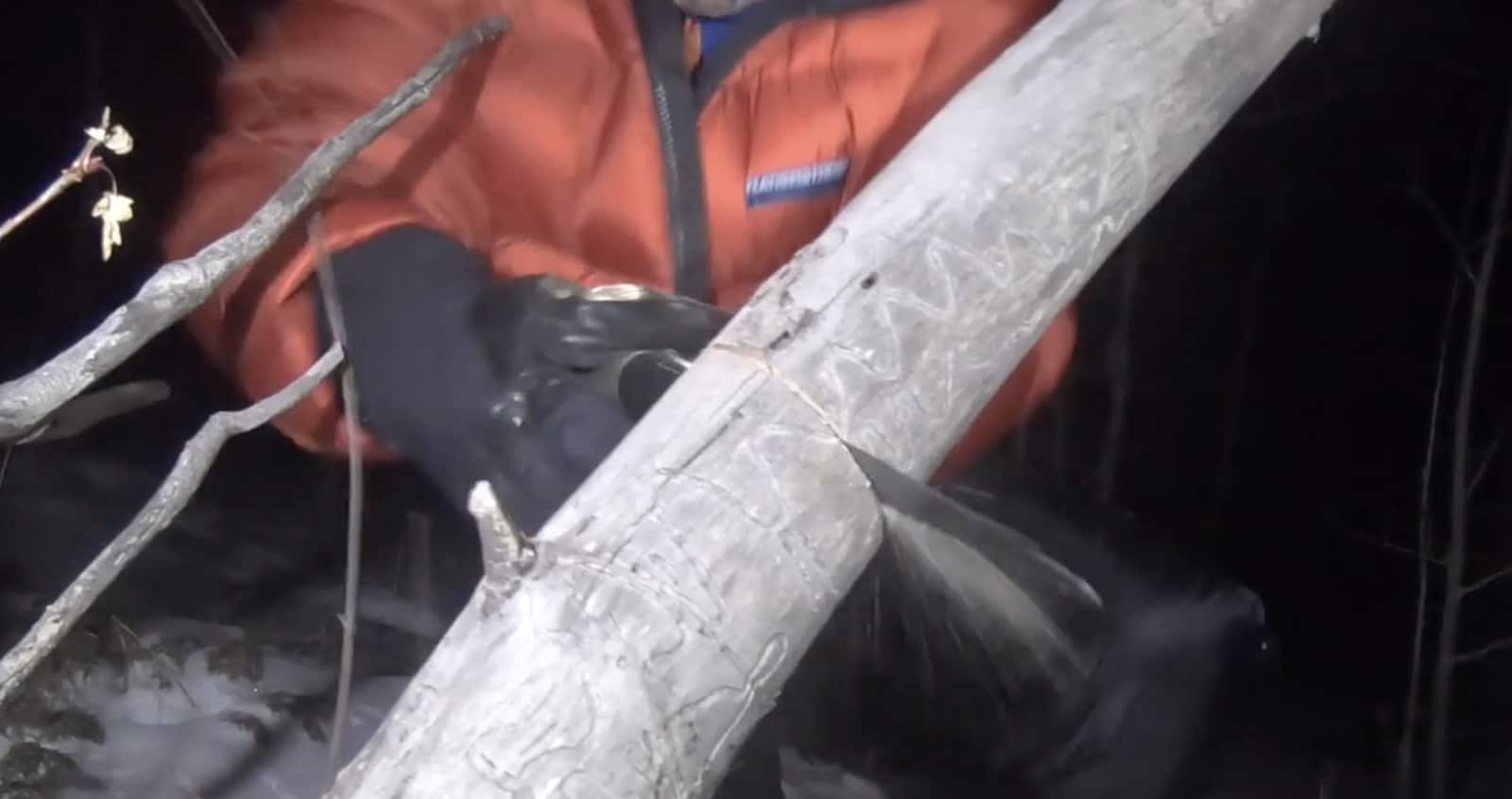
The Bahco Model 396 Laplander saw is one of the best cutters I’ve ever used. I wish it was lighter. I think I said in the video that it weighed around 1/4 of a pound but I got it mixed up with my lighter (and very poorly cutting) Gerber saw. The Laplander weighs a few ounces more, and I find the extra weight worth it if there’s a lot of cutting to do. It goes with me on almost every winter trip for firewood prep and building stick roofs on my snow trenches.
Cooking and Water
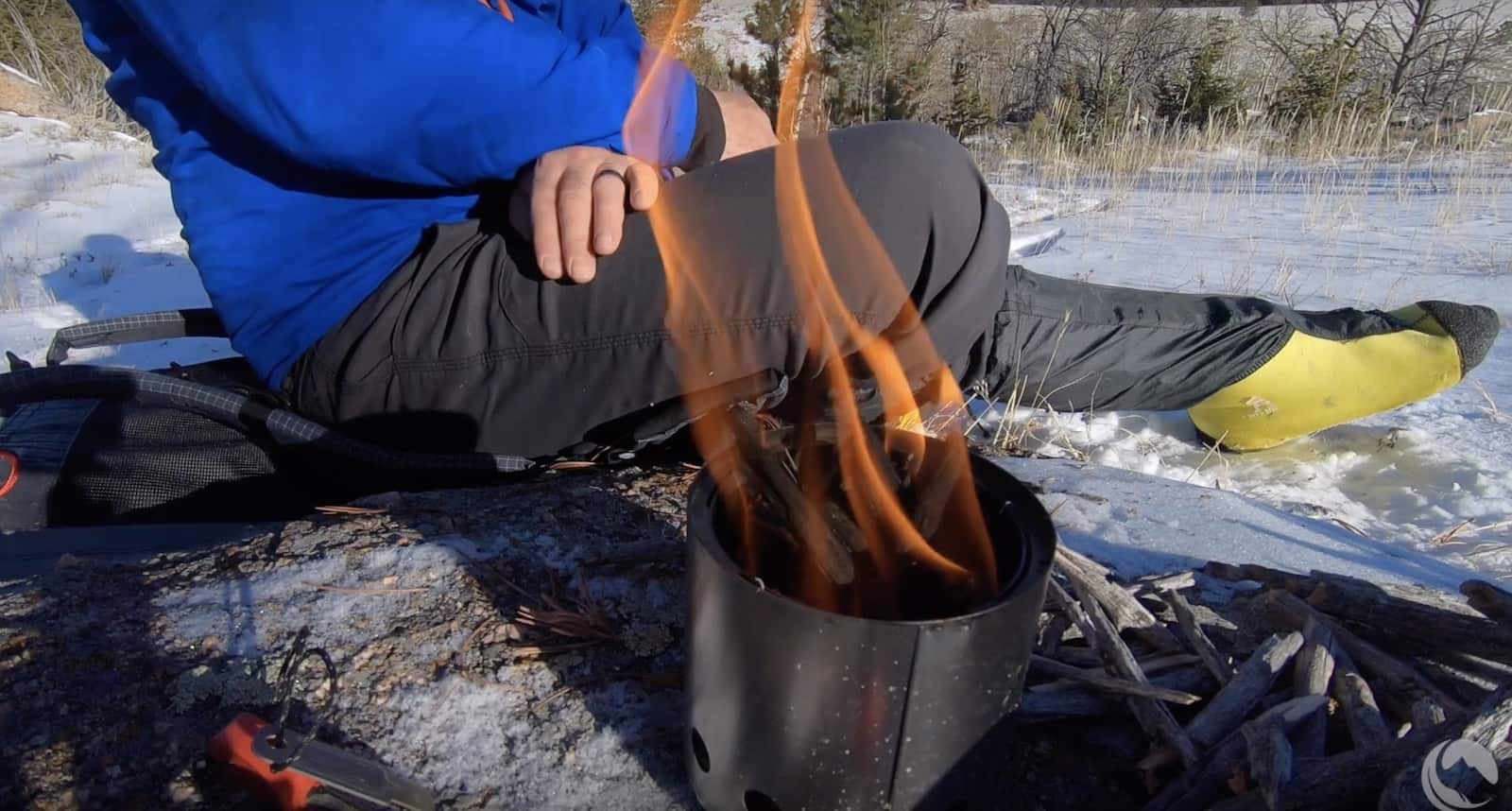
The Suluk46 Una Titanium Wood Stove is a huge win. At 2.5 oz, it cuts the weight of my wood stove in half (from the Bushbuddy Ultra) with no decrease in performance. I used beetle-killed pine needles and dead sagebrush twigs and the stove burned both very clean. Well done!
Acknowledgments
Thanks to the following companies for making this video possible through financial and/or gear support:
* These companies have entered into sponsorship agreements with us in 2019 in our effort to support our effort to produce more engaging content and reduce our reliance on network advertising (e.g., “Google Ads”). Thank you!
Product Review Disclosure
Updated September 15, 2018
How we acquired these products: Product(s) discussed in this review were either acquired by the author from a retailer or otherwise provided by the manufacturer at a discount/donation with no obligation to provide media coverage or a product review to the manufacturer(s).
We do not accept money or in-kind compensation for guaranteed media coverage: Backpacking Light does not accept compensation or donated product in exchange for guaranteed media placement or product review coverage.
Affiliate links: Some (but not all) of the links in this review may be “affiliate” links, which means if you click on a link to one of our affiliate partners (usually a retailer site), and subsequently make a purchase with that retailer, we receive a small commission. This helps us fund our editorial projects, podcasts, instructional webinars, and more, and we appreciate it a lot! Thank you for supporting Backpacking Light!
Today’s episode is a SKILLS SHORT where we’ll discuss the philosophy and skills of lightweight winter backpacking. This episode marks the first of our BPL Podcast Shorts: 15- to 20-minute episodes that focus on a news item, a piece of gear or tech, or specific ultralight backpacking skills.
This format won’t replace our long episodes. Instead, it will supplement them, so make sure you are subscribed so you don’t miss anything!
As we recorded this episode, a huge winter storm was rolling across large parts of the country.
So that made us think: how can we take the ultralight ethos and apply it to winter backpacking: a situation that usually requires more gear and a heavier pack?
After introducing the new format and the episode’s topic, Ryan jumps straight in: listing off the building blocks of a sub-15 lb two or three-night kit. You might be surprised at what gets left out!
From there, the guys segway into a brief conversation around the idea of minimizing inputs in the outdoors.
Outline
INTRODUCTION
Ryan and Andrew introduce the new podcast format and the episode’s topic: winter backpacking skills!
THE CONVO
The question is this: How can we create a warm and light winter backpacking kit that meets our needs in the backcountry? And what skills do we need in order to compensate for the things we are leaving behind? Ryan and Andrew jump right in.
What goes into our pack in the winter (base weight) and what stays out (worn)?
Clothing worn/gear used while hiking: base layers, wind layers, light insulating jacket, hat, gloves, socks, shoes/boots, gaiters, sunglasses, snowshoes, trekking poles.
What does that leave?
Pack, sleeping bag, sleeping pad, extra clothing, flashlight, food.
This episode of the Backpacking Light Podcast is supported by Backpacking Light membership fees. Please considerbecoming a member which helps support projects like this podcast, in addition to a whole slew of other benefits!
In addition, some of the links on this page may be affiliate links that refer to our partner merchant retailers. If you follow a link and then make a purchase, we receive a small commission which goes a long way towards helping us pay for podcast production, hosting, and bandwidth fees! Thanks for supporting us in this way!
Contact
You can contact us at podcast@backpackinglight.com, or follow us on social media –
We do not accept money or in-kind compensation for guaranteed media coverage: Backpacking Light does not accept compensation or donated product in exchange for guaranteed media placement or product review coverage.
Affiliate links: Some (but not all) of the links in this review may be “affiliate” links, which means if you click on a link to one of our affiliate partners (usually a retailer site), and subsequently make a purchase with that retailer, we receive a small commission. This helps us fund our editorial projects, podcasts, instructional webinars, and more, and we appreciate it a lot! Thank you for supporting Backpacking Light!
I put together a 4-minute video montage with my initial thoughts about the Black Diamond Glidelite skis that includes footage from both tracked and untracked trails, with inclines up to about 15 degrees.
Introduction
I’ve been using the new Black Diamond Glidelite Snow Trekker Skis (“trekking skis”) this winter. I have the 127-cm model with Universal Bindings, which can be used with any type of footwear. I’ve been skiing in Altra Lone Peak Mids (usually with a neoprene overboot) with them this winter.
This is a Flash Review meant to communicate my initial experience with the product – it’s in no way a comprehensive review that reflects use of this product in a wide range of conditions.
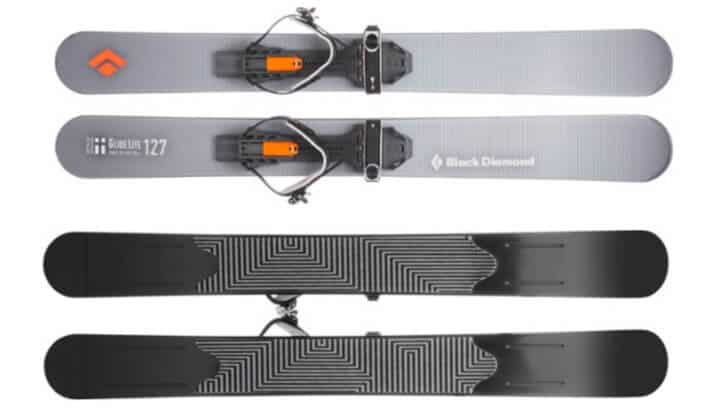
The Black Diamond Glidelite Snow Trekkers have an integrated synthetic mohair climbing skin that sits flush with the base of the ski, and covers about half of its length. The universal binding works with any type of footwear. Photo: Black Diamond
Features & Specs:
Tip-waist-tail: 135-120-132
Camber: single
Length: 127 cm
Weight:
Skis only: 36 oz/ski
Skis + Universal Bindings: 57.6 oz/ski (verified)
Integrates Skins: yes, Black Diamond Glidelite
Construction: poly, foam core
I put together a 4-minute video montage with my initial thoughts about the Black Diamond Glidelites that includes footage from both tracked and untracked trails, with inclines up to about 15 degrees.
Summary
Better than snowshoes?
Yes, if you want to cover ground faster in rolling terrain.
Yes, if you’re a skier and know how to drive skis (that said, the learning curve on these is very fast!).
No, if you just can’t get the hang of the technique and balance required to ski safely and effectively.
No, if you are venturing into steep (especially icy) terrain.
Better than a conventional backcountry skiing setup?
Yes, if you like to ski in footwear that’s more comfortable than XC, tele, or AT ski boots.
Yes, if you want an overall lighter setup.
No, if you want to ski steeper downhill terrain.
No, if you travel in hard-packed terrain and need the security of a more aggressive, full-length climbing skins and/or metal edges.
This Gear Guide features GPS App Reviews, including AllTrails, Gaia, Google Maps Offline, Guthooks, Hiking Project, MapMyHike, Outdoor Active, Ramblr, REI – National Parks, Spyglass, and ViewRanger.
Introduction
With the rise of the smartphone within the last decade there has been a corresponding rise in navigation apps. As the hardware has become more durable with longer battery life, as well as the growing affordability in solar powered chargers and battery banks, the use of a smartphone as navigation in the field has become much more practical than it has been in the past.
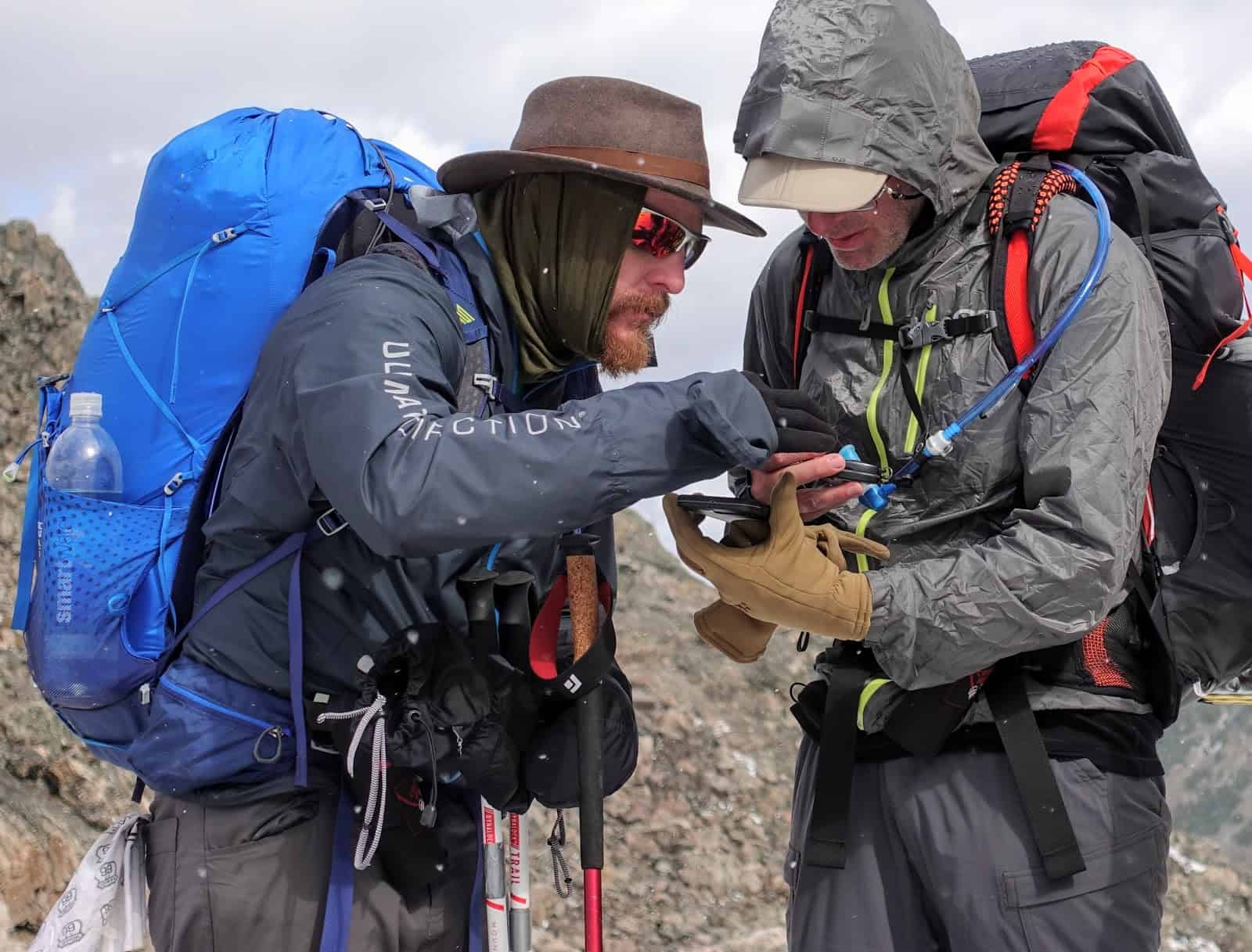
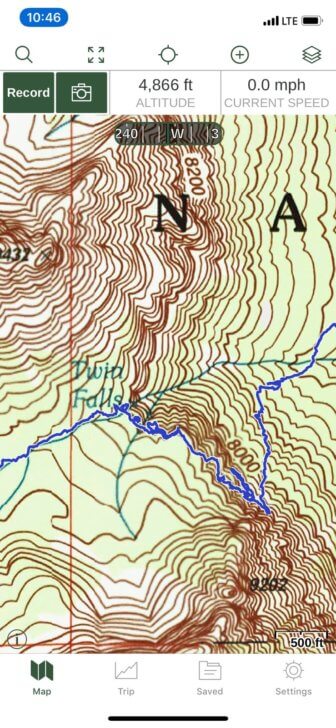
Andrew and Paul use a Smartphone GPS app loaded with USGS 24k quadrangles to navigate a complex off-trail section in the Absaroka-Beartooth Wilderness as part of Backpacking Light’s 2018 Wilderness Adventures Whitetail Trek.
Category Description
For the purposes of this review, I will be looking at apps that can be found on both iOS and Android platforms. There may be some good apps that are excluded because they can only be found through one or the other but for this article, we are taking an ‘all or nothing’ approach.
Many of these apps are free but require a membership or in-app purchase in order to get the most out of the app. The apps being reviewed will include:
All Trails
Gaia
Google Maps Offline
Guthooks
Outdoor Active
Rambler
REI – National Parks
Spyglass
Viewranger
Yonder
This list is not comprehensive! New apps are being developed and introduced all the time. In addition, this list doesn’t include some apps that have been around for awhile (like Topo GPS) because I don’t have personal experience with them.
Feature Summary
In this review, I will be looking at what are the most important criteria for a navigation app. These features include:
Downloadable Maps
GPS Navigation
Ability to Import and Export a GPX Track
Route and Waypoint Creation
Speed and Distance Tracker
Altimeter
Criteria for Evaluation
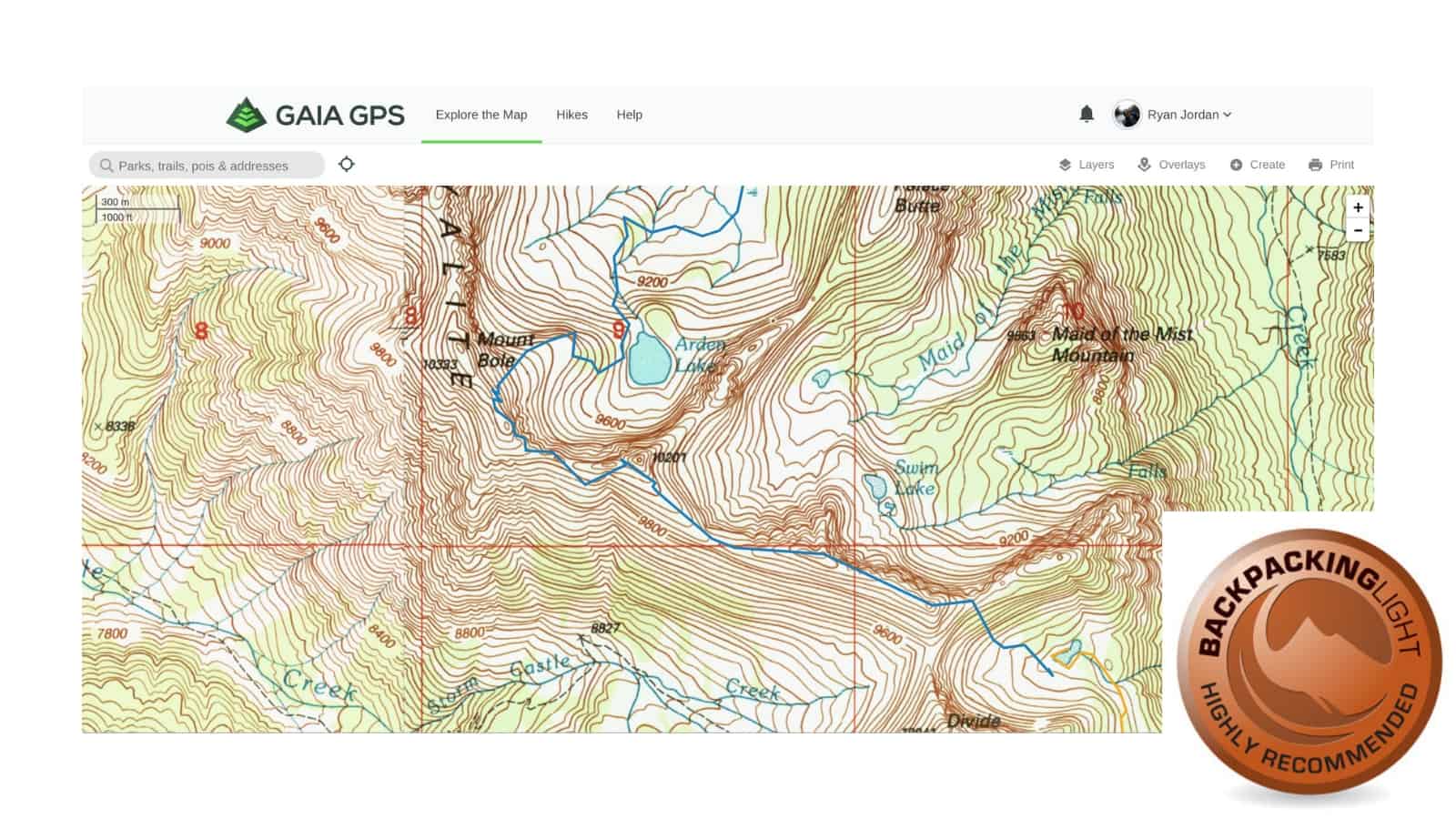
A GPS track from Gaia of an off-trail route that was completed years prior proved critical to find a very subtle route that safely descended a series of near-vertical cliffs when the route was repeated later. Source: Ryan Jordan.
Downloadable Maps
For those who plan on taking a longer hike and might not want the added weight of a battery bank or those who prefer a good old fashioned printable map, this feature is key. Being able to plan a route in the comfort of your home office and then transfer it to your phone or print it out gives more options for how to navigate during the trek.
GPS Navigation
With modern cell coverage, it’s hard to find places without coverage within 50 miles of a freeway or 100 miles of a town. Even so, many of the canyons we get into or the mountains that we climb will not have any signal. This means that an app that uses your phones GPS function is far more useful than one that doesn’t.
The Ability to Import and Export a GPX Track
The GPX file standard has been around since 2004 and has become a vital part of every GPS unit since. GPX records your longitude and latitude in decimal degrees while elevation is recorded in meters or feet. Depending on what you are using GPX to monitor, it may be important to note that times are not recorded in local time but in Coordinated Universal Time (UTC). Simply put, this is the system that allows you to mark waypoints and share them across multiple platforms and devices. This is crucial when marking a point for a group with some members using a dedicated GPS device like the Garmin inReach Mini while others are using an app on their phone and others using printed maps.
Routes and Waypoints
When planning a short hike or a longer trek, using an established trail or bushwacking from point to point, it’s nice to know where you’re going, how you are going to get there and what points of interest are along the way. If you’re venturing into new territory, it’s nice to know where a water source can be found or where a nice camp spot might be. It can also be nice to know what hazards can be found and where they can be found along a given route. This is where routes and waypoints come in. Will an app allow you to mark a waypoint with a detailed description? Can a photo be attached to a waypoint? Will waypoints and routes automatically coordinate or are extra steps needed?
Speed/Distance Tracker
If you are doing any kind of training then this is crucial. For those of us who want a minimal amount of multifunctional gear, a navigation app that can also record speed and distance is vital. This function can also be used to predict how long it will take to get from waypoint to waypoint or how long it should take the fastest or slowest members of your group to get from point to point. A good speed and distance tracker can help you know if you need to pick up the pace or if you can take a few more pictures along the way.
Altimeter
Knowing your elevation can tell you everything from why you can’t seem to catch your breath to how much fuel to bring on a hike. Being able to easily access an accurate altitude reading can be a vital tool in staying safe while summiting a mountain while tracking elevation gain or loss is crucial for performance tracking as well as monitoring for altitude sickness.
AllTrails allows you to record routes then access the statistics and map all in one easy to read screen. Expanding the map is as easy as a touch!
This app contains hiking, biking and running trails all around the world. All Trails boasts 50,000 trail maps as well as reviews and photos regularly updated by its millions of users. This allows dog lovers, hardcore hikers, mountain bikers, and other users to give local and valuable recommendations for everything from city park walking trails to the Continental Divide Trail and everything in between.
With an annual membership, you can download and print customized maps. There is also a real-time satellite weather tracker. Map layer options include topo, terrain, open street maps and more.
Without the annual subscription, you can still record and track data during hikes. This allows you to follow the adventurers who inspire you while also saving your favorite trails to challenge yourself. This feature is great for anyone interested in Fastest Known Time or Fastest Personal Time. Lastly, without a membership, your map will still show topo data during your hike.
All Trails is a powerhouse app that integrates trail reviews and beta – a benefit for some users, the added clutter may get in the way of others looking for a cleaner navigation experience. Although the interface is not as elegant as Gaia, All Trails is a strong competitor in this market and has all of the features required for a positive navigation experience. It earns our Recommended Review Rating (read more about our ratings here).
One particularly nice feature of Gaia is the ability to assign pictures as waypoints. This allowed my Brother-in-law to follow the route that I took and use a better camera to take higher quality pictures.
Gaia has been showcased in several publications including the New York Times and Outside Magazine. This app is designed to give hunters, hikers, offroaders, backcountry skiers, mountain bikers and professional guides a one-stop solution to their mapping needs.
At the free membership level a user can research a worldwide catalog of maps but downloading for offline use is unavailable. You do still have the option of tracking vital stats such as speed, distance and, elevation and you can also record trips, add waypoints with notes and photos and share them across devices with friends and group members.
At the “Member” level you gain access to downloadable maps including topo, road, and satellite map layers. You also keep all of the vital features of the free membership that make this app so practical in the backcountry.
By upgrading the “Premium” membership you gain access to the following additional map sources for download:
National Geographic Trails Illustrated
US Hunting Maps
IGN European Maps
Neotreks Premium Land Use Maps
Land Management, Elevation Shading, and Slope Analysis Overlays
Gaia’s feature set, highly customizable display, powerful interface, frequent app updates, map layers, ease of use, and outstanding desktop/tablet trip planning features earns this app our Highly Recommended Review Rating (read more about our ratings here).
All the familiarity of one of the most widely recognized mapping tools around the world. Although much can be said for this app, in the context of a navigation app for hikers the big draw is being able to record directions to a trailhead and even take a detailed photo of the area around a destination.
This app doesn’t support waypoints or any of the tracking functions of the other GPS apps on this list.
Guthook’s app shows its elevation profiles complete with waypoints, which makes planning and navigating easier.
A great app for set trails, Guthook allows you to find waypoints including camping spots, water sources, and great data for the towns that you’ll pass through on longer hikes. Users are able to update current conditions on any of these waypoints but are unable to set waypoints of their own. The elevation profile can tell you where you are along a trail and the distance to the nearest waypoint. Unfortunately, it doesn’t allow you to track your personal data. Importing and exporting GPX are also unavailable.
MapMyHike’s primary screen demonstrate that it’s niche market is the fitness market, showing important workout statistics but no navigation tools.
More of a fitness tracker than a Navigation App, Map My Hike is developed by Under Armor and will give you all the data you need to optimize your performance including community challenges to help you stay motivated. It can be connected to other apps and wearables including the various Garmin and Fitbit models.
Outdoor Active’s ability to plan out a route on a desktop then seamlessly access it on your phone makes it especially nice.
Outdoor Active is designed specifically for hiking, cycling, and mountaineering. This app allows a user to plan out trips of any kind using the desktop site or the app independently or in unison. This makes sharing with friends one of the easiest parts of the planning process. In addition to the tracking and mapping features that we expect in a navigation app there are also some considerate safety features. These include an emergency call option as well as up to date weather conditions.
Because of the social media lean to Ramblr exploring routes from around the world is only a fingertip away.
Rambler is designed with sharing trips across social media in mind. It allows you to plan trips, track all of your vital statistics. You can also plot waypoints and attach photos as well as videos. You can also download maps based on Apple and Google map data for offline use. All of this is integrated with Facebook and Twitter to seamlessly and effortlessly share your treks across a wide range of groups and friends.
Using the same program as HikingProject, each National Park has trails and destination gems that can be sorted by activity, and difficulty.
This app contains complete trail data for many of the most popular National Parks. You can search for hikes in each park using a map display. Each park also has a “best of” list to search for hikes. Hikes can be sorted by difficulty rating, star rating, or elevation profiles. There is also community input giving insights into camping, guided tours, and best seasons to go.
REI – National Parks also comes with a real-time GPS tracker that includes an elevation profile on a terrain or satellite map. In the case of an emergency, you can also send your coordinates to rescuers.
If you want a printable map, the app can link you to nps.gov where they have a small selection to choose from.
Spyglass functions as a hi-tech compass that includes a sun/moon/star finder, rangefinder, sextant, inclinometer, and angular calculator in addition to the expected GPS tracker, speedometer, altimeter, and waypoint tracker.
All of the operations work in 3D with augmented reality. This allows you to track stars on a cloudy night or overlay directions and info over the camera or a printed map.
The overall interface is a step below its competitors – I would describe the map and elevation profile as clunky – but in the overview tab industry standard statistics are presented in an easy to interpret way.
Viewranger gives you the option of downloading maps for offline use but it uses a credit system per map or you can download bundles for a higher price. With that little caveat, you can browse maps and routes posted by some pretty credible sources such as the trekkers at Backpacker Magazine.
Like many of the other navigation apps, you can track location (which can be shared privately in real time with select friends), speed, and distance. What sets this app apart from the others is the ability to use your phone’s camera to show peak names, trails, and waypoints with the Skyview function.
Product Performance Considerations
Planning
One of the key features to consider with a navigation app is planning. The two key features for planning are the ability to import/export GPX and download maps for offline use. If you can’t plot points at home to be used in the field in offline mode then maybe you can download someone else’s route and piggyback off of their adventure. If an app won’t let you do either then it probably isn’t worth much as a navigation app.
Import/Export GPX
Alltrails, Gaia, Outdoor Active, Ramblr and Viewfinder do well in this category. Outdoor Active unfortunately has a tendency to crash when adding a photo waypoint while recording a route. Google Maps Offline has the ability to download maps for offline use but they are meant for street-level views not trail level use.
On the export end of things, it is nice to keep a record of where you’ve been for personal records or to show your friends how cool you are. Alltrails, Gaia, Outdoor Active, Rambler and Viewfinder are strong in this category as well, although they all require you to purchase an upgraded membership or pay per download.
Downloadable Map
In one way or another, all of these apps give you the chance to download maps. The feature works especially well with All Trails and Gaia who allow you to plot a trail with waypoints on your desktop and easily move them to your phone. Guthook also does well with an easily downloadable map but doesn’t give you the option of adding your own waypoints.
Tracking
It’s easy to say that you’ve been there and done that but it’s entirely different to have accurate statistics to back up your claims. It’s also nice to be able to track performance and improvement or to know that the next waterhole, campsite or summit is a specific distance away. For this, you need to accurately know your position along a route to track your speed and elevation along with distance traveled and distance to the next point.
Speed/Distance
Almost all of the apps do well in this category or they don’t track this data at all. I was able to communicate with the developers at Guthook and they are working to integrate a speed tracker in future updates.
Elevation
A tricky point is whether or not an app actually tracks your elevation or just gives an elevation profile of your route. In general, if an app will track your elevation then it will also give you an elevation profile. Conversely, just because an app gives an elevation profile doesn’t mean that your ascent or descent has been tracked. Anyone with basic math skills can work around this but for those who don’t want to do the math at the end of a long day the tracking feature is important.
Commentary and Recommendations
Gaia’s feature set, highly customizable display, powerful interface, frequent app updates, map layers, ease of use, and outstanding desktop/tablet trip planning features earns this app our Highly Recommended Review Rating.
If you’re looking for a good all-around app for navigation purposes then All Trails and Gaia are the two to choose from. They both have easy to navigate planning and tracking features and are easy to share across platforms and devices. Gaia has an especially customizable readout that will allow you to see the information that is most important to you and not worry about the other stuff.
Gaia’s feature set, highly customizable display, powerful interface, frequent app updates, map layers, ease of use, and outstanding desktop/tablet trip planning features earns this app our Highly Recommended Review Rating.
If you are looking to do something more specific like a National Park or the Continental Divide Trail then you may want to go with Guthook or REI National Parks. Guthook is especially nice for hikers who are shy on experience in the backcountry and may need the frequently updated information that Guthook provides.
For those that are more interested in using an established social media site to share your exploits then Ramblr is for you. It has all of the tracking features with an emphasis on syncing with your social media accounts.
If you’re most interested in fitness and tracking health improvements, Map My Hike is made by Under Armour and will sync with everything from your GPS enabled shoes to your watch while Viewranger will sync with your phones health tracker app.
A forum thread to read for those initially opposed to futuristic, high-tech gear that compares various Garmin handheld GPS models to use of an iPhone.
Product Review Disclosure
How we acquired these products: Product(s) discussed in this review were either acquired by the author from a retailer or otherwise provided by the manufacturer at a discount/donation with no obligation to provide media coverage or a product review to the manufacturer(s).
We do not accept money or in-kind compensation for guaranteed media coverage: Backpacking Light does not accept compensation or donated product in exchange for guaranteed media placement or product review coverage.
Affiliate links: Some (but not all) of the links in this review may be “affiliate” links, which means if you click on a link to one of our affiliate partners (usually a retailer site), and subsequently make a purchase with that retailer, we receive a small commission. This helps us fund our editorial projects, podcasts, instructional webinars, and more, and we appreciate it a lot! Thank you for supporting Backpacking Light!
This Therm-a-Rest NeoAir UberLite review presents our performance assessment of the lightest full-sized air-filled sleeping pad on the market.
Introduction
This Therm-a-Rest NeoAir UberLite review presents our performance assessment of the lightest full-sized air-filled sleeping pad on the market.
The Therm-a-Rest NeoAir UberLite is an 8.8-oz inflatable air mattress (i.e., size “regular” – 20 in wide x 72 in long). Users of the Therm-a-Rest XLite and XTherm will recognize the UberLite’s shape and basic design. The UberLite is a little over three ounces lighter than the XLite. It also packs down smaller and sleeps more quietly. The tradeoff? Warmth.
Here’s how the three mummy-shaped pads in the Therm-a-Rest NeoAir line compare:
All specs are for a regular-sized pad (20 in width x 72 in length x 2.5 in thickness). The UberLite is also available in short and long sizes.
In addition to the obvious differences in weight, warmth (R-value), and packed volume, you can see that the Therm-a-Rest NeoAir UberLite is made with lighter fabrics. Therm-a-Rest claims in particular that the UberLite’s top fabric is quieter than the fabrics used in the other two pads, a performance feature we’ll look at in this review.
Watch Ryan Jordan’s video about how he uses the Therm-a-Rest NeoAir UberLite for winter camping, as well as a summary of the findings presented in this review:
Measured weight including stuff sack and repair kit: 8.3 oz (235 g)
Width (regular): 20 in (50 cm)
Length (regular): 72 in (183 cm)
Thickness: 2.5 in (6.4 cm)
R-Value: 2.0
Packed Dimension: (out of the box): 6 in x 3.5 in (15.2 cm x 8.9 cm)
Top fabric type: 15 denier ripstop nylon
Bottom fabric type: 15 denier nylon
Review Context
The UberLite offers 2.5 inches of cushioning thickness at only 8.8 oz.
Why choose an inflatable air mattress in the first place?
Closed cell foam pads (generally) insulate better (higher R:thickness ratio), are tough, have multiple uses (e.g., stove windshield, lounge pad on abrasive ground, internal pack frame), are significantly cheaper, and weigh about the same.
For instance, check out the specs for the Therm-a-Rest RidgeRest SOLite. This pad gets you more utility at virtually the same weight as the current gold standard in inflatable mattresses, the Therm-a-Rest NeoAir XLite – for a fraction of the cost.
Those who can sleep well on a textured and relatively thick closed cell foam pad are a special breed. Hikers that can wake up feeling rested after a night on a very thin foam pad are even rarer. If your dedication to ultralight backpacking means you are willing to suffer sleepless nights in the pursuit of ounce shaving, you are one tough cookie. But I would argue that sleep deprivation will eventually catch up with you and degrade your hiking performance regardless of how light your pack is. The longer your hike, the more this is likely to come into play.
It is true that most bodies and minds will adapt (somewhat) to sleeping on a thin closed cell foam pad. I thru-hiked the Appalachian Trail and Colorado Trail using a 5/8″ closed cell foam pad, and eventually got (sort of) used to sleeping on it. But I never got what I would consider an excellent night’s sleep, and suffered extensively from numb shoulders and achy hips.
So while R-Value, durability, and price are all important considerations for an inflatable mattress, comfort is king, especially if you are the type of person where comfort on a closed cell foam pad is elusive. Or, should I say, the comfort-to-weight-ratio is king. It is the chief factor that separates inflatable air mattresses from other types of pads.
Of course, comfort is subjective, particularly where sleep is involved. If it were easy to objectively quantify comfort we’d all be sleeping like kings every night in the backcountry. I don’t have to tell you this isn’t the case! So you’ll see words like feels and seems pop up from time to time in this review, particularly where comfort is concerned. I can only offer you my subjective opinion here, and provide you with anecdotal data that will allow you to extrapolate what your own experience might be. In all other performance metrics (weight, durability, etc.) I remain as objective as possible.
Description of Field Testing
Blowing up the Therm-a-Rest NeoAir UberLite in Wyoming. I could achieve maximum pressure with 15 to 17 breaths.
Therm-a-Rest recommends the UberLite for summer use. Production samples of the mattress were not available until the late summer of 2018, so I was not able to test the UberLite in peak summer conditions. In some ways, that limitation works out nicely. I think that the average user of this mattress will not contain herself to summer conditions but will instead be sleeping on the UberLite across three seasons, depending on conditions. Rare is the backpacker that can afford to own a separate mattress purely for summer temperatures.
I tested the UberLite across the late summer and fall, in three mountain ranges, and at elevations ranging from 5,000 ft to 11,000 ft.
My first wilderness test was a two night trip in the Wind River Range in Wyoming in late summer. Both campsites were 10,000 ft to 11,000 ft. Conditions at night were windy with light-to-heavy rain and temperatures dropping just below freezing. Daytime hikes consisted of steep climbs and high elevation peak bagging, with correspondingly low mileage.
My second test was a six-night off-trail trek through Montana’s Absaroka-Beartooth Wilderness in early fall (story about that trek here). Campsite elevations ranged from 6,000 ft to 10,000 ft. Evening temperatures ranged from the low 20s (deg F) to mid 30s (deg F) with occasional high winds and light rain. Daytime hiking consisted of steep ups and downs over high passes and through dense brush. Long hiking days (up to 12 hours a day) with up to several thousand feet of elevation gain, combined with inclement weather and chilly nights provided a good backdrop for testing an ultralight sleep system and evaluate its ability to help me recover each day.
Finally, I tested the UberLite on several late fall one and two-night excursions in California’s Eastern Sierra. Overnight temperatures fell to the 20s and 10s (deg F), with occasional light to moderate snow. Daytime hiking was characterized by high-mileage days through shallow snow.
I’m 5 ft 6 in (168 cm) tall, weigh 160 lb (73 kg), and used a regular sized mattress.
Performance Assessment
My performance assessment of the Thermarest UberLite addresses the following items:
Comfort
Weight and Compressibility
Durability
Usability
Finish Quality
I’ve listed these items in order of what I judge to be greatest to least importance – for me.
Comfort
The UberLite is 2.5 in (6.4 cm) thick, with horizontal baffles and Therm-a-Rest’s Triangular Core Matrix for stability and warmth.
Let’s start with warmth.
The UberLite has an R-Value of 2.0. Therm-a-Rest claims this makes the UberLite the warmest sub-10 oz (284 g) inflatable mattress on the market. To the best of my research ability, they are correct. This low R-Value is the reason Therma-A-Rest doesn’t rank the UberLite as a three-season mattress.
Longtime Therm-a-Rest users will know that the UberLite’s older brother, the XLite, carries an R-Value of 3.2, making the XLite more comfortable across a wider range of conditions. However, Therm-a-Rest designers achieve this extra warmth in the XLite through a secondary layer of material inside the pad they call ThermaCapture. ThermaCapture is somewhat famous for being loud. I once heard an Appalachian Trail thru-hiker describe her first few nights on the trail as “a symphony of crinkling, crackling, and crunching emanating from the shelter and every tent within five miles.” According to anecdotal reports in the Backpacking Light forums, some users find the ThermaCapture in their own pads to be quiet enough but are kept awake by the ThermaCapture on the pads of their tent/shelter mates.
Pad noise was evaluated by placing a microphone approximately six feet away from the head end of the pad, and then measuring the sound waveforms resulting when a user on the pad was changing her sleep position from one side to another. This FFT plot shows the frequency (Hz, x-axis) vs. sound level (dB relative to mic clipping, y-axis). The arrows point to the waveform at the maximum sound level that was measured while the user changed sleeping positions. This graph shows that the UberLite is quieter than the XLite, with sound level differences averaging about 15 dB across the entire frequency range. How this actually translates into real-world differences depends on a host of factors that are too complicated to address here, including the psychology of sound perception, a user’s own hearing quality, environmental sound dampening, and more. Furthermore, keep in mind that the sound levels shown here are only relative to a level of zero, which is the level at which the microphone starts clipping, and is completely arbitrary. This graph cannot be used to compare to any particular sound source. Lower lines indicate the ambient sound floor (indoors, no fans running, etc.), for reference. Source: Ryan Jordan.
The UberLite does not use ThermaCapture. Instead, it relies on the internal structure of the mattress (Therm-a-rest calls it a “triangular core matrix”) to fight heat transfer (the XLite also has the same internal structure). On the one hand, the UberLite is comfortable because it is a reasonably quiet pad. On the other, it may feel less warm in some environmental conditions than some other inflatable pads on the market.
As I mentioned in the description of field testing, I slept on the UberLite in below freezing temperatures at least six or seven times. Compensating for the 2.0 R-Value wasn’t all that difficult, particularly as I’m a quilt user and already accustomed to throwing on a few extra articles of clothing before falling asleep. I’d make sure to have a thin insulating pad to place under the UberLite if snow was in the forecast (e.g., the Gossamer Gear Thinlight Foam Pad).
Fabric noise and R-Value are objective, but the question of “how does it sleep” is a little more difficult to nail down. My opinion is that the UberLite cradles the body and prevents pressure points just as much as the average 2 to 3 in thick (5.1 – 7.6 cm) inflatable mattress with horizontal baffles. I usually spend my nights rotating from side to back to side and back again, and I think the mattress performs equally well in side-sleeping and back-sleeping scenarios. My hips and shoulders felt well-supported without being too firm, even with the mattress inflated to max capacity.
Ryan Jordan, who has extensive experience with the NeoAir XLite and XTherm pads, has also tested the UberLite and his experience echoed mine. He felt that differences in support between the three pads was marginal, and all three offered similar latitudes of comfort adjustment by controlling air capacity using the valve.
The UberLite is a no-frills piece of gear. Don’t expect it to cradle you with thicker side baffles or support your neck with an integrated pillow. Most ounce-counting ultralight backpackers will likely appreciate the design simplicity and weight savings.
In short, the UberLite gave me as good a night’s sleep as I usually get on any other sub-15 oz inflatable mattress. For certain there are more comfortable inflatable mattresses on the market, but do they come close to matching the UberLite’s high level of comfort, small packed size, and light weight? Not by a long shot.
Weight and Compressibility
The UberLite compresses down to a very small package, even after multiple uses (photo shows the UberLite packed inside the included stow bag). A little more care and time in folding could probably get it down to its original six inches in length, but I never felt the need to bother.
Weight and compressibility are the UberLite’s two biggest strengths. If you are going to purchase this piece of gear, you are going to do so because it weighs 8.8 oz (249 g) and compresses down to a tiny size.
Therm-a-Rest’s marketing materials claim you can fit the UberLite in your back pocket. They’re right, even if it wouldn’t be comfortable. You will certainly have no trouble finding a good spot in your pack for it. You could even compress it in with your sleeping bag for simplicity’s sake if you wanted to.
I can’t overemphasize the size and weight of this product: if you’ve maxed out the ounce savings in your current kit, the UberLite can take you another step forward.
Therm-a-Rest claims that the NeoAir UberLite has a packed size of 6.0 in x 3.5 in. If the pad could be perfectly folded, this is an accurate claim. Realistically, you can expect a packed size in the range of 7.5 in x 3.5 in during actual field use.
Shoe size is US 9 for reference. Photo: Ryan Jordan.
Durability
The UberLite is so light in part because it utilizes 15 denier nylon on both the top and bottom of the pad.
The UberLite is constructed of thin 15 denier ripstop nylon on the top and 15 denier nylon on the bottom. In other words, it’s so thin you can see through it in the right light. Exactly how this translates to long-term durability remains to be seen. I can tell you that after occasional and consecutive night use in two seasons, it has yet to spring a leak. That being said, I was cautious with this piece of gear – extremely cautious.
Therm-a-Rest NeoAir pads use a combination of four different types of fabrics. 15D ripstop nylon (upper left) is used for the top surface of the NeoAir UberLite. 15D ripstop nylon (upper right) is used for the bottom surface of the NeoAir UberLite. 30D ripstop HT (“high-tenacity”) nylon (lower left) is used for the top and bottom surfaces of the NeoAir XLite, and the top surface of the NeoAir XTherm. 70D nylon (lower right) is used on the bottom surface of the NeoAir XTherm. All images were captured at the same scale (approximately 12X magnification). Photos: Ryan Jordan.
15 denier nylon is not a fabric with which you can be rough. Choosing to use the UberLite means you are committing to paying attention to where you are setting it down, where you are blowing it up, and precisely what type of detritus is littering the surface of your shelter. We were unable to puncture either side of the pad with both green and dry spruce needles, which was a huge relief! The real puncture enemies of this pad would include desert and prairie diaspores, burs, and sharp bits of rock underneath the pad while you sleep.
The UberLite comes with a repair kit that includes two patches and two glue dots to adhere the patches. The total weight of the repair kit, minus the instructions, is 0.2 oz (6 g).
The upcoming thru-hiking season should be a revealing test case for the long-term reliability of this mattress. My suspicion is that novice hikers will be punching holes in the UberLite left and right, while more experienced users will baby it accordingly. Still, accidents happen, and they will happen more often with a fabric of this thickness. I’ll say this: I wouldn’t use the UberLite if I were sharing my tent with a dog, and I wouldn’t use it without a ground sheet or shelter floor to protect it.
Usability
My wife and my cat both know it: I’m a notoriously fidgety sleeper. Despite constant rolling and re-adjusting, I had no trouble staying on the mattress, which is 20 in (51 cm) at its widest point and 72 in (183 cm) length from tip to tip (size regular). The UberLite utilizes horizontal baffles. Some back sleepers prefer vertical baffles, but I’ve always found horizontal baffles to work just fine for back sleeping. Some larger users may disagree.
The UberLite retains its structure well when under pressure. After letting out an estimated 5% to 10% of the air from the point of maximum pressure, I still had to exert effort to get the mattress to bottom out from my body weight.
The 15 denier nylon fabric is somewhat slick and may slide around on your shelter floor (depending on your floor material). The usual fixes apply: painting silicone strips on the bottom of your shelter floor or using a thin insulating pad underneath the mattress.
I was able to consistently inflate the UberLite to maximum pressure using 15-17 breaths in just over a minute at an average elevation of 6,500 ft. The nozzle is the standard Therm-a-Rest variety: unscrew to open and screw to lock closed. While inflating you can push the valve forward with your tongue to temporarily close it off, allowing you to inhale more deeply or to keep air from escaping as the air pressure increases inside the mattress during the inflation process.
After opening the valve and letting the mattress deflate on its own for a few seconds, I was able to consistently roll it back up and put it in the stuff sack in about 2.5 minutes. The mattress reliably re-compresses to its stowed size and always fits back in the stuff sack with room to spare.
The no-frills Therm-a-rest nozzle is easy to use and saves on weight, but lacks a “quick deflate” function.
The nozzle resides on the upper right-hand corner of the UberLite. The nozzle placement makes it easy to reach up and let a little air out to dial in your favorite pressure. The best practice with the UberLite is to start at full pressure and let out a little air at a time while laying on the mattress. The nozzle placement technically allows you to bend it up towards your mouth to re-inflate while laying on the mattress, but I wasn’t ever able to make this work. On cold nights where the internal pressure of the mattress dropped, I had to remove my body from it entirely to re-inflate to my desired pressure. This is consistent with our experience using other inflatable sleeping pads.
Finish Quality
The 15 denier nylon has a satiny finish that has a nice feel but may slide around shelter floors. It’s noticeably slicker than the “stickier” finish of the fabrics used in the NeoAir XLite and Xtherm pads.
The bonded seams on the UberLite appear to be reliable and sound, with no material differences in construction quality or methods when compared to the NeoAir XLite or XTherm.
The surface fabric is satiny, but bare skin pressed against it overnight would likely be uncomfortable. The UberLite and the included stuff sack both come in a dark greenish-bluish-grey. The shade is difficult to see around camp at twilight, so I placed a small square of bright orange tape on my stuff sack to avoid having to search for it.
Some users will appreciate the dark tone, especially those who disliked the bright yellow of the XLite. It’s purely an aesthetic choice and has no bearing on the performance of this particular product.
Therm-a-Rest sources its materials worldwide but assembles its products in America.
Product Strengths
Light weight, especially considering its size, thickness, and comfort level
Small packed size
Relatively quiet fabric, especially compared to mattresses that utilize ThermaCapture or other heat reflective materials
Warm enough for use in temperatures near freezing when not sleeping directly on snow
Product Limitations
Low R-value (2.0) may limit warmth in sub-freezing temperatures and/or when sleeping on very cold, wet, or snowy surfaces
Simple, no frills design (e.g., no integrated pillow, body cradling baffles, rapid-inflation/deflation options)
Slick fabric may cause pad to slide around on tent floors
Thin material (15 denier nylon) is not yet proven for long-term use
I’ve chosen to compare the UberLite to a sampling of inflatable mattresses that weigh 15 oz (425 g) or less and represent the lightest air pads from Therm-a-Rest, Big Agnes, Nemo, REI, Sea to Summit, and Klymit. All data is for regular or standard size mattresses in the 20 in x 72 in size range.
Therm-a-Rest shaves weight primarily by utilizing a 15 denier fabric. The Exped and NEMO mattresses both use a 20 denier fabric, while all the other mattresses in our table use 30 denier fabric. Klymit saves weight by using a skeleton design that doesn’t maintain full coverage under the body. The result is a sleeping pad that simply can’t compete with the others in an R-value or sleep comfort comparison. Now that the UberLite is as light as the Klymit Inertia X Frame pad, the advantage of the latter (weight savings) has disappeared in favor of the more comfortable UberLite.
In terms of estimated R-value-to-weight ratios, the UberLite is near the top of the pack, and easily the highest amongst all pads weighing less than 11 oz.
Commentary
The Therm-a-Rest NeoAir UberLite lacks features and warmth but makes up for it with savings in weight and volume. Is it worth it? Probably not for the novice, but for the experienced ultralight hiker looking to shave some ounces…yes!
Is the introduction of the Therm-a-Rest NeoAir UberLite a game changer? It could be, depending on where you are in your ultralight journey, and what pad you are currently using.
Let’s review some highlights. The NeoAir UberLite:
Provides more comfort than a closed cell foam pad, and comfort on par with other inflatable mattresses in this range of thickness (2.5 in).
Uses a reasonably quiet fabric, which will be appreciated by both you and your tent/camp mates, especially if you are currently using a famously crinkly NeoAir XLite pad.
Is the lightest standard-sized (20 in x 72 in) sleeping pad at this thickness, and compacts to a smaller size than any other 20 in x 72 in pad on the market.
Therm-a-Rest has chosen to prioritize weight and volume over features, added insulation, and fabric durability.
The long-term ramifications of these design decisions on durability are not yet evident. The upcoming thru-hiking season will tell us a lot about how the UberLite holds up to long-term daily use. Certainly many Therm-a-Rest users have found the quality of the XLite and XTherm to stand the test of time, and it’s unlikely that a brand with the reputation of Cascade Designs (the parent company of MSR, Therm-a-Rest, and Platypus) would introduce a new product without thorough field testing.
If you are looking for an all-around inflatable mattress to keep you extra-cozy and extra-toasty in all seasons, this is not the piece of gear you need. Likewise, if you can save two-to-four ounces somewhere else in your pack, you might want to consider a mattress with more features and more warmth. But if you have bottomed out in the ounce-counting game, the UberLite has the potential to shave your base weight even further while still keeping you reasonably comfortable.
If you are a warm sleeper who finds herself sweating through the night on something like the NeoAir XLite or REI Flash, then the UberLite can save you even more ounces. If you typically bundle up while sleeping on the XTherm when temperatures are above freezing, avoid the UberLite!
With careful planning, appropriate clothing choices, and a knowledge of what temperature ranges you can handle, the UberLite has three-season qualifications, but beware of winter and winter-like conditions. On a purely subjective note, I found it to be plenty warm in shoulder season conditions at just-below-freezing temperatures. For these scenarios I used a 20 deg F rated quilt and some extra layers on my body.
For crushing high miles in mild conditions, the UberLite is going to be very hard to beat. Nothing in its comfort class can match the packed size and weight of the NeoAir UberLite. For this reason it has earned a spot in my summer thru-hiking kit, and I see no reason not to bring it along in shoulder seasons as well.
Review Rating
Recommended
The Therm-a-Rest NeoAir UberLite is currently the lightest and most packable air-filled sleeping pad on the market that provides at least 2.0 inches of thickness, and a standard 20×72 footprint. In addition, it features outstanding manufacturing quality and quiet fabrics.
The UberLite will allow serious ultralighters to shave some ounces while still getting a good night’s sleep. The UberLite will appeal to existing NeoAir XLite and XTherm users who are seeking a quieter sleep and a lighter pack, or Klymit Inertia X-Frame users who are tired of suffering cold nights just to carry a sleeping pad in this weight class. In addition, the UberLite makes sense for ultralight backpackers who have previously been committed to closed cell foam pads, and want to save more weight and increase their sleeping comfort. If long-term users report the kind of ruggedness found in other Therm-a-Rest inflatable mattresses, we may consider bumping this rating to a Highly Recommended.
Inventory will be limited when it is launched in February of 2019. REI is expected to receive the largest shipment of pads, with all pre-orders fulfilled by February 15.
Related Content
Excitement and speculation about the UberLite are building on our forum. Join the conversation.
Read more review and other articles about sleeping pads at Backpacking Light.
Disclosure
How we acquired these products: Product(s) discussed in this review were either acquired by the author from a retailer or otherwise provided by the manufacturer at a discount/donation with no obligation to provide media coverage or a product review to the manufacturer(s).
We do not accept money or in-kind compensation for guaranteed media coverage: Backpacking Light does not accept compensation or donated product in exchange for guaranteed media placement or product review coverage.
Affiliate links: Some (but not all) of the links in this review may be “affiliate” links, which means if you click on a link to one of our affiliate partners (usually a retailer site), and subsequently make a purchase with that retailer, we receive a small commission. This helps us fund our editorial projects, podcasts, instructional webinars, and more, and we appreciate it a lot! Thank you for supporting Backpacking Light!
Tarptent’s Stratospire Li is a two-person DCF shelter with well-considered features and has enough chops for year round use.
Introduction
The Tarptent Stratospire Li pitched in the Eastern Sierras above Lake Tahoe.
The Tarptent Stratospire Li is a roomy and stable two-person DCF shelter with well-considered features. It sets up quickly, stays taut in rough conditions due to DCF construction and Tarptent’s proprietary built-in tensioners, and has enough chops for year round use. I tested the Stratospire Li during an eight-day trek through Montana’s Absaroka-Beartooth Wilderness in the summer/fall shoulder season. Weather conditions were all over the map, meaning I had the opportunity to observe this shelter’s performance during clear (but cold) nights, light rain, mist, light snow, and driving wind.
Features and Specifications
Features
Dyneema® fabrics: strong and light
Seams are bonded and sewn
Dual trekking pole set-up
Double wall
Dual vestibules are spacious and provide for dual entry
Interior can be set up independently from the rest of the shelter
Tarptent’s optional SideCar attachment turns either vestibule into a separate sleeping compartment for a pet or a kid (or both!)
PitchLoc™ foldable corners and integrated line tighteners
Reflective spectra cord guylines
Catenary ridgelines
Specifications
Sleeps: 2
Seasons: 3+
8,000mm+ hydrostatic head pressure rating
Manufacturer provided weight:
26 oz (738 g) tent body (fly, interior, guylines, carbon fiber struts, and stuff sacks)
1.7 oz (48 g) stakes
Measured weight:
29.5 oz (836 g) tent body (fly, interior, guylines, carbon fiber struts, and stuff sacks)
1.7 oz (48g) stakes
Fly: 0.51 oz (14.5 g) / yd² Dyneema
Floor: 1 oz (28.3) / yd²
Interior Height: 45 in (115 cm)
Floor Width: 45 in (114 cm)
Floor Length: 86 in (218 cm)
Stakes: 6 x 6 in (15 cm) Easton Nanos (included)
Packed size: 16 in x 5 in (41 cm x 12 cm)
Compared To
The Stratospire Li is most similar to the Zpacks Duplex: both are two-person DCF shelters designed to set up with trekking poles. An in-depth head-to-head performance review of the two is in order, but in the meantime, we can compare some of the basic features and specifications.
Photo: ZPacks The Duplex has many of the same features as the Stratospire Li, but differs in design.
Shelter
Zpacks Duplex
Tarptent Stratospire Li
Total weight
19 oz (538.7 g)
26 oz (737.1 g)
Tent body material
0.51 oz (14.5 g) / yd² Dyneema
0.51 oz (14.5 g) / yd² Dyneema
Floor material
Floor: 1 oz (28.3) / yd²
Floor: 1 oz (28.3) / yd²
Trekking pole position
Centered
Offset
Design
A-frame (six panels)
Octogonal (8 panels)
Vestibule
2
2
Doors
2
2
Independent interior
No
Yes
Interior Height
48 in (121.9 g)
45 in (114.3 cm)
Interior Width
45 in (114.3 cm)
45 in (114.3 cm)
Floor Length
90 in (228.6 g)
86 in (218.4 cm)
Stakes
8 required (0 included)
6 required, 2 optional, ( 6 included)
Cost
$599.00
$679.00
The Duplex is a few inches longer and taller (interior) than the Stratospire Li. It features an A-frame six-panel design and weighs 19 oz (538.7 g). The Stratospire Li features an octogonal eight-panel design and is about $80.00 more expensive than the Duplex. It weighs 26 oz (737.1 g). The fly can set up independently from the interior. Both shelters are constructed of identical weight Dyneema Composite Fabrics and measure 45 in (114.3 cm) across the bottom of the floor.
Strengths and Limitations
Strengths
Dyneema fabric resists condensation and will not absorb moisture, sag, or stretch
Double wall design means any condensation that does occur won’t touch your stuff
Octogonal design holds up extremely well in high winds
Spacious vestibules
Double door design is easy to get in and out of
Thoughtful features: magnetic snaps, zipper covers to reduce condensation drip, PitchLoc corners, and integrated line tighteners
Lots of optional features: solid wall design for four-season use, side-car attachment, trekking pole “handle up” set-up
Limitations
Extremely high price tag ($679.00)
Low stretch of DCF means you must exercise some precision in the pitch
Shallow pitch angle could be a problem with serious snow loads
Small interior gear pockets
Feels bulky in a pack
Commentary
The offset trekking poles, huge vestibules, and roomy interior are just a few of the features that make the Stratospire Li such an expertly designed shelter.
This is a roomy, tough, well-designed shelter. Tarptent rightly lauds the Stratospire Li’s performance in windy conditions.. The eight-panel design minimized noise and flap on a long, cold, windy night high in the Beartooths. The ridgeline remained tight (with the aid of the two optional stakes and tie-outs), and the integrated line tighteners were taut after ten hours of high-speed gusts. In short, Montana threw quite a lot of wind at this shelter, and it didn’t budge. I was camping with a group of ten hikers, and I was one of the few who passed an uneventful and cozy night.
Photo: Tarptent The Stratospire Li’s stability is a function of its octagonal design.
The floor of the Stratospire Li is rectangular, but the fly is octagonal, and the trekking poles are offset. This can require a bit of thinking during setup, particularly if you are in a tight situation or your spot isn’t optimal. DCF fabric has very little stretch, meaning your stake angles and placement need to be a bit more precise than with a silnylon shelter. Make sure to watch Tarptent’s setup video. After viewing that and pitching the shelter a few times in a yard, I had no problem getting the shelter pitched in under two minutes.
PitchLoc corners are a unique Tarptent element: they provide stability and structure to the eight-panel design. The carbon fiber struts fold flat for stowing the shelter and are removable if needed.Most of the seams on the Stratospire Li are sewn then bonded. The pull-outs, shown here, are bonded then sewn for added strength.
The shelter sets up with trekking poles in a handle-down configuration (although Tarptent sells an adaptor to allow the handles to face up). I’ve used a silnylon Tarptent for years and never worried about poking a hole in my shelter with the carbide tip of the trekking pole, but something about the nearly seven-hundred dollar price tag of the Stratospire Li gave me pause every time I set it up. The good news is, should you happen to (carelessly) puncture the Stratospire Li, the DCF construction makes it much easier to patch than silnylon.
A grommet cradles the tip of a trekking pole in the standard setup configuration. Tarptent sells an optional “handle down” attachment if the thought of possibly punching a hole in your $700.00 tent is too much to bear.
The shelter is roomy, with a 45 in (114.3 cm) wide and 86 in (218.4 cm) long bathtub floor. The apex height is 45 in (114.3 cm) tall. This space accommodates two standard sized sleeping mats with ease (or one standard mat and one wide mat with slightly less ease). There’s plenty of room to sit up and change clothes, even for tall hikers. Two doors and two vestibules make sharing the shelter as comfy as it gets, as well as optimizing airflow and views for those dramatic campsite days.
Plenty of room to stretch out in the Stratospire Li. The shelter easily accommodates two standard sized mats but is light enough for a solo hiker with luxury and space in mind.
The vestibules are gigantic, more than large enough to accommodate cooking, wet gear, packs, dogs, or children. Tarptent sells an attachment to turn this vast space into a separate compartment should you be traveling with a child.
One side effect of these large vestibules is that the edge of the fly is quite far from the bathtub flooring after zipping the doors. The distance eliminates the “up-splash” problem (in heavy rain, water can splash up from the puddle created by the fly) occasionally experienced by smaller Tarptents.
These vestibules are so large I couldn’t fit one into a picture, even with the standard wide-angle lens of an iPhone. Plenty of room to store gear and cook if needed, and that still leaves you one whole vestibule on the other side.
Tarptent loaded the Stratospire Li with thoughtful features: floor and apex adjustment straps, storm sealed zippers, zipper flaps for drip protection, and magnetic closure loops to roll the outer fly up and out of the way.
Storm sealed zippers. This tent will keep you dry in raging storms.
The zipper flap also snaps up out of the way with a magnet. Remember to do this before unzipping, or you will have a stuck zipper.
The Stratospire Li is loaded with well-considered features such as a magnetically fastening snap to reduce zipper drip.
I love this magnet system, and I wish it was also on the interior mesh door. Instead, that door rolls up with a clip and loop system, something I occasionally found challenging to manipulate with cold or gloved hands.
The clip and loop system on the interior bug net is functional but less easily manipulated in the cold than the magnet snap system on the exterior fly.
The Stratospire Li is a bulky tent when rolled and stored. The carbon fiber struts in the PitchLoc corners are removable if you feel like stuffing, but Tarptent recommends rolling to improve the lifespan of the DCF. I found the stuff sack to be large enough that rolling was not much of a pain, particularly if you follow the manufacturer instructions. That being said, the tent did feel chunky in my pack and required that I re-think my regular pack organizational system.
The interior pockets at the corners of the mesh doors felt small. Bulky, light items such as a Buff or stuff sacks tended to fall out throughout the night. Storing smaller, heavier items like a headlamp or a pocket knife are the ideal use for these pockets.
Tarptent sells an optional solid wall interior for extremely cold or windy conditions. Adding a solid wall interior would beef up an already storm-resistant tent, and give it some four-season potential. However, I’d be concerned that the Stratospire Li’s shallow pitch angle could give it some problems with heavy snow loads, though the DCF will not stretch under load and will shed snow better than silnylon.
Further testing is required, particularly to see how the tent fares in winter conditions, and in comparison to the Zpacks Duplex. Until then, this is a well-designed, well-constructed, thoughtfully realized shelter with enough toughness to withstand a wide range of seasons and conditions. Large, cozy, and stable while remaining ultralight, it won’t let you down—assuming you can stomach the price tag.
The Stratospire Li is stable even without the optional ridgeline guyline (shown here in orange, and not included with purchase). When you add that, this shelter can withstand some impressive conditions for its weight class.
How we acquired these products: Product(s) discussed in this review were either acquired by the author from a retailer or otherwise provided by the manufacturer at a discount/donation with no obligation to provide media coverage or a product review to the manufacturer(s).
We do not accept money or in-kind compensation for guaranteed media coverage: Backpacking Light does not accept compensation or donated product in exchange for guaranteed media placement or product review coverage.
Affiliate links: Some (but not all) of the links in this review may be “affiliate” links, which means if you click on a link to one of our affiliate partners (usually a retailer site), and subsequently make a purchase with that retailer, we receive a small commission. This helps us fund our editorial projects, podcasts, instructional webinars, and more, and we appreciate it a lot! Thank you for supporting Backpacking Light!
StoveBench defines a protocol that is used to measure two important backpacking stove performance features (power and efficiency) in order to determine a single, quantifiable performance factor called the StoveBench Score.
Introduction
StoveBench defines a protocol that is used to measure two important backpacking stove performance features (power and efficiency) in order to determine a single, quantifiable performance factor called the StoveBench Score.
Power is important because it characterizes a stove’s ability to perform well in adverse conditions (e.g., wind, cold temperatures, cold water). Efficiency is important because it defines a stove’s ability to conserve fuel and save weight for the hiker. Most consumers are enamored by reported boil times (a measure of power), while most ultralight backpacking gram-counters are enamored only by fuel usage amounts (a measure of efficiency). In actual use outdoors, both are important to consider.
This article introduces the StoveBench protocol and presents the definition of the StoveBench Score and how to determine it using the protocol.
As a case study, the protocol is applied specifically to the testing of upright canister stoves. Future applications of StoveBench will be applied to other types of stoves. In addition, special considerations, limitations, potential sources of error, and other applications of StoveBench are discussed.
Backpacking stove manufacturers often report the performance of their stoves in terms of:
Boil time (i.e., the time required to boil a given volume of water) – a measure of a stove’s power; and
Burn rate (e.g., the amount of fuel burned in a given amount of time) – another measure of a stove’s power.
In addition, ultralight backpackers, in particular, are interested in a metric that defines the mass of fuel required to boil a certain amount of water (a measure of the stove’s efficiency). Calculating this metric is popular amongst the more serious kitchen-counter stove testing enthusiasts.
However, the conditions during which these metrics are determined are not necessarily standardized from manufacturer to manufacturer or stove tester to stove tester and can’t necessarily be used to compare stove models from different brands.
Therefore, we have developed a protocol at Backpackinglight.com that we’ll be using in our stove reviews, called StoveBench (a portmanteau derived from the term benchmark, a type of test that defines a standard point of comparison).
In particular, we don’t see metrics that define “power” (e.g., boil time, burn rate) or “efficiency” (mass of fuel required to boil a certain volume of water) as mutually exclusive performance indicators. After all, any manufacturer can optimize stove performance for one vs. the other. However, balancing both power and efficiency with system weight is a design and engineering challenge of developing and using any cooking system (which may include multiple components, such as the burner, fuel container, windscreen, heat exchanger, pot, and lid). After all, a stove that is 100% efficient but takes 20 minutes to boil a pint of water, or doesn’t have the power to boil water in cold temperatures or breezy weather is as disadvantageous as a stove that boils a pint in three minutes but requires 50 grams of fuel.
Thus, the real purpose of StoveBench is to provide a meaningful way to compare different stoves so that efficiency, power, and fuel economy are implicitly defined in a single quantifiable performance factor.
The StoveBench Score
The goal of the StoveBench Protocol is to produce a numerical “performance factor” that considers both a stove’s power output (proportional to its boil time) and its fuel efficiency (proportional to the amount of fuel used during the test) during a standardized stove operation test, during which a stove will be used to heat some predetermined amount of water.
This StoveBench Score (“F”) can be described as follows:
F = output ÷ input
In any cooking scenario, output is defined primarily by water volume and temperature change (heating). More energy is required to heat larger volumes of water, and to change the temperature by more degrees.
Input is defined primarily by time (more energy is used the longer a stove boils) and fuel mass (more energy is used by a greater amount of fuel).
It follows that higher values of F are better, as they represent higher levels of output (water volume boiled) for a given amount of input (energy expenditure).
Therefore, F can be written in these terms:
F = [ V ⨉ ΔT ] ÷ [ t ⨉ M ]
where
V = volume of water used in the test
ΔT = difference in starting and ending water temperatures
t = time of test duration
M = mass of fuel used during the test
For example, a test performed under the following conditions at sea level might look something like this:
V = 0.5 L
ΔT = 100°C (i.e., start with 0°C water and end when the water boils at 100°C)
t = 4 minutes (boil time)
M = 15 g (mass of fuel used to boil the water)
The calculated StoveBench Score would thus be:
F = [ 0.5 L ⨉ 100°C ] ÷ [ 4 min ⨉ 15 g ] = 0.83 L•°C/min•g
Which can be read in layman’s terms like this: in this test, this stove was capable of heating up 0.83 liters of water by 1 degree Celsius (or, 1 liter of water by 0.83 degrees Celsius) in one minute using one gram of fuel.
The StoveBench Score will vary across different test conditions, being influenced by factors such as:
Pot geometry
Ambient air temperature
Fuel type
Presence of air current (e.g., wind).
However, because the StoveBench Score is normalized for water volume and temperature differential, it has the potential to be less sensitive to factors such as the elevation of the test location or starting water temperature, which means that across a narrow range of test environments and materials used, results should compare relatively well. Unfortunately, manufacturers seldom publish the details of their test protocols, emphasizing the importance of testing stoves using a standard methodology when comparing stoves from different brands, or in different environments.
For example, let’s consider two tests using a well-known canister stove from a major US brand.
Test #1, performed by the manufacturer, is conducted with water having a starting temperature of 70 °F (21.1°C), an ending temperature of 212 °F (100°C), and water volume of 1.0 L. In this test, the manufacturer reports a boil time of 3.5 minutes and 14 g of fuel consumption. The StoveBench Score is thus calculated as follows:
F = [ 1.0 L ⨉ 79°C ] ÷ [ 3.5 min ⨉ 14 g ] = 1.61 L•°C/min•g
Test #2, performed by the author, is conducted with water having a starting temperature of 32.9 °F (0.5°C) and an ending temperature of 199 °F (92.7°C), noting that these tests are conducted at an elevation of 7,205 feet, where water boils at a lower temperature than at sea level. A 0.85 L titanium pot was filled with 0.5 L of water for the test, and the stove operated at full power. The boil time was 3 min 5 sec and 11.3 g of fuel was consumed. (Full details of the test protocol are described below in the “Materials and Methods” section of this article.) The StoveBench Score for this test is thus calculated as follows:
F = [ 0.5 L ⨉ 92.2°C ] ÷ [ 3.08 min ⨉ 11.3 g ] = 1.30 L-°C/min-g
The differences between the two results are not dramatic (F is only 20% lower in Test #2), given significant differences in starting water temperature, water volume boiled, and elevation of the test location. However, the differences highlight the need to ensure standardized testing when comparing the performance of different stoves.
This is important because the vast majority of “gear guides”, “best stoves” comparisons, and stove reviews simply re-publish manufacturer-reported performance data, and make judgments accordingly, without regard for the factors that influence stove test results.
Considering Efficiency
A stove’s efficiency can be loosely defined as its ability to minimize waste heat. Heat is wasted via a number of processes, including incomplete combustion of fuel, a flame pattern that causes heat to spill up the sides of a pot vs. being targeted to the bottom of the pot, and heat losses from the pot itself (e.g., always use a lid!).
Efficiency is a function that balances fuel economy with flame power. A high-power stove aids efficiency by delivering more heat in a shorter period of time which can combat system heat losses. However, a high-powered flame can also waste more heat because the heat cannot be absorbed into the water fast enough.
Consideration of efficiency is built into the StoveBench Score, which is calculated from both boil time and fuel usage. Short boil times (high power) and low fuel requirements (high fuel economy) both contribute to higher StoveBench Scores.
Specifically, the fractional contribution of stove performance by fuel economy is defined by the Feconomy = [ V ⨉ ΔT ] ÷ M part of the StoveBench Score equation, and the fractional contribution of stove performance by flame power is defined by the Fpower = [ V ⨉ ΔT ] ÷ t part of the StoveBench Score equation.
Since efficiency can be defined as the ratio between the actual amount of fuel used in the test and the theoretical amount of fuel that should have been used in the test if the stove was operating at 100% efficiency (i.e., no heat loss), the StoveBench Score is particularly useful for comparing stoves of different types (e.g., alcohol vs. compressed gas vs. liquid gas), where inherent inefficiencies in both the heat capacity of fuels and heat losses in stove systems will be reflected by both Feconomy and Fpower.
Often, there is a direct correlation between heavier stoves and stoves that are more efficient. Thus, the StoveBench Score is a versatile metric that can provide a backpacker with valuable information about which stove type might be best for a given set of water heating requirements based on trip duration and required water volumes. The StoveBench Score can provide the foundation for a variety of subsequent analyses to aid the hiker in evaluating different stove systems. For example, the StoveBench Score divided by the total cook kit weight (which might include the stove, fuel container, pot, windscreen, etc.) would provide valuable insight into the performance:weight ratio of a particular stove and cooking system.
The StoveBench Test Protocol: Overview
What follows are the materials and methods used in a standardized protocol for determining the StoveBench Scores for any stove type.
Environment and Instrumentation
In general, the standard (“control”) boil test of the StoveBench protocol measures stove performance under the following conditions:
Indoor room temperature (ambient)
No ambient air flow (wind)
Measure the time and fuel required to boil water originally near its freezing temperature
No stove windscreens or other accessories unless they are integrated into the burner design.
The following table describes my own test environment and instrumentation in more detail.
Ambient Environment
Indoors; Air Temperature = 19.5 °C +/- 0.5 °C, thermostat-controlled fanless convection heater; RH = 20-40% (monitored); elevation = 7205 feet above sea level.
Water
500 g of water (0.5 L) +/- 2 g; measured starting temperature = 0.5 to 5.0 °C (water temperature stabilized by ice); stopping ("boiling") temperature = 91.0 °C (measured temperature at the beginning of a rolling boil at this elevation)
Water Temperature Measurement
HTI HT-9815 Digital Thermometer w/K-type Thermocouple Sensors
(±1 °C accuracy, 0.1 °C resolution)
Weight Measurement
Adam Equipment CBK 8a scale, 4kg capacity, 0.1g accuracy (calibrated)
Stove System Thermal Imaging
HTI HT-18 Thermal Imaging Camera, -20 °C to +300 °C range, image resolution 220x160 pixels.
Infrared Temperature Measurement
Etekcity Lasergrip 1080 Infrared Thermometer, 0.1 °C resolution.
Water Heating Container
titanium pot with lid (0.85 L capacity, 5.0 in wide x 3.75 in height, 4.0 oz dry weight)
General Test Procedure:
Prepare ice water using a 50/50 mixture of ice cubes and tap water in a gallon container that can be easily stirred so as to ensure uniform temperature distribution of the water. Store the water in a cold environment when not in use.
Record the ambient air temperature of the test environment to within 0.1°C regularly throughout the test.
Using infrared temperature measurement, ensure that the temperature of the fuel is the same as the ambient temperature of the test environment by comparing the temperature of the test fuel to the temperature of fuel stored nearby that isn’t being used in the test. This is important because different material types can emit different levels of infrared radiation, and the surface temperature of the material itself may differ from the ambient room temperature. Ensure that the surface temperature of each batch of fuel is within 0.1°C of each other.
Measure the starting weight of the fuel (this generally requires measurement of the stove plus fuel) to within 0.1 g.
Place the water heating container on the bench scale, tare the scale, and add the specified amount of ice water (filtered so as to remove the ice) to within +/- 0.5% of the target weight. The target weight should be converted to water volume, and water volume used as V in the StoveBench Score (F) formula above.
Place the water heating container on top of the stove burner (centering it on the stove’s pot supports), insert the thermocouple into the water so that it measures the temperature of the water halfway down the water column and does not touch the sidewall of the container. Place the lid on the container. The thermocouple wire should be suspended vertically over the pot, so waste heat from the stove system can’t materially cause damage or temperature measurement interference with the thermocouple wire.
Measure the starting temperature of the ice water to within 0.1°C resolution. Ensure that the starting temperature is less than 5.0°C.
Within the span of 1 second, light the stove burner/fuel, open the stove valve to a fully open position (not applicable for stove types with no fuel flow regulation), and start a stopwatch.
When the water temperature reaches a predetermined temperature defined as the boiling point (to within 0.1°C resolution), record the elapsed time to the nearest second and extinguish the stove (i.e., turn off the fuel flow) immediately. This elapsed time shall be recorded as the “boil time”. Boil time should be converted to decimal minutes, which will be used for t in the StoveBench Score (F) formula above.
The difference between the starting and ending water temperatures will be used for ΔT in the StoveBench Score (F) formula.
Measure the ending weight of the remaining fuel to the nearest 0.1 g (or as applicable, the stove plus fuel assembly). The difference between this weight and the starting weight shall be recorded as the “fuel consumed”, and used for M in the StoveBench Score (F) formula above.
Calculate the StoveBench Score (F) for the test.
Repeat the test as needed to ensure statistical confidence in the result (1-2 additional times in a highly-controlled test environment with accurate instrumentation; up to 6 times in less controlled environments).
What follows are the specific materials used in the application of the StoveBench Protocol for upright canister stoves:
Fuel
80/20 mixture of isobutane/propane; 227 g net weight canisters between 30% and 80% of their fuel capacity*
* Canisters are retired when fuel capacity reaches 30% or less when changes in internal canister pressures can skew results materially. At high canister capacities, high canister pressure causes excess heat losses that can skew results materially when stoves are operated at full throttle. See below for more details.
Specific Procedural Notes When Using Upright Canister Stoves:
Fuel Weight Measurements. During the fixation to and removal from a canister, a stove may cause small amounts of compressed gas to leak out of the canister, which could skew results. Thus, fuel weights are determined by calculating the difference in weights of the entire stove-canister assembly at the start and end of the test.
Fuel Temperature Measurements. The surface temperature of the canister is measured with an infrared thermometer to ensure that it’s the same temperature of a nearby control canister that isn’t being used in the test (and is thus, at ambient temperature).
Starting the Test. A lighter is held to the stove burner while the stove gas valve is turned on very slowly until the burner is lit. Within one second, the stove valve is turned to its maximum at the same time a stopwatch timer is started.
Ending the Test. When the thermometer readout reaches the stopping temperature, the stopwatch timer is recorded and the stove gas valve is immediately turned off.
Proof of Concept: Preliminary Stove Test Results
Comparing Upright Canister Stoves
As part of a series of new Backpacking Stove Gear Guides, we are planning on releasing our upright canister stove gear guide later this month.
What follows is a small selection of control boil test results (using the protocol above) from one test batch that included 18 models of upright canister stoves (the final gear guide will include approximately 25 models). For the purpose of this article, brand and model names have been hidden. They will be revealed with the rest of the results in the upcoming gear guide.
Results have been sorted by order of highest to lowest StoveBench Scores.
Model ID #
Boil Time (mm:ss)
Fuel Usage (g)
StoveBench Score - F (L•°C/min•g)
1
3:30
8.3
1.56
2
2:45
13.2
1.25
Average
3:30
12.3
1.16
3
4:05
10.9
1.02
4
3:10
19.7
0.73
The StoveBench Score rewards not only stoves that have good fuel economy (low fuel usage), or stoves that have high power output (low boil times), but stoves that are efficient – that can deliver a high amount of power for the least amount of fuel.
Sources of Error
Scale accuracy. Calibration standards were used to monitor and verify scale accuracy using the USBR 1012 protocol. The accuracy of measured standards was determined to be less than 0.04 g, resulting in an error % of reported fuel consumption amounts of less than 0.3%. The scale manufacturer reports linearity of +/- 0.2 g, which could contribute an error of up to about 2% in reported fuel consumption amounts.
Fuel usage at start and end of test. Up to one full second of time was required to start and stop the stove during which the valve was turned (two seconds total). Thus, up to two additional seconds of unnecessary fuel consumption may have occurred. The average amount of fuel used in the tests was 12.3 g over the course of a burn time of about 210 seconds (i.e., 0.059 g/sec). Therefore, over the course of 2 seconds, up to 0.12 g of additional fuel may have burned, amounting to an overstatement of approximately 1% of reported fuel usage. This error was consistent over all tests.
Temperature measurement accuracy. Thermocouples were calibrated in both ice water and boiling water. Measurement accuracy proved to be within 0.1°C. Since the test was stopped when the water temperature reached 92.7°C, and if heating is assumed to follow a fairly linear progression from 0°C to 92.7°C, then over the course of the average boil test (210 seconds), the approximate rate of heating was 2.3 seconds/°C. A temperature inaccuracy of 0.1°C would thus introduce a boil time error of only 0.23 seconds, which corresponds to a fuel consumption error (see #2 above) of only 0.014 g (about 0.1% error).
Starting and Ending Canister Temperatures. Starting canister temperatures were measured with a laser infrared thermometer (Etekcity Lasergrip 1080) and were always within 0.1°C of another canister (not in use) that was used as a room temperature control. Ensuring consistent starting canister temperature in all tests was critical to minimizing error. Canister temperatures often dropped 4 to 6°C during the course of a test due to the heat of vaporization principle, the process by which heat is converted to energy required for liquid gas to become vapor. Starting the next test immediately after resulted in boil times that were as much as 20% slower than the previous test, since lower-temperature canisters had lower vapor pressures (i.e., lower fuel flows, lower burn rates, and thus, longer boil times). While some method of controlling canister temperatures during the test (e.g., placing it in a water bath with temperature controlled by a thermostat) might be valuable in order to prevent the canister temperature from decreasing, doing so would add significant complexity to the protocol and further decrease the protocol’s relevance to how stove systems are used in the field by most users.
Error percentages will be higher when using consumer-grade instrumentation (e.g., digital kitchen scales and meat thermometers). For example, a typical made-in-China digital kitchen scale has an accuracy of 0.1 oz (3 g) with linearity of up to 0.2 oz (6 g). With this much potential error introduced in the measurement of fuel consumption during a single boil test, replicate testing becomes even more important. Verification of scale accuracy with calibration standards is important, even for at-home stove testing enthusiasts.
Other Considerations
What about using tap. vs. distilled vs. water from a lake or stream?
This concern is propagated by Betty Crocker et al., based on the common kitchen practice of putting a teaspoon of salt into a pot of water to make it boil faster. In other words, do differences in the concentration of solutes have an effect on boiling time?
For those of you that think physicochemistry is fun (you have a copy of the CRC-HCP by your bedside), consider the basic principles that:
Solutes will lower the boiling point (water will boil faster) because the specific heat capacity of those solids (e.g., salts) is lower than the specific heat capacity of water.
However, solutes will also increase the boiling point of water (water will boil slower) because they raise the vapor pressure of the solution, requiring more heat energy to boil.
So, at what sort of solute concentrations does this make a difference?
A 1% solution of salt water (e.g., 10 g of salt dissolved in 1 kg of water) will increase the boil time by about 1% (physics fans: use the heat equation Q=MCΔT) to determine this). Adding more salt starts to tip the scales, however, and by the time we reach a 5% solution of salt, the boil time is decreased by about 1.5%. Of course, these calculations are based on a perfectly efficient system (where 100% of the heat produced by the fuel is transferred to the water). But even with highly inefficient (10% to 40% efficiency) stove systems characteristic of solid fuel, alcohol, and gas stoves without pressure regulation, the effects of solutes on boil times are likely negligible relative to the other sources of variability inherent in performing testing like this.
In other words, we are talking about minute effects on the boil time and concentrations of salt that would make your water unpalatable.
For my own testing, I use tap water that has a total dissolved solids (a measure of solutes) concentration of less than 100 mg/L (0.01%).
Do changes in canister pressure skew results?
For tests involving canister stoves, the amount of fuel remaining in the fuel canister could impact results.
As a fuel canister is used, the volume of fuel inside a canister decreases (which also decreases the pressure and resulting flow rate of fuel that is delivered to the burner).
To evaluate this effect, the control boil test described above was repeated using a stove that does not include a pressure regulator (since the effects will be less dramatic on a stove that has a built-in pressure regulator). A 227 g (net weight) canister containing a mixture of 80/20 isobutane/propane was used for this test.
Boil times, fuel consumption, and StoveBench Scores are presented in the following chart as a canister is used from full capacity to nearly-empty capacity.
The following table provides a basic statistical analysis of all tests performed for this canister:
Boil Time (mm.ss)
Fuel Consumed (g)
StoveBench Score - F ( L•°C / min•g )
Average
3.4
10.08
1.32
Standard Deviation
0.49
0.83
0.12
StDev% (100 x Standard Deviation / Average)
14.5%
8.2%
8.9%
Based on examining the graph above, I attribute the high variability to the high pressures in the canister when full (or nearly full), and the low pressures in the canister when nearly empty. Here are my conclusions when examining the graph, noting, in particular, those values that are near to or exceed +/- one standard deviation from the average values. StDev% is a useful statistic for estimating the range of error of experiments that should be repeatable. For the purposes of this protocol, I’m hoping for a range of StDev% of +/- 5%. From the table above, all three ranges are outside this criterion.
Boil times are abnormally high at low canister fuel capacities (<30%).
Fuel consumption is abnormally high with a full canister (>80% capacity) and abnormally low with a nearly empty canister (<5%).
StoveBench Scores (F) are abnormally low at low canister fuel capacities (<20%), and (possibly) abnormally high at high canister fuel capacities (>80%).
Based on these observations, the most reliable repeatability for the two measured performance metrics (boil time and fuel consumption), and the calculated StoveBench Score, occurred when canister fuel was in the range of 30% to 80% of its capacity.
With this restriction in place, if all tests performed at capacities exceeding 80% and lower than 30% are discarded, we can examine the resulting statistics:
Boil Time (mm.ss)
Fuel Consumed (g)
StoveBench Score - F ( L•°C / min•g )
Average
3.16
10.1
1.39
Standard Deviation
0.13
0.41
0.07
StDev% (100 x Standard Deviation / Average)
4.1%
4.1%
5.0%
This constraint results in StDev% values for boil times, fuel consumption, and StoveBench Scores that are 5% or less.
Consequently, all tests measuring StoveBench Scores will be performed when the canister is within the 30% to 80% range of fuel capacity.
These results indicate that (at least for upright canister stove tests adhering to the control protocol defined above), a StoveBench Score can be interpreted to have an experimental standard error (defined by +/- 1 standard deviation) in the range of +/- 5.0%.
What are the problems associated with running stoves at full throttle?
Running a stove at full throttle probably wastes unnecessary heat when using stoves that don’t have built-in pressure regulation. Most users will “feel” that their stove needs to be turned down a little in order to run it more efficiently, but thermal imaging can reveal the effect more objectively.
On the left, the thermal image shows a stove system with the burner off. In the center image, the same system is operating with the burner turned down about 25% towards its off position, using a nearly-full canister. On the right, the system is in use with the stove throttle turned to its maximum using a nearly-full canister. Note the high amount of wasted heat on the right (full-throttle) image, as indicated by the thermal pattern surrounding the pot. Interestingly, thermal imaging of stoves operated at full throttle on canisters containing less than 80% of their fuel capacity revealed images that looked more like the one in the center rather than the one on the right.
Unfortunately, without (extremely difficult to make) direct measurements that correlate the fuel valve orifice opening, fuel valve handle positioning, and a stove’s heat output, running a stove at any output level less than 100% (fuel valve handle turned all the way counterclockwise so the fuel delivery orifice is at its maximum) will introduce too much subjectivity that may interfere with test repeatability and/or performance comparisons between stove models.
That said, having a control test at full throttle provides a good foundation for further testing where stove output is controlled by the fuel valve handle, and results of this type of comparison testing will be presented in our forthcoming Upright Canister Stove Gear Guide.
Interestingly, the effect of wasted heat was much more significant for canisters having a fuel capacity that was greater than 80% (see “Do changes in canister pressure skew results?” above), suggesting that operating a stove at full throttle has more detrimental impacts when using fuller canisters. I used thermal imaging to verify this.
What about mismatched burners and pots?
Large pots don’t necessarily match so well with small burners, or low power fuels (e.g., solid fuel tablets). On the other end of the spectrum, small pots get overwhelmed by large burners, resulting in significant heat loss and fuel waste.
I recognize that burner-pot mismatches will result in a stove system that perhaps scores lower than it should in the control test protocol defined here.
This control test protocol is optimized for solo cooking in three-season conditions (small pot volume, low water volume). Users should consider StoveBench results for large pots and large water volumes as part of any burner’s overall performance, and not rely solely on the control test described above before choosing a stove for boiling larger volumes of water.
“No wind, full throttle, not my pot, this test isn’t representative for me.”
This is a controlled testing environment where we’ve arbitrarily defined a set of test conditions and a test protocol that gives us repeatable results that can be used to identify one performance metric benchmark that we can:
Use to compare different stoves; and
Use as a point of reference for different test environments and conditions (see next section).
Is the StoveBench test useful for other types of stoves, and how do F factors compare?
Yes, of course. The rationale for determining a StoveBench Score is applicable for any type of stove and fuel, including solid fuel (e.g., hexamine tablets), alcohol, upright/inverted/integrated canister stoves, liquid fuel (e.g., white gas, kerosene) stoves, or wood stoves.
We’ll be developing protocols for each of these stove types as part of the StoveBench program.
StoveBench Scores for stoves using different fuel types will differ primarily as a result of the specific energy capacity of a fuel (i.e., energy per weight), and the efficiency of the benchmarked stove system (e.g., stove/pot/burner combination).
When we publish stove reviews and gear guides, we’ll also include a metric equal to the StoveBench Score divided by the stove system weight. This will (perhaps) represent at least some of the benefit of carrying so-called ultralight stove systems (e.g., solid fuel and alcohol), even though these stoves use fuels that don’t contain as much specific energy (energy per gram of fuel) in them as gas stoves.
Variations of the Control Protocol
In addition to Control Boil Tests (described above), we are devising a number of other performance scenarios that will be featured in upcoming reviews and gear guides, including:
Wind Test: add a low-speed fan to the test environment to create a wind speed characteristic of a light breeze. We performed a test similar to this in a recent comparison of integrated canister stoves and the differences in stove performance results was dramatic.
Large Water Volume Test: 1500 g of water in a titanium 2-liter pot, a common scenario for groups of 2-3 hikers sharing a cook kit.
Cold Temperature Test: a test performed at an ambient temperature of 32 °F (0°C) or less, a common scenario for winter backpacking environments and/or snow melting.
Stress Test: 1500 g of water, ambient temperature of 32 °F (0°C) or less, and wind induced by a fan.
Our first round of StoveBench Scores will be released later this month when we publish the results of our new Upright Canister Stove Gear Guide, which will include StoveBench Scores for all of the above scenarios from a subset of the approximately 25 canister stove models being reviewed in the Gear Guide.
How to Perform Your Own StoveBench Tests and Contribute to the StoveBench Database
You don’t need fancy instrumentation to run your own StoveBench tests. In fact, your own tests can be extremely valuable for our community!
If you can reasonably measure the temperature of your water and measure fuel consumption weights, then you are well on your way to running your own StoveBench tests.
Here’s a short video that illustrates how I run a StoveBench Control Boil Test for an upright canister stove:
I use the following spreadsheet template for each test I run:
We’ll be publishing this information in a subsequent article to be published in early February 2019. In addition, if this information proves to be valuable to our community, we’ll be releasing a live version of the database (with real-time updates as new user tests are submitted) as well.
StoveBench Testing Services
If you are a stove manufacturer and would like to have your stove tested using the StoveBench protocol, here is some more info.
If you’re interested in starting your own StoveBench Lab, click here.
Final Commentary and Disclaimer
When interpreting StoveBench Scores, do so with an understanding of this protocol’s limitations and error sources (outlined above). When interpreting StoveBench Scores calculated from user-submitted test data to our database, consider that different test environments, different types of measurement instrumentation, and differences in protocols may result in StoveBench Score variability that may not be present when we perform our own StoveBench tests in our own laboratory environment. The StoveBench database will distinguish between user-submitted stove testing data and stove testing data we perform on behalf of Backpacking Light that adheres more strictly to the protocol described herein.
Finally, the StoveBench Score is not the holy grail of stove performance. While it can factor into your decision-making process to purchase a stove, or select a type of stove for a particular trip, there are other issues of importance as well: the dry weight of the system, the starting weight of the system including fuel, the environment you are cooking in, the cost of the fuel, the allure and satisfaction that comes with making a homemade stove, brand loyalty, and so much more. So, let StoveBench be one of your guides in making decisions, but not your only one.
Acknowledgments
The author wishes to acknowledge Roger Caffin, Hikin’ Jim Barbour, Gary Dunckel, and Jerry Adams for their helpful and critical reviews of the StoveBench protocol.
Our 18th year of publishing has brought some exciting new things to our community! Here’s a review of our top highlights from the last year, and what’s coming up in 2019.
Our 18th year of publishing has brought some exciting new things to our community! Here’s a review of our top highlights from the last year, and what’s coming up in 2019.
New Staff!
Two new staff joined our team in 2018:
Andrew Marshall was hired early in the year, and is producing the new Backpacking Light Podcast, managing our Gear Review program, is one of our technical content editors, and editing the Learn to Packraft video instructional series and other video projects that will be released in 2019!
Chase Jordan was hired this fall as our new article production editor and staff writer. He has some neat projects in the works for 2019, including trip reports and a new series about creative arts in the backcountry.
These new additions round out our little team of 10. If you’re new here, we are:
Ryan and Stephanie Jordan – founders, owners, publishers
Brenna Kotar – publishing assistant and bookkeeping
Jessica Ulary – customer support
Erica Gage – webmaster
Andrew Marshall – content development
Chase Jordan – production editor
Kevin Fletcher – trek director
Roger Caffin and Matthew King – community moderators
Of course, our community wouldn’t be complete without also including and acknowledging our trekking guides, contributing authors, part-time contractors, and of course, the thousands of people who purchase memberships each year and support Backpackinglight.com.
Before the global financial crisis hit in 2008, Backpacking Light published a podcast. We released more than 50 episodes about stories, gear, and more when advertising dollars dried up and we had to shutter the program.
In 2018, we re-launched the podcast! Andrew is producing it, and Andrew and Ryan are co-hosting it. It’s been met with a terrific response from our community – check out our 5-star ratings in iTunes and subscribe today!
Our 2019 podcast calendar is shaping up to be even better, as we add new episode formats (shorts!).
In response to requests from our members to provide more in-depth technical instruction behind topics of interest to the backpacking community, we launched our new Outdoor Skills and Tech Webinar Series in 2018.
Our first three episodes were a huge hit. In case you missed them, here they are:
In 2018, we launched a new Guide’s Training Program and conducted our first ever Whitetail Trek – a comprehensive program to help people plan and execute challenging, off-trail routes in a mountain environment.
2019 Enrollment has started off with a bang – save your spot now and join us on a trek in Montana!
In 2018, we experienced the largest % growth in our membership since the financial crisis hit in 2008, and the highest fraction of membership renewals ever! This is great news for us, because it serves to stabilize our revenue, re-invest into new programs (like the podcast, webinar, new staff, and more content!), and *best of all* – allows us to make some very welcome changes when it comes to advertising (see below for more info).
Your memberships and renewals are critical for our long-term financial stability and contribution to the outdoor industry – we are grateful for you being a part of our community!
Top Reviews of 2018
Gear Reviews have always been and will continue to be, a core part of our content strategy. In 2018, we made a very strong push to publish reviews that were timely, technical, and free from the bias that’s inherent in so many gear reviews published online.
The primary problem with gear reviews today is that publishing them is motivated by the dangling carrot of affiliate revenue.
As such, gear review headlines are written for click bait (“Best stoves/tents/backpacks of 2018!”) and feature lists (listicles) of popular gear that will deliver the publisher good revenue. However, seldom do these types of articles feature trustworthy comparisons by writers who actually use the gear or have an in-depth understanding of gear design and performance.
Backpacking Light receives affiliate revenue, of course, but since our core revenue comes from Membership Fees, we are in the fortunate position to provide gear reviews that are more in-depth, based on extensive field use, and provide you with information that helps you make wise buying decisions – not just getting you to click a buy button for the sake of putting affiliate revenue in our pockets. In addition, our membership fees help us review gear from non-affiliate vendors, allowing us to represent the overall market in a more meaningful way.
Here’s a list of our most popular gear reviews, gear guides, and state of the market reports from 2018:
With the introduction of the podcast, the webinar series, our Wilderness Adventures Guide’s Training and Whitetail Treks, and new video series about trekking poles and canister stoves on YouTube, we’ll be continuing to emphasize teaching solid backcountry skills to our community in 2019.
In 2018, navigation skills proved to be our most popular area of interest:
Four stories, in particular, proved to be wildly popular with our community in 2018, so if you haven’t had the chance to view some of this beautiful photography and read some of the most engaging trip narratives of the year, don’t miss these stories:
In response to user feedback for improved website navigation, we created a new sticky, responsive, website navigation menu and took it live in 2018. This has had a huge impact on website usability and has significantly improved the time that our users spend on our site.
We’ve continued to work under the hood on website performance. We are experiencing substantial growth in traffic, and it’s vital for us to make sure the website keeps running smoothly by maintaining, optimizing, and upgrading the performance of our server platform and codebase. Increases in membership revenue in 2018 have allowed us to make substantial improvements in site speed. As an example, our Recent Forum Posts page (one of our most popular pages, that requires a heavy database query), requires an average of 2.1 seconds to load. Compared to where this page was in 2015 (12+ second load times), we’ve come a long way!
The primary problem now with website performance is network advertising. But, we’re fixing that in 2019. See below for more info!
What’s in Store for 2019?
We have lots of exciting things already in motion for 2019:
We are launching a huge program initiative about backpacking stoves in January. New articles, technology discussions, reviews, gear guides, video skills instructions, and more. We’ll be kicking it off with StoveBench – a new protocol for comparing the performance of different backpacking stoves, along with our Upright Canister Stove Gear Guide in January, featuring more than two dozen canister stoves!
New content initiatives: BPL*TV! BPL*NEWS! That’s all we can say about these things right now. ;)
And how about those awesome network ads?
How about “saying goodbye to them”?
Network advertising – ick. You know, like Google Ads. We’re transitioning away from all network advertising in 2019, and reducing the number of impressions we are serving dramatically.
We are moving towards a site sponsorship model where site sponsors participate in our community in a more meaningful way, rather than just blast their banners to our community. Stay tuned as this program kicks off in January – which is when you’re going to start seeing a decrease in tasteless, annoying, and irrelevant ads!
During this transition, you’re also going to see website page redesigns come into our forums and articles, to improve readability, clean things up and make them more aesthetically appealing, and make the site more functional and easy to read across all types of devices!
Thank you for being a part of the backpackinglight.com community, and we hope you enjoy a healthy and happy 2019 with lots of trail miles!
Backpacking Light’s editorial team, guides, contributors provide their favorite gear choices in BPL’s Staff Picks gear guide for 2018.
The Backpacking Light Staff Picks Gear Guide offers what we consider to be our personal recommendations for high-quality, high-performance, lightweight backpacking gear that we’ve actually used this year.
– The Employees, Editors, Guides, and Contributing Authors of Backpacking Light
Backpacks
MyTrail Co UL 35 Backpack
MyTrail Co UL 35 Backpack – $72 from MyTrail.
Learn More
This is a great little pack that can do double duty as a daypack or a pack for those with ultralight and compact loads. It’s 20 ounces, holds 35 liters, is well-built, and costs less than $100. In the XS size, it is also a great pack for children, such as my 9-year-old daughter, Lily. It fits her perfectly, it’s easy for her to use, and it’s a great size for the loads that a young backpacker should be carrying. I highly recommend this bargain of a pack!
– Doug Johnson
Editor’s Note: For a pack at this price, I don’t think I’ve ever seen anything that has this sort of quality. Top shelf? No. Worth twice as much as the cost? Oh yeah, easily! ^rj
The Gossamer Gear Gorilla became my go to pack for short trips in 2018. With a well-integrated frame, padded shoulder straps, and hip belt, it carried up to 25 pounds so gracefully that I seldom even thought about it. The large hip belt pockets, easily accessible side pockets, and big, stretchy front pocket made packing for 4 days a breeze and kept necessities handy during the day.
– Dave Swink
Editor’s note: Glen et al. have spent 20 years in this business doing the right thing – taking care of customers. Take a chance on one of their products. If you don’t like it, they’ll make it right.
This year, our Scout troop started using an Oware NetTarp5 and it is a GREAT group shelter. With space to easily fit five Scouts, full rain and bug protection, and enough guyline tieouts to manage moderate winds, this is a 47 oz. shelter that cuts pack weight of group gear considerably. It’s a reasonable $315 and the craftsmanship is excellent. It is a floorless shelter which means there is no floor to damage; when our cheap polycro groundsheets wear out, we’ll just buy new ones! A bonus is that the NetTarp5 does double duty as a dry and bug-free cooking or hangout shelter.
– Doug Johnson
Editor’s Note: Dave and the crew at Oware have been a huge part of my evolution as an ultralight hiker. He supported me in the Arctic 1000 when everyone else was warning me not to be stupid. Oware’s bivy sacks and tarps are among the best in terms of value. ^rj
Mountain Hardwear Hoop Dreams 4 Tent
Mountain Hardwear Hoop Dreams 4 Tent (out of production).
The Mountain Hardwear Hoop Dreams 4 tent. It’s been out of production for a few years so I picked it up super cheap from an REI Garage Sale. It’s a 7d silnylon that weight in at 13 oz and is about the size of a Nalgene so I can stick it anywhere. As with any single wall tent, I’ve had some condensation issues but for the weight and usability I don’t mind.
– David Hosmer
Editor’s Note: I had the chance to review and test this before it hit the market. The hoop creates a lot of space, especially useful in winter. If you can get your hands on a used version, snatch it up. This one’s a goodie. ^rj
I have used this shelter a number of times in Montana and Utah. It is not as light as a tarp, but as a (mostly) free-standing, double-wall option it is very light. It has withstood wind, heavy snow and rain – with much more stability than most “ultralight” tents.
– Kevin Fletcher
Editor’s Note: The right mix of poles and guylines, this one surprised me. A far better version of the old Quarter Dome, especially for inclement conditions. When we got hammered with a blizzard in the Beartooths, I couldn’t believe this tent was actually maintaining its structure. Well done, REI. ^rj
The Thermarest NeoAir Womens Xlite sleep mat is another favourite I never leave at home. It is warmer and lighter than the mens version. I sleep better in the hills than at home now. Love it.
– Mark Webb
Editor’s Note: The absolute best inflatable sleeping pad ever produced for the ultralight hiking community. ^rj
Enlightened Equipment got a nice 7D fabric figured out in the last year and its enabled even lighter sleeping quilts from them. I think sleeping quilts are a perfect application for the lightest nylons, so I’ve been delighted with my 40F Revelation with 950 FP down and 7D fabrics (inside and out). Mine weighs just 12.01oz and has been a big part of enabling a UL renaissance for me in 2018.
– Dan Durston
Editor’s Note: Stephanie and I have a Revelation 7d 950 fp 10 deg F. We fight over it. She usually wins. ^rj
All the awesome features of an insulated jacket for the trail (light weight, compressible, durable) with a fashionable fit for going out on the town when I drive back from the trail. My favorite features: elasticized wrists that cover my fleece mitten cuffs easily, deep pockets for storage and hand warming, windproof shell (hey I do live in WY!), and a hood that fits better than any I have ever worn. I’ve worn this jacket for the past three months almost everyday for outdoor activities and casual/dress up fare (I’ve even worn it to the symphony!) and I’m in love. Mostly, because it’s so lightweight, yet surprisingly warm.
Patagonia will continue to receive my support not only for the quality and durability of their products, but because they are passionate about protecting public lands, and their activism for the environment is inline with my own.
– Stephanie Jordan
Editor’s Note: This is one of those situations where I get this really cool piece of gear (review here), I write a review about it, ask her to proofread it, and she says, “Oh, I’m gonna need me one of those…” – ^rj
I like New Balance shoes because they are available in a 4E width, plus they have good traction. So many niche brands only come in an ‘average’ width of D or E. Narrow shoes invariably give me (and many others) blisters; wide fittings do not. The NB 1080 shoes are wide enough, have a reasonable grip, and they seem to have an improved foam for the inner sole – hence their being in the ‘Fresh Foam’ category. They seem to be up to version 9 now for the model: rather popular.
In fact, I challenge you to the following test. Get the inner soles out of your current shoes, take off your shoes and socks, and stand on the inner soles. Now see just how far the sides of your feet overhang the inner sole at the front. If you overhang more than a little, that means your shoes are compressing your feet – which easily leads to all sorts of pain, suffering and foot problems.
What sort of problems can you get? If the shoes are too narrow the bones inside your foot will grind together. If this goes on for too long, you can get blisters under your toes, or worse still there can be internal damage, with bleeding. When such damage happens the blood can diffuse to the sole of the foot. I’ve seen it, and it’s not good.
I have been walking in the mountains for over 40 years and I had never tried a windshirt up until about 3 years ago and when I brought this Montane windshirt on a trip. I couldn’t believe the difference that such a lightweight jacket could make – it added warmth but I didn’t get wet from sweat (usually a problem for me as as soon as I start climbing). It is surprisingly water-resistant too. I find I am not having to stop and change as often as I used to. I know, I’m late to the windshirt party but I’m happy to have arrived!
Pants are not glamorous backpacking gear. Instead, my Prana Stretch Zion convertible pants are a quality tool, like a good carpenter’s hammer. They are notable because they fill all of my mundane pant needs so well. Very tough, comfy (stretchy!), good pockets in the right places, warm, breathable, cool, water resistant, good looking, and convertible to shorts. OK, maybe they are glamorous gear!
– Dave Swink
Editor’s Note: All of my favorite pants are Prana pants. Dave’s not kidding – tough, comfy, pockets, and good lookin’. ^rj
Ever since GoLite stopped making their superlight base layers I’ve been on the hunt for a satisfactory replacement while milking the last life out of my GoLite apparel. The Lightweight Capilene from Patagonia has finally provided that and thus has become my go-to baselayer. The medium T’s are 71g (2.5oz) and have a nice slim fit and long enough torso length. It’s also quite a bit more durable than anything in merino that is even close to this weight. They even have thumb loops on the long sleeve ones.
– Dan Durston
Editor’s Note: I prefer wool for a top base layer, unless I’m running in warm weather, but the LW Cap line is bar none – the highest performing base layer (function:weight ratio) for ultralight backpacking. ^rj
The Patagonia Cloud Ridge Jacket has served me well on multiple backpacking trips in the mountains of Montana and the Utah desert. It is light, breathable, and keeps me dry in rain and snow. It is also my go to shell for backcountry skiing. In inclement weather I can wear it without working up too much of a sweat because of its very good breathability. It packs small enough – but it’s not in the class of ultralight shells that most of the readers here are going to get giddy over. For me, as a guide and active year-round adventurer, I need more durability (economy is important to me), so a 13 oz jacket that I wear often is not such a great sacrifice.
– Kevin Fletcher
Editor’s Note: Ultralight has its limits, and one of those limits is durability. If you spend as much time in the brush and canyons as Kevin does, maybe consider spending a few more ounces on a more durable rain jacket. ^rj
Since the demise (holes) of my last round of merino hoodies, I’ve been trying others (Ibex, Icebreaker, Patagonia, Arc’teryx) for the past few years, and have finally settled in on the Smartwool PhD Light Base Layer Hoodie. Worn alone, it’s my primary 3-season base and hiking layer (except during biting insect season). Layered over a short-sleeve merino fishnet shirt, it’s the most comfortable cold weather (winter) base layer system I’ve ever worn. And it has thumb loops and a great-fitting hood!
Merino wool is IMO superior to synthetics for next-to-skin base layers in cold weather. Merino wool fibers absorb moisture into the fiber’s interstices, minimizing the rapid “flash-off” cooling effect you feel with synthetics after you sweat, and then stop to rest. The same process means less moisture on fiber surfaces to promote microbe-induced body odor production. This particular hoodie is neither skin-tight nor baggy – for me, it’s the perfect fit for backpacking (I have a pretty normal body type – not fat, not skinny).
My wife and I have used a range of bowls for our dinners when walking, and not all of them have been satisfactory. Eventually, we found the polypropylene GSI Inform bowls. They come as a nesting set in orange or blue, and are sometimes sold in sets with small bowls (mugs). We have been using them since 2009.
The interiors are about 120 mm (5.3″) diameter and 55 mm (2″) high and weigh ~43 g (1.5 oz) each. They hold about 600 mL (20 fl oz) when full: unwise, and more than we could eat anyhow! The official website dimensions are larger: I assume they were measuring the outsides.
Editor’s Note: Bowls are unnecessary “extras” if you’re a young, strapping thru-hiker, but for the rest of us, provide quite a bit of convenience and luxury, especially if you’re hiking as a couple or a group with a shared cook kit. ^rj
1.25L PET Rocket Bottle
PET Rocket Bottles in front of Roger Caffin’s Tent.
There are expensive water bottles of all sorts, and bladders too. The expensive bottles are all heavy and not very big; the bladders seem to fail at regular intervals. We use the 1.25 L ‘rocket-base’ PET bottles you get with fizzy drinks and fizzy mineral water. They are about 90 mm (3.5″) in diameter and 300 mm (11.7″) high, and weigh 43 g (1.5 oz) each. All things considered, they are effectively free. Americans seem pretty enamored with similar bottles, like those from Smartwater or Gatorade.
Whether they leak and how durable they are are key questions. Some of my PET bottles are well over 10 years old and still in regular use. Unlike some rectangular Nalgene bottles I have (but no longer use), the PET bottles do not shatter. Nor do the caps leak under pressure. Much of this is due no doubt to the fact that they are rated for holding fizzy drinks at high pressures, which means all sorts of food regulations come into play, at least here in Oz.
They also handle impact very well. I took a couple of these bottles and filled them nearly full, and then hurled them up into the air – about 4 m (13′), while standing on sheet rock (in the US you call this “paver stones”). The bottles bounced on the sheet rock with no damage, apart from very minor scratches. They didn’t leak either.
– Roger Caffin
Editor’s Choice: Rocket bottles! They also double as rocket bottles! ^rj
My favourite piece of kit is the MSR Guardian purifier pump-style water filter. I know, this is Backpacking Light and it’s not exactly light weight at about 17oz (500g). However, it gives me water quickly without having to wait for chemicals, and it’s field serviceable and more reliable than other filters. It doesn’t really take much effort or time to fill my 2L Platypus water bottle. Its best feature: rock-solid protection from bacteria and protozoa, something that can’t always be claimed by chemical treatment methods, at least in a short amount of (treatment) time.
– Mark Webb
Editor’s Note: The most efficacious filter on the market and the only hollow-fiber filter capable of virus removal. ^rj
A Trail Designs Caldera Cone with a Zelph Starlyte stove. I don’t have as much control over the temperature but for what I’m cooking on the trail and how light and foolproof the setup is I don’t mind. Here’s a neat article comparing Zelph and Trail Designs Stoves I wrote earlier this year.
– David Hosmer
Editor’s Note: The decision to combine two different brands of windscreens and stoves will cause some forum outrage for a few days. ^rj
I love how versatile and light the BeFree is. I can quickly fill it up and have water to drink – the flow rate is fast! Ryan wrote a review about it here last year, and when I went hiking with him in 2018, he was still using it! I can also easily fill it up and then squeeze the water into a pan for cooking. I used it this year on the Wilderness Adventures Whitetail Trek, with no issues at all.
– Kevin Fletcher
Editor’s Note: I’ve been using the BeFree on nearly every trip for two years and still haven’t experienced a failure. I love this bottle for its ability to deliver clean water *fast*. ^rj
The Ursack Major is my primary tool for food storage. It fits perfectly at the bottom of my Hyperlight Mountain Gear Porter 4400, while the ease of use compared to a bear bag and comparatively lightweight (to a bear canister) but durable construction make it my go to food storage system wherever it is allowed. This is mandatory gear for our Wilderness Adventures program, and rightly so – our land management agency, the USFS, prefers it to bear bag hanging, and it prevents the one very risky thing that causes animal encounters in the wilderness – sleeping with your food.
– Chase Jordan
Editor’s Note: Don’t sleep with your food. The Ursack gives you no excuse. ^rj
The Garmin inReach Mini Satellite Communicator was far and away the most exciting piece of gear I added to my kit in 2018. Having access to fully-featured GPS (especially when paired with my smartphone) and two-way SMS communications in a 3.5 oz device still blows my mind. Read my full review here.
I can’t wait until the inReach can receive an AirDrop of an iPhone photo and upload it to Instagram or the BPL forums. No, not for all y’all, per se, but so my wife and mom and fishing pals can see all the big fish I’m catchin’ in real time!
– Ryan Jordan
This 3.5 ounce device is incredible. On trips this year, we have shared map locations and messages with family while canoeing for weeks in Boundary Waters, Minnesota. We have kept the families of Scouts at ease by sending quick text messages about the fun we were having in the backcountry. We also have had the security of knowing that help would be on the way quickly, if that were ever needed. The inReach Mini is so small that we carry it everywhere now, and it’s one of my favorite pieces of gear.
– Doug Johnson
Editor’s Note: For most of you, this device exists so you can maintain a good relationship with your loved ones, and keep them at ease. Don’t underestimate the positive value of that. ^rj
I featured the GoPro Hero 7 Black in my Publisher’s Gear Guide this year. The more I use it, the more I’m starting to believe that this may be the perfect video camera for the ultralight backpacker. It’s light, tiny durable, waterproof, captures high-quality 4K footage, slow-motion video, and has terrific image stabilization. But my favorite feature is its speed of use: I can pull the camera out of my pocket, press the record button, the camera turns on, and starts recording. When I’m done, I hit the record button again, recording stops, and the camera shuts off. A great camera for shooting video rapidly.
The Gaia GPS App underwent a major interface and functional overhaul this year, which made this already best-in-class app even better. Gaia GPS is the cornerstone of my route planning, tracking, and navigation system. The fact that it works seamlessly across all of my devices (web, iPad, and iPhone) makes it a very compelling option for me.
– Ryan Jordan
Editor’s Note: Be careful of how much time this App sucks from your day! ^rj
GPS apps! I use AllTrails and Gaia depending on if I’m going out alone or with my scout troop. Both have been easy-to-use tools to help me get where I want to go.
– David Hosmer
Editor’s Note: I got nothin’ here. I’m addicted to Gaia. ^rj
I started using this personal finance budgeting app two years ago and have found it to be an outstanding tool for helping me to use my money in ways that maximize my happiness. After years of prioritizing trips over money, I am now prioritizing paying off student debt and working an office job. However, getting out in wild places is soul-satisfying like nothing else. My goal is to minimize my expenses such that I can quickly pay down debt AND take unpaid time off for trips. With YNAB, I assign a purpose for every dollar I earn. I particularly benefit from the Wish Farm Method to save for things I want, such as a flight or gear.
– Max Neale
Editor’s Note: GREAT choice, Max. Sometimes I think if we spent less $ on gear and more on travel to go hike in wild places, we’d be a lot happier. ^rj
Glacier Peak Studio’s mapping application for Mac OSX and iOS has become my favorite mapping application on the iPhone. The ability to store different topographic maps, including CalTopo, the in-house Glacier Peak Studio maps, Backroad Mapbooks for Canada, topographic maps for New Zealand, and Satellite Imagery makes it invaluable for planning and revising routes on the fly. In addition, it comes with a fully functional route planning system that interacts with the native trail system data, distance and elevation trackers, and an advanced waypoint system that allows notes and photos to be attached to locations, and the ability to tag routes, tracks, and waypoints to organize them by day and expedition.
– Chase Jordan
Editor’s Note: So … why are you looking at Canada maps? Hmmm… I hope I’m invited. ^rj
Snow hiking with a winter-weight backpack calls for serious flotation to prevent wallowing about, but in the late spring 30″ snowshoes can be overkill. The Northern Lites Race Snowshoes give me just enough flotation and traction on consolidated snow while keeping the hike fun. I was the envy of the other hikers in the 2018 Guide’s Trek in Montana’s Beartooths when wearing these nimble beauties.
– Dave Swink
Editor’s Note: Envy doesn’t even begin to describe the feelings we had. Great choice for snowshoes! ^rj
I’m no Tenkara expert, which is why this rod checks all the boxes for making it into my pack anyways. Its packs very small (14″) and a complete setup (rod, extra tippet, soft case, flies, fly case) weighs just 4.3oz (the rod comprises just 2oz of that). Even though I’ve barely caught anything with it, it has provided a lot of amusement and a better connection to the backcountry as I try to figure out what the fish are eating.
– Dan Durston
Editor’s Note: A full tenkara kit for less than 5 oz? Don’t underestimate the value this could bring to your backcountry experience. Loads of fun! ^rj
Circumstances have prevented me from spending a lot of time backpacking this year but I have found some time to research and plan off-trail routes for future trips. I’ve been assembling dense guides consisting of maps with relevant layers, photos and text using page layout software and printing these on Rite in the Rain All-Weather Copier Paper. I’ve found that I can print double-sided in a color laser printer at work and not have to think about keeping my maps dry in the field. Hopefully this research will pay off in the mountains next summer!
– Matthew King
Editor’s Note: Yes, my paper of choice as well. Durable, light, and totally waterproof. ^rj
This is a bit of an unusual choice – Margot Morrell and Stephanie Capparell’s analysis of Sir Ernest Shackleton’s leadership is valuable for anyone who spends significant time in the backcountry. The ability to lead oneself and others is key for succeeding in expeditions as they increase in complexity, and Shackleton is the adventurer whose leadership abilities we should all strive for. The fact that this book also translates the lessons into lessons for the business world makes this read applicable beyond the trails and woods backpackers haunt! One of my favorite reads I’ve been assigned while at the University of Wyoming.
– Chase Jordan
Editor’s Note: Thank you for completing your reading assignment. You’re a good kid. ^rj
These sunglasses fit securely and comfortably during the gamut of outdoor activities I love: hiking, biking, cross-country skiing, snowshoeing, trail running and of course fishing. Their coverage provides great protection in windy conditions. They provide all-day comfort on the trail, and the photochromatic lenses adjust in dim light on the drive home. I used to buy cheap sunglasses, because I wasn’t sure I wanted to spend a ton of money on something that I might leave sitting on a log. I’m so glad Ryan talked me into these grown-up sunglasses, because now I may just beat him to the biggest fish rising! Spotting fish is so much easier for me now! These lenses are glass, scratch resistant, polarized and so clear to see through. These are a great everyday all around pair of sunglasses!
– Stephanie Jordan
Editor’s Note: You look amazing when you wear these. Rrrrowl. ^rj
All-purpose sport wedding ring. Choose from many different designs and colors. Don’t want to lose your diamond in the snow due to cold weather? I don’t blame you. Happened to me once in a parking lot while I was scraping my car windows. Shot off my hand into a foot of snow. I had to call Ryan to come help me comb the area. We did find it miraculously. Ryan has had his come right off while paddling – it sank to the bottom of the Thorofare River! This option is so much better. Made of Medical-grade silicone, comfortably stays in place, is malleable and pinch-resistant when holding onto trekking/ski poles, lifting weights with metal barbells, grasping ice axes and bicycle handles. I use to get horrible blisters during activities, this ring has changed all of that. If you fall in love with your Qalo rings, like we have, this organization will happily take your gold and diamonds to build wells for clean water in third-world countries.
– Stephanie Jordan
Editor’s Note: Thank you for not holding me to the societal standard of spending two months of salary on a wedding ring. Also, spending two months of salary on a wedding ring may have actually allowed me to buy you TWO Qalo Rings, so I owe you one. Pick it out, let’s go ring shopping. Then, let’s go hiking. Love you. ^rj
Product Review Disclosure
Updated September 15, 2018
How we acquired these products: Product(s) discussed in this review were either acquired by the author from a retailer or otherwise provided by the manufacturer at a discount/donation with no obligation to provide media coverage or a product review to the manufacturer(s).
We do not accept money or in-kind compensation for guaranteed media coverage: Backpacking Light does not accept compensation or donated product in exchange for guaranteed media placement or product review coverage.
Affiliate links: Some (but not all) of the links in this review may be “affiliate” links, which means if you click on a link to one of our affiliate partners (usually a retailer site), and subsequently make a purchase with that retailer, we receive a small commission. This helps us fund our editorial projects, podcasts, instructional webinars, and more, and we appreciate it a lot! Thank you for supporting Backpacking Light!
Ari Jutkowitz goes backpacking in the Adirondacks to the tune of 161 miles over the span of 8 days. He shares his thoughts and experiences.
Vleis are marshy clearings often crisscrossed by streams and are commonly found throughout the Adirondacks. Ever since I first traversed this region, I have developed a healthy respect for these wetlands. They were the most similar thing to quicksand that I had encountered, and I had developed the not-altogether-unreasonable fear of crossing one in the dark and finding myself plunged deep into the muck, never to be heard from again. Now I found myself off-trail in the Adirondacks, balanced on a tussock in one of these vleis with a dozen braided, muddy river channels directly in my path.
This was not the adventure I had planned. THAT adventure had been a week-long traverse of the Adirondacks by packraft, incorporating some of the best whitewater the region had to offer. I had planned the route months in advance and then modified it over and over as river flow data became available causing me to cross off some of the smaller waterways. Finally, with one week to go, it became clear that I’d have to abandon the route completely. The Adirondack rivers were at all time lows, and local observers were reporting that even the Hudson River was a rock garden.
Unwilling to scrap the trip altogether, I hastily put together a new itinerary. The idea would be a fast and light traverse on foot, linking snowmobile routes, ski trails, established trails, and any other “lines” on the map to see the area in a different way. The total distance was 161 miles, approximately a marathon a day for six consecutive days. I knew that there would be some challenges related to this plan. Some trails might not exist anymore and others might not be publicly accessible. I’d be modifying my route on the fly if needed, and that would be part of the fun.
My trip began in the southern foothills of the Adirondacks at Glasgow Mills, a name on a map with no place associated with it, just a two-track disappearing into the woods. I took off on a snowmobile trail and was soon pleasantly surprised by the scenery.
Start of the route at Glasgow Pond.The wet trail from Glasgow Mill made me thankful for my lightweight and quickly draining shoes.
The route was extremely wet and I was immediately thankful for the lightweight, quick-draining shoes I favored on these trips. Trying to avoid the often knee-deep puddles, streams, and boggy stretches of trail was an exercise in futility. Were the trails to improve, my shoes would dry quickly. Otherwise, I had a pair of designated sleep socks to warm and dry my feet at night.
In the Daks, walking on beaver dams is often the driest route to safety.A beaver near a beaver dam.These Red-Spotted Salamanders were everywhere, and I had to watch my step to avoid injuring one. Every time I saw one though, my childhood fascination with them was immediately rekindled.Fall leaves line the river at Axton Landing. This seemed like a good place to stop for lunch.Lunch was a fresh bagel with cream cheese and some salmon I had caught in Alaska and smoked at home. I garnished it with some slices of beefsteak tomato from my garden. I find that having a hand in my own food production adds greatly to my enjoyment of it.Passing a Vlei in the Ferris Lake region.
It was hard to find streams in these areas that didn’t have evidence of beaver activity, and I idly wondered if a beaver had created the vleis by damming the streams and flooding the plains, or if the vleis had created the beaver through adaptation to this type of environment. It is probably a combination of both, I supposed.
Bear sign was particularly prevalent around Fourth Lake.
I ran into my first problem in this area, attempting to follow a foot trail that appeared on CalTopo, but not on any other map. I could figure out where the trail might once have been, but attempting to follow it turned into a game of guessing and bushwhacking. I held to my compass course, kept a lake on either side of me as handrails and eventually connected with a snowmobile trail further north. I would have many similar experiences in the next week, and the cycles of tension and relief resulting from route uncertainty added a depth to the experience that I rarely experienced on established trails. It did cost dearly though in time spent on navigation and in picking my way through, over, and around obstacles such as bogs, vleis, underbrush, and deadfall.
I hiked until well after dark, finally stopping when I couldn’t find my route anymore. I had been somewhere on an abandoned and overgrown snowmobile trail and would have to find it again in daylight. I threw down my bivy in the first flat spot I found, grateful to not have anything more to do to set up camp. I rewarded myself with a dry pair of socks and a steaming bowl of home-cooked baked ziti made with my sister-in-law, Caroline’s famous meat sauce. This was the ultimate camp comfort food. Today had been a good day, and I was soon down for the count.
Putting on cold, wet, and gritty socks in the morning is one of the least pleasant chores of a minimalist hiking style.
Day two began with more route problems. The trail around Kennel’s Pond had been posted private property, and I paused for a while, wondering how to access the Clockmill Corners trail beyond it. I could either take a 10-mile road walk along route 10 to work around this area, or get a little more creative. Seeing more of route 10 was not real high on my bucket list, so I decided to backtrack a little and get on the snowmobile trail again. Maybe there would be an unmapped branch heading in the right direction. A quarter mile up the road, I noted faint evidence of a small, footpath disappearing into the brush and with nothing to lose, I decided to see where it went. Almost too fortuitously, it accessed a heavily overgrown two-track that was not on my maps but appeared to parallel the route I had planned.
It’s sometimes better to be lucky than good.
The two-track was overgrown and thick with deadfall, but I was able to follow it without too much difficulty up and over the foothills west of Kennel’s Pond, consulting the compass around my neck frequently to make sure I wasn’t getting too far off route. When I was roughly parallel with the end of Kennels Pond, I bushwhacked east and sighed in relief as I found a DEC snowmobile trail there. This seemed like as good a time as any for breakfast, so I made some burritos with sausage, egg, mashed potato, and cheese and ate them contentedly on a large rock by the pond. I washed them down with a mug of coffee, feeling the tension leaving my shoulders as I sipped at the steaming beverage and listened to the sounds of the wetlands.
The food was good, but the ambiance was great.
After breakfast, I continued on along the trail past vleis and backcountry lakes until I hit Clockmill Corners, another name on the map with no place. I had some concerns about the viability of my route from Clockmill Corners to Piseco (a trail was noted on CalTopo again, but not on any other map) but found an abandoned snowmobile route and decided to give it a try. The route was easy to follow at first but became progressively harder until it ultimately vanished and I found myself off trail again, face to face with a large vlei.
Hiking through an open meadow somewhere in the Adirondacks.
I consulted my map, which showed a trail crossing a stream and then running between Sheriff and Meco Lakes, so I decided to locate the trail.
The map showing a trail between Meco and Sheriff Lakes.
The reality was less promising. Where the map showed the trail crossing the forked stream was actually the dead center of a vlei. Braided, silty river channels crisscrossed it, and the route apparently went straight across these into the trees on the far side. I could not see any break in the forest to suggest a trail had ever been there, nor could I find any obvious route through the swamp. I crept forward cautiously, closer to the main river channel. I was walking on a floating raft of spongy vegetation, and the closer I got to the river channel, the less stable it felt. Any minute now, my foot was going to break through. I looked toward the main channel. Who knew how deep the mud lay there? I envisioned the option where I made it to the channel and managed to swim across. Best-case scenario saw me crawling out the far side covered in muck like a drowned swamp rat. More realistically, I’d lose a shoe in three feet of mud, or get myself stuck. There was no option I could imagine where I came out smelling like a rose, literally.
Discretion being the better part of valor (and sanity), I ultimately decided to bushwhack around the foot of the mountain that bordered the swamp to the east. At times, I pushed through the thick forest underbrush, hopping from one faint deer trail to another to ease my passage. Where the forest was too thick, I’d move closer to the swamp, wading through mud, but avoiding the deeper channels.
The vleis had a remarkable ability to be pretty in their own way, despite the torment they caused during the trek.
Finally, to the north of the unnamed mountain, I connected with the snowmobile track seen on the map and took this into the town of Piseco. I had fantasized about celebrating my escape from the swamp with a giant burger and beer, but with tourist season at an end, the town was closed and I walked in silence along seven miles of Country Road 24 around Piseco Lake, my longest road walk of the trip. With their never-ending sameness of tread, road walks beat up my feet more than any other type of hiking, and halfway through, I was ready for a break.
Stopping for lunch by Piseco Lake.A typical lunch of salami and a 3-year aged gouda.
After lunch, I continued along toward the “airport”, planning to hook up with a northbound backcountry ski trail. There were many unkempt apple trees along the way, and I picked one every now and again to munch on. The apples were green, stunted, and splotchy, like a cross between a golden delicious and a crabapple. They looked like they’d be buggy, but I carved them with my knife as I walked and found them refreshingly tart, juicy, and delicious. Finally back on the trail, my feet felt rejuvenated and I walked on well past dark.
A few hours later, my feet were plotting a mutiny and I was having trouble remembering why I liked to do stuff like this in the first place. I found a well used clearing a couple hundred yards off trail lit my stove, and threw down my bedroll. Viola, camp was made before my water had even boiled. I took off my shoes and sat on a stump, savoring the unfamiliar but enjoyable feeling of not walking. Dinner tonight was an experiment I called Cowboy Pasta. It was roughly equal parts tomato sauce and salsa, both from my garden, spiced heavily with cilantro, cumin, and red pepper flakes. I had thrown in a can of great northern beans and some pastured pork sausage, cooked it down a little and then dehydrated the whole mess. It was served over a giant heap of pasta shells. Well seasoned with hunger and dosed liberally with some Jamaican Jonkanoo hot sauce, it was passably good, though warmth and volume were probably its two best traits. The Jonkanoo was a gift from a pre-veterinary student I had worked with this summer. I’d had her class over for potluck dinner one night and they had crowded into the kitchen, jostling, joking, and getting in each other’s way as they each cooked their dishes. Every time I used the hot sauce, I remembered how the little house had filled with laughter that night. Still smiling at the memory, I retired contentedly to my bivy.
A typical camp. I usually look for some sort of overhead canopy like a Spruce tree to minimize condensation
Given the option, I’d much rather sleep outside than confine myself to a tent. I love being able to see the stars at night, feel the breeze on my cheeks, wake to the crunch of autumn leaves as a bear pads through the forest… oops, did I just dream that? That was going to keep me up for a while. Anyway, I do enjoy the freedom that a lightweight bivy gives on these kinds of trips. There is not any real weight savings over the newer shelters on the market and they’re not much fun in a storm, but the convenience of being able to quickly throw down anywhere and sleep that much closer to nature made it my “go to” option if weather was likely to be halfway decent.
I woke early, stuffed my quilt into my pack, and within 10 minutes was on my way to the biggest mistake of my trip. Today’s itinerary took me on ski and snowmobile trails to Jessup Road. There I’d connect with a trail to Otter Lake. CalTopo had suggested a foot trail that ran north of Otter Lake all the way up toward Pillsbury Lake where I would hopefully connect with the French Louie Trail and then complete a big loop through the West Canada Lakes Wilderness. Unfortunately again, this trail appeared on no other map, and the past two days had taught me to be very leery of what I might find. The hike to Otter Lake was uneventful, but no amount of effort could turn up any shred of evidence of a trail north of the lake. I bushwhacked for some time, cutting east and west where the trail should have been but could find no breaks in the dense undergrowth, not even a game trail. Finally, I looked back at the map and calculated the time it would take at my current snail’s pace to travel cross-country to Pillsbury Lake. It wasn’t going to happen in the time I had available. I sadly headed back to Otter Lake, and the time it took me to get there through the dense jungle of brush validated my decision.
Dejected, I stopped to regroup by Otter Lake.
It was time for an attitude adjustment. I boiled some water for coffee and pulled out all the stops on breakfast. I assembled some bacon, egg, and cheese bagels, with a sweet red cheddar made from pastured cows milk. As I side dish, I rehydrated some hash browns. I held back a handful of the crispy potato strings to be added back in at the end. This would give my dish the crunch of real hash browns.
It was impossible to feel disheartened after a breakfast like this
My mind once again clear, I headed back down to Jessup Road and connected with a trail to Spruce Lake. I was finally making forward progress again, but had lost most of the day. It was now 2 pm.
A fall themed lunch by Spruce Lake.
I continued onward to join the French Louie Trail from the west, hiking late into the night once again to make up for the morning’s error. When I finally reached Pillsbury Lake, I felt like I had done enough for one day and gratefully stopped, or collapsed; whatever you want to call it.
Autumn colors on the trail.West Canada Creek at dusk.
I’m embarrassed to admit it but one of my favorite dinners on trail right now is a Thai inspired noodle dish that incorporates ramen noodles, peanut butter, soy sauce, rice vinegar, sesame oil, chili sauce, crushed peanuts, cilantro, and some freeze dried chicken into a 1,000 calorie mess of steaming goodness. I had made the seasoning packets with my foodsaver to keep the liquid ingredients from leaking. I always saved it for a night when I knew I’d need a little pick-me-up and tonight was that night. Sitting in an Adirondack style lean-to slurping hot noodles, everything was all right with the world again.
Thai inspired noodles with a backpacker’s margarita.Another morning on another lake in the Adirondacks.
Having been expecting a week of packrafting, I had not conditioned myself for this type of trip, and my body was starting to break down. I was bone-weary, bruised, and scraped, and was starting to develop some repetitive use injuries. The next two days of travel would be on familiar trails, and I suddenly found myself relieved of the responsibility of knowing exactly where I was at all times, of making navigating decisions, of having to work my way through whatever obstacle I was facing. My mind began to wander; distancing itself from the physical suffering I was experiencing.
I met her through a friend. She had wild red hair that matched her adventurous spirit, piercing green eyes, and a great laugh. She was refreshingly direct but could be intuitive and subtle when called for, like when relating to my older daughter. We hit it off almost immediately. I cooked her dinner one night, my signature ahi tuna parfait, rack of lamb with rosemary and port wine reduction, celery-root mashed potatoes, and a flourless chocolate cake that was just this side of orgasmic. We ate in a pool of warm light at the kitchen island, the rest of the house dark and quiet around us. “I’d like you to stay,” I said. She stayed.
A few weeks later, I surprised her with a quick getaway to the Caribbean. We explored the island, ate at beachside stands, swam with turtles in the bay, and slept beneath a mosquito-netting canopy overlooking the ocean. I loved to watch her laugh with the locals. She had a way of making people feel immediately comfortable. I didn’t want to admit it, but I was already in love.
We were married at our little farmhouse, in the field by the barn and garden, surrounded by close friends and family. I had been secretly taking dance lessons and she let out a squeal of delight after we were announced as husband and wife and she realized what I had done. We danced through the evening, until our friends gave each other knowing glances and left us to ourselves.
She called me one day in a panic, as I was getting ready for my annual fall adventure. “My car broke down. I’m stranded in the middle of nowhere. I’ll never make it to my meeting tomorrow. “ “Don’t worry,” I said. “Just find someplace comfortable to hole up. I can be there in four hours. “ “But, your trip,” she said. “You’ve been training for weeks. I’m sure I can find another option.” “I don’t want another option,” I replied, “I like the option where you need help and I drop everything and come running. I’m grateful for this chance to show you that you are more important to me than anything.”
The years passed. We traveled the world, we tended our little farm, and we watched the girls grow up. We did things together and apart, but mostly we enjoyed spending time together. Adventuring or gardening, it didn’t matter.
I got cancer when I was 73. By the time they found it, it had spread through my abdomen. The doctors talked about chemotherapy but they weren’t sounding optimistic. This wasn’t for me, the hospitals, treatments, sickness, and loss of dignity. I had lived a good life and was ready to let go. “I need you to stay,” she said. “Please. For me.” I stayed.
Another hospital room. I held her hand as she rested, and we laughed about old memories. “You don’t need to stay here with me all day,” she urged. “Go see the kids.” “I’m grateful for the chance…” I started. She finished the sentence for me and laughed quietly. “Why do you always say that? You proved it years ago.” “I’ll never take you for granted,” I answered.
She slipped away that afternoon and I sat by her bedside, holding her hand and weeping silently. I followed her later that week, my vows finally fulfilled.
I was climbing Blue Mountain in the rain, wracked by loss and scrubbing tears from my eyes. Somewhere else in my head, my rational self was laughing at me. “You’ve been pushing too hard. Too little sleep, not enough food. You’re totally coming unhinged, dude!” I was barely crawling up the mountain at this point. I had always prided myself on mental toughness, the ability to keep moving forward no matter what, but it was one thing to keep plodding along and another thing to keep MOVING. It was time to focus. I charged the mountain with renewed purpose, trash-talking for motivation. I guess I was trading one form of crazy for another. “Come-on Blue Ridge, Is that all you got? IS THAT ALL YOU GOT? I’m gonna walk all over you, Blue! I hope you got another pitch in you cause I can do this all day long. You hear me? ALL DAY LONG, Blue!” My tiredness forgotten, I was soon up and over; hoping the trip down wouldn’t be too bad. “ALL DAY LONG,” I told myself again, and this time I believed it.
Yesterday I had walked along the Cedar River, past the brilliant colors of the Cedar River Flow. I remembered the fall colors and the meals, but little else. I had eaten biscuits and gravy for breakfast and I’d do it again in a heartbeat.
The trails were carpeted with fall colorsA variant on my usual meat and cheese lunch, salami and Cotswold rollups.
Still hungry, I also devoured a bacon cheddar wrap made with the leftovers from the other day’s breakfast. So simple, yet so good- I’d have to remember this trick for next time.
Yes, I know my food is touching the ground. Trust me, it’s the least of the crimes I committed against good hygiene this week.
I met her online through a popular backpacking website. She was quiet but playful with dark hair and eyes. She worked with autistic kids. We had developed a long-distance friendship over time and eventually decided to meet up for a hiking trip. We were exploring the Superior Shoreline in 3 feet of snow. The weather was brisk but clear, and the sunlight sparkled off the ice formations on the lake. Conversation flowed easily and the day passed pleasantly. Later, as we huddled in a snow trench beneath our quilts, she whispered mock plaintively, “I’m so cold. Would you share your warmth with me?” Her eyes were twinkling.
I had spent the night on Cascade Pond. Dinner was my old backpacking standby, a giant bowl of pasta with a spicy homemade tomato sauce and sausage. Over the years, I had found my appetite increasing on trips like this, and nowadays I made most meals with at least 6 oz dry pasta and as much protein as I could stuff in the bag.
Ever a restorative source of warmth and hope on a cold night.Morning on yet another backcountry lake.My socks were already starting to disintegrate from a combination of miles, mud, and grit. They would soon be more of an abstract concept than an actual item.
By Tirrell Pond, I ran into a couple sharing time together in the backcountry. They seemed content. They were packing up camp and offered me a bratwurst, “Fresh from the fire”, the man said. I wolfed it down unhesitatingly, wiped the grease from my chin, and looked around desperately for another. They asked me questions about my route and I chatted with them for a while, secretly hoping they’d remember some other treats they wanted to get rid of. When it became clear that no more food was forthcoming, I wished them well and continued on my way.
Loon on Tirrell Pond.Trail burritos before climbing Blue Mountain in the rain. These are one of those foods that will always taste good no matter how I’m feeling.
That night, I stopped early and watched the sun set over Long Lake. It had been an emotional day. I boiled water over a small campfire in a dirty soup can I had found so that I could drink my ethanol stove fuel. Don’t judge me. You weren’t there.
Dinner was a home-dehydrated beef stew. I’ve always found that dehydrating beef-based foods really takes something out of them and the best tasting stews at home can be bland and mealy on the trail. My strategy for dealing with this is to add seasonings and ingredients after dehydrating. In this case, I had added freeze dried peas for sweetness and “pop”, dried mushrooms for earthiness and texture, and a whole lot of minced onion and garlic from the spice rack. For good measure, I added a couple ounces of dried pasta too. For whatever reason, I really enjoy spicy foods on the trail, so I doused the stew with more Jonkanoo, and I could feel my face flush as I ate it.
Sunset over Long Lake.
I fueled up with one of my favorite breakfasts, a casserole of artisanal bread, eggs, mushrooms, cheese, and sausage. People worry about dehydrating eggs, but it works really well when they are cooked into a dish. Made with eggs from our own free-range chickens, it was a beautiful gold color, sweet and earthy and savory all at the same time. I gave it a good squirt of extra-virgin olive oil for flavor, but in winter, it’s even better with butter. I’d spend the morning along Long Lake, before hooking up with a horse trail at Shattuck Clearing. I was looking forward to escaping the monotony of the familiar trail and seeing something new again.
An early morning breakfast with the fall colors.
I was treating her dog, Mya, a Shih Tzu who had developed a blood disorder. Mya had been in the hospital for 5 days and was now on the road to recovery. In the months that followed, I’d see her every couple of weeks for rechecks and came to look forward to these visits. Apparently, she did too. She had noted the lack of a ring on my finger and asked one of the receptionists about it. She stopped by the next day with coffee and treats for the staff. She was wearing a blue pea coat and a white wool hat that barely contained her dark curls. She looked like autumn. “I think she likes you,” Nyssa whispered. Amy smiled and nodded quietly in agreement.
Over and over, the story repeated itself. They had different features, different interests, and different personalities, but the theme was always the same; someone worth sharing a life with. By the third day, I finally had to admit that my subconscious might be trying to tell me something, and the intensity of the message was altogether unexpected. I would have to explore these feelings a little more once I got home.
Someone’s prince.The horse trails past Shattuck Clearing.
The horse trails along Moose Creek started out wide and clear, and I strolled along easily. There was little in the way of scenery, just a green tunnel through the forest. Past the Moose Creek lean-to, all evidence of trail maintenance vanished. The trail filled in with brush, saplings, and deadfall and I found myself practically bushwhacking once again. There were also many sections that were loaded with what I had come to call skank-pits.
Skank (definition): any substance that is particularly foul, unhygienic, or unpleasant. Alternate: to cheat or deceive.
These are areas of the leaf-covered trail that conceal knee-deep mud pits. I was cursing under my breath as I plowed through yet another 100-yard stretch of the stuff. I felt like I was missing out on some of the great scenery of this region in exchange for the chance to wade through mud and get torn apart by spiky plants. I decided that I wouldn’t recommend this trail to anyone who didn’t actually own a horse, but I was glad that I had seen it for myself just this once.
I wouldn’t recommend it to people with horses either, for that matter. The poor beasts would never get through.
I stayed on the horse trail well past dark, hoping to find Duck Hole before making camp. The trail was unmarked and difficult to follow at night, and I ended up losing it briefly after going around a particularly large deadfall. I’m always amazed at just how quickly this can happen in the dark, particularly when the trail is pretty sketchy to begin with. You take a few steps in one direction then another trying to find what should be right there, directions seem to reverse themselves, and the next thing you know, you are alone in the blackness with no trail to be found. At least I had my pack with me.
This had happened to me years ago on another trail when I had gone to hang my bear bag away from camp as the sun was setting. In the minutes that it took, the sun had gone down, and I walked back in the direction of the trail in the dark. It wasn’t there. I tried again. It still wasn’t there. Now I couldn’t find my bear bag either. I was alone in the dark without any of my gear, just my knife, the compass around my neck, and a really small headlamp that couldn’t illuminate more than 10 feet in front of me. That was the last time I had ever let myself go off in the woods with an “ultralight” headlamp.
Now, as I had done back then, I paused and let the panic subside. I knew which direction I had left the trail. I took a bearing that should allow me to intercept it perpendicularly. I marked my current path to avoid compounding my mistake should I fail to find the trail. And then, there it was. It had hung a sneaky right turn at the deadfall and I had gone straight. With tangible relief, I continued on carefully until I finally made it to the Cold River. Grrr. I stared across 100 yards of river toward the darkness of the opposite bank; one final inconvenience before stopping for the night. With no changes of clothing to be had, wet crossings were not my favorite pre-bedtime activity. With barely a pause, I pulled off my pants and waded in.
It was my last night on the trail and I had saved the best for last; Bowtie pasta with chicken and broccoli in a spicy tomato sauce. I poured in the last of my olive oil for flavor and calories and shaved some curls of parmesan with my knife. Finally, I sprinkled dried parsley on top to finish the dish. I wasn’t sure how much flavor it added, but it looked nice. You eat with your eyes first, after all.
It had gotten frigid overnight, and I had woken briefly to pull on my jacket before falling back asleep. The next morning, my fingers were numb with cold as I broke camp, and I gratefully clutched a hot bag of mashed potatoes with bacon, eggs, and cheese in both hands, finishing up my breakfast before heading out. All I had left now was a bag of trail mix, and I silently congratulated myself on this fact. The epitome of successful meal planning is finishing up the last of your food as you are walking out. I walked with my hands stuffed deep into my pockets, wondering why I was so cold. I’d get my answer soon enough. As I passed Duck Hole, I noted with wonder that it was snowing. I’d find out later that it had dropped overnight to 20 F.
This would be an easy day, I thought. Just 15 miles past Henderson Lake, over Indian Pass, and back to my car by Heart Lake. I’d be eating a celebratory burger by 4 pm.
Why, yes. Those are the same clothes I’ve been wearing for the last 7 days.A long portage.
I continued on past Henderson Lake thinking about food. Just 6 more miles to go. Suddenly the trail markers disappeared and I found myself in a rocky gorge: This was Indian Pass. The route to Indian Pass was a strenuous climb straight up a boulder field and I suspected that it was unmarked so that the DEC could disavow any responsibility should someone die out here (“Nope, that’s not one of OUR trails”). Every now and then, I’d find a stone cairn and feel reassured that I was heading in the right direction. And then, a bunch of time would pass where I didn’t see one and I’d start to doubt.
Starting the climb.
It was getting later in the afternoon, and I was still picking out my route, ever upward, starting to wonder if I’d be down before dark. This was not a route I’d want to attempt at night, but I’d be hard pressed to find a spot in this jumbled boulder field in which to bivy. All vestiges of fatigue and pain vanished and I climbed with purpose.
Nearing the top; the cliffs of Wallface.Looking back toward Henderson Lake.
And suddenly the earth tilted and I was heading downward. Elated, I let gravity do some of the work and slip-slided my way toward Indian Pass Brook. After an eternity, the red markers re-appeared and I was back on trail. I still had a few hours before I’d reach my car, but I could already taste victory and ran onward, wings on my feet and my heart soaring. It’s funny – because if you asked me at any point in the past 3 days why I did this, I would have been hard-pressed to come up with a good answer. In fact, had a jeep pulled up in the backcountry right next to me and said, “Hey man, you need a lift?” I probably would have jumped in without hesitation. But suddenly the answer filled me. All the trials of the past week had come together to create this euphorically perfect moment, and I knew right then that I’d be doing it again soon.
I stopped briefly at a small stream to savor this feeling, taking my shoes off and dipping my swollen feet in the cool water, thinking about all that I had felt and experienced in the past week. In the end, I may not have gotten the adventure I had planned, but I did get the one I needed. Stripped of the responsibilities of work, home, and family, I had lived the past 7 days as my truest self, and in the process had learned something that I probably needed to hear right now. I had been injured, alone, hopeful, afraid, lost, found, dejected, determined, cold, and ecstatic. But through it all, I did what I have always done best; I put one foot in front of the other and kept moving forward. And in doing so, I had once again found myself worthy. I was me.
My battered feet and shins at the close of the trip.
Epilogue
The house was quiet, dark, and comfortable. The kids wouldn’t be home until tomorrow, and I enjoyed the solitude. I put on Miles Davis’s “Kind of Blue”, opened a Guinness, and started a hot bath to soak away a week’s worth of accumulated grime. This was a 20-year-old ritual that had always helped to ease my reintroduction to civilization. Tomorrow, I would need to winterize the chicken coop, finish painting the barn trim, dig up the potatoes and onions, and pick the last of the cabbages. My heirloom pumpkins would also be ripening any day now. Thinking about these projects, I was content, self-contained once again. I liked the life I had created for myself. So what had happened this week? Was it real or just the product of an overstressed mind? Regardless, it was time to dip my toes back into that pool and find out. The possibilities were exciting.
Related Content
Read another trip report in the Adirondacks, this time by foot and packraft!
Curious about backpacking in the Adirondacks? Read this forum thread for advice.
Membership Required
This feature requires an active Backpacking Light Membership.
Premium Articles
You're currently viewing a free preview of a member exclusive premium article. Our premium articles include in depth journalism and insights from the Backpacking Light editorial team.
Get full article access by subscribing to a Premium or Unlimited Backpacking Light membership!