This post from the Publisher’s Blog (available to Unlimited Members only) shares insight into the speed improvements that our new server framework is expected to deliver, as well as a tentative date set for the migration.
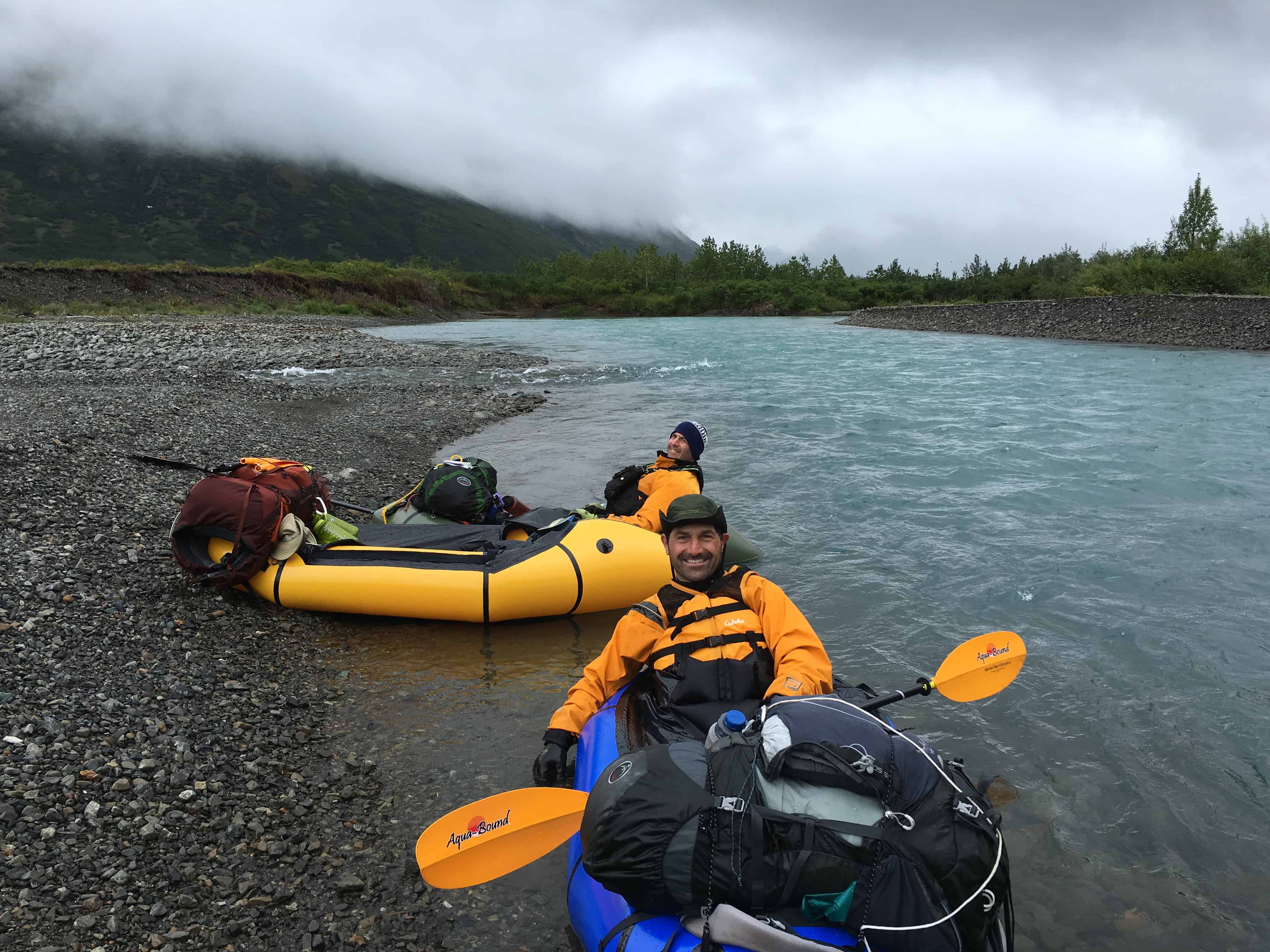
Morry Steinbach, Vince Jajuga, and I completed a trip packrafting Southwest Alaska from Heart Lake in Togiak National Wildlife Refuge to Tikchik Lake in Wood-Tikchik State Park from July 29-August 5, 2016. We ran Milk Creek, paddled Chikuminuk Lake, and backpacked into the Tikchik River which we floated to Tikchik Lake. We covered approximately 82 miles (132.0 km) total over seven days of packrafting and backpacking.
Hiking the Ottawa-Temiskaming Highland Trail, one of Ontario’s gems – is not without its challenges. Leanne tells us about its rewards, too.
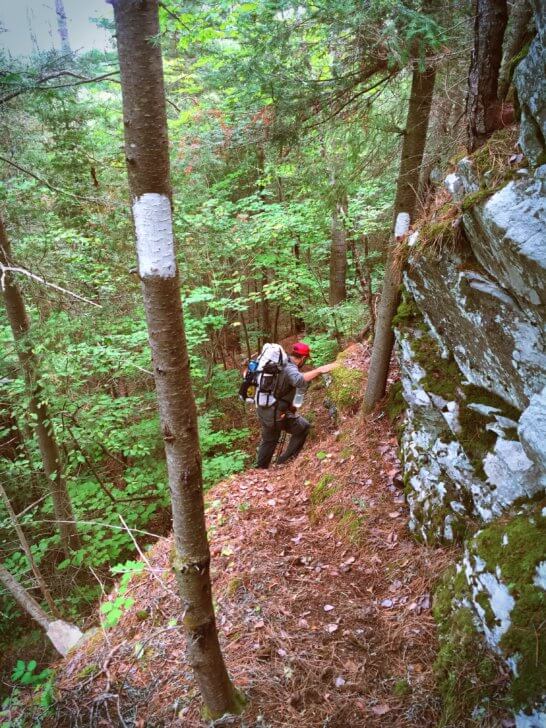
The Ottawa-Temiskaming Highland Trail is one of Ontario’s best-kept secrets. It is at once more rugged than the LaCloche-Silhouette Trail in Killarney Provincial Park, more challenging than the most difficult sections of the Bruce Trail, and harder than both of the Lake Superior Coastal Trails we have done. Also, I think it may be the most challenging trail in Ontario. It offers those who would brave it a real wilderness experience: few road access points; miles of overgrown trail that follow through plants and vegetation higher than your waist; dozens of downed trees requiring bushwhacking; and relentless, unforgiving, almost vertical, climbs.
As we followed various parts of the trail, I wasn’t sure if ravenous velociraptors would greet us, or smiling Hobbits offering to share Second Breakfast. I rated the wildness factor somewhere between the jungles of Jurassic Park and the forests in the Fellowship of the Ring. It was untamed and much less traveled than any other trail in Ontario. However, the blazes are close together and easy to spot.
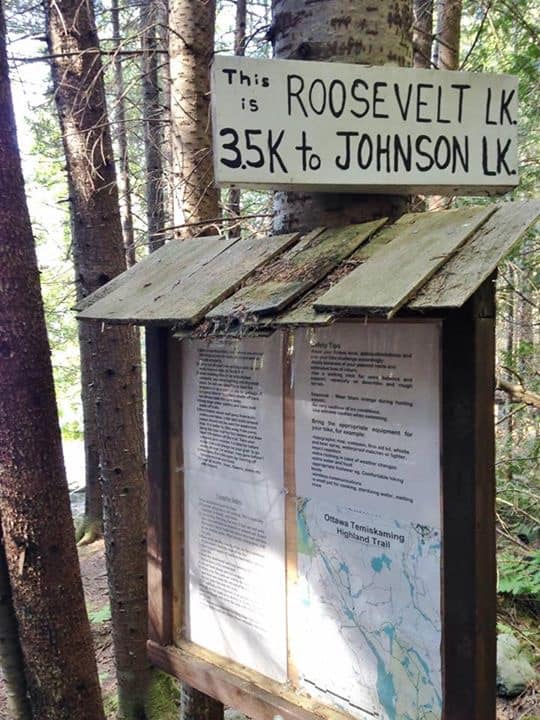
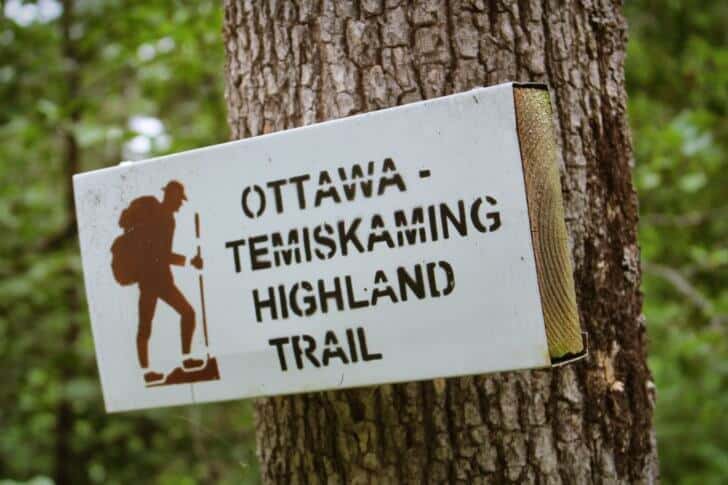
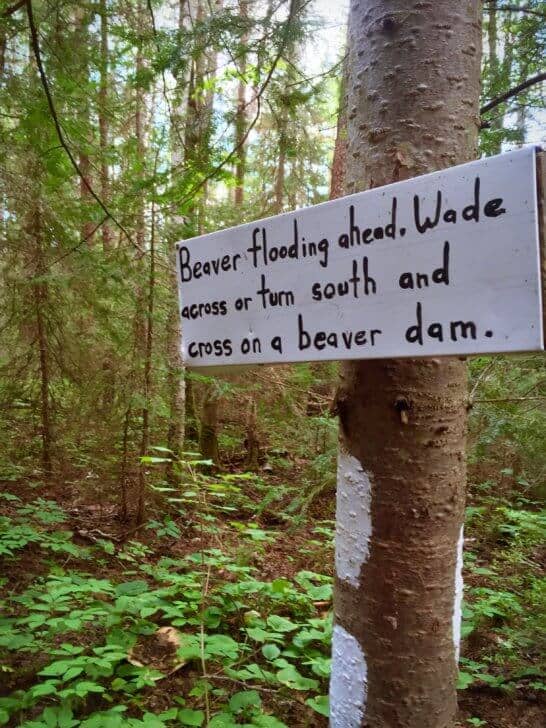
Hand painted sign on the trail.
The trail traverses through the wilderness area known as Temagami, Ontario, and follows the shoreline of Lake Temiskaming and the Ottawa River. Also, Temagami is a rather loosely defined area which includes a network of provincial parks, conservation reserves, crown land, and over 1491.2 mi (2400 m) of interconnected canoe routes and hiking trails.
Incidentally, the area, together with the Lake Temiskaming and Ottawa River system, was home to the First Nations people who trace their settlement back 6000 years ago and was later home to European explorers, traders, loggers, hunters, trappers, prospectors, and coureur des bois. Rich in human history and heritage, Temagami has become a world-class destination for hikers, canoeists, kayakers, and other outdoor adventurers seeking a true wilderness experience. Geologically diverse, the area has many of Ontario’s highest ridges and oldest growth pines. We determined to make our journey, aware of the area’s rugged quality and beauty of the ancient, old growth pines that hold the secrets of generations and the pristine, crystal clear lakes that are, for the most part, untouched by man.
Nastawgan Trails, a non-profit charitable organization incorporated in 2000, led by Murray and Vicki Muir, had the idea for this trail and it is their work that led to its creation. Working in conjunction with the Ministry of Natural Resources, Ontario Parks, and local citizens, their mission was to “plan, establish, maintain and promote a four season non-motorized trail network… to make the Temiskaming area a world class recreational tourism destination.” Nastawgan is the Ojibwa word for “traditional travel routes” developed by the First Nation people thousands of years ago.
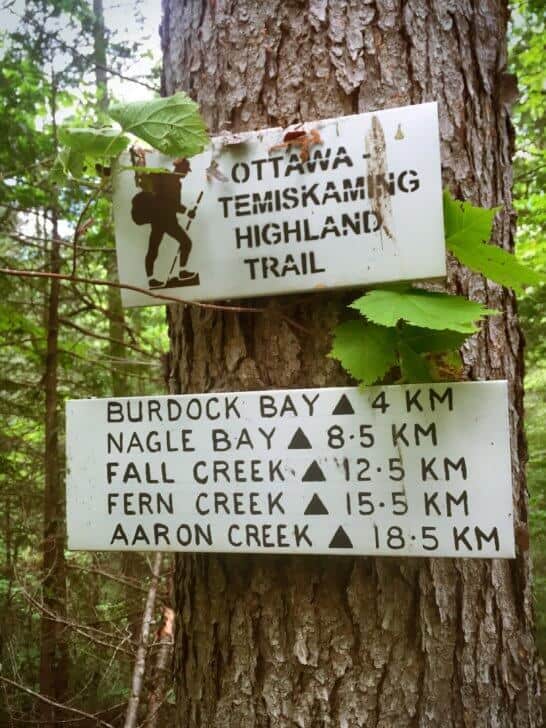
To a large extent, these routes still exist and are used today. Murray and many volunteers work tirelessly to clear and mark the trail. There are hand painted signs with distances to the next campsites that add to the charm and sense of seclusion of the trail. Accordingly, guides facilitate the use of the trail through scheduled section hikes in what is clearly a labor of love for Murray and his team.
Our first exposure to the Ottawa-Temiskaming Highland Trail was a four-day, “out and back” hike of a section of the trail in August of 2015. We hiked from the northern terminus at Latchford, Ontario to Friday Lake. Consequently, the purpose of this short trip was two-fold. We wanted to use the challenging terrain as training for our upcoming trip along the Lake Superior Coastal Trail in Pukaskwa National Park later that summer. Also, we wanted to get a preview of the trail for our 2016 plan to hike the full length of the trail (which is the subject of this article). As you might expect, the trip from 2015 is a separate adventure on its own, but I wanted to share the story of our first day on the trail from that time.
Ottawa-Temiskaming Highland Trail, August 2015: Day 1, Latchford to Roosevelt Lake
Tirelessly, we were slogging through some thick overgrown sections of the trail and Stephen was about 10 ft (3 m) ahead of me. All of a sudden he stopped and I heard him say something. I thought he was talking to himself.
“@#%$! Something just bit me, right under my shirt!”
“What?” I said, coming up to where he was now standing still.
He was pulling his shirt away from his body and looking at his belly. “Something bit me, hard!”
How on earth could something get under your shirt and bite you, I silently wondered. Also, I thought men are such babies sometimes. Really, they do exaggerate and have no concept of real pain and oh my God, get over it already. We ARE in the backcountry …
And then I felt an excruciating, piercing jolt of pain on my inner right elbow. Then another one on the side of my right breast. And two more on my right calf….
Confused, I looked down at my breast and saw a big black bug the size of a quarter biting right through my shirt and bra. As you might expect, I screamed and tried to brush it off. It came right back. I looked in horror at my other wounds and saw three more giant creatures feasting on my flesh. I tried to swat at the one at my elbow. And then in some weird slow-motion moment, all sensation and awareness ceased. My brain objectively studied these creatures and saw that they had wings. And the wings seemed to have spots. And they were eating me. Alive. I was standing there, unable to do anything about it.
“Run!” The word brought me back to awareness. “Run,” Stephen shouted at me.
Clumsily tripping over my poles in my haste, I ran down the trail and Stephen followed. We ran for about 1000 ft (300 m) before we stopped. Thankfully, the flies did not follow us.
“It hurts Stephen! Holy @#$%, it hurts so much,” I said, with tears springing to my eyes. “What were they?”
“I’m not sure,” he replied, as he grabbed his First Aid kit. Rubbing Afterbite on the affected areas provided some relief, but already the bites were turning red and swelling in a 1-inch (2.5 cm) radius around the bite. Also, although we didn’t see any stingers in our skin, we couldn’t decide if we had walked into some wasps’ nest or if they were something else. After a few minutes’ rest and regaining our composure, we set off on the trail again. We resolved to add some anti-histamines to our kit for the next trip.
Once home, we were able to determine that they were horseflies. I knew both from my memory of what they looked like and pictures of the bite marks found on the internet. As we realized now, they are actual predators that bite and suck blood, members of the family Tabanidae.
Horseflies hunt in groups of 4 or 5 (this is the exact number that attacked us) and are most active in hot, humid weather, and areas like the damp, overgrown, old growth forests of Temagami. With six different mouth parts built for cutting, tearing, and piercing, and jaws built like scissors, female horseflies rip into human and other mammalian flesh to find protein in blood that they need to produce eggs. As you might guess, it was horrifying to see these parts enlarged in pictures on the internet. They looked like medieval torture implements. No wonder the pain was so intense. We called them demon spawn.
The taxonomic classification system in biology lists horseflies as follows:
Kingdom: Animalia
Phylum: Arthropoda
Class: Insecta
Order: Diptera
Family: Tabanidae
Genus: Tabanus
Also, I think they are blood sucking spawn, man-eating, pain-inflicting, ferocious predators – the species? Horseflies.
With the memory of the pain receding, we continued for a few more hours until we reached our campsite for the evening at Roosevelt Lake. We couldn’t put our gear down and get our shoes off fast enough to get into the lake. As our bodies were made new again with the cold refreshing waters, the day’s efforts were soon forgotten.
A half an hour later, we hung our wet clothes on the clothesline, and we set up the tent. It was time to eat. I arranged our sleeping bags and inflated the pads in the tent while Stephen got dinner ready. Then, I heard him call out.
“Um, Leanne, we’ve got company!”
“Yay!” I thought to myself, imagining some hikers coming down the trail. “Someone to talk to!” Carefully, I crawled out of the tent and headed towards where Stephen was getting the food ready, about 20 ft (6 m) away. Suddenly, I saw Stephen grab something and walk briskly to the lake. I heard the BANG just as I saw them: 2 black bear cubs and a mama bear. They had just climbed down a tree about 20 ft (6 m) away and were headed in our direction, but the bear banger scared them. They scampered off into the bush in the opposite direction. As you might imagine, I was thankful that Stephen had the foresight even in a moment of panic to walk to the water’s edge and release the bear banger over the lake where the reverberation made the sound much louder than it was.
Also, we didn’t know if the bears had been up in the tree all along from the time of our arrival and watched us swim, or if they silently climbed while we were busy setting up camp after our swim. Either way, we decided it would be wise to make a lot more noise when we arrived at sites and to do a quick scan of nearby trees.
The rest of the evening passed uneventfully. As the sun began its slow descent across the lake, we were in awe of the peace that began to extend through the valley and gently settle our souls.
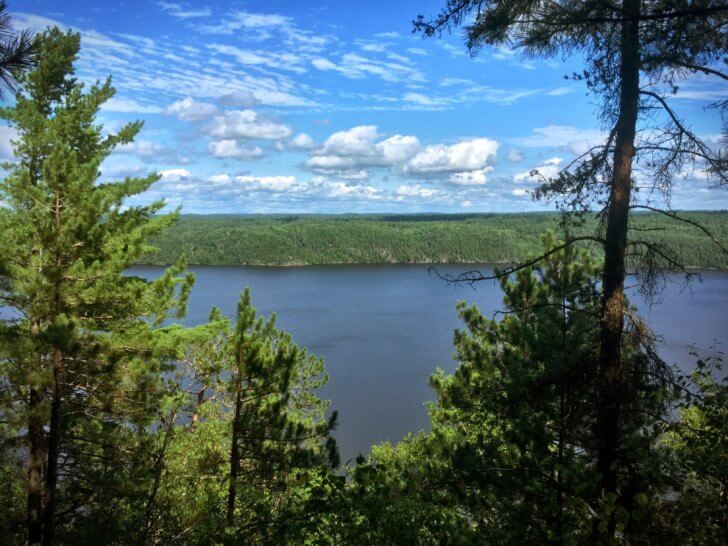
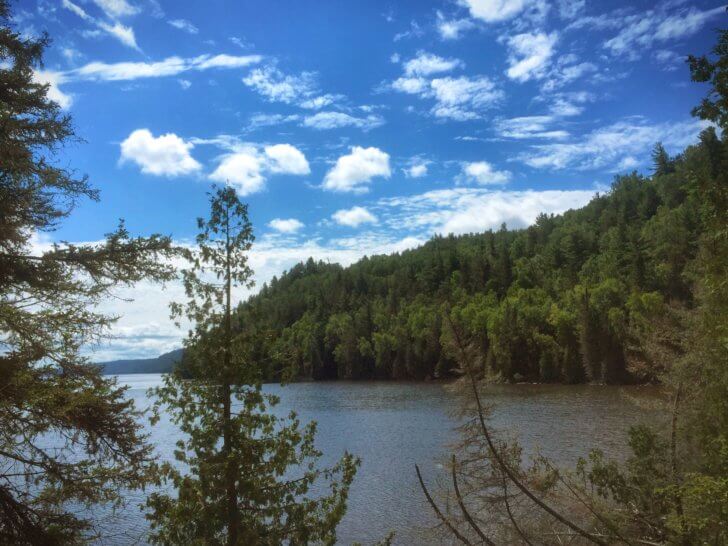
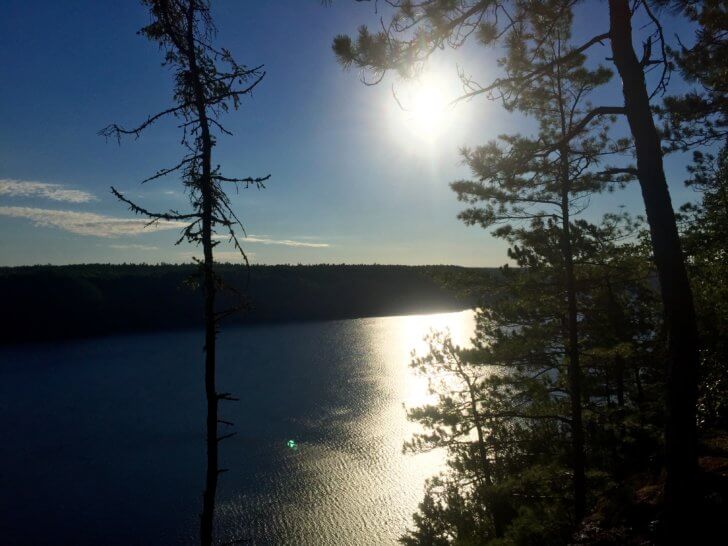
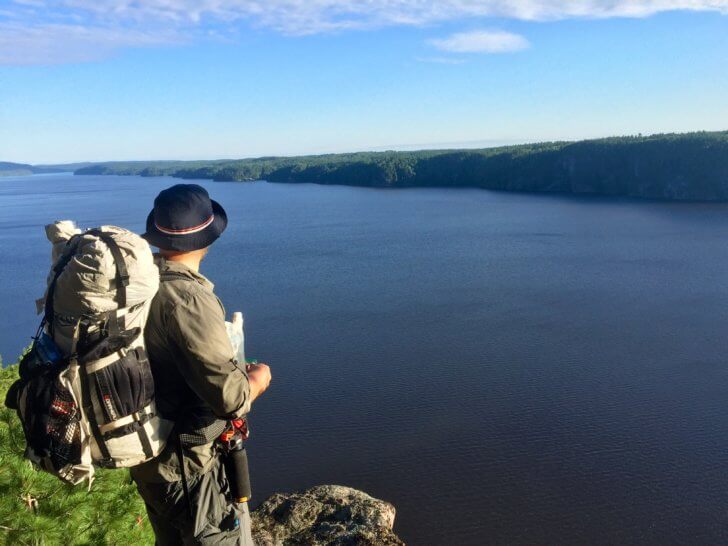
The hand-painted signs add to the feeling of isolation and seclusion out on the trail.The view overlooking Temagami’s vast wilderness from Singing Pine Lookout.
Follow me to August 2016, and our trip on the rest of the trail. Here are some high-level statistics regarding the journey:
Eight days total length (self-supported, no re-supply; approximately 30-35 lbs [13.6-15.9 kg] packs) although we had prepared for a total of 10 days as a precaution (food and time);
75 mi (120 km) total distance;
19,730 ft (6014 m) total elevation gain;
19,127 ft (5830 m) total elevation loss;
8 hours average hiking each day.
The 2016 Expedition
Day 1: Thorne to Unknown
Distance: 9.5 mi (15.32 km)
Elevation Gain: 868 ft (265 m)
Elevation Loss: 452 ft (138 m)
On the 22nd, we left early at 4:30 AM to begin the 5-hour drive from Toronto to Temagami, Ontario. Our plan was to meet our shuttle driver, Doug Adams of Northland Paradise Lodge, in Temagami at 10:00 a.m. He then shuttled us to the southern terminus of the trail at Thorne, Ontario, another 2-hour drive from the lodge. Thorne is a small community of about 300 people located just across the Ottawa River from Témiscaming, Quebec.
Our arrival was a bit delayed due to construction traffic just south of Temagami on Highway 11. When we arrived, Doug and his wife, Marge welcomed us. I must pause here, and tell you about Doug. Doug is a larger-than-life, rough and tumble, old-school survivalist. As owner/operator of Northland Paradise Lodge for over 30 years, he has many tales to tell. He can clean a fish in under a minute and cut and package a moose in thirty. He’s had a trap line for 30 years and in that time, has not once bought meat from a grocery store.
Also, he’s an accomplished photographer who takes his camera wherever he goes. As Doug explains, even during a 5-minute drive, the perfect “photo op” could present itself: a bear, a 12 point buck, a lynx, a moose, etc. Stunning photographs line the walls of his lodge.
Also, you can add Environmentalist to the list of Doug’s accomplishments. About twenty years ago, he single-handedly galvanized the support of locals, First Nations, and the town council when the Ministry of Natural Resources (MNR) decided to clearcut an old growth forest adjacent to his property. This decision was around the time that Bob Rae, the former Premier of Ontario, and other activists, chained themselves to bulldozers to protest and stop the clearcutting of the old growth forests in Temagami.
Thanks to Doug’s efforts, a 2,000-acre ancient ecosystem of giant red and white pines up to 5 ft (1.5 m) in diameter, and a variety of at least twenty-five different species of rare northern orchids attained protection. Not only did he save the area, but he also researched the history of the forest and suggested a name honoring the First Nations’ presence in this area. Today, it is known as The White Bear Old Growth Forest.
Finally, we arrived at Thorne, armed only with handwritten directions for this first section of the trail, as it was just newly opened and there was as of that date, no map ready for this part. Unfortunately, the GPS coordinates on the website gave us trouble prior to the trip and we could not get them to download successfully. We even called the IT specialist for the website but were still unable to download them. As it happened, about two days after we returned they downloaded without issue.
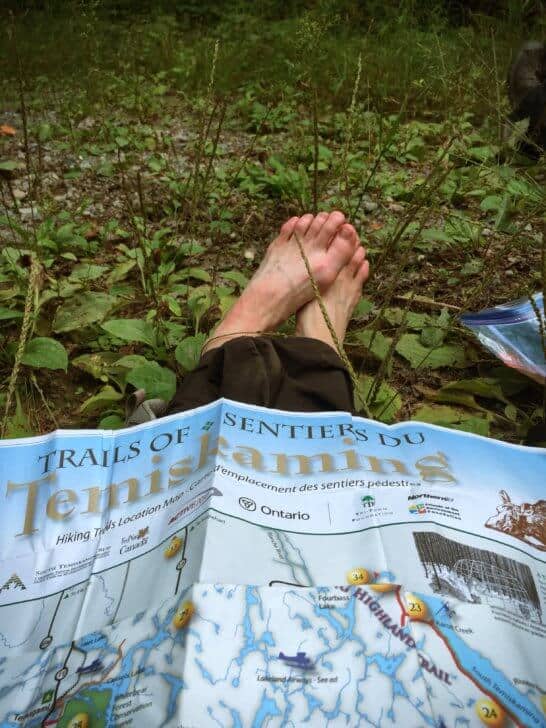
Doug was on the Board of Directors for Nastawgan Trails and had procured the directions for us. We knew from our experience the previous year from the northern terminus at Latchford that the trail was exceptionally well-blazed. The Ministry of Natural Resources would not allow signage on their lands, so we only had the handwritten directions. Also, we had maps for all the other sections.
Many thanks to Doug for confirming our pick up point at Friday Lake eight days later. We set off from the Nurse’s station in Thorne about 1:00 PM. As expected, following the handwritten directions to find the trail proved challenging initially. There were several ATV trails and MNR roads crisscrossing throughout the area. Also, we followed what we thought was the right course according to the note. Within the first 1.5 miles (2 km), we encountered a significant stream crossing ad decided to cautiously pass by Giant Hogweed on our left and right. Trying to give the noxious weed enough room, we were careful to not brush up against it as the photo-reactive sap can cause intense burns and blistering.
Eventually, we came to the road described in the directions and followed it until we came to a stream with a bridge that had been removed. We walked through the creek and up and over the embankment. The road continued as far as the eye could see. Unfortunately, we began to fear we had missed the trail somehow and backtracked to follow the road in the opposite direction. After walking 3.5 miles (6 km), and not seeing any sign of trail, we thought maybe the original path was right, and we had just not gone far enough to see where the trail started.
So we decided to double back. But by now it was close to 6 PM, and we were hungry, worried, and frustrated. It was time to think about where to camp for the evening. With dashed spirits, we decided to camp on a Ministry of Natural Resources side road where there was a clearing in the forest and a fire pit. Apparently, Ministry of Natural Resources staff had camped here, and it was disappointing to see the condition of the site. Unfortunately, garbage and propane stove tanks littered the area.
This photo demonstrates what being lost looks like.
We had supper and set up camp for the night. Our game plan for the next day was to continue down the road, and if we did not find the trail by the end of the day tomorrow, we would have to call Doug and get him to take us to another access point.
Day 2: Lost as Hell to Ottertail Creek
Distance: 9.3 mi (15.07 km)
Elevation Gain: 1419 ft (433 m)
Elevation Loss: 1868 ft (569 m)
We arose early with determined spirits to find the trail and finally get this trip started. After a quick breakfast, we broke camp and headed back out to the Ministry of Natural Resources road around 7:15 AM. We thought that the trail would branch off the road if we just went far enough. If we didn’t see it, we had a good sense that the Ministry of Natural Resources road would lead us to a county road. Ideally, we could then get our bearings.
Approximately, a half an hour later we came to a main road. This scenario made us happy, as we thought that we were on McLaren Road. Although there was no sign on the road itself, we thought that it would be a 3 or 4 mile (5 or 6 km) walk to another access point at Ottertail Creek. Consequently, we decided to flag down the next car that drove by just to make sure we were on the road we thought we were.
Fortunately, within 5 minutes, a pick-up truck came up the road, and we flagged it down. We said, “Hi there!” “We seem to be a bit lost. Could you please tell us what road this is?” “Oh sure,” said a friendly grandfatherly figure. “This is McConnell road.” Oh. Not what we thought at all. We asked, “Does this road take you to McLaren road? How far is it?” He replied, “Um, yeah, but oh geez, it’s about 18.5 m (30 km).”
I’m sure our jaws hit the ground. We looked at each other. Unfortunately, we had gone the wrong way and were much farther west than we thought. “Well, have we passed Emerald Lake?” we asked. We knew that Emerald Lake was near the access point at Ottertail Creek. He replied, “Nope. That’s where we’re going fishing.” We must have looked stunned. He continued, “Do you want a ride? We could take you to Emerald Lake.”
Now, I have never hitchhiked in my life, ever. Uh-uh. No way. Too dangerous. It’s a good way to get yourself killed, dismembered, or to go missing.
Stephen looked at me. I could see a grandmotherly figure and a young grandson, maybe eight years old, in the cab. Without hesitation, I smiled and said, “That would be so great. We’re so lost, and it would take us all day to walk there.” And with that, he moved aside the fishing gear in the back of the truck and cleared room for us to sit. Happily, we tossed our packs in and then hopped in ourselves.
A long bumpy ride later, we saw the sign for Emerald Lake, and we pulled over to the side of the road.
For a split second, I thought, ok this is it. This is where we’re going to get dismembered.
The driver came around to the back of the truck and said, “Well, you know it’s only another 10 kilometers to Ottertail Creek. Would you like us to take you all the way?”
We smiled and said, “Well, if it’s not too much trouble that would be great!”
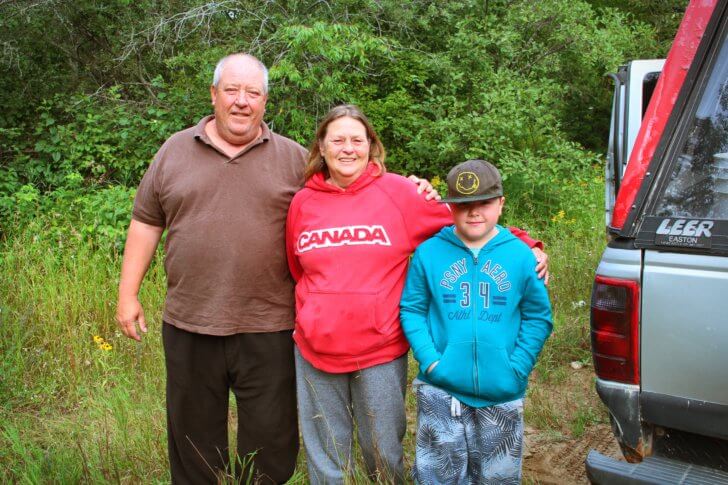
And 15 minutes later they let us out at Ottertail Creek. It turns out that Randy and his wife Louise were taking their grandson, Ryan, fishing. Fortunately, they were nice people, not killers lurking on the back roads waiting for lost hikers. As you may have guessed, we thanked them profusely as they saved us a day of walking. We had read about Trail Angels on the Pacific Coast and Appalachian Trails, but we didn’t know they existed so far to the north. These lovely people were our Trail Angels. We tried to give them gas money, but they would not hear of it.
Our Trail Angels: Randy, Louise, and Ryan.
So with handshakes and many thanks, our Trail Angels returned down the road back to Emerald Lake. We turned to the map once more. It appeared the trail would pick up about 3 miles (5 km) down an ATV trail where McLaren road branched off. With buoyed spirits, we set off again.
After walking about 3 miles (5 km), we still had not found the access point. Once again we second-guessed ourselves and turned around, thinking we were wrong or had missed the trail. The map was clear that it should have been there. We had backtracked for almost 2 miles (3 km) when Stephen abruptly said, “No. This is stupid. It has to be the other way; we just didn’t go far enough. There’s no other way it could be according to the map.” So once again we turned around and this time, went a bit farther. We could hear a stream flowing, and we saw white blazes on the trees across the river. HALLELUJAH!
Never in our lives have we ever been so happy to see trail blazes. And then, the sign. The trail sign. We crossed the river at a dry spot and stopped for lunch before picking up the trail. Now we could finally start this trip, after falling behind schedule by a day.
Crossing the river bed to pick up the trail at Ottertail Creek.
The afternoon saw us following along a gorge with beautiful waterfalls and dense overgrowth lining the path. At this point, we didn’t care what condition the trail was in as long as we had blazes to follow, and we could readily discern them from this point on.
Eventually, we came to our first campsite where Ottertail Creek emptied into the Ottawa River. It had a small sandy beach and a view of the river with Quebec on the other side. With thanks to Trail Angels, we set up camp for the night.
Looking out across the Ottawa River. The Quebec wilderness is on the far side.Our private beach at the campsite where Ottertail Creek meets the Ottawa River.
Day 3: Ottertail Creek to Not A Creek
Distance: 8.5 mi (13.82 km)
Elevation Gain: 2693 ft (821 m)
Elevation Loss: 2624 ft (800 m)
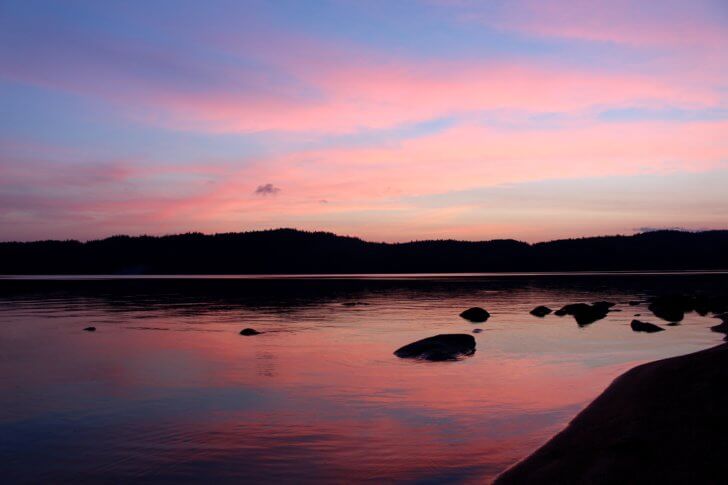
We arose to a lazy sunrise radiating pink and yellow hues up over the Quebec wilderness and into the Ottawa River valley. Breakfast on the beach was muggy and sticky. We knew it was going to be a hot one.
Looking north on the Ottawa River from Ottertail Creek campsite.The pink sunrise gave way to a soft golden glow as the sun rose over the Quebec wilderness.An early pink sunrise fills the Ottawa River Valley.
We started out at 7 AM, and before long, we were soaking wet with sweat. With the humidex, it must have been 104º F (40 ºC). Consequently, we didn’t know it but we would spend the next four days soaked, either from sweat or rain.
Walking through a dense section of forest, we surprised a marten who did not hear us coming. Slender and agile, he quickly scampered up the tree, but his curiosity got the better of him. He kept stopping to get a better look at us. His face was a cross between a fox with a long slender snout and a cat with tiny triangular ears. He looked cute and cuddly. But I remembered reading somewhere that they are quite vicious. I wondered if he was sizing us up and deciding if he could rip us to shreds with his long sharp claws.
We continued. Unfortunately, the combination of the relentless ups and downs of the valley and the humidity caused us to drink more water than we had anticipated. Our hydration bladders held 1.6 qt (1.5 L) each, but we were rapidly drinking it all. Stephen ran out before our next water source.
Maybe it was just a little dehydration delirium (I was trying to be very conservative with my water), but I had visions of our dead, dehydrated bodies being found two years later by some random hikers. I must remember to write in my journal, I thought, how much I love my girls so that when someone finds my body, my girls will know I thought about them near the end.
An inland lake was the perfect spot to have a short break and replenish our water.
Shortly after that, we came across a small inland lake. Exhausted and drenched in sweat, we stopped for a break and to refill our water.
Feeling better, we pressed on through more of the same – up and down and up and down – until we finally came to our campsite. The sign said 984 ft (300 m) to the site – but it was almost vertically straight down a massive hill. Unfortunately, our tired legs reminded us that the descents could be much worse than the ascents in many ways.
Also, this particular campsite looked like it had never seen any campers. With the hill to get down, we could understand why. We set up camp and went for a refreshing dip, clothes and all, in the chilly Ottawa River. We hung a clothesline right on the shore hoping to catch a breeze to dry our clothes, but the humidity was still so intense that they did not dry.
A red shirt hanging on our clothesline caught the attention of a small family fishing on the river. They motored over close to us and told us they had been fishing around there for years and had never seen any campers there. The family didn’t even know it was a campsite. They thought that this location was in the middle of nowhere. Consequently, we had a hard time convincing them we were, in fact, sane, hiking through such humidity, dense forest, and elevation.
As we turned in for the night, tired and sweaty, it began to rain. At least it waited until bedtime.
Day 4: Not-A Creek to Owl Creek
Distance: 9 mi (14.56 km)
Elevation Gain: 4877 ft (1487 m)
Elevation Loss: 4841 ft (1476 m)
A humid morning takes shape on the Ottawa River on the fourth day.
We awoke to another hot, sticky, mug-fest of a day, with wet clothes that did not dry out from the previous day and a wet tent and tarp from rain overnight. We didn’t know it yet, but this day would prove to be the hardest of the trip with a total elevation gain of 4877 ft (1487 m). It WAS the Ottawa River Valley, after all. All we knew was that the steep ups and downs kept coming at us with no relief. Needless to say, they were ubiquitous and relentless. Again, we found ourselves sucking up our water quite rapidly.
We passed through dense forest with damp mossy carpeting on the floor where we found our feet sinking inches into the wet softness. Obviously, there had been inland streams and rocky beds. We bushwhacked through waist-high vegetation and blow downs and marveled at the size of the trees.
We came across some discarded antlers on the trail that appeared well-chewed and gnawed. Shed antlers, we later found out, can be a source of calcium, phosphorus and other minerals in areas where these may be scarce in the soil. Apparently, some small animals, maybe squirrels, rabbits, or mice, had availed themselves of the opportunity.
Later in the afternoon, we both began to feel a bit wobbly-kneed and weak. We had been on the move since 7:00 AM and the combination of extreme humidity and the substantial physical effort on the immense climbs was taking its toll. Fortunately, we stopped for a brief rest and decided to break out the salt pills as a pre-emptive measure before we became further depleted. This determination turned out to be a wise decision and gave us a boost to keep going until our next stop.
The hard physical effort of the ups and downs continued. To distract me, I began singing Tragically Hip songs in my head. The refrains of Wheat Kings slipped in and out of my mind – “Wait and see, what tomorrow brings.” Their final concert in Kingston, Ontario, which we had watched on TV not too long before our trip, kept playing in my mind. I was thinking about how courageous Gord Downie was. If he could battle brain cancer and tour across Canada, I could surely do a few hills.
Before we knew it, we arrived at a site we had identified on the map to have a small break. We immediately dropped everything, stripped down, and jumped into the lake for a refreshing swim. Taking our time to rest a bit, we soaked up the sunshine as some of the oppressive humidity began to lift. Suddenly, a familiar humming noise caught our attention, and to our delight, a shimmery green hummingbird hovered in front of us and looked straight at us for a split second before realizing that my pink shirt hanging on a nearby bush was not a flower full of nectar.
The afternoon we saw more climbs than earlier that morning. We were rewarded for our efforts with some spectacular views of the river. Our campsite for the night was beside the ruins of an old Trapper’s cabin, and we could see the rusted remnants of mattress springs, part of an old stove, and other relics. Sleep came quickly that night despite the heat and also came dreams of a trapper’s life.
A mid-trail peek at the Ottawa River.Dense forest along the trail.
Day 5: Owl Creek to Aaron Creek
Distance: 10 mi. (16.55 km)
Elevation Gain: 2930 ft (893 m)
Elevation Loss: 2963 ft (903 m)
We arose to a promise of a cooler day. The humidity did not seem quite so oppressive. This change in the weather was a welcome relief as we knew we still had some climbing to do. We weren’t out of the valley yet and the map showed us several lookout points. Lookout Points, we began to realize, were really map makers’ code for “Get Ready For One Hell Of A Climb”.
Another stunning morning in the Ottawa River Valley.
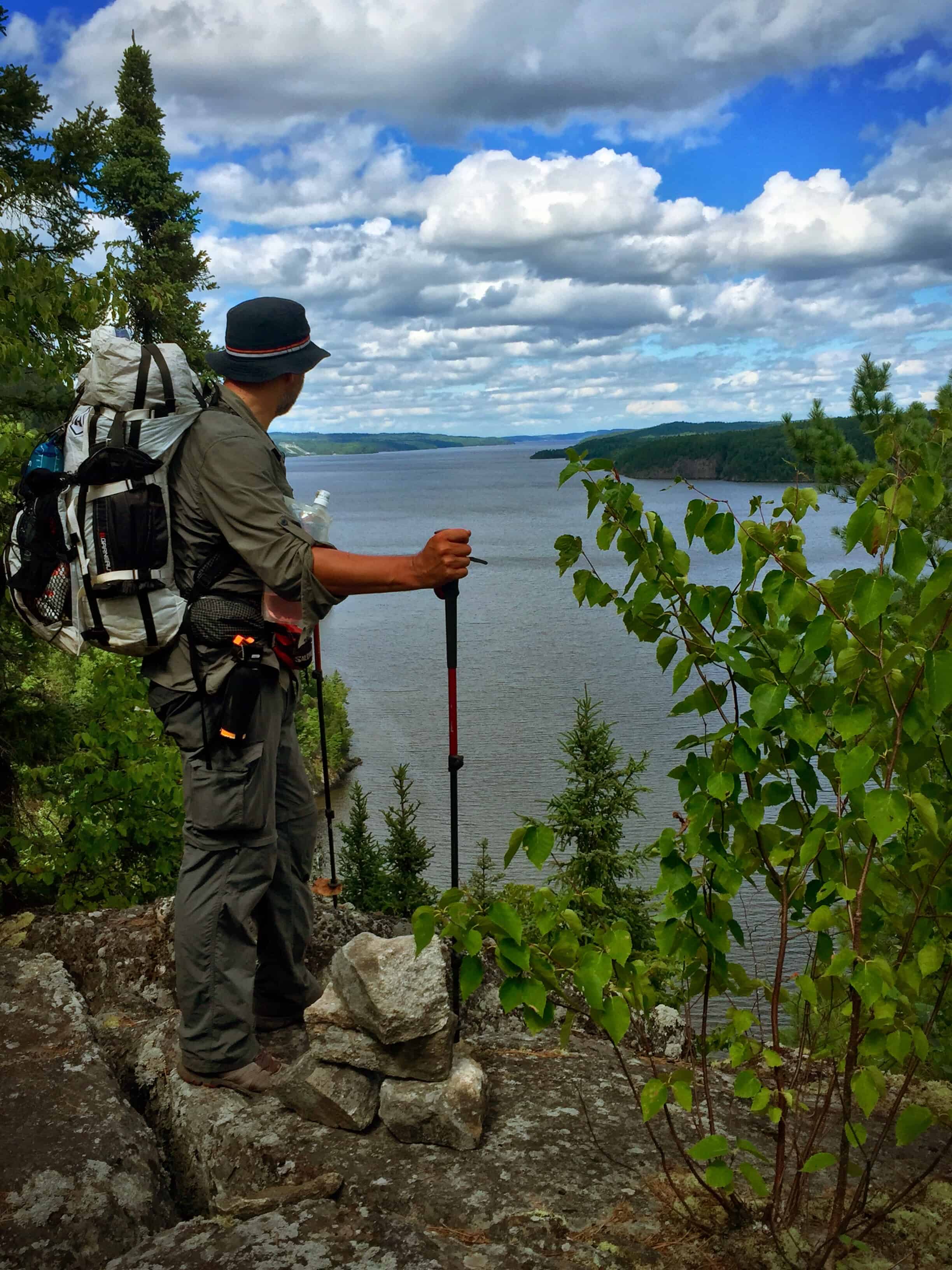
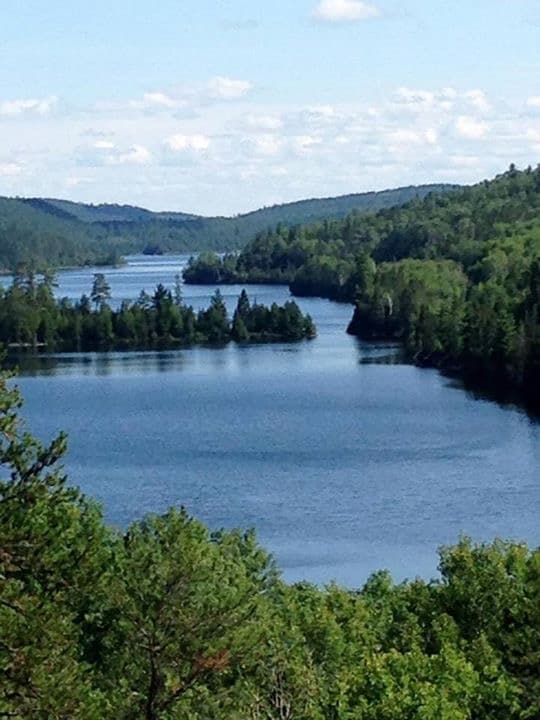
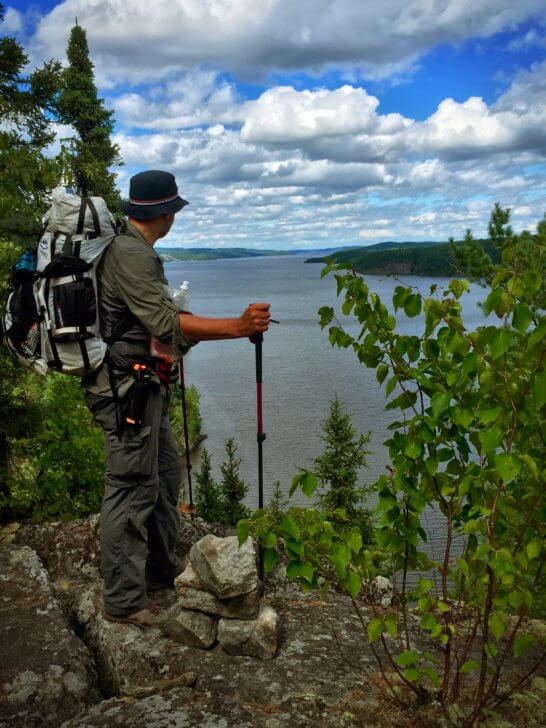
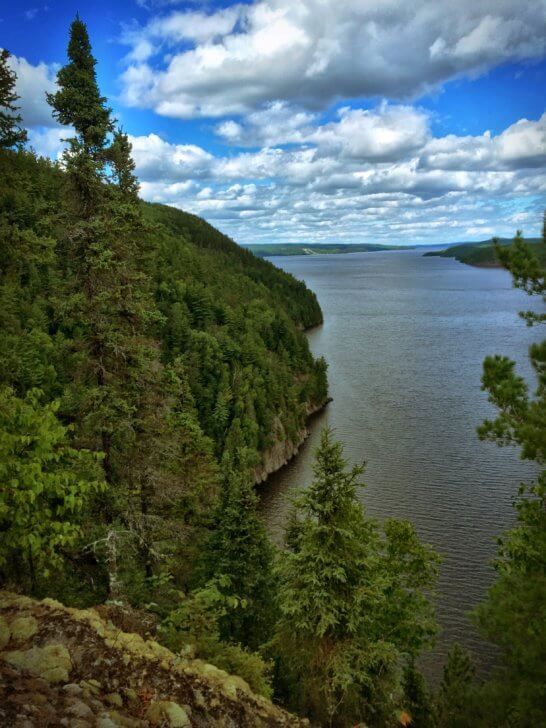
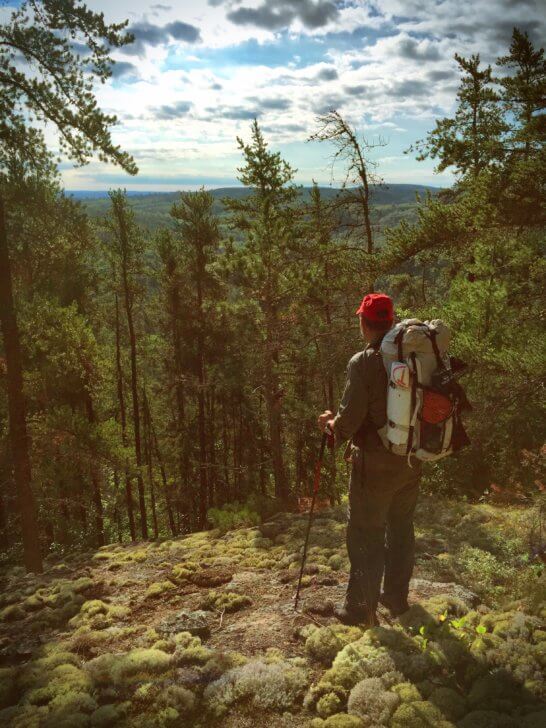
Our first lookout came early in the morning. After some climbing, we came across an area of flat rocks overhanging the valley. This spot was called The Perch. The sun was still rising in the sky to the southeast but looking more north, the view was awe-inspiring. With one glance at the beauty, all the hardships we endured to get to this point seemed small. We became lost in the moment.
The view from The Perch. From this vantage point, the Ottawa River was immense.
The trail headed into the forest again and we immediately encountered a massive hill that took about forty minutes to climb. As we descended, we came across what appeared to be the leg bones of a moose. Doug told us the wolves in the area decimated the beaver and moose populations. We wondered if a wolf had eaten this one.
The afternoon took us to two more spectacular lookouts. At the Guiding Spirit lookout, we paused for a few minutes and enjoyed the silence and solitude, and the view. Stephen asked me if the Spirit was guiding me. “Yes,” I said. “Right to the next campsite!”
Looking out onto the river from Guiding Spirit Lookout.At Guiding Spirit Lookout the rugged nature of the trail proved spectacular.
Our next lookout point was Moose Lookout. Here we could imagine a moose wandering up and pausing to look out over his kingdom. Everything the light touched was his.
Hiking back into the forest once more, Stephen didn’t notice that he had stepped on a wasp’s nest that was right in the middle of the trail. As I approached where he had just stepped, I could hear a growing, buzzing sound and I could see swarms of wasps angrily buzzing around their crushed nest. I avoided them on the trail. Luckily we avoided what could have been a nasty situation.
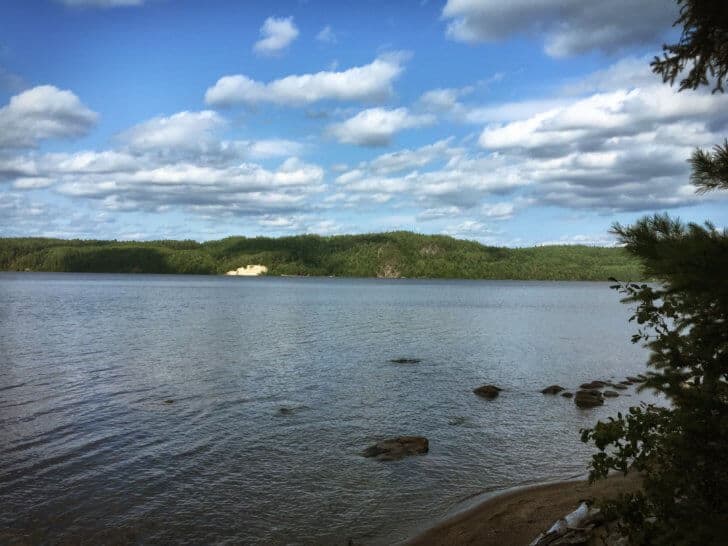
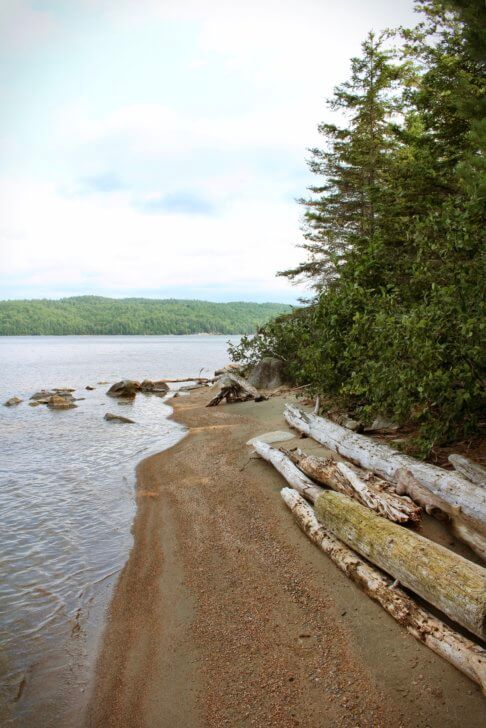
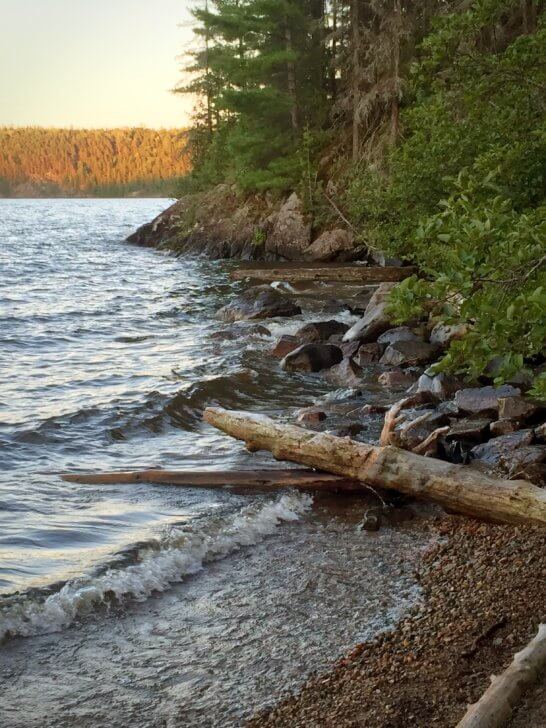
Our campsite for the evening was at Aaron Creek, and it is here that the Ottawa River begins to merge into Lake Temiskaming. We had a beach all to ourselves, strewn with driftwood and dreams.
A rocky beach at Aaron Creek, our campsite on the fifth day.
Day 6: Aaron Creek to Matabitchuan Power Generating Station
Distance: 10 mi (16.28 km)
Elevation Gain: 3188 ft (972 m)
Elevation Loss: 3099 ft (945 m)
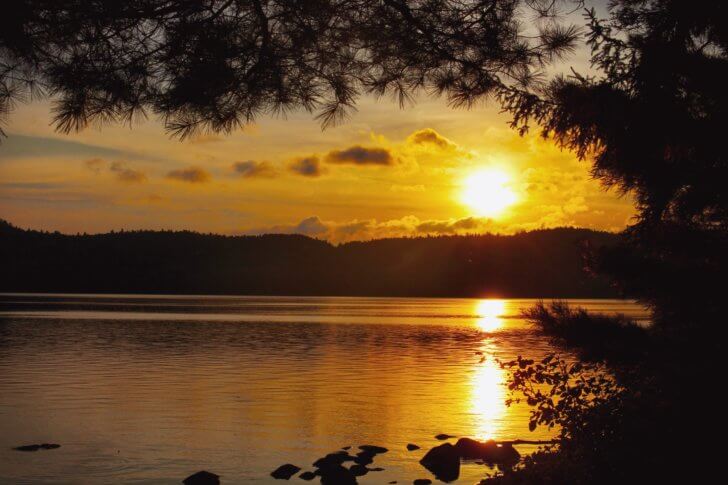
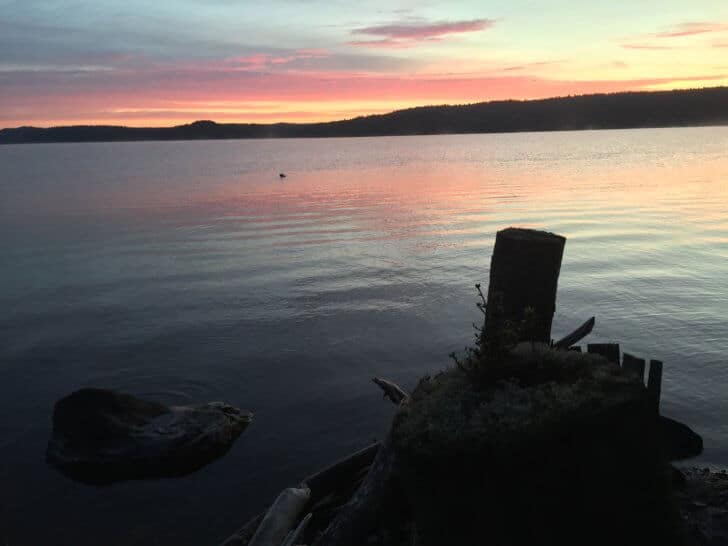
As the sun rises higher over the Quebec wilderness, the valley comes to life.Another pink morning on the Ottawa River at Aaron Creek.
Another beautiful sunrise greeted us on our 6th morning on the trail. Counting the days, we realized that it was Saturday but had no sense of time otherwise. There were no calendar days.
Back on the trail, we began quickly climbing once more. Regarding elevation gain, this was our second highest daily total. The climbs were many and so steep that we shortened our grip on our hiking poles and used them as picks to gain more leverage as we moved upwards. The trail proved ruthless.
We climbed down the trail.Enjoying the view on the trail. Dense forest as far as the eye can see.
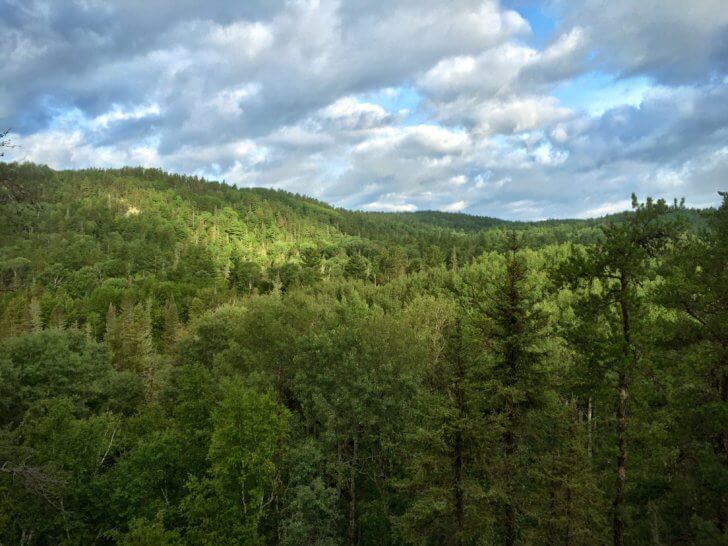
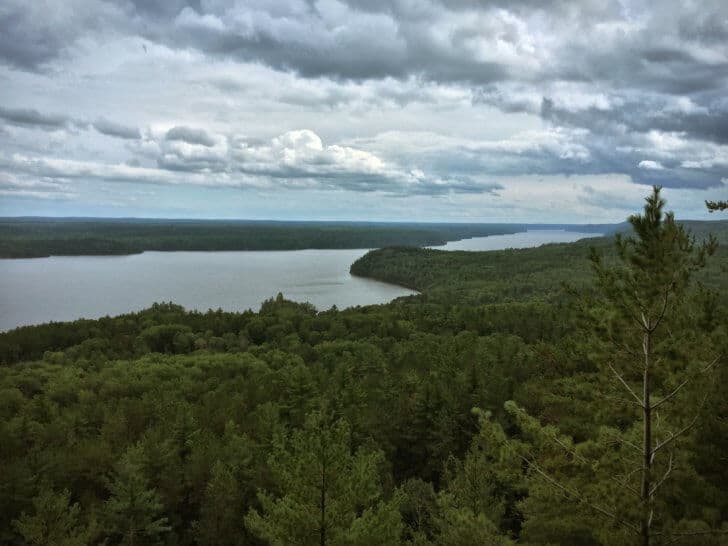
But the climbs, as always on this trail, rewarded us with stunning lookout points. One particularly memorable view was the Ottawa River Lookout. Here you could see where Lake Temiskaming and the Ottawa River merged. It was truly a beautiful sight from this vantage point and gave us a new appreciation for the immense nature of the Ottawa River, Lake Temiskaming, and the wilderness on both the Ontario and Quebec sides.
The view from the Ottawa River Lookout, where the Ottawa River meets Lake Temiskamimg.The view from Jack Pine Lookout.
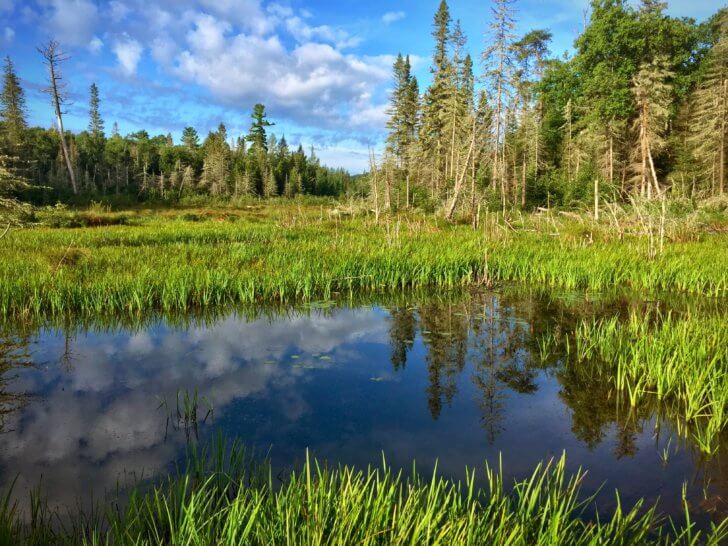
Finally turning inland and leaving the climbs behind, we encountered a beaver dam. Now this wasn’t a regular beaver dam. This was the Hoover Dam of beaver dams. It even had its own sign on the trail. You could either wade through the flooding (shorter, but wet) or go around on the dam. We didn’t know how deep the flooding was so we chose to cross over the dam. It seemed to go on forever; I think it took 20 minutes to cross. Thick vegetation higher than our waist was grasping at our clothes and packs as we walked.
The Hoover Dam of beaver dams coming up.The flooding caused by the beavers.
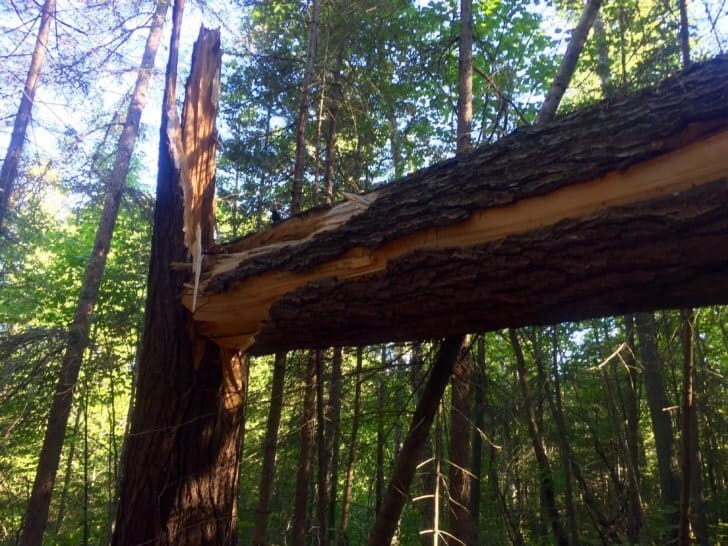
Throughout the trail, we encountered hundreds of blowdowns, requiring us to use various combinations of going around, under, or over the fallen trees. At one point we even broke out the saw to cut away some branches blocking the trail. A little trail maintenance was a small price to pay for that kind of beauty. After arriving home, we learned that there had been a tornado through this particular area of the trail earlier in the season.
Later in the afternoon, we could not find the canoe campsite that was on the map near Beaver Mountain (we later found out it didn’t exist anymore) We decided to push on to Matabitchuan Power Generating station where the map indicated there was an area to camp.
The trail was confusing between Beaver Mountain and the power station, but we eventually found where it continued on the other side of the station. Just as we arrived, it began to rain. We quickly set up our shelter and tarp in a field across from the station hoping to wait it out. Around 7:00 PM it finally stopped raining. It was hot, humid, and buggy, and we were tired and hungry. A little self-inflicted misery crept into our moods. Later, we apologized for what we said when we were tired and hungry.
The rain continued overnight and we were dismayed to find some water had entered the tent. We had carelessly left some gear at the bottom of the tent near our feet that had pushed the bathtub floor of our Zpacks Duplex out past the pitch of the tent roof, allowing water to flow in. This was definitely a lesson learned the hard way as we tried to soak up several large puddles that had gathered at our feet.
Day 7: Matabitchuan Power Station to Gorrie Lake
Distance: 8.5 mi (13.85 km)
Elevation Gain: 2244 ft (684 m)
Elevation Loss: 1696 ft (517 m)
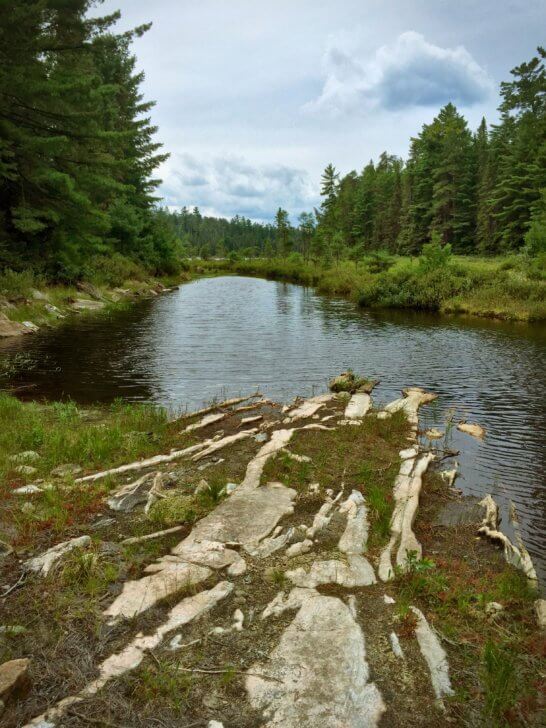
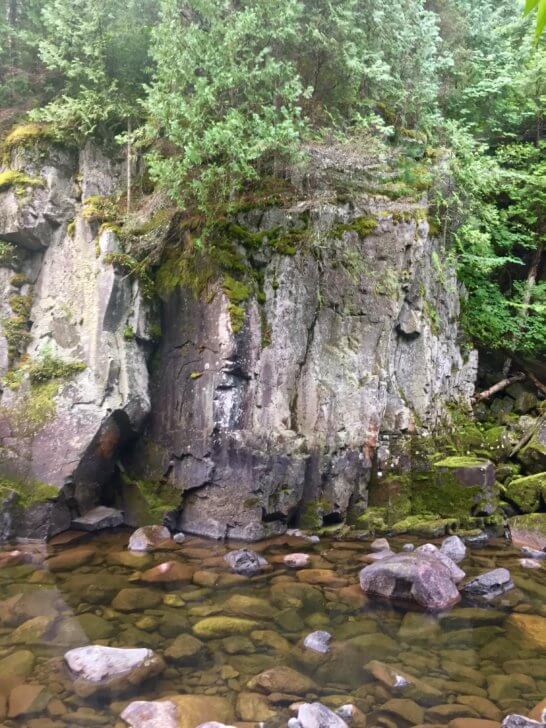
We packed up the wet gear on an overcast, misty morning and picked up the trail at the mouth of the Matabitchuan River. We soon forgot the previous night’s misery as the beauty of the river revealed itself. Rocky, tree-lined cliffs edged the Matabitchuan, and the trail followed the river closely.
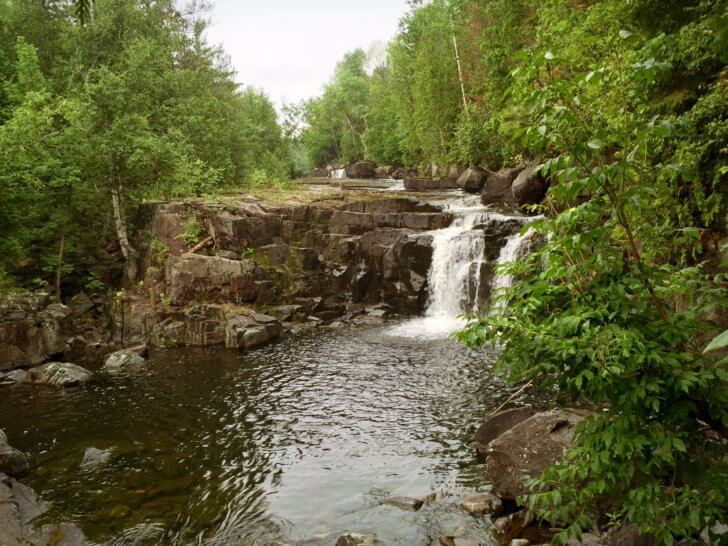
Soon we came to a series of waterfalls cascading over flat rock shelves. A hydro dam, many miles farther down the river, prevented its full force from roaring over the rocks, decreasing the volume of water. Bare rocks between the falls and water flow made it possible to step right into the river bed. We looked at each other and smiled, dropped our packs on the river’s edge, and began to explore. Jumping from rock face to rock face, we walked down the middle of the river bed and enjoyed a view of the falls.
Picking up the trail at the Matabitchuan River.One of the several little waterfalls along the Matabitchuan River.Getting personal with the waterfalls.Walking along the river bed.
The trail continued along the river’s edge until we could see the hydro dam in the distance. Here it turned inland and upwards once again. We weren’t done climbing yet. It was still misty, and a light rain fell as we approached a couple of lookout points. Once again, our breath was taken away as we gazed at the beauty before us. Fourbass Lookout was astounding; the lake was expansive and surrounded by vast wilderness.
The view from Fourbass Lookout.A tenacious tree clings to the cliff at Fourbass Lookout.
Making our way down into the valley, we decided to take a small break at Fourbass Lake and try to dry out our wet gear. We hung several clotheslines; everything was wet and needed a good hour to dry out. We were making good time that day and could afford to take a little extra time there. There was a stiff breeze blowing, but it was also still slightly misting. It was hard to discern if the wind was strong enough to overcome the misty rain still blowing. Darker clouds blew in from the north and threatened us with heavier rain.
It was a constant battle which required much vigilance: we had to be ready in a split second to take everything down if the heavier rain fell. The dark clouds moved around the lake and dissipated. We ate lunch and decided it was time to hit the trail again. And, of course, just as we had everything packed up and ready to go, the sun came out, along with blue skies and fluffy clouds, but we could not linger. We hoped that the sunshine would follow us to our next campsite.
Just as we left Fourbass Lake, the sun and blue skies came out.
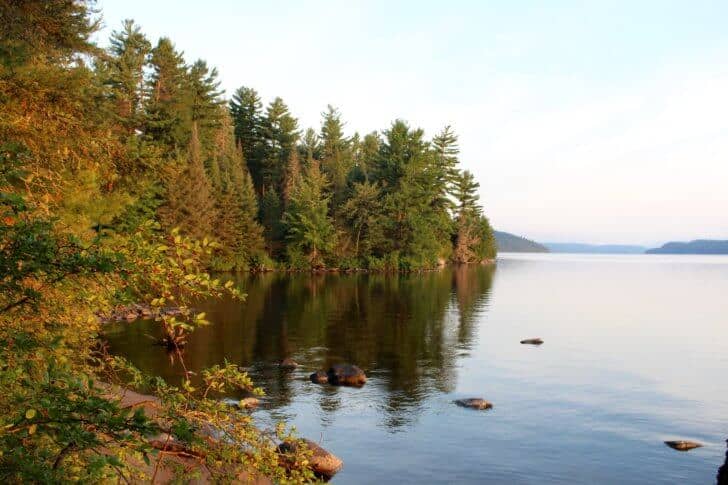
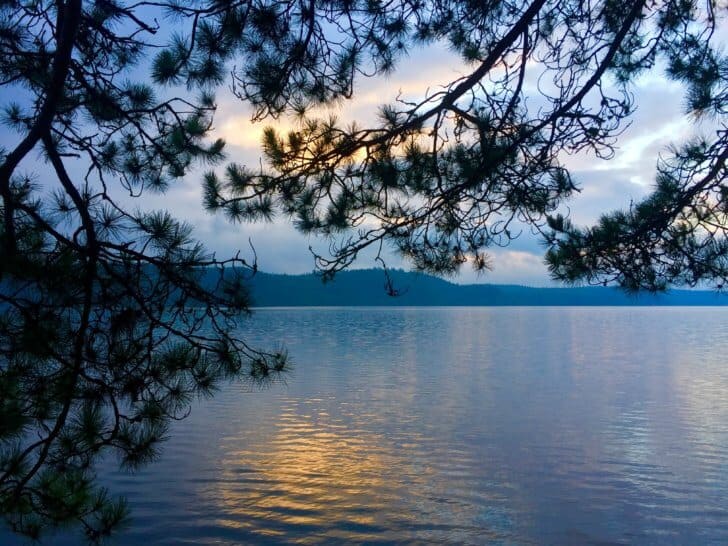
The sun did indeed follow us as we made our way to Gorrie Lake, which was to be our last campsite on the trail. This lake was crystal clear; pristine and untouched by human activity.
Arriving at Gorrie Lake, our last campsite of the trip.The pristine crystal clear water of Gorrie Lake.
We were able to get our wet gear dry and enjoy the warm sunshine on our shoulders.
It was here that I unknowingly walked through poison ivy trying to find a private place to relieve myself. We had been so careful the whole trip and had identified its presence at many other places along the trail. I thought the itchy spots around my ankles were due to bugs or mosquitoes and I didn’t look closely at them. It was only over the next 2 days that I realized what it was.
On the small beach here, I was wading in the water and just taking in the trees, blue sky, and the lake. That familiar humming sound caught my attention and less than 6 inches away from my nose, a hummingbird hovered, looking me in the eye. It soon realized my purple tank top was not a flower and disappeared.
Day 8: Gorrie Lake to Friday Lake
Distance: 9.5 mi (15.17 km)
Elevation Gain: 1511 ft (461 m)
Elevation Loss: 1584 ft (483 m)
We awoke with a certain sadness that always plagues us when we know our trip is coming to an end. Today would be our last day on the trail.
A misty morning sunrise on Gorrie Lake.The early morning mist cleared and revealed a beautiful sunny day as we left Gorrie Lake on our last day.
The early morning fog gave way to warmth, and we set out by 7:00 AM. We passed through some rugged sections of the trail and several small lakes. The climbs were now less intense and not as frequent. The oppressive humidity had lifted, and hot summer temperatures remained.
The gnarly trail heading inland.A beautiful sky and reflection visible as we passed through Snort Lake.
We made good time and decided to stop at Price Lake so I could soak my poison ivy afflicted ankles in the lake. The cool water provided welcome relief for the itchy, irritated blisters. It was here that we met up with the only other hiker we saw on the entire trail: a young man named Andrew soloing from Latchford, the northern terminus, to the Matabitchuan Power Station where friends were picking him up. We chatted with him for quite awhile and he described for us a close encounter of the bear kind. Not to be outdone, we told him our bear story from Roosevelt Lake last season.
The cold waters of Price’s Lake were soothing on my poison ivy afflicted ankles.
We pressed on and upon arriving at Friday Lake, the time seemed to have passed too quickly. The trail was not as rugged and we had made good time. It was the end of our journey and we weren’t quite ready for it. It was time to call Doug, our shuttle driver, to pick us up. Our journey ended here at Friday Lake, even though the trail continued, as we had completed the remainder of the trail to the northern terminus.
At the Lodge, we picked up our car and drove into the local town, Temagami, to perform our two post-trip rituals. The first: the traditional throwing away of the stinky, sweaty, mud covered, swamp infested, never-quite-dried from rain, sweat, and lakes, and beyond-all-hope-of-redemption, trail shoes. Yep. Into a garbage can they went. No amount of washing or laundry detergent could save them.
Our second ritual: ICE CREAM CONES. The most decadent flavor we could find, with cheers of the ice cream to our fantastic trip.
Our customary ice cream cheers at the end of our journey.
That afternoon, we drove to North Bay where we ate and stayed overnight at a hotel. The hot meal, hot shower, and soft bed felt amazing on aching, tired, and hungry bodies.
A few days later at home, we were talking to Murray and Vicki Muir, the founders of the trail. We told them how we could see that the construction of this trail was a labor of love for them and how grateful we were to them for their vision. Vicki mentioned that I was one of about only five women that they know of who have completed the entire trail. A big smile spread across my face. The beauty we had seen and the difficulties we had faced were forever etched in my heart. Despite all of the challenges, we had to overcome over 19,700 feet of total elevation gain, being lost, poison ivy, rain, extreme humidity, dehydration, bushwhacking, scarce water, and missing campsites, I knew that this trip was ultimately wildly successful. Why would I deem it so after all of these difficulties?
It seems to me that these very difficulties are what make a trip worthwhile and memorable. It brings out our best and worst. And learning how to cope with them, and soldiering through, and smiling anyways, makes us both stronger and more humble human beings.
It is facing ourselves in the wilderness; stripped down to nothing except what we carry on our backs, and the strength we carry in our hearts, that brings us closer to who we are meant to be. Through this comes much happiness and great peace. And every single person who finds peace inside themselves makes this world just a little bit better, don’t you think? Besides, what’s an adventure without a little adversity? It all makes for a better story.
“The wild requires that we learn the terrain, nod to all the plants and animals and birds, ford the streams and cross the ridges, and tell a good story when we get home.” – Gary Snyder
Chris Smead, who produces Backpackinglight.com’s “According to Chris” video series, goes through his ultralight video gear.
Join Chris, a BPL member and Amateur Film Maker, as he walks us through this 10-minute video on the ultralight video gear he uses to capture his backpacking adventures. From gear (and how to carry it) to video editing software, Chris talks about what he considers to be the best ultralight video gear. He also shares valuable lessons learned and how to make the most of the images you capture while backpacking. Stay tuned for more “According to Chris” film series here on Backpackinglight.com throughout the year.
This post from the Publisher’s Blog (available to Unlimited Members only) shares results from our Members Podcast Interest Survey, and gives you the inside scoop asking the question: “Is Backpacking Light going to publish a podcast?!”
This post from the Publisher’s Blog (available to Unlimited Members only) offers some comments on the nature of ultralight design and the opportunities that await designers and manufacturers of ultralight gear.
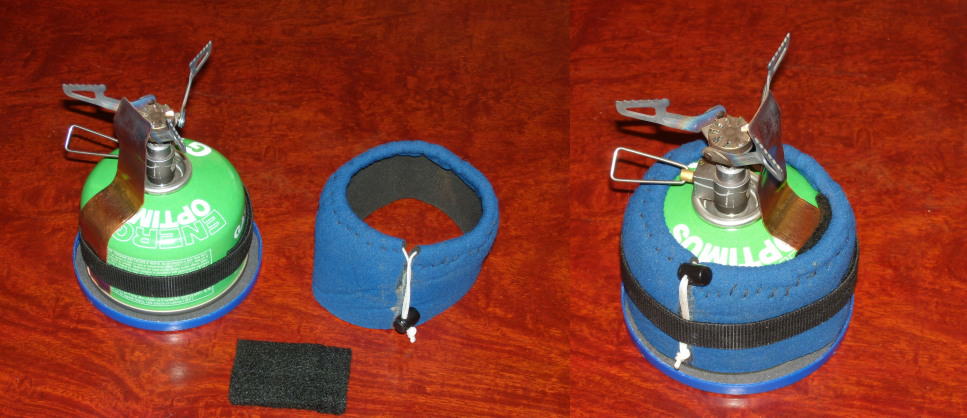
Evaporative heat loss in upright canister stoves extends boiling times and changes fuel mixture composition. Here’s how to combat it.
Introduction
Upright canister stove performance is negatively affected by low temperatures (see The Effect of Cold on Gas Canisters and refer to forum threads here and here). Evaporative cooling is the culprit: as fuel evaporates from a canister when a stove is in operation, the canister temperature drops. This generates a negative feedback loop that then slows down evaporation (More detail about the process is offered in the article The Evolution of a Winter Stove). Evaporative heat loss in upright canister stoves causes extended boiling times and changes in fuel mixture composition that results in the hiker stockpiling partially-filled canisters that are often never used again.
Quantifying evaporative cooling in canister stove systems is the purpose of this article series.
I have measured how the temperature of a canister drops due to evaporative cooling by using an upright canister stove in the cold, covering a number of different parameters including air temperature, canister size, and how full it is. From this, I have determined a simple rule for determining at what minimum air temperature a canister can be used.
I have also measured the temperature for a couple of use case techniques which allow you to operate at air temperatures below freezing.
Finally, I propose a different paradigm for canister stove use, where you carry just as much fuel as you need for a particular trip, such as is done with alcohol, white gas, and Esbit. This lets you eliminate the partially-filled canisters that accumulate after trips.
Test Equipment
I used LM335 Zener diode temperature sensors. They come in the familiar plastic molded TO-92 package with three leads like old style transistors. The third lead is for calibration but I don’t use that; I just calibrate in software. The voltage across the diode is nominally 2.73 Volts at the freezing point of water (~273 Kelvin) and it varies by close to 10 mV per degree C from there. Their biggest error is a scale error around absolute zero so I calibrate that out using the triple point of water. I use a Labjack U3 data logger to read the data into my PC and I use Excel to generate plots and do calculations.
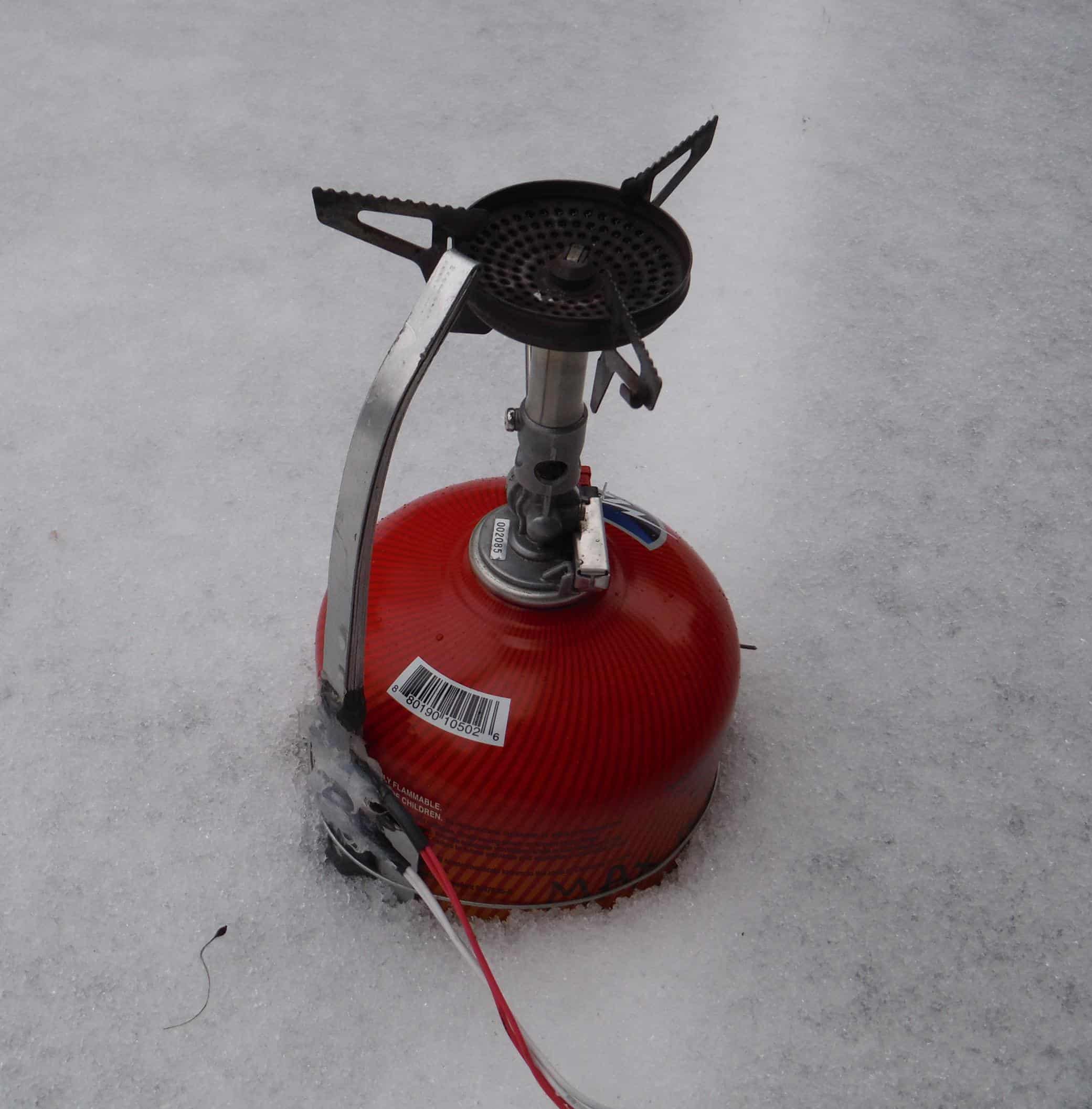
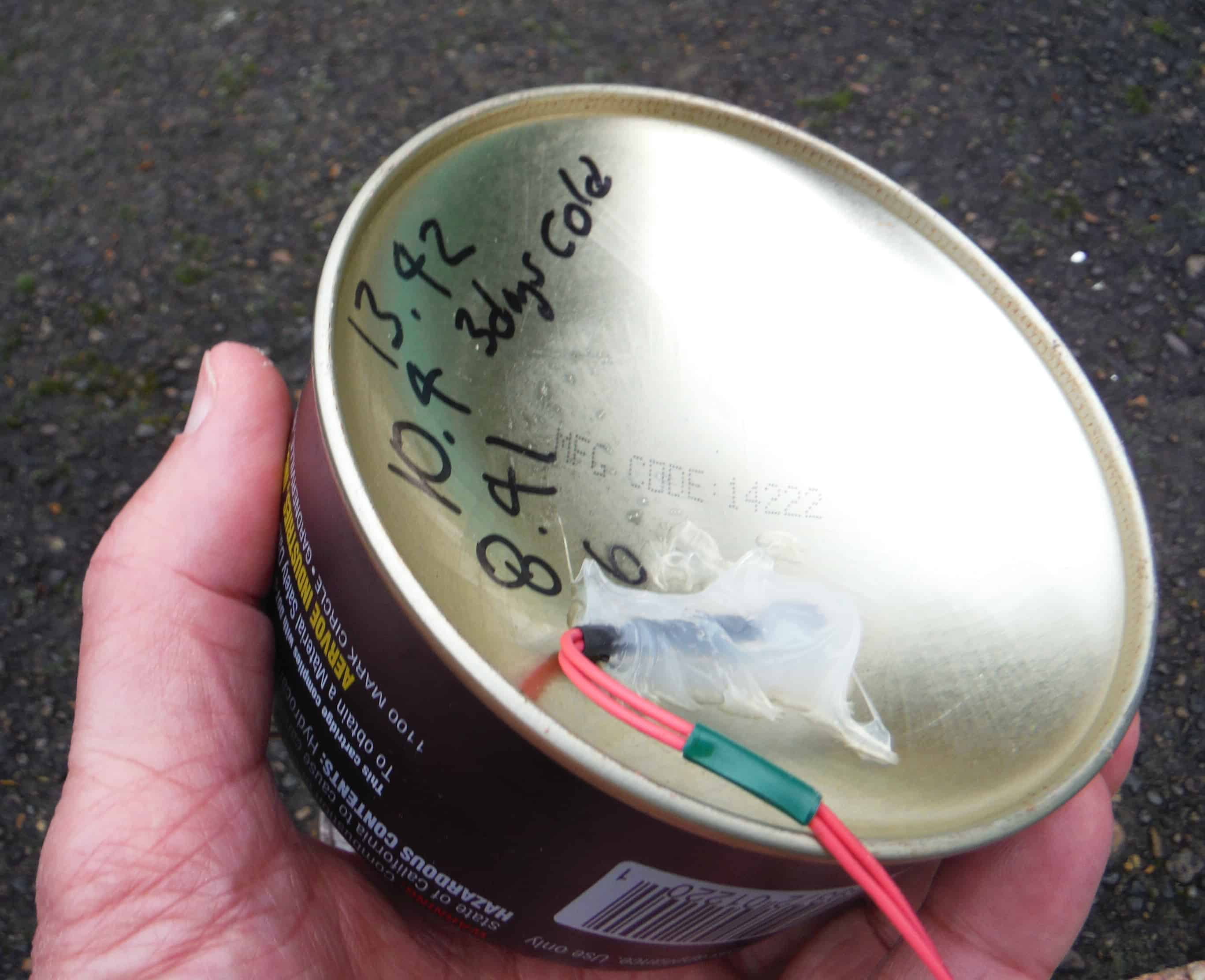
The LM335 sensor measures the temperature of what it is clamped to – it’s a thermometer. I clamped the temperature sensor to the bottom of the canister and put silicone where the clamp wasn’t and let it cure, then removed the clamp and put silicone where the clamp had been and let that cure. This silicone insulation isolates the sensor from the world while the sensor is in close contact with the canister. As a result, the sensor should fairly accurately measure the temperature of the side of the canister. Putting the sensor on the bottom as shown keeps it away from radiant heat from the burner.
There is liquid butane inside the canister, next to the sensor, so the sensor should in practice fairly accurately measure the temperature of the liquid.
I did my measurements while operating normally, boiling a pint of water, at some air temperature. You can do things like putting your canister into ice water or into the freezer to simulate cold temperatures, but it’s too difficult to correlate that with actual use, and of course the canister tries to match up to the ambient anyhow. It’s better to just use the stove to boil water like I do when backpacking, making a cup of coffee or whatever.
Butane and Its Mixtures
Although it has has been discussed a few times, it is worth noting that ‘butane’ canisters really contain a mixture of propane, isobutane, N-butane, and other gasses. I will provide more data later in this series that reflects how the mixture affects canister performance. For now, just note that because the label says ‘butane’ it does NOT mean the contents are straight (pure) n-butane. This is not common knowledge.
There is a boiling point for any mixture (whatever it is), below which there is not enough vapor pressure to push gas out of the canister. Above that ‘boiling point’ the internal pressure will force fuel vapor out of the canister, but that temperature will vary as the mix in the canister changes. This is actually the definition of ‘boiling point’.
While we are at it, please note that what is in the canister is a true mixture: the different gasses are not separate. So the behavior of a propane/n-butane mix (for example) is intermediate between the behaviors of straight propane and straight n-butane. How they evaporate is a bit complex.
Good fuels like MSR IsoPro contain mostly isobutane which has an 11 F (-12 C) boiling point. Adding some propane to this takes the boiling point further below that. What the article The effect of cold on gas canisters showed was that the percentage of propane falls as the canister is used up. I will conservatively say the boiling point of the MSR canister is 10 F – just below the boiling point of pure isobutane. I call this “the good stuff”. There are other brands: I just happen to have some IsoPro canisters (IsoPro does NOT stand for ‘iso-propane’: such a chemical does not exist).
Then there are the cheap fuels like the ‘butane’ canister I got at the Korean grocery for $1.25 for 8 oz. I measured the boiling point for one of these as 20 F (-7 C). This is in between the boiling points for n-butane and iso-butane, so it must contain a mixture of isobutane and N-butane (BP 31 F or -0.5 C). The easiest mix to produce during gas refining has a mixture of isobutane, N-butane, and other gasses, so I think the 20 F boiling point is typical, but I have only looked at two brands. I call this ‘cheap butane’. There are also brands of canisters that perform close to cheap butane but at a higher price.
I just used cheap butane for my testing. The fact that it has a higher boiling point is convenient because it’s never cold enough where I am for testing the ‘good’ stuff near its boiling point. I have calculated what the performance would be with the good stuff – I just subtracted 10 F (5 C) from all the cheap butane results. I did verify this a little – I used some MSR IsoPro at 18 F (-8 C) and the results were consistent.
This boiling point temperature is just the starting point. The first strategy for reducing the lowest temperature you can operate at is to get the good stuff. You can operate an upright canister with the good stuff at 10 F (5 C) lower than with cheap butane.
From here on I will be making references to canisters with a variable amount of a gas or gas mixture. For the purpose of this article, I was carefully refilling canisters. More on this later.
Experimental Results
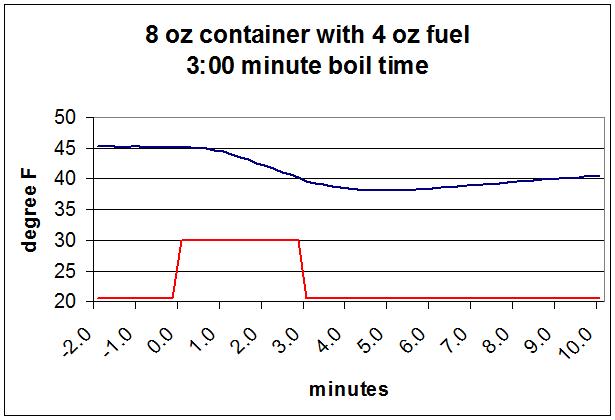
I started with an 8 oz canister (typically 220 g) was half full of cheap butane and an upright Soto Windmaster stove. I boiled 16 oz of water. The water started at about 50 F (10 C). I heated it to 212 F (100 C). The sensor on the underside is of course directly below the butane liquid. I did the same thing for all my tests so they can be compared.
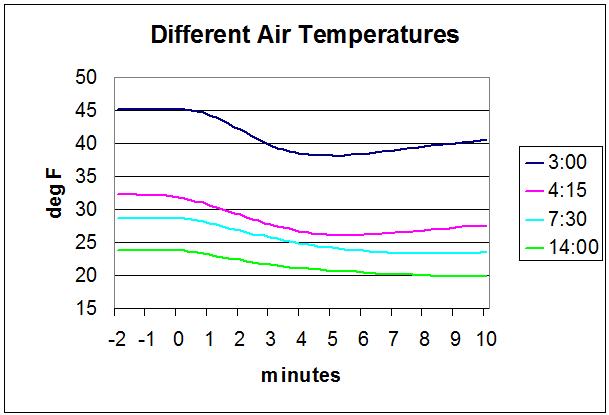
The dark blue line is the temperature of the probe under the canister, which will be very close to that of the butane inside. It started at the ambient temperature of 45 F (7 C) and dropped to 38 F (3 C) over the course of boiling the water. After I turned the stove off it started rising back up. The red line shows when the stove was burning. It took 3:00 to boil the water, and this is as fast as this stove goes.
The temperature at the surface of the butane inside the canister where it’s evaporating will start dropping as soon as the stove starts burning, but you can see that the drop in the temperature at the bottom of the canister is delayed by about a minute. It takes that long for the fall in temperature to propagate down through the butane, through the canister wall, and into the sensor. I expect that the last two delays will be relatively short. I’m going to assume the minimum the sensor gets to is the close enough to what the butane actually gets down to before it starts to rise again.
The minimum temperature of the fuel (about 38 F or 3 C) was well above the boiling point for my ‘butane’ (which was measured as being about 20 F or -7 C). That meant there was plenty of butane vapor to drive the burner at full speed during the 3 minutes it took to boil the pint of water. The Soto regulator would not allow a higher rate regardless of pressure/temperature. A more conventional needle valve would do the same, although different stoves will take a little longer or shorter time to boil a pint of water.
In the course of boiling the pint of water, the temperature at the bottom of the canister dropped 7 F (4 C). It takes energy to evaporate the fuel that leaves the canister to be burned. That energy comes from the liquid fuel in the canister dropping in temperature. This is evaporative cooling.
Then I did the same thing at several other air temperatures, all with an 8 oz canister and 4 oz of fuel.
The dark blue line was for an ambient air temperature of 45 F (7 C).
The purple line was for an ambient of 32 F (0 C). The stove started at a normal level but after a couple minutes slowed down noticeably. It took a little longer to boil – 4:15 rather than the normal 3:00. The butane got down to 26 F. This was close enough to the 20 F boiling point for this fuel, that the rate of butane evaporation was a little less, so the stove didn’t burn as fast, so it took longer to boil. I would consider this totally acceptable. This is the start of cold temperature performance degradation.
The light blue line was for an ambient of 28 F (-2 C). The stove started a little slowly, then got much slower. It took 7:30 to boil – more than twice as long as normal. The butane got down to 23 F (-5 C). The rate of evaporation was way less at this temperature so the stove burned much more slowly. To me, if it takes twice as long to boil my patience level is exceeded. I would consider this unacceptable.
The green line was for an ambient of 24 F (-4 C) air temperature. It took 14 minutes to boil, and the butane got down to 20 F (-7 C). The flame was so feeble as to be unusable in my opinion, although it eventually did boil. This is my measure of the boiling point for this fuel: 20 F. There was plenty of time for the system to stabilize, so the temperature I measured was close to the actual temperature of the fuel.
For all cases the burn started at minute 0 on the plot. For the 24 F case the stove continued burning past the end of the plot.
The measured temperature drop varied a little with air temperature:
Ambient of 45 F ; Drop of 7 F
Ambient of 32 F ; Drop of 6 F
Ambient of 28 F ; Drop of 5 F
Ambient of 24 F ; Drop of 4 F
Simplistically, the temperature drop should be the same in all cases, but it wasn’t. I think that when the stove was running at a lower power for a longer time, there was more opportunity for the surrounding air to warm up the canister back up and cancel out some of the temperature drop.
From here on I will (somewhat arbitrarily) define four levels of operation:
The butane stays >6 F above the BP – normal operation
The butane stays between about 3 and 6 F above BP – slow but still usable, doubles the boil time at the bottom of this range
The butane gets to <3 F above BP – I would call this unusable, although if patient you might still get water to boil
Butane temperature below BP – not even a feeble flame
Evaporative Cooling for Different Canister Sizes
All of the above was for an 8 oz canister half full. I tested a number of combinations of canister sizes and fuel amounts:
8 oz canister with 8 ozs of fuel – full
8 oz canister with 4 ozs of fuel – half full
8 oz canister with 2 ozs of fuel – mostly empty
4 oz canister with 4 ozs of fuel – full
4 oz canister with 2 ozs of fuel – half full
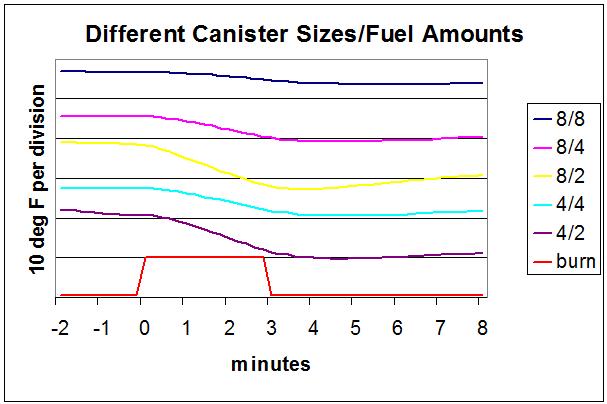
For each, I boiled a pint of water and measured the temperature of the canister. For each run, I used the coldest air temperature that I had data for that had a 3:00 boil time.
The top line is the temperature for an 8 oz canister with 8 oz of fuel. The next line is an 8 oz canister with 4 ozs of fuel and so on. The red line shows when the stove was on.
Note that I offset the lines on the plot so they wouldn’t be on top of each other, but they all have the same scale for temperature drop. For example, the top line, 8 oz canister with 8 oz fuel dropped about 0.3 divisions, so that would correspond to 3 degree F.
Summary
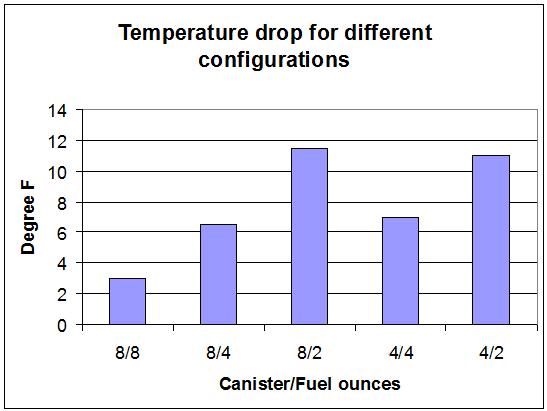
So, for example, if you use a full 8 oz canister (8/8) the temperature drop is only 3 F, so the minimum air temperature for normal operation is calculated thus:
BP for this fuel = 20 F
Margin for sufficient evaporation rate = 6 F
Evaporative cooling temperature drop = 3 F
Minimum air temperature for normal operation = 20+6+3 = 29 F
You can see that the results depend mostly on the amount of fuel (or its thermal mass). The 8 oz canister might be bigger than the 4 oz canister, so the steel in the 8 oz might have more thermal mass, but the experimental data says that the canister size is largely irrelevant. The small differences seen in the graph between the cases is simply experimental error.
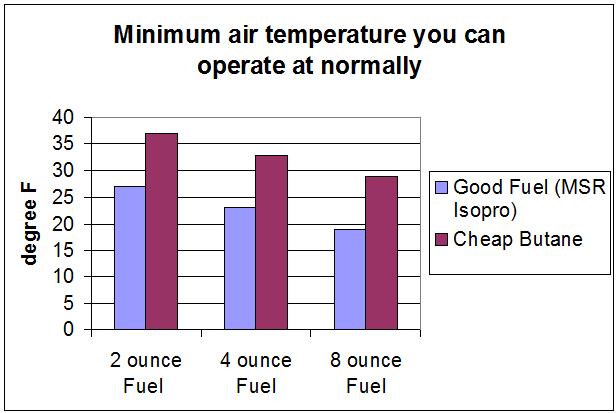
The minimum air temperature you can normally operate at for a 3 min boil time for different amounts of fuel is shown next:
If there is less than 2 ozs of fuel the temperature drop will be even more. I tried to measure this, but there’s so little fuel I couldn’t get good measurements. 1 oz of fuel will have half the thermal mass of 2 oz, so it will cool down twice as fast – although the thermal mass of the canister will start to be significant soon. The temperature drop with 1 oz fuel might be about 16 F (9 C).
You can go about 3 F colder than this if you don’t mind doubling the time it takes to boil, or you can go 6 F colder if you don’t mind waiting 15 minutes to boil and the wind doesn’t blow the flame out. That could be limiting.
Case Study (A Technical Analysis)
I have used an MSR Isopro canister with 2 oz of fuel in it at 18 F air temperature and the boil time was 4 minutes. I was too lazy to measure the temperature, but I can estimate it. With 2 oz of fuel, there should have been 11.5 degrees F of evaporative cooling. With a 4 minute boil time, the fuel should have got to within 6 degree F of its boiling point. Thus, the boiling point of this fuel should be about 18 – 11.5 – 6 = 0.5 F (-17.5 C).
I conservatively use 10 F (-12 C) for the BP of the good stuff, which is what happens when most of the propane has been preferentially evaporated off, but my canister had not had its propane boiled off. Hence the lower number.
For both equations, T is the temperature in degree C. You have to weigh these by the mole fractions and add to get the total pressure. I calculated above that the BP of the Isopro fuel seemed to be about 0.5 F. For that temperature, to get the total pressure to be 1000 mBar so vapor would come out of the canister, the mole fraction must be 0.11 propane and 0.88 isobutane (assuming there are no other gasses). Multiply by 0.8 to get a mass percentage of 9% propane and 91% isobutane. They say it’s 20% propane, 80% isobutane. It’s difficult to measure this so maybe they don’t worry about meeting that spec and figure 9%/91% is close enough. Maybe they’re more concerned with minimizing N-butane, which is actually a good thing. Or maybe I’ve made a math error.
A Strategy for Cold Weather
All of the above leads to a simple strategy for cold weather usage – bring a full 8 oz canister. Many people already do this and have assumed it works because the full canister will have lots of propane in it, but my data suggests that a major reason it works is because of the thermal mass of the fuel. There is in fact a bit more to this, and we will come back to it in Part 4 of this series.
Appendix: Background Theory
The calculation of evaporative cooling is straightforward. We will switch units here and work in metric: it’s easier. Note that the Specific Heat, Heat of Evaporation, and the Heat of Combustion are about the same for n-butane, isobutane, and propane, so the amount of evaporative cooling should be about the same for all fuel types. We will assume n-butane.
The heat of evaporation of N-butane is 386 Joules/gram. That is, it takes 386 J to evaporate 1 g of N-butane. So if you know how much fuel you have used, you know how much energy you have used.
The Specific Heat of N-butane is 1.675 J/gC. This means that 1.675 Joules are released if you cool 1 g of N-butane by 1 C. The specific heat of steel is ~0.49 J/gC (different alloys give slightly different figures).
I use 7 g of butane to boil a pint of water, so 7*386 = ~2700 J were used to evaporate the fuel. That energy has to come from the fuel, which will cool down as a result.
I started with 114 g of N-butane in my canister, and the steel canister (nominally a 110 g one) weighed 85 g. Cooling 114 g ‘butane’ by 4 C gives 4*114*1.675 = 764 J. Cooling 85 g of steel gives 4*85*0.49 = 167 J, for a total of 931 J. This is much less than the 2700 J required.
I cannot easily explain why it cooled so little. It is possible that some heat got into the canister and fuel from the ambient or from the hot gasses from the flame. It is possible that the canister was also picking up some radiant energy from the flames as well.
If so, that means we really must pay attention to what heat can get fed back into the canister during operation. If we are smart, that feedback can be hugely helpful.
This post from the Publisher’s Blog (available to Unlimited Members only) offers a peek into our content queue – what’s coming in the next several weeks?
This post from the Publisher’s Blog (available to Unlimited Members only) takes a behind-the-scenes look at what we’re doing to cut our page load times by half in 2017.
Chris Smead presents “Snowshoeing Yosemite Point”, a film in 4K about a beautiful winter trek accomplished in lightweight style!
About The Film “Snowshoeing Yosemite Point”
A half dozen times a year you’ll find me in Yosemite. The valley is so visually dynamic that it never gets old. The crowds can be overwhelming at times, but the snow chain requirements and severe flooding in January of 2017 provided the perfect opportunity for me to enjoy the valley in peace – snowshoeing Yosemite Point.
I arrived the night after the park re-opened to the public. Yosemite and Bridalveil falls were roaring in full force. The snow was fresh on the steep Upper Yosemite Falls trail, and every hour or so there was a thunderous boom as ice broke free from the nearby granite wall which kept me on my toes.
I spent 2 beautiful nights on the rim that I documented in this short film. I hope you enjoy it.
Gear Notes
Favorites
Smartwool sock liners under Defeet Woolie Boolie socks
Brooks Cascadia Trail Runners
40below overboots
Chainsen Light Spikes (for Icy sections lower on the trail) and Northern Lites Snowshoes (for snowy sections).
Goosefeet down pants, and custom parka stuffed with 7oz of fill.
Snow Anchors: Lawson Ti Snow Anchors work great. Unfortunately they’re currently out of stock. I believe Lawson is working on a new design.
Meh
MSR Windpro Stove and Primus heat exchanger pot. Heavy, and I emptied a large 230g canister in 2 nights. I’m still on the lookout for a more efficient snow melting system.
Didn’t Use
My Rocky’s Goretex Socks. The 40 Belows were ample protection from moisture in these conditions.
Filmmaker Bio
Chris Smead: Lightweight backpacking and music are my passions. Amateur film making is how I bring those passions together. I’m a husband and father of 2 living in San Jose, CA and consider the Sierra my home away from home.
This Patagonia Airshed Pullover Review features a new type of wind shirt that focuses on maximizing the air permeability of the fabric.
Introduction
This Patagonia Airshed Pullover Review features a wind shirt made with fabric that is more breathable (i.e., higher air permeability) than traditional wind shirt fabrics. The shirt represents a shift in wind shirt design. It moves away from weather protection (e.g., resistance to light rain or snow). Also, it signifies a move towards maximizing breathability during high levels of exertion.
This review describes the design and feature set of the Patagonia Airshed Pullover. In addition, it compares the garment to a few other wind shirts on the market. It also provides some commentary about how it fits into an ultralight layering system, and summarizes my field experience to date.
Listen to this 3-minute audio Gear Brief for an overview of the Patagonia Airshed that discusses its most important feature: the breathability of the fabric.
Note: In the audio recording, I said that my sample of the Patagonia Airshed Pullover weighs 3.7 oz. This is an error – its actual weight is 3.4 oz (size M).
The Patagonia Airshed Pullover. Photo: Patagonia, Inc.
Features
100% nylon ripstop with stretch;
DWR (durable water repellent) finish;
Stretch fabric at cuffs and hem;
Zippered chest pocket converts to stuff sack;
1/4-length chest zipper.
Specifications
Body fabric: 1.3-oz 20-denier 100% nylon mechanical stretch ripstop with a DWR (durable water repellent) finish;
Hem and cuff panels: 4.2-oz 79% nylon/21% spandex jersey;
Weight: 3.7 oz (104 g) (as reported by the manufacturer).
Field Use and Review Context
My field use of the Patagonia Airshed Pullover is limited to approximately 30 days of daily wear that includes snowshoeing and hiking in mountains of Southern Wyoming and the Medicine Bow National Forest. I’ve been a faithful wind shirt user for several years and I can’t recall any backpacking trips during the last decade where I haven’t taken and used a wind shirt.
My primary wind shirt of choice for the past three years has been the Patagonia Houdini Jacket (hooded). However, I’ve been experimenting recently with both the Patagonia Airshed Pullover and the ZPacks Ventum Jacket, so the latter two constitute my frames of reference for this review.
That said, without long term experience using the Patagonia Airshed Pullover, I’m unable to comment authoritatively on its durability and fabric wear nuances. In addition, my use has been limited to the dry weather (little to no precipitation), cool temperatures (20 to 45 degrees F), and the reliably breezy winter winds of southern Wyoming. Without long term testing and use in other seasons and environments, this review has thus been classified as a Flash Review (i.e., a gear review meant to introduce the reader to new or otherwise untested gear).
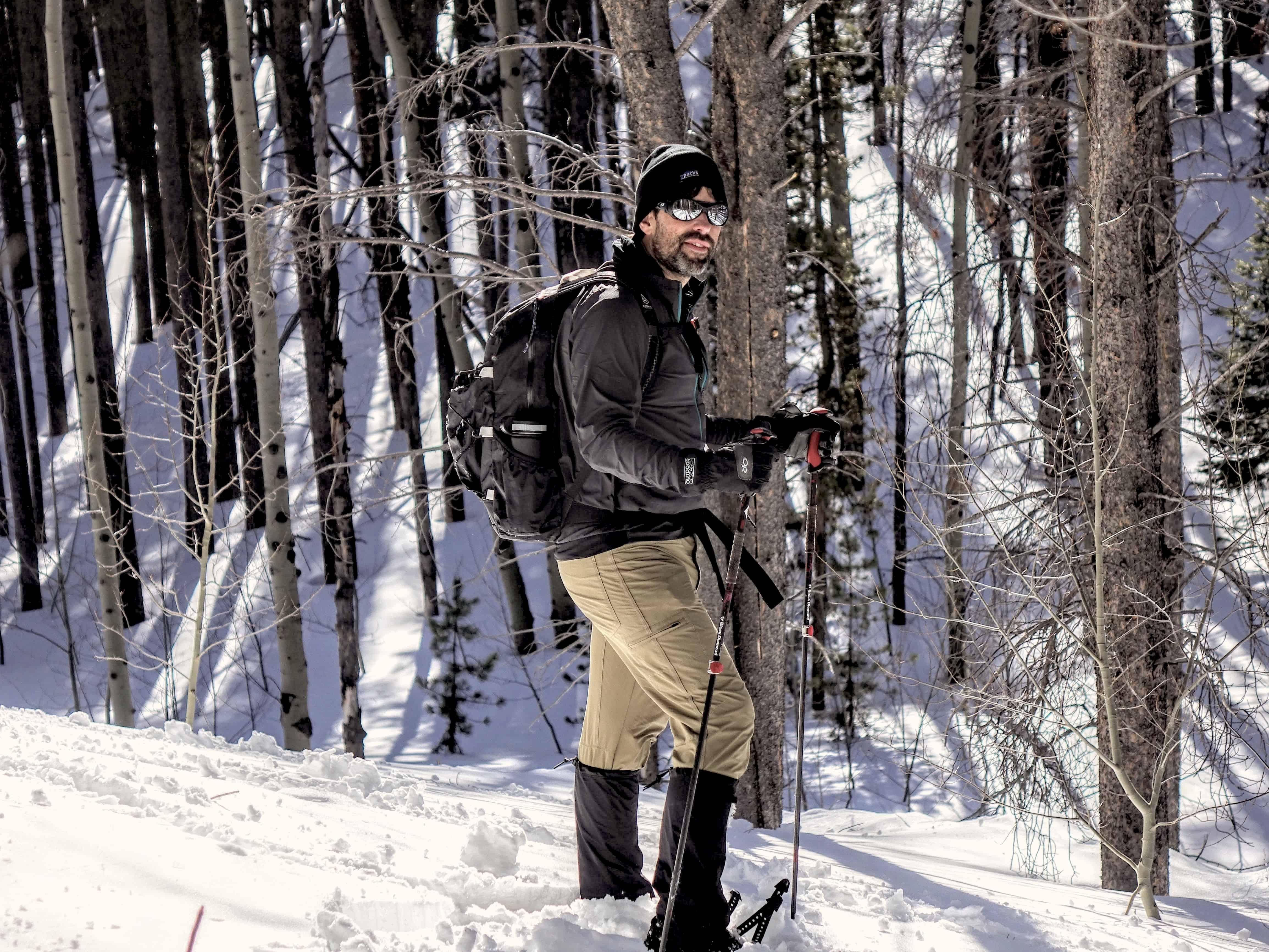
Snowshoeing with the Patagonia Airshed Pullover on a sunny but cool and breezy day in Wyoming’s Snowy Range, Medicine Bow National Forest. Here, I’ve layered the Airshed over a thin polyester base layer for high-exertion snowshoeing with a day pack at temperatures around the freezing point. Photo: Stephanie Jordan.
Compared To…
I compared the Patagonia Airshed Pullover to the following:
Patagonia Houdini Jacket – a full-featured (full-zip, hooded) wind shirt from Patagonia;
Patagonia Houdini Pullover – a similar (pull-over style) wind shirt from Patagonia, as well;
ZPacks Ventum Wind Shell Jacket – a full-zip, hooded wind shirt that represents one of the lightest available.
Patagonia Houdini Jacket. Photo: Patagonia, Inc.
Patagonia Airshed Pullover vs. Patagonia Houdini Jacket
Fabric
1.2 oz, 15 denier nylon fabric comprises the Patagonia Houdini Jacket, while 1.3-oz, 20-denier nylon makes up the Patagonia Airshed Pullover.
Both fabrics have a similar DWR treatment (C6 DWR finish).
The higher air permeability of the Airshed’s fabric (50-60 CFM; Source: email exchange between author and C. Simpson, Patagonia Inc.) makes it more breathable. It’s perhaps, less wind- and water-resistant. It has a faster dry time than the fabric of the Houdini (1-2 CFM; Source: ibid).
There should be little if any noticeable difference in durability between these two fabrics.
Fit
When I compared the fit of the Patagonia Airshed Pullover to the Houdini Jacket, I found that the fit of the Airshed Pullover to be slightly more trim.
The slightly stretchier fabric seemed to accommodate movement in the Airshed as well as in the Houdini Jacket.
There is no meaningful difference in the center back length of the jackets for the size medium that I compared.
Features
The Patagonia Houdini Jacket has a full zipper and a hood. It should offer both better protection from the elements and more flexible ventilation options.
The Patagonia Houdini Jacket features elasticized fabric cuffs and a drawcord-adjustable hem. The Patagonia Airshed Pullover, however, uses stretch woven fabric panels at the cuff and hem. Neither of which is adjustable.
Weight
The Houdini Jacket has a manufacturer-claimed weight of 3.6 oz vs. the Airshed’s claimed weight of 3.7 oz (note: the actual weight of my size M sample of the Airshed is 3.4 oz and the actual weight of my size M Houdini Jacket is 3.6 oz).
Patagonia Houdini Pullover. Photo: Patagonia, Inc.
Patagonia Airshed Pullover vs. Patagonia Houdini Pullover
Fabric
The Patagonia Houdini Pullover and Jacket are made from the same 1.3-oz 20-denier nylon fabric (see comments above).
Fit
The Patagonia Houdini Pullover and Jacket have a comparable fit and center back length (see comments above).
Features
The Patagonia Houdini Pullover features a kangaroo-style hand pocket. The Patagonia Airshed Pullover, however, features a zippered chest pocket.
While the Patagonia Houdini Pullover features half-elastic cuffs, the Patagonia Airshed Pullover features stretch-woven fabric cuffs. The Patagonia Houdini Pullover features a snap-up neck opening. On the other hand, the Patagonia Airshed Pullover features a zippered opening.
The Patagonia Houdini Pullover features half-elastic cuffs, while the Patagonia Airshed Pullover features stretch-woven fabric cuffs.
It also features an elastic drawcord adjustable hem. The Patagonia Airshed Pullover, however, features stretch-woven panels in the hem and no drawcord.
Weight
The Houdini Pullover has a manufacturer-claimed weight of 3.5 oz vs. the Airshed’s claimed weight of 3.7 oz (note: the actual weight of my size M sample of the Airshed is 3.4 oz).
ZPacks Ventum Jacket. Photo: ZPacks.
Shown: Patagonia Airshed Pullover vs. ZPacks Ventum Wind Shell Jacket
Fabric
The ZPacks Ventum Wind Shell Jacket is made from 0.7 oz ripstop nylon with air permeability in the range of 6-7 CFM (source: email exchange between author and J. Valesko, ZPacks LLC). It is less breathable than the fabric used in the Patagonia Airshed Pullover (50-60 CFM).
I can easily draw a breath through the Airshed fabric. However, I cannot do so without great difficulty through either the Houdini or Ventum fabric. I don’t notice much difference in the effort required to draw air through the Houdini vs. Ventum. The Ventum is a lighter and thinner material than used on the Airshed. It will likely be less durable in long term use and perhaps in seam strength.
Both fabrics are DWR-finished. They resist moisture penetration well enough. The long-term durability of the DWR for both fabrics, however, is unknown.
Fit
The ZPacks Ventum Wind Shell Jacket has a significantly roomier fit (by at least one full size) and longer back length (by more than 1.5 in/3.8 cm) than the Patagonia Airshed Pullover.
Features
The ZPacks Ventum Wind Shell Jacket does not have a pocket, whereas the Patagonia Airshed Pullover features a zippered chest pocket.
The ZPacks Ventum Wind Shell Jacket has a full zipper and a hood. It should offer both better protection from the elements and more flexible ventilation options.
While the ZPacks Ventum Wind Shell Jacket features elastic cuffs, the Patagonia Airshed Pullover features stretch-woven fabric cuffs.
The ZPacks Ventum Wind Shell Jacket features an elastic hem. The Patagonia Airshed Pullover, however, features stretch-woven panels in the hem.
Weight
While the ZPacks Ventum Wind Shell Jacket has a manufacturer-claimed weight of 1.9 oz, the Airshed’s claimed weight is 3.7 oz. (Note: My size S sample of the Ventum weighs 1.8 oz, and my size M sample of the Airshed weighs 3.4 oz.)
Comparison Summary Table
This table features horizontal scrolling to view additional columns.
The Patagonia Airshed Pullover is not the first wind shirt to use so-called ultra-breathable “air-permeable” fabrics. The Arc’Teryx Squamish and the Rab Windveil also come to mind. However, the Squamish and Windveil are both full zip hooded jackets that weigh 5-6 oz. The Airshed is a simpler pullover style that weighs 4 oz and may be a better option for those who are on the fence about asking the questions:
Should I carry a wind shirt?
Can’t I just use my rain jacket?
Let’s discuss both of these questions in some detail and see where the Patagonia Airshed Pullover fits in.
Should I carry a wind shirt?
A wind shirt offers the following advantages:
It can be layered over a base/mid layer to provide wind-(and perhaps, intermittent rain/snow) resistance with more comfort (better breathability) than what a rain jacket offers.
It can be layered under a mid layer to provide some evaporative cooling resistance (i.e., it behaves like a semi-permeable vapor barrier) in very cold conditions. This type of use mitigates the “flash-off” cooling effect (the use of body heat to evaporate accumulated perspiration in your clothing system) when you stop after a period of high output.
It provides sun and biting insect protection.
Many lightweight backpackers believe that a wind shirt offers significant versatility to the layering system. Considering that a wind shirt usually weighs less than 4 oz, it’s hard to argue that point.
Others believe that a wind shirt is better off replaced by a light fleece layer, which provides more breathability while hiking. While true, it comes at a weight penalty. For example, my lightest fleece is a 100-weight pullover that weighs about 8 oz. There is also a loss of versatility. Fleece is so permeable to the wind. It’s not a great option for sun or insect protection in warm temperatures.
To Breathe or to Repel Weather?
The Achilles’ heel of a wind shirt has always been low fabric breathability. It has most often been made of ultralight fabrics that are heavily calendared to improve strength, water-resistance, and/or aggressive DWR treatments. In fact, many wind shirt proponents will do their best to wash out the DWR treatment to improve breathability using aggressive detergents. While this does help, it doesn’t solve the fundamental problem of increasing the air permeability of the fabrics.
That’s where the Patagonia Airshed Pullover comes in. It’s more air-permeable fabric should improve the comfort and versatility of the wind shirt not only for active wear but also for warmer temperatures. The wind shirt provides for protection from the sun and/or biting insects.
Of course, the increase in air permeability may come at a cost as well, for both wind and weather resistance.
Perhaps asking a wind shirt to perform the function of a rain jacket is asking too much.
Can’t I just use my rain jacket?
If a wind shirt provided a very high level of resistance to wind and rain, then its functionality might overlap some with that of your rain jacket. Of course, this violates one of the core tenets of ultralight backpacking philosophy (“don’t take more than one item that can perform the same function”).
Thus, for a wind shirt to provide unique functionality in your clothing system, it must be differentiated from your rain jacket in a meaningful way:
A rain jacket provides extreme inclement weather protection (i.e., it’s impermeable to wind and precipitation) at the cost of breathability. The wind shirt, however, is there to provide extreme breathability (at the cost of weather resistance).
A (waterproof!) rain jacket should keep outside moisture from penetrating your clothing system. The wind shirt, on the other hand, should maximize the transport of internally accumulated moisture (perspiration) to the outside.
Therefore, it makes sense, perhaps, that a wind shirt should be made of fabrics that are as breathable as possible while still providing the minimum possible protection from sun, wind, and bugs – especially for active conditions.
That said, I would personally welcome the trend for a wind shirt to be as breathable as possible, rather than as light as possible. The Patagonia Airshed Pullover is a step in the right direction. Now, if it only had a hood and a full zipper…
Where to Buy the Patagonia Airshed Pullover
Patagonia Airshed Pullover Review: Disclosure
The manufacturer provided a complimentary sample of this product to Backpacking Light with no expectation for a review.
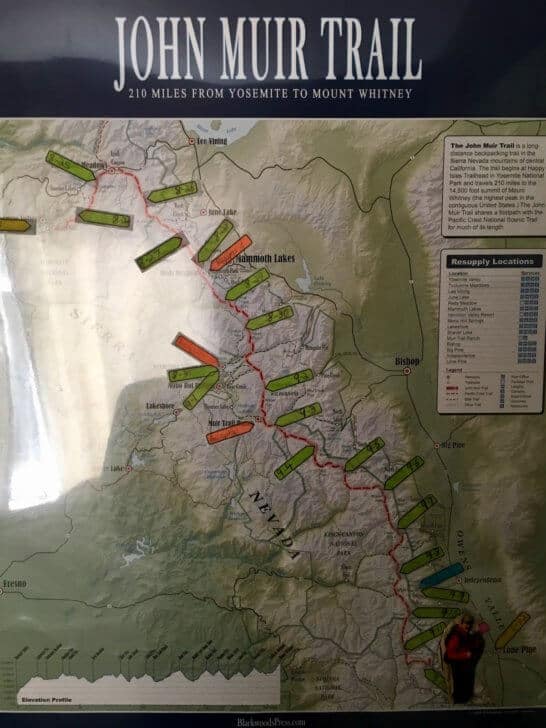
Christopher Smead tells his story in this John Muir Trail Movie – the JMT according to Chris. Read the backstory & gear notes, too.
Watch The Film
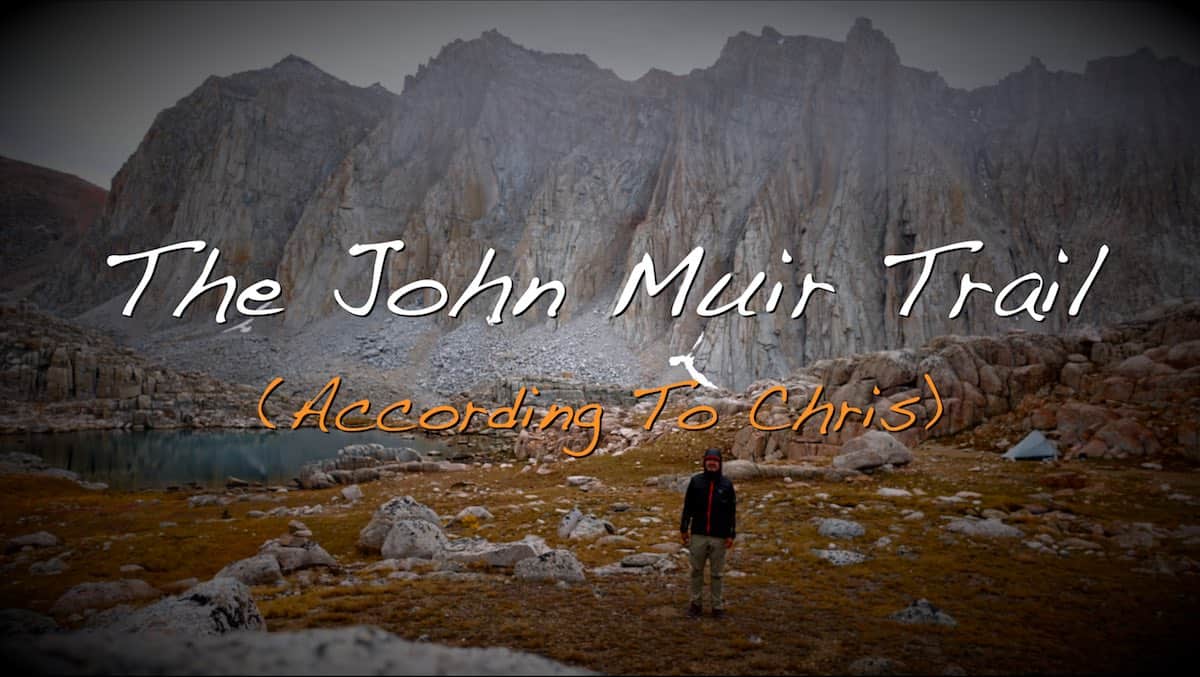
Watch Christopher Smead’s terrific debut into expedition filmmaking in his John Muir Trail movie, “The John Muir Trail (According to Chris)”:
Backstory
For me, the John Muir Trail is more than just a temporary adventure. It’s a big deal. It’s my happy place.
It occupies so much of my mental space that it feels like part of the foundation that I’m built upon. I hiked sections of the trail over the years, watched every documentary I could get my hands on, read trail maps and trip reports, and scrolled through countless pictures online.
I looked forward to completing the entire trail for years.
Everything about the trip – the planning, preparation, time away, independence, and the outdoors seems to represent part of who I am.
I’m not an athlete, an artistic film maker, or a famous musician.
Pretty much the opposite actually. I’m a 37 year old husband and father of two. I work at a large hi-tech company in the Silicon Valley. About ⅓ of my diet is candy and soda.
And I love ultralight backpacking.
Besides a few crude Youtube videos, I’ve never made a movie.
But I wanted to make a movie about my time on the John Muir Trail.
I wanted to preserve the memories for myself and also for my kids. If the market crashes, you lose your job, or go through a breakup, the mountains are still there. That anchor in life is something that’s vital for me, and I want my kids to have that, too.
I hope this film inspires them to seek the Sierra.
This is the JMT as I Experienced It
This film captures a unique view of the John Muir Trail that’s accurate to the reality I experienced. I hiked the trail solo in August and September 2016. Every thru-hiker’s experience is unique and different, but one thing is certain: however you experience the JMT, it’s awesome out there!
Making the John Muir Trail Movie and Soundtrack
Deciding on cameras was a struggle. I invest heavily in keeping my pack light. I check all the cottage gear company websites regularly looking for new innovations to help me save an ounce. So carrying a 8lb DSLR wasn’t going to work for me.
The solution for me was a 10 oz Sony Rx100, and a GoPro. My strategy was to not let the cameras take over the experience, so some key moments were missing footage that I had to improvise with animations.
I had no real experience with video editing except for a few crude videos I made using free editing software. I had zero experience with animation.
For this project, I ended up purchasing Final Cut Pro, Motion 5 and some 3rd party plugins. I’ve always been a pretty technical guy. So after some Googling and fiddling around, I was able to make it work.
As for the soundtrack, I’m a hobby musician, and I have a small recording studio in my spare bedroom and a variety of instruments.
So why not make the soundtrack? :) The songs were focused musically around the JMT experience. Not necessarily lyrically. With 2 toddlers at home, I had to record while they were sleeping. Vocals had to be tracked quietly. So I heavily drove them with analog preamps and compressors to get it to cut through the mix. This created a specific kind of breathy saturated effect that reminds me of the acoustical response of Sierra granite. Specifically between Mt Hitchcock and Mt Whitney. Next time you’re there, clap, and listen. It sounds cool!
The end product is far from the organic acoustic guitar/banjo sound most would expect. I’m not the most organic guy. Heck, the one song where I played ukulele didn’t sound right to me until I added the synth beats and arpeggiator!
BlackwoodsPress JMT Guide & Wall Map – The wall map was a great way for my kids to track my progress at home. I even used this map in the film for the animated map sequences! See the photo above to view the map.
GlobalStar 1700 Sat Phone – For checking in on the family.
Meh:
Arcteryx Phase SL Baselayer – New ones only come in dark colors and no longer reflect heat well for use as a sun shirt.
Eclipse Sun Sleeves – Loved them when they stayed on. But I had to constantly adjust them when they slid down.
I don’t know if I would have ever pursued the JMT if it weren’t for all the inspiring trip reports and information I’ve learned here at Backpacking Light. I’m on the site daily. Thanks for existing :)
This feature requires an active Backpacking Light Membership.
Premium Articles
You're currently viewing a free preview of a member exclusive premium article. Our premium articles include in depth journalism and insights from the Backpacking Light editorial team.
Get full article access by subscribing to a Premium or Unlimited Backpacking Light membership!