

Day 4
Wonder Pass
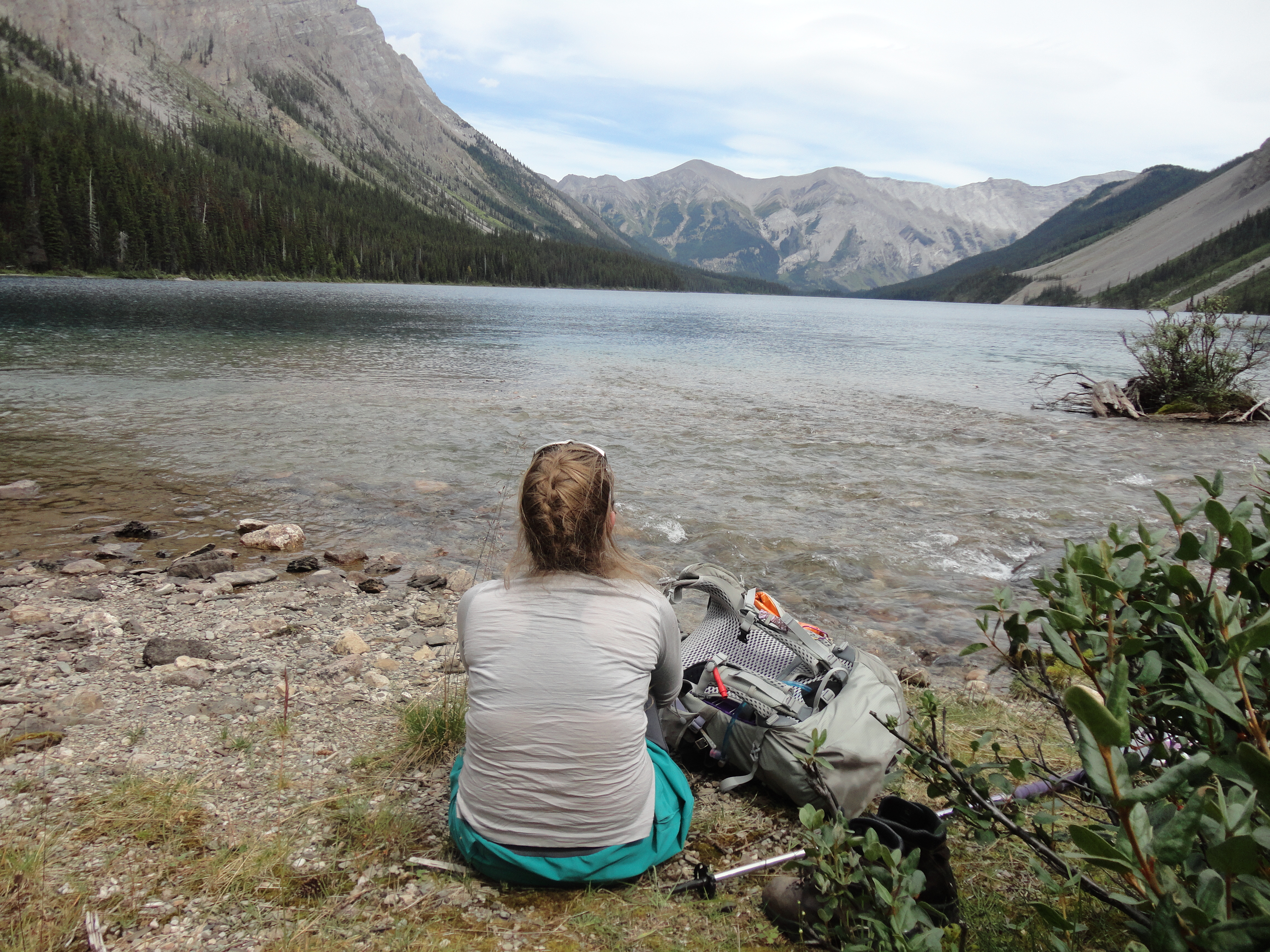
We start our morning early. The route we took backpacking to Mount Assiniboine was difficult enough: we have little hope that the other half of our planned loop back to Aurora Creek and the trailhead will be any shorter or easier. Again, we are both nervous as we get ready to cross through this area. Yesterday’s bear sightings do not bode well for the bear-free day I want to have.
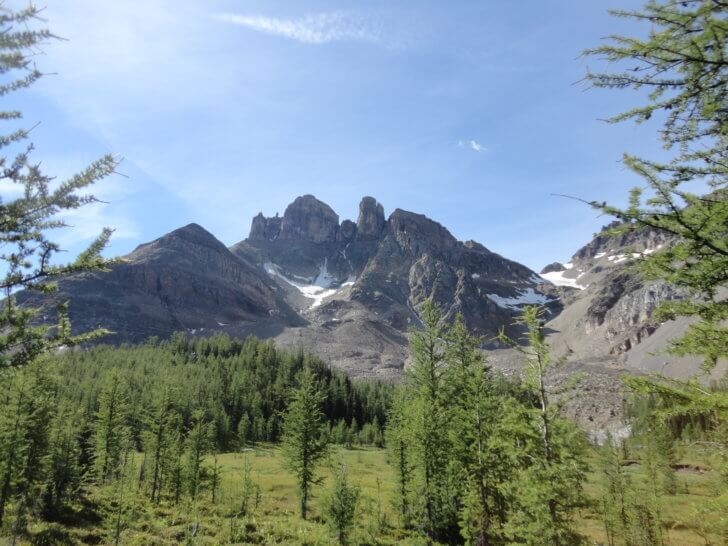
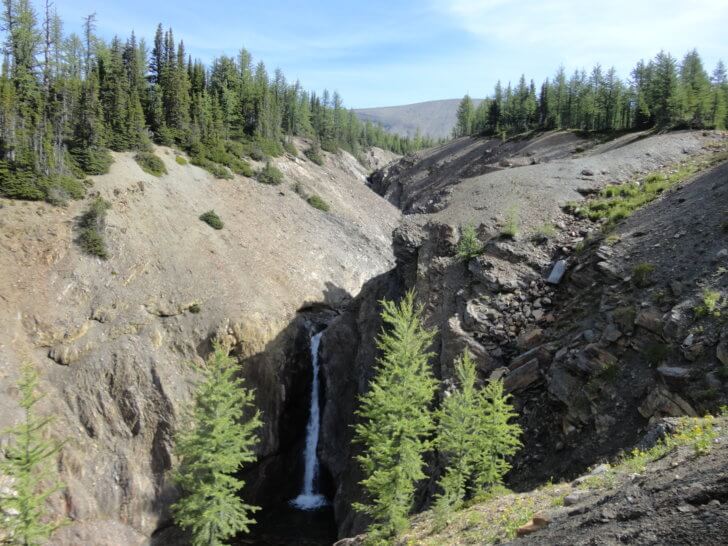
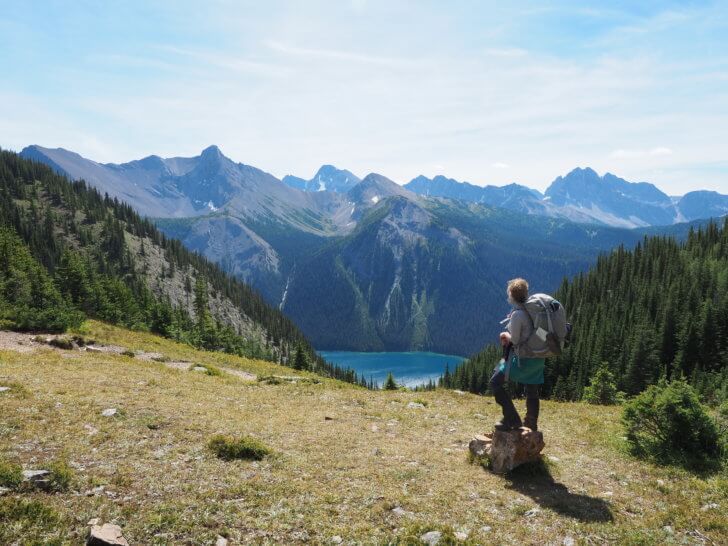
A Long Road Down
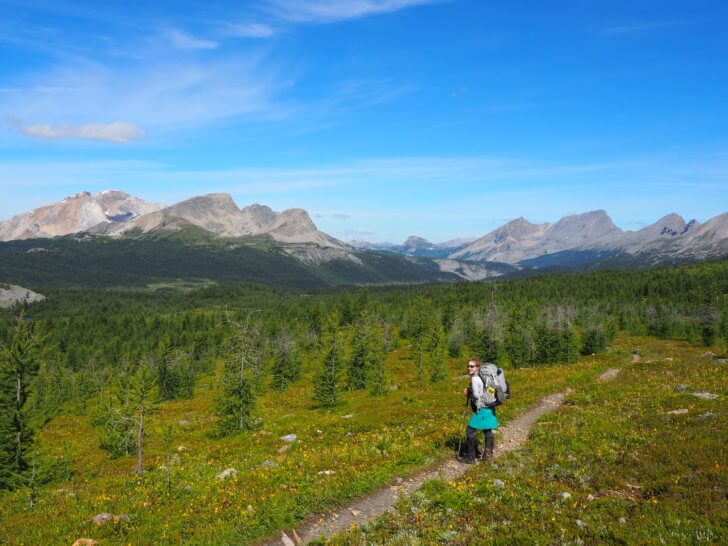
From the top of Wonder Pass, we drop down towards Marvel Lake.
The switchbacks here are steep and frequent. Unfortunately, my knees are aching, and I can see clumps of dirt torn up and bear scat littering the trail. I have goosebumps – do I sense a bear?
We shift gears and walk at “bear evasion speed” and turn up the Bluetooth speaker. For obvious reasons, I want off these switchbacks as fast as possible.
Near the bottom of Wonder Pass, we reach the junction to the Marvel Pass Trail. I am hungry and thirsty, but the prospect of stopping for lunch near a bear (again) forces my legs forward. An hour later, I give in to my hunger, and we stop for lunch. An eerie feeling is a constant companion.
We stop for about 15 minutes when I finally say: “Let’s pack up and get out of here, something doesn’t feel right.”
Craig has a similar instinct, and we pack up. No sooner do I shoulder my pack when from a switchback somewhere above, I hear the telltale warning from another hiker: “Bear! Bear!”
Hurriedly, I sprint down the switchbacks without looking behind. Craig and I yell back and forth to each other on the way down. A helicopter crosses overhead, and I groan inside. If the bear is running down the switchback behind us, then the helicopter is herding it toward us!
The Crossing
The trail levels out, and we continue sprinting down the path, leaping across fallen logs and boulders along the way. Suddenly, I am stopped short by a large creek which flows from Gloria Lake into Marvel Lake.
A slack rope and a slippery log are there to assist the crossing, but they are positioned upstream of a sweeper logjam. The water is fast and deep. A fall here is risky.
Luckily, I memorized the map earlier today. “This creek runs into Marvel lake. Downstream, there is likely to be a shallow peninsula where the creek runs into the lake. I’ll hike that way and see if there is a better crossing.” Craig seems relieved; he doesn’t care for this crossing anymore than I do.
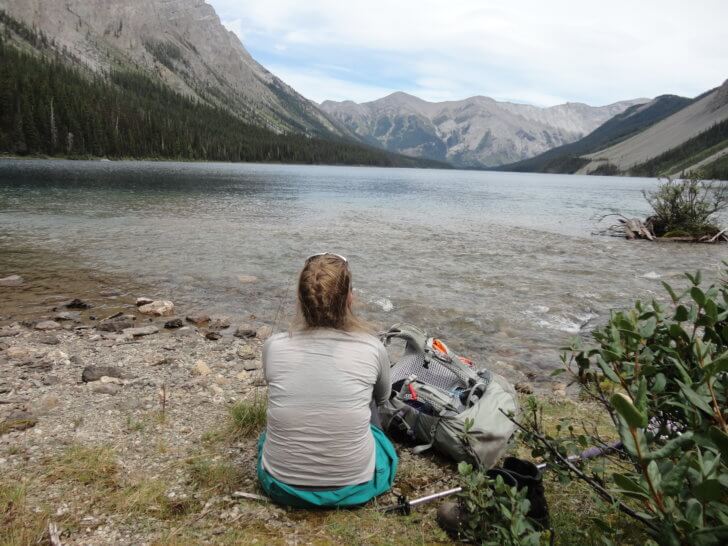
Marvel Lake
Just downstream from the risky log crossing, I find a much safer spot to cross. Consequently, my fear instincts settle down. So I take my pack off and take my boots off and prepare for an uncomplicated crossing with no risk of drowning.
The Other Side
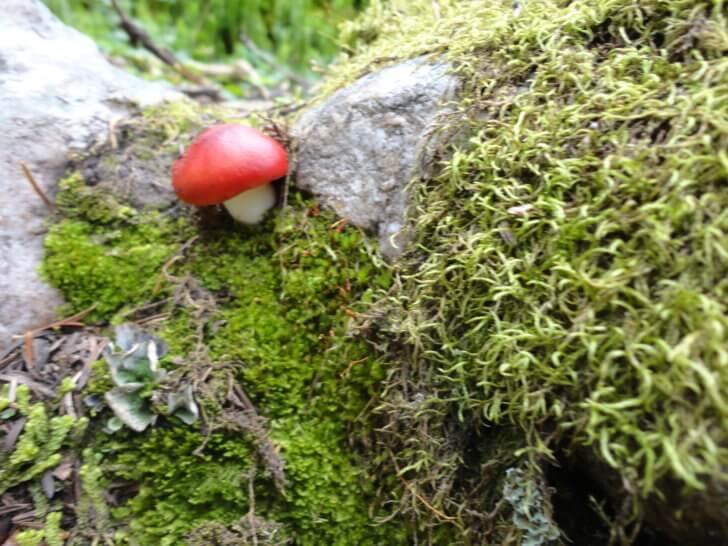
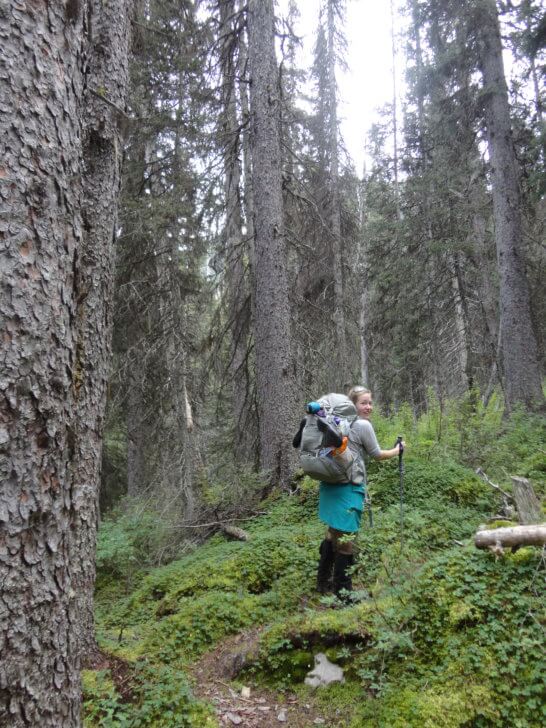
Once on the other side of the Creek, I find myself in what feels like a fairy wonderland. Moss, mushrooms, and rocks look like they conceal fairy villages in little nooks.
“There and Back Again”
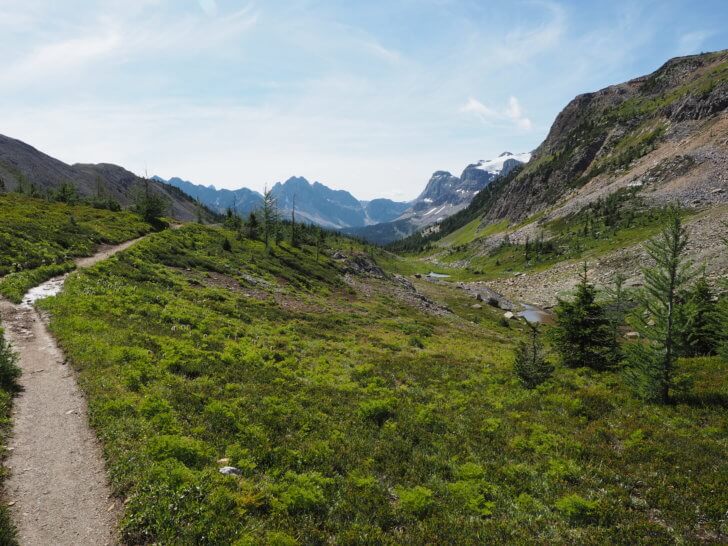
The West Fork of the Marvel Pass Trail (where we are hiking now) is much different than the low-lying marsh beds in the East Fork, where we hiked on the way into Mount Assiniboine a few days ago. Instead, the West Fork follows forest floors and dry creek beds up to Marvel Pass. Also, there are even fewer trail markers on the West Fork. Often, all that guides my way are aged cut lines and the occasional boot print from a solo backpacker who had crossed through recently.
By mid-afternoon, I am settled into “trudge mode,” and very little piques my interest along the way.
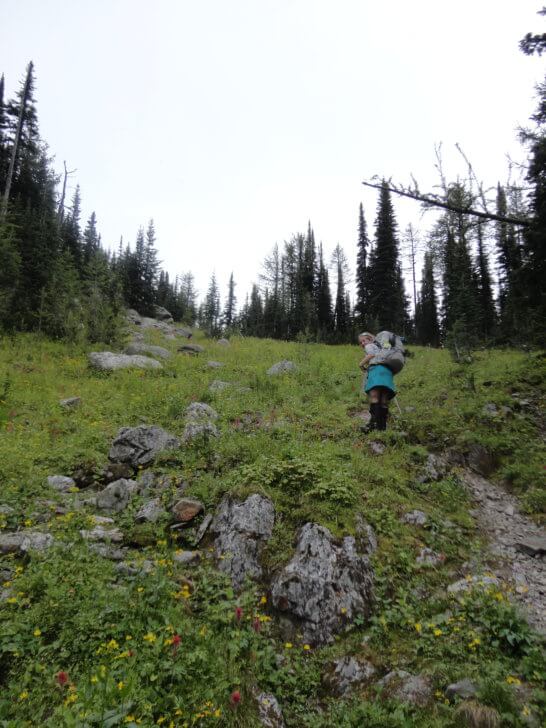
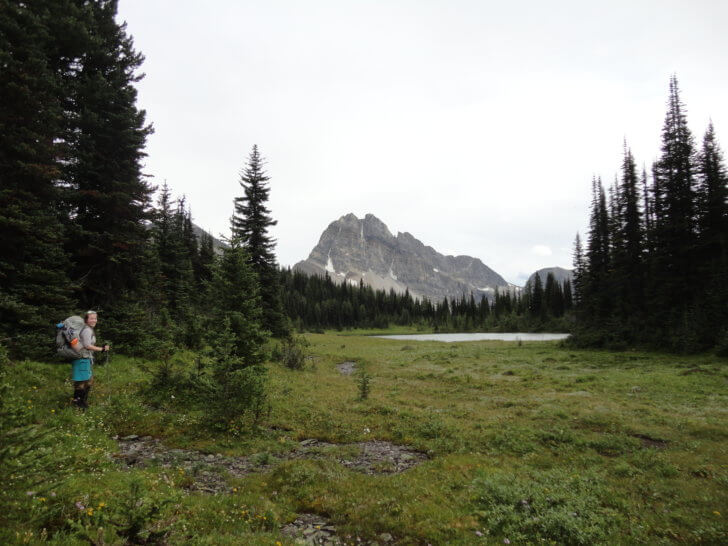
We pass Aurora Lake without a backward glance. Late afternoon was well upon us, and we are certain that we have at least 15 km (9 mi) ahead of us. We have already traveled 22 km (14 mi) today.
Pinnacle of Marvel Pass Backpacking Trail
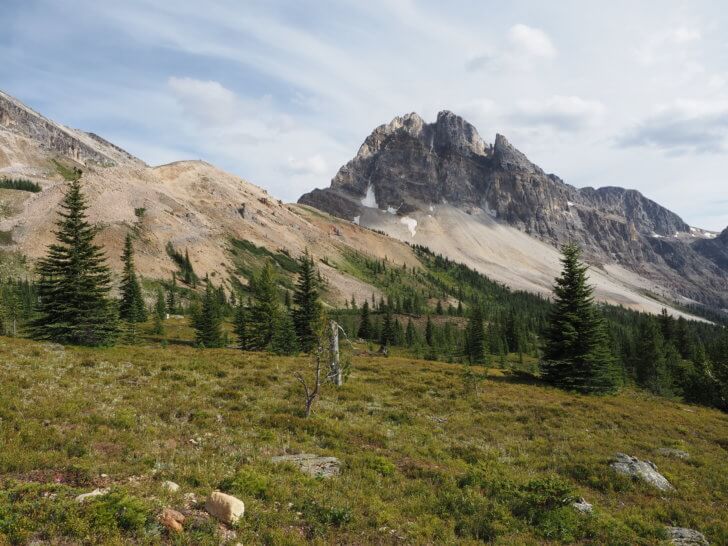
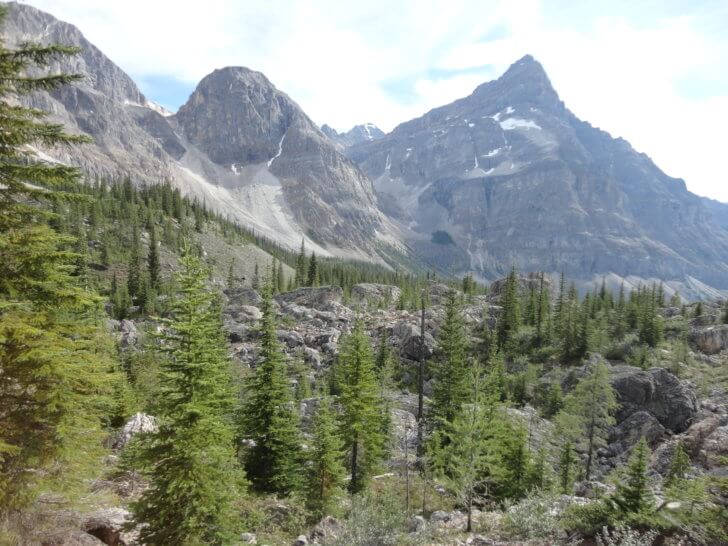
After several hours of hyper-vigilant trekking, we reach the epicenter of Marvel Mountain and the tri-branched passes which offer inspiring views. Although cloudy and obscured in a mist on our trip towards Assiniboine a few days ago, Marvel Pass is open and clear with sunlight edging its peaks today.
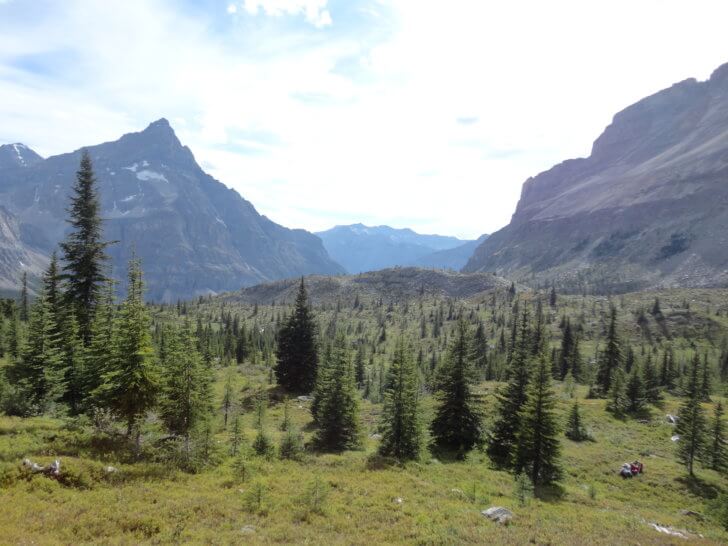
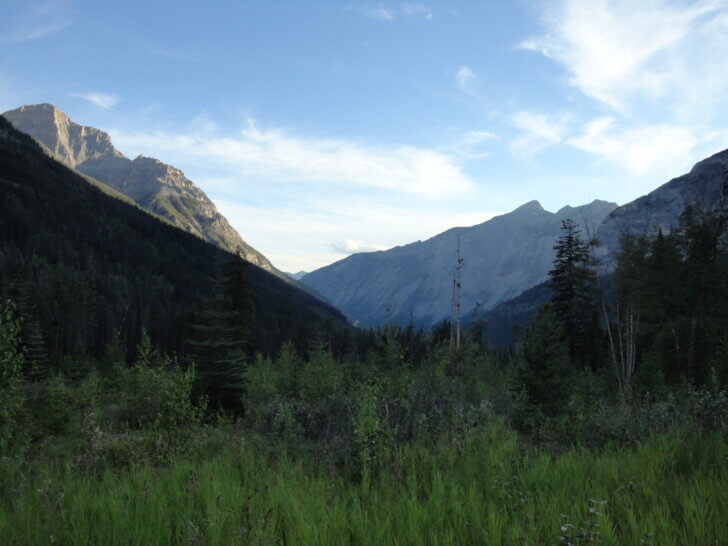
Every direction offers a new view; my fatigue is washed away in the shadow of Marvel Mountain. I desire to explore this alpine meadow.
Forced March
Although we still have several miles to go, I reluctantly leave the beautiful pass behind me and struggle through the increasingly dark forest. Predictably, the sun drops deeply behind the peaks, and the light is beginning to fail.
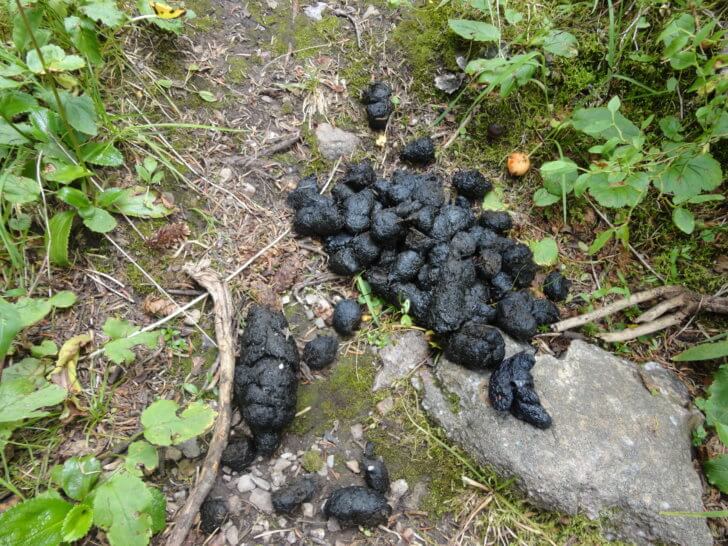
Failing light forces me to hike much faster than my muscles like. Also, fresh bear signs make me uncomfortably aware of sounds in the forest.
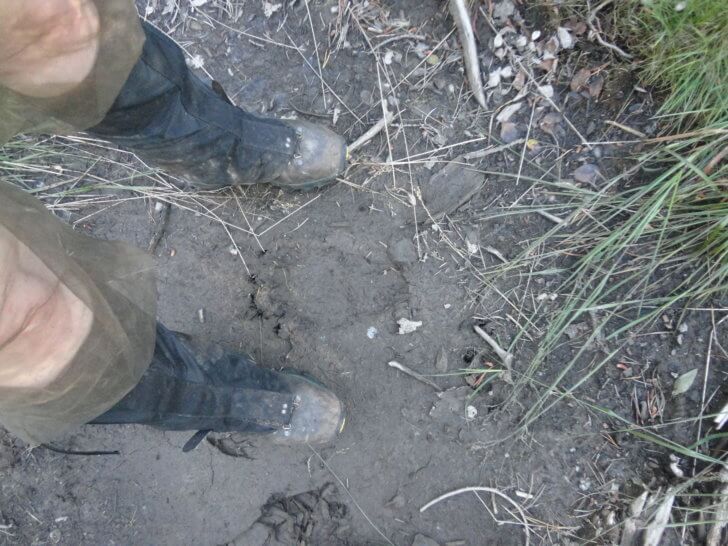
Unfortunately, hiking the last couple of miles to the truck is like walking on a razor’s edge.
I know about those warning signs that I had seen coming in on Marvel Pass Trail. Also, the scat and tracks I see now are new and large. Within 6 km (4 mi) of the truck, Craig yells, “Bear!”
We back off, grabbing for bear deterrents.
Craig fires off a bear banger. An exceptionally large male grizzly crashes through the trees with awkward grace. He breaks through to a meadow in the opposite direction of us.
The grizzly wants less to do with us than we want to do with him (is that possible?). Thankfully, within moments, we can hear him crashing far enough away that we begin to sprint down the trail in the opposite direction while talking as loudly as possible. If the bear circles back, we do not want to be anywhere near where he saw us last. However, we can’t keep up the fast pace for long; we have already put too many miles on our feet, and exhaustion and fatigue slow us both down.
When we reach the Aurora Creek Road, we slow to a moderately fast walking pace and glance in all directions with paranoia. Then, thirty minutes later we arrive at the truck. I have never been so happy to get back to my vehicle at the end of a hike. In what may have been record-setting time, I wash, change clothes, load gear, get into the truck and slam the door with finality behind me.
Reflections
A summary of this trip is challenging to describe. Do I start with the need to be prepared for encounters with wildlife? Perhaps the importance of having a backup of the most important supplies? Or perhaps the value of kindness on the trail? I could talk about the crucial skill of never outsmarting your common sense on safety decisions.
But this is Backpacking Light, and I do feel compelled to consider what unique aspects came out of this trip as a result of going light.
So within the context of lightweight backpacking, going light made this trip possible in two important ways:
First, in spite a few minor snags, I had everything I needed throughout the journey. I did lose my lighter, but I had enough matches to get me through. When Craig injured his knee, I had the tensor bandage he needed. When the map got lost, I had another copy on my camera’s memory card. Carrying a light pack still allowed us to complete the trip in relative comfort and safety.
Second, as I look back on the Marvel Pass Trail, I would say that most crucial point is this: I would not have been able to push as hard as I did for 114 km (71 mi) in four days if my pack was not pared down to lightweight essentials. At no point on my trip to Mount Assiniboine did my back feel sore or my feet hurt. Even after 37 km (23 mi) on the last day, I knew I could have easily hiked another 10 km (6 mi) – maybe more – if required. Not only was I able to push my mileage, but I was also able to push my hiking speed for extended periods of time.
Gear Lists
Notes on Gear Lists
- Of all my weight numbers, I’m happiest with my Group Gear (weight < 2.7 kg / 6 lb per person). The Group Gear encompasses my shelter, cooking, repair equipment, first aid, navigation and emergency supplies for two people.
- Part of going light is also being able to participate in hobbies and maintain enthusiasm and physical engagement (less fatigue!) while backpacking. To that end:
- I carry some extra first aid supplies and items that contribute to my overall physical comfort;
- I carry a relatively heavy camera, but using it to capture images is an important part of my enjoyment; On many occasions, I have left my camera behind to save weight, or I was pushing speed and time but lost some memorable moments and shots in the process. This summer I had a different goal, I reminded myself to look around and spend time taking photos because “I will not pass this way again.” If I wasn’t intentional about savings weight in other areas, I might not have the option to bring my heavier camera gear.
- On first glance, my other weight numbers are less than impressive (in the context of what you might consider as “state of the art” in ultralight backpacking); however, when you subtract out photography equipment and items which were not in my pack the numbers seem much less daunting.
As you review my gear lists, consider your needs: what would you do if your gear weighed less, and what items would you enjoy more if you brought them?
Note: all numbers are rounded up the nearest half ounce, and all weights are rounded heavier than actual.
Group Gear
| Item | Weight | Notes on Field Use |
|---|---|---|
| Nemo Equipment Blaze 2P Tent | 2 lbs, 5 oz (1.1 kg) | product in review |
| Woods Cypress Kettle | 9.1 oz (258 g) | |
| First Aid Kit | 9.9 oz ( 281g) | |
| Repair Kit | 7.6 oz ( 216 g) | |
| MSR Pocket Rocket | 2.9 oz (82.2 g) | |
| Silva Ranger Compass | 2.3 oz (65.2 g) | |
| Banff - Mount Assiniboine Map | 3.6 oz (103 g) | |
| SOL Mylar Blanket | 11.3oz (320g) | custom cut for Nemo Equipment Blaze 2P Tent |
| Outdoor Tech Buckshot 2.0 | 3.8 oz (108 g) | product in review |
| Tru Flare Bear Bangers | .4 oz (12 g) x8 | consumable used 6 of 8 bangers |
*Emylene’s Portion of Group Gear: 2 lbs 11 oz (903 g)
Individual Gear
| Item | Weight | Notes on Field Use |
|---|---|---|
| Osprey Aura AG 50 L XS | 3 lbs 3 oz (1.4kg) | Removed brain Actual volume available: 43 liters |
| Medium Exped Downmat UL 7 | 1 lbs 6 oz (623.7 g) | |
| Enlightened Equipment Prodigy | 26.50 oz (751.2 g) | |
| Platypus 1.8 Liter Big Zip Hydration System | 5.4 oz (153.1 g) | |
| Carbon Water Flavour Filter | 0.1 oz (2.8 g) | |
| 2 Mini Carabiners | 0.3 oz (8.5 g) | |
| Spork | 0.3 oz (8.5 g) | |
| Black Diamond Spot Headlamp | 3.3 oz (93.6 g) | |
| Black Diamond Women's Ultra Mountain FL Z-Poles 110 cm | 9.5 oz (269.3 g) | single pole only not carried |
| Cactus Creek Nylon 225g Bear Spray Holster | 1.4 oz (39g) | |
| Tru Flare Bear Banger Launcher | 1.3 oz (37g) | |
| Frontiersman Bear Spray 1% 225g Canister | 7.9 oz (225g) | consumable |
| Olympus OM-D E-M5 Mark II | 16.5 oz (469 g) | includes batteries |
| Olympus M. Zuiko Digital ED 12-40mm f/2.8 PRO Lens | 13.5 oz (382g) | |
| Joby Gorillapod | 1.6 oz (45.4 g) | |
| Apple iPhone 6 | 4.6 oz (129 g) | |
| FRĒ for iPhone 6/6s Case | 1.2 oz (35 g) |
*Emylene’s total gear: 10 lbs 2 oz. (4 kg 899g)
*Actual carried weight in pack: 9lbs. 8oz. (4 kg 309 g)
*Actual carried weight in pack minus camera equipment: 6lbs. 10 oz. (3 kg 61 oz.)
Layers
| Item | Weight | Notes on Field Use |
|---|---|---|
| Woman's Zamberlan Voiz GT Gore-Tex Backpacking Boots and Prescription Insoles | 3 lbs 4 oz (1.4 kg) | not carried |
| Outdoor Research Women's Verglas Gaiters | 6.5 oz (184.3 g) | not carried |
| Merino WrightSocks | 2 oz (56.7 g) | not carried |
| 2 Pairs of WrightSocks | 2.2 oz (62.6 g) | |
| MEC Watchtower Pants | 8.3 oz (253.3 g) | |
| MEC Hydrofoil Rain Pants | 9.3 oz (263.7 g) | |
| Colghan's Mesh Pants | 1.6 oz (45 g) | product in review |
| Purple Rain Adventure Skirt | 4.3 oz (121 g) | product in review not carried |
| IceBreaker Siren Bikini | 1.10 oz (31 g) | not carried |
| Seg’ments Merino Wool Base Layer | 4.8 oz (136.1 g) | not carried |
| Smart Wool Bra | 2.9 oz (82.2 g) | product in review not carried |
| MEC Women's Hydrofoil Jacket | 10.7 oz (302g) | |
| MEC Uplink Vest | 7.9 oz (224g) | |
| Liner Gloves | 0.8 oz (22.7 g) | |
| Silk Scarf | 1.8 oz (51 g) |
*Emylene’s layers: 11 lbs (5 kg)
*Actual carried weight in pack: 2 lbs 8 oz (1 kg 134 g)
*Emylene’s actual total carried weight minus camera equipment: 11lbs 13 oz (5 kg 352 oz)


Discussion
Become a member to post in the forums.
Companion forum thread to: Backpacking to Mount Assiniboine via the Marvel Pass Trail: Part 5
Backpacking to Mount Assiniboine through grizzly bear country requires you to pay attention! Enjoy the final day of our journal.
Great series. Gorgeous scenery! I have a couple of questions. First, what is a “bear banger?” I live in Alaska, but I’ve never heard of this. Like a firecracker? Second, you saw a lot of bears! Are they known for attacking hikers in this area? While I live in Alaska and have backpacked around the interior, I’ve never run into so many bears on a single hike, probably for several reasons, including hunting pressure, and also less rich habitat food-wise than you probably have in Canada. I notice that you and at least one other commenter speak to how much better the hike would be without bears; would you want them to be eliminated? Or reduced in numbers? Slamming the vehicle door with finality makes it sound like a boot camp trudge instead of an enjoyable experience, presumably due to bears. Just curious if you would advocate a change in management to accommodate hikers.
Thanks also for your gear list, will peruse when I have more time.
A good series. Thanks!
Thanks for the excellent write-up and great pictures. As a frequent hiker in the Canadian Rockies, I have never set of a bear banger (https://www.mec.ca/en/search/?text=bear+banger – posted link to answer Karen’s question), although I’ve come across many bears. The latest was this summer when my 12 year old son and I ran into a mother grizzly and cub while we were fishing in Kananaskis. We backed off, gave them space, and they pretty much ignored us as they were trying to fatten up on the (very early) berry crop. We had our bangers and spray ready, but would only have used them if they had come at us aggressively. Based on reading your reports, it seems like none of the bears were a threat to you, so I’m worried that firing off all those bear bangers is conditioning them to the noise. Just my interpretation, and forgive me if I’m wrong, but you seem to have an unhealthy fear of bears, not a healthy respect. You may want to find a bear expert to do a few hikes with to help ease the fear and enjoy these types of trips even more.
Cheers
Al
Enjoyed it immensely, from beginning to end. What a trip! And a tribute to your will to survive an accident that would have put an end to the backpacking life of most people.
“Force of nature”. Yeah, that sounds about right. :0)
I’ll look forward to hearing about your next adventure
Neat write up. Waited anxiously for each Part to arrive. Fun to read how you planned to avoid the major groupings of humans.
Bears? Wandering where they live is IMO an acquired skill. Too many people take them too lightly, I think. Fear does enhance the senses. Did well.
OmD tip……get a circular polarizing filter for your lens and experiment with it and the exposure settings available on that great camera. Scenics will pop!
Look forward to next Report.
Thx
Truly enjoyed this series, IMO the best write up series of the year.
Setting off gunfire-like noises because you’re near a bear?
If that’s your approach please stay out of bear habitat.
What an enjoyable read! It seems like ages since I was last in Canada; we went bike touring around Calgary and Banff. I was most impressed by the free provincial campgrounds with hot showers, something you’ll never find down here.
Having spent the first part of my adult life working for the Forest Service, I’ve had more bear encounters than I can recall; luckily the majority involved black bears, which tend to avoid humans, and the few grizzlies were observed from a safe distance. But the possibility of an adverse encounter always looms, so I keep the bear spray easily accessible on my shoulder strap and not stowed inside the pack. A couple of recent maulings involved folks who did indeed have bear spray…inside their packs. Not much good there! So far this fall four or five hunters have been mauled here in Montana, and none of them had bear spray. Only one of them was able to bring the bear down with his rifle. But if you talk to them (hunters) they all scoff at the idea of using spray and think I’m quite bonkers for hiking solo without a gun. Fact of the matter is, more people are killed by cows each year than by bears. You know what I’m talking about.
I noticed in some of your photos you seem to be wearing ‘skeeter netting leggings. How did those work out? Was the skirt, netting combo better than long pants? I’m curious because I’ve been toying around with the idea of a kilt…but then all the bugs, yikes! Also, I’d like to hear something of your food choices: commercial freeze-dried, DIY dehydrated, coffee vs tea, etc.
“If that’s your approach please stay out of bear habitat.”
Spoken with the benefit of expertise acquired from living in Chicago? What is your approach when hiking in Grizzly habitat and how is it superior to bangers, which are one of the methods of choice up there for dealing with Grizzlies?
Wow Emylene, this sounds like an amazing trip. You did a fantastic write up and the photos are gorgeous. I am impressed with you attitude, abilities and successful completion of you plan. Cheers to Craig for being a trooper about his knee, I know how hard that can be! Looking forward to your next report.
Benjamin Stewart – you must not know anything about bears. Bear bangers are an extremely effective and very light method of repelling bears. Don’t be a jerk… its better than carrying a gun, IMHO. Beyond which, sometimes yelling at a bear and moving away slowly doesn’t do the trick. Better safe than sorry. I wish bear bangers were sold legally here in the states.
Good to see the Discussion of Bears here.
“Bear attacks happen as fast as lightning!!! Most situations where you will need to use bear pepper spray will be in a close surprise encounter. When people are injured by bears in most cases it is due to the fact that the person and the bear were unaware of each others close proximity. In a surprise encounter as this, a person usually has less than 2 seconds to react. UDAP Pepper Power’s® belief is to get as much bear pepper spray as possible between you and the bear in that 2 seconds.”
Complex subject for sure. Knowledge and preparation are your best defense. But Studies have shown Spray is superior for defense than firearms, period. And even Spray has its limits. An experienced guy in the Madison Range last Sept was charged from a relatively long distance while hunting/scouting and he had a sow literally run through the Spray and attack him and multiple times.
i personally know professional hunting guides who operate in NW and NE BC leading Grizzly hunts for bow. They generally all carry and use two canisters. Have abandoned even big handguns for defense over the last five or so years. Having spent four or more weeks a year in that area over the last twenty five years, the SOP has changed. Rarely do I see anyone carrying a firearm. And Bangers? You bet…….crazy you cannot get them in the US.
Never allow your self to underestimate these great creatures.
Greg
I’m still trying to understand how these bangers are supposed to be used. Do you set one off when a bear charges? When you are actually under attack? Or just randomly whenever you happen to see a bear? that seems counterproductive to me, since part of hiking is seeing the wildlife, not frightening it all away. Or do you only use them when you happen to be very close to them? I hike in bear country but I do not understand how these should be used, since I had never heard of them.
Adam and Tom, I’ve spent months backpacking among grizzlies and longer than that among black bears. I don’t surprise grizzlies, I pack food in an Ursack, and I carry spray when solo in bear country.
Sure, there are risks and fears. But we need to put that into perspective. In North America about 3 people get killed by bears every year. Ninety get killed by lightning. About 50,000 by automobiles. Air pollution kills way more than that. Our wild soundscapes are worth a lot more than a dubious solution to a relatively tiny risk. Can anyone seriously imagine the backcountry if everybody was setting these damn things off?
In the end, there’ll always be wild in wilderness with all its risk and beauty, gratias Deo.
People setting off explosions because they see a bear should take a break from the backcountry, spend some time learning about bear behavior and low impact wilderness philosophies, and see a counselor about their fears if necessary. Come back and enjoy the sounds of the wilderness rather than creating a war zone.
Just a few things…..Bangers if used properly do not create a war zone.
Bears will always lose to humans over time. Enough people around and Bears will eventually be extricated.
Using a banger to warn a bear is a safe and sane way to give them a chance to move along and get out of the zone of trouble. Depending on wind and conditions and their alertness wise use of such devices is an adjunct to living with us and them.
Similarly certain dogs like a Karelian with experience and training are a real benefit to you and the bear. Until you have been around a Karelian or even some Elkhounds in serious bear country where they literally live around you, interact in the evening and dawn, I would say your bear experience is a little ….could be better.
just sayin’…
Greg
Haha, I see the conversation has been going on without me while I was being a beach bum in New Zealand.
I will try to address as many questions as possible. Likely in a couple parts….
I’ll start with the main question: bears.
Grizzly bears can run an incredible 35Mph which means if they are within 300 feet and charge you are an easy meal ticket. Contrary to popular belief they can climb trees and run down hill. The greatest risk to hikers is when they get close to a grizzly and startle it.
The main factor in startling a Griz? Being too quiet. In almost all cases of bear attack, the victim startled the bear and the bear acted aggressively in response to human error of the human trying to run away proving they were prey and food for a bear. A mother protecting young is another scenario but again likely precipitated because the sow didn’t hear she had company and reacted aggressively.
On two of my bear meetings the bears were displaying assertive to aggressive behaviour which was not far off of what could have become a mauling. I’ll explain:
First was with the yearling grizzly I met on day two. He initially ran off, then turned around and began coming toward me. Of all the bears on the trip, this was the most likely to kill me.
Why? Bears are tactile learners. He was deciding if I was a threat, food or a plaything. He would very quickly decide I was food if he got close enough to realize how easy to kill humans are.
I may have been that bear’s first human contact and instead of avoiding me, he began pursuing me. This is even worse if I am not this bear’s first contact. If I was not his first contact, he is no longer seeing humans as a threat and is exploring the possibility that we are food.
No pun intended but that’s ‘bad news bears’ for me and the bear. If the bear and I get into an altercation, I am likely to be seriously injured and the bear is likely to be destroyed for his trouble. Make no mistake, I sized the bear up and saw curious but verging on predatory behaviour from him. I’m experienced in animal behaviour studies and have no doubt that’s what situation I was in.
Backing off and talking to the bear did nothing to slow his strides toward me.
In this situation, bear spray was useless and detrimental. The bear was too far for the spray to be effective but was rapidly closing what was a safe buffer zone for us both.
For those of you who have never used spray (By used, I mean have deployed it and dealt with the consequences thereafter) I’ll explain some logistics.
Bear spray is an airborne lung and skin irritant in an aresol can with a wide discharge nozzle. If you discharge bear spray, you and the bear and anyone or anything around you is getting coated in it too. Once discharged, bear spray actually attracts bears. It tastes good to them and is suspended in high fat oil.
Discharging the spray in the middle of a busy hiker thoroughfare and having to bolt down the trail contaminated with it myself and spending three more days, in grizzly country, in spray tainted clothing and equipment is possibly my own personal worst nightmare. Not only could I be attracting bears towards other hikers, I have made myself walking bear bait that has breathing difficulties from my own exposure.
Now let’s talk about bangers. A bear banger is a modification of a marine signal flare, basically a long range fire cracker. In this situation, I could safely fire off a bear banger and not only increase my safety, but the safety of other trail users.
The yearling bear who was curious about my potential as a meal ticket suddenly had very good reason to avoid my kind: we’re loud and we might bite harder than he can. After such a direct confrontation, the yearling bear is likely to avoid that trail area and any humans he hears for the rest of his life. Bears are very trainable and humans train them all the time. Usually humans habituate bears by leaving food, food scraps and even bear spray residue out for them. In this case, a bear banger very well may have saved a human and a bears life by teaching him to avoid humans.
The second bear I met on day two was the other bear I was extremely concerned about. As much as she startled me, she wasn’t startled. She had been watching us for a short time while we were eating our lunch. Ultimately she decided I was too much effort but she was very intentionally following her nose to my food. In this situation she was within 30 feet and I was under an avalanche shelf and it was not safe to discharge a bear banger. If she had come closer one of us would have deployed spray. Not ideal for the reasons I’ve outlined, but it was the best option of the two deterrents.
From there on, the bears were generally easily deterred, noise is the best deterrent. In the places there were bangers fired off and no bear, there was fresh predatory bear sign. What that means is shredded trees, uprooted trees, fresh dug holes and bear scat which contains animal parts and no berries. All of the combined bear sign told me: ‘the bear that lingers in this area is carnivorous and bloody dangerous.’ That instinct comes with experience and knowledge of bears. The baddest bear in the woods is likely to be startled because he doesn’t have to watch his back. Let him know I’m here before we find each other the hard way.
A banger is a good way of telling the bear I’m there and getting him to pay more attention than usual for several hours. The bangers were all fired off at least 10 kilometres apart and sometimes much further and often in completely separate mountain passes, so I’m not too concerned about the bears getting used to them. None of the hikers we met had even heard our banger just off the main trail. They are loud but have limited range. I’ve never used that many before, but I’ve also never had that many close encounters in one trip either.
And on to a few specific questions:
Karen, there have been many bear incidents in this area. I call them bear incidents because the bear is doing what is natural in its habitat. Humans are just are just visitors and some of them fail to take proper precautions and act according to the ‘law of the jungle” as it were, which ends badly.
I think I’ve outlined my process for deciding to use or not use a bear banger. As far as the how, it’s fired off just like a marine flare, Straight up in the air. This makes a visual and sound barrier around you which is uncomfortable for bears. The banger is never fired towards the bear as it may explode behind him and drive him towards you. Feel free to post or inbox me if that is poorly clarified.
I think my joyful door slam had a great deal to do with 15 hours of hiking that day, I’m actually planning to go back to the area, hopefully with a telephoto lens to get some Griz pictures. I may be insane but I rather liked it there, though I can’t say as I’ll ever hike through Marvel Pass again, I’ll probably go for a more conventional route with less miles and less unknowns so I can play with my camera.
Monty! Great question about the skeeter leggings! Best part is I have two articles coming out on backpacking in kilts and skirts! Coming soon!
I dry most of my own foods and use some grocery store options. I actually have a MYOG article all about it in the archives. If you have more questions than I answer there, feel free to fire me a message.
Greg: good tip on the filter, it’s on my list but good ones are killer pricy. Maybe when I get my cheque for these articles ;-) If you know of a particularly good one I’d love to hear your thoughts. Fire me a message to my inbox if you think of something.
Emylene
Summer in NZ? Tough life, Ms.!
Anyway, goodness what a fine Post here. A real service and should be required reading for anyone venturing into Bear habitat. Lotsa experience, wisdom and animal behavior knowledge. Good on ya, girl!
Hopefully many will read and slowly re read your info. So many, as in numerous well made Points.
Polarizer? Will look at the brand I have on my EM 1 and email you. I usually try to go for the mid priced ones.
Yeah,, the compensation should be high for your Article! Ha.
Emylene,
Fortunately, there are no grizzlies here on Vancouver Island. But lots of black bears and cougars. I’ve considered a bear banger, but have opted (for now) for one of the small air horns (76g) similar to this one.
It’s painfully loud (though not as loud as a bear banger). My theory is that the sound eminates from me (or at least my location) and it’s very quick to engage (it hangs in front on my shoulder strap). And a fresh one should produce at least a dozen short toots. (I haven’t actually used it yet in a bear encounter.)
Any thoughts?
PS. You’re a very good writer. I’m expecting a book soon. :-)
So this is months … years late Bob.
I do like the air horns. The only issues I have had with them is failing in the cold overnight temperatures, bulk and weight. Cold overnight temperatures would have been an issue on this trip for sure. On Vancouver Island, I would for sure recommend an air horn for the reason that water can damage a banger and cause it to misfire. Even here, I keep them in ziplock bags and take them out of my pack and inspect between trips.
I have to say my favorite solution though, has been the mini-speaker and tunes running. iPods / Bluetooth speakers etc. are getting to have great battery lives and they warn the bears well before I get there.
As much as I like seeing wildlife, I don’t want to be close to 90% of what is in the Canadian Rockies. Moose, Elk, Caribou, Bison, Wolves, Wild Horses, Cougars and Bears are lovely to look at but they can all be deadly dangerous up close. If I recall my stats correctly, Caibou, Elk and Moose actually kill and injure more people than bears every year. Which is why I carry a massive camera for an ultralighter. I want to get a look up close, without being up close.
Become a member to post in the forums.