You don’t have access to view this content.
Hiking Clothing Guide: An Overview of Ultralight Layering Systems
Keys to layering clothing for outdoor activity – keep it simple, light, and functional. This hiking clothing guide shows you how.
Keys to layering clothing for outdoor activity – keep it simple, light, and functional. This hiking clothing guide shows you how.
You don’t have access to view this content.
News this week: Mt. Everest Avalanche Adds to Tragedy in Nepal, The U.S. Outdoor Act of 2015, Take a Trip Through the North York Moors, Craig Weiland Discovers a New Diatom, and much more!
If you’d like to submit a link to a timely (fresh) story for us to consider including in our next installment, please send it along to submissions@backpackinglight.com with the subject line “BPL NEWS DIGEST”.
An earthquake that registered 7.8 on the Richter scale in Nepal has caused an avalanche on Mt.Everest, ending the lives of eighteen climbers. The United States Geological Survey detected twelve aftershocks measuring up to 6.7. The earthquake occurred on Saturday before noon local time. Helicopters have been dispatched to evacuate the injured.
Seismologists have been expecting a major earthquake in western Nepal, because the Northern Eurasian plate and the Indian Plate have been grinding together building up pressure. This is also the second year in a row that there has been a major avalanche on Mt. Everest. Last year a large icefall broke from the mountain’s south side, killing 16 of 30 sherpas that were crossing the Golden Gate.
According to the Guardian, since Saturday the number of fatalities has risen to 5,000 confirmed deaths and 6,500 injured, and the count of fatalities could as much as double as more progress is made in finding victims. The UN says that over 8 million people have been affected.
Seventeen climbers were killed and thirty-seven climbers injured by the avalanche. One climber who perished was a Google Executive/Engineer Dan Fredinburg.
IMPORTANT: If you don’t see the photo immediately below, just click this link to refresh the page, and you’ll be good.
Dan Fredinburg, Google Exec, Killed in Mt. Everest Avalanche http://t.co/hpZ3q2lMC6 pic.twitter.com/8vX0YlhdVL
— Hollywood Reporter (@THR) April 25, 2015
He was part of the Jagged Globe camp which was effected by the avalanche severely. Strangely, he had been at Everest last year at Camp 1 above the Khumbu Icefall when that avalanche happened. Fredinburg was quoted at the time saying, “There was this massive shudder and I thought I was going to die. It was terrifying. I grabbed my helmet and my ice axe and rushed out of the tent and threw my ice axe into the ground. Basically, we were the last people through the icefall before it happened.” Many doctors are on the scene treating the victims. One of these, Dr. Nima Namgyal has been posting updates with photos via Facebook. “Many camps have been destroyed by the shake and wind from the avalanche,” and “All the doctors here are doing our best to treat and save lives.” Our thoughts and prayers are for peace for anyone suffering loss from this terrible natural disaster.
IMPORTANT: If you don’t see the video immediately below, or see a “Sorry…” message in the video player, just click this link to refresh the page, and you’ll be good.

Aims to boost consumer spending by $646 billion on outdoor related products and increase U.S. outdoor industry jobs by 6.1 million. The act is a bipartisan piece of legislation that creates new definitions and tariff classifications in the U.S. Harmonized Tariff Schedule for “recreational performance outerwear”, and does away with the import duties on these products. This is supposed to reduce the cost of performance outerwear for consumers since some outdoor apparel has import tariffs that are as much as thirty percent. The bill also creates the Sustainable Textile and Apparel Research fund supporting the research and development of sustainable textile and apparel supply chains.
CONFLICT CAUSES CLOSURE OF A PORTION OF THE SUPERIOR HIKING TRAIL – Land owner Randy Bowe owns 380 acres between Split Rock Lighthouse and Gooseberry Falls state parks in the Great Lakes area. He has come to the decision to close the part of the trail that runs through his private property because of conflicts with hikers that pass through. RARE FLIPPED ICEBERG – Approximately ninety percent of an iceberg is submerged under water. Alex Cornell recently captured views of the bottom of an iceberg that flipped in the water. This is not usual, as icebergs are most commonly seen right side up, covered in snow and debris, but the underside of the iceberg proved to be something quite rare and beautiful. Alex mentions that he would have loved to get a closer look, but there is a certain level of danger to being near an iceberg in motion as the force from an iceberg flipping can cause waves that carry enough force to cause a tsunami.
A new entry in the books for BackpackingBongos details a trip through Newtondale in the North York Moors. Many photos are included to give you a look at the United Kingdom’s country side. The trip passes through “The Grand Canyon of Yorkshire” Horcom Hole where the terrain is varied.
Liam Lonsdale’s shares photos and stories from his trip to Turkey to climb Horguc Margara. Get a descriptive look at the trip from Liam, as well as many photos. He talks about the climbing conditions, his fellow climbers, and the local food in Turkey.
DENALI NATIONAL PARK SHARES ADVENTURES WITH THE YOUTH – Denali Backcountry Adventures gives the student the opportunity to decide where they want to explore in the Denali Wilderness. FEED THE RAT – Alastair Humphreys shares one of his favorite books which talks about the spirit within that calls for adventure.
Beautiful day for a hike. IMPORTANT: If you don’t see the photo immediately below, just click this link to refresh the page, and you’ll be good.
Don’t find yourself alone without the necessities – The items that you choose to bring on your hike can become your most valuable tools for survival if you are lost. Amy Whitley shares her take on how not to get lost on a hike, what to do if you are lost, and five items that you can keep in your bag all the time to increase your chances of survival.
A mirror reflecting the sun can be seen for several miles, but using a mirror is not the only option. In this video Ranger Mike explains the conditions needed to use a mirror for signaling, some different items that you can use for signaling, techniques of use, and what the universal sign of distress means and how to use it. The end of the video shows a long distance shot of each item covered in use so that you can get an idea of what you would look like if you were effectively signaling for aid.
IMPORTANT: If you don’t see the video immediately below, or see a “Sorry…” message in the video player, just click this link to refresh the page, and you’ll be good.

TAROMOVIES SWISS BUSHCRAFT BUILDS A SURVIVAL BOW AND ARROW WITH NO TOOLS OR EQUIPMENT. – Checkout the video below to learn how.
IMPORTANT: If you don’t see the video immediately below, or see a “Sorry…” message in the video player, just click this link to refresh the page, and you’ll be good.

IMPORTANT: If you don’t see the video immediately below, or see a “Sorry…” message in the video player, just click this link to refresh the page, and you’ll be good.

Section Hiker had a chance to test out something new from Sierra Designs. The Elite Rain Chaps from Sierra Designs are intended to be a solution for wet weather that keep not only your legs dry, but when paired with a poncho or a long parka they will help keep your crotch dry. The idea is that having this area open as opposed to a traditional rain pant, you will have air flow beneath your parka.
The Reactor Single Billet 6061 Aluminum Camp Stove is a personal sized stove that can use multiple fuel sources or be placed into a wood fire. There is a single spike on the bottom of the stove that is meant to be driven into the ground as a stand. Sixteen holes drilled into the bottom of the stove draw air through to the heat source, and there are notches cut out of the top of all sides for the hot air to escape. It is large enough to handle a larger cook pot and will boil enough water for a dehydrated meal.
IMPORTANT: If you don’t see the video immediately below, or see a “Sorry…” message in the video player, just click this link to refresh the page, and you’ll be good.

PROS AND CONS OF ARCTEREX NEW TAKE ON THE HIKING BOOT. – Indefinitely Wild takes a look at the issue.
FUGOO OUTDOOR BLUETOOTH SPEAKER BRINGS MUSIC TO THE OUTDOORS – Gear Junkie reviews the Fugoo outdoor bluetooth speaker which has six speakers, multiple case options, and survived a drop from an overpass. Some of the configurations include the ability to clip it to a harness, and mount it to a bicycle. Forty hours of battery life make this speaker something to consider if you have to take music with you on multi-day expeditions.

Craig Weiland out backpacking for science. Photo courtesy of Adventurers and Scientists for Conservation used with permission of Craig Weiland.
Craig Weiland in a weekend backpacking trip has collected a new single celled organism for scientific research. Craig is a volunteer for Adventurers and Scientists for Conservation. He has been using his hiking trips to collect samples for the ASC.
I contacted the ASC and they informed me that Craig has been working with them since 2012, and has taken on more projects than any other volunteer. In addition to collecting diatoms, he has participated in Pacific coastal marten survey on the Olympic Peninsula, the Landmark wildlife research program on the American Prairie Reserve, and he’s now signed up for the freshwater micro-plastics research. Craig also has another species named after him: Encyonopsis Weilandii.
Kurtkramerria Weilandii is the new diatom that was collected by Craig was named partly after him and also after German diatom researcher Kurt Kramer. The sample was then given to Dr. Loren Bahls who discovered the new diatom. Craig was able to collect the sample on a weekend trip in the Olympic mountains in Washington.
PACKRAFTING IN SCOTLAND – Topofests writes how friends got together for some snowy packrafting.
CRAIG ROMANO GIVES HIS THOUGHTS ON OVERCROWDED TRAILS – Mountaineers.org shares Romano’s thoughts on crowded trails.
A film by Eric Timmerman and Travis Barron that interviews over 100 different through hikers that have traveled the Pacific Crest Trail. The film provides a look into life away from the normal societal human activities, the beautiful scenery that can be seen along the trail which spans from Mexico to Canada, and what lies in between.
IMPORTANT: If you don’t see the video immediately below, or see a “Sorry…” message in the video player, just click this link to refresh the page, and you’ll be good.
IMPORTANT: If you don’t see the photo immediately below, just click this link to refresh the page, and you’ll be good.
If you like my pics, (and I hope you do!) you’ll love today’s post on my #Oregon coast #hike http://t.co/u6tgV54CnC pic.twitter.com/siUBrOJKlM
— Dave Collins (@CleverHiker) April 22, 2015
IMPORTANT: If you don’t see the photo immediately below, just click this link to refresh the page, and you’ll be good.
A little inspiration on this #EarthDay “As I walk, As I walk, the universe is walking with me” A photo posted by Paul Mags (@pmagsco) on
IMPORTANT: If you don’t see the photo immediately below, just click this link to refresh the page, and you’ll be good.
As the rescue starts in #Napal & on #Everest our thoughts are with those affected by this catastrophic disaster. pic.twitter.com/lQjasOjAxy
— Cora McKenna (@McKennaCora) April 26, 2015
IMPORTANT: If you don’t see the photo immediately below, just click this link to refresh the page, and you’ll be good.
MT@SFGate: #NepalQuake triggered avalanche on #Everest http://t.co/EG70MsWZ7V pic.twitter.com/5hlW0VELtU — Zenzo L (@ZenzoLusengo) April 26, 2015
IMPORTANT: If you don’t see the video immediately below, or see a “Sorry…” message in the video player, just click this link to refresh the page, and you’ll be good.
Alastair Humphreys shares some beautiful footage of the Scottish countryside as he talks about the Bothy; a small shelter that is open to the public that provides just the bare essentials needed to experience a night away from the rigors of our societal lives.
Making your own tent will challenge your ingenuity, but it gives you total control over your shelter. The process can be simplified with this step-by-step guide for making your own lightweight tent.
You don’t have access to view this content.
A solo, multi-week expedition along the Brooks Range proves to be mentally and physically challenging as the author faced uncertain conditions and rugged terrain.
You don’t have access to view this content.
Introductory Reviews of the Excalibur Dehydrator #3526TCDB, Munk Pack Oatmeal Fruit Squeeze, LuminAid PackLite 16 Version 2.

Excalibur Dehydrator
DIY hikers like to tinker, so why not tinker with food? Some justify the activity of home food dehydrating as cost-saving, time-saving, and nutrition-saving, but for most of us, it remains an interesting hobby that gives us more ownership in our outdoor experiences.
In my inaugural test with the Excalibur Dehydrator, I (Ryan) decided to see how it could handle one of the more complicated food types to work with – salmon. Its fatty meat is notoriously difficult to dehydrate and preserve without turning the salmon to either a pile of mush or a firestarting stick.
What separates a quality dehydrator from a lesser one is its ability to maintain consistent temperature control and air circulation. When I dehydrated my batch of tamari-malabar seasoned salmon, the result was exactly what I was hoping for – a dry but chewy texture and the full flavor of the meat without being too jerky-like.
Having an insatiable appetite for data, I rigged a datalogger with thermocouples throughout my salmon-drying experiment just to see if temperature control across different trays and in different tray locations remained consistent throughout the 18-hour dehydration cycle. I set the thermostat to 155 deg F, and the temperature varied by less than 3.5 deg F regardless of location or time during the drying cycle.
So with my need for technical performance satisfied, the other key highlights are that it’s easy to use (two knobs!) and easy to clean (trays go in the dishwasher!). For an extra $130 you can either upgrade to the far more attractive stainless steel model or spend the cash saved on about 10 pounds of wild Alaskan sockeye salmon, which can be cut up and dehydrated into about 100 snack-sized pieces for your upcoming trekking season!


Munk Pack Oatmeal Fruit Squeeze
Outstanding texture and flavor, quality ingredients and energy, and packaging that allows it to be accessed and eaten while moving on the trail make this a very appealing product to the outdoor athlete. Unfortunately, its abysmal calorie-to-weight ratio (25 Calories per ounce) disqualify it as a food source for the ultralight backpacker interested in saving food weight on a multi-day expedition. If the product could dial in a 100-Calorie portion for less than two ounces, and offer lighter packaging, we’d be more inclined to recommend it to you. It remains a good option as a training food, however, for day trips where sucking gels or dry-mouthing an energy bar gets old.

LuminAid PackLite 16
This lantern is light enough that I will use it as my secondary light source. This is going to replace my head lamp since I prefer to use a small handheld flashlight that has a pocket clip (clipped to the bill of my hat) for the majority of my lighting tasks. The light output is good enough to light up your immediate working area at night, and not having to switch batteries is a nice feature. Ease of use is also a positive when considering the interface since there is only one button to cycle through the lighting modes. The lantern is inflatable and I have seen mention of it being used as a pillow. I might try this, although I have a pretty comfortable way of folding my jacket into its hood, which is what I currently use. Durability is a concern that I have since it is a soft material. I think as long as I take the care necessary to fold it up properly and not poke it with anything sharp, the lantern will hold up. The price is low enough that I don’t have any reservations about my purchase, even if I end up having to replace it after a few trips. There is also another thing to consider when purchasing. You can spend just a little more money and buy a light (the older version of the lantern) and choose an organization that will send the same lantern to someone in a different country that needs it, in hopes that the person won’t have to rely on a kerosene lantern for their night time light source. You can read more about that here.
Support Backpacking Light. Shop with

ISPO brings the top outdoor retailers together and gives us an opportunity to evaluate their gear firsthand.
You don’t have access to view this content.
News this week: The U.S. Senate votes yes on SA 838, Eric Barone becomes the fastest man on a mountain bike, YouTube opens 360 video uploading, an off-trail route in King’s Canyon, Exped Lightning Review, and much more!
If you’d like to submit a link to a timely (fresh) story for us to consider including in our next installment, please send it along to submissions@backpackinglight.com with the subject line “BPL NEWS DIGEST”.
The Senate has narrowly passed a vote (51-49) to establish a spending-neutral reserve fund relating to the disposal of certain Federal land in SA 838. As this action was a budgetary amendment it holds no legal precedence and is rather a philosophical support for the growing trend of federal lands transfer. However this vote could mean that in the future the United States National Forest land and other wildlife preserves could be owned by individual states. Opponents of the amendment worry that transferring federal lands to the states will result in these lands being sold off to private entities as a way to balance budgets and increase revenue streams. Opponents worry that this will result in decreased access to many of the areas used by the public for hunting, fishing, camping, and backpacking. Proponents emphasize that transferring federal lands to the States does not mean they will be sold off – rather it gives the States power to better manage lands within their borders. The amendment does forbid the sale or transfer of National Parks and Monuments furthering the protection for these historic sites.
One year ago an avalanche took the lives of 16 sherpas on Mt. Everest. Last fall a team from ESPN went to the region to chronicle the story. The result of their journey was a film showing the events that lead to their deaths and the ways in which the Sherpa community responded. On April 18, 2014 just as the climbing season was starting, a bottleneck was created along the Everest route as Sherpas heading up to set the route for their clients waited to cross a couloir using a defective ladder. Without much warning, an ice and snow avalanche fell from above trapping the Sherpas. This incident highlighted the dangers of the job to the Sherpas and the rest of the world. In a region where most people are extremely poor, the Sherpas line of work allows them to double or triple the average income in just a few months of work. The Sherpas have been crucial in making Everest such a prized destination for the climbing world – some Sherpas estimate that without support less than 5% of mountaineers would reach the summit. Each year the Nepalese government rakes in millions of dollars from climbing and permitting fees. After this incident the Sherpas began to demand that an increased percentage would benefit them directly through expanded life insurance and other benefits.
IMPORTANT: If you don’t see the video immediately below, or see a “Sorry…” message in the video player, just click this link to refresh the page, and you’ll be good.
SHOW OUR TRAILS SOME LOVE – The American Hiking Society’s National Trails Day event registration is now open. If you would like to organize an event to help clean up trails, or find one in your area follow the link. SCIENTISTS MAKE WALKING EASIER – Scientists at Carnegie Mellon University have developed a device that uses a spring to store and release energy in a manner that makes walking 7% more efficient. RAINIER NATIONAL PARK HALTS RESERVATIONS TO WONDERLAND TRAIL – Following a record year of reservation requests, Rainier is no longer giving out permits for the 93-mile trail for 2015. SCIENCE SHOWS WHY WE SHOULD SPEND MONEY ON EXPERIENCE VS. THINGS – Jay Cassano writes about how science shows that we are more happy with spending our money on our activities rather than material goods. IT’S BEAR WEEK – Brooks Range Wildlife Biologist Kyle Joly talks about his duty to take care of the bears who call this area home. AN HOUR IN SPACE – Astronauts on the International Space Station pieced together GoPro footage of their duties while in space. IMPORTANT: If you don’t see the video immediately below, or see a “Sorry…” message in the video player, just click this link to refresh the page, and you’ll be good.

A race to the North Pole has been announced by the Mamont Foundation. Said to be the ultimate challenge and ski race with competitors from around the world. The competition aims to capture the essence of polar exploration, teams will race from the eighty-ninth degree north to the North Pole. The route will cover 60 nautical miles on skis pulling pulks behind them with all of their equipment. The list of team captains includes David Hemplemam-Adams who leads an all British team, French explorers François Bernard, Christian de Marliave and Jean Gabriel Leynaud, and the women’s team lead by Denmark’s Bettina Aller. There will be competitors from Sweden, Italy, Russia, Germany, Switzerland, Canada, the U.S.A. and Denmark. The race day start is April 15th 2015, and the arrival at the North Pole is set for April 21, 2015.
Andrew Skurka introduces us to this route in the Sierra as part of his “Short is the New Long” effort designed to help get people outdoors exploring the geographic features near them. The King’s Canyon High Basin Route is 120 miles of off-trail backpacking in one of the “finest backpacking routes in the world”. The route is remote crossing miles of terrain above 10,000 feet and meeting other backpackers is unexpected. Due to a starting and ending location on the same side of the Sierra Range logistics are simplified and there are options for section hikers.
JOURNALING FROM EVEREST – Greg Vernovage shares his daily experiences leading an expedition to the Everest summit giving you a detailed perspective of what it takes to survive life on the world’s tallest mountain. NORTH POLE MARATHON 2015 – Adventure Blog writes about the North Pole Marathon where twenty-two countries are represented, 45 competitors race to the Pole, running in some of the world’s coldest conditions on the frozen Arctic Ocean. JOURNEY ON THE SANTA CRUZ – Sidetracked.com shares Leon McCarron’s experiences on the Santa Cruz River in Patagonia as he mirrors the journey that Charles Darwin made 180 years ago.
 Exploring Patagonia by horse and foot. Courtesy of Sidetracked Magazine.
This weeks featured photo is from the Tetons from last September, remember to use the hashtag #backpackinglight for a chance to see your photo featured. IMPORTANT: If you don’t see the photo immediately below, just click this link to refresh the page, and you’ll be good.
Find the ideal place for your next adventure. Get logistical planning tips from Paul Magnanti about knowing the conditions on the ground. Paul recommends that you perform a Google search for areas that may not be in your local area to find out about the weather in what month of the year you plan to make your trip. You will be able to find out weather history, if local ski resorts are still open in that month it would be an indication on the gear that would be required. Using a Benchmark Atlas to see the difference between BLM land, national monuments and wilderness areas, with overviews and detailed maps as well. He suggests that it is also a good idea to call the local BLM office or Department in charge of the area that you plan to travel to get specifics for regulations and possible permits that could be required.
If everyone who hiked the Appalachian Trail practiced Leave No Trace principles, the Appalachian Trail Conservatory could be saving a lot of work as hikers have been a contributor to the two main problems that the ATC addresses each year. Laurie Potteiger is the Information Services Manager for the ATC. She explained that the two main issues that they have seen in recent years has been graffiti, whether it be on boulders, trees, or shelters as well as the improper disposal of human waste. There are over 2.5 million hikers that travel the trail each year. Whether this concept is new to you or if you’ve been hiking with this idea in mind here is a quick list of leave no trace principles as cited from the Boy Scouts of America.
Joshua Tree National Park is known for it’s beautiful desert scenery, hiking trails, and climbing locations. There are also many varieties of wild flowers currently blooming. The Park was first established in 1936 as a National Monument to protect the desert vegetation that was being picked and planted in other locations. The park publishes a detailed catalog showing which flowers are blooming now in which parts of the park.
DON’T LET A RIVER RUN YOU OVER – Dave Collins shares his ideas on how to safely ford a river.
IMPORTANT: If you don’t see the video immediately below, or see a “Sorry…” message in the video player, just click this link to refresh the page, and you’ll be good.

AN EASIER WAY TO CROSS A RIVER – In India, there are bridges spanning rivers made from living roots; they may work better than fording if you have time to wait for them to grow.
HEY PACKRAFTERS, HOLDING YOUR BREATH IS USEFUL – Mark Healey shares his tactics like taking deep breaths beforehand and the mindset that enables him to hold his breath for a while: 3 and a half minutes to be exact.
IMPORTANT: If you don’t see the video immediately below, or see a “Sorry…” message in the video player, just click this link to refresh the page, and you’ll be good.

BACKPACKERS LEARN FIVE KNOTS – Wes Siler shows how to tie five knots. The bowline hitch, two half hitches, tautline hitch, figure eight, and a trucker’s hitch. With pictures of the process posted in GIF form.
TRAIL WISDOM FROM TOM JAMROG – Tom Jamrog has hiked over 10,000 miles on the Appalachian Trail. He recently gave a seminar on survival skills, and his experiences over the years, and shattering the two most common questions that he is asked, “Did you go alone?” and “Did you take a gun?”
IMPORTANT: If you don’t see the video immediately below, or see a “Sorry…” message in the video player, just click this link to refresh the page, and you’ll be good.

Youtube has currently opened a video uploading platform that supports 360 degree video, which if you don’t know means that you have the ability to press a button on screen which allows you to look in every direction around the camera, just like if you were there and you were turning your head! As of now the feature is only available in the chrome browser, and cameras that record 360 degree footage are a fairly new development. The Ricoh Theta 360 is one of those cameras. Weighing in at 95 grams (3.35 ounces), it has the capability to pair with your smartphone for extra controls, records three minutes of video in 1080p and has an MSRP of 299.99. Hikosaemon discusses the excitement, and potential about this small camera as well as some of the cons.
IMPORTANT: If you don’t see the video immediately below, or see a “Sorry…” message in the video player, just click this link to refresh the page, and you’ll be good.

The Exped Lightning 60 Liter pack is a lightweight, multi-day backpack with a large capacity. It’s list of features include a roll top closure which closes in two different ways, either clip it together or clip it to side straps that are near the water bottle pockets. A compression system consisting of straps (webbing style) that criss-cross around the body of the pack and over the top. The straps are also removable and can be reconfigured to attach at different points to carry different shaped items outside the pack. There is an inner pocket for holding valuables, or smaller items. Two side pockets on the outside of the bag at the bottom. The frame is an aluminum stay that is removable and a cross piece that is sewn into the bag across the top of the pack in the shape of a T. The vertical aluminum stay slides into two reinforced slots on this cross piece and also at the bottom at the hip belt. There is a lumbar pad on the hip belt at the base of the aluminum stay to help with support. You can flip it down to remove the stay from it’s slot. There are two zippered pockets on hip belt, one on the left side and one on the right. One large buckle which features an attached cinch hold the hip belt closed and offer a bit of fine adjustment. The Torso length of the pack is adjustable from 17 inches to 22.5 inches, weight is 2 pounds 7 oz. (1.10 kilograms) and the body of the backpack is made of ripstop nylon.
DREAM GEAR LIST COMPILED – Chris MacNamara has compiled a list of “Dream Gear” that aims to highlight the best gear for hiking inspired backpacking, or crossover inspired trips where you may want a balance of camping and hiking.
TARPTENT MADE IN AMERICA – Gear Junkie talks to Henry Shires of Tarptent about their products made in the U.S.A, durability, what makes Tarptent different than competitors, why they only sell direct, and how a background of physics impacts Tarptent’s shelter design.
The fastest man on a mountain bike just set a new world record in a down hill ride that began atop the tallest mountain peak in Vars France. Eric Barone is fifty-four years old and this is not the first time he has broken the world record for speed on a mountain bike, or the first mountain peak that he has raced down attempting to better his records. Barone has added his newest accomplishment to a list of previous achievements which include riding down twenty volcanos in Nicaragua, Mount Fuji in Japan, Etna and Stromboli in Sicily, Mauna Kea and Kilauea in Hawaii, and Nevado De Teluca in Mexico. This time he has bested his own record by descending the tallest slope of Vars France which boasts a slope of 98% at 2700 Meter altitude. Barone reached a top speed of 138.75219 miles per hour (223.3 Kilometers per hour).
IMPORTANT: If you don’t see the video immediately below, or see a “Sorry…” message in the video player, just click this link to refresh the page, and you’ll be good.

Outdoor enthusiast Jeremie Lamart doesn’t let a knee injury sideline his plans for adventure in Nepal. He originally planned to climb Lobouche, but finding out about his knee being what would seemingly become the end of a trip before it had started was not going to keep him from having some great adventures. With tickets already booked, he made the decision to turn his trip into a packrafting journey through some of the great rivers that run through Nepal.
IMPORTANT: If you don’t see the video immediately below, or see a “Sorry…” message in the video player, just click this link to refresh the page, and you’ll be good.
Packrafting Nepal from Injuring Eternity on Vimeo.
THE DAY THAT CHANGED IT ALL – Nick Gibb overcame a devastating leg injury that he sustained in 2004. Now he continues his love for the outdoors and completes the Leadville 100 mountain bike race.
IMPORTANT: If you don’t see the video immediately below, or see a “Sorry…” message in the video player, just click this link to refresh the page, and you’ll be good.
NO HANDS CLIMBING – Wayne Sharrocks recently had the opportunity to film and interview veteran climber Johnny Dawes about his passion for no handed climbing.
IMPORTANT: If you don’t see the video immediately below, or see a “Sorry…” message in the video player, just click this link to refresh the page, and you’ll be good.

CLIMBING IN THE PHILIPPINES – Take a peek at the S.P.O.T. Project climbing adventures in the Philippines with James Pearson and Caroline Ciavaldini.
IMPORTANT: If you don’t see the video immediately below, or see a “Sorry…” message in the video player, just click this link to refresh the page, and you’ll be good.

IMPORTANT: If you don’t see the photo immediately below, just click this link to refresh the page, and you’ll be good.
106 yrs after Matthew Henson, Joy, Og, Amiee & Moni Amazu: the 1st black family at the North Pole @thechallenge100 pic.twitter.com/5FOXysv4TC
— Martin Hartley (@MartinRHartley) April 13, 2015
IMPORTANT: If you don’t see the photo immediately below, just click this link to refresh the page, and you’ll be good.
Goodbye to Longyearbean. Heading further North to 90 Degrees, tonight… pic.twitter.com/vrRCSa3riw — Martin Hartley (@MartinRHartley) April 11, 2015
IMPORTANT: If you don’t see the photo immediately below, just click this link to refresh the page, and you’ll be good.
Friday night’s Anglesey cliff-top bivvy. St Patrick was shipwrecked here. Exceptionally windy. pic by @mattmercian pic.twitter.com/Y63cvrDseK
— Jack Thurston (@jackthurston) April 13, 2015
IMPORTANT: If you don’t see the photo immediately below, just click this link to refresh the page, and you’ll be good.
Five star accommodations. Room for two. Fireplace. View of river out front door. #tarplife #getoutside #frontrange @hyperlite_mountain_gear A photo posted by Noel Worden (@noelworden) on
MOUNTAIN BIKING IN FINALE LIGURE ITALY
IMPORTANT: If you don’t see the video immediately below, or see a “Sorry…” message in the video player, just click this link to refresh the page, and you’ll be good.
Guide’s Gear features products used by BPL’s WTS guides that have withstood the test of time by demonstrating exceptional performance, durability, weight, and value. Guide’s Gear No. 1 goes to the Gossamer Gear Mariposa Backpack for offering more features than any other two pound pack on the market.
The Backpacking Light Guides Gear Award identifies products that are recommended by the guides and instructors of Backpacking Light’s Wilderness Trekking School. These products have been proven in the field to offer exceptional performance, durability and value for their weight. Premarket or otherwise “new” products (less than one season old) do not qualify for the Guide’s Gear Award. Instead, the Guide’s Gear Award is given to those products that our guides and instructors use on a regular basis, not only on their Wilderness Trekking School courses and expeditions, but also for their own personal use. Every award recipient must meet the standard outlined in the following criteria statement:
“Guide’s Gear should represent products that are at the very top of their category in terms of their performance-to-weight ratio. Such products should be versatile and adaptable to a very wide range of environmental conditions and activity contexts, durable enough for rigorous use over an extended period of time, and embody state of the art design, materials, and manufacturing techniques. Guide’s Gear should reflect a simple and beautiful design aesthetic, address core functionality through exceptional performance, be intuitive to use, and contain no significant flaws or deficiencies. Guide’s Gear should reflect the unequivocal recommendation of experienced guides that is based on proven, long-term experience with the gear, complete with an understanding of the limitations of that gear.”
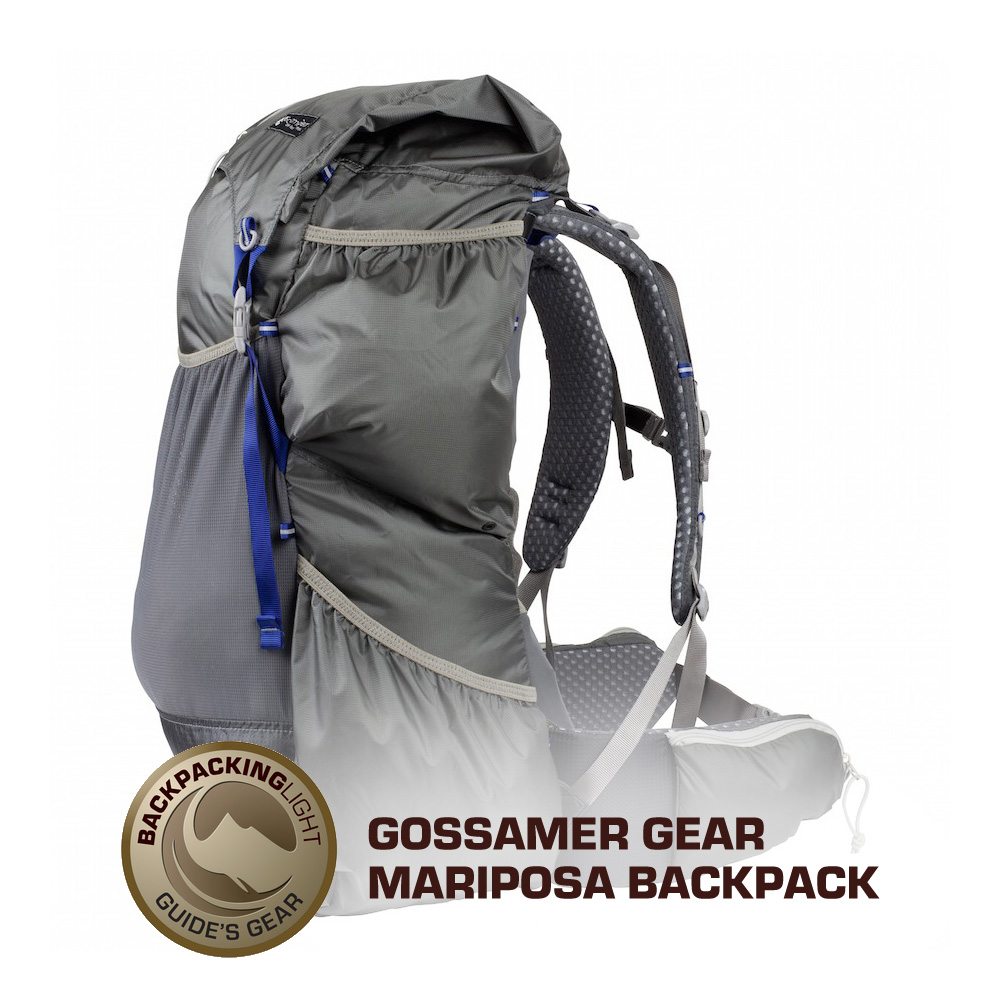
The Gossamer Gear Mariposa may pack more features into two pounds than any other pack on the market, including a solid suspension, a massive amount of gear-organizing capability, materials that are durable enough without costing a fortune, and enough volume for four-season use in cold climates.
The Mariposa offers very comfortable load handling at weights of less than 25 pounds, and carries up to 30+ well enough if you’re saddled with food weight at the beginning of a trek or thru-hike section. It accomplishes this with a simple internal frame (a feature sadly lacking on most so-called ultralight packs) and a very wide padded hip belt. Compared to the “gunny sacks” out there with their narrow belts and conspicuously absent suspensions, the Mariposa is a load carrying Cadillac in terms of comfort.
Its best feature is a design optimized for organizational efficiency and ease of access to lots of gear without opening the main packbag compartment. External pockets include a large rear pocket, three side pockets, two hip belt pockets, one top lid pocket, trekking pole and ice axe attachment points, and loops for customizing a bungee system for attachment and compression. With 36 liters of capacity in the main compartment and a whopping extra 21 liters in external pockets, small volumes can be carried without the pack carrying like a bag of slop, and there’s plenty of overflow for winter travel in cold weather (when high volume insulating gear takes up pack space).
A combination of 100 and 200 denier nylons give the pack enough durability for thru-hiking and other trail endeavors without excessive weight or cost.
Best for: on-trail use, thru-hiking, medium-to-large volume loads, those who need to access lots of gear while on the trail.
Limitations: Class 2+ scrambling or canyon hiking / bushwhacking (fabric durability limitation), very small volume loads, 40+ pound loads, those who need to lash large items to their packs (e.g., skis, snowshoes, packrafts).
In the winter, depending on snow conditions a fully-enclosed shelter can be preferred in which case a hanging stove system will still allow you to cook from the comfort of your shelter.
You don’t have access to view this content.
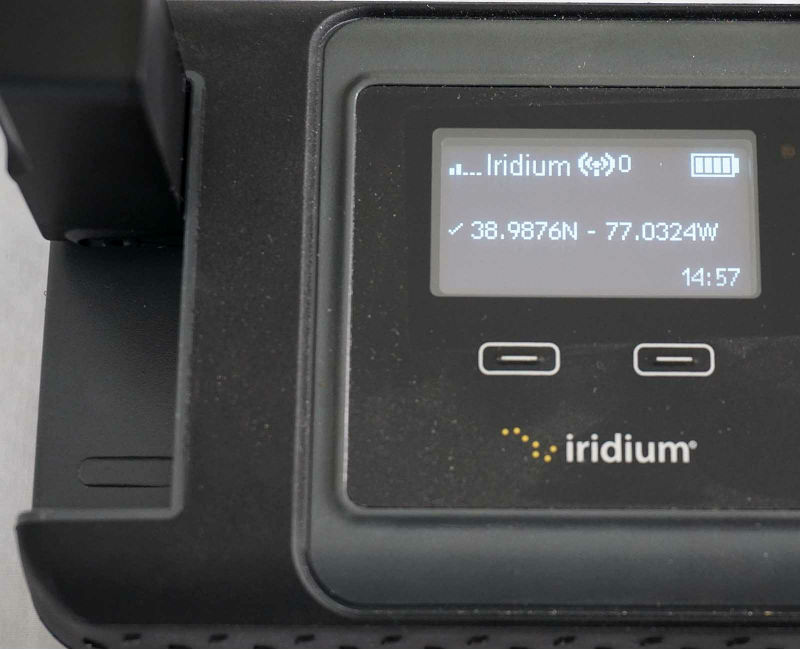
The Iridium GO! gives you access to technology even in remote locations by creating a backcountry WiFi hotspot for multiple smartphones.
You don’t have access to view this content.
News this week: Expedition Brings Sight to the Blind in Nepal, Skiing in the Cascades, Gear needed to Hike PCT in the Winter, 83-Year-Old who Runs a Ski Resort, and much more!
If you’d like to submit a link to a timely (fresh) story for us to consider including in our next installment, please send it along to submissions@backpackinglight.com with the subject line “BPL NEWS DIGEST”.
Jill Homer decided to hop on mid-race during the Iditarod joining the frenzy at Unalakleet some 750 miles into a 1000 mile race, and despite her fresh legs and enthusiasm, her mind and body had not been through the crucible that is training for an expedition of this magnitude. Now 45 miles since her start, her legs burned and she promised herself she would be better prepared in the future. Losing the trail only sharpened her awareness to do better in the future. The weather conditions had been extreme with some dog mushers calling it the worst blizzard they had ever seen, and now they were reaching the coast. “Everything that comes before the coast, prepares you for the coast.” or so the saying goes. At the coast is where the real race starts tracing 35 miles of sea ice. Here on the Iditarod, is where the mind is tested – where mental fortitude is so key. You have to know why you are doing this race – what your “why” is – otherwise it is impossible to keep going day after day in extreme conditions in a frigid desert. Upon reaching the top of Little Mountain Jill decides to turn around; she wasn’t ready, and yet all is not lost – valuable lessons on preparation were learned and those will be with her forever.
For many who live in remote villages around the world access to traditional, high-quality healthcare can be rare. For villagers in remote areas of Nepal blindness is a severe problem afflicting much of the population and there are very few local opportunities to improve their sight. A US-led effort to bring sight to these rural communities coordinated by Dooley Intermed International will offer free eye examinations, surgeries, and eyeglasses to the Upper Gorkha region of Nepal from May 1 to 10, 2015. Dooley International is a non-profit organization dedicated to helping those who live beyond the bounds of traditional healthcare. Due to the remoteness of these villages the effort will take on an “expedition-like” feel with the group walking on foot and carrying equipment on mules in order to reach the locations. In 2013, Dooley International visited the Lower Mustang region and made a documentary on their efforts to bring sight to the blind. This year they hope to help 1,500 to 1,800 people afflicted by blindness and give the the gift of sight. The expedition is sponsored by ISMS-Operation Restore Vision.
IMPORTANT: If you don’t see the video immediately below, or see a “Sorry…” message in the video player, just click this link to refresh the page, and you’ll be good.
NASA Astronaut Daniel Barry has spent a lot of time in space – 734 hours in orbit and 26 hours outside the shuttle. This has given him a lot of time to ponder humanity and how he was able to experience the final frontier. In a recent interview, he discusses NASA’s pursuit of Mars, and his love of space. He claims how space has given him a new perspective on earth and his most important takeaway – one that can be applied to any expedition – has been the value of teamwork. NASA training fosters the growth of leaders within the team and gives everyone from commanders to the followers an opportunity to experience each others shoes. His value on teamwork is apparent and says the camaraderie it takes to visit space is something he misses and dreams about.
HOW THE SKI PATROL STARTS THEIR DAY – The Mammoth Mountain resort gives us a first-hand view on what it is like to be on ski patrol.
IMPORTANT: If you don’t see the video immediately below, or see a “Sorry…” message in the video player, just click this link to refresh the page, and you’ll be good.

MISS WYOMING IS QUITE THE ADVENTURER – Miss Wyoming shares her video footage including packrafting and skiing from the past few years.
IMPORTANT: If you don’t see the video immediately below, or see a “Sorry…” message in the video player, just click this link to refresh the page, and you’ll be good.
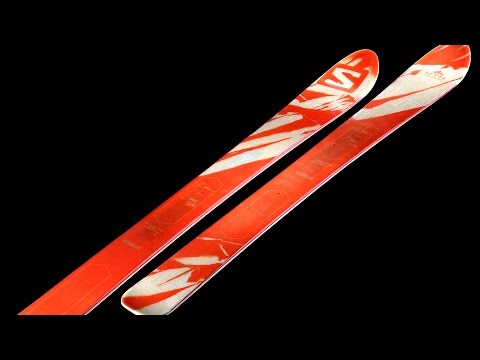
MAN RETRACES DANIEL BOONE’S TREK – Curtis Penix spent two weeks on the trail reliving the days Daniel Boone spent in Kentucky. SUN’S OUT, BEARS OUT – With the dawn of an early spring after a mild winter, bears are emerging from hibernation in Grand Teton National Park. SALOMON RELEASES INNOVATIVE SKI – After years of R & D, Salomon finished its “short” ski designed for touring, skiing, or carrying on your pack. IMPORTANT: If you don’t see the video immediately below, or see a “Sorry…” message in the video player, just click this link to refresh the page, and you’ll be good.
Mount Despair in Cascade Mountains in Washington juts out of the ground beckoning all who would dare to try to conquer it. Some have tried to ski North Despair and since 1989 when the first explorers visited the area on skis none had been able to ski it – and many didn’t even return. Despite having to scramble and slog through forests and hills to even reach the snow that surrounds this peak, a multi-generational team set its sights on skiing the North Despair. After 3 days of slogging they reached the snow and started their ascent. After facing the shadows that had swallowed others before, the group was pleased to finally emerge into the sun and begin their climb of Mount Despair. Upon reaching the summit no amount of restraint could hinder their joy. Screaming with delight as the descended the Barrel of North Despair, the group’s echos filled the valley – they had completed what they set out to do.
A few years ago, Alastair Humphreys birthed the concept of “microadventures” which are designed to get “normal people” outside to feel the wind on their face and experience the thrill of adventure. He believes that there is joy in climbing a hill or jumping into a river and wants to encourage us all to join him. In an interview with the New York Times, Humphreys explains the realization he had that lead him to reverse course from going on epic adventures to encouraging us all to join him for the microadventures movement. He explains that in discussions with people who would come to hear about his epic adventures they would classify themselves as “normal people” and him as an “adventurer”. Humphreys considers himself rather normal and thinks that the distinction between the two occurs in the mind and once you embrace your abilities and you can do adventures you are on the road to challenging yourself.
Lunndörren in Sweden is known for its ice climbing, opportunities for exploration, and severe weather – the perfect recipe for the adventurer whose single goal is to explore the unknown without the guarantee of success. For these adventurers the journey into the unknown is its own reward worthy of a whole-hearted pursuit. Despite the lack of snow, two friends set off on a 4 day ice climbing expedition. The weather did prove to be stormy but the scenery and adrenaline made it all worth it. After some big mountain pitches, skiing, and surviving, the duo was ready for a hot cup of coffee back at home.
KALISPELL MT: WHERE THE LOCALS GO – Teton Gravity explores the variety of opportunities for expeditions around this recreation-enriched town. BACKPACKING TRAILS AROUND THE WORLD – Buzz Feed presents these “breathtaking” trails to add your bucket list. GO WILD – The BMC shares a video with us to remind us about the character of the WILD.
We’re not giving up on winter yet! IMPORTANT: If you don’t see the photo immediately below, just click this link to refresh the page, and you’ll be good.
#wintercamping #backpackinglight #DIYgear A photo posted by kirill (@kirillbugaev) on
The period leading up to an expedition is exciting as you begin to see your hard work paying off. Undoubtedly you have spent months or maybe even years training and preparing for this adventure, and once you hit the trail the joy is palpable. However regardless of whether your trip proved to be a success or failure (this is dependent on how you define your objective) you will have to transition back into “normal life” (whatever that looks like before you were training and preparing). This can be tough – you’ve spent countless hours investing energy into your trip so returning can be frightening. Before you go on your adventure spend some time thinking on how you will transition. Consider setting up a short trip with your family afterwards or do something to help you decompress. At the very least you should have goal or objective you can work towards to look past your expedition.
Will Gadd, an athlete who has been at the top of his game is 48 years old, and recently posted on his blog that he had the best athletic year of his life. He went on to share the ten tactics that helped him do it. Becoming an athlete really just boils down to two things 1) consistency, and 2) simplicity. On the topic of consistency, be consistent in your training – if you want to be improve your fitness train often, and track what you do so you can see your improvement. Also don’t think that you can kick it into gear come summit day. Excellence is built upon your training both physical and mental and requires a discipline that forces you to push yourself to the limits during training so when it comes time to demonstrate that force on the mountain your body and your mind know what to do. On the topic of simplicity, don’t over think the process: food is fuel, make your circle of influence like-minded folks, use your time for what you want, and pursue your dreams with obsession.
DINNER AND SNACK: WHAT TO EAT – Trail Cooking shares two new recipes.
CREATING AUTHENTIC SOUNDS IN SPACE – BBC News commemorates Glenn Fremantles challenge to create sound for the movie Gravity.
TECHNIQUES FOR TAKING BETTER PHOTOGRAPHS – The Big Outside shares its secrets for taking high-quality outdoor photos.

Hiking the PCT in the winter. Courtesy Gear Junkie.
Recently, Justin Lichter and Shawn Forry finished hiking the PCT in winter. On their journey, they skied, hiked by foot and by snowshoes, faced extreme temperatures and strong winds, while traversing from Canada to Mexico. Before leaving, they spent months testing and practicing their gear. Other than a few oversights the duo planned well and had what they needed. From their baselayers to insulating clothing their mantra was lightweight – every ounce counts when you are traversing 2600 miles.
An often overlooked and under-appreciated gear item, the baselayer plays the important role of wicking sweat away from our body keeping us warm. In the winter it is very easy to overdress to stay warm with the paradox apparent to the experienced as this leads to more sweating which decreases our body temperature. The new buzz word in the world of baselayers is “merino” – merino wool is nature’s temperature regulator. Like its synthetic baselayer cousins, merino wool baselayers manage moisture well however merino wool will also stay warm when wet and it won’t stink. Synthetic baselayers are far more durable which is why the newest attempts at baselayers are hybrids which combine both merino wool and synthetic fibers.
Alpine Start field tested this pack and was impressed with its performance. A low-volume (37 liters), reasonably lightweight (a shy over 2 lbs), durable pack, the Crux AK37 is made to get you outdoors doing what you love. With versatile tie-downs that can be used for ice axes, the pack carries well even with full loads. With unique features like hybrid metal-plastic buckles, the AK37 demonstrates its innovative design. After abuse on outings in canyons, rockwalls, and ice walls the pack showed no severe wear. The pack isn’t flashy and won’t be winning awards for its looks but for the backpackers looking for a ruck-sack like pack that will do the job, the AK37 is a serious candidate.
CORE CLOTHING COMBINATIONS – Andrew Skurka’s Core 13 posts revealed the crucial pieces of outdoor gear that can be used in various combinations for 3-season backpacking.
SILKY SAW USEFUL TOOL FOR BACKCOUNTRY – Section Hiker reviews this lightweight saws which makes quick work of deadfall on the trail and is also useful in preparing firewood.
LIQUIDITY LAUNCHES NAKED FILTER – The Naked Filter can yield clean drinking water from anywhere, and all you need to do is stick the bottle in the water source and drink.
IMPORTANT: If you don’t see the video immediately below, or see a “Sorry…” message in the video player, just click this link to refresh the page, and you’ll be good.

Christy Mahon has climbed and skied every 14,000-foot peak in Colorado. Referred to as “14ers” by locals and enthusiasts, Colorado has 54 of these such peaks. She first accomplished this feat from 2000 to 2004 and then from 2008 to 2010 she did it again this time in the winter. Recently, she has turned her sights on skiing Colorado’s Centennial Peaks – the 100 tallest peaks in Colorado. When she’s not busy training for this endeavor which she hopes to finish this spring, she’s working at the Aspen Center for Environmental Studies as the development director where she educates local students and the community on the value of the environment’s health and sustainable agriculture. Her training schedule to prepare her body for her new challenge is quite rigorous and includes running, cross-country skiing, downhill skiing, strength training and yoga. She takes care of her body by eating well and keeps her mind fresh by listening to audio books while training.
83-year-old Larry Hernberger has been running Quebec’s Mont Chilly ski resort for years. His family started the resort after immigrating to Canada from Europe after WWII. Mont Chilly is truly “old-school”; inexpensive food, lift tickets without bar codes, only natural snow (no snow making machines), and groomer machines so old they can be fixed without outsourcing. Larry works the resort with the help of his wife and son and a few other friends. Mont Chilly is rather tame compared with most big mountain resorts but it has a small-town feel (you can even ski with your dog) accompanied by deep snow and surprising terrain variability. Its only lift – a T-bar – carries riders to the top of the mountain where four choices of runs (appropriately named 1, 2, 3, and 4) spread out before them. The resort is only open on weekends and holidays to let the snow build up.
MOMENTS FROM SPACE – Astronaut Reid Wiseman shares his favorite moments from space and why they are so special.
INTERVIEW WITH REINHOLD MESSNER – UK Climbing shares an interview with the renowned climber to first summit all fourteen 8000-m peaks.
IMPORTANT: If you don’t see the video immediately below, or see a “Sorry…” message in the video player, just click this link to refresh the page, and you’ll be good.

It’s all in the mind – just do it.
IMPORTANT: If you don’t see the photo immediately below, just click this link to refresh the page, and you’ll be good.
There’s no easy way to start a swim in Antarctica. Just make up your mind and the rest will follow! pic.twitter.com/LpCNcIn2p9
— Lewis Pugh (@LewisPugh) March 17, 2015
Conquer the Mountain and Conquer Yourself. IMPORTANT: If you don’t see the photo immediately below, just click this link to refresh the page, and you’ll be good.
“Look deep into nature, and then you will understand everything better.” Albert Einstein #expandyourplayground #XAlp pic.twitter.com/8u0Vf6a6eU — Charley Radcliffe (@digitalsteak) March 18, 2015
The Gear will Withstand – Can you?
IMPORTANT: If you don’t see the photo immediately below, just click this link to refresh the page, and you’ll be good.
.@dommelheimer putting the Stubai to good use on Hatcher Pass. http://t.co/tOPdExmdnK pic.twitter.com/m8WISBD1a4
— Brooks-Range (@BrooksRange) March 25, 2015
Get Outside and Reconnect – It’s Good for You! IMPORTANT: If you don’t see the photo immediately below, just click this link to refresh the page, and you’ll be good.
@trailshow says #getonthetrail … So I did. Just me and the coyotes last night pic.twitter.com/ivEZfHb58D — Felicia Hermosillo (@FeliciaDarkness) March 29, 2015
Keep it Simple and Get out!
IMPORTANT: If you don’t see the photo immediately below, just click this link to refresh the page, and you’ll be good.
Camp all set up for the night on Beacon Hill. #wildcamping #microadventure #outdoors pic.twitter.com/Gh4MlmpDua
— Hiking David (@hikingdavid) March 28, 2015
A 4,000 mile unsupported transcontinental race across the US testing the mental and physical limits of the riders.
IMPORTANT: If you don’t see the video immediately below, or see a “Sorry…” message in the video player, just click this link to refresh the page, and you’ll be good.
New Zeland is a beautiful place and exploring it by packraft and foot for three months is even better.
IMPORTANT: If you don’t see the video immediately below, or see a “Sorry…” message in the video player, just click this link to refresh the page, and you’ll be good.
Alastair Humphreys shares his spring microadventure with the hope to encourage you to make your own.
IMPORTANT: If you don’t see the video immediately below, or see a “Sorry…” message in the video player, just click this link to refresh the page, and you’ll be good.
ISPO brings the top outdoor retailers together and gives us an opportunity to evaluate their gear firsthand.
This article has been broken into 3 parts.

The new Mountain Raid Jacket & PA 1.0 (1/2 bag) Sleep System from OMM.
After walking past stand after stand of ski fashion wear and other generally mediocre offerings one begins to glaze over a bit. The fact of the matter is, there is precious little at ISPO of serious interest to the SUL minimalist. Thankfully, OMM was there to lift us briefly from our torpitude. Half bags are not new of course, they’ve been around for ages, but what with OMM being a British firm this will hopefully make them easier to come by in Europe. The shell is 22 g/m2 ripstop nylon whilst the insulation is Primaloft GOLD 80/100 g in the jacket and 60/40 g in the half bag. OMM have added a set of interconnects to both jacket and half bag so that they stay together better whilst sleeping:

A bit more minimalist!
The jacket weighs 13.7 oz (390 g) and the sleep system weighs 8.3 oz (235 g). Unfortunately, OMM does not retail in the states at this time, but they would definitely like to. The owner said he had a box of samples ready to send over anytime; it’s just a question of who’s going to sell it to general public once it’s been reviewed. There’s no point whipping up interest via BPL if there’s no stock in the USA. If you are retailer who is interested in selling OMM gear and reasonably well connected or willing to connect with BPL, then OMM would love to hear from you.
There were one or two other items that may interest the minimalist:

Edelrid’s Rap Line II 6.5 mm with dynamic reserve.
Edelrid’s new Rap Line is intended for mountaineers who save weight by using a thin static rope for glacier travel and rappelling etc. instead of a full rope. The Rap Line II behaves like a standard static rope up to loads of 5kN, but under shock load, the static internal aramid structure tears whilst the polyamide structure holds the fall. This gives the rope a dynamic character and allows it to withstand 2 of the 12 required standard falls on the basis of twin rope tests pursuant to EN892. At 25 g/m, it is also very light. With so much to see, you inevitably miss something you should have had a good look at. As I was having a last look at the awards hall on my way out on Saturday I noticed this:

The Kovea Alpine EZY ECO, refillable gas stove.
Well, it’s certainly not SUL, but the technology may be of interest to some. In all honesty, there was not much point going to the stand and talking to the rep. I emailed them afterwards and there was still very little information forthcoming; so no weight as yet. Everything I know about it is written on the card in the photo basically. It’s a refillable stove that takes isobutane fuel and supposedly reduces waste on the trail by obviating the need to carry refill cartridges. I can’t help but ask myself, what happens when you run out of fuel? Go home and refill it? Carry the re-fill equipment with you? On the other hand, I think I’ll let Roger have his say before being too negative, you never know what he, or indeed some other ingenious reader, might be able to turn it into. On a more conventional note, Optimus was showing off their new Polaris Optifuel multi-fuel stove;

One jet for every fuel.
Readers familiar with Optimus will immediately recognise the old Nova stove modified for multi-fuel use. I had a Nova many moons ago and it did good service, although knowing what I know now, I would take a different stove in some of those situations. That’s not to criticize the Nova in any way: Lindal valve butane cartridges are more widely available today than they were in 2003. The Polaris Optifuel is certainly about as versatile as any stove can be. Altogether, it weighs 16.8 oz (475 g), which is on the heavy side. With white gas the output is 4200 watts and with butane it is 3300. At $300 they are certainly not cheap, but with a bullish dollar they may still appeal to some readers. Optimus has changed the connector on the pump assembly, although they may have done this sometime ago; I haven’t used a pump type stove of any description in quite a while. The old Nova sliding hose coupler was a neat design, my only problem was that when (carefully) using petroleum ether (pentane & hexane) as a fuel, the ether was of such a low viscosity it would wash the lubricant out of the coupler to the point where the coupler would not close correctly when the hose was disconnected. As a result it would dribble fuel everywhere till I could fiddle it and get it closed. I solved the problem by carrying round an eye dropper with some sewing machine oil in it. The new coupling system makes anything like that impossible. Optimus is part of Katadyn group, so on the same stand was to be found this:

The Katadyn Gravity Camp 6 L water filter.
Gravity feed water filters were arguably developed by BPL readers. You will be pleased to know the 10 L version took gold at the ISPO 2015 awards.
Paramo has been trying a few new ideas recently. Readers will probably remember my review of the Bora Smock fleece and windproof last year. Whilst Paramo gear is not particularly light, their new poncho is probably the lightest item of rain gear in their collection:

A new direction?
The poncho is so new I could not find any info on it in the press pack; I seem to remember being told the weight is about 12 oz (350 g). If you look carefully at the photo, you may just be able to see the seam where the pump liner is sewn in over the shoulders. Paramo has introduced a new mesh based liner in some of their garments that is more breathable than the old felty fleece type liner. The Poncho uses this liner over the shoulders to keep moisture off the torso, whilst using the lightweight water repellent fabric they use in products like the Vista Jacket for the shell. There are plenty of poppers round the edges to keep the two halves together, but no tie-outs for pitching it as a shelter. Of course, Paramo strongly encourages owners to modify the poncho in whatever way they see fit. Whilst the material is not 100% waterproof like silnylon, it may work well together with a bivi bag (a popular combination amongst BPL readers). I don’t use a poncho myself, so Roger stepped up to put this piece through its paces; sample on its way…
Something else I think Roger will be particularly interested in is this:

DIY heaven!
As we all know, Roger is quite fond of Baladéo / Deejo knives, at least the ultra-minimal ones! So needless to say, when I emailed a photo of this he was eager to get his hands on one. Traditionally, folding knives are riveted together, making them a quite a challenge for the home builder to replicate. Baladéo has got around this by using screws and stand-offs to produce something that anyone can build with very basic tools. Of course, if you have a well stocked metal workshop, then Baladéo strongly encourages builders to use the parts they provide as the basis for much more elaborate creations. This is another item that is so new it is not in the press pack, but in this case we can say the knife is as light as you make it. Not everyone is a fan of the grade of steel Deejo uses. To be sure, there are harder grades to be had, but the owner of Deejo said that he was focussing on serviceability in the field, rather than high quality steels; and then there’s the cost of course. As to the ins and outs of different grades of steel: that I leave to the comments section below, I’m no expert myself. Baladéo had another new ultralight knife on display:

The Papagayo Skinny from Baladéo.
The Papagayo Skinny is in a similar vein to the Deejo (Baladéo spin off company) knives Roger reviewed last year. Without the orange lanyard it weighs 1.3 oz (37 g). I gave mine a few minutes on a DMT extra fine sharpening stone (approx. 1200 grit) and it sharpened up nicely. Not quite razor sharp, but it will live nicely in my paragliding harness as an emergency line knife. The serrated section may be useful when sawing small bits of wood, although some users may prefer a straight blade, again, that I leave to the comments section. A fuller review may well be pending.
Anyone who has been climbing and had to shout ‘ON BELAY’ at the top of their voice into a howling gale to their partner below may well have had occasion to contemplate the benefits of a radio. I think in certain circumstances they definitely do have their benefits, although they are certainly not essential for the average hiker. BCA has brought out a robust looking UHF radio called the BC Link:

The BC Link with attached ‘Smart Mic’ speaker mic.
The unit uses a range of UHF channels giving better coverage than the 8 basic PMR 446 channels, and it is waterproof to IP56 standard. It weighs 12 oz (340 g) including the speaker mic unit and costs $223. Being from BCA, the radio is aimed primarily at off-piste skiers and ski mountaineers. Having had an amateur radio license for well over 10 years now, I suppose I am a more than a little spoilt for radios, so PMR and GMRS radios don’t do much for me to be honest. Imported radios from Wouxun and Baofeng cost less than a third the price of the BC Link; have well over 10 times the effective radiated power (depending on what antenna you use) and cover a huge range of frequencies. OK, so if you want something waterproof you have to pay a lot more, but for that extra you usually get something waterproof to IP57. My advice to anyone contemplating buying a radio is get the entry level ham radio license, it really is a box ticking exercise requiring minimal study, and it opens the door to a huge range of frequencies (including global shortwave communications). You can even use the radios on PMR and GMRS channels provided the output power is set within legal limits and the radio is certified for operation in that area. To be fair, the BC Link does interface nicely with BCA’s rucksacks:

The BC Link with speaker mic routed down the shoulder strap.
I am a little biased when it comes to handheld transceivers. As far as PMR goes it’s a nice looking unit and clearly better than some cheap and nasty walkie-talkie, but you should be aware, there can be big differences in performance that are not always apparent from the outside.
A little more controversial is the apparent success of Primus Winter Gas cartridges with ‘Vapour Mesh’ technology:

The awards are rolling in it seems.
Readers will probably remember that I reported on Primus Winter Gas Cartridges last year, and the general consensus was not positive to say the least. With vague epithets like ‘Seriously good stuff!’ floating round the internet, you could be forgiven for thinking some reviewers have been inhaling it rather than cooking with it. Well, in such circumstances one doesn’t like to go on. BPL has proffered its professional opinion, and I’m sure I speak for all the staff when I say that Primus is more than welcome to take out a forum membership and set the record straight below. Perhaps it is a telling sign that in general only the cottage industry in the USA is happy to interact with the public via the BPL platform. It’s a shame really, Primus makes some nice gear that is popular with many readers and I hope this, ahem, difference of opinion, does not put anyone off buying Primus gear. Just to show there’s no hard feelings here’s one of their latest offerings:

Yes, it’s made out of titanium.
The Primus Stove Paw Ti weighs only 2 oz (55 g) and interfaces with most Primus stoves like the OmniLite and Express Spider. It works OK with non Primus stoves as well. You can just make out the hinges that allow the three parts to fold into one. OK, at $67 it’s not cheap, but titanium rarely is. I seem to remember reading many years ago about how a new industrial process was going to reduce the price of titanium to about that of normal steel. Ten years later, and Ti is still eye wateringly expensive.
Goal Zero had some new Lithium Ion battery chargers on show. For multi day trekking the Venture 30 is probably the best of the bunch:

7800 mAh and waterproof to IP X6.
The Venture 30 weighs 8.8 oz (250 g); is solar ready and according to Goal Zero it will charge in 8-16 hours using one of their Nomad 7 solar panels. I find most solar panels are not good enough to charge early morning and late evening, and when on a hike and fly trip most paraglider pilots want to be in the air at midday, precisely the time when the solar panels work best. For that reason, I don’t bother with panels. I would probably use the Venture 30 myself, but I already have other power packs. For single day use the Flip 10 and Flip 20 from Goal Zero look promising, the Flip 10 is below:

The Goal Zero Flip 10.
The Flip 10 takes my Galaxy Note 2 from 17% to about 94%, so it gives me that bit extra I need to extend my flights past 100 km. Most paraglider pilots use a small external battery like this for XC flights. That being said, I think many people will prefer the more rugged and more waterproof Powermonkey Explorer 2:

6000 mAh and waterproof to IP 67!
The card points out that the unit can withstand the weight of a Land Rover, but I ask myself if this is entirely unique among batteries. Certainly it is fully waterproof. For what it’s worth, Brunton had brought along their redesigned Resync charger:

The Brunton Resync 3000.
You may well scoff at the solar panel on the back of the charger. Personally, I have come to terms with them over the years. As long as the unit doesn’t cost any more, then I like the idea of getting more for nothing, even if it doesn’t do all that much; maybe it’s the Yorkshire man in me.
The Superior Coastal trail offers stunning views of Lake Superior that for this duo of hikers symbolized a shared spiritual transformation that cannot be erased.
You don’t have access to view this content.
Very similar to the first version, these lightweight shoes perform well for trail running or hiking.
You don’t have access to view this content.
News this week: Steger’s Solo Winter Traverse through the Boundary Waters, the 235-mile Trans-Adirondack Route, ISPO 2015, and more!
If you’d like to submit a link to a timely (fresh) story for us to consider including in our next installment, please send it along to submissions@backpackinglight.com with the subject line “BPL NEWS DIGEST”.
On March 15, Will Steger will begin a 200-mile, solo winter traverse by canoe-sled along the Minnesota-Ontario border. The founder of the Steger Wilderness Center, a climate change awareness advocacy group, will rely on his experience from previous expeditions to the North Pole and the Antarctica to complete this challenging endeavor. Steger said he was grateful that he could find a route that “would stretch his skills” and hopes his journey will be a source of inspiration to others. He wants to go beyond the physical and mental toll and express “why you would do these things”. The rapid onset of Spring forced him to begin his journey early. He hopes he can spend most of his time on the rivers and he’ll be wearing a dry suit in case he has to take a swim. He’ll be hauling 200 lbs of gear and he’ll be able to stretch his rations to last longer than four weeks if necessary. To survive out there along for so long, Steger knows that’ll he need to be in the moment and pay attention – one might consider it a form of meditation. His previous experience has taught him to be cautious and to avoid risk-taking. On several previous expeditions after months of preparation and financial resources spent he has had to turn around so he knows he is comfortable making that decision again if necessary. He’ll be sharing his journey through daily satellite updates as he faces this hostile land alone.
IMPORTANT: If you don’t see the video immediately below, or see a “Sorry…” message in the video player, just click this link to refresh the page, and you’ll be good.

This year, an international team of climbers including Nick Cienski founder of the Mission 14 project will attempt to climb six 8000-m peaks in one year which has reportedly never been done before. The project will raise money for the non-profit organization which will use the funds to fight human trafficking across the globe. The expedition is backed by Under Armour and other corporate sponsors so all funds raised through the philanthropic process will directly support Mission 14. The project believes that like golf tournaments or running for a cause, mountaineers can use their sport to raise money for charities they are passionate about. Beginning in April with climbing Lhotse the fourth highest peak in the world, the Mission 14 climbing team will attempt Everest in mid May and Makalu the fifth highest peak in late May. This fall they will attempt Cho Oyo the sixth highest, Manaslu the eighth highest, and Shishapangma the fourteenth highest peaks in the world. The support team includes some well-known names, such as, Russell Brice founder of Himalayan Experience to oversee the logistics as well as Phurba Tashi who has the record for the most total ascents of the world’s highest peaks as the head sherpa. Nick Cienski hopes that breaking this world record will shed light onto the ongoing horrors of human trafficking and hopes this expedition will make a difference to eradicating this human rights violation.
As winter winds down and the spring season dawns, the season of climbing in the Himalayas is gearing up. Usually this shift is accompanied by a slew of expeditions intent on reaching the pinnacle of the Arctic. With no Arctic expeditions slated for this spring the window for exploration this year is quickly closing. Far more significant however is the fact that the time for exploration in the Arctic may be closing for good. Thin ice, ice chunks, and channels of water have hindered exploration of the Arctic for years – each year it becomes increasingly harder to reach the North Pole on skis from the Canadian side. In fact, since 2010 there has only been one successful expedition heralded by some as one of the hardest expeditions to complete. As further evidence of this trend, Kenn Borek Air which routinely supports these expeditions recently announced that they were ending their operations in the Arctic region due to economic viability signaling a further decline of exploration in this area.
The fabled Ciudad Blanca or “White City” has for long eluded archaeologists and explorers. Passed down in native lore, the White City has been rumored to be visible just above the jungle floor with exposed white sections visible through the forest canopy. This area of the jungle is remote – the animals seem to have never had much contact with humans and they are inquisitive. An expedition team made up of archaeologists and scientists from the US and Honduras plus a military escort ventured deep into the rain forest – to the spot where an aerial survey had found the city in 2012. Not only did this expedition seem to verify the aerial survey and find the White City but the team found enough evidence to suggest much more – a lost civilization.
LES STROUD HOST OF SURVIVORMAN IS LOOKING FOR CO-HOST – In season 6, Stroud is looking to partner with skilled filmmaker who is skilled at telling a story; no extensive survival skills are necessary.
LYNX TO BE REINTRODUCED TO UK AFTER 1300 YEAR ABSENCE – The cats are predators of deer and rabbits and their presence is expected to revitalize the stressed countryside burdened by an overabundance of deer.
RIDING THE WHITE LINE – Michal Kollbek takes riding to the extreme.
IMPORTANT: If you don’t see the video immediately below, or see a “Sorry…” message in the video player, just click this link to refresh the page, and you’ll be good.
Many hikers are looking for a more authentic wilderness experience – one that is less common with the popular Triple Crown of American thru-hiking (PCT, AT, and CDT). Some of these hikers are turning to the Trans Adirondack Route in Upstate New York, a 235-mile, remote trek that passes fifty-five bodies of water, five wilderness areas, and eight forests. Although there have been a dozen attempts since its conception two years ago, the route has only seen 4 successful thru-hikes. This place is filled with opportunities for cross-country travel or thru-hiking on trails.
Our world is filled with stunning places and visiting those places is food for the soul. Taking a break from the hustle and bustle and spending time in a wild place is an opportunity to refocus and reemphasize the priorities in your life. It is rumored that J.R.R. Tolkien spent time on the Laugavegurinn Trail in Iceland before finishing up the Lord of The Rings series so you never know what kind of inspiration your experiences might provide. There are wild places all over the world but for whatever reason some are more popular than others. From the Cinque Terre in Italy, a leisure stroll through five coastal towns, to the 13,000 square mile Arctic National Park you can go as frontcountry or as remote as your imagination can take you. The links that follow are a resource to identify some of the world-class backpacking routes, but don’t let financial or time limitations inhibit your exploration. There are lots of backpacking places right out your front door and it can be as simple as strapping on your pack and going.
GOOGLE VIEW GOING OFF THE BEATEN PATH – If you’ve gotten on Google View recently you may have noticed a few views and were wondering how they got them.
MASSIVE GLACIER CALVING CAUGHT ON CAMERA – Calving is when ice breaks of the front of a glacier and for this patient camera crew their wait was worth it.
WITNESS THE HIMALAYAS FROM 20,000 FEET – The crew from Teton Gravity Research took HD footage using a innovative gyro-stabilization camera.
IMPORTANT: If you don’t see the video immediately below, or see a “Sorry…” message in the video player, just click this link to refresh the page, and you’ll be good.
WATCH LEO MAcCARRON’S “KARUN” FILM FOR FREE – In 2014, adventurer Leo McCarron followed Iran’s longest river from source to sea, and now he wants to share a film commemorating that journey with you!
Father daughter time at the Flapjack Lakes ultralight style.
IMPORTANT: If you don’t see the photo immediately below, just click this link to refresh the page, and you’ll be good.
A crucial component of a successful backpacking trip is finding your way. While you may be an experienced navigator and may thrive in the woods on your own navigation in a group can be challenging just due to group dynamics. Before you head out on the trail it is important to get everyone on the same page and have multiple people keeping track of navigation. Headaches, arguments, and delays are inevitable if the navigators have their compasses set to a different declination or their GPS units using a different coordinate system. Learning how to navigate in the outdoors is a valuable skill one that can be fun to teach provided that you take care of the initial steps and make sure you have consistency between navigators.
Anytime you venture into the backcountry for some skiing you are putting yourself in avalanche danger. Even in low lying areas there is potential for a slide to come from above you. Avalanches are extremely dangerous and the best way to survive one is to avoid them completely. Avalanches are most common on slopes between 25-45 degrees which are unfortunately usually the most fun to ski. Learning to avoid these slopes especially during avalanche conditions is the best thing you can do stay away from avalanches. There are some skills you should have and tactics you can employ to avoid avalanches. Having the right equipment is crucial to performing a rescue and if you are the one who is trapped in avalanche swimming for your life and creating an air pocket increases your chances for survival. When performing a rescue speed is the mantra – after about 10 minutes of being trapped a person’s chances for survival drops rapidly. Before heading out, master terrain association so you can avoid avalanche slopes and practice with your gear.
BECOME A SPONTANEOUS TRAVELER – These sites and apps will make it quick and easy to do so.
ADVICE FOR BEGINNING WRITERS – Cheryl Strayed, author of Wild, shares her thoughts on becoming a proficient writer.
The gear show in Munich, Germany this year featured “new” gear for the outdoorsman and outdoorswoman in all of us. From clothing to equipment there were some innovative products that will certainly make your time in the backcountry easier but the majority was last-year’s models with some minor upgrades. There was of course unique gear like outdoor gear for an urban environment styled in a way that will allow you to “fit in”. The ISPO is what you would expect – a trade show with vendors extolling their wares. Nevertheless, ISPO is a way to see all the gear in one spot.
A trekking shirt is your first line of defense against the elements. Long-sleeve shirts offer sun protection and minimize skin abrasion during bushwhacking. Short-sleeves work well in warm environments with shade. Other than the length it is important to consider the materials. Nylon and woven fabrics are often touted as the fabrics with superior sun protection however using merino wool or polyester although offering slightly less sun protection perform better in other ways. Knit polyester or merino wool are preferred to woven fabrics which have limited airflow and nylon which manages moisture poorly. Both polyester and merino wool will stink less than the other options. Make sure to size your shirt long on the torso so you will have some protection as the shirt raises some when wearing a pack. Front zippers or buttons are ideal to increase airflow and manage temperature.
KEY CHAIN LIGHT STILL RELEVANT – Paul Mags uses a key chain along with his Swiss Army knife as a primitive tool kit that still gets the job done.
KEEN RELEASES UNEEK SHOE – Made from a two-cord construction using a process “never-seen-before” in the shoe industry, the Uneek shoe is turning shoe manufacturing upside down.
PETZL KID’S CLIMBING HARNESS – Due to their anatomy, kids climb better if they have a harness that raises their center of gravity when climbing with a rope.

Petzl Harness courtesy of Gear Junkie.
This has been addressed on BPL before, but the athletes and spectators of the outdoor sports world cannot help but notice that women are disproportionally represented. This trend seems to be unintentional and is reversing. Take the story of Nasa Koski who was employed Microsoft as an engineer for 17 years, but one day quit to start a career in the outdoor film industry. Now she is the CEO of Adventure Film School. For Sarah Woods, the executive director of the 5Point Film Festival in Carbondale Colorado, and Ashley Gatelesss who is working on an outdoor film reversing this trend is simple yet gradual and begins with women in the outdoors taking the initiative. They say that this can be extremely tough as women must fight back the legions of self-doubt resulting from years of societal norms. They want to encourage all women to believe in themselves to pick up the camera and go after it because they can do it.

Kids enjoying the outdoors courtesy of Trail Cooking.
It has been well-documented here as well as elsewhere the benefit to us from spending time in nature. It is nourishing to the soul and allows for important reflection. Taking that a step further; taking full-advantage of the potential of the outdoors is an important step to saving our society. Picking up a newspaper only heightens the tension we all feel. Battles of rhetoric and weapons are being waged across the globe and here locally. So much of today’s media focuses on the things that divide us leaving most consumers depressed and wondering why the “world is so messed up”. For decades now, outdoor adventurers who journey to other countries and experience the culture there have run stories completely contradictory to this notion. From them we’ve heard of the compassion of locals to strangers which contradicts the claims the media has made about places around the world (the Middle East, Africa, etc.) In a society that prioritizes so many material and divisive things it is little wonder our youth are facing so many so many problems today – their role models and examples demonstrate rather odd and selfish ways of behaving. Getting kids outdoors and exposing them to adventure exposes them to other ways of experiencing something unique. It gives them an opportunity to learn to trust in themselves and develop skills they can use anywhere. Exploration in the outdoors helps them develop valuable leadership skills which they take back and share with friends, family, and neighbors. Getting the youth into the outdoors might just be one of the best ways to improving our society and focusing on what matters. One of the solutions is to get the kids out at a young age when they can truly just enjoy it.
ANDREW SKURKA LOOKING FOR FEMALE MODEL FOR OUTDOOR EVENT – If you live in Portland and want to model Sierra Designs clothing the morning and afternoon of March 31 contact Andrew Skurka.
JOIN THE REBEL BOOK CLUB – Guaranteed to help you read 12 “life-changing books” over the course of the year.
A story of traveling across India by bus, car, and bike and the lessons that come along the way.
IMPORTANT: If you don’t see the video immediately below, or see a “Sorry…” message in the video player, just click this link to refresh the page, and you’ll be good.
A climbing duo finds trad climbing routes in South Africa.
IMPORTANT: If you don’t see the video immediately below, or see a “Sorry…” message in the video player, just click this link to refresh the page, and you’ll be good.
Rugged trail running in NW Scotland forges endurance and toughness.
IMPORTANT: If you don’t see the video immediately below, or see a “Sorry…” message in the video player, just click this link to refresh the page, and you’ll be good.
Videography with an emphasis on the pursuit of the “perfect” shot and the ensuing editing can be time consuming, daunting, and distract from your trip. The author presents tactics to make it easier and record your adventures.
You don’t have access to view this content.
ISPO brings the top outdoor retailers together and gives us an opportunity to evaluate their gear firsthand.
This article has been broken into 3 parts.

It’s that time of year again!
Having had so much fun last year and, at a modest six hour train journey away being relatively local, I signed up for another report on the ISPO sports and outdoor trade show in Munich. I decided to just do three days this year, as I found the fourth a bit tedious in 2015. That meant a bit more organization and a tighter schedule. I also wanted to improve on last year’s photos: smartphones will take a nice picture; it’s just a matter of holding them steady enough. To that end I bought a lightweight tripod and smartphone adapter. I think the photos are much sharper as a result, I hope you enjoy them. Of course, eventually the fun is over and one gets down to the nitty-gritty of sorting through the small mountain of USB sticks, business cards and brochures.
Where shall we start? Well, last year I focused quite heavily on raw materials, so naturally I went back to some of the same manufacturers to see how things were going. One of my first ports of call was Ardmel Group, which is the parent company of Keela. As you may recall from last year, Ardmel is currently locked in a complex legal battle with W.L. Gore over the claim ‘Guaranteed to Keep You Dry’ in Gore’s advertising literature. The argument, of course, runs much deeper, and raises questions about exactly which criteria should be applied when evaluating, and consequently promoting, outdoor clothing. As we all know only too well, physical activity means sweat and water vapour building up on the inside, irrespective of what is going on outside; although heavy rain also negates any breathability the fabric poses when completely dry. Well, as you can imagine, due legal process, all too often wielded punitively in its own right, is not doing very much right now, so no news to report on that front I’m afraid. However, Ardmel also decided to lodge a complaint with the Advertising Standards Authority in the UK. Basically, they complained that the phrase ‘Guaranteed to Keep You Dry’ misleads the consumer and thus amounts to false advertising. They were good enough to let me take away a copy of the ASA’s response, which I’m sure will be of great interest to BPL readers. It is duly reproduced below.

Clear as mud?
Personally, I find this response both presumptuous and somewhat contradictory: presumptuous, in its unqualified definition of the average consumer; contradictory, in that the average consumer interprets the claim ‘Guaranteed to Keep You Dry’ to mean that the fabric is also breathable, but understands that physical exertion will obviously impinge on this breathability. I’m sure someone with better retail sales knowledge could produce a better definition of the ‘average consumer’; most of the people I talked to at ISPO readily admitted that most of the gear on show will end up on the high street rather than up a mountain. Moreover, I think the letter is very badly written, and that its dual use of the linking adverbial ‘however’ seems particularly vague and rambling, as if the author is not quite sure of what they are trying to say. The matter may well be worth appealing, but to be honest, if meaningful change is to come, it will probably come from the markets before it is secured by the rule of law(yers). This unfortunate fact of life is by no means lost on Ardmel. To try and get things moving they offer their own solution to the problem of water vapour build up – a double breathable membrane with the moniker ‘System Dual Protection’ – license free to interested manufacturers. All they ask is that manufacturers recognize that the technology belongs to Ardmel with the addition of a System Dual Protection’ tag in the construction. This, I think, is a smart move on their part. Maier Sports and Sherpa are already offering SDP technology in their product lines, whilst Bergens and Alaska are showing interest. An additional membrane means more weight in the finished garment of course, but with fabric weights coming down all the time, even these dual membrane pieces now rival traditional breathable technologies. Keela themselves have produced the Saxon jacket, pictured below:

A new lightweight double membrane jacket from Keela.
The piece was finished quite literally, just before the show, so unfortunately no one knows as yet how heavy it is. It felt lighter than 17 oz (500 g) to me. Hopefully I can contact Keela to get a specific figure before the end of this run of articles. In the photo below you can just make out the transparent inner membrane against the white outer membrane:

Lighter and lighter…
The SDP technology itself could easily be made lighter still, given that there are now 7 micron membranes on 7 denier face fabrics available. It just depends on how much money you want to throw at it. Keela have generously offered to construct what they call a half and half version of the Saxon jacket for BPL to test. One half of the jacket is lined with a double membrane, the other with just a single membrane, which allows a more direct comparison to be made. After all this talk, it’s only fitting that some of Keela’s claims are held up to scrutiny. Hopefully this sample, along with some others, will be forwarded to one of the BPL team in the near future.
Speaking of lighter and lighter membranes, I ambled over to Pertex to ask how things were going there. They were busy promoting their new Pertex Shield Plus fabric which employs a hydrophilic membrane. Normal Pertex Shield has a 10,000mm hydrostatic head and 7000g (MVTR) A1, whereas, Pertex Shield Plus has a 20,000mm hydrostatic head and boasts a much improved 20,000g (MVTR) B1 breathability rating. Also new on the Pertex order books is Pertex Shield AP, the AP standing for Air Porous. Pertex Shield AP employs an air porous membrane, greatly increasing breathability. Unfortunately I could not find the exact figures on the Pertex website, but I think it’s safe to say that Shield AP represents a comparable improvement in performance to Shield Plus. Shield Plus available now in a 7 denier option, whilst the rep said Shield AP will certainly work on 7 denier fabrics, so it may take some liaising with Pertex to get it made. The 7 denier Shield Plus is just a few moths old, in fact, Pertex is offering a fabric known internally as Pertex Sheild Plus Triple 7 – 7d face, 7 micron membrane and 7 d jersey knit liner – that is yet to be utilized by any manufacturer in the world. The rep told me that Pertex was aware that their fabrics were sold to the MYOG community, but supplying outlets like Thru-Hiker and Extremextil was something they initially resisted. The main reason being that they are a component brand and big customers don’t like their top of the range fabric turning up in people’s homespun gear. However, he said, and I quote ‘attitudes are changing’. Pertex it seems, like other companies, is beginning to sense the huge benefits engaging with online communities can have on corporate reputation. One of the reasons we don’t see more of it in the outdoor retail sector is that, like everything in big business, online reputation management is done to a budget. Readers may be interested to know that Quantum GL now comes in a matt finish as well as the normal shiny version. According to the rep, European customers prefer the matt finish, whilst producers in the US prefer the shiny finish because ‘it looks lighter’. Pertex throws in some titanium dioxide to take off the sheen once the fabric has been calandered. They recommend having the shiny side facing the down so that it is harder for a stray quill in the down to snag and push through to the outside. However, in an ideal world the fabric should be calandered on both sides.
I had a very interesting conversation with the rep from Toray. They had sewn up some nice factory prototypes with their new insulation material ‘3DeFX+’. I reported on this new ‘stretch’ insulation last year, but it was nice to see it turned into something wearable:

On your mark, get set, drool!
It might not look like much, but it had a wonderfully soft feel to it, and I mean ‘really nice’. I’m sure I don’t have to tell you how much I would have liked to have taken that away for testing; out of the question of course. Toray were also showcasing their new ‘Plant Based’ technology:

30 – 40% Plant based Dermizax.
Dermizax is actually available from Extremtextil, the samples above are the new 30 – 40% plant based version. Toray is aiming to be 100% plant based by 2020, a wise decision given the fluctuations in oil price. For nylon fabrics they use castor beans, and for polyester fabrics they use waste molasses, so the new supply chain will hopefully be gentle on the environment unlike say, palm oil production. They also had a new fleece product on the stand called ‘Karuishi’. The fleece is woven with a new patented weaving technique and according to Toray, a 4.5 oz (125 g) Karuishi cloth has the same clo value as a traditional 7.1 oz (200 g) fleece cloth. Besides that, the rep also told me that Toray is definitely working on a 5 denier nylon textile, even though they are extremely skeptical as to whether it will be good for anything. So far, they have only been able to produce very small quantities as the thread breaks too easily. You can’t blame them for being skeptical about the end uses of a fabric they are not technically capable of producing. I’m sure the irony of this situation is not lost on you the esteemed reader. Here we have companies expending untold resources on the production of something they themselves doubt to be any practical use, whilst, more often that not, manufacturers fail to realize the full benefit of the materials they do have either because of the pernicious influence of high street fashion, or in order to use raw materials that outperform everything else on paper and in the laboratory, but not in the real world. The fact is, technology sells, as does fashion. Unfortunately, it often sells better than the things of which it is merely a component. Not that I think we shouldn’t be appreciative of companies with significant financial leverage using these high end materials for their own marketing purposes, it would be unfair to suggest there has been no benefit for us.
Thinsulate was still pushing their new ‘Featherless’ insulation:

Impossible to see, but when you press a button water drips down through the tubes.
The demonstration setup was a lot better than last year’s, and a good way to show how there is no reduction in volume, and thus clo value, when Thinsulate Featherless gets wet. I found out a bit more about the material this year. It is a continuous filament insulation material equivalent to about 600 (US) cu. in. down. I also found out, thanks to other traders, that Thinsulate is working on new versions of their ‘Featherless’ insulation, and that some manufacturers feel that, in terms of warmth to weight, its performance is even better than that of its leading competitors. Manufacturers like Spyder, Bench, Merrel, Quiksilver, Carhartt and Rossignol have all added ‘Featherless’ to their range. And before you say, ‘but I wouldn’t touch any of their gear with a bargepole’, even Rab have added some ‘Featherless’ garments to their range:

From left to right: Men’s Nebula Jacket, Women’s Nebula Jacket and two Nimbus Jackets (unisex).
These jackets, like those that follow, will be out fall/winter 2015. They are so new the Nimbus jackets were not even in the workbook. It took a few emails with the rep to get all the relevant information. The Nebula jacket is available in both a men’s and women’s version and will weigh about 20.5 oz (580 g) (large). It has a Pertex Endurance shell and 8.6 oz (244 g) of ‘Cirrus’ powered by 3M Featherless insulation. It looks like a pretty warm cold weather jacket, and so should probably not be compared with the very lightest synthetic jackets available. It will cost $240. The Nimbus jacket is lighter at 16.0 oz (455 g). The Nimbus has a Pertex Quantum shell but is only available in a unisex fit. It will cost $210. For ultralight use there will be an ‘Ether X Jacket’ weighing 9 oz (240 g). The Ether X again uses Pertex Quantum GL inside and out, but with PrimaLoft Gold (1.5 oz / m2) insulation. The Ether X will cost $195. I’m afraid I didn’t get a picture of the Ether X. When questioned as to why Rab chose Thinsulate Featherless, the rep said that Rab is always interested in new developments and, being a British company, they wanted to make some gear for damp UK weather conditions. Last year, Rab was only just beginning to incorporate hydrophobic down (from Nikwax) into their range. This year they unveiled the new Continuum Pull-on:

On test soon???
The Continuum Pull-on has Pertex Quantum GL inside and out and is filled with 850 (US) fp hydrophobic down. It weighs 7.4 oz (210 g) (large) and will cost $270. So, not the lightest, but not the most expensive either. Polartec Alpha insulation is proving very popular with manufacturers at the moment, and Rab had their offering on display:

The Rab Paradox Pull-on
The Paradox Pull-on weighs 13.0 oz (360 g) (large) and has a high gauge stretch polyester outer. According to Rab, Polartec Alpha has a better drying time and a better warmth to weight ratio than a conventional fleece. Of course, the drying time of the other materials used in such garments may prove to be a limiting factor. Unveiled last year, Rab’s new Flashpoint jacket has been in the shops for a week or two now:

A fully featured waterproof breathable jacket for 6.3 oz (180 g).
Hopefully, this jacket and the others featured here will be reviewed by the team in the coming weeks.
Montane has always been well known for their very light weight offerings, but they haven’t released much new ultralight gear in quite a while. This year saw the release of their new Fireball Verso Pull-on:

Fireball Verso Pull-on with Hypervent outer showing.
The Fireball Verso Pull-on has Pertex Quantum Rip-stop on one side, and Hypervent on the other. For insulation it has PrimaLoft Silver. Keen eyed readers may notice the invisible zipper for the breast pocket; a nice touch, and quite easy to do on a home sewing machine once you’ve seen it done. That said, I can’t help but wonder if this is just more high street fashion creeping in. The Fireball Verso Pull-on is quite light, however, at about 8.6 oz (244 g) (medium). It should retail for about £100, so not too expensive either. As the name implies, it can be reversed, if desired, to a more windproof (less breathable?) configuration:

Pertex Quantum Rip-stop inner becomes windproof outer.
There is more light weight gear in the pipeline at Montane, and it will form part of Montane’s expanded ‘Via Running’ range. Much is changing at Montane at the moment: they have recently become a Goretex licensee; the first UK company in 17 years to be licensed by Goretex. Of course, that is not great news for fans of eVent, because it will have to be phased out under the terms of Gore’s licensing. Montane, however, is very excited about it. Montane has also become the first company in the world to commit to applying the RDS (responsible down standard) across its entire range of clothing. Montane customers will now be able to trace the down in their clothing from the beginning of the supply chain right through to the end thanks to Allied Feather and Down’s ‘Track My Down’ service. It’s good to see some substantial change in an industry where sustainability and ethics could so easily become mere greenwash. Montane has brought out a new jacket using PrimaLft’s gold down blend:

The New Montane Black Ice 2.0 jacket.
The jacket is designed for more extreme conditions, so is in the mid to heavy weight range of cold weather insulated jackets. It has a box wall construction over the torso and a 38g/m

The new Montane Hi-q Luxe synthetic insulated jacket.
The Hi-q Luxe uses the new PrimaLoft Gold Luxe synthetic insulation, which is exclusive to Montane. When wet it has a clo value of 0.93 clo/oz/yd2. Altogether, the jacket weighs 20.2 oz (574 g) (Montane describes this as ultralight, hmm), and it will sell for $255. It has a Pertex Quantum Rip-stop shell with DWR. Speaking of DWR, there was an interesting press breakfast on the Montane stand on the second day. A rep from Allied down and one from Montane both gave a short presentation. The Allied down rep said they are using a C6 treatment at the moment, but Allied Down will be 100% FC free by 2016. C6 treatments have been here and gone in the blink of an eye it seems.
I went to have a look at the Mountain Equipment stand this year, as I had missed them out for some reason last year. They were showing off their new ‘Dewline’ down jacket range:

The Mountain Equipment Dewline Hooded Jacket
The Dewline hoodie weighs 15.5 oz (440 g) and has a 20 denier inner and outer (Mountain Equipment don’t use any ballistics lighter than 20d). You can see the lighter jacket version behind it on the rack; that weighs 13.2 oz (375 g), so is at the top end of the ultralight down jacket scale. However, when you consider that 6.0 oz (170 g) of that weight is the water resistant down insulation, you clearly have a very warm jacket. There is a vest for summer use:

The Mountain Equipment Dewline Vest.
The Dewline vest weighs 10.1 oz (285 g), of which, 3.7 oz (105 g) is 700 fp water resistant down. The Dewline range is certainly feature rich, and comes with a full length zip rather than the popular ½ zip pullover style. Personally, I quite like a full zip, because it allows me to attach Velcro tabs to the inside of the jacket and fix it to more Velcro tabs sewn on to the top of my quilt. That way, a spread out jacket can cover my whole torso and the top of my legs. I’m also not crushing any down uselessly underneath me, whilst the sleeves can be tucked under the jacket, giving even more insulation over the chest. Best of all, I don’t have to wear so much underneath, so I feel more comfortable. When I got home and started looking through the Mountain Equipment workbook I found this:

The Mountain Equipment Compressor Hooded Jacket.
Apologies for the stock photo; for some reason the rep didn’t show me the item when I asked about ultralight gear, although we did get talking about the new Compressor Pant:

The Mountain Equipment Compressor Pant.
The Compressor Hooded Jacket weighs in at 13.4 oz (380 g), making it quite light compared to the other synthetic jackets I saw at the show. It uses PrimaLoft Gold synthetic insulation, although the workbook doesn’t say how much overall. The Compressor Pant weighs11.8 oz (335 g) and also comes in a ¾ version weighing 8.5 oz (240 g):

The Mountain Equipment Compressor ¾ Pant.
Again, whilst these garments are not at the ultralight end of the scale, it remains to be seen how much warmth they provide.
Whilst walking round ISPO one sees so much new and innovative gear it is always a challenge deciding what to include in the article. One item I just couldn’t leave out was this amazing new jacket from a little known break-out manufacturer:

Some of the manufacturer’s claims may be a little inflated.
As you can see, it boasts the very latest in cutting edge hybrid materials and bonded construction. According to the rep, Goretex experimented with the technology but couldn’t get it to work because they tried a sew and tape approach. The jacket bears an uncanny resemblance to technology currently being developed by Klymit. Perhaps this is an example of ‘creative’ R&D on the part of our Asian partners. Good ideas spread fast, bad ones even faster it seems.
Backpacking Light has scoured the web and will now bring you salient backpacking news stories, gear releases, and trip reports.
If you’d like to submit a link to a timely (fresh) story for us to consider including in our next installment, please send it along to submissions@backpackinglight.com with the subject line “BPL NEWS DIGEST”.
After months of hardship and adventure, Shawn “Pepper” Forry and Justin “Trauma” Lichter have reached the southern terminus of the Pacific Crest Trail. Thought to be the first duo to ever complete the PCT in the winter, Forry and Lichter showed determination in the face of frostbite, storms, and the miles after miles of trudging from Canada to Mexico. The duo were greeted by family, friends, and PCT enthusiasts who were on hand to celebrate this special moment. Their accomplishment is also press for the ultralight backpacking community. Forry and Justin are practitioners of this sport and no doubt some of their success is in due part to their emphasis on taking only the essentials with them. Certainly, after an accomplishment such as this, where so much time was devoted to preparation and planning to bring only the right amount of gear that was needed to complete the trip in the winter a light is being shed on lightweight backpacking. Even so the level of uncertainty was high with Forry calculating their odds of success at around 17%. Nevertheless, the gave it a try and if it was a sure thing would any of us really try to get out as often as we can?
For the last 2.5 years, Shantanu Starick an accomplished photographer has been traveling the world exchanging his photography skills for a place to stay, food, and a transportation. He has seen quite a bit of the world this way visiting 6 out of 7 continents (I’m guessing he has Antarctica left…maybe someone can help him get down there), completing close to 200 trades, and spending $0. That’s right he has been traveling the world for 33 months and hasn’t yet spent a dime. Starick is trying to reinvigorate the bartering system. So far he has had quite a bit of luck. He plans to keep doing this until the enthusiasm for adventure runs dry also saying that the plan is to visit all 7 continents so when that’s done his project will be close to being finished.
Dan Durston an ecology grad-student turned outdoor adventurer recently wrote an essay on his site discussing the environmental impact humans have on caribou and how their populations have decreased significantly over the years. Dan cites industry which has modified the landscape to favor other ungulates like deer as the biggest culprit. Another ramification from industry has been the building of roads which give wolf packs easier access to the caribou habitat. At first glance the wolves seem to be the issue; however Dan stresses that a wolf cull unless taken to the extreme of eliminating 50% of the pack will be unsuccessful because wolf packs fracture to form new packs when their alpha males are taken out. A wolf cull would just lead to more packs. The permanent solutions that exist are a temporary wolf cull to relieve stress on the caribou coupled with a simultaneous cull of the competing ungulates (deer). For the long term however the environment itself must be restored to allow for the caribou to thrive again.
A CRAZY WINTER OUT EAST – While the Northwest is suffering from limited snowfall this year, the East Coast is suffering from extreme snowfall and temperatures – and even frozen waves. Can we switch roles?
IMPORTANT: If you don’t see the video immediately below, or see a “Sorry…” message in the video player, just click this link to refresh the page, and you’ll be good.

IMPORTANT: If you don’t see the video immediately below, or see a “Sorry…” message in the video player, just click this link to refresh the page, and you’ll be good.
DRONES USED TO CAPTURE RARE FOOTAGE OF VOLCANOES – Drones were used to create 3-D models of the volcano only to plunge to their demise after completing their mission.
Nanga Parbat and K2 are the two 8000m peaks that have never been climbed in the winter – there are a total of 14 8000 m peaks in the world. Since 1985, there have been about 18 attempts to climb Nanga Parbat in the winter. This winter, several attempts to complete the first ever ascent of Nanga Parbat in the winter have been halted by severe weather. An international team of Alex Txikon and Daniele Nardi are planning on sticking around to see if a weather window opens up here in the last few weeks of winter. An Iranian team, after consulting the weather report has decided that summit attempts will be limited this winter and is headed home. Stay tuned, if the international team can find a way to make it up this winter it will be quite the feat.
An unheralded bunch – the photographers of outdoor productions – finally have a competition to call their own that recognizes their skill. The King of Dolomites competition takes place in San Martino Di Castrozza, Italy. Photographers pair with two riders to form a contestant team and then they have 48 hours to go out take the “perfect” shot. Conditions proved to be challenging for them this year and the contestants employed scrambling, rappelling, and general daredeviling to capture the image. In all there were 13 pro teams and about 100 amateur contestants. In the end, we are left with images of this wild place and an appreciation of the work it takes to be an outdoor photographer.
CLIMBING HIGHEST MOUNTAIN NORTH AFRICA – Add darkness and winter to that recipe and you have an adventure.
IMPORTANT: If you don’t see the video immediately below, or see a “Sorry…” message in the video player, just click this link to refresh the page, and you’ll be good.

Logging and the timber industry has shaped our ski areas and given us more access to the backcountry. Logging opens up remote areas to easier exploration and the challenge is how do we continue to allow access the backcountry without compromising the integrity of our forests.
IMPORTANT: If you don’t see the video immediately below, or see a “Sorry…” message in the video player, just click this link to refresh the page, and you’ll be good.
Sooner or later when traveling in the woods you are going to have cross a stream. This can be intimidating at first but there are some tactics to make it easier. For example, one commonly used technique is to start far upstream from where you want to end up on the other bank and walk with the current across the river. It is far easier to walk with the current then try to fight your way upstream or directly across. Often people take their shoes off in order to keep them dry, but remember if you slip because you don’t have good foot protection or support more than your shoes will be soaked. If you do slip don’t panic!
360-degree view of the Dawn Wall – Check out this view of Tommy Caldwell on the Dawn Wall.
MANTRAS TO TAKE YOU TO THE TOP – Top athletes are taking from tactics from the Buddhists and using mantras to keep themselves motivated and focused during competition.
As subscribers of BPL, I think most of us have a grasp on why synthetics and wool are preferred insulators to cotton for activities in the outdoors; however the article below is a scientific discussion on why cotton is a killer.
When preparing for a backpacking trip it is important to consider the calorie-to-weight ratio of your foods. This can make a difference in the success of your trip – you don’t want to be carrying a lot of foods that are heavy yet calorie deficient. Provided that you have trained your body to burn fats as an energy source, foods like nuts, cheeses, and butter have high caloric density which will help you to replenish your energy stores. Also carbs that your body can metabolize quickly (energy bars, cookies, nuts, etc.) make for good snacks to give you a boost to finish the day.
ULTRALIGHT COLEMAN CANISTER STOVE – Paul Mags takes a look at the Coleman F1 Ultralight stove – a forgotten gem.
CHEESY POTATOES – Andrew Skurka shares his cheesy potatoes recipe and boy do they look good!

Photo credit to Christoph Oberschneider & Matthias Aigner. Courtesy of Sidetracked.com.
Eagle, Colorado between Aspen and Vail is in the process of starting a new trend. In November the city council unanimously approved a project called Singletrack Sidewalks which connects schools and existing trails with an additional 10 miles of mountain biking terrain within the city. The project sprung from residents who witnessed students creating dirt paths off the pavement. The residents contacted the city to see if the city could be connected with mountain bike paths giving the kids an opportunity to have some fun on the way to school. This project seems to be the first of its kind in the US and the firs stage is underway this Spring.
Alastair Humphreys has become a legend in adventure lore for some of his trips and chasing his passions. From cycling around the world to traversing the Empty Quarter his expeditions have tested his will and his spirit, and have inspired others to try similar feats. Now it seems that Humphreys is switching his gaze to something a little more “humane”. Recently, Alastair has started his microadventures which encourages us all to get out for a mini-adventure each day. His website has been filled with tips to get you started on becoming an adventurer and he seems to be mainly focused on building a network around the globe of people who value and practice adventure.
WHO’S THE FASTEST ICE CLIMBER IN THE WORLD? – This weekend the world championships of ice climbing will take place in Russia.
AMANDA BATTY WILL PAY YOU TO RACE – Provided that you are a women that is; Batty plans to put up $20,000 to grow the sport of women’s mountain biking.
Kyle Dietz was a former professional Mixed Martial Arts fighter who hung it all up for a love of the mountains. The film explores this transition. Check out the trailer below.
IMPORTANT: If you don’t see the video immediately below, or see a “Sorry…” message in the video player, just click this link to refresh the page, and you’ll be good.
Still not great as the real deal, Pat’s Backcountry Brewery is a nice lightweight option to enjoy some beer in the backcountry.
You don’t have access to view this content.
Dissatisfied with what was commercially available at the time, the author has been working on the design of a lightweight winter canister stove since 2007. This installment focuses on infra-red testing.
You don’t have access to view this content.
 © Beartooth Media Group Inc.
 Loading...