

You don’t have access to view this content.
Bomber Tents REVIEW SUMMARY and GEAR GUIDE OVERVIEW
Field performance and features comparison of four lightweight mountaineering tents designed to handle the toughest weather.
Field performance and features comparison of four lightweight mountaineering tents designed to handle the toughest weather.
You don’t have access to view this content.
Single wall, low-profile, and built for altitude: the Summit Extreme belongs on a high mountain ridge.

The Outdoor Designs Summit Extreme is built with a single focus – to climb to the world’s toughest summits.
The Outdoor Designs Summit Extreme is a tent that was created for a singular purpose – to climb serious mountains quickly with the lightest weight and greatest level of security possible. It weighs in at just about 3.25 pounds, making it among the lightest two-person bomber mountaineering tents on the market. The Summit Extreme is constructed of Exchange Lite Gore-Tex, which is highly breathable and gas permeable, and has a large rear vent; both factors greatly minimize condensation. (Exchange Lite Gore-Tex is not available in tents sold in the U.S.; Outdoor Designs is manufactured in the U.K.) It uses Easton 340 Carbon FX poles which are 35% lighter but 208% stronger than similar aluminum models. The Summit Extreme has an extremely low profile at 28 inches, 13 stake out points, and can handle the strongest of winds. It has a small footprint and can be pitched in very small spots (even most double porta-ledges). A unique feature is the dual sealed tie out points, allowing two climbers to be directly anchored to the mountain without having to open the tent to pass a rope or slings.
However, in its singular focus, the Outdoor Designs Summit Extreme has some serious downsides. The 28-inch roof is very short, making sitting up impossible. This low height also creates low angled walls which, while adding to its wind stability, greatly minimize usable space. This tent is very cramped for two people. It also has no vestibule, making this a better solo tent unless you have a very focused pair of climbers who are willing to accept the cramped quarters. There is a mosquito mesh door on the front but this is not a tent you’d want to spend a lot of time in while waiting out the bugs in lowland areas. At $660 USD, the Outdoor Designs Summit Extreme is also a very expensive tent. That said, the price is right, and the design is right, if you need a tent that offers an unparalleled mix of light weight, high security, breathability, and wind stability. It begs to be taken up the most serious mountains in the world.
|
• Tent Type |
Single wall with floor, mountaineering tent | ||||||||||||
|
• Fabric Description |
Tent body: Exchange Lite Gore-Tex – 15,000 mm Hydrostatic Head, O2 and CO2 gas permeable; Tent floor: coated nylon – 10,000 mm Hydrostatic Head | ||||||||||||
|
• Pole Material |
Carbon fiber, Easton 340 Carbon FX (ultimate tensile strength poles – 200,000 psi, inserts – 96,000 psi) | ||||||||||||
|
• Weight Full Package |
|
||||||||||||
|
• Weight Minimum Package |
|
||||||||||||
|
• Floor/ Vestibule Area |
|
||||||||||||
|
• Floor Area/Backpacking Light Minimum Weight Ratio |
0.52 ft2/oz | ||||||||||||
|
• Dimensions |
|
||||||||||||
|
• Model Year |
2004 | ||||||||||||
|
• MSRP |
$660 (£350) |

The rear vent can be held open by attaching it to the guyline and is fully adjustable from within the tent. Note the elastic section of the guyline for flex during high winds.
Setting up the Outdoor Designs Summit Extreme is very easy. Like other single wall wedge designs, the poles are set up outside the tent, slipped inside, and flexed into their corner spots. Pole tips are placed into the corner grommets (two are provided for tensioning options or for running a double pole set for extra strength). The 10 Velcro tabs are then attached. A minimum of six stakes are recommended to achieve the maximum stability and floor space (one at each corner and two for the side guy outs). In really nasty conditions, I was even able to set the tent up from inside, although it’s usually easier from the outside because of the small interior space.
The poles are Easton 340 Carbon FX models which are 35% lighter than similar gauge aluminum poles but 208% stronger. In fact, these poles are twice as strong as ANY OTHER POLE EASTON MAKES. Their weakness is in their standard Easton aluminum inserts, which are half the strength of the pole material (see Durability below).
The tent material is Gore-Tex Exchange Lite, a waterproof/breathable fabric that is also oxygen and carbon dioxide permeable, allowing for totally sealed usage for extended periods. All seams are seam taped and the corners have deep, reinforced pole pockets.


The dual tie in loops are found on the top and side of the tent.
There is one door that has an inner mosquito/spindrift netting door. Door seams are covered by two overlapping 3.5 inch wide flaps that are Velcro closed. A rear vent is placed low in the tent for high/low air flow with the front door. This vent can be sealed closed by a cordlock, but is not backed with mesh. The vent is easily adjusted from inside and attaches to the rear guyline for maximum ventilation.

The author hanging out with the top tie in use. I am directly tied off with zero load on the tent and no opening in the top. Another loop on the side gives another secure tie-off.
A unique feature of the Outdoor Designs Summit Extreme is the dual sealed tie points. These points are created by fabric hoops that are sewn to the tent walls, creating sealed elbow macaroni-shaped hoops. One hoop is located on top of the tent (hoop outside the tent) and the other is at the base of the tent side (hoop inside the tent). These two fabric tubes allow the climber(s) to tie into the tube with a runner and then to tie into an anchor on the outside of the tent. This system effectively removes the tent from the system WITHOUT having to pass a rope or runner through an opening in the tent. This means that you can pitch the tent on a highly exposed ridge, on a big wall porta-ledge (it fits most double porta-ledges), or in an area of extreme wind and secure yourself directly to the mountain, increasing security in extreme conditions dramatically.
The Summit Extreme comes with standard v-stakes and a set of guylines. Also included are guylines with thick elastic hoops at one end which allow the tent to give a bit during high winds. These elastic guylines were a blessing during one 60+ mph night, allowing the fully guyed-out tent to give during gusts, helping maintain solid anchor placements. Three reasonably lightweight and durable stuff sacks are also included, although the pole sack is too short for the carbon poles.
At around 3 pounds 4 ounces for the complete tent, this is one of the lightest tents that can truly be considered “bomber.” The floor space is also reasonable, measuring 1 inch wider and 1 inch longer than a comparable Integral Designs MK1 Lite. However, because of the very short 28 inch roof (compared to 42 inches on the MK1 Lite), the walls are at a low angle. This cuts way down on usable space, making this tent very small for two people. As a solo tent, usable space in the Summit Extreme was better, but at 6’2″ tall, I slept at an angle to be most comfortable. I could not fully sit up in the tent, and with a partner it was necessary to take turns getting ready or organizing gear.
There is no vestibule and precious little space for gear inside. If there are two of you, compromises will be a necessity.


The Outdoor Designs Summit Extreme is a tiny tent – very low to the ground and very cramped for two hikers. My wife and I survived in the tent during condensation testing on the Olympic Coast – cramped but with extremely minimal condensation despite completely sealing the tent in constant rains.

The Summit Extreme has low angled walls, stiff Easton carbon fiber poles, and 13 guy outs, creating exceptional wind stability.
Although the low height and low angle walls cut down on usable space, they absolutely shine when the wind picks up. Despite the fact that two-pole designs tend to not be the best when winds pick up because of side deflection, the Outdoor Designs Summit Extreme does very well with high winds, due to its sloped walls that easily spill wind. With 50-60 mph gusts on a mountain ridge in the Cascades, the tent barely moved. The side guy outs added to the stability of the tent. In fact, much higher winds would be needed to fully test the upper limits of wind stability with the Summit Extreme. This is the first tent I’ve used that I would take for an overnight in a storm on the summit of Rainier or a high camp in the Himalaya.
The Outdoor Designs Summit Extreme sheds snow easily. However, the low roof creates a tiny flat spot on the top of the tent. During snow storms, I had to occasionally knock snow off the roof. Nothing abnormal resulted from these light snow loads and the tent could handle far greater snow loads with ease.
The Gore-Tex Exchange Lite fabric is second in breathability only to eVENT in waterproof/breathable tent fabrics. However, the only full eVENT tent currently available is the Nemo Tenshi and only for a limited time. Further, because of fire codes, Gore-Tex tents are not available from North American companies. To find Gore-Tex tents you have to look at brands outside of North America such as Outdoor Designs (U.K.), Terra Nova (U.K.), MacPac (Australia), or Montbell-Japan. But when it comes to breathability and condensation resistance, it is well worth it to track down a Gore-Tex tent.
Little more than minor condensation along the poles was ever achieved during field usage of the Summit Extreme. This includes a very wet trip in the Olympic National Park; despite constant drizzle, still air, two people in the tent, and keeping it completely sealed, very little condensing occurred in the tent and not enough to run down the sides (a huge difference from the condensation found on the large volume silnylon tent pitched next to us). Even during condensation testing in my backyard when I boiled water in the tent for 15 minutes (not recommended), the condensation was remarkably low and dried within 20 minutes after shutting off the stove.
By opening the rear vent and cracking the door, cross ventilation was sufficient for airing out the tent if one is forced to cook inside the tent (once again, not recommended). However, finding space for cooking is a different matter.
The Summit Extreme tent is designed to survive bug season but not to be comfortable in it. The door has bug netting and the fabric is breathable. However, the tiny tent is just a step ahead of a bivy for comfort when being swarmed. The rear vent without netting makes it impossible to achieve cross-venting at these times. However, adding netting to this vent would make it impossible to adjust the vent from inside the tent, a compromise not acceptable with the focus of the Summit Extreme.
While on a climbing trip, I fell hard on the tent while walking on ice in my boot liners, breaking a pole insert (which are half the strength of the carbon poles). I ended the trip fine and Easton had a new section to me in just three days, no questions asked. Believe me – this was not the fault of the pole. It is interesting to note that it was not the carbon pole that snapped but the aluminum insert, proving the strength of the carbon shafts.
The Gore-Tex fabric is very tough, both inside and out, and showed zero wear after several months of field testing. Even when a sharp piece of aluminum shoved into the tent fabric from the broken pole, I was amazed that no damaged occurred. Same goes with the floor which shows no wear despite being pitched directly on ice and rock on many occasions. This tent will last through many tough summit bids.
At $660, the Outdoor Designs Summit Extreme is an expensive and specifically-focused tent and is $100-$200 more expensive than its nearest competitors from Integral Designs and Bibler. That said, there really is no competitor for the Outdoor Designs Summit Extreme. It can go with you on the most challenging alpine routes and keep you alive with its wind stability, moisture-passing walls, durability, and dual tie out loops. For climbers that put themselves on the toughest routes, this tent is an excellent value. If you are a casual mountaineer, however, your money will be better spent on a more comfortable, less expensive, and less narrowly-focused tent.
The inside pockets need more reinforcement on the corners so they don’t pull away from the inside of the tent (a minor issue). Other than that, there is no need for additional improvements. Sure, it would be nice to have more headroom or more usable space but that would miss the point of the Summit Extreme.
If you’re looking for a more well-rounded tent, the Summit Raider is also available from Outdoor Designs. It features aluminum poles, a more comfortable 41 inch ceiling, the same Gore-Tex walls, and at a weight penalty of less than 1 pound.
Roomy two-person mountaineering tent with fire retardant waterproof/breathable canopy fabric of pre-stretched polyester.

The Mountain Hardwear EV2 is loaded with high tech materials and design: strong Atlas Scandium SL pole set with new floating connectors, low-stretch VX-O2 panels follow pole lines and reinforce side panel tie outs. The idea is that together they create a strong truss-like system to support the tent in high winds and heavy snow loads. The main canopy is a waterproof/breathable, fire-retardant (nice!), pre-stretched polyester.
The EV2 may be the lightest two-person, three-pole mountaineering/expedition tent on the market. Many new high tech (and expensive) materials contribute to weight savings. The EV2, even with its few flaws, is our first choice for a fast and light ascent tent. The Atlas Scandium SL poles and low-stretch reinforcing panels on the canopy create a surprisingly solid structure for the weight. Five vents and the waterproof/breathable, fire retardant canopy fabric do a credible job of managing condensation. The EV2 is one of the easiest tents we’ve pitched, mountain or otherwise. With the built-in vestibule, we found the tent had more than enough room for us and our gear to comfortably wait out a day long Patagonian storm of high winds with horizontal rain, sleet, and snow.
|
• Tent Type |
Single wall, three-pole, mountaineering/expedition tent with built-in vestibule | ||||||||||||||||||
|
• Fabric Description |
|
||||||||||||||||||
|
• Weight Full Package |
|
||||||||||||||||||
|
• Weight Minimum Package |
|
||||||||||||||||||
|
• Floor/ Vestibule Area |
|
||||||||||||||||||
|
• Floor Area/Backpacking Light Minimum Weight ratio (including internal vestibule) |
0.36 ft2/oz (1.2 m2/kg) | ||||||||||||||||||
|
• Dimensions |
|
||||||||||||||||||
|
• Model Year |
2004 body tested with 2004 Easton and a stronger 2005 Atlas pole set | ||||||||||||||||||
|
• MSRP |
$625.00 USD |

Pitched in the Patagonian Andes. The Mountain Hardwear EV2 was strong enough to withstand the legendary Patagonian winds. It was 3 or more pounds lighter than most tents venturing out in the area, and the envy of other parties.
With external poles and clips, and no fly, the Mountain Hardwear EV2 is easier and faster to pitch than most mountaineering tents, including those that use internal poles attached with Velcro straps. The EV2 vestibule goes up easily – a welcome change from some tents where attaching an external vestibule takes more time than pitching the tent body itself. While it is easy to pitch, getting a taut canopy on the EV2 is difficult. I will discuss this further later in the review.
The EV2 has:
The EV2 may be the lightest tent in its class. Although it has a slightly lower total area to weight ratio than the Crux X2, it is important to remember that the vestibule of the EV2 is completely enclosed and floored. No other two-person, three-or-more pole mountaineering tents can claim the floored area to weight ratio of the Mountain Hardware EV2.
For a five-pound, three-pole mountaineering tent the EV2 has a lot of room. The built in vestibule contributes to this. My wife and I slept in the rear of the tent and found enough room in the vestibule for all our gear. We easily weathered a day of high winds, rain, sleet, and snow in the EV2 without going crazy. The tent seems much larger than other tents in the 31 to 33 square foot size range. The roof line is almost horizontal front to back making it easy for two to sit-up and face each other. For a mountaineering tent it is fairly bright and cheery. The VX-02 panel reinforcements are semi-clear and let light in. There are two small side UVX film windows and the orange waterproof/breathable canopy fabric lets pleasantly colored light in as well. Even the vents let light in. The pseudo-bathtub floor, which has edges raised 3 inches above the ground, reduces the level floor area a bit. It took a little getting used to, but we did not find this a significant problem for usable area or gear storage.
I found the Mountain Hardwear EV2 plenty stable in the winds in Patagonia which is, without question, the windiest place I’ve ever been. It seems like the closer you get to the crest of the Patagonian Andes and the huge southern ice field, Hielo Sur, the stronger the winds blow. The most severe test for the EV2 was a campsite below Paso Viento. Viento means wind in Spanish and if they have to mention wind in Patagonia… The wind was so strong that my wife and I were unable to walk or stand up. We retreated to a semi-sheltered site and pitched the EV2 to wait out the wind. The EV2 was stable with little deflection even during the hardest gusts that day and night. Our only gripe was the noise from flapping panels on the not completely taut tent canopy. Good side tie outs were essential to reduce the panel flapping and stabilize the large and otherwise unsupported side panels of the tent. The raised edges of the tent floor occasionally allowed some wind underneath the tent – a strange experience. The 41 inch peak height, while tall enough for both of us to sit up, was low enough to reasonably shed wind.
Contributing to the strength of the tent is the new Atlas Scandium SL pole set. This pole replaces the standard Easton 7172 poles on previous EV2’s and adds a few ounces to the total weight. Much of this weight increase comes from a stronger and larger diameter vestibule pole. Atlas Scandium SL poles use floating connectors which they claim make the poles stronger, lighter, and more durable than standard fixed connector inserts or swaged end poles. The floating connectors allow more even pole flex, are 13% stronger than traditional fixed insert poles like the Easton 7172, and are 30% stronger than swaged end poles like the DAC FeatherLite. The floating connectors also make the poles more easily field repairable.
The EV2 has panels of low-stretch VX-02 fabric panels in high stress areas – under the tent poles and crossing the side panels of the tent where the side tie outs attach. The theory is that these panels form a strong, non-stretching network that interlocks with the poles for a super stable pitch structure between the tent canopy and poles. We found this only partially successful.
 The built-in vestibule offers seamless protection. No extra weight and nothing extra to pitch. The downside is that the vestibule is not protected from the rain when entering and exiting the tent (move fast), nor can you cook inside the tent with the vestibule partially open. The side and ceiling vents work OK when cooking in the tent but not as well as a partially opened, side entry vestibule as used on many mountain tents. When tent-bound in a severe storm, there is a zippered hole in the vestibule floor to get snow in and dirt and other stuff out (like emptying your pee bottle) without having to open the tent door. Make sure you don’t mix clean snow with the stuff you put out!
The Mountain Hardwear EV2 does quite well with wind, rain, and moderate snow. The front door and all five vents zipper shut to keep wind and precipitation out. The built-in vestibule works to store all your gear away from precipitation and keeps it readily available as you wait out a storm. You can seal down the EV2, even more than a double walled shelter, which usually has a gap between the floor and the fly. I found this a blessing at the end of a day of windy hiking and bad weather in Patagonia. There was nothing more I wanted than to crawl into a place where there wasn’t wind, dust, and grit swirling around, or horizontal rain, sleet, and snow, and where the whooshing and howling quieted down. The EV2 is easy and fast to pitch, so I was under shelter sooner than with most other shelters I’ve used. The five vents worked well to let in fresh air, hold down condensation, and keep precipitation out. The side windows and vents were also nice to peek out and see what the weather was doing.
Note: The following discussion involves testing done prior to receiving the newer and stronger Atlas pole set. The EV2 that deflected under snow loading used the older and more flexible Easton poles. We believe that the stronger Atlas pole set should reduce the EV2’s deflection under snow loads. In particular, the vestibule pole is much stiffer, with an increased pole diameter from 0.350 to 0.390 inch.
Our major gripe with the EV2 is deflection with heavy snow loading. One of our testers used the EV2 (older Easton poles) on a winter ski trip. During a night with around 16 inches of snow, the ceiling of the EV2 deflected 6 to 8 inches and the walls closed in by a foot or more. After a day of skiing and more heavy snow, the EV2 had deflected to a height of around 24 inches or almost half of its original 41 inch peak height. The tent did spring back undamaged after shoveling out. A Mountain Hardwear Trango 2 tent pitched in the same campsite did not significantly deflect under the same snow load. On the other hand, the Trango 2 is a four pole, double-walled tent, that weighs nearly twice the weight of the EV2.
 I found the Mountain Hardwear EV2 plenty stable in the wind but a bit noisy due to some of the canopy panels flapping. This is about as taut a pitch as I could achieve in the field. Notice that some of the canopy panels are under-tensioned and wrinkled. A good side tie out anchored into the crossing VX-02 structure stabilizing seam strips helps but does not completely solve the problem. The less-than-taut canopy may well contribute to tent deflection under heavy snow loads. Not visible in the picture is the super taut tent floor.
A few of our staff engineers (also the testers) discussed the snow load deflection. Here’s our best guess at possible factors contributing to this and some possible solutions (in addition to the stronger Atlas pole set already mentioned above):
1. While the exoskeleton and clip pole attachment is a breeze to pitch, it may not lock the poles solidly in relation to each other or connect them solidly to the VX-02 reinforcement panels on the tent canopy. Thus, under heavy loads the poles have the freedom to shift from a strong structural configuration to a weaker one (i.e. they get crooked and start to flatten out) allowing significant deflection of the tent body. Also, and possibly more important, the three-pole design leaves a large and relatively unsupported rear panel on the tent as well as lacks the structure and rigidity of a four-pole tent.
Solution?: An interlocked four-pole structure may do much better as evidenced by the performance of the Trango 2. There may be something special about the rigidity and structural integrity of four pole design. As such, taking a pole out of a four-pole tent may not be the best approach to saving weight. A better approach might be sticking with four-pole design and looking for weight savings elsewhere. We’d guess that a fourth pole on the EV2 would add about 5 to 8 ounces. Even with the additional weight, the EV2 would still be the lightest tent in its class. (It may not be a coincidence that a new Mountain Hardwear tent, the ‘EV3,’ uses a four-pole design. This upcoming tent is featured at the end of this review; we can’t wait to get our hands on one.) Other possibilities include better stabilizing the poles to each other and/or the canopy so they can’t shift as much under load. In this way they may better utilize the structure and support of the VX-02 reinforcement panels on the tent canopy, the original design goal of the tent. Our tent was showing some wear at the pole junctions after substantial Patagonian winds, indicating that they were shifting under load.
2. The lack of tension in the canopy of the EV2 may also contribute to snow load deflections as well as allowing tent panels to flap in the wind. The floor of the EV2 is under much greater tension than the tent canopy. When we first pitched the tent, the floor was so tight and the canopy still not taut, that we were sure that we had done something wrong. But all testers found the floor very tight and could not get a taut-canopy pitch on the EV2.
Solution?: The EV2 is a complex structure and we can suggest no immediate solution other than that Mountain Hardwear needs to find a way to better distribute the tension in the tent. More tension should go to the canopy and less to the floor. Again a four-pole design may help with this.
It is important to note that our reviewers did not use an optional ‘internal guy’ system described in the EV2 User Manual. This system, while taking extra time and effort to set up, may have improved the EV2’s snow loading performance. The Trango 2 also did not use the internal guy system and did well with snow load.
 This is a pitch done in a hurry. No apologies. It was windy and sleeting when we pitched the tent and we wanted to get under shelter ASAP! Rocky ground also prevented perfect stake placement. With some fiddling this pitch could be improved. Note also the raised edges of the pseudo-bathtub floor. It takes a bit of getting used to, but it is normal for the floor edges to pitch 2 to 3 inches above the ground. Mountain Hardwear claims that this is much stronger than a true bathtub floor.
The critical factor for managing condensation in the Mountain Hardwear EV2 is wind. With wind the EV2 is almost condensation free due to its five vents with struts to prop them open. Without wind, the EV2 with its waterproof breathable fabric, does better than non-breathable single walled tents but still condenses at moderate levels*. In calm conditions the vents are not large enough to make convective (chimney) ventilation work. To be fair, vents large enough for this are inappropriate on a mountaineering shelter. In calm, bug free conditions, the vents can be completely opened without mosquito netting for improved air movement.
Patagonia has an excessive amount of damp and foul weather that can make the best single wall tent look pretty bad. One of the techies at Mountain Hardwear was a bit skeptical of how the EV2 would do with condensation there. He shouldn’t have been. Even waiting out a very cold day of constant rain we had no problems with condensation in the tent. What contributed most to this were the vents and that there was wind. With the vents open, the wind created enough air exchange to keep condensation at bay. The vents are thankfully located in areas of the tent that keep drafts away from the occupants. The waterproof/breathable shell fabric helped as well with condensation. In addition, having the poles outside the tent keeps them from condensing and dripping on you, which can be a problem in tents with internal pole attachments as found on many mountaineering tents. On another night without rain, we slept with the front door open. The vestibule was deep enough and protective enough that sleeping in the rear of the tent we were protected from the wind. Without rain and bugs this is a very pleasant way to sleep and an excellent way to keep condensation down.
Our other tester used the tent on an overnight backcountry ski trip. With two people damp from skiing, no wind, and temperatures just below freezing, the tent had moderate condensation. In his opinion the tent did significantly better than non-breathable single walled tents but not as well as some of the eVENT single walled tents he has used under similar conditions. The eVENT tents do not use fire retardant fabric, while the EV2 does.
* Note: All tents/shelters will condense given the right conditions – even uncoated nylon with no fly over it. I’ve had condensation inside a large nylon tent with a substantial mosquito netting roof vent, no fly, and the tent was even protected by a large roof. If it’s humid enough with little air movement, anything will condense.
The EV2 provides complete insect protection. There are five vents on the tent with mosquito netting and no other way for bugs to get in. That being said, this is a mountaineering tent and not a camping tent. If you want a tent with bug protection and a nice view buy a Coleman. The EV2 front door does not have a mosquito netting backing and there are no large panels of mosquito netting anywhere else on the tent. Under heavy bug pressure, your ventilation, and more importantly, viewing options are limited. Although the tent is fairly bright and cheery inside, it may not be the happiest place to wait out a swarm of mosquitoes.
The strong and field serviceable Atlas Scandium SL pole set, strong UV resistant VX-O2 panel reinforcements, and the pre-stretched polyester canopy fabric (polyester is also UV resistant) should go a long way to making the EV2 a durable tent. The durable taffeta polyether coated tent floor should be durable enough on most ground that you can skip the footprint and save yourself some weight.
The Mountain Hardwear EV2 is arguably the lightest and most innovative tent in its class. For $625 you get a lot of high tech design and materials. The EV2 is a great tent. Even with its design blemishes, it would be our testers’ first choice for a two-person fast and light ascent. With a few structural improvements EV2 could be an exceptional tent and an excellent value. But the current design falls a bit short of its goal due to the snow load deflection and not-so-taut canopy. The EV2 is a good if not stellar value. We eagerly await the next generation EV2.
See possible structural improvements discussed in the “Heavy Snow Loads” section above. A side entry option on the vestibule would be a nice addition.
The raised floor edges are supposed to be that way! Remember to follow the pitching instructions and leave the tie out webbing at an initial 3-inch length. Don’t cinch the straps more to make the canopy tighter. You’ll only increase floor tension without improving the canopy tension. Make solid side tie outs to stabilize the sided panels and you should obtain a reasonably taut pitch. It takes a bit of practice to get things just so and achieve the best pitch possible (which will likely include a few less than taut tent panels).

Mountain Hardwear EV3: If you look closely you can see that it has a four pole design. It also has a side entry vestibule (not shown). This tent was built for Ed Viesturs. He will use the EV3 in his attempt to climb Annapurna, the final peak in his bid to be the first American to climb all fourteen 8,000 meter peaks without supplemental oxygen. Note: EV in the tent name stands for Ed’s initials. He tested the EV2 before introduction of the tent. Photo courtesy of Mountain Hardware<

Mountain Hardwear EV3: It’s a little blurry, but this front view shows the improved vestibule. It has a side entry, which protects the vestibule from precipitation while entering and exiting the tent and gives more options for ventilation, especially when cooking in the vestibule. You can just make out the four pole design if you stare hard. Photo courtesy of Mountain Hardware<
Lightest woven fabric dry sacks on the market today.
The Sea To Summit Ultra-Sil Dry Sacks are the lightest woven fabric dry sacks on the market, significantly lighter (by several ounces) than the Granite Gear Dry Sacks, and just lighter (by less than an ounce) than comparably sized Outdoor Research HydroLite Dry Sacks. Plastic sacks such as a mylar turkey roasting bag (0.5 oz) and the Gossamer Gear Pack Liner bags (2 mil polyethylene film, 1.3 oz for medium, 12″ x 8″ x 32″) are lighter, but the Sea To Summit Dry Sacks still merit a look by ultralighters.
The Ultra-Sil Dry Sacks are waterproof when used as designed, according to the US marketing rep, Shelley Dunbar. She adds, “If you are going to be getting really wet, as in floating them in a river, we also recommend another layer of protection for expensive items such as cameras or GPS. They are not recommended for prolonged submersion.”
I used a 20 liter Sea To Summit Dry Sack on a recent SuperUltralight canyoneering trip to protect my sleeping quilt and spare clothing in sections where I needed to swim and float the pack. I double protected my soft goods by also using a Gossamer Gear Pack Liner. Everything stayed dry.
For testing purposes, I threw the stuffed Ultra-Sil Dry Sack into a slow section of the creek towards the end of my trip. I left it floating high in the water for 20 minutes. When I removed my quilt and clothing, they were bone dry. I repeated this test with a 4-liter sack in my sink at home with the same results. In both cases, the Dry Sacks floated with the bottom seam out of the water.
The Ultra-Sil Dry Sacks are not recommended for prolonged submersion, but there are occasions when that might occur inside a pack. For example, Backpacking Light Product Review Director, Alan Dixon, recently returned from Patagonia with tales of unpacking his pack at the end of a day of wild weather to find the bottom of the pack filled with water. A dry sack in the bottom of the pack could have been partially submerged underwater for quite some time in a case like that. The Sea to Summit rep assures me that their Dry Sacks will not leak in that situation. I’m awaiting production samples to test their claim.
Sea To Summit is an Australian company making their Ultra-Sil Dry Sacks available in the US this summer. They will soon be introducing Ultra-Sil pack liners and a compression dry sack where air is released through the eVENT bottom rather than through a valve.
Notes:
Use the listed volume of the Ultra-Sil Dry Sacks, rather than the listed dimensions to determine what size sack you need. According to the Shelley Dunbar, “The rule of thumb for making the dry sacks as water tight as possible is three folds, minimum.” Three folds subtracts about 4 inches from the listed length of the Dry Sack, and the smaller sacks (1,2, and 4 L) are flat, rather than cylindrical, changing the volume calculation. The 4-liter size is just big enough for a lightweight synthetic insulated top, e.g. Patagonia Puffball, men’s medium.
The 20-liter Dry Sack fits inside a Gossamer Gear Uberlight pack with enough room so that a folded Bozeman Mountain Works TorsoLite pad (serving as back padding), can easily be removed and replaced, such as when using the pad to float the pack through a narrow canyon section. The 20-liter Sack is over twice the volume that is needed to hold a sleeping quilt and extra hot weather clothing – big enough to hold all the contents of a sub-5-pound base weight pack for an overnight trip. Sea To Summit will soon have three oval shaped pack liners (50, 70, and 90 L)available (2.6, 3.4, and 4.4 oz respectively). The 50 liter Dry Sack should be about right for a 3000 cubic inch volume pack. Sea to Summit said there is the possibility of an extra small pack liner which would suit ultralight packs.
It is important to roll the Ultra-Sil Dry Sack top down far enough so that the pressure from the Sack contents keeps the folds in the closure tightly closed and water out.
| Volume* | Size (in x in) | Weight oz (g) | MSRP $ |
| 1 L | 6 x 9 | 0.7 (20) | 8.95 |
| 2 L | 8 x 12 | 0.8 (23) | 10.95 |
| 4 L | 9 x 15 | 0.9 (26) | 11.95 |
| 8 L | 6.5 x 18 | 1.1 (30) | 15.95 |
| 13 L | 8.5 x 21 | 1.4 (40) | 18.95 |
| 20 L | 10 x 24 | 1.8 (50) | 22.95 |
| 35 L | 12 x 27 | 2.3 (65) | 29.95 |
| *Note: 50, 70, and 90 L oval shaped Ultra-Sil pack liners will be available soon. | |||
Two-person bomber tent constructed of eVENT – waterproof, very breathable, and now rarely available in tents.
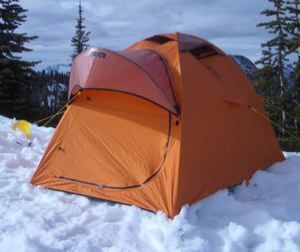
The Nemo Tenshi is a super-breathable and well ventilated bomber tent.
The Nemo Tenshi tent does the best job of avoiding condensation of any tent I’ve used. With waterproof and highly breathable eVENT fabric (much more breathable than Gore-Tex or other laminate fabrics), three vents, and a rear window with bug screen, I experienced extremely minimal, to no, condensation in winter conditions. A removable “condensation curtain” helps further by limiting all condensation to a small area and directing it to a vent. A retractable awning also allows you to leave the door partially unzipped for extra ventilation and effectively protects your gear when entering the tent. At 45 inches tall (114 cm), the Tenshi allows for significant airflow and usable living space.
All of these extras come at the price of weight. Although the Nemo Tenshi tent is only 1 inch wider and 4 inches longer than the discontinued Integral Designs eVENT MK1Lite, it weighs over 2 pounds more. Further, it is taller than several comparable tents, making its side walls steeper and more susceptible to deflection during high winds. That said, the Nemo Tenshi survived being pitched on a ridge top with wind gusts over 70 mph – where I was unable to walk without being blown over – with only minimal damage. Pressure vents in the awning allowed it to remain open all night without damage, proving that it’s tough enough for a mountaineering tent. This is a versatile tent that can take serious weather.
Note: General Electric purchased eVENT and now restricts its use in tents due to flammability considerations. Integral Designs and other manufacturers no longer use eVENT in their tents. The Nemo Equipment Tenshi tent is among a rare few tents that are still constructed of eVENT.
|
• Tent Type |
Single wall with floor | ||||||||||||
|
• Fabric Description |
Shell: eVENT fabric; vents and awning: Dimension-Polyant VX02; floor: PU coated 70D Nylon | ||||||||||||
|
• Pole Material |
DAC Featherlite Aluminum poles (tent was tested with a heavier pre-production pole set) | ||||||||||||
|
• Weight Full Package |
|
||||||||||||
|
• Weight Minimum Package |
|
||||||||||||
|
• Weight of Accessories |
|
||||||||||||
|
• Floor/ Vestibule Area |
|
||||||||||||
|
• Floor Area/Backpacking Light Minimum Weight Ratio |
0.35 ft2/oz | ||||||||||||
|
• Dimensions |
|
||||||||||||
|
• Model Year |
2005 | ||||||||||||
|
• MSRP |
$675.00 USD, (optional insulated floor $89 USD) | ||||||||||||

The retractable awning uses one pole and is easily stowed.
Setting up the Tenshi is very easy. Like other single wall wedge designs, the poles are set up outside the tent, slipped inside, and flexed into their corner spots. Pole tips are placed into the corner grommets. Velcro tabs are then attached to fix the poles in place. A minimum of five stakes is recommended to achieve the maximum stability and floor space (one at each corner and two for the side guy outs). When conditions were very windy, I was able to set up the tent from inside. However, the Velcro tabs are rather narrow, making them more difficult to attach than on similar tents.
The tent material is eVENT, a fully waterproof material that is far more breathable than comparable Gore-Tex or other laminate fabrics. The Nemo Tenshi is among a rare few tents that are still constructed of eVENT. Dimension-Polyant VX02 fabric is used for increased strength in the canopy and external vent flaps; I have seen this fabric used in several products through the years and it has worked very well.
A unique feature of the Tenshi is the retractable awning. My test sample awning sets up with one pole that is a very tight fit and takes a great deal of shoving to slide into the Velcro attachment. I’ve been assured that this difficulty has been addressed in the production models. The awning features pressure vents that are designed to release pressure during high winds. I found these vents to be extremely effective during a night of high winds when I had the awning deployed. Further, the guy out on the end of the awning added additional stability at the front of the tent.
A rear window is lined with bug mesh and provides cross ventilation and an extra look at the surroundings. This can also be used as a second door in an emergency but isn’t designed to be used regularly. I found it be unneeded in most situations but in warm weather, the cross ventilation was a nice change from most bomber tents, which tend to be pretty stuffy in these conditions.
An optional closed-cell EVA foam floor mates with the Tenshi floor, creating a fully insulated base. The floor weighs 2 pounds 13.9 ounces and costs an additional $89. It is extremely bulky and I never used it in the field, although it may be a useful option for some people.

A rear window with bug netting provides cross ventilation and additional views.
All of the extra features of the Nemo Tenshi are nice but they come at the price of additional weight. These extras, such as the rear window, three top vents, awning, additional height, and condensation curtain (3.9 oz extra), contribute quite a bit of the 5.5 pound weight of the Tenshi. I would like to see a pared-down version of the tent available.
Compared to the other bomber tents in our review suite, the Nemo Tenshi floor area to weight ratio of 0.35 ft2/oz is close to the Mountain Hardware EV2 (0.36), and lower than the Crux X2 Storm (0.44) but these other tents are much more stable three and four pole designs. The Outdoor Designs Summit Extreme, with an area to weight ratio of 0.52 ft2/oz, has nearly one and a half times the area per ounce, but sacrifices living space. Still, the Tenshi could easily lose weight and retain its size.
When compared to similar tents, the Nemo Tenshi has a taller ceiling height:
This extra height increases the steepness of the walls and the usable space of the tent. This Nemo Tenshi is comfortable for two people to sleep or sit up in, although there isn’t much room left over for gear.
Unlike the Bibler I Tent or Integral Designs MK1 XL, there is no optional full vestibule for the Nemo Tenshi.
Camped on a ridge in the North Cascades last winter, I had this tent in the most serious winds I’ve ever experienced. Wind gusts that were approximately 70 mph made it impossible to move around camp without crawling. I used all seven of the Tenshi guylines and laid in the darkness, hoping that the tent wouldn’t blow off the mountain or disintegrate. It didn’t, and I was happy to wake up in safety. The Nemo Tenshi can survive serious winds and proved that it is a true bomber tent.
However, these high winds also revealed some problems in the design. While the steep sidewalls increased usable space, they also increased side deflection. Although the side guy outs did a good job of counteracting this, they tensioned the upper portion of the wall much more than the lower section, causing the lower sidewalls to flap in even moderate gusts. Further, having the upper portion of the tent more rigid made the tent unable to “spill” side gusts like some other two-pole tents that lean over slightly to release pressure. The consequence was extra stress on the seams, resulting in several internal Velcro pole attachments coming loose through the night and one ripping free of the tent wall (see Durability below).
The steep sidewalls helped the Nemo Tenshi to effectively shed snow and rain. During heavy snowfall, keeping the upper vents closed was important because they acted to flatten the roof and cause snow to pile up.
In heavy Washington rains, the Tenshi shed water easily and the eVENT fabric proved to be completely waterproof. When sitting out bad weather, the sufficient usable space and yellow walls made things a bit more comfortable and cheery. We often had to drag our gear inside the tent – a vestibule would be a really nice option to keep wet gear outside the living area.

Three large vents include support rods, Velcro closures, and can be opened and closed from inside the tent through zippered access slots.

The condensation curtain keeps any condensation in a small area, directing it to a front vent. The curtain drapes loosely across the body and is easily removable with Velcro attachments.
There is no such thing as a 100% condensation-free fabric. Given subzero conditions, sealed vents, and high levels of humidity and warmth inside a tent, condensation can occur with any fabric. The beauty of eVENT, though, is that the range of conditions in which condensation will not occur (or will be minimal) is much broader than Tegral-Tex (Integral Designs), Todd-Tex (Bibler), Epic (Black Diamond), and even Gore-Tex (Outdoor Designs). With all the vents sealed in conditions well below freezing, the condensation I experienced was extremely minimal. With the three vents open or the door or rear window cracked, I never experienced any condensation at all. I was stunned by the performance of the eVENT fabric.
The Tenshi has three vents that close with Velcro and prop open with small support rods. The side vents have small internal zippers that allow you to reach outside to adjust the vents without leaving the tent. With a bit of a stretch, I could also reach the front vent. This feature was very useful during storm conditions, especially because the awning prevented reaching out the door.
If that wasn’t enough, the Nemo Tenshi also includes a removable “condensation curtain.” This curtain attaches to the sidewalls with Velcro strips and drapes across the chests of the sleepers, trapping moisture in a small portion of the tent and directing it toward an upper vent. When used with the door cracked under the protective awning, specific high/low venting can be achieved. This is a brilliant design that would be well worth the extra 3.9 ounces in subzero conditions. This is a well thought-out innovation that would be especially effective in tents made of less breathable fabrics. However, with the excellent breathability and ventilation of the Tenshi, I found it to be overkill in most situations.
It’s rare that a mountaineering tent would be found in bug-infested areas below the treeline. However, living with the Tenshi in these situations would be quite comfortable. It has a large door, rear window, and three vents that are all backed with mosquito netting. As temperatures rise, the eVENT fabric would also help to keep things comfortable. This is a very versatile bomber tent.
(Before commenting on durability, it is important to note that the tent tested was a pre-production model and came with a detailed outline of problems already addressed before the first production run. Flaws found that were addressed in this outline have been indicated.)
During the night of high winds described in the Wind Stability section, the poles were stressed out of the internal Velcro attachments on several occasions. During one of these events, the attachment partially tore from the inner tent wall. Improvements in internal welding are intended to address this problem in production runs.
Another potential durability issue was corner pockets that came loose from the sidewalls. With the resulting gaps, a pole could easily slide behind the pocket and come against the weaker eVENT fabric. Nemo is sewing these corners in production runs to address this possibility.

Problems with internal welding have been addressed in production runs.

Corner pockets will be sewn in production runs.

Using shorter, or elastic, cord would be more secure for roll-up doors.
The only other flaw I found in the tent was door tie-up cords that were too long. Shorter cords or those made of elastic would keep rolled doors and windows closed more securely.
At $675, the Nemo Tenshi is in the upper end of high-end bomber tents but is also made of more expensive (and rare for tents) eVENT fabric. (In fact, the only other eVENT tent that is currently on the market is the Exped Polaris, which retails for $619.) Considering the versatility and amazing condensation-resistance of the Tenshi, the price is reasonable.
However, when you consider that for less money you can pick up a Bibler I Tent or an Integral Designs MK1 XL with the optional vestibule, the decision becomes less obvious. If you’re looking for the ultimate in fabrics, though, you’ll be hard pressed to beat eVENT, and in today’s market, that leaves few options. With the Nemo Tenshi, you’ll have a versatile design that you’ll enjoy for years to come.
The Nemo Tenshi is a well thought-out design with many innovative features. It is well-built and will last many seasons of winter and mountaineering use. However, there are some changes that could improve this design:
Perspectives from the field, with commentary on gear and technique for hammock camping with less than five pounds of gear.
You don’t have access to view this content.
Mini alcohol stove that doesn’t require a pot stand or priming.
I came across the Mini Bull Design Elite alcohol stove when I conducted a search for the “perfect” SuperUltraLight alcohol stove. I wanted a stove that was simple and very light.
My criteria:
The Elite meets all four requirements. It produces nice hot, blue flames. Determining how efficient it is with a narrow beer can pot will require further testing.
Double wall two-person tent with two doors, two vestibules, easy setup, and interior pockets for organizing gear: all for just a shade over three pounds.
Double wall tents are not high on our list of things to love about ultralight backpacking. We get more enthused about single wall tents, tarp tents, and tarps, and Ryan gets downright ecstatic when the conversation turns to poncho tarps and bivy sacks. So when we were faced with the prospect of having to review some double wall tents for BackpackingLight.com, we really had to suck it up and bury some serious biases and learn – again – to appreciate their benefits. Double wall tents still offer significant advantages over lighter shelters. A double wall tent is generally stronger and more wind resistant than a similarly designed single wall counterpart, and, with a few minor exceptions, condensation is still easier to manage in a double wall tent due to the breathable inner tent that remains mostly dry. But, double wall tents are more complex to set up, they have low weight:space ratios, and they are heavy.
Those preconceptions and biases against double wall tents made us appreciate the Summit Shelters Evolution 2P Tent all the more.
The Evolution 2P is a fairly traditional looking double wall tent – it is built for two with all the amenities of a three-season backpacking tent: dual side doors, dual side vestibules, plenty of interior pockets to aid organization, and a mesh inner tent for maximum airflow. On paper, when you review these features, you immediately notice the comparison to tents like the MSR Hubba Hubba, Sierra Designs Hyperlight AST 2, REI Quarter Dome UL, and The North Face Vector 22. However… there’s one very notable difference: the Evolution 2P is a pound – or more – lighter than these tents.
With a silnylon fly and floor and carbon fiber poles (you can also cash down with a slightly heavier aluminum option), the Evolution 2P tips the scales at just over three pounds. That’s a remarkably low weight for two people to share on a backpacking trek, considering the nature of the tent, and it’s plenty light to be seriously considered as a roomy solo tent. The Evolution 2P is only a fraction of a pound heavier – and far roomier – than most of the lightest double wall solo tents on the market.
So does the weight savings come at a price? To the mass market that has been drilled (brainwashed?) with ”durability fear”, certainly – the carbon fiber poles require more care in handling and setup than aluminum poles, and provide a somewhat less stable structure in severely windy weather (however, in this double wall design, I would have no reservations in using the tent in virtually any three-season condition one might find in the US). In addition, the silnylon floor is lighter and less waterproof than conventional (heavier) tent floors, but again, silnylon fabrics have been put through the wringer enough by the ultralight community to have gained wide acceptance.
The real beauty of the tent is its ease of setup. External poles with clips make the free standing inner setup a cinch (new models come with single continuous pole sleeves, which may even be easier), and the fly goes on quickly. Vestibules are secured with two stakes each, and for best storm resistance and ventilation, the tent can be staked at its corners – we recommend carrying 8 stakes (lightweight titanium, of course!). Optionally, in severe weather, you can add up to four guylines to tie outs along the pole structure, which helps stability significantly in high winds.
For two people, ease of use is hard to beat with the Evolution 2P. Each occupant has plenty of interior pocket storage for organization, and dual vestibules and doors go a long way towards keeping close tentmates close friends. Vestibules are large enough for boots, a mid-sized backpack, and plenty of other gear. The fly is adjustable in several different positions on each vestibule side, allowing you to fine tune ventilation and views ranging from entirely open sides to fully sealed. Peak vents in the top of the fly vent moisture, and a clear vinyl window brings morning light into the shelter.
Pros: Lightest double wall, two-door, dual-vestibule tent on the market; easy setup; plenty of pockets for interior storage and organization; multiple vestibule configurations
Cons: Full mesh inner tent allowed condensation to “rain in” from the inside of outer fly in high morning winds following a cold, still night; carbon fiber poles not stiff enough for serious snow loading.
Ideal Application: 3-season camping with a child or spouse, or solo hiking for folks that like the comfort, security, wind resistance, bug protection, and privacy of a double wall tent.
Perspectives from the field, with commentary on gear and technique from a 10k high camp near Mount Humphries with less than five pounds of gear.
You don’t have access to view this content.
Experiences of a Montana news journalist taking the trail to backpacking enlightenment.
Lightweight guru Ryan Jordan
helps hiker lessen load
Story and photos
By Brett French
Gazette Outdoor Writer
I felt exposed. With my motley collection of backpacking gear laid out for criticism, I was sure Ryan Jordan would laugh out loud. After all, the founder of BackpackingLight.com is the guru of all things new and lightweight – a high-end gear aficionado.
But he took the discussion of my hand-me-down external frame pack and its jumbled contents very seriously. He carefully assessed the contents and pointed out how I could save weight and loaned me several items to test. The only time he showed emotion was when he came across my old blue Gerry down vest, circa 1973.
"That’s cool," he said. "That’s a relic. You could probably sell it for $200 on eBay."
Mentor needed
Conversion to a new belief system takes a mentor, someone who can point out the enlightenment in a new way of thinking. That’s how I ended up talking to Jordan. Hoping to trim the weight off my traditional backpacking gear, I appealed to him for a critique and a piece-by-piece examination of my gear.
Many backpackers are probably in the same boat, I reasoned, loaded down with old, heavy gear and unsure about the best places to make an investment to substantially lighten their load.
"Our mission is to educate people how to use a lightweight product safely and comfortably," Jordan said. "Our philosophy is you can carry lightweight gear and you don’t have to suffer."
He stressed, however, that "You can’t send a neophyte into the wilderness with a one-pound tarp. You can do this, but you need some skills."
Paring it down
Shaving weight off my oddball collection of gear was relatively easy. Without food or water, my basic kit weighed in at 31 pounds, 4 ounces. With some modifications from Jordan, I was able to get my entire pack weight, with food, down to 26 pounds.
The food alone for the three-day outing I planned weighed in at 7 pounds. And since I had plenty left over when I reached the trailhead, I probably could shave my food weight down to around 4 pounds. My goal on my next outing is to carry 20 pounds or less.
But what’s the best way to achieve such a weight loss? It’s a question as difficult as dieting.
"Take less stuff," Jordan said simply. "It doesn’t cost a dime."
My miscellaneous gear is a good case in point. It weighed in at 4 pounds, 12 ounces. Here’s some of what I had planned to take along: mosquito headnet, fuel bottle, binoculars, Leatherman multitool, lighter, matches, first-aid kit, pen and paper, patch kit for Therma Rest, sun and bug lotion, trowel, bullion cubes, toothbrush, toothpaste, bear spray, garbage sack, whistle, compass, firestarter, flashlight, extra batteries, clothespin, clothesline, ear plugs, aluminum foil and toilet paper.
"Unless I’m fishing, I don’t ever take a knife," Jordan said. Instead, he’ll take along a small pair of scissors to cut tape for patching up blisters.
So my large Leatherman multitool was overkill, he said. For those people who have to have a knife, Jordan recommended the smaller Leatherman Micra or Swiss Army Classic.
Hot plate lightweight
"The stove is probably one of the biggest areas where you can invest a little money and save a lot of weight," he said.
Jordan set me up with a Vargo Titanium Jet-Ti Stove (2.7 oz.-$65). The stove requires an isobutane canister ($7), one of which will last about four days depending on how much you use it. The Jet-Ti has an output of 9,000 BTUs an hour and quickly heated enough water for a dehydrated meal and drink. Also, it was nice to not have to mess around with filling a stove with fuel, pumping and fiddling to get the flame just right. Unfortunately, the canisters are not refillable.
By comparison, my old white gas Coleman Peak One stove weighed in at 2 pounds, 8 ounces, not counting the extra fuel that might be required.
The big 3
The backpack, tent and sleeping bag are the big three places to save weight, but they are also the most expensive, Jordan noted.
"The sleeping bag is probably the most expensive," Jordan said. "Most people carry a lot of weight because the bags are synthetic or durable."
Jordan let me borrow a Nunatak Arc Alpinist bag. With a detached down hood, it weighed in at 1 pound, 9 ounces compared to my old Goose Bay Down bag with fleece liner that weighed 4 pounds, 7 ounces.
The Arc Alpinist has 800 fill down, meaning there are 800 cubic inches of down per ounce of fill. Unique to this bag’s design is that it has no bottom. Instead, nylon webbing crosses from one side of the bag to the other. The idea is that when down is compressed, it loses its heating capability. So the down you’re sleeping on doesn’t do much good anyway, so why not remove it. The straps can be slid around your pad, which will provide insulation from the ground.
"I’ve taken it into the teens," Jordan said.
The bag was more than warm enough on cool summer nights. The stuff sack, made out of spinnaker sail material, weighed a half ounce. Stuffed, the bag measures about 7 by 11 inches.
"That’s down’s best quality, its ability to occupy small spaces," Jordan said.
Rated to 20 degrees, the Arc Alpinist’s medium bag (5 foot, 10 inches) costs $260.
For a pad, I left my 2-pound, 6-ounce Therm-A-Rest self-inflating mattress at home. This was a difficult choice. I love my pad, especially since I sleep on my side a lot and lesser pads leave my hips hurting.
But in the interest of experimenting, I opted instead for a closed cell foam pad ($14) that weighed in at about 14 ounces. (One good thing about foam pads is that there’s no risk of popping them.) It’s nowhere near as comfortable as my Therm-A-Rest, but for a couple of nights, it was no big deal. In the future, however, I might look to shave weight elsewhere just to take it along.
Home on the mountainside
"One of the biggest things people are paranoid about is that they invest a lot of money in a tent," Jordan said. And because it’s a big investment, they feel the need to take it along, even if the weather doesn’t merit such protection from the elements.
For my trip, I planned on taking my Crazy Creek Crib LEX that comes with a tarp. The neat thing about this 4-pound hammock is that it can also be used as a bivy sack when no trees are around. Aluminum poles prop the crib’s canopy up to avoid a claustrophobic feeling and it’s covered with mosquito netting. The tarp provides protection from rain.
With an Integral Designs Siltarp 3 ($135, 8 x 10 feet), some hiking poles, guy lines and tent stakes, Jordan was able to drop that weight to about 1 pound.
I’ve got to admit, setting up the tarp in the front yard to try alternate layouts is much different than erecting the same shelter in the middle of a rainstorm. I was a bit frustrated with my first design, trying to get enough headroom to feel comfortable without letting the rain in. And I was too chicken to try it in the traditional pup-tent style, with a pole at each end, for fear of the rain getting in. Instead, I set it up in a lean-to style to shed water and wind. I stayed dry and, on this trip, mosquitoes were no problem. I also had a huge window for viewing the stars at night.
I’ve tarp-camped before with mixed results. One night I spent worrying about my bag getting wet. Another time mosquitoes buzzing in my ear kept waking me up. So I would recommend a mosquito head net and ear plugs for tarp campers.
Lighter packs
For a backpack, I’ve got a hand-me-down Alaskan Frame Pack from Cabelas that weighs 6 pounds, 6 ounces. This is a beefy, external frame setup that has lots of pockets and strap loops.
Jordan could have been describing me when he said, "So many people when they started out bought heavy, durable gear."
But if most of your trips are in the summer, such heavyweight items aren’t necessary, Jordan said.
He recommended I keep my frame pack until I got my weight down. But I opted to shave 2 pounds by borrowing my son’s internal frame backpack. Its smaller size also meant I had to shave some gear to ensure it all fit.
Jordan took me by ProLite Gear’s shop in Bozeman to show me some of the lighter alternatives to my external frame pack. The Granite Gear Vapor Trail ($145) won Backpacker magazine’s Editor’s Choice award. It can carry 30 pounds and weighs just under 2 pounds.
GoLite’s Infinity pack ($200) was another Jordan choice. It’s a top seller, weighing 2 pounds, 7 ounces and accommodating 2550 cubic inches of gear. The Gregory Z ($180) was another recommendation. It weighs 3 pounds, and holds 3550 cubic inches of gear.
"What this really highlights is that there’s a huge range of stuff that you can get into at a wide range of costs," Jordan said.
He noted that for about $300 to $550, anyone could significantly shave weight off their basic backpacking kit.
Lightweight backpacking is here to stay, Jordan noted. All of the larger outdoor gear manufacturers have jumped on the bandwagon.
"We’re riding a wave," he said. "That’s something we’ve never seen before – the mass marketing of products directly at lightweight users."
Brett French can be reached at french@billingsgazette.com or at 657-1387.
Copyright © The Billings Gazette, a division of Lee Enterprises.
Source: http://www.billingsgazette.com/index.php?id=1&display=rednews/2005/07/21/build/outdoors/30-hiking-lighter.inc
Outdoor writer Larry Tullis brings a lightweight ethic to backcountry fishing.
You don’t have access to view this content.
Results of a BackpackingLight.com reader contest, featuring the Top 10 Reasons to Carry a Spork List, and “Ode to a Spork” cowboy poetry by Paul Johnson.
What follows is the result of a reader contest held by BackpackingLight.com: what are the top 10 reasons to carry a spork while backpacking?
Top 10 List Credits: Paul Johnson, Chad Lorenz, Casey Lindstrom, Catherine Moore, Gerry Olenick, Dave Plantenga, Alec Rieger, and Bob Spencer
Submitted By Paul Johnson
Ode to a Spork
Alone on the trail, with m’trusty ole Spork.
It’s made’f pure Ti, ain’t no rusty fork.
It serves so many uses,
It’s utility never loses;
It’s my friend, it’s my mate, it’s my Spork!
At days end I bivy, and cook up my sup,
It’s all hot and steamin’, in my solo Ti cup.
Then into the cup, the Spork I do dip,
And lift up the Spork, straight on to my lip.
I taste all the goodness, the warmth, and the food.
My heart is so thankful; it no longer doth brood.
I lift up my eyes,
give thanks up above
for my friend, for my mate, for my Spork!
Then into my bag, beneath my taut tarp.
The sounds from my belly, like sounds from a harp.
This night I’ll sleep well
til morn’s light surely swells
Tis much thanks I owe
to my friend, to my mate, to my Spork.
Little known trivia about the spork.
Did you know that the spork was actually the first utensil ever invented? Moses invented a three-tined spork to illustrate to the Israelites that each tine was symbolic to their right to God’s love, fruitful land, and a lightweight desert pack. Rumor has it that Moses parted the Red Sea, of course, with his staff, but what do you think was lashed on the upper end, reflecting the power of God off its shiny bowl back to Pharoah et al? You got it: a spork.
Ryan Jordan and Alan Dixon got caught with too-light packs and their pants down at 12k in a storm in the Tetons, with an all-night rappel ahead of them down an unknown mountain couloir. They had 14 rappels total and ran out of gear after 13. After fishing through their packs and searching for that last piece of protection (there wasn’t one), Ryan muttered with dismay, “Dang, I knew I shoulda brought a spork.”
You can flick mashed potatoes the farthest with a Vargo Ti Spork. The design works so well in terms of potato capacity and balance that you’d’a thought Brian Vargo designed the spork exactly for this purpose. Watch the backlash, though, and wear goggles: the deep tines of the Vargo Spork can whip spuds right back in your eye.
Try here: Sporkelicous
Perspectives on footwear and foot care from a type II diabetic backpacker.
You don’t have access to view this content.
First look at the Jacks ‘R’ Better 8’x8′ Square SilNyl Tarp.
Jacks ‘R’ Better is a small cottage company founded by… you guessed it, two guys named Jack. Their gear is aimed at hammock hangers, but some of it, the 8’x’8 Square SilNyl Tarp included, crosses over for tent/tarp camping use as well.
The Square SilNly tarp is designed to be strung above a hammock on the diagonal. Jacks ‘R’ Better says that it also works well in a flying diamond configuration, or in a standard ‘A’ frame pitch for ground sleepers.
Rumor has it that the Jacks are working on a modification so that the tarp can also serve as rain gear.
A first look at a lightweight down quilt for saving weight on your 3-season sleep system.
The Jacks ‘R’ Better No Sniveller Universal Quilt can be used as a top quilt with foot pocket in a hammock or for ground sleeping, as a flat quilt, and as a hammock under quilt with the included JRB Suspension System.
One thing that makes the No Sniveller Universal Quilt unique is the slit in the center of the quilt allowing it to be worn in camp as a poncho/serape for warmth. The slit is edged with omni-tape (both sides look like the loop side of Velcro) which is surprisingly comfortable against the skin when in use, and keeps the slit closed when it’s not needed.
The second thing that makes the No Sniveller unique, is that the actual loft is significantly higher than the advertised 1.5 inches. The average loft (centered between baffles) is between 2.25 and 2.5 inches for the two quilts we measured.
Ultralight and ultra-tough, a ground cloth for the masses with a weight that appeals to the fringe.
For you gram wienies – yes, you! – the Gossamer Gear Polycryo Ground Cloth is the lightest ground cloth that we know of (1.3 oz / 36 g) that is tough enough for multiple trips. Half a space blanket is lighter, but one puncture and they rip apart. I’ve had the same Gossamer Gear Polycryo Ground Cloth out in the desert for 7 nights and the dunes for 5 nights without any damage.
I used the Polycryo Ground Cloth with a sleeping bag and with a quilt, without a bivy. Both bag and quilt sometimes migrated off the Ground Cloth and into the dirt. I’d like to see the Gossamer Gear Ground Cloth offered in a slightly wider version. Gossamer Gear offers a 6′ x 8′ ground cloth but in a heavier material (apparently wider Polycryo sheets are hard to find).
Destruction testing further confirms that the Gossamer Gear Polycryo Ground Cloth is tough and puncture resistant as claimed. I cut a couple of pieces from my used Ground Cloth and destroyed them. I ground a piece under my foot on concrete a few times – no holes. When I next ground it on tiny gravel, I produced several holes. When I pulled the edges of the Polycryo square, it did not tear immediately (unlike a space blanket).
I poked a sharp stick into the second square of Polycryo until it pierced the material. It took a little, but impressive, bit of push to force the stick to puncture the Polycryo. I pulled on the edges of the square and, not weakened by the grinding on concrete test, it took some extra effort to stretch the hole until the Polycryo tore.
A folding windscreen keeps this stove kit small but offers the power for boiling larger volumes of water.
The Go-torch by Mo-go-gear is a nicely designed open-jet alcohol stove that is well suited for group cooking. The 2.5-inch diameter burner has a 2-ounce capacity, it has a wide/sturdy pot stand, and comes with a windscreen (4 inches high x 24 inches long), heat reflector, and fuel measuring cup.
The Go-torch’s pot stand is very innovative and sturdy. It spreads out to about 4 inches in diameter, and folds flat for packing. The distance from the burner to pot bottom is 1.75 inches, which is higher than the traditional 1 inch. I queried the manufacturer on this and he replied that his tests showed that configuration worked best.
The windscreen and heat reflector (goes under the burner) are made of soft temper 36 gauge aluminum, which is very flexible and durable. It’s the same material the MSR windscreens are made of. Another nice feature is that the windscreen is adjustable for pot diameter, just set it to the desired diameter and secure it with a paper clip. For packing, the windscreen easily rolls up into a tight cylinder.
The total weight of the Go-torch is 2.4 ounces (my measurement). That is a little heavy by alcohol stove standards (you can find or make one that weighs 1 to 1.5 ounces), but remember that this stove can easily cook for two people or more. Much of the stove’s weight is in the pot stand and windscreen, which weigh 1.7 ounces together. However, these components are sturdy and will last a long time.
I tested the Go-torch both in the lab and field. My lab test results were as follows:
| Test Condition | Boil Time (minutes:seconds) | Fuel Consumption (grams) |
| Optimal (70 °F air and water) | 5:11 | 13.6 |
| Cold (40 °F air and water) | 8:18 | 15.9 |
| Wind (70 °F air and water, plus 12 mph wind) | 6:40 | 31.8 |
My tested optimal boil time is reasonably close to the manufacturer’s claimed boil time of 4:20. The discrepancy is easily accounted for by differences in elevation, fuel used, and water/air temperatures.
The Go-torch performed well in the field. It lit directly from a match in warm weather, but on a 35 °F morning I had to warm it with my hands to get it to light (which is normal). The Go-torch does not come with a simmer ring for flame control, so it is most suited for cooking quick meals by the boil and set method.
My reasons for liking the Go-torch are its suitability for group cooking, it’s a complete cooking system (sans pot), the windscreen is high quality and adjustable for pot diameter, its components are sturdily built, and it performs well. The consequence of its sturdiness is an extra ounce of weight.
Field notes on perspectives from the field, with commentary on gear and technique in the canyons of the desert southwest.

Lower section of West Clear Creek, Arizona.
I enjoyed my sub-5-pound base weight trip into Arizona’s West Clear Creek Canyon. Weather was as expected – lows of 60 °F and highs around 100 °F, no rain. The main thing I learned was that it’s really easy to go sub-5 in hot weather – no insanity required. I was able to skimp on weather protecting (cold and rain) gear, which left plenty of ounces to carry luxuries, like a TorsoLite, so I was super comfortable on the trail and in camp.
The spreadsheet below has my final gear list. My base weight was 4.5 pounds. An unforeseen safety advantage was that total pack weight was light enough that I usually just kept my pack on when scouting routes, so I automatically had the 10 essentials with me.
Choosing gear for a backpacking trip always involves trade-offs between gear weight and usefulness. For example, on this trip I would have appreciated a hipbelt on the Gossamer Gear Uberlight pack about 10% of the time (when scrambling down a steep canyon or carrying extra water weight). But is it worth it to carry the extra 2 ounces a hipbelt would cost when it’s not needed 90% of the time?
Below I’ve listed selected gear and some of the factors I’ll take into account when I decide what gear to carry on my next SuperUltralight trip.

The BMW TorsoLite pad easily floated a 12-pound pack and 1-pound trekking poles (not shown).
Gossamer Gear Uberlight Backpack. The small size made it easier to slip between rocks and horizontal, vertical, and slanted uprooted trees during a descent down a debris choked side canyon.
No hipbelt left my waist cooler and made slipping on the pack simple, but let the pack flop over my head when I bent double to scramble down rocks, leaving small items in the back pocket vulnerable to loss.
When I carried extra water for a dry camp above the canyon, the 18-pound pack felt really heavy on my shoulders. I hardly missed the hipbelt at 12 pounds (starting pack weight).
I was very conscious of how I placed the pack on the ground and tried to prevent it from snagging on trees and brush due to the 0.96 oz/yd2 spinnaker fabric. The pack did hang up a couple of times on tree branches but survived without any damage.
I missed a side water bottle pocket. I needed to take off the pack to get a drink of water.
My back was soaked with sweat from spinnaker fabric next to me instead of some absorbent – and heavier – material.
Bozeman Mountain Works TorsoLite. I really enjoyed the TorsoLite. I slept well at night on it, it easily floated my pack and hiking poles when I swam sections, and it even supported me when I floated down some swift water to cool off. It compressed small enough to fit in the outside pocket of the Uberlight.
Speer Hammocks Top Blanket. As Ed Speer advises, this is a narrow blanket (30″) made to be used with a hammock. However, it kept me warm to 60 °F on the ground. I did need to be conscious of tucking the edges beneath me each time I turned over – something I’m not used to doing in a sleeping bag – but doing so became habit by the end of the first night.

SUL sleep setup: Gossamer Gear Polycro ground sheet, BMW TorsoLite pad, Speer Top Blanket, Dancing Light Gear Ultralight SleepNet, and grocery bag food sack (inside Adventure 16 mosquito head net) for a pillow.
Sea to Summit Ultra-Sil Dry Sack. I used a 20-liter Sea To Summit Ultra-Sil Dry Sack (1.8 oz) instead of a mylar turkey roasting bag (0.5 oz). The Dry Sacks are made of sil-Cordura with taped seams and a dry bag style roll top closure. The dry sack kept my bag and extra clothing dry (even when I “accidentally” dropped the full sack in the stream and left it for 20 minutes) and served as a back up emergency water carrier to my single Platypus bottle. The 20-liter size was a somewhat random choice based on what the Sea To Summit rep had available before the first major shipment arrived for the initial US release of the bags. It ended up being very handy. The sack diameter was the right size to nearly fill the bottom of the UberLight, yet left enough space so that I could easily extract the folded up TorsoLite from the pack and then slide it back in after I floated the pack through a swimming section. The Ultra-Sil Dry Sack also had enough volume that I could get all the pack contents into it at the end of the trip when my food volume was reduced.
Gossamer Gear Pack Liner. I used the Gossamer Gear Pack Liner inside the pack to provide double protection for the sleeping quilt and single containment of my food and sundries. It, along with the folded up TorsoLite, kept my pack floating when the pack “accidentally” fell in the water. The Gossamer Gear Pack Liner is proving to be quite tough; it survived this trip (and two previous short trips) with no holes.
Dancing Light Gear Ultralight SleepNet. This net (my size large weighs 2.7 oz) is a large rectangular sack that is intended to fit over your head and torso while in your sleeping bag. It definitely helped my sanity! I wore it over my legs while I ate to keep the pesky bugs from biting my exposed ankles. I used it over the bottom of my quilt and feet for a little extra warmth one night, and on another night over my head and torso while sleeping for the extra warmth. I used it as a head net by tucking the ends into my shirt.
Gardeneer Garden Pegs. These plastic pegs are very light (about 0.1 oz each), but didn’t make the grade. I broke two and bent one pounding six stakes in at a camp site above the stream on hard packed dirt.
Grocery bag food sack. The grocery bag food sack survived the trip and enabled me to use my food as a very adequate pillow, although I did question the wisdom of having food so close to my head when I heard some kind of wildcat screaming while I was trying to sleep on my last night in the canyon.
OraLabs Lip Sun Shield. I loved the tiny size and, despite applying it frequently, I used less than a quarter for a four-day trip. I like the taste and its smooth application too.
The bottom line is that I didn’t need to give up much with a sub-5-pound base weight in hot weather. The adjustments in behavior I made from an 8-pound base weight were minor since much of the weight loss was due to lighter weight gear, rather than less gear.
| Clothing Worn While Hiking | WEIGHT | |||
| FUNCTION | STYLE/Rationale | EXAMPLE | Ounces | Grams |
| sun hat | full brim | Tilley LT5 | 3.3 | 94 |
| hiking shirt | long sleeved sun and brush protection | Rail Riders Adventure shirt | 6.1 | 173 |
| sport top | minimal, breathable | Patagonia Mesh Sport Top | 2.1 | 60 |
| underwear | synthetic briefs | Moving Comfort Microbrief | 1.3 | 37 |
| pants | hike/swim/bushwhack | Columbia PFG zip off | 10.3 | 292 |
| hiking socks | thin merino wool blend or synthetic | SmartWool Ultra Light RBX socks | 1.2 | 34 |
| hiking shoes | lightweight, dry fast | Salomon Tech Amphibians | 24.2 | 686 |
| Other Items Worn or Carried | WEIGHT | |||
| FUNCTION | STYLE/Rationale | EXAMPLE | Ounces | Grams |
| trekking poles | collapsible so can be stowed | Leki Lightwalk Hiking Staff | 16.2 | 459 |
| Other Clothing | WEIGHT | |||
| FUNCTION | STYLE/Rationale | EXAMPLE | Ounces | Grams |
| bandana | cool off, protect neck from sun | bandana | 0.8 | 23 |
| pants | dry, bug protection | Solumbra Active Pants | 6.3 | 179 |
| long sleeved shirt | dry | GoLite C-thru Lite-weight | 3.5 | 99 |
| wind shirt | extra evening warmth, bug protection | Patagonia Dragonfly | 3.2 | 91 |
| Warm hat | use with quilt at night | Turtle Fur fleece beanie | 1.3 | 37 |
| extra socks | thin merino wool blend | SmartWool RBX Racer socks | 1.3 | 37 |
| Shelter and Sleep System | WEIGHT | |||
| FUNCTION | STYLE/Rationale | EXAMPLE | Ounces | Grams |
| shelter | poncho/tarp | Bozeman Mountain Works SpinPoncho LITE prototype | 5.9 | 167 |
| tent stakes | light weight, plastic | Gardeneer Garden Pegs (6) | 0.7 | 20 |
| guylines | 20′ of thin cord able to hold a tautline hitch | 275 lb EZC spectra-core line | 0.3 | 9 |
| ground sheet | fit under sleeping bag | Gossamer Gear Polycro ground sheet | 1.3 | 37 |
| sleeping bag | minimal for very warm weather | Speer Hammocks Top Blanket | 14.5 | 411 |
| sleeping pad | inflatable, used to float pack | Bozeman Mountain Works TorsoLite | 10.6 | 301 |
| mosquito netting | upper torso protection | Dancing Light Gear Ultralight SleepNet | 2.7 | 77 |
| Packing | WEIGHT | |||
| FUNCTION | STYLE/Rationale | EXAMPLE | Ounces | Grams |
| backpack | small volume, frameless | Gossamer Gear Whisper Uberlight with shoulder strap foam | 3.9 | 111 |
| waterproof pack liner | keep pack contents dry while floating it | Gossamer Gear Pack Liner (medium) | 1.3 | 37 |
| stuff sack | water resistant for sleeping bag and extra clothing | Sea To Summit Ultra-Sil Dry Sack, 20 L | 1.8 | 51 |
| Cooking and Water | WEIGHT | |||
| FUNCTION | STYLE/Rationale | EXAMPLE | Ounces | Grams |
| stove | solid fuel, Esbit | bottom quarter inch of V-8 juice can | 0.1 | 3 |
| fuel container | Esbit packaging | packaging for one Esbit tab weighs less than 1 gram and is included in fuel weight | 0.0 | 0.0 |
| cookpot | titanium mug | Snow Peak 600 | 2.8 | 79 |
| cook pot lid | aluminum foil | cut to size, doubled | 0.1 | 3 |
| wind screen | wind screen/pot support | pot support/wind screen as designed by W. Kevin Smith, made of oven liner foil | 0.3 | 9 |
| bag for cookpot | protect pack contents from Esbit residue on cookpot | plastic grocery store veggie bag | 0.1 | 3 |
| utensil | spoon | GSI Lexan soup spoon | 0.3 | 9 |
| ignite Esbit | lighter | Scripto | 0.6 | 17 |
| water bottle | 1 L | 1 L Platypus with sport cap | 0.9 | 26 |
| emergency water carrier | back up for Platypus | Sea To Summit Ultra-Sil Dry Sack (weight listed under Packing) | 0.0 | 0 |
| water treatment | containers for Aqua Mira, measuring cap | Bozeman Mountain Works 0.35-oz Capacity Dropper Bottles (2, carried in ditty bag) | 0.4 | 11 |
| food storage | light weight | plastic grocery bag | 0.2 | 6 |
| Other Essentials | WEIGHT | |||
| FUNCTION | STYLE/Rationale | EXAMPLE | Ounces | Grams |
| maps | trail map | none needed, follow canyon | 0.0 | 0 |
| sunglasses | clip on | clip on sunglasses | 0.2 | 6 |
| mosquito head net | bug protection | Adventure 16 | 0.8 | 23 |
| personal hygiene | toilet kit | toilet paper, alcohol hand gel, zip bag for used tp, antibiotic cream with pain relief in zip bag | 1.1 | 31 |
| personal hygiene | teeth cleaning kit | toothbrush, floss, baking soda (in tiny zip bag), mouth guard in zip bag in food bag | 0.9 | 26 |
| ditty bag | miscellaneous | paper cutter, headlamp, wound kit, firestarting kit, sunscreen, keychain compass, DEET in silnylon bag | 3.9 | 111 |
| light | LED headlamp | Photon II with mini alligator clip | in ditty bag | n/a |
| first aid | minor wound care / meds | ibuprofen, duct tape, butterfly bandages (2) | in ditty bag | n/a |
| firestarting | emergency, firestarting | storm matches (2), no-blow out birthday candles (2), whistle | in ditty bag | n/a |
| sunscreen | SPF 30, sunscreen and lip balm | Banana Boat Kids repackaged (1.6 oz), OraLabs Lip Sun Shield (0.2 oz) | in ditty bag | n/a |
| Consumables (4-Day Trip) | WEIGHT | |||
| FUNCTION | STYLE/Rationale | EXAMPLE | Ounces | Grams |
| fuel | Esbit | 0.5 oz/ evening | 1.5 | 43 |
| food | 3.5 days | 24 oz / day | 84.0 | 2381 |
| water | average carried | 32 oz | 32.0 | 907 |
| water treatment | Aqua Mira (excluding packaging) | 0.6 oz/4 days | 0.6 | 17 |
| toilet paper | soft but strong | 1.2 oz/4 days | 1.2 | 34 |
| Weight Summary | Pounds | Kilograms |
| (1) Total Worn or Carried While Hiking | 4.0 | 1.8 |
| (2) Total Base Weight in Pack | 4.5 | 2.0 |
| (3) Total Weight of Consumables | 7.5 | 3.4 |
| (4) Full Skin-Out Base Weight (1) + (2) | 8.6 | 3.9 |
| (5) Total Initial Pack Weight (2) + (3) | 12.0 | 5.4 |
| (6) Full Skin-Out Weight (1) + (2) + (3) | 16.0 | 7.3 |
|
Note: I did not include journalistic gear (camera, paper, and pen) in weight calculations. |
||
| What | Dry camping, will need to carry 1 gallon of water |
| Where | San Francisco Peaks, Arizona including Mt. Humphreys, the highest peak in Arizona |
| When | July |
| Weather | Air temperatures from 45-80 °F, wind, and possibly rain |
| What | Hammock camping |
| Where | Mogollon Rim, Arizona |
| When | July |
| Weather | Air temperatures from 55-85 °F, possible rain |
Look for the pre-trip gear list for both July trips here in the Backpacking Light Gear Lists Forum.
A tiny stove well suited for backpackers that view pint sized cooking mugs as group cooking devices.
Gossamer Gear never loses sight of light, and the new Fire-fly alcohol stove they commissioned from Mo-go-gear (at 1.56 ounces for the whole kit) is no exception. The cooking system includes the burner, pot stand, heat reflector, windscreen, and fuel measuring cup.
The Fire-fly uses a mini alcohol burner (2-inch diameter) with a capacity of 1.25 ounces. The heat reflector and 3-inch x 22-inch windscreen are made of soft temper 36 gauge aluminum, which is the same stuff that MSR uses for their windscreens. The pot stand is wide and sturdy.
I like the innovative pot stand (which folds flat), the high quality adjustable windscreen, and the fact the stove comes as a cooking system (sans pot). My guess is that it’s capable of cooking for two; we will find out. Our editors are testing the Fire-fly in different regions of the country, and we will publish a full review this summer.
Rain shirt? Jacket? Who cares: It’s 7 oz and has the ability to disappear in a corner of your pack.
Montane calls it “the world’s lightest weight fully waterproof and breathable outdoor shirt”. Is it really a shirt? At a claimed weight of just 6 ounces (size large), the Montane 180 is similar to the Patagonia Specter Pullover (at 6.5 ounces, size medium), and a close contender for the coveted title of lightest woven fabric hooded rain jacket. Both jackets use a polyurethane-only waterproof/breathable membrane, and have similar features.
In our upcoming review of the Montane 180 I will take a hard look at its features and performance compared to the Patagonia Specter Pullover that we recently reviewed. How do they compare for performance, weight, and value?
 © Beartooth Media Group Inc.
 Loading...