



Introduction
Increasingly dirty fuel canisters are clogging the inverted remote canister stoves I’ve been building. There are two solutions: prevention and filters. This article will cover both.
Background
I like lightweight remote inverted canister stoves, especially for winter use. When I started making and using them around 2008, I did not have too much trouble with jet blockages due to dirt from within the canister. By 2010 I was even happily selling my stoves. I did avoid any canisters labeled “Made in China” because the ones I tried were disasters.
Now roll forwards to 2022, and I find some of my customers have problems with the fuel flow and dirt. Their stoves are sometimes not working properly. It seems they are finding the dirt inside the stove, from the hose inlet to the jet. The dirt is there despite my attempts at cleaning the parts during assembly by:
- first using compressed air to blow all parts clean after machining,
- then immersing the parts in hot soapy water in an ultrasonic bath for 3 minutes,
- then flushing all the parts with hot water,
- then flushing the assembled stove (minus jet) with liquid fuel,
- finally doing a full test-burn on the bench, cycling the power up and down.
History
I will assume some familiarity with remote inverted canister stoves and my stoves in particular. Otherwise, some of this won’t make much sense. You won’t need deep technical knowledge, though, and I have lots of diagrams.
From Our Archives: catch up on Roger Caffin’s recent work on remote inverted canister stoves with this series of articles:
- Remote Inverted Canister Winter Stove V6.
- Remote Inverted Canister Stove V4, Part 1 and Part 2.
- DIY Backpacking Stove An Ultralight Vortex Burner for Winter Backpacking Part 1, Part 2, Part 3, Part 4, and Part 5
- Is a Heat Exchanger Pot Worth the Weight?
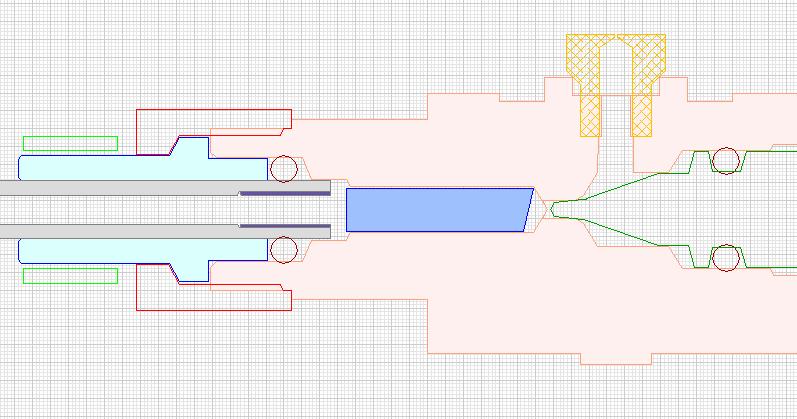
This diagram is a cross-section of the body of one of my stoves: it’s the big pink thing. There are variations, but this is typical. The hose connector is at the left (blue and grey), the needle valve (green) and the jet (yellow) are at the right, and the blue thing in the middle is the heat exchanger. Fuel flows out of the grey hose and down the thin space (0.1 mm) between the blue rod and the bore in the main body. There it absorbs enough heat that it vaporizes as it goes. Note that the fuel must be vaporized before it can burn and that n-butane boils at 32 °F (0 °C).
Way back around 2010, I was developing the concept for this heat exchanger to replace the traditional fuel pipe over the burner initially designed and used for petrol and kerosene stoves. I thought it was clumsy and unnecessary here. After all, a lot of heat is needed to vaporize petrol and even more so for kerosene (boiling point > 392 °F / 200 °C). But nowhere near as much heat is required to vaporize butane (boiling point 32 °F / 0 °C) and propane (boiling point -44 °F / -42 °C). Actually, with an upright canister stove, the fuel vaporizes inside the canister.
One early idea I had involved a Teflon rod with a spiral groove cut around it, inserted roughly where the blue rod above goes, at the input to the stove body. The idea was that the liquid fuel would have a long path in that spiral in contact with warm metal (the stove body), and it could vaporize as it went. It was not easy to make this bit as the Teflon rod is very soft and bendy, but I managed. I put the Teflon rod into an experimental stove, attached a canister, and fired it up with the canister inverted. My test rig looked something like this:
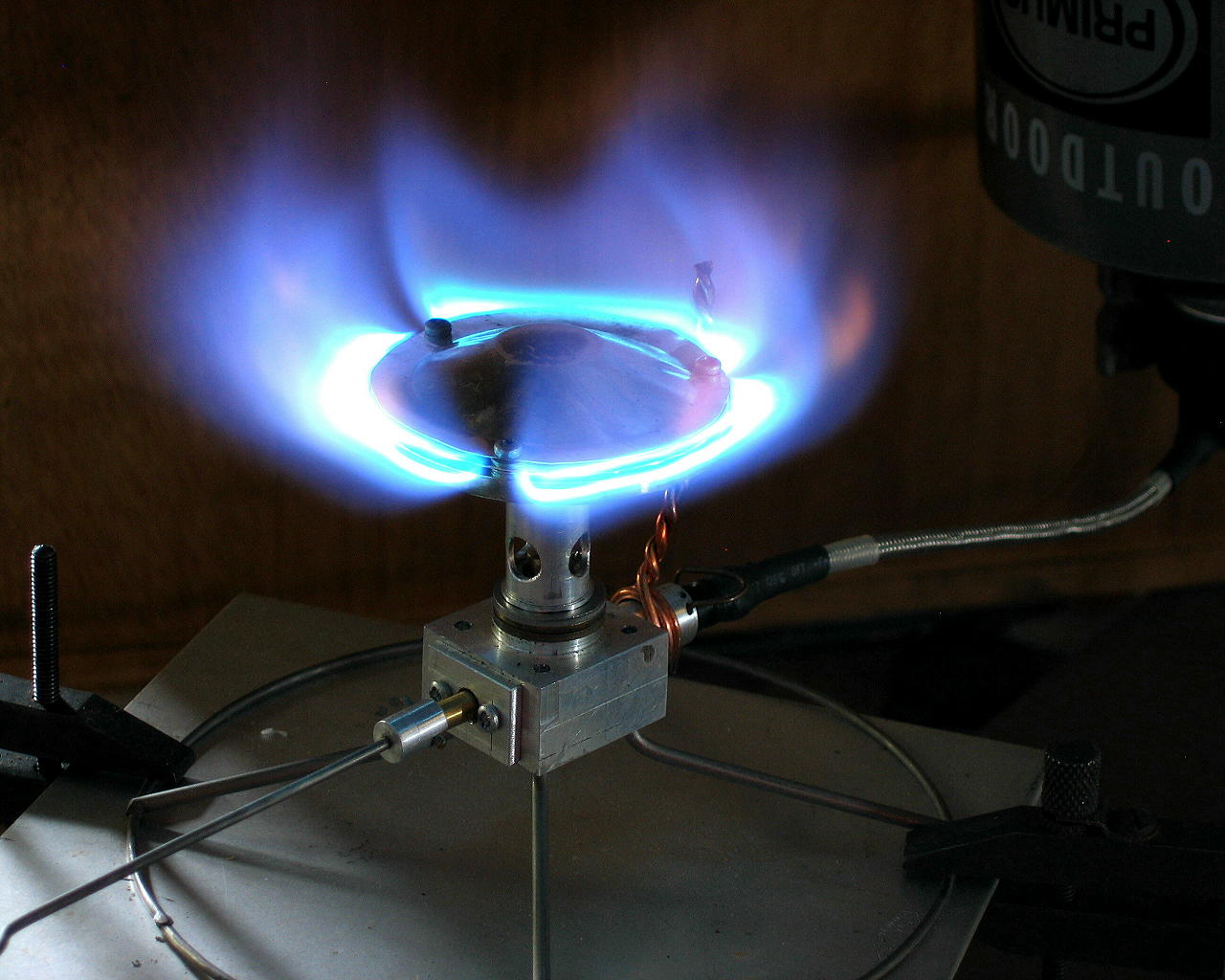
Yes, there’s a heavy copper wire heat shunt going from the flame down to the region of the heat exchanger. Heat travels down the heat shunt from the flame to the fuel coming in, helping to vaporize it. That idea (the heat exchanger) was working fine. My interest at this stage was the design of the rest of the stove, including the burner head.
Well, I fired up the stove, it ran for about 10 seconds, and then to my surprise, it stopped. I turned the canister off and stripped the stove down to see why. The groove in the Teflon rod was caked solid with dirt. I cleaned everything, reassembled the stove, and tried again. Again it lasted for about 10 seconds and then stopped. There was more dirt on the Teflon rod. This time I examined the dirt more carefully: it was dirt, not swarf (fine metal dust resulting from machining). It must have come from the canister: no other sources were possible. I had not met this kind of contamination before with a remote inverted canister stove.
Then I realized that I had just started these tests with a new canister: one of two I had recently bought locally at a lower price than normal. They were labeled “Made in China.” So I switched to a half-used Primus canister, and all was well: the stove ran fine. It would seem that the gas in the Primus canister was clean or well-filtered, but that the Chinese gas was not clean or filtered: it had a lot of dirt in it. Missing the filtration step probably saved them money during production. As roughly 99+% of the Chinese market is for upright stoves, where the dirt stays at the bottom of the canister, that may be fine for them.
In our community: read this forum thread, in which Backpacking Light members share their favorite winter and cold weather stoves.
Today
Recently, one of my customers has been having trouble with an MSR IsoPro canister: his stove has clogged several times. Not just at the jet but also at the heat exchanger. I find it very hard to believe that the dirt could have come from anywhere but the canister. From the MSR website, I see that the canister is “Made in Korea,” but what does that mean? I am quite happy to believe that the canister is indeed Korean-made. I know Korea has the manufacturing facilities for that. But where was it filled? Or where did the gas come from? I don’t know.
I was willing to believe that there might still be very fine traces of machining swarf at the jet despite all the cleaning I had done. But that the heat exchanger rod (blue cylinder in my diagram) should be covered in dirt straight after the fuel comes out of the PFA hose is too hard to explain that way. Remember: this PFA hose is American-made for use in chemistry and medical laboratories: it is clean. The way the manufacturers extrude it, it can’t help but be clean. So what to do about the dirt?
There are two ways I can think of to keep canister dirt out of the stove: block it with a filter, or prevent it from coming out of the canister. Most of this article will be about filters, but let’s cover the second option – prevention – first. It is zero-cost and pretty much zero-effort.
Prevention via tilting
The dirt is denser than the liquid fuel, so it sinks to the bottom of the canister. That is a bit like mud in a puddle. So let us look at the canister more closely.

On the left, we have the insides of a Lindal valve before crimping into a canister. Note the blue bit. On the right, we have the cross-section of a real canister (cut in half) with the blue bit of the Lindal valve added. When the canister is upright, the dirt is out of the way at the bottom of the canister. Now let us invert the canister.
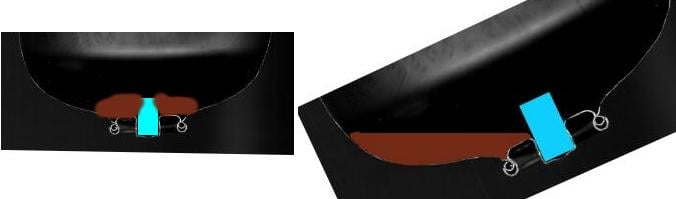
The left-hand illustration is an inverted canister with brown dirt piled up around the Lindal valve inlet. That’s how dirt gets into the stove. But what happens if, instead of casually flipping the canister upside down, we gently roll the canister onto one side and let the dirt settle? We would have something like the sketch on the right. If we avoid shaking the canister up, the dirt will settle at the lowest point, and the fuel going out of the Lindal valve should be moderately clean. Perhaps not perfect, but very usable. And that angle of tilt is dead easy to have in the field.
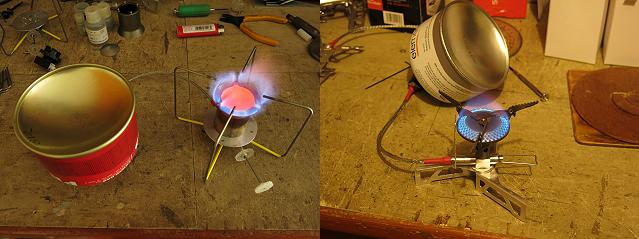
This principle is illustrated here with real canisters and real stoves. On the left, we have a rather unstable, fully inverted canister. This configuration would allow dirt into the Lindal valve and then the stove. I have to prop the canister up to keep it in this position. On the right, we have the canister leaning over in a far more stable position with the dirt (hopefully) below the Lindal valve
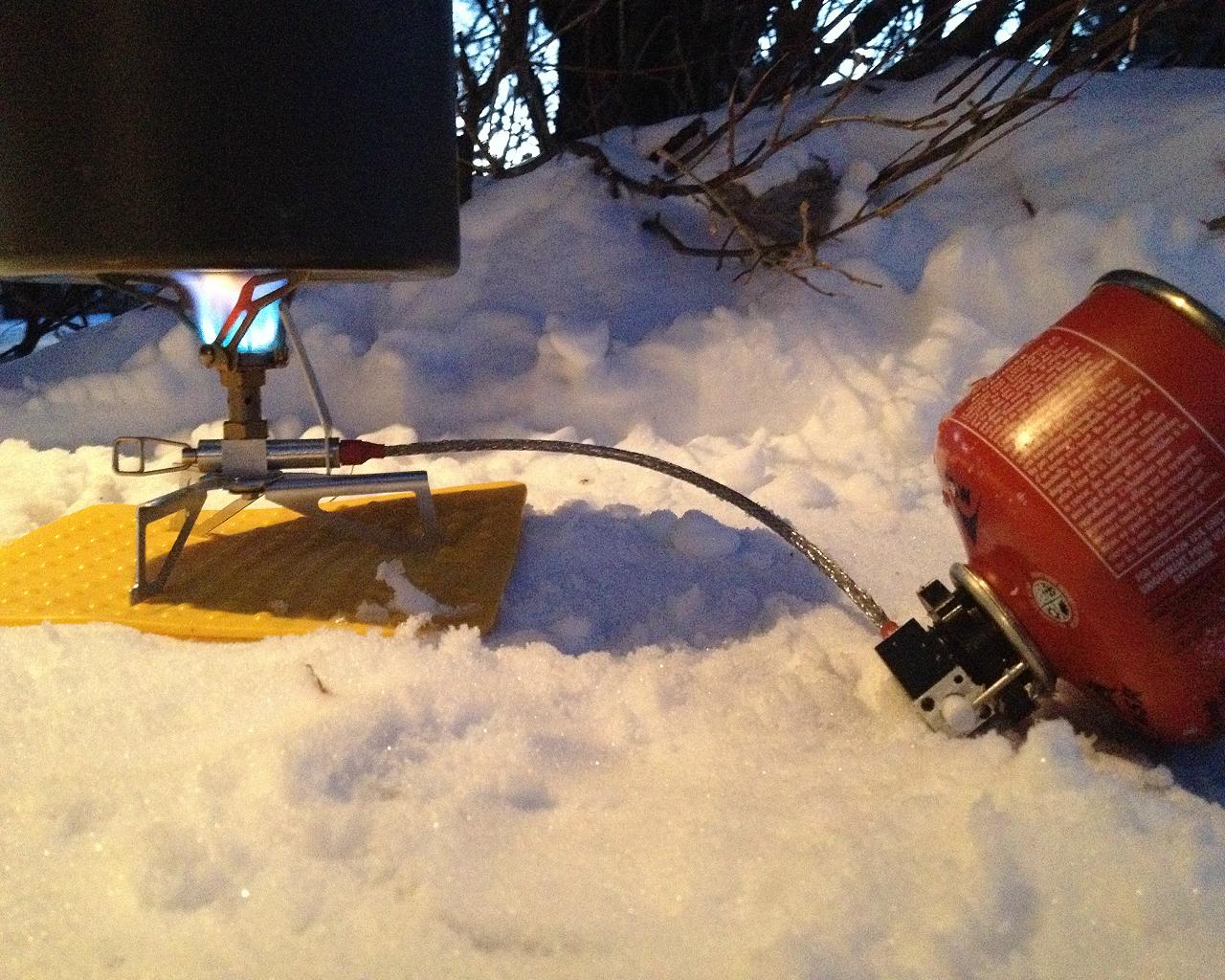
And it is not difficult to arrange a canister like this in the field either. Above is a customer photo of an early version of one of my stoves in the field many years ago. Don’t worry about the snow: propane boils at -44 °F (-42 °C) and pushes the liquid fuel down the line.
Commercial filters
I cannot claim to be the only source of knowledge about dirt in canisters. At least one Asian commercial stove manufacturer must have had problems many years ago with dirt at the jet. They took steps to prevent clogging by placing a fine sintered metal filter on the jet’s underside. See the left-hand unit below.
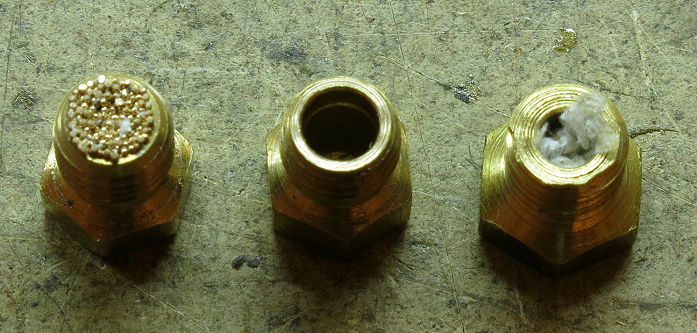
I tried to replicate this by putting some filter material in the hole in the underside of a jet I had made: see the right-hand unit. That did not work very well in practice: the paper tended to pack in and block gas flow. Putting just a little bit of tissue fluffed up in there was very hit and miss as well.
Actually, the sintered filter did not work very well either. Look closely at the top of the filter in the next photo.
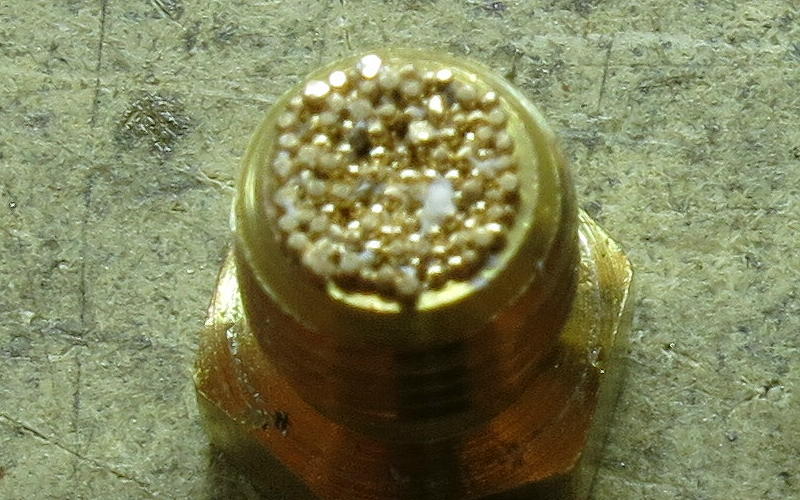
See that white stuff on top? I am unsure what it was, but it represented more stuff embedded into the sintered mass. Sure, the filter blocked any rubbish from reaching the jet hole, but it retained that rubbish too. The flow through this sintered filter had slowed to a trickle after some use, and I could not clean it very well in the lab. It would have been hopeless in the field: cold drinks and cold dinner for the rest of the trip. The unit in the middle in the previous photo shows a jet after the sintered filter had been removed, which was my temporary solution.
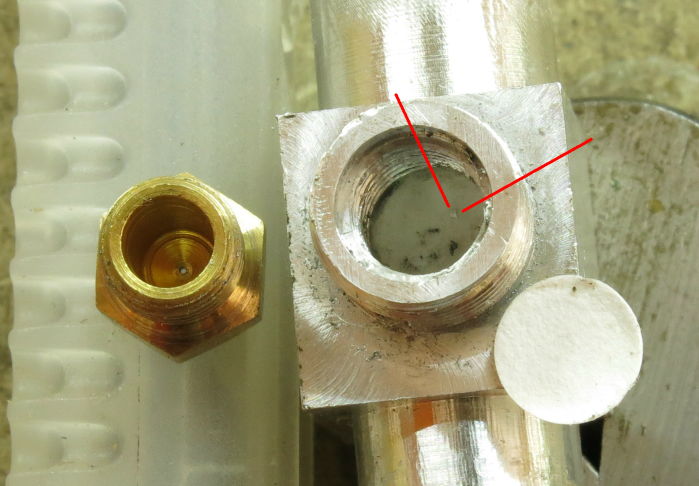
I tried putting a slightly larger filter (about 6 mm diameter) under the jet: a disk of laboratory filter paper. This filter did get dirty, of course. But a big problem was getting the filter to reliably stay in place without leaks around the edge.
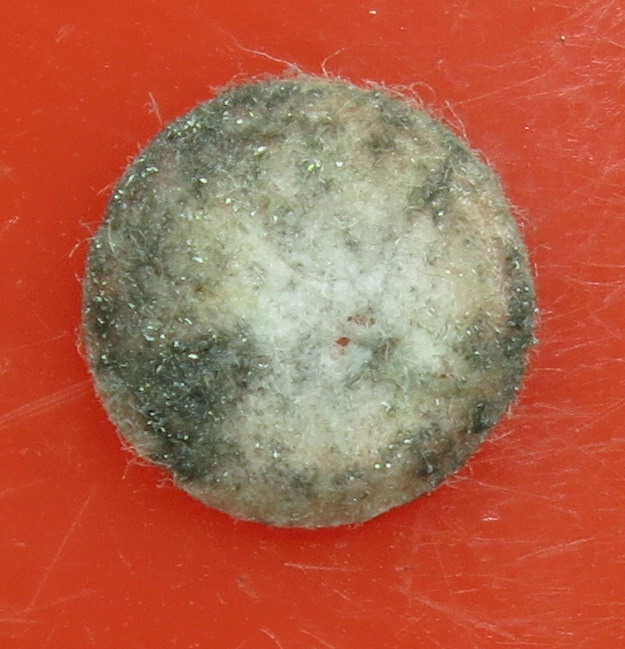
I did manage to get one filter disk to stay in place in a test unit and ran it for a while. There was a lot of dirt collected (the vague dark areas everywhere). In addition, there was a fair bit of shiny aluminum swarf. That stuff is really fine: the filter disk is only about 6 mm in diameter. Machining aluminum can leave a certain amount of fine aluminum dust, which sticks to the bulk aluminum. The stove body I was using was an experimental one I’d made just for testing, and I had not cleaned it before use. After this incident, I seriously upgraded my cleaning process.
But what is not covered by any filter located at the jet is anything else upstream from the jet. As I mentioned previously, an early Teflon heat exchanger rod had become caked by dirt upstream of the jet. I needed something better.
Refilling / filtration unit
At the same time, I was also playing around with refilling some old Powermax canisters. The aluminum Powermax cans are much lighter than the steel screw-thread ones (and the Coleman gas in them originally was very clean too). I like them. So I decided to add a filtration stage to this refilling system. I show bits of two units below.
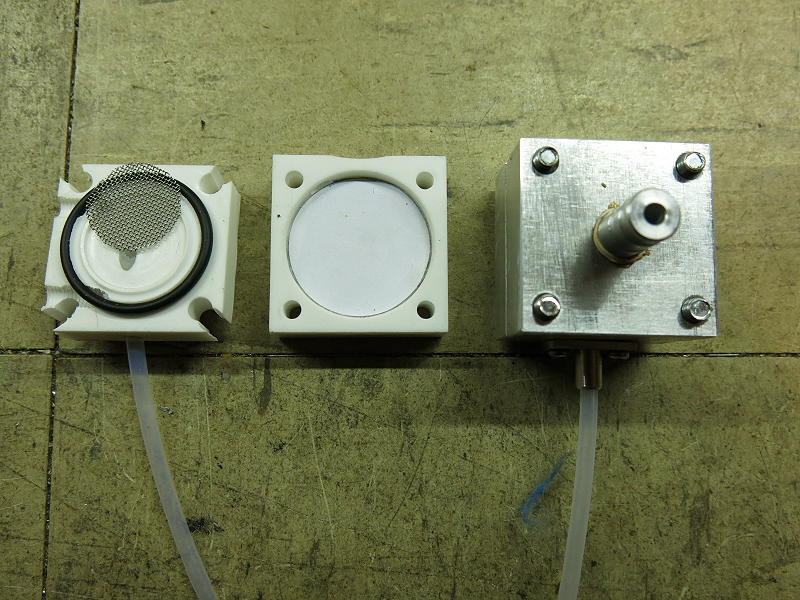
I made up a filter unit using a larger filter paper disk with a stainless steel mesh for support. Good chemistry lab filter paper: Whatman 540, 8-micron rating, sealed around the edge. The unit plugged into the canister connector on the donor canister in place of the hose connection. I suspect that paper coffee filter material would work fine in place of the Whatman stuff, and also probably paper vacuum cleaner bags. Both are readily available and very cheap. Any dirt fine enough to get through those paper filters would sail through the jet unimpeded.
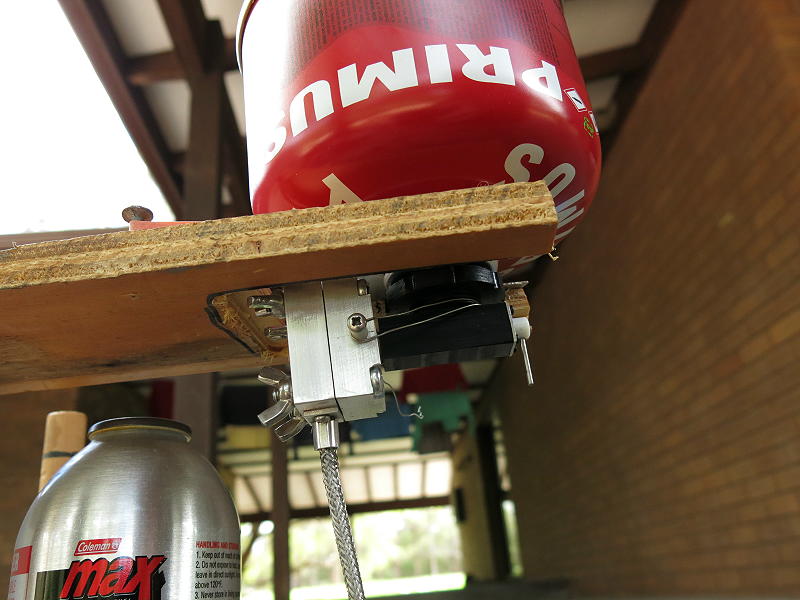
I have refilled quite a few Powermax canisters like this. I had to monitor the weight of the receiving canister to avoid overfilling it, of course: a load cell and associated electronics did that. To explain: if one fills a canister right up, so there is no vapor space left, there is no room for expansion. The canister can explode if it gets warm later, and the liquid fuel tries to expand but can’t.
I got some dirt on the filter paper, but not much. That was (I think) because I was using Primus canisters as the donors (see photo above), and they are filled in Europe, not in China. I have not had any problems with Primus canisters. Anyhow, the refilled filtered Powermax canisters have never given me any problems.
This tactic worked, but it was a bit complex, and it does not help the average user who does not have the workshop facilities I have. What I really needed was a simple filter to go inline – especially for my stoves.
Inline Filters
My ideal solution would be something that took out any dirt before it got into the hose – for two reasons. The first is that I have also seen blockages in the hose once or twice, and they can be quite messy to clear at home and very difficult to deal with in the field. One needs about 300 mm of 1 mm titanium wire to do the cleaning, and who carries that in the field? The second reason is that the stove body can get hot (allow for 392 °F / 200 °C), which could damage many filter materials, especially any paper filters. So a filter back at the canister connector (which stays cold) seemed a better idea.
Member Exclusive
A Premium or Unlimited Membership* is required to view the rest of this article.
* A Basic Membership is required to view Member Q&A events


Discussion
Become a member to post in the forums.
Companion forum thread to: How to Keep Canister Dirt from Clogging MYOG Remote Inverted Canister Stoves
Roger Caffin proposes several solutions to keep dirty fuel from clogging remote inverted canister stoves.
I assume this is by Roger, not Andrew
I love all Roger’s articles. This one is good.
Another solution is to leave the canister upright, then only gas flows without any particles
Inverted canister is good for cold weather. Other solutions include Mulder strip and a saucer of water.
Or, my current solution is to use a small torch lighter from amazon. If the stove slows too much, give the canister a few hits at the bottom where the butane is. 1.3 ounces. Also good for lighting the stove and lighting fires.
I have noticed that cheap butane cartridges also say “made in Korea” on them. Several different brands – Burton, Sun, Gas One. They must all be made by the same country and then different labels put on them and marketed by different companies
@Roger. Could you invert the canister for say 30 minutes to let the debris settle and then press the valve with a pin to eject the contaminants? Is that viable?
Roger’s article got me to thinking – what about using this $10-$15 commercial propane filter? Except that we would need a non-existent adapter from the Isobutane canister to the filter, and purchase a Kovea LPG to Isobutane adapter.
Another excellent article from Roger that gets a person to think.
Ah ha ha, yeah, I absolutely did not write this, though I was honored to shepherd it into production! Sorry for that settings goof all, fixing now.
Although, Jerry, I’m sure you ALSO love all of Andrew’s articles too, right? Right? :-)
Roger, you could design a dirt trap similar to what is regularly installed on a gas line. A very simple device that will trap any dirt with no impedance to gas flow, Well, maybe, it depends on the size of the dirt trap. I am guessing about a half inch long and about a 1/4″ around would do well for a couple years.
Free Offer
If you have one of my stoves and are having problems with canister dirt, feel free to contact me. I will make the outer spacer, some 8 mm long self tappers (or 10 mm, depending on availability) and some disks of filter material available for free, provided you pay for the (letter) postage. Letters are fairly cheap. Alternately, consider making the parts for yourself! Pretty easy stuff.
MYOG filter disks
I find that I forgot to say that paper coffee filters probably work just fine too. And they are readily available in your supermarket. Vacuum cleaner bags might also work.
James
Commercial dirt filters would doubtless work, but my aim was to find an absolute minimal solution. Minimal in both weight and cost.
Also, I am not sure whether the commercial units would fit on the narrow hose I use. Commercial hose seems a lot bigger.
Photo acknowledgment – correction
The photo of a V1 stove on some yellow foam in the snow was taken by Douglas Frick in 2013, and was sent to me. My thanks to DF. Hopefully Andrew can correct the attribution.
Cheers
Or…use a stove designed for inverted butane canisters, but hook it up to an upright Boss Torch propane canister, which has the same fitting/threads as butane canisters. In addition to being upright so only gas flows, it contains a proprietary “tip cleaner” to prevent clogs.
[edit: NEVER fill a canister intended for butane with propane!]
Even the initial cost – $3/can (or $33 for a case of 12) is roughly 1/3 the cost of butane. Get a couple of adapters and refill from common 1 lb. tanks or 5 lb. BBQ tanks for pennies. Vaporizes down to -44* F (-42* C) vs. 33* F (0.6* C). Add a Moulder strip and you could probably use it in Antarctica.
Hi Jon
Could you invert the canister for say 30 minutes to let the debris settle and then press the valve with a pin to eject the contaminants? Is that viable?
Sounds reasonable to me.
But I don’t like ‘wasting’ all that gas! :)
Hum – could be a useful idea in the field, on a very long trip after a resupply.
Cheers
Hi David
Yeah, filtering while refilling from another canister is certainly a good idea. MUST be done outdoors of course!
HOWEVER, A WARNING!
Refilling a canister pressure-rated for 30%propane/70%butane with 100% propane can be dangerous!
Our little p/b canisters are not rated or designed to handle the much greater pressure you get with straight propane. It can be several TIMES higher. On a warm day it would not be difficult for the canister to fail, rupture, explode, detonate. Then where would you be? (In shredded bits hanging from the branches of a tree?)
Be Safe!
Cheers
I recall you purchased a case of the BOSS canisters a year ago. Have you used it? Never read anything here regarding it’s use by you.
I agree Roger, absolutely. NEVER fill any butane canister with propane, ever! I thought it was clear that I was saying refill the Boss Torch propane canister from other propane sources, but in case it wasn’t I have edited that post.
I should also mention that I have a regulator with tank pressure and output pressure gauges. I first tested the pressure in a brand new Boss Torch canister, and I only refill them to the same pressure from my 5 lb. BBQ tank.
I have used the Boss Torch many times with different butane stoves (BRS, BRS clones, Fire Maple, others) and they work great. The only minor complaint is the smaller diameter of the can is less stable than a butane canister, but I’m working on a leg set to address that issue. Haven’t used one below freezing yet to fully take advantage of propane’s higher vapor pressure, but I’m sure I will eventually. In the meantime I just enjoy saving money.
David
I understand that the BOSS canister is narrow and may be a bit unstable.
How far can you tilt it from the vertical before the flow switches from gas to liquid? That is, what is the intake inside the canister like?
It may of course be a standard Lindal valve design, such as I have shown a number of times.
Cheers
Roger, there may be a commercial gas filter, but I have never used one. I just use a “T” fitting the size of the inlet pipe, add a small 4-6″ nipple with a cap, and let the gas flow through the “T” to the stove. I’ve installed about a hundred of these before I was 16 years old working for my Grandfather/Father. Likely cost a few dollars for the little brass fitting needed, 3/16-1/4″ should work fine. You can likely get these in nylon fittings for about $0.50 each. Like this:

Estimating about 75-80 degrees from vertical/15-20 degrees from horizontal (that’s a 30-60-90 triangle in the backgound):
But…why would you want to invert it? To see if your remote canister stove works below -44* F?
It is definitely a standard Lindal valve, compatible with all my “butane” canister stoves. One caveat: The valves are set down below the crimp a few hundredths of an inch lower than on butane canisters (intentional to prevent compatibility with butane tools/stoves?) and on one of my 12 cans the Lindal valve was a hair lower than the others, low enough that I couldn’t screw any of my stoves all the way on to seal it, and I had to give up on that one. Apparently the compatible propane torches the canisters are designed for have a bit longer “stem” or whatever you call it.
Smaller diameter Boss Torch = 2.625″ (2-5/8″) vs. small butane canister 3.5″ (3-1/2″)
Hi James
3/16-1/4″ should work fine.
Aye, there’s the problem. My hose is smaller: 1/8″ OD, 1/6″ ID.
Hum: does a dirt trap like that always work? The ‘dirt’ in the Chinese canisters seems to be a very fine dust.
Brass fittings: they might double the weight of the stove! Brass is heavy!
Cheers
Hi David
Misunderstanding on my part? I thought you meant you were putting the canister upright.
One caveat: The valves are set down below the crimp a few hundredths of an inch lower than on butane canisters (intentional to prevent compatibility with butane tools/stoves?) and on one of my 12 cans the Lindal valve was a hair lower than the others, low enough that I couldn’t screw any of my stoves all the way on to seal it, and I had to give up on that one.
Ratbags!
Add another O-ring inside the bottom of the stove? Coleman had to do that with the Powermax adapter after I explained why so many of their customers were having problems in the field. Or even a thin flat rubber washer under the O-ring?
Cheers
Roger – got it. With a full canister, about the same angle from vertical but valve end up, before it switches from gas to liquid. Horizontal is the zone where a full canister flows liquid but a half-used can will flow gas.
I’ll give that o-ring/flat rubber washer idea a try, inside the bottom of the stove, and maybe also around the base of the Lindal valve. It would be great if it works.
With a full canister, about the same angle from vertical but valve end up, before it switches from gas to liquid.
Understood – with a FULL canister as you say.
I think you could even use a soft metal or soft plastic washer under the O-ring, as the canister will squoosh the O-ring outwards against the inner wall. That should make an acceptable seal.
CHECK! In a bucket of water is fine.
Cheers
A week ago I sent 2 empty Boss canisters to France to be used by someone doing mountaineering. I’m glad someone has a use for them.
Roger, McMaster-Carr has a large selection of both plastic and brass fittings in 1/8″ size. Skip it, you clearly don’t want to do it.
James, are you referring to the debris trap idea or the use a washer or o-ring to seal the stove to tank connection idea?
Hi James
Yes, I do know about the McMaster-Carr range, and have done so for the last 25+ years. They do have a big range, and even some which might fit my stoves, but there are some problems.
I will only trust PFA and PTFE tubing as other plastics may melt when the stove gets hot.
The tubing has to take a very high pressure and resist bending damage.
The size I used is 1/8″ OD and 1/16″ ID, at the limited small end of what is available.
I will not trust the common Push-to-Connect fittings with liquid propane.
Most of the fittings which might work are in the $40-$60 price range, each.
All the fittings add a lot of weight.
I have better solutions.
Cheers
Maybe running water and/or fuel back-and-forth would loosen dirt as well.
I got my teenage grandsons a Fire Maple Blade 2 inverted canister stove for its stability as their 1st backpacking stove and instructed them on its use.
On their next outing in the Sierra Nevada it worked well for them both on below freezing mornings and hot afternoons.
Become a member to post in the forums.