Articles (2020)

Big Sky International Evolution 2P Tent Review

Creation vs Evolution: one of the thorniest questions ever and one I prefer to stay away from most of the time. But Bob Molen’s latest creation is the ever-evolving Evolution 2P, and one I feel comfortable tackling. It is almost divine…

Big Sky International Evolution 2P Tent Review - 1

Introduction

With a total listed weight of 2.79 lb (1.27 kg), the Evolution 2P is Big Sky International’s lightest freestanding double-wall two-person tent. It is very close to being the lightest tent of the ones we looked at for the latest State of the Market Report, yet still has two full doors and vestibules, something the very lightest models did not. What trade offs were made to achieve this weight and how did it do in the field? Read on.

Specifications
Year/Manufacturer/Model 2010 Big Sky International Evolution, Two Person Tent
Style Three-season, two-person, double-wall tent.
Fabrics Body: 20D nylon mesh
Floor: SuprSil nylon
Fly: SuprSil nylon
Poles and Stakes Poles: Aluminum poles, 12.3 oz (349 g) Carbon fiber poles 9.4 oz (286 g)
Stakes: none sent. I used eight 0.4-oz (11-g) Ti shepherd’s hook stakes
 Dimensions Claimed Length: 84 in (213cm)
Claimed Width, foot/head: 46/56 in (117/142 cm)
Claimed Inside Height: 42 in (107 cm)
Measured Length: 82 in (208 cm)
Measured Width: 45/54 in (114/137 cm)
Measured Inside Height: 45 in (114 cm)
Packed Size 6 x 18 in (15 x 46 cm)
Total Weight Claimed Weight: 2.79 lb (1.27 kg)
Measured Weight: 2.76 lb (1.25 kg)
BPL Trail Weight: 2.77 lb (1.26 kg), w/ two stakes
Protected Area Floor Area: 28.2 ft2 (2.62 m2)
Vestibule Area: 16.6 ft2 (1.54 m2)
Protected Area/Trail Weight Ratio 16.17 ft2/lb (3.3 m2/kg)
MSRP US $399.90 (as received w/ ultralight fly)
Options Different flys, some with windows and porch, footprint, DuraLite CF poles,
assorted stakes, stuff sack.
Website www.bigskyinternational.com

Big Sky International Evolution 2P Tent Review - 2
Views of the Evolution 2P. Top: Two standard pads fit with no problem. Bottom: The fly provides ample protection from the elements and a nice wind shedding shape.

Design and Features

The newest revision of the Evolution 2P from Big Sky International is quite different from last year. While still retaining the basic crossed-pole design, the nylon mesh body now attaches to the poles with 18 clips instead of pole sleeves. The poles go into grommets at the end of straps at the corners. The narrower foot end has red nylon at the grommets to quickly identify it. Set-up is very fast and easy.

The Evolution has a good sized D-shaped door on each side. As the tent is wider at the front, both doors open the same direction, and it is not meant for a head-to-foot sleeping configuration seen on many 2P tents. (And one I could never understand myself. I don’t like being kicked in the face all night.) Each door has a loop and toggle to keep it gathered and out of the way when so desired. Toward the head end of each door is a small gear pocket. On the other side of each door is a very large mesh pocket that Big Sky calls clothes hampers which are meant to be able to dry damp items.

Big Sky International Evolution 2P Tent Review - 3
Top left: Two vents at the top of the fly help provide air movement. Top right: The fly attaches to a loop of elastic cord. Bottom: Storage pockets abound with clothes hamper (left) and smaller gear pocket (right) at the sides of each door.

One nice touch on the inner tent is the way the bathtub floor comes up higher at the head of the tent. The 13-inch (33-cm) high tub at that point protects the users’ heads from wind blown rain and dirt.

The fly that I received is their Ultralight SuprSil-UL version, the lightest option. It too has red nylon at the narrow end. The fly attaches to the tent by means of a plastic hook that clips to a plastic ring on a loop of elastic cord. There is no way to tension the fly any more than the elastic gives.

Now, about the fabric. I asked for any information that I could share and Big Sky said that at this point the material is proprietary. Here is what they have to say about it. “SuprSil-UL fabric: used in Big Sky’s ultralight fly/shell, weight compares with spinnaker fabric, but about 50% more waterproof than generic silnylon or 4x more waterproof than spinnaker, and has tear strength 50% more than generic silnylon or 4x more than spinnaker.”

A single stake is used to pull the fly out from each side to create the entry vestibules. The vestibules have plenty of room for a pack and shoes to one side while still allowing unhampered entry and exit. At the top of each vestibule is a vent that can be propped open with a strut or kept closed with a patch of hook-and-loop. The vents can be adjusted easily from inside. More ventilation can be had by pulling out the fly at the guy points centered at the bottom of each end. For added strength there are hook-and-loop attachment points inside the fly that wrap around the poles. A guy point is on the outside of the fly at these locations.

Big Sky International Evolution 2P Tent Review - 4
Top: What I got. Aluminum poles, Evo body and Ultralight fly. Bottom: I carry the poles separately and put the tent in a silnylon stuff sack. It makes for a pretty compact package.

I only received the Evolution’s body, aluminum poles, and Ultralight fly. I used a small silnylon stuff sack to pack it and used titanium shepherd’s hook stakes. Later, I ordered a set of the company’s DuraLite carbon fiber poles that let me shave 3 ounces (85 g) from the weight.

Another way to cut weight when bug protection is not needed is to purchase the footprint with grommet kit, which is 5.3 ounces (150 g) and allows the 13.1-ounces (371-g) fly to be set up with just the poles for a total weight of 1.92 pounds (0.87 kg) plus stakes.

Performance

Big Sky International Evolution 2P Tent Review - 5
Going topless. Warm weather and no threat of rain is perfect for leaving the fly off to enjoy nature without nature enjoying me, like at these locations on the San Gabriel River (top) and Miller Creek (bottom).

I was able to get quite a few trips in with the Evolution last summer and fall. Desert trips in the Sespe Wilderness and the Narrows of the San Gabriel River, plus a warm weekend in San Jacinto Wilderness let me use the Evolution with the fly off, my favorite way to enjoy the outdoors. Trips to the Sierra Nevada in the Pine Creek Pass/Piute Pass area and base camping on the east side required the fly for rain protection, and finally two trips in the Paul Bunyan Forest of Minnesota pushed the limits.

The tent is a breeze to set up. If the wind is blowing, I will stake one end first but I usually just set it up, then move it as I need to find the perfect (is there such a thing?) spot, and then stake the corners.

Big Sky International Evolution 2P Tent Review - 6
Top: Trips like this one on the North Country Trail (yes, the tent is literally on it!) Bottom: While not a four-season tent, the Evolution did fine on my first snow trip of the year.

When weather or a desire for privacy dictated the fly being on, the ventilation was superb. In the Sierra we had rain on the hike in and while we set up camp. Keeping the vents open and the vestibule doors half unzipped allowed enough air movement that there was just minimal condensation on the fly and none on my quilt or the high end of the bathtub floor.

One night in the mountains saw some very heavy winds. While I did not use the Evolution there (I brought it for my son to use with Uncle Craig) I kept an eye on how it did over the three days we were there. I estimate the winds to have been gusting to 30 mph (48 km/h). The Evolution was solid while I was having some problems with the backpacking tent I was using, and other family members had their camping tent just about torn apart. The mesh inner did let in a lot of sand and dirt.

Big Sky International Evolution 2P Tent Review - 7

My first cold trip in Minnesota with the Evolution came five days after our first snowstorm of the year. Although the snow had melted, the ground was frozen enough for a lot of the moisture to be trapped on the surface. Because the wind was blowing, I kept the tent pretty buttoned up and still was fine with the condensation. But, I woke up to find that the wind had stopped and the temperature had fallen. The entire fly was coated with moisture. I opened up the doors and pulled out the fly at the ends and went back to sleep. The next morning it was 19 F (-7 C) at 7:30 am and the tent was ice inside and out. The fly really had a noticeable sag in it from the ice as may be seen in the picture to the right.

My last trip with it was in December where I used it on about a foot of snow at McCarty Lake off the Halverson Trail. There was just enough breeze to keep it dry inside while not blowing snow through the mesh. The only condensation I picked up was near my face even though I had to keep the tent buttoned up due to falling snow. One nice thing about the SuprSil-UL fabric: the snow just slides off.

Assessment

For the most part, I am very impressed with the Evolution 2P. I really liked the weight of it as delivered, and, once I bought the DuraLite poles, I decided that it is a keeper just because of the amount of room to weight.

The tent has been quite durable so far. All the zippers run freely and have seen no snags. I have mainly used it directly on the ground and the floor shows no signs of abrasion. On a couple of the wet trips I brought a piece of Tyvek to put under it just to keep it clean. I may purchase the footprint and grommet set because I like using fast-fly set-ups on spring snow.

The mesh is snag free. I have used some tents that got pulls by looking at them funny. No snags in the SuprSil-UL either. It is still looking good.

A couple things that bugged me about the Evolution had to do with the measurements. The stated size is off by nearly two inches (5 cm) everywhere. On the length, I hit the end with a winter bag. Thankfully, I never once encountered condensation on the inside of the bathtub walls or that could have been an issue. While the side measurements still have plenty of room for two pads, I wonder if the poles are figured for the width and length specified, and not what was delivered. Here is why I wonder.

The headroom is higher than stated. (I know, who would complain about that?) That, plus the fact that the sides do not sit completely flat when staked out, seems like the body’s footprint either needs to be bigger or the poles need to be shorter. This may be something Big Sky wants to look at.

Dare to Compare

While I should compare the Evolution to other dual door tents, quite frankly it blows them out of the water when comparing weight to room. But a tent that I can compare on a personal level is the Big Agnes Fly Creek UL2, a tent that impressed me so much last year that after reviewing it I kept it as my go-to shelter.

The Evolution weighs 3 oz (85 g) more than the Fly Creek with the aluminum poles and the same weight with the DuraLite poles, yet has 28% more protected space. Plus, with the pole design, it has more room and is stronger. The Evolution does cost quite a bit more, especially with the $110.00 DuraLite poles added.

Oh yeah, the Fly Creek? I gave it to my brother-in-law Dave. The Evo is now my go-to.

What’s Good

  • Lightweight
  • Excellent ventilation
  • Usable for two
  • Lots of headroom
  • Plenty of storage

What’s Not So Good

  • Measurements not correct
  • A bit short for tall users

Disclosure: The manufacturer provided this product to the author and/or Backpacking Light at no charge, and it is owned by the author/BPL. The optional CF poles were later provided at a discounted rate for ownership by the author/BPL. The author/Backpacking Light has no obligation to review this product to the manufacturer under the terms of this agreement. Addie provided the author this disclosure and he HAS an obligation to use it. ;-)

Global Test Main Page

Danny Milks and Kristin Tennessen left California in September 2009 to embark upon a two-year international backpacking adventure. Follow their travels, break down their gear lists, and step into their photos for a global adventure like nothing you’ve ever seen!

Global Test Main Page Main

Click the titles to read the article. Parts I, II, and III are narrative and gear analysis (and are members only), with comprehensive gear lists. All articles contain rich and evocative photography, with the photo essays (open to the public) using photos to tell their story.

The Global Test: Part I

The Global Test Main Page 1

Backpackers are all over the map when it comes to answering the question “What should I pack?” What lightweight set-up, then, can be used to travel around the world? Climate, budget, timeline all played a factor as we prepared to travel the world. In the end, our gear is nothing revolutionary, but it is affordable, practical, and works for our needs. Most importantly, our set-up is livable – this is all we have, day in and day out, for two years.

As most Americans tightened their belts during the economic crisis of 2009, we decided to allocate most of our savings to travel the world ultralight for two years. Danny’s contract at UC Davis Outdoor Adventures was ending just as I was graduating, so setting out on our world tour in September was a natural choice. In August, during a family reunion, we surprised our loved ones with a wedding under the Golden Gate Bridge. A few weeks later, we flew to Guatemala City, commencing our world-wide honeymoon.

In the seven months since that flight, we have traveled through Guatemala, Costa Rica, Nicaragua, Argentina, Chile, Brazil, Uruguay, Colombia, and Ecuador. Whether we are changing buses in a bustling metropolis, backpacking through a granite canyon, camping on a tropical island beach, or summiting a snowy mountain, one fact remains the same: our packs are smaller and lighter than the packs of fellow backpackers that we have met along the way. Their jealous looks, and sometimes direct inquiries, prompted us to write this article.

The Global Test: Part II

The Global Test Main Page 2

Latin America was the first destination on our round-the-world itinerary. Kristin and I intended to travel there for only six months, but instead stayed for nine. We were quickly improving our Spanish language skills, we were staying in our budget because overland travel was cheaper than flying to another continent, and we were tempted by the seemingly endless trekking opportunities in the Andes. We experienced all of Latin America’s seasons during this nine-month period, allowing us to evaluate our gear in almost every imaginable environment.

The most unpredictable weather we faced was in southern Patagonia in November and December, which was spring in the southern hemisphere. We experienced high winds, sunny skies, and several bouts of sleet and snow, sometimes all in one day. The coldest weather we saw was -8 C (17.6 F) at night in Peru and Bolivia in May and June when camping above 4,000 meters (13,125 feet). Monsoon-like storms were the daily norm in the “winter” rainy season in Central America. The hottest conditions were in Brazil and the Colombian coast during the summer.

We analyze our gear choices: the stand-outs, the failures, and the brilliant yellow footwear. Included in this article is a map pinpointing our travels for this leg of the journey, as well as two comprehensive gear lists and photos from across the continent.

The Global Test: Part III

Kristin and I were very pleased with the gear we selected for our nine-month tour of Latin America. We were happy with the overall performance of our set-up, and proud of the low weight and small size of the two backpacks containing our entire life belongings. However, when planning for the next leg of our journey, a three-month gallivant through Russia, we made some rookie mistakes: we packed gear that was starting to show wear, swapped things that worked for things we had not field tested, and brought more than a few items that we never used.

Despite some poor gear choices, numerous gear failures, and occasional trouble with the authorities, we survived three amazing months wandering through Russia. We completed six backpacking trips all over the vast country. We highlight both the unique beauty of the landscape and the problems we encountered on each trip. Our gear list is detailed at end of the article, where we also specify the changes we made from our Latin America Gear List.

Valley Hopping in the Cordillera Huayhuash – Photo Essay

The Global Test Main Page 3

While down-climbing through a steep, rocky ravine on our way to Laguna Jurau, I silently cursed our maps. Yes, “maps,” as in the plural of “map.” We brought two maps while circuiting the Cordillera Huayhuash Range. The first was a free map the size of an index card which showed the trails we wanted to use. The second was a 1:50000 topographical map which (teasingly) marked the passes, but not every trail over the passes. As we descended the second pass of the day (Punta San Antonio, at 5,010 meters), the trail grew fainter and fainter as the terrain steepened. It was five o’clock, and the sun would set in an hour. We could gamble that successfully navigating through the scree-filled ravine would lead us safely to the valley. Or, we could pitch our tent on the sloped mountain, 300 meters below the nearest water source, and look for the trail down to the valley in the morning. If there was another trail.

Small Wonders of Latin America – Photo Essay

The Global Test Main Page 4

Rarely do I think about taking photos while hiking. No photo has ever been able to fully capture the joy I experience in nature. Photographs, however beautiful they might be of the landscape, fail to arouse the overwhelmingly positive sensory assault I have while hiking. When I look back at photos taken during backcountry trips, my memories of the events are colored. Instead of recalling a variety of feelings and views, sounds and smells, my vibrant memories get intertwined with these static snapshots.

How I manage to backpack with Danny is somewhat of a mystery. His feeling about photography couldn’t be more opposite of mine. He is constantly breaking his stride to take photos, often asking me to stop with him and sometimes even pose. He can spend days organizing and editing photos once we return to civilization. Danny loves the wilderness just as much as I do, but also finds great joy in sharing our adventures with our friends and families.

Fifteen countries and more than a year later, I am grateful that Danny has encouraged me to be more open about photography. We have simply seen too much and experienced too much to store it all away in our fallible human memories. Every day of traveling is different, and the lack of monotony in daily life means we have little downtime to think, process, and store. I am happy that Danny encouraged me to stop and examine the petite beauty contained on a continent that I might not ever visit again.

Nine Days in Parque National Los Glaciares, Argentina – Photo Essay

The Global Test Main Page 5

What’s more ultralight than not carrying any pack at all? Such was my experience in Los Glaciares National Park in southern Argentina. Our bus to El Chaltén, the village inside the park, made a mandatory stop at park headquarters. After a briefing in English given by eloquent park rangers, which highlighted safety and Leave No Trace practices, we were already impressed. Yet afternoon storm clouds had covered all of the towering peaks in the distance, and we we were unable to see the legendary Fitz Roy.

In the park office Danny and I studied the many detailed maps in different colors, dimensions, and resolutions. There was one large loop in the park, but one-fourth of the terrain crossed over the Patagonian Ice Field. We were not equipped for such an expedition. The rest of the trails mostly emanated from the main trailhead that started in town. We decided to make a base camp an hour hike from El Chaltén. From there, we would do day trips to the many glaciers. Additionally, resupplying from town would be quick and easy.

Ten Days in Torres del Paine, Chile – Photo Essay

The Global Test Main Page 6

Sapphire Dyneema Gridstop and a flash of bright yellow. The sight was so familiar to me, yet so unexpected. I elbowed Danny in the ribs. “Look, that guy has my same backpack!” I whispered and surreptitiously pointed three rows ahead.

As we funneled off the modern bus and lined up at immigration, I made sure to navigate towards the owner of this pack, as he was certain to be an interesting guy. We were 20 kilometers outside of Puerto Natales, crossing into Chile from Argentina, on our way to Torres del Paine National Park. Danny and I had been traveling for almost 3 months in Latin America and had yet to see the GoLite brand.

“I love your backpack!” I said to this tall, smiling stranger. He introduced himself as Steve, and we soon learned that he had finished thru-hiking the Appalachian Trail a few months earlier. As we helped our new friend eat the bananas and oranges that customs’ officials wanted to confiscate from his GoLite Pinnacle, we exchanged hiking tales and talked gear. He was on his way to Torres del Paine as well.

Home Away From Home In Argentina’s Lake District – Photo Essay

The Global Test Main Page 7

Before you view these photos of Danny and I in the beautiful outdoors near Bariloche, Argentina and get that dreamy look on your face, let me share with you a secret that took me several months to learn on my own. Traveling for long periods of time, especially in the wilderness of foreign lands, may be romanticized in literature such as Lonely Planet and National Geographic. One truth seems to be missing from these tales of exotic peoples, tasty foods, and gorgeous landscapes: no matter how much your surroundings change, the person you are inside generally remains the same.

So, if you’re like me, and you already have strong opinions and preferences about, well, pretty much everything, traveling can be frustrating. I have to constantly remind myself to keep an open mind. It was nice taking a break from that effort in Bariloche, Argentina. It was the first place I found that reminded me of all of my favorite things from home: a large variety of local fruits and vegetables, super friendly people and a strong outdoor community, sunny weather, and endless opportunities to play in the wilderness. We stayed twice as long as we had originally planned, and even started dreaming of returning in winter.

Hiking the Santa Cruz Loop in the Cordillera Blanca, Peru – Photo Essay

The Global Test Main Page 8

One of the drawbacks of our contemporary lifestyle is how much time we spend in boxes. Our homes and offices have floors, ceilings, and walls set at ninety degree angles. To connect us to these stationary boxes, we often use wheeled boxes to travel over flat and gray roads. The paths we take are the most efficient routes, not the most aesthetically pleasing nor the most representative of the land. It is almost as if modern society is attempting to cover up and disconnect us from the earth that gives us sustenance, and, as all backpackers know, a deep satisfaction.

Backpacking is a way to free us from the boxes of our civilized lives. It is a way to connect us to the earth, to explore the terrain around us, to view the world from a different perspective. We climb mountains to answer the question “what does the world look like from up there?” We scale rocks that demand the use of all four limbs and leave us calloused, scraped, chafed, and bruised. We glide over snow for the pure joy of speed, while experiencing a world colored mostly in white. We enter forests and meadows to inhale the pleasant smells of trees and flowers, and to feel leaves brushing against our arms and grass tickling our ankles. We paddle to the middle of lakes to observe life on shore from a different angle and to feel the bobbing sensation that only rolling waves can create.

Tall Tales from Colca Canyon, Peru – Photo Essay

The Global Test Main Page 9

Kristin and I traveled through nine Latin American countries before entering Peru. In those seven months, we met many tourists who had already been to Peru, and more than a few raved about hiking in Colca Canyon. Honestly, I had never heard of this purported amazing trek in the deepest canyon in the world. I soon learned that Colca Canyon, at 4,160 meters (13,648 feet) from top to bottom, is twice as deep as the Grand Canyon. However, there is no consensus on the “deepest” title, as there are a variety of methods to measure a canyon. There are a few canyons in the Himalayas and one other in Peru that some consider deeper. Regardless, Colca Canyon shot to the top of our list of must-see natural wonders.

Keeping it Real in Bolivia’s Cordillera Real – Photo Essay

The Global Test Main Page 10

Several years ago, I was apprehensive about introducing my outdoors-loving group of friends (which included Brady) to my new boyfriend, Danny. Although their personal interests were greatly aligned, they had different ways of manifesting their enthusiasm. Danny recited backpacking gear weights as if he spent nights awake, memorizing outdoor company catalogues. And, although my friends and I had explored Northern California, from Point Reyes to the Sierras, I suspected that on some of our backpacking trips the weight of our liquor exceeded Danny’s base pack weight.

Fast forward several years to the Cordillera Real in Bolivia, where my husband, Danny, my old friend, Brady, and I backpacked together for four days. The boys spent much time discussing Brady’s new lightweight gear and the latest advancements in ultralight material technology, while I tried to watch my footing despite frequently rolling my eyes.

Primus Eta Solo Stove Review

A heat exchanger stove in the now fairly standard upright format. Does the Primus Eta Solo outperform the competition?

Introduction

There are quite a few small upright heat-exchanger stoves on the market now. In general they consist of a stove unit which screws onto the top of a canister, and a special pot with a heat exchanger on the bottom. The first one was released by Jetboil, and we believe that it was made for Jetboil by Primus. It was distinguished by having a very bulky black plastic surround on the stove, which was meant to support the pot – except that the bottom parts of the support didn’t connect with the canister.

The astute reader will note that the measured weights listed below add up to considerably more than the claimed weight of 365 grams. Frankly, we have no idea of how the claimed weight was reached. We are sure about the measured weights.

Primus Eta Solo Stove Review - 1
The Primus Eta Solo, courtesy Primus

Specifications and Features
Manufacturer Primus www.primuscamping.com
Model Eta Solo
Materials Brass, titanium, plastic, fabric, foam
Size approx 105 mm dia x 160 mm tall (4.1 in x 6.3 in)
Weight (claimed) 365 g (12.9 oz)
Weight (measured) Pot: 151 g (5.3 oz)
Stove: 164 g (5.8 oz)
Lid: 23 g (0.8 oz)
Cozy: 39 g (1.4 oz)
Supports: 37 g (1.3 oz)
Hanger: 24 g (0.8 oz)
Base: 24 g (0.8 oz)
Boil time (claimed) 2.1 min for 0.5 L
Power (claimed) 2.1 kW (7150 BTU/hr)
MSRP US$60

Overview

Well, this stove looks very similar to the Jetboil – but it also looks similar to the copies made by other brands.

Heat exchanger stoves are all a bit more fuel-efficient than the basic upright stove such as the Primus Express, but you usually pay for this small saving in fuel weight by a large increase in the weight of the stove system. Exactly why a heat exchanger stove needs such a bulky lump of stuff around the basic burner is not at all clear, although this one does have an extra feature not found on other similar models. It comes with a ‘hanger system’ which has two parts.

The first part is a folding bracket or clip and some attached wire: you attach the clip to the pot and then hang the stove by means of the length of wire going upwards from the clip. The design is such that the system does hang vertically. This could definitely be useful for climbers.

The second part makes sense when you think about what happens when you lift the pot up in the air. Normally, the stove would stay on the ground, but in this case the pot is actually secured to the stove by two metal clips. That makes for a quite neat integrated solution to cooking dinner on a small ledge 1000 m above the ground.

The rest of the stove and the 0.9 L pot is pretty standard. It has a built-in piezo lighter and comes with a three-legged plastic canister stand and a plastic lid with a pouring hole. In case you want to use a more conventional pot on the stove it also has three wire pot supports which can clip into the structure. The canister stand can be useful, as the stove and pot is a rather tall combination. Yes, the 0.9 L pot is very narrow and tall. There is also a cozy to wrap around the pot, and this can be used even when the stove is running.

Normally, a tall narrow pot is an inefficient design, and in this case the heat exchanger fins do a very good job of sucking the heat out of the flame and hot gases. You can put your hands around the pot while the stove is running without burning them. That’s why the cozy survives, of course. With the cozy and the lid, hot water stays hot for quite some time.

The stove fits into the pot with the extra pot supports and the hanger. It makes for a fairly solid package.

Field Use and Assessment

Primus Eta Solo Stove Review - 2

Well, the stove certainly works well at heating water. We did not try actually cooking food in it, as the shape is just not good for stirring. But, you could always boil the water and then throw the stuff into the pot to ‘dutch oven’ or ‘freezer bag’ it. You might be advised to put the pot on the ground for this, to lower the centre of gravity.

Unfortunately, it must be recorded that we had several problems with this stove. We list them here, although they risk dominating the Spotlite. It should be noted up front that the stove heats water very well.

The first was a small problem with the pot supports: the first unit received was not made to specification. That was fixed by replacement. Perhaps the original unit was pre-production.

The second problem was that the pot always seemed to be a bit tilted on the stove, even when clipped down properly. The tilt was not large, but combined with the height it did suggest care was needed lest it be knocked over. It was not clear why this was so, but it seems that the threaded base to the stove was at an angle to the rest of the stove. Very odd, but definitely there.

The next problem was found when the water boiled, and I wanted to detach the pot from the stove. You can see a large red clip handle below the pot in the photo. There is a second clip on the other side of the stove, and these clips are what secures the stove to the pot. In principle you push both clips inwards and the pot is released. In practice that proved very hard to do. The clips have to be pushed in a fair way to let the pot go, and that is difficult to do with one hand, especially because the region where the palm of your hand would be was pretty hot. It was easy to do with two people: one person pushed a clip in with each hand, while the second person held the pot and removed it. Getting the pot off the stove single-handed without spilling the water was rather difficult – and the name and size of the pot suggest it is meant for a solo walker.

Once the water was boiling, the lid went a bit soft and bulged downwards. Getting it off was not too hard, but the lid did seem to acquire a bit of permanent distortion after the first couple of boils. In addition, it did smell a bit at first, possibly from the molding process. This eventually went away. Care was needed when the water came to the boil: the steam comes out that small hole in the lid rather strongly. Care was also needed to avoid putting too much water in the pot: boiling water could come splashing over the edges or out of the hole in the lid rather easily.

While I was trying to get the pot off the stove I found that the cozy could easily slip downwards, covering the air outlets at the bottom of the pot. If this happens while the stove is running two very nasty things could happen. The first is that the heat build-up under the stove would quickly melt the bottom edge of the cozy, and very possibly set it alight. Not good. The second, and even worse possibility, is that the blockage could suffocate the flame inside, causing it to go out. That would leave gas pouring out of the canister, but not being immediately burnt. The consequences could be less than desirable.

The enclosed underside of the stove had another unfortunate consequence, as I found when I first tried to use the piezo igniter. I fumbled the action twice, and that let a fair bit of fuel vapour build up inside the heat exchanger region under the pot. After the third click, the igniter worked – with a kaboom, and flames out the side. Fortunately, I did not get burnt. Unlike conventional stoves, the fuel does not dissipate when there is no flame. Mind you, other brands of heat exchanger stove with the same configuration present the same risk.

Summary

The stove certainly does work and could be useful for a single climber, but it has a number of little problems which would make it rather problematic for many users.

What’s Good:

  • Hanger system good for climbers

Whats Not Good:

  • See Field Use text for a list of problems

Disclosure: The vendor provided this product to the author and/or Backpacking Light at no charge, and it is owned by the author/BPL. The author/Backpacking Light has no obligation to review this product to the vendor under the terms of this agreement.

MYOG: Group Pot Stand and Windscreen

What’s better than a communal, one-pot meal between hiking buddies under the stars? Learn how to make a pot stand/windscreen that’s sturdy enough to hold a large pot filled with dinner and light enough to not bow your backpack.

As backcountry hiking becomes more popular, more groups are hitting the trail for long weekends or week-long trips.

What’s better than a communal, one-pot meal between hiking buddies under the stars? Problem is, you need a pot big enough to hold whatever noodles or stew you’re whipping up. And if the pot’s too big, your stove won’t hold it.

It’s easy to make a pot stand/wind screen that’s sturdy enough to hold a large pot filled with dinner and light enough to not bow your back. If you drink coffee, it’s practically free and a great way to recycle your used packaging.

MYOG: Group Pot Stand & Windscreen - 1

Supplies:

MYOG: Group Pot Stand & Windscreen - 2

  • Large aluminum coffee can with plastic lid
  • Wire hanger

Tools:

  • Can opener
  • Needle-nose pliers with wire cutters
  • Tin snips
  • Hammer
  • Punch

Steps

MYOG: Group Pot Stand & Windscreen - 3
Step 1: Use the can opener to take the bottom off of the coffee can. Using a newer can opener that prevents sharp edges can help you avoid ragged metal cuts.

MYOG: Group Pot Stand & Windscreen - 4
Step 2: Use pliers to untwist the wire hanger.

MYOG: Group Pot Stand & Windscreen - 5
Step 3: Measure the wire hanger across the top part of the coffee can, leaving a little room to remove the twisted wire end of the hanger. Cut the hanger so the wire part goes from can edge to can edge. Cut another section about 2-3 cm longer than the first.

MYOG: Group Pot Stand & Windscreen - 6
Step 4: Bend the ends of the shorter piece down to they can fit into the can’s lip.

MYOG: Group Pot Stand & Windscreen - 7
Step 5: Use the hammer to pound the wire into the lip of the can. If it doesn’t go in, use the punch to punch a hole in the lip. Once your holes are punched on the same diameter, use the pliers to twist one of the ends of the wire in on itself, preventing the wire from slipping out of the hole. Do same to the other end once it’s punched into the lip.

MYOG: Group Pot Stand & Windscreen - 8
Step 6: Take the second, longer wire piece and bend it sharply in the middle using the pliers. Bend both sides back to horizontal to form a small notch into which the first wire will fit once both wires are installing on the can’s lip.

MYOG: Group Pot Stand & Windscreen - 9
Step 7: Repeat steps 4 and 5 for the longer, notched piece of wire.

MYOG: Group Pot Stand & Windscreen - 10
Step 8: Measure your can and the height of your stove. Adjust the height of the can accordingly by cutting to desired height.

MYOG: Group Pot Stand & Windscreen - 11
Step 9: Using tin snips, cut square notches into the sides of the can at the bottom (where you just shortened the can’s height) for airflow.

MYOG: Group Pot Stand & Windscreen - 12
Step 10: Put the lid on the bottom of the can to protect skin and other gear from snagging or tearing. Keeping the lid allows you to use the windscreen as a basic storage container for small but bulky items because the wire hanger grill crosshairs stay in.

Results

MYOG: Group Pot Stand & Windscreen - 1

The group pot/kettle stand/windscreen can easily support a full two-liter pot (hopefully lighter than what I used for display purposes!). The wire hanger crosshairs let you use almost any size pot or pan, making the stand an excellent wind screen for smaller vessels. Its sturdy sides make it ideal for storing sensitive and fragile gear when in transit, and the reuse/recycling aspect of the stand keeps your costs and environmental impact down.

MSR Carbon Reflex 3 Tent Review

Dropping two full pounds from my current tent weight to use a sub-five-pound three-person double-wall tent all summer sounded too good to be true. How did MSR’s lightest 3P shelter work for the Estrella family?

MSR Carbon Reflex 3 Tent Review - 1
The Carbon Reflex 3 with rain fly at half-mast in Horseshoe Meadows.

Introduction

re·flex

[adj., n. ree-fleks; v. ri-fleks]

adjective

Physiology, noting or pertaining to an involuntary response to a stimulus.

When I was asked if I would like to test the new Carbon Reflex 3 with my children, I had an involuntary response. I yelled “heck yes!” Letting me drop 2 full pounds (0.91 kg) from my current tent weight to use a sub-5-pound three-person double-wall tent all summer sounded too good to be true. See how MSR’s lightest 3P shelter worked for the Estrella family.

Specifications

Year/Manufacturer/Model 2009 Mountain Safety Research Carbon Reflex 3
Style Three-season, three-person, double-wall tent.
Fabrics Body: 20D x 330T ripstop nylon 66 & DWR & 20D polyester mesh
Floor: 40D x 238T ripstop nylon 6 30000mm Durashield polyurethane coated
Fly: 20D x 330T ripstop nylon 66 1000mm polyurethane & silicone coated
Poles and Stakes Poles: 3 ea Easton Carbon FX poles, total weight 14 oz (397 g)
Stakes: 8 ea Needle stakes, 6.25 in (16 cm), 0.4 oz (11 g) each, 2.8 oz (79 g) total
Dimensions Length Listed: 88 in (224 cm)
Width Listed: 68 In (173 cm)
Inside Height Listed: 46 in (117 cm)
BPL Measured Length: 85 in (224 cm)
BPL Measured Width: 65 In (173 cm)
Packed Size 6.5 x 19 in (16 x 48 cm)
Total Weight Listed Weight: 4.81 lb (2.18 kg)
BPL Measured Weight: 4.76 lb (2.16 kg)
BPL Trail Weight: 4.49 lb (2.04 kg) w/ two stakes
Protected Area Floor Area: 38.4 ft2 (3.6 m2)
Vestibule Area: 20 ft2 (1.8 m2)
Protected Area/Trail Weight Ratio 13 ft2/lb (2.65 m2/kg)
MSRP US $599.95
Options Footprint 11.9 oz (337 g)
Website www.cascadedesigns.com

MSR Carbon Reflex 3 Tent Review - 2
Top: Hooped poles at the sides give the Carbon Reflex 3 a lot of interior space by creating vertical walls. There is room for three standard width sleeping pads with room to spare. Bottom: The full coverage fly overhangs the doors keeping the inside protected during entry in rainy weather.

Design and Features

The Carbon Reflex 3 is Mountain Safety Research’s (MSR) lightest weight three-person tent. It gets its name from the Easton Carbon Fiber poles used to shave some weight, but it is how they use those poles that really make the tent stand out.

Many of my roomiest winter tents have been hoop or tunnel design tents with the poles bending side to side instead of crossing each other. MSR used this design with the Carbon Reflex 3, going top to bottom in its case. To make it freestanding they used a trick that they employed with the Fling, a 3-4 season tent I tested a few years ago. They added a crossing pole at the top. As the pole is wider than the main tent, it holds the sides out and, better yet, keeps the fly held further away from the inner body.

Set-up is very straight-forward. The polyester mesh inner attaches to the poles by means of reinforced pole clips. Once up, I stake it out before placing the fly on. The stake points have line tensioners to allow further adjustment later. The fly has grommets that attach to the top pole for strength and quick-disconnect buckles at the corners. Straps through the buckles allow fine tuning of the fly’s tension. There are plenty of guy points around the fly for added strength in windy conditions and two lower guy lines with tensioners to pull out the bottom for better ventilation.

A needle stake at each door pulls the fly out to provide two roomy vestibules. The vestibule doors close with waterproof zippers which hide in hooded covers when closed. As mentioned earlier, the center poles extend away from the sides of the inner tent. This keeps water from falling into the inner when the vestibule doors are open. As the Carbon Reflex does not have any upper vents, it also allows the vestibule doors to stay open at the top if needed to get airflow through the tent while still staying dry.


MSR Carbon Reflex 3 Tent Review - 3
Top left: The stake points at the corners have line tensioners. The buckled-in fly attachments have strap tensioners. Top right: While the zipper is waterproof the place it stops is not, so MSR gave it a parking garage. Bottom: Lower guylines at each end pull out to provide ventilation and keeps the wind from slapping the ends all night.

The inner tent has a bathtub floor which extends higher on the ends. Although MSR does not say it, I think that this is to protect the users’ heads from wind and wind-blown rain coming under the fly. A small pocket at each corner of the tent provides storage for flashlights and such.

As usual, MSR provides separate storage sacks for the poles and stakes, 0.7 and 0.3 ounces (20 and 8 g) respectively. The optional footprint protects the tent in dirty or rough spots and can be paired with just the poles and 23.4-ounce (663-g) fly to cut the trail weight down to 3.25 pounds (1.47 kg) with eight stakes.

MSR Carbon Reflex 3 Tent Review - 4
Top: Parts of the Carbon Reflex 3. Stuff sack, pole sack, Easton carbon fiber poles, needle stakes, pole repair sleeve, guy lines w/ tensioners, stake sack, inner, fly and optional footprint. Bottom: The 1.8-ounce (51-g) stuff sack has ample room to keep the footprint in it too.

Performance

The Carbon Reflex was first used by the kids and me in Maplewood State Park at Lida Lake. It got down to only 45 F (7 C) and had high humidity as a storm was rolling in. In fact, as I got up early to make coffee, I saw that the expected clouds had a freaky tornado-look and got the kids up and out. (Good thing too, as we got slammed not three minutes after leaving.)

Next, I used it with the kids at Itasca State Park where we backpacked in to McKay Lake. The temps were 74 to 47 F (23 to 8 C). It rained briefly in the early morning, was very humid, and the bugs were atrocious.

Our last trip with it was to Horseshoe Meadows in Inyo National Forest for three days of camping and day hiking. The first night was pleasant but the second was extremely windy. The wind was coming at one of the doors so I told the kids to use the other. It fended off the wind well but around 2:00 AM, a gust pulled the vestibule stake from the ground, slapping the fly against the door. The following gust really clobbered the tent as it was now presenting a flat face to the wind. I scurried out and re-staked it before the whole thing blew apart.

I used the Carbon Reflex with a friend (and fellow BPL member) on Durwood Creek in the Sequoia National Forest. The temps got down to 45 F (7 C). We again used it together the next month in Sierra National Forest in the Dinkey Lakes area. We camped near Island Lake where it was cool, humid, and quite buggy.

MSR Carbon Reflex 3 Tent Review - 5
My kind of lake house. The Carbon Reflex 3 on Island Lake (top) and McKay Lake.

Assessment

I came away from this past summer’s trips with the children really liking the Carbon Reflex 3. The amount of room provided by the hooped pole design was instantly noticeable. While the stated dimensions are off, it was not by much. We had no problem fitting three standard width pads in it. On the trip to McKay Lake, I brought my large NeoAir which, when placed next to the kids Insulated Air Core pads, did take all the room across the floor.

What we all appreciated was the amount of room the hooped pole design gives. The trip to McKay Lake was the buggiest we have ever seen. Once the sun started going down enough to cool off, the mosquitoes came down from the trees in a buzzing cloud. As it does not get dark until after 9:00 PM in Minnesota in the summer time, we spent a few hours of quality time stuck inside. We used the MSR Mutha Hubba for the two previous years and a Big Agnes Copper Spur UL3 the year before that. The Carbon Reflex blows them away for interior space.

MSR Carbon Reflex 3 Tent Review - 6
Top: The family that plays together stays together! The Carbon Reflex has lots of room when conditions trap us inside. Bottom left: In dry climates the all mesh inner tent alone gives the feel of sleeping outside without the bug bites. Bottom right:.The vestibules have plenty of room for protected gear storage while still providing easy access.

What Dad really appreciated was the weight. I sold the Mutha Hubba after the first trip with the Carbon Reflex because it let me drop 2.1 pounds (0.95 kg), while getting the extra room. The weight was low enough that I did not mind bringing it on a couple trips with one of our fellow BPL members. I don’t normally share tents with other adults who are not family, but since this one was a woman I decided to offer my tent in the sake of tent data gathering… The Carbon Reflex is a palace for two people.

I never really got to see how it handles rain. For the first time I can remember, we never had rain in Minnesota on our trips. Well, the first camping trip would have seen it, but it was far too dangerous to stay. We did get sprinkled on a few times, but not enough to make any evaluations. As the materials used are the same as the Hubba Hubba HP, which has seen plenty of weather, I figure the Carbon Reflex will prove to be pretty weatherproof.

Condensation was not as big of a problem as I thought it may be when I first saw that it did not have upper vents. I almost always kept the vestibule doors open to create air movement. There was build-up on the inside of the fly in humid Minnesota. In California the air was dry enough that there was no condensation, especially the night spent without the fly on.

One problem with the mesh inner was with dirt blowing in. The trip to Horseshoe Meadows saw heavy wind the second night. We got a lot of dirt blown in, coating our quilts and pads. I pulled the fly as low as possible and changed the angle of the side pull-outs to lessen exposure. The wind was hitting one of the doors, providing a better shape to shed it, so we instead used the other door. But, in the night a gust pulled the stake out and I woke to see Emma getting clobbered by the side of the tent. (She didn’t even wake up. Hiking is good for wearing kids out.) I reset the stake and set a good sized rock on it which held until we broke down the next morning.

All told I am very impressed with the Carbon Reflex 3. At this point, seeing as I gave away my Copper Spur and sold my Mutha Hubba, it is staying as my go-to family backpacking tent.

MSR Carbon Reflex 3 Tent Review - 7
While the Carbon Reflex is not hard to set up alone, it is easier and more fun with helpers like Emma and Raymond.

Dare to Compare

The best freestanding tent I can compare to the Carbon Reflex is one of the other 3P tents that the kids and I have used a lot, the Copper Spur UL3 from Big Agnes. The total weight of both tents is identical. The Copper Spur has more interior floor space but the Carbon Reflex has much more true room inside thanks to its pole design. The Carbon Reflex has a 2-inch (5-cm) higher peak height and slightly bigger vestibules. I like the door design of the Carbon Reflex much better than that of the Copper Spur too. Trust me. If you have kids you don’t want your doors dropping to the ground when open. (Love you guys…)

In the Copper Spur’s favor, for shoulder season use in snow its partial height solid walls are great, plus it has two high vents for added air movement. It is also $100.00 less expensive.

What’s Good

  • Roomy
  • Lightweight
  • Fast set-up

What’s Not So Good

  • Expensive
  • Sizing is off

Disclosure: The manufacturer provided this product to the author at no charge, and it is owned by the author. The author has no obligation to review this product to the manufacturer under the terms of this agreement.

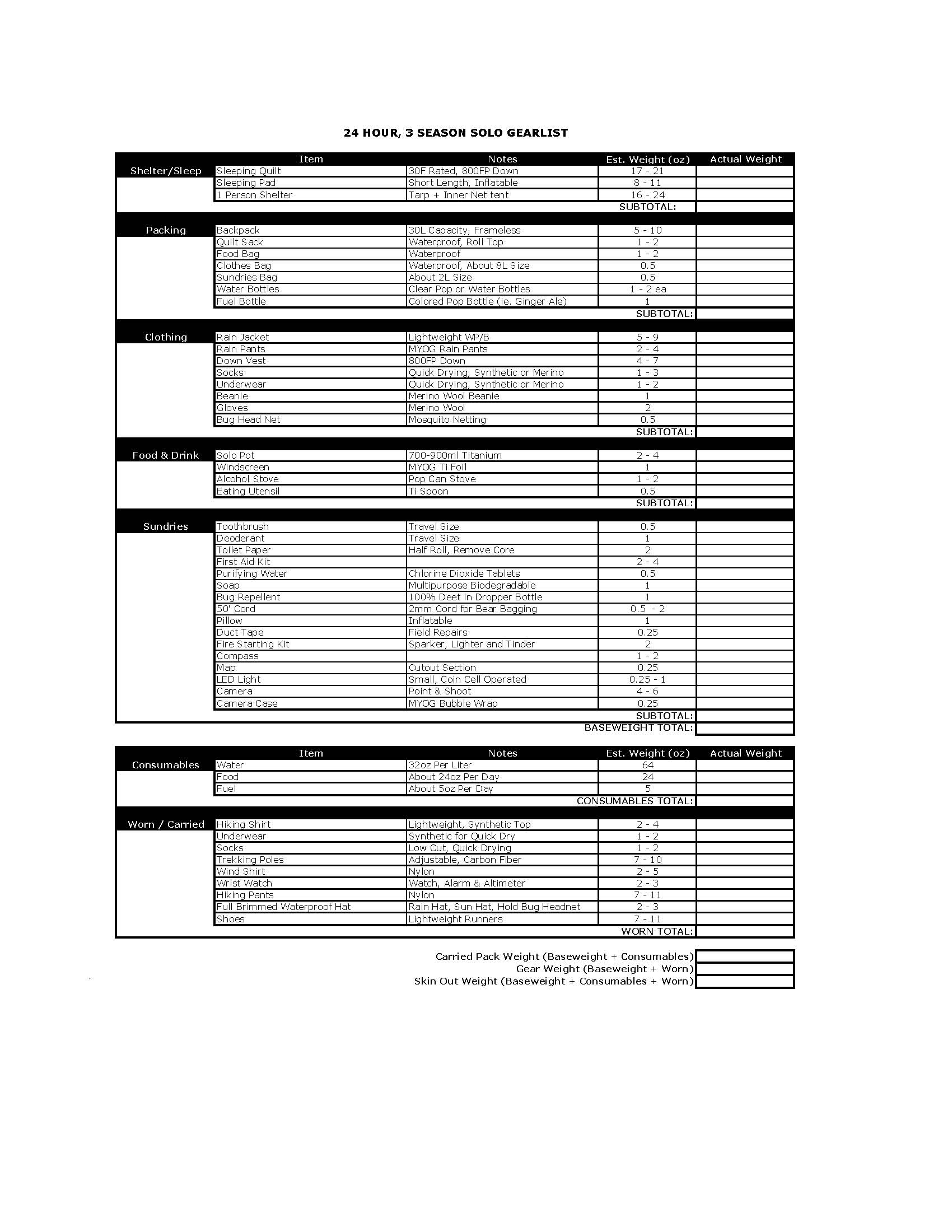
24-Hour Gear Lists

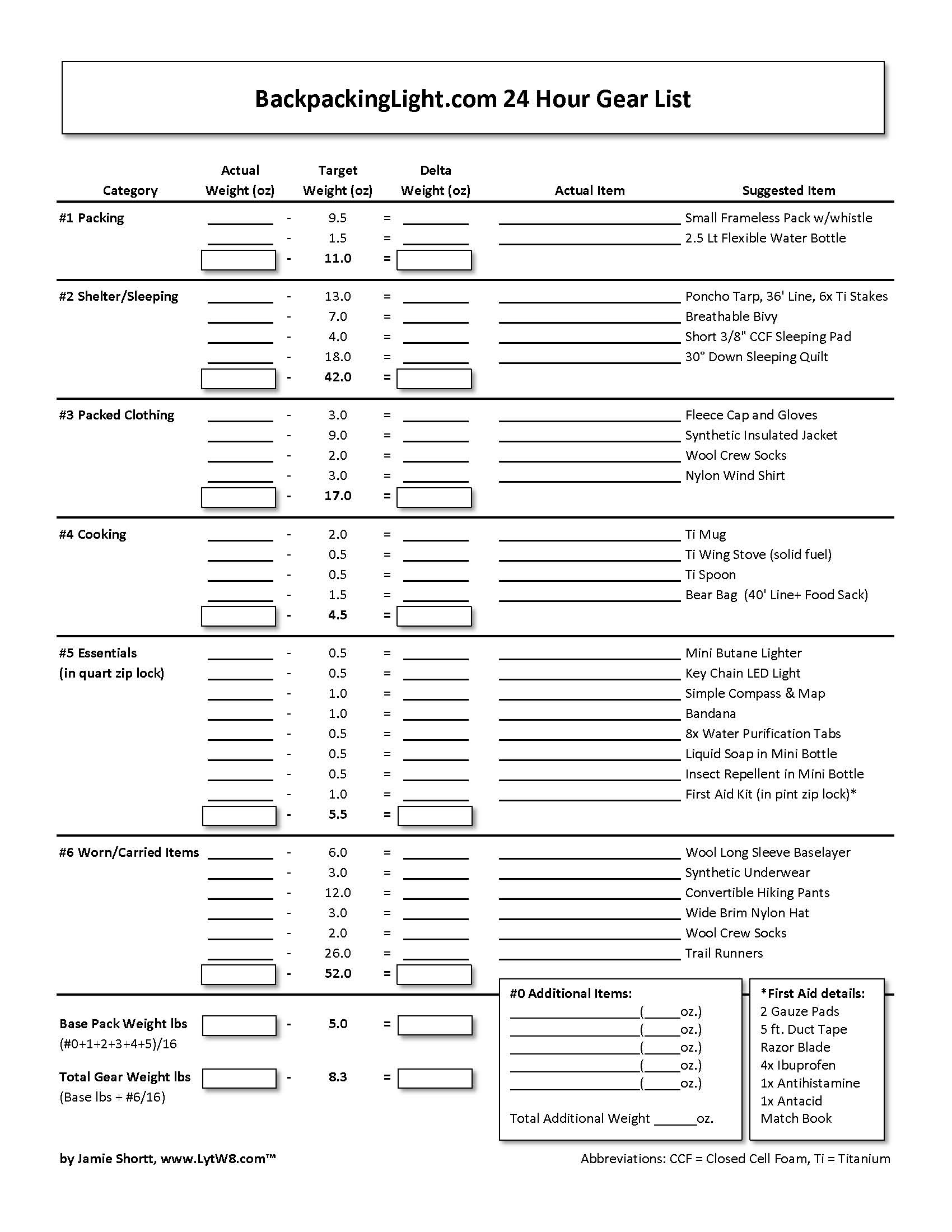
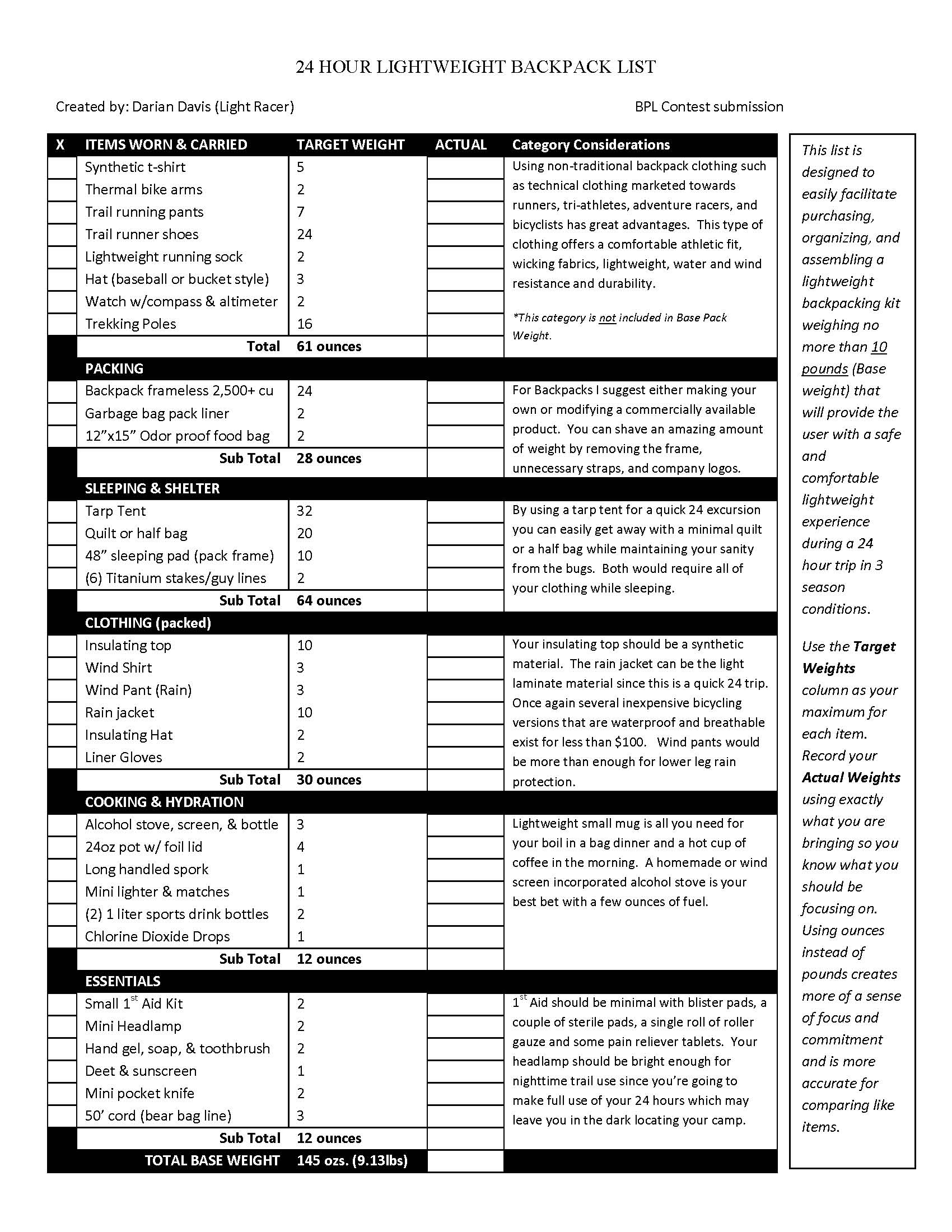
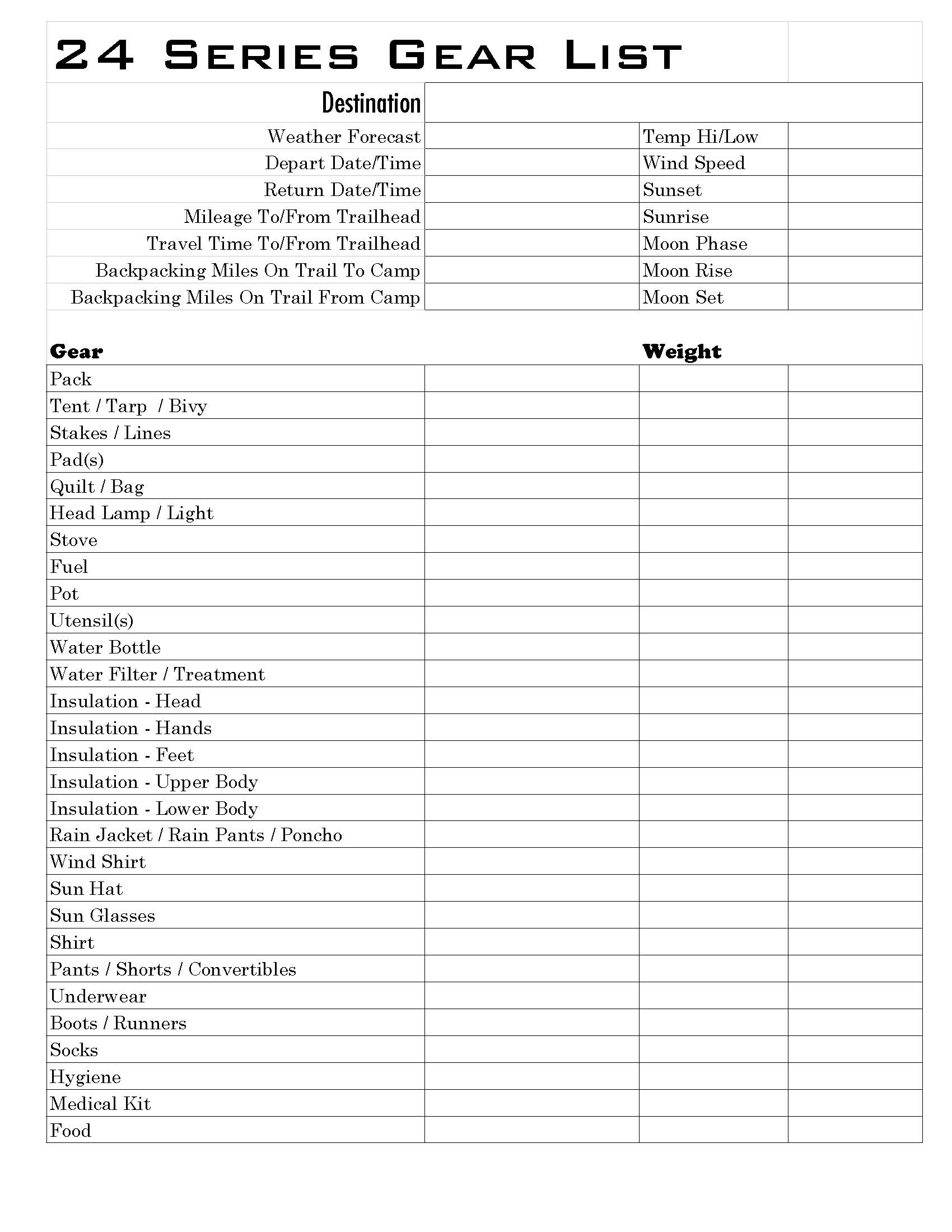
See the winners of our recent contest and download a zip file of all the submissions. Use your favorite to plan YOUR next trip!

It was long-running and took some time to judge, but the 24 Series Gear List Contest is complete!

Results

  1. Jamie Shortt
  2. Darian Davis
  3. George Matthews
  4. Jeremy Gustafson and Dan Durston

Please click each list to see a full-res version of the winners (you’ll have to zoom), or download all the submissions here (3.5 MB zip file).

24-Hour Gear Lists

Jamie Shortt, first place

Darian Davis, second place & George Matthews, third place.

Jeremy Gustafson, honorable mention & Dan Durston, honorable mention.

Thank you again to all who submitted! We have plans for Jamie’s list, but we’re keeping those under wraps for the time being…

Keeping it Real in Bolivia’s Cordillera Real: Global Test Photo Essay

Lightweight backpacking in Bolivia’s northern Andes.

Editor’s Note: click here to see all the articles (and a brief synopsis of each) in this excellent series.

Global Test Photo Essay: Keepting it Real in Bolivia’s Cordillera Real - 1
Ultralight in Bolivia: sandals, wool layers, felt bowler hat, and a frameless pack.

Nine months into our Latin American journey, our friend Brady flew to Bolivia to join Danny and me on a trek in the Andes. We were thrilled to have new conversation material and a showcase of the latest lightweight gear from the US. On top of all that, it was, for me, the successful pinnacle of an inescapable venture.

Several years ago, I was apprehensive about introducing my outdoors-loving group of friends (which included Brady) to my new boyfriend, Danny. Although their personal interests were greatly aligned, they had different ways of manifesting their enthusiasm. Danny recited backpacking gear weights as if he spent nights awake, memorizing outdoor company catalogues. And, although my friends and I had explored Northern California, from Point Reyes to the Sierras, I suspected that on some of our backpacking trips the weight of our liquor exceeded Danny’s base pack weight.

Fast forward several years to the Cordillera Real in Bolivia, where my husband, Danny, my old friend, Brady, and I backpacked together for four days. The boys spent much time discussing Brady’s new lightweight gear and the latest advancements in ultralight material technology, while I tried to watch my footing despite frequently rolling my eyes.

I suppose there is no greater form of flattery than a close friend bonding with your significant other, but, as I crawled into the tent each evening, I longed for the nights when my eyes closed more quickly after a few sips of port. But, maybe it was not only alcohol which brought on my drowsiness. Perhaps carrying an eight pound pack on this trip did not drain my energy as much as carrying a 22 pound pack, like in my pre-Danny days.

Global Test Photo Essay: Keepting it Real in Bolivia’s Cordillera Real - 2
After six hours on various modes of transportation to get from La Paz to the mountains, we finally began our backpacking adventure. Our trek started in the afternoon, after the clouds rolled in, at an altitude of about 3,500 meters (11,283 feet).

Global Test Photo Essay: Keepting it Real in Bolivia’s Cordillera Real - 3
On the second day we were all smiles as the sky opened up and revealed stunning views in every direction.

Global Test Photo Essay: Keepting it Real in Bolivia’s Cordillera Real - 4
We hiked up this valley to a saddle at 4,738 meters (15,643 feet). Photo courtesy of Brady McDaniel.

Global Test Photo Essay: Keepting it Real in Bolivia’s Cordillera Real - 5
The trail in this valley was well-defined because it led to an active mine. We heard several blasts throughout the day, so we decided to turn around and find a quieter valley in which to set-up camp.

Global Test Photo Essay: Keepting it Real in Bolivia’s Cordillera Real - 6
Danny and Brady chatted incessantly about sil-nylon, tyvek, spinn cloth and cuben fiber.

Global Test Photo Essay: Keepting it Real in Bolivia’s Cordillera Real - 7
Kristin was excited to find someone to talk to.

Global Test Photo Essay: Keepting it Real in Bolivia’s Cordillera Real - 8
Are these clouds rolling in or out? We continuously monitored the sky for signs of inclement weather. We lucked out with no rain or wind, just fog.

Global Test Photo Essay: Keepting it Real in Bolivia’s Cordillera Real - 9
The afternoon traffic jam.

Global Test Photo Essay: Keepting it Real in Bolivia’s Cordillera Real - 10
Every so often, the clouds teased us by exposing the beauty of the 6,000+ meter (19,685 feet) peaks towering above.

Global Test Photo Essay: Keepting it Real in Bolivia’s Cordillera Real - 11
These two photos, taken less than an hour apart, demonstrate how quickly the weather changed.

Global Test Photo Essay: Keepting it Real in Bolivia’s Cordillera Real - 12
An abandoned mine. We passed several more open mines, many of which were unmapped and likely illegal.

Global Test Photo Essay: Keepting it Real in Bolivia’s Cordillera Real - 13
We couldn’t see the massive peaks surrounding us, but we thoroughly enjoyed the quiet stillness of this small lake.

Global Test Photo Essay: Keepting it Real in Bolivia’s Cordillera Real - 14
On the last night, we pitched our tents in the dark on this plush, grassy plateau at 3,500 meters (11,483 feet). We awoke the next morning to this amazing sunrise and expansive view, while the clouds settled into the valley below. Pictured here are Brady’s Golite Xanadu 1 (1340 grams/47 ounces) and our TarpTent Double Rainbow (1134 grams/40 ounces).

Global Test Photo Essay: Keepting it Real in Bolivia’s Cordillera Real - 15
We followed the trail/dirt road as it dropped below the clouds and through an enclave of houses and a region prime for vegetative growth. It was warmer here than in the higher altitudes and received more precipitation and ground water than in the lower elevations.

Global Test Photo Essay: Keepting it Real in Bolivia’s Cordillera Real - 16
Something breathtaking is always blooming in the Andes, regardless of season.

Global Test Photo Essay: Keepting it Real in Bolivia’s Cordillera Real - 17
A landslide had taken away this section of the trail, leaving a steep, loose hillside to scramble along.

Global Test Photo Essay: Keepting it Real in Bolivia’s Cordillera Real - 18
As we neared the end of our trek, we looked back and finally saw the full grandeur of the mountain range. Mt. Illampú, on the left, is the fourth highest peak in Bolivia at 6,368m (20,892 ft).

Global Test Photo Essay: Keepting it Real in Bolivia’s Cordillera Real - 19
Sorata – the beginning and end point of our adventure. It was an oasis in an otherwise dry, steep, and desolate landscape.

Apparatus for Testing Thermal Insulation Properties

When it comes to assessing things like air mats, foam mats, and other insulating things, the common measurement is called an R-value – meaning thermal resistance. We describe equipment designed and built to provide calibrated measurements of R-value for BPL articles.

You don’t have access to view this content.

Tall Tales from Colca Canyon, Peru: Global Test Photo Essay

Trekking in one of the world’s deepest canyons.

Editor’s Note: click here to see all the articles (and a brief synopsis of each) in this excellent series.

The Global Test:  Tall Tales from Colca Canyon, Peru - 1

Kristin and I traveled through nine Latin American countries before entering Peru.  In those seven months, we met many tourists who had already been to Peru, and more than a few raved about hiking in Colca Canyon.

Honestly, I had never heard of this purported amazing trek in the deepest canyon in the world. I soon learned that Colca Canyon, at 4,160 meters (13,648 feet) from top to bottom, is twice as deep as the Grand Canyon. However, there is no consensus on the “deepest” title, as there are a variety of methods to measure a canyon. There are a few canyons in the Himalayas and one other in Peru that some consider deeper. Regardless, Colca Canyon shot to the top of our list of must-see natural wonders.

When we finally arrived in the large city of Arequipa, the best launching point for excursions to the canyon, we made sure to arm ourselves with our traveling protectionist philosophy: low expectations. We were most disappointed when our expectations were built up by other tourists, travel companies, websites, and even government media. Either the travel destination/activity did not live up to the hype, or did not align with our personal preferences.

So, after four days of hiking in Colca Canyon, what is our honest opinion? How much does it matter if it is, or isn’t, the deepest canyon in the world? And most importantly, irrespective of the hype, how was the hiking?

We’ll let the photos do the talking and you can decide for yourself.

The Global Test:  Tall Tales from Colca Canyon, Peru - 2
These highly terraced fields are below the town of Chivay, the last major settlement before the steep canyon walls make the area nearly inhospitable.

The Global Test:  Tall Tales from Colca Canyon, Peru - 3
The switchbacks of the main trail are visible on the left side. There is an oasis along the bend in the river, where several sleeping cabins and grassy camp sites are available.

The Global Test:  Tall Tales from Colca Canyon, Peru - 4
This is one of the more enjoyable camping spots that we’ve happened upon – flat, grassy, private, and with enormous flowers in full bloom.

The Global Test:  Tall Tales from Colca Canyon, Peru - 5
This lush oasis was replete with small waterfalls and large banana trees, flourishing in a small pocket of an otherwise inhospitable desert.

The Global Test:  Tall Tales from Colca Canyon, Peru - 6
Away from the oasis, we hiked among hardy desert vegetation.

The Global Test:  Tall Tales from Colca Canyon, Peru - 7
This cactus had some serious self-defense issues.

The Global Test:  Tall Tales from Colca Canyon, Peru - 8
The walls of Colca Canyon certainly are tall and steep. However, we often felt like we were hiking in a typical “V” shaped valley, as opposed to the more box-like shape of the Grand Canyon. The Grand Canyon is also much more colorful.

The Global Test:  Tall Tales from Colca Canyon, Peru - 9
There are a few small communities within the steepest section of the canyon and the Catholic church remains at the center of village life.

The Global Test:  Tall Tales from Colca Canyon, Peru - 10
Despite the harsh climate, forbidding landscape, and numerous pre-Incan ruins, village life still seemed vibrant.

The Global Test:  Tall Tales from Colca Canyon, Peru - 11
Irrigation from distant glacier melt enables farming in small pockets of the canyon, where the land is relatively flat and receives sufficient sunlight. Farming and tourism are the main economic activities.

The Global Test:  Tall Tales from Colca Canyon, Peru - 12
The trails were well defined and in relatively good condition. They have been used by locals and pack animals for more than half a millennium.

The Global Test:  Tall Tales from Colca Canyon, Peru - 13
At the tourist spot of “Cruz del Condors,” several Andean condors reliably ride the updraft along the canyon’s steep walls in the morning, sometimes perching as close as 15 meters.

The Global Test:  Tall Tales from Colca Canyon, Peru - 14
Watching wildlife wasn’t as satisfying with such a large crowd.

The Global Test:  Tall Tales from Colca Canyon, Peru - 15
Local women sold hand-woven clothing to the busloads of tourists, many who rode up to 10 hours in one day just to get a glimpse of the condors and the valley.

The Global Test:  Tall Tales from Colca Canyon, Peru - 16
This woman devised a simple method for carrying goods on her back, using only a small sheet and two knots. Backpacking in these areas has introduced us to different methods and ideas, some of which have been cultivated over hundreds of years. This was a good learning experience for me. In the U.S., I often find myself getting caught up in the excitement of the latest gear, and forget that our modern technologies are still completely foreign to many living in less developed countries.

Hiking the Santa Cruz Loop in Peru’s Cordillera Blanca: Global Test Photo Essay

Escaping the “boxes” of modern society in the heart of the breathtaking Peruvian Andes.

Editor’s Note: click here to see all the articles (and a brief synopsis of each) in this excellent series.

Introduction

One of the drawbacks of our contemporary lifestyle is how much time we spend in boxes. Our homes and offices have floors, ceilings, and walls set at ninety degree angles. To connect us to these stationary boxes, we often use wheeled boxes to travel over flat and gray roads. The paths we take are the most efficient routes, not the most aesthetically pleasing nor the most representative of the land. It is almost as if modern society is attempting to cover up and disconnect us from the earth that gives us sustenance, and, as all backpackers know, a deep satisfaction.

Backpacking is a way to free us from the boxes of our civilized lives. It is a way to connect us to the earth, to explore the terrain around us, to view the world from a different perspective. We climb mountains to answer the question “what does the world look like from up there?” We scale rocks that demand the use of all four limbs and leave us calloused, scraped, chafed, and bruised. We glide over snow for the pure joy of speed, while experiencing a world colored mostly in white. We enter forests and meadows to inhale the pleasant smells of trees and flowers, and to feel leaves brushing against our arms and grass tickling our ankles. We paddle to the middle of lakes to observe life on shore from a different angle and to feel the bobbing sensation that only rolling waves can create.

Danny and I have been traveling internationally for over 18 months, and many people we meet along the way ask what draws us to this lifestyle. The shortest answer, and one that consequently requires the longest explanation, is that we are trying to escape the habit of living in boxes. Additionally, we are trying to learn from other cultures how it is possible to live securely without the stifling feeling of spending so much time in a box.

Danny and I still spend more time indoors than is ideal, including time in buses, trains, cars, and supermarkets. However, when we do escape, it is well worth the compromise. The following photographs from our May trek in the Cordillera Blanca are best viewed indoors, but I hope they inspire you to get outside the box.

The Global Test: Hiking the Santa Cruz Loop in Peru’s Cordillera Blanca - 1
Laguna Llaganuca sits at the entrance to Huscaran National Park, several hours north of the city Huaraz, Peru.

The Global Test: Hiking the Santa Cruz Loop in Peru’s Cordillera Blanca - 2
The village of Colcabamba – the “trailhead” for our hike.

The Global Test: Hiking the Santa Cruz Loop in Peru’s Cordillera Blanca - 3
There were few independent backpackers and no designated campsites, so it was easy for us to find a comfortable spot for the night.

The Global Test: Hiking the Santa Cruz Loop in Peru’s Cordillera Blanca - 4
Nevado Piramide as seen from the east side. We hiked over the pass, Punta Union, directly south of this peak.

The Global Test: Hiking the Santa Cruz Loop in Peru’s Cordillera Blanca - 5
The weather was variable and the summits were often obscured by clouds. It was sometimes warm enough to wear a tank-top while hiking uphill. We always wore high SPF sunscreen regardless of the cloud coverage.

The Global Test: Hiking the Santa Cruz Loop in Peru’s Cordillera Blanca - 6
As we reached the high point of our trek, Punta Union at 4,750 meters (15,500 feet), we turned around to admire the valley in which we had just hiked.

The Global Test: Hiking the Santa Cruz Loop in Peru’s Cordillera Blanca - 7
The ~5,700 meter (18,700 foot) tall summit of Taulliraju.

The Global Test: Hiking the Santa Cruz Loop in Peru’s Cordillera Blanca - 8
We saw several of these servicios higienicos which were poorly designed and too putrid to use. Instead, the guided trips carried a portable canvas outhouse. We used the standard cat hole.

The Global Test: Hiking the Santa Cruz Loop in Peru’s Cordillera Blanca - 10
Kristin wore the right camouflage for this time of year.

The Global Test: Hiking the Santa Cruz Loop in Peru’s Cordillera Blanca - 11
The north side of Nevado Alpamayo as seen at sunrise from our campsite.

The Global Test: Hiking the Santa Cruz Loop in Peru’s Cordillera Blanca - 12
Outside of the jungle, we rarely encountered forests in Peru. We found this small band of trees tucked away in a valley above 4,000 meters (13,123 feet).

The Global Test: Hiking the Santa Cruz Loop in Peru’s Cordillera Blanca - 13
This lone flower Senecio comosus grew next to a glacier lake at 4,200 meters (13,780 feet).

The Global Test: Hiking the Santa Cruz Loop in Peru’s Cordillera Blanca - 14
Kristin wished she had a packraft to get closer to the glacier.

The Global Test: Hiking the Santa Cruz Loop in Peru’s Cordillera Blanca - 15
We saw many vibrant flowers during our trek, including these Taulli blooms.

The Global Test: Hiking the Santa Cruz Loop in Peru’s Cordillera Blanca - 16
Walking back to the main valley, the 6,025 meter (19,767 foot) peak of Artesonraju punctuated the skyline (top right).

The Global Test: Hiking the Santa Cruz Loop in Peru’s Cordillera Blanca - 17
Danny wished he had a packraft to mosey down the crisscrossing waterways instead of soaking our feet in the flooded meadow.

The Global Test: Hiking the Santa Cruz Loop in Peru’s Cordillera Blanca - 18
A bonus feature of a lightweight pack: it was easier to jump across creeks.

The Global Test: Hiking the Santa Cruz Loop in Peru’s Cordillera Blanca - 19
The high-altitude solar radiation was intense. We built a shelter for our lunch break using our five-ounce sil-nylon tarp. The smell of fresh cow pies ruined our peaceful meal. When the smell followed us along the trail, we realized Kristin’s shoe was the culprit, as she had unknowingly stepped in a fresh, gooey cow pie.

The Global Test: Hiking the Santa Cruz Loop in Peru’s Cordillera Blanca - 20
I’m likin’ this lichen.

The Global Test: Hiking the Santa Cruz Loop in Peru’s Cordillera Blanca - 22
Nothing like the sight of vibrant patchwork fields to welcome us back to civilization.

Interview with Mike Clelland!

A lively chat to introduce a new feature coming up on Backpacking Light: Mike’s Ultralight Tip of the Week!

An Interview with Mike Clelland! - 1
Mike’s self-portrait.

Addie: Mike, you’ve got a new book out! Can you tell readers who may not be familiar a little bit about yourself?

Mike: Why yes, Addie, that is an excellent question, and I’m glad you asked.

I’ve been juggling the role of outdoor educator and illustrator for the last 17 years, and the two careers end up contributing to each other. Most of my teaching experience is with NOLS (National Outdoor Leadership School) and most of my illustration work has been doing instructional cartoons for books and magazines with a focus on camping, skiing, and climbing.

My introduction to lightweight backpacking came in 2005, when I received a phone call from Don Ladigin. He wanted me to do the illustrations for his book LIGHTEN UP! My first reaction was to say “No, thanks,” because I had just finished a series of instructional outdoor books, and they all ended up requiring hundreds of cartoons. I was sort of burned out. But, after talking with Don and reading his manuscript, I realized that this would be a really fun project, and I eagerly took on the job.

It’s actually pretty hard for me to draw things that I’m unfamiliar with, so during the process of drawing the cartoons for Don, I bought a few key pieces of gear and started doing little overnights in my backyard (Grand Teton National Park). I was immediately blown away by the simplicity and freedom of the lightweight techniques. From that very first one-night solo experience, I became a sort of crazed zealot about shaving ounces, which continues to this day.

Up until Don’s phone call, my outdoor pursuits revolved around mountaineering, telemark skiing, and rock climbing. All of those activities require a lot of gear, and I didn’t realize how the big backpack can subtract from the core experience of being outside in the wilderness. The lightweight mindset changed everything, and now that I’m inching up on 50, I’m reveling in the advancements in techniques and gear in way that just can’t happen with a backpack full of traditional equipment.

The last few years have been a reflection of my newfound passion. I took on a leadership role at NOLS and helped create their Lightweight Backpacking program. I’ve done a bunch at BPL, writing and illustrating articles, as well as teaching some of the Wilderness Trekking Courses out of Bozeman. And last summer I even wrote a book on the subject!

The upcoming book is meant to be a more comprehensive follow-up to Don Ladigin’s excellent LIGHTEN UP!

An Interview with Mike Clelland! - 2
Co-teachers Sam Haraldson and Mike Clelland! Yes, Sam is smiling.

A: Tell us more about the book – how did you come up with the idea?

M: Curiously, the book came about as a direct result of the dire economic events in 2008. In the aftermath, I went through the whole year of 2009 without any illustration work. That’s never happened before, and it was rough. It took me a while to realize that nobody was offering me any work, so I might as well invent my own.

Over the years, I’ve worked on a handful of instructional books as illustrator (each with LOTS of cartoons), and I wasn’t intimidated by stepping into a big job. So I figured I would just write a book rather than wait for the phone to ring.

I’ve worked as illustrator on a series of successful books with Allen O’Bannon. My favorite is titled ALLEN & MIKE’S REALLY COOL TELEMARK TIPS. This was one of the most rewarding projects I’ve ever been involved with, and readers really seemed to respond to the simple format. The subject matter was presented as a simple series of tips, each one describing (in words and cartoons) some of the subtle skills required to master the elegant telemark turn.

I figured that the skills and techniques required for advanced ultralight backpacking could be listed in a very similar format, just a series of simple tips, each one numbered for ease of use. This makes it easy for the reader to jump from tip to tip, especially if they are looking for specific info.

One thing that I really strive for in the series of instructional books I’ve worked on is to make sure the book is un-intimidating. I really feel that it’s important for any potential reader to hold the book in their hands for the very first time and NOT be daunted by the material. When they initially browse through the pages, I want ‘em to think, “Hey, this looks fun!”

An Interview with Mike Clelland! - 3

I wrote and drew pretty much the whole thing in just two months, July and August of 2010. I became a sort of hermit with a deadline, and I chained myself to my desk to get it all done on time. That might sound dire, but it was an exciting flurry of creative output. It ended up being a really fun job.

I was very cautious not to overlap too much with the content of the other books out there that cover some of the same skills and techniques. I was inspired by Don Ladigin, Ryan Jordan, and Ray Jardine, but I didn’t want to repeat what they had already shared.

I’m a quirky guy, sure enough, and that ends up in my writing and in my illustrations. Most of the little tips in the book are a reflection of my own idiosyncratic point of view. I worked hard to keep my own voice in the text – the last thing I wanted was something dry and monotone!

A: I think one of the thing readers really appreciate about you is your tone! Since you’ve gotten this book under your belt and off your desk, do you have any exciting adventures planned for the summer, or will you simply be perfecting your one-night-at-a-time trips?

M: I really enjoy the quick little one-night-at-a-time trips, especially with the Tetons just a few minutes out my door. That is such an easy way to get out into the mountains and play with some cool gear. Plus, I get to sleep outside under the stars.

The short over-nighters are a great way to fine-tune my systems. But the real test is to put everything I’ve learned on these short little trips into something a bit more bold. This summer, I wanna do a ten-day trip with an ultralight set-up. I’ve been looking at maps, and I’ll probably try to link up a bunch of trails through the Tetons and Yellowstone, and maybe the Gallatins too. While I was working on the book, I was trying to make sure each of the tips was something that the reader could really use, nothing hypothetical, I was dedicated to real information.

Early on in the book, I describe a “Model Trip,” and I use it as the example outing, a sort of template for all the tips in the book. I feel it’s important that I actually DO this Model Trip myself. It will be set-up as a solo outing, ten days long, ambitious, and in three-season temps.

But, most importantly, it’s an ultralight experience, meaning the base weight is below ten pounds. Ten days is a nice length because you can easily carry ten days’ of food. And it’s also nice because the math is easy: if you do a one-night trip, all the numbers are the same except for the consumables, and you can just move the decimal point over a little bit to the left.

The cover of the book features a cartoon of a guy (who looks suspiciously like me) and there is a call-out box with an arrow pointing to his very cute little backpack. The box reads: “food and gear for 10 DAYS under 25 pounds!” And that’s my goal for the summer.

An Interview with Mike Clelland! - 4
Me and my baby, hot off the presses.

Now, I just saw a presentation given by Andrew Skurka where he tells the story of his Alaska-Yukon Expedition: 4,680 miles and 176 days of solo-trekking, skiing, and packrafting through some of the most remote terrain on the planet.

That puts a humble little ten-day trip into a sort of stilted perspective.

All that said, I feel like I have a lot of experience camping and teaching with a lightweight backpack, mostly in a team with NOLS and BPL’s Wilderness Trekking School. On those trips we’ve been out for as long as two weeks at a time.

A: Before I let you go, is there anything else you think our readers need to know about you, your new book, lightweight backpacking, or coffee?

M: About the book, there was a genesis to the project that kind of had a life of its own; it took me in a direction I didn’t expect. My initial idea as I began writing was that it would be a string of technical tips, you know, cool little things to do and make. Now rest assured, that there is plenty of that stuff in there, but as things took shape, a more philosophical tone began to emerge, and it eventually sort of took over.

I realized that the most important aspect of ultralight backpacking comes from a mind-set and not from cool gear. The book is a lot more introspective than I would have ever guessed from the outset. For me at least, there is a joy to liberating yourself not only from ounces, but from old ways of thought. I worked hard to encourage the reader to take on the challenge of looking at his or her own mind-set.

My experiences with a very light backpack has made me much more introspective, and this has greatly improved the way I walk in the woods. And this same newfound ease-of-travel has enriched the way I relate to nature.

And about coffee. One of the skills I’ve perfected is stopping in a beautiful spot, sitting down and brewing up a small cup of afternoon coffee. I keep my cook gear ready to go in a dedicated stuff sack, and I can pull out out and light the stove within seconds of pulling the pack off. This is easy and rewarding – and greatly appreciated by my hiking partners.

Editor’s note: We’re as excited about Mike’s new venture as he is, and Backpacking Light has partnered with him to offer a weekly rotation of tips and illustrations from his book. Mike Clelland!’s Tip of the Week begins soon, when his book, Ultralight Backpackin’ Tips: 153 Amazing & Inexpensive Tips for Extremely Lightweight Camping , hits the Gear Shop. Stay tuned!

Eleven Years Old on the PCT

Recently unemployed, with a daughter itching to complete a thru-hike, what’s a dad to do? Get sponsors and yank her from school, of course!

BackpackingLight sponsored a father/daughter team on their PCT thru-hike in the summer of 2011. To get the full skinny on what a dynamic duo they are, read their first installment of adventure, Eleven Years Old on the PCT (this article), then their second, We’re Going to Disneyland!, then their third, Sunshine in the Sierra Mountains.

Introduction

Father Daughter PCT - 1
Balls and Sunshine, age 10, at the Canadian border.

A Note on My Trail Name

When I joined the Army, my plan was to fly under the radar in basic training and not be noticed by the drill sergeants. How hard can it be to blend in with 300 other men that are all 17 to 21 years old, shaved bald, and wearing the same camo clothes? Easy, right?

Wrong!

You see, my family is from Norway, so I was blessed with a last name that’s impossible to pronounce in English. With some imagination and sadistic spite, one could pronounce it cojones, which means “balls” in Spanish. On my first day in training, my drill sergeant took one look at my name and shouted (the only way they ever spoke) “Cojones! COOO-JOOO-NES! Boy! Do you know what that means? It means ‘balls!’ Boy, you better have some balls if you want to make it through this!” From that point on, everyone only knew me as Balls.

The drill sergeants had me brew coffee in their office at all times, and whenever they wanted a cup, they would yell “Balls!” down the hall. All the other trainees would join in, echoing down the long concrete hallway. I had five seconds to be in the office in the parade rest position with a hot cup of coffee in my hand. It didn’t matter if I was taking a shower or on the toilet: five seconds, that’s all! I mentioned this story to some hikers, and they naturally insisted on “Balls” being my trail name.

Growing up in small town Midwestern America, I was no stranger to hiking, what with many years of my older brother dragging me along on his pointless wandering. He loved to simply take a compass bearing and walk into the woods or swamp on a game trail (which always disappeared). After hours of falling in the mud, being accosted by wood ticks, and lacerated by briers just for the sake of knowing what the terrain was like, he would look at his compass and walk right back to the road where we started.

I joined the Army straight out of high school, just before Desert Storm. Humping 100 pounds of land mines in an external frame pack and walking through stream beds up the side of South Korean mountains in the dark didn’t help my affection for hiking.

While in South Korea, I sustained a major back injury (I was knocked off a tank, fell ten feet into rocks, and landed on my tail bone). Over the years, this injury worsened, leaving me unable to walk for days at a time. When I could walk, it was with a limp and a hunched back, but the only thing that relieved the chronic nerve pain in my back and legs was walking. I walked around our neighborhood before and after work to ease the pain and stiffness. In 2001, I finally agreed to undergo back surgery after realizing that I couldn’t even hold my infant daughter, Reed, for any length of time. Sometime during this process, I decided that if I needed to walk all the time, I would at least get out of town and see some wilderness.

Beginning to Backpack

After surgery, I still have chronic pain and limited ability, and I can’t sit more than 15 minutes at a time without muscle spasms. However, following my recovery, I was determined to start backpacking for the first time in my life. Of course, my back problems mandated I pack as lightly as possible. After one 30-mile trip on the Pacific Crest Trail, I was hooked on backpacking and the PCT forever, beginning my obsession with ultralight methods. I started with mainstream periodicals, equipment, and methods. It didn’t take me long to grow out of these entry level tools, and I began to search the internet (once my greatest adversary, but now an ally!) for new ideas. I stumbled onto many UL manufacturers and Backpacking Light.

Each year my pack has become lighter and smaller. Last summer, I ditched my titanium alcohol stove for cold food: salami, hard cheese, and cold instant oatmeal. I even learned about pre-made bean and cheese burritos from gas stations. You just set the burrito at the top of your pack on a nice sunny afternoon, and by dinner, voila! You have a hot meal. Achieving a 7-pound base weight last summer was the culmination of eight years of trial and error, research, and mooching tips off every hiker I ran into.

Sharing the Gift

As a married man, one of my loftiest dreams was to have a son to share my love for the outdoors with, though my wife and I had two beautiful daughters. I grew up as a Boy Scout and later was a Boy Scout and Royal Rangers Leader for many years. Since I don’t do anything half-heartedly, I soon found myself investing more than 2,000 hours a year in these boy’s programs. It took me away from my family far too much. One day it hit me: I wasn’t going to have a son, I was raising other peoples’ kids, and I was neglecting my own daughters. I abruptly quit my leadership roles and began taking my family on adventures. The additional time allowed me to go on more challenging adventures and improve my own skills as well. I didn’t need a son to share this amazing gift – my daughters loved it as much as I did!

My relationship with the girls flourished once I started spending more time outdoors with them. Reed responded especially well to hiking and embraced everything I taught her. She began hiking ten-mile days at age six. At age seven, she climbed Broken Top with me, glissading the entire way down. At age eight, she climbed the South Sister, passing many adults with ease. By nine years old she easily hiked 15 miles a day. (Her younger sister, Annika, loves the outdoors, but isn’t as fond of hiking. Perhaps she will be my touring kayak partner some day!) Reed always begs me to take the long way home (usually by asking to start out in the opposite direction of home), and it didn’t take long to figure out that Reed would be my thru-hiking partner some day. I just didn’t think that “some day” would arrive so soon!

A Trail Name

Reed, who is now ten years old, joined me for 150 miles on the PCT last year. Her first section in northern California was full of trail angels doting over her, hot springs, and good old California sunshine. Her number one ambition on this hike was to get a trail name. Blue Butterfly said that the sun in Reed’s hair and her cheery disposition reminded her of the sunshine. “Sunshine” it was! Her second ambition was to beat her mother’s single day 17-mile distance record. On her first day, Sunshine hiked 19 miles and later, 21 miles. In September, we hiked 30 miles into Monument 78, at the Canadian border and back to pick up some thru hikers who could not enter Canada. We hiked 18 miles to base camp, slack packed to the border and back the next day (24 miles), then 18 miles back out to the car. It snowed and rained on us all three days! We were so wet and cold, I thought, “Surely this will turn her off to thru-hiking forever.” However, on the way home, all she talked about was when our next thru-hike would be. I agreed to seriously consider quitting work and completing a thru-hike with her in 2013.

As my back problems grew more aggravated through years of physical labor, it became apparent to me that I could not be an electrician for the rest of my working life. My well paying career was slipping away from me, with an employer unwilling to understand or accommodate my service-related disability. I tried for years to work my way into a less physically demanding job within the company, but was stymied at every turn. In December 2010, my 17 years of service and ambition ended in being laid off. Of course I was angry and felt betrayed, but I couldn’t show signs of failure to my family. I walked in the door, gave the girls big hugs and kisses, and said “I have good news. Sunshine, there is a 100% chance that we will be thru-hiking the PCT this year!”

Turns out, being laid off was the best thing that has ever happened to me! I quickly engaged in conversations with Reed’s current school, teachers, and the middle school she will be attending next year. Everyone agreed that she is an excellent student and would actually learn more on the trail. Her fifth grade teacher will be mailing math pages to work on along the way, and made me promise to bring books for her to read. Reed will never have to say she had a ‘distant father,’ considering we won’t be more than 100 feet apart for the next five and a half months.

Figuring Out the Details

Bringing my 10-year-old daughter on this trip makes the balance between ultralight and safety more delicate than ever. I had to rethink my UL philosophy altogether. My wonderfully understanding (and beautiful) wife said, “Eric, you pushed your limits last year and put yourself into some dangerous situations. That can’t happen with Reed along.”

Needless to say, I won’t be night hiking – seriously, never remove your pack (containing everything you require to survive the night) in the dark, then walk off trail to hang your bear bag. I’m bringing back the stove – no skimping on food – and I’m carrying a two-person tent. However, that doesn’t mean I need to join the traditional backpacking crowd with their 50-pound packs. It only means that I need to do more research and purchase our gear wisely. We also have several generous sponsors who have helped us achieve our safety and weight goals, and I plan to provide reviews on all our equipment as the journey progresses.

We plan to begin this amazing adventure April 29, 2011, at the Mexican border during the annual PCT kick-off event, and finish in early September. The record holder for the youngest PCT thru-hiker is a 10-year-old girl. Though Sunshine will be 11 when we complete our hike, we plan to finish almost two months earlier than the record holder, who also took some alternate routes and side roads instead of the established PCT. Sunshine and I are determined to stick to this year’s official established PCT.

As trail angel Donna Saufley told me last year, “When life hands you a thru-hike, you have to take it.” Instead of staying at home, getting fat and depressed because life took a crazy turn, we, as a family, want to embrace it and accept it for the blessing that it is. I have an opportunity to impact Sunshine’s life forever. I wouldn’t miss this for anything in the world! She is driven, like myself, and hopes to be the youngest Triple Crowner (PCT, AT, CDT) by the age of 13. Keep following this amazing adventure, as I believe it is only the beginning of an even greater journey!

Father Daughter PCT - 3
Sunshine, age 4. Left: Entering the Mt. Jefferson Wilderness. Right: Her first freeze dried ice cream. She still doesn’t like it.

Father Daughter PCT - 4
Sunshine, age 4. Left: On the way into Pamelia Lake, her first trip carrying all her own gear. Right: We got skunked fishing, so we gave up and swam instead. Notice the ultralight Elmo floatie!

Father Daughter PCT - 5
Sunshine, age 6, on her first overnight snowshoe trip.

Father Daughter PCT - 6
Sunshine, age 7. Left: Climbing Broken Top in the Three Sisters Wilderness. Right: At the top of Broken Top with Dad.

Father Daughter PCT - 7
Sunshine, age 8. Summit of South Sister, with Broken Top in the background.

Father Daughter PCT - 8
Sunshine, age 9. First 15-mile day. Notice the sign in the background? It’s the same one from her 4-year-old trip photo (mounted to a different tree – possibly due to storm damage to the original tree).

Father Daughter PCT - 9
Sunshine, age 9. Literally ON Shale Lake, with Mount Jefferson in the background.

Father Daughter PCT - 10
Sunshine, age 10. Left: Drakesbad, California on her first 19-mile day. Pictured with Ed, Golden Child (with whom she’s still in touch), and Jake Rabbit. Right: Hat Creek Rim, on the longest waterless stretch on the PCT. She hiked 21 miles that day on the Rim, and some thru-hikers actually skipped this section because of the heat.

Father Daughter PCT - 11
Sunshine, age 10. At the Canadian border, in a brief reprieve from the rain.

Father Daughter PCT - 13
Sunshine, age 10. Hiking back to the PCT after a visit to a trail angel.

Gear List

Sunshine’s Interview

EG: Why do you want to thru-hike?

Sunshine: I really like walking and backpacking a lot. Our family has always walked together. It seems like a great opportunity to walk a lot and spend lots of time with you. All your trail stories sound like so much fun.

EG: Does it seem scary or dangerous?

Sunshine: Some parts I think will be scary, like cold weather, rattlesnakes, scorpions, and mountain lions that could hurt me. But I’m pretty sure that nothing will happen because I’ve got you along. I know you won’t let anything happen to me.

Annika: (Sunshine’s sister, listening in while eating applesauce) I have a question.

EG: Yes, Annika?

Annika: Can I have more applesauce?

EG: Yes, Annika. (to Sunshine) When did you first want to thru-hike the PCT?

Sunshine: I’ve known ever since you started hiking it, because your really cool stories and pictures. Every time we hike together, I have so much fun. I chose the PCT first because our family has always hiked it or gone to PCT events and when we aren’t, you’re planning the next trip. Each time we dropped you off for a trip, it seemed more and more exciting.

Annika: (while eating her applesauce) Sunshine, are you interested in bringing us back souvenirs?

Sunshine: Yes, I’ll bring lots of shiny rocks home.

EG: Will you miss home and day-to-day life? If so, why, and what will you miss the most?

Sunshine: Yes, I’m not going to see my friends and family for a long time, but we can email everyone when we get to a town. I will miss Mom, Annika, the cat, my violin, my Webkinz, and my comfortable bed, that I love so much.

EG: What are you looking forward to the most?

Sunshine: Spending time with you and walking all the time. The greatest feeling will be reaching my goal of walking from Mexico to Canada. I also really want to see the wildlife preserve by the trail in California. I just don’t want to camp by it. That would be scary!

Annika: (all done eating) Sunshine, are you interested in hiking in the really hot desert?

Sunshine: Yes, it sounds adventurous.

EG: Go to bed Annika. I love you. Good night.

Annika: Ok, love you too. Dad, can I have more –

EG: No, good night. (to Sunshine) Do you think it will be a challenge?

Sunshine: Yes, but I like challenges. Things that are easy are too boring.

EG: It’s almost time for our trip. What are you doing to prepare besides training with me after school?

Sunshine: I walk 10 to 12 laps around the track at school during lunch recess every day with my friend Riely. We’ve done over 75 miles together at school. I can’t wait for our trip!

EG: Thank you, Reed. I love you.

Sunshine: Love you too, Dad. Good night.

Clothes

  • Printed Buff (1.4 oz)
  • Backpacking Light Merino Wool Hoody (9.1 oz)
  • Silk Long Johns (Top and Bottom) (6.7 oz)
  • Disposable Rain Poncho (1.8 oz)
  • MontBell Down Hooded Jacket (9.5 oz)
  • Backpacking Light Thorofare Trekking Shirt (5.0 oz)

Cookware

  • REI Titanium Pot Set (5.1 oz)
  • Vargo Triad Alcohol Stove (1.1 oz)
  • 3L CamelBak Bladder (7.8 oz)
  • Backpacking Light Bear Bag Hanging System (4.8 oz)
  • Fuel Bottles 2x (1.5 oz)

Pack/Sleeping

  • Backpacking Light Absaroka Pack (34.5 oz)
  • MontBell Spiral Down Hugger #3, 30 F (20.0 oz)
  • Backpacking Light DIAD 3/16 inch Sleeping Pad (1.9 oz)

Tent

  • Zpacs Hexamid Twin Tent (11.4 oz)

Miscellaneous

  • Backpacking Light Stix Trekking Poles (8.0 oz)
  • Leatherman Squirt (2.0 oz)
  • First Aid/Emergency Bag: bandages, gauze, foot tape, head lamp, compass, Neosporin, personal hygiene, dropper bottle with bleach for water purification, lighter, spork, ibuprofen, pen, note pad (16.0 oz)

Sunshine’s List

  • Backpacking Light Absaroka Pack (33.5 oz)
  • Backpacking Light Cocoon Insulated Hoody (9.7 oz)
  • Backpacking Light DIAD 3/16 Foam Pad (1.9 oz)
  • MontBell Spiral Down Hugger #1 Sleeping Bag 15 F (32.0 oz)

A note from Addie: I’ve been working closely with Eric and Reed/Balls and Sunshine, as Backpacking Light is one of their major sponsors this summer. Check back for periodic updates here, as well as on their trail journal and Sunshine’s trail journal. One of the highlights of my spring was getting their thank you note for the BPL-supplied gear:

Father Daughter PCT - 14
The best thank you note ever? I THINK SO.

Integral Designs eVent Pullover Review

Does the strong appeal, on paper, of the Integral Designs eVent Pullover materialize in real-world use?

Initial Impressions

I came across the Integral Designs eVent Pullover while on my seemingly endless search for hard shell bliss. Honestly, my first thought was something along the lines of “Huh! These guys actually make some cool stuff!” In my experience, Integral Designs is not a company that has much brand recognition with the majority of US consumers, and I think many of those who have heard of the company think of it as “that other brand.” My experience with the eVent Pullover, however, clearly places Integral Designs in the top echelon of gear purveyors.

The appeal on paper is was what drew me in. The specs of the eVent Pullover: a 10-ounce, three-ply eVent shell. The design is clean, the aesthetic is uncluttered and purposeful. The 17-inch chest zipper allows for excellent ventilation, and the shell sports merely one more small zipper for a Napoleon pocket on the left chest. The hood is an integral part of the collar design, and the drop tail, while not allowing for full head to toe protection, provides good rain protection from head to sit pad. I liked that the shell doesn’t have pit zips, because I generally feel that if a jacket needs to be unzipped that much, it probably shouldn’t be worn, and I’d rather not have the extra weight, bulk, or frills.

Integral Designs eVent Pullover Review - 1
This gives you a general idea of the fit, clean design, and integration of the hood and collar.

If you’ve spent some time researching lightweight eVent shells, you might notice that the Integral Designs eVent Pullover looks remarkably similar to the Rab Demand Pull-On, for good reason. Rab now owns Integral Designs, and particularly plans on incorporating light and fast gear into the Integral Designs brand.

Build Quality and Material

One of the first things I noticed about the shell when I got it in hand was the relatively substantial feel of the fabric. Other shells I’ve handled in this weight range have felt pretty wispy, but not so with the Integral Designs eVent Pullover. The material feels like you could actually wear it on a lengthy trip and not worry about having to baby your jacket. I guess you could say that the material inspires a degree of confidence. At only 10 ounces, though, the face fabric can’t be much more substantial than that found on the lightest waterproof-breathable shells. What makes the difference, I believe, is the use of three-ply construction instead of the two-ply or two+-ply construction many of the lightest jackets now use. Instead of just having the face fabric and waterproof layer, the Pullover also has a layer of tricot mesh laminated to the waterproof layer.

The finish quality also grabbed my attention quickly. Stitching is consistent and tight, seams are well-fitted and use narrow tape, and openings are neatly finished with clean simplicity. Overall design has been well thought through. I like the integration of the hood drawcords into the hood and collar designs. The elastic cuffs are as simple as they get, completely functional with a minimum of fuss or weight. The chest pocket is a clean installation, with a good hood over the top of the zipper. For whatever reason, I like the addition of a snap at the top of the main zipper, as well as the wrap-over chin fleece.

Integral Designs eVent Pullover Review - 2
A closer look at the deep chest zipper and front pocket. Also note the snaps at the collar points.

Fit… Once You Go Up a Size, It’s Great

Fit of the eVent Pullover is trim. In fact, I wear a large instead of the medium I wear in nearly all other brands. That said, the shell fits well. Sized as I have, the jacket is not baggy, but has enough room for me to wear a midlayer and a down vest underneath. Wearing just a baselayer and midlayer, I could wear the size medium eVent Pullover, but the fit was a little too constrictive for my tastes. Although I had to go up one size, I think the resultant fit is just about perfect. The drop seat is a good length for me and works as intended. I’ve found the simple elastic cuffs to work admirably well while being unobtrusive. The adjustable hood fits well and adapts to a variety of layering requirements.

Integral Designs eVent Pullover Review - 3
The drop seat provides welcome coverage and, unlike other jackets I’ve had, didn’t leave me wishing the rear was a few inches longer.

Considerations on the Hood

The hood, however, was my main source of frustration with the pullover. Integration of the hood into the collar cleans up the lines of the garment, but I found that the collar consistently, and literally, got in my face when partially unzipped. The collar almost removed my glasses on a number of occasions! Slight head rotation, and/or slight head tilt, easily brought the edge of the collar to my eye, particularly if the hood was up and the shell partly unzipped. I tried a variety of methods to get the collar to lay down, including dropping the hood and unzipping fully, but at the end of the day the collar was designed to stand up, and it generally does. For the most part it’s not a huge deal, but it is a bugger when the hood’s up and you want to vent. I wonder if it would be possible to attach a small Velcro tab at the leading edge of each collar point and one tab at the rear to minimize collar extension.

Integral Designs eVent Pullover Review - 4
The collar/hood points easily find their way under my glasses. Also note the oddly truncated wire brim.

My favorite winter cap of all time uses a wire brim, which I find to be eminently functional, but I’m not a big fan of the wire brim on the Integral Designs eVent Pullover. It seems to be oddly integrated into the hood, sort of a floating attachment that could provide more support if it was better secured, or perhaps wrapped a bit further around to the back. Don’t get me wrong, it gets the job done just fine, but it’s just… a little bit off.

Despite occasional relapses, I’m pretty much one of those guys who always has some kind of facial hair. One thing I’ve found throughout the years is that facial hair, particularly during a “stubble face” phase, can really wear down clothing. The tricot liner of the eVent Pullover seems to be a bit softer than that of other three-ply garments I’ve owned before, and thought it has fuzzed up more quickly, it still seems to have full integrity. If I could re-work the jacket, I might try to conjure a way to wrap just the face fabric back down over the inside of the collar. I think doing so would greatly increase wear resistance, with minimal effect on breathability.

Integral Designs eVent Pullover Review - 5
Sometimes the collar behaves quite nicely.

I have mixed feelings about the single chest pocket. It is positioned in such a way that it is functional and accessible even when wearing a pack. And, there are times when it’s nice to have a pocket on an outer garment, though I find that in the backcountry I normally just want a place to stash a butane lighter and perhaps a small folding knife. Pockets seem more “necessary” for front-country life, for example stowing a wallet and cell phone. What I’ve found is that I use a pant pocket for the lighter and knife, and I don’t carry a wallet or phone (normally) in the backcountry. For town life, the chest pocket is quite convenient. Otherwise, it strikes me as unnecessary. It isn’t a big quibble, but eliminating the pocket would streamline the garment some more, cut a little weight, and enhance breathability (the pocket is made completely of eVent).

Field Performance

Speaking of breathability, the Integral Designs eVent Pullover did not disappoint. I started testing going relatively easy on the shell by wearing my lightest baselayer at a moderately low activity level. Subjectively speaking, breathability struck me as roughly comparable to a windbreaker worn in similar situations. I progressively built up layers and activity level to see just how well the eVent shell dealt with sweaty conditions.

Integral Designs eVent Pullover Review - 6
A detail shot showing the elastic sleeve cuff. Simple, but functional and well-executed. It fit snugly enough to keep the sleeves from sliding down my hands, but loosely enough to be quite comfortable.

I wore the eVent Pullover with only a 150 g/m2 merino wool zip tee in temperatures ranging from the teens to high 60s, with no pack and with one up to twenty pounds. The most I wore was that same baselayer with a 320 g/m2 merino hoody, a loden vest, and a stocking cap, in temperatures ranging from 0 F to 32 F (-18 C to 0 C), while snowshoeing. My typical testing was with a 200 g/m2 merino layer in temps ranging from about 10 F to 50 F (-12 C to 10 C), during fast-paced hikes.

I’ve found that I am able to wear the Pullover across a broader range of temperatures and activity than other, non-eVent hard shells I’ve worn in the past. Even when purposefully over-dressed to make myself sweat heavily, the shell handled things pretty well. In those heavily-dressed situations I was obviously too hot, and the humidity level inside the shell was obviously high, but I didn’t find myself or the inner surface of the shell wet, as I’ve learned to expect from other rain wear. In more moderate clothing and conditions, I was able to continue wearing the shell when I normally would have had to remove it. I never found myself wishing I had pit zips, perhaps also due in part to the super-deep main zipper. I’m not going to say the Pullover is as airy (or arid) as wearing a windbreaker, but for a full-on waterproof/breathable shell, its performance is quite remarkable.

Integral Designs eVent Pullover Review - 7
Here you can see the relatively clean lines of the shell, the slightly funky hood, the relative depth of the chest zipper, and a bit o’ fit.

Overall Impression

So, the question of the moment: “Does the strong appeal, on paper, of the Integral Designs eVent Pullover materialize in real-world use?” Yes, the Pullover meets my hopes and expectations. It’s light, durable, very breathable, and highly functional. A few design tweaks would help the Pullover sort of melt away into the background of a user’s outdoor experience, but it still seems to be the first shell I grab as I head out the door.

Disclosure: The manufacturer provided this product to the author and/or Backpacking Light at no charge, and it is owned by the author/BPL. The author/Backpacking Light has no obligation to review this product to the manufacturer under the terms of this agreement.

7 Myths about the Continental Divide Trail

At first glance, doing a round-trip (a yo-yo) on the Continental Divide Trail (CDT) seems like a waste. Why not hike a different trail instead of hiking the same one two times? However, unlike the Appalachian Trail and the Pacific Crest Trail, the CDT is never the same trail twice.

Although the CDT Alliance (CDTA) has designated an official route, thru-hikers often deviate from it. The benefit of yo-yoing the CDT is that about 70% of the southbound journey can be new! No longer does one have to debate whether to take the low route along the lake or the high route on the ridge. A yo-yoer can do both!

7 Myths about the Continental Divide Trail - 1
First sign. The first 25 miles of official CDT trail in New Mexico are so well marked that you want to show your gratitude! Too bad that the signs stop after that…

After yo-yoing the CDT, I discovered that some of the beliefs that I had about the trail were false. Let’s debunk seven common myths about the CDT.

Myth #1: The CDT is 70% complete.

This myth implies that you’re bushwhacking with a map and compass 30% of the time. Reality: about 3% of the CDT involves trailblazing or cross-country travel. The 70% statistic comes from the fact that while 100% of the trail is designated, 30% of the time it’s not where the CDTA would ultimately like the trail to be. For example, one section of the CDT might be a road-walk until the CDTA can create a footpath. Perhaps a more accurate description is that 30% of the CDT is on either a dirt or paved road.

7 Myths about the Continental Divide Trail - 2
Hitchhiking to get to the start of the trail in Antelope Wells, New Mexico.

Myth #2: Thru-hiking is not a race.

All thru-hikers race against winter. Even the most leisurely thru-hiker looks like a maniac to the average weekend backpacker. Section-hikers have self-imposed time boundaries that force them to pace themselves, even if that pace is five miles per day. Someday, a courageous backpacker will thru-hike the CDT during winter; until then, we’re all racing – just at different paces.

7 Myths about the Continental Divide Trail - 3
I win! Celebrating the end of the CDT Yo-Yo.

Myth #3: You can’t go through Colorado’s San Juans before June because there’s too much snow.

I went through in early May. The secret is to start hiking before sunrise (when the snow is hard, but not icy), stay on the ridge as much as possible, and don’t let the snow intimidate you. Just because the CDT isn’t always on the divide doesn’t mean you shouldn’t be. Thanks to the wind and sun exposure, the divide doesn’t have the deep snow that you’ll find elsewhere. The extra effort needed to get on the divide pays off because you won’t be postholing all day. As a result, a pugnacious hiker can do 25-30 miles, even in May and June. I brought crampons, but never used them. The snow was almost never icy; it was usually crunchy or soft, in May. I didn’t bring any, but given the soft snow, ultralight snowshoes would have helped. However, the key ingredients to getting through the San Juans in the spring are lots of patience and courage.

7 Myths about the Continental Divide Trail - 4
This isn’t intimidating: I can still see the trail signage. (Through the Tetons in mid-June. This pic was taken by the first backpacker I saw on the trip. I had already walked 2,000 miles – the length of the Appalachian Trail – until I found my first backpacker! Before that I’d seen two skiers, two snowmobilers, and one guy walking a dog near a trailhead.)

Myth #4: The Idaho-Montana border is full of PUDs.

A Pointless Up and Down (PUD) is a trail that takes you up and down a view-less mountain. Because the Idaho-Montana border has few trees, you’ll actually enjoy big views all day. Sure, you must head up and down along the ridge, often on steep trail, but you’re rewarded throughout the hike with impressive vistas on either side of the Divide. There’s nothing pointless about that!

7 Myths about the Continental Divide Trail - 5
The Highline Trail: Glacier National Park’s Garden Wall.

Myth #5: Resupply lines are unusually long.

Compared to the PCT, the resupply points are about the same or arguably more convenient. The CDT surprised me by how often it goes right through a town, especially if you take the cutoffs. A 5-mile hitch is just as easy as a 20-mile hitch if there’s really nowhere to stop during those 20-miles. The longest resupply sections are around the Idaho-Montana border and the Black Range, but they’re no different than the John Muir Trail.

Myth #6: The CDTA route isn’t as good as the unofficial route that most thru-hikers take.

There are five major alternate routes that most CDT thru-hikers take, and they’re all shorter than the official trail. I took the official route on the way to Canada, and the five conventional shortcuts on the way to back to Mexico. These cutoffs are so popular that they almost feel like the official trail. However, only one of the five alternates is worth taking: hiking the Middle Fork of the Gila River in New Mexico is a bit better than the Black Range, which is the official trail. The other four alternates aren’t as good as the official trail. I recommend:

  • Using the Crazy Cook Monument terminus, not Columbus.
  • Taking the San Juans, not the Creede Cutoff.
  • Enjoying the 25-mile Rocky Mountain National Park loop, even if you make little forward progress (why skip a National Park?).
  • Going around Butte, not through Anaconda (when is a paved road-walk better than a dirt road?).

Thru-hikers have good reason to take such shortcuts: they’re usually racing to beat winter and/or want to just “bag” the Triple Crown as quickly as possible. Sticking with the official trail adds one or two weeks to the thru-hike, but more thru-hikers should consider it.

7 Myths about the Continental Divide Trail - 6
In mid-August, I walked the Divide in the Wind River Range instead of taking the CDT. The harder route was worth it to see these glaciers.

7 Myths about the Continental Divide Trail - 7
Going through the Tetons on the way north is a great alternative to the traditional CDT route.

Myth #7: You can’t go through the Tetons and have a contiguous thru-hike.

I describe a contiguous route on my website that has hardly any paved road-walking. The downside: you miss the Parting of the Waters. The upside: you walk from one National Park to another (Grand Tetons – Yellowstone)!

It’s fun to yo-yo the CDT because of the variety the trail offers. More than any other trail, the CDT invites you to hike your own hike.

7 Myths about the Continental Divide Trail - 8
Who says there are no hot baths on the CDT?


Francis Tapon is the first person to yo-yo the CDT. He is the author of Hike Your Own Hike: 7 Life Lessons from Backpacking. He donates half of his royalty to the CDTA, PCTA, and ATC. Watch his 77-minute CDT Yo-Yo Video here.