Articles (2020)

Walking the Backbone: A Journey on the Continental Divide Trail

Anyone who hikes the long trails is asked “Why go?” There are many answers: the physical challenge, being immersed in the wilderness for months at a time, the joy of seeing new sights every day, the camaraderie of people we meet along the way. Ultimately, the reason I go is for the journey itself.

Walking the Backbone: A Journey on the Continental Divide Trail - 3
Suitably contemplative-looking pose. I am really thinking “Where the heck am I?” or “I hope my three liters of water does not fall out!”

Introduction

On July 1, 2006, I was at the northern terminus of the Continental Divide Trail (CDT) located in Glacier National Park. A long brown path lead before me… taking me wherever I chose. In this case, I chose the Mexican border at Antelope Wells. Four months and many footsteps later, I arrived.

My journey on the Continental Divide Trail was perhaps the most difficult of all the long trails I’ve hiked, and perhaps the most frustrating as well. It is a trail that is not completed, involves frequent route finding, and is still rough around the edges.

The CDT was also perhaps the most rewarding of the trails I’ve hiked:

  • I saw a grizzly bear in the Bob Marshall Wilderness.
  • I heard the howl of wolves in the wild.
  • I cherish a memory of being on top of Temple Pass in the Winds one glorious morning.
  • I stood on a ridge in Montana and Idaho and saw NOTHING around but for the mountains.
  • I looked over the snow-covered Colorado Rockies and again fell in love with my chosen home.
  • I caught the most intense sunrise of my life in New Mexico, as I started my last full day on the trail.

The rawness, intensity, wildness, and the rough edges are indeed what made my time on the trail so rewarding.

Why the Continental Divide Trail?

It would be misleading to deny that part of the allure of doing the CDT was finishing the Triple Crown of backpacking. It certainly was an achievement worth striving for. Being able to complete the Appalachian, Pacific Crest and Continental Divide Trails was more than just having a tchotchke on my wall, however. The real reward was being able to experience living in the mountains for months at time not once, not twice, but three times. I feel fortunate to have had the time, money, health, and desire to have extended outdoor journeys.

And how to spend time in the outdoors? By hiking through my adopted home in the West.

Far different from the dense hardwoods, green cover, and crowded spaces of my native Rhode Island, there is something about the wide open spaces and austere beauty found in the western landscape that appeals to me. I now consider Colorado and surrounding areas my home.

And what better way to see my adopted home then to walk it one step at a time?

The Gear Used

After many years and miles of backpacking, I have become a minimalist in terms of the gear I use. I prefer this term to ‘ultralight’ or ‘lightweight,’ as it is more reflective of my philosophy. I take only the gear I need for a given trip for my own personal comfort, safety, and fun levels. The emphasis is not on the most expensive (or even the lightest) gear, but the gear that does the job for me and does it well for a particular trip. Some of my gear and clothing is from MontBell, some of it is from the Army surplus store.

On the CDT, my base pack weight hovered around 9 pounds. The ubiquitous blue foam pad from XYZ Mart, a lightweight aluminum pot from the thrift store and a polyester dress shirt comprise my kit. On social backpacking trips (more camping, less hiking) the base pack weight is heavier (a box of wine adds weight!).

Overall, my gear reflects how I enjoy the outdoors: I use the gear to spend time in the outdoors. I don’t spend time in the outdoors to use gear. Keep it simple. Make it work. Let me enjoy myself. And my gear for the CDT allowed me to spend four wonderful months walking the backbone.

Below is a glimpse at my evolving gear list to give you an idea of how I went from traditional backpacker to a more minimalist (some would say ‘dirt bagger!’) approach for the CDT.

  Vermont’s Long Trail 1997 Appalachian Trail 1998 Vermont’s Long Trail 1999 Pacific Crest Trail 2002 Colorado Trail 2004 Continental Divide Trail 2006  
BACKPACK EMS 5500 (1996 Model) EMS 5500 (1996 Model) Camp Trails Scirroco (3500 CI) LWGEAR – One Pound Pack (all mesh) LWGEAR – One Pound Pack (all mesh) Six Moon Designs Essence (2006 Version)
SHELTER Walrus Swift Walrus Swift Walrus Swift Campmor 8×10 Silnylon Tarp Oware 5×7 SilNylon Tarp Six Moon Designs Gatewood Cape
SLEEPING BAG Feathered Friends Hummingbird Feathered Friends Hummingbird Feathered Friends Hummingbird Feathered Friends Hummingbird Feathered Friends Hummingbird Feathered Friends Hummingbird
SLEEPING PAD Z-Rest Z-Rest Z-Rest Z-Rest Z-Rest (cut down) Generic blue foam pad (cut down)
COOKING MSR Alpine Cookset MSR Alpine Cookset K-Mart Alum Pot K-Mart Alum Pot (a little beat up) K-Mart Alum Pot (really beat up) K-Mart Alum Pot (a friend says it should be thrown away!)
  MSR Whisperlite MSR Whisperlite Alcohol Stove Alcohol Stove Alcohol Stove Alcohol Stove
HYDRATION 2x Nalgene Bottles 2x Nalgene Bottles 2x Gatorade bottles 2x Gatorade Bottles 2x Gatorade Bottles 2x Gatorade Bottles
  1-gallon Plastic jug   Nalgene Cantene Nalgene Cantene Nalgene Cantene Nalgene Cantene
  PUR Microfilter Polar Pure Polar Pure Polar Pure MP-1 Tabs Iodine Tabs
JACKET Generic Fleece Pullover Generic Fleece Pullover Generic Fleece Pullover Marmot Driclime Windshirt Marmot Driclime Windshirt MontBell Light Shell Jacket
RAINWEAR Windpants Windpants Windpants Windpants MontBell UL Rainpants MontBell UL Rainpants
  PVC Rainjacket PVC Rainjacket Generic Nylon Rainjacket Generic Nylon Rainjacket GoLite Wisp GoLite Wisp
FOOTWEAR LL Bean Cresta Hikers LL Bean Cresta Hikers Asolo 535s various running/trail shoes Nike Air Pegasus various running/trail shoes
BASE PACK WEIGHT (estimated) 30 lbs 28 lbs
(weighed at Boiling Springs ATC office)
17 lbs 13 lbs 10 lbs
(I had a digital scale for this kit)
9 lbs
(I had a digital scale for this kit)

NOTES

  • I did not include most of my clothing, as that has changed very little from 1997. I still hike in shorts, wear generic polypro, and wear a synthetic hat. I may wear a long sleeve shirt, wear sunglasses, and/or use a boonie hat for sun protection. I also use running socks with lighter footwear. Other than that, my clothing hasn’t changed much.
  • I used the same sleeping bag from 1997 until 2006. It really is worth paying more money for a good bag, and I did put some new down in it after the PCT. After the CDT, it was time for a new bag.
  • Also not included are the weights of sundry items that were reduced because of equipment used. (A plastic bottle vs. a metal bottle for fuel, for example.)
  • My full gear list reflects my May 2009 gear.

Looking over my list, you can see a big drop from my AT gear to my Long Trail 1999 gear. After humping a 50-pound pack over the mountains for over 2,000 miles, I vowed to NEVER DO THAT AGAIN!

My shorter hikes (the Long Trail and the Colorado Trail) were used to refine my techniques a bit. My current gear list is more or less reflective of my 2002 PCT gear list, but with refinements: frameless pack, down bag, trail shoes instead of boots, alcohol stove, and aluminum pot. I can picture doing all my future long walks with my PCT 2002 gear. I would not want to do any of my long walks with my AT 1998 gear!

After the Long Trail in 1999, there was a gradual decline in my base pack weight. I am at the point where I can only get lower if I spend more money for shaving ounces rather than pounds and/or going more minimalist and choosing my seasons with care. It gets to the point that I have to ask myself how much money and effort is worth spending to lose more weight in my pack? I’m lazy and not very motivated, mind you! :)

Photo Essay

Walking the Backbone: A Journey on the Continental Divide Trail - 1
Start of the trail in Glacier National Park. Obviously, the trail must be well marked all the way to Mexico!

Walking the Backbone: A Journey on the Continental Divide Trail - 2
Home-sweet-home for four months. A Gatewood Cape was quick to set up, simple to use, and worked well for my ‘hike all day and camp less’ style of backpacking.

Walking the Backbone: A Journey on the Continental Divide Trail - 4
Heart Lake in Yellowstone reminded me of Maine.

Walking the Backbone: A Journey on the Continental Divide Trail - 5
Temple Pass in the Winds. This is why we backpack.

Walking the Backbone: A Journey on the Continental Divide Trail - 6
I loved the expansiveness of the Great Divide Basin. The Oregon Buttes were a landmark for many pioneers on the Oregon Trail.

Walking the Backbone: A Journey on the Continental Divide Trail - 7
Zirkel Wilderness, Colorado. I’m back home!

Walking the Backbone: A Journey on the Continental Divide Trail - 8
Sometimes my favorite memories are the more subtle ones, like aspen leaves on the trail.

Walking the Backbone: A Journey on the Continental Divide Trail - 9
The snow-covered mountains foretold an early winter, but the views were stunning.

Walking the Backbone: A Journey on the Continental Divide Trail - 10
Peeking out from my snow-covered shelter. Winter did come early! (Sept 21!)

Walking the Backbone: A Journey on the Continental Divide Trail - 11
Snow in the San Juans.

Walking the Backbone: A Journey on the Continental Divide Trail - 12
Interesting trail markers on the CDT in New Mexico!

Walking the Backbone: A Journey on the Continental Divide Trail - 13
Still autumn in the lower elevations of New Mexico.

Walking the Backbone: A Journey on the Continental Divide Trail - 14
One of the reasons northern New Mexico was one of the highlights of the CDT for me.

Walking the Backbone: A Journey on the Continental Divide Trail - 15
Windmills are important to any CDT hiker in New Mexico!

Walking the Backbone: A Journey on the Continental Divide Trail - 16
Not on the “official” CDT, but the history buff in me could not pass up the Gila Wilderness and the cliff dwellings.

Walking the Backbone: A Journey on the Continental Divide Trail - 17
My last full day on the trail started with this sunrise over the Hatchitas.

Walking the Backbone: A Journey on the Continental Divide Trail - 18
At the Mexican border after four months, 2,500+ miles, six pairs of shoes and many Snickers bars!

Final Thoughts

Any person who hikes the long trails is asked “Why go?” There are many answers: the physical challenge, being immersed in the wilderness for months at a time, the joy of seeing new sights every day, the camaraderie of people we meet along the way.

Ultimately, the reason I go is for the journey itself.

I hiked the CDT during the bicentennial of the Lewis and Clark expedition. When I finished the CDT, the words of Meriwether Lewis during his own travels in Montana came to mind: “As we passed on, it seemed as those scenes of visionary enchantment would never have an end.”

I think that is why many of us walk the long trails: to continue the scenes of visionary enchantment. We don’t want them to end.

And we hope to see them again in the future.

Canovaccio: Natural, Sustainable Pack Fabrics

New developments in durable and water-resistant backpack fabrics.

When I posted a photo of a new pack manufactured with a highly unconventional fabric to my instagr.am feed yesterday, the resulting social media storm caught me by surprise. Here’s the story of the fabric that has the Twitterverse up in arms.

Conventional backpack fabrics include oxford nylon, ballistics nylon, and Cordura. More modern materials are impregnated or coated with silicone, or offer ripstop patterns with high molecular weight polyethylene rip threads for tear resistance. And, if you follow the ultralight industry, you certainly know about the variants of Cuben Fiber, which promise very high performance-to-weight ratios.

Unfortunately, all of these materials suffer from the limitations of being synthetic in nature. Disadvantages of synthetic fabrics include:

  • hydrolysis of solvent-based coatings in response to sustained exposure to wet conditions, resulting in peeling and failure of the coating;
  • manufacturing processes that depend on petroleum-based chemical processing;
  • the feeling of abrasiveness and irritation when worn next to skin (i.e., as in the contact areas of shoulder straps, hip belts, and back panels).

Consequently, there has been a significant push by the outdoor industry in recent years towards “natural” and “sustainable” fabrics, including bamboo, merino wool, and even fabrics made from the fibers of coconut shells and corn stalks.

Most of these natural fabrics cannot be processed in a way, however, that is most suitable for backpack materials, due to low strength-to-weight ratios, high elasticity, and high levels of water absorption.

Consequently, we have been partnering with our overseas backpack manufacturing facility to develop natural, sustainable fabrics that can be used in backpacks.

After researching a variety of manufacturing processes and fabric constructions, we are getting closer to a final fabric. This fabric will be featured in the 2012 Absaroka Backpack.

Some of its advantages include:

  1. The ability to absorb very small amounts of precipitation and perspiration into the fabric’s interstitial structure, to enhance wicking and prevent moisture from “dripping” off of pack fabric into your clothing system.
  2. The ability to regenerate the pack’s waterproofness via natural oil impregnation using many commonly available waterproofing solutions sold in shoe and organic food stores.
  3. Its ability to be manufactured from renewable resources (e.g., organic cotton) using modern automated looms that won’t require equipment upgrades.

The new fabric will be branded as “Canovaccio” and be manufactured by a well-known company that specializes in soft shell materials in the high alps of Italy.

We are confident that this fabric will have achieved widespread distribution and be available to small cottage manufacturers by the end of the year – hopefully spurring the development of garage innovation and new business for our friends in the cottage industry.

Ryan Jordan is the Founder and CEO of Backpacking Light and can be found on Twitter @bigskyry if you want to stay up to date about lightweight backpacking industry trends.

Minimalist Footwear for Summer Backpacking

Unlike more traditional running shoes, there is no set pattern established and accepted as to what characteristics make a good minimalist shoe. We scan the currently available products and test some out to see how applicable these designs are for ultralight backpacking.

You don’t have access to view this content.

Home Away From Home In Argentina’s Lake District: Global Test Photo Essay

Months of travel can wear on people, even as they enjoy the “other” of another country. We found the perfect combination of comforts from home and the diversity of a foreign culture in Bariloche, Argentina.

Editor’s Note: click here to see all the articles (and a brief synopsis of each) in this excellent series.

Introduction

Before you view these photos of Danny and I in the beautiful outdoors near Bariloche, Argentina and get that dreamy look on your face, let me share with you a secret that took me several months to learn on my own. Traveling for long periods of time, especially in the wilderness of foreign lands, may be romanticized in literature such as Lonely Planet and National Geographic. One truth seems to be missing from these tales of exotic peoples, tasty foods, and gorgeous landscapes: no matter how much your surroundings change, the person you are inside generally remains the same.

So, if you’re like me, and you already have strong opinions and preferences about, well, pretty much everything, traveling can be frustrating. I have to constantly remind myself to keep an open mind. It was nice taking a break from that effort in Bariloche, Argentina. It was the first place I found that reminded me of all of my favorite things from home: a large variety of local fruits and vegetables, super friendly people and a strong outdoor community, sunny weather, and endless opportunities to play in the wilderness. We stayed twice as long as we had originally planned, and even started dreaming of returning in winter.

Danny and I spent more than two weeks sampling various wilderness opportunities while using a hostel in Bariloche as our base. We did four camping trips and pitched our tent in a variety of places such as on top of Mt. Tronador, next to an aquamarine glacier lake, in a crowded lawn with lots of vacationing Argentinian families, and stealthily in a bamboo forest. We found the perfect combination of comforts from home and the diversity of a foreign culture.

The Global Test:  A Home Away From Home In Argentina’s Lake District - 1
Nahuel Huapi National Park beckoned us from the tenth floor balcony of our hostel in Bariloche.

The Global Test:  A Home Away From Home In Argentina’s Lake District - 2
Our camp near Refugio Frey in Nahuel Huapi National Park. There are many refugios (refuge or shelter) throughout the park, which typically sell hot meals and offer basic sleeping accommodations.

The Global Test:  A Home Away From Home In Argentina’s Lake District - 3
Much of the higher altitude trekking was on loose dirt and scree, like this part of the trail on the backside of Cerro Catedral.

The Global Test:  A Home Away From Home In Argentina’s Lake District - 4
Early summer hiking in the Argentine side of Patagonia was ideal. The weather was perfect every day, the flowers were blooming, the peaks looked dramatic, frosted with snow, and the trails were clear and dry.

The Global Test:  A Home Away From Home In Argentina’s Lake District - 5
Every day was filled with challenging hiking, marvelous views, and superb camp sites, like along this lake in Nahuel Huapi National Park.

The Global Test:  A Home Away From Home In Argentina’s Lake District - 6
This particular section of the trail was exciting, but wasn’t as dangerous as it appears.

The Global Test:  A Home Away From Home In Argentina’s Lake District - 7
Relying on public transportation occasionally left us stranded. We had to stealth camp in a bamboo forest near Lago Moreno in Llao Llao Park.

The Global Test:  A Home Away From Home In Argentina’s Lake District - 8
Kristin explored the rocks along Brazo Tristeza, with Cerro Capilla in the background.

The Global Test:  A Home Away From Home In Argentina’s Lake District - 9
Bariloche is home to a strong mountaineering community with a long history and, naturally, some lost lives. This hand-carved memorial was in the “Mountaineers Cemetery,” which is remotely located in a thicket of trees at the edge of the Llao Llao Park.

The Global Test:  A Home Away From Home In Argentina’s Lake District - 10
The most money we paid to camp in Argentina was at this private campground near Lago Gutierrez. The only spot available was next to this cement wall. However, we did receive wi-fi in our tent.

The Global Test:  A Home Away From Home In Argentina’s Lake District - 11
This trail among sharp volcanic rock led us to the high camp on the stratovolcano Mt. Tronador, which translates to “thunderer.”

The Global Test:  A Home Away From Home In Argentina’s Lake District - 12
Mt. Tronador, at 3,491 meters (11,453 feet) tall, is 1,000 meters higher than any of the surrounding mountains.

The Global Test:  A Home Away From Home In Argentina’s Lake District - 13
Refugio Otto Meiling was named after the German-born mountaineer who built a number of huts in the area, including this one on Mt. Tronador. Otto was instrumental in bringing skiing and mountaineering to Argentina and was co-founder of the Club Andino de Bariloche.

The Global Test:  A Home Away From Home In Argentina’s Lake District - 14
We camped on this ridge, surrounded by two of Tronador’s eight glaciers.

The Global Test:  A Home Away From Home In Argentina’s Lake District - 15
This was the most spectacular sunset that we witnessed in ten months of backpacking in Latin America.

SIA Nordic Ski On-Snow Demo 2011: New Waxless Ski Technologies

While the new waxless technologies are mostly in Nordic race skis and high end touring skis, we see promise for their future use in backcountry skis as well.

SIA Show Background and Overview

SIA Nordic On-Snow Demo 2011: New Waxless Technologies - 1
The 5,000-acre Devil’s Thumb Ranch was the host and testing grounds for the SIA On-Snow Nordic Demo. Not quite discernible in the photo are some backcountry Nordic ski tracks down the large sunlit snow slope in the distant right (Marker Hill).

This is the second year that the biggest US Ski Show, the SnowSports Industries of America (SIA) Snow Show, has hosted a Nordic On-Snow Demo. The Cross Country Ski Areas Association (CSAA), a non-profit “to promote the growth and improve the quality of cross country ski operations,” partnered with SIA to organize the Nordic Demo.

One of the main messages from the show was huge growth in interest and sales for backcountry ski equipment. According to SIA, backcountry ski and equipment sales are up 90% to 150% so far this season. A representative for Madshus reports strong backcountry ski sales for their popular “Cross Country Downhill” line of backcountry (BC) Nordic skis like the Eon and Epoch. The Silent Spider, a light backcountry ski, is Fischer’s third best selling ski. To meet interest and demand, Fischer has re-designed their entire line of S-Bound backcountry Nordic skis for 2011/2012.

SIA Nordic On-Snow Demo 2011: New Waxless Technologies - 2
Two excellent backcountry Nordic skis at the show. Bottom: the new Fischer S-Bound 78 (78-61-69, 2130 g 179 cm). Fischer has redesigned their line of BC Nordic skis for 2012. The main changes are to improve grip, turning, and gliding in soft snow. Top: the “new” Madshus Eon (2160 g 185 cm). This ski is the reincarnation of the Karhu XCD GT – same mold and construction, just different graphics on the deck.

New Waxless Technologies

SIA Nordic On-Snow Demo 2011: New Waxless Technologies - 3
At the Demo Atomic, Salomon, and Fisher all introduced “new” waxless grip technologies for 2011/2012. Some of the grip technologies have been in development since the 2002 Olympics, but many are only making their commercial debut for the coming season.

The theme for these waxless technologies is to move away from fish-scale patterns to a smoother grip material that performs more like a waxed ski. That is, good grip but retaining the fast, silent glide of a well waxed ski. For the future, the companies think that there is a possibility of these technologies working their way into BC skis. In fact, Fischer’s waxless technology, Zero, and Salomon’s G2 Micro have already made it to select touring skis for 2011/2012.

Atomic Skintec Waxless

SIA Nordic On-Snow Demo 2011: New Waxless Technologies - 4
Atomic Skintec is a high-speed reinvention of kicker skins, and is fast enough to be used on the Nordic race skis shown here. (We see an obvious application to backcountry Nordic skis for this technology.)

Skintech is Atomic’s highlighted technology for 2011/2012 and has top billing on the front page of their catalog. Unlike many “smooth” waxless grip technologies it is designed to work in all temperature ranges.

Skins are new? Yeah, using skins for grip on Nordic skis has been around forever, but skins glide terribly and are slow. Atomic has taken a new approach to make skins faster – fast enough that Skintec will only be on Atomic’s top end race skis for 2012. In simple terms, Skintec is a shorter version of a kicker skin that is integrated seamlessly into the bottom of the ski. The skin is just a smidge higher than the gliding surface. The skin pattern is short, about 30% shorter than the standard wax pocket or fish-scale grip pattern, which helps with gliding. A new “on-off” flex pattern, rather than a traditional progressive flex, works to keep the skins high and off the snow when gliding, and snapping down hard on the snow when kicking. (We were able to walk up some pretty steep inclines.)

We see obvious application for Skintec in BC skiing. With a couple of grip modules, including a skinless, glide-surface-only module, you could easily fine-tune your grip and glide to backcountry conditions much faster than conventional skins (the plates simply magnetize to the bottom of the ski). And Skintec should be faster and more efficient than conventional skins.

SIA Nordic On-Snow Demo 2011: New Waxless Technologies - 5
A very thin skin pattern is bonded to a plastic plate that drops into a cavity on the base of the ski. When inserted, the plate is flush with the gliding surface of the ski and the skin is just slightly higher than the gliding surface. The plate and skin unit is referred to a “grip module.” Removing and installing the grip module is easy, as it is only held in place by matching magnets in the ski cavity (silver dots) and on the bottom of the grip module.

SIA Nordic On-Snow Demo 2011: New Waxless Technologies - 6
Currently there are two Skintec Grip Modules. The full skin favors grip over glide; the partial skin favors glide over grip. For backcountry skiing we see an application for a skinless/glide-surface-only module for downhill joy!

SIA Nordic On-Snow Demo 2011: New Waxless Technologies - 7
Roman Toferer, Nordic race director for Atomic (with his back to the camera) shows SkinTec to Oskar Svärd. A three time Vasaloppet winner, Oskar is one of the best distance skiers in the world.

Salomon G2 Micro Waxless

Also debuting at the show and new for the 2011/2012 season was Salomon new waxless grip technology “G2 Micro.”

SIA Nordic On-Snow Demo 2011: New Waxless Technologies - 8
Unlike all the other technologies presented, Salomon G2 Micro is not a base insert, but a thin layer of grip material permanently bonded to the base of the ski in the grip pocket.

Salomon G2 Micro is not a base insert, but a thin layer of epoxy based material that is applied to the grip pocket of the ski. In addition, G2 Micro skis use a lower camber to work best with the G2 Micro. To make G2 Micro, graphite and silica compounds are mixed with an epoxy resin. The graphite and silica give the G2 Micro material enough texture to grip the snow, but compared to a conventional fish scale, the G2 Micro grip pattern is smooth. G2 Micro has a limited temperature range (-15 C to 5 C) compared to the broader temperature range of a fish scale grip pattern, but within its temperature range, Curtiss Graves of Salomon claims the G2 Micro should outperform fish scales and many waxed skis.

SIA Nordic On-Snow Demo 2011: New Waxless Technologies - 9
Testing waxless skis in fresh powder.

Salomon Zero Grip Waxless

Salomon “Zero Grip” is a waxless race technology for those tricky, wet conditions right around freezing 0 C (32 F). It is a rubber insert in the ski’s grip zone that is sanded to create a grip texture. It “performs better than kick wax in fresh snow [in] around freezing temperatures.” The Zero Grip base can be fine tuned to conditions by using sandpaper to either smooth or roughen the surface of the grip compound.

Fischer Zero Waxless

Fisher Zero has been used in race skis for a number of years (since the 2002 Olympics). It is a finely textured rubber compound. Zero looks smooth, and it glides silently like a smooth based waxed ski. You have to touch the Zero surface or look closely to discern the tiny surface filaments that grip the snow. Like the Salomon Zero Grip, the Fischer Zero base can be fine tuned to conditions by using sandpaper to either smooth or roughen the surface of the grip compound.

SIA Nordic On-Snow Demo 2011: New Waxless Technologies - 10
The new Zero grip section on the Fischer Superlight Zero ski (lower ski) compared to the more conventional fish-scale Crown grip section on the Superlight Crown Ski (upper ski).

Fischer Zero was originally conceived as a waxless race technology for those tricky conditions right around freezing, 0 C (32 F). In a 2009 race in just such conditions, the top six finishers were all using Fischer Zero skis.

According to Peter Ashley, VP for Nordic Products at Fischer, 20-40 F is a good working temperature range for Zero. At lower temperatures Zero tends to “grip too well.” I tested Superlight Zero skis from -20 to 1 C (-14 to 34 F). In warmer temperatures (20 F and above), Zero skis behave more like waxable skis – they glide well and delightfully make no noise. It, or an improved version with a broader temperature range, might be potential technology for the warmer temperatures of spring backcountry trips.

SIA Nordic On-Snow Demo 2011: New Waxless Technologies - 11
A detail of the Zero waxless grip material on a touring ski. The grip section is longer than a race ski and has two Zero grip materials. The center grip section (yellow/green) is softer and has more grip than the Zero used for a racking ski. The end grip sections (orange) have less grip as they transition to the gliding surface of the ski. In the touring ski, the orange/transition grip material extends slightly beyond the grip pocket.

When I tested Zero skis at -20 C they worked well enough in smooth set tracks and climbed like crazy, but they tended to grab a bit when skied out of tracks into fresh (hard and sharp) powder to descend a hill. I really needed to concentrate on “heels down and tips up.” And the skis stuttered a bit in the track at any place spindrift had blown in.

Fischer must have confidence in Zero and its broader applications since they have added it to select touring skis for 2011/2012. Their extremely popular performance touring ski, the Superlight, will come in a Zero version for 2011/2012. As befits a touring ski (versus a racing ski), the Superlight Zero favors grip a bit more over glide. We would imagine a similar grip configuration for a BC Nordic spring ski, if and when Fischer decides add it to their S-Bound series of BC skis.

SIA Nordic On-Snow Demo 2011: New Waxless Technologies - 12
Early morning setup on the first day of the Nordic Demo.

Mountain Laurel Designs Exodus Backpack Review

A higher volume (59 L) durable fabric frameless backpack with superb design, construction, and options.

Introduction

Formerly called the Zip, the current Exodus backpack is a larger volume (59 L) frameless backpack suitable for week-long trips using ultralight gear. It has volume reduction clips and loops at the bottom of the pack to reduce volume, making it usable for smaller loads and shorter duration trips. And numerous options are available to customize the pack to your heart’s content. So, how versatile is the Exodus?

Specifications

Mountain Laurel Designs Exodus Backpack Review - 1
The Mountain Laurel Designs Exodus frameless backpack packed with ultralight gear for an overnight backpacking trip.

Year/Model 2010 Mountain Laurel Designs Exodus www.mountainlaureldesigns.com
Style Frameless backpack with attached hipbelt, top loading, roll down top with top compression strap
Volume 3600 cubic inches (59 L) including pockets and extension collar
Weight Size Large tested. Measured weight 15 oz (425 g); manufacturer specification 15 oz (425 g) size M
Sizes Available Unisex S, M, L
Fabrics Dyneema X, 4 oz sq/yd2 (135.6 g/m2) 210d nylon with a white 210 Dyneema ripstop grid reinforcement at 0 and 90 degrees; 4 oz/yd2 (135.6 g/m2). Tough Mesh pockets
Features Durable fabrics, removable sternum strap with whistle buckle, removable frontpanel bungie system, 1 large mesh front pocket with elastic binding, 2 mesh side pockets with drawcord closure, 2 side compression straps, 12 in (30 cm) extension collar, drawcord closure and top compression strap, SuperWick Mesh lined shoulder straps and hipbelt, 2 ice axe loops, haul loop, volume reduction clips and loops, 2 hydration hose ports
Volume to Weight Ratio 240 in3/oz (based on 3600 in3 and measured weight of 15 oz (size Large)
Maximum Comfortable Load Carrying Capacity 20 lb (9.1 kg) estimated comfortable load for an average person carrying the pack all day
Carry Load to Pack Weight Ratio 21.3 (based on 20 lb and a measured weight of 0.94 lb)
MSRP US$185
Options Hydration sleeve, internal stow pocket, hipbelt pockets, rain cover, shoulder strap water bottle pouch, shoulder strap gear pouch, UL packlid

Description

Mountain Laurel Designs Exodus Backpack Review - 2
The Exodus frameless backpack is one of four frameless backpacks of similar design offered by MLD, differing mainly in volume. From smallest to largest, the packs in the series are: Burn (2200 in3/36 L), Prophet (2900 in3/47.5 L), Exodus (3600 in3/59 L), and Ark (4200 in3/69 L). All are constructed of durable Dyneema X fabric and have essentially the same feature set and options. Note: these manufacturer photos do not show the comparative size differences among the packs.

The Mountain Laurel Designs Exodus is a typical design for a top-loading frameless backpack, it has a drawcord and rolltop closure with top strap and mesh pockets on the front and sides. What is different about the Exodus (and the other three packs in the series) is: 1) they are constructed of high quality and durable fabrics and mesh, 2) the pack design gets the details just right, 3) they are exceptionally well made with plenty of reinforcements at stress points, and 4) a variety of options is offered so you can configure a pack just the way you want it.

Mountain Laurel Designs Exodus Backpack Review - 3
Views of the MLD Exodus Pack: The frontpanel (top left) has a large mesh pocket with elastic top binding (I didn’t install the front bungie system, shown in the previous photo, because I didn’t need it). The backpanel (top right) does not have any ventilated padding, just fabric against your back. Each side (bottom left) has a mesh pocket with drawcord closure and one compression strap. The top (bottom right) has a rolldown closure with top compression strap. This is a classic design, so there is nothing unusual.

Mountain Laurel Designs Exodus Backpack Review - 4
Closeup of the pack’s exterior mesh pockets: The front pocket (left) is bellowed and holds a lot of gear. The side pockets (right) are smaller and barely large enough to hold lightweight rainwear (jacket and pants) in one pocket. A water bottle in either side pocket is reachable with the pack on.

Mountain Laurel Designs Exodus Backpack Review - 5
The pack’s suspension system consists of 3-inch (7.6-cm) wide padded shoulder straps and padded hipbelt wings that are 4 inches wide tapering to 1.75 inches wide (10.2 cm to 4.5 cm). Both are 0.5-inch (1.3-cm) thick and faced on the inside with 3D mesh.

Performance

Mountain Laurel Designs Exodus Backpack Review - 6
Ah wilderness! Exploring scenic remote alpine country while carrying a light pack.

To be frank, I struggled with the high volume of the Exodus pack. In fact, I violated one of the key considerations when choosing a frameless backpack: choose a pack with a volume capacity that matches the usual volume of your gear kit. The reason for this is that a fully expanded frameless backpack is firmer, so it transfers weight and carries better than a partially filled pack. If I had followed that rule, I would have chosen the Prophet instead of the Exodus, but I reviewed the Prophet a few years ago (when it was a silnylon pack with a different design). Most of the time while I tested the Exodus, the pack had 50% more volume than I needed. So much of my testing focused on different approaches to fill up the extra volume.

As part of the Frameless Backpack State of the Market Report I am currently working on, I measured the actual volume of the Exodus and found it to be a whopping 550 cubic inches (9 L) larger than specified. Rather than 3500 cubic inches (57 L), the Exodus is 4050 cubic inches (66 L)! That explains the problems I was having with my gear disappearing inside the Exodus, and revives old memories of my first frameless backpack, the Gossamer Gear G4. The problem with these large volume frameless backpacks is that it’s hard to fill them with gear to create a fully extended pack with a “virtual frame” to transfer weight to the hips. If I did fill up all that volume with backpacking gear and food, the pack weight would far exceed its comfortable carrying capacity. Bottom line, MLD needs to take some volume out of the Exodus and design it to accept removable contoured stays to assist with pack stiffening and weight transfer.

Mountain Laurel Designs Exodus Backpack Review - 7
Fortunately, the Exodus pack has two volume reduction clips and loops at the bottom front of the pack (left), just below the front pocket, analogous to GoLite’s ComPACKtor system. The volume reduction system, in combination with the side compression straps, effectively reduce pack volume for smaller loads. The right photo shows the Exodus used as a day pack with the pack’s compression system completely tightened and a closed cell foam pad (Gossamer Gear NightLight) inside.

Mountain Laurel Designs Exodus Backpack Review - 8
On backpacking trips, a folded closed cell foam pad against the backpanel helps tremendously to take up extra volume and to create a “virtual frame” to make the pack carry better and add weight carrying capacity.

The Exodus is capable of carrying a heavier load if a stiff folded closed cell foam pad is placed against the backpanel or coiled inside the pack. However, without the extra stiffening, the Exodus is like most frameless packs – the normal comfortable load carrying capacity is around 20 pounds (9.1 kg), or a little more if you have a strong back.

Mountain Laurel Designs Exodus Backpack Review - 9
Options supplied with the pack for my testing included a packlid with zippered pocket (left), shoulder strap water bottle pocket (center), and hipbelt pockets (right). A lightweight shoulder strap gear pouch, hydration sleeve, and internal stow pocket are also available. All are well designed and removable.

I found the MLD pack accessories to be very useful. The top cover attaches easily, adds an extra pocket on top, makes the pack look more attractive, and helps to shed showers. I especially like the well-designed shoulder strap mounted water bottle pocket for backpacking in the mountains where water is plentiful. Likewise, the shoulder strap gear pouch is nice if you use a GPS a lot or carry a MP3 player. I tested the hydration sleeve, and it works very well, but I find it more convenient to carry a partially filled hydration system in a side pocket because it’s easier to refill (and for that reason I wish one of the side pockets were taller). Finally the mesh internal stow pocket is nice for secure storage, and it uses the same clips as the hydration sleeve. The beauty of these pack accessories is they are all removable, so you can choose the options you want for each trip.

Comparisons

Comparative specifications can be found in my Frameless Backpack State of the Market Report 2011 (coming soon), and will not be repeated here. The packs most comparable to the MLD Exodus are the Z-Packs Dyneema X, Six Moon Designs Swift, ULA CDT, and Gossamer Gear Mariposa Plus. However, the Exodus is larger.

Assessment

There are lighter frameless backpacks available, made of lighter, less durable fabrics. For example, the Z-Pack Dyneema X 32 pack can be had in Cuben Fiber, with a weight savings of 6.8 ounces (193 g), and at the same cost as the Dyneema X fabric (the weight saving for the same pack made of silnylon is about half of that). So, the weight difference is substantial, but the durability difference is substantial too. Dyneema X is a superb fabric for backpacks, so purchasing a backpack made with this fabric is an investment in longevity. Further, Mountain Laurel Designs’ construction is superb. In their own words: “the seams are double stitched, felled, and we use many bartacks – more than 2X the seam stitching versus other budget packs.” So, if your preference is for a more durable, long-lasting frameless backpack, this is one to consider.

I didn’t compare the MLD Exodus with backpacks that have removable stays because that’s a different breed of pack that I discuss separately in the Frameless Backpack State of the Market Report. For a larger frameless pack like the Exodus and Ark, it would be nice if MLD would offer removable contoured stays as an option; there are times when everyone needs to carry a heavier load, like a week-long trip or after a re-supply, and the stays would help to transfer some weight. Removable stays do not convert a frameless pack into a full-fledged internal frame backpack, but they do assist with pack stiffening and load transfer, so a pack like the Exodus could carry a 25-pound (11.3-kg) load more comfortably.

As with any pack, it’s important to choose the proper torso size for a good fit, and in a frameless pack to select a pack with a volume capacity to match your backpacking kit. MLD makes the same pack design in four different volumes, so it’s easy to find a good match. Realistically, it’s best to choose a pack with a bit larger volume than your gear kit.

Overall, the Exodus is an exceptionally well designed and constructed frameless backpack. The components are meticulously sourced. MLD offers all the options a la carte when you purchase a pack, and they are all removable so you can configure the pack for each trip. It all comes together as one of the very best frameless backpacks on the market.

What’s Good

  • Volume reduction system
  • Three torso lengths (plus custom sizes) to fit most hikers
  • Four pack models with different volume capacities
  • Removable accessories
  • Durable fabrics and mesh
  • Large mesh front pocket for convenient access to items needed on the trail
  • Very sturdily built, with adequate reinforcements
  • Fits well (if you choose the correct size)
  • Comfortably carries moderate loads

What’s Not So Good

  • Durable fabric and mesh add weight
  • Removable stays not offered as an option

Recommendations For Improvement

  • Make one of the mesh side pockets taller

Disclosure: The manufacturer provided this product to the author and/or Backpacking Light at no charge, and it is owned by the author/BPL. The author/Backpacking Light has no obligation to review this product to the manufacturer under the terms of this agreement.

Kelty Cosmic Down 20 Sleeping Bag Review

It’s a $100 DOWN bag. Too good to be true? You may be surprised…

Introduction

First thing first: It’s a $100.00 DOWN sleeping bag.

A hundred bucks for a down bag?! The skeptic in my head immediately said “Yeah, it’ll weigh five pounds and be good for 60 F (16 C).” But the sleeping bag only weighs two and a half pounds, and it’s been EN tested for 20 F / -7 C. Well, that clinched my curiosity. Is the Kelty Cosmic Down 20 a true bargain, or should backpackers on a budget save for a more expensive bag?

Kelty Cosmic Down 20 Sleeping Bag Review - 1
In this overview of the Cosmic Down 20, you can clearly see the over-stuffed nature of some baffles… and the average to under-filled look of a few other baffles. Does the lumpy appearance belie the bag’s performance?

The Lowdown

I guess you could say I went into this evaluation with high hopes and low expectations. I’m accustomed to sleeping bags more in the price range of $400, and while the idea of saving $300 was awesome, I didn’t really think the Cosmic Down 20 would keep me warm. How could it? It weighs maybe 12 to 16 ounces more than a bag that costs nearly four times as much… and the Cosmic Down 20 is only using 550 fill down! For such a cheap bag, could the shell material really be light enough to offset the extra weight of 550 fill? As I waited for what I was sure would be an overweight package, I psyched myself up for some very cold nights.

The box that arrived at my doorstep was surprisingly small and light. “Huh,” I thought. “That actually feels about right.” Out of the box and onto the scale: my size regular Cosmic Down 20 weighs 2 pounds 9.6 ounces, 1.6 ounces over spec, but hey, that’s still pretty good. I had imagined wrestling a behemoth into a stuff sack, but it easily stuffed into a 10 liter dry sack. “Huh,” I thought again. “This thing might actually be legitimate.” I shook my head. “Nah, it won’t loft for beans.”

I’m not gonna lie: It isn’t a sexy bag. The 50 denier polyester taffeta shell fabric is not inspiring. The loft of the sleeping bag is… not bad. It does not have the distinctly reassuring appearance of, say, Western Mountaineering bags and their slightly overstuffed baffles. Maybe it looks a little lumpy? But the Cosmic Down 20 lofts well enough, even better than many. Down distribution in the baffles is more adequate than some $200 down bags I’ve handled. There are definitely some thinner spots in loft, particularly on the bottom of the bag, but overall I’m pretty pleased.

Brand Model Temperature Rating (F / C) Down Rating Length (ft / m) Shoulder Measurement (in / cm) Fill Weight (oz / g) Total Weight Cost Cost per Ounce
Kelty Cosmic Down 20 20 / -7 550 6.0 / 1.8 62.0 / 157.5 20.0 / 567 2 lb 8 oz / 1.13 kg $109.95 $2.75
Western Mountaineering Ultralite 20 / -7 850 6.0 / 1.8 59.0 / 149.9 16.0 / 453.6 1 lb 13 oz / 0.82 kg $385.00 $13.28

Kelty Cosmic Down 20 Sleeping Bag Review - 2
Just for grins, a comparison shot of the Cosmic Down 20 alongside a Western Mountaineering Ultralite. Note the hood and shoulder region “tummy tuck” on the CD 20; I wish there were more down in this region.

The hood has a reasonable amount of depth and shape, and has been cut to allow a bit of an insulated ruff around the top of the opening. Although I can fluff the hood to get some more down into the area, the neck region of the hood habitually shifts down out of the neck region and toward the head. The bag should really have some more down in that area, or use an additional baffle. There is a passive top draft collar in the Cosmic Down 20, an insulated tube that hangs from the top of the bag to block air movement. The draft tube is not circumferential, nor can you cinch it down, but the passive top collar does help keep the bag warmer.

The zipper draft tube is surprisingly well filled, and the zipper runs freely. The Cosmic Down 20 uses a three-quarter-length zipper, but it’s a three-quarter-length zipper that I’ve found eminently functional. Most partial zips don’t go down far enough to be useful for venting, but this one hits me just below the knee. They could have extended the zipper another foot for about an ounce, but oh well.

Kelty Cosmic Down 20 Sleeping Bag Review - 3
The three-quarter-length zipper has proven to be a true three-quarter-length zipper… it seems like many companies’ “three-quarter zips” are closer to half zips to me. You can also get a slightly different perspective on loft here.

There are two large loops sewn onto the footbox for hanging, and a number of small loops along the sides so you could secure a pad underneath the bag. I’ve never found the need to do that, but they’re there if you’re so inclined.

Now that you’ve had the full tour, let’s take a look at some real-world performance. Does the bag do what it’s supposed to do?

Performance

I’m not a huge fan of equipment surprises when I’m in the backcountry, so I first test almost all new equipment in the backyard. Walking from my back door to the tent on a night in the high 30s I shivered a little, and thought to myself that I’d probably be headed back for the house halfway through the night. Instead I woke up warm, cozy, and smiling somewhat late the next morning. Huh! Yet another pleasant surprise from the Cosmic Down 20.

That’s not to say I trusted the rating yet, but the bag kept me warm on progressively cooler nights, including one that dipped into the twenties. The forecast for an upcoming weekend trip was for lows in the teens; I considered bringing a different sleeping bag, but decided to just bring an extra down layer and warmer pants to complement the Cosmic Down 20 if needed. Despite temps bottoming out in the low twenties, I slept warm and cozy for that weekend and the next. A night in the hammock (with a DownMat under me) down to the mid twenties found me, yet again, warm and toasty.

I’ve found that using pads with barely adequate insulation can dramatically decrease the performance of a bag, therefore I used pads with R-values ranging from 5 to 8 (yeah, I know the 8 is high, but I have the pad, it’s comfy, and I love it) for all my field evaluations. Although I normally roll over with the bag (kind of wearing it as I roll over to sleep on my side), I found myself turning inside the Cosmic Down 20 to keep the bottom surface down. I didn’t have much faith in the ability of its underside insulation.

Kelty Cosmic Down 20 Sleeping Bag Review - 4
Note the passive top collar and draft collar of the Cosmic Down 20. No, they’re not of the same quality as a WM bag, but the build construction is much, much higher than what I’ve seen in other bags near this price range.

A late fall/early winter overnighter was forecasted with single-digit temperatures. Although I was game to experiment and had gained healthy respect for the Cosmic Down 20, I took along a 0 F / -18 C bag as a backup. That night only dropped to about 15 F / -9 C, but I woke up perhaps five hours into the night, feeling particularly cold. I didn’t want to start from scratch warming up the zero degree bag, so I pulled it over me quilt-style and hunkered down for the rest of the night. It wasn’t until that morning when I got up and moved around for awhile that I really warmed up.

I was a bit perplexed. That night wasn’t significantly colder than several others, when I had been warm using the same pad and clothing combo. At first I dismissed it as a fluke, perhaps a hydration problem I wasn’t aware of, maybe a slight cold, or a light dinner… but all factors struck me as being completely normal. Then I realized that what had changed wasn’t so much the low temperature, but the high temperature of the day.

My previous experiences with the bag had all been during warm days, with highs perhaps in the forties and bottoming out in the twenties in the middle of the night. The night I slept cold had been in the mid twenties all day and dropped even lower that night. I had essentially been coasting through the previous lows on the borrowed heat of the day.

Kelty Cosmic Down 20 Sleeping Bag Review - 5
Night falls, but the loft of the bag is relatively inspiring. I gotta say, the shell doesn’t look too bad under flash light.

If I were headed on a trip and expected a narrow range of temperature variation, hovering around 20 F / -7 C, the Cosmic Down 20 isn’t the bag I would take. However, if I were looking for a decent three-season bag and typical temperature swing, this bag could be a good choice. Trips with days in the 40s or 50s F and nights in the 20s or 30s F would be fine with the Cosmic Down 20, and frankly those are conditions most backpackers are more likely to encounter.

Conclusion

The real question, then, “Should everyone buy this bag?”

No.

If you’re counting ounces, you could save three-quarters of a pound by going to an 850-fill bag. If you want and expect greatness from your equipment, this isn’t your bag. The Cosmic Down 20 is for those seeking a serviceable sleeping bag that gets pretty small, is reasonably light, and will do the trick for most three-season conditions. I see the bag working particularly well for those who would benefit from other gear upgrades… perhaps the $300 “savings” of the Cosmic D could be put toward a new backpack or tent that would save a few pounds.

Who should buy the Cosmic Down 20? Anyone on a limited budget who’s in the market for a good all ‘round sleeping bag. If someone’s new to backpacking and trying to put together their whole kit, this sleeping bag is a good bargain. Note that when I say “bargain,” I don’t mean cheap… I mean a good value. College students or Scouts might want to take a look at the Cosmic Down 20. If you want a spare bag, or even if you’ll be spending more time afield, this would be a durable option for the same price as value-priced synthetic bags. If someone wants to get into backpacking, but doesn’t want to make a large equipment investment, this bag could be just the ticket. There is nothing outwardly impressive about this bag in appearance, but it works. It’s a much better sleeping bag than I imagined.

Disclosure: The manufacturer provided this product to the author and/or Backpacking Light at no charge, and it is owned by the author/BPL. The author/Backpacking Light has no obligation to review this product to the manufacturer under the terms of this agreement.

Brutality, Beauty, and the Day I Could Have Died on the Continental Divide Trail

The CDT is off-the-charts gorgeous, a great challenge, and it is my favorite of the big three long-distance trails. However, as with the Pacific Crest and Appalachian Trails, the CDT is not without its tricky areas.

Hordes of blood-sucking mosquitoes thrive in the Beaverhead and Anaconda-Pintler Wilderness areas in Montana. Heavy snow and bone-chilling temperatures haunt the high elevations in Colorado, and magnificent thunderstorms chase hikers off the spines of mountains. Yes, the Continental Divide Trail has a ruthless reputation as a brutal thru-hiking experience. In 2009, I had some hard moments out there, but honestly, I don’t think the trail is as savage as it has been billed. I think the CDT is off-the-charts gorgeous, a great challenge, and it is my favorite of the big three long-distance trails.

However, as with the Pacific Crest and Appalachian Trails, the CDT is not without its tricky areas. I hiked through one such area just south of Togwotee Pass at Lava Mountain.

Brutality, Beauty, and the Day I Could Have Died on the Continental Divide Trail - 1
Boulder-hopping for the trees.

I left Dubois, Wyoming without my hiking companions. There was a lot of confusion and miscommunication getting out of town, and to make a long story short, I hitched a ride to the pass by myself. My friends were more than an hour ahead of me, and I had a lot of hiking to do to catch up to them.

Out of Togwotee Pass, I hiked down Forest Service Road 537 for a few miles, then turned east on another old road to a shorter cross-country route that I wanted to take. I overshot the route and continued walking down the road, which began to skirt around Lava Mountain from a distance. Since I “misplaced” the route I wanted to take – not unheard of on the CDT – I thought I’d just go ahead and make a bee-line towards a distant escarpment, which I recognized on my map.

I left the road, and hiked through a small meadow, which gradually transitioned into a boulder field. At first, walking through there had this cool, novelty feel to it. I saw beautiful, unusual patterns of broken rock, and like a kid with reckless abandon, I hopped from one gigantic boulder to the next.

I began to tire of the boulder hopping, since I had seven days’ worth of food in my pack for the long stretch through the Wind River Range. My knees couldn’t take any more of the pounding, and my feet were sliding out from underneath me on the rocks – my shoes couldn’t get traction! I then started stepping on shifting boulders, some the size of refrigerators… seriously. All I could think of was Aron Ralston, the adventurer who in 2003 cut his right arm off with a dull knife after getting pinned by a boulder. Yep, I started to worry.

Brutality, Beauty, and the Day I Could Have Died on the Continental Divide Trail - 2
Scree.

I reached an oasis of trees, which gave me a chance to survey my maps and my situation. I could still shoot for the escarpment, which was across a wide, vast boulder field (I had no desire to cross it!), or I could turn around, and hike back to the road to find a better route. I was already too deep in this field to do that. The other option was to hike through some trees, and up to the scree-covered base of Lava Mountain, which I could contour, and avoid shifty boulders. I chose the latter option.

When I got to the base of the mountain, I discovered that the scree was terribly loose. With each step, my foot sank ankle high into the ground. Soon I gave up on the idea of contouring around the mountain. Again, I studied my map and GPS, and noticed that the top of Lava Mountain looked flat (and perhaps boulder-free), so I decided to take a gamble by climbing several hundred feet to the top.

Scree continued to be problematic on the ascent as it became smaller and more like quicksand. I couldn’t climb more than 50 feet without stopping to catch my breath: my pack felt so heavy on this climb. Above me, I saw rocks and ledges which meant solid footing, or so I thought. Large, television-sized rocks that I wanted to use for hand holds came loose out of the ground, and tumbled down the mountain. I was, in fact, causing an amazing, massive rock slide below me. With the ground being so loose, I wondered if the mountainside above me would crumble at any moment, taking me down with large, toppling boulders and burying me in a rubbly grave. It truly felt like this was one of those moments where I just might die on the trail.

Brutality, Beauty, and the Day I Could Have Died on the Continental Divide Trail - 3
Brief respite.

I climbed further, again breaking off more large chunks of rock and causing more rockslides. At one point, I lost my footing and slid down the loose scree for 10-15-feet. Finally, after what seemed like an eternity, I summited the top of Lava Mountain. Fortunately, there were stands of trees on top of the long, deep summit, so my gamble paid off… somewhat. On the summit, there were still more boulders and shifting rocks, but they were not as daunting as the larger ones below the mountain.

I reached a grassy stretch and the true summit of the mountain, where I climbed to the top for a break. I sat down, ate a snack, and appreciated the distant, hazy view of the Tetons to the northwest. At this moment, I didn’t care where my companions were – I would catch up with them later. I savored each breath of mountain-fresh air and gave thanks that I was alive another day to enjoy the beauty of the Continental Divide Trail.

Youtube video

Read more about my adventures on the Continental Divide Trail.

PHD Mountain Software Yukon Down Pullover Review

Featuring 900 fill-power down, baffled construction, high loft, and a nearly waterproof shell, the Yukon Pullover is a well-balanced four-season down parka. Is this the ultimate ultralight down garment for cold weather pursuits?

Introduction

PHD Mountain Software Yukon Down Pullover Review - 1
The PHD Yukon Down Pullover features 900 fill-power down and baffled construction.

PHD (Peter Hutchinson Designs) Mountain Software is a small company in Stalybridge, UK that manufactures sleeping bags and garments “from the lightest in the world to the ultimate in extreme expedition protection.” Many of their garments are offered in standard sizes, or custom sizing, added fill, or custom features at additional cost. All products are sewn in their small factory after the order is placed.

This review covers their baffled Yukon Down Pullover (also available as a jacket with a full-height front zipper), which is designed to provide maximum warmth with minimal weight. Is this the ultimate ultralight down garment for cold weather pursuits?

Description

The PHD Yukon Down Pullover features 900 fill-power down, which PHD tests on-site to be sure it meets or exceeds their specifications. One ounce of down of this quality expands to 900 cubic inches (14.7 liters), so a relatively small weight of down produces a very puffy jacket. The jacket has box wall baffled construction and 4-inch (10-cm) down chambers. PHD does not disclose the amount of down fill in the jacket. I measured the jacket’s average double layer loft at 3.75 inches (9.5 cm).

PHD Mountain Software Yukon Down Pullover Review - 2
Front and rear views of the PHD Yukon Down Pullover. The Yukon, designed as a lightweight cold weather garment, has a few features beyond the minimum: a detachable hood, fleece-lined collar, #5 front and pocket zippers, and a drawcord hem.

The outer shell is PHD’s Drishell fabric, which is 1.68 oz/yd2 (57 g/m2) ripstop nylon with DWR, claimed to provide “total wind resistance, high breathability, and effective water resistance”. Its functionality is similar to shell fabrics used in the Western Mountaineering Flash XR Jacket and the Montane Anti-Freeze Jacket. The lining is PHD’s MX Microfiber nylon ripstop which, at 0.88 oz/yd2 (30 g/m2), is one of the lightest downproof fabrics currently available. MX is calendared on both sides (more on the inside) to increase strength, wind resistance, and downproofness.

The Yukon Down Pullover is featured for lightweight four-season use, i.e., it adds some essentials for cold weather comfort and convenience. It has a detachable hood (1.8 oz/51 g) that attaches with five snaps. The front zipper is a 12-inch (30-cm) YKK #5CN coil zipper, rather than the #3 zipper found on the three-season PHD Ultra Down Pullover. The hood and cuffs have a simple elastic binding, but the hem has an elastic drawcord with two adjustors to seal out drafts. There is one large reach-through front pocket, with zippered openings, that provides loads of room inside to hold an assortment of items.

PHD Mountain Software Yukon Down Pullover Review - 3
The front reach-through pocket (left) is full width and high volume. There is a zippered security pocket (right) inside on the right side.

PHD Mountain Software Yukon Down Pullover Review - 4
The hood is attached with five snaps and is removable; it has a simple elastic binding on the front plus two under-chin snaps.

Performance

I tested the PHD Yukon Down Pullover on a number of fall backpacks in the southern Colorado Rockies, plus winter skiing and snowshoeing (even ice fishing) over a five-month period. Temperatures ranged from +30 to -15 F (-1 to -26 C). I typically wore the pullover in camp, in my sleeping bag on cold nights, and while hiking or skiing on frigid days.

I normally wear a men’s size Large and found the sizing of the Yukon Down Pullover to be perfect. It’s roomy enough inside to wear over a baselayer plus a thin insulating layer, and the sleeves are extra long. The fit around the face, at the neck, and at the wrists is snug but not tight; the hem is snugged with a drawcord. The dropped tail covers the butt somewhat (see photos above) but the garment is not extra long in the body. I personally like a pullover style, but I must admit it is not as convenient to put on as a jacket style. The Yukon Jacket version of this garment has a full-height front zipper and weighs 1.1 ounces (30 g) more, and many users will feel that it is worth the extra weight.

For cold weather camping, the PHD Yukon Down Pullover paired with the PHD Minimus Down Trouser (8 oz/227 g) is a warm and lightweight combination, weighing about 1.5 pounds (680 g), providing plenty of comfort in camp, and extending the warmth of an ultralight sleeping bag by 10-15 F (6 to 8 C). I have found that wearing an ultralight rain jacket and pants over my insulating layers noticeably increases their warmth in camp, and have been known to wear my raingear inside my sleeping bag on really cold nights to stay warm.

PHD claims a comfort temperature for the Yukon Pullover of +5 F (-15 C). I found that to be accurate when physically active, but, for inactive conditions, I needed a couple of layers under it and a shell over it to stay warm. For skiing or snowshoeing, the jacket is simply too warm to wear while climbing, but it’s perfect to wear during breaks and downhill runs on frigid days.

In wind and snow, I found the Yukon provided superb protection from the elements. While skiing on frigid days with a biting wind, the Yukon kept me toasty warm. I deliberately wore it as an outer layer on snowy and rainy days to test its water resistance; it stayed completely dry inside, and the shell fabric did not wet out.

Unfortunately, PHD’s Drishell at 1.68 oz/yd2 (57 g/m2) is not very light. It weighs more than twice as much as the new Pertex Quantum GL (about 0.7 oz/y2/27 g/m2), which is considered to be the current state-of-the-art material for lightweight shell fabric (MontBell’s 7 denier Ballistic Airlight fabric is equal in light weight and quality). While Drishell is heavier, it is also clearly more durable and weather-resistant. The fabric itself contributes significantly to the garment’s warmth and dryness, which should not be discounted.

PHD Mountain Software Yukon Down Pullover Review - 5
I tested the jacket’s waterproofness by placing a puddle of water on the shell for an hour (left), then checking for leakage. No water soaked through the fabric or seam, verifying PHD’s claim of high water resistance. From my home and field tests, I conclude that PHD’s Drishell provides superb weather resistance and durability.

Comparisons

The following table compares specifications of jackets similar to the PHD Yukon Down Pullover. All jackets have lightweight shell fabric, premium down insulation, and baffled construction. Manufacturer data for size Medium are shown.

Jacket Shell Fabric Insulation Features Weight oz (g) size Medium Cost
PHD Yukon Down Pullover Drishell ripstop nylon with DWR 1.68 oz/yd2 (57 g/m2) 900 down Half-zip, reach-through front pocket, zippered security pocket, elastic cuffs and hem 15.0 (420) £245 (approx. US$334 without VAT)
PHD Yukon Down Jacket Drishell ripstop nylon with DWR 1.68 oz/yd2 (57 g/m2) 900 down Full-height front zipper, plus above features 15.9 (450) £255 (approx. US$348 without VAT)
Nunatak Skaha Plus Pullover with Front Pocket Pertex Quantum 0.9 oz/yd2 (30 g/m2) 800 down Half-zip, drawcord hood and hem, elastic cuffs 10.5 (298) US$412

For light weight, the hooded Nunatak Skaha Plus is hard to beat at 10.5 ounces (298 g), but the cost is about US$100 more. The Skaha Plus apparently attains its lighter weight by using lighter shell fabric, a lighter front zipper, and no pocket zippers. In defense of their using “only” 800 fill down, Nunatak stresses that down quality varies a lot by source, and they use the highest quality down available.

Other than the manufacturer data presented in the table, I have no additional information (such as fill weight and loft) to compare the garments. I have not personally tested any of the other garments in the table, so I can’t comment any further on how well they compare.

Assessment

Without data on fill weight and loft, it is difficult to compare the warmth of the PHD Yukon Down Pullover (or jacket) with the Nunatak Skaha Plus. There are a limited number of lightweight baffled down jackets on the market, and their weights vary over a fairly wide range. And the lightest jacket isn’t necessarily the warmest. Warmth ultimately depends on the amount and quality of down in the jacket; and light weight comes from high lofting down and minimalist fabrics and features. The Nunatak Skaha Plus seems to be the most minimalistic, but the down fill-power, by the numbers, does not compare well. PHD verifies the fill-power of their down, but they do not disclose the amount of down in the jacket. My double layer loft measurement of 3.75 inches (9.5 cm) is good, and my personal testing of the Yukon Pullover verifies that it is quite warm.

All of the jackets listed in the table are high-end baffled jackets with premium down and cost in the US$350-425 range. An alternative is to look at premium stitched-through jackets, such as the Rab Infinity Jacket and GoLite Bitteroot Jacket. Both have 850 fill down, a Pertex Quantun GL shell and lining, and attached hood. The Rab Infinity weighs 18 ounces (510 g), contains 7.4 ounces (210 g) of down, and sells for US$280 (that’s a great value); the GoLite Bitterroot (fall 2011) will weigh 13.1 ounces (371 g), contains 5.3 ounces (150 g) of down, and will sell for US$375. Another notable stitch-through jacket is the Western Mountaineering Meltdown (850+ down/17 oz/482 g/US$340), which has a microfiber shell. And of course there is the WM Flight Jacket (4.7 ounces/133g of 850+ down/10.5 oz/ 298g/US$250). Although these stitched-through jackets are not directly comparable to the jackets in the table, some of them are a lower cost alternative, and their warmth can be comparable to a baffled jacket if you wear a shell over them (for details read my article Lightweight 3-Season Down Jackets State of the Market Report). The referenced article also provides fill weight, loft, and other data for a large number of ultralight down jackets.

Overall, the PHD Yukon Down Pullover (and jacket) appears to be in the ball park for weight, warmth, and pricing for a baffled garment. It could be made a bit lighter by offering a lighter shell fabric, using a #3 zipper on the front, eliminating the pocket zippers, and lightening the hem drawcord. That would eliminate 2-3 ounces (57-85 g), but would make the jacket more fragile for four-season use. The Yukon is a balancing act of durability, functionality, warmth, fit, and weather resistance. From our perspective, it’s not as lightweight as it could be; but from a mountaineer’s perspective, it is spot on. Perhaps PHD should offer an ultralight version of this pullover, and perhaps they should consider using Pertex Quantum GL fabric. As it is, the Yukon does not stand out from a lightweight perspective.

Specifications and Features

Manufacturer PHD Mountain Software (http://www.phdesigns.co.uk/)
Year/Model 2010 Yukon Down Pullover
Style Half-zip Pullover
Fabrics Outer shell: 1.68 oz/yd2 (57 g/m2) Drishell with DWR finish
Lining: 0.88 oz/yd2 (30 g/m2) MX Microfiber mini-ripstop nylon, calendared both sides
Insulation 900 fill-power down
Loft Measured two-layer loft is 3.75 in (9.5 cm)
Features Box wall baffled construction with 4-inch (10-cm) horizontal chambers
Down filled stand up collar with fleece lining
Detachable hood (5 snaps) with elastic binding
12-inch (30-cm) front #5CN YKK coil zipper with one slider and storm flap under zipper
Reach-through front pocket with zippered openings and zippered security pocket inside
Elastic cuffs
Stretch drawcord hem with two adjustors
2.5-inch (6.4-cm) dropped tail
Stuff sack included
Weight Size Large tested
Measured Weight: 15.8 oz (448 g)
Manufacturer Specified Average Weight: 15.0 oz (420 g)
MSRP £245 (approx. US$393)
Price includes VAT; if the item is to be delivered outside the EU, VAT does not apply and 15% is deducted from the price

Disclosure: The manufacturer provided this product to the author and/or Backpacking Light at no charge, and it is owned by the author/BPL. The author/Backpacking Light has no obligation to review this product to the manufacturer under the terms of this agreement.

SteriPEN vs H2O Amigo: A Long Distance Hiker’s Comparison

Cutting-edge solar-powered UV water purification or simple gravity filter? I took both on the CDT to compare/contrast their performance, durability, and usage.

Introduction

The SteriPEN Adventurer Opti and the H2O Amigo Pro are both innovative and effective means for treating water in the backcountry, but the two products otherwise share little in common.

SteriPEN’s story has been one of overwhelming success and rapid adoption amongst backpackers. After selling its first unit in 1999, Hydro-Photon Inc, the makers of SteriPEN, now offer no fewer than ten versions of the SteriPEN and market not only to the backpacking community, but also to the military, emergency rescue agencies, and the general traveling public.

SteriPEN vs H2O Amigo, a long distance hiker’s comparison - 1
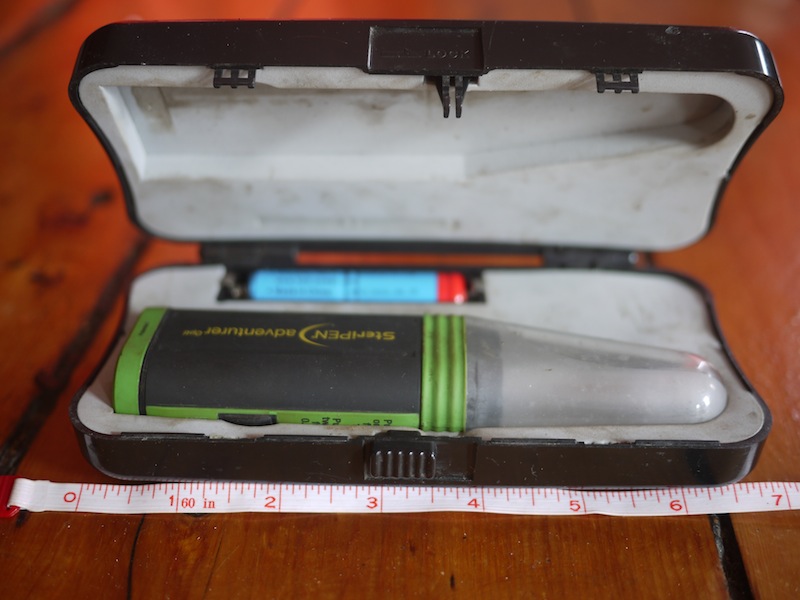
SteriPEN in solar case.

The success and attention surrounding SteriPEN lies in a breakthrough, and admittedly glitzy concept in water purification: the use of ultraviolet light from a handheld pen-shaped device to scramble the genetic material of water-borne pathogens, making them incapable of reproducing. This technology is a clean alternative to more traditional water treatment methods involving chemicals or filtration. The Adventurer Opti is the ultralight version of the SteriPEN and can be used with disposable or rechargeable CR123 Li-ion batteries. For those not keen on buying disposable batteries or relying on the power grid, SteriPEN makes a solar charging case exclusively for the Adventurer Opti.

The H2O Amigo occupies the more subdued realm of the gravity filter. Far from being on technology’s cutting edge, the gravity filter’s basic but effective design uses a water-holding bag that contains a filter with a small tube at the bottom for water output. The bag is filled, hung, and water moves passively from the bag, through the filter, and out to another bag or a drinking bottle for consumption. It’s essentially pump filtration without all the work of actually pumping.

SteriPEN vs H2O Amigo, a long distance hiker’s comparison - 2
Amigo full setup.

A quick-drying, lightweight SilNylon bag with durable drawstrings and a single open-ended output hose make the Amigo perhaps the most no-frills, elegantly designed gravity filter to date. Sadly, the Amigo is no longer in production by its manufacturer, Ultralight Adventure Equipment. MSR, Katadyn, Cascade Designs, and Sawyer Products sell their own gravity filters, but none match the lightweight simplicity of the Amigo. Used Amigos can still occasionally be found online, but these tend to be few and far between. More importantly though, the Amigo’s simple design and obtainable raw materials permit at-home construction. This subject has been discussed in great detail on BPL’s own forums.

The aim of this study was to compare the solar-powered SteriPEN Adventurer Opti with the H2O Amigo Pro for use in long distance hiking. Both devices were used alternately along 800 miles of the Montana section of the Continental Divide Trail from July 19 to September 28, 2010 to provide drinking water for a companion and myself. While one device was in use, we shipped the other ahead to a mail drop location. Once at the mail drop, we switched devices, shipping the other ahead to the next mail drop. Practical considerations for long distance hiking for each device were noted. These included observations and recorded data on each device’s weight, cost, performance, maintenance requirements, durability, and ease of lightweight modification. Temperatures ranged from the mid 80s to the mid 20s F. The Amigo was outfitted with a new Katadyn Hiker filter.

Results

Performance

A total of 71.5 liters of water were treated with the Amigo and 107.0 liters with the SteriPEN. We primarily sourced from clear bodies of water with good flow. We occasionally got water out of lakes or from cattle contaminated sources, but never needed to pre-filter. Except for the initial charge, which was done using the supplied power adapter, the SteriPEN was charged in the field using the solar charger. Batteries were not removed from the SteriPEN when placed into the bounce box for shipping.

SteriPEN vs H2O Amigo, a long distance hiker’s comparison - 3
SteriPEN solar case.

Speed and Water Quality

Both devices produced clean tasting water and neither of us became ill. They provided water in a timely fashion with neither exceeding two minutes per liter, unless the SteriPEN’s battery ran out mid-treatment. At the end of the trip, both devices were tested with clean tap water. The Amigo made one liter in 73 seconds and the SteriPEN in 93 seconds. Priming the Amigo’s filter by sucking water through the output hose was necessary in order to start the flow of water.

Convenience

We appreciated the hands-off nature of the Amigo. Being able to fill the bag and hang the Amigo from a tree branch or rock while we went about other chores or relaxed was a big plus. We did need to be careful to make sure our Platypus was placed carefully under the Amigo’s output hose so that it wouldn’t tip over as it filled. The SteriPEN, requiring constant stirring for about 90 seconds per liter, was obviously more hands-on. This was not too bothersome for small quantities, but when we wanted to make multiple liters, sitting and stirring started to become tedious and, in cold, wet weather, fairly unpleasant.

Since we carried small-mouthed collapsible 2L bottles, we were not able to treat our water directly with SteriPEN, which better accommodates a wide-mouthed receptacle. However, we were able to avoid packing an extra bottle by putting water to be treated in our cook pot, and treating the water there. We did find it somewhat inconvenient to have to dig out our cook pot each time we wanted to treat water.

SteriPEN vs H2O Amigo, a long distance hiker’s comparison - 4
SteriPEN in pot.

We found that the Amigo was easy to pack and I usually kept it near the top of my Granite Gear Vapor Trail pack. The SteriPEN, while in its charger case, was a little more cumbersome. As we were in Montana and thus often walking in partial or full sun, it made sense to carry the solar charging case outside and on top of my pack. The case was, however, sometimes a challenge to secure. The case’s plastic belt-style clip fit quite loosely onto my pack straps and was therefore not very reliable to use. I eventually settled on lashing the charger down using the two cross straps at the top of the pack, although this was still a loose attachment when my pack was not full.

We did not use the flashlight function on the SteriPEN.

Reliability

SteriPEN’s published manual advises users to remove batteries from the device when not in use. We learned this lesson the hard way. When putting the SteriPEN away for a few weeks, we failed to remove the batteries from the device. With the second set of batteries just partially charged, we found ourselves constantly changing the batteries back and forth when the device returned to use. The set of batteries that were inside the SteriPEN had mostly discharged, and the charge left in the second battery set was only enough to treat 3-4 liters. Coupled with a few cloudy days on the trail, we never were able to fully charge one set of batteries,and thus had to keep switching back and forth between partially charged batteries. We were not able to fully charge the batteries until we stopped in town for a few very sunny days.

SteriPEN vs H2O Amigo, a long distance hiker’s comparison - 5
SteriPEN on/off.

We did not have any reliability issues with the Amigo, except once when we left water in the device overnight and temps dropped below freezing. The next morning, we had to wait until the ice in the filter and hose thawed until we could treat water. From then on, we made sure to completely drain and dry (if possible) the Amigo each night.

Maintenance

The advantage to both devices is that they require very little maintenance. Because we used the Amigo in mostly clear water, we never needed to scrub the filter. With greater use, I expect we would have needed to scrub at some point. The SteriPEN required zero maintenance.

Durability

Despite both devices having sensitive components, neither broke or malfunctioned. For the SteriPEN, the sensitive component is the bulb, which is encased in glass. If this breaks, the only method of repair is to send the device back to the manufacturer. The SteriPEN took a tumble off my pack on several occasions, but was well-protected inside the solar charging case and no damage was done. The case itself began to show small signs of wear by the end of the trip as some of the inner padding near the latching mechanism began to get caught in the latch. With a few weeks remaining, the belt clip on the back of the case snapped off. This didn’t bother us because we found the clip to not be very useful in the first place.

The sensitive component of the Amigo is the SilNylon bag that holds water for filtering. The SilNylon is thin and thus susceptible to tearing on sharp branches. On a prior trip, I actually made a small hole in the bag this way, but was able to easily repair the bag with SilNet sealer.

SteriPEN vs H2O Amigo, a long distance hiker’s comparison - 6
Amigo Bag – a closer look.

Weight and Volume: (See Figure 1)

At 3.75 oz on a kitchen scale, the SteriPEN Adventurer Opti with a single set of batteries is significantly lighter than the Amigo, which comes in at 7.75 oz of dry weight. However, the solar charging case, with its necessary second set of batteries, brings the SteriPEN system up to 11.0 oz. This combination is .25 oz heavier than a soaking wet Amigo stored in its SilNylon carrying bag.

SteriPEN vs H2O Amigo, a long distance hiker’s comparison - 7
Figure 1

  Weight (oz)
SteriPen w/ single pair rechargeable batteries 3.75
Steripen w/ solar case and 2 battery sets 11.00
H2O Amigo, dry 7.75
H2O Amigo, wet 10.00
H2O Amigo, dry w/ bag 8.50
H2O Amigo, wet w/ bag 10.75

The H2O Amigo in its SilNylon bag compresses down to 75 in³ and takes up twice as much pack space as the 37 in³ solar charging case. This was a moot point for us as we carried the SteriPEN in its solar charger outside of my pack.

SteriPEN vs H2O Amigo, a long distance hiker’s comparison - 8
Amigo wrapped.

Cost (see figure 2)

While the SteriPEN with a solar charger is initially more expensive, the H2O Amigo Pro surpasses it in cost after approximately 2,500 liters of water has been treated. WAt this point the Amigo’s Katadyn filter will need to be replaced for a third time. Taking this into consideration, the SteriPEN becomes an increasingly better value for the amount of water treated. Interestingly, the H2O Amigo eventually even surpasses the cost of using the SteriPEN with disposable batteries.

SteriPEN vs H2O Amigo, a long distance hiker’s comparison - 9
Figure 2

  0L 1000L 2000L 3000L 4000L 5000L 6000L 7000L 8000L 9000L 10000L
SteriPEN Opti w/ Rech. Batteries $150.00 $150.00 $150.00 $150.00 $150.00 $150.00 $150.00 $150.00 $170.00 $181.88 $181.88
SteriPEN Opti w/ Disp. Batteries $100.00 $135.72 $173.32 $210.92 $248.52 $286.12 $323.72 $361.32 $418.92 $456.52 $494.12
H2O Amigo $50.00 $90.00 $130.00 $170.00 $250.00 $290.00 $330.00 $410.00 $450.00 $490.00 $570.00

Certain performance assumptions were made in these calculations. With the exception of liters water treated per charge for the SteriPEN, field-testing did not provide sufficient volumes of water to test capacities experimentally:

  • The SteriPEN rechargeable batteries die after 300 charges. Source: SteriPEN customer service. Field-testing on the CDT revealed that these batteries, new and fully charged, made 28 liters of water.
  • A pair of CR123 Li-ion disposable batteries are capable of treating 50 liters of water before needing replacement. Source: SteriPEN User’s manual.
  • The SteriPEN’s bulb requires replacement after 8,000 liters of water treated. Source: SteriPEN customer service and user’s manual.
  • The Katadyn filter is capable of treating 750 liters of water before requiring replacement. Frequent treatment of murky water and failure to periodically clean the filter will obviously shorten this lifespan. Source: Katadyn product manual.

Cost Assumptions (not including tax or shipping):

  • Disposable CR123 Li-ion batteries are purchased online in quantities of 50 at a cost of $46.99 ($1.88/pair). Each battery is 3V with 1300mAh capacity.
  • Replacement rechargeable batteries are purchased online in quantities of 2 at a cost of $11.88. Each battery is 3V with 650mAh capacity.
  • Replacement Katadyn filters can be purchased online at a cost of $40.00.
  • The SteriPEN bulb can be replaced by the manufacturer at a cost of $20.00.
  • A used H2O Amigo can be obtained online for $50.00.

Ease of Lightweight Modification

Although we chose not to modify either device on this trip, both devices lend themselves to some modification to drop weight. The Amigo’s output hose can be cut to a shorter length and the small plastic hose clamp removed. The cords that allow the Amigo to be hung can be cut and re-tied. On the SteriPEN solar charger, the clip can be removed. Otherwise, the SteriPEN itself is difficult to modify. The plastic cap that protects the bulb can be omitted, but this leaves the bulb vulnerable.

SteriPEN vs H2O Amigo, a long distance hiker’s comparison - 10
Amigo output hose.

Overall Impressions

We found that by the end of our trip we preferred using the H2O Amigo. This was based on the fact that by its hands-off nature, the Amigo, especially for treating multiple liters of water, was more convenient to use and we encountered fewer problems with reliability. Admittedly, the battery issue was our own fault, but we also value not having to worry about battery charges and changes on backpacking trips.

The added convenience of the Amigo, comes with a significant difference in monetary price. However, the long term savings associated with the SteriPEN currently adds a significant cost in weight, as the solar charger with its second battery adds an extra 7.25 oz, negating the SteriPEN’s weight advantage over the Amigo. With some design changes to the SteriPEN’s solar charging feature, this would be a closer call. Reducing the size of the charging case might be a possibility. Using a lighter material to make the case would be another. This would expectedly increase the cost of the case, but since the cost savings with the solar rechargeable feature is so significant, this might not be a tough sell. Finally, designing the solar charging case to charge the batteries while still inside the SteriPEN would reduce weight by eliminating the need to carry a second set of batteries. It would also add a considerable amount of convenience to the entire system.

Ten Days in Torres del Paine: Global Test Photo Essay

We discovered why Torres del Paine, Chile is the poster child for Patagonia’s wilderness playground.

Editor’s Note: click here to see all the articles (and a brief synopsis of each) in this excellent series.

The Global Test: Ten Days in Torres del Paine, Chile - 1

Introduction

Sapphire Dyneema Gridstop and a flash of bright yellow. The sight was so familiar to me, yet so unexpected. I elbowed Danny in the ribs. “Look, that guy has my same backpack!” I whispered and surreptitiously pointed three rows ahead.

As we funneled off the modern bus and lined up at immigration, I made sure to navigate towards the owner of this pack, as he was certain to be an interesting guy. We were 20 kilometers outside of Puerto Natales, crossing into Chile from Argentina, on our way to Torres del Paine National Park. Danny and I had been traveling for almost 3 months in Latin America and had yet to see the GoLite brand.

“I love your backpack!” I said to this tall, smiling stranger. He introduced himself as Steve, and we soon learned that he had finished thru-hiking the Appalachian Trail a few months earlier. As we helped our new friend eat the bananas and oranges that customs’ officials wanted to confiscate from his GoLite Pinnacle, we exchanged hiking tales and talked gear. He was on his way to Torres del Paine as well.

After two busy days of preparation, the three of us took the ferry across Lago Pehoé to begin our trek in the park. Steve was doing the classic “W” hike, as he only had four or five free days. Danny and I brought enough supplies for 10 days, and were planning to hike the “Q” route. After our last fresh meal for a while – avocado and tomato sandwiches – we said goodbye to Steve and promised we’d meet again.

Photo Essay

The Global Test: Ten Days in Torres del Paine, Chile - 2
Refugio Paine Grande. Kristin’s pack, Steve’s pack, Danny’s pack (left). Danny and Steve posing in front of a field of rental tents and Paine Grande (right).

The Global Test: Ten Days in Torres del Paine, Chile - 3
The first day we hiked up the Valle del Frances, from Refugio Paine Grande to Campamento Británico. Midway up the valley we stopped here, beneath Paine Grande, to have a leisurely lunch break while listening for glacier movement and watching for mini avalanches.

The Global Test: Ten Days in Torres del Paine, Chile - 4
Whereas most backpackers stop at the lower Campamento Italiano, which is usually overcrowded and heavily impacted, we hiked a bit further up to Campamento Británico. This was our view from camp of Aleta de Tiburon (Shark’s Fin), at the end of Valle del Frances (Frenchman’s Valley).

The Global Test: Ten Days in Torres del Paine, Chile - 5
Rather than descend back down Valle del Frances, we decided to hike further to see if we could traverse across a high pass. Behind Danny, and slightly hidden by clouds, are Cota 2000 and Catedral Peaks.

The Global Test: Ten Days in Torres del Paine, Chile - 6
We found one set of tracks in the snow that stopped before the pass. Near the top we realized that late spring conditions would prohibit us from continuing further. We weren’t prepared to circumnavigate the glacier in the saddle, as the snow obfuscated the edges. Kristin is shown here hiking underneath Fortaleza (Fortress).

The Global Test: Ten Days in Torres del Paine, Chile - 7
We returned down Valley del Frances and enjoyed the mellow hiking on this well-defined trail along Lago Nordenskjold.

The Global Test: Ten Days in Torres del Paine, Chile - 8
Leaving the open views of the lake behind, we turned into Valle Ascensio. The trail continued to gain elevation up to Campamento Torres.

The Global Test: Ten Days in Torres del Paine, Chile - 9
The next day, we awoke at 4:30am and hiked 45 minutes to this point, where we watched the first rays of the sun splash red hues onto the Torres del Paine.

The Global Test: Ten Days in Torres del Paine, Chile - 10
We spent a day hiking up Valle Ascensio and into Valle del Silencio, coming to a dead-end underneath the imposing Fortaleza and Escudo (Spanish for “fortress” and “shield”).

The Global Test: Ten Days in Torres del Paine, Chile - 11
Returning down Valle Ascensio, we followed the meandering trail along the Rio Paine. It took us to the backside of the range where we found a milder, greener landscape and fewer backpackers.

The Global Test: Ten Days in Torres del Paine, Chile - 12
After a week without precipitation, a rarity in Patagonia, this is probably the driest the trail ever gets.

The Global Test: Ten Days in Torres del Paine, Chile - 13
As we climbed higher towards John Gardner Pass, the trail disappeared under snow pack. We were able to navigate without any problems, thanks to the relatively clear weather. Our feet were wet after several hours of hiking on the snow in trail runners without gaiters. We were able to easily dry off and warm up at the next camp.

The Global Test: Ten Days in Torres del Paine, Chile - 14
After we hiked up and over the pass, we stopped in unison, awe-struck. Before us was the vast glowing beauty of Glacier Grey, a teeny, tiny tip of the Patagonian Ice Field. It was the most stunning vista we’d ever experienced.

The Global Test: Ten Days in Torres del Paine, Chile - 15
We descended from Glacier Grey to Refugio Torre Grande to complete the hiking loop. After picking up our small cache of food and fuel from the refugio, we continued hiking south. We crossed the Rio Grey, then hiked northwest to this point, where we admired the roar of the Rio Pingo Waterfall.

The Global Test: Ten Days in Torres del Paine, Chile - 16
Our final trek led us to the origins of Rio Pingo, where we enjoyed the solitude and understated power of Pingo Glacier.

The Global Test: Ten Days in Torres del Paine, Chile - 17
We packed up camp early on our last day and walked to Park Headquarters. While waiting for the bus back to Puerto Natales, we stretched out our worn bodies in the soft grass and enjoyed the warm sunshine.

Nine Days in Parque National Los Glaciares, Argentina: Global Test Photo Essay

In this Global Test Photo Essay, we arrived ill-equipped for a trek over an ice field. Setting up a base camp and sticking with day trips ensured that we didn’t miss out on one of the most beautiful parks in the world.

Editor’s Note: click here to see all the articles (and a brief synopsis of each) in this excellent series.

The Global Test:  Nine Days in Parque National Los Glaciares, ArgentinaThe Global Test:  Nine Days in Parque National Los Glaciares, Argentina - 1
Parque National Los Glaciares, Argentina

Introduction

What’s more ultralight than not carrying any pack at all? Such was my experience in Los Glaciares National Park in southern Argentina.

Our bus to El Chaltén, the village inside the park, made a mandatory stop at park headquarters. After a briefing in English given by eloquent park rangers, which highlighted safety and Leave No Trace practices, we were already impressed. Yet afternoon storm clouds had covered all of the towering peaks in the distance, and we we were unable to see the legendary Fitz Roy.

In the park office Danny and I studied the many detailed maps in different colors, dimensions, and resolutions. There was one large loop in the park, but one-fourth of the terrain crossed over the Patagonian Ice Field. We were not equipped for such an expedition. The rest of the trails mostly emanated from the main trailhead that started in town. We decided to make a base camp an hour hike from El Chaltén. From there, we would do day trips to the many glaciers. Additionally, resupplying from town would be quick and easy.

As it turned out, this was a smart decision. Patagonia weather can be unpredictable, so camping at a low elevation and in the trees helped seclude us from high winds and cold temperatures. We took advantage of the long Patagonia summer days, and never ran out of day light. Instead, sheer exhaustion sent us to bed. Because we traveled light, with a few extra warm clothes, a small med kit, and plenty of calories, we could travel fast and cover long distances.

We passed through several crowded camps on our day hikes, yet most of those hikers we did not see on the trails. Our hypothesis was that moving camps and carrying heavier packs discouraged trekkers from exploring beyond the main routes.

With one backpack, carried often by my personal sherpa, my husband Danny, I was able to backpack in one of the most beautiful parks in the world, without actually carrying a pack.

Photo Essay

The Global Test:  Nine Days in Parque National Los Glaciares, ArgentinaThe Global Test:  Nine Days in Parque National Los Glaciares, Argentina - 2
The town of El Chaltén is situated next to Rio de las Vueltas. It is the only entry point for all of the great hikes and climbs, including those to Fitz Roy and Cerro Torre.

The Global Test:  Nine Days in Parque National Los Glaciares, ArgentinaThe Global Test:  Nine Days in Parque National Los Glaciares, Argentina - 3
We set up a base camp in the protection of these wonderfully crooked trees, within view of Fitz Roy. Still, the winds were quite strong and kicked up a lot of dirt, often leaving a layer of dust on our gear inside the tartpent.

The Global Test:  Nine Days in Parque National Los Glaciares, ArgentinaThe Global Test:  Nine Days in Parque National Los Glaciares, Argentina - 4
Park rangers warned us that the trails were dangerous in certain sections, such as this path across a steep rock slide above Laguna Torre. We did see a few guided groups, but we felt comfortable navigating on our own.

The Global Test:  Nine Days in Parque National Los Glaciares, ArgentinaThe Global Test:  Nine Days in Parque National Los Glaciares, Argentina - 5
Cerro Torre, at 3128m, stands tall over Torre Egger, Punto Herron, Cerro Stanhardt (left to right).

The Global Test:  Nine Days in Parque National Los Glaciares, ArgentinaThe Global Test:  Nine Days in Parque National Los Glaciares, Argentina - 6
On a rare day like this, with clear skies and no wind, we stretched out our breaks so that we could further enjoy the majestic surroundings.

The Global Test:  Nine Days in Parque National Los Glaciares, ArgentinaThe Global Test:  Nine Days in Parque National Los Glaciares, Argentina - 7
Rock surfing next to Glaciar Piedras Blancas – another favorite lunch spot that we had all to ourselves.

The Global Test:  Nine Days in Parque National Los Glaciares, ArgentinaThe Global Test:  Nine Days in Parque National Los Glaciares, Argentina - 8
Typical ground-hugging vegetation in southern Patagonia.

The Global Test:  Nine Days in Parque National Los Glaciares, ArgentinaThe Global Test:  Nine Days in Parque National Los Glaciares, Argentina - 9
The ferocious wind made hiking difficult as we made our way up to Lago de los Tres. When we finally arrived, the lake was still frozen over and clouds obscured our view of Fitz Roy.

The Global Test:  Nine Days in Parque National Los Glaciares, ArgentinaThe Global Test:  Nine Days in Parque National Los Glaciares, Argentina - 10
On the descent from Laguna de los Tres, we enjoyed expansive views of smaller mountains and the Argentine steppe to the east.

The Global Test:  Nine Days in Parque National Los Glaciares, ArgentinaThe Global Test:  Nine Days in Parque National Los Glaciares, Argentina - 11
Snow covered mountains for as far as the eye can see. The rough waters are the only indication of the strong wind, given the calm appearance of the sky.

The Global Test:  Nine Days in Parque National Los Glaciares, ArgentinaThe Global Test:  Nine Days in Parque National Los Glaciares, Argentina - 12
Yvon Chouinard climbed Fitz Roy in 1968. Can you guess where he got the inspiration for the name and logo of his soon-to-be outdoor company?

The Global Test:  Nine Days in Parque National Los Glaciares, ArgentinaThe Global Test:  Nine Days in Parque National Los Glaciares, Argentina - 13
After resupplying in El Chaltén, we hiked south for our last trip: an overnight to Lago Toro. We were blasted by sleet and snow as we hiked over the pass.

The Global Test:  Nine Days in Parque National Los Glaciares, ArgentinaThe Global Test:  Nine Days in Parque National Los Glaciares, Argentina - 14
The weather improved the next day during our return hike, allowing us a memorable last view. The “light” at the end is Glaciar Rio Tunel. We camped nearby the spectacular glacier the night before.

The Global Test:  Nine Days in Parque National Los Glaciares, ArgentinaThe Global Test:  Nine Days in Parque National Los Glaciares, Argentina - 15
Cerro Solo. One last dramatic view before returning to El Chaltén, to catch a bus to Chile. Our amazing experiences in Parque National Los Glaciares set the bar high for our next trek in Torres del Paine.

The Global Test:  Nine Days in Parque National Los Glaciares, ArgentinaThe Global Test:  Nine Days in Parque National Los Glaciares, Argentina - 16

Food Planning Using Pounds Per Person Per Day

Calculating how much food to take on a trip? My goal is to be perfectly satisfied during my time in the backcountry, but to walk out of the mountains with absolutely ZERO food. It is so gratifying to eat that last raisin on the last mile of the last day. If I can do that, the math worked out perfectly.

You don’t have access to view this content.

Katabatic Sawatch 15 Quilt and Crestone Hood Review

Very warm, quality gear from a cottage manufacturer dedicated to innovative lightweight sleeping solutions.

Introduction

Katabatic Sawatch 15 Quilt and Crestone Hood Review  - 1
Sawatch 15 Quilt.

Katabatic Gear is a small cottage industry set up ‘to build the finest ultralight sleeping bags available,’ and the Sawatch 15 is their middle offering (they are working on a quilt for even colder conditions). While rated to 15 F (-9 C), they only call it their ‘three season workhorse.’ This has got to be different from some other bag manufacturers who notoriously hype their offerings to temperature extremes. The Crestone hood is described as ‘our warmest lightweight hood, ideal when extra head insulation is needed.’

Neither of these items feature any of the usual mass-market gimmicks, but the quilt does have an interesting method of stopping drafts from getting in at the sides: it has (patent pending) clips to hold the sides down onto strings tied around your air mat. Yes, they assume you will be using an air mat at the temperatures this quilt is designed for.

I field tested the Sawatch 15 and the Crestone Hood on a couple of trips in the Australian Alps during the winter and early spring. Unfortunately both trips had to be aborted part-way through, before I had done any serious photography, so many of the photos used in this review are derived from the Katabatic Gear website. Those photos have ‘KG’ in the corner. (The first ski trip was aborted as I needed stitches in my knee. The second trip was aborted as we could not cross the flooded rivers.)

We do not award the Highly Recommended rating lightly: gear needs to be very good to get this rating. However, you should remember that ‘highly recommended’ does not mean ‘perfect’ – no gear is ever perfect. I have commented on some fringe features, but commentary is not the same as criticism.

Technical Details – Sawatch Quilt

The fabric used in the quilt and hood is Pertex Quantum: none of your cheap Asian taffeta here. Trust me, it feels very nice. The goose down is rated at 850 loft on the enhanced IDFL USA scale, or 750 – 800 on the more realistic European scale. (The enhanced IDFL scale relies on an unrealistic conditioning process to get a higher score, principally for marketing purposes. Neither the birds nor the down has really changed, however.)

Katabatic Sawatch 15 Quilt and Crestone Hood Review  - 3
Details underneath.

The quilt is made with proper internal baffles and a differential cut. The foot end is closed into a footbox, which is really the only way to keep the bottom end of a quilt under control. They claim to have ‘overstuffed’ the tubes around the footbox so your feet are toasty, but I don’t think this is the best way to keep your feet warm. However, the weight of the extra down used is probably barely measurable, and perhaps it will help people with poor circulation.

Beyond the foot box (going towards the neck) the quilt opens up in the usual quilt manner, and a short way up there’s an adjustable webbing across the gap (yellow line at left). Personally, I think the buckle could be dispensed with, as I cannot see anyone doing much adjustment. The design simply does not allow for much sensible adjustment, but this does not affect the quilt.

Further up the sides again there are two sets of small plastic clips (red lines): these form the patent pending attachment which is meant to hold the edges of the quilt down to the mat. The picture helps tell the story. The idea is that these clips will hold the edges of the quilt down against the mat to prevent drafts. Since mats don’t provide anything to attach to, the quilt comes with two sets of string (one set is a spare) which you tie around the mat to make the anchorages. It is an innovative idea.

In addition, there are extra clips on the outside (top side) of the quilt in just a bit from the edge (green lines). The idea here is that if you are still getting drafts when using the clips on the edge of the quilt, you should switch to using the outer clips, leaving a sort of ‘baffle’ along the edge to block the drafts. Doing so reduces the width of the quilt a fair bit.

You might ask why not use tapes under the mat to hold the edges of the quilt down? Katabatic claim that using tapes under the mat leaves an air gap down the sides of the quilt which can let drafts in: ‘Your precious body heat is spent trying to warm this draft tunnel, which leaves less body heat for you.’ Instead, the clips allow the quilt to be tucked in much closer to your body. I’ll disagree with part of this: the energy required to heat the small volume of air is utterly trivial. However, if you toss and turn a bit, any air space could definitely be conducive to drafts. At -10 C (14 F), drafts are definitely to be avoided. On the second trip to the mountains, I did not always bother with the strings around the mat, relying instead on my experience with a quilt to avoid getting drafts at the sides. That made it easier to get under the quilt, as seen in the first photo below. More on this in a moment.

Katabatic also claim that tapes under the mat ‘can also cause compressed insulation at your shoulder and hip. All this conspires to leave you cold.’ That is because the tapes tend to stretch a narrow quilt across your body. I will only partly go along with this idea: the use of a differential cut should prevent any squashing of the down over the high point of your body. However, quite often ‘should’ does not work too well in the middle of the night when the quilt is only just wide enough. What may be more important here is that this quilt is wide enough to avoid drafts.

I have to mention here that my normal three-season quilt is much wider than this one, so the problems described don’t happen with it. Frankly, I think that you might get more joy from adding 6 inches of extra width to your quilt than any fancy methods of holding the edges down. Having a wide quilt means I can drape it partly over my wife when the nights are very cold and share warmth with her. Of course, such extra width does mean extra weight, so things are not that simple, and the Katabatic solution does work. Please note that I am not implying that this quilt is too narrow: that is not part of my field observations.

Katabatic Sawatch 15 Quilt and Crestone Hood Review  - 4
About to go to sleep.

Katabatic Sawatch 15 Quilt and Crestone Hood Review  - 5
The neck muff.

The top end of the quilt has two interesting features. The first is that the corners of the quilt can be connected under your neck to bring the quilt around your neck and shoulders. That gives it a ‘bag’ type of neck. You can see the single snap used in the above photo. There is also a draw cord around the neck which can be tightened once the snap has been done up. The second feature is based on the first: there is a down baffle or ‘neck muff’ around the neck to block drafts. This would be relatively useless if the top was just open like a quilt on a bed, but we all know that neck muffs are quite popular on warmer sleeping bags. It works fine here.

The Sawatch 15 does not have an attached hood. Personally, I like an attached or integral hood on my quilt: my head goes under it and I can manipulate it however I want. Instead, Katabatic offer the Crestone hood or the Windom hood. How well this works is discussed later.

Katabatic Sawatch 15 Quilt and Crestone Hood Review  - 2
Crestone Hood.

Finally, in a very nice touch, the quilt comes with its own large cotton storage sack, to keep it clean at home.

Technical Details – Crestone Hood

The Crestone hood is the top of the Katabatic line of hoods, with almost double the amount of down compared to the Windom. It looks just like a conventional balaclava with a longish neck region, but with a rather small opening for the face. It has a draw-cord around the face and two detachable loops of light cord going from the front to the back. These hook under your arms to keep the hood on your head.

Katabatic do make a ‘lighter’ hood with a larger opening for the face. I mention this here for reasons which will soon become apparent.

Field Assessment – Sawatch

Frankly, hauling the Sawatch out of the stuff sack I was using for it each evening was a pleasure. It feels nice, and I knew I would be warm under it.

The overstuffed footbox worked fine, although I have a bit of a bias against believing the usual footbox marketing spin. My experience has always been that having a good dinner, a good mat under me, a warm head and no restrictions around my legs is usually quite enough. Yes, I have tried breaking each of those rules, and I regretted it every time. But anyhow, under the Sawatch, my feet were always warm with or without socks. The photo here was taken early in the morning in a mountain hut: nice morning sun, but those metal huts do get cold overnight!

Katabatic Sawatch 15 Quilt and Crestone Hood Review  - 6
Early morning in a mountain hut.

The tape across the gap worked fine. As mentioned above, it does not seem to warrant the buckle for adjustment. But of course, it works with no attention.

I am in two minds about the clips which fasten onto the string around the mat. Yes, I found that they do work to keep the edge of the quilt down, but… First of all, with both sets (call them top and middle) done up, it is a bit hard to sit up. The top clips drag the mat up as well. Also, once or twice I did notice the clips under me. I am not sure why, because with a bit of a shove and a wiggle the clips ceased to be noticeable.

Second, doing up the clips was always a bit of a hassle at the last minute. There I am, lying down in the dark, and I have to hook the clips onto the string – if I can find the clips and the string. First find a clip, then find the opening in the clip, then find the string. Sometimes I succeeded, sometimes I just didn’t bother, as shown in the previous photo. My wife reckons I fall asleep very quickly in the evening.

I am sure the top clips came undone from the string a couple of times. I thought I had done them up before going to sleep, but at least one of them was undone in the morning. Eventually I reached a compromise with the clips when I used them: I did up the bottom clips before I lay down but not the top clips. This seemed to work fine.

It is worth emphasising a point here: even without the clips the quilt was wide enough to keep me nicely warm. That means that the ‘system’ is not critically dependent on the clips. I doubt very much that the clips would break under normal field use: the plastic is of a high quality. But even if one did break, it would not be a disaster. In addition, as mentioned below, the latest model of the Sawatch has a backup for the clips.

I mentioned the width of the quilt above. With the clips all done up I didn’t experience any draft, so I didn’t need to resort to the outer set of clips (the ones with the green pointers). Personally, I doubt they are needed – at least for someone as slim as me (62 kg). And yes, I did find the quilt wide enough that I didn’t have any problems with drafts when I turned over – even without the clips. Mind you, I am not a ‘clutcher’ – when I turn over, I do so under the quilt, leaving it in place. It’s practice: you wake up about 10% and turn over, then relax back to sleep.

The neck opening on the unit I had for testing proved less successful. It was very nice when done up around my neck, with the baffle stopping drafts, but the snap came undone rather easily. Doing the snap up in the middle of the night was never easy. I found this a bit frustrating, but see below for what Katabatic have done to fix this.

Katabatic Sawatch 15 Quilt and Crestone Hood Review  - 7
New snaps on neck.

So a preliminary assessment is that the quilt is very nice and warm, but the technical features didn’t seem entirely successful on the unit I tested. However, Katabatic were aware of these problems and the company sent me an update, which I will quote in full. The new features should be current by the time you read this.

  • Elastic binding around the bottom opening prevents possible gaps and drafts and stabilizes the cord clips, keeping them more securely attached to the cord.
  • Webbing straps and attachment loops in addition to the cord clip attachment system allows bag to be used like a traditional quilt-style bag and allows the option of being used without a sleeping pad.
  • Two snaps at neck closure with reinforced material [see photo to right] provides more overlap for a better sealing collar and improves long term durability in this high strain area.

Total increase in weight for all this was estimated by Katabatic at about 0.5 ounce. I am not sure about the need for the first two modifications, but the double snaps will definitely give an improvement in holding power. (Double snaps seem to give more than just twice the holding power – something to do with how the pull is aligned with the snaps.) I think the double snaps solve the only significant criticism I had, and they are responsible for changing my initial rating from ‘Recommended’ to ‘Highly Recommended’.

Field Assessment – Crestone

Katabatic Sawatch 15 Quilt and Crestone Hood Review  - 8
Small opening on Crestone hood.

There is no question that the Crestone hood is suitable for very cold weather. But therein lies a problem: it is sometimes too hot and sometimes the wrong shape.

Above about -10 C (14 F), I found it rather too warm. This created two problems in the field. The first was that face opening is fixed and not large. There is no way to vent this hood. The second is that this warmth means I need to carry a lighter hood or head covering as well, for those nights or times when the Crestone is too hot, but going bare-headed is too cold.

A subsidiary problem is that the face opening is small. I tried to eat dinner with this hood on, but the risks were just too high. I did not want stew all over the hood (from dripping off the under-side of the spoon!). This is another reason why this hood alone is not enough kit even in fairly cold weather: it may be good for sleeping, but not for dinner time.

Unfortunately the seam is at the back, or I might have unpicked it and added some Velcro to make a closure. It would still be possible to do this if you are willing to cut the fabric and handle the down. There’s lots of it in there!

I had no problems with the loops under the arms. They seemed a bit strange at first, but I think I forgot all about them five minutes later. I also tried sleeping without putting the loops under my arms, and that worked as well. The shape of the hood meant it did stay aligned with my head when I turned over. I didn’t need to adjust the lengths of the under-arm draw-cords: I left them at full length. I didn’t find any need to tighten the face draw-cord either, although I did not get down to extremely cold conditions.

The above might sound like criticisms of the hood, but really they are more comments about the philosophy of ‘flexibility.’ The reality is that you cannot expect to use the same gear over the full range from -30 C to 10 C (-22 F to 50 F). The Crestone is a lovely hood for really cold weather, but most people just won’t need it. Frankly, I would suggest that most people would be better served by the lighter Windom hood with its larger face opening. It would be warm enough. In mild conditions a fleece hat might do well enough, but that is outside the scope of this review.

I do suggest that Katabatic should consider making the front of their hoods openable under the chin, or perhaps offer a similar model which does open under the chin. That would solve a lot of problems.

Summary

This is all high-class gear. The version of the Sawatch 15F which I field tested had one minor nit (the snap) which needed fixing, but the nit seems to be largely fixed in later models. The Crestone hood is hot, and you should seriously consider whether you need something that warm. If you do, then no question! A model with an opening under the chin would be nice, and yes, I will be using these items on snow trips in the future.

The Sawatch may be compared to the GoLite UltraLite 3-Season quilt or the Nunatak Arc Alpinist. The figures quoted here for the latter two are from their websites and are for the Regular/Medium sizes, to match the Sawatch tested. Exact matches between brands are never possible, of course.

  Sawatch UltraLite 3-Season Arc Alpinist
Weight 24 oz (690 g) 24 oz (690 g) 20 oz (570 g)
Height to 6 ft to 6 ft to 5 ft 10 in
Girth 52 in 56 in 55 in
Rating 15 F (-9 C) 20 F (-7 C) 20 F (-7 C)
Neck Muff Yes No No
Down 850 FP 800+ 800+ FP
Fill Weight 15 oz (425 g) 11.8 oz (335 g) 11 oz (312 g)
Loft 3.25 in (82.5 mm) 2.5 in (63.5 mm) 2.5 in (63.5 mm)
Outer Shell Quantum 0.85 oz 15 denier nylon Quantum
Inner Shell Quantum Taffeta 22 denier polyester 20 denier nylon taffeta
Hold-down Clip system 2 straps 2 straps
Price US$370 US$275 US$426

None of the companies state on their websites how the temperature rating for their quilts have been tested: to the reliable EN13537 standard or to some other standard.

The Sawatch is narrower than the other two, but the patent pending clip system used on it seems to be very capable of stopping any side drafts. The difference in width is not great, in any case.

Technical Details

Sawatch 15F Manufacturer claims BPL measurements
Size Regular (to 6 ft or 1.83 m)  
Shell Fabric Pertex Quantum Ripstop .85oz/sqyd  
Liner Fabric Pertex Quantum Taffeta 1.0oz/sqyd  
Weight 24 oz (680 g) 24.2 oz (686 g)
Down 850 loft goose down (USA scale)  
Fill weight 15 oz (425 g)  
Loft 3.25 in (82.5 mm)  
Length 72 in (1.83 m) OK
Shoulder Width (max) 52 in (1.32 m) (>50 in)
Packed size 8 x 14 in (200 x 355 mm)  
Stuff sack 0.64 oz (18 g)  
Price US$370  
Notes: Manufacturer weights are accurate. Length, width and loft depend on how tightly you stretch the fabric.

Crestone Manufacturer claims BPL measurements
Size Just one  
Shell Fabric Pertex Quantum Ripstop .85oz/sqyd  
Liner Fabric Pertex Quantum Taffeta 1.0oz/sqyd  
Weight 2 oz (57 g) 2.08 oz (59 g)
Down 850 loft goose down (USA scale)  
Fill weight 0.9 oz (25 g)  
Price US$79  
Notes: Manufacturer weights are accurate. Length, width and loft depend on how tightly you stretch the fabric.

Disclosure: The manufacturer provided this product to the author and/or Backpacking Light at no charge, and it is owned by the author/BPL. The author/Backpacking Light has no obligation to review this product to the manufacturer under the terms of this agreement.

Small Wonders of Latin America – Global Test Photo Essay

In nine months backpacking around Latin America, there was much grandeur to be seen, but there were also tiny treasures that required a closer look. Examine their petite beauty.

Editor’s Note: click here to see all the articles (and a brief synopsis of each) in this excellent series.

Introduction

As soon as I fall into my hiking stride, I enter a state of rhythmic and peaceful calm. I am only half aware of the nature that surrounds me, the texture of the trail changing underfoot, and the tempo of my inhalations. All I can sense is tranquility.

Rarely do I think about taking photos while hiking. No photo has ever been able to fully capture the joy I experience in nature. Photographs, however beautiful they might be of the landscape, fail to arouse the overwhelmingly positive sensory assault I have while hiking.

When I look back at photos taken during backcountry trips, my memories of the events are colored. Instead of recalling a variety of feelings and views, sounds and smells, my vibrant memories get intertwined with these static snapshots.

How I manage to backpack with Danny is somewhat of a mystery. His feeling about photography couldn’t be more opposite than mine. He is constantly breaking his stride to take photos, often asking me to stop with him and sometimes even pose. He can spend days organizing and editing photos once we return to civilization. Danny loves the wilderness just as much as I do, but also finds great joy in sharing our adventures with our friends and families.

Fifteen countries and more than a year later, I am grateful that Danny has encouraged me to be more open about photography. We have simply seen too much and experienced too much to store it all away in our fallible human memories. Every day of traveling is different, and the lack of monotony in daily life means we have little downtime to think, process, and store.

The photo collection below is a but a tiny sample of the many small wonders we saw during our nine months backpacking around Latin and South America. I am happy that Danny encouraged me to stop and examine the petite beauty contained on a continent that I might not ever visit again. I even admit, I might have taken one or two of the photos myself.

Small Wonders of Latin America - Global Test Photo Essay - 1
Rucu Pichincha Volcano (4,698m or 15,143ft), near Quito, Ecuador.

Small Wonders of Latin America - Global Test Photo Essay - 2
Cordillera Real, Bolivia.

Small Wonders of Latin America - Global Test Photo Essay - 3
Parque Nacional Corcovado, Osa Peninsula, Costa Rica.

Small Wonders of Latin America - Global Test Photo Essay - 4
Machu Picchu, Peru.

Small Wonders of Latin America - Global Test Photo Essay - 5
Ruki Pichincha Volcano, Ecuador.

Small Wonders of Latin America - Global Test Photo Essay - 6
Foz do Iguaçu, Parque Nacional do Iguaçu, Brasil.

Small Wonders of Latin America - Global Test Photo Essay - 7
Parque Nacional Chirripó, Costa Rica.

Small Wonders of Latin America - Global Test Photo Essay - 8
Illiniza Norte Volcano, near Machachi, Ecuador.

Small Wonders of Latin America - Global Test Photo Essay - 9
Washed-up coral on Playa Blanca, Parque Nacional Caroles del Rosario, Cartagena, Colombia.

Small Wonders of Latin America - Global Test Photo Essay - 10
Reserva Natural Dos Brazos, Osa Peninsula, Costa Rica.

Small Wonders of Latin America - Global Test Photo Essay - 11
Parque Municipal da Lagoinha do Leste, Florianopolis, Brasil.

Small Wonders of Latin America - Global Test Photo Essay - 12
Parque Nacional Corcovado, Osa Peninsula, Costa Rica.

Small Wonders of Latin America - Global Test Photo Essay - 13
Ruki Pichincha Volcano, Ecuador.

Small Wonders of Latin America - Global Test Photo Essay - 14
Near Glaciar Rio Tunel, Parque Nacional Los Glaciares, Argentina.

Small Wonders of Latin America - Global Test Photo Essay - 15
Cerro Morado, Andes, near Santiago, Chile.

Small Wonders of Latin America - Global Test Photo Essay - 16
Ruki Pichincha Volcano, Ecuador.

Small Wonders of Latin America - Global Test Photo Essay - 17
Scorpion near El Mirador, El Peten, Guatemala.

Small Wonders of Latin America - Global Test Photo Essay - 18
Concepción Volcano, Isla de Ometepe, Nicarauga.

Winter ISPO 2011: Day 4 – Technical Treats

Stoves, shovels, poles, crampons, harnesses, and more: oh my!

Editor’s Note: Read all the articles in this series:

Introduction

Since ISPO is a winter trade show, the focus is on snow and ice activities, as well as garments that insulate and protect. By now you may have had your fill of down jackets and 7-ounce smocks. So today we bring you some of the more technical gear from the show. Unfortunately, we did not discover anything new in lightweight shelters. We hope you find something interesting in the following run-down of stoves, shovels, poles, crampons, harnesses, and more!

Soto

The Japanese stove company Soto has made a splash in the backpacking world with their cold-weather worthy OD-1R Micro Regulator Canister Stove (74g/2.6oz). However, they have a new product that may cause many backpackers to rethink their opinion of the liquid fuel stove.

Winter ISPO 2011: Day 4 - Technical Treats - 1
The good people at Soto gave us a full demonstration of the new OD-1NP Muka Stove, due to hit shelves in March. The stove atomizes liquid fuel, so there is no need for priming (there’s not even a priming cup!). Flame control and simmering is actually possible. There is an air release button to eliminate fuel from the fuel line, used when turning the stove off. Flame control is on the pump, which minimizes the risk of hand injuries. The pump is mostly made of aluminum, has a pressure indicator, an emergency stop button, and other innovations. The stove burns all types of fuels, burns with less soot, is lighter and packs smaller, and has a more stable pot support than the standard liquid fuel stove. Basically, it fixes all of the common gripes about liquid fuel stoves. We wouldn’t have believed this if we didn’t spend 25 minutes learning about and playing with the stove, which was burning unleaded auto gasoline!

The stove weighs 160g/5.6oz, and the pump weighs 160g/5.6oz. The pump is only compatible with Soto fuel bottles, which are also new and have been specifically designed for this stove. The cost in the US will be US$150; prices elsewhere will vary. Photos of the actual stove were not allowed.

Providus

Speaking of stoves: Providus is an 83-year-old manufacturing company in Italy that was displaying a few of their camping items, like lightweight aluminum canteens, aluminum stoves and… the world’s lightest canister stove?

Winter ISPO 2011: Day 4 - Technical Treats - 2
The FM300G is a 90g/3.2oz aluminum stove that looks like a lot of other stoves on the market. Almost hidden in the display case was a titanium version (pictured above) of the FM300G that weighs 63g/2.2oz. The display case was sealed, so we couldn’t take a closer look at the stove. Cost, availability and details were unavailable, even after multiple inquiries. We are waiting to receive the product catalogue through e-mail.

Dynafit

This Italian company focuses on ski racing gear.

Winter ISPO 2011: Day 4 - Technical Treats - 3
For ski racers, Dynafit will be making the Broad Peak Ski Poles (190g/6.7oz per pole). These are adjustable, two-section, all carbon poles with baskets and wrist straps. These pretty pieces will set you back 500€ (US$684) per pair when they become available next fall.

Winter ISPO 2011: Day 4 - Technical Treats - 4
The Broad Peak will use Dynafit’s newly developed Safety Snap. To adjust pole length, flip open the lever and slide to the newly desired height until you feel a divot, then close the lever. The poles have slight indentations every few centimeters and the Safety Snap aligns with these indentations to provide 100% slip-free security. So, it’s a discrete adjustment, not continuous like Black Diamond’s Flick Lock.

Fizan

Fizan is an Italian company that has been making poles since 1947. They were the first manufacturer to make aluminum ski poles, and they still make a wide variety of trekking and skiing poles in their factory in northern Italy.

Winter ISPO 2011: Day 4 - Technical Treats - 5
Fizan claims that the Compact are the lightest three-section telescopic poles in the world at 158g/5.57oz per pole. These trekking poles have EVA grips, carbide tips, neoprene wrist straps and removable 50mm baskets. The poles use very thin 7001 aluminum and adjust from 58-132cm. Fizan poles are available in 30 countries, including most of Europe, Australia, New Zealand, parts of South East Asia, and Kazakhstan. But not the US. The cost is 60-70€ (US$82-96.

Grivel

Founded in 1818 and located at the foot of Mt. Blanc, Grivel is one of the oldest mountaineering brands and is well-known around the world. What may not be so well-known is the great efforts of the company to protect the environment. Grivel’s entire factory roof is covered with 7000m² of solar panels and is able to produce more energy than it consumes.

Winter ISPO 2011: Day 4 - Technical Treats - 6
We wrote about the Climbing Technology ASD ice axe and shovel combo on Day 1 of ISPO. A fellow BPL reader brought our attention to the Steel Blade (398g/14oz), which is similar in concept and has been on the market for two years. Lighter snow shovels may exist, but this versatile design is notable for three things. First, the shovel can be used with a regular Grivel ice axe (above right) or a standard handle (above left). Second, the shovel blade can be effectively used without a handle (above center). Third, the shovel is made from plastic, but has a steel blade (hence the name). Using plastic in the shovel body saves weight and allows for more intricate forms. The steel blade cuts into hardened snow better than plastic or aluminum. The Steel Blade retails for 45€ (US$70).

Kohla

This Austrian company manufactures snow sport equipment like avalanche shovels, ski skins, and packs.

Winter ISPO 2011: Day 4 - Technical Treats - 7
Another shovel variation: the X-Light Shovel (weight unknown) has a novel feature in that the handle can be easily and securely inserted into the blade (top right). This would be handy when digging snow caves and quinzees. This shovel is available now throughout Europe for around 50€ (US$68).

Arva

Arva is a French company that specializes in avalanche safety equipment.

Winter ISPO 2011: Day 4 - Technical Treats - 8
The Snow Pure Light (295g/10.4oz) shovel has a carbon fiber shaft and polypropylene blade. This shovel is ISMF certified and will be available in September for 70€ (US$96). Arva products are available in 34 countries, including most of Europe, parts of South America, India, New Zealand, Canada, and the US (through Wasatch Ski Distribution).

Winter ISPO 2011: Day 4 - Technical Treats - 9
The Snow Pure Light is reinforced with aluminum pieces on the blade and on the back where it connects with the shaft. The shaft is 44cm and the total length of the shovel is 59cm.

GV Snowshoes

Continuing with our carbon fiber theme, we came across the company GV Snowshoes, which has been making snowshoes in Quebec, Canada for 50 years.

Winter ISPO 2011: Day 4 - Technical Treats - 10
The Carbon Tech Snowshoe has a one-piece frame and Entech deck. The snowshoes have been around for a few years, but this newest version has moved to an all-carbon frame, with the addition of a front toe stopper and padding on the front straps to reduce foot pressure. It also features buckles made from only two molded pieces of polycarbonate material that is 40% lighter. There is a heel lifter too. All components are tested to work down to -50C/-58F. The 20x61cm/8x24in version is 2130g/4.69lb and the 20x73cm/8x29in model is 2240g/4.94lb. These sell for US$280, CAN$300, or 350€. These snowshoes are widely available in Europe and Canada, and in the US through Cabela’s.

CAMP

Our search for ultralight technical gear led us back to our friends at CAMP.

Winter ISPO 2011: Day 4 - Technical Treats - 11
The Race 290 (290g/10.2oz per pair) are super minimalist 10-point crampons that require Dynafit-compatible ski boots. These aluminum wonders are color coded to be easily distinguished from each other – orange is left foot, black is right foot. The removable anti-bot plate is included and weighs a few extra grams. These will be available in September for 143€ (US$196).

Winter ISPO 2011: Day 4 - Technical Treats - 12
The Race 290 uses webbing instead of a metal bar to connect the front and back plates. The crampons have a much smaller volume when compacted. CAMP wins points for having the ONLY scale in the entire show.

Winter ISPO 2011: Day 4 - Technical Treats - 13
CAMP also debuted their new Blitz Harness (205g/7.2oz). This ski mountaineering harness is made from hydrophobic fabric, has buckle leg loops, and four gear loops. This barely edges out Black Diamonds Couloir Harness (230g/8oz) as what may be the lightest mountaineering harness on the market. The Blitz will be available in September for about 60€ (US$60-65).

Winter ISPO 2011: Day 4 - Technical Treats - 14
For those of you who haven’t yet seen CAMP’s really light harness, here it is: the Alps 95 (95g/3.35oz), the lightest UIAA-certified harness is the world. This gossamer beauty is made for randonee racing, and as such, has only two micro gear loops. Each gear loop is big enough to hold one carabiner. The Alps 95 is available now for 45-50€ (US$50).

On The Softer Side of Things

Companies are really experimenting with different types of blended fabrics. On Day 2 of ISPO we reported about Rab’s new 65% merino wool / 35% Cocona blend. Today we stopped by Icebreaker and learned about their GT line which incorporates 3% Lycra into their merino wool products. Icebreaker is adamant about not increasing the synthetic composition of their garments any further than 3%. For comparison, SmartWool garments range from 75-100% merino wool.

Winter ISPO 2011: Day 4 - Technical Treats - 15
Devold’s Active Line uses 54% Thermocool, 37% wool, and 9% polyamide. The Thermocool is on the inside of the garment, which helps channel moisture away from your skin, to the wool layer on the outside. You can see the two layers in the photos above: the Thermocool is light grey, and the wool is black. Additionally, this unique garment also has wind-blocking fabric in the front. This piece is named the Active Man Boxer with Windblock, and the fabric is 205g/m².

Winter ISPO 2011: Day 4 - Technical Treats - 16
The Air Vest, also by Devold, has a windblocker membrane sandwiched between two layers of wool. The complete fabric is 420g/m². This unique vest will be available in August in Europe for 200€ (US$274).

Winter ISPO 2011: Day 4 - Technical Treats - 17
Klättermusen makes three jackets that utilize organic cotton with fluorocarbon-free impregnation that make a highly water resistant shell which is ten times more breathable than eVENT. The crew at Klättermusen are devotees of the jackets, but also admit it’s a hard sell to a public that wants high tech clothing to match their high tech gear, especially when this company is going against market giants like Gore-Tex. The Einride Jacket (560g/19.75oz) is available now for 365€ incl. 25% VAT in Sweden (US$500).

And Finally, A Question of Style Versus Utility

Winter ISPO 2011: Day 4 - Technical Treats - 18
Jackets with angled front zippers were a fairly common sight throughout the show. The benefit is clear – the zipper is moved away from the wearer’s chin. However, it remains to be seen whether this is done for comfort or style, and whether this trend will (or has?) spread beyond Europe.

That wraps up our coverage of four days at ISPO here in Munich, Germany. We hope you enjoyed reading about these new products and innovations.

We’d like to thank Will for helping us prepare for this event, and Addie for doing such a fabulous job making the information available to the Backpacking Light community.

Winter ISPO 2011: Day 3 – A Smorgasbord of Worldly Flavors

From practical (bras) to indulgent (a back-country electronics charger) to “they can do new things with zippers?”, the ispo show floor has it all.

Editor’s Note: Read all the articles in this series:

Aclima – Wool design innovation

Aclima is a Norwegian company that has participated in the textile industry since 1922. The company focuses on sports-underwear that is elegant, warm and soft, breathes, and does not hold odors. All products are available now in Europe. US and UK customers may be able to purchase through NordicOutdoors.

Winter ISPO 2011: Day 3 - A Smorgasbord of Worldly Flavors - 1
Most unique about Aclima is their WoolNet line, which is mostly composed of 100g/m² wool netting. The netting gives the garment maximum breathability for active sports. When the activity is stopped, donning another layer on top (like a windshell) maintains a blanket of air next to the skin. The mesh effectively acts like mini baffles for an outer garment. Ultralight wool (130g/m²) is placed around sensitive areas, like the joints, neck, and private parts. The garments are also available in the lighter synthetic CoolNet line, using 100g/m² polypropylene.  Left: Women’s Polo with Zip, 205 grams (7.23 oz), 62€ (US$85). Right: Women’s ¾ Longs (Knee Pants), 121 grams (4.27 oz), 56€ (US$77).

Winter ISPO 2011: Day 3 - A Smorgasbord of Worldly Flavors - 2Men’s Hood Sweater, 337 grams (11.89 oz), 72€ (US$98). It has thumb loops, long arms, a hand warmer pocket, and snug fit. It comes in a women’s version, as well.

Winter ISPO 2011: Day 3 - A Smorgasbord of Worldly Flavors - 3
The zipperless hood can be worn in three different ways, as shown above.

Winter ISPO 2011: Day 3 - A Smorgasbord of Worldly Flavors - 4
From left: Sports Top, 84 grams (2.96 oz), 54€ (US$74), racerback design, no adjustable straps. Nursing Bra, 63€ (US$86). What’s more ultralight than producing your backpacking companion’s food? Wool’s naturally anti-bacterial properties are perfect for this application. Sports Bra with Zip, 93 grams (3.28), 62€ (US$85), for women needing more support.

Millet – YKK compatible

Started in 1921, the French company Millet is one of the most established mountaineering companies in Europe. Several of their products are available in the US through internet-based sellers and specialty climbing shops.

Winter ISPO 2011: Day 3 - A Smorgasbord of Worldly Flavors - 5
The LTK Shadow (300g/10.6oz) is a concept piece that was premiered at ISPO. The jacket is made from Gore-Tex Pro and has waterproof zippers, one large chest pocket, hem drawcord, extra-long arms, and helmet-compatible hood. The price is not set and the smock won’t be available until summer 2012.

Winter ISPO 2011: Day 3 - A Smorgasbord of Worldly Flavors - 6
The LTK Shadow is the first shell to use a new type of zipper, where the coil is sewn directly to the garment. Millet and Mammut worked together with YKK to develop this ultra light zipper, and only these two companies will be allowed to use it. This photo shows the detail of an opened chest pocket.

Winter ISPO 2011: Day 3 - A Smorgasbord of Worldly Flavors - 7
The Radikal Speed (420g/14.8oz, 150€/US$165) is a very light approach shoe that is as burly as any boot. It uses Boa lacing system and has tons of protected mesh on the top of the foot for enhanced breathability. These might suffice as a substitute mountaineering boot for some users and are available now.

Lurbel – from Spain

For 22 years Lurbel has extensively researched and developed high-quality technical garments. We were drawn to their claims of accelerating the curing of injuries and blisters with their Regenactiv sock.

Winter ISPO 2011: Day 3 - A Smorgasbord of Worldly Flavors - 8
Non-Regenactiv socks start at 10€ (US$14), underwear at 27€ (US$37),and baselayers at 45€ (US$61). Garments in the Regenactiv range sell for about 30-50% more.

Winter ISPO 2011: Day 3 - A Smorgasbord of Worldly Flavors - 9
A description of the Regenactiv design. Lurbel makes garments with synthetic or wool as the third layer.

Power Traveller – When you can’t escape technology

Winter ISPO 2011: Day 3 - A Smorgasbord of Worldly Flavors - 10
The powermonkey-eXplorer, (65€/US$89), provides a little bit of juice in remote locations. The battery weighs 83 grams (2.93 oz), and plugs into standard mobiles with the maximum power out of 96 hours. Additional connector tips for other devices are available. The solar portion weighs 82 grams (2.89 oz) and can charge the battery while strapped to your pack, as long as there is plenty of sunlight. Power Traveller is a UK company and is currently interested in distribution in the US.

Devold – More established than 19 States

The Norwegian company Devold has been producing high quality wool clothing since 1853! We were pleased with their selection of women’s garments.

Winter ISPO 2011: Day 3 - A Smorgasbord of Worldly Flavors - 11Pulse Bra (left), 22€ (US$30), 230 g/m² merino wool, racer back design, adjustable straps, available in March 2011 Wool Fleece Bra (right), 20€ (US$27), designed for winter use with 470 g/m² wool inner, fleece outer, available now

Winter ISPO 2011: Day 3 - A Smorgasbord of Worldly Flavors - 12Pulse Woman Strap Top (all), 44€ (US$60), and Hipster (middle), 19€ (US$26), 230 g/m² merino wool, available in March 2011

Devold has their own factory in Lithuania and owns wool farms in Australia and Tunisia. They previously had distribution in Colorado and Minnesota but several years ago made the choice to focus their brand in Scandinavia and other European regions. They would like to enter the US market once again and are currently expanding their factory to create the quantity needed for increased distribution.

Alpinist – Picnic for two, please

Alpinist is a South Korean manufacturing company.

Winter ISPO 2011: Day 3 - A Smorgasbord of Worldly Flavors - 13
The Picnic Mat is a two-person closed-cell foam pad. The design is similar to the Therm-a-Rest Z-rest, though a bit thicker and more structurally rigid. It appealed to us for two reasons. First, it is a two-person sleeping pad. We share a down quilt and there are not many products made for us! Second, the pad is partitioned into 60x40cm (23.6×15.7in) sections. If you chopped it up, one section could work well for a backpack that uses the pad as the back panel/frame, like those from Gossamer Gear. Two sections placed vertically would give hikers a long and thin sleeping pad (20x40cm/47.2×15.7in). This product is available in certain countries, but very likely none that you live in, and therefore the price is also irrelevant. The weight is unknown as well. Very helpful, we know!

Berghaus – Continuation from yesterday

As promised in yesterday’s post, we have a bit of information on two new jackets from Berghaus.

Winter ISPO 2011: Day 3 - A Smorgasbord of Worldly Flavors - 14
Berghaus claims that the Mount Asgard Smock (289g/10.2oz men’s Large) is the lightest Gore-Tex Pro shell in the world. It is one of the first products to come out of their MtnHaus R&D team. This special work-group is composed of in-house experts from all levels of design, testing, and production. This particular piece was field tested and retested by climber Leo Holding, among other elite athletes. All told, this jacket went through 28 samples (a normal shell goes through three samples). The result is a Pro Shell smock at the exact weight as a previous Paclite smock.

Winter ISPO 2011: Day 3 - A Smorgasbord of Worldly Flavors - 15
The front chest detail (left) shows how closely the zipper seals. The Raptor hood (center) has two pull-strings on each side of the neck. Pulling down on the tabs at the same time gives a uniformly snug hood (right). The Mount Asgard Smock will be available in spring 2011 for 220£/$350.

Winter ISPO 2011: Day 3 - A Smorgasbord of Worldly Flavors - 16
The Mount Asgard Hybrid Jacket (472g/16.6oz men’s; 425g/15oz Women’s) uses 700 fill down around the torso, Primaloft One on the arms, shoulders, hood and along the hem, and Pertex Quantum for the shell. This jacket uses hydrophobic down, which is made with a coating process that Berghaus helped develop. The down takes longer to collapse when wet, and has a much faster drying time. In field recovery (ie, not using a machine to dry) is up to 80% of loft, whereas untreated down only recovers to 50%. Berghaus will continue to develop this technology and hopes to be able to use it with higher fill power down in the future. The jacket will be available in fall 2011 for 190£/US$300.

Lenzing – ECO Responsibility Award in category Fabrics and Fibers

The less the Earth is impacted by humans, the more wilderness fun for us.

Lyocell fibers, made from pulpwood, were first manufactured several decades ago. Recently, more focus has turned to eco-friendly fabrics and manufacturing processes. Consumers are increasing their interest in products which were created with a low impact to the environment.

Lenzing produces lyocell fibers under the brand name TENCEL. From logistics, to the use of resources, to the working conditions at the company, Lenzing implements a holistic approach from nature to product. In their Austrian factory, production energy is garnered from biomass, municipal solid waste incineration, and a small amount of fossil fuels. The wood fibers come from FSC-certified Eucalyptus grown in South Africa.

Winter ISPO 2011: Day 3 - A Smorgasbord of Worldly Flavors - 17
The shell pictured above is just an example of a potential garment. The fabric is 40% Tencel and 60% nylon, weighing in at 41 g/m². The shell is windproof and downproof.