Articles (2020)

Lightwave zrO cylq Tent REVIEW

Double wall tent that weighs 3 lbs, fits 1.5 people and does well keeping rain out, but…

Overview

Lightwave zrO cylq Tent Review - 1
The Lightwave zr0 cylq is a well-constructed and storm-worthy solo tent.

The Lightwave zrO cylq (zero silk) is a lightweight and storm-worthy solo double-wall tent. Lightwave is a small tent manufacturer located on the edge of the Pennines in Northumberland, UK. At 3 pounds, the zrO cylq is the lightest of the Lightwave tents. It is best described as a three-season one-and-a-half-person tent – roomy for one, very cozy for two. It is a double-wall asymmetric design with two carbon fiber hoop poles and has excellent stability in high winds. Entry is from the front behind a small vestibule. The fly completely envelops the tent down to the ground, providing exceptional rain and wind protection, but also exceptional proneness to condensation. Three mesh-lined vents in the inner tent and one vent in the fly provide limited ventilation. We found much to like about the zr0 cylq’s features and performance in wind and rain, but its condensation problem needs to be addressed.

Specifications

  Model Year

2004

  Tent Type

Double wall with floor

  Fabric Description

Inner tent groundsheet is 75 g/m2 (2.2 oz/yd2) high-tenacity nylon 6.6 ripstop with 3 x PU-coating (water resistant to 6000 mm hydrostatic head); canopy is 35 g/m2 (1.0 yd/m2) high-tenacity nylon 6.6 ripstop with large no-see-um mesh panels; fly is 52 g/m2 (1.5 oz/yd2) high-tenacity 6.6 nylon ripstop silicone-coated on both sides (5000 mm hydrostatic head)

  Weight Full Package

Backpacking Light scale Manufacturer claim
2 lb 13.9 oz (1.3 kg) 3 lb 0.5 oz (1. 4 kg)

  Weight Minimum Package
Includes tent body and fly, minimum necessary stakes and guylines, no stuff sacks or extra hardware.

Manufacturer supplied minimum Backpacking Light minimum
3 stakes, 0 ft (0 m) guyline Same as Manufacturer Minimum but with 0.25 oz (7 g) titanium stakes (no guylines required)
2 lb 13.4 oz (1.3 kg) 2 lb 12.6 oz (1.3 kg)

  Floor/ Vestibule Area

Floor area Vestibule area
20.5 ft2 (1.9 m2) 4.3 ft2 (0.4 m2)

  Floor Area/Backpacking Light Minimum Weight Ratio

0.46 ft2/oz

  Dimensions

  Inches Centimeters
Width 47.2/31.5 120/80
Length interior 96 245
Length exterior 116 295
Peak Height 37.4 95

  MSRP

£275 (approximately $498 US)

Features

Ease of setup

Lightwave zrO cylq Tent Review - 2
The inner tent canopy is lightweight ripstop nylon with four small mesh panels to provide limited ventilation. Mesh pole sleeves hold carbon fiber poles at front and rear. The bathtub floor is PU-coated ripstop nylon. Entry is on the right front through a circular door with a two-way zipper.

This tent is designed for easy setup – 5 minutes max. It has two shock corded carbon fiber poles that almost assemble themselves. The inner tent is set up by threading the poles through mesh sleeves, slipping the ends into grommets to tension the tent, then staking out the front and rear. The fly is attached by laying it over the tent, attaching four grommets to the pole ends, and staking out the front and rear. The tent is not free standing; a minimum setup requires five stakes. There are four loops near the top of the tent to attach guylines at 45-degree angles for windy conditions.

Usable Features/Options

The zrO cylq is Lightwave’s lightest tent, utilizing lightweight fabrics and carbon fiber poles. Specific features include a front vestibule, two-way zippered entry, four vents in the inner tent and one in the fly, a large inside pocket, shockcord loop for a headlamp, bug netting window in entry door, 11 high-viz hard aluminum stakes, four detachable guylines, pole sack, and tent stuff sack. Entry into the tent is via zippered openings on the right front of the fly and inner tent. The stuff sack’s size is just right for the tent and poles and has a zippered pocket for the stakes and an emergency pole repair sleeve. The same tent with heavier, less expensive components is the "trek" model. Lightwave will provide a footprint for its tents upon request.

Weight/Sizing

The zrO cylq is best described as a one-and-a-half-person tent – it will function as either a roomy one-person tent or a very cozy two-person tent. This size makes a lot of sense for someone who likes to hike solo and also likes to camp with his/her partner. With two people inside, there is little room for gear. The tent has a lot of room for its weight. It is sufficiently long to accommodate a 6′ 6" (2 m) tall person, but he would have to extend his legs into the back point of the tent. At 3 lb (1.4 kg) the zr0 cylq is lightweight for a double wall tent. The MSR Zoid 1.5 by comparison has a little more floor space, but it also weighs 1 lb (0.5 kg) more than the zrO cylq.

Flexibility of Pitching

Lightwave zrO cylq Tent Review - 3
The zr0 tapers to a point at the rear of the tent.

The only pitching options are the inner tent without fly and as a double-wall tent. We tried pitching the fly and poles as a fast and light setup, but the zrO cylq lacks pole sleeves on the fly to properly tension it. It would be very easy to add this feature and I highly recommend it.

Usable Space

Not a square inch of space is wasted in this tent. The zrO cylq tapers to a point at each end. The back end provides extra length for tall people, or can be filled with gear. The tent’s sidewalls are at approximately a 70-degree angle to maximize interior usable floor space however the tent height is barely sufficient for our 6′ (1.8 m) reviewer to sit up and change clothes. Height in the back of the tent is sufficient to stand on one’s hands and knees to retrieve gear stashed there but little else.

Usable Vestibule/Porch

The tent has a front vestibule extending out 36 inches (91 cm). However, the front point of the inner tent extends into the vestibule, taking up a lot of its space (a fact not readily apparent in the illustrations on Lightwave’s website). Fortunately they have provided a clip and ring arrangement that allows the top of the inner tent to anchor to the fly so the front point of the tent can be retracted, giving more space for other tasks.

With the front of the tent extending into the vestibule, there is only room for two small backpacks. With the front of the tent retracted, the vestibule will shelter two medium sized packs or one pack and a dog. The tent’s vestibule is simply too confined to safely cook in; it would be too easy to burn a hole in the fly (or worse).

The zrO cylq is convenient to enter, simply open the zipper on the fly and then the circular zipper on the tent. The bottom of the entry is about 6 inches (15 cm) above the ground to reduce unwanted debris and water entry into the tent. It is no problem to enter the tent headfirst and then turn around once inside the tent. The zipper on the vestibule has a good storm flap anchored with Velcro tabs and a small side compression buckle at ground level to secure the entry.

Performance

I used the zrO cylq on several outings in the Colorado Rockies. The longest was a 6-day trek on the Continental Divide Trail. During my experience with this tent, I managed to test it on a rainy night, in 30 mph (48 kph) winds, below freezing temperatures, and buggy conditions.

Stability

Lightwave zrO cylq Tent Review - 4
A 30 mph wind has little effect on the Lightwave zr0 cylq.

The wind test was one afternoon and night camped at 12,000 feet on alpine tundra, where I had wind gusts of at least 30 mph (48 kph). The zr0 cylq excelled in the wind due to its wedge shape, taught pitch, and sturdy guylines. The tent has four guylines that attach to loops at the top of the tent and tie out at 45-degree angles, a very stable design. I attached and used the guylines on this occasion, in case the wind got stronger, but frankly the tent could have easily withstood this wind without the guylines. Besides the guylines, the tent has loops for staking it at each of the pole ends. Inside the tent, it was hardly noticeable that the wind was blowing outside. The sides of the tent compressed slightly in the wind, but there was no major compression or flapping. This is one stable tent!

Storm Protection

During field testing, I found the Lightwave zr0 cylq to be very storm worthy, with no water leaking into the tent. Its sturdy fly is ripstop nylon silicone coated on both sides, slightly heavier (52 g/m2) than the familiar silicone impregnated ripstop nylon (44 g/m2). The fly extends to the ground on all sides, and snugly attaches with grommets to the four pole ends plus three stakes at the ends. The instructions do not say anything about seam sealing the fly, but I seam sealed it anyway on the inside with diluted silicone seam sealer. The tent has a polyurethane (PU)-coated ripstop nylon floor with a bathtub design that extends 6 inches (15 cm) up the sides. All floor seams are taped.

Waiting out a rainstorm in this tent is a lying down experience. The height at the door (the highest point) is barely high enough for a 6-foot (1.8 m) tall person to sit up, and the small vestibule means that you may have some of your gear inside the tent with you. The fly is zippered on the right side of the tent and has a good storm flap secured with two hook and loop tabs. There is a small side compression buckle at the bottom so the two-way zipper can be partially opened for ventilation when it is not raining.

Ventilation/Condensation Resistance

The zr0 cylq’s main weakness is lack of ventilation and small interior space, and consequently its proneness to condensation. The inner tent is made of thin ripstop nylon and has only three small mesh vents to the space between the tent and fly. In contrast, the inner tent of many comparable tents is made entirely of mesh to maximize ventilation. I found this construction to be good for retaining heat on the one hand, but disastrous for venting away moisture from inside the tent. I experienced condensation inside the tent whenever the fly was zipped closed, except when it was windy or breezy. After a humid night during or following a rain, the condensation was so bad it was dripping from the ceiling and my sleeping bag was damp from condensation.

Lightwave zrO cylq Tent Review - 5
A waterproof fly that goes to ground level gives excellent protection against splashing rain or windblown snow.

The condensation problem is primarily due to the fly design. While it is very storm-worthy, it completely envelops the tent down to the ground. There are no tieouts to pull it out away from the tent to provide some opportunity for ventilation. As mentioned, there are four small mesh vents from the tent to the fly space, and one small vent on the front of the fly’s vestibule, but these simply are not adequate to exhaust internal moisture under calm or humid conditions. Another problem is that the sidewalls of the fly (between the poles) contact the inner tent when the fly is wet, and condensation from the fly is transferred to the tent fabric.

Insect Protection

This tent provides excellent shelter from insects. However, there is only a limited view to the outside through the zippered vestibule. The zr0 cylq is most comfortable and convenient to use in fair weather when the vestibule opening can be tied open to maximize ventilation and to allow easy entry.

Durability

For a lightweight tent, the zr0 cylq is very durable. All fabrics are adequately durable for their purpose without adding extra weight. Seams are double stitched and all stress points are strongly reinforced. The light carbon fiber poles save weight and seem to be very strong. The main risk is stepping on one of the poles and breaking it. The floor is fairly heavy (75 g/m2) PU-coated ripstop nylon, which should be sufficiently durable for most camping surfaces, exercising normal care.

Value

The zrO cylq is a very well thought out tent that provides a lot of room, functionality, and durability for its 3-pound weight. It is a high-end tent made of high quality materials and featuring excellent craftsmanship. However, it also sports a high-end price of approximately $500 US. For comparison, that is over twice the cost of the MSR Zoid 1.5. Considering its high cost, the zrO cylq only scores a fair value rating.

Tips and Tricks

A basic pitch of this tent, requiring only a few minutes and five stakes, is adequate for many conditions. If wind is expected the four top guylines can also be staked out, which will provide plenty of stability. One-half of the tent’s instructions are dedicated to explaining the proper use and protection of the tent’s carbon fiber poles. This serves as proper warning to be careful with them to avoid breakage; a broken pole section costs $10 US to replace.

Recommendations for Improvement

The Lightwave zr0 cylq needs more provision for ventilation to overcome its condensation problems. I recommend redesigning the fly to more effectively exhaust water vapor from within the tent. Also it would be very easy to add pole sleeves on the fly to create a fast and light option, where only the fly, poles, and a few stakes can be taken on some outings to save weight.

Vaude Hogan Ultralight Tent REVIEW

Two-person semi-freestanding double-wall tent that weighs less than 4 lbs but sacrifices in some areas to achieve that weight.
Overview

Vaude Hogan Tent Review - 1
The Vaude Hogan Ultralight tautly pitched at 10,400 feet on the seemingly incorrectly named Froze-to-Death plateau of the Absaroka-Beartooth Wilderness of Montana.

The Vaude Hogan Ultralight is a double-walled, three-season, two-person shelter with a one-piece pole system. At less than 4 pounds, it is among the lightest double walled tents on the market. The steep walled interior is spacious for one but extra-cozy for two – almost to the point where I question its two-person status. The tent has a single entrance at the head and a small vestibule that has room to protect two medium sized backpacks. It is lightweight, simple to set up, holds up well to rainstorms and wind gusts and looks nice, but is expensive at an MSRP of $371.

In Brief

  • One piece pole system connects together in a “+” shape, improving stability and keeping the pole system light
  • Quick set up – takes about two minutes with a little practice
  • Lightweight – the design and materials were selected to keep weight at a minimum
  • Very compressible – the tent and fly minus poles will easily shrink to half the size of its spacious 22″x7″ stuff sack
  • Well ventilated – when staked taut there is a large air gap between the breathable tent fabric and the fly on all sides, additional weatherproof venting is provided by zipping down the top of the covered fly entrance
  • Original stakes bend too easily under normal use and should be upgraded

Specifications

  Year/Model

2004 Vaude Hogan Ultralight

  Tent Type

Three-season, double wall, single entrance tent with floor and vestibule

  Fabric Description

Flysheet: Waterproof to 3000 mm hydrostatic head, 40d polyamid ripstop 240T nylon, silicone-coated on both sides. The stakeout points are reinforced with thicker gray nylon sewn to the inside of the fly. Inner canopy: 30d polyester ripstop 285T. Groundsheet: Waterproof to 10,000 mm hydrostatic head, 40d Polyamid ripstop 240T laminated nylon.

  Pole Material

Aluminum 7001 T6, 9.8 mm

  Weight Full Package
As supplied by the manufacturer: includes tent body, flysheet, poles, 12 aluminum stakes, four 4.9 ft (1.5 m) guylines with plastic glow in the dark tensioners, pole stuff sack, stake stuff sack, and tent stuff sack.

Backpacking Light scale Manufacturer claim
3 1b 14.8 oz (1.78kg) 3 lb 15.5 oz (1.8 kg)

  Weight Components

Component Ounces Grams
Poles 15.2 431
Pole stuff sack 0.5 14
Tent stuff sack 1.1 31
Stake stuff sack 0.4 11
Flysheet 18.8 534
Tent 21.8 618
Stakes (12) 4.2 119
Guylines (4) 0.8 23

  Weight Minimum Package
Includes tent body and flysheet, poles, three stakes and two guylines.

Manufacturer supplied minimum Backpacking Light minimum
3 lb 9.2 oz (1.62 kg) 3 lb 8.5 oz (1.60 kg)

  Floor/Vestibule Area

Floor area Vestibule area
29.2 ft2 (2.71 m2) 4.5 ft2 (0.4 m2)

  Floor Area/Backpacking Light Minimum Weight Ratio

0.52 ft2/oz

  Dimensions

Inches Centimeters
Width 48.8 124
Length 106.4 270
Height 38.1 97

  MSRP

£210 (Approximately US $371.00)

Features

Usable Features/ Ease of Use

Set up of the tent is straightforward and intuitive. After a few tries I could confidently pitch the tent in the dark in less than three minutes, closer to two minutes in daylight. All of the sections of the pole connect together at one “+” intersection near the front of the tent which branches the side poles at a slight forward angle. The ridgepole continues forward for another segment length to provide a weatherproof overhang for ventilation. To connect the poles to the tent put the front two poles in their grommets then insert the rear part of the pole at the back. Next attach the eight hooks, which connect to the tent via short lengths of elastic material and snap snugly to the pole. Next run the short pole segment at the front through the hole at the front of the fly and insert into the pocket. Snap the fly to the tent at the base of each pole and stake tent and guylines.

The minimum number of stakes required to set up the tent is three – one on each side in the rear and one at the head of the fly (with a maximum of 12 stakeout points). I would recommend using at least six for good stability, additionally securing the front two guylines and the rear-most point.

The 13 included stakes are 6.3-inch (16 cm) long aluminum with a curved shaft and a 90-degree bend at the top to provide a pushing point. During field testing the stakes proved to be too weak in all but the softest, most stake-friendly soils. When trying to pitch the tent on some very rocky ground in the Absaroka Mountains several stakes bent to the point of being unusable. I settled for a loose pitch accomplished by placing heavy rocks on the horizontal stakes.

The Vaude Hogan Ultralight tent comes with four guylines, which are quickly attached and de-attached with plastic sliders. They have glow in the dark tensioners, which cinch nicely and make the tent very taut.

The inner tent has two small zippers to the door with orange pulls and a 10-inch by 6-inch mesh pocket on each side in the front. The entire tent is lightweight breathable nylon with just one small mesh window on the upper half of the door.

Weight/Sizing

At 3 pounds 9.2 ounces trail weight, this tent is very lightweight, especially if distributed between two hikers. However, it is a little small for two hikers. When taken on solo trips it is still manageably lightweight and I found I preferred the extra space provided by the tent over a lighter bivy shelter. The stuff sack is a spacious 7 by 22 inches, but the tent will easily take up half that space. The area to weight ratio of 0.54 ft2/oz (1.75 m2/kg) is in the average range for double wall tents we tested.

Usable Space

The steep walls of the tent interior make for good usable space at the head of the tent. Near the foot of the tent the walls are really low, my upward pointing feet brush up against the fabric. I estimate the amount of compromised difficult-to-access space at the foot of the tent constitutes about 10% of the total tent area. The length of the tent may not be enough for tall people; I’m 5’10” tall and there is about a 5″ space cushion at my head and feet. The width of the tent will fit two 20″ wide side-by-side ground pads, any wider and they will overlap at the foot of the tent. With two bodies in the tent there is no room for additional gear.

The usable space of the vestibule is hindered by the fact that the fly does not go all the way to the ground and any gear too close to the wall will get wet in a storm. The vestibule is large enough to protect two medium packs and two pairs of boots, but not much more.

Performance

Wind Stability

Vaude Hogan Tent Review - 2
The rear guyout points are securely located on a seam in the fabric above the pole. The fly attaches to the pole at this point with Velcro, making the tent very stable in the wind.

The tent has Velcro strips that secure the fly to the poles at three locations. This lightweight and simple feature adds a lot of stability to the tent in windy situations by keeping the poles from sliding relative to the fly. The front guylines are secured high on the tent and dramatically improve stability, especially because they are easy to get very tight. I originally thought the low rear guylines were poorly positioned and not very useful. I took them off a few times in moderately windy conditions and didn’t notice much difference. But on one windy night a huge gust flattened the rear of the tent, folding the pole almost to the ground. Re-installing the rear guylines prevented another flattening. The guyout points are located at seams in the fabric above the poles, making them strong and not prone to tearing. In general it is good to point the tail into the wind to maximize stability, since even with all the guylines, strong side winds will cause some deflection.

Storm Protection

When pitched taut the Vaude Hogan Ultralight is extremely weatherproof. The fabric will not let any moisture through. On one trip in the Spanish Peaks Wilderness in Montana I spent two days alone in the tent with almost constant rain fluctuating from a light drizzle to times of heavy downpour. I kept the guylines tight and the tent held up well and kept me completely dry. An elastic sleeve of fabric covers the zipper and keeps water from leaking through. The seams are not sealed, but I didn’t notice any leaking at all. The tent has steep walls that make the rain run off quickly and keep dry snow from building up. Wet snow sticks a little, but the tent holds its shape surprisingly well and snow tends to slide off after a little buildup. When correctly pitched the only water I noticed on the inside was due to condensation buildup. The fly doesn’t reach all the way to the ground, so with a loose pitch the bottom of the tent is exposed and will leak.

Ventilation/Condensation Resistance

When pitched taut there is a large air gap between the fly and the tent allowing for good air circulation around the whole tent. The fly door unzips at the top under an overhanging canopy and provides weatherproof ventilation. I found that zipping each side down 5-7 inches keeps condensation buildup down except on overly humid or rainy nights when a larger hole is needed. The most condensation buildup I noticed with two people occupying the tent was a light dampness, not enough to form droplets. When the tent is loose to the point where the fly sags against the walls of the tent it severely decreases the ventilation and condensation will build up. On one stormy night, in my backyard, I loosely pitched the tent and tried to weather the storm. Condensation built up and began dripping by early morning and rain soaked the side of my sleeping bag where the tent was exposed, so I abandoned the tent and went inside. Taking the time to properly pitch the rain fly is critical.

Vaude Hogan Tent Review - 3
This good-sized ventilation opening keeps condensation down.

Insect Protection

The Vaude Hogan Ultralight is completely bug proof when the door is zipped closed. In situations where there is no likelihood of a storm, the fly can be left behind and the tent becomes a very lightweight bug shelter with a floor area to weight ratio of 0.76 ft2/oz (2.49 m2/kg). The upper half of door is mesh, which allows for good ventilation but minimal views.

Durability

The fly material is very durable – I stretched it as tight as I could every time I pitched the tent and noticed no wear on the fabric surface or at the guyout points, which are reinforced and located along seams. The stake points at the base of the tent are reinforced with heavy gray nylon. The thinner breathable fabric of the inner tent is less durable. On about the tenth use one of the elastic clips started tearing out. On subsequent uses more of these points began weakening. I noticed no wear on the surface of the tent fabric itself over the duration of testing. The floor fabric is very strong; on several occasions I pitched it on very rocky surfaces with no resultant tears. On one occasion I unknowingly pitched the tent on a very sharp rock that not only wore a small hole in the tent, but also popped my Therm-a-Rest sleeping pad. No fabric could have stopped that rock, and overall I found the tent to be well built and very strong.

Value

The MSRP of $371 is a bit higher than similar tents. The Vaude Hogan Ultralight is a lightweight, storm-proof, no-frills tent but overall it has no distinguishing features that distance it from other tents of comparable lightness and functionality.

Recommendations for Improvement

I found the provided tent stakes ineffective on all but the most stake-friendly ground. On rocky ground the stakes bent to the point of no longer being usable. Vaude should include tougher stakes with this tent.

The two side stake points on the fly need a longer loop to help make the stakes less apt to pull out of the ground – which will help stablize the tent – and move the walls of the fly further from the tent and improve ventilation.

The tent door zipper tends to snag at the seams near the bottom of the door. The seam should be modified to not intrude along the path of the zipper.

The elastic clips should be reinforced; they are prone to tearing out of the tent fabric.

Montbell UL Wind Jacket SPOTLITE REVIEW

2.6 ounces, full zipper, does it hold up with use?

Overview

Montbell’s UL Wind Jacket has been around for a couple of years, but at 2.6 ounces and with a full front zipper it is still among the leading windshirts. The UL Wind Jacket uses a 15 denier Ballistic Airlight nylon shell fabric which is treated with Montbell’s PolkaTek DWR. The shell fabric is translucent and really looks wild with the right clothes as a base layer. It features a chest zip pocket and elastic lycra cuffs and hem.

I’ve used my UL Wind Jacket for a couple of seasons, and carried it as my primary wind and water protection for a month on the PCT this spring. My jacket has held up surprisingly well, with only the plastic zipper showing some signs of wear. The full front zipper is the best feature of the UL Wind Jacket in my opinion – giving the user considerable control over ventilation and stretching the comfort zone more than many pullover style windshirts. It has also served me well in light rain – the DWR treatment is still repelling water well after two summer seasons of use. If I have any complaint about this jacket, it is the breathability of the fabric, which seems less than some other windshirts – again the full zipper can help to overcome breathabilty with ventilation. Features and Specifications

  • 2.6 oz (74 g) as measured, size L
  • Full front zipper
  • 15d Ballistic Airlight ripstop nylon shell fabric, with DWR
  • Elastic cuffs and hem
  • Single chest pocket
  • MSRP $79

GSI Lexan Cutlery SPOTLITE REVIEW

Light, cheap, Lexan eating utensils.

Overview

If a titanium spork doesn’t do it for you, and a plastic take-away spoon seems a bit inadequate as well, consider some of the GSI Lexan cutlery. The handles are very generous in size, but the weights are very low: so much so that trimming the handles seems futile. The price is wonderful. And being made of Lexan, they are remarkably robust.

They come in several colours, and you don’t have to buy the lot, just the ones you want. The only limitation seems to be that you can’t carve the family roast with the knife, although the serrations are enough to cut things like bread and cheese.

(Note that the prices and weights shown on the GSIoutdoors.com web site seem to be out of date, as are the weights on older packaging.)

Features and Specifications

  • Constructed from GE Lexan
  • Knives are approximately 8″ (200 mm) end to end
  • Spoons are about the standard size
  • Smooth finish all around: no sanding required
  • Knife: 0.46 oz (13 g) (all weights as measured)
  • Fork: 0.35 oz (10 g)
  • Spoon: 0.35 oz (10 g)
  • Teaspoon: 0.25 oz (7 g)
  • MSRP $2.75 USD for the full set of 4 pieces
  • MSRP $0.50 USD per item (yes, quite illogical)

VersaLayer Stretchwoven Jacket Features Retractable Insulation (Outdoor Retailer Winter Market 2006)

The first jacket to offer retractable insulation, so you can adjust your temperature level on the fly, without taking the jacket off.

Overview

Hey, get a load of this – pull on the blue straps and the insulation around your core area retracts to your backside, pull on the red straps and the insulation pulls back. The VersaLayer Ability is the first jacket to offer retractable insulation so you can adjust your temperature on the fly without taking the jacket off.

Besides retractable insulation, the Ability Jacket also features a 2-way stretch nylon shell with a Schoeller 3XDry water-repellent coating, high collar, stow-away helmet-compatible hood, twin chest pockets, high hand-warmer pockets with core vents, and a dropped tail.

How reliable is the insulation pull system? Andy Gathings, the inventor, devised a machine to test it and found no failures after 25, 284 pulls. So Andy is pretty confident the system is reliable. The Army Rangers think so too. They have been testing the Ability Jacket for 2 years and have found no failures (they are also reluctant to give the samples back).

VersaLayer Ability Stretchwoven Jacket - 1
Andy Gathings wearing the VersaLayer Ability Jacket with the hood up. The hood is helmet compatible and stuffs into a stow-away pocket under the collar.

Since this is a brand new design and product, Andy invites you to help with field testing. He’s offering a pro deal price of $165 to selected testers; simply send your application in to development@versalayer.com. The jacket will be available March 1.

With an average weight of 19 ounces, the Ability Jacket is not as light as we would like. But it does pack a lot of versatility and performance into one jacket. Andy already has a prototype of a new pullover version that will weigh around 12 ounces. I can’t wait for that one!

Specifications and Features

  • Manufacturer: VersaLayer (www.versalayer.com)
  • Sizes: S to XXL
  • Insulation: 3.5 oz/sq yd continuous filament polyester encased in a 20d nylon. The pull cords are a 100 lb test braided Spectra line with a proprietary coating.
  • Fabrics: shell is a stretchwoven nylon with Schoeller 3XDry treatment, lining is brushed polyester tricot, polyester mesh, and heat reflective mesh
  • Weight: 19 ounces average weight
  • MSRP: $350

Crocs Hydro Shoes (Outdoor Retailer Winter Market 2006)

Foam shoe with neoprene, pull-tight ankle cuff.

Overview

Crocs has several new models of foam shoes coming out next year. See photos and weight comparisons of the new Athens flip-flops and Scoot slides with Holey Soles and Waldies shoes here. Also interesting are the Hydro shoes. The Hydros are relatively heavy at 14 ounces per pair, but offer a stream crossing shoe that is held securely to your foot with a pull-tight neoprene upper. If you do a lot of stream crossings, hate getting your hiking shoes wet, or enjoy water sports, the Hydros are worth a look.

Features and Specifications

  • Weight: 14.1 oz per pair women’s 12
  • Material: Croslite – closed-cell foam resin material
  • Sizes: men’s 6-12, women’s 4-12 whole sizes
  • Features: waterproof and pull-tight neoprene upper, molds to your feet, orthotic foot bed, toe-box ventilation, slip-resistant and non-marking soles, anti-microbial and odor resistant, wide, roomy foot bed
  • Available: late spring ’06
  • MSRP: TBD

Schooled By An Industrialist

Outdoor Industry Association keynote makes members squirm… we hope

Ray Anderson stood behind the podium wearing a jacket and tie and looking a little out of place. Not that he was uncomfortable – far from it. It was just that he was apparently indifferent to the standard Outdoor Retailer dress code. Or perhaps, as the person sitting next to me suggested, he just hadn’t gotten the memo. Outdoor Retailer isn’t typically a jacket and tie kind of venue. Mostly you see a lot of snappy-looking people clad in bright, stretchy stuff hinting that somewhere deep inside they’ve probably got a couple of wild hairs.

And as if to heighten the sense of dissonance between himself and the large group of people he was addressing, Mr. Anderson opened his talk by flatly stating, “I am an industrialist.” Not just some petty ironmonger either – the man is founder and CEO of Interface, a huge and growing floor covering manufacturer. And just to make sure we were all on the same page, he added that the floor covering industry has historically been a notoriously noxious and wasteful business. For something like four decades Ray Anderson was a part of that history, a self-described plunderer.

So what was a guy like this doing up in front of a fairly large gathering of outdoor enthusiasts – a crowd of people who presumably care a lot about the natural world he’d spent half a lifetime pillaging? The answer has to do with the other half of his life – the half he’s inhabiting right now, doing gleeful and potent penance for the sins of his past. He was addressing us because his penance involves an outrageously ambitious attempt to revolutionize not just his own company, but the entire industrial culture in which it is embedded as well. Anderson stood before us at the invitation of the Outdoor Industry Association because he had a story to tell. It was a story of the epiphany that led him to make wildly unconventional choices about future shape of his life’s work.

Ray Anderson can tell you to the day when the lightning bolt hit. He can tell you the precise source of his insight, and he has monitored the impact that insight has had, both on his own life, and on the life of his company. As Mr. Anderson tells it, he was reading Paul Hawken’s Ecology of Commerce one day when he realized that the way he had been doing business, although completely legal, was manifestly wrong. It was wrong because it was wasteful, harmful and unsustainable. He was a plunderer. He came to the conclusion that he’d been stealing from his grandchildren, and it was not the kind of legacy he wanted to leave. He decided to do something about it. He vowed to move beyond basic compliance with the law and committed his company to sustainability. Anderson said that it became clear to him that somebody simply had to make this move, and he found himself wondering, “why not us?”

The rest is not so much history, as history in the making. Interface’s progress toward sustainability over the last ten years has been a jaw-dropping success. Anderson reported greenhouse gases down 52%, the use of non-renewables down 43%, effluents down 53%, landfill waste down 80%, and a whopping $289 million in cost avoidance through waste reduction. He is quick to point out that they have a long way to go, but he has not wavered in his commitment to reaching his target of zero impact by 2020. Mr. Anderson said that this approach has required him to embrace the notion that, “we are our entire supply chain.” He has reorganized his company around taking responsibility for the damage that it does and insisting on a ferocious commitment to transforming the practices that contribute to that damage.

What makes this story particularly uplifting is the not too familiar feeling that one of the good guys has been rewarded for making difficult choices. At Interface, costs are down as a result of changed practices, products are the best they’ve ever been, people in the company are galvanized around a higher purpose and the company has reaped enormous good will in the marketplace.

Since 1994 when the lightning bolt hit, Anderson has been relentlessly crusading to change the way people think about their responsibility to the world they live in, by both example and exhortation. Listening to him speak on Saturday morning, it became clear that he’s gotten very good at it. He closed his talk by reading a poem called Tomorrow’s Child, and as he finished reading, the entire audience of outdoor industry professionals responded with an immediate standing ovation.

And this, of course, is where things start to get a little uncomfortable. For so many of us in the outdoor industry Ray Anderson’s message, and his example, are enormously compelling – moving even. And that’s exactly as it should be. But I’d be surprised if I was the only one in the audience feeling the slightly bitter tang of irony as I stood there clapping. At the front of the room, was a man in a coat and tie telling the assembled climbers, backpackers, paddlers and skiers that his decision to transform a large industrial company was fundamentally the result of the realization that it was simply and manifestly the right thing to do.

Mr. Anderson did not make his case for sustainability on aesthetic grounds, he didn’t explore with us the spiritual implications of how we respond to this set of challenges, and he didn’t mention the potential for human transformation that wild places represent. He didn’t describe what it feels like to stand in a river, get lost in the desert, drop into a couloir, or even just walk off into unknown country. Whether or not Mr. Anderson knows anything about these things I couldn’t tell you, but I know for a fact that many of us do.

For a significant number of people in the outdoor industry, our debt of gratitude and sense of responsibility to the natural world stem not just from the realization that our grandchildren are heirs to the what we leave them, but also from the very personal and specific set of experiences around which we have attempted to build our lives. If any segment of the business world has a heightened obligation to move aggressively toward sustainability, it seems we should be prime candidates. Upon hearing Ray Anderson’s talk, and recognizing once again that somebody has to make this move, it’s pretty hard to avoid the obvious question: why not us?

Waldies Shoes (Outdoor Retailer Winter Market 2006)

The original foam, waterproof shoe relaunches.

Overview

Waldies shoes came onto the market in 2001. They were light, durable, waterproof, and very popular with kayakers. Which makes sense since they were designed by Bill Hearn, a member of the USA Whitewater kayak team for 10 years. Waldies became a cult favorite of backpackers who were looking for lightweight camp shoes. Soon Holey Shoes and Crocs began selling shoes from the same factory as the Waldie shoes and the populaity of this style of shoe increased. Then Croc bought the factory and Walden Kayaks company failed. Holey Shoes found a new factory, and, after buying back the Waldies name at auction, Waldies found a new factory as well. But before begining production, Bill Hearn re-engineered the foam used in the Waldies to make it more shock absorbing. Waldies re-launched their presence at this Winter OR show.

Photo: Waldies AT shoes

The Waldies shoes are very comfortable and the sizing is generous. They weigh a few tenths of an ounce more than the Holey Sole shoes of the same design because they are slightly wider and longer. For my foot size and shape, the Waldies are measurably more comfortable than the Holey Soles shoes (which rub against the top, inside of my ankle).

See a weight comparison with Holey Soles and Crocs here.

Features and Specifications

  • Weight: 8.8 oz per pair Waldies AT (with heel strap), 8.1 oz per pair Waldies Classic
  • Styles: Waldies AT (with heel strap), Waldies Classic
  • Sizes: kids small and medium (8/9, 10/11), women’s 2 to 15 (7 sizes), men’s 2 to 13 (6 sizes)
  • Features: anti-microbial cell foam, float, non-slip 3-mm tread, long lasting wear and tear resistant foam, shock absorbing cell foam technology, open design for ventilation
  • MSRP: $29.95 AT, $28.95 Classic

Leki Mountain Unlimited and Venom Vario Poles (Outdoor Retailer Winter Market 2006)

2-Segment, less than 10 ounces per pole, carbon fiber and aluminum construction

Leki introduced the Mountain Unlimited at the show. This is a 2-segment pole whose upper section is aluminum and lower segment is carbon fiber. The standard Leki twist-lock is employed. The rubber grip has a trigger and adjustable strap. Each pole weighs 9.7 ounces, making the pair tip the scales at 19.4 ounces. The Venom Vario is targeted to those who want to do both inbound and backcountry skiing.

They also presented their Mountain Unlimited. It too is a 2-segment pole using the standard Leki twist lock and, like its sister pole, does not have anti-shock springs. However, the lower segment of this pole is aluminum while the top segment is made of carbon fiber. This pole is meant to be an all-around performer for those equally at home on telemark cross-country skis, trails, or snowshoeing.

Leki Mountain Unlimited and Venom Vario Poles (Outdoor Retailer Winter Market 2006) - 1
The Leki Venom Vario pole.

Leki Mountain Unlimited and Venom Vario Poles (Outdoor Retailer Winter Market 2006) - 2
The Leki Mountain Unlimited pole.

Features

Mountain Unlimited Venom Vario
Number of segments 2 2
Construction carbon fiber upper segment; aluminum lower segment aluminum upper segment; carbon fiber lower segment
Anti-shock No No
Weight per Pole (ounces) 9.5 9.7
Minimum Length (cm) 110 (compactg model)
120 regular model
110
Maximum Length (cm) 140 (compact5 model)
150 (regular model)
135
Grip material/type rubber nordic style grip with trigger strap rubber race grip with trigger strap
MSRP $149.95 $149.95 (available August, 2006)

Leki Carbon 12, 10, and 8 Poles (Outdoor Retailer Winter Market 2006)

3 single-segment, carbon fiber, poles from Leki

Leki is introducing, for an August 2006 release, three new single-segment carbon fiber ski poles. The carbon 12, 10, and 8 differ slightly in shaft diameter, materials construction, and grip choice. Leki does not recommend using these poles as trekking poles (I was told of the large number of damaged aluminun poles Leki sees at the Trail Days event in Damascus, Virginia that through-hikers on the Appalachian Trail bring in. Damascus is about 450 miles from the southern end or "beginning" of the trail.) Unlike their aluminum pole which they back with a lifetime guarantee against breakage, Leki provides a much shorter guarantee for these poles. While I was unable to get a precise weight for the poles it was clear that the Carbon 12 pole I held in my mind was considerably lighter than their Mountain Unlimited or Venom Vario poles, either of which weigh between 9 and 10 ounces.

Features

  • Carbon fiber, single segment ski poles.
  • Pole lengths from 110-135cm avaialbe in increments of 5cm.
  • Carbon 12 and 10 feature the ergonomic grip with trigger strap; the Carbon 8 uses the Ergosoft grip with trigger strap.
  • MSRP of Carbon 12 is $109.95; Carbon 10 is $89.95; Carbon 8 is $79.95.
  • Avaialbe August 2006.

Shock Doctor Trim-Free Insoles (Outdoor Retailer Winter Market 2006)

Lightweight, supportive and cushioning insoles.

Overview

Shock Doctor insoles are popular with some backpackers. New for 2006, Shock Doctor introduces insoles that even an ultralight backpacker can love. The Trim-Free insoles are three-quarter length and weigh 1.0 ounce each. If you want more support and cushioning for your shoes, but have been reluctant to add a heavy insole, check out the Trim-free insoles.

Shock Doctor Trim-Free Insoles-2
Shock Doctor Trim-Free insole next to full-length insoles – X-Active and Ultra Arch Adjust.

Features and Specifications

  • Weight: 1.0 oz per pair Trim-Free for Men, 2.3 oz X-Active, 3.2 oz Ultra Arch Adjust
  • Sizes: men’s four sizes covering 7-14.5, women’s four sizes covering 5-12.5, kids three sizes covering 11-4.5
  • Four layers:
    • Air/FX top cover:Reduces friction and controls odor with anit-microbial protection.
    • ShockDome Technology: Found in heel, forefoot, and metatarsal areas, composite materials actively help absorb over 90% of shock.
    • ShockShell: Protects the foot all the way from heel to toe, and allows the insole to wrap around the foot for comfort. Adds extra support. (New)
    • Control Bar: Provides extra support.
  • Features:
    • Trim-Free for Men: Features a slim resin shell to cradle and support foot.
    • Trim-Free for Women: Narrower heel pocket and padding for women’s higher arches.
    • Trim-Free for Kids: Kid-specific shape and padding.
  • MSRP: $19.99

Updated Dunham Waffle Stomper Terrastryder (Outdoor Retailer Winter Market 2006)

Rated as “best fit” by another magazine, the Terrastryders have been updated for 2006.

Overview

Dunham is my boot company because they offer extended sizes and widths (I wear a size 11.5 EEEE), lightweight, and comfortable fit. With the Terrastryder, Dunham’s goal was “to build the best fitting, most comfortable, lightweight, and durable fast packing shoe on the market”. It has in fact become one of Dunham’s most popular models. I agree with all of the claims, except the last one. I loved the fit, comfort, and traction of the original Terrastryders, but the seams came apart after only six months and 1000 miles.

Dunham Terrastryder

The updated Dunham Terrastryder fast packing shoe in the full height version. It now has fewer exposed seams on the sides and a better toe bumper, plus lighter more durable materials.

The updated 2006 model seem to fix the durability issue I had with the original Terrastryders. A key change is an extended rubber toe bumper and leather band along the sides above the welt to eliminate exposed seams on the sides. Hopefully, this change will greatly extend their longevity. They also have Dunham’s DryWorks membrane for breathable waterproof protection. The uppers are made of breathable fabrics.

Specifications and Features

  • Manufacturer: Dunham Bootmakers (www.dunhamfits.com)
  • Style: the new Terrastryders are available in low and mid-height cuts
  • Sizes: available in a wide range of sizes and widths
  • Weight: mid is 21 oz/pair, low is 16 oz/pair (size 9.5)
  • MSRP: about $100 for low, $120 for mid-height

SAM Medical Blist-O-Ban (Outdoor Retailer Winter Market 2006)

Bandage meant to prevent blisters before they happen or reduce pain of already formed blisters.

Overview

Blist-O-Ban is meant to help prevent blisters. It is a very thin (.002" thick) bandage with a bubble in the center. Placed over a hot spot, or where you are prone to blisters, it is meant to prevent a blister from forming by isolating the tender spot from friction. When friction is applied to the top (bubble) layer in the center of the bandage (such as from a shoe or sock rubbing), the top layer slides over the next layer of the bandage and dissipates the friction before it reaches the tender skin below.

Blist-O-Ban has a strong adhesive and will stay on for several days, even in wet conditions, if applied correctly. That means swabbing the area with alcohol – alcohol swabs are packaged with the bandage. The skin-contact layer of the bandage is a breathable, micro-perforated, latex-free, polyurethane film. Each Blist-O-Ban bandage is packaged in a waterproof pouch. Pouch, bandage, and alcohol swab weigh less than 0.1 ounce.

I’ve been wearing a Blist-O-Ban bandage on the back of my hand for about 20 hours. It is so thin and flexible that I don’t notice it is there, and it hasn’t irritated my skin like duct tape does. It comes in several colors including clear so you can see what yor "boo boo" looks like under the bandage. This product was developed on a larger scale for limb amputees and has been scaled down for blisters. It shows promise of being a very effective anti-blister treatment.

Features and Specifications

  • Weight: bandage, waterproof pouch, and alcohol swab weigh less than 0.1 oz
  • Sizes: small, medium, large
  • Dimensions: medium – oval shape approximately 3" long by 1.5" wide by 0.002" (6 mil) thick
  • Features: sterile, strong adhesive, breathable, in a waterproof pouch.
  • Colors: pink, blue, clear
  • MSRP: $7.50 – $8.50 in assorted sizes (6 each)
  • Distributed: by Adventure Medical Kits separately or in their Light & Fast series of first aid kits

SAM Medical Blist-O-Ban-2
Profile of Blist-O-Ban showing bubble to dissipate friction.

Big Agnes Mountain Booty (Outdoor Retailer Winter Market 2006)

Lightweight PrimaLoft insulated down booty to wear in a backcountry hut or in your sleeping bag.

Overview

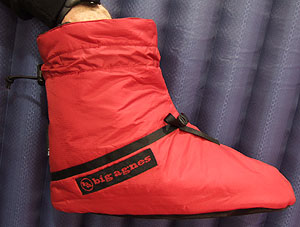
A new product from Big Agnes is their lightweight Mounatin Booty, which is insulated with 60 gram PrimaLoft I. They have a thin nylon outer fabric and brushed nylon inside. The bottom is a heavier weight nylon fabric. They have two drawcords to secure them, one over the ankle and one above it.

Big Agnes Mountain Booty

The Big Agnes Mountain Booty has PrimaLoft I insulation and is suitable for wearing in a hut or in your sleeping bag. The bottom is not intended to wear on the ground on wet surfaces.

Specifications and Features

  • Manufacturer: Big Agnes (www.bigagnes.com)
  • Style: synthetic insulated footwear
  • Insulation: 60 gram PrimaLoft I
  • Weight: 6 ounces (size L)
  • MSRP: $35

Origo Multi-Sensor Watches (Outdoor Retailer Winter Market 2006)

New manufacturer, with a suite of reasonably priced multi-sensor watches that are claimed to be user-friendly.

Overview

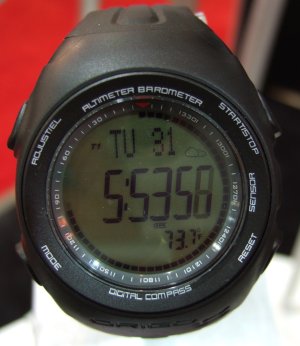
Origo is a brand new company making multi-sensor watches with barometer, altimeter, and digital compass. The watches are available in a multitude of styles. Their size and weight are about the same as similar products, the big differences are that they are (claimed to be) very user-friendly and cost only $150-$200.

Origo Rendevous Peak Watch

The Origo Rendevous Peak multi-sensor watch in black. Several models are available in different formats and finishes.

The features are:

  • Graphic weather forecasting indicator and temperature function
  • Barometric trend graph display (past 30 hours)
  • One-touch direct access altimeter
  • Altimeter 1 foot resolution
  • Altitude graph with past 8 hours trend
  • One-touch direct access digital compass with bearing lock
  • Declination adjustable
  • 75 altimeter data memories with date, time and altitude
  • 1/1000 second chronograph with lap and split time
  • 99 lap memories stored in a maximum of 99 runs
  • 2 daily alarms
  • Soft blue EL backlight
  • Battery life: Up to 1 year
  • Water resistance: 50 feet

Specifications and Features

  • Manufactuer: Origo (www.nagear.com)
  • MSRP: $150-$200, depending on features

Holey Soles Social Shoes (Outdoor Retailer Winter Market 2006)

Light, foam “Crocs” style camp shoe.

Overview

You’ve seen those light, colorful, foam shoes that are so popular now. The Crocs brand seem to be everywhere, but the original design is from Waldies who are relaunching their line at this OR show. And the shoes from Canadian distributer Holey Soles are out of the same mold as the other two – literally. It seems that all three brands used to come from the same manufacturer. Then Crocs bought the factory and the other companies needed to find new factories. The rumor is that Holey Soles came away with the original foam recipe and took it to another manufacturer. Waldies designed a new foam meant to have more cushion and has now relaunched their line. And in the meantime, Crocs has greatly expanded their style choices.

So, which company makes the lightest shoe – Holey Soles, Crocs, or the original Waldies?

Holey Soles wins. Photo to the right is of the Holey Soles Social (top) and Explorer shoes(bottom).

Weight per pair for women’s size 8 or 8/9 shoe with enclosed forefoot and toe, rear strap (this style is a favorite on the AT)

  • Holey Soles Explorer: 8.5 oz, $29.99
  • Waldies AT: 8.8 oz, $29.95 (click here for more info)
  • Crocs Cayman: 10.2, $29.99

Holey Soles-3
The original Walldies.

The Waldies are 0.3 ounces heavier than the Holey Soles, but run large and wide (the Holey Soles size W-10/11 M-8/9 are just long enough for my size 11+ feet while the Waldies in the same size have about half an inch of extra length), and have what looks like a slightly more aggressive tread and a softer footbed feel right out of the box than the Holey Soles shoes. The Holey Soles distributer said that his shoes soften during the first wearing and I can confirm that.

Crocs, Holey Soles, and Waldies both offer lighter models – who wins the overall title for lightest camp shoe?

Holey Soles again.

Weight per pair for women’s size 8 or 8/9 shoe

  • Holey Soles Social (closed forefoot and toe, no rear strap): 7.8 oz
  • Waldies Classic (closed forefoot and toe, no rear strap): 8.1 oz
  • Crocs Scoots (slide style with open toe, available May ’06): 8.1
  • Crocs Athens (flip-flop style, available Mar ’06): 8.4 oz

Holey Soles-2
Crocs Athens and Scoots.

Features and Specifications

  • Weight: Holey soles Explorer 8.5 oz per pair, Social 7.8 oz women’s size 8/9
  • Styles: Explorer, Provider (same but no holes), Social (same but no rear strap)
  • Sizes: Cricket (kids 9-10, Explorer only), XXS, XS, S, M, L, XL, XXL (men 12-13)
  • Features: antimicrobial, EVA closed cell foam
  • MSRP: $29.99 Explorer, $26.99 Social

Gregory Arreba Women’s Backpack (Outdoor Retailer Winter Market 2006)

New for 2006, the Arreba is a women-specific lightweight pack with a very nice feature set, including huge hipbelt pockets.

Overview

While the new Arreba is billed as a women’s adventure racing pack, we found it to be sweet general use lightweight backpack. Many adventure racing packs are loaded with racing specific features, but the Arreba doesn’t have that clutter, and is in fact a very nice lightweight pack with a normal feature set.

Gregory Arreba Womens Pack

The new Gregory Arreba for women is 2200 cubic inches, weighs 2.5 pounds, and has a full feature set, all of which is useful for lightweight hiking and backpacking.

At 2.5 pounds and 2000-2400 cubic inches (depending on size) the Arreba is sized for a woman with a narrower backpanel and a women’s shoulder harness and hipbelt. The pack has Gregory’s Wraptor Stabilizer system and a weight-supporting HDPE framesheet. I especially liked the roomy outside mesh pockets and huge hipbelt pockets. The body is made of Gregory’s G 30 silicone impregnated high tenacity nylon fabric.

Gregory’s Anti-Gravity pack series strike an excellent balance of lightweight, durability, and performance and are the choice of many thru hikers for their exceptional load-carrying comfort. The men’s equivalent to the Arreba is the Advent Pro, which has a slightly different feature set.

Specifications and Features

  • Manufacturer: Gregory Mountain Products (www.gregorypacks.com)
  • Style: internal frame, top loading, drawcord closure with top pocket
  • Features: top and front access, quickdraw compression system, large mesh hipbelt pockets, large side and front mesh pockets, and hydration sleeve and port
  • Sizes: XS, S, M
  • Weight: 2 pounds 8 ounces (size S)
  • MSRP: $149.

X-Socks (Outdoor Retailer Winter Market 2006)

Gad, these are the most high-tech socks I have ever seen!

Overview

X-Technology uses proprietary sewing machines to incorporate as many as 17 different fabrics and 8 different stitches into one pair of socks. X-Technology is based in Switzerland and X-Socks are the most popular socks in Switzerland, Germany, and Austria and have just recently been introduced into the US.

X-Socks Hiking Sock

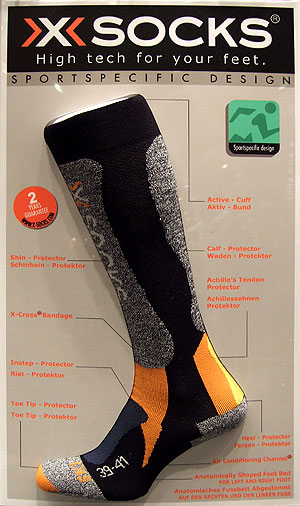
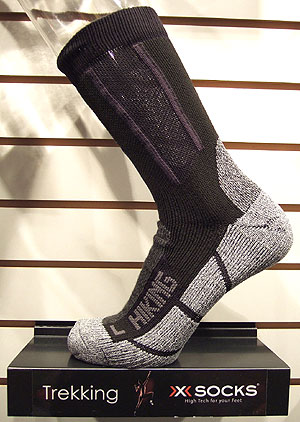
X-Socks pack an impressive amount of technology into a pair of socks. They have a 2-year warranty.

First of all, the socks are right and left foot specific in accordance with foot anatomy. Different fibers and stitching are used in different parts of the sock, depending on the purpose. Some of the sewn-in features specific to different foot regions include air conditioning channels, air guiding ridges, instep cushioning, toe protector, toe tip protector, self-adjusting cuff, high cushion shaft, X-cross ankle bandage, Achilles’ tendon protector, heal protector, and traverse airflow channel system. You get the idea…

X-Sock Hiking Sock 2

The X-Socks Hiking model. The air conditioning channels and guiding ridges can be seen above the ankle. Different fibers and stitching are used in different regions of the socks.

As far as technology goes, these socks are totally amazing. I’m looking forward to trying them on the trail to see if I can really detect a difference in performance.

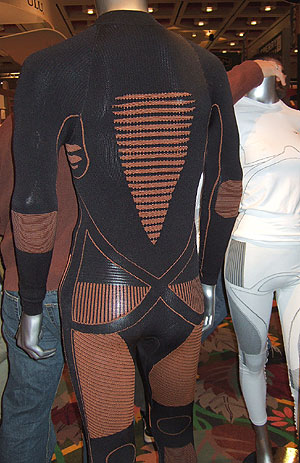
If the socks were not amazing enough, you should see their base layers. Their X-Bionic union suit will blow you away! It better, because it costs $350 for a base layer. It’s also available in separate tops and bottoms.

X-Bionic Base Layer

Here’s X-Technology’s version of a base layer! This one is a full union suit; they also have separate tops and bottoms.

Specifications and Features

  • Manufacturer: X-Technology (www.x-socks.com)
  • Style: many sport-specific styles available
  • Fabrics: the Hiking model is 60% Nylon, 28% Polypropylene, 7% Acrylic, 5% Elastodiene
  • Sizes: S to XXL
  • Weight: 3.1 oz for Hiking model, size L
  • MSRP: $29.95

Vaude Ski Packs (Outdoor Retailer Winter Market 2006)

An assortment of quality, lightweight backpacks from Vaude of Germany are now available in the US with Liberty Mountain as the distributor.

Overview

With Liberty Mountain as the new US distributor for Vaude outdoor gear from Germany, we now have an assortment of lightweight backpacks available to us. We recently reviewed the Vaude Rock Ultralight 25 and the Cross Ultralight 35, two exceptionally lightweight and durable daypacks. At the OR Show we got to see some of Vaude’s ski packs, which equally impressed us.

Vaude Pack

The Vaude Powder 34 ski pack has sturdy ski loops on the front and sides, a good compression system, and a supportive frame and suspension system.

Vaude Rescue Pack

Some Vaude ski packs include a Rescue Pack to hold your snow shovel, avalanche probe, etc. It slips into a sleeve behind the backpanel and is easily accessible in an emergency.

We looked at a total of six packs. The Daytour 26, Powder 34, and Ski Pro 42 are all ruggedly built HDPE framesheet/single aluminum stay packs. Each contains a Rescue Pack which holds your shovel, avalanche probe, etc., in a sleeve that is easily pulled from the pack and opened. The outside of each pack has sturdy ski loops on the sides and front, plus a strap to tie the tops into an A-frame configuration. The exterior has lots of pockets and a detachable helmet sleeve.

Vaude Pack Back

Backpanel view of the Powder 34, showing its well padded suspension system. The shoulder strap material wraps around the edges to avoid chaffing.

Another group of three packs are a bit lighter because they don’t have the Rescue Pack. They are the Ski Race Ultra 12, Snowrider 22, and the Spindrift 35. These packs have the same framesheet and stay, but use lighter fabrics. All of the packs have firm and well padded suspension systems for carrying weight.
Vaude Flash System

The Ski Pro 42, largest of Vaude’s ski packs, has a super easy torso adjustment, just pull a small cord and slide the shoulder straps in or out to get the desired torso length.

Overall, we were dully impressed with the quality, features, and general light weight of the Vaude ski packs, and they are also an excellent value.

Specifications and Features

  • Manufacturer: Vaude (www.libertymountain.com)
  • Style: internal frame, top loading, drawcord closure with top pocket
  • Frame: HDPE framesheet and one center aluminum stay
  • Features: easily accessible Rescue Pack in some models, ski loops, ski tie straps, detachable helmet sleeve, front zippered pocket, zippered top pocket, side tool loops, compression straps, and well padded shoulder straps and hipbelt
  • Weight: varies by model, range is 1 pound 15 ounces to 4 pounds 1 ounce
  • MSRP: $65 to $135

Kelty Sawtooth Tent (Outdoor Retailer Winter Market 2006)

New tents by Kelty are a strong entry into the lightweight gear market.

Overview

One thing we discovered at this OR is that Kelty is catching the ultralight bug. While one could argue whether their gear is lightweight or ultralight, the point is Kelty has some serious interest in entering the lightweight arena. We looked over their Sawtooth 2-person double wall tent and saw some true innovation. The Sawtooth comes in at 28 square feet and a minimum weight of 3 pounds 9 ounces.

Kelty Sawtooth Tent

The Kelty Sawtooth is a lightweight 2-person double wall tent with one side entry. Note the single diagonal pole and two corner struts to support the canopy.

The tent is basically a mono-pole design, with one main looped diagonal pole and two shorter struts at the other two corners to extend the canopy. The inner tent has a mesh ceiling for good ventilation, the poles are Featherlite aluminum, and the fly is silicone coated nylon. There is one entry door with vestibule.

Other tents in their “ultralight” series include the Stick, which is a solo pyramid style tent with a minimum weight of 2 pounds 8 ounces, and the Ridge which has one hubbed multi-pole and has a minimum weight of 3 pounds 12 ounces. The Ridge (which we did not get to see) has two doors and two vestibules and weighs only 3 ounces more than the Sawtooth, so its specifications gained our highest interest.

Specifications and Features

  • Manufacturer: Kelty (www.kelty.com)
  • Style: 2-person double wall tent, one door with vestibule
  • Fabrics: 33d nylon ripstop tent walls, 1800mm nylon taffeta tent floor, 30d 3000 mm silicone coated nylon ripstop fly
  • Poles: 8.5 mm Featherlite aluminum
  • Features: one door, one vestibule, taped floor seams, side-wall vents, internal storage pockets, side-release buckle tent fly connections, mesh ceiling
  • Weight: minimum weight = 3 pounds 9 ounces, packed weight = 4 pounds 3 ounces
  • MSRP: $275