


Introduction
It seems widely accepted that elevated air permeability (the ease with which ambient air can penetrate jacket fabric) in a lightweight windshirt can provide effective moisture vapor removal during backpacking and hiking. In prior studies, I have made the case that activities that occur at low speeds, such as backpacking, do not provide sufficient air pressure on the face of a jacket to support significant convective cooling or adequate moisture removal by means of windshirt fabric air permeability. Rather, in the absence of winds, one must rely on ventilation provided by jacket openings such as pit zips or the front zipper.
In this study, I compare the performance of four jackets made with fabrics that span a wide range of air permeability rates and moisture vapor transmission rates (MVTR). The study shows that significantly greater moisture removal can be achieved as a function of jacket MVTR than jacket air permeability. In fact, the ratio of moisture removal in the jackets tested due to MVTR exceeds that of air permeability by a factor of nearly 7 to 1. This means that when we select a windshirt or even a waterproof breathable shell, we should pay close attention to vapor transmission characteristics if we wish to obtain effective moisture removal. This study also demonstrates that a high MVTR waterproof/breathable shell can provide better moisture removal than a typical windshirt. This means that you can have a single layer that functions as both a rain jacket and a windshirt. In short, MVTR is a performance characteristic that should receive lots of attention when selecting your next wind layer or rain jacket.
Background
During exercise, your body will eliminate excessive heat by sweating. How effectively your clothes allow sweat to be removed will determine how well sweating accomplishes its cooling function. Effective elimination of moisture from sweat will also avoid accumulating condensed water vapor in various clothing layers.
Sweat must evaporate to provide cooling and the resulting water vapor must be then removed from all garment layers. Water vapor removal is typically accomplished through convection and/or moisture vapor transmission.
Convection describes moisture vapor removal by means of air circulation within a layer or through a layer. Convection can be enhanced by garment ventilation features such as pit zips, openings at the neck, sleeve, or hem, or air movement through pores in the garment fabric. Convection is driven by air pressure differences across the garment layers.
Moisture vapor transmission describes the transfer of moisture through one or more garment layers. It can occur at the garment ventilation features mentioned above. Moisture vapor transmission also can take advantage of tiny openings in garment fabric, both pores and spaces between fibers, to expel moisture. Vapor transmission is driven by the vapor pressure difference between the skin and the ambient environment. Vapor pressure is a function of both temperature and relative humidity. A high temperature at the skin, combined with high humidity will produce the pressure gradient necessary to expel moisture vapor to an ambient environment that has a lower temperature and/or humidity.
The ease with which air can move through a garment is termed air permeability. Air permeability is typically characterized by measuring the volume of air that can pass through a fabric at a known air pressure differential across the fabric. The ability of a garment to support moisture vapor transmission is often termed breathability or vapor permeability. Of course, the term breathability is sometimes used by some to include air permeability, so confusion can be expected when breathability is not clearly defined.
There are many ways to measure a garment’s ability to transfer moisture vapor. Two widely used measurement approaches produce very different and not necessarily comparable measurement data: moisture vapor transmission rate (MVTR) and evaporative resistance. MVTR is measured as grams/meter2/24 hours. MVTR test methods tend to promote evaporation of water from a reservoir, through a piece of fabric, to the ambient environment. The other main approach is often called the skin method. It uses a device called a sweating guarded hot plate and produces results in units of Evaporative Resistance. Both general approaches are guided by several available test standards. The results of different test standards are not necessarily in good agreement and will almost always result in different magnitudes of vapor transfer rates. In this study, MVTR is determined by measuring the quantity of moisture that passes through a garment at a vapor pressure differential of 0.3 psi using devices that I’ve designed called permeation kettles.
The relative effectiveness of air permeability and MVTR for removing moisture from garments has not received a great deal of attention here at Backpacking Light. In this study, I look at the relative effectiveness of both simultaneously.
In a previous study published in 2001 at Backpacking Light, the author went on runs at similar exertion levels and conditions using different shells. The shells were utilized under sealed conditions or ventilated conditions. The subject athlete wore a wool base layer under the shells for each run. At the end of the run, he weighed the base layer and compared its weight to the dry weight of the base layer. The weight difference, of course, was sweat accumulated in the base layer. The author reasoned that less accumulated sweat in the base layer indicated improved moisture transfer for the test garment. Based on his tests, he concluded that higher exertion exercise could overwhelm the ability of any waterproof/ breathable jacket or any windshirt to remove moisture. He found that only a combination of ventilation and adjustment of insulation or activity level could effectively ensure adequate removal of moisture during higher exertion exercise.
I decided to try a similar study, but the jackets would span the extremes of air permeability and vapor transmission levels. I would then apply statistical measures to attempt to parse the impact of these and other characteristics on the jackets’ abilities to remove moisture. One of the nice features of the 2001 Backpacking Light study and my test methodology is that anyone with fairly rudimentary equipment but high enough motivation can conduct their own version of this test.
Test Design
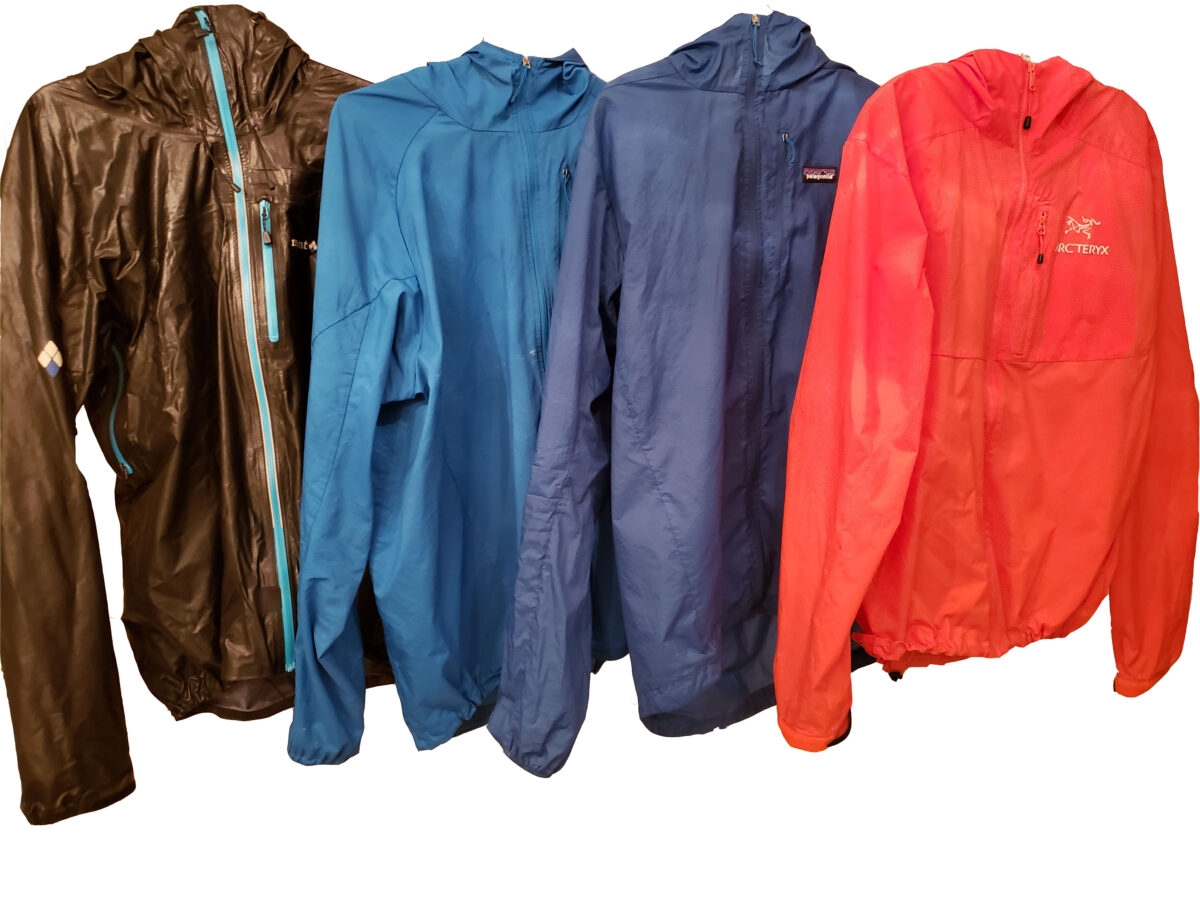
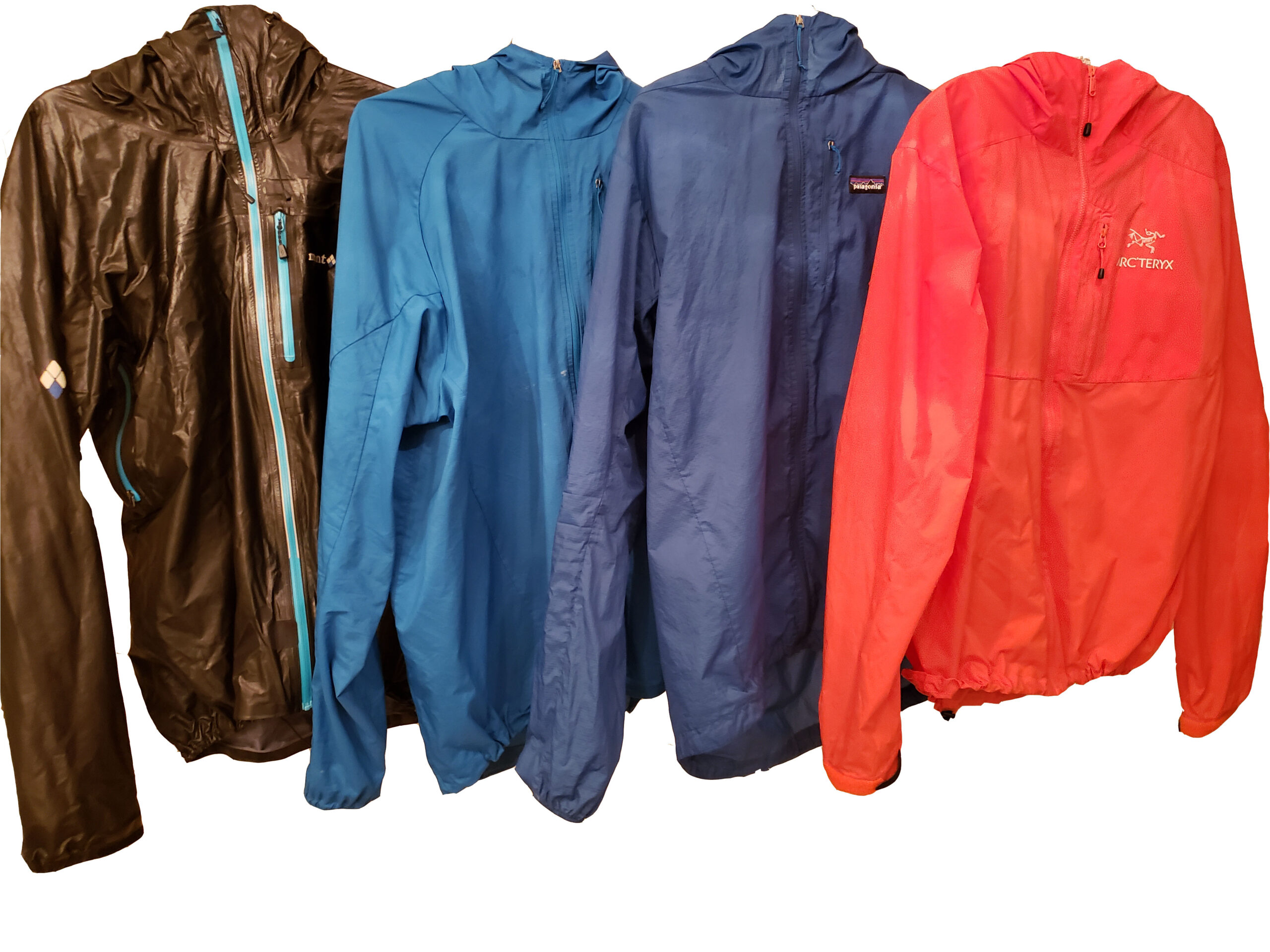
Four jackets were selected for this test. Table 1 below provides their characteristics.
Table 1: Test Jacket Characteristics
| Jacket | Fabric | weight (grams) (see note 1) | Air Permeability (CFM/ft^2 @ 0.5" wc) (see note 1) | MVTR (grams/m^2/24 hr) (see note 1) |
|---|---|---|---|---|
| Montbell Peak Dry Shell | Gore Shake Dry | 237 (see note 2) | <.43 | 3370 |
| Patagonia Houdini | Dense weave nylon | 107 | 0.6 | 2250 |
| Patagonia Houdini Air | Dense weave nylon | 121 | 14.3 | 3120 |
| Arcteryx Squamish 2019 | Dense weave nylon | 157 | 11 | 2580 |
Table Notes:
- All measurements made with in-house instruments
- Extra weight due to the addition of custom pit zips.
The Montbell Peak Dry Shell is constructed from a waterproof, breathable Gore Shakedry fabric and is not typically considered a windshirt. It is virtually air-impermeable with air permeability that is lower than I can measure. It has the highest MVTR of any waterproof breathable (WPB) garment I have tested. The Patagonia Houdini Air ranks seventh highest out of 19 windshirts or windshirt fabrics that I have tested for air permeability. It is near the top of general-purpose windshirts in terms of air permeability and MVTR while still offering some wind protection. The 2019 Patagonia Houdini has very low air permeability and has the second-lowest MVTR of the windshirts I have tested. The 2019 Arc’teryx Squamish has somewhat middle-of-the-road air permeability and MVTR performance.
The base layer worn for the test is a long sleeve shirt made by Xoskin. This garment is constructed using a nylon 3D seamless knit fabric with embedded PTFE and copper in the fibers. This garment is skintight which means that perspiration cannot easily drip down the skin; rather, it will be absorbed into the fabric until saturation is reached. This garment offers some of the best wicking/drying performance of any base layer I have tested, making it an ideal base layer for this test. The dry weight of the Xoskin shirt is 6 ounces (167 g).
Each of these jackets was worn during a series of runs. Four runs were conducted for the Squamish. Three test runs were completed for each of the other three jackets. The run takes place on a 4.9-mile (8 km) circular trail located in a large open space. The trail has minor elevation changes. During the runs, all zippers, hems, and cuffs were closed to minimize pumping air exchanges. The hoods were worn and tightly sealed. During the run, a Garmin Fenix (version 5) along with a heart rate monitor chest strap was used to collect physiological data. The average MET level for each run was calculated using average heart rate data and results of metabolic testing I underwent at the University of Colorado Sports Medicine and Performance Center (Boulder, CO). Weather data was obtained using NOAH statistics from the Vance Brand Airport, located approximately 2 miles from the center of the running loop. The data is published online at approximately 15-minute intervals. The weather data corresponding to the beginning and end of the run are averaged.
Water retained in the base layer was weighed on an A&D SJ-2000HS digital scale. The scale resolves 1 gram.
The runs cover a range of temperature, humidity, and wind conditions. Of course, this being Colorado, the highest humidity during a run was only 67%. The range of environmental conditions can be seen in the test results table below.
Test Results
Test results are presented in Table 2. The results for individual runs are listed by date. The critical measured data for each run is the water weight gain of the Xoskin base layer, shown in column 3. Performance data for each run is shown in columns 4, 5, 6 and 7. Columns 8-12 show environmental data for each run.
Member Exclusive
A Premium or Unlimited Membership* is required to view the rest of this article.
* A Basic Membership is required to view Member Q&A events


Discussion
Become a member to post in the forums.
Companion forum thread to: Air permeability vs. moisture vapor transmission rate (MVTR): which one impacts moisture transport more in wind and rain jackets?
This study compares the performance of four jackets made with fabrics that span a wide range of air permeability rates and moisture vapor transmission rates (MVTR). The study shows that significantly greater moisture removal can be achieved as a function of jacket MVTR than jacket air permeability.
These results are stunning. It sounds like, in cool and cold conditions, a windshirt with high MVTR and low CFM, will provide the best performance in windy conditions. This is really good news, and very surprising.
The accepted wisdom has been that high CFM windshirts are the only hope of getting moisture from exertion out of our clothing layers. But high CFM windshirts don’t actually block wind, so what is the point? Further, as explained here, they will only vent more moisture through their permeable fabrics in the presence of wind, so again, what is the point? I suspect the point (and the existence of jackets like the Airshed, with ~60 CFM, has to do with the part near the end, where it’s explained that MVTR is disabled when outside conditions are warm and/or humid. In those conditions, we want some air to come blowing through the fabric to help cool us, and hopefully to convect some moisture out as well. These types of windshirts are also bugproof, so provide that additional utility.
Personally, I find that I only wear winshirts below 50F if it’s windy and pretty much always wear one when hiking at 35F and below, even in still conditions. At 40-50F, highly permeable windshirts (~35CFM) can be very comfortable, but if the wind gets over 20mph I can get chilled.
Knowing that fabrics that actually block wind (low CFM), but have great MVTR, exist allows for the selection of a low CFM, high MVTR windshirt for cool and cold conditions. Windshirts like this provide continual protection from wind, preserve a boundary layer of warm air, and so keep a microclimate near my skin that is pretty stable, whether the wind blows or no. Relying on MVTR works well in cool and cold conditions, because there is a high temp gradient from inside to outside. And if I climb a hill, I can vent increased moisture produced by opening the front zip. I’d rather open a window than have leaky walls.
Hi Stump:
I like your closing analogy! I wish I had thought of it.
Thanks for reading.
Thank you for writing these reports up. What is the difference between your MVTR findings and Montbells 80,000g using “JIS L-1099 B-1”. I don’t know if there is any comparability between tests but I am curious about differences in the tests to produce different results. Thanks again for your work here.
Glad you asked. There are 6 main standards for measuring vapor transfer through fabrics or garments. The two standards that seem to be most commonly used are ASTM E96 and JIS L1099. Each of these have four variations. Each variation produces different numerical results. The lowest MVTR numbers are produced by the ASTM test. The highest numbers are produced by the B1 version of the JIS test. The B2 version of the JIS test is probably a bit lower. The various tests impose a wide array of vapor pressure differences across the test fabric. They also use varying air flows where an air space is present in the test configuration. In those tests where an air layer is not present in the test apparatus, the resistance of air is eliminated. The resistance of any present air layer can exceed the performance of the fabric itself and the air layer resistance depends greatly on air movement velocity, from the use of a fan. Faster air flow offer lower resistance. These and other differences in the test configurations account for the wide variation in test results. There have been a number of academic studies that attempt to relate one standard to another, generally without great success. In a study by McCollough, the average for all fabrics tested using the E96B standard, an average MVTR of 772 was found. For JIS L1099 B2, the same study found an average of 12662. In this study, the highest value fabric using the JIS standard produced a result of 13421. Clearly, the fabrics included in this study did not perform nearly as well as today’s best MVTR fabrics. My test, which uses my permeation kettles produces results that are closer ASTME96 values than JIS-1099 B-1. Many product manufacturers, who actually disclose test information will use the JIS LL1099 B1 or B2 tests. This test produces very high numbers and can be completed very quickly:15 minutes. These two features make this a very popular test. My rule of thumb for understanding test JIS L1099 B1 or B2 results compared to my tests, which are very rough are as follow: For B1 or B2, poor MVTR performance is <20000. Excellent MVTR performance is >60000. Right now, for my test, excellent performance is above 3000. Poor performance in my test is below 2000. The other main standards measure vapor transfer resistance. These tests use completely different measurement units and instrumentation than those that present MVTR results. I have seen enough examples to relate those tests results (measured on a sweating guarded hot plate or a permeation cell) to my test or any of the other MVTR tests.
In summary, there is rough comparability between my tests and the other main MVTR tests. For test results using a sweating guarded hot plate or permeation cell, I cannot provide comparable data.
Great article Stephen, thanks for sharing!
As you know, some manufacturers like The North Face and their Futurelight WPB product are marketed with very high MVTR of 75K and CFM of 1.5 most likely using a test standard that is very much in favor of their marketing strategy.
At the same time, other manufacturer’s like Patagonia do not publish MVTR with the following reason:
“The Quality Team then went one step further; they took the exact same piece of fabric and sent it back to the exact same lab to be retested. Wouldn’t you know it, the second laboratory tests did not reliably match the first set. Obviously, if independent laboratories couldn’t provide similar results from the exact same fabric, comparisons between different fabrics (and brands) were impossible. This discrepancy is the reason we don’t publish hard and fast numbers; any comparison with other fabrics would be meaningless.“
https://www.patagonia.com/stories/from-the-pct-to/story-20305.html
Can you comment on whether your test methodology is able to provide consistently the same MVTR result, with a tolerance of +/- 10 g/m^2/24hr?
If so, then have you considered submitting your test methodology for peer review and getting it standardized within ASTM or JIS, to replace the inconsistent current test methodologies which prevents Patagonia from publishing or marketing their MVTR results?
Hi Weekend:
Thanks for reading! If only some action I take could influence major manufacturers to publish performance data obtained through standardized tests. I wish my voice were that loud! The best I can do is test their products, determine how they perform and compare with similar products on the market. I don’t think the marketing status quo of selling with unsubstantiated claims will change any time soon. But, that is not really the point of my article. I am trying to provide the community with a basic understanding of how garments can support their needs in the field and that will be a constant theme of my articles on BPL.
Stephen, thank you, as always, for your investigations. I have a few specific comments on the methods and the overall comment that I recommend that you expand research in this area to test the conclusions drawn from this study.
1. The small sample included one rain jacket and a few low air perm windshirts. A high air perm windshirt was not included. I recommend including the Patagonia Airshed and similar. I also recommend including more rain jackets with different types of membranes. Therefore, increase the size and diversity of the sample.
2. Conduct the study in the rain.
3. Conduct a similar study over a longer duration (e.g. 4 hours) in the rain after DWR has worn off all garments.
4. Consider adjusting the research question. This study is relevant to two broader questions: (1) how do you stay comfortable in the rain? and (2) how to stay comfortable in variable windy conditions?
A rain jacket has to be durably waterproof. I have found that most of the ul rain jackets are NOT durably waterproof. Further, since the face fabric wets out (DWR fails quickly), breathability/MVTR falls to zero–it;’s a lark. Shakedry and similar no contact fabrics aren’t durable yet. Patagonia’s H2NO membrane is not durably waterproof based on my experience using it for long duration activities in the rain. (HH test is a short-duration lab test that does not reflect the realities of life in the wild.)
On staying comfortable in variable windy conditions – I abandoned low air perm windshirts (e.g. Houdini and Houdini Air) in favor of the Airshed in 2017. I use that every day all year and then add a rain jacket on top when it’s rainy or very windy (and more insulation, of course).
5. Another research question to consider for future studies: what is the optimal air permeability for a windshirt? I find the Airshed (60 CFM) works well for me. I’d love to try something with a higher CFM that retains similar attributes (strong, light, chest pocket, some stretch).
Cheers, Max
Vapor pressure is a function of both temperature and relative humidity.
A small point here. Vapour Pressure itself is a function of temperature only, but the VP across a fabric does also depend on the (external) RH.
There are many ways to measure a garment’s ability to transfer moisture vapor.
Oh, I fully agree. They all measure slightly different things.
As Stephen says himself:
There are 6 main standards for measuring vapor transfer through fabrics or garments. The two standards that seem to be most commonly used are ASTM E96 and JIS L1099. Each of these have four variations. Each variation produces different numerical results.
A cynic within the industry once commented to me that you pick the version which gives you the most commercial advantage. The general public would not have a clue anyhow.
Cheers
For Stumphges’s flip side I have been using my Westcomb Crest Hoody more as a sun and bug shirt. The CFM is 42.8 and it was one of the highest MVTR that Stephen had tested. It is made out of Pertex Equilibrium. The SPF is 30 and HH is 125ish. I have talked with Westcomb and they said it is a layer that should be worn next to the skin.
I have done this quite a few times over the last few weeks when the temp is from 80-93F. I had zipped the jacket all the way up and had the hood on. I did some walking and was pretty okay. I was sweating but that fabric did pull the sweat off of me. It was sunny each day and I did notice some sweat build up on my head. I also spent a few days moving gravel with a shovel with it on for about 3 hours each day and the temps were 88-93F. I was sweating bullets but the fabric still kept me pretty dry. The fabric remained somewhat damp and that help me also. I had a lot of sweat buildup on my head where some would come down my face but I think that would be prevented with a head band or visor. The color is black so I am sure that added to the heat some. I basically have a farm tan and did not notice tanning on my upper arms, shoulders or head that was not present before.
The jacket itself does not have any DWR so I applied Kiwi’s Camp Dry. It took longer to wet out but since I would be wearing this jacket while moving I will probably not care about that so much.
I also have worn it out when it has been buggy. I have not really noticed any mosquitoes biting me. This may be to the decently tight weave and the Camp Dry may have a little to do with this also.
Westcomb said at one time that they had made a grey version and I wish they did now because I am sure that would mitigate some of the heat I have had to deal with having the black color.
Hi Max:
Thanks for reading and providing some comments.
The thesis of the article is pretty simple: High MVTR beats out high air permeability for eliminating water vapor. However, I do mention in the article that my results could change for high air permeability garments like an Air Shed. But, without a breeze, even an Air Shed doesn’t move much air. At 3 mph hiking speed in still air, the best you can hope for in the Air Shed is about .4 CFM/ft2 of air flow. That is not much. From my experience with highly permeable garments for summer use, in order to get some cooling at hiking speeds, air permeability of over 300 CFM/ft2 is needed. One of the summer shirts I have used this summer is from Japan, called Fine Track. It is over 700 CFM/ft2 and is reasonably comfortable on hot days. Its drawback is that it is black which is a bad color choice above tree line due to solar heat gain.
Rain is not particularly relevant to the test I did: a high air permeability garment is not water proof. A high MVTR garment can be. High MVTR garments are still subject to the laws of thermodynamics and being out in the rain can be challenging, depending on the weather conditions, the layering you are using and your MET rate. I would guess you are a master at being comfortable in the rain and would be interested in your strategy as temperatures rise.
Optimal air permeability: I think that is a myth. Like everything else, comfort depends on weather conditions, the layering you are using and your MET rate. I typically like my wind layer to have no air permeability but the option for ventilation through pit zips, front zips, etc. However, for winter ascents with little to no wind, a highly air permeable base layer often is typically all I need down to 20F.
I am going to go into more detail on these sorts of issues in the article to be published in September. This will focus on active insulation garments. I have read your excellent articles on active insulation garments and think we come to some of the same conclusions.
Great article, Stephen!
For fun (I’m a geek), I analyzed your data in MiniTab too. I was mainly interested if any two-way interactions were significant – for example, does the effect of MVTR change depending on the temperature or vapor pressure? Turns out none of the interactions that made sense were significant. So high MVTR is the best for any condition (within the range you tested, of course). FWIW.
I know the mid CFM windshirts are very popular around here ( and I am personally a huge fan of the discontinued Airshed Pullover as well ) but I am not sure that most people are claiming that the higher CFM actually REMOVES moisture significantly faster by transporting it through the garment. Instead I think the general consensus (certainly for myself) is that the windshirts with more air permeability cause the user to PRODUCE much less moisture in the first place. I can use the airshed in a lot of different and variable conditions and be relatively comfortable but there is no way I am going to be comfortable in anything but very cold or very windy conditions in a windshirt that is essentially windproof. This becomes a very personal and subjective thing however and is much more difficult to quantify in numbers – a CFM that works for one person may be the opposite of what someone else needs.
Christopher, so you’re saying the Airshed (CFM ~70) is so permeable that lots of cool air blows through the fabric and keeps you cooler so you don’t sweat as much? Intrinsic ventilation? That might be more important than any breathability advantage offered by high permeability fabrics, definitely.
But you can get that ventilation extrinsically with a little work: If you take a low-CFM windshirt with extrinsic ventilation (pitzips, or laser perforated armpits, plus front zip, maybe with a snap to keep the zip open but the front from flying open all the way, loose hem, etc.) you can have the same thing – venting to allow more cool air in to prevent overheating. But if your activity level drops and/or the wind comes up, you can batten all those venting hatches and enjoy the low-CFM/high-MVTR fabric actually blocking the cold wind.
With the Airshed, what happens when the sun goes behind the clouds, the wind whips up, and I start going downhill instead of up? I’m going to be reaching for another layer, because 70 CFM doesn’t really block the wind. And that second layer had better have good breathability, because now my perspiration will be fighting to get through two layers instead of one.
I like high-CFM windlayers when it’s borderline too-warm to wear a windshirt in the first place. Today I wore a 35CFM Squamish in 55F and 20-40 mph winds. The wind wasn’t cold enough to bother me even though my shirt was pretty permeable, and it was nice to have some air coming through without having to fuss with zips and cuffs and hems. But when it gets near freezing and windy, I want a low CFM/high MVTR windshirt with ventilation options to vent heat/moisture when my activity level goes up. And I want that low CFM fabric to actually protect me from the freezing wind. My 35CFM shirt sucks in those conditions.
I think the individual cases are very important here in determining ideal CFM – for example since I run very hot the airshed (even though its at 60 CFM) would definitely overheat me in 55F weather with that level of wind. I have trouble wearing any sort waterproof layer above freezing if I am doing even moderate activity – personally I do not reach for even a very permeable windshirt like the airshed until it hits approximately 40F or maybe less. A low CFM windshirt would be fairly useless to me as at that point its cold enough that I likely can just use a rain jacket. And even then I definitely prefer the highest CFM possible stuff I can find.
Mechanical ventilation is great in theory but I find most garments designed pretty terribly in regards to this – pitzips are the standard but provide no ability to cross ventilate with only a single way for air to go in an out. I have experimented with stuff where there is a pocket vent on each side of the chest and also an additional vent on the back near the shoulder blades (placed vertically) so that it does not get blocked by a pack. This worked very well but I have yet to see a commercial garment ever made with such a system. The closest I have seen is the now defunct Brooks Range Mountaineering brand who made a waterproof jacket with zippered vents on both sleeves and additional vents in the back.
Good read, I was a bit surprised to see the weight gain of the more air permeable fabrics which led me to wonder if you consider weight of the actual jackets used after activity. The fabric specific construction and finishing could be effecting how much moisture is actually transferring outside and not just into the fabric itself. Stretch Windshells are typically using a twisted or crimped nylon which would tend to retain more moisture inside the yarns. Perhaps there is a domino effect increasing condensation inside the jacket, thus more weight gain of the baselayer shirt. Anyway, after much experience with multiple types of shells I do have a hard time accepting that a shake dry fabric with a WPB film is more comfortable than an air permeable wind shirt so I am just wondering if something else is going on.
Hi Kenny:
Thanks for reading. 1st question for you is whether you have tried a Shakedry? Fundamentally, the force of vapor drive can often exceed the force of air pressure at hiking speeds. As a result, a very high MVTR fabric can produce the results in the article. I can see how under heavier air pressure from higher air speeds that a stretchy wind shell with higher porosity will perform differently. To benefit from that higher air pressure, air must enter the jacket through fabric pores and then force moist interior air out. This entering air may have to also pass through additional underlying layers to reach moist air. So, what you say, under the right circumstances may occur. Under other conditions, not so much.
I have measured air permeability in wind shirts up to 81 CFM/Ft2. With a high air permeability, the odds improve that your wind shirt can permit adequate or even superior vapor removal. However, as air permeability goes up, you have less of a wind shirt. After all, a wind shirt is supposed to block wind. I don’t want the air permeability of my wind layer to exceed 5 CFM/ft2. However, my wind layer will always have pit zips and the usual other ventilation means in case more ventilation is needed.
There are wind shirts that that have higher MVTR than Shakedry. For example, the OR Helium Wind Hoody is equal in MVTR to Shakedry but has essentially similar air permeability to Shakedry. In contrast, the BD Alpine Start has higher MVTR but has air permeability of 13.2 CFM/Ft2. So, if you wear the Alpine Start in high winds and cold temperatures, you may feel cold while both the OR Helium and Shakedry will provide better weather protection. Of course, Shakedry is the only one that will also keep rain out.
However, as air permeability goes up, you have less of a wind shirt. After all, a wind shirt is supposed to block wind.
To put this in simple English: you can not have your cake AND eat it.
But I m sure marketing will continue to claim that you can. It’s your wallet they want.
Cheers
Yes you loose water/wind resistance as air perm goes up but there is a good balance in there somewhere. To be honest I only use a windshell in high exertion activities and rarely am I worried about a bit of wind penetration or actually prefer it. Even 15-25 CFM seems fine for this useage. Also I have owned a TNF Shake dry jacket. However durability is suspect (as even Gore admits) and I can see many pinholes when I place it up to the light. Of course it is quite breathable but hard to say its a good choice considering the cost and lack of durability not to mention lack of a hood. Because of all this I personally don’t include shake dry in my current quiver. I do think the windshell category is extremely challenging for brands and consumers to put a finger on. As your testing shows the experience can be quite different depending on the fabric and finishing used and the general use case is quite specialized. For the record my favorite wind shell is BD’s Alpine start. great balance of wind resistance, water shedding and high air perm, though a bit heavier than some other options.
Without a doubt, Alpine Start offers a nice feature set. It sounds like a good choice for your activities and environmental conditions. Of course, with that jacket, with its high MVTR, you are more than getting the vapor transmission benefits of Shakedry with the possibility of some ventilation when winds are blowing.
Hey Steve, your link goes to a OR Helium Rain jacket. I had to send last season’s OR Helium Wind back because the color was bleeding when I washed it so it will be interesting to see how different this year’s model is.
Brett: Not my link. I think the website inserted the link.
Good Morning/Evening Stephen,
here (https://backpackinglight.com/lightweight-clothing-layering-systems-backpacking/) around min 14:50, if I understood correctly, Ryan is making the point that a wind shirt is better than a rain jacket in terms of moisture transmission (hence MVTR I would assume) in a three-season scenario, i.e. when the temperatures are higher.
Now, if I’m not mistaken, from your article there is not a such temp variable in the sense that the MVTR of both the wind shirt and the shell jacket would deteriorate as the environment temperature gets higher (hence the temp gradient gets lower), in the same manner (unless I have not understood correctly either your article or the video). Assuming that there is no significant wind presence in the environment, of course.
How should I interpret Ryan’s claims in the video?
Thank you very much in any case.
Enjoy Summer!
MVTR of both the wind shirt and the shell jacket would deteriorate as the environment temperature gets higher
I don’t think that is correct. I suggest the MVTR of an uncoated windshirt depends on the gaps between the threads, and that will not change as the ambient gets warmer.
If the fabric has a coating I would not call it a ‘windshirt’.
Cheers
Hi Indrit:
MVTR performance of wind shirts or WPB (water proof, breathable) membrane garments covers a continuum. There will be many wind shirts with MVTR that exceeds that of WPBs. The reverse can also be true. Given today’s technology, I would say that there are only a few WPB membranes whose MVTR can outperform those of many wind shirts. This would include Gore Shakedry and various electrospun membranes such as Polartec Neoshell, The North Face Futurelight and OR Ascentshell. There are a few other WPBs that have performed well in my testing.
MVTR, as I have stated in my articles, is driven by vapor pressure differential, which is a function temperature and humidity level on both sides of the WPB membrane. This mechanism is not to be confused with convection whereby moisture may be removed as a result of air movement through the small openings between fibers of a wind shirt. If a wind shirt is to effectively block wind, air permeability has to be relatively low. This means there will be a necessary tradeoff in moisture removal via convection and protection from the wind. Effective removal of moisture via convection, in my experience and test results, requires order of magnitude greater air permeability than is available in an effective wind shirt.
As temperature and/or relative humidity rise outside a wind shirt or WPB, the vapor pressure differential across the wind shirt or WPB does decrease and vapor removal performance will diminish. At some point, MVTR will be inadequate to provide sufficient vapor removal. That is why I advocate the use of Pit Zips, front zips, sleeve and waist hems to provide supplemental ventilation in both wind shirts and WPB jackets.
Become a member to post in the forums.