


Introduction
It seems widely accepted that elevated air permeability (the ease with which ambient air can penetrate jacket fabric) in a lightweight windshirt can provide effective moisture vapor removal during backpacking and hiking. In prior studies, I have made the case that activities that occur at low speeds, such as backpacking, do not provide sufficient air pressure on the face of a jacket to support significant convective cooling or adequate moisture removal by means of windshirt fabric air permeability. Rather, in the absence of winds, one must rely on ventilation provided by jacket openings such as pit zips or the front zipper.
In this study, I compare the performance of four jackets made with fabrics that span a wide range of air permeability rates and moisture vapor transmission rates (MVTR). The study shows that significantly greater moisture removal can be achieved as a function of jacket MVTR than jacket air permeability. In fact, the ratio of moisture removal in the jackets tested due to MVTR exceeds that of air permeability by a factor of nearly 7 to 1. This means that when we select a windshirt or even a waterproof breathable shell, we should pay close attention to vapor transmission characteristics if we wish to obtain effective moisture removal. This study also demonstrates that a high MVTR waterproof/breathable shell can provide better moisture removal than a typical windshirt. This means that you can have a single layer that functions as both a rain jacket and a windshirt. In short, MVTR is a performance characteristic that should receive lots of attention when selecting your next wind layer or rain jacket.
Background
During exercise, your body will eliminate excessive heat by sweating. How effectively your clothes allow sweat to be removed will determine how well sweating accomplishes its cooling function. Effective elimination of moisture from sweat will also avoid accumulating condensed water vapor in various clothing layers.
Sweat must evaporate to provide cooling and the resulting water vapor must be then removed from all garment layers. Water vapor removal is typically accomplished through convection and/or moisture vapor transmission.
Convection describes moisture vapor removal by means of air circulation within a layer or through a layer. Convection can be enhanced by garment ventilation features such as pit zips, openings at the neck, sleeve, or hem, or air movement through pores in the garment fabric. Convection is driven by air pressure differences across the garment layers.
Moisture vapor transmission describes the transfer of moisture through one or more garment layers. It can occur at the garment ventilation features mentioned above. Moisture vapor transmission also can take advantage of tiny openings in garment fabric, both pores and spaces between fibers, to expel moisture. Vapor transmission is driven by the vapor pressure difference between the skin and the ambient environment. Vapor pressure is a function of both temperature and relative humidity. A high temperature at the skin, combined with high humidity will produce the pressure gradient necessary to expel moisture vapor to an ambient environment that has a lower temperature and/or humidity.
The ease with which air can move through a garment is termed air permeability. Air permeability is typically characterized by measuring the volume of air that can pass through a fabric at a known air pressure differential across the fabric. The ability of a garment to support moisture vapor transmission is often termed breathability or vapor permeability. Of course, the term breathability is sometimes used by some to include air permeability, so confusion can be expected when breathability is not clearly defined.
There are many ways to measure a garment’s ability to transfer moisture vapor. Two widely used measurement approaches produce very different and not necessarily comparable measurement data: moisture vapor transmission rate (MVTR) and evaporative resistance. MVTR is measured as grams/meter2/24 hours. MVTR test methods tend to promote evaporation of water from a reservoir, through a piece of fabric, to the ambient environment. The other main approach is often called the skin method. It uses a device called a sweating guarded hot plate and produces results in units of Evaporative Resistance. Both general approaches are guided by several available test standards. The results of different test standards are not necessarily in good agreement and will almost always result in different magnitudes of vapor transfer rates. In this study, MVTR is determined by measuring the quantity of moisture that passes through a garment at a vapor pressure differential of 0.3 psi using devices that I’ve designed called permeation kettles.
The relative effectiveness of air permeability and MVTR for removing moisture from garments has not received a great deal of attention here at Backpacking Light. In this study, I look at the relative effectiveness of both simultaneously.
In a previous study published in 2001 at Backpacking Light, the author went on runs at similar exertion levels and conditions using different shells. The shells were utilized under sealed conditions or ventilated conditions. The subject athlete wore a wool base layer under the shells for each run. At the end of the run, he weighed the base layer and compared its weight to the dry weight of the base layer. The weight difference, of course, was sweat accumulated in the base layer. The author reasoned that less accumulated sweat in the base layer indicated improved moisture transfer for the test garment. Based on his tests, he concluded that higher exertion exercise could overwhelm the ability of any waterproof/ breathable jacket or any windshirt to remove moisture. He found that only a combination of ventilation and adjustment of insulation or activity level could effectively ensure adequate removal of moisture during higher exertion exercise.
I decided to try a similar study, but the jackets would span the extremes of air permeability and vapor transmission levels. I would then apply statistical measures to attempt to parse the impact of these and other characteristics on the jackets’ abilities to remove moisture. One of the nice features of the 2001 Backpacking Light study and my test methodology is that anyone with fairly rudimentary equipment but high enough motivation can conduct their own version of this test.
Test Design
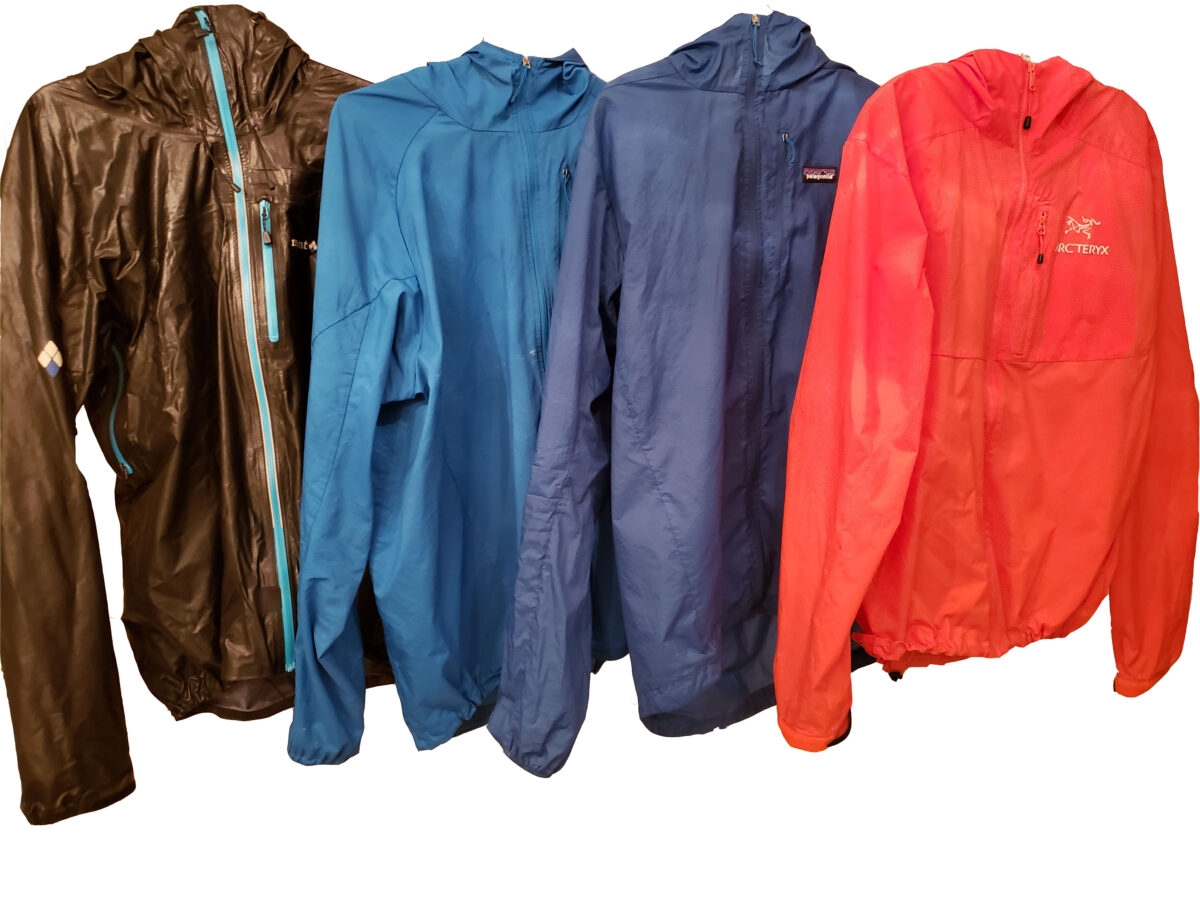
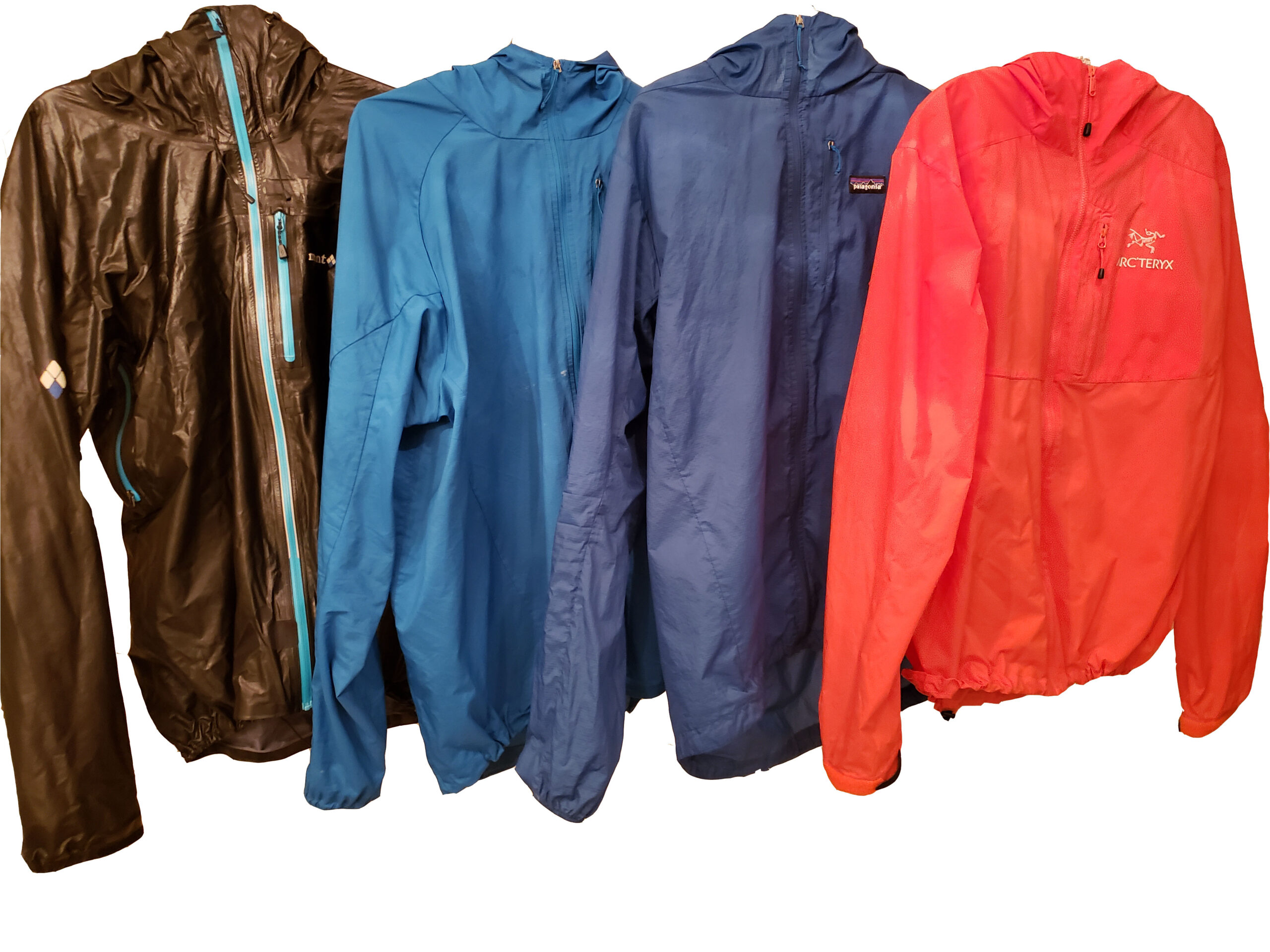
Four jackets were selected for this test. Table 1 below provides their characteristics.
Table 1: Test Jacket Characteristics
| Jacket | Fabric | weight (grams) (see note 1) | Air Permeability (CFM/ft^2 @ 0.5" wc) (see note 1) | MVTR (grams/m^2/24 hr) (see note 1) |
|---|---|---|---|---|
| Montbell Peak Dry Shell | Gore Shake Dry | 237 (see note 2) | <.43 | 3370 |
| Patagonia Houdini | Dense weave nylon | 107 | 0.6 | 2250 |
| Patagonia Houdini Air | Dense weave nylon | 121 | 14.3 | 3120 |
| Arcteryx Squamish 2019 | Dense weave nylon | 157 | 11 | 2580 |
Table Notes:
- All measurements made with in-house instruments
- Extra weight due to the addition of custom pit zips.
The Montbell Peak Dry Shell is constructed from a waterproof, breathable Gore Shakedry fabric and is not typically considered a windshirt. It is virtually air-impermeable with air permeability that is lower than I can measure. It has the highest MVTR of any waterproof breathable (WPB) garment I have tested. The Patagonia Houdini Air ranks seventh highest out of 19 windshirts or windshirt fabrics that I have tested for air permeability. It is near the top of general-purpose windshirts in terms of air permeability and MVTR while still offering some wind protection. The 2019 Patagonia Houdini has very low air permeability and has the second-lowest MVTR of the windshirts I have tested. The 2019 Arc’teryx Squamish has somewhat middle-of-the-road air permeability and MVTR performance.
The base layer worn for the test is a long sleeve shirt made by Xoskin. This garment is constructed using a nylon 3D seamless knit fabric with embedded PTFE and copper in the fibers. This garment is skintight which means that perspiration cannot easily drip down the skin; rather, it will be absorbed into the fabric until saturation is reached. This garment offers some of the best wicking/drying performance of any base layer I have tested, making it an ideal base layer for this test. The dry weight of the Xoskin shirt is 6 ounces (167 g).
Each of these jackets was worn during a series of runs. Four runs were conducted for the Squamish. Three test runs were completed for each of the other three jackets. The run takes place on a 4.9-mile (8 km) circular trail located in a large open space. The trail has minor elevation changes. During the runs, all zippers, hems, and cuffs were closed to minimize pumping air exchanges. The hoods were worn and tightly sealed. During the run, a Garmin Fenix (version 5) along with a heart rate monitor chest strap was used to collect physiological data. The average MET level for each run was calculated using average heart rate data and results of metabolic testing I underwent at the University of Colorado Sports Medicine and Performance Center (Boulder, CO). Weather data was obtained using NOAH statistics from the Vance Brand Airport, located approximately 2 miles from the center of the running loop. The data is published online at approximately 15-minute intervals. The weather data corresponding to the beginning and end of the run are averaged.
Water retained in the base layer was weighed on an A&D SJ-2000HS digital scale. The scale resolves 1 gram.
The runs cover a range of temperature, humidity, and wind conditions. Of course, this being Colorado, the highest humidity during a run was only 67%. The range of environmental conditions can be seen in the test results table below.
Test Results
Test results are presented in Table 2. The results for individual runs are listed by date. The critical measured data for each run is the water weight gain of the Xoskin base layer, shown in column 3. Performance data for each run is shown in columns 4, 5, 6 and 7. Columns 8-12 show environmental data for each run.
Member Exclusive
A Premium or Unlimited Membership* is required to view the rest of this article.
* A Basic Membership is required to view Member Q&A events


Discussion
Become a member to post in the forums.
I also tried to understand a little bit better Stephen’s results in terms of CFM/MVTR and the fact that the very same people behind this website appear to not really believe on it or at least as if they have failed to take the results into account (which is quite interesting, you publish a serious series on your own website to finish not following them) but I received a hastily answer above…
IMHO:
your weather is not my weather
Your terrain is not my terrain
Your physiology is not my physiology
Your walking speed is not my walking speed
Your comfort level is not my comfort level
So why on earth should my clothing suit you?
(Silnylon poncho over a Taslan windshirt, but with a high rate of climbing.)
Cheers
Hey there – I have some real world testing anecdotes to add.
I have an ultra lightweight arcteryx shake dry top and a highly air permeable Patagonia Houdini.
I’ve run 5 miles at a reasonable pace using both back to back on similar days with similar pace in the same trail -40 degree temps, no wind, cloudy, and the shake dry leaves my shirt totally soaked underneath, while the Houdini is nice and mostly dry.
something with air permeability is going on that your tests aren’t measuring.
my pace wasn’t anymore then 6 miles an hour and I doubt that amount of “wind” would cause that degree of evaporative differnce
If your Houdini is highly air permeable, then it must be pre-2012? I don’t think Stephen has been able to get his hands on one of those to test. It may also have very high MVTR.
No it’s a couple years old only.
My point is that that’s study lists them as relatively the same MVTR and the only differnce is air permeability – this does seem to have an effect on under-garment humidity more then the study would have us believe
Newer Houdini’s have been testing with very low air permeability.
Any chance it is a Houdini Air?
That would fit your description (and question) better.
It may well be.
Again – wanting to point out without getting bogged down in details that either way it’s air permeability will be higher than shakedry with likely similar MVTR.
I have quite a few air permeable garments and all of them have similar improved moisture Managemnt performance over shake dry.
MVTR in my experience is not the only variable if we are to believe as the tests show that it is similar across these groups.
if we do believe it’s similar then air permeability is actually important, or MVTR is a poor measurement tool or measured incorrectly in the study
I had similar thoughts about my OR Ferrosi soft shell, so I sent it to Stephen for testing. The result was that the soft shell MVTR was very much greater than ShakeDry. It was consistent with Stephen’s hypothesis. Yes, the soft shell was also more air permeable, but I’m persuaded that the MVTR makes the difference in comfort.
Your experience is interesting, because Houdini (and Houdini Air) both test with lower MVTR than ShakeDry. Perhaps Stephen will weigh in (or at least consider the question for his next article).
Agreed. I would be interested in a possible explanation that still holds MVTR as the greatest factor in breathability.
There are a few things going on with wind shirts in real-world use that don’t have much to do with wind (which is the focus of Stephen’s recent CFM vs MVTR work):
Moisture vapor movement across a fabric results from passive diffusion (vapor pressure driven) and active convective movement (air pressure driven). The latter is a process that we don’t fully understand yet and is the one missing link we still have in this discussion. But after doing the math, I think a few tenths of mb of air pressure differential is enough to have a noticeable impact *if* a garment has a CFM rating of at least 30 or so.
Makes sense, thanks.
So high CFM garments do play a role
Yes, they play a role. But we don’t know to what extent, air pressure gradient, induced moisture transfer contributes to the overall breathability of a garment.
We’ll certainly my real world experience would indicate to stick with wind shirts and not shake dry
Hi Philip:
I appreciate your comments. If you review this article carefully, I comment on how the garments were worn. In all runs, the sleeves and bottom hem closures were tightened and, as needed, retightened during each run. In addition, the hood was always worn, and the drawstring tightened. This was done to minimize the influence of pumping and flapping during the runs. I also discussed the impact of fit on the results. The results were consistent across the original three jackets I tested but showed a significant change when I added the Arcteryx jacket. I attributed this impact, without detailed study, to the difference in fit for this jacket: it was closer fitting than the others. Of course, I also measured all the relevant weather conditions and determined their impact on the results. I also measured the baselayer weight before and after each run as a surrogate for how much water was retained for a particular jacket. Finally, I continuously measured my level of effort in terms of speed, calorie expenditure and MET level during each run. Of course, I also measured each jacket’s air permeability and MVTR. Then I did the statistical analysis, whose results were not close when determining the impact of MVTR vs. air permeability.
With respect, I suggest unless you take similar steps, it is pretty difficult to reach performance conclusions. We don’t know, from your description, what Houdini you wore: the regular or the Houdini Air. We don’t know their condition, fit, adjustment, etc. We don’t know how comparable was the level of effort. We don’t know enough about the weather conditions, especially humidity and wind speed.
The air permeability of the regular Houdini is pretty close to that of the Shakedry. The air permeability of the Houdini Air is substantially higher than Shakedry. The MVTR of the regular is considerably lower than Shakedry. The MVTR of the Houdini Air is a little lower than the Shakedry.
So, I don’t think we have enough information about many factors that could have contributed to your experience.
If you have not read my latest article, you might find it helpful. In the article I am presently working on, I will, among other things, present the correlation between Air Permeability test results and the velocity of air that actually penetrates a wide range of garments. I think the results will be surprising, so stay tuned.
Thanks Steven – all of those factors such as flapping, fit, etc would certainly make a difference, but I will say that this is an across the board difference. I have multiple windshirts – Patagonia Houdini air, Patagonia air shed pro, black diamond alpine start – they all subjectively breathe far better then the shakedry – I’ve used them all extensively – running similar courses, backcountry skiing and all the wind shirts just work better – you can say that that’s not scientific and of course it’s not a controlled experiment but one can’t discount what works.
anyway, I appreciate your work and your articles and will continue to look forward to reading them with interest
Philip: Interesting. If you would like to follow up, why don’t you try a little mini-experiment along the lines of what I did for the article and compare performance for your Shakedry and favorite of the various windshirts? One thing (among many) that I don’t know, is whether Gore made different versions of shakedry for different clothing manufacturers. If you want, I can test yours and then we will know how it compares to the Montbell Shakedry that I use. If you are interested, PM me.
Hi Steven – certainly a fascinating topic but unfortunately not fascinating enough for me to devote the time for setting up a testing apparatus. I feel I have a pretty good idea of what works and dosent in real world scenarios.
Have you considered that the membranes are just plain “hotter” – perhaps since there’s no air permeability they can’t thermoregulate as well, and the extra heat build up manifests as more sweating which overwhelms their MVTR whilst the more air permeable fabrics allow air transport in and out which would allow for a more cooling effect and thus less sweating?
seems as though perhaps there may be more at play then just MVTR numbers alone.
a corollary question would be if you’ve tested baseline characteristics of say a lightweight polypro shirt – if the MVTR was similar to other fabrics in the windbreaker /shakedry range – say 3000 – then we would know that something else is at play because that obviously dosent make real world sense as we know anectodotally that lightweight polypro breathes better then shakedry or wind shirts
Do you think WPB would work in a tent to reduce condensation inside?
There would be insignificant temperature difference across the fabric, but there could be a humidity difference. 100% humidity inside, if there’s condensation, but less than that outside.
Maybe this question is outside what you studied.
Do you think WPB would work in a tent to reduce condensation inside?
That is a definite ‘maybe’.
Sorry!
From experience, I would say that ventilation would be far more practical.
My 2c.
Cheers
WPB fabrics have been used in a variety of tents. I have never tried one. I would like to. I have seen user reports that are, like most things, all over the place. I suspect the answer will always be: it depends on the environmental conditions. But, as I said, I have no practical experience with a WPB tent.
Thanks
Ryan has a WPB tent — his Locus Djedi (DCF-eVent) that he says is one of his favorites.
Would he lend it to Stephen for testing?
Is a WPB tent better because it has less condensation inside? Because it’s breathable?
An experiment would be to have a waterproof tent next to an identical tent except with WPB. Humans sleeping overnight. Does one have less condensation inside in the morning.
I bet there are users of WPB tents, like Bibler, that have this experience.
I have seen the texture of fabric make a difference.
Like, on my sleeping bag next to my face is some supplex. There is less condensation there. The supplex has a rough texture. The rest of the sleeping bag is slippery nylon.
Become a member to post in the forums.