


Introduction
It seems widely accepted that elevated air permeability (the ease with which ambient air can penetrate jacket fabric) in a lightweight windshirt can provide effective moisture vapor removal during backpacking and hiking. In prior studies, I have made the case that activities that occur at low speeds, such as backpacking, do not provide sufficient air pressure on the face of a jacket to support significant convective cooling or adequate moisture removal by means of windshirt fabric air permeability. Rather, in the absence of winds, one must rely on ventilation provided by jacket openings such as pit zips or the front zipper.
In this study, I compare the performance of four jackets made with fabrics that span a wide range of air permeability rates and moisture vapor transmission rates (MVTR). The study shows that significantly greater moisture removal can be achieved as a function of jacket MVTR than jacket air permeability. In fact, the ratio of moisture removal in the jackets tested due to MVTR exceeds that of air permeability by a factor of nearly 7 to 1. This means that when we select a windshirt or even a waterproof breathable shell, we should pay close attention to vapor transmission characteristics if we wish to obtain effective moisture removal. This study also demonstrates that a high MVTR waterproof/breathable shell can provide better moisture removal than a typical windshirt. This means that you can have a single layer that functions as both a rain jacket and a windshirt. In short, MVTR is a performance characteristic that should receive lots of attention when selecting your next wind layer or rain jacket.
Background
During exercise, your body will eliminate excessive heat by sweating. How effectively your clothes allow sweat to be removed will determine how well sweating accomplishes its cooling function. Effective elimination of moisture from sweat will also avoid accumulating condensed water vapor in various clothing layers.
Sweat must evaporate to provide cooling and the resulting water vapor must be then removed from all garment layers. Water vapor removal is typically accomplished through convection and/or moisture vapor transmission.
Convection describes moisture vapor removal by means of air circulation within a layer or through a layer. Convection can be enhanced by garment ventilation features such as pit zips, openings at the neck, sleeve, or hem, or air movement through pores in the garment fabric. Convection is driven by air pressure differences across the garment layers.
Moisture vapor transmission describes the transfer of moisture through one or more garment layers. It can occur at the garment ventilation features mentioned above. Moisture vapor transmission also can take advantage of tiny openings in garment fabric, both pores and spaces between fibers, to expel moisture. Vapor transmission is driven by the vapor pressure difference between the skin and the ambient environment. Vapor pressure is a function of both temperature and relative humidity. A high temperature at the skin, combined with high humidity will produce the pressure gradient necessary to expel moisture vapor to an ambient environment that has a lower temperature and/or humidity.
The ease with which air can move through a garment is termed air permeability. Air permeability is typically characterized by measuring the volume of air that can pass through a fabric at a known air pressure differential across the fabric. The ability of a garment to support moisture vapor transmission is often termed breathability or vapor permeability. Of course, the term breathability is sometimes used by some to include air permeability, so confusion can be expected when breathability is not clearly defined.
There are many ways to measure a garment’s ability to transfer moisture vapor. Two widely used measurement approaches produce very different and not necessarily comparable measurement data: moisture vapor transmission rate (MVTR) and evaporative resistance. MVTR is measured as grams/meter2/24 hours. MVTR test methods tend to promote evaporation of water from a reservoir, through a piece of fabric, to the ambient environment. The other main approach is often called the skin method. It uses a device called a sweating guarded hot plate and produces results in units of Evaporative Resistance. Both general approaches are guided by several available test standards. The results of different test standards are not necessarily in good agreement and will almost always result in different magnitudes of vapor transfer rates. In this study, MVTR is determined by measuring the quantity of moisture that passes through a garment at a vapor pressure differential of 0.3 psi using devices that I’ve designed called permeation kettles.
The relative effectiveness of air permeability and MVTR for removing moisture from garments has not received a great deal of attention here at Backpacking Light. In this study, I look at the relative effectiveness of both simultaneously.
In a previous study published in 2001 at Backpacking Light, the author went on runs at similar exertion levels and conditions using different shells. The shells were utilized under sealed conditions or ventilated conditions. The subject athlete wore a wool base layer under the shells for each run. At the end of the run, he weighed the base layer and compared its weight to the dry weight of the base layer. The weight difference, of course, was sweat accumulated in the base layer. The author reasoned that less accumulated sweat in the base layer indicated improved moisture transfer for the test garment. Based on his tests, he concluded that higher exertion exercise could overwhelm the ability of any waterproof/ breathable jacket or any windshirt to remove moisture. He found that only a combination of ventilation and adjustment of insulation or activity level could effectively ensure adequate removal of moisture during higher exertion exercise.
I decided to try a similar study, but the jackets would span the extremes of air permeability and vapor transmission levels. I would then apply statistical measures to attempt to parse the impact of these and other characteristics on the jackets’ abilities to remove moisture. One of the nice features of the 2001 Backpacking Light study and my test methodology is that anyone with fairly rudimentary equipment but high enough motivation can conduct their own version of this test.
Test Design
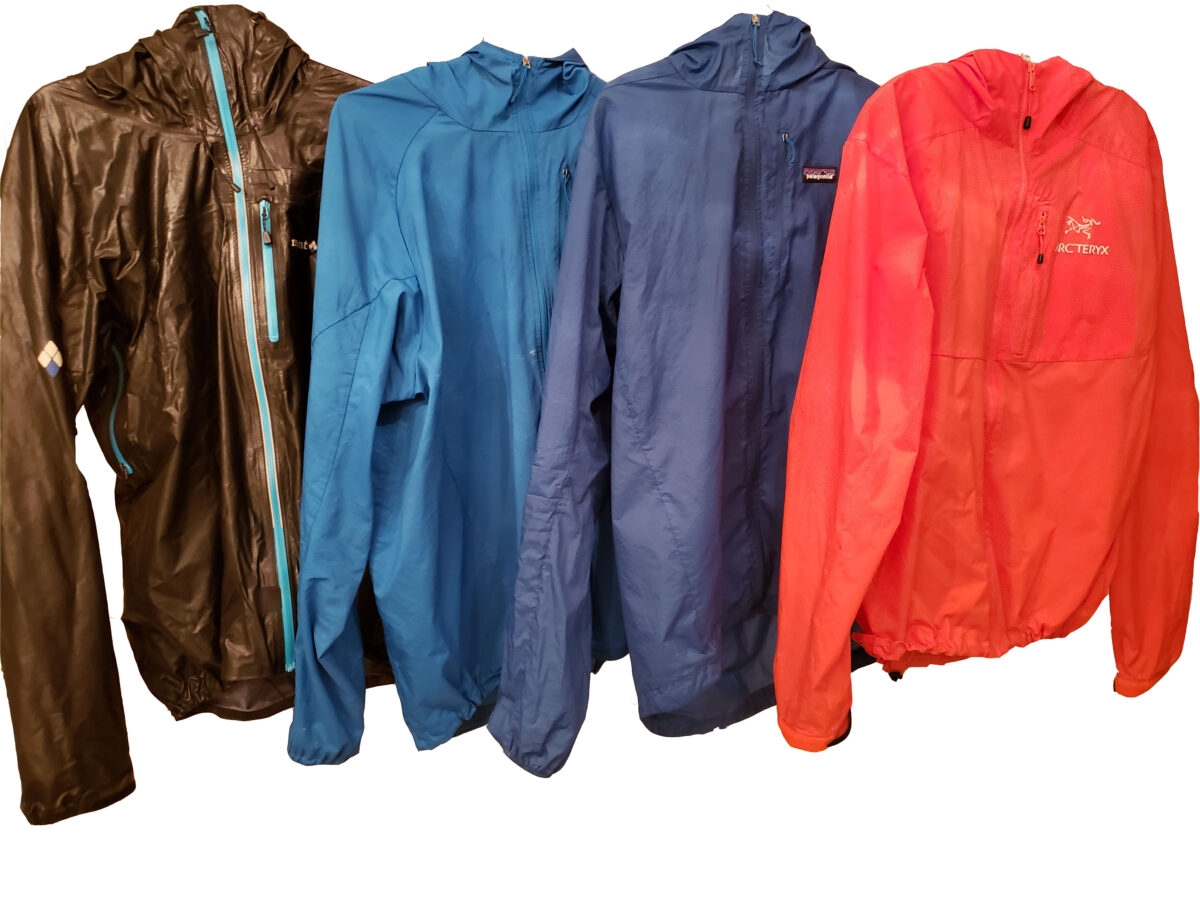
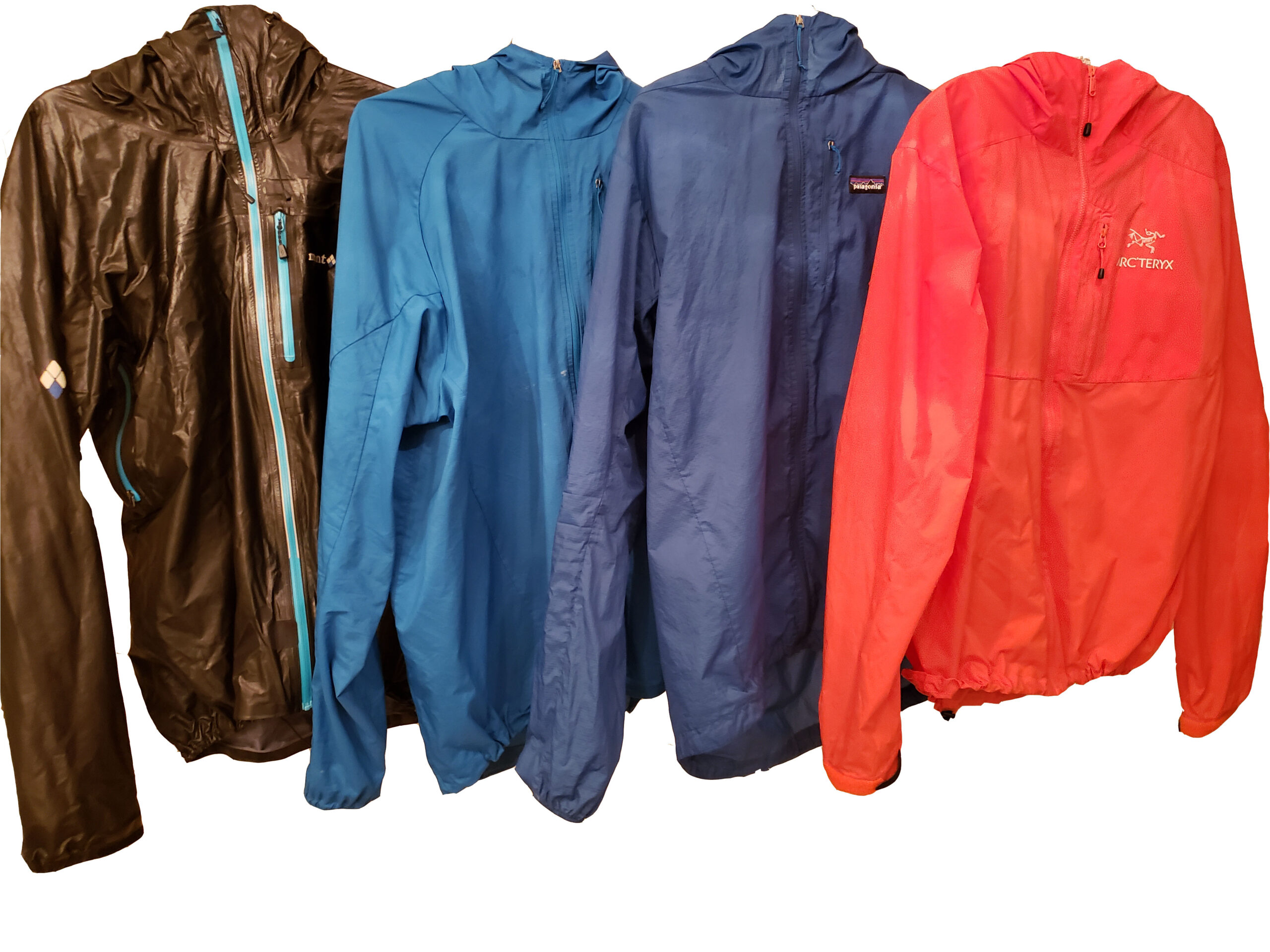
Four jackets were selected for this test. Table 1 below provides their characteristics.
Table 1: Test Jacket Characteristics
| Jacket | Fabric | weight (grams) (see note 1) | Air Permeability (CFM/ft^2 @ 0.5" wc) (see note 1) | MVTR (grams/m^2/24 hr) (see note 1) |
|---|---|---|---|---|
| Montbell Peak Dry Shell | Gore Shake Dry | 237 (see note 2) | <.43 | 3370 |
| Patagonia Houdini | Dense weave nylon | 107 | 0.6 | 2250 |
| Patagonia Houdini Air | Dense weave nylon | 121 | 14.3 | 3120 |
| Arcteryx Squamish 2019 | Dense weave nylon | 157 | 11 | 2580 |
Table Notes:
- All measurements made with in-house instruments
- Extra weight due to the addition of custom pit zips.
The Montbell Peak Dry Shell is constructed from a waterproof, breathable Gore Shakedry fabric and is not typically considered a windshirt. It is virtually air-impermeable with air permeability that is lower than I can measure. It has the highest MVTR of any waterproof breathable (WPB) garment I have tested. The Patagonia Houdini Air ranks seventh highest out of 19 windshirts or windshirt fabrics that I have tested for air permeability. It is near the top of general-purpose windshirts in terms of air permeability and MVTR while still offering some wind protection. The 2019 Patagonia Houdini has very low air permeability and has the second-lowest MVTR of the windshirts I have tested. The 2019 Arc’teryx Squamish has somewhat middle-of-the-road air permeability and MVTR performance.
The base layer worn for the test is a long sleeve shirt made by Xoskin. This garment is constructed using a nylon 3D seamless knit fabric with embedded PTFE and copper in the fibers. This garment is skintight which means that perspiration cannot easily drip down the skin; rather, it will be absorbed into the fabric until saturation is reached. This garment offers some of the best wicking/drying performance of any base layer I have tested, making it an ideal base layer for this test. The dry weight of the Xoskin shirt is 6 ounces (167 g).
Each of these jackets was worn during a series of runs. Four runs were conducted for the Squamish. Three test runs were completed for each of the other three jackets. The run takes place on a 4.9-mile (8 km) circular trail located in a large open space. The trail has minor elevation changes. During the runs, all zippers, hems, and cuffs were closed to minimize pumping air exchanges. The hoods were worn and tightly sealed. During the run, a Garmin Fenix (version 5) along with a heart rate monitor chest strap was used to collect physiological data. The average MET level for each run was calculated using average heart rate data and results of metabolic testing I underwent at the University of Colorado Sports Medicine and Performance Center (Boulder, CO). Weather data was obtained using NOAH statistics from the Vance Brand Airport, located approximately 2 miles from the center of the running loop. The data is published online at approximately 15-minute intervals. The weather data corresponding to the beginning and end of the run are averaged.
Water retained in the base layer was weighed on an A&D SJ-2000HS digital scale. The scale resolves 1 gram.
The runs cover a range of temperature, humidity, and wind conditions. Of course, this being Colorado, the highest humidity during a run was only 67%. The range of environmental conditions can be seen in the test results table below.
Test Results
Test results are presented in Table 2. The results for individual runs are listed by date. The critical measured data for each run is the water weight gain of the Xoskin base layer, shown in column 3. Performance data for each run is shown in columns 4, 5, 6 and 7. Columns 8-12 show environmental data for each run.
Member Exclusive
A Premium or Unlimited Membership* is required to view the rest of this article.
* A Basic Membership is required to view Member Q&A events


Discussion
Become a member to post in the forums.
At some point, MVTR will be inadequate to provide sufficient vapor removal.
At which point (when you get that hot) you should take the windshirt OFF.
Cheers
Depends on the conditions doesn’t it? I am speaking in this response in broad generalities. I think I have addressed the details in my articles. Where I spend most of my time, I am above tree line on almost all outings. We are subject to high winds over a wide range of temperatures. There are many occasions that I need wind protection but I also need to dump more vapor than MVTR will support. So, the pit zips are opened. The pit zips on my jackets are custom, 22″, double sided zips. These zips can dump a lot or a little moisture as needed while still providing excellent wind protection. Similarly, when it is raining, MVTR may be inadequate for the conditions or level of activity. Again, I can be protected from the rain or wind (they both can occur together) by using the pit zips. A typical wind shirt does not offer such flexibility. However, to your point–when I don’t need the protection of my Shakedry wind/rain layer, off it comes. Why would anyone wear an unnecessary layer?
https://www.adventurexpert.com/product/6d-waterproof-breathable-3-layer-fabric/
Thank you for your research, I have enjoyed it. Have you seen the AdventureXpert 3L WPB they sell? Its rated at 50k MVTR supposedly and has a “hydrophilic membrane”.
Slightly off topic but im looking for the best shell material for a winter bag/overbag. Ive measured my moisture output of my body between 200-250ml for 8hrs, so MVTR is the most important metric for me.
Some reports have suggested that this fabric is the one used by zpacks and EE. If youre not interested in buying some, I can send you some for testing, no charge. Thanks!
I have not read all the comments but I think your study is missing a huge, huge variable here: the user.
You have stated before you are using most of this stuff above treeline and you are very likely in good shape and it also sounds like you are not a heavy sweater nor do you run super hot. As a consequence of this the low CFM garments in general (regardless of how much moisture they remove) are probably the best bet for you. I have friends who are similar and they also use similar systems.
That being said there are also many of us who run warm and sweat heavily – and for those people I still maintain that air permeability is king. I know that I can easily – very easily – out sweat even the best MVTR that any jacket has to offer. Therefore my priority is always managing my own temperature and airflow over everything else. I am in very good shape with a relatively low body fat percentage ( I would estimate probably 12-13%). Trail running for example in the Sierra (a higher output activity obviously than backpacking) I am perfectly comfortable shirtless down the upper 30s fahrenheit.
Mechanical ventilation of course is always king but in very high precip this may not be an option or in more high risk scenarios you may not have the time to be adjusting pitzips and whatnot all the time. For all practical purposes at this point I just basically ignore MVTR of a garment – its ability to remove moisture is negligible compared to my ability to produce it. A waterproof with even a low CFM, however, makes a sizeable difference in how I feel when working hard and greatly reduces the moisture I produce. And a windshirt with a medium CFM becomes extremely useful even above treeline for managing my own output.
In addition I think the way that these membranes function is also very important. MVTR in the lab is one thing – but real life is another. Many of the high MVTR garments require that there is heat being produced within the garment to move moisture out. With air permeable garments this is NOT the case – the air permeability directly influences the moisture removal. This becomes especially obvious when used as a shelter fabric – even if the user is absent from inside the shelter it will continue to “breathe” out moisture that is inside. There is a reason every manufacturer has pretty much exclusively moved to using air permeable fabrics in their single wall shelters – it just works better. Much better.
Of course this is not even taking into account that MVTR itself is a lab test that may not be the end all measurement for real world use. Given that air permeable membranes did not exist when MVTR was invented I think it is likely we need new methods of measurement. And for a true real world use case it would likely be necessary to test a variety of subjects with different backgrounds and needs.
@Chris S
Which shelters are you referring to? The ones I’m thinking of,
RAB latok/summit is WPB
BD Firstlight is WPB
MSR advance Pro is WPB
BD Eldorado (toddtex) is WPB
Only single wall alpine shelter that comes to mind immediately with an uncoated fabric is MH AC2….
also I think microfluidics have several complex charge interactions at this scale that rely on capillary forces, surface area, pixies, etc. so it’s not so simple to hand wave those principles away by just eyeing up the bigger holes, and it seems the data suggests this as well.
eVent is technically air permeable – just barely.
The true air permeable shelters though made of electrospun membranes would be things like the Big Agnes Shield line (and their bivy) and the Ascentshell bivies made by OR.
Also the new Rab single wall shelters I believe are Pertex Shield Air which is also an electrospun membrane and air permeable and could very well just be Neoshell licensed to Pertex.
I see, thanks. But, one bivy from OR is hardly the market moving but I guess I’m just confused on the new marketing verbiage. How does “air permeable” compare to “breathable” or is it just some indefensible statement like “drinkability” that’s allowed only because it’s necessarily vague… For the record many brands are using hydrophilic components in their WPB laminates but the choice to market with “breathable” or “air permeable” seems random.
Air permeable means air will actually pass through it – like it has a CFM measurement greater than 0
“Breathable” means (surprisingly) that is can technically pass water molecules. And funnily enough has nothing to do whether you can “breathe” through it. Goretex, for example, is 0 CFM and will suffocate you if you try to breathe through it.
“Breathable” is basically pure marketing while “air permeable” is used in some marketing but is an accurate technical term.
But what “air permeable” means in numbers is UNdefined. Heavy canvas and mosquito netting are both “air permeable”. Well – I guess that depends somewhat on the canvas!
Spin, spin and more spin.
Cheers
I have tested 9 electrospun membranes-Neoshell, Ascentshell and Futurelight. The air permeability is typically around 1 CFM/Ft2. I suspect you would suffocate if you tried to breathe through them or a Gore membrane. As Roger said, the numbers for air permeability are not really defined. I know what they mean because I measure them and compare the measurements with what I experience in my various activities. Patagonia has defined air impermeable at less than 5 CFM/ft2 (there is a post somewhere on BPL with this information, perhaps someone can link to it). I don’t think you will ever find a WPB membrane of any sort that approaches anywhere near 5. That would reduce its hydrostatic head pressure and lead to leaks. Generally, the best route to improve breathability or MVTR in a WPB is a lighter-weight, more loosely woven face fabric.
In a study I did last year of four light-weight Neoshell fabrics, this is clearly demonstrated in the following photomicrographs.
The upper image shows the neoshell fabric with the lowest MVTR. The lower image shows the neoshell fabric with the highest MVTR. The white you see in the images is the waterproof membrane. The red fabric is the heaviest of the four I tested. The black fabric is the lightest with the most open weave. The light fabric permits the membrane to perform closest to its potential for moving vapor or air. In this case, the black fabric MVTR is 12% higher than the red. The air permeability of the black is 7% higher than the red. But still, just over 1. The price of the improvement is hydrostatic head, which is 4% lower. The black fabric is 40% lighter than the red.
I have just received a jacket made for me from the black neoshell that will be used for skinning uphill. It has the best breathability of any WPB I have found, but it also has 20″ pit zips for when that is not enough. Since I will follow skinning with skiing down, 1 CFM/ft2 air permeability is all I would want. However, if I fall at high speed on the way down, the black fabric will prove to be less durable than the red. All of these fabric parameters have trade-offs.
By the way, Kin, the fabric that you linked to claims an MVTR of 50000. On my scale, that would be around 2500 g/ft2/24 hr. Middling performance. I have samples of the fabric used by EE and Zpacks. I cannot tell if those are the same as the fabric in your link. The mill that makes their fabric makes similar fabrics in many weights, with improved MVTR as the face fabrics become lighter.
Stephen suggested Neoshell so I got some fabric. Kind of expensive – $45 per yard at discoveryfabrics.com
I found that jacket to be better in sustained rain than other fabrics I’ve used. The clothing underneath stayed dry.
I made a jacket from RSBTR WPB fabric – it wets out in sustained rain – clothing underneath started getting wet. But, it weighs less. Good on trips where I know there won’t be sustained rain.
These manufacturers are approaching it in the wrong way. It is possible to get a more air permeable and functionally waterproof fabric if you change the equation and core thinking. Rather than having 1 highly waterproof, very low air permeable, and permanent DWR layer, what you do is two combine two layers of water resistant, moderate air permeability, and permanent DWR layers.
This could be two siliconized polyester and/or nylon fabrics, two very tightly woven polypropylene fabrics,, siliconized polyester or nylon fabric with a non woven PP, PE, or PTFE “membrane” that is more air permeable than usual, etc or any combo of 2 of the above (while factoring in that you want the stronger, more abrasion resistant, more durable, and more UV resistant fabric on the outside).
The logic is, is that two permanent DWR fabrics will have a higher combined water resistance than one layer of fabric with similar water resistance. (Purely for a theoretical example) Say for the first part, you have two fabrics each with a 1000 mm water resistance vs a single layer of 2000 mm water resistant fabric or membrane. In the former, you get higher than 2 x 1000 mm water resistance (i.e. greater than 2000 mm) because the first layer absorbs most of the force of the rain drops and so the second layer doesn’t need to be as water resistant to act as a barrier to the water anymore. It is a non linear system where the water resistance increases over the combined singular water resistance of the fabrics.
I’ve experimented with such systems and it works not only in theory but in practice. You just have to tweak the air permeability vs water resistance of the two fabrics in combo. I don’t have the equipment and mathematical know how to get the perfect combo blend to maximize air permeability in relation to waterproofness, but I’m sure that this would be easy for these corporations. And to me, it just makes sense to use such fabric in combo with mechanical venting such as in a poncho style garment (or at the very least, very large pit zips).
My first experiment with such a system involved taking a 1.4 oz/yd2 silnylon that had a very poor waterproofness rating and then I folded it up and ran it under my sewing machine with an unthreaded needle to puncture it. Then I sewed that to some “Kite” tyvek and nylon tulle to make panels, and then made a poncho out of that combo. The punctured silnylon was on the outside/face–this is because it is stronger, and more abrasion and UV resistant than the tyvek. The tyvek was inside/center, and the nylon tulle was outside/inner solely to protect the tyvek from body oils and abrasion.
I ended up losing it. I plan to make another one, but this time, I plan to get an uncoated and uncalendered polyester that is highly air permeable and put a silicone coating on it and either have the inner layer the same or a nonwoven polypropylene fabric that is more air permeable than the tyvek was, and then the layer closest to skin would be Monolite. And again, make it into a poncho type design. The fabric composite itself will be more breathable than the first iteration since the first two layers will be more air permeable than the previous one.
Oh, and if one wears a fishnet baselayer and a woven, non wicking (meaning, when water is dropped onto it, it doesn’t absorb into and spread, but rather beads up) polypropylene baselayer (such as the Terramar ones) over that, you are guaranteed to stay dry and comfortable even in the worst conditions involving rain. PP baselayers don’t get near as funky when they are not worn directly touching the skin btw. I think they make excellent midlayers as they are lightweight, warm, and don’t absorb any moisture into the material itself. I don’t use them as baselayers because of the odor factor.
(my favorite fishnet baselayer of late is made out of 80% nylon and 20% spandex and is this item in a hood version:
https://www.amazon.com/dp/B09XHQCX6H?ref=ppx_yo2ov_dt_b_product_details&th=1&psc=1
The fabric is very comfortable and because it is a nylon-spandex blend, it doesn’t get near as stinky as other synthetic baselayers that aren’t treated with silver or copper–such as polyester or polypropylene fabrics.)
or that gear in England, Buffalo (?), makes multi layer jackets. The layers by themselves aren’t waterproof but together they are. I think they have a fleece layer with a nylon on the outside.
I wear marino socks with breathable nylon gaiter outside. My socks never get wet. The breathable nylon gaiter is nothing close to waterproof.
Justin is back : )
no chaff though
Ar the risk of repeating myself again: it does NOT matter if you get wet. You do wash, or swim, don’t you? What matters is whether you are badly cold.
In this photo, taken at the concrete cairn on Mt Jagungal, Kosciusko NP, it looks as though Sue has her hand on the concrete cairn.

She does not. Her hand is on a thin layer of ice covering the cairn. Yeah, well, that happens.
But she is warm inside her poncho and over-trousers, and that was all that mattered.
OK, we did not hang around for very long: stand still and you will get cold.
Cheers
Yeah, Buffalo, Paramo, etc work on a similar concept, though these tend to be warmer than the two thin layers I’m advocating.
Hi, and cheers Jerry. Re: no chaff, probably for the best (speaking for self).
True Roger, but if you had the choice between being wet, initially cold, and having to move to stay warm vs dry, warm, and can move whenever you feel like, I suspect most people would probably choose the latter. I know I would. And it is possible to achieve the latter if the right material combinations are used. Paramo, Buffalo, etc were/are overly warm and non permanent DWR approaches, but it can be achieved with thinner, lighter, less hot, and permanent DWR fabrics.
I guess everyone goes their own way. Our preferred way is either moving fast (which keeps us warm), or inside the tent. Lunch during a storm? Sometimes we grab food – biscuits, choccy, scroggin mix, put them in our pockets, and keep walking. Other times we have stopped and put the tent up. The latter has the distinct advantage that it quickly leads to hot coffee :)
Once or twice we have found either an old mountain hut or a big overhang in the sandstone cliffs. You can’t rely on these however.
Anyhow, the bottom line is that we don’t play the MVTR & pit-zips game. We go a different route.
Cheers
yeah, probably no chaff is best Justin : )
I try to stay dry. Which I accomplish 95% of the time or so.
Getting wet and staying warm is a plan B. If it rains a lot and my rain jacket fails me, synthetic insulation may start getting wet but still retain half of it’s warmth. And dry out from body heat after a while. But this is not ideal.
Just my opinion
“Sometimes we grab food – biscuits,…”
I am thinking of the Geico commercial where the Geico Gecko offers the new people some food, the guy says “great, cookies”, the Gecko says “no, they’re biscuits…”
Stephen, thank you for all of your excellent work on fabrics. The knowledge here (from you, and others) is impressive.
So if MVTR beats CFM, then why are any of my windbreakers so much more comfortable (in all weather other than heavy rain) than a high MVTR rain jacket? Is the MVTR of a typical windshirt or soft shell orders of magnitude higher than the 3,000 range of good WPB or Houdini?What is the MVTR of, say, an OR Ferrosi?
Also, this analysis would benefit from the addition of a measurement of rainproofness. There is some amount of moderate-to-heavy rain where a poncho or rain jacket becomes more comfortable than a windbreaker while working. Is there a way to quantify that inflection point? Measuring rainproofness on Houdini/Air/Airshed (in addition to MVTR and CFM) would better help us choose.
Hi Bill:
I cannot answer your question about your personal comfort. There are too many variables. What I can do is design testing procedures to get insights into clothing performance. I always try to describe those procedures so curious readers, such as you, can understand how I arrived at any conclusions. As an engineer, you should be well-equipped to understand the test procedures and determine how they may or may not replicate the conditions you experience. So, I would like to turn your question around and suggest you look at the study methodology and describe where it went wrong.
In this article, I provided hydrostatic head measurements for various shell-type jackets. In comparison, wind shirts tend to be in the neighborhood of around 200-400 mmwc. A fraction of any WPB garment that I have tested. The relationship between hydrostatic head and leaks into a garment under various use cases and weather conditions is not well defined in the literature beyond very broad guidelines.
Oh, I didn’t expect you to have a test for measuring “comfort” off the top of your head. :)
I don’t even know IF there is anything wrong with your tests. All I know is that the data presented in this article appears to be missing some illusive factor. It doesn’t quite add up to real-world experience.
Elsewhere throughout the forum, there are two distinct camps about shells; those who like WPBs for most cool conditions, and those who prefer more breathable wind garments for all but heavy rain. It isn’t a matter of right or wrong. It does not appear to be a difference in knowledge or amount of experience or access to the “best” garments; it’s just a personal choice.
It may not even be a choice based on comfort. I cannot know how it feels for someone else; all I know is how it feels for me. I’m clearly in the wind-garment camp; keeping a front-zippered poncho in my pack for when it rains hard. I do wear a WPB shell around town and sometimes around camp, but find them generally uncomfortable when going uphill.
Others prefer WPB for both wind and rain. I do not know if that choice is made based on comfort. It may be based on saving a few ounces of weight or the convenience of having one shell and/or not having to change when the weather changes. Perhaps comfort isn’t part of the calculation at all.
I like Roger Caffin’s solution of a quick-change garment. On and off in seconds without removing the pack. Nice.
(One odd data point: Your CFM measurement for the Houdini is almost an order of magnitude lower than other CFM figures posted throughout the forum for modern Houdinis. Maybe that is due to a change in fabric from year to year, or maybe it is just a different way of performing the test? Not sure that it matters; it just stuck out.)
While you did not find CFM to correlate with weight loss in your base layer, I would expect CFM to correlate better with comfort. How do we measure that? I dunno, that’s why I asked. :)
That’s also why I asked the questions that I did. I have not seen them discussed elsewhere. I’m not asking for an immediate answer; just suggesting that they might be worthwhile to investigate in the future:
Hypothesize, test, refine, repeat.
Something about this test doesn’t add up to real-world experience, so perhaps we can refine and do some further testing in the future? (And by “we” I mean “you” unless I can help somehow.) :)
I guess I need to read the article a couple more times. I’m not an engineering type, I’m a retired auto mechanic — a person that fixes things the engineers didn’t design properly ;-)
Since this is a backpacking site, I look for things that are applicable to how I operate on backpacking trips. So my starting point of thinking for all of this is probably different. I do not hike at 9+ MET as was the test parameters, more like 6 – 7 MET depending upon the environment I am in.
I try to minimize moisture generation, not transmit it through my clothing.
My focus is on regulating my core body temperature. Removing, adding, or adjusting layers during a hike is completely acceptable to me. I try not to sweat in cooler or cold temperatures if possible, even if it means I have to make clothing adjustments every hour or so. I am not going to be wearing a wind shell in 50° F and higher temperatures, unless it is really, really windy. Plus my windshirt has a full front zipper.
I have an old Houdini that is highly breathable and the DWR wore off well over a decade ago — on purpose. On most trips I take an R2 vest, the Houdini, and a baselayer shirt for daytime backpacking.
My three daytime layers provide lots of flexibility with several combination options, which most of the time sees the R2 vest remaining in my pack.
It is not unusual for me to wear an insulation layer over my wind shell at times.
That’s me in the center. It was a very cold and windy morning. The previous night was so windy that two in our group had collapsed shelters and none of us got much sleep. You’ll notice I am wearing less clothing than the others, even though, unlike them, I have lived in a desert for almost 50 years and don’t do well in cold weather. After about an hour I removed the down vest, which is an older Montbell Extremely UL Down Vest that weighs less than my Houdini. Later the bottom Capilene 1 layer came off, and then finally the Houdini. Unlike others in my group, no sweating or wet clothing on my part from hiking while too warmly dressed.
At rest stops I am very willing to put on additional layers until I resume my walking.
Rain is a separate consideration for me and a small poncho covers that.
This is what has worked for me over several decades. No science on my part, just experimentation and experience without even knowing what MVTR is ;-)
One more thought about the water-retention test: While it sounds like a reasonable test, it produces results that don’t obviously match real life. GoreTex outperforming a Houdini Air on breathability? Doesn’t that seem unlikely?
I wouldn’t normally wear a windshirt for running; more likely fleece or a sweatshirt. I interpret that as “CFM rules”. Maybe I’m wrong about the interpretation, but the experience stands.
A confounding factor is the zipper: In real life we lower the zipper and pull up the sleeves when noticeably sweating. However, doing that would interfere with testing the effect of air permeability.
I don’t have a better test, but when test results don’t match observation, it’s worthwhile to re-consider the test.
I appreciate all Stephen has done. I think a lot of this is very situational also.
I am not the best at putting these things together so please correct me if I am wrong on any of these.
You should keep your exertion level in balance as much as you can so you do not sweat or be about to.
You may build up more heat and/or water vapor inside your shell than you can get rid of. This is especially more of a concern the colder it gets. You should reduce these as much as possible.
The MVTR helps water vapor pass though the shell.
The MVTR becomes more of a benefit the lower the CFM.
MVTR mainly comes into play with a rain or wind shell with a very low CFM when you have to button it up because of the rain and/or wind and cannot vent or take off layers.
There are wind shells that have a higher CFM but they will not stop a strong wind and will chill you. These higher CFM wind shells and the chill are effective when someone is doing higher exertion but become a detriment when you slow down or stop and it is cold outside.
The higher MVTR materials for rain shells are Neoshell, Ascentshell, Futurelight and ShakeDry. Even with the higher MVTR and very low CFM it is still good to have your exertion level in balance. It is better to get rain jackets with pit zips and pockets that are mesh to vent if you can.
Opening up the main shell zipper will negate MVTR and CFM to a great degree.
Become a member to post in the forums.