


You don’t have access to view this content.
Lightweight in Wonderland
Circumnavigating Mount Rainier’s premier walk with lightweight gear has J. Sinclair Oal grinning like the Cheshire Cat.
Circumnavigating Mount Rainier’s premier walk with lightweight gear has J. Sinclair Oal grinning like the Cheshire Cat.
You don’t have access to view this content.
Four footwear systems in as many days: Carol does her best to get cold feet.

 Kahtoola, based in Flagstaff, Arizona, has a passion for innovation and quality outdoor gear. Their flexible KTS crampons, Step-in Snowshoe options and MICROspikes stretch-on traction products are trend setting designs that outperform other products in their category and are all backed by Kahtoola’s Satisfaction Guarantee. See them at www.kahtoola.com or call 866 330 8030.
During the fringes of winter when temperatures hover around freezing and snow on the trail sometimes turns into cold water, it can be hard for a lightweight backpacker to keep her feet warm. Many swear by lightweight Gore-Tex shoes with wool socks for such conditions (see Will Rietveld’s series on Lightweight Footwear Systems for Snow Travel ). On a recent four-day trek in the Allegheny National Forest in Pennsylvania, I wore low top Gore-Tex XCR shoes with thin wool socks through shallow snow, mud and water to test if my feet, which get cold easily, would stay warm with this simple, light system. I also tested Gore-Tex socks – which I’d had great luck with inside mesh shoes – to see if the socks benefited a system based on waterproof/breathable shoes. I wore a different system on each foot every day and recorded my observations during the trip.
Waterproof clothing without coatings or membranes: how they do it and how it works.

Hiking in Paramo Pajaro jacket and Cascada trousers on a cold windy day.
Paramo (http://www.paramo.co.uk) is a UK clothing company that makes a unique form of waterproof clothing without coatings or membranes. Paramo also makes base layers, mid layers and windproof garments, but it is the waterproof clothing that I am interested with here and that lies at the heart of the range.
Paramo was created by Nick Brown, the chemist behind the Nikwax range of proofing and cleaning products. Back in the 1980s Nick had the idea for a new type of waterproof clothing using water repellency and wicking to keep the wearer dry rather than barrier technology. He thought this system should be far more breathable, comfortable, and versatile than conventional rain wear. His prototypes worked as expected, but no outdoor clothing companies were interested in taking up the idea, so in the early 1990s Nick started Paramo Directional Clothing Systems to make and market the garments.
Paramo is the name of a cold, wet area in the Andes, lying above the timberline and below the snowline where Nick Brown first tested prototype Paramo garments.

Wearing Aspira Smock and Alta trousers on a bitterly cold snowy day in Yellowstone.
Paramo waterproof garments consist of two layers of material: a windproof water repellent polyester microfiber outer and a very thin polyester fleece lining, known as the Nikwax Analogy Pump Liner. The inside of the pump liner, facing the body, is smooth; the outside, facing away from the body, has fine V-shaped ribbing, with the open end of the Vs away from the body. This liner is designed to mimic animal fur and push water away from the body, hence the name directional. It works because water molecules form spheres. As there isn’t enough space to do this at the base of the V ribbing, water moves outwards to where the diameter of the space between the ribs is large enough.
The pump liner on its own isn’t windproof, and water can easily be forced through it by pressure, so an outer layer is needed to deflect wind and break the force of rain. Even so, the two layers combined don’t meet hydrostatic head tests, as there is no solid barrier to the pressure of a column of water. However, garments have been tested on a dummy in the rain room at the Leeds University Textile Department in the UK, where they withstood the equivalent of hours of heavy rain.
To work, both layers need to be non-absorbent, so they are treated with Nikwax water repellency. In fact, the whole of a garment is treated like this, including zippers. This water repellency can be restored when necessary, making the garments very long-lived.
The lack of a coating or membrane means that Paramo garments are quite breathable, far more so than any other rain wear, and can transmit liquid water as well as moisture vapor, so sweat will pass through. Seams don’t need to be taped or sealed, and punctures or tears are not a problem, as there’s no barrier to damage.

Alta/Aspira trousers provided good protection for my legs whilst igloo building.
The theory sounds great, but the key question is how well garments work in practice: while carrying a pack in the wilds. When I first heard the idea, I was skeptical, unable to see how a garment without a waterproof barrier could keep me dry. Then Nick Brown sent a set of very basic prototype garments – a zip-fronted hooded jacket and pull-on trousers – and asked me to try them. I took them up into the Cairngorm mountains in typical Scottish cold rainy weather, and was somewhat surprised and very pleased to find the garments kept me dry and were free from condensation. Since then, I have used Paramo garments frequently in cold and wet weather, finding them far superior to anything else, whether hard shell or soft shell. The breathability and comfort is the same as that of soft shells without membranes. Wearing Paramo, I don’t feel like I’m wearing rain wear. Indeed, I have worn Paramo trousers all day, every day for three week long trips, only removing them for sleeping (and I’d sleep in them if I was cold).
Occasionally, I have gotten damp in Paramo garments. They certainly aren’t perfect; just the best answer yet to staying comfortable in cold wet conditions. Once the water repellency starts to fail, the garments start to absorb moisture and can get damp inside. Keeping garments clean and renewing the water repellency whenever it shows signs of fading is necessary, but of course you can’t do this while out on the trail. However, even when wet, I’ve found Paramo garments comfortable. On one long day of skiing in heavy rain (it happens!) in some early Paramo trousers without shaped knees, the fabric stretched tight over my knees with every stride, and I felt cold wet rain against my skin. As soon as the tension was released, I felt dry again, and at no time did the wetness spread or my legs feel generally cold.
If soaked, Paramo dries fast, too. On another ski tour, I forded a river in temperatures of -4 F/-20 C (the river was open because it was fed by thermal springs), and discovered too late that the water was much deeper than I’d thought. I’d unzipped my Paramo trousers and rolled them up to my thighs, but the water washed over them and they were soaked when I climbed out on the far bank. My bare, wet legs felt painfully cold in the freezing air, but once I’d rolled down the trousers and started skiing again, they quickly warmed up, and within half an hour the trousers were dry.
Paramo garments cope with a wide range of conditions. I’ve found them comfortable in dry cold at -31 F/-35 C and in very high humidity at +35 F/1.6 C. However the garments are quite warm due to the two layers, especially the inner one, and the air trapped between them. I find the warmth equivalent to a medium weight base layer and full weight rain wear. As I run hot and like to hike quite fast for fairly long periods at a time, I find the garments too warm in temperatures above 40 F/5 C, unless it’s very wet and windy. I know other hikers who find Paramo comfortable year round.
Because Paramo garments are quite heavy and bulky (the lightest jacket weighs an average of 25 ounces/720 grams, though new lighter ones will appear in 2009 – see Garments below), I don’t use them unless I will wear them virtually all the time. I don’t want them in my pack. This means I only wear Paramo garments in conditions where the temperatures are unlikely to rise above 40 F, which means late October to early May in my home country of the Scottish Highlands. Of course, temperatures can be higher than this even in winter when the sun shines. Then, I unzip all the vents and sometimes wear the jacket next to the skin.

Wearing the Aspira Smock on a cold, snowy day in Yellowstone.
Paramo garments are neither hard shell or soft shell but combine the best properties of both, being waterproof, windproof, highly breathable, and comfortable. I just wish I could wear them in warmer weather. Despite the heavy weight, Paramo waterproof garments can fit into a lightweight system if worn all the time. On trips where I wear the trousers, the only legwear I carry is long underwear, as there is no need for rain or wind pants. With jackets, I leave one warm layer behind due to the extra warmth and don’t pack a windproof top, which I do when using a conventional rain jacket.
Paramo garments don’t need special care on the trail. In fact, they need less care than conventional rain wear, as there’s no need to worry about getting holes in them. Small punctures don’t affect the rain resistance, and can be ignored. To show this, Paramo sent me a jacket that had been damaged in manufacture and had a mass of tiny needle holes in one shoulder. I soon discovered that these holes made no difference to the performance. Larger tears need repairing of course, but this can be done by sewing the edges together or else stitching a patch on. I have damaged garments during trips – the most serious when I brushed against a hot stove in a hut and melted part of the outer pair of trousers, and when a fall while skiing ripped a jacket arm on some jagged ice – and each time a crude makeshift repair (sewing is not my strong point) was adequate until I was home and able to send the garment to Paramo for a proper repair.
Paramo garments should be kept clean if they are to work properly. Dirt impedes breathability and can reduce water repellency. Because detergents can damage the water repellency, garments should be washed in pure soap products. Paramo, unsurprisingly, recommends Nikwax Tech Wash, a liquid biodegradable soap, and this does work well. I have used alternatives successfully, however. Paramo suggests washing garments after every four to eight weeks of regular wear. I wash them when visibly dirty, or if the outer wets out quickly. If garments are really filthy or badly stained, they can be washed in detergent, which is a more effective cleaner than soap, but must then be washed in soap to remove detergent residues and reproofed with Wash-In TX.Direct.
Paramo says garments should be reproofed with Wash-In TX.Direct every six to twelve months, depending on amount of wear or when the garments wet out even after washing. My garments are reproofed annually, which has proven adequate.
Since 1992, Paramo waterproof clothing has been made in Bogota, Colombia, continuing Nick Brown’s association with South America. This overseas manufacturing is not done to reduce costs, but to provide work and training for “at risk” women as part of the Miquelina Foundation social program, now a charity. Miquelina has since gone from relying on donations to making profits that are reinvested in equipment and training and used for other projects, such as a housing cooperative.

The first of Paramo’s new lightweight waterproof clothing – the Velez Adventure Light Smock.
Paramo makes nine different waterproof jackets and three different pairs of waterproof trousers in men’s and women’s sizes. In men’s medium size, weights range from 25 ounces/720 grams (Velez Adventure Smock) to 35 ounces/985 grams (Alta Jacket) in jackets and 20 ounces/572 grams (Cascada Trousers) to 32 ounces/904 grams (Aspira Salopettes) in trousers. Even given the two-layer construction and the warmth, these weights are quite high. In autumn 2008 Paramo launched the Velez Adventure Light Smock, with a lighter weight outer shell. Weighing 21 ounces/591 grams, this saves a little weight. I’ve been testing this garment and can find no diminution of the performance. Initially, only a small number of the Velez Adventure Light Smocks have been made, and they are only available from one store in London, England. However, Paramo says that more lightweight garments will be launched in the spring of 2009, and these will be more widely available.
Paramo garments generally have good ventilation options and protective features. Jackets have big adjustable hoods with wired brims that will fit easily over helmets (or cover your face!). Most jackets also have plenty of pockets, including ones accessible when wearing a pack hipbelt. Rather than underarm zippers, some jackets have upper arm vents, which are easier to use, while smocks also have twin two-way front zippers that can be used as vents. Trousers have full or three-quarter length two-way side zippers. On many garments, there is a popper fastened storm flap inside the zipper. Except in storms, the zipper can be left open and just the poppers used to fasten the garment, which allows for good ventilation while still providing protection.
Jacket cuffs are usually wide so that sleeves can be rolled up in warmer weather and airflow in the sleeves is excellent. Removable foam strips are found in the backs of some jackets. These are said to be for comfort when wearing a pack and for “better removal of perspiration.” I’ve never found any advantages to these, and they feel uncomfortable, so I always remove them. Some trousers have foam pads in the knees and seat that I also don’t like and remove, though I can see that if you’re likely to be kneeling or sitting in snow or on wet ground, then they could be useful.
The Paramo garments I have used most are the Aspira Smock (30.6 ounces/868 grams), Alta II Jacket (30 ounces/839 grams), Pajaro Jacket (31.2 ounces/885 grams), Alta Trousers (now replaced by the similar Aspira Trousers – 30.5 ounces/864 grams) and Cascada Trousers. For ski touring, snow hiking and camping, my favorites are the Aspira Smock and Trousers.
The Smock has an excellent protective hood, arm vents, twin front zips, a huge kangaroo pocket into which I stuff hats, gloves, maps, ski wax, and more, and two internal pockets useful for items that need keeping dry or for drying and warming cold and damp gloves. The Smock is quite short, which isn’t a problem as I always wear it with the trousers, which I like when skiing, as it isn’t restrictive. The trousers have built-in elastic braces (suspenders) that cleverly only fasten to the front so the seat can be lowered by unzipping the sides without unfastening them. Having struggled uncomfortably in storms in the past with braces that needed to be undone before trousers could be lowered, I really appreciate this design. I like braces, as they keep the trousers up without need of a belt and help prevent any gaps appearing at the waist.
The trousers also have chunky reversed side zippers, reinforced thigh linings for increased water shedding (helping avoid the problems with an earlier design I described above), tough abrasion resistant fabric on the seat, knees and ankles for greater durability, wide adjustable hems to fit over plastic boots and internal snow cuffs that mean gaiters aren’t needed. The ankle reinforcements are particularly welcome, as they protect against cuts from crampons and ski edges.

Paramo hoods are large enough to fit over helmets – and for providing maximum protection!
When there isn’t deep snow and I’m not using skis or crampons, I prefer the lighter weight Cascada Trousers, which have three-quarter length side zips, a double seat and shaped knees. For hiking, these are comfortable and easily vented. With the Cascadas, I wear either the Alta II or Pajaro jacket. The Alta II has arm vents, an internal poppered storm flap, lower handwarmer pockets and chest pockets. The Pajaro is designed as a general “country lifestyle” jacket and has arm vents, internal poppered storm flap, huge chest pockets and two large bellows pockets above the hem.
It’s the pockets that make the Pajaro attractive – I can carry hat, gloves, map, compass, compact camera, mini binoculars, DSLR camera lenses, and more in them. However the advent of the much lighter Velez Adventure Light Smock – basically a less specified version of the Aspira Smock with twin front zips and big kangaroo pocket – means that the Pajaro and Alta II jackets will now be used only for day hikes and overnight trips. For longer trips, I’ll save weight by taking the Adventure Light.
There is one curious and interesting Paramo top that I haven’t tried, the 3rd Element (27 ounces/765 grams). This can be split into vest and arms/hood, allowing for excellent ventilation and the option of just wearing the vest when it’s not too stormy or in camp. The 3rd Element was used successfully on the 2008 Challenge crossing of the Scottish Highlands by ultralight hiker Colin Ibbotson, who found the ventilation meant he could wear the jacket virtually all the time. A lighter weight version of the 3rd Element could be the Paramo jacket for year round lightweight backpacking.
Paramo waterproof clothing is the most breathable and comfortable rain wear by far. In wet, cold conditions it performs superbly. Garments are designed to be worn all the time rather than carried in the pack and are warm enough to replace two or even three layers, which somewhat mitigates the high weight and packed bulk.
Osprey’s new Exos 46 and Exos 58 backpacks are designed specifically for lightweight backpacking, and, at just over 2 pounds, set a new weight standard for an internal frame backpack with a built-in frame. Plus, they’re durable and full-featured.

Before the storm. The new for spring 2009 Osprey Exos 46 (shown) and 58 packs will weigh just over 2 pounds and are full-featured.
We have previously reviewed the Osprey Aether and Atmos backpacks and found their feature set much to our liking, but their weights pushed our upper limits, and we could barely call them "lightweight." Osprey is solidly re-entering the lightweight backpack competition with its new Exos pack, which is a brand new pack series specifically designed to be lightweight. The Exos packs will be available in spring 2009 in 34, 46, and 58 liter volumes.
|
Year/Model |
2009 Osprey Exos 46 and Exos 58 |
|
Style |
Built in internal frame, top loading with floating top pocket |
|
Volume |
Exos 46 is 2800 cu in (46 L) Exos 58 is 3500 cu in (58 L) |
|
Weight |
Size M tested. Measured weight: Exos 46 2 lb, 3.3 oz (1 kg), Exos 58 2 lb, 6.5 oz (1.1 kg) Manufacturer specification: Exos 46 1 lb, 14 oz (845g), Exos 58 2 lb, 3 oz (997g) |
|
Sizes Available |
Unisex S, M, L |
|
Torso Fit Range |
Small fits torso less than 18.5 in (47 cm), hip less than 31 in (79 cm) Medium fits torso between 18.5 – 20.5 in (47-52 cm), hip between 30 – 34 in (76-86 cm) Large fits torso longer than 20 in (51 cm), hip larger than 33 in (84 cm) |
|
Fabrics |
70d x 100d shadow-check and 160d x 210d window rip-stop |
|
Frame Material |
6061-T6 aluminum, polycarbonate cross piece |
|
Features |
Floating top pocket with zippered access and zippered mesh map pocket on the underside, stretch pocket for MP3 player or small GPS on shoulder strap, two mesh side pockets with top and side access, large front stretch-woven kango pocket, two mesh hipbelt pockets, full width front compartment under kango pocket with zippered access on both sides (one side on the Exos 46), two front tool holders (one on the Exos 46), four side compression straps, one top compression strap, two ice axe loops, two sleeping pad loops, Stow-on-the-Go trekking pole attachment, AirSpeed mesh backpanel, load lifters, adjustable sternum strap with whistle, ErgoPull hipbelt, 3L internal hydration sleeve with two hose ports |
|
Volume To Weight Ratio |
79.3 ci/oz for the Exos 46, 90.9 ci/oz for the Exos 58 (based on 2800 and 3500 ci, respectively, and measured weights of 35.3 and 38.5 oz, respectively) |
|
Maximum Comfortable Load Carrying Capacity |
30 lb estimated comfortable load for an average person carrying the pack all day |
|
Carry Load to Pack Weight Ratio |
13.6 for the Exos 46 and 12.5 for the Exos 58 (based on 30 lb and a measured weight of 2.21 and 2.41 lb, respectively) |
|
MSRP |
Exos 46 US$179 Exos 58 US$219 |
Although the Exos was designed to be lightweight, it borrows a lot of design elements from Osprey’s current Talon and Atmos backpack lines. Every component was optimized for light weight and functionality. It’s rather amazing that a backpack with a built-in frame can be so light and at the same time have so many features (see the list in the Specifications section).
This review covers both the Exos 46 and Exos 58 backpacks, which differ mainly in volume. The feature set is nearly identical on the two packs, with only a few small differences.
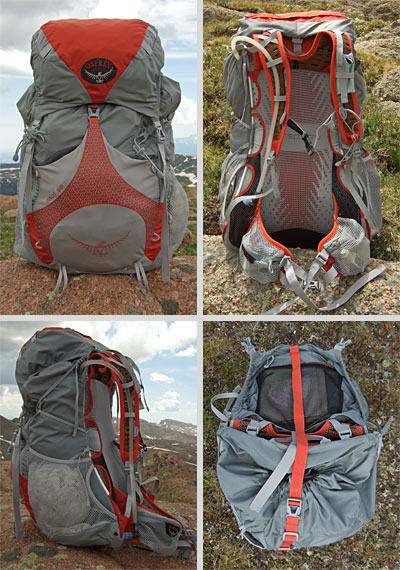
Views of the Osprey Exos 58 (and 46). The frontpanel view (top left) shows the pack’s large front stretch-woven kango pocket and dual tool loops. The pack’s AirSpeed backpanel (top right) is a trampoline type for increased ventilation. There is even a small pocket on one shoulder strap for an MP3 player. A side view (bottom left) shows the pack’s large mesh pockets with top and side entry and narrow compression straps that will also attach items to the side of the pack. The top view (bottom right) reveals a zippered mesh map pocket under the top cap, top compression strap (orange), and drawcord closure.

The new AirSpeed mesh backpanel on the Exos packs is not as deep as previous versions. The gap is about 1 inch, enough to provide good ventilation without interfering with pack volume or the pack’s center of gravity. The peripheral contoured tubular frame is 6061-T6 aluminum.

At first look, Osprey’s BioStretch (mesh covered slotted foam) shoulder harness (left) and hipbelt wings (right) seem thin and inadequate, but the suspension system performed well with moderate loads (see my field testing section below).

The peripheral tubular aluminum frame of the Exos is curved to wrap around the hips. Hipbelt wings and shoulder harness (see photo in previous panel) are attached to the backpanel mesh rather than the frame. This is not a design intended to carry heavy loads.
The Exos packs do NOT have an adjustable torso length like many larger Osprey packs. Rather, the shoulder straps and hipbelt wings are sewn to the backpanel and the only adjustment available is to lengthen or shorten shoulder straps and load lifters. Getting a proper fit is a matter of choosing the proper pack size. The Exos will be available in unisex sizes small, medium, and large (torso fit ranges are listed in the Specifications section).
During summer 2008, I tested both the Exos 46 and 58 on numerous backpacking trips carrying a wide range of loads. I tested the Exos 58 (58 liters) first, assuming it would be the optimum size for lightweight backpacking. However, using typical lightweight backpacking gear and loads in the 25- to 30-pound range, I was never able to completely fill it up. The Exos 58 has a lot of room! It has eight separate pockets, so a large portion of my gear fit in the pockets alone.

The side mesh pockets on the Exos (left) have a side entry that enables a hiker to reach and replace a water bottle without taking the pack off. My favorite feature on the Exos pack is the large zippered compartment under the kango pocket on the frontpanel (right). The Exos 58 has zippered access on both sides, while the Exos has access on only one side. The pocket will hold numerous frequently needed items and make them easily accessible on the trail.
On one occasion, while volunteering for the Hardrock 100 Endurance Race, I used the Exos 58 to carry in 40-pound loads of supplies and food to a remote aid station, climbing 1000 feet over a three mile distance. The pack carried the weight just fine without popping a seam and transferred the majority of the weight to my hips, but I had to tighten the hipbelt really tight to keep it from slipping off my hips.
Although the Exos 58 carried moderate (25 to 30 pounds) loads comfortably, the heavier loads described above are beyond its comfort range, except for hikers with strong shoulders. Thus, for summer backpacking, the Exos 58 seems to have too much volume for its weight carrying capacity. On the other hand, the Exos 58 would be an excellent choice for winter backpacking, where more volume is needed for bulkier insulated clothing and gear.
Realizing that the Exos 58 was a bit too roomy for me, I tested the Exos 46 during the second half of the summer. Although 46 liters seems small, I found the volume to be closer to my needs for summer backpacking. On a six-day, 100-mile backpacking trip on the Continental Divide Trail, I was able to get all of my gear and eight days of food (31 pounds initial weight) into the Exos 46. It carried the weight comfortably enough, but I was happier when pack weight dropped under 25 pounds. It would help if the shoulder straps were a little wider to distribute the weight more.
My carry load tests closely agree with Osprey’s recommended maximum carry weights of 20 to 30 pounds for both the Exos 46 and 58. Bottom line, the Exos backpacks are not designed or intended to carry heavy loads. My field testing confirmed that.

Exos 46 on the Continental Divide Trail in Colorado. Because of its numerous pockets, the pack has more room than its 46-liter size would indicate. The Exos also carried well on day-length trips from a base camp (right).
The Exos is a brand new pack model, and it’s remarkable that Osprey got most of the details right on the first try. In spite of its light weight, the Exos is loaded with features. I found it rather amazing that an internal frame backpack weighing slightly over 2 pounds can have so many features (including eight pockets!) and durable fabrics.
Osprey states "The Exos Series was designed with the knowledge that, in the long run, going light with a pack that has no suspension burns more energy than is gained by ounces saved." If they are referring to a frameless backpack, I personally would never carry 20- to 30-pound loads in a frameless pack. Granted, some frameless packs, like the GoLite Pinnacle and Jam2 are capable of carrying heavier loads more comfortably, but the updated Pinnacle and Jam2 for spring 2009 will weigh 2 pounds and 1 pound, 10 ounces, respectively – nearly as much as the Exos. My current pack of choice to carry 20 to 30 pounds is the Six Moon Designs Comet (27 ounces, $170 with stays) that has removable stays, but again the Comet weighs nearly as much as the Exos and does not have the feature set of the Exos. Needless to say, the Exos is now my pack of choice for carrying 20- to 30-pound loads.
However, the Exos is not quite perfect, and I have a few small issues to mention here, which hopefully will be addressed in the production pack.
Overall, I’m very impressed with the new Osprey Exos backpacks. This is a pack designed from the ground up for lightweight backpacking, assuming you want a pack that has room for everything and plenty of organizing and convenience features. The Exos will carry a 20- to 30-pound load with comfort and is capable of carrying up to 35 pounds when necessary. Both packs have more room than their size (46 or 58 liters) would indicate, so be sure to take that into account when choosing which one to get.
Erin and Hig’s mothers weigh in with childhood anecdotes that give us a glimpse of young explorers in the making.

Erin McKittrick at around eleven, with little brother Scott and dog Jessie.
 Ibex Performs
Ibex is crafted with the finest quality wool, allowing it to adapt to every condition. Stay cool when it’s warm, stay warm when it’s cool. You’re always comfortable, whether you’re hiking the trail or settling in for a night under the stars.

Twelve-year-old Bretwood Higman and dog Shiggy.
Hig and Erin form a dynamic hiking duo that is somewhat incomprehensible to mere mortals. How do they withstand the dangers and stresses of wilderness hiking month after month? And, most astoundingly, how does this married couple manage to get along while doing it?
Denita (Dede) Higman reveals that Hig was adventuresome from kindergarten.
Nicole (Niki) Hoagland, Erin’s mom, says Erin has always been very “determined.” The moms weren’t able to completely explain why Hig and Erin are capable of hiking 4000 miles through trail-less wilderness, or how they have developed into such a harmonious hiking team, but it’s obvious some of the couple’s adventurous spirit is genetic.
Oh, and a hint from Niki – don’t ask Hig how he got so lucky as to find a woman who would accompany him on his journeys. Who says the journeys are all Hig’s idea?
Join Regina WB for her annual family trek to Blue Lake in the Eagle Cap Wilderness, Wallowa Mountains.

We pass Minam on the way up to Blue Lake. Many hikers choose to stay here at Minam, as it has quite a few established camps around it.
When glaciers moved through Oregon’s Eagle Cap Wilderness, they ripped apart the earth, leaving dramatic granite faces streaked and exposed, creating what is now the Wallowa Mountains, the state’s premier backpacking location. As my father likes to say, "This is God’s country," and I’ll hand it to him that the Wallowas do provoke a sense of awe and perhaps even a spiritual feeling within me. Maybe it’s the solitude or the openness of the landscape. Maybe it’s the people I meet when I am on the trail, cowboys mostly, who shuffle by on horses and remind me that there is a simpler life happening not too far from where I stand, on the sloping ranches and golden farms of La Grande and Lostine.
My family is from Portland, Oregon, and the Wallowa Mountains are our tradition. From the time my three brothers and I could strap on a backpack, our father loaded us in the car for a six-hour drive east, followed by a two-day hike into the heart of the Eagle Cap Wilderness, where we’d explore for a week or so. Though our family is spread out now, we make an effort each year to come home and hike into those familiar alpine meadows. We do it for us, but we also do it for dad, as nothing makes him happier than seeing his children suffering under the weight of a pack or tenderly applying moleskin to enlarged blisters on our heels and toes. By the end of our trips to the Wallowas, we are sunburnt, mosquito-bitten, blister-covered, and physically exhausted. We are also happy. Some families have picnic reunions or vacations to Cancun; ours goes backpacking.
This summer, we came back together after a lapse of a couple of years. We loaded up the car with packs, sleeping bags, oatmeal, and a beat up map that no one ever looks at because there’s no need. We know to take Highway 84 east from Portland through the windy Columbia River Gorge and then out onto the plains of the state’s cattle country, eventually turning off in La Grande. We then head through Wallowa and Lostine, small farming and timber towns. Past Lostine, at the end of a forty-minute drive down a rocky road that can pop the toughest tire, we park at Two Pan trailhead and unload.

On the road up to Two Pan trailhead, there are a few leftovers from the years before the zone was deemed a National Wilderness area, such as this original log cabin.
This year, as usual, we’ve taken our time getting to Two Pan, and the sun is starting to go down. No matter. We take off down the trail with our headlamps handy for when darkness hits. My brother Jason is quickly ahead of us, disappearing up the path. We call him "the antelope" because of his long stride, which has had us eating his dust since he was fifteen years old. Each one of us has a different way of approaching the hike up. My father keeps a steady, sturdy pace far ahead of me, but way behind Jason. Greg, my "little" brother, is 6’5" and hikes like a pack mule. He can carry more weight than any of us, but is slower because of it. He also never complains. Chad is light and quick and keeps the mood upbeat. I am the slowest, the turtle to Jason’s hare. I stop a lot to take photos and search the landscape for white mountain goats in rocky knolls and slide areas. We’ve seen goats a few times up here, bounding like ballerinas from boulder to boulder, sometimes with kids.
An hour and a half into the hike, and it’s dark. We’ve turned on our headlamps, but only use them to watch for roots and complicated rocks on the trail, as the moon is just about full, lighting up the night forest around us in a magical blue shadow. The trail out of Two Pan up to Blue Lake, our destination, is the West Fork trail, which follows the Lostine River most of the way. There are fifty-two named alpine lakes in the Wallowas, and some are more secluded than others. Falcon Guide author on the Wallowas, Fred Barstad, rates the climb from Two Pan to Blue Lake as "moderately difficult" with an elevation gain of over 2,000 feet. Tonight, we won’t make it to Blue Lake, and instead decide to make camp near a trail split in a meadow. It’s a good stopping spot because of the soft grass and fresh water nearby. The rest of us set up our tents, but Jason decides to sleep under the stars, which are thick and ablaze in the August sky, tainted only slightly by the light pollution coming from the white moon. At night he’ll hear white-tailed deer nosing around the meadow, and in the morning he’ll wake with dew on his face.

The trails in the Wallowas are rocky dirt paths with great views.
On day two, we take the hike more seriously. It’s up, then up some more, which is how I love to hike first thing in the morning. This series of switchbacks makes for a dramatic climb in elevation on a slim, rocky, dirt path. Because it’s Wednesday, we don’t see many hikers. After a couple hours, a group of cowboys with saddle stock pass us. We stand off the path and let them go by, saying our "howdies" and smiling, but my father and brothers consider all these "horse people" to be traitors to the Wallowas. Unless you’re wearing a pack, you’re lazy in my father’s eyes.

Dad comes down a typical Wallowa trail though a sunny clearing.
He also hates the way the horses tear up the stream banks and muddy the trails. I have often dreamed of having an alpaca or mule carry my pack come late in the afternoon on day two of the hike and so can’t share my father’s distaste for the horses. Plus, for the most part, the cowboys are laid back local guys who know and love the Wallowas. A couple years ago, on the hike out from Mirror Lake, one brother and I were stopped by a group of them riding enormous horses and trailing loaded up mules behind them. After some small talk they offered us a drink.
"A drink?" we asked.
"Yeah, how ’bout a Bud?" one of them said and opened up a large sack attached to a hazel-color mule. Inside was not only a case of beer, but ice. They gave us each a Budweiser, which is not my favorite beer, but was probably the best one I have ever had after spending six days in the wilderness. We emptied our cans, and they headed up the trail, while we carefully headed down. Since then, the "horse people" have made my good list.
This hot Wednesday, no one offers us drinks as they pass us by, leaving a dusty trail to tackle. As we continue, I stop and look west at 9,000-foot Elkhorn Peak in the distance. In the scree fields, there are pika chirping and bobbing in and out, doing whatever it is they do. The Wallowas are rich in flora and fauna, but they have a very short summertime growing period from June to September. As a result, in August everything is in full swing. Come earlier or later, and you’ll be up against cold, difficult river crossings, rain, hail, and even possibly snow. Because of the harsh climate, the Ponderosa and lodgepole pines are sparse, and people are advised to protect the native plants, which do their best to reproduce in the summer. Wildfires are also a big concern, so campfires are limited in most places and required to be made 200 feet or more away from alpine lakes.

The terrain around the alpine lakes is mostly soft grassy meadows, full of wildflowers and green onions.
According to ranger Sweyn Wall, the alpine lakes are the most fragile ecosystems in the Eagle Cap Wilderness. With about 30,000 to 40,000 hikers and horses coming through the Wallowas each year, human impact is a significant issue. "Other areas of concern include invasive plants in the lower elevations, and the removal of natural fire from the ecosystem. We do actively inventory and manage invasive plants, but it is often difficult to locate populations when they are at a stage that is easily manageable," says Wall.
Working our way up the trail, we reach a meadow and stop for lunch along the Lostine River. By this time, we have crossed the river twice, using river rocks as makeshift bridges. Some years we’ve had to take off our boots and wade across, but this time the river is low enough to keep our shoes on. When the Lostine River is not criss-crossing the West Fork trail, it’s meandering through meadows scattered with Indian paintbrush, yarrow flowers, and wild onion. These picture-perfect settings beg us to sit down and take a load off… so we do, using a fallen tree as a bench and keeping our eyes open for golden eagles and red digger squirrels.
We eat our cheese and salami lunch in almost total silence. It’s not that we’ve got nothing to say, it’s that the kind of peace these mountains evoke should not be disturbed. The other part is that one of my dad’s Wallowas rules is "no useless chattering." Over the years, Dad has compiled an unofficial list of rules that his children know and abide by. A sampling:
That last rule may put some people off, but it is actually Dad’s Rule Number One. When he first started coming up to the Eagle Cap Wilderness, he came with his buddies, who were all married with young children. They came up as a group of men probably trying to escape their families for a week. When their kids got older, they started bringing us along, but held fast to the idea that their wives couldn’t come up. The Wallowas was always a trip for guys and eventually became a trip for dads and kids. The fathers feared that with wives in tow, their kids would be pampered (see #4 above), and that the ruggedness of the experience would be altered. Wives and mothers might want certain comforts that the fathers didn’t care to bother with, and so moms were banned from the trip. Sexist? Perhaps. But it’s been like this for twenty years, and only time will tell if grandchildren or other circumstances might eventually change Dad’s mind. I doubt it.

Views from Blue: from Blue Lake, the views extend down glacier carved valleys.
Back on the trail, we cross more lush meadow and reach Minam Lake, circling around it. Many hikers stay at Minam, as it’s a crystal-clear beauty with plenty of swimming, trout fishing, and a handful of established campsites along the perimeter. For us, the Wallowas is all about solitude, and we want to camp alone, so we keep going another 300 feet up to Blue Lake. Camp is in a boulder-clad clearing surrounded by shady lodgepole pine and fir trees, plus a mountainside backdrop which alternates between granite rock slides and patches of snowfields, leftovers from those glacial days.

We spend a few hours every day at the flat piece of granite we call Swim Rock, or just Swim for short. Here, there’s a diving spot and plenty of room to dry off in the sun.
The next day, Jason and a friend climb up to the snow fields, scrambling and hopping over boulders. With them they’ve brought a poncho and a pot. I am laid out on Swim Rock, reading a David Sedaris book when I hear, "Whoop!! Ahhh! Hoo, hoo, hoo," coming from the snowfields. With the binoculars, I watch them zip down the snowfield using a rubber poncho as a sled. Later, they return with Jell-O, which they premixed and cooled in a titanium pot in the snow while sledding.
Around the campfire, there is talk of climbing Eagle Cap the next day, a strenuous hike from Minam Lake with an elevation gain of 1,972 feet. This is the central point of the Wallowa Wilderness, with unobstructed views reaching Idaho on a clear day, plus views of most of the Eagle Cap Wilderness and the Imnaha River headwaters. Another day hike option out of Blue Lake is the loop trail to Mirror Lake. From Blue Lake, the trail heads down to Minam, then crosses an 8,500-foot pass after a series of switchbacks, eventually dropping onto Mirror Lake. If a hiker didn’t want to take the same West Fork trail back to Two Pan, he could hike over to Mirror Lake, then hike out on the East Fork trail.
There are many day hikes, many trails to traverse, and plenty of ridges to explore in the Wallowas. Jason and his friends will head out and try new trails, plus re-visit some old ones. Greg will fish for trout and cook them up late in the afternoon. Dad will hike too, fish a bit, and sit on boulders in the sun. Packing up and leaving Blue Lake at the end of the week is always hard. We drag our feet and take our time heading out on the trail. Leaving is difficult because the Wallowas are so perfect, but also because it means we’re all going to go our separate ways. Not to worry, we’ll get together next year at the same time and same place, on the edge of a different alpine lake with new campfire stories to tell under a starry sky that thankfully never changes.
Veteran gear editors Chris Townsend and Will Rietveld unlock the mystique of the single wall tent – identifying their advantages and disadvantages, evaluating designs and technologies, listing specifications on the lightest ones available, picking their favorites for a range of applications, and speculating on future trends.
You don’t have access to view this content.
This new single wall tent provides convenience and ventilation, plus loads of room for one person and gear and can accommodate two people when needed.

The AntiGravityGear O2 is a roomy one- or two-person single wall silnylon tent with side entry and trekking pole support.
The new AntiGravityGear (AGG) O2 tent evolved from the AGG Tarptent. The footprint and canopy are basically the same, but the front entry and back of the tent have been substantially revised. While the AGG Tarptent (which is still available), at 23 ounces, is a lightweight and roomy shelter for one person and plenty big for two, its major shortcoming is excessive interior condensation due to inadequate ventilation. The O2 is designed to overcome that problem and add some convenience features; how well does it succeed?
As mentioned, the footprint and canopy of the AGG Tarptent and O2 are virtually identical. The canopy is one piece of fabric, so there is no ridge seam to seam seal (or leak). However, the lack of canopy seams creates a tent with a lot of loose fabric that needs to be pulled outward with back and side pullouts in order to maximize interior volume.
The design changes in the O2 are at the front and rear. The front has a large zippered vestibule and a mesh entry wall with large zippered entry door. The rear has a large mesh panel for extra ventilation, with a zippered closure on the inside and large overhang on the outside.

Views of the AntiGravityGear O2 tent. The front of the tent (top left) has a large zippered vestibule that extends almost to the ground. The rear (top right) is extended by a tieout cord attached to a trekking pole and then to the ground. A side view (bottom left) shows one side of the vestibule open and tied back. Each side has a tieout cord that can either be staked directly to the ground (shown) or extended to a branch found onsite and then staked to the ground. The top view (bottom right) shows the tent’s shape; the front of the tent is at the bottom of the photo.

Inside the AGG O2. Note that the front of the tent is supported by a trekking pole angled to the side. Entry is through a large zippered mesh door. The rear of the tent has a large mesh panel to provide flow-through ventilation.
The front of the tent has a PVC plastic cap that a trekking pole tip inserts into, which is safer protecting against slippage compared to a grommet, especially with worn tips. There are four front vestibule positions: it can be fully open (first photo), it can be completely closed (second photo, top left), one side can be tied back (second photo, bottom left), or half of each side can be tied up (below) for more ventilation.

The O2’s front vestibule can be set at half height position for extra ventilation.
I tested the AGG O2 tent on a number of summer trips in mountain and desert country. As a solo tent, the O2 is luxurious, with loads of room in both the tent and vestibule. Because of the side entry and lower headroom in the back, the O2 requires some logistical plannng for two sleepers. It works best if the person sleeping in the back of the tent gets settled in before the second person enters. For midnight relief, the person in the rear has to climb over the person in the front to exit the tent. Also, headroom is more limited in the rear of the tent, so it is more cumbersome to enter and exit a sleeping bag, especially if the tent walls are wet. Keeping the back and side pullouts taut is vital to maximize the volume inside the tent.
While two people can adjust to sharing the O2 tent, a side entry tent is simply more convenient if it has two doors and two vestibules. Alternatively, a couple can choose a tent with an entry at one end. In either case, one person can exit the tent without disturbing the other. Considering this, the best use for the AGG O2 is as a one-plus-person tent, providing plenty of room for one person plus gear, and only used occasionally two people.
In rainy weather or buggy conditions, the AGG O2 provides a lot of security for minimal weight. The tent completely seals up to exclude bugs. The vestibule on the front and the rear overhang provide plenty of protection so the tent can be ventilated to the max during a rainstorm. If wind and bugs permit, opening the front mesh door really helps to increase ventilation and minimize condensation.

In spite of its better ventilation, the AGG O2 tent is not exempt from condensation on the inside walls on a clear/cool/calm night. This photo was taken on a 32 F morning while camped at 12,200 feet in the southern Colorado Rockies.
In windy conditions, it helps a lot to orient the back of the O2 tent into the wind. The back vent has a zippered closure, so the amount of breeze passing through the tent can be regulated. However, the O2 is not particularly wind stable. Because of its loose canopy, secured by three pullouts, the tent flaps a lot in the wind and even buzzes during stronger gusts. The front vestibule helps to deflect wind from the front, and fully zipping the mesh entry door and back vent closure helps to reduce the amount of air flowing through the tent.
For comparison, the AGG O2 is similar to the Six Moon Designs Lunar Solo (25.4 ounces trail weight, US$235). It has an extra 10 square feet of floor space and weighs about 2.6 ounces more. However, (in my opinion) the Lunar Solo is better ventilated, more wind stable, in addition to having a floating bathtub floor.
Overall, the AGG O2 provides a lot more room for its weight than most other single wall tents, and is reliable shelter from storms and bugs. Its condensation resistance is average for a single wall tent, but it is not particularly wind stable.
|
Manufacturer: |
AntiGravityGear (http://www.antigravitygear.com/) |
|
Year/Model: |
2008 O2 |
|
Shelter Type: |
One or two-person single wall tent with side entry |
|
Poles: |
Requires trekking poles |
|
Stakes: |
Eight 6-inch titanium shepherd hook stakes (not included) |
|
Fabrics: |
Canopy and floor are 1.3 oz/yd2 silnylon, entry wall and rear vent are mesh |
|
Dimensions: |
Trapezoidal, floor is 9 feet in back tapering to 7 feet in front, 55 inches deep, front height is 43 inches, rear height is 24 inches |
|
Protected Area: |
Floor 36 ft2, vestibule 10 ft2 |
|
Features: |
Large zippered front vestibule, mesh entry wall with large zippered door, back mesh ventilation panel with zippered closure, one piece canopy (no top seam), trekking pole support |
|
Weight: |
Total weight 1 lb, 12.6 oz (includes seam sealed tent, eight titanium stakes, tent stuff sack, stake sack); trail weight (includes tent, stakes) 1 lb, 12 oz; manufacturer specification 1 lb, 12 oz total weight |
|
MSRP: |
US$279 |
|
Options: |
Seam sealing US$30 |
Two-person single wall tent with a twist: one side is double wall, so the fly can be rolled up in good weather for extra views and ventilation.

The two-person MontBell Crescent 2 is a “hybrid tent” – one side is double wall and the other side is single wall. It’s supported by a single longitudinal pole.
Montbell’s new hybrid Crescent 2 tent is supported by a single length-wise pole similar to their now discontinued Hexagon two-person double wall tent. However, the Crescent 2 is a single wall tent, with a twist: one side of the tent is double wall (with a mesh body and a waterproof fly on that side) and the other side is single wall. Technically, it’s a hybrid tent, since part of it is double wall.

Views of the Montbell Crescent 2. In the head end view (top left), the right side of the tent is double wall. The entry is through a zippered opening in the fly on the right side of the pole. The foot end of the tent (top right) has a high vent. A side view of the single wall side of the tent (bottom left) shows how the canopy extends the drip line out away from the tent. The top view (bottom right) puts all this into perspective; the top of the photo is the double wall side of the tent.

The unique feature of the MontBell Crescent 2 (besides its monopole design) is that the fly on one side of the tent can be rolled up in good weather to provide abundant ventilation and views. The left photo shows the tent with the fly staked out, and the right photo shows the fly rolled up.
By the numbers, the Crescent 2 is a roomy tent. The floor is 96 inches long and 59 inches wide, and headroom is 43 inches at the center. Area is 34 square feet. However, usable space is another matter. Since the tent hangs from a single length-wise pole, the side walls drape inward substantially, greatly reducing inside volume. With two people inside the tent, the occupants are constantly brushing against the tent walls with their heads and shoulders. The limited elbow room is not a real problem in good weather, but is not pleasant in rainy weather when the inside tent walls are wet with condensation.

Entry is through a small zippered mesh door on one end of the tent (left). The door is barely shoulder width and is accessed through a zippered opening in the tent’s fly on the right side. Seen from the inside (right), the door has a wrap-around zipper so it can be completely opened and pushed to the side out of the way.
For a better viewing experience, please download the Flash Player. You may also download the MontBell Crescent Moon 2 Tent
Video: A tour of the inside of the Montbell Crescent 2 during a rainstorm.
During southern Colorado’s summer monsoon season, I had the opportunity to test the Crescent 2 in both wind and rain. In 20 + mph winds accompanying a thunderstorm, I found the tent to be quite stable, especially with either end of the tent facing the wind. The Crescent 2 comes with nine 7-inch long Y-stakes which secure the tent very well.

I found the Crescent 2 to be an effective sanctuary in mountain showers and an overnight rain (left), but it is not exempt from condensation on the inside walls (right).
When condensation forms on the inside walls, we found it prudent to sleep in the center of the tent or toward the mesh wall to avoid contacting the wet walls with our sleeping bags. However, while dressing in the morning, it was nearly impossible to avoid brushing against the wet interior walls.
Some further comments on the Crescent 2, both pro and con:
Overall during the test period we found that the Montbell Crescent 2 tent grew on us somewhat. Set-up is very simple and fast. It endures wind and storms well. In good weather, rolling up one side gives excellent ventilation and views. However, its limited headroom is inconvenient, and the tent’s trail weight is slightly under 3 pounds, which is heavy compared to the competition. In comparison, the Tarptent Double Rainbow weighs 2 pounds, 7.7 ounces and has two doors and two vestibules, as well as more elbow room inside.
|
Manufacturer: |
MontBell (http://www.montbell.com/) |
|
Year/Model: |
2008 Crescent 2 |
|
Shelter Type: |
Hybrid two-person single wall tent (one side is double wall) |
|
Poles: |
8.8 mm DAC Featherlight NSL |
|
Stakes: |
Nine 7-inch aluminum alloy Y-stakes |
|
Fabrics: |
Canopy is 30d polyurethane coated nylon rip-stop, 1500 mm; floor is 40d PU coated nylon rip-stop, 2000 mm; 20d nylon mesh |
|
Dimensions |
96 x 59 x 45 in (inside headroom is 43 in) |
|
Protected Area: |
Floor 33.9 ft2, vestibule 2.2 ft2 |
|
Features: |
Single longitudinal pole, tent clips to pole, wrap-around zipper on entry door, one side of tent has a mesh wall and separate fly that rolls up, small mesh storage pocket in rear, bathtub floor |
|
Weight: |
Total weight 3 lb, 1.4 oz (includes tent, pole, nine stakes, two guylines, repair sleeve, three stuff sacks); trail weight (includes tent, pole, stakes) 2 lb, 15.3 oz; manufacturer specification 3 lb total weight |
|
MSRP: |
US$279 |
|
Options: |
Footprint US$35, 10.3 oz with stuff sack |
The new BPL Wiki hosted by Backpacking Light!
Today Backpacking Light launches a wiki as a community-driven reference on lightweight backpacking. With BPL’s passionate and active online community, we are confident that the wiki will quickly become a valuable tool and an excellent supplement to BPL’s published articles and community forums.
For those not familiar with the technology, a wiki is a website that can be edited by its users, allowing users to create new articles that contain images, links, and tables. It is a community project, where anyone can create content. What makes a wiki unique is that the collective power of a large and passionate community can quickly create a valuable resource. As a site targeted at reference material, the BPL wiki will be limited to certain types of content. Reference material that contains factual information such as articles about hiking trails, collections of recipes, or examples of techniques are perfect for the wiki. Articles that are primarily opinion pieces, such as essays and gear reviews are not appropriate for the wiki.

The Backpacking Light wiki launches today as a reference for BPL readers.
To get things started, the wiki has been organized into a series of categories to help organize the content. The categories are People, Places, Companies, Food and Nutrition, Techniques, Materials, and Gear. There is also a page to collect links to BPL classic articles, making it easier for users to find those pieces that represent the best and most popular material published on BPL. The wiki has been seeded with a limited amount of content, and we expect it will take some weeks for the community and staff to get it populated more fully. Examples include:
From People: Bio of Ryan Jordan
From Places: John Muir Trail, Superior Hiking Trail, and Absaroka-Beartooth Wilderness
From Companies: Snow Peak and Western Mountaineering
From Food and Nutrition: the Recipes page
The BPL Classics page
As a collaborative project, the wiki will rely on the community to reach its full potential. The collective knowledge and experience of BPL readers is immense, as is evident from the forums and reader reviews. Our challenge to you is to get involved and help grow the wiki. Imagine the value of definitive pages on your favorite trails and wilderness areas. Imagine the knowledge that could be harvested from the BPL forums on topics such as cuben fiber or insulation properties or fording rivers. Imagine the value of collecting links related to a single topic from BPL articles or other areas of the web. Now all of these things can be done easily and with the help of your fellow members.
So our challenge to you is to get involved. To give you a little motivation, we’ll be monitoring the wiki and will give out up to fifty gear shop coupons for $14.99 to those who create articles or add significant content. We can monitor this online, so you do not need to contact us – we’ll contact you. However, you can send email to wiki@backpackinglight.com if you have suggestions on overall organization or content. You can also direct those same comments to the forums.
There are help pages on the wiki with basic information regarding policies, content, and editing. If you are interested in creating new content, please take a quick look at these pages before you get started. The wiki is open to everyone on the web, but if you wish to edit the wiki, you will need to have a BPL account and be logged in. This allows us to track changes and attribute changes to users.
Also launched today is a re-organization of the tabs on BPL web pages. The new tabs are: Home, Articles, Shop, Community, and Wiki. These changes accurately reflect the organization and use of BackpackingLight.com and will help users more easily navigate the site. Finally, today we are also launching a new search engine. This engine is a significant improvement over BPL’s previous search capability and will make it easier and more effective to search the vast collection of material at Backpacking Light.
Collectively, these changes are a significant step forward in creating value for Backpacking Light readers. We are excited to see where the wiki will go in the weeks and months ahead. As always, we welcome your participation in the process and your comments on future directions.
The Photon ReX looks like another one of those little button-cell LED lights, but it has a couple of very nice surprises – and it even works well. Testing it presented some difficulties, but these were generally easy to overcome.

Photon Rex. Photo courtesy LRI.
Flashlight progress comes in unpredictable spurts, interspersed with long plateau periods where little notable progress occurs. The first generation of LED lights used several batteries and a current-limiting resistor. The second generation used several batteries and a fairly crude electronic chip to provide current-limiting. The Freedom chip used in the ReX is a third generation device that is somewhat more sophisticated – and it shows.
Slightly larger than their existing Photon line of button-cell flashlights, the ReX differs in three significant respects: its battery is a single rechargeable lithium-ion cell, it has four (instead of the usual one) good white LEDs, and the ReX can be recharged on the go using common inexpensive batteries.

Photon Rex. Photo courtesy LRI.
The ReX is fitted with the LRI Freedom controller chip. This chip is reportedly also used in the LRI Photon Freedom Micro single-LED light, but that unit does not have the recharging facility. The battery in the Photon Freedom Micro unit is replaceable, while the battery in the Photon ReX unit is not. The Freedom chip delivers "stepless" variable output and a number of flash modes as well, all operated via the single button. The button is phosphorescent, by the way, making the ReX a little easier to locate in the dark. A spring clip connected to the ReX with a split-ring gives one a way to anchor the little flashlight to hopefully keep from losing it.

Photon Rex. Photo courtesy LRI.
The ReX is charged by connecting to a battery (1.2 volt to 3 volt, see below) using a pair of magnet-tipped wires. The wires are anchored to a yoke that connects magnetically to the ReX itself, and the other ends attach to the donor battery terminals. To keep the positive and negative separate, one yoke terminal has a small plastic collar to prevent it from being reversed inadvertently, creating a polarized connector. This is where several of us had some problems: a mismatch in the dimensions of the polarized connector can actually prevent a connection from being made. At the very least, some fiddling is required to seat the yoke correctly and complete the circuit. Proper connection is clearly signaled by a slow flashing from the ReX, which ceases when charging is complete (in approximately two hours with a fresh battery, according to LRI). This is further discussed under the ‘Problems’ section at the end of this review.

Photon Rex. Photo courtesy LRI.
The Freedom chip does far more than just control the flashing, however. It is a fairly sophisticated switch mode controller chip, and actually performs four distinct functions:
It is, therefore, far more sophisticated than the more common chips found in other LED headlights, which just turn the LEDs on and off at three different brightness levels. This is clearly a third generation device.
LRI claims two full charges from an alkaline AA battery and twenty or so full charges from an alkaline D-cell battery. They champion the use of NiMH rechargeable cells for the least expensive and most environmentally friendly approach (with an average three charges from an AA cell). The ReX onboard Li-ion battery is claimed to have a useful life of three hundred to five hundred charge cycles.
The little charge wire assembly comes with a snap connector that can (and should!) be anchored in some safe place to prevent its loss – it’s hard to envision fashioning temporary connectors from stray or salvaged bits you might have in your pack! The ReX is too small to store the wires on board, unlike the rechargeable Aquastar mUV, for instance.
Interestingly, the ReX isn’t water-resistant, despite not having a battery door. It may be they weren’t able to sufficiently seal the two halves of the clamshell around the four-LED bezel to supply this desirable trait, which is a shame, since the Freedom is splash-proof. However, it seems likely that a few splashes would not do much harm to the unit. The ReX ships with a clip similar to that of the Freedom’s for attaching to a hat, etc. (ReX accessories, including a clip, headband, and solar charger, are promised in the future.)
At the time of writing this review, the LRI website was claiming that "The ReX will charge from any standard battery of six volts or less." This is not strictly correct and should not be followed. Previously, the website was claiming a maximum of three volts, which is correct. The six volt claim relates to charging from a USB connector, but the supply on a USB connector has a protective ten ohm resistor in series, and this reduces the output to under three volts when used to charge the ReX. Our understanding is that a USB charger is planned for the ReX in the future, along with a solar panel.
However, in bench testing, we were sometimes unable to get the charging circuit to start working when the incoming voltage was much above 2.5 volts. The microprocessor is a shade cautious about overload. On the other hand, we found it would work at very low incoming voltages, down to almost 0.6 volts, which approximates a very flat single alkaline cell, which is actually more important.
A few notes are warranted regarding the ReX modes of operation, especially about how to turn it on. Starting from the off state, a single brief click of the rubber button turns the ReX on to the high setting. Stepless dimming is performed simply enough by pressing and holding the button again. It dims until it reaches the lowest level, which is signaled by a blink. Other flashing modes can then be accessed. Actually, the dimming isn’t really stepless: there are just lots of steps which the eye can’t resolve, except at the lowest power, which is fine.
However, many of us don’t want to start at the brightest setting and kill all our night vision, and this is in fact a common complaint about many LED lights. The ReX has solved this problem: Instead of giving the button a brief press, you can press and hold the button for a moment. The electronics inside senses the longer button press and obliges by turning on at the lowest setting. Holding the button down will then, after a moment, start ramping the brightness upwards. This has got to be one of the biggest improvements in headlamp circuitry for a long while!
If you keep the button pressed beyond the ramp, the ReX eventually enters the signal mode, cycling though slow, medium, and rapid blink modes and an SOS mode. There’s yet another Morse code mode, reached via a series of fast clicks from the off state. In this mode the ReX blinks briefly, once, with each subsequent click. If you don’t know you’re in this mode, the light will drive you nuts until you recall/accidentally discover how to clear it (press and hold).
Most folks most of the time will only have use for the full and stepless dimmer modes, but it’s important to at least learn the others well enough to be able to get rid of them and regain control of the light! One sometimes wishes the marketing guys could be persuaded to skip the frills and concentrate on the basics, despite how nice some of the frills can be at times.
There is an undocumented auto-off point-of-purchase protection mode, but we haven’t found out how to enter this mode in our testing. If you discover this behavior while using your own ReX, then you’ve solved the mystery. You get out of it by pressing the button down for fifteen to twenty seconds. Instructions for this are included with the ReX.
How do they get all these different modes of operation into such a small device? Quite simple really: the central control chip is (we believe) a PIC microprocessor. There’s no part number on it, just the word "REX". All the smarts are in the software. Isn’t technology wonderful?
The ReX’s bright wide beam is a revelation – how can a flashlight so small do that?!? Fully charged, it’s more like a three- or four-LED headlamp like a Petzl Tikka or Princeton Tec Quad than a button cell light. Without question, this is a light one could hike by – not for hours, mind you, but certainly for a quarter-hour stretch with judicious use. Yes, the little battery inside does have a very finite life when used at high power. More details of this are given below in the technical section.
The beam is the familiar purple-white center with white halo that’s the hallmark of five millimeter white LEDs. The Nichia-brand LEDs have a small shield above and below them, but are more open to the sides, allowing sidespill while controlling top and bottom glare. This configuration makes the beam spill fairly rectangular.
The ReX’s four LEDs place demands on the little battery, draining it fairly rapidly on high. Dimmed, it lasts a good while longer, certainly long enough for camp chores and some tent time. If you are making a lot of use of it, you may find it convenient to recharge the ReX overnight, and a single 2,000 mAh NiMH cell should yield two or three full charges. However, if you don’t drain the battery completely each night, many more chargings are possible, and it is hard to give a definite number of possible recharge cycles like this per recharge battery.
The blinking charge indicator makes the ReX easy to find in the dark and makes it very easy to monitor the recharging. Charging on the go is also possible, but the battery, flashlight, and contact wires need to be carefully packed so they don’t disconnect. One won’t know if this happened until unpacking that evening, and our experience is that the connection at the ReX end can be somewhat tenuous.
I’m used to carrying a technical headlamp and don’t have any misconceptions about the ReX replacing it. For trips where I don’t have to navigate after dark for more than a few minutes, it probably is up to the task. And, because it can always be charged up, it always starts at peak performance, unlike button cell lights with disposable batteries, which generally are partly spent. Also, unlike button cell lights, cost of operation for the ReX is miniscule, especially if you rely on NiMH batteries to charge it. For long trips, lower-capacity eneloop-type cells that hold their charge are preferable to high-capacity but common formula NiMH batteries, which self-discharge rather quickly.
We recently spent a week in the Australian Alps. This should have been a late summer trip, but the weather decided otherwise, with nights down to -7 C and some rather violent winds. While I normally take some white LED headlamps, I made myself with Energizer lithium e2 batteries, I also decided to take the little ReX on this trip.
Well, what happened was that I mostly used the ReX each evening instead of one of my headlamps. It was just so easy to use in comparison with getting a headlamp out and putting it on my head. I usually needed some light by the end of cooking dinner, so I general hung the ReX from the roof of the tent and turned it on to the lowest power setting while packing up and getting into my sleeping bag.

Dinner by ReX-Light. The glow at the top edge of the photo is the ReX.
On another weekend trip down a very narrow and rough rainforest-filled valley in winter time, it was dark by the time I had cooked dinner. Again, I hung the ReX from the roof of the tent, this time so my wife could see to eat her dinner. On one notch up from Low, she found it quite adequate, as the lowest setting was just a bit too dim for ease of use. The photo here was taken by the light of the ReX, although I did turn up the brightness a bit to reduce the exposure time.
I should point out that the lowest power setting really is moderately dim. It was bright enough for getting into my sleeping bag, but if I lost something in the tent I usually had to turn the brightness up at least one notch. (Stepless? Not quite!) It was then bright enough for all my needs, and very seldom have I needed to use it at full power.
For these two trips, I had charged the little rechargeable lithium battery inside the unit fully before leaving. In a calculated gamble, I left the recharging accessory at home each time, figuring that the expected light duty it would get would be within the capacity of the little battery. I was right: the single charge lasted the whole of each trip at generally low power.

The insides of a ReX.
For those who might be interested, the ReX may be disassembled fairly easily, and the insides look like this. There is a shell in black, a rubber seal and button cover in white, some electronics on a green PCB with the four LEDS soldered to the edge, and the rechargeable lithium coin cell under the PCB, with a yellow plastic cover.
The Printed Circuit Board (PCB) holds the four white LEDs and the Freedom chip, which is the small integrated circuit (IC) to the right with a blue dot on it. There are also a couple of discrete devices including the essential inductor for the switching operation: the copper coil in the middle. Behind that is the little brass-colored flat push-button assembly in the middle. The red wire at the front goes to one of the metal contacts for recharging. It really looks rather neat and simple.

The circuitry.
The steady illumination ranges from high power to low power. It does this by very rapidly switching the bank of four white LEDs on and off. The ratio of on-time to off-time (mark-space ratio) sets the perceived brightness. The ratio is set by a digital counter in the Freedom chip, but the steps are quite small. It is easy to see this as being stepless at anything much above the lowest power. This digital mark/space ratio technique is more efficient than placing a current-limiting resistor in series between the battery and the LEDs.
It should be added here that high power really is very bright and low power really is quite dim: there is a wide dynamic range on this light, much more than on most LED lights.

The result of waving the ReX around.
You can actually see the pulsed illumination if you want to. Turn the ReX on medium to low power on a dark night and wave it rapidly across in front of your face. If you do this correctly, you will see a series of bright white dots in space. Each dot is one of the on-periods. We managed to photograph this, as seen here. Each pulse makes a column of four white dots (the four white LEDs), and there are several passes in front of the camera.
Two methods were used to measure the performance of the ReX while switched on and discharging. For one method, Roger’s, the ReX was mounted in front of a photo-sensor inside a dark box, and the output signal from the light sensor was monitored and recorded with a PC-based data logger. For the other method, Rick’s, the ReX was mounted in front of a calibrated Luxmeter (the Lux is a standard unit of brightness) and readings were taken every five minutes. For charging, several parameters were monitored by the PC data logger.

Test on High.
For the tests shown here, a fully-charged ReX was turned on and the brightness level was measured over time as the battery decayed. As may be seen in Run 1 of Rick’s results (left hand graph), the light output decayed steadily for a while and then seemed to drop a bit more, around fifteen minutes. The light then decayed away to a low level with a long tail. The second test run (Run 2), gave very similar results. Roger’s results (right hand graph) show a similar behavior, with the decay of the battery voltage also shown.
Clearly the behavior of the ReX changes when the battery voltage gets low: it seems to go into a low-power survival mode. This is very useful. The light level during the survival mode tail might be adequate for settling down in your sleeping bag for the evening.
After one such test, the ReX was given a couple of minutes of off-time while the battery rested and was then turned back on to see what sort of recovery the battery can make. It was found that while there was a little recovery, the effect was hardly worth the effort. Don’t rely on it.
One could say that the battery life of the ReX at high power is not great: only about twenty-five to thirty minutes. You certainly would not want to rely on it for an alpine start up the mountains, for instance. But let’s be realistic: you would hardly expect that sort of performance from something this small anyhow. The unit is so bright that it is tempting to compare it with a headlamp using three AA lithium batteries and a 1 W Cree LED, and that comparison is just not fair! On the other hand, it is surprising just how much power is contained in those little rechargeable lithium button cells.
The discharge test was repeated with the ReX set to its lowest power, and the results were similar – but stretched over a much longer time. For a fully charged ReX, the useful time could be several hours. Certainly there would be plenty of time for cooking dinner, washing up, and getting to bed, and probably for more than one night if you are careful. This is something which would depend very much on how you use the light and how well-charged it was at the start, but it should be possible to rely on the internal battery alone for a three-day trip. That’s an awfully light way to illuminate things.
This is typically done with the little recharging accessory seen in previous pictures. This accessory attaches to both the ReX and an external battery by means of small gold-plated high-power magnets (but see below under the ‘Problems’ section). While recharging, the ReX periodically flashes briefly: if you don’t see the flashes, then the unit is either not connected properly or it has fully charged. The instructions that came with the ReX say the flashing will stop when the internal lithium battery is fully recharged, and yes, this does happen. It may take a while, up to a couple of hours if the internal battery started out flat, but it does work.
The bit which attaches to the ReX unit is physically polarized: one magnet has a little plastic sleeve around it which can only mate with the right contact on the ReX. This is meant to prevent you from attaching the battery back to front. Note that the gold contacts on the ReX are just steel and not magnetic: they won’t prevent you from trying to connect the recharging accessory back to front, but the plastic sleeve should prevent you from making it work. However, be warned: The physical polarization does not stop you from attaching the magnets out at the ends of the wires to the battery the wrong way around (reversed polarity), and while reversed polarity is not fatal for up to fifteen seconds (according to the company), this doesn’t do the ReX any good. A longer period may well do some harm, as the components overheat.
While the company claims you can use a three volt battery, we found that the recharging circuit would often only start to recharge the internal lithium button cell when the applied voltage was under 2.5 volts; three volts was sometimes too high, and the charging unit would not activate. This doesn’t matter if you use a common 1.5 volt battery, of course.
Interestingly, we found that it is also possible to be charging from an external battery while the unit was switched on and giving out light. The company confirmed that this is possible, adding that in this mode the recharging is done with very conservative rules, as the microprocessor is fairly busy looking after the LEDs. Finally, there is another undocumented feature which can sometimes be invoked when the ReX reaches full charge. It gives a very brief flash which signals that the unit is charging, but when really fully charged it can give an intense flash of about one second once every few seconds. This is called the "lighthouse signal," and it is meant to alert you to take the unit off charge. In the meantime, it dumps a bit of excess power every so often. Wonderful what you can do with software!
For the recharging tests, a bench power supply was set to about two volts and was applied through a current-sensing resistor. The ReX would not start charging with a higher voltage. A number of recharging runs were recorded; some typical results are quoted here. Please note that the length of time taken to recharge the ReX on any occasion will depend on the initial state of discharge and on the power supply used (normally another battery). This means that measured charging times may not be very meaningful. The following will, however, serve to illustrate what happens during a charging cycle.

Here we see a typical charge cycle, starting from a fairly low battery condition. The battery voltage (black) starts to rise as charge is poured in. The charge current (blue) settles quickly to a steady level. Eventually the recharger in the ReX decides the battery is fully charged (about 4.22 volts, in this case) and stops pouring current in. The battery voltage relaxes slightly while the charge current drops to zero. The input voltage (green) rises to the power supply level (in this test set-up) as the voltage drop across the current-sensing resistor drops to zero. The ReX has absorbed about 0.84 watts for about 3,400 seconds, in this case, which seems typical for this unit. However, input power can vary significantly depending on the external voltage source: values from 0.3 watts to 0.9 watts have been encountered, and a wider range may be possible.
The ReX is designed to recharge from an external battery, not from a power supply as used for these measurements. Testing showed that the recharger inside the ReX is able to draw power from an external source down nearly to 0.6 volts. This is below the fully-discharged rating of 0.8 volts quoted for most single cell batteries in the AAA to D range, although the final decline from 0.8 volts to 0.6 volts is usually very swift. This is quite impressive.
For those with a technical mind, it should be noted that the internal impedance of a battery, be it a AA or a D cell, will be far less than the one ohm external resistor used in the tests above. The external resistor was used to allow current monitoring. It also means that you, the user, need to be just a little careful, as a short-circuit across the external battery can be somewhat destructive (to the external battery).
It is relevant to ask what capacity a single-cell battery might have, but this is not an easy question to answer. For instance, the data sheet for the Energizer alkaline e2 AA battery states 2850 mAh to 0.8 volts, but the voltage is falling over the discharge cycle. Assuming a 600 mA load, the AA battery is quoted as providing just over two hours of life. Just how many recharges you might get from one of these batteries is totally dependent on the initial state of discharge of the internal battery. If the internal battery was really flat to start, one might get only a few recharge cycles from such an AA battery.
The data sheet for the standard Energizer alkaline AA battery (not e2) gives significantly lower performance figures at high discharge rates. This battery would seem to provide about half the performance of the Energizer e2 battery. It is not as good a choice for high loads.
The data sheet for the Duracell Ultracell AA alkaline battery uses a different method of presenting performance, so the two brands cannot be directly compared. However, looking at the available data suggests that the performance would be similar to that of the Energizer e2 alkaline AA battery.
The data sheet for the Energizer e2 lithium AA battery is again slightly different. This lithium battery excels at high loads and cold temperatures, and is the one many of us use, despite the higher upfront cost. At a load of 0.9 watts, the battery should be able to provide four hours of life: twice that of the Energizer alkaline e2 cell and the Duracell Ultracell. However, if the power drain is reduced, the life goes even higher. What’s more, this lithium AA battery is half the weight of an alkaline AA.
The ReX literature suggests using a D cell to get twenty-plus full recharges. These D cells are heavier than the AA cells, and we question whether the extra weight is worthwhile for normal walking trips. An Energizer D battery may give up to four or five times as many recharge cycles, but it weighs as many times more than an e2 AA alkaline battery and ten times as much as a lithium e2 AA battery. We would prefer to carry the e2 lithium AA – and they can often be used in cameras as well.
Applying the wrong polarity does not immediately damage the ReX, but it can overheat the internal electronics in about ten to fifteen seconds. Failure is certainly possible. Doing so is not a good idea, and it may also flatten the battery. It may also be possible to flatten the internal battery completely just by leaving it on for too long. Once the battery is seriously discharged, the recharging circuit inside may not turn on. This can make it difficult to rescue the ReX from a seriously flat state.
If the battery is only seriously discharged (not damaged), it can be recovered by one of two methods. The first is to allow the lithium battery about an hour or so to recover all by itself. It can sometimes do this, to the point where the recharging circuit will start up again. The second method, which should be used with some caution, requires that you open the plastic case up and apply a carefully controlled and current-limited three volts to the rechargeable cell itself. There are some solder connections on the PCB where this can be done, and doubtless this will void the warranty. Both of these methods have been tested – and worked. (Yeah – some mistakes were made during testing!)

The recharging adapter and the polarized connector.
It is also possible (and unfortunately common with the early model units) that the ReX will appear to not accept a charge when you think you have attached it correctly to the recharging accessory and an external battery. The symptom here is quite obvious: it does not flash. Two out of three reviewers, Roger Caffin and Will Rietveld, had this problem. The cause might be a seriously flat battery as above, but more commonly it is due the the polarized connector not making proper contact. In the picture here the gold connector with the red dot is the one described as being polarized. It has a thin plastic shroud around the central gold-plated contact, which otherwise looks like the connector with the green dot.
The problem appears to be that in the early models the plastic sleeve or shroud around the gold connector was effectively a shade too large for the matching hole or depression in the plastic case of the ReX – by a whisker. As a result the gold-plated connectors do not make contact, and there is no circuit. The instructions do say "Do not press or force them into place" and that they will "self-align," but for the early-model units we had, it just didn’t happen that way. Will Rietveld reported having this problem, and the company quickly replaced his unit, in case the problem lay elsewhere. The replacement unit had the same problem, and this persisted until Will tried the "gentle squeeze" described next.
We carefully gave the little accessory part a gentle squeeze onto the ReX body at the appropriate connector. This seemed to push the plastic sleeve on the accessory into its socket on the ReX. When done properly, the circuit was made, and the flashing was visible. We successfully tested this quite a few times. However, Roger found that the repeated squeezing together of the polarized connector had fractured the shroud on one unit. The two pink arrow heads in the photo above point to a pale grey line on the shroud. Viewed under high magnification, this grey line was seen to be a fracture: the plastic had cracked. Mind you, being cracked didn’t mean the unit was unusable.
We discussed this problem with the company. The company attributed the problem to the manual assembly method used for early units: it meant the two halves of the plastic shell were not always properly aligned when the ultrasonic welding was done. They have since moved to an automated system of assembly, which they believe will provide more consistent joining of the parts.
A third problem encountered (by Roger) was that some of the rechargeable batteries seemed to have extremely low capacity, lasting for only a few minutes (about four) at full power rather than the thirty minutes seen in good units. The company reported that some batteries appear to have been shorted out during assembly, and this had severely damaged them (it would!). Again, a replacement unit was quickly provided. In the meantime, Roger spent some time cycling the battery through discharge/recharge cycles, with long float times at the ends. This seems to have restored the faulty battery to better capacity, but with an uncertain life.

Small enhancements for the UL hacker.
Of course, no dedicated ultralight enthusiast ever misses out on an opportunity to further reduce weight and fine tune his gear. The photo above shows two enhancements which Roger uses.
The red thing on the left is a 200-weight fleece cozy or sleeve, designed to protect the ReX from abrasion inside your pack. It will protect the rubber button and the gold contacts. It’s made from some scraps of generic fleece.
On the right we have the metal clip which came with the ReX. Now having a clip is an excellent idea, of course: it lets you hang the ReX from the roof of your shelter at night. Granted, the clip weighs only about three grams, but it looks so solid (heavy). A suitable UL replacement is shown on the ReX in the middle: a small shaped hook made from 0.9 millimeter stainless steel MIG welding wire. Weight – under one gram. You could probably use part of a paper clip instead – preferably plastic-coated. The hook is folded sideways so that it lies flat against the body of the ReX inside the red sleeve.
|
Manufacturer: |
LRI |
|
Year/model: |
2007/8, Photon ReX |
|
Battery: |
internal rechargeable lithium, not replaceable, 300 to 500 recharge cycles |
|
LEDs: |
four 5 mm Nichia |
|
Battery life: |
From twenty-five minutes upwards at high power to several hours at low power |
|
Weight: |
16 g with metal catch (very useful); recharger with clip 3 g |
|
MSRP: |
US $29.95 |
Erin and Hig discuss their minimal first aid kit and strategies for staying alive and well throughout a year of wilderness trekking.

Mighty tasty and packing a mighty whallop of calories per ounce, the Buttery Goodness (4 pounds salted butter, 2 pounds regular oats, 1.5 pounds brown sugar, and a half jar of cinnamon) helped fuel Hig and Erin.
Ibex Performs
Ibex is crafted with the finest quality wool, allowing it to adapt to every condition. Stay cool when it’s warm, stay warm when it’s cool. You’re always comfortable, whether you’re hiking the trail or settling in for a night under the stars.
Near the end of their nearly thirteen-month journey from Seattle to the Aleutian Islands, Hig Higman and Erin McKittrick talk about how they have managed to stay healthy, surviving a year of mostly trail-less trekking and packrafting without illness or major injury from accident or overuse. A well stocked first aid kit is not part of their ten essentials; they cite duct tape, alcohol, a needle and thread, and a bandana as potentially useful for first aid, but the only items they carry solely for the purpose of first aid are anti-inflammatory tablets. Keeping pack weight low is part of their strategy for preventing injury, but an item weighing half a pound is part of their emergency kit. They have carried it for seven years and nearly 7000 miles and have yet to use it, but don’t plan on leaving it at home.
They talk of using imagination as a tool to visualize potentially life threatening hazards, then developing strategies to combat any such death scenarios. Hig discusses the only time they came up against a dangerous situation they had not imagined. His analysis is that being well fed at the time gave them the extra stamina needed to save themselves.
Erin and Hig both have a talent for being able to sleep through anything, which they confirm may be their biggest asset to staying well and whole under circumstances most modern people will never find themselves in. They stress the importance of listening to and responding to their bodies’ subtle messages (such as for extra sleep or more butter) – another key to their continued well being.
Although most of us won’t be hiking 4000 miles next year, many of the strategies Erin and Hig have developed to stay healthy on the trail can be applied to combat the stresses we all face in our daily lives. Consuming pounds of the Buttery Goodness is not recommended, however!
Chris Townsend walks us through the PHD Design Your Own Bag feature online.
Off the shelf gear is never perfect, unless you’re that mythical “average” size. Even then, there may be features you don’t want and ones missing that you would like. Ideally, all gear would be custom made to exact requirements. Of course, you can make it yourself, and many people do this. For most of us, though, this isn’t an option, especially with complex items like down sleeping bags. Many companies offer options in length and sometimes width, with a variety of features available. But finding a bag the right size with just the features you want, no more or less, can still be difficult. Enter British company PHD and its Design Your Own Sleeping Bag online program. This offers a huge array of options (at least seventeen, depending on the basic style) and is well-designed and easy to use. The bags use the latest, lightest materials and top quality down.
Using this feature, I designed a bag which PHD then made for me. Below, I describe how the process went, what the resulting bag is like, and how it performs. PHD uses metric measurements throughout, and I have followed this. You will need to be familiar with metric weights and measures to use the facility or else have a calculator handy.
PHD is a small, specialist down sleeping bag and clothing company based in northern England, where all the products are made. PHD stands for Pete Hutchinson Designs. Founder and owner Pete Hutchinson has been involved in producing top quality down gear for mountaineering and polar expeditions, including many to Everest, since the 1960s (he founded the UK company Mountain Equipment in the 1970s). PHD’s standard sleeping bags are excellent – I’ve used several of them in recent years, especially the ultralight +5 C/41 F rated 16 ounce/465 gram Minim and the -5 C/+23 F rated 24 ounce/670 gram Minimus.
The process starts on the main PHD web page, where you click on the ‘Design Your Own Sleeping Bag’ box at the top of their home page. This takes you to an intro page with a dramatic snowy mountain scene, accompanied by the sound of a rushing chill-inducing wind and some atmospheric flute music. This only lasts seconds but can be skipped. This leads into the opening page, which tells you that there are two design routes, a free route for the experienced, who have used sleeping bags and understand their design, and a guided route for those who need assistance.

The opening Design Your Own Bag page.

The first choice: free or guided?
Select the Guided Route and a page opens to enter the minimum temperature you expect to the bag to handle. This brings up a selection of PHD bags close to that rating. Change the temperature and the selection changes. The weight and price of the bags are given, along with their categorization as ultralight, which means few features, or hi-tech, which means many features. Continuing in the Guided Route allows you to modify these standard designs. Click on one of the bags and a page comes up with information and details. Click on ‘Choose This Bag’ and the actual design page appears with all the options. These also appear in the Free Route and are described below. In the case of the Minim 400 sleeping bag I chose for this example, after entering -5 C, I added some features which raised the weight and price. It is always possible to go back and change your design if it’s not working out as you wish, and you should review the design before submitting an order.

The Guided Route starts with minimum temperature selection.

Having selected a bag, the Guided Route provides the details.

Now the chosen bag can be modified to fit your requirements.

My choices in the Guided Bag Route added 105 grams to the weight and £70 to the cost. I selected a lighter shell fabric, but added a short zip, a collar and waterproof panels in the hood and at the feet.
The Free Route is the one to choose if you know the type of bag you want and don’t want to be restricted to modifying an existing PHD bag. The first decision to be made is whether you want a lightweight style or hi-tech style bag. Full details of each are provided. The lightweight style is a simple design with an open hood (which means a zipper isn’t essential) and box wall baffles. The high-tech style has trapezoidal baffles, vertical channels over the chest, side channels and a close-fitting mummy hood that doesn’t open wide. PHD says hi-tech bags are for extreme expedition use and high altitudes. For most backpackers the extra weight of a high-tech bag is probably not justified. I certainly wanted the lightest bag possible for the minimum temperature rating and so chose the lightweight option. As an exercise, I also designed a hi-tech bag with the same fill and shell fabrics as the lightweight bag described below. It weighed 364 grams more and cost £83 more, both substantial increases, but the minimum rating was the same.

Lightweight or Hi-Tech? The first choice on the Free Route.
Once a choice has been made between lightweight and hi-tech, the next decision is the amount and quality of the down. The possible quantity of down runs from 200 to 1300 grams in 50 gram increments and 700, 800 and 900 fill power down is available. If you’re not sure what the differences between these are, or how much down you need, you can click on ‘view important information about this option,’ and a pop-up chart appears showing you the temperature ratings for different quantities and qualities of down. Bags can be designed with minimum temperature ratings from +7 C/45 F to an astonishingly cold -64 C/-83 F. Sensible warnings point out that this is only a rough guide and that many factors need to be taken into account, both subjective (metabolism, tiredness, food and drink) and objective (humidity, wind, sleeping pad, clothing, altitude). I wanted a bag that would keep me warm down to around -5 C. The 400 grams of 800 fill power down had this rating but the same amount of 900 fill power down had a -8 C rating. That little extra touch of warmth with no increase in weight sounded appealing, so I chose the 900. No choice is fixed however; you can always change it later on in light of the weight, cost, or temperature rating of the bag.

Choosing the down.

Insulation Quantity/Maximum Temperature chart.
Once the quantity and quality of the down has been chosen, you move onto choosing the details. The next page shows the basic bag with the price, weight, and temperature rating. Each time you make a decision that affects any of these, they change so you can keep a precise track of them and go back if necessary. There are seventeen different options covering outer and inner fabrics, color, stuff pattern, zippers, hood, down fill power and weight, down overfill, collar, inner panels, side baffles, hood and collar cords, bivvy cowl, length, and width. With all these options, there are explanations and definitions to help with your decisions. The number of permutations is enormous and fun can be had changing them and watching how the weight, temperature rating, and price change. Here’s a rundown of the options, their usefulness, which ones I chose, and why.

Inputting the design.
Fabrics
Four shell fabrics are available. M1 is a microfiber weighing 42 grams per square meter (g/m2). MX is an ultralight ripstop nylon weighing 30 g/m2. Both are highly breathable, downproof, wind resistant, and fast drying. Drishell is 48 g/m2 ripstop nylon with an ultralight coating. The seams aren’t waterproof, but the fabric is water resistant, and it’s still very breathable. The fourth choice is 70 g/m2 Gore-Tex with fully taped seams. This shell is fully waterproof and lowers the bag’s minimum temperature rating to -13 C, but it also adds considerable weight, (the bag weighing 870 grams as opposed to 640 grams for one with an MX shell) and price (£381 as opposed to £259 for the MX). The Drishell outer would be a good choice for use with tarps in damp climates. The Gore-Tex shell might be useful on polar expeditions or alpine climbing, but is too heavy for backpacking, in my opinion.
I prefer highly breathable ultralight sleeping bag shells so the down can loft fully and body moisture can escape quickly, so I chose the MX shell, as it’s the lightest. I rely on my shelter, whether bivvy bag, tarp, or tent, to keep off rain.
The choices for inner fabric are MI, MX, Drishell, and 54 g/m2 Pertex, which is the least expensive, but also the heaviest fabric. Again I chose MX.
Color
The choice in colors is not great. Drishell has most with four – red, black, blue, and gold. For M1 and Gore-Tex, the choice is red or black. For MX and Pertex it’s the old Henry Ford choice – black, black, or black. Luckily, I like black for sleeping bags, as it absorbs heat and dries fast when aired in the sun.
Stuff Pattern
This is an interesting option that allows you to have the down redistributed so there is more on the top, base, or foot of the bag. In a standard PHD bag, the down is distributed almost equally, with just marginally more over the chest and at the foot. Obviously if you have more down in one area there will be less everywhere else, reducing the overall warmth of the bag (PHD doesn’t say how much down is redistributed). However, if you suffer from cold feet (a common complaint) or a cold chest, then having more down in the foot or on top could be useful. If choosing this option, I would start with a bag rated for colder temperatures than I expected so that even with less down in some areas it should still be warm enough. However, as I don’t generally feel particularly cold in any one area, I chose the standard stuff pattern.
Zipper
Zips can be on the right or left side, long or short, with single or double draft tubes. I was interested to see just how much weight a zip and draft tube adds – 150 grams for full length zip with double draft tube, 120 grams for full length zip with single draft tube, 65 grams for short zip with double draft tube and 55 grams for short zip with single draft tube. I avoided any extra weight by opting for no zip at all. This reduces ventilation options, but that’s not something I’ve ever found to be a big problem.
Hood
The choice is between an open hood, which can be tightened around the head when needed but which allows good ventilation when fully open, and a mummy hood, which always fits close round the face. The bag has to have a zip to have a mummy hood, so I’d have had to go back and choose a zip if I wanted one. I prefer an open hood anyway, as it’s more versatile.
Down Overfill
After confirming or changing the amount and quality of the down, there’s an option for putting extra down into the shell so the down is packed more tightly. PHD points out that they optimize the amount of fill and the shell size, and that an overfilled shell doesn’t have as good a warmth to weight ratio, but some people like a thicker feeling bag, and it reduces the chance of thin areas appearing due to the down shifting as you move in the bag. A better warmth to weight ratio can be had by increasing the standard amount of down in the previous step or the quality if 700 or 800 fill power down has been chosen. The amount of down overfill is 100 grams. If chosen this would have lowered the minimum temperature rating of my bag from -8 C to -11 C. However, if I’d increased the amount of down by 100 grams and had a shell sized to go with this, the rating would have been -14 C at a weight increase of 15 grams over the overfilled bag.
Collar
This is a simple option: to have a collar or not. I chose not, as one adds 60 grams of weight, and I don’t like collars much anyway, as they restrict ventilation and don’t seem to make much difference in warmth.
Inner Panels
Water resistant panels in the hood and the foot can protect the down against moisture from your breath or dampness from socks. I’ve used bags with these, and they do work, especially the one in the hood. I haven’t had serious problems without them however. PHD’s Drishell panels only added 10 grams (and £15 in cost) so it was tempting to add them. However I wanted the lightest bag for the warmth, so I resisted.
Side Baffles
Side baffles prevent the down from shifting from top to bottom and vice versa. In bags without them, you can shift down from one side to the other to increase or decrease the warmth. If, that is, you can keep that side on top. Those who turn in their sleep and often wake with the bottom of the bag on top, as I do, learn that no side baffles can mean waking in the early hours with a cold back as the down has shifted. That is my one complaint with PHD’s off the shelf ultralight bags – they don’t have side baffles – and a main reason why this design option is of value to me. So I chose the side baffles, despite the 10 gram weight increase – my only concession to a feature that added weight.
Hood and Collar Cords
The choice here is between stretch and non-stretch. Having used both, I find non-stretch hood cords easier to use and less likely to allow the hood to gape, letting in cold air. If I’d chosen a collar, I’d have gone for a stretch cord, as these give when you move, making them less restrictive than collars with non-stretch cords.
Bivvy Cowl
This is a curious option that is basically the top half of a bivvy bag. It’s made from proofed nylon and lies under the bag when not needed. Pulled up it covers the head and body down to the chest. There’s an elastic drawcord in the hem but no zip. The seams aren’t sealed, so it’s not fully waterproof. PHD says it’s for below freezing conditions, not rain. In combination with a bag with a waterproof shell, I guess you could sit out a blizzard on a ledge during a climb with this, but I don’t think it’s of great interest for backpacking. It adds 100 grams to the weight and £37 to the cost.
Length and Width
Being able to choose from five lengths and four widths is one of the great benefits of PHD’s Design Your Own Bag, as many people find the choices in off the shelf bags too limited and end up with bags that are too long, too short, too wide or too narrow. In lightweight bags, PHD offers lengths for people up to 142 centimeters/62 inches (X-Short), 168 centimeters/66 inches (Short), 183 centimeters/72 inches (Standard), 198 centimeters/78 inches (Long) and 213 centimeters/84 inches (X-Long). Being 5’8″, I chose the Standard length. The widths refer to the maximum torso circumference, whether the chest or waist. The options are up to 92 centimeters/36 inches (Slim), 109 centimeters/43 inches (Standard), 121 centimeters/48 inches (Wide) and 135 centimeters/53 inches (X-Wide). Again, I chose the Standard width. (For some reason, PHD gives English and metric measurements here).
The Final Decision
Once all the decisions have been made and perhaps considered and reconsidered, you can review the bag you have designed and submit your order. Before doing this, you can save a copy of your design and email it to yourself as well. This is done by clicking on the floppy disc image in the lower left corner of the sleeping bag picture. This saves the design and brings up a box in which you can enter your email address and then click to have the design emailed to you. I did this and a few minutes later received an email containing the following:
| Bag Name/Type: | Lightweight |
| Price (£): | 268 |
| Weight (g): | 650 |
| Min Temp C: | -8 |
| Outer: | mx |
| Inner: | mx |
| Down Fill (g): | 400 |
| Down Quality: | 900 |
| Down Overfill: | no |
| Stuff Pattern: | std |
| Zip: | none |
| Length: | std |
| Width: | std |
| Mummy: | no |
| Collar: | no |
| Inner Panel: | no |
| Side Baffles: | yes |
| Hood Cord: | nonstretch |
| Collar Cord: | none |
| Bivvy Cowl: | no |
| Outer Color: | black |
| Inner Color: | black |

Checking the final design.
PHD gives deliver time as twenty-one days in the UK, thirty days outside the UK. Mailing charges are £15 for the UK and the EU and £25 for other countries. My bag arrived in a week, but it was a special order for this article.
Of course, for the application to be really useful, the end product – the sleeping bag itself – has to fit the design brief. The bag supplied does this perfectly. The dimensions are correct and the weight is 652 grams/23 ounces. The fit is on the slim side, but there is enough room for me to move in the bag and to wear clothing if necessary. The MX fabric is very soft and comfortable, and the bag feels luxurious to sleep in.

The finished bag.
The bag is supplied with a stuffsack weighing 25 grams/0.88 ounces and a big mesh storage bag. The stuffsack measures 30.5 centimeters/12 inches by 18 centimeters/7 inches, which is quite compact for a bag with this rating. It can be compressed to half this size. The stuffsack isn’t waterproof, so in wet weather, it will need to be stored in a waterproof pack liner or replaced with a waterproof stuffsack (or both if you want to be really certain it’ll stay dry in the pack).

Weight of the bag with stuffsack.

The stuffed bag compared to a 750ml titanium mug.
I haven’t yet been able to sleep in the bag at -8 C/17.6 F, as early autumn temperatures in Scotland do not often dip below freezing. At +5 C/41 F, I was very warm with the hood wide open.
Comparable with the PHD bag is Rab’s Quantum 400, one of my favorite bags, which weighs 885 grams/31.2 ounces and costs £250. The Quantum 400 has 400 grams/14.1 ounces of 750 fill power down (European measurement)/850 fill power down (American measurement), and is rated to -5 C/23 F. PHD uses the European fill power measurement. However despite the theoretically higher lofting down in the PHD, I measured the loft of both bags as 13 centimeters/5 inches at the chest. The Quantum 400 has a full length zip with a baffle and a collar. If I’d chosen these features for the PHD bag, it would have weighed 830 grams/29.3 ounces and cost £304, still lower in weight but significantly more expensive. The Quantum 400 is slightly longer than the PHD at 215 centimeters/84.6 inches as opposed to 210 centimeters/82.7 inches. The Quantum 400 has kept me warm at -7 C/19.4 F, so I expect the PHD bag to do the same.
The Design Your Own Bag application is easy, quick, and fun to use. All the options are clearly explained, as are the relationships between them when necessary (such as having to have a zipper with a mummy hood). Being able to see how changes affect the weight, temperature rating, and price of the bag, plus the choices you have made, means you are always fully in control of the process and can change any option at any point. This is a very well-designed program. Of course there are many good off the shelf sleeping bags, including those from PHD, and most people find one of these fine. However Design Your Bag provides the opportunity for a customized bag that is exactly what you want and which can solve problems of size for those who don’t fit off the shelf bags. I think it’s excellent.
Don Wilson explores the new Patagonia Traverse Softshell clothing, with input from Ryan Jordan.
For winter 2009, Patagonia has released a new lineup of lightweight softshell clothing targeted at climbers and high-output mountain travelers (that’s us, folks). The Traverse product line includes a jacket, a pullover, and pants. The jacket and pants are available in both men’s and women’s styles, while the pullover is only available in men’s style. The specified weight of the men’s jacket is 9.9 ounces (women’s is 9.0 ounces), and its measured weight on our scales is 10.2 ounces. The pullover weighs in at the specified 9.2 ounces, and the pants come in at 8.8 ounces (both for size M). The women’s pant is slightly lighter at 8.6 ounces.

The author cooking a meal in his Patagonia Traverse jacket while exploring in Butterfly Canyon, Santa Catalina Mountains, Arizona.
The fabric for all the Traverse series products is a 4.7-ounce-per-square-yard, 70 denier, 93% polyester, 7% spandex with four-way mechanical stretch and DWR finish. The jacket has a full zipper, two handwarmer pockets, and a bicep pocket. The pullover has a half zip and a single chest pocket with horizontal zipper. Both the pullover and jacket have elastic cuffs and a slight drop tail. The Pants feature an elastic and drawcord waistband, two zippered handwarmer pockets, gusseted crotch, and straight leg cut. All garments are cut with a slim fit.
We’ve had the jacket and pants over the past few months for an early look. My jacket has accompanied me on winter trail runs, many training hikes, and a few trips in my local mountains. The fabric is indeed quite stretchy, perfect for use on climbs and strenuous off-trail hikes. I had the jacket out in several nasty windstorms, and it seemed very wind resistant, but I would not say it is windproof (and it is not intended to be). During aerobic activity, it performed quite well as wind protection. Breathability in heavy aerobic use was very good – much better than a wind shell such as a Patagonia Houdini. This shell is perfect for cold weather training, or strenuous fall and winter hikes. I did find myself opening the zipper for extra ventilation on strenuous climbs with temperatures in the low 50s.
In minor rain, the DWR treatment did fine, but I wouldn’t expect these garments to hold off rain for long periods of time. Build quality and workmanship is superb, with good stitching, high quality (but heavy) zippers, and nice touches such as a mesh-lined stand-up collar. Durability was good during my testing, but I did not take the jacket through any long, rocky climbs. I did have it on several bushwhacking sections that stressed the fabric, and it came through with no snags or pulls. I found the slim fit and stretch fabric to be functional for the intended use in high output activities. The handwarmer pockets in the jacket were cut too low for use with a hip belt, but were useful during cool rests. Note that the Pullover does not have handwarmer pockets – just a single chest pocket.
Ryan Jordan tested the Traverse pants over the spring and summer, and found them to be a comfortable, fast drying pant. At 8.8 ounces, they are lighter than most other comparable pants and the stretch fabric makes them very useful in technical hiking and climbing. Ryan found that the pocket design limited the usefulness of this garment as a trekking pant, as the two pockets are shallow and difficult to use for typical trekking storage (compass, small camera, etc). Ryan also found the black fabric on the pants to be limiting in warm or hot weather.
While not a product that would be targeted at an ultralight three-season kit, the Traverse garments are a good option for cold weather, or for summer alpine conditions. The pants are lighter than most other summer pant options. The jacket and pullover are better suited to cooler conditions. My jacket is my new favorite for winter training.
The Traverse Series will be available in January 2009.

The stretch fabric of the Traverse series is comfortable and windproof. The handwarmer pockets are available only in the jacket. The pullover has just a single chest pocket.

The bicep pocket in the jacket is useful for small items, but might not be effective in climbing conditions where your shoulder and upper arm are in heavy use or are pressed against rock slabs.

The slim fit and long sleeves are well suited to high output aerobic activity. The short, stand-up collar provides a bit of extra protection in strong winds.

There is a slight drop tail for a bit of extra coverage in the rear.
|
Fabric: |
4.7-ounce-per-square-yard, 70 denier, 93% polyester, 7% spandex with four-way mechanical stretch and DWR finish |
|
Features: |
Jacket: two handwarmer pockets, vertical bicep pocket, full zipper, elastic cuffs, lined collar. Pullover: half length front zip, horizontal chest pocket, elastic cuffs, lined collar. Pants: two zippered pockets, gusseted crotch, straight leg. |
|
Weight: |
Jacket 10.2 ounces (289 g) as measured. Pullover 9.2 ounces (260 g) as specified. Pants 8.8 ounces (249 g) as specified. All weights for men’s M. Jacket and pants available in women’s sizes. |
|
MSRP: |
Jacket $100, Pullover $75, Pants $75 |
Got a week (or two) and a taste for adventure? Hig Higman and Erin McKittrick highlight hidden gems along the coast from Seattle to the Alaska Peninsula.
Ibex Performs
Ibex is crafted with the finest quality wool, allowing it to adapt to every condition. Stay cool when it’s warm, stay warm when it’s cool. You’re always comfortable, whether you’re hiking the trail or settling in for a night under the stars.
Most of us won’t ever have the opportunity to spend a year exploring North America’s west coast like Hig Higman and Erin McKittrick have done, yet we still yearn for adventure. With limited time, we want to get right to the good parts. Erin and Hig help us by describing the four regions they enjoyed most in their 3000+ miles of trekking. Each region has its own character; one is sure to capture your imagination and excite you into vacation planning mode.
Hig and Erin recommend these four regions beginning in the south and moving north. Each “How” section describes how to position yourself for an immersion wilderness experience, but if you prefer shorter excursions, hop a cruise ship to any of the three southernmost regions.

Princess Royal Island.
Princess Royal Island is a magical place with white Spirit bears, tumbling water falls, verdant rain forest and crystal clear alpine lakes.
Princess Royal Island: for those who are attracted to mystery and magic. This locale is ideal for the adventurous honeymoon couple.

Misty Fjords.
The terrain in Misty Fjords National Monument/Canada’s Golden Triangle looks impassible – with big rivers, steep glaciated mountains, and chilling fjords – unless you are a sneaky packrafter.
Misty Fjords: for packraft fanatics. The intricate landscape can seem insurmountable to a hiker, but a sneaky packrafter can work their way around obstacles.

Lost Coast.
The Lost Coast (the Gulf of Alaska coast from Glacier Bay to Prince William Sound) can be a challenging place for adventure, with unprotected open beaches and huge mountains housing the largest glaciers in Alaska.
The Lost Coast: for a grand adventure with unpredictable challenges and the opportunity to collect unique knick-knacks.
Although you will mostly be hiking, a packraft is necessary for crossing bays and large rivers.
To see more of this area from the comfort of your arm chair, watch the reality TV show, The Alaska Experiment, now running on the Discovery Channel. Hig and Erin ran into one of the groups of contestants in Icy Bay.

Base of Alaska Peninsula.
In late spring the country at the base of the Alaska Peninsula is delightful to ski, with a deep base covering rounded mountains and sharp volcanoes. Be prepared for very changeable weather.
The Base of the Alaska Peninsula: for a ski vacation in a winter wonderland.
With a natural bamboo overlay and a leather grip and strap, these poles have a beautiful and classic look. Underneath the bamboo is a modern tapered carbon fiber trekking pole that is both lightweight and very stiff.
The Komperdell Nature Stick Carbon trekking poles are based on the highly rated Komperdell Carbon Featherlight trekking poles (which are nearly identical to the Backpacking Light STIX carbon fiber trekking poles). A similar tapered carbon fiber shaft is used, as is a similarly-sized and shaped grip. However, the look is totally different.

The Komperdell Nature Stick Carbon trekking poles add a touch of class to the trail.
Unlike the Carbon Featherlight, the Nature Stick Carbon hides its carbon fiber beneath a natural bamboo overlay that is strikingly beautiful. It is a work of art, showing no seams or imperfections. Despite many months of hard usage through cold winter snowshoe trips and mid-summer downpours, the bamboo has proven quite durable, and I’ve experienced no lamination or warping issues of any kind. The graphics on the shafts are minimal and tasteful, highlighting the bamboo’s natural beauty.

A natural bamboo overlay hides a modern tapered carbon fiber shaft.
Also unique to the Nature Stick Carbon are the leather grips and straps. The shape of the grips is very similar to other Komperdell grips – comfortable and usable for a wide range of hand sizes. The leather is soft and durable and remained somewhat tacky when wet, eliminating any slippage concerns. The leather seams are highlighted by large stitching and the leather straps have a grey embroidered logo – classy.

A leather strap (left) with embroidered logo matches a leather grip (right) with large stitching.
Besides being gorgeous poles, the Komperdell Nature Stick Carbon poles are serious performers. The oversized carbon/bamboo shafts taper from 17 to 11 centimeters and are both stiff and effective at damping vibration. These poles flex only during very hard landings, making them a great choice for hikers who carry heavier packs, or need a longer pole length.

Using the 2008 Backpacking Light Pole Stiffness Test: a pack loaded with 25 pounds of water and positioned at the center of pole supported at a 100-centimeter length; deflection is then measured.
Using our new 2008 Backpacking Light Pole Stiffness Test, the Komperdell Nature Stick Carbon poles were supported in a fixed rig at a 100-centimeter length, with a 25-pound load suspended from the center of one pole. Pole deflection was then measured using calipers. The Nature Stick Carbon poles deflected just 2.7 centimeters, nearly identical to the Komperdell Carbon Featherlight and Backpacking Light STIX poles.
| Pole make and model | Amount of deflection (cm) | Pole weight (no baskets) oz (g) |
| LuxuryLite Big Survival Stik | 1.1 | 9.7 (275) |
| Bozeman Mountain Works Stix Pro (no longer available) | 2.1 | 3.2 (90) |
| Pacerpole 2-section aluminum/carbon hybrid | 2.5 | 10.9 (308) |
| Komperdell Featherlight / Bozeman Mountain Works Stix | 2.6 | 4.8 (136) |
| Komperdell Nature Stick Carbon | 2.7 | 5.3 (151) |
| Gossamer Gear Lightrek 3 | 5.1 | 2.8 (79) |
| Gossamer Gear Lightrek 2 (discontinued) | >9.0 | 2.8 (79) |
While not the lightest poles on the market, the Nature Stick Carbon poles weigh just 5.3 ounces in a 125-centimeter length. This is just 0.5 ounces more than the comparable Komperdell Carbon Featherlight and Backpacking Light STIX poles. The tapered shafts lighten the poles near the tips, lowering swing weight and making quick placements easy.

The Nature Stick Carbon poles are serious performers – light, stiff, and quite durable.
One downside of the Nature Stick Carbon poles are the tungsten/carbide tips. While the tips work fine, they only accept Komperdell-specific press-fit baskets (Black Diamond press-fit baskets are too small and won’t fit). Further, once the included baskets are installed, they are very difficult to remove. I wish these poles had come with standard Komperdell tips that accept the more common and more versatile Komperdell twist-on baskets.
If you are looking for a modern trekking pole with a classic look, the Komperdell Nature Stick Carbon poles are a fantastic choice. At approximately $142, they are expensive, but still in the ballpark of comparable carbon fiber poles. That said, tracking down a pair may prove quite difficult – you’ll need to direct your browser to a handful of sites in Germany or Russia to find them. What you’ll end up with, though, is a truly unique and beautiful set of poles that you aren’t likely to see on the trail again.
|
Year/Model |
2008 Komperdell Nature Stick Carbon Trekking Poles |
|
Style |
Fixed-length |
|
Shaft Material |
Carbon fiber with a natural bamboo overlay |
|
Tips |
Tungsten Carbide Tip |
|
Grips |
Leather grip with leather wrist strap (“fur” wrist strap in current model) |
|
Grip Size |
Medium |
|
Weight |
5.3 oz (151 g) measured weight, 125 cm length |
|
Pole Length |
Fixed: 43-53 in (110-135 cm) |
|
Baskets Included? – Yes |
2.3 inch baskets weighing 0.2 oz (7 g) each |
|
Basket Type |
Komperdell-specific press-fit |
|
MSRP |
€ 99,90 (approx $142) |
Publisher Ryan Jordan recalls moments worth celebrating.
It is with mixed emotions that we announce today the discontinuation of what has been one of our flagship products since 2004: the print magazine. Details behind this decision can be found in the press release.
While it’s a sad day, it’s one worthy of positive reflection as well.
Issue 1’s humble roots featured the article “Backpacking Alaska” by Peter Vacco, the first person to have walked the length of the Continental Divide from Mexico to the Chukchi Sea. Kevin Sawchuk wrote of his fastpacking trek across 200 miles of the JMT in four days in Issue 2. Justin Lichter’s beautiful photography from the Great Divide Trail graced the pages of Issue 3, and Brian Frankle’s contemplative cover of Issue 4 inspired us to discover our own Haydukes in the desert. Issue 5 featured a blazing Bushbuddy on the cover and began to focus on critical issues facing wilderness advocates: road building and commercialization of our National Parks. Issue 6 highlighted both the serious side of wilderness (the roadless Absarokas) and the very serious side of wilderness (lightweight techniques for brewing coffee), while Issue 7 featured Jason Geck swimming the Ipnavik River en route to his 500+ mile traverse of the Alaskan Arctic without resupply. We celebrated the grandest of wilderness residents, the grizzly bear, in Issue 8, packrafting in Issue 9, and BPL’s Wilderness Trekking School in Issue 10. Issue 11 (to be mailed in mid-November) will feature the best photography we’ve ever published, and its final page is a fitting end to our print run: a photo of my 10-year old son, Chase, sitting down exhausted on the side of the trail after hiking late into the evening (photo above).
I sort of feel like Chase did in that photo when it comes to the print magazine: feeling rewarded for hiking a hard journey, but rather exhausted.
But like Chase did a few minutes after that photo was taken, I’ll get up, grab a handful of GORP, start walking again, and BPL will continue its journey – this time, however, with a bit more focus. I’m really excited to move forward and redirect energy on things we’ve neglected in the past because of the print magazine: the website, our online content, and continued gear and apparel design and development. I’m also eager to lessen our energy footprint and minimizing printed waste is a large part of that.
I’m grateful for all of your support during our print magazine publishing run. It’s a project I’m proud to have delivered to customers, and I know that I’ll treasure my own copies while they occupy a pretty special spot on my bookshelf.
Godspeed,
Ryan Jordan
Publisher
Erin and Hig take part in Backpacking Light’s version of the Newlywed Game and reveal themselves to us.
Ibex Performs
Ibex is crafted with the finest quality wool, allowing it to adapt to every condition. Stay cool when it’s warm, stay warm when it’s cool. You’re always comfortable, whether you’re hiking the trail or settling in for a night under the stars.
Hig Higman and Erin McKittrick have nearly completed a year-long self-powered expedition along the western coast of North America from Seattle, Washington to Unimak Island in the Alaskan Aleutian Chain. Along the way, they have talked with us about every aspect of their journey, from environmental issues and gear to travel travails and animal encounters – but they haven’t talked much about themselves. As they each answer ten questions for themselves and their spouse, they reveal that they are master strategists and intensely competitive (in an understated way). And, they reveal much more. Want to know Hig’s outhouse inspired childhood nickname? How about the – not surprising – place where the couple plans to eventually settle? What does Hig think is Erin’s most annoying trait? And, most valuable, we get some pointers on relationships by observing one that works.
A new development in the area of microfilters which is both light and field maintainable, but does it work well enough? There are problems when the water is not crystal clear.

Hyperflow kit, courtesy MSR.
To be legally called a ‘purifier,’ a unit has to meet the EPA specifications for blocking the passage of protozoa (large), bacteria (medium), and viruses (small). The industry term ‘microfilter’ does not have a legal definition, but is generally taken to mean a filter which meets the EPA specifications for bacteria and protozoa, but not the specifications for viruses. In general, viruses are just too small for small filters.
Most microfilters use either a labyrinth filter (a maze of twisty little passages, all the same) or an absolute filter layer (holes no larger than the filter rating). The latter may be referred to as a membrane. Both sorts have the disadvantage that they block up fairly quickly when handling murky water, and you have to either mechanically scrape the filter cartridge surface clean or replace the cartridge.

End view of the filter cartridge showing the tubes.
This MSR Hyperflow filter is a little different. Instead of having a single cylindrical membrane, it has a mass of fine ‘micro-porous’ tubes all bundled together. The tubes have tiny 0.2 micron holes in the walls for the water to flow through: holes small enough to block the bugs. Water is pumped from the outside of the tubes into them, to emerge at the open end. MSR calls this a ‘Hollow Fiber Membrane’.
The photo above shows the ends of the little tubes. They look as though they are packed very loosely in the block of epoxy at this end, but this is a bit deceptive. The tubes do not go down to the other end of the cartridge and stop there: instead they are actually folded over at the bottom so that both ends are at the top face shown here. If you peer inside the other end of the filter cartridge, you can just see the fold of the tubes.
The filter cartridge seems fairly robust, although MSR cautions against dropping the cartridge by itself onto hard surfaces. If it is dropped, it can be tested by the user: instructions are included for this. MSR also cautions against letting the wet cartridge freeze. Ice is likely to rupture the fine tubes, so this unit is not suitable for winter trips.
So far, this filter unit has strong similarities to other membrane filter cartridge units. But this MSR Hyperflow cartridge can be ‘back-flushed’ with clean water. The idea is that back-flushing causes most of the stuff sitting on the surface of the tubes – dirt, algae and bugs, to be dislodged from the surface. This should leave a clean surface and restore the filter to nearly full capacity. You can also disinfect the filter with a very dilute solution of household bleach for storage.
For those curious about the details of the mechanism, it seems that when the filter is back-flushed, the pressure inside the tubes increases, which forces them open just enough that particles wedged in the very small holes should fall back out of them and go back out the inlet port of the filter. Of course, you must use clean (filtered) water to do this!
The filter package consists of the filter itself, an outlet adapter for the standard Nalge bottle thread, a long silicone rubber hose and a float to go on the end of the hose. There’s the inevitable stuff sack, of course, with a sewn-in set of instructions about how to arrange the valves. Finally there’s a wrapped bundle of instruction leaflets in a huge range of languages.
MSR claims that the Hyperflow weighs 209 grams (7.4 ounces), but the full kit is much heavier than that: over 300 grams (10.6 ounces). I was able to get a ‘minimal’ kit down to about 220 grams (7.8 ounces), although the exact weight varies depending on how much water is left inside.

The underneath of the inlet filter.
The inlet filter is a neat idea. Instead of a small bobble or acorn which floats underwater, this filter floats face down on the top of the water. This gives it a largish surface area and also lets you get water from very shallow sources. Rub the filter face into the mud, and it will block up, of course, but it’s actually a fairly tough nylon mesh which can be easily back-flushed to clear muck off the surface.
The silicone rubber tube can be detached from the inlet filter, so the latter can be replaced. The hook and loop tapes attached to the inlet filter are meant to allow you to bundle the whole thing up neatly, but they seemed to be more of a hindrance than anything else, really. They thread through slots and can be disconnected very easily, too. After a very small amount of use, the tapes were removed from the field test package and the weight quoted below is without them.
The Nalge-compatible cap or connector looks neat, but it has several deficiencies. For a start, at 37 grams (1.3 ounces) it seems a bit like excess weight. In addition, having the filter connected this way to the bottle turns out to be very inconvenient during filtering for a couple of reasons, which will be explained later. Finally, the connection between the pump and the cap is not watertight, so when you tip the Nalge bottle upside for back-flushing, water dribbles out everywhere.

Katadyn Hiker outlet hose and hook.
One alternative to the cap idea is use a second bit of silicone hose to go from the outlet to whatever water bottle you are using. There is a far more useful spigot in the middle of the outlet fitting which will conveniently take such a silicone rubber hose. If you don’t have some spare silicone tubing handy, you could even cut off about 200 – 300 millimeters (8 – 12 inches) of the long inlet hose and use that. You would need to keep this outlet hose clean, of course: it could, for instance, be carried in a very small ziplock bag. It would be nice if MSR could also provide a ‘hook’ to make the hose hang on the neck of any bottle, like the one which comes with the Katadyn Hiker, shown above.
MSR claims that the outlet fitting will fit into ‘most water bottles’. It may fit in some, but it is just too big to fit into the neck of the 1.25 liter fizzy water PET bottles I use all the time. However, I don’t think this matters, as the whole idea of a direct connection turns out to have relatively little practical value.

The pumping action.
Basically, you put the inlet filter in the water source and pump. The filter has a pump action which – when new, is a bit softer than some other models we have tested over the years. The action needs to be soft if it is to be pumped between one’s arms as shown here, but you can hold it in other ways of course. The flow rate is quite good – when new, for all the low force involved, and this is due to the rather large surface area of the filter – all those little tubes of course. MSR claims one liter every 20 strokes, or ‘more than 3 liters per minute’. My maths says that means they expect you to do 60 pumps per minute, or one pump per second. Hum – that might be a slight exaggeration of my arm strength, especially at the end of a hard day. More on this later.
Sooner or later the filter will block, and it’s then time to strip it down for back-flushing. What this means is that you have to reverse two small valves, one on each end of the pump. One is at the middle of the filter and one is inside the inlet housing. You unscrew the lower part of the pump to reveal one of the valves, as shown below. You take the valve out, reverse it, and pop it back in. Then you repeat this at the inlet end, inside the black lump. That valve is slightly larger and can be extracted using two long bits sticking out from the face of the valve. The instructions are clear about how to do this.

The valve in the middle of the filter.
Then you feed clean water into the outlet end and pump to ‘back-flush’ a bit. The accumulated muck should then fall out. The main instruction booklet covers the back-flushing process quite well. In addition, there is a second instruction leaflet which includes detailed instructions on an easily-done test the user can perform to confirm that the filter remains intact. This attention to easy field maintenance and user confidence is gratifying.
We requested information from MSR about laboratory test reports to demonstrate compliance with the EPA specifications. The MSR reply was as follows. We feel that MSR’s reputation is good enough for this to be an acceptable assurance at this stage.
"As for the test reports, I don’t have anything available to give you at this time. We are in compliance with the EPA Guide Standard for the removal of bacteria and protozoa. We have tested the filters rigorously in-house, meeting a variety of internal performance specifications as well as the NSF P231 standard for the removal of bacteria and protozoa. We will have test reports available on the website soon, but I do not have a timeframe. For this I apologize, but we’ll have it available as soon as possible."
Well, of course, the first thing I did was to try to access the valves and the end of the filter. I tried… and failed. I simply could not get the pump to unscrew. This prompted some emails with MSR, who responded very quickly. To cut a long story short, I was testing a manually assembled pre-production unit which had somehow acquired one O-ring too many. The excess O-ring was blocking the mechanism needed for unscrewing the pump – but I didn’t know that at first.
MSR sent a replacement unit without question. Once I had pulled that one apart I could see where the problem was, and was able to disassemble the first unit and extract the errant O-ring. I sent a photo to MSR, and they were quite surprised. But they were prompt to reply to all my requests for assistance. So Backpacking Light ended up with two functioning units for testing. This allowed the testing to be done by two separate Editors.

Filtered and unfiltered water.
The first brief test was conducted using water from the dam on my farm. The dam has ducks swimming in it, and sometimes looks a bit murky. Typically I can see a few feet down through the water, but not much more. We use this water for all our family needs, except drinking water, at home. It is pumped up from the dam through a neat Israeli filter which we clean out once every couple of months. There is some suspended algae, but not a huge amount.
You might say that I should be testing the unit with better water than that, but this is not so. If I am high in the mountains and collecting water from a little stream, I usually don’t bother to filter it. It is when I have to get water from a source like the dam that I want to use the filter. (We use this water for everything in my house except drinking: we have a rainwater tank for that.)
The filtered water is on the right, while the unfiltered water is on the left. The plastic in the front is a shiny white. The filter took out all the fine algae that was in the water (which the photo does not really show), but obviously did not take out the tannin color. That’s okay: tannin doesn’t hurt. The pumping action was not difficult over this volume.
This test was done using the Nalge bottle connector, into a two-liter rectangular Nalge bottle. It was not the easiest way to use the pump: I had to drive it between my arms, with the bottle hanging off one end. It was clumsy to do and hard work after a while. From experience with many other filters, I know it is much easier to pump downwards, with one end of the pump on the ground. That method lets me use my shoulder muscles to drive the pump, and it is much easier with this pump, too.
However, pumping vertically means I can’t use the Nalge connector. Instead, I used a length of silicone rubber tubing to go from a spigot at the outlet into the bottle. The hose is visible in the next photo. I found when doing this that the hose MSR uses on this filter is actually slightly larger than that used on some other filters, and that smaller hoses will slip off the spigot fairly easily. But a bit of the hose supplied by MSR sticks on fairly well if pushed on firmly.
Having an outlet hose in place means that the filter can be used vertically. If you try to use the filter with the inlet at the top, you will never get rid of all the air in the pump. It will remain there as an energy-sapping ‘air-spring’. Always have the inlet at the bottom: the air will be at the top and will get quickly flushed out in a couple of strokes.
What the vendors never mention about routine operation of a filter is that the cycling pressure and flow in the inlet tube can make the pre-filter dance across the water. It happens to some degree with this filter too, with the added complication that the pre-filter can easily flip upside down. What I usually do when using such a filter pump is to lock the inlet hose down somehow: with a rock or my foot. The pre-filter still dances, but it stays in one place. Just don’t hold the tube too hard or you will squash it.

The filter set up for back-flushing.
Then I tried the back-flushing process. The bottom valve, in the rounded inlet housing, is tricky to reverse. It has to be put back in very square to get the valve bit into the recess provided. The other valve, at the middle, is easy to reverse. Both get easier with practice: it is not a problem.
MSR shows a diagram of the filter with a Nalge bottle attached and inverted for the back-flushing process, but they fail to mention that the connection between the outlet spigot and the Nalge connector is not sealed. As mentioned above, it can leak all over you. I used the outlet hose I had rigged up to feed clean water from the Nalge bottle to the filter outlet, as shown in the photo above.
When starting to back-flush, there is usually air in the system, and the little filter tubes don’t like passing air. It is hard to flush the air out of the pump, and MSR recommends that you flush any air out the inlet tubing first. I found that the best way to hold the filter during back-flushing is as shown in the photo above: ‘upside down’. Doing it this way puts any air in the system at the top, where it gets flushed out quickly.
Even so, sucking water back through the filter requires that you pull upwards on the pump section (the top red bit), and this is much harder than leaning downwards on the pump to push down. If you try to do this too quickly you can get air leaks from the middle O-ring seal as well. If I pumped very fast I could get quite a vacuum in the pump chamber (half the volume in fact), and that seems a waste of energy. It is better to pump slowly. After a few slow strokes of the pump I managed to clear the air out, and by taking it slowly I was able to run the recommended half a liter of water back through the filter. It isn’t really difficult, just slow.
I was able to clean the flat red pre-filter very easily. I took the hose off the inlet and allowed the water in it to drain back through the pre-filter. Then I blew gently down the hose, making the pre-filter fabric bulge slightly. That seemed to dislodge just about everything. This is something I would possibly do every time I used the filter – at least it gets rid of the water in the hose.
The middle O-ring gets a lot of action, and needs to be lubricated regularly. For some strange reason, MSR does not include any silicone grease with the filter kit, although it is available in the recommended (and very comprehensive) maintenance kit.
We report here, three different rounds of field testing: in the field with clear water by the two authors and a more controlled test using dam water.

Field testing, with clear water and the Nalge bottle connector.
The photo here shows the Hyperflow being used with the Nalge bottle connector on a shallow clear mountain steam. There is some (harmless) iron bacteria on the bottom of the creek, but the floating inlet filter handled that excellently. You can see the inlet tube being restrained by the author’s foot: this kept it in place and stopped it from flipping. You can also see the awkward position of the author’s arms dictated by the use of the Nalge bottle connector.
The filter worked satisfactorily here over a couple of liters, but I would note that I probably would not normally bother filtering this clear mountain water. The inlet filter did pick up some of the red iron bacteria stuff from the creek bed, but this blew off easily when I back-flushed it.
Will Rietveld and his wife used the MSR Hyperflow water filter on three backpacking trips totaling eleven days. In his notes, he wrote:
"On each trip we solely relied on the Hyperflow, and all of the water we filtered was from clear mountain streams. First of all, it weighs a bit more than specified; we carried it in its zippered carry bag, and the complete kit (including a cap for a Nalge-type bottle) weighs 10.1 ounces, which is a bit more than the specified 7.4 ounces. So much for light weight!
From the beginning, the filter was fairly stiff to pump, and it has stayed that way. We back-flushed it after every trip, but back-flushing made no noticeable difference in its operation. Because of its stiff pumping and the need to pause briefly to allow the pump chamber to fill up, the pumping rate we achieved was about one liter per minute, much less than the three liters per minute claimed. The pump chamber filled up faster if we held it lower to the ground, but that made the pumping even more difficult.
Filtering directly into a narrow mouth water bottle required some downward pressure on the delivery end of the filter to keep it in position, which was a little awkward. The special cap provided that fits a Nalge-type bottle or flask works beautifully; we used it on a six-liter Nalge Canteen, then filled other bottles from the larger container. There is a fitting on the top of the cap that the outlet of the filter locks into, which helped to streamline the filtering process, especially for one-person operation.
Overall, we found the MSR Hyperflow water filter to be reliable, but laborious. At 10.1 ounces for the whole kit, it’s no lightweight compared to other filters, and it seems heavy and complex compared to chemical water treatment. Our main reservations about it are the higher force than expected to pump it, and the relatively slow delivery rate. For us, it was a lot less than hyperflow."
Thus both authors found that the Hyperflow worked reasonably well with clear mountain water, albeit with more force and more slowly than claimed.
Finally, a controlled test was done with my dam water, as described above. It should be remembered that the dam water is not crystal clear, but it is the sort of water you would want to filter if you had to use it. The cycles were as follows:
Filter 3 liters.
Pumping action started to get harder after 2 liters.
Back-flush with five good strokes.
The first two strokes were difficult, then it got easier.
Filter 3 liters.
Again, pumping got harder after 2 liters.
Back-flush with five good strokes.
The first three strokes were difficult, then it got easier.
Filter 2 liters.
These were harder to filter, and pumping at any speed collapsed the inlet valve several times.
Back-flush with ten good strokes.
These were hard to pump.
Filter 2 liters.
These were quite hard to pump, and the inlet valve collapsed several times.
While back-flushing, I found that it was easily possible to get half the pump chamber effectively holding a vacuum. I had to pull the pump up and then wait while water flowed through the filter to fill the pump chamber up. This could take a couple of seconds. Clearly the backwards flow was not good.
MSR says to back-flush with 0.5 liters (ten strokes) each time. In this test I only used 0.25 liters (five strokes). However, if I have to use 0.5 liters to clean out the filter after every 3 liters, then the whole thing becomes a serious waste of effort. I question whether there would be a lot of difference between the number of strokes I used and MSR’s recommendation anyhow. If five strokes won’t clear the filter, I doubt that ten would.
You will see my comment that the inlet valve collapsed during the testing. This means that the soft rubber flaps inverted, and let water go back out the inlet hose. This only happens when the pressure inside the pump chamber gets too high for the valve. I didn’t think I was exerting all that much force. This suggests that the design of the valves needs some attention. I see this as being a ‘Version 1.0’ problem.
Not mentioned above, I also observed that the outlet valve was doing something strange. When I pulled the pump back to refill the pump chamber with more water from the inlet valve, the water would recoil a distance up the outlet hose. I really do not understand what was happening there.
Finally, I tried using a Katadyn Hiker filter on the same water. The Hiker is widely regarded as the benchmark filter against which other filters are often compared. It uses a large pleated filter with a very long life, even on this sort of water. (I would expect to get at least 100 liters through it here, and probably considerably more.) The Katadyn Hiker was easier to pump than the MSR Hyperflow.
The design of the MSR Hyperflow is nice. The filter is light. But the filter element seems to be just not up to the task of handling anything other than clear water. To be sure, some ‘clear’ water can be problematic, and the Hyperflow does handle it moderately well. But that is not good enough for walkers who often have to handle a wider range of water quality with little in the way of choice.
My understanding is that MSR is very well aware of this problem, is concerned about it, and that there may be an updated version of the Hyperflow in the future. We look forward to seeing the updated version. In the meantime we cannot recommend this filter for use on anything other than clear water.
|
Manufacturer: |
MSR |
|
Year/Model: |
2008 |
|
Manufacture: |
various plastics and polymers |
|
Materials: |
various plastics and polymers |
|
Filter specification: |
0.2 micron. Removes bacteria and protozoa to a degree which meets EPA requirements for water purification. Note that this does not include viruses. |
|
Weight: |
~220 g (7.8 oz) for minimal kit of pump, full-length hose and inlet filter |
|
MSRP: |
Filter Kit: US$99.95 Replacement cartridge kit: US$39.95 Replacement prefilter: US$14.95 Maintenance kit: US$19.95 |
We have identified a flow performance issue with some of the hollow fiber filter cartridges contained in MSR HyperFlow microfilters. The performance issue DOES NOT affect the product’s ability to filter safe drinking water, but can be frustrating, as the flow rate of the filter may not perform to product specifications. The issue has been rectified, and all filter cartridges currently in production for the MSR HyperFlow microfilter perform to flow specifications. We have worked with our retailers to replace units they have in stock that may have this issue. Any consumer that is experiencing less-than-expected flow rates on this product right out of the box or after back flushing is urged to call us at 1.800.531.9531, and we will send a valid replacement filter cartridge at no charge if the original was manufactured prior to November 11, 2008. (Please have the filter element handy, as we will ask for the serial number for our records and manufacture date verification.)
At 25.2 ounces for the Refuge and 15.8 ounces for the “world’s lightest two-man” Refuge X, Six Moon Designs now has two of the lightest floored single-wall shelters on the market (and the only floored tent made of Cuben Fiber). Were the design compromises and added expense worth the weight savings?
The Six Moon Designs Refuge and Refuge X are the lightest two-person shelters by Six Moon Designs. The two tents are identical in size and design, with only minor differences in guyline and stake adjustments and a slight difference in vestibule coverage. The largest difference between these tents is in the tent body fabric – the $260 Refuge is made of silnylon and weighs just over 1.5 pounds, while the $400 Refuge X is made with a Cuben Fiber body and weighs under 1 pound.
Both single-wall tents offer excellent usable space and plenty of room for two large hikers. They use trekking poles or optional carbon fiber poles for support and have an integrated, non-bathtub floor.

The Six Moon Designs Refuge X high in Washington’s Cascades.
|
Year/Manufacturer/Model |
2008 Six Moon Designs Refuge 2008 Six Moon Designs Refuge X |
|
Style |
Three-season, single-wall, floored tent |
|
Fabrics |
Refuge: Body and floor are 30d silicone nylon, interior mesh is 0.7 oz no-see-um netting Refuge X: Body is CNK.8 0.75 oz Cuben Fiber, floor is 30d silicone nylon, interior mesh is 0.7 oz no-see-um nylon |
|
Poles and Stakes |
Uses two to four trekking poles or two carbon poles (optional), stakes not included (optional) |
|
Dimensions |
Floor area: length 90 in (229 cm), width 48 in (122 cm) Overall area: length 108 in (274 cm), width 72 in (183 cm) peak height 45 in (114 cm) |
|
Packed Size |
Refuge: 12.5 x 6 in (32 x 15 cm) Refuge X: 12.5 x 5.5 in (32 x 14 cm); |
|
Total Weight |
Refuge: 1 lb 9.7 oz (0.73 kg), manufacturer specification: 1 lb 11 oz (0.77 kg) Refuge X: 1 lb (0.45 kg), manufacturer specification: 1 lb (0.45 kg) |
|
Trail Weight |
Refuge: 1 lb 9.2 oz (0.71 kg) Refuge X: 0 lb 15.8 oz (0.45 kg) (excludes compression stuff sack and stake sack) |
|
Protected Area |
Floor area 30.0 ft2 (2.79 m2), vestibule area 6.0 ft2 (0.56 m2), total 36.0 ft2 (3.34 m2) |
|
Protected Area/Trail Weight Ratio |
Refuge: 22.9 ft2/lb Refuge X: 36.5 ft2/lb |
|
MSRP |
Refuge: $260 USD Refuge X: $400 USD |
|
Options |
Stake set: 2.5 oz, $12 Tyvek footprint: 6.5 oz, $12 Carbon fiber tent pole: 1.8 oz, $25/each |
The Six Moon Designs Refuge and Refuge X are nearly identical tents in design and features. Besides a few minor differences (explained below), the main difference between these tents is the fabric used in the tent body; the Refuge uses 30 denier silnylon while the Refuge X uses Cuben Fiber.
The Refuge tents have similarities to the Six Moon Designs Lunar Duo, including side entry, trekking pole support, integrated floor with a perimeter mesh, high vents, and a spacious interior design. With floor dimensions of 90 by 48 inches, the Refuge is equal in length to the Lunar Duo but is 6 inches narrower. To save weight, the Refuge is also a simpler design, with less features (single door and vestibule, no interior pockets, no aluminum struts, no bathtub floor, etc.); the silnylon Refuge is over a pound lighter than the Lunar Duo at 1 pound, 9.2 ounces and the Cuben Refuge X, the lightest floored shelter on the market, at just 15.8 ounces.

The Refuge (left) has a body made from silnylon while the Refuge X (right) is made of Cuben Fiber – all other differences between the tents are minor.
Fabric Note: Cuben Fiber (typically used for sailboat sails) is a laminate of Spectra fibers between two films of Mylar plastic, so it’s not woven.
In comparing the Six Moon Designs Refuge and Refuge X, the largest difference is the fabric used in the tent body. The Refuge uses a 30 denier silnylon while the Refuge X uses a 0.75 ounce Cuben Fiber. The Cuben Fiber fabric drops the overall weight of the tent by 37% (25.2 ounces to 15.8 ounces) while increasing the cost by 53% ($260 to $400). However, there are other differences between these fabrics that make these two tents unique.
It is well known that silnylon is a fabric that can stretch to some degree. In the field, that means that if the ridgeline of the silnylon Refuge is not quite taut, tightening the guylines just a little bit more can stretch the fabric and achieve a taut pitch. The side guyouts on the silnylon tent also create a larger interior space because the fabric stretches to a greater degree. On the other hand, the silnylon tent can sag through the night, requiring occasional re-tensioning. I also found that the tent tended to ruffle in the wind more than the Cuben fiber version.
Cuben Fiber, on the other hand, has almost zero stretch. With the Refuge X, it was easier to achieve a taut pitch, and there was no detectable stretch to the fabric in cold or wet conditions. The side panels did not stretch as much as the silnylon Refuge, but once set, the side panels remained drum tight. On the other hand, the ability to stretch the ridgeline to make it taut is lost. In the case of the Refuge X, the way the beaks attached to the tent body didn’t allow the ridgeline to become as taut as the silnylon Refuge, no matter how much I cranked on the guylines. While the rest of the Refuge X was tensioned like a drum, the ridgeline would move around in moderate winds, decreasing the overall wind stability of the tent and undoing some of the extra stability that came from the low-stretch fabric. In this case, a ridgeline/vent design that worked fine in one material (silnylon) had a drawback in another material (Cuben Fiber).

The Refuge X (foreground) sets up very taut due to its low-stretch Cuben Fiber body with the exception of a ridgeline that is difficult to properly tension.
In the months that I reviewed the two Refuge tents, I had them out in conditions ranging from high desert to lowland northwest rain forests to high subalpine camps in the Cascades. Overall, I was impressed with both tents’ storm-worthiness, easily surviving extended downpours. In moderate winds, with all of the guylines in use, the tents had reasonable wind stability, but did experience some deflection and flapping (more than the comparable but heavier Tarptent Squall, for example). I wouldn’t recommend either of these tents for very windy conditions.

It is impossible to achieve a taut ridgeline on the Refuge X with the stock pole placement in the beak (left) but a taut ridgeline is possible when the pole is attached to the tent body (right).
In analyzing the ridgeline of the Refuge X and how I could never get the tension I was looking for, I decided to take a closer look at how the poles attached to the beak. Having the attachment point on the end of the beak means that the non-stretch Cuben fabric must be aligned perfectly to have a taut ridgeline – even a small error can put less tension on the ridgeline than on the tent body. To find a possible solution, I put the grip end of the trekking pole against the seam of the ridgeline and beak and found that greater tension was much easier to achieve. Although the current design has adequate ridgeline tension, moving the trekking pole attachment and redesigning the beak would increase the wind stability of this tent.

The Refuge tents have one large mesh wall for good views and a single side-entry door.
While wind stability may not be the forte of the Refuge and Refuge X design, usable space most certainly is. There is an amazing amount of usable space in these tents, especially when the side guyouts are used. My wife and I shared the tent with our two-year-old son, Henry, on several occasions, and found the tents to be sufficient to fit the three of us (when Henry slept on the mesh at the end of the tent). When waiting out a storm, the adults had room to comfortably sit up while Henry walked inside the tent and climbed on us – four adults could sit up and play cards in a pinch. There is also excellent length for sleeping in the Refuge; at 6 feet 1 inch, I’m a pretty tall guy, but when I stretched out from end to end, I was unable to touch the walls of the tent. In maximizing usable space per ounce, Six Moon Designs has definitely hit the mark with the Refuge and Refuge X – these tents are much roomier inside than other tents in their class.
The entry and exit of the Refuge is through one reasonably-sized door. The vestibule unzips and clips to the sides with elastic clips. The mesh door also rolls up and shares the same clip as half of the vestibule door, adding to the thoughtful simplicity of the design. The large mesh wall on the front of the tent makes for great views during fair conditions.
Ventilation on the Refuge and Refuge X is excellent. Two large covered vents at the top of the tent, along with perimeter mesh and an all-mesh front wall, create a chimney effect and excellent airflow. I found the Refuge tents to have the least condensation of any lightweight single-wall shelters I’ve used. Even during calm, high humidity conditions (a single-wall tent’s greatest enemy), the Refuge tents had very moderate condensation that was easily wiped away. I was very impressed by these tents’ condensation resistance.

The integrated floor has a non-bathtub design. While it raises off the ground, it is susceptible to dirt and water entering the tent.
The Refuge tents do not have a bathtub floor. A bathtub floor is a typical tent feature for many reasons – it keeps water out of the tent, offers increased splash protection when combined with mesh walls, and keeps dirt off of the tent floor. The Refuge tents work around this by having mesh floors that lift off the ground between 2 and 5 inches, depending on the length of stake out guylines. During field testing, I found that this design kept flowing water under the tent floor and provided sufficient ventilation. I also found that when adjusted correctly with longer corner guylines, the mesh rarely came into contact with the ground, keeping the mesh clean and mud-free.
That said, the seamless floor-to-mesh transition makes it very easy to slide or roll onto the mesh area, and on several occasions during testing, gear or a hiker’s body slid into this area. When this occurs, gear or a sleeping bag can become wet very quickly and ventilation is decreased.
During dry conditions, the large mesh areas increase the potential floor space of the tent, but the thin mesh is much less durable than the silnylon floor, so this is not recommended.

Detail of pole attachment of the Refuge (top left, bottom left) and Refuge X (top right, bottom right). Differences can be seen in the guyline adjustments (top) and less coverage seen on the Refuge X vestibule (bottom right).
The Refuge tent directions call specifically for a 45-inch (114-centimeter) trekking pole, and that’s exactly what the tent needs to be set up as intended. The pole handle slips into a small pouch at the base of the tent (one in front and one in back) and attaches to a grommet at the top. This exact length creates the ideal tension, and a longer or shorter pole negatively affects the tent setup. This is very easy to achieve for those that use adjustable poles, but it can be a limiting factor for those that use fixed-length poles. I found that it was possible to use a longer trekking pole if I didn’t use the handle pouch and used a small guyline and stake to extend the front attachment (this is also a trick to increase headroom). However, this creates the need for two additional stakes and guylines and adds a step in setting up the shelter.
The style of guyline adjustments at the front and rear beak are different between the Refuge and Refuge X tents. The silnylon Refuge has a nylon guyline with integrated plastic adjuster, while the Refuge X has a short section of webbing with an adjuster and lighter fixed-length guylines (included). The difference in usability is minimal, and I assume the change with the Refuge X was an attempt to shave some grams to hit the sixteen ounce weight goal.
Another difference between the two tents is the length of the vestibule wall. While the Refuge comes to nearly ground level, the Refuge X is about three inches higher above the ground. The difference in gear coverage or increased ventilation was very minimal.

The silnylon Refuge has adjustable stake attachments (right). The non-sewn webbing is easily pulled out if you loosen it too much (left).

The Cuben Refuge X has simple, non-adjustable stake out points which can be extended with guylines for better ventilation (left) or staked to the ground during high winds or heavy rains (right).
The last difference between the two tents (besides fabric type, main guyline adjustment, and height of the vestibule wall) is the stake adjustments. The silnylon Refuge features adjustable stake attachments that make re-tensioning a breeze. (Keep in mind – the webbing straps are not sewn at the end, making it easy for them to slide out of the plastic adjuster, so be careful not to lose them!) When setting up the tent, I recommend starting with the straps adjusted to their longest length and tightening them as the silnylon sags; this way you maximize the height of the perimeter mesh off the ground.
The Refuge X has simple corner loops that require separate guylines (included with the tent) with no adjustor – presumably to cut a bit more weight. This requires repositioning the stake to change tension, rather than using a simple adjustment as in the silnylon Refuge. Again, using a longer guyline is preferable to keep the mesh off the ground.

Both Refuge tents have YKK zippers with Velcro closures (Refuge X shown).
Both tents feature diminutive YKK zippers that performed flawlessly during testing. Storm flaps cover the zipper and a Velcro tab keeps the rain flap closed and takes tension off of the zipper.
The vestibule measures approximately six square feet, which is sufficient for two ultralight packs, shoes, and a few other items.

There is plenty of room for two ultralight packs in the small vestibule (image taken in Arizona’s Aravaipa Canyon).
While some may question the durability of the extremely lightweight Cuben Fiber used in the Refuge X, I found this to be an excellent material for use in a tent body. Cuben Fiber is waterproof and extremely strong and stretch resistant – its weakness is in puncture and abrasion resistance. Six Moon Designs was intentional in using this as a fabric in the tent body but sticking to 30 denier silnylon for the tent floor, a combination that plays to the strengths of the two different materials. Still, if durability is a concern, you may want to go with the silnylon Refuge.
A couple of durability concerns did come up with the Refuge tents. First, mesh is used at the base of the corner stake out positions. When adjusted too low, the mesh comes in contact with the ground, where dirt can get into the material. In one corner, the abrasion caused a small hole. I would recommend additional reinforcement in these corners.
I have a similar concern for the entire mesh perimeter – if the tent is staked too low, the fragile mesh comes in contact with the ground, causing a potential durability concern. While proper pitching with long corner guylines can alleviate this problem, rolling onto the mesh also has the potential to cause damage.

The mesh used in the tent corners is susceptible to abrasion and damage.
Cuben Fiber requires additional reinforcement at seams that are under tension. On the Refuge X this only occurs at the junction between the tent body and the beak, and it’s reinforced with seam tape. After several months of use, the seam tape started to peel up at the edges. While I don’t believe that this will peel all the way off or lead to a seam failure, this is a spot that a Refuge X user will want to check periodically.

Seam tape on the Refuge X peeled up slightly after heavy use.
At $260, the Refuge tent is reasonably priced and offers excellent usable space, effective ventilation, good views, and a functional vestibule – all for just over 1.5 pounds. At $400, the Refuge X is a very expensive tent. However, it features low-stretch and very strong Cuben Fiber material and a weight of under one pound – a first for a two-person floored shelter. Depending on your priorities, both Refuge tents offer a good value.
The silnylon Six Moon Designs Refuge tent is a reasonably priced, two-person shelter that has incredible usable space for a weight of just 1.5 pounds. Released alone, the Refuge tent would be a welcome entry to the market.
As far as uniqueness, however, the Refuge X steals the show. It is the first Cuben Fiber, two-person tent on the market and is currently the lightest two-person floored tent, at just under one pound. It’s not just an experiment in light weight, though – after several months on the trail, the Refuge X has proven its worth as a shelter that is both usable and durable.
 © Beartooth Media Group Inc.
 Loading...


