


You don’t have access to view this content.
Tent Stake Holding Power: Comparative Evaluation of Various Designs and Lengths
What type and length of tent stake works best for different conditions? We did the research and have the answers.
What type and length of tent stake works best for different conditions? We did the research and have the answers.
You don’t have access to view this content.
This silnylon mountain poncho covers both you and your pack against some of the worst weather, allows ease of movement on mixed terrain, and isn’t prone to condensation.
You don’t have access to view this content.
With all-new, tapered and oversized carbon fiber shafts, the Gossamer Gear Lightrek 3 is significantly stiffer than previous models. As reigning “lightest trekking pole” champ, how does this affect the pole’s overall weight?
The previous generation 2006 Gossamer Gear Lightrek pole was a staff favorite and received the highest rating among fourteen poles reviewed in our 2006 Carbon Fiber Trekking Pole Review Summary and Gear Guide. They were comfortable to use, had excellent grips, and were incredibly light. However, the Gossamer Gear poles did have some drawbacks – they were more flexible than other poles and had a bad habit of losing baskets on the trail.
The new Gossamer Gear Lightrek 3 poles address both of these concerns and have some major improvements over the previous model. The poles feature all-new shafts that are made of tapered carbon fiber that are both larger in diameter and significantly stiffer than the previous models. They use the same excellent grips but a better Leki-style tip is used. The best news about all of this is that the weight remains exactly the same as the previous Lightrek (2.8 ounces in a 125-centimeter length), making these poles the lightest on the market once again.
|
Year/Model |
2008 Gossamer Gear Lightrek 3 Trekking Poles |
|
Style |
Fixed-length |
|
Shaft Material |
Carbon fiber |
|
Tips |
Carbide Flex Tip |
|
Grips |
Molded EVA foam; wrist loops optional |
|
Grip Size |
Medium-large |
|
Weight |
2.8 oz (79 g) measured weight, 125 cm length; manufacturer’s specification: 2.5 oz (71 g) |
|
Pole Length |
Fixed: 41-53 in (105-135 cm) |
|
Baskets Included? – Yes |
2.1 inch baskets weighing 0.4 oz (11 g) each |
|
Basket Type |
Leki-style screw on |
|
MSRP |
$130 |
The Gossamer Gear Lightrek 3 are fixed length trekking poles. Since the first generation Lightrek, Gossamer Gear has held the title of “lightest trekking pole”, and at 2.8 ounces in the 125-centimeter length, the Lightrek 3 continues this tradition. While previous Lightrek poles were too flexible for some users and tended to be on the fragile side, the new Lightrek poles tackle this and other issues, all while retaining their ultralight weight.

The all-new Lightrek 3 shafts are tapered from 1.4 centimeters to 1.1 centimeters and are significantly stiffer than previous models.
The major news in the Gossamer Gear Lightrek 3 are the all new shafts. While the last generation Lightrek poles had a straight shaft diameter of 1.0 centimeter, the Lightrek 3 shafts taper from 1.4 to 1.1 centimeter, an increase of nearly 30% in the thickest portion of the shaft. The result is a pole that is significantly stiffer (see results below) while keeping “swing weight” lower at the tip end of the pole. All Lightrek 3 shafts are now produced in the United States.
Also new to the Lightrek 3 poles are carbide tips that accept Leki-style screw on baskets. While the previous model also used screw-on baskets, the baskets tended to come loose while hiking and were easily lost. The new tips eliminate this problem by placing a non-threaded area above the screw-on portion of the tip. This allows the baskets to rotate without unscrewing and after several months of testing, I haven’t lost a basket yet. The poles come with small two-inch trekking baskets which are highly recommended when hiking in rocks or long boardwalks. The poles are compatible with a variety of widely available Leki baskets; I’ve used the large Leki snow baskets on many occasions with no issues.

While the excellent EVA “Kork-o-lon” grips remain unchanged from the previous model, a new carbide tip is used that works much better with Leki-style baskets.
The multi-position EVA “Kork-o-lon” grips remain unchanged from the previous Gossamer Gear Lightrek poles. This is good news because these grips offer three usable hand positions, adding comfort during extended uphills or steep downhills. They have a nice cork-like feel and don’t get slippery in wet or snowy conditions. I’ve now used Kork-o-lon grips on three different sets of poles and they remain my personal favorites.
While some may miss the security of a wrist strap, they really are not necessary with a pole this light. A light hand pressure is all that’s needed to keep the poles in your hands in technical situations, and the Kork-o-lon grips allow for quick hand placement changes when climbing or descending. Further, not having the poles attached to your hands can save the shafts from possible breakage when leveraging them between rocks or in the grooves between wood slats. For times when you can’t afford to drop a pole, such as high angle snow crossings, small loops at the base of the grips allow wrist loops to be attached to the poles. Tent guylines make excellent improvised loops in these situations.

The multi-position Kork-o-lon grips allow you to change position based on comfort or conditions. I never missed straps when using these ultralight poles.
One disadvantage of fixed-length poles is that they are not quite as versatile when used with shelters that require trekking poles. Angling the poles, digging small holes to set them in, or setting poles on rocks to extend the length can often help to overcome this issue.
| Compatibility with Trekking Pole Shelters | Usable with this shelter? |
| Gossamer Gear/Tarptent Squall Classic (42 in/107 cm) | Depends on pole length |
| Tarptent Virga 2 Squall 2 and Six Moon Designs Lunar Solo e Refuge Refuge X (45 in/114 cm) |
Depends on pole length |
| Golite Trig 2 (48 in/123 cm) | Depends on pole length |
| MSR Missing Link (54 in/137 cm) | Not without an extension |
At only 2.8 ounces in the 125-centimeter length, the Gossamer Gear Lightrek 3 is the lightest trekking pole on the market. A pole this light is a pleasure to use, making for quick placements and significantly less fatigue at the end of a long day. They are, quite simply, a joy to hike with.

At just 2.8 ounces per pole (125-centimeter length), the Gossamer Gear Lightrek 3 are the lightest poles on the market.
Older Gossamer Gear Lightrek poles were known for their excellent shock-absorbing flexibility but they were also less stiff than most other poles on the market. With the new over-sized and tapered shafts, stiffness of the Lightrek poles has increased significantly. Using our new 2008 Backpacking Light Pole Stiffness Test, the Lightrek 3 poles were supported in a fixed rig at a 100-centimeter length with a twenty-five-pound load suspended from the center of one pole. Pole deflection is then measured using calipers. While the previous generation Lightrek 2 poles deflected over 9.0 centimeters and exceeded the maximum deflection of the testing system, the Lightrek 3 poles deflected a much more moderate 5.1 centimeters, an increase in stiffness of more than 40%. While this deflection is still more than some other poles we’ve tested, they are now comparable to most trekking poles on the market and have a confidence-inspiring, non-“noodly” feel – impressive for a pole this light.
| Pole make and model | Amount of deflection (cm) | Pole weight (no baskets) oz (g) |
| LuxuryLite Big Survival Stik | 1.1 | 9.7 (275) |
| Bozeman Mountain Works Stix Pro (no longer available) | 2.1 | 3.2 (90) |
| Pacerpole 2-section aluminum/carbon hybrid | 2.5 | 10.9 (308) |
| Komperdell Featherlight/Bozeman Mountain Works Stix prototype | 2.6 | 4.8 (136) |
| Komperdell Nature Stick Carbon | 2.7 | 5.3 (151) |
| Gossamer Gear Lightrek 3 | 5.1 | 2.8 (79) |
| Gossamer Gear Lightrek 2 (discontinued) | >9.0 | 2.8 (79) |

Using the 2008 BackpackingLight Pole Stiffness Test, a pack is loaded with twenty-five pounds of water and positioned at the center of pole supported at a 110-centimeter length. Deflection was then measured and found to be 5.1 centimeters.
On the trail, the Lightrek 3 poles have a very comfortable balance of stiffness and flexibility. They feel reasonably stiff when pushing off, adding efficiency during high mileage days and inspiring confidence during tricky descents. They are also very comfortable on the trail, flexing somewhat when absorbing harsh impacts. This balance between rigidity and flexibility was very functional.
In addition to being stiffer than previous models, I also found these poles to be much more durable. Despite many months of serious use, ranging from snowshoeing to off-trail scrambling to trips carrying 50+ pound loads of a child and gear, the Lightrek 3 poles had zero durability issues. I was very hard on them and never felt the need to treat them gently (except when avoiding placements between rocks or wood slats – a real danger zone for trekking poles). These are poles I feel I can really count on.

Whether jumping off rocks with a fifty-pound pack (including my son, Henry) or climbing steep hills in the snow (my brother, Greg, on Rainier), the Gossamer Gear Lightrek poles proved both confidence-inspiring and durable.
With such a solid performance increase and no increase in weight, there must be a catch somewhere; in this case, it’s the cost. With the Lightrek 3, the cost has increased from $96 to $130 – ouch! That said, improved stiffness and durability and a much more usable tip make this a worthy increase. When compared to other poles in this class, the Gossamer Gear poles are still an excellent value and a purchase that I would highly recommend.
These are the lightest trekking poles on the market and they have increased in stiffness more than 40%, while having a weight increase of exactly 0%. The added stiffness and durability makes them poles that would satisfy the needs of both ultralight and traditional backpackers. They are stellar performers.
All of my complaints of previous Gossamer Gear poles have been addressed with the Lightrek 3. After testing a prototype pole that had even larger shafts, I feel that Gossamer Gear has found a real sweet spot in pole performance with the Lightrek 3. I wouldn’t change a thing.
Chris Townsend and the Pertex/Pile Revolution.
You don’t have access to view this content.
Roger Caffin leaves the GR5 behind and takes the GR52 to the Mediterranean Sea.

Les Barres du Roi: the range above St. Dalmas Valdeblore.
In Track Notes Part 1 GR5 in France and Track Notes Part 2 GR5 in France, I described the experiences my wife, Sue, and I had walking the GR5 from Thonon les Bains in Switzerland to the town of Saint Dalmas Valdeblore near the south of France. At this town, we left the GR5, which was going to head down towards the plains around Nice on the Mediterranean, and instead took the GR52 to Menton, also on the Mediterranean coast. This is a somewhat more technical, high-level route, which goes over some interesting high passes and through the Vallèe des Merveilles: the Valley of Marvels. The valley is home to some amazing and ancient petroglyphs or rock carvings. The south end of this route is different from the rest as well.
Click a thumbnail to view the image gallery.

Tuesday 24 July 2007: The track going up to Saint Dalmas Valdeblore, across very harsh country.
Late in the afternoon, we entered the cute town of Saint Dalmas Valdeblore (1,209 meters). This town has an interesting ancient walled core and a boring newer bit outside by the river (anything later than 1900 is ‘new’ there). The camping was a long way out of town, so we stopped in a gite in the middle of the old town, run by a retired guide. One suspects the campgrounds are deliberately placed outside the towns, a long way from the shops…
Once we had dropped our packs, we went food shopping for the forth-coming GR52 stage and got some nice hard cheese from the local cheese-maker. Their cows, their cheeses. The owner of the cheese shop assured us it would be cooler up top the next day. We didn’t believe her.
It had indeed been a hot day, and instead of the normal tureen of hot soup as first course, the owner of the gite served a huge bowl of ice-cold cooked green beans and tomato slices, which we thought was rather good for this weather. The bowl was emptied with enthusiasm – not a bean was left.

Wednesday 25 July 2007: The track rising past the main Lacs des Millefonts.
Breakfast was scheduled for 6:30 a.m., but since it was all there on the table, we started eating at 6:15, as did the few others staying at the gite. We were all keen to leave early and get the climb up from the valley done before the heat of the day. Well, the mornings were pleasant anyhow.
There was a long climb up to the pretty Lacs des Millefonts, with no water on the way, and almost no camping places, either. You wouldn’t believe just how continuous some of the hillsides can be. There were other parties up at the Lacs – but they had come from the nearby car park – sneer. The top lake had a man-made ‘drain hole’ in the side: it looked rather strange! Something to do with the inevitable dams, I guess.

Wednesday 25 July 2007: The top lake with the hole drilled in the bank for overflow.
Over Col de Barn with grass and trees, and down to the Vacherie de Collet (cow farm). The guide book said this place had a font for water, which was true, but there were cows everywhere and the mud around the font looked very suspicious. We collected water and treated it with our Steripen.
It was warming up as we continued up the valley, on a not-very-charming white dirt road to the Col de Salese. I found a faint pad in the grassy pine forest to the side for part of the way, which was much nicer. There were lots of day walkers near the col – yep, another car park down the other side. Sigh. There was a nice track down through the forest to the car park, but from there down to the very small town of Boreon, we were on a tar road with little chance of finding a walking track: the hillside was collapsing on the road all the time. Steep country, and heavily wooded.

Wednesday 25 July 2007: The steep hillsides and thick forest around Boreon.
It was very hot, and the heavily-timbered hillsides around Boreon were very steep, with private property everywhere at the bottom and no room for camping. There was a ‘wolf farm’ down below – not an inviting prospect for camping. We asked at the Boreon Gite about space, but an assistant said they were booked solid. The gite was small, and so was the amount of land they could build on. They even had some overflow tents pitched in the back yard! How to beat the Council Planning Regulations, maybe?
But long-distance hikers get better treatment than car tourists – or maybe we just looked tired. The owner turned up later and told us to wait until 5 p.m. and see if all the people who had booked turned up. They didn’t arrive on time, so we got beds. (In general you have to turn up by 5 p.m. to ‘confirm’ your reservation.) Those who arrived later got to sleep in the tents outside.

Thursday 26 July 2007: Going up to the Pas des Landres: where is it?
We were first to breakfast at 6:00 a.m. and were away straight after, at 6:30 a.m. We had done all our packing beforehand. There was a long, cool forested valley up to the very pretty Lac Trecolpas. We had an ‘early’ morning tea to enjoy the view there, although in fact we had been walking for two and a half hours anyhow. Some other walkers passed as we enjoyed the view. Then, it was steeply up to Pas des Landres in rough scree country. Not at all obvious where the col or the track was from a distance – in this very rocky country there usually is no track per se. You just follow the markings from boulder to boulder. It would be more difficult in fog. Since it was fine, the view at the top was panoramic.

Thursday 26 July 2007: The view forward from the easy side of the Pass.
Down over lots of grassy alpine hillsides and scree beside a small ravine, to a church in the valley below called Madonne de Fenestre. A yearly pilgrim procession was taking place when we got there. Snacks for the participants had been laid out in front of the adjacent hotel, but the faithful declined to offer food or drink to starving walkers… That’s charity for you. (I did get a sample, but it was fairly ordinary.)

Thursday 26 July 2007: The ‘mauvais place’ near the Pas de Mont Colomb: not a good campsite.
No matter, we went down across the creek and up other other side of the main valley ravine, towards the Lac and Pas de Mont Colomb. More rough scree country, with track markings dotted on the boulders at frequent intervals. Up over an abrupt false col to a small bowl holding a little Lac where I had considered camping, although the guide at St Dalmas had advised against this. He said it was it was a ‘mauvais place’ (bad place). Well, yes indeed: the Lac was in a scree-filled funnel and there was almost no flat dirt or grass on which to camp! In bad weather the wind would howl through. Perhaps the rocks would hold the tent down? The lake was almost empty too, with red rock showing where the water had been. Clearly the rains we had experienced further north had not been here.

Thursday 26 July 2007: The Pas de Mont Colomb – kinda narrow.
We found some water in a little trickle nearby and treated it with the Steripen. There were some scats (sheep? chamois? goats?) around on the rocks, you see. After this, we started climbing some rather steep scree gullies up to a notch in the rocky ridge above. At the top, we scrambled our way onto a small one meter square col. That’s all the space there was in the notch. It was hard even getting the two of us onto it at once. Then, we realized that while the ascent had been steep, the descent was even steeper, with genuine rock scrambling in places. We inched down carefully, thinking to ourselves that was indeed not the GR5!

Thursday 26 July 2007: Part of the descent gully, with Sue inching her way down.
The descent below the chimney went down a very steep, loose, rocky gully, then down across a vast scree field decorated with huge boulders as well as rocks. Progress was very slow over this, but it was magnificent alpine country. Our light-weight footwear was infinitely better than big clumsy boots on this stuff. Finally, we reached grass at the bottom, below yet another barrage (dam), and had a late afternoon snack. We needed it.

Thursday 26 July 2007: Refuge Nice above the lake, camping below it.
From there, a much better track led around the lake to Refuge Nice. There was a car park some distance below the barrage of course – hence the better track we were now on. The Refuge was being rebuilt and was closed for business, but we had known about this in advance. There was plenty of flat land beside the lake, and tents were being pitched by 4:30 p.m., well before the official 7:00 p.m. curfew. Never mind the idea of ‘summer’: it was cold by 7:00 p.m., and no one seemed bothered by the conflict.

Thursday 26 July 2007: Chamois on the hillside.
Chamois were running around the place, quite oblivious of the walkers. We wished we could bound over the rocks like them. We had dinner and washed up. By then it was rather cold, so we retired inside our tent and sleeping bags, and went to sleep. No, the nights weren’t that long: we appreciated the rest!

Friday 27 July 2007: Early morning above the Refuge Nice. There’s a pass up there, somewhere…
As usual, we were up early, before most of the others, and away by 6:55 a.m. It was cold, but there was a clear sky again. The day would be hot (again). We could understand a lack of haste by the others: it was only a half-day to the next and most important destination. On the way up, we found small tarns, grass, and creeks in the bowls above the Refuge, and good private campsites, too. Never mind: we had been comfortable overnight.

Friday 27 July 2007: Lac Nire and its brothers in the valley below us.
Up to a chain of five small lakes in a flat narrow valley, starting with Lac Nire. The lower lakes still had a decent amount of water in them, but the upper lakes were almost empty: just mud. The guide book had a sketch map showing the route up the slopes beyond, but it was not really much use, except in helping us to identify the Baisse de Basto notch we were heading for.

Friday 27 July 2007: Heading up to the Baisse de Basto (col).
The book said the route would go up three gullies, but we found it went up several buttresses – which made for easier climbing and were safer than the boulder-filled scree gullies. There were white and red markings dotted on the boulders at regular intevals, usually *much* larger than the official FFRP-sanctioned size of marking. But at least you could see these from a distance (or through fog). You wouldn’t want to get lost up there in bad weather.

Friday 27 July 2007: Getting close to the Baisse de Basto.
It was a long climb up on scree, boulders, and even base rock, with just a little grass right at the top. It wasn’t hard to see why there was no grass lower down: it gets wiped out by all the rock falls during the spring thaw. Only the saddle itself was safe from this. The col itself was quite broad for a change. There were lots of walkers coming up from our destination, the Refuge in the Vallèe des Merveilles, and heading down to the car park below the barrage below Refuge Nice.

Friday 27 July 2007: Lac de Basto in the valley below.
From the col we went down to the very nice Lac du Basto and up to the easier Baisse de Valmasque (masked valley?). We stopped on the col for morning tea, and to enjoy the spectacular views over the Vallèe des Merveilles. This was a highly glaciated area: all the rock walls and the sheet rock on the ground showed heavy signs of glacial scouring some 20,000 years ago. It was spectacularly obvious, in fact. (We don’t have glaciers in Australia.)

Friday 27 July 2007: Glacier scouring on the rock walls of the valley.
Even more special were the petroglyphs or Bronze Age rock carvings on slabs beside the track. Some of these are 5,000 years old, and in most cases completely undecipherable. Only the ‘weapons’ seemed to be obvious. Of course, some of the representations of faces had been given picturesque names a hundred years ago, such as ‘Le Christ’, but I think the carving is at least twice as old as that! We admired, but did not touch.

Friday 27 July 2007: The carving called ‘Le Christ’ (last century) – but a few thousand years too old.
This is a specially protected archeological zone. The rules are that you stay on the track and camping is not permitted anywhere. Yeah, right, except for the hordes of sheep which are allowed to go and crap anywhere and walk over the carvings. The inevitable sheep fold stank, and the local shepherds’ horses had steel horseshoes as well. Obviously, vested interests and local politics outweigh conservation values.

Friday 27 July 2007: Some more petroglyphs on the rocks.
We had reached the Refuge de Merveilles by 12:30 p.m., but we stopped there. We wanted to look around at the valley and the carvings, and have a bit of a rest day doing so. We spent the afternoon touristing around a little, looking at the prehistory, but had no incentive to go exploring for large distances.

Friday 27 July 2007: Lac des Merveilles, Refuges des Merveilles, and a heavily scoured valley.
We were low on food again (traveling light, you know), so we bought omelettes at the refuge for lunch and booked dinner for the evening. Sadly, I have to report that the bread they served was stale – shame! Late in the afternoon, we grabbed a nice tent site hidden from the Refuge and pitched our tent – well before the curfew. So did some others, as soon as our tent was up! In fact, there was an informal general camping area around the Refuge. Dinner was lamb stew – the first time we had seen lamb served in France. There was plenty of stew – perhaps one of the sheep from outside? A nice thought.

Saturday 28 July 2007: Heading up early to the Pas de Diable, out of the valley.
Up at 5:10 a.m., with dawn just a faint glow on the horizon. Away by 6:55 a.m., just as the Refuge was opening for breakfast. But most of the refugees would be heading for the car park below the barrage, and would not be going our way. We headed up to the Pas de Diable (Devil’s Pass) through beautiful and fairly green alpine country. Then, we popped over the Pas to contemplate the next stage.

Saturday 28 July 2007: The long, hot, dry ridge in front of us.
A bit of a shock greeted us: it was totally different country stretching to the Mediterranean. We could see the track going down over scree, then making a long traverse on harsh dry country, to a long, dry, open grass ridge running all the way to Sospel (a day away). This was going to be a long hot day!

Saturday 28 July 2007: The antique fort, fenced off for its protection.
We reached a small bump on the long ridge called the Pic de 3 Commune, where there was an antique fort (1877), largely intact. It looked small and useless to our modern eyes, but a signboard said it had been important long ago. I guess the security it had offered against the sort of small arms expected up there had been significant.

Saturday 28 July 2007: The long dry ridge ahead of us.
We had morning tea in the shade cast by the fort, looking across the valleys. After that, there was a long traverse on the ridge we had seen before, in hot sun on dry terrain, conserving our water as we walked. In two forested areas, we had to move sheep off the track surface itself – the sheep were collapsed in the heat, and sheltering in the shade. This is really hot, dry country in the summer. We had lunch in the shade of yet another wrecked modern concrete fort. Curiously, the concrete and the insides were quite cold. It was interesting to see an old iron cross by the track: people have trod these tracks for a long time.

Saturday 28 July 2007: Harsh land, but well traveled over the centuries.
Eventually, we went down into an open, dry, hanging valley beside the ridge, to what the guide book said was an ‘abreuvoir’ (water trough for cattle) and the only water on the ridge. The vacheries (cow farms) further up the valley were all deserted: no water in the creeks or springs. This may be a seasonal thing of course, with summer being the dry season, all right. We found the abreuvoir where it was meant to be, but some cows had got there first, and there was a lot of cow poo trampled into mud. Yuk. There was a half inch Nylex hose coming out of the hillside, and a small trickle of water was coming out of it into some troughs. The overflow made mud.
The question was, obviously, whether the water was clean enough. But, that was a moot point as we needed the water, anyhow. Well, it looked clear, so we filled up two bottles and UV-treated them immediately. Continuing, we saw another vacherie in valley below us. Perhaps it operated as a gite? Otherwise, for most walkers, it would be a very long, hard day from the Vallèe des Merveilles to the town of Sospel. But, I don’t think many do this section anyhow, only through-hikers.

Saturday 28 July 2007: One of the old cannons, chopped up.
Late in the day, we left the main ridge to go down a side spur to the town of Sospel in the valley below. There, we passed several old cannons from the modern military forts. It seems that when the forts were abandoned, the military started to retrieve the cannons, only to find that it was too much hard work, and perhaps too expensive – and the cannons were, by then, way out of date, anyhow. So, they cut them up with an oxygen torch and left them there on the hillside! But, they had managed to get them UP the hills many years earlier…

Saturday 28 July 2007: The old bridge at Sospel.
It was a long, dry, descent, fortunately with some shade at times, to Sospel. This is a cute, country town with an old core and a distinctive old bridge. We were there a bit too early for dinner, so we shopped a little for the morrow and watched some games of ‘petanque’ in a park for a while. Petanque is a strange French game of bowls, played with small steel cannon balls on a very rough gravel surface. The balls don’t roll gently along a smooth surface in straight lines: they are lobbed in the air to come crashing down! Lacking a convenient camping ground we opted, again, for a hotel and dinner out in a small auberge. After all, this was our last night on the track! We were amused to find ourselves sharing the auberge with another couple we had seen at intervals along the way. Unfortunately, they were pulling out just one day short of the end because of an ankle problem. We sympathized.

Sunday 29 July 2007: Heading up to the Col de Razet in the cool of the early morning.
We set the alarm and were up at 5:00 a.m. in the near-dark. We had arranged ‘breakfast on a tray’ the night before, so we could make an early departure. This concept seemed to be well understood by the hoteliers in small towns: they get quite a few walkers. The breakfast was huge! Lots of different breads and different cheeses: we ate vigorously, and packed a little bit away as well. After all, it is unlikely they were going to recycle the bits and pieces. Then, we tiptoed away quietly at 6:30 a.m., before the sun had gotten above the hills, heading up through nice old-growth forest to Col de Razet.

Sunday 29 July 2007: Rough limestone country on top, but the Mediterranean is in sight!
On the way up, we passed a font built on the tip of a spur by some locals for walkers: kind of them, as the rest of the area was very dry. We got to the Col before the sun really hit: it had been on the other side of the hills from us. This was probably the major climb for the day, and it was good to get it done in shadow. From here on, we started to see the Mediterranean Sea: the end of our walk. There was a fair bit of smokey haze, though. The terrain then became really rough, poor limestone, getting steadily rougher and poorer as we approached the coast. The heat started to rise, too.

Sunday 29 July 2007: Water conservation, or what to do with a dozen bathtubs.
Farming this area would have been difficult in the past, and a lot of it seemed to have been abandoned. Perhaps people will no longer accept such a harsh existence, or perhaps the water supply dropped too low: I can’t say. What buildings we saw seemed more in the way of holiday homes. Some water sources were shown on the map, but these were either dry or very poor. What functioning water sources existed were being… conserved. It had been a dry spring here.

Sunday 29 July 2007: Heading down the final descent to the coast.
We took lunch under some old fruit trees on an abandoned farming terrace – it appeared to have once been a well-maintained farm. Then, over the Plan (plain) de Lion to the Pas de Porc – loved the name, but the pass wasn’t very obvious. Finally, the descent to the coast started. The guide book correctly warned it was steep and rough, but it didn’t mention the ferocity of the sun. This section does not seem to be as popular as others up in the mountains – I wonder why? Down we went to suburbs, where we threaded our way to the local railway station. The station here is the official end of the GR52, so we had completed it! A strange feeling as we stopped walking and stood on the railway platform.
We took train to Menton itself, as the place we had reached was just a commuter suburb. Menton is a TOURIST city – we weren’t really quite ready for the full impact of so-called ‘civilization’, but we survived this as well.
Read Part One and Part Two of Roger Caffin’s GR5 Trek Notes here.
Roger Caffin shares his adventure in misadventure.
You don’t have access to view this content.
Join Bayley Lawrence on a hike of the Croatan National Forest in North Carolina.
Meet Croatan. As one of only four National Forests in North Carolina (the others are all in the western half of the state), and the only true coastal forest east of the Mississippi, she’s got a lot to prove. But Croatan knows how to impress: with white sand beaches, stands of towering pines, wildlife both rare and common, marshes, river-swimming opportunities and a twenty-one-mile trail that bisects the forest to give the hardcore day hiker or dedicated overnighter a sweet taste of all that is coastal North Carolina.
Because the Croatan is nearly flat and generally warm, you can get away with carrying the very minimum for an overnight trip.
I hiked the Neusiok Trail in early summer, and having done so, I recommend visiting the Croatan in spring, fall, or winter, when the temperatures are mild. In the summer, it’s a bit like hiking in a horsefly terrarium: unpleasant and best avoided, unless you don’t mind a good, cleansing sweat, in which case you’ll have the Trail nearly to yourself. Bonus: keep your eyes peeled for venus fly traps.

The bright blue sky and healthy breeze set the tone for a great day on the Trail, and I’m blissfully happy as I stroll along in my sil-nylon Patagonia pack along an unmarked path from the Pinecliff Recreational Center parking lot. This turned out to be a quick detour to the beach, which was an unexpected pleasure at the start of a hike. The wind whipping off the Neuse River cooled my hot-from-the-car skin. Now, if only my tiny daypack and I could find the Trail!

Footprints in the sand showcase the solitude of this area: the sand was undisturbed until I stepped into it. This beach walk along the bank of the Neuse – not technically part of the Neusiok Trail, but right next to the parking area and too tempting to avoid – is stunning, and I didn’t even mind taking off my shoes afterwards to pour out a half-cup of fine, white sand before entering the woods on the actual trail.

The most beautiful of the beaches along the Neusiok Trail might trick you into thinking you’re at Ipanema, but don’t be fooled: unlike the Brazilian paradise, in the Croatan you’ll have the beach practically to yourself. I took a refreshing pre-hike dip in the river, only to remember why I don’t usually go swimming on a long hike: wet feet in sandy shoes.
|
|
|
| A short search led me to the northern terminus of the Neusiok Trail. The first section of the Trail takes hikers into the lush pine forest, then winds its way along the Neuse River. There are sweeping views of the wide, brown, and windswept Neuse River. The most striking and lovely discovery I made at the outset is that white sand beaches and pine forest meet at the trailhead. The first mile is a hiker’s dream: flat, well-marked, and alternating between soft pine-needled forest walking and beach hiking. It is dotted with beach-side campsites and, unfortunately, more than a few beer cans from weekend revelers. Once the trail turns into the woods, it is trash-free and very pleasant, winding through the tall trees and crossing tannin-stained swamps on well-built footbridges. | |

Watch your step: American alligators roam these parts, as do cottonmouth moccasins, canebrake rattlers, eastern diamondback rattlers, pygmy rattlers and copperheads. I was fortunate (or unfortunate, depending how you feel about snakes when hiking solo) to cross paths with only one slithering beast: a harmless black snake, sunning itself in the leaves. I cut a wide berth around, and it crankily retreated to the side of the Trail, obviously upset that I’d interrupted its sun time.

This is what makes the Neusiok Trail unique: it skirts the ground where land meets water. This distinct eastern North Carolina ecosystem supports an impressive roster of resident land species, including white-tailed deer, black bear, turkey, quail, mink and otter. In its estuaries swim dolphins, large-mouth bass, red-breast sunfish, yellow perch, and catfish. Scan the skies for egrets, woodpeckers, hawks, owls, osprey, bald eagles, and peregrine falcons.

Once the Trail leaves the riverbank and its white sand stretches, the landscape changes dramatically – from a beach edged by trees to a true forest. Towering stands of pine trees are a trademark, because hardwoods thrive in this pocosin (a wetland area with sandy, acidic peat soil). I stood, mouth agape, at these tall sky-tickling trees.
|
|
|
| Leave the oxygen tank (and warm-weather gear) at home. My altimeter watch recorded the highest and lowest points along the pleasantly flat Trail. | |

Swamp thing: the Trail crosses many wet, swampy areas (sometimes on footbridge, other times via mud pit). Many of these shallow bodies of water are dark orange, dyed from tannins in the surrounding loblolly pine trees.
|
|
|
| The Neusiok Trail, unlike the Appalachian Trail or other national hiking trails, is somewhat crudely marked. Here are two examples of rustic blazes that point the way. Although the Trail is not uniformly marked, and unofficial side trails can be slightly confusing, the blazes and assorted markers are sufficient, and most of the smaller side trails peter out quickly. I never got more than three minutes’ lost. | |

One of many well built, well maintained foot bridges along the Trail. The green MST sign indicates that the Neusiok coincides with another, much longer North Carolina scenic trail: the Mountains-to-Sea Trail, which runs from the Great Smoky Mountains in the far western part of the state to the Outer Banks in the easternmost reaches. The Croatan is one of the final stretches for MST thru-hikers, who have descended from over 6,000 feet in the Smokies in their 900-mile journey east.

I stumbled (literally) across this veritable garden of cypress knees. I don’t recommend pitching a tent right here, but here’s the skinny on camping in the Croatan: there are no official campsites along the Neusiok Trail, and camping is permitted everywhere except where posted. In other words, bring your own tarp or hammock, and you can sleep where you please. The ground is very flat, so finding a campsite is no problem.

Bird overhead! The Croatan’s proximity to Cherry Point Marine Corps Air Station means you’re guaranteed to hear woodpeckers and helicopters at the same time. The first low-flying helicopter took me by surprise, but after a few miles of hiking, my ears grew accustomed to the occasional drone of a fighter jet breaking apart the chirping forest. This feature of the Croatan sets it apart from more remote trails, and although it is a constant (and loud) reminder of civilization, the forest was so lush and the Trail so empty that the jets seemed out of place. I watched them the way the birds did: with a sense of removal. In that way they made me feel more entrenched in the habitat I was walking through.

The abundant ferns give the southern terminus a prehistoric vibe. I think I glimpsed a brachiosaur having lunch in one of the fern beds, but it was hard to see through all the black flies. I was glad to be wearing a light pack so I could outrun the worst of the insects.
|
|
|
| The trail winds through lush forest and, just when it gets too hot to stand, the trees open up and the haggard hiker emerges at the wide, calm Newport River. The water is a sight for over-heated eyes, but it’s not drinkable: just five miles away lies the ocean, and this river is quite salty. Still, I dipped my toes in and smiled, remembering how the wind whipped up the river and cooled my skin at the start of the Trail. I decided that, in my ideal world, all trails would start and finish at a majestic body of water. Sadly, this isn’t the case, so the Neusiok holds a special, sweaty place in my hiker’s heart for trails that challenge the hiker to put up with some seasonal annoyances as well as they showcase the local charms. | |
Chris Townsend reviews the options in lightweight packs for heavy loads.
You don’t have access to view this content.
Backpacking Light Associate Editor Will Rietveld highlights our current favorite backpacks in three categories, evaluates some upgrades and new arrivals, and discusses the trends.
As part of our traditional coverage of summer Outdoor Retailer, I would like to summarize our current favorites and discuss some expected changes and new introductions in the backpack category. We currently have lots of excellent choices for built-in internal frame backpacks, convertible packs with a removable frame, and ultralight frameless backpacks. Nevertheless, we always look forward to new products entering the market and upgrades to current models, and we especially enjoy comparing them to our present favorites. For us gearheads, it’s always fun to find out what’s new and cutting edge.

Osprey re-enters the lightweight backpack category with the Exos 58 backpack for spring 2009, weighing just over two pounds. The Exos will be available in three sizes.
Many larger companies, which are well represented at OR, have a lightweight product line that we focus on at OR, and many new technologies are announced at OR. So we are always there to report on the cutting edge of technology. However, our coverage is not limited to the Outdoor Retailer trade show, because many new lightweight and (especially) ultralight products of interest to us come from small companies who typically are not present at OR. We want our coverage to include some of these products as well.
This category has a built-in internal frame that the rest of the pack is designed around, and the frame is not removable. A backpack of this type with a volume in the fifty- to sixty-five-liter range is very popular for lightweight backpacking, carrying a total weight of twenty-five to thirty-five pounds. Our weight limit in this category is three and a half pounds. These packs are generally better padded, sturdier, and capable of carrying a heavier load more comfortably.
My current favorites are:
Please note that total pack volume can be very misleading, because it doesn’t indicate how much of the volume is contained in outside pockets versus the main compartment. The actual pack size/volume can be significantly larger or smaller than expected. I strongly recommend comparing packs in detail before making a purchase. Factors that contribute to weight – but also to comfort – are adjustability and padding. The Granite Gear Nimbus Meridian is the heaviest pack on our favorites list, but it is also the most adjustable and arguably the most comfortable.
A new addition to this category, and one sure to hit our favorites list, is the new Osprey Exos 58 (38.5 ounces, US$199) which will be available in spring 2009. The popular Osprey Aether and Atmos packs have been previous favorites, but their weight increased with each upgrade to push them beyond our weight limit. We are pleased to have Osprey back in the lightweight backpack category with their new Exos pack.
The Exos is a top loader with a full feature set that includes nine pockets, air suspension backpanel, and a “Stow on the Go” trekking pole carrying system. The contoured tubular frame is made of 6061-T6 aluminum for strength and light weight. Weight reduction on the Exos is achieved by using lightweight durable fabrics, mesh pockets, die-cut Biostretch EVA foam in the suspension system, and lightweight straps and connectors. The new AirSpeed backpanel is a trampoline type, but the air gap is reduced from previous versions to reduce its interference with pack volume and put the center of gravity closer to the user.
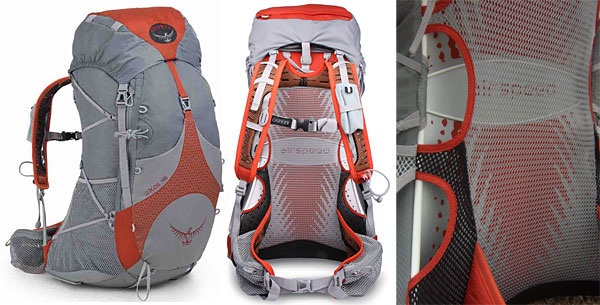
Osprey’s new Exos 58 internal frame backpack is a pound lighter than many of its competitors. The frontpanel (left) has a large stretchwoven kangaroo pocket, and there are two large mesh pockets on the sides. The backpanel view (center) shows the pack’s lightweight contoured peripheral frame, AirSpeed mesh backpanel, and mesh hipbelt pockets. A close-up of the backpanel shows the reduced depth of the AirSpeed backpanel, which brings the pack’s center of gravity closer to the hiker. The Exos does not have an adjustable torso length, so it’s important to choose the correct pack size.
I have been testing the Exos 58 for a couple of months and have found it fully capable of comfortably carrying loads between twenty-five and thirty-five pounds. With a large main compartment and nine spacious pockets, I found the Exos 58 overly spacious for my gear kit most of the time, so I advise readers to take a good look at the Exos 46 (30 ounces). It may seem to be too small, but it is in fact a very roomy pack for a weekend trip or longer when using lightweight gear. It’s important to purchase a backpack that is properly sized for the volume of gear that will be carried. Most backpacks carry better when they are fully expanded, but not overstuffed. The smallest pack in the new Exos series is thirty-four liters (28 ounces).
Although not available in the United States, another internal frame backpack of interest is the new Lightwave Wildtrek (60 liter men’s/55 liter women’s, about 2.3 pounds), available now throughout Europe. Although they are traditional top-loading designs, the distinctive feature of these packs (besides their light weight) is they have welded and taped seams that make the packs mostly waterproof. The backpanel seams are not seam taped, but they are protected to a large extent. The packs have an internal M-frame made of 7001-T6 aluminum.

The new Lightwave Wildtrek 60 has welded and taped seams that make it nearly waterproof while hiking in the rain.
Gregory will be introducing the men’s Z-65/women’s Jade 60 (65/60 liters, sub-4 pounds, US$229) in spring 2009 to provide a larger version of their popular Z-Packs. These packs feature Gregory’s Jet Stream suspension technology, top loading and frontpanel access, and six pockets for convenient access to gear. In addition to these larger Z-Packs, Gregory is also introducing the Z-35/Jade 35 and Z-25/Jade 25.
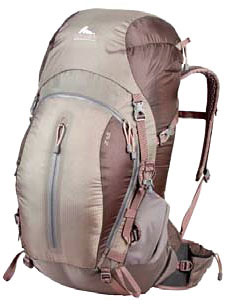
Gregory’s new Z-65 and its companion women’s Jade 60 extend the volume range in their popular Z-Pack series.
The North Face will have twenty-one new or updated backpacks for spring 2009, and we obviously can’t cover all of them. Lightweight standouts are the Skareb 65 and 50. The name remains the same, but the packs will receive a complete makeover for spring 2009, which will consist of new lightweight durable fabrics, improved X-Radial frame (that weighs only 2.5 ounces!), a fast opening top access, outside access, improved molded EVA padded backpanel and lumbar zones, stretch nylon side pockets, large stretch-woven front pocket, and a lightweight but comfortable suspension system. The wide hipbelt has a pocket on one side and accessory attachment loops on the other. There is even a loop on the left shoulder strap to conveniently carry a water bottle adventure racer style. The Skareb 65 (65 liters, about 54 ounces, US$249) and Skareb 50 (50 liters, 48 ounces, US$219) are cutting edge internal frame backpacks that pack a lot of features and comfort into their sub-3.5-pound weights.

North Face’s Skareb 65 (left) and Skareb 50 (center) will receive a complete makeover for spring 2009. Backpanel padding and ventilation are provided by a molded EVA lattice (right), and the left shoulder strap has a built-in water bottle holder.
These packs are very versatile because they can be used as either an internal frame backpack or frameless pack. The stays or framesheet slip into a sleeve on the backpanel and are easily inserted or removed. I put these packs into a separate category so as to compare apples with apples. These packs are also popular with many lightweight backpackers because they provide the capacity to carry a twenty-five- to thirty-five-pound load when needed. However, they are arguably more comfortable for loads in the twenty- to thirty-pound range. The lightest pack in this category (by Gossamer Gear) is an ultralight frameless pack when the stays are removed.
My current favorites are:
Gossamer Gear Mariposa Plus (60 L, 19.3 oz, US$155)
Six Moon Designs Comet (60 L, 29 oz, US$160)
Six Moon Designs Starlite (67 L, 30 oz, US$165)
The weights include the stays. The Gossamer Gear Mariposa Plus is made of durable 2.2 oz/yd2 coated rip-stop nylon and has straight carbon fiber stays that are not bendable. It replaces the current Mariposa and Miniposa packs (made of silnylon) that are being discontinued. The Six Moon Designs Comet and Starlite differ in volume and design, are constructed of durable 210 denier Dyneema Gridstop, have half-inch wide aluminum stays that can be bent to match the curvature of the user’s back, and are available with different hipbelt sizes and styles (with or without hipbelt pockets).
REI’s in-house gear and apparel development program continues to crank out new well designed, durable products with a great feature set and value pricing. Their new Flash backpack series for spring 2009 will replace their Ultralight series, and includes the Flash 65 (65 liters, 50 ounces, US$149) and Flash 50 (50 liters, 42 ounces, US$129). Their HDPE framesheet and top lid are removable to yield a frameless pack that weighs two pounds or less. These packs feature a wrap-around front kangaroo pocket with its own front zippered compartment, water-resistant zippers, mesh side pockets (four overlapping side pockets on the Flash 65, two on the Flash 50), and a large top lid. The suspension system is well padded and comfortable without being too weighty. The Flash packs have a fixed torso length, so getting a good fit means choosing the correct pack size. Both packs are available in men’s and women’s small, medium, and large.

The new REI Flash 65 (top left) and 50 (top center) are exceptionally well-designed, durable packs with a great feature set and value pricing. The suspension system (top right) is comfortable and light. These packs use a contoured HDPE framesheet (bottom left) that has been die-cut to reduce weight. With the top cap and frame removed (bottom right), the Flash packs become a frameless pack weighing around two pounds.
The new Six Moon Designs Traveler (62 liters, 31 ounces, US$180), available now, addresses the needs of backpackers who use public transportation to get to their destination. It’s a panel-loader with a zippered top pocket and zippered front mesh pocket. The other features are basically the same as the Comet (adjustable torso length, hipbelt sizes with optional pockets, one tall mesh pocket on the left side and two mesh pockets on the right side front compression straps).
Although the Traveler has design features to help it survive public transportation abuse, I don’t think I would ship a backpack with gear stuffed into mesh side pockets. I have had much better luck with wrapping my pack in plastic or placing it in a duffle bag to keep it clean and unscathed. Actually, the Traveler is a wonderful design for normal backpacking without using public transportation. Its design borrows a bit from the revised SMD Essence pack, which really works well for comfort and convenience, especially when the pack is fully expanded.

The new Six Moon Designs Traveler pack is a panel loader with a zippered front mesh pocket and zippered top pocket.
For spring 2009, Mountain Hardwear will be introducing a larger version of their popular Scrambler backpack, called the Super Scrambler (51 liters, 35 ounces, US$130). Size large bumps the volume up to fifty-six liters and fits torsos longer than 18.5 inches. This pack has a unique corrugated thermofoam framesheet that can be removed, along with a foam back pad and the top cap, allowing the pack to be used as a conventional frameless backpack with top compression strap. Inside there is a large internal sleeve that allows the use of a sleeping pad for additional backpanel cushioning/support.

The 2009 Mountain Hardwear Super Scrambler (left, 51 liters, 35 ounces, US$130) is built to be versatile. It has a removable corrugated framesheet (right), back pad, and top cap to convert it to a conventional frameless backpack.
These backpacks, as the name implies, have no frame at all. For back padding and to stiffen the pack, it’s standard practice to create a “virtual frame” by placing a closed cell foam pad against the backpanel or coiling it in the main compartment.
My current favorites are:
Mountain Laurel Designs Prophet (2750 cubic inches/45 L, 5.9 oz, US$130)
Six Moon Designs Essence (3100 cubic inches/51 L, 13 oz, US$120
GoLite Jam2 (3100 cubic inches/51 L, 21 oz, US$100)
GoLite Pinnacle (4400 cubic inches/72 L, 25 oz, US$130)
Pack weights vary because of fabrics, features, and size, and do not include accessories, such as a hipbelt and sternum strap. I included the GoLite Pinnacle because it really shines for carrying high volume/moderate weight loads, such as winter backpacking where a bulkier sleeping bag and more insulated clothing are needed.
Gossamer Gear’s popular Whisper Uberlight pack is being replaced by the Murmur Hyperlight pack (1700 cubic inches/28 liters, 7.5 ounces, US$90). The Murmer is constructed of 1.1 ounce/yd2 spinnaker fabric and has 300 cubic inches less volume than the Whisper. It also gains some features and more than doubles in weight (from 3.5 ounces to a whopping 7.5 ounces!). The additional weight comes from the addition of a waist strap, sternum strap, and two side pockets. The Murmur has a total of three outside pockets – one front mesh pocket and two side spinnaker pockets – while the Whisper only has one front spinnaker pocket. Overall, the Murmur has a feature set that most hikers prefer, and provides more utility in a pack that is still outrageously light. For gram cutters, the waist belt and sternum strap are removable.

The new Gossamer Gear Murmur frameless backpack (7.5 ounces/1700 cubic inches) is made of spinnaker fabric and is 300 cubic inches smaller than the former Whisper pack.
More evolution will be taking place in the GoLite line of backpacks. After introducing a completely new backpack line a couple of years ago, the Jam2 and Pinnacle will receive an upgrade and the weights will go up a bit (there appears to be a trend here). The new packs will have a conventional zipper and storm flap on the large front pocket (which is how it was on the original Jam and Gust), spacer-mesh padded backpanel, shoulder straps, hipbelt wings, and larger stretch-woven hipbelt pockets and side pockets. The side compression straps will (finally) mate across the front of the pack to stabilize the load or attach larger items to the front of the pack. And the ComPACKtor system for reducing pack volume has been improved. By now, you are probably wondering what the damages (in weight) are; according to GoLite, a large Pinnacle will gain eight ounces and a large Jam2 will gain two ounces. That’s not too bad, considering the gains in comfort and utility.

The GoLite Jam2 (shown) and Pinnacle (which is a larger volume pack of the same design) will receive a substantial upgrade for spring 2009, which will increase their comfort and utility as well as their weight.
The durable Mountain Laurel Designs Zip pack has been replaced by two similar packs that differ in size: the Exodus (3200 cubic inches/52 liters, 11.3 ounces, US$160) and Arc (4200 cubic inches/69 liters, 14.2 ounces, US$170). These packs are constructed of more durable 40 denier silnylon with 210 denier Spectra Gridstop on the backpanel and bottom. Features include three outside mesh pockets, compression straps, top strap, hipbelt, and sternum strap. The main difference between the two packs is their volume, although the larger Arc has wider shoulder straps and hipbelt wings.

The new Mountain Laurel Designs Exodus (left, 11.3 ounces, 3200 cubic inches) and Arc (right, 14.2 ounces, 4200 cubic inches) are more durable frameless backpacks and differ mainly in size.
Terra Nova is well known in the UK for their extremely light double wall tents. Starting in 2009, their products will be available in the U.S. through selected dealers and eventually a distribution center. In spring 2009, Terra Nova will be introducing a new line of ultralight frameless backpacks that are designed for adventure racers and fastpackers. The largest of the series is the Laser 35 (35 liters, 17 ounces, US$100), which is a panel-loading pack made of lightweight fabrics derived from their tent designs, and spacer-mesh padded suspension system. The pack has wide side pockets and a closed-cell foam backpanel that is removable.

The Terra Nova Laser 35 is designed for adventure racers and fastpackers and weighs just seventeen ounces.
The weight of lightweight fixed internal frame backpacks is steadily declining while their feature set is steadily improving. The Osprey Exos 58 and 46 are standouts for weight reduction while providing plenty of volume, features, and comfort. Every component of the pack has been fine tuned to provide function with minimal weight, and it adds up to a substantial weight savings. A year ago, our lightest internal frame backpacks weighed just over three pounds; the Osprey Exos beats that by nearly a pound.
Backpacks with a removable frame continue to be a viable category, and the selection is expanding. This is perhaps the most versatile type of backpack. While they won’t carry heavier loads as comfortably as the fixed internal frame backpacks, they easily handle moderate lightweight loads or weekend loads. The packs in this category are diverse, and the final choice depends on the volume and weight of your gear kit and trip lengths. While slightly heavier, the new REI Flash backpacks should not be ignored. They have a wonderful feature set, are more versatile than the Exos because of their removable components, and they are an outstanding value. However the Flash packs are about a pound heavier than the Six Moon Designs packs, and almost two pounds heavier than the Gossamer Gear Mariposa. The Flash packs should be considered for purchase alongside the Osprey Exos packs (and other favorites in that category), rather than the SMD and Gossamer Gear packs.
Many of our readers have a gear kit so light that they will only consider a smaller frameless backpack. The trend in this category seems to be toward more durable fabrics, which adds only an ounce or two to the weight of a pack and extends its lifespan considerably. Removable components are also common, so a hiker can customize the pack to the conditions on each trip.
Our latest lightweight shelter roundup turns up the lightest, most user-friendly tents to be found, ever. Major manufacturers are introducing sub-four-pound double wall two-person tents. And two two-person double wall tents break through the three pound barrier.
Many tents are touted to be “lightweight” and we even see the word “ultralight” in the name of a tent. There is a lot of misleading information out there, and a lot of heavier shelters (by our standards) are being hyped as “lightweight,” and they win awards from other magazines. So, do you buy it? A five+ pound three-season two-person tent is not ultralight or even lightweight; it’s not even close. There are literally hundreds of shelters on the market, but only a small fraction of them are truly lightweight and well suited for lightweight backpacking. Our interest is in that select few.

The new Tarptent Sublite one-person tent (19 ounces) is available now in a Tyvek version (shown) and will be available soon in a silnylon version. The Tyvek Sublite is made of soft, durable, breathable type 1443 “soft structure” Tyvek, not the house-wrap type of Tyvek.
To define our standards, I would like to share with you our current weight limits for what we consider to be a lightweight tent:
| Capacity (persons) | No vestibules Maximum Weight (lb) |
With vestibules Maximum Weight (lb) |
| 1 | 3 | 3.25 |
| 2 | 4 | 4.25 |
| 3 | 5 | 5.5 |
| Capacity (persons) | No vestibules Maximum Weight (lb) |
With vestibules Maximum Weight (lb) |
| 1 | 2.5 | 2.75 |
| 2 | 3 | 3.25 |
| 3 | 3.5 | 4 |
| Capacity (persons) | No vestibules Maximum Weight (lb) |
| 1 | 1.5 |
| 2 | 2 |
| 3 | 2.5 |
As you can see, a tent has to be very light to meet our standards. The weights above are for a complete tent, including stakes. Many manufacturers specify a “minimum weight” or “trail weight,” but it is not clear what’s included, and it usually omits stakes. The weights listed in this roundup are total weights or “packaged weights,” which include all components. In our reviews, we define our “minimum trail weight” as the weight of a complete tent (with stakes, but minus stuff sacks and other accessories) so we can compare tents on the same basis.
Many larger companies, which are well represented at Outdoor Retailer, have a lightweight product line that we focus on at OR, and many new technologies are announced at OR. So, we are always there to report on the cutting edge of technology. However, our roundups are not limited to the Outdoor Retailer trade show, because many new lightweight and (especially) ultralight products of interest come from small companies who typically are not present at OR.
I have some exciting new tents to report on in this category. For a long time, manufacturers were lightening their tents a little and calling them “lightweight” or “ultralight.” Now, they are getting serious, and tents really are getting light. The number of sub-four-pound two-person tents is increasing, and a few are approaching the weight of a single-wall tent.
Europeans prefer double-wall tents, and it seems they have evolved the double-wall tent to extremes. Good! At the extreme lightweight end is the new Terra Nova Laser Photon (1 pound, 12 ounces, US$500), which is claimed to be the lightest double-wall solo tent in the world. The Photon is a “fly first” design, meaning the pole inserts into a sleeve on the fly and the tent body clips to that. The tent can be left assembled and erected as a unit. The new Laser Photon is one step lighter than the Laser Competition, due to the development of stakes weighing just one gram and new lighter weight fabrics. The weight of the Photon will drop to twenty-four ounces in 2009 by incorporating new materials and making the tent slightly smaller.
The Photon is long enough for a person taller than six feet, but headroom diminishes a lot at the ends. Fortunately, the inner tent is made of uncoated nylon and is really distanced away from the fly, so there should be little condensation on the inside.
Terra Nova’s updated Laser tent (2 pounds, 14 ounces, US$420) is similarly claimed to be the lightest two-person double-wall tent available. The design is basically the same as the Photon, with side entry, vestibule, and flow-through ventilation that can be adjusted from the inside.

The Terra Nova Laser Photon (top photo, 1 pound, 12 ounces, US$500) and Laser (bottom photo, 2 pounds, 14 ounces, US$420) are claimed to be the lightest double-wall tents in the world.
The Terra Nova tents are a bit spendy, but the distinction of “lightest in the world” comes at a price. Terra Nova products are now available in the United States through four retailers, and they expect to establish a U.S. distribution center in 2009 to expanded the availability of their products.
More good news in the ultralight double-wall tent category (is that an oxymoron or not?) is the announcement of MSR’s new Carbon Reflex tents, the lightest tents ever from MSR. The Reflex 1 weighs two pounds, ten ounces and retails for US$450, and the Reflex 2 weighs three pounds, four ounces and costs US$500. The low weights are achieved by using lightweight fabrics and mesh, carbon fiber poles, and a unique one-plus pole design consisting of a single hoop plus a top strut. Both tents have one door and one vestibule. Protected area (floor + vestibule) for the Reflex 1 is 17 + 9.5 square feet and the area for the Reflex 2 is 29 + 14 square feet. The floor areas sound small, but the bathtub floor is designed so a sleeper can press it to the sides to create more room. Floor lengths are eighty-six inches for the Reflex 1, and eighty-four inches for the Reflex 2; the fly is 20 denier rip-stop nylon, 1000 millimeter polyurethane and silicone coated, and the floor is 40 denier rip-stop nylon 10,000 millimeter polyurethane coated. Another nice feature is the top strut extends the ridgeline beyond the door opening, so vertical rain will not enter the tent.
This is really significant – ultralight double-wall tents coming from a major manufacturer in the U.S.! Large equipment manufacturers have heretofore only entered the lightweight gear category, which is a much larger market than ultralight gear. They normally avoid the ultralight gear category because they perceive the market to be too small and the gear not durable enough, resulting in unwanted returns and loss of reputation. In response to my inquiry about their rationale behind the Carbon Reflex tent introduction, MSR Brand Manager Chris Parkhurst responded: “Our Fast & Light tent design philosophy is to push the limits of light weight while still achieving the performance people demand and the livability that sets MSR tents apart. These designs are dependent on the right technical materials becoming available at a price that still nets out to be a reasonable investment for the consumer. We believe we’ve achieved this with the Carbon Reflex tents.” Pretty cool, huh?

MSR’s new Carbon Reflex double-wall tents tents for spring 2009 have carbon fiber poles and a unique pole design. The Reflex 1 (top) weighs two pounds, ten ounces and the Reflex 2 (bottom) weighs three pounds, four ounces. Both tents use a lightweight Easton FX 1+ carbon fiber pole system to save weight.
Two new tents now available from Big Sky International are the Convertible and Montana. Both have three-season and four-season configurations. In their four-season configurations they require three heavy duty poles and weigh over four pounds, which is remarkable for a four-season tent. Both tents are a “fly first” design – poles are inserted into sleeves on the fly and the tent is set up as a unit. Read Backpacking Light’s review of the Convertible here.
What is really remarkable is the summer configuration of the three-season Montana. With two lightweight aluminum poles and lightweight stakes, it weighs just 2 pounds, 10.8 ounces and costs US$347. It gets a half pound lighter with Big Sky’s carbon fiber poles and spinnaker fly options, at a significant cost. The Montana is a tunnel design with two short A-frame shaped poles at the ends. It sets up very quickly and staking just the ends results in a very secure pitch. The interior is mesh and the fly is silnylon. It has a roomy entry vestibule and mesh entry door at the front, and a smaller vestibule at the foot end that is accessible only from the outside. A review of the Montana 2P is in progress.

The Big Sky International Montana 2P three-season configuration weighs just 2 pounds, 10.8 ounces for a two-person double-wall tent.
The new REI Quarter Dome T series tents were introduced in spring 2008 and are available now. These freestanding tents feature REI’s “Tension Truss Frame” with DAC Featherlite NSL aluminum poles to reduce weight, convenient side entry, flow-through chimney ventilation, lots of inside pockets, and value pricing. The pole set is hubbed and color coded to assist setup, and once the process is mastered (this is one where you need to read the directions), the tent goes up very quickly. The Quarter Dome comes in three sizes: T1 (3 pounds, 4 ounces; US$179), T2 (4 pounds, 2 ounces; US$259), and T3 (5 pounds, US$289). The T1 model has one side entry door with vestibule and the T2 and T3 models have two doors and two vestibules. These well-designed tents are an excellent balance of lightweight materials, durability, usable space, and cost.

REI’s updated T-series Quarter Dome tents (T2 shown, 4 pounds, 2 ounces, US$259), available in 1-, 2-, and 3-person versions, are well-designed, lightweight, and value priced.
BA’s new Fly Creek Ultralight (2 pounds, 3 ounces, US$300) is their lightest tent ever. It achieves that weight with the lightest DAC poles available, mesh interior, and lightweight fabrics throughout. The floor area is twenty-two square feet, and the front entry vestibule adds five square feet. Floor length is eighty-six inches and front height is thirty-eight inches. A fast fly setup requires a footprint (4 ounces, US$50).

The 2009 Big Agnes Fly Creek double-wall solo tent weighs just 2.25 pounds.
With the introduction of the mesh BugDome (1 pound, 10.7 ounces, US$195) for spring 2009, the combination of the BugDome and existing SilDome becomes a double-wall two-person tent weighing 3 pounds, 4.7 ounces. The floor space (96 inches long, 60 inches wide, 40 square feet) is long and roomy. Entry is through a zippered door with no vestibule. If purchased together, the cost is approximately US$350. The components will pitch separately or together, producing three combinations: a bug tent, a floorless single-wall tent, or a double-wall tent.

The new Integral Designs BugDome can be combined with the SilDome to create a 3.3 pound two-person double-wall tent.
Ok, you guys keep asking for a tent for tall hikers; is ten feet long enough? The EX’s 119-inch long floor is plenty long for a tall hiker plus gear. The Go-Go EX (2.8 pounds, US$299) is a double-wall tent with a low, flat profile for stability. The fly is asymmetric to provide some extra protected space on one side. It’s a single air beam tent, so a lightweight pump is needed to inflate it (not included in the weight).

The Nemo Go-Go EX (2.8 pounds, US$299) is extra long, enough for a tall hiker plus gear. The fly extends further out on one side to provide some extra protected gear storage.
We have always liked Sierra Design’s easy to set up tents, but they have always been a bit on the heavy side by our standards. For spring 2009, SD has re-designed most of their extensive tent line, and six of them now come in under our weight limits. I will highlight two of them.
The Lightning XT 2 (4 pounds, 7 ounces, US$289), a two-person freestanding double-wall tent, has two side entry doors with vestibules, and provides thirty square feet of floor space plus twenty-one square feet in the vestibules. A Lightning XT4 (four-person) is also available. These tents are a “Tunnel-Dome” design which incorporate elements of tunnel tents and dome tents.
The VaporLight 2 (3 pounds, 12 ounces, US$329) is also freestanding and has front entry and vestibule. Floor space is 25.5 square feet, and the front vestibule adds another 8 square feet of protected area.
To save weight, both the Lightning and VaporLight (below) use half poles with “Ballcap” pole ends that clip into the tent and fly to become a structural element, adding strength and headroom. They also use hubs that stay attached to the poles for fast setup, and “Jake’s Feet” to quickly and securely attach the fly to the tieout straps. The poles are DAC Featherlight NSL.

Sierra Design’s new Lightning XT2 (top, 4 pounds, 7 ounces, US$289) is a “Tunnel-Dome” design, incorporating elements from tunnel and dome tents. The new VaporLight 2 (bottom, 3 pounds, 12 ounces, US$329) has a front entry.
Space does not allow me to cover all of the new lightweight tents, so here’s a sampling of the new North Face tents. All use DAC Featherlight poles with struts (half poles with “ballcap” ends) to extend and support the tent with minimum weight. The struts are hubbed to the other color-coded tent pole(s) to facilitate a fast setup.

The North Face Mica 12 (3 pounds, 2 ounces, US$229) is a one-person double wall tent with a 1.5 pole system and side entry with vestibule. The floor area is eighteen square feet and the side vestibule adds six square feet of protected area. The Meso 22 (4 pounds, 1 ounce) is the two-person version.
The new Helion 2 tent (3 pounds, 5 ounces, US$395), available now, is their lightest two-person double-wall tent, and it’s a freestanding three-pole design. The low weight is made possible by the use of superlight fly and floor fabrics, new Atlas UL poles, 1/4-inch webbing with molded clips, and an all-mesh canopy. Floor area is twenty-eight square feet and the entry vestibule adds 8.5 square feet of protected area. It has a tall front entry with vestibule. It also has a “Pitch Light” option (2 pounds, 11 ounces) consisting of the fly, poles, and a Tyvek footprint.

The Mountain Hardwear Helion 2 (3 pounds, 5 ounces, US$395) tent is a lightweight free-standing three-pole design using cutting edge lightweight components throughout.
Lightweight backpacking is a growing segment in the outdoor industry. Hikers in this category want gear that provides comfort and features, and they want it to be light, too. Lightweight backpackers prefer a double-wall tent because they want a bug-free, secure, roomy, and dry shelter, and they don’t want to deal with the condensation issue of a single-wall tent. More and more people are realizing that a five+ pound two-person backpacking tent is simply too much weight to carry, and manufacturers are getting the message. A five+ pound tent is okay for car camping, but it’s simply not acceptable for backpacking anymore.
Manufacturers now seem to have the will to design lighter tents. With the increased availability of lighter fabrics, poles, and fasteners we are seeing more and more double-wall tents that meet our weight limits. A few years ago, a sub-four-pound two-person tent was rare, and Big Sky International dominated that niche. Now, we have a growing selection of sub-four-pound tents in this category, with many of them coming from major manufacturers like MSR, Sierra Designs, Mountain Hardwear, and The North Face.
If my numbers are correct, two tents in this roundup break the three-pound barrier for a two-person double-wall tent. The Terra Nova Laser weighs two pounds, fourteen ounces, and is claimed to be the lightest two-person double-wall tent in the world. However, the Big Sky international Montana 2P weighs 2 pounds, 10.8 ounces. That’s 3.3 ounces lighter; do we have a new world record?
Using a single-wall tent has been considered a lightweight backpacking technique (base pack weight under twenty pounds), but some of the newest single wall tents like the Gossamer Gear The One, Six Moon Designs Refuge X, and Tarptent Sublite) are so light they can fit into an ultralight gear kit (base pack weight under ten pounds).
In this roundup I have several innovative and exciting single wall tents to report on. Each one is unique and remarkable in its own right, and together they represent some real progress in making the single-wall tent lighter and more user-friendly.
We recently reviewed the new Gossamer Gear The One, and found it to be amazingly user-friendly and protective for its minimal weight. The One uses two trekking poles for setup, has a protective vestibule on the front, large zippered entry door, and good ventilation. Why use a tarp when you can get an 18.5 ounce solo tent? Available now, but a shortage of spinnaker fabric makes it hard for Gossamer Gear to keep up with the demand for this tent.

Gossamer Gear’s The One (18.5 ounces, US$275), made of spinnaker fabric and mesh, provides complete bug and rain protection.
The new one-person Tarptent Sublite tents are equally exciting. The Sublite is available now in a Tyvek version (19 ounces, US$179) and will be available soon in a silnylon version. The Sublite is the first use of Tyvek in a tent. The specific Tyvek is Type 1443R “soft structure” Tyvek, which is also used for disposable clothing. This type of Tyvek is soft, lightweight, highly water-resistant, very durable, and highly breathable. Technically, this is the world’s lightest breathable fabric tent. The Sublite uses two trekking poles in an A-shape for support and has a side entry sans vestibule. The floor is silnylon. I am currently testing the Sublite and will publish a full review in late summer.

The Tarptent Sublite (19 ounces, US$179) is available now in the Tyvek version and will be available soon in silnylon.
The new two-person Six Moon Designs Refuge tent comes in two versions, the Refuge X (about 17.5 ounces, US$400) made of cuben fiber, and the Refuge (about 28.5 ounces, US$260) made of silnylon. The Refuge X sets a new lightweight standard for a two-person single-wall tent, but requires special care because of its thin 0.6 ounce/yd2 cuben fabric. The refuge is similar to the Lunar Duo in design and uses two trekking poles for support, but does not have entry vestibules. Both tents have ample room for two people and flow-through chimney ventilation with two top vents. A review of the Refuge X is in progress and will be published soon.

Two new lightweight two-person single-wall tents from Six Moon Designs are the cuben fiber Refuge X (left) at 17.5 ounces, and the silnylon Refuge (right) at 28.5 ounces.
The two-person California (2 pounds, 5 ounces, US$310) is Big Sky International’s first single-wall tent. The dimensions are the same as the Montana, except it is single-wall rather than double-wall. It’s basically a tunnel tent design supported by A-shaped aluminum poles at the front and rear. Silnylon is used for the canopy and floor; flow-through ventilation is provided by vestibules at both ends. The front entry is through a large vestibule and zippered mesh door. There is a small vestibule for gear storage at the foot end, accessible from the outside only. The California sets up very quickly, and two six- or nine-inch Easton stakes will provide a very secure pitch. Expect a Backpacking Light review of the California this fall.

The single-wall two-person Big Sky International California has the same floor dimensions and area as their other tents. The tunnel design with short poles brings the weight down to thirty-seven ounces.
Another very interesting new two-person tent is the AntiGravityGear O2 (28 ounces, US$279). The O2 was created in response to our review of the AntiGravityGear Tarptent, and incorporates some solid refinements and functionality enhancements. The unique feature of this tent is its large protected area, a whopping forty-six square feet, including the entry vestibule. The O2 sets up with two trekking poles and has pull outs on the sides and rear to maximize inside volume. Backpacking Light will also publish a review of the O2 this fall.

The new AntiGravityGear O2 is a two-person single-wall tent that weighs just twenty-eight ounces and has forty-six square feet of protected area, convenient entry, and good ventilation.
Among The North Face’s rollout of new tents for spring 2009, the Flight Series of single-wall tents are the lightest. The lightest in the Flight Series are the Dyad 22 (3 pounds, 9 ounces) for two people and the Solo 12 (2 pounds, 10 ounces) for one person. The Dyad has a floor area of 36 square feet plus 4.5 square feet in the vestibule, lots of headroom at the front, and a good high/low ventilation system. The Solo 12 has 24.5 square feet of floor area plus three square feet in the front vestibule. North Face claims this tent has withstood ninety-five mph winds in their wind tests.

The Solo 12 (2 pounds, 10 ounces, US$209) is a one-person single wall tent with a 2.5 pole system and front entry with vestibule. Note the tight cut. The Dyad 22 (3 pounds, 9 ounces) is the two-person version.
It’s not eVENT, but the new Rab is made of Exchange Lite, a ePTFE fabric without a protective polyurethane layer, so it is very breathable. The Summit Mountain “Bivi” (4 pounds, 7 ounces, US$500) is 86 inches long x 47 inches wide x 39.4 inches high, which is cozy. It’s designed as a mountaineering tent, with nine sturdy tieouts that allow the tent to be clipped in so it will withstand extreme winds. The tent has a zippered door and does not have any vestibules. There are four mesh pockets inside. This mountaineering tent is overkill for backpacking, but if you want a truly breathable fabric tent, this is it.

The Rab Summit Mountain Bivi (4 pounds, 7 ounces, US$500) is made of Exchange Lite ePTFE breathable fabric that is truly breathable.
Overall, single-wall tents are getting more refined and lighter. In fact, they are getting so light that they present a decision challenge between the diminishing weight advantage of a tarp versus the full weather and bug protection of a single-wall tent. The latest designs set up quickly, are easy to enter and exit, and have adequate space and headroom inside.
However, one thing that won’t go away is condensation. Using a single wall tent means living with condensation on the inside walls. To understand why, read my article on Condensation in Single-walled Shelters: Contributing Factors and Tips for Reduction. You can’t escape condensation inside a single-wall tent, but you can manage it effectively.
We also have more choices of single-wall tents as far as design, size, and features. Most are made of silnylon, with a few made of spinnaker fabric, and now one made of cuben fiber. Ten years ago, silnylon was a breakthrough technology for lightweight and ultralight backpacking gear. Now it is commonplace and cheap. Today, silnylon seems heavy, and we are looking for even lighter fabrics to use for shelters that will reduce weight some more, while retaining adequate strength and storm resistance.
Tyvek has emerged as a tent fabric. It’s strong, light, breathable, and cheap, but it will require some time and testing to determine how suitable it is for shelters and how well hikers will accept it.
Besides tents, soft structure Tyvek can also be used for tarps and other floorless shelters, and as a groundsheet or bivy. It’s easy to make your own Tyvek bivy: just go to http://ecom.citystar.com/hang-em-high/, order Part TYVEK-60 – Tyvek #14 White – Soft, and sew it on two sides like an envelope with one end open.
The new for spring 2009 Terra Nova Bivy Tarp (25.7 ounces, US$200) is a cross between a tarp and a single wall tent. It comes with two poles, tarp style flysheet, mesh inner, and fully seam sealed groundsheet. The protected area is eight-five inches long x fifty-nine inches wide, so it’s large enough for two hikers.

The new Terra Nova Bivy Tarp (25.7 ounces, US200) comes with two poles, a mesh liner, and groundsheet and is large enough for two people.

The North Face Backpacking Bivy (2 pounds, US$200) is a hooped single wall breathable fabric bivy made of HyVent DT breathable fabric with a 40 denier nylon face, and features a zippered side entry with a window.
This is a good time to announce that a new State Of The Market report on single-wall tents is in the works, and will be published in the late fall at Backpackinglight.com. Our last report back in 2003 has become one of our most popular articles – it looks like a lot of our readers are interested in single-wall tents! A lot has changed since then, and Chris Townsend and I will document the evolution, provide specifications on tents that meet our selection criteria, and rate the tents on their performance for different applications. Judging from the innovations in this lightweight shelters update, we will have a lot to say in the new SOTM report.
A seven-ounce mosquito-free haven which, when mated with the Gatewood Cape, becomes the inner half of an eighteen-ounce double walled tent system.
The Six Moon Designs Serenity Net Tent is designed to integrate with their Gatewood Cape to form an eighteen-ounce weather and bug proof shelter. It can also be set up by itself in fine weather. The Serenity has a half pyramid shape with a silnylon bathtub floor and no-see-um netting upper with a double zipper side entry door. The peak clips to the Gatewood Cape harness or can be supported by a trekking pole for stand alone set up. Elastic tieouts on the four corners can be hooked to the same stakes used for the Gatewood or staked independently.

The Serenity Net Tent set up near the CDT for bug protection with ventilation. The Gatewood Cape behind the Net Tent is ready to be pulled over the Serenity in case the threatening clouds begin to leak.
|
Manufacturer: |
Six Moon Designs |
|
Year/Model: |
2008 Serenity Net Tent |
|
Occupancy: |
Single person |
|
Materials:: |
Canopy – ultralight no-see-um netting; Floor – 30 denier silynylon; Zipper – number 3 YKK |
|
Dimensions: |
Width – 31 in at head, 22 in at foot; Length – 84 in; Height – 42 in (79 x 56 x 213 x 107 cm) |
|
Floor Area: |
15.5 ft2 (1.44 m2) |
|
Stakes required: |
None when used with Gatewood Cape, five for stand alone |
|
Features: |
Full zip entrance, peak clips to harness of Gatewood Cape with a mitten hook (older harnesses can be sent to Six Moon Designs to be retrofitted with a D-ring), pocket at the peak to hold a trekking pole tip for stand alone set up, elastic loops on end panels that align with Gatewood Cape inner snaps, elastic loops at the corners of the floor to attach to Gatewood Cape stakes |
|
Included: |
Mesh stuff sack 0.1 oz (3 g) |
|
Weight: |
measured weight Carol 7.5 oz (212 g), manufacturer specification 7 oz (198 g) |
|
MSRP: |
$120USD |

The elastic tieout from the Net Tent stretched over the top of an Easton aluminum tent stake used to secure the Gatewood Cape.
The Serenity Net Tent is easy to set up, but it takes some experimentation to create the roomiest setup. After the Gatewood Cape is pitched, clip the glove hook on the Net Tent peak to the D-ring on the Cape harness (Six Moon Designs will retrofit older harnesses), then from outside the Gatewood, stretch the elastic tieouts at the Serenity floor corners over the stakes securing the Gatewood. Lastly, attach the two side loops on the Net Tent to the snaps on the inside of the Gatewood.
The Serenity can be set up by itself by staking out the four corners, fitting the tip of a trekking pole into a pocket at the peak and guying out the pole. Six Moon Designs recommends a trekking pole height of forty-three inches, but I found the Serenity very saggy at this height. The bug shelter had much more interior room with a forty-eight-inch long pole.
The instructions for the Gatewood Cape recommend a forty-two-inch trekking pole if the shelter is set up in a low pitch, or a forty-five-inch pole when extender loops are used to raise the edges of the shelter for increased ventilation. I sleep under the Gatewood a lot and typically use a 48.5 inch (123 cm) fixed length pole with it. Even with adjustable poles, I set them long, since the Gatewood is roomier with a taller pole. Will Rietveld also prefers a taller pitch. He describes his setup method in his Gatewood Cape Review, and in more detail in his review of the similarly shaped Wild Oasis Tent. I use a tall pole and lengthen the front guyline as Will describes, but I stake out the front entrance without using a second pole.
The Gatewood Cape is quite roomy for such a lightweight shelter when set up as described above. When the Serenity Net Tent is set up inside the Gatewood, interior space is significantly reduced. The rear triangle of storage space is lost as well as some of the height and length. There is plenty of length for me (5’10” tall) and the netting is well off my face when I am lying down, but it is difficult to prevent the Serenity from sagging and, unless you are quite short, the netting will drape on your shoulders when you sit up. (I soaked the Serenity in Permethrin to keep bugs from biting through the mesh.)

The Gatewood Cape and Serenity Net Tent double wall tent. Note that the sides of the Gatewood are tied out to increase room inside the Serenity, and that the Serenity reduces space under the Gatewood Cape significantly.
To optimize interior space in the Serenity, use a higher pitch and a second trekking pole or a stick to pull out the head end of the Gatewood, where the elastic loop on the Serenity is snapped to it. Also, I found that staking at least one end of the Serenity independent of the Gatewood allowed me to fine tune the Serenity pitch to improve interior space. I’d like to see a method of pulling out the back of the Serenity to create more space. Either a tieout on the center back of the Serenity floor (which could be done without needing to retrofit older Gatewood Capes) or an elastic loop and corresponding snap on the Gatewood. Note: I’ve used the snaps on my Gatewood Cape only once or twice, but one snap refused to open during my trip. I ended up tying the elastic loop to the snap since this connection is crucial to creating space in the Serenity.
The lightweight no-see-um netting is delicate. The mesh squares were already elongated where the elastic loops are sewn on when I received the Serenity. After a five-day trip, there were several spots in other places in the netting where the mesh holes have become larger. Bug resistance won’t be affected at this point – especially with the Permethrin treatment.
I used the Serenity on a trip on the Continental Divide Trail in Colorado in July – the season for mosquitoes and thunder showers. The Gatewood can be stuffed back into its built-in pocket with the Serenity still attached, although it’s a tight fit. When rain threatens, the Gatewood can be set up quickly, then the Serenity can be put up (whether it is stored attached to the Gatewood or separately) under the cover of the Gatewood. The only tough part is attaching the corner tieouts to the stakes from inside the Gatewood. It is easier to stake the Serenity separately. I used Lazr Hi-Vis Titanium tent stakes (about 0.8 ounces for four) to stake the Serenity, but four Lazr Nano stakes would be adequate and weigh less than 0.2 ounces.

A glove hook attached to the peak of the Serenity Net Tent clips into a D-ring on the multi-colored Gatewood Cape harness (supported by a trekking pole).
Staking the Gatewood high using extension loops put the stakes too far away for the Serenity tieouts. I either staked the four tieouts separately or put two tieouts over Gatewood stakes and staked the other two independently.
The door on the Serenity is large. A two-way zipper goes to nearly the peak and one end of the tent. Rain was more present than biting bugs on my trip, so I often sat under the Gatewood with the door open while I was cooking or just lounging. The netting door was continually getting in my way until I took a fold and tucked it into the elastic loop on the Gatewood used to hold the door rolled back. I don’t use a chair inside a floored tent for fear the stays will press through lightweight fabric, but I found I can use a chair (the Big Agnes Cyclone SL Chair Kit) under cover with the Serenity/Gatewood combination by pushing the floor back far enough that the stays didn’t press into it.
I normally use a six-ounce Bozeman Mountain Works Vapr Quantum Bivy with the Gatewood. The Serenity was my bivy on my CDT trip. Even when bug pressure was low, the Serenity added a bit of warmth and splash protection.
The Six Moon Designs Wild Oasis is essentially a Gatewood Cape with the rainwear option removed and a perimeter of bug netting added. It weighs thirteen ounces. In October 2007, Will Rietveld posed this question in his review of the Wild Oasis: “Why not simply develop a detachable mesh skirt for the Gatewood Cape? Then one could have the Gatewood’s dual benefits of rainwear and shelter, plus bug protection when needed by adding the skirt. The challenge would be to devise a lightweight attachment system that is convenient and bug-proof. Velcro is not necessarily a good solution because it would add too much weight, and it snags badly on the mesh.” The Serenity Net Tent is almost certainly not what Will was envisioning, but it functions as he requested.
If you already own a Gatewood Cape, the Six Moon Designs Serenity Net Tent is a nice addition to one of my favorite shelters. It decreases the roominess of the Gatewood, but provides full bug protection.
No other shelter in this weight range has full mosquito protection, modularity (netting and rain fly can be used separately), and a rainwear option. Even bypassing its use as rainwear, the Gatewood Cape/Serenity Net Tent is unique as a shelter with the option of full bug coverage with the door open, modularity, and to-the-ground shelter on three sides when conditions warrant. The Tarptent Sublite and Six Moon Designs Wild Oasis (13 ounces) have mosquito coverage only with the fabric door closed. The Gossamer Gear The One is not modular, so weight can’t be saved by leaving the netting at home in non-buggy conditions. The Mountain Laurel Designs Serenity Shelter and one of their tarps, such as the Patrol Shelter, have the most similar features but they can’t be pitched to the ground without reducing sitting height under the netting. Another difference is that the Mountain Laurel Designs shelter has an end entry, while the Six Moon Designs shelter has a center door.
New sleeping bag designs from Integral Designs, Montbell, Exped, Jacks ‘R’ Better, Mountain Hardwear, and REI show innovative functionality and lighter weight.

Two Integral Designs representatives look warm if not exactly comfortable in the new bag coupler prototype.
This unnamed prototype from Integral Designs is an innovative way to reduce weight for couples and very focused climbers. The wedge-shaped panel zips into any of Integral Designs’ bags and allows two persons to share a footbox while each having an individual hood. The top and bottom of the panel connect at the shoulder area to reduce drafts. The concept certainly represents out-of-the-(foot)box thinking. For two people who could actually sleep in this configuration, the weight savings due to shared warmth and reduced total bag surface area could be considerable. This version made from Pertex Microlight and five-ounce Primaloft Sport weighs 20 ounces (566 grams). No MSRP or delivery date has been set. Contact Integral Designs if you’d like to see the concept developed further.

Footbox of the Montbell Spiral Down Hugger. Note the diagonal baffling claimed to allow some stretch to the design.
For Spring 2009, Montbell is introducing a new series of down bags called Ultra Light Spiral Down Huggers. The bags feature a slight mechanical stretch in the 12 denier nylon shell plus diagonal baffling. The combination is claimed to allow the bag to snug around the sleeper without the elastic weight and construction complications of their Super Stretch bags. The “snugging” effect is not as pronounced as in the older bags, but the Spiral bags are about 4 ounces lighter than the corresponding Super Stretch ones, giving them impressively low (claimed) weight for their temperature ratings. The 800 fill-power U. L. Spiral Down Hugger bags will be available in Montbell’s #0, #1, and #3 weights, corresponding to 0 F, 15 F, and 30 F temperature ratings, respectively. MSRP: $390 (#0), $299 (#1), and $229 (#3). Claimed weights: 41 ounces (#0), 32 ounces (#1), and 18 ounces (#3).
|
|
|
| The Exped Swift in bag mode (left) and poncho mode (right). | |
The Exped Swift is a versatile new bag that doubles as a quilt and triples as an insulated poncho. The Swift uses 250 grams of Primaloft Sport insulation to achieve a EN 13537 men’s comfort rating of 48 F. The two-way, full-length zipper allows the bag to be opened into a quilt, while a side slit forms a head opening for use as an in-camp poncho. Finally, the rectangular cut is roomy enough to use as an overbag to extend the temperature range of another bag or quilt. The Swift certainly deserves points for flexibility, though this comes with somewhat of a weight penalty. Weight: 26 ounces (740 grams). Available March 2009. MSRP: $135 regular, $145 long.
Also from Exped is a warmer, 20 F version of their wearable Wallcreeper. The Wallcreeper 650g contains 650 grams of 750-fill down and weighs a claimed 39 ounces (1100 grams). Available March, 2009. MSRP: $310 for the regular size in 20 F down version.

Ryan Gardner experiences an abundance of loft in the JRB Mt. Washington Under Quilt.
Rivaling the versatility of the Exped Swift are products from Virginia-based Jacks ‘R’ Better. Wizards with Omni-Tape (hermaphroditic Velcro), JRB has been building highly versatile down quilts for the past five years that can be worn as ponchos, used as sleeping quilts, or attached to the bottom of hammocks as underquilts. Their No Sniveller was the top-ranked bag in our 2006 Unconventional Sleep Systems Review Summary and Gear Guide Overview.
Keeping away from the bleeding edge of ultralight materials, Jacks ‘R’ Better has instead focused on competitive pricing on products that tend to run a few ounces heavier than those from specialized, semi-custom gear makers. This philosophy has enabled them to be one of the few lightweight, cottage manufacturers that has grown enough to warrant their own booth at Outdoor Retailer.
New this year is their Winter Nest Under Quilt, a 10-15 F rated down quilt with 3-inch baffles stuffed to 3.5 inches of loft. The Winter Nest Under Quilt is designed to accommodate bottom-entry hammocks such as those made by Hennessy Hammock, but is claimed to also fit other lightweight camping hammocks. As with most JRB quilt products, it can also be used as an over-quilt or bag. Incorporating 800+ fill down and 1.1 ounce rip-stop nylon shells, it has a claimed weight of 26 ounces. MSRP: $349.95
Also new from JRB is the Mt. Washington Under Quilt. Lacking the bottom-entry slit of the Winter Nest, the Mt. Washington instead features an aggressive differential cut with radial baffles. A differential cut is where the outer shell material is cut to a larger diameter than the inner one. It results in a more body-contoured design with less material and better drape than flat construction. It is generally more important on high-loft bags than on thinner ones. Featuring the same three-inch baffle height as the Winter Nest, the differential cut and additional down fill of the Mt. Washington allow it to achieve a claimed 0-10 F temperature rating in a 30-ounce package. According to Jack Tier, this makes it the warmest commercially available hammock under quilt. Contact JRB for pricing, availability, and options.

The Mountain Hardwear UltraLamina 0°.
BackpackingLight Senior Editor Don Wilson and I both chose the 15 F version of the Mountain Hardwear UltraLamina bag to use on the Wilderness Trekking III Course last October. The roomy cut that allows layering over high-loft clothing, synthetic insulation welded to the shell, and dual side zips that allow the user to sit up and use their hands while wearing the bag were key features that drove our choice. This year, Mountain Hardwear is expanding the UltraLamina line to include a 0 F version. The UltraLamina 0 F features a 20 denier micro ripstop shell and taffeta liner and weighs a claimed 53 ounces. MSRP $220.

Representative of the Halo bags is this men’s 25 F version with a claimed weight of 31 ounces. MSRP: $259.
Outdoor Retailer juggernaut REI is expanding further into the lightweight market sector with the introduction of their in-house designed Halo down bags. Using lightweight (but not too light) materials, and with sparse (but not too sparse) features, the new bags are aimed at the mainstream lightweight hiker looking for solid performance in an upper-end but still value oriented product. While these are not the lightest bags available, REI’s move to embrace the lightweight market bodes well for making lightweight products, and therefore techniques, available to more of the traditional hiking community.
The new Halo bags are offered in a staggering twelve different sizes and temperature ratings. Offered in men’s and women’s versions in regular and long sizes, the bags will be made in 10 F, 25 F, and 40 F varieties. The Halo bags will feature 750-fill down, and will incorporate EN 13537 standards in their temperature ratings. MSRP’s will range from $149 for a women’s regular 40 F version to $309 for a men’s 10 F long. Available Spring 2009.
Mike Martin and Will Rietveld have the highlights on new apparel from ORSM08.
A number of new and light clothing pieces debuted at Outdoor Retailer this year. As Backpackinglight covered rainwear separately in Lightweight Rainwear 2008: Current Favorites, New Introductions, and New Technologies by Will Reitveld, this article will instead focus on other clothing categories. As the clothing landscape at the show is vast, we’ll take a look at a few of the standout new pieces and technologies. Read on for details on a two-ounce windshirt, a nine-ounce hooded down jacket, lightweight softshell pieces, and exciting new clothing technology.
The Rab Vapor-Rise series of clothing, with a microfleece wicking liner and Pertex Equilibrium shell fabric have been solid-performing winter layers for several years. For spring 2009, they are introducing a new piece called the Vapor-Rise Lite Jacket constructed of a lighter version of the denier-gradient Equilibrium shell and a Powerdry liner. The hoodless jacket features a full zip for ventilation, long sleeves with thumb loops, two chest pockets, and a drop tail. While likely too heavy and warm for summer use, this looks like a fine piece for ski and snowshoe tours. MSRP $125. Weight: 14 ounces.

The Rab Vapor-Rise Lite Jacket.
First shown at Outdoor Retailer Winter Market 2008, the five down jackets in the Rab Microlight range are made with Pertex Microlight fabric. The warmest of the group is the Microlight Alpine Jacket, which has 140 grams of European 700+ goose down, weighs thirteen ounces, and costs $200. The down is stabilized by horizontal sewn through stitching. The jacket has an attached hood and two side pockets. The Microlight (11 ounces) contains 125 grams of down and costs $180. There is also a Microlight Vest (8 ounces) with 80 grams of down for $175. The Microlights will be available in fall 2008.

The Rab Microlight Alpine Jacket.
Patagonia has released a new series of lightweight, stretch, soft shells – the Traverse series. These are light, tough garments aimed at high speed mountain pursuits. The fabric is 93% polyester (100% recycled) and 7% spandex. The men’s line has pants, a jacket, and a pullover. The women’s has pants and a jacket. The pants and pullover are particularly attractive as UL garments. The pants are claimed to weigh 8.6 ounces in size men’s medium. The pullover is claimed at 9.2 ounces and the jacket is 9.9 ounces, also in men’s medium. MSRP: $100 (jacket) and $75 (pullover). Available in January 2009.

The Patagonia Traverse Jacket.
Yes, you read that right. Backpacking Light is expanding our own line of hiking clothing. This year, the Thorofare Trekking Shirt and Pants join our lightweight Merino Wool baselayer and Cocoon insulated shell garments. The Thorofare pieces are constructed from a durable but very light nylon fabric that balances moisture transportation, wind resistance, and drizzle protection. Intended to be worn as a sole layer in warm weather, the Thorofare Trekking Shirt and Pants can also be layered over wool or synthetic base layers for colder conditions. Weight: 4.6 ounces (130 grams) size medium shirt, 4.0 ounces (113 grams) size medium pants. MSRP: $76.99, shirt or pants. Available August 2008.

Ryan Jordan models the Backpacking Light Thorofare Trekking Shirt and Pants.
Etowah Gear is launching what may be the lightest commercially available windshirt in spring 2009. The Ultra Light Wind Shirt is made from .8 ounces untreated sailcloth that is highly breathable. Intended for summer use, it features an eight-inch neck zip for ventilation, elastic cuffs, and drawstring bottom. The claimed weight is a scant 1.8 ounces (51 grams) in a men’s size large. MSRP: $50.

The 1.8 ounce Etowah Gear Ultra Light Wind Shirt.
Western Mountaineering adds a hooded jacket to complement their Flash Vest. The Flash Jacket saves weight by using stitched-through construction and simple elastic trim on the cuffs, hem, and hood. Still, unlike its extremely spartan sister vest, the new Flash Jacket features an insulated hood and handwarmer pockets. In my opinion, Western Mountaineering makes some of the best handwarmer pockets in the industry – generously down filled on both the inner and outer layers, with no zippers to snag. Garments like their classic Flight Vest are almost worth their weight as handwarmers alone. Stuffed with 3.25 ounces of down, the Flash Jacket still weighs a Backpacking Light verified 8.8 ounces (252 grams) in men’s size medium. MSRP: $260. Available January 2009.

The sub-nine ounce Western Mountaineering Flash Jacket.
Sun hat design is a tricky business. For the, shall we say, follicly challenged, a light colored, breathable crown is a crucial design feature to protect the scalp from sunburn. But, for those who have never considered asking their doctor about Rogaine, a visor-style hat can be much cooler. Yet visors typically don’t provide much side or back coverage.
Enter the Outdoor Research Chameleon Sombrero. Featuring a full 360° stiffened brim, vented UPF 50+ Supplex nylon crown, and removable chin cord, the Chameleon Sombrero appears at first glance to be a pretty competent but typical sun hat. However, one feature sets it apart from its competitors: the crown unsnaps and stows in a pocket located in the rear of the brim, turning the hat into a full-brimmed visor. This lets the user adjust the warmth, ventilation, and sun protection as conditions dictate. It’s on my “must have” list for next summer. Claimed Weight: 2.4 ounces. MSRP $36. Available February 2009.

The versatile Outdoor Research Chameleon Sombrero.
I like wool socks. They provide just the right coefficient of friction against my skin to avoid blisters, a natural anti-funk property to improve my social interaction with fellow hikers, and an absorbency that buffers moisture dissipation from my sweaty feet. But wool has its drawbacks: it’s not as durable as the best synthetic materials, such as nylon; it can be itchy; and it is not well tolerated by persons with a sensitivity to lanolin. Conventional synthetic socks can improve all three of these drawbacks, but typically trade off on durability versus wicking performance and offer little absorbency.
The new “Tri Layer” sock line from Lorpen knits three different types of yarns together to offer wicking, absorbency, and durability. The next-to-skin layer is made from highly surface-wicking Coolmax. The inner layer is made from a natural absorbent fiber called Tencel that is derived from Eucalyptus wood pulp. The exterior layer is made from abrasion-resistant nylon and is concentrated in high-wear areas such as the toe, heel, and shin. The combination of materials potentially promises to be a viable alternative to wool for hiker’s feet. MSRP: $14.99 to $16.99 depending on style. Available spring 2009.

One of the new Lorpen socks featuring Tri Layer Technology.
Anyone who has spent time hiking in bright sunlight on a hot day knows the benefit of light-colored clothing. Surfaces with a high albedo reflect a greater percentage of incoming solar radiation and, as such, absorb less heat energy. For a hiker in the sun, this means that a white hat or shirt is going to be cooler than a black one.
Swiss textile manufacturer Shoeller is introducing a new fabric finish called ColdBlack that while absorbent (dark) in the visible light portion of the spectrum, is reflective in the non-visible infrared portion. Shoeller claims that their new ColdBlack finish on a dark fabric reflects up to 80% of all incoming electromagnetic energy. The ColdBlack finish is planned to be available on their Dryskin and Dynamic fabrics.
Mammut is the first adopter of the new fabric in their Dryskin line of clothing for spring 2009. The Mammut pieces are not particularly lightweight, but the ColdBlack technology has the potential to trickle down to lighter fabrics. In a year or two, you may be able to hike comfortably in the sun while wearing dark clothing instead of white.
I met with Utah-based startup company Klymit at Outdoor Retailer to get a glimpse of their vision of the future of insulation. Klymit has developed a technology based on filling a flexible bladder with noble gases such as Argon. Their system is claimed to be more compressible and provide a higher warmth per thickness ratio than conventional fiber insulations, while allowing the user to adjust the volume of insulation and therefore warmth on the fly.

The adjustable Klymit gas-filled insulation system. Image Courtesy of Klymit.
It varies somewhat with thickness due to the boundary layers and convection cell size, but Argon gas has approximately two-thirds the thermal conductivity of air for a given thickness. Krypton and Xenon have even less. This has been exploited for years in the building market where premium multi-pane windows have been filled with Argon to improve their R-values over air-filled ones. The Klymit gas bladder system is adjustable over a typical thickness range of 0.5 to 10 mm and is claimed to provide two to three times the thermal resistance as an equivalent thickness of conventional high-loft insulation.
Their system uses small gas canisters similar to the carbon dioxide ones used to inflate bicycle tires. This type of canister is already commercially available filled with Argon in the $4 to $5 range for use in the wine market, where partially filled wine bottles can be injected with Argon to reduce oxidation. One of these canisters only provides enough gas to inflate a jacket once or twice, so Klymit is working to produce higher pressure cartridges that will be sufficient for eight to ten inflations. I measured the weight of a prototype valve assembly and Argon cartridge at 3.4 ounces (96 grams). Note that depending on the final application, this weight does not necessarily have to be carried by the user – for example a detachable inflator could be used to pump up a jacket prior to a trip. Once inflated, a jacket is claimed to retain the gas for up to two months.

A prototype Klymit valve and canister assembly.
Klymit plans to license their technology to apparel partners and supply canisters, connectors, and valves to them. They hope to see ultimate end products of footwear, gloves, and jackets. They say that the bladders can be made from a wide array of materials including waterproof/breathable fabrics. Their bladders in the prototype jacket they showed me were RF welded from a material with a PU/ePTFE membrane to provide breathability.
Going into the meeting with Klymit, I had a number of reservations about their technology:
I came away from the meeting much more impressed with the viability of their system. I’m still concerned about the breathability of garments, as even if WPB membranes were used in the bladder fabrics, moisture would still need to pass through two membranes, presumably reducing breathability. Still, I see great potential when used in a variable-insulation vapor barrier garment.
The system was not nearly as heavy as I thought. The inflator assembly weighs only 3.4 ounces, and as mentioned, can be removed in some applications. Even the prototype jacket I saw weighed only 17 ounces (490 grams) despite its bomber, non-lightweight construction. Conceivably, this technology could be used to build a variable insulation lightweight jacket in the twelve-ounce range.
Punctures remain an issue. However, products could be built with well-protected internal bladders and/or have patch kits similar to inflatable sleeping pads. Time will tell if Klymit can develop their technology, establish partnerships, and gain market acceptance. Their core ideas look promising, and I wish them success. I’d be very pleased to be winter hiking in 2010 with a fourteen-ounce Klymit parka that I could hike in all day, then pump up to keep me warm in camp.

A seventeen-ounce variable insulation Klymit Jacket prototype.
This full-featured synthetic insulated pant really fits well, and it’s a great value – if you want or need the features.

Montbell Thermawrap Pant on an early summer mountain backpacking trip. The temperature was 30 F.
The Montbell Thermawrap Pant is a full-featured, lightweight, synthetic insulated pant. It packs a lot of features and warmth into its eleven ounce weight (size large), making it a highly versatile piece for year-around use. In comparison, the Bozeman Mountain Works Cocoon UL 60 Pant is a simple pull-on with few features and more insulation, and weighs 3.6 ounces less. The issue I would like to address in this review of the Thermawrap is whether the features are worth the extra weight.
Look at the list of features in the Specifications section below; Montbell has masterfully incorporated a lot of features into the Thermawrap Pant while keeping weight to a minimum. The key issue is whether or not you want or need all of these features, compared to keeping it simple and light.
I selected the Thermawrap Pant to use on an eleven-day winter camping trip in Yellowstone National Park, where we build three different igloo base camps and skied the surrounding areas. My legwear clothing system consisted of thin wool long johns (Ibex Woolies), an insulation layer (Montbell Thermawrap), and a shell layer (Rab Bergen Pant). I typically wore the wool long johns and eVENT Bergen Pant for daytime winter travel, and my plan for extra warmth on very cold or windy days was to add the Thermawrap Pant without having to take my boots off. It worked perfectly, thanks to the full length side zippers on the Thermawrap. In our igloos at night, I wore all three layers.
Beyond using the Thermawrap on our Yellowstone odyssey, I wore it as a midlayer on several backcounty skiing trips at high elevations and cold temperatures and found it to be very warm and versatile. When I heated up while climbing with skins, I opened the side zips for extra ventilation, and closed them on descents to keep the snow out.
As winter gave way to spring and summer, I wore the Thermawrap as leg insulation in camp and in my ultralight sleeping bag. When I donned them for camping insulation, I found the zippered hand pockets to be useful for keeping things handy, but the full-length leg zips were not needed. I also liked the zippered fly. Especially notable is the Thermawrap Pant fits very well, at least for me. I have a thirty-four-inch waist and thirty-two-inch inseam, and the size Large Thermawrap fit me perfectly. It has a trim fit, the knees are articulated, and the legs are adequately long. Although it’s a trimmer fit, I found that I could wear the Thermawrap either under or over my hiking pants or hiking shorts. And Montbell’s 15 denier Ballistic Airlight nylon shell is lightweight, but remarkably durable and water repellent.

The Thermawrap’s full-length side zips with double sliders allow the pant to be donned without taking your boots off. It also allows temperature regulation if the pant is worn while hiking or skiing.
Now I would like to address my earlier question – are the features worth the extra weight? It depends on your intended usage. The full-length side zips with double sliders are definitely useful for winter travel on cold days. They go on without taking boots off and allow temperature adjustment by opening the zips. However, for adding insulation in camp, the side zippers are not really needed, unless you prefer to donn the Thermawrap Pant over hiking pants or shorts without taking your boots off.
To compare the Thermawrap with an alternative “no frills” insulated pant, I constructed the following table comparing the Montbell Thermawrap with the Bozeman Mountain Works Cocoon UL 60 pant, which has a Pertex Quantum shell and lining, but no extra features other than an elastic drawcord and cuffs.
| Pant | Size | Weight (oz) | Insulation | Inseam (in) | Total Length (in) | MSRP |
| Montbell Thermawrap | L | 11 | Exceloft 50 g/m2 | 33.5 | 44 | $130 |
| BMW Cocoon UL 60 | M | 7.4 | Polarguard Delta 68 g/m2 | 31 | 45.5 | $180 |
| BMW Cocoon Pro 60 Side Zip | M | 12 | Polarguard Delta 68 g/m2 | 31 | 45.5 | $230 |
Some interesting comparisons are as follows:
The BMW pants run large, so a Medium Cocoon is roughly equivalent to a Large Thermawrap.
The Cocoon has thicker insulation, 68 g/m2 versus 50 for the Thermawrap.
The Cocoon weighs 3.6 ounces less.
The Cocoon has a shorter inseam, but the pant is longer because it has a longer draw (distance from the waist to the crotch).
The Thermawrap costs $50 less.
I added the BMW Cocoon Pro 60 Side Zip to the above table to provide a comparison of two similar pants. Note that the BMW Pro 60 weighs one ounce more, but it has a Pertex Quantum Endurance Mini-Ripstop shell (1.3 oz/sq2), which makes it suitable as an outer layer in cold conditions. It also costs $100 more.
The bottom line is that the Montbell Thermawrap is more versatile legwear if you want an insulated pant that can be donned without taking your boots off. It also fits very well and has pockets and has articulated knees, while the BMW Cocoon is plain and baggy. It’s also an excellent value compared to the Cocoon. Personally, I like the Thermawrap best for winter snow travel, but for summer backpacking in the mountains I will the take the Cocoon because it has the most warmth for the weight.
|
Manufacturer: |
Montbell (http://www.montbell.com/) |
|
Year/Model: |
2008 Thermawrap Pant |
|
Sizes: |
Unisex XS, S, M, L, XL |
|
Materials: |
Outer shell and lining are 15d Ballistic Airlight, hollow fiber calendered nylon with DWR |
|
Insulation: |
Exceloft 50 g/m2 |
|
Features: |
Two zippered hand pockets, zippered fly, elastic waist with drawcord and snap, full size zips with two-way pulls, all zipper, concealed zippers, elastic cuffs with snap tab, articulated knees, gusseted crotch, stuff sack |
|
Weight: |
measured weight men’s Large 11 oz (312 g), manufacturer specification 10.3 oz (292 g) size Medium |
|
MSRP: |
$130 USD |
Kevin Sawchuk shares his how-to on fast day hikes, and his why-to, too.
You don’t have access to view this content.
Finally – a really lightweight, thick, comfy inflatable sleeping pad. Used properly, it’s a cushy alternative to a thin torso length pad.
I have been looking for a really lightweight, thick, shorter length, comfy inflatable sleeping pad for a long time. Inflatable Air Core pads are available, with or without insulation inside, but they are too heavy, at sixteen ounces or more. Finally, we have the Big Agnes Clearview Air Pad, a 2.5-inch thick polyurethane inflatable pad that weighs just 11.7 ounces (measured weight) in the 20 x 60-inch mummy size (their smallest and lightest). I have been sleeping on a Bozeman Mountain Works TorsoLite Pad (10 ounces, 1-inch thick, 32-inches long) for several years, and find it just barely comfortable enough (for me). For just 1.7 ounces more, the Big Agnes Clearview Pad is 2.5-inches thick and nearly twice as long. I’m flipping out on this pad! Also, for lightweight backpackers who enjoy their comforts, Big Agnes has the 6.3 ounce (measured weight) Cyclone Chair SL Kit that the Clearview Pad (or other 20-inch wide pads) fits into, reviewed here.

The shortest and lightest Big Agnes Clearview Air Pad is 60 inches long, 20 inches wide, 2.5 inches thick, and weighs 11.7 ounces. For my six-foot height, the sixty-inch pad is adequately long. Photo by Travis Ward.
The Clearview Pad is made of thin polyurethane with welded seams. Okay, I know what you are thinking at this point: 1) is it adequately puncture resistant to withstand backpacking conditions? and 2) how insulating is it? The short answers are: yes – it is quite puncture resistant, but there limits; and no, it doesn’t contain any insulation, but it’s warm to sleep on down to about freezing (Big Agnes rates it at 35 F). Read on to get the details of our testing.
Carol Crooker reports: “I used the Clearview pad on four trips, for a total of seventeen nights. The trips were a five-day CDT trek and desert and canyon country packraft trips, one in Arizona on the Gila River and two on the Green River in Utah (Desolation/Gray Canyons) and Colorado (Gates of Lodore). I slept on the pad inside a Bozeman Mountain Works Vapr bivy sack or Six Moon Designs Serenity NetTent. The prototype sixty-six-inch rectangular pad I used on two trips was two ounces over the specified weight of fourteen ounces and made of a slightly thicker material than the production sixty-inch (11.5 ounce) mummy pad I used on the CDT and Gates of Lodore trips.
The Clearview is very comfortable. For times when insulation is not needed, it is more comfortable than two other pads I’ve slept on in that weight range: the Bozeman Mountain Works TorsoLite and the Pacific Outdoor Equipment Uber Lite. These are both torso length, one-inch thick self-inflating pads. The Clearview is more comfortable than those pads because it has enough thickness to keep my hip off the ground when I sleep on my side. Interestingly, the Clearview is also more comfortable than Pacific Outdoor Equipment Max Thermo (an older version of the Ether Thermo 6) and Big Agnes Insulated Air Core pads I’ve slept on, which are just as thick as the Clearview pad. The reason? The Clearview is made of polyurethane, which is softer and more flexible than the nylon rip-stop material in the other pads. I’ve been careful with the Clearview and haven’t needed to repair it. It even survived the torture of being used in the Big Agnes Cyclone SL Chair Kit on my CDT trip. I’d love to see a torso length, thirty-one-inch Clearview pad! Now that would be light!”
I used a sixty-inch long Clearview Pad on nine trips totaling twenty-three nights. Using my backpack as a pillow, I found the sixty-inch length pad to be adequately long for my six foot height. The pad inflates fairly quickly, about fifteen deep blows. As far as comfort, I found the Clearview to be much more comfortable than the Bozeman Mountain Works TorsoLite and Therm-a-Rest Prolite 3 Short pads I have used in the past. The Clearview is very flexible and “absorbs” the lumps and bumps of the surface I am sleeping on, which included spruce cones and sticks. I always had a groundsheet or tent floor under the Clearview and did not get any punctures at all.
How warm is it? On several spring and early summer mountain backpacking trips, and summer nights in the mountains after a shower cooled things down, I encountered nights near or below freezing, and found the bottom side of the Clearview getting a bit chilly (but not cold). I wore insulating clothing inside my sleeping bag, but it compresses on the bottom side. Big Agnes’s rating of 35 F is about right.
So, how durable and how repairable is it? To try to answer those questions, I napped on the Clearview on top of some nice sharp lava rock. I succeeded in puncturing the pad between the tubes, a hard place to repair. It was not hard to find the leak by immersing the pad in water, and I easily repaired it with McNett SeamGrip. I wanted to try other repair methods, so I punctured the pad with a sharp nail on the top of one of the tubes and tested various patching materials. I first tried duct tape since many backpackers carry it. It worked just fine as a field repair. For a permanent repair I tried McNett’s Tenacious Tape, McNett SeamGrip, McNett FreeSole, Therm-a-Rest Repair Patches, and Platypus Repair Patches. All adhered very well and made a permanent repair.

To test the Clearview’s puncture resistance, I napped on the Clearview on top of some very rough lava rock. I managed to puncture the pad between two of the tubes.

The Clearview is easily repaired in the field with duct tape or a Platypus Repair Patch (left). McNett SeamGrip also works well in tighter locations (right), but it takes time to dry, so it’s not a good field repair method.
The next time I used the pad, I discovered a different issue. While working on the Hardrock 100 Endurance Race in Silverton, Colorado I left the inflated pad (inserted in the Cyclone Chair Kit) out in the sun. Heating from the sun overinflated the pad and caused some of the tubes to rupture where they were folded in the chair, and also caused a leak where the valve is attached to the pad (see photos below). The ruptures are cosmetic so far and have not resulted in any problems, and I successfully repaired the leak with McNett SeamGrip.

Over inflation of the pad from letting it sit in the sun caused some rupturing of the tubes (left) and a leak at the valve (right), which I repaired with McNett SeamGrip.
From our field testing and my home tests, I conclude that the Clearview is adequately puncture resistant under normal field conditions, with reasonable care. However, it won’t withstand outright abuse, and I’m sure it would be no match for thorns or other very sharp objects. Other inflatable pads would have the same vulnerability. Also, I found it to be easily repaired with a variety of patching materials.
Overall, the Big Agnes Clearview Pad has made my backpacking nights a lot more comfortable. It has proven to be adequately durable to resist punctures, and easily field repairable if it is punctured.
|
* Manufacturer: |
Big Agnes (http://www.bigagnes.com/) |
|
* Year/Model: |
2008 Clearview Air Pad |
|
* Sizes Available: |
Rectangular or mummy, 20 or 25 inches wide, 60-78 inches long (20 x 60 inch mummy and 20 x 66 inch rectangular pads tested) |
|
* Materials:: |
Polyurethane |
|
* Insulation: |
None |
|
* Features: |
Plastic valve, welded seams, mesh stuff sack |
|
* Weight: |
measured weight Will’s 20 in x 60 inch mummy pad 11.7 oz (332 g), Carol’s 11.5 oz (326 g); manufacturer specification 11 oz (312 g) |
|
* MSRP: |
20 in x 60 inch mummy is $35USD |
Read BackpackingLight.com’s companion review, the Big Agnes Cyclone SL Chair Kit Review, here.
Camp chair aficionados rejoice – the ten ounce barrier has been convincingly broken by Big Agnes with their six ounce Cyclone SL chair kit.
A few years ago when I spent six months SuperUltralight backpacking, I was comfortable with just five pounds of gear, but I did miss having a chair. When my SUL experiment was over, the first thing I added back into my pack was my twenty-year-old Therm-a-Rest UL chair kit. My back is a little twingy and there are only two ways to completely take the stress off it after a long day of hiking – lie flat on my back or use a chair. Since a chair is much more convenient for cooking and conversing, I often carry one, but ten ounces is a significant chunk of an ultralight budget, so I was delighted to hear Big Agnes had knocked a quarter pound off that mark with their Cyclone SL Chair Kit. The question for me was whether the Cyclone Chair would support me in my favorite back relaxing pose – leaning back with the chair tilted and my legs outstretched. Another chair I tested, the Crazy Creek Backpacker Lite AIR chair, did not come high enough on my back to support that posture.
Testing the Cyclone on the Continental Divide Trail in Colorado, I was delighted to find that I could indeed lean back and lounge. I was using the chair kit with a Big Agnes Clearview pad, and the combination made a very comfortable chair. The thick pad raised my bum a few inches off the ground, which made sitting cross-legged easier on my hip joints, and the back was long enough that I could completely relax and let it support me as I leaned back.

The Big Agnes Cyclone SL Chair Kit combined with the Big Agnes Clearview Air Pad makes an extremely comfortable camp chair. Once you try it, it’s hard to leave it at home.
The Cyclone chair design is very similar to the Therm-a-Rest chair kit (both my older UL version and the current Trekker version). Weight savings are achieved by making each component lighter than what is used in the Therm-a-Rest chair. Fabric is lightweight Cordura rip-stop nylon instead of a heavier nylon, the stays are aluminum tent stays rather than composite rods, the webbing is 5/8 inch instead of 1 inch with correspondingly smaller buckles, and reinforcement where the two stays meet is less substantial in the Big Agnes chair.
Big Agnes did not stop with lighter materials, but also employed some clever redesign to reduce chair weight. The pad pockets are significantly shorter, but most notably, the stays forming the Cyclone seat bottom are four inches shorter than the back stays (instead of equal length as in the Therm-a-Rest). The Cyclone back stays are about 3/4 inch shorter, and of course the bottom stays are considerably shorter, than those on the Therm-a-Rest, but the total length of the Cyclone is only about an inch less than the 37.5-inch Therm-a-Rest UL chair kit (the Crazy Creek Backpacker Lite AIR chair is 31.5 inches long). The Big Agnes chair kit almost catches the Therm-a-Rest in overall length because the chair back extends five inches beyond the end of the stays. This extra tall cushioning helps make the Cyclone quite comfortable.
One feature saves weight but is inconvenient: the webbing is not long enough for the ends to remain clipped together when the chair is laid out flat. That means the side release buckles on both sides must be unclipped before a pad can be inserted. The buckles are small enough that I sometimes had to try twice to get them unclipped.

This Pacific Outdoor Products pad is out of production, but a pad this size (20 x 48 x 2.5 inches), like the current Ether Compact 6 (13 ounces) fits the Cyclone Chair and also fits the bottom of a pack raft perfectly to provide a little extra cushioning and a drier bottom.
The Big Agnes Cyclone SL Chair Kit is designed as a companion for the Clearview Pad, reviewed here, but it will work with any twenty-inch wide inflatable pad. The Cyclone also makes an acceptable chair when combined with twenty-inch wide foam pads and even the less-than-twenty-inch wide Bozeman Mountain Works TorsoLite pad. Without the stiffness of an inflatable pad, the resultant chair is not as comfortable, since the chair collapses around the user’s torso and legs, but it still provides good back support.
Will and I both tested the Cyclone on the trail with the sixty-inch long Big Agnes Clearview mummy pad. The pad was too short to double in the chair adapter, but it worked well to fold the top and bottom of the pad under to fit the length of the chair adapter. I struggled at first to get a fully inflated Clearview pad into the chair kit. One end of the pad would pop out of the short pocket while I attempted to insert the other end. Once I started holding down the inserted end with my knee I found I could quickly finish the job of getting the chair put together.
The Cyclone sacrifices durability for weight but the four-ounce weight savings is well worth the sacrifice in my mind. I certainly do not expect the Cyclone to hold up for twenty years, like my Therm-a-Rest chair. However, I do expect good quality control. After just one five-day trip, my test sample has some stitching pulling out where the reinforcing hinge is sewn on. The stitching is not in a wear area, so it appears the problem is one of quality control.
Many ultralight backpackers will sneer at taking a six-ounce chair along, but if you are a chair user, you’ll applaud Big Agnes for reducing chair weight by a whopping forty percent. For those of you still sneering – beware – once you enjoy the ease of relaxing around a circle of alcohol stoves with your legs out-stretched, leaning back in a cushy chair, it may be hard to leave the chair at home the next trip.
|
* Manufacturer: |
Big Agnes (http://www.bigagnes.com/) |
|
* Year/Model: |
2008 Cyclone SL Chair Kit |
|
* Sizes Available: |
One size only that fits a 20-in (51-cm) wide pad |
|
* Materials:: |
Lightweight Cordura rip-stop fabric and aluminum tent pole stays |
|
* Included: |
Mesh stuff sack (0.3 oz, 9 g) |
|
* Weight: |
measured weight (Will) 6.3 oz (179 g), (Carol) 5.3 oz (150 g) manufacturer specification 6 oz (170 g) |
|
* MSRP: |
$40USD |
Read BackpackingLight.com’s companion review, the Big Agnes Clearview Air Pad Review, here.
Chris Townsend shares his sandal wearing experience.
You don’t have access to view this content.
A primer on choosing footwear for fast and light backpacking, with input from the Backpacking Light staff on the footwear they use; a roundup of promising new lightweight footwear found at the summer 2008 Outdoor Retailer Show; and a description of Ion Mask, a nanotechnology waterproofing process that doesn’t affect breathability and could eliminate the need for a waterproof membrane in footwear.
New footwear always abounds at Outdoor Retailer, and it’s a challenge to decide what to highlight in our coverage. Every hiker has individual needs and preferences for backpacking footwear, and the bottom line for all of us is the “best” footwear is what fits our unique feet and is comfortable to wear in rough terrain day after day. Many of us have found a particular brand or type of footwear and stick with it because it works.

Note how water beads up on this mesh shoe. Ion Mask is a nanotechnology that uses a plasma environment to permanently bond a fluorocarbon monomer to every fiber in an item (e.g., the mesh hiking shoe shown) to make it highly water repellent, without affecting other properties like breathability.
This article will be focused on footwear for fast and light backpacking, which is the core activity of our magazine. We fundamentally subscribe to the philosophy that when you carry a light pack, you don’t need traditional (heavy) boots to insulate your feet from the trail. Lightweight trail running shoes are just fine and are our preference. They provide plenty of support and protection from the rocks, and they literally take the load off your feet. According to U.S. Army research, taking one pound off your feet is equivalent to taking 6.4 pounds off your back.
In fact, low-cut trail running shoes are now the “in” thing. The current market trend is toward lightweight mid- and low-cut trail runners and light hikers, rather than the two-pound clunkers of yesteryear. Some manufacturers and many retailers still adhere to the notion that a taller, stiffer boot is necessary for ankle support and foot protection while backpacking. Granted, taller boots do provide more stability, especially for traversing, but a good fitting and supportive heel cup also gives a lot of stability in a low-cut trail runner. Taller boots may actually cause atrophy of the foot muscles and tendons, while trail runners actually strengthen them. However, if you do have a problem with weak ankles, you should follow the advice of your podiatrist.
So, what specific types of shoes are we talking about? It depends a lot on individual preferences and specific footwear needs. Many hikers have special needs because of wide or narrow feet, under- or over-pronation, and low or high arches. A good description of specific footwear to address those needs is found in the September 2008 issue of Runner’s World, along with their fall 2008 shoe guide. However, fast and light backpacking is different from running on relatively smooth trails, and pronation and other issues may be moot when hiking on rough trails or off-trail, where your ankles are bent at forty-five-degree angles.
When searching for shoes suitable for fast and light backpacking, the choices become mind-boggling. Every manufacturer has a zillion models with similar descriptions, and it’s hard to choose a model that’s right for you. Add to that the fact that shoes are becoming ever more specialized: trail running, cross-training, off-trail, adventure racing, fell (hill) running, approach shoes, etc. No one seems to slice and dice them the same either, so we have a lot of overlapping categories.
In footwear for fast and light backpacking, some hikers really like the ultra lightweight neutral trail runners such as the Inov-8 shoes, which are the lightest to be found, provide good traction, and give a good feel of the terrain. These shoes require some adaptation to get accustomed to the softer soles and reduced rock protection. Other hikers (me included) prefer a more supportive trail runner with moderate stiffness, torsional stability, and an aggressive tread. These shoes are a few ounces heavier per shoe, but they provide a lot more support and reduce foot fatigue at the end of the day, especially on trails.

Footwear for fastpacking and off-trail hiking needs to be lightweight, durable, grippy, and supportive. Shown here is the Montrail Hardrock, an adventure racing shoe, worn with Teko Eco Merino wool socks and Integral Designs Shortie Gaiters.
Things you should look for in a trail runner or light hiker for fast and light backpacking are good torsional stability (grab the shoe and twist it, there should be good resistance to the twisting), heel support (pinch the heel cup area, it should feel stiff, and the heel cup should fit your heel like a glove), flex (bend the shoe longitudinally, it should have a medium flex to it – not too stiff and not too soft – and the flex point should line up with where your foot flexes), and outsole grip (that’s the tread; it should be grippy and sticky so you don’t easily slip). Many shoes nowadays have a fairly shallow tread; the outsole adds a lot of weight, so manufacturers make them thinner to save weight. They also save weight in the tread design and materials. That’s not a problem because modern outsole materials are grippy, sticky, and durable and often outlast the upper.
Many of the Backpacking Light staffers’ choices have evolved with the lightweight backpacking revolution since it started about ten years ago, so I thought it would be informative to get their individual opinions and preferences for fast and light footwear. Here is a collation of their input.

Ryan Jordan writes: The context of what I’ll present here is off-trail on Yellowstone tundra – rock, tundra grass, and scree. I want good lateral stability for traversing steep slopes, so a higher top is better for me; if the trip involves minimal traversing, then a lower top. I prefer a shoe with minimal longitudinal (midsole) resistance so the foot can do its natural thing when walking. Minimally supportive trail runners are my favorite. On hardpack (trail), I prefer a more supportive shoe to prevent foot fatigue over long distances. Trails are actually hard on feet! For cross-country: Inov-8 330 and Inov-8 370 (boot type); for snow: Inov-8 390 GTX; for trail: Montrail Vitesse.

Sam Haraldson writes: When hiking in the summer, I spend most of my time on trails ranging in quality from well-maintained to barely there. I connect these trails with off-trail jaunts over trail-less mountain passes and summits. I also take a few winter snowshoe backpacking trips in which the conditions range from icy hardpack trails shared by snowmobiles to fluffy, deep woods powder.
For all my hiking I’ve taken to wearing Inov-8 brand shoes. I hiked the 1,100-mile Pacific Northwest Trail wearing the Inov-8 Flyroc 310 and Terroc 330. I found the 330 to have amazing traction, almost akin to an approach shoe on slippery rocks. They performed excellently as well in terms of stability and grip for steep off-trail sidehills through brushy canyons. For on-trail sections, both the 310 and 330 performed perfectly.
My choice in winter hiking footwear is something waterproof designed to keep melting snow from soaking my feet. The Inov-8 390 GTX boot combined with a gaiter is my current hiking combination. The gaiter keeps snow from falling into the top of the boot and the Gore-Tex fabric keeps melting snow from penetrating the boot from above and from the side. Although the 390 GTX is cut higher than a trail running shoe, my opinion is I would do just as well with a Gore-Tex shoe as I do a boot, so long as the right gaiter was used for the application.

Roger Caffin writes: I backpack in local harsh sandstone country with ironstone, Australian alpine country, European alpine tracks, and on snow in the Australian Alps.
For harsh sandstone country: Dunlop KT-26 – an ultralight low-cut fabric shoe, high-friction carbon rubber layer with radial lugs over an EVA foam sole. The soft sole allows almost prehensile grip on rock, the design was created at least twenty years before Inov-8, about US$30/pair. The thinner and softer sole wears faster than joggers with their Vibram-class soles. Another key feature is the soft upper which adapts so nicely to my foot shape. In the Australian Alpine: usually KT-26, for similar reasons. Even in light snow falls, but only UNplanned. European tracks: typical good light low-cut joggers with FLAT footbeds. We will NOT buy shoes with pronounced “arch supports” (like some Nike models). The soft flexible sole of the KT-26 has had trouble on mud and snow on the tracks.
Snowshoeing: this year we (Sue and I) used New Balance MT1110GT shoes in a wide EEEE width. The ones they supplied were a size too large for my feet in summer, but this allowed me to wear a second layer of thick socks in the snow on my Yowies. The sole was stiff enough to take the bindings easily without pressure on my foot. The Gore-Tex membrane kept my feet dry, and hence, warm. I used one pair of Gobi Wigwam liner socks, then a layer of Darn Tough Vermont Boot socks (wool), then a layer of Ultimax wool blend socks on the outside. Comfy!

Don Wilson writes: I hike in both mountains and desert, and lots of it is off-trail. My preference is low-top trail runners. In summer, I don’t care if my feet get wet. I’d rather dry quickly than attempt to stay dry in the first place. Montrail shoes are my favorite for my narrow feet. I’m still using pairs from 2006. I like both the Hardrock and Continental Divide models.

Carol Crooker writes: I usually hike on rocky trails and like a lightweight, low-cut trail runner. My favorite shoe for backpacking is the GoLite Sun Dragon. The shoe is a recent innovation from the Timberland Invention Factory and has “Trail Claws” that retract individually in response to terrain features. It also has a nice wide toe box. When I wear Sun Dragons, my feet don’t get that hamburger feel after a long day of hiking up and down uneven, rocky trails. The brand has just been bought by New England Footwear, a new company headed by Doug Clark of the Invention Factory. Since the purchase included the existing shoe designs, I’m looking forward to even more models in this line.

Alan Dixon writes: I generally prefer the lightest and most flexible trail runners available. I hike pretty much everywhere (Appalachians, western mountains, canyons, and Pacific Northwest as well as winter/snow travel) but do not vary my shoe choice that much. On most trips I wear the Invo-8 Roclite 285 or F-Lite 250.
For desert travel, mesh shoes in fine desert sand can take on so much sand you can’t walk. This can happen in as little as five minutes and usually doesn’t take longer than ten to fifteen minutes. Then you have to stop, take off both shoes, and work the sand out. It is incredibly debilitating. But with hot weather your shoes need to breathe, and with wading they need to drain well. So shoes need to breathe well, drain well, and stop the entry of fine sand.
Alison and I took two softshell trail runners to Utah for a week. Mine were Salomon Softshell Walkers, and Alison’s were the Keen Shellrock. Both did great at stopping sand entry and were reasonably breathable and quick drying. The Salomon adventure race shoes are always a consistent good bet; Alison and I still use them (Alison actually gets the US$80 version). Alison’s Keens get a slight nod for their more breathable fabric. Even the Salomons were fine for breathability and water draining and are overall a better constructed shoe with an excellent sole. It would have been nice to have the same fabric on a lighter and more flexible Inov-8 chassis because their mesh is a bit too open to stop fine sand, and nobody wants to take GTX shoes to the desert! Another desert/canyoneering rat friend of ours tried the Keens, and he loves them as well.
For rugged trail travel in western mountains, I prefer the Inov-8 Terroc because they are very durable and have a well lugged sole. These shoes stand up to abuse without being too rigid or heavy. They have a roomier last than the F-Lite, which gives more room for heavier socks, a light orthopedic insole, or foot swelling on long days,.
For general trail travel and moderate off-trail travel, I prefer the Inov-8 F-Lite 300. It’s lighter and more flexible than the Terrocs with a shallower lugged sole that is quite pleasant on a trail, especially when traveling very fast and light with thin socks. It has a bit tighter last than the Terrocs. The Roclite 315 is maybe the best all round trail shoe, with the roomier, more comfortable “Terroc last” and a lighter “Roclite” sole.
For serious snow travel I prefer the Inov-8 Roclite 390 GTX boots with thick wool socks (possibly with a liner). For intermittent to moderate snow travel I like the Inov-8 Roclite 318 GTX shoes with a single pair of medium to thick wool socks.

Mike Martin writes: For three-season, on-trail hiking, I usually hike in Brooks Adrenaline running shoes. I’m a fairly serious runner, and the excellent fit trumps most other considerations for me. They are a “stability” running shoe with lots of cool, quick-draining mesh on the upper. Their major drawbacks are that they lack a very aggressive sole, and the mesh material is open enough to collect prickly seeds and other debris.
For more rugged terrain, I go to a pair of mid-height Merrell Moab Ventilators. These also fit my particular feet well and provide additional stability and a rugged sole. They are not particularly light. But again, fit is everything for me.
For snow travel in warmer weather (25-40 °F), I like the Merrell Moabs so much that I also have a pair of the Gore-Tex version of them for these conditions. With a pair of wool socks and a short gaiter to seal the top, I’m all set for early and late season mixed terrain hiking.
Finally, for winter snowshoeing, I use a pair of waterproof-breathable, insulated Keen Growlers. For me, they hit the sweet spot of breathability, water-resistance, and warmth for use in snow from 10-30 °F.

Will Rietveld writes: Most of my hiking and backpacking is in the southern Rockies and southern Utah, where I typically hike on trails to get into more remote areas, then explore off-trail over steep, rocky, rough terrain. I love to find new routes, which involves steep uphills and downhills, some traversing on steep slopes and scree, and some scrambling. I have wide feet, so my choice of footwear is more limited. I prefer trail runners with a wide toe box, lots of support and torsional stability, and a snug heel cup. My favorite backpacking shoe right now is the Vasque Velocity, which is available in wide. Other wide shoes that have served me well with are the New Balance 872 (which evolve to the 875 for spring 2009), Montrail Hardrock Wide, GoLite Storm Dragon, Keen Wasatch Crest, and Salomon XT Wings. I always wear short gaiters with trail runners to exclude snow, water, and debris. I only wear waterproof shoes when I expect wet conditions; otherwise I prefer a more breathable upper so my feet stay dryer and dry out fast if they do get wet.

Janet Reichl writes: I hike with Will in the southern Rockies and southern Utah, and we make an annual trip to the Wind River Mountains in Wyoming. My preference is to stay on trails as much as possible, and I like to wear lightweight low-cut trail runners with a mesh upper so they breathe well and dry out fast. Shoes I use a lot are the New Balance 872 and Keen Wasatch Crest. Both are excellent for mountain trails, but not for southern Utah sand, because the sand comes in through the mesh. There I prefer to use the Salomon XT Wings or Vasque Velocity. I always wear short gaiters, like the Montbell Stretch Gaiter, to keep debris out of my shoes. In winter, my favorite footwear is the Keen Growler with heavy wool socks.
(Photo not available.) Rick Dreher writes: My typical trail is steep, rocky, and rubble-strewn, often over a loose base of sand and silt. As someone with bad ankles, I’m always looking for a “perfect” pair of shoes and always falling short of the mark. The last several years, I guess “supportive trail runners” is where I’ve been shopping, although I’m not too cognizant of the differences among the many categories. I require torsional stiffness, a fairly wide toe, a straight last, and reasonably aggressive soles of hydrophilic rubber.
I’ve been using New Balance 810 ATs this season and have discovered that they, for whatever reason, now give me blisters on the balls of both feet. I have to fire them and find something else, as I’ve tried other insoles, double socks, etc. Too bad, because they’re otherwise comfortable and perform well, but with an overnight load on steep terrain something happens to upset the fit.
Last two seasons I used Montrail Hardrocks, but kept losing the nail on middle toe, left foot, so I’ve had to fire them as well. I just can’t tweak the fit; the left shoe is just a hair too short (interesting, as my right foot is a bit larger).
Other than outright fit, it’s impossible to figure out in the store what’s going to perform on the trail. (e.g., nobody can tell you which shoes are hydrophilic.) Every shoe is a basket of disappointments just waiting to be unveiled.
The crux is this: my daily hiking mileage is limited by my wheels (feet) more than my energy. It generally starts and ends there.
The summer 2008 Outdoor Retailer Show provided us with an opportunity to search for new lightweight footwear that appear to stand out from the crowd. Please note that we have not tested these footwear models, so we are not recommending them; rather most are recent introductions or new footwear for spring 2009 that we perceive to be particularly suited for fast and light backpacking and worthy of consideration. Also note that our coverage does not include all manufacturers; there are many, many shoe manufacturers, and there simply was not enough time for us to visit every one of them at Outdoor Retailer to look at their shoes.
Space does not allow an in-depth description of each shoe, so I have provided basic information in the caption for each one. Note that shoe weights are for a men’s size 9, and all shoe models are available for both men and women unless stated otherwise.
|
|
|
|
|
|
|
|
|
|
|
|
|
|
|
|
|
|
|
|
|
|
|
|
|
|
|
|
|
|
|
|
|
|
|
|
|
|
|
Trail runners have evolved to the point where one is amazed at the amount of technology that is packed into a shoe, and they are remarkably light. It’s no wonder we prefer trail runners: they give us what we want – comfort, light weight, support, and stability. Overall it seems that the concepts and technologies embodied in trail runners have matured, and what we are seeing is new materials (fabrics, foams, rubbers, etc.) incorporated into trail runners to make them better, and shoes designed for more specialized applications (adventure racing, fell running, approaching, mountain biking, etc.). One wonders if the construction is really that different, or if it’s just re-packaging.
In contrast, it seems like light hikers are stuck in a time warp – traditional styles with leather and fabric uppers, lots of padding, a deep traction outsole, and weight of one to one-and-a-quarter pounds per boot. We looked hard for light hikers under sixteen ounces per boot and found a few, but they were generally unremarkable. The Montrail Hardrock 09 Mid (12.6 ounces/boot) and Inov-8 Rocklite 370 (13 ounces/boot) are exceptions; why don’t we have more of these?

The new Montrail Hardrock Mid (left) for spring 2009 and Inov-8 Roclite 370 for fall 2008 weigh just 12.6 and 13 ounces/shoe, respectively, and the Inov-8 Roclite 390 GTX (13.7 ounces/shoe) is available now. These boots equal the weight of trail runners and provide more ankle support for rough terrain and traversing.
Instead, it seems that manufacturers are afraid to depart from leather construction and traditional styles for fear that retailers and consumers won’t accept anything else. Apparently there are a lot of occasional hikers who walk into an outdoor store to buy hiking boots and walk out with a pair of light hikers of the type I described above, and most likely they will have a Gore-Tex lining because people don’t want to get their feet wet. That’s all fine, and I recognize that occasional hikers are a big part of the market, but why don’t they have more high performance mid-height lightweight hikers for people like us? I personally feel that most of us would buy mid-height boots if they were truly lightweight, highly supportive, and highly breathable.
Trail runners have become high-tech, and we are seeing trail running shoe technologies starting to migrate to light hikers to make them lighter, better cushioned, and more stable and supportive. The new La Sportive Flex Control boots are a hybrid, but they are still on the heavy side. The Montrail Hardrock Mid and Inov-8 Roclite 370 (pictured above) are good examples of what we are really looking for. Basically these shoes are just taller trail runners. Perhaps we have the beginning of a new footwear category – mid-height trail runners, or better yet – fastpackers. We do deserve to have our own footwear category don’t we?
In terms of the concept and potential, the new Ion Mask technology developed by P2i Ltd. in England is the most exciting development to come along for some time. Ion Mask is a patented plasma-based technology that permanently alters the surface of a fabric at a molecular level to repel water and other liquids – which are forced to bead and simply run off (see photo at the top of this article). As a surface enhancement technology, it works by invisibly binding polymers to each individual fiber. When a shoe is treated, for example, every fiber inside and out is coated with a fluorocarbon polymer. If the benefits of Ion Mask (minimum consumption of materials, durable long-lasting water-repellency, no effects on breathability and other fabric properties) are fully realized, Ion Mask enhancement represents a quantum leap in footwear and fabric treatment technology, and it could make shoe/boot waterproof-breathable membranes obsolete.
Here’s how the process works:
Click here to download a pdf of the image below. (Adobe PDF File, 444k).

Ion Mask fact sheet provided by Hi-Tec footwear.
In the United States, Hi-Tec Sports is the first to use the technology on their shoes, and will be rolling out a total of nine models with Ion Mask treatment in spring 2009 (I highlighted two of them in our roundup). Regatta, a European outdoor brand, will feature Ion Mask on selected products in their Spring/Summer 2009 footwear ranges. P2i’s Business Development Director Dr. Ian Robins stated in a press release: “Since we won an Innovation Award last year at the ISPO Show and signed up our first high street brand, the phones haven’t stopped ringing. There’s no better way for us to showcase the amazing benefits of Ion Mask enhancement than by being able to demonstrate the technology on a variety of applications from the industry’s leading manufacturers. Interest has come from a wide range of markets, including companies involved in performance textiles, bio-consumables, and electronics, proving that the potential of this technology is almost infinite.”
Another noteworthy technology advancement is Vibram’s IdroGrip rubber compound, which is a very sticky rubber that is also firm and temperature stable. It’s a spin-off from their ExcessGrip developed for climbing shoes. This new compound is 30% stickier on wet surfaces and will be incorporated into various shoe models targeted to situations where extra dry and wet traction are needed.
A unique feature of the Convertible it that a third pole can be added to “convert” it from a three-season tent to a “WinterLite” four-season tent. At 3.5 pounds for a complete two-person double-wall tent, the Convertible in three season mode is 2.6 ounces heavier than Big Sky’s award-winning Evolution 2P, but new design elements make it more stable and versatile.
The new Big Sky International Convertible 2P double wall tent (also available in a four-person version) introduces some new innovations to the expanding line of Big Sky tents. The Convertible is based on the Evolution’s proven design and takes it a few steps further. It’s called the “Convertible” because it can be configured as either a three-season or four-season tent. And it’s designed so the entire tent (fly, body, footprint) can be set up as a single unit. The summer version weighs a few ounces more than the award-winning Evolution 2P, but it’s tighter, better ventilated, more wind stable, and more versatile. And the winter version (Big Sky calls it “WinterLite”) breaks the five-pound barrier for a two-person four-season tent. The Convertible is destined to be one of the most versatile tents around, but be prepared to make a few decisions and compromises.

The Big Sky Convertible 2P accommodates two people with two side entry doors and vestibules. The summer version weighs 3 pounds, 8 ounces with lightweight aluminum poles.
|
Year/Manufacturer/Model |
2008 Big Sky International Convertible 2P |
|
Style |
Three- or four-season, two-person, double-wall tent with floor |
|
Fabrics |
Fly and floor are 1.3 oz/yd2 (44 g/m2) silnylon; summer interior is no-see-um mesh; winter interior is 1.1 oz/yd2 (37 g/m2) uncoated ripstop nylon |
|
Poles and Stakes |
Summer version uses two carbon fiber or lightweight aluminum poles; winter version uses three heavy duty carbon fiber or aluminum poles; a minimum of six stakes are needed for a secure pitch |
|
Dimensions |
Length 84 in (213 cm), width at head end 56 in (142 cm), width at foot end 46 in (117 cm), peak height 42 in (107 cm) |
|
Packed Size |
19 x 6 in (48 x 15 cm) |
|
Total Weight |
Tent is purchased a la carte, with numerous options to choose from. Example summer configuration is 3 lb, 8 oz (1.59 kg), winter configuration is 4 lb, 10 oz (2.1 kg) (includes fly, tent body, aluminum poles, compression stuff sack, 6 stakes, stake sack) |
|
Trail Weight |
Summer configuration is 3 lb, 5.8 oz (1.53 kg), winter configuration is 4 lb, 7.8 oz (2.04 kg) (excludes compression stuff sack and stake sack) |
|
Protected Area |
Floor area 32.7 ft2 (3.04 m2), vestibule area 16.8 ft2 (1.56 m2), total 49.5 ft2 (4.6 m2) |
|
Protected Area/Trail Weight Ratio |
14.1 ft2/lb for summer configuration; 10.6 ft2/lb for winter configuration |
|
MSRP |
Varies with options selected; US$388 for the summer version with lightweight aluminum poles; US$515 for the winter version with heavy duty aluminum poles |
|
Options |
Summer or winter body, lightweight or heavy duty aluminum or carbon fiber poles, several stake choices, guylines, storage bag, footprint |
Big Sky International’s new Convertible 2P builds on the success of their award-winning Evolution 2P. Both tents have two doors and two vestibules, side entry, and the same dimensions. The poles are interchangeable between the two tents. However, the Convertible has design elements that set it apart from the Evolution and make it better in several ways.

Views of the Big Sky Convertible 2P. Each side of the tent (top left) has a zippered vestibule entry. A side view with vestibules tied open (top right) shows the tent’s large doors and easy entry. The foot end view (bottom left) shows both vestibules and the tent’s large top vent. A top view (bottom right) shows the tent’s overall proportions.
The distinctive design elements that set the Convertible apart from the Evolution are as follows:

Distinctive design elements of the Convertible. The foot end view (left) showing the tent’s large top vent, pole sleeves on the fly, and third pole attached to add stability and extend the vestibules. The snow flaps are rolled up in the photo. Two interchangeable inner tent bodies (mesh or breathable nylon) connect to fasteners on the fly (right).
Purchasing a Big Sky tent is like ordering a la carte in a restaurant – it allows you to get exactly what you want, but you need to make a decision on each component rather than order a pre-selected package. It helps to know what you want, and perhaps this review will help in that regard.
By choosing the appropriate components, the Convertible 2P can be configured as a lightweight three-season tent or a sturdier lightweight four-season tent. Big Sky qualifies the latter as “WinterLite,” meaning it’s “suitable for camping in snow and cold weather, and capable of withstanding moderate wind and snow loads. Please note that this shelter is not ‘Mountain,’ ‘Alpine,’ or ‘Expedition’ rated and is NOT intended for use in extreme weather conditions.” With their WinterLite rating, Big Sky has basically created a new tent category (as defined above) for travelers who want to do an occasional short duration winter camping trip under better weather conditions.
There is only one fly available (with snow flaps), so both summer and winter configurations use the same fly (more on that later).

The three-season configuration typically uses two lightweight poles (aluminum or carbon fiber) in an X-pattern and a mesh interior (left). The summer interior (center) is all mesh (except for the silnylon floor), and there is no access to the top vent from inside. The fly can be pitched by itself (right) using an optional X-cord that clips to the pole ends.

The four-season configuration typically uses three heavy-duty poles (aluminum or carbon fiber) and a breathable nylon interior. The third pole (left) adds stability to the tent and extends the vestibules. Opening the snow flaps (center) around the perimeter anchors the tent and keeps snow from entering around the sides. The winter interior has zippered openings in the ceiling (right) for increased ventilation and access to the top vent from inside.
Although I present typical summer and winter configurations in the above photos, the beauty of the Big Sky a la carte system is that the user can select the components that best meet his/her needs, budget, and conditions (more on that later).

Inside features. Both interiors have large mesh pockets at the head (top left) and foot (top right) ends. Each side vestibule (bottom left) is 8.4 square feet, which is not huge, but adequate for equipment storage and cooking (with good ventilation). Floor area (bottom right) is adequate for two sleepers. The large entry doors tie open out of the way to incorporate the vestibules into the usable space inside the tent.
I field tested the Convertible 2P a bit backwards because I obtained the fly, summer interior, and three heavy-duty aluminum poles at first, and used that configuration for winter camping, then later obtained the winter interior (when it became available) and used it for spring and summer camping. Overall, it was fortuitous because I experienced the pros and cons of using both interiors in winter and summer conditions.
Setup is easy and fast. As I mentioned, the interior and fly (and optional footprint) can remain attached and the entire tent can be set up as a single unit. Simply thread two long poles into the pole sleeves on the fly until they reach dead-end pockets at the other end, then slip the tips into grommets on the rear corners of the tent. Six stakes are required (four corners and two vestibules) for a secure pitch, and four optional guylines can be attached for extra wind stability.

Big Sky’s new Y-Not stakes (left-left) are 5 in long, weigh 0.4 oz each, and hold much better than titanium hook stakes. Their new SnoAnchor stakes (left-right) for winter snow camping weigh just 1 oz each. Big Sky’s new ShelterSaver groundsheet (right) is made of type 1443 “soft structure” Tyvek, the same “fabric” that is used in disposable Tyvek clothing. It’s very durable, lightweight, and functionally waterproof. The ShelterSaver adds 4.4 oz to the weight of the tent and can be left attached.
For a better viewing experience, please download the Flash Player. You may also download the the video.
View a tour of the Big Sky International Convertible 2P Tent.
My first trips using the Convertible 2P were winter snow camping outings by myself or with my wife. On my first trip I camped on a ten-foot snowpack at 11,800 feet. After a few hours of delightful backcountry skiing in the area, it began to snow and blow, and I retreated to the tent. I refuged from late afternoon though the night solo in the comfort of the Convertible, observing how the tent performed during the course of a six-inch snowfall driven by twenty mph winds. It performed remarkably well. Snow accumulated on the extended snow flaps around the perimeter to help anchor the tent in the wind and prevent snow from entering around the sides of the tent. The mesh summer interior basically worked well, except some spindrift entered through the top vent and filtered down through the mesh, even with the vent closed with a Velcro tab. Obviously the winter interior would have worked better, because the nylon would have shed the spindrift. Under those windy conditions, I had no problems with condensation inside the tent.

The morning after a 6-inch snowfall at 11,800 feet. The Convertible didn’t budge in a 20 mph wind.
Three other winter trips were under calmer conditions, with lows down to 16 °F. Under those conditions, we rolled up the snow skirt and mesh doors for more ventilation, but the clear/calm/cold conditions resulted in a lot of frost on the inside of the fly, especially on the vestibules. Again, the summer mesh interior worked well, but the winter nylon interior would have been warmer.
In the spring, we took the Convertible on two rafting trips for a total of thirteen days, using the summer mesh interior for better ventilation and three poles for extra wind stability. On two very rainy nights, with the mesh doors open, I had copious amounts of condensation on the inside of the tent fly, especially the vestibules. The mesh interior separated us from the wet fly, but we had to be careful not to brush against the inside of the wet vestibules. Under such cool/calm/rainy conditions, heavy condensation is inevitable in any shelter.

On a 40 °F rainy/calm night (left) we had copious condensation on the inside of the tent fly. The air temperature hit the dew point temperature (right) most of the night. In this scenario condensation is inevitable in any shelter.
My photos and graphs showing condensation in this double-wall tent depict the extreme conditions where condensation is inevitable in any tent. In fair weather, especially with the vestibules open at night, we had no condensation at all. Overall, the Convertible has adequate flow-through ventilation and is not especially prone to condensation.
In early summer, the winter nylon interior finally arrived and we tested it on a high elevation backpacking trip, where there were still lots of snowdrifts around and nighttime temperatures dropped below freezing. On our first night, we tied the interior doors open and closed the vestibules, and there was light frost on the inside of the vestibules in the morning. The temperatures inside and outside the tent were about the same. Under nearly identical weather conditions the second night, we closed the interior doors and vestibules. The morning temperature inside was about ten degrees warmer inside, and we had heavy frost on the inside of the tent fly.
Because it’s designed to be versatile, the Big Sky Convertible can be difficult to understand, and choosing the desired components using Big Sky’s a la carte system can be a bit challenging. However, it needn’t be that confusing. Many buyers simply want a three-season tent, so the summer configuration with a mesh interior and lightweight aluminum (or carbon fiber) poles will suffice. Other buyers may prefer a nylon interior, or may plan to use the tent year-round, so they may wish to purchase both interiors and different pole and stake sets. Still other users may want to use three heavy duty aluminum poles for extra wind stability. And the fly-only configuration (with or without a footprint) provides a very stable single-wall shelter. The versatility introduces some complexity, but it’s worth it in order to get what you want.
Overall, I found the Convertible 2P to be a well designed, highly versatile, and stable tent. It introduces some new design elements into the Big Sky line of lightweight tents. However, pole sleeves on the fly and clipped-in interior is not a brand new concept. I reviewed a Vaude tunnel tent a few years ago that used the same concept, but Big Sky’s iteration goes one step further by allowing the user to easily switch between a mesh or nylon interior and use different pole and stake sets. I found that the design works, and I had no problem erecting the tent as one unit repeatedly in the field. In my opinion, we will be seeing more tents using this design approach in the future.
With the summer mesh interior and two lightweight aluminum poles, the Convertible 2P is just 2.6 ounces heavier than a similarly configured Evolution 2P. I would personally choose the Convertible over the Evolution because it pitches tighter, has better top ventilation, and is more wind stable. It’s also more versatile, if the user wants one tent that will serve multiple needs.
The downside is the snow flaps on the fly – only one fly is available, and it has the snow flaps. For fair weather camping, when more ventilation is desired, the snow flaps can be rolled up. However, even when they are rolled up, they are not completely out of the way, and give the tent a disheveled appearance. But that’s the compromise when purchasing one tent to serve multiple purposes. Another issue is the vestibule zippers can be very tight at times. Nylon stretches when damp and shrinks when it dries. I encountered several occasions when closing the zippers put a lot of stress on them, and I had to reposition stakes or pull on one side to avoid blowing out the zipper.

The main issue I have with the Convertible 2P is the lack of a summer fly. Only one fly is available, and that is basically a winter fly with snow flaps. Toggles and loops are provided so the snow flaps can be rolled up when they are not needed, but as the photo shows, the snow flaps are extra clutter when summer camping. Big Sky contends that the snow flaps can be cut off if they are not wanted. Bottom line, the snow flaps are a compromise when the tent will be used for both three- and four-season conditions.
There are no close comparisons to the Convertible in terms of design and weight. Big Sky tents are simply the lightest double wall tents available on the market. The REI Quarter Dome T2 weighs four pounds, two ounces and has less floor and vestibule area, but it is bargain priced at US$259. The Montbell Thunder Dome 2 weighs just over four pounds, has slightly less floor area, only one entrance and vestibule, and costs US$299. These tents are better compared to the Big Sky Evolution 2P, which weighs a pound less.
The Convertible is the most versatile double wall tent available, with multiple interior, pole, and stake combinations available to create different three- or four-season configurations. The entire tent can be quickly set up as a single unit.
 © Beartooth Media Group Inc.
 Loading...


