


You can’t buy the fly only but you can buy a sil interior.
Topic
Become a member to post in the forums.
 .
.
You can’t buy the fly only but you can buy a sil interior.
The silnylon version can be bought fly only and you can buy also either the mesh or partial solid (fabric) inner.
Under Extras , page 2.
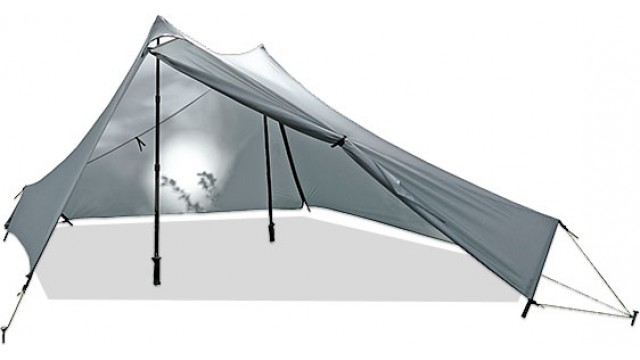
Early days to do that with the Li.
As one BPLer said at the introduction of a previous Tarptent model, “Curse you Henry Shires, now I have to buy it!”
Oh well, I just finished my last car payment this month…
And I’m a geezer nearing 75 who needs to lighten his load…
Plus I like it better than the (out of production) SMD Skyscape X…
And my carbon fiber hiking poles would look right at home supporting this tent…
Aaaarrrggghhh!
“Curse you Henry Shires!”

I really hope you offer the fly only. I have a Notch and would like the opportunity to upgrade piece by piece, rather than having to do it all at once.
Looks nice. I’m not sure what the floor is, but it appears to be 0.7oz cuben, which I’m not a fan of for floors as the durability is a big compromise. So having a fly only option would be nice so it could be paired with the regular silnylon floors inner for a lower cost and more durability.
Wonder if Henry is thinking people are never satisfied,lol.

According to a tarptent employee over on the Reddit thread for this, they will not be offering the fly alone. You can opt for a sil innernet though instead of the cuben. The floor material will be the 1.0 oz cuben.
I use a polycryo ground sheet no matter what, which helps with abrading of floors for sure.
Okay. 1.0 cuben is fair for a floor. Glad to see they are using a cuben with the double thick .18 mylar.
The 1.0 cuben adds a lot of cost vs silnylon and doesn’t save much weight, but that’s better than going with .7 that won’t hold up long term. This cuben floor inner might save 1oz over silnylon for perhaps $100 more. It’s not as cost effective as using .7oz cuben for the fly. Glad to hear buyers can pick.
One thing I thought in my hundreds of nights in my original Moment, was that the triangular flap at the ends that covers the vent (between the two shafts) which is adjustable, was massively overkill in Silnylon. I realise I’m talking grams here, but absolutely zero need for it to be even a waterproof material or even DWR coated material, due to the height from the ground, vertical nature of the panel, and the fact that it is already behind a section of mesh, with mesh beyond it (any residual moisture coming through will drop through the mesh before getting to your floor. Or, if you in weather bad enough to get through it…you have much bigger problems!!!). Could have been a lightweight piece of uncoated taffeta. Or it could be done on the cuben version in .33oz cuben. There will be zero durability issues here. If it does develop small holes or even tears, it will never even affect performance.
What mesh is being used on the cuben inners? Will it be lighter than the Silnylon version? Weight savings to be made here.
Cuben vs sil floor. Don’t for get seam sealing and water weight. Maybe add another ounce penalty for sil, but sure, not that cost effective.
Mesh question… From a TT employee participating on the reddit thread:
The Notch has always been made with 0.75oz mesh, while most of our other models use 0.9oz.
Same employee:
0.51 oz DCF
[meaning, for the fly]

The Notch has always been made with 0.75oz mesh, while most of our other models use 0.9oz.
Are any of the well-known cottage manufacturers using the 0.5 oz nano-see-um netting by RSBTR? Seems like an obvious way to save on weight without sacrificing function. Is there a financial or production disincentive to use the lighter 0.5 oz netting?

Just checked the Tarptent website in the “whats new” section and it appears the weight of the Notch Lithium has gone up by 1/2 ounce from 19.5oz for a total of 20oz. Not looking to start any UL wars, just couldn’t help but notice.

Lester, the 0.5 nonoseeum is extremely susceptible to snags and runs. Even though the 0.67 is only 0.17 oz heavier, it’s much more durable. I think that’s why manufacturers don’t use the 0.5
Lord knows I’m not much of a seamstress, but I found the 0.5 to be very hard to work with. The 0.67 on the other hand wasn’t bad.
As far as Henry’s new venture into DCF, I’m waiting for a cuben Moment.
You don’t need to seam seal the floors since they are bathtub ending with mesh.
DCF is less slippery though so you don’t need to add tacky strips to keep your pad in place if that is your thing.
Eagerly awaiting prices……
Yeah for solo tents you don’t need to seam seal floors, as the fabric is wide enough that there are no seams on the floor. With a 2 person floor you might have a seam that needs sealing. 3 person for sure.
Hopefully in the future they may offer just the fly or possibly a ProTrail.

@septimius wrote:
As far as Henry’s new venture into DCF, I’m waiting for a cuben Moment.
I agree that this would be fun.
But DCF doesn’t play well with curves unless you have some pretty high precision manufacturing tolerances ($$$) in place. I’m not hopeful. SD tried with the Mojo (27 oz) and flopped it pretty hard with a super expensive tent that was heavier than MORE stable DCF mids from the likes of HMG / MLD. They said “Don’t let the weight fool you, this is as tough as it comes…” Oh Lord.
The Terra Nova Laser 1 was definitely more stable and is more Moment-like but this is a company that actually has the manufacturing capability to nail it. Problem of course is cost, it’s difficult to justify a Laser 1 in DCF when you have to lay down seven Bens and it’s not really more functional or stable than a similarly-weighted Locus or MLD DCF mid w/inner tent.
Brooks Range: The Rocket, remember that? Less cost than the Laser 1, and so much more stable in wind that it isn’t even funny. This was an OUTSTANDING mountaineering / expedition tent. Ultralight backpacking? Not so much, usability was crap with the tiny front entrance, low height.
So, actually, I have a *lot* more hope for the Notch 1. I’d take this over a Moment any day. It should be more stable…?
But I really want to see HS bring DCF into the SS line – that would change the game…
But DCF doesn’t play well with curves unless you have some pretty high precision manufacturing tolerances ($$$) in place.
I agree, and would go further. DCF does not handle ‘twisted’ sites at all well, and it lacks the ability to absorb severe punishment from buffeting winds when compared to nylon.
My 2c.
Cheers
it lacks the ability to absorb severe punishment from buffeting winds when compared to nylon.
My 2c.
Wasn’t it originally designed as a material for sails?
Yes, it was, and it is fine in big spinnakers when adequately reinforced.
But when it is sewn into small areas in a tent with poles here and there, you find that small errors in sewing mean that the stresses are not evenly distributed. You can get localised very high stresses. Silnylon stretches and absorbs those errors just fine, and snaps back after being buffeted. Some practical field experience has shown the difference. Mind you, as a fairly free-standing tarp it can be fine.
Cheers
Do you have any evidence or data to back up that opinion Roger?
Seems like a monumental sweeping statement that’s bordering on disingenuous to me
To say that “Silnylon stretches and absorbs those errors just fine, and snaps back after being buffeted” is absolutely ridiculous.
Even if a material stretches you are talking millimeters if that, to suggest that this stretch compensates for bad stitching is againn, ridiculous
Even if that were true, in my experience in high wind conditions you want a pitch to be as taut as possible, any stretch will cause the material to blow inwards, the more loose material the bigger the parachute effect.
People have been using CF tents for a fair few years now in some terrible conditions, your opinion does not ring true to my experience.
Let’s look at the problem in two parts: (sil)nylon and Cuban.
To say that “Silnylon stretches and absorbs those errors just fine, and snaps back after being buffeted” is absolutely ridiculous.
Really? Sorry, but you are simply wrong. I build tents for extreme conditions – tunnel tents, and my wife and I live in them under extreme conditions. We KNOW how they behave.
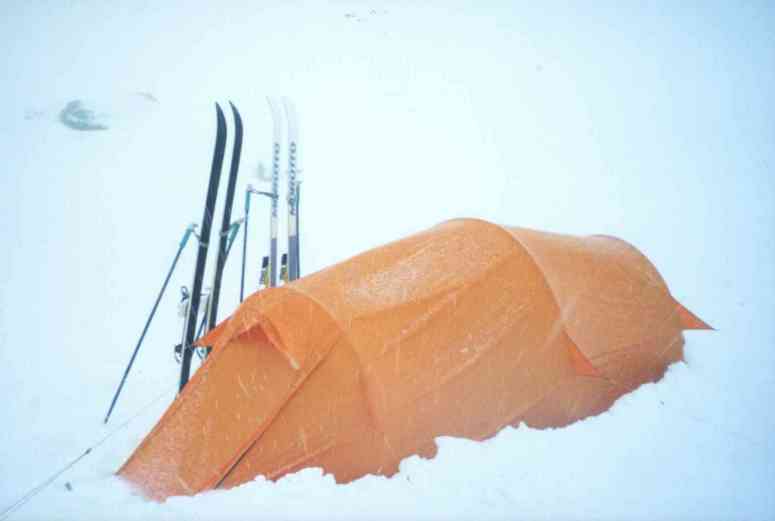

These are tents I made myself, but other tents like the Macpac Olympus (which I have also owned) behave the same. The second tent here took 100 kph winds across the Main Range all night, and barely moved. The fabric absorbed the hammering very nicely – I lay there and watched it for some time out of interest. :)
Now, a non-stretch material like Cuban is NOT able to correct for small deviations in the sewing. Stress gets localised and can be focused on quite short parts of the sewing. This is not good for the integrity of the fabric. Yes, a few experimental tunnel tents have been made using Cuban, and the owners (makers) have in general agreed with me afterwards. One of them is currently replacing his Cuban tunnel with a silnylon one (using my designs) for that reason.
Even if a material stretches you are talking millimeters if that, to suggest that this stretch compensates for bad stitching is againn, ridiculous
Well, most seam deviations are less than 1 mm over a reasonable distance (on a well-sewn tent), and silnylon can easily accommodate that with a little stretch. Been there, done that. I am certainly NOT suggesting that one should tolerate bad stitching – far from it, but my sewing is not perfect. Knowing the fabric can handle that is important.
in my experience in high wind conditions you want a pitch to be as taut as possible, any stretch will cause the material to blow inwards, the more loose material the bigger the parachute effect.
I agree entirely with this – perhaps even more than you do! That is why I have 4 arches in my current (red) tunnel tent – to keep the width of the fabric panels as short as possible so they don’t blow inwards. And the end anchors I use are always very robust, to keep the tension in the fabric high. Flapping is death.
Mind you, if you have photos and wind speeds for some Cuban tents in the field, I would love to see them. But they would need to be up around 100 kph or more to be of serious interest.
Cheers
Become a member to post in the forums.
 How to Plan with Decision GatesKeep going, change your route, or turn back? Watch how decision gates help structure these choices in our YouTube video.
 © Beartooth Media Group Inc.
 Loading...