You don’t have access to view this content.
Notes from the Field â Bushwhacking Trousers
BPL’s resident brush-buster describes pants that work in tough conditions without falling apart.
You don’t have access to view this content.
A very light carbon fibre and aluminium alloy âpotty trowelâ (which works quite well as such) which also functions very well as an ultra-light ice axe.


Traverse near the Col du Bonhomme on the GR5
In the middle of 2007 the author and his wife spent three months walking in France. While it was meant to be summer, the chances of snow on the high cols was real and we wanted something very light to add just a little safety in the snow. Conventional ice axes were too heavy to be justified, but we felt that the very light weight of a medium-length âPotty Trowelâ was justifiable. It was used quite a bit, both as a real potty trowel and as an aid in the snow, but we never got any further than âwalkingâ with it. While not perfect in all details, it can be recommended for those walking trips where a little more security is needed.
|
  Manufacturer |
ULA Equipment |
|
  Year/Model |
2007âHelix Potty Trowel |
|
  Sizes and prices |
Short: 55 cm, 4.5 oz, US$130 Medium: 66 cm, 5.0 oz. US$140 (measured at 146 g or 5.15 oz) Long: 74 mm, 5.4 oz, US$150 |
|
  Parameters |
Pick length 125 mm (5 in) Pick thickness 4.7 mm (3/16 in) Adze length 80 mm (3 in) Adze width 50 mm (2 in) |
|
  Shaft |
Multi-layer wrapped carbon fibre tubing, 21 mm (0.83 in) diameter |
|
  Spike |
Anodised aluminium alloy tube, cut at a slant for penetration |
|
  Head |
MIG or TIG welded aluminium alloy, anodized after welding |
The manufacturer ULA Equipment advertises this as a âPotty Trowelâ. The company does not advertise it as an ice axe, although the web sites admits it looks like an ice axe and that people have used it as such. One reason for this caution is very likely to avoid any liability if someone uses it as an ice axe and has an accident which the lawyers could try to blame on the Helix. In such a case the company can point out the Helix was being used for a purpose for which it was not advertised. Another very good reason is because the Helix has not been submitted for testing to the UIAA, the European body which tests and certifies ice axes against European standards. So what you do with this Potty Trowel is entirely up to you.
The comments here are just the authorâs own opinions: Backpacking Light makes no claims as to the suitability of the Helix Potty Trowel as an ice axe either.

Head and spike of helix
For simplicity I will talk about the Helix Potty trowel as though it really is an ice axe, despite the caution above. As you can see from the photo to the right it has the features you would expect from an ice axe: a head with pick and adze, a shaft, and a spike at the bottom. Both the head and the spike have been hard-anodised. The head and the spike are glued into a round carbon fibre tube which is the shaft. The spiral markings on the shaft are just an artifact of how the carbon fibre tubing is made.
The head has a classical shape, with the pick curving out at a gentle angle for about 125 mm from the shaft. It does not have the pronounced downwards rake of a modern ice tool, but then it is not sold as an ice tool. The pick is made from 4.7 mm thick aluminium alloy plate and this piece of plate extends forward to provide the support for the adze blade as well – this is the normal construction method. The pick has series of 8 plain 6.3 mm (1/4 in) holes down its length. These holes are too small for any respectable carabiner and are not chamfered at the surfaces, which is a pity. In fact I am not sure why the holes are there: they donât reduce the weight by very much. The tip of the pick is chamfered but is definitely not sharp. The pick also has a series of semi-circular notches of the same size along the underside, going out to the tip. I assume that these are meant to help the pick to grip in really hard snow or soft ice, but their effect is not great. They might grip better in hard ice, but you are unlikely to get the pick very far into hard ice. If you are climbing on hard ice you should be using a UIAA-certified axe anyhow. The notches do have some effect on crusty ice early in the morning.
The adze is welded to the pick plate very solidly. It has very rounded front corners – more rounded than my two other heavier axes. These corners are usually meant to prevent the adze from jamming in hard ice, but the axe is too light to be of much use on hard ice anyhow. It does not matter. The adze blade has three small holes along each side – exactly why I cannot tell. Once again, any weight reduction would be very small. The cutting edge of the adze has been chamfered but like the tip of the pick it is not sharp. Really, none of the edges on this axe represent any danger to gear or clothing – unlike my steel axe which is very sharp at both adze and pick tip. Behind the adze itself there is an unchamfered 9.5 mm hole in the support for the adze. It would have been nice if this hole had been lightly chamfered before anodizing.
Finally, the pick plate itself is welded into a short length of tube which goes into the carbon fibre shaft. The weld lines are very full and look well done. There is a shoulder on the bit of tube which butts up against the end of the carbon fibre tube: this is visible in the photo.
The spike at the bottom end of the axe is a bit of aluminium alloy tube set into the end of the carbon fibre shaft, and it has been cut on a definite chamfer. It too has a shoulder to butt up against the end of the shaft, and this shoulder is essential to support the spike inside the shaft and prevent the glue from being overloaded. Both the chamfer and the shoulder are visible in the photo above.
I have some experience with using 2-D wrapped carbon fibre tubing in outdoors gear, and I like it. Some people have worried about its impact resistance, saying it is âbrittleâ. In my experience it handles impact very well, up to its yield point. Unlike, say, mild steel which yields (bends) slowly at low forces, carbon fibre resists any deformation right to the end, but then it fails quickly. It could therefore be described as being âbrittleâ – but this is somewhat misleading. It is really extremely strong, but like anything else it can be broken if you take it to an extreme. I found both the Helix and a carbon fibre trekking pole we were carrying on in France to be very reliable when used as walking aids.

Climbing up the back of Mt Brevent, near Mont Blanc
I know that abrasion can damage the surface of carbon fibre tubing, and I was a little concerned about the effect of both ice and rock on the bottom end of the shaft. I added a short length of heat-shrink tubing over the bottom end of the shaft to provide some protection against abrasion – I am sure this added a few grams to the weight. This is visible in the photo above just above the spike and below the spiral markings on the shaft. Whether it is really needed depends entirely on how one treats the axe – it made me feel just that little bit happier about waving it around.
The Helix is missing three features often found on a certified ice axe. It does not have a hole in the head which could take any of my fairly normal carabiners, although there may be very light ones which would fit through the 9.5 mm hole. Mine would require a 10.5 mm hole I think. However the lack of a chamfer there makes putting either a carabiner or a loop of tape or cord through the hole a bit risky. Second, it dose not come with a wrist strap and the shaft has no stopper on it to limit downwards travel of any wrist strap, nor is there a carabiner hole through the spike. Now you may not need a wrist strap with this axe and I have never needed a hole through the spike on any axe, but the UIAA tests seem to require one or the other (clause 2.2.1) in order to do a test on the strength of the head.
Third, the Helix is very light: it lacks the mass and thin adze edge needed to hack into ice. But once again we note: it is not sold as an ice axe, and is not meant for use ice climbing. So there is no point in criticizing it for this.
One other âfeatureâ should be mentioned, although it is not unique to the Helix. The shaft is hollow, and can act as a cork borer in snow and dirt. This meant I ended up with the shaft loaded with tightly packed snow a few times. I found out about this the embarrassing way, when my axe dribbled water all over the floor of a refuge one evening. It took us a little while to work out just where the water was coming from! After that I made sure I melted and blew the snow out before taking the axe indoors. I donât think this is a fault, and you only make this mistake once (I think).
We do not normally quote what the manufacturer writes about a product as it is usually just marketing spin, and we can live without that. However, two comments from ULA are worth including here as they relate to the ULA position about the use of the Helix as an ice axe.
“Q: How well balanced is the Helix Potty Trowel? How does this affect the swing of the Trowel?
A: Many other lightweight trowels or poorly balanced due to the majority of the weight being located in the shaft instead of the head of the trowel. In comparison, the majority of weight in the Helix Potty Trowel is in the head. This is especially noticeable when you are swinging the Trowel towards a stubborn surface. While the entire trowel is incredibly light, the impact is relatively solid as the head (what you are creating impact with) is comparatively heavy. This results in a well-arched ‘swing.’ [See below under Field Testing for further comment on this.]
Q: The Helix Potty Trowel has a striking resemblance to an ice axe. Have you considered using it as an ice axe?
A: Hmmm. Wow. Now that you mention it, it does kind of look like an ice axe. I’ve heard that a number of thru-hiker’s have been using the Potty Trowels on the PCT and CDT as a non-technical ice axe for glissading, basic slope safety, and the occasional self-arrest. You certainly have to admire the weight conscious, multi-use philosophy employed by these intrepid hikers!”
I took this with me on our three month walking trip in France in the middle of 2007. That time of the year should be summer in France, but we had previously met old snow (nĂŠvĂŠ) piled up rather steeply in high cols in the Pyrenees even in summer. Well, it turned out that the snow season had been very late in 2007, and there was a lot of snow around still when we got there in mid-May, and it lasted for quite a while too. (So did the bad weatherâŚ) In fact, the cols in the Pyrenees where we started we definitely not passable with the light-weight gear we were carrying, and we had to take our alternate route.
The Helix got used on four occasions in the snow in 2007: going over the Col dâAnterne (2,257 m) in good weather, climbing up the back of Mont Brevent (2,526 m) in good weather (above right), and twice going over the Col du Croix du Bonhomme (2,483 m), each time in filthy weather (second photo). As you may be able to see from the photos, I was wearing light joggers in the snow, and these can skate around a bit -especially late in the day when the sun has warmed things up a bit. Itâs not that the angle of any of these ascents was that steep, but there were some runouts below which could have been âundesirableâ. It also got used a fair bit as a potty trowel: more on that later.

Square top edges of tube and pick
I found the Helix very easy to carry of course, being so light. I started out with a light cord wrist leash which I had added myself, but I found that it was not really a lot of use for ordinary snow walking. I wanted to change hands quite often, depending on which side was uphill. The Medium length was a little too short to be of much use to me on the downhill side. (I would have selected the Long model except that it was too long to fit in my pack for the airline flight. This was a serious consideration.) After a little while I removed the leash completely. In addition to making it easier to change hands, removing the leash made it easier to stow the axe temporarily behind my shoulder in the usual manner.
One thing I did notice while using the axe in bare hands was that the top edge of the tube and the pick have not been rounded off. As you can see in the photo to the left, the top of the tube and the pick are quite square. This contrasts strongly with the old designs of ice axe heads, which were very smoothly rounded and very comfortable to carry (see below right). One could hope that the next generation of the Helix might make some concession to comfort: perhaps a plastic plug in the top of the tube might go a long way towards this? However, I have to admit that the edges, while square, are not sharp at all. Itâs a detail.
One might ask whether the owner could round off these edges, and the answer is of course yes. But doing so would remove the hard anodizing layer which protects the underlying aluminium alloy. Remember: the anodizing is much harder than the aluminium alloy. So I canât see any sense in doing this.

Three generations of ice axes
I did not try any ice climbing with the Helix. Why not? Because the Helix is simply not meant for genuine ice climbing. To the right I have shown three different ice axes (right to left): the Helix at 150 g, a Charlet Moser Snow Walker at 470 g, and a classical wood and steel axe at 960 g (1960s era). The steel one has the weight needed to cut steps with a will, and the Charlet Moser one is really only meant for snow walking, and both are much heavier than the Helix. To try to use an axe the weight of the Helix on any sort of ice is simply misusing an otherwise useful tool. I did try chopping steps in the softer snow we met, but frankly I found it easier to sink the shaft into the snow and hang onto the head while kicking hard, even with light joggers.
One comment about ergonomics is in order. The wood and steel axe swings quite well: thereâs a lot of weight there. The Charlet Moser axe does not swing all that well: the shaft is heavier than the head. Thatâs still fine for walking of course. The Helix actually feels better than the Charlet Moser because the shaft is so light: it felt as though I could focus the strike reasonably well. The ULA web site makes some mention of this feature too.
Some Forum readers have tried the Helix out on steeper snow and report good performance. Brian Lewis wrote on the 18-Apr-2007:
I recently bought the shortest ULA Helix, the 55 cm. I took it up to a fairly steep-yet-safe slope and threw myself down the slope a couple of times to test my ability to self-arrest. Due to the snow conditions, even on a steep slope I wasn’t able to build up a lot of speed/momentum, but I satisfied myself that it would stop me just fine. I’m used to a 75 cm axe that’s a pound heavier, but I’m convinced that the 55 cm Helix will dig in fine. I’m a little less confident about plunging the carbon fiber shaft spike into the snow to help when carrying this in my uphill hand. I think I’ll do it when snow conditions are not too soft to make this less useful and not so hard as to risk the CF spike. A short axe like this definitely isn’t a “walking stick” for me, but that’s not what I bought it for. It cut steps just fine for me too, at least when traversing uphill; downhill is more of a challenge with a shorter axe. The lightness of the head means I change my technique somewhat to cut steps, it’s a little slower process, but it worked fine.
Peter King wrote on the 2-May-2007:
⌠some initial field test results: Tests done on firm snow (running shoes could barely kick steps), approximately 40 degree slope, lightweight tester (<<60kg), 65cm Helix.
- 8 arrests, 2 in each direction (face up/down, feet up/down).
- 10 falls on self belay (shaft plunged above, feet kicked out).
- 5 arrests during fast sitting glissades.
- 5 arrests during standing glissades, plunging the shaft while falling headfirst.
Result: no axe failureâŚ
Well, the company does advertise it as a potty trowel, so I tested it as a potty trowel as well. For comparison purposes I used the widely available orange plastic Coghlans Poo Trowel. In the soft soil of our untracked Blue Mountains in Australia the Coghlans Poo Trowel works fine, albeit with a bit of hacking sometimes. In the limestone soils we met in France it was a different story. Those soils seem to have been stompled for a few hundred years by sheep and cows, and they were hard. I had a lot of trouble making any impression at all on the soil in some places with the Poo Trowel. So after a few days of this I hauled out the Helix and tried digging holes with it, using both the adze and the pick. (We were wild camping at this stage, even stealth camping.) I have to report that the Helix worked very well! In fact, it was as the ULA web site says – bring it on! Later on I used it to âmodifyâ a wild tent site on an abandoned farm terrace, and it did an excellent job there too despite all the stones in the soil. In the end I didnât bother with the Coghlans Poo Trowel any more: I always took the Helix with me. I refined my technique too. Rather than just hack away, I found that the pick could be used to help cut out a square divot which could be replaced, leaving no real sign of disturbance. This was an added feature in my opinion.
Two things are worth mentioning here. The first was that hammering the adze into a lot of soil over the months did result in some fine burrs along the edge. Thatâs why the edge of the adze looks a bit shiny in the photo above: I cleaned it up with a file when I got home. The second is that the head got a lot of hammering and pulling over that time. If there was any chance that the glue might release and the head fall out, it would have done so. But it came home quite solid. This was very reassuring.
A big question is whether the Helix could meet the UIAA requirements. I donât know. I did a lot of pretty hard digging with the axe as a potty trowel and I also used it clearing several tent sites, and if the head was going to break loose I would have expected it to have done so under that treatment. It didnât. And the carbon fibre shaft seems extremely strong: I have little doubt it would take the load test as well. On the other hand, neither I nor Backpacking Light are certified test laboratories, so any numbers we could come up with would be meaningless.
The real question is whether it would be worth-while getting the certification, since the Helix weight is so low that it is very limited in power when it comes to chipping. The authorâs opinion is that would not be worth-while.
Lightest bug-proof one-person shelter on the market.

Six Moon Designs Wild Oasis set up with its front beak extended using a second trekking pole.
At 13 ounces, the Six Moon Designs Wild Oasis is the lightest bug-proof one-person shelter on the market. The design is based on the popular Gatewood Cape, with the same shape and protected area (35 square feet). However, it is not wearable as a poncho like the Gatewood, so the Wild Oasis is a single-purpose shelter. How does its utility and performance compare with the Gatewood Cape?
|
  Year/Manufacturer/Model |
2007 Six Moon Designs Wild Oasis |
|
  Style |
Three-season, one-person, bug-proof, floorless, single-wall shelter |
|
  Fabrics |
30d, 1.3 oz/yd2 (44 g/m2) silnylon canopy; 0.7 oz/yd2 (24 g/m2) no-see-um mesh skirt |
|
  Poles and Stakes |
Requires one trekking pole or optional carbon fiber pole for support, plus six stakes (not included) |
|
  Floor Dimensions |
Length 105 in (267 cm), width 66 in (168 cm), height 45 in (114 cm) |
|
  Packed Size |
6 in x 5 in (15 x 13 cm) |
|
  Total Weight |
Measured weight 13.1 oz (371 g), manufacturer specification 13 oz (369 g) |
|
  Trail Weight |
Measured weight 14.3 oz (405 g); includes shelter, extender loops, and six titanium stakes |
|
  Protected Area |
35 ft2 (3.25 m2) |
|
  Protected Area/Trail Weight Ratio |
39.3 ft2/lb |
|
  MSRP |
$175 |
|
  Options |
Carbon fiber pole (1.8 oz/51 g, $25) |
Although the design and dimensions of the Wild Oasis are the same as the Gatewood Cape, itâs a distinctly different shelter. Itâs not a dual purpose product (rainwear and shelter) like the Gatewood; rather itâs designed to only serve as a shelter, providing bug-proof protection for one person. It has a high vent instead of a hood, and an 18-inch mesh skirt has been added around the perimeter to make it bug-proof.
The Wild Oasis is hexagon shaped, with six corners that are staked out with short (6-inch) extender loops. I followed Six Moon Designsâ setup instructions and obtained mixed results. The procedure is as follows: 1) set a trekking pole to 45 inches, 2) lay the shelter out flat on the ground in the desired position, 3) stake the two front outside corners, 4) stake the rear center, 5) insert the trekking pole tip into a grommet at the peak and raise the tent, 6) stake the front center, and 7) stake the two rear outside corners. That process produced the pitch shown below on the left.

Following the manufacturerâs instructions yields a pitch shown at the far left. The shelter is 106 inches long and 72 inches wide, but the sidewalls are at a low angle and nearly touch the ground (center photo), which limits headroom and ventilation. Extending the front entry with a second trekking pole (right photo) helps to provide more protected area and ventilation.

I personally prefer a taller pitch for the Wild Oasis, shown here with a 50 inch trekking pole. With a taller pole and extended entry (top left), the protected area measures 98 inches long and 60 inches wide, which leaves less floor space but more usable room due to the extra height. The canopy is lifted above the ground a little more (top right and bottom left), providing better ventilation. The top view (bottom right) shows the shelterâs shape.
However, going to a taller pitch requires a different setup procedure: in step three, stake the front outside corners loosely, then insert the trekking pole in the grommet and stand up the front of the shelter, then continue staking as outlined above.

The shelterâs 18-inch mesh skirt extends inward (top right) so it can be overlapped with a ground sheet. The front opening in the mesh skirt is secured with two Velcro patches (top right), which catch on and damage the mesh. With the front of the shelter extended (bottom left), the mesh skirt still reaches the ground for bug protection. A tall pitch reduces the shelter length to 98 inches, but it is still ample for a taller person (Iâm 6 feet tall) without touching the inside of the tent walls (bottom right).
I used the Wild Oasis on several backpacking trips in spring and early summer where bugs were a definite issue, and am pleased to report that it is definitely bug-proof. After swatting the mosquitoes already inside the tent with my hat, the shelter remained bug free the rest of the night. It helped to overlap the shelterâs mesh skirt with my groundsheet to seal the floor, and to use my boots to seal the front entry in the mesh. Protection like this is most appreciated when biting insects are an issue.

The two Velcro patches used to close the front of the mesh skirt easily damage the fragile mesh, resulting in a collection of snags after several trips. A user solution to help mitigate the problem is to make sure the Velcro patches (hook and loop) are attached before stuffing the tent into its stuff sack. However, thatâs only a partial solution; the mesh will still get damaged from using the closure. A better closure is needed.
Although I pitched the shelter with trekking poles ranging from 45 inches to 51.5 inches, I was never able to raise the sides of the shelter off the ground more than a few inches (see photos above). The mesh skirt is designed and sewn so that it extends inward from the canopy edge (rather than downward), so it lies on the ground where it can be overlapped with a groundsheet. With this design, the canopy can be raised only a small amount without raising the mesh above the ground too much, so variable height pitching is limited. It would be nice if the sides could be raised 6 inches or more to expose more of the mesh for increased ventilation when desired. I tried using longer (12-inch) extender loops on the tent corners, but that didnât raise the canopy above the ground very much more, unless I propped up the guylines with sticks.
Using my tall pitch and extended entry technique, I found headroom and length to be adequate. There were times when the foot end of my sleeping bag got damp from brushing against the tent wall, and my head also brushed against a wet tent wall as well. Overall, the Wild Oasis provides a good deal of protected area for its low weight.
One thing I missed is the Gatewoodâs zippered storage pocket. The shelter stuffs into the pocket for packing, and the pocket is used for storage in shelter mode. The Wild Oasis comes in a stuff sack instead, so thereâs no interior pocket to stash eyeglasses and other fragile items overnight.
The Wild Oasis is certainly storm worthy, but it has definite limits because of its single trekking pole support. On one windy alpine evening at 12,500 feet, I staked the shelter to the ground to reduce breezes through the tent, and put rocks on the stakes for insurance. Its hexagonal shape handled a 20 mph wind just fine, but it flapped a lot. A really strong wind would be worrisome.
Summer showers and even extended rains were no problem for the Wild Oasis, if you donât mind sitting out a storm in a confined space. Itâs important that the perimeter mesh does not stick out beyond the edge of the canopy, because it will draw streams of water inside the shelter. The Wild Oasis is strictly a three-season shelter, and is not intended for use in snow at all. Although I did not have an opportunity to test it, this shelter would probably handle a light snow okay, but would probably sag a lot under the weight.
The tradeoff for bug protection is reduced ventilation and more condensation. Because its mesh skirt restricts ventilation, the Wild Oasis is more prone to condensation compared to tarp-like shelters I have tested. That said, the Wild Oasis is not a condensation chamber. The combination of its high vent and taking advantage of site conditions and available breezes allowed me to minimize condensation much of the time.

A vent at the peak (bottom right) helps to exhaust moisture and reduce condensation.
Interior wall condensation is normal for a single wall tent, especially on clear, calm nights with a large temperature drop. With the perimeter mesh skirt sealed up to exclude bugs, the Wild Oasis is more prone to condensation because the mesh restricts ventilation. For more information on condensation in single wall tents and how to minimize it, see my article on Condensation in Single-walled Shelters: Contributing Factors and Tips for Reduction.

With a taller pitch to maximize ventilation, the Wild Oasis (with the vestibule and mesh skirt closed) is prone to condensation (left), similar to tarptent-type single wall shelters. On this clear/calm/cool night, the shelter developed heavy condensation, starting at about 11 PM where the air temperature reached the dew point temperature (right). Note that the taller pitch causes the condensation to run down rather than drip inside.
For me, the Wild Oasis is an ultralight seasonal shelter, to be used during the bug season in spring and early summer when mosquitoes are a significant issue. In some locations itâs bug season all the time, and the Wild Oasis is definitely a good ultralight bug-proof shelter for those areas. However, in other locations, like the Alaskan tundra, any floorless shelter, even one with the features of the Wild Oasis may not be adequate to exclude bugs.
One question that begs asking is: why not simply develop a detachable mesh skirt for the Gatewood Cape? Then one could have the Gatewoodâs dual benefits of rainwear and shelter, plus bug protection when needed by adding the skirt. The challenge would be to devise a lightweight attachment system that is convenient and bug-proof. Velcro is not necessarily a good solution because it would add too much weight and it snags badly on the mesh. This concept is food for thought, and perhaps our readers can offer some design ideas.
At 13 ounces, the Wild Oasis is the lightest bug-proof single person shelter on the market.
With over 38 square feet of floor area, this single person tent has the highest area to weight ratio in its class (single wall shelter with floor), but it has a few flaws.

AntiGravityGear TarpTent at 12,100 feet elevation in the Weminuche Wilderness, Colorado. The optional vestibule on the front doubles as a poncho.
AntiGravityGearâs TarpTent is based on the pattern and design of the former Brawny Tarptent. Itâs a little bit funky, and a whole lot functional. The canopy is one piece of silnylon – no seams. With a floor area of 38.25 square feet, it has the highest area to weight ratio in its class (single wall tent with floor). And its trail weight is just 23 ounces. So far it sounds awesome, but thereâs a downside too.
|
  Year/Manufacturer/Model |
2007 AntiGravityGear TarpTent |
|
  Style |
Three-season, one-person, bug-proof, single-wall shelter with floor |
|
  Fabrics |
30d, 1.3 oz/yd2 (44 g/m2) silnylon canopy; no-see-um mesh curtain |
|
  Poles and Stakes |
Requires one trekking pole for support, plus 8 stakes (sold separately) |
|
  Floor Dimensions |
10-foot size tested. Trapezoidal, length is 120 in (305 cm) in back and 84 in (213 cm) in front, floor is 54 in wide (137 cm), height is 40-44 in (102-112 cm) |
|
  Packed Size |
9 in x 6 in (23 x 15 cm) |
|
  Total Weight |
Measured weight 21 oz (595 g), manufacturer specification 20 oz (567 g) |
|
  Trail Weight |
Measured weight 22.7 oz (644 g); includes shelter, four Spectra guylines, and eight titanium stakes |
|
  Protected Area |
38.25 ft2 (3.55 m2) |
|
  Protected Area/Trail Weight Ratio |
27 ft2/lb for the tent only, 31.4 ft2/lb for tent plus vestibule |
|
 MSRP |
$229 |
|
  Options |
Poncho Villa (doubles as vestibule) $79, vestibule $49, StormFlap $29, 8 titanium stakes $20, seam sealing $30 |
To be truthful, when I reviewed the AntiGravityGear TarpTent, I didnât realize that Backpacking Light had previously reviewed it back in 2004 as the Dancing Light Gear Ultralight Brawny Tarptent. It is now hand-made by AGG owner George Andrews, and he does a very fine job. His sewing and seam sealing are superb.
The design of the current AGG TarpTent is essentially unchanged from the Dancing Light design. The emphasis in the re-introduced tent is on strong construction and developing accessories to expand its utility. The TarpTent is available in two sizes: 10 feet wide and 9 feet wide at the rear. The difference in weight is miniscule, so unless you are a short person you might as well get the larger size.
Setup is very easy and takes about 5 minutes: 1) lay the tent out on the ground, 2) stake the four corners, 3) insert a trekking pole set at 40-44 inches in a PVC cup at the peak and raise the front, 4) stake the front guyline, and 5) stake out three lift loops on the sides and back of the tent. For adequate interior space, itâs important to stake out the lift loops to pull the canopy outward. Eight stakes are required for a complete pitch.

Views of the AntiGravityGear TarpTent. Entry is from the side (top left) which is protected by a beak. The side view (top right) and back view (bottom left) show how the tentâs three lift loops pull the canopy outward to maximize interior volume. The top view (bottom right) shows the trapezoidal shape of the tent. Note that the canopy is one piece; there is no ridgeline or center seam.

With 38.25 square feet of floor space (top left), the AGG TarpTent is a roomy one-person tent. Many two-person tents have less than that. Bugs are kept out by a no-see-um mesh curtain (top right) that is gathered under the peak when not in use. The mesh curtain will connect to the floor (bottom left) to raise the front edge and create a bathtub floor. An optional StormFlap (bottom right; 1.2 ounces, $29) is available to block wind-driven rain.
I used the AGG TarpTent on several backpacking trips in spring and summer and found it very livable and functional. Itâs a tent that grows on you as you learn how to refine the pitch and use its accessories. The first time I set it up I used adjustable trekking poles set to 44 inches as recommended. That produced a taught pitch in keeping with the tentâs design, but interior headroom was lacking except for the front center. Since then I have used 47.5 inch fixed length basketless carbon trekking poles (my preferred poles) with the TarpTent to gain more interior headroom, which works fine except the front beak is limp. Because the tent has no ridgeline, its very important to stake out the lift loops on the sides and back to increase interior volume.

Although a minimum of one trekking pole is required to erect the tent, it is handy to use a second trekking pole to raise the back of the tent upward for maximum interior space. The side guylines can be supported with sticks found onsite. The tent comes with four Spectra guylines, and requires a total of eight stakes for a complete pitch.
One shortcoming of the AGG TarpTent design is its short front beak. By itself, it does not provide adequate protection from wind-blown rain hitting the front of the tent, and it does not provide much privacy when the tent is used in a public place. AGGâs solution is to offer an optional StormFlap (1.2 ounces, $29) that attaches across the front opening (see photo panel below). It attaches with four mitten hooks, which are cumbersome to use, making it inconvenient to enter and exit the tent. It begs the question: why not extend the front beak as an alternative? The early Tarptent Squall had the same issue, and it was solved with an extended beak.

AntiGravityGearâs solution to the TarpTentâs short front beak is to offer an accessory StormFlap (left; 1.2 ounces, $29) that clips across the tent entry. It works, but it makes entry less convenient because of the mitten hooks (right) used for attachment. I am not fond of the mitten hook connectors (used to tie up the mesh curtain and attach accessories), and would like to see a more convenient connector used.
A handy accessory for the TarpTent is AGGâs Poncho Villa (5.5 ounces, $79), which is a unique poncho that also serves as a front vestibule for the tent. The Poncho Villa is basically a square (almost) piece of silnylon with a hood in the center, but it is worn or attached to the tent diagonally.

In poncho mode (left), I found the Poncho Villa will cover a small pack adequately, but rain pants or chaps are needed to stay dry from the waist down. It has Velcro patches to create âsleevesâ as shown. In vestibule mode (right), the Poncho Villa adds 17 square feet of protected area to the front of the TarpTent.

Itâs difficult to attach the vestibule to the peak of the tent when using a trekking pole without a basket, so I resorted to attaching it to a mitten hook near the peak, which resulted in an opening on the sides (photo) that allowed rain to enter. A solid vestibule (sans hood) is also available (3.3 ounces, $49).
For bug protection, the AGG TarpTent has a no-see-um mesh curtain that drapes down across the entry. Itâs not zippered like other tarptents, but it is functionally bug proof because the mesh overlaps the tent floor and boots or other gear can be placed on it to seal any gaps. The curtain is simple and functional and eliminates a zipper, but it has several folds in it and is bulkier than a zippered mesh door (see photo panel above). It is fairly easy to tie it up out of the way when itâs not needed.
I was able to test the AGG TarpTent in moderate winds, gusting to about 20 mph, with scary results. Ideally, for best wind resistance, the back of the tent should face the wind. Even with that positioning, the TarpTent deflects and flaps substantially in stronger wind gusts, to the point where I worried about the lift loops (which are attached to reinforcement patches on the canopy) tearing out. Overall, the AGG TarpTent should hold together in moderate 10-15 mph winds, but beware of really strong winds. Choosing a sheltered location is highly recommended.
I went through the spring and most of the summer without hitting a good rainstorm while testing the AGG TarpTent. Then in early September I got a good one, at 12,100 feet elevation in an open alpine setting. Overall, the AGG TarpTent was a dry haven, except for gaps at the sides of the vestibule from not installing it correctly.
Download File
Will Rietveld inside the Anti Gravity Gear Tarptent during a rainstorm at 12,100 feet.
I was not able to test the AGG TarpTent in snowy conditions, but Ryan Jordan did in his review of the Dancing Light Gear Ultralight Brawny Tarptent. The outcome was not pretty. Because of its single pole support and large canopy, this tent is not recommended for use in snow or strong winds.
Condensation is normal for a single wall tent, especially on a clear calm night with a large temperature drop, and the AGG TarpTent is one of the worst performers in that respect. There is no cross ventilation through the tent – the front entry is the only opening. There is no mesh around the perimeter and no top vent. When its mesh curtain is down to exclude bugs, the AGG TarpTent is a condensation chamber, unless there is a good breeze. For more information on condensation in single wall tents and how to minimize it, see my article on Condensation in Single-walled Shelters: Contributing Factors and Tips for Reduction.

The AGG Tarptent is more prone to condensation (left) because it has no provision for cross ventilation through the tent. The graph on the right is for a clear/calm/cool night following an evening rain (the one in the video). The air temperature hit the dew point early in the evening and stayed there all night, resulting in copious condensation.
Design-wise and functionally, the AGG TarpTent provides an amazing amount of protected area for its weight. At 31.4 ft2/lb (tent plus vestibule), it even blows away the Gossamer Gear Squall Classic, made of spinnaker fabric, which is 22.8 ft2/lb based on 35.3 ft2 floor + vestibule area and 1.55 lb trail weight. The tent and its accessories function very well together as a system, especially the Poncho Villa, which can serve as both a poncho and a vestibule. The side pullouts are a bit funky, but very functional to expand the volume inside the tent. Thatâs the plus side. On the downside, the tentâs design (single trekking pole support and a large canopy with fragile side pullouts) makes it very unstable in strong winds and snow. For that reason, I would recommend this tent only for summertime use in areas where there is good wind protection. If you can find a protected campsite in some trees to break the wind, you can probably avoid problems, most of the time.
Another significant limitation is the tentâs short front beak. It is not long enough to provide adequate protection from wind-driven rain from the front. AGGâs StormFlap is a questionable solution; why not just extend the beak as part of the standard tent rather than solving the problem with an optional accessory? On the other hand, AGGâs Poncho Villa is a viable accessory because it serves as both a poncho and a vestibule. It would not necessarily be overkill to extend the tentâs beak and still use the Poncho Villa to create a roomy vestibule for gear storage.
My biggest issue with the AGG TarpTent is its lack of cross ventilation. As presently designed, the user simply has to learn to live with condensation. Thatâs not necessarily a given, because on many nights with low humidity or a light breeze, I had little or no condensation inside the TarpTent. However, in conditions favoring condensation (as described in the article linked above), the TarpTent will develop more condensation on the inside walls compared to other (better ventilated) tarptents. When the tentâs mesh curtain is down to exclude bugs, there is no way to increase ventilation, except to face the tent into any available breeze. The best moisture management for this tent is a good pack towel, such as the Sea to Summit Microfiber Towel, which will absorb three times its weight in water.
In my opinion, this tent needs a re-design to provide cross ventilation. It would not be that difficult to add a flange around the perimeter with mesh underneath. If the flange were about 18 inches above the ground, it could incorporate several tieout points to secure the tent better and expand the canopy. That height would provide enough room underneath the flange for a mesh panel and bathtub floor. It would add minimal weight and a lot more ventilation. The tent also needs a high vent at the peak to utilize the chimney effect to exhaust moisture.
A tent most similar to this one is the Six Moon Designs Lunar Solo (23 ounces, 27.5 ft2 floor, $235). The Lunar Solo has mesh around the sides and back, a floating floor, a large front beak/vestibule, a zippered mesh entry, and a high vent. These features add up to much better ventilation, but the Lunar Solo is not as roomy and does not have the coordinated accessories of the AGG TarpTent.
Some final nitpicks: there is no storage pocket inside the tent to stash eyeglasses and other fragile items, and the mitten hooks used to tie up the mesh curtain and connect accessories are cumbersome to use.
For its 21 ounces (tent only), the AGG TarpTent provides the most protected area available for a single-person single-wall tent with floor. Its canopy does not have any seams or ridgeline.
A durable and versatile âconvertible backpackâ with removable stays that allow it to be used either frameless or as an ultralight internal frame backpack.

The 2007 Comet is constructed of durable Dyneema Gridstop fabric and has numerous upgrades and refinements.
The Six Moon Designs Comet is a convertible pack. Optional flat aluminum stays ($10, 4.7 ounces) are easily inserted into sleeves to create an internal frame backpack (27 ounces), or removed to use it as a frameless backpack (22.3 ounces). The hipbelt is also removable, further reducing the weight to 17 ounces. When I reviewed the original Six Moon Designs Comet I was impressed with its comfort and versatility, but I thought the construction was a little rough. The updated 2007 Comet adds some welcome improvements and is much more refined overall.
|
  Year/Model |
2007 Six Moon Designs Comet |
|
  Style |
Internal frame or frameless, top loading, dry bag closure with top compression strap |
|
  Volume |
3700 ci (61 L) |
|
  Weight |
1 lb 11 oz (765 g) measured weight with stays and optional hipbelt pockets, 1 lb 6.3 oz (746 g) without stays; manufacturerâs specification 1 lb 13 oz (822 g) with stays, 1 lb 8 oz (680 g) without stays |
|
  Sizes Available |
One size with adjustable torso; 15 and 18 in (38-46 cm) shoulder strap lengths available; short, medium, and long hipbelts available to fit 26-44 in girth (66-112 cm) |
|
  Torso Fit Range |
15 to 22 in (38-56 cm) |
|
  Fabrics |
Body is 210d Dyneema Gridstop, bottom and backpanel are 420d pack cloth, extension collar is 70d silnylon |
|
  Features |
Durable fabrics, contoured shoulder straps, adjustable torso length, 11 inch extension collar, Velcro dry bag closure, one large front and two large side mesh pockets, interior zippered security pocket, interior pad/hydration sleeve with one hose port, three front compression straps, one ice axe loop, hipbelt stabilizers, load lifter straps, sternum strap, three hipbelt lengths available, two shoulder strap lengths available, hipbelt pockets available |
|
  Volume To Weight Ratio |
137 ci/oz with stays (based on 3700 ci and measured weight of 27 oz), 165.9 without stays (based on 3700 ci and measured weight of 22.3 oz) |
|
  Comfortable Load Carrying Capacity |
35 lb estimated comfortable load for an average person carrying the pack (with stays) all day |
|
  Carry Load to Pack Weight Ratio |
20.7 with stays (based on 35 lb and a measured weight of 1.69 lb) |
|
  MSRP |
$160 US |
|
  Options |
Two shoulder strap lengths (no charge), three hipbelt lengths (no charge), hipbelt pockets $15, aluminum stays $10 |
The 2007 Comet is more of a makeover than an upgrade. I was impressed with the original Cometâs comfort and versatility, but acknowledged that there was room for improvement. The 2007 model basically âgets it rightâ with the following improvements:
A notable upgrade is the use of durable Dyneema Gridstop fabric in the new pack. The original pack was made of 70 denier silnylon, and its yellow color was likely a negative for some people. The new pack is a more pleasing blue. Overall, the new Six Moon Designs Comet is a much more refined backpack, as can be seen in the following photo gallery.

Views of the 2007 Six Moon Designs Comet. The front of the pack (top left) has a large mesh pocket with 250 cubic inches of capacity. Each side (top right) also has a large mesh pocket with 200 cubic inches of capacity. The backpanel view (bottom left) shows the stay sleeves, new contoured shoulder straps, and new hipbelt with pockets. The top view (bottom right) shows its dry bag closure and top strap.
The Comet comes in only one size that fits 15 to 22 inch torsos. I measured the pack torso length (underside of shoulder straps to the center of the hipbelt) in the fully extended position at 21 inches, and 15 inches in the shortest position, which more or less conforms to the manufacturerâs claimed fit range.

The shoulder straps (left) are now contoured and two lengths are available; the padding and surface fabric are the same as the previous model. The hipbelt (right) is removable and available in three lengths (short, medium, long), with or without pockets. The hipbelt pockets are very roomy (42 cubic inches each) and will easily hold a digital camera or GPS, plus an assortment of smaller items that you want instant access to.

The frame of the Comet consists of two 0.5 inch wide contoured aluminum stays (left) that slide into sleeves attached to the inside of the backpanel. The stays (right) are anchored to the load lifters at the top, but are not anchored to the hipbelt at the bottom.
Although the Cometâs flat aluminum stays weigh 4.7 ounces/pair, a distinct advantage is they can easily be shaped to match the curvature of the userâs back. I found the existing curvature to be pretty close, but I got my wife to bend one stay to match the curvature of my back, then I bent the other one to match. The resulting custom anatomical fit made the pack feel like I was wearing it instead of carrying it. While I have had a problem with other packs leaning back at the top, the Comet pulled in tight to my shoulders, owing to a combination of its custom bent stays and load lifter straps.
If you like a backpack with lots of exterior storage, you’ll appreciate the Comet’s large mesh pockets. The front and side mesh pockets will swallow a lot of gear and make it readily accessible on the trail. The side pockets are 18 inches deep and 8 inches wide, and the front pocket is 13 inches deep and 10 inches wide. All three pockets have an elastic binding to prevent gear from falling out when you bend over.
Although the tall side pockets are roomy, they are not designed for reaching a water bottle on the go, so one is forced to take the pack off to get a drink, or use a hydration bladder. Also, the side pockets extend all the way to the bottom of the pack and do not have a durable fabric reinforcement at the bottom, so the mesh could suffer some wear at the bottom. I did not experience that problem, but I am not hard on gear.

The new Comet has a zippered security pocket on the inside (left), along with a sleeping pad sleeve against the backpanel that will accommodate most compact pads. The packâs Velcro dry bag closure (right) is easy to open/close and roll down.
I have mixed feelings about the Cometâs Velcro dry bag closure. I am not a big fan of Velcro, and find that it snags clothing (especially socks and fleece) when putting it in or taking it out of the pack. Velcro can damage certain fabrics. On the other hand, itâs easy to close (just pull the ends tight and the Velcro lines up) and it makes a tight seal. Itâs also easy to open, just pull on the two center loops (right photo above).
The interior sleeping pad sleeve will accommodate any lightweight sleeping pad. A folded ž-length RidgeRest pad (shown in the above photo) takes up quite a bit of the packâs volume. However, for shorter trips, using a thicker pad or partially inflating an inflatable pad can be a useful technique to use up unneeded volume and make it possible for one pack to suffice for a variety of uses.
By itself, the interior sleeping pad sleeve does not work very well as a hydration sleeve, because a full water bladder creates a large rounded bulge in the center of the backpanel that is not very comfortable against the back. It does work okay if the bladder is separated from the backpanel with a sleeping pad. There is one hose port on the right side. I personally prefer to carry a hydration bladder in a side pocket because it is much easier to access for refilling.
The Comet does not have any exterior webbing loops to tie large items to the outside of the pack, or to create a bungee system to attach clothing.
My first trip with the Comet was with Backpacking Light MYOG Editor Jay Ham to a large, remote mesa on the Navajo Reservation in Arizona. I started out with a total weight of 24 pounds, which included insulated gear, proper shelter, and food for a five-day late winter trip. The Comet with stays and adjusted to its longest torso length fit me very well and comfortably carried the load on our approach. But there was one catch – the mesa was dry, so we had to carry all our water up with us. At the last available waterhole, I added a full 6 liter Platypus Water Tank (about 12.5 pounds) to the Comet, bringing the weight up to about 36 pounds. Then we packed that heavy load (for us) up 1600 vertical feet on a primitive Indian trail to the top of the mesa. The Comet carried the load surprisingly well, and with the hipbelt tight it put most of the load on my hips.

Packing a 36 pound load in the Comet up an ancient Indian trail in a remote corner of the Navaho Indian Reservation, Arizona. The platy in the front pocket contains 6 liters of water. Note: this is not the correct location to carry heavy, dense weight (inside the pack against the middle of my back is better), but the front pocket was convenient (Ok, I was lazy!).
On subsequent trips I carried more modest 17 to 22 pound loads in the Comet, with stays in, and it was extremely comfortable. I found that for any load over about 15 pounds the stays are a definite benefit and are worth their weight (4.7 ounces).
On shorter summer backpacks, I carried the Comet as a frameless backpack with loads from 12 to 16 pounds, leaving the hipbelt on for extra stability and for its pockets. I easily adjusted the pack volume for smaller loads by tightening the packâs three front compression straps (see photo below). With those straps pulled completely tight, the pack volume is reduced to about half, but the use of the front mesh pocket is eliminated. At 22.3 ounces in this configuration, the Comet is overkill; there are several packs on the market weighing half as much that will comfortably carry the same load. In its lightest configuration (sans stays and hipbelt), the Comet still weighs 17 ounces. However, itâs notable that the Comet is a single pack that will adapt to a wide range of loads and conditions.

To evaluate how well the Comet fits a shorter person, I adjusted the pack to its shortest torso (15 inches) and tried it on my petite wife. It fit well (left). Although the tall stays put the load lifters 5 inches above her shoulders, the pack still fit and carried well, transferring weight to her hips. For smaller loads (right), the packâs three front compression straps reduce pack volume to about half.
I did a lot of off-trail hiking in forested terrain, and found the Comet to be very stable and durable for bushwhacking. The mesh pockets are also quite durable, showing no snags so far.

The only issue I discovered with the Comet is a lack of adequate reinforcement at the bottom of the stay sleeves. Probably as a result of carrying the heavier loads described earlier, the stays are starting to break through the bottom of the sleeves. To correct the problem Six Moon Designs is sewing a second layer of webbing over the first, which puts additional reinforcement between the stay and the backpanel. All future packs shipped will have the fix, as well as any pack sent in for upgrade.
Although the original Six Moon Designs Comet was not necessarily a best-seller, the new 2007 model is much more refined, and definitely deserves serious consideration. Its best use is for an ultralight backpacker who wants a more durable pack, and one that is capable of carrying heavier loads in certain situations – like cold weather backpacking or hiking for extended periods between re-supplies. Itâs also ideal for a lightweight backpacker whose total pack weight is in the 20 to 30 pound range.
Very noteworthy features of the Comet are its adjustable torso length and removable flat aluminum stays. I was able to obtain a perfect fit by matching the packâs torso length and stay curvature to my back. This helped tremendously to comfortably carry a heavier load. The stays themselves weigh 4.7 ounces, which is a significant amount of weight. Possibly thinner, lighter stays could be used to reduce weight a bit.
The Comet has a slightly larger cousin, the Starlite, with 4200 cubic inches of volume and a somewhat different feature set. The weight and cost are very similar.
Compared to a conventional lightweight internal frame backpack with approximately the same volume, such as the recently reviewed GoLite Quest and REI Cruise UL 60, the Comet is 1.5 pounds lighter and more versatile because of its removable stays. However, the Comet does not carry heavier loads with as much comfort. If you consistently carry loads in the 25 to 35 pound range (or more), then a more heavy-duty lightweight internal frame pack is a better choice because the stays will likely be anchored to the hipbelt, and more anatomically shaped padding and load control features are added.
Although the Comet (27 ounces with stays) is a very lightweight and durable convertible pack, itâs not the lightest one available in its category. The durable Gossamer Gear Mariposa Plus weighs just 21 ounces with stays, and the Mariposa (made of silnylon) weighs just 18 ounces with stays. However, the Mariposasâ straight carbon fiber stays are not bendable to fit the curvature of your back, hipbelt pockets are not presently available, and they do not have an adjustable torso length (rather the pack comes in three sizes to fit different torsos). Although the Comet weighs 6 ounces more than the Mariposa Plus, I would personally choose it over the Mariposa Plus because its flat aluminum stays can be shaped for a custom fit, allowing me to more comfortably carry a 20 to 30 pound load. I also prefer it because of its adjustable torso, inside security pocket, and roomy hipbelt pockets (a $15 option).

The Six Moon Designs Comet pack (right) is about the same size as the Gossamer Gear Mariposa Plus pack (left), although the volume specification for the Mariposa Plus is 500 cubic inches higher. Both are constructed of durable fabrics. Although the Comet weighs about 6 ounces more, its adjustable torso and bendable flat stays provide a better fit and a higher comfortable load carrying capacity.
The Comet is a âconvertible backpackâ with removable stays that allow it to be used as either a frameless or internal frame backpack. The body is made of Dyneema Gridstop, which is considered to be one of the best backpack fabrics available because of its high strength to weight ratio.
These three section carbon fiber trekking poles are sturdy and stiff and are light in your hands AND on your budget.
Carbon fiber trekking poles are becoming quite common. We have reviewed an astonishing variety in the past year from large and small companies. Fixed length, 2-segment, and 3-segment poles with all manner of grips, straps, and locking systems have been examined. One thing many of the poles have in common though is their fairly high price. A notable exception can be found with the Alpkit Carbonlite Trekking Pole Review written by Doug Johnson last fall. Alpkit has since refined the pole, making several changes which I believe have made a value-leading trekking pole better yet.
|
  Year/Model |
2007 Alpkit Carbonlite Trekking Poles |
|
  Style |
Three-section collapsible |
|
  Shaft Material |
Carbon fiber |
|
  Tips |
Tungsten/Carbide Flex Tip |
|
  Grips |
EVA foam with straps; cork grips with straps also available |
|
  Grip Size |
medium |
|
  Weight |
6.7 oz (190 g) measured weight for poles with EVA foam grip; 6.9 oz (196 g) measured weight for poles with cork foam grip; manufacturerâs specification (not clear if it’s with baskets) per their website 216g (7.6 oz) (EVA handle)), 220g ( 7.8 oz) (cork handle) |
|
  Pole Length |
26.6-53.9 in (65.5-137 cm) |
|
  Baskets Included? – Yes |
2.2 inch baskets weighing 0.35 oz (10 g) |
|
  Basket Type |
Press Fit |
|
  MSRP |
ÂŁ40 (approx. $80) |
A solid locking system is vital for any trekking pole. I used these poles on a variety of terrain including steep root and rock infested ground, and steep hard pack with plenty of loose rock and soil. Having a pole collapse under these conditions would be irritating to say the least, but the poles performed quite well and only gave way once. I fell down while pushing hard on the pole – the pole tip lost purchase and slipped under the relentless heavy pressure. They have remained solid even after I accidentally broke a plastic prong on a locking segment off. I cannot be completely certain when this actually happened, though I believe it was on a hard fall where a pole landed underneath me and on top of a rough rock step (not the same fall described above). However, it is possible that it happened due to one too many rough airline luggage handling sessions. Even if the damage occurred during the most recent mishap, the pole still has seen nearly 100 miles of use in assorted terrain without any incidents.

The ridges make twisting this lock easy whether the pole is wet or dry and you are gloved or un-gloved.

The way the locking prongs should appear (top). While I cannot say exactly when these tines were broken off (bottom) I can say that it does not seem to have impaired the pole’s ability to remain locked.
The Alpkit Carbonlite Trekking Poles weigh 7.0 ounces per pole (EVA foam handle). With the balance point in the top segment this gives the poles a very comfortable swing weight. I also found the poles easy to carry completely collapsed. At 26.5 inches long when collapsed these aren’t the shortest poles to carry, but I never found it an issue except when trying to stuff them into my suitcase for overseas travel. At full extension the poles are 54 inches long which ought to be adequate for even very tall hikers.
| Compatibility with trekking pole shelters | Usable with this shelter? |
| Gossamer Gear/Tarptent Squall Classic (42 in/107 cm) | Yes |
| Tarptent Virga 2 / Squall 2 and Six Moon Designs Lunar Solo / Europa (45 in/114 cm) | Yes |
| Golite Trig 2 (48 in/123 cm) | Yes |
| MSR Missing Link (54 in/137 cm) | Maybe |
The poles are stiff and do a wonderful job of absorbing vibrations when you cross rock or slam a pole down onto hard ground. I never really noticed any vibration of the shafts during walking. Even when I would place my entire weight on the pole I felt very little deflection. This was confirmed when I performed the stiffness test described in this article. When I put a 25 pound load on the center section of a 115 centimeter pole it deflected 1.75 inches. This is far from the smallest deflection measured, but for this class of pole it is quite good.

A Gossamer Gear Mariposa is loaded with 25 pounds of water and positioned at the center of a 115cm long pole. Deflection was then measured and found to be 1.75 inches.
Going hand-in-hand with pole stiffness as far as comfort is concerned is the grip and it’s strap. I tested the Carbonlite poles with EVA foam and cork grips. I was expecting I’d notice some differences in overall feel of the grips especially when my hands grew sweaty which they had ample opportunity to do when hiking in the summer heat in Maryland. To my surprise I found each type of grip just as comfortable. They both have performed quite well and remain easy on the hands even when you are drenched in sweat. Furthermore, I found the straps to be comfortable even under the hottest conditions. Sometimes straps can cause uncomfortable sweat and warmth underneath. I did not have any issues of this sort with these straps.

I found the EVA foam and cork equally comfortable. While the cork grip poles are slightly heavier I would have no qualms about using them. I still suspect, though I have no proof, that the cork grips will feel better over the very long-term when hiking in hot and humid weather.
The Carbonlite poles come with 2.2 inch press-fit baskets that are certainly more than adequate for non-snow use. The tungsten tip grips the ground just as you would expect it to do. You can attach other types of baskets to the poles such as those from Life-Link and Black Diamond.

Equipped with 2.2-inch baskets and tungsten tips these poles have no trouble gaining good purchase against the ground.
With the exception of the broken lock prong I mentioned above the Carbonlite poles have proven to be quite durable. I’ve not taken any special care with the poles. In fact when I took the hard fall on the hard rock steps and landed on top of the pole I felt sure it would deform somewhat. Nothing happened.
These are not the lightest carbon fiber trekking poles we have tested. They are, however, among the least expensive trekking poles we have used. Combined with the poles apparent durability and Alpkit’s clear attention to detail (incorporating many improvements into this generation of poles) and you have a set of trekking poles that fill a valuable market niche.
I believe these trekking poles are quite well designed. Alpkit has incorporated many improvements into this second-generation of their Carbonlite poles. I have managed to break a bit off the lock that, but that is hardly a design failing. If anything it is a testament to how stout the locking mechanism is since that still works. I do wish the minimum length of the poles was a bit shorter since this would make transporting them in smaller luggage a bit easier, but this is a minor complaint since they do fit if you are persistent and careful.
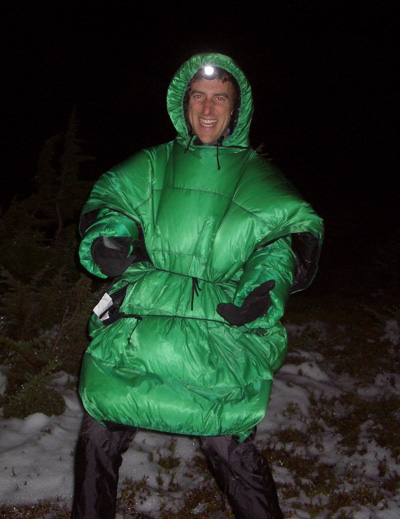
The Jacks âRâ Better Down to Earth Pad Converter converts any JRB quilt, including the No Sniveller, into a top bag system.
The Jacks âRâ Better âDown to Earthâ Pad Converter is a system for attaching a custom foam pad to a JRB quilt. To use the system, the quilt must be modified by attaching full-length Omni-tape along the sides. The quilt then attaches underneath the pad with matching Omni-tape. The JRB Down Hood also attaches to the pad, making the converted quilt into a roomy integrated top bag system for ground sleepers.
|
 Year/Model |
2007 Jacks ‘R’ Better “Down to Earth” Pad Converter |
|
 Style |
Pad for modular top bag system |
|
 Manufacturer |
estimated on the Jacks âRâ Better site at 20°F (-7 °C) for the system |
|
 Weight – Down to Earth Converter |
Measured weight 5.3 oz (150 g); manufacturerâs specification 5.6 oz (159 g) |
|
 Weight – No Sniveller Quilt with full-length Omni tape |
Measured weight 21.2 oz (602 g); manufacturerâs specification 22.5 oz (638 g) |
|
 Weight – accessories |
JRB Down Hood: Measured weight 2.5 oz (71 g); manufacturerâs specification 2.0 oz (57 g), JRB Down Sleeves: Measured weight 5.1 oz (145 g); manufacturerâs specification 5.0 oz (142 g) |
|
 Weight – complete No Sniveller / Down to Earth Converter / JRB Down Hood / JRB Down Sleeves system |
Measured weight 34.1 oz (967 g); manufacturerâs specification 35.1 oz (995 g) |
|
 Size – pad only |
Pad size (measured): 20 in wide x 69 in long (51 cm x 175 cm), tapering at 36 inches to 12 inches wide (30 cm); mfr claimed 20 in wide x 72 in long (51 cm x 183 cm) |
|
 Size – top bag system |
Reg. size; length (incl. hood) 82 in (208 cm), shoulder girth 67 in (170 cm), foot girth 45 in (114 cm) |
|
 Features |
“Down to Earth” Pad Converter attaches to quilt and Hood with Omni Tape; No Sniveller bag can be used as a quilt, top bag, or as an underquilt in a hammock system, draw cord at neck and feet, closable neck slot for use as a poncho; Down Hood can be used in both the poncho and top bag systems |
|
 MSRP – Down to Earth Converter |
1/8 inch Torso – $24.95, 1/4 inch Torso – $26.95, 1/4 inch Full – price n/a. Omni-Tape Bag modification (necessary for system) – $24.95, Omni-Tape DIY kit – $11.95 |
|
 MSRP – No Sniveller Universal Quilt and Accessories |
No Sniveller Quilt – $264.95; JRB Down Hood – $59.95; JRB Down Sleeves – $79.95 |

The No Sniveller quilt may be the most versatile bag available. Itâs a top quilt, an under quilt for a hammock system, a poncho/serape, and now with the “Down to Earth” converter, part of an integrated top bag / sleeping pad system. The “Down to Earth” conversion, though, can be made to any JRB quilt with a 48 inch width.
The Jacks âRâ Better No Sniveller is a highly adaptable down quilt. It can be used as a top bag, as an underquilt in a hammock system and even worn as a serape/poncho. Options for the No Sniveller include a matching down hood and sleeves, both of which can be used in the serape set-up and also a suspension system for attaching the quilt to Hennessy and other hammocks. The No Sniveller is the foundation for one of the most modular and flexible sleep systems available. It is also very effective, achieving the highest score in our Unconventional Sleep Systems Review Summary and Gear Guide Overview.
Reviews of individual system components can be found here:
While the No Sniveller system is extremely adaptable, it does favor the needs of hammock campers. The introduction of the Jacks âRâ Better âDown to Earthâ Pad Converter aims to bring true top bag versatility for ground sleepers and can work with any converted Jacks âRâ Better quilt.
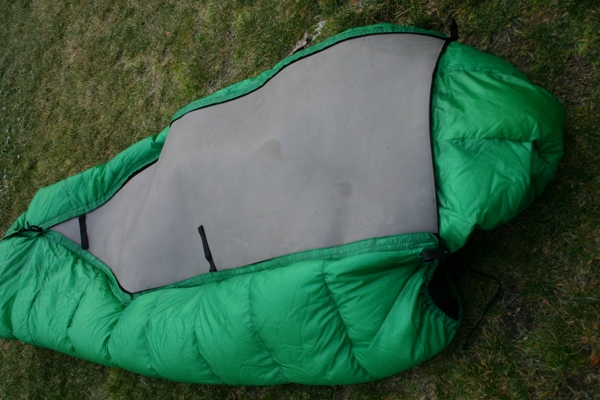
The Jacks âRâ Better âDown to Earthâ Pad Converter is a system for attaching a custom foam pad to a JRB quilt. To use the system, the quilt must be modified by attaching full-length Omni-tape along the sides (Omni-tape is like Velcro except that itâs softer and isnât male/female specific). The quilt then attaches underneath the pad with matching Omni-tape.

The No Sniveller / Down Hood / Down to Earth Converter put together in a modular system.
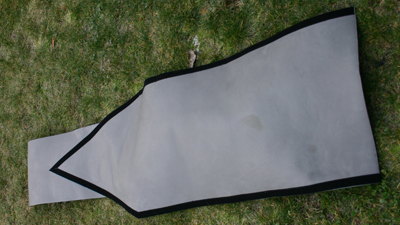
The pad is made from Gossamer Gear ThinLight material and is available in 1/8 inch Torso and 1/4 inch Torso and Full models. The Torso length models measure 58 x 20 inches with the first 36 inches being full width and the final 22 inches tapering to a point where the footbox begins. In the 1/4 inch full length version that I tested, the pad measures 69 inches long (72 inches claimed) and it narrows to 12 inches rather than coming to a point. The extra length of the long pad tucks inside the top bag.

The Jacks âRâ Better âDown to Earthâ Pad Converter consists of a choice of three different pads (1/4 inch full length reviewed) and an Omni-Tape modification to a JRB quilt.
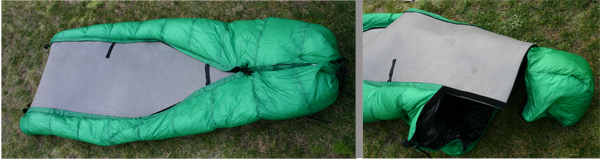
When setting up the system, it takes a couple of minutes to properly line up and attach the Omni-tape fasteners. Once set up, though, it provides a very secure attachment that didnât unfasten despite numerous roll-overs and inside the bag movement. When using the system in the field, I never had any problems with components becoming unattached while sleeping. The quilt attaches under the pad, creating an effective seal against outside air. The Jacks âRâ Better hood also attaches to the pad, making the converted quilt into an integrated top bag system for ground sleepers.

A modified Jacks âRâ Better quilt attaches underneath the pad and the hood attaches to the top.
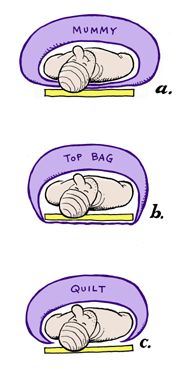
With this system, you have the choice to convert the No Sniveller from a quilt to a top bag. The distinction between these two types of bags was thoroughly explained in our 2006 Unconventional Sleep Systems Manifesto. The bottom line, though, is that there are distinct advantages and disadvantages to top bag. While the top bag’s closed bottom prevents drafts, the seal also creates dead air spaces in the corners, as seen in the illustration below. The “Down to Earth” system cannot avoid this weakness inherent to the top bag design.

This illustration by Mike Clelland!, borrowed from our 2006 Unconventional Sleep Systems Manifesto, shows the dead air spaces that come with a top bag, such as the No Sniveller Down to Earth top bag.
As a top bag, the No Sniveller / “Down to Earth” has the characteristic dead air spaces in corners where the bag and sleeping pad meet. However, these cold air spaces are larger than in most top bags because of the roominess of the wide No Sniveller quilt.

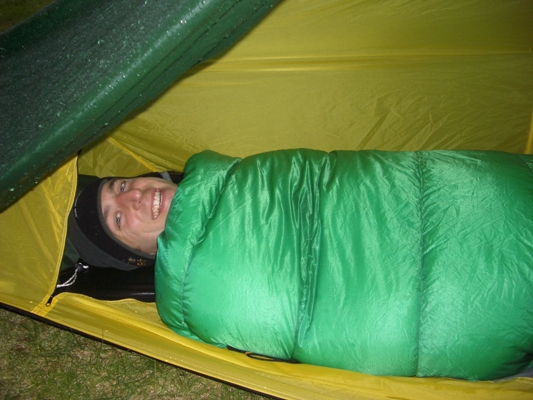
The Down to Earth system is efficient in the footbox and roomy in the upper body, making it easier to slide into the bag and to wear additional insulation.
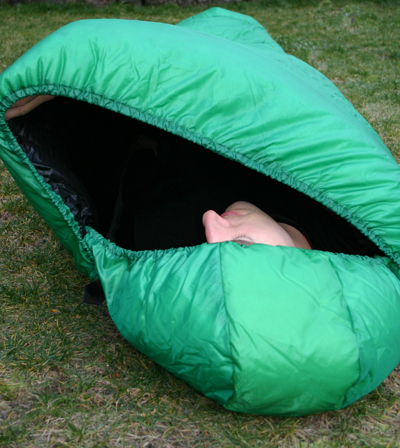
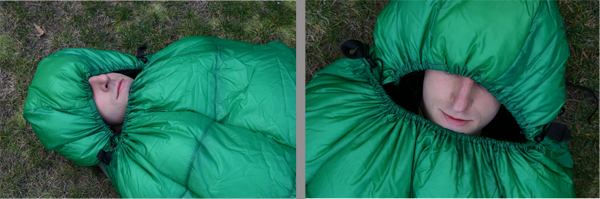
The fit of the top bag system is trim and efficient in the foot box but widens to very roomy in the upper body. This gives plenty of room to move around and is important because without a zipper, you have to slide into the bag. Even when wearing a high loft down jacket and with a second pad inside the bag, though, there is a lot of extra space in the upper bag. While larger hikers (I have a medium build) or those who like roomy bags will appreciate the extra space, I found the extra space to be excessive and inefficient. The hood attachment adds extra warmth to the system but it was a bit wide on my first generation pad, creating large spaces in the neck/shoulder area that leaked a large amount of air (later models will have a narrower attachment at the neck and hood which should minimize these draft issues). Despite the generous loft of the No Sniveller bag, I found the dead air spaces and poor shoulder/neck seal to decrease the warmth of the bag in cold conditions.

The hood attachment on my prototype pad was rather wide, creating gaps on the sides that let warm air escape. Production models will be narrower to minimize this issue.
To make sure that these issues were due to the top bag configuration, I used the No Sniveller and Hood in a quilt configuration on back to back nights and with much more warmth. That said, the “Down to Earth” setup was fantastic on more mild evenings when I wasnât pushing the temperature rating of the bag; I had room to move, none of the draft issues that are typical of quilts, and I never had to worry about rolling off my pad.

When used as a quilt, the No Sniveller can be adjusted to a trim, efficient cut.
On a side note, the new lace closure that defines the footbox area on the latest generation Jacks âRâ Better quilts is an excellent upgrade. The bag can be used as a quilt with solid footbox or opened wide for use in warm weather or with a hammock system.

The 1/4 inch Full pad weighs only 5.3 ounces.
The pads for the conversion system are reasonably priced at $24.95 for the 1/8â torso pad, $26.95 for the 1/4â torso pad and $24.95 for the quilt conversion. A complete No Sniveller / Down to Earth system with pad and Down Hood will set you back just over $350 and the price is well over $400 when you add the Down Sleeves. That is quite expensive but when you consider the versatility of the system and the cost of a separate bag, down jacket, and a pad, itâs a pretty fair price. Further, all of the components are of the highest quality and craftsmanship.
As an upgrade to an existing quilt, the “Down to Earth” Pad Converter starts at $49.90 for the pad and Omni Tape conversion. If you are looking for a roomy top bag, this kit adds yet another option for your Jacks âRâ Better quilt.
For those that donât want to send in their quilt, the conversion kit is a reasonable $11.95 and can be added to the quilt yourself or by a local tailor.
There is no bag on the market with the versatility of a Jacks âRâ Better No Sniveller Universal Quilt. Poncho, quilt, hammock under quilt, and now top bag- if you are looking for the ultimate in versatility, nothing else offers what the No Sniveler does.
If you have any Jacks âRâ Better quilt, the “Down to Earth” Pad Converter gives you a well though-out option for taking   to the ground.
The downside of a product as versatile as the No Sniveler is that some compromises must be made in its various configurations. The quilt is brilliant as part of a hammock system (either top or under quilt), is darn good as a poncho/serape, and is also a high quality ground quilt (although a bit roomy in the footbox). When used with the “Down to Earth” Pad Converter as part of a top bag system, it is too wide to be very efficient.
To improve its usage in this arena, I would like to see Omni Tape attachments under the pad that pull the bag further underneath, making for a less roomy fit. I would also like to see a hood/neck attachment that allows for a complete neck and head seal. These changes would add quite a bit of warmth to the system.
A lightweight internal frame child carrier that compacts for use as a day pack.
At 3 pounds 12 ounces, the Deuter KangaKid is among the lightest framed child carriers with storage on the market. Its long list of features makes it a great for day hikes or overnights, as long as you have a shorter torso.
|
  Year/Model |
2007 Deuter KangaKid |
|
  Style |
Internal frame child carrier |
|
  Volume |
1800 ci (30 L) |
|
  Weight |
Measured weight: carrier only- 3 lbs 11.8 oz (1.70 kg); manufacturerâs specification 4 lbs 6 oz (1.98 kg) |
|
  Fabrics |
âBallistic Liteâ- 210 denier woven nylon version of standard Ballistic fabric (420 denier); âMicrorip-Nylonâ- 210 denier ripstop nylon with a PU coating |
|
  Features |
Large main storage compartment, smaller front pocket with interior key-ring clip and pockets for organizing small items, front stuff pouch with small zippered pocket, side mesh water bottle pockets, padded 5 point child harness, child carrying area zips closed to compact pack and hide harness system, padded shoulder straps and waist belt, internal aluminum stay system to support child seat and storage area, load lifter straps |
|
  Comfortable Load Carrying Capacity |
35 pounds (15.88 kg) estimated maximum comfortable load an average person can carry all day in this pack |
|
  Carry Load to Pack Weight Ratio |
9.4 (based on a 35 lb load and measured weight of 3.74 lb) |
|
  MSRP |
$129.00 |
|
  Options |
Sun roof (not tested): $24.99, 9.0 oz (255 g) |
The Deuter KangaKid is a full-featured child carrier that at first glance appears to be a ânormalâ day-pack, or at least a normal day-pack with an infant stuck in. This is the allure of this compact pack: no bulky external frames to lug around and as much or more storage capacity than many ultralight packs. While 3 pounds 12 ounces might not necessarily be considered ultralight, the KangaKid is among the lightest framed child carriers with storage on the market and is more than 2 pounds lighter than the lightest external framed carrier, the Sherpani Rumba Superlight.

The KangaKid provides a comfortable enough ride that my son Porter had no problem falling asleep after a long day in the pack.
Any child carrier is defined by its harness system and the KangaKid is average in this area. The harness consists of a padded sling-seat as one of the five points, and then waist and shoulder straps that snap into this sling using quick release buckles make up the other four points. These nylon straps are adjusted using ladder locks found over the childâs thighs when they are seated. While the harness is very secure, the sling seat cannot be adjusted up or down in the pack to accommodate for different size infants or toddlers. The buckles and adjusters are also difficult to get to when a child is in the seat, especially since it is easiest to load the pack while it is on a parentâs back.

The five-point harness system is similar in design to many child carriers on the market. A unique feature is that one side of the seat area opens using Velcro and a quick release buckle to make loading and unloading easier.
Most external frame child carriers are self-standing, making it easy to âdropâ the child straight into the harness system. The lack of a self-standing frame makes it easiest to load a child if one parent is wearing the pack while the other secures the child into the harness system. To make this task easier Deuter has added a split side-piece to the 2007 model of the KangaKid. This piece fastens together using Velcro and an adjustable quick release buckle and can be quickly undone to remove the child from the seat, allowing for more convenient side entry and exit.
Once situated in the seat harness, the pack itself can be further adjusted to make a better fit for both the child and the adult. On either side of the child there are adjustable nylon straps that can be tightened to cinch down the seat area. This snugs the child closer to your back and keeps him or her from moving around too much. When our son Porter was smaller we could also partially zip up the sides of the carrier compartment to keep his feet inside the pack and keep him warmer in cooler weather. Deuter doesnât offer pack stirrups for the KangaKid, so this was our only option to keep his feet in place. As Porter has gotten bigger his feet just dangle down the sides of the pack.

Multiple adjustments and straps keep Porter secure to my back while leaving plenty of room for storage directly behind him. Like a traditional pack, this puts the densest, heaviest gear (in this case Porter) nearest my back.
The KangaKid does have an available sun cover, which I didnât test, but offers no option for a rain cover. In situations where sun or rain may be an issue we just carry a lightweight umbrella for protection.

The available sunroof provides shade but no protection against the rain.
The use of internal stays instead of an external frame has some benefits and some drawbacks. The main benefit is that the pack is much lighter than an external frame pack of a similar volume. It also means the pack can be stowed more easily in a car or closet. The downside of not having an external frame is that you canât put the pack directly on the ground to load or unload the child, or to take a break. When we put Porter on the ground in the pack we have to keep a hand on him. When he was smaller and didnât move around as much we could also prop him up against a tree without a lot of worry.
It is possible to lower the pack to the ground with a child in it, but Iâve learned to do it when Mom isnât watching because the balance point of the loaded pack isnât quite perfect to pull this off smoothly (the harness is secure, though, and ensures that the child wonât fall out). The whole pack, including Porter, tends to lean back past vertical making it look and feel moderately unstable. Getting the loaded pack back on by yourself is possible but is easier done with a second pair of hands for help.

The KangaKid lacks an external frame. When putting Porter on the ground in the pack we always have to make sure to keep a hand on him or to prop him up between two stable objects.
Load carrying is limited by the suspension design of the KangaKid. Whereas an external frame pack from Kelty or Sherpani can carry 50 pounds or more, Deuterâs recommended weight limit of 33 pounds for the KangaKid is pretty accurate. Our son has weighed close to 30 pounds since he was 9 months old. (Doug Johnson of this website has nicknamed him âSumo.â) This has meant either limiting what we can carry or exceeding the comfortable maximum load of around 35 pounds. With clothes, diapers, wipes, changes of clothes, food, etc. we regularly get closer to the 40 pound mark. While the frame and suspension components of the KangaKid are plenty sturdy enough to handle the weight, the problem is in the torso fit which makes loads over 35 pound uncomfortable for many pack users.
Deuter claims a one-size-fits-all pack size for the KangaKid but the sizing is truthfully for short-torsos only (such as smaller moms). I typically use a medium pack size, but can fit into a large if needed and my wifeâs torso is about two inches shorter than mine- a definite medium. For both of us the torso length of this pack is too short. This makes it difficult to balance the weight properly between our hips and our shoulders. If we put the weight on our hips, we have to loosen up the shoulder straps to the point where the pack becomes unstable (though the pack does have load-lifter straps to help with this). If we tighten up the shoulder straps to where they are comfortable the waist belt slides up to our belly buttons and off of our hips. When Porter was lighter, which wasnât long for him, this wasnât such a big deal, but now that we are forced to carry heavier weight it gets downright uncomfortable and shortens the distance we can hike without stopping and readjusting. The shoulder straps and waist belt themselves though were quite comfortable but could not be properly used because of the short torso design.

The back panel of the KangaKid is Deuterâs âAirContactâ system. It consists of crossed aluminum stays and a plastic frame sheet. Overall, the torso length was too short to be truly comfortable for medium to long torsos.
At $129.00, the Deuter KangaKid is less expensive than most child carriers on the market. It is durable and has plenty of room to carry everything a child needs for an overnight trip or everything we all need for an extended day hike. The seat harness system is simple though the adjustments can be difficult when a child is seated. It would be nice if the sling were adjustable. We like the fact that it is compact and very rarely miss having an external frame. Offering a low price and good features, the KangaKid is a great value – especially for those with shorter torsos.
The KangaKid is one of only a few internal frame child carriers on the market, and at 3 pounds 12 ounces is among the lightest. The child compartment zips up to compact the pack if a child is not seated in it, and when open one side has a “quick release” to make loading and unloading the child easier.
I offer the following recommendations for improving this pack:
1. Offer different size packs or make the torso length adjustable for taller users.
2. Offer more accessories. A rain-fly would add versatility and stirrups would be a great addition.
Ultralighters love replacing old gear with new. But what gets lost when you get new hiking buddies to go with your new kit?
You don’t have access to view this content.
A women-specific bag thatâs properly sized for a womenâs body and uses an ultralight Schoeller NanoSphere shell.

The Feathered Friends Grouse is a 1.5 pound summer bag that is sized for a woman.
For a woman that is sized like Amy, it is often difficult to find a sleeping bag that fits well. At 5 foot 2 inches tall, even the shortest bags from most manufacturers are too long, leaving extra space in the footbox and decreasing the bag’s efficiency. Further, Amy has a woman’s body with narrower shoulders and wider hips than most men; men’s bags just aren’t the best fit for her.
When looking for the ideal woman’s bag, the options are limited and of the available bags, most fall outside of the ultralight range. Feathered Friends, a custom down sleeping bag company out of Seattle, Washington, however, has the woman’s market nailed. They offer 6 woman-specific bags ranging from -25°F to 30°F. Amy already had the 10°F Petrel and loved it so when looking for a summer bag, the 30°F Grouse was an obvious choice.
Like the Petrel, the Grouse is a perfect fit for Amy. It is 4 inches narrower in the shoulders and 4 inches wider in the hips than the comparable Merlin men’s bag. It also has an overfilled footbox to keep the feet extra warm. Unlike all of her previous bags, the short women’s bags from Feathered Friends also fit her short stature perfectly, increasing the bag’s efficiency.

Women’s bags from Feathered Friends are sized for a woman’s body with narrower shoulders and wider hips.
On the trail, the Grouse proved to be conservatively rated, which matched Amy’s tendency to sleep cold. The bag’s generous loft confirms this conservative rating.
There is no draft collar but the hood has a tight, ergonomic fit that minimizes heat loss. An inner draft tube keeps the zipper area warm and a stiff fabric strip makes zipping quick and snag-free.

The hood fits well and keeps heat loss to a minimum.
For the shell we chose the new Schoeller NanoSphere fabric (simply called Nano by Feathered Friends). This lightweight fabric has an effective DWR, is highly breathable, and is also very stain resistant. Having a one year old, food and drinks were spilled on the bag on several occasions; just as claimed, the spills wiped right off. I’m excited to see this new fabric used more widely in the market.
A well designed and capable lightweight internal frame backpack from REI with a great feature set, and itâs an excellent value!
Serious lightweight backpacking gear from REI? You betcha! New for 2007, the REI Cruise UL 60 is a major overhaul of their previous UL 60 model. This highly refined pack has an easy to adjust and comfortable suspension system, great feature set, some innovative features, minimal weight, and a remarkably low price tag.
|
Year/Model |
2007 REI Cruise UL 60 |
|
Style |
Internal frame, top loading, fixed top pocket |
|
Volume |
3661 ci (60 L) size M, 3970 (65 L) size L (size L tested) |
|
Weight |
3 lb 3.1 oz (1.45 kg) measured weight, size L; manufacturer’s specification 3 lb 3 oz (1.45 kg), size L |
|
Sizes Available |
M, L |
|
Torso Fit Range |
M fits 17 to 19 inch torsos, L fits 19 to 21 inch torsos |
|
Fabrics |
140d ripstop nylon and 210d double ripstop nylon, polyurethane-coated |
|
Features |
Fixed top cap with water-resistant zippered pocket and underside zippered map pocket , internal compression system, kangaroo front sleeve with water-resistant zippered pocket, two side mesh pockets, two zippered hipbelt pockets, easy torso length adjustment, 3 L internal hydration sleeve with two hangers and two hose ports, frontpanel has four elastic loops and six webbing loops for attaching gear, front daisy chain, haul loop, sternum strap |
|
Volume To Weight Ratio |
77.7 ci/oz size L (based on 3970 ci and a measured weight of 51.1 oz) |
|
Comfortable Load Carrying Capacity |
35 lb estimated comfortable load for an average person carrying the pack all day |
|
Carry Load to Pack Weight Ratio |
11.0 (based on 35 lb and a measured weight of 3.19 lb) |
|
MSRP |
$130 US |
An internal frame pack with a volume of 60 to 65 liters is optimal for lightweight backpacking. Hikers in this category typically keep their base weight (everything except food, water, and fuel) under 20 pounds, and carry a total weight of 25 to 35 pounds. There are quite a number of backpacks to choose from in this size category, and the REI Cruise UL 60 (in my opinion) is one of the top contenders. The following photo gallery will help acquaint you with the pack.

Views of the REI Cruise UL 60. The frontpanel (top left) features a prominent kanga pocket (short for kangaroo) and a total of 14 attachment points. Each side (top right) has a bellowed mesh pocket in addition to the space behind the kanga pocket. The backpanel view (bottom left) shows the pack’s simple but capable suspension and “Rip and Stick” torso adjustment. The top pocket (bottom right) is fixed (not floating) and has a zippered map pocket on the underside.

The frame consists of two hollow contoured aluminum stays in sleeves on the main compartment (left). Torso length adjustment on the Cruise UL 60 is very easy with its unique “Rip and Stick” design, where the shoulder harness slides up and down on the stays.
Although size Large is specified to have 3 inches of torso adjustment (19 to 21 inches), I measured it at 4.5 inches (17 to 21.5 inches). REI’s “Rip and Stick” design makes it very easy to adjust the pack torso length: simply loosen the load lifters, rip the Velcro attachment loose, slide the shoulder harness to the desired torso length, and re-fasten the Velcro and load lifters. The stays are anchored to a delrin sheet on the back of the hipbelt (right) and a contoured aluminum headrail at the top of the load lifters (not shown). The design is simple, lightweight, and effective. Note that the stays can be custom bent to better fit the user’s back, but the pack cannot be used without the stays because the shoulder harness is mounted to them. I found the fit with the existing curvature to be just fine.

The Cruise UL 60’s suspension system is Spartan but effective. The shoulder straps (left) taper from 3 inches at the load lifters to 2.5 inches at the sternum strap. The shoulder straps, backpanel (middle), and hipbelt (right) are a firm foam faced with spacer mesh to distribute weight and moisture.
A unique and prominent feature of the Cruise UL 60 is its kanga pocket on the front. It’s actually two pockets in one: there is a large dry storage pocket on the front of it with a vertical water-resistant zipper, and a large space behind it that wraps around the sides. The cradle behind the kanga pocket is very handy for stuffing a jacket or for carrying a wet tent or wet rainwear. A strap at the top of the kanga pocket connects to the pack’s top pocket.

The Cruise UL 60’s front kanga pocket (top left) is a prominent feature that adds a lot of utility and character. It’s actually two pockets: a large flat pocket on the front with a water-resistant zipper, and a cradle behind it (top right) to stuff more gear. The side mesh pockets (bottom left) overlay the kanga pocket’s mesh attachment, and are a bit tight when the main compartment is packed full. Inside the main compartment there is a 3 liter hanging hydration sleeve (bottom right) with two hangers and two hose ports.

Hipbelt pockets (left) are small but not tiny. The fixed top pocket (right) has a map pocket on the underside with a key clip. There are two drawcords, one for the internal compression system and one for the top closure.
If you count the cradle behind the kanga pocket, there are a total of 8 pockets on the outside of the pack. Each side has an additional mesh pocket attached to the kanga pocket, the top cap has a storage pocket on top with a water-resistant zipper and a map pocket on the underside, and there are two hipbelt pockets. Overall, the abundance of outside storage makes most everything needed on the trail easy to get to without digging into the pack’s interior.
A unique feature of the Cruise UL 60 is its internal compression system. There is a second drawcord at the top of the main compartment that will collapse the volume down to a third of its extended size. It consists of a network of double seams with cords between them that tighten with a single pull at the top. It’s an elegant design that works smoothly, and probably doesn’t add any extra weight to the pack compared to a set of external compression straps that frequently get in the way of pocket access. However, the extra seams may be more prone to leakage in the rain.

The REI Cruise UL 60 has some drawcord wizardry. The top drawcord closure (green line in right photo) is a figure eight design to pull the extension collar down, and the internal compression system (purple line) snugs the main compartment and its contents into a tight unit.
For attaching bulky gear to the front of the pack, the UL 60 has four tool attachments and a daisy chain on the front of the kanga pocket. There are also six webbing loops that could be used for lashing straps or to add a bungee system.
I used the REI Cruise UL 60 on a number of winter snow camping trips and spring backpacks. The pack is nicely contoured to fit my back and easily adjusted to fit my torso and place the load lifters just above my shoulders where they belong. I found the pack very comfortable carrying loads up to 35 pounds (even heavier if you are a strong person), and it will transfer all the weight to my hips. The firmly padded suspension system is surprisingly comfortable.

The Cruise UL 60 has adequate attachment options to attach bulky items to the front. I easily carried 30 inch long snowshoes or a tent cradled behind the kanga pocket. The side mesh pockets are a tight fit for a water bottle.
With eight outside pockets (counting the cradle behind the kanga pocket), the pack has plenty of places to organize and stow gear frequently used on the trail. However, the side mesh pockets are tight when the pack is stuffed full, so a water bottle is a tight fit. They are best used for smaller, stuffable items. The hipbelt pockets are also on the small side, and will hold about three energy bars or other small essentials in each one.
The pack’s internal compression system essentially makes it unnecessary to carry a summit pack. It collapses the pack down to a much smaller volume and secures items inside.
I also found the pack to be quite durable for its lightness. The 140 denier ripstop nylon is a good balance of durability and lightweight. The pack, including the mesh side pockets, should easily endure off-trail backpacking in timbered terrain with no damage (assuming reasonable care is taken).
I’m very impressed with the REI Cruise UL 60. It’s a remarkable balance of features, fit, comfort, adjustability, organization, and lightweight. The pack fit me well, easily carried 25 to 30 pound loads, and transferred all of the weight to my hips. It also has plenty of storage and attachment options. My only complaints are its tight mesh side pockets and small hipbelt pockets, which hopefully will get remedied in the next production run. The pack is also a screaming deal at $130, and if you are an REI member you get part of that back at the end of the year in your membership dividend. Other packs in this category typically cost $175 to $250.
The Cruise UL 60 is one of the lighter packs in its category (internal frame, 60-65 liters, top-loading) at 3 pounds 3.1 ounces (size L). The GoLite Quest pack weighs the same, has a large zippered front pocket and costs $175, but has little torso length adjustment. The Granite Gear Nimbus Ozone (3800 cubic inches, 3 pounds, $215) is fairly spartan on the outside with only two side pockets and a top pocket, but its Nimbus framesheet and suspension are highly adjustable for torso length and shoulder width, and multiple shoulder strap and hipbelt sizes are available. The foam padding of the Nimbus suspension is also very soft and comfortable, compared to the Cruise UL 60’s thinner and firmer padding.
Although they are not a direct comparison, “convertible” internal frame packs from Six Moon Designs and Gossamer Gear are an ultralight internal frame backpack alternative. The Six Moon Designs Comet and Starlite packs, and the Gossamer Gear Mariposa Plus pack have removable stays and weigh 30, 29, and 20 ounces, respectively. All are capable of carrying loads in the 25 to 30 pound range, but not as comfortably as the REI Cruise UL 60. They are also less durable than the Cruise UL 60 and lack the range or ease of torso length adjustment.
The Cruise UL 60’s internal compression system works very smoothly to reduce pack volume for day hikes from camp summiting a peak. The pack torso length is easily adjusted within a 4.5 inch range with its “Rip and Stick” feature. And its front kanga pocket is very useful and adds a lot of utility and character to the pack.
Removable carbon fiber stays make it one of the lightest and most versatile internal frame backpacks on the market.

The Mariposa Plus on a 6-day backpack in the Wind River Range, Wyoming.
Backpacking Light reviewed the original Gossamer Gear Mariposa backack in 2004. We were delighted with its light weight and load-carrying capacity, but noted that it needed a few refinements. The Mariposa has since been tweaked to near perfection. The new Mariposa Plus is essentially identical except it has a removable wraparound hipbelt and uses more durable fabrics. Therefore, my review of the Mariposa Plus, contained herein, pertains to both packs.
|
  Year/Model |
2007 Gossamer Gear Mariposa Plus |
|
  Style |
Internal frame or frameless, top loading, drawcord closure with top compression strap |
|
  Volume |
4200 ci (69 L) total; main body 2900 ci, pockets 500 ci, extension collar 800 ci (48 + 8 + 13 L) |
|
  Weight |
1 lb 4.5 oz (581 g) measured weight with stays and supplied padding; pack with hipbelt 18.7 oz (530 g), stays 0.9 oz (26 g), shoulder strap padding 0.6 oz (17 g), hipbelt padding 0.3 oz (9 g); manufacturerâs specification 1 lb 4.1 oz (570 g) with stays |
|
  Sizes Available |
S, M, L (size L tested) |
|
  Torso Fit Range |
S fits 12-16 in (30-40 cm), M fits 16-20 in (40-51 cm), L fits (20-24 in (51-61 cm) |
|
  Fabrics |
Body is 70d 2.2 oz/yd2 (75 g/m2) polyurethane-coated ripstop nylon, stress and abrasion areas are reinforced with 200d 4 oz/yd2 (118 g/m2) polyurethane coated ripstop nylon, backpanel is 30d 1.3 oz/yd2 (44 g/m2) silnylon |
|
  Features |
Durable fabrics, wide shoulder straps, removable padding in shoulder straps and hipbelt, removable hipbelt, removable carbon fiber stays, 11 inch extension collar, drawcord closure, Y-strap top compression, backpanel sleeping pad sleeve, one large front and three large side mesh pockets, front or side bungee attachment/compression system, interior hydration sleeve with two hose ports, one ice axe loop, removable sternum strap with whistle, three hipbelt lengths available, haul loop |
|
  Volume To Weight Ratio |
204.9 ci/oz with stays (based on 4200 ci and measured weight of 20.5 oz), 214.4 without stays (based on 4200 ci and measured weight of 19.6 oz) |
|
  Comfortable Load Carrying Capacity |
30 lb estimated comfortable load for an average person carrying the pack (with stays) all day |
|
  Carry Load to Pack Weight Ratio |
23.4 with stays (based on 30 lb and a measured weight of 1.28 lb) |
|
  MSRP |
$150 US |
|
  Options |
None |
The main differences between the standard Mariposa and the Mariposa Plus are the more durable fabric and removable hipbelt of the Plus version; the pack volume and other features are the same. The Plus is made of 2.2 oz/yd2 polyurethane-coated ripstop nylon, compared to the standard Mariposaâs 1.3 oz/yd2 silnylon. The heavier fabric and removable hipbelt add about 3 ounces, which is a small weight penalty for the durability and utility gained. However, I have used the standard Mariposa, and find its silnylon body adequately durable for my needs, so the choice ultimately depends on the intended use.
The Mariposa (and Mariposa Plus) have received some useful refinements since the original version, with minimal weight gain:
The following photo gallery will help familiarize you with the pack:

Views of the Gossamer Gear Mariposa Plus. The frontpanel (top left) has a large bellowed mesh pocket plus loops to add a bungee attachment/compression system. The backpanel (top right) has a sleeve to allow the use of a sleeping pad for padding and weight transfer (the sternum strap pocket and camera case are my additions). The right side (bottom left) has two mesh pockets, and the left side (bottom right has one tall mesh pocket.
The frame is the lightest to be found anywhere – two carbon fiber rods weighing 0.9 ounce. They have rounded aluminum caps to prevent them from puncturing the fabric. Although they are very light, they are straight and are not bendable to fit the curvature of the userâs back. More on this in the Field Testing section.

The Mariposa Plusâs frame consists of two straight carbon fiber rods that slip into durable sleeves inside the pack. The two stays weigh just 0.9 ounce.
I really love the packâs wide shoulder straps and hipbelt. Theyâre 3.5 inches wide and have openings (with Velcro closures) to insert either articles of clothing (e.g. socks) or the provided 3-inch wide, ½-inch thick closed-cell pads. Since the shoulder strap pads weigh just 0.6-ounce and the hipbelt pads weigh 0.3 ounce (thatâs a total of 0.9 ounce for all four pads), it might make sense to simply sew in the pads and eliminate the weight of the Velcro closures.
The pack does not have load lifter straps or hipbelt stabilizer straps.

The suspension consists of 3.5-inch wide shoulder straps (top left) with 3D wicking mesh on the underside, a sleeping pad inserted into a pad sleeve (top right) to serve as a padded backpanel and pack stiffener, and a 3.5-inch wide removable hipbelt (bottom) with 3D spacer mesh on the underside.
The Mariposa Plus (and Mariposa) has an essential set of features to meet the needs of a lightweight or ultralight backpacker. For starters, several components (hipbelt, stays, padding, and sternum strap) are removable, so the pack can be stripped down to a frameless backpack weighing about 14 ounces. Like many ultralight backpacks, the outside of the pack is covered with three large mesh pockets (500 cubic inches total) capable of holding a lot of gear and keeping it readily accessible on the trail. The lower right mesh pocket is designed to make a water bottle reachable without taking the pack off.
Conspicuously missing are hipbelt pockets, and I highly recommend that Gossamer Gear design some optional lightweight pockets, perhaps in different sizes, that can easily be slipped on the hipbelt. Further, an optional sternum strap pocket would also be a desirable option for convenience on the trail. To accommodate it, the sternum strap would need to connect at one side rather than in the middle.
Although the Gossamer Gear website states that this pack has an inside “small map/permit/sundries pocket”, my sample pack did not have it. Such a pocket would be a nice addition, and worth the miniscule weight. A length of elastic cord and cordlocks are provided (0.4 ounce) to create a bungee attachment/compression system either on the front of the pack or the two sides, using loops sewn into the seams.
The pack body is not large enough to hold a bear canister, but the Y-strap on top is designed to hold a canister carried on top of the pack. I donât have a bear canister, so I was not able to test that feature. In normal use without a bear canister, the Y-strap is a little cumbersome to use compared to a single strap because of its extra length and tendency to get twists in it.

The Mariposa Plus has an internal hydration sleeve and two hose ports (left). Also note the sleeves that hold the carbon fiber stays. The packâs roll-down closure is secured with a Y-strap (right), which is designed to hold down a bear canister carried on top of the pack.
Although an internal hydration sleeve (and two hose ports) is provided, I find it more convenient to carry a smaller water bladder in the upper right side pocket (as shown in the photo gallery above). The side pocket location makes it much more accessible for refilling, and I offset the weight by packing a little more weight on the left side inside the pack.
I carried the Mariposa Plus on three backpacking trips and simply loved it. On two trips I carried all the shared gear and food so my wife could carry a lighter pack – this allowed me to test the Mariposa Plus with a heavier load. I carried 20 pounds on an overnight trip and noted that the Mariposa Plus carried the load much more comfortably than a frameless pack. On a 6 day trip in the Wind River Range in Wyoming my measured starting weight was 29 pounds. I marveled at how comfortably the pack carried the weight, in large part due to the packâs wide, firm shoulder straps and effective weight transfer. The third trip involved carrying my overnight gear plus supplies to a remote aid station we manned for the Hardrock 100 Endurance Race in Silverton, Colorado. When packed with about 35 pounds of dense weight, I felt that the Mariposa Plus had exceeded its comfortable limit, but it did in fact carry the weight without damage to the pack or unusual discomfort to me.
Although the carbon fiber stays (along with a stiff sleeping pad) definitely help to support a heavier load, the stays are as straight as an arrow (in fact, they are arrow shafts!). There is no way to bend the stays to fit the curvature of your back. Consequently, the top of the pack tends to lean back (see first photo). The pack does not have load lifter straps to pull the top of the pack against the shoulders, because they would be ineffective with the unbendable stays. Switching to a curved flat carbon or fiberglass stays would be a lightweight option to attain an anatomical fit. Thin aluminum stays would be ideal because they could readily be bent to customize the curvature against the wearer’s back, but they would increase the weight of the pack by about 3 ounces.
I tested the Mariposa Plus with several different sleeping pads I have, and found it to be amenable with the Bozeman Mountain Works TorsoLite, Gossamer Gear NightLight, Therm-a-Rest RidgeRest ž, and Therm-a-Rest Prolite 3 Short. The NightLight is ideal because it provides a stiffer backpanel (for better weight transfer to the hips) with minimum thickness. The folded RidgeRest provides a lot of stiffness, but itâs 2.5 inch thickness pushed the packâs center of gravity away from my back, which is undesirable for heavier loads. Inflatable pads provide a comfortably padded backpanel, but do nothing to stiffen the pack for weight transfer.

A trick I used on a standard Mariposa pack to overcome the straight stay issue is to fold my TorsoLite pad so that it’s square and stuff it into the bottom part of the pad sleeve. My wife sewed a strip of Velcro on the top edge to secure it. This modification pushes the bottom of the pack out and levers the top of the pack in closer to my shoulders, making the pack fit better.
Since the weight of the carbon fiber stays and foam inserts for the shoulder straps and hipbelt are so miniscule, adding up to 1.8 ounces, I made no effort to remove them from the pack to save weight. For me, the additional comfort and weight-carrying capacity are well worth the weight. I suspect other hikers will do the same, unless they intentionally strip the pack down and use it as a frameless backpack for loads less that about 15-18 pounds.

The only problem I had with the Mariposa Plus was a seam came apart that attaches the elastic binding to the top of a side mesh pocket. My wife re-sewed it and there were no further problems.
On their website, Gossamer Gear notes that the mesh used for the sleeping pad sleeve has been reported to stain clothing, and they recommend giving it a good rinsing before using the pack. Also, they note that stitching on the mesh pockets may unravel (as mine did), and offer to repair existing packs at no charge. Both problems will be remedied in future production runs.
Because of its removable stays and other components, the Gossamer Gear Mariposa Plus (and Mariposa) is easily the most versatile ultralight backpack around. When stripped down, itâs a very comfortable and capable frameless pack. With the stays in, the comfortable range is extended to about 30 pounds.
When you hold the empty pack in your hand, it is hard to believe that it will comfortably carry up to 30 pounds, but it does. If your total pack weight is normally in the 20 to 30 pound range, consider getting the 20 ounce Gossamer Gear Mariposa or Mariposa Plus instead of a conventional internal frame backpack that can weigh 3 pounds or more. The standard Mariposa and Mariposa Plus are fully capable of carrying 20 to 30 pound loads with a good level of comfort. However, many conventional internal frame packs have additional features that fit the pack more closely to the user, like adjustable torso length, load lifters, bendable stays, adjustable shoulder strap width, and anatomically shaped padding.
For short ultralight trips, the Mariposa Plus simply has too much volume. One solution is to put your sleeping pad inside the main compartment to take up some of the volume. If you use an inflatable pad, you can even partially inflate it to adjust the volume. This technique would allow you to use one pack for practically any application. Alternatively, you could purchase Gossamer Gearâs Miniposa pack (3300 cubic inches, 18.6 ounces), which is about 900 cubic inches smaller.

We all loved Gossamer Gear’s G4 (left) in its heyday, but its 4600 cubic inch volume was simply too much for ultralight backpacking. The Mariposa Plus at 4200 cubic inches (center) is much better. Itâs about the same size as the Six Moon Designs Comet (right), although the Comet has a specified volume of 3700 cubic inches. Volume specifications donât always indicate the actual size of a pack.
The only other packs on the market with features and weight comparable to the Mariposa are the Six Moon Designs Starlite and Comet. The Starlite (30 ounces) has the same volume as the Mariposa, is constructed of rugged fabric with Dyneema gridstop, has hipbelt sizes available with and without pockets, has load lifters and hipbelt stabilizer straps, and has removable, shapeable flat aluminum stays. It also has a zippered security pocket on the inside. However, it weighs about 10 ounces more and is available in only one size that adjusts to fit a wide range of torsos. The slightly smaller (3700 cubic inches, 27 ounces) Comet has been re-designed for 2007, and has a similar feature set to the Starlite.
A distinct advantage of the Comet and Starlite is their torso length is adjustable and their aluminum stays can be bent to match the curvature of the userâs back to provide a customized fit and more comfort and weight carrying capacity.
The Mariposa Plus is easily the lightest durable internal frame backpack on the market in its size class. Itâs also extremely versatile. With the stays and other components removed, its weight is competitive with many frameless backpacks on the market and itâs more comfortable to carry because of its wide padded shoulder straps.
A better way to apply seam sealer, producing a nearly factory perfect look.
You don’t have access to view this content.
A performance sweater made from all natural fabrics
In the summer of 2005 I visited the Andean Highlands and was struck by the common use of alpaca wool. Fabrics made from alpaca are soft and lush and are used by native peoples throughout the high country of South America. But pure alpaca wool is fragile; most garments I saw in Peru were decorative and did not look like they would be up to our standards for backcountry use. At the Outdoor Retailer show in January 2007 I met with the team at Indigenous Designs to look at their all natural blended fabrics that utilize alpaca wool extensively. They have devised a fabric with 3 components – merino wool, alpaca wool and tencel. The Terra Sport line of sweaters is specifically designed for high performance outdoor use. Over the past 7 months I have put these sweaters through all sorts of abuse – on trail, off trail, in rain, cold, heat and wind. In the photo at right I am wearing the Terra Sport Edge Crew at the misty Col de Barrancq in the French Pyrenees.
The blended fabric is listed as 45 percent Tencel, 40 percent alpaca wool and 15 percent merino wool. Tencel was developed in Europe and is derived from wood pulp. It is the branded name of the fiber lyocell. By itself, Tencel has some interesting characteristics – it is soft to the skin, rapidly wicks water, is strong when wet or dry, and is resistant to bacteria growth (it is frequently used in medical dressings).
The fabric in the Indigenous Designs Terra Sport line is very soft on the skin; more comfortable than any merino wool midweight fabric I have tested. It feels as comfortable as alpaca wool, but has a tighter weave than any pure alpaca fabrics of similar weight I have seen. I was very intrigued and anxious to get it out into the field. My primary concern with the fabric – how would it stand up under rigorous use? How would it compare with merino wool in bad weather?
We tested several Terra Sport midweight layers over the past few months, but I found the Edge Crew to be my favorite. For a midweight sweater, the Edge is very comfortable, and can easily be worn against your skin all day long. I had my Edge out on the field for over 30 days, and nearly always wore a pack all day. The fabric held up very well, and looks almost as good as new. It washes easily and I have not detected any odor buildup. There are a couple of fabric pulls that have developed on the rear shoulders, and one small one on the lower arm. The Terra Sport is the perfect match for a lightweight windshirt. By itself, it is a warm, very breathable outer layer. You’ll stay dry during moderate exertion, but warm when you rest. When the cold or wind picks up, throw on a wind shirt and the pair offer excellent wind and cool weather warmth. I wore my Edge Crew this summer in the Pyrenees whenever we got into high country. The Pyrenees were shrouded in constant wet clouds this summer – and the resulting cool, wet conditions were easily handled by the Edge Crew. The overall construction quality is very good, and the fit is slightly tapered – perfect for a mid-layer. In light rain, water beaded up on the surface for at least a few minutes, but eventually penetrated down through the porous fabric. The big drawback of the Edge Crew is it’s weight, which is true of all sweaters. At 12.5 ounces it is heavier than I would like given the insulation and protection it provides. But combined with a wind shirt, you can have a flexible and warm package at about 16 total ounces. It is good to see manufacturers such as Indigenous Designs exploring new fabric blends. We will continue to look for new products that push the envelope of innovation and performance.
The Terra Sport line is available in both men’s and women’s products. All are midweight fabrics and are available in full zip, crew, mock-t, hoodies and other styles.
Score another winner for SMD â the Lunar Duo is a well-designed, roomy, lightweight, well-ventilated single-wall tent for two people.
The Six Moon Designs Lunar Duo is not a larger version of the popular Lunar Solo; rather it’s an entirely new tent design. Its 44.3 ounce trail weight (including stakes) may seem a bit high for a single-wall silnylon two-person tent, so it’s important to point out at the beginning of this review that this is a BIG tent, with 58 square feet of protected area. If you’re looking for a really roomy two-person single wall tent, the Lunar Duo may fill the bill.
|
Year/Manufacturer/Model |
2007 Six Moon Designs Lunar Duo |
|
Style |
Three-season, two-person single-wall tent with floor, two doors, and two vestibules |
|
Fabrics |
30d, 1.3 oz/yd2 (44 g/m22) silnylon canopy; no-see-um mesh doors and lower side vents; 70d, 2.3 oz/yd2 (78 g/m2) silnylon floor |
|
Poles and Stakes |
Two curved aluminum poles at ends of ridge, requires two trekking poles or optional carbon fiber poles for support, stakes (six required) not included |
|
Floor Dimensions |
Length 90 in (229 cm), width 54 in (137 cm), height 45 in (114 cm) |
|
Packed Size |
14 in x 6 in (36 x 15 cm) |
|
Total Weight |
Measured weight 2 lb 11.1 oz (1.22 kg), manufacturer specification 2 lb 12 oz (1.25 kg) |
|
Trail Weight |
Measured weight 2 lb 12.3 oz (1.26 kg); includes tent body, two aluminum spacer poles, and six Easton aluminum stakes |
|
Protected Area |
58 ft2 (5.4 m2); floor area is 34 ft2 (3.16 m2), entry vestibules are 24 ft2 (2.23 m2) |
|
Floor Area/Trail Weight Ratio |
12.27 ft2/lb |
|
Protected Area/Trail Weight Ratio |
20.94 ft2/lb |
|
MSRP |
$275 |
|
Options |
1.3 oz/yd2 (44 g/m2) ultralight silnylon floor (no charge), carbon fiber poles (1.8 oz/51 g, $25 each) |
For those familiar with the Hilleberg Rajd tent, the new Six Moon Designs Lunar Duo has some striking similarities. Both have a broad ridgeline supported at the ends with trekking poles, which provides a lot of interior volume. But that’s where the similarity ends. The Lunar Duo has mesh side and interior end walls and two huge vestibules, which gives it much better ventilation and gear storage than the Rajd. The following photo gallery provides a tour of the tent’s design elements.

Views of the Six Moon Designs Lunar Duo. Both sides of the tent (top left) have a large vestibule entry. The top of the tent is 54 inches wide (top right), which provides a LOT of interior volume and headroom. The top view (bottom left) helps to put the tent’s proportions into perspective. With both vestibules tied open (bottom right), the tent’s mesh entry and large doors are visible.
Because of its larger footprint, the Lunar Duo requires more space than many two-person tents. Setup is fast and easy: spread the tent out on the ground, insert two curved aluminum poles into their sleeves at the ends of the ridgeline, stake out the four corners of the tent, raise the tent and insert the tip of a 45-inch trekking pole into a grommet at one side and stake out the vestibule, and repeat for the other side. Six stakes (not included) are required for a basic pitch. Because the tent has a broad profile, which gives it more wind resistance, I strongly recommend adding four guylines (loops provided) for a more secure pitch.
The Lunar Duo is fussy about trekking pole length; 45-47 inches seems to be the optimum length, and adjustable poles are easiest to adjust to the proper length . Taller fixed-length poles can be used if the poles are inserted first and the corners staked last, but the extra height throws the tent’s geometry offand the vestibules become limp. It’s also notable that the use of grommets to attach trekking poles requires poles with good tips; a pole with a worn-down tip could slip out and puncture the tent.

The Lunar Duo uses two curved aluminum struts (left) to create its rounded ridgeline and distribute tension on the canopy. They slip into a sleeve (right) at each end of the ridgeline. Although it’s convenient to leave the struts in their sleeves, they make the rolled tent about 24 inches long, which is not easy to pack.
Entry is through a zippered vestibule on each side, which shelters a vertical mesh wall with a large zippered door. One or both sides of the large (12 square feet each) vestibules can be tied open for better breezes and views in fair weather, or closed to provide extra sheltered space. The total protected area is a whopping 58 square feet, 34 square feet of floor space plus 24 square feet of vestibule space. This is a big tent! When the vestibules are closed, it’s very convenient to leave the interior mesh doors open and reach gear in the vestibules on each side. Because of the tent’s wide body, steep sidewalls, and generous headroom (45 inches), all of the interior space is usable, and its easy to reach into the vestibules from inside the tent.

The Lunar Duo is supported with trekking poles or optional carbon fiber poles (1.8 oz, $25 each). Both vestibules will tie completely open to provide good views and breezes in fair weather.
Although the body of the Lunar Duo resembles the Hilleberg Rajd, the Lunar Duo is a vast improvement in terms of ventilation. The side entry walls are solid mesh, there are mesh panels at both ends, and there are two high vents at the tops of the vestibules. Also, the vestibules have about a 6 inch gap at the bottom, which allows air to more freely circulate through the tent.

The Lunar Duo’s 54-inch wide x 90 inch long floor (top left) provides plenty of room for two people plus gear. The entry walls are mesh with a large zippered door. The end walls are also mesh at the bottom. The interior mesh storage pockets (top right) are in a convenient location, but they don’t hold very much and things fall out easily. The vestibules (bottom left) are zippered and easy to reach into from inside the tent. A high vent on each end of the ridgeline (bottom right) assists with ventilation.
I tested the Lunar Duo on several trips in late winter through early summer. On clear/calm/cold nights (down to freezing or below) the Lunar duo with the doors and vestibules closed consistently developed moderate condensation (or frost) inside, which is typical for a single wall tent. With the mesh doors open (bugs willing) and vestibules closed there was light or no condensation inside, depending on breezes. The steeper tent walls help to avoid brushing against them when they are wet, but there is usually some contact when there are two people inside (as shown in the photo). Larger top vents would help to reduce condensation when the tent is zipped up.

The Lunar Duo is prone to condensation inside on clear/calm/cool nights with the doors closed, like any other single wall tent. It helps a lot to leave the mesh doors open at night, if possible.

Environment inside the Six Moon Designs Lunar Duo. Left Graph: On a cloudy March night with a shower, I kept the mesh doors closed until 3 AM, then opened them. Moderate condensation formed on the inside tent walls with the doors closed (note that the air temperature hit the dew point temperature), then disappeared by morning when I opened the mesh doors. Right Graph: On a clear/calm/cool May night, I kept one door and vestibule completely open and the second door unzipped and its vestibule closed. In the morning I had moderate condensation inside the tent.
The Lunar Duo has a broader profile than many tents, so it is more affected by wind. Even in the moderate 10 to 15 mile per hour winds I experienced, the tent distorted significantly. For adequate wind stability (and to protect your investment), I strongly recommend using 6-inch Y-stakes or Easton tubular stakes, and attaching four guylines to the tent sides (ten stakes in all). However, the guylines are only attached to tent seams rather than poles. With its large surface area and lack of internal structure, the Lunar Duo is not going to be a particularly stable tent in high winds, in my opinion.
On the ergonomic side, my wife and I found the Lunar Duo to be fast and easy to set up, easy to enter and exit, and very roomy inside. The separate vestibule/entry on each side is very convenient for two people, and very versatile. In fair weather we could tie one side of the vestibule and the mesh entry door open to catch more breezes and views. And at night or in rainy weather we could zip the vestibules closed and leave the mesh doors open, which had the effect of incorporating the vestibules into the usable space inside the tent. While sitting inside the tent, we could easily reach things in the vestibules.
The Lunar Duo is overkill for one person, and just plain luxury for two. It’s a very roomy tent, with 58 square feet of protected area inside, which makes it ideal for two people who want more room. It would also be a good choice for a lightweight base camping tent because of its roominess. While it’s possible to find a two-person single wall tent that weighs about 12 ounces less, it would not have nearly as much protected area as the Lunar Duo.
Note that this review is based on the Lunar Duo with a standard (70 denier silnylon) floor, which weighs 4 ounces more than the lightweight (30 denier silnylon) floor. The standard floor is certainly recommended for more abrasive ground surfaces, and will undoubtedly last longer. However, a 30 denier silnylon floor is commonly used on many single wall tents, and holds up very well with reasonable care.
In addition to its large area/weight ratio, the Lunar Duo is also well ventilated, which is a necessity for a single wall tent. Except for enlarging the top vents to increase ventilation when the tent is completely zipped up, I don’t see any way that the Lunar Duo’s ventilation could be improved.
In our forums several readers have asked for a comparison of the Lunar Duo and the Tarptent Double Rainbow. By the numbers, the two tents appear to be similar in size, but based on my personal experience with both tents, I can say that the Lunar Duo is clearly a roomier tent. One factor that makes a big difference is the width of the tent body at the top – the Tarptent Double Rainbow measures 18 inches, while the Lunar Duo is 54 inches. That makes a huge difference in interior room. Also, while the floor width of the Double Rainbow is given at 54 inches (with the bathtub floor laid flat), I measured the actual width to be 48 inches. The Double Rainbow is in fact quite narrow for a two-person tent. In spite of the size difference, the weights of the two tents are identical (40.9 ounces with stakes and ultralight floor; weight of trekking poles is not included in the weight of the Lunar Duo) because of the weight of the Double Rainbow’s 12 foot long ridgepole. Bottom line, the Lunar Duo is a much roomier tent for the weight. However, the Double Rainbow costs $25 less, it does include stakes, and is more wind stable because of its curved profile. Both tents have good ventilation, but will develop heavy condensation inside on a clear/calm night with a large temperature drop.

Six Moon Designs Lunar Duo (left) and Tarptent Double Rainbow (right). The Lunar Duo’s ridgeline is 54 inches wide versus the Double Rainbow’s 18 inch ridgeline, making it a much roomier tent inside. The two tents weigh the same.
Because of the Lunar Duo’s jumbo size and large fabric panels, it is more susceptible to winds than many two-person tents, and requires extra staking for adequate wind stability. Four tieout loops are provided to attach guylines to the sides the tent, and I strongly recommend using them. Even with extra staking, the Lunar Duo would not do well in high winds, in my opinion.
The Lunar Duo has a remarkable protected area to weight ratio, and is very well ventilated. It’s a good choice for a lightweight roomy two-person tent or a base camping tent.
It IS possible to climb Denali using lightweight techniques! Agnes and Matt discuss their gear and provide detailed gearlists.
For most people climbing Denali (aka Mt. McKinley) is no easy task. A vertical rise of 18,000 feet makes it bigger than Everest. It is no wonder that Denali means âthe high oneâ in the Athabascan language. With backbreaking loads of 100 pounds (45 kilograms) or more the haul to the summit is grueling for even the fittest climber, but as Matt and I proved on this trip, itâs not so miserable with a lighter load. In a mere 3 hours Matt and I trucked into the first camp at the base of the ski hill at 7800 feet (2377 meters) with half the load of a typical climber and plenty of energy to spare. We could not go any further until our bodies acclimated. We set up camp and tried to âchillâ in the heat of the day when afternoon temperatures can swelter to 100 °F (38 °C on the lower glacier. Perhaps our two most unorthodox items – at least for this type of climbing – were our 20 ounce (567 gram) packs and 2.5 pound (1.1 kilogram) tent. For most climbers on Denali, these two items alone can weigh from 15 to 20 pounds (6.8 to 9.0 kilograms), while these two items weighed only 4 pounds (1.8 kilograms) for us. By taking techniques from ultralight backpacking and alpine climbing, we manage to put together a 30 pound (13.6 kilogram) kit (base weight plus non-worn technical gear) not including food and gas.
To jump directly to the gear lists and weight summaries click here.
Our Golite Gust packs, at 20 ounces (567 grams) with no bells or whistles fulfilled our volume (5000 cubic inches, 81 liters) needs – they carried a lot of goose feathers. I rigged a sternum strap to help adjust the pack under load. We pushed the packâs 30 pound carrying capacity limit, which helped us keep our loads honest. Early in the trip when the pack was maximized and we were pulling sleds the thin unpadded waist belt made our hips tender. We were thankful to be caching the sleds at the 11,000 foot (3352 meter) basin camp, especially after the hard second day around Kahiltna Pass with high winds.
The high winds persisted at the 11,000 foot (3352 meter) camp, putting our small tent to the test. The Stephenson Warmlite tent (2.5 lbs, 1.1 kilogram) was designed over 40 years ago and today is still one of the lightest high quality mountaineering tents on the market. The tent depends on its aerodynamics to withstand high winds with no guylines attached. As is expected in such cold conditions, condensation formed on the inner walls. The condensation accumulated primarily on the single-wall end sections rather than on the double wall section over the sleeping bag area. This minimized the dampness of our bags.
Another fairly unconventional item that we included in our shelter system was an 8 x 10 foot (2.4 x 3.0 meters), 14 ounce (397 grams) Integral Design Siltarp. Part of Integral Designâs âfast and light,â line this ultralight waterproof nylon tarp was great as a vestibule or awning. During high winds, we setup the Siltarp as a huge vestibule with snow walls digging down to make a cubbyhole great for cooking or just hanging out. Most of the time we did not so much encounter wind but intense sun instead. Using our poles and snow walls, we created a front porch (awning style) that allows us to stay out of the hot tent but remain protected from the blaring sun. The tarp was probably the most admired commodity on the mountain.
When it came to choosing technical gear, we had to ask ourselves, âwhat can we get away without?â and âwhat canât we do without?â One thing we noticed was that many climbers carried excessive amount of technical gear: miles of cordalets, numerous screws and slings, and carabiners galore. The National Park Service provides fixed ropes and permanent pickets at all the technical locations leaving you to provide basic gear in case of a self-rescue situation. We reduced our technical equipment to two pickets, one ice screw, two Mammut Specter slings, two Petzel Tiblocs, and six CAMP Nano carabiners per person (Note:
The West Buttress does not have a high avalanche danger, so we decided we could âdo withoutâ an avalanche beacon. A probe, however, is useful for finding crevasses.
Choosing snowshoes instead of skis was a no-brainer for us. It is hard to pull a sled when youâre roped together on skis going downhill. Snowshoes are also lighter. Backpacking Light supplied us with Northern Lite snowshoes that worked great for travel on the lower glacier. We cached the snowshoes along with the sleds at the 11,000 foot (3352 meter) camp. Dependable footing is critical when one slip could be fatal so steel crampons were necessary. On the other hand, self-arresting on blue ice is challenging even with the best of ice axes so we felt safe with lightweight aluminum alloy CAMP USA XLA ice axes, which also assisted with the headwall climb above 14,000 feet (4267 meters).
Multi-purpose items and simplicity were the keys to our cooking system. All our meals were of the âjust add hot waterâ variety, which allowed us to bring one four-liter cooking pot to melt snow for the two of us. Our MSR XGK stove provided the BTUs required to melt large quantities of dry snow in a short amount of time at high elevations. Some of our favorite parts of our kit were our homemade insulated yellow buckets. We purchased 32-ounce Nalgene containers that we insulated with blue foam and duct tape. The buckets were used for both hearty meals and hot drinks. We even used them to cook our Mountain House Pro-Pak meals with an extra half cup of rice. They were easy to clean too – just add water, cover, and shake.
Our sleeping setup was nothing fancy, but it was one place we did not want to skimp. After a bit of research, we chose REI 20-below Sub Kilo sleeping bags. The Sub-Kiloâs specs were comparable to bags costing twice as much. A basic blue foam pad cut to length served as both bottom insulation and as our âblue foam couchâ under the front porch. Lastly, a ž-length ultralight Therm-a-Rest provided a little more insulation under the torso.
When worst comes to worst you want to be warm. A good sleeping bag is one thing, but great layers are equally if not more important. It is crucial that when conditions become desperate you can throw on all your layers and keep moving until you can make camp. Matt and I tested our layering system on a 30-below ski tour in late February so we were confident that our clothing would see us through the Denali attempt. Key pieces included MontBell UL Down Inner Pants (7 ounces, 198 grams), Patagonia Specter Pullovers (6.5 ounces, 184 grams), Intuition Denali Liners (8.5 ounces, 241 grams), Patagonia Micro Puff Pullovers (12 ounces, 340 grams), and MontBell Ventisca down parkas (26.5 ounces, 751 grams). The Intuition Denali Liners are half the weight of standard double boot liners and thus dry quickly. This is important because you want your sweat-soaked liners to dry and not freeze overnight. The Patagonia Specter pullover was light and worked well for protection against any precipitation or wind. Finally, a down parka with a hood that you can throw on over all your layers when things turn for the worst is crucial, and the MontBell proved to be a good choice.
In the end, the only item we wished we had carried was a full-size snow shovel. The Snowclaw shovels are light and useful but when we could not poach a prefabricated tent site, building snow walls and digging out a site through hard ice layers was strenuous and back-breaking.
Slow and light is the only way I go anymore for mountaineering expeditions; not that I know any other way. It just seems like an unnecessary burden to carry a monster load when you can do it just as well carrying half the weight. Hopefully, all of you will find some ways to lighten up on your next mountaineering expedition.
|
|
||||||||||||||||||||||||||||||||||||||||||||||||||||||||||||||||||||||||||||||||||||||||||||||||||||||||||||||||||||||||||||||||||||||||||||||||||||||||||||||||||||||||||||||||||||||||||||||||||||||||||||||||||||||||||||||||||||||||||||||||||||||||||||||||||||||||||||||||||||||||||||||||||||||||||||||||||||||||||||||||||||||||||||||||||||||||||||||||||||||||||||||||||||||||||||||||||||||||||||||||||||||||||||||||||||||||||||||||||||||||||||||||||||||||||||||||||||||||||||||||||||||||||||||||||||||||||||||||||||||||||||||||||||||||||||||||||||||||||||||||||||||||||||||||||||||||||||||||||||||||||||||||||||||||||||||||||||||||||||||||||||||||||||||||||||||||||||||||
|
|
||||||||||||||||||||||||||||||||||||||||||||||||||||||||||||||||||||||||||||||||||||||||||||||||||||||||||||||||||||||||||||||||||||||||||||||||||||||||||||||||||||||||||||||||||||||||||||||||||||||||||||||||||||||||||||||||||||||||||||||||||||||||||||||||||||||||||||||||||||||||||||||||||||||||||||||||||||||||||||||||||||||||||||||||||||||||||||||||||||||||||||||||||||||||||||||||||||||||||||||||||||||||||||||||||||||||||||||||||||||||||||||||||||||||||||||||||||||||||||||||||||||||||||||||||||||||||||||||||||||||||||||||||||||||||||||||||||||||||||||||||||||||||||||||||||||||||||||||||||||||||||||||||||||||||||||||||||||||||||||||||||||||||||||||||||||||||||||||
Extremely versatile and lightweight four-season, four-person, single-wall, free-standing, breathable fabric tent.
Beyond the ultralight one- or two-person shelter that most of us use much of the time, we also have situations where we need a larger tent – for car camping, youth camping, base camping, and winter camping. For those situations we want a tent that is lightweight, roomy, durable, and very storm worthy. Is there one tent that will satisfy all these criteria and needs? The Black Diamond Guiding Light is one option that offers significant advantages.
|
  Year/Manufacturer/Model |
2007 Black Diamond Guiding Light |
|
  Style |
4-person single-wall breathable fabric freestanding tent with floor, 2 doors, optional vestibules |
|
  Fabrics |
Epic shell fabric is 1.9 oz/yd2 (65 g/m2), floor is 2.3 oz/yd2 (78 g/m2) double silicone coated ripstop nylon |
|
  Poles and Stakes |
Five DAC Featherlite poles, fourteen 6 inch aluminum Y-stakes |
|
  Dimensions |
Length 90 in (229 cm), width 80 in (203 cm), height 42 in (107 cm) |
|
  Packed Size |
15 in x 7 in (30 x 18 cm) |
|
  Total Weight |
Measured weight 6 lb 1.9 oz (2.76 kg), manufacturer specification 6 lb 4 oz (2.84 kg) |
|
  Trail Weight |
Measured weight 6 lb (2.72 kg); includes tent body, five aluminum poles, and 14 stakes |
|
  Protected Area |
Bathtub floor area 50 ft2 (4.6 m2) |
|
  Floor Area/Trail Weight Ratio |
8.3 ft2/lb based on 50 ft2 floor area and weight of 6 lb |
|
  MSRP |
$599.95 |
|
  Options |
Footprint $54.95 (17 oz/486 g), vestibule $109.95 (15.8 oz/486 g, 12 ft2/1.12 m2) |
The Black Diamond Guiding Light is a four-season, four-person, single-wall, free-standing, breathable fabric tent. Although it will accommodate four adults in a sardine arrangement, most people probably wonât use it that way. Rather, this lightweight and larger shelter is more appropriate as:
For one tent to satisfy all of these needs (especially the last one) is a tall order. At only 6.12 pounds for a four-person 50 square foot tent, the Black Diamond provides more room with less weight than many two-person double wall tents on the market. And itâs also well-suited for winter camping (more on this later).

Views of the Black Diamond Guiding Light. Side (top left), top (top right), end with door closed (bottom left), and end with doors partially open (bottom right).
The shell of the Guiding Light is breathable Epic fabric in Black Diamondâs traditional maize (yellow) color. The tent uses five DAC Featherlite aluminum poles – two in an X-shape that slip into corner pockets, two arched poles that support the end doors, and a ridge pole that extends the beaks over the doors. Setup takes about 15 minutes for one person: insert the long poles into corner pockets, raise the tent and secure the poles to Velcro fasteners, insert the two end poles and secure their fasteners, insert the ridge pole, and stake out the tent. The tent has eight staking points around the perimeter plus six guylines, and comes with fourteen Y-stakes and enough cord to make up the guylines.

The Guiding Light is freestanding and its Epic fabric shell is as tight as a drum (left). Five DAC Featherlite poles create its exceptional tautness (right): two in a diagonal X-shape, two arched over the doors, and one ridge pole that extends the beaks.

The ends of the diagonal poles slip into grommets in reinforced corner pockets (left). Ends of the arched poles over the doors are anchored in reinforced sleeves on the sides of the tent (right).
The tentâs shell attaches to the poles with a total of twenty-six Velcro fasteners, which must be individually opened up and wrapped around the pole. Itâs a bit tedious and time-consuming, but they really work well in concert with the tentâs five poles to make the shell a secure unit and tight as a drum. Fortunately, the Velcro pole fasteners do not stick to the tentâs Epic shell fabric, but they do stick to the mesh inner doors.
Black Diamond recommends sealing the seams of their Epic tents with silicone, and provides a tube of McNett SilNett and syringe to do the job. I complied so I could test the tent in accordance with their recommendations. Seam sealing defaces the appearance of the tent, but it’s important to insure that the seams will not leak.

The tent body is attached to the poles on the inside with a total of twenty-six Velcro fasteners. They are tedious to individually fasten and unfasten (the webbing tab helps a lot), but they are very effective to tie the tent into a secure unit. The Velcro does not stick to or damage the Epic fabric.
The inside of the tent has plenty of headroom (42 inches), and all of the interior space is usable because of the tentâs steep walls.

The Guiding Light will sleep four (two in each direction), but itâs tight, as shown (left). Four youths would probably be happy in this configuration, but not four adults. Three adults length-wise is more reasonable, and the tent is luxury for two adults either length-wise or width-wise (right).

Each door has tie-downs (left) to avoid damage to the Epic fabric or mesh inner door when they are open. Standard storage options are limited to four shallow mesh pockets (right, two on each side). A mesh loft is available, but it decreases headroom somewhat.
For a technical description of Epic fabric, read Alan Dixonâs article on Waterproof Breathable Fabric Technologies: A Comprehensive Primer and State of the Market Technology Review. Epic is technically water-resistant and not waterproof. From our long-term experience with Epic fabric in tents, we have found that it sheds water well in shorter duration showers, but wets through after about 5 hours of continuous rain. It breathes well in warmer temperatures, but not very well at all in cooler temperatures and when wet. For good performance, adequate ventilation is necessary in addition to the breathable fabric, especially in cool/cold temperatures and wet weather.
We tested the Guiding Light in a variety of uses and weather – car camping, base camping, youth camping, winter camping, snow, rain, and high winds – so our evaluation was pretty thorough.
For car camping and base camping for two or three people, the Guiding Light is pure luxury. The packed tent is very compact so it is easy to stow in a small car.

The tent packs into two stuff sacks (tent body on left, poles and stakes in center), so it is easy to divide up the weight on a group trip, and the two sacks weigh about the same. An optional vestibule (right) comes in a separate stuff sack.
I had the opportunity to test the Guiding Light in some strong winds, 47 mph gusts to be exact (measured with a Kestrel Pocket Water Tracker), and I was impressed with the tentâs wind stability. The tent has a low profile and with 14 stakes (8 around the perimeter plus 6 guylines) it barely budges in a strong wind gust. I strongly recommend using the guylines to protect your investment.

The Guiding Lightâs Epic shell readily sheds rain showers but wet snow sticks to it (left). There are beaks on the two ends to shelter the doors, and I found that I can leave the top one-third of each door open for ventilation (middle) while its raining, less if the rain is accompanied by wind. The add-on vestibule (right) also has a large vent.
Not all tents in Black Diamondâs Superlight series are rated for four seasons, but the Guiding Light is one that is. Although Black Diamond does not actively promote the Guiding Light as a four-season tent, I found it to be more than acceptable for winter use. I have already mentioned its drum-tight shell and wind resistance. It sheds snow equally well, and will support a sizeable snow load with its five-pole design. On one April snow camping trip, I had rain followed by snow in the afternoon and an overcast night. The tent easily handled the weather and the weight of the snow.

The Guiding Light does not have any standard vestibules, but an add-on vestibule (15.8 oz, 12 ft2, $110) is available (left). For winter snow camping (right), a vestibule is a must to store wet gear.
The Guiding Lightâs larger volume and good ventilation helps to reduce condensation inside, especially on cold nights. The following graphs show the tent environment on a clear, cold night and on a rainy night. In both cases the condensation was only moderate.

Environment inside the Black Diamond Guiding Light tent on a clear, cold night (left) and on a rainy night (right). In the left graph, the sky was overcast then cleared. I entered the tent at 10:15 PM, kept the doors closed until 3 AM (exiting the tent briefly), then opened the top of the doors. With the doors closed, the inside air temperature hit the dew point and moderate condensation occurred on the inside tent walls. With the doors partially open, the inside relative humidity dropped and condensation stopped forming. In the right graph, it was overcast all night with intermittent rain. I entered the tent at 10:05 PM, and left the doors one-third open all night, exiting the tent briefly at 3:20 AM. Because of the extra ventilation, there was only light condensation on the inside walls in the morning. All data were taken with a Kestrel Pocket Water Tracker.
The Black Diamond Guiding Light is the largest tent in the Superlight series of single wall breathable Epic fabric tents. Granted, most of us donât routinely use a larger tent, but there are many situations where a lightweight larger tent is really useful, as explained earlier. For those special situations, the Guiding Light is one of the most versatile larger tents to be found. Itâs very lightweight for its size and the number of people it will accommodate, and the weight can easily be divided between two hikers.
For base camping and winter camping, using a larger tent with extra space is really a nice luxury to have, and the Guiding Light provides that extra space without much of a weight penalty.
Although the Guiding Lightâs five poles account for 40% of the tentâs weight, there are distinct benefits from its drum-tight shell. This tent is remarkably wind stable, sheds snow well, and will support a substantial snow load. For winter camping and mountaineering, it would be a good idea to purchase at least one add-on vestibule for the tent, which could be carried by a third person. The vestibules have one pole to prevent them from flattening under snow loads. The Guidling Light will accept an add-on vestibule at both ends, but two vestibules add 2 pounds to the weight and $220 to the cost.

The only problem I had with the tent is one of the end pole anchors tore loose. A Black Diamond representative said that the component is attached with a super-adhesive that is used on white water rafts, but from now on it will be sewn in addition to the adhesive.
Although the Guiding Light is not marketed as a four-season tent, it is in fact capable of withstanding strong winds and a substantial snow load. Overall, itâs one of the most versatile larger tents to be found.
Noteworthy new bags from Golite, Big Agnes, The North Face, and Rab.
The big news in bags from Golite is their use of waterproof/breathable Pertex Endurance panels at the head and foot of all of their sleeping bags this year. Waterproof/breathable shells have been available for years on sleeping bags, but except for short trips in very damp conditions, they have a major problem: while they provide substantial protection from external moisture such as dew, wet tent walls, and rain spray, the wp/b shells are simply not breathable enough to disperse the moisture generated inside the bag over prolonged periods from the userâs respiration, perspiration and/or damp clothing. Unless the bag can be turned inside-out and air-dried periodically (preferably in warm, breezy sunshine), its loft will degrade over several days or weeks as moisture accumulates in the insulation. On the other hand, highly breathable shells that minimize this accumulated moisture offer limited protection from wet tent walls and rain spray through the ends of a tarp. Goliteâs selective use of Pertex Endurance on the parts of the bag most likely to encounter external moisture potentially offers the best of both worlds – highly breathable fabric over most of the shell surface and water resistance where it is needed most. (It should be noted that while Golite markets the end panels as waterproof/breathable, the exposed stitching and lack of seam taping make the finished bag ends only water-resistant.) Itâs a very clever idea, and one whose merit was not lost on Backpackinglight staff members who nearly tripped over each other lining up to test some of the new bags.
In addition to the Ultra 20 quilt, the âAdrenalineâ series of down bags with torso-length center zips appear compelling for tarp campers whose bags are subject to spray entering the ends of the tarp. Theyâre available Spring 2008 in four sizes (2 menâs, 2 womenâs) with 0° F, 20° F and 40° F ratings.

The 20 ounce Golite Adrenaline 40. An 800 fill-power down bag with 20d ripstop main body and Pertex Endurance panels at the hood and foot. Judging by its loft, it appears very conservatively rated at 40° F. $250 MSRP.
The North Face has developed two new proprietary insulations in partnership with Climashield. Their lightest bags now feature Climasheld Neo while mainstream bags feature Climashield Prism. Neo is touted as the first-ever âcommercially availableâ dual-density fill. (However, dual-denier Exceloft has been used by Montbell for several years.) Small-diameter insulation fibers offer better radiation resistance (AKA heat reflection) than larger fibers, while large-diameter fibers better maintain loft and compaction resiliency. Prior single-diameter insulations were always a tradeoff between these characteristics. The dual-density, hydrophobically-coated Neo insulation is claimed to have better compaction resistance and wet performance than any previous insulation used by The North Face, with 27% more compressibility than Polarguard Delta.

The updated TNF Orion bag. 2 lb 8 oz, rated at 20° F, $189 MSRP, available Jan., 2008.
Big Agnes announced a new bag that caught our attention. But unfortunately, they did not have one at ORSM to photograph. So, hereâs just a teaser of what is to come. The 800 fill down, hoodless, 40° F rated Pitchpine SL is a top-bag with uninsulated bottom pad-sleeve in the typical Big Agnes tradition. The kicker? A claimed 15 ounce weight. $279.95 MSRP. Available Spring, 2008.
Rab has updated their venerable top-bag, now on its third generation. The revised Quantum Top Bag AR (available March 2008) features 850 fill down, a hood with drawcord, and Primaloft insulation on the bottom of the footbox to better deal with compression in that area. The beautifully constructed bag continues to feature a sleeping pad sleeve, box-wall baffle construction, and Pertex Quantum inner and outer shells. Specifications are impressive with a 30° F temperature rating, 18 ounce weight, and $200 MSRP. We have an in-depth review in the works.

Top view of the Rab Quantum Top Bag AR. Note the new hood.

Bottom view of the Rab Quantum Top Bag AR showing the pad sleeve that will accommodate both ž and full-length pads.
The Convertible creates a new âLight Four-Season Tentâ category, and the Mirage will challenge the lightest three-season single wall tents currently available.
Big Sky Products – who developed the award winning Evolution 2P, the lightest two person double wall freestanding tent currently available – is expanding their tent line with two completely new models which will likely also be the lightest tents in their class. Bob Molen had a booth at the Summer 2007 Outdoor Retailer Show, and we had an opportunity to get some photos and specifications for the new tents.
Convertible This tent may create a new category, which might be called âlight four-season tentâ. The Convertible, as the name implies, can be converted from a three-season to a four-season tent by adding a third pole. Basically, the user chooses the components he wants using Big Sky’s a la carte approach. There are two silnylon flys available (summer and winter), two tent bodies (mesh or thin ripstop nylon), and three pole sets available (aluminum, lightweight carbon fiber poles, or heavy-duty carbon fiber poles. A lighter weight spinnaker fly may also be available.
The Convertible differs from the popular Evolution 2P in that the poles fit in sleeves on the tent fly, and the tent body is attached with clips to that unit. The poles are in Big Sky’s familiar X-configuration, and the the third pole is attached to one end of the tent to provide extra stability for four-season use. The production version will add a pole sleeve for the curved section of the outside pole.
This may sound a little complex, but the following photos should clarify it somewhat.

The Convertible 2P configured for four-season use (left) uses a winter fly with snow skirt, three heavy-duty carbon fiber or aluminum poles (two in pole sleeves on the fly and one on the outside), and a winter body. The snow skirt will tie up for extra ventilation in three-season use. The inside body (right) is 30d uncoated ripstop nylon for extra warmth. The tent has two side vestibules with entry doors and two top vents. The weight for this configuration with heavy duty carbon fiber poles is about 3 pounds 14 ounces and MSRP will be $499.95.

The Convertible 2P configured for three-season use (left) uses a summer fly, two aluminum or lightweight carbon fiber poles, and a mesh body. The resulting tent (right) is very similar to the current Evolution 2P, except the poles are in sleeves on the fly and the body is clipped to the fly structure. The weight with lightweight CF poles is about 3 pounds, and the MSRP is $329.95.

The Convertible in its “fly only” configuration (left) consists of the winter (or summer) fly, two aluminum or lightweight carbon fiber poles, and an X-cord connecting the corners to tension the tent. The weight with lightweight carbon fiber poles is about 2 pounds.
Many buyers will want to choose only one fly, body, and pole set to start, and perhaps add components later. A good starter configuration is the winter fly, summer body, and heavy-duty carbon fiber (or aluminum) poles. The heavy-duty carbon fiber poles (Easton Xtreme) are twice as strong as aluminum poles.
While the Convertible may not be a bomber expedition-grade tent, it certainly looks like it will have a great deal of wind and snow stability, and will perform well in non-alpine winter camping conditions.
Mirage Move over Tarptent Rainbow and Double Rainbow, the new Big Sky Mirage will be a single-wall silnylon freestanding tent with two vestibules that will weigh as little as 1.5 pounds (with lightweight carbon fiber poles, 1.75 pounds with aluminum poles). Again, the tent will use Big Sky’s familiar X-configuration for the poles, and the tent body will be attached to the poles with clips. The one-person model (Mirage 1P) will have a side entry with vestibule and mesh entry wall. The backside will also have a vestibule, but it will only be accessible from the outside (a second door option will be available). The two-person model (Mirage 2P) will have two doors and two vestibules. No weight specification is available yet for the Mirage 2P.
The MSRP for the Mirage 1P will be around $199.95 with aluminum poles. Lightweight carbon fiber poles will add about $95 and save about 4 ounces.

The Big Sky Mirage 1P (left) has one door and two vestibules (one accessible only from the outside). A second door will be an option. The interior (right) is mesh with a bathtub silnylon floor.
The Mirage will not necessarily be the lightest single wall tent with floor on the market. The Six Moon Designs Lunar Solo at 23 ounces and Tarptent Contrail at 24 ounces are in the same range, so it will be a shootout when the production version of the Mirage comes out to determine which one is lightest. One thing for certain is that the Mirage will offer a lot of usable space for its weight.
There’s no question that Big Sky designs great tents and maintains good quality control. But the on-going issue is product availability and customer service. According to Bob Molen, the Convertible will be available in September 2007 and the Mirage will be available in January 2008, and both will be coming from his “new” dependable factory in China that produces his silnylon tents. The first production runs will be a limited number of tents, and Bob is in the process of hiring a customer service representative, so lets hope that everything goes smoothly this time around. Its frustrating for everyone when a maufacturer offers an outstanding product but is unable to meet the demand.
Ultralight pack cover, rain skirt, and rain mitts.
Etowah Gear is well known in the eastern US, but many westerners may be unaware of their numerous ultralight backpacking products. We visited their booth at the Summer 2007 Outdoor Retailer Show to get acquainted and see their new products. We were not disappointed; owner Paul Fitzner had lots to show us. The items featured here were jointly developed with Brian Frankle at Ultralight Adventure Equipment.
Intrepid Pack Cover Paul is incorporating a fabric he calls âIntrepidâ into his product line, which is a 1.1 ounce/square yard calendared ripstop nylon that has exceptional strength and water resistance. The fabric is waterproof to 20 psi, compared to silnylon at 30 psi. The Intrepid Pack Cover is one such application. In size medium it weighs 3.1 ounces and costs $30. It has an elastic binding all around and glove hooks to secure it around the hipbelt.

The Intrepid Pack Cover is made of calendared 1.1 ounce ripstop nylon and weighs 3.1 ounces in size medium. The left photo shows the fit on a Granite Gear Nimbus Access FZ pack (3800 cubic inches). The right photo shows the cover’s use of glove hooks to anchor it to the pack’s hipbelt.
Rain Wrap Superlite Another name might be ârain skirtâ. Itâs also made of the Intrepid fabric and weighs just 2.5 ounces. If you can get past the word âskirtâ, the rain wrap concept has a lot of merit. Itâs extremely light and offers a lot of freedom, especially when wearing hiking shorts in warm weather. It has an elastic waistband and Velcro patches to close the slit. The cost is $42. The Rain Wrap is also available in slightly heavier silnylon in regular and long lengths for $30.

Rain Wrap in 1.1 ounce Intrepid fabric extended (left), and worn (right).
Rain Mitt Etowah also makes a waterproof/breathable Rain Mitt made of Frogg Toggs fabric that weighs just 1.3 ounces/pair and costs $18. The fabric is a breathable membrane sandwiched between two layers of non-woven polypropylene, and has limited durability.

The Rain Mitts are made of Frogg Toggs fabric and weigh 1.3 ounces/pair.