Articles (2020)

Six Moon Designs Traveler Backpack Review

Larger volume frameless backpack, with removable stays, designed to be both a travel pack and a capable backpack once you get to your destination.

Introduction

Six Moon Designs Traveler Backpack Review - 1
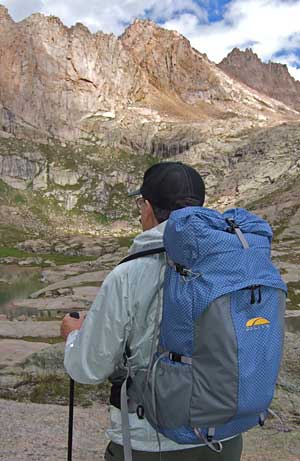
Six Moon Designs Traveler backpack on an early summer visit to the high country.

The relatively new Six Moon Designs Traveler is a panel loading version of their popular (and proven) Starlite backpack. It’s designed to perform double duty as a lightweight travel bag and backpack. The volume of the main pack body is the same as the Starlite, as are the side mesh pockets, removable stays, sleeping pad pocket on the backpanel, and the suspension system. The difference is the panel-loading system, where you lay the pack flat and access the contents through a front panel. The pack has a zippered top pocket instead of the extension collar and roll-down top closure on the Starlite. The front of the pack has a zippered mesh pocket and two compression straps, compared to a large open mesh pocket and a drawcord compression system on the front of the Starlite.

Backpacking Light published a review of the Starlite back in 2004 and found it to have the highest comfortable load carrying capacity of all the frameless backpacks we tested. Does the Traveler perform as well as its seasoned older brother?

Specifications

Year/Model 2010 Six Moon Designs Traveler (www.sixmoondesigns.com/)
Style Panel loading with removable stays
Volume 3800 cu in (62 L) total; 3000 cu in (49 L) in main pack body, 500 cu in (8.2 L) in side pockets, 300 cu in (4.9 L) in front pocket
Weight 2009 model tested. Measured weight 31.6 oz (896 g) with stays, 26.9 oz (763 g) without stays; manufacturer specification for current 2010 pack 29 oz (822 g) with stays, 24 oz (680 g) without stays
Sizes Available One size with adjustable torso length
Torso Fit Range Adjusts to fit torsos 15-22 in (38-56 cm)
Fabrics Body is 210d 4.5 oz/yd2 Dyneema Diamond ripstop, high wear areas are 420d pack cloth, outside pockets are a stiff mesh
Frame Material Contoured flat aluminum stays 0.5 in wide x 24 in long (1.3 cm x 61 cm)
Features Durable fabrics, removable contoured flat aluminum stays, removable hipbelt available in 3 sizes with or without pockets, 2 shoulder strap sizes, removable/adjustable sternum strap, zippered sleeping pad sleeve on backpanel, 1 zippered front mesh pocket, 3 side mesh pockets, 1 zippered top pocket, 2 front compression straps, daisy chain on top, 1 hose port (no hydration sleeve), 3D wicking fabric on inside of shoulder straps and hipbelt, load lifter straps, hipbelt stabilizer straps, ice axe loop, haul loop, bear canister compatible
Volume to Weight Ratio 120.2 cu in/oz (based on 3800 cu in and measured weight of 31.6 oz)
Maximum Comfortable Load Carrying Capacity 30 lb (13.6 kg) estimated comfortable load for an average person carrying the pack all day (with optional stays inserted and a folded ¾-length closed cell foam sleeping pad in the pad sleeve)
Carry Load to Pack Weight Ratio 15.2 (based on 30 lb and a measured weight of 1.975 lb)
MSRP US$180
Options Hipbelt pockets US$15, stays US$10

Description

At 3800 cubic inches (62 L), the Traveler is a larger volume frameless backpack. It’s designed with long distance hikers in mind, as a translation of the company’s name implies – six months (moons) on the trail. Long distance hikers need a pack that will carry higher volume and weight when needed, like after a re-supply, yet will compress down to accommodate diminishing loads as well. According to the manufacturer, the Traveler is designed to do just that and double as a secure travel bag, but does it deliver on all accounts?

The key design element of the Traveler (and Starlite) is the combination of a backpanel sleeping pad pocket and removable stays. A folded ¾-length closed-cell foam pad (like a Z-Rest or RidgeRest) inserted in the pad sleeve gives the pack substantial vertical rigidity, so this is a frameless backpack that will comfortably carry a substantial load. With the stays inserted, the pack will comfortably carry even more weight and more effectively transfer weight to the hips.

Six Moon Designs Traveler Backpack Review - 2
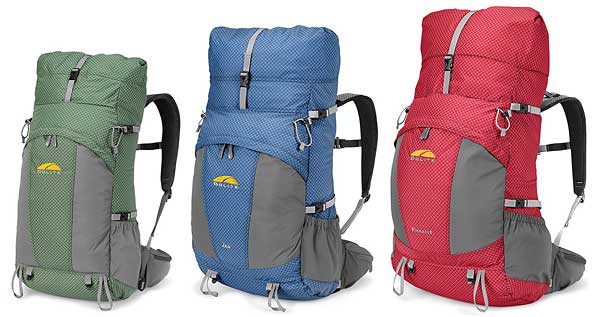
Views of the Six Moon Designs Traveler pack. The front view (top left) shows the pack’s panel access, mesh front pocket, and front compression straps. The backpanel view (top right) shows a corrugated sleeping pad in the zippered pad sleeve (more on that below), contoured shoulder straps, and large (optional) hipbelt pockets. The left side (bottom left) has one tall mesh pocket, and the right side (bottom right) has two mesh pockets.

Six Moon Designs Traveler Backpack Review - 3
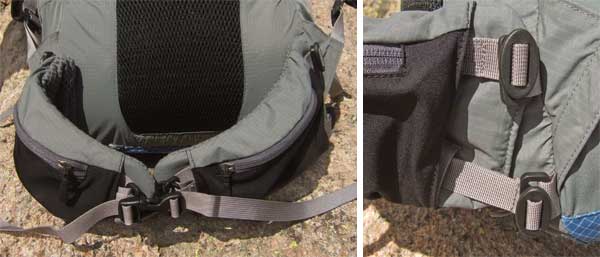
The pack has a removable hipbelt (left) that’s available in three lengths, with or without pockets, to fit different waist sizes. The hipbelt is 4.25 inches (11 cm) high and 3/8 inch (1 cm) thick. I tested the Traveler with a size medium hipbelt with pockets. The pockets (right) are some of the largest to be found; they will hold an assortment of smaller items for easy access on the trail, and they are functionally waterproof.

Six Moon Designs Traveler Backpack Review - 4
A fairly large bellowed mesh front pocket (left) is zippered to prevent the contents from falling out while traveling. It’s not as large as the front pocket on the Starlite. The sternum strap (right) has a wide vertical range of adjustment; I like to keep it lower on my chest as shown.

Six Moon Designs Traveler Backpack Review - 5
The torso adjustment at the top of the backpanel (left) attaches the shoulder harness at different heights. Here it is adjusted for the maximum length. The Traveler is available with two optional contoured flat aluminum stays (right, 4.7 oz/133 g, US$10) that slip into sleeves on the inside of the backpanel (inside the pack body).

Six Moon Designs Traveler Backpack Review - 6
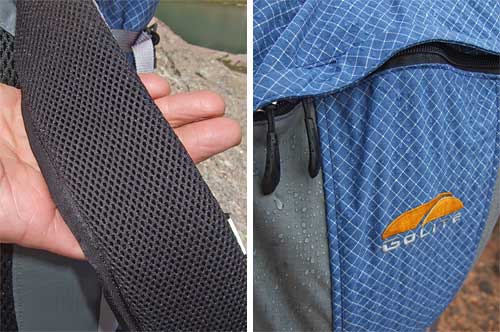
The pack’s contoured shoulder straps (left) are 2.75 inches (7 cm) wide where they ride on the shoulders. A closed-cell foam pad in the zippered sleeping pad sleeve (right) on the outside of the backpanel provides back padding and vertical rigidity for the pack. The stays reside behind the pad on the inside of the backpanel.

Performance

Six Moon Designs Traveler Backpack Review - 7
Carrying the Traveler pack on a high altitude backpacking trip in perfect weather – life doesn’t get any better than this! (And I caught a cutthroat trout on nearly every cast in the lake too.)

I tested the Traveler on four backpacking trips, ranging from a winter backcountry ski trip to a mountain cabin to multi-day spring and summer mountain backpacking. I carried loads ranging from 18 to 22.5 pounds (8.2 to 10.2 kg), with and without the stays for extra support, and with different sleeping pads in the pad sleeve. To test it at heavier weights, I loaded it up at home with heavier gear plus bottles of water to attain pack weights up to 32.5 pounds (14.7 kg).

The Traveler’s performance strongly depends on the user’s needs, and it clearly performs best under a particular set of conditions. To reiterate, the Traveler is designed to serve both as a travel bag and long distance backpack. It’s a larger volume pack, and the user must have a need for that volume. It will also serve lightweight backpackers well, if their gear will fill up the pack and weight is in the 25 to 30 pound (11.3 to13.6 kg) range.

For me, the Traveler is a bit of a conundrum for ultralight backpacking. The pack has too much volume for my gear kit, so I load my sleeping bag and down jacket unstuffed in the pack to fill up the volume. The pack’s two front compression straps do little to reduce the volume of the pack for smaller loads, so the pack size stays about the same regardless of the load.

Secondly, the pack will indeed comfortably carry higher volume and weighty loads, but its dependent on having a folded ¾-length closed cell foam sleeping pad (like a Z-Rest or RidgeRest) in the sleeping pad sleeve in order to do that, plus the stays for heavier pack weights. The problem for me is I rarely sleep on a closed-cell foam pad anymore, so I don’t really need the foam pad other than as a pack stiffener. An inflatable sleeping pad or thin foam pad (like the Gossamer Gear NightLight) does little to stiffen the Traveler for carrying heavier loads.

Six Moon Designs Traveler Backpack Review - 8
The Traveler pack in use as a day pack from camp – not very pretty. The pack compresses very little to accommodate smaller loads.

I also like to use a hydration system. It weighs a little more than a couple of soda bottles or a Platy flask, but it’s more convenient and I drink more. It’s noteworthy that the Traveler does not have a hydration sleeve, but it does have a hose port from the top pocket. The choices for using a hydration system are to put the reservoir in the top pocket or put it in the tall side pocket on the left side of the pack (as shown in the photos). The latter actually works well because it is easy to refill. I pack some heavier items on the opposite side of the pack to balance the weight.

The main point of this discussion is the Traveler is not very versatile in terms of its ability to adjust to different volumes and weights. It is best suited for a person who carries a moderate volume/weight load, like a lightweight backpacker, a long distance hiker, and of course a traveler/hiker. An ultralight backpacker will be happier with a backpack in the 3000 to 3500 cubic inch (49 to 57 L) range that compresses and expands well to accommodate different size loads.

So, what is the weight carrying capacity of the Traveler? The short answer is it’s about the same as the Starlite, which is around 30 pounds (13.6 kg). In my carry weight testing, with the optional stays inserted the Traveler carried 32.5 pounds (14.7 kg) of backpacking gear with reasonable comfort, which is remarkable for a frameless backpack. The key design element is the pack’s sleeping pad pocket which confines a ¾-length closed cell foam pad between the user’s back and the stays. The stays and folded pad create a virtual frame much stiffer than is possible with a pad coiled inside the main pack bag. The caveat here is this performance is dependent on a folded ¾-length closed cell foam pad confined in the pad sleeve; without it, or with a thinner foam pad or inflatable pad, the pack’s weight carrying capacity drops considerably.

The Traveler can be used without the stays for lighter loads, or with the stays for extra support and weight transfer when carrying heavier loads. But it’s not a true internal frame backpack because the stays are not anchored to the hipbelt, although the load leveler straps are anchored to the tops of the stays. The stays act as a pack stiffener, working in conjunction with a rigid foam pad to create an “enhanced virtual frame,” but they do not provide the same support and weight transfer as a backpack with a built-in internal frame.

A folded sleeping pad as described is about 3 inches (7.6 cm) thick when compressed against the back, so it pushes the pack’s center of gravity outward. Consequently it’s important to load the pack so heavier items are against the pack’s backpanel, preferably in the center of the pack. Since the pack’s volume can’t be reduced very much, the Traveler performs best when the pack is fully expanded with a full load of gear.

Six Moon Designs Traveler Backpack Review - 9
One defect in my sample pack is the elastic binding on one of the mesh was not adequately sewn to the mesh, so a section of the mesh pulled out.

Comparisons

The following table compares packs currently available that have removable stays, allowing the pack to be used either frameless or with the stays inserted for extra support. Note: information is manufacturer data for a size Medium pack.

Pack Total Weight With Stays (oz/g) Volume (cu in/L) Fabric Stay Description Stay Weight (oz/g) Adjustable Torso Cost (US$)
Six Moon Designs Traveler 29.0/822 3800/62 210d Dyneema 2 flat contoured aluminum 5.0/142 Yes 180
Six Moon Designs Starlite 30.0/850 4200/69 210d Dyneema 2 flat contoured aluminum 5.0/142 Yes 180
Gossamer Gear Gorilla 23.2/658 2800/45.9 210d ripstop Contoured aluminum tubing 3.4/96 No 180
Gossamer Gear Mariposa Plus 22.3/632 3600/59 70d ripstop Contoured aluminum tubing 3.4/96 No 170

The Six Moon Designs Starlite has a little more volume than the Traveler because it is a top loader with an extension collar, otherwise the packs’ dimensions, suspension system, and weight are very similar. The Gossamer Gear Mariposa Plus has similar volume to the Traveler and weighs 6.7 ounces (190 g) less, but its comfortable load carry capacity is less. The Gossamer Gear Gorilla is a smaller pack, so it is not a very close comparison.

Assessment

The Six Moon Designs Traveler and Starlite have the same suspension system and are basically the same size pack. The difference is the Traveler is a panel loader and the Starlite is a top loader. The only real reasons for getting the Traveler instead of the Starlite would be: 1) use as a travel pack, and 2) a preference for a panel loading design. As a travel pack, the Traveler’s dimensions are too large to qualify as carry-on baggage on most airlines, and the side pockets are not zippered to make sure things don’t fall out.

For use strictly as a backpack, I would personally prefer the Starlite over the Traveler. The Starlite is a conventional top loader and has a little more compression capability than the Traveler, but it still does not have enough compression to reduce pack volume adequately for smaller loads.

To get the best performance from a frameless backpack (including when optional stays are inserted), its important to use a closed cell foam pad, either coiled around the circumference of the pack bag or folded against the backpanel to create a virtual frame to stiffen the pack and transfer weight to the hips. It’s also important to completely fill the pack so it’s a firm, solid unit. That is accomplished by purchasing a pack that has a volume close to the volume of your normal gear kit and using the pack’s volume adjustment and extension collar to handle smaller and larger loads. Applying these principles to the Traveler and Starlite runs into some potential obstacles: 1) if you use an inflatable sleeping pad, the pack’s weight carrying capacity is significantly reduced, and 2) the Traveler is a larger volume frameless backpack and it has limited volume reduction capability to accommodate smaller loads.

Overall, the Traveler’s (and Starlite’s) stellar performance is limited to a particular set of conditions (higher volume and weight, use of the optional stays, and a folded ¾-length closed cell foam sleeping pad). If that is your situation most of the time, this is your pack, especially if you travel a lot. However, if you use an inflatable sleeping pad, your gear kit is a smaller volume, and you don’t intend to travel with the pack, you would be better served with a smaller top-loading frameless backpack. If you consistently carry loads heavier than 30 pounds (13.6 kg), I recommend getting a an internal frame backpack rather than a pack with removable stays

What’s Good

  • Serves as both a travel pack and lightweight backpack
  • Pack volume is just right for lightweight backpacking and long distance backpacking
  • Adjustable torso length
  • Three hipbelt sizes and two shoulder strap lengths to fit most hikers
  • Removable stays provide extra stiffening and better weight transfer for heavier loads
  • Hipbelt and sternum strap are removable, allowing some weight reduction
  • Durable fabrics and mesh
  • Outside mesh pockets hold a lot of gear
  • Higher comfortable load carrying capacity than other frameless backpacks

What’s Not So Good

  • Too much pack volume for ultralight backpacking
  • Minimal compression capability, so the pack does not accommodate smaller volume loads very well
  • No hydration sleeve, so a hydration bladder must be placed in the top pocket or a side mesh pocket
  • Stays do not anchor to the hipbelt, so they function as a pack stiffener rather than a true internal frame

What’s Unique

The combination of a backpanel sleeping pad sleeve containing a folded ¾-length rigid foam pad and removable flat aluminum stays create an “enhanced virtual frame” that allows the Traveler to comfortably carry more weight compared to other frameless backpacks.

Recommendations For Improvement

  • Develop an improved compression system that will allow the pack to better contain smaller volume loads
  • Offer a stiff plastic framesheet that can be inserted in the pad sleeve to achieve better weight transfer when an inflatable sleeping pad is used

Disclosure: The manufacturer provided this product to the author and/or Backpacking Light at no charge, and it is owned by the author/BPL. The author/Backpacking Light has no obligation to review this product to the manufacturer under the terms of this agreement.

High Gear ATF8 Multi-Function Device

The ATF8 is almost everything I am looking for in a multi-function watch, without being merely a watch. It has proven to be accurate, durable, and easy to learn and use.

Introduction

Highgear ATF8 Multi-function Device - 1

The new 1.6 oz (44 g) Highgear ATF8 puts a lot of features in a small, compact package. As part of the company’s Summit Series of products it is made with the outdoors person in mind. How does it work for backpacking?

Design & Features

The High Gear ATF8 is based on the company’s Alterra Multi-function watch. What’s the most noticeable difference? They lost the watch band. The ATF8 is made to be carried, not worn. It has a carabiner-style attachment for hanging from a loop or strap on a backpack. The carabiner can also fold into a groove in the back of the unit to make for a compact pocket carry. The carabiner ratchets as it closes and can be stopped in various positions to allow it to sit on display. A coin slot in the back lets the ATF8’s CR2032 coin-style battery be accessed.

The ATF8 has a slew of functions. It has dual time zones, compass, altimeter, barometer, standard chronograph, special ski chronograph, dual alarms and data logs for the chronograph and altimeter. I won’t get into all those – I didn’t use many! – but you can scan the company’s online manual for some light reading to acquaint yourself with all those bells and whistles.

Highgear ATF8 Multi-function Device - 2
The ATF has a carabiner-style attachment that may also be folded completely flat or left half-way to form a stand for the unit.

Highgear ATF8 Multi-function Device - 3
The ATF8 has five buttons around the side of the case (button functions described below). It’s in time mode here, where I normally keep it.

S1 Key:

  • Changes view in time, barometer, altimeter, altimeter log, and chronograph log modes
  • Start/Stop information storage in altimeter mode
  • Advances variable in setting mode
  • Start/Lap/Split action in chronograph mode
  • Starts ski chrono
  • Turns daily alarm on/off

S2 Key:

  • View/Select Time 1/Time 2 in time of day mode
  • View Select C/F and inHg/mbar in barometer mode
  • View/Select ft/m in altimeter mode
  • Scroll through altitude log files
  • Turn altimeter alarm on/off
  • Stop chronograph/save chronograph files
  • Scroll through chronograph log files
  • Store base altitude in ski chronograph
  • Select alarm 1 or 2

S3 Key

  • Activate EL backlight system

S4 Key

  • Advances display through the various operational modes
  • Selects variables in setting mode

S5 Key

  • Enter/Exit setting mode for each function
  • Clear chronograph and altimeter memories

The ATF8 is equipped with a Swiss-made barometric sensor. The barometer measures the Absolute Barometric Pressure and calculates the Barometric Pressure corrected to Mean Sea Level. Once calibrated, the barometer tracks changes in pressure and will give a “weather forecast” in the form of a little icon in the upper right-hand area of the screen. The main temperature screen is found in barometer mode.

The altimeter function works with the barometer. When climbing or descending (and again, after calibrating the unit to your known elevation first) the unit uses the change in pressure to calculate the change in elevation. While in this mode, an altitude alarm can be set to alert one of reaching a desired elevation.

Highgear ATF8 Multi-function Device - 4
The ABCs of what I want from my device. Left: Altimeter mode with time and temp. Center: Barometer mode with pressure listed as Inches of Mercury and graph showing pressure trend. Right: Compass mode.

The last function I really use is the digital magnetic compass. It shows the current heading in quarter cardinal points (so the center one is your heading) and the current heading in degrees at the bottom of the screen. In the picture above, I am just one degree off straight north.

Performance & Assessment

I received the ATF8 in January 2010 and have brought it on every backpacking trip since. Looking at my log, I have carried it for 621 miles (1000 km) to date. Most use has been in the Sierra Nevada of California, the rest in northern Minnesota.

Unless testing something else, I have been carrying one of the company’s AltiTech 2 carabiner-style units for the past six years. I like the ATF8 much better. I carry it attached to the shoulder or sternum strap of my backpack at all times. While I have tested watches, I do not care for anything on my wrist so I really like this style of carrying.

The main function that I use with any of these multi-function devices is the altimeter. As most of my backpacking is on trail and in mountainous terrain, I find that a good altimeter is easier and faster to track where I am on a map than with a compass.

I make a point to calibrate the unit at known locations, usually at the top of a pass. If I know beforehand where I am going to stop for the night, I will write that spot’s altitude on my map and recalibrate it when I get into camp too. Calibrating is easy to do, although having owned other of the company’s products helped I am sure. The ATF8 has done very well in its accuracy between calibration spots. It is normal to see a difference of around 20 ft (6 m) after a day that saw 4000 ft (1220 m) or more of elevation gain and loss. On one torture test I calibrated it on the top of Mt. San Gorgonio (11,499 ft/3505 m), drove back home to sea level for five days, and took it to Mt. San Jacinto (10,835 ft/3303 m) the next weekend. After all the time and elevation and pressure changes it was 120 ft (36.5 m) off.

Once in camp I set it to barometer mode and use it to track the temperature and the pressure/weather. The thermometer is very accurate but equalizes quite slowly. I checked it against a certified thermometer and it was dead on, after sitting for about five minutes. With a range of only 14 to 122 F (-10 to 50 C) I can’t rely on it for all my trips. In the Sespe Wilderness I was reading 119.5 F (48.6 C) in the shade at 3:30 pm, so it was probably hotter on the hike in. And more recently I was on the North Country Trail in northern Minnesota where I woke up to a reading in my tent of 19.8 F (-6.8 C) at 7:00 am. In another week or so I will be out of its range for lows. I would like to see a greater range.

The forecasting icons work well, but in the mountains the building thunderheads often tell me the same thing. ;-) On a recent trip in the Sierra I noticed the icon change to “rain” and told my brother-in-law that it seemed weird as it was pretty nice out. As we crested the next pass to start our descent to the trailhead we were treated to the sight of clouds which continued to build. By the time we got down it was raining. How dare I question the ATF8?

Highgear ATF8 Multi-function Device - 5
Left: the ATF8 hitches a ride on my pack’s sternum strap in the Sespe Wilderness. Right: the water resistance was tested hard in three straight days of rain on the Pacific Crest Trail. It survived, my rain gear did not…

While I don’t need a compass to orient by (and if I did, I would bring a true map-reading analog model) I do use one often to check heading to make sure I am on the correct trail. In flat Minnesota, the woods can be so thick that often the heading of the trail and lakes I pass are the only way to keep track of where I am. The digital compass of the ATF8 works great for this. And since I have been bouncing back and forth between California and Minnesota, the ease of recalibrating the compass and resetting the declination is a blessing. It takes me about a minute to set it for each state once I get there. From what I can tell the accuracy is spot on when compared to my two Rangers.

The alarm is very faint. I have used it only two times. Once to alert me to a turn-around time as I needed to go back to my camp before it got dark, the other an early wake-up. I heard the alarm when it went off while the ATF8 was hanging on my pack. I never heard it go off in my tent. This has been true of the AltiTech units too. It must be noted that my ears do not register high sounds well when background noise (like wind) is present, due to too much powder actuated tool (think guns) use when I was younger.

The unit is said to be water resistant to 5 ATM. High Gear says that it “is designed to be water resistant to a static pressure of 5 ATM and can be worn while showering and light swimming.” As I wrecked one of the AltiTechs by dropping it in 3 inches (7.5 cm) of water in a tiny creek along the Pacific Crest Trail, I did not put the swimming claim to the test. I did carry it in the rainiest backpacking I have ever experienced this spring in California, where many records for rainfall were set in 2010. I clearly remember three days of PCT hiking that it rained all day long. I left the ATF8 on my pack through it all, and it did fine. My rain gear, on the other hand, failed miserably. Well, I was miserable, that was for sure.

Because of where I carry the ATF8, it has seen its share of hard knocks when my pack falls over. As can be seen in some of the pictures, it is getting scratched up a bit but has proven quite durable so far. I am still on the original battery and even in the cold of the last trip it is showing no sign of wearing down. (When battery gets low, the display fades during use.) The blue EL backlight works well but I usually just use my headlamp to check it during the night.

If there was one thing I could change about the ATF8 it would be a way to disable the functions that I do not want or use so that I did not have to waste time scrolling back through them all to get to the ones I do use. My Kestrel lets me remove any functions I don’t need.

A way to scroll backwards would be even better. When I stop to take a quick heading with the compass, I just have to push one button. But to get back to where I to the time mode I have to push eight more, traveling forward through all the functions.

All told I am very satisfied with the ATF8, so much so that I gave my AltiTech 2 away. I look forward to many more trips with it feeding me my backcountry data.

What’s Good

  • Accurate functions.
  • Easy to calibrate.
  • Long battery life.
  • Don’t have to wear it on my wrist!

What’s Not So Good

  • No way to remove unwanted functions.
  • Forced to scroll through everything to get where I want.
  • Too-faint alarm chime.

Disclosure: The manufacturer provided this product to the author and/or Backpacking Light at no charge and is owned by the author/BPL. The author/Backpacking Light has no obligation to review this product to the manufacturer under the terms of this agreement.

Black Diamond Infinity 60 & Innova 50 Backpack Review

Freedom of movement is the next advancement in internal frame backpack technology, but it appears to have limitations.

Introduction

Black Diamond Infinity 60 & Innova 50 Backpack Review - 1
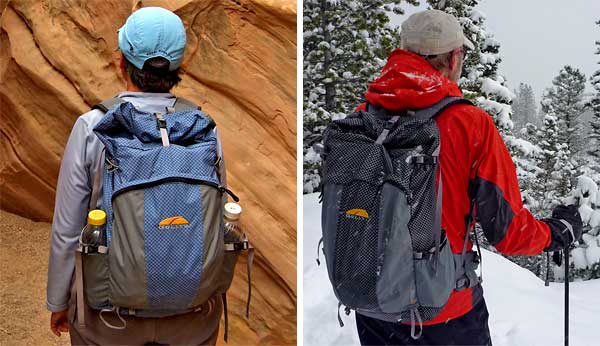
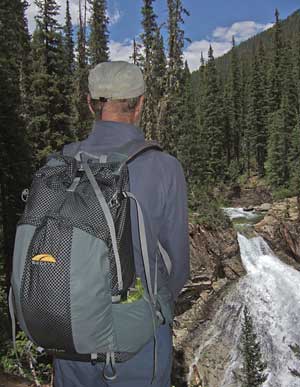
Black Diamond women’s Innova 50 (left) and men’s Infinity 60 (right) on a summer backpack in the southern Rocky Mountains. The large bagged item under the top pocket (right) is a plastic raft that someone abandoned at a wilderness lake.

Black Diamond introduced their Infinity and Innova backpacks in spring 2010. These are dedicated backpacking packs, not climbing packs. A much expanded line of backpacks of all types will be introduced in spring 2011.

By lightweight standards, the Infinity/Innova packs at 3.75 pounds (1.7 kg, size Medium) are just above our upper weight limit of 3.5 pounds (1.6 kg), but they are still lightweight considering the technologies they incorporate. What is remarkable, and why we decided to review the new Black Diamond backpacks, is their ergoACTIV suspension system. According to Black Diamond: most backpack manufacturers have now incorporated lighter weight materials and ventilated backpanels into their backpack line; the next innovation needs to be freedom of movement. In the ergoACTIV suspension system, the frame, shoulder straps, and hipbelt pivot and twist in concert with the hiker, allowing the backpacker to move unrestricted in any direction. The obvious questions from our standpoint are: does it really work, are the benefits useful, and if so, do they justify the weight of the technology?

Specifications

Year/Model 2010 Black Diamond men’s Infinity 60 and women’s Innova 50
Style Built-in internal frame, top loading with floating top pocket
Volume Infinity 60 is 3660 cu in (60 L), Innova 50 is 3050 cu in (50 L) for size Medium
Weight Size L Infinity and size Small Innova tested.
Measured Weight: Infinity 60 4 lb 3 oz (1.9 kg), Innova 50 3 lb 11.8 oz (1.7 kg)
Manufacturer Specification: Infinity 60 3 lb 13 oz (1.74 kg), Innova 50 3 lb 12 oz (1.7 kg) for size Medium
Sizes Available Men’s M, L
Women’s S, M
Fabrics 210d ripstop nylon and 400d nylon twill
Frame Material HDPE framesheet with attached peripheral 6061 aluminum frame
Features ErgoACTIV hipbelt, SwingArm shoulder straps, OpenAir backpanel, floating top pocket with zippered access (key clip inside), two stretch nylon side pockets, large front stretch nylon and fabric kango pocket, one fabric hipbelt pocket, two front tool holders, two concealed ice axe/trekking pole loops, four side compression straps, one top compression strap, two removable sleeping pad straps, load lifters, hipbelt stabilizer straps, adjustable sternum strap with whistle, pulley-type hipbelt, 3L internal hydration sleeve with one center hose port
Volume to Weight Ratio 57.4 ci/oz for the Infinity 60, 49 ci/oz for the Innova 50 (based on 3845 and 2929 ci, respectively, and measured weights of 67 and 59.8 oz, respectively for the pack sizes tested)
Maximum Comfortable Load Carrying Capacity 30 lb for the Infinity 60
25 lb for the Innova 50
Estimated comfortable load for an average person carrying the pack all day
Carry Load to Pack Weight Ratio 7.16 for the Infinity 60 and 6.68 for the Innova 50 (based on 30 and 25 lb and measured weights of 4.19 and 3.74 lb, respectively)
MSRP Infinity 60 US$220
Innova 50 US$200

Suspension System and Features

The Infinity and Innova backpacks have a unique ergoACTIV suspension system that provides freedom of movement. It consists of three design elements: an ergoACTIV hipbelt connected to a pivot hub on the backpanel that allows the hipbelt to swivel, SwingArm Shoulder Straps that are connected to each other by a cable and housing that allow the shoulder straps to move from side to side in tandem with the hipbelt, and a V-Motion Frame that transfers weight to the hipbelt. These three components working together allow the backpack to freely move from side to side and twist to the right and left with the user.

The pack’s frame consists of a HDPE framesheet and attached peripheral curved aluminum tubing to create a very supportive unit in the vertical direction while providing some horizontal and torsional flexibility to conform to and move with the user’s back. The frame unit is bendable to create a customized anatomical contour to match the user.

Black Diamond Infinity 60 & Innova 50 Backpack Review - 2
The packs’ ergoACTIV hipbelt is attached to a pivot hub on the backpanel (left), which allows the hiker to lean unrestricted to the left and right. The bottom ends of the shoulder straps are connected by a cable and housing (like a bicycle brake cable) to provide about 1.5 inches (3.8 cm) of travel. The pivot hub (right) slides up and down and locks in position to provide 2.5 inches (6.4 cm) of torso length adjustment.

Black Diamond Infinity 60 & Innova 50 Backpack Review - 3
The pack’s OpenAir backpanel (left) provides ventilation and conforms to the user’s back; shoulder straps (right) are contoured and well padded. The suspension system on the women’s Innova pack is anatomically contoured for women.

Black Diamond Infinity 60 & Innova 50 Backpack Review - 4
Views of the Black Diamond Infinity 60: The frontpanel (top left) has a large capacity stretch nylon and fabric kango pocket; the backpanel view shows the pack’s pronounced lumbar pad, ergonomic hipbelt, and ventilated backpanel; each side (bottom left) of the pack has a stretch nylon pocket that can be reached with the pack on; and the top (bottom right) shows the pack’s roomy floating top pocket.

Black Diamond Infinity 60 & Innova 50 Backpack Review - 5
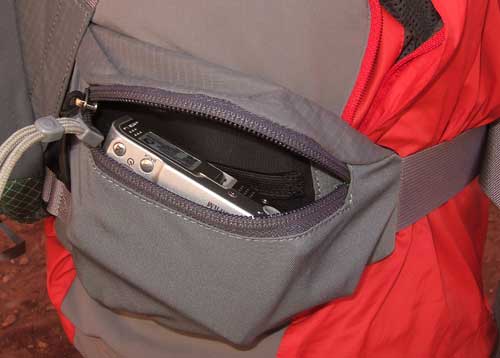
Pockets: The Infinity and Innova have a total of five pockets: a large capacity kango pocket on the front (left), two stretch nylon side pockets (center), one hipbelt pocket (right), and a large floating top pocket. The right side hipbelt pocket is (barely) large enough to hold a compact digital camera as shown; the left side is blank, without any strap or other means to attach an accessory pocket.

Field Testing

Black Diamond Infinity 60 & Innova 50 Backpack Review - 6
We tested the Infinity and Innova backpacks on several summer backpacking trips in the southern Rockies.

Our first time experience with the ergoACTIV suspension was: “Whoa, this pack is looser than a goose!” We are accustomed to backpacks that “stick” to our back, so the freedom of motion feature feels strange at first and requires some getting used to. The pack leans sideways with you, and twists as you twist. This freedom of movement is nice, but I wondered if it’s really needed for ordinary on-trail backpacking. After all, I am basically satisfied with a typical internal frame backpack that “sticks” to my back and allows me to comfortably carry a load down the trail.

On a solo trip, I carried a lighter load (24 lb/10.9 kg) in the Infinity 60 while hiking off-trail and found the freedom of movement feature more beneficial. When negotiating rougher terrain, it is helpful to carry a pack that moves with me, rather than restricts my movements. My conclusion is the ergoACTIV suspension performs well and is useful in situations where the extra agility is really needed, with the caveat of carrying a lighter load. A heavier load can throw me off balance when I’m in an awkward position, and the freedom of movement feature can work against me.

The heaviest load I carried with the Infinity 60 was 32 pounds (14.5 kg) while climbing a steady grade on-trail to gain 3000 feet (914 m) of elevation over 6 miles (9.7 km). With this heavier load (not all that heavy by conventional backpacking standards), I felt the pack weight concentrated on the pivot hub at the back of the lumbar pad, which caused some lower back fatigue by the end of the day. Also, the weight bearing down on one point at the back of the sternum pad caused the hipbelt to lever and press into my stomach, which was also uncomfortable. The problem was exacerbated by my tightening the hipbelt more to carry the heavier load on my hips. Note that most internal frame backpacks are designed to transfer and distribute weight to a much broader region of the hipbelt, rather than to a single point.

On a subsequent trip, carrying 28 pounds (12.7 kg) on secondary trails, I did not experience the problem, so there appears to be a threshold where pack weight concentrated on a single point (the pivot hub on the back of the sternum pad) causes discomfort. Overall, for me, the Infinity 60 carries loads up to about 30 pounds (13.6 kg) quite comfortably, but above that the concentrated weight on the pivot hub creates some less comfortable dynamics. For many lightweight backpackers, who carry loads in the 25-to 30-pound (11.3- to 13.6-kg) range, this should not be much of an issue.

Janet never really tested the upper load carrying limits of the Innova 50 pack, mainly because she has me to be the pack mule! She completely filled the Innova with bulky loads in the 15- to 18-pound (6.8- to 8.2-kg) range and was very pleased with the pack’s fit and comfort.

Assessment

Overall, aside from the issue described above, the Black Diamond men’s Infinity and women’s Innova are very nice backpacks. They are exceptionally well designed and constructed to fill the needs of most lightweight backpackers. We especially liked the packs’ fit, contoured backpanel, anatomical hipbelt, comfort, large front kango pocket, large floating top pocket, and reachable side pockets. We would prefer two hipbelt pockets, rather than one, and a larger capacity to more easily hold a digital camera. For a new pack model, the Infinity/Innova gets most of the details right.

However, the ergoACTIV suspension is a mixed bag. It delivers freedom of motion quite well and remains comfortable (for me) up to around 30-pound (13.6-kg) loads, but with heavier loads, the concentrated weight on the pivot hub creates uncomfortable leverage on the hipbelt. This effectively limits the comfortable load carrying capacity of the pack to around 30 pounds (13.6 kg).

We are neutral on the benefits of the freedom of movement feature while hiking on a good trail. It’s nice, but it doesn’t make the load any lighter or easier to carry. However, the freedom of movement feature is appreciated much more while carrying light to moderate loads over rougher terrain. Also, it very likely will make a difference for traveling on skis or snowshoes, but we did not have an opportunity to test that out.

Weight-wise, the Infinity 60 compares favorably with similar backpacks. The current Osprey Aether 60 now weighs 4 pounds 14 ounces (2.2 kg) for size Medium, so the Infinity 60 is a full pound lighter, based on manufacturer data for size Medium. However, there are lighter similar-sized internal frame backpacks to be found, as covered in Roger Caffin’s state-of-the-market series on Lightweight Internal Frame Backpacks.

What’s Good

  • Innovative ergoACTIV suspension provides freedom of motion
  • OpenAir backpanel is contoured to fit the back and provides good ventilation
  • Adjustable torso length
  • Lightweight durable fabrics and frame materials
  • Large front kango pocket is very handy for stuffing a jacket or carrying a wet shelter
  • Numerous pockets for organizing and convenient access
  • Fits well; women’s model is sized and contoured to fit a woman
  • Comfortably carries moderate loads

What’s Not So Good

  • With heavier loads, weight concentrated on the pivot hub leverages the hipbelt causing discomfort
  • Only one hipbelt pocket

Recommendations For Improvement

  • Provide two larger hipbelt pockets
  • Revise the pivot hub and hipbelt so they distribute weight better

Disclosure: The manufacturer provided this product to the author and/or Backpacking Light at no charge, and it is owned by the author/BPL. The author/Backpacking Light has no obligation to review this product to the manufacturer under the terms of this agreement.

Valley Hopping in the Cordillera Huayhuash – Global Test Photo Essay

Hopscotch over lakes, skip the main trail, and discover the jewels of Peru.

Editor’s Note: click here to see all the articles (and a brief synopsis of each) in this excellent series.

Introduction

Valley Hopping in the Cordillera Huayhuash - 1
Most of the trekking trails in the Cordillera Huayhuash are shared with local inhabitants and their herds.

While down-climbing through a steep, rocky ravine on our way to Laguna Jurau, I silently cursed our maps. Yes, “maps,” as in the plural of “map.” We brought two maps while circuiting the Cordillera Huayhuash Range. The first was a free map the size of an index card which showed the trails we wanted to use. The second was a 1:50000 topographical map which (teasingly) marked the passes, but not every trail over the passes. As we descended the second pass of the day (Punta San Antonio, at 5,010 meters), the trail grew fainter and fainter as the terrain steepened. It was five o’clock, and the sun would set in an hour. We could gamble that successfully navigating through the scree-filled ravine would lead us safely to the valley. Or, we could pitch our tent on the sloped mountain, 300 meters below the nearest water source, and look for the trail down to the valley in the morning. If there was another trail.

Moments like these really test a team’s communication, trust, and ability to tackle difficult problems. Danny and I had been traveling together through Latin America for the last 34 weeks and had experienced many highs and lows, but we took on surprisingly uncharacteristic roles in the dwindling daylight on this fourth day of our trek. Danny, usually calm and positive, was worried because we had no ropes, harnesses, and helmets, but we had not planned on coming across this type of terrain. I had never seen him scared or unsure, and fortunately this triggered my inner calm instead of my natural hysteria. I was supportive, markedly positive, and brave. Danny made the decision to continue climbing down through the gorge, and I listened carefully to his directions of “foot here, hand hold there” as he maneuvered us down the steeper walls.

Some might call it luck, but I give all the credit to my husband. He guided us through the ravine, and it provided safe passage to the valley. An hour after our panic, we shooed away some stray cattle and set up our tent in the fading light, on a small flat area not far from a trickling stream. Our view encompassed two mountain lakes, several glaciers, green sloping pastures, fragrant violet wildflowers, and no buildings, tents, or other people. Just us.

Valley Hopping in the Cordillera Huayhuash - 2
Our only semblance of a home: the Tarptent Double Rainbow nestled between bushes of wildflowers and steep lush pasture.

Logistics

The Cordillera Huayhuash is a thirty-kilometer mountain range located in the Andes of Peru. It contains the towering snowy peak of Siula Grande (6,344 m), which was made world famous in the book Touching the Void. The trekking trails can be reached in six hours, mas o menos, by vehicle from Huaraz. Unfortunately Huaraz does not have a nearby or large airport, so the best option is to fly to Lima and take an eight-hour bus to the trekking capital of Peru. From Huaraz to and from the trailheads, we traveled in a variety of local buses, taxis, and hitches, which is much cheaper than hiring a personal vehicle. Although the Huayhuash is a bit tricky to travel to, the remoteness is part of its attraction.

Spending a few days in Huaraz can be part of an acclimatization plan because it lies at 3,052 meters above sea level. Danny and I had been slowly acclimating for seven weeks as we traveled south through the Andes of Colombia and Ecuador. Doing hikes and summits along the way prepared us for this week of sleeping every night above 4,000 meters.

Ours Were Not the Smallest Packs

It is not difficult to comparably “go light” around the Huayhuash because most other hikers are part of entourages with hired cooks, guides, and pack animals that carry most of the equipment. The trekkers carry only day packs with clothing and water. They also tend to stick to a set itinerary, and because we like our solitude, hopping from valley to valley over the high passes allowed us to avoid the crowds. In our seven-day hike around the mountain range, we came upon only three tourist groups and no independent hikers.

Valley Hopping in the Cordillera Huayhuash - 3
These mules walk from campsite to campsite, carrying the absurd amounts of gear needed for supporting large groups of tourists.

Danny and I did not have the luxury in selecting from a variety of gear when packing for this seven-day trip into the wilderness. We had only the gear in our two backpacks, which had allowed us to comfortably backpack in the jungle of Costa Rica, the mountains of Patagonia, and the remote beaches of Brazil. Additionally, Danny had the foresight to send our down jackets to our friend’s house in Huaraz. As it turned out, they were a necessity for staying warm in the winter weather we experienced in the Huayhuash.

Day 1: Quartelhuain (4,170 m) to Laguna Mitococha (4,230 m) via Cacananpunta Pass (4,690 m)

The availability of public transportation in Peru, even to remote villages, makes traveling convenient if you can speak and understand a few phrases of Spanish and if you are not in a hurry. The collectivos frequently pick up and drop off the lively locals and their cargo, which may include live animals, furniture, and large sacks of fresh produce. We caught one of these minivans from Huaraz to Recuay, where we came upon a tourist group on a pitstop. They were headed to the same trail head as us, so we negotiated a ride with the driver.

The big, bright tents waiting for our van of loud foreign twenty-somethings at the trailhead encouraged us to take advantage of the last hours of daylight. We wanted to have much physical distance from the entourage to ensure we would not keep crossing paths throughout the week. As we all piled out of the van, Danny and I threw on our warm layers and swung on our packs. After answering the usual questions about where we were sleeping (“How can you fit a tent in your small pack?”), we headed over one of the lowest passes of the week, Cacananpunta, at 4,690 meters. After crossing the ridge, we did not see the group ever again.

Darkness approached as we entered the river valley, and we used our headlamps to guide us up the marsh to the lake, where we wanted to camp. When we saw the glistening reflection of Laguna Mitococha in the moonlight, we started searching for a clean, flat spot to pitch our tent. It is wonderful that most of the Huayhuash is pasture, because that makes for a soft place to rest one’s head. However, the pasture is food for a variety of animals which most definitely do not have Leave No Trace (LNT) training. It is hard enough to avoid stepping in a pile of poop, let alone find a whole poop-free two square meters to pitch a tent. Therefore, I prefer to search for a campsite in the dark because then I am blissfilly unaware of how much poop I am stepping in and sleeping on.

Valley Hopping in the Cordillera Huayhuash - 4
We were impressed with the abundance of hearty flowers found at the high elevations.

Day 2: Laguna Mitococha to Laguna Quesillococha (4,332 m)

via Carhuac (Yanapunta) Pass (4,640 m) and Laguna Gangrajanca (4,245 m)

Trekking up the valley to sleep near the lake the day before took us off the main tourist circuit, so we started the next day by backtracking a few kilometers. Even though we met up with the main trail, we did not see anyone but a shy toddler and his father who offered to sell us Coca-Cola as we walked past their house. In the afternoon we cut off the main trail to search for a trilogy of lakes nestled under several glaciers.

Valley Hopping in the Cordillera Huayhuash - 5
After leaving camp, Danny rushed ahead to snap this shot of me hiking up the pass.

Jungle animals, exotic birds, blooming colorful flowers, white sandy beaches – I will trade them all for a view of a glacier and its lake. I can spend hours watching the sun move shadows across the turquoise chunks and perfectly smooth white-frosted slopes. I wait patiently for the crack and thunder of an avalanche, quickly scanning the mountain for moving snow. We traded a bit of comfort and convenience when pitching our tent, so that we could satiate our eyes with a view of the towering peaks and aquamarine lakes. Unfortunately, that meant cooking next to either a cow pie or a cactus. I chose the cactus.

Valley Hopping in the Cordillera Huayhuash - 6
Our favorite dinner recipe: 250 grams of whole wheat pasta, one half of a dried tomato soup packet, two cloves of garlic, and a handful of walnuts.

Day 3: Laguna Quesillococha to Laguna Viconga (4,530 m)

via Siula Punta (4,834 m) and Portachuelo de Huayhuash (4,785 m)

When I peeked out under the vestibule in the morning, I was not surprised to find frost on the grass, because I had awoken a few times in the night to shiver, cuddle closer to Danny, and fall back asleep. We were both surprised, however, to find that both vestibule zippers were frozen and inoperable. Closer inspection revealed that the inside of our tent was coated in ice as well. We needed no other excuse to stay in bed awhile longer. After discussing what we could do differently to keep me warm, we made the decision to wear our “skirt” the following evening. Danny and I have similar Rab jackets which zip together, and many times have slept with them encircled around our legs. I stuff my feet into a hood, and the sleeves take up space in our shared sleeping bag, reducing air volume. This strategy proved helpful the rest of the week, as we slept soundly despite finding ice in our tent the next four mornings.

Valley Hopping in the Cordillera Huayhuash - 7
Ice crystals add to the beauty of these miniature mountain plants.

Foregoing a hot breakfast, we kept warm by hiking up to the pass. At 4,834 meters, we laid out our tent to dry in the strong early morning sun, and cooked kiwicha oatmeal. With our stomachs full and our fingers thawed, we descended into the valley where we exhausted ourselves by jumping instead of walking. The terrain was a bit swampy, but we kept our feet dry by jumping from green mound to green green mound. With every leap, I felt a twinge of guilt for the beautiful mountain life I was crushing.

Valley Hopping in the Cordillera Huayhuash - 8
Mt. Carnicero reflected in a pool. By jumping onto these dirt mounds, we kept our feet dry.

It was a long haul to Lake Viconga. We skirted around the campsite full of bright tents and boisterous hikers and headed up into the valley toward the pass. The valley curved left and after twenty minutes, we found a flat spot to pitch the tent, out of sight from the lake. I cooked dinner, taking a short break to chase away a curious mule, while Danny shot photos of the bright red sunset.

Valley Hopping in the Cordillera Huayhuash - 9
Easily viewed from far away, the signs of a guided trip: big bright tents, lots of mules, cooking and camping next to the water source.

Day 4: Laguna Viconga (4,365 m) to Laguna Jurau (4,350 m camp)

via Punta Cuyoc (4,950 m) and Punta San Antonio (5,010 m)

Valley Hopping in the Cordillera Huayhuash - 10
Danny turning around to admire the view near the top of Punta San Antonio.

The ascent up the first pass of the day was long, but gentle and did not prepare us for the severity of Punta San Antonio. While side-stepping up the steep grade of our second pass of the day, we encountered the only other tourist group of the week. They were descending from the pass and carrying only day packs. They enjoyed an afternoon hike while their porters built camp down the valley near the main trail. We inquired if they had come over the pass, but they had ascended the same trail and turned around at the pass. We asked if there was a trail on the other side of the pass, and they laughed and replied “no.” Even though we planned to hike down the other side of the pass, their answer did not worry us because the pass was marked on our small map, and these hikers were doing an out-and-back so they probably did not pay too much attention to the terrain on the other side. When we reached the top of the pass, I saw faint markings of a footpath on the crumbly rust-colored rock. Little did I know that the trail would not be visible much longer.

Valley Hopping in the Cordillera Huayhuash - 11
Perhaps the view distracted us from finding the trail.

As described in the beginning of this article, the trail did not really exist. We scouted many possible routes, ultimately deciding to down-climb a steep and narrow ravine. It was a scary few hours, but we eventually made our way down to the isolated canyon below and set up our camp in the last minutes of daylight.

Valley Hopping in the Cordillera Huayhuash - 12
Danny carefully down-climbing after having lowered his pack to a ledge three meters below.

Day 5: Laguna Jurau to Laguna Caramarca (4,520 m camp)

via Laguna Sarapococha and Punta Rosario (5,060 m)

The Huayhuash is not inhabited by many people, but those who do live under the towering snow and ice capped mountains raise cows, sheep, llamas, pigs, horses, and mules. These animals create their own trails when grazing, so it is sometimes difficult to find a human-navigable trail when one wanders off the beaten tourist track. When starting the climb up Punta Rosario, we saw no main trail, but several trails that looked like they might be the under-utilized main trail. The pass symbol )( was on our map and we could see the saddle, but we were only guessing as to the route. There was plenty of evidence that the mountainside was regularly ascended or descended, but by whom or what? We tried to distinguish between mule poop and cow pies. Remnants of mules or horses likely means a pack animal, and signifies we found a trail appropriate for animals with only two feet.

Valley Hopping in the Cordillera Huayhuash - 13
A clear view of Siula Grande, the setting of Touching the Void.

One hundred meters short of the pass, we came upon half a dozen cows wandering near an almost barren lake. At this point, we were a full day’s walk from either valley and wondered how long these cows had been away from their owner, and if he knew they were missing. We stopped to give them a treat (cows find our urine fascinating in smell and taste) and made the last ascent to the pass.

Valley Hopping in the Cordillera Huayhuash - 14
Do animals need to acclimate? The lost cows at 4,960 meters.

A barely-visible trail over loose scree slowed us down on the descent into the next valley, but not as much as the tiny islands of beautiful green mountain flora. Every thirty meters I stopped to admire the existence and diversity of the patches of ground cover in different sizes, textures, and brilliant shades of green:

Valley Hopping in the Cordillera Huayhuash - 15

Day 6: Laguna Caramarca (4,748 m) to Laguna Susucocha (4,550 m camp) via Tapush Punta (4,750 m)

Even though we had a long day of hiking ahead, we could not resist a short excursion up to the glacier lake in the morning. After packing up camp, and following a river down the valley past cow-filled pastures, we encountered a remote homestead. The very friendly son of the patriarch described which trail we should take through the valley to reach the next town. We saw his father hiking up the valley wall and thought about following him, assuming he knew a shortcut to reach the next valley, but were told he was only searching for a lost vaca (cow).

A few hours later, we were regretting the choice to stay on the main trail. As we approached the pueblito of Huayllapa, we started noticing signs of civilization. The trail grew wider, and we encountered a few women in their beautiful native dress carrying firewood. The valley began to resemble a checker board with stone fences marking animal pens and crop fields. Above the city, we came across two local women manning a gate. As soon as they saw us, the closed the gate and waited. After a few minutes, we asked what we had to do in order to pass through the gate.

Huayhuash is not a park or a protected wilderness area. It is a collection of communities, and each community requires tourists to buy a ticket before passing through their region. We were told by several tourist agencies to bring $50US worth of soles per person because we would need to buy about eight tickets as we trekked around the Huayhuash. Our first ticket was purchased while we were still in the van on the way to the trailhead. A local road construction crew flagged down our vehicle and required us to buy their ticket, 15 soles (~$5US) a person, for passage.

This was to be our second, and final, ticket purchase. After a few minutes of awkward silence, we talked to the gate guards, and they asked us who else was coming behind us. Perhaps our guides and our mules? We stated it was just us two, no mas. The women asked several more versions of the same question, using simple phrases, and even threw in some English words to make sure we understood. When they finally believed us, we paid our 35 soles (~$12.5US) per person, and were admitted through the gate. Since our total ticket purchase was less than $20US per person, we believe that by hiking off the main trail, we unintentionally bypassed some of the check points.

Darkness set in about the time we reached Tapush Punta at 4,750 meters. We stopped to put on our warm layers and turned on our headlights. We continued slowly, with the goal of camping at Laguna Susucocha. An hour later, we were surprised to see lights coming up towards us. Two friendly locals met us on the trial, and told us to follow them to a flat spot near water to pitch our tent. We chose a spot not far from their small permanent tent covered with layers of tarps. We fell asleep listening to their laughter as they told stories around their cook fire. I did not understand their words, but the universal language of laughter made me appreciate their merriment in this remote spot, far from luxuries we take for granted.

Valley Hopping in the Cordillera Huayhuash - 16

Day 7: Laguna Susucocha to Llamac (3,300 m)

We had inquired about the bus from Llamac to Huaraz when we purchased our regional Huayllapa ticket the day before. The women guarding the town gate thought the bus left Llamac at 2:00 PM. We have learned through much trial and error that in South America, if someone two days’ walk from a town gives you information about that town, it is more likely to be incorrect than correct. We assumed the bus time was probably not correct, but nonetheless it was a decent goal. We were on the trail by 6:00 AM with headlamps and down jackets. When we decided we were on track to meet our deadline, we relaxed a bit, and of course, that was when we took a wrong turn and lost some time.

When we finally found the correct trail, we came across two hikers with their guide. He told us the bus left at 12:30 or 1:00 PM. Danny ran down the trail to Llamac, only to learn we missed the 12:30 bus and there would not be another one until the next day. No one in Llamac owned a car, but someone owned a moped, and we thought about hiring him to shuttle us to Chiquian, the closest town in which we could find a taxi or bus to Huaraz. Since it was only 25 kilometers away, and we had several hours of daylight to spare, we decided to walk. Not twenty minutes into our trek on the road, we threw out our thumbs at a large truck spitting up gravel dust. The driver let us ride in the back of the flat-bed, and we sat on the spare tire and gripped anything we could find to stay put. Through dust and angular switchbacks down and up the river valley, we enjoyed a thrillingly wild ride to Chiquian. There we caught the first of three taxi and bus rides back to Huaraz, where we ate out for dinner. Twice.

Valley Hopping in the Cordillera Huayhuash - 17
This was the best photo Danny could snap while tightly holding on to the ropes securing the giant spare tire that we used as a seat.

Danny’s Gear List

Category Function Item Weight (g)
Worn/Used Pants REI Adventure Pants 340
  Shirt Icebreaker Bodyfit SS Atlas 153
    Icebreaker LS Chase Zip 255
  Underwear Icebreaker Bodyfit Boxers 88
  Socks Generic, thin, lowcut 28
  Shoes Lafuma Sky Racer 964
  Sunglasses Generic 20
  Watch High Gear Altimeter Watch 57
  Sun Hat Montagne Dakar 71
  Trekking Pole REI Peak UL Pole 178
  Map   30
Clothing Carried Extra Socks Generic, thin, lowcut 28
    Icebreaker Hiker Lite Crew 79
  Baselayer Bottom SmartWool LT Bottoms 170
  Midlayer MontBell Thermawrap Parka (2007) 360
  Shell Rab Drillium 340
  Outer Layer Rab Microlight Alpine Jacket 348
  Headwear Generic fleece beanie 57
  Camp Shoes Generic Crocs 113
  Gloves Black Diamond Liners 34
Sleep System Sleeping Quilt GoLite Feather (2003) (Modified 2-person quilt) 680
  Stuff Sack Granite Gear AirVent HD Dry Bag 54
  Pads MontBell U.L. 90 (x2) 578
    Therm-a-Rest Z-rest (3 sections) 57
  Pillows MontBell U.L. Pillow (x2) 127
Shelter Tent Tarptent Double Rainbow (w/out pole) 907
  Ground Sheet / Tarp Equinox Globe Skimmer UL 4’x8′ 142
Cook System Stove MSR Superfly 130
  Pot Evernew 1.3 Titanium 170
  Water Extra Plastic Bottle, 2L 28
  Purifier First-Need XL 453
Essentials Headlamp Black Diamond Spot 128
  Repair Kit Batteries, duct tape, sew kit, montbell patch kit, bleach 170
  Med Kit Med book, various meds, latex gloves, matches, bandages, iodine, etc 227
  Photography Panasonic DMC-TS1 181
    Extra Battery 20
    Joby Gorillapod 45
Pack System Pack Mountainsmith Ghost (2005) 1020
  Packliner Garbage Bag 30
Consumables Food 800g/day x 6 4800
  Fuel Doite Canister 250

A: Base Weight

6676 g / 6.7 kg

B: Consumables

5050 g / 5.1 kg
Max Carried (A+B) 11726 g / 11.7 kg

C: Worn

2184 g / 2.2 kg
Skin Out Total (A+B+C) 13910 g / 13.9 kg

Kristin’s Gear List

Category Function Item Weight (g)
Worn/Used Pants Prana Janice 184
  Shirt Generic Synthetic Tank Top 79
  Underwear IceBreaker Nature Bikini 85
    UnderArmor Sports Bra 57
  Socks SmartWool PhD Running Light Micro 40
  Shoes Vasque Velocity w/orthotics 879
  Sunglasses Generic 31
  Watch Timex Ironman 28
  Sun Hat Montagne Dakar 71
  Trekking Pole REI Peak UL Pole 178
Clothing Carried Underwear Generic synthetic (x3) 142
  Extra Socks SmartWool PhD Running Light Micro 40
    Synthetic loafer socks (x2) 35
    Icebreaker Hiker Mid Crew 62
  Baselayer Bottom Icebreaker Rapid Leggins 170
  Baselayer Top SmartWool MW Long-Sleeve Zip 198
  Midlayer MontBell Thermawrap Parka (2009) 303
  Shell Rab Momentum 312
  Outer Layer Rab Microlight Alpine Jacket 340
  Gloves Generic Synthetic Liners 22
  Headwear REI Fleece Beenie 51
Essentials Toiletries Toothpaste, tooth brush x2, floss 56
    Sunscreen, hand sanitizer, facial wipes, lipscreen, mosquito spray 283
  Entertainment Mini playing cards and homemade Rummikub set 42
  Headlamp Princeton Tec 93
  Water Bottle Nalgene Small Mouth, 1L 170
  Utensils Vargo Steel Spork 34
    Jetboil Extendable Spoon 17
  Knife Swiss Army Classic 37
  Bowl Orikaso Bowl x 2 79
Pack System Pack GoLite Jam2 (2008) 680
  Frame Double Rainbow Pole 212
  Packliner Garbage Bag 30
Consumables Food 800g/day x 8 6400
  Water Filled Nalgene 453

A: Base Weight

3408 g / 3.4 kg

B: Consumables

6853 g / 6.9 kg
Max Carried (A+B) 10261 g / 10.3 kg

C: Worn

1632 g / 1.6 kg
Skin Out Total (A+B+C) 11893 g / 11.9 kg

Lightweight Backpacking, Wal-Mart Style

I love gear, but I hate paying for it. Could I get a lightweight shelter, pack, sleeping bag, and sleeping pad for under $100? And if I could… how long would it last me?

Introduction

Lightweight Backpacking, Wal-Mart Style - 1My Wal-Mart test kit.

Part of me loves gear. Lots of me hates paying for it.

When it comes to lightweight backpacking, why is cost so often the factor that weighs down a would-be hiker or torments an outdoorsperson looking for replacement gear? Space-age fabrics and titanium everything do loads to lessen your weight, but do an even better job lightening your pocketbook.

There are ways to skirt the cost, but they aren’t always the most efficient. Searching for end-of-season sales might save a few dollars, but puts you at the mercy of the stuff no one wanted for the season that just ended. Making your own gear is preferable, but tough when it comes to fashioning your own backpack, sleeping bag, or tent (if you want one).

I rolled this problem around in my head one day when getting ready for a weekend hike. I was making my food list when it dawned on me: where does everyone go for the cheapest stuff they can find?

Of course: Wal-Mart!

After my epiphany, I set over to Wally World (and to their online store) to see if $100 would outfit me for a good, lightweight hike. I focused on four things: a pack, a tent, a sleeping bag, and a sleeping pad. Those are usually the most expensive items a lightweight hiker needs on each trip (food, mess, and clothing/footwear are all much more subjective in my opinion).

My mission: outfit myself with these four pieces of equipment for $100 or less.

Method

I scoured Wal-Mart’s website and store to find a backpacking outlay that most closely matched my getup for the times I’ve trekked the Appalachian Trail (no thru hikes, just a few section hikes). I succeeded in outfitting a rig that actually weighed less than my standard getup. I also noted that Wal-Mart’s huge stores have opportunities to find alternate items that can easily be converted into lightweight hiking gear.

Initial Findings

Weight is the top priority, and looking at the labels on many of the products I picked up doesn’t help. In almost every case, the items I bought at Wal-Mart were mislabeled when it came to weight. For example, the backpack weighed 3.4 pounds instead of the listed 6.4 pounds. A great find, yes, but some of that weight must have come out of the hip belt and shoulder strap cushions. A lack of internal dividers may have also contributed.

Other mislabeled weights:

  • Wenzel Starlight Tent: Listed 3.4 lb / 1.5 kg; Actual 2.8 lb / 1.3 kg
  • Ozark Trail 3lb Sleeping Bag: Listed 3.0 lb / 1.4 kg; Actual 2.6 lb / 1.2 kg

Another thing to note is that Wal-Mart’s supplies look like they wouldn’t last more than a week on the trail. I guess durability is something you sacrifice when you’re looking exclusively at cost.

Comparisons

Backpack: Stansport "Willow" Internal Frame Backpack 75L

Weight: 3.4 lb / 1.5 kg

Cost: $35 on sale, online

Support: Compared to both my Cerro Torre and my modified Columbia day-pack, this bag has little to no support. It’s an internal frame, and it has more internal room than my biggest long-hike pack – both things I didn’t expect to find at Wal-Mart. The straps will begin to dig in pretty quickly, especially if you overload this bag, which is tempting due to its large single interior compartment. The internal frame itself is light, which is good, but the whole bag seems flimsy, and repeated or long-term use will take its toll quickly. It rests well on the body, but the thin straps mean you have to really tie it onto yourself to get a good feel out of it.

Space: I could fit all of the Wal-Mart gear (tent, pad, bag, mess, stove) into this bag. The thin wall fabric meant difficulty in organizing and balancing the pack, but this fabric also cut down on weight.

Strength: Those thin walls don’t inspire confidence for the long trail. This cheap pack will last about as long as you’d think $35 would last for a larger backpack. Zippers are also a concern, but they’re not the worst I’ve seen on a backpack.

Overall: I liked the pack and would use it for a 2-3 day journey. Problem is, I don’t see it lasting much longer after that. Good beginner pack that I believe would help a friend get an initial feel for backpacking.

Tent: Wenzel Starlight Backpacker Tent

Lightweight Backpacking, Wal-Mart Style - 2

Weight: 2.8 lb / 1.3 kg

Cost: $24

Ease of setup: This tent needs to be staked and comes with standard pin stakes. You can easily substitute lighter stakes for this shelter. The rain fly is cumbersome to get on with one person. You might get a little frustrated with the classic design (not a dome tent), but we’re talking weight and economy here, not aesthetics.

Room: Lots of room inside, though I couldn’t share it comfortably with my wife, despite the packaging’s assurances that two can sleep in it. Great for a solo hike if you prefer an actual shelter.

Rain: Make sure to seal this tent, and all tents, before use.

Overall: It’s a good weight for a good price ($24) if you want to take a tent. Problem is, if you’re experienced, you can make a nice tarp shelter for much less weight and less money. A beginner might not want to worry about advanced lean-to-ism, so this is a good option (Note: both Wal-Mart and Target have several backpacking tent options both in-store and online).

Sleeping Bag: Ozark Trail 3lb Sleeping Bag

Lightweight Backpacking, Wal-Mart Style - 3

Weight: 2.6 lb (surprise!) / 1.2 kg

Cost: $9

Comfort: I performed this experiment in the summer, so this bag was not comfortable for me personally – too warm. I’m sure up a mountain this 45 F (7 C) bag would be fine. Easy to get into, easy to get out. Not for cooler weather, as this is a standard rectangular bag.

Compressibility/storage: The bag leaves a lot to be desired in compressibility. The new version has a lot of loft, but it doesn’t get much smaller than the bag it comes in (it’s not a compression bag, either). Tying it with shoelaces or extra para-cord for other uses helps, but I’d like it to get smaller.

Overall: It’s a sleeping bag. If you play your cards right, it can help, but this is an area where going with a more expensive, lighter, and more easily compressible item will pay big dividends.

Sleeping Pad: Wenzel 71×24 inch (180×61 cm) Sleeping Pad

Lightweight Backpacking, Wal-Mart Style - 4

Weight: 1.2 lb / 0.5 kg

Cost: $10

Comfort: This is a standard foam pad without egg crate bumps or inflation. There is minimal support and comfort on ground, pavement, or hardwood flooring.

Compressibility/storage: The pad rolls up just like any other pad and is not very compressible.

Overall: A good simple pad. Another case where, if you’re just starting out, you might want to invest a bit more in a lighter pad with more support, possibly an inflatable one. If you’re feeling creative, you can cut strips off this standard pad and reinforce the shoulder straps of your bag for more shoulder comfort. You won’t be losing much from the pad.

Results

Lightweight Backpacking, Wal-Mart Style - 5

Total Weight: 10 lb / 4.5 kg

Total Cost: $78

The gear performed well on my one-night jaunt on the trail. The tent set up OK and proved to be roomy enough to enjoy. I didn’t see any rain on my trip; you will have to rig your own rain protection over the Wenzel as the seams and walls seem pretty thin. The bag kept me warm (when I was in it) but I tend to be a warm sleeper anyway, so I kept it open most of the night. It was soft and felt like it would insulate pretty well at the 45 F (7 C) rating. The sleeping pad was a standard thin sleeping pad. I normally use an inflatable pad, so this foam-only version was a little less plush. It did insulate from the ground well and kept roots or the odd stone (which I found under the tent after my test) from poking into me. The bag sat well on a SUBSEQUENT three-mile side hike DURING THE TRIP and had plenty of room for clothing, first aid, food, cooking, and even entertainment. The bag was by far the best buy of the kit: I’ll be using it until it falls apart, now that I’ve reinforced the shoulder straps.

I’ll be using this set-up for as long as it lasts, which I doubt will be very many trips. As the old adage goes: you get what you pay for. My estimate is that for this set-up, you’re paying for about a week’s worth of overnight backpacking, maybe two.

That’s not to say this is a bad deal. Just as you might not buy long-term furniture or gourmet food at a Wal-Mart, you shouldn’t expect top-of-the-line ultralight hiking gear. This is something to consider when weighing the cost versus the utility and longevity of these products. You’re getting most of the things you need for a good hiking trip in one, cheap place. They’ll work, and they’ll last you through the trip. Think of it as paying for one night in a motel room. Here, however, you’re getting a week in nature’s hotel room.

It’s a good set-up for shorter trips where you don’t want to worry about ripping your gear or replacing it afterward. It would also be nice for beginner backpackers who aren’t sure they are into the sport enough to spend the big bucks to get the better gear.

Wal-Mart Backpacking Gear

Does not include weight for food, clothing, or first aid.

  Listed Weight (lb / kg) Actual Weight (lb / kg) Price
Backpack 6.4 / 2.9 3.4 / 1.5 $35.00*
Tent 3.4 / 1.5 2.8 / 1.3 $24.00*
Sleeping Bag 3.0 / 1.4 2.6 / 1.2 $9.00
Sleeping Pad 1.0 / 2.2 1.2 / 0.5 $10.00
Total 13.8 / 6.3 10.0 / 4.5 $78.00
*Available online only.

SPOT2 Personal Locator Review and Extensive Field Test

Results of 80 days (750 hours) of field testing of the new SPOT2 in Alaska, the Andes, the Pyrenees, and the Lower 48, including the Sierras and a southwest canyon system.

Version Two of SPOT Delivers the Potential of their Technology

SPOT2 Personal Locator Review and Extensive Field Test - 1
The new SPOT2 (right) is almost half the size and weight of its predecessor. It is easier to operate and delivers far greater message reliability, especially in Tracking Mode.

As we reported at the Press Release of SPOT Satellite GPS Messenger (SPOT2) at the 2009 Outdoor Retailer Summer Market, the folks at SPOT addressed many of our suggested improvements to the original SPOT1 in the Generation Two: SPOT Satellite GPS Messenger.

Now, after 80 days (750 hours) of field-testing of the new SPOT2 on three continents, we report improvement in three significant areas:

  • Lighter and Smaller: 43% lighter (4.16 oz vs. 7.33 oz) and 45% smaller.
  • Improved Reliability: 100% delivery of all OK messages for 80 days. Near 100% delivery of Tracking Point messages in “typical” mountain conditions, e.g. the Sierras and Andes. And daily delivery of ~90% (or better) of Tracking Point messages in deep canyons or when bushwhacking (vegetation cover).
  • Improved Operation: Dedicated button and status light for each function and safety covers for Help and SOS buttons make for intuitive operation and easily understood operational status.

In the field, the SPOT2 is easier to use and delivers a much higher proportion of Tracking Point messages than its predecessor. In addition, the Web-based software that supports SPOT is also better and now has a separate social networking site, SPOT Adventures, to share your adventures/data with others. In summary, the combination of the physical SPOT2 unit and supporting software is beginning to look more like a mature technology.

What impressed us most about the SPOT2 was its performance in a difficult transmission situation, a “typical” southern Utah canyon system. On a five-day slickrock canyon backpacking trip, the SPOT2 successfully delivered a daily average of ~90% of Tracking Point messages. Every OK message made it out. We saw similar message delivery performance on bushwhacking days in Alaska.

Basic Specifications – SPOT Satellite GPS Messenger (SPOT2)

Weight 4.17 oz, 118 g with batteries – BPL measured (4.8 oz, 137 g with carry case and biner clip)
Size 3.7 x 2.6 x 1.0 inches – 93 x 65 x 25 mm – BPL measured
Batteries 3 AAA – lithium only
MSRP $170 ($150 retail)
Basic Service $100 for one year (does not include Tracking Mode)
Tracking Service $50 in addition to yearly service
Includes Armband, case, and carabiner clip

SPOT2 Improvements Summary

SPOT2 Personal Locator Review and Extensive Field Test - 2
SPOT2 weight.

  • 43% lighter – 4.17 oz vs. 7.33 oz, BPL measured with batteries.
  • 45% smaller 93 x 65 x 25 mm (3.7 x 2.6 x 1.0 inches) vs. 110 x 70 x 36 mm (4.3 x 2.8 x 1.4 in) 3 AAA batteries decrease size & weight, but operating time is less. BPL field measured Tracking mode 5.0 to 5.8 days (120 to 140 hours). Manufacturer reported Tracking mode, 3.5 to 7 days depending on percentage of sky view.
  • Improved GPS performance.
    • GPS upgrade to uBlox AMY-5M chipset. Similar to SiRF and other high performance GPS chips.
    • Advanced GPS capabilities – Time-to-First-Fix (TTFF) usually seconds instead of minutes.
    • New antenna improves performance in foliage and canopied environments. (BPL note: also deep canyons)
    • New Rogers material antenna (Gen 1 was ceramic material).
    • Gen 2 increases performance at the horizon. Power same as Gen 1 (.16 Watt) using a proprietary Global Star tuning pattern and spread spectrum.
  • Improved user interface.
    • Message-sending LED indicator.
    • GPS acquisition LED indicator.
    • New separate Tracking button.
    • New extra “Custom Message” button that works the same as OK but with different message content and its own email notification list. The addition of the new message improves your ability to communicate your status and intentions to people monitoring your trip.
    • New backlit message function buttons blink when the specific function is engaged.
    • Safety covers over the SOS and Help buttons.
    • Universal communications symbols on buttons.
    • Short SOS instruction placard on the back of the SPOT.
    • Comes with more detailed instructions (Quick Reference Guide) printed on a 2 x 3.5 inch fanfold plasticized card stock.

SPOT Concept of Operation – General Overview

For those unfamiliar with how SPOT operates, please see our review of the original SPOT1, SPOT Satellite Personal Tracker – Full Review.

Field Test of SPOT2

Message Delivery Reliability

As we reported at the press release on SPOT 2:

Of all Gen 2’s improvements… the GPS chipset and improved antenna/transmission matter the most. Only these have the potential to improve the reliability of SPOT’s message delivery, especially in areas with tree cover or in deep canyons… It will take some time and field-testing to determine if Gen 2 has significantly improved message delivery reliability over Gen 1.

We are happy to report that the SPOT2 has made significant improvements.

In our field testing, the SPOT2 has improved the reliability of Tracking Point message delivery – probably our single greatest gripe with the original SPOT1. While not tested as extensively, the increased reliability in Tracking Points we measured should also translate into a higher reliability in transmitting the OK, Custom, Help, and SOS messages. We had 100% success of transmitting OK messages in our 80 days of testing.

The increased message reliably for SPOT2 is probably due to (listed in order of greatest contribution):

  1. A better antenna and antenna tuning pattern,
  2. Queuing of the last three Tracking Point locations (even if two Tracking Points are unsent, if the SPOT2 successfully transmits a third Tracking Point, the previous two will also be sent), and
  3. An improved GPS chip set.

In “typical” mountain conditions (the Sierras, Andes, and Pyrenees, and the Talkeetnas in Alaska), the SPOT2 had a Tracking Point message reliability approaching 100%.

But what really impressed us about the SPOT2 was its performance in a difficult transmission situation, a “typical” southern Utah canyon system. On a five-day backpacking trip, even in a deep canyon with significant vegetation at times, the SPOT2 successfully delivered 88% of expected Tracking Points (best day was 98%). Every OK message made it out. Even on its worst day, it delivered 83% of Tracking Points. This is more than adequate for your emergency contacts to accurately track your trip.

SPOT2 Personal Locator Review and Extensive Field Test - 3
A plot of our Tracking Points in a southern Utah canyon system. The SPOT2 is surprisingly reliable at transmitting Tracking Points in a deep canyon as indicated by the tightly grouped points with no obvious gaps.

Prior to using the SPOT2 in the Utah, I had warned my emergency contacts to not expect much in the way of Tracking Points due to the depth of the canyons we’d be traveling in. To all our surprise, it was easy to track our progress via the SPOT2 Tracking Points, even in the deep and narrow sections. After this experience, I have confidence that with a little intelligence on selecting a location, that the SPOT2 would successfully get HELP and SOS messages out of many popular southwest canyon backpacking destinations (but probably not very deep slots like Buckskin Gulch).

In Alaska, we averaged more than 90% of the Tracking Points on our bushwhacking days – also not the easiest transmission conditions due to frequently dense vegetation cover.

This canyon and bushwhacking data is a bit more impressive because in our field testing we didn’t bother to be particularly careful about SPOT2 use:

  • We used a lazy person’s mounting method: just hanging the SPOT2 vertically off the back of a backpack. (With a fully upward facing mounting method, the SPOT might have delivered a greater percentage of Tracking Points.)
  • We weren’t particularly fastidious about using the SPOT2, e.g. at rest stops we sometimes put our packs down in a way that partially blocked the SPOT2’s sky view for transmission.
  • Sometimes we turned the SPOT2 off for a few minutes at a rest stop but didn’t record doing this. Thus, at the end of the day, there are a few “missed” Tracking Points that aren’t really missed.

The combination of a very deep canyon WITH heavy tree cover was the only time we had significant gaps in Tracking Point transmission. On a three-day trip in coastal California, the SPOT2 had two Tracking Point gaps of approximately an hour. Both were from the bottom of a ~2000 feet deep, narrow canyon with trees. Even so, we had similar daily tracking percentages as on the southern Utah canyon trip, around 90%. Daily tracking percentages on the worst day (the day with the two gaps) was 82% and still more than sufficient to track the trip. Other days it was 90% or better.

Operation

SPOT2 is a significant improvement in the ease of operation over its predecessor and addresses the majority of our operational gripes with the original SPOT1. Most operations are fairly intuitive and the operational status of the unit easily understood. Each function has its own button, as well as its own status LED. There are also status LEDs for “GPS Fix” and “Message Sending.” There is a short SOS/basic instruction placard on the back of the SPOT2, and it ships with more detailed instructions (Quick Reference Guide) printed on a 2 x 3.5 inch fanfold plasticized card stock that is easily carried on the trail. With a new and much faster GPS chipset (acquisition in seconds rather than minutes), the SPOT2 gains a fix much faster and therefore operates much faster than its predecessor. In summary, both Amy and I are satisfied with the basic operation of the SPOT2.

SPOT2 Personal Locator Review and Extensive Field Test - 6
Rear view of the SPOT2 showing SOS/basic instruction placard and the Quick Reference Guide printed on a 2×3.5-inch fanfold plasticized card stock that is easily carried on the trail.

A few functional observations:

  • A nice feature of SPOT2 is that if you initiate an OK message when in Tracking Mode, the unit automatically reverts back to Tracking Mode once the OK message is done. (Tip: When you start hiking, first initiate Tracking Mode. Right after that, put the unit in OK mode. When the SPOT2 is done with the OK (20 minutes), it will automatically go into Tracking Mode for the rest of the day.)
  • The SPOT2 function buttons need to be depressed fully and for a long time. I usually dug a thumb tip deep into the button cavity and counted to five. This helps prevent accidentally engaging a button (a good thing), at the expense of being incompatible with thick gloves (not good for certain conditions); in cold weather in the Andes, we took our gloves off to press SPOT2 buttons.
  • The SPOT2 status LEDs are not easy to read in bright daylight. Sometimes you need to cup your hand over the button lights to create enough shade to see what mode the SPOT2 is in.

Battery Life

Battery Life Lithium Claimed by SPOT

Utilizing fully charged Energizer Ultimate 8x AAA Lithium batteries under the specified usage environments, the following guidelines apply to the anticipated battery life of the SPOT Satellite GPS Messenger:

Mode 100% clear view of sky 50% clear view of sky
SOS (or Help if reactivated) ~ 6 days ~3 days
Track Progress ~ 7 days ~ 3.5 days
Check-in (OK) or Custom Msg ~ 700 messages ~ 350 messages

Testing of SPOT under common usage environments has shown that battery performance can be degraded in operating environments where SPOT’s GPS must take a longer time to acquire your GPS location, such as trying to send a message indoors or under extreme canopies. For optimal performance, please try and utilize SPOT in locations with a clear view of the sky with the logo side up. SPOT also recommends that you carry extra Energizer Ultimate 8x AAA Lithium batteries.

Battery Life – BPL Field Testing

Mode Mixed field conditions/Mixed sky view
Track Progress (lithium batteries) 5.0 to 5.8 days (120 to 140 hours)
Track Progress (alkaline batteries)* ~1.7 days (40 hours) near 100% success
+ ~1.7 days (40 hours) degrading success
Total of 3.4 days (80 hours)
*Not a manufacturer approved use. Batteries of unknown expiry date. 

Battery Life Lithium – BPL Field Testing

In warm to hot weather in the Pyrenees, one new set of lithium batteries lasted twelve days for a total of 120 hours in Tracking mode, plus twelve OK messages, in total approximately five days of operation. This is right between the minimum and maximum operation time claimed by SPOT. Almost perfect delivery of six data points per hour was consistent until the unit shut down completely. The red low-battery warning came on after about nine days (90 hours), however, the unit continued to transmit data successfully until the batteries were completely dead.

In a combination of field testing in Peru finished up with testing outside Alan’s home (fairly benign transmission conditions) the SPOT2 lasted approximately 140 hours in Tracking mode until exhausted (including two OK messages per hiking day). In combined use in Alaska and a southern Utah canyon system, with a new set of lithium batteries, the red low-battery warning came on after about 100 hours of operation.

Battery Life Alkaline – BPL Field Testing (not a Manufacturer approved use!)

SPOT clearly specifies to only use lithium batteries. However, on a long walk where battery resupply is from small shops (for example on the Haute Route Pyrenee), lithium batteries are not available. As such, Amy used four sets of alkaline batteries over 31 days.

On average, the alkaline batteries gave approximately 40 hours of reliable delivery (at or near six data points per hour) followed by approximately 40 hours of degraded delivery, degrading to as low as 50% success. The red low-battery warning light came on after about 40 hours of use, roughly concurrent with the start of the degraded delivery. When delivery rates were low, the delivery pattern was often to show a couple of hours of data points at ten minute intervals, followed by a couple of hours with no data points. We cannot substantiate this speculation, but the pattern in the data suggests that when the alkaline batteries were low, delivery would fail if any conditions were not optimal (for example if the device had slipped into a vertical orientation, had less than perfect sky view, or less than optimal satellite configuration), but if the conditions were optimal, then delivery would still be consistently successful. Note: The battery expiry date/freshness was unknown as they were bought from tiny shops in fairly remote locations.

Mounting SPOT2 on a Backpack

The manufacturer recommends a horizontal position for the most reliable message delivery. But the SPOT2 does not come with an effective “out of the box” method to mount the unit horizontally on a backpack. Most attempts to mount the SPOT2 with the manufacturer supplied mounting hardware (armband strap, or biner-clip), or just stuffing the SPOT2 in a pack pocket, result in the unit hanging vertically. While this is not the optimal transmission orientation, it turns out to be less of a problem for SPOT2 than the original SPOT1. Even with a “lazy person’s” vertical mounting, we had a high percentage of successful deliveries from SPOT2 even in difficult situations.

SPOT2 Personal Locator Review and Extensive Field Test - 4
Lazy person’s vertical mounting of the SPOT2 used when field testing in a southern Utah canyon system (biner clipped to top pocket closure strap). While not horizontal, we still had a high percentage of successful deliveries from SPOT2, even in difficult conditions.

SPOT2 Personal Locator Review and Extensive Field Test - 5
Horizontal mounting: Amy’s SPOT2 in a roughly horizontal position inside the pack. It rests on top of all the gear but under pack’s roll top closure (pack is shown from above with closure open). This method works well with roll top closures, common on many lightweight backpacks. Notes: 1) The SPOT2 is tied to a loop inside her pack. It never gets untied, so the only way it could get lost is if the whole pack is lost. 2) She has taped over three of the buttons in order to make absolutely certain they don’t get dispatched by mistake.

Amy’s under the roll top is only one solution for horizontal mounting on a backpack. We are certain that user ingenuity will devise many more methods for horizontal mounting.

Protocols for Our Use – Use and Meaning of SPOT2 Messages

Note: The following use of SPOT2 messages and their meaning is only used as an example. Readers are obviously free to use and interpret SPOT2 messages as they see fit. Alan carries a satellite phone and Amy does not. Therefore, there are some differences in our protocols.

Amy and I have been emergency contacts for each other’s trips since well before the advent of the original SPOT1. We both use the SPOT2 and have agreed upon the following interpretations for the four types of SPOT2 messages. Note that we use the Custom Message, Help Message, and SOS Message to indicate increasing severity of problems.

Meaning of SPOT2 messages

OK = We are OK and just checking in. Will generally do this starting hiking for the day at the end of the day when we make camp. We may occasionally send an OK at lunch, a summit, or significant point of interest. Also used to indicate that a significant deviation from route or schedules is “OK,” and to not worry.

Alan’s Custom Message = There is something up but it does not require rescue at this point. Start to closely monitor your phones (including mobile), email, trip blog, etc. Somebody is feeling ill, we have an orthopedic issue, terrible weather has set in, or we have significantly changed route or itinerary under duress, etc.

Amy’s Custom Message = There is something up, but it does not require rescue at this point. Monitor our SPOT locations and messages closely. Illness, injury, bad weather, unexpected ground conditions, etc.

Help = We have a problem we cannot solve and require rescue in 24-72 hours. Possible reasons include being lost or non-life-threatening illness/injury that is serious enough that the ailing person should not be left alone while the other goes for help. We are safe and this is not urgent, but we need assistance.

911 = We have a major problem that requires immediate rescue. Although you won’t receive this message, you are on the list to be contacted if it is sent out. (See below). We will not send this message unless we believe there is a serious threat to life or limb.

SPOT2 goes dead (no more messages)

Alan carries a sat phone, and his protocol is this: Start to closely monitor your phones (including mobile), email, trip blog, etc. for messages, calls, and voice mails from our sat phone. Absence of messages from both SPOT2 and sat phone for 24 hours indicates a significant problem, since it is unlikely that both the SPOT2 and the sat phone will fail and that we haven’t managed to move into a good transmission area to send out some sort of message.

Amy does not carry a satellite phone, and her protocol is this: If there are no tracks or SPOT2 messages, it does NOT mean that we have a problem. It could be one of many reasons, but you should NOT worry about it. (dead battery, device lost or damaged, etc). In this case revert to protocols used before we started carrying SPOT2: assume all is well until 24 hours after our expected trip completion time, at which point Responsible Party should notify the appropriate agency to initiate SAR.

If the track shows regular progress and/or there are daily OK messages, assume that all is well, even if hikers are off course or out past their planned trip completion time. This would be a normal scenario if a trip is delayed or rerouted due to weather, unexpected on-the-ground conditions, or minor injury/illness.

In the SPOT2 account, the text for the 911 (SOS) message includes the following information:

  • Names (and optional – Passport Numbers).
  • Ages, medical conditions, allergies, medications.
  • “Will initiate 911 (SOS) message only when there is a perceived threat to life or limb for ourselves or somebody we encounter on the trail. (Note: we will NOT initiate 911 for non-urgent request for help.)”
  • Planned itinerary and dates.
  • Local emergency phone numbers or the area were hiking: Forest Service, Park Service, BLM, local Search and Rescue Organization, local sheriff, etc.
  • Full contact information for the Responsible Parties/Emergency Contacts (names, addresses, cell/work/home phone numbers, email addresses).

The SPOT2 user leaves their login/password information with the Responsible Party/Emergency Contact, in case there are any problems with the account.

Pre-trip, the SPOT2 user sends tests for all four types of messages, OK, Tracking, Custom, and Help to all Responsible Parties/Emergency Contacts and makes sure they receive all email and text notifications, and that all messages show up on the Web tracking page.

Suggestions for Improvement

  • We’re still waiting for some sort of display on a SPOT2. We’d love to at least get our GPS coordinates from the unit. And while the new status LEDs are an improvement, even a one line alpha-numeric LCD display would give greater understating of the unit’s operational status.
  • Increase the queue of Tracking Points to six – a full hours worth. This would be useful for SPOT2 units operated in canyons and/or heavy tree cover.
  • Smart management of Tracking Points when going from OK back to Tracking mode: Usually the first OK message attempt is successful, but the SPOT2 continues in OK mode for another 20 minutes before returning to tracking mode. This usually leaves a 20 minute or so gap between OK and the next Tracking Point. The Web interface could convert subsequent OK points, sent in the 20 minutes after the first OK delivery, into Tracking Points.
  • Devise a simple and reliable way to mount the SPOT2 horizontally on a backpack.
  • To be a bit greener, we’d like to see the SPOT2 have the option to be compatible with NiMH rechargeable batteries, even if the operational life with NiMH batteries was a bit shorter than lithium batteries.

Disclosure: The manufacturer provided this product to the author and/or Backpacking Light at no charge, and the author/BPL has/will return this product to the manufacturer upon completion of the review period of one year. The author/Backpacking Light has no obligation to review this product to the manufacturer under the terms of this agreement.

MontBell Ultra Light Super Spiral Down Hugger #3 Sleeping Bag Review

MontBell’s body-hugging stretch technology is lightweight and adds warmth, yet the bag extends to accommodate a wide range of sizes, shapes, and sleeping positions.

Introduction

MontBell Ultra Light Super Spiral Down Hugger #3 Sleeping Bag Review - 1
The MontBell UL Super Spiral Down Hugger #3 weighs 21 ounces (595 g) for size Regular and has more stretch than the UL Spiral Down Hugger #3.

Introduced in 2009, MontBell’s Spiral technology is an alternative way to create a stretchy sleeping bag and save some weight to boot. The Spiral technology is best described in their own words: “By integrating a woven fabric ‘cut on the bias’ and orienting the fabric’s warp and weft threads at 45 degrees to major seam lines, the sleeping bag becomes more fluid or elastic in nature. Additionally, ‘spring like’ crimped fibers are used in the weave of the fabric to capitalize on their inherent stretch properties.” Rather than the traditional horizontal or vertical orientation of the down tubes, they are oriented on a 45 degree angle and appear to spiral around the sleeping bag.

For 2010, MontBell has extended their Spiral Stretch technology to their entire line of sleeping bags. Thus the former “UL Super Stretch Down Hugger #3” is now the “UL Super Spiral Down Hugger #3.” That’s a mouthful, but it is descriptive. Whereas the previously reviewed MontBell UL Spiral Down Hugger #3 uses only the Spiral Stretch technology, the MontBell UL Super Spiral Down Hugger #3 (reviewed here) is a combination of the new Spiral Stretch technology plus the original Super Stretch technology (elastic stitching in the seams to create small “gathers” in the quilting), which allows the bag to contract and expand even more. So what are the differences between these two bags, and are these differences meaningful for backpacking?

Description

The Spiral Down Hugger and Super Spiral Down Hugger share MontBell’s new 12 denier Ballistic Airlight sleeping bag fabric. Switching from 15 to 12 denier fabric plus spiral construction reduces the weight of a sleeping bag by about 2 ounces (57 g). In the Super Spiral series, that weight is added back due to the elastic stitching and slightly different bag lengths.

The common features of Spiral Down Hugger #3 and Super Spiral Down Hugger #3 are: 10 ounces (283 g) of 800 fill power down, 30 F (-1 C) temperature rating, spiral construction, 12 denier Ballistic Airlight nylon shell with Polkatex DWR, sculptured hood, and YKK #5 CN auto-locking zipper. The Super Spiral Down Hugger #3 no longer has a footbox drawcord to snug the bag around the feet, or shorten the bag.

The following table summarizes the differences between the two bags for size Regular.

  UL Spiral Down Hugger #3 UL Super Spiral Down Hugger #3
Weight 19 oz (539 g) 21 oz (595 g)
Zipper Length 59 in (150 cm) 67 in (170 cm)
Shoulder Girth Range 57-68 in (145-173 cm) 53-75 in (135-191 cm)
Bag Lengths Regular fits to 5 feet 10 inches (178 cm), Long fits to 6 feet 4 inches (193 cm) Regular fits to 6 feet (183 cm), Long fits to 6 feet 6 inches (198 cm)
Cost US$249 US$279

MontBell Ultra Light Super Spiral Down Hugger #3 Sleeping Bag Review - 2
MontBell UL Super Spiral Down Hugger #3.

MontBell Ultra Light Super Spiral Down Hugger #3 Sleeping Bag Review - 4
The purpose of MontBell’s stretch system is to gently draw the bag around the sleeper, which increases warmth by eliminating excess volume inside the bag. The left photo shows the bag’s shell relaxed, and the right photo shows the same area extended. The stretch system allows the bag to accommodate people of different sizes and shapes and provide freedom of movement.

I have always been impressed with MontBell’s Ballistic Airlight nylon shell fabrics and Polkatex DWR finish, but the new 12 denier shell on the Spiral Down Hugger is truly remarkable. It’s the softest sleeping bag fabric I have seen, and it sheds water like a duck’s back.

MontBell Ultra Light Super Spiral Down Hugger #3 Sleeping Bag Review - 3
The Super Spiral Down Hugger’s hood (left) covers the face very well and draws easily via a simple braided cord and cordlock. On the inside, the bag has a thinly insulated flap that covers the zipper (right), rather than a puffy down-filled draft tube. The zipper has inside and outside pulls, and there is a Velcro tab at the top of the zipper to secure it.

Performance

MontBell Ultra Light Super Spiral Down Hugger #3 Sleeping Bag Review - 5
I tested the Super Spiral Down Hugger #3 on seven backpacking trips, with nighttime temperatures ranging from 25 to 52 F (-4 to 11 C) in various shelters, like the Hyperlite Mountain Gear Echo 1 shown.

MontBell has revised bag sizing in the Super Spiral series to conform with most other manufacturers; size Regular now fits to 6 feet (183c m) and size Long fits to 6 feet 6 inches (198 cm). I tested a size Regular and found it perfect for my 6-foot/170-pound (183 cm/77 kg) frame. There is all the room you could ever want inside to wear extra clothing to extend the bag’s warmth.

The Super Spiral Down Hugger (and the Spiral Down Hugger) has a simple and lightweight zipper track (see photo above) that works. I experienced very few instances of zipper snagging in my testing. Rather than a puffy down filled draft tube along the zipper, MontBell uses a thinly insulated flap, much like the storm flap on a jacket. Although I did not feel any drafts or cold spots along the zipper, it quite likely does not insulate as well a down-filled draft tube.

I measured the bag’s average double-layer loft at 4.4 inches (11.2 cm), which gives a single-layer loft of 2.2 inches (5.6 cm). From our table of estimated temperature ratings based on measured loft (read our Backpacking Light Position Statement on Sleeping Bag Temperature Ratings), 2.2 inches (5.6 cm) of single-layer loft translates to about a 20 F (-7 C) rating, so the Spiral Down Hugger #3 appears to be conservatively rated (please take the time to read the referenced article and note that sleeping bag warmth depends on a number of factors).

The Spiral Down Hugger #3, is not the loftiest bag around with a 30-32 F (-1 to 0 C) temperature rating (see comparison table below). I found its warmth to be “average.” In my field testing, my methodology was to wear my basic sleepwear (dry wool socks plus microfleece top, bottom, and cap) inside the bag initially, then add insulated clothing later in the night if I got cold, noting the time and temperature when I got chilly. On nights when the temperature dropped down to freezing just before sunrise, I started getting chilly around 4:00 a.m. when the temperature was around 35 F (2 C). After donning my insulated clothing (or better yet putting it on the evening before), I was able to stay warm in the Spiral Down Hugger down to 25 F (-4 C).

MontBell Ultra Light Super Spiral Down Hugger #3 Sleeping Bag Review - 6
I tested the bag’s water repellency by placing a puddle of water on the bag and checking for leakage after an hour. Not a drop soaked through, and after removing the water, there was no evidence of a puddle being there. This was verified in my field tests, where the bag did not absorb any water when I brushed against wet tent walls, and contacted a wet tent floor in another case.

MontBell Ultra Light Super Spiral Down Hugger #3 Sleeping Bag Review - 7
The stuff sack provided is tapered and has two drawcords to stuff the bag down to bread loaf size. It’s simply too tight. In my opinion, the two drawcord design is overkill, extra weight, and overstuffing may damage the down over time. I prefer a stuff sack that does not overstuff a down bag, although it takes up a little more room in my pack.

Comparisons

The following table compares the MontBell UL Super Spiral Down Hugger #3 with some popular 30-32 F (-1 to 0 C) rated ultralight mummy style down sleeping bags. All of the bags have baffled construction, and the data are manufacturer specifications for a size Regular bag.

Manufacturer Model Temperature Rating F ( C) Single Layer Loft in (cm) Weight of Down oz (g) Fill Power Total Weight oz (g) Cost US$
MontBell UL Super Spiral Down Hugger #3 30 (-1) 2.2 (5.6) 10 (283) 800 21 (595) 279
MontBell UL Spiral Down Hugger #3 30 (-1) 1.9 (4.8) 10 (283) 800 19 (539) 249
Mountain Hardwear Phantom 32 32 (0) 2.0 (5.1) 10 (283) 800 22 (624) 290
Western Mountaineering SummerLite 32 (0) 2.0 (5.1) 10 (283) 850+ 19 (539) 315
Marmot Hydrogen 30 (-1) 2.5 (6.4) 10 (283) 850+ 25 (709) 319
The North Face Beeline 30 (-1) 2.4 (6.1) 10 (283) 850+ 22 (624) 279
Sierra Designs Nitro 30 30 (-1) 3.0 (7.6) 12 (340) 800 26 (737) 289

By the numbers, the MontBell UL Super Spiral Down Hugger compares favorably with other bags in terms of down quality, fill weight, loft, weight, and cost.

Assessment

I really like the Super Spiral Down Hugger’s soft lightweight shell fabric, fit/roominess, non-snagging zipper, hood, and low weight. It’s an excellent choice for an ultralight 30 F (-1 C) rated sleeping bag. It is not quite as warm as the Marmot Hydrogen and Sierra Designs Nitro 30, but it is not as heavy either. I have not personally tested the Western Mountaineering SummerLite, so I can’t comment on how well it compares in warmth.

The MontBell UL Super Spiral Down Hugger #3 stands out for its variable girth feature, superb shell fabric, nearly snagless zipper, easy to operate hood closure, and exceptionally light weight. This bag “hugs” your body as claimed, yet it easily expands as needed to accommodate different size people, varying amounts of clothing worn inside the bag, and different sleeping positions. Although the bag’s warmth is only average among its peers, that is not a particular problem for me since I typically wear my camp clothes (wool socks, insulated jacket and pants, fleece cap) in my sleeping bag anyway. The colder it gets, the more clothing I put on, so I typically have no problem staying warm down in a 30 F (-1 C) rated sleeping bag down into the mid 20s F (-7 to -1 C).

How does the Super Spiral compare with the Spiral Down Hugger? It provides a wider range of shoulder and hip stretch and has a longer zipper. The sizing for sizes Regular and Long are slightly different. Since I am a slender person, I would personally opt for the Spiral Down Hugger and save US$30 and 2 ounces (57 g). However, the Super Spiral Down Hugger would be a better choice for a larger person.

Specifications and Features

Manufacturer MontBell (www.montbell.us/)
Year/Model 2010 UL Super Spiral Down Hugger #3
Style Hooded mummy bag with full-length zipper
What’s Included Sleeping bag, stuff sack, cotton storage bag
Fill 800 fill-power down
10 oz (283 g) size Regular
11 oz (312 g) size Long
Construction Multi-Tube Construction with Flow Gate technology, 5.5 in (14 cm) baffles
Measured Loft 4.4 in (11.2 cm) average double-layer loft
Manufacturer Specification: “about 4 inches (10 cm)”
Manufacturer Claimed Temperature Rating 30 F (-1 C)
Stuffed Size 5.5 x 11 in (14 x 28 cm)
Weight Size Regular tested
Measured Weight: 1 lb 5.1 oz (598 g)
Manufacturer Specification: 1 lb 5 oz (595 g)
Sizes Regular fits to 6 ft (183 cm)
Long fits to 6 ft 6 in (198 cm)
Fabrics Shell and lining are 12d Ballistic Airlight nylon 0.86 oz/yd2 (29 g/m2) with Polkatex DWR. Fibers are solid core.
Features Spiral stretch system, three-quarter-length two-way auto-locking zipper with inside and outside pulls, draft flap on inside of zipper, Velcro tab at top of zipper, sculptured hood, braided drawcord and cordlock closure on hood, tapered stuff sack with two drawcords, heat transfer logos
MSRP Regular US$279
Long US$299

Disclosure: The manufacturer provided this product to the author and/or Backpacking Light at no charge, and it is owned by the author/BPL. The author/Backpacking Light has no obligation to review this product to the manufacturer under the terms of this agreement.

Therm-a-Rest Haven Down Top Bag Review

The Therm-a-Rest Haven is a simple sleeping bag: a zipperless down mummy bag with a bottom opening and pad straps that qualify it as a top bag. At about a pound and a half the Haven is light, packs small, and is relatively affordable for its (claimed) 20 F (-7C) rating.

Therm-a-Rest Haven Down Top Sleeping Bag - 1
The Therm-a-Rest Haven is part of a 2010 expansion of the Cascade Designs Sleep System, that was itself unveiled a couple of years ago. With designs that featured comfort ahead of low bulk and weight, the initial system targeted traditional campers. Presently the lone bag in the system’s new Fast & Light segment, the Haven is the first Therm-a-Rest bag for backpackers. Based on the specs, it seems to offer a light, compact, and affordable substitute for a typical 20 F (-7 C) down mummy bag. So, does it?

Design & Materials

Viewed from most angles, the Haven is a typical mummy bag, sans zipper. Flip the Haven over, however, and you’re greeted by an elastic-edged opening that to me looks like a plant’s stoma as viewed through a botany class microscope. This partial underside puts the Haven in the top-bag category, but the design seems unique (because it has a hood and doesn’t open flat, the Haven is not a quilt). The opening extends from about the shoulders to mid-thigh and, as noted, is stretchy. Rather than use a fabric sleeve to attach a pad or mattress, the Haven has two straps that attach to strap loops at each end of the opening. Each 1-inch strap has an adjustable snap buckle closure and can be removed in seconds if not needed.

The full hood has a simple drawstring perimeter closure with thin cord and a tiny cord lock. A small snap-closure pocket, just below the hood opening to the right, is big enough for a watch, small flashlight, etc., but not glasses. With no zipper, there’s no draft tube, nor is there a draft collar.

Therm-a-Rest Haven Down Top Sleeping Bag - 2
In sum, the Haven is a simple mummy bag with a big hole underneath.

Haven specs list 11.6 oz (332 g) of 700 cubic inch goose down fill for the size long, 20 denier nylon ripstop shell with DWR finish and 30 denier calendared nylon taffeta lining. Heavier than some makers’ 10 denier and 15 denier shells, the Haven shell is also less delicate. Therm-a-Rest calls the fabric’s gray color “pewter” but in reality it’s a lot darker than, well, pewter. Call it “ouzel” and know that with this bag you’ll be able to blend invisibly with basalt should you so choose. While perhaps lacking a positive colorful impact on campsite cheer, it’s hard to imagine a more dirt-concealing color.

The down chambers are fully baffled including side baffles, so there’s no shifting the down between top and bottom to respond to the temperature (not too relevant in a top bag). The elastic around the bottom opening stretches wide, affording considerable mid-bag expandability.

The Haven’s materials and design place it in the mid-grade down bag category, which the price basically reflects.

Fitting a Pad

Therm-a-Rest Haven Down Top Sleeping Bag - 3
Therm-a-Rest suggests using either a small tapered pad inside the Haven or a longer and/or rectangular pad outside, strapped underneath using the supplied straps. (They provided a size small ProLite to pair with the Haven for this test.)

Performance

Measurements

The size large Haven tested weighs 25.2 ounces (714 g), including the 1.2-oz removable pad straps. Subtracting the manufacturer’s fill weight of 11.6 oz, the Haven shell sans straps is 12.4 ounces (352 g), or a bit more than half the bag’s weight. Some credit for the overall low weight can be chalked up to the lack of a zipper or draft tube, and the simple single-closure hood.

My length measurement essentially confirmed the 76-inch (193 cm) spec. It’s not meaningful to measure the top two girth dimensions because with the Haven’s design, one simply stretches the opening until the dimensions match. But how much stretch is too much? Empty and unstretched, the bag closes up and the hip and shoulder girth dimensions are well under the 60-inch (152-cm) spec. Because of this property it’s not very revealing to compare the Haven’s width specs to those of a standard mummy bag – the stretchy opening makes it perhaps more comparable to expandable bags such as those from MontBell and Sierra Designs. The non-stretchy footbox measures about 38 inches (97 cm) compared to the 40-inch spec (but it’s difficult to guess where to take this measurement in the tapered foot area).

Therm-a-Rest Haven Down Top Sleeping Bag - 4
The Haven ships with a coated nylon stuff sack and a ventilated storage sack. The 10×8-inch, 0.8 oz (25×20 cm, 23 g) stuff sack is, to my liking, small for this bag, requiring dense packing to fit. While I’ve substituted a larger one, it is still possible to fit the Haven in the supplied sack for those who don’t mind cramming it in, and I’d guess the regular fits much more easily. I hasten to add that no matter the stuff sack, the Haven packs small and takes minimal backpack space. The very nice storage sack is well suited to the task.

Therm-a-Rest Haven Down Top Sleeping Bag - 5
The Haven inhabited.

Room and Comfort

Per the specs, the regular Haven fits those up to 5’10” and the large up to 6’4”. Girth is said to be the same for the two sizes. At 6’ and 175 pounds I find the large Haven roomy in all dimensions, including my feet, leaving ample space to wear insulated clothing from head to toe without excessive compression of the loft. By comparison, a slender mummy bag like my 20 F Western Mountaineering UltraLite (size long, 60/52/38) constricts insulated clothing, especially at the hips and legs. The UltraLite is also bulkier and larger than the Haven. My 20 F Feathered Friends Swift (64/58/40) matches the Haven for room, but is heavier and bulkier still.

The Haven’s simple hood is nicely contoured and warm. It closes from the side using the single cord and cord lock and requires two hands to adjust. The hood is reasonably comfortable and snug around my noggin on cold nights, although when I turn, it doesn’t always turn with me.

Fill and Temperature Rating

Therm-a-Rest has adopted the EN 13537 European rating system and for the Haven claims a “comfort” rating of 30 F (-1 C), a “comfort limit” rating of 20 F (-7 C) and an “extreme” rating of -10 F (-23 C). The standard roughly translates as follows: a standard woman (sleeping in a “relaxed” position) should be comfortable to 30, a standard man (sleeping eight hours in a curled position) should be comfortable to 20 and at 10 below, the “standard woman can remain for six hours without risk of death from hypothermia.” Frankly, if I ever find myself at -10 in this bag, I need to hire a trip planner or a life coach.

Ah yes, per EN 13537, “standard man” is 25 years old, 173 cm (~5’8”) tall and weighs 73 kg (161 lbs); “standard woman” is likewise 25, 160 cm (5’3”) tall weighing 60 kg (132 lbs).

Measuring the Haven’s loft is tricky. I found a rough average of four inches (10 cm) total loft where there are both a top and bottom layer and about two inches (5 cm) of loft atop the bottom opening, where there is but a single (top) layer. The handy BPL estimated temperature rating chart indicates the Haven falls between a 30 F and 20 F bag, which is consistent with my experience.

Down chambers are evenly filled, but not stuffed “fat” in the fashion of the best bags. I don’t note any insulation gaps examining the bag with strong back-lighting.

Pads

Therm-a-Rest Haven Down Top Sleeping Bag - 6
Therm-a-Rest recommends the pad be inside for best cold weather performance (presuming it’s a pad that fits) and outside the rest of the time.

At home I paired several pads with the Haven, including a full-length Big Agnes Insulated Air Core, a small NeoAir and the small ProLite self-inflator. I didn’t find any problems with these combinations. I typically use a short pad and pillow, and that’s what I field-tested. After trying the short ProLite and NeoAir, I settled on the NeoAir as my top choice-comfort is excellent, warmth is sufficient, and it’s my smallest, lightest pad. While the NeoAir inside the bag blocks drafts more effectively than strapped outside, the somewhat rubbery fabric isn’t terribly comfortable against my skin, so I prefer it outside. (By contrast the ProLite fabric is more comfortable against the skin and lends itself more to use inside the bag.) The Haven straps encircle the pad and do a decent job keeping it in place and centered, thereby reducing drafts through the bag opening.

Ingress/Egress

Therm-a-Rest Haven Down Top Sleeping Bag - 7
Snug hood. No entry here!

The Haven design merits extra attention to entry and exit. In theory there are two ways-through the bottom and through the hood-but in practice the hood opening is so tight the bottom opening is much more practical (endomorphs and contortionists can perhaps ignore my observations). Naturally, bottom access is quick and easy when no pad is attached but trickier with the pad strapped on. My routine is to slide my legs in first, scoot down to the end, then pull the top over my head. Once inside I adjust the pad and ensure the bag opening is pulled snug. After some practice this has become second nature. Ease of entry is also affected by the shelter used – low, tight quarters like a tunnel-style tent make it more of a challenge.

Sleeping in the Haven

Especially because I’m a top-bag newbie, the Haven forced some habit adjustments. The biggest challenge is turning inside the bag to sleep on my side, rather than turning the bag with me as usual. If I turn the Haven sideways, the pad turns on its side too, and then I’m sleeping right on the ground. Turning sideways while leaving the bag in place sometimes has my face planted inside the hood.

The other challenge is ensuring the bottom opening remains covered by the pad, fending off drafts. This is mostly a finesse issue, because the Haven’s stretchy opening tends to stay somewhat closed – not completely – but normally enough to overlap the pad edges.

Therm-a-Rest Haven Down Top Sleeping Bag - 8
I slept in the Haven more than a dozen nights this season at altitudes between 7,000 and 10,000 feet (2,130-3,050 m). My shelters were one- and two-person Shires Tarptents and observed overnight temperatures ranged from the mid-50s down to the mid-20s, with the weather spanning mid-summer mild to cold and stormy with wind-driven snow and sleet. On the warmest nights I had to wriggle partway out of the hood to keep from overheating, and at these times would love some extra circumference in that opening. However, once my shoulders and arms are clear, there’s enough clearance around my chest.

On the coldest nights I wore long underwear top and bottoms and a knit cap and was sufficiently comfortable to conclude the Haven is a legitimate 25 F bag for my metabolism. The challenge is scrupulously keeping the bottom opening blocked by the pad, and here’s where having the pad inside might be better, as per Cascade Designs instructions, as opposed to my preference for strapping it outside. Whenever the opening is exposed, it’s announced by a blast of cold air, and as experience grew I got better at minimizing those moments. The key seems to be some combination of pad placement, pad strap tension and turning slowly rather than abruptly.

Fabrics & Wear Performance

Therm-a-Rest Haven Down Top Sleeping Bag - 9
Soak test and results.

The liner fabric is pleasingly soft and the ripstop shell is reasonably water-repellant. In a one-hour leak-through test using a cup of water, none made it through to the tray beneath. Although the shell fabric did become wet, it dried quickly once the water was poured off. In the field, the bag fended off dripping tent condensation, but my test didn’t include any hard rain or spindrift. While the liner proved downproof, the shell regularly leaks small feathers, represented by a flurry appearing in the tent each morning. Since calendaring is skipped in the shell-perhaps to enhance breathability-minor down loss appears to be a tradeoff here. It’s no goosey blizzard, so I’m not concerned about actual loss of loft, but I’m also not accustomed to seeing so much, so routinely.

Market Comparisons

The bag closet to the Haven we could find is the Rab Neutrino SL top bag (20.5 oz, $225-250). It’s significantly more slender at 55/41/32 (140/104/82 cm) and Rab does not provide a temperature rating. It does, however, spec desirable 800 ci down and uses bits of Primaloft in strategic spots. It also has a short zipper. Two quilts roughly within the Haven’s specs and price range are the GoLite UltraLite 3-Season Quilt (27 oz, $295) and the Jacks ‘R’ Better Sierra Sniveller (23 oz, $270). Neither has a hood and both spec better down. The Sierra Sniveller adds versatility, being wearable as a sort of parka.

Many more-expensive options exist in the 20 F down bag/quilt category. (Comparison against quilts may be a bit off-target, since the Haven is basically a hooded mummy bag with a hole in the bottom.)

Some 20 F high-end mummy bags:

  • Western Mountaineering UltraLite. Long. 60/52/38. 31 oz/17 oz fill, 850 ci. $400
  • Western Mountaineering Alpinlite. Long. 64/56/39. 33 oz/21 oz fill, 850 ci. $440
  • Feathered Friends Swift. Long. 64/58/40. 36 oz/18 oz fill, 850 ci. $389

Some 20 F top bags/quilts:

  • Nunatak Arc Alpinist hoodless quilt. Long. 55/45/38. 22-25 oz, depending on fabric/11 oz fill, 850 ci. $464
  • Big Agnes Horse Thief hoodless top bag. Long. 72.5/69/44. 25 oz/12 oz fill, 800 ci. $320
  • Big Agnes Tumble Mountain top bag. Long. 72.5/69/44. 51 oz/17 oz fill, 720 ci. $310
  • Big Agnes Zirkel SL. Long top bag. 72.5/69/44. 34 oz/14 oz fill, 800 ci. $360

Assessment

The Haven is attractively priced at $240 (regular) and $250 (large). The scant few top-bag/quilt competitors are spec’d with higher-loft down and generally thinner fabrics and most are much more expensive. Haven “penalties” for its lower price are greater weight and packed bulk – it weighs more than it would with higher loft down and a thinner shell, but then it wouldn’t hit this price point. Detangling the EN 13537 ratings is tricky, as it’s murky as to whether I’m reviewing a 30 F bag or a 20 F bag. Whatever the claims, a 20 F rating seems optimistic for my metabolism in the testing conditions encountered. At the least, the Haven is not as warm as my 20 F standard mummy bags, which routinely take me past that temperature milestone wearing only boxers and a T-shirt to bed. Such is the challenge of comparing similarly spec’d bags among different makers. The Haven is easily a 30 F bag and for me, is comfortable at 25 F, as noted above.

With its relatively tough shell and liner fabrics and lacking a zipper, there’s nothing dainty about the Haven – it demands no special care and presuming the shell and stitching hold up, it should provide the long life typical of down bags (decades, in my experience). I can find no wear or damage to the test bag despite treating it sans kid gloves (other than ditching the too-tight stuff sack). Being zipperless, the Haven is simpler and lighter but perhaps at the cost of less flexibility in warmer conditions and added difficulty entering and exiting.

So the Haven is roomy, warm, inexpensive, and lighter than competing full mummy bags. Therm-a-Rest’s take on the top bag is a conservative one with respect to how much of a traditional sleeping bag they’ve retained, but for those who find quilts and the competing top-bags expensive, fussy, or drafty, this design may work for you.

Specifications

Manufacturer Cascade Designs, Therm-a-Rest
Year/Model 2010 Haven
Style Hooded zipperless top bag
What’s Included Sleeping bag, stuff sack, storage bag
Fill 700 fill-power goose down, 10.6 oz (300 g) regular, 11.6 oz (330 g) long
Construction 5-inch (13-cm) baffles
Measured Loft 4 inches (10 cm) total, 2 inches (5 cm) top loft.
Manufacturer
Claimed Temperature Rating
 EN 13537 “Comfort”: 30 F (-1 C)

“Comfort limit”: 20 F (-7 C)

“Extreme”: -10 F (-23 C)
Stuffed Size 10 x 8 inches (25 x 20 cm)
Weight Size large tested, measured weight: 25.2 oz (714 g)
Manufacturer specification: 24 oz (698 g) with 1.2 oz pad straps
Sizes Regular fits to 70 inches (178 cm)
 Long fits to 76 inches (193 cm)
Fabrics Shell is 100% nylon ripstop, 20d, DWR finish
Liner is 100% nylon taffeta, 30d, calendared for down-proofing
Features Full single-drawstring hood, bottom opening, fully baffled, two removable pad straps with anchor loops
MSRP Regular: US$240 Long: US$250

Disclosure: The manufacturer provided this product to the author and/or Backpacking Light at no charge, and it is owned by the author/BPL. The author/Backpacking Light has no obligation to review this product to the manufacturer under the terms of this agreement.

The Evolution of Fastpacking

How do the classic fastpacking offerings by Ultimate Direction compare to a pack of today?

Introduction

The Evolution of Fastpacking - 1
From left: the Ultimate Direction Voyager, WarpSpeed, and Rampage packs, as well as the Osprey Kestrel 48.

“Fastpacking” was coined as a term by Jim Knight during a 1988 traverse of the Wind River Range with Bryce Thatcher. In a 1988 article in UltraRunning Magazine, Jim wrote, “We were wilderness running. Power hiking. Kind of backpacking, but much faster. More fluid. Neat. Almost surgical. Get in. Get out. I call it fastpacking.” They completed the 100-mile traverse in just 38 hours. Bryce, an accomplished endurance athlete and climber, was also the founder and design guru at Ultimate Direction, a hydration product company.

My own fastpacking experiences began a few years earlier with a collection of the lightest gear I could assemble and with much less impressive trips than Bryce and Jim undertook. My own wilderness travel evolved from hiking and backpacking to trail running, ultra marathons, and peak bagging, and finally to lightweight multi-day trips that combined hiking and running. That original gear was, looking back some 25 years, surprisingly good and light.

I started with a Lowe Alpine pack that I made a number of modifications to, and for shelter, I either used a state-of-the-art Bibler Solo Dome (a 2.5-pound Gore-Tex single-wall tent) or an Early Winters bivy. My first sleeping bags also compare fairly well with those of today. An Early Winters Qualofill and a Feathered Friends down filled Hummingbird served me well. Food was mostly of the no-cook variety, and rain gear was Sierra Designs Micro-Lite pullover and pants. Although my gear was rather light, compact, and carried well when hiking, there was too much bounce when the pace quickened to a run.

In 1987 Ultimate Direction introduced the Voyager, the first overnight pack really suited to running. I bought one of the first Voyagers and then upgraded in 1988 to the newest Voyager, now with the Torso-Link suspension. The Voyager had many versions through the years and ranged in size from 1800 to 2400 cubic inches.

After the Wind River Range epic, Ultimate Direction devoted significant effort into their new Fastpack line of packs. I owned several versions of the Voyager, upgrading as models changed until the Voyager disappeared from the Ultimate line (as well as from my pack collection). I was, however, fortunate enough to advertise recently on the BPL Gear Swap and purchase a 1996 model Voyager. Ultimate’s Fastpacks took a big jump in technology in the late 1990s. The introduction of the Rampage, the WarpSpeed, and the original SpeedDemon day pack set the bar higher in pack design. This new series of Fast & Light packs utilized new materials, suspension, and features. How do the Voyager, Rampage, and WarpSpeed stack up against the packs of today?

The Ultimate Direction Voyager

The Evolution of Fastpacking - 2
The Voyager had foam molded water bottle pockets that were scalloped and angled for ease of access.

Ultimate Direction was founded in 1986 as a hydration pack company and in 1986, hydration meant water bottles. They later expanded into hydration bladders as well. Nearly all of the Voyagers had foam molded water bottle pockets. All the bottle pockets were sized for the 26- to 30-ounce SportFlask, with the exception of the last versions of the Voyager, which came with 54-ounce bottles in removable foam bottle pockets.

The early Voyagers had zippered flaps on the bottle pocket top, a nice feature for winter use. All the foam pockets were angled for easy bottle access and were placed to avoid elbow contact during the running motion. Some Voyagers had sewn in hip belt pockets while my 1996 model had removable pockets.

The key feature of Ultimate’s packs beginning in 1988 was the advent of the TorsoLink suspension system. The TorsoLink was a fully articulating suspension that allowed total freedom of movement while running.

The Evolution of Fastpacking - 3
The TorsoLink suspension is fully articulated for a great range of motion.

My 1996 Voyager is a 2000 cubic inch dual-zip panel loader. In addition to the main pocket, there are three other exterior pockets, a large stash pocket and bottom straps with a skid plate flap for carrying a sleeping bag, pad, or tent. There is also a hydration bladder slot in the backpanel.

Suspension on the Voyager is created with a 3/8-inch Delrin stabilizing rod and Evaporade, a special combination of perforated foams and mesh designed to create an ideal balance of rigidity, breathability, and padding in hipbelts and shoulder harnesses. In addition, the shoulder harness is fleece lined.

The shoulder harness attaches with Velcro into the backpanel for torso length adjustment.

The Voyager carries excellently in spite of its rather hefty weight of 53 ounces (without bottles). The foam gives shape and stability to the pack and allows for a natural running motion. Twelve to fifteen pounds is about the maximum carrying weight with the Voyager.

The WarpSpeed & Rampage

The WarpSpeed and its big brother, the Rampage, utilize lightweight fabrics with Dyneema grid fabric in wear areas. The Evaporade is thinner, lighter, and now faces the shoulder harness. Suspension is created with a removable, ridged foam frame sheet. The main pack bag has gone from the panel zip of the Voyager to a top load design. Water bottle pockets are now mesh fabric with an elasticized top for even more weight savings. Some other innovations include skeletonized buckles and quad buckles on the hip belt.

The Evolution of Fastpacking - 4
The water bottle pockets on the WarpSpeed and Rampage became more trim and lighter with the use of mesh fabric and an elasticized top. WarpSpeed on the left and molded foam pocket of the Voyager on the right.

The Evolution of Fastpacking - 5
Among the innovations Ultimate Direction had was the use of the skeletonized quad buckle.

To the best of my memory, the WarpSpeed was listed at 2700 cubic inches and the Rampage at 3400. The two packs are nearly identical with respect to sizing. The features include top pockets, interior hydration sleeve, mesh bottle pockets on the sides, a large stash pocket, daisy chain, ski loops and an exterior zippered pocket. Sewn in bellows hip belt pockets swallow up gear, including compact SLR cameras. The TorsoLink suspension continues, and with the rigid frame sheet and the weight limit, a runner’s comfort zone increases. I have had up to 30 pounds in the WarpSpeed, and when carrying in supplies to the cabin, as much as 45 pounds in the Rampage (these weights are greater than typical and to actually run with a pack, my personal limit is around 25 pounds).

The weight cutting measures were significant, with the WarpSpeed coming in at 40 ounces and the Rampage at 54 ounces, the same as the Voyager but nearly 1.5 times the capacity.

All three packs, with the convenient access to hydration and food, allow for a lot of miles between stops.

Compared To A 2010 Pack?

I have tried some of the lighter packs, like the Osprey Exos, for fastpacking and haven’t found them overly comfortable. However an Exos 46, at 54 ounces, compares evenly to the similarly sized Rampage. A newer pack that fits me very well is the Osprey Kestrel 48. Yet a large Kestrel 48 weighs 48 ounces and has a capacity of 2900 cubic inches, heavier than the larger Rampage.

The Evolution of Fastpacking - 6
The EvaporAide foam used on the UD packs was well ahead of its time for moisture management, but not quite as efficient as the modern Airscape used by Osprey.

Features of the older packs certainly stack up with any of the new. Water bottle access, large hip belt pockets and enough pockets in the main pack for good organization without being overwhelming are some high points with the UD packs. Hydration bladder sleeves are more accessible on the newer Osprey. Durability of materials has been very good with the Ultimate packs as well.

How about comfort? While the Kestrel is a very comfortable pack for me, when actually running with loads of 15 pounds, the Ultimate Direction packs have better freedom of movement and greater stability. As I said earlier, the load carrying limits of the UD packs are certainly well within what would be normally carried in light packs of their size. The Airscape suspension in the Kestrel is more breathable in hot weather, but the difference isn’t huge.

In conclusion, the Voyager, the WarpSpeed, and the Rampage were innovative designs, well ahead of the curve of pack design at the time and very comparable to modern packs. It is unfortunate that Ultimate Direction didn’t continue to fine tune these great designs and continue their lead in the fastpacking market… but old packs can be found if you know where to look!

Big Sky International Mirage 1P Tent Review

Two-pound free-standing single-wall solo tent with lots of interior usable space, good ventilation, good wind and storm protection, and it sets up in one minute!

Introduction

Big Sky International Mirage 1P Tent Review - 1
Alpine camping in the Big Sky International Mirage 1P, a one-person hybrid tent with a trail weight of 34 ounces (964 g) for the basic complete tent. Numerous options are available to lighten the tent down to about 25 ounces (709 g). (I scrambled through that pass in the background the next morning.)

The Big Sky International Mirage 1P is a one-person hybrid free-standing tent. What’s a hybrid tent? Well, we used to simply call them a single-wall tent, but technically the vestibule sides of the tent are double-wall and the ceiling of the tent is single-wall, so it’s now called a hybrid. If you want to simply call it a single-wall tent, that’s just fine.

What is unique about the Big Sky Mirage is its external X-configuration poles, which make it free-standing. The tent attaches to the poles with clips, so it can be set up in about a minute, conveniently. Some people would argue that the external poles and clip attachment is a weaker design in terms of wind stability and storm protection, so how well does it perform in the wind and rain? Also, how does the Mirage 1P compare with other lightweight solo tents?

Specifications

Specifications provided below are for a basic complete tent with one door. On their website, Big Sky sells their tents a la carte, meaning you get to choose the number of doors (one or two), tent fabric, poles, stakes, carry sack, guylines, and accessories you want. Note that numerous options are available to create a tent lighter than the configuration specified. This is discussed further below.

Year/Manufacturer/Model 2010 Big Sky International Mirage 1P (bigskyinternational.com)
Style Three-season, one-person, hybrid, free-standing tent with floor, one or two side entry doors, and two vestibules
Included Tent body, two aluminum poles, six stakes with stuff sack, storage bag (selected a la carte)
Fabrics Proprietary SuprSil weighs about the same (1.3 oz/y2/44.1 g/m2) as generic silnylon, and is claimed to be two times more waterproof and four times more tearproof; no-see-um mesh inner walls. Other optional shell fabrics available.
Poles and Stakes Two aluminum poles and six aluminum 6-in (15-cm) Ultra-C stakes
Floor Dimensions Manufacturer Specifications: 84 in (213 cm) long x 35 in (91 cm) wide at head end x 24 in (61 cm) wide at foot end
(dimensions verified by Backpacking Light)
Features Lightweight fabrics, large side entry door, two mesh storage pockets, one top vent
Packed Size 18 x 5 in (46 x 13 cm)
Total Weight Measured Weight: 2 lb 3.9 oz (1.02 kg)
Manufacturer Specification:
2 lb 4.2 oz (1.03 kg)
Trail Weight Measured Weight: 2 lb 2 oz (0.96 kg)
Manufacturer Specification: 2 lb 2.7 oz (0.98 kg) (excludes stuff sacks)
Protected Area Floor Area: 17.5 ft2 (1.63 m2)
Vestibule Area:
7 ft2 (0.65 m2)
Total Protected Area:
24.5 ft2 (2.28 m2)
Protected Area/Trail Weight Ratio 11.5 ft2/lb (2.36 m2/kg)
MSRP US$292.19
Options Second door US$50, SuprSil UL shell US$35, Let-It-Por II shell (Cuben Fiber) US$275, DuraLite Poles US$100, Guy lines and stakes US$16-24, Footprint US$17

Design and Features

The Mirage 1P is a single-wall tent (or hybrid if you look at the vestibule sides as double-wall) for one person (a two-person version, the Mirage 2P, is available). As with most Big Sky tents, the Mirage 1P is based on two poles in an X-configuration, making the tent free-standing. What’s unique about the Mirage is that the poles are external and the tent body is simply clipped onto the poles, which is the ultimate in convenience.

The Mirage 1P has a vestibule on each side of the tent. The basic tent has a zippered vestibule and zippered mesh entry wall on one side; the vestibule on the other side is only accessible from the outside. With the two-door option (adds 2.6 oz/74 g and US$50), the vestibules on both sides of the tent are zippered and there are two mesh entry doors. It may sound redundant for a solo tent to have two entries, but read on to understand the benefits.

The Mirage 1P is available with three different “skins” (shell fabrics), and I had the opportunity to test all three of them. Big Sky does not provide a specific description of their proprietary tent fabrics, but does provide some comparative properties in relation to generic silnylon and spinnaker fabric as follows:

  • SuprSil is Big Sky’s basic shell fabric. It’s a silicone-impregnated ripstop nylon similar to generic silnylon in weight, but claimed to be two times more waterproof and have four times more tear strength.
  • SuprSil UL is a lighter weight version using a mini-ripstop nylon. The weight is similar to spinnaker fabric, but claimed to be four times more waterproof and tearproof.
  • Let-It-Por II is a Cuben Fiber weighing about 0.6 oz/yd2 (20.3 g/m2, my estimation).
  • Additionally, Big Sky now uses SuprSil HD for their floor fabric. The weight is about the same as generic silnylon but it’s three times more waterproof and four times more tearproof.

Big Sky International Mirage 1P Tent Review - 2
Views of the Big Sky Mirage 1P (two-door version). Entry is from one or both sides (top left) via a zippered door in the vestibule. The top view (top right) shows the tent’s shape. The head end (bottom left) is 36 inches (91 cm) wide, while the foot end (bottom right) is 24 inches (61 cm) wide.

Big Sky International Mirage 1P Tent Review - 3
This series compares the one- and two-door versions of the Mirage 1P. The one-door version (top left) provides one entry protected by a vestibule; the back wall of the tent is mesh. The vestibule on the opposite side (top right) is accessed from the outside by reaching under the bottom or lifting it up. The two-door version (bottom left) allows entry from either side and provides easy access to both vestibules from inside the tent. It also allows both sides of the tent to be partially or completely opened up (bottom right) for better views and cross ventilation.

Big Sky International Mirage 1P Tent Review - 4
Features: the one-door version of the Mirage 1P has one top vent (left), while the two-door version has two top vents. And the one-door version has two mesh pockets (right) on the entry side, while the two-door version has two storage pockets on each side (total of four, one in each corner).

Big Sky International Mirage 1P Tent Review - 5
Big Sky has developed a lightweight composite tent pole called DuraLite that they claim is stronger and more durable than carbon fiber. The cost is about the same (US$100); weight savings compared to aluminum poles is 3 ounces (85 g). The photo also shows the SuprSil fabric and clip attachment to the poles.

Performance

Big Sky International Mirage 1P Tent Review - 6
I tested three versions of the Mirage 1P over a thirteen-month period: the basic tent with one door and aluminum poles (summer and fall 2009), a Cuben Fiber version with one door and DuraLite poles (midwinter), and the two-door version (shown) with SuprSil UL fabric and DuraLite poles (summer 2010). This provided ample time to evaluate the Mirage 1P and its options over a wide variety of conditions.

Set-up is very fast, about one minute. Simply spread the tent on the ground, stake the four corners, connect the poles to corner grommets, attach the tent’s clips to the poles, and stake out the vestibules. It doesn’t get any easier than that.

While testing the basic one-door Mirage 1P, I liked the fast set-up, protected side entry, and roomy interior. I did not find the back vestibule very useful because it can only be accessed from outside the tent by sliding things under the bottom edge. With its aluminum poles, the tent is quite stable in moderate winds, but I recommend using four guylines in heavy winds. It’s also very storm worthy, and kept me dry during numerous thunderstorms. The top vent will close to prevent wind-driven rain from entering the tent.

Big Sky International Mirage 1P Tent Review - 7
In midwinter I had the opportunity to test the very lightest version of the Mirage 1P: Cuben Fiber shell, one door, and DuraLite poles. The weight with stakes and carry bag is 25 oz (709 g), and cost is US$717 (!). It’s very impressive – resilient in snow and wind, and Cuben Fiber does not stretch when wet. I was reluctant to send it back!

Big Sky International Mirage 1P Tent Review - 8
I tested the basic Mirage 1P in the snow on several occasions and found it not well suited for snow (left). It will withstand a light dusting, but any significant amount of snow flattens the vestibules and could easily collapse the tent. With some air movement, the Mirage ventilates well and is very resistant to condensation. However, on a still night with a large temperature drop, it is still susceptible to condensation (right) like any other single-wall tent (double-wall tents too!).

The superlight version arrived in early summer 2010. This one has two doors, SuprSil UL shell fabric, SuprSil HD floor fabric, and DuraLite poles – the latest version. I took it on several summer backpacking trips to test it out, and managed to catch a few good thunderstorms with some good wind gusts.

The superlight version of the Mirage 1P withstood heavy downpours with aplomb. The tent stayed bone dry inside; there was no leakage through the open top vents. It’s notable that Big Sky silnylon tents do not require seam sealing by the user. I inquired about how they accomplish that, and got the usual answer: it’s proprietary.

The DuraLite composite poles are clearly stronger than the Fibraplex poles previously sold by Big Sky. They deflect in strong wind gusts, but not as much as the Fibraplex poles. They perform well in “normal” conditions, meaning occasional moderate winds and wind gusts associated with thunderstorms, but I would definitely add four guylines to the tent to protect my investment. However, be aware that the DuraLite poles are more flexible than aluminum poles, which allows the tent to deflect (lean) substantially in a strong wind gust, which can be scary at times, and they could fail in really serious wind. They also cost US$100 to save 3 ounces (85 g), so they are not very cost effective, and they really don’t save any weight when you consider the additional need for guylines.

I fell in love with the two-door version of the Mirage 1P. I am always trying to reconcile added weight with added functionality and benefits. For me, the second door is worth the 2.6 ounces (74 g) of additional weight. It’s actually a package, as when buying a car. The two-door option also gives you two top vents instead of one and four mesh storage pockets instead of two. It adds up to a lot better ventilation, roominess, and convenience. Going to the SuprSil UL shell fabric (saves 2 oz/57 g and adds US$35) offsets the weight of the second door. The SuprSil UL fabric is my personal choice, it’s softer than generic silnylon and appears to be just as strong.

Through my testing, I realized that the Mirage 1P is strictly a three-season tent. It will handle cold temperatures, rain, and wind just fine, but no more than a dusting of snow.

Big Sky International Mirage 1P Tent Review - 9
The latest version of the Mirage 1P uses a pair of clips to secure the poles at the junction where they cross, but the clips are loose and don’t tension the tent as designed. The previous version used a small buckle which secured the poles better.

Comparisons

The following table compares the basic one-door Mirage 1P with similar one-person single-wall tents with poles. The table does not include solo double-wall tents or solo single-wall tents that use trekking poles for support, because they are not a valid comparison.

Tent Floor Area ft2 (m2) Vestibule Area ft2 ( m2) Ventilation Mfr.Weight oz (g) Cost US$
Big Sky Mirage 1P* 17.5 (1.63) 14 (1.3) 1 top vent, raised side walls 34.2 (970 g) 292
Tarptent Rainbow 23 (2.14) 6 (0.56) 1 top vent, mesh perimeter 34 (965) 225
Tarptent Moment 18 (1.67 ) 6.6 (0.61) 2 top vents, 2 end vents, mesh perimeter 28.8 (810) 215
Montbell Crescent 1 21.8 (2.03) 2.6 (0.24) 2 top vents plus partial mesh canopy 33 (936) 229
*The Mirage 1P is available with one or two doors with vestibules; data are for the one-door version.

Some highlights and observations from the comparison table are as follows:

  • The Big Sky Mirage 1P is significantly more expensive compared to the other tents.
  • The Tarptent Moment is significantly lighter, less expensive, and its floor area is comparable to the other tents. However, a recent Backpacking Light review of the Moment reported that its ventilation is only average and condensation is a major issue. It sets up as quickly as the Mirage 1P.
  • The Tarptent Rainbow is a similar design to the Mirage 1P, with more floor area and lower cost, but it is not free-standing (unless you attach trekking poles).

Assessment

My personal choice for the Big Sky Mirage 1P is the two-door version with aluminum poles and the SuprSil UL shell fabric. The tent sets up exceptionally fast, has great ventilation, lots of usable space inside, and is very storm worthy and wind stable. However, the cost for that configuration adds up to US$360, which is a lot of gold for a single-wall solo tent.

Among the comparable tents, the Tarptent Moment is hard to ignore. It also sets up very quickly, weighs less, and costs much less. The drawbacks are that it’s not free-standing, it has higher than average condensation, and it does not have nearly as much usable space inside as the Mirage 1P. The ends of the Moment taper down to about 18 inches (46 cm) and are usable only as foot space and gear storage. In contrast, all of the interior space in the Mirage 1P is usable.

Another consideration is the weight of the poles – all of the tents in the table above require a dedicated poleset, which weighs 11.4 ounces (323 g) for the Mirage 1P. An alternative is to consider a solo tent that utilizes trekking poles for support, which reduces the tent weight considerably. The lightest trekking pole supported single-wall solo tent is the Gossamer Gear One, which is made of spinnaker fabric and weighs about 18 ounces (510 g) with stakes and stuff sack.

The bottom line – especially if you don’t use trekking poles, or don’t want to use trekking poles to support a tent, and you do want a free-standing solo tent that sets up fast and has loads of interior usable space – is there’s nothing that directly compares with the Mirage 1P.

What’s Good

  • Two-pound one-person single-wall tent
  • Free-standing
  • Side entry protected by a vestibule
  • Two vestibules
  • Top vent (two top vents on the two-door version)
  • All of the interior space is usable
  • Two mesh storage pockets (four on the two-door version)
  • Gear in the entry vestibule can easily be reached from inside the tent (both vestibules on the two-door version)
  • Great ventilation and condensation resistance
  • Numerous customization and weight saving options
  • Very wind stable and storm worthy
  • Plenty of space for one person plus gear, or one hiker plus a dog

What’s Not So Good

  • Expensive
  • Clips at pole junction are too loose
  • Big Sky’s website is not very user friendly

Recommendations for Improvement

  • Revise the fasteners at the pole junction so they tension the tent better

Disclosure: The manufacturer provided this product to the author and/or Backpacking Light at no charge, and it is owned by the author/BPL unless otherwise noted. The author/Backpacking Light has no obligation to review this product to the manufacturer under the terms of this agreement.

September Around Mount Hood

Trip report and photo essay of a wildflower-filled circumnavigation of Oregon’s famed peak.

Introduction

Circumnavigating Mount Hood in North central Oregon is a classic, challenging hike, one I completed in early September, 2010. One of my favorite parts of the hike were the many and varied views of Mount Hood.

September Around Mount Hood - 1
Mount Hood from Cairn Basin.

September Around Mount Hood - 2
Wildflowers in Paradise Park. Peak flower season is August, but there were still plenty around for my jaunt.

Warnings

In 2006, there was a large flood that washed out the trail across the Eliot Branch. The Forest Service has officially closed the trail here, but many people are doing it anyway. There is a 75-foot gully you must climb into and out of, with a lot of loose rock and dirt and a risk of it falling onto you. There were yellow ropes on both sides to help, but a slide in August 2010 buried the rope on one side, which makes it that much more difficult (not to mention what would have happened to anyone on the route at the time of the slide).

The alternate route across the Eliot is to cross it higher up, at the foot of Eliot Glacier. Though most now take this route (including me), the Forest Service does not recommend it because it is off-trail. Off-trail travel isn’t encouraged so that hikers do not get lost.

In addition to the Eliot crossing, there are a number of other difficult stream crossings, each with elevation loss and gain into and out of the stream canyon, making this hike challenging. Several years ago someone was killed trying to cross one of these streams after several days of rain.

Because of these complications, the previous couple of years I hiked around the Three Sisters instead, which is easier, a little longer, and possibly more scenic. I was curious about the alternate high crossing of the Eliot, however, so I thought “It’s time to do Hood again!”

Moving Right Along

Mount Hood Circumnavigation Facts

  • 39 miles if you start at Timberline Lodge, 42 miles if you start at Cloud Cap or Tilly Jane.
  • 7,500 feet elevation gain, 8,600 feet if you start at Cloud Cap or Tilly Jane.
  • Low point: 2,900 feet.
  • High point: 7,300 feet.
  • Mount Hood summit elevation 11,239 feet, about 50 miles east of Portland, Oregon.
  • The hike is on the Timberline Trail, which is also the Pacific Crest Trail on the west side of the mountain.
  • Most of the hike is in the Mount Hood Wilderness.
  • The hike goes through two ski areas – Timberline and Mount Hood Meadows.
  • Self issuing permit at trailhead is required.
  • No camping restrictions or designated sites (except in meadows and near streams).
  • Current conditions info: Hood River Forest Service (541)352-6002.
  • Current user trip reports and field guide.

    I did the Mount Hood hike in four nights/five days. Many people do this in less time, even in just one day, but I like stretching it out (and there’s no way I could do it in one day – two nights/three days is about my limit). I started at Tilly Jane, which is near Cloud Cap, a common starting point. Because of the Eliot crossing, the next time I do this I think I’ll start at Timberline Lodge, which is what most people do.

    September Around Mount Hood - 3
    Map of trip

    My pack base weight was 12 pounds, initial total weight 20 pounds. I make a lot of my own gear, so I’m testing some new iteration of at least one piece of gear on almost every trip. This was my second hike with a homemade tarp, and I used my trekking pole to hold it up, which worked quite well.

    CATEGORY ITEM BRAND MODEL WORN PACK
    FOOTWEAR Boots Lowa Renegade GTX size 12 49.0
    Socks Bridgedale Endurance Trekker 3.4 3.4
    Gaiters Homemade Nylon 4.0
    CLOTHES Bottom Pants Homemade Supplex 8.0
    Bottom Shorts Homemade Supplex 5.0
    Bottom Underwear Homemade Supplex 1.0 1.0
    Top Shirt Homemade Supplex 7.0
    Top Vest Homemade Climashield 11.5
    Top Jacket Homemade Epic 11.0
    Hat 3.5
    Hat Homemade Fleece 1.8
    Balalclava Homemade Fleece 2.2
    PACKING GEAR Backpack Homemade Silnylon 11.0
    CAMPING GEAR Shelter Homemade Silnylon 11.5
    Stakes From old tent Aluminum 2.6
    Pole Polesforyou Aluminum 1.5
    Sleeping Bag Homemade Climashield/Pertex 29.0
    Sleeping Pad Therm-a-Rest Prolite 16.0
    Flashlight Princetontec Fuel 3.0
    Pillow Homemade Fleece/Foam 5.0
    Stove MSR Pocket Rocket 3.0
    Windscreen Homemade Aluminum 0.6
    Cooking Pot Titanium 0.9 L 5.0
    Spoon Cutoff handle Stainless Steel 0.5
    Water Bottle Reused Soda 0.5 L 1.0
    Water Bag Platypus 4 L 1.0
    MISC GEAR GPS Garmin 60CSx 7.5
    Camera Olympus Stylus 1020 5.5
    Cell Phone 4.0
    Radio 4.0
    First Aid 8.0
    Toiletries 24.0
    Misc. Junk 24.0
    CONSUMABLES Food 4 days 96.0
    Fuel Canister 8 ounces 13.0
    Water 0.5 L 17.0
    Total Weight oz lbs
    Total Weight (Worn/Carried) 89.9 5.6
    Total Base Pack Weight 189.6 11.9
    Total Weight Consumables 126.0 7.9
    Total Initial Weight (Pack + Consumables) 315.6 19.7
    Full Skin Out Weight 405.5 25.3

    I didn’t bother bringing any water filter, as I have read that in alpine areas the chance of getting any parasites is small, if you get water from a snowmelt stream. I’ve done this on a number of trips, maybe 30 days total, and haven’t noticed any problems. After one trip I was a little sick, but it could have been anything.

    My trip started at Tilly Jane, with a night at the nice campground before my hike. There are also generally fewer people than at other trailheads on Mount Hood. To get to Tilly Jane, follow the signs off highway 35 to Cooper Spur Ski Resort. Take the 9.5-mile gravel road to Tilly Jane (or Cloud Cap, which results in a slightly shorter hike). This gravel road was never very good, but after the recent forest fire they put in these water bars – my regular passenger vehicle scraped bottom once.

    From Tilly Jane, the trail goes half a mile to Cloud Cap through an area that burned a couple of years ago. I happened to be there just before the forest fire and was required to evacuate, thwarting that trip around the mountain. The fire got to within about 100 yards of Tilly Jane. It’s interesting where the trail goes through the burned area.

    September Around Mount Hood - 4
    Burned out area between Tilly Jane and Cloud Cap.

    I took the crude trail up the ridge to the east side of Eliot Canyon, though there is no “official” trail until past Eliot. I met some people who said Eliot was impassable, but when I said I was determined to do it, an experienced guy said to follow the route I marked with red dots on the photo below.

    September Around Mount Hood - 5
    The route I took across Eliot.

    The trail up went on a knife edge ridge at places, and the wind threatened to blow me off. I was really wondering about just how far I was going to go on this trip. I find a trip more satisfying if there are moments where it’s challenging without being overly dangerous, and this was that moment. After going about a mile up on the ridge and after 1,000 feet of elevation gain I found the climbers trail that comes from the Cooper Spur shelter and goes down into the Eliot drainage.

    September Around Mount Hood - 6
    Looking back up the climbers trail from down in the Eliot drainage.

    From here, there was a faint trail with rock cairns about halfway across the Eliot drainage. At some point here, you get onto the glacier. It’s not at all obvious there’s a glacier, because it’s covered with loose rock that fell from above.

    A word of warning here: walking on the glacier involves some risks. The ground is really unstable – I poked around in front of me with my trekking pole in places. There’s a risk of flood or rocks falling on you from above, though I don’t believe there are any crevasses. I got by this area as quickly as possible – not a good place to stop for a rest.

    When I got to the other side of the Eliot drainage, I had to get up to the ridge. This was somewhat steep with loose rocks and was probably the most difficult part of the whole trip. I didn’t see any tracks where anyone else had gone the last half of crossing the drainage and getting up to the west side ridge. Once again, I wondered if I was really going to finish this trip. I think if I had gone up just a little higher it would have been easier… oh well, next time.

    There was a crude trail going down from the west side ridge, generally following the edge of the ridge. There were places where it was knife edge and the wind wanted to blow me off again. This crossing of the Eliot is definitely adventurous, but other people were also successfully doing it.When I got down to near the real Timberline Trail, I could see where the lower crossing was on the other (eastern) side.

    September Around Mount Hood - 7
    The lower crossing, officially closed, marked with red arrows. I tried to find it when I was going up the other side, but missed it, so you really have to look for it if you want to try this route.

    September Around Mount Hood - 8
    Close-up of trail into 75-foot deep gully, marked with red arrows.

    Finally, I made it down to the Timberline Trail. What a relief! It was only 3 miles from the trailhead and 1200 feet of elevation gain, but it took 2.5 hours. From here it was routine – passing Compass Creek, Coe Creek, Elk Cove, and Cairn Basin.

    September Around Mount Hood - 9
    Mount Hood from Compass Creek.

    September Around Mount Hood - 10
    From the west side of Mount Hood you get distant views of other Cascade volcanoes (from left): Mount Adams, Mount Rainier, Mount Saint Helens.

    September Around Mount Hood - 11
    Crossing Coe Creek wasn’t too difficult, there were a number of logs across it.

    September Around Mount Hood - 12
    Just as a comparison, here’s Coe from mid July 2005 – much more water and difficult to cross. Right when you get to the center you hit a place where the stream flow rate was much higher. Amazing how much force it puts on you. It kind of fools you because the water was only knee high. This is why you want to do Mount Hood in September when stream flow is minimal.

    September Around Mount Hood - 13
    Wildflowers near Cairn Basin. I had planned on camping at Cairn Basin, but there wasn’t any drinking water convenient so I went about half a mile further. First day mileage was 10.5 miles, which is high for me, especially on the first day and especially with the difficult Eliot crossing. I was pretty tired. I found a small flat area, plopped my stuff down, and slept under the stars that night.

    September Around Mount Hood - 14
    My set-up under the stars. About half the time I sleep without any tent. I like the freedom you get from seeing and hearing the wilderness. Sometimes I’ll set up the tarp, then undo guylines from a few stakes and set the tarp to my side, as shown. If it rains on me in the night, it only takes a few moments to set the tarp up.

    September Around Mount Hood - 15
    If rain threatens, I have a small tarp that weighs 1 pound including pole and stakes. This was actually my second trip with this tarp, so I was eager to see how it performed, and I used it one night.

    September Around Mount Hood - 16
    Mount Hood lenticular cloud from east of McNeil ridge before dropping down to Sandy. This day had the most elevation loss of the trip, almost 3,000 feet down to the Sandy River. The trail was easy the whole way.

    September Around Mount Hood - 17
    After several miles, I joined up with the PCT, which I followed on the west side of the mountain. The trail is a little better maintained on this section, and even includes the only real bridge on the entire trip (when crossing the Muddy Fork).

    September Around Mount Hood - 18
    Logs crossing the Sandy River. This will get washed out in the next big rain storm.

    My second night was at a nice little site next to the Rushing Water creek a bit after it joins the Sandy River. My only problem with the site was that it was a bit marshy and buggy, and felt kind of close in a claustrophobic sort of way. Next time I’ll camp right at the Sandy River. I did 8.5 miles the second day. Not quite leisurely, but plenty of time to enjoy the scenery.

    I camped out under the stars again, but I was rudely awakened the following morning at 6:30 to a bit of a mist. In Portland, the weather report said it would be cloudy, but here I was in those clouds. I had left my gear fairly protected but my sleeping bag got just a bit wet. I quickly got up and packed up my gear to avoid getting any wetter and then leisurely ate breakfast in the occasional mist.

    The third day I had to gain back the 3000 feet of elevation I had lost the second day. The trail is mostly forested at the beginning, which would be nice in hot weather, but it continued to be misty and I was occasionally enveloped in clouds.

    September Around Mount Hood - 19
    Most people attach a few things on the outside, like sleeping pad, bag, and tent, but this was pretty extreme. I think he was probably carrying more stuff than needed so he didn’t have enough room inside his pack. In my opinion, it’s better to have less stuff and a pack big enough to put it all in. Same thing with outside pockets – better to have enough room inside so you don’t need pockets, but most people, at least in the U.S., would disagree with me on that one.

    September Around Mount Hood - 20
    After 3000 feet elevation of climbing, I reached Paradise Park, one of the most scenic areas of the hike. Fellow hikers were trying to see Mount Hood through the clouds.

    September Around Mount Hood - 21
    Lots of berries. The blue ones are huckleberries and very good eating. Normally there are many huckleberries but this year, this was the only place I saw them in significant numbers. The red ones are mountain ash. Both are popular with bears.

    September Around Mount Hood - 22
    A ways further along, I saw bear poop on the trail – he’s been eating those mountain ash berries. The tip of my boot is for scale.

    September Around Mount Hood - 23
    A glimpse of Mount Hood through the clouds.

    September Around Mount Hood - 24
    Paradise Park wildflowers.

    September Around Mount Hood - 25
    A traffic jam crossing the Zigzag River. From Paradise Park to past Timberline, it gets pretty crowded – day hikers and backpackers from Timberline Lodge going to Paradise Park – tourists wandering away from Timberline Lodge – an occasional PCT thru hiker.

    September Around Mount Hood - 26
    Mount Hood from the east side of the Zigzag canyon with some hikers in the foreground.

    For my third night, I found a spot just down the Hidden Lake trail. Being so near to Timberline Lodge was a problem – there were many people walking by – but getting a ways off the main trail helped. I did 8.5 miles for my third day – not a lot of mileage, but it allowed me to take my time through Paradise Park and eat some huckleberries. I also took advantage of some afternoon sun to dry my sleeping bag, which was just a bit damp. It’s polyester, so it still maintains most of its warmth when wet.

    It rained a bit over the third night, but my tarp kept me dry. This was the most rain and wind I have experienced with this version of MYOG tarp. So far so good! I ate breakfast in the mist, but sought shelter under a tree, which kept me pretty dry. It never rained enough to make the tree start dripping.

    I made a jacket using Epic fabric by Nextec. I like it because it’s single-layer. The fabric weighs about 1.5 ounce per square yard. It’s supposed to be “silicone encapsulated” to be highly water resistant without requiring a lining, which saves weight. I was disappointed though, because my vest got wet on the shoulders underneath, even though it was only misting lightly. I will limit the use of this jacket to good weather when I don’t expect any significant rain and want minimum weight.

    When I got home I tested several pieces of fabric – Epic, eVENT, Pertex Quantum, and some 200 denier nylon. Put a paper towel at the bottom of a one-inch deep plastic container, then fabric, then two cups of water. Let it sit for several hours. 200 denier nylon wetted through immediately. Pertex and Epic were okay for about an hour, but then wetted out – as soon as a little water gets through so that there’s water on both sides, then the water just streams through. eVENT was dry after four hours. I’ll have to make my next jacket out of eVENT and see how well it breathes.

    September Around Mount Hood - 27
    Starting out for the day’s hike, the trail goes through the Timberline ski area. In the summer, there is one lift operating, taking skiers up to the Palmer glacier ski area, open all summer.

    September Around Mount Hood - 28
    They were doing a bunch of remodeling on Timberline Lodge. Normally, I’d stop for a beer and a sandwich or burger, but this time, this is as close as I got.

    September Around Mount Hood - 29
    About half a mile past Timberline Lodge, I passed over the crest of the Cascades. On the eastern side, all the clouds pretty much disappeared. It’s amazing how quickly this transition happens.

    September Around Mount Hood - 30
    From here, the trail goes down to the White River crossing. This is usually the most difficult stream crossing of the whole trip, but it wasn’t too bad, this being September. I sort of “pole vaulted” across with my trekking pole. I’ve tried taking a trekking pole on a few trips recently, but this is the only trip where I thought it was really worth taking, because of the stream crossings. This was the only crossing on this Mount Hood trip without some small logs set up to cross on. A group crossed after I did.

    September Around Mount Hood - 31
    Then, the trail goes up to Mount Hood Meadows. This is another ski area, which some people might think ruins the wilderness, but a lot of people enjoy skiing there so I’m sort of conflicted. I think that since they clear out the ski runs, there are much better wildflower meadows and open views of the mountain. A truck passed me, going up a steep gravel road, doing some sort of ski area maintenance.

    September Around Mount Hood - 32
    A distant view of the Three Sisters.

    My last night was spent just before Newton Creek, a nice little campsite I’ve stayed at before with a small drinking water stream. I did 8.5 miles for the fourth day. This is the last drinking water before tomorrow’s long slog up Gnarl Ridge.

    There was a bit of sun so I spread my gear out, which was just a bit damp from that morning – especially my tarp, sleeping bag, insulated vest, and rain jacket. After a couple hours they were pretty dry.

    September Around Mount Hood - 33
    My last day started with the Newton Creek crossing. Nice logs to walk over, but they were icy! A little early in the year for freezing temperatures. It’s totally open to the sky there, so it gets colder. My campsite in the trees was a bit warmer although still chilly. I underestimated the cold and didn’t bring quite warm enough gear. I should have brought a heavier coat or insulated vest.

    September Around Mount Hood - 34
    The trail then goes up Gnarl Ridge. The upper reaches get really barren, which makes for lovely Mount Hood views.

    September Around Mount Hood - 35
    Me.

    September Around Mount Hood - 36
    The trail goes up to the high point of the hike, 7,300 feet elevation. There are still several snow fields to cross, but there’s a well worn trail, no need for any traction devices or anything. Most years the snow has melted off by now, but this was a cool summer and there was a lot of late spring snow.

    September Around Mount Hood - 37
    The trail is marked with these large rock cairns with timbers. Early in the season this is all snow covered, and it would be otherwise difficult to find the trail.

    September Around Mount Hood - 38
    Cooper Spur shelter is a stone shelter made in the 1930s (?). If you got caught by a snowstorm, this might be a good place to seek shelter. There are similar shelters on McNeil ridge and at Cairn Basin. I stayed in the McNeil Ridge shelter once when it started snowing on me. There are similar shelters in Paradise Park, Elk Cove, and on Gnarl Ridge, but these have fallen into ruin and offer no shelter.

    The next time I do the round-the-mountain hike, I’ll start at Timberline Lodge, as there’s a much easier way to cross Eliot. When you get to the Cooper Spur shelter, walk over to it, go just below it, then keep going on the climbers trail another 0.1 mile, and you’re at the Eliot crossing as I described at the beginning. It saves the 1.5 mile up, 1,200 feet of elevation gain, and 1.5 mile down that I did by starting at Tilly Jane.

    From the Cooper Spur shelter, it’s a mile down to the end of my hike at Tilly Jane, giving me 6.5 miles on my last day. I usually plan a multi-day trip to be fewer miles the last day – gives me a little flexibility in case something happens, like getting injured or if there’s a problem with the trail that requires a detour.

    All right, it’s time to start planning the next trip!

POE Ether Elite 6 2/3 Length Air Mat Product Review

We know plain air mats tend to be rather cold, but can this be alleviated by including a very thin layer of synthetic insulation inside the mat on one surface? This is what Pacific Outdoor Equipment have attempted to do with this very light Ether Elite 6 air mat.

Technical Details

POE Ether Elite 6 2/3 Length Air Mat Product Review - 1
Pacific Outdoor Equipment Ether Elite 6 Mat.

Self-inflating foam-filled mats are either very thin or quite heavy. An air-filled mat can be much thicker and lighter, but the design usually suffers from internal air circulation, which can make it a cold mat to sleep on. Pacific Outdoor Equipment have attacked this problem by affixing strips of a thin layer of synthetic insulation (which they call ‘Zonal Air Loft Thermo insulation’) to the inside of the top surface. The theory is that there will be enough of a thermal gradient across the insulation that the cooling due to air circulation will not be significant.

In order to minimise the weight of the mat, they have only applied the insulation to a (large) central diamond region, as seen in the photo here. As that is the area where most of your torso lies, the idea is reasonable.

We tried to measure the thickness of the insulation layer with a micrometer, but this was not really successful. It came out to about 0.6 mm (0.024") – but that was fully compressed by the micrometer and not a really meaningful result. (The fabric itself came out to 0.3 mm thick for the two layers, which is quite thin!) When the mat is in use and the top surface warms up, it seems that the insulation layer does relax a bit and fluff out. You can actually feel it fluffed up. That is normal – but even so the layer looks very thin. POE do not specify the width of the insulation strips, and we did notice some variation in this width between mats. The variation was not large enough to worry anyone, however.

POE claim a size of 51 x 122 x 6 cm for the 2/3 mat; we measured it as being 47 x 123 x 8 cm inflated fully, but this was with no load on the tubes. You will not get this thickness when you lie on the mat! The reduction in width is due to the way the tubes blow up: it is a bit wider at lower inflations. At reasonable inflation we found that a thickness of about 44 mm was a very generous estimate over a broad area. Blow the mat up too hard (to get greater thickness), and it gets a bit uncomfortable. Measure the clearance between your hips and the ground at a comfortable pressure and it will be much less. Even so, it is thicker than the average layer of foam.

We ended up with four mats between us (see below as to why), although one was supposed to be a hand-made prototype. The dry weights were 307 g, 317, 374 g and 371 g. POE claim 306 g on their web site. POE explained that it was probably due to a mistake in the factory: they have two very similar fabrics, with the lighter one meant to be used for these air mats and the heavier one for Dry Bags. They think the wrong roll of fabric was used in this case. This means you might want to check the weight of the mat when you are buying it to see what you are getting.

The mats seem quite air-tight: one was inflated fairly hard and left for a week indoors. There was little or no apparent loss of pressure.

POE Ether Elite 6 2/3 Length Air Mat Product Review - 2
The mat blown up in Will’s tent in the mountains.

Field Testing

Testing this mat was a little involved at first. Three samples were provided by POE for testing: two went to Roger Caffin and his wife Sue, and the third went to Will Rietveld. Preliminary testing of the first mat received by Roger showed up a problem: when the mat was deflated, folded lengthwise as recommended, and then rolled up, some of the insulation started to come loose inside the mat. It was being sheared by the rolling action.

POE Ether Elite 6 2/3 Length Air Mat Product Review - 3
Loose insulation.

POE was contacted and they claimed the mat was a hand-made prototype of less quality than the production units, and they replaced it. I have to say that the first mat did not look like a hand-made one, but who knows. I agree that the other mats did not seem to have as much of this loose insulation problem – although signs of it were still visible. Will saw a small amount of this problem on his mat as well.

Yes, the mats were taken on a number of walking trips by all concerned. Roger and Sue had some issues with theirs (we’ll get to those shortly), but they did find the mats rather comfortable on flat surfaces. On one trip Roger and Sue took one POE mat and one self-inflating Therm-a-Rest Prolite and swapped mats each night. We both agreed that the POE Ether Elite mat was ‘rather comfortable.’

POE Ether Elite 6 2/3 Length Air Mat Product Review - 4
Blowing up a mat.

A problem Sue noticed concerned blowing the mat up in the evening – that is normally her job while I stake out the guy ropes. The trip this photo was taken on was a rather hard one, and Sue was tired at the end of each day. Blowing up a mat tends to make one a bit dizzy. But this is a problem for most air mats which are not foam-filled and self-inflating.

Our previous review of the MSR NeoAir mats with its cross-ways tubes found that you could easily roll off the sides. The lengthwise tubes on the POE Ether Elite mat proved to be a lot more stable, with little or no tendency for rolling off. Will commented ‘the lengthwise tubes help to cradle the body,’ which is a fair description.

Some people have complained that with thicker air mats they notice the drop-off at the end of the mat where their feet hang over. None of our testers had any problem with this. Provided that you don’t inflate the mat hard, the ends do seem to give a bit, enough to avoid a hard feeling there.

Other issues follow.

Condensation

POE Ether Elite 6 2/3 Length Air Mat Product Review - 5
Condensation inside the mat.

This is a problem which many people will have noticed with blow-up mats. Your breath carries water vapour, and when the ambient air is cold this water vapour condenses inside the mat. This photo was take the day after we got home from a four-day trip. You can see the water inside the mat – it’s the darker area. We got rid of the water by hanging the mat up on the clothes line in the sun for a day with the open valve at the bottom. This worked OK.

However, it must be said that this condensation problem will strike any mat which the user has to blow up himself. It is not unique to POE. Note that using a small pump solves this problem – but the pump will have a weight.

Sliding Around

POE Ether Elite 6 2/3 Length Air Mat Product Review - 6
Blue loops holding two mats together.

A very annoying problem we noticed was that the mats slide something awful on a silnylon groundsheet. Tying two mats together with big loops around them did help once we got the mats into the right positions, but that only works when there are two of you. You can see one of the blue tape loops in the photo here: the other one is at the other end of the mats.

If the floor was tilted sideways at all, then things got worse. The mats would slide sideways and the side which hit the wall would then curl up in the air. There was one night in dark rainforest when the site was quite tilted – it was nearly dark before I found anything usable for the tent and I was grateful for it! That night we did slide sideways. I checked in the middle of the night and Sue’s mat had at least 2 tubes curled up the wall of the tent. She was sleeping half on mine. I didn’t mind: it was a bit cold that night anyhow, but the sliding around is a problem.

POE Ether Elite 6 2/3 Length Air Mat Product Review - 7
Silicone stripes on the underside of the mat.

This problem can be solved in the usual manner with some thin stripes of silicone sealant run down the lengths of the tubes, as shown here. I wish vendors would do this for us – but they don’t. Do it yourself – don’t hesitate! I just run the tube down the length of the mat and let the nozzle do the spread – I don’t even get silicone on my fingers.

R-Value

I mentioned that the mats were comfortable. That includes being reasonably warm. Will commented "I found the pad to be warm down to about freezing when using a 30 degree bag," and Roger and Sue had similar experiences. Now POE have a strange claim for the R-value of this mat: they claim an R-value of ‘2 – 4’. What does this mean? We suspect that they are claiming a value of 4 for the regions where there is insulation, but only 2 for the other regions.

POE Ether Elite 6 2/3 Length Air Mat Product Review - 8
R-values for the mat.

Initially I thought that the claimed R-value of 4 was a bit high. However, we measured the R-value of the mat at various degrees of inflation, as shown in the graph here. The numbers on the horizontal axis show the separation of the measurement surfaces (ie top and bottom) in the insulation tester, in millimetres. Indeed, in a still horizontal test the R-value over the insulated section was above 4. For most of the cases here the insulation was on the top surface, as recommended.

You will see that as the mat is deflated and the thickness decreases (from 44 mm down to 14 mm) the R-value decreases. This is as expected. Comparing these results with actual field performance suggests however that all the values may be a little higher than would be experienced in the field. For a start, the gap under your shoulders and hip is going to be quite low – probably as low as or less than 24 mm if you have the mat inflated only to a ‘comfortable’ level. In fact, it isn’t hard to actually feel the ground under your hips if you try. But also, when you are sleeping on the mat you do move around, and this stirs the air up a bit. Moving air will be colder. All the same, the insulation layer does seem to be effective.

The bar labelled ’44 inv’ is an interesting case. Roger had noticed that the mat seemed colder when used upside down, so this test was at the ‘full’ inflation level but with the mat inverted: insulation face downwards. The R-value was lower, but not by much. Again, the still air in the mat while it was in the measurement system seems to have played a part here.

Summary

There is always a trade-off between weight and durability, and POE have made their choice. There is however a bit of a concern as to what is the ‘normal’ weight. There are also concerns about condensation collecting inside, the mat sliding around (which can be fixed), and some apparent fragility of the insulation strips. Apart from that, all testers found the mats nicely comfortable when inflated to a soft level, and useful down to about freezing.

Possible Improvements

  • Silicone stripes on the underside to stop it sliding around are deemed essential!
  • Making the insulation less prone to shearing off during packing is desirable.
  • A ‘zero’ mass pump to keep condensation out would also be nice.
  • Limiting the mat’s tendency to curl up one side would be nice.
  • A small reduction in the weight would be nice – ie lighter fabric.

Specifications for 2/3 length mat

Dimensions (claimed) 51 x 122 x 6 cm
Dimensions (measured) 47 x 123 x 8 cm (but note comment!)
Weight (claimed) 306 g
Weight (measured) 307, 314, 373, 374 g (plus optional stuff sack and repair kit)
R-value (claimed) 2 – 4
R-value (measured) Over 4 (but depends hugely on effective thickness)
Colour Bright orange
MSRP approx $60

Disclosure: The manufacturer provided this product to the author and/or Backpacking Light at no charge, and it is owned by the author/BPL. The author/Backpacking Light has no obligation to review this product to the manufacturer under the terms of this agreement.

MYOG Fleece Headgear

Come see the softer side of making your own cozy fleece items!

Hat

MYOG Fleece Headgear - 1
Wearing the hat at Lake Ozette on the Washington State Olympic Peninsula in the winter.

Call it a beanie, toque or watch cap: I have used this for years, sometimes down to 20 degrees F when I’m hiking, or with a hood when I’ve stopped hiking. It’s somewhat rain resistant – fleece retains its warmth when wet and dries fairly quickly. Fleece is stretchy, so it stays on my head under the windiest conditions.

The hat is a single layer of fleece, with the bottom rolled back to make two layers over my forehead and ears. Warmth is easily adjusted by the roll of it: rolled less for more coverage of my forehead and ears, rolled more for less coverage.

I sleep in a top bag with my head completely exposed, to keep breath moisture from getting into the bag, and I wear the cap to keep my head warm. The set-up is good down to about 35 degrees F, and the hat weighs two ounces.

Balaclava

This is the same idea as the watch cap, except it’s longer (all the way down to my neck) with a cut-out for essentials like breathing and seeing. It’s bigger around than the hat, so I can easily wear the hat layered inside.

I find the balaclava too restrictive for day use. I use it to keep my head warm when I’m sleeping. I wear the watch cap underneath, and the combination keep me warm to below freezing, maybe 25 degrees F. Below, that I use a polyester batting insulated hat.

MYOG Fleece Headgear - 2
In my sleeping bag with watch cap and balaclava.

Pillowcase

A pillowcase, you may ask? I’ve tried plastic pillows and stuff sack pillows, but I don’t like those materials against my face. I like a pillowcase to absorb some moisture and be soft against my skin. My pillowcase only weighs 1.5 ounces, so it’s a luxury I can afford in my weight budget.

Currently, I use a simple rectangular block of foam as pillow, but you could use a plastic blow-up pillow or spare clothes. I kind of object to spare clothes, because I want to be able to wear all my clothes and still have a pillow.

I previously had a pillowcase with a folded bottom so the raw edge wasn’t exposed, but my current iteration has a raw edge – it just doesn’t matter with fleece, which doesn’t unravel, but sort of curls up a bit on the raw edge. The pillowcase is two inches longer than the pillow and stretches a bit to fit the pillow fully inside it.

MYOG Fleece Headgear - 3
So soft and fluffy, it’s worth the (wee) weight penalty.

Getting Fleeced

You can find fleece at your local fabric store. Malden’s Polartec 200 would be a better (lighter) choice. I used black, but they make it in many colors (or patterns, if you want to support your favorite sports team). Some fleece has longer fiber (pile) on one side, but I prefer two-sided.

Mark the fleece with a white “dressmakers marking pencil” (found at the same fabric store). The fleece fibers don’t allow a very precise line, but it’s good enough, and the pencil mark will wash or wear off. Cut the fleece with regular scissors or sewing shears, and raw edges needn’t be protected.

Use a 2 mm stitch length, normal stitch, reverse the stitch direction at the beginning and end of a seam to lock the stitch. Unlocked stitches will slowly come out. Sometimes I do a second row of stitches, but it’s probably unnecessary.

The only thing I don’t like about fleece is that it’s heavy for the warmth you get. Roughly speaking, warmth is determined by insulation thickness. I crudely measured by placing the material on a flat surface, holding a straightedge over the top surface, and measuring the thickness with a ruler. I also measured some polyester batting insulation with light nylon on the top and bottom.

Fabric Thickness (inches) Weight (oz/yd)
Fleece 1/8 6
Polyester batting with lining ¾ 5

As you can see, the polyester batting is about six times thicker (warmer) for close to the same weight. This is a crude measurement, but however you calculate it, fleece is a lot heavier for the warmth.

Down provides even more warmth for the same weight, but for a small item like a hat, this doesn’t matter. I never have a large item of fleece clothing, like a jacket or pants, because of the excessive weight.

Detailed Instructions

Watch Cap

The trick is to have the hat loose enough to be comfortable (don’t cut off blood flow) and tight enough to stay on when it’s windy. Fleece is typically stretchier in one direction than the other. You want the stretchy direction to go around your head, not up and down.

MYOG Fleece Headgear - 4
Cut a piece of fleece 26 inches wide in the stretchy direction by 14 inches long.

MYOG Fleece Headgear - 5
Fold your fleece rectangle over so it’s half as wide. Sew it together half an inch from the edge, forming a tube or cylinder. Make sure the fabric is cut and sewn perfectly: you don’t want the cylinder wider at some places and narrower at others.

Now try the cylinder on your head and test for comfort and snugness. If it’s too loose, make another row of stitches closer in, making sure that the resultant cylinder is the same width all along its length. It’s easy to put in another row of stitches, but difficult to rip out a row if you make it too small, so don’t go too far in. The starting width should be big enough for even the biggest heads (like mine!). Don’t cut off the excess fleece until you’re all done. When you’re happy with the size, you can put in a second row of stitches for strength.

MYOG Fleece Headgear - 6
Next, put a row of stitches in a curved shape to close up the top of the hat. The exact shape of the curve isn’t important, though the cap will look aesthetically better if it’s an even arc. From the top of the curve to the bottom (where it meets the side) should be about 3 inches.

MYOG Fleece Headgear - 7
Cut off the excess fabric about 0.25 inch from the seam. The beauty of fleece is that the raw edge doesn’t unravel, so you don’t have anything else to do! (I have worn the hat shown for a few years, so it seems to have stretched out a bit at the bottom, and the width is no longer the same from top to bottom.)

Try the hat on. Fold up the bottom so it is double thickness over your forehead and ears and tweak, cutting some off the bottom to shorten it if needed.

Detailed Instructions

Balaclava

The balaclava is made much the same as the hat, except that it’s wider because it doesn’t have to be tight to stay on in the wind, and so it will fit over the hat. It’s also longer to cover your neck, and there’s a hole for your face.

Cut a piece of fleece, 30 inches wide and 18 inches long. Fold in half and sew together, half an inch from the edge. Try it on, while wearing your hat. It should fit loosely. If it’s too loose, you can sew the seam closer.

When you’re happy with the width, sew a curved top, just like the hat. Cut off the excess fabric, 0.25 inch away from the seam.

MYOG Fleece Headgear - 8
Be careful cutting the face hole – fabric can’t be uncut. Make the hole on the side opposite the seam so that the seam of the balaclava runs up the back of your head. The exact shape isn’t critical. The measurements in the diagram below fit me, but you may want it a little different. You might want to try it on to determine where the hole should be in relation to important things like your eyes. Start with a very small hole, try it on, see which direction and how much bigger the hole should be, etc.

Detailed Instructions

Pillowcase

Start with a piece of fleece 10 inches wide (in the stretchy direction) and 20 inches long. This size works for my piece of foam (8.5 x 6.5 x 2 inches), which is only JUST big enough for comfort without being any bigger or heavier than necessary. You may prefer a different size, and if you simply stuff it with spare clothes, size isn’t that critical. If you have a plastic pillow, you will have to figure out your own dimensions.

MYOG Fleece Headgear - 9
Fold the fleece over in the long direction (this is opposite the two hats above). Sew on each side, half an inch from the edge, to form a rectangular sleeve. Try the pillowcase on for size and make it smaller if needed. Cut off the excess fabric 0.25 inch from the seam. Done and done!

My case weighs 1.38 ounces. The 8.5 x 6.5 x 2 inch piece of foam weighs 4.37 ounces. Total is 5.75 ounces, which is kind of a lot for a pillow, but it’s a luxury I choose to splurge on. Added bonus: the fleece is washable!

Reader Tips: Best Way to Pitch a Tarp with Fewest Stakes or Guylines

We asked, you answered! Responses to our solicitation for the best tarp pitch using the fewest poles, stakes, or guylines.

A while back, we asked readers for their best tarp pitches using the fewest poles or guylines. Presenting our favorites:

Jhaura Wachsman

The best way to pitch a tarp is with NO poles, six stakes, and only ONE guyline!

Reader Tips: Best Way to Pitch a Tarp with Fewest Stakes or Guylines - 1
I ran the ONE guyline from the front stake up through the poncho neck hole right to the overhanging tree branch. All the other corners are staked directly to the tarp. Fast, easy and the best!

William Golden

Reader Tips: Best Way to Pitch a Tarp with Fewest Stakes or Guylines - 2
Tarp Lean-to Shelter: A 9 x 12 foot tarp or plastic gives a 4-foot wide ground cloth under the single bed, a 3-foot wall, and a 5-foot awning. The reflector behind this fireplace is an inverted V of rocks as tall as you can easily roll into place. It also serves as a chimney to help channel smoke up, no matter which way the wind blows. By keeping the awning angled upward, it sheds rain off the back and doesn’t trap smoke.

It’s important to pick a site that will remain sheltered from later strong winds. A cross-pole, fallen log or tall rock behind tarp-wall provides a back-rest. Tarp size for a double bed is 9 x 18 feet. If biting insects are not a problem, I much prefer this to a tent. With a stack of firewood within reach, a back rest, and a view, it makes for a happy camp, rain or shine!

Weigh In

Got your own trick or tip? Post it in the forums below, or send it to us for possible publication. We want to hear what you have to say!


MontBell Tachyon Anorak and Dynamo Wind Pants Review

This very lightweight wind shirt and pants are remarkably useful and versatile.

Introduction

MontBell Tachyon Anorak and Dynamo Wind Pants Review - 1
The unisex hooded MontBell Tachyon Anorak (left) weighs just 2.4 ounces (68 g), and the Dynamo Pants (right) weigh 2.8 ounces (79 g).

I have tested other wind shirts, but I strayed away from them because they are often too hot to wear while hiking and because I can save some weight by wearing my lightweight rain jacket and pants if I really need wind protection. Then I had the opportunity to test the new MontBell Tachyon Anorak and Dynamo Wind Pants and rediscovered how useful a wind shirt (and pants) can be. These are super-light, so they have little impact on my pack weight. Is there really a place for a wind shirt and wind pants in an ultralight backpacking kit?

Description

The spring 2010 MontBell Tachyon Anorak is made of their 7-denier Ballistic Airlight ripstop nylon with Polkatex DWR finish, which is the same superb fabric they use for the shell of their X-Light Down Jacket. It has a 7.5-inch (19-cm) lightweight #3 zipper, an attached adjustable hood, elastic cuffs, and a drawcord hem. It’s hard to believe the weight is just 2.4 ounces (68 g, measured for size Large)!

The Dynamo Wind Pants are made of slightly heavier 12-denier Ballistic Airlight ripstop nylon with Polkatex DWR finish. They have an elastic waist with drawstring, a small key pocket inside, and 12-inch (30-cm) ankle zippers.

Both garments have a basic feature set to make them user friendly, while still keeping weight to a minimum.

MontBell Tachyon Anorak and Dynamo Wind Pants Review - 2
Front (left) and rear (right) views of the MontBell Tachyon Anorak and Dynamo Wind Pants.

MontBell Tachyon Anorak and Dynamo Wind Pants Review - 3
Details of the Tachyon Anorak: The attached hood (top left) has a Velcro adjustment tab on the back. The hood is sculptured to fit the head well (bottom left) and has an extended brim. A lightweight hem drawcord (top right) has one adjustor. The front zipper closes up to the chin (bottom right), and there are two drawcord adjustors to snug the hood around the face.

MontBell Tachyon Anorak and Dynamo Wind Pants Review - 4
Details of the Dynamo Wind Pants: The waist (left) has an elastic waist band and drawstring, plus a small inside key pocket. The cuffs (right) have 12-inch (30-cm) high ankle zips, large enough to get my size 12s through.

Performance

MontBell Tachyon Anorak and Dynamo Wind Pants Review - 5
I tested the wind shirt and pants during the spring and summer of 2010 on numerous backpacking trips and day hikes. The Tachyon Anorak was just the ticket for hiking a 12,000-foot (3,659-m) windy ridge in early summer (left). I love to camp on the alpine tundra, such as this camp (right) at 12,600 feet (3,840 m) where it is typically windy or breezy; the Tachyon Anorak and Dynamo Pants worn over an insulation layer makes life very comfortable.

For me (6 ft/1.83 m, 170 lbs/77 kg), the Tachyon Anorak and Dynamo Pants in size Large are a perfect fit. The sleeves and legs are just the right length, and both garments are roomy enough to wear over a thin insulation layer.

I found both garments to be especially useful. I wore the Anorak a lot during the day whenever the weather turned chilly, breezy, or downright windy. For me, the wind shirt worn over a baselayer while hiking is a dynamite combination, and I wear that combination a lot in the mountains where it is frequently cool and breezy.

MontBell Tachyon Anorak and Dynamo Wind Pants Review - 6
Carrying a backpack over the wind shirt (left), did not abrade the wind shirt at all. I wore the pants in camp with my hiking shorts worn over them (right) so I could sit on abrasive rocks and logs without damaging the pants, and my shorts provided pockets. I kneeled on the ground many times with the wind pants on and did not damage the knees at all (of course I was careful not to abuse them).

The main difference between wearing a very lightweight wind shirt while hiking when it’s cool and breezy compared to using a lightweight rain jacket as windwear is that the wind shirt has a much broader comfort range. I can wear the Tachyon while hiking uphill carrying a backpack and stay comfortable much longer than I can with a lightweight polyurethane laminate rain jacket. The Tachyon completely blocks the wind and breathes well enough to stay comfortable, most of the time. However, when the breeze stops and the sun comes out, the anorak gets too warm and I have to take it off.

I did not wear the Dynamo Wind Pants as much as the Tachyon Anorak while hiking during the day. My legs don’t get cold as easily as my torso, so I simply wear them less. However, they really come in handy when I’m wearing hiking shorts and an icy wind suddenly comes up, or a shower. The pants (and anorak) will shed a short duration light rain or shower quite well – MontBell’s Polkatex DWR is excellent – but they will soak through eventually. When kneeling on wet ground, the knee area of the pants will readily wet through.

MontBell Tachyon Anorak and Dynamo Wind Pants Review - 7
The anorak’s hood tends to balloon in a strong wind.

Assessment

As I said at the beginning of this review, I had forgotten how useful and versatile windwear is until I tried these. The Tachyon Anorak, especially, is so lightweight, yet so effective and durable, that I don’t go on a trip anymore without it. Many readers in hot humid climates are probably wondering what I am talking about, so I better qualify that. Most of my hiking and backpacking is in the mountains from spring to fall, and in canyon country in fall to spring. The ideal conditions for a wind shirt are when there is some combination of cloudy, cool, and windy; and that occurs a lot where I hike.

The sweet spot for a wind shirt is to wear it over a baselayer. That combination is remarkably warm and comfortable over a wide range of conditions while hiking. The type and thickness of the wind shirt can be adjusted for the season and expected conditions. I find that a very thin wind shirt, like the Tachyon, is best because it is comfortable to wear over a wider range of conditions. I previously used a Montane Microlight wind shirt, which is a little heavier, and it is simply too hot to wear much of the time.

Overall, I am very pleased with the light weight, minimal and useful features, fit, durability, wind resistance, water resistance, and versatility of the Tachyon Anorak and Dynamo Wind Pants.

Specifications and Features

Manufacturer MontBell (http://www.montbell.us/)
Year/Model 2010 Tachyon Anorak and Dynamo Wind Pants
Sizes Available> Unisex anorak S to XL
Men’s pants S to XL
Style Hooded anorak
Pullover pants with ankle zippers
Fabrics Anorak is 7d Ballistic Airlight ripstop nylon
Pants are 12d Ballistic Airlight ripstop nylon
Both have Polkatex DWR finish
Features Anorak: attached hood with front drawcord and rear Velcro adjustment, 7.5-in (19-cm) front YKK 3 zipper, elastic cuffs, hem drawcord, stuff sack included
Pants: elastic waist with drawstring, inside key pocket, 11.8-in (30-cm) 3 zipper, elastic cuffs, hem drawcord, stuff sack included
Weight Size men’s Large tested.
Anorak Measured Weight: 2.4 oz (68 g)
Manufacturer Weight: 2.3 oz (65 g) size Medium
Pants Measured Weight: 2.8 oz (79 g)
Manufacturer Weight: 2.8 oz (79 g)
MSRP Anorak US$89, Pants US$69

Disclosure: The manufacturer provided this product to the author and/or Backpacking Light at no charge, and it is owned by the author/BPL. The author/Backpacking Light has no obligation to review this product to the manufacturer under the terms of this agreement.

Vaude Power Lizard UL Tent Review

The Power Lizard lays claim to the lightest two-person double-wall tent in the world, but does that make it the best one?

Introduction

The Power Lizard UL is Vaude’s lightest tent. At 2 pounds 5.4 ounces (1060 g) measured total weight, it’s also the lightest two-person double-wall tent to be found anywhere, beating the Terra Nova Laser by nearly a half pound. As a matter of fact, the Power Lizard UL is strikingly similar to the Terra Nova Laser, which was recently reviewed by Backpacking Light. So how does the Power Lizard match up to the Laser?

Further, many superlight tents (like the Laser) achieve their low weight by downsizing the tent; so how does the Power Lizard stack up as far as roominess and comfort for two people? And how did they come up with that name?

Specifications

Year/Manufacturer/Model 2010 Vaude Power Lizard UL (vaude.com)
Style Three-season, two-person, double-wall, non-freestanding tent with floor and one side entry door with vestibule
Included Tent body and fly, 3 aluminum poles with sack, 8 stakes with sack, storage bag
Fabrics Fly is 20d ripstop nylon silicone coated two sides, 3000 mm, seam taped; inner tent is 15d polyester fine mesh; floor is laminated ripstop nylon, 10,000 mm
Poles and Stakes One aluminum center hoop pole and 2 aluminum end struts, DAC Featherlite 7.5 mm 7001 T6 aluminum; stakes are 6 in (15 cm) titanium shepherd hook
Floor Dimensions and Inside Height Measured dimensions: 89 in (226 cm) long x 45 in (114 cm) wide at head end x 36 in (91 cm) wide at foot end; center height 35 in (89 cm), end height 18 in (46 cm)
Features Lightweight fabrics, side entry door with vestibule, 2 mesh storage pockets, two end vents
Packed Size 16 in x 5.5 in (41 cm x 14 cm)
Total Weight Measured weight 2 lb 5.4 oz (1.06 kg), manufacturer specification 2 lb 5 oz (1.05 kg)
Trail Weight Measured weight 2 lb 4.5 oz (1.04 kg), manufacturer specification not available (excludes stuff sacks)
Protected Area Floor area 23.8 ft2 (2.21 m2), vestibule area 5.2 ft2 (0.48 m2), total protected area 29 ft2 (2.69 m2)
Protected Area/Trail Weight Ratio 12.7 ft2/lb (2.6 m2/kg)
MSRP US$400

Design and Features

Vaude Power Lizard UL Tent Review - 1
Vaude Power Lizard double-wall two-person tent on a cold windy early summer morning at 12,600 feet (3,840 m) in the southern Rockies.

The Vaude Power Lizard UL is a two-person double-wall tent with one side entry door and one vestibule. The inner tent and fly are connected and set up as a unit, which simplifies setup and keeps the interior of the tent dry when setting up in the rain. The tent is supported by one lightweight aluminum center hoop pole and a 21-inch (53-cm) vertical strut on each end. The poles are DAC Featherlite 7.5 mm 7001 T6 aluminum, which are very strong. This tent design minimizes the number and length of poles required to support the tent, while still resulting in an easy to set up taut tent that has excellent wind and storm resistance.

The Power Lizard incorporates some notable innovations and advances. The fly is silicone coated on both sides, which is an advancement because heretofore larger companies have been reluctant to use silnylon because of its flammability. The siliconized fly is claimed to have 6-12 times more tear strength compared to a PU-coated fabric and 3-4 times more UV resistance. And the fly is seam taped on the inside using Vaude’s own process of ultrasonic welding, which is the first use of seam tape on silnylon that I know of. Finally, the floor is a very lightweight laminate, with a very high hydrostatic head.

As noted, the Terra Nova Laser tent utilizes the same basic design, as does the Tarptent Scarp 1 and 2 (double-wall) and Tarptent Moment (a single-wall tent). After I have fully described the Power Lizard and commented on its performance, I will relate it to the Terra Nova Laser and Tarptent Scarp and Moment tents for some interesting comparisons.

Vaude Power Lizard UL Tent Review - 2
Views of the Vaude Power Lizard UL. The tent has one center hoop pole that provides the main support for the tent (top left). Each end (top right) is supported by one vertical external pole that fits tightly in a sleeve at the top and a grommet at the bottom. There is a protected vent at each end. The top view (bottom left) shows the shape of the tent. Entry is through a zippered door to the left of the center pole, and is protected by a vestibule (bottom right).

Vaude Power Lizard UL Tent Review - 3
Outside features. The poles and stakes provided with the Power Lizard (top left) are quite light. The three aluminum poles weigh just 6.9 ounces (196 g), and the eight titanium shepherd hook stakes weigh just 1.5 ounces (42.5 g). I added the Easton tubular stakes to better secure the ends of the tent. The tent body attaches to the hoop pole with some strong clips (top right) that grasp and hold; they don’t slide once they are clipped on. The entry vestibule (bottom left) is 18 inches (46 cm) wide at the center. Here’s a close up view of one of the end vents and strut pole (bottom right).

Vaude Power Lizard UL Tent Review - 4
Inside features. The outer door ties back with a loop and toggle, and the inner door rolls to the left and secures with a loop and toggle (top left). The tent is extra long (89 inches/226 cm), so the best way to utilize interior space and maximize headroom, is to sleep with feet all the way to one end. Doing that provides about 24 inches (61 cm) of storage space at the head end of the tent (top right), which is to the right of the entry. The floor is just barely wide enough to fit two standard width sleeping pads side by side (bottom right) and still be able to zip the door closed. The tent has two side by side mesh storage pockets at the head end (bottom left).

Performance

Vaude Power Lizard UL Tent Review - 5
I tested the Power Lizard on several solo backpacking trips where I camped at high altitudes (12,600 to 12,700 ft/3,840 to 3,871 m) in early summer (left, and first photo at the top of the review) and experienced some strong winds at night, with gusts up to about 30 mph (48.3 kph). My wife and I also slept in the Power Lizard several nights while volunteering on the Hardrock 100 endurance race near Silverton, Colorado (right). I also used it on some summer backpacks where I got caught in some torrential downpours.

The Power Lizard is average for ease of set-up. The tent and fly are attached to each other and set up as a unit, which is good. The set-up process is to spread the tent out on the ground, insert the end poles, attach the center hoop pole, stake one end, then extend the tent and stake the other end, and finally stake out the corners and guylines. The end poles fit tightly in their grommets and require some muscle. Similarly, the clips fit very tightly on the hoop pole and require some muscle to put them on and get them off (I think they’re over-engineered a bit!). The whole process takes about five minutes.

As a solo tent, the Power Lizard is luxurious. It has more than enough room inside the tent and in the vestibule for me and my gear. I am 6 feet (1.83 m) tall, and found the inside headroom (claimed to be 37 inches/94 cm, measured to be 35 inches/89 cm) to be adequate if I slept with my feet to one end, placing my head closer to the center of the tent.

On two windy nights at high elevation, I tensioned the tent at bedtime, but it still flapped quite a bit during the night and was fairly noisy. The flapping came from the unsupported canopy to each side of the center hoop pole. Outside of the flapping, I still found the Power Lizard to be very wind stable; its tapered shape handles wind quite well.

In the southwestern US, we have something we call the summer monsoons, which is afternoon thunderstorms with strong wind gusts and very heavy rain. I experienced two torrential events while testing the Power Lizard. Again, the tent flapped a lot in the wind, but it held steady. Since the fly is silnylon, the tent sags a lot when it gets wet, to the point where the fly is contacting the inner tent. After re-tensioning, the tent stays tauter, but it’s hard to get out and do that during a thunderstorm!

So, how does the Power Lizard accommodate two sleepers? As mentioned, the tent has only one entry door, so you know what that means – the person in the back has to step over the person in front in order to enter/exit the tent. The first time my wife saw the Power Lizard set up, she said something like: “Oh my God, are both of us going to fit in there?” Actually we did, but it helped that my wife is short. It also helps for one person to enter the tent and get settled before the other person comes in, and it further helps to leave the inner door open to provide a little extra elbow room. In summary, space is very limited, including headroom, but it’s workable for two people who are close friends.

It’s notable that the inner tent is made of a thin fabric rather than no-see-um mesh, so the Power Lizard retains heat fairly well if the inner door is closed at night. With two people in the tent on a chilly night, I measured a temperature difference of 12-15 F (7-8 C) between the inside of the tent and outside.

Vaude Power Lizard UL Tent Review - 6
Finally, I note that the Power Lizard has reasonably good ventilation, so there is little condensation when there is some air movement. However, on one calm night with a large temperature drop down to about 25 F (-4 C, with the inner tent door open and vestibule zipped shut), we had so much condensation on the inside of the fly that it was dripping down on us. The amount of condensation was equivalent to a single-wall tent. Also, note the amount of sagging when the tent is wet.

Comparisons

The following table compares the Vaude Power Lizard UL with tents of a similar design.

Tent Floor Area ft2 (m2) Vestibule Area ft2 ( m2) Ventilation Mfr.Weight oz (g) Cost US$
Vaude Power Lizard 23.8 (2.21) 5.2 (0.48) 2 end vents 37 (1050) 400
Terra Nova Laser 20.8 (1.93) 7.0 (0.65) 2 end vents inside the fly 43.7 (1239 ) 509 (as of 7/24/10)
Tarptent Scarp 1+* 19.0 (1.77) 12.5 (1.16) 2 top vents plus raised side walls 44 (1250) 295
Tarptent Scarp 2 31.0 (2.9) 12.0 (1.11) 2 top vents plus raised side walls 54 (1530) 325
Tarptent Moment** 18 (1.67 ) 6.6 (0.61) 2 top vents, 2 end vents, mesh perimeter 28.8 (810) 215
*The Tarptent Scarp 1 is a one-person double-wall tent with two doors and vestibules.
**The Tarptent Moment is a one-person single-wall tent, but it shares the same design as the other tents.

Some highlights and observations from the comparison table:

  • The Vaude Power Lizard UL is 6.7 ounces (190 g) lighter (based on manufacturer data) than the Terra Nova Laser, granting it claim to the lightest two-person double-wall tent in the world.
  • The Power Lizard costs US$109 less than the Laser, and it comes with “real” stakes – eight titanium shepherd hook stakes to be exact.
  • The Power Lizard also has a little more floor area than the Laser, but the Laser has two entry doors, while the Power Lizard only has one.
  • The Power Lizard has better ventilation than the Laser, but neither tent has really good ventilation. Neither has a top vent, and the fly extends to the ground on both tents.
  • The Tarptent Scarp 1+ is a one-person double-wall tent that has nearly as much floor space as the European two-person tents, and twice the vestibule area. It weighs a little more than the Power Lizard, but it has two doors, much better ventilation and costs US$105 less.
  • The Tarptent Scarp 2 has much more floor and vestibule area for two people and costs US$75 less, but it weighs a pound more than the Power Lizard.
  • For comparison, the Tarptent Moment, a single-wall tent with the same design, has nearly the same protected area as the European tents (two-person!), weighs 8-15 ounces (227-425 g) less, and costs half as much as the European tents. However, it has similar condensation problems.

Assessment

When you read my experience with two people sleeping in the Power Lizard, and Ray Estrella’s similar account for the Terra Nova Laser, you quickly realize that these tents are miniaturized to lay claim to the honor of “lightest two-person double-wall tent in the world.” (Either that or Europeans are very small people!) From a PR standpoint, that’s quite an accomplishment, but from a user’s standpoint it’s only meaningful for two very small people who are good friends. For the rest of us, these amount to fairly roomy one-person tents, and pricey ones at that.

For someone who wants a double-wall one-person tent, the Power Lizard is a good candidate. Some of the design details are better than the Terra Nova Laser, and one door is enough for one person. But, as the comparison table above shows, the Tarptent Scarp 2 has much more room inside, is a better value, and has much better ventilation, albeit a pound heavier. It is also easier to enter, has more usable space, and has better headroom. Further, the Tarptent Scarp 1+ (a one-person single-wall tent) nearly equals the Power Lizard for floor and vestibule space, has the other advantages mentioned for the Scarp tents, and weighs a half pound less.

Bottom line, the Vaude Power Lizard UL can claim its record for lightest two-person double-wall tent, but it’s not a very roomy or convenient two-person tent (unless you’re an exhausted adventure racer and you don’t care). It’s much more suitable as a one-person tent, but that said, there are better options on the market.

What’s Good

  • At 37 ounces (1049 g), it’s the lightest two-person double-wall tent available
  • Side entry protected by a vestibule
  • Strong aluminum alloy poles and titanium stakes
  • Two functional end vents
  • Two mesh storage pockets
  • Gear in the entry vestibule can easily be reached from inside the tent
  • Extra long length will accommodate tall hikers (but headroom is limited)
  • Very wind stable and storm worthy
  • Plenty of space for one person plus gear

What’s Not So Good

  • Only one entry door
  • Too little space to comfortably accommodate two people
  • Limited headroom
  • Canopy flaps in the wind
  • Expensive
  • Clips are difficult to attach and remove from the pole

Recommendations for Improvement

  • Add top vents
  • Use lighter and easier to attach clips

Disclosure: The manufacturer provided this product to the author and/or Backpacking Light at no charge, and it is owned by the author/BPL. The author/Backpacking Light has no obligation to review this product to the manufacturer under the terms of this agreement.

Philmont Redux: A Returning Scouter’s Report

Nearly 40 years after his first visit, Tom brought his son’s Troop to experience the magic of Philmont – and the magic of lighter packs!

Philmont Redux: A Returning Scouter’s Report - 1
In high places: Crew 613-K on the summit of Mt. Phillips (11,736 ft). Mt. Baldy in the background.

A long time ago, at a Scout ranch far far away…

In the summer of 1972, when I was 16, my father put me on the Greyhound bus that would take me from Lewiston, Idaho to Cimarron, New Mexico, home of Philmont Scout Ranch, a place about which I knew almost nothing, my attendance owing only to an unclaimed scholarship offered by our local Scout council. I didn’t really want to go. I was traveling by myself, dressed in the full Scout uniform my father insisted that I wear for the duration of the bus trip. In 1972 the Vietnam War was still raging, and my generation, or part of it, was still raging against authority. Anyone in a uniform was suspect, and dressed as I was, I could only be taken as someone whose allegiance was to The Man. Talk about being self conscious. The bus trip was to take almost three days, with stops at almost every wide spot in the road. Forward progress was hard to discern, and at some point I began to feel, as one sometimes does on long unpleasant trips, that my entire life had been spent on this interminable voyage.

When I finally did arrive at Philmont, any embarrassment about being seen in a Scout uniform was quickly dispelled. Everyone, and there were a lot of people milling about camp headquarters, was in uniform, all wearing neckerchiefs and patches that advertised their home council. It was a flurry of activity and color, and above this scene were the Sangre de Cristo Mountains, and the Tooth of Time. I met my Ranger and the rest of my crew. The scholarship I had claimed was for a program called Kit Carson Men, a precursor to the current Rayado program. We would trek for sixteen days and cover Philmont south to north. The highlight would be a side trip into the Latirs where we would climb Wheeler Peak, and try, unsuccessfully, to signal to the Scouts we imagined to be on the summit of Mt. Baldy, the high point on the Ranch. In all we hiked about 135 miles, a modest trek by KCM standards. However, to that point in my life it was the hardest thing I had ever done. I was always hungry, my equipment was inadequate, and I was, at times, almost overcome by self doubt. Completing my trek and successfully shouldering my share of our crew’s responsibilities were among the proudest moments of my young life, and in time I came to realize that those brief weeks were as important a formative experience as I have had.

I arrived without a backpack, but did bring a kapok sleeping bag from the Lewiston Army Navy store, a heavy Scout issue jacket in bright red wool, a pair of department store “wafflestompers," a plastic poncho, and a steel GI mess kit. I also brought one of my prized possessions, a Buck knife, the Folding Hunter, in a black leather sheath. At my father’s insistence, I wore a Scout issue campaign hat in dark green felt, like the one Smokey The Bear wears. I suppose that such a ridiculous thing may find a place in a Scout’s ceremonial wardrobe, but it proved wholly unsuitable as a backpacking hat. It was unwearable while carrying a pack, owing to the fact that the flat circumferential brim continuously bumped into the back of my pack, forcing my head down, and denying me a view of the terrain ahead. In the end I carried the thing in my hands most of the length of our trek. At the trading post I purchased a Philmont belt, along with the iconic bronze Philmont buckle. At that time, there was a tradition that you were supposed to wear the belt and buckle upside down until you had climbed the Tooth of Time. I bought a belt that was a little too long, but that was a choice that proved foresighted in the long run since I can still (barely) wear it today.

Philmont Redux: A Returning Scouter’s Report - 3
In Tent City: crew members make final preparations for their trek.

There was other paraphernalia, but that’s what jumps out at me these many years later. I had as yet no notion that backpacking could be anything but uncomfortable. I had never used a hip belt or a Nalgene bottle, steel canteens being de rigueur in my experience. I was vaguely aware of a book called The Complete Walker, written by a man named Colin Fletcher, which advocated Kelty Packs, and walking sticks that would “convert an insecure biped into a confident triped.” But for that, the backpacking revolution in my neck of the woods had gotten no further than the Lewiston public library.

Back in the Day

My Ranger chose for me a canvas Camp Trails frame pack from camp stores and advised me to outfit it with a hip belt, an unpadded version of which was available for purchase at the Philmont trading post. For his part, my Ranger was equipped with a dark green Kelty D4, a nylon mummy bag stuffed with goose down, and a pair of svelte Pivetta hiking shoes. Even now, it is hard to call them boots. They reminded me of nothing so much as hiking slippers. Instead of a water bottle he favored a leather bota bag. His name was Jeff Dias, and I suppose he was then in his early twenties.

I had never used a backpacking stove, and, indeed, during that portion of our trek which was on Ranch property we cooked over open fires, after first rubbing down the outside of our pots with a paste made from powdered soap and water to prevent soot from sticking. I believe the brand of soap used for this and all other cleaning purposes was “Tetrox," and there was a running (pardon me) joke about the “Tetrox trots,” which you would contract if you did not rinse your cookware thoroughly enough. (Although Tetrox appears to be long gone, the condition it sometimes caused yet abides, now known to one Philmont Ranger as the “butt pees.” Our Scouts loved this expression. Excretory humor is never wasted on a 15-year-old. ) However, when we ventured into the Latirs, my crew used what was then called a “bluet” stove, later rebranded as “gaz.” I had never seen anything like it and was amazed that a heat source so small and light could accommodate a crew of seven people.

Coming Full Circle

After returning from Philmont, I was anxious to apply all I had learned about backpacking and to equip myself in a fashion that would allow me to travel comfortably in the wild. Among my first purchases was a red Kelty B4 pack, a purchase which I have never regretted. Thirty-eight years later, I am still carrying that red pack, although the packsack is now so sun rotted as to make me reluctant to pack it too tightly. Backpacking became a passion and ultimately came to include a summer hiking the Washington and Oregon sections of the PCT.

Philmont Redux: A Returning Scouter’s Report - 4
My partners in crime, Joe and Todd, take a break at Rayado.

However, marriage, small children and the demands of my profession caused me to take a break from backpacking until my son, now 15, joined Scouts. I, in turn, joined the Troop committee and participated in planning activities for the boys including backpacking trips into the Sawtooths and Owyhees. I began to sense that during my hiatus from backpacking, things had again changed. I didn’t pay much attention to the lightweight movement, still satisfied with my Kelty and an MSR Hubba, which I had acquired for Scout outings. As an aside, I found that as I reached middle age, I no longer desired to have a tent mate, particularly one of the same gender. My sleep was much more restful if I slept in a solo tent, using earplugs to drown out the snoring neighbors situated around me.

About a year ago, a fellow Scouter suggested that the Troop apply for a Philmont trek. She had staffed at Philmont in the 80s and had the same halcyon memories of her time there as I did. We applied for a trek and were told by those in the know that it might take as long as three years to get a slot. However, the Great Recession evidently tempered demand, and in the fall of 2009 we were contacted by Philmont and asked if we would be interested in a trek for 6/12/10 – 6/25/10. We accepted and began planning. Our roster filled quickly, our crew consisting of three adult Scouters – Todd Swanstrom, Joe Williams and myself – and nine Scouts. I accepted the responsibility to be adult advisor for our crew and began to obsess about how to make this as great an experience for our Scouts as my Philmont trek had been for me.

Rules & Regs

Where to start? My cursory searches on the internet about Philmont suggested something rather ominous, later confirmed by the first mailings we received from the Ranch in the fall of 2009; Philmont has become a place of rules, adherence to which is not optional. I know my temperament, and I recognized that it might prove difficult for me to accede to regulations that ran counter to my own experience. The best advice I received about returning to Philmont was from one of Doug Prosser’s articles. He advocated going with the flow, even though the rule in question might seem arbitrary, or even slightly ridiculous. Months in advance, I got my mind right and resolved that I would flow like water. (After arriving at our first campsite, and after our Ranger had watched me erect the thing, I was asked to move my tent eight (eight!) paces so that all crew tents would fit within some radius visible only to him. I smiled and did as I was asked.) To anyone contemplating a Philmont trip, especially experienced backpackers who think they know a thing or two, I cannot emphasize enough the importance of Doug’s advice. You will have a lot more fun if you knuckle under and do it their way, because there really isn’t any other way. By the way, their way works!

Philmont Redux: A Returning Scouter’s Report - 5
They like things cozy here: Scouts, tents, and Ranger huddling within the invisible radius.

Early in my preparations I stumbled on the Backpacking Light website and discovered that a number of Scouters have given a good deal of thought to how to do Philmont in a lightweight style that accommodates the constraints of established trek architecture. I am particularly indebted to Doug Prosser and Al Geist for their tested insights on gear and practices that made our Philmont trek more enjoyable. After reviewing these and other materials, I personally resolved to go as light as possible and to craft gear lists that would lighten the packs of all our Scouts. Particular attention was devoted to selecting crew gear.

Troop Gear

My gear list was disseminated to Scouts and their parents several months before our departure date. With total Philmont costs and associated travel expenses hovering around $875 per Scout, I recognized that it was not reasonable to ask Scouts to replace their current equipment with lightweight gear as I planned on doing, so I focused on getting them to select from their current gear, and when in doubt leave it out. Here my list is reprinted, unchanged from my original email:

  • Backpack with hip belt. You all have one of these.
  • Rain cover for backpack.
  • Sleeping bag. Light summer bag is better. Light summer down bag is best.
  • Sleeping clothes; synthetic t-shirt, boxer shorts or light (Capilene) long john bottom.
  • Sleeping pad.
  • Rain jacket. Philmont will not allow a poncho for some reason.
  • Rain pants.
  • Hiking shoes. Many recent trekkers recommend lightweight breathable hikers or trail running shoes. Avoid heavy leather boots. I’m told that most of the Philmont trails are smooth and there isn’t a lot of off trail scrambling required. Some may also want to bring pair of low gaiters.
  • Two or maybe three pairs of mid-weight synthetic or wool socks, inclusive of the pair you start hiking in. Some may also want to use a liner sock. Wear one pair of socks and wash the other for the next day. Repeat.
  • One set of underwear, i.e., the set you’re wearing.
  • One pair nylon pants and one pair hiking shorts, or one pair of zip off pants (best).
  • One short-sleeve wicking t shirt, or one long-sleeve nylon trekking shirt, such as the ones we used for Kandersteg last summer.
  • Hat with brim.
  • Insulating layer, e.g., fleece jacket, lightweight down sweater. Avoid heavy windproof fleece. The idea is to take a pure insulating garment, one whose only purpose is to create dead air space. Any wind blocking that needs to be done can be done by donning your rain jacket over your insulating layer.
  • Bowl.
  • Philmont Redux: A Returning Scouter’s Report - 6
    The Phillips brand.

  • Cup.
  • Spoon.
  • Container(s) in which to carry 3 L of water.
  • Sunglasses.
  • Lip balm.
  • Small knife.
  • Flashlight (LED headlamp is best).
  • Butane lighter.
  • $10-$20 in small bills for the trail.
  • Bandanna (trip neckerchief being created by Dr. Williams may substitute for this).
  • Compass.
  • (very) Small synthetic towel.
  • Philmont map, available at trading post.
  • Toothbrush and baking soda, dental floss.
  • Small container biodegradable soap, e.g., Campsuds.
  • Stuff sacks and two or three one-gallon Ziploc bags.
  • Tent. Philmont requires that two- or three-person tents be used. One-man tents are not allowed. We will use Troop tents, footprints, and stakes.
  • Trekking poles, if you use them.
  • Camera, if you are so inclined.
  • Class A shirt for travel and first day at Base Camp.
  • Compass.
  • Any medications you need.
  • Lightweight beanie if you sleep cold, or to wear on chilly morning.

Prior to our departure, I required all Scouts to produce their packs for inspection and announced that a prize would be awarded to the lightest pack that met all of the above requirements. It was an interesting exercise in winnowing, and I’m glad we did it, or all kinds of unnecessary gear would have been lugged from Idaho to New Mexico. As I remember, the prize went to the son of the Scouter responsible for reinvigorating our Troop as a backpacking Troop. His pack weighed in at 17 pounds exclusive of food, water, and crew gear.

Philmont Redux: A Returning Scouter’s Report - 21
Out of the fiery furnace; crew members play around with wrought iron at Rayado.

My Gear

Backpack

For my part, although I seriously considered taking my Kelty as a kind of homage to another era, the thought of having to sew the thing up with dental floss and duct tape should it fail left me with an excuse to acquire another pack. I considered several packs, including a GoLite Jam, a Granite Gear Vapor Trail, and an REI Flash 65 before finally settling on a Granite Gear Meridian Nimbus, at 3800 cubic inches, slightly smaller than my Kelty. This is the first internal frame pack I have owned, and it proved very comfortable, but really not any more comfortable than my Kelty. I did not find it to be any hotter than my frame pack, and I appreciated the expandability afforded by the extension collar. Without this, I would never have been able to accommodate my share of Philfood following our two resupplies. Water bottle pockets were nice and deep, but accessible without taking off the pack. I purchased a Granite Gear shoulder strap pocket in which I carried a small Zeiss monocular, and on the other strap I mounted my camera case, which kept my Canon G10 close at hand.

The floating lid provided good access to small items, although I did begin to tire of readjusting it as my load shrank or grew. Since this was my first experience with an internal frame pack, I did have a couple of head scratching moments that probably seem funny to anyone who is a longtime internal frame pack user. For example, what do you do with the thing when you take it off? When I take off my external frame pack, I stand it upright on the frame ends, and prop it up with a trekking pole. The packsack, shoulder straps and hip belt never come close to touching the ground. The internal frame pack is not so handy. Since Philmont does not want you to tie or hang anything from a tree, you have to throw your pack down in the dust. I decided that I should have brought a 3 x 4-foot sheet of Tyvek that I could lay on the ground before lowering my brand new pack. Alas, I made do with a garbage bag.

Sleeping Bag & Pad

I took a Feathered Friends sleeping bag, the Swift model, rated by the manufacturer as a 20 degree F bag. At 34 oz, it proved more than adequate for conditions in early June. My coldest night was at Carson Meadows, where the temperature briefly dipped below freezing. Even so, this was the only night I had to zip the bag all the way up.

Philmont Redux: A Returning Scouter’s Report - 8
Descending Mt. Phillips towards Cypher’s Mine camp.

Philmont requires that all crew members bring separate sleep clothes to be worn nowhere except inside the tent. The logic is that the clothes a Scout wears during the day will inevitably carry traces of food, Gatorade, or suntan lotion, all of which might cause a bear to investigate the sleeping Scout’s tent. I took a Patagonia Capilene t-shirt (4.3 oz) and a pair of Patagonia Capilene boxers (4 oz) for this purpose.

Like many middle aged backpackers, the ground feels much harder to me now than it did twenty years ago. A few years ago I purchased an Exped Downmat pad and have slept soundly ever since. However, at 41 ounces, I deemed it too heavy and too bulky to bring on this trip. Instead, I opted for a Therm-A-Rest NeoAir, at 14 ounces. This mattress is just as long as the Exped (72 in), but only 20 inches wide. When inflated, it is 2.5 inches thick, versus 2.8 for the Exped. It looked extremely fragile though, and I very carefully prepared my sleeping surface every night before laying down on the thing. However, it worked as advertised, and I experienced no leaks during our trek. I found it pretty easy to inflate, and very comfortable, though it was easy to roll off the 20-inch-wide pad in the night.

Shelter

As I have explained, it is my preference to use a solo tent on Scout outings. This view was shared by Joe and Todd, each of whom brought a solo tent on our trek. I had planned to take my Tarptent Contrail on this trip. At 24.5 ounces, it provides a great deal of space for a single adult, along with excellent bug protection and ventilation. It erects with a single trekking pole which can be angled to give unobstructed access to the tent. However, as I studied the materials sent by Philmont, I noted that Philmont does not allow single person tents, just as it does not allow clotheslines or hammocks.

These restrictions puzzled me for awhile, until I learned that in the course of a summer Philmont will run up to 30,000 Scouts through the Ranch. Yet Philmont looks just as lovely today as it did thirty-eight years ago. The Scouts have taken good care of the generous gift made by Waite Phillips in 1938. Every Scout who visits the Ranch is instructed in Leave No Trace practices and is expected to apply these rules during his trek. These rules receive reinforcement during the first three days of a trek while each crew is accompanied by a Philmont Ranger.

Philmont looks so good because use has been concentrated. Travel is limited to existing trails, and camping is restricted to designated campsites containing a fire ring and a grey water sump. Tents must be pitched in a tight group, on durable surfaces. In practice, the area in which a group of tents may be located at a particular campsite is limited, and owing to the heavy traffic at Philmont, these areas are pretty quickly reduced to mineral soil. After a few days without rain, the campsites become quite dusty. However inconvenient this may be for the individual, it has proven to be a necessary tradeoff if the natural beauty of the Ranch is to be preserved.

Philmont Redux: A Returning Scouter’s Report - 9
Strange colors in the sky portend more good weather.

Getting back to our tent issue, several months before we left I decided that if Philmont could be expected to insist that only multi-person tents could be used, I needed to have a fallback position for the three adult Scouters on our trek. I eventually settled on a Mountain Laurel Designs Super Mid, in silnylon, which I ordered in March, and received (as promised) just a week before our intended departure date. It is a pyramidal tent without a floor and is billed as cozy for four. It weighs just 24 ounces. If the rule against solo tents was not negotiable, the three adults would share the Super Mid.

On the day of our arrival at Philmont, we were met by our assigned Ranger, a great young man on loan to Philmont for the summer by the U.S. Naval Academy. He possessed the kind of quiet self assurance that you would hope to see in a future naval officer, and in him Philmont’s expectations of visitors were fully internalized. I took a deep breath and told him that the three adults on our trek were prepared to sleep in one tent, but would probably be at each other’s throats within a week. Did he want to be responsible for that? He considered this for a moment and told me that it would be OK if all adults slept solo. This was no small kindness, and it left me with palatial quarters in the Super Mid, which I did not have to share with anyone. The Super Mid weighed less than my Tarptent, and allowed me to stand up inside. I should also say that the workmanship on the Super Mid is impeccable. You can tell that it is lovingly put together by a small shop and that product quality is of paramount importance.

Still, if I had it to do over again, I might have taken the Tarptent, only because it was difficult to keep gear and clothes clean in the Super Mid, due to omnipresent dust in combination with a floorless shelter. I used a mylar space blanket for a ground cloth, and I had to be very careful about how I laid it out in order to avoid kicking up the fine powder. Of course, the Super Mid did not provide 100% bug protection. However, as I thought back on my trip thirty-eight years ago, I did not remember bugs being a significant problem. Even so, I took along a head net which would protect my exposed face once I was fully cocooned in my bag. As it turned out, we were troubled by mosquitoes on only one night, and even then, I had pitched the Super Mid low enough to the ground that I had no problems. In all I recommend the Super Mid very highly to anyone in need of elbow room.

Philmont Redux: A Returning Scouter’s Report - 16
Nowhere to go but up: a crew member pushes the limits at Cimarroncito.

The Super Mid can be erected with one trekking pole, so long as one uses the MLD supplied pole extender. Since I use two trekking poles, I elected to leave the extender at home and figure out some way of joining my poles together to achieve the necessary height. My solution, though not particularly elegant, worked very well for the twelve days of our trek, even during a windy night at Carson Meadows. I joined the poles tip to tip with about a foot and a half of overlap. To handle the vertical load I wound a two-foot length of Kelty Triptease line around the poles where they overlapped. Each end of the line had a small loop tied in it, which I slipped over the tip of each pole. To keep the poles bound together, I employed two six-inch lengths of double sided Velcro tape, which proved sufficiently strong and durable to keep the poles rigidly in line for the duration of our trek. Every morning, as I prepared to get on the trail, I separated the poles and wound both the Velcro tape and the line around one of the poles for use again that evening.

Clothing

I took one pair of Mountain Hardwear Matterhorn convertible pants at 14 ounces, a pant that I have used for several years and like a great deal. I did not take any other pants or shorts. We had showers available to us on days two and eight of our trek. I rinsed the pants out during my shower, and they were dry in thirty minutes. I chose a long-sleeve Cloudveil Classic Cool nylon shirt for my one top. I liked the shirt for its two deep zippered chest pockets, which I could get to easily even while wearing my pack. Any time we had water in a camp, I would rinse it out and put it back on. It, too, was dry in thirty minutes. If you are disciplined to take advantage of opportunities to wash your clothes, there is no reason to be burdened with extras in the dry Philmont climate

I took a pair of Salomon XT Wing trail running shoes and was generally pleased with their performance, although the toe cap of one shoe began to delaminate during our trek. A little more ankle support would have been appreciated, the trails being slightly less buffed than I had been led to believe, particularly,the ascent of Mt. Phillips and the descent from Shaefers Peak to the Tooth of Time. My most significant complaint about the shoes was, strangely enough, their breathability, or, to be more precise, their porosity. The uppers are constructed of a nylon mesh which is porous enough to admit the fines that are kicked up on the trail. At the end of the day my feet and socks were black. This could have been ameliorated by staying well in front of, or behind, our gaggle of foot dragging 15-year-olds, but for another Philmont regulation.

Philmont Redux: A Returning Scouter’s Report - 7
Working on the dirt tan. Fastidious they were not.

To keep crews from getting separated, to lessen the chances of bear and mountain lion encounters, and to make passing other groups somewhat less problematic, Philmont requires that a crew hike as a group. During the first part of our trek, our Ranger took us through a little exercise to demonstrate the appropriate interval between crew members while hiking. It turns out to be about eight to ten feet, and they are pretty serious about it too; on day five of our trek, we spent an hour at Crooked Creek camp, which is staffed by Rangers who play the part of a family of 1840s homesteaders. It’s a pretty good show, and the staff has it down to a T, affecting period attire, accents, and mannerisms. As we left Crooked Creek, a few of us who were low on water backtracked several hundred yards to a spring. The rest soldiered on, leaving a quarter mile gap in our midst. The manner of our departure was evidently noted by at least one keen-eyed staffer, who radioed ahead to Clear Creek camp, our next staffed camp, with a tale of our misdeeds. The next day, as Todd, Joe, and I were walking past the Clear Creek staff cabin, we were surprised to be stopped by several Rangers who gently chided us for allowing our crew to become separated. Lesson learned: the woods have eyes. Thereafter, we stuck together.

On a recommendation from Backpacking Light, I took two pairs of Darn Tough Vermont socks. I also used a Coolmax liner sock. The Darn Toughs were great, and I would recommend them without reservation. I had to wash a pair every day, but once you get into this routine, it is not a hassle. In keeping with Philmont protocol, I did my wash in a Ziploc bag at the end of the day, and poured wash water down our campsite sump. Our Scouts, as well, were encouraged to wash their clothes and socks when the opportunity arose. Of course, they would not do this without some prodding. Left alone, I do not doubt that they would have been most content to ignore soap and water for the duration of our trek.

I have always used gaiters on backpack trips, mostly to keep pebbles out of my shoes and trail dust off my socks. On this trip I took a pair of Integral Designs Shortie gaiters in eVent fabric, weighing in at 2.5 oz. They work well with low top shoes and are equipped with a replaceable instep cord. The most notable thing about these gaiters is the lack of a zipper. You pull them on before you put your boots on, and then snug them down on your boot using the elastic instep cord and the front hook. I took them off only once during our descent from Mt. Phillips to Cypher’s Mine camp, when mid-day temperatures were high enough to cause me to want a little more air flowing around my feet.

Philmont Redux: A Returning Scouter’s Report - 17
Waite Phillips’ favorite view: a crew member on Window Rock.

For an insulating layer I took a Patagonia Nano Puff pullover. If I hadn’t taken this on a shakedown trip into southern Idaho’s Owyhee mountains in May, I would never have believed that this silky, bulkless garment could offer significant warmth. However, it was all I needed and more on chilly mornings. At 10.2 ounces, it disappeared in my pack. Under a shell, I am sure that it would have kept me comfortable in any conditions we might reasonably have expected to encounter at Philmont in the month of June.

The funny thing was that June was as nice as June can be. In twelve days of trekking we saw nary a drop of rain. Only at Zastrow did we hear distant thunder one evening, though the next day was clear and cloudless. Against the chance of Philmont weather at its worst (I remember the August monsoon from my 1972 trek), I took a Mountain Hardware Cohesion jacket in Conduit fabric (14 oz), and a pair of Marmot PreCip rain pants at 11 ounces. Both of these were a little bit of overkill, and I could have gone lighter with a Mountain Hardwear Quark jacket at 10 ounces. The Cohesion jacket has a nice slim fit and mated well with the Nano Puff jacket. At any rate, it never left the bottom of my pack.

For headwear, I took a Patagonia Bimini cap, a baseball style cap with a wrap around cape to protect the back and sides of the neck. Others have complained about the fact that the cape is not detachable, but I did not find this to be a problem. The fabric is so sheer that the cape can easily be tucked inside the hat when not wanted. I thought this was a great piece of gear, and I felt like a French Legionnaire while wearing it. With a little sunscreen on my nose and cheeks, I was good to go.

Philmont Redux: A Returning Scouter’s Report - 10
AWOL from the French Foreign Legion: the author and his son atop the Tooth of Time.

Miscellaneous

I took prescription sunglasses along with my regular specs. I considered taking a Photon Micro-Light II as a backup flashlight to my Petzl headlamp until I used the Photon on a shakedown trip, decided to make it my only light, and found it filled this role admirably. Especially useful was the clip attachment for the brim of my hat, which made night time reading/writing very easy. I highly recommend this light as your only light for around camp activities after dark.

Shortly after we arrived at Philmont, our crew leader and I reviewed our itinerary with an Itinerary Planner from Logistic Services. This was very informative, and we learned a great deal about the current conditions at each of our camps, the location of our two resupply points, and how we would have to arrange our hiking schedule to accommodate the programs we hoped to take in. We learned that we had no dry camps, though we did have two stretches of trail that would probably require humping some extra water. With this in mind we made sure that each Scout took at least two Nalgene bottles, or the equivalent, down from the three I originally recommended. A lot of our Scouts prefer two- or three-liter bladders. For my part, I took a one-liter bottle and also carried a three-liter MSR Dromedary, which I would usually fill with about half a liter of water. Our last day was a thirteen-mile hike including the obligatory hike down Tooth Ridge, all of which is dry. As chance would have it, this was also our hottest day. I filled the Dromedary and my bottle at the spring at Shaefers pass and was glad to have done so. This was the only day I had to dispense water to a few Scouts who underestimated the distance remaining to Headquarters.

I was prepared to use Philmont-supplied water purification tabs every time I filled up. However, the use of these tablets turned out to be the exception, rather than the rule. Most of the camps we stayed at had potable water on tap. When we did use the tablets, I was pleasantly surprised to find that they did not impart a terribly disagreeable chemical taste. I was happy to have left my filter at headquarters.

Of course, I suffer from doodad creep as much as any backpacker. There is always a shiny gadget that serves no vital purpose, yet demands to be taken. I was able to restrict myself to bringing only my Kindle, with some summertime reading on board. All I usually need to send me into a sound slumber is a few pages of words in a row, and my reading for this trip was Justin Cronin’s thriller, The Passage. It must have made an impression on me, since one night I had a dream about vampire bears hanging from the trees surrounding our tents.

Crew Gear

Philmont Redux: A Returning Scouter’s Report - 12
At Wild Horse camp crew members busy themselves with cooking.

Philmont will provide all crew gear you may require. However, as others have noted, it is heavy and somewhat battered. I saw some bear bag ropes at Philmont that should have been retired long ago, and I don’t even want to think about the stuff I saw stuck to the Frisbee filter that I was offered at camp stores. Of the myriad items that Philmont is prepared to lend a crew, we took only the Philmont bear bags. All other crew gear we brought with us after considering the advice of those who have given careful thought reducing weight.

Stove and Cookware

I read that butane canisters are now offered for sale at trail commissaries. We had three opportunities to obtain butane canisters after we started our trek. This led us to forego white gas stoves in favor of butane stoves. I also read that good luck had been reported with MSR WindPro stoves. We elected to carry one of these and one MSR Pocket Rocket. Of the two, I much preferred the WindPro, at 6.5 ounces. The Pocket Rocket burner sits on top of the fuel canister and makes balancing a pot on top of this set-up somewhat precarious, and we lost at least one pot of boiling water to an errant foot while using this stove. It is also hard to come up with an effective wind screen, the height of the burner again making things somewhat difficult. The remote burner of the WindPro sits on the ground, connected to the canister by a flexible fuel line. Others have reported that crews of twelve have gotten away with using only six cartridges during their twelve-day trek. Knowing that we could resupply en route made us a little lazy about being as efficient as possible in our daily water heating. We used seven eight-ounce canisters, and we had plenty of hot water for cooking, cleaning, and coffee.

We brought two three-liter aluminum pots with lids and found these entirely adequate for our needs. We also brought one hot pot lifter. We took neither crew spoons nor spatulas. A plastic measuring cup was used to dip hot water from the pot. The real trick was to get the Scouts not to set it down in the dust after having used it to measure and dispense hot water.

Philmont Redux: A Returning Scouter’s Report - 13
Todd demonstrates our rehydration technique, complete with cozy.

Grey Water Treatment

As part of its bear protocol and also in furtherance of its Leave No Trace policy, Philmont has equipped all campsites with grey water sumps. These are lengths of PVC pipe, approximately 5 to 6 inches in diameter, which are driven into the ground to an undetermined depth such that only 8 or 9 inches of the pipe protrudes from the ground. A coarse wire screen is affixed to the open end of the pipe with a hose clamp. In addition, every crew is issued the dreaded Frisbee, which turns out to be an actual Frisbee, into which a number of small holes have been drilled. This is the first stage filter that is to be used when getting rid of grey water. It is placed over the sump, concave side up, and waste water is strained through it. At the end of the process, anything that has not made it through the filter is picked off the Frisbee and put in the crew “yuck” sack for transport with the rest of the Troop’s packaging waste.

In doing things this way, very little is left above ground that might attract bears, and grey water is disposed of in a way that does not contaminate surface water. All very laudable, if a little unsavory, particularly if you are the one carrying the Frisbee. Others have given thought as to how this process might be improved. At Doug Prosser’s recommendation we took four one-gallon paint strainer bags, purchased at Home Depot for a few cents and weighing next to nothing. On arrival at a campsite, we simply stretched the elasticized bottom of one of these bags over the sump and poured all waste water through it for the duration of our stay. The weave of the paint strainer bag is much finer than the holes drilled in the frisbie, but since the bag is a mesh, you can actually move a higher volume of water through it than you can the frisbie. Because of the cooking method we used, we did not generate a significant amount of suspended food in our cleaning and rinse water, but we nevertheless switched out the paint strainer bags every three days. The use of paint strainer bags met with the approval of our Ranger and is a great improvement over the status quo. My advice is to come equipped to (politely) decline the Frisbee.

The Question of Rehydration

Of all the things that caused me to scratch my head during our months of preparation, none caused more perplexity than cooking, or to be more precise, rehydration, lest real cooking be given a bad name. I read with great interest about all of the methods devised by inventive Scouters to deal with this task. Every method had its champion, and I saw a few of these demonstrated during our trek. At Clear Creek camp, I caught a glimpse of a turkey bag from which a dinner entrée had been incompletely decanted several days before. There were things growing in it! I suppressed a shiver and moved on. During our planning we considered rehydrating via turkey bag, until I read an article by Al Geist which discussed a rehydration procedure that struck me as being very much in the spirit of Leave No Trace. Geist advocated conducting rehydration in a way that made use of resources at hand and generated neither dirty dishes nor grey water for the sump. This procedure is familiar to anyone who has used Mountain House, Packit Gourmet or Backpackers Pantry products: in-the-pouch cooking means all you dirty is a spoon. Since all of the Philfood we saw called only for rehydration with hot water, pouch cooking would seem much the preferable route to go. The devil, as they say, is in the details.

All Philfood meals come packaged for two people. However, some of the individual meal items are individual servings and some, such as the dinner entrees, are packaged to serve two people. If one were to rehydrate the dinner entrée in the pouch in which it was packaged, you would still have to split the entrée up so each Scout could have a serving. What do you put the other half of the entrée into if you are striving not to dirty a bowl? Geist advocated mining the packaging debris from other meal components for foil pouches that can be reused to rehydrate a portion of an entrée and serve as a simple bowl. For example, one of our dinners included one two-person serving of Mountain House Chili Mac. In that same meal one finds two foil packages of “Kreamy” crackers. Geist proposed that the cracker bags be carefully slit along their long dimension and the crackers put into a Ziploc bag for later consumption. Next he proposed that the contents of the Chili Mac pouch be equally distributed between the two empty cracker pouches. Boiling water would then be carefully measured and introduced into the cracker bags to rehydrate the entrée. Because the cracker bags are somewhat flimsy, the wonderfully obsessive Geist made little foam “cozies” for his crew, which would provide both support and insulation for the foil cracker pouches that were never intended to be used in this fashion.

Philmont Redux: A Returning Scouter’s Report - 14
Joe samples a canned meat product.

You can make this work, although it requires practice and a certain amount of forethought not normally found in a 15-year-old. We elected to try it out. We made cozies out of an aluminized bubble wrap that I think is used in HVAC applications. This material provided rigidity and insulation. As the Scouts tried to make this method work, they discovered a hybrid approach that seemed to satisfy everyone. The entrée pouch was put in the cozy and rehydrated. After enough time had passed, half of the entrée would be poured/spooned into an empty foil pouch resting in a cozy. One Scout would eat directly from the entrée pouch and one Scout would eat from the salvaged foil pouch. We also used an alternate method, which was preferred by some of the Scouts. Because our itinerary called for a chuckwagon dinner at Clark’s Fork camp, each Scout carried a 16-ounce Tupperware container with a snap lid. Some Scouts preferred to use this as the container in which to pour their half of the rehydrated entrée. At the very most then, we had only six containers and twelve spoons to clean after the evening meal.

My mess mate Todd Swanstrom and I did not dirty anything but a spoon apiece during our entire trek, and we became pretty adept at Geist’s process after awhile. However, we remarked more than once how all this agonizing about food and cooking could be avoided if Philmont would simply mandate of its suppliers that all foods requiring rehydration be individually packaged. That way each Scout has his own pouch in which to rehydrate his food and out of which to eat. Although this would generate a little more packaging waste, fuel would be saved, and the tedious necessity of cleaning dishes and filtering grey water avoided.

As to the quality of the food itself, any adult with a modestly refined palate will find a lot to complain about in Philfood. (Again, get your mind right! Whose trip is this anyway, yours or your Scouts’?) However, I think the boys in our crew were generally pretty happy with the fare. It’s nice to get Oreos and Nutter Butter cookies in your meal, particularly when you can wash them down with limitless volumes of Gatorade! They did not want for sugar. The breakfasts and lunches are “bar heavy," but Philmont seems to try to mix things up so the food does not become too monotonous. Ritz and Saltine crackers and canned and pouched meat products all figure prominently in the lunch menu. For the peanut averse, Philmont has substituted sunflower butter in squeeze packets. Oatmeal and granola are well represented in the breakfast menu. Gatorade powder makes up a surprisingly large percentage, by weight, of the meals. Of all the food, the dinner entrees were probably the least offensive to me. This year, Mountain House and Richmoor products were found in the dinner bags, and they seemed to be of the same quality that you would find at REI, albeit in cheaper packaging. One treat that I was particularly fond of was the freeze dried cherries that appeared in one meal. They were extremely tart and crunchy, sort of like an organic SweetTart. Fortunately, these did not seem too popular; I found all I wanted in the swap box at Cypher’s Mine camp.

Coffee

Finally, I consider the vexing problem of caffeine delivery to have been solved once and for all with the introduction of Starbucks Via instant coffee. Each adult took 24 packets, which provided each of us with two cups of coffee per day. If you have just a few quiet moments in the morning to contemplate what the day might bring over a cup of decent coffee, you can get through about anything.

Bear Bag Hanging

Philmont Redux: A Returning Scouter’s Report - 15
The crew hoists the first bear bags of the trek at Olympia camp.

Our Ranger advised that 200 bears and an undetermined number of mountain lions make Philmont their home on any given day. That makes roughly one bear per square mile. Philmont has devoted a great deal of energy to preventing or minimizing the chances for Scout/bear interactions. In addition to Leave No Trace, this is one of the main drivers of Philmont regulations. Every camp is equipped with a number of bear bag cables strung between two trees. The cables are, on average, about 25 feet off the ground. It is over these steel cables that Scouts are expected to hoist their crew bear bags with rope that each crew carries. Philmont will supply a crew with two 150-foot lengths of heavy, typically quite worn, nylon rope for this purpose. In lieu thereof, we took two 150-foot lengths of Amsteel Blue rope with a diameter of 7/64 inch and a breaking strength of 1600 pounds, made of Dyneema SK75 fiber. The best price I could find was $.20/foot, or $60.00 for 300 feet. Its small diameter also makes it somewhat hard to hold onto while hoisting bear bags, particularly after a resupply. After it gets a little dirty, it becomes less slippery. Three hundred feet of this rope, plus two carabiners, two mini carabiners, and two small stuff sacks weighed 21.6 ounces.

The first of the two ropes is for the main bear bags, and these items should be hoisted as soon as the crew arrives in camp. To prepare this rope, a loop is tied in the rope at its midpoint using a butterfly knot. A carabiner is clipped to this loop. With the carabiner clipped to the belt of the thrower, the two ends of the rope are coiled and thrown over the bear cable. Snarls are inevitable. My solution, and the only refinement I can offer to Al Geist’s treatment of this issue, is to employ a rescue bag, something that has been a safety mainstay in whitewater rafting and kayaking for some years: Find a small stuff sack that will hold all 150 feet of the rope. It needs to have a small loop sewn into the bottom of the bag. Into this loop clip a mini carabiner. Tie loops in both ends of the rope and clip these ends into the mini carabiner. Then, stuff all the rope into the bag, leaving only the midpoint carabiner sticking out of the sack. It can be clipped onto the stuff sack drawstring to keep it outside the sack.

When you are ready to hoist the bear bags, clip the midpoint carabiner to your belt, loosen the drawstring of the stuff sack and pull out eight or nine feet of slack. Throw the sack over the bear cable. Because of the way you have loaded the sack, the rope will spool out without snarls. The rope ends can then be unclipped from the stuff sack, and the bear bags tied to the rope using lark’s head hitches. Next, the second rope, which has been similarly prepared, is threaded through the midpoint carabiner of the main rope. Finally the bear bags are hoisted and each end of the rope is tied off to a separate tree, per Philmont protocol. The second rope, which has been threaded through the first, is dangling within reach. When you are ready to put up the “oops” bag later in the evening, it will be attached to the midpoint carabiner of the oops bag rope and hoisted up to join the other bags, using the bear bag rope carabiner as a pulley. This worked very well for us, and I know that other crews were envious of our minimalist setup. After hoisting bags for two weeks, the Amsteel Blue showed no noticeable wear.

Philmont Redux: A Returning Scouter’s Report - 20
A remembered landscape; Lower ‘Cito, Hidden Valley, Window Rock, Cathedral Rock and Mt. Baldy as viewed from Shaefers Peak.

Dining Fly

Philmont requires that each crew take a dining fly and offers to supply a 12 x 12-foot tarp and poles. The crew is expected to bring its own guy lines. Packs and other gear are stored under the fly at night, and the fly serves as a kitchen or group refuge in inclement weather. Interestingly, Philmont will not let Scouts sleep under this or any other tarp. A tent is required. I don’t know whether this requirement is related to bear safety or privacy issues. The Philmont fly is made of coated nylon and weighs about four pounds. I did not get a look at the poles. In lieu of the Philmont tarp we took a Granite Gear 10 x 12-foot silnylon tarp, weighing in at 23 ounces. Instead of dedicated poles, we erected it in a variety of configurations using two, four, or six trekking poles. It worked really well and pitched very taut, owing to its slight catenary cut. However, because we did not encounter any foul weather, I can’t comment on its storm worthiness.

Miscellaneous

Aside from TP, a scrub pad, hand sanitizer, and liquid soap, we took no other Philmont gear. We took no extra accessory cord since all our tents and tarp were pre-strung, as it were. We left the spade at Headquarters, since all camps we were to stay at were equipped with scenic Philmont latrines. We took one communal 8-ounce tube of 30 SPF sunscreen, which we used religiously. It was still about one quarter full when we got home, and we had no cases of sunburn. We also took a communal tube of Ultrathon insect repellent at 2 ounces, and I don’t think we got into it except for one night at Wild Horse camp.

Preparatory to our trek, Todd Swanstrom and I took the 16-hour wilderness first aid training course offered to Scouters by the Red Cross. Philmont now requires that each crew have at least one, and preferably two, adults with this training. However, Todd and I didn’t have to worry ourselves with things medical since Joe Williams, our third companion, is a Boise M.D. Joe graciously offered to oversee the collection and safekeeping of the all important medical forms, without which you do not pass go. We had one Scout with us who has a strong allergy to all things equine. There was a possibility that he would go into anaphylactic shock should we camp or hike around horses, so we were all instructed in the use of the Epi-Pens Joe brought. This issue ultimately informed our choice of itineraries, and we were able to avoid all horse activities with the exception of the chuckwagon dinner at Clark’s Fork camp. Joe assembled our medical kit and dutifully tended to the boys as needed, but drew the line at working on their feet. He would, however, talk them through a blister repair from a safe distance. Fortunately, we had no significant blister problems, although we came equipped with tincture of benzoin and Leukotape P.

Philmont Redux: A Returning Scouter’s Report - 18
Leaving ‘Cito for greener pastures.

In all, I was very pleased with the equipment choices we made as a group, although these choices were not tested by bad weather. We were all happier for having parsed the over-inclusive Philmont equipment lists, bringing only what was essential, and making appropriate substitutions where there was a superior and lighter alternative. For myself, were I to leave tomorrow for another trek, I would bring a pair of briefs in lieu of the Capilene boxers I wore, and I might opt for a slightly sturdier shoe. I would leave the 16-ounce Tupperware bowl at home and make do with something else for our chuckwagon dinner, like a gallon Ziploc bag. Although I was pleased with the comfort of my new pack, I can’t say that it performed any better than my Kelty, and in some areas the external frame pack clearly excels, such as ease of loading. They weigh nearly the same, at 4.2 pounds for the Granite Gear and 4.4 pounds for the Kelty. To my mind, and I appreciate that mine is a minority view, the modest improvements offered by internal frame packs don’t seem to justify the extinction of the external frame pack.

Redux

Thirty-eight years ago I stood on the summit of Mt. Baldy and concentrated on fixing the 360-degree view in my mind, confident that I would never return to the spot, and I haven’t yet. To the south I could make out Mt. Phillips, the second highest peak on the Ranch. This summer my son and I stood on the summit of Mt. Phillips and contemplated the not-too-distant summit of Mt. Baldy away to the north. I suggested that he, too, should take a good look around since this might be the last time he would ever visit this particular vantage point. He considered this for about two seconds before busying himself with lunch on the windswept summit, lunch including, among other things, yet another squeeze packet of the (by now) much reviled “Sunbutter.” I suppose that it’s asking too much of a 15-year-old to imagine that there will ever come a time when opportunity is foreclosed by age or infirmity. When you are 15, there is always another day.

We finished our trek on the afternoon of 6/24/10. We turned in our bear bags, which ended up being the only bit of Philmont-issued gear we carried, and the boys quickly repaired to the snack bar and trading post. I showered and completed my last journal entry before getting ready for the closing campfire, at which we would receive our arrowhead patches for successfully completing our trek. As I review that journal now, I am struck by one wish I expressed while we were at Cimarroncito, a large staffed camp northwest of the Tooth of Time, and adjacent to Hidden Valley, a place that I had visited in 1972 and still remembered. There were a lot of crews at ‘cito, and the dust was roiling. I briefly longed for a landscape vacant of Scouts, vacant of people. Philmont is no longer a wilderness, notwithstanding that the BSA has been a good steward of the property. There are just too many people using the small portion of the Ranch designated as durable surface. So be it. The activities at the staffed camps are great, the staffers are friendly, knowledgeable, and engaged, and at Philmont the Scout Oath and the Scout Law are taken seriously. Philmont’s experience and dedication to making everything click is visible everywhere. Thirty-eight years after last setting foot on the Ranch, Philmont still strikes me as the embodiment of Scouting at its very best.

Philmont Redux: A Returning Scouter’s Report - 22
Last rest stop of the trek. Headquarters and snack bar in view.