You don’t have access to view this content.
Backpacking With A Thermometer
A thermometer allows you to establish trends that relate temperature to how you feel while hiking and camping. This can lead to better preparation and execution in the field.
A thermometer allows you to establish trends that relate temperature to how you feel while hiking and camping. This can lead to better preparation and execution in the field.
You don’t have access to view this content.
Located above the Arctic Circle, the Brooks Range is one of the last true wildernesses. Here the grizzly bears, wolves, moose, and caribou roam free and the hiker is enveloped in nature.
You don’t have access to view this content.
A voice recorder is a great way to reflect on your journey without compromising safety or the experience.
You don’t have access to view this content.
Mt. Rainer is dominating and impressive. The Wonderland Trail circumvents this majestic peak offering stunning views and unprecedented access to this gem of the Pacific Northwest.
You don’t have access to view this content.
Absolutely Stunning! This photo essay will take you over 14 mountain passes through one of the most beautiful countries in the world.
You don’t have access to view this content.
Overpacking is a major issue with frameless packs. Implementing side panels can help distribute your load in a more effective way.
You don’t have access to view this content.
Tarp camping is tricky enough. Couple that with unstable ground and strong winds and that perfect campsite can quickly become a nightmare. Learn all the tricks to stay dry and happy.
At some point in your wilderness travel career, you’ll want to pitch your shelter on a river bar. Maybe you’ve arrived by packraft or foot, or have been allured by the promise of fat trout caught only steps from the porch of your tarp. For others, snoozing next to a thrashing river or bubbling current provides the audio elixir required to detox from a weekday world of honking, text message notifications, and complaining.

Tarp camping in a dry side channel on the Gallatin River in Southwest Montana. The two rear corners are tied to tiny willow bushes, the two front corners are tied to buried deadmen, and the front ridgeline is secured by a stow sack containing 50 pounds of cobbles.
Some river bars provide dry ground year-round (or, at least, dry ground most years), while others are washed clean of debris every spring. River bars can exist as vegetated cottonwood cathedrals, sandy willow groves, large cobbles, or fine gravel. Often, river bar ground is rocky, sandy, or otherwise unconsolidated, and in general, rather awful places for titanium skewer tent stakes and the like. Other river bars littered with cobbles or gravel whisper their laughter when you fight them with any sort of tent stake!
| Forest Soil | Wet River Sand | 0.5” River Gravel | |
| 6 in x 1/8 in Titanium Skewer | 22 | 4 | 4 |
| MSR Groundhog | 59 | 9 | 10 |
| Sand Anchor [1] | n/a | 116 | 137 |
| Cobblesack (50 lb) [2] | n/a | 62 | 71 |
Reference: Test method is outlined in Tent Stake Holding Power. Notes: [1] The sand anchor consisted of an REI Snow and Sand Anchor wrapped around a 6 in diameter stone and buried 8 in below the ground surface. [2] The cobblesack contained approximately 50 lbs of mixed sand, gravel, and stones with the latter two averaging 0.5 in to 3 in diameter. These are representative values and are not meant to reflect all types of stakes in all types of riverbed soil.
The purpose of this article is to provide you with some insight into riverbed camping challenges, and some techniques to overcome those challenges.
Suffering an exposed camp in a tarp on a river bar during a driving rainstorm is less than pleasant. Buffeting winds, sideways blowing rain, and even spray blown in from the river’s surface is not what I usually equate with “cozy” and “protected”.
So, the first consideration about river bar camping is determining where to locate your shelter in context with the prevailing weather pattern.
Will wind blow up, or down a river corridor?
This question is best answered by legends and gamblers, but there is a bit of rationale that might explain some trends.
First and foremost, prevailing weather patterns and river corridor topography probably have the most influence on which direction the wind blows.
Where I live in Montana, prevailing winds generally come from the southwest and blow towards the northeast. During a storm, this means I’d rather be paddling the west-to-east trending river corridor of the Yellowstone below Livingston than the east-to-west trending river corridor of the Clark Fork below Missoula.
Narrow river corridors, especially deep gorges, will act as wind funnels. Regardless of their orientation, wind entering the top (or bottom) of a gorge is more than happy to make its way around the twists and turns in the gorge with no care at all about the prevailing wind direction on the flatlands above.
In the absence of the prevailing winds that come with storms, river corridors commonly experience winds as a result of the heating and cooling of the earth’s surface – so called thermal winds. Thermal winds are most common in mountain environments where significant topographic relief amplifies the effects of temperature change.
A common morning (on very hot days) and afternoon wind blows up a river corridor. These are called anabatic (Gr. anabatos, the verb form of anabainein = “moving upward”) winds. In calm, sunny weather, a hill (or a mountain, for you east coasters), heats up in response to the sun’s radiative warming rays. This heats the air at the surface of the hill. This hot air rises and travels up mountain slopes, so this effect causes a pressure differential that draws air from high-pressure lower elevation spots (downstream) to the low-pressure higher elevation spots (upstream). Anabatic winds can last nearly all day and are generally the bane of summer paddlers who have to face them for hours at a time. It’s the primary motivation for hot-weather paddlers to get as many miles as possible completed early in the morning.
Conversely, a common late evening wind blows down a river corridor. These are called katabatic (Gr. katabatikos = “going downhill”) winds. In calm, sunny weather, a hill’s radiative heat layer cools dramatically (especially after sunset) and then starts spilling down into the adjacent river corridors, creating a downstream breeze. Unlike anabatic winds, katabatic winds are relatively short-lived (they often last less than an hour or two in the northern Rockies), and are not as powerful.
The third type of wind worth noting is the Foehn wind. I’m well acquainted with Foehn winds during fall and winter packrafting trips in mountainous regions – because they require a bit of high elevation snow for them to form. Foehn winds form when a warm, dry wind blows down the leeward side of a mountain range. As the wind reaches the snow at the range’s higher elevations, the winds cool and roar their way down alpine valleys. Foehn winds occur during periods of dramatic temperature changes (fall and late winter/early spring), and can be powerful, dramatic, and destructive. They typically blow downstream in valleys that are narrowly confined by two adjacent mountain ranges.
Then, there are days when a wind blows in a direction that is completely unpredictable or unexplainable. So be it, I suppose.
Regardless, winds blow more in river corridors than back in the adjacent forests where trees might provide a wind break, and there are some predictable trends that you might consider when pitching your shelter.
If you are expecting strong Foehn winds, you might think twice about camping on the river beach, or even camping with a tarp. I remember one warm spring day on the Yellowstone River where a Foehn wind kicked up a violent sandstorm that was rather unpleasant for us tarp campers on the beach. In other words, find trees, pitch your tarp in a storm pitch (see Tarp Camping Techniques for Inclement Conditions for instructions) with the foot end of the shelter facing upstream, and hold on.
Otherwise, consider that in the absence of foul weather, especially in the summer, you’ll have a bit of downstream breeze in the evening, little or no wind in the morning, and an upstream breeze in the afternoon. Pitch your tarp accordingly and be prepared for swirling, reversals, and unpredictability. Like I said earlier, predicting wind direction is best left to legends and gamblers, but it’s fun to try nonetheless, and the science is interesting.
Other considerations worth noting include the amount and type of vegetation you have access to and the quality of your guyline anchors.
In tree bottoms (usually found on the floodplain a few feet above the normal high water mark of a freestone stream), tying your tarp to, and using trees as stakeout points and wind breaks probably give you the most security in a river bottom. In addition, since tree stands typically occur a few feet above normal river levels, they provide some protection against the coldest katabatic flows, some overhead protection from falling rain and snow, and insurance from rising waters in response to heavy rains.

Camping on the floodplain in a lodgepole pine stand. Slough Creek, Montana.
As you travel from tree stands towards the river, you might encounter river brush. Where I live, that river brush is almost exclusively comprised of willows. Willows have strong root systems and can grow very dense. They provide good tie-down points, and big willow bushes can provide meaningful wind breaks. Willow stands often grow in consolidated soil with grass that provides reasonable ground stake holding power, but just as often can grow in sand or gravel where stakes won’t hold.

Taking advantage of willows as windbreaks on the Slough Creek floodplain during a fall storm, Yellowstone National Park, Wyoming.
In wide, freestone rivers, willows usually give way to sand or gravel, and then cobbles. Special staking techniques are required for pitching in these areas (read further) and obviously, your opportunity for a wind break is gone as you approach the tempting “beach zone” of a beautiful river.
Once you’ve selected your campsite, and the direction that you want your shelter to face, it’s time to secure it. I’ve seen many novices pitch their freestanding popups in river corridors only to walk away for a doodie break to find their temporary home tumbling downstream towards the next set of rapids. The chase is on! Don’t do this with your pants down: cobbles are hard to stumble across when you’re doing the pants-around-the-ankle-shuffle.
In short, stake down your shelter very securely in a river corridor. It’s worth the time and effort, and provides an opportunity to engage your mind with a bit of problem solving! Also, you won’t lose your shelter, your shelter will handle wind loading better, and it will be quieter on a windy night.
Woe to the ultralighter who packs six inch titanium skewers for riverbed camping! Fine by me if you want to bring a few kiddie-stakes along for securing non-essential guylines if you’re camping in the forest near the riverbed, but don’t rely on them during a storm or are camping in the riverbed between its high water marks where holding power in unconsolidated terra-temporaria is suspect. Certainly an easily-offended ultralight guru will come forth and proclaim his success with skewers for riverbed camping and tell me that I’m cracked for pitching in gravel. To you I say: “Hyas klosh mamook mika!” The rest of you I refer to the valuable information found in Tent Stake Holding Power, as well as Table 1 presented in the beginning of this article.
The closer you get to the riverbed, the more creative you have to be with staking your guylines. Sand, gravel, and cobbles are the norm here, so conventional stakes are out. Long stakes are tempting (8 – 12 in) but can be heavy and difficult to insert into the cemented conglomerate that sometimes characterizes the beach of a freestone stream.
Thus, you should add a few options in your stakeout arsenal. I’d like to discuss three of them here: big rocks, deadmen and cobblesacks.
Big Rocks are big rocks to which you tie guylines (duh). Here, I define a Big Rock as a rock so big that it requires severe back strain to move it, and thus, it’s big enough to hold your shelter stake-out point immobile in a Real Storm (or if you’re a Scot, a “brisk breeze”). Big Rocks that anchor critical stake-out points, such as tarp ridgelines, are generally about the size of beer talus (see Techniques for Talus for a definition). Littler Rocks, which can be more easily picked up, or rolled around with one hand while the other snaps a selfie, don’t qualify. That some bit of pain is required to maneuver Big Rocks into position for shelter pitching should be obvious. The pain is magnified when you consider the number of guylines (which equals the number of Big Rocks required) on most tarps and tents pitched properly for windy environments. Therefore, I employ the use of Big Rocks as part of my arsenal, and seldom as the exclusive mechanism of staking out my shelter in a riverbed. Further, as the proud owner of an aging back, I no longer roll around Big Rocks, so I choose something slightly smaller and more manageable than a Big Rock, for staking out only those guylines that might not be subject to very high stresses during a wind.
Another riverbed staking tool, well known to the mountaineers and skiers who pitch their homes in snow, is the deadman anchor. A deadman is easily defined as “any convenient object to which a cord is tied, and then buried beneath the ground surface.” Living things don’t qualify. The idea behind the deadman is that relatively small (and light!) objects can be used, and one takes advantage of compacted soil between the shelter and the deadman to create the resistance required to keep the deadman in place when tension is applied to the guyline.
Virtually any available object can be used as a deadman anchor in river sand or cobble, but the most important part of seeing that it holds against a strong force is that it’s buried well beneath the surface of the bed. I’ve used tent stakes, sticks and small logs buried sideways, small stuff sacks filled with sand or a rock, and even Really Little Rocks (the size of a grapefuit) as deadmen for successful riverbed pitching.

A variety of deadman anchors (top) useful for anchoring guylines in riverbed sand and gravel, including a snow/sand anchor (gray frabric with the orange cord), MSR Blizzard Snow Stake (large red stake), MSR Groundhog Stake (small red stake), an SMC Snow Picket (silver with yellow cord), a 1 in diameter stick, and a small stuff sack that can be filled with sand and gravel (green). Tying a guyline to a rock that will be buried as a deadman anchor (bottom left). Guyline leading to a buried deadman below the gravel surface (bottom right).
Snow and sand anchors are marketed various specialty outdoor accessory companies, and are easy and fun DYI projects on your mom’s sewing machine. They are comprised of a fabric patch about six inches square, with cords or thin straps of webbing attached at reinforced corners on the patch. Carabiners or rings then provide a transition point between the anchor’s cords/straps and the guyline. The fabric is wrapped around a cobble (or bundle of gravel or sand) and then buried beneath the ground surface.

A fabric-and-cord style snow and sand anchor used as a deadman with cobbles (upper left), a single rock (upper right), a sand and gravel mixture (lower left). The deadman is buried at least six inches below the surface (lower right) with the opening of the anchor facing the guyline. The deeper the burial, the stronger the anchor. When buried at depths of six inches or more in loose river gravel, these types of anchors usually require more than 50 lbs of force along the guyline axis to fail.
I’ve made my own snow-and-sand anchors in the past from various lighter fabrics and materials, including Cuben Fiber and silnylon, and this can save a bit of weight if you are carrying several of them. However, be warned that light fabrics used on deadmen in this manner (being buried in rocks and sand) will suffer some abuse, and a little extra fabric weight can dramatically increase the durability of your anchor. I still use a set that I made in 2002 from 100% Spectra fabric, Samson 2.75 mm Dyneema line, and titanium rings, that are lighter than any commercially available sand/snow anchor I’ve used and far more durable. They are a core part of my stake kit for both wintertime and riverbed camping.
Deadmen anchors have the primary advantage of being able to provide a guyline attachment point very near (or even below) the ground surface, thus making them appropriate for ground-level stake-out points, such as those found attached to the floor of a tent. In addition, deadmen allow for the very low pitching of a floorless shelter, which reduces wind, spindrift, and sand entry into the shelter as sometimes happens in fiercer storms.

I prefer small gravel, like this, for riverbed camping. It’s more comfortable to lay on than larger cobbles, easier to sculpt and dig anchor holes into, and cleaner than sand.

A stout trowel is an invaluable tool for digging holes for deadmen on river bars. Heel boots and toy trowels, like the well-known orange or green plastic ones, won’t cut it. This one is marketed by a company that manufactures high quality composite garden trowels.
Cobblesacks (a.k.a. sandbags) are stow sacks that are large enough to hold several dozen pounds of rocky stuff. This generally equates to a stuff sack in the volume range of 800 to 1,500 cubic inches. Like Big Rocks, and unlike deadmen, cobblesacks are above-the-ground tent anchors. The concept is simple: fill a sack with sand, gravel, or cobbles; secure the drawstring; attach the drawstring to the end of the shelter guyline (via a knot, carabiner, or ring); tighten the guyline.
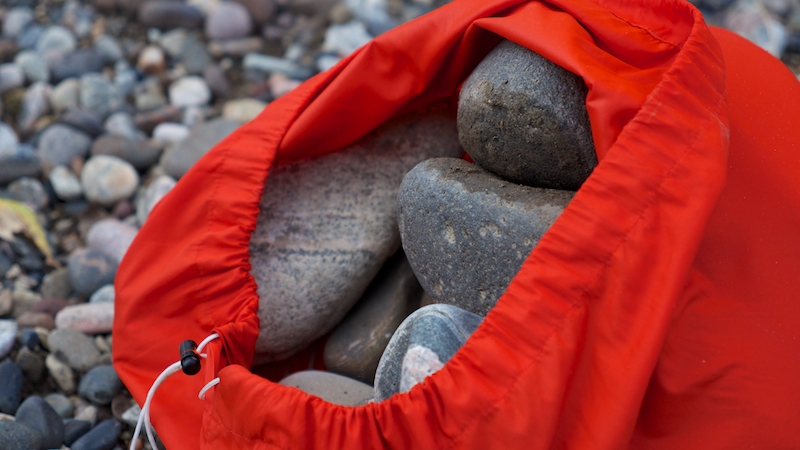
The cobblesack in action. To use it properly, locate the “anchor position” first (you won’t want to try to move a delicate stow bag full of 50 lbs of rocks later!), then fill the sack with stones, gravel, or sand. Pull the drawstring and use the end of the drawstring loop as a guyline attachment point.

I don’t usually pull the toggle and cinch the stow bag closure on a cobble sack – it places too much stress on the drawcord tunnel sewn into the sack fabric. Here, a small carabiner is affixed to the end of the drawcord, and the guyline tied to the carabiner with a tautline hitch, which provides the primary mechanism of guyline adjustment. I nearly always use a cobblesack over any other type of anchor for securing the ridge guylines of my tarp shelter, which require the highest tension forces (commonly, 20+ lbs) to ensure that the shelter is secure.
Cobblesacks have the distinct advantage over Big Rocks in that there is no heavy lifting involved, only the shuttling of small rocks or piles of sand between the riverbed and the sack. Cobblesacks have the additional advantage over both Big Rocks and deadmen in that larger volume cobblesacks can hold an enormous amount of weight (several hundred pounds!) and thus, can be used in the foulest weather conditions and/or for the largest shelters.
Don’t neglect natural attachment points that are (supposedly!) immovable and thus, could provide secure anchors for guyline attachment points. The obvious example already discussed is that of the tree, which I’ve found to be readily available and completely reliable in the lowland river bottoms where I fish and packraft.
Nearer to the riverside, and a bit less robust, but even more ubiquitous than the cottonwood and pine trees in my local riverbeds, is the willow bush. Willows provide wind breaks, fish storage sticks, and skewers for bratwurst. As important, they are usually rooted strongly enough to serve as guyline anchors. Low-to-the-ground anchors can be wrapped at the base of the willow bush, with the guyline encircling several stalks to distribute stress. Higher elevation guylines, as those that might come out the middle of a tarp or tent panel and angle upward, can be wrapped around the more bendy upper willow branches, which serve as a bit of a shock absorber in high winds (perhaps at the expense of some shelter stability).

Tying off a tarp corner around the base of a tiny willow bush. This single root bush had a root system less than 14 in deep and was able to withstand a static force along the guyline axis of 48 lbs before the roots pulled out of the gravel.
Driftwood is also common in the river corridors of freestone streams, and logs can be drug into place to provide useful guyline attachment points as well. Logs secured by a few Big Rocks between the log and the shelter provide a strong structure for securing one edge of a shelter.

A piece of 10 in diameter by 8 ft long cottonwood does not provide enough anchor security on its own for anything but guylines subjected to very light tension forces. However, two Big Rocks placed on either side of the guyline attachment next to the wood (towards the tarp) can create an immovable structure suitable for any guyline.
One bitter and gusty January day many years ago, while trekking in Montana’s Bear Trap Wilderness in the Madison River corridor, I was preparing a pitch just off the riverbed in a stand of willows on a small, but landlocked island. I was a rookie back then, and I made a rookie mistake: I removed my tent from my pack, and knowing that it was light enough to blow all the way to Helena if I let go of it, I grabbed a single stout tent stake and secured one stake out loop into the ground firmly. Then, with the assurance that it was going nowhere, I let go of the flapping lot to retrieve gloves from my pack, and upon turning around, my tent, and the crossbow ammo that used to be my tent stake, was sailing down the river corridor.
The lesson I learned was twofold. First, that the force of wind on a large patch of fabric can be mighty (especially into the open door of a tent, which becomes something like a sail), and easily pull out even a few well-placed stakes. Second, and therefore, the first order of business when staking in a gale must be securing one of the shelter guylines to an immovable object (like your pack!) until several points are staked out and you are confident that the shelter is secure before untying it from your pack and continuing the pitch.
In addition to the challenges of staking down a shelter on a river bar, you should also consider other aspects and challenges of river bar tarp camping, including sleeping comfort, conservation, river channel property ownership, and risks that must be considered so that you aren’t swept away by rising water in the middle of the night.
The ultralight ethic for creating a comfortable bed, at its minimalist core, depends on using a very thin and tiny patch of a closed cell foam pad in combination with a campsite located on fluffy forest duff or fresh cut pine boughs (leave no trace considerations aside). These types of pads are no longer used by me, but I know many young men with earth stains on their hearts that do.
The option of using such a spartan mattress does not really exist on river bars littered with gravel, sand, and cobbles. None of these surfaces approach anything remotely related to “soft” and although sand and gravel can be sculpted to provide little pockets for side-sleeper hips and such, sculpting the platform to a “just right” shape is sometimes an exercise in futility that begins with frustration at sunset and a backache by sunrise.
For river bar camping, I carry a Big Fat Pad – a 2.5 in inflatable air mat. This gives me the flexibility to sleep on gravel and small cobbles without actually having to worry about their presence enough to remove them, sculpt a bed, or drag a pack full of forest duff from the pines that grow beyond the cottonwoods. I find myself carrying this pad on nearly all of my trips now, just in case I see a gravel bar that I may want to camp on, think about camping on, dreaming about camping on, or simply camping near.
This doesn’t mean that I don’t prepare a bed, if camping on big cobbles. I do, and so should you! Other than (obviously) picking a reasonably level platform, cobbles can usually be removed in the bed area. On freestone streams, cobbles usually overlie a layer of sand, which tends to settle under the cobbles during springtime runoff. This process requires about ten minutes of effort if done intentionally, and is well worth the time investment.
On sand, a sleeping platform can be carved even from a slight incline, which gives you some flexibility in where you pitch your shelter. In addition, sand tends to accumulate small, poky sticks, so be wary of them before you set down your ultralight inflatable pad. Regardless, a ground cloth or bivy sack is useful for protecting inflatable pads from puncture, but are otherwise (usually) unnecessary for wet ground protection. River bars tend to drain very well and both closed cell and durable inflatable pads can be placed directly on the river bar without a ground cloth and provide plenty of protection from moisture. If using an inflatable pad, beware of camping on gravel in rivers that carve through limestone bedrock and other sharp rocks.
When river camping in a floorless shelter, I find bivy sacks to be particularly useful when the probability of Foehn winds is high. Being able to completely cocoon myself inside a bivy sack to protect my sanity during violent sandstorms is a tolerable reprieve.
There is controversy associated with river bar camping. Some leave no trace zealots believe that camping within ____ feet of any water body is irresponsible and shows a lack of respect for nature. They evidently believe that various forms of pollution emanate directly from the walls of a shelter, including litter, noise, visible humanity, urine, and poop.

Gaining wind protection for the tarp by pitching it adjacent to a willow stand on the grassy-bottomed Slough Creek floodplain, Yellowstone National Park, Wyoming.
I’m not one of those zealots. I like to camp by water. But I like to camp by water responsibly, carefully, and respectfully, and I do find myself adopting an increasingly stringent leave no trace ethic as I grow older, and become more practiced at minimum impact techniques. Here’s what to consider when camping in a river corridor with respect to camping, fires, liquid waste, and solid waste:
The sand and gravel of riverbeds may be the ultimate durable surfaces for pitching a shelter outside of the slickrock of the desert and the granite slabs of alpine places. River channels between the high water marks are mostly devoid of vegetation, and in freestone streams, are rototilled and recycled with each minor flood that occurs once or more per annum.
Fires built below the high water mark leave scars and traces only during the time between floods. And at least once a year, all signs of fires between the high water marks are completely vaporized, never, ever to be noticed again. Contrast this to the fire scars and semi-permanent rings found in the forest, which can remain for decades. In canyons where camping is limited, on tailwater rivers that don’t receive regular flood surges, or in very high traffic areas, fire pans are a useful tool for minimizing your impact. My favorite fire pan is a simple turkey roasting pan, which is light, foldable, and has high sidewalls to contain the ashes. I fill the pan with a few inches of sand, then build the fire on top of that. Ashes can be packed out in zip baggies if your’re hardcore, or mixed into nearby soils in an inconspicuous location away from camp if you are an intentional ultralighter.
Liquid waste can be dispersed directly into the fast-moving and/or turbulent currents of high volume rivers. The river flow will dilute it quickly (“the solution to pollution is dilution”). In low-volume river corridors, liquid waste can be dispersed on the ground above the high water mark, in the hopes that rain will dilute its pollution potential. Some notable exceptions are worth mentioning. In desert areas with little rainfall or in grizzly bear country, liquid waste should generally be catholed in a “sump” far away from camp, or dispersed directly into a river regardless of its flow. Consult with the land management agency to see what their preferences are, and honor them.
Solid waste (poop and food) should always be catholed above the high water mark at least 200 feet from the river’s edge, except in areas where that practice is prohibited (especially high traffic and/or some desert river or canyon corridors). Many land management agencies will require some type of human waste disposal system, such as groovers or wag bags. For the DIY’er interested in a lightweight solution, you can poop on the ground, pick it up with an inside-out quart sized ziplock (use it like a glove, then turn it back inside-in), sprinkle some waste gelation “bio-gel” powder into the bag, seal it, and then store it in a second, more durable zip closure bag – some type of tough, odor-proof bag is ideal.
Different areas have different laws regulating camping in river corridors bordered by privately owned lands.
In some jurisdictions, the entire river is owned by the property owner and one cannot even float through. In others, the riverbed is owned by the property owner, but the water remains a public right-of-way. Obviously, floating is allowed, but camping (or even getting out of your boat for a shoreline rest) would not be. Finally, some places allow public use of the water and the riverbed between the high water marks of any navigable stream. This is the fortunate case where I live, in the State of Montana, which means there are a plethora of opportunities for river camping here.
One caveat to my local stream access law, however, is where I can locate my river camps. Some islands remain privately owned, so I have to pay careful attention to land ownership. It can be confusing, since islands technically lie between the high water marks of the main channel. In addition, some islands are large enough to harbor permanent tree groves, so they are considered to have their own high water marks. As you might imagine, determining where to camp when river levels are low, some side channels go dry, and various types of islands become exposed, can be confusing. Consult your local river management agency to become educated about stream access in your state.
In addition, Montana has an interesting law that minimizes landowner-river user conflict by requiring river campers to camp at least 500 yards away from (or out of sight of, whichever is shorter) any occupied dwelling.
In short, if you are river camping in a river corridor that is not bound by public lands, be very careful about respecting private property ownership and understand both the laws that protect your rights as a citizen, and that protect the interests of landowners. In the most beautiful and pristine river corridors of Montana and Wyoming, for example, one may find themselves encroaching upon the viewscape of drunken movie stars with guns hanging out on the porch of their trophy home. These encounters are unpredictable. Movie star or not, however, landowner conflict is seldom a reasonable option that ends well, and should generally be avoided.
If you have a desire to camp in a riverbed that is prone to dramatic fluctuations in water levels resulting from dam releases or floods triggered by significant rainfall, consider bringing along a water leak alarm. They weigh a few ounces, are usually powered by a 9-volt battery, and emit an outrageously loud noise when triggered. I find them useful, if not a little bit unnerving when triggered, when camping in desert slot canyons, in river corridors below dams, and in rivers prone to rapid flow increases in response to nightly rainfall. I place them just a few feet from the waterline, between my shelter and the river, so that any overnight rise in water level is triggered well before it reaches my shelter. The only time I had one triggered was while camping on a gravel bar on the Hoh River in Olympic National Park during a spring deluge. The alarm sounded at about 2:00 am as the river started to rise, so I packed up my gear and moved my camp into the trees. During the course of the next four hours, the river’s edge had moved more than 40 ft inland across the gravel bar, swallowing my old camp.
My two favorite types of camps are on open tundra in high alpine areas, and in riverbeds. Neither is particularly comfortable when the weather turns bad, and both lack the coziness of a forest camp in windy or cold conditions.
However, camping in a riverbed is immensely rewarding. It connects you to the land via the motion and sound of the river in a way that cannot be experienced anywhere else.
Being able to enjoy river camping with lightweight gear and techniques that allow me to leave the conventional river camping shelter – the freestanding dome tent – at home, means that river camping doesn’t require me to add a dramatic amount of weight to my pack.

Packrafter’s camp using guylines tied to willows for all tie-down points. Fish Creek, Montana.
Looking to jumpstart your backpacking experience? Try motorcycling to your next trip – it will get you into the lightweight mindset from the moment you step outside your door.
You don’t have access to view this content.
280 miles in 10 days? You Betcha. The Long Trail has become a “right of passage” of sorts for unsupported thru hikers.
You don’t have access to view this content.
An in depth look at an exploration above the Arctic Circle. Journey to where Finland and Norway collide.
You don’t have access to view this content.
The Columbia and Western is a section of the Trans-Canada Trail, a haven for thru Hikers. It caters to all skill sets and is a wilderness of pristine beauty.
You don’t have access to view this content.
Talus can be tricky but with a few tips and a new approach you’ll be all set for some Talus Dancing. And boy what fun it is!
You don’t have access to view this content.
The quest for the perfect lightweight backpacking shoe continues. Don’t hold your breath. While these shoes are great for most hikes they are less than ideal for seriously demanding trips.
The quest for the perfect lightweight backpacking shoe seems about as futile as chasing a rainbow. Just when you think you are within reach, and eager for next year’s version of your favorite shoe to be released, you either grab the pot and find it to be full of fool’s gold or it vaporizes entirely and your quest begins anew.
Such is how I feel about the Altra Lone Peak 1.5.

The Altra Lone Peak 1.5 (women’s version shown in photo) offers a wide toebox, thick underfoot cushioning, zero drop, and sub-10-oz weight – key attributes that could be the foundation of a perfect backpacking shoe.
I’ve worn Lone Peaks since they were released and put hundreds of backpacking miles on v1.0.
To summarize how I feel about v1.0, please refer to my comments about it in the context of the larger market of minimalist footwear in my article Considering Minimalist Footwear for Backpacking published last October.
To save you some labor for now (but don’t be lazy – read the article above to broaden your view of what minimalist footwear has to offer us as backpackers), the following list summarizes what I liked about Lone Peak 1.0’s:
Of course, the wide toebox and zero drop differential promotes “natural” biomechanics. This may or may not be a benefit to you, but it’s at least a perceived benefit to me because the whole thing sounds well enough, not unlike eating “natural” cookies or fueling my truck with “natural” oil products, I suppose.
The idea that “natural” biomechanics promotes is longevity: I should be able to hike for more hours or more miles during the day, perhaps, and maybe I’ll be able to hike to a riper, older age than the fellow next door still encapsulated in his old school Scarpas with their high heels and pointy toes.
I wasn’t completely enamored with Lone Peak 1.0’s, however, and note the following limitations with those shoes:
So let’s take a look if and how the v1.5’s addressed these v1.0 limitations:

Here’s why the lugs under the metatarsal region of a shoe wear the fastest – and why they are the most important lugs for traction.
Lone Peaks are darlings in ultrarunning circles. I’m not so enamored with them for backpacking, so let’s consider these differences.
First, ultrarunners don’t carry heavy packs. Pack weight adds stress to the shoe on every step. This stress is magnified on steep terrain, when the shoes are wet, or when you’re off trail. A backpacker simply isn’t going to get as many comfortable miles on a trail shoe as an ultrarunner.

Light packs and easy terrain, like when day hiking on this subalpine Wasatch trail, don’t pose particular problems for most minimalist shoes.
Second, I hike in places not frequented by ultrarunners. I spent a lot of time on snow, talus, scree, and in steep and brushy terrain – terrain that adds to the stress load on my hiking shoes. A backpacker who travels through steep, rugged terrain will wear shoes out sooner than a backpacker who sticks to trails.

My son and I both wore Lone Peak 1.5’s on a 10-day High Sierra traverse this summer. We started the traverse with 45-50 pound packs and spent a fair bit of time scrambling through scree and talus on moderately steep Class 2+ terrain, like Alpine Col (here). This type of trip taxes footwear significantly.
Third, my shoes spend a lot of time wet – snow, river crossings, packrafting, and flooded, early season tundra are common where I hike. Wet shoes cause hydrolysis of glues, stretching of threads, and delamination of bonds. Shoes that spend a lot of time wet don’t last as long as shoes that stay dry. For the backpacker, having shoes remain wet day after day for multiple consecutive days places particularly high demands on a shoe’s construction quality.
Those three factors – heavy packs increasing the stress on the shoe, steep and rugged underfoot terrain increasing stress on the shoe, and sustained wet conditions increasing stress on the shoe – mean that we have to adjust our expectations of how long running shoes will last.

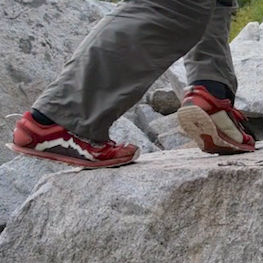
Very rocky terrain, like this granite trail in Utah’s Wasatch, places high amounts of stress on shoes when carrying a heavy pack. These stresses are magnified on multi-day expeditions, and when shoes are wet.
That said, I generally consider a reasonable lifetime for trail shoes for backpackers to be in the following ranges, based on my experience with shoes that weigh less than 12 ounces, including La Sportiva, Montrail, Inov-8, and Salomon – the primary trail running shoe brands that I’ve worn in the past 15 years.
| Terrain | Description | Example | Shoe Life |
| tundra | wet or dry off trail travel, moderate steepness | Western Brooks Range | 400-600 miles |
| trails | hardpack, rocks, steep | JMT | 300-500 miles |
| granite alpine | off-trail, scree, talus | SHR | 200-400 miles |
| limestone alpine | off-trail, scree, talus | Northern Rockies | 150-250 miles |
I don’t have extensive experience with the Lone Peaks on tundra (other than the accumulation of incidental stretches to the tune of about 50 miles per pair at most), but having gone through three pair myself, and observing two pair each worn by wife and son, I have a reasonable sense of their lifetime on trails and alpine off trail travel.
The following summarizes my empirical observations for shoe life while backpacking on this limited data set, and compares them to a handful of other shoes that I’ve used extensively.
Note: I estimate shoe life to be the point at which a shoe begins to fail catastrophically, either from delamination of sole bonds, worn stitching/glues that affect the structural integrity of the upper, rips in the upper that compromise its structural integrity, breaking of sole lugs, or wearing of sole lugs under the metatarsal region of more than 50%.
| Terrain | Shoe Model | Shoe Life |
| trails | Inov8 BareGrip 190 | 200 miles |
| trails | Inov8 X-Talon 212 | 300 miles |
| trails | Inov8 RocLite 315 | 400 miles |
| trails | Altra Lone Peak v1.0 | 300 miles |
| trails | Altra Lone Peak v1.5 | 250 miles |
| granite alpine | Inov8 BareGrip 190 | 150 miles |
| granite alpine | Inov8 X-Talon 212 | 200 miles |
| granite alpine | Inov8 RocLite 315 | 300 miles |
| granite alpine | Altra Lone Peak v1.0 | 150 miles |
| granite alpine | Altra Lone Peak v1.5 | 100 miles |
| limestone alpine | Inov8 BareGrip 190 | 100 miles |
| limestone alpine | Inov8 X-Talon 212 | 150 miles |
| limestone alpine | Inov8 RocLite 315 | 250 miles |
| limestone alpine | Altra Lone Peak v1.0 | 100 miles |
| limestone alpine | Altra Lone Peak v1.5 |
Failures on my Lone Peaks have included the following:

Blown stitching on the Lone Peak 1.5’s instep reinforcement patch. Single-stitched construction combined with rotting thread from several straight days of wet shoes contributed to this failure, which resulted in decreased sidehilling performance due to the inability of the upper to retain structural integrity.
I never expect a shoe not to fail. And I certainly don’t expect a lightweight trail shoe to last as long on a limestone ridge route in the Bob Marshall Wilderness as on the hardpack of the California PCT.
Backpackers carrying heavy loads in alpine terrain, especially in wet weather, are going to place severe demands on their shoes. It’s part and parcel with the decision to trade in boots for lighter footwear that allows you to go faster and further with less foot pain and stress.

Abrasion of the upper while traveling through alpine areas littered with High Sierra granite talus and scree. Again, this is a structural failure of the upper that makes for a sloppier fit, reduced sensitivity during precise foot placements on steep terrain, and a general feeling of emotional stress, wondering when the more fragile inner (white) layer is going to blow.
In that context, I’d rate the applicability of the Altra Lone Peaks (especially v1.5) at the lower end of what I’d expect for durability both on and off-trail.

There’s no drama here, just a simple scramble up a short Class 2 granite slab. This isn’t the realm of advanced backpackers, and even beginners will find themselves relying on the traction of their shoes to remain safe and secure while trekking. As lugs wear out, so too does traction. I found myself slipping and sliding, even on rough-surfaced Wasatch granite, as my Lone Peaks came to the seemingly premature end to their practical life.
Before anyone goes postal on me in the forums for giving the shoe what you perceive to be a low review rating, let me qualify it.
First, this is my family’s outdoor shoe of choice. This is what all three of us wear for day hiking, backpacking, and packrafting. We wear them daily. They are our shoe du jour for all of our outdoor pursuits.
Second, my current pair of Lone Peak 1.5’s are worn out. Guess what I’m buying next? Yep, Altra Lone Peak 1.5’s. And I’ll probably buy another pair after that. That doesn’t mean that the price tag isn’t painful and that I’m not disappointed by their short lifespan. In fact, when I purchase my next pair, I’m going to have a big stomachache because of my contribution to the global economy’s premature use of resources for what amounts to my personal recreation.
However…
There’s no shoe quite like this one. It’s special, with a unique blend of attributes that makes it both comfortable and philosophically compatible with my desire for my footwear to promote natural biomechanics.
Therefore, it more than deserves an Above Average review rating (as opposed to something less attractive) because it does stand apart from the crowded market of lightweight backpacking shoes and I’m looking forward to future iterations that pay greater attention to both sustainability and the economic limitations of its customers.
The lightweight philosophy coupled with high adventure creates a schoolroom for incredible growth. Witness it here.
In July 2013, I participated in the first ever BSA-sponsored packrafting school at the Montana High Adventure Base in Dupuyer, Montana. The program principles and curriculum were developed by Ryan Jordan, and I had the great privilege of serving with Ryan as an instructor and mentor for a select group of Scouts who would be our guinea pigs and pioneers, and who would pave the way to opening up a dramatic new mode of high adventure wilderness travel in the Scouting program.

Scouts search for packraftable rivers in the Bob Marshall Wilderness.
This essay and trip report reflects some of my experiences, thoughts about Scouting, and importance of a lightweight philosophy as part of effective wilderness group dynamics.
The paddles dug into the water, spilling us into the river, and we were off.
The landscape around us was enveloping, and peaceful. As we paddled I couldn’t help thinking how cool it was to be doing a Wilderness packrafting trip with teenage Boy Scouts. But this trip was greater than the packrafts. In fact it was greater than the location, the gear, and the hikers individually. This trip was about working together to overcome obstacles.
When we simplify life – boil it down to the basics as we are forced to in the backcountry – we begin to identify what really matters. We see that the people around us and their safety and well-being become the priority. We begin to rely more on ourselves and then work as a team to come out safely. Couple the backcountry with learning a new challenging skill that forces participants to go out of their comfort zone and you have a recipe for growth.
At the beginning of the trip the Scouts were uncomfortable as they adjusted to new experiences with their as-yet-unproven decision making matrices. But with each riffle, rapid, and river bend, their confidence increased with their experience. I was amazed at the transition. By the end of the trip they were totally different; far better equipped to face challenges, more resilient, and willing to be helpful and be helped. This latter attribute was surprising, and reflected the positive benefits of going through shared experiences that test physical, mental, and emotional limits.

Ryan and Eric teach Scouts how to attach their packs to their boats at the put-in.
High Adventure (especially, backcountry travel in remote environments) is one of the best schools for growth offered by the Scouting program. There is something about a challenge that forces people to look deep within to overcome the obstacle. We started as a group of individuals and by the time we ended we were functioning as a team and loving every minute of it. I’m sure the lure of the backcountry and the growth that comes along with it may be why some of you subscribe to BPL and why you seek intimate backcountry experiences.
Honestly, I was blessed to serve as an instructor for this trip – the first ever BSA-sponsored wilderness packrafting program. So the trip was born; 5 days in the majestic Bob Marshall Wilderness: 4 scouts, 4 adults, and 8 packrafts. The trip was challenging, it was engaging, and it was fun. It was a pilot trip – to see if packrafting was a feasible high adventure BSA program.
On the trip, we ran challlenging water for newbies (Class 2-3 / PR 2-4), saw diverse forms of wildlife (ducks, bear, deer, and lots of trout!), saw some beautiful country, but the best part was watching the Scouts grow as a result of the challenge.
To better accommodate our high adventure itinerary we stayed true to the principles of lightweight backpacking, choosing our gear based on anticipated weather and actual need. This included packing thin, light, non-absorbent clothing, sharing a significant amount of personal gear (knives, first aid kits, insect repellent, and more), and taking advantage of careful cooking and water treatment techniques to minimize our need for fuel and water chemicals while learning important skills.Our necessity-based packing and sharing mindset enabled us to run this trip with less than 40 lbs of gear per person, which included 12+ pounds per person of whitewater packrafting gear (individual and group shares), 8 pounds of food per person, and a variety of lightweight luxury items that included tenkara rods and bratwurst.
We got out of the cars at 10 am and after a short restroom break inflated the packrafts and put into the river right from the parking lot. How cool is that! Wilderness packrafting from a car. The water was cool and the boys immediately faced a challenge – a strainer. This water hazard (a log stuck in such a manner that the current flows over it) is an unwelcome sight to inexperienced and experienced packrafters alike. The boys readily adapted and relied on their previous training to easily navigate the hazard.
Shortly thereafter, after hitting a tricky PR3 rapid, we had the first (and only) unplanned wet entry into the water when one of the Scouts flipped his packraft after his stern was bandersnatched by a pourover. He quickly recovered demonstrating proper recovery form as he kept his feet off the river floor (to prevent them from becoming lodged in the rocks) and swam to bank, shaking his head, but smiling. He later remarked how his experience flipping the boat was a blessing as he understood that he could safely and comfortably handle a wet entry.

Ryan teaching the art of scouting rapids, and helping new packrafters make paddle-or-portage decisions.
The day passed without further incident as we traversed the beautiful landscape before us. We had been floating for 4 hours or so and the sky was darkening – it appeared that a thunderstorm was about to let loose.
One of the values of Scouting is that it promotes leadership and responsibility at a young age. These 13-16 year olds took the initiative when they saw the storm approaching in the distance to make finding a campsite the main objective. We stopped to scout a potential camp and the boys made the decision to continue downstream to find a nicer place to camp, their confidence in paddling and inclement weather management keeping their options open
This ended up being a great decision as the storm passed us by but what amazes me about their behavior was not only did they have the foresight to look far down the horizon they saw what was coming and prepared a plan to meet it head on. The storm’s drama dissolved, but these Scouts demonstrated the Scout Motto “Be prepared” when they decided to take their fate into their own hands.
We floated some beautiful country down to our camp and the two patrols (one adult patrol, and one Scout patrol) each set up their respective shelters and bear bags, treated water, and arranged the cooking area. That night we carved willow sticks, built a fire, and roasted Bratwursts.

First night weiners roasted on a willow stick over fire. We introduce Scouts to an important packrafting tradition.
Day two dawned with all of its glory and we packed up. Ryan was quick on his tenkara draw while the rest of us were tying our packs to our boats and caught 15 trout in 15 minutes, foreshadowing what would become a continuing theme on the trip – superb fishing.
After packrafting for an hour or so we stopped for a tenkara fly fishing class. Tenkara fly fishing is becoming increasingly popular among backpackers. Its light weight and collapsible design are ideal for backcountry travel. The scouts immediately took a liking to the fishing with a few catching fish right away.
We packrafted without incident as the landscape enveloped us. We had to be focused today. At the bottom of the South Fork lies a gorge that marked a transition point for us, and we didn’t want to suffer the inconvenience of running whitewater beyond our current ability when our route was to be transitioning to trekking. Navigation played a role here as we had to make sure we didn’t accidentally plunge into the gorge where the close proximity of the cliffs to the water’s edge would not only make water travel hazardous but would also make portaging an extreme challenge. We wanted to pull out of the river before the gorge.

Working together to portage loaded boats around a logjam in a braided side channel.

The majesty of river travel in the Bob Marshall Wilderness.
As with all things on this trip the Scouts were in charge with the adults serving as advisors and making sure extremely dangerous situations were avoided. Therefore it was the Scouts’ responsibility to evaluate every rapid, navigate on both the water and trail, and execute route decisions accordingly – without the aid of GPS units (we teach precision map and compass navigation combined with a continuous “look up and pay attention to the landscape” routefinding).
They did an excellent job relating what they saw around them to the features on the map. We pulled out above the gorge, ate lunch, and were soon on the trail to evening campsite. That evening, we camped on a gravel bar island and ate fresh trout that night.

A tenkara-caught wild rainbow from the North Fork.
Today we would leave our camp set up for the afternoon, trek up to the North Fork headwaters, and float back to camp. Upon our arrival back to camp, we packed up and started making our way down the top of the North Fork Gorge with an uneasy evening float as ominous weather, a nearby forest fire, and loud whitewater echoed on the canyon walls below. Our camp would be located above the gorge’s first major rapid in a lovely meadow protected by pines on three sides and decorated with bear scat.

Packrafting is about “packing a raft” as much as “rafting a pack”. Climbing out of the South Fork Gorge.
After scouting a solid Class 3 (the entrance rapid to the gorge), and teaching more advanced packrafting principles, Ryan ran the rapid while the Scouts teetered on the edge of excitement and fear. All of the Scouts attempted it, and ran the rapid carefully, intentionally, and aggressively — the hallmark attributes of seasoned packrafting veterans. This point was a shining, proud moment for us as instructors.

Chase running the entrance rapid to the North Fork Gorge.
Although the rapid was a challenge the preliminary scouting was perhaps a more crucial learning experience. It gave the scouts an opportunity to demonstrate what they had learned, reinforce their comfort on the water (especially compared to Day 1!), and parse complex whitewater into its less-intimidating parts. When we were scouting the rapid, we felt that this was the type of challenge that Baden-Powell had in mind when he envisioned a patrol of Scouts facing a backcountry challenge.
We continued downstream a quarter of a mile to a river-wide pourover shelf and spent a few hours fishing in the riffles and pools near our boats.
In the early afternoon, we decided that we wanted to give the gorge a shot, so we scouted the next several rapids downstream of our fishing spot. Unfortunately, within the span of just a few days, water levels had dropped enough to make safe navigation of some of the rapids problematic – we were worried about the prospect of repairing boats incessantly as they scraped through razor-sharp limestone bedrock bands for the rest of the day.
After scoping it out we decided to play it safe and trek around the gorge and camp in the vicinity of the entrance gorge to a stillwater body downstream. We pitched camp in a sagebrush meadow overlooking the gorge while casting tenkara flies to finicky trout until well after dark.
We woke up at 5:30 am to ensure we had enough time to reach our pickup point by 1:00 pm. We caught the sunrise as we came through the top of the reservoir’s entrance gorge, which would lead into our final stretch of paddling.

Early morning paddle through a stillwater canyon.
The last day was a tough paddle against the wind and after having a final packrafting exam (which included a deep, open-water wet entry and exit with a loaded packraft in high wind), the scouts were sufficiently exhausted. We stopped for lunch halfway across the lake, took some time to readjust, and hit the trail for a midday walk in blazing heat to the trailhead.
There were many obstacles on the trip that forced the boys to demonstrate their knowledge and leadership. I think the most prevalent example and the most defining moment of the trip was when they made the decision to not continue down the North Fork gorge. We had walked a ways into the gorge in an effort to scout it out and it was clear to us that low water, tall cliffs, some private property, and a steep gradient would make portaging extremely challenging. The adventurous side of me really wanted the scouts to go down the gorge but at the current water levels the likelihood of a packrafting trip turning into a packraft repair trip was high. Even though I was marginally disappointed I knew they made the right decision and I was impressed at their judgment. It was one of those moments. They probably don’t even realize how special it was. It was just an affirmation to us instructors that they were paying attention and learning and they knew their limits. It was cool to see them exhibit that wisdom and elect a mode of travel that was dictated by their desire for efficiency to keep moving across the wild landscape.
I am no stranger to high adventure and can say that it is one of the reasons I am who I am today. I draw upon my 50 miler in the Beartooths and other trips often. Not because it was such a cool trip (which it was) but because serving as the crew leader on that trip gave me an incredible opportunity to demonstrate leadership in an adventure setting. The beauty of the Scouting program is that it not only gives boys training on skills and leadership and service, it gives them tangible ways to experience them.
I saw this type of leadership demonstrated first hand on the trip. It was rewarding to come full-circle and observe the boys meet similar challenges that I faced and watch them grow as they handled them. I really admire the Scouting program and am grateful that it gave me so many opportunities to demonstrate and learn leadership in an adventure setting.
These types of experiences are distinguished from other leadership programs in that high adventure breeds trust within the Scout patrol. When faced with extreme adversity we begin to identify who we can actually depend on because of the way they handle that pressure. And for those who are not quite ready to lead, just being a part of the patrol structure furthers their preparation by giving them experiences to witness leadership at the edges of challenge.
On the trip we talked about four principles that Ryan incorporates into his high adventure instruction: Honor, courage, service, and leadership. These four attributes became guiding principles and shaped our mindset for how we acted during the trip:
I suppose I share all of this with you out of some sense of pride. When I went through the Scouting program as a youth, it was tough to see what I was actually learning and how I could apply it to my life. The Scouting program is unique in that it explains leadership and provides examples and facts about it, but it goes a step further than other youth leadership programs in that it gives creative, hands-on experiences that allow the participants to really learn what leadership is. It gives them opportunity in a high adventure type-setting to face problems together.
Looking back on it now, when I am faced with challenges in school or at work or in the backcountry, the lessons I have learned from Scouting continually point me in the right direction. The purpose of this article is not to recruit for the BSA (most of you are probably past the 18 year-old cutoff anyway) or to encourage you to get your kids involved (which is still a good idea). I hope that in writing this article I could encourage you to take some of the lessons from the way Scout troops operate their high adventure programs and apply them to your own trips in the backcountry, whether it’s using the patrol method, teaching skills to other members in your expedition, or cultivating a sense of bonding by sharing difficult challenges together.
As was noted in the introduction, we also shared a lot of gear to cut down on weight. At first pass this makes sense from the methodology of lightweight backpacking. Cutting down weight means we can travel fast, safer, and conquer more advanced terrain. Aside from those benefits, sharing gear forces you to be more dependent on those around you. This may sound limiting but in the wilderness any excuse that brings you closer and forces you and your group to operate as a team is a good thing. In the wilderness, hazards can appear in the blink of an eye and we are continually adjusting to meet the circumstances. The closer you are with your group the better prepared you will be to successfully meet the challenges.
Another benefit of lightweight philosophy is that less time is spent looking for, thinking about, repairing, using, and otherwise managing gear. Gear gets out of the way so the most important parts of the Scouting curriculum can be emphasized: learning skills, building positive relationships, and working towards the group’s goals.
“This is High Adventure” is a film written and directed by Ryan Jordan and produced by the Montana Council BSA and the Boone and Crockett Club that will be released in the Winter of 2013, promoting packrafting in Scouting and the importance of high adventure in building youth leadership, outdoor skills, positive group dynamics, and character.
View an unofficial “pre-trailer” of “This is High Adventure” here:
If you are a parent of a Scout, or a Scout leader and would like to inquire about youth participation in this program in 2014 and beyond, please contact the Montana Council BSA High Adventure Committee Chair, Ryan Jordan (publisher@backpackinglight.com).
The Leadville Runners are light and we mean really lightweight. But don’t worry you won’t have to sacrifice comfort or stability as you conquer the outdoors.
You don’t have access to view this content.
A unique and diverse area, the Grayson Highlands are an excellent hiking location in the Mid-Atlantic.
You don’t have access to view this content.
Grizzly Bears! Mountain Goats! Elk! With a clear conscience the author returns to conquer this vast wilderness.
You don’t have access to view this content.
Going ultralight and cooking for a group can be a real challenge. The “Critter” stand is lightweight and takes the pain out of cooking for a group.
You don’t have access to view this content.
The Teton Wilderness is vast and beautiful. Take a journey through this landscape and enjoy the scenery.
You don’t have access to view this content.
Buckskin Gulch is one of the top 10 most dangerous hikes in America as sudden rain fall can lead to flash floods. Paria Canyon is stunning. Grab a seat and relive the journey.
You don’t have access to view this content.
 © Beartooth Media Group Inc.
 Loading...