


Introduction
We all carry around a lot of preconceived notions about clothing performance. These preconceptions may result from personal experience, exposure to marketing campaigns, or a misunderstanding of clothing function. I think it pays, from time to time, to check whether our preconceived notions hold water.
I have not worn merino wool garments of any type for years. I have made that choice because merino fibers, like cotton, are hygroscopic—they absorb and hold onto moisture. So, I reasoned, I would remain dryer and warmer by wearing polyester base layers, which wick moisture but do not absorb water into the fibers.
In this paper, I subject base layers in various weights made from merino, merino blends, and alpaca to the suite of tests I have developed to evaluate base layer performance. I then compare the performance of these base layers with those of the polyester base layers I have recently reviewed. We also see if my preconceived notions about merino hold water. Finally, we will see how to choose the fiber for our base layers.
In summary, here is what I found:
- As I have demonstrated in prior articles, the rate at which moisture dries from a polyester fabric is a function of drying conditions: ambient temperature, humidity, and air movement. This finding is also the case for merino, alpaca, and blends. The drying rates of all these fibers show modest variation and, as a practical matter, can be considered equivalent. Fiber choice does not significantly influence the rate at which moisture evaporates from a base layer.
- The time a garment will take to dry depends on the quantity of moisture trapped in the fibers. The more water a garment can hold, the longer it will take to dry. A fast-drying garment is simply one that cannot trap a lot of moisture. A fabric built to be warm will trap a lot of air but also a lot of water so that it will dry slowly. Fiber choice does not significantly influence drying time in a base layer.
- The amount of air trapped in a fabric determines its warmth. The knit pattern and yarn characteristics determine the amount of air trapped in a fabric. It does not seem to make much difference whether those fibers are natural or synthetic. Polyester can provide an exception: as we saw with the Mountain Hardwear Airmesh’suse of Octa fibers, warmth is influenced by complex fiber extrusions that trap more air than a typical circular fiber. Fiber choice does not significantly affect the warmth of a base layer.
- Despite the claims made by some manufacturers, merino and alpaca do not wick (except through chemical treatment, which, in the limited examples observed, results in poor wicking performance). The exterior of these fibers is hydrophobic, meaning water will not bond to their surfaces. They do not support capillary action. When exposed to liquid water, the force of diffusion can drive water into merino and alpaca fabrics. Liquid water or water vapor may then enter the hydrophilic core of the fibers, where it will bond to interior proteins and remain trapped until enough energy is present to drive evaporation. Some manufacturers utilize the chemical treatment of merino to render a fabric either more hydrophobic or more hydrophilic. These treatments seem to have a limited impact on performance. Fiber choice does influence moisture management performance. If you desire a wicking fabric (and you may not), you may need to rely on treated polyester or hydrophilic natural fabrics such as cotton, lyocell, or various blends. It may be possible to find a treated merino fabric that wicks well. However, my limited testing did not encounter that fabric.
So, if natural fibers such as merino and alpaca do not offer drying or warmth advantages over polyester, how can we choose our base layer fibers? To make that decision, we need to examine other characteristics of our base layer garments and other personal objectives. These include our moisture management strategy, price point goals, garment durability, garment comfort, laundering requirements, and environmental impacts over the life of a garment.
Review Stephen Seeber’s past work on base layers to get more out of this article and better understand the testing methods used.
- By the Numbers: Do Moisture-wicking Fabrics Work?
- By the Numbers: Why is My Base Layer Soaked?
- By the Numbers: Testing the Performance of Mountain Hardware AirMesh Garments
- By The Numbers: Patagonia Capilene Thermal Weight vs. Patagonia Capilene Midweight Performance Comparison
catch up on the entire By the Numbers series here.
Table of contents
How I tested
Garment manufacturers claim numerous benefits from their garment’s fibers. These include claims about warmth, moisture management, comfort, durability, environmental impact, and more. Investigating all of these claims for fibers would be an exhaustive task. Measurements of actual fiber performance for warmth and moisture handling are beyond the capacity of my test instruments. In this article, I don’t investigate fiber performance. Instead, I measure fiber performance when incorporated into fabrics.
The performance characteristics that I measured include physical characteristics, air permeability, insulative ability, wicking, wetting, and drying.
Fiber diameter
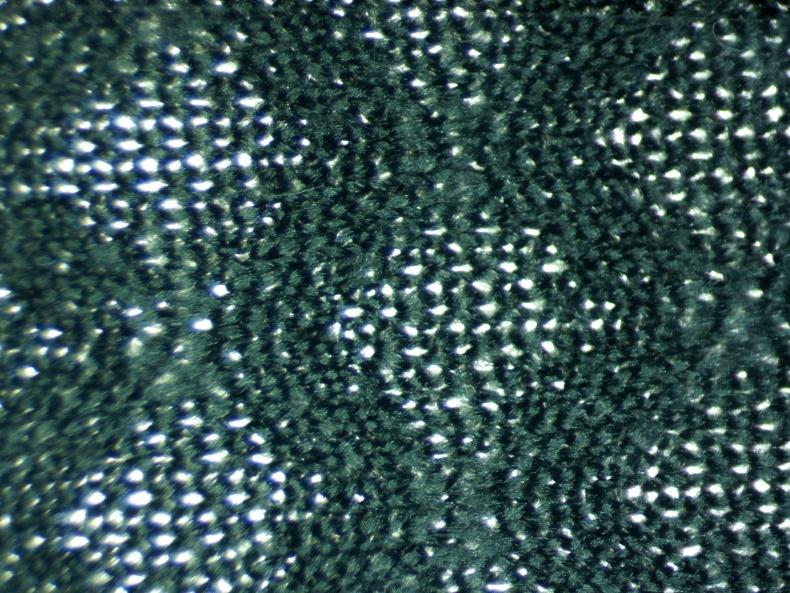
Fiber diameter influences garment comfort. Fiber diameters below 20 microns tend to eliminate itching. As fiber diameters increase above 20 microns, they are more likely to result in itching. Human hair is 40-50 microns in diameter. Wool from sheep tends to have a range of diameters ranging from 17 to 33 microns. Merino sheep fiber diameters range from 17-24 microns. Alpaca fibers can range from 15-40 microns. The finest fiber is from Angora rabbits at 11 microns. Typically, market scarcity forces finer-diameter natural fibers to command higher prices. Garments made with finer diameter fibers will tend to command higher prices. We measured the fiber diameter for each fabric under a microscope.
Garment weight
In this article, we test garments or fabric samples. We weighed all garments. We list the size of each garment. When possible, we attempted to obtain men’s extra-large garments. Arms of Andes provided women’s extra small garments.
Fabric thickness
Fabric thickness is determined utilizing a method that applies consistent compression to the fabric as part of the measurement process. A 50-gram weight applies compression to the fabric. The weight measures 1.27mm x 76mm x 76 mm. An iGAGING digital thickness gauge measures fabric thickness. The gauge applies slight additional pressure onto the 50-gram weight. The average thickness of each sample is calculated based on 3-5 measurements.
Fabric weight per unit area
The fabric area and weight were measured to determine grams/square meter and ounces per square yard. When garments were tested, we used the manufacturer’s specifications for fabric weight per unit area.
Air permeability
This measurement determines how much air flows through the fabric at a pressure difference of .5 inches (1.27cm) of water column. The higher the reading, the greater the amount of air that can flow through the fabric at any wind speed. Higher air permeability enables greater ventilation and improved moisture vapor transfer through the fabric.
Porosity
This measurement is generally related to air permeability. The measurement indicates the looseness of the knit or how much of the fabric is void or air space. Porosity is measured by placing the fabric sample on the microscope using backlighting. We set the magnification at .8 and produced a photomicrograph. The resulting image is analyzed using Photoshop to determine the portion of surface area through which light can penetrate. If you hold two fabrics in front of a light source, the fabric with higher porosity will permit more light to penetrate.
R-value
R-value measures a fabric’s resistance to heat transfer from the wearer to the environment. Higher R-value means a fabric will help reduce heat loss in cool weather or prevent the body from shedding heat in warm weather. I measured R-value on my guarded hot plate.
R-value/ounces/square yard
This is a measure of thermal efficiency. Higher efficiency occurs when more resistance to heat transfer occurs with lower material weight. As ultralight backpackers, we like to experience the insulating value required for our comfort at the least possible garment weight.
Wicking tests – wicking, infab, evap
This test demonstrates how well a fabric wets, wicks, and dries. I conducted using my permeation kettles. I place a sponge containing a predetermined quantity of water on the 120F (49C) kettle surface. Then, the test fabric is draped over the kettle surface and rests directly on the wet sponge. The fabric can absorb water which may wick across the fabric’s surface. An overhead thermal imager observes and records the progress of water as it spreads. The test continues for 30 minutes. At the end of that time, the fabric is removed and weighed. An increase in fabric weight occurs from water retained during the process and is called INFAB. Next, we weigh the sponge. The difference between the sponge’s starting weight and the finishing weight is the amount of water wicked into the fabric from the sponge. The difference is called WICKING. Finally, we subtract INFAB from WICKING to determine the amount of water that evaporated from the fabric during the process. Using these three values and watching the time-lapse drying video, we can readily determine which fabrics can remove sweat effectively from the skin and those that provide little or no ability to move sweat away from the skin.
Wetting tests – 200 and 400 microliter (ul) drops
The drop test measures how rapidly water contacting a fabric is absorbed. Drops can sit indefinitely on a hydrophobic (water-hating or water-repellent) fabric. Water drops can be absorbed rapidly into a hydrophilic (water-loving, absorbent) fabric. The industry-standard test places a 50ul drop on the fabric using a pipette. The test ends if a drop is not absorbed within 60 seconds. In our test, we use larger drops – four and eight times larger, respectively. These larger drops will hasten the wetting and absorption process. If the drops do not wet and absorb into the test fabric, we can be confident that the fibers are hydrophobic and do not support wicking.
Drying tests – water added, water dried, time to dry and drying rate
This test examines the following question: How long does it take for a saturated fabric to dry? Saturation for this test is the maximum amount of water a fabric can hold without dripping. This quantity is determined by dunking and carefully squeezing out excess water five times and then calculating the average weight after each dunking. We install the saturated fabric on the 120F permeation kettles’ surface. The moisture begins to dry. We record the drying process with the thermal imager. When the fabric is dry, the surface becomes uniformly warm and shows no further temperature rise. At this point, the test ends, and we weigh the test fabric to determine how much water evaporated. We calculate the drying time by measuring the elapsed time to dry from the thermal imager video. The drying rate is the weight of dried water/drying time.
The test fabrics
We base our findings on the performance of 16 base layer fabrics. Some were provided as complete shirts by their manufacturers. Others are fabric samples. We cut the garments and fabrics to fit the permeation kettles and the guarded hot plate. Table 1 shows the fabric breakdown:
Table 1: Test fabric distribution
| Fiber | Samples |
|---|---|
| 100% Merino | 5 |
| 100% Alpaca | 5 |
| 100% Polyester | 4 |
| Merino/Polyester Blend | 1 |
| Merino/Polypro Blend | 1 |
| Total | 16 |
Member Exclusive
A Premium or Unlimited Membership* is required to view the rest of this article.
* A Basic Membership is required to view Member Q&A events


Discussion
Become a member to post in the forums.
Stephen – Thanks for the follow up. Very interesting!
I wonder if there is a regular (non-mesh) shirt made of the same fabric as the Brynje wool mesh? If so, that might also be an interesting comparison to try to tease out the influence of the fabric vs. construction on the results.
Hi Stephen
Arcane, very arcane.
Basically, a short length (say 30 mm) of wool fibre was strung up under known tension and made to vibrate at resonance like a violin string. The frequency of vibration is proportional to the mass per unit length. The instrument details were complex.
The big problem was that the wool fibre was extremely light and air drag was significant (and organics are squooshy compared to, say, steel strings), resulting in the fibre having a resonance Q of about 10. The Q for a watch crystal might be about 10 million. It was hard to maintain resonance.
Abrupt changes in the humidity of the surrounding air flow caused the frequency to shift, by the amount of water absorbed. Ah, but what mattered to us at the time was how fast the frequency shifted: that gave the time constant for absorption into a single fibre. It was fairly short.
It turns out that this time constant hardly matters when it comes to clothing. In any loose clump of fibres there is air around each fibre, making a boundary layer, and this boundary layer dominated everything – in loose clumps. Fibres and fabric are different.
For fabric there are extra problems. The main difference between wool (or cotton) and a synthetic is that the natural fibres are hydrophilic, so the water sticks to them. The fabric stays wet. On the other hand, synthetics are hydrophobic and water does not stick. It shakes off synthetics very easily. This materially affects the drying time.
Do I still have the original data? Not a chance! That work was done in the late 70s. I am not a ‘woolie’, I am a physicist.
Cheers
Hi Roger, It sounds like a fascinating (although, I expect, challenging) project. The problem with wool research publications is that it is hard to figure out who the objective scientists are and who (they may be real scientists) are employed by the wool marketing machine.
So far, my work suggests that the characteristics of the fabric and yarns can trump the characteristics of fiber. I am working towards repeating the work that produced the above article. I am changing some of the methods to try to get a more nuanced read on the prior sentence. Your description of your work seems to lend some support to this. My last round of testing demonstrates water sticking to wool vs shaking off polypro.
In the real world, most polyester fabrics are treated to be hydrophilic, so some water will stick to the surface of the fibers but not penetrate inside. Polyester’s performance may be somewhere in between wool and polypropylene. Or not. In my next round, I will look at polyester that is treated to wick and polyester that is not. I will also include some cotton, which I have never tested. I will retest some of the merino and alpaca fabrics included in the prior study. I expect to replace IR imaging to determine when drying is complete with a weighing method like what was used for my last posting. The shape of the drying curves from weighing the samples provides superior insight into what is happening in the sample compared to the IR temperature data.
Interesting results with the fishnet fabrics. Expecting absorption to be largely a function of yarn and fabric construction, I thought the fishnets would probably absorb a much larger percentage of their weight because the spaces between yarns are so big, or a much smaller percentage because they are too big to hold water. It seems that neither occurred because the fishnet portions absorb roughly the same percentage as the non-fishnet portions. (Or perhaps the two effects cancelled each other out.)
All two merino fabrics in this last test, however, absorbed a much smaller portion than the three merino garments in the original test, which surely means the gentle spin cycle removed more water than the procedure in the original test. Maybe this is why in this last test we finally see big water retention differences between different fibers – because so little remains absorbed after the spin cycle that differences in adsorption become more visible. If wool adsorbs about 20 percentage points more than polypro, that would explain the results rather well. And if the water absorbed by the fishnet portions dries very quickly, such a differences in adsorption could also explain most of the difference in drying time.
Anyway, the test shows that very large spaces between yarns had little impact on water retention per gram, but a big impact on drying time. I wonder about the opposite – how would extremely tightly knit or woven fabrics compare? Might they absorb less because there is no space for the water? One such fabric, ventile, is claimed to absorb only 10% of it’s weight, which if I understood the above discussion, is how much the cotton fibers it is made from adsorb. Might very tightly woven nylon or poly similarly absorb very little? Or probably better still, polypro?
I believe Helly Hanson makes hardshells with a polypro outer layer. One review noted the outer layer picking up some water. But if, as I would hope, it absorbs much less than nylon or polyester, perhaps it would greatly solve the wetting-out problem, interfering less with breathability and loosing less heat??
That would be nice. I’d rather have an outer layer that can’t get wet at all, like Gore’s Shake Dry, or Columbia’s Outdry. Sadly, Shake Dry is discontinued, and Columbia doesn’t make any outdry garments that suit my needs. And while Outdry seems more rugged than Shakedry, Columbia apparently doesn’t find it rugged enough for a ski jacket. Given the absence of such alternatives, it would be great to find a hard shell that can retain very little water and dry quickly, if that indeed helps a lot with wetting out issues.
“Given the absence of such alternatives, it would be great to find a hard shell that can retain very little water and dry quickly, if that indeed helps a lot with wetting out issues.”
There are decent alternatives, but you have to do a little work. Take a layer of woven, non-coated polyester fabric with a CFM rating ranging somewhere between 40 and 70 (it will lose air porosity after the following treatment. Barring exact CFM measurements or testing apparatuses, look up the coffee filter breathing through approximations on this site). Thin out some 100% silicone caulk with naphtha (I don’t know the ideal ratio of silicone to naphtha, but thinner is generally better, so I would start off with somewhere between 15 to 20 to 1 ratio of naphtha to silicone by weight) and coat the polyester fabric with the thinned silicone.
Once fully cured, sew that fabric to some nonwoven polypropylene with the most water shedding side towards the silicone coated polyester fabric. To that, sew some 1 oz/yd2 monolite or cloud fabric.
Whatever garment you make with this fabric composite (for easiest to sew/make and most breathable, I recommend making it the front of a poncho), the silicone coated polyester goes towards the outside and the monolite layer towards your body. (The monolite/cloud layer is mostly to protect the inner polypropylene layer from abrasion and somewhat from body oils).
Very occasionally wash with hot water and strong degreaser, and rinse very well.
Anyways, this combo will shed rain very well, dry very fast, breathe better than most WPB fabrics, is pretty durable (the DWR attributes will last a very long time, and will only very occasionally need to be refreshed with hot water + strong degreaser), and is pretty inexpensive to make. The most challenging part of it is finding a good, strong but lightweight polyester fabric that is not already coated with a DWR. Avoid ripstop if you can.
It’s somewhere in between traditional WPB multi layer fabrics and Paramo as far as breathability (a lot of that depends on the initial air porosity of the polyester fabric and the thickness of the silicone coating put on it in relation to the former). But unlike Paramo, you won’t have to constantly retreat with wax, and it’s definitely not as hot/insulating.
I’ll be making a new poncho out of the above improved fabric combo. Note, if you don’t want to go through the process of silicone coating polyester fabric, you can also instead use outdoor woven polypropylene fabric as the outer layer, but note these tend to be on the heavier side (these can be found online, and at places like JoAnn Fabrics and Crafts). These are non wicking and water shedding in nature. I’ve yet to find a lighter weight, tightly woven polypropylene fabric anywhere, alas. I tried to encourage RSBTR to try to source or get such fabrics made, but apparently they weren’t interested.
But if you’re just say making a front chest insert for an otherwise lightweight poncho, then the extra weight might not be that big of a deal. If using the heavier outdoor woven polypropylene fabric, I recommend using the darkest color you can find for maximum UV resistance, with black and dark navy blue being the best (these will also dry very fast with any sunlight exposure).
And to reiterate: I have not yet found a base layer of any kind that feels as dry as my polypropylene mesh ones after a wash/spin cycle.
The Brynje baselayers do tend to be somewhat on the pricier side. If you want a cheaper option, look for the (softer/thicker) nylon spandex mesh shirts out there (I got one with both longsleeves and a hood[!] a few years back for around 20 dollars on Amazon), and then treat it with the naphtha thinned silicone mentioned in my just prior post. Try putting a few grams of super fine copper oxide powder in with the thinned silicone– if it doesn’t interfere with the curing process, it should provide some anti odor properties to the garment.
(I’ll also be trying the above since Bryjne doesn’t have a P.P. baselayer with a hood.)
Tell us more about the copper oxide business, please! References?
Cheers
interesting Justin
Paramo works by having two layers. Even though they aren’t waterproof, together, they work pretty good. But it’s heavy. Maybe your solution would be better.
I wear breathable gaiters over my merino socks. My socks never get wet. The combination of two layers…
Maybe a fleece jacket with a breathable fabric on top would work good – that would be lighter.
I wear an apex vest. If I wear a jacket that wets out, the outer lining of the apex will get wet, but I don’t notice the apex itself getting wet. Or inside it doesn’t get wet.
Not sure about that one. I have several bits of Paramo clothing, and as far as I can see they are all single-layer.
Cheers
Hi Roger, that part about the copper was hypothetical as I haven’t tried it yet. But I know that many forms of copper are highly antimicrobial in nature. If you could get the ratio right and disperse it well in the thinned silicone, some particles should remain near the surface and thus provide anti odor properties via being anti microbial. Sort of like a more macro version of Polygiene treatment, but using a form of copper rather than silver chloride. And rather than being adhered via the dyeing process in the case of Polygiene, it is adhered via the silicone curing and adhesion. Again, don’t know if it would actually work in practice. I’m going to try it, probably over Christmas break, as currently I’m working 3 jobs and don’t have a lot of time and energy for much else. If it does work, it will be a cheap and easy way to add a long lasting anti odor treatment to a garment that doesn’t need to wick (plus the silicone will fill in some of the interstice spaces of the nylon mesh, and make it both more comfortable and less water absorbing).
Hi, Justin. It is always interesting to hear updates about your multi-layered poncho adventures. Finding suitable materials seems to be the sticky part. Some questions:
I’m looking forward to hearing how this works out for you. It’s an interesting experiment!
I thought paramo is two layer jackets – it’s unclear from their website, although they talk about a “system” which implies two layers of fabric?
Another one is buffalo jackets. On their website they say they have a pile (fleece?) lining and an outer layer abric.
Hi Jerry, yes, ime the two layers concept has merit. One outer DWR layer to absorb much of the initial force of the rain and the other DWR layer to prevent further water ingress. Btw, long time no see (I kind of completely forgot about this site for awhile). Hope you have been and are well.
P.S., if one wanted to go super simple, more than I outlined earlier, it might be that wearing two thinner, non wicking polypropylene baselayers* under a windjacket with a good DWR, would work decently, however, that might be on the warmer side.
* One such example is the Terramar brand PP based baselayers. These do not wick but shed water pretty well since the surface of the PP has not be altered to wick. Not sure if they are still being sold or not, but I have a couple. Unfortunately, they are just not tightly woven enough to be used as a single layer, unless you had the perfect water resistant wind jacket over it, and then say like a PP mesh baselayer under it.
Hi Roger, perhaps I’m mistaken, but my understanding is that most Paramo systems are comprised of a combo of an outer wind jacket fabric and an inner “pump liner” layer. Perhaps in some (or many?), they are laminated together, but I have a separate pump liner layer that I had ordered from Scotland some years back. Paid entirely too much for it (around $90 US if I remember correctly), as all it is a polyester garment that is brushed and thus slightly furry on one side (about the same thickness of a thin fleece) and then treated with Nikwax, one of the least durable of the DWR’s. I didn’t know better at the time. There was and has been a lot of obfuscation and mystique around Paramo.
Roger! What do you think of it? I’ve never seen what seemed like a thoughtful review of the stuff. Mostly people say they like what they bought, but never compare it other garment combinations.
As Jerry and Justin said, Paramo (and Buffalo) say that they use something resembling two different kinds of material, but don’t outright explain what they mean. Not sure whether it is multiple layers, or a single layer with different inner and outer treatments, or something else?
Can you shed some light on the subject? And how would you compare Paramo’s performance to your Taslan shirt, either solo or with another layer?
Hi Bill, what you wrote is italicized and my comments are not:
“The outer layer: Are you hoping that the very-thin silicone mix will coat the fibers while allowing spaces for moist air to pass through? Like a DIY-EPIC sort of thing? Making your own, better, DWR?”
Correct, but some minor differences as compared to EPIC though. First, a different application process, and two, shooting for greater breathablity. EPIC fabrics typically were meant to be used in a single layer type application and thus tended to be highly water resistant with the resulting pretty low air porosity, though it varied from fabric to fabric. The one that I had bought, had quite low air porosity and wasn’t suitable for my purposes.
“Where DO you get suitably lightweight untreated polyester? Most technical sources seem to have factory DWR applied.”
Correct, that is one of the challenges, to find a suitably light but strong and well woven polyester fabric that doesn’t have a DWR already applied.
“Why must it be untreated? Is that for the silicone to stick better?”
It has to have no DWR treatment so that the silicone can adhere at all. For example, one time I bought some polyester fabric from DIY Gear thinking it would be excellent to apply silicone for my diy WPB experiments. The description mentioned nothing about it having a DWR treatment. I coated it with silicone, and ended up sending a sample to Richard Nisely to have it tested for hydrostatic head and air porosity. To my surprise (and a bit egg on face), the fabric already had a high quality DWR treatment and the silicone just came right off. Both chemistries are very low surface energy (factory DWR’s more so), but non compatible with each other as far as adhesion. Silicone is not quite as good as some factory DWR’s (especially the old ones) in the sense that it is not also olephobic. Thus why I mentioned that very occasionally a hot wash with a strong degreaser would be neeed to refresh a silicone coated fabric. But better than a factory DWR in the sense that it is a much, much thicker coating and thus far more truly “durable”.
“The middle layer: What do you envision for non-woven polypropylene? When you say to get it from Jo-Ann, are you thinking of something like this 1.1 OSY interfacing fabric? Do you really think that will breathe much?”
No, that is not the correct type of fabric. As far as non woven polypropylene, have you ever seen those reusable grocery bags made out of the soft and breathable material? These are typically made out of non woven polypropylene, and are usually quite breathable. I would guesstimate the average air porosity to easily be around 50 to 80 CFM range. You can fairly easily suck and blow air through the ones I’ve bought.
When I was talking about Joann’s, I was talking about sourcing an alternative to the outer fabric of silicone coated polyester-that alternative being outdoor woven polypropylene fabric.
“The inner layer: Monolite or Cloud — Is this mostly for comfort? To keep the polypropylene off of your skin? Or is it necessary to protect the polypropylene layer? Can we buy anything resembling Brynje’s coarse polypropylene mesh?”
As mentioned earlier, mostly to protect the inner, more fragile layer of non woven polypropylene from abrasion and body and/or plant oils (and as an extra layer for the thread). A more open mesh fabric wouldn’t help as much as far as the latter, and might actually induce abrasion through rubbing? I’m not sure.
“Outdoor woven PP mesh: Would that be something like this 1.2 OSY spun-bond PP landscape fabric? Is anything lighter available? I found lots of 3-6 OSY landscape fabric, as you said.”
The outdoor woven PP fabric is not mesh at all, but a sturdy, somewhat thick fabric like this:
https://www.joann.com/p/solartex-outdoor-fabric-dark-blue-solid/16977217.html
It is usually sold for outdoor cushions/furniture, shading fabric, and the like. I proposed it would make a decent, but heavy alternative for the outer of a front poncho insert. In my case, I have a rather short torso and so I would only need a piece of fabric that was like 1 ft x 1.5 ft, as an insert right over my chest area, and the rest of the poncho would be made out of UL silpoly or the like (shoulders, back, and lowest front part).
“It seems as though all three layers would total 2.5 OSY or more. Are you concerned about total weight and possible warmth of the finished poncho?”
Yeah, ideally one would use an UL polyester fabric to cut down weight, but as mentioned it is hard to find these without a DWR already applied. Many WPB fabrics are 2.5 or 3 layers already, but they are usually laminated which yes, does make them less thermally insulating. However, their lack of air porosity counter balances that. The greater the convection of air, the less insulation. As far as the weight, to cut down on the weight, as mentioned, I could get by with an insert as small as 1 ft x 1.5 ft on the front of the poncho. Obviously someone with a very long and/or wide torso would need a larger insert. But even then, if all the rest of the material is an UL silpoly, then it really shouldn’t weigh too much.
Btw, something like this would make a decent inner/center fabric for the non-woven polypropylene:
https://www.amazon.com/House2Home-Polypropylene-Interfacing-Stabilizer-Embroidery/dp/B08Q2FNJTP/ref=sr_1_5?crid=KBV0XO3TUB0W&dib=eyJ2IjoiMSJ9.2VYorcPCI13cS4ONUCk55frFKCfmQ3Wvo2VerXir89kYCnQwbtgPFJW7etzvvUrYQy8-6_FCkYvCOMmIkqCsS_D70PLPHI-VXvz2f6S9cRTwHnGAuLBXNbGgEBQ9CZMhHOjzEiVGsCL6my74xi4TpNdAjGYYhGuWtJWrkdEdk-me_8w4Ow463XBgU8aq4xTY1Qb8zlVWHwcvxaxFe2mQDaD8NETf5XFJsONHsI_mijqHpxCa5ljNEo5OMX3EzZmaEU3H7rG0Ja-q59uRAG0V8OC6rihvFzj9AWVHIpbnz5U.8yzWUzuVXnHf6xK0AAMfV7qmILyf_sJ5gduGbgknHxQ&dib_tag=se&keywords=lightweight%2Bnon%2Bwoven%2Bpolypropylene%2Bfabric&qid=1732320215&sprefix=lightweight%2Bnon%2Bwoven%2Bpolypropylene%2Bfabric%2Caps%2C379&sr=8-5&th=1
“I’m looking forward to hearing how this works out for you. It’s an interesting experiment!”
Thanks. I wish I had the time and energy to do more experimentation and creating. Ironically, I finally have the money, but as I’m working 3 jobs, one of which is a full time job, I just don’t have much time and energy of late. These projects will have to wait until Christmas break.
My first iteration (the needle punctured, low HH silnylon + 1443R Tyvek fabric was decent), but I strongly suspect it can be made significantly more air porous and still work.
Anyways, since this thread is about baselayers, I’m probably going to not talk too much more, if at all, about rain gear type systems here.
Cheers
I gave most of the Paramo clothing they sent to me for review to my wife. She uses some of it a lot.
There are several reviews of the Paramo stuff on BPL, with photos.
The classical Paramo fabrics are a bit like EPIC: no membrane, and relying on the surface tension between the Nikwax-coated fibres. For UK weather, where a ‘fine day’ may mean no more that a few millimetres of rain per hour, it is excellent. Not so good in a 50 mm per hour downpour.
But – the key point: it breathes very well (of course: no membrane).
Cheers
Yes, I botched the link, then fixed it, but you replied before the fix took effect. Coincidentally, my corrected link is exactly the same Amazon link that you posted near the bottom. So I was on the right track with “interfacing” fabric. It is 1.2 OSY, from the listed weight of the roll.
I have some soft blue shopping bags from Walmart (not the stiff plastic-y bags). Is that what you mean? I can blow air through them moderately easily. Michael’s (crafting supplies) has bags made of similar fabric.
I just tried making a pool of water on a Walmart bag. The water does bead and run off, then quickly seeps through. So, yes, it is somewhat water resistant, especially on a mostly-vertical panel, moderately high CFM, but not waterproof.
OK. I know that I said “mesh”, but the stuff I linked was not mesh, either. It is spun-bond polypropylene, apparently see-through. It looks air-permeable. It has the advantages of being inexpensive, 1.2 OSY, and in-stock at my local Lowes. I will take a look at it.
Interesting. So mostly a regular poncho, but with a WPB section in the chest? I usually cut the front of a poncho open and add snaps or a zipper for closure — Are we both seeking a similar effect? Yours would have the advantage of being water resistant.
I suppose that you could make it a flap rather than a panel, so that you could have the choice between ventilation and WPB?
Yes, I remember that discussion. There is a soft-structure Tyvek that is perforated (Type 16) although I have been unable to find a source for small quantities.
Fair enough, it is a bit off-topic. Perhaps your original thread would be a good place for continued discussion?
OK, so I have a couple of candidate fabrics for outer layer, an easy-to-find middle layer, and the inner Monolite is easy enough. I may experiment a bit on my own.
Thanks for sharing, Justin.
Good to hear from you justin
I see… Apparently I had been looking at the wrong reviews. I see that there were several by a respected Australian fabric scientist, as well as one by Chris Townsend.
Vexingly, only one article said anything at all about what “directional fabric” is: the article about T-Shirts. The description sounds like Octa/Airmesh?
Since we have a variety of good synthetics that move moisture well (from Brynje to Airmesh/Alpha Direct, with many others in between), am I correct in thinking that the most unique part of the system is little more than a windbreaker laundered in Nikwax? (Of course I mean a nice windbreaker for the several hundred dollar price tag).
Or is there more involved?
Become a member to post in the forums.