


Introduction
We all carry around a lot of preconceived notions about clothing performance. These preconceptions may result from personal experience, exposure to marketing campaigns, or a misunderstanding of clothing function. I think it pays, from time to time, to check whether our preconceived notions hold water.
I have not worn merino wool garments of any type for years. I have made that choice because merino fibers, like cotton, are hygroscopic—they absorb and hold onto moisture. So, I reasoned, I would remain dryer and warmer by wearing polyester base layers, which wick moisture but do not absorb water into the fibers.
In this paper, I subject base layers in various weights made from merino, merino blends, and alpaca to the suite of tests I have developed to evaluate base layer performance. I then compare the performance of these base layers with those of the polyester base layers I have recently reviewed. We also see if my preconceived notions about merino hold water. Finally, we will see how to choose the fiber for our base layers.
In summary, here is what I found:
- As I have demonstrated in prior articles, the rate at which moisture dries from a polyester fabric is a function of drying conditions: ambient temperature, humidity, and air movement. This finding is also the case for merino, alpaca, and blends. The drying rates of all these fibers show modest variation and, as a practical matter, can be considered equivalent. Fiber choice does not significantly influence the rate at which moisture evaporates from a base layer.
- The time a garment will take to dry depends on the quantity of moisture trapped in the fibers. The more water a garment can hold, the longer it will take to dry. A fast-drying garment is simply one that cannot trap a lot of moisture. A fabric built to be warm will trap a lot of air but also a lot of water so that it will dry slowly. Fiber choice does not significantly influence drying time in a base layer.
- The amount of air trapped in a fabric determines its warmth. The knit pattern and yarn characteristics determine the amount of air trapped in a fabric. It does not seem to make much difference whether those fibers are natural or synthetic. Polyester can provide an exception: as we saw with the Mountain Hardwear Airmesh’suse of Octa fibers, warmth is influenced by complex fiber extrusions that trap more air than a typical circular fiber. Fiber choice does not significantly affect the warmth of a base layer.
- Despite the claims made by some manufacturers, merino and alpaca do not wick (except through chemical treatment, which, in the limited examples observed, results in poor wicking performance). The exterior of these fibers is hydrophobic, meaning water will not bond to their surfaces. They do not support capillary action. When exposed to liquid water, the force of diffusion can drive water into merino and alpaca fabrics. Liquid water or water vapor may then enter the hydrophilic core of the fibers, where it will bond to interior proteins and remain trapped until enough energy is present to drive evaporation. Some manufacturers utilize the chemical treatment of merino to render a fabric either more hydrophobic or more hydrophilic. These treatments seem to have a limited impact on performance. Fiber choice does influence moisture management performance. If you desire a wicking fabric (and you may not), you may need to rely on treated polyester or hydrophilic natural fabrics such as cotton, lyocell, or various blends. It may be possible to find a treated merino fabric that wicks well. However, my limited testing did not encounter that fabric.
So, if natural fibers such as merino and alpaca do not offer drying or warmth advantages over polyester, how can we choose our base layer fibers? To make that decision, we need to examine other characteristics of our base layer garments and other personal objectives. These include our moisture management strategy, price point goals, garment durability, garment comfort, laundering requirements, and environmental impacts over the life of a garment.
Review Stephen Seeber’s past work on base layers to get more out of this article and better understand the testing methods used.
- By the Numbers: Do Moisture-wicking Fabrics Work?
- By the Numbers: Why is My Base Layer Soaked?
- By the Numbers: Testing the Performance of Mountain Hardware AirMesh Garments
- By The Numbers: Patagonia Capilene Thermal Weight vs. Patagonia Capilene Midweight Performance Comparison
catch up on the entire By the Numbers series here.
Table of contents
How I tested
Garment manufacturers claim numerous benefits from their garment’s fibers. These include claims about warmth, moisture management, comfort, durability, environmental impact, and more. Investigating all of these claims for fibers would be an exhaustive task. Measurements of actual fiber performance for warmth and moisture handling are beyond the capacity of my test instruments. In this article, I don’t investigate fiber performance. Instead, I measure fiber performance when incorporated into fabrics.
The performance characteristics that I measured include physical characteristics, air permeability, insulative ability, wicking, wetting, and drying.
Fiber diameter
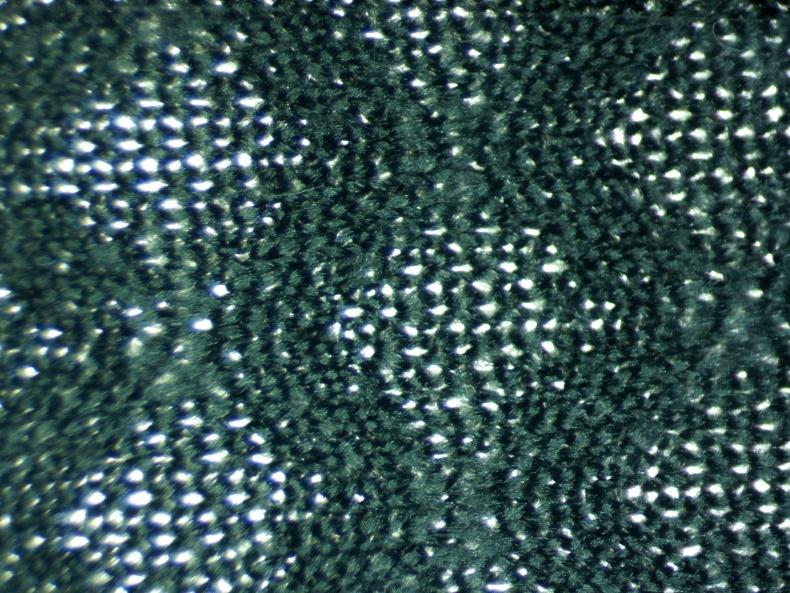
Fiber diameter influences garment comfort. Fiber diameters below 20 microns tend to eliminate itching. As fiber diameters increase above 20 microns, they are more likely to result in itching. Human hair is 40-50 microns in diameter. Wool from sheep tends to have a range of diameters ranging from 17 to 33 microns. Merino sheep fiber diameters range from 17-24 microns. Alpaca fibers can range from 15-40 microns. The finest fiber is from Angora rabbits at 11 microns. Typically, market scarcity forces finer-diameter natural fibers to command higher prices. Garments made with finer diameter fibers will tend to command higher prices. We measured the fiber diameter for each fabric under a microscope.
Garment weight
In this article, we test garments or fabric samples. We weighed all garments. We list the size of each garment. When possible, we attempted to obtain men’s extra-large garments. Arms of Andes provided women’s extra small garments.
Fabric thickness
Fabric thickness is determined utilizing a method that applies consistent compression to the fabric as part of the measurement process. A 50-gram weight applies compression to the fabric. The weight measures 1.27mm x 76mm x 76 mm. An iGAGING digital thickness gauge measures fabric thickness. The gauge applies slight additional pressure onto the 50-gram weight. The average thickness of each sample is calculated based on 3-5 measurements.
Fabric weight per unit area
The fabric area and weight were measured to determine grams/square meter and ounces per square yard. When garments were tested, we used the manufacturer’s specifications for fabric weight per unit area.
Air permeability
This measurement determines how much air flows through the fabric at a pressure difference of .5 inches (1.27cm) of water column. The higher the reading, the greater the amount of air that can flow through the fabric at any wind speed. Higher air permeability enables greater ventilation and improved moisture vapor transfer through the fabric.
Porosity
This measurement is generally related to air permeability. The measurement indicates the looseness of the knit or how much of the fabric is void or air space. Porosity is measured by placing the fabric sample on the microscope using backlighting. We set the magnification at .8 and produced a photomicrograph. The resulting image is analyzed using Photoshop to determine the portion of surface area through which light can penetrate. If you hold two fabrics in front of a light source, the fabric with higher porosity will permit more light to penetrate.
R-value
R-value measures a fabric’s resistance to heat transfer from the wearer to the environment. Higher R-value means a fabric will help reduce heat loss in cool weather or prevent the body from shedding heat in warm weather. I measured R-value on my guarded hot plate.
R-value/ounces/square yard
This is a measure of thermal efficiency. Higher efficiency occurs when more resistance to heat transfer occurs with lower material weight. As ultralight backpackers, we like to experience the insulating value required for our comfort at the least possible garment weight.
Wicking tests – wicking, infab, evap
This test demonstrates how well a fabric wets, wicks, and dries. I conducted using my permeation kettles. I place a sponge containing a predetermined quantity of water on the 120F (49C) kettle surface. Then, the test fabric is draped over the kettle surface and rests directly on the wet sponge. The fabric can absorb water which may wick across the fabric’s surface. An overhead thermal imager observes and records the progress of water as it spreads. The test continues for 30 minutes. At the end of that time, the fabric is removed and weighed. An increase in fabric weight occurs from water retained during the process and is called INFAB. Next, we weigh the sponge. The difference between the sponge’s starting weight and the finishing weight is the amount of water wicked into the fabric from the sponge. The difference is called WICKING. Finally, we subtract INFAB from WICKING to determine the amount of water that evaporated from the fabric during the process. Using these three values and watching the time-lapse drying video, we can readily determine which fabrics can remove sweat effectively from the skin and those that provide little or no ability to move sweat away from the skin.
Wetting tests – 200 and 400 microliter (ul) drops
The drop test measures how rapidly water contacting a fabric is absorbed. Drops can sit indefinitely on a hydrophobic (water-hating or water-repellent) fabric. Water drops can be absorbed rapidly into a hydrophilic (water-loving, absorbent) fabric. The industry-standard test places a 50ul drop on the fabric using a pipette. The test ends if a drop is not absorbed within 60 seconds. In our test, we use larger drops – four and eight times larger, respectively. These larger drops will hasten the wetting and absorption process. If the drops do not wet and absorb into the test fabric, we can be confident that the fibers are hydrophobic and do not support wicking.
Drying tests – water added, water dried, time to dry and drying rate
This test examines the following question: How long does it take for a saturated fabric to dry? Saturation for this test is the maximum amount of water a fabric can hold without dripping. This quantity is determined by dunking and carefully squeezing out excess water five times and then calculating the average weight after each dunking. We install the saturated fabric on the 120F permeation kettles’ surface. The moisture begins to dry. We record the drying process with the thermal imager. When the fabric is dry, the surface becomes uniformly warm and shows no further temperature rise. At this point, the test ends, and we weigh the test fabric to determine how much water evaporated. We calculate the drying time by measuring the elapsed time to dry from the thermal imager video. The drying rate is the weight of dried water/drying time.
The test fabrics
We base our findings on the performance of 16 base layer fabrics. Some were provided as complete shirts by their manufacturers. Others are fabric samples. We cut the garments and fabrics to fit the permeation kettles and the guarded hot plate. Table 1 shows the fabric breakdown:
Table 1: Test fabric distribution
| Fiber | Samples |
|---|---|
| 100% Merino | 5 |
| 100% Alpaca | 5 |
| 100% Polyester | 4 |
| Merino/Polyester Blend | 1 |
| Merino/Polypro Blend | 1 |
| Total | 16 |
Member Exclusive
A Premium or Unlimited Membership* is required to view the rest of this article.
* A Basic Membership is required to view Member Q&A events


Discussion
Become a member to post in the forums.
Thank you both. That makes sense.
Sorry, I’m still not sure I follow.
Holding fabric weight constant, does the type of material noticeably affect drying times or not? The article above seems very clear that it doesn’t. But has the balance of evidence now changed? Is it now the case that synthetics, after ringing out, will hold less water and therefore dry noticeably faster than natural fibres (of comparable dry weight) after soaking and ringing out?
seems to be a key point.
In the real world, I find by experience that good synthetic fibre base layers dry far faster than the equivalent weight merino wool base layer. I have no experience with other natural fibres.
In their marketing some years ago. RAB promoted their MeCo Merino synthetic mix as drying five times faster than the equivalent full Merino fabric. And having owned and used meco for some years, I can tell you it takes a lot longer than full synthetic to dry.
The idea that they all dry at the same rate whilst in use seems counter to what pretty much all manufacturers say, and to my and everyone I know experience whilst actually using them.
I’ve been hiking in damp conditions with people who have sweated the backs of their Merino base layers to sodden, And seen them never get dry for the rest of the day, whilst my sweaty synthetic has dried in 15 minutes or so once exertion has stopped.
And yet, the article concludes (based on empirical testing, eg table 7) that….. “Fiber choice does not significantly influence drying time in a base layer.”
My socks don’t get saturated crossing a creek.
Hi Hugh and Web:
You raise some good points. I will review the article and respond within the next few days.
I am looking forward to Stephen’s respond.
My (much less extensive) testing and field experience suggests that the rate of drying varies slightly by material (polyester being the best)…. drying time is much more driven by the amount of water the garment is carrying at the beginning of the drying process. The water carriage is influenced by how much water the material absorbs (synthetics suck up less), and how much water settles inside the weave (thinner, open weave hole less… especially after a good shake/squeeze).
I have found synthetics dry quickly. I figured it’s because they absorb less water.
One could weigh the garment dry, then wet, and determined how much water…
Thanks Stephen. Like Mark, look forward to hearing your further thoughts.
It’s interesting, I found corroboration very similar to your results when I was in the literature: “In 1951, Fourt et al. [L. Fourt, A.M. Sookne, D. Frishman and M. Harris, Text. Res. J. 21(1) (1951) p.26.] made a thorough and systematic investigation into the drying behaviour of various fabrics, when the first synthetic fabrics were becoming available inthe consumer market. They characterised some key drying behaviours that seem to be ignored in some of the newer literature. Fourt et al. found that ‘by and large’ all fabricsdry at the same rate; however, the drying time depends on the amount of water the fabricoriginally holds.”
I defer to Stephen regarding his own article, but it seems like there may just be a wording issue here about the relationship between fiber and drying time.
In the article, the first conclusion is “Fiber choice does not significantly influence the rate at which moisture evaporates from a base layer.” I.e., different fibers dry at the same RATE.
The second conclusion is “Fiber choice does not significantly influence drying time in a base layer.” That’s switching from drying RATE to drying TIME, and drying time is the product of drying rate (constant among fibers) to moisture absorbed (variable among fibers). So to the extent fiber choice impacts how much moisture is absorbed, it seems like it will impact drying TIME.
Hi ZY:
I don’t think I have read your article, but I have found it and will (although I may have it but I can only search by title, not author.
Here is another old article with the same findings:
I have finished my response, but I want to reread the Crow paper and the one you cited to see if I can explain this better. I will probably post tomorrow.
OK, I read the page shown, and was a bit alarmed by the amount of waffle. Some of it was being debunked by the authors of course, but in that case why quote it?
Some other claims, like ‘During exercise liquid water accumulates on the skin’, are just plain wrong.
Not a good look.
Cheers
Dr R Caffin
formerly Principle Research Scientist, CSIRO Div’n Textile Physics
Can you please clarify Roger:
“Some other claims, like ‘During exercise liquid water accumulates on the skin’, are just plain wrong.”
Don’t they just mean that during exercise people can become visibly sweaty?
I would have said this is a statement of the bleeding obvious rather than“plain wrong”. What am I missing?
Re does the fabric matter question. Agree it makes good sense that it’s all about how much water gets retained. Stephen’s article makes this point very clear and also the important point that heavy/ thick fabric will retain more water.
My question is just whether there is any practically significant difference in the amount of water retained between wool and synthetic:
The latter point seems an important qualification. Both initial absorption and retention after squeezing matter. A literal sponge soaks up a large volume of water but good ones will release nearly all of it after squeezing.
a closely related variable that might be too hard to control for beyond a certain point is fabric construction. As an extreme example to show the point – a felted wool “great coat” absorbs lots of water and is very hard to squeeze out. Even controlling for dry weight/ thickness, it seems like it would be suboptimal for drying.
I’d defer to Stephen, but maybe a good test would just be to look at polypropylene yarn and wool yarn that has been soaked and squeezed. This would control for the fabric construction confound.
Anyway, grateful for everybody sharing their thoughts, and Stephen’s rigour.
“Some other claims,. . . are just plain wrong.”
Bit of a bald statement, wasn’t it? But I will stand by it.
First problem: what is exercise? One could define it as being something which makes you get sweaty, but that, surely, is begging the question.
We go for a run early every morning, maybe 30 – 40 minutes. For me, it is more like jogging. I do not get sweaty. Is that exercise? (Feels like it!)
Don’t they just mean that during exercise people can become visibly sweaty?
I am sure you CAN get sweaty, but that does not mean you have to.
On the other hand, if you end up in a Police Station being interrogated, might you get a bit sweaty? It has been known, I am told. Is that exercise? Maybe not.
Does this help?
Cheers
I think that may just be poor writing — a skill that seems to transcend educational attainment. That sentence seems to be a continuation of the prior sentence in an attempt to describe a particular situation — the worst case. Inserting the word “that” between “during” and “exercise” makes it mildly better.
I reread the article and reviewed the details of the test methodology. Here is my conclusion: I wish I had not speculated on the results of shaking or squeezing a fabric to remove excess water, as that possibility was already incorporated into the test methodology. So, mea culpa, I did not reread my own article before responding.
Saturating a piece of fabric, in other words, getting it to hold as much water as it can hold, is a tricky proposition to pull off in a repeatable fashion.
As explained in the article, I dumped each fabric sample into a water container. I stirred the fabric around in the container. I then pulled the sample out and lightly squeezed the excess water out so it was not dripping. I then weighed the wet sample to measure how much water was retained. I repeated the procedure 5 times and calculated the average. I then calculated the standard deviation of the individual measurements. If the standard deviation exceeded the average by 5%, I would continue until the sample average was below the standard deviation of 5%. This process would have accomplished the fabric manipulation I suggested in my prior response, but it was done on all the fabrics tested.
Let me review the testing process and results with a subset of data from the article.
This is a subset of table 2. I am showing 4 fabrics. The important lines to look at are highlighted in yellow. You can compare the thickness and weight for of the fabrics.
The last four lines in the table apply to the drying test. The line “Water Added” for each fabric results from the process I just described above. The “Water Dried” line requires a little explanation. The fabric samples were square. I placed them on the round surface of my heated permeation kettle to dry. This meant the extra fabric hung down in folds in the four corners of the kettle. Water would drip from each corner onto the floor during the drying process. This water had to be accounted for, so I placed paper towels of known weight beneath each corner to collect all the dripping water. I then could calculate the water weight that dripped from the test fabric and subtract it from the “Water Added” fabric weight. The amount of water weight that was eliminated from the drying area over the kettle is the “Water Dried” value. During the drying process, I monitored the fabric’s surface temperature with my thermal imager. When the surface temperature achieves a steady state, the fabric over the heating area is dry, and I now know the drying time described in “Time to Dry”. If you inspect “Time to Dry” and “Water Dried”, you can see the strong relationship between the amount of trapped water and drying time. If you then divide the “Time to Dry” by the “Water Dried,” you get the drying rate shown in the last line of the table. The average drying rate of 1.257. The standard deviation of the drying rates is .064. This is equal to the 5% variation I imposed on the on the “Water Added” saturation test.
These steps produced figures 6 and 7 in the article.
Figure 6 shows the relationship between the quantity of water in each fabric and the drying time for each fabric is exceptionally linear, with a correlation (R2) of 97.5%. This means that the drying time is nearly a complete function of the water volume trapped in the fabric and very little else. “Very little else” includes the type of fiber used to produce the fabric. Of course, the drying time will vary as drying conditions change.
Figure 7 is a graph of the drying rate calculated by dividing the weight of the water dried for each sample by the time it takes to dry completely. The average drying rate for all samples was 1.26 grams per minute, with a standard deviation of .065 or 5%. This table demonstrates that all fabrics’ drying rates are identical, regardless of fiber type or fabric construction.
This still does not necessarily answer whether the fiber type causes more or less moisture to be absorbed into a piece of fabric and influences the drying time.
I produced multiple regression models that considered fabric weight, thickness, fiber type, and other variables to test whether fiber type predicted water absorption quantity. I could not prove or disprove this hypothesis.
I then tried a more straightforward method. In Figure 6, we have the plot of absorbed water weight vs. drying time. I hypothesized that if a specific fiber held more water than another, it would form a cluster of deviation from the fitted curve line in Figure 6. So, for example, if merino wool consistently held more water than polyester, each merino wool fabric would take longer to dry, and it would be positioned above the fitted curve line. Similarly, polyester would cluster below the fitted curve line.
Here is Figure 6.
We see that most fabric samples are very close to the line. This means there is no discernable impact of fiber type. Four points show greater deviation from the line than the other 12 points. We will want to know if these are similar fiber types.
Here is a plot of residuals.
The plot of residuals calculates the predicted drying times using the regression equation seen at the upper right corner of the graph for the measured water contained in each fabric sample. The plot shows the actual time to dry (blue dot) and the calculated time to dry (orange time to dry). The difference between the two is the residual or variance between the measured values and values predicted by the regression equation. Most points predicted and measured values line up very well. We do see our four points in blue that have the highest residuals.
Here is a table of residual values:
This table shows the predicted dry time for each sample in column 2. The difference between the predicted and actual dry times (the residual) is shown in column three. The variance between the two numbers is shown in column 4. In column 5, I identify the fabrics for the four outliers. We have two merino blends; one dries faster than predicted, and one dries slower. We have two Alpaca garments; one dries faster than predicted, and one dries slower than predicted. You can learn about the fibers, weight, thickness, and other characteristics by viewing Table 2 in the article. Whatever is going on, no consistent variance can be attributed to any particular cause, including fiber type.
To repeat the article’s conclusions: 1) Drying time for a fabric is a function of the quantity of water absorbed into the fabric. 2) The drying rate (in grams/minute) for fabric is a function of the drying conditions: temperature, windspeed, and relative humidity. 3) Fiber type does not influence drying time.
Let’s look at ways moisture accumulates in fibers and fabrics.
Regain describes the weight of moisture vapor that accumulates inside a fiber. This water accumulates in the fiber as a function of relative humidity. For example, wool can retain as much as 30% of its weight; cotton can hold 10%, and polyester can keep 4%. This process of moisture accumulation is called adsorption.
Adsorption has nothing to do with the quantity of water absorbed by a fabric you wear on your sweating body. The quantity of water a fabric absorbs is determined mainly by its volume of voids. This quantity will greatly exceed the weight of water accumulated through adsorption.
This is evident in data from the study that was not included in the article and is presented in the table below.
This table lists the results of the “soak” process for 13 of the 16 fabrics included in the test. You can see the dry weight for each sample in column 2 and the weight of absorbed water in column 3. Water trapped in a textile is measured using two metrics: Water Content and Regain. Water Content is the ratio of water weight in the fabric to the total weight of the wet fabric. Regain is the ratio of water weight in the fiber to the dry weight of the fiber. This table shows water accumulation due to soaking with liquid water, not regain, but I include “Regain Equivalent” because we are used to seeing this type of metric for fibers.
Observing this data, we can see that the absorbed water weight is many times greater than what is explained by fiber regain. We can see no relationship between the fiber type and the amount of water accumulated in each test fabric. We see the variation of water accumulation in fabric due to fabric construction: weight, thickness, yarn characteristics, knit and weave patterns, and more.
I know this may seem counterintuitive. If the test does not reflect reality as you have experienced it, I welcome a discussion of any flaws you find in the test method, which I hope are fully described in this response and the article.
In the discussion with ZY, he and I referenced two other drying studies. Both of these studies reached similar conclusions: fiber type is unrelated to fabric drying time. The Crow articles makes this statement:
Thank you Stephen. This clarifies things more comprehensively than I could have hoped for.
I do really appreciate the systematic and scientific approach you bring to answering these quite fundamental questions.
Despite your analysis, I suspect the “synthetics (of the same weight) will absorb less and dry faster than natural” myth will be hard to dislodge.
Thanks again.
No doubt in part because 75% of the wool/alpaca garments in the test absorbed almost twice as much water as Alpha Direct (or more). Only one wool garment absorbed less.
There may be no statistical correlation but, in real life, odds are that AD will absorb less water than most natural fabrics. However, in the lightest natural garments, the differences diminish.
This is consistent with anecdotes and most of what has been written on BPL in the past: Both natural and synthetic fibers perform well enough to be valid choices, and individuals have preferences one way or the other.
That was a very thorough response, thanks.
The “synthetics will absorb less and dry faster than natural” myth isn’t totally dead because in most cases wool weighs more, so it absorbs more water, so it takes longer to dry
To complicate, if you sweat the same amount for synthetic fabric, and for heavier natural fabric, and both fabrics absorbed all that sweat, then they will dry in the same amount of time.
If you sweat more than what the fabric can absorb, then where does the extra water go? If it dripped onto the ground then the lighter weight fabric would dry faster.
Another strategy would be to not sweat so much. If you get warm, remove clothing.
I like the consistency of the dry time for different fabrics.
That is a verification of your test apparatus and analysis techniques.
Yes, my characterisation of the myth in full is: “ synthetics (of the same weight) will absorb less and dry faster than natural”
Hopefully we’re all now in furious agreement:
(Btw – I’m not an avid proponent of either fabric. I usually wear synthetic coz – for the same weight of fabric- it’s less prone to getting holes. I used to think I preferred it because I assumed it dried faster, even controlling for weight. Stephen and others who have posted with evidence have set me straight on this last point)
Glad to see this excellent article is getting so much attention again! Only problem is it makes me feel guilty about not sharing my thoughts. So …
It seems there are two reasons why polyester keeps you drier. One, as mentioned, is that you can wring it out. (And a related advantage, when not in the mountains, you can put in the high-speed spin cycle and wear it the next day.) I’d be nervous about doing either with pure merino or alpaca.
The second is that while all fabrics absorb roughly the same amount per weight (given similar weaves, etc.), polyester weighs less.
This is true for both base layers and mid layers (compared to merino and alpaca). Mid layers are simple: A good poly mid layer weighs less than an equally warm wool or alpaca mid layer. So it absorbs less and dries quicker. See Polartec Alpha. It may absorb a lot per gram, but for a mid layer, that’s irrelevant. What is relevant is how much it absorbs per R value. (Per unit of insulation.)
I suspect poly fleeces, which were not tested, would be second best.
But don’t look at Patagonia mid-weight, or any other synthetic that can’t decide whether it’s a wicking base layer or a mid layer.
For base layers, it’s a bit different. Moisture absorption per R value is irrelevant, because for base layers, R value is irrelevant. If you have a warm base layer, you are carrying too many grams of an inefficient, heavy insulator. Better to have a thin one and save the grams for polartec alpha, or a fleece. Your gear will weigh less and absorb less.
(There are also other reasons why the first duty of a base layer is to be light: Because you can hand wash it over night. Because, unlike mid and insulating layers, you may want to carry a spare base layer. And because of warm weather.)
So with base layers, what matters is absorption not per R, but per layer. (Or per square inch or yard or meter of fabric.) And poly base-layer fabrics weigh less per m2.
Again, we can ignore the 147g/m2 patagonia midweight. It’s not a base layer. And if it were, it would be an overweight one and therefore a bad one. If we want to know which is better, poly, merino, or alpaca, we need to know how merino and alpaca compare to good base-layer poly, not bad base-layer poly.
My Rab poly base layer uses 85g/m2 fabric. Patagonia’s lightweight Capilene uses 65 g/m2. (Now that’s a base layer! (Or at least it would be, but Patagonia doesn’t make a zip-top :-( .)) And I suspect my Montbell poly base-layer pants use an even lighter fabric (not sure).
For comparison, I don’t think alpaca base-layers get any lighter than the 120g/m2 Arms of the Andes fabric tested, and pure merino base layers don’t get much lighter than Icebreaker’s 200g/m2, if at all. So the Patagonia lightweight poly is well under half the weight of the lightest poly base-layer tested, less than 60% of the lightest alpaca, and incredibly, less than a third of the Icebreaker’s 200g/m2.
So in terms of water absorption and drying time for base layers, poly wins.
Does that mean it’s best? One question is, regardless how wet it gets and how quickly it dries, how warm is it when wet. This depends at least partly on how much air it holds onto. We know cotton holds on to none and is cold, whereas wool – if I understand and remember correctly – can hold onto 60% as much as when dry. How about poly?
But perhaps there is more to the warm-when-wet story. An additional claim for wool, which I haven’t seen for a long time, is that, at least in certain circumstances, it can do the neoprene trick, using water as an insulator. Anyone know if there is anything to that?
Then there’s the question of how quickly fabrics get wet – and there did seem to be some differences in the tests.
Beyond pure wet performance questions, many fabrics, but especially the animal fibers, claim to thermoregulate, whatever that means. What I know it doesn’t mean is keep you cool in Summer. And despite spending too much time searching, I never found any evidence for it. Yes, I understand wool emits heat when it absorbs water. So what? I don’t want that when I’m sweating. And when it rains, that only helps until it’s done adsorbing. After that you’re cold and wet. Am I missing something?
Of course, wool smells better than poly. Usually. And if I need one garment for a weekend away that includes both day hikes and going out for nice dinners, a wool sweater beats a poly fleece.
But merino and alpaca are scratchy. Bring on the anti-scratch treated Cashmeres and Alpacas! (Though for base layers, blended with synthetics, so they’re strong and thin.)
The other topic I’ve been wanting to comment on is alpaca vs merino.
In the article, it appears that fabric construction, e.g. how it is knit or woven, and coating make a much bigger difference than the kind of fiber, and that it is not clear whether alpaca’s claim to be warmer per gram than merino is true. However, what I see in the results is that it is VERY likely that alpaca is indeed warmer per gram than merino.
· While there is some overlap in R value per gram, it is small relative to how many alpaca fabrics are how much warmer than how many merino fabrics. And precisely because fabric construction makes such a big difference, it is likely that the overlap is due to fabric construction, not to some alpaca fibers being less warm than some merino fibers.
· And related to that, controlling for permeability (because higher permeability is expected to increase R per gram) makes alpaca’s advantage even more certain. A scatter plot showing R per gram and permeability would probably make quite clear that with the same permeability, an alpaca garment is likely to be a lot warmer per gram than a wool garment.
But did I mention that it’s scratchy? :-(
Become a member to post in the forums.