

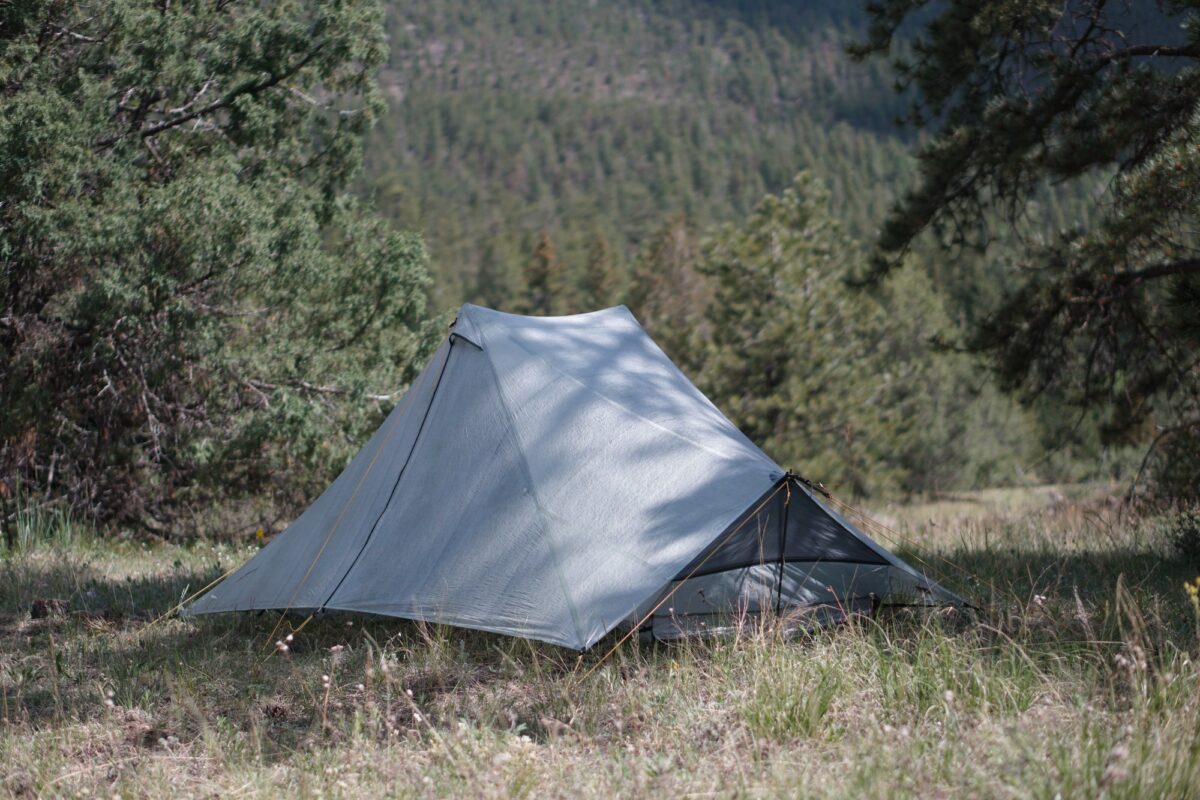

by Andrew Marshall and Ryan Jordan
Introduction
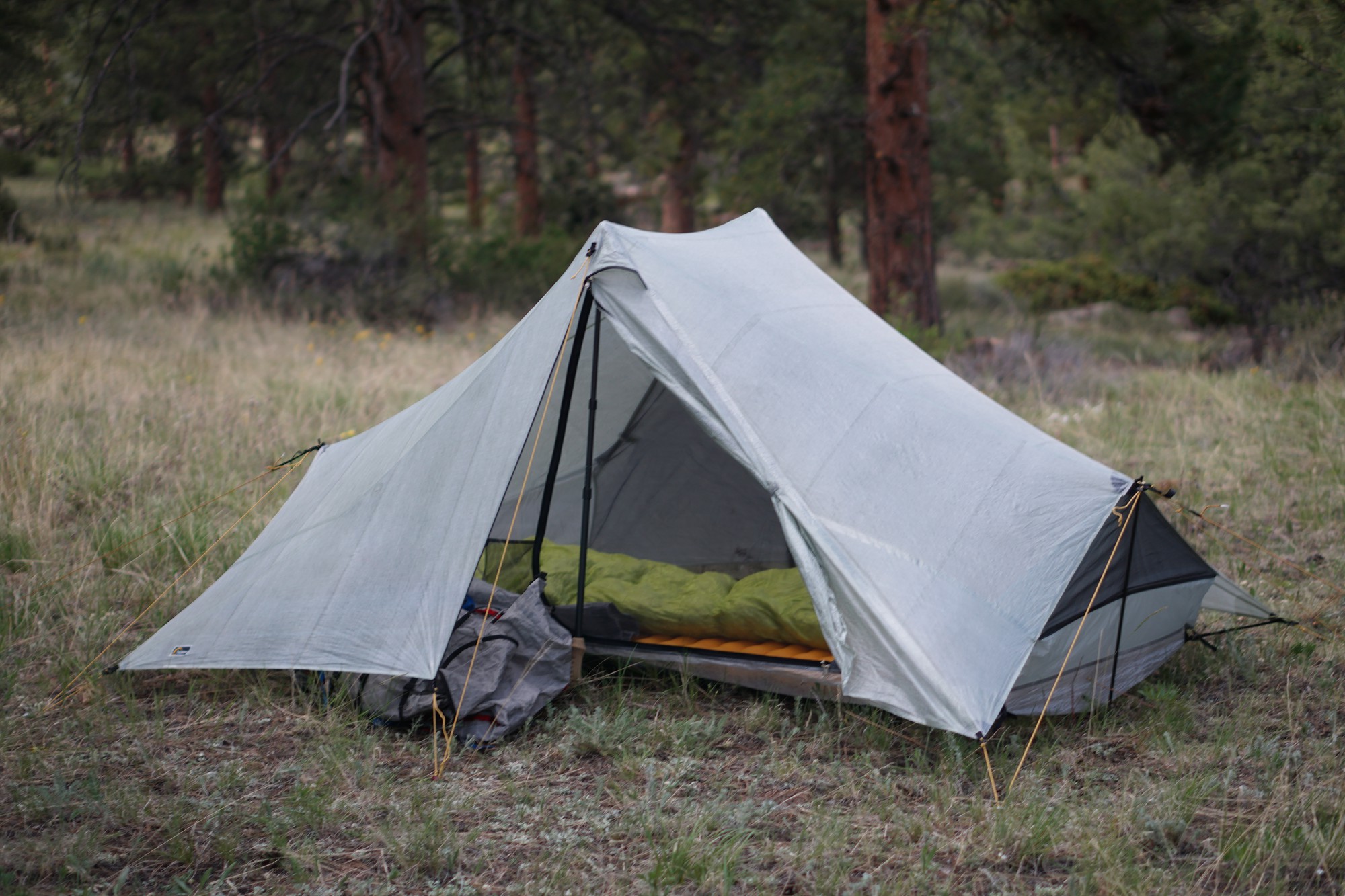
The Tarptent Dipole 1 Li (22 to 23 ounces / 0.62 to 0.65 kg, MSRP: ~$699) and Tarptent Dipole 2 Li (26 to 27 ounces 0.74 to 0.77 kg, MSRP: ~$799) are both modified A-frame, double-trekking-pole, double-vestibule, double-door, side-entry, single-wall, Dyneema Composite Fabric (DCF) shelters.
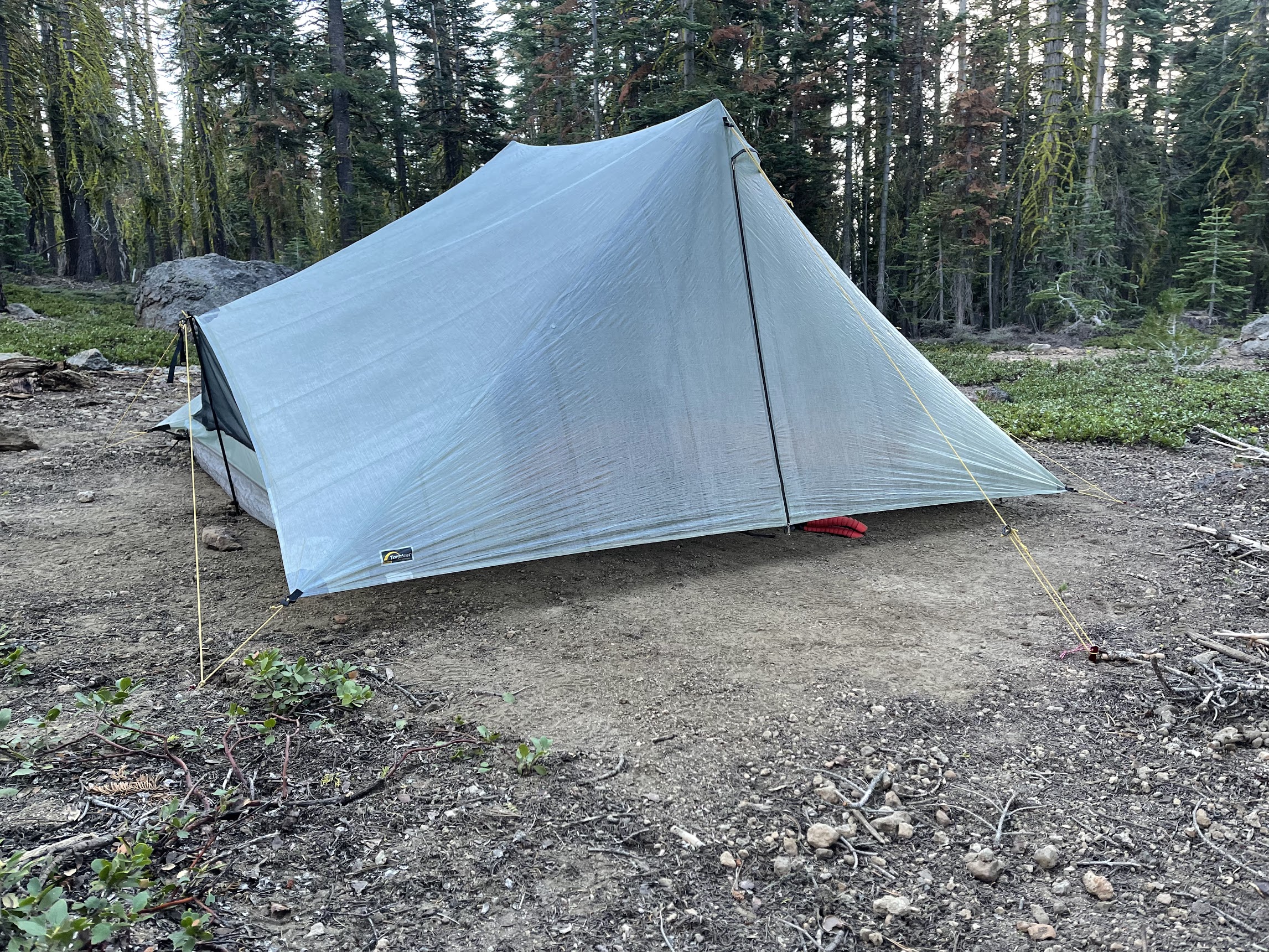
The Dipole line represents a continuation of Tarptent’s use of supplemental poles (i.e., extra poles in addition to the trekking poles) to add volume and support to trekking-pole shelters. Dipole tents have several features that make them unique among two-pole, double-door shelters:
- they can maintain a stable structure with four stakes
- they can maintain a stable structure while both vestibule doors are open and the shelter is in a four-stake configuration
- they feature collapsible, removable, 21-inch (53 cm) carbon fiber struts at the head and foot that add a noticeable amount of interior livable volume while supporting the tent structure (and allowing the first two points above to be a reality)
Watch the Video
Watch Ryan Jordan’s video review and tour of the Tarptent Dipole 1 Li and Dipole 2 Li:
Highlights
- weight*: Tarptent Dipole 1 Li – 22.6 ounces / 0.64 kg (*pre-production prototype)
- weight*: Tarptent Dipole 2 Li – 26.3 ounces / 0.75 kg (*pre-production prototype)
- can maintain a stable structure in mild weather with four stakes
- vestibule doors are not part of the structure (both doors can be open at the same time without losing tension/stability)
- 21-inch volumizing end struts (Easton 3.9 carbon fiber) create large amounts of interior livable volume
- end struts are removable and collapsible to 13 inches (two-section, shock-cord connected)
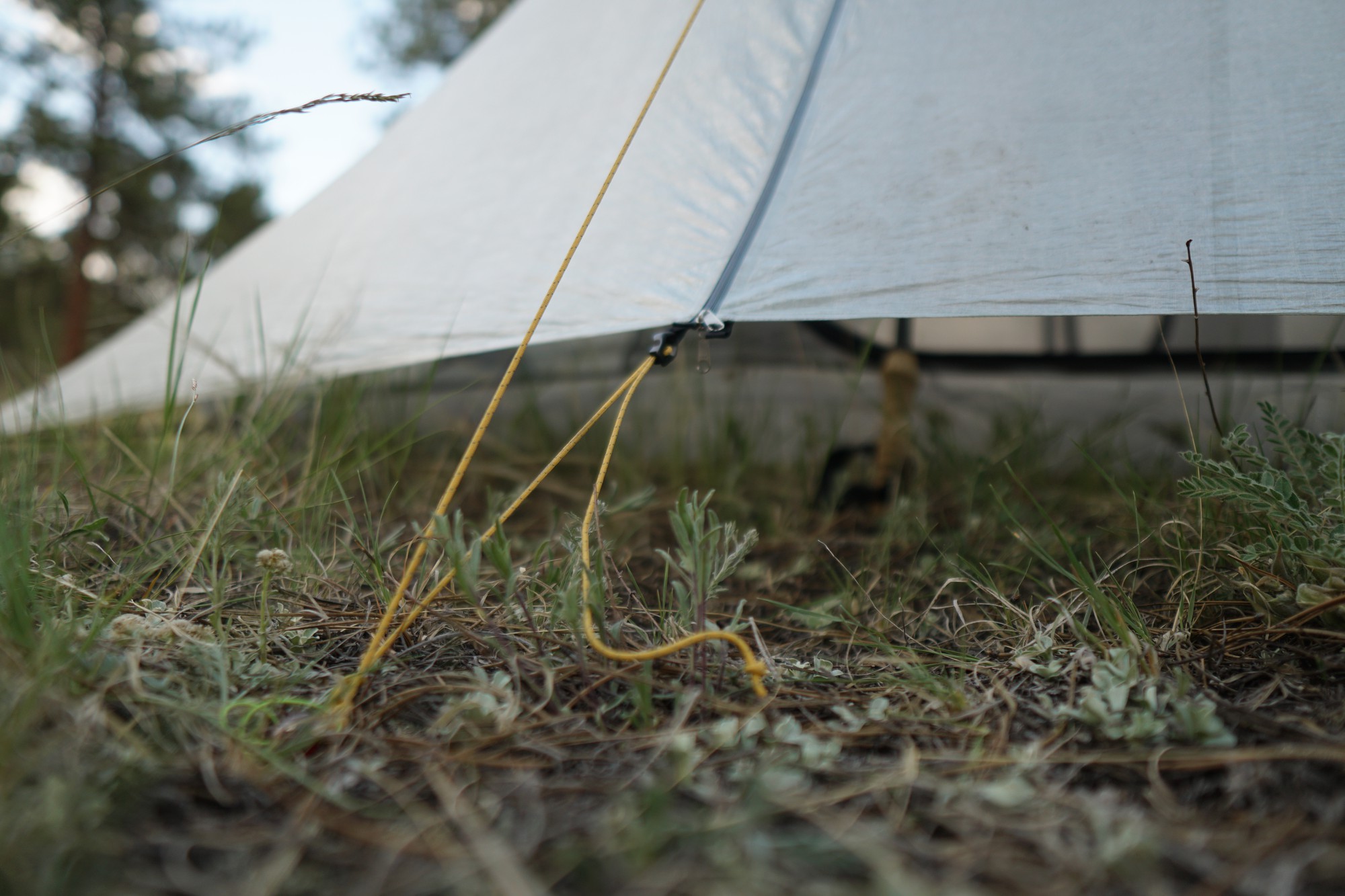
- vestibules are 17 inches (43 cm) deep, expandable with an optional line from lower zipper pull tab to apex guyline stake (Tarptent includes hardware and guyline to accomplish this)
- Dipole 1 Li apex height: 43 inches (109 cm)
- Dipole 2 Li apex height: 45 inches (114 cm)
- Dipole 1 Li width x length: 36 x 84 inches (91 x 213 cm)
- Dipole 2 Li width x length: 58 x 88 inches (147 x 224 cm)
- single-wall design with condensation drain vents
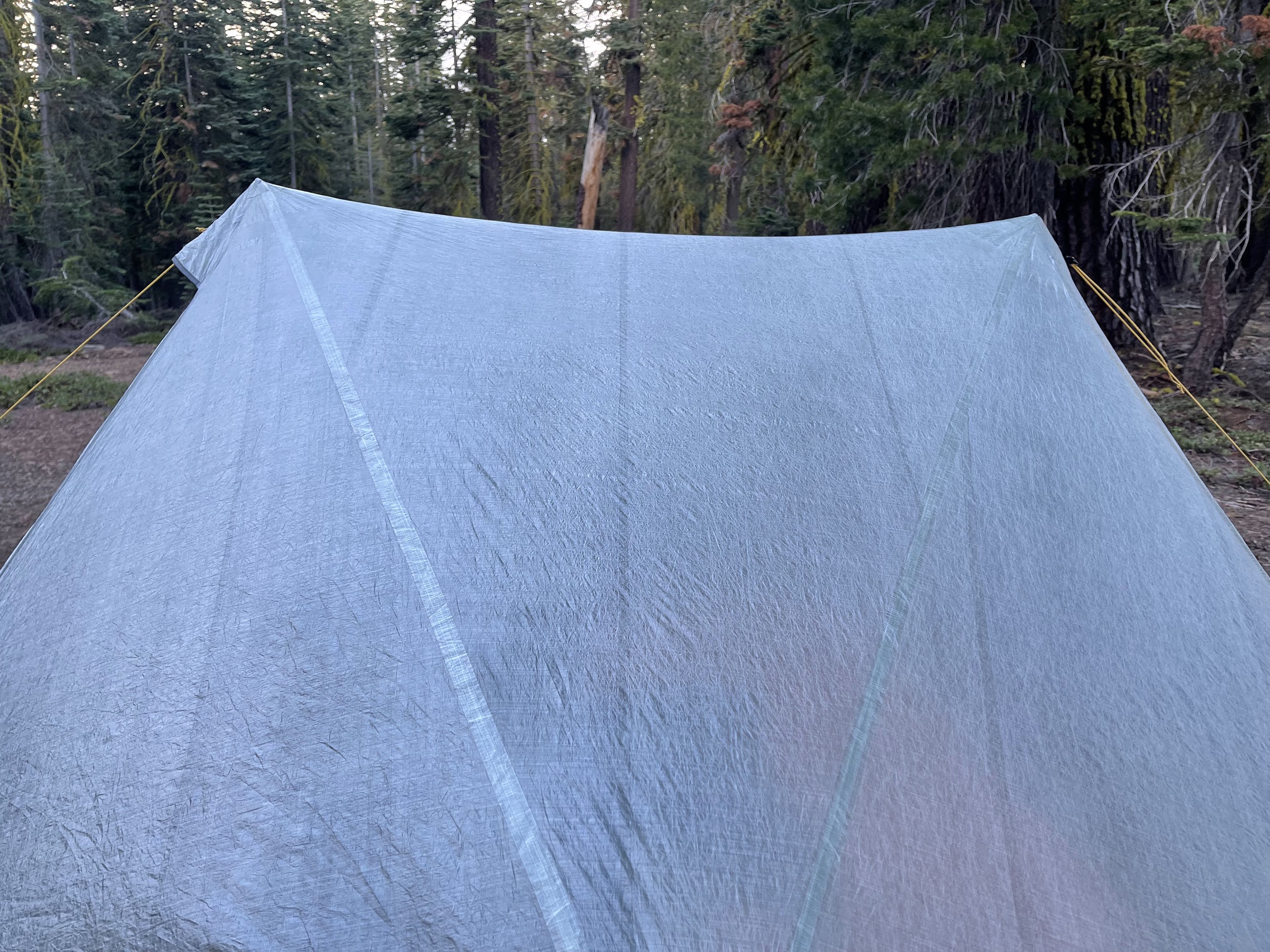
- canopy/fly material: Dyneema Composite Fabric CT1E0.8, 0.55 oz/yd2
- floor material: Dyneema Composite Fabric CT2K.18, 1 oz/yd2
- zipper-type – canopy – YKK #3 AquaGuard
- zipper-type – interior mesh – YKK #3 coil
- catenary curved ridgeline
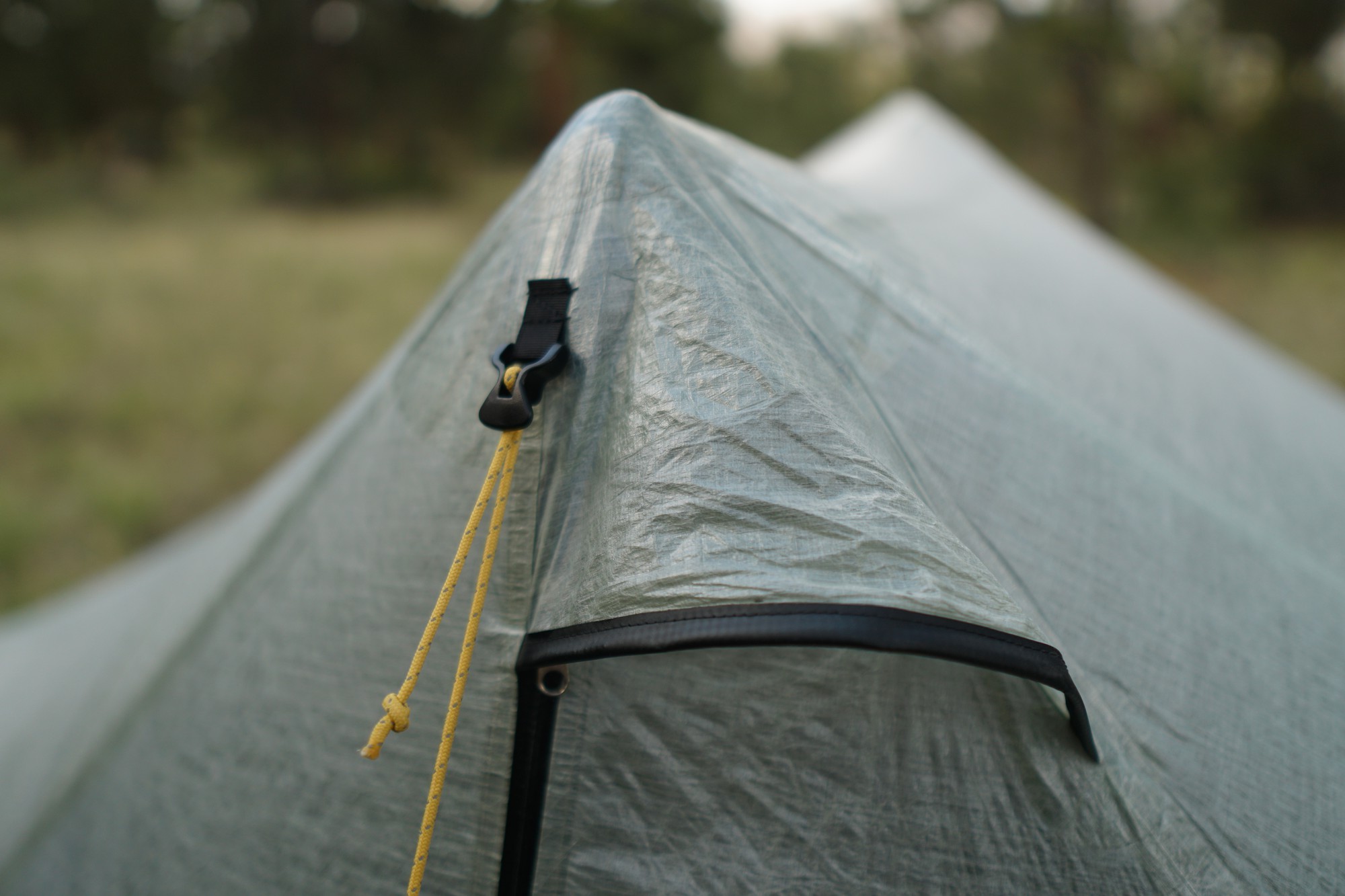
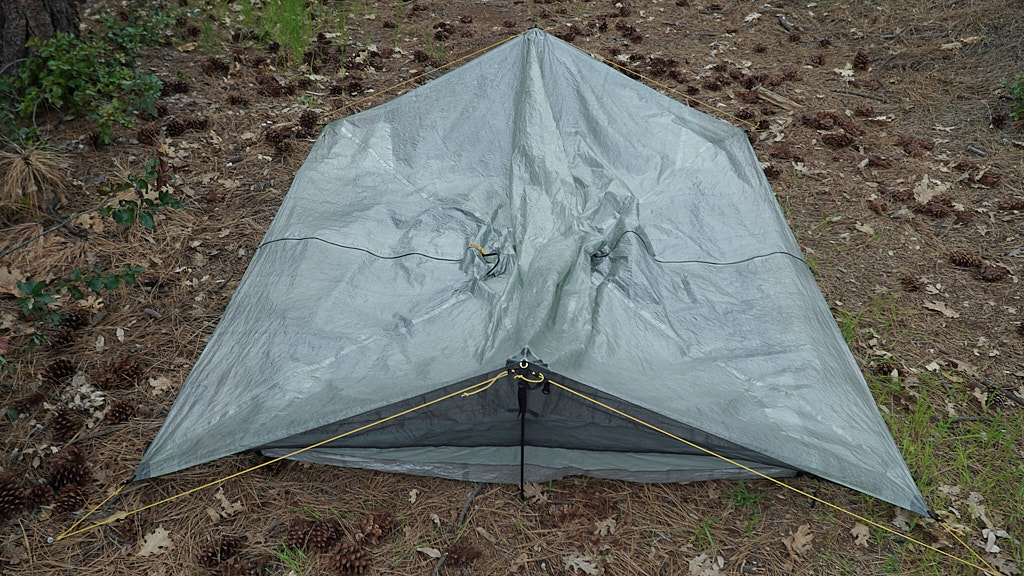
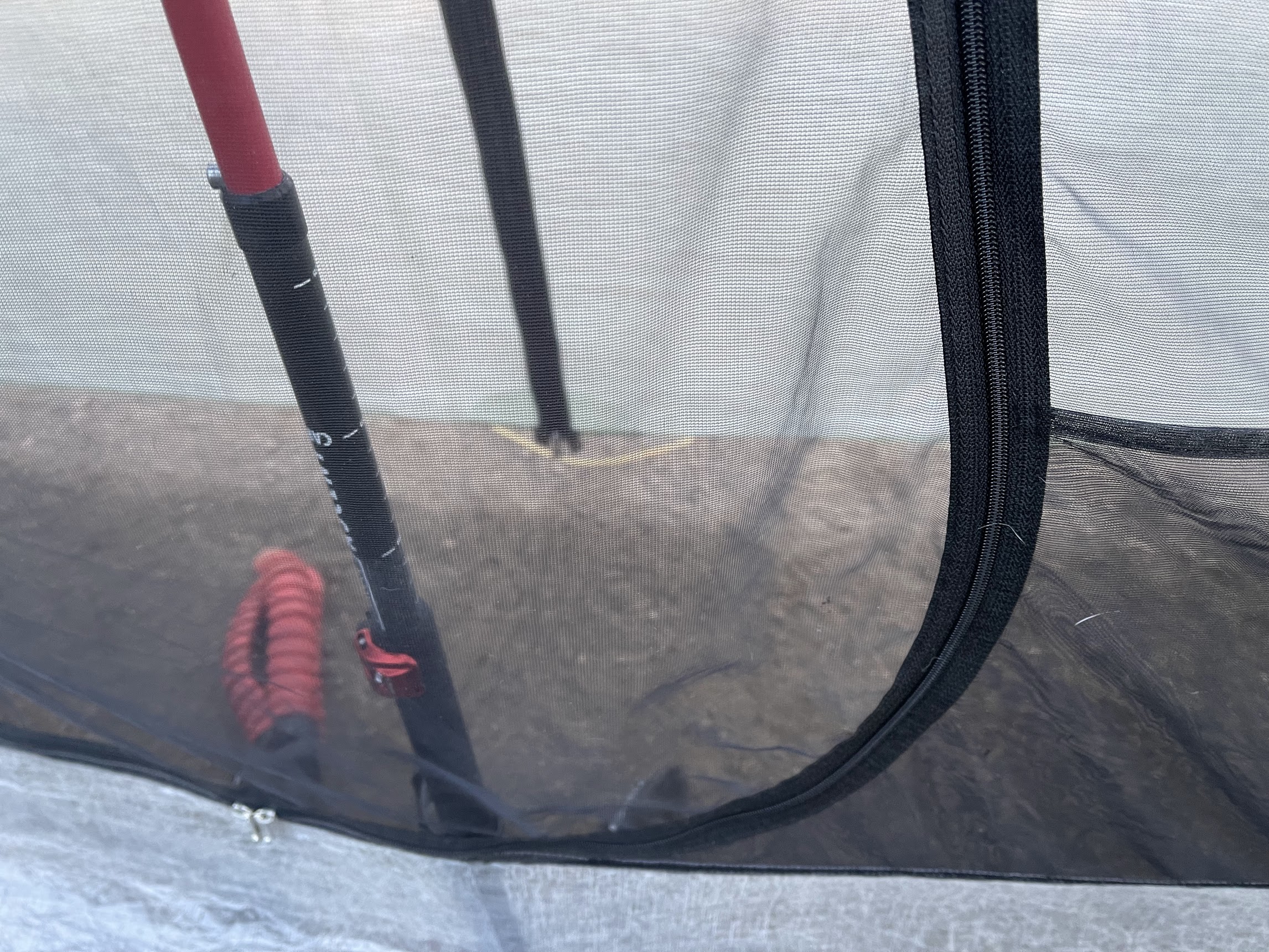
- mesh panel on either end, backed by a sil-poly panel that can be opened and closed from inside the tent for ventilation/weather protection
- Dipole 1 Li fits one long/wide pads and users up to 6 feet 8 inches (203 cm)
- Dipole 2 Li fits two long/wide pads and users up to 6 feet 10 inches (208 cm)

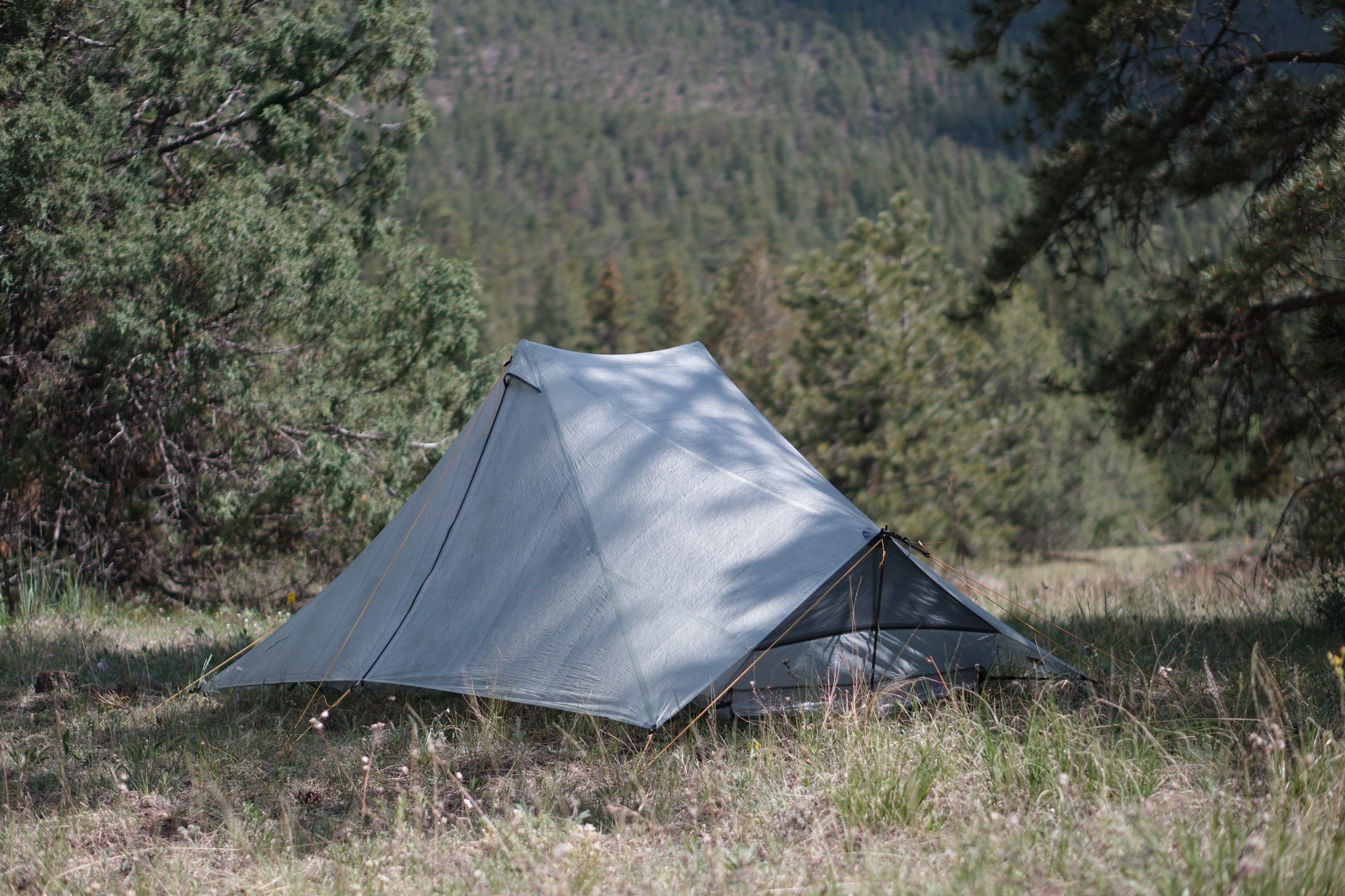
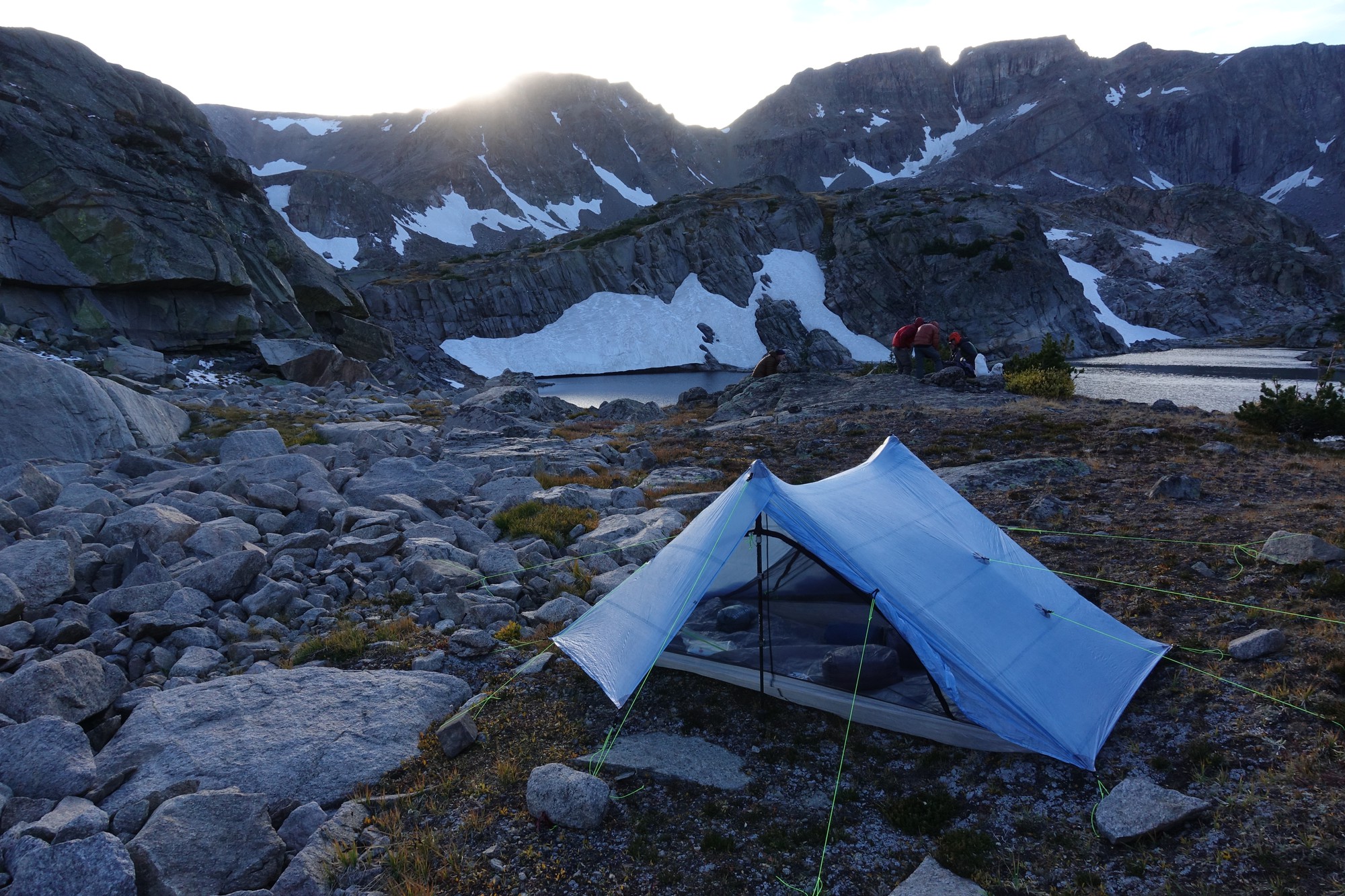
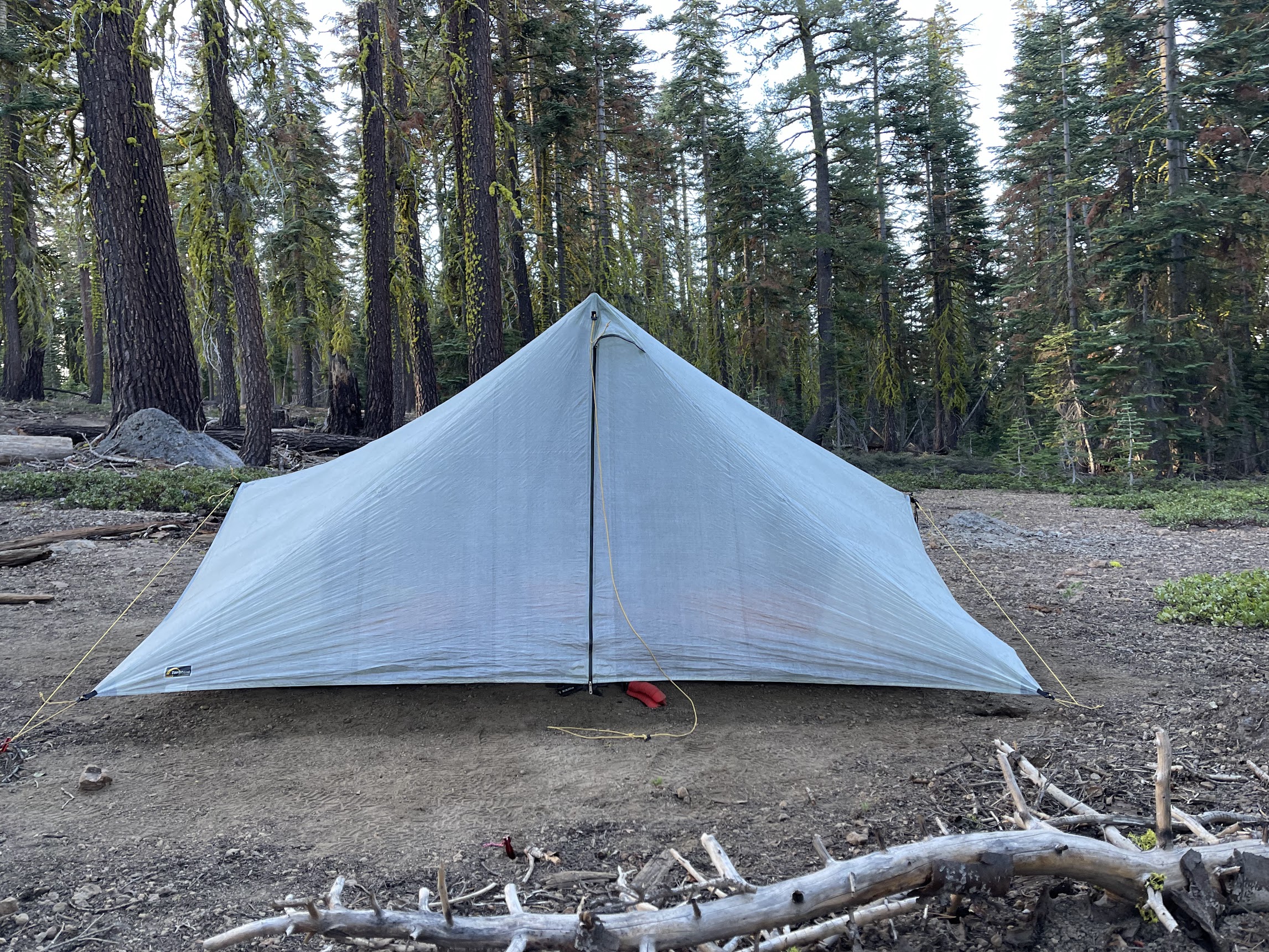
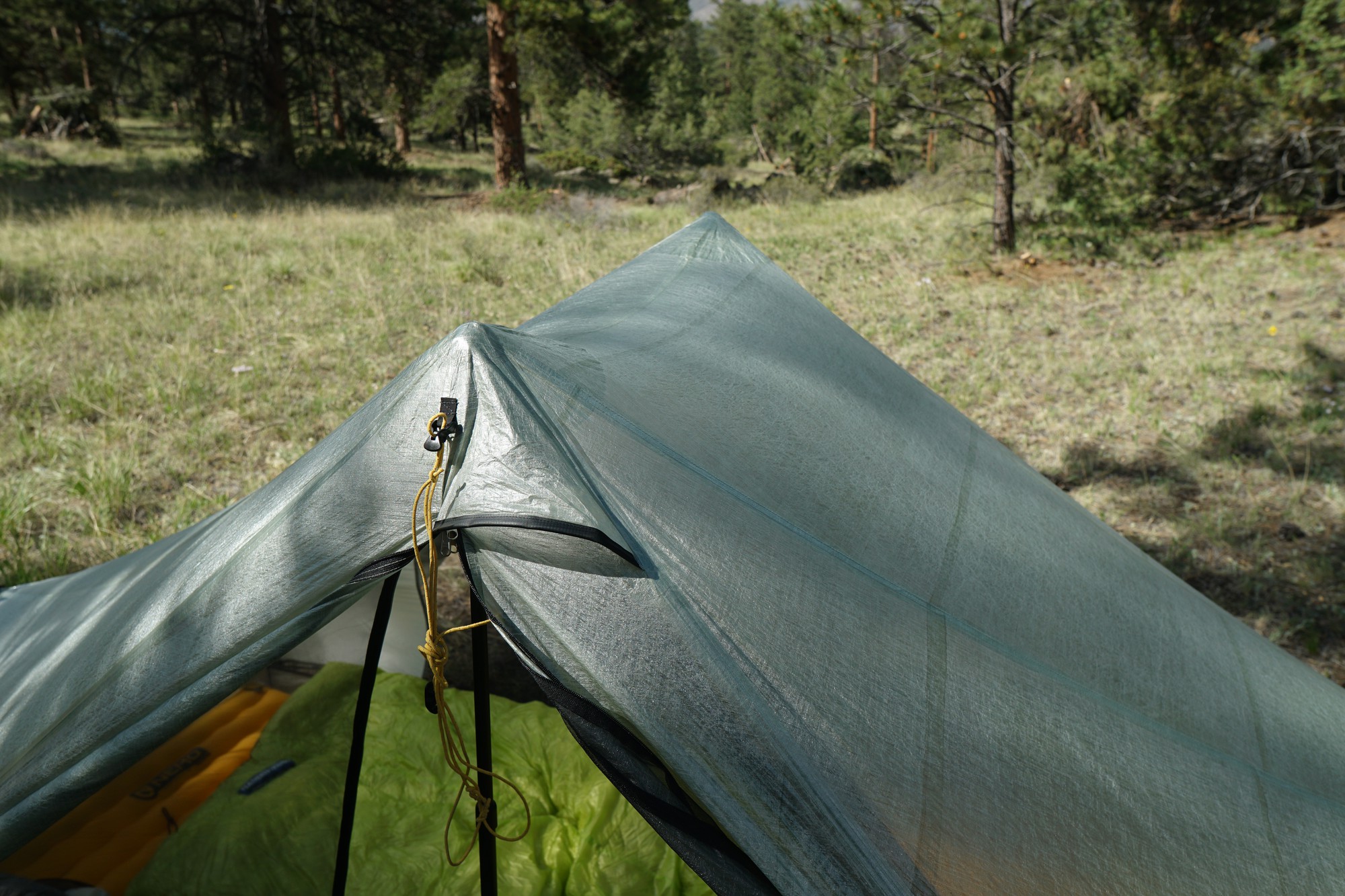
A Tarptent Dipole 1 Li in the Colorado Rockies. Photo: Ryan Jordan.
Testing context
We tested the Tarptent Dipole 1 Li and Dipole 2 Li on three below-the-treeline overnight treks in June of 2022 in the Sierra Nevada and Colorado Rockies. Both shelters were subjected to light wind (with gusts up to 10 to 20 mph) and moderate-to-heavy rain. We were interested in getting initial impressions on ease of setup, livability, structural integrity, condensation resistance, and weather protection.

Test samples vs. final product
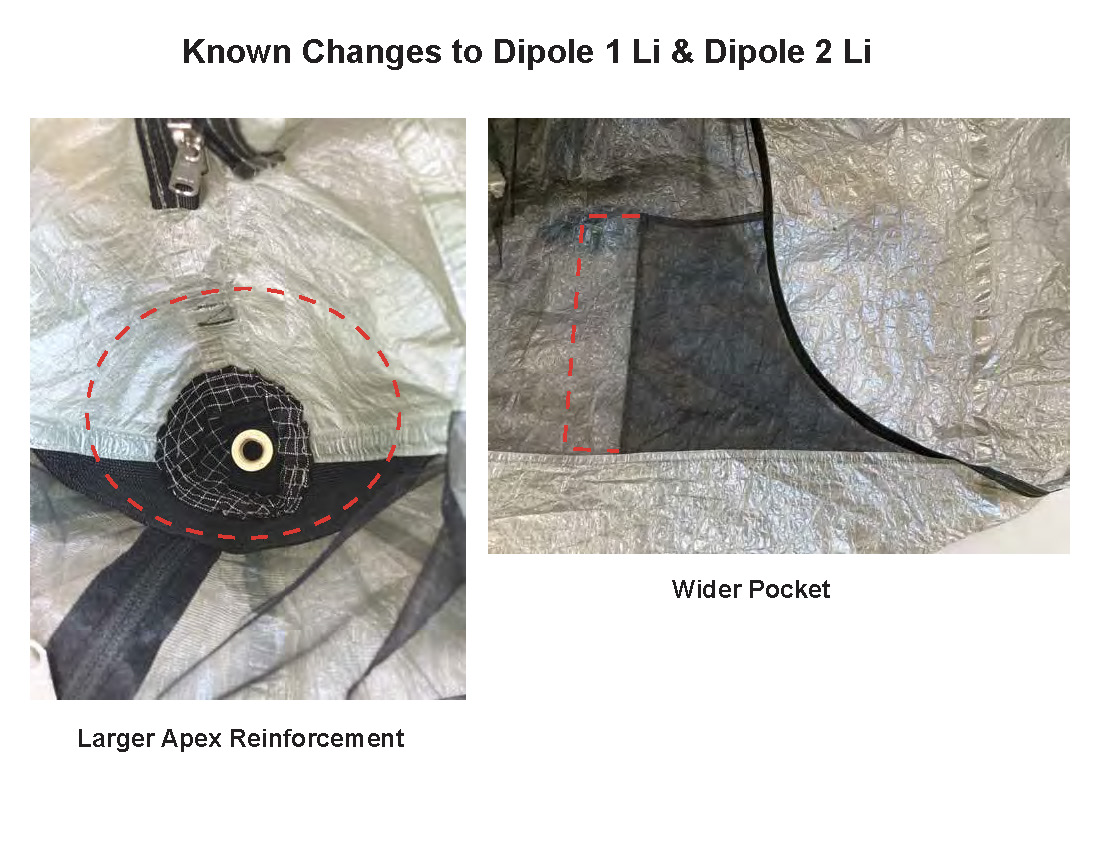
The samples that we tested are late-stage prototypes. Tarptent is still making adjustments to the Tarptent Dipole 1 Li and Dipole 2 Li, and some of the features visible in the photos in this article will be changed by the time the product gets into consumers’ hands. Currently, changes will include:
- very small pattern edits on the vestibules to tighten them up at the hem, especially on the Dipole 2 Li
- larger apex pole cap reinforcements
- top of the mesh reinforcement that is currently black ballistic nylon will also be changed to the lighter 210D w/Dyneema grid
- wider interior stow pockets
- the MSRPs listed above are estimates
First impressions
Setup and structure
The Tarptent Dipole 1 Li and Dipole 2 Li have a rectangular footprint, which makes site selection easy – certainly easier than site selection is for the Stratospire Li or ProTrail Li (non-rectangular shelters).
Setup is simple (for a trekking-pole supported shelter) but the order of operations is important – watch the video above for a setup demonstration.
Setup instructions:
- Insert the end struts.
- Stake the two corners of one end of the tent to bring tension to the fly edges between the top of the strut and the stakeout point.
- Repeat for the other end, ensuring a rectangular configuration that brings tension to the vestibule door bottom edges.
- Unzip one vestibule zipper from the top, insert a trekking pole (tip up) – 43 inches (109 cm) for the Tarptent Dipole 1 Li and 45 inches (114 cm) for the Tarptent Dipole 2 Li. Zip up the zipper.
- Repeat – insert the second trekking pole into the opposite vestibule.
- Reset corner tent stakes as needed so they are parallel with the corner seams (i.e., 45-degree angle off the parallel lines of the tent bottom edges).*
- Make sure the bottoms of the end struts are inset slightly relative to the tops, to ensure that downward falling rain doesn’t enter the end vents.
- Tighten the corner guylines.
- Tighten the guylines at the tops of the struts – this step brings the entire tent into a final state of tension. At this point, minor adjustments to pole height and position, corner tension, and corner stake location may be necessary to bring the tent into a taut stake if camping on uneven ground with minor irregularities.
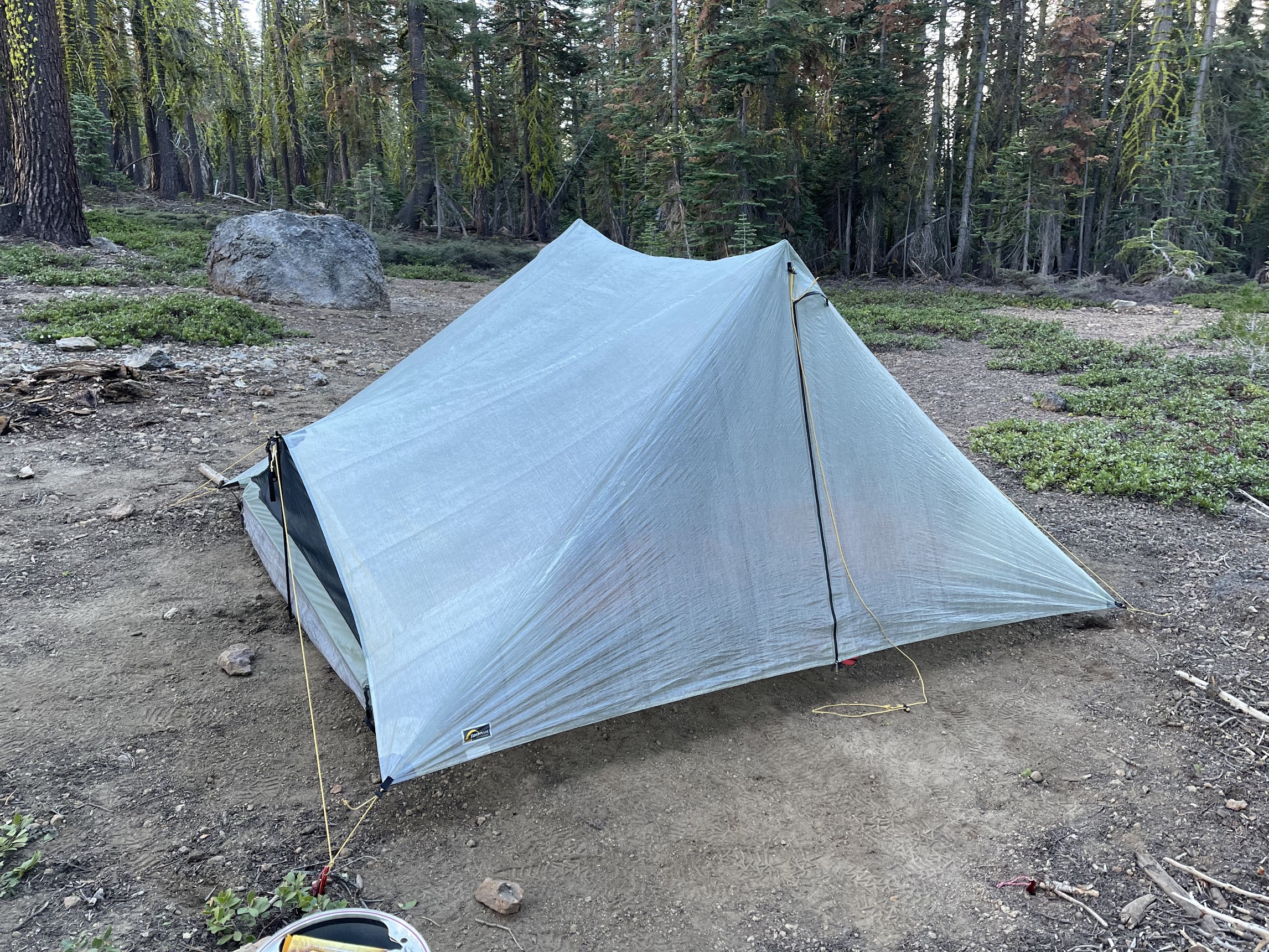
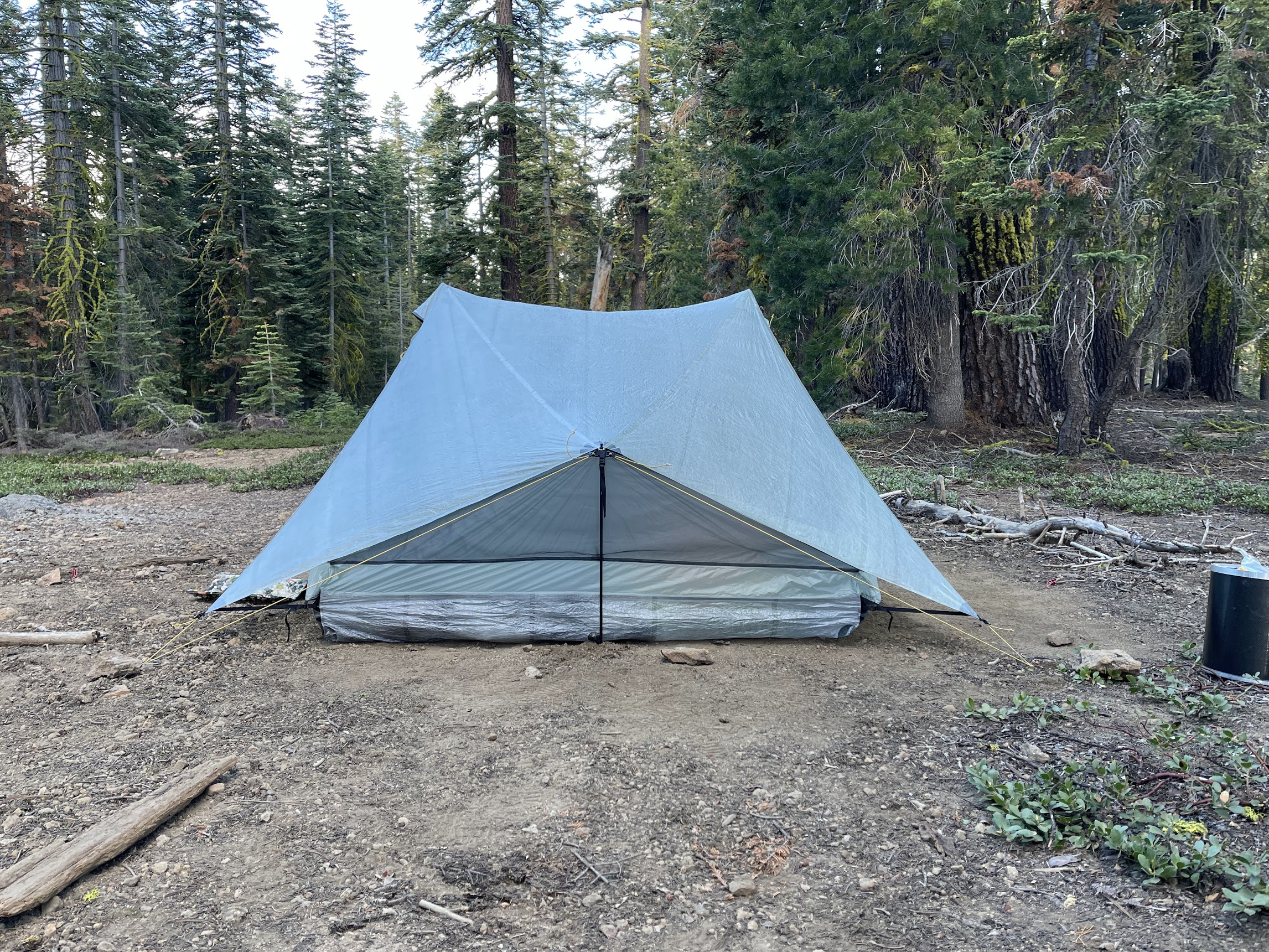
*Tarptent recommends a 45-degree angle for the corner stakes (i.e., the guylines should be parallel to the corner seams). We found that a slightly wider than 45-degree angle works best for creating tension along the edges at the ends of the shelter. The photo below illustrates a pitch on uneven ground that hews very closely to the 45-degree guyline recommendation.
Note just a slight amount of slack on one of the end edges – so slight that I (Andrew) didn’t notice it until I was reviewing my photos. Adjusting the angle of the corner stakes to be slightly wider solved this issue in Ryan’s pitches (as noted in the video above).
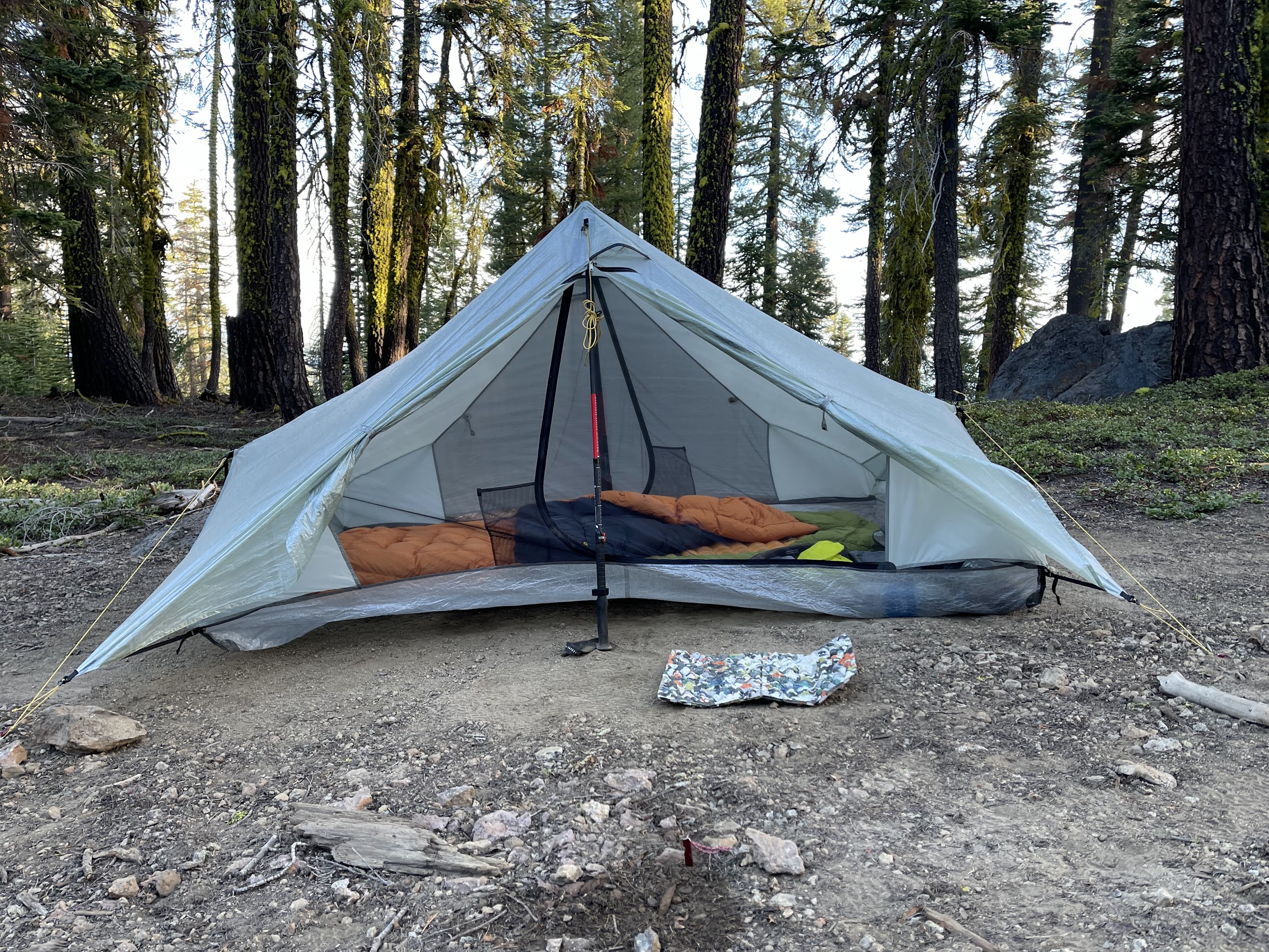
The tension created by the end struts and their triangular guyline system allows the Tarptent Dipole 1 Li and Dipole 2 Li to maintain a stable four-stake pitch that does not incorporate the doors as a load-bearing element. The upshot is that both vestibule doors can be open and rolled back without losing tension.
We experienced moderate rain and light wind below treeline in our testing, and are confident that the Tarptent Dipole 1 Li and Dipole 2 Li can handle those conditions without collapsing or letting in water. In heavy weather, four additional stakes and guylines can be deployed – two along the axis of the ridgeline and two running from the end struts. The symmetrical nature of the tension forces in the Dipole shelters is a real strength of the design (see our email interview with Henry Shires at the bottom of this article for more on this).
Livability and interior volume
There are several other features that we’ll explore more fully as we continue to review the Tarptent Dipole 1 Li and Dipole 2 Li:
- vestibule size and depth
- vent placement and design
- condensation drain placement and design
- end vent/window design and stormworthiness
- packed size and packability
- trekking-pole placement in terms of livability
- performance and stability in high winds/heavy rain/under snow load
- inner mesh door size and placement
Ryan touches on these performance issues in the video above.
But in this First Looks review, we are concentrating on the two features that stood out the most in our initial handling of the Tarptent Dipole 1 Li and Dipole 2 Li. The first was the four-stake design that allows both vestibule doors to be open without losing tension.
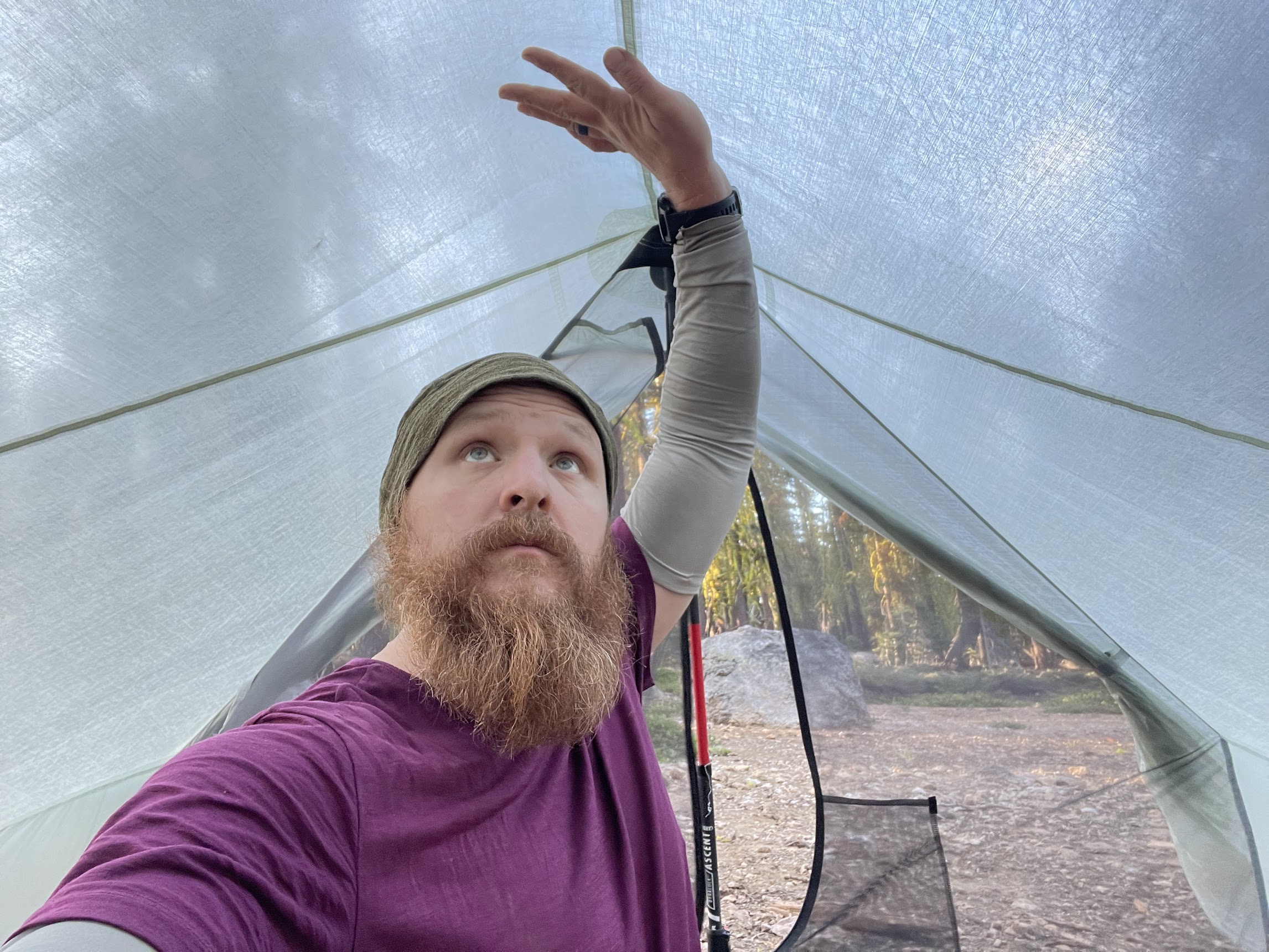
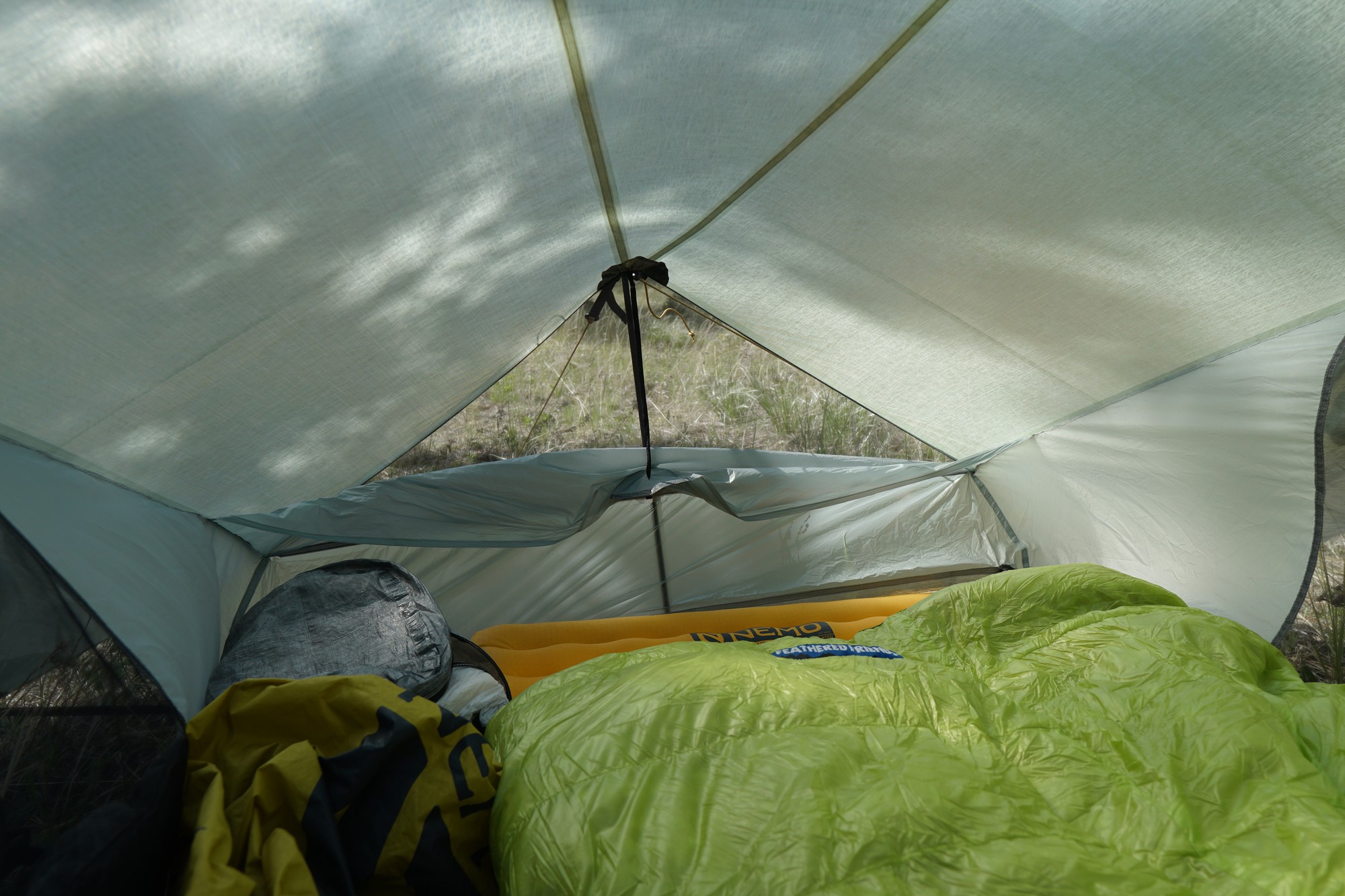
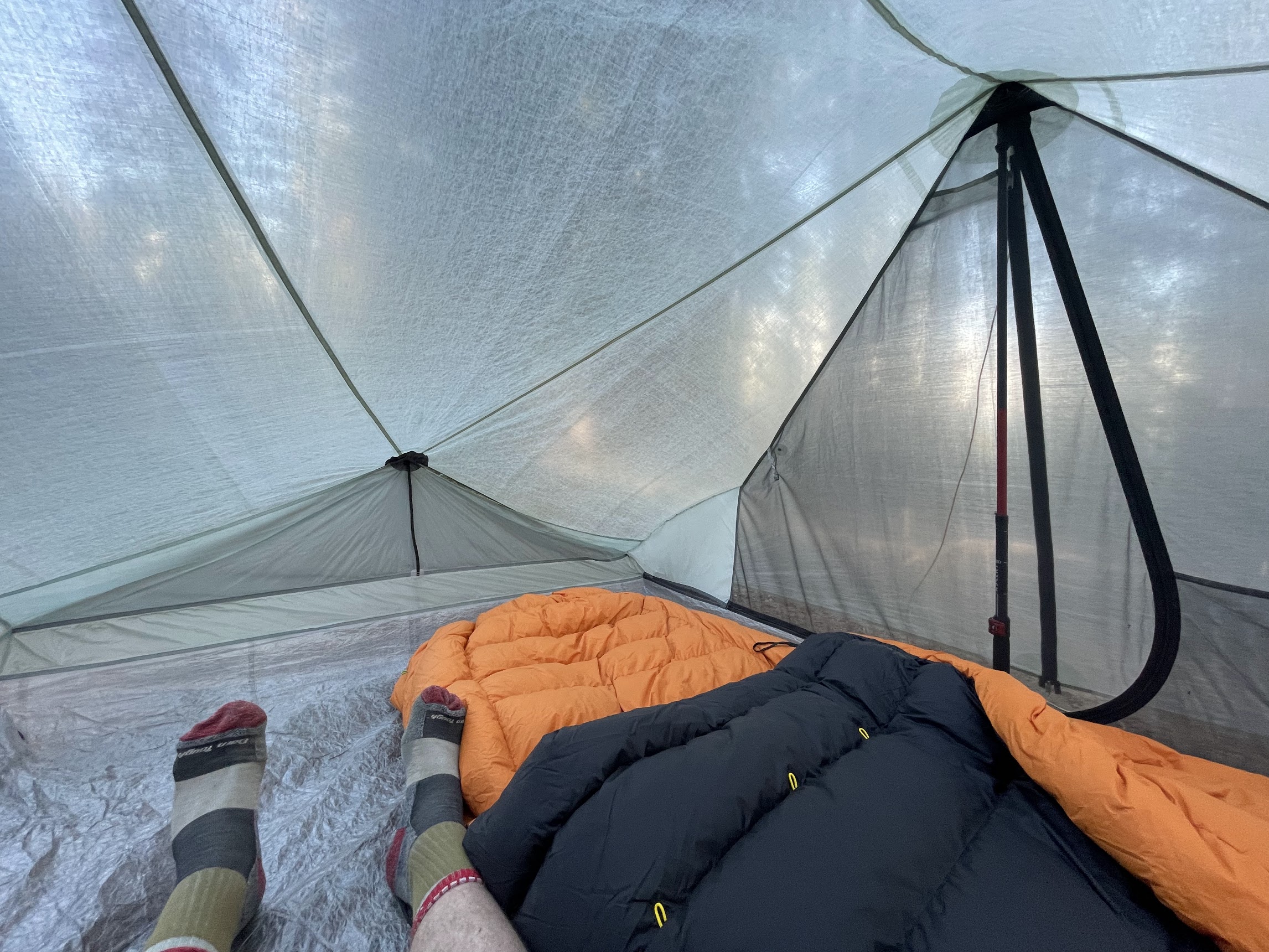
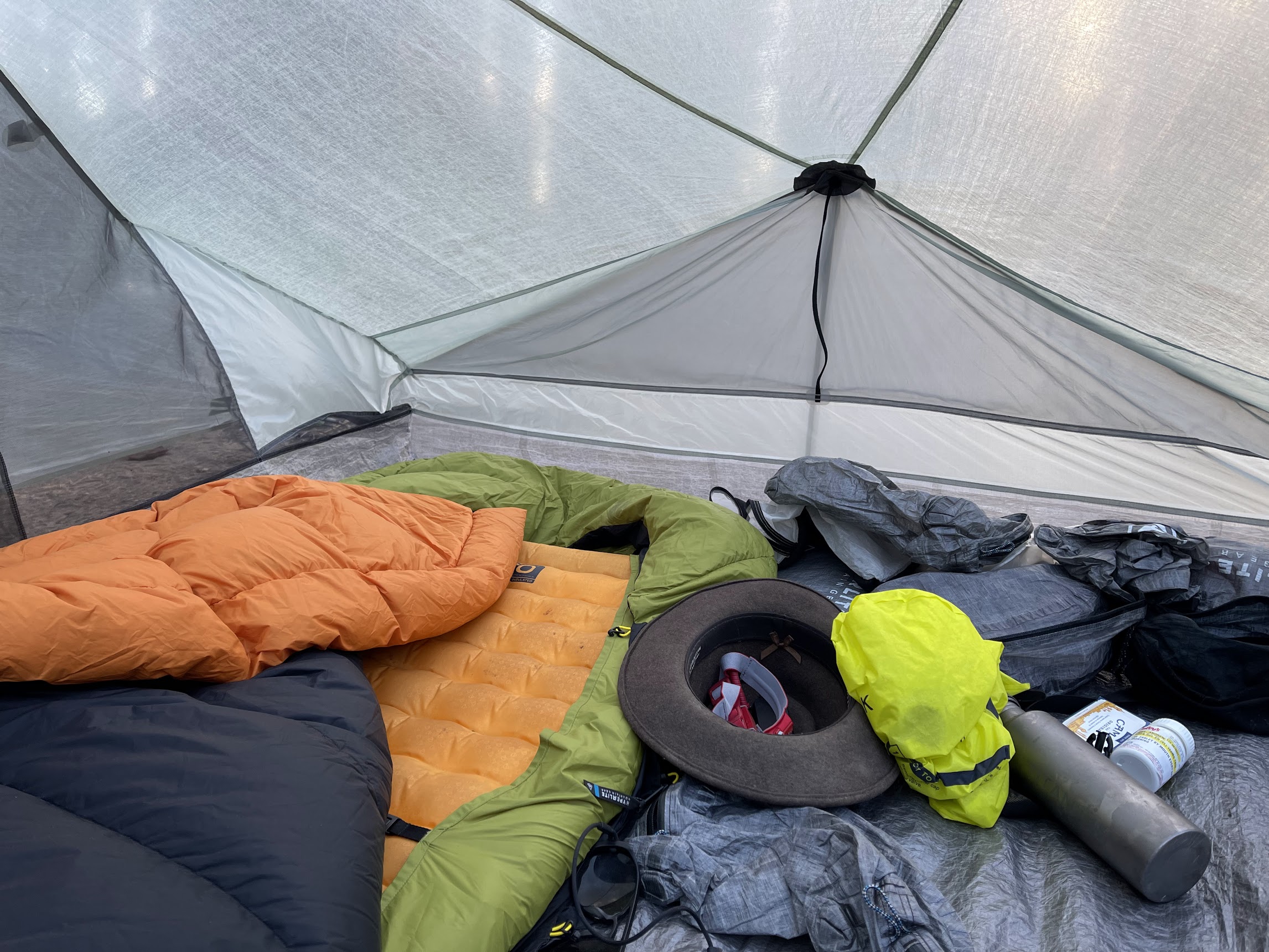
The second standout feature is the livable interior volume present in both shelters. The ends of the shelter are 21 inches (53 cm) tall – tall enough that feet will not rub against the shelter ceiling when sleeping pads inevitably slide down towards the end of the tent. The width and length are both designed to accommodate larger hikers. We are not tall (Andrew is five feet six inches and Ryan is five feet seven inches) but we are confident that Tarptent’s claim of comfort for backpackers six feet eight inches and over is not an exaggeration.
We believe that the Tarptent Dipole 1 Li and Dipole 2 Li are the roomiest trekking-pole-supported shelters for their weight that we’ve ever tested.
Comparisons
This is not a comprehensive comparison – that will have to wait until we can put the Tarptent Dipole series through long-term field testing. The purpose of this comparison is to help place the Tarptent Dipole 1 Li and Dipole 2 Li (specifically the Dipole 2 Li) within the category of two-pole, two-door, single-wall, Dyneema Composite Fabric shelters. No shelter in this comparison has the end struts and correspondingly totally vertical end panels of the Tarptent Dipole 2 Li, so we won’t waste time repeating that in every comparison.
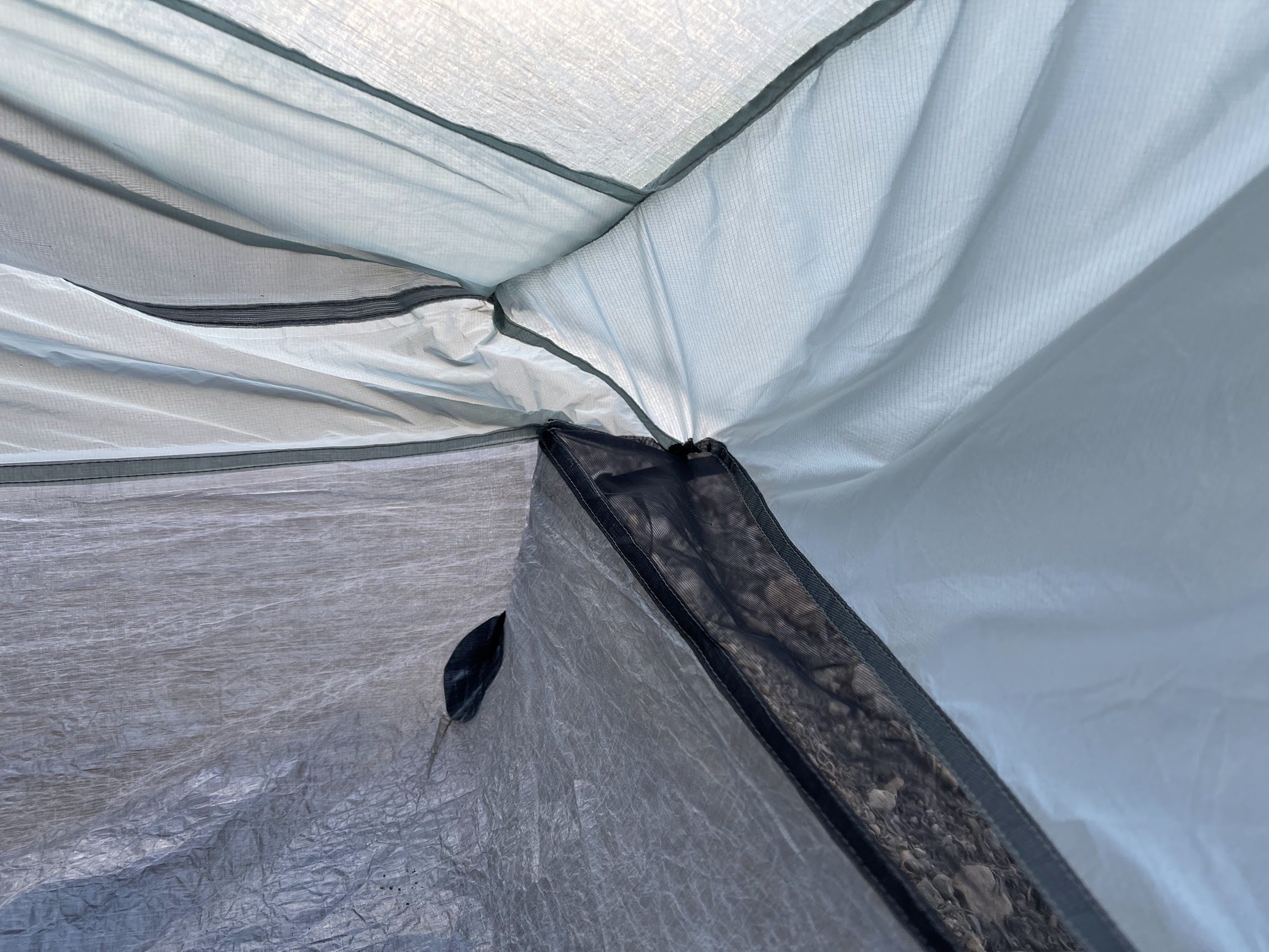
Another noteworthy thing about the Tarptent Dipole 1 and 2 is that both shelters feature a slightly hourglass-shaped bathtub floor. In the specs above, we list the bathtub floor dimensions as follows:
- Dipole 1 Li width x length: 36 x 84 inches (91 x 213 cm)
- Dipole 2 Li width x length: 58 x 88 inches (147 x 224 cm)
But in fact, the Dipole 2 Li narrows slightly in the center to 50 inches (127 cm) and the Dipole 1 Li narrows in the center to 28 inches (71 cm).
Readers are encouraged to elaborate further on the differences and similarities between all four shelters in this comparison – and the pros and cons of each – in the comments section.
Tarptent Dipole 2 Li vs. Durston Gear X-Mid Pro 2
The Durston Gear X-Mid Pro 2 is the only other two-person, two-pole, double-pole, double-door, single-wall shelter currently on the market that is claimed to be pitched with a minimum of four stakes. (Another one is the Sierra Designs High Route 1 but that’s a one-person shelter.)
The Durston Gear X-Mid Pro 2’s floor footprint is slightly longer than the Tarptent Dipole 2 Li – 90 inches (229 cm) for the X-Mid Pro 2 vs. 88 inches (224 cm) for the Dipole 2 Li. But the Tarptent Dipole 2 Li is significantly wider at 58 inches (147 cm) at the ends and 50 inches (127 cm) at the middle vs. the X-Mid Pro 2’s 48 inches (122 cm). The final weight of the Dipole 2 Li is still pending, but the Durston X-Mid Pro 2 is likely to be ~5 ounces (142 g) lighter than the Dipole 2 Li. The Dipole 2 Li easily fits two long/wide (25 inches / 64 cm) sleeping pads – this is not possible in the X-Mid Pro 2 without deforming the shape of the inner tent.
The Durston Gear X-Mid Pro 2 is ~$100 cheaper than the Tarptent Dipole 2 Li. There are differences in overall design between the two shelters. The biggest difference is that the X-Mid Pro 2 is based on an asymmetrical design (offset poles and an inner tent that is diagonally oriented relative to the canopy). The Tarptent Dipole 2 Li is symmetrical – poles are oriented opposite of each other and the inner tent is parallel to the canopy. These design characteristics have implications for pole placement, stability, and the wind and rain performance of both shelters in their four-stake configuration.
For more on this, see our interview with Henry Shires, below.
Tarptent Dipole 2 Li vs. Zpacks Duplex
The Zpacks Duplex is still one of the most ubiquitous double-pole, double-door, single-wall DCF shelters. A noteworthy difference between the Duplex and the Tarptent Dipole 2 is that the Duplex needs eight stakes minimum to be considered ready for mild wind and rain. The resulting forest of guylines can be a little overwhelming at a small campsite.
It is assumed in our community that the Zpacks Duplex does not fare well in high winds. However, we think it’s mostly attributable to user error – the Duplex is a difficult shelter to pitch properly and securely in stormy weather, but with up to 14 stake-out points, it can be done. We think the Tarptent Dipole 1 Li and Dipole 2 Li will fare better than the Duplex in this regard – it takes much less effort to achieve an extremely taut pitch with the Dipole than with the Duplex.
The Duplex has large doors with the support poles taking up space right in the center of the doors. The Tarptent Dipole 2 Li also has centrally located poles, but smaller, offset doors so the pole is not in the way, particularly if the user angles the poles to one side. The Duplex is more than a foot (30 cm) narrower than the Dipole 2 and weighs ~8 ounces (227 g) less than the Dipole 2.
Gossamer Gear The DCF Two
The Gossamer Gear The DCF Two weighs ~6 ounces (170 g) less than the Tarptent Dipole 2 Li. The DCF Two requires a minimum of six stakes for setup. Steeply sloping walls and a relatively small footprint make the DCF Two suitable only for hikers shorter than about 6 feet 1 inch (185 cm).
Like the Dipole 2 Li, the DCF Two has smaller doors to one side of the support pole (they are across from each other as opposed to offset from each other as with the Dipole 2 Li).
The DCF Two also stands out on this list for being tapered, with a head-end width of 48 inches (122 cm) and a foot-end width of 42 inches (107 cm) – so no room for two wide pads. It also has an apex height of 43 inches (109 cm) as compared to the Dipole 2 Li apex height of 45 inches (114 cm).
Final Thoughts
The Tarptent Dipole 1 Li and Dipole 2 Li are not the lightest double-door, double-pole, single-wall Dyneema Composite Fabric shelters available. From conversations with Henry Shires (owner/founder) and Rob Dunne (design engineer) at Tarptent, that was clearly not the design goal. Tarptent’s primary goals were to create usable interior volume and a stable minimum four-stake setup, and at this, it succeeded.
The Tarptent Dipole 1 Li and Dipole 2 Li are the roomiest shelters in their class – that class being single-wall, double-pole, double-door trekking pole-supported shelters in the 18 to 26 ounce (510 to 727 g) range. This liveable interior volume is a combination of apex height, floor width and length, and the unique end-strut design.
Four-stake setup is stable in rain and light winds and allows vestibule doors to be open without losing tension. Tarptent’s secondary goal was to maximize ventilation and minimize condensation buildup. We like the design features they’ve implemented with this in mind, but we will need further field days with these shelters to accurately judge condensation management.

Photos








Where to Buy
- See the Tarptent Dipole 1 Li and Tarptent Dipole 2 Li at the Tarptent website.
Tarptent Dipole 1 Li and Dipole 2 Li design notes: an interview with Henry Shires
Ryan Jordan: Using the four-stake setup without apex guylines, I’m able to achieve pretty good stability the tighter the guylines are tightened. In our forest soils here, the six-inch stakes are not holding this level of tension on the Dipole 2 Li, so I’ve been using eight-inch stakes.
That said, I’m pulling [up to] 15-20 pounds of tension on each stake – that’s a lot. I can pull significantly less by using apex guylines, which is to be expected. But I wanted to get a feel for your expectation of stability with and without apex guylines in terms of use cases for wind speeds.
Henry Shires: Yes, agreed that six-inch stakes are marginal in loose soil, especially for the Dipole 2 Li and that eight-inch [stakes] are the way to go. In my/our testing the 4-stake setup (assuming the stakes hold) is fine for low to moderate winds but, yes, the apex/vestibule lines are needed in higher winds if only to take some of the stress directed at the low corners by broadside winds.
As with most/all tents, more stakes are better than fewer stakes, and, yes, for real weather in exposed places the Dipole will want six of them. However, for many/most cases, at least in sheltered areas, four will be fine and I personally really like not having to work around guylines getting in and out.
RJ: Can you give us some info on what is exactly being patented?
HS: We are moving to patent the combination of the ability to stand with four stakes – provided by the dual inset pole structure and relatively large (17-inch) displacement between the ground level corners and apex points – and the mid-end foldable struts which provide the large increase in both interior volume and structural support.
As you know we’ve done plenty of trekking pole tents with end strut designs including the long discontinued Saddle 2 but all had vestibules that required staking (or, if rolled back, apex guylines in lieu of) for lateral support.
The Aeon Li was the first one [that] allowed for full front rollback with no apex line needed (and we have a patent for that one) but to the best of our knowledge, the Dipole has never been done before. I know you’ve played around with the [Durston Gear] X-Mid and [Sierra Designs] High Route designs which, at first glance, appear to be a four-stake setup but the asymmetry proves otherwise and my goal with this one is a true 4-stake setup and practical use (in most cases).
[Here are a] couple of graphics (below) showing the tension lines on the Dipole and X-Mid/High Route designs, both with full rolled back doors. Note that for stability what matters are the relative forces applied to apex points where the underlying vertical poles meet the canopy.
Unequal forces will cause some form of pole rotation and corresponding loss of fabric tension. I did not include a graphic of a simple four-sided square pyramid but that one would have four tension lines coming off the center apex pole and each would be at 90 degrees. For two pole tents, each pole has tension lines and at least one connecting tension line between them.
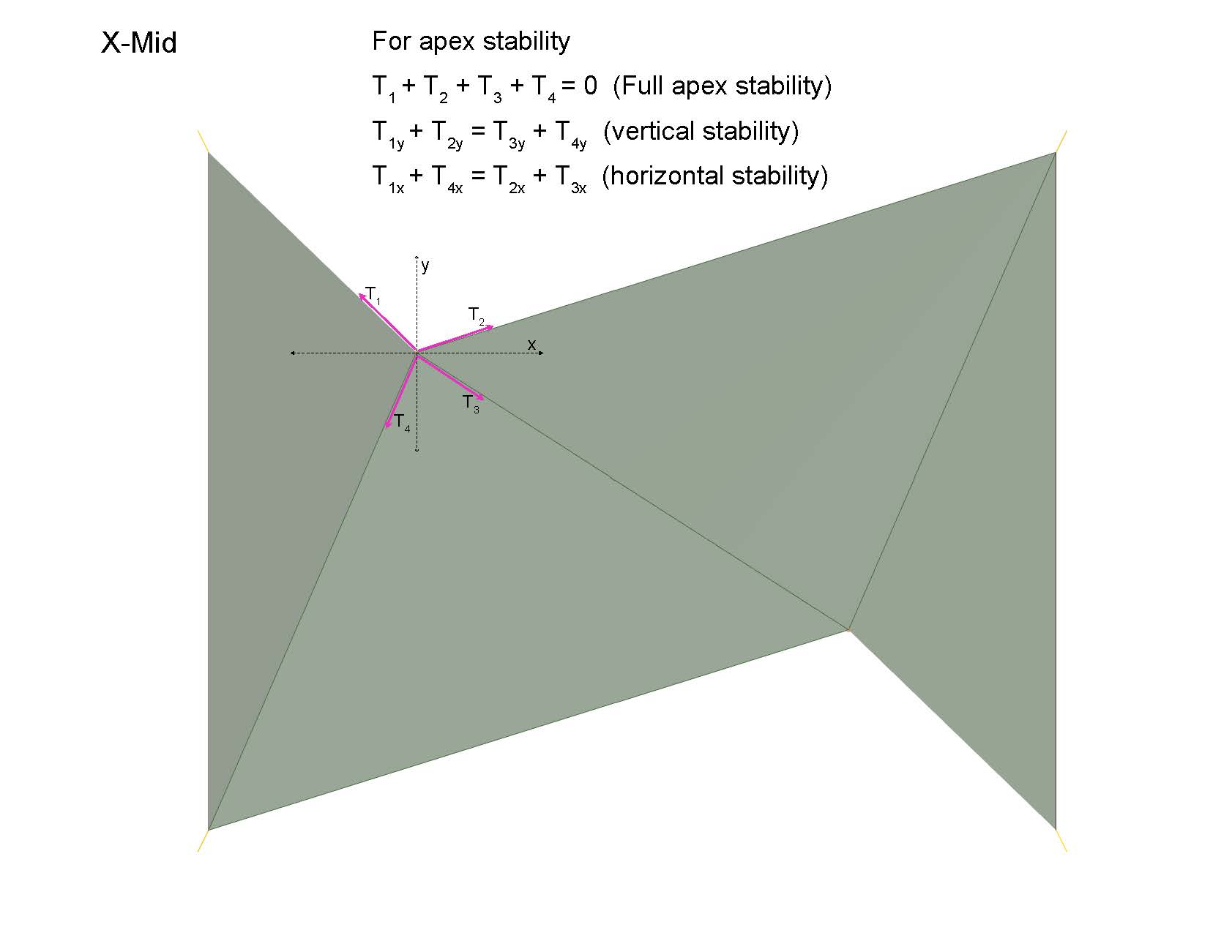
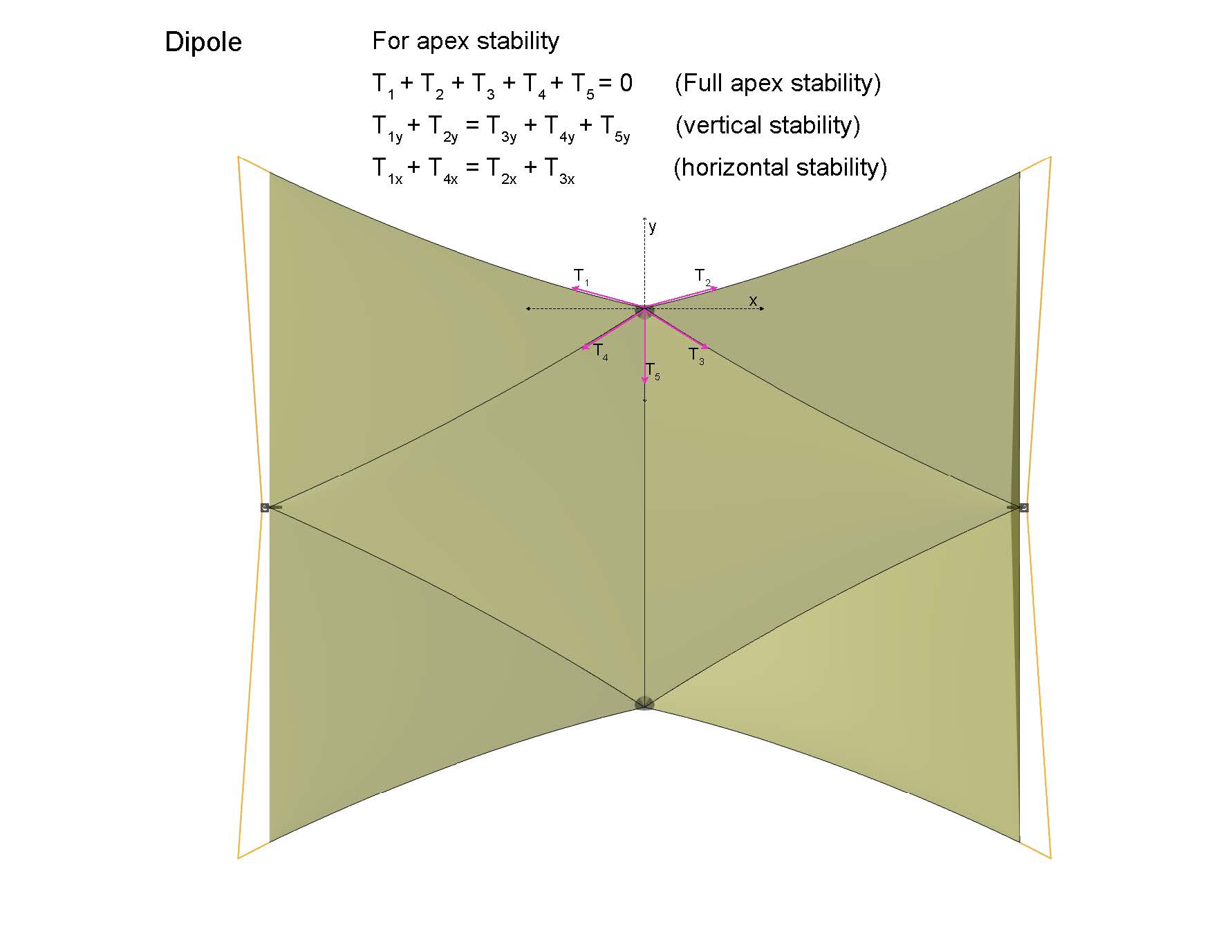
The inherent asymmetry of the offset poles in the X-Mid/High Route means there is no way to adjust the four corner tension points such that the sum of all the tension lines equals zero with the doors open in any sort of stable equilibrium. In the X-Mid graphic, note that all tension lines are at different angles and that the T3 tension line that runs between the two apex points is not independently addressable.
RJ: T3 is not independently controllable without apex guylines – and that makes the X-Mid a six-stake tent in all but a mild breeze.
HS: It is also the case that the long seam line carrying the T2 tension is a shallow angle and any deviations in the pole apex position aren’t resisted by corresponding changes in tension because that edge doesn’t need to stretch to accommodate the change.
RJ: There is notably different behavior in apex stability between the X-Mid and Dipole. On the X-Mid, T2y is indeed a very shallow angle. So it would seem intuitive to crank that T2 corner stake down hard, to bring more tension to T2y. However, the asymmetry causes an additional imbalance in all of the other tension lines because there are no directly opposite forces to T2y. It’s tricky and time-consuming in the field to sort this all out. Of course, the problem is sort of solved by just adding the apex guylines to the X-Mid.
HS: Adding an additional tension line (in the direction of the Y-axis as shown in the diagram) does inhibit an inward rotation and is the reason why the X-Mid is always shown that way.
In the Dipole, there is an additional inward tension line (T5). That line is resisted by the corner tension lines (T1 and T2) but is also addressable through the tensioning system at each mid-end strut which creates T3 and T4. The inherent symmetry of the Dipole – tension lines are equalized and at comparable angles – means that no additional apex tension lines are needed for low to moderate winds and doors can be fully rolled back.
RJ: I had the tent in a heavy thunderstorm yesterday and it otherwise stayed remarkably dry – the end vent construction is unique and effective. I like it. I was admittedly a bit nervous about not having an awning over these vents, but the inward-sloping struts kept rain from entering the tent.
HS: Yes, I too was nervous about that. Earlier versions of that system weren’t reliable but [Tarptent Design Engineer] Rob [Dunne] – thanks Rob – made that work well.
RJ: What’s at the heart of your design process for the Dipole series? What did you set out to accomplish?
HS: The pack and pad market [has] evolved over the years and we acknowledge the trend toward wider, thicker pads and narrower packs. The way we achieve [usable interior volume] on many of our tents is to deploy the PitchLoc structure. They are strong and effective but only foldable/packable down to 16 inches on the Notch and StratoSpire series and that length makes it hard to fit horizontally into many ultralight (i.e., skinny) packs.
To retain/enhance usable volume on the Dipole we moved to a foldable single strut structure that folds to 13 inches (and [is] easily detachable), a length much more viable for horizontal packing. The other goal for these was to enhance usable length and width such that both models would easily fit long wide, and thick pads – one in the Dipole 1 and two in the Dipole 2 – while still sleeping people at six feet eight inches or even taller. The completely vertical and relatively tall (21-inch) ends walls make that possible.
The other goals were a true four-stake setup and greatly enhanced venting – ends, sides, and apex venting.
Check this space for more notes and observations on the Tarptent Dipole 1 and 2 as we continue to field test these shelters over the coming months.
Learn More
Browse our curated recommendations in the Backpacking Light Gear Shop – a product research & discovery tool where you can find Member gear reviews, Gear Swap (used gear) listings, and more info about specific products recommended by our staff and members.
Gear Shop » Trekking Pole Tents

Related Content
- more Tarptent reviews and Tarptent-related content
- see the Durston X-Mid Pro 2 review
- check out what our community thinks of the Zpacks Duplex
- see what our community has to say about tent shopping in forum threads here and here
DISCLOSURE (Updated April 9, 2024)
- Product mentions in this article are made by the author with no compensation in return. In addition, Backpacking Light does not accept compensation or donated/discounted products in exchange for product mentions or placements in editorial coverage.
- Some (but not all) of the links in this review may be affiliate links. If you click on one of these links and visit one of our affiliate partners (usually a retailer site), and subsequently place an order with that retailer, we receive a commission on your entire order, which varies between 3% and 15% of the purchase price. Affiliate commissions represent less than 15% of Backpacking Light's gross revenue. More than 70% of our revenue comes from Membership Fees. So if you'd really like to support our work, don't buy gear you don't need - support our consumer advocacy work and become a Member instead.
- Learn more about affiliate commissions, influencer marketing, and our consumer advocacy work by reading our article Stop wasting money on gear.


Discussion
Become a member to post in the forums.
To me, the obvious comparison is the Rainbow Li to the Dipole 1. Initial thoughts for this comparison:
1) weights similar
2) Dipole better in wind (but is it really? Would a Rainbow actually be blown over when a Dipole would remain standing?)
3) Dipole better for condensation seems right with the end vents and two doors
4) Rainbow better for footprint; appears tigher
5) Rainbow better for interior space, especially headspace at ends; and is square without the hourglass shape
6) Rain protection? Rainbow better at ends, Dipole better on sides. Assuming that this end curtain works fine, … I’d probably give the nod to the Dipole – but I’m a bit skeptical about these ends and would feel a bit better if it had more overhang
Personally, if I were to make a suggestion, it would be to add a couple inches width to the Dipole1. I use a wide sleeping pad, and like to arrange my stuff to either side of my head; so that I can just grab during the night. I have to add that I’m a MYOG person, and I’ve occasionally sketched around about what my “dream tent” would be, and the Dipole1 is the closest thing I’ve seen to what I’ve been drawing… my vision was a width of closer to 38″-40″ though.
I LOVE THE TWO DOORS FOR THE DIPOLE1. For breeze, condensation control, and extra protection from condensation since if you shift to the side, you’re against the mesh and not the outer wall.
Well done, Mr. Shires and co.
Could this be the 2P+ trekking pole tent I’ve been looking for that can accommodate my wife, me and our 60lbs. dog? If so, I think you might have a winner Henry!
Ryan’s breakdown of wind speeds aligns well with the sailing world. A full gale is 39-54 mph – not a pleasant place to be in boat or tent!
Thanks to Henry and Dan, I feel that we are in the Golden Age of UL tents. But new materials are being developed that will improve on DCF – and hopefully less costly, too.
I agree we have some amazing UL tent designs out there currently. For several years I used a Gossamer Gear SpinnShelter (made out of Spinniker – remember that stuff?) . At the time it was the lightest fully enclosed shelter in the world at just over 10oz and I used it with just polycro, or with a SMD Metor bivy, or a Custom made inner by Alpinelite (now Yama Mtn Gear). Lot’s of UL shelters today aren’t lighter, but they are a lot more livable and more stormworthy.
Yes, materials are important, but what both gentlemen have done is to think outside the box and innovative structures that have great interior space and improved the user setup. I myself, like the design of the Dipole and look forward to it when it is offered in an affordable material. Great job Henry & Dan, way to raise the bar!
Liked the Dipole for adding the space and comfort to what would otherwise be just another A-frame or ‘pup’ tent that can be so confining. But think it foolish to expect trekking pole tents to handle high winds, which come in all directions and forms that make data collection a fruitless approach to severe weather . And the experiences related in the current thread about stakes provide a good indication that stakes also have their limitations.
So continue to agree with the observation about “… any condition appropriate for a trekking pole tent – which is *not* extreme winds or severe storms. Look elsewhere if you need shelter for those conditions!”
The problem is that “those conditions” can often nail anyone who is out in the high country for any length of time. And that includes even some not so high Eastern US peaks, as shown by the winds frequently recorded on Mount Washington.
For that reason, frame supported tents remain the answer for those who are going to be out long enough to make severe storms a real possibility. Sure, you can get away with mild weather for a few weeks if lucky; but it is all a crapshoot.
When heaven turns to hell on earth, what has worked for me is simply descent to more protected areas, even through it can require a significant detour from the projected route. And what also helps is a frame supported tent that depends far less on stakes for survival.
Unfortunately, the lust for lightness has encouraged the production of frames that are more like loose assemblies of struts that provide limited support when the wind howls. A good frame with no loose ends for a solo tent can weigh less than six ounces using best quality filament wound carbon. That is not too great a price to pay for not using trekking pole supports in tents that are inherently unstable.
Roomy and extremely well ventilated, as are most Tarptents.
Howsomever… with those large ends I’d say this is really a “forest tent” and not suited to high winds.
I’d rather endure a windstorm in my TT Notch Li than in the Dipole Li. Or better yet my TT Moment DW with the shortened X-ing pole run beneath the fly as I have done.
Well, I have to say this about the Dipole in high winds – it completely surprised me.
Chase and I backpacked in the Indian Peaks last weekend, and camped above treeline in a severe thermal current corridor.
I had my anemometer with me and it recorded steady winds for 6-8 hours in the 25-35 mph range and a peak gust of 55 mph.
Early in the night, because we were lazy (it was calm when we went to bed), both of our tents (he was in a Khufu) blew down in gusts of 40-45 mph (stakes ripped out). At midnight, we restaked everything, secured with big rocks, and all was well for the rest of the night.
The Dipole (I was using the Dipole 1 Li) was impressively solid, even in broadside winds (which causes more issues than when pitched ends-into-the-wind). It was more stable by a fair margin than than my Notch Li. The end struts/guyline config on the Dipole makes it quite stable. There was almost zero movement in the trekking poles or struts at these gusts. Caveat: end and pole apex guylines were deployed (8 stake pitch).
The Dipole isn’t a winter blizzard tent, for sure, but neither is it limited to below-the-treeline use. I have way more confidence in it now than virtually any other 2-trekking pole tent I’ve used.
This is really useful information, Ryan. Especially the measured wind speed and height. It’s nice to see measured wind speed becoming part of the conversation. The photo is also helpful because it gives an idea of panel deflection and, indirectly, some idea of noise caused by flapping and deflection.
Low noise and high measured wind speed resistance are two things that I’ve come to increasingly value. To see discussion and measurement of these qualities on the agenda in UL shelter evaluation is great.
That’s why I’ve settled on a small 8-sided mid for alpine walking. While I’m still in the early stages of evaluation, experience so far has me thinking that these octagonal mids completely redefine, if not blow away, our expectations of high wind resistance and low noise in a low weight trekking pole supported shelter.
What an interesting discussion.
If someone had way too much time on their hands, I’d love to see the dipole and xmid sketched up and run through cfd software.
I’ve been trying to train my instincts in such matters and would guess the X mid has the advantage on the diagonals by presenting a smaller area and being more slippery whereas the Dipole design looks like it would have the aerodynamic advantage side on and head on with good angle changes that could keep laminar flow.
I guess that if you were to test 8 wind directions at 45 degree angles, the dipole would come out on top in 4 directions (head on/side on) and the xmid in 4 directions (diagonals)
The pic of the dipole taking high winds side on is interesting. When I first saw the dipole I thought the vestibules might be vulnerable to cupping in the broadside wind but it appears that the less material and sharper angle means the upper trekking pole acts as a back stop and there is no sign of cupping. Nice.
The Dipole certainly is giving me theoretical confidence for high winds but I’d love to see it fully guyed out and taking a beating (with instrumentation for measuring wind speed).
Somebody with the right connections needs to talk to DAC about using their wind tunnel for comparative testing. :D
pay per view wind tunnel tent off.
I bet there is at least 6 people who would pay to see that.
Lol!
But if you could get an influencer to start popularizing the idea of measured wind resistance and quietness in the wind, the number of views would skyrocket…
Seventh right here!
Not the same, but I have seen Kevin Timm in a video or two use a leaf blower…
Ryan, that story about the Dipole’s wind-worthiness is amazing. Better than the Notch Li? Also amazing.
That means the 4 fly hem loops (with reinforcements) I put on my Notch Li were well worth it. I carry 2 Ground Hog spiral stakes as a “just in case” measure with both the Notch Li and my Moment DW.
But yeah, I’ve often had to resort to heavy rocks on top of stakes to hold through a very windy night. Also, tying guy lines to logs or trees when possible is another way to insure a windy night’s good sleep.
Anyone have an idea of when the Dipoles might be available to order?
mike
Well, despite Ryan’s warning about the storm-worthiness of trekking pole tents there are lightweight designs that can take big winds – the TrailStar (famously), the Kifaru Paratarp/Supertarp is an A frame design that has survived 70mph Alaskan gusts, plus of course the 8 sided teepee designs already mentioned. And they can all cope with a bit of snow as well, within reason.
But you are giving up a LOT of liveability compared to these Shires and Durston designs, and in general they require many more stakes in storm pitch.
So you pays your money and takes your choice. For the great majority, the more liveable designs are probably the better option.
In my case, I’m often camping on exposed terrain with little option to run for shelter so storm-worthiness has to take priority.
But I am certainly envious of the liveability offered by the Dipole design – especially after Ryan’s promising experience in the wind. If they ever release a more affordable silpoly version I’d be sorely tempted…
I plan on purchasing a Dipole 2 when it is released. That said I wonder if Ill have to make the same modification to it that I had to make to a competitors 1 man tent that employs the same mesh gap from outer tent to bathtub as a means to prevent water migrating inside.
in brief, that design does not function as intended all of the time.
Not every pitch is perfect because not every surface is as flat as s pool table, as was the surface in this video review. Gear, bag, pad, etc sometimes press against the wall of the bathtub.
Either of those factors can introduce compression of the mesh or a slope inward of the mesh. When that happens water does not drip off the edge of the outer to the ground, surface tension causes the water to follow the mesh and pass through it into the interior of the bathtub wall. As anyone who’s spent hours in a tent in the rain can attest. A little water goes a long way toward making life less pleasant.
The solution for the tent I own was to purchase dyneema fabric, double sided PST on a roll and single sided dyneema PST repair tape. A two inch wide strip was added to the entire perimeter of the tent so that the ‘drip edge’ of the outer tent extends beyond the joint of the outer tent and mesh gap. Problem solved 100%. Water wont flow uphill on non absorbant dyneema.
I hope Tarptent recognizes this limitation of the mesh-gap design and adds a drip skirt. If not I’ll probably have to do it myself.
Great review guys, thanks! I’m excited to try out my Dipole li 2. Should be arriving tomorrow.
I received my Dipole 2Li and set it up during a break in rainy, windy weather here in MA. For what its worth, these are my thoughts:
1) Light, light, light, even with the carbon poles i ordered and 4 extra groundhog stakes.
2) Because the lines at each end of the tent are permanently attached, if you are not super careful unrolling, as I was not, you will have a real rats nest to untangle. It takes a bit of care to unroll the tent, sort out the lines and then create that “perfect rectangle” required for a proper pitch. Note that the instructional video on Vimeo is of a Dipole 1Li, and so the width can be managed with spread arms. Not so with the 2. I had to move around quite a bit, working on the stake placement, and then my first pitch was pretty poor. My suggestion is to partially insert all stakes until you are certain of a tight pitch. I moved my quite a bit.
I would not want to set this tent up in a rain, unlike the Notch. There was just too much fussing around to get it set up correctly.
3) The tent comes with four stakes. It should come with 8. Based on the price I really doubt the choice to send 4 is economical, perhaps it is to achieve a lower packed weight in the specification, but in truth, you do need 8 stakes. After working on the pitch for some time with just four stakes, I retrieved a few more, unrolled the supplied ridge lines and staked out the vestibule and ridgeline. A much better pitch was achieved.
4) The short ends present quite a catch to the wind. There were gusts to 20, the ground was soaked, and the tent was pitched in a “wind tunnel” created by some trees and a building. Perhaps the wind was gusting to 30. Having left the tent up to see how it would fare I returned to find it was down. The two corner stakes had pulled out by cutting through the turf then pulling up. 8″ stakes, so there was some kind of force exerted on them. That flat end presents a wall to the wind, and also a means for wind to get into and under the vestibules.
5) I made ropes for the straps supplied attached to the top of the short poles and re-staked the tent, using another pair of groundhog stakes to secure those lines. After that the pitch was drum tight and did not come loose. Winds continued and rain came.
6) I expected to see rain infiltrate the inner tent via the mesh ends. I had the vents half open and although there was a fair amount of water dripping down the mesh from the seam with the tent (there is no overhanging drip edge from the tent roof), there was no water in the tent. A small amount did collect between the mesh and the inner, though none entered the tent because the vent flap prevented it.
7) End poles should be tilted inward at the bottom. This is not shown in the setup video and Henry will likely tell me I’m wrong, and I may be, but if you don’t tilt them then rain will fall directly onto the mesh and I think it would eventually get in the tent. Tilting the stakes might prevent that so I will.
8) The vestibule is maybe a tad small. My pack would not fit in there unless I pulled the tent inner toward the inside to create room for it. OK, fine when alone, but would not work for two. It is big enough for boots and a few small bags.
9) The interior is HUGE. This is the Dipole’s single greatest feature in my opinion. See pictures of me sitting erect at one end. I am 5’11” 165. Also me laying down with my head touching one end and my feet a foot or more from the other. I love the size. There is plenty of room to move around dress, pile gear at one side or end, spend time recuperating or waiting out nasty weather.
10) Its cold. The mesh doors are always mesh, and the fly has a lot of ventilation coming under it in a breeze. The ventilation is good because it is a single wall tent, but a breeze will cool you off so if you use this in cold weather, like we are having here, bring that warmer bag, a good hat, and perhaps even a hard shell bivy to wrap the bag in. Being inside the Dipole is about a close as you can get to sleeping in the open.
Will this tent replace my Notch Li, which is by far my all-time favorite tent for virtually any trip? No. I’m still a fan of supplying my companion with their own Notch (I have two) rather than sleeping in a tent with two people in it. For a while I wondered why I’d keep the Dipole, running through trips and how I’d use it.
For trips in warm weather, in buggy circumstances, I think the Dipole would be superior. It has a lot of room inside and when the bugs get horrible after dusk and you need a place to be comfortable, relax, read and then sleep, this will be it. For those who don’t mind a tent mate, or have a pet, this tent because of its size vs. weight is unbeatable.
Here are some pictures.
First pitch before moving stakes around to square off.
A better pitch without ridgelines.
Vestibule with size 10 moccasins. They are just inside the drip line of the tent.
Me sitting at one end upright, not touching the sides or top.
Me laying down, head at one end just touching. Lots of room beyond feet.
Mesh from above when pole not tilted
Rain on mesh, but not in tent
My final perfect pitch, with 8 stakes. Hey, carry them, use them. In wind you’ll NEED them.
OK, now I’ve had the tent setup for three weeks through all sorts of weather, some very hight winds and heavy rain. It never blew down, barely needed retensioning on the guy lines. No water inside other than that first event.
I did have to replace the webbing buckles on the short pole ends with a line lock. The buckles were not able to hold their position in sustained high winds and gusts. The webbing slipped.
After I put on the line locks and staked down that small pole peak with the pole angled inward there was never another water accumulation in the tent. Angling the pole does not appreciably reduce the tent interior area and greatly improves the ability of the tent to withstand driving rain.
As for stakes. I’ve replaced the stock stakes (4 at 1.7oz totoal) with 8 groundhog 8” stakes at 4.2oz total with pull ropes attached. I do not believe this tent would be reliable in other than calm conditions without 8 stakes, so the net gain using the 8 groundhogs is 0.9oz, assuming 8 of the stock stakes at 3.4oz total. Well worth the 1oz on my back.
The experience of watching this tent withstand some very heavy rain, freezing temps, winds gusting to 50kts, I am thoroughly impressed with the design. With time available in December I’ll be taking it out and experiencing the condensation, or lack thereof, and will report back. I very highly recommend this tent.
I am looking at this tent to replace my Stratospire 2 which I think is my favorite actual design but can be hard to manage in loose rocky sandy soils in the Mojave where I live. We have constant winds and regular gusts to 30mph. I find myself really working to get a solid pitch as I must rely on boulders, sand anchors etc which always end up shifting or taking a while to get set. I only use the tent when I am with my partner and medium sized dog but it would be nice to have a simplified setup while retaining the wind shedding capabilities.
My concern with the Dipole is blowing sand coming up under the vestibule and filling the tent. With the Strat 2 we have the solid inner to prevent this. I wish the Dipole had the same strip of nylon covering the bottom portion of the door as the sides have.
With strong winds am I not really solving the issue of less reliance on numerous stakes? I usually run 8 on the Strat. The reduced weight is a clear advantage of course.
Become a member to post in the forums.