


by Andrew Marshall and Ryan Jordan
Introduction
The Tarptent Dipole 1 Li (22 to 23 ounces / 0.62 to 0.65 kg, MSRP: ~$699) and Tarptent Dipole 2 Li (26 to 27 ounces 0.74 to 0.77 kg, MSRP: ~$799) are both modified A-frame, double-trekking-pole, double-vestibule, double-door, side-entry, single-wall, Dyneema Composite Fabric (DCF) shelters.
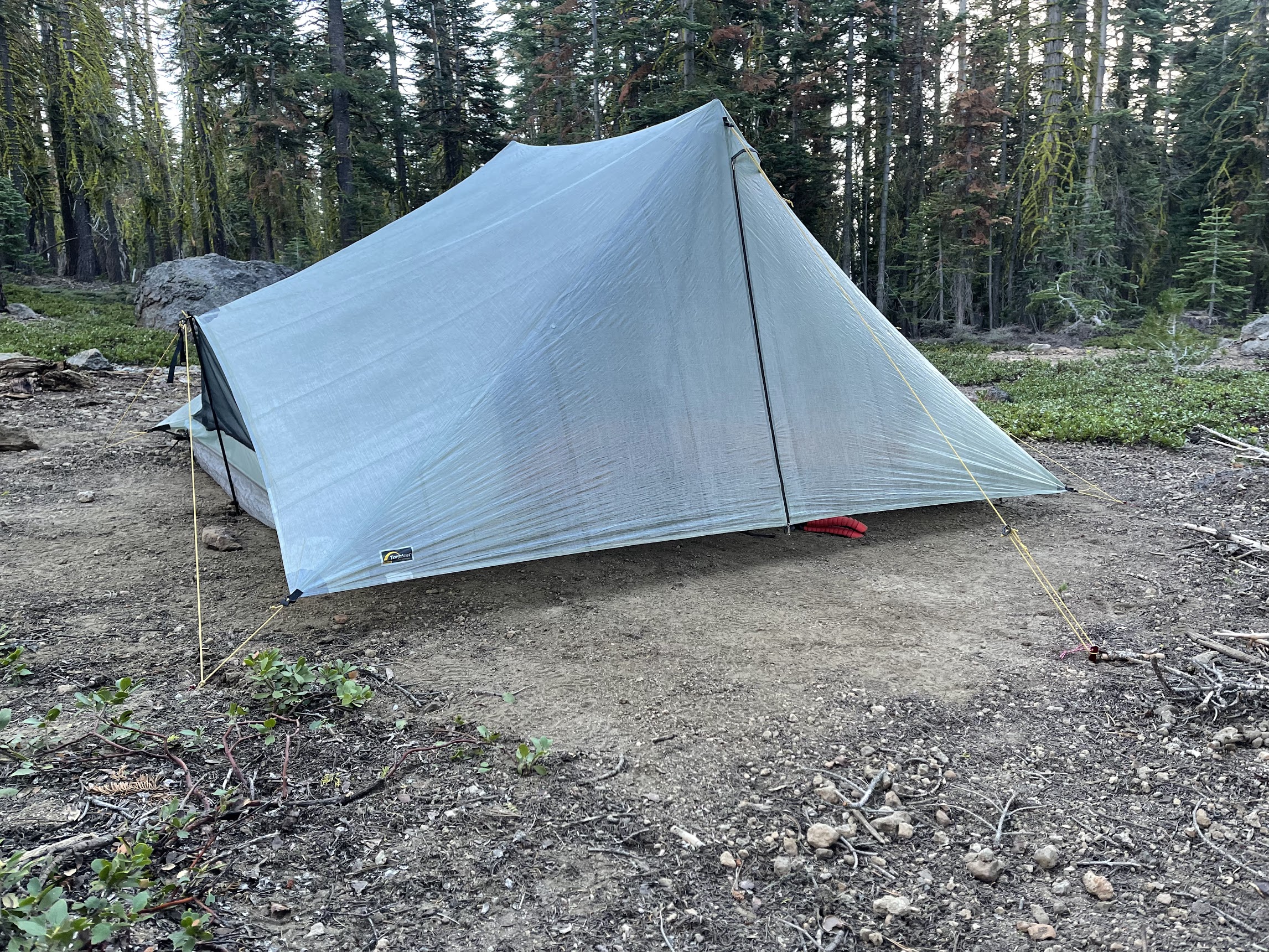
The Dipole line represents a continuation of Tarptent’s use of supplemental poles (i.e., extra poles in addition to the trekking poles) to add volume and support to trekking-pole shelters. Dipole tents have several features that make them unique among two-pole, double-door shelters:
- they can maintain a stable structure with four stakes
- they can maintain a stable structure while both vestibule doors are open and the shelter is in a four-stake configuration
- they feature collapsible, removable, 21-inch (53 cm) carbon fiber struts at the head and foot that add a noticeable amount of interior livable volume while supporting the tent structure (and allowing the first two points above to be a reality)
Watch the Video
Watch Ryan Jordan’s video review and tour of the Tarptent Dipole 1 Li and Dipole 2 Li:
Highlights
- weight*: Tarptent Dipole 1 Li – 22.6 ounces / 0.64 kg (*pre-production prototype)
- weight*: Tarptent Dipole 2 Li – 26.3 ounces / 0.75 kg (*pre-production prototype)
- can maintain a stable structure in mild weather with four stakes
- vestibule doors are not part of the structure (both doors can be open at the same time without losing tension/stability)
- 21-inch volumizing end struts (Easton 3.9 carbon fiber) create large amounts of interior livable volume
- end struts are removable and collapsible to 13 inches (two-section, shock-cord connected)
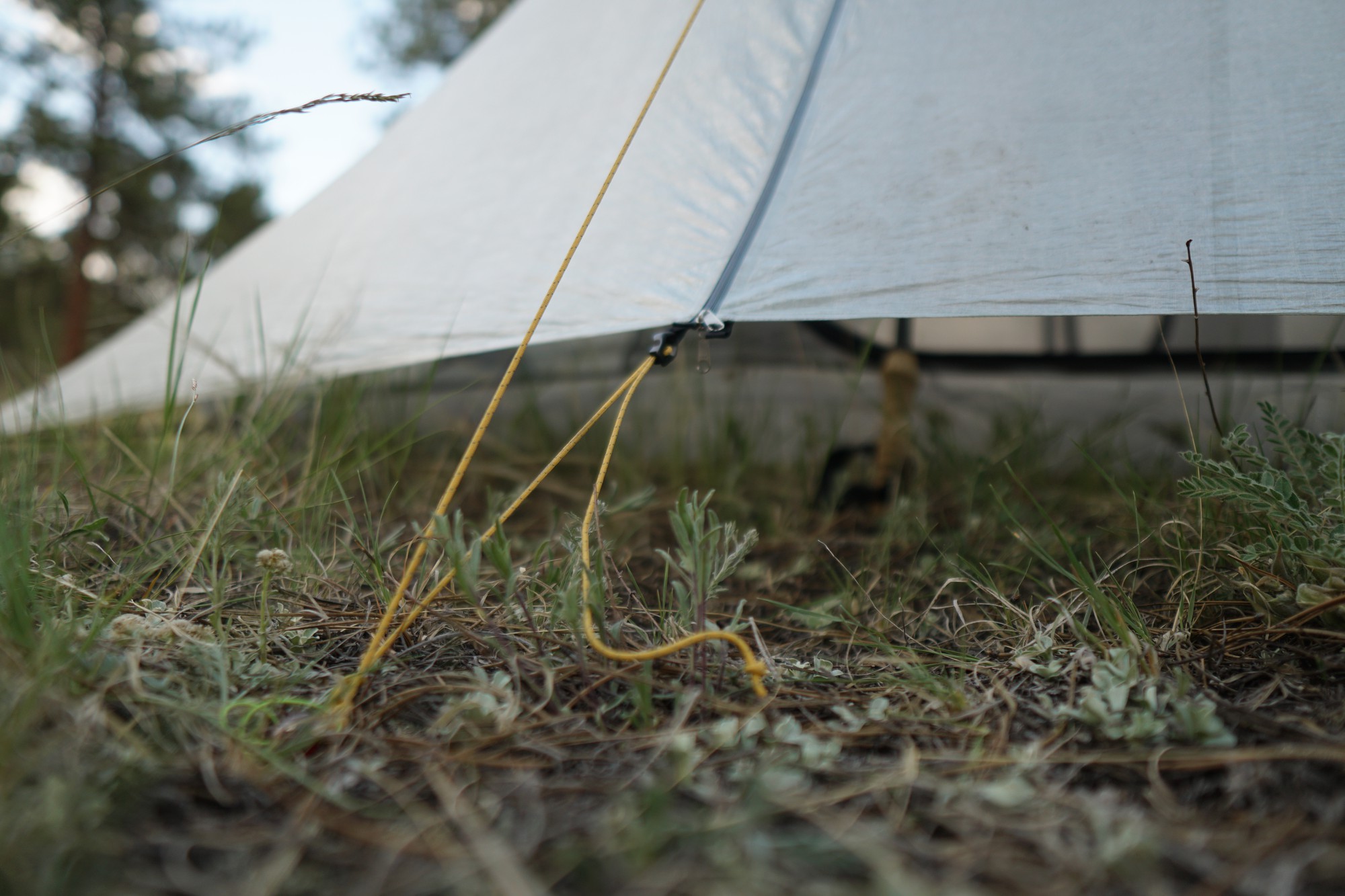
- vestibules are 17 inches (43 cm) deep, expandable with an optional line from lower zipper pull tab to apex guyline stake (Tarptent includes hardware and guyline to accomplish this)
- Dipole 1 Li apex height: 43 inches (109 cm)
- Dipole 2 Li apex height: 45 inches (114 cm)
- Dipole 1 Li width x length: 36 x 84 inches (91 x 213 cm)
- Dipole 2 Li width x length: 58 x 88 inches (147 x 224 cm)
- single-wall design with condensation drain vents
- canopy/fly material: Dyneema Composite Fabric CT1E0.8, 0.55 oz/yd2
- floor material: Dyneema Composite Fabric CT2K.18, 1 oz/yd2
- zipper-type – canopy – YKK #3 AquaGuard
- zipper-type – interior mesh – YKK #3 coil
- catenary curved ridgeline
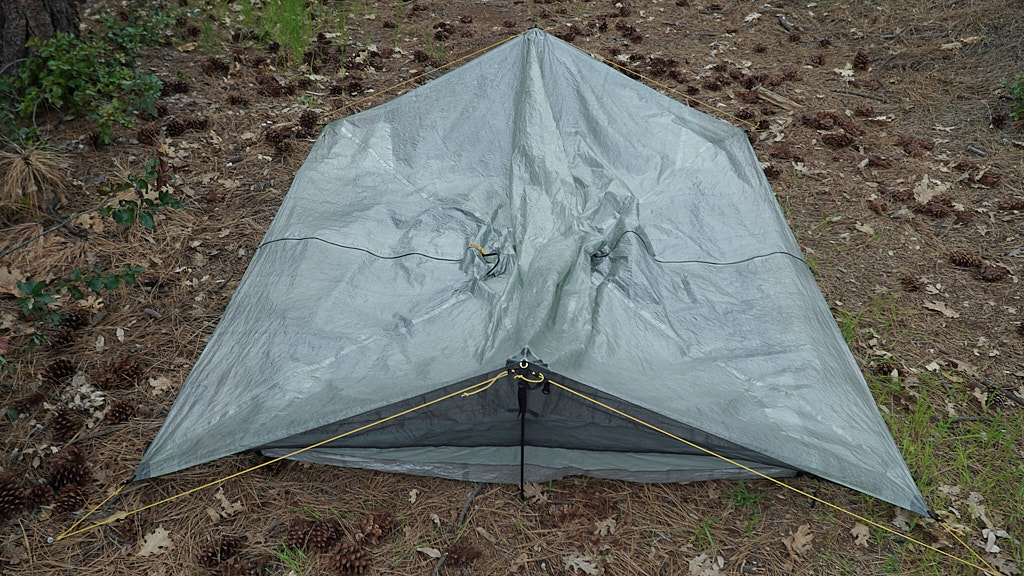
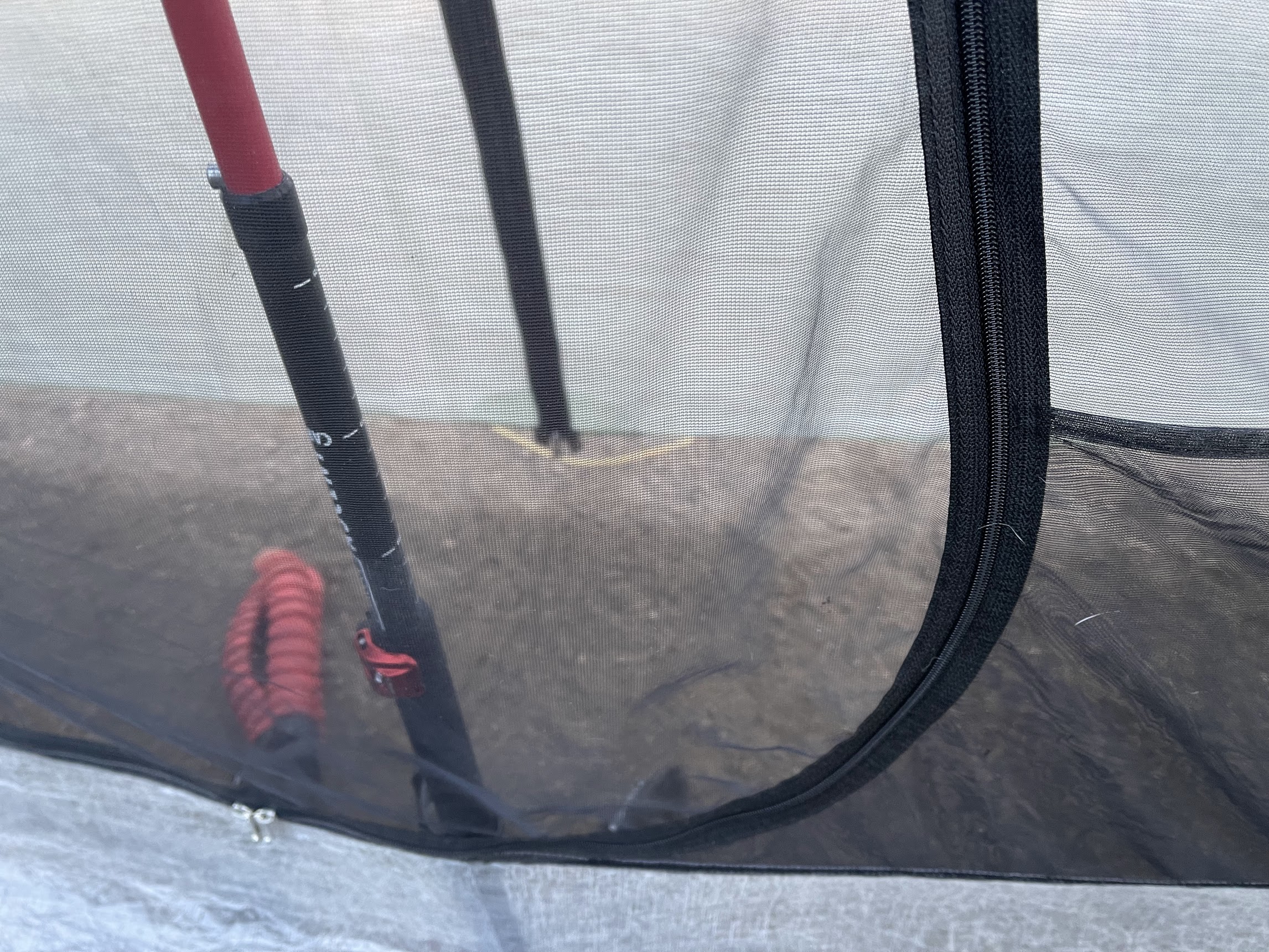
- mesh panel on either end, backed by a sil-poly panel that can be opened and closed from inside the tent for ventilation/weather protection
- Dipole 1 Li fits one long/wide pads and users up to 6 feet 8 inches (203 cm)
- Dipole 2 Li fits two long/wide pads and users up to 6 feet 10 inches (208 cm)

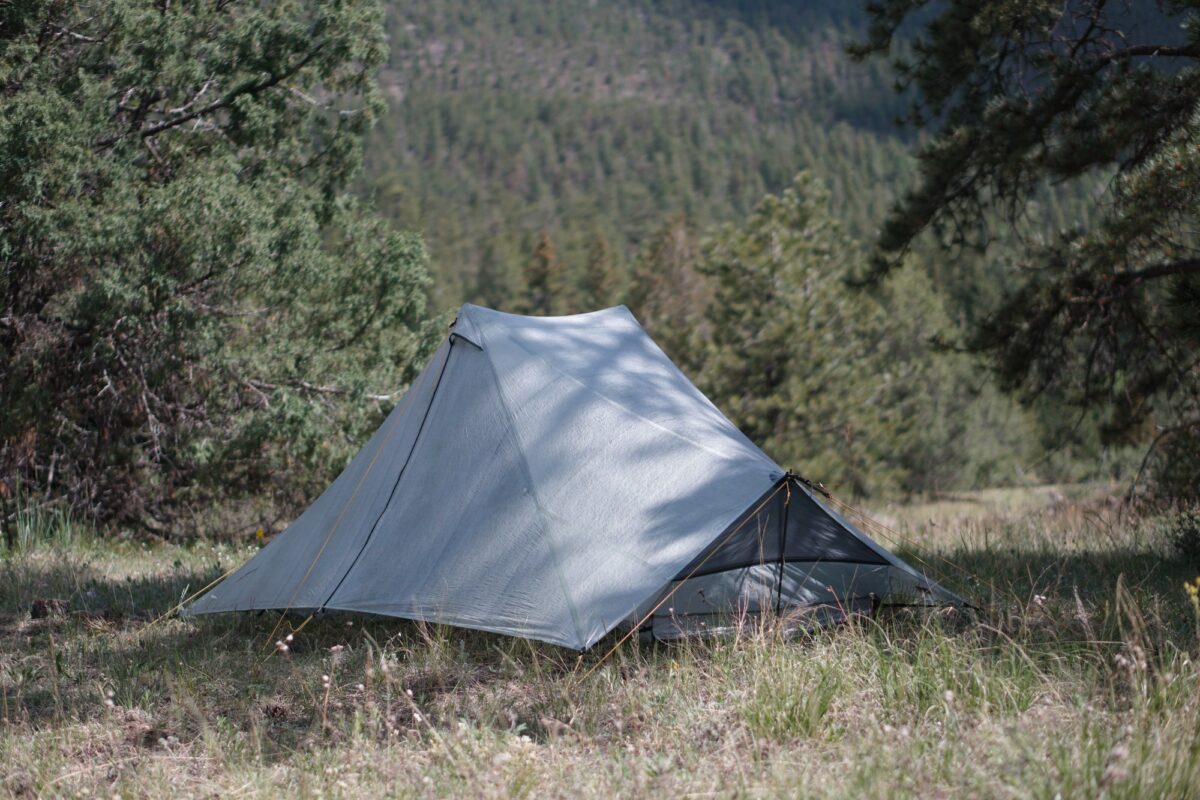
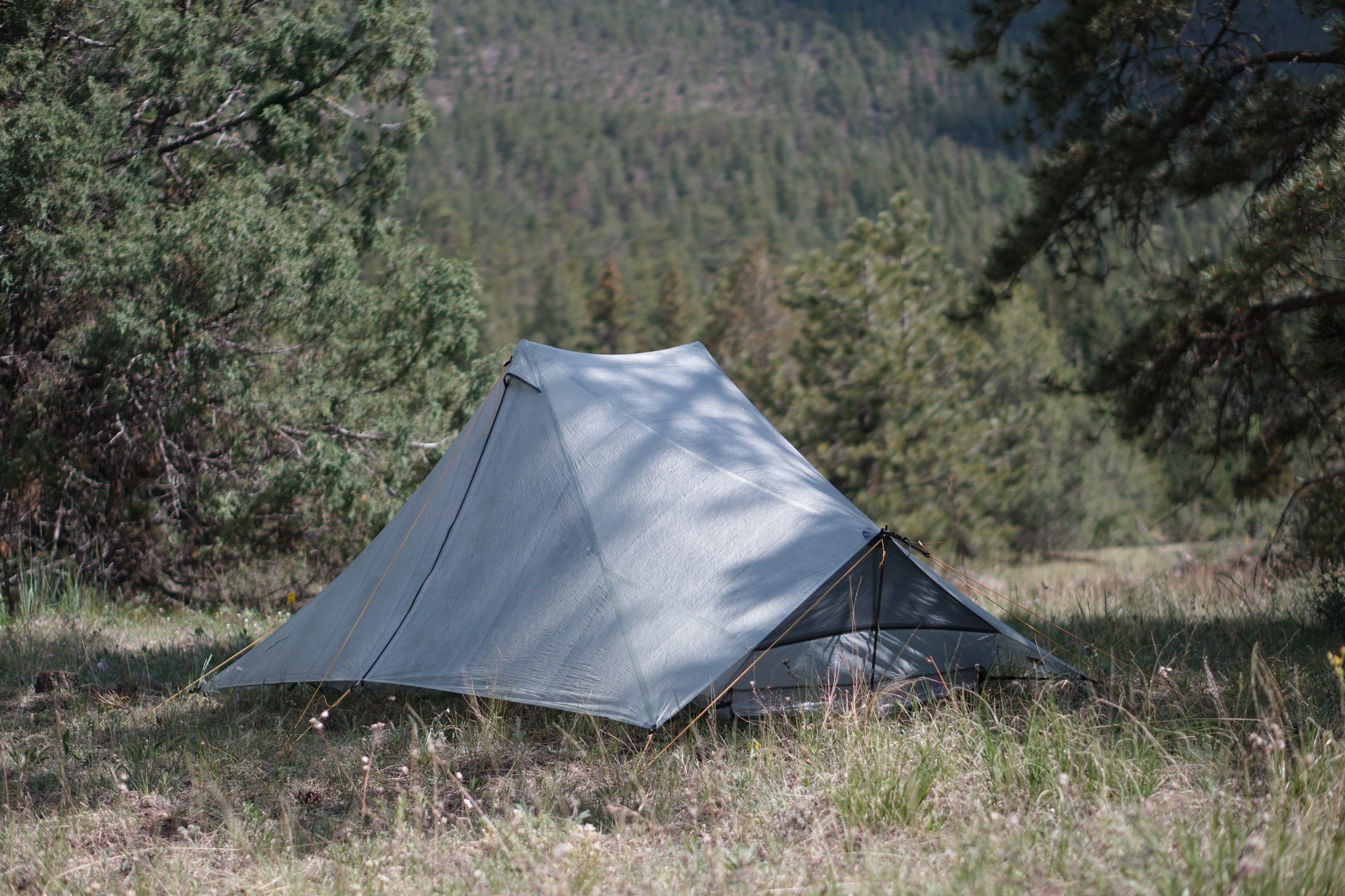
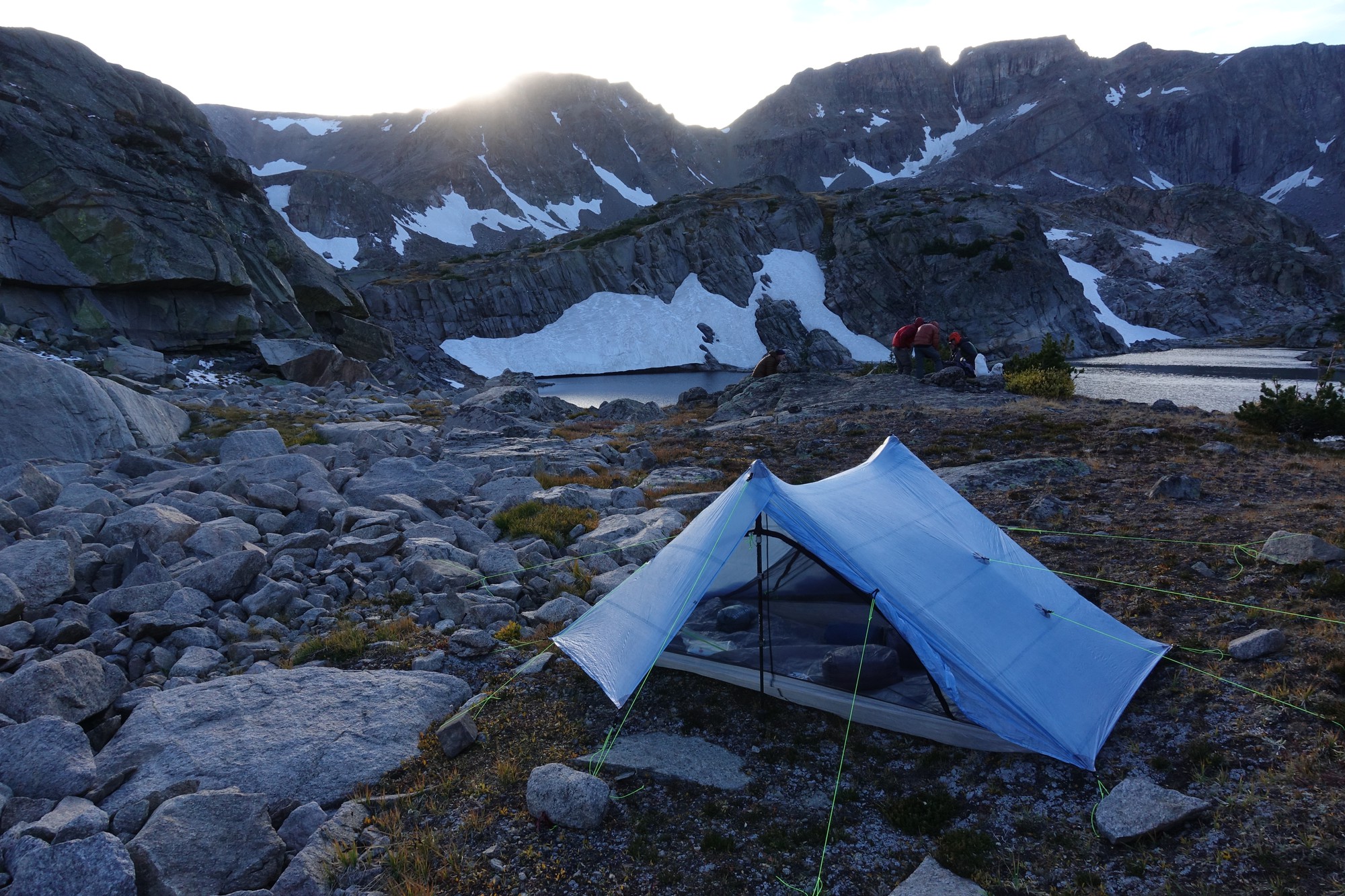
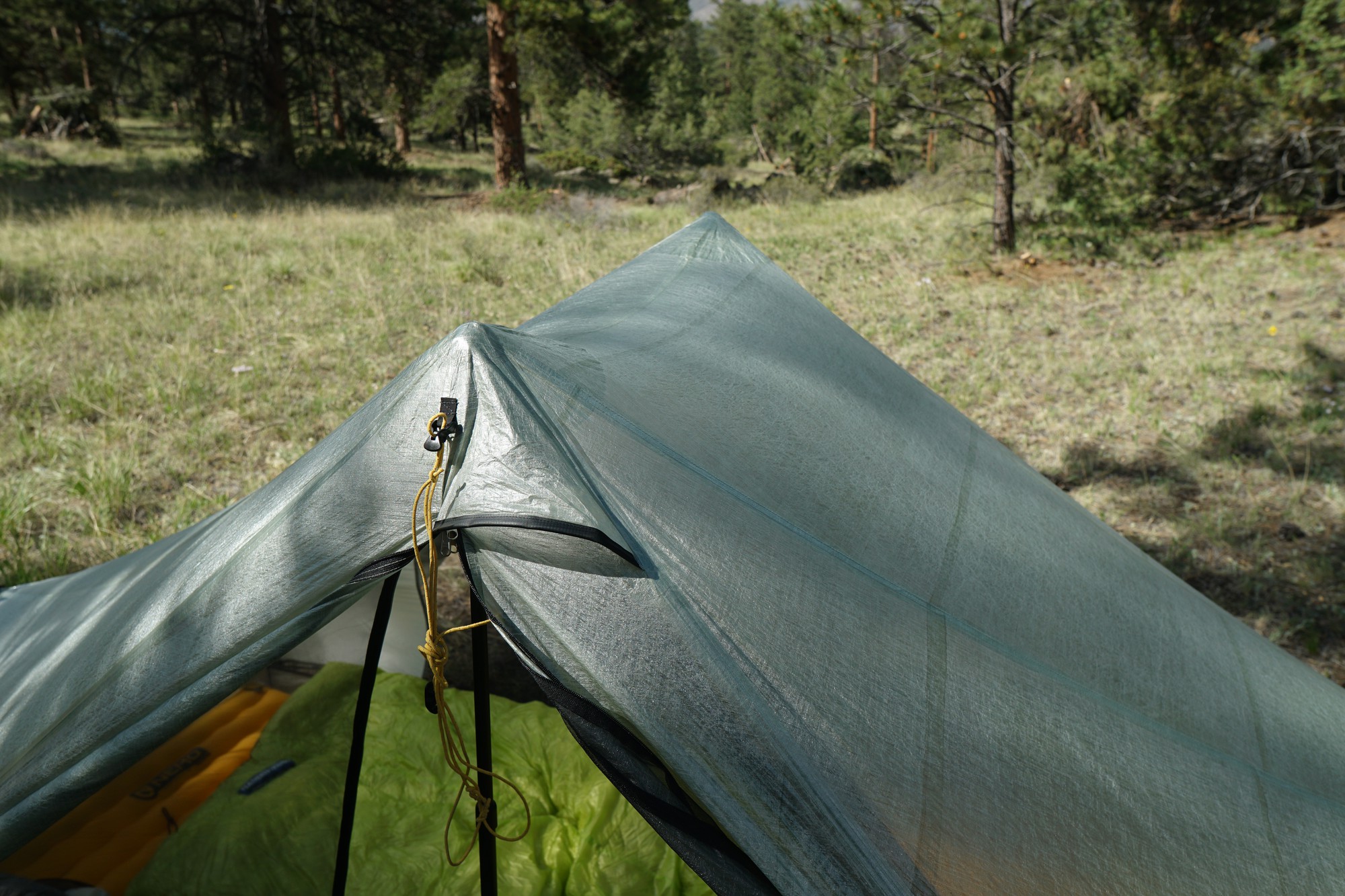
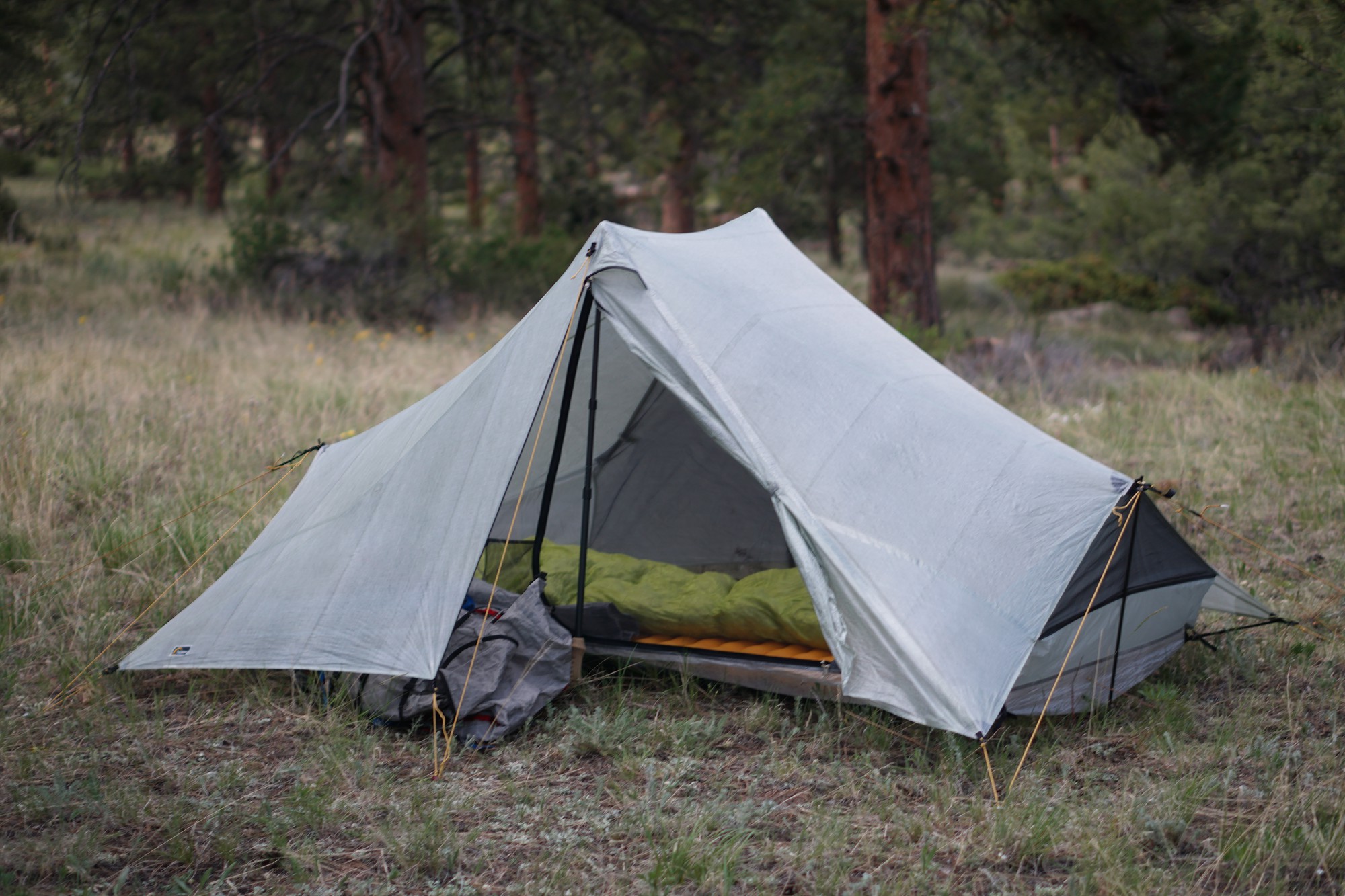
A Tarptent Dipole 1 Li in the Colorado Rockies. Photo: Ryan Jordan.
Testing context
We tested the Tarptent Dipole 1 Li and Dipole 2 Li on three below-the-treeline overnight treks in June of 2022 in the Sierra Nevada and Colorado Rockies. Both shelters were subjected to light wind (with gusts up to 10 to 20 mph) and moderate-to-heavy rain. We were interested in getting initial impressions on ease of setup, livability, structural integrity, condensation resistance, and weather protection.

Test samples vs. final product
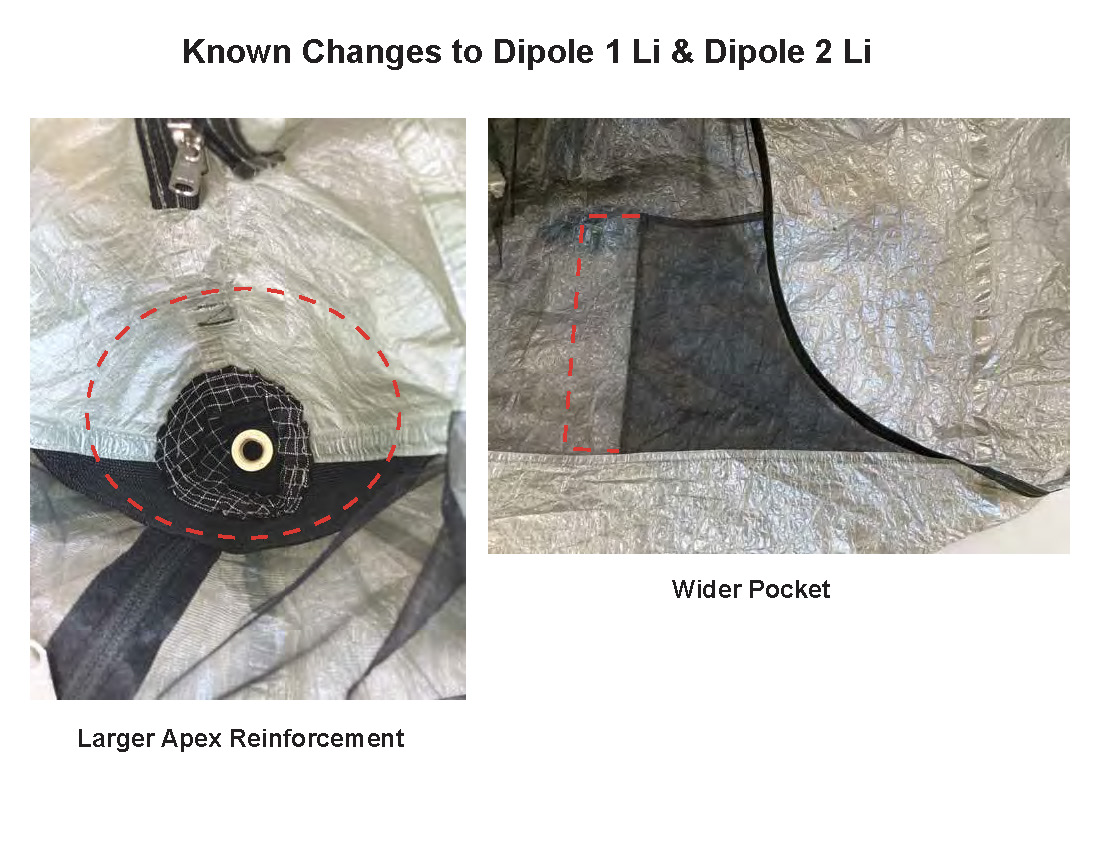
The samples that we tested are late-stage prototypes. Tarptent is still making adjustments to the Tarptent Dipole 1 Li and Dipole 2 Li, and some of the features visible in the photos in this article will be changed by the time the product gets into consumers’ hands. Currently, changes will include:
- very small pattern edits on the vestibules to tighten them up at the hem, especially on the Dipole 2 Li
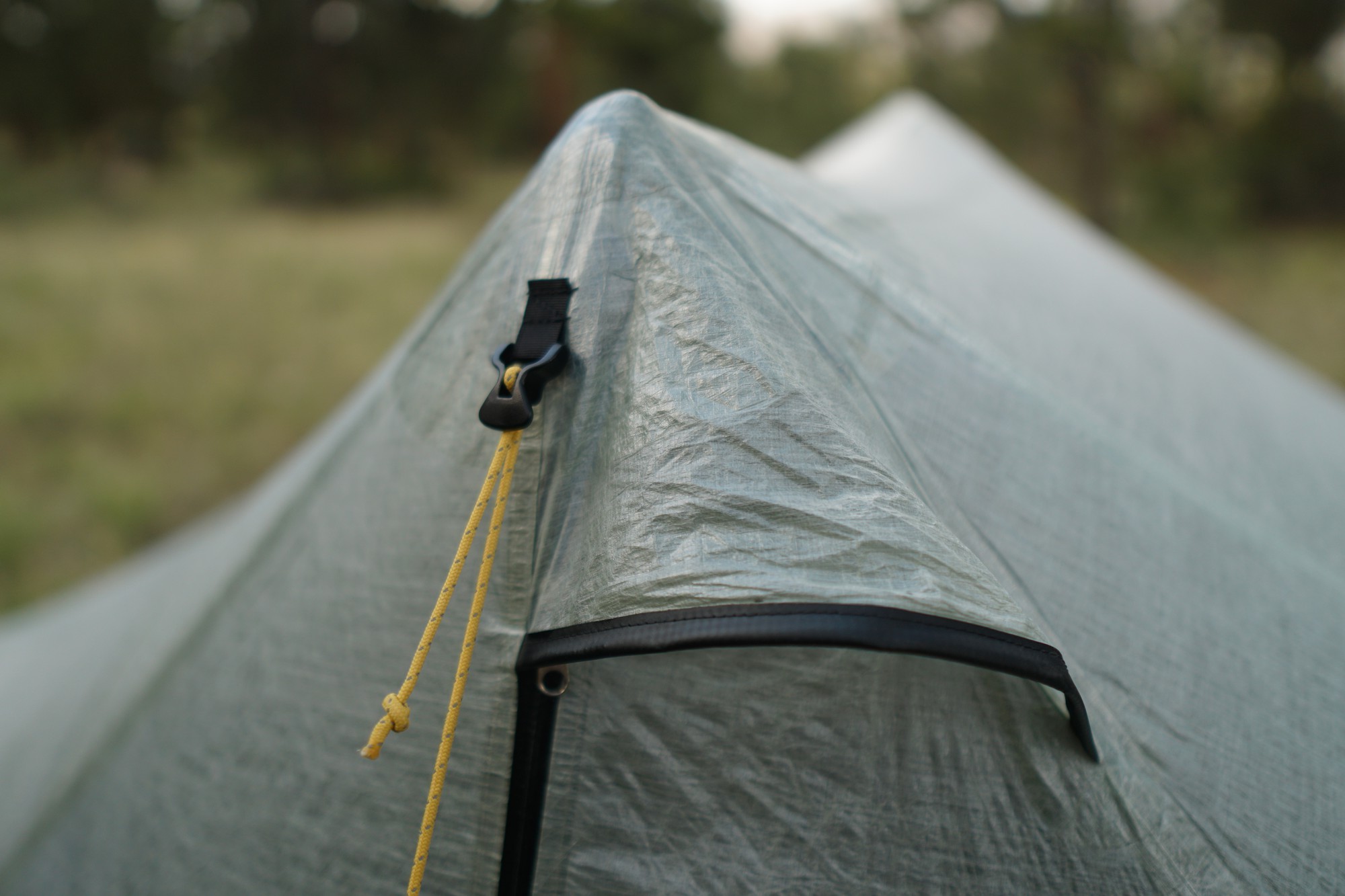
- larger apex pole cap reinforcements
- top of the mesh reinforcement that is currently black ballistic nylon will also be changed to the lighter 210D w/Dyneema grid
- wider interior stow pockets
- the MSRPs listed above are estimates
First impressions
Setup and structure
The Tarptent Dipole 1 Li and Dipole 2 Li have a rectangular footprint, which makes site selection easy – certainly easier than site selection is for the Stratospire Li or ProTrail Li (non-rectangular shelters).
Setup is simple (for a trekking-pole supported shelter) but the order of operations is important – watch the video above for a setup demonstration.
Setup instructions:
- Insert the end struts.
- Stake the two corners of one end of the tent to bring tension to the fly edges between the top of the strut and the stakeout point.
- Repeat for the other end, ensuring a rectangular configuration that brings tension to the vestibule door bottom edges.
- Unzip one vestibule zipper from the top, insert a trekking pole (tip up) – 43 inches (109 cm) for the Tarptent Dipole 1 Li and 45 inches (114 cm) for the Tarptent Dipole 2 Li. Zip up the zipper.
- Repeat – insert the second trekking pole into the opposite vestibule.
- Reset corner tent stakes as needed so they are parallel with the corner seams (i.e., 45-degree angle off the parallel lines of the tent bottom edges).*
- Make sure the bottoms of the end struts are inset slightly relative to the tops, to ensure that downward falling rain doesn’t enter the end vents.
- Tighten the corner guylines.
- Tighten the guylines at the tops of the struts – this step brings the entire tent into a final state of tension. At this point, minor adjustments to pole height and position, corner tension, and corner stake location may be necessary to bring the tent into a taut stake if camping on uneven ground with minor irregularities.
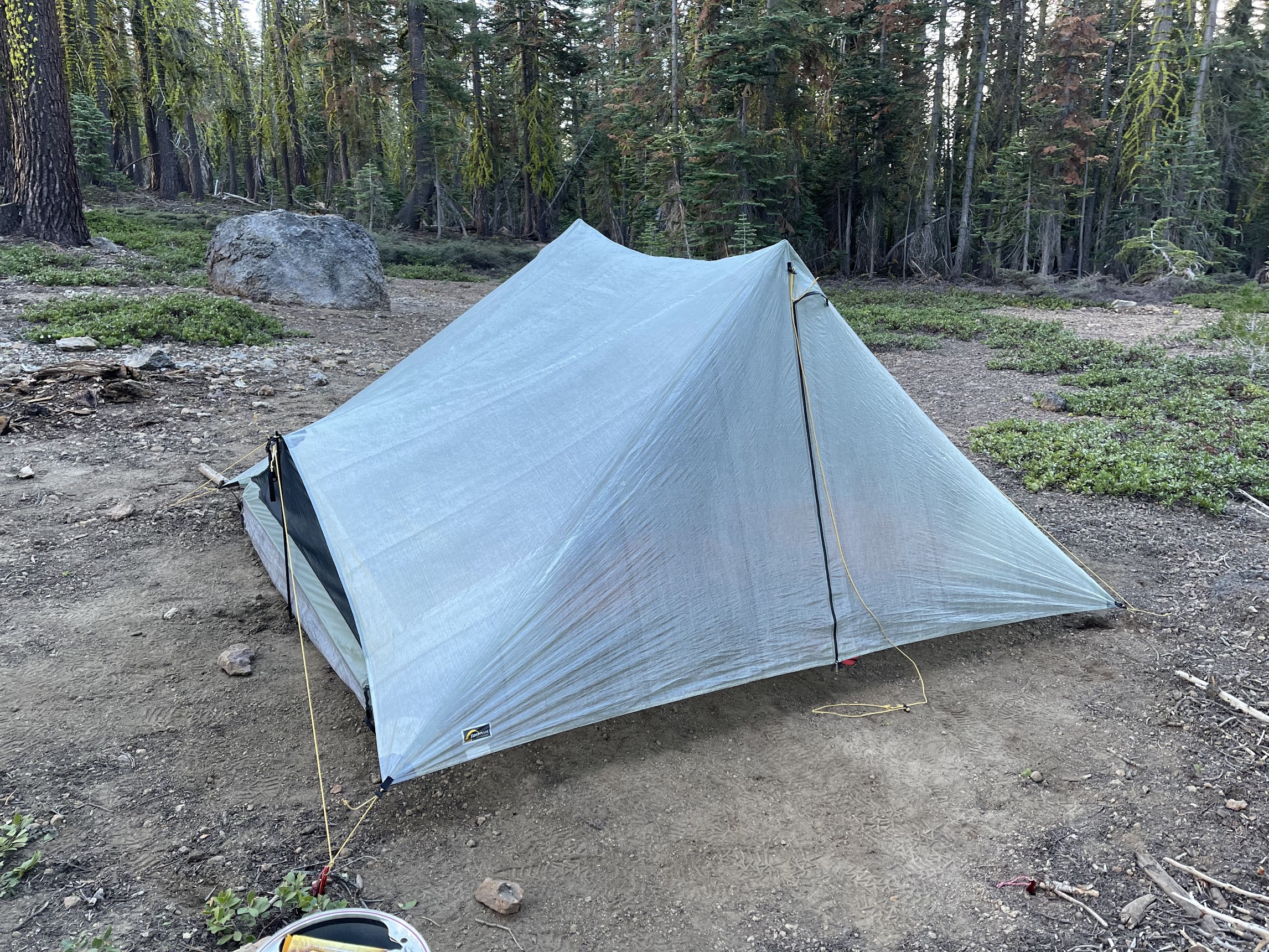
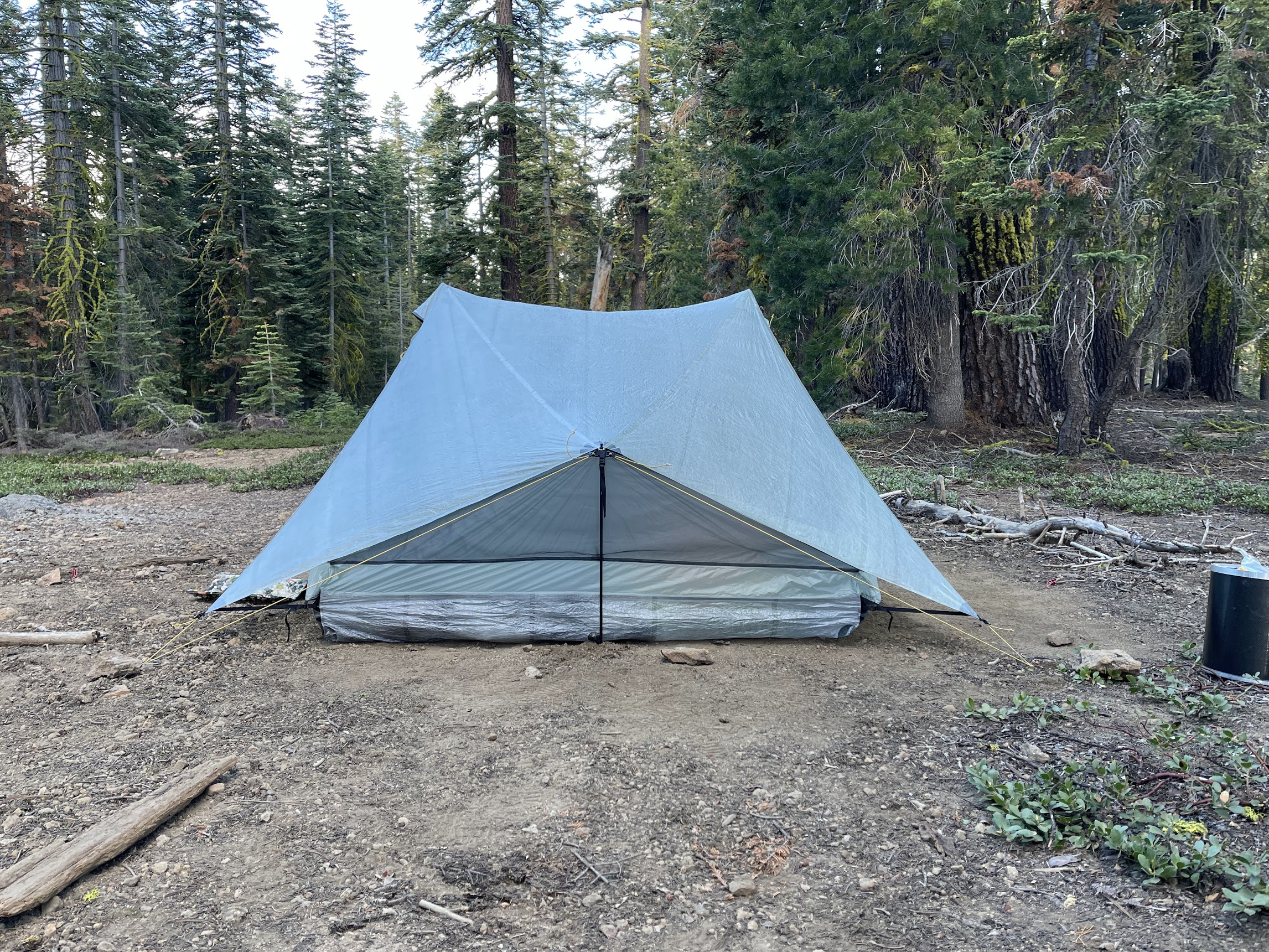
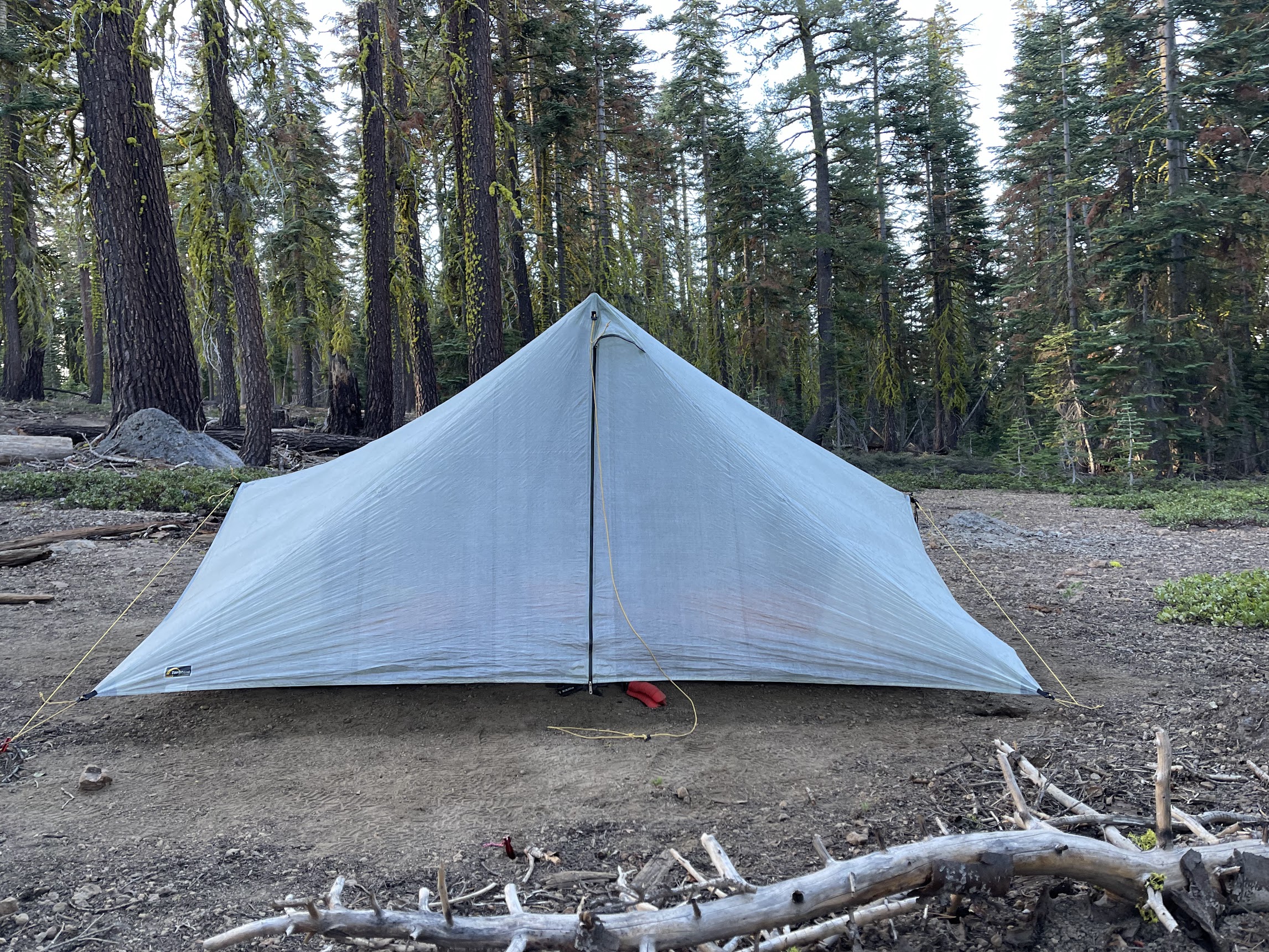
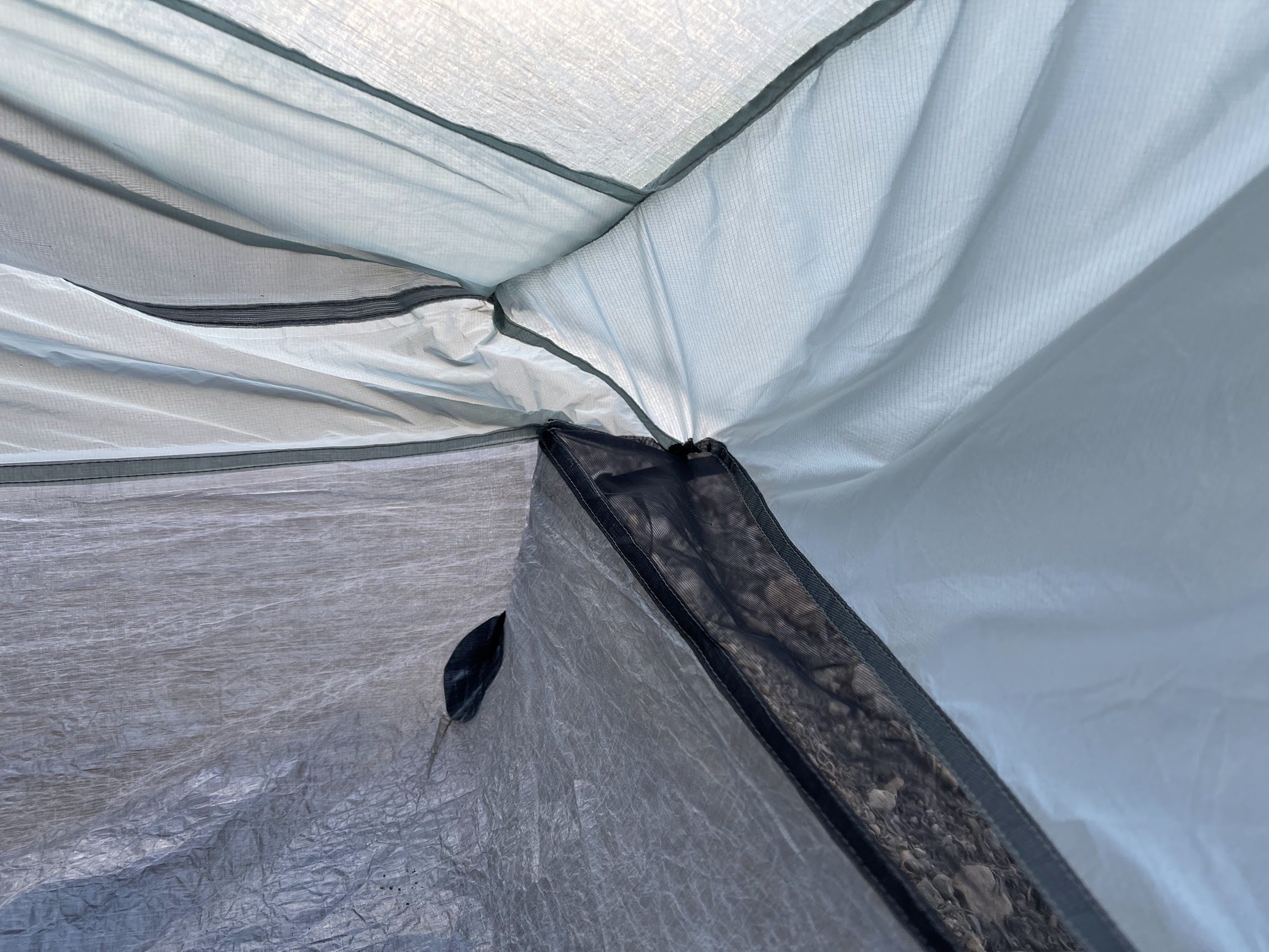
*Tarptent recommends a 45-degree angle for the corner stakes (i.e., the guylines should be parallel to the corner seams). We found that a slightly wider than 45-degree angle works best for creating tension along the edges at the ends of the shelter. The photo below illustrates a pitch on uneven ground that hews very closely to the 45-degree guyline recommendation.
Note just a slight amount of slack on one of the end edges – so slight that I (Andrew) didn’t notice it until I was reviewing my photos. Adjusting the angle of the corner stakes to be slightly wider solved this issue in Ryan’s pitches (as noted in the video above).
The tension created by the end struts and their triangular guyline system allows the Tarptent Dipole 1 Li and Dipole 2 Li to maintain a stable four-stake pitch that does not incorporate the doors as a load-bearing element. The upshot is that both vestibule doors can be open and rolled back without losing tension.
We experienced moderate rain and light wind below treeline in our testing, and are confident that the Tarptent Dipole 1 Li and Dipole 2 Li can handle those conditions without collapsing or letting in water. In heavy weather, four additional stakes and guylines can be deployed – two along the axis of the ridgeline and two running from the end struts. The symmetrical nature of the tension forces in the Dipole shelters is a real strength of the design (see our email interview with Henry Shires at the bottom of this article for more on this).
Livability and interior volume
There are several other features that we’ll explore more fully as we continue to review the Tarptent Dipole 1 Li and Dipole 2 Li:
- vestibule size and depth
- vent placement and design
- condensation drain placement and design
- end vent/window design and stormworthiness
- packed size and packability
- trekking-pole placement in terms of livability
- performance and stability in high winds/heavy rain/under snow load
- inner mesh door size and placement
Ryan touches on these performance issues in the video above.
But in this First Looks review, we are concentrating on the two features that stood out the most in our initial handling of the Tarptent Dipole 1 Li and Dipole 2 Li. The first was the four-stake design that allows both vestibule doors to be open without losing tension.
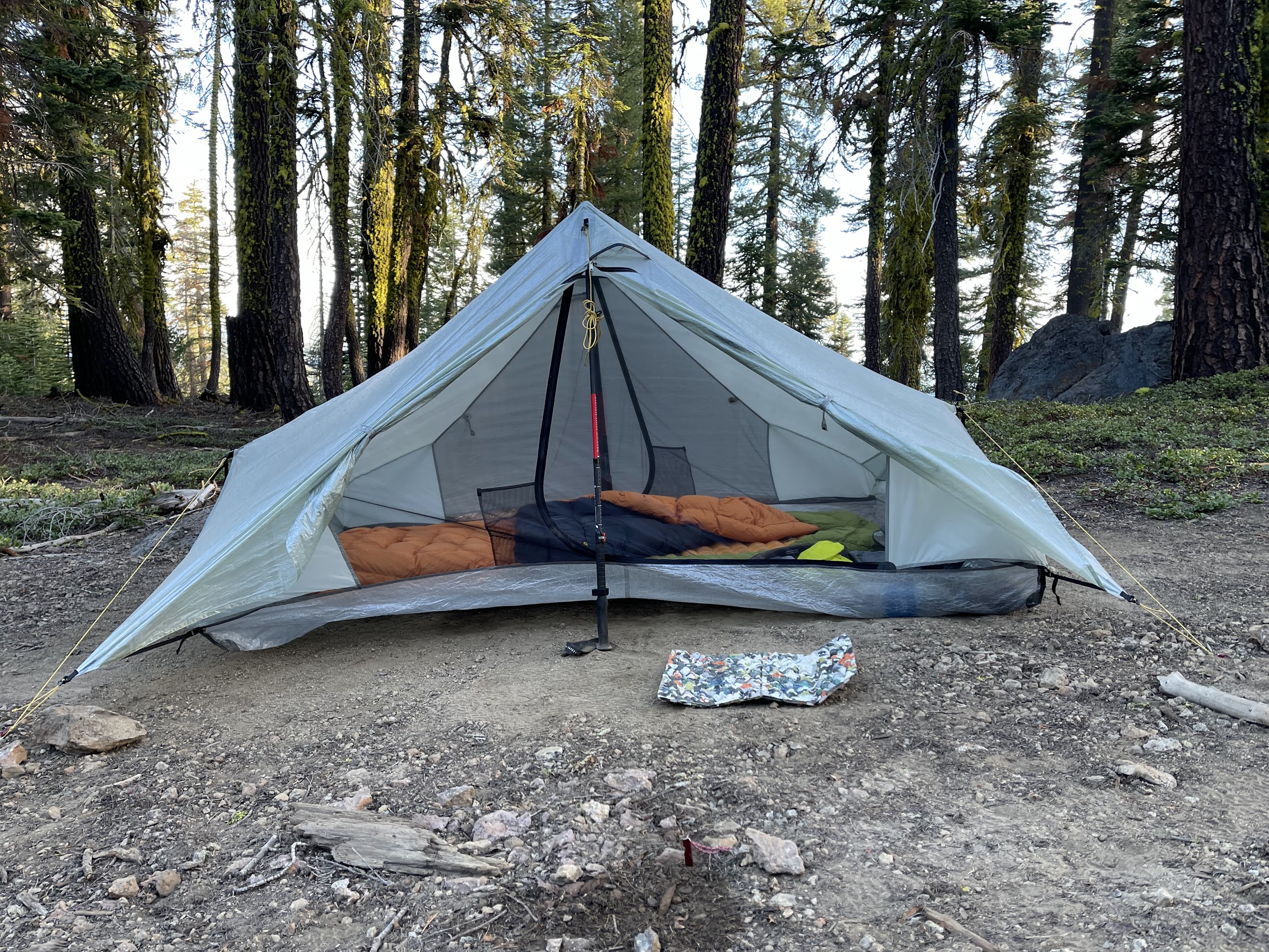
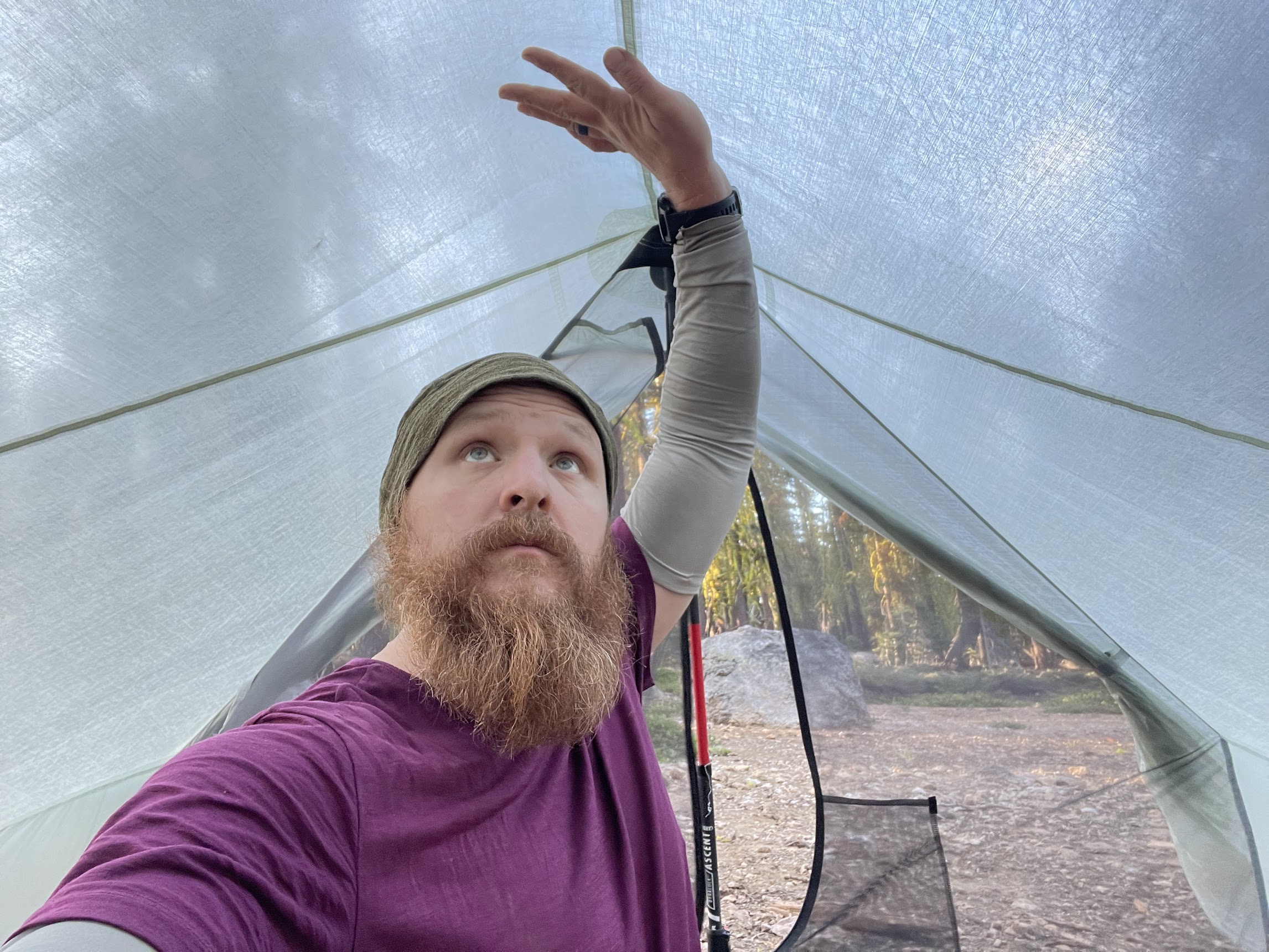
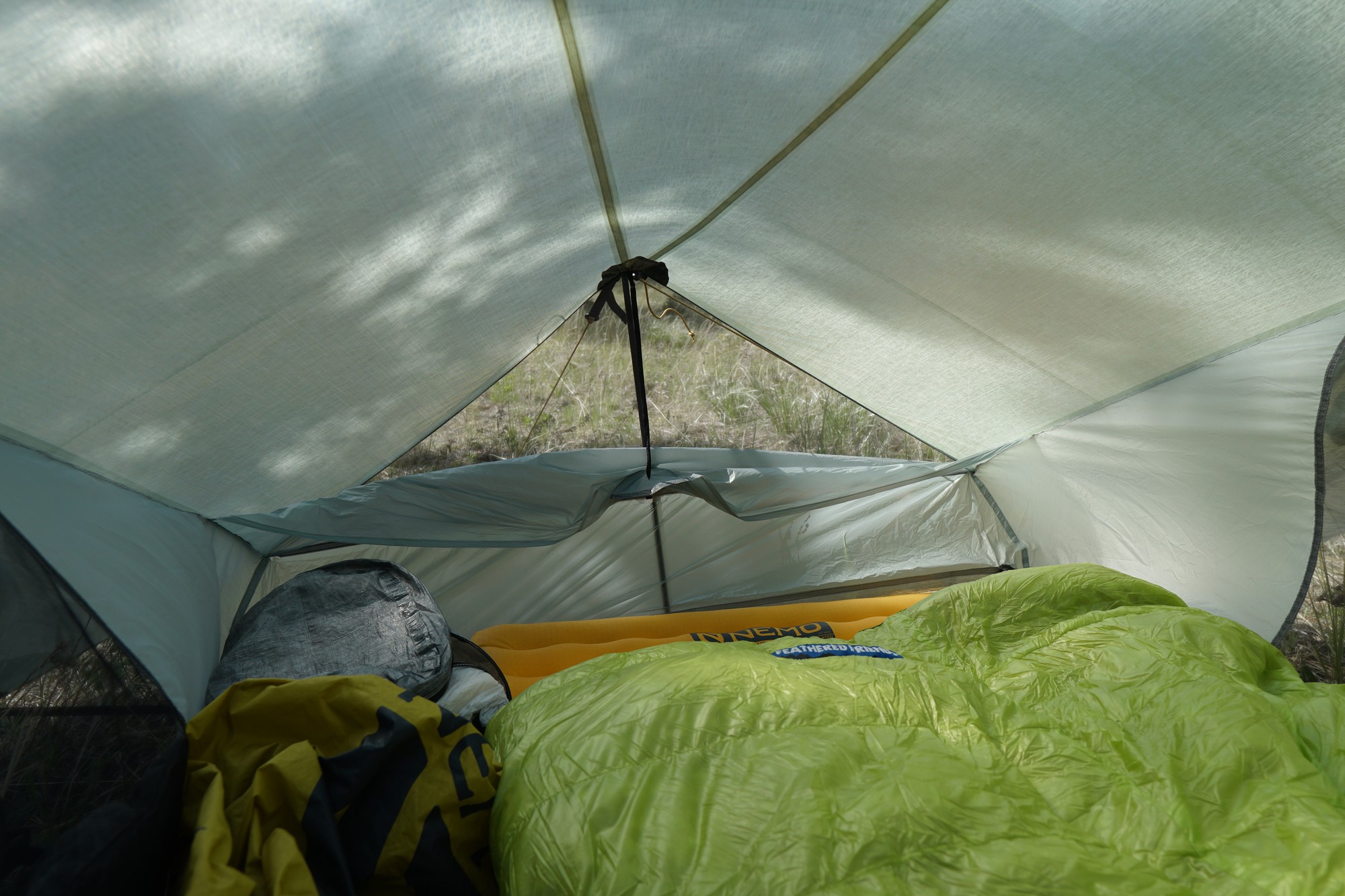
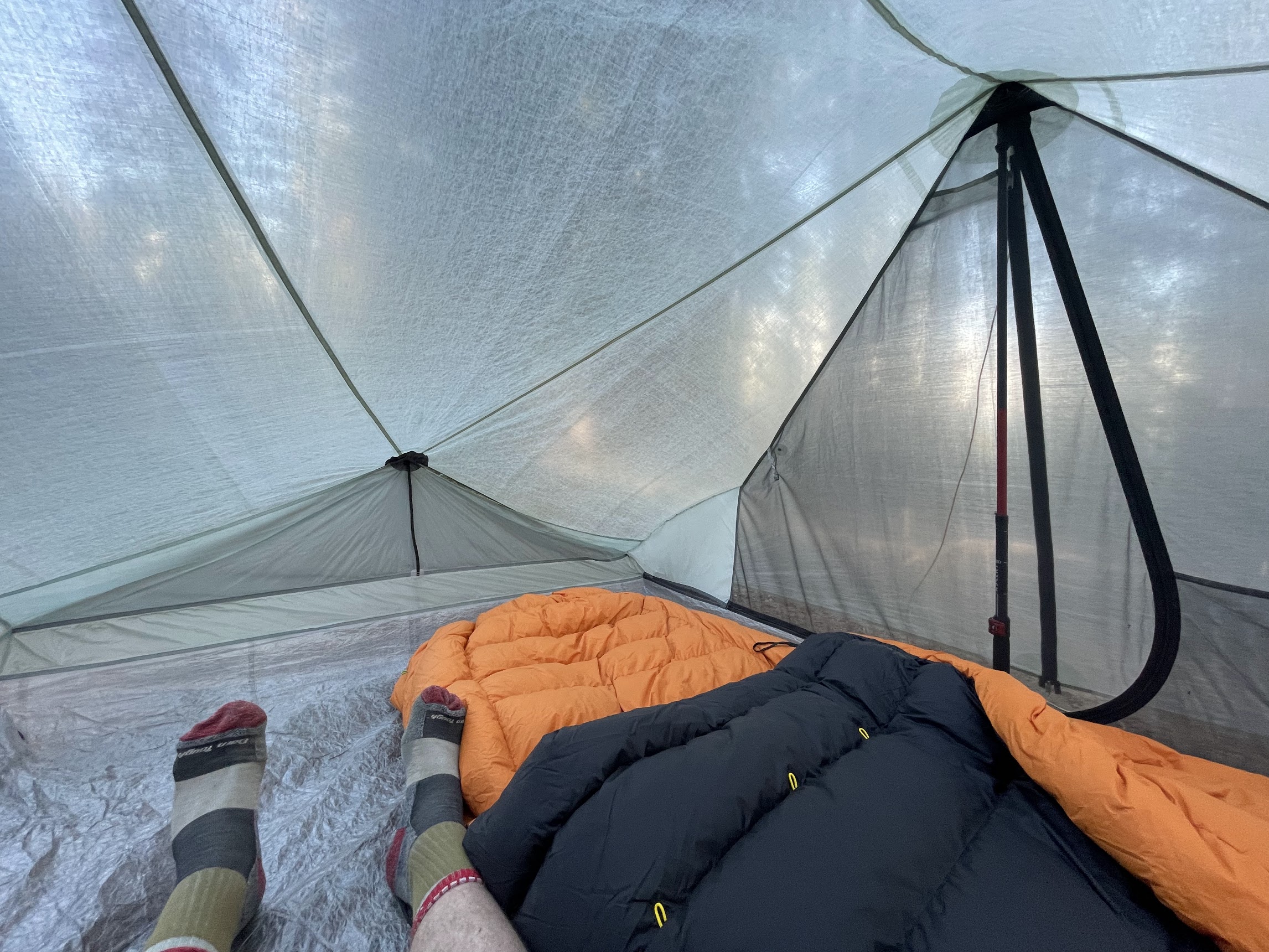
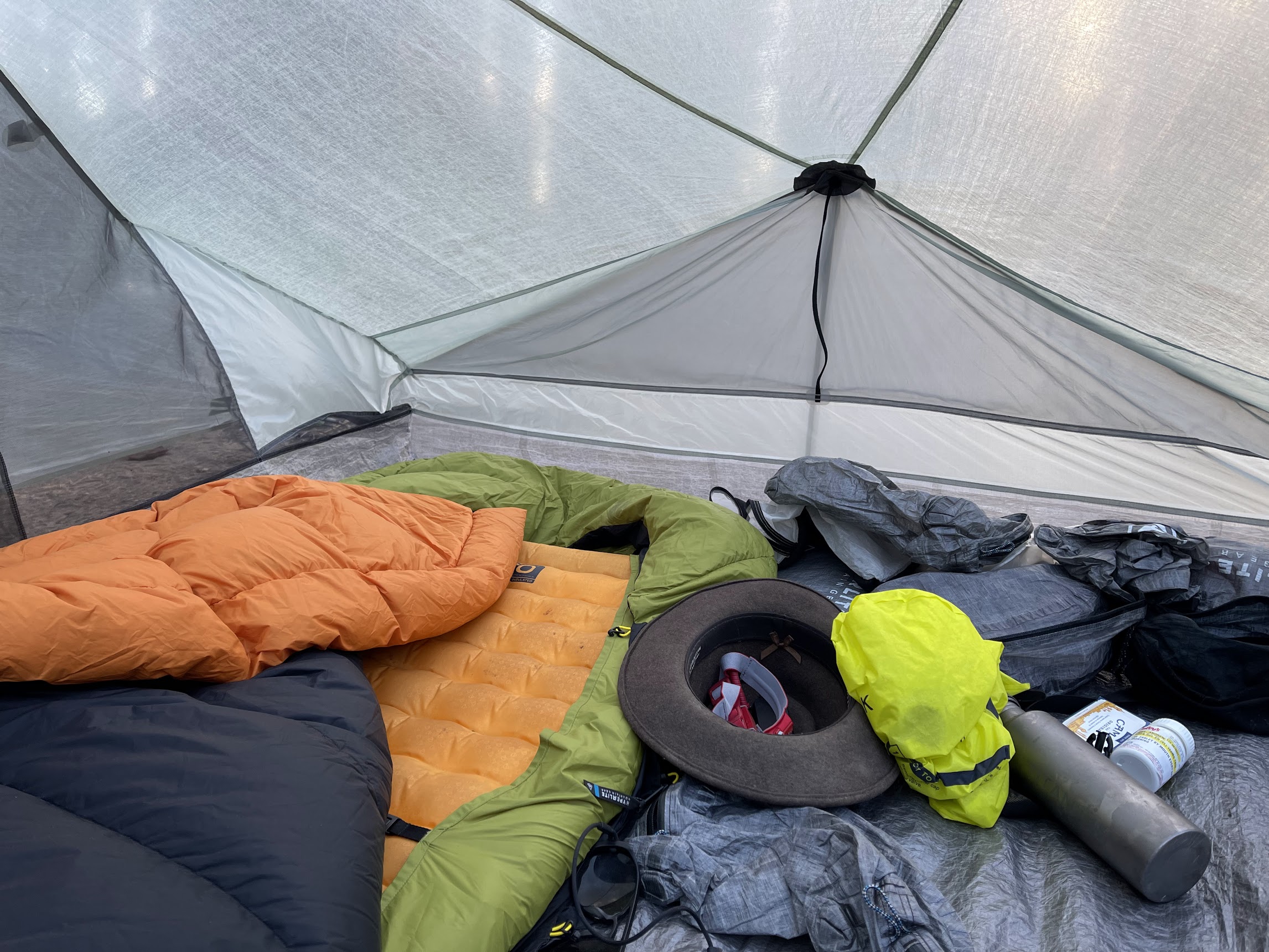
The second standout feature is the livable interior volume present in both shelters. The ends of the shelter are 21 inches (53 cm) tall – tall enough that feet will not rub against the shelter ceiling when sleeping pads inevitably slide down towards the end of the tent. The width and length are both designed to accommodate larger hikers. We are not tall (Andrew is five feet six inches and Ryan is five feet seven inches) but we are confident that Tarptent’s claim of comfort for backpackers six feet eight inches and over is not an exaggeration.
We believe that the Tarptent Dipole 1 Li and Dipole 2 Li are the roomiest trekking-pole-supported shelters for their weight that we’ve ever tested.
Comparisons
This is not a comprehensive comparison – that will have to wait until we can put the Tarptent Dipole series through long-term field testing. The purpose of this comparison is to help place the Tarptent Dipole 1 Li and Dipole 2 Li (specifically the Dipole 2 Li) within the category of two-pole, two-door, single-wall, Dyneema Composite Fabric shelters. No shelter in this comparison has the end struts and correspondingly totally vertical end panels of the Tarptent Dipole 2 Li, so we won’t waste time repeating that in every comparison.
Another noteworthy thing about the Tarptent Dipole 1 and 2 is that both shelters feature a slightly hourglass-shaped bathtub floor. In the specs above, we list the bathtub floor dimensions as follows:
- Dipole 1 Li width x length: 36 x 84 inches (91 x 213 cm)
- Dipole 2 Li width x length: 58 x 88 inches (147 x 224 cm)
But in fact, the Dipole 2 Li narrows slightly in the center to 50 inches (127 cm) and the Dipole 1 Li narrows in the center to 28 inches (71 cm).
Readers are encouraged to elaborate further on the differences and similarities between all four shelters in this comparison – and the pros and cons of each – in the comments section.
Tarptent Dipole 2 Li vs. Durston Gear X-Mid Pro 2
The Durston Gear X-Mid Pro 2 is the only other two-person, two-pole, double-pole, double-door, single-wall shelter currently on the market that is claimed to be pitched with a minimum of four stakes. (Another one is the Sierra Designs High Route 1 but that’s a one-person shelter.)
The Durston Gear X-Mid Pro 2’s floor footprint is slightly longer than the Tarptent Dipole 2 Li – 90 inches (229 cm) for the X-Mid Pro 2 vs. 88 inches (224 cm) for the Dipole 2 Li. But the Tarptent Dipole 2 Li is significantly wider at 58 inches (147 cm) at the ends and 50 inches (127 cm) at the middle vs. the X-Mid Pro 2’s 48 inches (122 cm). The final weight of the Dipole 2 Li is still pending, but the Durston X-Mid Pro 2 is likely to be ~5 ounces (142 g) lighter than the Dipole 2 Li. The Dipole 2 Li easily fits two long/wide (25 inches / 64 cm) sleeping pads – this is not possible in the X-Mid Pro 2 without deforming the shape of the inner tent.
The Durston Gear X-Mid Pro 2 is ~$100 cheaper than the Tarptent Dipole 2 Li. There are differences in overall design between the two shelters. The biggest difference is that the X-Mid Pro 2 is based on an asymmetrical design (offset poles and an inner tent that is diagonally oriented relative to the canopy). The Tarptent Dipole 2 Li is symmetrical – poles are oriented opposite of each other and the inner tent is parallel to the canopy. These design characteristics have implications for pole placement, stability, and the wind and rain performance of both shelters in their four-stake configuration.
For more on this, see our interview with Henry Shires, below.
Tarptent Dipole 2 Li vs. Zpacks Duplex
The Zpacks Duplex is still one of the most ubiquitous double-pole, double-door, single-wall DCF shelters. A noteworthy difference between the Duplex and the Tarptent Dipole 2 is that the Duplex needs eight stakes minimum to be considered ready for mild wind and rain. The resulting forest of guylines can be a little overwhelming at a small campsite.
It is assumed in our community that the Zpacks Duplex does not fare well in high winds. However, we think it’s mostly attributable to user error – the Duplex is a difficult shelter to pitch properly and securely in stormy weather, but with up to 14 stake-out points, it can be done. We think the Tarptent Dipole 1 Li and Dipole 2 Li will fare better than the Duplex in this regard – it takes much less effort to achieve an extremely taut pitch with the Dipole than with the Duplex.
The Duplex has large doors with the support poles taking up space right in the center of the doors. The Tarptent Dipole 2 Li also has centrally located poles, but smaller, offset doors so the pole is not in the way, particularly if the user angles the poles to one side. The Duplex is more than a foot (30 cm) narrower than the Dipole 2 and weighs ~8 ounces (227 g) less than the Dipole 2.
Gossamer Gear The DCF Two
The Gossamer Gear The DCF Two weighs ~6 ounces (170 g) less than the Tarptent Dipole 2 Li. The DCF Two requires a minimum of six stakes for setup. Steeply sloping walls and a relatively small footprint make the DCF Two suitable only for hikers shorter than about 6 feet 1 inch (185 cm).
Like the Dipole 2 Li, the DCF Two has smaller doors to one side of the support pole (they are across from each other as opposed to offset from each other as with the Dipole 2 Li).
The DCF Two also stands out on this list for being tapered, with a head-end width of 48 inches (122 cm) and a foot-end width of 42 inches (107 cm) – so no room for two wide pads. It also has an apex height of 43 inches (109 cm) as compared to the Dipole 2 Li apex height of 45 inches (114 cm).
Final Thoughts
The Tarptent Dipole 1 Li and Dipole 2 Li are not the lightest double-door, double-pole, single-wall Dyneema Composite Fabric shelters available. From conversations with Henry Shires (owner/founder) and Rob Dunne (design engineer) at Tarptent, that was clearly not the design goal. Tarptent’s primary goals were to create usable interior volume and a stable minimum four-stake setup, and at this, it succeeded.
The Tarptent Dipole 1 Li and Dipole 2 Li are the roomiest shelters in their class – that class being single-wall, double-pole, double-door trekking pole-supported shelters in the 18 to 26 ounce (510 to 727 g) range. This liveable interior volume is a combination of apex height, floor width and length, and the unique end-strut design.
Four-stake setup is stable in rain and light winds and allows vestibule doors to be open without losing tension. Tarptent’s secondary goal was to maximize ventilation and minimize condensation buildup. We like the design features they’ve implemented with this in mind, but we will need further field days with these shelters to accurately judge condensation management.

Photos








Where to Buy
- See the Tarptent Dipole 1 Li and Tarptent Dipole 2 Li at the Tarptent website.
Tarptent Dipole 1 Li and Dipole 2 Li design notes: an interview with Henry Shires
Ryan Jordan: Using the four-stake setup without apex guylines, I’m able to achieve pretty good stability the tighter the guylines are tightened. In our forest soils here, the six-inch stakes are not holding this level of tension on the Dipole 2 Li, so I’ve been using eight-inch stakes.
That said, I’m pulling [up to] 15-20 pounds of tension on each stake – that’s a lot. I can pull significantly less by using apex guylines, which is to be expected. But I wanted to get a feel for your expectation of stability with and without apex guylines in terms of use cases for wind speeds.
Henry Shires: Yes, agreed that six-inch stakes are marginal in loose soil, especially for the Dipole 2 Li and that eight-inch [stakes] are the way to go. In my/our testing the 4-stake setup (assuming the stakes hold) is fine for low to moderate winds but, yes, the apex/vestibule lines are needed in higher winds if only to take some of the stress directed at the low corners by broadside winds.
As with most/all tents, more stakes are better than fewer stakes, and, yes, for real weather in exposed places the Dipole will want six of them. However, for many/most cases, at least in sheltered areas, four will be fine and I personally really like not having to work around guylines getting in and out.
RJ: Can you give us some info on what is exactly being patented?
HS: We are moving to patent the combination of the ability to stand with four stakes – provided by the dual inset pole structure and relatively large (17-inch) displacement between the ground level corners and apex points – and the mid-end foldable struts which provide the large increase in both interior volume and structural support.
As you know we’ve done plenty of trekking pole tents with end strut designs including the long discontinued Saddle 2 but all had vestibules that required staking (or, if rolled back, apex guylines in lieu of) for lateral support.
The Aeon Li was the first one [that] allowed for full front rollback with no apex line needed (and we have a patent for that one) but to the best of our knowledge, the Dipole has never been done before. I know you’ve played around with the [Durston Gear] X-Mid and [Sierra Designs] High Route designs which, at first glance, appear to be a four-stake setup but the asymmetry proves otherwise and my goal with this one is a true 4-stake setup and practical use (in most cases).
[Here are a] couple of graphics (below) showing the tension lines on the Dipole and X-Mid/High Route designs, both with full rolled back doors. Note that for stability what matters are the relative forces applied to apex points where the underlying vertical poles meet the canopy.
Unequal forces will cause some form of pole rotation and corresponding loss of fabric tension. I did not include a graphic of a simple four-sided square pyramid but that one would have four tension lines coming off the center apex pole and each would be at 90 degrees. For two pole tents, each pole has tension lines and at least one connecting tension line between them.
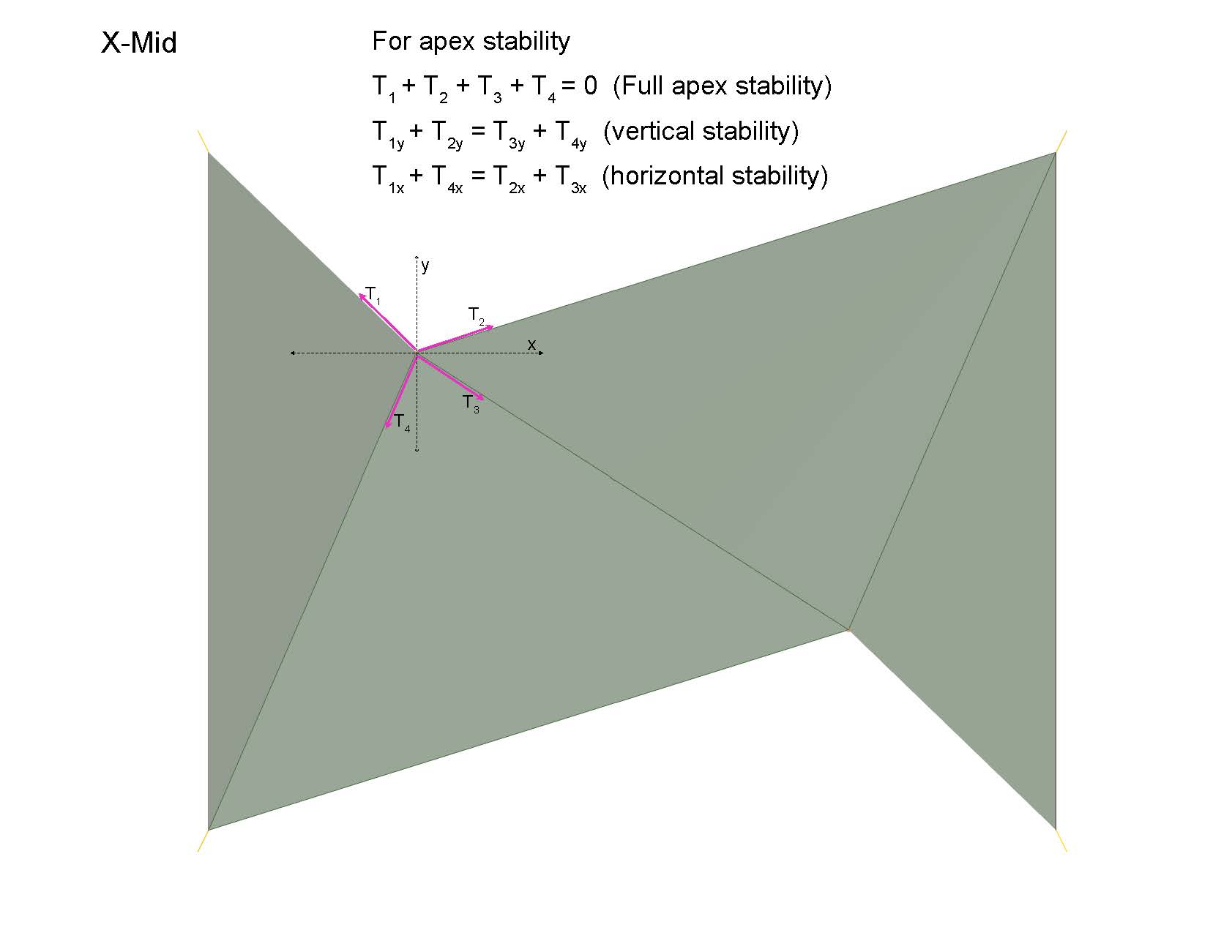
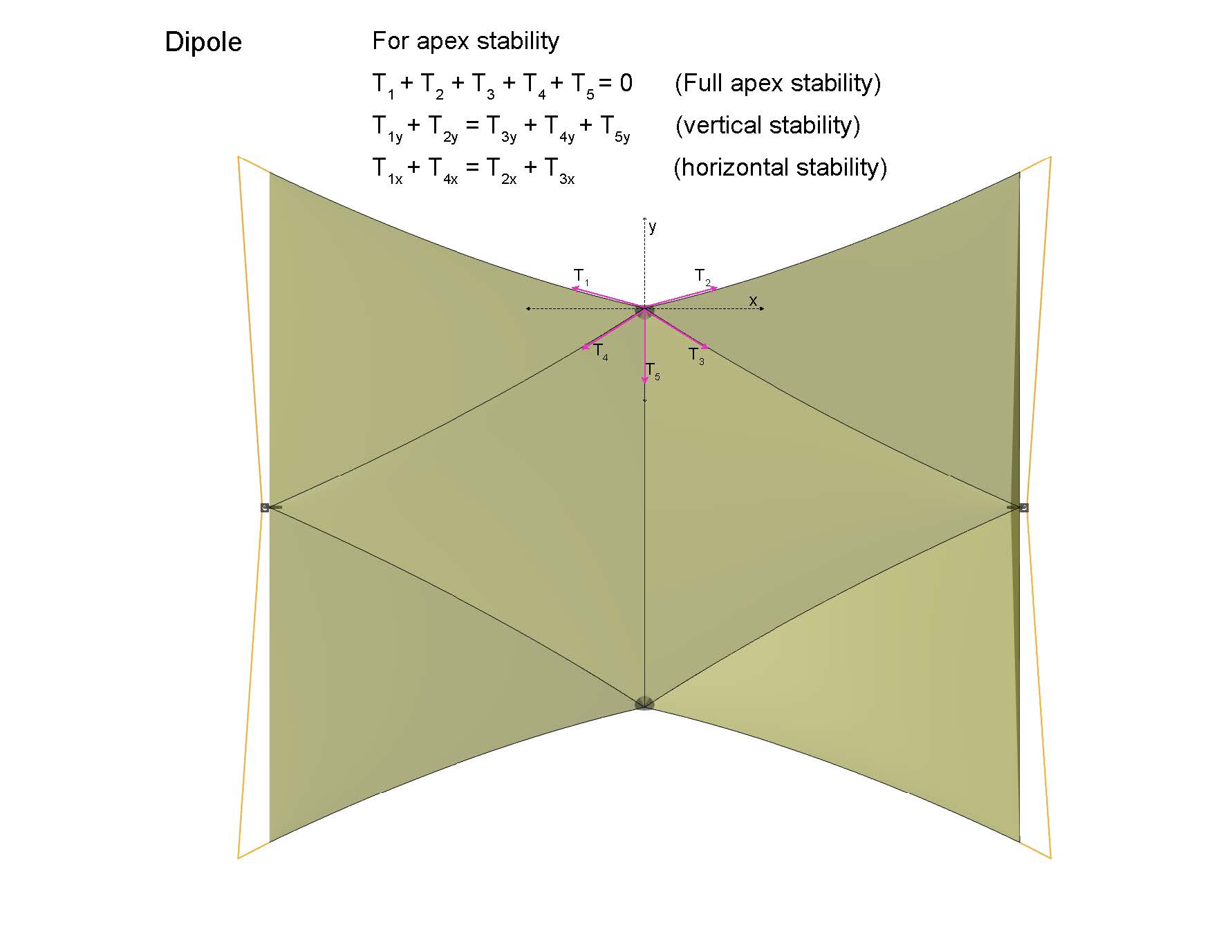
The inherent asymmetry of the offset poles in the X-Mid/High Route means there is no way to adjust the four corner tension points such that the sum of all the tension lines equals zero with the doors open in any sort of stable equilibrium. In the X-Mid graphic, note that all tension lines are at different angles and that the T3 tension line that runs between the two apex points is not independently addressable.
RJ: T3 is not independently controllable without apex guylines – and that makes the X-Mid a six-stake tent in all but a mild breeze.
HS: It is also the case that the long seam line carrying the T2 tension is a shallow angle and any deviations in the pole apex position aren’t resisted by corresponding changes in tension because that edge doesn’t need to stretch to accommodate the change.
RJ: There is notably different behavior in apex stability between the X-Mid and Dipole. On the X-Mid, T2y is indeed a very shallow angle. So it would seem intuitive to crank that T2 corner stake down hard, to bring more tension to T2y. However, the asymmetry causes an additional imbalance in all of the other tension lines because there are no directly opposite forces to T2y. It’s tricky and time-consuming in the field to sort this all out. Of course, the problem is sort of solved by just adding the apex guylines to the X-Mid.
HS: Adding an additional tension line (in the direction of the Y-axis as shown in the diagram) does inhibit an inward rotation and is the reason why the X-Mid is always shown that way.
In the Dipole, there is an additional inward tension line (T5). That line is resisted by the corner tension lines (T1 and T2) but is also addressable through the tensioning system at each mid-end strut which creates T3 and T4. The inherent symmetry of the Dipole – tension lines are equalized and at comparable angles – means that no additional apex tension lines are needed for low to moderate winds and doors can be fully rolled back.
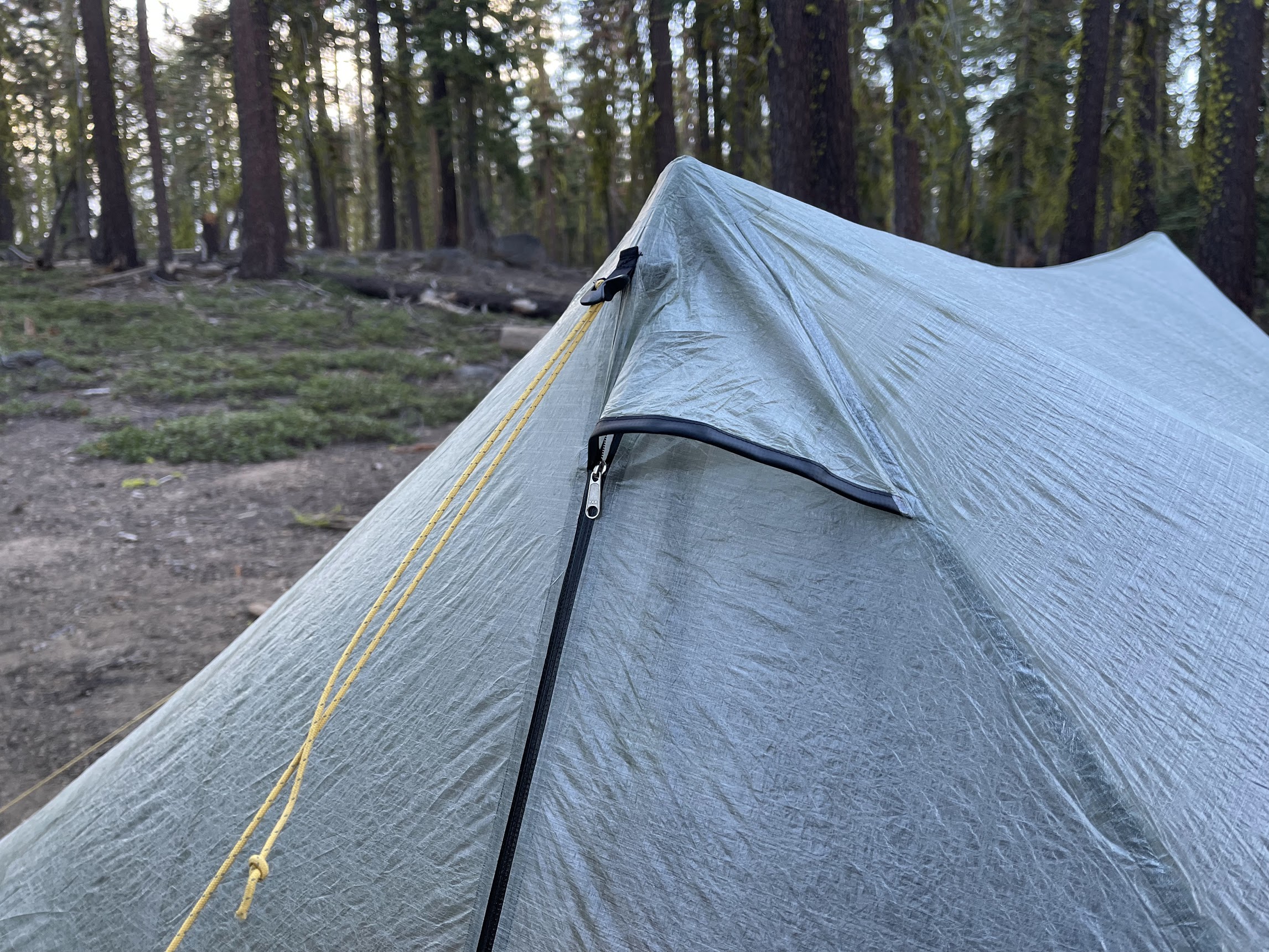
RJ: I had the tent in a heavy thunderstorm yesterday and it otherwise stayed remarkably dry – the end vent construction is unique and effective. I like it. I was admittedly a bit nervous about not having an awning over these vents, but the inward-sloping struts kept rain from entering the tent.
HS: Yes, I too was nervous about that. Earlier versions of that system weren’t reliable but [Tarptent Design Engineer] Rob [Dunne] – thanks Rob – made that work well.
RJ: What’s at the heart of your design process for the Dipole series? What did you set out to accomplish?
HS: The pack and pad market [has] evolved over the years and we acknowledge the trend toward wider, thicker pads and narrower packs. The way we achieve [usable interior volume] on many of our tents is to deploy the PitchLoc structure. They are strong and effective but only foldable/packable down to 16 inches on the Notch and StratoSpire series and that length makes it hard to fit horizontally into many ultralight (i.e., skinny) packs.
To retain/enhance usable volume on the Dipole we moved to a foldable single strut structure that folds to 13 inches (and [is] easily detachable), a length much more viable for horizontal packing. The other goal for these was to enhance usable length and width such that both models would easily fit long wide, and thick pads – one in the Dipole 1 and two in the Dipole 2 – while still sleeping people at six feet eight inches or even taller. The completely vertical and relatively tall (21-inch) ends walls make that possible.
The other goals were a true four-stake setup and greatly enhanced venting – ends, sides, and apex venting.
Check this space for more notes and observations on the Tarptent Dipole 1 and 2 as we continue to field test these shelters over the coming months.
Learn More
Browse our curated recommendations in the Backpacking Light Gear Shop – a product research & discovery tool where you can find Member gear reviews, Gear Swap (used gear) listings, and more info about specific products recommended by our staff and members.
Gear Shop » Trekking Pole Tents

Related Content
- more Tarptent reviews and Tarptent-related content
- see the Durston X-Mid Pro 2 review
- check out what our community thinks of the Zpacks Duplex
- see what our community has to say about tent shopping in forum threads here and here
DISCLOSURE (Updated April 9, 2024)
- Product mentions in this article are made by the author with no compensation in return. In addition, Backpacking Light does not accept compensation or donated/discounted products in exchange for product mentions or placements in editorial coverage.
- Some (but not all) of the links in this review may be affiliate links. If you click on one of these links and visit one of our affiliate partners (usually a retailer site), and subsequently place an order with that retailer, we receive a commission on your entire order, which varies between 3% and 15% of the purchase price. Affiliate commissions represent less than 15% of Backpacking Light's gross revenue. More than 70% of our revenue comes from Membership Fees. So if you'd really like to support our work, don't buy gear you don't need - support our consumer advocacy work and become a Member instead.
- Learn more about affiliate commissions, influencer marketing, and our consumer advocacy work by reading our article Stop wasting money on gear.


Discussion
Become a member to post in the forums.
Is putting a tent stake into the ground really something that a lot of people struggle with? Seems like a strange flex to make a big deal out of being able to pitch with 4 or whatever number of stakes. As long as the core structure is easy to pitch with a basic number of stakes, then putting in additional stakes for stability isn’t much of an issue.
Is the general public fearful of stakes in general? Honestly asking here.
Something like one of the Zpacks mids looks very complicated to set up to someone who has never used something with so many guy lines, but the core of the structure goes up fast with only 3 stakes, and then the rest are easy or optional. My Altaplex is the fastest pitching tent I have ever used.
—————————
Overall, these look like neat shelters due to the massive amounts of living volume inside. I don’t think many people are going to care much about how few stakes it can be pitched with. The volume and weight are going to be the selling points, in my opinion.
Have you never tried to shove a stake into rock or rocky ground? When the ground is reluctant to take stakes, it’s vastly easier to find four usable nailing spots than 6 or 9 or 11…
If that were the case, then one would have a free-standing tent, no?
I had an Aeon Li and while it had a very minimal setup of stakes, they were very difficult to get into ideal positions on rocky ground due to how limited the guy lines are in how they can be pitched to get stake spots that let something go through into the ground. So, the number of guy lines being limited didn’t help and might have made it worse. Ended up having to stack rocks and dead-man the guy lines in several corners.
I pitched in the same spot with my Altaplex and had an easier time getting something that worked due to how much variability is allowed in where I can place the stakes and even which stakes even get placed.
I know threads like this can get very argumentative, so please, don;t take this as me trying to trash talk anything. I’m genuinely curious about the perception of guy lines to customers.
Regardless of what I think though, for the guys who have to market these things to people, do you think the number of stakes is a large factor in their buying decision?
Thank you Ryan, Andrew, Henry, Dan, and the community. I appreciate the thoughtful and in-depth analysis and discussion. I have been educated and entertained even though much of the conversation is over my head.
While, at least initially, there appears to be an advantage to the symmetry and design of the Dipole 2 in terms of spaciousness, ventilation, and stability, it comes at a weight penalty compared to the XMid Pro. Both my wife and I are small and thin so going with the XMid Pro to save 6-7 ounces is very appealing, and by doing so I would expect to give something up. This is a trade-off we make on all of our gear choices in an effort to stay light.
Ryan has articulated some of the differences using wind speeds to quantify, but for me, either option will be strong enough for most of the conditions I encounter and either option will be a marked improvement to my aging Duplex which seems to be left in the dust.
Not me. I appreciate trekking pole supported shelters that use fewer stakes rather than more. I’m constantly running into rocks here in AZ or in the Sierras but I am not interested in carrying a freestanding tent.
I always laugh when I see shelter setup videos where people are just leaning over and casually slipping a stake into the ground. I’ve never experienced that. I’m envious of it.
I read the review from Andrew and Ryan. One item to be addressed is, “larger apex pole cap reinforcements”. Do we know if it will still be trekking pole tip up or perhaps with the larger cup(s) I might be able to pitch with handle up.
I think people like a hiking pole tent that goes up quickly with a small number of stakes, and then can be finessed from there. For me, one selling point of Durston’s solo tent is how simple and quick it is to stake out with four stakes and then have up and sturdily standing. If that or similar tents, like Henry’s, then need to be guyed out further, so be it. No big deal.
All that said, the Notch li is my aspirational tent. It ticks every box for me and then some. Four stakes and it’s up. It’s storm worthy and light.
My old Zpacks hexamid solo with a net floor was a lot more finicky just to get standing up. And it required more stakes to do that as well. Not a deal breaker by any means!
The Sierra are never short on rocks to use as guy points. I ended up finding a small pile of rocks to be sturdier than to stake into shallow, flimsy soil. Or both!
> Do we know if it will still be trekking pole tip up or perhaps with the larger cup(s) I might be able to pitch with handle up.
Yes, it will support handle up.
Thank you
I’d really like to see a distinction between meteorological winds and actual wind loads on the tent when defining windspeeds for tents. Many people seem to go by forecasts or measurements from a nearby weather station with little regard to their surroundings and the velocity gradient. Even above treeline in fairly smooth terrain, a meteorological wind of 30mph is maybe half of that at a height of 4 feet and a quarter of that with some woods around – the problem being that these generalizations are very rough.
Many people will say they can just estimate, and they might not be wrong. I used to be one of those people, having sailed quite a bit. That changed when I purchased a cheap anemometer from Aliexpress, even if they are pretty sensitive to being pointed directly at the wind and not completely accurate. I’m not too far off in clear areas, but considering individual variation etc. I feel like these guesstimates are as useful as weighing items by how heavy they feel. Sorry for the rant :)
The large end vents with the pull up covers look vulnerable to ingress from sideways-blown rain. This is very common in the UK where very variable wind direction is common too.
How secure are those large end vents against sideways-blown rain ingress? Thanks!
Im a committed Notch Li owner, having two so I can always have a snore-free tent to myself. For condensation Ill keep to the double wall design.
Personally i find the stake debate off point. A few extra stakes of extra length add a level of security in bad weather well worth the ounce(s).
As for rocky ground?? Rocky ground means rocks above ground that you can position over a stake lain on its side. I carry a few short loops of 3mm cord to extend my lines and protect the plastic from being under the rock. Rocky ground does not present a challenge to a taught pitch unless you insist it must be penetrated.
While I appreciate a company owner’s pride in design, I respect a company owner who is very careful to be fair and accurate when criticizing a competitor’s product. One of you is a true gentleman. Thank you.
“I’d really like to see a distinction between meteorological winds and actual wind loads on the tent when defining windspeeds for tents.”
+1, I am a bit confused or puzzled about this. I guess based on previous articles that Ryan is relating to when he has measured wind speed so it corresponds to “tent level”, and if I remember right metrological forecast wind speeds are given for 10 m above the ground, at least where I live. About half the wind speed at tent level compared to 10 m level four places without much vegetation sounds familiar. If my assumption height over ground for winds speeds given by Ryan is correct, this would mean that the tents discussed are more storm worthy than it would seem if you relate the wind speeds given to meteorological data.
If you really value livability and tend to spend more time hanging out inside of a tent, I can see where the Dipole 1 or 2 might be a good choice. But if you instead prefer a smaller footprint with quick and easy setup then the Rainbow Li looks way better in my opinion, especially if you’re like me and only carry 1 trekking pole. And the Rainbow Li just weighs 2 oz more. True, it doesn’t have the options and space of the Dipole, yet the Rainbow Li still has far more headroom than a comparably sized mid.
The Dipole is busy looking. I’m sure once you’re inside the space provided is probably unmatched, yet it does obviously take some work to get there. There’s a fiddle factor for sure. It’s kind of like a high-end German car, supremely designed and constructed, but also complex and maybe a tad overdone in the engineering department. Tarptent has some awesome shelters though.
Ryan,
How would you compare livability, storm-worthiness, etc. to the Double Rainbow Li, as they’re very similar in weight?
Thanks for such objective, thorough reviews always!
S
Great review and I’ll be interested in your impressions over time, particularly regarding the end vents. I’m 6’5 225 and lightweight durable tent options are few when you add high loft sleeping w insulated pad (colorado) …I move around and usually had to cover the toe box with a pack liner…I’m familiar w Henry’s work, own a notch li (very tight fit) and stratosphere li (…more room). For me they are quality tents used for fast light, or more comfort, with great venting…with one BIG nit would be the length of the side struts impact to a rolled up tent…enough so that I have seriously looked at Dan’s xmid pro 2 and yes, am on the waiting list …
The new vents and the smaller packable sized struts could be a game changer… Great problem for me to have, another viable option to consider. BPL – I am very interested in long-term use (durability) and storm worthiness impressions…
two great tent makers, and quality reviews… keep it up gentlemen!
Yes, as someone who owns both the High Route and the X-Mid they are quite different so I don’t think it’s fair to characterize it like that. When I insert the trekking pole along the wall of the HR I need to have guyline in hand or else that side is falling. On my first pitch of the X-Mid last weekend the minute I inserted the trekking pole into the X-Mid, raised it up, and the entire structure was held upright, secure in place. A much different experience than pitching the HR.
The High Route is really nice because it feels like a big room with its vertical walls. I think it is much more suited for a bivy/ground sheet set-up so you have the space to place gear and more easily sleep where you want in that rectangle shape. The inner doesn’t leave much of a usable vestibule IMO along the long narrow spaces between the walls. The X-Mid creates seriously massive vestibules in comparison.
The poles on the HR certainly do not interfere with the living space in any configuration which is a plus. However, even though the trekking poles in the X-Mid are positioned more towards the center of the tarp the inner is well placed against them so that they also don’t really interfere with the living space, in a way that it “might” feel it would if using without the inner.
I was able to use the X-Mid without Apex guylines, and used them on the night we expected 40 mph winds. The shelter held up just fine even without side wall guylines. I had used all my extra stakes to pin down the Flash 2 tent my friend was using, but I was also confident in the angled walls of the X-Mid and it felt plenty sturdy with those 6 guylines/stakes.
I like both of my shelters and the Dipole would be a single wall shelter I would consider because of the size it offers for the weight – plus the other cool features like the visibility vents and the attention to fighting condensation and shorter/more packable struts – more so than because it can stand with just 4 stakes.
There’s some untruth in every generalization. Not all rocky ground has big rocks. Sometimes you’re shoving stakes basically into river rock-permeated soil and the largest stone lying around that could be used as an anchor might be the size of a softball. Fewer required stakes *is* a good thing in many places. Keep it up, tentmakers!
Ryan Jordan’s comment above gives one reason for pause: “Either one will serve you well in any condition appropriate for a trekking pole tent – which is *not* extreme winds or severe storms. Look elsewhere if you need shelter for those conditions!”
My experience has been that 4 season weather hits any day of the year, in virtually any location. We’ve been caught out in severe rainstorms and desert storms, with nary a warning.
What 4 season shelter strikes the balance between stormworthiness and light weight? The Stratospire and the Ultamid come to mind. Any others?
“My experience has been that 4 season weather hits any day of the year, in virtually any location. We’ve been caught out in severe rainstorms and desert storms, with nary a warning.”
wow, that’s not my experience at all. Sure, I’ve been caught in bad weather, but never ‘with nary a warning”. I know how to read the sky. I’ve never been hit with a full on winter snow storm in August. Come on.
Ryan is simply stating what we all assume: we don’t need a full on winter tent in typical three season conditions in most of the 48 contiguous states. Look at weather reports before setting out.
don’t pack your fears, or spread them on the internet.
Wadi Rum, Jordan:
~8:00 pm: Skies clear, ~5 km/h wind, pitch tents, enjoy a relaxing dinner.
~2:00 am: Gale force winds (~70 km/h), friend’s pole breaks, I pitched shelter in a rock shelf.
What was the forecast?
Some rain and wind was forecast, but certainly nothing out of the ordinary. Wadi Rum is located at the confluence of various systems: rift valley, sea, and hundreds of miles of open desert. Unpredictable year round. Desert squalls are not common, but they happen. Other land forms offer similar unpredictability: https://weather.com/science/weather-explainers/news/toughest-weather-forecast-places-us. Enough to warrant the extra pound of shelter adequacy, unless you don’t mind having more than one shelter, though I prefer gear usable in the broadest range of scenarios less subject to the vagaries of weather and the errors of forecasts. We learned the next morning that the Bedouin cameleer who came with us spent the night under a rug in a different shelf, so I guess it also depends on a person’s willingness to occasionally face the elements.
“There’s some untruth in every generalization. Not all rocky ground has big rocks. Sometimes you’re shoving stakes basically into river rock-permeated soil and the largest stone lying around that could be used as an anchor might be the size of a softball.”
Well…. If you are on a river, then there is driftwood? Seriously, there is always something you can pile on the top of a stake or rope to tie it out. If you are serious then how could any minimal number of stakes satisfy? None of them can be put in the ground or held by dead weight.
What river? River rock can be miles from the nearest river.
I’ll give you usually, but not always. Regardless, why would I want to find and drag eight logs to my tent when I could get by with four with a better designed tent?
I have an old tent you might be interested in…it requires eleven stakes for the most basic pitch. :-)
Become a member to post in the forums.