

Episode 69 | Ultralight Shelters in Inclement Weather
Listen
Summary
In today’s episode of the Backpacking Light podcast, we’re going to talk about gear and skills for pitching ultralight shelters in inclement conditions – rain, snow, wind, and cold.
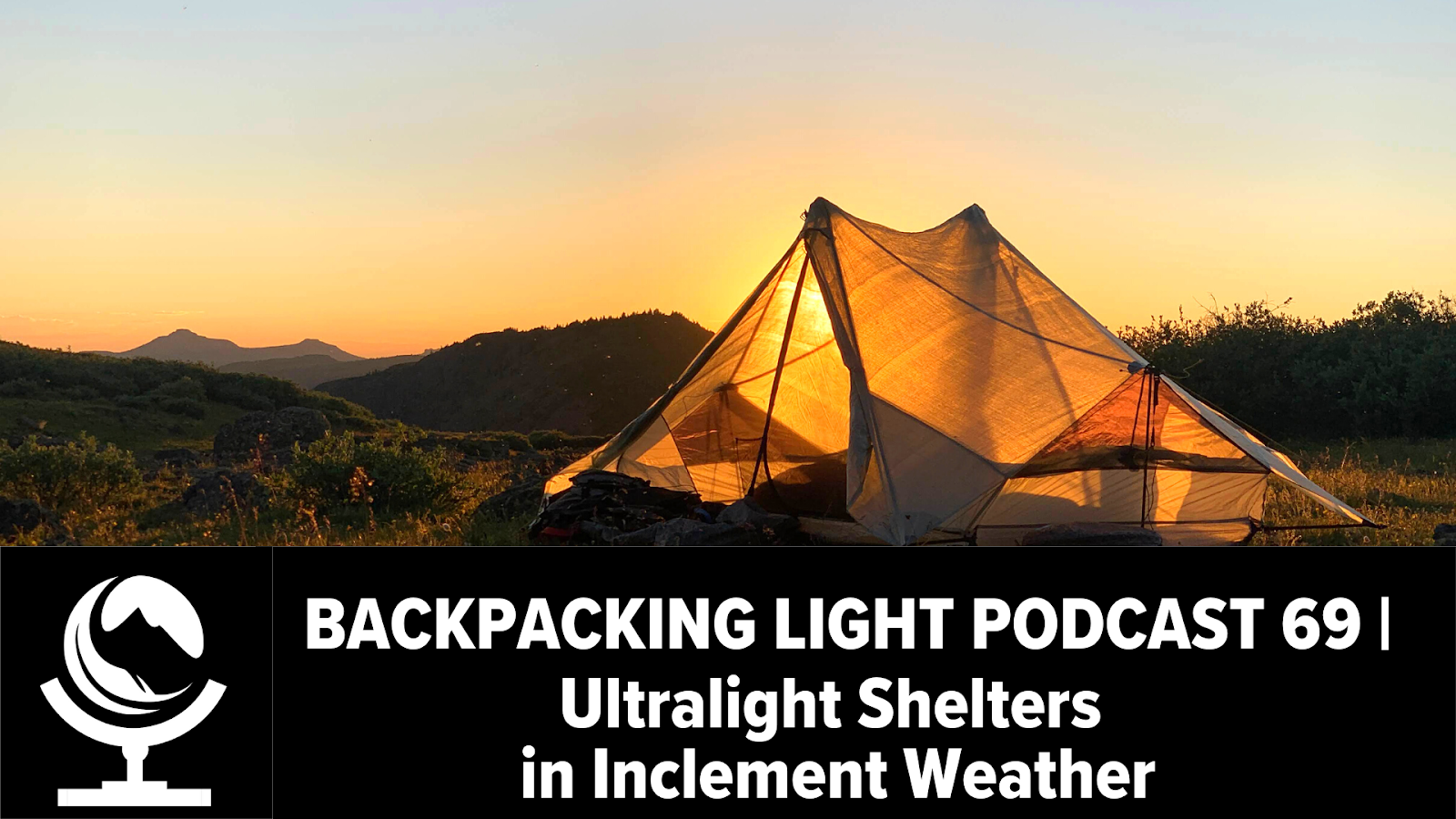
In this Episode:
- What is Inclement Weather?
- How the structure of a shelter affects its performance in inclement weather.
- Choosing your campsite based on terrain and height above the ground.
- Pitching a shelter for stability in inclement weather.
- The downsides to shock cord for guyline tie-outs.
- Comparing different shapes and materials for tent stakes.
- Major issues regarding shelters when used in inclement weather.
Learn More
- See how an ultralight shelter behaves in a violent storm.
- Check out BPL Author Roger Caffin’s Tunnel Tent.
- Learn more about the Locus Gear Khufu tent in our Gear Shop.
- Read about tent stake holding power and what makes the best tent stakes, or join the discussion in the BPL forums.
- See the TarpTent DiPole Li Review and Durston X-mid Pro Review.
- Member Q&A: Choosing an ultralight shelter for backpacking.
- Enroll in our online course Backpacking in Inclement Conditions.
How to Subscribe
Apple Podcasts | Spotify | RSS
More Episodes
Backpacking Light Podcast Index
Credits
Executive Producer - Backpacking Light; Show Director and Host - Ryan Jordan; Producer - Chase Jordan; Theme music: Look for Me in the Mountains written by Chris Cunningham and Ryan Jordan, performed by Chris Cunningham (acoustic guitar, lead and harmony vocals, harmonica), Chad Langford (upright bass), and Tom Murphy (mandolin), produced by Basecamp Studios in Bozeman, Montana.
Feedback / Tips / Questions
podcast@backpackinglight.com
More Backpacking Light
Sign up for the Newsletter. Become a Backpacking Light Member.
Disclosure
Sponsorship Policy: Backpacking Light does not accept compensation or donated/discounted products in exchange for product mentions or placements in editorial coverage, including any podcast episode content not excplicitly identified as sponsored content. Some (but not all) of the links in these show notes may be affiliate links. Learn more about affiliate commissions, influencer marketing, and our consumer advocacy work by reading our article Stop wasting money on gear.


Discussion
Become a member to post in the forums.
the famous Olympus tunnel (now out of production)
Aaarrgghh
The end of an era – and the end of Macpac as we knew them. But the company has been through several changes of ownership since then. The original ethos has been lost.
I guess it was just too difficult to get the Asian factories to learn how to make them. I know I had huge problems there too. And the difficulties in mfr meant much larger factory costs too.
I still have an almost unused Olympus in my cupboard, left over from a Review. I doubt I will ever use it.
reinforcing the ridges on a mid with a stiff strip, like polyester webbing or dyneema,
Hum – interesting thought. It might be sufficient to just add another layer of the fly fabric for reinforcing – maybe. Or two? The pole seams on my tunnels are in practice reinforced like this, with several layers, and of course zipper lines are reinforced.
Cheers
I’ve also taken the same fabric as the tent, polyester. 3 inch wide strip. Fold over several times to make 1/2 inch strip. Sew to ridge. That worked pretty good.
You have to get the length of the strip right. If it’s too long then the ridge will be loose, totally ineffective. Too short – raises up the corner of the tent. I sewed the webbing strip to the bottom, set up tent, pulled on the strip to make it taut, hand stitch at the top, take tent down and sew the webbing strip along the ridge and reinforce the top and bottom.
Wow, Jerry, that sounds like a lot of extra work, but it’s a cool idea.
Any idea of how much weight that adds?
maybe 1.5 ounces for four ridges
1/2 inch polyester grosgrain
$8 for 25 yards from amazon
Trying to visualize this and how it would work
Trying to visualize this and how it would work
Tie two loops in the guyline 6″ apart. Tie a single piece of shock cord to each loop. If the shock cord is shorter than 6″ when relaxed, it will take up the initial tension. If it will stretch to more than 6″, the guyline takes the tension at that point.
The Blake’s hitch is a little fiddly, tends to bunch up a lot — it just substitutes two hitches with the shockcord for the fixed loops.
Thanks so much to all for the constructive comments on our slower hiking article(s).
In reply, you are quite right, Roger, that Geoff and I have little experience in tunnel tents. And zero in mids! We have mostly used conventional geodesics and domes in the past, (and before that A frames remarkably similar to those of today!) followed by silpoly and dcf non freestanding ones more recently. We do include tunnels in our articles and recommend them for their wind performance.
Geoff and I are by no means the most experienced hikers out there, which is why we decided to interview tent manufacturers, and why we read forums such as this one for the wealth of experience presented by members. We added Ron of MLD to our interview list because of your comments here regarding the absence of mids in our coverage, and have edited to include this design in the first article as well.
The Duplex tent is our least favourite DCF tent for a number of reasons, but it has performed adequately for us in high winds, described in the third article. That’s not to say it’s the best for high winds, far from it. However, we (and no doubt you) have often seen less wind-resistant but well- pitched shelters outperforming more wind resistant but poorly pitched models. And as you note, terrain and choice of pitch are huge factors too, of course. The series of articles is aimed at a demographic midpoint between highly experienced knowledgeable hikers such as in these forums, and newer hikers with some experience who deserve more than the basic ten bullet points available in most generalist offerings.
Geoff and I always welcome constructive criticism of our work and are happy to edit articles in response if necessary, so that the information we present is as accurate and useful as possible – thank you again for your comments here!
Helen (and Geoff),
Slower Hiking
Become a member to post in the forums.