


Introduction
On the leading edge of the last bomb cyclone storm cycle that hit the Rockies and Midwest this spring (April 2019), I was hoping to get in a quick 24-hour trip up in the high country of Wyoming’s Snowy Range.
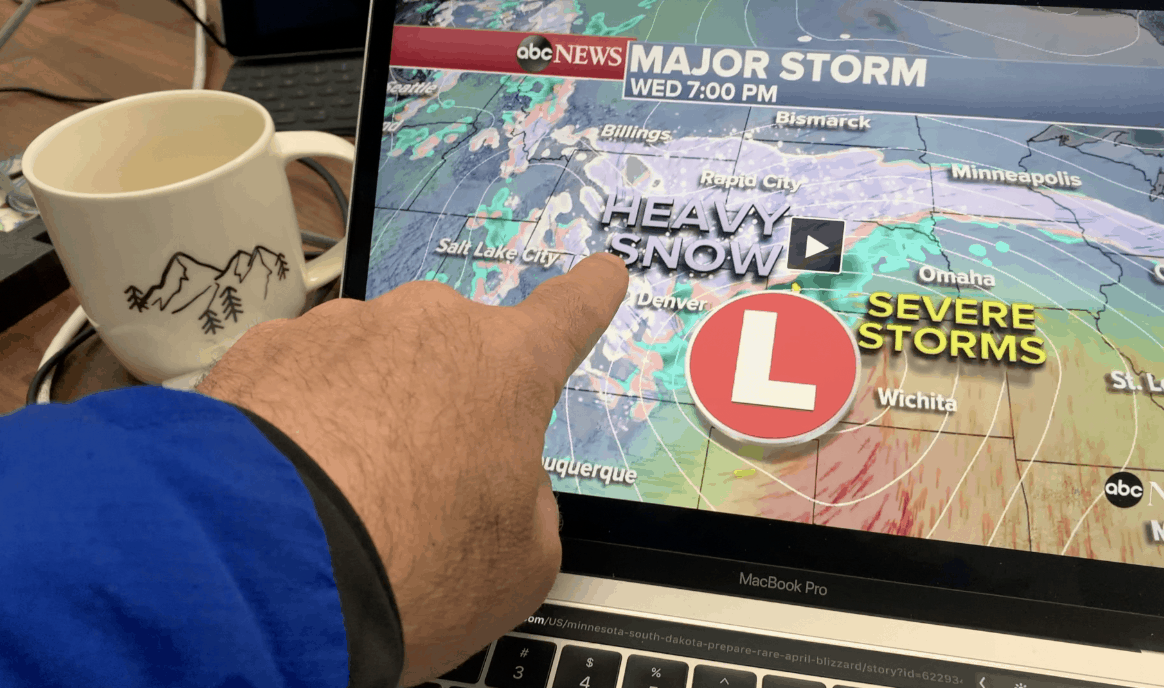
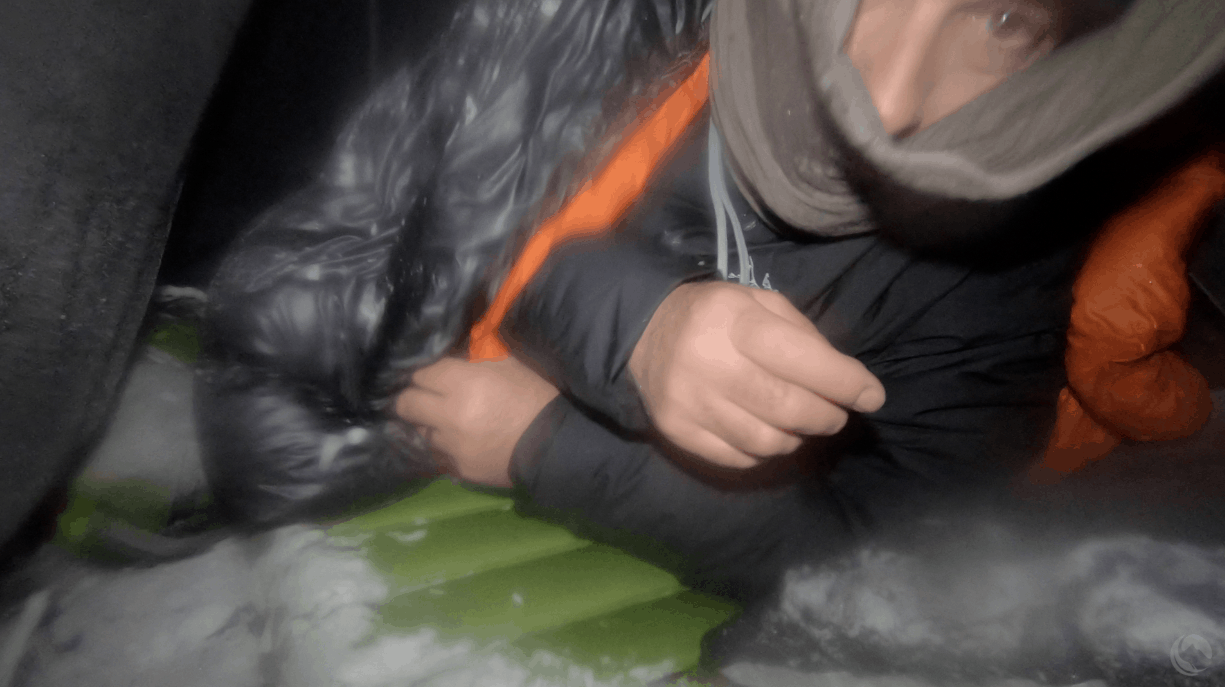
Apparently, the pressure bars compressed a little bit more than what was predicted, and I faced some breezy conditions that were a little more than what my ultralight shelter system could handle, so I retreated in the middle of the night.
Enjoy the video:
Summary Notes
Route:
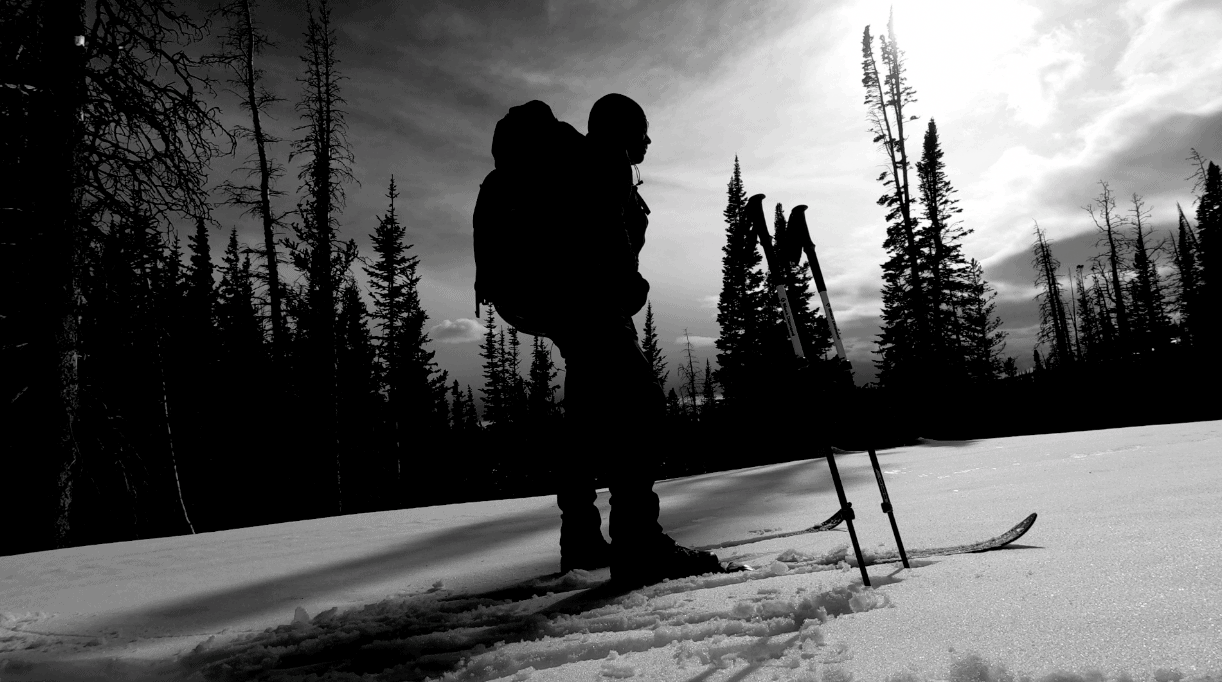
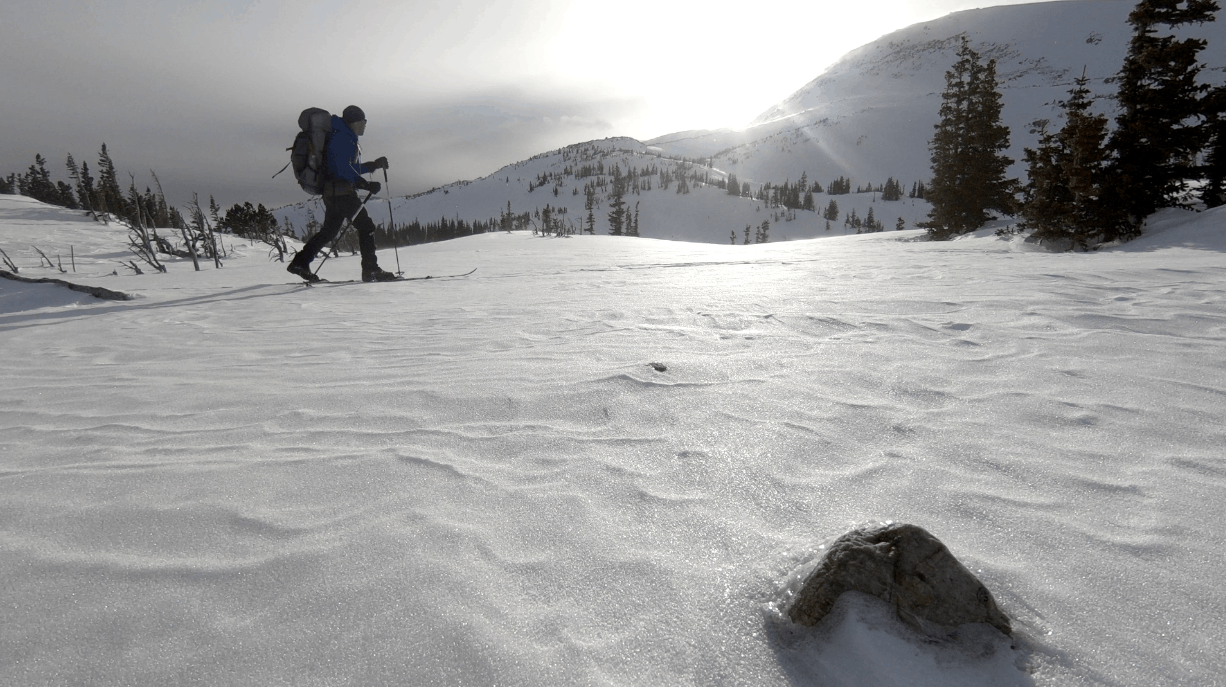
- My route followed snowmobile trails across summer roads for a couple of hours, and then up into the untracked backcountry via spruce forest, subalpine fir, traversing high benches in cliffy terrain, and finally into a glacial cirque at 10,800 feet. I arrived in camp a little more than an hour before sunset.
- My route back down to the trailhead was a little different. Since I was navigating in a blizzard in the dark, I opted for a longer but safer route through less steep terrain, intersected a summer road bed, and then used a summer road network to weave my way back to my original approach route.
Weather:
- Temperatures ranged from about 23 F to 41 F during the trip, with wind chills near 0 F.
- Winds increased from 10-15 mph (gusting to 20+ mph) at the beginning of the trip to 40-50 mph (gusting to 65+ mph) by the time I decided to bail.
- Skies were partly cloudy, with periods of bright sunshine, on the hike in. During the night, I couldn’t see any stars, and the weather devolved into whiteout conditions. I assumed it was a result of a snowstorm, but after reviewing satellite image history upon my return, the night skies were actually totally clear. The source of the whiteout was 100% a result of windblown snow – a ground blizzard.
 Instrumentation:
- I recorded weather data (temp, humidity, etc.) using two Kestrel Drop D3FW devices (one inside the tent, one outside – although from watching the video you’ll see that the conditions weren’t so different between the two!).
- I recorded wind speeds using a Kestrel 5500 mounted on a rotating weather vane that was affixed to the top of a 24 in (60 cm) tall sapling stump with an Ultrapod Mini.
- I was able to monitor weather data from all devices from inside the tent, using Kestrel apps and a Bluetooth connection to my smartphone.
 Gear Notes:
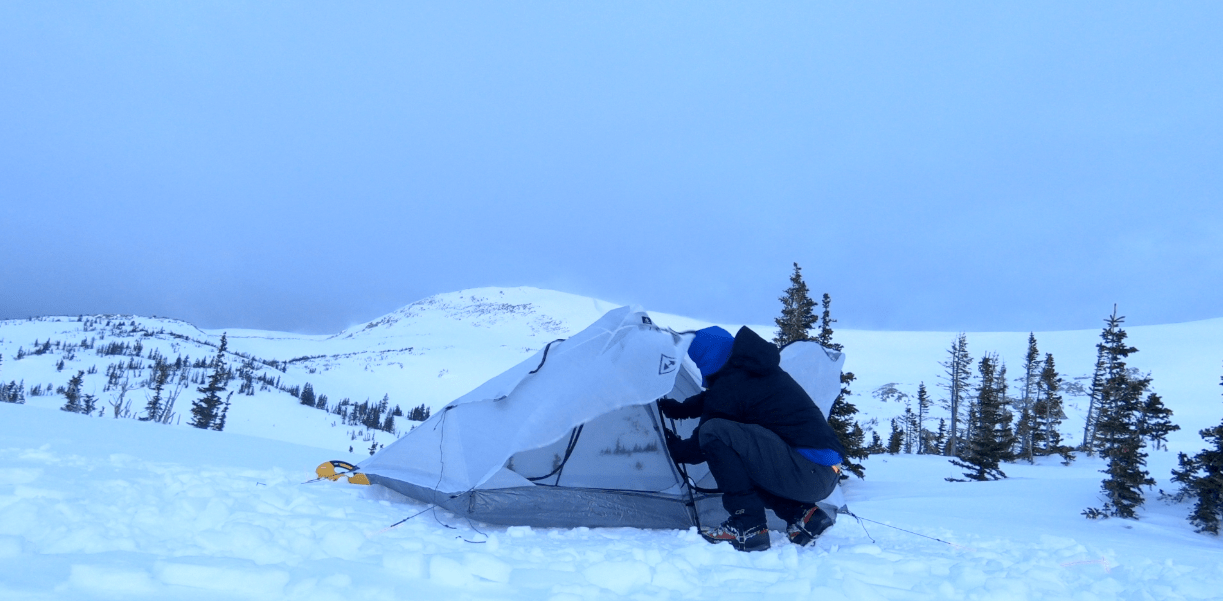
- Shelter: I used the Hyperlite Mountain Gear Dirigo 2 tent on this trip. Admittedly, this isn’t the type of conditions the tent is designed for. In fact, these conditions would be problematic for any three-season shelter. However, I was able to gather some pretty good data and experience with the shelter that should add value to my forthcoming review of the Dirigo.
- Stakes: buried sticks as deadmen, cut using the Suluk 46 Uki Buck Saw (4.5 oz!).
- Guylines: stock HMG guylines attached to 1mm Dyneema cord. I experienced two failures of the cord in two separate wind gusts, which broke the cord. On another guyline, the thin Dyneema cord tore through a stock HMG guyline (the 1mm Dyneema was attached to the HMG guyline with a sheet bend with an extra bight).
- Sleeping pad: A Nemo Astro Lite (insulated) – large size. This is the comfiest mattress I own but it doesn’t have sufficient insulation for sleeping directly on snow at subfreezing temperatures. I should have added a thin foam pad. It’s not as warm as my NeoAir XTherm, but far more comfortable.
- Sleeping Quilt: I used the REI Magma Trail Quilt 30 and wore all of my clothes to bed. The quilt performed like a champ and kept me warm and dry enough, even with wind and spindrift blowing through my shelter.
- Buff: My merino Buff was a critical piece of equipment during the night. I wore it as a face tunnel to keep spindrift out while I was trying to sleep. I would have rather had something like the new Timmermade Waterbear Hood.
- Insulating Clothing (in addition to a thin wool hat, light gloves, ski gloves, ski socks, trekking pants and a merino hoody): lightweight long underwear bottoms, an active insulation hoody, and an Apex-insulated jacket.
- Shell Clothing: the most comfortable WPB jacket I’ve ever owned (I size up one size so I can layer it over my puffy jackets), and some ultralight WPB pants.
- Ski Gear: leather insulated Nordic BC NNN boots, nordic backcountry skis with a wax/waxless base and full metal edges, manual Nordic BC NNN bindings, and lightweight kicker skins.
 Lessons Learned:
- I mostly felt pretty calm during the whole experience. I suppose I attribute that to having experienced these conditions before, having gear (except for the shelter system) that was matched to the conditions, and knowing that even if I retreated in the middle of the night in a storm, I could simply go slow, make decisions carefully, and I’d get out safely.
- I’m very appreciative for a high enough level of fitness that provides me with a lot of reserves to manage adversity when needed, without facing the anxiety that comes with being too fatigued or sore to have bailout options.
- Stormy conditions can manifest themselves at high elevations long before a weather reporter down in town starts to experience them.
Disclosure
- Affiliate links: Some (but not all) of the links in this review may be “affiliate” links, which means if you click on a link to one of our affiliate partners (usually a retailer site), and subsequently make a purchase with that retailer, we receive a small commission. This helps us fund our editorial projects, podcasts, instructional webinars, and more, and we appreciate it a lot! Thank you for supporting Backpacking Light!


Discussion
Become a member to post in the forums.
Companion forum thread to: Field Notes: Retreat from a Spring Alpine Storm
On the leading edge of the last bomb cyclone storm cycle that hit the Rockies and Midwest this spring (April 2019), I was hoping to get in a quick 24-hour trip up in the high country of Wyoming’s Snowy Range.
If you hadn’t relied on your own 1mm Dyneema cord (~200 lbs tensile strength), would the shelter have been adequate to handle the wind you experienced?
Thanks Ryan for an interesting trip report – it brings back fond memories of winter camping back in the day. Do you think you would have fared better by camping in a dense cluster of trees rather than in the open? What gear choices do you feel would have allowed you to continue spending the night in that location for the least amount of extra weight?
On at least two occasions I remember retreating under similar windy and dark conditions. The first was while setting up a VE-24 tent near dusk, which was anchored with skis in somewhat shallow snow above treeline, the tent actually blew away. We stood and watched it fly nearly 2000 vertical feet up a mountain slope before getting blown far down valley once it reached the ridge line. Miraculously, a mile or so down the trail on the ski out in the dark we found the tent laying just 20 feet off the trail, ripped and beat up and missing a few poles. My buddies headlamp died on the ski out – not a good gear night. The second winter camping retreat was solo near treeline in my North Face West Wind tent – the walls would have collapsed if not for holding them up with my legs – that got really old after an hour or so.
I already had a poor opinion of that particular shelter before this trip report, now it’s even worse given the apparent lack of quality. If a shelter cannot handle bad weather I don’t know what the point of the shelter is. I think a Duomid would have handled those conditions just fine.
With the Duomid you could have built up snow all around the perimeter and yet still had ventilation from the top vent. The shelter in the video has no top vent which is one of it’s several fatal flaws.
Great storytelling, Ryan. I’m glad you decided to keep on shooting.
So besides the pole grommet failure, was there anything else stock on the tent that gave way? Also, I have the same question as Richard, was it your cord that broke?
Oh, and how about the deadman anchors, how solid were they?
I’d like to see the Dirigo 2 in another wind test, one where it’s staked to solid ground (no snow) and with thick Spectra cords. I’d hate for the tent to get a black eye when all of the variables may not have been controlled.
Richard – yeah, those tiny guylines are terrible. Of course, they break at dynamic forces that are much less than 200 lb, and it’s the dynamic loading that causes guyline breakage in violent winds. I’m also not a fan of Linelocs in windy conditions. Dynamic movement of the guyline, followed by extremely fast loading in gusts, causes them to loosen up, especially in cold conditions. And then there are the little plastic mitten hook clips on the vestibule doors. I’ll be replacing those as well with some type of guyline tensioner.
I’ll explain more about the Dirigo’s wind resistance in my review, but the grommet failure was notable. Both grommets failed on both sides – wind loads created a massive torque of the center pole structure that drove the tips through the grommets and ripped them out of their fabric tabs. A better solution would be a hypalon or even plastic cap to hold the pole tips.
Lester – the only thing I wished I really had was my Hilleberg Soulo tent. I would have taken it, honestly, but I was only expecting winds up to about 40 mph.
Monte – yeah, my guylines broke. Also, the Lineloc-guyline combo (stock) slipped under wind loads, which then led to extreme flapping loading, and this could have led to the guyline and grommet failures. But you’re right otherwise – it’s a well-built tent, and suffered no other damage. Seams and fabrics, all sewing and bonding, held up just fine.
Ryan- enjoyed the video, only because I can totally relate :) I have very clear (not fond) memories of riding out two similar winter storms in the Elkhorns. Both nights I gave serious thoughts of just bailing, but was really too far in for that option. Fortunately I didn’t have any tent failures (BD Firstlight), but I think if I got an hour of sleep on each occasion that might stretching it.
Mike
Sounds like thicker cord, 4-season shelter could help. However nothing better than selecting a campsite that is significantly wind sheltered. A storm like that would be a test no matter what gear you bring. Thanks for producing this real life video in a storm!
Great video Ryan. I really enjoyed the storytelling
Great video! Ryan in his element… The structural system of the Dirigo ought to depend on rigid joints between the poles and the short horizontal top pole, if it is not to distort by twisting, so that that top pole rotates about the vertical axis together with the tops of the main poles. The tension of the skin would tend to prevent such distortion, but any looseness in the pitch, worked loose by the buffeting, ought surely to result in such deformation of the proper shape. I have considerable respect for HMG, but to my mind that particular structural design concept is intrinsically flawed. That said, I’ve not seen the tent, and have only a hazy idea of how the tops of the upright poles are held in place; but maintaining the three poles in a (vertical) plane when the load in the two upright poles at their tops is trying to twist the structure just doesn’t make a lot of sense to me.
Nice, thanks for sharing, this is very helpful!
I got caught in a similar storm in the swiss alps, the winds are called “Foehn” here and I was on top of a 3000m peak where I was completely exposed.
My tent was a Tarptent Moment DW. The problems I had were:
Fortunately I had no snow. If i face these kinds of conditions again I would most probably take a bivy with me because of the low profile. It was also extremely loud in the tent, even with ear protection.
Well, 65+mph gusts are death to any 3 season tent. I usually figure 40mph is about the limit. I am sure a less exposed location would have helped…but, you have to go by weather/knowledge of those places.
Plastic stuff on tents is always a problem. I much prefer a simple line. Yeah, sometimes, it takes a bit of fiddling with knots. I have had trouble with 1mm spectra in the past. Even with a vinyl coating, they don’t hold up well. The dynema seems to break after about ten years of use leaving only the nylon sheath. Not sure if this is common, since this is kind’of at the extreme end of durability. A loop to loop connection works well with a good surgeons knot locking the knot. Even this breaks at the knot under heavy wind loads, though. I usually use a 2mm line for most of this (1000lb+ test) nowdays, but even this has broken over several days of heavy winds. Anyway, it does not apear to be a “cutting” issue, more of a few dynema strands breaking under load (no stretch.) I assume it gets worse with time… Possibly it is a bending/fracture of the dynema, as seen with some of the older DCF/cuben cloth, due to the size of the cord.
The spindrift was terrible. Better you than me…ha, hey. Everything must’ve been fairly wet when you got back.
Questions concerning the head lamp you were using:
Great you had a bailout planned in the scenario! Awesome adventure… thrilling footage… good test for realistic limitations of the Dirigo in high winds any season.
Gotta love those sleepless nights whapping snow off the shelter as it endlessly accumulates. Last years northeast Polar Vortex was an intimidating storm for me to “ride out”. I had a bailout planned but was able to stick it out due to decent tree cover and the solidity of the shelter. Very loud howling winds 40-60mph and 18” of snow in one night. It looked as if the snow was falling “upward”… I slept the next day
the hmg stock guylines slip for me as well, if I tie a slippery half hitch right up against the Lineloc after tensioning it stops the slipping. But instead I replace using 2.7mm guylines like MLD supplies with their products, even though it’s a touch heavier it is the proper size for Linelocs and don’t seem to slip. If in stupendous winds like you had that night they might still slip when the panels flap around. Out of habit I just put the slippery half hitch regardless.
Have a great weekend all…
On a completely separate note, it’s always amazing to see the MSR Reactor functioning in strong winds, where most any non-radiant burner stove would blow out. At least you were able to enjoy a hot meal in spite of the strong, gusty winds.
Ken:
Petzl Bindi.
USB Rechargeable.
No, it wasn’t really that cold out. I’ve used it below zero, however, and illumination hasn’t been affected much.
Standard (100 lm) for navigating in the forest. I had it on this mode for at least an hour and a half. Otherwise, around camp and for the rest of the hike out (maybe 8 hours total use) I alternated between standard and low (“Max Autonomy” ??!!) mode (5 lm).
Yes, no problems. 100 lm is certainly good enough for navigating in the dark through forest, and the 5 lm mode was fine once I got back on the snowmobile trails. No moon or ambient light, so it was pretty much pitch dark out, even on snow-covered terrain.
I used the max mode (200 lm) for a few minutes at a time when I was trying to see through thick trees to pick a route through brush and blowdowns, near the beginning of the descent once I hit the treeline.
Ryan, apart from looking for extreme weather events to test the Drigo, why would you camp on an exposed ridge line at 10,000 feet in the winter knowing there would be storm of some sort coming through? You were able to get down to safety but it could have ended much differently.
Having experienced what you did, despite it being extreme, I think there is a learning/teaching opportunity here about campsite selection in the winter or any time for that matter – but especially when a storm is forecast at high altitudes.
This reminds me a lot of a September night i spent in the Alpine Lakes basin of the Winds. We had snow and high winds, and there was really no way to get any shelter from the wind. We were in a Zpacks Duomid that fared about the same. Ryan looked much calmer than I did that night. On the other hand, I was 2 days from the trailhead instead of 2 hours. The pucker factor was real. We spent the night holding onto the poles aand re-staking. We got one image that morning before packing up and scampering away like mice.
As an aside, it’s a little funny that the banner ad for this thread is for the Dirigo.
David – no other motivation apart from wanting as much exposure as possible. I actually walked around the area for a bit before settling on the little ridge where I camped, because that’s where I was measuring the highest wind speeds.
I don’t see campsite selection as the problem—I see the choice of tent as being the problem. Arctic adventurers use tents all the time on their treks (often tunnel tents) and routinely deal with these conditions. If a shelter choice dictates site selection, well, then there’s a loss of freedom where you can or must set up. The whole purpose of a shelter esp a winter shelter is using it to stay secure—and dry—and warm—for the duration you’re squatting there.
I watched the video and it’s sad you guys have snowmobile noise to deal with in the backcountry. Thank god we don’t get enough snow here in the mountains of TN and NC to attract ATV types riding in on their loud and noisy snowmobiles. We have enough noise pollution with overhead Jet traffic and VERY LOUD scenic road motorcycle tourism. Okay, got that rant out of my system. I did like the “No Snowmobiles” sign.
I can’t understand why you’d bring a tent with unsealable mesh to let in blowing spindrift. It’s obvious it results in letting in too much snow which could wet your sleeping bag and clothing and pillow and sleeping pad. Might as well just have a tarp.
The grommet failure seems to have happened quickly and far too soon for this tent. Maybe some tent designer in some room decides to make a tent—your Dirigo for instance—and then the online community doesn’t get a feel for the thing because it has no history in tough conditions (like other proven tents I can mention)—and so it has no decent reputation until you post this kind of report. So your post is a sort of Alert, a needed warning.
And I love tent reviews which show failures. It’s what a tent review is all about in my opinion—because NO TENT is perfect.
As an aside—I just got back from a March trip and got caught in a real March windstorm on a TN mountain with 60+mph gusts—though no snow—and the big trees around me were swaying like blades of grass. It was so loud I don’t remember being in such a loud storm. I counted the “climax gusts”—you know—the Level Fives which break through the Level Fours—and dangit after counting to 20 I gave up and just hunkered in.
Instead of snow spindrift I had buckets of horizontal rain slamming against my silnylon tent fly and of course the driven liquid pushed against my yellow inner tent and caused the inside canopy to get wet—see pic—although no actual water came inside or onto the floor. What a blow.
Ryan – you are brave! I wonder how the shelter would have performed if you had dug in a bit so that you had 1-2 feet of snow above the floor line of the tent. It still would have been wild I’m sure.
Digging down creates a new problem set – snow accumulating in the reservoir.
It would be better to keep the tent at the ground surface and build walls so the snow blows up and over it.
Because this is supposed to be. 3-season tent. It is April, after all.
;)
Old school if not just old, personally I’d gladly accept the extra weight of a side door zipper to attach a solid panel if needed… sure to help a bit with warmth and with cold winds as well. As well as for desert camping – nights can be hot and still but there were many times when anything to help with the super fine sand would be very welcome… as well as the unexpected snow & spindrift in other situations. Don’t think this would weigh much more than a power bar or two. Is this such a bad idea?
Become a member to post in the forums.