

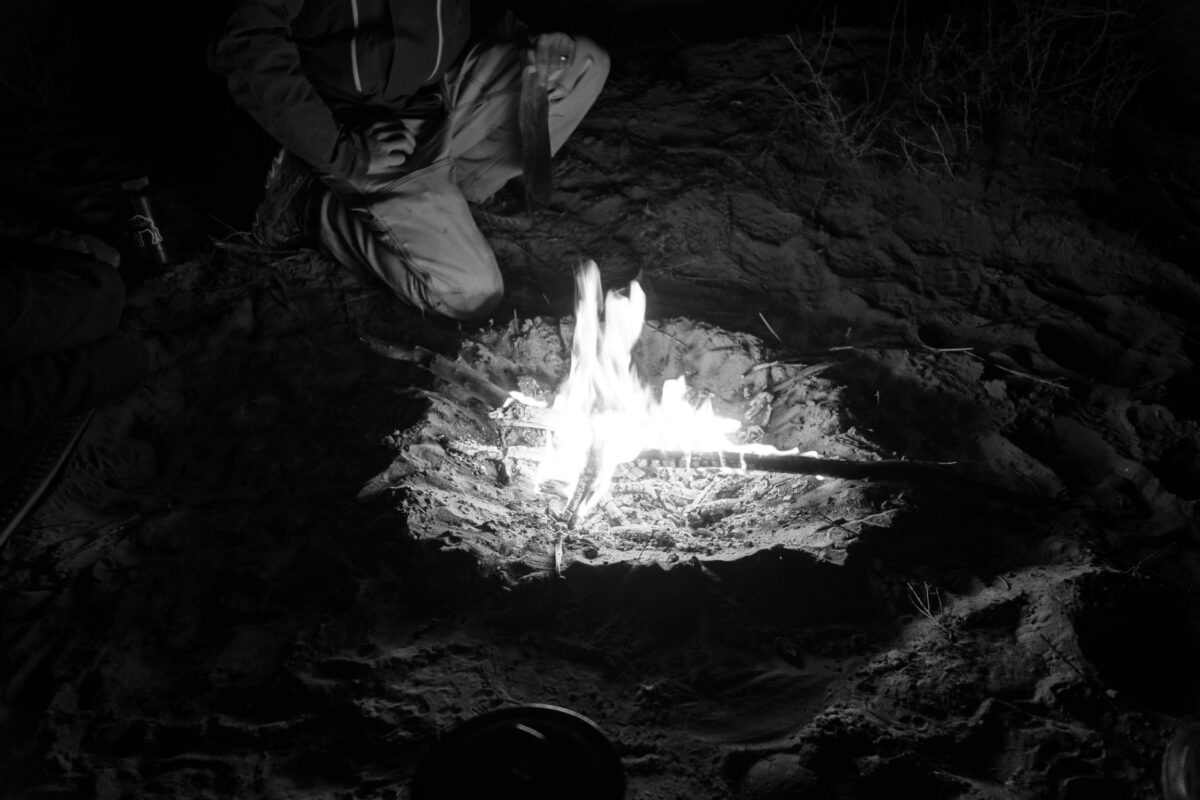
When I was a kid I loved playing with fire.
I enjoyed starting the fire when my family would go camping, and I was constantly tending it. I wanted to know what would burn, so I would experiment. Green spruce bows popped and spat but eventually burst into flames and then flamed out quickly. Pretty exciting. Pine and fir bows: same deal. Dry juniper bows spat and sparked loudly, flaming up and dying back just as quickly. Cowpie? Eventually burns, good to know. Because I was raised by parents who generally care about the world around us, I didn’t experiment much with tin foil, cans, Mountain House bags, or glass bottles when camping.
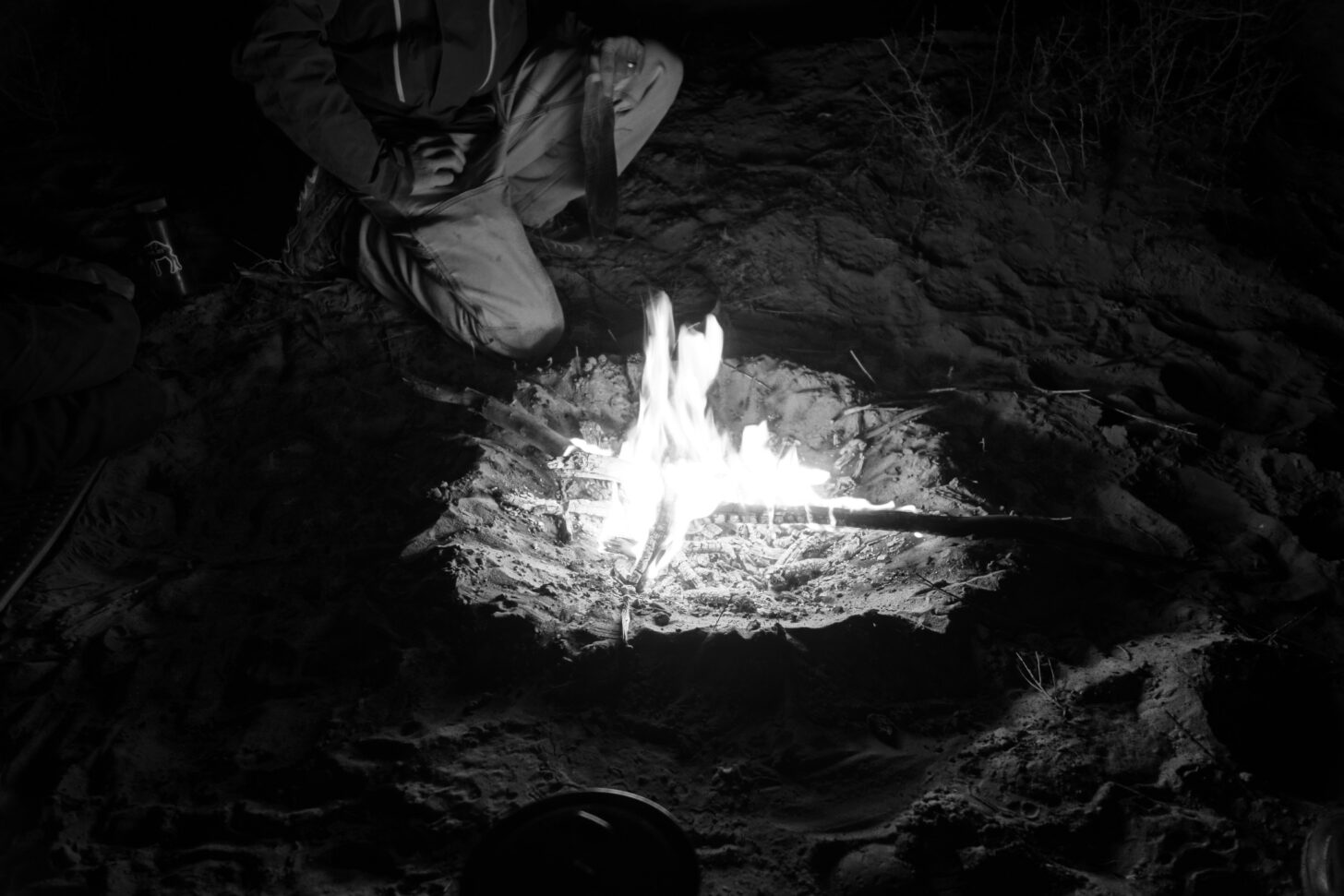
But at home – when my parents weren’t looking – I experimented. What happens when ants burn? What about a ripe apricot? These were questions I felt utterly compelled to find answers to. And so I did my best. Ants shrivel up and extinguish with a subtle pop which you can hear if you listen closely. Apricots require explosives.
The tension between experimentation for experimentation’s sake and an outright desire for destruction is difficult to untangle. And then why did this infatuation just evaporate at some point? But also why, when I do find myself staring into a fire as an adult, am I totally captivated, awed?
Professor of Anthropology Daniel Fessler has researched this topic and offers some clarity here. In his paper, A Burning Desire: Steps Toward an Evolutionary Psychology of Fire Learning, he says that just as humans and primates are born with an inherent fear of snakes, we are also born with an inherent fascination with fire. Kids in traditional cultures are expected to be interested in fire with their curiosity peaking around age six and a half. Fessler says that besides fire’s use for survival (warmth and light) it was also evolutionarily advantageous to have an interest in fire because it expanded our diet, what we were able to hunt.
Controlling fire also aided in developing tools, combating predators, and managing wild plant resources. And because humans inhabited all sorts of different environments, there was no universal mastery of fire. Fire making had to be learned in each new environment. Everywhere we went we had to find out what burns, what makes fire, and how to keep it going.
He goes on to say that children in traditional cultures don’t really play with fire, rather their interest is more practical, utilitarian. They bake pretend food, or even cook little bits of real food, for example. He thinks this is probably due to the mundanity of fire in these cultures. Fire in western cultures, on the other hand, is anything but mundane. We use it for celebrations. We set off fireworks on the Fourth of July, we burn giant effigies at gatherings like Burning Man, and we barbecue fancy meats to celebrate someone’s graduation or birthday.
And, of course, we light campfires when we go backpacking. Sometimes I wonder if this too is a ceremony of some sort, a celebration that we have escaped the office, that we have found the forest and the big sky full of stars. We did it!
It stands out to me that my interest in fire peaked not in middle childhood but in my early teenage years. Fessler says it is common in western societies today for interest in fire to peak around age 12. But then I’m left wondering if that’s really even true. I know plenty of adults who can’t go backpacking without having a fire each night. They poke at it incessantly, completely transfixed. I wonder if our interest in fire never goes away. I wonder if, when we don’t live in a traditional culture, fire experimentation becomes fire play and simply extends into adulthood, where we are still just trying to find out what burns, what doesn’t. I wonder if there is ultimately no purpose to this fire play and if we should have stopped when we were kids.

So I want to ask the backpacking community why many of us still feel compelled to have fires. Considering the severe drought conditions across much of the western United States and all the wildfires raging west of the hundredth meridian, maybe we should take a deeper look at this desire.
I know there are fire bans in many places now, but even before that, we should have known better. The Pack Creek Fire near Moab, Utah was started by an unattended campfire. Maybe if whoever left that fire burning had paid a little more attention when playing with fire as a teenager they’d know that the ground was dry, the crispy ponderosas just waiting for a spark. But maybe that’s wishful thinking on my part. Maybe our fireplay is now displaced. Instead of learning about the interactions between fire and the world around us, we have gotten sucked into the fire itself, what it consumes, how fun it can be. Maybe the ceremony of lighting it and the distraction of its mystery have superseded the practical implications of our mastery of the tool.
A group of friends and I recently walked the South and North Coast trails on the Olympic Peninsula and found ourselves camping in the rainforest on our last night. I looked up at the giant firs and cedars and listened to the eerie-sounding birdcalls echo through the forest. I examined sword ferns and felt occasionally the salty spray of the sea reach us where we stood amongst the trees. But when my friend started a campfire, all that faded away.
He piled so much driftwood on it that I had to back up. Then I somehow found myself with the job of spark stomper. Then when it got dark I got sucked in and just stared at it. The common phrase for this act – Cowboy TV – is telling, for what is TV but a distraction from the world around us? I thought about how addicted many of us are to our screens these days and pondered if Cowboy iPhone could be a more appropriate name for the distraction that fires provide. It’s striking that the act of fire staring is unique to western societies and that it is virtually nonexistent in traditional societies.

Of course, I will make a fire in winter if it is very cold and when nights are long. In other seasons I will start a fire if someone has fallen in a creek, or if everyone’s clothes are soaked from a storm and we need to try and reset things a bit. And I will stare at both fires and iPhones plenty more in my life, but when I do, I will try to think a little more deeply about what I’m doing. I will try to be thinking about how adult interest in fire might not be all that different from other evolutionary holdovers such as the fight or flight instinct transmuting into anxiety when we’re stuck in rush hour traffic. And if I feel a desire to start a fire and know it is not actually needed for survival, I should try and remember that I may actually be engaging in an adult form of fire play that should have faded away a long time ago.
And the arid land will probably thank me for my fireless camp.
Related Content
- More by Ben Kilbourne
- Read the first of Rex Sanders’ series of articles on wildfires
- Use our site search engine to find more articles and forum threads about fire
DISCLOSURE (Updated April 9, 2024)
- Backpacking Light does not accept compensation or donated/discounted products in exchange for product mentions or placements in editorial coverage. Some (but not all) of the links in this review may be affiliate links. If you click on one of these links and visit one of our affiliate partners (usually a retailer site), and subsequently place an order with that retailer, we receive a commission on your entire order, which varies between 3% and 15% of the purchase price. Affiliate commissions represent less than 15% of Backpacking Light's gross revenue. More than 70% of our revenue comes from Membership Fees. So if you'd really like to support our work, don't buy gear you don't need - support our consumer advocacy work and become a Member instead. Learn more about affiliate commissions, influencer marketing, and our consumer advocacy work by reading our article Stop wasting money on gear.


Discussion
Become a member to post in the forums.
Woodford Reserve: A very fine use of corn.
Corn along with the potato and sugar cane and cotton. Native American.
“Corn or maize was actually created or hybridized in the Tehuacan valley @ Monte Alban in Oaxaca, Mexico by native peoples by about 10,000 years ago. They used many generations of selective breeding to transform a wild teosinte grass with small grains into the rich source of food that is modern Zea mays or corn.”
Now the major staple grain and the only major staple more or less created by man.
But that’s enough drifting for one thread. No quibble with esbit and alcool stoves but as a 10% addition to gasoline? Better used as food; tacos, tortillas, on the cob, shoe-peg, white, pudding, corn cakes, polenta, grits!
This is an untrue statement: “OK for you guys in Alaska where nothing is flammable.” 254,633 acres burned this year was low, for sure, compared to say 2019 when 2.5 million acres burned in Alaska. But wildfire here is an ever present threat in summer. Always has been, and of course the risk will grow with climate change. We had a few close calls to my town this summer. The fire risk means bans of some activities some of the time, not all of the activities all of the time. I’d simply prefer that public land managers use science and data for decision-making, and not panic and overreaction. Most of our fires are lightning-caused, so may as well tell the sky there’s a ban on.
I camped at Bastrop State Campground in Texas a few months ago and was surprised to learn of this rule:
The park had firewood for sale at the main office, $2.00 per piece.
I started burning hardwood wood pellets instead of regular fire wood long ago. A 40 pound bag of pellets costs $6.00
https://m.youtube.com/watch?v=CoLrW3sqaaY&feature=youtu.be
I think it’s been that way in the greater SW for quite awhile. We used to stop and collect firewood from road maintenance work before going into the backcountry of the Needles through Beef Basin to the drive-up sites like Bobby Jo or Devils Kitchen all the way back in the 90’s. Got checked by the rangers too if one came by. There’s a nice little burn site at the junction in the Salt Creek trail where the trail forks off to Angel Arch. Campfire gone bad. Burned a lot of the big Cottonwood canopy. Used to be a great spot to camp. Great rock art panel near that spot. The Proud Man Panel.
Looks like a family gathering around a campfire bbq ring
Lot going on there! Looks like Newspaper rock.
Looking down on the burned site from the ledge with the rock art. Burn continued up and down canyon
It’s interesting, how so many people don’t complain about certain things, yet are willing to die upon the hill of others. Trails themselves are a scar upon the landscape, as are the roads that lead to them…yet this defacement is accepted as necessary, and the argument from principle dies with the acceptance. The fact of the matter is this:
Well-said, and true…and being true, the goal must not be to narrow our focus to the point of losing it entirely. The entire principle of “Leave No Trace” was never meant to be taken literally: it is a catchphrase, designed to be memorable, and designed to recall the necessity of minimizing our further environmental and site-specific impact upon a world that we have crossed in every sense of the word.
I live in an area that’s intermittently under threat from wildfire: the current time is one of those periods, so I haven’t been building campfires recently. Over the weekend, however, I wound up in a state park that wasn’t under any sort of burn restrictions: thus, it was nice to have a campfire on a surprisingly and unseasonably-cool evening. I used twigs that had fallen into the campsite and firewood that I collected per park regulations, and confined my tiny inferno to an existing rock ring. A passing shower during the night double-checked my coal-extinguishing, and a few fallen leaves had covered up the small remains by the time I packed and left. I enjoyed my time with friends, felt invigorated and ready to be back out and about, and worked out a few of my existential problems. It was good for both my mental and physical health.
“Should” is a strange word. Although not intended to do so, it often speaks more about its user than its target.
Solid question.
“A passing shower during the night double-checked my coal-extinguishing”
when forest fire risk is low, I’ll often have a fire, then let it burn to coals and go to bed, watching those coals
I know this is improper. Theoretically possible for it to burn out of control. I should extinguish with water. But if the ground is wet and there’s nothing flammable near the fire the risk is low. I would feel terrible if it ever started a forest fire.
I’ve encounter other people’s fires that they left burning and put them out.
Once, I encountered someone’s fire that started burning the roots of a tree. That was difficult to put out.
A cold/cool front usually accompanies rain clouds. Wind usually accompanies the cold front.
It happened to me 1 time. I was camped at the top of a hill about a 1,000 feet from the Mississippi river, clear view of the river. At dusk my campfire was down to glowing coals, time to get ready to call it a day. I was in my tent brushing my teeth, cold front came in with it’s accompanying wind off the river right up the hill and blew hot coals right outta the fire ring onto the gravel drive near where I was parked. Sparks flying high into the air, so bright it lit up the inside of my tent as if it were daytime. Scared the daylights outta me. A lesson learned. Always drown your campfire coals when finished. That was my experience, my lesson learned. I always drown my campfire remains…..always! I sleep good knowing it’s completely out.
“Honey, I got a great bottle of wine. Let’s have a romantic evening around the air duct.” Said no one ever.
I’m using that line tonight.
I just tried it out on my wife, she said I need counseling.
LOL, LOL
My wife said I need counseling as well
There’s always candlelight, guys. For when pg and e cuts the power because of wildfires.
actually these numbers from just now are a big improvement from over the last month or so:
real-time USA city ranking
#
CITY
US AQI
1
Virginia City Highlands, Nevada
421
2
Minden, Nevada
360
3
Carson city, Nevada
355
4
South Lake Tahoe, California
353
5
Virginia City, Nevada
342
6
Johnson Lane, Nevada
334
7
Kingsbury, Nevada
330
8
Douglas, Nevada
313
9
Hornbrook, California
237
10
Incline Village, Nevada
NM – unnecessary thread drift.
Way too funny! My 2 cents
I’m sorry for writing this article? You’re welcome? I honestly don’t know.
I would call it a success, and a lesson in being careful: you never know when your topics are going flare up and get out of control.
@Ben Kilbourne I think it was a very timely and important article personally.
The fact that a few folks appear to sit in a very high seat, doesn’t detract from the importance of the topic at all.
There are certainly going to be a lot of times that a campfire (or twig/esbit/etc stoves for that matter) are going to be a no go. But just as certainly, there will be a lot of times when a campfire would be a go.
If you do decide on a campfire, be especially cautious and vigilant.
In the last few days, most of the national forests in the Sierra Nevada have outlawed all fires except for contained gas stoves for backpackers. That will continue through the fall, I would guess.
Here’s a typical notice, from the Inyo NF:
Fire Restrictions are in effect August 24, 2021 until further notice:
Due to increased fire activity throughout California and the northwest, demand for firefighting resources, to protect natural resources and provide for public safety, the following acts are prohibited within the Inyo National Forest.
Building, maintaining, attending, or using a fire, campfire, or stove fire.
Visitors with a valid California Campfire Permit are not exempt from the prohibitions contained in this Order. However, they may use a portable stove or lantern using gas, jellied petroleum, or pressurized liquid fuel.
Why is there a seeming sense of despair about the course of this thread?
I really appreciated this comment:
“I’m glad that you do…and just so it’s perfectly clear: my questions to you have been made in order to better understand you, and – if desired – to afford you more opportunities to express and clarify your opinion. Whether or not you and I agree is irrelevant; what is important is that we continue the dialogue and each attempt to see from the perspective of the other. After all, is that not the core purpose of this thread?”
Hey some people are concerned about the risks of campfires. Given the current summer and the immediate past summer that’s pretty understandable. We even had a couple of air warning days here on the farthest east coast this summer.
And plenty of people love campfires. Count me in that long line.
I read Ben’s article twice and it seems to me the idea was given recent events and the way things are going it’s worth thinking carefully about campfires. If you like one, and I do; you might want to especially take this to heart and hopefully we won’t see wholesale, one size fits all, across the board bureaucratically blind to all nuance type bans.
Given the way everything else seems to be going these days that may be a long shot.
nm
Draco, also called Drako or Drakon, was the first recorded legislator of Athens in Ancient Greece. He replaced the prevailing system of oral law and blood feud by a written code to be enforced only by a court of law. So lay down the law!
And I always figured you were sorta Scottish. ;)
Hey if I lived in California I’d be pretty darned focused on fires. I also remember posts from the big fire that took out Kat’s house and lots lots more and how bad it got in the Bay area. It is and ought to be a touchy subject. Meantime we’re gradually washing away; but damned if it isn’t a beautiful world still.
Become a member to post in the forums.