

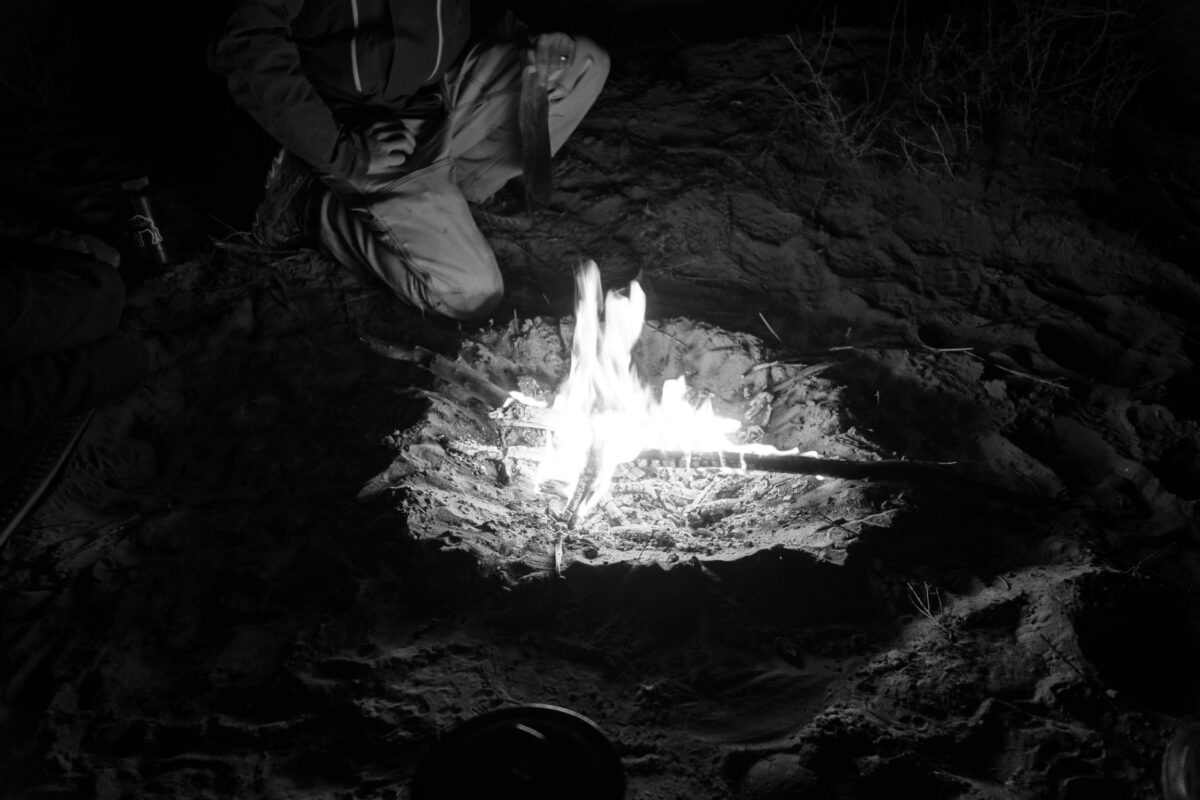

When I was a kid I loved playing with fire.
I enjoyed starting the fire when my family would go camping, and I was constantly tending it. I wanted to know what would burn, so I would experiment. Green spruce bows popped and spat but eventually burst into flames and then flamed out quickly. Pretty exciting. Pine and fir bows: same deal. Dry juniper bows spat and sparked loudly, flaming up and dying back just as quickly. Cowpie? Eventually burns, good to know. Because I was raised by parents who generally care about the world around us, I didn’t experiment much with tin foil, cans, Mountain House bags, or glass bottles when camping.
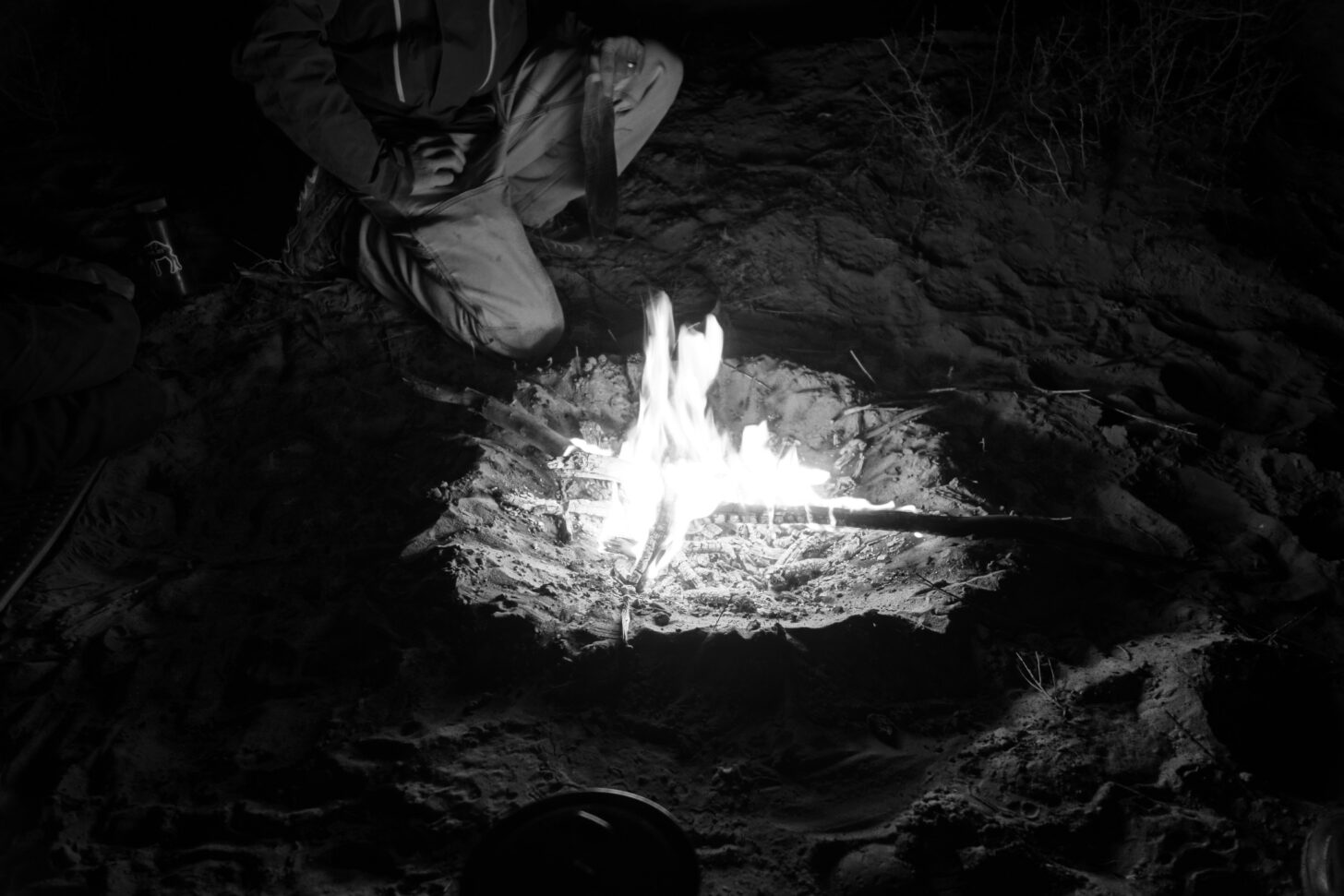
But at home – when my parents weren’t looking – I experimented. What happens when ants burn? What about a ripe apricot? These were questions I felt utterly compelled to find answers to. And so I did my best. Ants shrivel up and extinguish with a subtle pop which you can hear if you listen closely. Apricots require explosives.
The tension between experimentation for experimentation’s sake and an outright desire for destruction is difficult to untangle. And then why did this infatuation just evaporate at some point? But also why, when I do find myself staring into a fire as an adult, am I totally captivated, awed?
Professor of Anthropology Daniel Fessler has researched this topic and offers some clarity here. In his paper, A Burning Desire: Steps Toward an Evolutionary Psychology of Fire Learning, he says that just as humans and primates are born with an inherent fear of snakes, we are also born with an inherent fascination with fire. Kids in traditional cultures are expected to be interested in fire with their curiosity peaking around age six and a half. Fessler says that besides fire’s use for survival (warmth and light) it was also evolutionarily advantageous to have an interest in fire because it expanded our diet, what we were able to hunt.
Controlling fire also aided in developing tools, combating predators, and managing wild plant resources. And because humans inhabited all sorts of different environments, there was no universal mastery of fire. Fire making had to be learned in each new environment. Everywhere we went we had to find out what burns, what makes fire, and how to keep it going.
He goes on to say that children in traditional cultures don’t really play with fire, rather their interest is more practical, utilitarian. They bake pretend food, or even cook little bits of real food, for example. He thinks this is probably due to the mundanity of fire in these cultures. Fire in western cultures, on the other hand, is anything but mundane. We use it for celebrations. We set off fireworks on the Fourth of July, we burn giant effigies at gatherings like Burning Man, and we barbecue fancy meats to celebrate someone’s graduation or birthday.
And, of course, we light campfires when we go backpacking. Sometimes I wonder if this too is a ceremony of some sort, a celebration that we have escaped the office, that we have found the forest and the big sky full of stars. We did it!
It stands out to me that my interest in fire peaked not in middle childhood but in my early teenage years. Fessler says it is common in western societies today for interest in fire to peak around age 12. But then I’m left wondering if that’s really even true. I know plenty of adults who can’t go backpacking without having a fire each night. They poke at it incessantly, completely transfixed. I wonder if our interest in fire never goes away. I wonder if, when we don’t live in a traditional culture, fire experimentation becomes fire play and simply extends into adulthood, where we are still just trying to find out what burns, what doesn’t. I wonder if there is ultimately no purpose to this fire play and if we should have stopped when we were kids.

So I want to ask the backpacking community why many of us still feel compelled to have fires. Considering the severe drought conditions across much of the western United States and all the wildfires raging west of the hundredth meridian, maybe we should take a deeper look at this desire.
I know there are fire bans in many places now, but even before that, we should have known better. The Pack Creek Fire near Moab, Utah was started by an unattended campfire. Maybe if whoever left that fire burning had paid a little more attention when playing with fire as a teenager they’d know that the ground was dry, the crispy ponderosas just waiting for a spark. But maybe that’s wishful thinking on my part. Maybe our fireplay is now displaced. Instead of learning about the interactions between fire and the world around us, we have gotten sucked into the fire itself, what it consumes, how fun it can be. Maybe the ceremony of lighting it and the distraction of its mystery have superseded the practical implications of our mastery of the tool.
A group of friends and I recently walked the South and North Coast trails on the Olympic Peninsula and found ourselves camping in the rainforest on our last night. I looked up at the giant firs and cedars and listened to the eerie-sounding birdcalls echo through the forest. I examined sword ferns and felt occasionally the salty spray of the sea reach us where we stood amongst the trees. But when my friend started a campfire, all that faded away.
He piled so much driftwood on it that I had to back up. Then I somehow found myself with the job of spark stomper. Then when it got dark I got sucked in and just stared at it. The common phrase for this act – Cowboy TV – is telling, for what is TV but a distraction from the world around us? I thought about how addicted many of us are to our screens these days and pondered if Cowboy iPhone could be a more appropriate name for the distraction that fires provide. It’s striking that the act of fire staring is unique to western societies and that it is virtually nonexistent in traditional societies.

Of course, I will make a fire in winter if it is very cold and when nights are long. In other seasons I will start a fire if someone has fallen in a creek, or if everyone’s clothes are soaked from a storm and we need to try and reset things a bit. And I will stare at both fires and iPhones plenty more in my life, but when I do, I will try to think a little more deeply about what I’m doing. I will try to be thinking about how adult interest in fire might not be all that different from other evolutionary holdovers such as the fight or flight instinct transmuting into anxiety when we’re stuck in rush hour traffic. And if I feel a desire to start a fire and know it is not actually needed for survival, I should try and remember that I may actually be engaging in an adult form of fire play that should have faded away a long time ago.
And the arid land will probably thank me for my fireless camp.
Related Content
- More by Ben Kilbourne
- Read the first of Rex Sanders’ series of articles on wildfires
- Use our site search engine to find more articles and forum threads about fire
DISCLOSURE (Updated April 9, 2024)
- Backpacking Light does not accept compensation or donated/discounted products in exchange for product mentions or placements in editorial coverage. Some (but not all) of the links in this review may be affiliate links. If you click on one of these links and visit one of our affiliate partners (usually a retailer site), and subsequently place an order with that retailer, we receive a commission on your entire order, which varies between 3% and 15% of the purchase price. Affiliate commissions represent less than 15% of Backpacking Light's gross revenue. More than 70% of our revenue comes from Membership Fees. So if you'd really like to support our work, don't buy gear you don't need - support our consumer advocacy work and become a Member instead. Learn more about affiliate commissions, influencer marketing, and our consumer advocacy work by reading our article Stop wasting money on gear.


Discussion
Become a member to post in the forums.
Agreed on hypothermia and campfires. Far better methods for treating that at one’s campsite.
From Herman’s link. Good to know.
“Wildfires can be caused by nature — mostly due to lightning strikes — but the vast majority are caused by humans. Research estimates that nearly 85 percent of wildland fires in the United States are caused by people….”
I would say that you’re bordering on it, yes, but that’s just my opinion. You can assign personal relevance all you like, and I support you doing so, but keep in mind the fact that your circumstances are not everyone’s circumstances. If campfires truly present more risk than reward in your environment, so be it: don’t use them if you experience neither inclination nor necessity. Be aware, however, that this is not true for all environments and all peoples, in all situations. Transferring specific or idiosyncratic personal experiences into blanket policies can be dangerous, and is and often both blinding and misleading.
Question: do you feel that other wilderness skills – acquiring water/shelter/food, identifying plants/animals, reading the weather, etc. – have also gone by the wayside? If so, why? If not, why not? What is the difference between those and the employment of fire?
Also, you are correct: you do not know where I live, or what impact any current events may have had on me. There are fires everywhere in this world, these days.
from the post above: “Transferring specific or idiosyncratic personal experiences into blanket policies can be dangerous, and is and often both blinding and misleading.
Question: do you feel that other wilderness skills – acquiring water/shelter/food, identifying plants/animals, reading the weather, etc. – have also gone by the wayside? If so, why? ”
How in the world did you come up with all that? I thought we were discussing fires in the wilderness. I stand by what I’ve written.
The topic of this thread is, after all, It’s Time to talk about fires in the wilderness.
The same way that you, I and others have mentioned ideas and examples that were tangential to the topic at hand…which is not, incidentally, “fires in the wilderness.” The title and topic is campfires and the discussion thereof: some (including the author) have equated that topic to wildfire risk, some to survival skills, some to human evolutionary processes, some to nostalgia, and – in your example – to the bad behavior of Boy Scouts. At no time have any of those tangents been problematic: this is, after all, a discussion thread. Likewise, I don’t see my questions to you regarding the legitimacy of survival skills and the inclusion of safe fire-building amongst them as being problematic.
I’m glad that you do…and just so it’s perfectly clear: my questions to you have been made in order to better understand you, and – if desired – to afford you more opportunities to express and clarify your opinion. Whether or not you and I agree is irrelevant; what is important is that we continue the dialogue and each attempt to see from the perspective of the other. After all, is that not the core purpose of this thread?
It took me awhile to find this graph – thanks, search engine algorithms – and, having done so, I thought it would shed some interesting light on our discussion here: it is a breakdown of the sources for human-caused wildfires on US Forest Service lands since 2006.
There’s a bit more information on this page if anyone is interested in reading it, but the chief factoid to take away from this graph is that campfires account for slightly less than half of the total of the human-caused fires that were tallied at the time of the graph being created. That’s a significant portion, and in my opinion, it demonstrates that more comprehensive fire education is needed on all levels: juvenile, adult, professional, recreational, etc. By attacking the systemic lack of knowledge, care, concern and awareness of campfire safety and safe/effective fire usage that we in the US seem to exhibit, we would be taking on the single largest current contributor to wildfire origins. Personally, I can’t see how that’s a bad plan; it covers all of the bases on both sides of this debate, and it would help Average Joe Camper not only know when and why to absolutely not build a fire, but when and how it’s permissible to enjoy a campfire safely. So, again: BPL masterclass as a good way to start?
If any Scout leader is approving of their Scouts “lopping off branches” to make bonfires, then they are irresponsible leaders who are not following the clear instruction from the Scout handbook and their training as a leader.
A major focus of the Scouting program is to teach LNT, conservation, stewardship, and responsible citizenship with regards to our natural treasures. It may be the single largest organization in the US that is teaching these ideals.
I for one am thankful for the skills I learned as a Scout 30+ years ago. And I am thankful for the way I was taught LNT principles and environmental stewardship. And I am happy to impart this to my sons and to the scouts in our troop.
One of my favorite quotes:
“Volunteering is the ultimate exercise in democracy. You vote in elections once a year but when you volunteer, you vote every day about the kind of community you want to live in.” -Anonymous
Treating Hypothermia requires an external heat source. If a stove or other warm non-hypothermic bodies are not available, a fire may be the best bet for hot liquids and warming and drying the victim.
Treating mild into moderate hypothermia with an alert and cooperative patient does not necessarily require a fire. If they can move and contract their muscles, that will warm them up quicker than a fire will. If your patient has a decreased level of consciousness, then placing them next to a fire, when they can’t move and protect themselves, is dangerous. For sure fires are great for making hot drinks and drying clothing in such cases.
My wife once had mild hypothermia. I covered her in a sleeping bag and crawled in with her. Apperantly, a normal human will output 100-120 watts of heat. It seems like that would be lot faster than starting a fire.
Yes, I think erecting a dry shelter, putting the person in a sleeping bag and possibly climbing in with them, then immediately heating water on a stove and having them drink that would be the first moves. Often the weather is wet and cold when someone has hypothermia. It may well take a long time to get a fire going in those conditions. Standing in cold rain next to a fire…? maybe not all that effective. If there’s a group and it’s not pouring rain and others aren’t themselves cold and in need of shelter (likely) I suppose a fire might eventually be welcome.
We never ever make fires..ever. Leave no trace. What is so hard to understand about leave no trace. Not “some” trace, “no” trace. Done. Bring warm cl0othes, use a gas (liquid or canister) stove. Done. It’s sad to encounter a firepit, and the mess around it. Bummer. And the cutting of limbs off trees (even if dead limbs) and the forest floor devoid of wood because it has all been collected, scavenged and burnt just so someone can have a campfire in the evening, a passing pleasure with lasting impact. It can take decades for a campfire ring to be reclaimed by nature.
I also personally would rather not have a fire because the smoke invariably gets in my eyes, all over my clothes. It is nice to just have it be dark and enjoy the nighttime as it is.
In terms of treating hypothermia, the first steps as mentioned should be removing the person from the conditions that are drawing heat away. However by definition, without adding external heat the person will not recover.
Anecdotal- had a teenager take an unintentional swim while rafting on a cold river on a cold day. It took 3 different people crawling in the sleeping bags to warm him up. In turn each got too cold and had to be replaced by another.
We had a fire to keep everyone else warm while we treated the young man and dried his clothes.
Side tracked off of fires.
Concerning leave no trace. I understand that point. How does burning dead wood from the forest floor affect the wilderness other then removing kindling for a wildfire? I’d love to see the LNT advocates work more on dogs pooping on the trails and the wilderness, or poop bags being left on the side of the trail to supposedly get picked up later. Or off leash dogs going wherever they please. Or those hiking with music playing and causing noise pollution which alters wildlife behavior. I’d agree on LNT, but often I see picking and choosing of when LNT will be called out.
If the person is cold and hypothermic in the wilderness and is able to move and generate their own heat by exercise, that is the main way to bring up their core temperature quickly. You can feed and water them during that time as well. Not letting them passively sit or lay. Fire is good for drying all your or their stuff and keeping people warm while you work in getting the other colder person warmer.
I would agree with you on this point; like most moral arguments, it is often highly subjective in its deployment. Also, it’s worth mentioning that “leave no trace” does not equate into “never have a fire”…and this fact is borne out by LNT themselves in Principle 5: Minimize Campfire Impacts.
https://lnt.org/why/7-principles/minimize-campfire-impacts/
After reacquainting myself with their advice and suggestions, I can say that I’m pretty much on board with them. I like that they specifically mention the avoidance of overusing fallen wood.
You know, I just had a thought: why is it that we are so committed to lessening fossil fuel usage, and yet so enamored with stoves that utilize hydrocarbons as their fuel source? From this perspective, could it be argued that a clean-burning wood stove is actually more environmentally friendly than a dinosaur-powered gas stove? For that matter: do twig-burning wood stoves count as campfires? 🤔
Well…if it’s still raining…I don’t want to be out ‘drying’ my clothes in sleet.
I would imagine that for most backpackers, weather is more often the cause of hypothermia than falling in a lake, for example. Maybe I’m wrong!
Again, the Western U.S. is in a major drought. Fires are burning everywhere, with at least two more months of fire season to go. Fires are banned in most wilderness areas. This is not a “moral” “subjective” ban that could go either way depending on your viewpoint, and it’s all good. It is a ban attempting to address an eminently objective, real ongoing problem. Firefighters are dying and homes and animals and forests are being incinerated. This isn’t a good time to be taking people out into the woods and showing them good fire building practices.
You know what … never mind.
My grandmother cooked all the food for my mother and her 5 siblings and on until the mid 60’s on a wood burning stove that must have literally weighed a ton and never went out or at least not until she did. We still gather for reunions in that room which is now a lot more modern. Anyway point being that fire is not necessarily something from the ancient past.
Growing up in the 50’s/60’s with boy scouts and hunting and etc. camp fires were a part of life; almost of daily life. Fond memories of arrowhead hunting in harvested peanut fields and making a fire in the field and roasting peanuts. Of course eastern NC is a relatively wet place and can’t really remember having any idea what a wildfire was like except that Smokie the Bear cautioned us about it quite frequently on TV.
Now I’ve come to agree with Jon Fong that it’s troubling to try and reconcile camp-fires with LNT and there’s also that release of carbon involved; though I have a dandy firepit and burn wood so can’t claim some sort of higher ground in that regard. But there is something almost mystical about sitting around a nice campfire, watching the coals glow and pulse, entranced.
I remain though really interested in LNT and think if you want to practice a really important survival skill that might be worthy of consideration.
Had no idea who Bob Ross was but now I know and will play one of his soothing videos while I take a nap and perchance to dream about gender reveals?
<p style=”text-align: left;”>I have a fire whenever legal, safe, and practical. I always will. Fire is life. I also never burn trash, never leave unattended, go overboard extinguishing the fire, and respect fire bans. Also, if good wood is not available we do not take green wood or overuse available wood.</p>
As with all things things, using common sense and respect should be applied to fires. A trip without a fire is marginally incomplete in my book, but does happen often as I’m in California and fires are only safe to have from the first rain to a month after the last rain, which can be as little as 4 months a year.
I don’t think you have to worry about CO2 released from fires. If you didn’t burn that wood, it would naturally decay releasing the CO2. Although it would be better for nature to let the wood decay slowly.
Not to mention it’s such a small amount as to not worry about. Driving to the trailhead is another story.
To coin a phrase from Spiderman, “with great power, comes great responsibility ”
Fire is a great power for good and evil, and occasionally good turns into evil because of laziness and complacency.
I believe making fire is a life skill everyone should learn, just like swimming, but making fire carries more responsibility because you also need to learn how to take care of it, extinguish it correctly and respect it’s power.
Can you make a fire and leave no trace, yes, if done correctly, can it be done and leave minimal trace, yes. But it requires thinking and practice to make perfect.
For me fire is not only about survival, cooking, heat, socializing but therapy. Ever hear of fire meditation? Fire has a calming affect which slowly brings you into an alpha state which is very calming and stress reduction ect…
I am teaching my boys how to respect and be responsible with fires and anytime I have a fire in the back country I always make sure the fire is out and I can touch bare hands and use an existing fire ring/spot if I can.
As evidenced by the afore-posted link, in which LNT themselves state their policy as “reduce campfire impacts” instead of “don’t have a campfire.” I feel that this is infinitely more practical and effective than pure abstinence…but perhaps I’m just having flashbacks from being a teenager in a school system that taught abstinence from everything as the only effective method. Shiver.
And more importantly: how does someone not know who Bob Ross is?!?!
Bonzo,
I thought everyone knew Bob Ross! I grew up watching him and my 5&7 yr olds know who he is and watch him!!
We must have gone to the same school…..
I mean, the man has his own channel; it makes me wish I had TV/streaming service.
Didn’t know he had his own channel, but streaming is fairly cheap….. 😉
Become a member to post in the forums.