

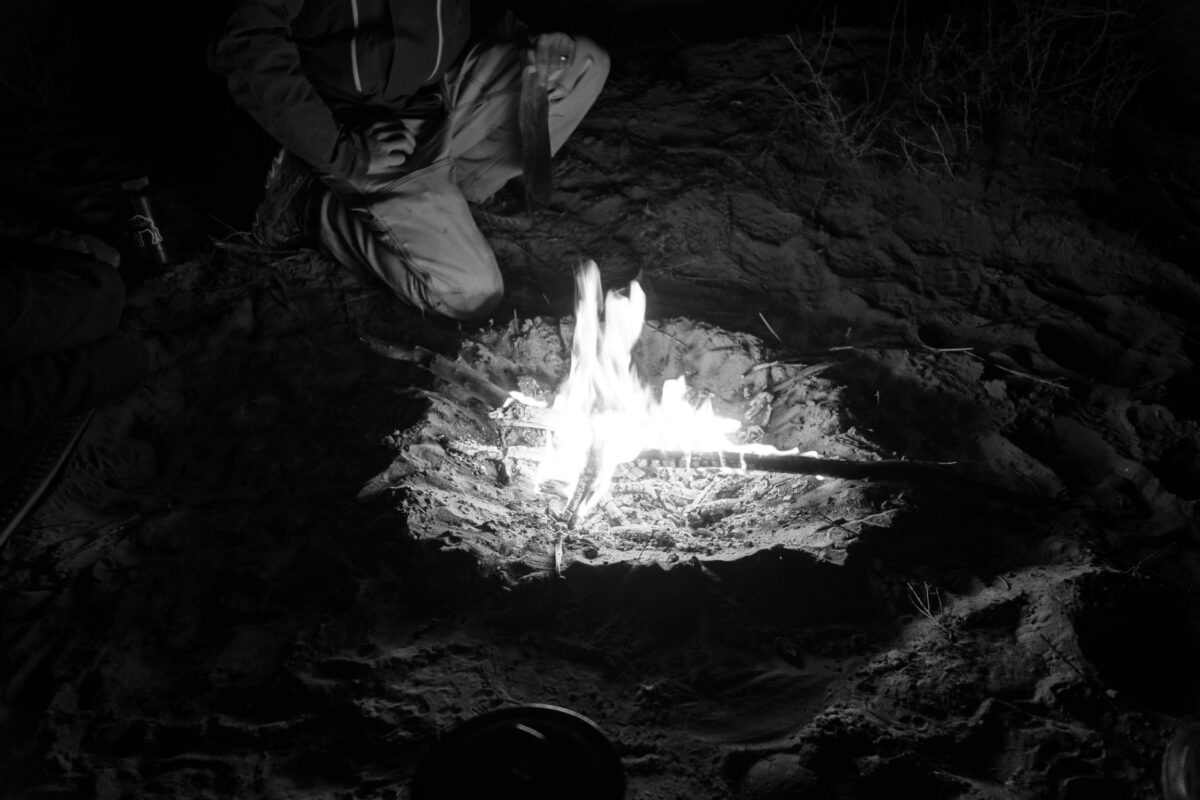
When I was a kid I loved playing with fire.
I enjoyed starting the fire when my family would go camping, and I was constantly tending it. I wanted to know what would burn, so I would experiment. Green spruce bows popped and spat but eventually burst into flames and then flamed out quickly. Pretty exciting. Pine and fir bows: same deal. Dry juniper bows spat and sparked loudly, flaming up and dying back just as quickly. Cowpie? Eventually burns, good to know. Because I was raised by parents who generally care about the world around us, I didn’t experiment much with tin foil, cans, Mountain House bags, or glass bottles when camping.
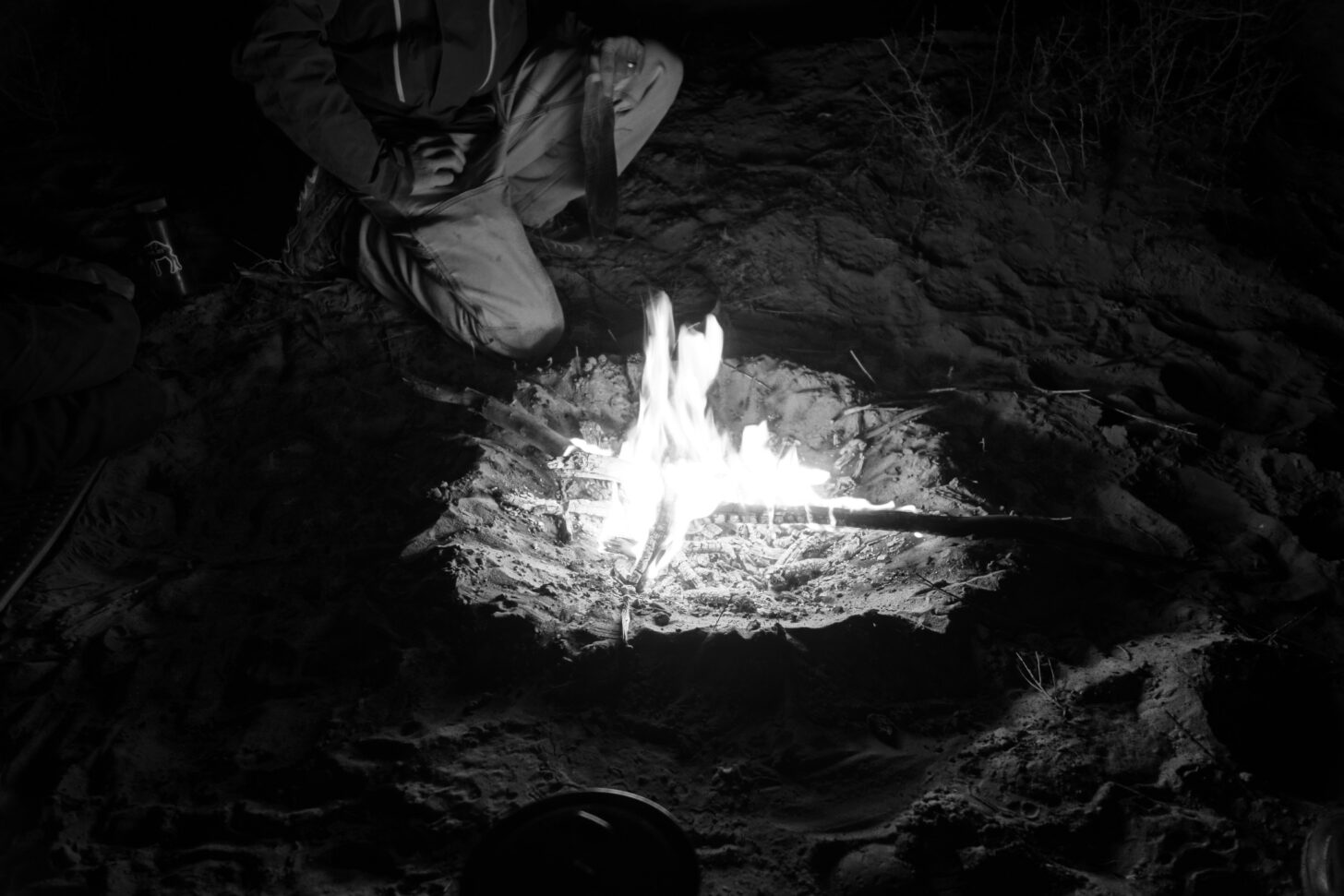
But at home – when my parents weren’t looking – I experimented. What happens when ants burn? What about a ripe apricot? These were questions I felt utterly compelled to find answers to. And so I did my best. Ants shrivel up and extinguish with a subtle pop which you can hear if you listen closely. Apricots require explosives.
The tension between experimentation for experimentation’s sake and an outright desire for destruction is difficult to untangle. And then why did this infatuation just evaporate at some point? But also why, when I do find myself staring into a fire as an adult, am I totally captivated, awed?
Professor of Anthropology Daniel Fessler has researched this topic and offers some clarity here. In his paper, A Burning Desire: Steps Toward an Evolutionary Psychology of Fire Learning, he says that just as humans and primates are born with an inherent fear of snakes, we are also born with an inherent fascination with fire. Kids in traditional cultures are expected to be interested in fire with their curiosity peaking around age six and a half. Fessler says that besides fire’s use for survival (warmth and light) it was also evolutionarily advantageous to have an interest in fire because it expanded our diet, what we were able to hunt.
Controlling fire also aided in developing tools, combating predators, and managing wild plant resources. And because humans inhabited all sorts of different environments, there was no universal mastery of fire. Fire making had to be learned in each new environment. Everywhere we went we had to find out what burns, what makes fire, and how to keep it going.
He goes on to say that children in traditional cultures don’t really play with fire, rather their interest is more practical, utilitarian. They bake pretend food, or even cook little bits of real food, for example. He thinks this is probably due to the mundanity of fire in these cultures. Fire in western cultures, on the other hand, is anything but mundane. We use it for celebrations. We set off fireworks on the Fourth of July, we burn giant effigies at gatherings like Burning Man, and we barbecue fancy meats to celebrate someone’s graduation or birthday.
And, of course, we light campfires when we go backpacking. Sometimes I wonder if this too is a ceremony of some sort, a celebration that we have escaped the office, that we have found the forest and the big sky full of stars. We did it!
It stands out to me that my interest in fire peaked not in middle childhood but in my early teenage years. Fessler says it is common in western societies today for interest in fire to peak around age 12. But then I’m left wondering if that’s really even true. I know plenty of adults who can’t go backpacking without having a fire each night. They poke at it incessantly, completely transfixed. I wonder if our interest in fire never goes away. I wonder if, when we don’t live in a traditional culture, fire experimentation becomes fire play and simply extends into adulthood, where we are still just trying to find out what burns, what doesn’t. I wonder if there is ultimately no purpose to this fire play and if we should have stopped when we were kids.

So I want to ask the backpacking community why many of us still feel compelled to have fires. Considering the severe drought conditions across much of the western United States and all the wildfires raging west of the hundredth meridian, maybe we should take a deeper look at this desire.
I know there are fire bans in many places now, but even before that, we should have known better. The Pack Creek Fire near Moab, Utah was started by an unattended campfire. Maybe if whoever left that fire burning had paid a little more attention when playing with fire as a teenager they’d know that the ground was dry, the crispy ponderosas just waiting for a spark. But maybe that’s wishful thinking on my part. Maybe our fireplay is now displaced. Instead of learning about the interactions between fire and the world around us, we have gotten sucked into the fire itself, what it consumes, how fun it can be. Maybe the ceremony of lighting it and the distraction of its mystery have superseded the practical implications of our mastery of the tool.
A group of friends and I recently walked the South and North Coast trails on the Olympic Peninsula and found ourselves camping in the rainforest on our last night. I looked up at the giant firs and cedars and listened to the eerie-sounding birdcalls echo through the forest. I examined sword ferns and felt occasionally the salty spray of the sea reach us where we stood amongst the trees. But when my friend started a campfire, all that faded away.
He piled so much driftwood on it that I had to back up. Then I somehow found myself with the job of spark stomper. Then when it got dark I got sucked in and just stared at it. The common phrase for this act – Cowboy TV – is telling, for what is TV but a distraction from the world around us? I thought about how addicted many of us are to our screens these days and pondered if Cowboy iPhone could be a more appropriate name for the distraction that fires provide. It’s striking that the act of fire staring is unique to western societies and that it is virtually nonexistent in traditional societies.

Of course, I will make a fire in winter if it is very cold and when nights are long. In other seasons I will start a fire if someone has fallen in a creek, or if everyone’s clothes are soaked from a storm and we need to try and reset things a bit. And I will stare at both fires and iPhones plenty more in my life, but when I do, I will try to think a little more deeply about what I’m doing. I will try to be thinking about how adult interest in fire might not be all that different from other evolutionary holdovers such as the fight or flight instinct transmuting into anxiety when we’re stuck in rush hour traffic. And if I feel a desire to start a fire and know it is not actually needed for survival, I should try and remember that I may actually be engaging in an adult form of fire play that should have faded away a long time ago.
And the arid land will probably thank me for my fireless camp.
Related Content
- More by Ben Kilbourne
- Read the first of Rex Sanders’ series of articles on wildfires
- Use our site search engine to find more articles and forum threads about fire
DISCLOSURE (Updated April 9, 2024)
- Backpacking Light does not accept compensation or donated/discounted products in exchange for product mentions or placements in editorial coverage. Some (but not all) of the links in this review may be affiliate links. If you click on one of these links and visit one of our affiliate partners (usually a retailer site), and subsequently place an order with that retailer, we receive a commission on your entire order, which varies between 3% and 15% of the purchase price. Affiliate commissions represent less than 15% of Backpacking Light's gross revenue. More than 70% of our revenue comes from Membership Fees. So if you'd really like to support our work, don't buy gear you don't need - support our consumer advocacy work and become a Member instead. Learn more about affiliate commissions, influencer marketing, and our consumer advocacy work by reading our article Stop wasting money on gear.


Discussion
Become a member to post in the forums.
I live adjacent to a National Forest and I essentially just had my backyard closed. I know people working for LA County Fire; they simply do not have the manpower to fight multiple fires of the sizes that are becoming the norm.
What I wonder is where this whole thing is headed…
So we close the forests, keep out the crowds, and avoid another major catastrophe…For now.
And next year?
I don’t think this drought is going anywhere and I don’t think our forests are suddenly bouncing back. Seems to me that every year the unburned portions of the West Coast will be flirting with the next “fire of the century” until there’s nothing left to burn. And this pattern will likely creep East.
Mt. Ralston, my favorite day hike in the Desolation Wilderness (just west of Tahoe), went up in flames yesterday. My first backpacking trip in 1969 was to Echo Lakes and Lake Aloha (both burning currently). I watched the news footage and wept. The exposed granite will prevent total destruction of the wilderness area but the damage to the watersheds will be permanent. The hillsides will be overgrown by chapparal and the forest will not return. To those folks who live in the Pacific Northwest and Alaska, the destruction is headed your way. Temperatures are rising, trees are dying and dead, weather patterns are changing. These huge conflagrations are the new normal in CA and will be the normal throught the Mountain West and Pacific Northwest. You are watching the real-time destruction of the places we all love. Is it too much to ask that you forgo fire in the wilderness in the summer months to slow the destruction? Or to stay away from the national forests for a few weeks to allow all hands to fight the multiple fires? What is your rationale for being so selfish?
Stop with the selfish accusation, please. It’s just petty nonsense and aimed to create conflict, and founded in not listening to what people are actually discussing here on this thread. Let’s try for a rational conversation, which I think most of us are having -save the “get a counselor” crap.
Because we’ve all – all of us!! – been sitting on the knowledge that climate change is real and a threat since at least the 1970s, and because we refuse to act in a meaningful way to slow it down, we now all get to enjoy the show as our world comes apart. Calling other people selfish who live 3000 miles away because a place you happen to love is burning isn’t really fair. Should camping in California be banned when we have a wildfire in Fairbanks?
FYI Alaska has had wildfires forever so you can’t really say it’s coming; it’s already here. It’s part of our landscape and has been for centuries. And yes, they are getting worse because of changing climatic conditions. My home has been close to multiple wildfires over the last 20 years. We have had to pack the car and wait for evacuation notices, breathe thick smoky air, and watch as a nearby hillside burned and cars flooded the roads to escape. It’s not just you and your concern. We live it too.
While caution is obviously needed, campfires are not the main cause of our fires (or yours). Gender reveal parties, fireworks, trash and brush burning, the electric company, lightning? They aren’t going to stop. Enjoying a safe and legal campfire when it’s raining and 40 degrees, after a long day of slogging through wet brush, is not selfish; it’s just fine. It’s safe, it’s not threatening anyone.
I get that you want a scapegoat, but BPL members are hardly your target.
Karen, I never said that camping should be banned in Alaska because of fires in CA. I said when precautions are warranted, you are selfish not to comply. It seems that you are the one ratching up the conflict.
Yes Karen, I totally agree with you about how ALL Americans, regardless of geographic location, are responsible for global warming (which is the cause for at least 50% of the latest droughts and wildfires). At last look, the US, Australia and the wealthy Middle Eastern countries such as Qatar, Dubai, etc have the highest per capita CO2 emissions. I’ve said before that when I see all of the Americans in their gas guzzling cars, pickups and SUV’s driving along the crowded highways, with usually only one person inside, I can easily see why other countries tell us to save our hypocritical self-righteous preaching about global warming. Many other gluttonous consumer culture habits also contribute to America’s giant carbon footprint.
But I think when many on this thread use the word “selfishness” they are referring to backpackers who are in extremely dry and vulnerable parts of the country and insist it’s their right to build a fire anywhere they darn well please. And has been stated earlier, many people in reality shouldn’t have the right to build fires at all because they are too, well, “intellectually challenged” (PC) to safely contain a fire in dry conditions. Problem is there’s no way to identify and weed out the dangerous (inadvertent) fire starters. Even if you could they would scream about “their rights” and it would of course be discriminatory.
I’d like to see all fires banned in California, Arizona, Nevada, Utah and New Mexico….at least until we can get out of this 22 year western megadrought that is the worst in over 1200 years.
Also, the National Park Service estimates that 85% of forest fires are human induced.
https://www.nps.gov/articles/wildfire-causes-and-evaluation.htm#:~:text=Humans%20and%20Wildfire%20Nearly%2085%20percent%2A%20of%20wildland,negligently%20discarded%20cigarettes%2C%20and%20intentional%20acts%20of%20arson.
Yes, it most certainly would be.
Yes, and – to keep things clear – according to the information that I found and posted, slightly less than half of that number result from campfires.
This just appeared in a popup on the TV screen: Better Bring a Brigade is being streamed for free at 5pm PT or 8pm edst on CBSN so if your streaming service carries CBSN here’s your chance to watch it.
I have heard it said multiple times that Fires are camp TV and the social or”meditative” qualities are the real draw. I agree with this as the zone out or conversations around the fire is very relaxing. That said since the wild fires out here in Colorado and the constant smell and haze of smoke I have had a significantly less desire to build a fire. In fact when alone in the backcountry or even at an established campsite it usually doesn’t even cross my mind to build a fire. But if with a few friends it is almost always on everyone’s list.
I think everyone should know how to build a properly build and safely maintain a fire. That said I feel that we should also know when a fire is “needed” and when we are just bored. I think if it’s the later we as a community should do or best to minimize these ornamental fires if nothing else to prepare ourselves and future generations for a world where fire bans become more permanent. We may be there already…
Years ago REI used to carry a cheap, 2 ounce or so candle holder (“lantern”). You’d place a candle inside and hang it from a stick, typically. I was amazed at how bright that single candle appeared on a dark night. I recall sitting around the candle lantern with a few friends and having a conversation. No smoke, no constant feeding and tending, and easier to see the stars. It still provided the sense of a center of light.
Of course tending a fire can give us something to do. Still, it may be worth exploring alternatives to a fire for when they’re banned, or even if they’re not. Try something new! There’s certainly a lot of advantages to a candle over a fire–in many circumstances.
p.s. and then there’s this–.6 ounces
https://www.rei.com/product/102806/nite-ize-moonlit-led-micro-lantern
Ain’t nothing wrong with a little fire…
^^Too many jalapeno peppers? That voice of Seger. Like 20 grit sandpaper but somehow smooth around all those rough edges.
Hey in reference to J Scotts idea and John’s post back on page 5 of a PMags article in which PMags linked to another of his articles with this idea similar to jscotts.
^^What a sentence that possibly wasn’t even a sentence!
Anyway: Luci lights. Well it ain’t a campfire but it just might work as something to sit around and shoot the breeze and it won’t get away and burn Paradise.
I was actually going to suggest Luci lights (true story) since I own a couple, but I decided I’d rather post something utterly useless instead….
Oh, your posts aren’t useless.
Who’s Bob Seger?
p.s. “they got the led lights down below” doesn’t pack the same wallop somehow. Of course, as we age we can always say, “my heat may be diminished, but my wattage is long lasting.”
Or, “Roxanne…you don’t have to turn on the led lights.
Those days are over…”
“At last look, the US, Australia and the wealthy Middle Eastern countries such as Qatar, Dubai, etc have the highest per capita CO2 emissions. ”
In Australia’s case, “per capita” doesn’t mean much because there’s only 25 million of us – and it’s actual CO2 emissions that count towards global warming, not per capita ones.
As a result we aren’t even in the top 15 CO2 producers – the US for instance produces 15x more CO2 than Australia, China 28x more.
NB, I’ve never lit a fire when bushwalking. And as I’ve been posting on here for 20 years, even when it’s actually allowed I still regard it as environmental vandalism.
Per capita and total. Australia 11th per capita and a somewhat startling 14th total.
USA 2nd ranked for total with China in first with 10,432,751,400 tons over double the USA total of 5,011,686,600
Worldometer CO2 emissions
Per capita the USA is 16th at 15.52 per person. If your personal footprint is half that it would put you in between the average person in Poland and Bosnia and ranked 41st which is pretty much meaningless but still vaguely aspirational.
The average per capita electrical use in the USA is @ 10,650 for 2019. I guess fossil fuel use for heating would add to your personal footprint if you don’t heat with electricity. Then I suppose fuel used for vehicles would be next or maybe that would be ranked higher?
Anyway back to Monte’s idea of just banning campfires in dry areas? Also an interesting idea from a NYT article about military satellites having the ability to do pinpoint spotting of fires as small as a campfire and using that asset during fire season in the usual vulnerable areas.
Edited to add just re-reading the NYT article and it points out that GIS which we all use was once exclusively military and of course uses satellites. Wouldn’t it be great if we could all get a wildfire app on our smartphones!
My pharmacist has a brother who is a climatologist in California. He told him that the conditions we ‘enjoyed’ this summer will likely be the norm for the foreseable future – CA wild fires, with the amazing resulting smoke we endured here in CO’s front range all summer. So where to we move to, northern Saskatchewan?
And there are several carbon footprint calculators online.
Here’s one from the EPA
i hate to say it but the weather is just going to get crazier. temps are rising, seasons are shifting and changing and weather patterns are becoming unstable. the world as a whole would have to reduce their CO2 omissions by more than half starting today and even then it might be too late to change what’s happening.
there is plenty of data to back it up. where i live a local meteorologist puts out regularly articles about how our seasons are changing. for instance we get over a foot less of snow now then we did just 20 years ago, our frosts are happening later, higher temps are staying later, the average winter temps are rising…..
science is real
^^ Yes we’re going to have to figure out how to sequester carbon without releasing even more carbon in the process. Probably have to be powered by nuclear or hydrogen and splitting water to make hydrogen also will take lots of power; and yes climate has already definitely changed.
One thing for example I’m old enough to have seen the before and the now is this permanent haze layer at @ 15 to 20K feet that did not used to be there in the 70s.
When I was a kid @ 1960 living near where I-95 crosses the VA/NC border we used to regularly have snow days out of school all winter long. Since the early 70’s (so 50+ years ago) there have been very few snow days; Probably all total in the past 50 years about the same as we got in one year alone @ 1960-1961. Heck nobody even owns a sleigh, most kids don’t even know what one is and we used to sled all the time. If this is a “temporary” pattern change it’s a long one. Heck the “permanent” snowfields all over the taller western ranges are disappearing. We could go on and on
Switching back to campfires and the firestorm that has become the US beyond around the 100th. Read that article about the dedicated satellites for early wildfire detection and then start engaging however you can with your local congress-critter. It’s ridiculous that there is a potentially very impactful resource for discovery and containment that is not being utilized. I’m surprised the insurance industry isn’t pushing on this one.
“Wouldn’t it be great if we could all get a wildfire app on our smartphones!”
Ga-ia has current and historical wildfire map overlays. Google maps just added a wildfire overlay. I imagine there are others.
“Per capita and total. Australia 11th per capita and a somewhat startling 14th total.”
Not sure why that’s startling – Australia’s economy is 12th biggest in the world by nominal GDP. As I’ve pointed out to a few people recently, re our current issues with France and the EU, if we were in the EU we’d be the 4th biggest economy out of 27 members. Our economy is also only marginally smaller than Russia’s, South Korea’s and Canada’s – and they all have way more people than we do. And most of our electricity is generated by burning coal, of which we have a very, very large amount
^^ I knew about the coal. I occasionally read articles by an Australian economist named John Quiggin. I think the thing I wasn’t aware of and surprised by was the 25 million population. I guess I was thinking Melbourne, Sydney, Adelaide, Brisbane, Perth etc. and picturing more than 25,000,000 people. You all are definitely punching above your weight.
Now I’ll quit digging.
I wonder if you could use fracking technology on coal fields and produce natural gas.
That could produce a lot less CO2. Not destroy expanses with strip mining. No coal ash pond floods into streams. etc.
I just had a campfire for the first time in months. It rained 4 inches so I think wildfire risk is minimal.
One night. Several other nights I didn’t bother, just watched sunset. And it was a bit alpiny for campfires.
Become a member to post in the forums.