


Introduction
Managing moisture (including perspiration and precipitation) while backpacking in cold temperatures can be challenging. It’s easy to reach a level of physical exertion that causes significant sweating and body heat generation, even during winter conditions. The primary challenge arises from the stop-and-go nature of backpacking, where the hiker generates heat and perspiration while active, and undergoes rapid cooling due to evaporation of that same perspiration while inactive.
In this article, we present:
- moisture transport mechanisms in base layer fabrics;
- the problem with wicking and cold temperatures: the Mancusi Dilemma;
- the idea that wicking isn’t all it’s cracked up to be;
- the case for fishnet fabrics; and
- ventilation options for outer layers.
Moisture transport mechanisms in base layer fabrics
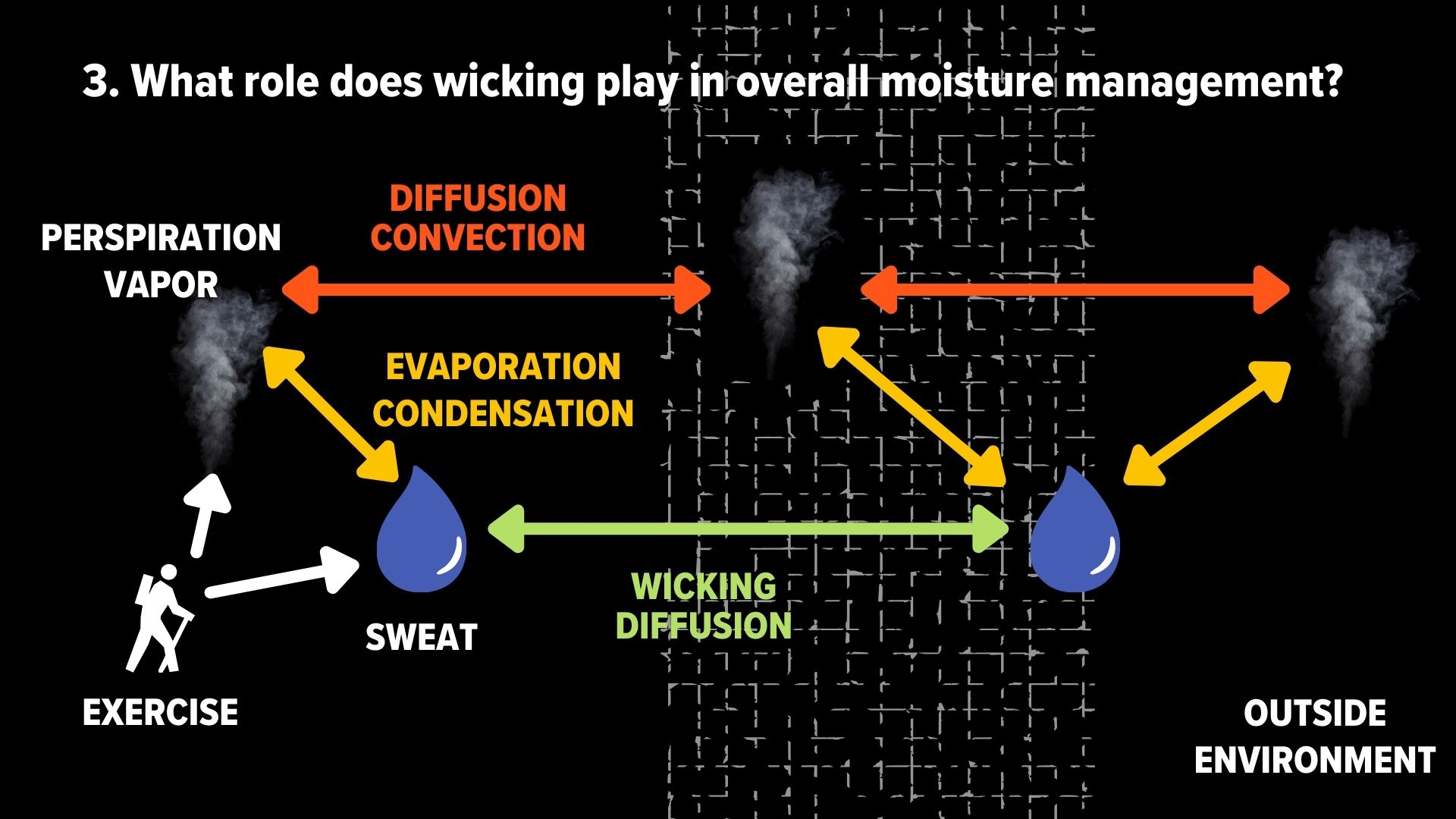
The transport of perspiration moisture in both vapor and liquid form in a layered clothing system is controlled by a complex system of interrelated processes including diffusion, convection, evaporation, condensation, and wicking. These processes occur in the following transport pathways:
- As you hike (or exercise), your skin temperature warms and accumulates water vapor that results from either insensible perspiration or the evaporation of liquid sweat at the skin surface. Because your skin is now a warm, humid environment, that increases the vapor pressure near the skin surface, which drives moisture vapor towards cooler, lower-humidity areas (your layered clothing system, and eventually, the outside environment). These vapor pressure-driven processes include both diffusion and convection. These processes are represented in the diagram below by the orange lines.
- In addition, as you perspire and generate liquid sweat against your skin, that liquid enters into your clothing system via wicking (e.g., a diffusive analog known as capillary action). Liquid travels along the surface of individual fibers and through pores (capillaries) within the textile structure of the fabric. This process is driven by surface tension forces and drives moisture from areas of high liquid moisture content to areas of low liquid moisture content. These processes are represented in the diagram below by the green lines.
- Evaporation and condensation also occur in this system: at the skin surface, inside the layered clothing system, and between the outer surface of the clothing system and the outside environment. These processes are represented in the diagram by the yellow lines.
The problem with wicking and cold temperatures: the Mancusi Dilemma
In a conventional knit-fabric wicking base layer, the fabric pores are very small, and the fibers are hydrophilic. This creates high levels of surface tension forces that drive wicking. Therefore, it’s presumed that wicking is the dominant transport mechanism of moisture away from the skin surface and into the outside environment.
However, a problem arises after a very short period of time following the onset of sweating: the fabric starts to become saturated with perspiration. At this point, the liquid water concentration gradient approaches zero, capillary action halts, and wicking no longer occurs. You just get wetter and wetter. Mancusi et al. (Mathematical modeling and numerical simulation of heat and moisture transfer in a porous textile medium, Journal of the Textile Institute, Vol. 107 No. 5, July 2015) showed that this occurs much faster than we think. During steady exercise, relative humidity reached 100% across 90% of the fabric thickness within 20 minutes. Once the air inside of the fabric becomes saturated with moisture vapor, condensation occurs, and at that point, you are wearing a ticking time bomb of fabric that’s only going to get wetter. I call this the Mancusi Dilemma.
Then, when you stop, evaporation becomes the dominant moisture transport mechanism at the skin surface and inside your layered clothing system. Since evaporation requires heat, if outside temperatures are cold, that source of heat is your body, and you get chilled within minutes. This is commonly known as the “flash-off” effect – the rapid drop of body temperature that results in evaporative cooling when you stop hiking.
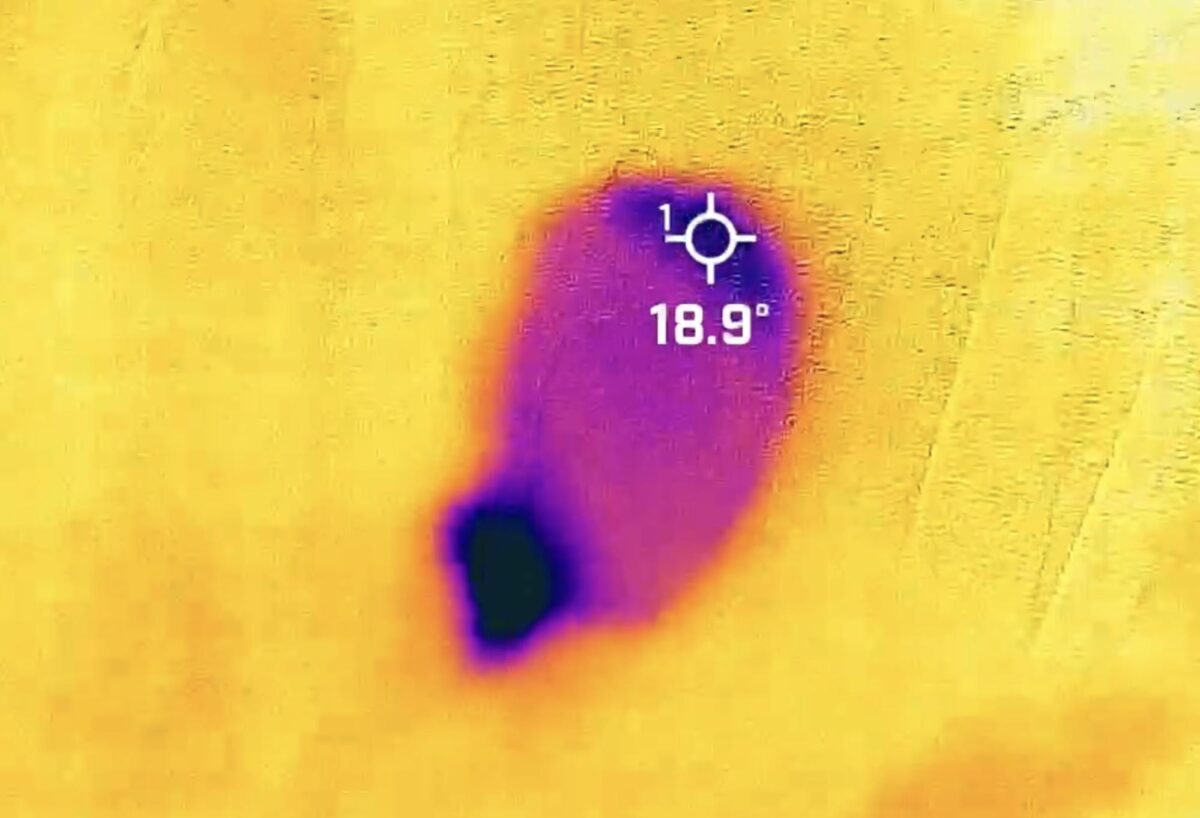
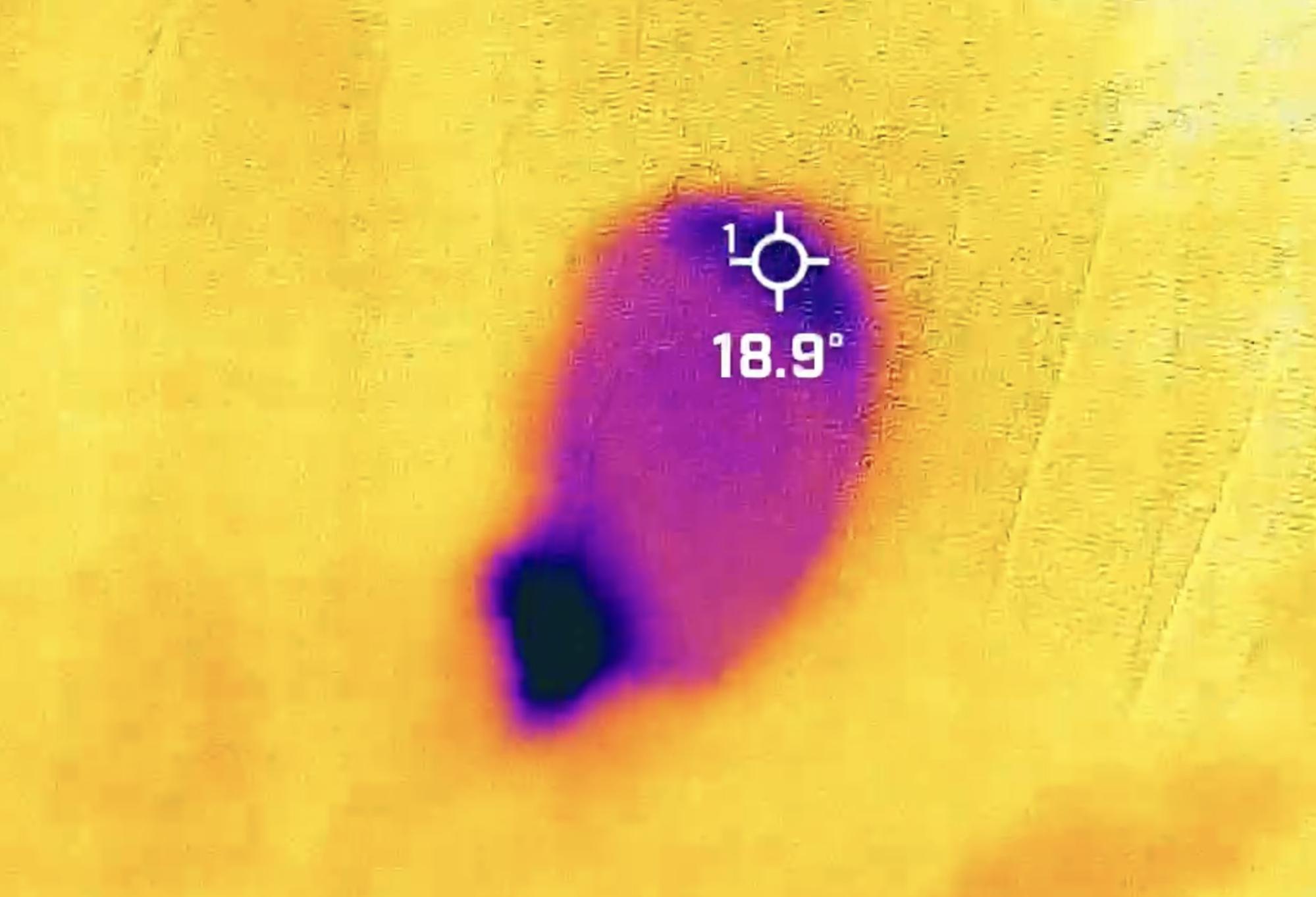
Some of my recent research investigates the impact of wicking at the micro-scale using infrared microscopy. The following image shows a 50-microliter drop of water wicking through a hydrophobic polyester base layer fabric. The ambient air, water, and starting fabric temperatures were 22.2 °C (72 °F). As the water droplet wicked through the fabric, the edges become areas that were dominated by evaporation. The heat driving that evaporation resulted in a drop in temperature of the fabric in these regions by more than 3 °C (6 °F). This is a notable temperature drop. Not only can there be a loss of body heat driving the evaporation phase change, but now we have a cold fabric next to skin that has the potential to drive conductive heat loss from the body. This is why it’s so easy to feel chilled if you’re wearing a damp base layer next to skin if you’re not exercising at a high enough intensity to combat this heat loss.
So maybe wicking isn’t all it’s cracked up to be
We’ve been investigating the wicking process for the past few years. You can catch up by reviewing the Related Content section at the end of this article.
My research into the impact of wicking on physiological comfort continues to validate the idea that maybe we shouldn’t trust that wicking is the be-all-end-all of fabric performance for hiking in cold temperatures.
Here’s why.
If we can avoid the Mancusi Dilemma described above (i.e., rapidly achieving moisture vapor-saturated air inside the clothing system), then we can short-circuit the process of moisture vapor condensing inside the clothing system and wetting it.
The Mancusi Dilemma can be minimized when:
- Rapid transport of moisture vapor away from the skin surface and through the base layer fabric;
- Minimal wicking inside the fabric structure (to minimize liquid water surface area and subsequent rapid evaporation); and
- Rapid convective expulsion of moisture to the outside environment.
These three factors can be optimized with the strategic application of a layering system where a fishnet made with hydrophobic fibers constitutes the base layer and outer layers are highly ventilated.
The case for fishnet
Rapid transport of moisture vapor away from the skin will occur in two scenarios: (1) when vapor diffusion through the fabric is maximized and (2) when external convective forces (e.g., caused by normal bellowing of clothing during physical movement) can reach the skin surface.
Vapor diffusion is governed primarily by pore size (diameter) and overall fabric porosity.
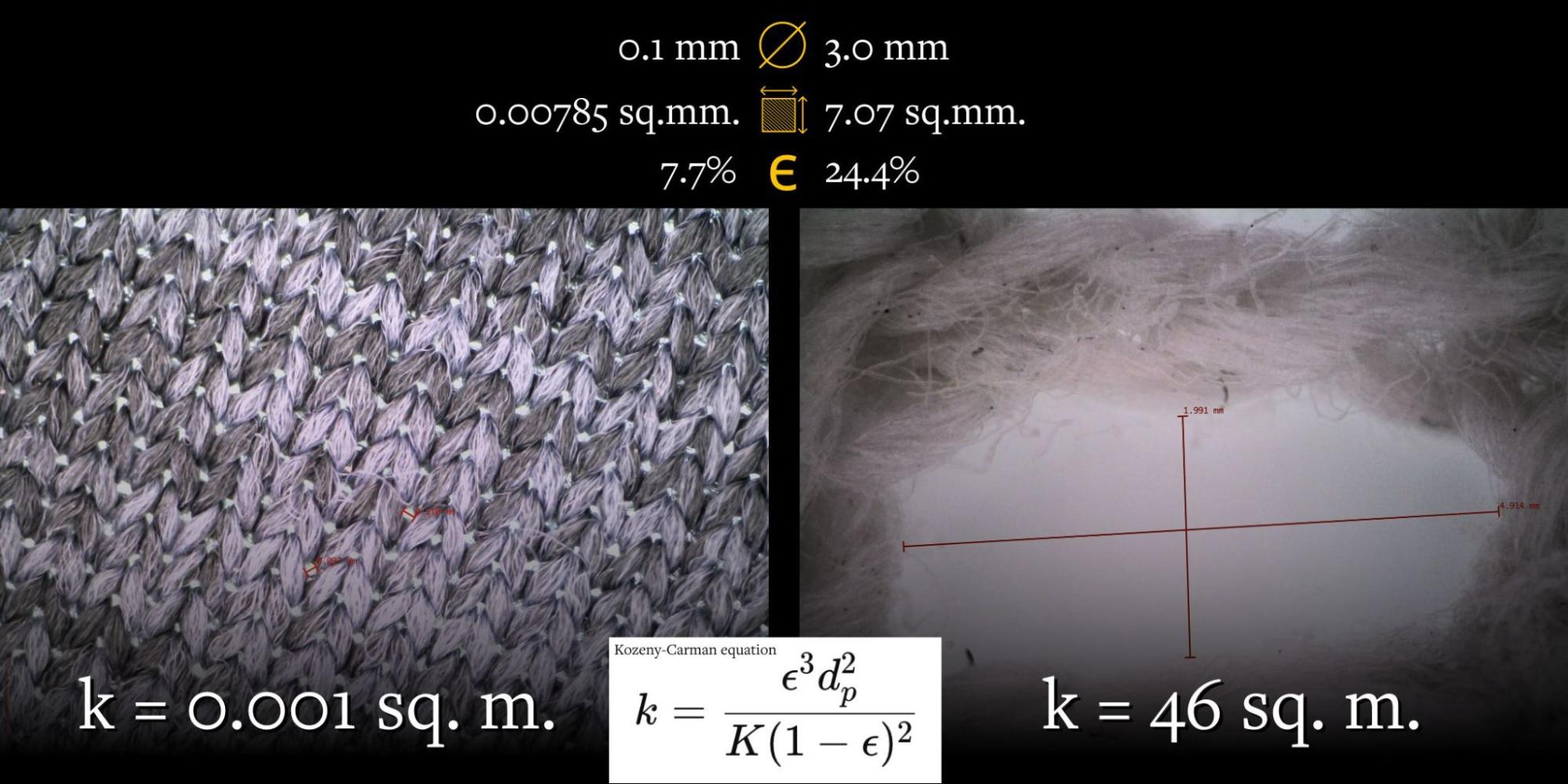
In this example, the fishnet has holes that are 30X larger than the knit and an overall porosity that is 3.2X higher than the knit. However, the compounding effects of these differences are dramatic – the vapor transport coefficient through the fishnet is orders of magnitude higher than through the knit.
The larger holes of the fishnet serve another purpose – they allow for cool, dry air (e.g., from the outside environment) to be exchanged with warm, humid air next to the skin (through the bellows effect that occurs during movement). As a result, moisture vapor can be rapidly transported away from the skin surface, lowering humidity underneath and inside the base layer.
In addition, the case for fishnet (or any base layer, for that matter) is strengthened if we consider the hydrophobicity of the fibers.
Because wicking works “best” (sic) when fibers are hydrophilic, and wicking is the process we are trying to short-circuit (minimize), then it follows that hydrophobic fibers may be the best option. Barring hydrophilic chemical treatments, fibers that maintain intrinsic hydrophobicity throughout their life cycle include polypropylene (synthetic) and alpaca wool (natural).
My personal preference is a fishnet base layer made with polypropylene fibers. It retains the highest degree of hydrophobicity, the lowest amount of water absorption, and the fastest dry time.
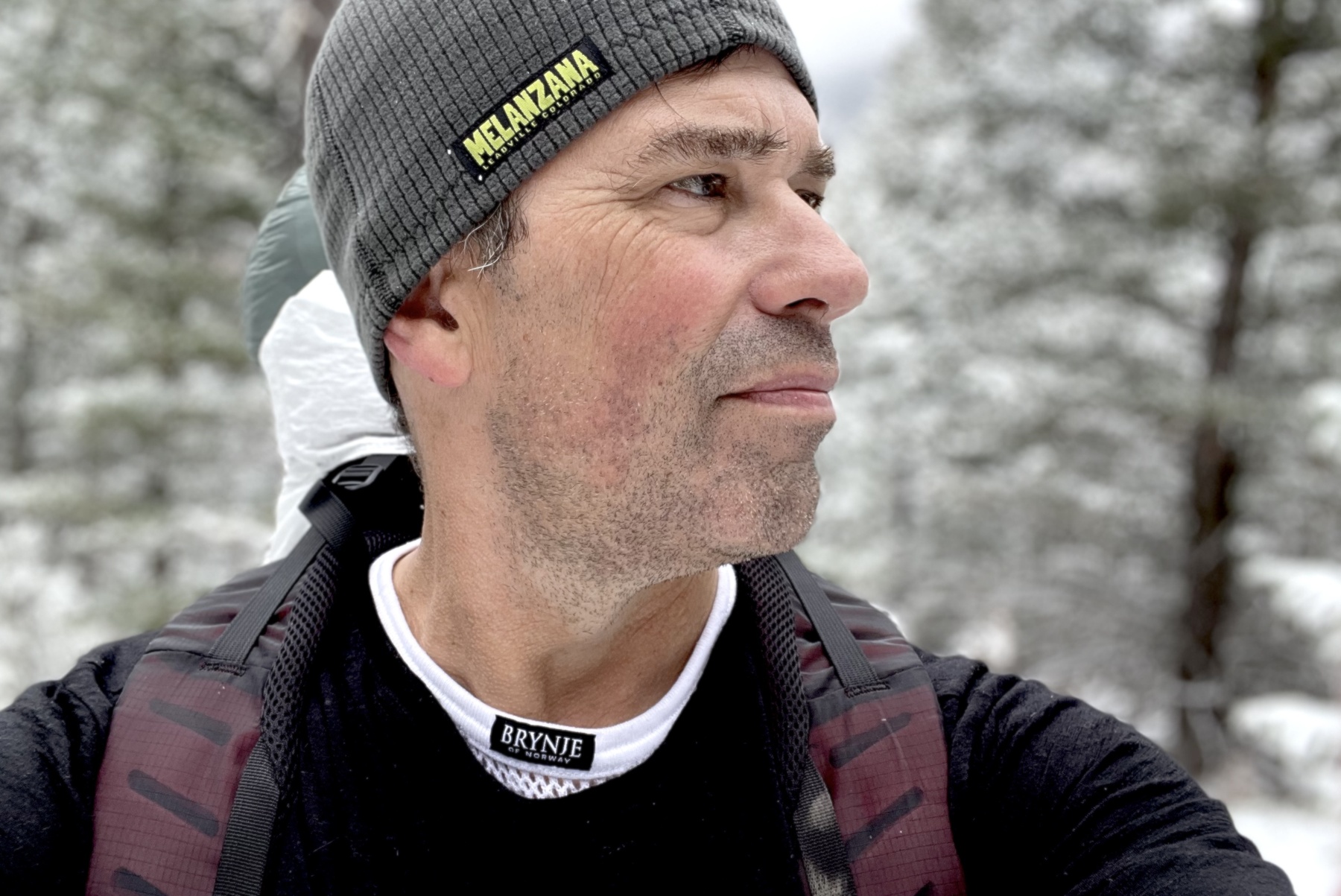
The author wearing a polypropylene fishnet base layer underneath an alpaca wool shirt during a winter trek in the Colorado Rocky Mountains.
Ventilation options for outer layers
Recently, I proposed spending a few ounces of pack weight on raingear with extensive ventilation options, such as a full-zipper, adjustable hood, cuffs, and waist, and pit zips. After all, even if you wear a hydrophobic fishnet base layer, if you encapsulate it in an outer layer of clothing that’s poorly ventilated, you’re still going to suffer the Mancusi Dilemma and eventually reach 100% RH inside your clothing system (and subsequently suffer the same consequence of liquid moisture condensation and accumulation).
Outer layers with extensive ventilation options allow two things to happen – warm, moist air can exit the system (minimizing condensation), and cool, dry air can enter the system (allowing for additional humidity to be generated during exercise without condensation).
Summary
In this article, we explored the challenges of moisture management in cold-weather backpacking, focusing on the limitations of traditional wicking base layers. It introduces the “Mancusi Dilemma,” where wicking fabrics quickly become saturated, leading to condensation and discomfort. I propose fishnet fabrics as a solution – their open pore structure and hydrophobic properties facilitate rapid moisture vapor transport and minimize condensation. Don’t neglect the importance of well-ventilated outer layers to enhance moisture expulsion. By combining fishnet base layers with breathable and ventilated outerwear, backpackers can potentially achieve superior moisture management and comfort in cold conditions.
Learn more
- Our clothing systems module in Basecamp Live dives deep into the science of thermoregulatory comfort, which forms the basis of various layering system frameworks for different environmental conditions. Basecamp Live is our most comprehensive live online skills course for backcountry users.
- Sometimes, a wet base layer just can’t be avoided. Soaked-based layers happen. Here is why it will happen to you.
- Moisture-wicking fabrics (base layers and underwear) are designed to move sweat away from the skin. In this study, we test if Polartec and other base layer fabrics meet manufacturer claims.
- An example of how and why some fabrics are prisoners of wicking physics.
- Listen to one of our podcast episodes about fishnet base layers.
- See our recent review of Brynje fishnet base layers.
Disclosure
This article is sponsored by Brynje of Norway. The sponsor did not participate in any way whatsoever in defining the topic, editorial direction, outline, link or product placements, review, or editing of this manuscript. This article is the original work of the author and was developed solely by the Backpacking Light editorial team with no participation from the sponsor. The author has been wearing and using fishnet base layers made by Brynje and others since 1987.
Sponsor’s Message:
Take advantage of innovative fabric structure (big holes) for more effective thermoregulation.
👉🏽 Fishnet (mesh) has big holes. That means the warm, moist air generated during moderate- and high-exertion exercise (like backpacking) can be transferred away from your skin rapidly, before it has a chance to condense into sweat. That sweat then causes both conductive and evaporative cooling.
👉🏽 Fishnet made of merino wool is comfortable and soft next to skin, but when it’s made of polypropylene, the fabric is more hydrophobic and doesn’t absorb as much moisture. This means it dries faster, and doesn’t wet out like more hydrophilic base layers (e.g., so-called “wicking” polyester knits).
👉🏽 Those big holes do double-duty as you layer over your fishnet base layer by trapping warm air. That makes fishnet very warm for its weight – when paired with another layer over it – and much more breathable than conventional knits when well-ventilated. These two properties are rare in base layer fabrics. Fishnet mesh with these properties makes for a very effective type of fabric construction for cool- and cold-weather hiking.
Brynje of Norway has set the gold standard for manufacturing technical fishnet base layers for more than a century. It’s no surprise that you’ll find Brynje base layers on the backs (literally) of the world’s most prominent alpinists, explorers, and Nordic skiers.


Discussion
Become a member to post in the forums.
Companion forum thread to: How fishnet works (base layer fabric structures)
This article explores how fishnet base layers offer superior moisture management and comfort for cold-weather backpacking by promoting rapid moisture vapor transport and minimizing condensation.
Good article, makes sense
One strategy is to have less insulation so you don’t sweat so much. Take stuff off when you start getting warm. Open front zipper. If you start sweating slow down…
One strategy is to have less insulation so you don’t sweat so much
The common wisdom in Oz is to start out cold and to warm up as you go. This is the opposite. It works for us.
Cheers
Yup, in summary, wool is a sponge. Brynje was a game changer for me, getting the sweat off skin.
From the article:
“The larger holes of the fishnet serve another purpose – they allow for cool, dry air (e.g., from the outside environment) to be exchanged with warm, humid air next to the skin (through the bellows effect that occurs during movement). As a result, moisture vapor can be rapidly transported away from the skin surface, lowering humidity underneath and inside the base layer.”
I found an alternative approach more effective for me: layering a relative close fit Lifa polypro over the fishnet. Water vapour gets transported into the Lifa layer so your skin stays dry, and it evaporates quickly because the Lifa is hydrophobic polypro. The secondary benefit is that the Lifa keeps the air trapped in the fishnet cells warmer (slowing down the exchange for cold dry air) which helps create a strong vapour pressure difference driving the sweat through and out of the Lifa as well.
Another practical benefit of this that I’ve seen is the ability to use a lighter weight mid layer for the temps and so that hold less maximum moisture, making the over-all system even drier.
I gave this combo a lot of use last year snowshoeing and day hiking down to ~ -15C (it was a warm winter) and this was the best combo.
I really notice the reduced performance if instead I layer a looser fitting mid directly over the Brynje: drafty cold spots, longer time for sweat to come off my skin
Thoughts on combining base and mid by using an alpha direct hoodie next to skin?
That works for me, Mark. I wear a Brynje in the Winter for day hiking/snow shoeing/skiing under an Airmesh or AD (for simplicity, I am going to call them both, “AD”). I like it, but the difference between Brynje+AD vs just-AD is subtle.
I suspect, but have not tested, that Brynje’s effect may be more pronounced under a different kind of shirt, such as David’s example with Lifa, above. That makes sense to me. However, AD already has some of the benefit of Brynje built into its loose weave.
When counting grams for UL backpacking, I get most of the advantage of Brynje by wearing AD directly against the skin. Since the Brynje weighs slightly more than AD, it is (slightly) more weight-efficient to just use AD directly. YMMV.
I think alpha tends to close itself off when its compressed under a second layer.
I’m not keen on the advertising on the neck band of the shirt. I’ll pass on it . I’m no one’s billboard.
Thom
Pretty easy to remove the tag…
I put in ~20 days ski touring in fishnet last winter and I think it is amazing as part of a winter system. Ski touring sees a lot of temperature change and the fishnet combined with an easy to ventilate jacket was able to transition between warm and cold.
I must be missing something. The reason that you sweat is that your body senses a heat buildup and evaporation is going to bring your temperature down. I thought that the whole winter strategy was to manage layers and to remove layers as you get warm (not hot). The basic concept was to keep slightly cool all of the time which requires active layer management. I thought that there was an article posted about military training and how they managed to not soak their base layers and stay warm. My 2 cents.
I don’t think you’re missing much at all, but everything that works out great in theory falls apart to some extent in real life.
Spending a winter day in the backcountry, heat generation and heat loss will change constantly with varying intensity and weather conditions, so unless one wants to bring a multitude of layers to accommodate any condition, and spend way too much time constantly adjusting layers – finding layers that are comfortable over a wider range and that handles moisture well for the unavoidable occasions when you get too hot, makes a lot of sense in my experience.
Haakon put it really well.
The other alternative is to slow waaay down at times as the Inuit do in the arctic.
That’s a non starter on most trips, unless any sweat build up could be dangerous such as deep winter multi-days without a hot tent.
My access to AD garments is very limited, so I haven’t been able to do this kind of comparison. I have one AD full-zip sweater with 3 zip’ed pockets, stretch fleece panels and all that jazz, so it’s not particularly light as far as AD goes, and as such there’s not much to gain from using it as a combination layer.
My intuition have me believe that AD isn’t the best companion mid layer directly on top of a fish net base layer as I imagine the fussy inside of AD and similar fabrics will fill up the holes in the mesh to a larger degree than mid layers with a smoother inner surface, so I usually choose to go with regular fleece, lifa or wool over my Brynje. Basically ending up using my fish nets similar to David D, though more by my own logic and chance than actual trial and error.
With my limited experience with AD I might be wrong about this one, but I also have the impression AD is way more fragile than a Brynje base layer, so unless weight is very crucial I’d probably pick brynje + something else over just a single layer of AD in most cases. I have a couple of Brynje base layers that are coming up on 25 years of use and still going strong, and access is rather good here in Norway so I have no qualms putting wear on my Brynje garments.
I also suspect Terran Terran has a point about the properties of AD being more susceptible to degrade under the weight of other layers, backpacks etc.
I’d love to get my hands on some decent AD hoodies, but price and access being what it is, I’d probably “save” them for regular mid-layer purposes and not wear them out by using them as base layers
I guess that what I am trying to get across is that layer management is a critical skill set to learn IF one wants to keep dry and comfortable as a trained Army Ranger. As I said, it’s a skill set just like tying knots, learning how to build an efficient fire and fishing. You get out what you put in. I would say that very few of us are super active in super cold climates and spend the time to develop these skills.
New fabrics and techniques may be able to expand the bandwidth of your layering system, but the fundamentals should still apply. If you are warm, you probably have too many layers on. If your clothes get wet, you’re probably not managing your system well. If I remember correctly, the Army Ranger Artic training is considered the most difficult skill to develop, much harder than desert and underwater training. My 2 cents.
You will have to experiment for yourself, Haakon, but I like AD and Airmesh next to skin. As I mentioned in the same post that you clipped, Brynje does add a small benefit — it isn’t so much that AD compromises the mesh as AD is mesh itself, which is why it has some of the benefit of mesh without adding a dedicated mesh layer.
I don’t find durability to be an issue. Both Airmesh and AD will get slightly thinner with use, but that’s actually a good thing IMO. Both remain plenty strong and lofty enough to do the job. I do use two layers in cooler weather.
Regarding temperature control and moisture management, I agree with all of you, and will add that temperature makes a difference.
I can work pretty hard in freezing weather or somewhat below without approaching saturation of any layers. It’s a combination of factors: layers that move moisture outward, including a breathable wind shell, plus adjusting ventilation and layers to remain comfortably cool. I accumulate a little moisture in my layers at some points, but it will quickly cook away when I slow down. Half an hour after stopping I am completely dry.
I frequently use zippers and adjustments around head, neck, and wrists to adjust cooling. Yes, part of it is experience or skill or whatever you want to call it.
It’s more challenging in very cold weather when I am wearing more insulation that doesn’t breathe so well, especially when it is cold and windy enough that all skin must remain covered at all times. In those cases, it can be easier to adjust pace rather than fiddle with layering to maintain comfort and avoid saturating layers with sweat/condensation.
That doesn’t necessarily mean a slow pace — it means keeping the power output more or less consistent, including hills.
Winter clothing management (real winter, not California) skills are (extremely) underserved from the experts.
Winter layering advice is also much more personal than 3 season: how much you sweat matters much more at -20C than +20C.
So, field testing is absolutely mandatory.
I came to the fishnet under Lifa as the best base combo (for me) after trying many combos over the years of:
They each of have pros and cons that need to be evaluated in person under real effort.
I arrived at different layering systems for every ~ 10C drop from 0C to -40C for each of head, hands, legs, trunk, arms, feet
This then gets tweaked based on wind and sun exposure and to a lesser extent the how technically difficult the travel will be, the latter because I prefer to just plow through and maintain a similar maximum effort regardless of the conditions.
Getting wet is unavoidable unless deciding to putter. Managing it is critical.
A nerdy spreadsheet is mandatory to keep track of it all.
The repercussions are severe for getting this too wrong.
One of the benefits of both Brynje and (thin) Alpha Direct, is that they allow for a lot of cooling/drying when you increase ventilation of your shell or remove it completely.
So rather than it being an either/or case of the best base layers vs the skills to stay dry, I think they are the best base layers to allow you to execute that skill.
And then of course, there are situations where venting and cooling are not an option.
last March I was skiing, and it was around freezing. A bit below and windy up top, and a bit above at the bottom. Mix of sun and clouds.
i could not remove or open up my waterproof shell garments, because the wet snow would soak me if I fell or sprayed it up.
So, fully zipped up, with just a baselayer shirt underneath the shells, I would get very warm and sweaty on the descent, then ride the gondola up (so stationary) exiting at much lower temps, and increased wind. The Brynje shirt really helped there compared to other base layers I have tried.
Yu’ns kin talk all ya want about fishnet underwear and moisture transport. I just know my BRYNJE works real good. I may git some fer Ma.
Has anyone used this fishnet in the summer under a shirt for mosquitos protection?
I used a similar but heavier fishnet shirt in 1979 in the arctic barrens for 45 days (summer).
Now that insectshield treatments are available I’m wondering if the mesh is worth it.
Become a member to post in the forums.