


Introduction
From time to time, a company produces a new fiber or fabric that has far-reaching impacts on the activewear industry. Polyester, synthetic fleece, and synthetic insulation are products that dramatically changed how people dress for outdoor activities.
Teijin, a large Japanese textile manufacturer ($8 billion revenue in 2020), introduced Octa fibers in 2018. Octa is used to manufacture Octa Active Mesh. This fabric has been implemented in various products, including the Arc’teryx Proton FL (as well as several other Arc’teryx products), the Noronna Faltikind Octa, the Mountain Equipment Kinesis Insulated Jacket, and now, the Mountain Hardwear AirMesh Shirt and Kor AirShell Warm Jacket.
I wrote briefly about Octa in my article on active insulation. I have also participated in a forum discussion dealing with the Mountain Hardwear AirMesh.
In this article, I will comprehensively review Octa as implemented in Mountain Hardwear AirMesh garments. This article includes extensive lab testing and limited field testing while hiking, biking, and running. When we refer to AirMesh in this article, it will be in reference to the fabric used in the Mountain Hardwear garment.
I discuss the fundamentals of base layer wicking and drying and the test methods used in this article in detail in two prior articles (here and here). I recommend reading those articles to better understand the concepts and techniques discussed here.
Editor’s Note: For the sake of clarity, we’ve added links in context throughout the article to other installments of Stephen Seeber’s work (as we did above). In addition, we recommend readers spend some time catching up on all of Stephen Seeber’s By the Numbers series. It is a body of work that builds upon itself, and readers will find a complete exploration of the series time well spent.
Summary of results
Briefly, here is what I have found about the Mountain Hardwear AirMesh shirt:
- My Wick/Dry test revealed that wetting performance and, therefore, wicking of AirMesh is limited by the brushed skin-side surface of the fabric.
- The restricted capillary capacity of the very lightweight fabric also limits wicking performance – there are insufficient capillaries to transport much moisture without reaching saturation.
- Air permeability of the fabric is high but quite a bit lower than that of 60 gsm (grams per square meter) Alpha Direct. This air permeability will promote dumping excessive heat through convection when sufficient ventilation is provided.
- AirMesh’s warmth is good for such a light fabric, but 60 gsm Alpha Direct surpasses the warmth-to-weight performance of AirMesh fabric.
- The impressive warmth relative to other wicking base layer fabrics of similar weight results from the Octa fiber structure, which traps more air per fiber than a standard cylindrical polyester fiber.
- The drawback of this fiber structure is that when saturated, it will trap and hold more moisture than similar weight fabrics constructed of conventional polyester fiber. This means that if you saturate this fabric, it will dry slowly and when wet, suffer from degraded thermal performance.
- In drying tests from saturation, the fabric dries at a considerably slower rate than 60 gsm Alpha Direct and an equivalent rate to 100 gsm conventional wicking fabric.
How is AirMesh constructed?
AirMesh is 100% polyester knitted from Teijin Octa fiber. Octa fiber is shown in Figure 1. A knit image is shown in figure 2.
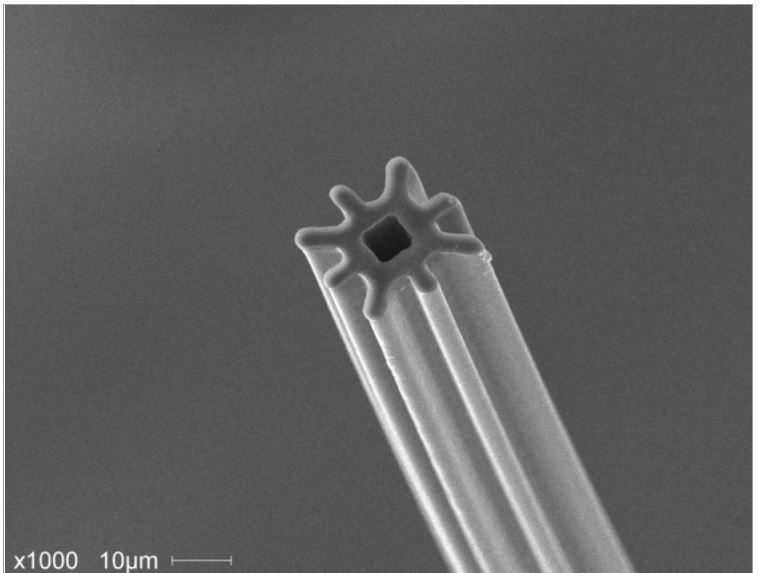
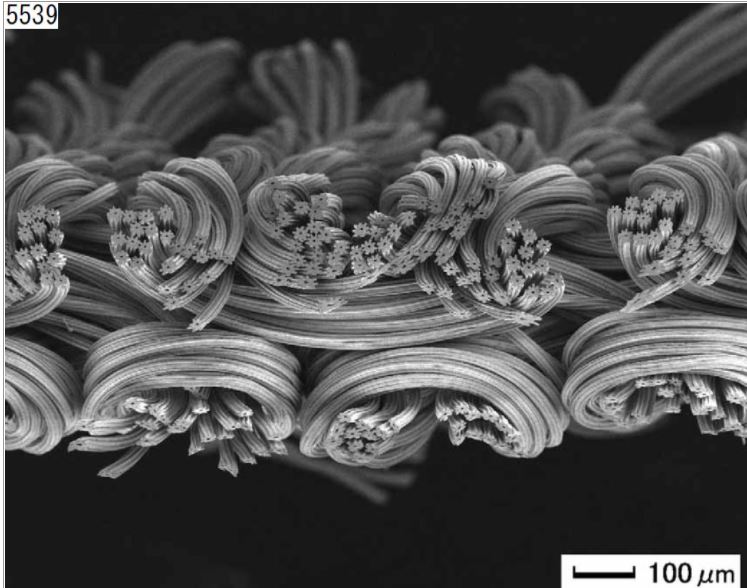
Instead of a typical (i.e., cylindrical) polyester fiber or even a more complex polyester fiber like Coolmax (i.e., an oblong bi-lobal cross-section), Octa has a square hollow core and eight lobes that project from a square fiber extrusion. The hollow core and projecting lobes trap more air than other polyester fiber designs. The fiber construction also provides substantial loft to a very lightweight fabric. As a result, the fabric feels surprisingly light and surprisingly warm when handled.
Figures 3 and 4 show the face and skin side of an AirMesh fabric at low magnification. Figure 3 is backlit, figure 4 is not.
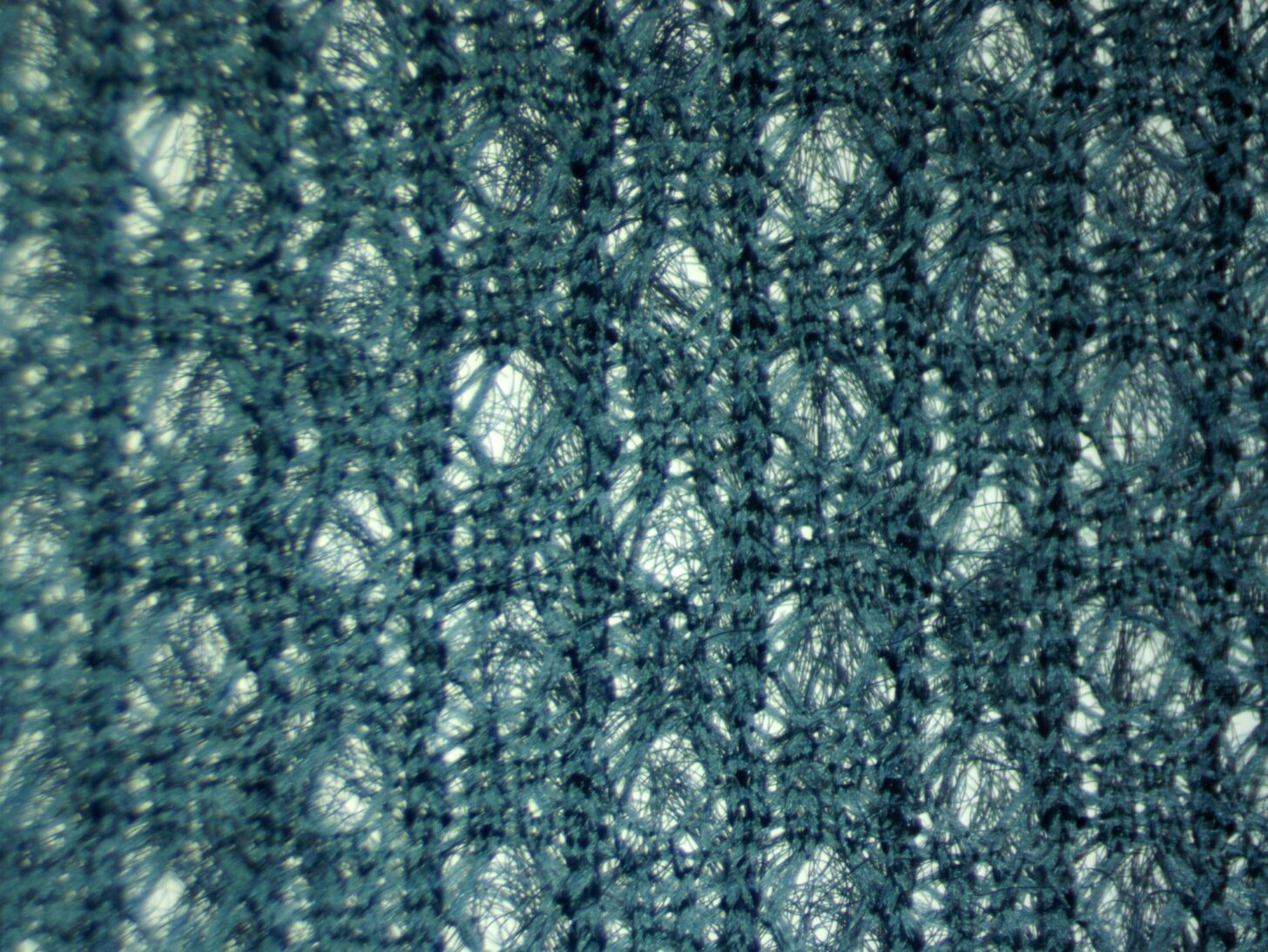
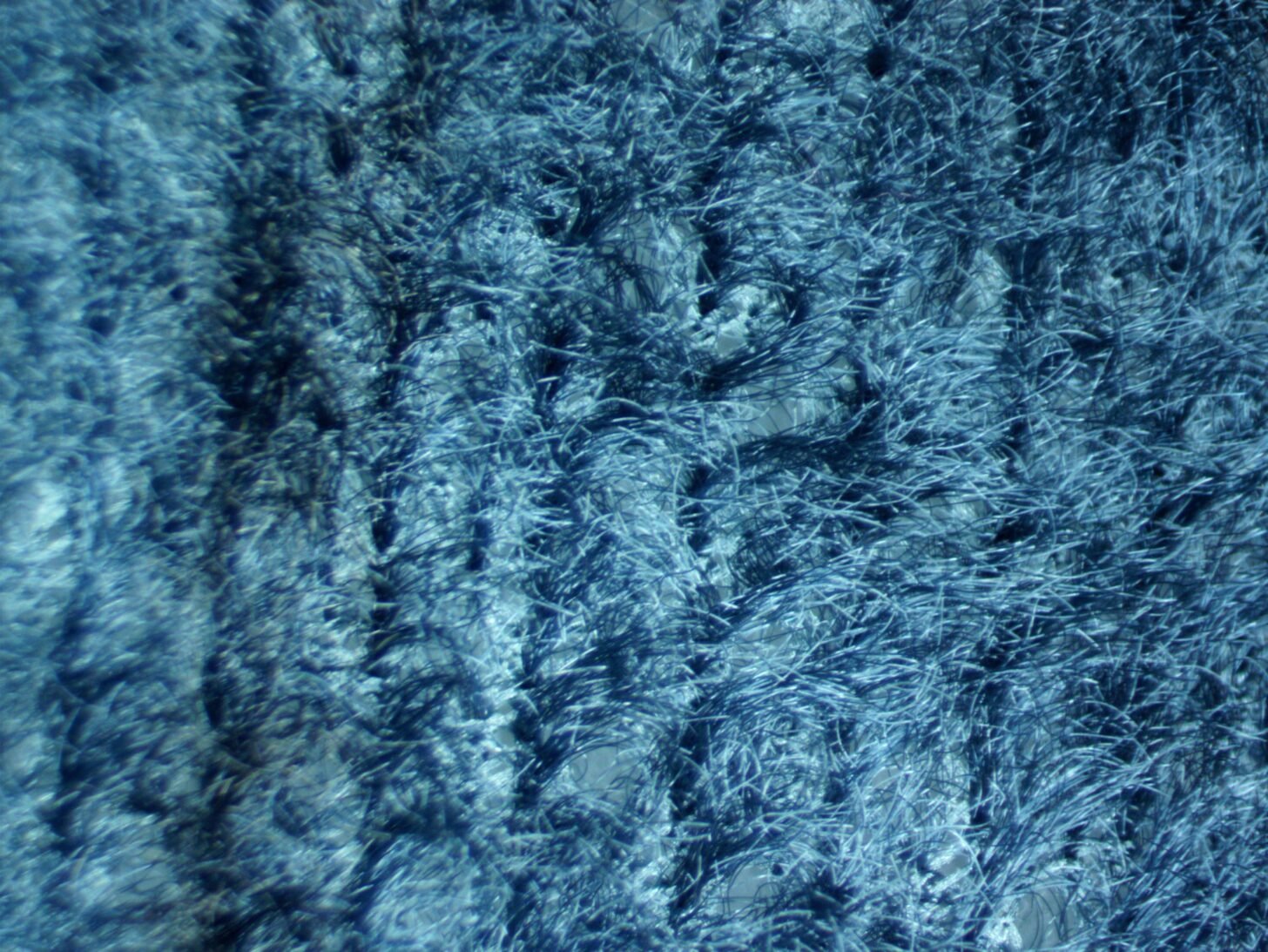
The face side of the fabric is a very loose knit with a grid of holes for increased air permeability. The skin side is lightly brushed, providing additional loft.
As can be seen from the Figure 3 face-side image, the knit is very porous. In the backlit white areas, the brushed fibers on the skin side block some of the light from coming through. Figure 4 shows the brushed fibers on the skin side – these function similarly to napping on fleece.
Summary laboratory test results
Table 1 presents a summary of laboratory test results.
Table 1: Summary laboratory test results
| AirMesh | 60 GSM Alpha Direct | 100 GSM Wicking Fabric | |
|---|---|---|---|
| Weight GSM Fabric | 83 | 60 | 100 |
| Weight OSY Fabric | 2.45 | 2.42 | 2.95 |
| Porosity (%) | 14 | 27 | 10 |
| Air Permeability | 740 | 920 | 500 |
| Shirt Weight (grams) for Airmesh and 60 gsm, both pullover, estimated weight for 100 gsm fabric | 117 | 106 | 150 |
| Approximate thickness (inches) | 0.076 | 0.1 | 0.025 |
| R-value | 0.35 | 0.39 | 0.08 |
| R-value/grams per square meter | 0.0042 | 0.0065 | 0.0008 |
| Spin Dry Water Weight Gain (% Dry Weight) | 52% | 26% | 31% |
| Saturation Test Sample Weight (grams) | 38 | 37 | 36 |
| Saturation Test Sample Water Weight Gain (grams) | 96 | 92 | 67 |
| Saturation Test Dry Time (minutes) | 68.3 | 39.08 | 52.83 |
| Saturation Test Drying Rate (grams/minute) | 1.24 | 1.87 | 1.26 |
| Wick/Dry Test Results: Wicking (grams) | 6 | NA | 25 |
| Wick/Dry Test Results: Infab (grams) | 1.5 | NA | 11 |
| Wick/Dry Test Results: Evap (grams) | 4.5 | NA | 14 |
| Wick/Dry Test Drying Time (minutes) | 6.58 | NA | 21.8 |
| Wick/Dry Test Drying Rate (grams/minute) | 1.46 | NA | 1.56 |
The laboratory testing provides data for AirMesh, 60 gsm Alpha Direct and a 100 gsm knit wicking fabric. I selected 60 gsm Alpha Direct to include in the comparison because it seems like a logical competitor to Airmesh: it is extremely light, very porous, and has a high warmth-to-weight ratio. The 100 gsm wicking fabric is a typical polyester knit. Although a little heavier than the other two fabrics, it is strikingly thin compared to the other two fabrics.
It is useful to compare similar weight fabrics as we look at performance. We can see that AirMesh falls between the two other fabrics. In the range of wicking fabric weights, these are all on the low end. The comparison for thickness shows a distinct difference between the 100 gsm “typical” wicking fabric and AirMesh and Alpha Direct. The AirMesh and Alpha Direct fabrics are both brushed, increasing the fabric’s thickness. Thickness increases various performance characteristics, of which warmth is the most notable.
Discussion of test results
Air permeability
Alpha Direct has the highest air permeability of the three fabrics, followed by AirMesh and the 100 gsm fabric.
Thermal performance
I measured R-value performance for the three fabrics on my guarded hot plate. We can see that Alpha Direct is a bit warmer than AirMesh. The 100 gsm fabric comes in a distant third to Airmesh and Alpha Direct. The differences between AirMesh and Alpha Direct become more significant when viewed in terms of warmth/weight. The Alpha Direct fabric is 28% lighter than AirMesh and 10% warmer. On a warmth-to-weight basis, Alpha Direct outperforms AirMesh by almost 155%.
Water absorption/drying tests
I hypothesized that the favorable warmth-to-weight performance of AirMesh would also contribute to increased levels of trapped moisture in the fabric when drying conditions were adverse. I did a series of tests to demonstrate whether this might be correct and, if so, how the performance compares with other fabrics.
A simple, non-standard test I performed was a rinse/spin dry test in the washing machine. This test saturates the test samples during the rinse cycle and then attempts to extract water in the spin cycle. In principle, the fabric with the highest hydrophilicity and highest pore volume will retain the most water. I expected this fabric to dry the slowest when saturation occurs during field use. We can see from the data that AirMesh retained substantially more water than either Alpha Direct or the 100 gsm wicking fabric.
Next, I performed a saturation test. In this test, I submerged each sample in warm water and then compressed the sample to remove excess moisture. I weighed each sample to determine how much water was absorbed into the fabric. I performed this process five times and averaged the results. Again, I expected the fabric with the highest hydrophilicity and/or highest pore volume to retain the most water. I also expected this fabric to dry the slowest when saturation occurred during field use. We can see from the data that AirMesh again retained the most water, followed closely by Alpha Direct, with the 100 gsm wicking fabric retaining the least moisture.
Finally, I soaked each test fabric to achieve the average water content produced by the above saturation test. I then placed each test fabric on the permeation kettles to dry. A thermal imager monitored the drying process. As the drying process begins, surface temperatures on the kettles will be low due to evaporative cooling. The temperatures will rise as drying occurs and then stabilize over the entire surface once drying is complete. The data from the thermal imager allows us to observe and time this process and then calculate the total drying time and drying rate (grams of water/minute) for each test fabric.
The dry time for the 100 gsm fabric is 77% of the dry time for AirMesh. This difference corresponds closely to the difference in absorbed water weight between the two fabrics. The rate of drying for the two fabrics is nearly identical. These outcomes are consistent with the findings in my last article about these issues.
The drying time for Alpha Direct is 57% of the dry time for AirMesh. It dries in just over half the time! Why is this? There are two possible reasons:
- Alpha Direct is hydrophobic, and AirMesh is hydrophilic. As a result, the cohesive force between water and fiber for AirMesh is stronger than the cohesive force between water and fiber for Alpha Direct. This difference in cohesive forces means that evaporation of water from Alpha Direct should require less energy than does AirMesh. For nearly any given temperature/humidity combination, Alpha Direct will dry faster than AirMesh. For a further explanation of the concepts behind this statement, see my first base layer article.
- The yarns and fibers for Alpha Direct have more surface area exposed to air than Airmesh.
I suspect reason #1 is more likely here. I intend to do further testing to verify the impact of hydrophilicity vs. hydrophobicity on drying. I will write about the results in a future article.
Figure 5 shows plots of the drying times. The boxes associated with each plot show the drying time and the average surface temperature when fabrics achieve dryness.
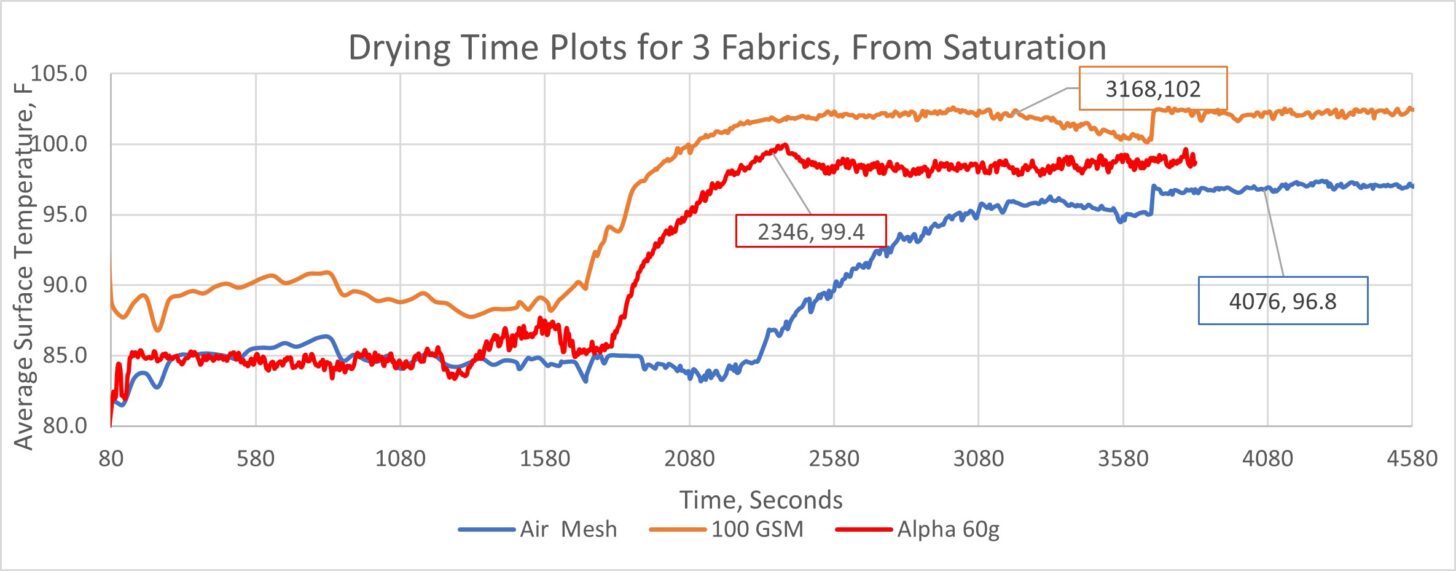
The video below shows the drying progress for Alpha Direct 60g and Airmesh. I provided a timestamp at the bottom of the image. As can be seen, Alpha Direct is nearly fully dry as Airmesh begins to visibly dry.
Wicking performance
I performed my Wick/Dry test on AirMesh and the 100 gsm wicking fabric. Since Alpha Direct is hydrophobic, I did not perform a wicking test on that fabric.
You can read more about how I perform the Wick/Dry test here and here.
The Wick/Dry test demonstrated poor wicking for AirMesh compared to the 100 gsm fabric. We see in Table 1 that the 100 gsm wicking fabric wicked over four times as much moisture as AirMesh. The moisture remaining in the 100 gsm fabric was over seven times greater than in the AirMesh. The amount of moisture that evaporated from the 100 gsm fabric was over three times greater than for the AirMesh.
The test probably overstates the amount of moisture that wicked into AirMesh. The measured wicking quantity is so low that a substantial portion of the water that left the sponge would probably result from the evaporation of water from the sponge. The released water vapor then passed directly through the AirMesh fabric. The water vapor did not contribute to the spread of moisture in AirMesh or the moisture remaining in the fabric at the end of the test.
We can better understand the poor wicking performance of AirMesh by watching the video below.
The video shows the AirMesh on the left and the 100 gsm fabric on the right. As the video progresses, the wicking presents as cold surface temperatures that spread from the sponge (the water source), located at the center, below each test fabric. In the AirMesh, the moisture spreads a limited distance and then stops. Moisture in the 100 gsm fabric spreads over nearly the entire surface of the right kettle. AirMesh’s poor wicking performance is happening for two reasons:
- Low capillary capacity. Low capillary capacity is present in AirMesh due to relatively few yarns per square inch and a large portion of void space between the yarns (see Figure 3 above).
- Poor wetting performance. Poor wetting performance in AirMesh results from the presence of brushed fibers that extend from the skin side. My first article on wicking concluded that napped or brushed fibers require extra force to start the wetting process and as a result, napped or brushed surfaces cannot provide reliable wicking performance.
We can see the impact of the brushed skin side in the following video. In this video, the left image is face-side up, so the skin-side brushed fibers contact the sponge. The right video is skin side up, so the knit face fabric fibers contact the sponge. On the left image, the moisture spread covers less surface (60 cm2) than we see on the right image (86 cm2). Here is how they compare:
The impact of the brushed skin side is seen in the following video. In this video, the left image is face-side up (“Face-Up”), so the skin-side brushed fibers contact the sponge. The right video is skin side up (“Skin-Up”), so the knit face fabric fibers contact the sponge. On the left image, the moisture spread covers less surface (60 cm2) than we see on the right image (86 cm2). Here is how they compare:
- The Face-Up test wicked half the moisture of the Skin-Up test.
- The Face-Up test had 1/3 the moisture in the fabric at the end as the Skin-Up test.
- The Face-Up test evaporated half the moisture of the Skin-Up test.
In comparison, the 100 gsm fabric demonstrates substantially better wicking and drying performance than either the Face-Up or the Skin-Up tests. Here are comparisons with the Skin-Up test results.
- The 100 gsm fabric wicked more than twice the moisture as the Skin-Up test.
- The 100 gsm fabric had nearly four times as much moisture in the fabric at the end of the test as the Skin-Up test.
- The 100 gsm fabric evaporated nearly twice as much moisture as the Skin-Up test.
After completing the Wick/Dry test, I weighed the AirMesh and 100 gsm fabrics and set them on the kettle surfaces to dry, with the thermal imaging measuring the drying time and drying rate.
As expected, the drying rates were close for the two fabrics, but the 100 gsm fabric took far longer to dry because it held more than seven times more water than the Airmesh fabric.
Field test results
I wore the AirMesh shirt for a 5-mile (8 km) run and a 20-mile (32 km) bike ride. For the run, I wore the AirMesh beneath a Patagonia Houdini wind shirt. The AirMesh was my only layer on the bicycle ride. The shirt retained 57 grams of moisture after the run, with another 106 grams of moisture condensed on the inner surface or the weave interstices of the wind shirt. After the bicycle ride, the AirMesh retained 23 grams of moisture, despite constant airflow over the shirt.
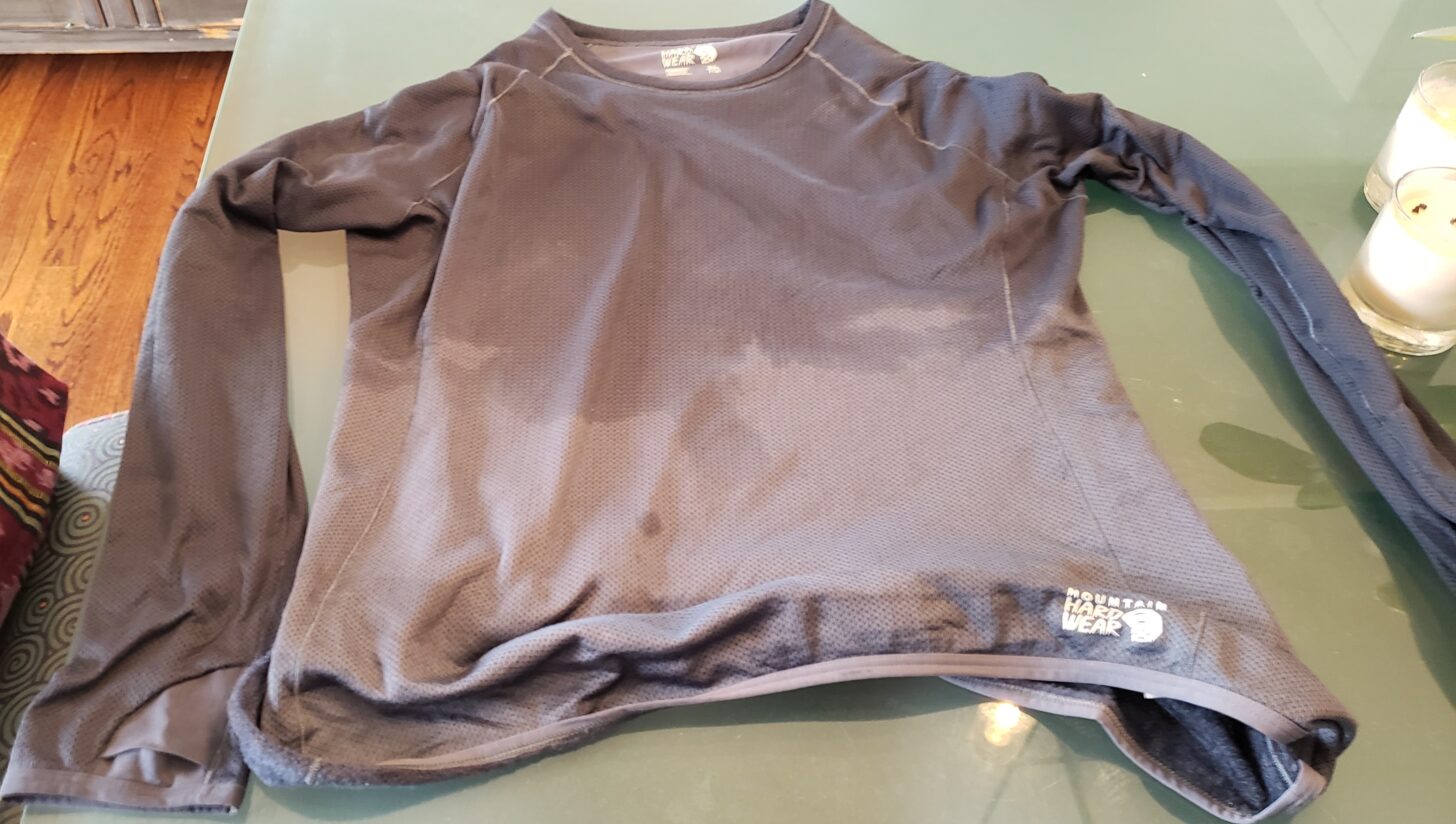
Figure 6 shows absorbed moisture on the chest and sleeves of the shirt. The same pattern repeats on the back. From this photograph, I suggest the following:
- We can conclude that wicking and drying were not keeping up with sweat generation during the run.
- Moisture did not effectively spread into dry portions of the shirt.
- Effective wicking appears to have occurred only where the shirt was under sufficient pressure to support wetting. This pressure happened at the chest, upper back, and sleeves.
Wicking did not happen on the lower portions of the shirt. These areas were generally dry. Moisture transfer in these areas would be limited to whatever could evaporate on the skin and travel through the fabric. The wind blew during the run, which should have maintained some pressure on the lower portions of the shirt. Evidently, there was not enough pressure to encourage wicking. Of course, as is often the case with field tests, we can only speculate on the causes of the wetting pattern seen here.
We do know that at saturation, the Airmesh fabric can absorb about 2.5 times its fabric weight in water. Let’s assume that the shirt above is 2/3 wet. Let’s assume that piping, stitching, and labels account for 15% of the shirt weight. That means this shirt, when saturated as shown in the photograph, would accumulate an extra 67 grams. This weight is fairly close to the 57 extra grams of water weight we measured in this shirt. It is likely that most of the areas that appear wet in this shirt are saturated and that the wicking ability of the fabric was degraded after the one-hour run.
Conclusions
Our testing revealed that the Airmesh fabric does provide very good warmth to weight performance. However, Alpha Direct 60 gsm provides greater warmth and a substantially better warmth-to-weight performance.
The tests also confirmed that Airmesh can absorb more water than the conventional wicking fabric or Alpha Direct. Elevated moisture absorption can substantially degrade the good thermal performance produced by the Airmesh shirt when dry. Our drying tests showed that drying performance of saturated Alpha Direct was far superior to Airmesh.
Our wicking/drying test reveals that Airmesh offers inferior wicking performance compared to a conventional wicking fabric due to unreliable wetting performance and limited capillary capacity.
Field tests suggest that moderate to high exertion levels can get this shirt to approach saturation conditions quickly.
The test results presented here should give the readers a pretty good idea of what to expect from the Airmesh shirt for their intended uses. As a result, the readers can make an informed decision as to whether or not this garment is likely to meet their needs and improve on performance available from other options. In my opinion, I would avoid the AirMesh shirt for high output activities where elevated sweat will be produced and ventilation to help drying is limited.
Learn more
Browse our curated recommendations in the Backpacking Light Gear Shop – a product research & discovery tool where you can find Member gear reviews, Gear Swap (used gear) listings, and more info about specific products recommended by our staff and members.
Gear Shop » Clothing Systems

Related content
- Catch up on the rest of the By the Numbers series.
- Explore the rest of our Gear Testing and Research content.
- Read our community’s discussion of Mountain Hardwear AirMesh garments in this forum thread.
DISCLOSURE (Updated April 9, 2024)
- Backpacking Light does not accept compensation or donated/discounted products in exchange for product mentions or placements in editorial coverage. Some (but not all) of the links in this review may be affiliate links. If you click on one of these links and visit one of our affiliate partners (usually a retailer site), and subsequently place an order with that retailer, we receive a commission on your entire order, which varies between 3% and 15% of the purchase price. Affiliate commissions represent less than 15% of Backpacking Light's gross revenue. More than 70% of our revenue comes from Membership Fees. So if you'd really like to support our work, don't buy gear you don't need - support our consumer advocacy work and become a Member instead. Learn more about affiliate commissions, influencer marketing, and our consumer advocacy work by reading our article Stop wasting money on gear.


Discussion
Become a member to post in the forums.
Companion forum thread to: By The Numbers: Testing the Performance of Mountain Hardwear AirMesh Garments
Is Mountain Hardwear AirMesh a breakthrough product or a prisoner of wicking base-layer physics?
Those tests are very interesting data. although, I am not sure how they translate to my real-world experience with the shirt. I am not at all close to as smart of some of you here, so feel free to rip my thoughts apart accordingly. LOL
1. Did you ever try running the Airmesh inside out? It completely changes the way it performs in real-world use, when inside out. The mesh layer absorbs liquid much better than the fleece side. It also changes how the air interacts with the heat and moisture exchange.
2. Wicking is lame. Yes, I said that. Wicking is lame. That’s old-school dinosaur stuff. ;) I’ve moved away from any sort of layers that rely on wicking and it has completely improved my clothing system in every way. I now find that having all of my clothing layers with excellent CFM air transport just plain work better in both heat and moisture management. I think wicking is along the lines of older guys using massive boots, where as trail runners are better in so many ways.
3. The trait of how the fleece side does not transfer moisture, but the mesh side does, seems to have been stated in a negative light here. Well, I think it’s actually a massive positive. I use my airmesh shirt as a camp towel, or even at home in the shower. I can turn it inside out and put it on, instantly soaking up water from my skin, then take it off and flip it right side out and now all that moisture is off my skin, but also in a state where it can dry off from the shirt. I can also put the shirt on over my other layers at this point for the same effect.
4. While not part of this test, airmesh is quite a bit more durable than Alpha-direct. My airmesh shirt has over 100 days of not-kind use and shows no signs of wear, even from pack shoulder straps.
5. Airmesh feels and works better next to skin than alpha direct.
6. I think overall it might be difficult to pin-point this new shirt based on traditional notions of versatility and testing protocols. It could be that it is used in ways that do not translate well to some tests, or that some tests might not show the whole picture when it comes to the net versatility of the shirt. The reason I make these questions is because in my real-world testing, I have never once used any sort of shirt that has the same features and traits of the airmesh hooddie I have.
Great real world testing Stephen and BPL. Thanks for your objective 3rd party reporting.
Stephen, in your subjective opinion, what is your preferred active insulating fabric based on your testing and personal experience?
I admit it has quirks as a garment, but your tests seem to show Alpha direct as a tough material to beat in moisture transfer and weight:warmth.
Have you tested Kuiu’s Peloton 97 fabric? I’d like to see how that stacks up too
Hi Johan:
I have been following your comments on this fabric, so I am glad you read the article. I will respond to your comments.
1) I have to destroy the shirts to accomplish the complete set of tests. I did not run with the shirt reversed and now, the shirt is in two pieces, so I won’t be able to run in the shirt reversed. However, the video I made of the shirt wicking in reverse demonstrates that it absorbs moisture much better in reverse. I did not test drying rate in reverse. Thinking about this, I can come up with reasons why drying could improve in reverse. However, I can also come up with reasons why drying would slow. It would be interesting to test this aspect of performance. So, under some circumstances you might get better performance from the reversed shirt, but under heavy sweating, I doubt it would perform any better. You obviously have a better feel for this than me. No matter how you wear this fabric, poor wetting and little wicking ability on the skin or fleece side and lack of capillary capacity on the normal face side serve to limit moisture management performance of the fabric.
2) I basically agree with you that wicking is not useful or reliable for reasons stated in my prior articles. I also agree with you that air permeability is critical in removing moisture as long as the layering system provides adequate ventilation to take advantage of elevated fabric air permeability.
3) I do state the performance of a napped surface as a negative. It degrades wicking but is often incorporated into a garment designed to wick. I can see how the use case you describe might work, but I am not sure how practical it would be to wear a garment to absorb moisture from the skin and then flip it to dry. I don’t doubt this would work. But it would be a lot of effort and does not address long term use during constant activity. I would rather wear a system that can continuously support sweat evaporation from the skin and vapor transport out of the layering system.
4) As I said in the article, I expect that this material may provide better durability than Alpha Direct. If nothing else, it will avoid snagging more easily because of its tighter knit. However, I wear Alpha Direct as a 2nd layer all winter long for hiking, skiing, biking and more. I probably have well over 100 days use on my single layer 60 gsm shirt and perhaps 30-40 days on my dual layer 60 gsm shirt. My garments have suffered no damage and have been washed after every use. Clearly, as an outer garment, you don’t want your Alpha Direct to be snagged on vegetation.
5) I have worn Alpha Direct directly on my skin only once, but it was very comfortable. That is a use case I should explore more, but that will have to wait until fall. I wore the AirMesh against my skin for hiking, biking and running. It is also comfortable.
6) Ultimately, any garment involves performance trade-offs. My lab tests can provide a pretty good understanding of what those are. In this case, I found excellent warmth to weight performance, excellent air permeability but I found moisture management to be inadequate for intensive activity that involves a lot of sweating. There are many combinations of activity level, layering approaches and environmental conditions that might support adequate performance of AirMesh. This is clearly your experience. There are three more articles left for this series. In the last, I will describe my layering approach which serves me well for my activities in the environmental conditions I experience in the Colorado Rockies. User experience will always vary.
The octa deployed in the proton Fl seems one sided (compared to above photos) – like half the material knitted to a large open mesh such that it’s individual fuzzy fibers sticking away from the skin (easily seen by eye in pockets). Seems like a different weave/deployment. So curious if that changes the extrinsic properties compared to the weave like deployment above. Obviously your article is amazing and the intrinsic properties are the same. I just wonder if a less dense one sided deployment is why the proton fl shines so less as a versatile lateral – and it definitely does.
Hi Hanz:
Thank you for reading. I pulled out a portion of my now cut up AirMesh shirt and compared it to the photograph from my article on active insulation that shows both sides of the Proton FL insulation. I would say that these seem to be the same fabric, but in different colors. It looks like Arcteryx made the same choice as Johan (see above comments from Johan) and uses the fabric in reverse of Mountain Hardwear. These photographs are produced differently. The photographs in the active insulation article are taken close up with a cell phone. The photographs in the present article are produced using a microscope. This makes them a little difficult to compare.
Hi Marcus:
As I discussed in my article on Active Insulation, the term Active Insulation seems to be a marketing construct that covers whatever performance characteristics a manufacturer is trying to ascribe to a particular product. Fleece traditionally was a go to active insulation. I stopped using fleece and replaced it with Alpha Direct. I have a 120 gsm piece (my first, which I no longer use), a 60 gsm piece and a 2×60 gsm piece. I use these with layers that provide ventilation so that moisture vapor from the skin can travel through the Alpha Direct and vent to the exterior. Alpha Direct is hydrophobic. It does not wick. You really have to work at getting Alpha Direct wetted from sweating.
I have not tested Kuiu’s Peloton 97 fabric. I get the impression it is popular among some BPL readers. Looking at Kuiu’s website, the 97 fabric is said to be a wicking, hydrophobic fabric. A fabric that is hydrophobic does not wick because water molecules are not drawn to the fibers. If this insulation is placed against the skin and heavy sweating occurs, moisture will be pushed into and through the garment by diffusion, not wicking. It is also described as themo-regulating. This is another strange, overused and generally undefined and misleading term. Thermo-regulating suggests a performance response that results from a humidity or temperature condition on one side or another of the garment. Wool may be thermo-regulating to an extent because of the way water is bonded to or released from the hygroscopic interior proteins that comprise the inner cell structure of a wool fiber. There are other fibers that can change characteristics in response to changes in temperature or humidity. Neither happens with most polyester fleeces. So, is this stuff “just fleece” or something different? If any readers would like me to test one of these garments, drop me a PM to make arrangements.
Ahh. I see. Yes. The same likely.
My opinion is that the proton FL continues to have the most use-case scenarios of any jacket I’ve owned (just a great mix of wind protection and breathability at many high output scenarios. I match this with a highly wicking skin tight Patagonia thermal weight base layer and I get a huge spectrum of comfort while moving. (All opinions of course).
And then thinking out loud, the least useful application of an alpha direct product I’ve tried to date was a Kora zenolith sweater matched yak and merino 240g wool with a alpha direct interior and mesh inner. I just never find a situation that this was appropriate for me.
nice article.
Hi Hanz:
My next article compares the Patagonia thermal and mid weight base layers. You may be surprised by my test results, so check it out.
I looked up the Kora Zenolith. That is one heavy and expensive garment. The portion of yak fiber is small, so I doubt the user can identify any impact from the blend. I tried to get a yak garment for an article I am working on. No luck. It appears that yak fibers are harvested by yak herders who follow the animals around and pick up the fibers from the ground as they shed. If true, does not seem like a scalable product.
I’d like to see you guys review the VOORMI river run hoody like this too… my non scientific in field use tells me its the best breathable sun hoody in existence for high temp conditions, would likely hold way less moisture than this garment, looks better, feels better on the skin and its only weakness is how thin it is in mosquito zones. This fabric looks like a bit of a fail to me, many other better options available imho.
Adam: Looks interesting. Can you look at the label in the garment and post what the fibers are. This appears to be a bicomponent fabric, but the website is unclear whether the skin side is wool or polyester.
Steve
Hi Johan (and others),
I too fail to see how wicking baselayer can be beneficial (if they even exist as advertised). This theoretical concept has led me too experimenting with Alpha Direct as a baselayer, with nothing underneath.
I have now worn Alpha Direct next to skin many times and absolutely love it for this use.
Hi. Two comments. 1). The Airmesh has one significant advantage over Alpha: Availability. Other than a few cottage makers (who routinely runout) it is very difficult to find Alpha garments. I love mine—I have both a MacPac hoodie and a Rab Alpha Flash—but I can’t reliably get one. 2) To Adam’s comment about the Voormi, I have the Voormi, and it’s my favorite shirt for walking…in town. On the trail, in anything above 40 or 45 degrees, it’s just too warm for me. It’s moisture management seems okay for a 50% merino shirt, but as Outdoor Gear Labs noted, when it becomes wet it becomes very dark. Not a great feature for a sun hoodie. I am looking forward to trying it in colder temps in the fall.
Hi – New Member, love the research. Question for you Stephen. Have you thought about Airmesh under Alpha Direct? Would the AD help continue to move the moisture outward? Or do you think the saturation would stymie the usefulness of the AD?
Thank you!
Hi Ryan:
The answer to your question is in Table 1. In the spin dry test, AD retains far less moisture than Airmesh. 26% water weight for AD and 52% water weight for Airmesh. This is because of its more open knit structure and its use of conventional cylindrical fiber extrusions and, importantly, its hydrophobic fibers. The saturation drying test further distinguishes moisture handling properties: They both hold about the same amount of water when saturated. But AD dried in 39 minutes and Airmesh dried in 68 minutes. This behavior is again the result of the AD open knit structure, its use of conventional cylindrical fiber extrusions and its hydrophobic fibers. Both metrics highlight very large performance differences between the two fabrics.
I don’t advocate using hydrophilic base layers in contact with skin. If you are sweating heavily (or lightly for light weight wicking fabrics) they will tend to saturate and become an impediment to removing excess heat. If you want to promote sweat evaporation on the skin or add additional warmth, I suggest wearing a fishnet beneath your AD. That is what I do all winter.
Hi Stephen:
I found that you recommend Finetrack Elemental Layer and Brynje as a combo in article “staff pick 2022”, but do I still need the Finetrack if I have an Alpha Direct ?
1: Brynje +Finetrack+Alpha Direct
2: Brynje+Alpha Direct
Which is better?
Also I recently purchased Patagonia Cap Air and found it to be a good base layer, would you be interested in testing it or comparing it to the Brynje, Finetrack or the combo?
Finally, thank you for writing these test articles, it really helped me a lot
When temperatures get cold and I need more insulation, I replace my Finetrack with a 60 gsm Alpha Direct or an Alpha Duo (2x60gsm). I usually layer the Finetrack over the Brynje in warmer weather, including summer. I use either long and short sleeve versions of Finetrack or Brynje as conditions dictate. Depending on conditions and my level of effort, I often wear nothing over the Brynje/Finetrack combination. (I wish Finetrack came in white or light colors to reduce the solar gain when worn as my outer layer.) The purpose of the Finetrack is to provide some protection against wind while covering my unsightly torso and not wicking liquid moisture. When it gets hot, I have been known to eliminate the Finetrack and hope the resulting view is not too offensive. Most of my hiking is in Colorado, so the humidity conditions I experience in the summer will generally be far less severe than in other parts of the country, so your results may vary. The objective of all this is to encourage sweat to evaporate on my skin and not be absorbed into subsequent layers. All subsequent layers are selected to provide the easiest path for water vapor to exit my clothing.
Hi Stephen, I know these are possibly questions for your next instalment but you seem to be answering questions here so I’ll chime in. Can you explain why you aren’t wearing the Finetrack against your skin? It would still serve the purpose of reducing the windchill and keep a modicum of dignity under the Brynje.
The weather is cooling here again slowly so I’m back thinking about all of this again ante a hot and dry summer here in Christchurch. I even geeked out and purchased a couple of data trackers (temperature and humidity) to record conditions and used them last night on a dog walk for the first time. One on a lanyard around my neck on the outside and the other in an internal mesh pocket in my waterproof jacket. I am aware this is probably not particularly accurate, or scientific BUT it gives me some idea of what’s happening.
Thanks, Scott
Hi Scott: You always ask the hard questions. When I concluded that wicking shirts were not working for me a few years ago, I was sent a Finetrack by a member to examine. I thought it looked promising and started wearing one instead of a wicking base layer. Like any hydrophobic fiber, it won’t wick. However, with enough sweat, the fibers will absorb water through diffusion. Against my skin, it can work better than a wicking base layer, but not well enough. The mesh structure of the Brynje gives sweat a better opportunity to evaporate and dissipate as vapor. It is not perfect. I can and have worked hard enough to wet the polypro fibers that form the Brynje fibers. Again, through diffusion. When that happens, I feel cold, like with a wet, wicking layer. I did that while skinning at 9F last week. It was colder than usual, and I added more insulation than I should have. Today, it was 1F, and I wore less insulation than last week, and all worked well. I do my quantitative testing to inform my clothing choices but then, I try to prove my choices in real life.
By the way, I have also run with sensor tiles. If more people did this, we could generate lots of performance information on all sorts of gear we use. At the beginning of winter, I was using them to measure temperature/humidity inside my single-wall tents vs outside conditions to verify a technique for eliminating condensation on the interior tent surfaces. $100 for two SensorPush HT1 bluetooth sensors that send continuous data to your cell phone. Amazing.
Hi Stephen, I’m not sure if that’s a good thing or not, an I apologise if my questions are annoying.
I definitely overwhelm my Finetrack BUT that is running, I’m yet to test it properly whilst hiking/walking, or “tramping” as we call it in New Zealand.
I got two of the Ink-Bird sensors which look remarkably like the SensorPush ones you have. I have downloaded the data, and just learnt how to make a graph/chart in excel to compare the two sets of data (inside/outside). My first experiment yesterday was enlightening as it showed and average of 13.8*C and 92%RH outside, and 22.5*C and 63.8%RH inside my jacket. Absolutely no way that pressure differential is going to work to remove moisture from a WPB.
Any other tips that I should be aware of or looking for with my data collection?
Thanks again for tolerating my annoying questions, Scott
So what could we learn from wearing these sensors? I’m game to try, but not sure that I know what to do with the data.
Hi Bill, I’m just interested to get some actual data, especially about the RH differential when using a WPB garment. I want to determine my own clothing strategy. Our climatic conditions seem so so different to those that Stephen experiences but until now it’s just been anecdotal. Our RH is so much higher than Colorado.
Are you calculating/estimating vapor pressures on both sides of the fabric? Maybe I’m slow, but it isn’t immediately obvious to me how you use the numbers.
I suspect that climate does play a role in WPB performance. As a sweeping generalization, it appears that people who love their WPBs tend to live in drier climates, while people who think they are pointless (or limited) tend to live in more humid climates. Is that what you are saying?
Hi Scott: The pressure difference of your example is 289 pascals or .04 PSI. Not much pressure, so don’t expect much vapor transmission. But you have to wonder if that is the right number. The temperature difference should probably be based on the temperature and humidity at the skin’s surface. If you had a base layer of some sort on and then placed a sensor in the mesh pocket, as you described, you probably are not seeing the entire picture.
It is unclear whether using the temperature/humidity sensor is superior to simply measuring the sweat accumulated in a wicking base layer as I did for my permeability vs. breathability article. If you use the humidity sensor, I think you would like to see which garment has the biggest impact on minimizing RH at skin level.
When using the two sensors, you should ensure they both read the same numbers for the same conditions. Before starting a test, I would place both sensors together in a room. Let them sit for around 15 minutes to reach equilibrium. If possible, have a low cost temperature/humidity monitor available. The temperature on such a device should be pretty reliable. Humidity will be less reliable as the value in the room goes lower. Then adjust the offsets so both sensors have the same readings. The sensors respond to changes in temperature/humidity relatively slowly. On mine, the sensor is seen through a hole on the back of the device.
I would wear the sensor on a string fastened around my neck, with the sensor sitting against the skin at the center of the chest, approximately over the heart. It might work best with the sensor hole toward the skin. The external sensor can be attached to the outside of your clothing so that air can freely circulate around it. Unclear if the external sensor should be protected from solar gain.
Before starting an activity, I would give the sensor perhaps 15 minutes to reach a “steady state” relative to its environment. You can tell when this happens if you watch the temperature humidity plot it produces on your phone. The plot will change rapidly and then flatten. After the plot becomes flat, you can begin your activity. The outdoor sensor should be put through a similar process.
When you begin your activity, you may want to have a fairly rapid data collection rate: perhaps one reading every 15 or 30 seconds.
I am assuming that you will use the data to compare various garments. To provide a realistic comparison, you may want to do your activity with a heart rate sensor to get a good idea of your level of effort. At a minimum, you should obtain your average heart rate during the activity. When I gathered data for my air permeability vs MVTR article, I had a metabolic test done to convert my heart rate data to Met level data. Some sports watches provide an estimate of MET level. This could be good enough as a measure of your activity level.
When you repeat this test for different garments, you will want to conduct the same activity at the same level of effort to make comparisons convenient. You might want to review the methodology I used here.
You will probably have to repeat an activity several times to understand changes that occur with different garments and weather conditions. You must gain enough data to judge whether this methodology provides useful information. If you find you can distinguish performance among various garments, you will probably need to develop a repeatable methodology that will yield dependable comparisons among garments.
I experimented with using humidity/temp sensors a bit before doing the data acquisition for my air permeability vs mvtr article. I decided that the sensors I had available were not reliable enough and did not pursue any more testing with these devices until my recent tent project. The recent project was done with a more highly developed sensor that had better accuracy and better software to compare and work with results.
I think Ryan Jordan did some data acquisition along these lines. If Ryan reads this thread, perhaps he can provide his opinion on its usefulness.
Hi Bill, this is all just a personal interest project, I am not as scientific or skilled as Stephen. I have been keenly reading and asking questions over the last couple of years as Stephen has released his findings. I do work in the Apparel industry here in New Zealand so there is some professional interest here too, but it’s nothing more than me trying to understand how things perform in our climatic conditions. The numbers Stephen has quoted, especially RH% is nothing like what I was seeing on my home, uncalibrated,”toy” weather station!
I have only used my data collectors once so far. One was worn inside my jacket and the other was on a string/lanyard around my neck on the outside of my jacket. It was a cool windy and rainy day.
And YES I am saying that climate plays a role in WPB performance. I deal with any complaints about the breathability our or garment that we make and sell and I would say that 95% on complaints are from people who are over dressed and get damp from internal moisture on humid days, in fact almost all of our complaints are from people in the North of New Zealand where it is both warmer and more humid. Gore has a lot to answer for with their “Guaranteed to Keep you Dry” promise!
Hope this helps, S
Become a member to post in the forums.