101 For The Win!
Would be awesome if a thread about spoons could one day challenge the Durston X-Mid 1P thread for length :)
Topic
Become a member to post in the forums.
 .
.
101 For The Win!
Would be awesome if a thread about spoons could one day challenge the Durston X-Mid 1P thread for length :)

I made my own 12″ titanium spoon. Weighs 4 grams
The next one will be better.
Roger needs an 11″ so I made one a little longer for the deeper freeze dried meals.
Packitgourmet large bags are 11″ tall.
Details:


OK Dan, so when will they be up for sale? =)
JR, it was meant to inspire the DIY folks that are lurking. :)

It is interesting to note that the woodcraft people are forever whittling forks and kuksa, making knives, axes, and for all I know, ploughshares (and good luck to them, as the wilderness rapidly continues to disappear), while Dan continues merrily on his hitech way with sophisticated Ti spoons, elegant stoves, practical screens, etc. Now who ya gonna call for life on Mars, or even the Moon?
Now who ya gonna call for life on Mars, or even the Moon?
BOC.
(British Oxygen Company)
Cheers
O~O…
Here is a question of Long Spoon Handlers Dan and Roger:
Are either of you familiar with flash boiling?
I have just edited a long paper on it (while knowing nothing about it). Apparently, the flash boiling phenomenon occurs when the ambient pressure around fuel is lower than the saturation pressure, followed by the formation and growth of bubbles. Flash boiling is considered a promising way to improve the atomization of the spray and reduce emissions without a high-pressure injection system. The paper addresses flash boiling spray in gasoline direct injection (GDI) injectors, with detailed characterizations of the phenomenon and constituents, but I wondered if flash boiling might have any relevance to liquid or gaseous fuel stoves? (I have no idea whatsoever). (Unfortunately, it is not yet published, so I can’t yet send you a copy, sorry).
Also, a paper on rotating stall characteristics in a centrifugal compressor with diffuser, which I mention because the highly detailed investigation and description of turbulent behavior illustrates that analysis and comprehensive understanding of Esbit, alcohol, and cartridge stove flames and burning behavior ought to be really feasible by someone highly skilled in the relevant fields. Beautiful figures by the way, color plots of instantaneous velocity field contours near surge point, time histories of unsteady static pressure during stall, instantaneous static pressure and entropy production distributions for various impeller revolutions, time/space entropy production contours on diffuser vane surfaces, all lovely stuff. Wish I understood it. Not knocking your expertise, either of you, in any way, just frustrated by my own ignorance.
So it ought to be possible to really understand these beautiful flames… reminds me as a child of the naughty lads next door who nearly burnt down their house playing with matches, vaguely recall it caused real serious damage to their house…
Hi Robert
Iirc, ‘flash boiling’ relates to a sudden drop in pressure in a liquid near its boiling point. It ‘flashes’ into vapour everywhere at once. Could be exciting …
So if you suddenly blew the base off a full canister, you would get a whole lot of flash boiling of the fuel. It would seem explosive. Interestingly, it would not involve a real explosion in the sense of a fuel/air mix, just a huge ball of vapour. Of course, if there was a flame nearby, THEN you might get a huge fireball of flame around a core of fuel vapour. I have got as far as creating the huge ball of vapour, but without a flame.
Is it relevant to our stoves? Yes, but only in the sense that I would hope to NEVER encounter it in the field, and certainly not in my tent! Instant megawatt cremation.
description of turbulent behavior illustrates that analysis and comprehensive understanding of Esbit, alcohol, and cartridge stove flames and burning behavior ought to be really feasible by someone highly skilled in the relevant fields.
HAH! The study of fluid dynamics is OK as far as it goes, but trying to apply the maths to the sort of volumes we are interested in is a nightmare. The difference between a large wind tunnel and one of our stoves could be summarised by the two words ‘skin effect’. Air blowing down a 4 m dia tube is one thing: the drag at the outer skin (the boundary layer) can be mostly ignored. At our scale of things, it is ALL boundary layer. And the maths for that is … hopeless.
Yes, I did try to work through the maths for the tiny jets in our canister stoves. It would seem that no-one wants to touch the subject! I gave up too.
Cheers
Sort of like the difference between a nuclear explosion and a nuclear reactor.
Watch the video on “super heated steam” and then watch the video on Tetkobas Capillary hoop burner. The capillary hoop vaporizes the alcohol at it’s base, travels up the thin corrugated ribs, becomes super heated and then exits through the tiny jet holes(turbulent behavior) and voila!!! Not sure if it can get any better than that. Maybe….just maybe, the Jim Woods Super Cat stove is better because it’s a “one piece” stove. Heats 2 cups with 1/2oz denatured 4-1/2 min.
http://jwbasecamp.com/Articles/SuperCat/


Cor blimey!
Dan, how is the fluting made on the capillary hoop stove, in general terms?
Robert, it’s shown in this video:
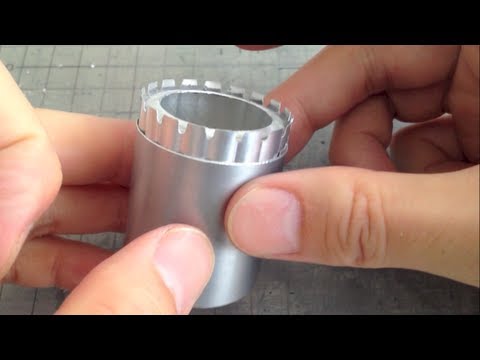
also in this one:
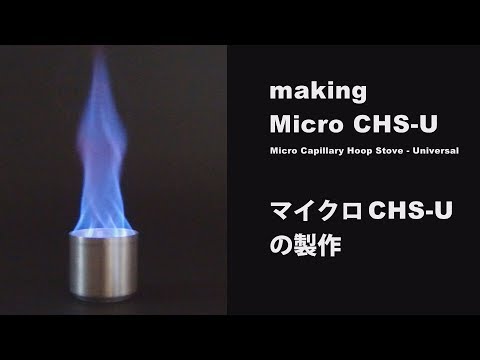
Thanks, Dan, wasn’t there some reverse (concave) fluting? I had better watch the two earlier videos again, as well as this. It just struck me as a tricky procedure, unless in some way the fluting gets popped into reverse curvature between two score lines. Just general interest, not planning to make one, (actually I’m interested in the general folding and curvature in itself), but the performance of both stoves looks impressive.
Dan, I wondered if you had come across this:
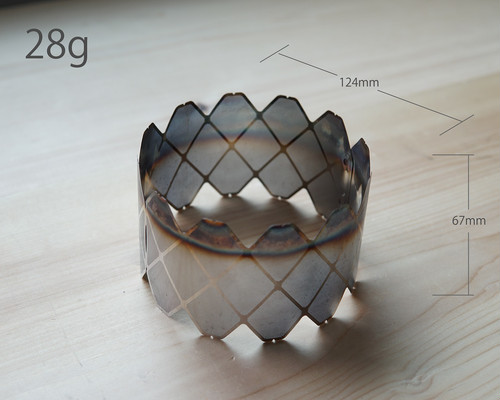
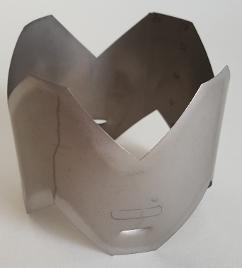
Ultralight windscreen Japanese Munieq
https://www.theultralighthiker.com/2019/10/19/most-beautiful-ultralight-windscreen/
Party hat! Did you sell the domecile?
Actually I now remember looking at these screens when last in Tokyo – the shop with all the stoves had them, among others. But I didn’t realize two (or presumably more) would connect together for wider diameter – which is an asset.
Roger, I take your point about skin effect or perhaps scale effect – I presume that as the scale reduces, the local effects become more stochastic and have relatively more influence, hence more difficult to analyze, maybe…
Better men than I have looked at the problem, and despaired. It is actually rather notorious.
Cheers
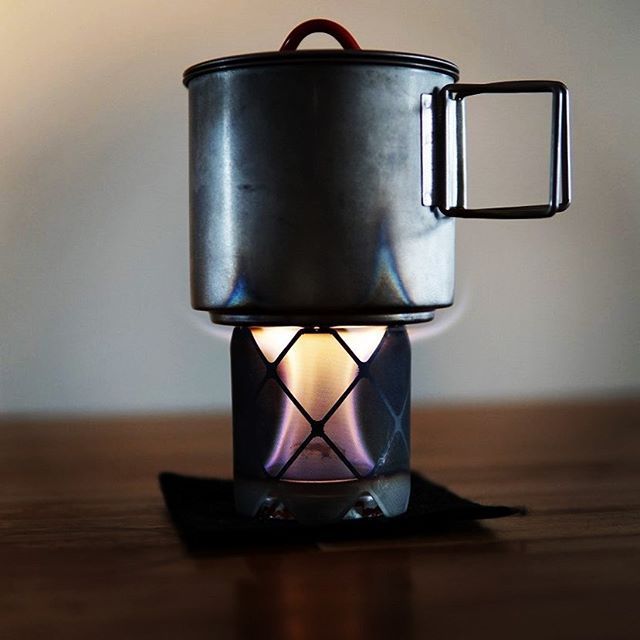
Look at the colored heat pattern on the side of the pot. It’s evident that flames going up the side of the pot do have the ability to continue to heat the water inside the pot.
I see the marks, but I interpreted them as (ESBIT) residues rather than heating. Do they clean off?
Cheers
That’s the color of scorched, highly heated, titanium. Esbit leaves yucky soot marks :)
Become a member to post in the forums.
 Brynje Mesh BaselayersBrynje baselayers use open mesh construction to move moisture away from the skin, create insulating air pockets, and help regulate body temperature across changing conditions and activity levels.
 © Beartooth Media Group Inc.
 Loading...