

Introduction
“Many men go fishing all their lives without knowing that it is not fish they are after.” – Henry David Thoreau
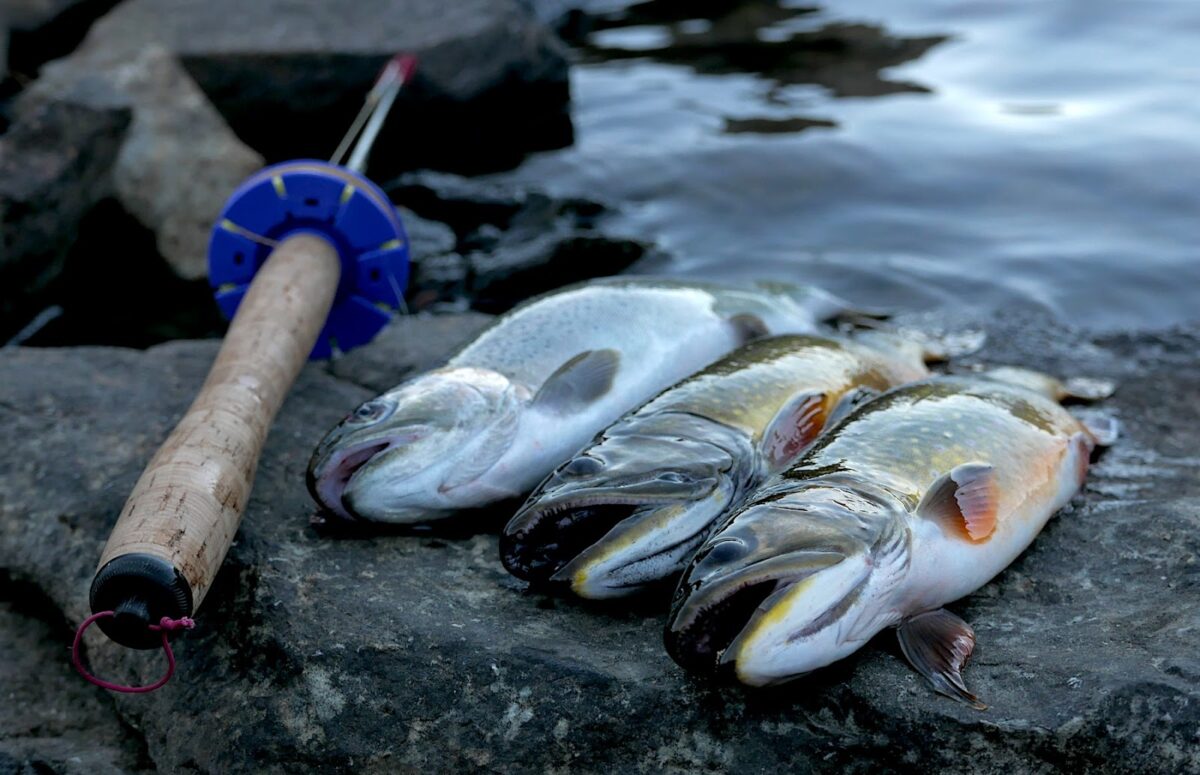
Fishing (also, hunting and foraging) has been part of the backcountry experience since the dawn of humanity. For some, it connects them to their ancestral roots. For others, it allows them to connect to the natural world on a more visceral level. For me, it’s both the feeling of self-reliance and a deeper appreciation of how nature nourishes us, both metaphorically and physically. In addition, I’ve always been a bit of an adrenaline junkie. And the endorphins (happy hormones) released following the adrenaline rush of catching a big, wary trout have a profound impact on my enjoyment of the backcountry.
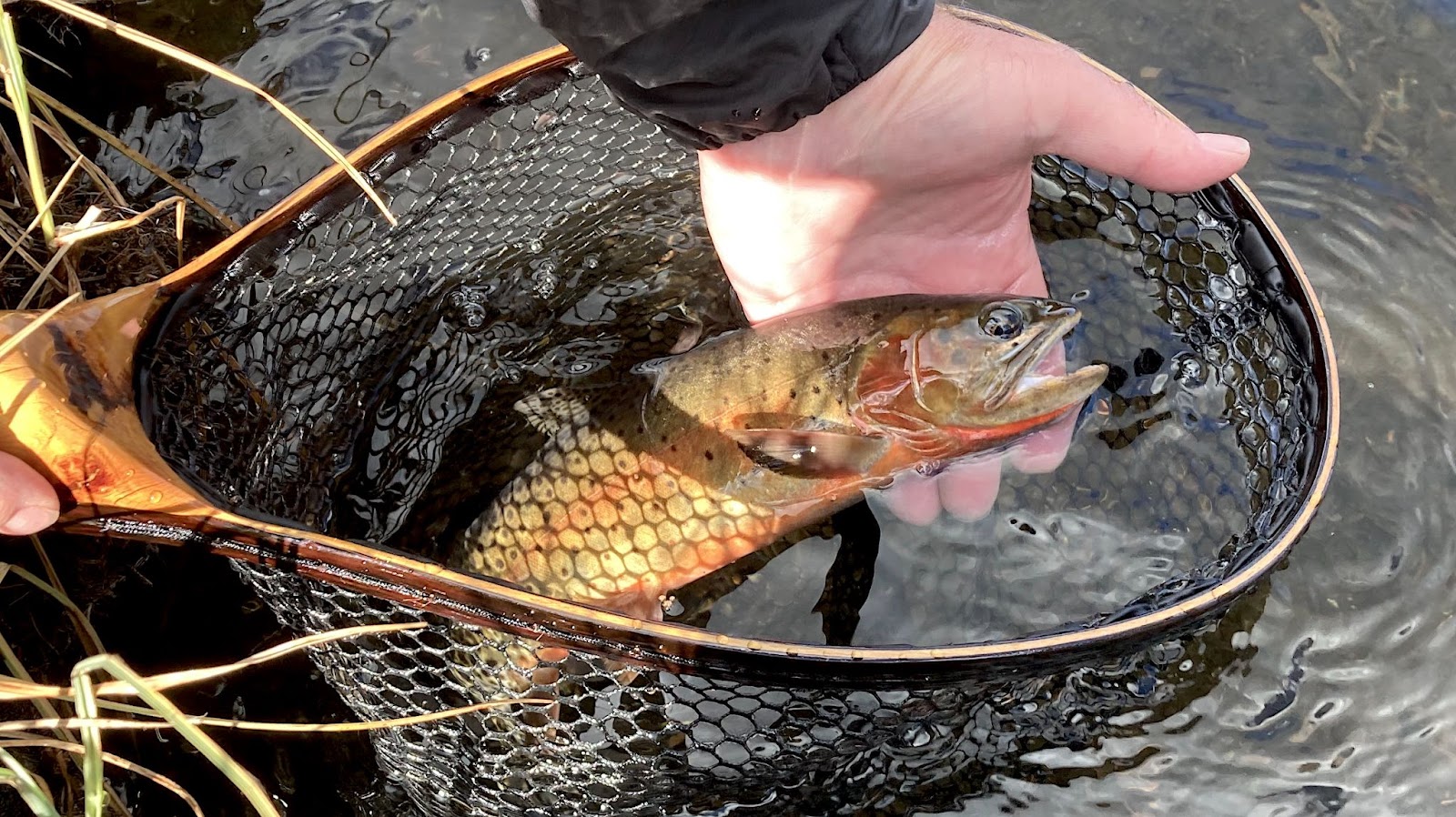
In addition to these benefits, fish are a healthy source of protein, omega-3 fatty acids, and essential vitamins and minerals. Cold water trout, in particular, have unusually high concentrations of vitamins D, E, and A, deficiencies of which can have notable impacts on the performance, recovery, and injury risk to long-distance endurance athletes (source). Admittedly, eating one or two trout per day may have a negligible impact on nutrition or performance during a short backcountry trek. However, it’s well-known that eating cold-water fish, including trout, can have profound positive impacts on one’s long-term nutritional health (assuming they were sourced from pristine and uncontaminated water sources or farms).
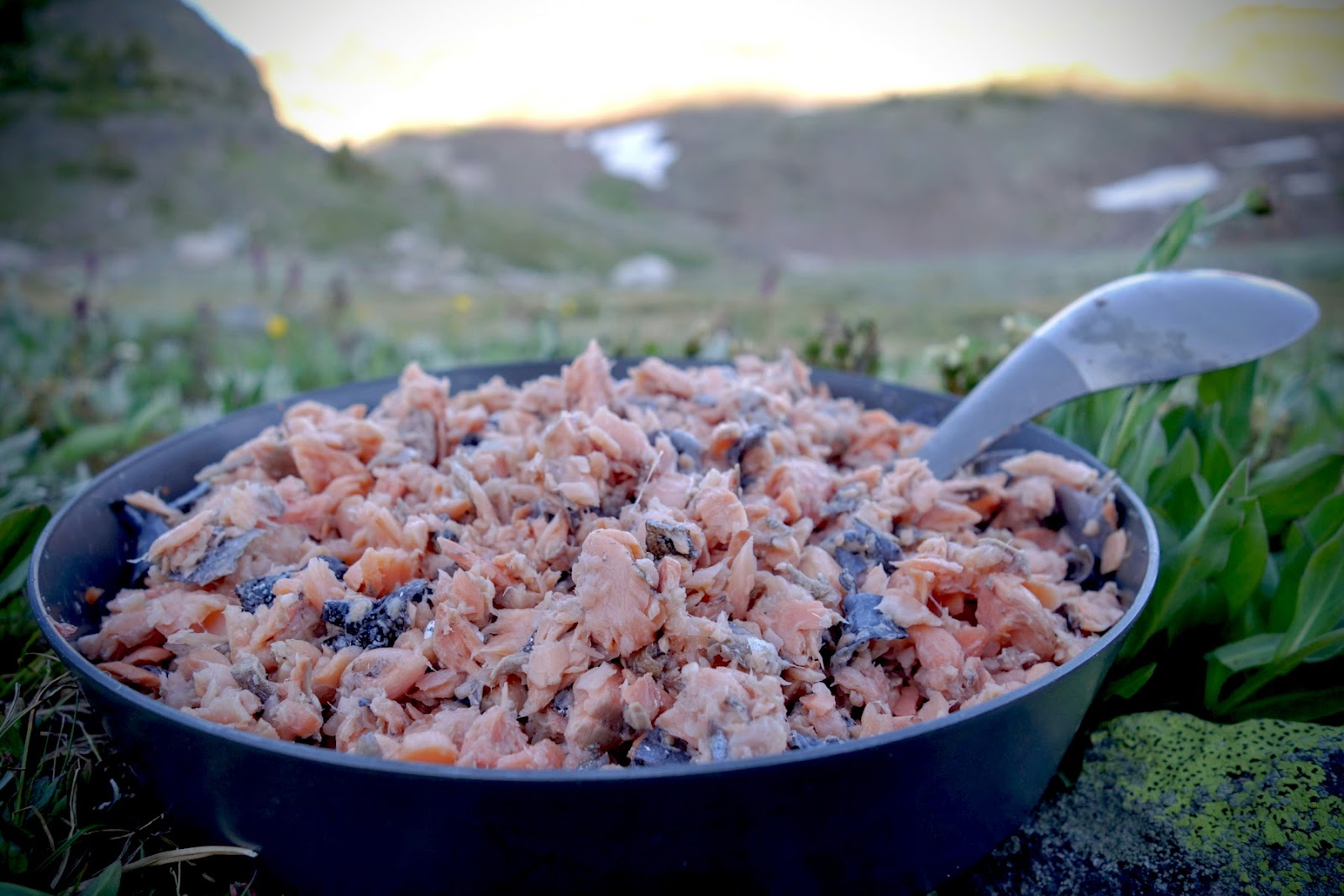
Consuming fresh fish in the backcountry can also provide a welcome break for the palate that’s accustomed to dehydrated, freeze-dried, pre-packaged, or processed backpacking foods. Enjoying a plate of fish tacos while watching the alpenglow fade on a nearby wilderness peak is admittedly, one of my guiltiest culinary pleasures in the backcountry.
But fishing requires some additional gear and unique skills. A deeper skill set, and some experience, is essential if the backcountry traveler is going to rely upon it for part of their caloric sustenance.
That’s why debates about the practicality of fishing and its ability to reduce food weight are not uncommon within the community of enthusiasts who call themselves ultralight backpackers. Therefore, the primary purpose of this article is to explore the specific question: can backcountry fishing save carried food weight?
In order to answer this question, I’ll follow this process:
- Calculate the weight of backcountry fishing gear.
- Estimate the probability of catching and eating fish every day.
- Determine the macronutrient content of that fish.
- Evaluate how much carried food weight the caught fish can replace without sacrificing daily nutrition or calorie intake.
- Calculate the number of days required to get a return (eating caught fish) on investment (weight of carried fishing gear).
- Compare these results using conventional, light, and ultralight backcountry fishing kits.
How much does fishing gear weigh?
The basic elements of a fishing kit include the rod, the reel, line (including leader and tippet), and either bait, lures, or flies.
Conventional (Western) Fly Fishing Kit – 2 pounds
For the purpose of this article, we are going to focus on fly fishing. A conventional fly fishing kit includes a fly rod (which is protected in a cloth rod sleeve and carried in a rigid tube), a fly reel, backing line, the fly line, leaders, tippet spools, flies in a fly box, a vest, and a few tools (hemostats, nippers) and supplies (split shot, strike indicators, and floatant). In addition, it’s not uncommon for backcountry anglers to bring a landing net, but they rarely bring wading gear (e.g., waders, wading boots).
In most of my interviews with anglers who practice conventional western fly fishing into the backcountry, the following gear list is representative of their kits:
- Fly rod – 9 ft 5 wt 4pc carried in a cloth rod sock and metal rod tube – 16 oz
- Fly reel – 5 wt with fly line and backing – 5 oz
- Extra leaders and tippet spools – 3 oz
- Flies and boxes – 4 oz
- Tools – 2 oz
- Other supplies – 2 oz
Minimalist (Western) Fly Fishing Kit – 1 pound
A conventional western fly fishing kit can be lightened up by making a number of compromises that would be appropriate for most backcountry fisheries:
- Reduce the length and rated line weight of the rod.
- Reduce the size and line capacity of the fly reel.
- Reduce the length of the fly line and eliminate the backing.
- Replacing plastic fly boxes with foam fly boxes.
- Replacing the vest with a hip pack or other type of pouch for tackle storage.
- Eliminating the landing net.
- Replacing the stock metal rod tube with something less rigid, like a plastic shipping tube with vinyl end caps.
In my experience, I’ve been able to reduce the weight of a western fly fishing kit down to about 12-16 ounces, recognizing that such sacrifices result in the inability to fight extremely large trout, which fortunately, are not common in the backcountry. The reason for this is that I’m carrying a lighter rod, less line, and a smaller reel. In addition, there are some sacrifices made in fly boxes and fly selection, which to be honest, I’ve never found to limit my ability to catch enough fish in the backcountry for reliable meals.
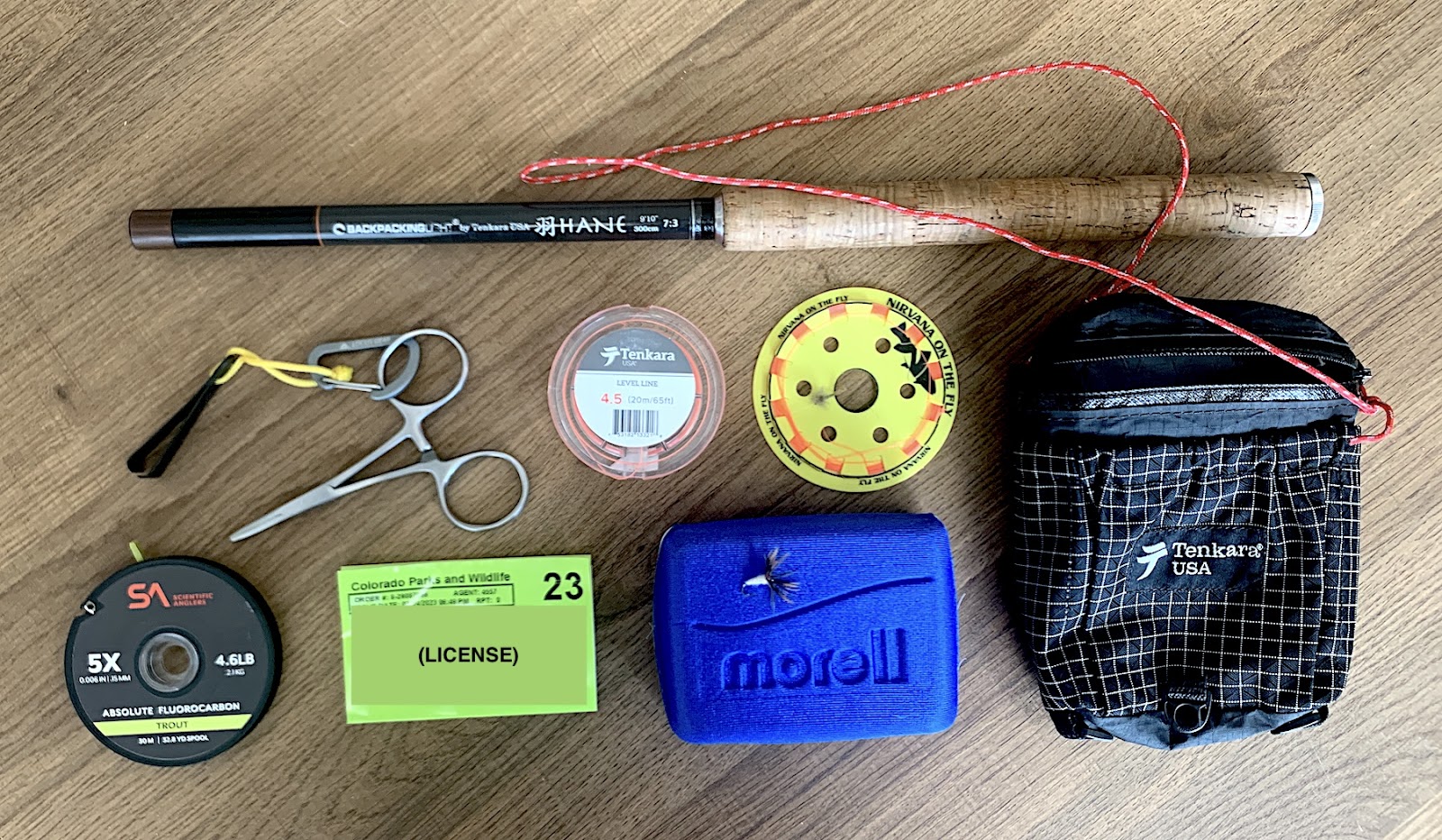
Ultralight (Tenkara) Kits – 0.25 pounds
Finally, at the lighter end of the range, one can assemble a minimalist tenkara fishing kit, which eliminates the weight of a fly reel and fly line.
And at the ultralight end of the spectrum, a tenkara kit can be minimalized to an extreme by including only those essential items required to catch small to medium-sized trout – e.g., rod, line, tippet, and flies.
What is the probability of catching fish every day?
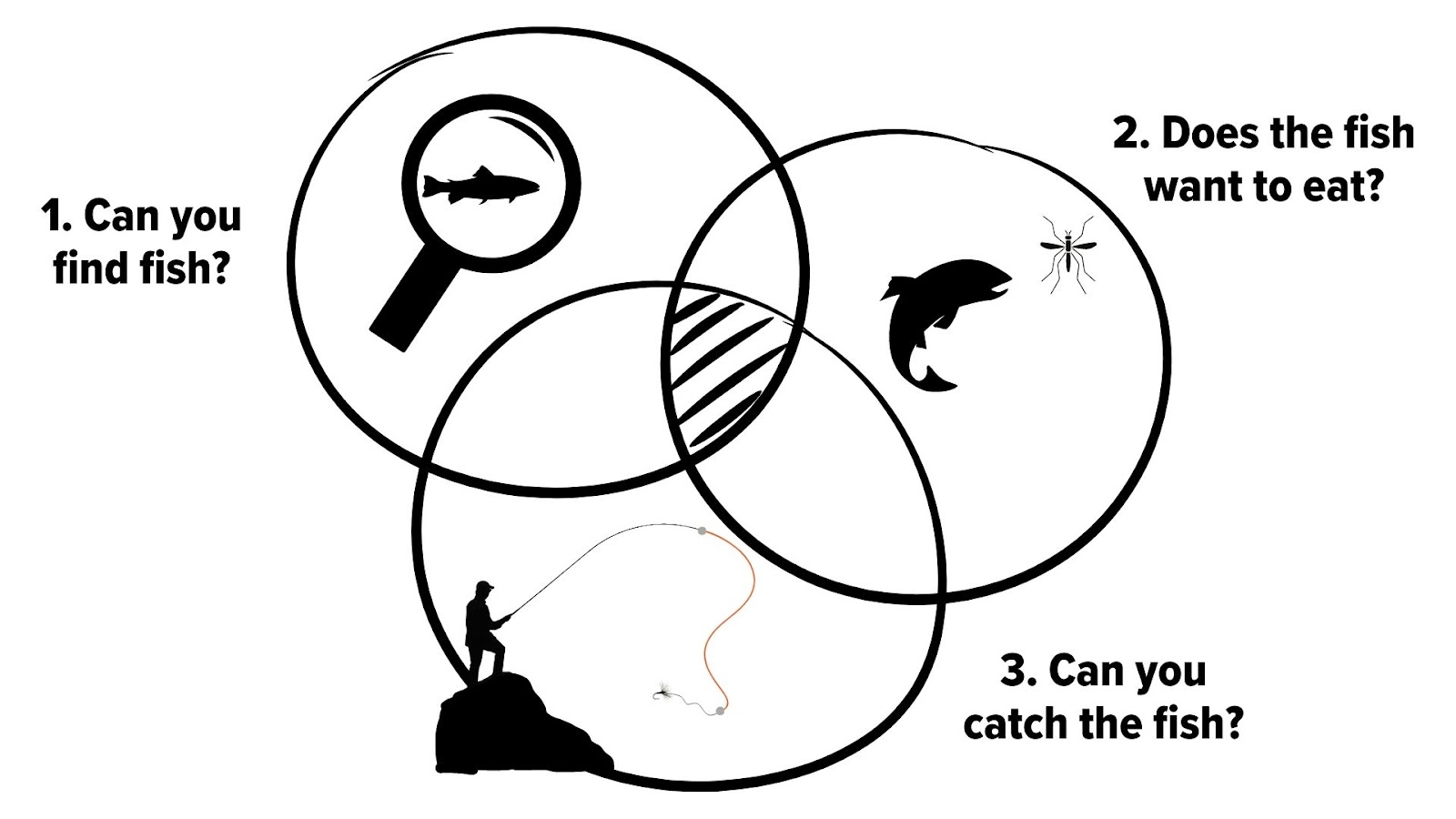
Whether or not you catch fish every day depends not only on you and your skill, but on the level of cooperation of the fish! Specifically, the probability that you catch a fish will depend on you finding the fish, the fish wanting to eat, and you being able to catch the fish.
Whether or not you find fish depends in part on your skill, and in part on whether or not there are fish in the area where you are hiking. The latter can be mitigated by doing research prior to your trip. Fishing reports from local fly shops, trip reports from backcountry users, and stocking reports (or fish population inventories or surveys) from land and fisheries management agencies can all be used to determine which lakes and streams are most likely to support populations of fish. Once you have identified a water body that houses fish, then your skills come into play. Understanding where fish lie and feed in the waterbody makes your fishing efforts more efficient. Otherwise, you may just be casting into water in the hopes of catching a fish that may never show up.
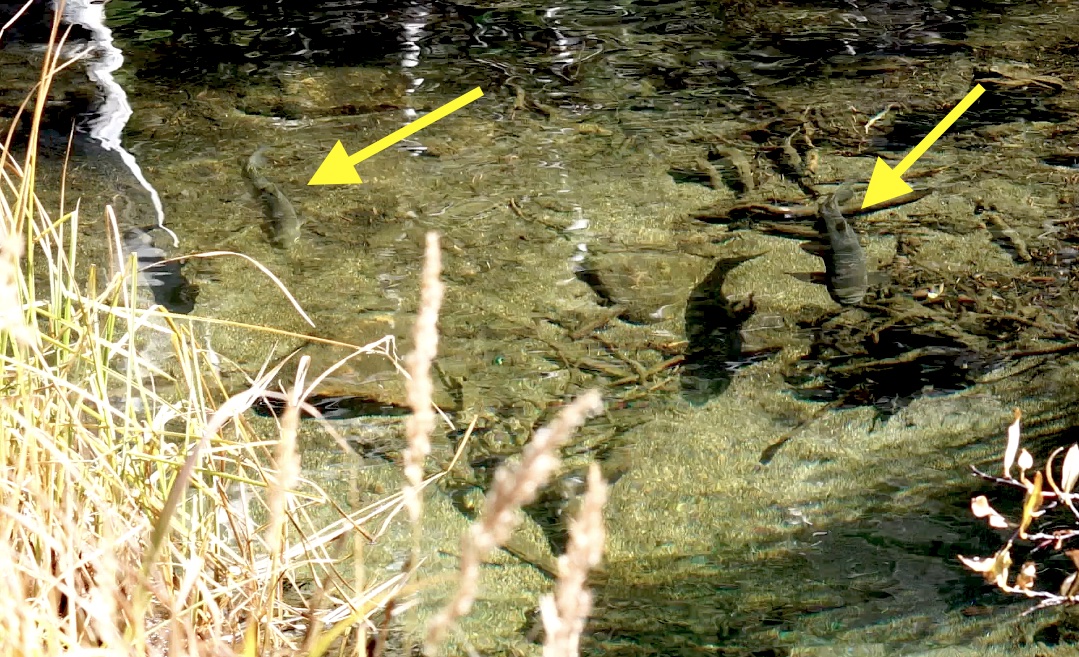
Fish feed in response to a variety of conditions. Seasonality, environmental conditions and the activity of food sources are the two most important. Sunlight (or cloud cover), wind, barometric pressure, lunar phases, water temperature, and air temperature may have an impact on both the activity of food sources and whether or not fish will feed on them. In one of my favorite headwater streams in the Montana Beartooths, I know with almost absolute certainty that calm, sunny, fall afternoons result in a Dicosmoecus gilvipes (October Caddis) hatch that makes trout go into a feeding frenzy.
Finally, once you’ve found the fish and are confident that they’ll eat, you still have to present your line, leader, and fly to the fish so as not to spook it and have them sense that you’re a predator. And assuming you hook a trout that takes your fly, you have one more step ahead of you: land the fish so you know that it’s going to make it into your cooking pan!
How much nutrition does trout meat provide?
Now that you’ve caught your fish, let’s figure out how much nutrition it can provide. The following table shows the relationship between the size of a trout, how much edible meat can be harvested from it, and the macronutrient profile of that meat.
| Length (inches) | Weight (ounces) | Edible Meat Weight (ounces) | Protein (g) | Fat (g) | Carbohydrates (g) | Calories |
|---|---|---|---|---|---|---|
| 6 | 1.1 | 0.6 | 3.2 | 1.6 | 0 | 24 |
| 8 | 2.7 | 1.3 | 7.6 | 3.8 | 0 | 57 |
| 10 | 5.2 | 2.6 | 14.7 | 7.4 | 0 | 111 |
| 12 | 9 | 4.5 | 25.5 | 12.7 | 0 | 191 |
| 14 | 14.3 | 7.1 | 40.5 | 20.2 | 0 | 304 |
| 16 | 21.3 | 10.7 | 60.4 | 30.2 | 0 | 453 |
Assumptions:
- Weight is estimated based on the popular cubic formula used in fisheries science to estimate the weight of average-proportioned rainbow trout, i.e., weight (g) = 0.009 * length (cm) ^ 3.
- Edible meat weight is estimated as 50% of the total fish weight for trout.
- Macronutrient content is estimated as 20% protein, 10% fat, and negligible carbohydrates.
How much carried food weight can caught fish replace?
This question can be answered using the previous table (above) as a reference.
My normal backpacking diet has a caloric density of about 120 Calories per ounce, and a macronutrient profile of approximately 20% protein, 50% fats, and 30% carbohydrates.
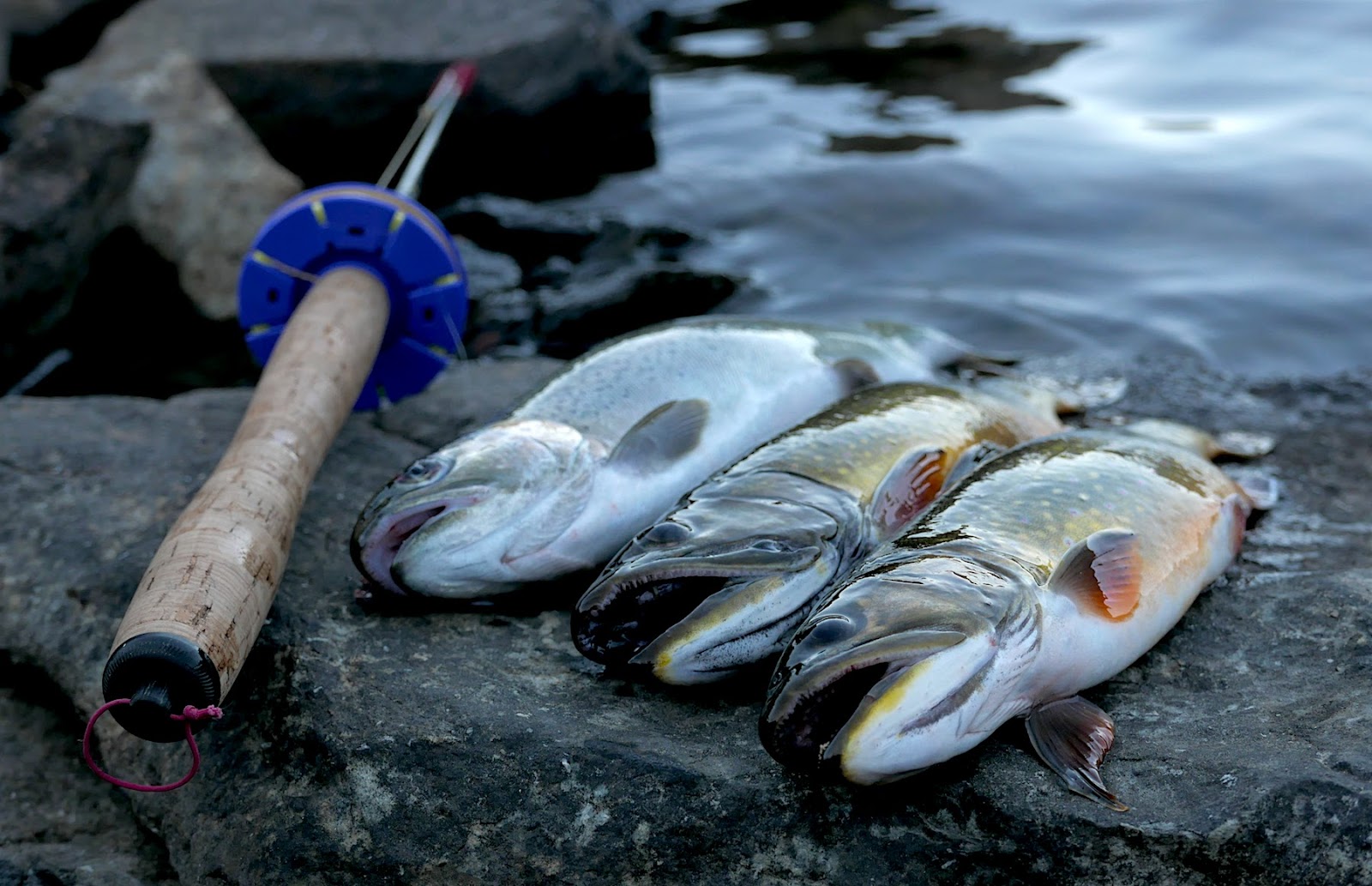
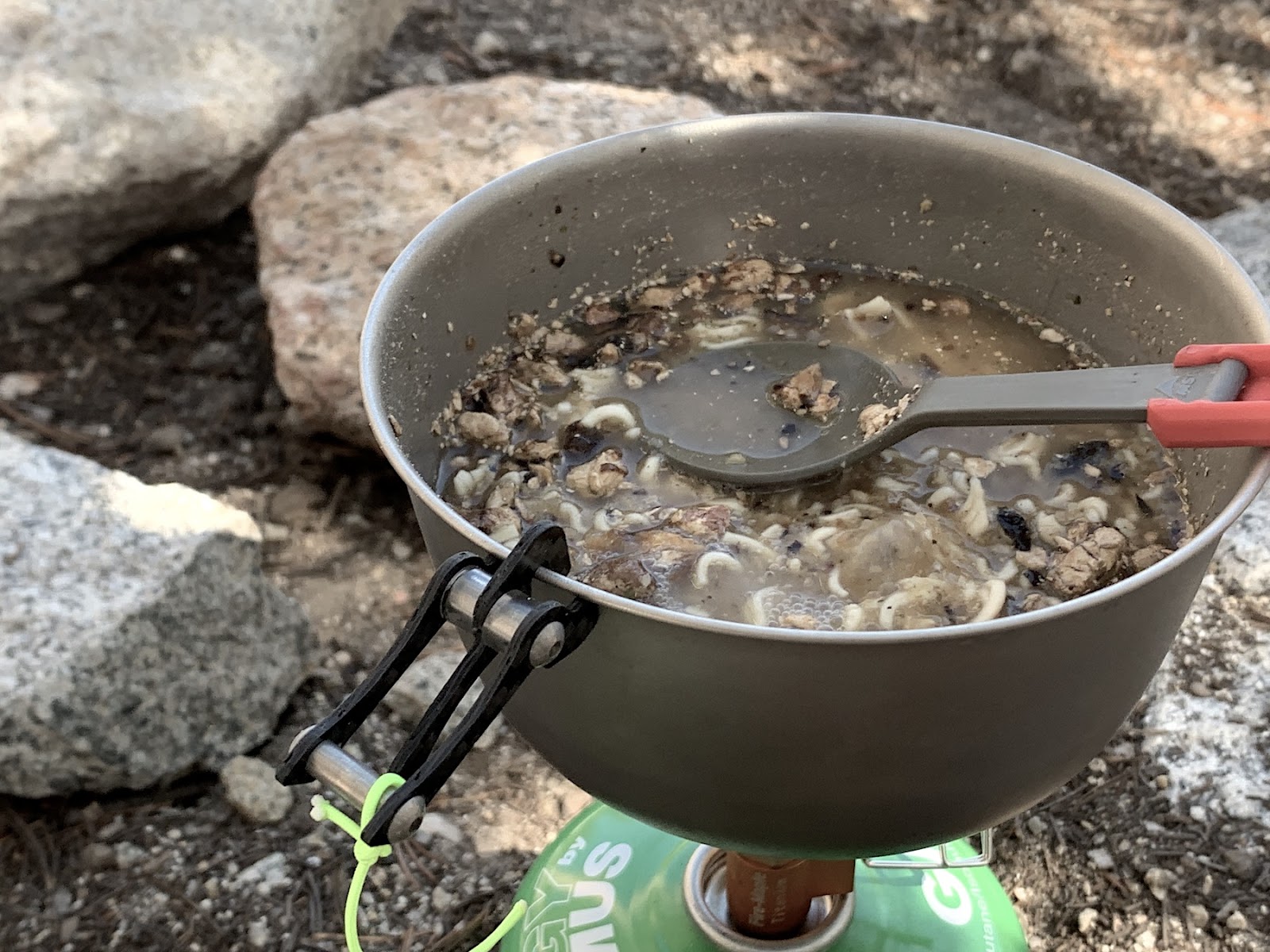
For the purpose of this discussion, I’ll focus primarily on Calories. Since I’m consuming trout for only one meal of my day, I usually try to catch a hearty portion for a meal, i.e., four 10-inch fish (444 Calories) or some combination of larger and smaller trout that provide me with 400 to 500 Calories.
To keep the math simple, let’s assume I’m targeting 480 Calories for my trout meal. That means I might leave 480 Calories out of my packaged (dry) backpacking meals, which equates to about four ounces of dry food.
How many days of eating fish for one meal a day is required to get a return (eating caught fish) on investment (weight of carried fishing gear)?
The answer to that question depends on the weight of my fishing kit. Here’s a case study from a recent 10-day summer wilderness trek in Colorado, where I ate an average of one hearty trout meal per day (480 Calories).
My fishing kit included the following:
- tenkara rod – 2.7 oz
- line, tippet, fly on a card x 2 – 0.2 oz
- 5x tippet spool – 0.2 oz
- nippers / hemostats on neck cord – 1.3 oz
- foam box with flies – 1.0 oz
- tackle pouch – 1.1 oz
Summary:
- Total weight of fishing kit = 6.6 oz = 0.41 lb
- Total dry packaged food weight left behind = 9 days x 480 Calories/day / 120 Calories/ounce = 36 oz = 2.25 lb
- Total weight of spices and carbs (e.g., dry potatoes) added back for cooking fish = 1 oz/day x 9 days = 9 oz = 0.56 lb
Total Net Weight Savings = 0.41 lb + 0.56 lb – 2.25 lb = 1.28 lb
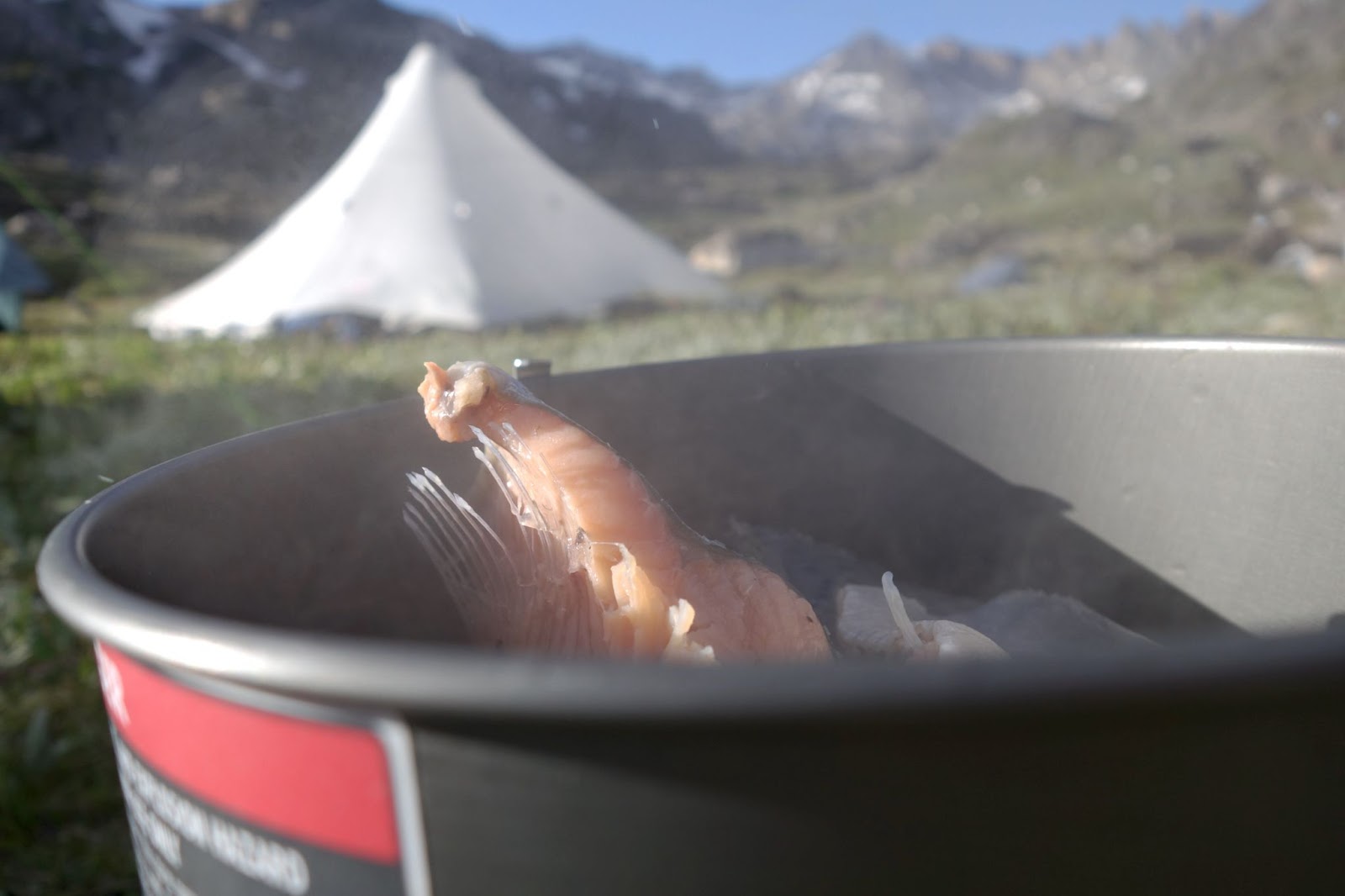
This is not a substantial amount of weight savings over the course of a 10 day trek. For sustenance alone, it would be somewhat difficult to justify. For the backcountry hiker that doesn’t find any entertainment or meditative value in fishing, the time spent fishing, dealing with gear, cleaning and cooking fish, etc., won’t be worth the savings of a pound or two.
However, it’s refreshing to discover that not only can you save pack weight by bringing a fishing kit, you can also have all of the benefits that come with fishing (as described in the introduction to this article).
Keep in mind that the analysis in this section involves a relatively lightweight kit based on a tenkara-style fishing rod. This, of course, is one of the most compelling reasons to fish tenkara in the backcountry.
The following chart illustrates a case study showing different starting pack weights for 3, 7, 14, and 21-day treks for different types of fishing kits.
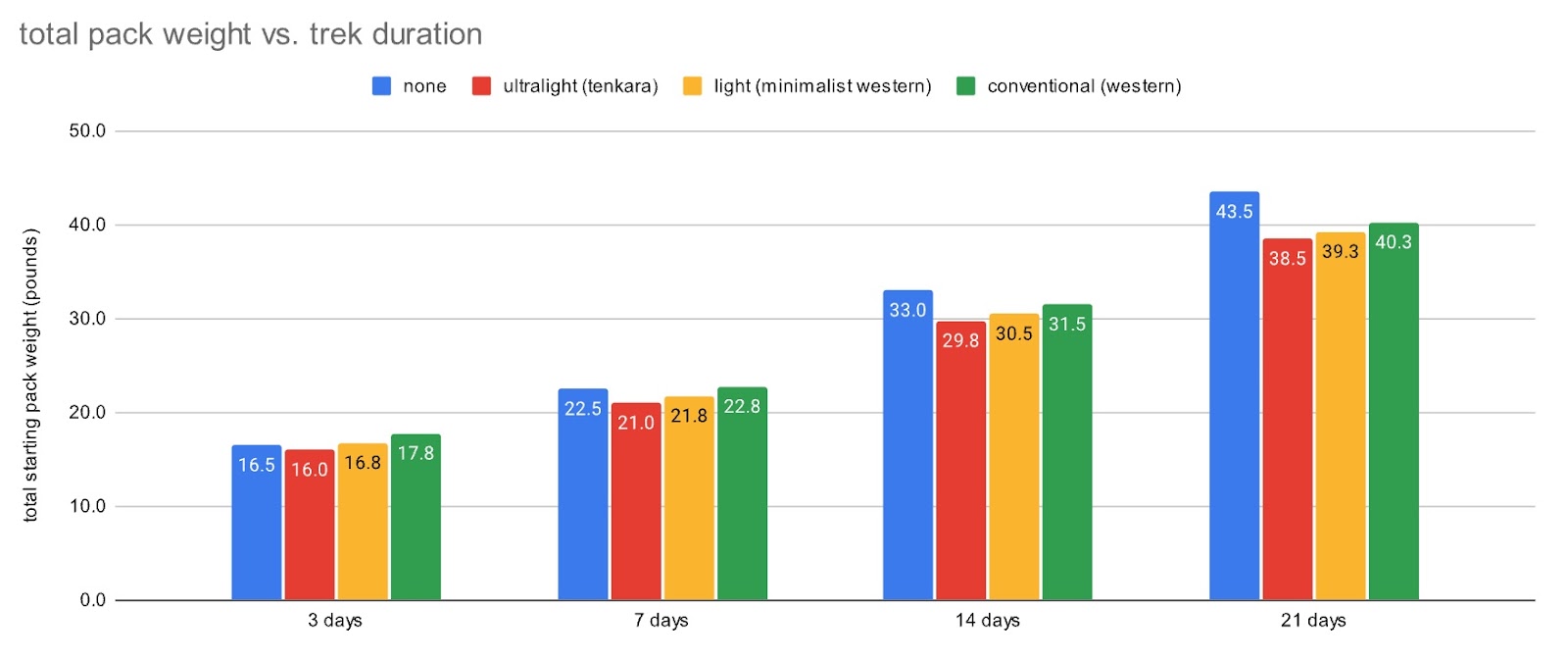 Assumptions:
- Base weight = 12 pounds.
- Fishing kit weights: none (0 pounds), ultralight (0.25 pounds), light (1.0 pounds), conventional (2.0 pounds).
- Food weight is 1.5 pounds per day for the case where no fishing kit is carried, and 1.25 pounds per day for the cases when a fishing kit is carried, based on the assumption that the angler will catch and consume approximately 480 Calories per day of fish, which would be equivalent to saving about 4 ounces per day of dry food (if average dry food caloric density is 120 Calories per ounce).
Conclusions from the chart above:
- The difference in total starting pack weight for non-fishing and fishing case studies increases as trek duration increases.
- For short trips (e.g., 3 days), only the ultralight (tenkara) fishing kit makes it worth the added weight of a fishing kit.
- For long trips (e.g., 21 days), carrying an ultralight (tenkara) fishing kit can save as much as five pounds off the total starting pack weight.
Conclusion
Fishing isn’t for everyone. In terms of a backcountry activity, fishing is similar to photography or painting or climbing a snowy couloir in that it may (or may not) be the primary focus of a backcountry expedition, but requires additional gear to enjoy the activity.
However, unlike other ancillary backcountry activities, fishing has the potential to impact your pack weight by reducing the amount of carried food weight. The purpose of this article was to illustrate that point using a quantitative analysis.
For me, I’m a passionate fishing enthusiast, and am particularly passionate about tenkara-style fishing. Using an ultralight tenkara-style fishing kit allows me to not only enjoy that activity in the backcountry, but also to maximize the amount of benefit that comes from reducing carried food weight without adding much extra gear weight.
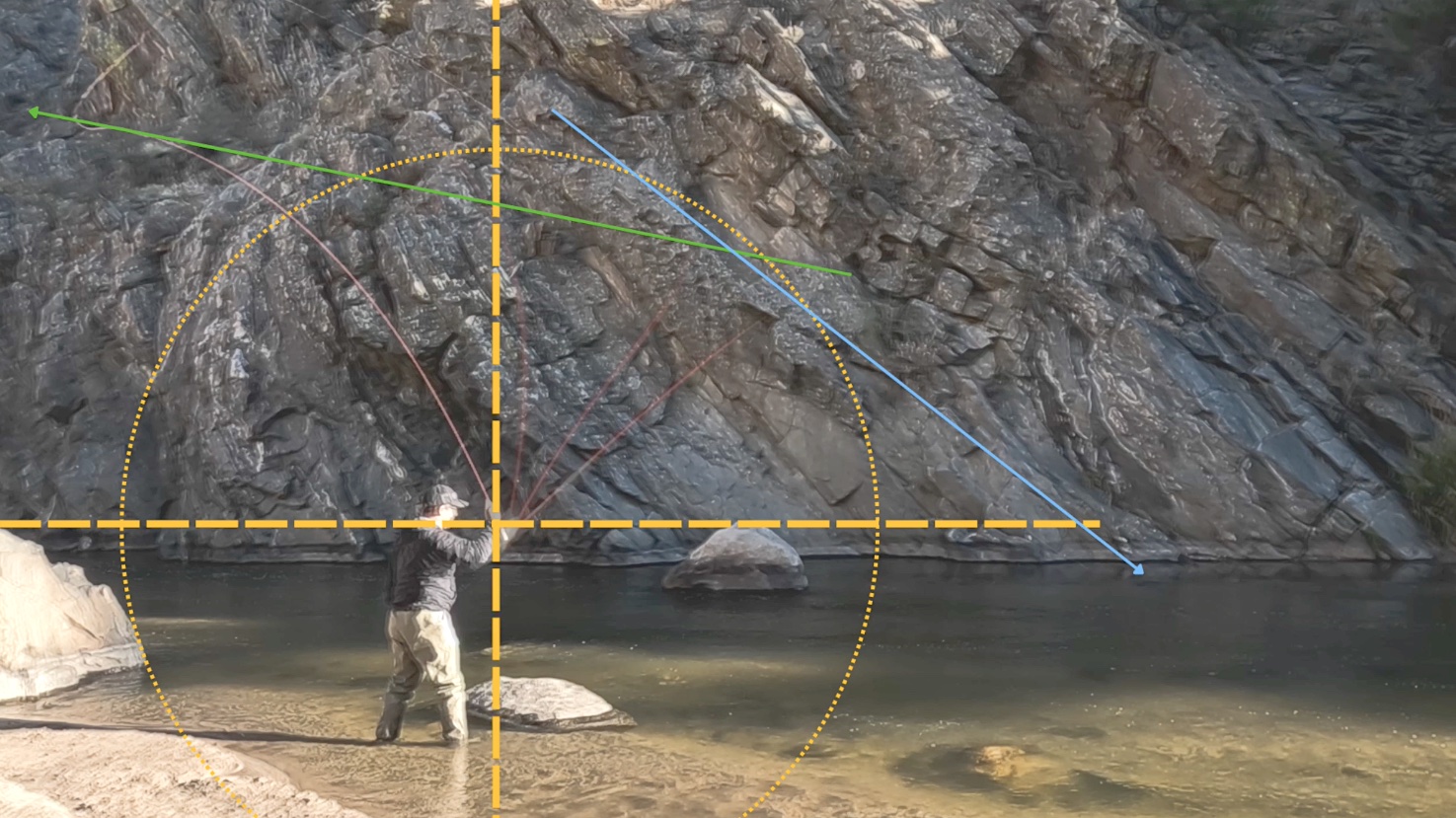
Finally, when thinking about the questions “can backcountry fishing save carried food weight?” and “can backcountry fishing provide me with a high level of enjoyment that makes it worth the weight of extra gear?” I always gravitate back toward the venn diagram above that asks:
- Can you find fish?
- Does the fish want to eat?
- Can you catch the fish?
Inherent in the answers to each of these three questions is the presumption that you have some level of skill as a backcountry angler. Gaining angling skills and experience can be difficult. Western fly fishing is intimidating, and requires an enormous amount of casting practice and study to be proficient at it. This is part of why I like tenkara fishing. It’s not only lighter, but it’s simpler and easier. In addition, the skills barriers required to become a very proficient tenkara angler come with less practice and less experience. This was a large part of my motivation to develop the new Backcountry Tenkara Masterclass. My hope is that experienced anglers see the benefits of tenkara and can transition quickly and easily, and that new anglers achieve tenkara casting and fishing skills quickly.
Recommendations
- Learn about tenkara gear, skills, and tactics in the new Backcountry Tenkara Fishing Masterclass
- Shop tenkara rods, lines, accessories, and flies at Tenkara USA
Related Content
- Article: Tenkara Fishing Rods and Gear for Backpacking
- Gear List: Tenkara Fly Fishing
- Podcast Episodes: Tenkara Fishing and the 12 Steps of Tenkara


Discussion
Become a member to post in the forums.
George, where were you fishing that they changed management philosophy? I volunteer for the state of Washington packing fish into high lakes. National Parks quit stocking fish in the seventies (with a single exception, but that is another subject). The state of California did make changes in that time frame but as far as I know (and CA is the western state I know least well) they were air planting. Idaho still uses volunteers for some plants.
Wilderness areas in WA required walking in, no air drops. I lived a short distance from the Alpine Lakes Wilderness area. This wasn’t the only place I fished, but I did fish there most often.
Well, I can assure you that they never stopped stocking high lakes an any Washington wilderness area. I’ve carried fish into many Alpine Lakes Wilderness lakes myself over the 36 years I’ve been doing it.
https://www.scientificamerican.com/article/the-trouble-with-fish-stocking/
Terran, the linked article is absolutely correct about problems with stocked fish, but, as much most such articles, it omits some research, muddies the waters (so to speak), and ignores current practices by agencies such as Washington Department of Fish and Wildlife (WDFW) which is the agency and state I know best.
As cited in the article, studies on the mountain yellow-legged frog are the most well known high lake work on the effects of fish stocking in high lakes. But there have also been studies in other states, most notably North Cascades National Park (NCNP).
In most high lakes amphibians are the top native predator. Shallow, warm lakes and ponds are the best amphibian habitat. When trout or char are introduced they become the top predator. What they found in NCNP was that when fish were either over-stocked or over-reproducing naturally they could suppress or extirpate some amphibian species with the long-toed salamander being the most sensitive species in the area. At the same time, they discovered that in lakes were fish were stocked periodically and in low densities native species were preserved. And that is exactly the philosophy that guides current stocking practices in the state of WA. For an exhaustive deep dive into WDFW’s stocking philosophies and history see “Washington Department of Fish and Wildlife’s High Lakes Fishery Management Program”.
As recently as the 1980s the NPS was saying that the best practice would be to stop fish stocking but that there would always be fishing available because in some lakes introduced fish were able to reproduce. This is backwards. When fish are able to reproduce naturally in high lakes they will, most of the time, reproduce too well and over-populate the lake. In NCNP they have gotten really good at removing these spawning populations with rotenone. At the same time, some lakes are being stocked with non-reproducing fish and effects on native vertebrate and invertebrate species are being monitored. And, of course, if you stock fish that can’t reproduce they can be removed by simply waiting. More and more we are doubly assuring fish can’t reproduce by stocking sterile triploid trout.
At this point the biggest issues in high lakes are not the lakes being stocked, but the lakes with naturally reproducing populations. It is even worse when they are a non-native species like eastern brook. These stunted populations can even change zooplankton population dynamics. In WA high lake zooplankton populations will often be dominated by large, predatory copepods (tiny red crustaceans you can see, if you look closely) but they can be grazed off by fish and the lake will become dominated by smaller grazing species. Stocking non-reproducing, fish periodically, in low densities assures these populations aren’t disrupted.
I could go on all day (I also volunteer counting amphibians in Mt Rainier national Park and I love to talk about amphibians) but this is getting long enough. Hopefully I’ve been somewhat coherent in trying to explain why articles like the one linked above can on the one hand be quite correct, and on the other make things confusing about hatchery stocking by ignoring current best practices.
Brian
Intersesting, all of the talk during probably the late 90s and into the 2000s indicated that plants in this area were being halted. And the fishing did declince to the point of having almost no fish in many lakes.
Gold lake was one I would go to every year, but eventually when I took two sons there in the early 2000s, the were no fish. Chetwoot kind of went the same way.
I normally bypassed the lakes on the way to those lakes.
Dollar lakes near index was similar.
It may have just been that there was a downturn in fish plants and/or survival for a period of years that coincided with the talk of no more plants, and I assumed that was the cause.
I lived on the Skykomish river and was rather active for a while in North of Falcon stuff pertaining to it. And worked with the biologists on salmon spawning studies. Salmon and steelhead addiction took up most of my free time, rehab is helping, but I live on another river now. I can catch nice sized Red Band trout right out front, along with a lot of plants.
This is a pretty hopeful story
“We” are figuring out how to support fishermen with stocked fish and not ruin native plant and animal populations. At least we’re becoming aware of the negative effects of stocking. This needs to spread to other states than just California and Washington.
And, that hatcheries have been used to justify dams but don’t work very well.
There was another Scientific American article about a stream in Seattle that was rehabilitated and now there are salmon in it. In the middle of the city. While we’re figuring out whether dam removal is possible, we should rehabilitate every stream not blocked by a dam. Same thing in backcountry lakes and stream.
I have caught a fish before and eaten it. If I was unable to backpack maybe I should take up fishing. That seems like a good activity.
The SA article is dated. It’s good to see there’s progress being made. I don’t take too much of a stand either way. If they’re going to drop free food from the sky, it’s my job to get it. If volunteers are packing it in, I’ll leave it there.
Many of the streams in California are seasonal. I wouldn’t count on them for food. I did find a truckload of what appeared to be tuna remnants once.
I saw a Daiwa reel ad today. It connects to your phone. $1,000.
George, I’m not sure why you didn’t see fish in those lakes, but it would have to be attributed to bad luck, or something. I’m going to hazard a guess that you got the impression that fish stocking would be stopped because of articles around that time talking about fish stocking being stopped in North Cascades National Park. I recall hearing that impression for a couple people even though the issue was specific to NCNP.
There are two Gold Lakes in the ALW, I assume you are talking about the one above Dorothy. The fish there, and in Chetwoot are naturally reproducing and there was never a population decline in either lake. Gold was last stocked in 1969 and the cutthroat reproducing there were stocked in 1954. Chetwoot was last stocked in 1984. Both lakes are still full of small fish.
The Dollar Lakes are much more difficult to reach these days with roads gated way down at the bottom of the valley. Although they are now in the Wild Sky Wilderness that wasn’t designated until 2008 and at least ’til the early 90s the upper lake had an obvious helicopter camp. Both lakes have some very limited naturally reproducing fish and are supplemented with stocking so there would have definitely been fish there when you visited, even if they were hard to catch. I should note that between 1973 and 1986 the Dollar Lakes were not stocked. Starting in 1986 they began to be stocked regularly.
Jerry, the state if Idaho is doing a lot of very creative work trying to figure out ways to control stunted populations. I’m assuming that other western states are also using the same philosophies.
You should take up backpacking and fishing. High lake fishing is the best fishing! I mean, catching one is just a bonus to being able to fish in the midst of gorgeous scenery.
My last trip to Dollar lakes and that area was in the early 80s, I don’t recall seeing a helicopter camp, there wasn’t really even a trail.
There were a couple of high snowfall winters and vey late ice outs that may have reduced the number of fish in Gold and Chetwoot when I last visited them. I had to wait until the end of August to take my two sons to Gold lake. Oldest son just turned 40 this month, he was about 10 at the time. That trip was a long time ago.
This discussion has me thinking of going back to visit those lakes again, but they may be crowded locations now.
Jerry
I typed a long response to the salmon spawning situation, but it dissappeared, thought I hit submit, but poof, it’s gone.
That subject is extremely difficult, there are so many parties involved with different priorities and objectives that very little gets done.
George, none of those lakes are all that crowded, even today. Gold and Chetwoot see a fair number of people but not huge numbers. The Dollars are probably visited less now than they were when you were there.
Back to the subject of eating fish you catch in the backcountry. I normally just catch and release everywhere, the fish are typically small and its a hassle. And the absolute worst fish I’ve eaten in the backcountry were from Dollar Lakes. The red fleshed fish were good, but a significant number had white flesh that was terrible. Sometimes theres a difference in flavor between the two and sometimes not, but the white ones from these lakes were horrible.
I don’t keep fish anywhere though, except for lings and halibut when I’m in Alaska. The salmon and steelhead I catch are either given to the people I’m with or released.
I catch a lot of trout and walleye from the bank where I live, but I dont keep any of them. I have my drift boat on the bank year round, but rarely use it, it’s too easy to catch them without it. And my jet boat hasn’t been in the water since I moved from the Skykomish river 8 years ago.
Red flesh vs white flesh is always an interesting topic. The color is based on diet. I can’t speak to fish from the Dollar Lakes as we didn’t keep any when we were there a few years ago. But in general most people say they prefer red fleshed fish. But, on several occasions we’ve done very unscientific blind taste tests of fish caught from the same lake and almost every time, when tasted blind, the white flesh ended up winning. All of this is based on the fish’s diet so will vary greatly based on both time and location. In high lakes red flesh generally indicates a diet with either fresh water shrimp or copepods.
Edit to add that the most likely time that high lake fish are mushy and don’t taste good is when they are in spawning shape.
Make fish soup. The seasoning……. it’s all about the Seasoning;)
FWIW Discovered today that Cabela’s offers a 2 year no questions asked warranty on the the Bass pros telecopying rod, in Canada $10, in US probably pocket change. I stomped my rod tip last week in an early onset seniors moment, so that’s a good deal.
It’s prime fishing time in Ontario as the bass fatten up for the winter. I just got back from a few days fishing Ontario park backcountry.
Here’s how the Cabela’s rod and Shimano reel pack up. The telescoping rod is handy for following deer trails and the collapsing handle snugs the reel into the pack’s side pocket. I’ve been very happy with this set up. It can handle large fish without stress and the reel is very smooth.
The fish were biting the first 2 days in advance of a storm front, producing 29 largemouth in the 2 pound range, and 4 in the 3 to 4 pound range:
I managed to land a largemouth ~ 6lbs but the wise old brute spit the hook and jumped back in before I could grab my camera.
And for you ultralighters, there were pike (of a sort):
So, how did you cook them?
Wow David, I think you may have caught more sizeable Largemouth on a single trip than I have landed in my life. Well done!
Thanks Andrew! I was in the right place at the right time. Some might consider my lure carry heavy (4.9oz), but I try to make sure I have something for multiple options of depth, retrieve speed, horizontal vs vertical, and open vs heavy cover. It pays off. I caught something on everything as the conditions changed. This time of the year on Ontario lakes while backpacking, this is what I consider the lightest necessary lure carry: 2 spinner bait, 4 spinners, 1 pitching jig (for heavy cover), 6 tubes, 1 grub, 2 worms, 1 stick bait, 2 Texas rig hooks, 2 Texas rig slip sinkers, one splitshot, 5 swivels, extra fluoro line leader, small freezer bag as tackle box.
Jon, what do you suggest for non stick options? ;) Catch and release only while backpacking. There are many nuisance rodents and bears in these parts and I don’t want to attract them with fish smells. I wash my hands with soap when done at the last lake of the day (200′ from water etc.), and leave my rod outside my tent in the open at night with the risk some creature will eat at the handles. Its another reason I use a cheap rod on trail.
Become a member to post in the forums.